Beginning an Improvement
               Journey II
                     Improvement Models


UIHC Lean Training
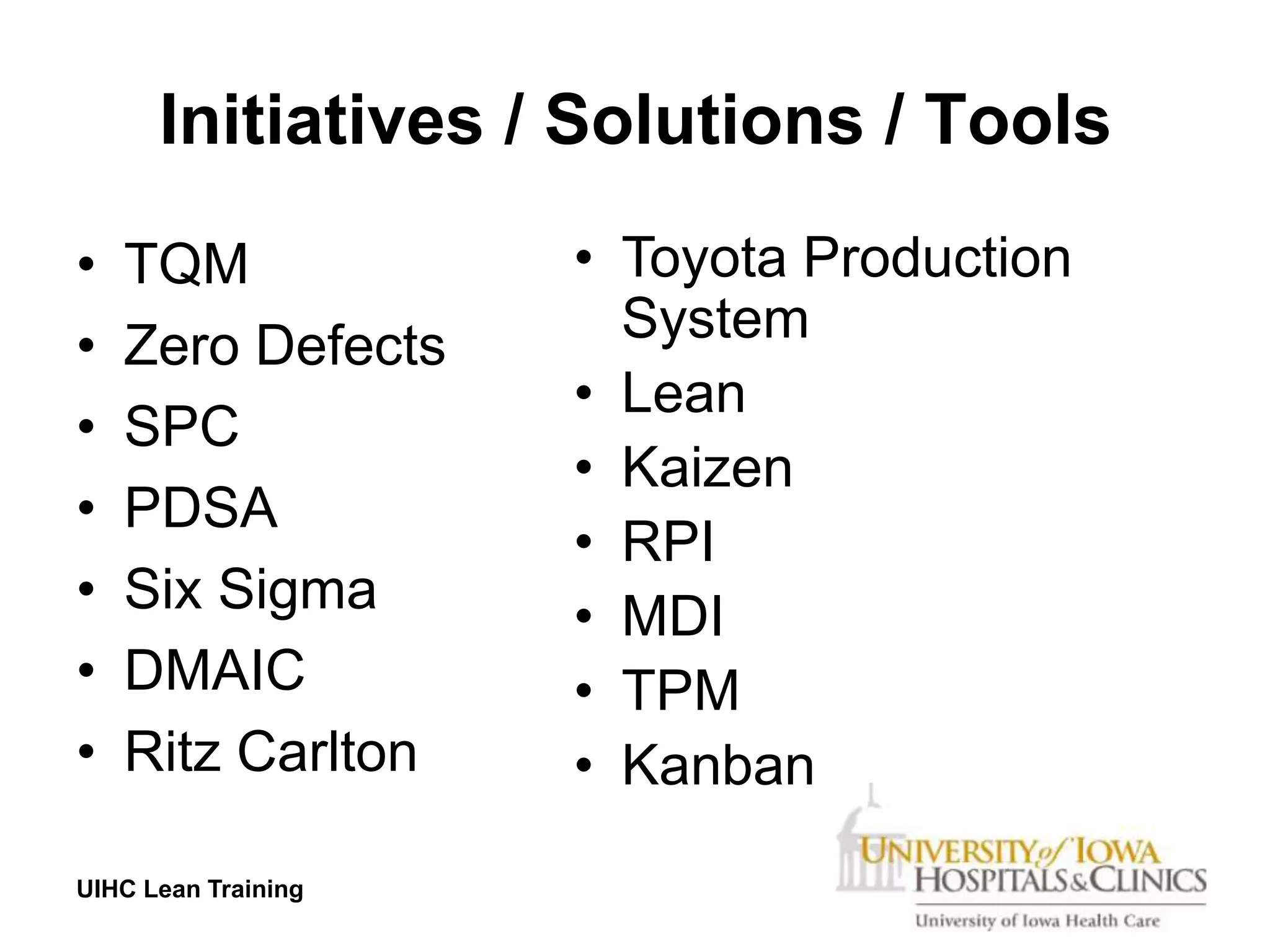
Initiatives / Solutions / Tools
•   TQM              • Toyota Production
•   Zero Defects       System
                     • Lean
•   SPC
                     • Kaizen
•   PDSA
                     • RPI
•   Six Sigma        • MDI
•   DMAIC            • TPM
•   Ritz Carlton     • Kanban
UIHC Lean Training
What improvement model
              should I use?
• It depends on
     – What improvement you’re trying to achieve
     – Your organization’s improvement maturity
       level
     – The degree of resource commitment


UIHC Lean Training
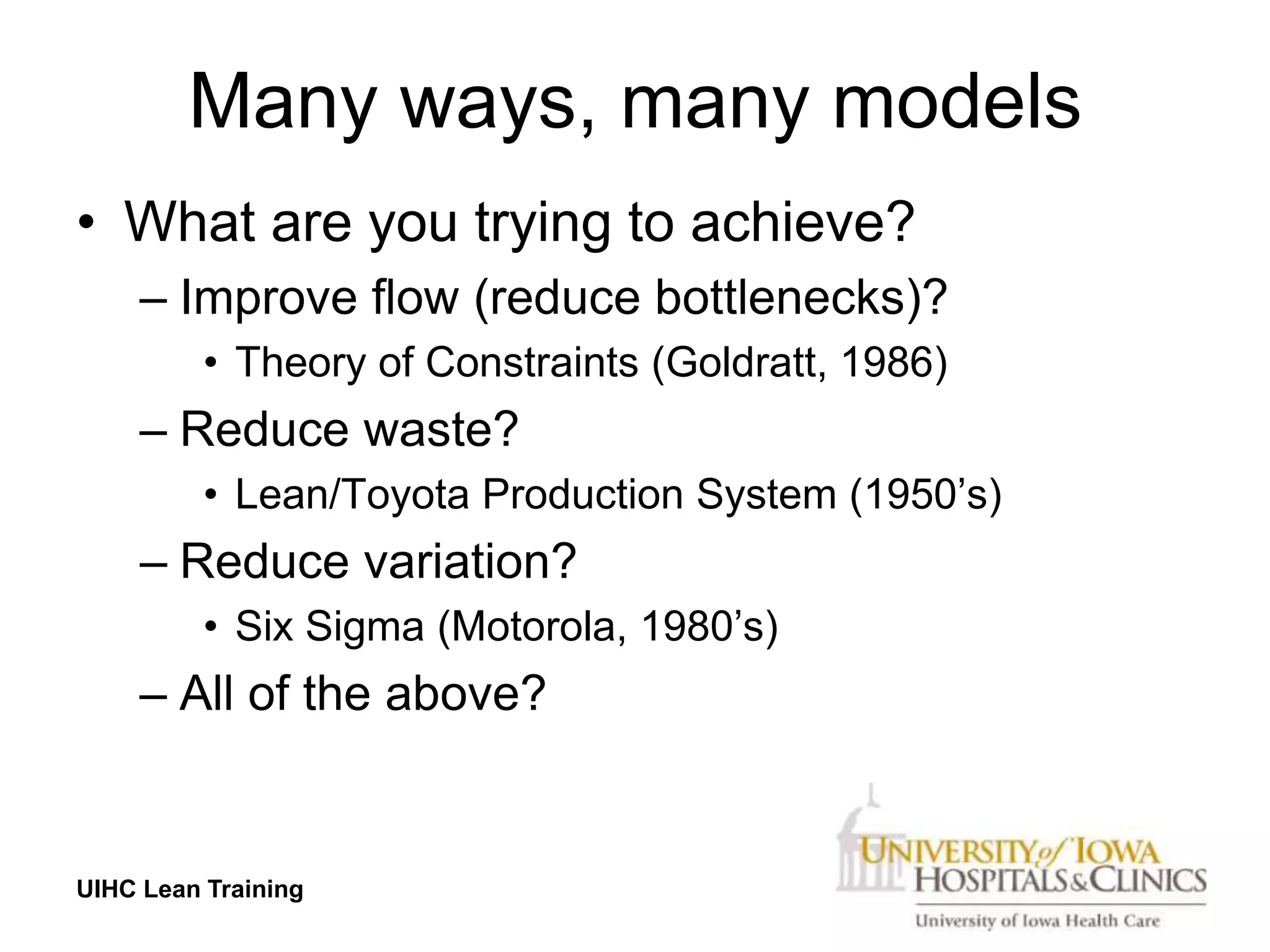
Many ways, many models
• What are you trying to achieve?
     – Improve flow (reduce bottlenecks)?
          • Theory of Constraints (Goldratt, 1986)
     – Reduce waste?
          • Lean/Toyota Production System (1950’s)
     – Reduce variation?
          • Six Sigma (Motorola, 1980’s)
     – All of the above?


UIHC Lean Training
Lean and Six Sigma
• We use Lean to eliminate the things that
  are not value-added.
• We use Six Sigma to improve the things
  that are value-added by reducing variation
  in the process.
     – We do not want to spend our time improving
       something that, ultimately isn’t worth doing!
• Lean and six sigma share many tools


UIHC Lean Training
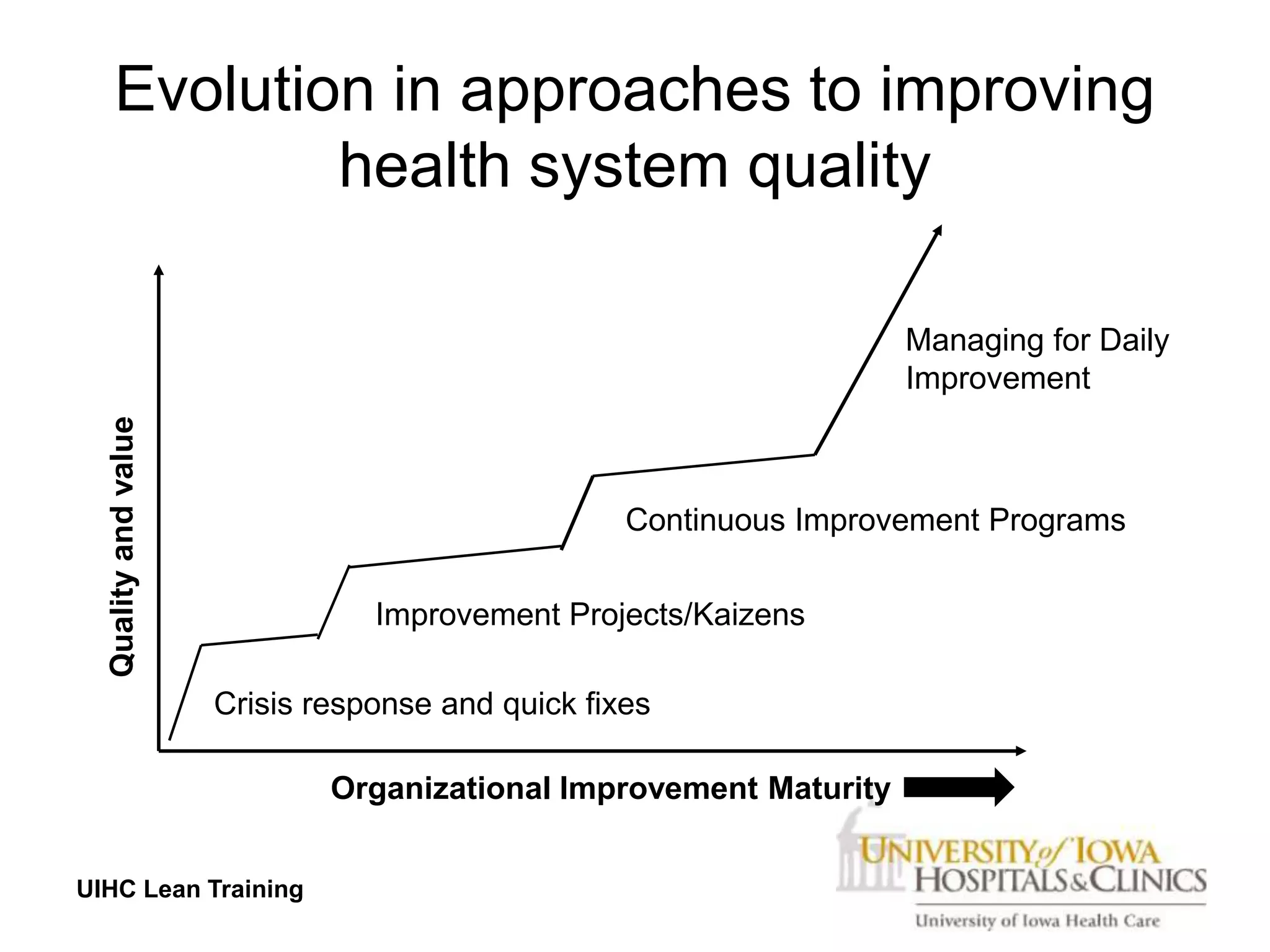
Evolution in approaches to improving
            health system quality

                                                                    Managing for Daily
                                                                    Improvement
  Quality and value


                                                   Continuous Improvement Programs

                                 Improvement Projects/Kaizens

                      Crisis response and quick fixes

                              Organizational Improvement Maturity


UIHC Lean Training
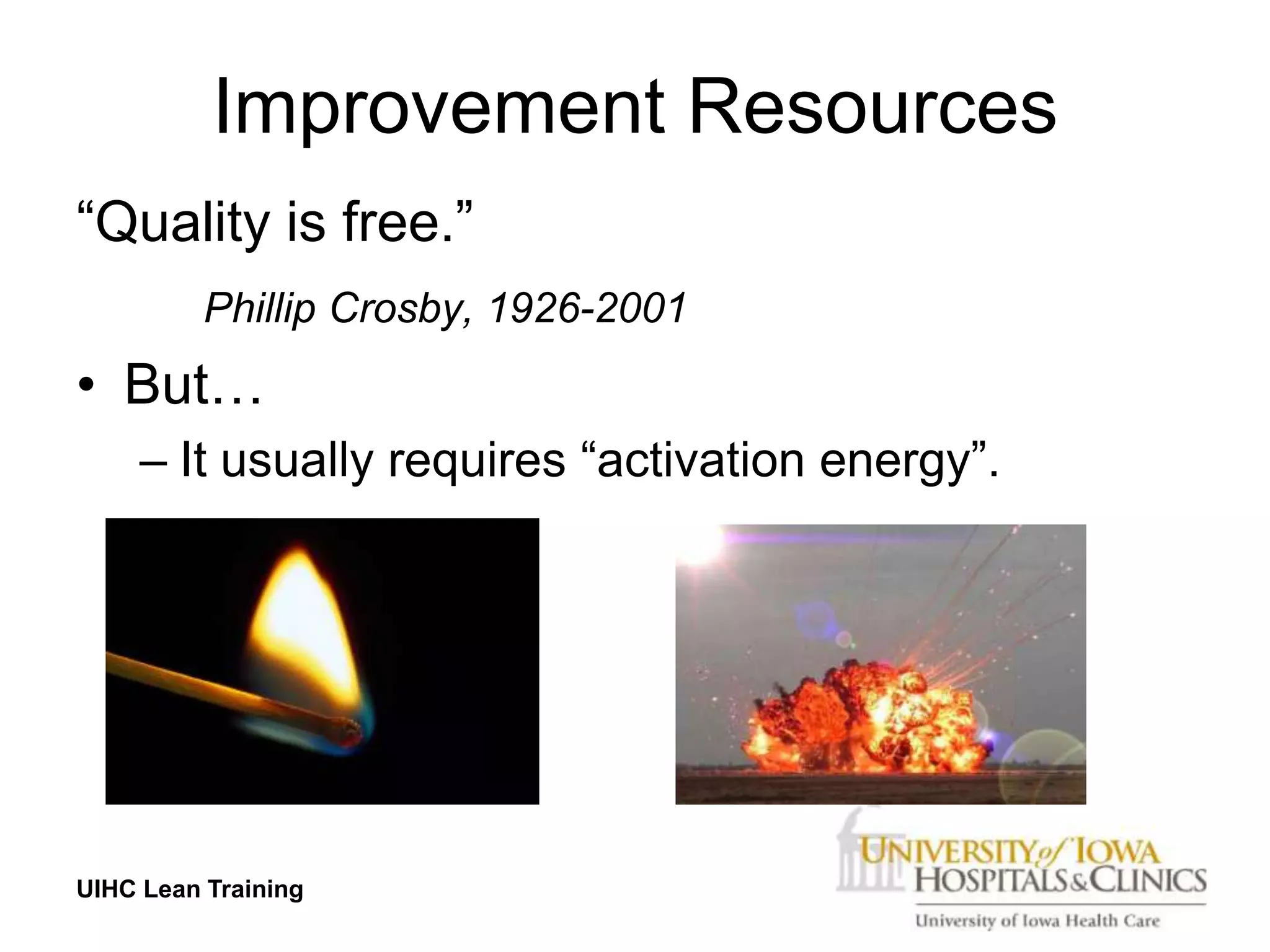
Improvement Resources
“Quality is free.”
          Phillip Crosby, 1926-2001
• But…
     – It usually requires “activation energy”.


UIHC Lean Training
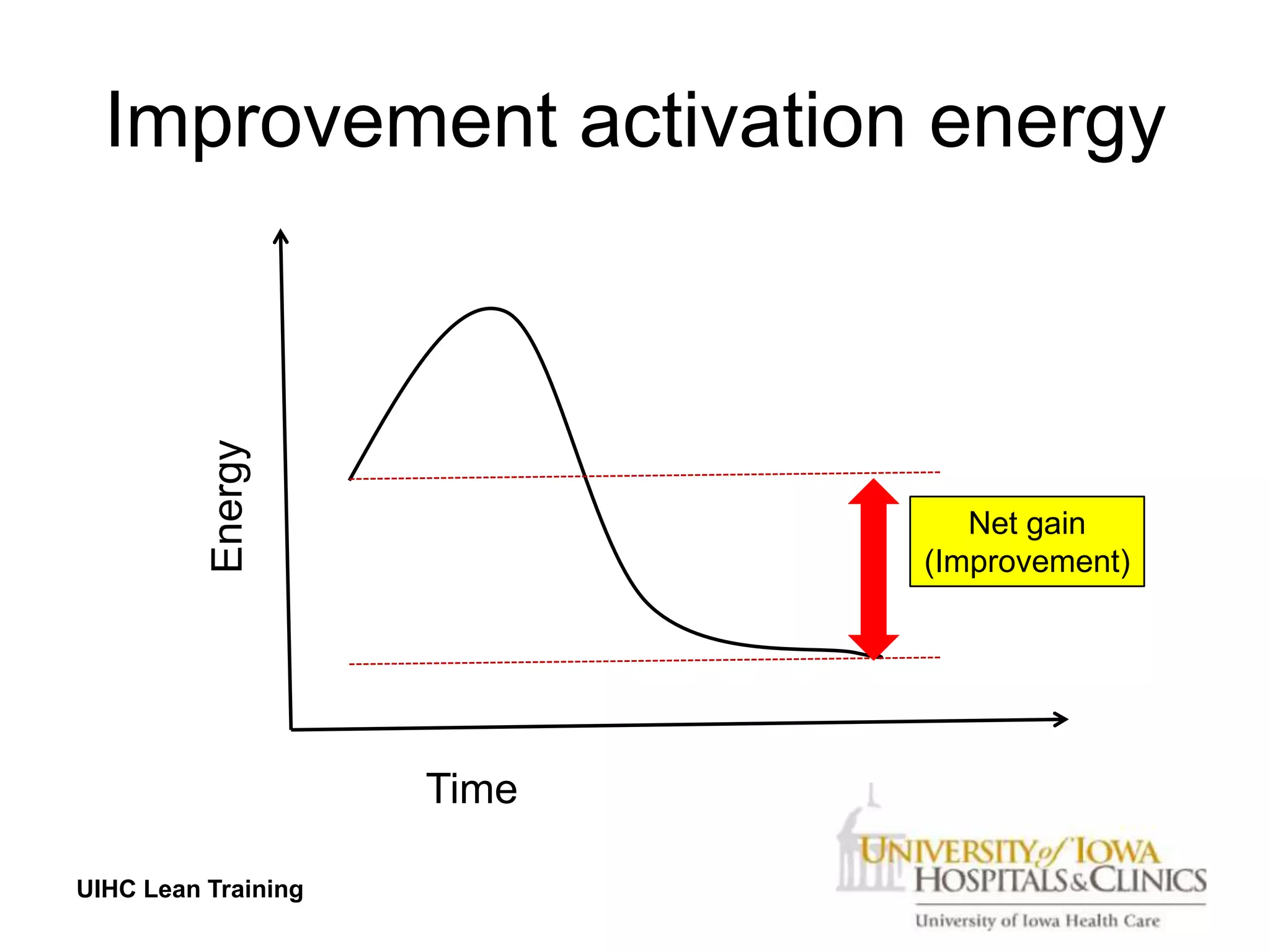
Improvement activation energy
          Energy


                               Net gain
                            (Improvement)


                     Time

UIHC Lean Training
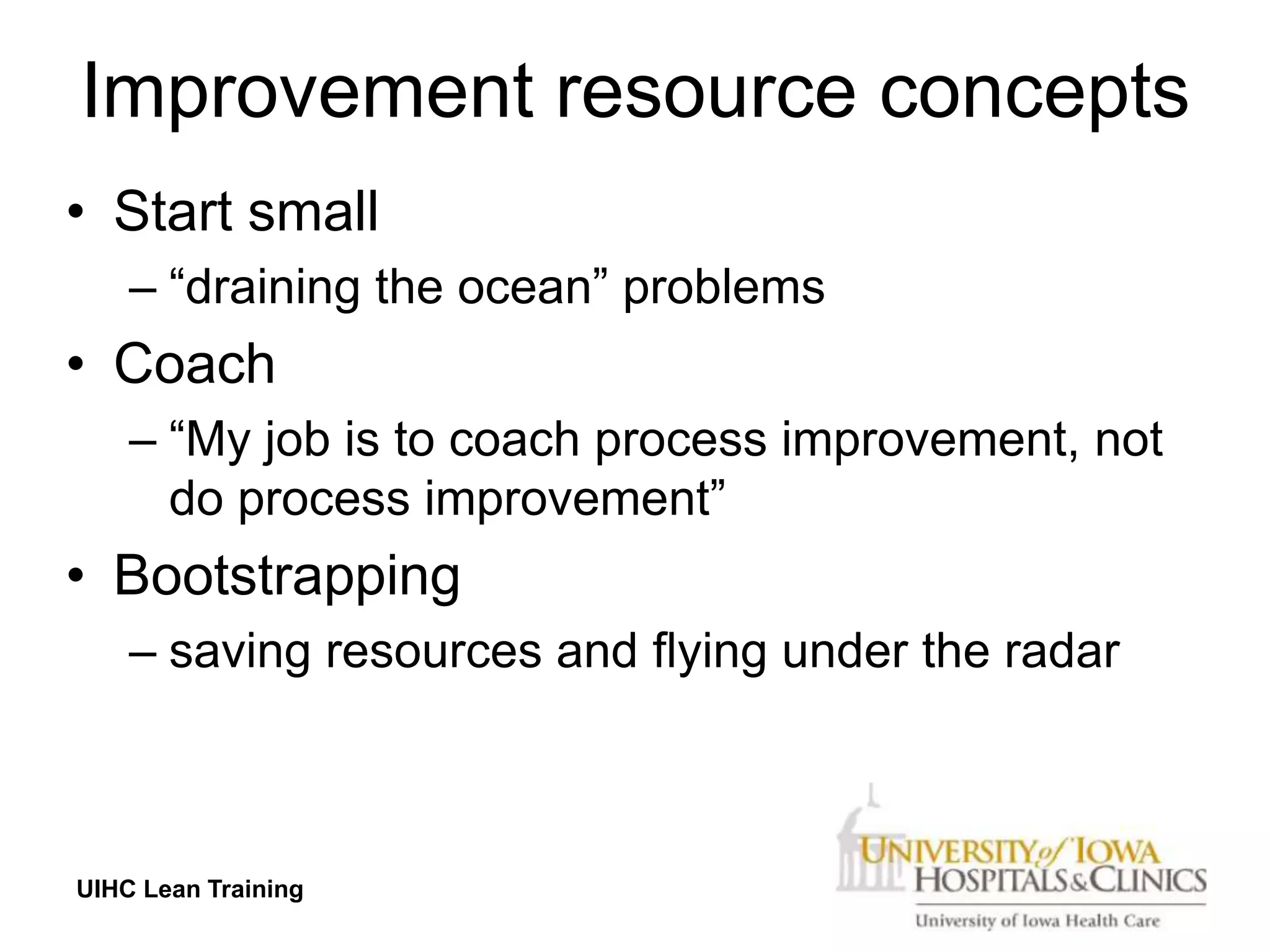
Improvement resource concepts
• Start small
    – “draining the ocean” problems
• Coach
    – “My job is to coach process improvement, not
      do process improvement”
• Bootstrapping
    – saving resources and flying under the radar


UIHC Lean Training
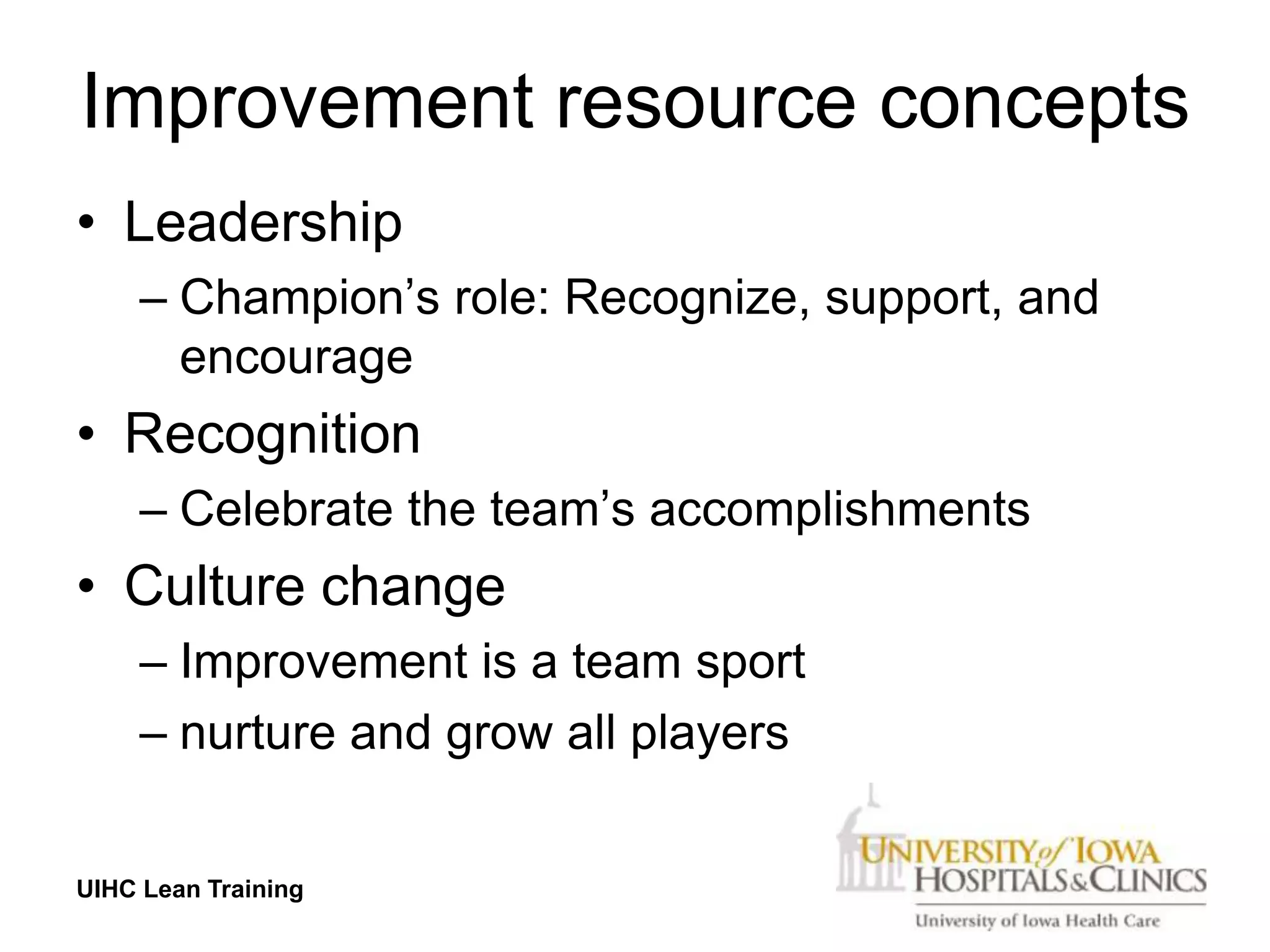
Improvement resource concepts
• Leadership
     – Champion’s role: Recognize, support, and
       encourage
• Recognition
     – Celebrate the team’s accomplishments
• Culture change
     – Improvement is a team sport
     – nurture and grow all players


UIHC Lean Training
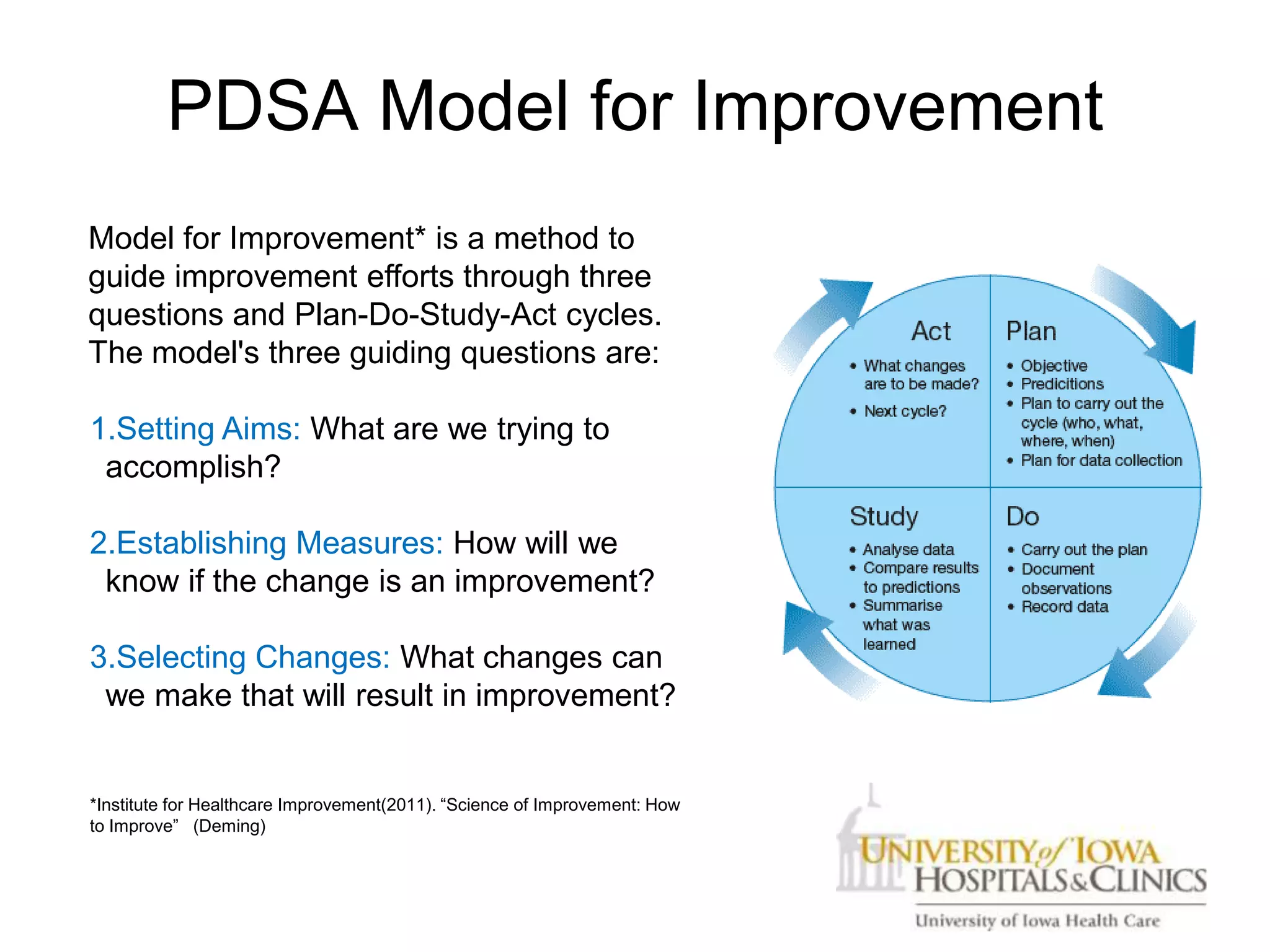
PDSA Model for Improvement
Model for Improvement* is a method to
guide improvement efforts through three
questions and Plan-Do-Study-Act cycles.
The model's three guiding questions are:

1.Setting Aims: What are we trying to
 accomplish?

2.Establishing Measures: How will we
 know if the change is an improvement?

3.Selecting Changes: What changes can
 we make that will result in improvement?


*Institute for Healthcare Improvement(2011). “Science of Improvement: How
to Improve” (Deming)
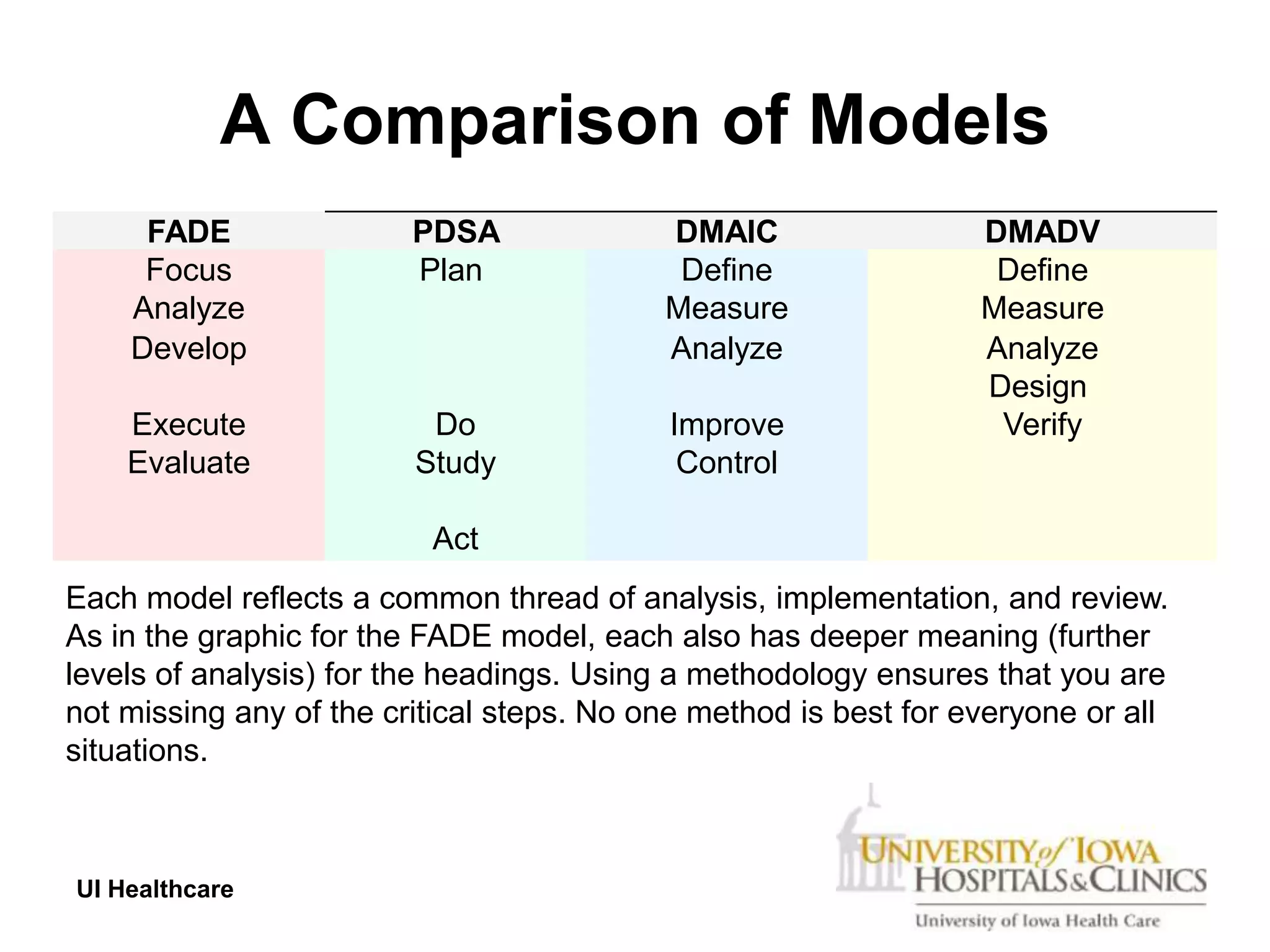
A Comparison of Models
     FADE                PDSA              DMAIC                  DMADV
     Focus               Plan               Define                 Define
    Analyze                                Measure                Measure
    Develop                                Analyze                Analyze
                                                                  Design
    Execute               Do               Improve                 Verify
    Evaluate             Study              Control

                          Act
Each model reflects a common thread of analysis, implementation, and review.
As in the graphic for the FADE model, each also has deeper meaning (further
levels of analysis) for the headings. Using a methodology ensures that you are
not missing any of the critical steps. No one method is best for everyone or all
situations.


UI Healthcare
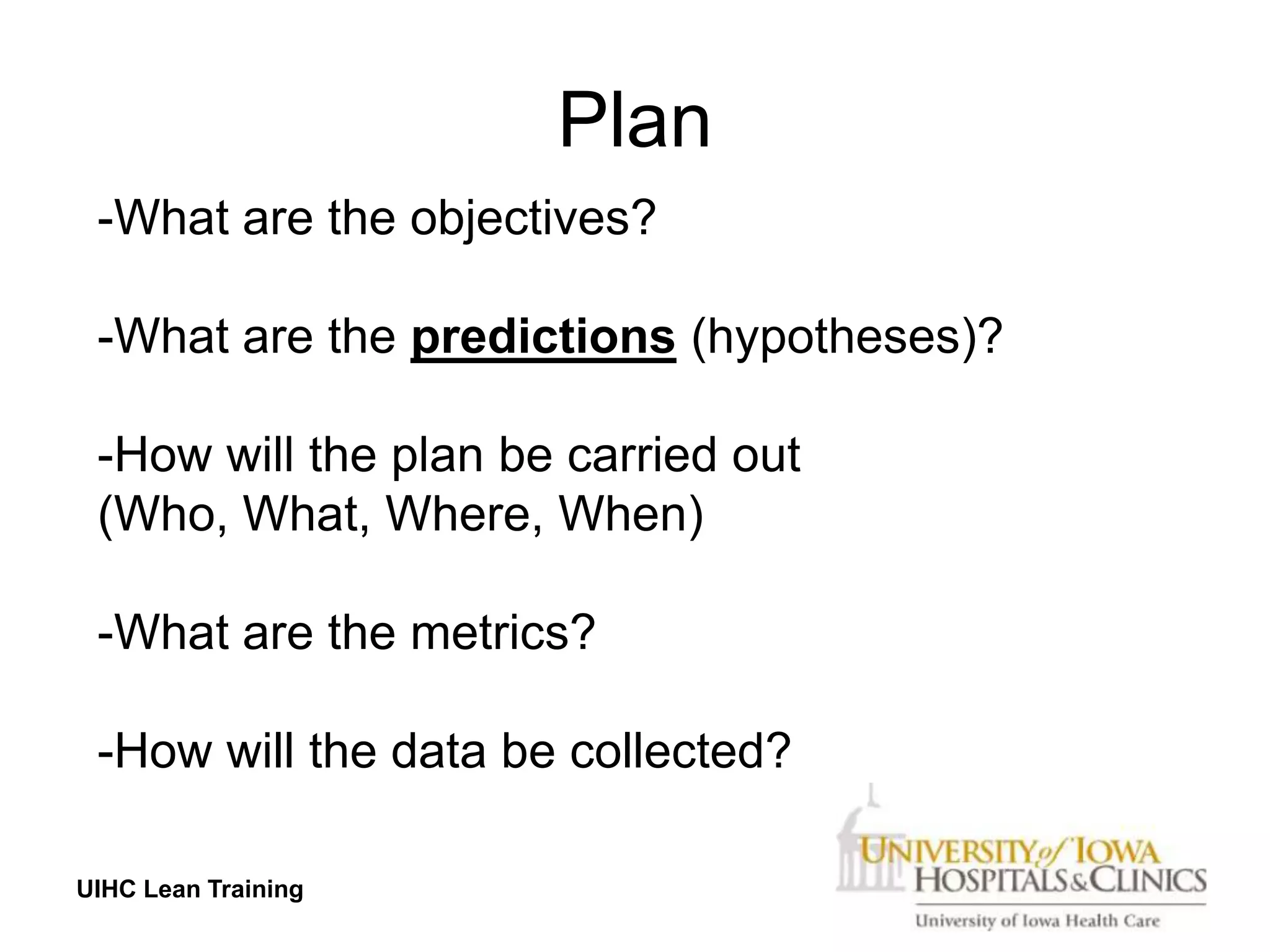
Plan
 -What are the objectives?

 -What are the predictions (hypotheses)?

 -How will the plan be carried out
 (Who, What, Where, When)

 -What are the metrics?

 -How will the data be collected?

UIHC Lean Training
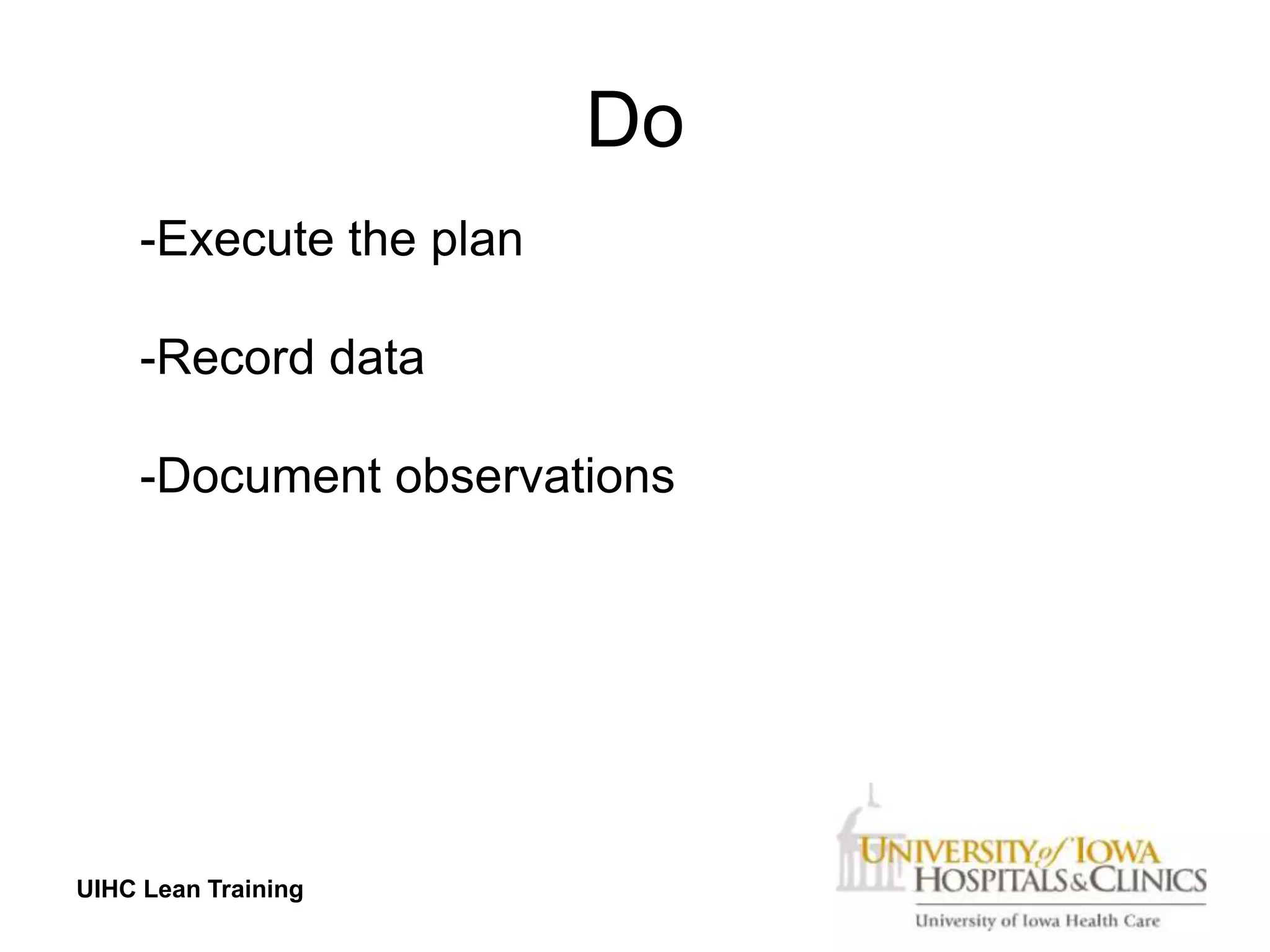
Do
     -Execute the plan

     -Record data

     -Document observations


UIHC Lean Training
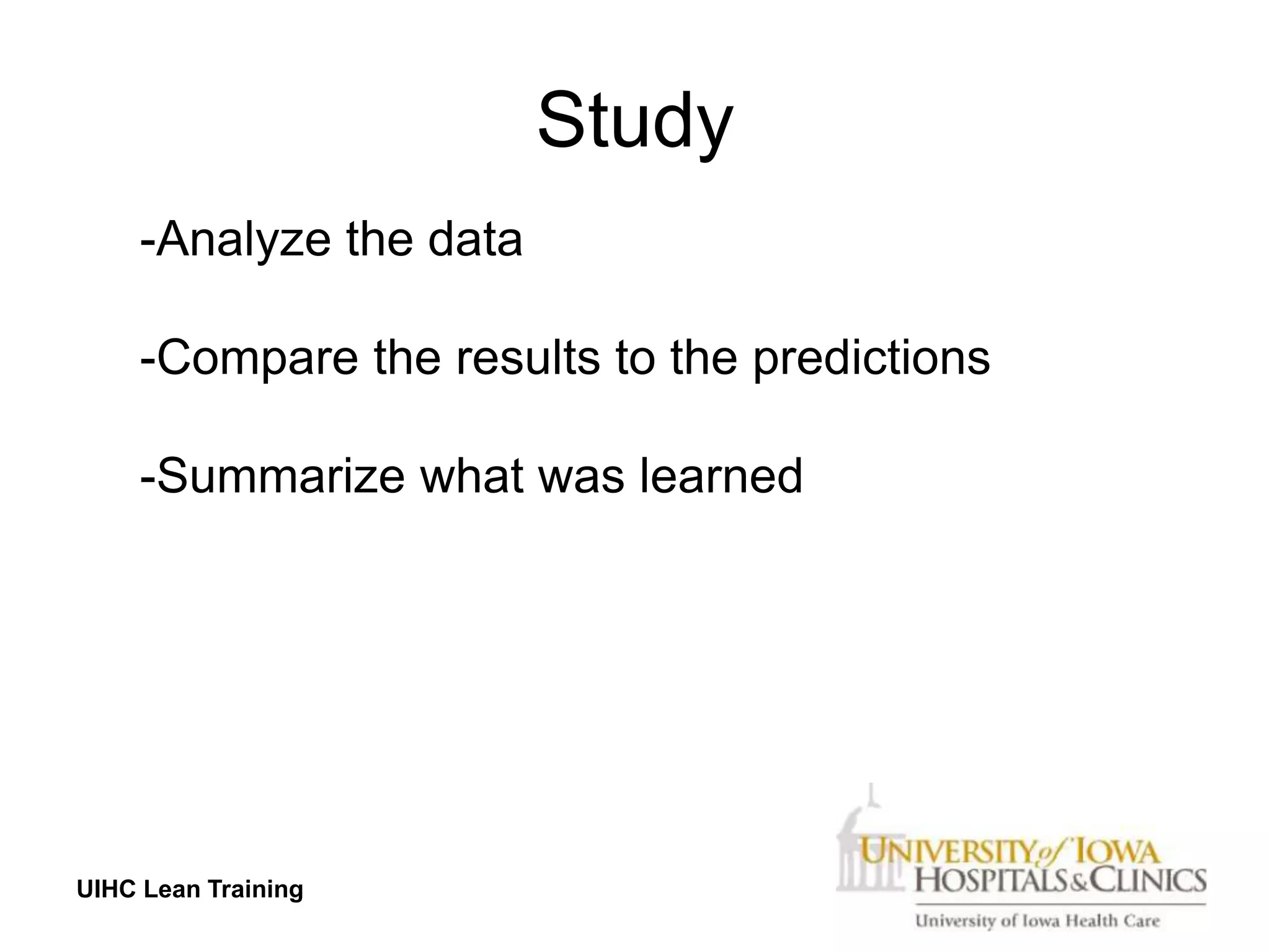
Study
     -Analyze the data

     -Compare the results to the predictions

     -Summarize what was learned


UIHC Lean Training
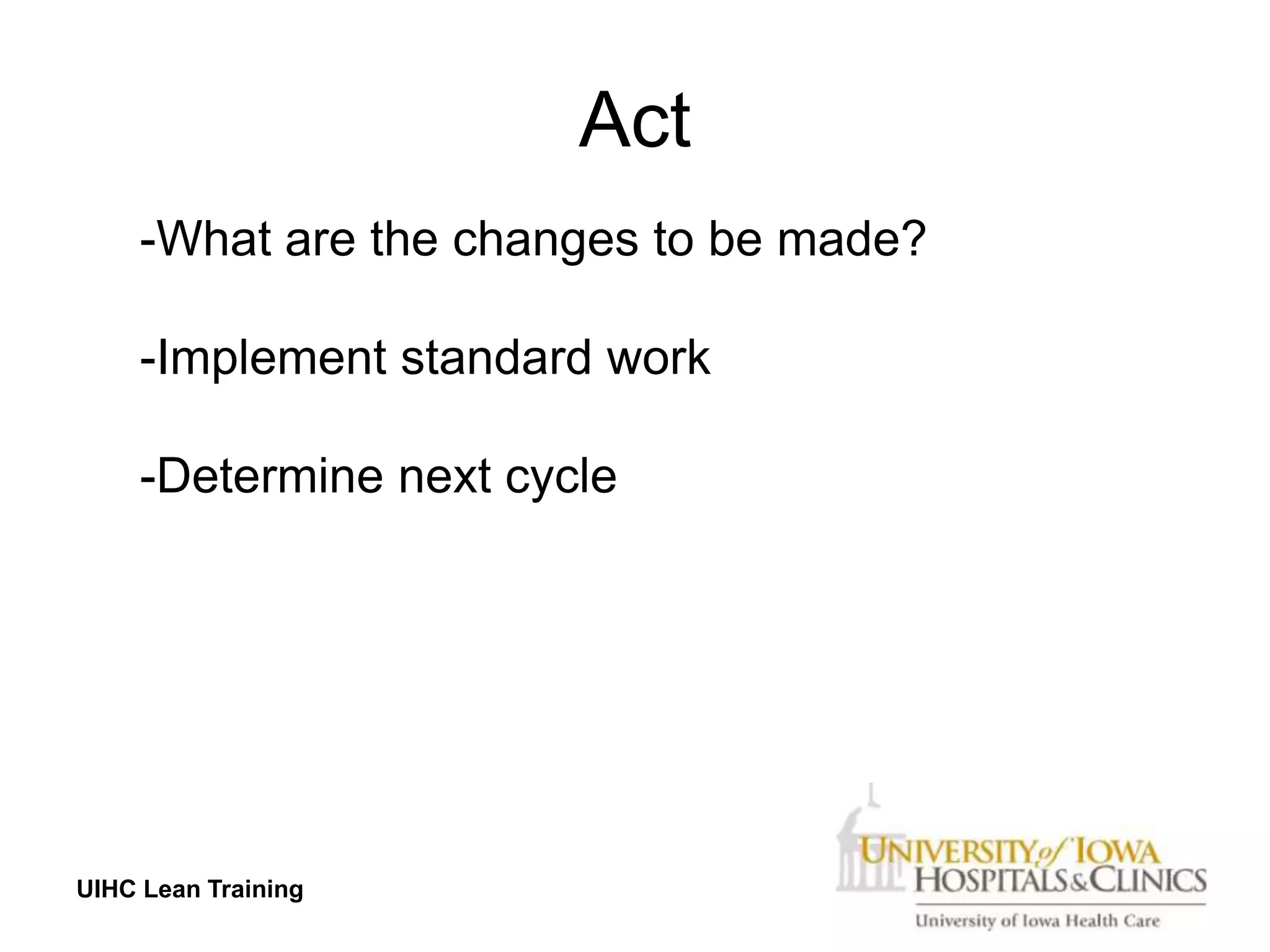
Act
     -What are the changes to be made?

     -Implement standard work

     -Determine next cycle


UIHC Lean Training
Do-It
•   Simple scope/Single task
•   Very short duration (1-2 hours)
•   1-3 people
•   Immediate impact
•   No decisions or management intervention
    required


UIHC Lean Training
Burst Event
•   Minimal scope/Single issue
•   Short duration (2-8 hours)
•   4-6 people
•   Quick impact
•   Intended for relatively simple tasks


UIHC Lean Training
Kaizen Events

• Kai = Change

• Zen = Good (For the Better)

• Kaizen events are used to make a fundamental
  process shift


UIHC Lean Training
Kaizen Event

•   Scope significant - often cross-functional
•   1-5 days
•   6-12 people or more
•   Quick impact
     – 80% of improvements implemented during event
     – 20% of improvements implemented within 30 days


UIHC Lean Training
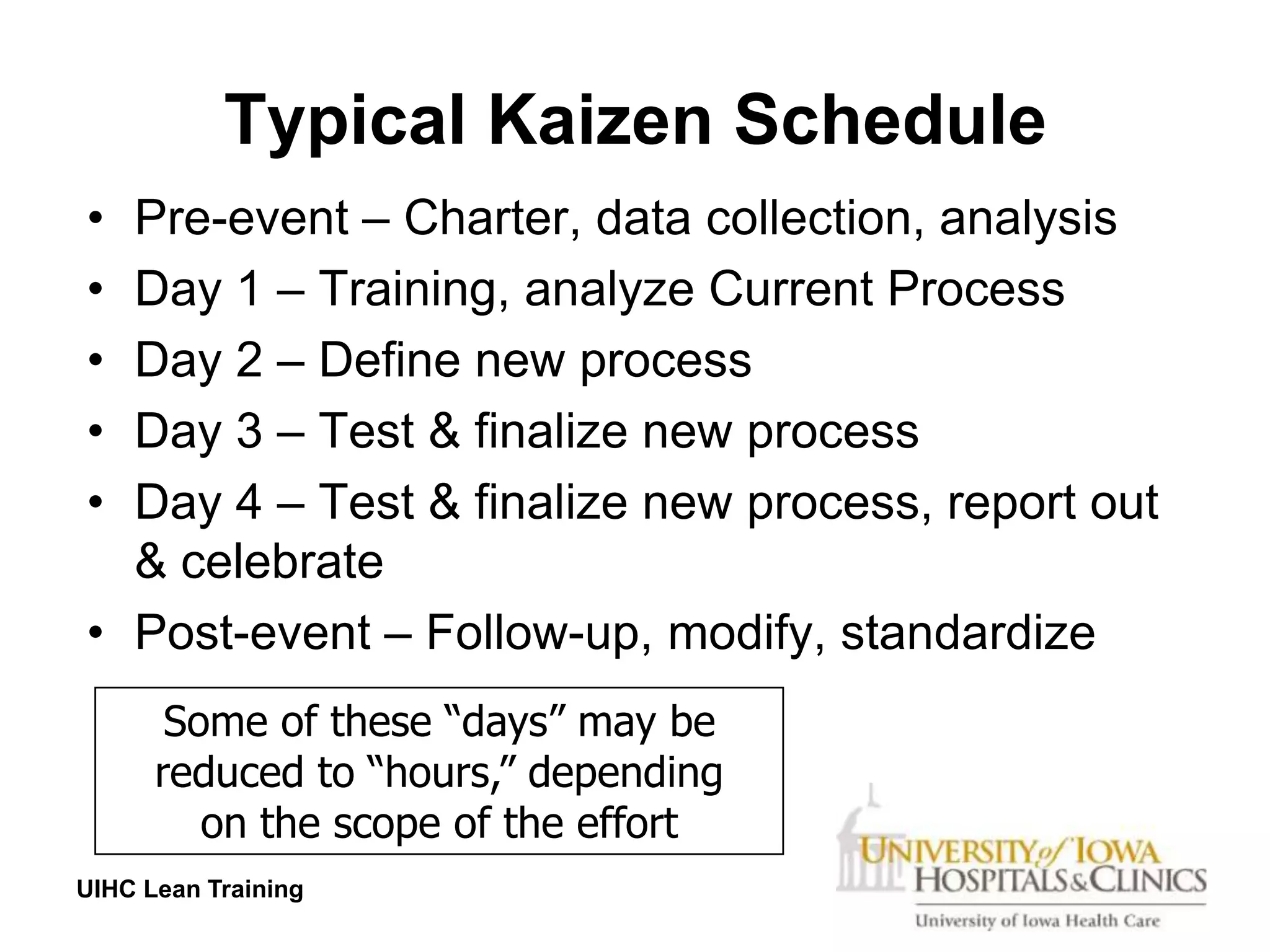
Typical Kaizen Schedule
• Pre-event – Charter, data collection, analysis
• Day 1 – Training, analyze Current Process
• Day 2 – Define new process
• Day 3 – Test & finalize new process
• Day 4 – Test & finalize new process, report out
  & celebrate
• Post-event – Follow-up, modify, standardize
       Some of these “days” may be
      reduced to “hours,” depending
         on the scope of the effort
UIHC Lean Training
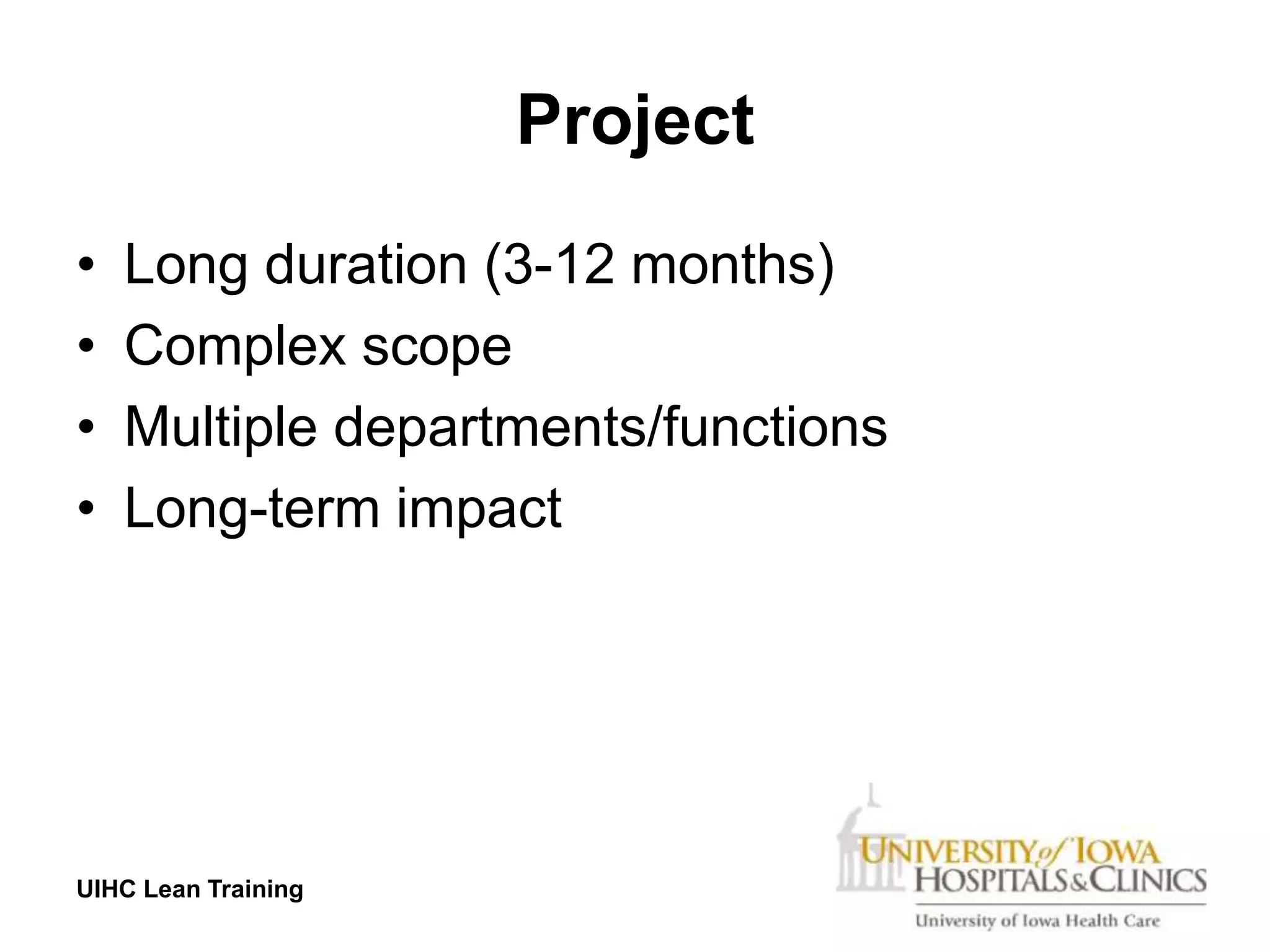
Project
•   Long duration (3-12 months)
•   Complex scope
•   Multiple departments/functions
•   Long-term impact


UIHC Lean Training
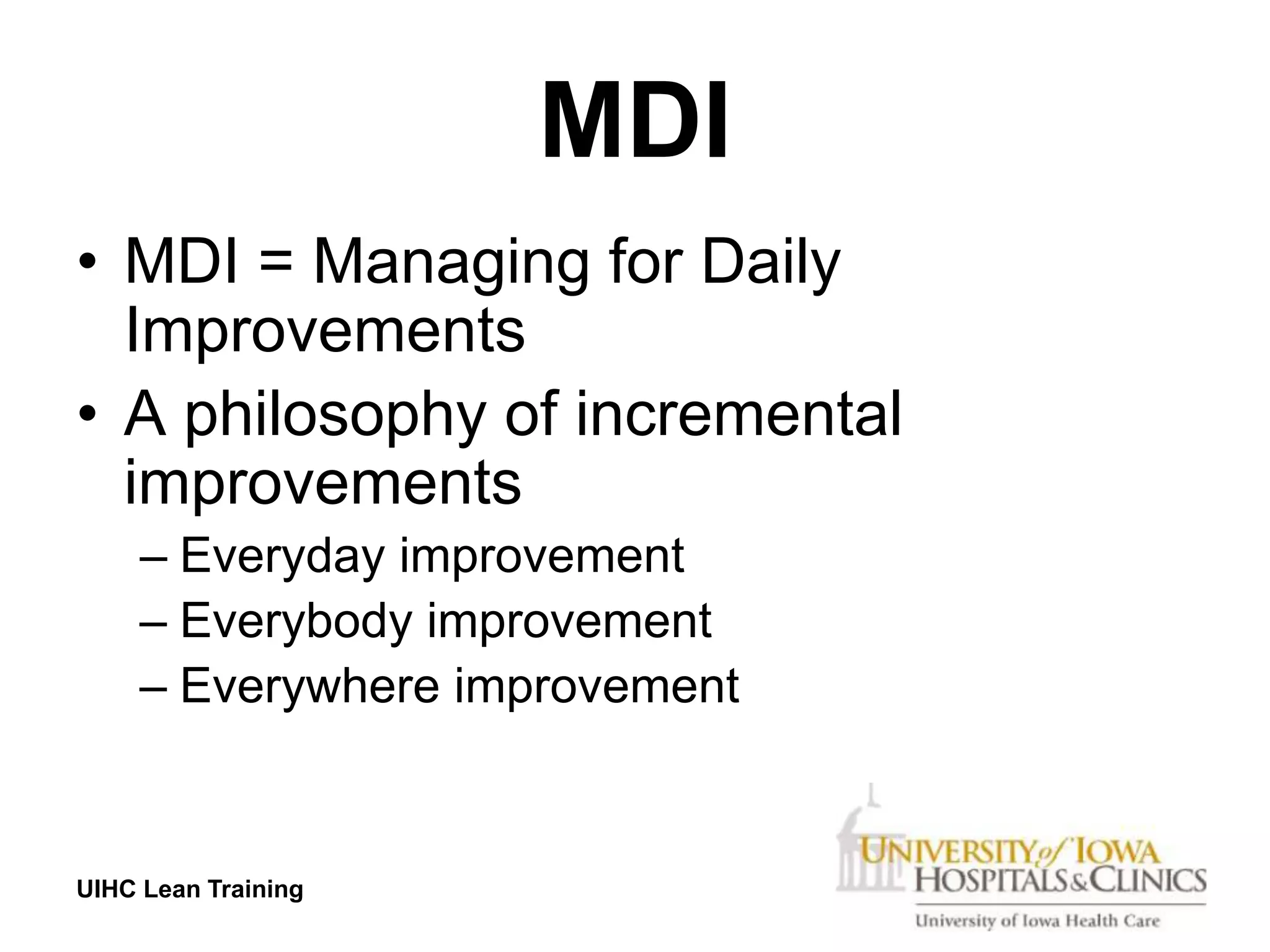
MDI
• MDI = Managing for Daily
  Improvements
• A philosophy of incremental
  improvements
     – Everyday improvement
     – Everybody improvement
     – Everywhere improvement


UIHC Lean Training
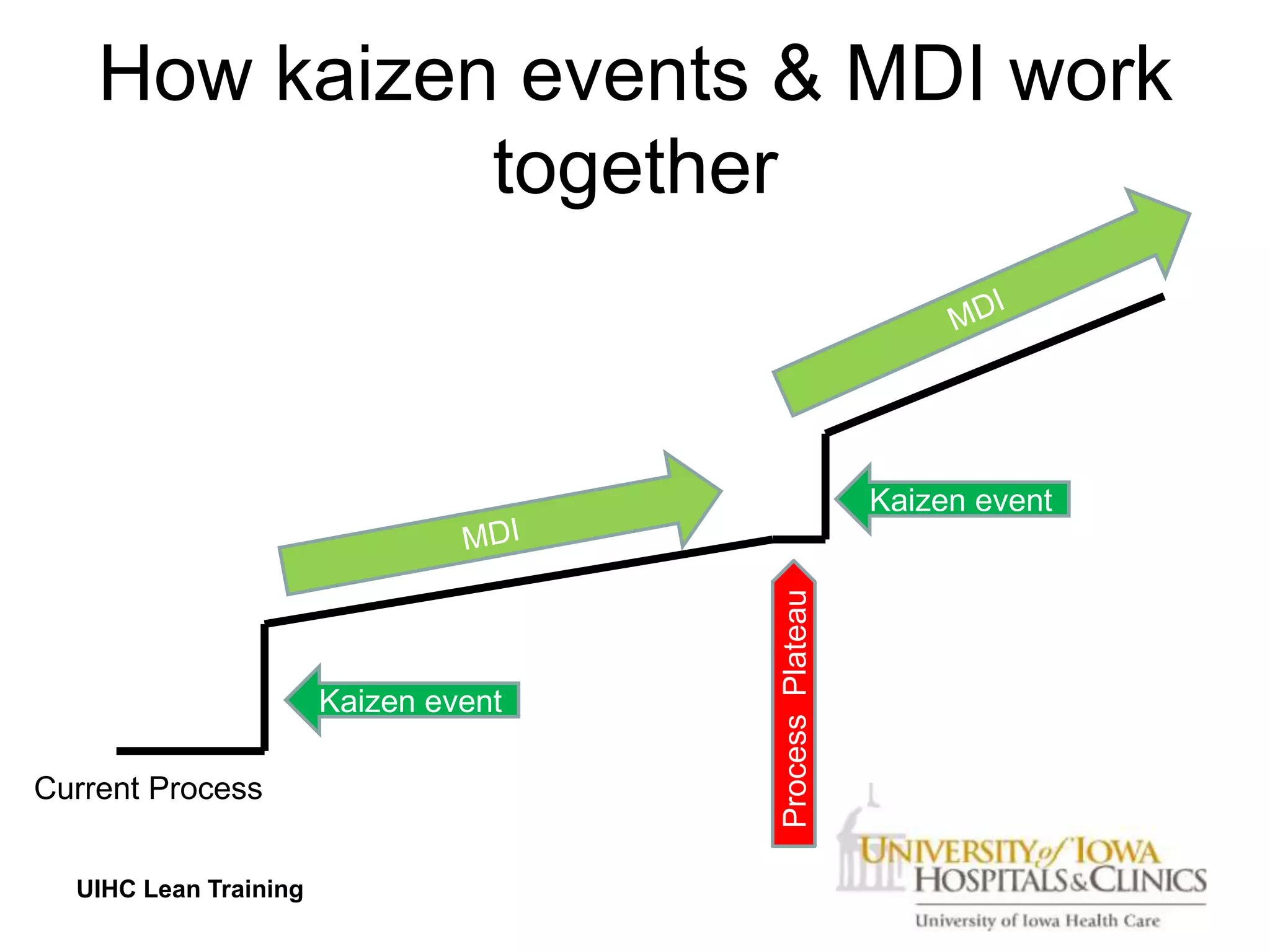
How kaizen events & MDI work
              together


                                                        Kaizen event


                                      Process Plateau
                       Kaizen event

Current Process


  UIHC Lean Training
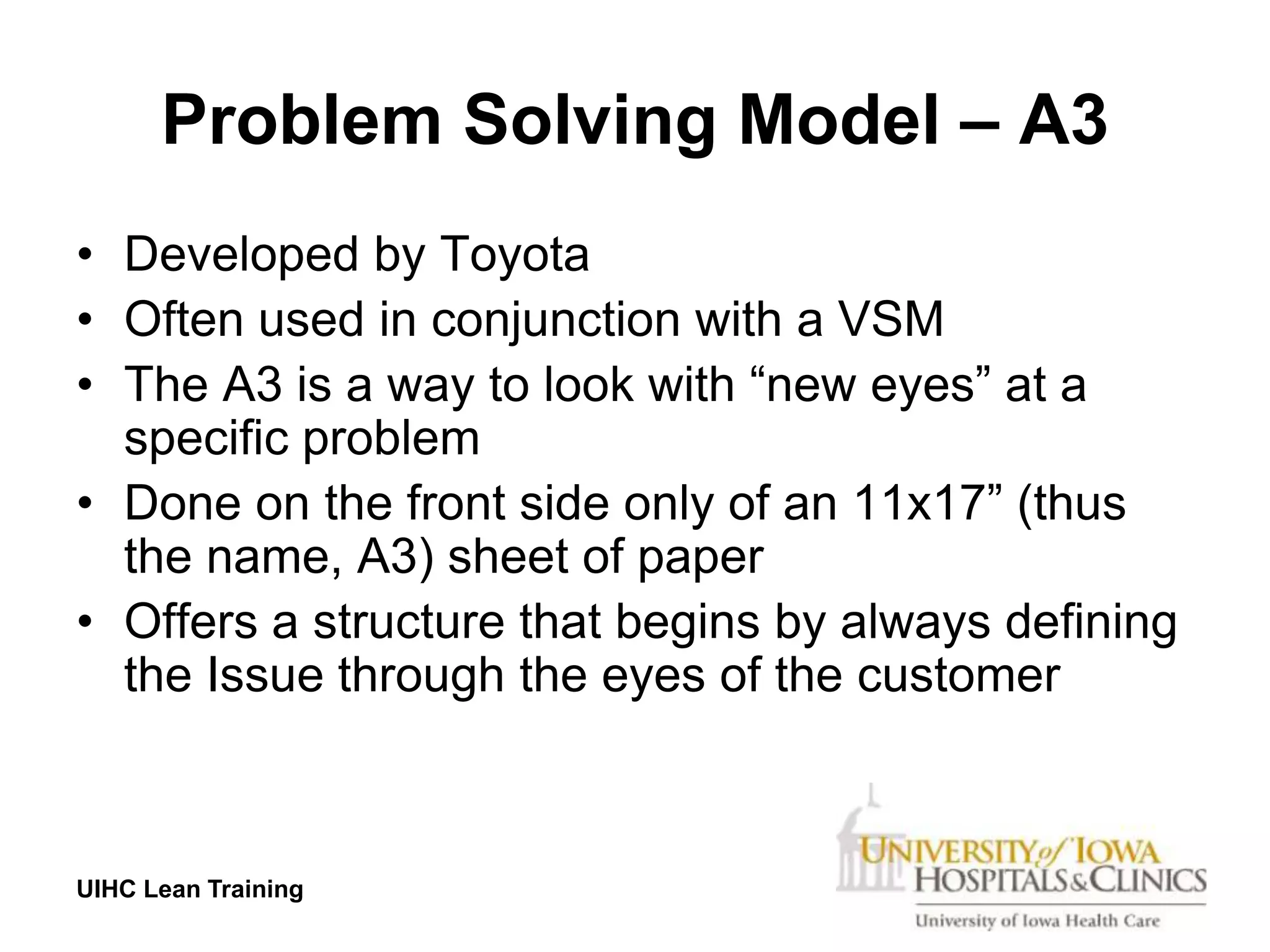
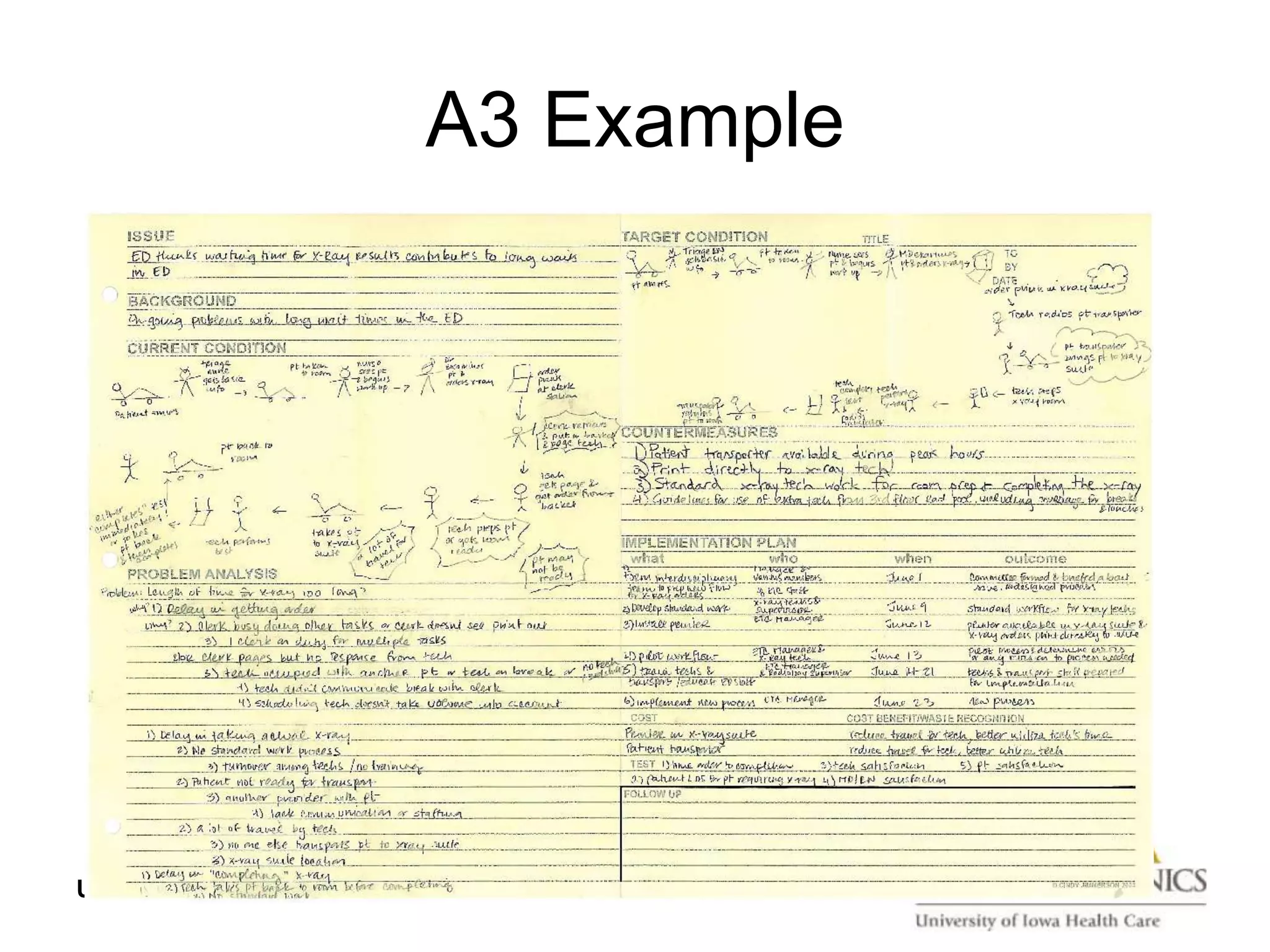
Problem Solving Model – A3
• Developed by Toyota
• Often used in conjunction with a VSM
• The A3 is a way to look with “new eyes” at a
  specific problem
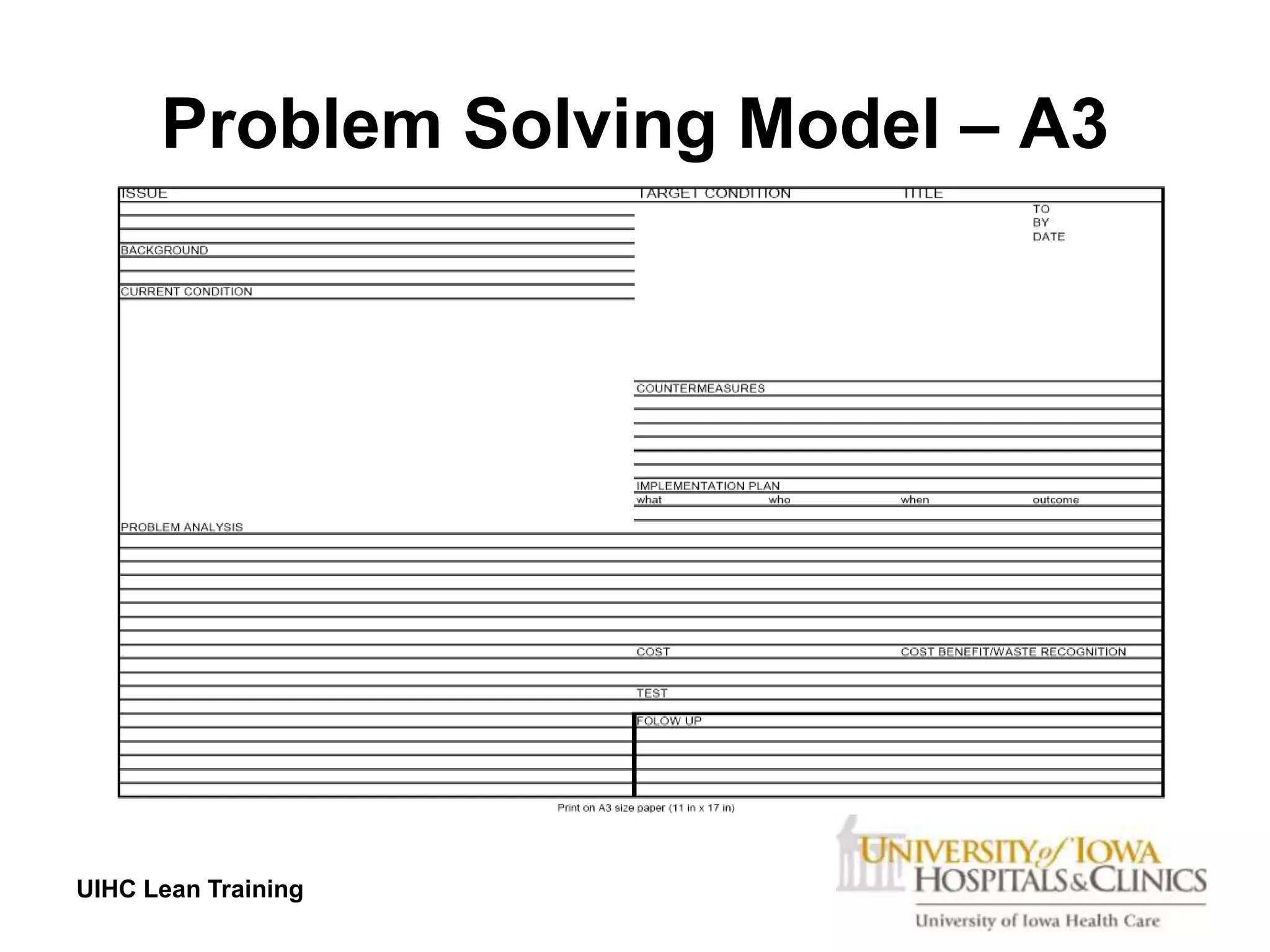
• Done on the front side only of an 11x17” (thus
  the name, A3) sheet of paper
• Offers a structure that begins by always defining
  the Issue through the eyes of the customer


UIHC Lean Training
Problem Solving Model – A3


UIHC Lean Training
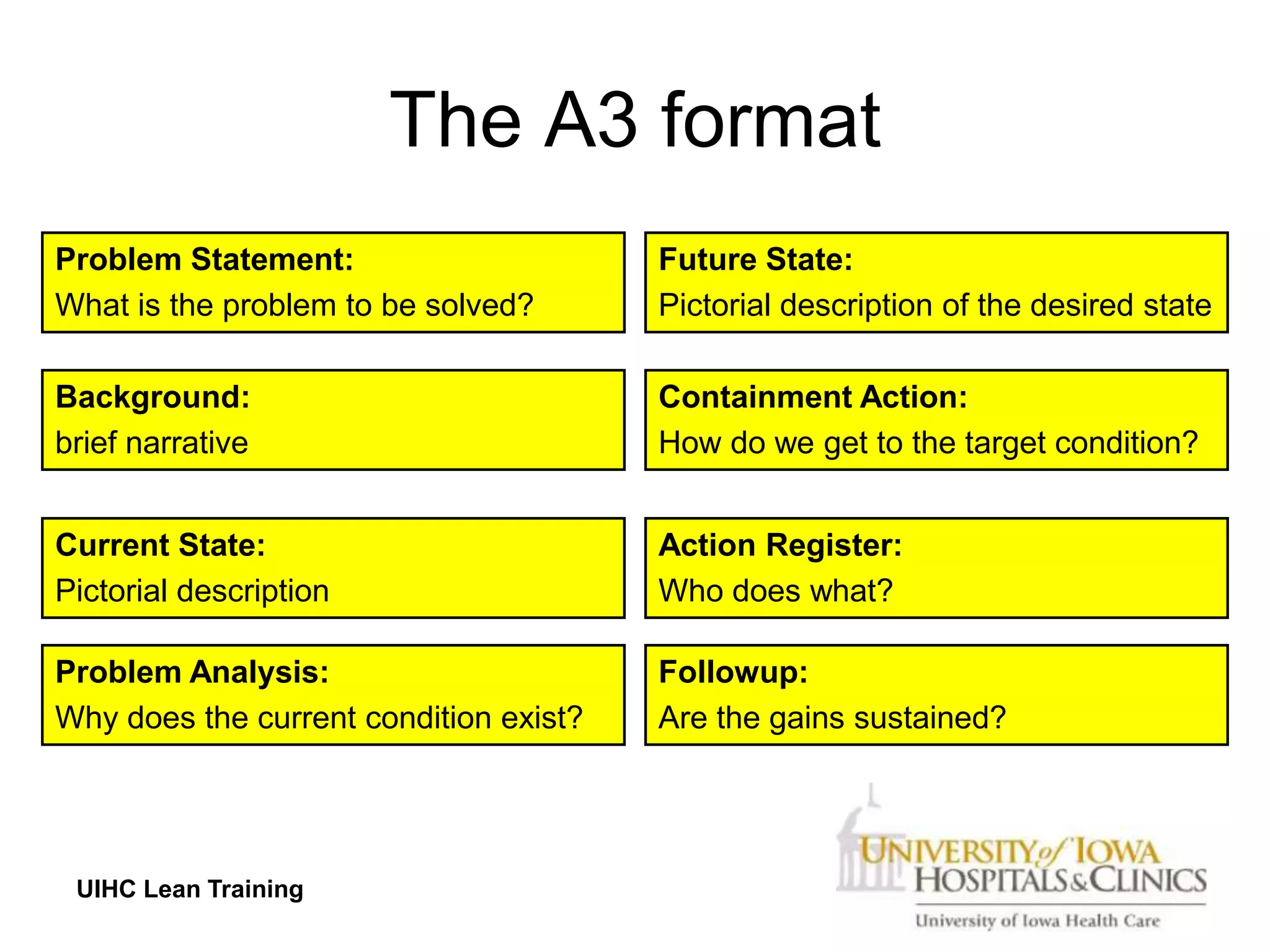
The A3 format
Problem Statement:                      Future State:
What is the problem to be solved?       Pictorial description of the desired state

Background:                             Containment Action:
brief narrative                         How do we get to the target condition?


Current State:                          Action Register:
Pictorial description                   Who does what?

Problem Analysis:                       Followup:
Why does the current condition exist?   Are the gains sustained?


 UIHC Lean Training
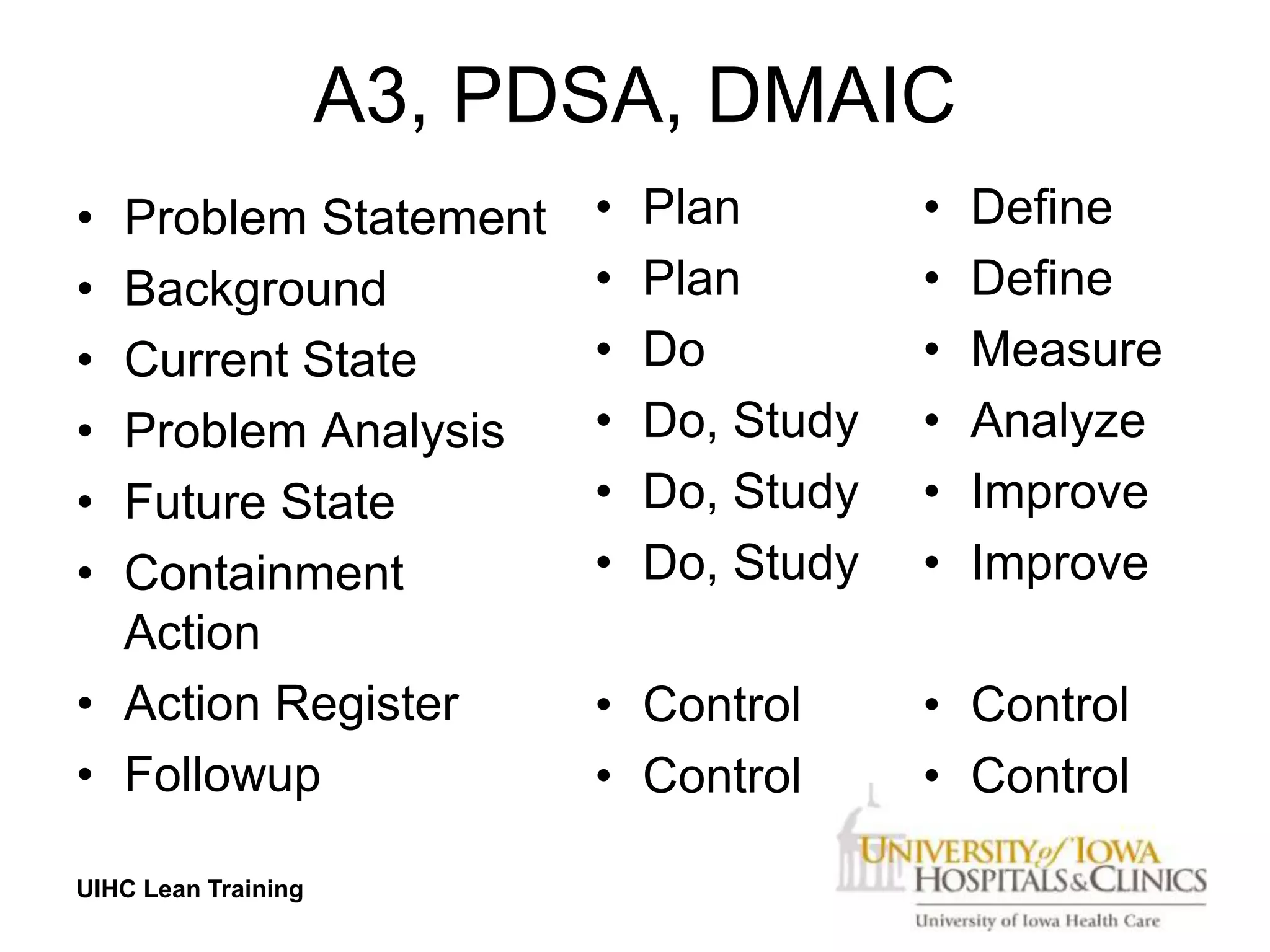
A3, PDSA, DMAIC
• Problem Statement        •   Plan        •   Define
• Background               •   Plan        •   Define
• Current State            •   Do          •   Measure
• Problem Analysis         •   Do, Study   •   Analyze
• Future State             •   Do, Study   •   Improve
• Containment              •   Do, Study   •   Improve
  Action
• Action Register          • Control       • Control
• Followup                 • Control       • Control

UIHC Lean Training
A3 Example


UIHC Lean Training
Advantages of using the A3
• Simple format
• Focuses on one issue
     – Bite off only what you can chew
• Has a flexible time frame
     – Do it in half a day or over several weeks
• Allows for flexible team structure
     – Stakeholders and experts can be brought in
       as needed
• Creates a record as you go
UIHC Lean Training
Pilots
• Pilot is another term for controlled
  experiment
• Benefits of pilots
     – Reduces risk
     – Allows for “tweaking”
     – Eases pain of change
     – Allows for stakeholder buy-in


UIHC Lean Training
Pilot Options
  • Limited time
     – Try solution for a few process cycles
            • Open minds may result with short pilots
            • Offers downtime for refinements
            • Comparative measures may be more revealing
  • Selected items or Customers
    – Alternative path where certain type or
      select number is sent through new process
    – This works well with “parallel”
      implementation
            • Where more and more work is moved over to new
              process

UIHC Lean Training
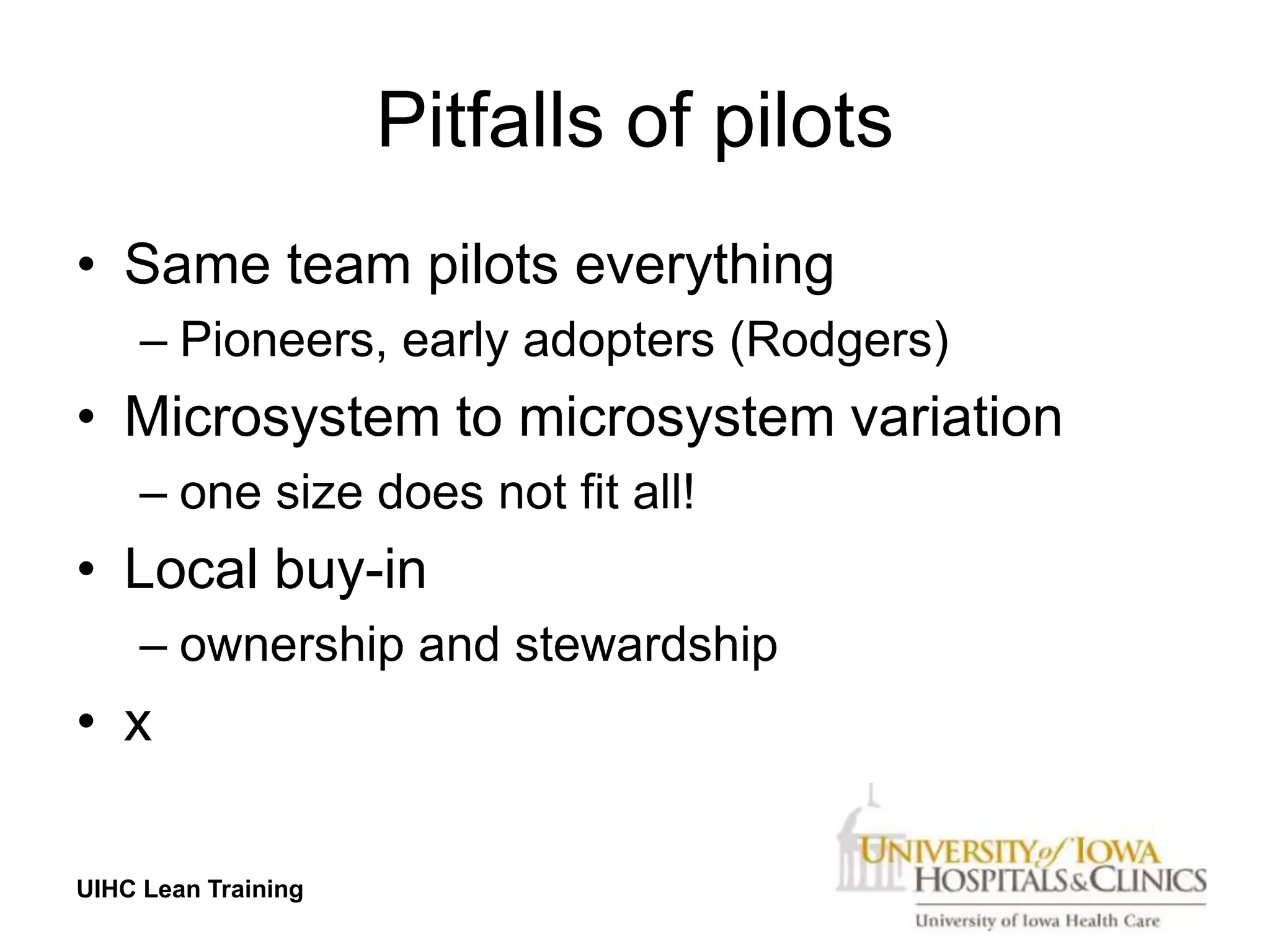
Pitfalls of pilots
• Same team pilots everything
     – Pioneers, early adopters (Rodgers)
• Microsystem to microsystem variation
     – one size does not fit all!
• Local buy-in
     – ownership and stewardship
• x

UIHC Lean Training
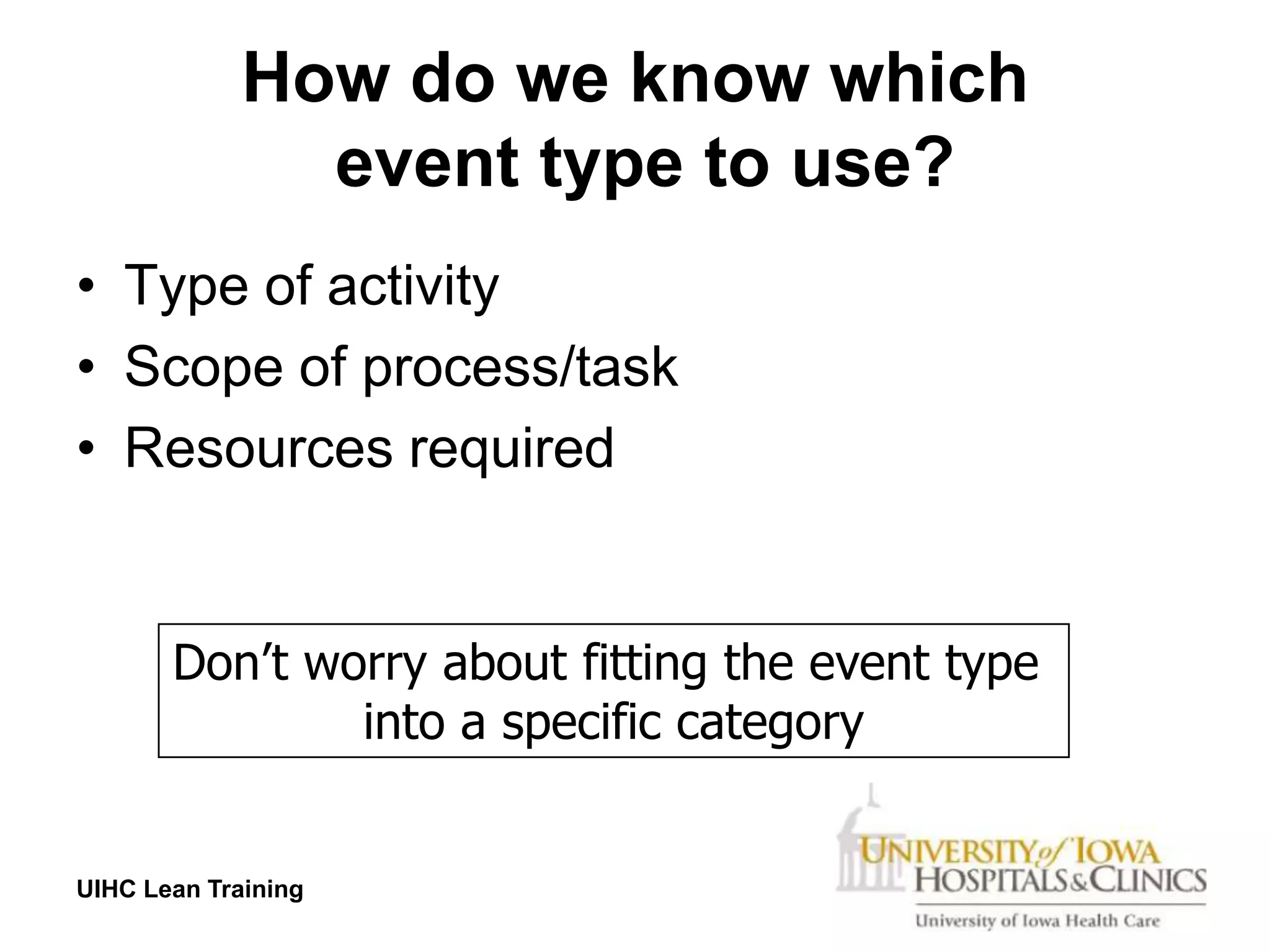
How do we know which
               event type to use?
• Type of activity
• Scope of process/task
• Resources required


       Don’t worry about fitting the event type
               into a specific category


UIHC Lean Training
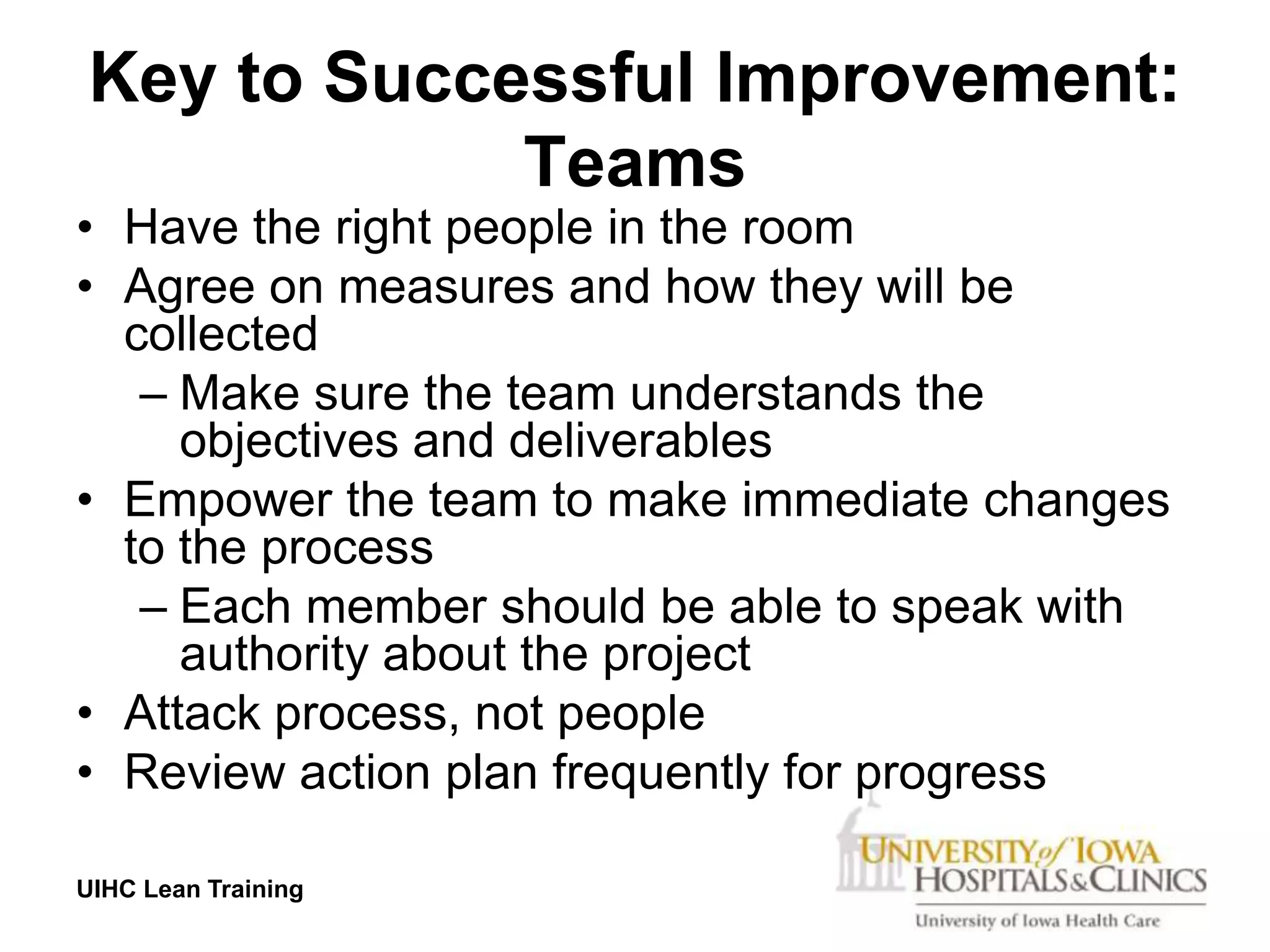
Key to Successful Improvement:
            Teams
• Have the right people in the room
• Agree on measures and how they will be
  collected
   – Make sure the team understands the
     objectives and deliverables
• Empower the team to make immediate changes
  to the process
   – Each member should be able to speak with
     authority about the project
• Attack process, not people
• Review action plan frequently for progress

UIHC Lean Training
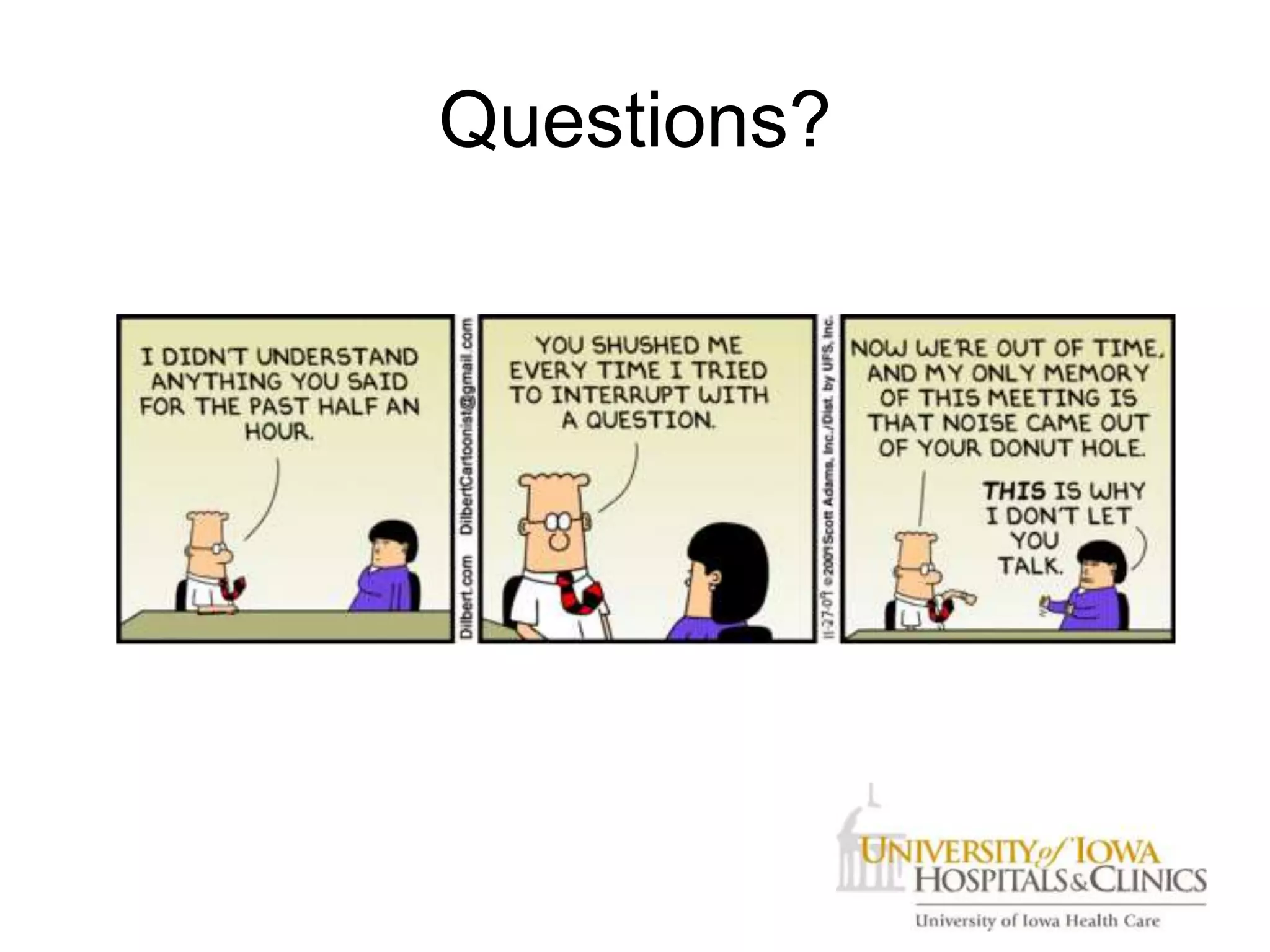
Questions?

Beginning an improvement journey ii introduction to improvement models

  • 1.
    Beginning an Improvement Journey II Improvement Models UIHC Lean Training
  • 2.
    Initiatives / Solutions/ Tools • TQM • Toyota Production • Zero Defects System • Lean • SPC • Kaizen • PDSA • RPI • Six Sigma • MDI • DMAIC • TPM • Ritz Carlton • Kanban UIHC Lean Training
  • 3.
    What improvement model should I use? • It depends on – What improvement you’re trying to achieve – Your organization’s improvement maturity level – The degree of resource commitment UIHC Lean Training
  • 4.
    Many ways, manymodels • What are you trying to achieve? – Improve flow (reduce bottlenecks)? • Theory of Constraints (Goldratt, 1986) – Reduce waste? • Lean/Toyota Production System (1950’s) – Reduce variation? • Six Sigma (Motorola, 1980’s) – All of the above? UIHC Lean Training
  • 5.
    Lean and SixSigma • We use Lean to eliminate the things that are not value-added. • We use Six Sigma to improve the things that are value-added by reducing variation in the process. – We do not want to spend our time improving something that, ultimately isn’t worth doing! • Lean and six sigma share many tools UIHC Lean Training
  • 6.
    Evolution in approachesto improving health system quality Managing for Daily Improvement Quality and value Continuous Improvement Programs Improvement Projects/Kaizens Crisis response and quick fixes Organizational Improvement Maturity UIHC Lean Training
  • 7.
    Improvement Resources “Quality isfree.” Phillip Crosby, 1926-2001 • But… – It usually requires “activation energy”. UIHC Lean Training
  • 8.
    Improvement activation energy Energy Net gain (Improvement) Time UIHC Lean Training
  • 9.
    Improvement resource concepts •Start small – “draining the ocean” problems • Coach – “My job is to coach process improvement, not do process improvement” • Bootstrapping – saving resources and flying under the radar UIHC Lean Training
  • 10.
    Improvement resource concepts •Leadership – Champion’s role: Recognize, support, and encourage • Recognition – Celebrate the team’s accomplishments • Culture change – Improvement is a team sport – nurture and grow all players UIHC Lean Training
  • 11.
    PDSA Model forImprovement Model for Improvement* is a method to guide improvement efforts through three questions and Plan-Do-Study-Act cycles. The model's three guiding questions are: 1.Setting Aims: What are we trying to accomplish? 2.Establishing Measures: How will we know if the change is an improvement? 3.Selecting Changes: What changes can we make that will result in improvement? *Institute for Healthcare Improvement(2011). “Science of Improvement: How to Improve” (Deming)
  • 12.
    A Comparison ofModels FADE PDSA DMAIC DMADV Focus Plan Define Define Analyze Measure Measure Develop Analyze Analyze Design Execute Do Improve Verify Evaluate Study Control Act Each model reflects a common thread of analysis, implementation, and review. As in the graphic for the FADE model, each also has deeper meaning (further levels of analysis) for the headings. Using a methodology ensures that you are not missing any of the critical steps. No one method is best for everyone or all situations. UI Healthcare
  • 13.
    Plan -What arethe objectives? -What are the predictions (hypotheses)? -How will the plan be carried out (Who, What, Where, When) -What are the metrics? -How will the data be collected? UIHC Lean Training
  • 14.
    Do -Execute the plan -Record data -Document observations UIHC Lean Training
  • 15.
    Study -Analyze the data -Compare the results to the predictions -Summarize what was learned UIHC Lean Training
  • 16.
    Act -What are the changes to be made? -Implement standard work -Determine next cycle UIHC Lean Training
  • 17.
    Do-It • Simple scope/Single task • Very short duration (1-2 hours) • 1-3 people • Immediate impact • No decisions or management intervention required UIHC Lean Training
  • 18.
    Burst Event • Minimal scope/Single issue • Short duration (2-8 hours) • 4-6 people • Quick impact • Intended for relatively simple tasks UIHC Lean Training
  • 19.
    Kaizen Events • Kai= Change • Zen = Good (For the Better) • Kaizen events are used to make a fundamental process shift UIHC Lean Training
  • 20.
    Kaizen Event • Scope significant - often cross-functional • 1-5 days • 6-12 people or more • Quick impact – 80% of improvements implemented during event – 20% of improvements implemented within 30 days UIHC Lean Training
  • 21.
    Typical Kaizen Schedule •Pre-event – Charter, data collection, analysis • Day 1 – Training, analyze Current Process • Day 2 – Define new process • Day 3 – Test & finalize new process • Day 4 – Test & finalize new process, report out & celebrate • Post-event – Follow-up, modify, standardize Some of these “days” may be reduced to “hours,” depending on the scope of the effort UIHC Lean Training
  • 22.
    Project • Long duration (3-12 months) • Complex scope • Multiple departments/functions • Long-term impact UIHC Lean Training
  • 23.
    MDI • MDI =Managing for Daily Improvements • A philosophy of incremental improvements – Everyday improvement – Everybody improvement – Everywhere improvement UIHC Lean Training
  • 24.
    How kaizen events& MDI work together Kaizen event Process Plateau Kaizen event Current Process UIHC Lean Training
  • 25.
    Problem Solving Model– A3 • Developed by Toyota • Often used in conjunction with a VSM • The A3 is a way to look with “new eyes” at a specific problem • Done on the front side only of an 11x17” (thus the name, A3) sheet of paper • Offers a structure that begins by always defining the Issue through the eyes of the customer UIHC Lean Training
  • 26.
    Problem Solving Model– A3 UIHC Lean Training
  • 27.
    The A3 format ProblemStatement: Future State: What is the problem to be solved? Pictorial description of the desired state Background: Containment Action: brief narrative How do we get to the target condition? Current State: Action Register: Pictorial description Who does what? Problem Analysis: Followup: Why does the current condition exist? Are the gains sustained? UIHC Lean Training
  • 28.
    A3, PDSA, DMAIC •Problem Statement • Plan • Define • Background • Plan • Define • Current State • Do • Measure • Problem Analysis • Do, Study • Analyze • Future State • Do, Study • Improve • Containment • Do, Study • Improve Action • Action Register • Control • Control • Followup • Control • Control UIHC Lean Training
  • 29.
  • 30.
    Advantages of usingthe A3 • Simple format • Focuses on one issue – Bite off only what you can chew • Has a flexible time frame – Do it in half a day or over several weeks • Allows for flexible team structure – Stakeholders and experts can be brought in as needed • Creates a record as you go UIHC Lean Training
  • 31.
    Pilots • Pilot isanother term for controlled experiment • Benefits of pilots – Reduces risk – Allows for “tweaking” – Eases pain of change – Allows for stakeholder buy-in UIHC Lean Training
  • 32.
    Pilot Options • Limited time – Try solution for a few process cycles • Open minds may result with short pilots • Offers downtime for refinements • Comparative measures may be more revealing • Selected items or Customers – Alternative path where certain type or select number is sent through new process – This works well with “parallel” implementation • Where more and more work is moved over to new process UIHC Lean Training
  • 33.
    Pitfalls of pilots •Same team pilots everything – Pioneers, early adopters (Rodgers) • Microsystem to microsystem variation – one size does not fit all! • Local buy-in – ownership and stewardship • x UIHC Lean Training
  • 34.
    How do weknow which event type to use? • Type of activity • Scope of process/task • Resources required Don’t worry about fitting the event type into a specific category UIHC Lean Training
  • 35.
    Key to SuccessfulImprovement: Teams • Have the right people in the room • Agree on measures and how they will be collected – Make sure the team understands the objectives and deliverables • Empower the team to make immediate changes to the process – Each member should be able to speak with authority about the project • Attack process, not people • Review action plan frequently for progress UIHC Lean Training
  • 36.