1
Chem 550
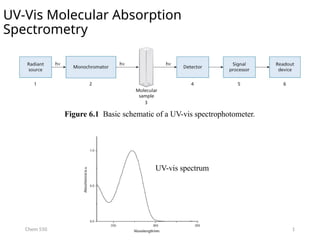
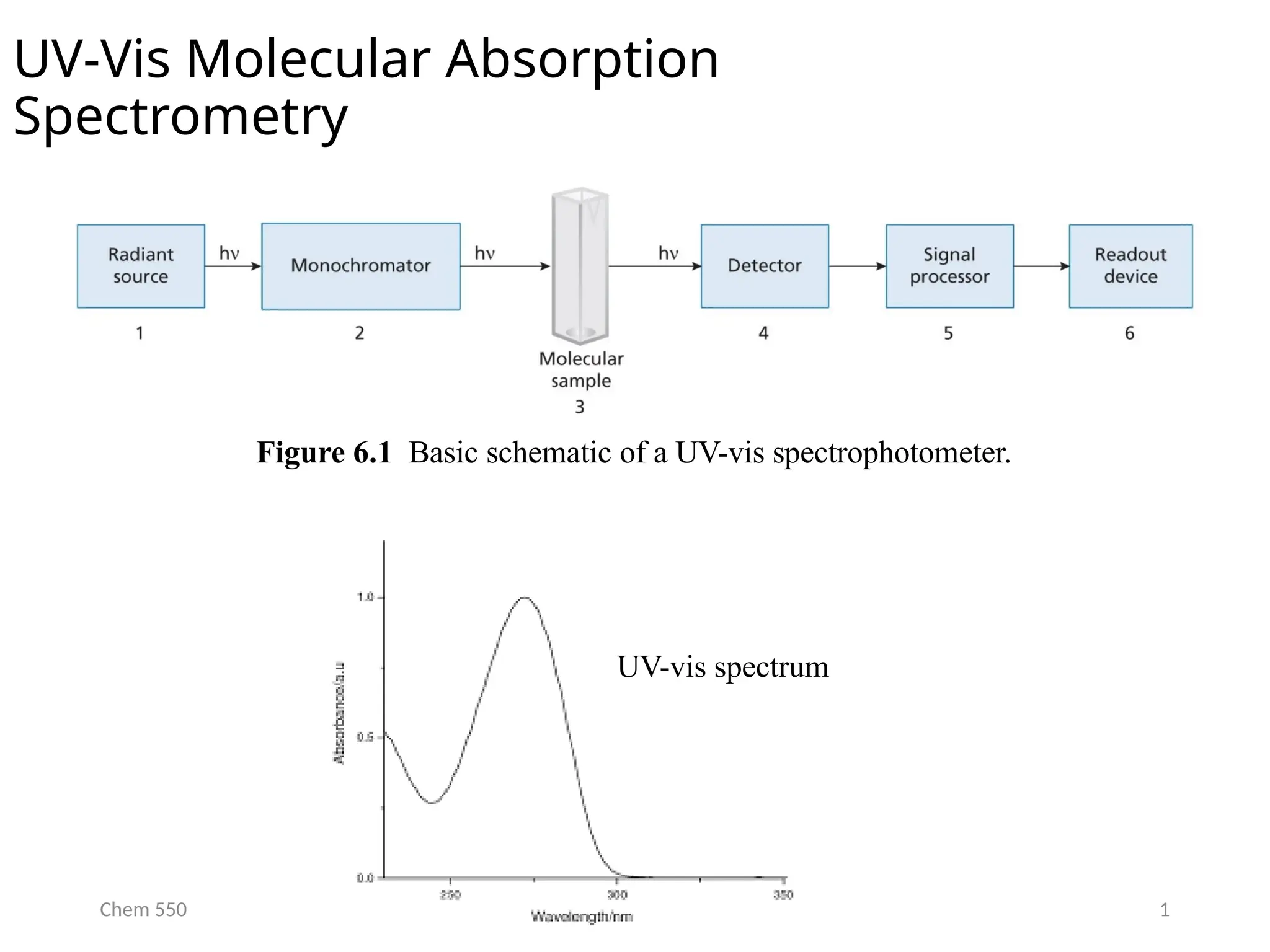
Figure 6.1 Basic schematic of a UV-vis spectrophotometer.
UV-Vis Molecular Absorption
Spectrometry
UV-vis spectrum
2
Chem 550
Measurement of Transmittance and
Absorbance
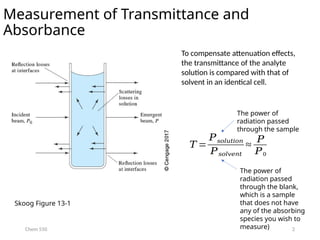
Skoog Figure 13-1
To compensate attenuation effects,
the transmittance of the analyte
solution is compared with that of
solvent in an identical cell.
𝑇 =
𝑃𝑠𝑜𝑙𝑢𝑡𝑖𝑜𝑛
𝑃𝑠𝑜𝑙𝑣𝑒𝑛𝑡
≈
𝑃
𝑃0
The power of
radiation passed
through the sample
The power of
radiation passed
through the blank,
which is a sample
that does not have
any of the absorbing
species you wish to
measure)
Measurement of Transmittance and
Absorbance
𝐴=− 𝑙𝑜𝑔𝑇 =−𝑙𝑜𝑔
𝑃
𝑃 0
=𝜀𝑏𝑐
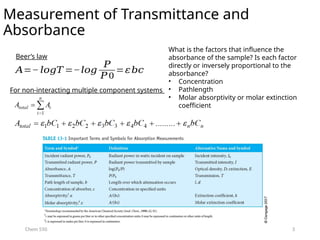
For non-interacting multiple component systems
Beer’s law
Chem 550 3
What is the factors that influence the
absorbance of the sample? Is each factor
directly or inversely proportional to the
absorbance?
• Concentration
• Pathlength
• Molar absorptivity or molar extinction
coefficient
4
Using Beer’s Law to calculate the
concentration
If you know the extinction coefficient,
Chem 550
Figure 6.12 UV-vis spectrum of 1-10-phenanthroline-5,6-dione platinum(IV)
chloride [Pt(dione)Cl4] in dry acetonitrile.
Absorbance
A = 0.145
**290.5 nm seem to be a typo. It should be ~315 nm.
What is the concentration of the
compound? The path length of the cell
is 1 cm.
5
Chem 550
Using Beer’s Law to calculate the
concentration
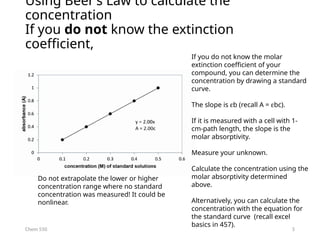
If you do not know the extinction
coefficient,
If you do not know the molar
extinction coefficient of your
compound, you can determine the
concentration by drawing a standard
curve.
The slope is eb (recall A = ebc).
If it is measured with a cell with 1-
cm-path length, the slope is the
molar absorptivity.
Measure your unknown.
Calculate the concentration using the
molar absorptivity determined
above.
Alternatively, you can calculate the
concentration with the equation for
the standard curve (recall excel
basics in 457).
Do not extrapolate the lower or higher
concentration range where no standard
concentration was measured! It could be
nonlinear.
6
Chem 550
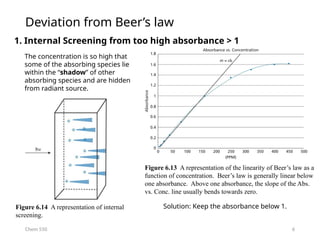
Figure 6.13 A representation of the linearity of Beer’s law as a
function of concentration. Beer’s law is generally linear below
one absorbance. Above one absorbance, the slope of the Abs.
vs. Conc. line usually bends towards zero.
1. Internal Screening from too high absorbance > 1
The concentration is so high that
some of the absorbing species lie
within the “shadow” of other
absorbing species and are hidden
from radiant source.
Figure 6.14 A representation of internal
screening.
Solution: Keep the absorbance below 1.
Deviation from Beer’s law
7
Deviation from Beer’s law
Chem 550
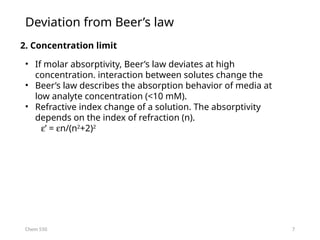
• If molar absorptivity, Beer’s law deviates at high
concentration. interaction between solutes change the
• Beer’s law describes the absorption behavior of media at
low analyte concentration (<10 mM).
• Refractive index change of a solution. The absorptivity
depends on the index of refraction (n).
e’ = en/(n2
+2)2
2. Concentration limit
9
Chem 550
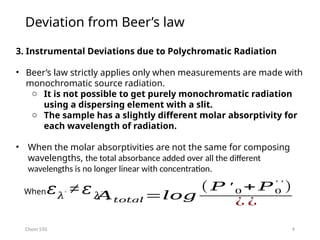
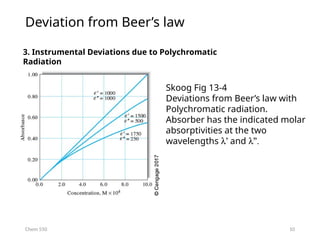
3. Instrumental Deviations due to Polychromatic Radiation
• Beer’s law strictly applies only when measurements are made with
monochromatic source radiation.
o It is not possible to get purely monochromatic radiation
using a dispersing element with a slit.
o The sample has a slightly different molar absorptivity for
each wavelength of radiation.
• When the molar absorptivities are not the same for composing
wavelengths, the total absorbance added over all the different
wavelengths is no longer linear with concentration.
𝐴𝑡𝑜𝑡𝑎𝑙 =𝑙𝑜𝑔
( 𝑃 ′ 0 + 𝑃0
′ ′
)
¿ ¿
𝜀𝜆′ ≠ 𝜀𝜆′′
,
When
Deviation from Beer’s law
10
Deviation from Beer’s law
Chem 550
3. Instrumental Deviations due to Polychromatic
Radiation
Skoog Fig 13-4
Deviations from Beer’s law with
Polychromatic radiation.
Absorber has the indicated molar
absorptivities at the two
wavelengths l’ and l .
”
11
Deviation from Beer’s law
Chem 550
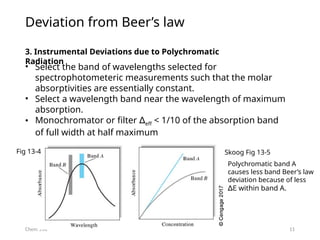
3. Instrumental Deviations due to Polychromatic
Radiation
• Select the band of wavelengths selected for
spectrophotometeric measurements such that the molar
absorptivities are essentially constant.
• Select a wavelength band near the wavelength of maximum
absorption.
• Monochromator or filter ∆eff < 1/10 of the absorption band
of full width at half maximum
Fig 13-4 Skoog Fig 13-5
Polychromatic band A
causes less band Beer’s law
deviation because of less
ℇ within band A.
∆
12
Deviation from Beer’s law
Chem 550
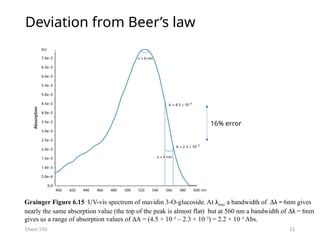
Grainger Figure 6.15 UV-vis spectrum of mavidin 3-O-glucoside. At λmax a bandwidth of Dλ = 6nm gives
nearly the same absorption value (the top of the peak is almost flat) but at 560 nm a bandwidth of Dλ = 6nm
gives us a range of absorption values of DA = (4.5 × 10⁻³
– 2.3 × 10⁻³
) = 2.2 × 10⁻³
Abs.
16% error
Instrumental Analysis Granger, Yochum, Granger, and Sienerth Copyright © 2017 Oxford University Press
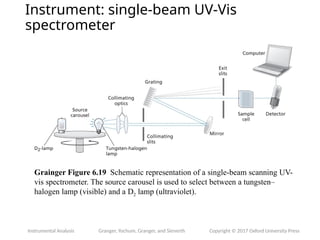
Grainger Figure 6.19 Schematic representation of a single-beam scanning UV-
vis spectrometer. The source carousel is used to select between a tungsten–
halogen lamp (visible) and a D2 lamp (ultraviolet).
Instrument: single-beam UV-Vis
spectrometer
Instrumental Analysis Granger, Yochum, Granger, and Sienerth Copyright © 2017 Oxford University Press
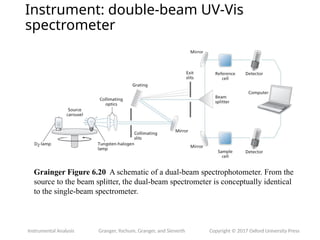
Grainger Figure 6.20 A schematic of a dual-beam spectrophotometer. From the
source to the beam splitter, the dual-beam spectrometer is conceptually identical
to the single-beam spectrometer.
Instrument: double-beam UV-Vis
spectrometer
16
Instrument Component: Source
Chem 550
To measure absorption spectrum, the UV-
Vis spectrometer requires continuum
source whose radiant power does not
sharply change over a considerable range
of wavelengths.
Deuterium and Hydrogen Lamps:
• UV region (190-400 nm)
• Electrical discharge lamp.
• Formation of excited molecular
deuterium followed by dissociation into
atomic deuterium produces various
wavelengths of UV light.
17
Chem 550
Tungsten Filament Lamps:
• Visible region (350-2500 nm)
• Spectrum follows black-body radiation
• Tungsten filament lamps.
o Operated at 2870K.
• Tungsten-halogen lamps (Quartz-
halogen lamp).
o Operated at 3500K.
o Enhanced lifetime because
sublimated W forms a volatile
product WI2 that allow W to be
redeposited to the filament.
LED: White LED (400-800 nm) or
semimonochromatic
Xenon Arc Lamps: 200-1000 nm.
Instrument Component: Source
Instrumental Analysis Granger, Yochum, Granger, and Sienerth Copyright © 2017 Oxford University Press
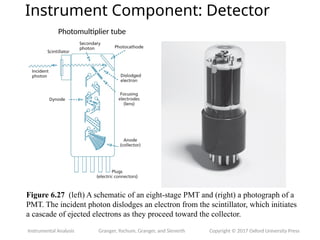
Figure 6.27 (left) A schematic of an eight-stage PMT and (right) a photograph of a
PMT. The incident photon dislodges an electron from the scintillator, which initiates
a cascade of ejected electrons as they proceed toward the collector.
Instrument Component: Detector
Photomultiplier tube
19
Chem 550
Figure 6.29 An MOS semiconductor used in a
CCD detector.
Instrument Component: Detector
Charge Coupled Device (CCD)
CCD is used in an array format.
No exit slit in monochromator.
20
Chem 550
Supplementary
discussion of
electromagnetic
radiation
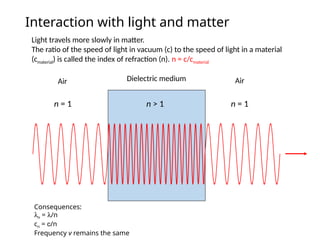
Interaction with light and matter
n = 1 n > 1 n = 1
Light travels more slowly in matter.
The ratio of the speed of light in vacuum (c) to the speed of light in a material
(cmaterial) is called the index of refraction (n). n = c/cmaterial
Air Dielectric medium Air
Consequences:
ln = l/n
cn = c/n
Frequency v remains the same
Reflected
wave
r
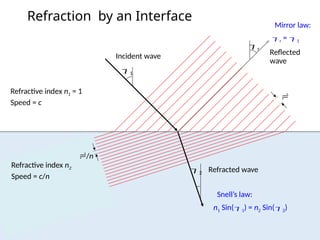
Refraction by an Interface
Refractive index n1 = 1
Speed = c
Refractive index n2
Speed = c/n
Incident wave
1
Refracted wave
2
Snell’s law:

/n
Mirror law:
r = 1
n1 Sin(1) = n2 Sin(2)
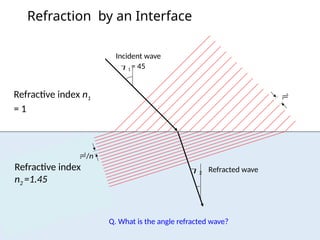
Refraction by an Interface
Refractive index n1
= 1
Refractive index
n2 =1.45
Incident wave
1 = 45
Refracted wave
2

/n
Q. What is the angle refracted wave?
UV-Visible
Spectroscopy
26
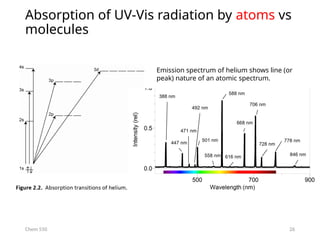
Absorption of UV-Vis radiation by atoms vs
molecules
Chem 550
Emission spectrum of helium shows line (or
peak) nature of an atomic spectrum.
27
Absorption of UV-Vis radiation by atoms vs
molecules
Chem 550
Atomic absorption
Molecular absorption
Molecular energy levels
28
Chem 550
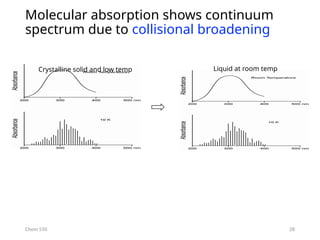
Molecular absorption shows continuum
spectrum due to collisional broadening
Liquid at room temp
Crystalline solid and low temp
29
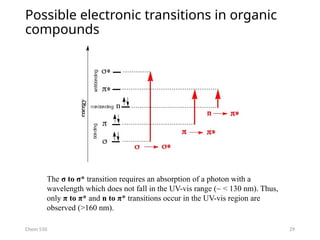
Possible electronic transitions in organic
compounds
Chem 550
The σ to σ* transition requires an absorption of a photon with a
wavelength which does not fall in the UV-vis range (~ < 130 nm). Thus,
only π to π* and n to π* transitions occur in the UV-vis region are
observed (>160 nm).
30
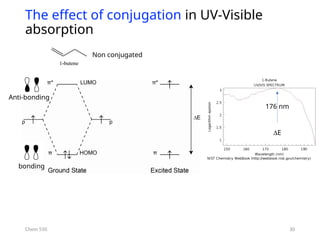
The effect of conjugation in UV-Visible
absorption
Chem 550
Anti-bonding
bonding
DE
Non conjugated
176 nm
31
Chem 550
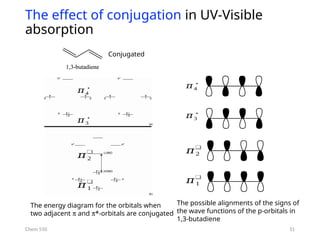
Conjugated
The effect of conjugation in UV-Visible
absorption
The energy diagram for the orbitals when
two adjacent p and p*-orbitals are conjugated
𝜋4
∗
𝜋3
∗
𝜋2
❑
𝜋1
❑
𝜋4
∗
𝜋3
∗
𝜋2
❑
𝜋1
❑
The possible alignments of the signs of
the wave functions of the p-orbitals in
1,3-butadiene
32
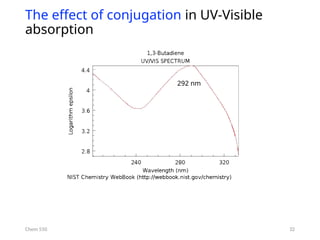
The effect of conjugation in UV-Visible
absorption
Chem 550
292 nm
33
Structure and color in conjugated systems
Chem 550
Figure 6.5 UV-vis spectra of anthracene and tetracene.
The energy level in a ”Particle in a box”
h = Planck’s constant
n = positive whole number
representing the quantum state
m = mass
L = length of the “box”
L increases as the degree of
conjugation increases. In other
words, the energy gap between p
and p* decreases.
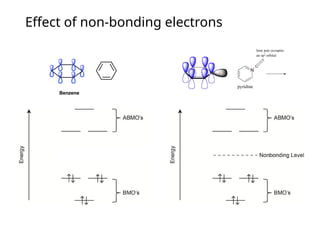
Effect of non-bonding electrons
35
Chem 550
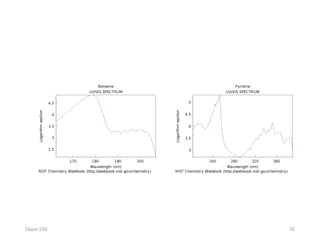
36
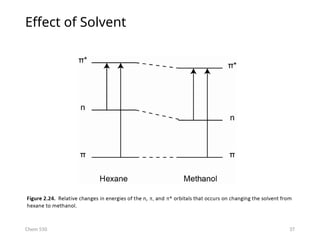
Effect of Solvent
Chem 550
37
Effect of Solvent
Chem 550

18-19_UV-Vis Molecular Absorption Spectroscopy.pptx

  • 1.
    1 Chem 550 Figure 6.1Basic schematic of a UV-vis spectrophotometer. UV-Vis Molecular Absorption Spectrometry UV-vis spectrum
  • 2.
    2 Chem 550 Measurement ofTransmittance and Absorbance Skoog Figure 13-1 To compensate attenuation effects, the transmittance of the analyte solution is compared with that of solvent in an identical cell. 𝑇 = 𝑃𝑠𝑜𝑙𝑢𝑡𝑖𝑜𝑛 𝑃𝑠𝑜𝑙𝑣𝑒𝑛𝑡 ≈ 𝑃 𝑃0 The power of radiation passed through the sample The power of radiation passed through the blank, which is a sample that does not have any of the absorbing species you wish to measure)
  • 3.
    Measurement of Transmittanceand Absorbance 𝐴=− 𝑙𝑜𝑔𝑇 =−𝑙𝑜𝑔 𝑃 𝑃 0 =𝜀𝑏𝑐 For non-interacting multiple component systems Beer’s law Chem 550 3 What is the factors that influence the absorbance of the sample? Is each factor directly or inversely proportional to the absorbance? • Concentration • Pathlength • Molar absorptivity or molar extinction coefficient
  • 4.
    4 Using Beer’s Lawto calculate the concentration If you know the extinction coefficient, Chem 550 Figure 6.12 UV-vis spectrum of 1-10-phenanthroline-5,6-dione platinum(IV) chloride [Pt(dione)Cl4] in dry acetonitrile. Absorbance A = 0.145 **290.5 nm seem to be a typo. It should be ~315 nm. What is the concentration of the compound? The path length of the cell is 1 cm.
  • 5.
    5 Chem 550 Using Beer’sLaw to calculate the concentration If you do not know the extinction coefficient, If you do not know the molar extinction coefficient of your compound, you can determine the concentration by drawing a standard curve. The slope is eb (recall A = ebc). If it is measured with a cell with 1- cm-path length, the slope is the molar absorptivity. Measure your unknown. Calculate the concentration using the molar absorptivity determined above. Alternatively, you can calculate the concentration with the equation for the standard curve (recall excel basics in 457). Do not extrapolate the lower or higher concentration range where no standard concentration was measured! It could be nonlinear.
  • 6.
    6 Chem 550 Figure 6.13A representation of the linearity of Beer’s law as a function of concentration. Beer’s law is generally linear below one absorbance. Above one absorbance, the slope of the Abs. vs. Conc. line usually bends towards zero. 1. Internal Screening from too high absorbance > 1 The concentration is so high that some of the absorbing species lie within the “shadow” of other absorbing species and are hidden from radiant source. Figure 6.14 A representation of internal screening. Solution: Keep the absorbance below 1. Deviation from Beer’s law
  • 7.
    7 Deviation from Beer’slaw Chem 550 • If molar absorptivity, Beer’s law deviates at high concentration. interaction between solutes change the • Beer’s law describes the absorption behavior of media at low analyte concentration (<10 mM). • Refractive index change of a solution. The absorptivity depends on the index of refraction (n). e’ = en/(n2 +2)2 2. Concentration limit
  • 8.
    9 Chem 550 3. InstrumentalDeviations due to Polychromatic Radiation • Beer’s law strictly applies only when measurements are made with monochromatic source radiation. o It is not possible to get purely monochromatic radiation using a dispersing element with a slit. o The sample has a slightly different molar absorptivity for each wavelength of radiation. • When the molar absorptivities are not the same for composing wavelengths, the total absorbance added over all the different wavelengths is no longer linear with concentration. 𝐴𝑡𝑜𝑡𝑎𝑙 =𝑙𝑜𝑔 ( 𝑃 ′ 0 + 𝑃0 ′ ′ ) ¿ ¿ 𝜀𝜆′ ≠ 𝜀𝜆′′ , When Deviation from Beer’s law
  • 9.
    10 Deviation from Beer’slaw Chem 550 3. Instrumental Deviations due to Polychromatic Radiation Skoog Fig 13-4 Deviations from Beer’s law with Polychromatic radiation. Absorber has the indicated molar absorptivities at the two wavelengths l’ and l . ”
  • 10.
    11 Deviation from Beer’slaw Chem 550 3. Instrumental Deviations due to Polychromatic Radiation • Select the band of wavelengths selected for spectrophotometeric measurements such that the molar absorptivities are essentially constant. • Select a wavelength band near the wavelength of maximum absorption. • Monochromator or filter ∆eff < 1/10 of the absorption band of full width at half maximum Fig 13-4 Skoog Fig 13-5 Polychromatic band A causes less band Beer’s law deviation because of less ℇ within band A. ∆
  • 11.
    12 Deviation from Beer’slaw Chem 550 Grainger Figure 6.15 UV-vis spectrum of mavidin 3-O-glucoside. At λmax a bandwidth of Dλ = 6nm gives nearly the same absorption value (the top of the peak is almost flat) but at 560 nm a bandwidth of Dλ = 6nm gives us a range of absorption values of DA = (4.5 × 10⁻³ – 2.3 × 10⁻³ ) = 2.2 × 10⁻³ Abs. 16% error
  • 12.
    Instrumental Analysis Granger,Yochum, Granger, and Sienerth Copyright © 2017 Oxford University Press Grainger Figure 6.19 Schematic representation of a single-beam scanning UV- vis spectrometer. The source carousel is used to select between a tungsten– halogen lamp (visible) and a D2 lamp (ultraviolet). Instrument: single-beam UV-Vis spectrometer
  • 13.
    Instrumental Analysis Granger,Yochum, Granger, and Sienerth Copyright © 2017 Oxford University Press Grainger Figure 6.20 A schematic of a dual-beam spectrophotometer. From the source to the beam splitter, the dual-beam spectrometer is conceptually identical to the single-beam spectrometer. Instrument: double-beam UV-Vis spectrometer
  • 14.
    16 Instrument Component: Source Chem550 To measure absorption spectrum, the UV- Vis spectrometer requires continuum source whose radiant power does not sharply change over a considerable range of wavelengths. Deuterium and Hydrogen Lamps: • UV region (190-400 nm) • Electrical discharge lamp. • Formation of excited molecular deuterium followed by dissociation into atomic deuterium produces various wavelengths of UV light.
  • 15.
    17 Chem 550 Tungsten FilamentLamps: • Visible region (350-2500 nm) • Spectrum follows black-body radiation • Tungsten filament lamps. o Operated at 2870K. • Tungsten-halogen lamps (Quartz- halogen lamp). o Operated at 3500K. o Enhanced lifetime because sublimated W forms a volatile product WI2 that allow W to be redeposited to the filament. LED: White LED (400-800 nm) or semimonochromatic Xenon Arc Lamps: 200-1000 nm. Instrument Component: Source
  • 16.
    Instrumental Analysis Granger,Yochum, Granger, and Sienerth Copyright © 2017 Oxford University Press Figure 6.27 (left) A schematic of an eight-stage PMT and (right) a photograph of a PMT. The incident photon dislodges an electron from the scintillator, which initiates a cascade of ejected electrons as they proceed toward the collector. Instrument Component: Detector Photomultiplier tube
  • 17.
    19 Chem 550 Figure 6.29An MOS semiconductor used in a CCD detector. Instrument Component: Detector Charge Coupled Device (CCD) CCD is used in an array format. No exit slit in monochromator.
  • 18.
  • 19.
  • 20.
    Interaction with lightand matter n = 1 n > 1 n = 1 Light travels more slowly in matter. The ratio of the speed of light in vacuum (c) to the speed of light in a material (cmaterial) is called the index of refraction (n). n = c/cmaterial Air Dielectric medium Air Consequences: ln = l/n cn = c/n Frequency v remains the same
  • 21.
    Reflected wave r Refraction by anInterface Refractive index n1 = 1 Speed = c Refractive index n2 Speed = c/n Incident wave 1 Refracted wave 2 Snell’s law:  /n Mirror law: r = 1 n1 Sin(1) = n2 Sin(2)
  • 22.
    Refraction by anInterface Refractive index n1 = 1 Refractive index n2 =1.45 Incident wave 1 = 45 Refracted wave 2  /n Q. What is the angle refracted wave?
  • 23.
  • 24.
    26 Absorption of UV-Visradiation by atoms vs molecules Chem 550 Emission spectrum of helium shows line (or peak) nature of an atomic spectrum.
  • 25.
    27 Absorption of UV-Visradiation by atoms vs molecules Chem 550 Atomic absorption Molecular absorption Molecular energy levels
  • 26.
    28 Chem 550 Molecular absorptionshows continuum spectrum due to collisional broadening Liquid at room temp Crystalline solid and low temp
  • 27.
    29 Possible electronic transitionsin organic compounds Chem 550 The σ to σ* transition requires an absorption of a photon with a wavelength which does not fall in the UV-vis range (~ < 130 nm). Thus, only π to π* and n to π* transitions occur in the UV-vis region are observed (>160 nm).
  • 28.
    30 The effect ofconjugation in UV-Visible absorption Chem 550 Anti-bonding bonding DE Non conjugated 176 nm
  • 29.
    31 Chem 550 Conjugated The effectof conjugation in UV-Visible absorption The energy diagram for the orbitals when two adjacent p and p*-orbitals are conjugated 𝜋4 ∗ 𝜋3 ∗ 𝜋2 ❑ 𝜋1 ❑ 𝜋4 ∗ 𝜋3 ∗ 𝜋2 ❑ 𝜋1 ❑ The possible alignments of the signs of the wave functions of the p-orbitals in 1,3-butadiene
  • 30.
    32 The effect ofconjugation in UV-Visible absorption Chem 550 292 nm
  • 31.
    33 Structure and colorin conjugated systems Chem 550 Figure 6.5 UV-vis spectra of anthracene and tetracene. The energy level in a ”Particle in a box” h = Planck’s constant n = positive whole number representing the quantum state m = mass L = length of the “box” L increases as the degree of conjugation increases. In other words, the energy gap between p and p* decreases.
  • 32.
  • 33.
  • 34.
  • 35.