





Be A Hero: Transforming
GoPro Analytics Data Pipeline
Machine Learning Innovation Summit , 2017
Chester Chen
ABOUT SPEAKER
• Head of Data Science &
Engineering
• Prev. Director of Engineering,
Alpine Data Labs
• Start to play with Spark since
Spark 0.6 version.
• Spoke at Hadoop Summit, Big
Data Scala, IEEE Big Data
Conferences
• Organizer of SF Big Analytics
meetup (6800+ members)
AGENDA
• Business Use Cases
• Data Platform Architecture
• Old Data Platforms: Pro & Cons and Challenges
• New Data Platform Architeture and Initiatives
• Adding Data Schema During Ingestion (Dynamic DDL)
Business Use Cases
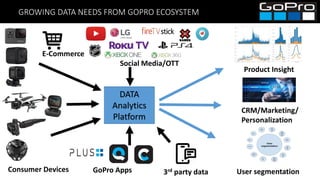
GROWING DATA NEEDS FROM GOPRO ECOSYSTEM
DATA
Analytics
Platform
Consumer Devices GoPro Apps
E-Commerce
Social Media/OTT
3rd party data
Product Insight
CRM/Marketing/
Personalization
User segmentation
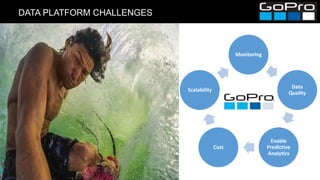
DATA PLATFORM CHALLENGES
Monitoring
Data
Quality
Enable
Predictive
Analytics
Cost
Scalability
Data Platform Architecture
Transformation
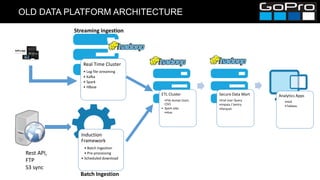
OLD DATA PLATFORM ARCHITECTURE
ETL Cluster
•File dumps (Json,
CSV)
• Spark Jobs
•Hive
Secure Data Mart
•End User Query
•Impala / Sentry
•Parquet
Analytics Apps
•HUE
•Tableau
Real Time Cluster
• Log file streaming
• Kafka
• Spark
• HBase
Induction
Framework
• Batch Ingestion
• Pre-processing
• Scheduled download
Rest API,
FTP
S3 sync
Streaming ingestion
Batch Ingestion
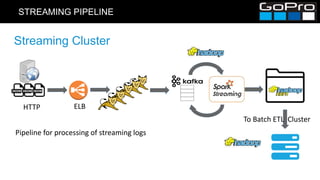
STREAMING PIPELINE
Streaming Cluster
ELBHTTP
Pipeline for processing of streaming logs
To Batch ETL Cluster
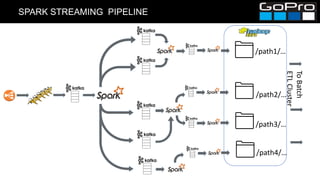
SPARK STREAMING PIPELINE
/path1/…
/path2/…
/path3/…
ToBatch
ETLCluster
/path4/…
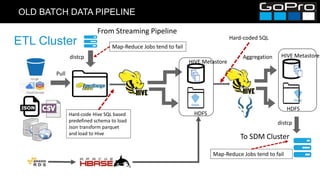
OLD BATCH DATA PIPELINE
ETL Cluster
HDFS
HIVE Metastore
To SDM Cluster
From Streaming Pipeline
Pull
distcp
Hard-code Hive SQL based
predefined schema to load
Json transform parquet
and load to Hive
Map-Reduce Jobs tend to fail
HDFS
HIVE Metastore
distcp
Aggregation
Hard-coded SQL
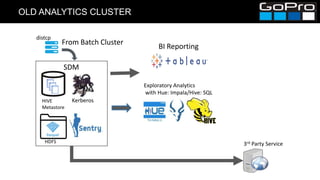
OLD ANALYTICS CLUSTER
HDFS
HIVE
Metastore
BI Reporting
SDM
From Batch Cluster
Exploratory Analytics
with Hue: Impala/Hive: SQL
Kerberos
distcp
3rd Party Service
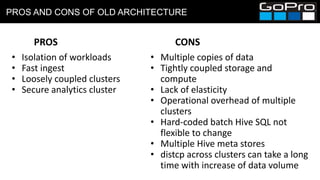
PROS AND CONS OF OLD ARCHITECTURE
• Isolation of workloads
• Fast ingest
• Loosely coupled clusters
• Secure analytics cluster
• Multiple copies of data
• Tightly coupled storage and
compute
• Lack of elasticity
• Operational overhead of multiple
clusters
• Hard-coded batch Hive SQL not
flexible to change
• Multiple Hive meta stores
• distcp across clusters can take a long
time with increase of data volume
PROS CONS
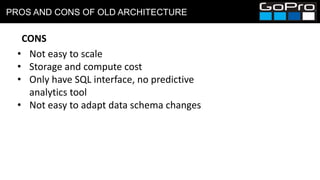
PROS AND CONS OF OLD ARCHITECTURE
• Not easy to scale
• Storage and compute cost
• Only have SQL interface, no predictive
analytics tool
• Not easy to adapt data schema changes
CONS
New Infrastructure
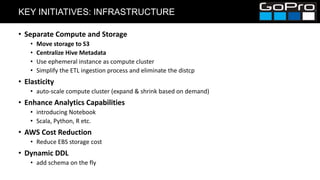
KEY INITIATIVES: INFRASTRUCTURE
• Separate Compute and Storage
• Move storage to S3
• Centralize Hive Metadata
• Use ephemeral instance as compute cluster
• Simplify the ETL ingestion process and eliminate the distcp
• Elasticity
• auto-scale compute cluster (expand & shrink based on demand)
• Enhance Analytics Capabilities
• introducing Notebook
• Scala, Python, R etc.
• AWS Cost Reduction
• Reduce EBS storage cost
• Dynamic DDL
• add schema on the fly
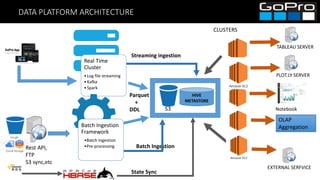
DATA PLATFORM ARCHITECTURE
Real Time
Cluster
•Log file streaming
•Kafka
•Spark
Batch Ingestion
Framework
•Batch Ingestion
•Pre-processing
Streaming ingestion
Batch Ingestion
S3
CLUSTERS
HIVE
METASTORE
PLOT.LY SERVER
TABLEAU SERVER
EXTERNAL SERFVICE
Notebook
Rest API,
FTP
S3 sync,etc
Parquet
+
DDL
State Sync
OLAP
Aggregation
NEW DYNAMIC DDL ARCHITECTURE
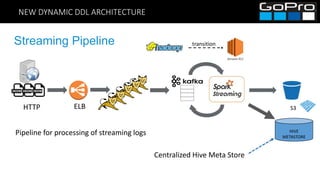
Streaming Pipeline
ELBHTTP
Pipeline for processing of streaming logs
S3
HIVE
METASTORE
transition
Centralized Hive Meta Store
DATA PLATFORM ARCHITECTURE
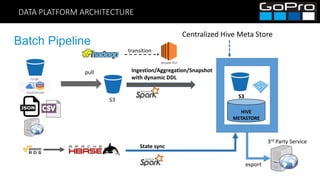
Batch Pipeline
pull
S3
3rd Party Service
export
Centralized Hive Meta Store
S3
HIVE
METASTORE
Ingestion/Aggregation/Snapshot
with dynamic DDL
State sync
transition
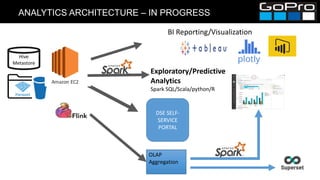
ANALYTICS ARCHITECTURE – IN PROGRESS
BI Reporting/Visualization
Exploratory/Predictive
Analytics
Spark SQL/Scala/python/R
Hive
Metastore
DSE SELF-
SERVICE
PORTAL
OLAP
Aggregation
Dynamic DDL: Adding
Schema to Data on the fly
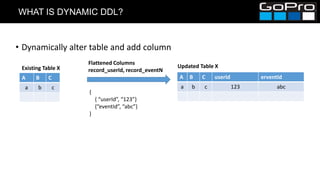
WHAT IS DYNAMIC DDL?
• Dynamically alter table and add column
{
{ “userId”, “123”}
{“eventId”, “abc”}
}
Flattened Columns
record_userId, record_eventN
Updated Table X
A B C userId erventId
a b c 123 abc
A B C
a b c
Existing Table X
WHY USE DYNAMIC DDL?
• Reduce development time
• Traditionally, adding new Event/Attribute/Column requires of a lot time among
teams
• Many Hive ETL SQL needs to be changed to every column changes.
• One way to solve this problem is to use key-value pair table
• Ingestion is easy, no changes needed for newly added event/attribute/column
• Hard for Analytics, tabulated data are much easier to work with
• Dynamical DDL
• Automatically flatten attributes (for json data)
• Turn data into columns
DYNAMIC DDL – CREATE TABLE
// manually create table due to Spark bug
def createTable(sqlContext: SQLContext, columns: Seq[(String, String)],
destInfo: OutputInfo, partitionColumns: Array[(ColumnDef, Column)]): DataFrame = {
val partitionClause = if (partitionColumns.length == 0) "" else {
s"""PARTITIONED BY (${partitionColumns.map(f => s"${f._1.name} ${f._1.`type`}").mkString(", ")})"""
}
val sqlStmt =
s"""CREATE TABLE IF NOT EXISTS ${destInfo.tableName()} ( columns.map(f => s"${f._1} ${f._2}").mkString(", "))
$partitionClause
STORED AS ${destInfo.destFormat.split('.').last}
""".stripMargin
//spark 2.x doesn't know create if not exists syntax,
// still log AlreadyExistsException message. but no exception
sqlContext.sql(sqlStmt)
}
DYNAMIC DDL – ALTER TABLE ADD COLUMNS
//first find existing fields, then add new fields
val tableDf = sqlContext.table(dbTableName)
val exisingFields : Seq[StructField] = …
val newFields: Seq[StructField] = …
if (newFields.nonEmpty) {
// spark 2.x bug https://issues.apache.org/jira/browse/SPARK-19261
val sqlStmt: String = s"""ALTER TABLE $dbTableName ADD COLUMNS ( ${newFields.map ( f =>
s"${f.name} ${f.dataType.typeName}” ).mkString(", ")}. )"""
}
DYNAMIC DDL – ALTER TABLE ADD COLUMNS (SPARK 2.0)
//Hack for Spark 2.0, Spark 2.1
if (newFields.nonEmpty) {
// spark 2.x bug https://issues.apache.org/jira/browse/SPARK-19261
alterTable(sqlContext, dbTableName, newFields)
}
def alterTable(sqlContext: SQLContext,
tableName: String,
newColumns: Seq[StructField]): Unit = {
alterTable(sqlContext, getTableIdentifier(tableName), newColumns)
}
private[spark] class HiveExternalCatalog(conf: SparkConf, hadoopConf: Configuration)
extends ExternalCatalog with Logging {
….
}
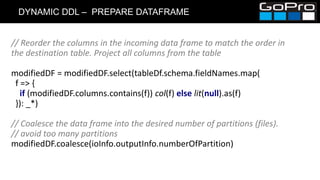
DYNAMIC DDL – PREPARE DATAFRAME
// Reorder the columns in the incoming data frame to match the order in
the destination table. Project all columns from the table
modifiedDF = modifiedDF.select(tableDf.schema.fieldNames.map(
f => {
if (modifiedDF.columns.contains(f)) col(f) else lit(null).as(f)
}): _*)
// Coalesce the data frame into the desired number of partitions (files).
// avoid too many partitions
modifiedDF.coalesce(ioInfo.outputInfo.numberOfPartition)
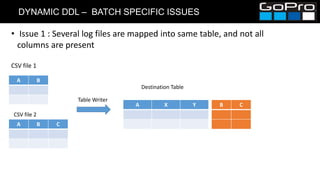
DYNAMIC DDL – BATCH SPECIFIC ISSUES
• Issue 1 : Several log files are mapped into same table, and not all
columns are present
CSV file 1
A B
A B C
CSV file 2
A X Y
Destination Table
Table Writer
B C
DYNAMIC DDL – BATCH SPECIFIC ISSUES
• Solution:
• Find DataFrame with max number of columns, use it as base, and reorder
columns against this DataFrame
val newDfs : Option[ParSeq[DataFrame]] = maxLengthDF.map{ baseDf =>
dfs.map { df =>
df.select(baseDf.schema.fieldNames.map(f => if (df.columns.contains(f)) col(f) else
lit(null).as(f)): _*)
}
}
DYNAMIC DDL – BATCH SPECIFIC ISSUES
• Issue2 : Too many log files -- performance
• Solution: We consolidate several data log files Data Frame into chunks, each
chunk with all Data Frames union together.
val ys: Seq[Seq[DataFrame]] = destTableDFs.seq.grouped(mergeChunkSize).toSeq
val dfs: ParSeq[DataFrame] = ys.par.map(p => p.foldLeft(emptyDF) { (z, a) => z.unionAll(a) })
dfs.foreach(saveDataFrame(info, _))
SUMMARY
SUMMARY
•GoPro Data Platform is in transition and we just get started
•Central Hive Meta store + S3  separate storage +
computing, reduce cost
•Introducing cloud computing for elasticity and reduce
operation complexity
•Leverage dynamic DDL for flexible ingestion, aggregation
and snapshot for both batch and streaming
PG #
RC Playbook: Your guide to
success at GoPro
Questions?

Be A Hero: Transforming GoPro Analytics Data Pipeline

  • 1.
    Be A Hero:Transforming GoPro Analytics Data Pipeline Machine Learning Innovation Summit , 2017 Chester Chen
  • 2.
    ABOUT SPEAKER • Headof Data Science & Engineering • Prev. Director of Engineering, Alpine Data Labs • Start to play with Spark since Spark 0.6 version. • Spoke at Hadoop Summit, Big Data Scala, IEEE Big Data Conferences • Organizer of SF Big Analytics meetup (6800+ members)
  • 3.
    AGENDA • Business UseCases • Data Platform Architecture • Old Data Platforms: Pro & Cons and Challenges • New Data Platform Architeture and Initiatives • Adding Data Schema During Ingestion (Dynamic DDL)
  • 4.
  • 5.
    GROWING DATA NEEDSFROM GOPRO ECOSYSTEM
  • 6.
    GROWING DATA NEEDSFROM GOPRO ECOSYSTEM DATA Analytics Platform Consumer Devices GoPro Apps E-Commerce Social Media/OTT 3rd party data Product Insight CRM/Marketing/ Personalization User segmentation
  • 7.
  • 8.
  • 9.
    OLD DATA PLATFORMARCHITECTURE ETL Cluster •File dumps (Json, CSV) • Spark Jobs •Hive Secure Data Mart •End User Query •Impala / Sentry •Parquet Analytics Apps •HUE •Tableau Real Time Cluster • Log file streaming • Kafka • Spark • HBase Induction Framework • Batch Ingestion • Pre-processing • Scheduled download Rest API, FTP S3 sync Streaming ingestion Batch Ingestion
  • 10.
    STREAMING PIPELINE Streaming Cluster ELBHTTP Pipelinefor processing of streaming logs To Batch ETL Cluster
  • 11.
  • 12.
    OLD BATCH DATAPIPELINE ETL Cluster HDFS HIVE Metastore To SDM Cluster From Streaming Pipeline Pull distcp Hard-code Hive SQL based predefined schema to load Json transform parquet and load to Hive Map-Reduce Jobs tend to fail Map-Reduce Jobs tend to fail HDFS HIVE Metastore distcp Aggregation Hard-coded SQL
  • 13.
    OLD ANALYTICS CLUSTER HDFS HIVE Metastore BIReporting SDM From Batch Cluster Exploratory Analytics with Hue: Impala/Hive: SQL Kerberos distcp 3rd Party Service
  • 14.
    PROS AND CONSOF OLD ARCHITECTURE • Isolation of workloads • Fast ingest • Loosely coupled clusters • Secure analytics cluster • Multiple copies of data • Tightly coupled storage and compute • Lack of elasticity • Operational overhead of multiple clusters • Hard-coded batch Hive SQL not flexible to change • Multiple Hive meta stores • distcp across clusters can take a long time with increase of data volume PROS CONS
  • 15.
    PROS AND CONSOF OLD ARCHITECTURE • Not easy to scale • Storage and compute cost • Only have SQL interface, no predictive analytics tool • Not easy to adapt data schema changes CONS
  • 16.
  • 17.
    KEY INITIATIVES: INFRASTRUCTURE •Separate Compute and Storage • Move storage to S3 • Centralize Hive Metadata • Use ephemeral instance as compute cluster • Simplify the ETL ingestion process and eliminate the distcp • Elasticity • auto-scale compute cluster (expand & shrink based on demand) • Enhance Analytics Capabilities • introducing Notebook • Scala, Python, R etc. • AWS Cost Reduction • Reduce EBS storage cost • Dynamic DDL • add schema on the fly
  • 18.
    DATA PLATFORM ARCHITECTURE RealTime Cluster •Log file streaming •Kafka •Spark Batch Ingestion Framework •Batch Ingestion •Pre-processing Streaming ingestion Batch Ingestion S3 CLUSTERS HIVE METASTORE PLOT.LY SERVER TABLEAU SERVER EXTERNAL SERFVICE Notebook Rest API, FTP S3 sync,etc Parquet + DDL State Sync OLAP Aggregation
  • 19.
    NEW DYNAMIC DDLARCHITECTURE Streaming Pipeline ELBHTTP Pipeline for processing of streaming logs S3 HIVE METASTORE transition Centralized Hive Meta Store
  • 20.
    DATA PLATFORM ARCHITECTURE BatchPipeline pull S3 3rd Party Service export Centralized Hive Meta Store S3 HIVE METASTORE Ingestion/Aggregation/Snapshot with dynamic DDL State sync transition
  • 21.
    ANALYTICS ARCHITECTURE –IN PROGRESS BI Reporting/Visualization Exploratory/Predictive Analytics Spark SQL/Scala/python/R Hive Metastore DSE SELF- SERVICE PORTAL OLAP Aggregation
  • 22.
    Dynamic DDL: Adding Schemato Data on the fly
  • 23.
    WHAT IS DYNAMICDDL? • Dynamically alter table and add column { { “userId”, “123”} {“eventId”, “abc”} } Flattened Columns record_userId, record_eventN Updated Table X A B C userId erventId a b c 123 abc A B C a b c Existing Table X
  • 24.
    WHY USE DYNAMICDDL? • Reduce development time • Traditionally, adding new Event/Attribute/Column requires of a lot time among teams • Many Hive ETL SQL needs to be changed to every column changes. • One way to solve this problem is to use key-value pair table • Ingestion is easy, no changes needed for newly added event/attribute/column • Hard for Analytics, tabulated data are much easier to work with • Dynamical DDL • Automatically flatten attributes (for json data) • Turn data into columns
  • 25.
    DYNAMIC DDL –CREATE TABLE // manually create table due to Spark bug def createTable(sqlContext: SQLContext, columns: Seq[(String, String)], destInfo: OutputInfo, partitionColumns: Array[(ColumnDef, Column)]): DataFrame = { val partitionClause = if (partitionColumns.length == 0) "" else { s"""PARTITIONED BY (${partitionColumns.map(f => s"${f._1.name} ${f._1.`type`}").mkString(", ")})""" } val sqlStmt = s"""CREATE TABLE IF NOT EXISTS ${destInfo.tableName()} ( columns.map(f => s"${f._1} ${f._2}").mkString(", ")) $partitionClause STORED AS ${destInfo.destFormat.split('.').last} """.stripMargin //spark 2.x doesn't know create if not exists syntax, // still log AlreadyExistsException message. but no exception sqlContext.sql(sqlStmt) }
  • 26.
    DYNAMIC DDL –ALTER TABLE ADD COLUMNS //first find existing fields, then add new fields val tableDf = sqlContext.table(dbTableName) val exisingFields : Seq[StructField] = … val newFields: Seq[StructField] = … if (newFields.nonEmpty) { // spark 2.x bug https://issues.apache.org/jira/browse/SPARK-19261 val sqlStmt: String = s"""ALTER TABLE $dbTableName ADD COLUMNS ( ${newFields.map ( f => s"${f.name} ${f.dataType.typeName}” ).mkString(", ")}. )""" }
  • 27.
    DYNAMIC DDL –ALTER TABLE ADD COLUMNS (SPARK 2.0) //Hack for Spark 2.0, Spark 2.1 if (newFields.nonEmpty) { // spark 2.x bug https://issues.apache.org/jira/browse/SPARK-19261 alterTable(sqlContext, dbTableName, newFields) } def alterTable(sqlContext: SQLContext, tableName: String, newColumns: Seq[StructField]): Unit = { alterTable(sqlContext, getTableIdentifier(tableName), newColumns) } private[spark] class HiveExternalCatalog(conf: SparkConf, hadoopConf: Configuration) extends ExternalCatalog with Logging { …. }
  • 28.
    DYNAMIC DDL –PREPARE DATAFRAME // Reorder the columns in the incoming data frame to match the order in the destination table. Project all columns from the table modifiedDF = modifiedDF.select(tableDf.schema.fieldNames.map( f => { if (modifiedDF.columns.contains(f)) col(f) else lit(null).as(f) }): _*) // Coalesce the data frame into the desired number of partitions (files). // avoid too many partitions modifiedDF.coalesce(ioInfo.outputInfo.numberOfPartition)
  • 29.
    DYNAMIC DDL –BATCH SPECIFIC ISSUES • Issue 1 : Several log files are mapped into same table, and not all columns are present CSV file 1 A B A B C CSV file 2 A X Y Destination Table Table Writer B C
  • 30.
    DYNAMIC DDL –BATCH SPECIFIC ISSUES • Solution: • Find DataFrame with max number of columns, use it as base, and reorder columns against this DataFrame val newDfs : Option[ParSeq[DataFrame]] = maxLengthDF.map{ baseDf => dfs.map { df => df.select(baseDf.schema.fieldNames.map(f => if (df.columns.contains(f)) col(f) else lit(null).as(f)): _*) } }
  • 31.
    DYNAMIC DDL –BATCH SPECIFIC ISSUES • Issue2 : Too many log files -- performance • Solution: We consolidate several data log files Data Frame into chunks, each chunk with all Data Frames union together. val ys: Seq[Seq[DataFrame]] = destTableDFs.seq.grouped(mergeChunkSize).toSeq val dfs: ParSeq[DataFrame] = ys.par.map(p => p.foldLeft(emptyDF) { (z, a) => z.unionAll(a) }) dfs.foreach(saveDataFrame(info, _))
  • 32.
  • 33.
    SUMMARY •GoPro Data Platformis in transition and we just get started •Central Hive Meta store + S3  separate storage + computing, reduce cost •Introducing cloud computing for elasticity and reduce operation complexity •Leverage dynamic DDL for flexible ingestion, aggregation and snapshot for both batch and streaming
  • 34.
    PG # RC Playbook:Your guide to success at GoPro Questions?

Editor's Notes

  • #7 Variety of Data Software – Mobile, Desktop and Cloud Apps Hardware – Camera, Drone, Drone Controller, VR, Accessories, Developer Program 3rd Party data – CRM, Social Media, OTT, E-Commerce etc. Variety of data Ingestion mechanism Real-Time Streaming pipeline Batch pipeline -- pushed or pulled data Complex data transformation Data often stored as binary to conserve space in camera Special logics for pair events and flight time correction Heterogeneous data format (json, csv, binary) Seamless data aggregation Combine data from both hardware and software Building data structures of both event-based and state-based
  • #8  Scalability Challenges Increase number of data sources and services requests Quick visibility of the data Infrastructure scalability Data Quality Tools and infrastructure for QA process Hadoop DevOp Challenges Manage Hadoop hardware (disk, security, service, dev and staging clusters) Monitoring Data Pipeline Monitoring metrics and infrastructure Enable Predictive Analytics Tools for Machine Learning and exploratory analytics Cost management AWS (storage & computing) as well as License costs
  • #24 .