Understanding Social Media
How being social connects us together and
the role Social Media plays in that.

  – Social Capital
  – The Networked Audience
  – How students use Social Media
being social connects us together
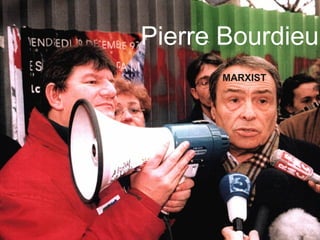
Pierre Bourdieu
      MARXIST
Bourdieu
Economic Capital – property


Cultural Capital – socialisation, class, education


Social Capital
“Social capital is the sum of the resources,
actual or virtual, that accrue to an individual
or a group by virtue of possessing a durable
network of more or less institutionalized
relationships of mutual acquaintance and
recognition.”
(Bourdieu, in Bourdieu & Wacquant, 1992: 119)
Bourdieu
Groups are formed from social norms

Aimed at reproducing or establishing social
  relationships “implying durable obligations
  subjectively felt”

Produces mutual knowledge and recognition
Bourdieu
Explaining how those in power hold on to it

How social capital works to exclude
Social Capital as a civic good
“social capital is a resource based on trust
and shared values, and develops from the
weaving-together of people in communities”
(Gaunlett on Coleman 2011)
Social Capital enhancing economic capital

“If you burn social capital to get a few more
people into your community, what good is
that? Ask yourself seriously whether you’re
being humble and honest” – Chris Brogan
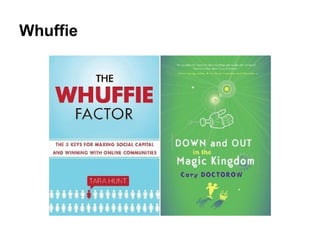
Whuffie
Granovetter / Putnam
Granovetter (1973): ‘Weak ties’
indispensible to individuals’ opportunities
and their integration into communities. (P1378)

Putnam (2000): ‘bridging’ social capital can
generate reciprocity. “Distant acquaintances
in different circles” (P23)
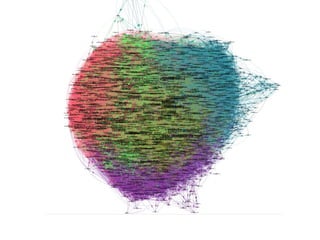
How my twitter followers
  follow each other – who is
  influential?


http://blog.ouseful.info/2011/06/11/a-map-of-my-twitter-follower-network/
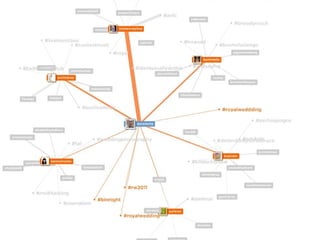
Recent mentions of @daveharte
    on twitter

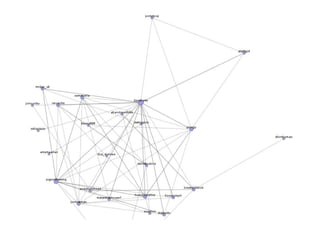
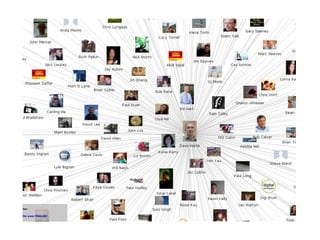
    How people are connected to
    each other


http://ouseful.open.ac.uk/twitter/friendviz.html?q=daveharte&typ=q
http://apps.asterisq.com/mentionmap/#user-daveharte
Social Capital and the web
Our networks as a resource

You have to give a bit to get something out
Measuring Social Capital online
“It might be more accurate to characterize
the individual activities of ranking, rating or
social networking, then, as moments of
experiential re-structuring”

Alison Hearn 2010
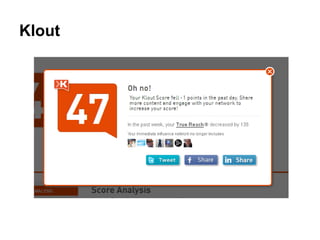
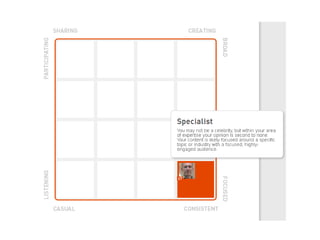
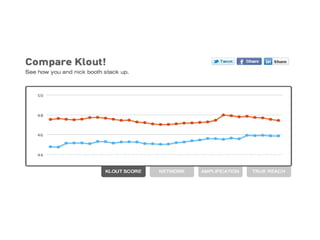
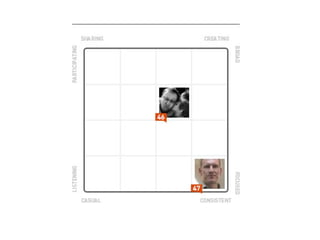
Klout
The Networked Audience


“individuals conceptualise an imagined
audience evoked through their tweets”

Marwick/Boyd (2010)
Someone working alone, with really
cheap tools, has a reasonable hope of
carving out enough of the cognitive
surplus, enough of the desire to
participate, enough of the collective
goodwill of the citizens, to create a
resource you couldn't have imagined
existing even five years ago.”


Clay Shirky
Cognitive
Surplus
“More is different”


Clay Shirky
Cognitive
Surplus
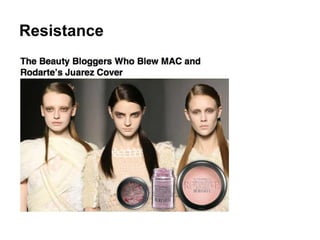
Resistance
MAC / Rodarte
Make-up inspired by Mexico
Nail Polish named after Juarez – known for the
disappearance of hundreds of women who
have been raped and murdered.
Beauty bloggers get a bit upset
Collaborated to respond simultaneously on a
single topic
Consumers as networked activists
MAC / Rodarte
Blogs
  Free platforms (wordpress.com)
  Link to others with similar interests
  Create conversations
  The media is listening
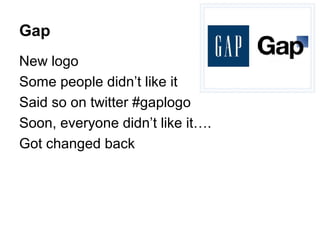
Gap
New logo
Some people didn’t like it
Said so on twitter #gaplogo
Soon, everyone didn’t like it….
Got changed back
Gap
Twitter hashtags #
Connecting the highly
  networked and the less highly networked
Simple, text-based
Coolest networking tool out there
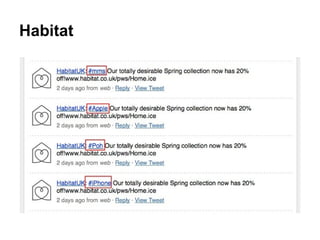
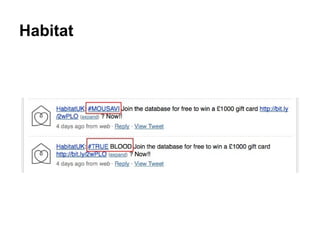
Habitat
Habitat
United Break Guitars
Students
Some things we learned from studying
Media students

How are students using social media to
network with the media industry?
Questionnaire
320 respondents (from about 400 possible
respondents)

Undergraduate Year 1   41.7%
Undergraduate Year 2   24.7%
Undergraduate Year 3   24%
Post graduate 9.6%
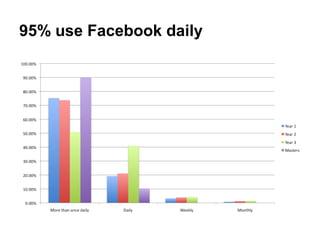
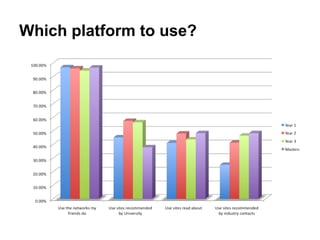
95% use Facebook daily
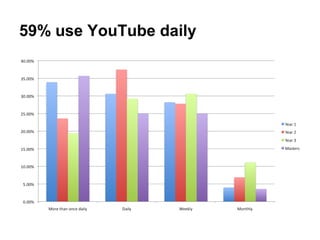
59% use YouTube daily
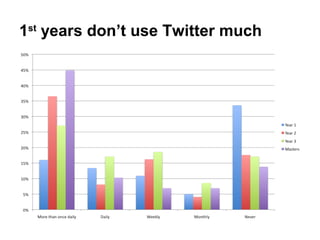
1st years don’t use Twitter much
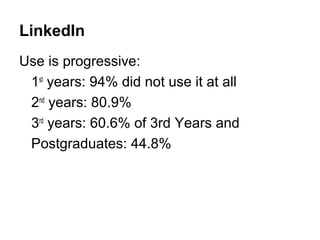
LinkedIn
Use is progressive:
 1st years: 94% did not use it at all
 2nd years: 80.9%
 3rd years: 60.6% of 3rd Years and
 Postgraduates: 44.8%
Which platform to use?
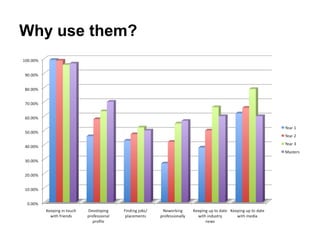
Why use them?
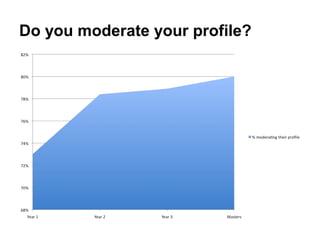
Do you moderate your profile?
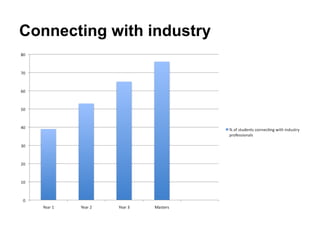
Connecting with industry
Finding Placements
24% had been successful in finding
    placements or paid work, fairly equally
    split between years
Qualitative Research
Personal versus Professional

‘ I tend to use Facebook for the more social side
   of it, and Twitter for the more professional side
   of it. My profile on Twitter and Facebook are
   really different’ (1 Year)
                   st
Online Etiquette
‘if there’s an opportunity for a placement or a job,
that you do that formally through email or writing in
to them, that you don’t send an in-box message
and say, hi, do you remember me and can I have
that placement or whatever, because that isn’t
considered the done thing.’ (MA student)
Negative posts
‘He slagged him off quite a lot, said he was
addicted to drugs and stuff, which was all untrue.
He then spoke to someone at Radio 1, to try and
get some work experience. They saw that he was
on Twitter, went on that, saw a link to his blog,
went on that, read the blog and basically told him
where to go’. (2 Year)
              nd
Creating rather than Consuming

‘if you’re interesting then people will follow you,
and if you’re not, no one will care’. (3 Year)
                                       rd


‘it’s quite novel for people in industry at the
moment to see how we’re emerging as the sort of
digital native, that are used to this platform and
know how to interact with people on it.’ (2 Year)
                                            nd
Bonding and Bridging Social Capital

Bonding social capital - Facebook:

‘really useful for Uni stuff, because everybody uses
   it, so even if they don’t text you back, they will
   look on Facebook. It’s easier to talk as a group
   rather than individuals.’ (2 Year)
                            nd
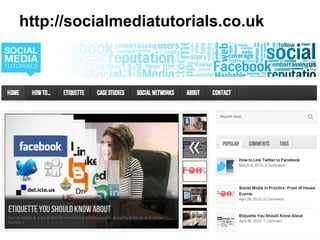
http://socialmediatutorials.co.uk
Summary
The social web is about relationships, not
technology or apps or websites.

We need to invest time into maintaining those
relationships (building our ‘Social Capital’)

It’s terrifying, exciting and moving very very
quickly

Students are savvy and strategic
Questions

BCUSU presentation part two

  • 1.
  • 2.
    How being socialconnects us together and the role Social Media plays in that. – Social Capital – The Networked Audience – How students use Social Media
  • 3.
  • 4.
  • 5.
  • 6.
    Bourdieu Economic Capital –property Cultural Capital – socialisation, class, education Social Capital
  • 7.
    “Social capital isthe sum of the resources, actual or virtual, that accrue to an individual or a group by virtue of possessing a durable network of more or less institutionalized relationships of mutual acquaintance and recognition.” (Bourdieu, in Bourdieu & Wacquant, 1992: 119)
  • 8.
    Bourdieu Groups are formedfrom social norms Aimed at reproducing or establishing social relationships “implying durable obligations subjectively felt” Produces mutual knowledge and recognition
  • 9.
    Bourdieu Explaining how thosein power hold on to it How social capital works to exclude
  • 10.
    Social Capital asa civic good “social capital is a resource based on trust and shared values, and develops from the weaving-together of people in communities” (Gaunlett on Coleman 2011)
  • 11.
    Social Capital enhancingeconomic capital “If you burn social capital to get a few more people into your community, what good is that? Ask yourself seriously whether you’re being humble and honest” – Chris Brogan
  • 14.
  • 15.
    Granovetter / Putnam Granovetter(1973): ‘Weak ties’ indispensible to individuals’ opportunities and their integration into communities. (P1378) Putnam (2000): ‘bridging’ social capital can generate reciprocity. “Distant acquaintances in different circles” (P23)
  • 17.
    How my twitterfollowers follow each other – who is influential? http://blog.ouseful.info/2011/06/11/a-map-of-my-twitter-follower-network/
  • 18.
    Recent mentions of@daveharte on twitter How people are connected to each other http://ouseful.open.ac.uk/twitter/friendviz.html?q=daveharte&typ=q
  • 19.
  • 21.
    Social Capital andthe web Our networks as a resource You have to give a bit to get something out
  • 22.
    Measuring Social Capitalonline “It might be more accurate to characterize the individual activities of ranking, rating or social networking, then, as moments of experiential re-structuring” Alison Hearn 2010
  • 23.
  • 27.
    The Networked Audience “individualsconceptualise an imagined audience evoked through their tweets” Marwick/Boyd (2010)
  • 28.
    Someone working alone,with really cheap tools, has a reasonable hope of carving out enough of the cognitive surplus, enough of the desire to participate, enough of the collective goodwill of the citizens, to create a resource you couldn't have imagined existing even five years ago.” Clay Shirky Cognitive Surplus
  • 29.
    “More is different” ClayShirky Cognitive Surplus
  • 31.
  • 32.
    MAC / Rodarte Make-upinspired by Mexico Nail Polish named after Juarez – known for the disappearance of hundreds of women who have been raped and murdered. Beauty bloggers get a bit upset Collaborated to respond simultaneously on a single topic Consumers as networked activists
  • 33.
    MAC / Rodarte Blogs Free platforms (wordpress.com) Link to others with similar interests Create conversations The media is listening
  • 34.
    Gap New logo Some peopledidn’t like it Said so on twitter #gaplogo Soon, everyone didn’t like it…. Got changed back
  • 35.
    Gap Twitter hashtags # Connectingthe highly networked and the less highly networked Simple, text-based Coolest networking tool out there
  • 36.
  • 37.
  • 38.
  • 39.
    Students Some things welearned from studying Media students How are students using social media to network with the media industry?
  • 40.
    Questionnaire 320 respondents (fromabout 400 possible respondents) Undergraduate Year 1 41.7% Undergraduate Year 2 24.7% Undergraduate Year 3 24% Post graduate 9.6%
  • 41.
  • 42.
  • 43.
    1st years don’tuse Twitter much
  • 44.
    LinkedIn Use is progressive: 1st years: 94% did not use it at all 2nd years: 80.9% 3rd years: 60.6% of 3rd Years and Postgraduates: 44.8%
  • 45.
  • 46.
  • 47.
    Do you moderateyour profile?
  • 48.
  • 49.
    Finding Placements 24% hadbeen successful in finding placements or paid work, fairly equally split between years
  • 50.
    Qualitative Research Personal versusProfessional ‘ I tend to use Facebook for the more social side of it, and Twitter for the more professional side of it. My profile on Twitter and Facebook are really different’ (1 Year) st
  • 51.
    Online Etiquette ‘if there’san opportunity for a placement or a job, that you do that formally through email or writing in to them, that you don’t send an in-box message and say, hi, do you remember me and can I have that placement or whatever, because that isn’t considered the done thing.’ (MA student)
  • 52.
    Negative posts ‘He slaggedhim off quite a lot, said he was addicted to drugs and stuff, which was all untrue. He then spoke to someone at Radio 1, to try and get some work experience. They saw that he was on Twitter, went on that, saw a link to his blog, went on that, read the blog and basically told him where to go’. (2 Year) nd
  • 53.
    Creating rather thanConsuming ‘if you’re interesting then people will follow you, and if you’re not, no one will care’. (3 Year) rd ‘it’s quite novel for people in industry at the moment to see how we’re emerging as the sort of digital native, that are used to this platform and know how to interact with people on it.’ (2 Year) nd
  • 54.
    Bonding and BridgingSocial Capital Bonding social capital - Facebook: ‘really useful for Uni stuff, because everybody uses it, so even if they don’t text you back, they will look on Facebook. It’s easier to talk as a group rather than individuals.’ (2 Year) nd
  • 55.
  • 56.
    Summary The social webis about relationships, not technology or apps or websites. We need to invest time into maintaining those relationships (building our ‘Social Capital’) It’s terrifying, exciting and moving very very quickly Students are savvy and strategic
  • 57.

Editor's Notes

  • #3 W hich is what is what I’d like to you about today. ‘how being social connect us together and w ha t that’s got to do with social media.
  • #4 This is what we should try not to be – technologically determinist. The desire to be social isn’t created by the emergence of social media. Social contexts aren’t affected by these technologies. But the pace and the manner at which groups that use such technologies can cooperate and coordinate is shaped by these technologies. In t he examples we look at later, examples where there is resistance on display. The desire to resist isn ’ t as a result of the technology, but is the manner of the resistance, and its level of impact, is as a result of the technology. p19
  • #5 This is what we should try not to be – technologically determinist. The desire to be social isn’t created by the emergence of social media. Social contexts aren’t affected by these technologies. But the pace and the manner at which groups that use such technologies can cooperate and coordinate is shaped by these technologies. In t he examples we look at later, examples where there is resistance on display. The desire to resist isn ’ t as a result of the technology, but is the manner of the resistance, and its level of impact, is as a result of the technology. p19
  • #6 Let’s begin with a dead French Marxist.
  • #8 Bourdieu, Pierre, and Wacquant, Loic J. D. (1992), An Invitation to Reflexive Sociology, Chicago: University of Chicago Press.
  • #9 Groups are formed from social norms They require investment Aimed at reproducing or establishing social relationships “implying durable obligations subjectively felt” Requires the ‘alchemy of consecration’ through exchange (of words, gifts, labor etc.) Produces mutual knowledge and recognition
  • #10 This is how Bordieu viewed the concept but it’s been viewed in different ways by different commentators.
  • #11 Taken from: http://www.makingisconnecting.org/gauntlett2011-extract-sc.pdf I can’t sell you my social capital. The trust I’ve built up can’t be passed on. Coleman saw the creation of social capital as a largely unintentional process, which arises from activities intended for other purposes.
  • #12 http://www.chrisbrogan.com/reach-outside-your-fishbowl-to-build-community/
  • #13 F rom: http://www.youtube.com/watch?NR=1&v=8AEzmaZsQ2M
  • #14 “ In this age of reputational transparency, companies must expand their social networks and cultivate meaningful quality relationships with the people in those networks. They can do this, according to Hunt, by going above and beyond their profit driven mission and finding a ‘high end’, authentic, commitment to community (Hunt, 2009)” (in ‘Structuring feeling: Web 2.0, online ranking and rating, and the digital ‘reputation’ economy’ Alison Hearn www.ephemeraweb.org volume 10(3/4): 421-438
  • #15 Tara Hunt 2009 – Cory Doctorow (2003) “ The operations of Disney World, in this glimpse into the near future, are administered by "ad-hocs", volunteer groups devoted to retaining the old-fashioned charms of the amusement park in a society that has otherwise undergone radical change. Now that you can back up the contents of your brain and download it into a fresh clone, death has become obsolete. And rather than acquiring wealth, people are concerned with earning Whuffie, a measure of good will and admiration among your fellow immortals.”
  • #16 Jon Hickman – let me have his useful literature review. charts its uptake in US and UK policy.
  • #17 Robert Putnam (looking scary) – Bowling Alone
  • #18 Tony Hirst – Communications and Systems - OU
  • #19 SMEs Colleagues No ‘real’ friends http://blog.ouseful.info/2011/04/12/using-protovis-to-visualise-connections-between-people-tweeting-a-particular-term/ - notes in the above M ore tools: http://mc539.posterous.com/45227147
  • #28 I Tweet Honestly, I Tweet Passionately: Twitter Users, Context Collapse, and the Imagined Audience. published online 7 July 2010 New Media Society Alice E. Marwick and danah boyd - http://nms.sagepub.com/content/early/2010/06/22/1461444810365313 “ Lisa Ede and Andrea Lunsford (1984) distinguished further between the audience addressed – the actual readers of a piece of writing – and audience invoked, the audience constructed by the writer. Published writers are often told to tailor books to particular demographics; these ‘future readers’ are a fiction about the audience addressed.”
  • #31 For Shirky a resource like wikipedia is the ultimate example of the power of that network.
  • #34 https://docs.google.com/document/pub?id=1knTaNYIB8xZvOisopRfMpn18AyFXgF_Eh2OAfKqwC88 - list of blog posts about the MAC/Rodarte controversy
  • #39 From http://www.youtube.com/watch?v=5YGc4zOqozo 11 million views (150k on first day) Full Story: ‪http://www.davecarrollmusic.com/story/united-breaks-guitars‬ - In the spring of 2008, Sons of Maxwell were traveling to Nebraska for a one-week tour and my Taylor guitar was witnessed being thrown by United Airlines baggage handlers in Chicago. So I promised the last person to finally say no to compensation (Ms. Irlweg) that I would write and produce three songs about my experience with United Airlines and make videos for each to be viewed online by anyone in the world. Made 3 songs. First one widely covered by media. Eventually compensated not before United stock price dropped 10%
  • #58 Videos: Carter2: 1:20 – 3:40 Kids – all Tim Berners-lee 9:12 – 11: 26 Phone review kid: start to 1:13 Ed Richards (PSB): 1:57 – 3:29 Shirky – 1:47 – 3:23