MEASURING FINANCIAL INCLUSION:
     THE GLOBAL FINDEX

 Asli Demirguc-Kunt & Leora Klapper
GLOBAL FINDEX OVERVIEW


Goal to collect comparable cross-country data on financial inclusion by
surveying individuals around the world:
― Measure the use of formal and informal financial services, using consistent
   methodology across economies and time
― Identify the segments of the population with greatest barriers to access to
   finance: poor, woman, youth, and rural residents.
― Motivate and track policies to expand financial services to the poor
― Design a questionnaire to harmonize financial inclusion questions across
   economies
Funded by a 10 year grant from the Bill & Melinda Gates Foundation (through
2020)
Added questions on the use of financial services - payments, savings, credit,
and insurance - to the 2011 Gallup World Poll
GLOBAL FINDEX ACCOUNTS AND PAYMENTS


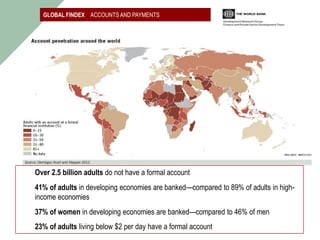
Over 2.5 billion adults do not have a formal account
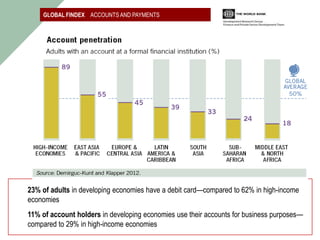
41% of adults in developing economies are banked—compared to 89% of adults in high-
income economies
37% of women in developing economies are banked—compared to 46% of men
23% of adults living below $2 per day have a formal account
GLOBAL FINDEX ACCOUNTS AND PAYMENTS


23% of adults in developing economies have a debit card—compared to 62% in high-income
economies
11% of account holders in developing economies use their accounts for business purposes—
compared to 29% in high-income economies
GLOBAL FINDEX ACCOUNTS AND PAYMENTS


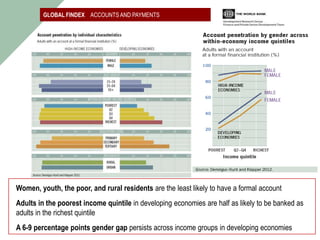
Women, youth, the poor, and rural residents are the least likely to have a formal account
Adults in the poorest income quintile in developing economies are half as likely to be banked as
adults in the richest quintile
A 6-9 percentage points gender gap persists across income groups in developing economies
GLOBAL FINDEX ACCOUNTS AND PAYMENTS


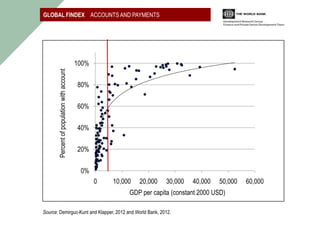
       Percent of population with account   100%


                                            80%


                                            60%


                                            40%


                                            20%


                                             0%
                                                   0   10,000   20,000   30,000   40,000   50,000   60,000
                                                            GDP per capita (constant 2000 USD)

Source: Demirguc-Kunt and Klapper, 2012 and World Bank, 2012.
GLOBAL FINDEX ACCOUNTS AND PAYMENTS


31 percent of unbanked in Sub-Saharan Africa choose ―Too far away‖
31 percent of unbanked in Europe and Central Asia choose ―[I] don’t trust banks‖
40 percent of unbanked in Latin America and the Caribbean choose ―They are too expensive‖
GLOBAL FINDEX ACCOUNTS AND PAYMENTS


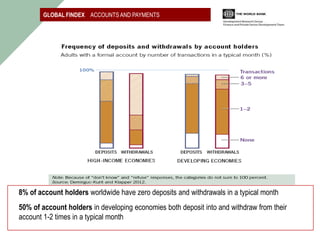
8% of account holders worldwide have zero deposits and withdrawals in a typical month
50% of account holders in developing economies both deposit into and withdraw from their
account 1-2 times in a typical month
GLOBAL FINDEX SAVING


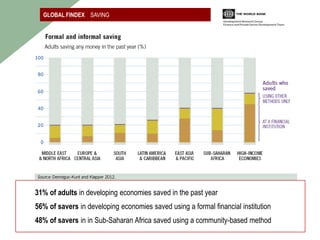
31% of adults in developing economies saved in the past year
56% of savers in developing economies saved using a formal financial institution
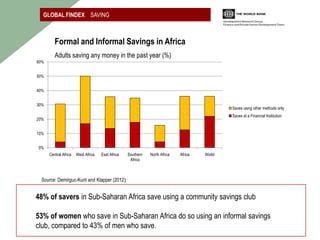
48% of savers in in Sub-Saharan Africa saved using a community-based method
GLOBAL FINDEX SAVING


         Formal and Informal Savings in Africa
         Adults saving any money in the past year (%)
60%


50%


40%


30%
                                                                                              Saves using other methods only
                                                                                              Saves at a Financial Institution
20%


10%


0%
      Central Africa   West Africa   East Africa   Southern   North Africa   Africa   World
                                                    Africa


 Source: Demirguc-Kunt and Klapper (2012)


48% of savers in Sub-Saharan Africa save using a community savings club

53% of women who save in Sub-Saharan Africa do so using an informal savings
club, compared to 43% of men who save.
GLOBAL FINDEX SAVING


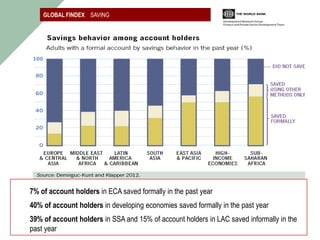
7% of account holders in ECA saved formally in the past year
40% of account holders in developing economies saved formally in the past year
39% of account holders in SSA and 15% of account holders in LAC saved informally in the
past year
GLOBAL FINDEX SAVING


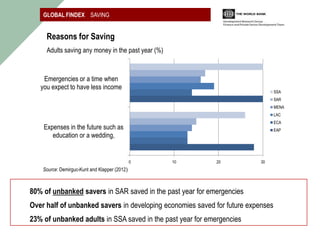
     Reasons for Saving
     Adults saving any money in the past year (%)


    Emergencies or a time when
   you expect to have less income
                                                                                 SSA
                                                                                 SAR
                                                                                 MENA
                                                                                 LAC
                                                                                 ECA
    Expenses in the future such as                                               EAP
       education or a wedding,


                                               0    10      20           30
    Source: Demirguc-Kunt and Klapper (2012)


80% of unbanked savers in SAR saved in the past year for emergencies
Over half of unbanked savers in developing economies saved for future expenses
23% of unbanked adults in SSA saved in the past year for emergencies
GLOBAL FINDEX CREDIT AND RISK MANAGEMENT


To conclude:
• This data can be useful for policy makers, bankers, NGO’s, donors, and
  researchers interested in a holistic understanding of how adults around
  the world use financial services.
• The data is included in the G-20 GPFI basic set of financial inclusion
  indicators to benchmark and set targets for financial inclusion strategies.
• Key headline indicators –formal accounts and credit—will be available
  annually, and the full questionnaire will be collected triennially. Microdata
  will be released Nov 27.
• Low rates of savings in many developing countries
  should encourage new modes of access and product
  development.
GLOBAL FINDEX DATA RELEASE


Global Findex Suite of Products
― Financial Inclusion Data Portal
― World Bank eAtlas of Financial Inclusion
― The Little Data Book on Financial Inclusion 2012
― Global Financial Inclusion Microdata Databank (November 2012)
               www.worldbank.org/globalfindex

Klapper,l savings plenary_presenter1

  • 1.
    MEASURING FINANCIAL INCLUSION: THE GLOBAL FINDEX Asli Demirguc-Kunt & Leora Klapper
  • 2.
    GLOBAL FINDEX OVERVIEW Goalto collect comparable cross-country data on financial inclusion by surveying individuals around the world: ― Measure the use of formal and informal financial services, using consistent methodology across economies and time ― Identify the segments of the population with greatest barriers to access to finance: poor, woman, youth, and rural residents. ― Motivate and track policies to expand financial services to the poor ― Design a questionnaire to harmonize financial inclusion questions across economies Funded by a 10 year grant from the Bill & Melinda Gates Foundation (through 2020) Added questions on the use of financial services - payments, savings, credit, and insurance - to the 2011 Gallup World Poll
  • 3.
    GLOBAL FINDEX ACCOUNTSAND PAYMENTS Over 2.5 billion adults do not have a formal account 41% of adults in developing economies are banked—compared to 89% of adults in high- income economies 37% of women in developing economies are banked—compared to 46% of men 23% of adults living below $2 per day have a formal account
  • 4.
    GLOBAL FINDEX ACCOUNTSAND PAYMENTS 23% of adults in developing economies have a debit card—compared to 62% in high-income economies 11% of account holders in developing economies use their accounts for business purposes— compared to 29% in high-income economies
  • 5.
    GLOBAL FINDEX ACCOUNTSAND PAYMENTS Women, youth, the poor, and rural residents are the least likely to have a formal account Adults in the poorest income quintile in developing economies are half as likely to be banked as adults in the richest quintile A 6-9 percentage points gender gap persists across income groups in developing economies
  • 6.
    GLOBAL FINDEX ACCOUNTSAND PAYMENTS Percent of population with account 100% 80% 60% 40% 20% 0% 0 10,000 20,000 30,000 40,000 50,000 60,000 GDP per capita (constant 2000 USD) Source: Demirguc-Kunt and Klapper, 2012 and World Bank, 2012.
  • 7.
    GLOBAL FINDEX ACCOUNTSAND PAYMENTS 31 percent of unbanked in Sub-Saharan Africa choose ―Too far away‖ 31 percent of unbanked in Europe and Central Asia choose ―[I] don’t trust banks‖ 40 percent of unbanked in Latin America and the Caribbean choose ―They are too expensive‖
  • 8.
    GLOBAL FINDEX ACCOUNTSAND PAYMENTS 8% of account holders worldwide have zero deposits and withdrawals in a typical month 50% of account holders in developing economies both deposit into and withdraw from their account 1-2 times in a typical month
  • 9.
    GLOBAL FINDEX SAVING 31%of adults in developing economies saved in the past year 56% of savers in developing economies saved using a formal financial institution 48% of savers in in Sub-Saharan Africa saved using a community-based method
  • 10.
    GLOBAL FINDEX SAVING Formal and Informal Savings in Africa Adults saving any money in the past year (%) 60% 50% 40% 30% Saves using other methods only Saves at a Financial Institution 20% 10% 0% Central Africa West Africa East Africa Southern North Africa Africa World Africa Source: Demirguc-Kunt and Klapper (2012) 48% of savers in Sub-Saharan Africa save using a community savings club 53% of women who save in Sub-Saharan Africa do so using an informal savings club, compared to 43% of men who save.
  • 11.
    GLOBAL FINDEX SAVING 7%of account holders in ECA saved formally in the past year 40% of account holders in developing economies saved formally in the past year 39% of account holders in SSA and 15% of account holders in LAC saved informally in the past year
  • 12.
    GLOBAL FINDEX SAVING Reasons for Saving Adults saving any money in the past year (%) Emergencies or a time when you expect to have less income SSA SAR MENA LAC ECA Expenses in the future such as EAP education or a wedding, 0 10 20 30 Source: Demirguc-Kunt and Klapper (2012) 80% of unbanked savers in SAR saved in the past year for emergencies Over half of unbanked savers in developing economies saved for future expenses 23% of unbanked adults in SSA saved in the past year for emergencies
  • 13.
    GLOBAL FINDEX CREDITAND RISK MANAGEMENT To conclude: • This data can be useful for policy makers, bankers, NGO’s, donors, and researchers interested in a holistic understanding of how adults around the world use financial services. • The data is included in the G-20 GPFI basic set of financial inclusion indicators to benchmark and set targets for financial inclusion strategies. • Key headline indicators –formal accounts and credit—will be available annually, and the full questionnaire will be collected triennially. Microdata will be released Nov 27. • Low rates of savings in many developing countries should encourage new modes of access and product development.
  • 14.
    GLOBAL FINDEX DATARELEASE Global Findex Suite of Products ― Financial Inclusion Data Portal ― World Bank eAtlas of Financial Inclusion ― The Little Data Book on Financial Inclusion 2012 ― Global Financial Inclusion Microdata Databank (November 2012) www.worldbank.org/globalfindex