MED6107
Creativity in the Media
Exploring the Creative City
Today…
• Some context for your exploration of
Birmingham as a Creative city
3
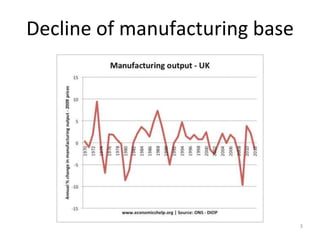
Decline of manufacturing base
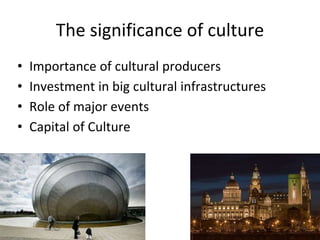
The significance of culture
• Importance of cultural producers
• Investment in big cultural infrastructures
• Role of major events
• Capital of Culture
4
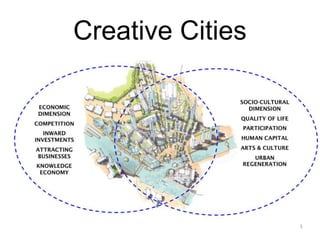
Creative Cities
5
The ten indicators of a creative place
(Landry and Hyams)
1. political & public framework
2. distinctiveness, diversity, vitality and expression
3. openness, trust, tolerance & accessibility
4. strategic leadership, agility & vision
5. talent & the learning landscape
6. communication, connectivity & networking
7. the place & placemaking
8. liveability & well-being
9. professionalism & effectiveness
10. entrepreneurship, exploration & innovation
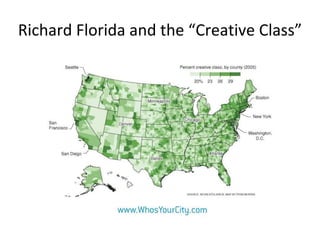
Richard Florida and the “Creative Class”
Gentrification
• What is the cost of becoming a Creative City?
• Problems with gentrification and how to
resist it.
8
Birmingham
Birmingham’s Cultural Strategy 2016-19
“Birmingham is a non-stop city of culture with
local roots and international reach - a capital of
imagination, creativity and enterprise.”
Birmingham
1. Culture on Our Doorstep
2. Next Generation
3. A Creative City
4. Our Cultural Capital
5. Our Cultural Future
10
Birmingham
Our Cultural Capital….
Actions:
We will improve our physical and promotional signposting about the city’s cultural assets
and centres, in and out of the city centre.
We will promote the Jewellery Quarter as both a significant heritage site and visitor
destination, and as a centre for contemporary making.
We will develop Digbeth and Eastside as both cultural destinations and homes for digital
and creative businesses; a combined centre of innovation.
11
Task: Ethnography of the city
• We will explore the creative city of Birmingham,
focusing on the Eastside/Digbeth area.
• What are the outward signs of this creativity?
– focus on people as well as places
– architecture, graffiti, signage
– businesses, coffee shops
– culture: high and low
• Can Birmingham become the cultural and creative city
that the strategy wants to achieve?
12
Task: Ethnography of the city
• Take ‘field notes’
– images, words, via #MED6107 hashtag
• Post a short summary (max: 250 words) of your
findings to the forum in Week 7 on moodle.
13

MED6107 wk07 lecture 2017 18

  • 1.
    MED6107 Creativity in theMedia Exploring the Creative City
  • 2.
    Today… • Some contextfor your exploration of Birmingham as a Creative city
  • 3.
  • 4.
    The significance ofculture • Importance of cultural producers • Investment in big cultural infrastructures • Role of major events • Capital of Culture 4
  • 5.
  • 6.
    The ten indicatorsof a creative place (Landry and Hyams) 1. political & public framework 2. distinctiveness, diversity, vitality and expression 3. openness, trust, tolerance & accessibility 4. strategic leadership, agility & vision 5. talent & the learning landscape 6. communication, connectivity & networking 7. the place & placemaking 8. liveability & well-being 9. professionalism & effectiveness 10. entrepreneurship, exploration & innovation
  • 7.
    Richard Florida andthe “Creative Class”
  • 8.
    Gentrification • What isthe cost of becoming a Creative City? • Problems with gentrification and how to resist it. 8
  • 9.
    Birmingham Birmingham’s Cultural Strategy2016-19 “Birmingham is a non-stop city of culture with local roots and international reach - a capital of imagination, creativity and enterprise.”
  • 10.
    Birmingham 1. Culture onOur Doorstep 2. Next Generation 3. A Creative City 4. Our Cultural Capital 5. Our Cultural Future 10
  • 11.
    Birmingham Our Cultural Capital…. Actions: Wewill improve our physical and promotional signposting about the city’s cultural assets and centres, in and out of the city centre. We will promote the Jewellery Quarter as both a significant heritage site and visitor destination, and as a centre for contemporary making. We will develop Digbeth and Eastside as both cultural destinations and homes for digital and creative businesses; a combined centre of innovation. 11
  • 12.
    Task: Ethnography ofthe city • We will explore the creative city of Birmingham, focusing on the Eastside/Digbeth area. • What are the outward signs of this creativity? – focus on people as well as places – architecture, graffiti, signage – businesses, coffee shops – culture: high and low • Can Birmingham become the cultural and creative city that the strategy wants to achieve? 12
  • 13.
    Task: Ethnography ofthe city • Take ‘field notes’ – images, words, via #MED6107 hashtag • Post a short summary (max: 250 words) of your findings to the forum in Week 7 on moodle. 13

Editor's Notes

  • #4  Climate change, peak oil, energy insecurity Economic Downturn Unemployment, stalled property market, lack of capital for investment, lack of diversity Regeneration incomplete – Even the boom times were not that good! Still work to do…. Inequality Governance and powers- Rigidity of Local policy instruments
  • #5 Importance of cultural producers. Development of new independent cultural quarters. Artists occupy empty spaces in the city •Investment in big cultural infrastructures (lottery funding) that support consumption-led economic development (Tate Modern) •New opportunities to attract major events: European Capital of Culture (Glasgow), Commonwealth Games (Manchester)
  • #6 Bianchini & Landry (1995): a place for social and creative innovation • End of 90s: role of ECC, regenerative potential of culture (city of consumption) • 1998: a city supporting and developing the „creative industries‟ • A city for the „creative class‟ (Florida, 2002)
  • #7 Creative City index: For Charles Landry conditions need to be developed in order for creative industries to truly thrive. They need to have particular spaces that encourage creativity and future proof cities. By having a thriving cultural sector this will help increase the economy of an area
  • #8 Richard Florida Govt. get regional development wrong New economic resources – intelligence, knowledge (vs physical labour/materials) Human Capital – key ingredient Overall it is creativity that is the basis of competitive advantage ‘high-tech’ workers: artists, designers, musicians etc – ‘high bohemians’ Cities with concentrations of creative class = higher economic development Creative class fosters open, dynamic, personalised but professional environment Self-perpetuating in attracting creatives and boosting economy
  • #11 1. Culture on Our Doorstep Becoming a leader in cultural democracy where people come together to co-create, commission, lead and participate in a wide range of locally relevant, pluralistic and community driven cultural ventures. 2. Next Generation Ensuring that all children and young people have opportunities to engage with a diverse range of high quality arts and cultural experiences at every stage of their development and which they value as worth it. 3. A Creative City Supporting and enabling the growth of creative and cultural SMEs and micro-businesses and individuals through business support, skills and talent development and access to finance. 4. Our Cultural Capital Cementing Birmingham’s role and reputation as a centre of imagination, innovation and enterprise, with local roots and international reach. 5. Our Cultural Future Adapting our business models to ensure they are capable of sustaining and growing the sector into the future through collaboration, diversification, rebalancing and devolution.
  • #14 Set readings: Forkert, K. (2013) The persistence of bohemia, City: analysis of urban trends, culture, theory, policy, action, 17(2), pp 149-163. Comunian, Roberta (2011) Rethinking the Creative City: The Role of Complexity, Networks and Interactions in the Urban Creative Economy. Urban Studies, Vol 48, No 6, pp. 1157-1179.