Welcome
WEEK 8 – WRITING II
Survey – participating in research
 One of the professors here at Brock has been conducting a research study
over the past few years comparing Canadian and American Pre-service
Education Programs for Language Arts.
 One part of this study is a survey for Teacher Candidates on their beliefs
about literacy and language.
 Participating in research allows you to meaningfully contribute to your field,
support those at your faculty and in your professions, and send out good
karma!
 Your participation is optional and completely separate form this course and
your program at Brock
 If you can, please take 5-7 minutes to fill in the survey at your table
(anonymously… I will have one of your peers collect the surveys so I will not
know who chose /chose not to complete it. I will also not be looking at any
responses, but handing them directly back to the researcher).
Agenda
 Picture Book Lesson Presentation.
 Connecting Writing Expectations to Current events
 Break
 PLCs
 Example Lesson
 Looking ahead to next week and homework
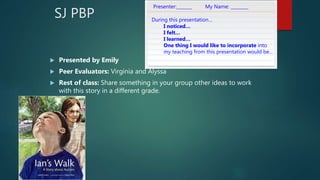
SJ PBP
 Presented by Emily
 Peer Evaluators: Virginia and Alyssa
 Rest of class: Share something in your group other ideas to work
with this story in a different grade.
Presenter:_______ My Name: ________
During this presentation…
I noticed…
I felt…
I learned…
One thing I would like to incorporate into
my teaching from this presentation would be…
Making Writing Meaningful
 What makes writing meaningful?
 Where do grammar and spelling fit in?
 In the early stages of writing, ideas and inspirations shouldn’t be impeded
by the technicalities of spelling and mechanics of sentence structure.
 Get their ideas on paper and then we can work together to organize them.
 That’s where the drafting and editing process come in.
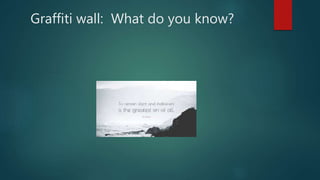
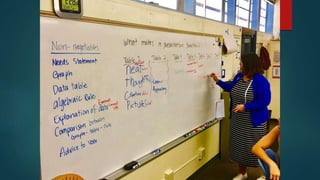
Graffiti wall: What do you know?
Lets create a toolbox to give us the tools
Many different things can go in your toolbox
and there are a number of questions that you
need to consider in the creation of your
toolbox.
Where do I have the power to make real
change?
Who is in my universe of obligation?
What will I need in my toolbox to sustain me
when this work gets hard?
What will I have in my toolbox that will help
me to remember why this work is necessary?
What do I have in my toolbox as far as a
‘difference alarm,' to wake me up when I need
to do the work?
Graffiti Wall
Remember that it is always “WE” not “Us and Them”
On the whiteboard answer a question,
provide an idea for a tool or whatever
comes to mind.
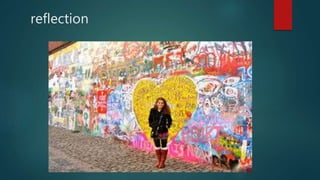
reflection
Current Event that has impact
What do you do?????????
Infusing your lessons with current events:
Addressing the NOW, history, and the future
 In small groups, design a lesson plan to address a current news
event
 Include a meaningful writing task that empowers students to use
their voices and actions for change
 Make sure you have explicit links to the writing curriculum. You can
include additional language strands if you wish to do so.
 Be prepared to share your lesson with the class
 You should include: curriculum expectations, a list of materials, and
minds on/action/consolidation stages.
In your group Create one Lesson together.
You must use at least 3 Writing Expectations
 3 Part Lesson Plan
 Minds On/ Action/ Consolidation
 If you are able to in the short time, include
 Rational
 Overall Expectation, Specific Expectation KTCA
 Learning Goals
 Success Criteria
 Materials Preparation
 Minds on
 Action
 Consolidation and Connection
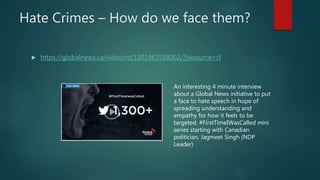
Hate Crimes – How do we face them?
 https://globalnews.ca/video/rd/1201963588002/?jwsource=cl
An interesting 4 minute interview
about a Global News initiative to put
a face to hate speech in hope of
spreading understanding and
empathy for how it feels to be
targeted. #FirstTimeIWasCalled mini
series starting with Canadian
politician, Jagmeet Singh (NDP
Leader)
PLC
A Sample GRR Lesson Sequence
Part 1: Minds on
A totem is a spirit being, sacred object, or symbol of a
tribe, clan, family, or individual.
Native American tradition provides that each person is
connected with nine different animals that will
accompany him or her through life, acting as guides.
Source: https://www.legendsofamerica.com/na-totems/
A Sample GRR Lesson Sequence
Part 1: Minds on
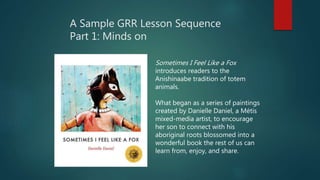
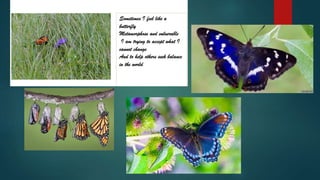
Sometimes I Feel Like a Fox
introduces readers to the
Anishinaabe tradition of totem
animals.
What began as a series of paintings
created by Danielle Daniel, a Métis
mixed-media artist, to encourage
her son to connect with his
aboriginal roots blossomed into a
wonderful book the rest of us can
learn from, enjoy, and share.
A Sample GRR Lesson Sequence
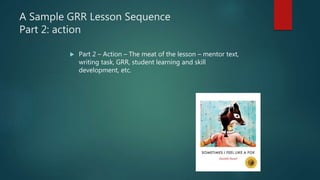
Part 2: action
 Part 2 – Action – The meat of the lesson – mentor text,
writing task, GRR, student learning and skill
development, etc.
A Sample GRR Lesson Sequence
Part 2: action
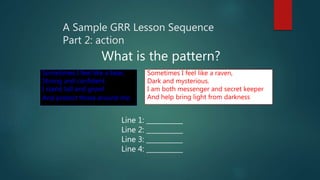
What is the pattern?
Sometimes I feel like a bear,
Strong and confident.
I stand tall and growl
And protect those around me.
Sometimes I feel like a raven,
Dark and mysterious.
I am both messenger and secret keeper
And help bring light from darkness
Line 1: ___________
Line 2: ___________
Line 3: ___________
Line 4: ___________
A Sample GRR Lesson Sequence
Part 2: action
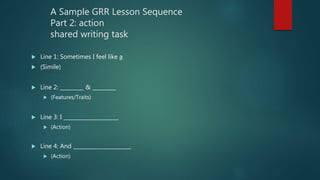
shared writing task
 Line 1: Sometimes I feel like a
 (Simile)
 Line 2: _________ & _________
 (Features/Traits)
 Line 3: I _____________________
 (Action)
 Line 4: And ______________________
 (Action)
Your Task:
 Choose one totem animal and create a poem based on
the model from “Sometimes I Feel Like a Fox.”
 Your focus will be on our Graffiti wall and current events
 How do you feel? What animal works for you using this
lense?
 Conduct research as needed to find out about your
animal
 When your poem is complete, post on google
https://goo.gl/BAomJe
Co-created rubrics
 What:
 A rubric created with students (shared writing task)
 Why:
 To give students ownership over their learning,
 To ensure they understand how to succeed,
 To ensure student friendly language is used
 How:
 Have a plan in your mind, list the curriculum expectations in student friendly language, and
organize their thoughts in categories,
 Ask them about what is important to include, probe them for deeper examples of what they
mean, prompt them to explain reasons for their choices.
 Write down all student ideas, then create the official document on your own using “their ideas”.
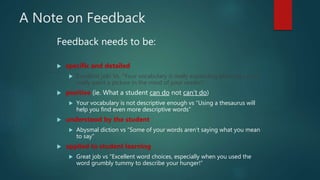
A Note on Feedback
Feedback needs to be:
 specific and detailed
 Excellent job! Vs. “Your vocabulary is really expanding allowing you to
really paint a picture in the mind of your reader!”
 positive (ie. What a student can do not can’t do)
 Your vocabulary is not descriptive enough vs “Using a thesaurus will
help you find even more descriptive words”
 understood by the student
 Abysmal diction vs “Some of your words aren’t saying what you mean
to say”
 applied to student learning
 Great job vs “Excellent word choices, especially when you used the
word grumbly tummy to describe your hunger!”
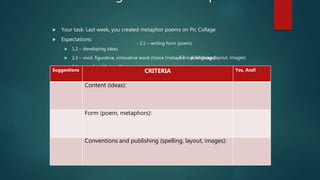
 Your task: Last week, you created metaphor poems on Pic Collage
 Expectations:
 1.2 – developing ideas
 2.3 – vivid, figurative, innovative word choice (metaphorical language)
 3.6 – proofread for spelling, punctuation, grammar
Suggestions CRITERIA Yes, And!
Content (ideas):
Form (poem, metaphors):
Conventions and publishing (spelling, layout, images):
- 2.1 – writing form (poem)
- 3.7 - publishing (layout, images)
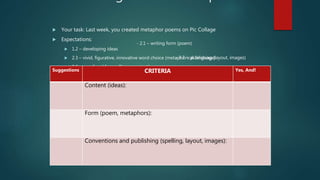
 Your task: Last week, you created metaphor poems on Pic Collage
 Expectations:
 1.2 – developing ideas
 2.3 – vivid, figurative, innovative word choice (metaphorical language)
 3.6 – proofread for spelling, punctuation, grammar
Suggestions CRITERIA Yes, And!
Content (ideas):
Form (poem, metaphors):
Conventions and publishing (spelling, layout, images):
- 2.1 – writing form (poem)
- 3.7 - publishing (layout, images)
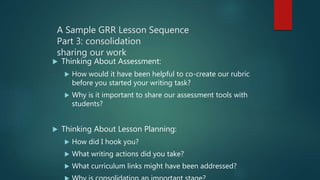
A Sample GRR Lesson Sequence
Part 3: consolidation
sharing our work
 Thinking About Assessment:
 How would it have been helpful to co-create our rubric
before you started your writing task?
 Why is it important to share our assessment tools with
students?
 Thinking About Lesson Planning:
 How did I hook you?
 What writing actions did you take?
 What curriculum links might have been addressed?
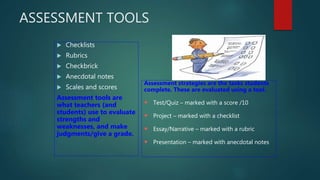
ASSESSMENT TOOLS
 Checklists
 Rubrics
 Checkbrick
 Anecdotal notes
 Scales and scores
Assessment tools are
what teachers (and
students) use to evaluate
strengths and
weaknesses, and make
judgments/give a grade.
Assessment strategies are the tasks students
complete. These are evaluated using a tool.
 Test/Quiz – marked with a score /10
 Project – marked with a checklist
 Essay/Narrative – marked with a rubric
 Presentation – marked with anecdotal notes
A closer look at rubrics
 A RUBRIC IS AN EVALUATIVE TOOL FOR TEACHERS AND
LEARNERS THAT...
 Establishes goals and expectations for learning
 Establishes standards
 Provides guidelines for teaching and learning
 Provides measures for proficiency and accountability
A closer look at rubrics
RUBRICS CONTAIN CRITERIA AND QUALIFIERS
 CRITERIA: the components being assessed
 Need to reflect curriculum expectations
 Need to separate ideas (content) and skills (spelling etc).
 Need to be observable traits
 QUALIFIERS: the degree of competency demonstrated by the work
 Need to be based on the language in the curriculum documents (see
achievement chart)
 Need to be objective as much as possible
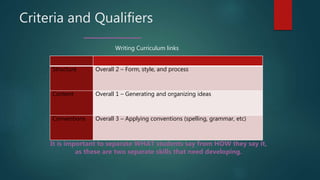
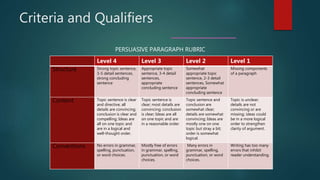
Criteria and Qualifiers
Structure Overall 2 – Form, style, and process
Content Overall 1 – Generating and organizing ideas
Conventions Overall 3 – Applying conventions (spelling, grammar, etc)
Writing Curriculum links
It is important to separate WHAT students say from HOW they say it,
as these are two separate skills that need developing.
Criteria and Qualifiers
Level 4 Level 3 Level 2 Level 1
Structure Strong topic sentence,
3-5 detail sentences,
strong concluding
sentence
Appropriate topic
sentence, 3-4 detail
sentences,
appropriate
concluding sentence
Somewhat
appropriate topic
sentence, 2-3 detail
sentences, Somewhat
appropriate
concluding sentence
Missing components
of a paragraph
Content Topic sentence is clear
and directive; all
details are convincing;
conclusion is clear and
compelling; Ideas are
all on one topic and
are in a logical and
well-thought order.
Topic sentence is
clear; most details are
convincing; conclusion
is clear; Ideas are all
on one topic and are
in a reasonable order.
Topic sentence and
conclusion are
somewhat clear;
details are somewhat
convincing; Ideas are
mostly one on one
topic but stray a bit;
order is somewhat
logical.
Topic is unclear;
details are not
convincing or are
missing; ideas could
be in a more logical
order to strengthen
clarity of argument.
Conventions No errors in grammar,
spelling, punctuation,
or word choices.
Mostly free of errors
in grammar, spelling,
punctuation, or word
choices.
Many errors in
grammar, spelling,
punctuation, or word
choices.
Writing has too many
errors that inhibit
reader understanding.
PERSUASIVE PARAGRAPH RUBRIC
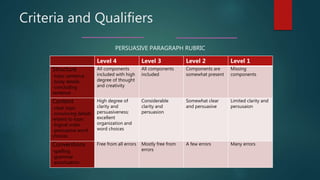
Criteria and Qualifiers
Level 4 Level 3 Level 2 Level 1
Structure
-topic sentence
-body details
-concluding
sentence
All components
included with high
degree of thought
and creativity
All components
included
Components are
somewhat present
Missing
components
Content
-clear topic
-convincing details
related to topic
-logical order
-persuasive word
choices
High degree of
clarity and
persuasiveness;
excellent
organization and
word choices
Considerable
clarity and
persuasion
Somewhat clear
and persuasive
Limited clarity and
persusaion
Conventions
-spelling
-grammar
-punctuation
Free from all errors Mostly free from
errors
A few errors Many errors
PERSUASIVE PARAGRAPH RUBRIC
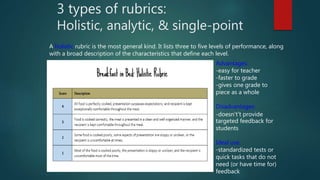
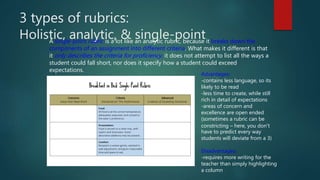
3 types of rubrics:
Holistic, analytic, & single-point
A holistic rubric is the most general kind. It lists three to five levels of performance, along
with a broad description of the characteristics that define each level.
Advantages:
-easy for teacher
-faster to grade
-gives one grade to
piece as a whole
Disadvantages:
-doesn't’t provide
targeted feedback for
students
Ideal use:
-standardized tests or
quick tasks that do not
need (or have time for)
feedback
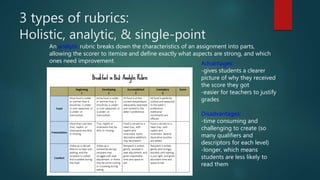
3 types of rubrics:
Holistic, analytic, & single-point
An analytic rubric breaks down the characteristics of an assignment into parts,
allowing the scorer to itemize and define exactly what aspects are strong, and which
ones need improvement. Advantages:
-gives students a clearer
picture of why they received
the score they got
-easier for teachers to justify
grades
Disadvantages:
-time consuming and
challenging to create (so
many qualifiers and
descriptors for each level)
-longer, which means
students are less likely to
read them
3 types of rubrics:
Holistic, analytic, & single-pointA single-point rubric is a lot like an analytic rubric, because it breaks down the
components of an assignment into different criteria. What makes it different is that
it only describes the criteria for proficiency; it does not attempt to list all the ways a
student could fall short, nor does it specify how a student could exceed
expectations.
Advantages:
-contains less language, so its
likely to be read
-less time to create, while still
rich in detail of expectations
-areas of concern and
excellence are open ended
(sometimes a rubric can be
constricting – here, you don’t
have to predict every way
students will deviate from a 3)
Disadvantages:
-requires more writing for the
teacher than simply highlighting
a column
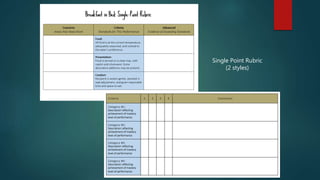
Single Point Rubric
(2 styles)
Pic Collage
Looking Ahead to Next Week
 Forum Post: Exploring Audio Resources Related to the Oral
Communication Strand
 PLC
 PBP led by Virginia
 Have a happy and safe Halloween! And a wonderful rest of the week 

Bc week 8 lesson notes

  • 1.
  • 2.
    Survey – participatingin research  One of the professors here at Brock has been conducting a research study over the past few years comparing Canadian and American Pre-service Education Programs for Language Arts.  One part of this study is a survey for Teacher Candidates on their beliefs about literacy and language.  Participating in research allows you to meaningfully contribute to your field, support those at your faculty and in your professions, and send out good karma!  Your participation is optional and completely separate form this course and your program at Brock  If you can, please take 5-7 minutes to fill in the survey at your table (anonymously… I will have one of your peers collect the surveys so I will not know who chose /chose not to complete it. I will also not be looking at any responses, but handing them directly back to the researcher).
  • 3.
    Agenda  Picture BookLesson Presentation.  Connecting Writing Expectations to Current events  Break  PLCs  Example Lesson  Looking ahead to next week and homework
  • 4.
    SJ PBP  Presentedby Emily  Peer Evaluators: Virginia and Alyssa  Rest of class: Share something in your group other ideas to work with this story in a different grade. Presenter:_______ My Name: ________ During this presentation… I noticed… I felt… I learned… One thing I would like to incorporate into my teaching from this presentation would be…
  • 5.
    Making Writing Meaningful What makes writing meaningful?  Where do grammar and spelling fit in?  In the early stages of writing, ideas and inspirations shouldn’t be impeded by the technicalities of spelling and mechanics of sentence structure.  Get their ideas on paper and then we can work together to organize them.  That’s where the drafting and editing process come in.
  • 6.
    Graffiti wall: Whatdo you know?
  • 7.
    Lets create atoolbox to give us the tools Many different things can go in your toolbox and there are a number of questions that you need to consider in the creation of your toolbox. Where do I have the power to make real change? Who is in my universe of obligation? What will I need in my toolbox to sustain me when this work gets hard? What will I have in my toolbox that will help me to remember why this work is necessary? What do I have in my toolbox as far as a ‘difference alarm,' to wake me up when I need to do the work? Graffiti Wall Remember that it is always “WE” not “Us and Them” On the whiteboard answer a question, provide an idea for a tool or whatever comes to mind.
  • 8.
  • 9.
    Current Event thathas impact What do you do?????????
  • 10.
    Infusing your lessonswith current events: Addressing the NOW, history, and the future  In small groups, design a lesson plan to address a current news event  Include a meaningful writing task that empowers students to use their voices and actions for change  Make sure you have explicit links to the writing curriculum. You can include additional language strands if you wish to do so.  Be prepared to share your lesson with the class  You should include: curriculum expectations, a list of materials, and minds on/action/consolidation stages.
  • 11.
    In your groupCreate one Lesson together. You must use at least 3 Writing Expectations  3 Part Lesson Plan  Minds On/ Action/ Consolidation  If you are able to in the short time, include  Rational  Overall Expectation, Specific Expectation KTCA  Learning Goals  Success Criteria  Materials Preparation  Minds on  Action  Consolidation and Connection
  • 12.
    Hate Crimes –How do we face them?  https://globalnews.ca/video/rd/1201963588002/?jwsource=cl An interesting 4 minute interview about a Global News initiative to put a face to hate speech in hope of spreading understanding and empathy for how it feels to be targeted. #FirstTimeIWasCalled mini series starting with Canadian politician, Jagmeet Singh (NDP Leader)
  • 14.
  • 15.
    A Sample GRRLesson Sequence Part 1: Minds on A totem is a spirit being, sacred object, or symbol of a tribe, clan, family, or individual. Native American tradition provides that each person is connected with nine different animals that will accompany him or her through life, acting as guides. Source: https://www.legendsofamerica.com/na-totems/
  • 16.
    A Sample GRRLesson Sequence Part 1: Minds on Sometimes I Feel Like a Fox introduces readers to the Anishinaabe tradition of totem animals. What began as a series of paintings created by Danielle Daniel, a Métis mixed-media artist, to encourage her son to connect with his aboriginal roots blossomed into a wonderful book the rest of us can learn from, enjoy, and share.
  • 17.
    A Sample GRRLesson Sequence Part 2: action  Part 2 – Action – The meat of the lesson – mentor text, writing task, GRR, student learning and skill development, etc.
  • 18.
    A Sample GRRLesson Sequence Part 2: action What is the pattern? Sometimes I feel like a bear, Strong and confident. I stand tall and growl And protect those around me. Sometimes I feel like a raven, Dark and mysterious. I am both messenger and secret keeper And help bring light from darkness Line 1: ___________ Line 2: ___________ Line 3: ___________ Line 4: ___________
  • 19.
    A Sample GRRLesson Sequence Part 2: action shared writing task  Line 1: Sometimes I feel like a  (Simile)  Line 2: _________ & _________  (Features/Traits)  Line 3: I _____________________  (Action)  Line 4: And ______________________  (Action)
  • 21.
    Your Task:  Chooseone totem animal and create a poem based on the model from “Sometimes I Feel Like a Fox.”  Your focus will be on our Graffiti wall and current events  How do you feel? What animal works for you using this lense?  Conduct research as needed to find out about your animal  When your poem is complete, post on google https://goo.gl/BAomJe
  • 22.
    Co-created rubrics  What: A rubric created with students (shared writing task)  Why:  To give students ownership over their learning,  To ensure they understand how to succeed,  To ensure student friendly language is used  How:  Have a plan in your mind, list the curriculum expectations in student friendly language, and organize their thoughts in categories,  Ask them about what is important to include, probe them for deeper examples of what they mean, prompt them to explain reasons for their choices.  Write down all student ideas, then create the official document on your own using “their ideas”.
  • 24.
    A Note onFeedback Feedback needs to be:  specific and detailed  Excellent job! Vs. “Your vocabulary is really expanding allowing you to really paint a picture in the mind of your reader!”  positive (ie. What a student can do not can’t do)  Your vocabulary is not descriptive enough vs “Using a thesaurus will help you find even more descriptive words”  understood by the student  Abysmal diction vs “Some of your words aren’t saying what you mean to say”  applied to student learning  Great job vs “Excellent word choices, especially when you used the word grumbly tummy to describe your hunger!”
  • 25.
     Your task:Last week, you created metaphor poems on Pic Collage  Expectations:  1.2 – developing ideas  2.3 – vivid, figurative, innovative word choice (metaphorical language)  3.6 – proofread for spelling, punctuation, grammar Suggestions CRITERIA Yes, And! Content (ideas): Form (poem, metaphors): Conventions and publishing (spelling, layout, images): - 2.1 – writing form (poem) - 3.7 - publishing (layout, images)
  • 26.
     Your task:Last week, you created metaphor poems on Pic Collage  Expectations:  1.2 – developing ideas  2.3 – vivid, figurative, innovative word choice (metaphorical language)  3.6 – proofread for spelling, punctuation, grammar Suggestions CRITERIA Yes, And! Content (ideas): Form (poem, metaphors): Conventions and publishing (spelling, layout, images): - 2.1 – writing form (poem) - 3.7 - publishing (layout, images)
  • 27.
    A Sample GRRLesson Sequence Part 3: consolidation sharing our work  Thinking About Assessment:  How would it have been helpful to co-create our rubric before you started your writing task?  Why is it important to share our assessment tools with students?  Thinking About Lesson Planning:  How did I hook you?  What writing actions did you take?  What curriculum links might have been addressed?
  • 28.
    ASSESSMENT TOOLS  Checklists Rubrics  Checkbrick  Anecdotal notes  Scales and scores Assessment tools are what teachers (and students) use to evaluate strengths and weaknesses, and make judgments/give a grade. Assessment strategies are the tasks students complete. These are evaluated using a tool.  Test/Quiz – marked with a score /10  Project – marked with a checklist  Essay/Narrative – marked with a rubric  Presentation – marked with anecdotal notes
  • 29.
    A closer lookat rubrics  A RUBRIC IS AN EVALUATIVE TOOL FOR TEACHERS AND LEARNERS THAT...  Establishes goals and expectations for learning  Establishes standards  Provides guidelines for teaching and learning  Provides measures for proficiency and accountability
  • 30.
    A closer lookat rubrics RUBRICS CONTAIN CRITERIA AND QUALIFIERS  CRITERIA: the components being assessed  Need to reflect curriculum expectations  Need to separate ideas (content) and skills (spelling etc).  Need to be observable traits  QUALIFIERS: the degree of competency demonstrated by the work  Need to be based on the language in the curriculum documents (see achievement chart)  Need to be objective as much as possible
  • 31.
    Criteria and Qualifiers StructureOverall 2 – Form, style, and process Content Overall 1 – Generating and organizing ideas Conventions Overall 3 – Applying conventions (spelling, grammar, etc) Writing Curriculum links It is important to separate WHAT students say from HOW they say it, as these are two separate skills that need developing.
  • 32.
    Criteria and Qualifiers Level4 Level 3 Level 2 Level 1 Structure Strong topic sentence, 3-5 detail sentences, strong concluding sentence Appropriate topic sentence, 3-4 detail sentences, appropriate concluding sentence Somewhat appropriate topic sentence, 2-3 detail sentences, Somewhat appropriate concluding sentence Missing components of a paragraph Content Topic sentence is clear and directive; all details are convincing; conclusion is clear and compelling; Ideas are all on one topic and are in a logical and well-thought order. Topic sentence is clear; most details are convincing; conclusion is clear; Ideas are all on one topic and are in a reasonable order. Topic sentence and conclusion are somewhat clear; details are somewhat convincing; Ideas are mostly one on one topic but stray a bit; order is somewhat logical. Topic is unclear; details are not convincing or are missing; ideas could be in a more logical order to strengthen clarity of argument. Conventions No errors in grammar, spelling, punctuation, or word choices. Mostly free of errors in grammar, spelling, punctuation, or word choices. Many errors in grammar, spelling, punctuation, or word choices. Writing has too many errors that inhibit reader understanding. PERSUASIVE PARAGRAPH RUBRIC
  • 33.
    Criteria and Qualifiers Level4 Level 3 Level 2 Level 1 Structure -topic sentence -body details -concluding sentence All components included with high degree of thought and creativity All components included Components are somewhat present Missing components Content -clear topic -convincing details related to topic -logical order -persuasive word choices High degree of clarity and persuasiveness; excellent organization and word choices Considerable clarity and persuasion Somewhat clear and persuasive Limited clarity and persusaion Conventions -spelling -grammar -punctuation Free from all errors Mostly free from errors A few errors Many errors PERSUASIVE PARAGRAPH RUBRIC
  • 34.
    3 types ofrubrics: Holistic, analytic, & single-point A holistic rubric is the most general kind. It lists three to five levels of performance, along with a broad description of the characteristics that define each level. Advantages: -easy for teacher -faster to grade -gives one grade to piece as a whole Disadvantages: -doesn't’t provide targeted feedback for students Ideal use: -standardized tests or quick tasks that do not need (or have time for) feedback
  • 35.
    3 types ofrubrics: Holistic, analytic, & single-point An analytic rubric breaks down the characteristics of an assignment into parts, allowing the scorer to itemize and define exactly what aspects are strong, and which ones need improvement. Advantages: -gives students a clearer picture of why they received the score they got -easier for teachers to justify grades Disadvantages: -time consuming and challenging to create (so many qualifiers and descriptors for each level) -longer, which means students are less likely to read them
  • 36.
    3 types ofrubrics: Holistic, analytic, & single-pointA single-point rubric is a lot like an analytic rubric, because it breaks down the components of an assignment into different criteria. What makes it different is that it only describes the criteria for proficiency; it does not attempt to list all the ways a student could fall short, nor does it specify how a student could exceed expectations. Advantages: -contains less language, so its likely to be read -less time to create, while still rich in detail of expectations -areas of concern and excellence are open ended (sometimes a rubric can be constricting – here, you don’t have to predict every way students will deviate from a 3) Disadvantages: -requires more writing for the teacher than simply highlighting a column
  • 37.
  • 38.
  • 39.
    Looking Ahead toNext Week  Forum Post: Exploring Audio Resources Related to the Oral Communication Strand  PLC  PBP led by Virginia  Have a happy and safe Halloween! And a wonderful rest of the week 