ConstructedResponse PaloozaWinter 2010
Think, pair, shareWhat are some of the challenges you face when grading constructed responsequestions?
ObjectivesProvide teachers with a firm understanding of the different types of rubrics and how to use them with different student writing samples.
Provide an opportunity to examine and discuss an anchor set for a given writing prompt.
Provide teachers with the opportunity to examine student samples from an administered constructed response item and norm along the ANet rubric.OVERARCHING GOAL: To leave with a better understanding of using rubrics to effectively score constructed responses and to take this back to your schools to improve your school’s overall use of constructed response data.
agenda I. Rubrics 101                                                                           15 min.Different types of rubricsDifferent types of questions/promptsScoring II. Norming around an Anchor Set                                         45 min.Review of passage, item, and rubricModel of ScoringPaired Scoring and Debrief II. Practice Norming around ANet Responses                       1 hourGroups use rubrics to score student responsesDebriefIV. Next Steps                                                                         10 min.
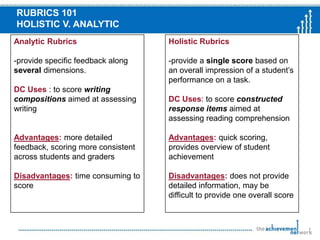
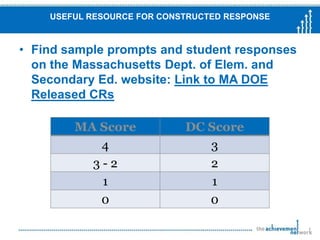
Rubrics 101Holistic v. AnalyticHolistic Rubricsprovide a single score based on an overall impression of a student’s performance on a task.DC Uses: to score constructed response items aimed at assessing reading comprehensionAdvantages: quick scoring, provides overview of student achievement Disadvantages: does not provide detailed information, may be difficult to provide one overall score Analytic Rubricsprovide specific feedback along several dimensions.DC Uses : to score writing compositions aimed at assessing writing Advantages: more detailed feedback, scoring more consistent across students and graders Disadvantages: time consuming to score
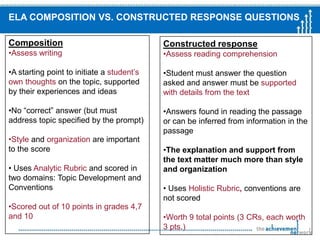
ELA Composition vs. Constructed Response QuestionsCompositionAssess writing
A starting point to initiate a student’s own thoughts on the topic, supported by their experiences and ideas
No “correct” answer (but must address topic specified by the prompt)
Style and organization are important to the score
 Uses Analytic Rubric and scored in two domains: Topic Development and Conventions
Scored out of 10 points in grades 4,7 and 10Constructed responseAssess reading comprehension
Student must answer the question asked and answer must be supported with details from the text
Answers found in reading the passage or can be inferred from information in the passage
The explanation and support from the text matter much more than style and organization
 Uses Holistic Rubric, conventions are not scored
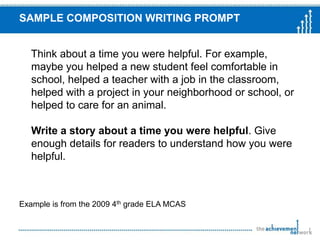
Worth 9 total points (3 CRs, each worth 3 pts.)Sample Composition Writing PromptThink about a time you were helpful. For example, maybe you helped a new student feel comfortable in school, helped a teacher with a job in the classroom, helped with a project in your neighborhood or school, or helped to care for an animal.Write a story about a time you were helpful. Give enough details for readers to understand how you were helpful.Example is from the 2009 4th grade ELA MCAS
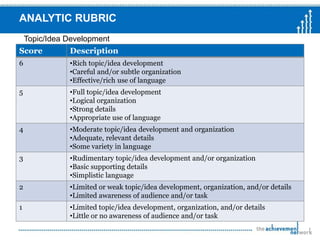
Analytic RubricTopic/Idea Development
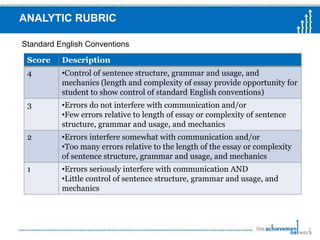
Analytic RubricStandard English Conventions
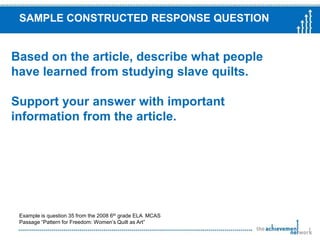
Sample Constructed Response QuestionBased on the article, describe what peoplehave learned from studying slave quilts.Support your answer with importantinformation from the article.Example is question 35 from the 2008 6th grade ELA  MCASPassage “Pattern for Freedom: Women’s Quilt as Art”
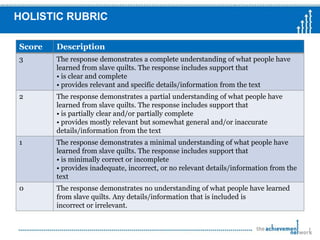
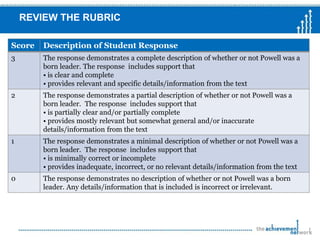
Holistic Rubric
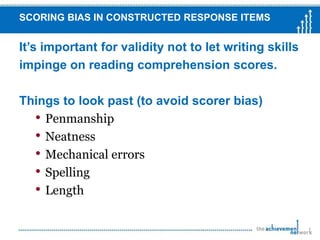
Scoring Bias in Constructed Response items It’s important for validity not to let writing skills impinge on reading comprehension scores.Things to look past (to avoid scorer bias)PenmanshipNeatnessMechanical errorsSpellingLength
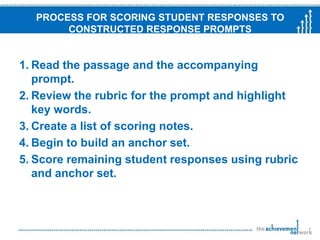
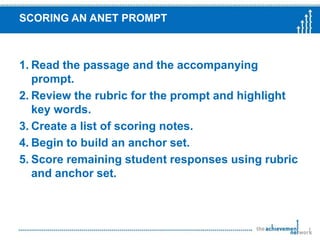
Process for scoring student responses to Constructed Response PromptsRead the passage and the accompanying prompt.Review the rubric for the prompt and highlight key words.Create a list of scoring notes.  Begin to build an anchor set.Score remaining student responses using rubric and anchor set.
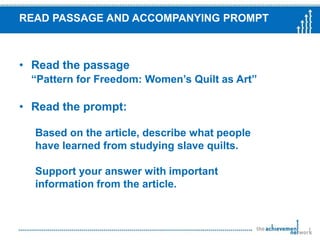
Read passage and accompanying promptRead the passage “Pattern for Freedom: Women’s Quilt as Art”Read the prompt:		Based on the article, describe what people		have learned from studying slave quilts.		Support your answer with important		information from the article.
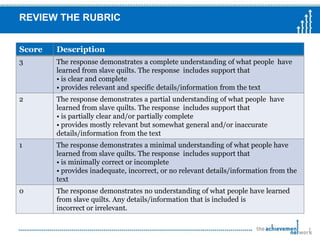
Review the rubric
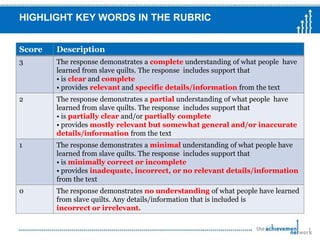
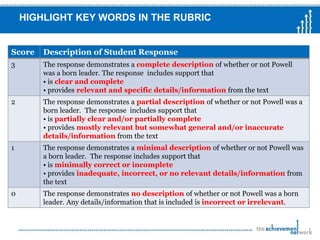
highlight key words in the rubric
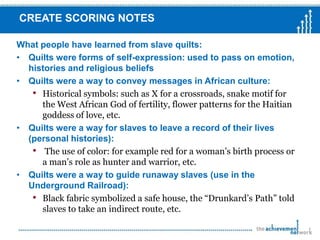
Create Scoring NotesWhat people have learned from slave quilts:Quilts were forms of self-expression: used to pass on emotion, histories and religious beliefs
Quilts were a way to convey messages in African culture:Historical symbols: such as X for a crossroads, snake motif for the West African God of fertility, flower patterns for the Haitian goddess of love, etc.Quilts were a way for slaves to leave a record of their lives (personal histories): The use of color: for example red for a woman’s birth process or a man’s role as hunter and warrior, etc.Quilts were a way to guide runaway slaves (use in the Underground Railroad):Black fabric symbolized a safe house, the “Drunkard’s Path” told slaves to take an indirect route, etc.
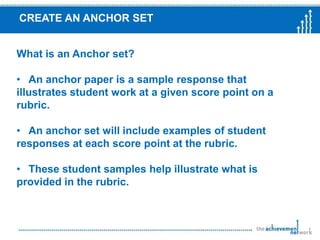
Create an Anchor setWhat is an Anchor set?An anchor paper is a sample response that illustrates student work at a given score point on a rubric.
An anchor set will include examples of student responses at each score point at the rubric.
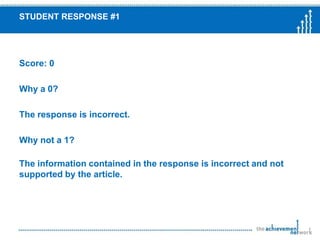
These student samples help illustrate what is provided in the rubric.Student Response #1Score: 0Why a 0?The response is incorrect.Why not a 1?The information contained in the response is incorrect and not supported by the article.
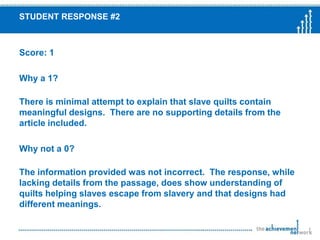
Student Response #2Score: 1Why a 1?There is minimal attempt to explain that slave quilts contain meaningful designs.  There are no supporting details from the article included.Why not a 0?The information provided was not incorrect.  The response, while lacking details from the passage, does show understanding of quilts helping slaves escape from slavery and that designs had different meanings.
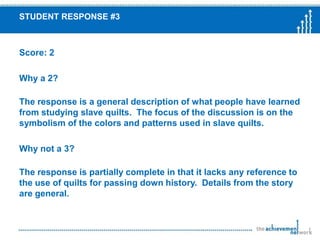
Student Response #3Score: 2Why a 2?The response is a general description of what people have learned from studying slave quilts.  The focus of the discussion is on the symbolism of the colors and patterns used in slave quilts.Why not a 3?The response is partially complete in that it lacks any reference to the use of quilts for passing down history.  Details from the story are general.
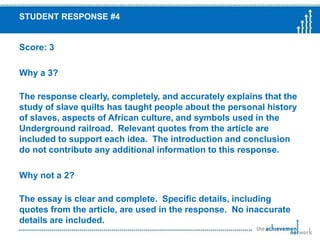
Student Response #4Score: 3Why a 3?The response clearly, completely, and accurately explains that the study of slave quilts has taught people about the personal history of slaves, aspects of African culture, and symbols used in the Underground railroad.  Relevant quotes from the article are included to support each idea.  The introduction and conclusion do not contribute any additional information to this response.Why not a 2? The essay is clear and complete.  Specific details, including quotes from the article, are used in the response.  No inaccurate details are included.
Think, Pair, ScoreRead student samples #5 and #6.Score each sample using the rubric.Justify your score.Share your thoughts with your neighbors.
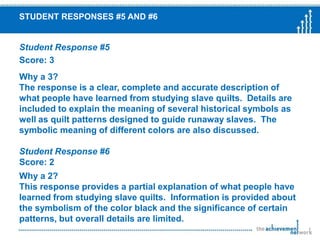
Student Responses #5 and #6Student Response #5Score: 3Why a 3?The response is a clear, complete and accurate description of what people have learned from studying slave quilts.  Details are included to explain the meaning of several historical symbols as well as quilt patterns designed to guide runaway slaves.  The symbolic meaning of different colors are also discussed.Student Response #6Score: 2Why a 2?This response provides a partial explanation of what people have learned from studying slave quilts.  Information is provided about the symbolism of the color black and the significance of certain patterns, but overall details are limited.
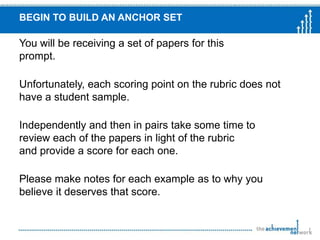
Scoring an ANET promptRead the passage and the accompanying prompt.Review the rubric for the prompt and highlight key words.Create a list of scoring notes.  Begin to build an anchor set.Score remaining student responses using rubric and anchor set.
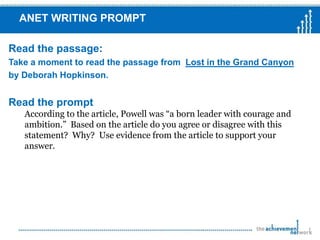
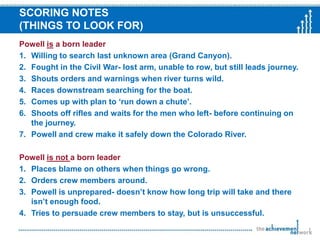
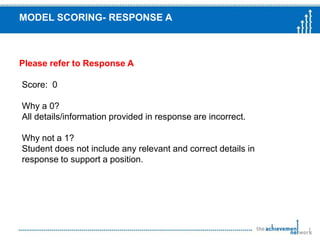
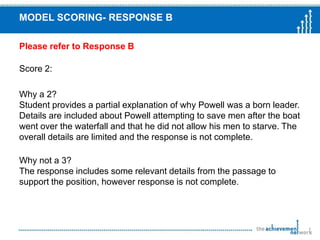
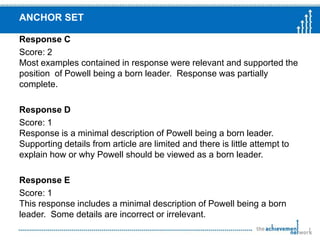
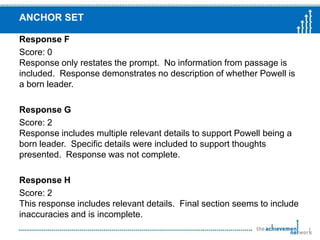
ANet Writing PromptRead the passage:Take a moment to read the passage from  Lost in the Grand Canyonby Deborah Hopkinson.Read the promptAccording to the article, Powell was “a born leader with courage andambition.”  Based on the article do you agree or disagree with thisstatement?  Why?  Use evidence from the article to support youranswer.

ANET Open Response Palooza Presentation DC

  • 1.
  • 2.
    Think, pair, shareWhatare some of the challenges you face when grading constructed responsequestions?
  • 3.
    ObjectivesProvide teachers witha firm understanding of the different types of rubrics and how to use them with different student writing samples.
  • 4.
    Provide an opportunityto examine and discuss an anchor set for a given writing prompt.
  • 5.
    Provide teachers withthe opportunity to examine student samples from an administered constructed response item and norm along the ANet rubric.OVERARCHING GOAL: To leave with a better understanding of using rubrics to effectively score constructed responses and to take this back to your schools to improve your school’s overall use of constructed response data.
  • 6.
    agenda I. Rubrics101 15 min.Different types of rubricsDifferent types of questions/promptsScoring II. Norming around an Anchor Set 45 min.Review of passage, item, and rubricModel of ScoringPaired Scoring and Debrief II. Practice Norming around ANet Responses 1 hourGroups use rubrics to score student responsesDebriefIV. Next Steps 10 min.
  • 7.
    Rubrics 101Holistic v.AnalyticHolistic Rubricsprovide a single score based on an overall impression of a student’s performance on a task.DC Uses: to score constructed response items aimed at assessing reading comprehensionAdvantages: quick scoring, provides overview of student achievement Disadvantages: does not provide detailed information, may be difficult to provide one overall score Analytic Rubricsprovide specific feedback along several dimensions.DC Uses : to score writing compositions aimed at assessing writing Advantages: more detailed feedback, scoring more consistent across students and graders Disadvantages: time consuming to score
  • 8.
    ELA Composition vs.Constructed Response QuestionsCompositionAssess writing
  • 9.
    A starting pointto initiate a student’s own thoughts on the topic, supported by their experiences and ideas
  • 10.
    No “correct” answer(but must address topic specified by the prompt)
  • 11.
    Style and organizationare important to the score
  • 12.
    Uses AnalyticRubric and scored in two domains: Topic Development and Conventions
  • 13.
    Scored out of10 points in grades 4,7 and 10Constructed responseAssess reading comprehension
  • 14.
    Student must answerthe question asked and answer must be supported with details from the text
  • 15.
    Answers found inreading the passage or can be inferred from information in the passage
  • 16.
    The explanation andsupport from the text matter much more than style and organization
  • 17.
    Uses HolisticRubric, conventions are not scored
  • 18.
    Worth 9 totalpoints (3 CRs, each worth 3 pts.)Sample Composition Writing PromptThink about a time you were helpful. For example, maybe you helped a new student feel comfortable in school, helped a teacher with a job in the classroom, helped with a project in your neighborhood or school, or helped to care for an animal.Write a story about a time you were helpful. Give enough details for readers to understand how you were helpful.Example is from the 2009 4th grade ELA MCAS
  • 19.
  • 20.
  • 21.
    Sample Constructed ResponseQuestionBased on the article, describe what peoplehave learned from studying slave quilts.Support your answer with importantinformation from the article.Example is question 35 from the 2008 6th grade ELA MCASPassage “Pattern for Freedom: Women’s Quilt as Art”
  • 22.
  • 23.
    Scoring Bias inConstructed Response items It’s important for validity not to let writing skills impinge on reading comprehension scores.Things to look past (to avoid scorer bias)PenmanshipNeatnessMechanical errorsSpellingLength
  • 24.
    Process for scoringstudent responses to Constructed Response PromptsRead the passage and the accompanying prompt.Review the rubric for the prompt and highlight key words.Create a list of scoring notes. Begin to build an anchor set.Score remaining student responses using rubric and anchor set.
  • 25.
    Read passage andaccompanying promptRead the passage “Pattern for Freedom: Women’s Quilt as Art”Read the prompt: Based on the article, describe what people have learned from studying slave quilts. Support your answer with important information from the article.
  • 26.
  • 27.
    highlight key wordsin the rubric
  • 28.
    Create Scoring NotesWhatpeople have learned from slave quilts:Quilts were forms of self-expression: used to pass on emotion, histories and religious beliefs
  • 29.
    Quilts were away to convey messages in African culture:Historical symbols: such as X for a crossroads, snake motif for the West African God of fertility, flower patterns for the Haitian goddess of love, etc.Quilts were a way for slaves to leave a record of their lives (personal histories): The use of color: for example red for a woman’s birth process or a man’s role as hunter and warrior, etc.Quilts were a way to guide runaway slaves (use in the Underground Railroad):Black fabric symbolized a safe house, the “Drunkard’s Path” told slaves to take an indirect route, etc.
  • 30.
    Create an AnchorsetWhat is an Anchor set?An anchor paper is a sample response that illustrates student work at a given score point on a rubric.
  • 31.
    An anchor setwill include examples of student responses at each score point at the rubric.
  • 32.
    These student sampleshelp illustrate what is provided in the rubric.Student Response #1Score: 0Why a 0?The response is incorrect.Why not a 1?The information contained in the response is incorrect and not supported by the article.
  • 33.
    Student Response #2Score:1Why a 1?There is minimal attempt to explain that slave quilts contain meaningful designs. There are no supporting details from the article included.Why not a 0?The information provided was not incorrect. The response, while lacking details from the passage, does show understanding of quilts helping slaves escape from slavery and that designs had different meanings.
  • 34.
    Student Response #3Score:2Why a 2?The response is a general description of what people have learned from studying slave quilts. The focus of the discussion is on the symbolism of the colors and patterns used in slave quilts.Why not a 3?The response is partially complete in that it lacks any reference to the use of quilts for passing down history. Details from the story are general.
  • 35.
    Student Response #4Score:3Why a 3?The response clearly, completely, and accurately explains that the study of slave quilts has taught people about the personal history of slaves, aspects of African culture, and symbols used in the Underground railroad. Relevant quotes from the article are included to support each idea. The introduction and conclusion do not contribute any additional information to this response.Why not a 2? The essay is clear and complete. Specific details, including quotes from the article, are used in the response. No inaccurate details are included.
  • 36.
    Think, Pair, ScoreReadstudent samples #5 and #6.Score each sample using the rubric.Justify your score.Share your thoughts with your neighbors.
  • 37.
    Student Responses #5and #6Student Response #5Score: 3Why a 3?The response is a clear, complete and accurate description of what people have learned from studying slave quilts. Details are included to explain the meaning of several historical symbols as well as quilt patterns designed to guide runaway slaves. The symbolic meaning of different colors are also discussed.Student Response #6Score: 2Why a 2?This response provides a partial explanation of what people have learned from studying slave quilts. Information is provided about the symbolism of the color black and the significance of certain patterns, but overall details are limited.
  • 38.
    Scoring an ANETpromptRead the passage and the accompanying prompt.Review the rubric for the prompt and highlight key words.Create a list of scoring notes. Begin to build an anchor set.Score remaining student responses using rubric and anchor set.
  • 39.
    ANet Writing PromptReadthe passage:Take a moment to read the passage from Lost in the Grand Canyonby Deborah Hopkinson.Read the promptAccording to the article, Powell was “a born leader with courage andambition.” Based on the article do you agree or disagree with thisstatement? Why? Use evidence from the article to support youranswer.

Editor's Notes

  • #3 10 min, have share out, list on chart
  • #4 Katie discusses three bullets, then Justin and Lindsay discuss the overarching goal – we frame how we see this pd supporting our schools’ work. We also say that this is NOT a PD about how to improve constructed response scores nor is it a PD about how to review constructed response data during a data meeting (reinforce the objectives).
  • #6 After Katie reviews the content, Justin and Lindsay remind everyone that ANet sends holistic rubrics
  • #7 After Katie discusses content, Lindsay and Justin remind everyone that Anet uses constructed response (not composition)
  • #13 Katie will show first line and then ask if anyone has experienced scoring bias. Take one response about an experience with scoring bias. Katie will define what scoring bias is and then ask for examples of what might cause scoring bias (then bring up the bullet points).
  • #14 After Katie reviews the process, Justin and Lindsay jump in and explain that this is the process you want to take back and replicate in your school. Even though we’re using a holistic rubric, you could use this with composition as well (steps 2-5: you just wouldn’t have a passage to read). These slides would be what you could do in your building if you replicated this PD.
  • #19 Justin and Lindsay might, depending on time and participation, chime in and ask how this is already being used or might be used in buildings.
  • #20 People will show their own score using colored cards.
  • #21 People will show their own score using colored cards.
  • #22 People will show their own score using colored cards.
  • #23 People will show their own score using colored cards.
  • #28 Step 1: Ask them to go through and highlight key words on the rubric before they begin scoring
  • #29 Step 1: Ask them to go through and highlight key words on the rubric before they begin scoring
  • #30 Norm yourself first. Make key points list before you begin grading. Katie Share what we came up with for Part A…allow 5 minutes for teachers in pairs to create part B. Share out.
  • #31 Katie Model – possible that we cut this depending on time
  • #32 Katie model – possible that we cut this, depending on time
  • #33 20 minutes, Tara, Katie, Lana circulate
  • #39 Justin and Lindsay can reinforce bringing this back to schools to increase validity of constructed response data.