Mini-Lesson Planning for Compare and Contrast (Similarities and Differences)
Benchmark(s)/Standard(s) What is the next benchmark(s) on my course timeline or FCIM calendar?
LA.A.2.2.7
    •   Recognizes the use of comparison and contrast in a text.

Definition
Comparison and contrast are ways of looking at objects and thinking about how they are similar (alike) and
different.

Essential Question(s): How do authors use compare/contrast to help readers understand information? How do
readers use signal words to identify compare/contrast? How can a graphic organizer be used to compare and contrast
text or objects?
FCAT Stem Questions

•   How are _________ and __________ALIKE?
•   How is ___________ DIFFERENT from _____________?
•   How is ______________ both SIMILAR and DIFFERENT from ______________?
•   What is the DIFFERENCE between _____________ and ________________?
•   How is ____________ SIMILAR/DISSIMILAR to __________________?

Materials/Resources: What do I have or need to have in order to teach the lesson objective(s)?
Teacher: Picture book or completed class novel; chart paper, overhead (LCD projector or doc camera),
text samples, graphic organizer templates (students can also draw these on paper)
Student: Paper, pencil
Lesson Agenda: How will I deliver this lesson to help my students answer the essential question(s)?
FCIM Mini-Lesson: Sequencing
Day One: Explicit Instruction (10 min)
Day Two: Modeled Instruction (15 min)
Day Three: Guided Practice (15 min)
Day Four: Independent Practice (10 min)
Day Five: Mini-Assessment (10 min) & Review Student Responses

Special Note: Day One could be Explicit and Modeled Instruction; Days Two and Three could be Guided
Instruction; Day Four could be Independent Practice. This depends upon your Instructional Focus
Calendar.
                       Suggested Read-Aloud: Stellaluna by Janell Cannon

Pre-read the book, Stellaluna (or other appropriate text). Anticipate where background knowledge needs
to be built. Highlight places to stop, question, make predictions or make connections. Identify the author,
title, setting, characters, etc. Activate prior or common knowledge. Take a picture walk. List the important
words in the story. During oral reading, conduct several teacher think-alouds. Include statements like,
“This reminds me of…” “This part is like…” “This character ____ is like____ because…” “This is similar
to…” Students need to hear your thinking so they can do this as they read independently.

Special Note: This is a suggested text. Use any other story, informational text, literature from Trophies, or
other familiar text that is appropriate for your students. The format for presentation would be similar.
Activating Strategy: Partner Share
This is a fast-paced activity in which the teacher will direct students to “talk with your partner”. Partners
will first discuss ways in which they are similar (hair or eye color, age, have pets, etc) and then ways in
which they are different. The teacher should call on a few partner groups to have them briefly share their
information.
  Mini-Lesson Delivery for Compare and Contrast (Similarities and Differences)
Day One: Explicit Instruction: (through Read-Aloud) How will I focus my students on what they need to
learn? What important vocabulary will I introduce/review?

Signal Words/Phrases
Add the following signal words and phrases to interactive word wall: compare, contrast, alike, different, same,
similar, however, although most, as well as, both, similarly, in contrast, too, on the other hand

Explain that compare and contrast is an important skill that we must learn to be good readers. Show
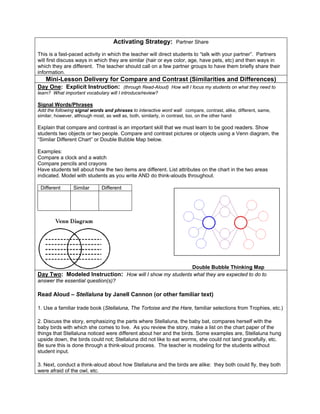
students two objects or two people. Compare and contrast pictures or objects using a Venn diagram, the
“Similar Different Chart” or Double Bubble Map below.

Examples:
Compare a clock and a watch
Compare pencils and crayons
Have students tell about how the two items are different. List attributes on the chart in the two areas
indicated. Model with students as you write AND do think-alouds throughout.

 Different       Similar      Different


                                                         Double Bubble Thinking Map
Day Two: Modeled Instruction: How will I show my students what they are expected to do to
answer the essential question(s)?

Read Aloud – Stellaluna by Janell Cannon (or other familiar text)

1. Use a familiar trade book (Stellaluna, The Tortoise and the Hare, familiar selections from Trophies, etc.)

2. Discuss the story, emphasizing the parts where Stellaluna, the baby bat, compares herself with the
baby birds with which she comes to live. As you review the story, make a list on the chart paper of the
things that Stellaluna noticed were different about her and the birds. Some examples are, Stellaluna hung
upside down, the birds could not; Stellaluna did not like to eat worms, she could not land gracefully, etc.
Be sure this is done through a think-aloud process. The teacher is modeling for the students without
student input.

3. Next, conduct a think-aloud about how Stellaluna and the birds are alike: they both could fly, they both
were afraid of the owl, etc.
Day Three: Guided Practice: How will I help students practice answering essential question(s)? How will I
incorporate collaborative structures and checks for understanding?

Practice 1:

Ask question: How can you relate compare and contrast to people you know? What kinds of
characteristics can you compare and contrast?

Make a second list of how children could be different but still be friends (they could look different, speak a
different language, come from different places, etc.) Ask the students to think of one person who is a
friend, and then think of all the ways they are different and alike. (Student accountable discussion)

Practice 2:

Pair up the students, giving each pair a blank Venn Diagram. Have them write on the diagram the ways
they are similar and different. (Collaborative structure)

Additional strategies/activities:

    •   Repeat the above exercise using a Double Bubble Map.
    •   Give students two pieces of short text to read OR provide students with a brief list of selections
        with which they are familiar and have them compare/contrast the selections using one of the
        graphic organizers.
    •   Do a Word Splash vocabulary activity using the compare/contrast signal words.
    •   A/B partner Review: Pairs Review—Partner A talks for one minute about everything he/she has
        learned about compare/contrast (similarities and differences). After one minute, Partner B talks
        for one minute, trying to follow the rule of no repeats.
    •   With a partner, complete a Compare & Contrast Word Map graphic organizer (What is it? What is
        it like? What are some examples?)
    •   Display two pictures for students (or use examples from math, science, social studies, or Trophies
        texts). Have pairs use one of the graphic organizers to compare/contrast the two pictures.
    •   Compare and contrast two familiar stories (application to text). Ex: Versions of the The Three Little
        Pigs or other familiar text (again, use content area texts as well). Students complete a graphic
        organizer (Venn, Same/Different, Double Bubble). Students should be able to answer the following
        questions: How are the two stories similar? Different? How are the endings alike? Different?

Special Note: It is important that students are able to link the skill of compare/contrast to text.
Day Four: Independent Practice/Processing Activities

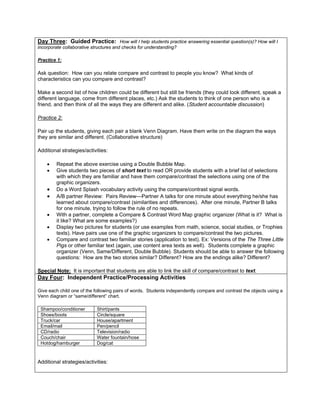
Give each child one of the following pairs of words. Students independently compare and contrast the objects using a
Venn diagram or “same/different” chart.

 Shampoo/conditioner        Shirt/pants
 Shoes/boots                Circle/square
 Truck/car                  House/apartment
 Email/mail                 Pen/pencil
 CD/radio                   Television/radio
 Couch/chair                Water fountain/hose
 Hotdog/hamburger           Dog/cat


Additional strategies/activities:
•   Repeat the above exercise using a Double Bubble Map.
    •   Give students two pieces of short text to read OR provide students with a brief list of selections
        with which they are familiar and have them compare/contrast the selections using one of the
        graphic organizers.
    •   Do a Word Splash vocabulary activity using the compare/contrast signal words. Display the signal
        words for compare/contrast. Individual students compose a scenario or create their own examples
        of compare/contrast, incorporating the signal words.
    •   Independently, complete a Compare & Contrast Word Map graphic organizer (What is it? What is
        it like? What are some examples?)
    •   Display two pictures for student (or use examples from math, science, social studies, or Trophies
        texts). Have individuals use one of the graphic organizers to compare/contrast the two pictures.
    •   Compare and contrast two familiar stories (application to text!). Ex: Versions of the The Three
        Little Pigs or other familiar text (again, use content area texts as well). Student independently
        completes a graphic organizer (Venn, Same/Different, Double Bubble). Students should be able to
        answer the following questions: How are the two stories similar? Different? How are the endings
        alike? Different?

Special Note: It is important that students are able to link the skill of compare/contrast to text.
Day Five: Assessment: How will I know if my students can answer the essential question(s)?
                      Extended and Refining Activity: Connection to Writing
Using the graphic organizer created on either Day Three or Day Four to summarize their learning,
students will use the content to write to respond to how the two stories are both similar and different.
Students should be prompted to include signal words for compare/contrast in their writing.

Compare and contrast focus calendarelementary

  • 1.
    Mini-Lesson Planning forCompare and Contrast (Similarities and Differences) Benchmark(s)/Standard(s) What is the next benchmark(s) on my course timeline or FCIM calendar? LA.A.2.2.7 • Recognizes the use of comparison and contrast in a text. Definition Comparison and contrast are ways of looking at objects and thinking about how they are similar (alike) and different. Essential Question(s): How do authors use compare/contrast to help readers understand information? How do readers use signal words to identify compare/contrast? How can a graphic organizer be used to compare and contrast text or objects? FCAT Stem Questions • How are _________ and __________ALIKE? • How is ___________ DIFFERENT from _____________? • How is ______________ both SIMILAR and DIFFERENT from ______________? • What is the DIFFERENCE between _____________ and ________________? • How is ____________ SIMILAR/DISSIMILAR to __________________? Materials/Resources: What do I have or need to have in order to teach the lesson objective(s)? Teacher: Picture book or completed class novel; chart paper, overhead (LCD projector or doc camera), text samples, graphic organizer templates (students can also draw these on paper) Student: Paper, pencil Lesson Agenda: How will I deliver this lesson to help my students answer the essential question(s)? FCIM Mini-Lesson: Sequencing Day One: Explicit Instruction (10 min) Day Two: Modeled Instruction (15 min) Day Three: Guided Practice (15 min) Day Four: Independent Practice (10 min) Day Five: Mini-Assessment (10 min) & Review Student Responses Special Note: Day One could be Explicit and Modeled Instruction; Days Two and Three could be Guided Instruction; Day Four could be Independent Practice. This depends upon your Instructional Focus Calendar. Suggested Read-Aloud: Stellaluna by Janell Cannon Pre-read the book, Stellaluna (or other appropriate text). Anticipate where background knowledge needs to be built. Highlight places to stop, question, make predictions or make connections. Identify the author, title, setting, characters, etc. Activate prior or common knowledge. Take a picture walk. List the important words in the story. During oral reading, conduct several teacher think-alouds. Include statements like, “This reminds me of…” “This part is like…” “This character ____ is like____ because…” “This is similar to…” Students need to hear your thinking so they can do this as they read independently. Special Note: This is a suggested text. Use any other story, informational text, literature from Trophies, or other familiar text that is appropriate for your students. The format for presentation would be similar.
  • 2.
    Activating Strategy: PartnerShare This is a fast-paced activity in which the teacher will direct students to “talk with your partner”. Partners will first discuss ways in which they are similar (hair or eye color, age, have pets, etc) and then ways in which they are different. The teacher should call on a few partner groups to have them briefly share their information. Mini-Lesson Delivery for Compare and Contrast (Similarities and Differences) Day One: Explicit Instruction: (through Read-Aloud) How will I focus my students on what they need to learn? What important vocabulary will I introduce/review? Signal Words/Phrases Add the following signal words and phrases to interactive word wall: compare, contrast, alike, different, same, similar, however, although most, as well as, both, similarly, in contrast, too, on the other hand Explain that compare and contrast is an important skill that we must learn to be good readers. Show students two objects or two people. Compare and contrast pictures or objects using a Venn diagram, the “Similar Different Chart” or Double Bubble Map below. Examples: Compare a clock and a watch Compare pencils and crayons Have students tell about how the two items are different. List attributes on the chart in the two areas indicated. Model with students as you write AND do think-alouds throughout. Different Similar Different Double Bubble Thinking Map Day Two: Modeled Instruction: How will I show my students what they are expected to do to answer the essential question(s)? Read Aloud – Stellaluna by Janell Cannon (or other familiar text) 1. Use a familiar trade book (Stellaluna, The Tortoise and the Hare, familiar selections from Trophies, etc.) 2. Discuss the story, emphasizing the parts where Stellaluna, the baby bat, compares herself with the baby birds with which she comes to live. As you review the story, make a list on the chart paper of the things that Stellaluna noticed were different about her and the birds. Some examples are, Stellaluna hung upside down, the birds could not; Stellaluna did not like to eat worms, she could not land gracefully, etc. Be sure this is done through a think-aloud process. The teacher is modeling for the students without student input. 3. Next, conduct a think-aloud about how Stellaluna and the birds are alike: they both could fly, they both were afraid of the owl, etc.
  • 3.
    Day Three: GuidedPractice: How will I help students practice answering essential question(s)? How will I incorporate collaborative structures and checks for understanding? Practice 1: Ask question: How can you relate compare and contrast to people you know? What kinds of characteristics can you compare and contrast? Make a second list of how children could be different but still be friends (they could look different, speak a different language, come from different places, etc.) Ask the students to think of one person who is a friend, and then think of all the ways they are different and alike. (Student accountable discussion) Practice 2: Pair up the students, giving each pair a blank Venn Diagram. Have them write on the diagram the ways they are similar and different. (Collaborative structure) Additional strategies/activities: • Repeat the above exercise using a Double Bubble Map. • Give students two pieces of short text to read OR provide students with a brief list of selections with which they are familiar and have them compare/contrast the selections using one of the graphic organizers. • Do a Word Splash vocabulary activity using the compare/contrast signal words. • A/B partner Review: Pairs Review—Partner A talks for one minute about everything he/she has learned about compare/contrast (similarities and differences). After one minute, Partner B talks for one minute, trying to follow the rule of no repeats. • With a partner, complete a Compare & Contrast Word Map graphic organizer (What is it? What is it like? What are some examples?) • Display two pictures for students (or use examples from math, science, social studies, or Trophies texts). Have pairs use one of the graphic organizers to compare/contrast the two pictures. • Compare and contrast two familiar stories (application to text). Ex: Versions of the The Three Little Pigs or other familiar text (again, use content area texts as well). Students complete a graphic organizer (Venn, Same/Different, Double Bubble). Students should be able to answer the following questions: How are the two stories similar? Different? How are the endings alike? Different? Special Note: It is important that students are able to link the skill of compare/contrast to text. Day Four: Independent Practice/Processing Activities Give each child one of the following pairs of words. Students independently compare and contrast the objects using a Venn diagram or “same/different” chart. Shampoo/conditioner Shirt/pants Shoes/boots Circle/square Truck/car House/apartment Email/mail Pen/pencil CD/radio Television/radio Couch/chair Water fountain/hose Hotdog/hamburger Dog/cat Additional strategies/activities:
  • 4.
    Repeat the above exercise using a Double Bubble Map. • Give students two pieces of short text to read OR provide students with a brief list of selections with which they are familiar and have them compare/contrast the selections using one of the graphic organizers. • Do a Word Splash vocabulary activity using the compare/contrast signal words. Display the signal words for compare/contrast. Individual students compose a scenario or create their own examples of compare/contrast, incorporating the signal words. • Independently, complete a Compare & Contrast Word Map graphic organizer (What is it? What is it like? What are some examples?) • Display two pictures for student (or use examples from math, science, social studies, or Trophies texts). Have individuals use one of the graphic organizers to compare/contrast the two pictures. • Compare and contrast two familiar stories (application to text!). Ex: Versions of the The Three Little Pigs or other familiar text (again, use content area texts as well). Student independently completes a graphic organizer (Venn, Same/Different, Double Bubble). Students should be able to answer the following questions: How are the two stories similar? Different? How are the endings alike? Different? Special Note: It is important that students are able to link the skill of compare/contrast to text. Day Five: Assessment: How will I know if my students can answer the essential question(s)? Extended and Refining Activity: Connection to Writing Using the graphic organizer created on either Day Three or Day Four to summarize their learning, students will use the content to write to respond to how the two stories are both similar and different. Students should be prompted to include signal words for compare/contrast in their writing.