WEEK 8
ASSUMPTIONS OF TEACHING AND
LEARNING
POVERTY: AS SEEN THROUGH NARRATIVES
• An International Inquiry: Stories of Poverty – Poverty
Stories (Ciuffetelli Parker and Craig, 2017) Introduction: This article examines
poverty not as depersonalized, decontextualized mega-narratives (Olson & Craig, 2009)
that categorize humans (Coles, 1989), but as “small stories” (Georgakopoulou, 2004)
educators and students live and tell on the edges, in small moments unseen, unheard,
and unaccounted for in grand narratives.
AGENDA
• Housekeeping
• Challenging our Assumptions
• Poverty
• Break
• Oral Chronicle presentations
• Triad Discussion & Work Session
• Looking ahead to next week
• Exit Card
HOUSEKEEPING - Field Placement Report
•Reminder: Submit the “Hours Tracker” form that was sent out to you by Danielle
Larmon
•Paper Format:
–Introduction (demographic of class, citation on Schwab’s curricular
commonplaces that will make up the field placement paper, etc.)
–A paragraph/section each for:
•Teacher
•Learner
•Curriculum/Subject matter
•Milieu/Environment
•Conclusion (what you learned, why 4 commonplaces are important to keep in
mind while teaching, how you will enact your teaching style, etc.)
•Exemplars under Resources on Sakai
ACTIVITY
•You are boarding a plane for a 12 hour flight.
There are several vacant seats available
beside people who are described on the cards
that are posted around the room.
•Read the descriptors and choose where you’d
like to sit.
•Go and stand by your choice but don’t say
anything.
SMALL GROUP DISCUSSIONS
• Why did you sit beside that person?
• What do you think they might look like?
• How might they act?
• What was it about sitting with them that made you
feel most comfortable?
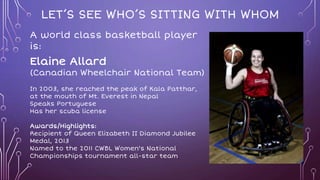
LET’S SEE WHO’S SITTING WITH WHOM
A world class basketball player
is:
Elaine Allard
(Canadian Wheelchair National Team)
In 2003, she reached the peak of Kala Patthar,
at the mouth of Mt. Everest in Nepal
Speaks Portuguese
Has her scuba license
Awards/Highlights:
Recipient of Queen Elizabeth II Diamond Jubilee
Medal, 2013
Named to the 2011 CWBL Women's National
Championships tournament all-star team
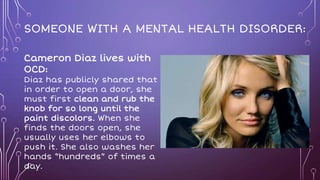
SOMEONE WITH A MENTAL HEALTH DISORDER:
Cameron Diaz lives with
OCD:
Diaz has publicly shared that
in order to open a door, she
must first clean and rub the
knob for so long until the
paint discolors. When she
finds the doors open, she
usually uses her elbows to
push it. She also washes her
hands ”hundreds” of times a
day.
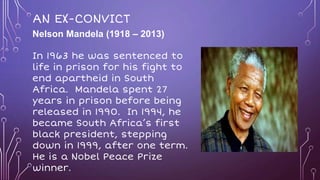
AN EX-CONVICT
Nelson Mandela (1918 – 2013)
In 1963 he was sentenced to
life in prison for his fight to
end apartheid in South
Africa. Mandela spent 27
years in prison before being
released in 1990. In 1994, he
became South Africa’s first
black president, stepping
down in 1999, after one term.
He is a Nobel Peace Prize
winner.
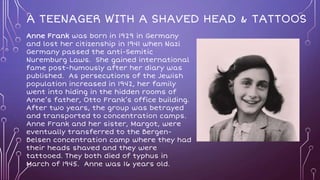
A TEENAGER WITH A SHAVED HEAD & TATTOOS
Anne Frank was born in 1929 in Germany
and lost her citizenship in 1941 when Nazi
Germany passed the anti-Semitic
Nuremburg Laws. She gained international
fame post-humously after her diary was
published. As persecutions of the Jewish
population increased in 1942, her family
went into hiding in the hidden rooms of
Anne’s father, Otto Frank’s office building.
After two years, the group was betrayed
and transported to concentration camps.
Anne Frank and her sister, Margot, were
eventually transferred to the Bergen-
Belsen concentration camp where they had
their heads shaved and they were
tattooed. They both died of typhus in
March of 1945. Anne was 16 years old.
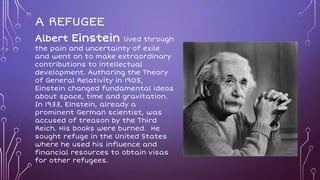
A REFUGEE
Albert Einstein lived through
the pain and uncertainty of exile
and went on to make extraordinary
contributions to intellectual
development. Authoring the Theory
of General Relativity in 1905,
Einstein changed fundamental ideas
about space, time and gravitation.
In 1933, Einstein, already a
prominent German scientist, was
accused of treason by the Third
Reich. His books were burned. He
sought refuge in the United States
where he used his influence and
financial resources to obtain visas
for other refugees.
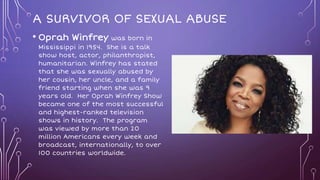
A SURVIVOR OF SEXUAL ABUSE
• Oprah Winfrey was born in
Mississippi in 1954. She is a talk
show host, actor, philanthropist,
humanitarian. Winfrey has stated
that she was sexually abused by
her cousin, her uncle, and a family
friend starting when she was 9
years old. Her Oprah Winfrey Show
became one of the most successful
and highest-ranked television
shows in history. The program
was viewed by more than 20
million Americans every week and
broadcast, internationally, to over
100 countries worldwide.
DEBRIEF
• Were you surprised by who the person next to you turned out
to be?
• How was he or she different from what you were expecting?
• Can you think of anything that may have influenced those
assumptions?
• Is it fair to judge someone by their labels?
• What can happen when we only consider labels and not the
individuals behind them?
• How can we be more aware of these unconscious biases in
our classrooms?
Reframing Our Perspective:
Deficit-based Language
• Poor people
• Lower class
• Ghettos
• Autistic kids
Bias-free Language
• People living in poverty
• Low income living
• Areas of poverty
• Kids who have autism
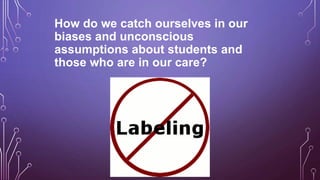
How do we catch ourselves in our
biases and unconscious
assumptions about students and
those who are in our care?
IDENTIFYING & UNDERSTANDING OUR
BIASES
Begin by being:
• Conscientious
• Thoughtful
• Reflective in practice - Use the 3 Rs!
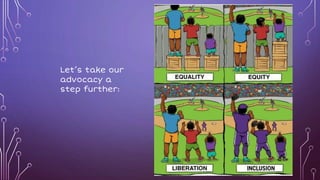
Let’s take our
advocacy a
step further:
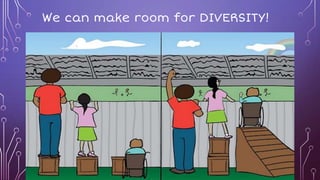
We can make room for DIVERSITY!
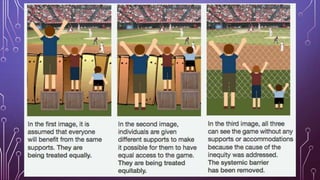
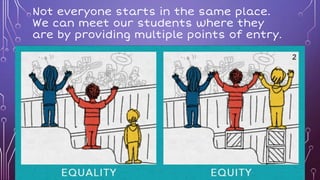
Not everyone starts in the same place.
We can meet our students where they
are by providing multiple points of entry.
WHAT DO WE KNOW ABOUT POVERTY &
WHAT DO WE ASSUME?
Think-Pair-Share
• What has shaped your ideas about poverty? Who or
what has challenged those ideas?
• How can poverty impact a narrative in terms of
temporality, sociality and place?
Stories of Poverty - Poverty Stories (CP & Craig,
2017)
● Small stories juxtaposed with mega-narratives
challenge stereotypes.
● Mega-narratives obscure; small stories enlighten
● Lindemann Nelson (1995) reiterates, “. . . public
policies that ignore differences between a
dominant group and groups with less power tend
to create a false neutrality that favors the
dominant group: its characteristics are taken as
the norm, while groups with other characteristics
are marked as deviant. (p. 29)”
Highlights
• “We Have a Collective Responsibility for Kids” (p. 137)
• Collective teacher efficacy - when we work together, we
all become better teachers which, ultimately, benefits
the students.
• Poverty is not a Statistic: “Disembodied statistics
suggest that all impoverished people are the same. That
is not the case.” (p. 144)
• Statistics suggest that poverty is encompassing and no
one is working on it: “the poverty phenomenon lacks
contextualization.” (p. 144)
• Poverty is not destiny; education is a pathway out
• Poverty can be seen as problem to be solved
PROBLEMS ARE THE STIMULUS TO THINKING
• Growth depends on the presence of difficulty to be
overcome by the exercise of intelligence
• Educators must see, equally, two things:
• 1. the problem grows organically, out of current
conditions/experiences, and if it’s within the range
capacity of students
• 2. it arouses in the learner an active quest for
information & for production of new ideas, which leads
to new explorations.
• The process is a continuous spiral
• Students learn to see themselves as problem-solvers
USING SCIENCE AS OUR GUIDE
• Science is s great way to grow the mind!
• Underlying ideal is the progressive organization of
knowledge
• You can’t dish out knowledge, you need to develop it
• The active process of organizing facts and ideas is
an ever-present educational process
• One of the most fundamental principles of the
scientific organization of knowledge is CAUSE & EFFECT
GROWTH IN JUDGEMENT & UNDERSTANDING
• Growth in judgement and understanding is essentially
growth in ability to form purposes, and to select and
arrange means for their realization.
• Intelligent activity is purposeful
• As students mature, they learn to make more
connections between means and ends, and between
means and more means, therefore, the idea of cause
and effect becomes prominent and explicit.
BREAK
10 MINUTES, PLEASE
ORAL CHRONICLE PRESENTATIONS
• Courtney
• Nicholas
• Rachel
Triad Discussion & Work Session
LOOKING AHEAD TO NEXT WEEK
Presenters: Julia, Kaeli, Nathan
Readings:
• OTC Additional Qualification Consultation on Teaching LGBTQ
Students
• Exploring the Ethical Standards for the Teaching Profession through
Anishinaabe Art
Reminders:
• Field Placement Reflection Due!
EXIT CARD
• Was there anything that surprised you about your
assumptions in our opening activity?
• What’s one approach you’re willing to undertake to
help identify and address your own subconscious
biases?

Week 8 2020

  • 1.
    WEEK 8 ASSUMPTIONS OFTEACHING AND LEARNING POVERTY: AS SEEN THROUGH NARRATIVES • An International Inquiry: Stories of Poverty – Poverty Stories (Ciuffetelli Parker and Craig, 2017) Introduction: This article examines poverty not as depersonalized, decontextualized mega-narratives (Olson & Craig, 2009) that categorize humans (Coles, 1989), but as “small stories” (Georgakopoulou, 2004) educators and students live and tell on the edges, in small moments unseen, unheard, and unaccounted for in grand narratives.
  • 2.
    AGENDA • Housekeeping • Challengingour Assumptions • Poverty • Break • Oral Chronicle presentations • Triad Discussion & Work Session • Looking ahead to next week • Exit Card
  • 3.
    HOUSEKEEPING - FieldPlacement Report •Reminder: Submit the “Hours Tracker” form that was sent out to you by Danielle Larmon •Paper Format: –Introduction (demographic of class, citation on Schwab’s curricular commonplaces that will make up the field placement paper, etc.) –A paragraph/section each for: •Teacher •Learner •Curriculum/Subject matter •Milieu/Environment •Conclusion (what you learned, why 4 commonplaces are important to keep in mind while teaching, how you will enact your teaching style, etc.) •Exemplars under Resources on Sakai
  • 4.
    ACTIVITY •You are boardinga plane for a 12 hour flight. There are several vacant seats available beside people who are described on the cards that are posted around the room. •Read the descriptors and choose where you’d like to sit. •Go and stand by your choice but don’t say anything.
  • 5.
    SMALL GROUP DISCUSSIONS •Why did you sit beside that person? • What do you think they might look like? • How might they act? • What was it about sitting with them that made you feel most comfortable?
  • 6.
    LET’S SEE WHO’SSITTING WITH WHOM A world class basketball player is: Elaine Allard (Canadian Wheelchair National Team) In 2003, she reached the peak of Kala Patthar, at the mouth of Mt. Everest in Nepal Speaks Portuguese Has her scuba license Awards/Highlights: Recipient of Queen Elizabeth II Diamond Jubilee Medal, 2013 Named to the 2011 CWBL Women's National Championships tournament all-star team
  • 7.
    SOMEONE WITH AMENTAL HEALTH DISORDER: Cameron Diaz lives with OCD: Diaz has publicly shared that in order to open a door, she must first clean and rub the knob for so long until the paint discolors. When she finds the doors open, she usually uses her elbows to push it. She also washes her hands ”hundreds” of times a day.
  • 8.
    AN EX-CONVICT Nelson Mandela(1918 – 2013) In 1963 he was sentenced to life in prison for his fight to end apartheid in South Africa. Mandela spent 27 years in prison before being released in 1990. In 1994, he became South Africa’s first black president, stepping down in 1999, after one term. He is a Nobel Peace Prize winner.
  • 9.
    A TEENAGER WITHA SHAVED HEAD & TATTOOS Anne Frank was born in 1929 in Germany and lost her citizenship in 1941 when Nazi Germany passed the anti-Semitic Nuremburg Laws. She gained international fame post-humously after her diary was published. As persecutions of the Jewish population increased in 1942, her family went into hiding in the hidden rooms of Anne’s father, Otto Frank’s office building. After two years, the group was betrayed and transported to concentration camps. Anne Frank and her sister, Margot, were eventually transferred to the Bergen- Belsen concentration camp where they had their heads shaved and they were tattooed. They both died of typhus in March of 1945. Anne was 16 years old.
  • 10.
    A REFUGEE Albert Einsteinlived through the pain and uncertainty of exile and went on to make extraordinary contributions to intellectual development. Authoring the Theory of General Relativity in 1905, Einstein changed fundamental ideas about space, time and gravitation. In 1933, Einstein, already a prominent German scientist, was accused of treason by the Third Reich. His books were burned. He sought refuge in the United States where he used his influence and financial resources to obtain visas for other refugees.
  • 11.
    A SURVIVOR OFSEXUAL ABUSE • Oprah Winfrey was born in Mississippi in 1954. She is a talk show host, actor, philanthropist, humanitarian. Winfrey has stated that she was sexually abused by her cousin, her uncle, and a family friend starting when she was 9 years old. Her Oprah Winfrey Show became one of the most successful and highest-ranked television shows in history. The program was viewed by more than 20 million Americans every week and broadcast, internationally, to over 100 countries worldwide.
  • 12.
    DEBRIEF • Were yousurprised by who the person next to you turned out to be? • How was he or she different from what you were expecting? • Can you think of anything that may have influenced those assumptions? • Is it fair to judge someone by their labels? • What can happen when we only consider labels and not the individuals behind them? • How can we be more aware of these unconscious biases in our classrooms?
  • 13.
    Reframing Our Perspective: Deficit-basedLanguage • Poor people • Lower class • Ghettos • Autistic kids Bias-free Language • People living in poverty • Low income living • Areas of poverty • Kids who have autism
  • 14.
    How do wecatch ourselves in our biases and unconscious assumptions about students and those who are in our care?
  • 15.
    IDENTIFYING & UNDERSTANDINGOUR BIASES Begin by being: • Conscientious • Thoughtful • Reflective in practice - Use the 3 Rs!
  • 17.
  • 18.
    We can makeroom for DIVERSITY!
  • 19.
    Not everyone startsin the same place. We can meet our students where they are by providing multiple points of entry.
  • 20.
    WHAT DO WEKNOW ABOUT POVERTY & WHAT DO WE ASSUME? Think-Pair-Share • What has shaped your ideas about poverty? Who or what has challenged those ideas? • How can poverty impact a narrative in terms of temporality, sociality and place?
  • 22.
    Stories of Poverty- Poverty Stories (CP & Craig, 2017) ● Small stories juxtaposed with mega-narratives challenge stereotypes. ● Mega-narratives obscure; small stories enlighten ● Lindemann Nelson (1995) reiterates, “. . . public policies that ignore differences between a dominant group and groups with less power tend to create a false neutrality that favors the dominant group: its characteristics are taken as the norm, while groups with other characteristics are marked as deviant. (p. 29)”
  • 23.
    Highlights • “We Havea Collective Responsibility for Kids” (p. 137) • Collective teacher efficacy - when we work together, we all become better teachers which, ultimately, benefits the students. • Poverty is not a Statistic: “Disembodied statistics suggest that all impoverished people are the same. That is not the case.” (p. 144) • Statistics suggest that poverty is encompassing and no one is working on it: “the poverty phenomenon lacks contextualization.” (p. 144) • Poverty is not destiny; education is a pathway out • Poverty can be seen as problem to be solved
  • 24.
    PROBLEMS ARE THESTIMULUS TO THINKING • Growth depends on the presence of difficulty to be overcome by the exercise of intelligence • Educators must see, equally, two things: • 1. the problem grows organically, out of current conditions/experiences, and if it’s within the range capacity of students • 2. it arouses in the learner an active quest for information & for production of new ideas, which leads to new explorations. • The process is a continuous spiral • Students learn to see themselves as problem-solvers
  • 25.
    USING SCIENCE ASOUR GUIDE • Science is s great way to grow the mind! • Underlying ideal is the progressive organization of knowledge • You can’t dish out knowledge, you need to develop it • The active process of organizing facts and ideas is an ever-present educational process • One of the most fundamental principles of the scientific organization of knowledge is CAUSE & EFFECT
  • 26.
    GROWTH IN JUDGEMENT& UNDERSTANDING • Growth in judgement and understanding is essentially growth in ability to form purposes, and to select and arrange means for their realization. • Intelligent activity is purposeful • As students mature, they learn to make more connections between means and ends, and between means and more means, therefore, the idea of cause and effect becomes prominent and explicit.
  • 27.
  • 28.
    ORAL CHRONICLE PRESENTATIONS •Courtney • Nicholas • Rachel
  • 29.
    Triad Discussion &Work Session
  • 30.
    LOOKING AHEAD TONEXT WEEK Presenters: Julia, Kaeli, Nathan Readings: • OTC Additional Qualification Consultation on Teaching LGBTQ Students • Exploring the Ethical Standards for the Teaching Profession through Anishinaabe Art Reminders: • Field Placement Reflection Due!
  • 31.
    EXIT CARD • Wasthere anything that surprised you about your assumptions in our opening activity? • What’s one approach you’re willing to undertake to help identify and address your own subconscious biases?