MAHA BARATHI
ENGINEERING COLLEGE
GAIT BASED PERSON RECOGNITION USINIG
ARTIFICIAL NEURAL NETWORKS
PRESENTED BY
B.ANTONY XAVIER (621412106009)
N.BABU (621412106013)
EBIN ROY (621412106015)
I.MOHAMMED (621412106036)
UNDER THE GUIDANCE
Ms.R.RAJALAKSHMI,ME.,
AP/ECE DEPT.
19-06-2016 1
ABSTRACT
 In this project a new approach is proposed for extracting human gait
based on the silhouettle image.
 Gait recognition is a useful biometric trait for person authentication
because it is usable even with low image resolution.
Human identification using Gait is method to identify an
individual by the way he walk or manner of moving on foot.
19-06-2016 2
GAIT RECOGNITION SYSTEM
Biometric is a field of technology that uses automated methods for
identifying and verifying a person.
 In real time applications like in banks, airports, authentications and
verifications are always required.
The first important step towards preventing unauthorized access is
user authentication. User authentication is the process of verifying
identity.
 Steps in gait system,
1.Background subtraction
2.Pre processing
3.Fature extraction
4.Recognition
19-06-2016 3
EXISTING SYSTEM
By using this we can able to find the person by his walk.
In existing system we can able to use gait features to identify the
person by their walks.
 Images from a virtual view are generated by re-projecting the 3D gait
volumes onto the image plane, these generated images are then used
for recognition.
19-06-2016 4
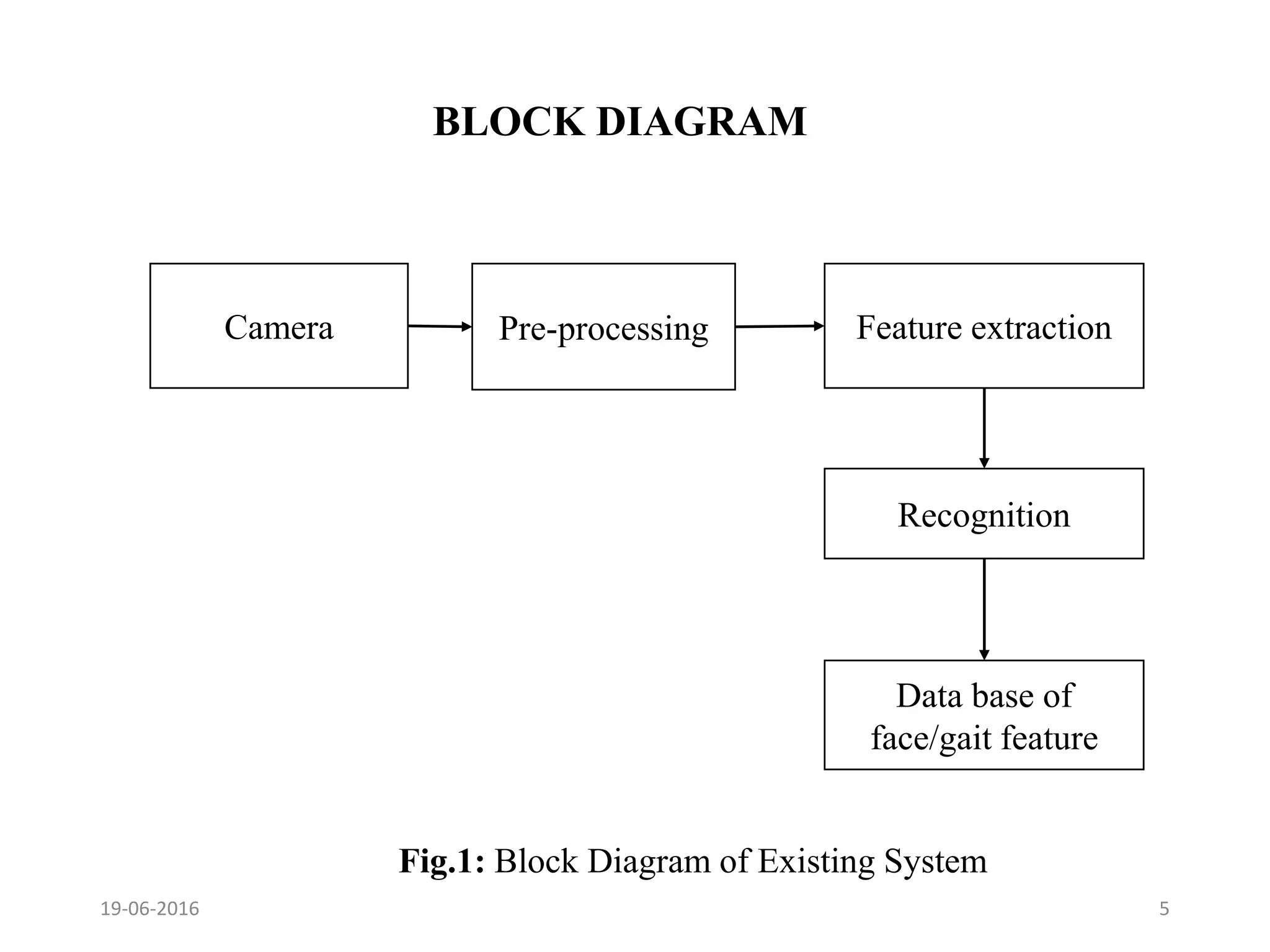
BLOCK DIAGRAM
Camera Pre-processing Feature extraction
Recognition
Data base of
face/gait feature
19-06-2016 5
Fig.1: Block Diagram of Existing System
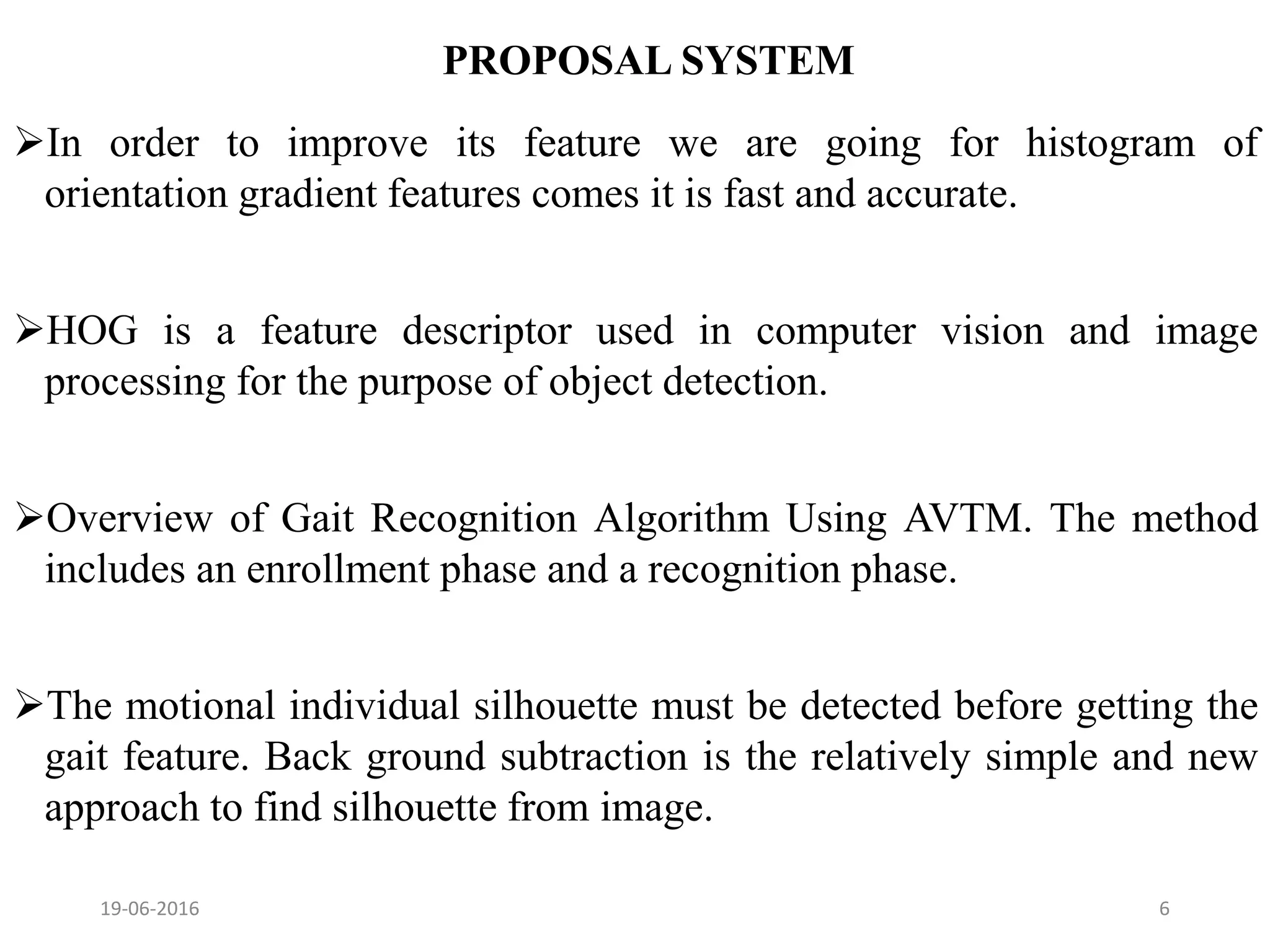
PROPOSAL SYSTEM
In order to improve its feature we are going for histogram of
orientation gradient features comes it is fast and accurate.
HOG is a feature descriptor used in computer vision and image
processing for the purpose of object detection.
Overview of Gait Recognition Algorithm Using AVTM. The method
includes an enrollment phase and a recognition phase.
The motional individual silhouette must be detected before getting the
gait feature. Back ground subtraction is the relatively simple and new
approach to find silhouette from image.
19-06-2016 6
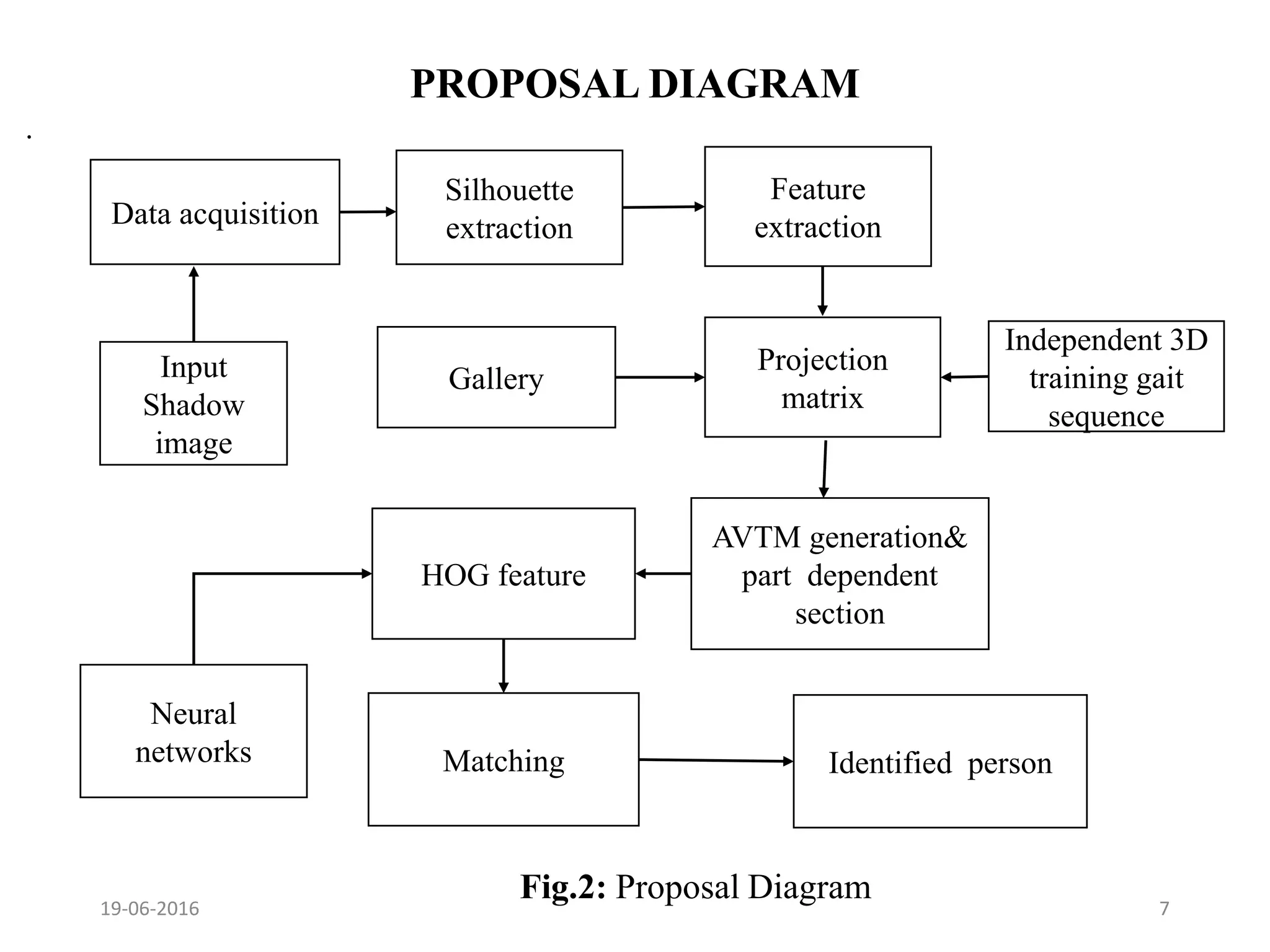
PROPOSAL DIAGRAM
.
Data acquisition
Silhouette
extraction
Feature
extraction
Projection
matrix
Gallery
Independent 3D
training gait
sequence
AVTM generation&
part dependent
section
HOG feature
Neural
networks Matching Identified person
Input
Shadow
image
19-06-2016 7
Fig.2: Proposal Diagram
ARTIFICIAL NEURAL NETWORK (ANN)
ANN is a parallel distributed processor that has a natural tendency
for storing experiential knowledge.
 They can provide suitable solutions for problems, which are
generally characterized by high dimensionality noisy, complex,
imprecise, and imperfect or error prone sensor data, and lack of a
clearly stated mathematical solution or algorithm.
A key benefit of neural networks is that a model of the system can be
built from the available data. Image classification using neural
networks is done by texture feature extraction and then applying the
back propagation algorithm.
19-06-2016 8
ADVANTAGES
It used low resolution camera.
To identify the accurate image by using HOG.
19-06-2016 9
Matlab output
SELECT THE PERSON
19-06-2016 10
These module used to select image of the various
person. These image represent the module which store on
to identify the thief.
Fig.3: Select The Person
SELCET THE SHADOW IMAGE
19-06-2016 11
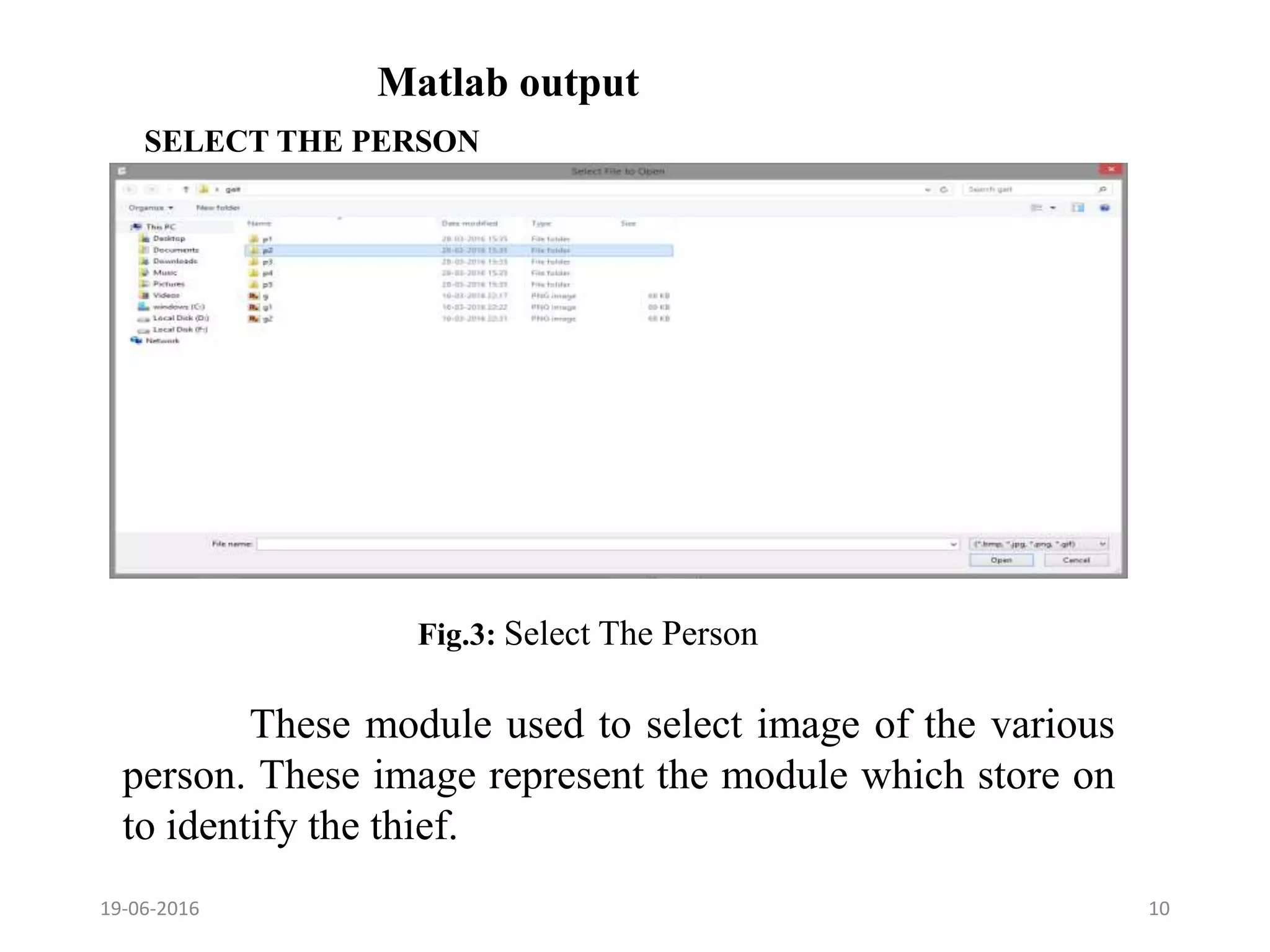
These image represent the shadow image of the
selected person to identify the person. These module show
the image of the same person in different style. It select the
any one style of the person to identify the person.
Fig.4: Select The Shadow Image
COMPARE TO ALL IMAGES
19-06-2016 12
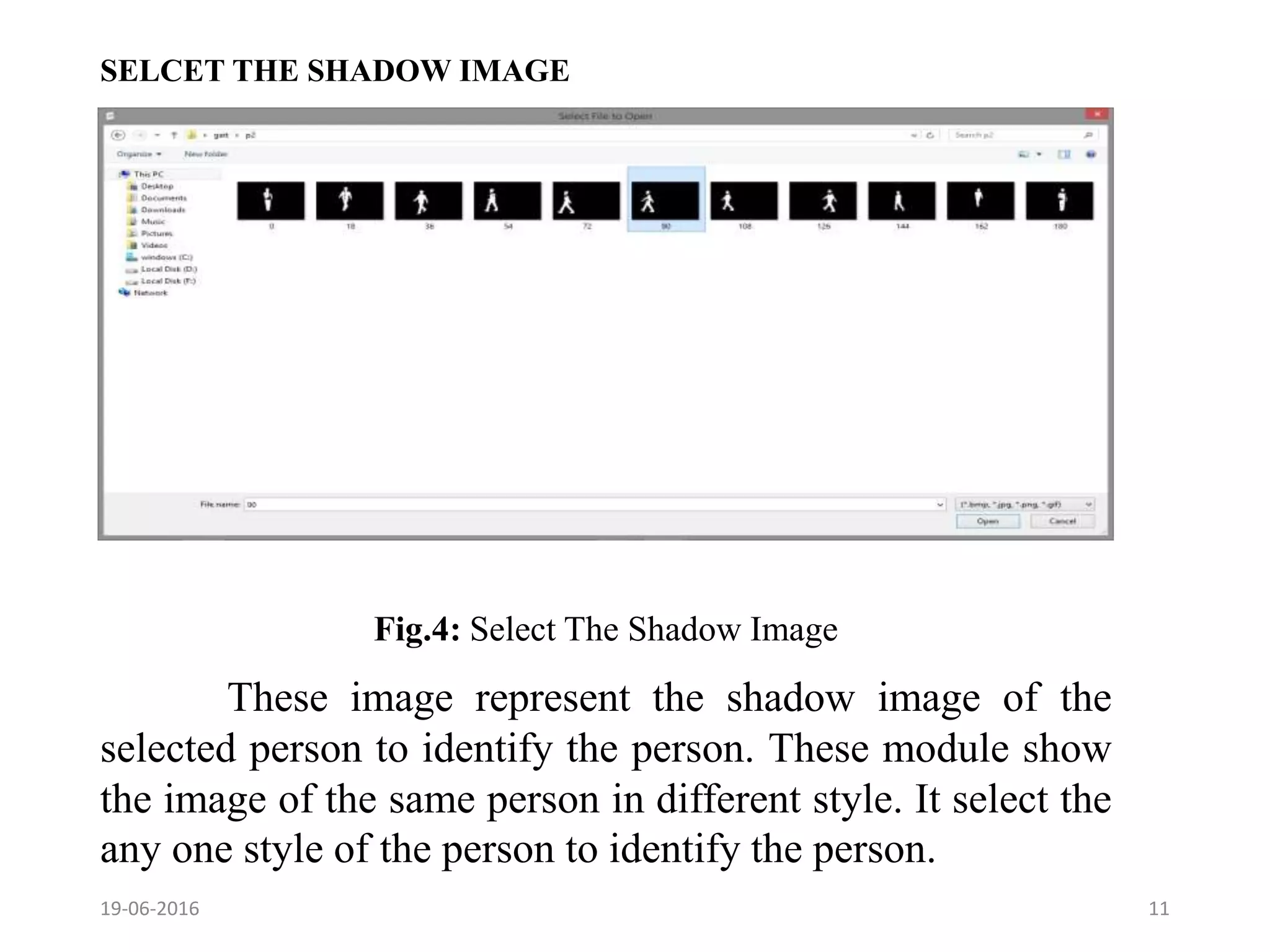
It compare the selected person image with the various
person image which internally stored in the system. These module
compare the shadowed image of the selected person with the various
persons image.
Fig.5: Compare to All Images
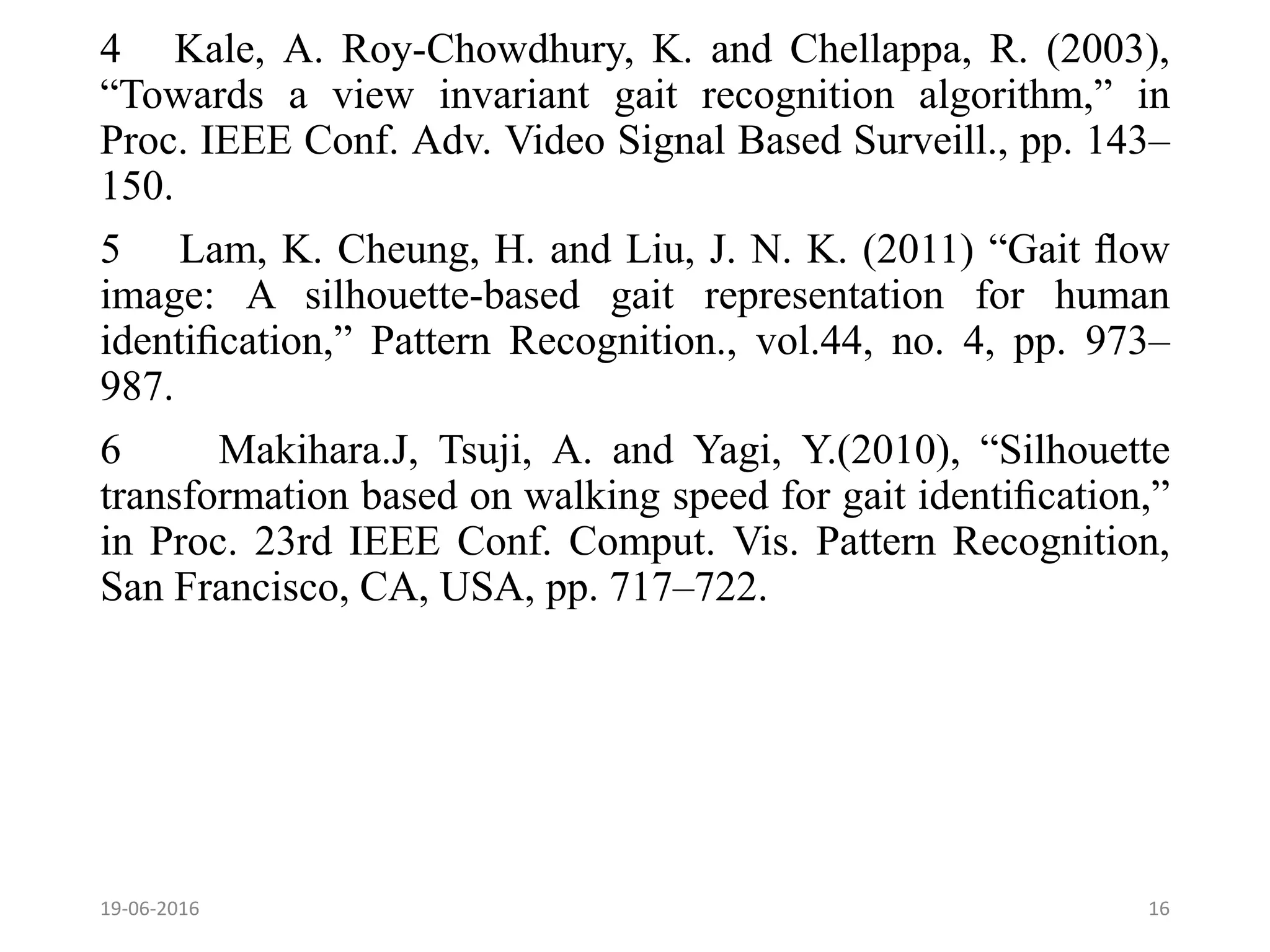
IDENTIFIED THE PERSON
19-06-2016 13
It finally identify the person which is selected by the user
based on the data stored. By comparing the image of the different
person in different style it finally find the person.
Fig.6: Identified the Person
CONCLUSION
Gait is a potential behavioral feature and many allied studies
have demonstrated that it has a rich potential as a biometric
for recognition.
 Quickly and accurately identified person using in artificial
neural networks.
19-06-2016 14
REFERENCES
1 Han.Rand, J. Bhanu, B. (2006), “Individual recognition using gait
energy image,” IEEE Trans. Pattern Anal. Mach. Intell., vol. 28, no. 2,
pp. 316–322.
2 Hossain,M. Makihara, Y. Wang, J. and Yagi, Y. (2010), “Clothing-
invariant gait identification using part-based clothing categorization and
adaptive weight control,” Pattern Recognition., vol. 43, no. 6, pp. 2281–
2291.
3 Kusakunniran,I. Wu, Q. Zhang, J. and Li, H. (2012), “Gait
recognition under various viewing angles based on correlated motion
regression,” IEEE Trans. Circuits Syst. Video Technol., vol. 22, no. 6, pp.
966–980.
19-06-2016 15
4 Kale, A. Roy-Chowdhury, K. and Chellappa, R. (2003),
“Towards a view invariant gait recognition algorithm,” in
Proc. IEEE Conf. Adv. Video Signal Based Surveill., pp. 143–
150.
5 Lam, K. Cheung, H. and Liu, J. N. K. (2011) “Gait flow
image: A silhouette-based gait representation for human
identification,” Pattern Recognition., vol.44, no. 4, pp. 973–
987.
6 Makihara.J, Tsuji, A. and Yagi, Y.(2010), “Silhouette
transformation based on walking speed for gait identification,”
in Proc. 23rd IEEE Conf. Comput. Vis. Pattern Recognition,
San Francisco, CA, USA, pp. 717–722.
19-06-2016 16

BATCH 11

  • 1.
    MAHA BARATHI ENGINEERING COLLEGE GAITBASED PERSON RECOGNITION USINIG ARTIFICIAL NEURAL NETWORKS PRESENTED BY B.ANTONY XAVIER (621412106009) N.BABU (621412106013) EBIN ROY (621412106015) I.MOHAMMED (621412106036) UNDER THE GUIDANCE Ms.R.RAJALAKSHMI,ME., AP/ECE DEPT. 19-06-2016 1
  • 2.
    ABSTRACT  In thisproject a new approach is proposed for extracting human gait based on the silhouettle image.  Gait recognition is a useful biometric trait for person authentication because it is usable even with low image resolution. Human identification using Gait is method to identify an individual by the way he walk or manner of moving on foot. 19-06-2016 2
  • 3.
    GAIT RECOGNITION SYSTEM Biometricis a field of technology that uses automated methods for identifying and verifying a person.  In real time applications like in banks, airports, authentications and verifications are always required. The first important step towards preventing unauthorized access is user authentication. User authentication is the process of verifying identity.  Steps in gait system, 1.Background subtraction 2.Pre processing 3.Fature extraction 4.Recognition 19-06-2016 3
  • 4.
    EXISTING SYSTEM By usingthis we can able to find the person by his walk. In existing system we can able to use gait features to identify the person by their walks.  Images from a virtual view are generated by re-projecting the 3D gait volumes onto the image plane, these generated images are then used for recognition. 19-06-2016 4
  • 5.
    BLOCK DIAGRAM Camera Pre-processingFeature extraction Recognition Data base of face/gait feature 19-06-2016 5 Fig.1: Block Diagram of Existing System
  • 6.
    PROPOSAL SYSTEM In orderto improve its feature we are going for histogram of orientation gradient features comes it is fast and accurate. HOG is a feature descriptor used in computer vision and image processing for the purpose of object detection. Overview of Gait Recognition Algorithm Using AVTM. The method includes an enrollment phase and a recognition phase. The motional individual silhouette must be detected before getting the gait feature. Back ground subtraction is the relatively simple and new approach to find silhouette from image. 19-06-2016 6
  • 7.
    PROPOSAL DIAGRAM . Data acquisition Silhouette extraction Feature extraction Projection matrix Gallery Independent3D training gait sequence AVTM generation& part dependent section HOG feature Neural networks Matching Identified person Input Shadow image 19-06-2016 7 Fig.2: Proposal Diagram
  • 8.
    ARTIFICIAL NEURAL NETWORK(ANN) ANN is a parallel distributed processor that has a natural tendency for storing experiential knowledge.  They can provide suitable solutions for problems, which are generally characterized by high dimensionality noisy, complex, imprecise, and imperfect or error prone sensor data, and lack of a clearly stated mathematical solution or algorithm. A key benefit of neural networks is that a model of the system can be built from the available data. Image classification using neural networks is done by texture feature extraction and then applying the back propagation algorithm. 19-06-2016 8
  • 9.
    ADVANTAGES It used lowresolution camera. To identify the accurate image by using HOG. 19-06-2016 9
  • 10.
    Matlab output SELECT THEPERSON 19-06-2016 10 These module used to select image of the various person. These image represent the module which store on to identify the thief. Fig.3: Select The Person
  • 11.
    SELCET THE SHADOWIMAGE 19-06-2016 11 These image represent the shadow image of the selected person to identify the person. These module show the image of the same person in different style. It select the any one style of the person to identify the person. Fig.4: Select The Shadow Image
  • 12.
    COMPARE TO ALLIMAGES 19-06-2016 12 It compare the selected person image with the various person image which internally stored in the system. These module compare the shadowed image of the selected person with the various persons image. Fig.5: Compare to All Images
  • 13.
    IDENTIFIED THE PERSON 19-06-201613 It finally identify the person which is selected by the user based on the data stored. By comparing the image of the different person in different style it finally find the person. Fig.6: Identified the Person
  • 14.
    CONCLUSION Gait is apotential behavioral feature and many allied studies have demonstrated that it has a rich potential as a biometric for recognition.  Quickly and accurately identified person using in artificial neural networks. 19-06-2016 14
  • 15.
    REFERENCES 1 Han.Rand, J.Bhanu, B. (2006), “Individual recognition using gait energy image,” IEEE Trans. Pattern Anal. Mach. Intell., vol. 28, no. 2, pp. 316–322. 2 Hossain,M. Makihara, Y. Wang, J. and Yagi, Y. (2010), “Clothing- invariant gait identification using part-based clothing categorization and adaptive weight control,” Pattern Recognition., vol. 43, no. 6, pp. 2281– 2291. 3 Kusakunniran,I. Wu, Q. Zhang, J. and Li, H. (2012), “Gait recognition under various viewing angles based on correlated motion regression,” IEEE Trans. Circuits Syst. Video Technol., vol. 22, no. 6, pp. 966–980. 19-06-2016 15
  • 16.
    4 Kale, A.Roy-Chowdhury, K. and Chellappa, R. (2003), “Towards a view invariant gait recognition algorithm,” in Proc. IEEE Conf. Adv. Video Signal Based Surveill., pp. 143– 150. 5 Lam, K. Cheung, H. and Liu, J. N. K. (2011) “Gait flow image: A silhouette-based gait representation for human identification,” Pattern Recognition., vol.44, no. 4, pp. 973– 987. 6 Makihara.J, Tsuji, A. and Yagi, Y.(2010), “Silhouette transformation based on walking speed for gait identification,” in Proc. 23rd IEEE Conf. Comput. Vis. Pattern Recognition, San Francisco, CA, USA, pp. 717–722. 19-06-2016 16