BME 595 - Medical Imaging Applications
Part 2: INTRODUCTION TO MRI
Lecture 1
Fundamentals of Magnetic Resonance
Feb. 16, 2005
James D. Christensen, Ph.D.
IU School of Medicine
Department of Radiology
Research II building, E002C
jadchris@iupui.edu
317-274-3815
References
Books covering basics of MR physics:
E. Mark Haacke, et al 1999 Magnetic Resonance Imaging: Physical Principles and
Sequence Design.
C.P. Slichter 1978 (1992) Principles of Magnetic Resonance.
A. Abragam 1961 (1994) Principles of Nuclear Magnetism.
References
Online resources for introductory review of MR physics:
Robert Cox’s book chapters online
http://afni.nimh.nih.gov/afni/edu/
See “Background Information on MRI” section
Mark Cohen’s intro Basic MR Physics slides
http://porkpie.loni.ucla.edu/BMD_HTML/SharedCode/MiscShared.html
Douglas Noll’s Primer on MRI and Functional MRI
http://www.bme.umich.edu/~dnoll/primer2.pdf
Joseph Hornak’s Web Tutorial, The Basics of MRI
http://www.cis.rit.edu/htbooks/mri/mri-main.htm
Timeline of MR Imaging
1920 1930 1940 1950 1960 1970 1980 1990 2000
1924 - Pauli suggests
that nuclear particles
may have angular
momentum (spin).
1937 – Rabi measures
magnetic moment of
nucleus. Coins
“magnetic resonance”.
1946 – Purcell shows
that matter absorbs
energy at a resonant
frequency.
1946 – Bloch demonstrates
that nuclear precession can be
measured in detector coils.
1972 – Damadian
patents idea for large
NMR scanner to
detect malignant
tissue.
1959 – Singer
measures blood flow
using NMR (in
mice).
1973 – Lauterbur
publishes method for
generating images
using NMR gradients.
1973 – Mansfield
independently
publishes gradient
approach to MR.
1975 – Ernst
develops 2D-Fourier
transform for MR.
NMR renamed MRI
MRI scanners
become clinically
prevalent.
1990 – Ogawa and
colleagues create
functional images
using endogenous,
blood-oxygenation
contrast.
1985 – Insurance
reimbursements for
MRI exams begin.
Nobel Prizes for Magnetic Resonance
• 1944: Rabi
Physics (Measured magnetic moment of nucleus)
• 1952: Felix Bloch and Edward Mills Purcell
Physics (Basic science of NMR phenomenon)
• 1991: Richard Ernst
Chemistry (High-resolution pulsed FT-NMR)
• 2002: Kurt Wüthrich
Chemistry (3D molecular structure in solution by NMR)
• 2003: Paul Lauterbur & Peter Mansfield
Physiology or Medicine (MRI technology)
Magnetic Resonance Techniques
Nuclear Spin Phenomenon:
• NMR (Nuclear Magnetic Resonance)
• MRI (Magnetic Resonance Imaging)
• EPI (Echo-Planar Imaging)
• fMRI (Functional MRI)
• MRS (Magnetic Resonance Spectroscopy)
• MRSI (MR Spectroscopic Imaging)
Electron Spin Phenomenon (not covered in this course):
• ESR (Electron Spin Resonance)
or EPR (Electron Paramagnetic Resonance)
• ELDOR (Electron-electron double resonance)
• ENDOR (Electron-nuclear double resonance)
Equipment
Magnet Gradient Coil RF Coil
RF Coil
4T magnet
gradient coil
(inside)
B0
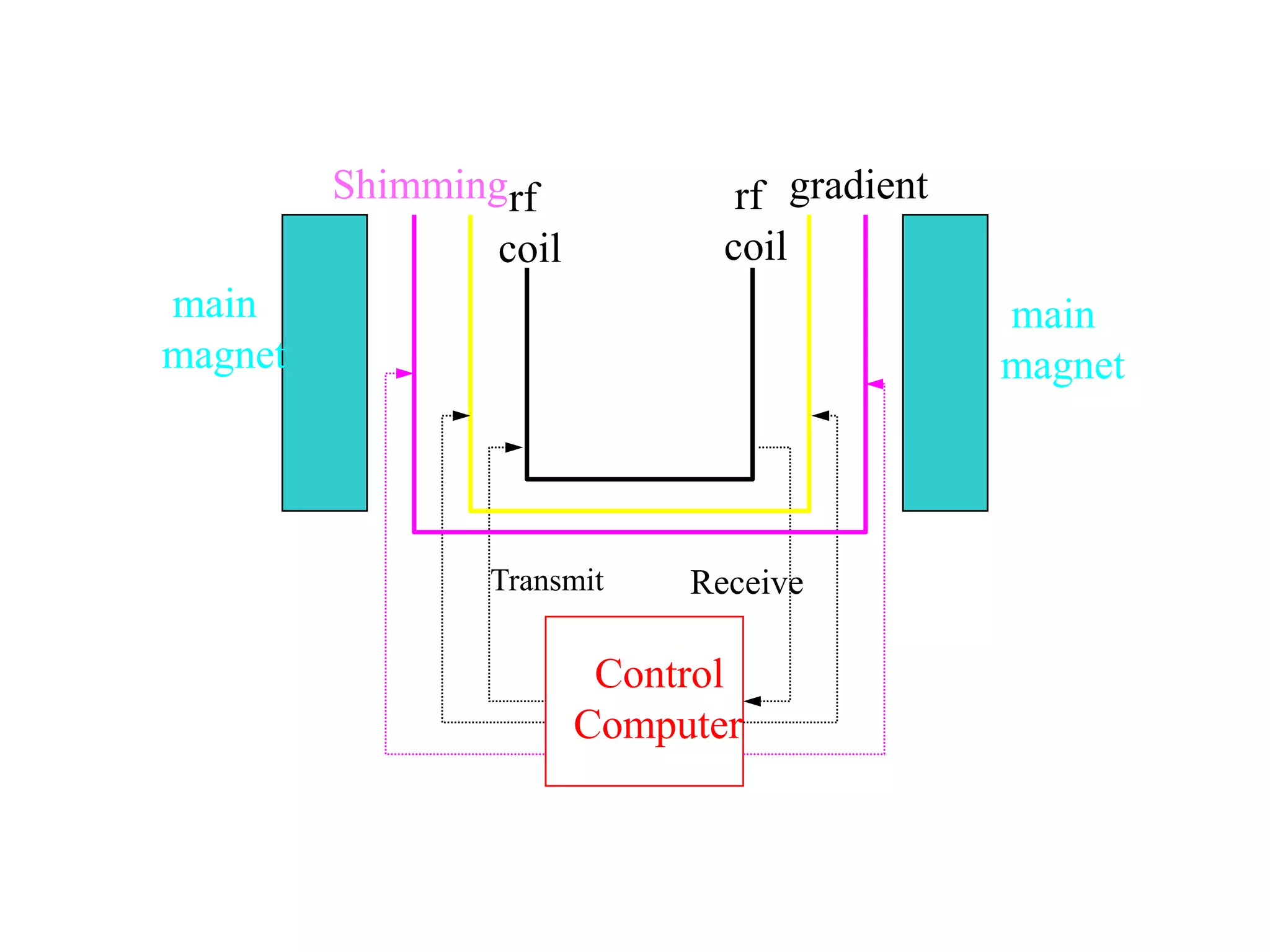
Main Components of a Scanner
• Static Magnetic Field Coils
• Gradient Magnetic Field Coils
• Magnetic shim coils
• Radiofrequency Coil
• Subsystem control computer
• Data transfer and storage computers
• Physiological monitoring, stimulus display, and
behavioral recording hardware
Transmit Receive
rf
coil
rf
coil
main
magnet
main
magnet
gradient
Shimming
Control
Computer
Main Magnet Field Bo
• Purpose is to align H protons in H2O (little
magnets)
[Little magnets lining up with external lines of force]
[Main magnet and some of its lines of force]
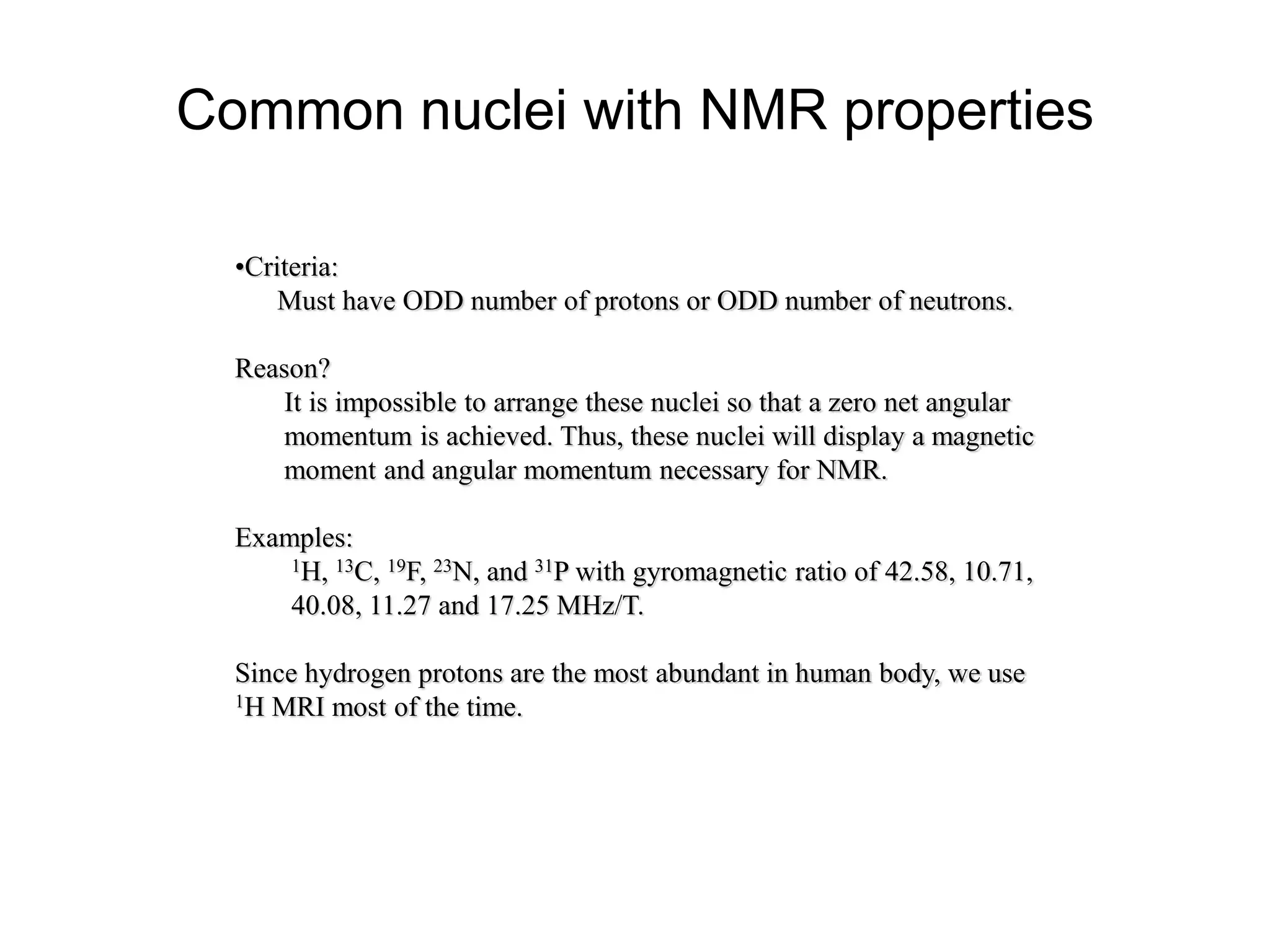
Common nuclei with NMR properties
•Criteria:
Must have ODD number of protons or ODD number of neutrons.
Reason?
It is impossible to arrange these nuclei so that a zero net angular
momentum is achieved. Thus, these nuclei will display a magnetic
moment and angular momentum necessary for NMR.
Examples:
1H, 13C, 19F, 23N, and 31P with gyromagnetic ratio of 42.58, 10.71,
40.08, 11.27 and 17.25 MHz/T.
Since hydrogen protons are the most abundant in human body, we use
1H MRI most of the time.
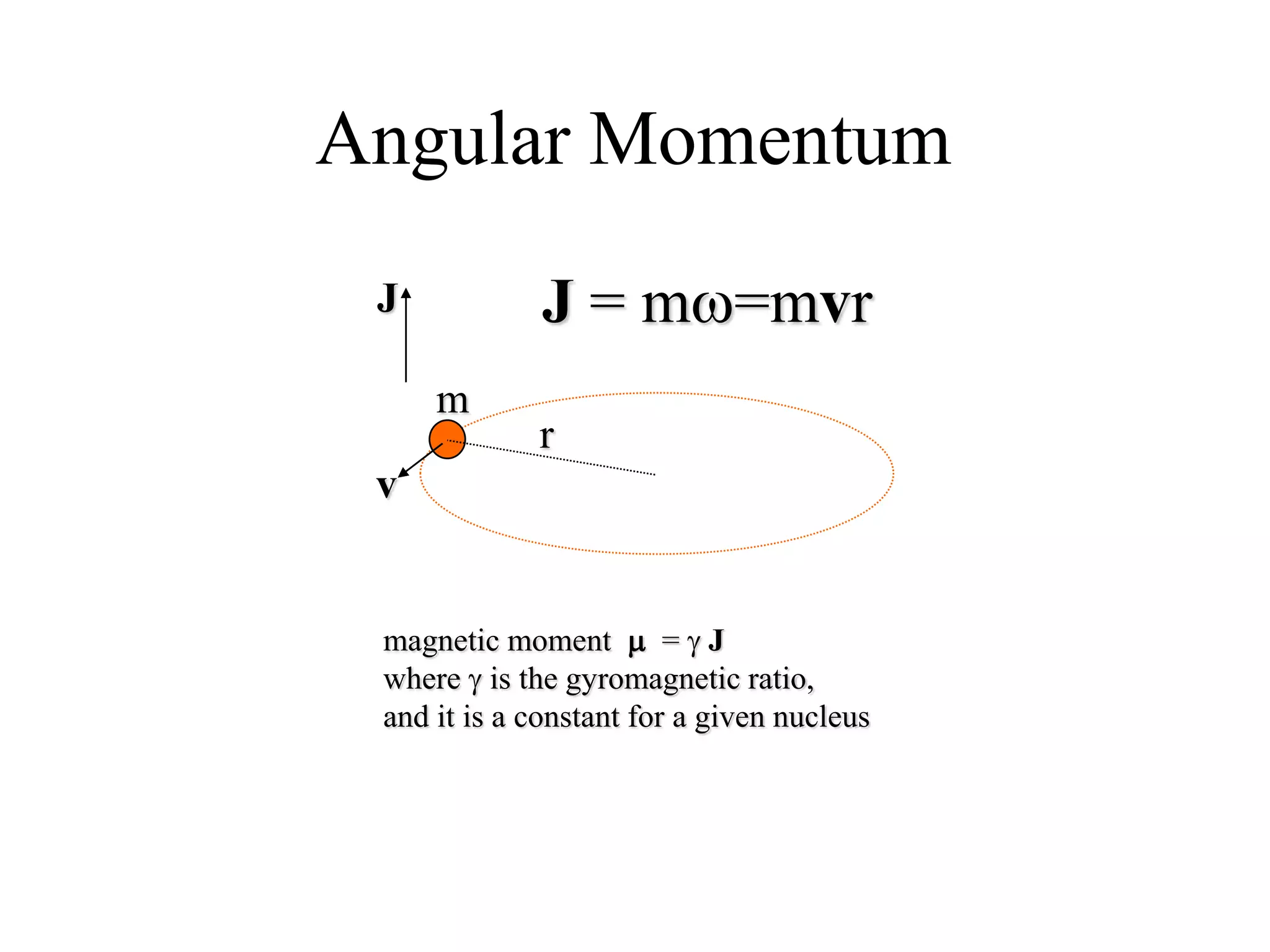
Angular Momentum
J = mw=mvr
m
v
r
J
magnetic moment m = g J
where g is the gyromagnetic ratio,
and it is a constant for a given nucleus
A Single Proton
+
+
+
There is electric charge
on the surface of the
proton, thus creating a
small current loop and
generating magnetic
moment m.
The proton also
has mass which
generates an
angular
momentum
J when it is
spinning.
J
m
Thus proton “magnet” differs from a magnetic bar in that it
also possesses angular momentum caused by spinning.
Protons in a Magnetic Field
Bo
Parallel
(low energy)
Anti-Parallel
(high energy)
Spinning protons in a magnetic field will assume two states.
If the temperature is 0o K, all spins will occupy the lower energy state.
Protons align with field
Outside magnetic field
randomly oriented
• spins tend to align parallel or anti-parallel
to B0
• net magnetization (M) along B0
• spins precess with random phase
• no net magnetization in transverse plane
• only 0.0003% of protons/T align with field
Inside magnetic field
Mz
Mxy = 0
longitudinal
axis
transverse
plane
Longitudinal
magnetization
Transverse
magnetization
M
Net Magnetization
Bo
M
T
B
c
M o

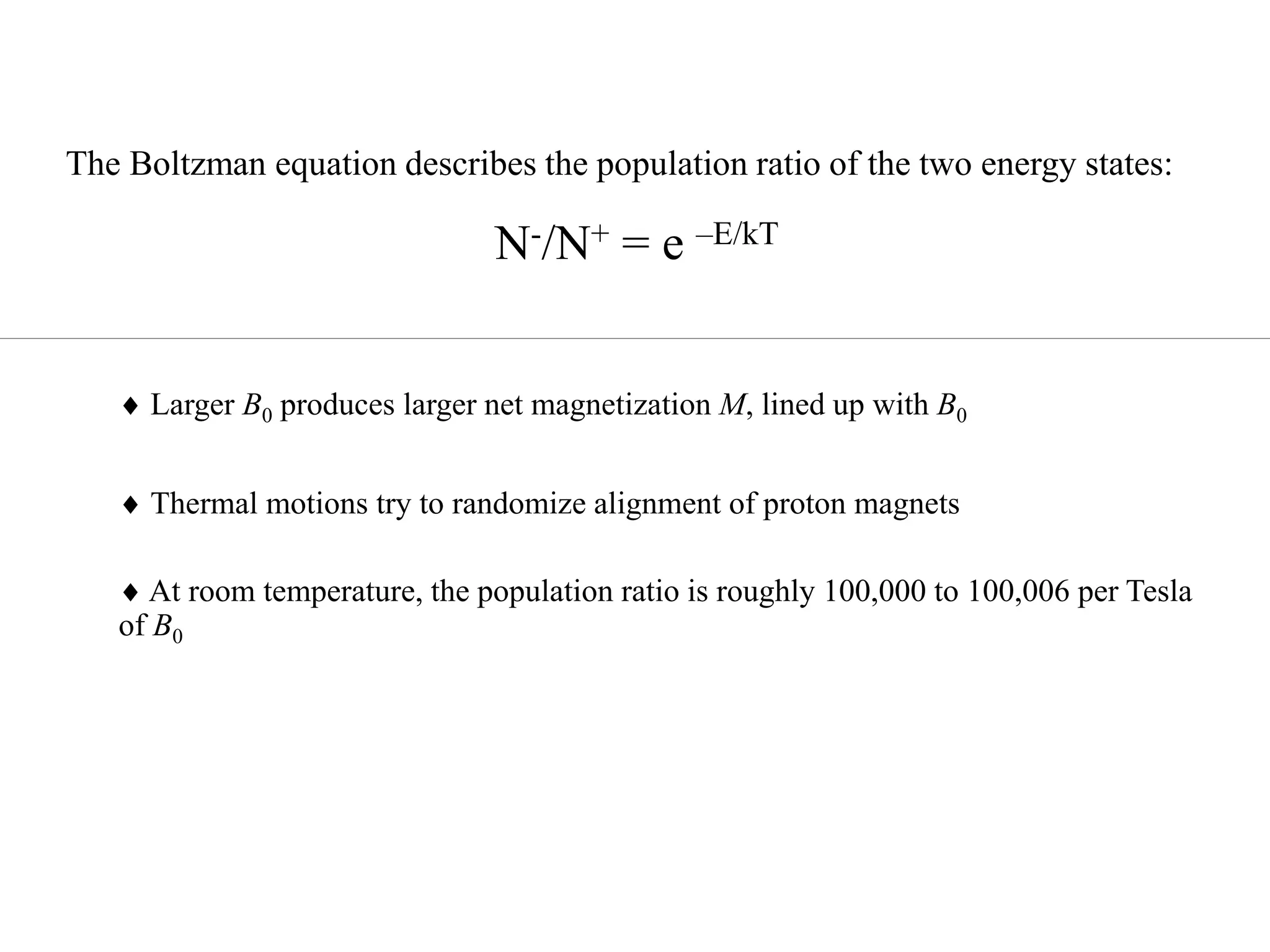
 Larger B0 produces larger net magnetization M, lined up with B0
 Thermal motions try to randomize alignment of proton magnets
 At room temperature, the population ratio is roughly 100,000 to 100,006 per Tesla
of B0
The Boltzman equation describes the population ratio of the two energy states:
N-/N+ = e –E/kT
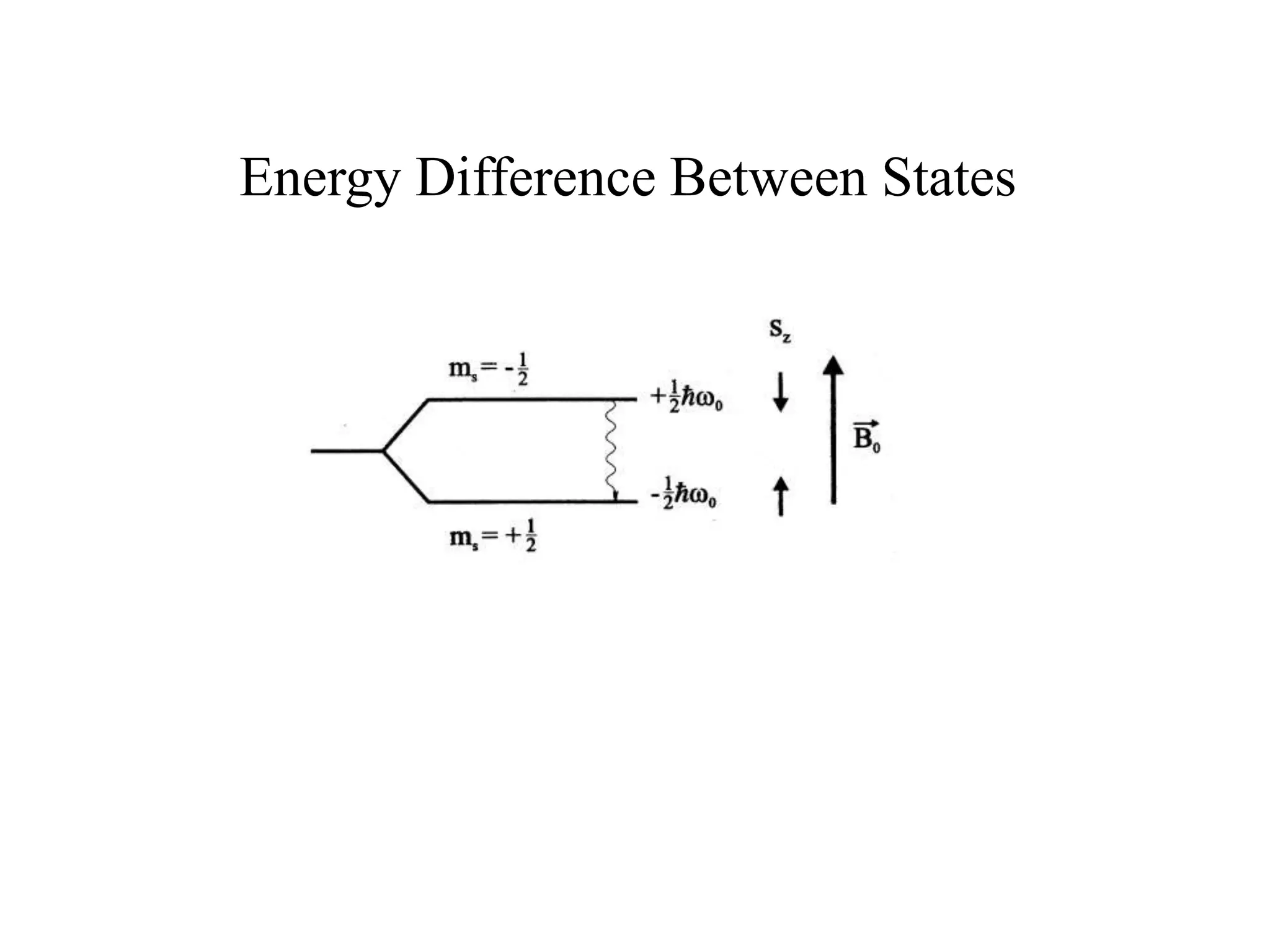
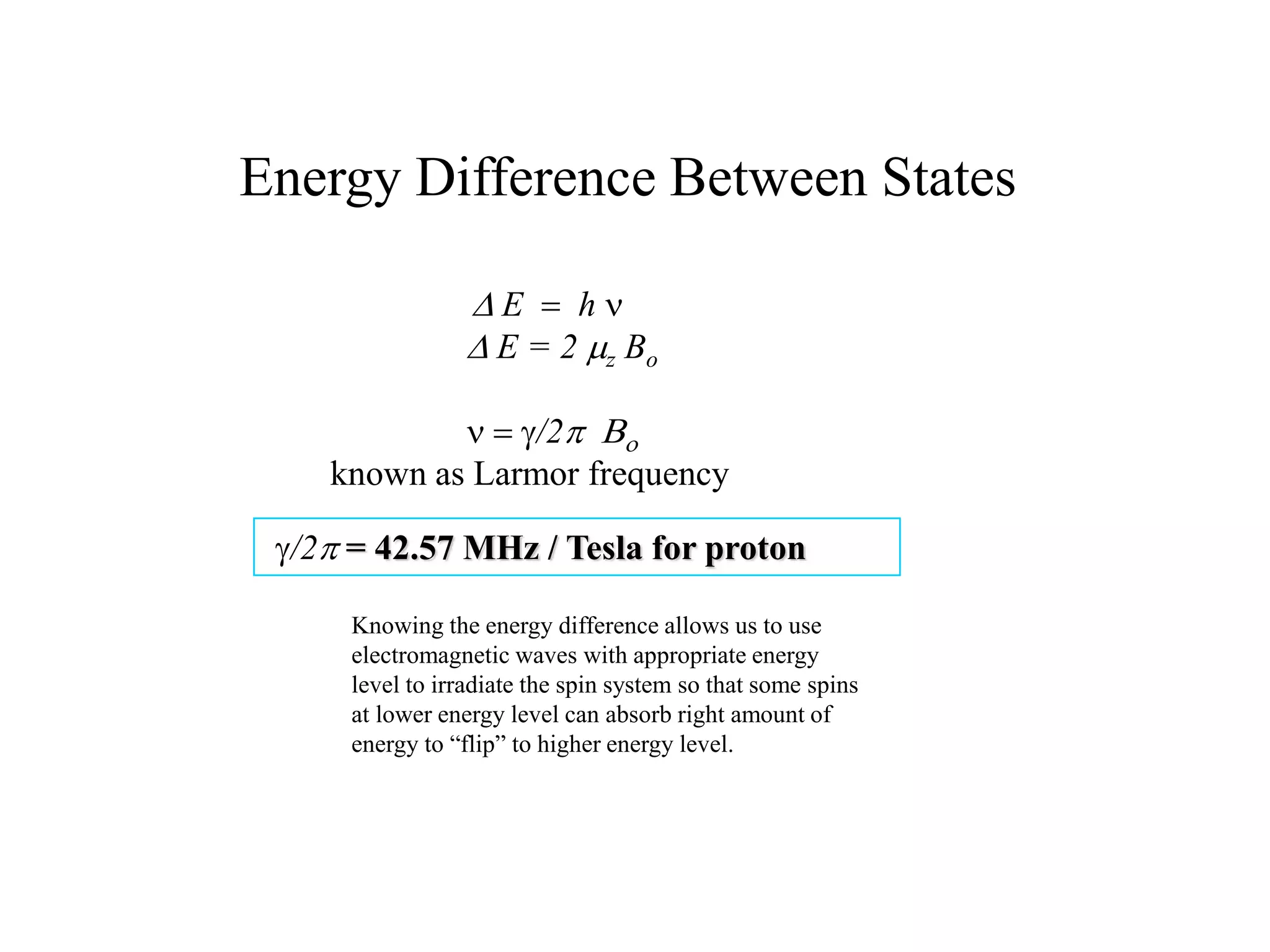
Energy Difference Between States
D E  h n
D E = 2 mz Bo
n  g/2p Bo
known as Larmor frequency
g/2p = 42.57 MHz / Tesla for proton
Knowing the energy difference allows us to use
electromagnetic waves with appropriate energy
level to irradiate the spin system so that some spins
at lower energy level can absorb right amount of
energy to “flip” to higher energy level.
Spin System Before Irradiation
Bo
Lower Energy
Higher Energy
Basic Quantum Mechanics Theory of MR
The Effect of Irradiation to the Spin
System
Lower
Higher
Basic Quantum Mechanics Theory of MR
Spin System After Irradiation
Basic Quantum Mechanics Theory of MR
Precession – Quantum Mechanics
Precession of the quantum expectation value of the magnetic moment
operator in the presence of a constant external field applied along the Z axis.
The uncertainty principle says that both energy and time (phase) or
momentum (angular) and position (orientation) cannot be known with
precision simultaneously.
Precession – Classical
= m × Bo torque
 = dJ / dt
J = m/g
dm/dt = g (m × Bo)
m(t) = (mxocos gBot + myosin gBot) x + (myocos gBot - mxosin gBot) y + mzoz
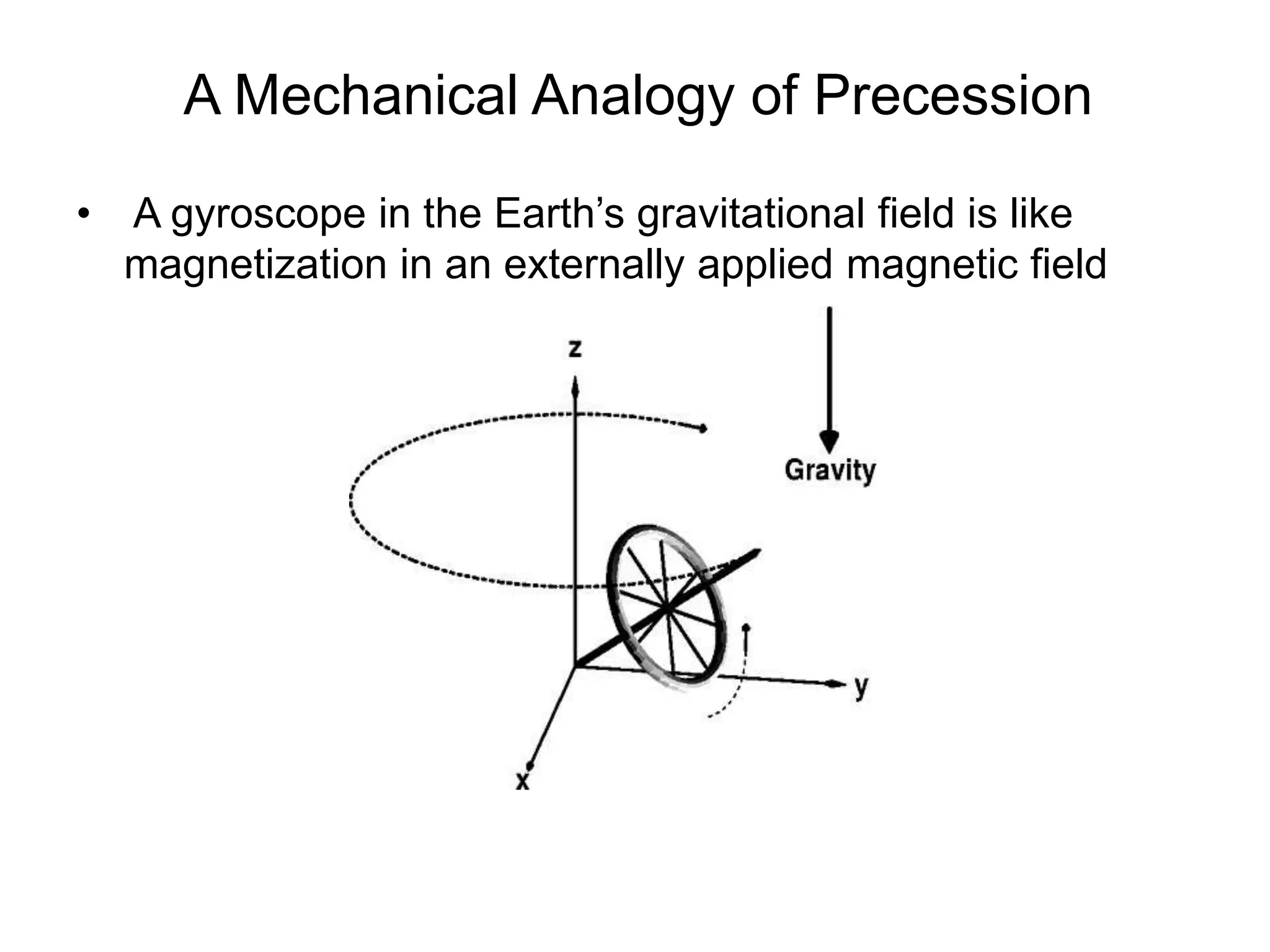
A Mechanical Analogy of Precession
• A gyroscope in the Earth’s gravitational field is like
magnetization in an externally applied magnetic field
Equation of Motion: Block equation
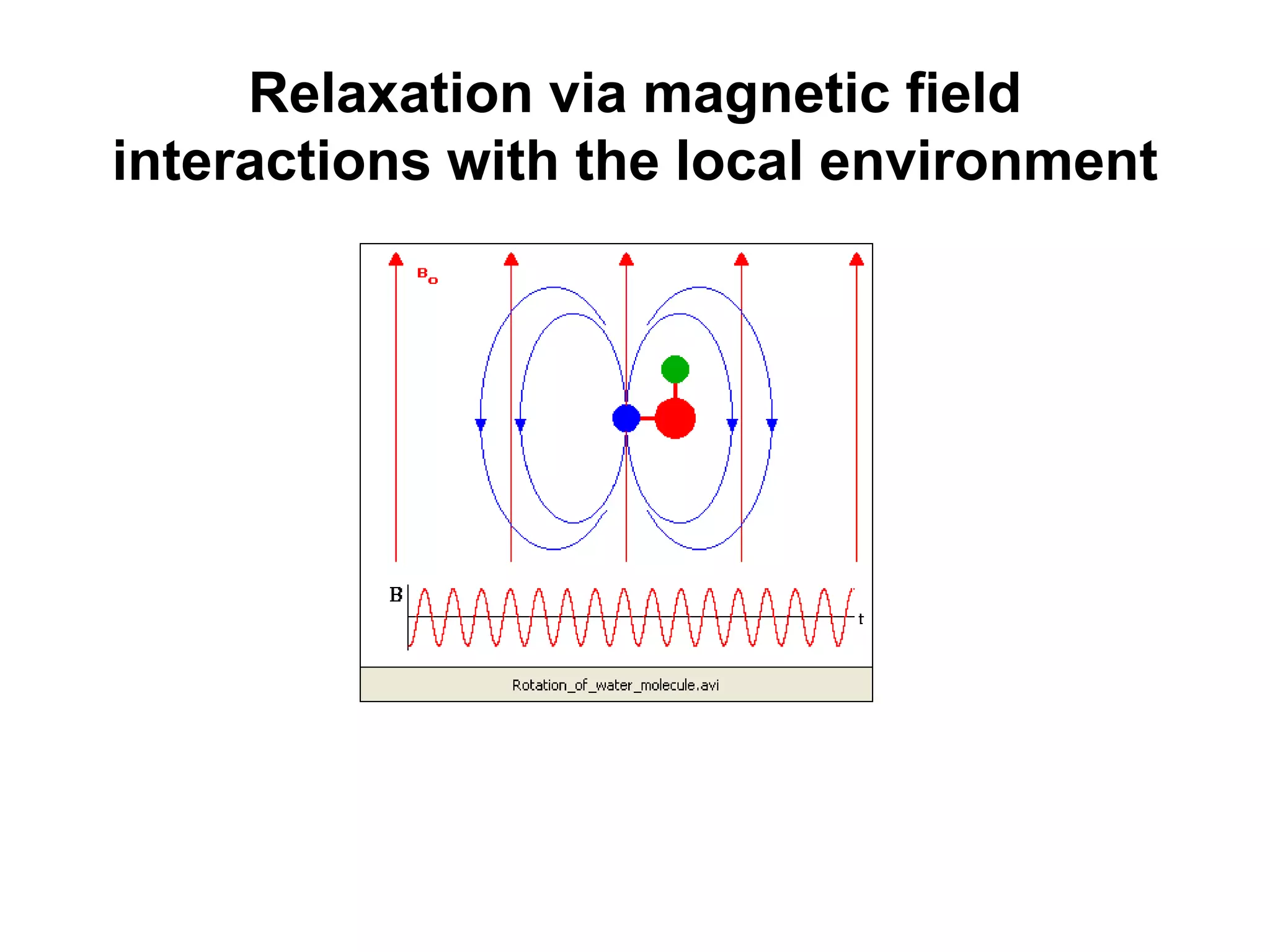
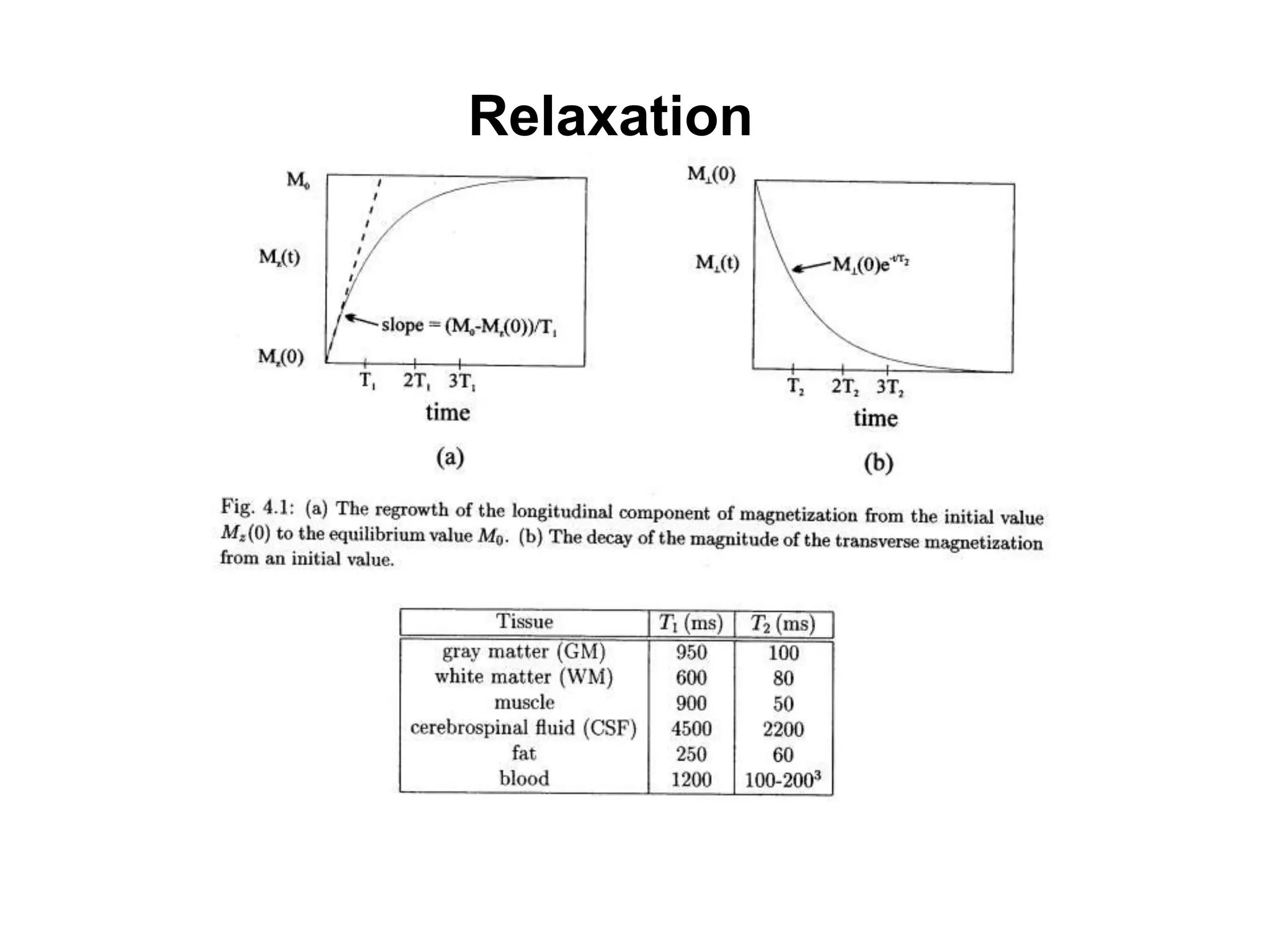
T1 and T2 are time constants describing
relaxation processes caused by interaction with
the local environment
RF Excitation:
On-resonance
Off-resonance
RF Excitation
Excite Radio Frequency (RF) field
• transmission coil: apply magnetic field along B1
(perpendicular to B0)
• oscillating field at Larmor frequency
• frequencies in RF range
• B1 is small: ~1/10,000 T
• tips M to transverse plane – spirals down
• analogy: childrens swingset
• final angle between B0 and B1 is the flip angle
B1
B0
Transverse
magnetization
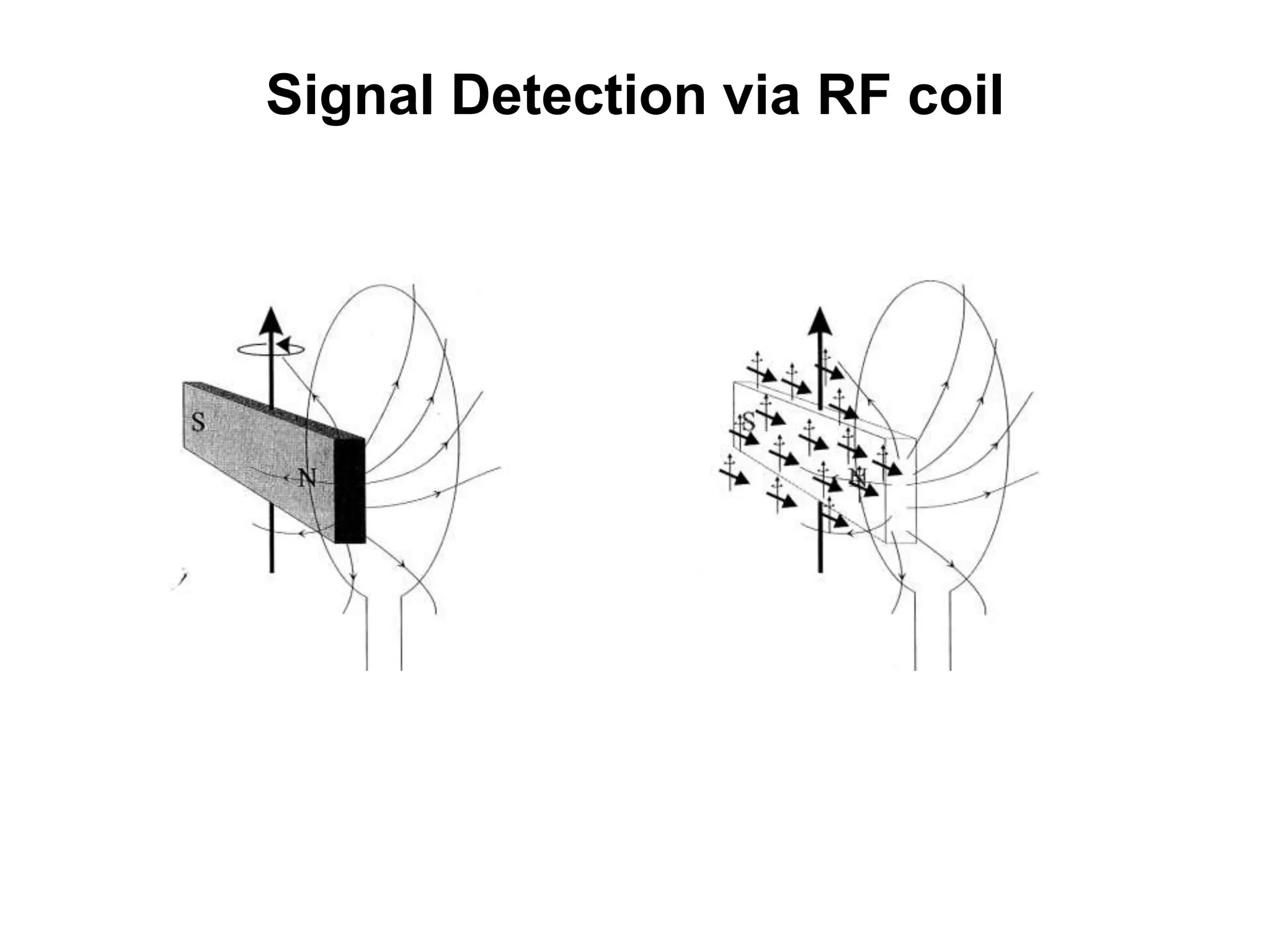
Signal Detection via RF coil
Signal Detection
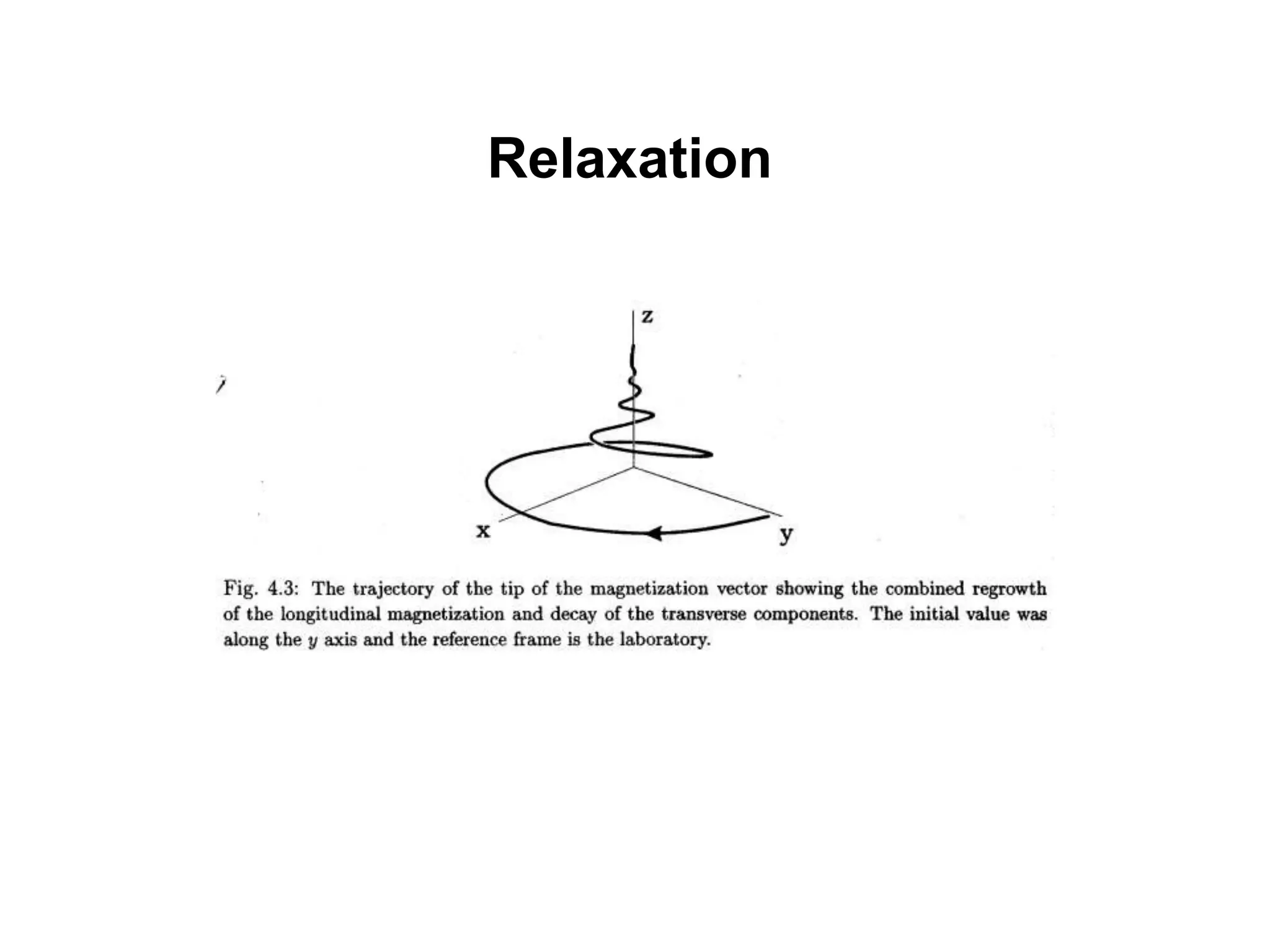
Signal is damped due to relaxation
Relaxation via magnetic field
interactions with the local environment
Spin-Lattice (T1) relaxation via
molecular motion
T1 Relaxation efficiency as function
of freq is inversely related to the
density of states
Effect of temperature Effect of viscosity
Spin-Lattice (T1) relaxation
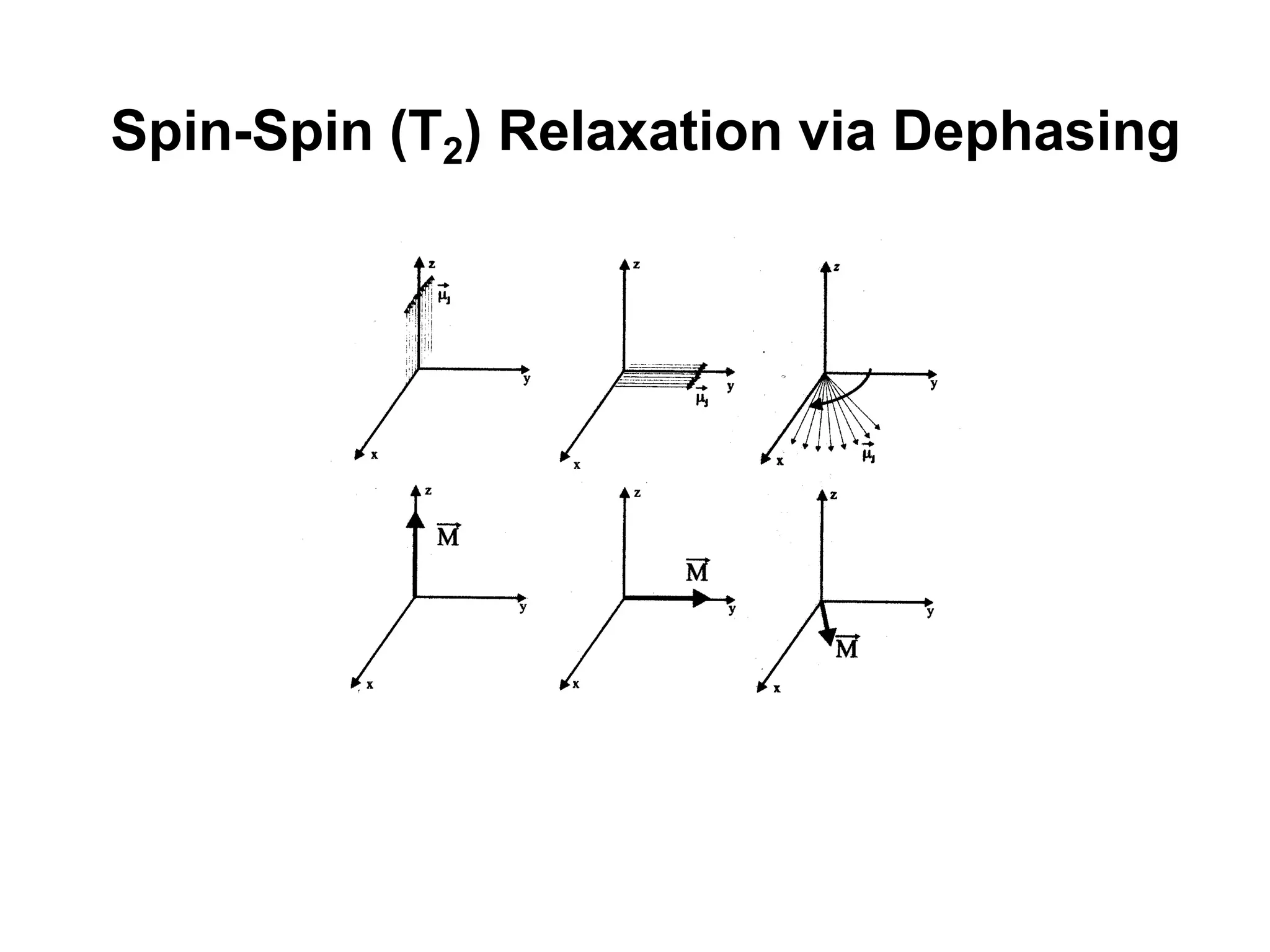
Spin-Spin (T2) Relaxation via Dephasing
Relaxation
Relaxation
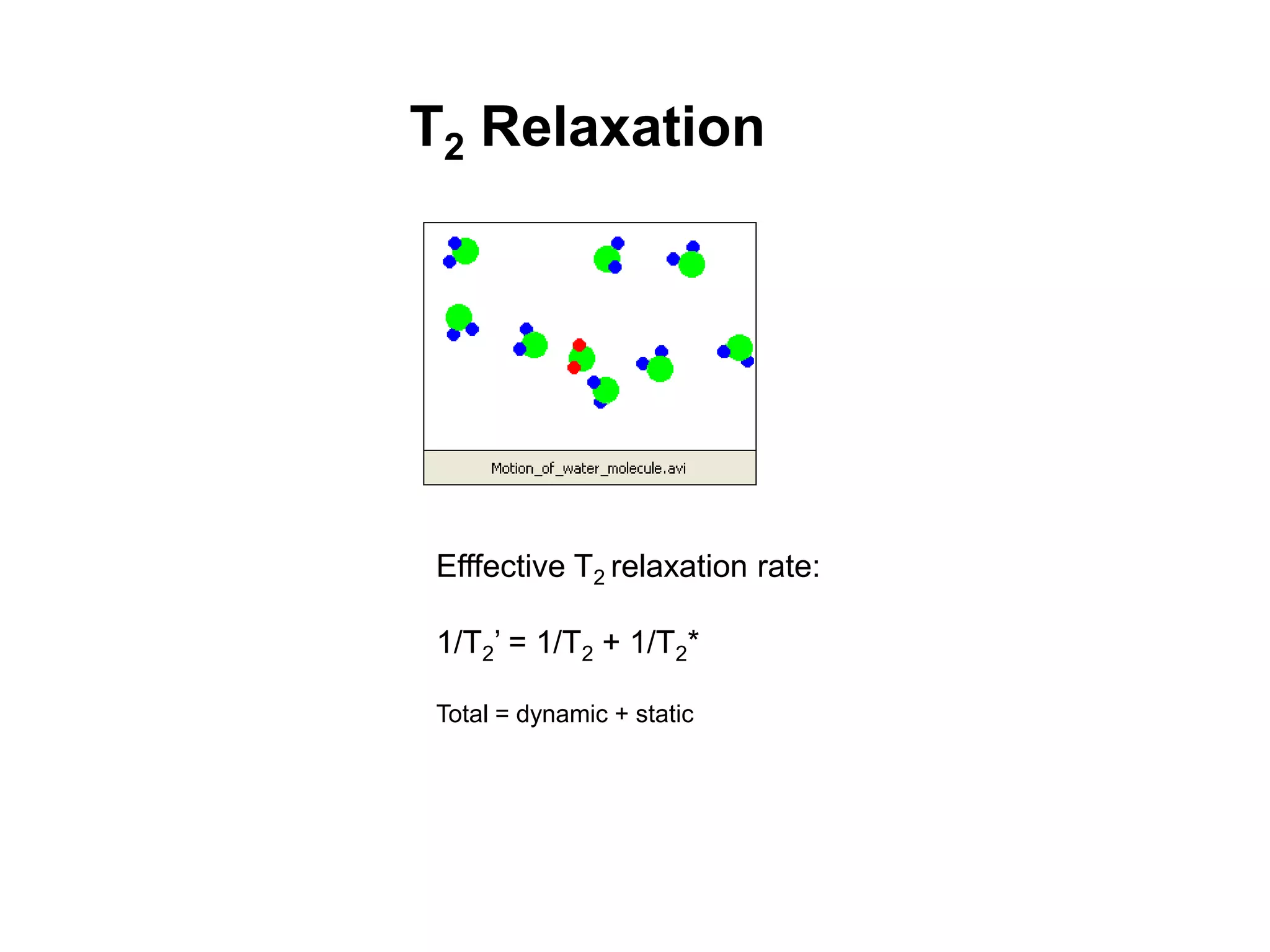
T2 Relaxation
Efffective T2 relaxation rate:
1/T2’ = 1/T2 + 1/T2*
Total = dynamic + static
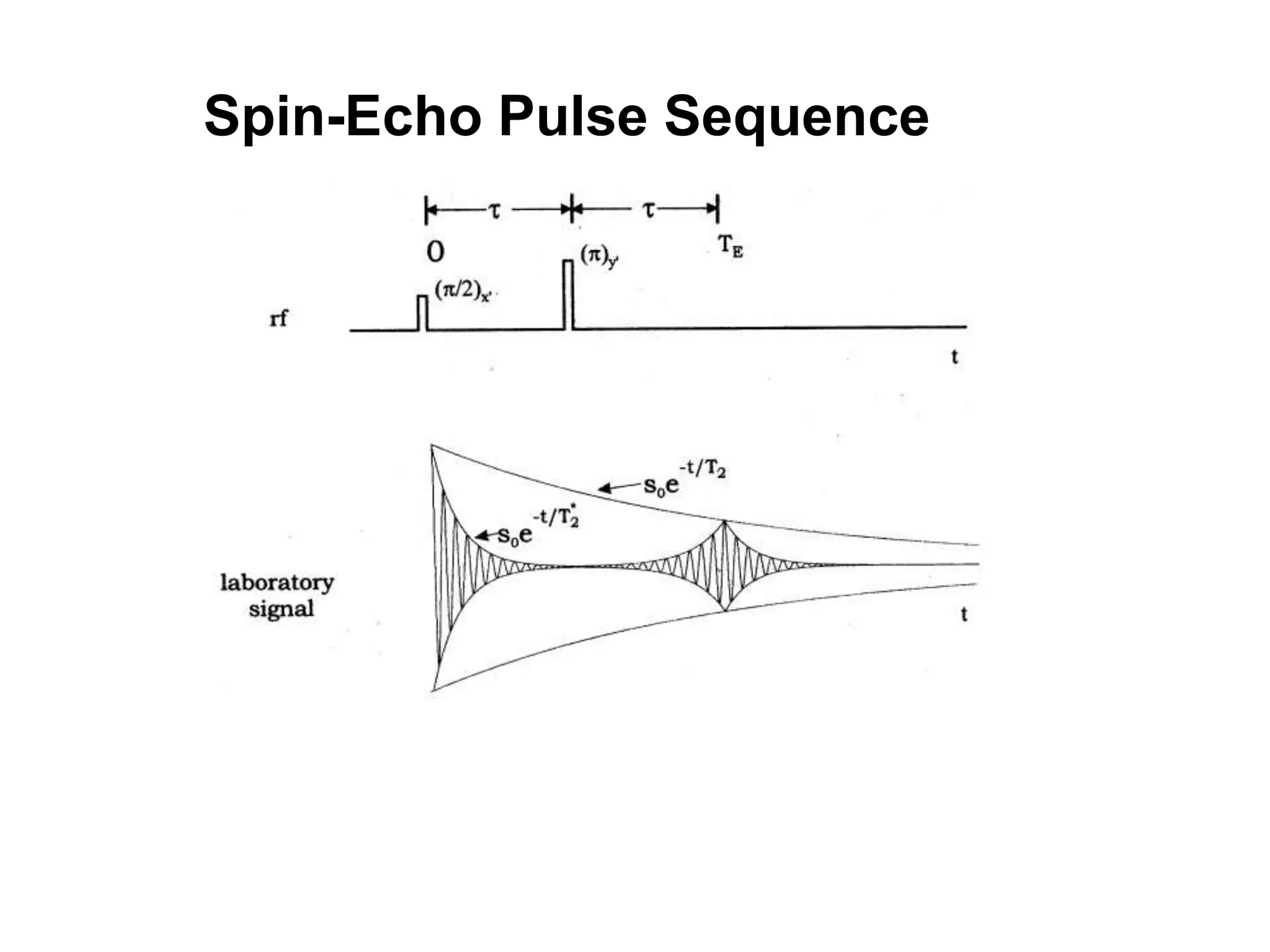
Spin-Echo Pulse Sequence
Multiple Spin-Echo
HOMEWORK Assignment #1
1) Why does 14N have a magnetic moment, even though its nucleus contains an even number of particles?
2) At 37 deg C in a 3.0 Tesla static magnetic field, what percentage of proton spins are aligned with the field?
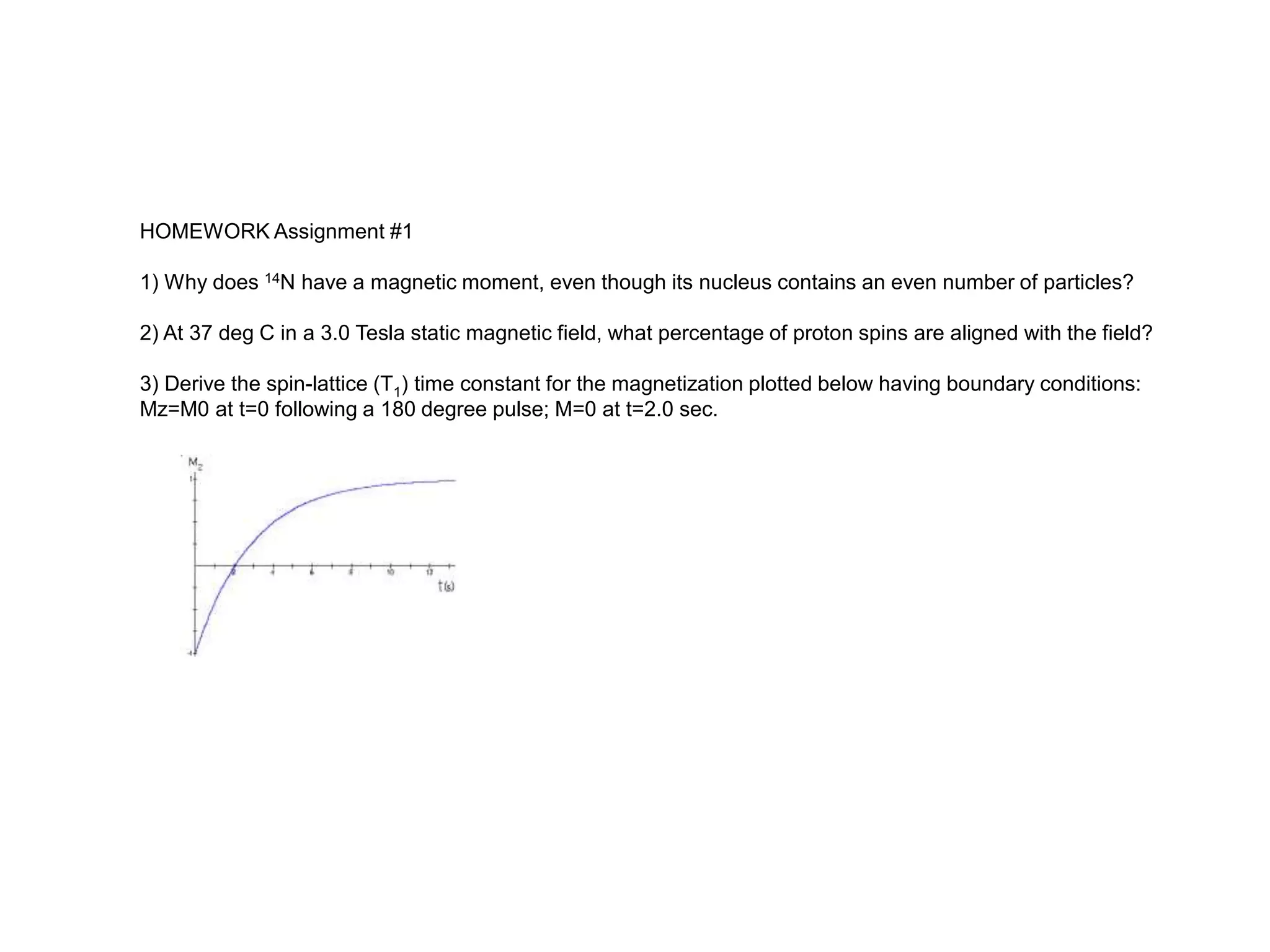
3) Derive the spin-lattice (T1) time constant for the magnetization plotted below having boundary conditions:
Mz=M0 at t=0 following a 180 degree pulse; M=0 at t=2.0 sec.

MRI_1.ppt

  • 1.
    BME 595 -Medical Imaging Applications Part 2: INTRODUCTION TO MRI Lecture 1 Fundamentals of Magnetic Resonance Feb. 16, 2005 James D. Christensen, Ph.D. IU School of Medicine Department of Radiology Research II building, E002C jadchris@iupui.edu 317-274-3815
  • 2.
    References Books covering basicsof MR physics: E. Mark Haacke, et al 1999 Magnetic Resonance Imaging: Physical Principles and Sequence Design. C.P. Slichter 1978 (1992) Principles of Magnetic Resonance. A. Abragam 1961 (1994) Principles of Nuclear Magnetism.
  • 3.
    References Online resources forintroductory review of MR physics: Robert Cox’s book chapters online http://afni.nimh.nih.gov/afni/edu/ See “Background Information on MRI” section Mark Cohen’s intro Basic MR Physics slides http://porkpie.loni.ucla.edu/BMD_HTML/SharedCode/MiscShared.html Douglas Noll’s Primer on MRI and Functional MRI http://www.bme.umich.edu/~dnoll/primer2.pdf Joseph Hornak’s Web Tutorial, The Basics of MRI http://www.cis.rit.edu/htbooks/mri/mri-main.htm
  • 4.
    Timeline of MRImaging 1920 1930 1940 1950 1960 1970 1980 1990 2000 1924 - Pauli suggests that nuclear particles may have angular momentum (spin). 1937 – Rabi measures magnetic moment of nucleus. Coins “magnetic resonance”. 1946 – Purcell shows that matter absorbs energy at a resonant frequency. 1946 – Bloch demonstrates that nuclear precession can be measured in detector coils. 1972 – Damadian patents idea for large NMR scanner to detect malignant tissue. 1959 – Singer measures blood flow using NMR (in mice). 1973 – Lauterbur publishes method for generating images using NMR gradients. 1973 – Mansfield independently publishes gradient approach to MR. 1975 – Ernst develops 2D-Fourier transform for MR. NMR renamed MRI MRI scanners become clinically prevalent. 1990 – Ogawa and colleagues create functional images using endogenous, blood-oxygenation contrast. 1985 – Insurance reimbursements for MRI exams begin.
  • 5.
    Nobel Prizes forMagnetic Resonance • 1944: Rabi Physics (Measured magnetic moment of nucleus) • 1952: Felix Bloch and Edward Mills Purcell Physics (Basic science of NMR phenomenon) • 1991: Richard Ernst Chemistry (High-resolution pulsed FT-NMR) • 2002: Kurt Wüthrich Chemistry (3D molecular structure in solution by NMR) • 2003: Paul Lauterbur & Peter Mansfield Physiology or Medicine (MRI technology)
  • 6.
    Magnetic Resonance Techniques NuclearSpin Phenomenon: • NMR (Nuclear Magnetic Resonance) • MRI (Magnetic Resonance Imaging) • EPI (Echo-Planar Imaging) • fMRI (Functional MRI) • MRS (Magnetic Resonance Spectroscopy) • MRSI (MR Spectroscopic Imaging) Electron Spin Phenomenon (not covered in this course): • ESR (Electron Spin Resonance) or EPR (Electron Paramagnetic Resonance) • ELDOR (Electron-electron double resonance) • ENDOR (Electron-nuclear double resonance)
  • 7.
    Equipment Magnet Gradient CoilRF Coil RF Coil 4T magnet gradient coil (inside) B0
  • 8.
    Main Components ofa Scanner • Static Magnetic Field Coils • Gradient Magnetic Field Coils • Magnetic shim coils • Radiofrequency Coil • Subsystem control computer • Data transfer and storage computers • Physiological monitoring, stimulus display, and behavioral recording hardware
  • 9.
  • 10.
    Main Magnet FieldBo • Purpose is to align H protons in H2O (little magnets) [Little magnets lining up with external lines of force] [Main magnet and some of its lines of force]
  • 11.
    Common nuclei withNMR properties •Criteria: Must have ODD number of protons or ODD number of neutrons. Reason? It is impossible to arrange these nuclei so that a zero net angular momentum is achieved. Thus, these nuclei will display a magnetic moment and angular momentum necessary for NMR. Examples: 1H, 13C, 19F, 23N, and 31P with gyromagnetic ratio of 42.58, 10.71, 40.08, 11.27 and 17.25 MHz/T. Since hydrogen protons are the most abundant in human body, we use 1H MRI most of the time.
  • 12.
    Angular Momentum J =mw=mvr m v r J magnetic moment m = g J where g is the gyromagnetic ratio, and it is a constant for a given nucleus
  • 13.
    A Single Proton + + + Thereis electric charge on the surface of the proton, thus creating a small current loop and generating magnetic moment m. The proton also has mass which generates an angular momentum J when it is spinning. J m Thus proton “magnet” differs from a magnetic bar in that it also possesses angular momentum caused by spinning.
  • 14.
    Protons in aMagnetic Field Bo Parallel (low energy) Anti-Parallel (high energy) Spinning protons in a magnetic field will assume two states. If the temperature is 0o K, all spins will occupy the lower energy state.
  • 15.
    Protons align withfield Outside magnetic field randomly oriented • spins tend to align parallel or anti-parallel to B0 • net magnetization (M) along B0 • spins precess with random phase • no net magnetization in transverse plane • only 0.0003% of protons/T align with field Inside magnetic field Mz Mxy = 0 longitudinal axis transverse plane Longitudinal magnetization Transverse magnetization M
  • 16.
  • 17.
     Larger B0produces larger net magnetization M, lined up with B0  Thermal motions try to randomize alignment of proton magnets  At room temperature, the population ratio is roughly 100,000 to 100,006 per Tesla of B0 The Boltzman equation describes the population ratio of the two energy states: N-/N+ = e –E/kT
  • 18.
  • 19.
    Energy Difference BetweenStates D E  h n D E = 2 mz Bo n  g/2p Bo known as Larmor frequency g/2p = 42.57 MHz / Tesla for proton Knowing the energy difference allows us to use electromagnetic waves with appropriate energy level to irradiate the spin system so that some spins at lower energy level can absorb right amount of energy to “flip” to higher energy level.
  • 20.
    Spin System BeforeIrradiation Bo Lower Energy Higher Energy Basic Quantum Mechanics Theory of MR
  • 21.
    The Effect ofIrradiation to the Spin System Lower Higher Basic Quantum Mechanics Theory of MR
  • 22.
    Spin System AfterIrradiation Basic Quantum Mechanics Theory of MR
  • 23.
    Precession – QuantumMechanics Precession of the quantum expectation value of the magnetic moment operator in the presence of a constant external field applied along the Z axis. The uncertainty principle says that both energy and time (phase) or momentum (angular) and position (orientation) cannot be known with precision simultaneously.
  • 24.
    Precession – Classical =m × Bo torque  = dJ / dt J = m/g dm/dt = g (m × Bo) m(t) = (mxocos gBot + myosin gBot) x + (myocos gBot - mxosin gBot) y + mzoz
  • 25.
    A Mechanical Analogyof Precession • A gyroscope in the Earth’s gravitational field is like magnetization in an externally applied magnetic field
  • 26.
    Equation of Motion:Block equation T1 and T2 are time constants describing relaxation processes caused by interaction with the local environment
  • 27.
  • 28.
    RF Excitation Excite RadioFrequency (RF) field • transmission coil: apply magnetic field along B1 (perpendicular to B0) • oscillating field at Larmor frequency • frequencies in RF range • B1 is small: ~1/10,000 T • tips M to transverse plane – spirals down • analogy: childrens swingset • final angle between B0 and B1 is the flip angle B1 B0 Transverse magnetization
  • 29.
  • 30.
    Signal Detection Signal isdamped due to relaxation
  • 31.
    Relaxation via magneticfield interactions with the local environment
  • 32.
    Spin-Lattice (T1) relaxationvia molecular motion T1 Relaxation efficiency as function of freq is inversely related to the density of states Effect of temperature Effect of viscosity
  • 33.
  • 34.
  • 36.
  • 37.
  • 38.
    T2 Relaxation Efffective T2relaxation rate: 1/T2’ = 1/T2 + 1/T2* Total = dynamic + static
  • 39.
  • 40.
  • 41.
  • 42.
    HOMEWORK Assignment #1 1)Why does 14N have a magnetic moment, even though its nucleus contains an even number of particles? 2) At 37 deg C in a 3.0 Tesla static magnetic field, what percentage of proton spins are aligned with the field? 3) Derive the spin-lattice (T1) time constant for the magnetization plotted below having boundary conditions: Mz=M0 at t=0 following a 180 degree pulse; M=0 at t=2.0 sec.