TRINITY INSTITUTE OF PROFESSIONAL
STUDIESSector – 9, Dwarka Institutional Area, New Delhi-75
Affiliated to Institution of G.G.S.IP.U,
Delhi
BCLS
Basics of Camera Light And Sound
Paper code : 24207
Credit : 4
Mr. NAVEEN GOLA
Assistant Professor (Department of journalism and Mass Communication)
TRINITY INSTITUTE OF PROFESSIONAL STUDIES
Sector – 9, Dwarka Institutional Area, New Delhi-75
What is camera ?
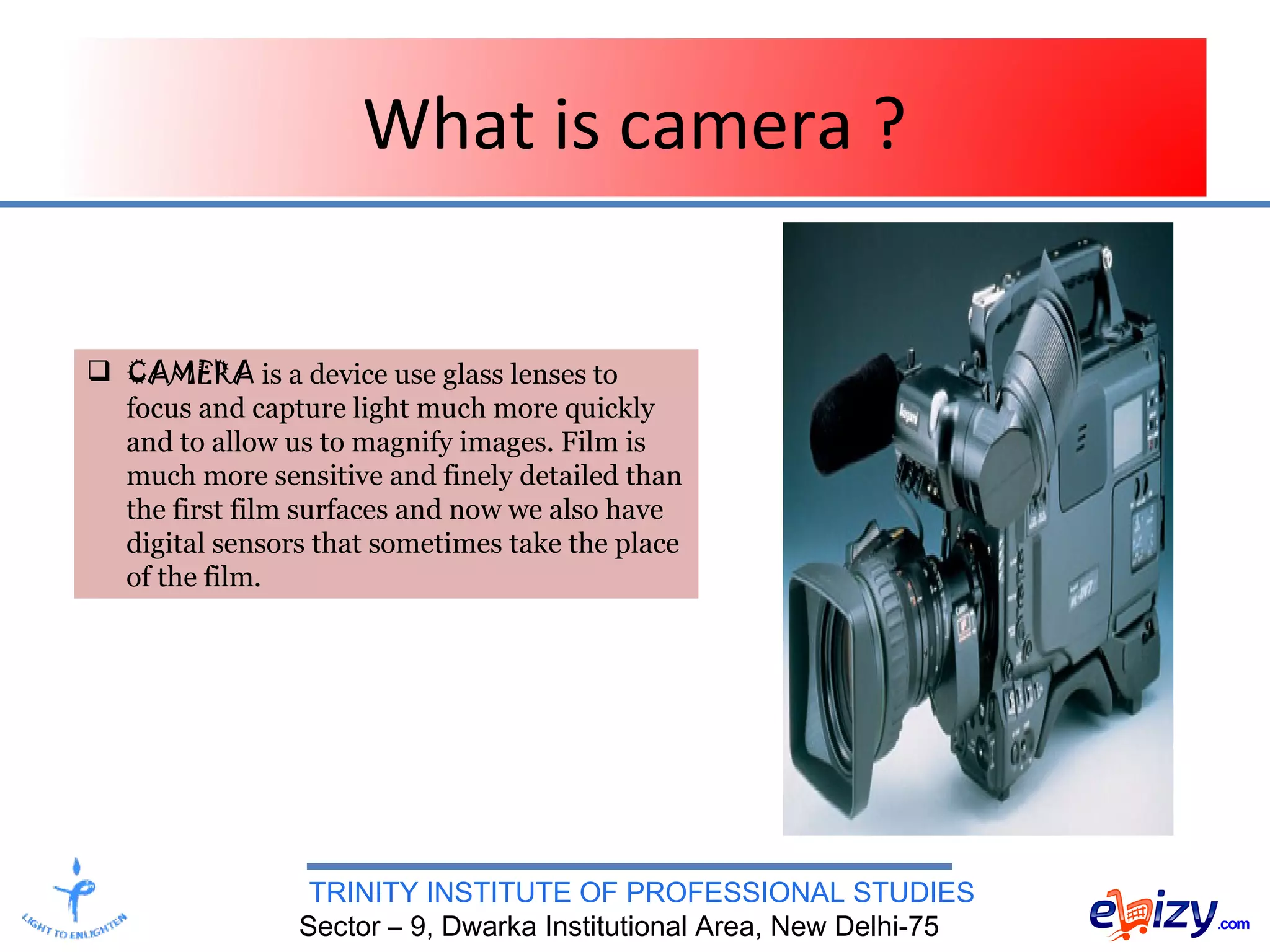
 CAMERA is a device use glass lenses to
focus and capture light much more quickly
and to allow us to magnify images. Film is
much more sensitive and finely detailed than
the first film surfaces and now we also have
digital sensors that sometimes take the place
of the film.
TRINITY INSTITUTE OF PROFESSIONAL STUDIES
Sector – 9, Dwarka Institutional Area, New Delhi-75
Camera Obscura (DARK ROOM)
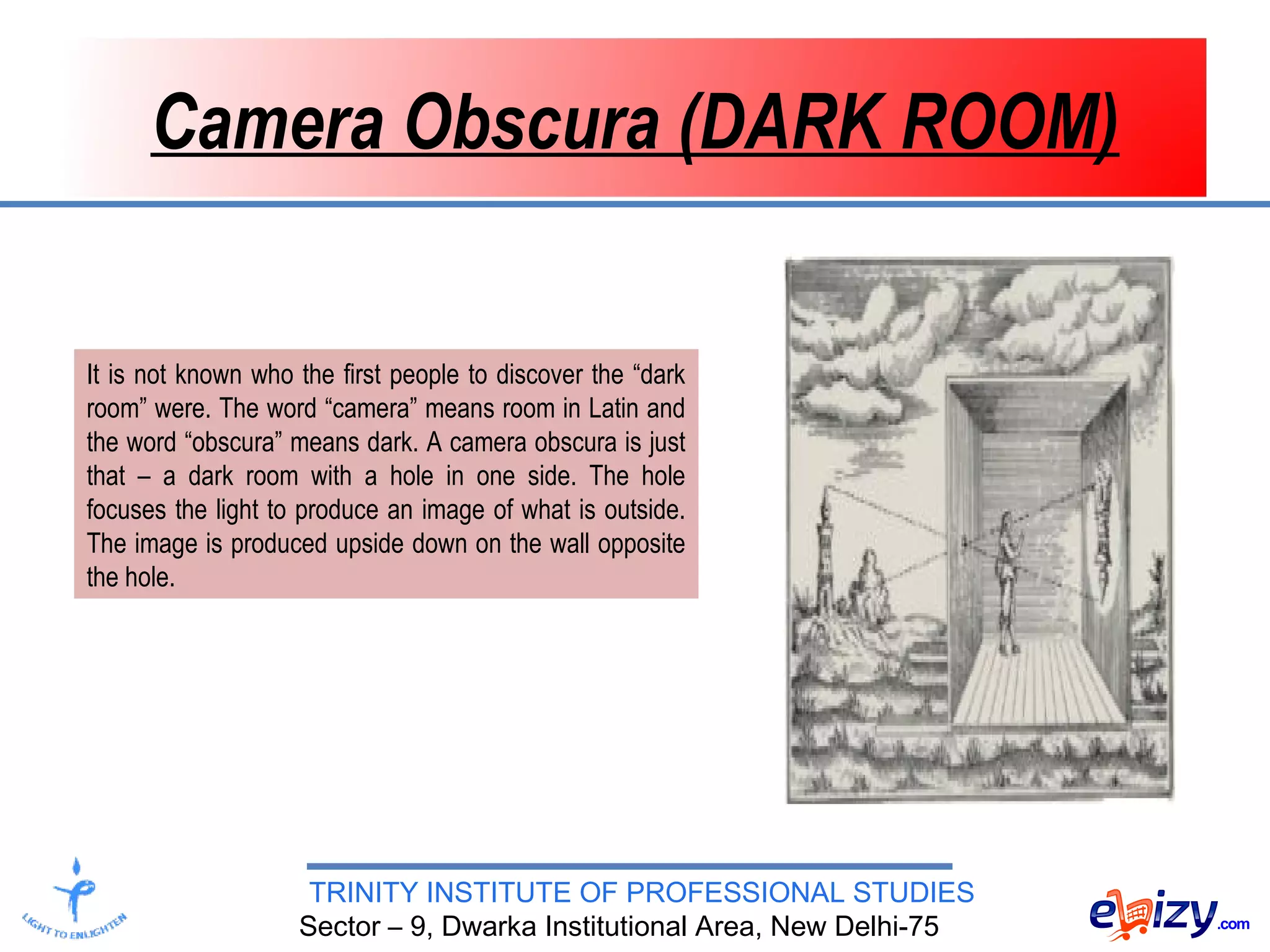
It is not known who the first people to discover the “dark
room” were. The word “camera” means room in Latin and
the word “obscura” means dark. A camera obscura is just
that – a dark room with a hole in one side. The hole
focuses the light to produce an image of what is outside.
The image is produced upside down on the wall opposite
the hole.
TRINITY INSTITUTE OF PROFESSIONAL STUDIES
Sector – 9, Dwarka Institutional Area, New Delhi-75
PATH OF LIGHT
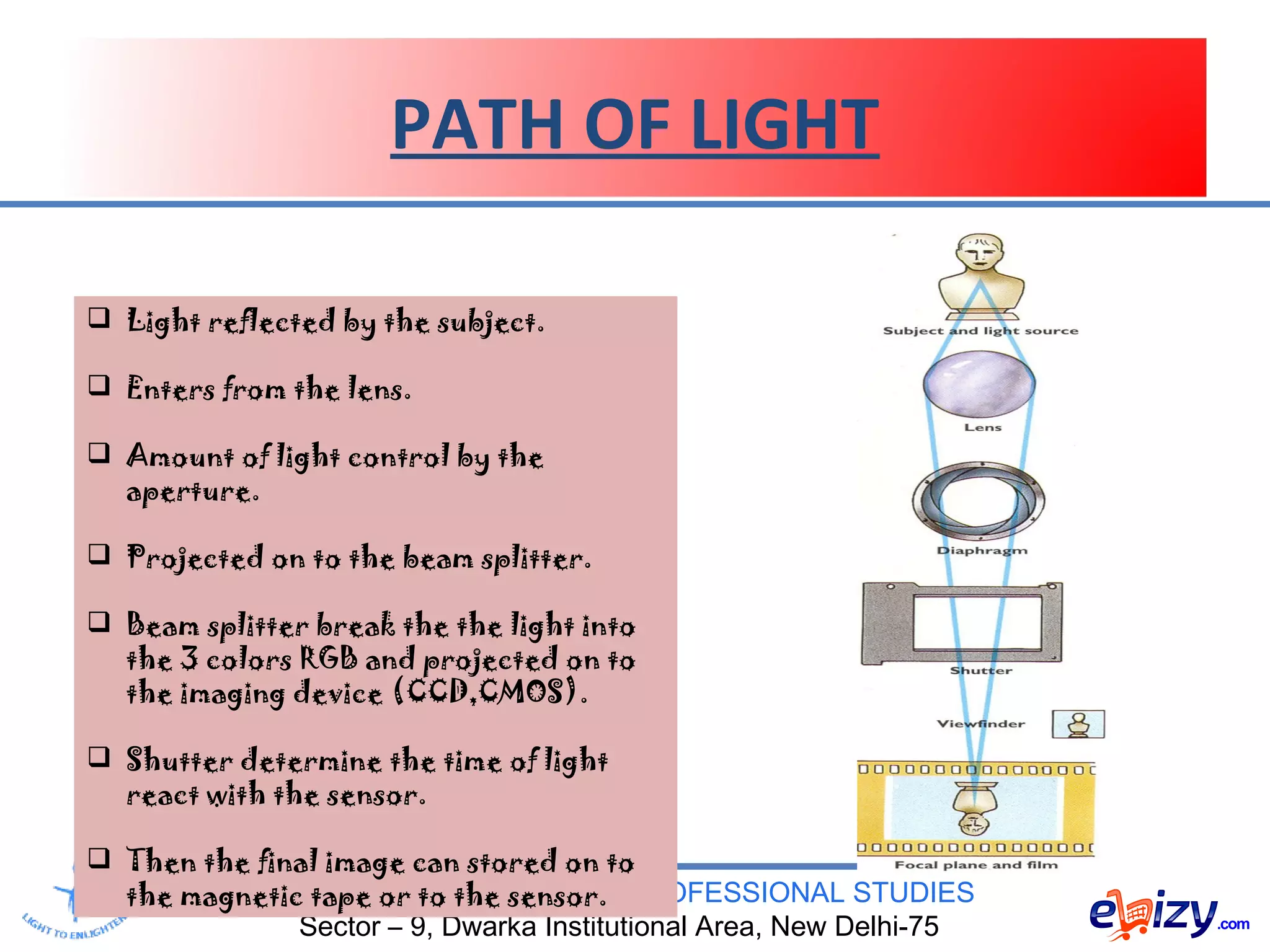
 Light reflected by the subject.
 Enters from the lens.
 Amount of light control by the
aperture.
 Projected on to the beam splitter.
 Beam splitter break the the light into
the 3 colors RGB and projected on to
the imaging device (CCD,CMOS).
 Shutter determine the time of light
react with the sensor.
 Then the final image can stored on to
the magnetic tape or to the sensor.
TRINITY INSTITUTE OF PROFESSIONAL STUDIES
Sector – 9, Dwarka Institutional Area, New Delhi-75
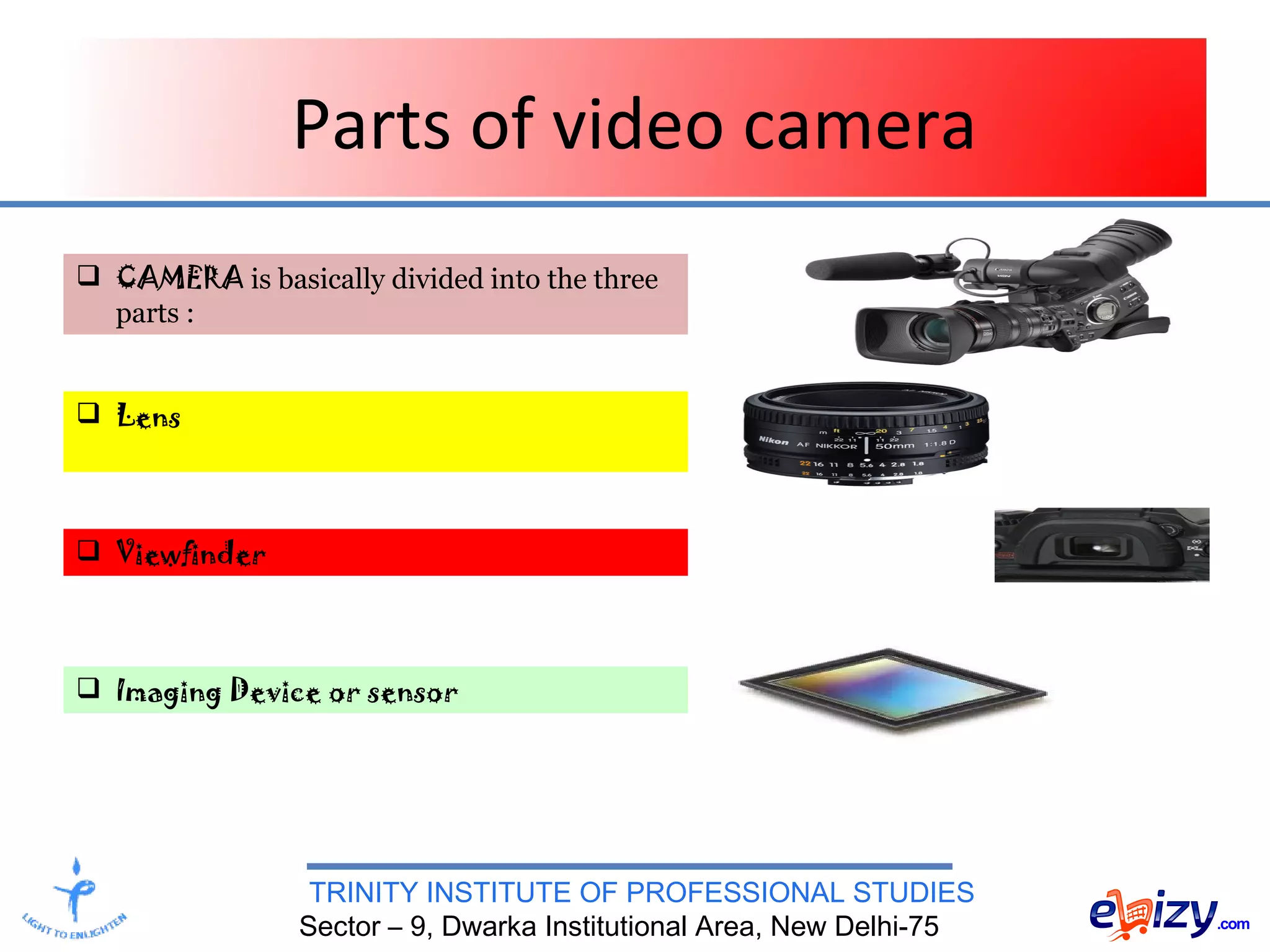
Parts of video camera
 CAMERA is basically divided into the three
parts :
 Lens
 Viewfinder
 Imaging Device or sensor
TRINITY INSTITUTE OF PROFESSIONAL STUDIES
Sector – 9, Dwarka Institutional Area, New Delhi-75
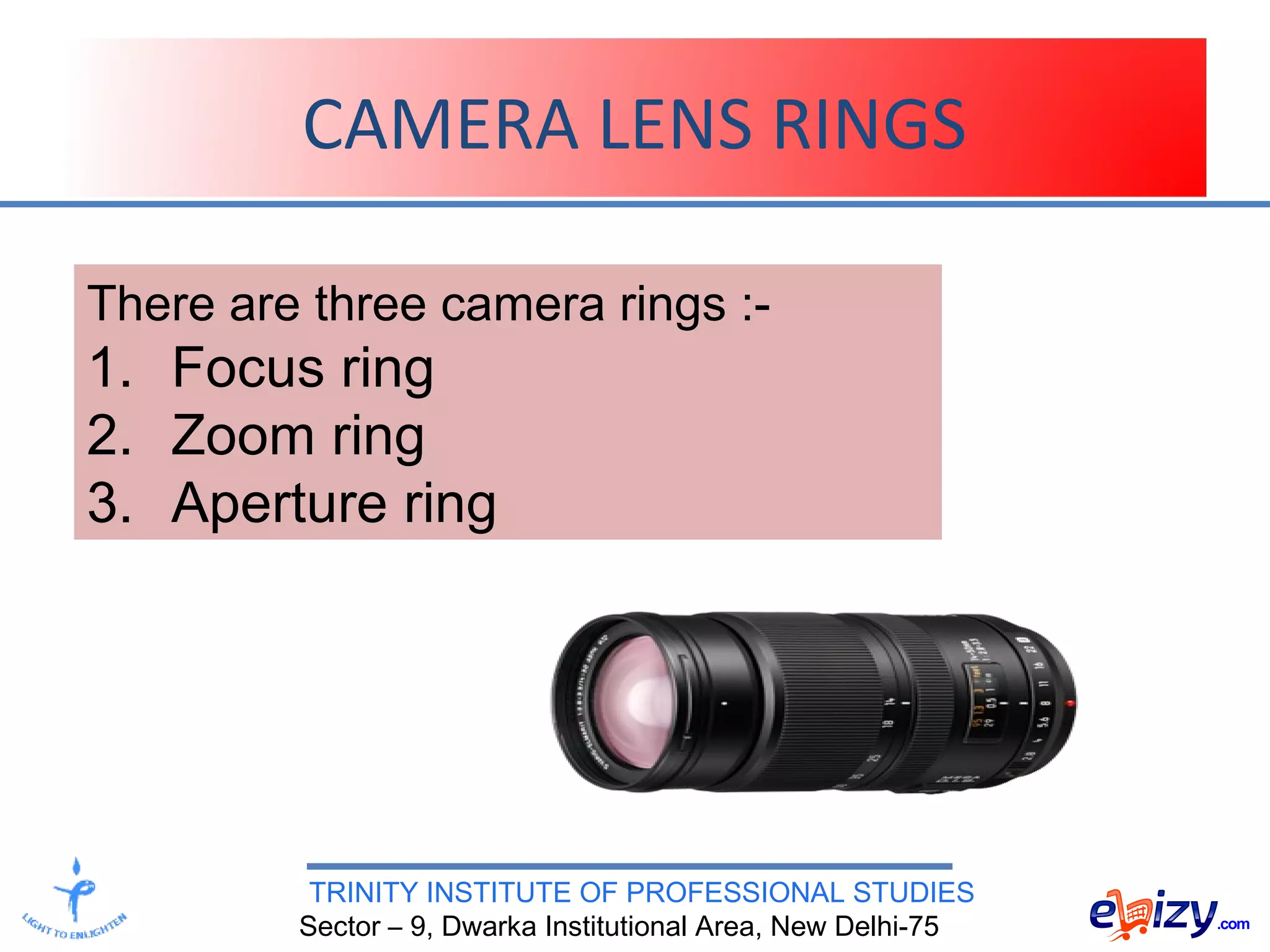
CAMERA LENS RINGS
There are three camera rings :-
1. Focus ring
2. Zoom ring
3. Aperture ring
TRINITY INSTITUTE OF PROFESSIONAL STUDIES
Sector – 9, Dwarka Institutional Area, New Delhi-75
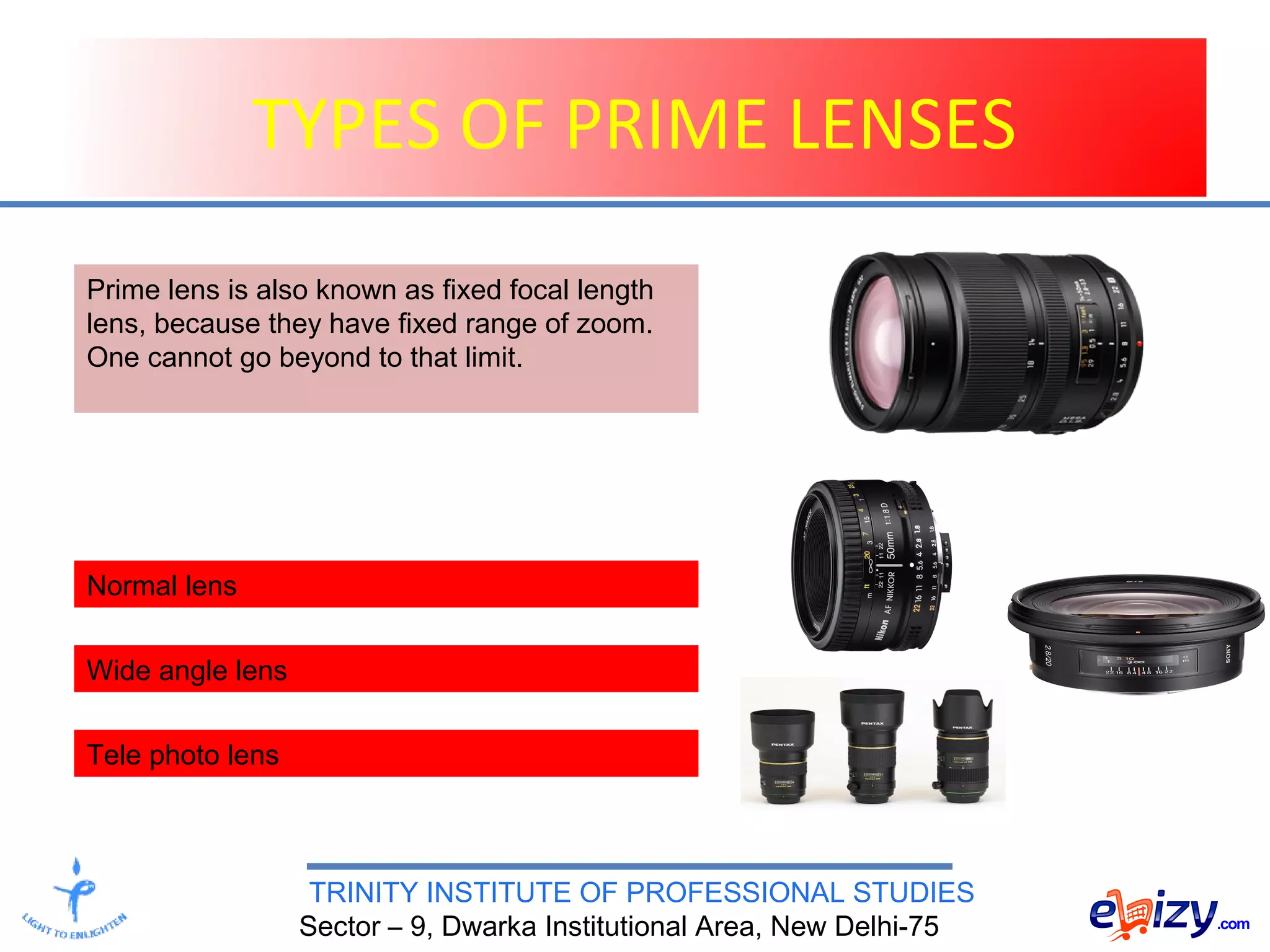
TYPES OF PRIME LENSES
Normal lens
Prime lens is also known as fixed focal length
lens, because they have fixed range of zoom.
One cannot go beyond to that limit.
Wide angle lens
Tele photo lens
TRINITY INSTITUTE OF PROFESSIONAL STUDIES
Sector – 9, Dwarka Institutional Area, New Delhi-75
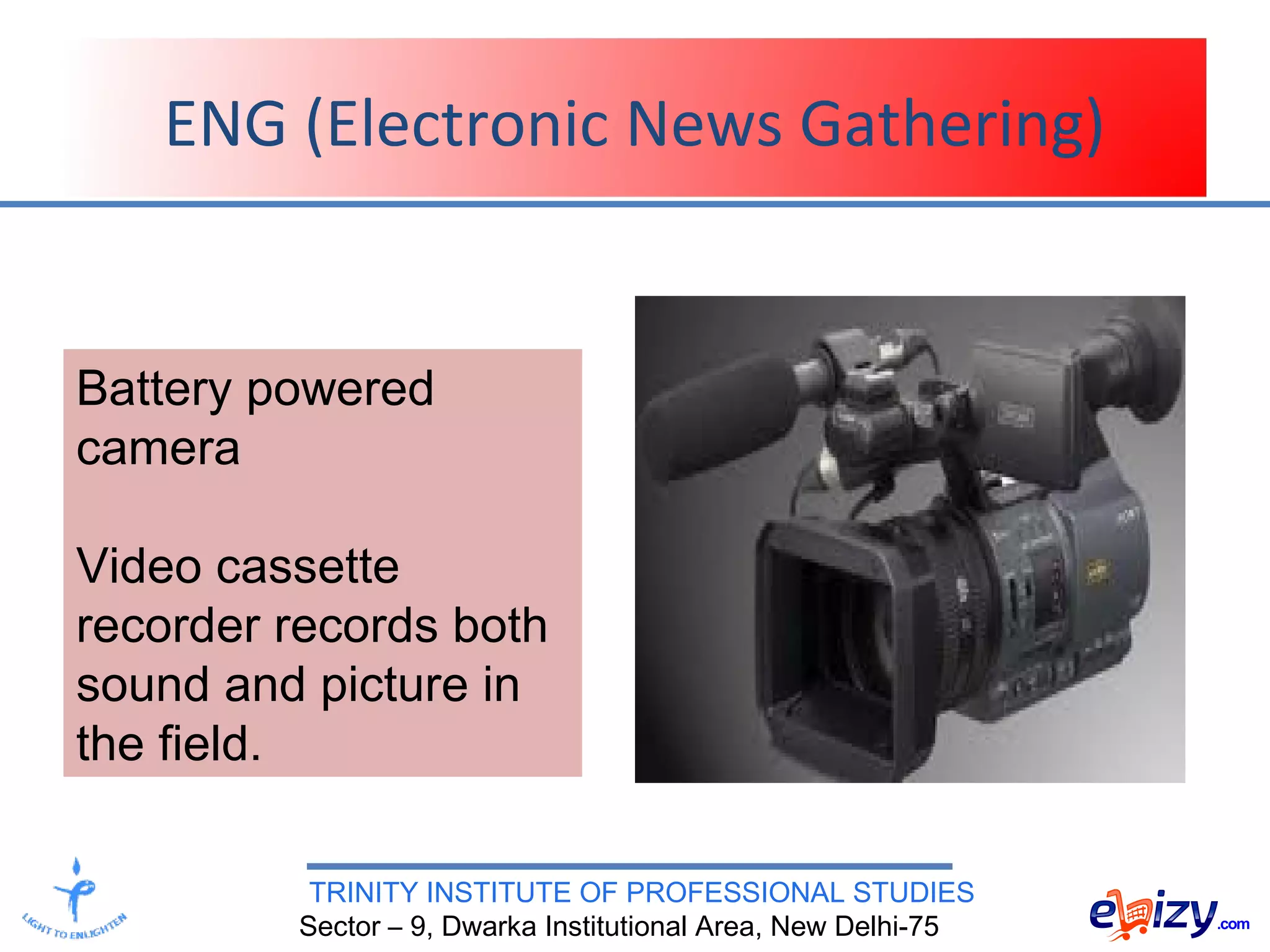
ENG (Electronic News Gathering)
Battery powered
camera
Video cassette
recorder records both
sound and picture in
the field.
TRINITY INSTITUTE OF PROFESSIONAL STUDIES
Sector – 9, Dwarka Institutional Area, New Delhi-75
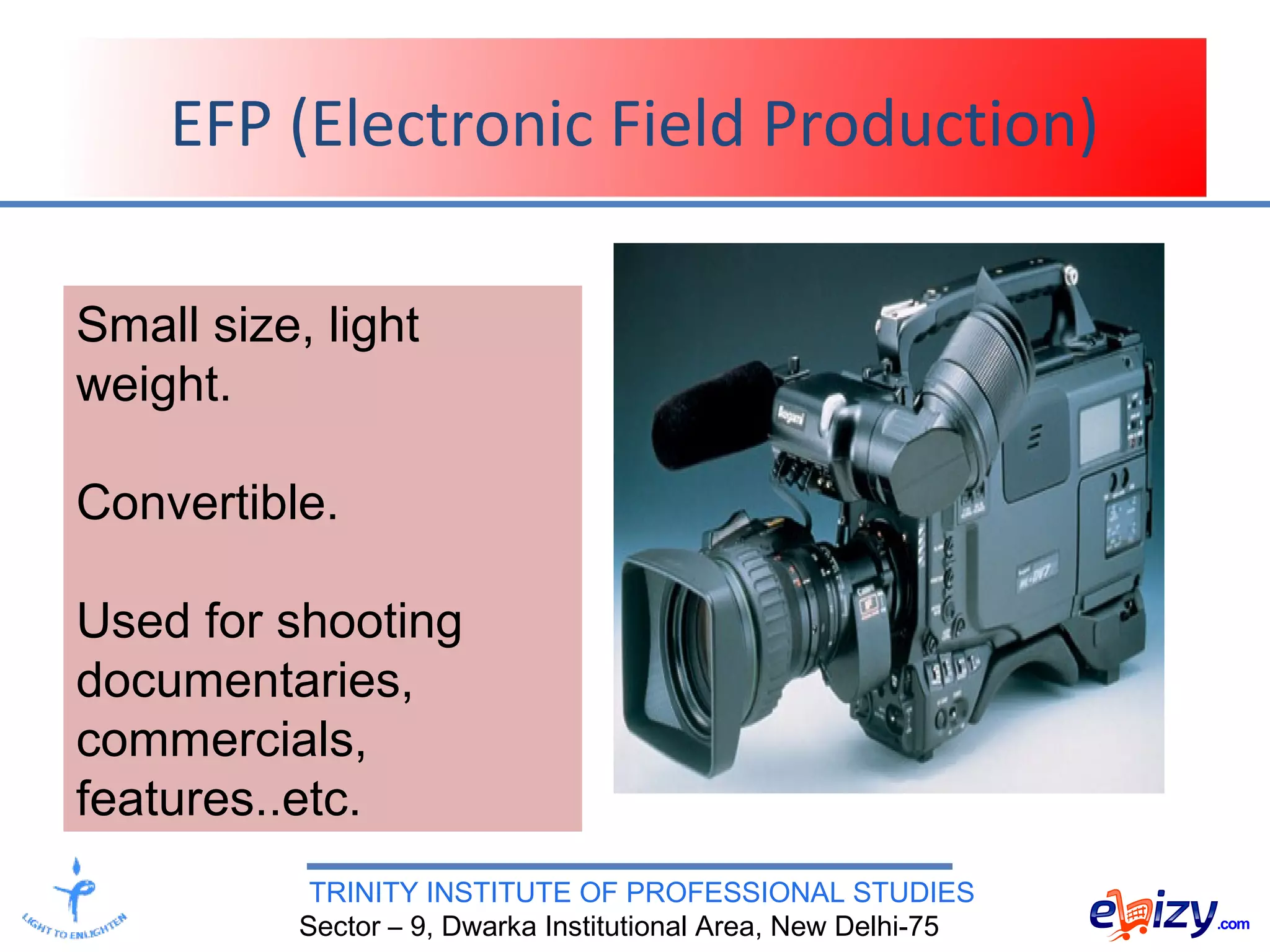
EFP (Electronic Field Production)
Small size, light
weight.
Convertible.
Used for shooting
documentaries,
commercials,
features..etc.
TRINITY INSTITUTE OF PROFESSIONAL STUDIES
Sector – 9, Dwarka Institutional Area, New Delhi-75
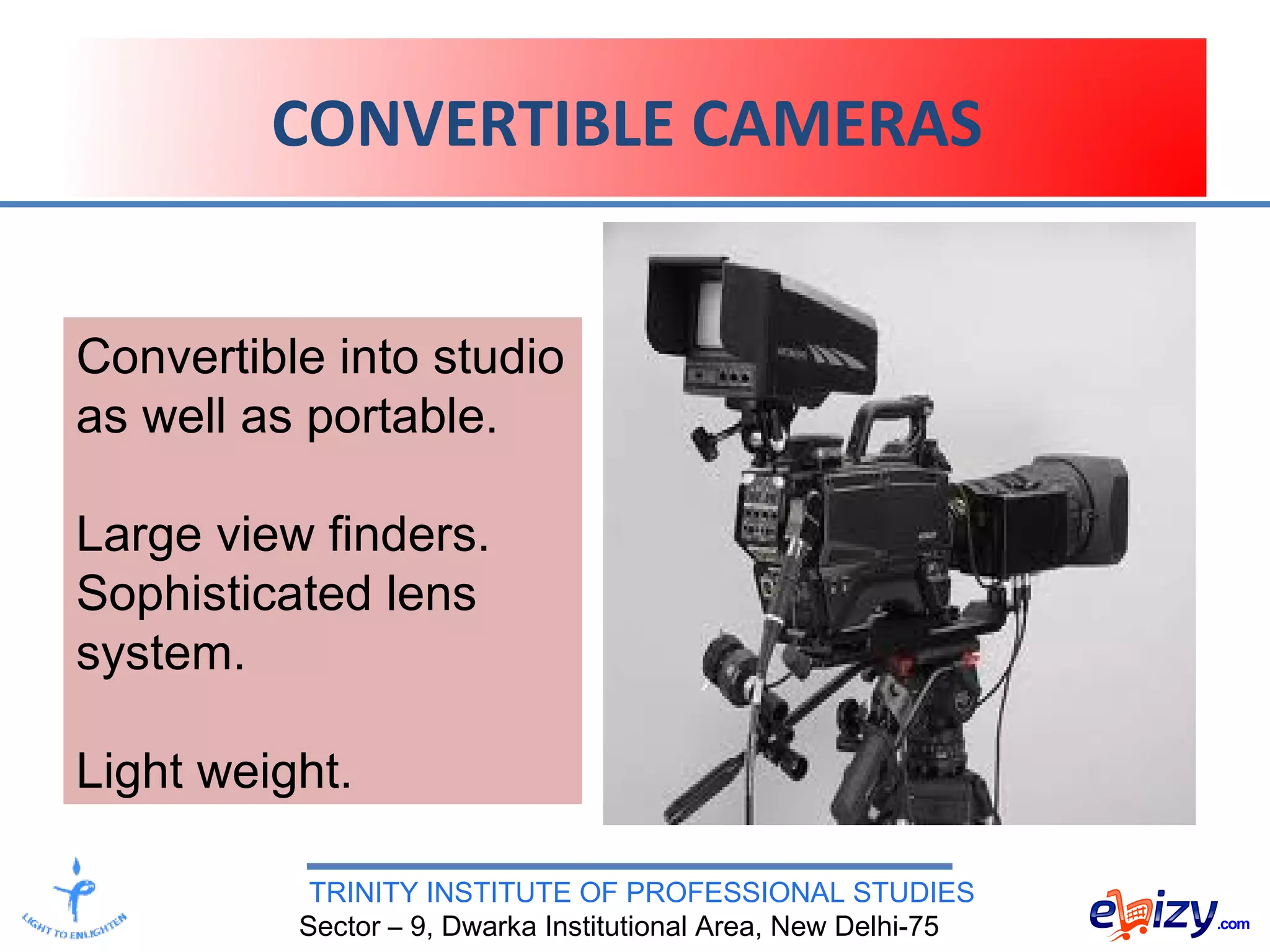
CONVERTIBLE CAMERAS
Convertible into studio
as well as portable.
Large view finders.
Sophisticated lens
system.
Light weight.
TRINITY INSTITUTE OF PROFESSIONAL STUDIES
Sector – 9, Dwarka Institutional Area, New Delhi-75
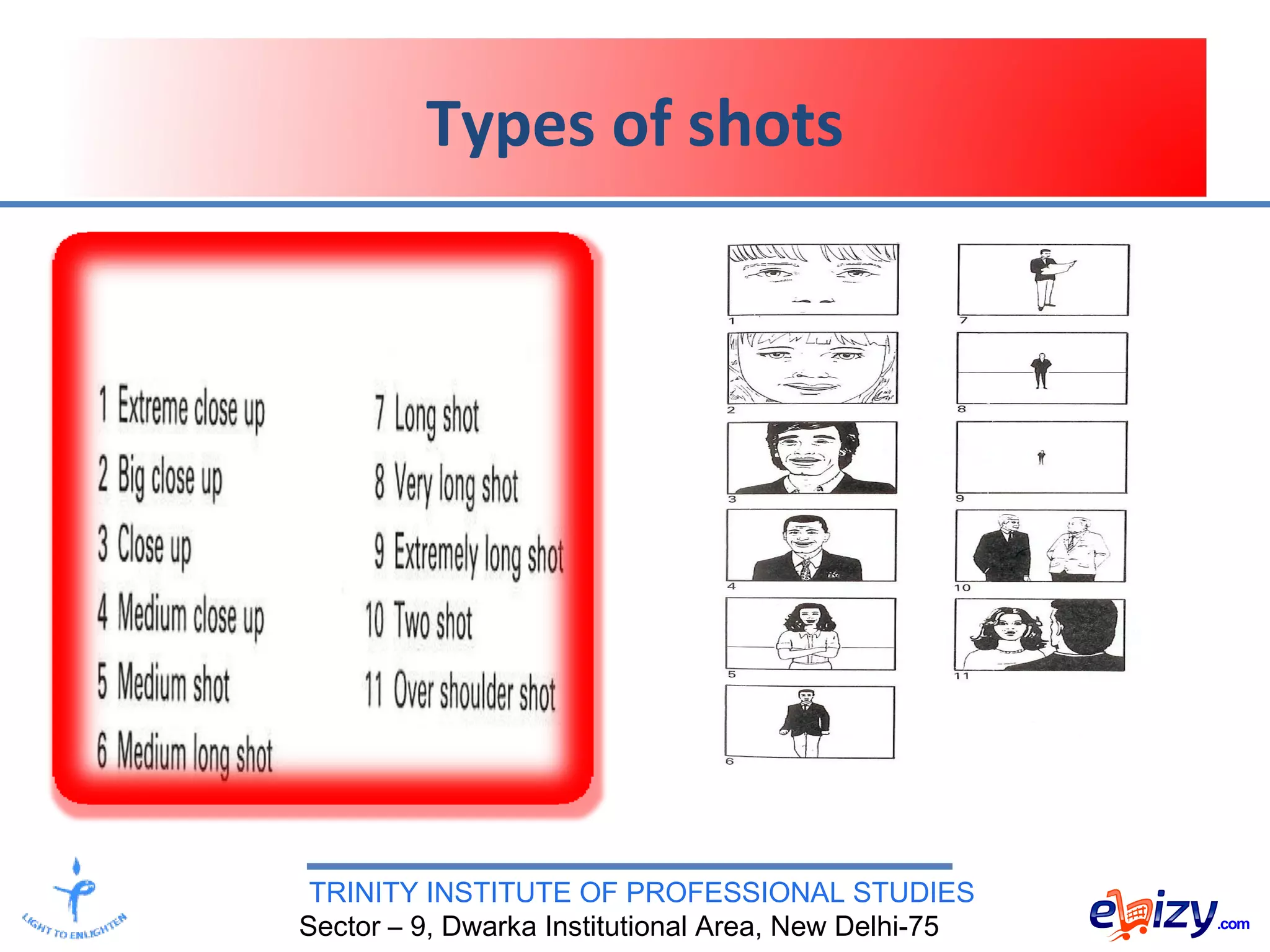
Types of shots
TRINITY INSTITUTE OF PROFESSIONAL STUDIES
Sector – 9, Dwarka Institutional Area, New Delhi-75
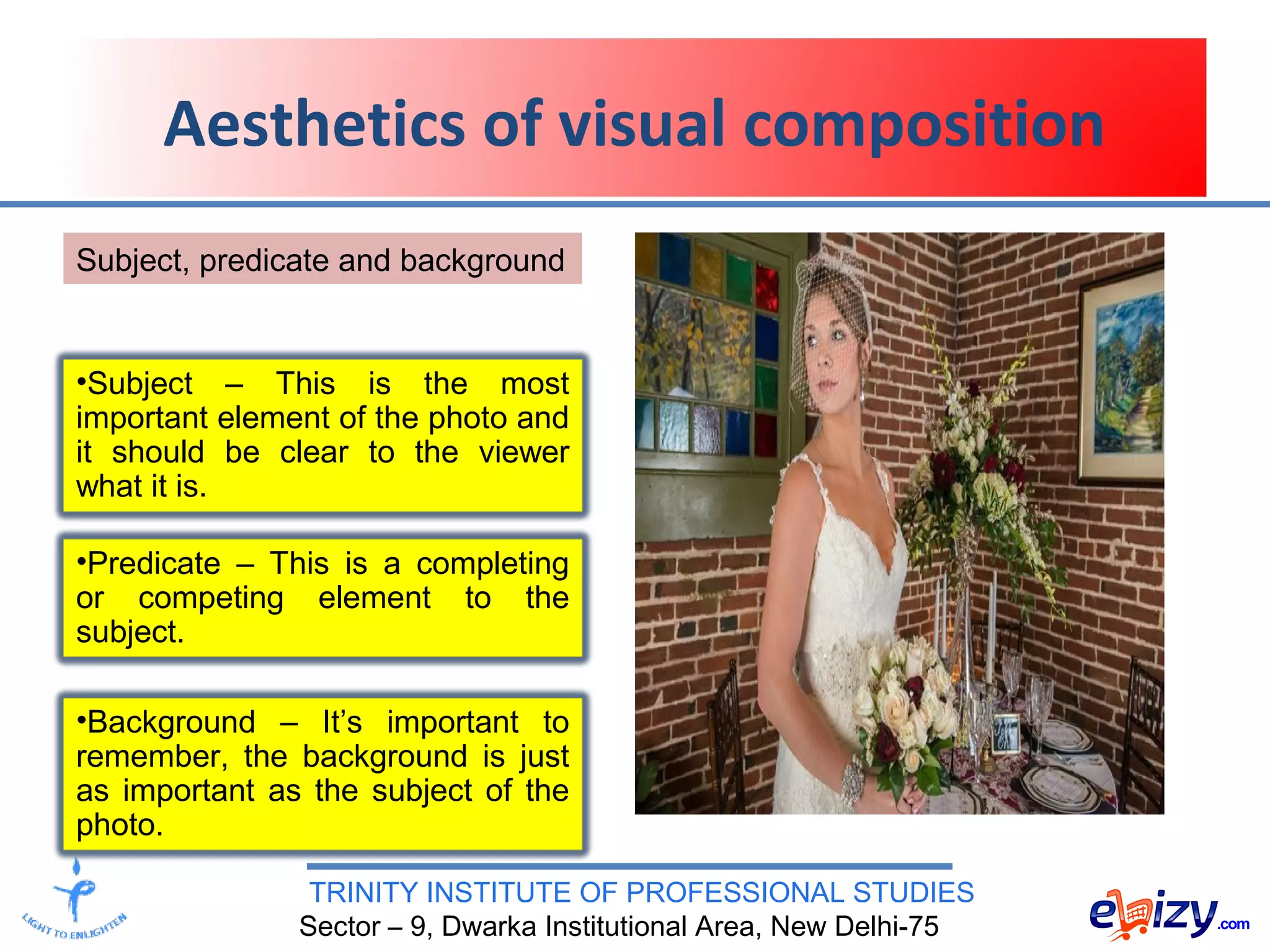
Aesthetics of visual composition
•Subject – This is the most
important element of the photo and
it should be clear to the viewer
what it is.
Subject, predicate and background
•Predicate – This is a completing
or competing element to the
subject.
•Background – It’s important to
remember, the background is just
as important as the subject of the
photo.
TRINITY INSTITUTE OF PROFESSIONAL STUDIES
Sector – 9, Dwarka Institutional Area, New Delhi-75
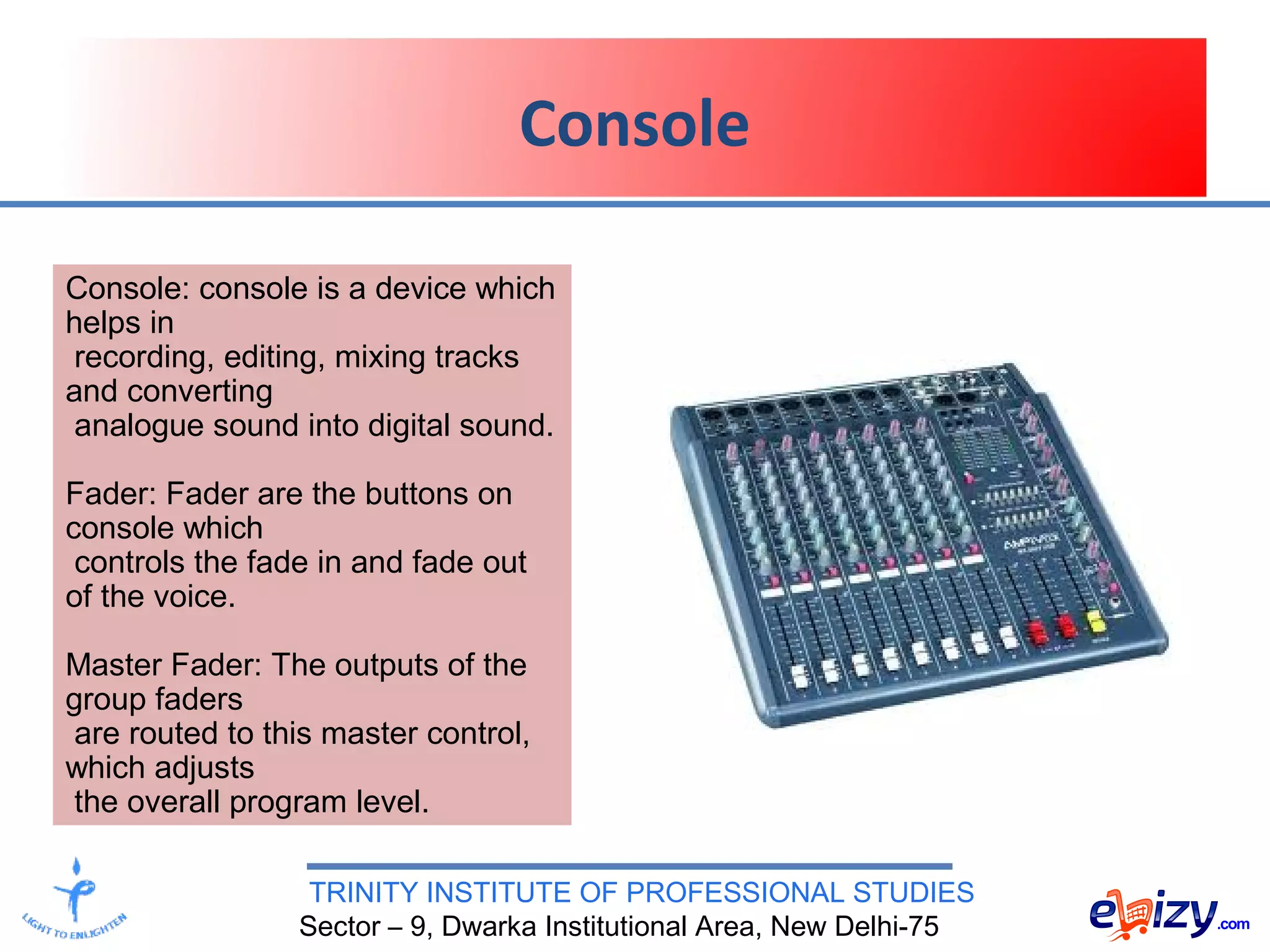
Console
Console: console is a device which
helps in
recording, editing, mixing tracks
and converting
analogue sound into digital sound.
Fader: Fader are the buttons on
console which
controls the fade in and fade out
of the voice.
Master Fader: The outputs of the
group faders
are routed to this master control,
which adjusts
the overall program level.
TRINITY INSTITUTE OF PROFESSIONAL STUDIES
Sector – 9, Dwarka Institutional Area, New Delhi-75
BOOKS REFERED
 BOOKS
The Five C's of Cinematography by Joseph V. Mascelli -
TRINITY INSTITUTE OF PROFESSIONAL STUDIES
Sector – 9, Dwarka Institutional Area, New Delhi-75
THANK YOU

Basics of camera light and sound

  • 1.
    TRINITY INSTITUTE OFPROFESSIONAL STUDIESSector – 9, Dwarka Institutional Area, New Delhi-75 Affiliated to Institution of G.G.S.IP.U, Delhi BCLS Basics of Camera Light And Sound Paper code : 24207 Credit : 4 Mr. NAVEEN GOLA Assistant Professor (Department of journalism and Mass Communication)
  • 2.
    TRINITY INSTITUTE OFPROFESSIONAL STUDIES Sector – 9, Dwarka Institutional Area, New Delhi-75 What is camera ?  CAMERA is a device use glass lenses to focus and capture light much more quickly and to allow us to magnify images. Film is much more sensitive and finely detailed than the first film surfaces and now we also have digital sensors that sometimes take the place of the film.
  • 3.
    TRINITY INSTITUTE OFPROFESSIONAL STUDIES Sector – 9, Dwarka Institutional Area, New Delhi-75 Camera Obscura (DARK ROOM) It is not known who the first people to discover the “dark room” were. The word “camera” means room in Latin and the word “obscura” means dark. A camera obscura is just that – a dark room with a hole in one side. The hole focuses the light to produce an image of what is outside. The image is produced upside down on the wall opposite the hole.
  • 4.
    TRINITY INSTITUTE OFPROFESSIONAL STUDIES Sector – 9, Dwarka Institutional Area, New Delhi-75 PATH OF LIGHT  Light reflected by the subject.  Enters from the lens.  Amount of light control by the aperture.  Projected on to the beam splitter.  Beam splitter break the the light into the 3 colors RGB and projected on to the imaging device (CCD,CMOS).  Shutter determine the time of light react with the sensor.  Then the final image can stored on to the magnetic tape or to the sensor.
  • 5.
    TRINITY INSTITUTE OFPROFESSIONAL STUDIES Sector – 9, Dwarka Institutional Area, New Delhi-75 Parts of video camera  CAMERA is basically divided into the three parts :  Lens  Viewfinder  Imaging Device or sensor
  • 6.
    TRINITY INSTITUTE OFPROFESSIONAL STUDIES Sector – 9, Dwarka Institutional Area, New Delhi-75 CAMERA LENS RINGS There are three camera rings :- 1. Focus ring 2. Zoom ring 3. Aperture ring
  • 7.
    TRINITY INSTITUTE OFPROFESSIONAL STUDIES Sector – 9, Dwarka Institutional Area, New Delhi-75 TYPES OF PRIME LENSES Normal lens Prime lens is also known as fixed focal length lens, because they have fixed range of zoom. One cannot go beyond to that limit. Wide angle lens Tele photo lens
  • 8.
    TRINITY INSTITUTE OFPROFESSIONAL STUDIES Sector – 9, Dwarka Institutional Area, New Delhi-75 ENG (Electronic News Gathering) Battery powered camera Video cassette recorder records both sound and picture in the field.
  • 9.
    TRINITY INSTITUTE OFPROFESSIONAL STUDIES Sector – 9, Dwarka Institutional Area, New Delhi-75 EFP (Electronic Field Production) Small size, light weight. Convertible. Used for shooting documentaries, commercials, features..etc.
  • 10.
    TRINITY INSTITUTE OFPROFESSIONAL STUDIES Sector – 9, Dwarka Institutional Area, New Delhi-75 CONVERTIBLE CAMERAS Convertible into studio as well as portable. Large view finders. Sophisticated lens system. Light weight.
  • 11.
    TRINITY INSTITUTE OFPROFESSIONAL STUDIES Sector – 9, Dwarka Institutional Area, New Delhi-75 Types of shots
  • 12.
    TRINITY INSTITUTE OFPROFESSIONAL STUDIES Sector – 9, Dwarka Institutional Area, New Delhi-75 Aesthetics of visual composition •Subject – This is the most important element of the photo and it should be clear to the viewer what it is. Subject, predicate and background •Predicate – This is a completing or competing element to the subject. •Background – It’s important to remember, the background is just as important as the subject of the photo.
  • 13.
    TRINITY INSTITUTE OFPROFESSIONAL STUDIES Sector – 9, Dwarka Institutional Area, New Delhi-75 Console Console: console is a device which helps in recording, editing, mixing tracks and converting analogue sound into digital sound. Fader: Fader are the buttons on console which controls the fade in and fade out of the voice. Master Fader: The outputs of the group faders are routed to this master control, which adjusts the overall program level.
  • 14.
    TRINITY INSTITUTE OFPROFESSIONAL STUDIES Sector – 9, Dwarka Institutional Area, New Delhi-75 BOOKS REFERED  BOOKS The Five C's of Cinematography by Joseph V. Mascelli -
  • 15.
    TRINITY INSTITUTE OFPROFESSIONAL STUDIES Sector – 9, Dwarka Institutional Area, New Delhi-75 THANK YOU