Operating Systems
ALIF MUHAMMED A
SN COLLEGE
PUNALUR
CANDIDATE : 63009405
Main Contents:-
Meaning of operating system
Basic function of an operating system
Operating system as an extended machine
Different types operating system
Generation of operating system
What is an operating System?
 Operating System is a software, which makes a
computer to actually work.
 It is the software the enables all the programs we use.
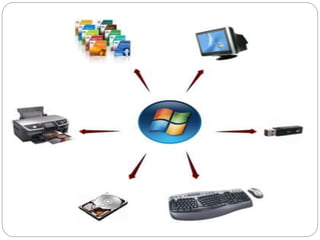
 The OS organizes and controls the hardware.
 OS acts as an interface between the application
programs and the machine hardware.
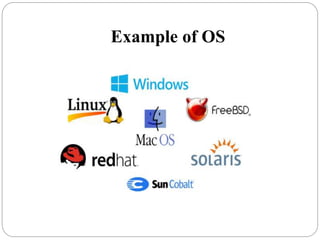
 Examples: Windows, Linux, Unix and Mac OS, etc.,
What OS does?
An operating system performs basic tasks such
as,
 controlling and allocating memory,
 prioritizing system requests,
 controlling input and output devices,
 facilitating networking and
 managing file systems.
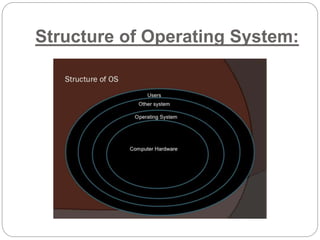
Structure of Operating System:
The structure of OS consists of 4 layers:
1. Hardware
Hardware consists of CPU, Main memory, I/O Devices,
etc,
2. Software (Operating System)
Software includes process management routines, memory
management routines, I/O control routines, file
management routines.
3. 3. System programs
This layer consists of compilers, Assemblers, linker etc.
4. Application programs
This is dependent on users need. Ex. Railway reservation
system, Bank database management etc.,
History of Operating Systems
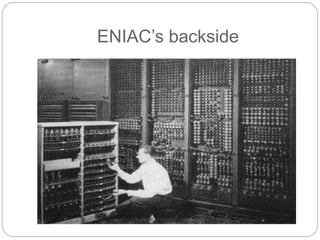
 ENIAC (Electronic Numerical Integrator
and Computer), at the U.S. Army's
Aberdeen Proving Ground in Maryland.
built in the 1940s,
weighed 30 tons,
was eight feet high, three feet deep,
and 100 feet long
contained over 18,000 vacuum tubes
that were cooled by 80 air blowers.
ENIAC’s backside
User View – The OS as an Extended
Machine
 Operating systems turn ugly hardware into
beautiful abstractions.
 An OS provides an abstraction layer over
the concrete hardware,
 use the computer hardware in an efficient
manner (converting hardware into useful
form),
 “hide” the complexity of the underlying
hardware.
 Most computer users sit in front of a PC, consisting of
a monitor, keyboard, mouse, and system unit. Such a
system is designed for one user to monopolize its
resources.
 The goal is to maximize the work (or play) that the
user is performing. In this case, the OS is designed
mostly for ease of use.
 Performance is, of course, important to the user; but
rather than resource utilization, such systems are
optimized for the single-user experience.
.
 The OS in such cases is designed to maximize
resource utilization to assure that all available CPU
time, memory, and I/O are used efficiently and that
no individual user takes more than her fair share.
 In still other cases, users sit at workstations
connected to networks of other workstations and
servers. These users have dedicated resources at
their disposal, but they also share resources such as
networking and servers-file, compute, and print
servers.
 In other cases, a user sits at a terminal connected to
a mainframe or minicomputer. Other users are
accessing the same computer through other
terminals. These users share resources and may
exchange information
Types of OS
Operating System can also be classified as,-
 Single User Systems
 Multi User Systems
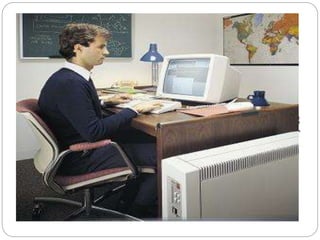
Single User Systems:
 Provides a platform for only one user at a time.
 They are popularly associated with Desk Top operating
system which run on standalone systems where no user
accounts are required.
 Example: DOS
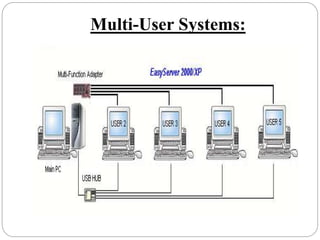
Multi-User Systems:
 Provides regulated access for a number of users by
maintaining a database of known users.
 Refers to computer systems that support two or more
simultaneous users.
 Another term for multi-user is time sharing.
 Ex: All mainframes and are multi-user systems.
 Example: Unix
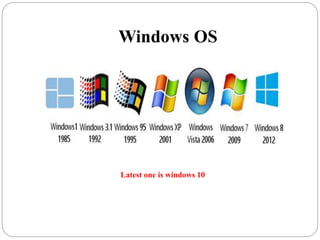
Example of OS
Windows OS
Latest one is windows 10
Operating system alif

Operating system alif

  • 2.
    Operating Systems ALIF MUHAMMEDA SN COLLEGE PUNALUR CANDIDATE : 63009405
  • 3.
    Main Contents:- Meaning ofoperating system Basic function of an operating system Operating system as an extended machine Different types operating system Generation of operating system
  • 4.
    What is anoperating System?  Operating System is a software, which makes a computer to actually work.  It is the software the enables all the programs we use.  The OS organizes and controls the hardware.  OS acts as an interface between the application programs and the machine hardware.  Examples: Windows, Linux, Unix and Mac OS, etc.,
  • 5.
    What OS does? Anoperating system performs basic tasks such as,  controlling and allocating memory,  prioritizing system requests,  controlling input and output devices,  facilitating networking and  managing file systems.
  • 6.
  • 7.
    The structure ofOS consists of 4 layers: 1. Hardware Hardware consists of CPU, Main memory, I/O Devices, etc, 2. Software (Operating System) Software includes process management routines, memory management routines, I/O control routines, file management routines. 3. 3. System programs This layer consists of compilers, Assemblers, linker etc. 4. Application programs This is dependent on users need. Ex. Railway reservation system, Bank database management etc.,
  • 8.
    History of OperatingSystems  ENIAC (Electronic Numerical Integrator and Computer), at the U.S. Army's Aberdeen Proving Ground in Maryland. built in the 1940s, weighed 30 tons, was eight feet high, three feet deep, and 100 feet long contained over 18,000 vacuum tubes that were cooled by 80 air blowers.
  • 9.
  • 10.
    User View –The OS as an Extended Machine  Operating systems turn ugly hardware into beautiful abstractions.  An OS provides an abstraction layer over the concrete hardware,  use the computer hardware in an efficient manner (converting hardware into useful form),  “hide” the complexity of the underlying hardware.
  • 11.
     Most computerusers sit in front of a PC, consisting of a monitor, keyboard, mouse, and system unit. Such a system is designed for one user to monopolize its resources.  The goal is to maximize the work (or play) that the user is performing. In this case, the OS is designed mostly for ease of use.  Performance is, of course, important to the user; but rather than resource utilization, such systems are optimized for the single-user experience. .
  • 12.
     The OSin such cases is designed to maximize resource utilization to assure that all available CPU time, memory, and I/O are used efficiently and that no individual user takes more than her fair share.  In still other cases, users sit at workstations connected to networks of other workstations and servers. These users have dedicated resources at their disposal, but they also share resources such as networking and servers-file, compute, and print servers.  In other cases, a user sits at a terminal connected to a mainframe or minicomputer. Other users are accessing the same computer through other terminals. These users share resources and may exchange information
  • 13.
    Types of OS OperatingSystem can also be classified as,-  Single User Systems  Multi User Systems
  • 14.
    Single User Systems: Provides a platform for only one user at a time.  They are popularly associated with Desk Top operating system which run on standalone systems where no user accounts are required.  Example: DOS
  • 15.
    Multi-User Systems:  Providesregulated access for a number of users by maintaining a database of known users.  Refers to computer systems that support two or more simultaneous users.  Another term for multi-user is time sharing.  Ex: All mainframes and are multi-user systems.  Example: Unix
  • 16.
  • 17.
    Windows OS Latest oneis windows 10