Descriptive
Statistics
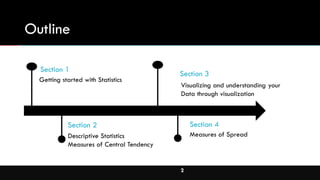
Outline
2
Section 1
Section 2 Section 4
Visualizing and understanding your
Data through visualization
Getting started with Statistics
Section 3
Descriptive Statistics
Measures of Central Tendency
Measures of Spread
3
What is Statistics ?
It’s a science deals with Collection, Classification, Analysis , and Interpretation of
numerical facts or data AND the use of probability theory to impose order on aggregates
of data
4
Branches of Statistics
Descriptive Statistics
Inferential Statistics
0 5
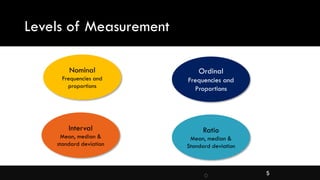
Levels of Measurement
Nominal
Frequencies and
proportions
Ordinal
Frequencies and
Proportions
Interval
Mean, median &
standard deviation
Ratio
Mean, median &
Standard deviation
0 6
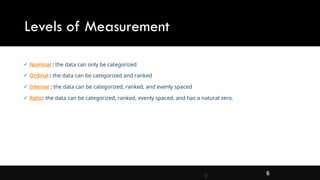
Levels of Measurement
✓ Nominal : the data can only be categorized
✓ Ordinal : the data can be categorized and ranked
✓ Interval : the data can be categorized, ranked, and evenly spaced
✓ Ratio: the data can be categorized, ranked, evenly spaced, and has a natural zero.
7
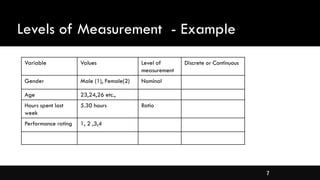
Levels of Measurement - Example
Variable Values Level of
measurement
Discrete or Continuous
Gender Male (1), Female(2) Nominal
Age 23,24,26 etc.,
Hours spent last
week
5.30 hours Ratio
Performance rating 1, 2 ,3,4
Descriptive Statistics
9
Descriptive Statistics
Summarizing or describing the fact known to you Organizes and make sense
of Data uses Numerical and Graphical Methods Identifies Patterns in Data
Simplifies the information focusing on the items/areas of interest Eliminates
undesired information to avoid information overload
10
Descriptive Statistics
Types of questions that can be answered using simple descriptive statistics:
1.What proportion of customers have responded to the offer in the dataset?
2.What is the average duration of calls? What is the median?
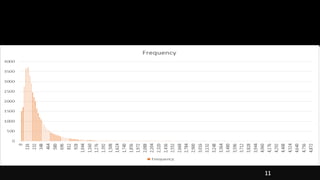
3.What is the frequency distribution of job types?
11
12
Measures of Central Tendency
Central tendency indicates where the centre of the distribution tends to be
13
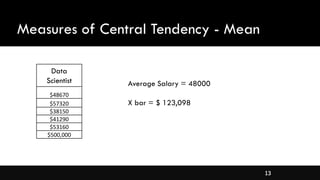
Measures of Central Tendency - Mean
Data
Scientist
$48670
$57320
$38150
$41290
$53160
$500,000
Average Salary = 48000
X bar = $ 123,098
14
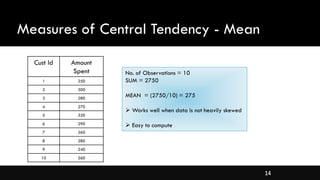
Measures of Central Tendency - Mean
Cust Id Amount
Spent
1 250
2 300
3 280
4 270
5 320
6 290
7 260
8 280
9 240
10 260
No. of Observations = 10
SUM = 2750
MEAN = (2750/10) = 275
➢ Works well when data is not heavily skewed
➢ Easy to compute
15
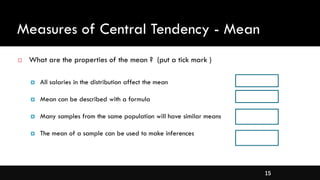
Measures of Central Tendency - Mean
 What are the properties of the mean ? (put a tick mark )
 All salaries in the distribution affect the mean
 Mean can be described with a formula
 Many samples from the same population will have similar means
 The mean of a sample can be used to make inferences
16
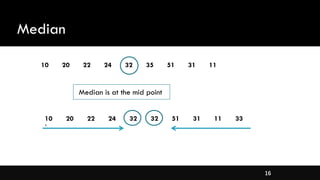
Median
10 20 22 24 32 35 51 31 11
Median is at the mid point
10
`
20 22 24 32 32 51 31 11 33
17
Mean Vs Median
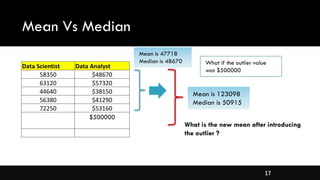
Data Scientist Data Analyst
58350 $48670
63120 $57320
44640 $38150
56380 $41290
72250 $53160
$500000
Mean is 47718
Median is 48670 What if the outlier value
was $500000
Mean is 123098
Median is 50915
What is the new mean after introducing
the outlier ?
18
Median
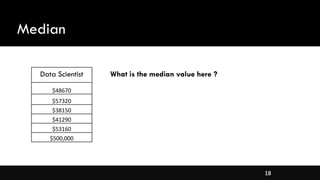
What is the median value here ?
Data Scientist
$48670
$57320
$38150
$41290
$53160
$500,000
19
Median
Data
Scientist
$48670
$57320
$38150
$41290
$53160
$500,000
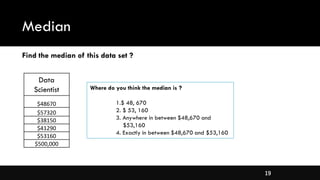
Where do you think the median is ?
1.$ 48, 670
2. $ 53, 160
3. Anywhere in between $48,670 and
$53,160
4. Exactly in between $48,670 and $53,160
Find the median of this data set ?
20
Mode
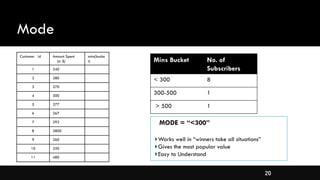
Customer id Amount Spent
(in $)
mins(bucke
t)
1 240
2 280
3 270
4 300
5 277
6 267
7 292
8 2800
9 260
10 250
11 480
Mins Bucket No. of
Subscribers
< 300 8
300-500 1
> 500 1
MODE = “<300”
Works well in “winners take all situations”
Gives the most popular value
Easy to Understand
21
Quiz - Mode
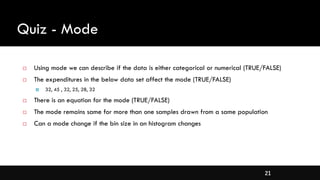
 Using mode we can describe if the data is either categorical or numerical (TRUE/FALSE)
 The expenditures in the below data set affect the mode (TRUE/FALSE)
 32, 45 , 32, 25, 28, 32
 There is an equation for the mode (TRUE/FALSE)
 The mode remains same for more than one samples drawn from a same population
 Can a mode change if the bin size in an histogram changes
22
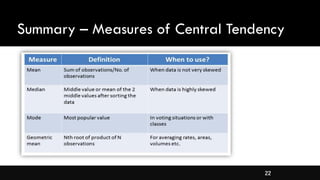
Summary – Measures of Central Tendency
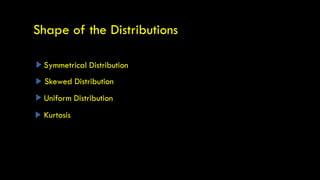
Symmetrical Distribution
Skewed Distribution
Uniform Distribution
Kurtosis
Shape of the Distributions
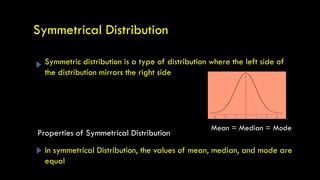
Symmetric distribution is a type of distribution where the left side of
the distribution mirrors the right side
Symmetrical Distribution
In symmetrical Distribution, the values of mean, median, and mode are
equal
Mean = Median = Mode
Properties of Symmetrical Distribution
26
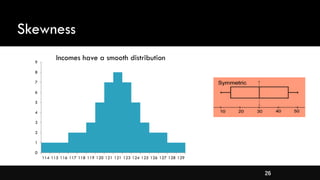
Skewness
0
1
2
3
4
5
6
7
8
9
114 115 116 117 118 119 120 121 121 123 124 125 126 127 128 129
Incomes have a smooth distribution
27
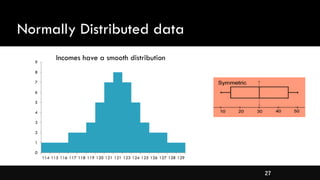
Normally Distributed data
0
1
2
3
4
5
6
7
8
9
114 115 116 117 118 119 120 121 121 123 124 125 126 127 128 129
Incomes have a smooth distribution
28
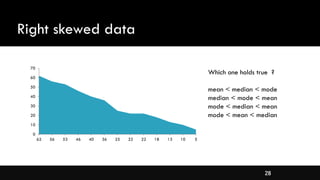
Right skewed data
0
10
20
30
40
50
60
70
62 56 53 46 40 36 25 22 22 18 13 10 5
Which one holds true ?
mean < median < mode
median < mode < mean
mode < median < mean
mode < mean < median
29
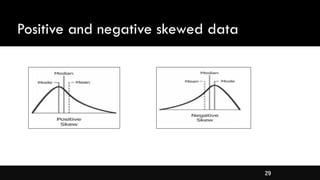
Positive and negative skewed data
30
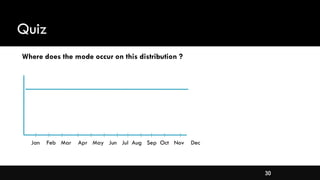
Quiz
Where does the mode occur on this distribution ?
Jan Feb Mar Apr May Jun Jul Aug Sep Oct Nov Dec
31
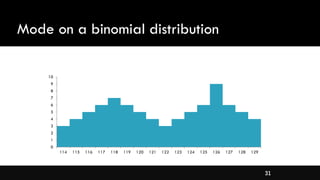
Mode on a binomial distribution
0
1
2
3
4
5
6
7
8
9
10
114 115 116 117 118 119 120 121 122 123 124 125 126 127 128 129
32
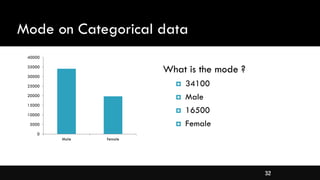
Mode on Categorical data
0
5000
10000
15000
20000
25000
30000
35000
40000
Male female
What is the mode ?
 34100
 Male
 16500
 Female
33
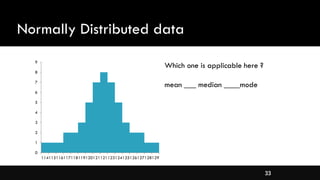
Normally Distributed data
0
1
2
3
4
5
6
7
8
9
114115116117118119120121121123124125126127128129
Which one is applicable here ?
mean ___ median ____mode
34
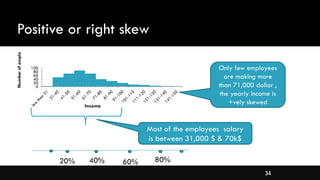
Positive or right skew
0
20
40
60
80
100
Income
Number
of
employees
Only few employees
are making more
than 71,000 dollar ,
the yearly income is
+vely skewed
Most of the employees salary
is between 31,000 $ & 70k$
When the skewness statistic is +ve, the data is
right-skewed.
20% 40% 60% 80%
35
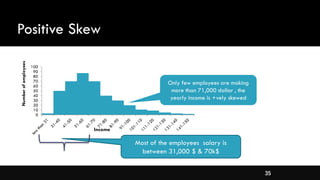
Positive Skew
0
10
20
30
40
50
60
70
80
90
100
Income
Number
of
employees
Only few employees are making
more than 71,000 dollar , the
yearly income is +vely skewed
Most of the employees salary is
between 31,000 $ & 70k$
36
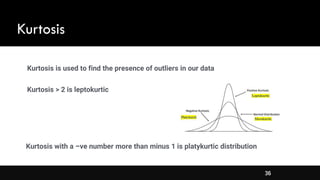
Kurtosis
Kurtosis > 2 is leptokurtic
Kurtosis with a –ve number more than minus 1 is platykurtic distribution
Kurtosis is used to find the presence of outliers in our data
37
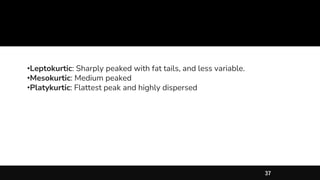
•Leptokurtic: Sharply peaked with fat tails, and less variable.
•Mesokurtic: Medium peaked
•Platykurtic: Flattest peak and highly dispersed
Measures of
Dispersion
39
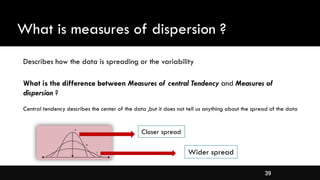
What is measures of dispersion ?
Describes how the data is spreading or the variability
What is the difference between Measures of central Tendency and Measures of
dispersion ?
Central tendency describes the center of the data ,but it does not tell us anything about the spread of the data
Wider spread
Closer spread
40
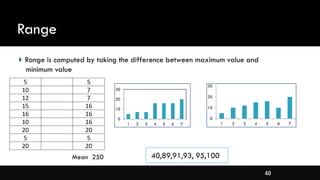
Range
Mean 250
5 5
10 7
12 7
15 16
16 16
10 16
20 20
5 5
20 20
0
10
20
30
1 2 3 4 5 6 7
0
10
20
30
1 2 3 4 5 6 7
40,89,91,93, 95,100
Range is computed by taking the difference between maximum value and
minimum value
41
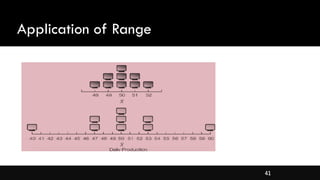
Application of Range
42
Standard Deviation
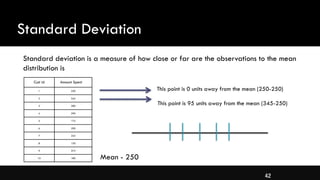
Standard deviation is a measure of how close or far are the observations to the mean
distribution is
Cust id Amount Spent
1 250
2 345
3 280
4 290
5 175
6 200
7 255
8 150
9 375
10 180
This point is 0 units away from the mean (250-250)
This point is 95 units away from the mean (345-250)
Mean - 250
43
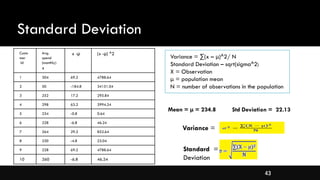
Standard Deviation
Custo
mer
Id
Avg.
spend
(monthly)
x
x -µ (x -µ) ^2
1 304 69.2 4788.64
2 50 -184.8 34151.04
3 252 17.2 295.84
4 298 63.2 3994.24
5 234 -0.8 0.64
6 228 -6.8 46.24
7 264 29.2 852.64
8 230 -4.8 23.04
9 228 69.2 4788.64
10 260 -6.8 46.24
Mean = μ = 234.8
Variance = ∑(x – μ)^2/ N
Standard Deviation – sqrt(sigma^2)
X = Observation
μ = population mean
N = number of observations in the population
Variance =
Standard =
Deviation
Std Deviation = 22.13
44
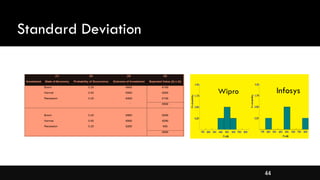
Standard Deviation
Wipro Infosys
45
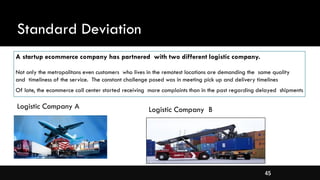
Standard Deviation
A startup ecommerce company has partnered with two different logistic company.
Not only the metropolitans even customers who lives in the remotest locations are demanding the same quality
and timeliness of the service. The constant challenge posed was in meeting pick up and delivery timelines
Of late, the ecommerce call center started receiving more complaints than in the past regarding delayed shipments
Logistic Company A Logistic Company B
46
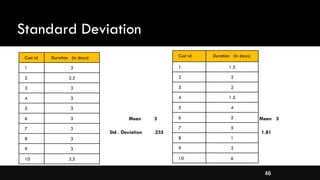
Standard Deviation
Cust id Duration (in days)
1 3
2 2.5
3 3
4 3
5 3
6 3
7 3
8 3
9 3
10 3.5
Cust id Duration (in days)
1 1.5
2 2
3 2
4 1.5
5 4
6 5
7 5
8 1
9 2
10 6
Mean 3 Mean 3
Std . Deviation .235 1.81
47
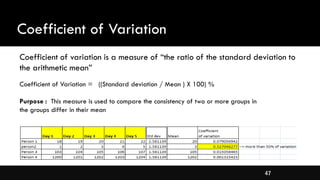
Coefficient of Variation
Coefficient of variation is a measure of “the ratio of the standard deviation to
the arithmetic mean”
Coefficient of Variation = ((Standard deviation / Mean ) X 100) %
Purpose : This measure is used to compare the consistency of two or more groups in
the groups differ in their mean
48
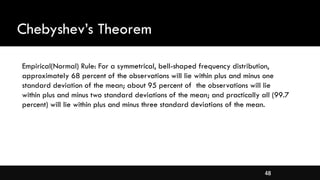
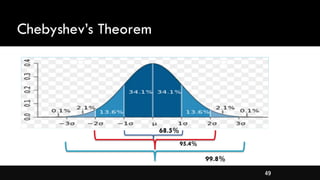
Chebyshev’s Theorem
Empirical(Normal) Rule: For a symmetrical, bell-shaped frequency distribution,
approximately 68 percent of the observations will lie within plus and minus one
standard deviation of the mean; about 95 percent of the observations will lie
within plus and minus two standard deviations of the mean; and practically all (99.7
percent) will lie within plus and minus three standard deviations of the mean.
49
Chebyshev’s Theorem
68.5%
95.4%
99.8%
50
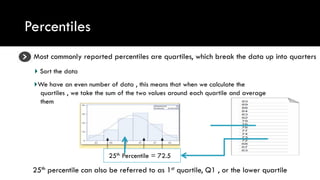
Percentiles
Most commonly reported percentiles are quartiles, which break the data up into quarters
Sort the data
25th Percentile = 72.5
25th percentile can also be referred to as 1st quartile, Q1 , or the lower quartile
We have an even number of data , this means that when we calculate the
quartiles , we take the sum of the two values around each quartile and average
them
51
Percentiles
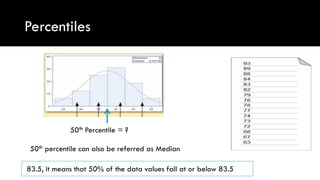
50th Percentile = ?
50th percentile can also be referred as Median
83.5, it means that 50% of the data values fall at or below 83.5
52
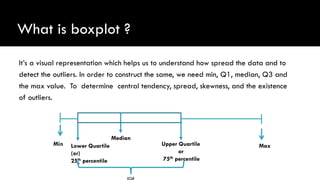
What is boxplot ?
It’s a visual representation which helps us to understand how spread the data and to
detect the outliers. In order to construct the same, we need min, Q1, median, Q3 and
the max value. To determine central tendency, spread, skewness, and the existence
of outliers.
Median
Upper Quartile
or
75th percentile
Lower Quartile
(or)
25th percentile
Min Max
53
Percentiles
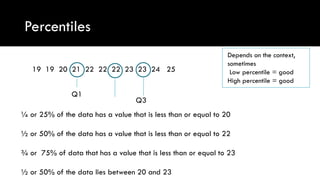
19 19 20 21 22 22 22 23 23 24 25
Q1
¼ or 25% of the data has a value that is less than or equal to 20
½ or 50% of the data has a value that is less than or equal to 22
¾ or 75% of data that has a value that is less than or equal to 23
½ or 50% of the data lies between 20 and 23
Q3
Depends on the context,
sometimes
Low percentile = good
High percentile = good
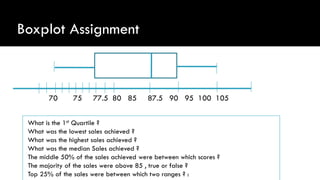
Boxplot Assignment
What is the 1st Quartile ?
What was the lowest sales achieved ?
What was the highest sales achieved ?
What was the median Sales achieved ?
The middle 50% of the sales achieved were between which scores ?
The majority of the sales were above 85 , true or false ?
Top 25% of the sales were between which two ranges ? :
70 75 77.5 80 85 87.5 90 95 100 105
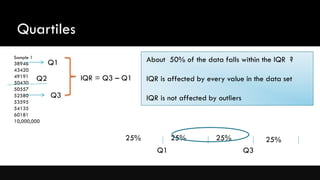
Quartiles
Sample 1
38946
43420
49191
50430
50557
52580
53595
54135
60181
10,000,000
Q1
Q3
Q2 IQR = Q3 – Q1
About 50% of the data falls within the IQR ?
IQR is affected by every value in the data set
IQR is not affected by outliers
25% 25% 25% 25%
Q1 Q3
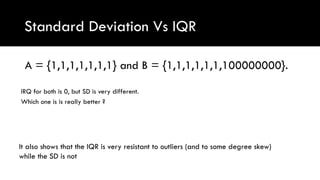
Standard Deviation Vs IQR
A = {1,1,1,1,1,1,1} and B = {1,1,1,1,1,1,100000000}.
IRQ for both is 0, but SD is very different.
Which one is is really better ?
It also shows that the IQR is very resistant to outliers (and to some degree skew)
while the SD is not
Good Luck

DescriptiveStatistics.pdf

  • 1.
  • 2.
    Outline 2 Section 1 Section 2Section 4 Visualizing and understanding your Data through visualization Getting started with Statistics Section 3 Descriptive Statistics Measures of Central Tendency Measures of Spread
  • 3.
    3 What is Statistics? It’s a science deals with Collection, Classification, Analysis , and Interpretation of numerical facts or data AND the use of probability theory to impose order on aggregates of data
  • 4.
    4 Branches of Statistics DescriptiveStatistics Inferential Statistics
  • 5.
    0 5 Levels ofMeasurement Nominal Frequencies and proportions Ordinal Frequencies and Proportions Interval Mean, median & standard deviation Ratio Mean, median & Standard deviation
  • 6.
    0 6 Levels ofMeasurement ✓ Nominal : the data can only be categorized ✓ Ordinal : the data can be categorized and ranked ✓ Interval : the data can be categorized, ranked, and evenly spaced ✓ Ratio: the data can be categorized, ranked, evenly spaced, and has a natural zero.
  • 7.
    7 Levels of Measurement- Example Variable Values Level of measurement Discrete or Continuous Gender Male (1), Female(2) Nominal Age 23,24,26 etc., Hours spent last week 5.30 hours Ratio Performance rating 1, 2 ,3,4
  • 8.
  • 9.
    9 Descriptive Statistics Summarizing ordescribing the fact known to you Organizes and make sense of Data uses Numerical and Graphical Methods Identifies Patterns in Data Simplifies the information focusing on the items/areas of interest Eliminates undesired information to avoid information overload
  • 10.
    10 Descriptive Statistics Types ofquestions that can be answered using simple descriptive statistics: 1.What proportion of customers have responded to the offer in the dataset? 2.What is the average duration of calls? What is the median? 3.What is the frequency distribution of job types?
  • 11.
  • 12.
    12 Measures of CentralTendency Central tendency indicates where the centre of the distribution tends to be
  • 13.
    13 Measures of CentralTendency - Mean Data Scientist $48670 $57320 $38150 $41290 $53160 $500,000 Average Salary = 48000 X bar = $ 123,098
  • 14.
    14 Measures of CentralTendency - Mean Cust Id Amount Spent 1 250 2 300 3 280 4 270 5 320 6 290 7 260 8 280 9 240 10 260 No. of Observations = 10 SUM = 2750 MEAN = (2750/10) = 275 ➢ Works well when data is not heavily skewed ➢ Easy to compute
  • 15.
    15 Measures of CentralTendency - Mean  What are the properties of the mean ? (put a tick mark )  All salaries in the distribution affect the mean  Mean can be described with a formula  Many samples from the same population will have similar means  The mean of a sample can be used to make inferences
  • 16.
    16 Median 10 20 2224 32 35 51 31 11 Median is at the mid point 10 ` 20 22 24 32 32 51 31 11 33
  • 17.
    17 Mean Vs Median DataScientist Data Analyst 58350 $48670 63120 $57320 44640 $38150 56380 $41290 72250 $53160 $500000 Mean is 47718 Median is 48670 What if the outlier value was $500000 Mean is 123098 Median is 50915 What is the new mean after introducing the outlier ?
  • 18.
    18 Median What is themedian value here ? Data Scientist $48670 $57320 $38150 $41290 $53160 $500,000
  • 19.
    19 Median Data Scientist $48670 $57320 $38150 $41290 $53160 $500,000 Where do youthink the median is ? 1.$ 48, 670 2. $ 53, 160 3. Anywhere in between $48,670 and $53,160 4. Exactly in between $48,670 and $53,160 Find the median of this data set ?
  • 20.
    20 Mode Customer id AmountSpent (in $) mins(bucke t) 1 240 2 280 3 270 4 300 5 277 6 267 7 292 8 2800 9 260 10 250 11 480 Mins Bucket No. of Subscribers < 300 8 300-500 1 > 500 1 MODE = “<300” Works well in “winners take all situations” Gives the most popular value Easy to Understand
  • 21.
    21 Quiz - Mode Using mode we can describe if the data is either categorical or numerical (TRUE/FALSE)  The expenditures in the below data set affect the mode (TRUE/FALSE)  32, 45 , 32, 25, 28, 32  There is an equation for the mode (TRUE/FALSE)  The mode remains same for more than one samples drawn from a same population  Can a mode change if the bin size in an histogram changes
  • 22.
    22 Summary – Measuresof Central Tendency
  • 24.
    Symmetrical Distribution Skewed Distribution UniformDistribution Kurtosis Shape of the Distributions
  • 25.
    Symmetric distribution isa type of distribution where the left side of the distribution mirrors the right side Symmetrical Distribution In symmetrical Distribution, the values of mean, median, and mode are equal Mean = Median = Mode Properties of Symmetrical Distribution
  • 26.
    26 Skewness 0 1 2 3 4 5 6 7 8 9 114 115 116117 118 119 120 121 121 123 124 125 126 127 128 129 Incomes have a smooth distribution
  • 27.
    27 Normally Distributed data 0 1 2 3 4 5 6 7 8 9 114115 116 117 118 119 120 121 121 123 124 125 126 127 128 129 Incomes have a smooth distribution
  • 28.
    28 Right skewed data 0 10 20 30 40 50 60 70 6256 53 46 40 36 25 22 22 18 13 10 5 Which one holds true ? mean < median < mode median < mode < mean mode < median < mean mode < mean < median
  • 29.
  • 30.
    30 Quiz Where does themode occur on this distribution ? Jan Feb Mar Apr May Jun Jul Aug Sep Oct Nov Dec
  • 31.
    31 Mode on abinomial distribution 0 1 2 3 4 5 6 7 8 9 10 114 115 116 117 118 119 120 121 122 123 124 125 126 127 128 129
  • 32.
    32 Mode on Categoricaldata 0 5000 10000 15000 20000 25000 30000 35000 40000 Male female What is the mode ?  34100  Male  16500  Female
  • 33.
  • 34.
    34 Positive or rightskew 0 20 40 60 80 100 Income Number of employees Only few employees are making more than 71,000 dollar , the yearly income is +vely skewed Most of the employees salary is between 31,000 $ & 70k$ When the skewness statistic is +ve, the data is right-skewed. 20% 40% 60% 80%
  • 35.
    35 Positive Skew 0 10 20 30 40 50 60 70 80 90 100 Income Number of employees Only fewemployees are making more than 71,000 dollar , the yearly income is +vely skewed Most of the employees salary is between 31,000 $ & 70k$
  • 36.
    36 Kurtosis Kurtosis > 2is leptokurtic Kurtosis with a –ve number more than minus 1 is platykurtic distribution Kurtosis is used to find the presence of outliers in our data
  • 37.
    37 •Leptokurtic: Sharply peakedwith fat tails, and less variable. •Mesokurtic: Medium peaked •Platykurtic: Flattest peak and highly dispersed
  • 38.
  • 39.
    39 What is measuresof dispersion ? Describes how the data is spreading or the variability What is the difference between Measures of central Tendency and Measures of dispersion ? Central tendency describes the center of the data ,but it does not tell us anything about the spread of the data Wider spread Closer spread
  • 40.
    40 Range Mean 250 5 5 107 12 7 15 16 16 16 10 16 20 20 5 5 20 20 0 10 20 30 1 2 3 4 5 6 7 0 10 20 30 1 2 3 4 5 6 7 40,89,91,93, 95,100 Range is computed by taking the difference between maximum value and minimum value
  • 41.
  • 42.
    42 Standard Deviation Standard deviationis a measure of how close or far are the observations to the mean distribution is Cust id Amount Spent 1 250 2 345 3 280 4 290 5 175 6 200 7 255 8 150 9 375 10 180 This point is 0 units away from the mean (250-250) This point is 95 units away from the mean (345-250) Mean - 250
  • 43.
    43 Standard Deviation Custo mer Id Avg. spend (monthly) x x -µ(x -µ) ^2 1 304 69.2 4788.64 2 50 -184.8 34151.04 3 252 17.2 295.84 4 298 63.2 3994.24 5 234 -0.8 0.64 6 228 -6.8 46.24 7 264 29.2 852.64 8 230 -4.8 23.04 9 228 69.2 4788.64 10 260 -6.8 46.24 Mean = μ = 234.8 Variance = ∑(x – μ)^2/ N Standard Deviation – sqrt(sigma^2) X = Observation μ = population mean N = number of observations in the population Variance = Standard = Deviation Std Deviation = 22.13
  • 44.
  • 45.
    45 Standard Deviation A startupecommerce company has partnered with two different logistic company. Not only the metropolitans even customers who lives in the remotest locations are demanding the same quality and timeliness of the service. The constant challenge posed was in meeting pick up and delivery timelines Of late, the ecommerce call center started receiving more complaints than in the past regarding delayed shipments Logistic Company A Logistic Company B
  • 46.
    46 Standard Deviation Cust idDuration (in days) 1 3 2 2.5 3 3 4 3 5 3 6 3 7 3 8 3 9 3 10 3.5 Cust id Duration (in days) 1 1.5 2 2 3 2 4 1.5 5 4 6 5 7 5 8 1 9 2 10 6 Mean 3 Mean 3 Std . Deviation .235 1.81
  • 47.
    47 Coefficient of Variation Coefficientof variation is a measure of “the ratio of the standard deviation to the arithmetic mean” Coefficient of Variation = ((Standard deviation / Mean ) X 100) % Purpose : This measure is used to compare the consistency of two or more groups in the groups differ in their mean
  • 48.
    48 Chebyshev’s Theorem Empirical(Normal) Rule:For a symmetrical, bell-shaped frequency distribution, approximately 68 percent of the observations will lie within plus and minus one standard deviation of the mean; about 95 percent of the observations will lie within plus and minus two standard deviations of the mean; and practically all (99.7 percent) will lie within plus and minus three standard deviations of the mean.
  • 49.
  • 50.
    50 Percentiles Most commonly reportedpercentiles are quartiles, which break the data up into quarters Sort the data 25th Percentile = 72.5 25th percentile can also be referred to as 1st quartile, Q1 , or the lower quartile We have an even number of data , this means that when we calculate the quartiles , we take the sum of the two values around each quartile and average them
  • 51.
    51 Percentiles 50th Percentile =? 50th percentile can also be referred as Median 83.5, it means that 50% of the data values fall at or below 83.5
  • 52.
    52 What is boxplot? It’s a visual representation which helps us to understand how spread the data and to detect the outliers. In order to construct the same, we need min, Q1, median, Q3 and the max value. To determine central tendency, spread, skewness, and the existence of outliers. Median Upper Quartile or 75th percentile Lower Quartile (or) 25th percentile Min Max
  • 53.
    53 Percentiles 19 19 2021 22 22 22 23 23 24 25 Q1 ¼ or 25% of the data has a value that is less than or equal to 20 ½ or 50% of the data has a value that is less than or equal to 22 ¾ or 75% of data that has a value that is less than or equal to 23 ½ or 50% of the data lies between 20 and 23 Q3 Depends on the context, sometimes Low percentile = good High percentile = good
  • 54.
    Boxplot Assignment What isthe 1st Quartile ? What was the lowest sales achieved ? What was the highest sales achieved ? What was the median Sales achieved ? The middle 50% of the sales achieved were between which scores ? The majority of the sales were above 85 , true or false ? Top 25% of the sales were between which two ranges ? : 70 75 77.5 80 85 87.5 90 95 100 105
  • 55.
    Quartiles Sample 1 38946 43420 49191 50430 50557 52580 53595 54135 60181 10,000,000 Q1 Q3 Q2 IQR= Q3 – Q1 About 50% of the data falls within the IQR ? IQR is affected by every value in the data set IQR is not affected by outliers 25% 25% 25% 25% Q1 Q3
  • 56.
    Standard Deviation VsIQR A = {1,1,1,1,1,1,1} and B = {1,1,1,1,1,1,100000000}. IRQ for both is 0, but SD is very different. Which one is is really better ? It also shows that the IQR is very resistant to outliers (and to some degree skew) while the SD is not
  • 57.