SHREE SWAMI ATMANAND SARASWATI
INSTITUTE OF TECHNOLOAGY
CIVIL ENGINEERING DEPEARTMENT
Concrete Technology
Seminar
on
“Non-Destructive test of Concrete”
Guided By:
Mrs. Avinas P. Satasia
Prepared By:
Gaurang A. Kakadiya
Index
Sr. No. Description
1 Introduction
2 Surface Hardness Test
3 Rebound Hammer Test
4 Penetration and Pull Out Test
5 Ultrasonic Pulse Velocity Test
6 Acoustics Test
7 Radioactive and Nuclear Test
8 Magnetic Method
9 Electrical Method
10 Reference
Introduction
• Importance and needof non-destructive testing
It is often necessary to test concrete structures after the concrete has hardened to
determine whether the structure is suitable for its designed use. Ideally such testing should
be done without damaging the concrete. The tests available for testing concrete range
from the completely non-destructive, where there is no damage to the concrete, through
those where the concrete surface is slightly damaged, to partially destructive tests, such as
core tests and pullout and pull off tests, where the surface has to be repaired after the test.
The range of properties that can be assessed using non-destructive tests and partially
destructive tests is quite large and includes such fundamental parameters as density,
elastic modulus and strength as well as surface hardness and surface absorption, and
reinforcement location, size and distance from the surface. In some cases it is also possible
to check the quality of workmanship and structural integrity by the ability to detect voids,
cracking and delaminating.
Non-destructive testing can be applied to both old and new structures. For new
structures, the principal applications are likely to be for quality control or the resolution of
doubts about the quality of materials or construction. The testing of existing structures is
usually related to an assessment of structural integrity or adequacy. In either case, if
destructive testing alone is used, for instance, by removing cores for compression testing,
the cost of coring and testing may only allow a relatively small number of tests to be
carried out on a large structure which may be misleading. Non-destructive testing can be
used in those situations as a preliminary to subsequent coring.
• Typical situations where non-destructive testing may be useful are, as
follows:
• Quality control of pre-cast units or construction in situ.
• Removing uncertainties about the acceptability of the material supplied owing to apparent
non-compliance with specification.
• Confirming or negating doubt concerning the workmanship involved in batching, mixing,
placing, compacting or curing of concrete.
• Monitoring of strength development in relation to formwork removal, cessation of curing,
prestressing, load application or similar purpose.
• Location and determination of the extent of cracks, voids, honeycombing and similar
defects within a concrete structure.
• Determining the concrete uniformity, possibly preliminary to core cutting, load testing or
other more expensive or disruptive tests.
• Determining the position, quantity or condition of reinforcement.
• Increasing the confidence level of a smaller number of destructive tests.
• Determining the extent of concrete variability in order to help in the selection of sample
locations representative of the quality to be assessed.
• Confirming or locating suspected deterioration of concrete resulting from such factors as
overloading, fatigue, external or internal chemical attack or change, fire, explosion,
environmental effects.
• Assessing the potential durability of the concrete.
• Monitoring long term changes in concrete properties.
• Providing information for any proposed change of use of a structure for insurance or for
change of ownership.
•
• Basic methods for NDT of concrete structures
The following methods, with some typical applications, have been used for the
NDT of concrete:
• Visual inspection, which is an essential precursor to any intended non-destructive test. An
experienced civil or structural engineer may be able to establish the possible cause(s) of
damage to a concrete structure and hence identify which of the various NDT methods.
• Available could be most useful for any further investigation of the problem.
• Half-cell electrical potential method, used to detect the corrosion potential of reinforcing
bars in concrete.
• Schmidt/rebound hammer test, used to evaluate the surface hardness of concrete.
• Carbonation depth measurement test, used to determine whether moisture has reached
the depth of the reinforcing bars and hence corrosion may be occurring.
• Permeability test, used to measure the flow of water through the concrete.
• Penetration resistance or Windsor probe test, used to measure the surface hardness and
hence the strength of the surface and near surface layers of the concrete.
• Cover meter testing, used to measure the distance of steel reinforcing bars beneath the
surface of the concrete and also possibly to measure the diameter of the reinforcing bars.
• Radiographic testing used to detect voids in the concrete and the position of stressing
ducts.
• Ultrasonic pulse velocity testing, mainly used to measure the sound velocity of the
concrete and hence the compressive strength of the concrete.
• Sonic methods using an instrumented hammer providing both sonic echo and transmission
methods.
• Topographic modelling, which uses the data from ultrasonic transmission tests in two or
more directions to detect voids in concrete.
• Impact echo testing, used to detect voids, delaminating and other anomalies in concrete.
• Ground penetrating radar or impulse radar testing, used to detect the position of
• Reinforcing bars or stressing ducts.
• Infrared thermograph, used to detect voids, delaminating and other anomalies in concrete
and also detect water entry points in buildings.
Surface Hardness Test
These are indentation type, include the Williams testing pistol and impact
hammers, and are used only for estimation of concrete strength.
The fact that concrete hardens with increase in age, the measure of hardness of
surface may indicate the strength of concrete. Various methods and equipments are
devised to measure hardness of concrete surface. William testing pistol, Frank spring
hammer, and Reinbeck pendulum hammer are some of the devices for measuring surface
hardness.
Rebound Hammer Test
The rebound Hammer test measures the elastic rebound of concrete and is
primarily used for estimation of concrete strength and for comparative investigations.
• PRINCIPAL
The Schmidt rebound hammer is principally a surface hardness tester. It works
on the principle that the rebound of an elastic mass depends on the hardness of the
surface against which the mass impinges. There is little apparent theoretical relationship
between the strength of concrete and the rebound number of the hammer. However,
within limits, empirical correlations have been established between strength properties
and the rebound number.
• EQUIPMENTFOR SCHMIDT/REBOUND HAMMER TEST
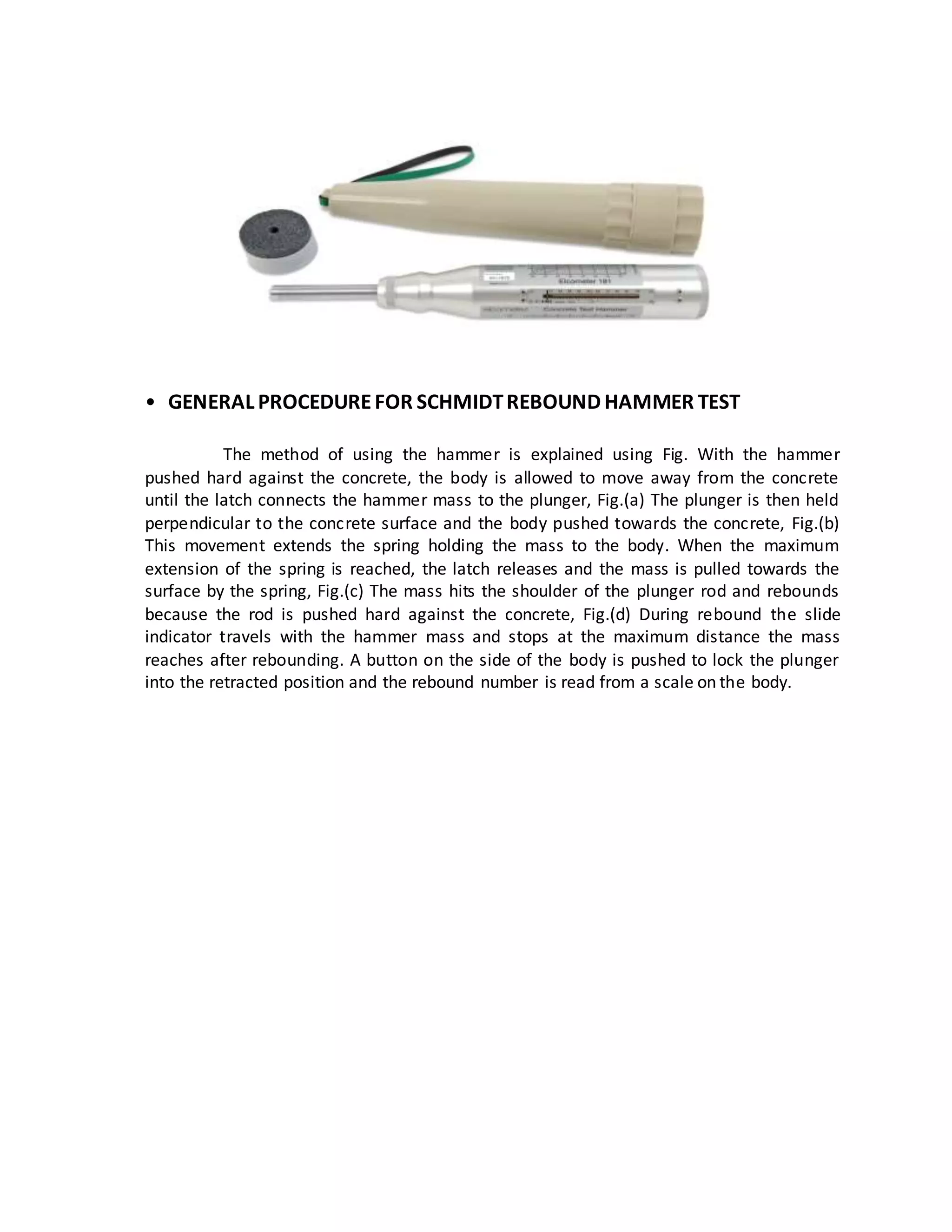
The Schmidt rebound hammer is shown in Fig. The hammer weighs about 1.8 kg
and is suitable for use both in a laboratory and in the field. A schematic cutaway view of
their bound hammer is shown in Fig. The main components include the outer body, the
plunger, the hammer mass, and the main spring. Other features include a latching
mechanism that locks the hammer mass to the plunger rod and a sliding rider to measure
the rebound of the hammer mass. The rebound distance is measured on an arbitrary scale
marked from 10 to100. The rebound distance is recorded as a “rebound number”
corresponding to the position of the rider on the scale.
• GENERAL PROCEDUREFOR SCHMIDTREBOUND HAMMER TEST
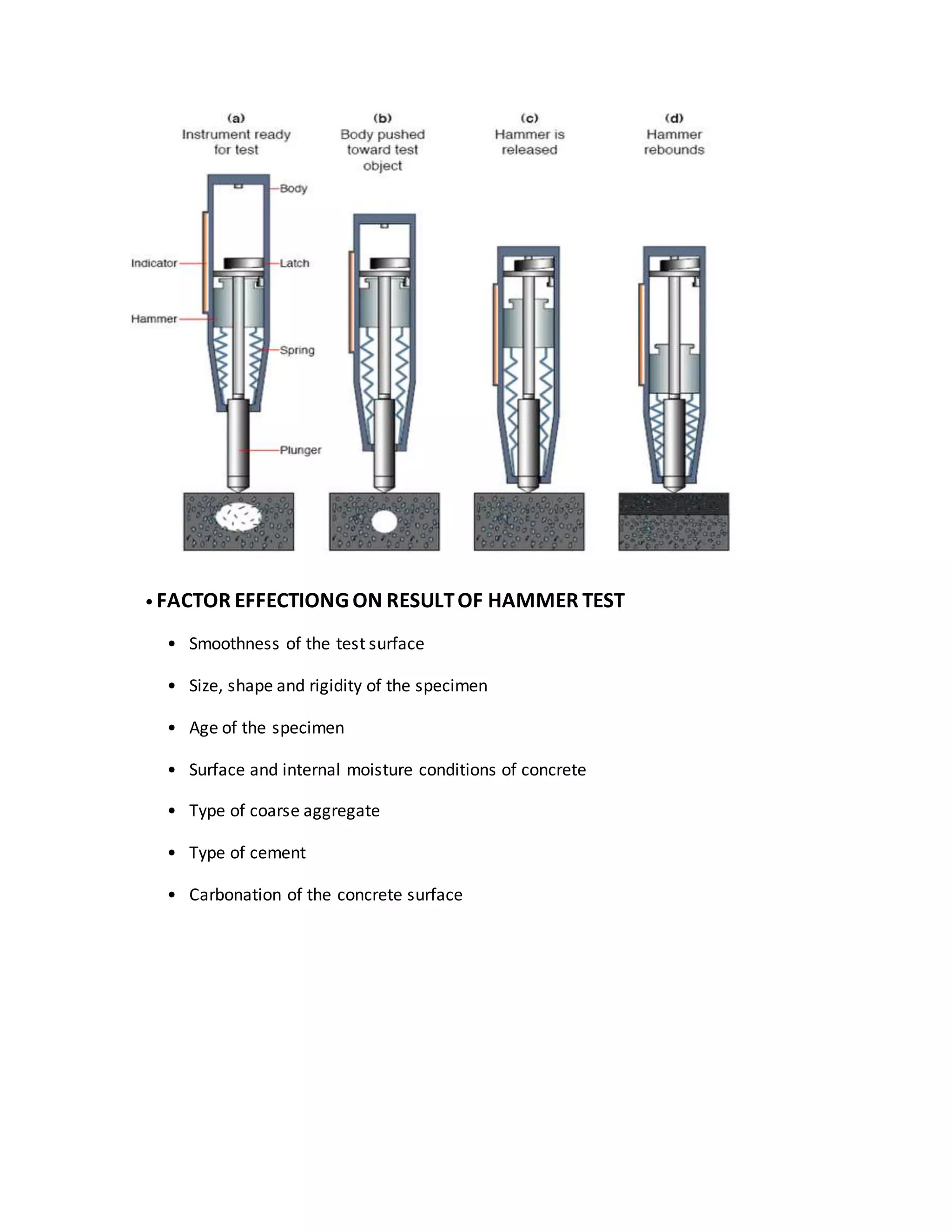
The method of using the hammer is explained using Fig. With the hammer
pushed hard against the concrete, the body is allowed to move away from the concrete
until the latch connects the hammer mass to the plunger, Fig.(a) The plunger is then held
perpendicular to the concrete surface and the body pushed towards the concrete, Fig.(b)
This movement extends the spring holding the mass to the body. When the maximum
extension of the spring is reached, the latch releases and the mass is pulled towards the
surface by the spring, Fig.(c) The mass hits the shoulder of the plunger rod and rebounds
because the rod is pushed hard against the concrete, Fig.(d) During rebound the slide
indicator travels with the hammer mass and stops at the maximum distance the mass
reaches after rebounding. A button on the side of the body is pushed to lock the plunger
into the retracted position and the rebound number is read from a scale on the body.
• FACTOR EFFECTIONG ON RESULTOF HAMMER TEST
• Smoothness of the test surface
• Size, shape and rigidity of the specimen
• Age of the specimen
• Surface and internal moisture conditions of concrete
• Type of coarse aggregate
• Type of cement
• Carbonation of the concrete surface
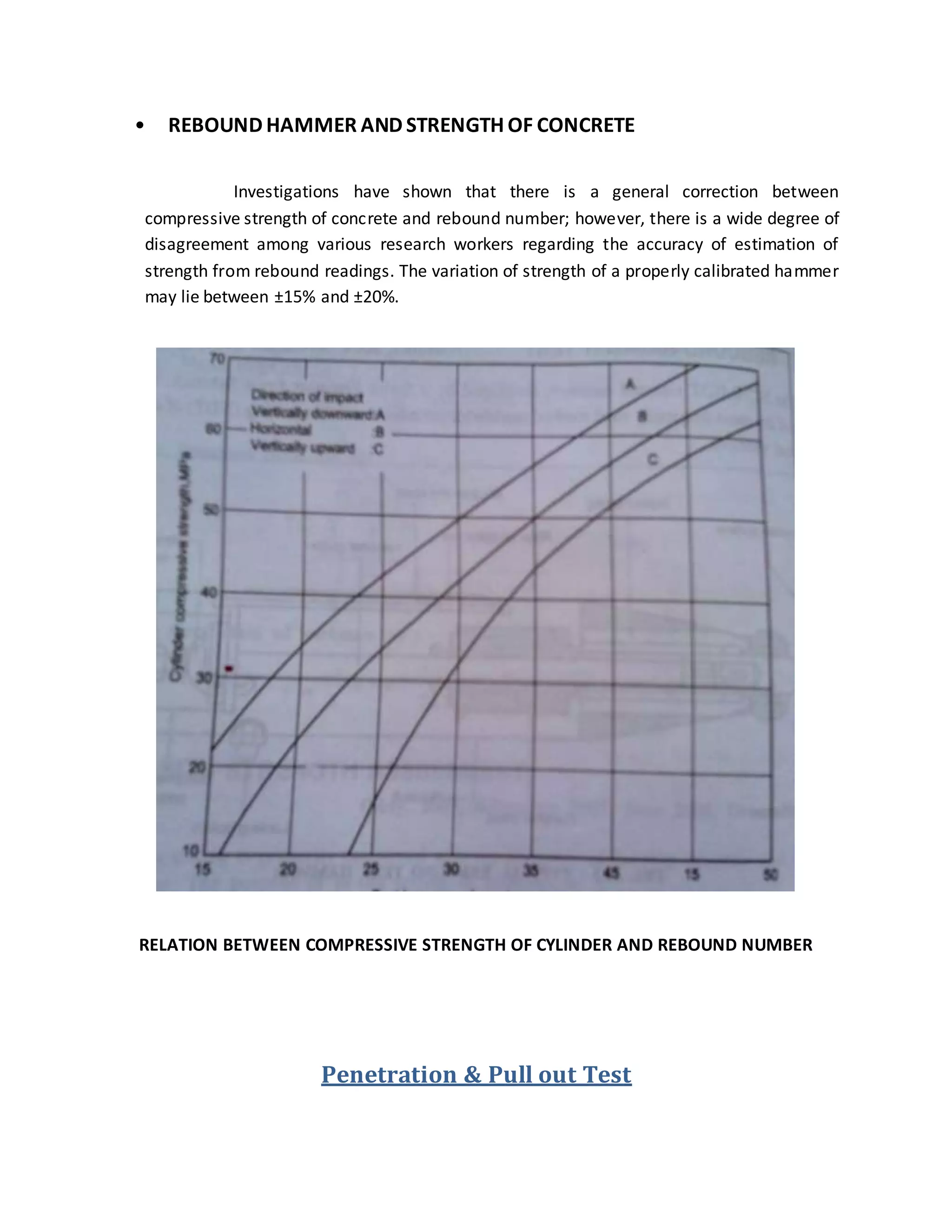
• REBOUND HAMMER AND STRENGTH OF CONCRETE
Investigations have shown that there is a general correction between
compressive strength of concrete and rebound number; however, there is a wide degree of
disagreement among various research workers regarding the accuracy of estimation of
strength from rebound readings. The variation of strength of a properly calibrated hammer
may lie between ±15% and ±20%.
RELATION BETWEEN COMPRESSIVE STRENGTH OF CYLINDER AND REBOUND NUMBER
Penetration & Pull out Test
• PenetrationTechniques
The measurement of hardness by probing techniques was first reported during
1954.Two techniques were used. In one case, a hammer known as, “Simbi” was used to
perforate concrete and the depth of borehole was correlated to compressive strength of
concrete cubes. In the other techniques, the probing of concrete was achieved by blasting
with spit pins and the depth of penetration of the pins was correlated with compressive
strength of concrete .The accuracy of this test was found to be ±25%. However, it is further
seen that, “Simbi” and spit pins were more affected by the arrangement of coarse
aggregate, than the tests using rebound hammers.
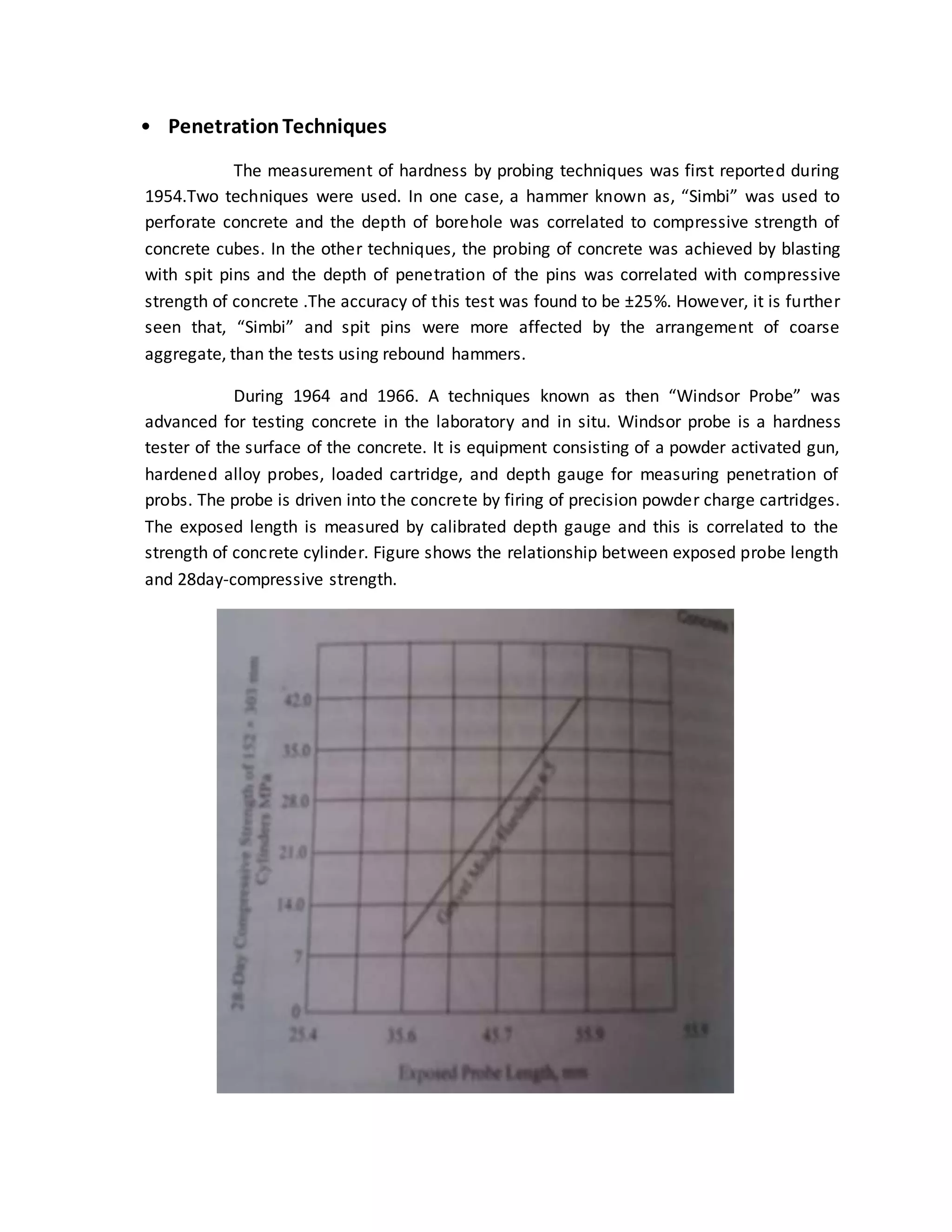
During 1964 and 1966. A techniques known as then “Windsor Probe” was
advanced for testing concrete in the laboratory and in situ. Windsor probe is a hardness
tester of the surface of the concrete. It is equipment consisting of a powder activated gun,
hardened alloy probes, loaded cartridge, and depth gauge for measuring penetration of
probs. The probe is driven into the concrete by firing of precision powder charge cartridges.
The exposed length is measured by calibrated depth gauge and this is correlated to the
strength of concrete cylinder. Figure shows the relationship between exposed probe length
and 28day-compressive strength.
The Windsor probe test cannot be really considered as a non-destructive
testing, as it makes a hale and damaged the structure. It can only be considered non-
destructive to the extent that concrete can be tested in situ and structural members. In
case of big structures like pavements or retaining walls etc., the structure need not be
discarded.
The Windsor probe test is basically a hardness tester and. Like other hardness
testers, should not be expected to yield accurate absolute values of strength of concrete in
a structure. However, like the “Schmidt rebound hammer”, the probe test provides a good
method for determining the relative strength of concrete in the same structure or relative
strength structures without extensive calibration with specific concrete.
• Pull out test
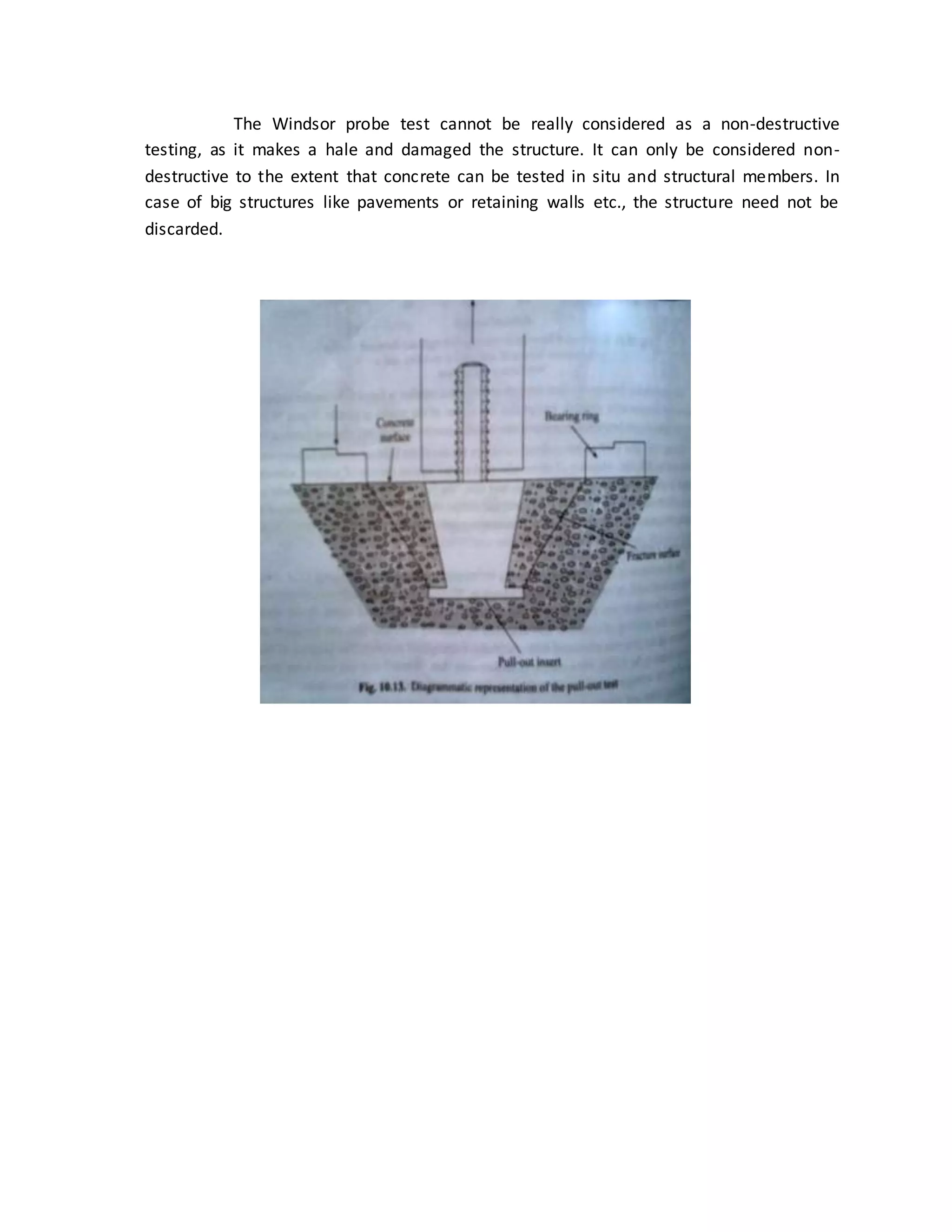
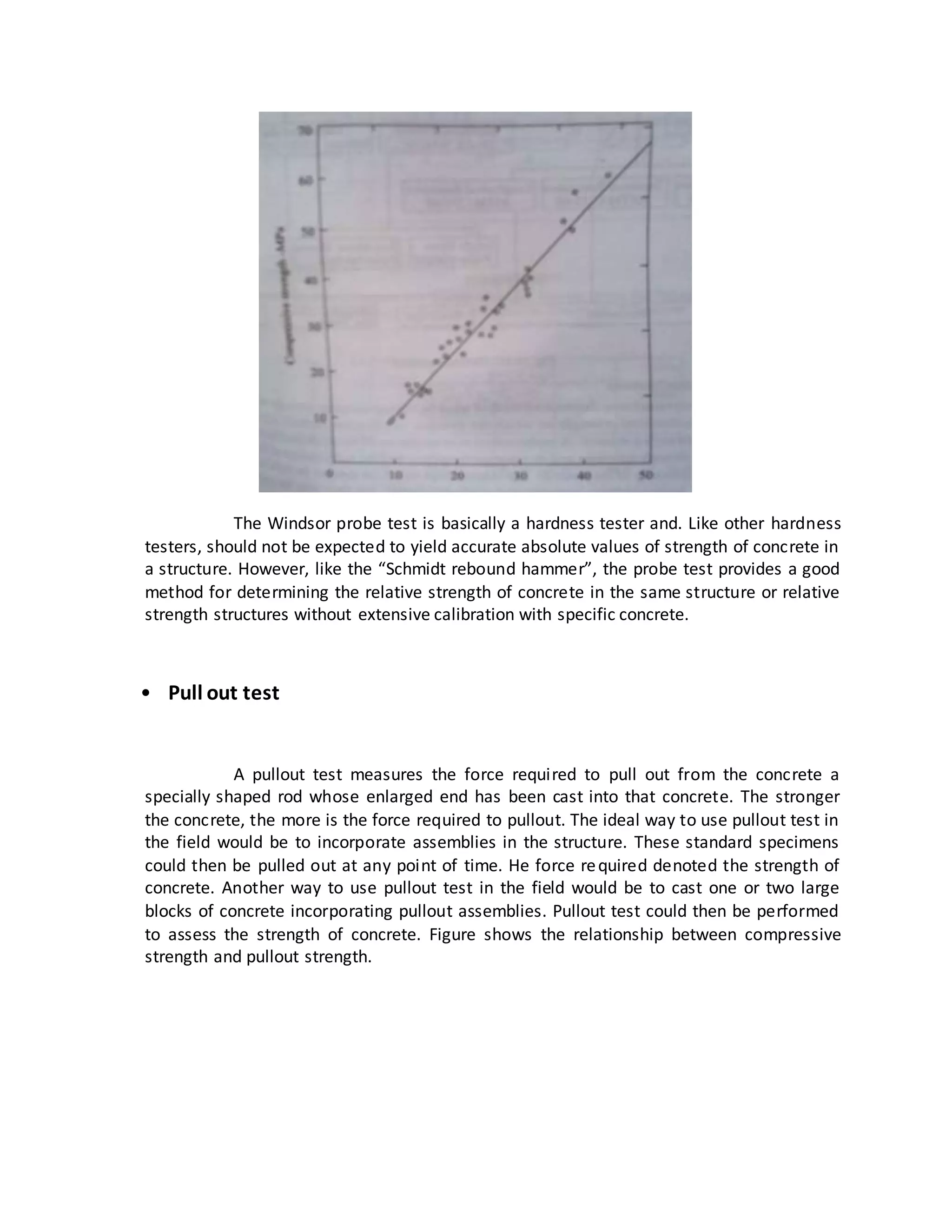
A pullout test measures the force required to pull out from the concrete a
specially shaped rod whose enlarged end has been cast into that concrete. The stronger
the concrete, the more is the force required to pullout. The ideal way to use pullout test in
the field would be to incorporate assemblies in the structure. These standard specimens
could then be pulled out at any point of time. He force required denoted the strength of
concrete. Another way to use pullout test in the field would be to cast one or two large
blocks of concrete incorporating pullout assemblies. Pullout test could then be performed
to assess the strength of concrete. Figure shows the relationship between compressive
strength and pullout strength.
Ultrasonic Pulse Velocity Test
• FUNDAMENTAL PRINCIPAL
A pulse of longitudinal vibrations is produced by an electro-acoustical
transducer, which is held in contact with one surface of the concrete under test. When the
pulse generated is transmitted into the concrete from the transducer using a liquid
coupling material such as grease or cellulose paste, it undergoes multiple reflections at the
boundaries of the different material phases within the concrete. A complex system of
stress waves develops, which include both longitudinal and shear waves, and propagates
through the concrete. The first waves to reach the receiving transducer are the longitudinal
waves, which are converted into an electrical signal by a second transducer. Electronic
timing circuits enable the transit time T of the pulse to be measured.
Longitudinal pulse velocity (in km/s or m/s) is given by:
Where,
v is the longitudinal pulse velocity,
L is the path length,
T is the time taken by the pulse to traverse that
length.
• EQUIPMENT FOR PULSE VELOCITY TEST
The equipment consists essentially of an electrical pulse generator, a pair of
transducers, an amplifier and an electronic timing device for measuring the time interval
between the initiation of a pulse generated at the transmitting transducer and its arrival at
the receiving transducer. Two forms of electronic timing apparatus and display are
available, one of which uses a cathode ray tube on which the received pulse is displayed in
relation to a suitable time scale, the other uses an interval timer with a direct reading
digital display.
The equipment should have the following characteristics. It should be capable
of measuring transit time over path lengths ranging from about 100 mm to the maximum
thickness to be inspected to an accuracy of ±1%. Generally the range of 20 to 150 kHz
although frequencies as low as 10 kHz may be used for very long concrete path lengths and
as high as 1 MHz for mortars and grouts or for short path lengths. High frequency pulses
have a well defined onset but, as they pass through the concrete, become attenuated more
rapidly than pulses of lower frequency. It is therefore preferable to use high frequency
transducers for short path lengths and low frequency transducers for long path lengths.
Transducers with a frequency of 50 kHz to 60 kHz are suitable for most common
applications.
• DETERMINATION OF PULSEVELOCITY
• Transducer arrangement
The receiving transducer detects the arrival of that component of the pulse,
which arrives earliest. This is generally the leading edge of the longitudinal vibration.
Although the direction in which the maximum energy is propagated is at right angles to the
face of the transmitting transducer, it is possible to detect pulses, which have travelled
through the concrete in some other direction. It is possible, therefore, to make
measurements of pulse velocity by placing the two transducers on either:
• Opposite faces (Direct transmission)
• Adjacent faces (Semi-direct transmission)
• The same face (Indirect or surface transmission)
• Determination of pulse velocity by direct transmission
Where possible the direct transmission arrangement should be used since the
transfer of energy between transducers is at its maximum and the accuracy of velocity
determination is therefore governed principally by the accuracy of the path length
measurement. The couplet used should be spread as thinly as possible to avoid any end
effects resulting from the different velocities in couplet and concrete.
• Determination of pulse velocity by semi-direct transmission
The semi-direct transmission arrangement has a sensitivity intermediate
between those of the other two arrangements and, although there may be some reduction
in the accuracy of measurement of the path length, it is generally found to be sufficiently
accurate to take this as the distance measured from centre to centre.
•Determination of pulse velocity by indirect or surface transmission
Indirect transmission should be used when only one face of the concrete is
accessible, when the depth of a surface crack is to be determined or when the quality of
the surface concrete relative to the overall quality is of interest. It is the least sensitive of
the arrangements and, for a given path length, produces at the receiving transducer a
signal which has an amplitude of only about 2% or 3% of that produced by direct
transmission. Furthermore, this arrangement gives pulse velocity measurements which are
usually influenced by the concrete near the surface. This region is often of different
composition from that of the concrete within the body of a unit and the test results may be
unrepresentative of that concrete. The indirect velocity is invariably lower than the direct
velocity on the same concrete element. This difference may vary from 5% to 20%
depending largely on the quality of the concrete under test. Where practicable site
measurements should be made to determine this difference. With indirect transmission
there is some uncertainty regarding the exact length of the transmission path because of
the significant size of the areas of contact between the transducers and the concrete. It is
therefore preferable to make a series of measurements with the transducers at different
distances apart to eliminate this uncertainty. To do this, the transmitting transducer should
be placed in contact with the concrete surface at a fixed point x and the receiving
transducer should be placed at fixed increments along a chosen line on the surface. The
transmission times recorded should be plotted as points on a graph showing their relation
to the distance separating the transducers. An example of such a plot is shown as line (b) in
Figure. The slope of the best straight line drawn through the points should be measured
and recorded as the mean pulse velocity along the chosen line on the concrete surface.
Where the points measured and recorded in this way indicate a discontinuity, it is likely
that a surface crack or surface layer of inferior quality is present and a velocity measured in
such an instance is unreliable.
Acoustic Test
These have been used to study the initiation and growth of cracks in concrete.
Radioactive and Nuclear Test
• Radioactive Method
This technique is suitable for the detection of internal defects in ferrous and
nonferrous metals and other materials.
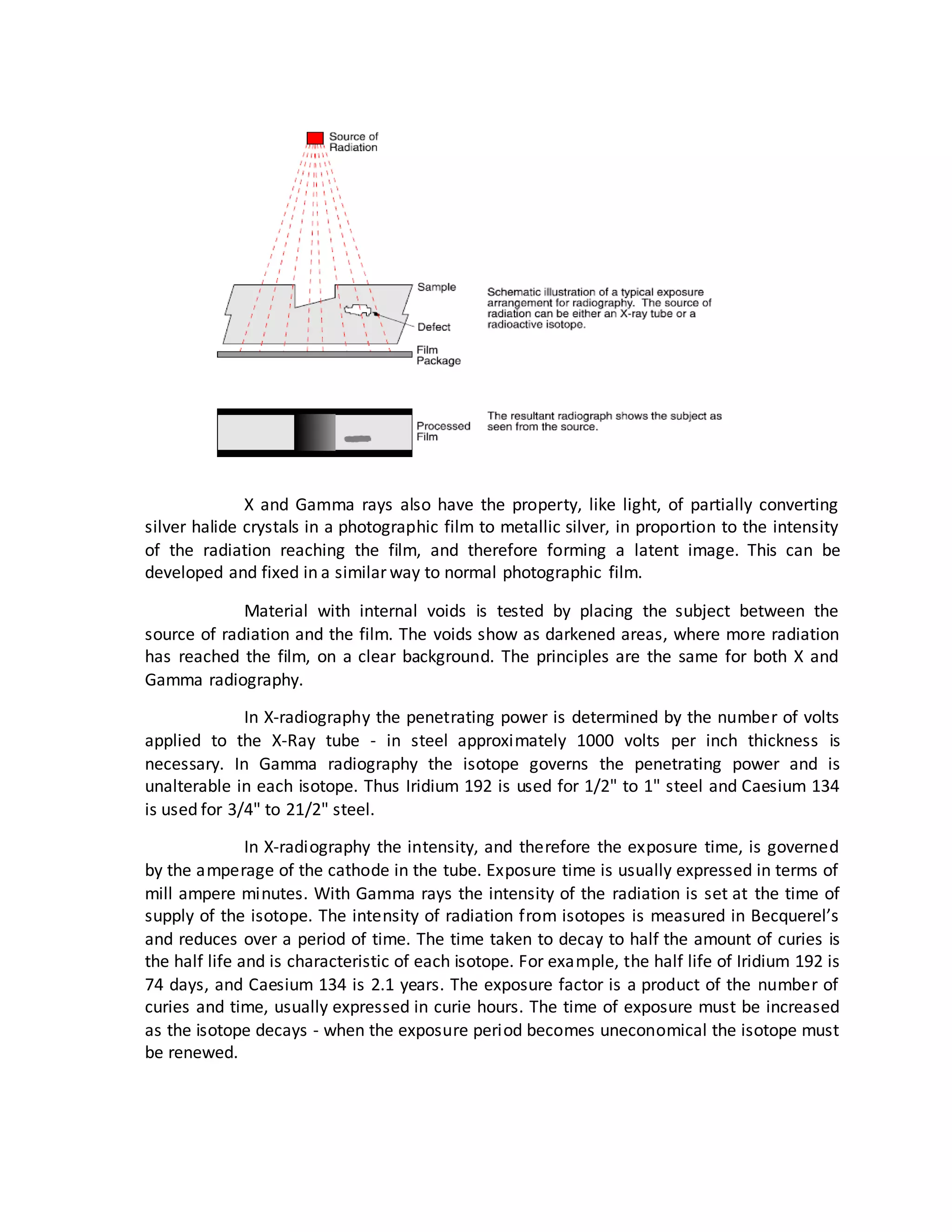
X-rays, generated electrically, and Gamma rays emitted from radio-active
isotopes, are penetrating radiation which is differentially absorbed by the material through
which it passes; the greater the thickness, the greater the absorption. Furthermore, the
denser the material the greater the absorption.
X and Gamma rays also have the property, like light, of partially converting
silver halide crystals in a photographic film to metallic silver, in proportion to the intensity
of the radiation reaching the film, and therefore forming a latent image. This can be
developed and fixed in a similar way to normal photographic film.
Material with internal voids is tested by placing the subject between the
source of radiation and the film. The voids show as darkened areas, where more radiation
has reached the film, on a clear background. The principles are the same for both X and
Gamma radiography.
In X-radiography the penetrating power is determined by the number of volts
applied to the X-Ray tube - in steel approximately 1000 volts per inch thickness is
necessary. In Gamma radiography the isotope governs the penetrating power and is
unalterable in each isotope. Thus Iridium 192 is used for 1/2" to 1" steel and Caesium 134
is used for 3/4" to 21/2" steel.
In X-radiography the intensity, and therefore the exposure time, is governed
by the amperage of the cathode in the tube. Exposure time is usually expressed in terms of
mill ampere minutes. With Gamma rays the intensity of the radiation is set at the time of
supply of the isotope. The intensity of radiation from isotopes is measured in Becquerel’s
and reduces over a period of time. The time taken to decay to half the amount of curies is
the half life and is characteristic of each isotope. For example, the half life of Iridium 192 is
74 days, and Caesium 134 is 2.1 years. The exposure factor is a product of the number of
curies and time, usually expressed in curie hours. The time of exposure must be increased
as the isotope decays - when the exposure period becomes uneconomical the isotope must
be renewed.
As the isotope is continuously emitting radiation it must be housed in a
container of depleted uranium or similar dense shielding material, whilst not exposed to
protect the environment and personnel.
To produce an X or Gamma radiograph, the film package (comprising film and
intensifying screens - the latter being required to reduce the exposure time – enclosed in a
light tight cassette) is placed close to the surface of the subject.
• Nuclear Method
Use of nuclear method for non-destructive measurement of some properties
of concrete is of recent origin. Two principal techniques have been reported, namely
neutron scattering methods for determining the moisture content of concrete and neutron
activation analysis for the determination of cement content. These methods are not
suitable for finding out the strength of concrete.
Magnetic method
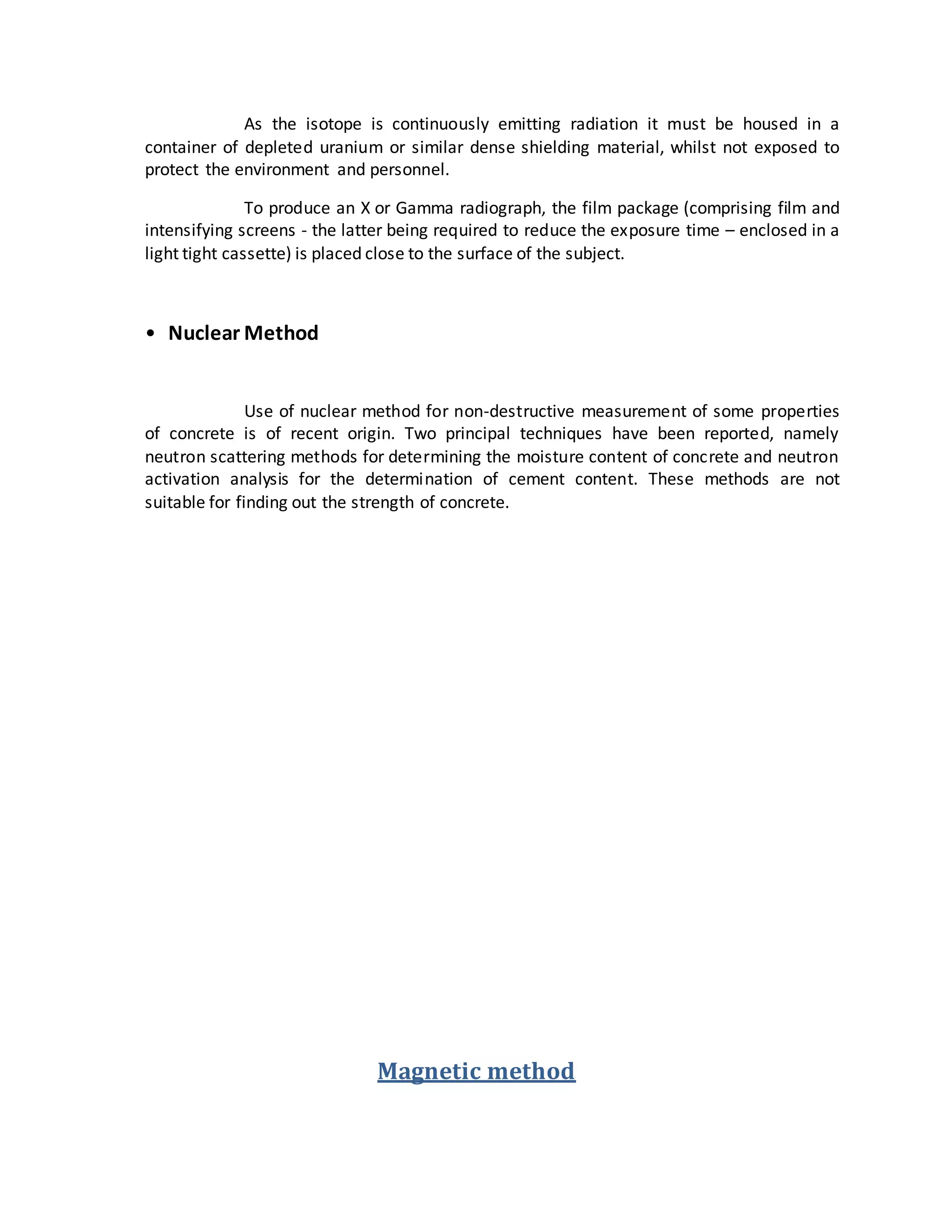
Battery operated magnetic devices that can measure the depth of
reinforcement cover in concrete and detect the position of reinforcement bars is now
available, the apparatus is known as cover meter. This can be used for measuring the cover
given in the lightly reinforced sections.
Electrical Method
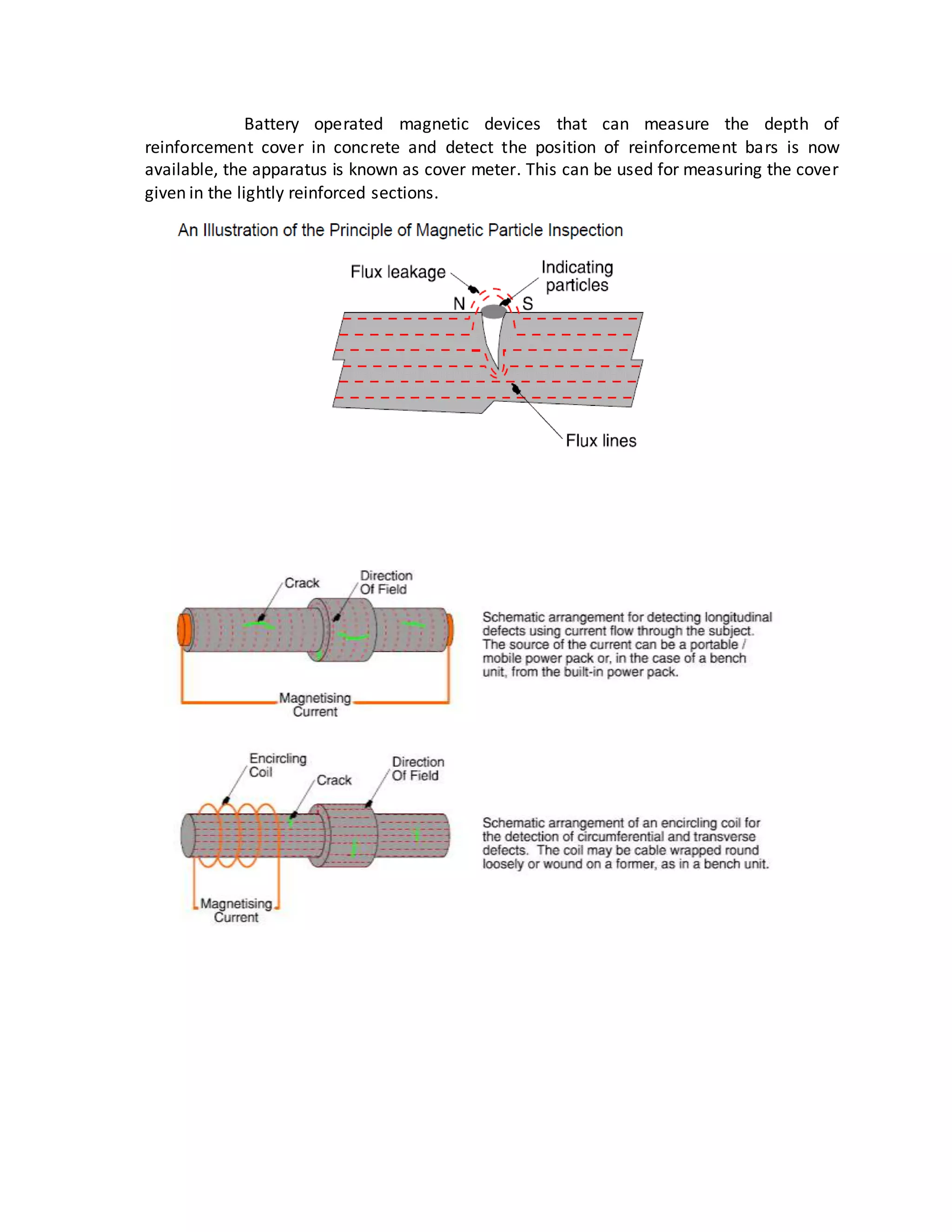
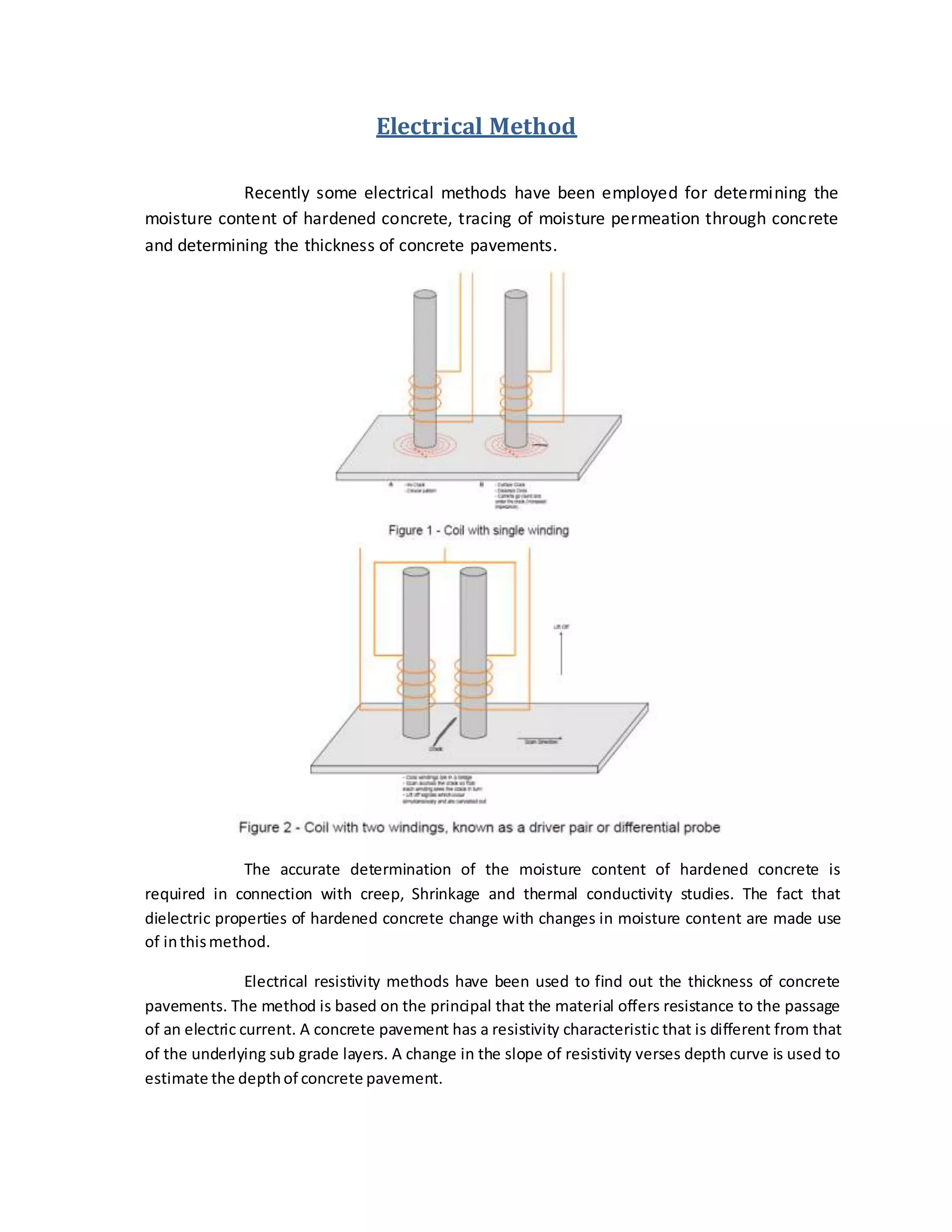
Recently some electrical methods have been employed for determining the
moisture content of hardened concrete, tracing of moisture permeation through concrete
and determining the thickness of concrete pavements.
The accurate determination of the moisture content of hardened concrete is
required in connection with creep, Shrinkage and thermal conductivity studies. The fact that
dielectric properties of hardened concrete change with changes in moisture content are made use
of inthismethod.
Electrical resistivity methods have been used to find out the thickness of concrete
pavements. The method is based on the principal that the material offers resistance to the passage
of an electric current. A concrete pavement has a resistivity characteristic that is different from that
of the underlying sub grade layers. A change in the slope of resistivity verses depth curve is used to
estimate the depthof concrete pavement.
Reference
Books
• Concrete Technology (M .S. Shetty)
• Concrete Technology (M. L. Gambhir)
• Concrete Technology (R. P. Rethaliya)
Web Sites
• www.concosystems.com
• www.ndt-ed.org
• www.omicsgroup.org
• www.turkndt.org

Non Destructive test

  • 1.
    SHREE SWAMI ATMANANDSARASWATI INSTITUTE OF TECHNOLOAGY CIVIL ENGINEERING DEPEARTMENT Concrete Technology Seminar on “Non-Destructive test of Concrete” Guided By: Mrs. Avinas P. Satasia Prepared By: Gaurang A. Kakadiya
  • 2.
    Index Sr. No. Description 1Introduction 2 Surface Hardness Test 3 Rebound Hammer Test 4 Penetration and Pull Out Test 5 Ultrasonic Pulse Velocity Test 6 Acoustics Test 7 Radioactive and Nuclear Test 8 Magnetic Method 9 Electrical Method 10 Reference
  • 3.
    Introduction • Importance andneedof non-destructive testing It is often necessary to test concrete structures after the concrete has hardened to determine whether the structure is suitable for its designed use. Ideally such testing should be done without damaging the concrete. The tests available for testing concrete range from the completely non-destructive, where there is no damage to the concrete, through those where the concrete surface is slightly damaged, to partially destructive tests, such as core tests and pullout and pull off tests, where the surface has to be repaired after the test. The range of properties that can be assessed using non-destructive tests and partially destructive tests is quite large and includes such fundamental parameters as density, elastic modulus and strength as well as surface hardness and surface absorption, and reinforcement location, size and distance from the surface. In some cases it is also possible to check the quality of workmanship and structural integrity by the ability to detect voids, cracking and delaminating. Non-destructive testing can be applied to both old and new structures. For new structures, the principal applications are likely to be for quality control or the resolution of doubts about the quality of materials or construction. The testing of existing structures is usually related to an assessment of structural integrity or adequacy. In either case, if destructive testing alone is used, for instance, by removing cores for compression testing, the cost of coring and testing may only allow a relatively small number of tests to be carried out on a large structure which may be misleading. Non-destructive testing can be used in those situations as a preliminary to subsequent coring. • Typical situations where non-destructive testing may be useful are, as follows: • Quality control of pre-cast units or construction in situ. • Removing uncertainties about the acceptability of the material supplied owing to apparent non-compliance with specification. • Confirming or negating doubt concerning the workmanship involved in batching, mixing, placing, compacting or curing of concrete. • Monitoring of strength development in relation to formwork removal, cessation of curing, prestressing, load application or similar purpose. • Location and determination of the extent of cracks, voids, honeycombing and similar defects within a concrete structure.
  • 4.
    • Determining theconcrete uniformity, possibly preliminary to core cutting, load testing or other more expensive or disruptive tests. • Determining the position, quantity or condition of reinforcement. • Increasing the confidence level of a smaller number of destructive tests. • Determining the extent of concrete variability in order to help in the selection of sample locations representative of the quality to be assessed. • Confirming or locating suspected deterioration of concrete resulting from such factors as overloading, fatigue, external or internal chemical attack or change, fire, explosion, environmental effects. • Assessing the potential durability of the concrete. • Monitoring long term changes in concrete properties. • Providing information for any proposed change of use of a structure for insurance or for change of ownership. • • Basic methods for NDT of concrete structures The following methods, with some typical applications, have been used for the NDT of concrete: • Visual inspection, which is an essential precursor to any intended non-destructive test. An experienced civil or structural engineer may be able to establish the possible cause(s) of damage to a concrete structure and hence identify which of the various NDT methods. • Available could be most useful for any further investigation of the problem. • Half-cell electrical potential method, used to detect the corrosion potential of reinforcing bars in concrete. • Schmidt/rebound hammer test, used to evaluate the surface hardness of concrete. • Carbonation depth measurement test, used to determine whether moisture has reached the depth of the reinforcing bars and hence corrosion may be occurring. • Permeability test, used to measure the flow of water through the concrete. • Penetration resistance or Windsor probe test, used to measure the surface hardness and hence the strength of the surface and near surface layers of the concrete. • Cover meter testing, used to measure the distance of steel reinforcing bars beneath the surface of the concrete and also possibly to measure the diameter of the reinforcing bars. • Radiographic testing used to detect voids in the concrete and the position of stressing ducts. • Ultrasonic pulse velocity testing, mainly used to measure the sound velocity of the concrete and hence the compressive strength of the concrete. • Sonic methods using an instrumented hammer providing both sonic echo and transmission methods. • Topographic modelling, which uses the data from ultrasonic transmission tests in two or more directions to detect voids in concrete. • Impact echo testing, used to detect voids, delaminating and other anomalies in concrete. • Ground penetrating radar or impulse radar testing, used to detect the position of
  • 5.
    • Reinforcing barsor stressing ducts. • Infrared thermograph, used to detect voids, delaminating and other anomalies in concrete and also detect water entry points in buildings. Surface Hardness Test These are indentation type, include the Williams testing pistol and impact hammers, and are used only for estimation of concrete strength. The fact that concrete hardens with increase in age, the measure of hardness of surface may indicate the strength of concrete. Various methods and equipments are devised to measure hardness of concrete surface. William testing pistol, Frank spring hammer, and Reinbeck pendulum hammer are some of the devices for measuring surface hardness. Rebound Hammer Test The rebound Hammer test measures the elastic rebound of concrete and is primarily used for estimation of concrete strength and for comparative investigations. • PRINCIPAL The Schmidt rebound hammer is principally a surface hardness tester. It works on the principle that the rebound of an elastic mass depends on the hardness of the surface against which the mass impinges. There is little apparent theoretical relationship between the strength of concrete and the rebound number of the hammer. However, within limits, empirical correlations have been established between strength properties and the rebound number. • EQUIPMENTFOR SCHMIDT/REBOUND HAMMER TEST The Schmidt rebound hammer is shown in Fig. The hammer weighs about 1.8 kg and is suitable for use both in a laboratory and in the field. A schematic cutaway view of their bound hammer is shown in Fig. The main components include the outer body, the plunger, the hammer mass, and the main spring. Other features include a latching mechanism that locks the hammer mass to the plunger rod and a sliding rider to measure the rebound of the hammer mass. The rebound distance is measured on an arbitrary scale marked from 10 to100. The rebound distance is recorded as a “rebound number” corresponding to the position of the rider on the scale.
  • 6.
    • GENERAL PROCEDUREFORSCHMIDTREBOUND HAMMER TEST The method of using the hammer is explained using Fig. With the hammer pushed hard against the concrete, the body is allowed to move away from the concrete until the latch connects the hammer mass to the plunger, Fig.(a) The plunger is then held perpendicular to the concrete surface and the body pushed towards the concrete, Fig.(b) This movement extends the spring holding the mass to the body. When the maximum extension of the spring is reached, the latch releases and the mass is pulled towards the surface by the spring, Fig.(c) The mass hits the shoulder of the plunger rod and rebounds because the rod is pushed hard against the concrete, Fig.(d) During rebound the slide indicator travels with the hammer mass and stops at the maximum distance the mass reaches after rebounding. A button on the side of the body is pushed to lock the plunger into the retracted position and the rebound number is read from a scale on the body.
  • 7.
    • FACTOR EFFECTIONGON RESULTOF HAMMER TEST • Smoothness of the test surface • Size, shape and rigidity of the specimen • Age of the specimen • Surface and internal moisture conditions of concrete • Type of coarse aggregate • Type of cement • Carbonation of the concrete surface
  • 8.
    • REBOUND HAMMERAND STRENGTH OF CONCRETE Investigations have shown that there is a general correction between compressive strength of concrete and rebound number; however, there is a wide degree of disagreement among various research workers regarding the accuracy of estimation of strength from rebound readings. The variation of strength of a properly calibrated hammer may lie between ±15% and ±20%. RELATION BETWEEN COMPRESSIVE STRENGTH OF CYLINDER AND REBOUND NUMBER Penetration & Pull out Test
  • 9.
    • PenetrationTechniques The measurementof hardness by probing techniques was first reported during 1954.Two techniques were used. In one case, a hammer known as, “Simbi” was used to perforate concrete and the depth of borehole was correlated to compressive strength of concrete cubes. In the other techniques, the probing of concrete was achieved by blasting with spit pins and the depth of penetration of the pins was correlated with compressive strength of concrete .The accuracy of this test was found to be ±25%. However, it is further seen that, “Simbi” and spit pins were more affected by the arrangement of coarse aggregate, than the tests using rebound hammers. During 1964 and 1966. A techniques known as then “Windsor Probe” was advanced for testing concrete in the laboratory and in situ. Windsor probe is a hardness tester of the surface of the concrete. It is equipment consisting of a powder activated gun, hardened alloy probes, loaded cartridge, and depth gauge for measuring penetration of probs. The probe is driven into the concrete by firing of precision powder charge cartridges. The exposed length is measured by calibrated depth gauge and this is correlated to the strength of concrete cylinder. Figure shows the relationship between exposed probe length and 28day-compressive strength.
  • 10.
    The Windsor probetest cannot be really considered as a non-destructive testing, as it makes a hale and damaged the structure. It can only be considered non- destructive to the extent that concrete can be tested in situ and structural members. In case of big structures like pavements or retaining walls etc., the structure need not be discarded.
  • 11.
    The Windsor probetest is basically a hardness tester and. Like other hardness testers, should not be expected to yield accurate absolute values of strength of concrete in a structure. However, like the “Schmidt rebound hammer”, the probe test provides a good method for determining the relative strength of concrete in the same structure or relative strength structures without extensive calibration with specific concrete. • Pull out test A pullout test measures the force required to pull out from the concrete a specially shaped rod whose enlarged end has been cast into that concrete. The stronger the concrete, the more is the force required to pullout. The ideal way to use pullout test in the field would be to incorporate assemblies in the structure. These standard specimens could then be pulled out at any point of time. He force required denoted the strength of concrete. Another way to use pullout test in the field would be to cast one or two large blocks of concrete incorporating pullout assemblies. Pullout test could then be performed to assess the strength of concrete. Figure shows the relationship between compressive strength and pullout strength.
  • 12.
    Ultrasonic Pulse VelocityTest • FUNDAMENTAL PRINCIPAL A pulse of longitudinal vibrations is produced by an electro-acoustical transducer, which is held in contact with one surface of the concrete under test. When the pulse generated is transmitted into the concrete from the transducer using a liquid coupling material such as grease or cellulose paste, it undergoes multiple reflections at the boundaries of the different material phases within the concrete. A complex system of stress waves develops, which include both longitudinal and shear waves, and propagates through the concrete. The first waves to reach the receiving transducer are the longitudinal waves, which are converted into an electrical signal by a second transducer. Electronic timing circuits enable the transit time T of the pulse to be measured. Longitudinal pulse velocity (in km/s or m/s) is given by: Where, v is the longitudinal pulse velocity, L is the path length, T is the time taken by the pulse to traverse that length. • EQUIPMENT FOR PULSE VELOCITY TEST The equipment consists essentially of an electrical pulse generator, a pair of transducers, an amplifier and an electronic timing device for measuring the time interval between the initiation of a pulse generated at the transmitting transducer and its arrival at the receiving transducer. Two forms of electronic timing apparatus and display are available, one of which uses a cathode ray tube on which the received pulse is displayed in relation to a suitable time scale, the other uses an interval timer with a direct reading digital display. The equipment should have the following characteristics. It should be capable of measuring transit time over path lengths ranging from about 100 mm to the maximum thickness to be inspected to an accuracy of ±1%. Generally the range of 20 to 150 kHz although frequencies as low as 10 kHz may be used for very long concrete path lengths and as high as 1 MHz for mortars and grouts or for short path lengths. High frequency pulses have a well defined onset but, as they pass through the concrete, become attenuated more rapidly than pulses of lower frequency. It is therefore preferable to use high frequency transducers for short path lengths and low frequency transducers for long path lengths. Transducers with a frequency of 50 kHz to 60 kHz are suitable for most common applications.
  • 13.
    • DETERMINATION OFPULSEVELOCITY • Transducer arrangement The receiving transducer detects the arrival of that component of the pulse, which arrives earliest. This is generally the leading edge of the longitudinal vibration. Although the direction in which the maximum energy is propagated is at right angles to the face of the transmitting transducer, it is possible to detect pulses, which have travelled through the concrete in some other direction. It is possible, therefore, to make measurements of pulse velocity by placing the two transducers on either: • Opposite faces (Direct transmission) • Adjacent faces (Semi-direct transmission) • The same face (Indirect or surface transmission) • Determination of pulse velocity by direct transmission Where possible the direct transmission arrangement should be used since the transfer of energy between transducers is at its maximum and the accuracy of velocity determination is therefore governed principally by the accuracy of the path length
  • 14.
    measurement. The coupletused should be spread as thinly as possible to avoid any end effects resulting from the different velocities in couplet and concrete. • Determination of pulse velocity by semi-direct transmission The semi-direct transmission arrangement has a sensitivity intermediate between those of the other two arrangements and, although there may be some reduction in the accuracy of measurement of the path length, it is generally found to be sufficiently accurate to take this as the distance measured from centre to centre. •Determination of pulse velocity by indirect or surface transmission Indirect transmission should be used when only one face of the concrete is accessible, when the depth of a surface crack is to be determined or when the quality of the surface concrete relative to the overall quality is of interest. It is the least sensitive of the arrangements and, for a given path length, produces at the receiving transducer a signal which has an amplitude of only about 2% or 3% of that produced by direct transmission. Furthermore, this arrangement gives pulse velocity measurements which are usually influenced by the concrete near the surface. This region is often of different composition from that of the concrete within the body of a unit and the test results may be unrepresentative of that concrete. The indirect velocity is invariably lower than the direct velocity on the same concrete element. This difference may vary from 5% to 20% depending largely on the quality of the concrete under test. Where practicable site measurements should be made to determine this difference. With indirect transmission there is some uncertainty regarding the exact length of the transmission path because of the significant size of the areas of contact between the transducers and the concrete. It is therefore preferable to make a series of measurements with the transducers at different distances apart to eliminate this uncertainty. To do this, the transmitting transducer should be placed in contact with the concrete surface at a fixed point x and the receiving transducer should be placed at fixed increments along a chosen line on the surface. The transmission times recorded should be plotted as points on a graph showing their relation to the distance separating the transducers. An example of such a plot is shown as line (b) in Figure. The slope of the best straight line drawn through the points should be measured and recorded as the mean pulse velocity along the chosen line on the concrete surface. Where the points measured and recorded in this way indicate a discontinuity, it is likely that a surface crack or surface layer of inferior quality is present and a velocity measured in such an instance is unreliable.
  • 15.
    Acoustic Test These havebeen used to study the initiation and growth of cracks in concrete. Radioactive and Nuclear Test • Radioactive Method This technique is suitable for the detection of internal defects in ferrous and nonferrous metals and other materials. X-rays, generated electrically, and Gamma rays emitted from radio-active isotopes, are penetrating radiation which is differentially absorbed by the material through which it passes; the greater the thickness, the greater the absorption. Furthermore, the denser the material the greater the absorption.
  • 16.
    X and Gammarays also have the property, like light, of partially converting silver halide crystals in a photographic film to metallic silver, in proportion to the intensity of the radiation reaching the film, and therefore forming a latent image. This can be developed and fixed in a similar way to normal photographic film. Material with internal voids is tested by placing the subject between the source of radiation and the film. The voids show as darkened areas, where more radiation has reached the film, on a clear background. The principles are the same for both X and Gamma radiography. In X-radiography the penetrating power is determined by the number of volts applied to the X-Ray tube - in steel approximately 1000 volts per inch thickness is necessary. In Gamma radiography the isotope governs the penetrating power and is unalterable in each isotope. Thus Iridium 192 is used for 1/2" to 1" steel and Caesium 134 is used for 3/4" to 21/2" steel. In X-radiography the intensity, and therefore the exposure time, is governed by the amperage of the cathode in the tube. Exposure time is usually expressed in terms of mill ampere minutes. With Gamma rays the intensity of the radiation is set at the time of supply of the isotope. The intensity of radiation from isotopes is measured in Becquerel’s and reduces over a period of time. The time taken to decay to half the amount of curies is the half life and is characteristic of each isotope. For example, the half life of Iridium 192 is 74 days, and Caesium 134 is 2.1 years. The exposure factor is a product of the number of curies and time, usually expressed in curie hours. The time of exposure must be increased as the isotope decays - when the exposure period becomes uneconomical the isotope must be renewed.
  • 17.
    As the isotopeis continuously emitting radiation it must be housed in a container of depleted uranium or similar dense shielding material, whilst not exposed to protect the environment and personnel. To produce an X or Gamma radiograph, the film package (comprising film and intensifying screens - the latter being required to reduce the exposure time – enclosed in a light tight cassette) is placed close to the surface of the subject. • Nuclear Method Use of nuclear method for non-destructive measurement of some properties of concrete is of recent origin. Two principal techniques have been reported, namely neutron scattering methods for determining the moisture content of concrete and neutron activation analysis for the determination of cement content. These methods are not suitable for finding out the strength of concrete. Magnetic method
  • 18.
    Battery operated magneticdevices that can measure the depth of reinforcement cover in concrete and detect the position of reinforcement bars is now available, the apparatus is known as cover meter. This can be used for measuring the cover given in the lightly reinforced sections.
  • 19.
    Electrical Method Recently someelectrical methods have been employed for determining the moisture content of hardened concrete, tracing of moisture permeation through concrete and determining the thickness of concrete pavements. The accurate determination of the moisture content of hardened concrete is required in connection with creep, Shrinkage and thermal conductivity studies. The fact that dielectric properties of hardened concrete change with changes in moisture content are made use of inthismethod. Electrical resistivity methods have been used to find out the thickness of concrete pavements. The method is based on the principal that the material offers resistance to the passage of an electric current. A concrete pavement has a resistivity characteristic that is different from that of the underlying sub grade layers. A change in the slope of resistivity verses depth curve is used to estimate the depthof concrete pavement.
  • 20.
    Reference Books • Concrete Technology(M .S. Shetty) • Concrete Technology (M. L. Gambhir) • Concrete Technology (R. P. Rethaliya) Web Sites • www.concosystems.com • www.ndt-ed.org • www.omicsgroup.org • www.turkndt.org