S.T.B.S. COLLEGE OF DIPLOMA
ENGINEERING
SURAT.
CERTIFICATE
This is to certify that the seminar report on “Admixtures” is the
bonfire work of the following group of the students of class- 961- CIVIL (B-
Batch), submitted by them as the partial requirement for the diploma course in
civil engineering as pre-described by the Gujarat Technological University,
Gujarat.
Prepared By
Name Reg. No
Kachwala Taher 096470306027
Kakadiya Gaurang 096470306028
SIGNATURE OF SIGNATURE OF
FACULTY H.O.D.
ACKNOWLEDGEMENT
We hereby take the opportunity to express our profound gratitude and sincere
thanks to our guide, Mrs. P. V. Shah, for their valuable guidance and constant
encouragement to complete this seminar report.
We also express our sincere thanks to our respected principal Mr. Y. S.
Chopare and Mr. M. P. Jariwala head of Civil Department for providing us facilities and
inspiration in bringing out this seminar report.
We are also thankful to librarian for providing books to complete this seminar
report successfully.
In last we also thankful to our friends, who have helped us directly or
indirectly for completion of this seminar report.
CONTENT
 Introduction
 Function
 Types of admixture
 Accelerators
 Retarders
 Plasticizers
 Super Plasticizers
 Air Entraining Admixtures
Introduction
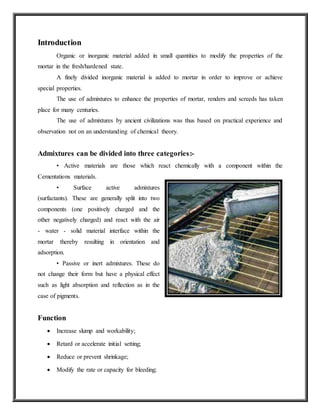
Organic or inorganic material added in small quantities to modify the properties of the
mortar in the fresh/hardened state.
A finely divided inorganic material is added to mortar in order to improve or achieve
special properties.
The use of admixtures to enhance the properties of mortar, renders and screeds has taken
place for many centuries.
The use of admixtures by ancient civilizations was thus based on practical experience and
observation not on an understanding of chemical theory.
Admixtures can be divided into three categories:-
• Active materials are those which react chemically with a component within the
Cementations materials.
• Surface active admixtures
(surfactants). These are generally split into two
components (one positively charged and the
other negatively charged) and react with the air
- water - solid material interface within the
mortar thereby resulting in orientation and
adsorption.
• Passive or inert admixtures. These do
not change their form but have a physical effect
such as light absorption and reflection as in the
case of pigments.
Function
 Increase slump and workability;
 Retard or accelerate initial setting;
 Reduce or prevent shrinkage;
 Modify the rate or capacity for bleeding;
 Reduce segregation;
 Decrease weight of concrete
 Improve durability
 Decrease the rate of heat of hydration
 Reduce permeability
 To make porous concrete
 To make coloring concrete
 To protect chemical attack
 Increase bond of concrete to steel reinforcement
 Increase strength (compressive, tensile, or flexural)
 Increase bond between existing and new concrete
Types of admixture
1. Accelerating admixtures
2. retarding admixtures
3. Water-reducing admixtures
4. Air-entrainment admixtures
5. Super plasticizers admixtures
6. Pozzolana admixtures
7. Grouting admixtures
8. Waterproofing admixtures
9. Air-detraining admixtures
10. Bonding admixtures
11. Corrosion inhibiting admixtures
12. Gas forming admixtures
13. Colouring admixtures
14. Alkali-aggregate expansion inhibiting admixtures
15. Fungicidal, germicidal, insecticidal admixtures
1. Accelerators:-
Main objective of using accelerators in concrete is to increase speed of setting and
hardening.
Advantages of using Accelerators:-
 To remove formwork quickly.
 To reduce the curing time
 To use structure earlier.
 To finish the surface fast.
 To increase the speed of construction.
 For quick repairing work.
Main Accelerators:-
 Calcium Chloride (CaCl2)
 Soluble Carbonates
 Silicates
CaCl2 is a most using accelerator in construction. If 2%
CaCl2by weight of cement is added in concrete, then it decreases
the setting time from 3 to 1 hour and final setting time from 6 to
2 hour.
We can get a two days strength in 1 day at 21 ̊ C temperature.
If the proportion of CaCl2 is more than 3% then flash set of concrete take place and
drying shrinkage and creep will increase.
2. Retarders:-
To decrease the speed of Hydration and setting, Retarders are used in concrete. Retarders
make concrete plastic and workable for long time.
Objectives of using Retarders:-
 To decrease the setting time.
 To increase strength by decreasing W/C Ratio.
 To do concreting in hot area.
 For grouting of oil wells.
Main Retarders:-
 Calcium Sulphate (Gypsum)
 Starches
 Sugars
 Cellulose Products
 Acids or Salts
Gypsum is most commonly used retarder. Generally 2 to 3% gypsum is added. We can
also use gypsum as a plaster of parries. By use more of gypsum expansion of concrete will occur
and setting of concrete will be very slow.
3. Plasticizers:-
Workability is a most important property of
concrete. Workability of concrete will changes according to
situation of construction. For deep beam, light partition wall,
beam-column junction, concrete pumping, tremie concreting
high workable concrete is used.
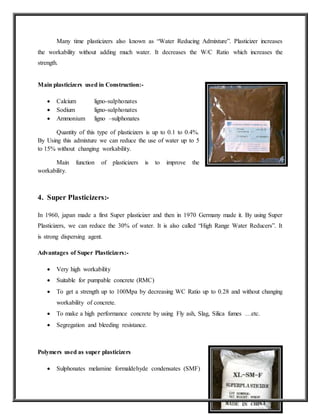
Many time plasticizers also known as “Water Reducing Admixture”. Plasticizer increases
the workability without adding much water. It decreases the W/C Ratio which increases the
strength.
Main plasticizers used in Construction:-
 Calcium ligno-sulphonates
 Sodium ligno-sulphonates
 Ammonium ligno –sulphonates
Quantity of this type of plasticizers is up to 0.1 to 0.4%.
By Using this admixture we can reduce the use of water up to 5
to 15% without changing workability.
Main function of plasticizers is to improve the
workability.
4. Super Plasticizers:-
In 1960, japan made a first Super plasticizer and then in 1970 Germany made it. By using Super
Plasticizers, we can reduce the 30% of water. It is also called “High Range Water Reducers”. It
is strong dispersing agent.
Advantages of Super Plasticizers:-
 Very high workability
 Suitable for pumpable concrete (RMC)
 To get a strength up to 100Mpa by decreasing WC Ratio up to 0.28 and without changing
workability of concrete.
 To make a high performance concrete by using Fly ash, Slag, Silica fumes …etc.
 Segregation and bleeding resistance.
Polymers used as super plasticizers
 Sulphonates melamine formaldehyde condensates (SMF)
 Sulphonates naphalene formaldehyde condensates (SNF)
 Modified ligno - sulphonates (MLS)
 Acrylic polymer (AP)
 Poly carboxylate ester (PC)
5. Air Entraining Admixtures:-
Air entraining agent is used to get an air entrained concrete. This air entraining agent produces
small air bubbles in concrete and works as ball bearing. So the properties of the concrete like
workability, segregation, bleeding …etc. will change.
Some Air entraining agents:-
 Aluminium Powder
 Hydrogen peroxide
 Alkali salts
 Vegetable Oils and Fats.
 Zinc Powder.
 Natural wood resing …etc.
Effect of Air entraining agents:-
 Decrease in strength of concrete.
 Decrease in volume of concrete.
 Increase in permeability of concrete.
 Workability increase.
 Decease in Alkali-aggregate reaction.
 Resistance against Sulphate attack.
 Decrease in heat of hydration.

Admixtures

  • 1.
    S.T.B.S. COLLEGE OFDIPLOMA ENGINEERING SURAT. CERTIFICATE This is to certify that the seminar report on “Admixtures” is the bonfire work of the following group of the students of class- 961- CIVIL (B- Batch), submitted by them as the partial requirement for the diploma course in civil engineering as pre-described by the Gujarat Technological University, Gujarat. Prepared By Name Reg. No Kachwala Taher 096470306027 Kakadiya Gaurang 096470306028 SIGNATURE OF SIGNATURE OF FACULTY H.O.D.
  • 2.
    ACKNOWLEDGEMENT We hereby takethe opportunity to express our profound gratitude and sincere thanks to our guide, Mrs. P. V. Shah, for their valuable guidance and constant encouragement to complete this seminar report. We also express our sincere thanks to our respected principal Mr. Y. S. Chopare and Mr. M. P. Jariwala head of Civil Department for providing us facilities and inspiration in bringing out this seminar report. We are also thankful to librarian for providing books to complete this seminar report successfully. In last we also thankful to our friends, who have helped us directly or indirectly for completion of this seminar report.
  • 3.
    CONTENT  Introduction  Function Types of admixture  Accelerators  Retarders  Plasticizers  Super Plasticizers  Air Entraining Admixtures
  • 4.
    Introduction Organic or inorganicmaterial added in small quantities to modify the properties of the mortar in the fresh/hardened state. A finely divided inorganic material is added to mortar in order to improve or achieve special properties. The use of admixtures to enhance the properties of mortar, renders and screeds has taken place for many centuries. The use of admixtures by ancient civilizations was thus based on practical experience and observation not on an understanding of chemical theory. Admixtures can be divided into three categories:- • Active materials are those which react chemically with a component within the Cementations materials. • Surface active admixtures (surfactants). These are generally split into two components (one positively charged and the other negatively charged) and react with the air - water - solid material interface within the mortar thereby resulting in orientation and adsorption. • Passive or inert admixtures. These do not change their form but have a physical effect such as light absorption and reflection as in the case of pigments. Function  Increase slump and workability;  Retard or accelerate initial setting;  Reduce or prevent shrinkage;  Modify the rate or capacity for bleeding;
  • 5.
     Reduce segregation; Decrease weight of concrete  Improve durability  Decrease the rate of heat of hydration  Reduce permeability  To make porous concrete  To make coloring concrete  To protect chemical attack  Increase bond of concrete to steel reinforcement  Increase strength (compressive, tensile, or flexural)  Increase bond between existing and new concrete Types of admixture 1. Accelerating admixtures 2. retarding admixtures 3. Water-reducing admixtures 4. Air-entrainment admixtures 5. Super plasticizers admixtures 6. Pozzolana admixtures 7. Grouting admixtures 8. Waterproofing admixtures 9. Air-detraining admixtures 10. Bonding admixtures 11. Corrosion inhibiting admixtures 12. Gas forming admixtures 13. Colouring admixtures 14. Alkali-aggregate expansion inhibiting admixtures 15. Fungicidal, germicidal, insecticidal admixtures
  • 6.
    1. Accelerators:- Main objectiveof using accelerators in concrete is to increase speed of setting and hardening. Advantages of using Accelerators:-  To remove formwork quickly.  To reduce the curing time  To use structure earlier.  To finish the surface fast.  To increase the speed of construction.  For quick repairing work. Main Accelerators:-  Calcium Chloride (CaCl2)  Soluble Carbonates  Silicates CaCl2 is a most using accelerator in construction. If 2% CaCl2by weight of cement is added in concrete, then it decreases the setting time from 3 to 1 hour and final setting time from 6 to 2 hour. We can get a two days strength in 1 day at 21 ̊ C temperature. If the proportion of CaCl2 is more than 3% then flash set of concrete take place and drying shrinkage and creep will increase.
  • 7.
    2. Retarders:- To decreasethe speed of Hydration and setting, Retarders are used in concrete. Retarders make concrete plastic and workable for long time. Objectives of using Retarders:-  To decrease the setting time.  To increase strength by decreasing W/C Ratio.  To do concreting in hot area.  For grouting of oil wells. Main Retarders:-  Calcium Sulphate (Gypsum)  Starches  Sugars  Cellulose Products  Acids or Salts Gypsum is most commonly used retarder. Generally 2 to 3% gypsum is added. We can also use gypsum as a plaster of parries. By use more of gypsum expansion of concrete will occur and setting of concrete will be very slow. 3. Plasticizers:- Workability is a most important property of concrete. Workability of concrete will changes according to situation of construction. For deep beam, light partition wall, beam-column junction, concrete pumping, tremie concreting high workable concrete is used.
  • 8.
    Many time plasticizersalso known as “Water Reducing Admixture”. Plasticizer increases the workability without adding much water. It decreases the W/C Ratio which increases the strength. Main plasticizers used in Construction:-  Calcium ligno-sulphonates  Sodium ligno-sulphonates  Ammonium ligno –sulphonates Quantity of this type of plasticizers is up to 0.1 to 0.4%. By Using this admixture we can reduce the use of water up to 5 to 15% without changing workability. Main function of plasticizers is to improve the workability. 4. Super Plasticizers:- In 1960, japan made a first Super plasticizer and then in 1970 Germany made it. By using Super Plasticizers, we can reduce the 30% of water. It is also called “High Range Water Reducers”. It is strong dispersing agent. Advantages of Super Plasticizers:-  Very high workability  Suitable for pumpable concrete (RMC)  To get a strength up to 100Mpa by decreasing WC Ratio up to 0.28 and without changing workability of concrete.  To make a high performance concrete by using Fly ash, Slag, Silica fumes …etc.  Segregation and bleeding resistance. Polymers used as super plasticizers  Sulphonates melamine formaldehyde condensates (SMF)
  • 9.
     Sulphonates naphaleneformaldehyde condensates (SNF)  Modified ligno - sulphonates (MLS)  Acrylic polymer (AP)  Poly carboxylate ester (PC) 5. Air Entraining Admixtures:- Air entraining agent is used to get an air entrained concrete. This air entraining agent produces small air bubbles in concrete and works as ball bearing. So the properties of the concrete like workability, segregation, bleeding …etc. will change. Some Air entraining agents:-  Aluminium Powder  Hydrogen peroxide  Alkali salts  Vegetable Oils and Fats.  Zinc Powder.  Natural wood resing …etc. Effect of Air entraining agents:-  Decrease in strength of concrete.  Decrease in volume of concrete.  Increase in permeability of concrete.  Workability increase.  Decease in Alkali-aggregate reaction.  Resistance against Sulphate attack.  Decrease in heat of hydration.