INTEGRATED MANAGEMENT
SYSTEM
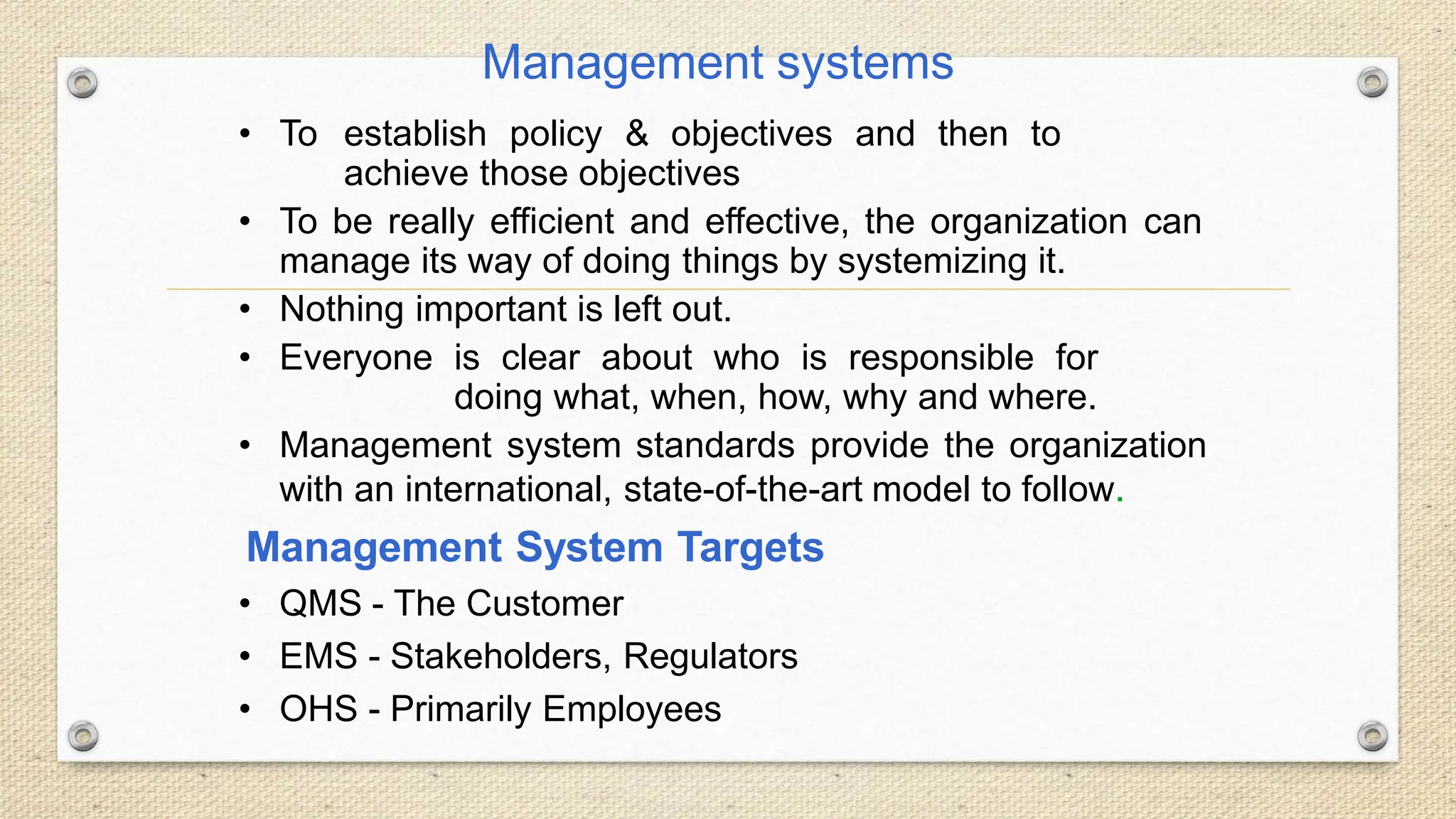
Management systems
• To establish policy & objectives and then to
achieve those objectives
• To be really efficient and effective, the organization can
manage its way of doing things by systemizing it.
• Nothing important is left out.
• Everyone is clear about who is responsible for
doing what, when, how, why and where.
• Management system standards provide the organization
with an international, state-of-the-art model to follow.
Management System Targets
• QMS - The Customer
• EMS - Stakeholders, Regulators
• OHS - Primarily Employees
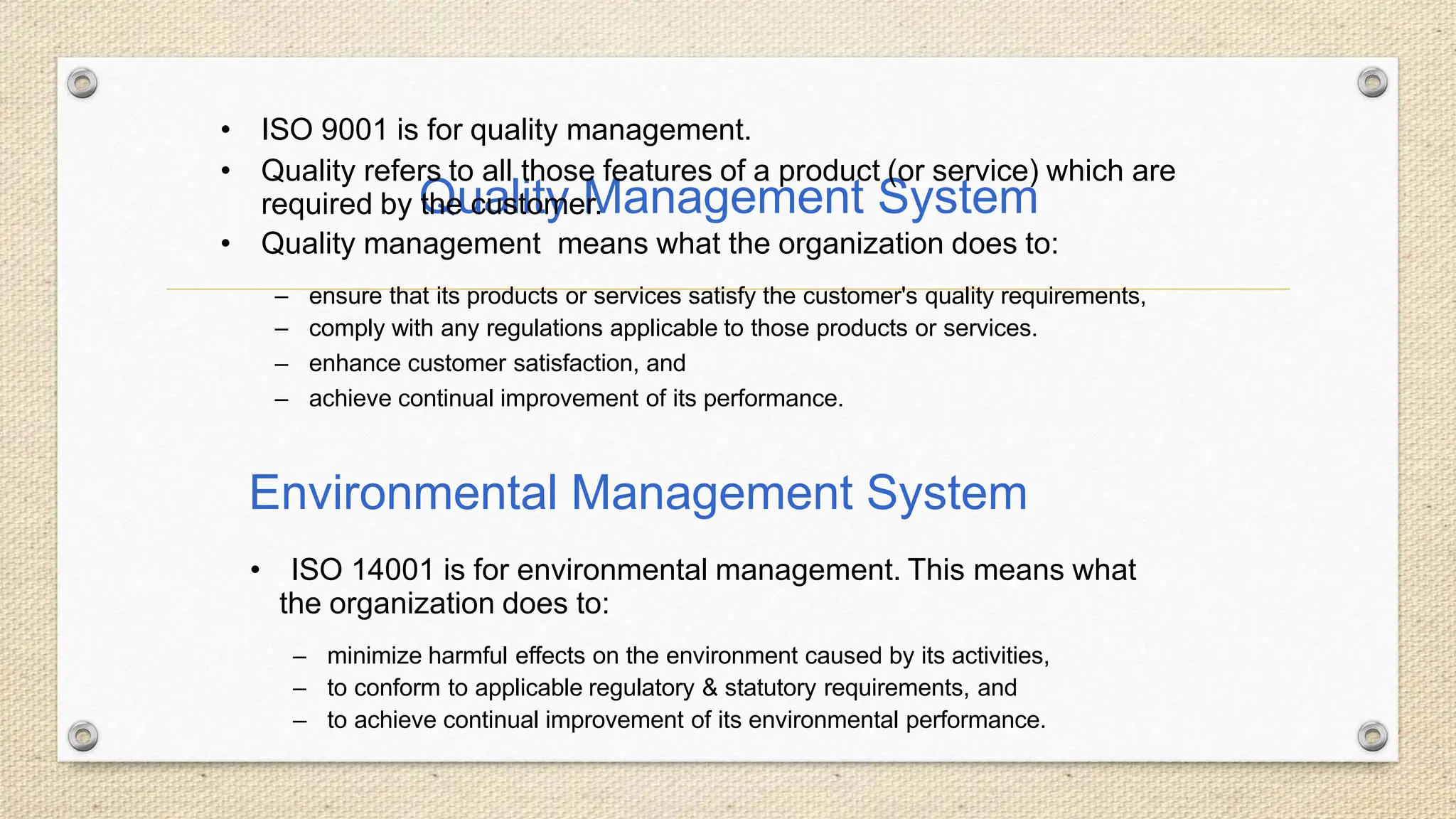
Quality Management System
• ISO 9001 is for quality management.
• Quality refers to all those features of a product (or service) which are
required by the customer.
• Quality management means what the organization does to:
– ensure that its products or services satisfy the customer's quality requirements,
– comply with any regulations applicable to those products or services.
– enhance customer satisfaction, and
– achieve continual improvement of its performance.
Environmental Management System
• ISO 14001 is for environmental management. This means what
the organization does to:
– minimize harmful effects on the environment caused by its activities,
– to conform to applicable regulatory & statutory requirements, and
– to achieve continual improvement of its environmental performance.
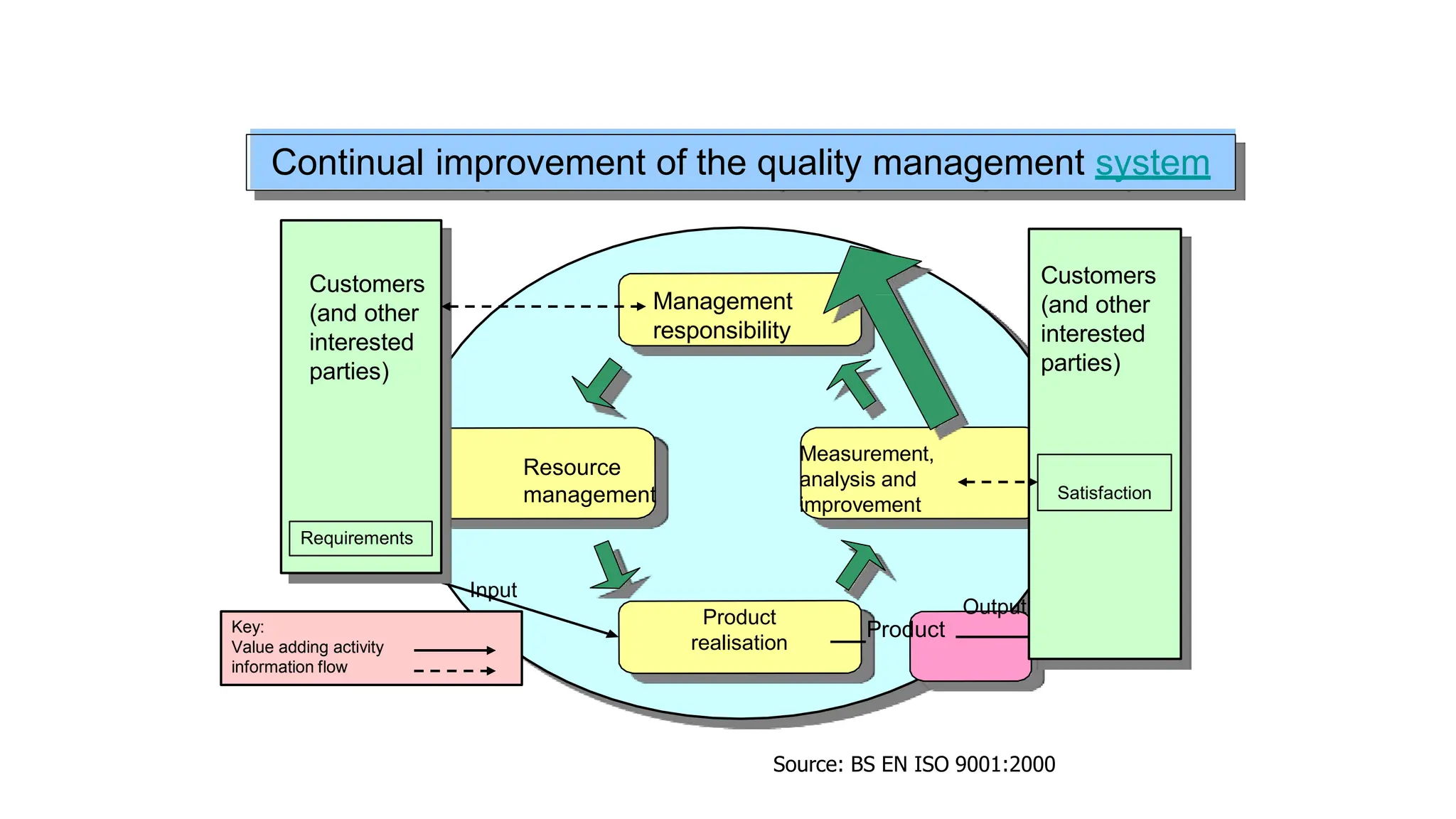
Product
Continual improvement of the quality management system
Customers
(and other
interested
parties)
Requirements
Management
responsibility
Resource
management
Measurement,
analysis and
improvement
Product
realisation
Output
Satisfaction
Input
Source: BS EN ISO 9001:2000
Key:
Value adding activity
information flow
Customers
(and other
interested
parties)
Continual improvement of the EHS management system
or Environment Policy
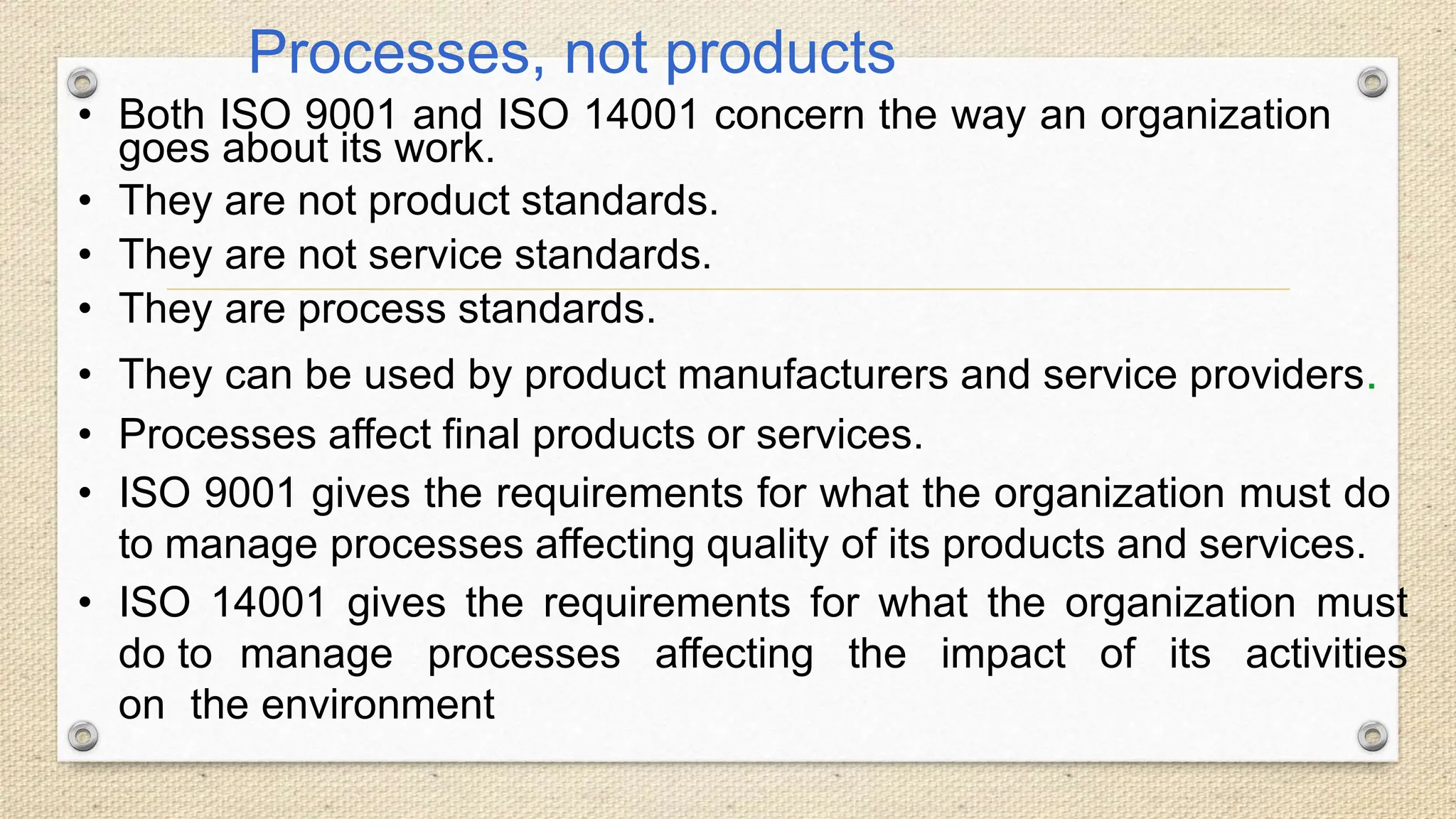
Processes, not products
• Both ISO 9001 and ISO 14001 concern the way an organization
goes about its work.
• They are not product standards.
• They are not service standards.
• They are process standards.
• They can be used by product manufacturers and service providers.
• Processes affect final products or services.
• ISO 9001 gives the requirements for what the organization must do
to manage processes affecting quality of its products and services.
• ISO 14001 gives the requirements for what the organization must
do to manage processes affecting the impact of its activities
on the environment
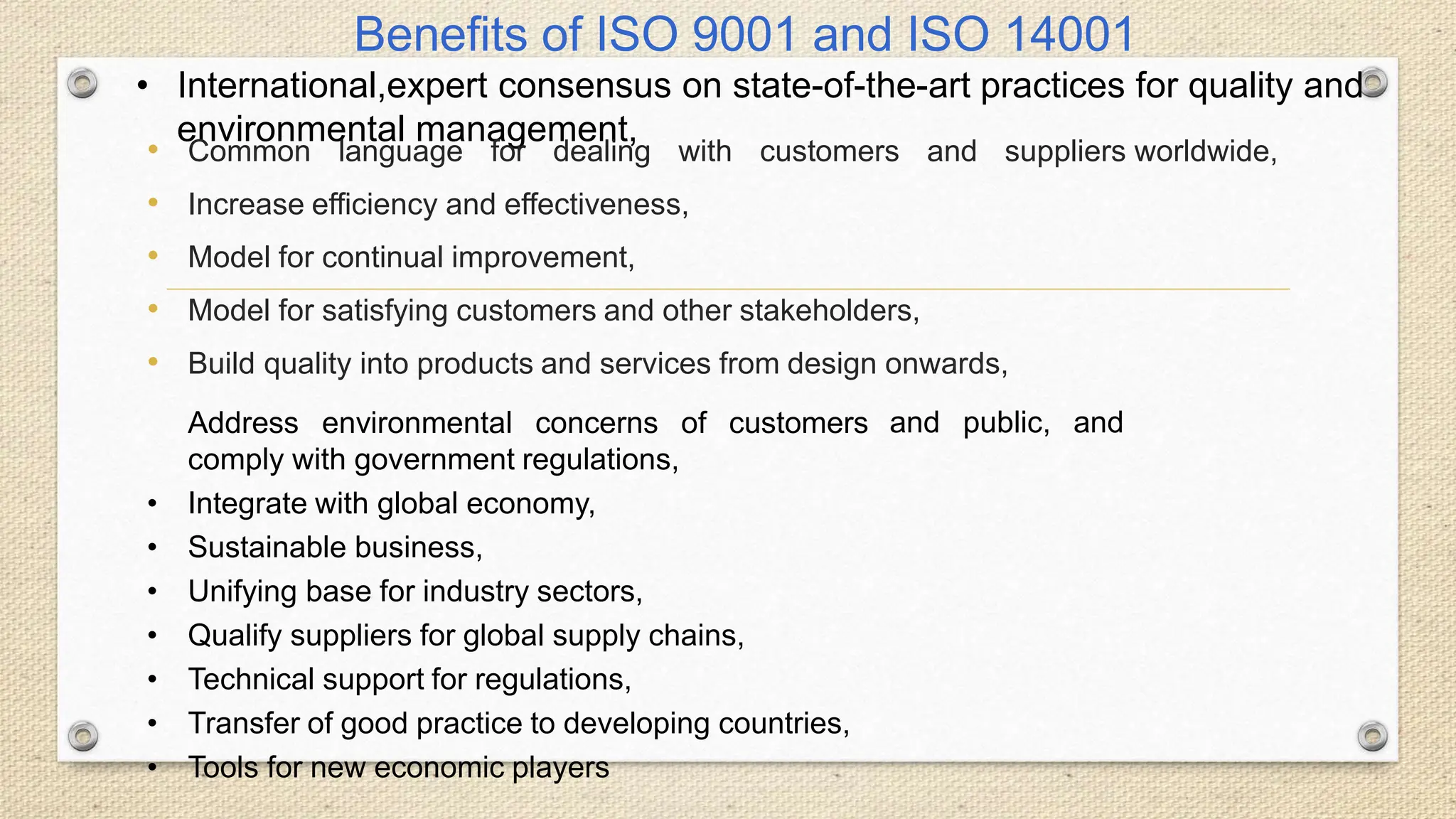
Benefits of ISO 9001 and ISO 14001
• International,expert consensus on state-of-the-art practices for quality and
environmental management,
• Common language for dealing with customers and suppliers worldwide,
• Increase efficiency and effectiveness,
• Model for continual improvement,
• Model for satisfying customers and other stakeholders,
• Build quality into products and services from design onwards,
Address environmental concerns of customers
comply with government regulations,
• Integrate with global economy,
• Sustainable business,
• Unifying base for industry sectors,
• Qualify suppliers for global supply chains,
• Technical support for regulations,
• Transfer of good practice to developing countries,
• Tools for new economic players
and public, and
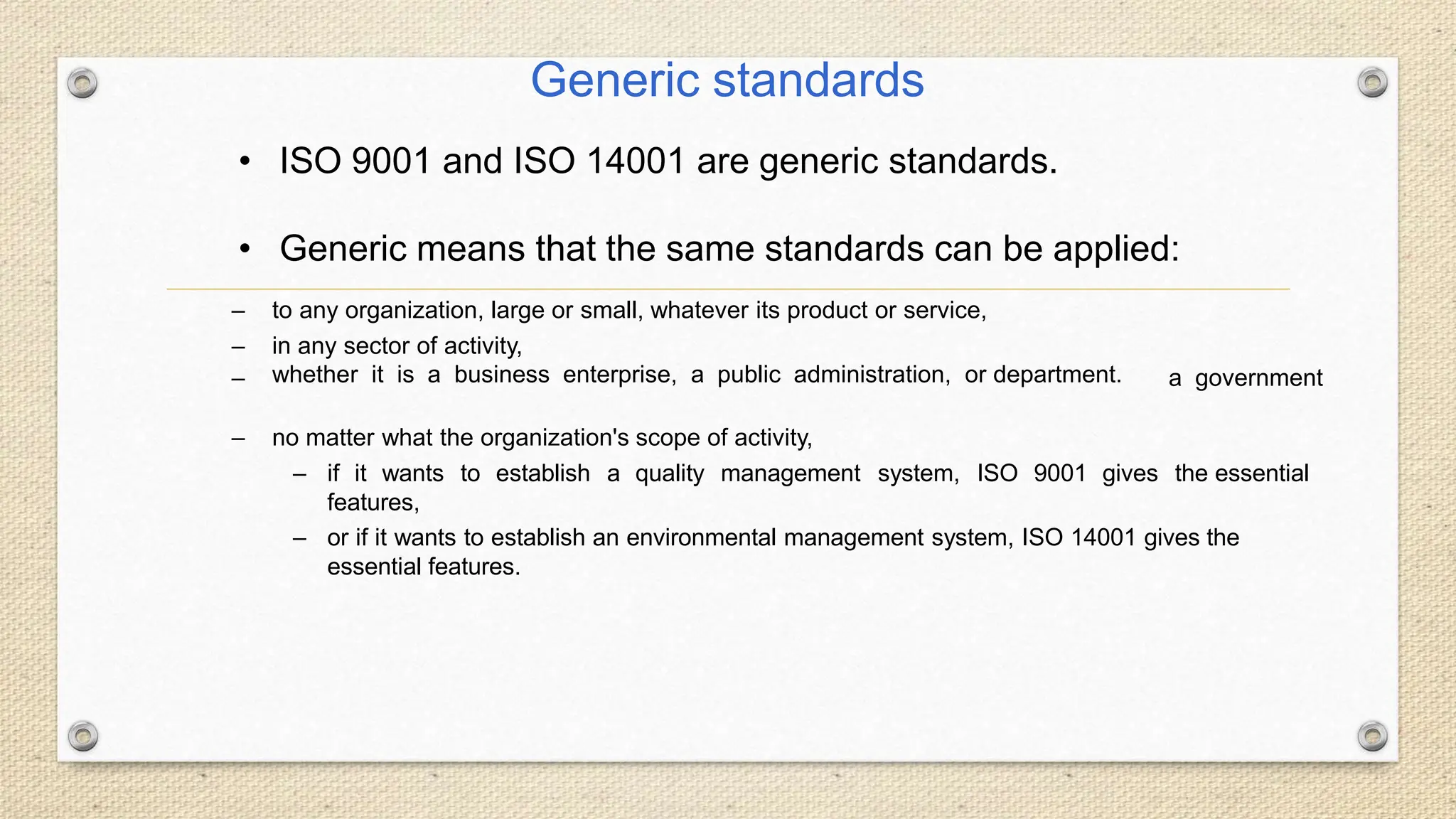
• ISO 9001 and ISO 14001 are generic standards.
• Generic means that the same standards can be applied:
– if it wants to establish a quality management system, ISO 9001 gives the essential
features,
– or if it wants to establish an environmental management system, ISO 14001 gives the
essential features.
Generic standards
– to any organization, large or small, whatever its product or service,
– in any sector of activity,
– whether it is a business enterprise, a public administration, or department. a government
– no matter what the organization's scope of activity,
ISO does not certify
• ISO does not carry out ISO 9001 or ISO 14001
certification.
• ISO does not issue certificates.
• ISO does not accredit, approve or control the
certification bodies.
Which Management Systems standards can be
integrated?
– ISO 9001 (Quality Management)
– ISO 14001 (Environmental Management)
– OHSAS 45001 (Occupational Health & Safety)
– ISO/IEC 27001 (Information Security)
– ISO 22000 (Food Safety)
– ISO/IEC 20000 (IT Service Management)
– ISO 50001 (Energy Management System)
There are no national or international standards for
integrated management systems.
Considerations for the Integrated Management Process
• The extent to which integration should occur.
• The political and cultural situation within the company.
• The levels of competence necessary.
• Legal and other regulatory requirements.
• Clear objectives for the integration project.
Why IMS
• Multiple/ overlapping organizations responsibilities to manage
different management systems.
• Multiple policy statements.
• Multiple management systems documentation (Apex or Systems
Manuals).
• Multiple operational control procedures in varying formats.
• Multiple task of record maintenance under each system.
• Multiple cadres of internal auditors and overlapping audit schedules.
• Multiple and frequent audits by external agencies.
• Overlapping of resources.
Why IMS
• Inconsistency/ multiple instructions at shop floor levels.
Increased cost due to overlapping of
external agency.
• Multi-focused/multi coordinated efforts
• Multiple internal communications
efforts/ audits by
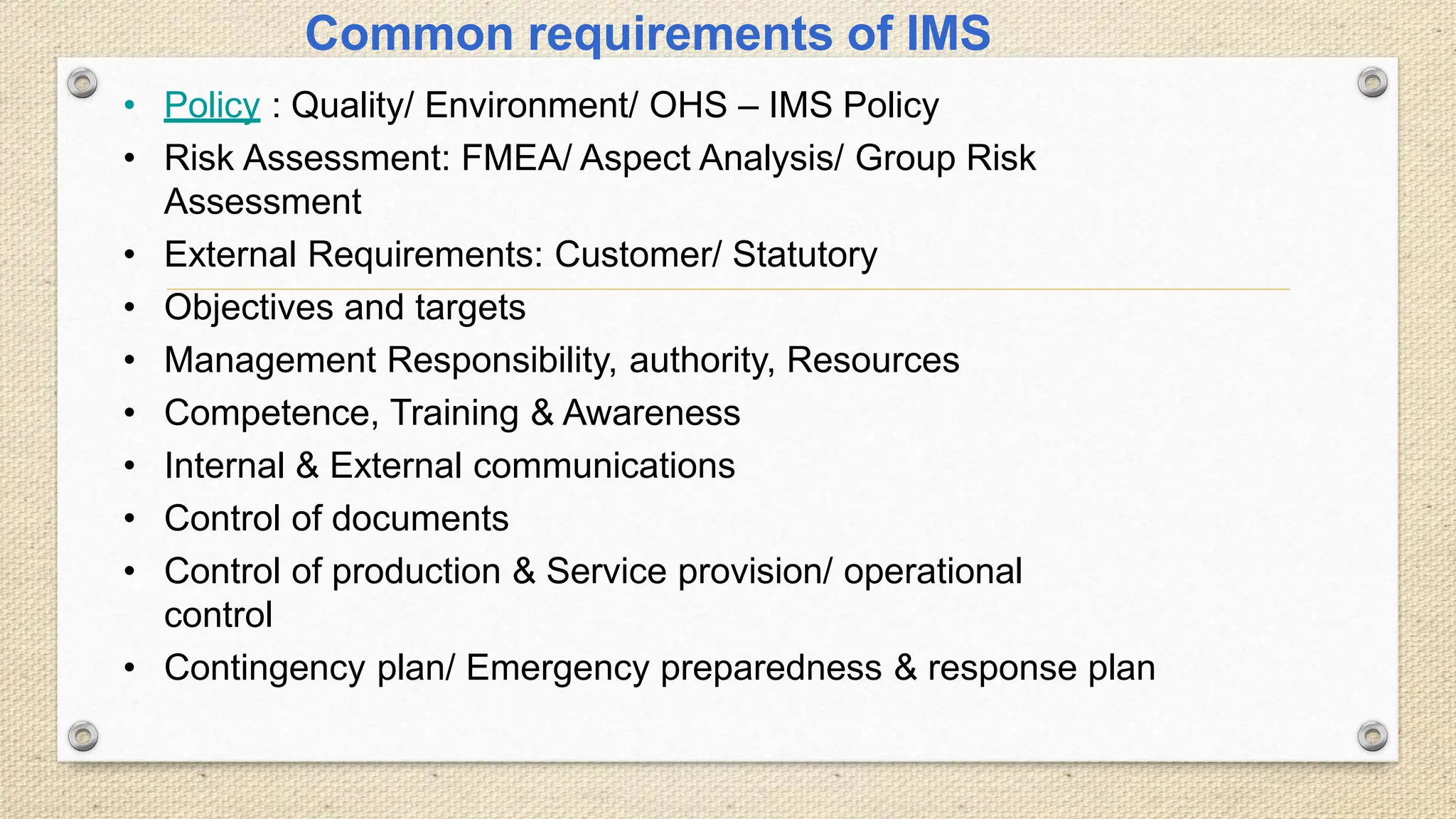
Common requirements of IMS
• Policy : Quality/ Environment/ OHS – IMS Policy
• Risk Assessment: FMEA/ Aspect Analysis/ Group Risk
Assessment
• External Requirements: Customer/ Statutory
• Objectives and targets
• Management Responsibility, authority, Resources
• Competence, Training & Awareness
• Internal & External communications
• Control of documents
• Control of production & Service provision/ operational
control
• Contingency plan/ Emergency preparedness & response plan
Common requirements of IMS
• Data Analysis / Monitoring &
Measurement
• Calibration of measuring equipments
• Corrective and preventive action
• Control of records
• Internal Audits
• Management Reviews
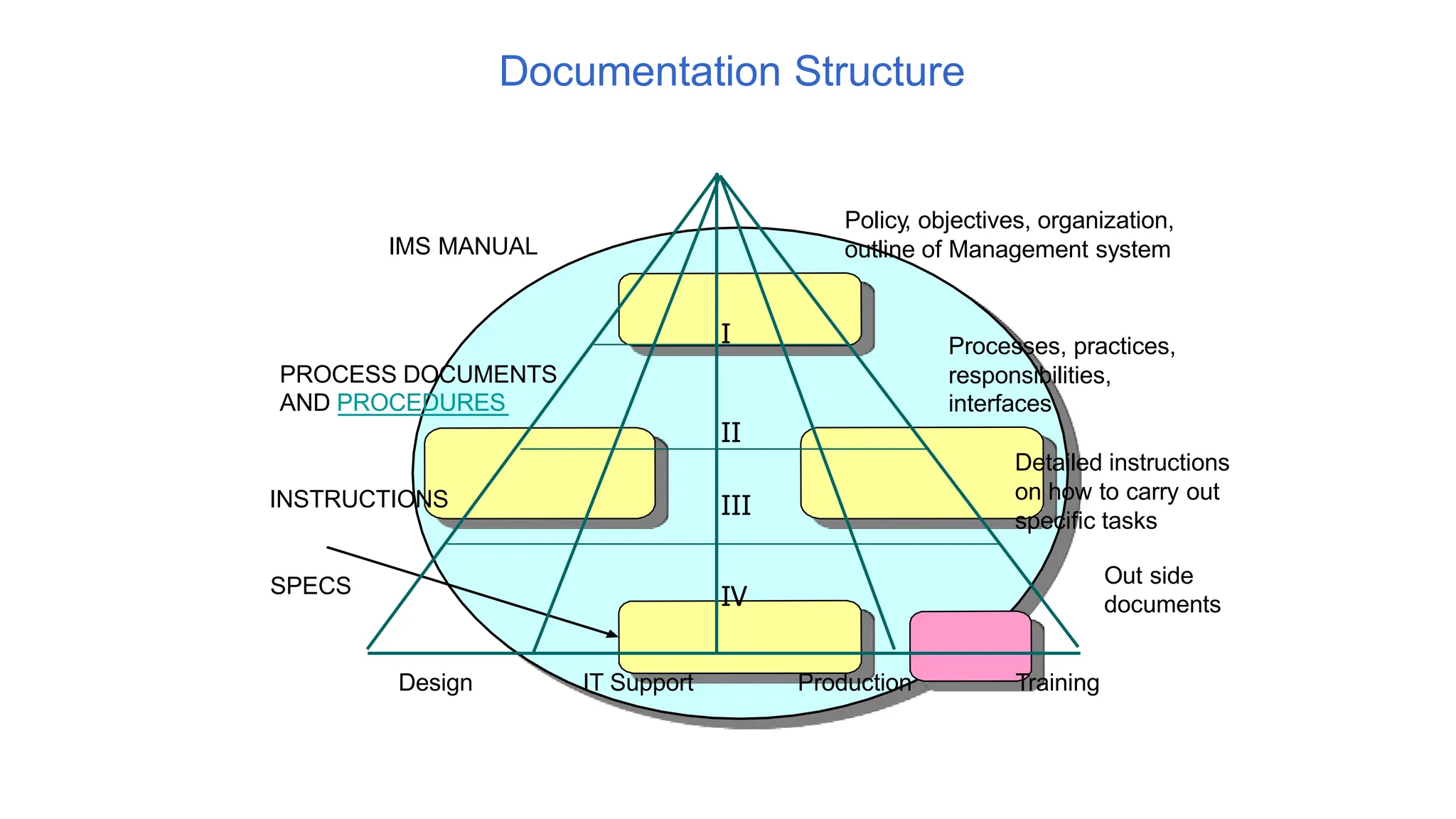
Documentation Structure
IMS MANUAL
Policy, objectives, organization,
outline of Management system
PROCESS DOCUMENTS
AND PROCEDURES
INSTRUCTIONS
Processes, practices,
responsibilities,
interfaces
Detailed instructions
on how to carry out
specific tasks
Out side
documents
Design IT Support Production Training
SPECS
II
I
III
IV
BENEFITS OF IMS
• Unified Policy statement
• Unified/ single management systems manual addressing the requirement
of ISO 9001, ISO 14001 and OHSAS 45001 in addition to organizational
needs.
• Unified/ single operational control procedures to cover all situations
which can result in deviation from the policy statement.
• A unified master list of objectives & targets and management programmes
• An integrated auditing competence (Internal Auditors equipped
with knowledge in competence to perform combine audits i.e. all
management systems at a time)
• Combined certification and audit programme from a single certification
agency.
xxxx is committed to produce xxxx with continual
improvements in their quality, while conserving resources,
protecting environment, providing safe and healthy working
conditions for its employees and complying with all the
legal requirements
INTEGRATED MANAGEMENT
SYSTEM POLICY

IClause by clause description of ISO 45001, ISO 14001and ISO 9001MS COMPREHENSIVE.pptx

  • 2.
  • 3.
    Management systems • Toestablish policy & objectives and then to achieve those objectives • To be really efficient and effective, the organization can manage its way of doing things by systemizing it. • Nothing important is left out. • Everyone is clear about who is responsible for doing what, when, how, why and where. • Management system standards provide the organization with an international, state-of-the-art model to follow. Management System Targets • QMS - The Customer • EMS - Stakeholders, Regulators • OHS - Primarily Employees
  • 4.
    Quality Management System •ISO 9001 is for quality management. • Quality refers to all those features of a product (or service) which are required by the customer. • Quality management means what the organization does to: – ensure that its products or services satisfy the customer's quality requirements, – comply with any regulations applicable to those products or services. – enhance customer satisfaction, and – achieve continual improvement of its performance. Environmental Management System • ISO 14001 is for environmental management. This means what the organization does to: – minimize harmful effects on the environment caused by its activities, – to conform to applicable regulatory & statutory requirements, and – to achieve continual improvement of its environmental performance.
  • 5.
    Product Continual improvement ofthe quality management system Customers (and other interested parties) Requirements Management responsibility Resource management Measurement, analysis and improvement Product realisation Output Satisfaction Input Source: BS EN ISO 9001:2000 Key: Value adding activity information flow Customers (and other interested parties)
  • 6.
    Continual improvement ofthe EHS management system or Environment Policy
  • 7.
    Processes, not products •Both ISO 9001 and ISO 14001 concern the way an organization goes about its work. • They are not product standards. • They are not service standards. • They are process standards. • They can be used by product manufacturers and service providers. • Processes affect final products or services. • ISO 9001 gives the requirements for what the organization must do to manage processes affecting quality of its products and services. • ISO 14001 gives the requirements for what the organization must do to manage processes affecting the impact of its activities on the environment
  • 8.
    Benefits of ISO9001 and ISO 14001 • International,expert consensus on state-of-the-art practices for quality and environmental management, • Common language for dealing with customers and suppliers worldwide, • Increase efficiency and effectiveness, • Model for continual improvement, • Model for satisfying customers and other stakeholders, • Build quality into products and services from design onwards, Address environmental concerns of customers comply with government regulations, • Integrate with global economy, • Sustainable business, • Unifying base for industry sectors, • Qualify suppliers for global supply chains, • Technical support for regulations, • Transfer of good practice to developing countries, • Tools for new economic players and public, and
  • 9.
    • ISO 9001and ISO 14001 are generic standards. • Generic means that the same standards can be applied: – if it wants to establish a quality management system, ISO 9001 gives the essential features, – or if it wants to establish an environmental management system, ISO 14001 gives the essential features. Generic standards – to any organization, large or small, whatever its product or service, – in any sector of activity, – whether it is a business enterprise, a public administration, or department. a government – no matter what the organization's scope of activity,
  • 10.
    ISO does notcertify • ISO does not carry out ISO 9001 or ISO 14001 certification. • ISO does not issue certificates. • ISO does not accredit, approve or control the certification bodies.
  • 11.
    Which Management Systemsstandards can be integrated? – ISO 9001 (Quality Management) – ISO 14001 (Environmental Management) – OHSAS 45001 (Occupational Health & Safety) – ISO/IEC 27001 (Information Security) – ISO 22000 (Food Safety) – ISO/IEC 20000 (IT Service Management) – ISO 50001 (Energy Management System) There are no national or international standards for integrated management systems.
  • 12.
    Considerations for theIntegrated Management Process • The extent to which integration should occur. • The political and cultural situation within the company. • The levels of competence necessary. • Legal and other regulatory requirements. • Clear objectives for the integration project.
  • 13.
    Why IMS • Multiple/overlapping organizations responsibilities to manage different management systems. • Multiple policy statements. • Multiple management systems documentation (Apex or Systems Manuals). • Multiple operational control procedures in varying formats. • Multiple task of record maintenance under each system. • Multiple cadres of internal auditors and overlapping audit schedules. • Multiple and frequent audits by external agencies. • Overlapping of resources.
  • 14.
    Why IMS • Inconsistency/multiple instructions at shop floor levels. Increased cost due to overlapping of external agency. • Multi-focused/multi coordinated efforts • Multiple internal communications efforts/ audits by
  • 15.
    Common requirements ofIMS • Policy : Quality/ Environment/ OHS – IMS Policy • Risk Assessment: FMEA/ Aspect Analysis/ Group Risk Assessment • External Requirements: Customer/ Statutory • Objectives and targets • Management Responsibility, authority, Resources • Competence, Training & Awareness • Internal & External communications • Control of documents • Control of production & Service provision/ operational control • Contingency plan/ Emergency preparedness & response plan
  • 16.
    Common requirements ofIMS • Data Analysis / Monitoring & Measurement • Calibration of measuring equipments • Corrective and preventive action • Control of records • Internal Audits • Management Reviews
  • 17.
    Documentation Structure IMS MANUAL Policy,objectives, organization, outline of Management system PROCESS DOCUMENTS AND PROCEDURES INSTRUCTIONS Processes, practices, responsibilities, interfaces Detailed instructions on how to carry out specific tasks Out side documents Design IT Support Production Training SPECS II I III IV
  • 18.
    BENEFITS OF IMS •Unified Policy statement • Unified/ single management systems manual addressing the requirement of ISO 9001, ISO 14001 and OHSAS 45001 in addition to organizational needs. • Unified/ single operational control procedures to cover all situations which can result in deviation from the policy statement. • A unified master list of objectives & targets and management programmes • An integrated auditing competence (Internal Auditors equipped with knowledge in competence to perform combine audits i.e. all management systems at a time) • Combined certification and audit programme from a single certification agency.
  • 19.
    xxxx is committedto produce xxxx with continual improvements in their quality, while conserving resources, protecting environment, providing safe and healthy working conditions for its employees and complying with all the legal requirements INTEGRATED MANAGEMENT SYSTEM POLICY