Organic Chemistry (II)
(Code: PE 213)
Instructor: Dr.Ehssan Nassef
e-mail: Ehssan.Nassef@Pua.edu.org.
Office Hours: Monday 1:30-3:30
Pharos University in Alexandria
Faculty of Engineering.
Petrochemical Department
Hydrocarbons
• Hydrocarbons can be classified to:
• Aliphatic Hydrocarbons (Alkane,Alkene and
alkynes) Organic I
• Alyciclic Hydrocarbons.
• Aromatic Hydrocarbons. Organic II
Aliphatic Hydrocarbons
Aromatic Hydrocarbons
5
The Term Aromatic
Arenes and Aromaticity
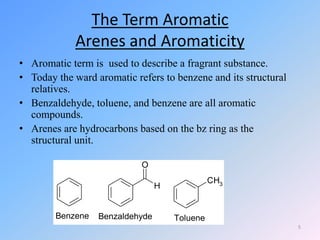
• Aromatic term is used to describe a fragrant substance.
• Today the ward aromatic refers to benzene and its structural
relatives.
• Benzaldehyde, toluene, and benzene are all aromatic
compounds.
• Arenes are hydrocarbons based on the bz ring as the
structural unit.
H
O
CH3
Benzene Benzaldehyde Toluene
6
Structure and Stability of Benzene
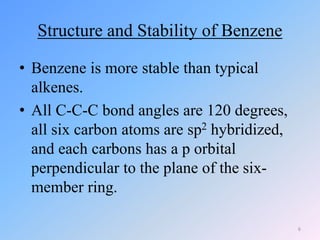
• Benzene is more stable than typical
alkenes.
• All C-C-C bond angles are 120 degrees,
all six carbon atoms are sp2 hybridized,
and each carbons has a p orbital
perpendicular to the plane of the six-
member ring.
7
We can see why benzene is stable:
According to resonance theory , the more
resonance forms a substance has ,the more
stable it is.
Benzene with two resonance forms of equal
energy ,is therefore more stable and less reactive
than alkene.
Structure of benzene
(The kekule Proposal)
• August Kekule proposed that:
1- benzene contains a ring of carbon atoms and
can be formulated as cyclohexa-1,3,5-triene.
2- Benzene is a planner structure.
 BUT the proposal failed in explaining :
1- why benzene is uncreative compared to
alkene.
2- why does benzene give a substitution product
rather than an addation product on reaction with
broumine(Br2)
9
Bonds of Benzene Rings
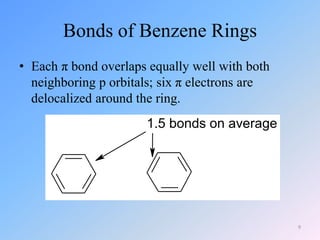
• Each π bond overlaps equally well with both
neighboring p orbitals; six π electrons are
delocalized around the ring.
1.5 bonds on average
10
Molecular Orbital Description of
Benzene
• Planar molecule with
the shape of a regular
hexagon.
• All C-C-C bond angles
are 120 degrees
• All six carbons are sp2
hybridized.
• Each carbon atom has a
p orbital perpendicular
to the plane of the six-
membered ring.
• All six carbon atoms and
six p orbitals in benzene
are equivalent.
11
The resonance Proposal of benzene
and the orbital structure
The six pi electrons are completely delocalized
around the ring.
12
Let’s review…
• Benzene is a cyclic conjugated molecule
• It is unusually stable, with a heat of hydrogenation of -
206 kJ/mol
• It is planar with the shape of a regular hexagon; bond
angles 120
• It undergoes substitution reactions that retain the
cyclic conjugation
• It is a resonance hybrid
• Generally less dense than water
• Insoluble in water but soluble in many organic
solvents
13
The Huckel 4n + 2 Rule
To be aromatic, the molecule must also follow the
Huckel 4n + 2 rule:
A molecule must have 4n + 2 pi electrons
where n is an integer
(0, 1, 2, 3, etc…).
The number of pi electrons must be odd.
14
Preparation
of Benzene
15
1. Destructive Distillation of Coal
• Gives coal gas, ammoniacal liquor, coal tar
and coke as products
• The coal tar produced is a mixture of many
organic compounds (mainly aromatic ones)
• benzene and methylbenzene can be
obtained by fractional distillation
New Way Chemistry for Hong Kong A-Level
3A
16
1. Destructive Distillation of Coal
A laboratory
set-up of the
destructive
distillation of
coal
17
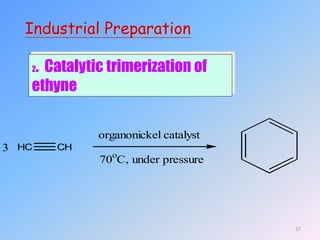
Industrial Preparation
2. Catalytic trimerization of
ethyne
HC CH
3
organonickel catalyst
70o
C, under pressure
18
Industrial Preparation
3. Catalytic Reforming of Petroleum
• Converts alkanes and cycloalkanes into
aromatic hydrocarbons
C6H14  C6H6 + 4H2
500 oC, 10 – 20
atm
Pt
19
Laboratory Synthesis
1. Decarboxylation of Sodium Salt of Benzoic
Acid
• When sodium benzoate is fused with sodium
hydroxide
 the carboxylate group is removed
20
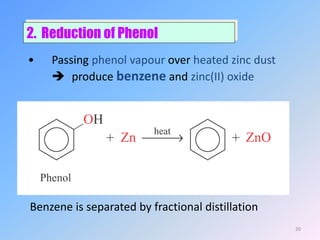
2. Reduction of Phenol
• Passing phenol vapour over heated zinc dust
 produce benzene and zinc(II) oxide
Benzene is separated by fractional distillation

lect 2.pptx

  • 1.
    Organic Chemistry (II) (Code:PE 213) Instructor: Dr.Ehssan Nassef e-mail: Ehssan.Nassef@Pua.edu.org. Office Hours: Monday 1:30-3:30 Pharos University in Alexandria Faculty of Engineering. Petrochemical Department
  • 2.
    Hydrocarbons • Hydrocarbons canbe classified to: • Aliphatic Hydrocarbons (Alkane,Alkene and alkynes) Organic I • Alyciclic Hydrocarbons. • Aromatic Hydrocarbons. Organic II
  • 3.
  • 4.
  • 5.
    5 The Term Aromatic Arenesand Aromaticity • Aromatic term is used to describe a fragrant substance. • Today the ward aromatic refers to benzene and its structural relatives. • Benzaldehyde, toluene, and benzene are all aromatic compounds. • Arenes are hydrocarbons based on the bz ring as the structural unit. H O CH3 Benzene Benzaldehyde Toluene
  • 6.
    6 Structure and Stabilityof Benzene • Benzene is more stable than typical alkenes. • All C-C-C bond angles are 120 degrees, all six carbon atoms are sp2 hybridized, and each carbons has a p orbital perpendicular to the plane of the six- member ring.
  • 7.
    7 We can seewhy benzene is stable: According to resonance theory , the more resonance forms a substance has ,the more stable it is. Benzene with two resonance forms of equal energy ,is therefore more stable and less reactive than alkene.
  • 8.
    Structure of benzene (Thekekule Proposal) • August Kekule proposed that: 1- benzene contains a ring of carbon atoms and can be formulated as cyclohexa-1,3,5-triene. 2- Benzene is a planner structure.  BUT the proposal failed in explaining : 1- why benzene is uncreative compared to alkene. 2- why does benzene give a substitution product rather than an addation product on reaction with broumine(Br2)
  • 9.
    9 Bonds of BenzeneRings • Each π bond overlaps equally well with both neighboring p orbitals; six π electrons are delocalized around the ring. 1.5 bonds on average
  • 10.
    10 Molecular Orbital Descriptionof Benzene • Planar molecule with the shape of a regular hexagon. • All C-C-C bond angles are 120 degrees • All six carbons are sp2 hybridized. • Each carbon atom has a p orbital perpendicular to the plane of the six- membered ring. • All six carbon atoms and six p orbitals in benzene are equivalent.
  • 11.
    11 The resonance Proposalof benzene and the orbital structure The six pi electrons are completely delocalized around the ring.
  • 12.
    12 Let’s review… • Benzeneis a cyclic conjugated molecule • It is unusually stable, with a heat of hydrogenation of - 206 kJ/mol • It is planar with the shape of a regular hexagon; bond angles 120 • It undergoes substitution reactions that retain the cyclic conjugation • It is a resonance hybrid • Generally less dense than water • Insoluble in water but soluble in many organic solvents
  • 13.
    13 The Huckel 4n+ 2 Rule To be aromatic, the molecule must also follow the Huckel 4n + 2 rule: A molecule must have 4n + 2 pi electrons where n is an integer (0, 1, 2, 3, etc…). The number of pi electrons must be odd.
  • 14.
  • 15.
    15 1. Destructive Distillationof Coal • Gives coal gas, ammoniacal liquor, coal tar and coke as products • The coal tar produced is a mixture of many organic compounds (mainly aromatic ones) • benzene and methylbenzene can be obtained by fractional distillation
  • 16.
    New Way Chemistryfor Hong Kong A-Level 3A 16 1. Destructive Distillation of Coal A laboratory set-up of the destructive distillation of coal
  • 17.
    17 Industrial Preparation 2. Catalytictrimerization of ethyne HC CH 3 organonickel catalyst 70o C, under pressure
  • 18.
    18 Industrial Preparation 3. CatalyticReforming of Petroleum • Converts alkanes and cycloalkanes into aromatic hydrocarbons C6H14  C6H6 + 4H2 500 oC, 10 – 20 atm Pt
  • 19.
    19 Laboratory Synthesis 1. Decarboxylationof Sodium Salt of Benzoic Acid • When sodium benzoate is fused with sodium hydroxide  the carboxylate group is removed
  • 20.
    20 2. Reduction ofPhenol • Passing phenol vapour over heated zinc dust  produce benzene and zinc(II) oxide Benzene is separated by fractional distillation

Editor's Notes