Has the battle been settled?
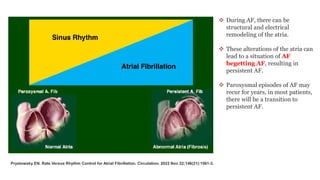
❖ During AF, there can be
structural and electrical
remodeling of the atria.
❖ These alterations of the atria can
lead to a situation of AF
begetting AF, resulting in
persistent AF.
❖ Paroxysmal episodes of AF may
recur for years, in most patients,
there will be a transition to
persistent AF.
Prystowsky EN. Rate Versus Rhythm Control for Atrial Fibrillation. Circulation. 2022 Nov 22;146(21):1561-3.
Contemporary Summary of the Role of ANS in AF
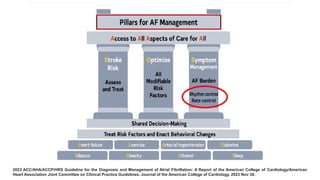
2023 ACC/AHA/ACCP/HRS Guideline for the Diagnosis and Management of Atrial Fibrillation: A Report of the American College of Cardiology/American
Heart Association Joint Committee on Clinical Practice Guidelines. Journal of the American College of Cardiology. 2023 Nov 30.
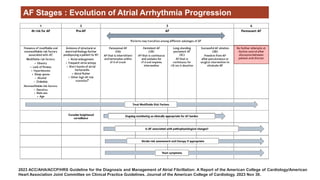
AF Stages : Evolution of Atrial Arrhythmia Progression
2023 ACC/AHA/ACCP/HRS Guideline for the Diagnosis and Management of Atrial Fibrillation: A Report of the American College of Cardiology/American
Heart Association Joint Committee on Clinical Practice Guidelines. Journal of the American College of Cardiology. 2023 Nov 30.
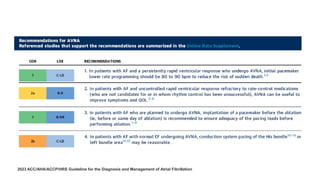
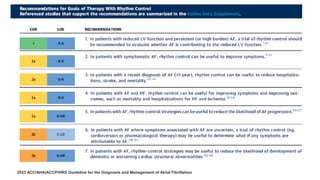
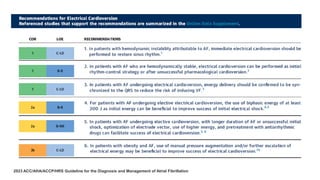
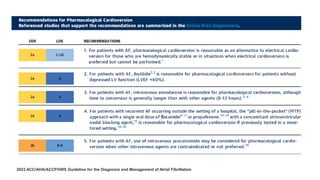
2023 ACC/AHA/ACCP/HRS Guideline for the Diagnosis and Management of Atrial Fibrillation: A Report of the American College of Cardiology/American
Heart Association Joint Committee on Clinical Practice Guidelines. Journal of the American College of Cardiology. 2023 Nov 30.
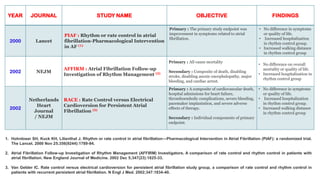
YEAR JOURNAL STUDY NAME OBJECTIVE FINDINGS
2000 Lancet
PIAF : Rhythm or rate control in atrial
fibrillation-Pharmacological Intervention
in AF (1)
Primary : The primary study endpoint was
improvement in symptoms related to atrial
fibrillation.
• No difference in symptoms
or quality of life.
• Increased hospitalization
in rhythm control group.
• Increased walking distance
in rhythm control group
2002 NEJM
AFFIRM : Atrial Fibrillation Follow-up
Investigation of Rhythm Management (2)
Primary : All-cause mortality
Secondary : Composite of death, disabling
stroke, disabling anoxic encephalopathy, major
bleeding, and cardiac arrest.
• No difference on overall
mortality or quality of life.
• Increased hospitalization in
rhythm control group
2002
Netherlands
Heart
Journal
/ NEJM
RACE : Rate Control versus Electrical
Cardioversion for Persistent Atrial
Fibrillation (3)
Primary : A composite of cardiovascular death,
hospital admissions for heart failure,
thromboembolic complications, severe bleeding,
pacemaker implantation, and severe adverse
effects of therapy.
Secondary : Individual components of primary
endpoint.
• No difference in symptoms
or quality of life.
• Increased hospitalization
in rhythm control group.
• Increased walking distance
in rhythm control group
1. Hohnloser SH, Kuck KH, Lilienthal J. Rhythm or rate control in atrial fibrillation—Pharmacological Intervention in Atrial Fibrillation (PIAF): a randomized trial.
The Lancet. 2000 Nov 25;356(9244):1789-94.
2. Atrial Fibrillation Follow-up Investigation of Rhythm Management (AFFIRM) Investigators. A comparison of rate control and rhythm control in patients with
atrial fibrillation. New England Journal of Medicine. 2002 Dec 5;347(23):1825-33.
3. Van Gelder IC. Rate control versus electrical cardioversion for persistent atrial fibrillation study group, a comparison of rate control and rhythm control in
patients with recurrent persistent atrial fibrillation. N Engl J Med. 2002;347:1834-40.
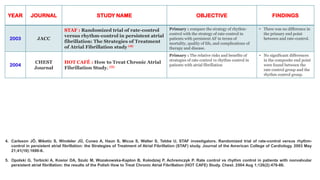
YEAR JOURNAL STUDY NAME OBJECTIVE FINDINGS
2003 JACC
STAF : Randomized trial of rate-control
versus rhythm-control in persistent atrial
fibrillation: The Strategies of Treatment
of Atrial Fibrillation study (4)
Primary : compare the strategy of rhythm-
control with the strategy of rate-control in
patients with persistent AF in terms of
mortality, quality of life, and complications of
therapy and disease.
• There was no difference in
the primary end point
between and rate-control.
2004
CHEST
Journal
HOT CAFÉ : How to Treat Chronic Atrial
Fibrillation Study. (5)
Primary : The relative risks and benefits of
strategies of rate control vs rhythm control in
patients with atrial fibrillation
• No significant differences
in the composite end point
were found between the
rate control group and the
rhythm control group.
4. Carlsson JÖ, Miketic S, Windeler JÜ, Cuneo A, Haun S, Micus S, Walter S, Tebbe U, STAF investigators. Randomized trial of rate-control versus rhythm-
control in persistent atrial fibrillation: the Strategies of Treatment of Atrial Fibrillation (STAF) study. Journal of the American College of Cardiology. 2003 May
21;41(10):1690-6.
5. Opolski G, Torbicki A, Kosior DA, Szulc M, Wozakowska-Kapłon B, Kołodziej P, Achremczyk P. Rate control vs rhythm control in patients with nonvalvular
persistent atrial fibrillation: the results of the Polish How to Treat Chronic Atrial Fibrillation (HOT CAFE) Study. Chest. 2004 Aug 1;126(2):476-86.
YEAR JOURNAL STUDY NAME OBJECTIVE FINDINGS
2005
European
Heart
Journal
Rate-control vs. rhythm-control in
patients with atrial fibrillation: A Meta-
Analysis
• RACE
• AFFIRM
• PIAF
• STAF
• HOT CAFÉ
Systematically assess the risk/benefit
ratio of a rate-control strategy vs. a
rhythm-control strategy in patients with
first or recurrent atrial fibrillation (AF)
• 5239 patients with AF
compared rate-control vs.
rhythm-control.
• Average follow-up ranged
from 1 to 3.5 years.
• A rate-control strategy
compared with a rhythm-
control approach was
associated with a
significantly reduced risk
of CEP [OR 0.84 (0.73,
0.98), P ¼ 0.02], and with
a trend towards a reduced
risk of death [OR 0.87
(0.74, 1.02), P ¼ 0.09]
and thromboembolic
stroke [OR 0.80 (0.6,
1.07), P ¼ 0.14].
• There was no significant
difference in the risk of
major bleeds [OR 1.14
(0.9, 1.45), P ¼ 0.28] and
systemic embolism [OR
0.93 (0.43, 2.02), P ¼
0.90].
Testa L, Biondi-Zoccai GG, Russo AD, Bellocci F, Andreotti F, Crea F. Rate-control vs. rhythm-control in patients with atrial fibrillation: a meta-analysis.
European heart journal. 2005 Oct 1;26(19):2000-6.
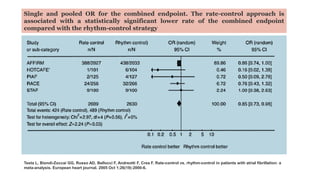
Single and pooled OR for the combined endpoint. The rate-control approach is
associated with a statistically significant lower rate of the combined endpoint
compared with the rhythm-control strategy
Testa L, Biondi-Zoccai GG, Russo AD, Bellocci F, Andreotti F, Crea F. Rate-control vs. rhythm-control in patients with atrial fibrillation: a
meta-analysis. European heart journal. 2005 Oct 1;26(19):2000-6.
YEAR JOURNAL STUDY NAME OBJECTIVE FINDINGS
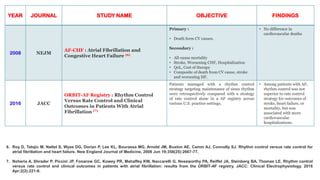
2008 NEJM
AF-CHF : Atrial Fibrillation and
Congestive Heart Failure (6)
Primary :
• Death form CV causes.
Secondary :
• All-cause mortality
• Stroke, Worsening CHF, Hospitalization
• QoL, Cost of therapy
• Composite of death from CV cause, stroke
and worsening HF.
• No difference in
cardiovascular deaths
2016 JACC
ORBIT-AF Registry : Rhythm Control
Versus Rate Control and Clinical
Outcomes in Patients With Atrial
Fibrillation (7)
Patients managed with a rhythm control
strategy targeting maintenance of sinus rhythm
were retrospectively compared with a strategy
of rate control alone in a AF registry across
various U.S. practice settings.
• Among patients with AF,
rhythm control was not
superior to rate control
strategy for outcomes of
stroke, heart failure, or
mortality, but was
associated with more
cardiovascular
hospitalizations.
6. Roy D, Talajic M, Nattel S, Wyse DG, Dorian P, Lee KL, Bourassa MG, Arnold JM, Buxton AE, Camm AJ, Connolly SJ. Rhythm control versus rate control for
atrial fibrillation and heart failure. New England Journal of Medicine. 2008 Jun 19;358(25):2667-77.
7. Noheria A, Shrader P, Piccini JP, Fonarow GC, Kowey PR, Mahaffey KW, Naccarelli G, Noseworthy PA, Reiffel JA, Steinberg BA, Thomas LE. Rhythm control
versus rate control and clinical outcomes in patients with atrial fibrillation: results from the ORBIT-AF registry. JACC: Clinical Electrophysiology. 2016
Apr;2(2):221-9.
YEAR JOURNAL STUDY NAME OBJECTIVE FINDINGS
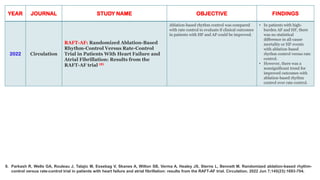
2022 Circulation
RAFT-AF: Randomized Ablation-Based
Rhythm-Control Versus Rate-Control
Trial in Patients With Heart Failure and
Atrial Fibrillation: Results from the
RAFT-AF trial (8)
Ablation-based rhythm control was compared
with rate control to evaluate if clinical outcomes
in patients with HF and AF could be improved.
• In patients with high-
burden AF and HF, there
was no statistical
difference in all-cause
mortality or HF events
with ablation-based
rhythm control versus rate
control.
• However, there was a
nonsignificant trend for
improved outcomes with
ablation-based rhythm
control over rate control.
8. Parkash R, Wells GA, Rouleau J, Talajic M, Essebag V, Skanes A, Wilton SB, Verma A, Healey JS, Sterns L, Bennett M. Randomized ablation-based rhythm-
control versus rate-control trial in patients with heart failure and atrial fibrillation: results from the RAFT-AF trial. Circulation. 2022 Jun 7;145(23):1693-704.
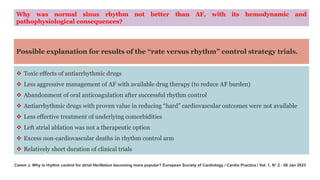
Why was normal sinus rhythm not better than AF, with its hemodynamic and
pathophysiological consequences?
Possible explanation for results of the “rate versus rhythm” control strategy trials.
❖ Toxic effects of antiarrhythmic drugs
❖ Less aggressive management of AF with available drug therapy (to reduce AF burden)
❖ Abandonment of oral anticoagulation after successful rhythm control
❖ Antiarrhythmic drugs with proven value in reducing “hard” cardiovascular outcomes were not available
❖ Less effective treatment of underlying comorbidities
❖ Left atrial ablation was not a therapeutic option
❖ Excess non-cardiovascular deaths in rhythm control arm
❖ Relatively short duration of clinical trials
Camm J. Why is rhythm control for atrial fibrillation becoming more popular? European Society of Cardiology / Cardio Practice / Vol. 1, N° 2 - 06 Jan 2023
YEAR JOURNAL STUDY NAME OBJECTIVE FINDINGS
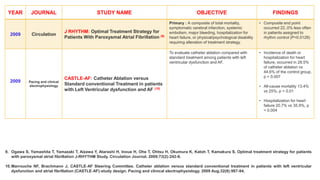
2009 Circulation
J RHYTHM: Optimal Treatment Strategy for
Patients With Paroxysmal Atrial Fibrillation (9)
Primary : A composite of total mortality,
symptomatic cerebral infarction, systemic
embolism, major bleeding, hospitalization for
heart failure, or physical/psychological disability
requiring alteration of treatment strategy.
• Composite end point
occurred 22..0% less often
in patients assigned to
rhythm control (P=0.0128)
2009 Pacing and clinical
electrophysiology
CASTLE-AF: Catheter Ablation versus
Standard conventional Treatment in patients
with Left Ventricular dysfunction and AF (10)
To evaluate catheter ablation compared with
standard treatment among patients with left
ventricular dysfunction and AF.
• Incidence of death or
hospitalization for heart
failure, occurred in 28.5%
of catheter ablation vs
44.6% of the control group,
p = 0.007
• All-cause mortality 13.4%
vs 25%, p = 0.01
• Hospitalization for heart
failure 20.7% vs 35.9%, p
= 0.004
9. Ogawa S, Yamashita T, Yamazaki T, Aizawa Y, Atarashi H, Inoue H, Ohe T, Ohtsu H, Okumura K, Katoh T, Kamakura S. Optimal treatment strategy for patients
with paroxysmal atrial fibrillation J-RHYTHM Study. Circulation Journal. 2009;73(2):242-8.
10.Marrouche NF, Brachmann J, CASTLE‐AF Steering Committee. Catheter ablation versus standard conventional treatment in patients with left ventricular
dysfunction and atrial fibrillation (CASTLE‐AF)‐study design. Pacing and clinical electrophysiology. 2009 Aug;32(8):987-94.
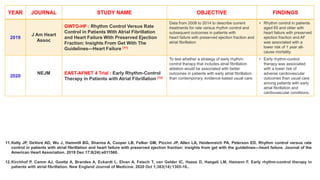
YEAR JOURNAL STUDY NAME OBJECTIVE FINDINGS
2019
J Am Heart
Assoc
GWTG-HF : Rhythm Control Versus Rate
Control in Patients With Atrial Fibrillation
and Heart Failure With Preserved Ejection
Fraction: Insights From Get With The
Guidelines—Heart Failure (11)
Data from 2008 to 2014 to describe current
treatments for rate versus rhythm control and
subsequent outcomes in patients with
heart failure with preserved ejection fraction and
atrial fibrillation
• Rhythm control in patients
aged 65 and older with
heart failure with preserved
ejection fraction and AF
was associated with a
lower risk of 1 year all-
cause mortality.
2020
NEJM EAST-AFNET 4 Trial : Early Rhythm-Control
Therapy in Patients with Atrial Fibrillation (12)
To test whether a strategy of early rhythm-
control therapy that includes atrial fibrillation
ablation would be associated with better
outcomes in patients with early atrial fibrillation
than contemporary, evidence-based usual care.
• Early rhythm-control
therapy was associated
with a lower risk of
adverse cardiovascular
outcomes than usual care
among patients with early
atrial fibrillation and
cardiovascular conditions.
11.Kelly JP, DeVore AD, Wu J, Hammill BG, Sharma A, Cooper LB, Felker GM, Piccini JP, Allen LA, Heidenreich PA, Peterson ED. Rhythm control versus rate
control in patients with atrial fibrillation and heart failure with preserved ejection fraction: insights from get with the guidelines—heart failure. Journal of the
American Heart Association. 2019 Dec 17;8(24):e011560.
12.Kirchhof P, Camm AJ, Goette A, Brandes A, Eckardt L, Elvan A, Fetsch T, van Gelder IC, Haase D, Haegeli LM, Hamann F. Early rhythm-control therapy in
patients with atrial fibrillation. New England Journal of Medicine. 2020 Oct 1;383(14):1305-16..
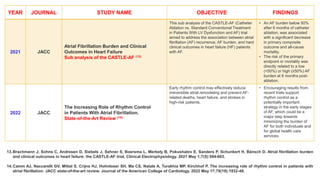
YEAR JOURNAL STUDY NAME OBJECTIVE FINDINGS
2021 JACC
Atrial Fibrillation Burden and Clinical
Outcomes in Heart Failure
Sub analysis of the CASTLE-AF (13)
This sub analysis of the CASTLE-AF (Catheter
Ablation vs. Standard Conventional Treatment
in Patients With LV Dysfunction and AF) trial
aimed to address the association between atrial
fibrillation (AF) recurrence, AF burden, and hard
clinical outcomes in heart failure (HF) patients
with AF.
• An AF burden below 50%
after 6 months of catheter
ablation, was associated
with a significant decrease
in primary composite
outcome and all-cause
mortality.
• The risk of the primary
endpoint or mortality was
directly related to a low
(<50%) or high (≥50%) AF
burden at 6 months post-
ablation.
2022 JACC
The Increasing Role of Rhythm Control
in Patients With Atrial Fibrillation.
State-of-the-Art Review (14)
Early rhythm control may effectively reduce
irreversible atrial remodeling and prevent AF-
related deaths, heart failure, and strokes in
high-risk patients.
• Encouraging results from
recent trials support
rhythm control as a
potentially important
strategy in the early stages
of AF, which could be a
major step towards
minimizing the burden of
AF for both individuals and
for global health care
services.
13.Brachmann J, Sohns C, Andresen D, Siebels J, Sehner S, Boersma L, Merkely B, Pokushalov E, Sanders P, Schunkert H, Bänsch D. Atrial fibrillation burden
and clinical outcomes in heart failure: the CASTLE-AF trial. Clinical Electrophysiology. 2021 May 1;7(5):594-603.
14.Camm AJ, Naccarelli GV, Mittal S, Crijns HJ, Hohnloser SH, Ma CS, Natale A, Turakhia MP, Kirchhof P. The increasing role of rhythm control in patients with
atrial fibrillation: JACC state-of-the-art review. Journal of the American College of Cardiology. 2022 May 17;79(19):1932-48.
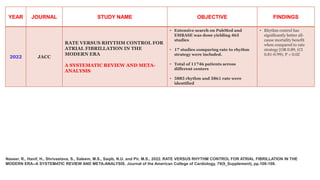
YEAR JOURNAL STUDY NAME OBJECTIVE FINDINGS
2022 JACC
RATE VERSUS RHYTHM CONTROL FOR
ATRIAL FIBRILLATION IN THE
MODERN ERA
A SYSTEMATIC REVIEW AND META-
ANALYSIS
• Extensive search on PubMed and
EMBASE was done yielding 465
studies
• 17 studies comparing rate to rhythm
strategy were included.
• Total of 11746 patients across
different centers
• 5885 rhythm and 5861 rate were
identified
• Rhythm control has
significantly better all-
cause mortality benefit
when compared to rate
strategy [OR 0.89, (CI
0.81-0.99); P < 0.02
Naseer, R., Hanif, H., Shrivastava, S., Saleem, M.S., Saqib, N.U. and Pir, M.S., 2022. RATE VERSUS RHYTHM CONTROL FOR ATRIAL FIBRILLATION IN THE
MODERN ERA--A SYSTEMATIC REVIEW AND META-ANALYSIS. Journal of the American College of Cardiology, 79(9_Supplement), pp.108-108.
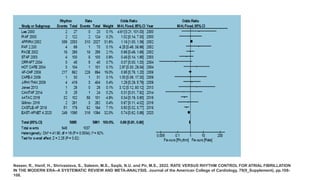
Naseer, R., Hanif, H., Shrivastava, S., Saleem, M.S., Saqib, N.U. and Pir, M.S., 2022. RATE VERSUS RHYTHM CONTROL FOR ATRIAL FIBRILLATION
IN THE MODERN ERA--A SYSTEMATIC REVIEW AND META-ANALYSIS. Journal of the American College of Cardiology, 79(9_Supplement), pp.108-
108.
YEAR JOURNAL STUDY NAME OBJECTIVE FINDINGS
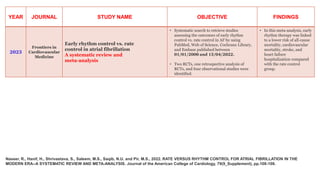
2023
Frontiers in
Cardiovascular
Medicine
Early rhythm control vs. rate
control in atrial fibrillation
A systematic review and
meta-analysis
• Systematic search to retrieve studies
assessing the outcomes of early rhythm
control vs. rate control in AF by using
PubMed, Web of Science, Cochrane Library,
and Embase published between
01/01/2000 and 15/04/2022.
• Two RCTs, one retrospective analysis of
RCTs, and four observational studies were
identified.
• In this meta-analysis, early
rhythm therapy was linked
to a lower risk of all-cause
mortality, cardiovascular
mortality, stroke, and
heart failure
hospitalization compared
with the rate control
group.
Naseer, R., Hanif, H., Shrivastava, S., Saleem, M.S., Saqib, N.U. and Pir, M.S., 2022. RATE VERSUS RHYTHM CONTROL FOR ATRIAL FIBRILLATION IN THE
MODERN ERA--A SYSTEMATIC REVIEW AND META-ANALYSIS. Journal of the American College of Cardiology, 79(9_Supplement), pp.108-108.
Han S, Jia R, Cen Z, Guo R, Zhao S, Bai Y, Xie M, Cui K. Early rhythm control vs. rate control in atrial fibrillation: A systematic review and meta-analysis.
Frontiers in Cardiovascular Medicine. 2023 Feb 6;10:978637.
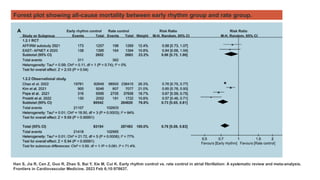
Forest plot showing all-cause mortality between early rhythm group and rate group.
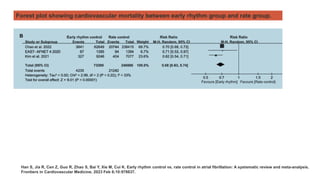
Forest plot showing cardiovascular mortality between early rhythm group and rate group.
Han S, Jia R, Cen Z, Guo R, Zhao S, Bai Y, Xie M, Cui K. Early rhythm control vs. rate control in atrial fibrillation: A systematic review and meta-analysis.
Frontiers in Cardiovascular Medicine. 2023 Feb 6;10:978637.
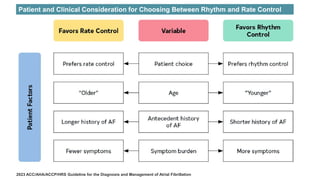
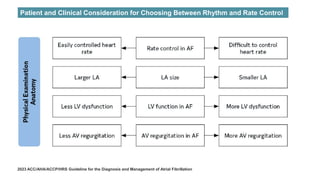
Patient and Clinical Consideration for Choosing Between Rhythm and Rate Control
2023 ACC/AHA/ACCP/HRS Guideline for the Diagnosis and Management of Atrial Fibrillation
Patient and Clinical Consideration for Choosing Between Rhythm and Rate Control
2023 ACC/AHA/ACCP/HRS Guideline for the Diagnosis and Management of Atrial Fibrillation

Rate vs Rhythm control for Atrial Fibrillation

  • 1.
    Has the battlebeen settled?
  • 2.
    ❖ During AF,there can be structural and electrical remodeling of the atria. ❖ These alterations of the atria can lead to a situation of AF begetting AF, resulting in persistent AF. ❖ Paroxysmal episodes of AF may recur for years, in most patients, there will be a transition to persistent AF. Prystowsky EN. Rate Versus Rhythm Control for Atrial Fibrillation. Circulation. 2022 Nov 22;146(21):1561-3.
  • 3.
    Contemporary Summary ofthe Role of ANS in AF 2023 ACC/AHA/ACCP/HRS Guideline for the Diagnosis and Management of Atrial Fibrillation: A Report of the American College of Cardiology/American Heart Association Joint Committee on Clinical Practice Guidelines. Journal of the American College of Cardiology. 2023 Nov 30.
  • 4.
    AF Stages :Evolution of Atrial Arrhythmia Progression 2023 ACC/AHA/ACCP/HRS Guideline for the Diagnosis and Management of Atrial Fibrillation: A Report of the American College of Cardiology/American Heart Association Joint Committee on Clinical Practice Guidelines. Journal of the American College of Cardiology. 2023 Nov 30.
  • 5.
    2023 ACC/AHA/ACCP/HRS Guidelinefor the Diagnosis and Management of Atrial Fibrillation: A Report of the American College of Cardiology/American Heart Association Joint Committee on Clinical Practice Guidelines. Journal of the American College of Cardiology. 2023 Nov 30.
  • 6.
    YEAR JOURNAL STUDYNAME OBJECTIVE FINDINGS 2000 Lancet PIAF : Rhythm or rate control in atrial fibrillation-Pharmacological Intervention in AF (1) Primary : The primary study endpoint was improvement in symptoms related to atrial fibrillation. • No difference in symptoms or quality of life. • Increased hospitalization in rhythm control group. • Increased walking distance in rhythm control group 2002 NEJM AFFIRM : Atrial Fibrillation Follow-up Investigation of Rhythm Management (2) Primary : All-cause mortality Secondary : Composite of death, disabling stroke, disabling anoxic encephalopathy, major bleeding, and cardiac arrest. • No difference on overall mortality or quality of life. • Increased hospitalization in rhythm control group 2002 Netherlands Heart Journal / NEJM RACE : Rate Control versus Electrical Cardioversion for Persistent Atrial Fibrillation (3) Primary : A composite of cardiovascular death, hospital admissions for heart failure, thromboembolic complications, severe bleeding, pacemaker implantation, and severe adverse effects of therapy. Secondary : Individual components of primary endpoint. • No difference in symptoms or quality of life. • Increased hospitalization in rhythm control group. • Increased walking distance in rhythm control group 1. Hohnloser SH, Kuck KH, Lilienthal J. Rhythm or rate control in atrial fibrillation—Pharmacological Intervention in Atrial Fibrillation (PIAF): a randomized trial. The Lancet. 2000 Nov 25;356(9244):1789-94. 2. Atrial Fibrillation Follow-up Investigation of Rhythm Management (AFFIRM) Investigators. A comparison of rate control and rhythm control in patients with atrial fibrillation. New England Journal of Medicine. 2002 Dec 5;347(23):1825-33. 3. Van Gelder IC. Rate control versus electrical cardioversion for persistent atrial fibrillation study group, a comparison of rate control and rhythm control in patients with recurrent persistent atrial fibrillation. N Engl J Med. 2002;347:1834-40.
  • 7.
    YEAR JOURNAL STUDYNAME OBJECTIVE FINDINGS 2003 JACC STAF : Randomized trial of rate-control versus rhythm-control in persistent atrial fibrillation: The Strategies of Treatment of Atrial Fibrillation study (4) Primary : compare the strategy of rhythm- control with the strategy of rate-control in patients with persistent AF in terms of mortality, quality of life, and complications of therapy and disease. • There was no difference in the primary end point between and rate-control. 2004 CHEST Journal HOT CAFÉ : How to Treat Chronic Atrial Fibrillation Study. (5) Primary : The relative risks and benefits of strategies of rate control vs rhythm control in patients with atrial fibrillation • No significant differences in the composite end point were found between the rate control group and the rhythm control group. 4. Carlsson JÖ, Miketic S, Windeler JÜ, Cuneo A, Haun S, Micus S, Walter S, Tebbe U, STAF investigators. Randomized trial of rate-control versus rhythm- control in persistent atrial fibrillation: the Strategies of Treatment of Atrial Fibrillation (STAF) study. Journal of the American College of Cardiology. 2003 May 21;41(10):1690-6. 5. Opolski G, Torbicki A, Kosior DA, Szulc M, Wozakowska-Kapłon B, Kołodziej P, Achremczyk P. Rate control vs rhythm control in patients with nonvalvular persistent atrial fibrillation: the results of the Polish How to Treat Chronic Atrial Fibrillation (HOT CAFE) Study. Chest. 2004 Aug 1;126(2):476-86.
  • 8.
    YEAR JOURNAL STUDYNAME OBJECTIVE FINDINGS 2005 European Heart Journal Rate-control vs. rhythm-control in patients with atrial fibrillation: A Meta- Analysis • RACE • AFFIRM • PIAF • STAF • HOT CAFÉ Systematically assess the risk/benefit ratio of a rate-control strategy vs. a rhythm-control strategy in patients with first or recurrent atrial fibrillation (AF) • 5239 patients with AF compared rate-control vs. rhythm-control. • Average follow-up ranged from 1 to 3.5 years. • A rate-control strategy compared with a rhythm- control approach was associated with a significantly reduced risk of CEP [OR 0.84 (0.73, 0.98), P ¼ 0.02], and with a trend towards a reduced risk of death [OR 0.87 (0.74, 1.02), P ¼ 0.09] and thromboembolic stroke [OR 0.80 (0.6, 1.07), P ¼ 0.14]. • There was no significant difference in the risk of major bleeds [OR 1.14 (0.9, 1.45), P ¼ 0.28] and systemic embolism [OR 0.93 (0.43, 2.02), P ¼ 0.90]. Testa L, Biondi-Zoccai GG, Russo AD, Bellocci F, Andreotti F, Crea F. Rate-control vs. rhythm-control in patients with atrial fibrillation: a meta-analysis. European heart journal. 2005 Oct 1;26(19):2000-6.
  • 9.
    Single and pooledOR for the combined endpoint. The rate-control approach is associated with a statistically significant lower rate of the combined endpoint compared with the rhythm-control strategy Testa L, Biondi-Zoccai GG, Russo AD, Bellocci F, Andreotti F, Crea F. Rate-control vs. rhythm-control in patients with atrial fibrillation: a meta-analysis. European heart journal. 2005 Oct 1;26(19):2000-6.
  • 10.
    YEAR JOURNAL STUDYNAME OBJECTIVE FINDINGS 2008 NEJM AF-CHF : Atrial Fibrillation and Congestive Heart Failure (6) Primary : • Death form CV causes. Secondary : • All-cause mortality • Stroke, Worsening CHF, Hospitalization • QoL, Cost of therapy • Composite of death from CV cause, stroke and worsening HF. • No difference in cardiovascular deaths 2016 JACC ORBIT-AF Registry : Rhythm Control Versus Rate Control and Clinical Outcomes in Patients With Atrial Fibrillation (7) Patients managed with a rhythm control strategy targeting maintenance of sinus rhythm were retrospectively compared with a strategy of rate control alone in a AF registry across various U.S. practice settings. • Among patients with AF, rhythm control was not superior to rate control strategy for outcomes of stroke, heart failure, or mortality, but was associated with more cardiovascular hospitalizations. 6. Roy D, Talajic M, Nattel S, Wyse DG, Dorian P, Lee KL, Bourassa MG, Arnold JM, Buxton AE, Camm AJ, Connolly SJ. Rhythm control versus rate control for atrial fibrillation and heart failure. New England Journal of Medicine. 2008 Jun 19;358(25):2667-77. 7. Noheria A, Shrader P, Piccini JP, Fonarow GC, Kowey PR, Mahaffey KW, Naccarelli G, Noseworthy PA, Reiffel JA, Steinberg BA, Thomas LE. Rhythm control versus rate control and clinical outcomes in patients with atrial fibrillation: results from the ORBIT-AF registry. JACC: Clinical Electrophysiology. 2016 Apr;2(2):221-9.
  • 11.
    YEAR JOURNAL STUDYNAME OBJECTIVE FINDINGS 2022 Circulation RAFT-AF: Randomized Ablation-Based Rhythm-Control Versus Rate-Control Trial in Patients With Heart Failure and Atrial Fibrillation: Results from the RAFT-AF trial (8) Ablation-based rhythm control was compared with rate control to evaluate if clinical outcomes in patients with HF and AF could be improved. • In patients with high- burden AF and HF, there was no statistical difference in all-cause mortality or HF events with ablation-based rhythm control versus rate control. • However, there was a nonsignificant trend for improved outcomes with ablation-based rhythm control over rate control. 8. Parkash R, Wells GA, Rouleau J, Talajic M, Essebag V, Skanes A, Wilton SB, Verma A, Healey JS, Sterns L, Bennett M. Randomized ablation-based rhythm- control versus rate-control trial in patients with heart failure and atrial fibrillation: results from the RAFT-AF trial. Circulation. 2022 Jun 7;145(23):1693-704.
  • 12.
    Why was normalsinus rhythm not better than AF, with its hemodynamic and pathophysiological consequences? Possible explanation for results of the “rate versus rhythm” control strategy trials. ❖ Toxic effects of antiarrhythmic drugs ❖ Less aggressive management of AF with available drug therapy (to reduce AF burden) ❖ Abandonment of oral anticoagulation after successful rhythm control ❖ Antiarrhythmic drugs with proven value in reducing “hard” cardiovascular outcomes were not available ❖ Less effective treatment of underlying comorbidities ❖ Left atrial ablation was not a therapeutic option ❖ Excess non-cardiovascular deaths in rhythm control arm ❖ Relatively short duration of clinical trials Camm J. Why is rhythm control for atrial fibrillation becoming more popular? European Society of Cardiology / Cardio Practice / Vol. 1, N° 2 - 06 Jan 2023
  • 13.
    YEAR JOURNAL STUDYNAME OBJECTIVE FINDINGS 2009 Circulation J RHYTHM: Optimal Treatment Strategy for Patients With Paroxysmal Atrial Fibrillation (9) Primary : A composite of total mortality, symptomatic cerebral infarction, systemic embolism, major bleeding, hospitalization for heart failure, or physical/psychological disability requiring alteration of treatment strategy. • Composite end point occurred 22..0% less often in patients assigned to rhythm control (P=0.0128) 2009 Pacing and clinical electrophysiology CASTLE-AF: Catheter Ablation versus Standard conventional Treatment in patients with Left Ventricular dysfunction and AF (10) To evaluate catheter ablation compared with standard treatment among patients with left ventricular dysfunction and AF. • Incidence of death or hospitalization for heart failure, occurred in 28.5% of catheter ablation vs 44.6% of the control group, p = 0.007 • All-cause mortality 13.4% vs 25%, p = 0.01 • Hospitalization for heart failure 20.7% vs 35.9%, p = 0.004 9. Ogawa S, Yamashita T, Yamazaki T, Aizawa Y, Atarashi H, Inoue H, Ohe T, Ohtsu H, Okumura K, Katoh T, Kamakura S. Optimal treatment strategy for patients with paroxysmal atrial fibrillation J-RHYTHM Study. Circulation Journal. 2009;73(2):242-8. 10.Marrouche NF, Brachmann J, CASTLE‐AF Steering Committee. Catheter ablation versus standard conventional treatment in patients with left ventricular dysfunction and atrial fibrillation (CASTLE‐AF)‐study design. Pacing and clinical electrophysiology. 2009 Aug;32(8):987-94.
  • 14.
    YEAR JOURNAL STUDYNAME OBJECTIVE FINDINGS 2019 J Am Heart Assoc GWTG-HF : Rhythm Control Versus Rate Control in Patients With Atrial Fibrillation and Heart Failure With Preserved Ejection Fraction: Insights From Get With The Guidelines—Heart Failure (11) Data from 2008 to 2014 to describe current treatments for rate versus rhythm control and subsequent outcomes in patients with heart failure with preserved ejection fraction and atrial fibrillation • Rhythm control in patients aged 65 and older with heart failure with preserved ejection fraction and AF was associated with a lower risk of 1 year all- cause mortality. 2020 NEJM EAST-AFNET 4 Trial : Early Rhythm-Control Therapy in Patients with Atrial Fibrillation (12) To test whether a strategy of early rhythm- control therapy that includes atrial fibrillation ablation would be associated with better outcomes in patients with early atrial fibrillation than contemporary, evidence-based usual care. • Early rhythm-control therapy was associated with a lower risk of adverse cardiovascular outcomes than usual care among patients with early atrial fibrillation and cardiovascular conditions. 11.Kelly JP, DeVore AD, Wu J, Hammill BG, Sharma A, Cooper LB, Felker GM, Piccini JP, Allen LA, Heidenreich PA, Peterson ED. Rhythm control versus rate control in patients with atrial fibrillation and heart failure with preserved ejection fraction: insights from get with the guidelines—heart failure. Journal of the American Heart Association. 2019 Dec 17;8(24):e011560. 12.Kirchhof P, Camm AJ, Goette A, Brandes A, Eckardt L, Elvan A, Fetsch T, van Gelder IC, Haase D, Haegeli LM, Hamann F. Early rhythm-control therapy in patients with atrial fibrillation. New England Journal of Medicine. 2020 Oct 1;383(14):1305-16..
  • 15.
    YEAR JOURNAL STUDYNAME OBJECTIVE FINDINGS 2021 JACC Atrial Fibrillation Burden and Clinical Outcomes in Heart Failure Sub analysis of the CASTLE-AF (13) This sub analysis of the CASTLE-AF (Catheter Ablation vs. Standard Conventional Treatment in Patients With LV Dysfunction and AF) trial aimed to address the association between atrial fibrillation (AF) recurrence, AF burden, and hard clinical outcomes in heart failure (HF) patients with AF. • An AF burden below 50% after 6 months of catheter ablation, was associated with a significant decrease in primary composite outcome and all-cause mortality. • The risk of the primary endpoint or mortality was directly related to a low (<50%) or high (≥50%) AF burden at 6 months post- ablation. 2022 JACC The Increasing Role of Rhythm Control in Patients With Atrial Fibrillation. State-of-the-Art Review (14) Early rhythm control may effectively reduce irreversible atrial remodeling and prevent AF- related deaths, heart failure, and strokes in high-risk patients. • Encouraging results from recent trials support rhythm control as a potentially important strategy in the early stages of AF, which could be a major step towards minimizing the burden of AF for both individuals and for global health care services. 13.Brachmann J, Sohns C, Andresen D, Siebels J, Sehner S, Boersma L, Merkely B, Pokushalov E, Sanders P, Schunkert H, Bänsch D. Atrial fibrillation burden and clinical outcomes in heart failure: the CASTLE-AF trial. Clinical Electrophysiology. 2021 May 1;7(5):594-603. 14.Camm AJ, Naccarelli GV, Mittal S, Crijns HJ, Hohnloser SH, Ma CS, Natale A, Turakhia MP, Kirchhof P. The increasing role of rhythm control in patients with atrial fibrillation: JACC state-of-the-art review. Journal of the American College of Cardiology. 2022 May 17;79(19):1932-48.
  • 16.
    YEAR JOURNAL STUDYNAME OBJECTIVE FINDINGS 2022 JACC RATE VERSUS RHYTHM CONTROL FOR ATRIAL FIBRILLATION IN THE MODERN ERA A SYSTEMATIC REVIEW AND META- ANALYSIS • Extensive search on PubMed and EMBASE was done yielding 465 studies • 17 studies comparing rate to rhythm strategy were included. • Total of 11746 patients across different centers • 5885 rhythm and 5861 rate were identified • Rhythm control has significantly better all- cause mortality benefit when compared to rate strategy [OR 0.89, (CI 0.81-0.99); P < 0.02 Naseer, R., Hanif, H., Shrivastava, S., Saleem, M.S., Saqib, N.U. and Pir, M.S., 2022. RATE VERSUS RHYTHM CONTROL FOR ATRIAL FIBRILLATION IN THE MODERN ERA--A SYSTEMATIC REVIEW AND META-ANALYSIS. Journal of the American College of Cardiology, 79(9_Supplement), pp.108-108.
  • 17.
    Naseer, R., Hanif,H., Shrivastava, S., Saleem, M.S., Saqib, N.U. and Pir, M.S., 2022. RATE VERSUS RHYTHM CONTROL FOR ATRIAL FIBRILLATION IN THE MODERN ERA--A SYSTEMATIC REVIEW AND META-ANALYSIS. Journal of the American College of Cardiology, 79(9_Supplement), pp.108- 108.
  • 18.
    YEAR JOURNAL STUDYNAME OBJECTIVE FINDINGS 2023 Frontiers in Cardiovascular Medicine Early rhythm control vs. rate control in atrial fibrillation A systematic review and meta-analysis • Systematic search to retrieve studies assessing the outcomes of early rhythm control vs. rate control in AF by using PubMed, Web of Science, Cochrane Library, and Embase published between 01/01/2000 and 15/04/2022. • Two RCTs, one retrospective analysis of RCTs, and four observational studies were identified. • In this meta-analysis, early rhythm therapy was linked to a lower risk of all-cause mortality, cardiovascular mortality, stroke, and heart failure hospitalization compared with the rate control group. Naseer, R., Hanif, H., Shrivastava, S., Saleem, M.S., Saqib, N.U. and Pir, M.S., 2022. RATE VERSUS RHYTHM CONTROL FOR ATRIAL FIBRILLATION IN THE MODERN ERA--A SYSTEMATIC REVIEW AND META-ANALYSIS. Journal of the American College of Cardiology, 79(9_Supplement), pp.108-108.
  • 19.
    Han S, JiaR, Cen Z, Guo R, Zhao S, Bai Y, Xie M, Cui K. Early rhythm control vs. rate control in atrial fibrillation: A systematic review and meta-analysis. Frontiers in Cardiovascular Medicine. 2023 Feb 6;10:978637. Forest plot showing all-cause mortality between early rhythm group and rate group.
  • 20.
    Forest plot showingcardiovascular mortality between early rhythm group and rate group. Han S, Jia R, Cen Z, Guo R, Zhao S, Bai Y, Xie M, Cui K. Early rhythm control vs. rate control in atrial fibrillation: A systematic review and meta-analysis. Frontiers in Cardiovascular Medicine. 2023 Feb 6;10:978637.
  • 21.
    Patient and ClinicalConsideration for Choosing Between Rhythm and Rate Control 2023 ACC/AHA/ACCP/HRS Guideline for the Diagnosis and Management of Atrial Fibrillation
  • 22.
    Patient and ClinicalConsideration for Choosing Between Rhythm and Rate Control 2023 ACC/AHA/ACCP/HRS Guideline for the Diagnosis and Management of Atrial Fibrillation
  • 23.
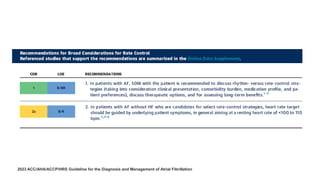
    2023 ACC/AHA/ACCP/HRS Guidelinefor the Diagnosis and Management of Atrial Fibrillation
  • 24.
    2023 ACC/AHA/ACCP/HRS Guidelinefor the Diagnosis and Management of Atrial Fibrillation
  • 25.
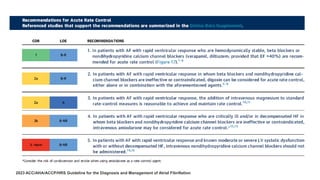
    2023 ACC/AHA/ACCP/HRS Guidelinefor the Diagnosis and Management of Atrial Fibrillation
  • 26.
    2023 ACC/AHA/ACCP/HRS Guidelinefor the Diagnosis and Management of Atrial Fibrillation
  • 27.
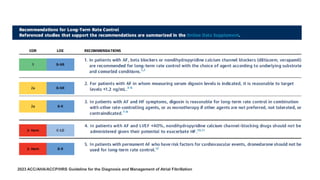
    2023 ACC/AHA/ACCP/HRS Guidelinefor the Diagnosis and Management of Atrial Fibrillation
  • 28.
    2023 ACC/AHA/ACCP/HRS Guidelinefor the Diagnosis and Management of Atrial Fibrillation
  • 29.
    2023 ACC/AHA/ACCP/HRS Guidelinefor the Diagnosis and Management of Atrial Fibrillation
  • 30.
    2023 ACC/AHA/ACCP/HRS Guidelinefor the Diagnosis and Management of Atrial Fibrillation
  • 31.
    2023 ACC/AHA/ACCP/HRS Guidelinefor the Diagnosis and Management of Atrial Fibrillation
  • 32.
    2023 ACC/AHA/ACCP/HRS Guidelinefor the Diagnosis and Management of Atrial Fibrillation
  • 33.
    2023 ACC/AHA/ACCP/HRS Guidelinefor the Diagnosis and Management of Atrial Fibrillation
  • 34.
    2023 ACC/AHA/ACCP/HRS Guidelinefor the Diagnosis and Management of Atrial Fibrillation
  • 35.
    2023 ACC/AHA/ACCP/HRS Guidelinefor the Diagnosis and Management of Atrial Fibrillation
  • 36.
    2023 ACC/AHA/ACCP/HRS Guidelinefor the Diagnosis and Management of Atrial Fibrillation