BASIC ENGINEERING
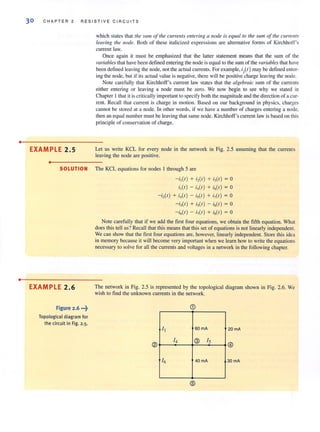
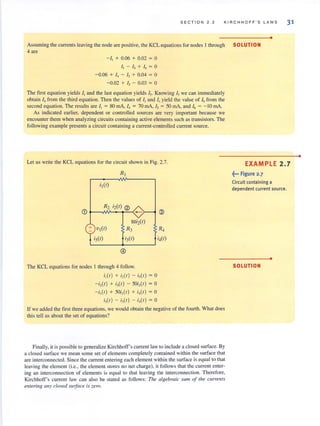
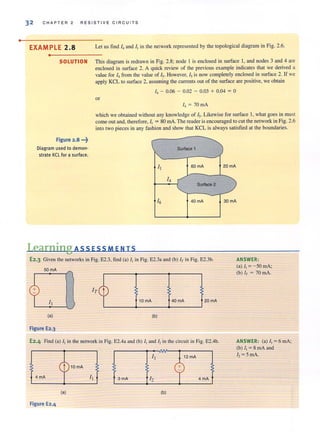
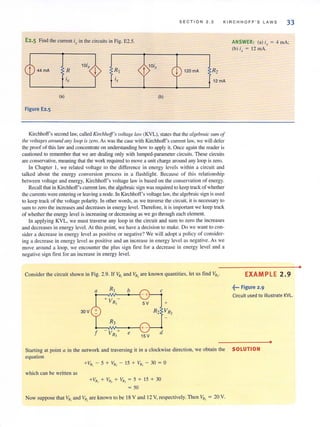
CI RCU IT ANALYSIS
SENIOR ACQU ISITIONS EDITOR
PROJECT EDITOR
SENIOR PRODUCTION EDITOR
EXECUTIVE MARKETING MANAGER
SEN IOR DESIGNER
SENIOR ILLUSTRATION EDITOR
SENIOR PHOTO EDITOR
MEDIA EDITOR
EDITORIAL ASSISTANT
INTERIOR DES IGN
COVER DESIGN
BICENTENNIAL LOGO DES IGN
COVER PHOTOS
Catherine Fields Shultz
Gladys $010
William A. Murray
Christopher Rucl
Kevin Murphy
Anna Melhorn
Lisa Gee
Lauren Sapira
Carolyn Weisman
Nomey Field
David Levy
Richard J. P"cilico
TOI) left. courtesy of Lockheed Martin: top eel/fer. courtesy of PPM Energy: tol) rig/II. courtesy of Hyund:.i
Motor M:muf:K:turing Alabama LLC: haltom/eft. courtesy of Ihe National Oceanic and Atmospheric
}dlllinistralion/Dcparlrncnt of COllllllerce: bottom cell/cr. courtesy of NASAIJPL-C:llicch: /)0110111 righl.
courtesy of the National Oceanic and Atmospheric Administt:ltion/DcpartlllCI11of Commerce
This book was SCI in 10/12 Times Roman by Prepare. Inc. and printed and bound by R.R. Donnelley. Inc. The
cover was printed by R.R. Donnelky. Inc.
This book is prinled on acid free paper. 00
Copyrigln © 2008 10hn WiJcy & Sons. Inc. All rights reserved. No pun of Ihis publication may be reproduced.
stored in a retrieval system. or transmiued in any fonn or by ~my means, electronic, mechanical. photocopying.
recording. scanning or otherwise. except as permitted under Sections 107 or 108 of the 1976 United States
Copyright Act. without either the prior written permission of the Publisher. or authorization through payment of
the appropriate per-copy fcc to the Copyright Cleamnce Cenler, Inc.. 222 Rosewood Drivc. Danvcrs. MA 01923,
Web site: www,Copyright.colll. Requests to the Publisher for permission should be addressed to the Penll i ssion~
Depanmenl. 10hn Wiley & Sons. Inc.. 11 I River Street. Hoboken, NJ 07030-5774. (20 I) 748·60 II, l':Ix (20 I)
748·6008. Web sile; www.wilcy.comlgo!permissions.
To order books or for customer service please call 1-800-CALL WILEY (225-5945).
Library of Co" gre,'.· C(lW/Ogillg-ill-PlIhIiClllioll Data:
Irwin, 1. David
Basic engineering circuit analysiS/1. David Irwin. R. Mark Nelms.-9th ed.
p. cm.
Includes bibliographical references and index.
ISBN 978·0-470-12869-5 (cloth)
I. Electric circuit analysis. I. Nelms, R. M. II. litle.
TK454.17S 2()()7
62l.3 19'2-<1c22
Printell in th~ United State:-- of America
10 9 8 7 6 5 4 3
2007040689
To my loving family:
Edie
Geri, Bruno, Andrew and Ryan
John, Julie, John David and Abi
Laura
To my parents:
Robert and Elizabeth Nelms
BRIEF CONTENTS
CHAPTER 1 Basic Concepts 1
CHAPTER 2 Resistive Circuits 23
CHAPTER 3 Nodal and Loop Analysis Techniques 95
CHAPTER 4 Operational Amplifiers 149
CHAPTER 5 Additional Analysis Techniques 183
CHAPTER 6 Capacitors 248
CHAPTER 7 First- and Second-Order Transient Circuits 291
CHAPTER 8 AC Steady-State Analysis 375
CHAPTER 9 Steady-State Power Analysis 455
CHAPTER 10 Magnetically Coupled Networks 507
CHAPTER 11 Polyphase Circuits 553
CHAPTER 12 Variable-Frequency Network Performance 587
CHAPTER 13 The Laplace Transform 677
CHAPTER 14 Application of the Laplace
Transform to Circuit Analysis 705
CHAPTER 15 Fourier Analysis Techniques 758
CHAPTER 16 Two-Port Networks 809
Preface
CHAPTER 1
BASIC CONCEPTS
J.I System of Units 2
1.2 Basic Quantities 2
1.3 Circuit Elements 8
Summary 16
Problems 16
CHAPTER 2
RESISTIVE CIRCUITS
2.1 Ohm's Law 24
2.2 Kirchhoff's Laws 28
2.3 Single·Loop Circuits 37
2.4 Single-Node-Pair Circuits 43
2.5 Series and Parallel Resistor Combinations 48
2.6 Circuits with Series-Parallel
Combinations of Resistors 53
2.7 Wye ~ Della Transfonmuions 57
2.8 Circuits with Dependent Sources 60
2.9 Resistor Technologies for
Electronic Manufacturing 64
2.10 Application Examples 67
2.11 Design Examples 71
Summary 76
Problems 77
xv
1
23
CONTENTS
CHAPTER 3
NODAL AND LOOP ANALYSIS TECHNIQUES 95
3.1 Nodal Analysis 96
3.2 Loop Analysis 11 5
3.3 Application Example 131
3.4 Design Example 133
Summary 133
Problems 134
CHAPTER 4
OPERATIONAL AMPLIFIERS 149
4.1 Introduction 150
4.2 Op-Amp Models 150
4.3 Fundamental Op-Amp Circuits 156
4.4 Comparators 164
4.5 Application Examples 165
4.6 Design Examples 169
Summary 172
Problems 172
CHAPTER 5
ADDITIONAL ANALYSIS TECHNIQUES
S.I Introduction 184
5.2 Superposition 186
5.3 Thevenin's and Norton 's Theorems 19 1
xii CON TENT S
5.4 Maximum Power Transfer 208
5.5 dc SPICE Analysis Using Schemalic Capture 2 12
5.6 Application Example 224
5.7 Design Examples 225
Summary 23 1
Problems 231
CHAPTER 6
CAPACITANCE AND INDUCTANCE
6.1 Capacitors 249
6.2 Inductors 255
6.3 Capacitor and Inductor Combinations 264
6.4 RC Operational Amplifier Circuits 271
6.5 Application Examples 274
6.6 Design Examples 278
Summary 280
Problems 280
CHAPTER 7---------------
FIRST- AND SECOND-ORDER
TRANSIENT CIRCUITS
7.1 Introduction 292
7.2 First-Order Circuits 293
7.3 Second-Order Circuits 3 14
7.4 Transient PSPICE Analysis
Using Schematic Capture 328
7.5 Application Examples 337
7.6 Design Examples 348
Summary 356
Problems 356
CHAPTER 8
AC STEADY-STATE ANALYSIS
8.1 Sinusoids 376
291
375
8.2 Sinusoidal and Complex Forcing Functions 379
8.3 Phasors 383
8.4 Phasor Relationshi ps for Circui t Elements 385
8.S Impedance and Admittance 389
8.6 Phasor Diagrams 396
8.7 Basic Analysis Using Kirchhoff's Laws 399
8.8 Analysis Techniques 40 I
8.9 AC PSPICE Analysis Using
Schematic Capture 4 16
8.10 Application Examples 429
8.11 Design Examples 43 1
Summary 434
Problems 435
CHAPTER 9
STEADY-STATE POWER ANALYSIS
9.1
9.2
9.3
9.4
9.5
9.6
9.7
9.8
9.9
9.10
9.11
Instantaneous Power 456
Average Power 457
Maximum Average Power Transfer 462
Effective or rms Values 466
The Power Factor 469
Complex Power 47 1
Power Factor Correction 476
Single-Phase Three-Wire Circuits 479
Safety Considerations 482
Application Examples 490
Design Example 494
Summary 496
Problems 496
455
CHAPTER 10'--------------
MAGNETICALLY COUPLED NETWORKS
10.1 Mutuallnductanee 508
10.2 Energy Analysis 5 18
10.3 The Ideal Transformer 521
10.4 Safety Considerations 529
10.5 Application Examples 530
10.6 Design Examples 535
Summary 539
Problems 540
CHAPTER 11
POLYPHASE CIRCUITS
ILl Three-Phase Circuits 554
11.2 Three-Phase Connections 559
11.3 SoufcelLoad Connections 560
50 7
553
11.4 Power Relat ionships 568
11.5 Power Factor Correction 572
11.6 Application Examples 573
11.7 Design Examples 576
Summary 580
Problems 58 1
CHAPTER 12
VARIABLE-FREQUENCY
NETWORK PERFORMANCE
12.1 Variable Frequency-Response Analysis
12.2 Sinusoidal Frequency Analysis 596
12.3 Resonant Circuits 608
12.4 Scaling 629
12.5 Filter Networks 63 1
12.6 Application Examples 655
12.7 Design Examples 659
Summary 665
Problems 666
CHAPTER 13
THE LAPLACE TRANSFORM
13.1 Definition 678
588
13.2 Two Important Singularity Functions 679
13.3 Transfortn Pairs 681
13.4 Properties of the Transform 683
13.5 Performing the Inverse Transform 686
13.6 Convolution Integral 692
13.7 Initial-Value and Final-Value Theorems 696
13.8 Application Example 697
Summary 699
Problems 699
CHAPTER 14
APPLICATION OF THE LAPLACE
TRANSFORM TO CIRCUIT ANALYSIS
14.1 Laplace Circuit Solutions 706
14.2 Circuit Element Models 707
705
CONTEN TS xiii
14.3 Analysis Tcchniques 709
14.4 Transfer Function 72 1
14.S Pole-Zero PlotlBode Plot Connection 732
14.6 Steady-State Response 735
14.7 Application Example 737
14.8 Design Examples 739
Summary 746
Problems 746
CHAPTER 15
FOURIER ANALYSIS TECHNIQUES
15.1 Fourier Series 759
IS.2 Fourier Transform 781
IS.3 Application Examples 788
IS.4 Design Examples 795
Summary 80 1
Problems 802
7SB
CHAPTER 1~()~-----------------------­
TWO-PORT NETWORKS 80 9
16.1 Admittance Parameters 810
16.2 Impedance Parameters 8 13
16.3 Hybrid Parameters 8 15
16.4 Transmission Parameters 8 17
16.S Parameter Conversions 8 18
16.6 Interconnection of Two~ Port s 8 19
16.7 Application Examples 822
16.8 Design Example 826
Summary 828
Problems 828
APPENDIX
COMPLEX NUMBERS
INDEX
Circuit analysis is not only fundamental 10 the enti re breadth of electrical and computer
engineering- the concepts studied here extend far beyond those boundaries. For this reason
it remains the starting point for many future engineers who wish to work in this field. The
text and all the supplementary materials associated with it will aid you in reaching this goal.
We strongly recommend while you are here to read the Preface closely and view all the
resources available to you as a learner. And one last piece of advice, learning requires
practice and repetition. take every opportunity to work one more problem or study one more
hour than you planned. In the end. you·1I be thankful you did.
The Ninth Edition has been prepared based on a careful examination of feedback received
from instructors and students. The revisions and changes made should appeal to a wide vari-
ety of instructors. We are aware of significant changes taking place in the way this material
is being taught and learned. Consequently, the authors and the publisher have created a for-
midable array of traditional and non-traditional learning resources to meet the needs of
students and teachers of modern circuit analysis.
• A new four-color design is employed to enhance and clarify both text and illustrations.
This sharply improves the pedagogical presentation, particularly with complex illustra-
tions. For example, see Figure 2.5 on page 29.
• New chapter previews provide moti vation for studying the material in the chapter. See
page 758 for a chapter preview sample. Learning goals for each chapter have been
updated and appear as pan of the new Chapter openers.
• End-of-chapter homework problems have been substantially revised and augmented.
There are now over 1200 problems in the Ninth Edition! Multiple-choice Fundamentals
of Engineering (FE) Exam problems now appear at the end of each chapter.
• Practical applications have been added for nearly every topic in the text. Since these are
items sllldenlS will naturally encounter on a regular basis, they serve 10 answer ques-
tions such as, "Why is this important?" or " How am I going to use what I learn from
this course?" For a typical example application, see page 338.
• Problem-Solving Videos have been created showing students step-by-step how to
solve selected Learning Assessment problems within each chapter and supplemental
PREFACE
To the Student
To the
Instructor
Highlights
of the Ninth
Edition
xvi PREFACE
Organization
Text Pedagogy
end-of-chapter problems. The problem-solving videos (PSVs) are now also available
for the Apple iPod. Look for the iPod icon ii for the application of this unique feature.
• The end-of-chapter problems noted with the 0 denote problems that are included in
OUf WileyPLUS course for this title. In some cases, these problems are presented as algo-
rithmic problems which offer differcllI variables for the problem allowing each student to
work a similar problem ensuring for individualized work, also some problems have been
developed into guided online (GO) problems with tutorials for students, as well as multi-
part problems allowing the student (0 show their work at various steps of the problem.
• The ~ icon next to end-of-chapter problems denotes those that are more challenging
problems and engage the student to apply multiple concepts to solve the problem.
• Problem-Solving Strategies have been retained in the Ninth Edition. They are utili zed
as a guide for the solutions contained in the PSVs.
• A new chapter on diodes has been created for the Ninth Edition. This chapter
was developed in response to requests for a supplemental chapter on this topic.
Whi le not included as part of the printed text, it is available through WileyPLUS.
This text is suitable for a one·semester, a two·semester, or a three·quarter course sequence.
The first seven chapters are concerned with the anal ysis of dc circuits. An introduction to
operational amplifiers is presented in Chapter 4. This chapter may be omiued without any
loss of continuity; a few examples and homework problems in later chapters must be skipped.
Chapters 8-12 are focused on the analysis of ac circuits beginning with the analysis of single-
frequency circuits (single·phase and three·phase) and ending with variable·frequency circuit
operation. Calculation of power in single·phase and three-phase ae circuits is also presented.
The important topics of the Laplace transform, Fourier transform, and two·port networks are
covered in Chapters 13- 16.
The organization of the text provides instructors maximum flexibility in designing their
courses. One instructor may choose to cover the first seven chapters in a single semester,
while another may omit Chapter 4 and cover Chapters 1-3 and 5-8. Other instruclOrs have
chosen to cover Chapters 1-3, 5-{;, and sections 7. 1and 7.2 and then cover Chapters 8 and 9.
The remai ni ng chapters can be covered in a second semester course.
The pedagogy of this text is rich and varied. It includes print and media and much thought
has been put into integrating its use. To gain the most from this pedagogy, please review the
following elements commonly available in most chapters of this book.
Learning Goals are provided at the outset of each chapter. This tabular list tells the reader
what is important and what will be gained from studying the material in the chapter.
Examples are the mainstay of any circuit analysis text and numerous examples have always
been a trademark of this textbook. These examples provide a more graduated level of pres·
entation with simple, medium, and challengi ng examples, Besides regular examples, numer-
ous Design Examples and Application Examples are found throughout the texl. See for
example, page 348.
Hints can often be fo und in the page margins. They faci litate understanding and serve as
reminders of key issues. See for example, page 6.
Learning Assessments are a crilicalleaming tool in this text. These exercises test the cumu-
lative concepts to that point in a given section or sections. Both a problem and the answer are
provided. The student who masters these is ready to move forward. See for example, page 7.
Problem-Solving Strategies are step-by-step problem-solving techniques that many stu-
dents find particularly useful. They answer the frequently asked question, "where do I
begin?" Nearly every chapter has one or more of these strategies. which are a kind of sum-
mation on problem-solving for concepts presented. See for example. page 115.
The Problems have been greatly revised for the Ninth Edition, This edition has hundreds of
new problems of varying depth and level. Any instructor will find numerous problems appro-
priate for any level class. There are over 1200 problems in the Ninth Edition! Included with
the Problems are FE Exam Problems for each chapter. If you plan on taking the FE Exam,
these problems closely match problems you will typically fi nd on the FE Exam.
Circuit Simulation and Analysis Software are a fundamental part of engineering circuit
design today. Simulation software such as PSpice®, Multisim®, and MATLAB® allow engi-
neers to design and simulate circuits quickly and efficiently. The use of PSPICE and MATLAB
has been integrated throughout the text and the presentation has been lauded as exceptional
by past users. These examples are color coded for easy location. After much disclission
and consideration, we have continued use of PSPICE 9.1 with the Ninth Edition. Although
other versions are available, we believe the schematic interface with version 9. 1 is
simple enough for students to quickly begin solving circuits using a simulation (00 1. A
self-extracting archive for PSPICE 9. 1 may be downloaded from WileyPLUS or
http://www,eng.auburn.edu/ece/download/9 Ipspstu.exe.
New to this edition is NI Multisim with simulated circuit exercises from the text. NI
Multisim allows you to design and simulate circuits easily with its intuitive schematic capture
and interactive simulation environment. The Muhisim software is uniquely available to you for
download with this edition. Simulated circuit examples and exercises from different chapters
are also available on the book's companion web site. While PSpice is referenced with screen
shots in the textbook, either software program may be employed to simulate the circuit simu-
lation exercises. Use the tool you are comfortable with. If you choose Multisim, we recommend
viewing the following Multisim resources. Visit www.ni.com/info and enter IRWIN
• Multisim Circuit Files - 50 Multisim circuit files provide an interactive solution for
improving student learning and comprehension
• SPICE Thtorials - information on SPICE simulation, OrCAD pSPICE simulation,
SPICE modeling, and other concepts in circuit simulation
• Multisim Educator Edition Eyaluation Download - 30-day evaluations of NI
Multisim, NI Ultiboard, and the NI Multisim MCU Module
A rich collection of interactive Multisim circuit files may also be downloaded from the
textbook companion page. Try them on your own. This circuit set offers a distinctive and
helpful way for explori ng examples and exercises from the text.
PREFACE xvii
The supplements list is extensive and provides instructors and students with a wealth of Supplements
traditional and modern resources to match different learning needs.
THE INSTRUCTOR'S OR STUDENT'S COMPANION
SITES AT WILEY (WILEYPLUS)
The Student Study Guide contains detailed examples that track the chapter presentation for
aiding and checking the student's understanding of the problem-solving process. Many of these
involve use of software programs like Excel, MATLAB, PSpice, and Multisim.
The Problem-Solving Companion is freely available for download as a PDF file from the
WileyPLUS site. This companion contains over 70 additional problems with detailed solu-
tions, and a walk through of the entire problem-solving process.
xviii PREFACE
Acknowledg-
ments
Problem-SolvingVideos are conlinued in Ihe Nimh Edilion. A novelty with Ihis edilion is Iheir
availability for use on the Apple iPod. Throughout the text i icons indicate when a video
should be viewed. The videos provide step-by-step solutions to learning extensions and
supplemental end-of-chapter problems. Videos for learning assessments will follow directly
after a chapter feat ure called Problem-Solving Strategy. Icons with end-oF-chapter problems
indicate that a video solution is avai lable for a similar problem-not the actual end-or-chapter
problem. Students who use these videos have found them to be very helpful.
The Solutions Manual for the Nimh Edilion has been complelely redone. checked, and
double-checked for accuracy. Allhaugh it is handwritten to avoid typesetting errors, it is the
111051 accurate solutions manual ever created for this textbook. Qualified instructors who
adopt the lext for classroom use can download it off' Wiley's Instructor's Companion Site.
PowerPoint Lecture Slides are an especially valuable supplementary aid for so me instruc-
tors. While 1110st publishers make only figures available, these slides are true lecture tools that
summarize the key learning points fo r each chapter and are easily editable in PowerPoinl.
The slides are available for download from Wiley's Instruclor's Companion Sile for qualified
adoplers.
Over the two decades (25 years) that this text has been in existence, we estimate more than
one thousand instructors have used our book in teaching circuit analysis to hundreds of thou-
sands of students. As authors there is no greater reward than having your work used by so
many. We are grateful for the confidence shown in our text and for the numerous evaluations
and suggestions from professors and their students over the years. This feedback has helped
us continuollsly improve the presentation. For this Ni nth Edition, we especially thank Ji m
Rowland from the University of Kansas for his guidance on the pedagogical use of color
throughout the text and Aleck Leedy with Tuskegee University for assistance in the prepara-
tion of the FE Exam problems and the solutions manual.
We were fortunate 10 have an outstanding group of reviewers for this edition. They are:
Charles F. Bunli ng, Oklahoma State University
Manha Sloan, Michigan Technological University
Thomas M. Sullivan. Carnegie Mellon University
Dr. Prasad Enjeli, Texas A&M UniversilY
Muhammad A. Khaliq, Minnesota State University
Hongbi n Li, Slevens Instilute of Technology
The preparalion of Ihis book and the malerials Ihal supporl il have been handled wilh both
en thusiasm and great care. The combined wisdom and leadershi p of Catherine Shultz, our
Senior Editor. has resulted in a tremendous team effort lhat has addressed every aspect of the
presentation. This team included the following individuals:
Executive Marketing Manager, Christopher Ruel
Senior Production Editor, William Murray
Senior Designer, Kevi n Murphy
Senior 1I1ustralion Editor, Anna Melhorn
Projeci Editor, Gladys SOlO
Media Editor, Lauren Sapira
Editorial Assistant. Carolyn Weisman
Each member of this team played a vital role in preparing the package that is the Ninth
Edition of Basic Engineerillg Circuit Analysis. We are most appreciative of their many
contributions.
As in the past, we arc most pleased to acknowledge the support that has been provided
by numerous individuals to earlier editions of this book. Our Auburn colleagues who have
helped are:
Thomas A. Baginski
Travis Blalock
Henry Cobb
Bill Dillard
Zhi Ding
Kevin Driscoll
E. R. Graf
L. L. Grigsby
Charles A. Gross
David C. Hill
M. A. Honnell
R. C. Jaeger
Keith Jones
Betty Kelley
Ray Kirby
Matthew Langford
Aleck Leedy
George Lindsey
Jo Ann Loden
James L. Lowry
David Mack
Paulo R. Marino
M. S. Morse
Sung-Won Park
John Purr
Monty Rickles
C. L Rogers
Tom Shumpert
Les Simonton
James Trivltayakhull1
Susan Williamson
Jacinda Woodward
Many of our friends throughout the United States, some of whom are now retired, have
also made numerous suggestions for improving the book:
David Anderson, University of Iowa
Jorge Aravena, Louisiana State University
Les Axelrod, lIIinois Institute of Technology
Richard Baker, UCLA
John Choma. University of Southern C;:tlifornia
David Conner, University of Alabama at Birmingham
James L. Dodd, Mississippi State University
Kevin Donahue, University of Kentucky
John Durkin, University of Akron
Earl D. Eyman. University of Iowa
Arvin Grabel, Northeastern University
Paul Gray. University of Wisconsin-Platteville
Ashok Goel, Michigan Technological University
Walter Green, University of Tennessee
Paul Greiling, UCLA
Mohammad Habli, Uni versity of New Orleans
John Hadjilogiou, Florida Institute of Technology
Yasser Hegazy, University of Waterloo
Keith Holbert, Arizona State University
Aileen Honka, The MOSIS Service- USC Inf. Sciences Institute
Ralph Kinney, LSU
Marty Kaliski, Cal Poly, San Luis Obispo
Robert Krueger, University of Wisconsin
K. S. P. Kumar, University of Minnesota
Jung Young Lee, UC Berkeley student
Aleck Leedy, Tuskegee University
James Luster, Snow College
Erik Luther, National Instruments
Ian McCausland, University of Toronto
Arthur C. Moeller, Marquette University
PREFA C E xix
xx PRE FA CE
Darryl Morrell. Arizona Slate Universily
M. Paul Murray, Mississippi State University
Burks Oakley II, University of Illinois al Champaign-Urbana
John O'Malley, University of Florida
William R. Parkhurst, Wichila Siale Universily
Peylon Peebles, Universily of Florida
Clifford Pollock, Cornell UniversilY
George Prans. Manhanan College
Mark Rabalais. Louisiana State University
Tom Robbins, National Instruments
Armando Rodriguez. Arizona State University
James Rowland, University of Kansas
Robert N. Sackelt, Normandale Community College
Richard Sanford, Clarkson University
Peddapullaiah Sannuti, Rutgers University
Ronald Schulz. Cleveland Slale University
M. E. Shafeei, Penn Stale University at Harrisburg
SCOIt F. Smilh, Boise Siale University
Karen M. St. Germaine, University of Nebraska
Janusz Strazyk, Ohio University
Gene Sluffle, Idaho Siale UniversilY
Saad Tabel, Florida Stale UniversilY
Val Tareski, North Dakola Siale University
Thomas Thomas, University of South Alabama
Leonard J. Tung, Florida A&M UniversityfFlorida Siale Universily
Darrell Vines. Texas Tech University
Carl Wells, Washington State University
Selh Wolpert, University of Maine
Finally. Dave Irwin wishes to express his deep appreciation to his wife, Edie, who has
been mosl supportive of our efforts in this book. Mark Nelms would like to Ihank his parents,
Robert and Elizabeth, for their support and encouragement.
J. David Irwin and R. Mark Nelms
CHAPTER
BASIC CONCEPTS
Review the 51 system of units and standard prefixes
• Know the definitions of basic electrical
quantities: voltage, current, and power
• Know the symbols for and definitions of
independent and dependent sources
• Be able to calculate the power absorbed by a circuit
element using the passive sign
convention
Courtesy NA5A/JPL-Caltech
r-~ LEeTRle CIRCUITS ARE OUT OF THIS
WORLD! In January 2007. the Mars Rovers-
Opportunity and Spirit-began their fourth
Cameras, antennae. and a computer receive energy from the
electrical system. In order to analyze and design electrical
systems for the rovers or futu re exploratory robots. we must
year of exploring Mars. Solar panels on the roverscollect have a firm understanding of basic electrical concepts such as
energy to power the electrical systems. Batteries are utilized to voltage. current. and power. The basic introduction provided in
store energy so that the rovers can operate at night. The rovers this chapter wi( lay the foundation for our study of engineering
are propelled and steered by electric motors on the six wheels. circuit analYSis. <<<
1
2 CHAPTE R 1 BASI C CONCEPTS
1.1
System of Units
Figure 1,1 •••~
Standard 51 prefixes,
1.2
Basic Quantities
I, = 2 A
@
(al
12 = - 3 A
~(bl
. ..:..Figure 1,2 l
Conventional current flow:
(a) positive current flow;
(b) negative current flow.
The system of units we employ is the international system of units, the Syslcme international
des Unites, which is normally referred to as the SI standard system. This system, which is
composed of the basic units meter (m), kilogram (kg), second (s), ampere (A), kelvin (K),
and candela (cd), is defined in all modern physics texts and therefore will not be defined here,
However, we will discuss the units in some detail as we encounter them in our subsequent
analyses.
The standard prefixes that are employed in SI are shown in Fig. 1.1. Note the decimal rela-
tionshi p between these prefi xes. These standard prefi xes are employed throughout O llf slUdy
of electric circuits.
Circuillcchnoiogy has changed drastically over the years. For example, in the early 1960s
the space on a circuit board occupied by the base of a single vacuum tube was about the size
of a quaner (25-cel11 coin). Today that same space could be occupied by an Intel Penlium
integrated circuit chip containing 50 million transistors. These chi ps are the engine for a host
of electron ic equipment.
10- 12 10-9 10-6 10- 3 10' 10' 10' 1012
I I I I I I I I
pico (pI nano (n) micro (II.) milli (m) kilo (kl mega (MI giga (GI lera (TI
Before we begin our analysis of electric circuits, we must define terms that we will employ.
However, in th is chapter and throughout the book our definitions and explanations will be as
simple as possible to foster an understanding of the use of the material. No attempt will be
made to give complete definitions of many of the quantities because such defi nitions are not
only unnecessary at this level but are often confusing. Although 1110st of us have an intuitive
concept of what is meant by <l circuit. we will simply refer to an elee1ric circlli1 as an inter-
connection of electrical components, each of which we will describe with a mathematical
model.
The most elementary quantity in an analysis of electric circuits is the electric charge. Our
interest in electric charge is centered around its motion, since charge in motion results in an
energy transfer. Of p<1I1icular interest to us are those situations in which the motion is confined
to a definite closed path.
An e lectric c ircuit is essentiall y a pipeline that facilitates the transfer of charge from
one point to another. The lime rate of change of charge constitutes an electric current.
Mathematically. the relationship is expressed as
i(l)
dq(l)
or '1(1) = ,Li(X) tit 1.1
dl
where i und q represent current and charge, respectively (lowercase letters represent time
dependency, and capital leiters are reserved for constant quaJ1lities). The basic unit of current
is the ampere (A), and I ampere is I coulomb per second.
Although we know that current flow in metallic conductors results from electron motion.
the conventional cun·ent flow, which is universally adopted, represents the movement of positive
charges. It is important that the reader think of cllrrent tlow as the movement of positive
charge regardless of the physical phenomcna that take place. The symbolism that will be lIsed
to represent currcnt flow is shown in Fig. J.2. I[ = 2 A in Fig. 1.2a indicates that at any point
in the wire shown, 2 C of charge pass from left to right each second. I']. = - 3 A in Fig. 1.2b
indicates that at any point in the wire shown, 3 C of charge pass from right to left each second.
Therefore, it is important to specify not only the magnitude of the variable representing the
current, but also its direction.
S ECTION 1.2
i(r) i(r)
(a) (b)
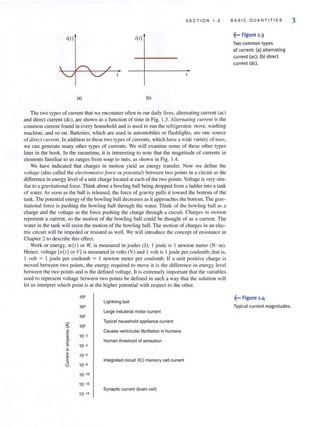
The two types of current that we encounter often in our daily lives. alternating current (ac)
and direct current (dc), are shown as a function of time in Fig. 1.3. A/remming currell! is the
C0l111110 11 current found in every household and is used to run the refrigerator. stove, washing
machine, and so on. Batteries, which are lIsed in automobiles or flashlights, are one sourcc
ofdirecr currell!. In addilion 10 these two types ofcurrents, which have a wide variety of uscs.
we can generate many other types of currents. We will examine some of these other types
later in the book. In the meantime, it is interesting to note that the magnitude of currents in
elements familiar to us ranges from soup to nuts. as shown in Fig. IA.
We have indicaled lhat charges in motion yield an cncrgy transfcr. Now wc detinc the
volrage (also called the elecrromotiveforce or porenthll) between IWO points in a circuit as the
difference in energy level of a unit charge located at each of the two points. Voltage is very sim-
ilar to a gravitational force. Think about a bowling ball being dropped from a ladder into a tank
of water. As soon as the ball is released, the force of gravity pulls it 100vard the boltom of the
tank. The potential energy of the bowling ball decreases as it approaches the bottom. The grav-
itational force is pushing the bowling ball through the water. Think of the bowling ball as a
charge and the voltage as the force pushing the charge through a circuit. Charges in mOl ion
represent a current, so the motion of the bowling ball could be thought of as a current. The
water in the tank will resist the motion of the bowling ball. The motion of charges in an elec-
tric circuit will be impeded or resisted as well. We will introduce the concept of resistance in
Chapter 2 to describe this effec.
Work or energy, w(r ) or W, is measured in joules (l ); I joule is I newton meter (N · m).
Hence, voltage [v(r) or VIis measured in volts (V) and I volt is I joule per coulomb; that is,
I volt ;:;:: I joule per coulomb = I newton meter per coulomb. If a unit positive charge is
moved between two points, the energy req uired to move it is the difference in energy level
between the two points and is the defined voltage. It is extremely imponant that the variables
used to represent voltage between two points be detined in such a way that the solution will
let us interpret which point is at the higher potential wilh respect to the other.
10'
Lightning bolt
10'
Large industrial motor current
10'
~ 100
Typical household appliance current
00
~
10-'~
Causes ventricular fibrillation in humans
0.
E Human threshold of sensation
~ 10-4
.5
C 10-6
~
5
10-80
Integrated circuit (IC) memory cell current
10- 10
10- 12
Synaptic current (brain cell)
10- 14
BAS I C QUANT ITI ES
.~.- Figure 1.3
Two common types
of current: (a) alternating
current (ae); (b) direct
current (de).
~... Figure 1.4
Typica l current magnitudes.
3
4 CHAPTER 1 BASIC CONCEPTS
Figure 1.5 •••~
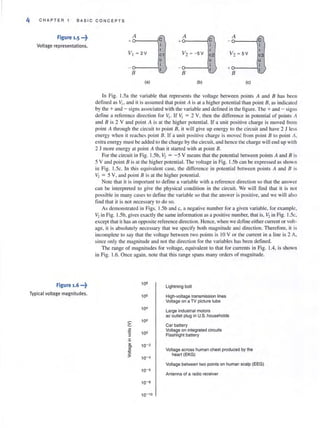
Voltage representations.
Figure 1.6 ...~
Typical voltage magnitudes.
A
+ o-----jC
B
(a)
r
e1
u
A
+
V2 ~ - 5 V
B
(b)
C
A
C
r
V2 ~ 5V
r
e2 e3
u u
+
B
(e)
In Fig. l.5a the variable that represents the voltage between points A and 8 has been
defined as VI. and it is assumed that point A is at a higher potential than point e,as indicated
by the + and - signs associated with the variable and detined in the tlgurc. The + and - signs
define a reference direction for VI' If ~ = 2 Y, then the difference in potential of points A
and B is 2 V and point A is at the higher potential. If a unit positive charge is moved from
point A through the circuit to point B, it will give up energy to the circuit and have 2 J less
energy when it reaches point B. If a unit positive charge is moved from point B to point A.
extra energy must be added to the charge by the circuit, and hence the charge will end up with
2 J more energy at point A than it started with at point B.
For Ihe circuil in Fig. 1.5b, V, ~ - 5 V means Ihat Ihe pOlential between points A and 8 is
5 V and point B is at the higher potential. The voltage in Fig. 1.5b can be expressed as shown
in Fig. 1.5c. In this equivalent case, the difference in potential between points A and B is
V2 = 5 V, and point B is at the higher potential.
Note that it is important to detine a variable with a reference direction so that the answer
can be interpreted to give the physical condition in the circuit. We wi ll find that it is not
possible in many cases to define the variable so that the answer is positive. and we will also
tind that it is not necessary to do so.
As demonstrated in Figs. 1.5b and c, a negative number for a given variable, for example.
V2 in Fig. 1.5b, gives exactly the same information as a positive number, that is. V2 in Fig. 1.5c,
except that it has an opposite reference direction. Hence, -vhen we define either current or volt-
age, it is absolutely necessary that we specify both magnitude and direction. Therefore, it is
incomplete to say that the voltage between two points is 10 V or the current in a line is 2 A,
since only the magnitude and not the direction for the variables has been defined.
The range of magnitudes for voltage, equivalent to that for currents in Fig. lA, is shown
in Fig. 1.6. Once again, note that this range spans many orders of magnitude.
10·
10·
10'
~
102
!!!
0 100
>
.~
" 10- 2
'"g
g 10- 4
10- 6
10- 8
10- 10
Lightning bolt
High-voltage transmission lines
Voltage on a TV picture tube
Large industrial motors
ac oullet plug in U.S. households
Car battery
Voltage on integrated circuits
Flashlight battery
Voltage across human chest produced by the
hearl (EKG)
Vottage between two points on human scatp (EEG)
Antenna of a radio receiver
SECT I ON 1.2
Switch
- Battery
Light bulb
At this point we have presented the conventions that we employ in our discussions of
current and voltage. Ellergy is yet another important tenn of basic significance. Let's
investigate the voltage-current relationships for energy transfer using the flashlight shown in
Fig. 1.7. The basic elements of a flashlight are a battery, a switch, a light bulb, and connect-
ing wires. Assuming a good battery, we all know thutthe light bul b will glow when the switch
is closed. A current now flows in this closed circuit as charges flow out of the positive ter-
minal of the battery through the switch and light bulb and back into the negative terminal of
the battery. The current heats up the filament in the bulb, causing it to glow and emit light.
The light bulb converts electrical energy to thermal energy; as a result, charges passing
through the bulb lose energy. These charges acquire energy as they pass through the battery
as chemical energy is converted to electrical energy. An energy conversion process is occur-
ring in the flashlight as the chemical energy in the banery is converted to electrical energy,
which is then converted to thermal energy in the light bulb.
I
- BaHery
- Vbauery + + V bu1b -
Let's redraw the flashlight as shown in Fig. 1.8. There is a current I flowing in this dia-
gram. Since we know that the light bulb uses energy, the charges coming out of the bulb have
less energy than those entering the light bulb. In other words, the charges expend energy as
they move through the bulb. This is indicated by the voltage shown across the bulb. The
charges gain energy as they pass through the banery, which is indicated by the voltage across
the battery. Note the voltage--<:urrent relationships for the battery and bulb. We know that the
bulb is absorbing energy; the current is entering the positive terminal of the voltage. For the
battery, the current is leaving the positive temlinal, which indicates that energy is being
supplied.
This is further illustrated in Fig. 1.9 where a circuit element has been extracted from a
larger circuit for examination. In Fig. 1.9a, energy is being supplied to the element by
whatever is attached to the terminals. Note that 2 A, that is, 2 C of charge are moving from
point A to point B through the element each second. Each coulomb loses 3 J of energy as it
passes through the element from point A to point B. Therefore, the element is absorbing 6 ]
of energy per second. Note that when the element is absorbing energy. a positive current
enters the positive terminal. In Fig. 1.9b energy is being supplied by the clement to whatever
is connected to terminals A-B. In this case, note that when the element is supplying energy,
a positive current enters the negative terminal and leaves via the positive terminal. In this con-
vention, a negative current in one direction is equivalent to a positive current in the opposite
direction, and vice versa. Similarly, a negative voltage in one direction is equivalent to a pos-
itive voltage in the opposite direction.
BASIC QUANTITIE S
~••• Figure 1.7
Flashlight circuit.
~... Figure 1.8
Flashlight circuit with
voltages and current.
A 1 ~ 2A
+
3V
B 1 ~ 2A
(a)
A 1 ~ 2A
+
3V
B I ~ 2 A
(b)
5
.or" Figure 1.9
Voltage- current relationships
for <aJ energy absorbed and
(bJ energy supplied.
•
6 C H APT ER 1 BASIC CONC E PTS
EXAMPLE 1.1
•
SOLUTION
Figure 1.10 ···t
Diagram for Example 1.1.
i(l)
+
V(I)
• -<••
Figure 1.11 i
Sign convention for power.
[hint ]
The passive sign convention
is used to determine whether
power is being absorbed or
supplied.
Suppose that your car will not start. To determine whether the battery is faulty, you turn on
the light switch and fi nd that the lights are very dim, indicating a weak battery. You borrow
a friend's car and a set of jumper cables. However, how do you connect his car's battery to
yours? What do you want his batlery to do?
Essentially, his car's battery must supply energy to yours, and therefore it should be
connected in the manner shown in Fig. J. IO. Note that the positive current leaves the posi-
tive termi nal of the good battery (supplyi ng energy) and enters the positive terminal of the
weak battery (absorbing energy), Note that the same connections are used when charging a
battery.
I
I
In practical applications there are often considerations other than simply the electrical
relations (e.g., safety). Such is the case with jump-starting an automobile. Automobile
batteries produce explosive gases that can be ignited accidentally, causing severe physical
injury. Be safe-follow the procedure described in your auto owner's manual.
We have defined voltage in joules per coulomb as the energy required to move a positive
charge of I C through an element. If we assume that we are dealing with a di fferential alllount
of charge and energy, then
li1V
v=-
dq
Muhiplying this quantity by the current in the element yields
1.2
1.3
which is the time rale of change of energy or power measured in joules per second, or watts
(W). Since, in general, both v and i are functions of time, p is also a time-varying quantity.
Therefore, the change in energy from time I, to lime 12 can be found by integrati ng Eq. ( 1.3);
that is,
1', 1"t.w = P dl = VillI
'1 '1
1.4
At this point, leI us summarize our sign convention for power. To determine the sign of
any of the quantities involved, the variables for the current and voltage should be arranged as
shown in Fig. 1. 11 . The variable for the voltage V{ /) is defi ned as the voltage across the ele-
ment with the positive reference at the same termi nal that the current variable i{/ ) is entering.
This convention is called the passive sign cOllvelllioll and will be so noted in the remainder
of this book. The product of V and i, with their attendant signs, will determine the magnitude
and sign of the powcr. If the sign of the power is positive, power is being absorbed by the ele-
ment; if the sign is ncgative. power is being supplied by the element.
SECTION 1 . 2
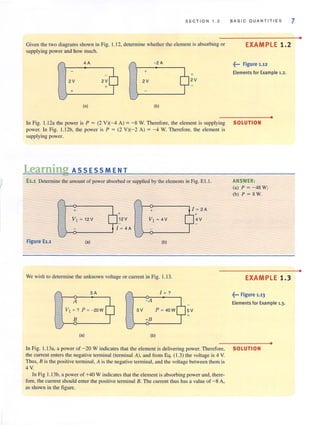
Given the two diagrams shown in Fig. 1.12, determine whether the element is absorbing or
supplying power and how much.
2V
+
4A
(a)
2V
+
+
2V
- 2A
(b)
+
2V
BASIC QU ANTI TI ES
EXAMPLE 1.2
~... Figure 1.12
Elements for Example 1.2.
•
In Fig. 1.l2a the power is P = (2 V)(- 4 A) =-8 W. Therefore, the element is supplying SOLUTION
power. In Fig. 1.12b, the power is P = (2 V)(- 2 A) = - 4 W. Therefore, the element is
supplying power.
Learning ASS ESSM ENT
E1.1 Determine the amount of power absorbed or supplied by the elements in Fig. El.I.
+
Figure El.l (a)
+
12V
+
(b)
We wish to determine the unknown voltage or current in Fig. 1.13.
SA { = ?
A -A
Vt =? P = - 20W SV p = 40W
B +B
(a) (b)
SV
+
ANSWER:
(a) P = -48 W;
(b) P = 8 W.
EXAMPLE 1.3
.~... Figure 1.13
Elements for Example 1.3.
•
In Fig. 1.13a, a power of -20 W indicates that the element is delivering power. Therefore, SOLUTION
the current enters the negative terminal (terminal A), and from Eq. (1.3) the voltage is 4 V.
Thus, B is the positive terminal, A is the negative terminal, and the voltage between them is
4Y.
In Fig 1.1 3b, a power of +40 V indicates that the element is absorbing powerand. there-
fore, the current should enter the positive terminal B. The current thus has a value of -8 A,
as shown in the figure.
7
•
•
8 CHAPT E R 1 B ASIC CONCEPTS
Learning ASS ESSM E N T
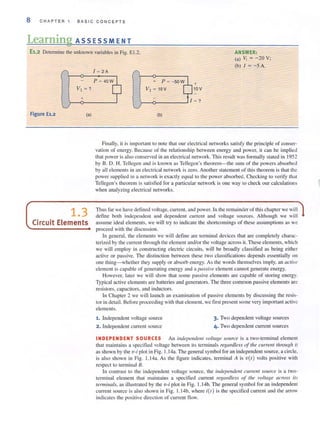
E1.2 Determine the unknown variables in Fig. E 1.2. ANSWER:
+
Figure E1.2 (a)
1.3
Circuit Elements
1 = 2 A
+
(b)
+
10 V
(0) V, = -20 V;
(b) I = -5 A.
Finally, it is imporlum to note that ollr electrical networks satisfy the principle of conser-
vation of energy. Because of the relationship between energy and power, it can be implied
that power is also conserved in an electrical network. This result was formally stuted in 1952
by B. D. H. Tcllcgcn and is known as Tellegcn's theorem- the slim of the powers absorbed
by all elements in an clectricalnclwork is zero. Another statement of this theorem is Ihal the
power supplied in a network is exactl y equal to the power absorbed. Checking (0 verify that
Tellegcn's theorem is satisfied for a particular network is one way to check our calculations
when analyzing electrical networks.
Thus far we have defined voltage, current, and power. In the remainder of this chapter we will
define both illllt:pclldent and dependent current and voltage sources. Although we will
assume ideal elements, we will try to indicate the shortcomings of these assumptions as we
proceed with the discussion.
In general, the elements we will define are terminal devices that are completely charac-
terized by the current through the clement and/or the voltage across it. These elements, which
we will employ in constructing electric circuits. will be broadly classified as being either
active or passive. The distinction between these two classifications depends essentially on
olle thing-whether they supply OJ' absorb energy. As the words themselves imply, an active
element is capable of generating energy and a passive element cannot generate energy.
However, later we will show that some passive elements are capable of storing energy.
Typical active elements are batteries and generators. The three common passive elements are
resistors, capacitors, and inductors.
In Chapter 2 we will launch an examination of passive elements by discussing the resis-
tor in detail. Before proceeding with that clement, we first present some very important active
elements.
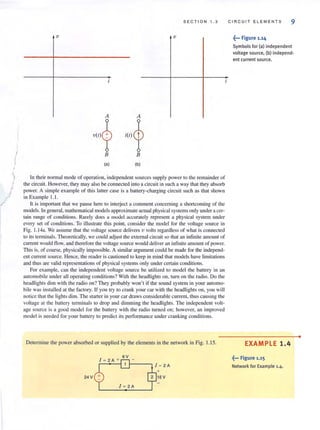
1. Independent voltage source 3. Two dependent voltage sources
2. Independent current source 4 . Two dependent current sources
INDEPENDENT SOURCES An illdepellde1l1 vo/wge source is a two-Ienninal element
that maintains a specified voltage between its terminals regardless oj tile CllrreW throllgh it
as shown by the v-i plot in Fig. I.14a. The general symbol for an independent source, a circle.
is also shown in Fig. 1.14a. As the figure indicates. terminal A is v(t ) volts positive with
respect to terminal B.
In contrast to the independent voltage source, the illdepel/{Iem current source is a two-
terminaJ elemeill that maintains a specified current regardless oj'tlte volwge (lcros.· its
termillals, as illustrated by the '1)-i plot in Fig. 1.14b. The general symbol for an independent
current source is also shown in Fig. 1.1 4b, where i(t) is the specified Clirreill and the arrow
indicates the positive direction of current now.
}
I
SECT I ON 1 . 3
'V 'V
A A
"(')~ '(')~
B B
(a) (b)
In their normal mode o f operation, independent sources supply power to the remainder of
the circuit. However, they may also be connected into a circuit in such a way that they absorb
power. A simple example of this latter case is a battery-charging circuit such as that shown
in Example 1.1.
It is important that we pause here to interject a comment concerning a shortcoming of the
models. 1.11 general, mathematical models approximate actual physical syslems only under a cer-
tain range of conditions. Rarely does a I1H..x.lel accuntlely represent a physical system under
every set of conditions. To illustrate this point. consider the model for the voltage source in
Fig. I. 14a. We assume thai the voltage source deli vers V volts regardless of what is connected
10 its tenninals. Theoretically, we could adjust the external circuit so that an intinite amount of
current would tlow, and therefore the voltage source would deliver an intinite amount of power.
This is, of course, physically impossible, A similar argument could be made for the independ-
ent current source. Hence, the reader is cautioned to keep in mind that models have limitations
and thus are valid representations of physical systems only under certain conditions.
For example, can the independent voltage source be utilized to model the battery in an
automobile under all operating conditions? With the headlights on, turn on the radio. Do the
headlights dim with the radio on? They probably won't if the sound system in your automo·
bile was installed at the factory. If you try to crank your car with the headlights on, you wi ll
notice that the lights dim. The starter in your car draws considerable current, thus causing the
voltage at the battery terminals to drop and dimming the headli ghts. The independent volt-
age source is a good model for the battery with the radio turned on; however, an improved
model is needed for your battery to predict its performance under cranking conditions.
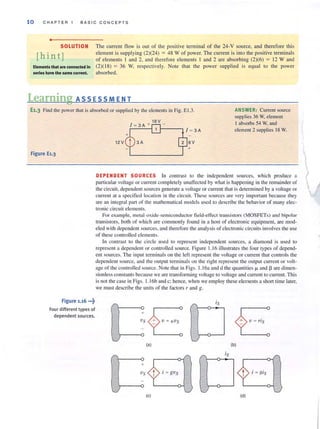
Determine the power absorbed or supplied by the elements in the network in Fig, 1,1 5,
6V
+
24 V 18 V
C IR C U IT ELEMENT S 9
~,•• Figure 1,14
Symbols for (al independent
voltage sou rce, (bl independ,
ent current source.
EXAMPLE 1.4
~••• Figure 1,15
Network for Example 1.4.
•
10 CHA PTE R 1 BAS I C C ONC EPT S
•
SOLUTION
[hin tj
Elements that are connected In
series have the same current.
The current now is out of the positive terminal of the 24-V source, and therefore this
element is supplying (2)(24) ~ 48 W of power. The current is into the positive terminals
of elements I and 2, and therefore elements I and 2 are absorbing (2)(6) ~ 12 Wand
(2)( 18) ~ 36 W, respectively. Note that the power supplied is equal to the power
absorbed.
Learning ASSESSM ENT
E1.3 Find lhe power that is absorbed or supplied by the elements in Fig. E1.3. ANSWER: Current source
supplies 36 W, element
Figure E1.3
Figure 1.16 ...~
Four different types of
dependent sources.
I absorbs 54 W, and
element 2 supplies 18 W.
DEPENDENT SOURCES In contrast 10 the independent sources, which produce a
particular voltage or current completely unaffected by what is happening in the remainder of
[he circuit, dependent sources generate a voltage or current that is detennined by a voltage or
current at a specitied location in the circuit. These sources are very important because they
are an integral purt of the mathematical models used to describe the behavior of many elec-
tronic circuit elements.
For example, mctal-oxide-scmiconductor ficld-clfect transistors (MOSFETs) and bipolm
transislOrs, both of which are commonly found in a host of electJonic equipment. are mod-
eled with dependent sources, and therefore the anal ysis of electronic circuits involves the use
of these controlled elements.
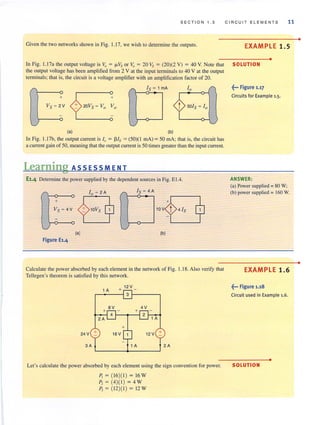
In contrast lO the circle used to represent independent sources, a diamond is used to
represent a dependent or controlled source. Figure 1.16 illustrates the four types of depend-
ent sources. The input termi nals on the left represent the voltage or current that controls the
dependent source. and the output terminals on the right represent the output current or volt-
age orthe COil trolled source. Note that in Figs. 1.1 6a and d the quantities ~ and J3 are di men-
sionless constants because we are transforming voltage to voltage and current to current. This
is not the case in Figs. 1.16b and c; hence, when we employ these elements a short time later,
we must describe the units of the factors rand g.
E(a) (b)
is
+
'Us t i = gvs
(c) (d)

•
I
SECTION 1 . 3 CIRCUIT ELEMEN TS 11
Given the two networksshown in Fig. 1.1 7, we wish to determine the outputs. EXAMPLE 1.5
•
[n Fig. 1.17a the output voltage is v" = [.LVs or Va = 20 Vs = (20)(2 V) = 40 V. Note that SOLUTION
the output voltage has been amplified from 2 V at the input terminals to 40 V at the output
terminals; that is, the circuit is a voltage amplifier with an amplification factor of 20.
IS = 1 rnA
+
Vs = 2V 5015 = 10
(a) (b)
[n Fig. 1.I7b, the output current is 10 = f3/s = (50)(1 mAl = 50 mA; that is, the circuit has
acurrent gain of 50, meaning that theoutput current is50 times greater than the input current.
Learning ASS ESSM ENT
£1.4 Determine the power supplied by the dependent sources in Fig. E1.4.
10 = 2A
"
15 = 4A
+
B '"'BVs = 4V
LI
(a) (b)
Figure E1.4
Calculate the power absorbed by each element in the network of Fig. I. IB. Also verify that
Tellegen's theorem is satisfied by this network.
24 V
3A
1 A
12 V
+
'---~--1 3 f------,
4V
Let's calculate the power absorbed by each element using the sign convemion for power.
PI = (16)( 1) = 16 W
P, = (4)( 1) =4W
P, = (12)(1) = 12 W
~.., Figure 1.17
Circuits for Example 1.5.
ANSWER:
(a) Power supplied = BO W;
(b) power supplied = 160 W.
EXAMPLE 1.6
~... Figure 1.18
Circuit used in Example 1.6.
•
SOLUTION
•
•
•
12 CHAP T ER 1 BASIC CONCEPTS
EXAMPLE 1.7
Figure 1.19 ...~
Circuit used in Example 1.7.
•
P, = (8)(2) = 16 W
P12V = (12)(2) = 24 W
P"v = (24)(- 3) = -72 W
Note that to calculate the power absorbed by the 24-V source, the current of 3 A flowing up
through the source was changed to a current -3 A flowing down through the 24-V source.
Let's sum up the power absorbed by all elements: 16 + 4 + 12 + 16 + 24 - 72 = 0
This sum is zero, which verifies that Tellegen's theorem is satisfied.
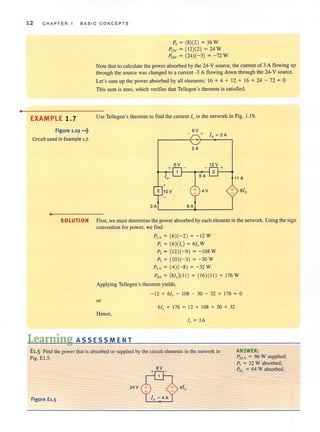
Use Tellegen's theorem to find the current 10 in the network in Fig. 1.19.
SOLUTION First, we must determine the power absorbed by each element in the network. Using the sign
convention for power, we find
P'A = (6)(- 2) = - 12 W
P, = (6 )(10) = 6/"W
P, = ( 12)(-9) = - 108 W
P, = ( 10)(- 3) = -30 W
PH = (4)(-8) = -32W
PD, = (8/,)( 11 ) = ( 16)( 11 ) = 176W
Applying Tellegen's theorem yields,
-12 + 6/" - 108 - 30 - 32 + 176 = 0
or
6/,, + 176 = 12+ 108 +30 + 32
Hence,
10 = IA
Learning ASS ESSM ENT
E1.5 Find the power that is absorbed or supplied by the circuit elements in the network in
Fig. EI.5.
BV
24V
Figure El.5
ANSWER:
P" v = 96 W supplied;
P, = 32 W absorbed;
P4I , = 64 W absorbed.
SECTION 1.3 C IRCUIT ELEMENTS 13
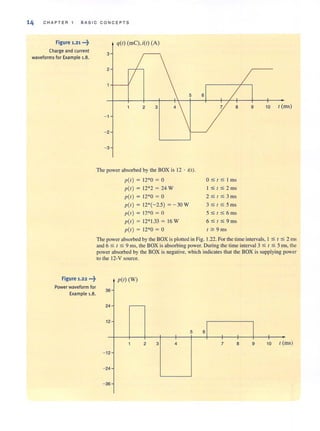
The charge that enters the BOX is shown in Fig. 1.20. Calculate and sketch the current flow- EXAMPLE 1.8
ing into and the power absorbed by the BOX between 0 and 10 milliseconds.
i (I) ~... Figure 1.20
Diagrams for Example 1.8.
t2 V BOX
q(t) (me)
3
2
5 6
2 3 4 7 8 9 10 I (ms)
- t
- 2
- 3
Recall that current is related to charge by i(l) = dq(l) The current is equal to the slope of SOLUTION
dl
the charge waveform.
i(l) = 0
3 X 10⁻³ - I X 10-3
i(l) = 2 X 10 3 _ I X 10 3 = 2A
i(l) = 0
-2 X 10⁻³ - 3 X 10⁻³
i(l) = 5 X 10 3 _ 3 X 10-3 = -2.5 A
i(l) = 0
2 X 10⁻³ - (-2 X 10⁻³)
i(l) = = 1.33 A
9 X 10 3 - 6 X 10⁻³
i(l) = 0
OSISlms
1St S 2 ms
2SI s 3ms
3 s t S 5 ms
5SI s 6ms
6 :5 t :5 9 ms
t ~ 9ms
The current is plotted with the charge waveform in Fig. 1.21. Note that the current is zero
during times when the charge is a constant value. When the charge is increasing. the current
is positive, and when the charge is decreasing the current is negative.
•
•
14 C H A P TER 1 BAS I C CO N CEPTS
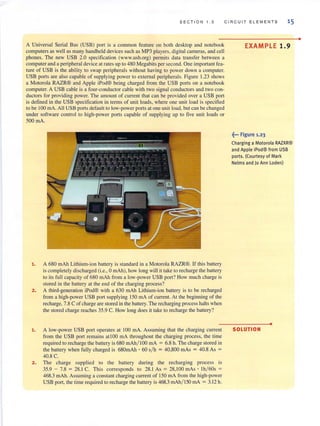
Figure 1.21 ...?
Charge and current
waveforms for Example 1.8.
Figure 1.22 •••l-
Power waveform for
Example 1.8.
q(l) (me),i(l) (A)
3
2
2 3
- 1
- 2
- 3
The power absorbed by the BOX is 12 . i(I).
p(l ) = 12*0 = 0
p(l ) = 12*2 = 24 W
p(l ) = 12*0 = 0
p(l ) = 12*(-2.5) = - 30 W
p(l ) = 12*0 = 0
p(l ) = 12*1.33 = 16 W
p(l ) = 12*0 = 0
O StS lms
1 ::51S 2ms
2 ::5 { ::5 3 1115
3 ::5 1 ::5 5 ms
5 ::5 t s 6 illS
6 "1 ,, 9ms
[ ~ 9 ms
9 10 I (ms)
The power absorbed by the BOX is plotted in Fig. 1.22. For the time intervals, I " I " 2 ms
and 6 s 1 ::5 9 ms, the BOX is absorbing power. During the time interval 3 ::5 t ::5 5 ms, the
power absorbed by the BOX is negative, which indicates that the BOX is supplying power
to the 12-V source.
p(l) (W)
36
24 1-'----
12 I
5 6
tJ
2 7 8 10 I (ms)
- 12
- 24
9
-36
SECTION 1 . 3 CIRCUIT ELE MEN T S 15
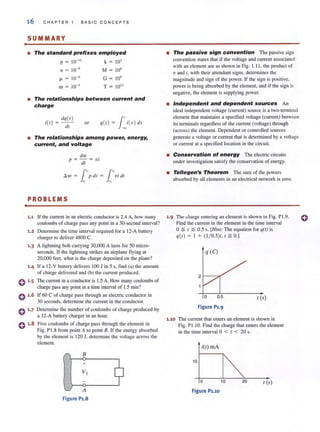
A Universal Serial Bus (USB) port is a common feature on both desklop and nOlebook
compulers as well as many handheld devices such as MP3 players. digilal cameras, and cell
phones. The new USB 2.0 specification (www.usb.org) permits data transfer between a
computer and a peripheral device at rates up to 480 Megabits persecond. One important fea-
ture of USB is the ability to swap peripherals without having to power down a computer.
USB ports are also capable of supplying power 10 eXlernal peripherals. Figure 1.23 shows
a MOlorola RAZR® and Apple iPod® being charged from the USB ports on a nOlebook
computer. A USB cable is a four-conductorcable with two signal conductors and two con-
ductors for providing power. The amount of current that can be provided over a USB port
is defined in the USB specification in terms of unit loads, where one unit load is specified
10 be 100 rnA. All USB ports defauillo low-power parIS al one unilload, bUI can be changed
under software control 10 high-power ports capable of supplying up 10 five unil loads or
500mA.
1. A 680 mAh Lilhium-ion battery is standard in a Motorola RAZR®. If Ihis battery
is completely discharged (Le., 0 mAh), how long will it take to recharge the baltery
to its full capacilY of 680 mAh from a low-power USB port? How much charge is
stored in the battery at the end of the charging process?
2. A Ihird-generation iPod® wilh a 630 mAh Lithium-ion battery is 10 be recharged
from a high-power USB port supplying 150 mA of current. Al the beginning of Ihe
recharge, 7.8 C ofcharge are stored in the battelY, The recharging process halts when
the stored charge reaches 35.9 C. How long does illake to recharge Ihe battery?
1. A low-power USB port operates at 100 rnA. Assumjng that the charging current
from the USB port remains at 100 rnA throughout the charging process, the time
required to recharge Ihe battery is 680 mAh/ IOO mA = 6.8 h. The charge stored in
the battery when fully charged is 680mAh • 60 s/h = 40,800 mAs = 40.8 As =
40.8 C.
2. The charge supplied 10 Ihe battery during the recharging process is
35.9 - 7.8 = 28.1C. This corresponds 10 28.1 As = 28,100 mAs ' Ih/ 60s =
468.3 mAh. Assuming a constant charging current of 150 rnA from the high-power
USB port, the time required 10 recharge the battery is 468.3 mAh/ ISO mA = 3.12 h.
EXAMPLE 1.9
~". Figure 1.23
Charging a Motorola RAZXR®
and Apple iPod® from USB
ports. (Courtesy of Mark
Nelms and Jo Ann Loden)
•
SOLUTION
•
•
•
16 C H APT ER 1 BASIC CONCEPTS
SUMMARY
• The standard prefixes employed
p = 10-12
k 103
n = 10-9
M 106
fJ. 10-6
G 10'
m 10-3
T= 1012
• The relationships between current and
charge
dq (l )
i(l) = - -
<II
or q(l ) = J~i(X) <Ix
• The relationships among power, energy,
current, and voltage
dw .
p = - = V I
dl
1"Ih v = p dl =
"
PROBLEMS
1
','VI df
"
1.1 If the currem in an electric conductor is 2.4 A, how many
coulombs of charge pass any point in a 30-second interval?
1.2 Determine the time interval required for a I2-A battery
charger '0 deliver 4800 C.
1.3 A lightning bolt carrying 30,000 A lasts for 50 micro-
seconds. If the lightning strikes an airplane flying at
20,000 feel, what is the charge deposited on the plane?
1,4 If a 12-V battery delivers 100 J in 5 s, find (a) 'he amount
of charge delivered and (b) the current produced.
0 '.5 The current in a conductor is 1.5 A. How many coulombs of
charge pass any point in a time interval of 1.5 min?
o 1.6 If 60 C of charge pass through an electric conductor in
30 seconds, determine the currem in the conductor.
0 1.7
0 ,.8
Determine the number of coulombs of charge produced by
a 12-A battery charger in an hour.
Five coulombs of charge pass through the elemem in
Fig. PI.8 from point A to point B. If the energy absorbed
by the element is 120 J, determine the voltage across the
element.
B
+
A
Figure P1,S
• The passive sign convention The passive sign
convention states that if the voltage and current associated
with an element are as shown in Fig. 1.11 . the product of
v and i, with their 3t1cndant signs. determines the
magnitude and sign of the power. If the sign is positive,
power is being absorbed by the element, and if the sign is
negative, the clemem is supplying power.
• Independent and dependent sources An
ideal independent voltage (current) source is a two-terminal
element that maintains a specified voltage (current) between
its terminals regardless of the current (voltage) through
(across) the element. Dependent or controlled sources
generate a voltage or current that is detcnnined by a voltage
or current at a specified location in the circuit.
• Conservation of energy The electric circuits
under investigation satisfy the conservation of energy.
• Tellegen's Theorem The Slim of the powers
absorbed by all elements in an electrical network is zero.
1.9 The charge entering an element is shown in Fig. P1.9.
1.10
Find the current in the element in the time interval
o~ I ~ 0.5 s. [Him: The equation for '1(1) is
'1 (1) = I + (1/ 0.5)1, I ~ 0.1
q (e)
2
o 0.5 r (s)
Figure P1.9
The current that enters an element is shown in
Fig. P1.1O. Find the charge that enters the element
in the lime interval 0 < I < 20 s.
i(l) rnA
10
o 20 I (s)
Figure Puo
o
1 .11 The charge entering the positive terminal of an element is
q(r) = -30e-41
me. If the vollage across the element is
120e-21
y , determine the energy delivered to the element
in the time interval 0 < t < 50 ms.
PR O B L E MS 17
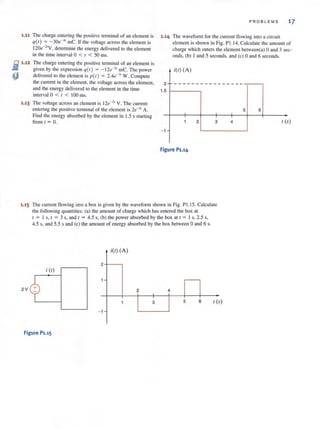
1.14 The waveform for the current flowing illlo a circuit
element is shown in Fig. P1. 14. Calculate the amoum of
charge which enters the element between(a) 0 and 3 sec-
onds, (b) 1 and 5 seconds, and (c) 0 and 6 seconds.
£1 1.12 The charge emering the positive terminal of an element is
given by the expression q(t) = - J2e-2r me. The power
delivered to the element is p(r) = 2.4e-31 W. Compute
the currem in the element, the voltage across the element,
and the energy delivered to the element in the time
interval 0 < t < 100 InS.
( ) (A)- t t
2 -- -- -- -- --------
1.13 The voltage across an element is 12e-2r V. The current
entering the positive terminal of the elemem is 2e-z, A.
Find the energy absorbed by the element in 1.5 s starting
from t = O.
.5
1
1
Figure Pl.14
2 3
1.15 The current flowing into a box is given by the waveform shown in Fig. PI .IS. Calculate
the following quantities: (a) the amount of charge which has entered the box at
2V
t = 1 s, t = 3 s, and t = 4.5 s, (b) the power absorbed by the box at t = I s, 2.5 s,
4.5 s, and 5.5 s and (c) the amount of energy absorbed by the box between 0 and 6 s.
t I.( ) (A)
2
i (I)
1 -
2 4
,
,
1 3 5 6
1
Figure P1.1S
t (s
4
5 6
t (s)
18 CHAP T ER 1 BASIC CONC E PTS
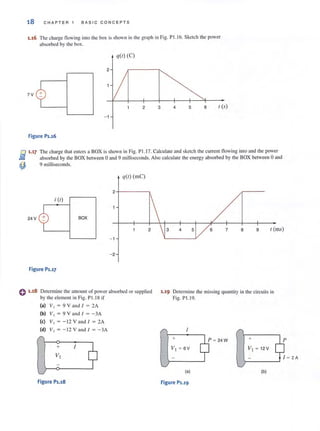
1.16 The charge flowing into the box is shown in the graph ill Fig. P1. 16. Sketch the power
absorbed by the box.
q(t) (C)
2
7V
2 3 4 5 6 t (.I )
- 1
Figure P1.16
f} 1.17 The charge that enters a BOX is shown in Fig. PI .I ? Calculate and sketch the current flowing into and the power
www absorbed by the BOX between 0 and 9 milliseconds. Also calculate the energy absorbed by the BOX between 0 and
~ 9 milliseconds.
q(t) (mC)
2-1-- - - ,
i (t)
24 V BOX
- 1
- 2
Figure Pl.l?
0 1.18 Determine the amount of power absorbed or supplied
by the element in Fig. PI.1 8 if
(a) V I = 9 V and I = 2A
(b) V I = 9 V and I = - 3A
(c) VI = - 12 V and I = 2A
(d) V I = - 12 V and I = - 3A
+ /
Figure Pl.18
4 5!
j
7 8 9 t (ms)
1.19 Determine the missing quantity in the circuits in
Fig. P1. 19.
I
+ +
(a) (b)
Figure Pl.19
1.20 Repeat Problem 1. 19 for the circuits in Fig. P1.20.
1 ~ - 3 A
+
(a)
Figure Pl.20
1 ~ - 4 A
+
(b)
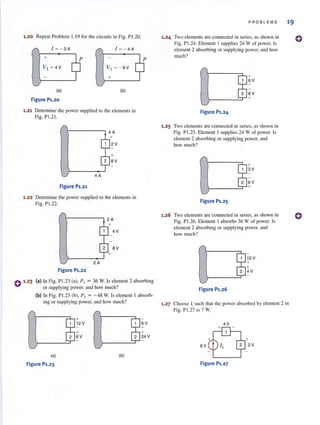
1.21 Determ ine the power supplied to the elements in
Fig. PI.2t.
Figure Pl.21
1.22 Determine the power supplied to the elements in
Fig. P1.22.
Figure Pl.22
(} 1.23 (a) [n Fig. Pt.23 (a), P, = 36 W. [s element 2 absorbing
or supplying power, and how much?
(b) In Fig. PI.23 (b). P, = -48 W. Is element I absorb-
ing or supplying power, and how much?
(a)
Figure Pl,23
+
12 V
+
6V
(b)
6V
+
+
24 V
P R OBLEMS 19
1.24 Two elcments are connected in serics, as shown in
Fig. P1.24. Element I supplies 24 W of power. Is
element 2 absorbing or supplying power, and how
much?
Figure Pl.24
+
6V
8V
+
1.25 Two elements are connected in series, as shown in
Fig. P1.25. Element I supplies 24 W of power. Is
element 2 absorbing or supplying power, and
how much?
Figure P1.25
+
3V
6V
+
1.26 Two elements are connected in series, as shown in
Fig. P1.26. Element I absorbs 36 W of power. Is
clement 2 absorbing or supplying power. and
how mLlch?
Figure Pl,26
12V
+
+
4V
1.27 Choose Is such thai the power absorbed by element 2 in
Fig. Pl.27 is 7 W.
4V
6V
Figure Pl.2?
+
2V
(}
(}
20 CHAPTER 1 BASIC CONCEPTS
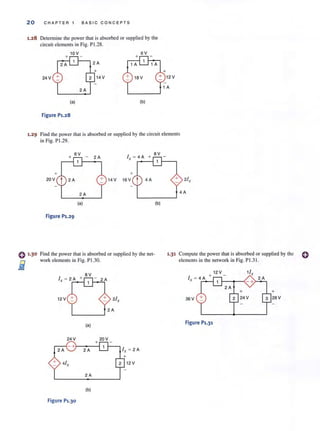
1.28 Delemline the power thaI is absorbed or supplied by the
circuit elements in Fig. P1.28.
10 V
24 V
(a) (b)
Figure P1.2S
1.29 Find the power that is absorbed or supplied by the circuit elements
in Fig. P1.29.
8V
14 V 16 V
(a) (b)
Figure P1.29
0 '.30 Find the power that is absorbed or suppJied by the net-
work elements in Fig. P1.30.
' .3' Compule Ihe power that is absorbed or supplied by Ihe
elements in the network in Fig. P1.31.
9-
(a)
(b)
Figure P1.30
36V
Figure P1.31
2A
+
28V
o
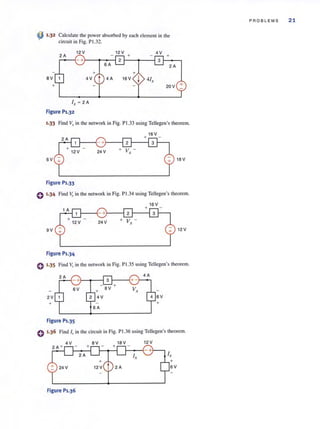
~ 1·32 Calculate the power absorbed by each element in the
circuit in Fig. P1.32.
2A
12V
- +
8V 4V
I , = 2 A
Figure Pl.32
6A
+
4A
12 V
+
2
+
16 V j 4I,
+
4 V
3 f--...,
2A
20V +
1.33 Find V, in the network in Fig. PI .33 using Tellegen's theorem.
1------(- +} -----j
24 V
6 V 18 V
Figure Pl.33
o 1·34 Find ~ in the network in Fig. PI.34 using Tellegen's theorem.
9 V 12V
Figure Pl.34
o 1·35 Find ~ in the network in Fig. P1.35 using Tellegen's theorem.
2V
+
Figure Pl.35
o 1.36 Find l.x in the circuit in Fig. PI .36 using Tellegen's theorem.
12 V
6V
Figure Pl.36
PROBL E M S 21
22 CHAPTER 1 BASIC CONC EPTS
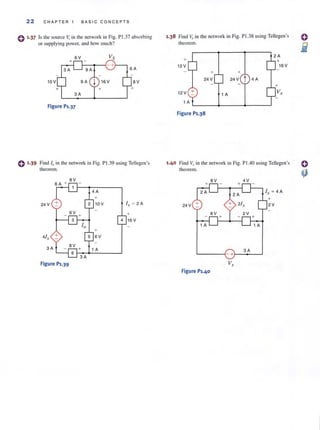
() 1.37 Is the source Vt in the network in Fig. P1.37 absorbing
or supplying power, and how much?
Figure Pl.37
() 1.39 Find I" in the network in Fig. P1.39 using Tellegen's
theorem.
+
24 V 10V l , ~ 2 A
6V +
4 16 V
+
41, 6V
3A
Figure Pl.39
1.38 Find Vrin the network in Fig. PI.38 using Tellegen's
theorem.
+
12 V
12V :!:
+
24 V
+
24 V t 4 A
1 A
1 A L-_ _~_ _ _-+-__----l
Figure Pl.38
+
16 V
1.40 Find VI"in the network in Fig. PlAO using Tellegen's
theorem.
8V 4V
+
24 V 2V
3A
-+
Vx
Figure P1.40
Courtesy ofToyota
CHAPTER
RESISTIVE CI RCU ITS
• Be able to use Ohm's law to solve electric circuits
• Be able to apply Ki rchhoWs current law and
KirchhoWs voltage law to solve electric circuits
• Know how to analyze single-loop and single-
node-pair circuits
• Know how to combine resistors in series and parallel
• Be able to use voltage and current division to
solve simple electric circuits
• Understand when and how to apply wye-delta
transformations to solve electric ci rcuits
• Know how to analyze electric circuits containing
dependent sources
YBRID VECHICLES SUCH AS THE
TOYOTA Prius utilize a gasoline engine
and an electric motor to provide propul-
sion. The gasoline engine may drive the vehicle, or it may charge
of a hybrid powertrain results inreduced emissions and improved
gas mileage. The electrical system in aToyota Prius isa de system
with a sealed Nickel-Metal Hydride battery with a rated voltage of
201.6 volts. The analysis and design of the electrical system in
the battery in the electrical system. The electric motor may drive hybrid vehicles require knowledge of fundamental circuit laws
the vehicle by itself, It is possible that thegasoline engine and such as Ohm's law, Kirchhoff's current law, and Kirchhoff's
I electric motor may work together to propel the vehicle, Utili_za_t_io_n__v_o_lt_a_g_e_la_w_,_T_he_se laws will be introduced in this chapter. < < <
23
24 CHAPTER 2 RESISTIVE CIRCU I TS
2.1
Ohm's Law
[hin tJ
The passive sign convention
will be employed in
conjunction with Ohm's law.
Figure 2.1 •••~
(a) Symbol for a resistor;
(b) some practica l devices.
(1), ('), and (3) are high·
power resistors. (4) and (5)
are high·wattage fixed
resistors. (6) is a high-
precision resistor. (7)-(1')
are fixed resisto rs with
different power ratings.
(Photo courtesy of Mark
Nelms and 10 Ann Loden)
itt)
+
vet) R
la)
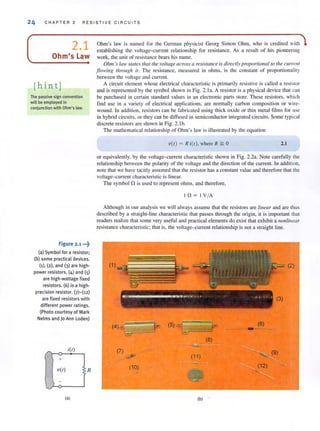
Ohm's law is named for the German physicist Georg Simon Ohm, who is credited with
establishing the voltage-current relationship for resistance. As a result of his pioneering
work, the unit of resistance bears his name.
Ohm's law stales that the lIo/rage acroH a resistance is directly proporliolla/ro the current
flowing through il. The resistance. measured in ohms. is the constant of proportionality
between the voltage and current.
A circuit element whose electrical characteristic is primarily resistive is called a resistor
and is represented by the symbol shown in Fig. 2. 1a. A resistor is a physical device that can
be purchased in certain standard values in an electronic parts store. These resistors, which
find use in a variety of electrical applications, are normally carbon composition or wire-
wound. In addition, resistors can be fabricated using thick oxide or thin metal films for usc
in hybrid circuits, or they can be diffused in semiconductor integrated circuits. Some typical
discrete resistors are shown in Fig. 2.1 b.
The mmhematical relationship of Ohm's law is illustrated by the equation
Ve t) = R i(t), where R ~ 0 2.1
or equivalently, by the voltage-<:urrent characteristic shown in Fig. 2.2a. Note carefully the
relationship between the polarity of the voltage and the direction of the current. In addition,
nOle that we have tacitly assumed that the resistor has a constant value and therefore that the
voltage-<:urrent characteristic is linear.
The symbol n is used to represent ohms, and therefore,
In = I V IA
Although in our analysis we will always assume that the resistors are linear and arc thus
described by a straight-line characteristic that passes through the origin, it is important !.hat
readers realize that some very useful and practical elements do exist that exhibit a nonlinear
resistance characteristic; that is, the vohage-<:urrent relationship is not a straight line.
(1 ) (2)
(6)
---(4)
(8)
(7)
(11)
(10)
Ib) -
S E CTIO N 2. 1 O H M ' S LAW 25
V(I) V(I)
R
i(I)
(a) (b)
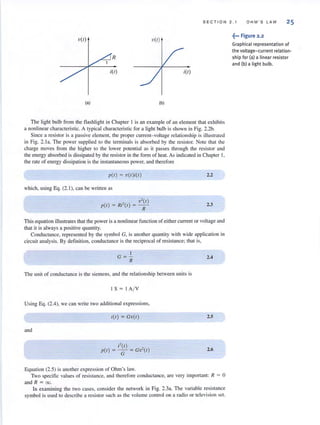
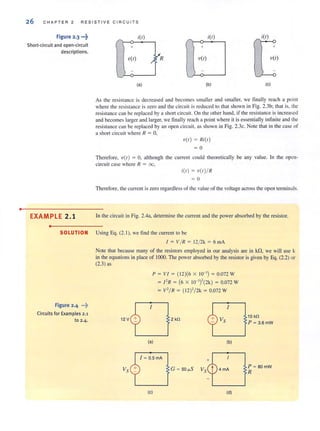
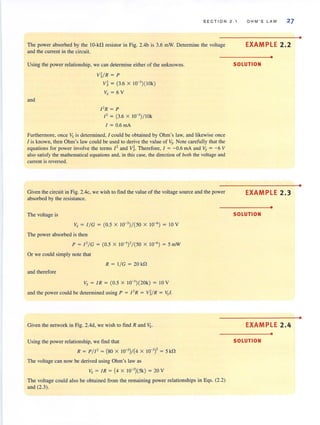
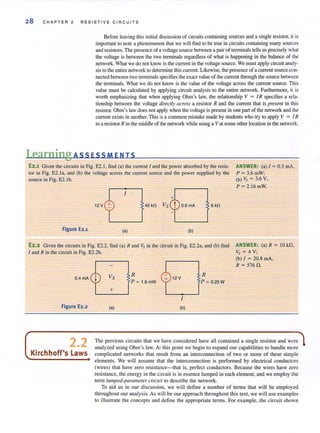
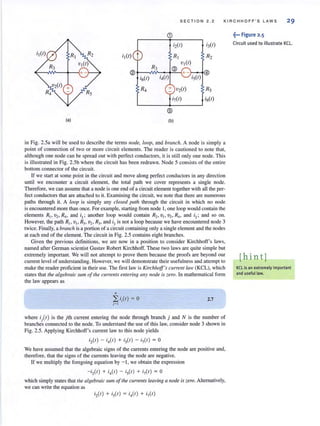
The light bulb from the flashlight in Chapter I is an example of an element that exhibits
a nonlinear characteristic. A typical characteristic for a light bulb is shown in Fig. 2.2b.
Since a resistor is a passive clement, the proper current- voltage relationship is illustrated
in Fig. 2.l a. The power supplied to the terminals is absorbed by the resistor. Note that the
charge moves from the higher to the lower potential as it passes through the resistor and
the energy absorbed is dissipated by the resistor in the fonn of heat. As indicated in Chapter J,
the rate of energy dissipation is the instantaneous power, and therefore
p(l ) = V(I);(I )
which, using Eq. (2.1 ), can be written as
, v' (I)
p(l ) = Ri-(I ) = -
R
2.2
2.3
This equation illustrates that the power is a nonlinear function of either current or voltage and
that it is always a positive quantity.
Conductance, represented by the symbol G, is another quantity with wide application in
circuit analysis. By definition, conductance is the reciprocal of resistance; that is,
1
G =-
R
The unit of conductance is the siemens, and the relationship between units is
I S = I A/ V
Using Eq. (2.4), we can write two additional expressions,
and
i(l ) = Gv(I )
;' (1) ,
p(l ) = - = GV'( I)
G
Equation (2.5) is another expression of Ohm's law.
2.4
2.5
2.6
Two specific values of resistance, and therefore conductance, are very important: R = 0
and R = 00.
In examining the two cases, consider the network in Fig. 2.3a. The variable resistance
symbol is used to describe a resistor sllch as the volume control on a radio or television set.
~••• Figure 2 .2
Graphical representation of
the voltage- current relation-
ship fo r (a) a linear resistor
and (b) a light bulb.
•
26 CHAPT ER 2 RESISTIVE CIRCUITS
Figure 2.3 ...~
Short-circuit and open-circuit
descriptions.
EXAMPLE 2.1
•
/'.
itt) itt) itt)
+ + +
-u(t)
'"
YR V(I) V(t)
~
(a) (b) (e)
As the resistallce is decreased and becomes smaller and smaller, we finally reach a point
where the resistance is zero and the circuit is reduced to that shown in Fig. 2.3b; that is, the
resistance can be replaced by a short circuit. On the other hand, if the resistance is increased
and becomes larger and larger, we finally reach a point where it is essentially infinite and the
resistance can be replaced by an open circuit, as shown in Fig. 2.3c. Note that in the case of
a short circuit where R = 0,
u(t) = !?i(t)
= 0
Therefore, V( I) = 0, although the current could theoretically be any value. In the open-
circuit case where R = 00,
i(l) = U( I)/!?
= 0
Therefore. the current is zero regardless of the value of the voltage across the open terminals.
In the circuit in Fig. 2.4a, determine the current and the power absorbed by the resislOr.
SOLUTION Using Eq. (2.1), we find the current to be
Figure 2.4 ...::.
Circuits for Examples 2.1
to 2-4.
1 = V/!? = 12/2k = 6mA
Note that because many of the resislOrs employed in our analysis are in kf1, we will use k
in the equations in place of 1000. The power absorbed by the resistor is given by Eq. (2.2) or
(2.3) as
12 V
/
P = VI = ( 12)(6 X 10-') = 0.072 W
= I'!? = (6 x lO-l)'(2k) = 0.072 W
= v'/!? = ( 12)'/2k = 0.072 W
/
2 kfl
(a) (b)
G = 50 ~S 4 mA
(e) (d)
10 kfl
P = 3.SmW
P = 80 mW
R
SECTION 2 . 1 O HM ' S LAW 27
The power absorbed by the 10-kD resistor in Fig. 2.4b is 3.6 mW. Determine the voltage
and the current in the circuit.
Using the power relationship, we can determine either of the unknowns.
and
V1/R = P
vl = (3.6 x 1O-3
)( IOk)
Vs = 6 V
I' R = P
I ' = (3.6 x 1O-3
)/ lOk
I = 0.6 rnA
Furthermore, once Vs is determined, 1could be obtained by Ohm's Jaw, and likewise once
I is known, then Ohm's law could be used to derive the value of 11,. Note carefully that the
equations for power invol ve the terms 12 and V~. Therefore, I = -0.6 rnA and Vs = - 6 V
also satisfy the mathematical equations and, in this case, the direction of both the voltage and
current is reversed.
Given the circuit in Fig. 2.4c, we wish to find the value of the voltage source and the power
absorbed by the resistance.
The voltage is
Vs = I/ G = (0.5 x 10⁻³
)/( 50 x 10-6
) = 10 V
The power absorbed is then
P = I' / G = (0.5 x 10⁻³)' /(50 x 10-6) = 5 rnW
Or we could simply note that
R = I / G = 20k!1
and therefore
Vs = IR = (0.5 x 1O-')(20k) = 10 V
and the power could be determined using P = I' R = Vl/R = 1',1.
Given the network in Fig. 2.4d, we wish to find Rand Vs.
Using the power relationship, we find that
R = P/ I' = (80 x 10-3
)/(4 x 10-3
) ' = 5 k!1
The voltage can now be derived using Ohm's law as
V, = IR = (4 x IO-J
)(5k) = 20V
The voltage could also be obtained from the remaining power relationships in Eqs. (2.2)
and (2.3).
EXAMPLE 2.2
•
SOLUTION
EXAMPLE 2.3
•
SOLUTION
EXAMPLE 2.4
•
SOLUTION
•
•
•
28 CHAPTER 2 RESISTI V E CIRCUITS
Before leaving this initial discussion of circuits containing sources and a single resistor, it is
important to note a phenomenon that we will find to be true in circuits containing many sources
and resistors. The presence of a voltage source between a pair of tenninals tells us precisely what
the voltage is between the two terminals regardless of what is happening in the balance of lhe
network. What we do not know is the current in the voltage source. We must apply circuit analy·
sis to the entire network to detennine this current. Likewise, the presence ofa current source con-
nected between two tenninals specifies the exact value of the current through the source between
the terminals. What we do not know is the value of the voltage across the current source. This
value must be calculated by applying circuit analysis to the entire network. Furthennore, it is
worth emphasizing that when applying Ohm's law, the relationship V = I R specifies a rela-
tionship between the voltage directly across a resistor R and the current that is present in this
resistor. Ohm's law does not apply when the voltage is present in one part of the network and the
current exists in another. This is a common mistake made by students who try to apply V = IR
to a resistor R in the middle ofthe network while using a Vat some other location in the network.
Learning ASS ESS MEN IS
E2.1 Given the circuits in Fig. E2. I. find (a) the current I and the power absorbed by the resis-
tor in Fig. E2. la, and (b) the voltage across the current source and the power supplied by the
source in Fig. E2.J b.
ANSWER: Ca) I = 0.3 rnA,
P = 3.6 rnW;
Cb) ", = 3.6 Y,
P = 2.16 mW.
I
12 V 40 k!l 0.6mA 6 k!l
Figure E2.1 (a) (b)
E2.2 Given the circuits in Fig. E2.2, find Ca) R and Vs in the circuit in Fig. E2.2a, and Cb) find
I and R in the circuit in Fig. E2.2b.
ANSWER: Ca) R = 10 kJ1,
Vs = 4 Y;
0.4 mA
Figure E2.2
2.2
Kirchhoff's Laws
Vs
+
(a)
12 V
I
(b)
R
P = O.2SW
Cb) I = 20.8 rnA,
R = 576 it
The previous circuits that we have considered have all contained a single resistor and were
analyzed using Ohm's law. At this point we begin to expand our capabilities to handle more
complicated networks that result from an interconnection of two or more of these simple
elements. We will assume that the interconnection is performed by electrical conductors
(wires) that have zero resistance-that is, perfect conductors. Because the wires have zero
resistance, the energy in the circuit is in essence lumped in each element, and we employ the
term llimped-parameter circllit to describe the network.
To aid us in our discussion, we will define a number of terms that will be employed
throughout our analysis. As will be our approach throughout this text, we will use examples
to illustrate the concepts and define the appropriate terms. For example. the circuit shown
S E C TI O N 2 . 2 K I RCHHO FF ' S L AW S 2 9
(a)
i2(1)
RI R2
VI(I)
® t--IIRIV
3
'---o-+@"'-{+_ @
i4(1) is(I)
®
(b)
Rs
is(I)
in Fig. 2.5a will be used 10 describe Ihe terms 1I0de, loop, and brallch. A node is simply a
point of connection of two or more circuit elements. The reader is cautioned to note that,
although one node can be spread out with perfect conductors. it is still only one node. This
is illustrated in Fig. 2.5b where the circuit has been redrawn. Node 5 consists of the entire
bottom connector of the circuit.
If we start at some point in the circuit and move along perfect conductors in any direction
until we encounter a circuit element. the total path we cover represents a single node.
Therefore, we can assume that a node is one end of a circuit element together with all the per-
fect conductors that are attached to it. Examining the circuit, we note that there are numerous
paths through it. A loop is simply any closed parh through Ihe circuil in which no node
is encountered more thanonce. Forexample, starting from node 1, one loop would contain the
elements Rio "-'2. R4 , and i1
; another loop would contain R2 , Vio 1h, R4 , and iJ
; and so on.
However, the path R1 , VI. Rs. 1h, R), and il is not a loop because we have encountered node 3
twice. Finally. a brallch is a portion of a circuit containing only a single element and the nodes
at each end of the element. The circuit in Fig. 2.5 contains eighl branches.
Given the previous definitions, we are now in a position to consider Kirchhoff's laws,
named after German scientist Gustav Robert Kirchhoff. These two laws are quite simple but
extremely important. We will not allempl 10 prove them because the proofs are beyond our
current level of understanding. However, we will demonstrate their usefulness and attempt to
make the reader proficient in their use. The first law is KirchllOjJ's Cllrrelll law (KCL), which
states that the algebraic Slim of the currellfs ellferitlg allY node is zero. In mathematical form
Ihe law appears as
N
Lij(l ) = 0 2.7
j - I
where i.(I) is the j th current entering the node through branch j and N is the number of
branche's connected to the node. To understand the use of this law, considernode 3 shown in
Fig. 2.5. Applying Kirchhoff's currenl law to this node yields
i,(I ) - i.(I) + is(I) - i, (I) = 0
We have assumed that the algebraic signs of the currents entering the node are positive and,
therefore, that the signs of the currents leaving the node are negative.
If we multiply the foregoing equation by - I, we obtain the expression
- i,(I) + i.(I) - i5(1) + i,(I) = 0
which simply states that the algebraic Slim of the currents leaving a node is zero. Alternatively,
we can write the equationas
~... Figure 2.5
Cileuit used to iliustrate KCL.
[hin tj
KCL is an extremely important
and useful law.
•
•
30 CHAP TER 2 RESISTI V E CIRCUITS
EXAMPLE 2.5
•
which siaies that the SIIIll offile Cllrrems entering a node is equal to the sum of the currefl/s
leaving the node. Both of these italicized expressions are alternative fOfms of Kirchhoff's
current law.
Once again it must be emphasized that the latter statement means that the sum of the
variables that have been defined entering the node is equal to the sum of the variables that have
been detincd leaving the node, not the actual currents. For example, i) 1) may be defined enter-
ing the node, but if its actual value is negative. there will be positive charge leaving the node.
Note carefully that Kirchhoff's current law states that the algebraic sum of the currents
either entering or leaving a node must be zero. We now begin to see why we stated in
Chapter I that it is critically important to specify both the magnitude and the direction of a cur-
rent. Recall that cllrrent is charge in motion. Based on our background in physics. charges
cannot be stored at a node. In other words, if we have a number of charges entering a node.
then an equal number must be leaving that same node. Kirchhoff's current law is based on this
principle of conservation of charge.
Let us write KCL for every node in the network in Fig. 2.5 assuming that the currents
leaving the node are positive.
SOLUTION The KCL equations for nodes I through 5 are
- i,{I) + i,{I) + i,{I) = 0
i,{I) - i,{I) + i.{I) = 0
-i,{I) + i,{I) - i,{I) + i,{I) = 0
-i,{I) + i,{I) - i8(1) = 0
-i6(1) - i,{I) + i,( I) = 0
Note carefully that if we add the first four equations, we obtain the fifth equation. What
does this tell us? Recall that this means that this set of equations is not linearly independent.
We can show that the first four equations are, however, linearly independent. Store this idea
in memory because it will become very important when we learn how to write the equations
necessary to solve for all the currents and voltages in a network in the following chapter.
EXAMPLE 2.6 The network in Fig. 2.5 is represented by the topological diagram shown in Fig. 2.6. We
wish to find the unknown currents in the network.
R~m2.6~ ID
Topological diagram for
the circuit in Fig. 2.5.
II
16
14
60mA
@ 15
40mA
®
20 mA
®
30mA
S ECTION 2.2 KIRCHHO FF ' S LAWS
Assuming the currents leaving the node are positive, the KCL equations for nodes I through SOLUTION
4 are
- I, + 0.06 + 0.02 = 0
I, - I, + I. = 0
- 0.06 + I, - I, + 0.04 = 0
- 0.02 + I, - 0.03 = 0
The first equation yields f, and the last equation yields f,. Knowing f, we can immediately
obtain f, from the third equation. Then the values of I, and f, yield the value of I. from the
second equation. The results are I , = 80 rnA, f, = 70 rnA, I, = 50 mA, and 16 = - 10 mA.
As indicated earlier, dependent or cOl1lrolled sources are very important because we
encounter them when analyzing circuits containing active elements such as transistors. The
following example presents a circuit containing a current-controlled current source.
•
31
Let us write the KCL equations for the circuit shown in Fig. 2.7. EXAMPLE 2.7
:!: v I (I)
is(I)
50i2(1)
R3
i3(1)
@
The KCL equations for nodes I through 4 follow.
i,(I) + i,(,) - i,(,) = 0
-i,(I) + i,(,) - 50i,(,) = 0
- i,(,) + 50i,(,) + i,(,) = 0
i,(,) - i,(,) - i,(,) = 0
If we added the first three equations, we would obtain the negative of the fourth. What does
this tell us about the set of equations?
Finally, it is possible to generalize Kirchhoff's current law to include a closed surface. By
a closed surface we mean some set of elements completely contained within the surface that
are interconnected. Since the current entering eachelemenl within the surface is equal to that
leaving the element (i.e.. the element stores no nel charge), it follows that the current enter-
ing an il1lerconnection of elements is equal to thill leaving the interconnection. Therefore,
Kirchhoff's current law can also be stated as follows: The algebraic SllIll of the Cllrrellls
ellterillg allY closed slIIiace is zero.
~••• Figure 2.7
Circuit containing a
dependent current source.
•
SOLUTION
•
•
32 C H APTER 2 RE SIS TI V E CI R C U I T S
EXAMPLE 2 .8 Let us find 14 and IIin the network represented by the topological diagram in Fig. 2.6.
•
SOLUTION This diagram is redrawn in Fig. 2.8; node I is enclosed in surface I, and nodes 3 and 4 are
enclosed in surface 2. A quick review of the previous example indicates that we derived a
value for I, from the value of I,. However, I, is now completely enclosed in surface 2. If we
apply KCL to surface 2, assuming the currents out of the surface are positive, we obtain
Figure 2.8 ...~
Diagram used to demon-
strate KCl for a surface.
I, - 0.06 - 0.Q2 - 0.03 + 0.04 = 0
or
I, = 70 mA
which we obtained without any knowledge of 15, Likewise for surface 1, what goes in must
come out and, therefore, 11 = 80 rnA. The reader is encouraged to cut the network in Fig. 2.6
into two pieces in any fashion and show that KCL is always satisfied at the boundaries.
Surface 1
60mA 20mA
Surface 2
40mA 30 mA
Learning ASS ESS MEN IS
E2.3 Given the networks in Fig. E2.3, find (a) I, in Fig. E2.3a and (b) IT in Fig. E2.3b.
SOmA
I, "cj>~______~1_0_m_A____~_40_m_A____-" 20mA
(a) (b)
Figure E2.3
E2.4 Find (a) I, in Ihe nelwork in Fig. E2.4a and (b) I, and I, in the circuit in Fig. E2.4b.
4mA 3mA 12 4mA
(a) (b)
Figure E2.4
ANSWER:
(a) I, =- 50 rnA;
(b) IT = 70 rnA.
ANSWER: (a) I, = 6 mA;
(b) I, = 8 rnA and
I, = 5 rnA.
SEC TION 2.2 KIRCHHOFF ' S LAWS 33
E2.5 Find the currelll ix in the circuits in Fig. E2.5.
44 rnA R 120 mA R2
12 rnA
(a) (b)
Figure E2.5
Kirchhoff's second law, called Kin-hilOff's voltage law (KYL), states that the algebraic SII1I1 oj
the voltages amwu/ allY loop is zem. As was the case wilh Kirchhoff's current law, we will defer
the proof of this law and concentrate on understanding how to apply it. Once again the reader is
cautioned to remember that we are dealing only with lumped-parameter circuits. These circuits
are conservative, meaning that the work required to move a unit charge around any loop is zero.
In Chapter I, we related voltage to the difference in energy levels within a circuit and
talked about the energy conversion process in a flashlight. Because of this relationship
between voltage and energy, Kirchhoff's voltage law is based on the conservation of energy.
Recall that in Kirchhoff's current law, the algebraic sign was required to keep track of whether
the currents were entering or leaving a node. In Kirchhoff's voltage law, the algebraic sign is used
to keep track of the voltage polarity. In other words, as we traverse the circuit, it is necessary to
sum to zero the increases and decreases in energy level. Therefore, it is imp0l1ant we keep track
of whether the energy level is increasing or decreasing as we go through each element.
In applying KYL, we mllst traverse any loop in the circuit and sum to zero the increases
and decreases in energy level. At this point, we have a decision to make. Do we want to con-
sider a decrease in energy level as positive or negative? We will adopt a policy of consider-
ing a decrease in energy level as positive and an increase in energy level as negative. As we
move around a loop. we encounter the plus sign first for a decrease in energy level and a
negative sign first for an increase in energy level.
Consider the circuit shown in Fig. 2.9. If VR! and VR2 are known quantities, let us find VR)'
a Rl b c
-+
+ V -
R, 5V +
30V R2 VR2
R3
J
-
VR3
+ de 15 V
ANSWER: Ca) ix = 4 mA;
(b) i, = 12 rnA.
EXAMPLE 2.9
~... Figure 2.9
Circuit used to illustrate KVL.
•
Staning at point a in the network and traversing it in a clockwise direction, we obtain the SOLUTION
equation
which can be written as
+VR, - 5 + VR, - 15 + VR, - 30 = 0
+VR, + VR, + VR, = 5 + IS + 30
= 50
Now suppose that VR, and VR, are known to be 18 Y and 12 Y, respectively. Then VR, = 20 Y.
•
•
34 CHAPTER 2 RESIS TI V E C IRCUIT S
V VR, +VRL
a + RI_ b + -- c
R, R2 R3
+
R4 VR,
+ 24 V e 8V +
16 V
lei us demonstrate that only two of the three possible loop equations are linearly independent.
•
SOLUTION Note that this nelwork has three closed paths: the left loop, right loop, and outer loop.
Figure 2.11 .J.
Equivalent forms for labeling
voitage.
+
(a)
Applying our policy for writing KYL equations and traversing the left loop staning at point
(I , we obtain
VR, + VR• - 16 - 24 = 0
The corresponding equation for the right loop starting at point b is
VR, + VR, + 8 + 16 - VR• = 0
The equation for the outer loop starting at point a is
VR, + VR, + VR, + 8 - 24 = 0
Note that if we add the first two equations, we obtain the third equation. Therefore, as we
indicated in Example 2.5, the three equations are not linearly independent. Once again. we
will address this issue in the next chapter and demonstrate that we need only the first two
equations (0 solve for the voltages in the circuit.
a
Finally, we employ the convention ~'b to indicate the voltage of point a with respect
10 point b: that is. the variable for the voltage between point a and point b, with point (l
considered positive relmive to point o. Since the potential is measured between two poiillS. it
is convenient to use an arrow between the two points, with the head of the arrow located at the
positive node. Note that the double-subscript notation, the + and - notation, and the single-
headed arrow notation are all the same if the head of the arrow is pointing toward the positive
terminal and the first subscript in the double-subscript notalioll. All of these equivalent forms
for labeling voltages are shown in Fig. 2. 11. The usefulness of thc afrow notation stcms from
the fact that we may want to label the voltage between two points that are far apart in a
network. In this case, the other notations are often confusing.
+ +
(b) (e)
+
+
Vx = V"b = Vo Vo
(d)
a
b
SECTION 2.2 KIRCHHOFF ' S LAWS 35
Consider the network in Fig. 2.12a. Let us apply KVL to determine the voltage between two
points. Specifically, in terms of the double-subscript notation, let us find v,,, and v,e'
16 V 12V 16 V 12 V
a + b c a + b c
RJ
+ +
24 V R2 4V 24 V 4V
R4 e R3
f - 10 V+ - 6V + d f - 10 V+ - 6V + d
(a) (b)
EXAMPLE 2.11
i··· Figure 2.12
Network used in
Example 2 .11.
•
The circuit is redrawn in Fig. 2. 12b. Since points a and e as well as e and c are not physi- SOLUTION
cally close, the arrow notation is very useful. Our approach (Q determining the unknown
voltage is to apply KVL with the unknown voltage in the closed path. Therefore, to deter-
mine Vae we can use the path aeJa or abcdea. The equations for the two paths in which Val'
is the only unknown are
t-:I~ + 10 - 24 = 0
and
16 - 12 + 4 + 6 - V" = 0
Note that both equations yield v,,, = 14 V. Even before calculating v"" we could calculate
V« using the path cdec or cefabc. However, since .r;1l' is now known, we can also use the path
ceabc. KVL for each of these paths is
and
4 + 6 + V,e=0
-v'e + IO - 24 + 16 - 12 = 0
-~c - ~It + 16 - 12 = a
Each of these equations yields Vrr = - 10 V.
In general, the mathematical representation of Kirchhoff's voltage law is
N
2;vj (t) = 0
/== 1
2.8
where v .(t ) is the voltage across the jth branch (wi th the proper reference direction) in a loop
J
containing N voltages. This expression is analogous to Eq. (2.7) for Kirchhoff's current law.
Given the network in Fig. 2.13 containing a dependent source, let us write the KVL equa-
tions for the two closed paths abda and bcdb.
a V+ RI- b c
+-
RJ
20 VR,+ +
Vs VR, R2 R3 VR3
d
[hin tj
KVL is an extremely important
and useful law.
EXAMPLE 2.12
~••• Figure 2.13
Network containing a
dependent source.
•
•
36 C HAPTER 2 RESISTIVE C I RCUIT S
• SOLUTION The two KVL equations are
VR, + VR, - Vs = 0
20VR, + VR, - VR, = 0
Learning ASS ESS MEN IS
E2.6 Find ~ul and V'b in the network in Fig. E2.6. ANSWER: V.d = 26 V.
V,b = IOV.
6V
Figure E2.6
E2.7 Find Vbd in the circuit in Fig. E2.7. ANSWER: Vbd = II V.
12 V
Figure E2.7
[hint]
The subtleties associated
with Ohm's law, as described
here, are important and must
be adhered to in orderto
ensure that the variables
have the proper sign.
Figure 2.14 •••~
Circuits used to explain
Ohm's law.
Before proceeding with the analysis of simple circuits, it is extremely important that we
emphasize a subtle but very critical point. Ohm's law as defined by the equation V :;; I R
refers to Lhe relationship between the voltage and current as defined in Fig. 2.14a. If the direc-
tion of either the current or the voltage, but not both, is reversed, the relationship between the
current and the voltage would be V :;; - IR. In a similar manner, given the circuit in
Fig. 2.14b. if the polarity of the voltage between the terminals A and 8 is specified as shown,
then the direction of the current I is from point B through R to point A. Likewise, in
Fig. 2. 14c, if the direction of the current is specified as shown, then the polarity of the voltage
must be such that point D is at a higher potential than point C and, therefore, the arrow rep-
resenting the voltage V is from point C to point D.
A I A R I
+
V R V R - -V-
C D
+ I
.J
B
.J
B
(a) (b) (c)
SECTION 2 . 3 SINGLE·LOOP C I RCUITS 37
VOLTAGE DIVISION At this point we can begin to apply the laws we have presented
earlier to the analysis of simple circuits. To begin, we examine what is perhaps the simplest
circuit- a single closed path, or loop, of elements.
Applying KCL to every node in a single-loop circuit reveals that the same current flows
through all elements. We say that these elements are connected in series because they carry
the same Cllrrenl. We will apply Kirchhoff's voltage law and Ohm's law to the circuit to
determine various quantities in the circuit.
Our approach will be to begin with a simple circuit and then generalize the analysis to more
complicated ones.The circuit shown in Fig. 2.15 will serve as a basis for discussion. This cir-
cuit consists of an independent voltage source that is in series with two resistors. We have
assumed that the current flows in a clockwise direction. If this assumption is correct, the
solution of the equations that yields the current will produce a positive value. If the current is
actually flowing in the opposite direction, the value of the current variable will simply be
negative, indicating that the current is flowing in adirection opposite to that assumed. We have
also made voltage polarity assignments for VR1 and VR
2
' These assignments have been made
using the convention employed in ourdiscussion of Ohm's law and our choice for the direc-
tion of i(t }-that is, the convention shown in Fig. 2.14a.
or
Applying Kirchhoff's voltage law to this circuit yields
- v(t} + vN, + vN, = 0
V(t) = vN, + vN,
However, from Ohm's law we know that
vN, = Ri(t)
vN, = R,i(t)
Therefore,
V(t) = RJi(t ) + R2i(t)
Solving the equation for itt ) yields
2,9
Knowing the current, we can now apply Ohm's law to determine the voltage across each
resistor:
VN, = R,i(t )
= RJ[ v(t) ]
R, + R,
2.10
R,
= R, + R, v(t)
Similarly,
2.11
Though simple, Eqs. (2. 10) and (2.11) are very important because they describe the oper-
ation of what is called a voltage divider. In other words, the source voltage v(t} is divided
between the resistors Rl and R2 ill direct proportion to their resistances.
In essence, if we are interested in the voltage across the resistor RII we bypass the calcu-
lation of the current i(t) and simply multiply the input voltage v(t} by the ratio
R,
As illustrated in Eq. (2. 10), we are using the current in the calculation, but not explicitly.
2.3
Single-Loop
Circuits
itt)
v(t} +
'i' Figure 2,15
Single·loop circuit.
[hin tj
RI
R2
The manner in which voltage
divides between two
series resistors.
+
VRJ
+
vR,
•
38 CHAPTER 2 RESISTIVE C I RCUITS
EXAMPLE 2.13
Figure 2.16 •••~
Voltage-divider circuit.
•
NOle Ihat the equations satisfy Kirchhoff's voltage law, since
Consider the circuit shown in Fig. 2.16. The circuit is identical to Fig. 2.15 except that R1
is a variable resistor such as the volume control for a radio or television set. Suppose that
Vs = 9 V, R, = 9Okfl, and R, = 3Okfl.
/
R
Vs + 0
+
R2 V2
Let us examine the change in both the voltage across R2and the power absorbed in this
resistor as R, is changed from 90 kfl to 15 kfl.
SOLUTION Since this is a voltage-divider circuit, the voltage V, can be obtained directly as
V,= [R, :'R}S
[90k3~Ok](9)
= 2.25 V
Now suppose that the variable resistor is changed from 90 kfl to 15 kfl. Then
V, = [30k3~kI5k]9
=6V
The direct voltage-divider calculation is equivalent to determining the current I and
then using Ohm's law to find 11,. Note that the larger voltage is across the larger resist-
ance. This voltage-divider concept and the simple circuit we have employed to describe it
are very useful because, as will be shown later, more complicated circuits can be reduced
to this form.
Finally, let us determine the instantaneous power absorbed by the resistor R2under the
two conditions R, = 90 kfl and R, = 15 kfl. For the case R, = 90 kfl, the power absorbed
by R, is
( 9 )'P, = I ' R, = 120k (30k)
= O.169mW
In the second case
P, = (4~J'(30k)
= 1.2 mW
The current in the first case is 75 fl.A, and in the second case it is 200 fl.A. Since the
power absorbed is a function of the square of the current, the power absorbed in the two
cases is quite different.
SE CT ION 2.3 SINGLE-LOOP CIRCUITS 39
Let us now demonstrate the practical utility of this simple voltage-divider network.
Consider the circuit in Fig. 2.17a, which is an approximation of a high-voltage de transmis-
sion facility. We have assumed that the bottom p0l1ion of the transmission line is a perfect
conductor and will justify this assumption in the next chapter. The load can be represented by
a resistor of value 183.5 n. Therefore, the equivalent circuit of this network is shown in
Fig.2.17h.
Line resistance is 0.04125 nlmile
16.5 fl +
Load 400 kV 183.5 fl
Perfect conductor
400-mile transmission line
(a) (b)
Let us determine both the power delivered to the load and the power losses in the line.
Using voltage division, the load voltage is
V. - [ 183.5 ]400k
'rod - 183.5 + 16.5
= 367 kY
The input power is 800 MW and the power transmitted to the load is
= 734MW
Therefore, the power loss in the transmission line is
= 66MW
Since P = VI , suppose now that the utility company supplied power at 200 kY and 4 kA. What
effect would this have on our transmission network? Without making a single calculation, we
know that because power is proportional to the square of the current, there would be a large
increase in the power loss in the line and, therefore, the efficiency of the facility would decrease
substantially. That is why, in general, we transmit power at high voltage and low current.
MULTIPLE-SOURCE/RESISTOR NETWORKS At this point we wish to extend our
analysis to include a multiplicity of voltage sources and resistors. For example, consider the
circuit shown in Fig. 2. 18a. Here we have assumed that the current flows in a clockwise
direction, and we have defined the variable i(l) accordingly. This mayor may not be the
case, depending on the value of the various voltage sources. Kirchhoff's voltage law for this
circuit is
+VR, + V,(/) - V,( /) + vR, + V,( /) + V,(/ ) - V,(/) = 0
or, lIsing Ohm's Jaw,
(R, + R,)i(/) = V,(/) - V,(/) + V)(/) - V,( /) - V,(/)
which can be written as
EXAMPLE 2.14
~... Figure 2.17
A high·voltage de
transmission facility.
•
SOLUTION
•
40 CHAPTER 2 RESISTI V E C I RC U IT S
Figure 2.18 "'f
Equivalent circuits with
multiple sources.
+ VRI _
RI
itt)
v(t) +
RN
- VR
N
+
Figure 2.19 ."f"
Equivalent circuits.
where
v(t ) = v,(t ) + 'U,(t) - [v,(t) + 'U,(t) + v,(t)]
so that under the preceding definitions, Fig. 2.18a is equivalent to Fig. 2.18b. In other words,
the sum of several voltage sources in series can be replaced by onc source whose value is the
algebraic sum of the individual sources. This analysis can, of course, be generalized to a cir-
cuit with N series sources.
i(t)+VR, _ vz(t)
R,
v} (t) + v3(t)
+
itt) RI
+
vs(t) +
Rz V R2 v(t) R2
- +
V4(t)
(a) (b)
+ V R2_ + VR]_
R2 R3
+
R4 VR,
itt)
+
Rs VR, 'U(t) Rs = R} + R2 + R3 +... + RN
(a) (b)
Now consider the circuit with N resistors in series, as shown in Fig. 2.19a. Applying
Kirchhoff's voltage law to this circuit yields
and therefore,
where
and hence,
v( t) = vRI + VN~ + ... + 'UN".
= R,i(t ) + R,i(t) + ... + R,vi(t )
v(t ) = Rsi(t )
v(t )
itt ) = -
Rs
2.12
2.13
2.14
SECTION 2.3 S IN GLE-LOOP CIRCUITS 41
Note also that for any resistor Ri in the circuit, the voltage across Ri is given by the expression
2.15
which is the voltage-division property for Illultiple resistors in series.
Equation (2.13) illustrates that the equivalent resistance of N resistors in series is simply
the sum of the individual resistances. Thus, using Eq. (2.13), we can draw the circuit in
Fig. 2. 19b as an equivalent circuit for the one in Fig. 2.19a.
Given the circuit in Fig. 2.20a, let us find J, Vbd , and the power absorbed by the 30-k!1
resistor. Finally, let us use voltage division to find V"".
a 10 kO b 20 kO
12V
(a)
KVL for the network yields the equation
10kJ + 20kl + 12 + 30kl - 6 = 0
60kl = -6
40 kO
6V
(b)
1= -0.1 rnA
b
20 kO
c
Therefore, the magnitude of the current is 0.1 rnA, but its direction is opposite to that
assumed.
The voltage Vbd can be calculated using either of the closed paths abdea or bcdb. The
equations for both cases are
lOki + V", + 30k! - 6 = 0
and
20kl + 12 - Vb. = 0
Using I = - 0.1 rnA in either equation yields Vbd = 10 V. Finally, the power absorbed by
the 30-k!1 resistor is
P = I' R = 0.3 mW
Now from the standpoint of determining the voltage V"" we can simply add the sources
since they are in series, add the remaining resistors since they are in series, and reduce the
network to that shown in Fig. 2.20b. Then
20k
V", = 20k + 40k (-6)
= -2 V
EXAMPLE 2.15
~... Figure 2 .20
Circuit used in Example 2.15.
•
SOLUTION
•
•
42 CHAPTER 2 RESISTIVE C I RCUITS
EXAMPLE 2.16
Figure 2.21 ...~
Circuit used in Example 2.16.
•
A de transmission facility is modeled by Ihe approximate circuit shown in Fig. 2.2 1. If the
load voltage isknown to be t[o3d = 458.3 kY, we wish to find the voltage at the sending end
of the line and the power loss in the line.
200
Vs R'aad 2200 V'aad ~ 458.3 kY
L-----~~------~o
SOLUTION Knowing the load voltage and load resistance, we can obtain the line current using
Ohm's law:
The voltage drop across the line is
Now, using KVL,
IL = 458.3k/ 220
= 2.083 kA
= 41.66 kY
's = V1inc + V[oad
= 500 kV
Note that since the network is simply a voltage·divider circuit, we could obtain Vs immediately
from our knowledge of RUne. R1oad• and !load'That is,
and 's is the only unknown in this equation.
The power absorbed by the line is
= 86.79 MW
Problem-Solving STRATEGY
Single-Loop Circuits
»)
Step 1. Define a current i(r). We know from KCL that there is only one current for a
single-loop circuit. This current is assumed to be flowing either clockwise or
counterclockwise around the loop.
Step 2. Using Ohm's law, define a voltage across each resistor in tenns of the defined
current.
Step 3. Apply KVL to the single-loop circuit.
Step 4. Solve the single KVL equation for the current ;(1). If i(1) is positive, the currenl
is flowing in the direction assumed; if not, then the CllITent is actually flowing
in the opposite direction.
S E C TI ON 2 . 4 SI NGLE -NODE-PA I R CIR CU IT S 43
Learning ASS ESSM ENIS
E2.8 Find I and Vbd in the circuit in Fig. E2.8. Ii
(/ b
12 V
c
+-
80kn I
6 V
Figure E2.8
d
E2.9 In the network in Fig. E2.9. if Vad is 3 V, find Vs.
a b 25 kn c
+- )--+-""'N'--",
Vs
20kn
Figure E2.9
d
40 kn
15 kn
CURRENT DIVISION An important circuit is the single-node-pair circuit. If we apply KVL to
every loop in a single-node-pair circuit, we discover that all of the elements have the same voil-
age across them and, therefore, are said to be connected in parallel. We will, however, apply
Kirchhoff's current law and Ohm's law to determine various unknown quantities in the circuit.
Following our approach with the single-loop circuit, we will begin with the simplest case
and then general.ize our analysis. Consider the circuit shown in Fig. 2.22. Here we have an
independent current source in parallel with two resistors.
r----~-----, +
~R2 V(/)
i2(/) /
L-____~~----~
Since all of the circuit elements are in parallel, the vohage v(t) appears across each of
them. Furthermore, an examination of the circuit indicates that the current i(/) is into the
upper node of the circuit and the currents i, (/) and i2( / ) are out of the node. Since KCL
essentially states that what goes illl11ust come out, the question we mllst answer is how il (t)
and ;2(/) divide the input current i(/).
Applying Kirchhoff's current law to the upper node, we obtain
i(/) = i, (I) + i2(/)
and. employing Ohm's law, we have
. V( /) V( /)
,(I) = - +-
RJ R2
= (...!... + ...!...)V(I)
RJ R2
V(I)
Rp
ANSWER: I = - 0.05 mA
and V/xI = 10 V.
ANSWER: Vs = 9 V.
2.4
Single-Node-Pair
Circuits
~... Figure 2 . 22
Simple parallel circuit.
•
44 C H A PTER 2 RE S I S TI V E CI RC U ITS
[hint]
The parallel resistance
equation.
[hint]
The manner in which
current divides between
two parallel resIstors.
EXAMPLE 2.17
•
where
R =p
2. 16
2.17
Therefore, the equivalent resistance of two resistors connected in parallel is equal to the
product of their resistances divided by their sum. Note also that this equivalent resistance Rp
is always less than either RJ
or R2. Hence, by connecting resistors in parallel we reduce the
overall resistance. In the special case when RJ
= R2• the equivalent resistance is equal 10 half
of lhe value of lhe individual resislors.
The manner in which the current i(r) from the source divides between the two branches
is called currelIl division and can be found from the preceding expressions. Forexample,
and
and
V(I) = Rpi(l)
R,R, i(l)
RI + R2
V(I)
i,(I) = -
R,
R,
i,(I ) = - i(l )
R, + R,
i,(I)
V( I)
R,
R,
R, + R, i(l)
Equalions (2. 19) and (2.20) are malhematical statemenls of lhe current-division rule.
Given the network in Fig. 2.23a, let us find I" I" and yo.
2.1S
2.19
2.20
SOLUTION First, il is important to recognize that the current source feeds two parallel paths. To empha-
size lhis point, the circuit is redrawn as shown in Fig. 2.23b. Applying current division,
we obtain
I = [ 40k + SOk ](0 x 10-' )
, 60k + (40k + 80k) .9
= 0.6 mA
and
I = [ 60k ](0 9 X 10-')
, 60k + (40k + SOk) .
= 0.3 rnA
Note that the larger current flows through the smaller resistor, and vice versa. In addition,
nOle that if lhe resistances of lhe two paths are equal, the current will divide equally belween
them. KCL is satisfied since II + 12 = 0.9 rnA.
The voltage Vo can be derived using Ohm's law as
Vo = SOkI,
= 24 V
SECTION 2.4 S I NGL E- NOD E - PAIR CIRC U ITS 45
The problem can also be approached in the following manner. The total resistance seen by
the current source is 40 kfl, that is, 60 kfl in parallel with the series combination of 40 kfl
and 80 kfl as shown in Fig. 2.23c. The voltage across the current source is then
V, = (0.9 X 1O-3)40k
= 36 V
Now that V, is known, we can apply voltage division to find V".
+
VI 60 kl1
(a)
12 40 kl1
II
V - ( 80k )C" - 80k+40k [
(
80k )
= 120k 36
= 24 V
+
0.9mA
VI
+
80 kl1 Vo
h
11
60 kl1 40 kl1
+
80 kl1 Vo
(b)
A typical car stereo consists of a 2-W audio amplifier and two speakers represented by
the diagram shown in Fig. 2.24a. The output circuit of the audio amplifier is in essence a
430-mA current source, and each speaker has a resistance of 4 fl. Let us determine the
power absorbed by the speakers.
(e)
l' Figure 2.23
+
VI 40 kl1
Circuits usedin Example 2.17.
EXAMPLE 2.18
•
The audio system can be modeled as shown in Fig. 2.24b. Since the speakers are both 4-fl SOLUTION
devices, the current will split evenly between them, and the power absorbed by each speaker is
Audio
amplifier
(a)
P = I'R
= (215 X 10-3)' (4)
= 184.9mW
411 411
(b)
~... Figure 2.24
Circuits used in
Example 2.18.
•
46 CHAPTER 2 RE S I STIVE CIRCUITS
l.earning ASS ESS MEN T
E2.10 Find the currents II and 12 and the power absorbed by the 40~kn resistor in the network
in Fig. E2.1O.
ANSWER: I, = 12 rnA,
I, = - 4 rnA, and
P,o'n = 5.76 W.
Figure E2.10
F· ...~
Igure 2.25 :
Equivalent circuits.
Figure 2.26 ···t
Equivalent circuits.
iZ(t)
R,
40 kO
(a)
is(t)
RZ
120 kO
'2
+
RZ v(t)
(b)
MULTIPLE-SOURCE/RESISTOR NETWORKS lei us now extend our analysis to
include a multiplicity of currcnl sources and resistors in parallel. For example, consider the cir-
cuit shown in Fig. 2.25a. We have assumed that the upper node is v( t) volts positive with respect
to the lower node. Applying Kirchhoff's current law to the upper node yields
or
The terms on the left side of the equation all represent sources that can be combined
algebraically into a single source; that is,
which effectively reduces the circuit in Fig. 2.25a to that in Fig. 2.25b. We could, of course,
generalize this analysis to a circuit with N current sources. Using Ohm's law, we can express
the currentson the right side of the equation in terms of the voltage and individual resistances
so that the KCL equalion reduces to
Now consider the circuit with N resistors in parallcl, as shown in Fig. 2.26a. Applying
Kirchhoff's current law to the upper node yields
i~(t) -- --- -J iN(t)
Rz RN
L--_~_ _---4. ___ ____ __
+
v(t) Rp
(a) (b)
or
where
SECT ION 2 . 4
i"(,) = i,(,) + i,(I) + ... + iN(I)
= (~ + ~ + ... + _I )V(I)
R] Rl RN
v(I)
io(l) = -
R"
1 N I
- = ~ -
Rp i= ] Rj
SINGLE·NODE·PAIR CIRCUITS
2.21
2.22
2.23
so that as far as the source is concerned, Fig. 2.26a can be reduced to an equivalent circuit,
as shown in Fig. 2.26b.
The current division forany branch can be calculated using Ohm's law and the preceding
equations. For example, for the jth branch in the network of Fig. 2.26a,
Using Eq. (2.22). we obtain
iJI) = V~)
J
. R" .
'j(l ) = - '.,(1)
Rj
which defines the current-division rule for the general case.
2.24
47
Given the circuit in Fig. 2.27a, we wish to find the current in the 12-kD load resistor. EXAMPLE 2.19
To simplify the network in Fig. 2.27a, we add the current sources algebraically and combine SOLUTION
the paraliel resistors in the following manner:
1 I I I
- =-+ -+-
Rp 18k 9k 12k
R" = 4 kn
Using these values we can reduce the circuit in Fig. 2.27a to that in Fig. 2.27b. Now,
applying current division, we obtain
I, = -[ 4k ] (1 X 10⁻³)
4k + 12k
= - O.25 mA
18 kn 9 kn 12 kn
(al
4 kn
(bl
l' Figure 2.27
Circuits used in
Example 2.19.
•
12 kn
•
•
48 CHAPTER 2 RESISTIVE CIRCUITS
Problem-Solving STRAT EGY
Single-Node-Pair
Circuits
»)
Step 1. Define a voltage v(t) between the two nodes in this circuit. We know from
KVL that there is only one voltage for a single-node-pair circuit. A polarity is
assigned to the voltage such that one of the nodes is assumed to be at a higher
potential than the other node, which we will call the reference node.
Step 2. Using Ohm's law, define a current flowing through each resistor in terms of the
defined voltage.
Step 3. Apply KCL at one of the two nodes in the circuit.
Step 4. Solve the single KCL equation for v(t). If v(t) is positive, then the
reference node is actually at a lower potential than the other node; if not,
the reference node is actually at a higher potential than the other node
Learning ASS ESS MEN T
E2.11 Find the power absorbed by the 6-kfl resistor in the network in Fig. E2.11. E
SmA
Figure E2.11
2.5
Series and
Parallel Resistor
Combinations
EXAMPLE 2.20
•
ANSWER: P = 2.67 mW.
4 kn Skn 12 kn
We have shown in our earlier developments that the equivalent resistance of N resistors in
series is
Rs = R, + R, + ... + RN
and the equi valent resistance of N resistors in parallel is found from
I I I I
- =- +-+ ... +-
Rp RL R2 RN
Let us now examine some combinations of these two cases.
We wish to determine the resistance at terminals A-8 in the network in Fig. 2.28a.
2.25
2.26
SOLUTION Starting at the opposite end of the network from the terminals and combining resistors as
shown in the sequence of circuits in Fig. 2.28, we find thatlhe equivalent resistance at the
terminals is 5 kn.
SECTION 2 . 5 SER I ES A N D PARALLEL RES I STOR COMBINA TI ONS 49
2 kO 2 kO 10 kO 2 kO 2 kO
A A
RAB _ 4 kO
6 kO
1 kO RAB _ 4kO
B B
9 kO 2 kO 9 kO
(a) (b)
2 kO 2 kO
A A
R AB _ 4 kO
6kO ~ 2kO +
6 kO (6 kO in parallel RAB _ 4 kO
with 12 kO)
B B
9 kO
(c) (d)
2 kO
A o----Iw------.
RAB _ 3 kO ~ (4 kO in parallel with 12 kO)
Bo-- - -....
(e)
Learning ASS ES S MEN T
E2.12 Find the equivalent resistance at the terminals A-B in the network in Fig. E2. 12.
6 kO 3 kO
18 kO 6 kO
RAB _
10 kO
Figure E2.12 Bo-- - - - - - '
12 kO ~ 10 kO +
6 kO (6 kO in parallel
with 3 kO)
12 kO ~ 9 kO +
(6 kQ in parallel
with 6 kO)
.... F' 8: tgure 2 .2
Simplification of a resistance
network.
ANSWER: RAB = 22 kil.
•
50 CHAPTER 2 RESIST I VE C I RCUITS
Problem-Solving STRATEGY
Simplifying Resistor
Combinations
»)
When trying to determine the equivalent resistance at a pair of terminals of a network com-
posed of an interconnection of numerous resistors, it is recommended that the analysis
begin at the end of the network opposite the terminals. Two or more resistors are combined
to faml a single resisrof, thus simplifying the network by reducing the number of compo-
nents as the analysis continues in a steady progression toward the terminals. The simplifi-
cation involves the following:
Step 1. Resistors in series. Resistors R, and R2 are in series if they are connected
end to end with one common node and carry exactly the same current. They
can then be combined into a single resistor Rs' where Rs = RI + R2.
Step 2. Resistors in parallel. Resistors R, and R2are in parallel if they are connected to
the same two nodes and have exactly the same voltage across their tenninals. They
can then be combined into a single resistor R,J' where Rp = RI R2/ (R! + R2)'
These two combinations are used repeatedly, as needed, to reduce the network to a
single resistor at the pair of terminals.
Learning ASS ESS MEN T
E2.13 Find the equivalcnl resistance at the tenninals A-B in the circuit in Fig. E2.13. .fj
Figure E2.13
EXAMPLE 2.21
Figure 2.29 ..i,.
Circuits used in
Example 2.21.
de
power
supply
+
+
VR
-
ANSWER: RAB = 3 kJ1.
4 kn 4 kn
Ao-------.--NV'---:II---IVi'-----,
3kn
12 kfl 8 kn
80-----4'----_------'
A standard de current-limiting power supply shown in Fig. 2.29a provides 0- 18 V at 3 A to
a load. The voltage drop, VR • across a resistor, R, is used as a current-sensing device, red
back to the power supply and used to limit the current I. That is, if the load is adjusted so
that the current tries to exceed 3 A, the power supply will act to limit the current to that
value. The feedback voltage, VR, should typically not exceed 600 mY.
OA
OA
If we have a box of standard 0. 1-.0, 5-W resistors, let us determine the configuration of
these resistors (hat will provide VR = 600 mY when the current is 3 A.
1
R
R _
ILoad I
I
O.t n
R
0.1 n
-
?
All resistors
0.1 n
(8) (b) (e)
SECTION 2.5 SERIES AND PARALLEL RESISTOR COMBINATIONS
Using Ohm's law, the value of R should be
VR
R= -
[
0.6
3
= 0.20
Therefore, two 0.1-l1 resistors connected in series, as shown in Fig. 2.29b, will provide the
proper feedback voltage. Suppose, however, that the power supply current is to be limited
to 9 A. The resistance required in this case to produce VR = 600 mV is
0.6
R= -
9
= 0.0667 n
We must now determine how to interconnect the O.l-l1 resistor to obtain R = O.0667l1.
Since the desired resistance is less than the components available (i.e., O.I-l1), we must
connect the resistors in some type of parallel configuration. Since all the resistors are of
equal value, note that three of them connected in parallel would provide a resistance of
one-third their value, or 0.0333 fl. Then two such combinations connected in series, as
shown in Fig. 2.29c, would produce the proper resistance.
Finally, we must check to ensure that the configurations in Figs. 2.29b and c have not
exceeded the power rating of the resistors. In the first case, the current I = 3 A is present in
each of the two series resistors. Therefore, the power absorbed in each resistor is
p = [' R
(3)'(0.1 )
= 0.9W
which is well within the 5-W rating of the resistors.
In the second case, the current I = 9 A. The resistor configuration for R in this case is a
series combination of two sets of three parallel resistors of equal value. Using current
division, we know that the current [ will split equally among the three parallel paths and,
hence, the current in each resistor will be 3 A. Therefore, once again, the power absorbed
by each resistor is within its power rating.
RESISTOR SPECIFICATIONS Some important parameters that are used to specify
resistors are the resistor's value, tolerance, and power rating. The tolerance specifications for
resistors are typically 5%and 10%. A listing of standard resistor values with their specified
tolerances is shown in Table 2. 1.
The power rating for a resistor specifies the maximum power that can be dissipated by the
resistor. Some typical power ratings for resistors are 1/4 W, 1/2 W, 1W, 2 W, and so forth,
up to very high values for high-power applications. Thus, in selecting a resistor for some par-
ticular application, one important selection criterion is the expected power dissipation.
•
SOLUTION
51
•
•
52 CHAP TE R 2 RES I S TI VE CI R CU IT S
TABLE 2.1 Standard resistor values for 5% and 10% tolerances (values available with a 10%
tolerance shown in boldface)
1.0 10 100 t.ok 10k took l.oM 10M
1.1 11 110 1.1k 11k l10k 1,1M 11M
1.2 12 120 1.2k 12k 120k 1.2M 12M
1·3 13 130 1·3k 13k 130k 1·3M 13M
1·5 15 150 1·5k 15k 150k 1·5M 15M
1.6 16 160 1.6k 16k 160k 1.6M 16M
1.8 18 180 1.8 k 18k t8ak 1.8M IBM
2.0 20 200 2.ok 20k 200k 2.oM 20M
2.2 22 22. 2.2k 22k 2 20k 2.2M 22M
2·4 24 240 2·4k 24k 2ltok 2·4M
2·7 27 270 2·7k 27k 270k 2·7M
3·0 30 300 3·0k 30k Jook 3·0M
].3 33 330 ].3k 33k 330k ].3M
3.6 36 360 3·6k 36k 360k 3·6M
J.9 39 390 3·9k 39k 390k J.9M
4·3 43 430 4·3k 43k 430k 4·3M
4-7 47 470 4-]k 47k 470k 4-]M
5.1 51 510 5·1k 51k S10k 5·1M
5.6 56 560 5·6k 56k S60k 5·6M
6.2 62 620 6.2k 62k 620k 6.2M
6.8 68 680 6.8 k 68 k 680k 6.8 M
7·5 75 750 7·5k 75k 750k 7·5M
8.2 82 820 8.2k 82k 820k 8.2M
9·1 91 910 9·1k 91k 910k 9·1M
EXAMPLE 2.22 Given the network in Fig. 2.30. we wish to find the range for both the current and power
dissipation in the resistor if R is a 2.7-kO resistor with a tolerance of 10%.
•
10V
SOLUTION Using the equations 1= VIR = 10/R and P = V'/R = 100/R. the minimum and maxi-
mum values for the resistor, current, and power are outlined next.
I Minimum resistor value = R(I - 0.1) = 0.9 R = 2.43 kO
Maximum resistor value = R( I + 0.1) = 1.1 R = 2.97 kO
Minimum current value = 10/2970 = 3.37 rnA
R Maximum current value = 10/2430 = 4.12 rnA
Minimum power value = 100/2970 = 33.7 mW
Maximum power value = 100/2430 = 41.2 mW
Figure 2.301" Thus. the ranges for the current and power are 3.37 rnA to 4.12 rnA and 33.7 mW to
Circuit used in Example 2.22. 41.2 mW. respectively.
EXAMPLE 2.23 Given the network shown in Fig. 2.31 : (a) find the required value for the resistor R; (b) use
Table 2.1 to select a standard 10% tolerance resistor for R; (c) using the resistor selected in
(b). determine the voltage across the 3.9-kO resistor; (d) calculate the percent error in the
voltage I'l. if the standard resistor selected in (b) is used; and (e) determine the power rat-
ing for this standard component.
S E C T ION 2.6 CIR C UIT S W ITH S ERIE S· PA R A llEl C OMBI NA TI O N S O F RE S I S T O R S
a . Using KVL, the voltage across R is 19 V. Then using Ohm's law, the current in the loop is
I = 5/3.9k = 1.282 rnA
The required value of R is then
R = 19/0.001282 = 14.82 k!1
24V
•
SOLUTION
R
+
53
b. As shown in Table 2. 1, the nearest standard 10% tolerance resistor is 15 kil.
C. Using the standard 15-kO resistor, the actual current in the circuit is 3.9 kll VI ~ 5 V
I = 24/ 18.9k = 1.2698 rnA
and the voltage across the 3.9-kO resistor is
V = IR = (0.001 2698)(3.9k) = 4.952 V
d. The percent error involved in using the standard resistor is
% Error = (4.952 - 5)/5 X 100 = -0.96%
e. The power absorbed by the resistor R is then
P = IR = (0.0012698)'( 15k) = 24.2 mW
Therefore, even a quarter-watt resistor is adequate in this application.
At this point we have learned many techniques that are fundamental to circuit analysis. Now
we wish to apply them and show how they can be used in concert to analyze circuits. We will
illustrate their application through a number of examples that will be treated in some detail.
We wish to find all the currents and voltages labeled in the ladder network shown in
Fig. 2.32a.
It 13 15 13
9 kll 12 3 kll 14 9kll 9 kll 12
+ + + +
1" Figure 2·31
Circuit used in Example 2.23.
2.6
Circuits with
Series-Parallel
Combinations
of Resistors
EXAMPLE 2 .2 4
3 kll
+
12V Va 6 kll Vb 4 kll Vc 3 kll 12 V Va 6 kll Vb 3 kll
h 13 15
(a) (b)
It 1 rnA + 9 V_ .l. rnA ~ V .l. rnA !l v
2 + 2 - 8 + 8 -
9 kll 9 kll l.. mA 3 kll ~ mA 9 kll
+ + 2 + 8 +
12V Va 3 kO 12 V 3 V 6 kll ~ V 4kO ~ V 3kn
2 8 _
(e) (d)
1" Figure 2 .32
Analysis of a ladder network.
•
54 C H A PTER 2 RESISTI V E C IRCUI T S
•
SOLUTION To begin our analysis of the network, we start at the right end of the circuit and combine the
resistors to determine the total resistance seen by the 12-V source. This will allow us to cal-
culate the current I,. Then employing KVL, KCL, Ohm's law, audior voltage and current
division, we will be able to calculate all currents and voltages in the network.
At the right end of the circuit, the 9-kO and 3-kO resistors are in series and, thus, can be
combined into one equivalent 12-kO resistor. This resistor is in parallel with the 4-kO resis-
tor, and their combination yields an equivalent 3-kO resistor, shown at the right edge of the
circuit in Fig. 2.32b. In Fig. 2.32b the two 3-kD resistors are in series, and their combina-
tion is in parallel with the 6-kO resistor. Combining all three resistances yields the circuit
shown in Fig. 2.32c.
Applying Kirchhoff's voltage law to the circuit in Fig. 2.32c yields
1,(9k + 3k) = 12
I, = I rn A
VII can be calculated from Ohm's law as
or, using Kirchhoff's voltage law,
v, = 1,(3k )
=3 V
v, = 12 - 9k/,
= 12 - 9
=3V
Knowing II and Y;I' we can now determine all currents and voltages in Fig. 2.32b. Since
v" = 3 V, the current 12can be found using Ohm's law as
3
/ -, = -
- 6k
I
= - rnA
2
Then, using Kirchhoff's current law, we have
I, = 12 + I,
I X 10-' = ~ X 10-' + I,
2
I
I, = - rnA. 2
Note that the I, could also be calculated using Ohm's law:
v, = (3k + 3k)/,
3
I, = -
6k
I
= - rnA
2
Applying Kirchhoff's voltage law to the right-hand loop in Fig. 2.32b yields
v, - Vb = 3k/,
3
3 - V =-/, 2
3
Vb = - V
2
SECT I ON 2.6 CIRCUITS W IT H SERIE S - PAR ALLEL COMBINAT IONS OF RESISTORS
or, since Vbis equal to the voltage drop across the 3-kfl resislOr, we could use Ohm's law as
Vb = 3k/3
3
= - v
2
We are now in a position to calculate the final unknown currents and voltages in Fig. 2.32a.
Knowing Vh' we can calculate '4using Ohm's law as
VI}= 4kI4
3
2
14 = -
4k
3
= g mA
Then, from Kirchhoff's current law, we have
1
-x
2
I) = 14 + Is
10-3 = ~ X 10-3 + I,
8
1
Is = - rnA
. 8
We could also have calculated Is using the current-division rule. For example,
Finally, ~ can be computed as
4k
I - f
5 - 4k + (9k + 3k) 3
1
= - rnA
8
V, = 1,(3k)
3
= -v
8
~. can also be found using voltage division (i.e., the voltage Vbwill be divided between the
9-kD and 3-kD resistors), Therefore,
[
3k ]V - V
, - 3k+9k b
3
=-v8
Note that Kirchhoff's current law is satisfied at every node and Kirchhoff's voltage law
is satisfied around every loop, as shown in Fig. 2.32d.
The following example is, in essence, the reverse of the previous example in that we
are given the current in some branch in the network and are asked to find the value of the
input source.
55
•
56 CHAPTER 2 RESISTIVE C IR C U ITS
EXAMPLE 2.25 Given the circuit in Fig. 2.33 and I, = 1/ 2 rnA, let us find the source voltage V, .
•
SOLUTION If I, = 1/ 2 rnA, then from Ohm's law, Vb = 3 V. Vbcan now be used to calculate I, = I rnA.
Figure 2.33 •.•~
Example circuit for analysis.
KirchhoFF's current law applied at node y yields
Then, from Ohm's law, we have
12 = h + 14
= 1.5 rnA
V, = (1.5 X 1O-')(2k)
=3V
Since ~l + Vb is now known, 15 can be obtained:
Va + Vb
I, = 3k + Ik
= 1.5 rnA
Applying Kirchhoff's current law at node x yields
II = 12 + 15
= 3 rnA
Now KVL applied to any closed path containing v" will yield the value of this input source.
For example, if the path is the outer loop, KVL yields
-V, + 6kl, + 3k/, + Ik/, + 4k/, = 0
Since I, = 3 mA and I, = 1.5 rnA,
V, = 36 V
If we had selected the path containing the source and the points x, y, and z, we would obtain
- V, + 6k/, + V, + Vb + 4kl, = 0
Once again, this equation yields
3 kfl Is
+
V 'a 2kfl
-
12
+ Y
- 1 kfl
+
3 kfl Vb 6 kfl
13 - 14
4 kfl z
SECTIO N 2 . 7 WYE ~ DEL T A TR ANSFORMATIONS 57
Problem-Solving STRATEGY
Step 1. Systematically reduce the resistive network so that the resistance seen by the
source is represented by a single resistor.
Step 2. Determine the source current for a voltage source or the source voltage if a
current source is present.
Step 3. Expand the network, retracing the simplification steps, and apply Ohm's law,
KVL, KCL, voltage division, and current division to determine all currents and
voltages in the network.
Learning AS S ESS MEN TS
E2.14 Find V. in the network in Fig. E2.14. fi
20 kfl 40 kfl
+
12V 30 kfl 20 kfl
Figure E2.14 ~------~--------4.----o
E2.15 Find Vs in the circuit in Fig. E2.1S.
20 kfl
Vs 60 kfl 120 kfl
0.1 rnA
Figure E2.15
E2.16 Find Is in the circuit in Fig. E2.16.
90 kfl
r-------~~~--~---~O
+
60 kfl 30 kfl 3V
Figure E2.16
To provide motivation for this topic, consider the circuit in Fig. 2.34. Note that this network has
essentiaUy the same number of elements as contained in our recent examples. However, when
we attempt to reduce the circuit to an equivalent network containing the source VI and an equiv~
alent resistor R, we find that nowhere is a resistor in series or parallel with another. Therefore,
we cannot attack the problem directly using the techniques that we have learned thus far. We
can, however, replace one portion of the network with an equivalent circuit, and this conversion
will pennit us, with ease, to reduce the combination of resistors to a single equivalent resist-
ance. This conversion is called the wye-to-delta or delta- to~wye transformation.
Analyzing Circuits
Containing a
Single Source and
a Series-Parallel
Interconnection
of Resistors
<<<
ANSWER: V. = 2 v.
ANSWER: Vs = 9 V .
ANSWER: Is = 0.3 rnA.
2.7
Wye~Delta
Transformations
58 CHAPTER 2 RESISTI V E CI R C U ITS
Consider the networks shown in Fig. 2.35. Note that the resistors in Fig. 2.35a form a
Ll. (delta) and the resistors in Fig. 2.35b form a Y (wye). If both of these contiguralions are
coonected at only three terminals a, b, and c, it would be very advantageous if an equivalence
could be established between them. It is, in fact, possible to relate the resistances of one net-
work to those of the other such that their terminal characteristics are the same. This relation-
shi p between the Iwo network configurations is called the y-.o. transformation.
The transformation that relates the resistances RI ' R2. and R] to the resistances R(l' Rh, and
Rc is derived as follows. For the two networks to be equivalent at each corresponding pair of
terminals, it is necessary that the resistance at the corresponding tenninals be equal (e.g., the
resistance at terminals a and b with c open-circuited must be the same for both networks).
Therefore, if we equate the resistances for each corresponding set of terminals, we obtain
the following equations:
R"b = R" + R" =
RIK = Rb + R,.
R,(R, + R,)
R, + II, + II,
R,(R, + II, )
R) + Rl + R2
Solving th is set of equations for Ra , Rh , and Rc yields
Similarly, if we solve Eg. (2.27) for R
"
R2, and R3, we obtain
RaR" + R"R, + R"Rc
II,
R) = _R~,_R"b_+_R-,b:cR-",_+_R-",-,R""
II,
2.27
2.28
2.29
S E C TIO N 2 . 7 WYE ~ DELTA TRANSFORMATIONS
Equations (2.28) and (2.29) are general relationships and apply to any set of resistances
connected in a Y or a. For the balanced case where Ra ; Rb ; Rc and RI ; R2 ; R3, the
equations above reduce to
I
Ry ; :J R. 2,30
and
R. ; 3Ry 2.31
It is important to note that it is not necessary to memorize the formulas in Eqs. (2.28)
and (2.29). Close inspection of these equations and Fig. 2.35 illustrates a definite panern
to the reintionships between the two configurations. For example, the resistance
connected to point {l in the wye (Le., Ra) is equal to the product of the two resistors in
the a that are connected to point (I divided by the sum of all the resistances in the delta.
Rb and Rc are determined in a similar manner. Similarly. there are geometrical patterns
associated with the equations for calculating the resistors in the delta as a function of
those in the wye.
Let us now examine the use of the delta ~ wye transformation in the solution of a
network problem.
59
Given the network in Fig. 2.36a, let us find the source current Is. EXAMPLE 2 .26
IS
12 kO 18 kO
+
6kO
- 12 V +
4 kO 9kO
(a)
IS
12V
4kO
6kO
3 kO
2 kO
9 kO
(b)
f.. Figure 2.36
(ircuits used in Example
2 .26.
•
Note that none of the resistors in the circuit are in series or parallel. However, careful SOLUTION
examination of the network indicates that the 12k-, 6k-, and 18k-ohm resistors, as well as the
4k-, 6k-, and 9k-ohm resistors each form a deha that can be converted to a wye. Furthermore,
the 12k-, 6k-, and 4k-ohm resistors, as well as the 18k-, 6k-, and 9k-ohm resistors, each form
a wye that can be converted to a delta. Anyone of these conversions will lead to a solution.
We will perform a delta-to-wye transformation on the 12k-, 6k-, and 18k-ohm resistors,
which leads to the circuit in Fig. 2.36b. The 2k- and 4k-ohm resistors, like the 3k- and 9k-ohm
resistors, are in series and their parallel combination yields a 4k-ohm resistor. Thus. the
source current is
I, ; 12/(6k + 4k)
1.2 mA
•
60 CHAPTER 2 RESIS T IVE CIRCUITS
Learning A SS ESS MEN TS
E2.17 Determine the total resistance Rr in the circuit in Fig. E2.17.
6 kO
ANSWER: RT = 34 kn.
36 kO
R
T
_ 18 kO
2 kO
Figure E2.17
E2.18 Find Vo in the network in Fig. E2.IS. ANSWER: Vo = 24 V.
Figure E2.18
2.8
Circuits with
Dependent
Sources
12 kO < 12 kO
4mA t
12 kO
0
+
12 kO 12 kO Vo
-
In Chapter I we outlined the different kinds of dependent sources. These controlled sources
are extremely important because they are used to model physical devices such as IIpll and pllp
bipolar junction transistors (BJTs) and field-effect transistors (FETs) that are either metal-
oxide-semiconductor field-effect transistors (MOSFETs) or insulated-gate field-effect tran-
sistors (lGFETs). These basic structures are, in turn, used to make analog and digital devices.
A typical analog device is an operational amplifier (op-amp). This device is presented in
Chapter 4. Typical digital devices are random access memories (RAMs), read-only memories
(ROMs), and microprocessors. We will now show how to solve simple one-loop and
one-node circuits that contain these dependent sources. Although the following examples are
fairly simple, they will serve to illustrate the basic concepts.
Problem-Solving STRATEGY
Circuits with
Dependent Sources
Step 1. When writing the KVL andlor KCL equations for the network, treat the
dependent source as though it were an independent source.
») Step 2, Write the equation that specifies the relationship of the dependent source to the
controlling parameter.
Step 3. Solve the equations for the unknowns. Be sure that the number of linearly inde-
pendent equations matches the number of unknowns.
The following four examples will each illustrate one of the four types of dependent
sources: current-controlled voltage source, current-controlled current source, voltage-
controlled voltage source, and voltage-controlled current source.
S E C TI ON 2 . 8 CIR CUI TS W ITH DEP E ND E N T SOU R C E S 61
Let us determine the voltage V. in the circuit in Fig. 2.37.
h 3 kn
.-~~----~-+.>--+----~
12 V
Va = 2000 I I
5 kn
+
~--------------~---~o
Applying KYL, we obtain
- 12 + 3k/l - VA + 5k/l = 0
where
and the units of the multiplier, 2000, are ohms. Solving these equations yields
11 = 2 rnA
Then
v. = (5 k)/1
= lOY
Given the circuit in Fig. 2.38 containing a current·controlled currenl source, let us find the
voltage Vo.
2 kn
4 kn
Applying KCL at the top node, we obtain
where
" "10 X 10-3 + S + ~ - 4/. = 0
2k + 4k 3k
Vs
1 = -
• 3k
Substituting this expression for the controlled source into the KCL equation yields
10-2 + Vs + Vs _ 4Vs = 0
6k 3k 3k
Solving this equation for Vs, we obtain
Vs = 12 Y
The voltage Vo can now be obtained using a simple voltage divider; that is,
V. - "[
4k ]
. - 2k+4k s
= 8Y
EXAMPLE 2.27
~... Figure 2.37
Circuit used in Example 2.27.
•
SOLUTION
EXAMPLE 2.28
~... Figure 2.38
Circuit used in Example 2.28.
•
SOLUTION
•
•
•
•
62 C H APT ER 2 RESISTI VE CIRCUITS
EXAMPLE 2.29
Figure 2.39 ...~
Circuit used in
Example 2.29.
•
SOLUTION
EXAMPLE 2.30
Figure 2.40 •••~
Example circuit containing a
voltage-controlled current
source.
The network in Fig. 2.39 contains a voltage-controlled voltage source. We wish to find ~ in
this circuit.
12 V
I 3 kfl
r-~~----~+->--'-----O
+
2Vo
1 kfl
L-______________• ___~O
Applying KYL 10 this network yields
- 12 + 3kl + 2V" + Ikl = 0
where
Vn = Ikl
Hence, the KYL equation can be written as
or
Therefore,
- 12 + 3kl + 2kl + Ikl = 0
1 = 2 mA
v. = Ikl
= 2V
An equivalent circuit for a FET common-source amplifier or BJT common-emitter
amplifier can be modeled by the circuit shown in Fig. 2.40a. We wish to determine an
expression for the gain of the amplifier, which is the ratio of the output voltage to the
input voltage.
il(t) RI
+
+
Viet) R2
Vg(t) j
gmvit) R3 R4 Rs vo(r)
~
(a)
il(t) RI
+
Viet) R2 gm vit) RL Vo(t)
---<l
(b)
SECT IO N 2 . 8 C I R CU ITS WITH DEPENDENT SOURCES
Note that although this circuit, which contains a voltage-controlled current source, appears SOLUTION
to be somewhat complicated, we are actually in a position now to solve it with techniques
we have studied up to this point. The loop on the left, or input to the amplifier, is essential-
ly detached from the output portion of the amplifier on the right. The voltage across R, is
Vg(I ), which controls the dependent current source. -
To simplify the analysis, let us replace the resistors RJ• RJ• and R, with RL such that
I I I I
- = - + -+ -
RI• R) RJ Rj
Then the circuit reduces to that shown in Fig. 2.40b. Applying Kirchhoff's voltage law to
the input portion of the amplifier yields
V,(I) = i,(I)(R, + R,)
and
'Vg(l ) = i,(I )R,
Solving these equations for Vg(l ) yields
R,
V.(I) = -=R-, '--'+'-c
R
=-, V,(I)
From the OUlput circuit, note that the voltage Vo(l) is given by the expression
VO(I) = - g",vg(I)RL
Combining this equation with the preceding one yields
Therefore, the amplifier gain, which is the ratio of the output voltage to the input voltage.
is given by
V.(I) = _ gmRLR,
V,(I) R, + R,
Reasonable values for the circuit parameters in Fig. 2.40a are RJ
= 100 n, R2 = I kn,
gm= 0.04 S, R, = 50 kO. and RJ = R, = 10 kO. Hence, the gain of the amplifier under
these conditions is
Va( I) -(0.04)(4.545)( I0')(1)( 10')
'V,(I) (1.1 )(10' )
= - 165.29
Thus, the magnitude of the gain is 165.29.
At this point it is perhaps helpful to point out again that when analyzing circuits Iith
dependent sources, we first treat the dependent source asthough it were an independent source
when we write u Kirchhoff's current or voilage law equation. Once the equution is written,
we then write the controlling equation that specifies the relationship of the dependent source
to the unknown variable. For instance, the first equation in Example 2.28 treatsthe dependent
source like an independent source. The second equation in the example specifies the relation-
ship of the dependent source to the voltage, which is the unknown in the first equation.
•
64 C HAPTER 2 RE S I S T IV E CIRC UI TS
Learning ASS ESS MEN TS
E2.19 Find Voin the circuit in Fig. E2.19. ANSWER: Vo = 12 V .
I + VA _ 2VA~~¥-____~_ +~~____-o
4 kfi +
SV 8krl
Figure E2.19 L---------------~-----_o
E2.20 Find Vo in the network in Fig. E2.20. ANSWER: Vo = 8 V.
1 kfi
+
~ t Vs S krl
t 2mA
2000
Figure E2.20
2.9
Resistor
Technologies
for Electronic
Manufacturing
+
-
2kfi Vo
-
In addition to the resistors shown in Fig 2. 1, three types are employed in the modern elec-
tronics industry: thick-film, thin-film, and silicon-diffused resistors.
THICK· FILM RESISTORS Thick·film resislor components are found on all modern
surface moum lechnology (SMT) prinled circuil boards. They come in a varielY of shapes,
sizes, and values. A labIe of slandard sizes for Ihick·film chip resiSiors is shown in Table 2.2,
and some ex.amples of surface mount thick-film ceramic resistors can be seen in Fig. 2.41.
Thick-film resislors are considered "Iow-lech," when compared wilh thin-film and sili-
con-diffused components, because they are manufactured using a screen printing process
similar to thal used with T-shirts. The screens utilized in thick-film manufacturing use a much
finer mesh and are typically made of stainless steel for a longer life time. The paste used in
screen printing resistorsconsists of a mixture of ruthenium oxides (RU02) and glass.
Once the paste is screen printed, it is fired at temperatures around 850°C, causing the
organic binders to vaporize and to allow the glass to melt and bind the metal and glass filler
TABLE 2.2 Thick-film chip resistor standard sizes
SIZE CODE SIZE (MILS) POWER RATING (WATTS)
0 201 20 X 10 1/ 20
0 402 4 0 X 2 0 1/ 16
0 6 0 3 60 x 30 1/10
0 805 80 x 50 1/ 8
1206 120 x 60 1/ 4
2 0 10 200 X 10 0 1/ 2
2 512 2 50 X 120 1
SECTI O N 2 . 9 RESIS T OR TE C H N OLOG I E S FOR E L E CTRONIC MANUFA C TUR I NG
65
Chip Resistors Chip Capacitors
Protective
coating Electrode (Inner)
Electrode
Alumina (Between)
substrate
Thick film Electrode (Outer)
resistive element
to the substrate. The substrates are typically 95% Alumina ceramic. After firing, conductors
are screen printed and fired to form the contacts used to solder the resistors. A second layer
of glass is screen printed and fired to seal and protect the resistor. A cross-section of a typi-
cal thick-film resistoris shown in Fig. 2.42. Notice that the conductors are "wrapped"around
the substrate to allow them to be soldered from the bottom or top and allow the solder to
'",vic" lip the side to form a i1"1ore reliable mechanical and electrical contact
Thick-fi lm resistors have typical "as lired" tolerances of +/- 10% to +/- 20%. These
wide tolerances are due to the fact that the screenprinting process does notafford good geom-
etry transfer or consistent thickness.To obtain a bener tolerance (i.e., +/- 0.5% to +/- 1.0%),
the resistors can be trimmed with aYAG laserto remove a portion of the resistor and change
its value. The resistor is constantly measured during the cutting process to make sure the
resistance is within the specified tolerance.
THIN·FILM RESISTORS Thin-film resistors are rabricated by depositing a thin layer
(hundreds of angstroms, where one angstrom is one ten-billionth of a meter) of Tantalum
Nitride (TaN) or Nichrome (NiCr) onto a silicon or highly polished alumina ceramic sub-
strate. Using a photolithography process, the metal film is patterned and etched to form the
resistor structure. Thin-film metals have a limited resistivity (the reciprocal ofconductivity-
a measure of a material's ability to carry an electric current). This low resistivity limits the
practical range of thin-tllm resistors due to the large areas required. BOlh TaN and NiCr have
simjlar characteristics, but TaN is more chemically and thermally resistant and will hold up
~••• Figure 2.4'
A printed circuit board show-
ing surface mount thick-film
ceramic resistors. (Courtesy
of Mike Palmer)
~••• Figure 2.42
Thick-film chip resistor
cross-section.
66 CHA PTER 2 RESI S TI V E CIRCUI T S
Figure 2.43 •••~
Thin-film chip resistor
cross-section.
better to har~h environments. Sputtered metal thin films are continuous and virtually def~ct
free, which makes them very stable, low-noise components that have negligible nonlineanty
when compared with the more porous Ihick-tilm materials. . '
Thin-film resistors are available in standard SMT packages, but are also avmlable as wlfe-
bondable chips that can be directly patterned onto integrated circuits. A cross-sectional ~r.aV­
ino of the thin-film chip on ceramic or silicon is shown in Fig 2.43. Because of the addItIon-
alosophislication involved in fabrication, thin-film resistors are more expensive than thick-
film resistors. However, they have a number of important characteristics that make them the
preferred devices for a number of microwave applications. Like thick-film resistors, these
components can also be laser-trimmed to obtain a desired value within a specified tolerance.
Since the sputtered metal film is extremely thin, the power requirement for the laser is very
low, which in turn ensures that there will be minimal micro-cracking and therefore an
increased level of stability.
Protective Coat Epoxy
Sputtered Resistive
Metal Film
Terminations (Nickel
& Solder Plating)
Electrode Thin Film
High Purity Alumina
Substrate
SILlCON·DIFFUSED RESISTORS Silicon-diffused resistors are part of virtually all
integrated circuits (lCs). They are passive devices that are implemented to support or enhance
the capabilities of active devices, such as transistors and diodes. Both passive and active
devices are manufactured at the same time using the same technology (e.g., CMOS-
Complementary Metal-Oxide SemiconduclOr). The resistors are made by diffusing 11 dopant,
such as boron or phosphorus, into a silicon substrate at high temperature. This process is very
expensive and is the reason silicon-diffused resistors cost more than thin-or thick-film resis-
tors. A photo of an integrated silicon resistor is shown in Fig. 2.44. Notice that the resistor is
completely integrated within a larger circuit, because it is not economically feasible to make
discrete silicon-diffused resistors. Table 2.3 compares some of the characteristics of thick-
film, thin-film, and silicon-diffused resistors.
Silicon resistors have a resistance range on the order of 5-6k ohms/sq. The term "ohms per
square" means a dimensionless square area of resistive material, having an ohmic value equal
to the sheet resistivity of the material. For example, a IO-ohm sheet resistivity material would
constiWle a 10-ohm resistor whether the material was I mil by I mil or I inch by I inch.
Dividing the length of the resistor by its width yields the number of squares, and multiplying
the number of squares by the sheet resistance yields the resistance value. The tOlal resistance
values are limited because of the high cost of silicon area, and there are other circuit design
techniques for implementing high-valued resistors through the judicious use of transistors.
These devices suffer from large changes in vullie over temperature and some resistance change
with applied voltage. As a result of these poor characteristics, thin-film resistors mounted on
the surface of the silicon are used in place of diffused resistors in critical applications.
SECT IO N 2 . 10 APPLICAT I ON EXAMPLES
•• ';.!"••:
. .'. .' . .....
l§i~~~~~9~r--:Diffused
Resistors
..... F': Igure 2.44
Silicon·diffused resistors.
TABLE 2.3 Characteristics of resistor types
CHARACTERISTIC THICK·FILM THIN · FILM SILICON-DIFFUSED
Sheet resistance 5 - 500k ohms/sq 25 - 300 ohms/sq 5 - 6k ohms/ sq
Sheet tolerance (as fired) +/-20% +/- 10% + / - 2%
Sheet tolerance (final) +/- 1% +/- 1% N/A
Relative cost low High Higher
Throughout this book we endeavor to present a wide variety of examples that demonstrate the
usefu lness of the material under discussion in a practical environment. To enhance our
presentation of the practical aspects of circuit analysis and design, we have dedicated sections,
such as this one, in most chapters for the specific purpose of presenting additional application-
oriented examples.
, ..,
.:~ ' . .' .' ,'i
2.10
, ,
Application
Examples
•
•
68 CHAPTER 2 R E SISTIV E C IRCUITS
APPLICATION
EXAMPLE 2.31
•
The eyes (heating elements) of an electric range are frequently made of resistive nichrome
strips. Operation of the eye is quite simple. A current is passed through the heating element
causing it to dissipate power in the form of heat. Also, a four-position selector switch,
shown in Fig. 2.45, controls the power (heat) output. In this case the eye consists of two
nichrome strips modeled by the resistors R, and R" where R, < R,.
1. How should positions A, B, C, and D be labeled with regard to high, medium, low, and
off settings?
2. If we desire that high and medium correspond to 2000 Wand 1200 W power dissipa-
tion, respectively, what are the values of R, and R,?
3. What is the power dissipation at the low setting?
SOLUTION Position A is the off setting since no current flows to the heater elements. In position B, cur-
rent flows through R, only, while in position C current flows through R, only. Since R, < R"
more power will be dissipated when the switch is at position C. Thus, position C is the medi-
um setting, B is the low setting, and, by elimination, position D is the high setting.
Figure 2.45 ".~
Simple resistive heater
selector circuit.
APPLICATION
EXAMPLE 2.32
When the switch is at the medium setting, only R, dissipates power, and we can write R, as
v~ 230'
R, = P, = 1200
or
R, = 44.0Sfl
On the high setting, 2000 W of total power is delivered to R, and R,. Since R, dissipates 1200 W,
R, must dissipate the remaining SOO W. Therefore, R, is
V~ 230'
R" =-=--
- P, SOO
or
R, = 66.13 fl
Finally, at the low setting, only R, is connected to the voltage source; thus, the power dissi-
pation at this setting is 800 W.
~ B
C
)DVs = 230V +-
R,
Have you ever cranked your car with the headlights on? While the starter kicked the engine.
you probably saw the headlights dim then return to normal brightness once the engine was
running on its own. Can we create a model to predict this phenomenon?
S E CTION 2. 1 0 A PP LICA TI ON E XAMP LE S
•
Yes, we can. Consider the conceptual circUIt In Fig. 2.46a, and the model circuit in SOLUTION
Fig. 2.46b, which isolates just the battery, headlights, and starter. Note the resistor Roo".
It IS mcluded to model several power loss mechanisms that can occur between the battery
and the loads, that is, the headlights and starter. First, there are the chemical processes with-
in the battery itself which are not 100% efficient. Second, there are the electrical connec-
tions at both the battery pOSts and the loads. Third, the wiring itself has some resistance,
although this is usually so small that it is negligible. The sum of these losses is modeled by
Rbm" and we expect the value of Rbm, to be small. A reasonable value is 25 mn.
+ 12V -
Headlights
(a)
Headlight
switch
Igniton
switch
Vb. u
12 V
+
Next we address the starter. When energized, a typical automobile starter will draw
between 90 and 120 A. We will use 100 A as a typical number. Finally, the headlights will
draw much less current-perhaps only I A. Now we have values to use in our model
circuit.
Assume first that the starter is off. By applying KCL at the node labeled VL> we find that
the voltage applied to the headlights can be written as
Substituting our model values into this equation yields VL = 11.75 V-very close to 12 V.
Now we energize the starter and apply KCL again.
VL = Vball - (IHL + Istan)Rban
Now the voltage across the headlights is only 9.25 V. No wonder the headlights dim!
How would corrosion or loose connections on the battery posts change the situation? In this
case, we would expect the quality of the connection from battery to load to deteriorate,
increasing Rb, ,, and compounding the headlight dimming issue.
A Wheatstone Bridge circuit is an accurate device for measuring resistance. The circuit,
shown in Fig. 2.47, is used to measure the unknown resistor R,. The center leg of the cir-
cuit contains a galvanometer, which is a very sensitive device that can be used to measure
current in the microamp range. When the unknown resistoris connected to the bridge. RJ is
adjusted until the current in the galvanometer is zero, at which point the bridge is balanced.
In this balanced condition
so that
I + [start
(b)
l' Figure 2.46
A conceptual (a) model and
(b) circuit for examining th e
effect of starter current on
headlight intensity.
APPLICATION
EXAMPLE 2.33
•
70 CHAPTER 2 RESISTIVE CIRCUITS
Figure 2.47 ••.~
The Wheatstone bridge
circuit.
Engineers also use this bridge circuit to measure strain in solid material. For example, a
system used to determine the weight of a truck is shown in Fig. 2.48a. The platform is sup-
ported by cylinders on which strain gauges are mounted. The strain gauges, which measure
strain when the cylinder deflects under load, are connected to aWheatstone bridge as shown
in Fig. 2.4Sb. The strain gauge has a resistance of 120 n under no-load conditions and
changes value under load. The variable resistor in the bridge is acalibrated precision device.
Weight is determined in the following manner. The AR3required to balance the bridge
represents the ~ strain, which when multiplied by the modulus of elasticity yields the
~ stress. The ~ stress multiplied by the cross-sectional area of the cylinder produces the
tJ. load, which is used to determine weight.
Let us determine the value of R3underno load when the bridge is balanced and its value
when the resistance of the strain gauge changes to 120.24 nunder load.
1 1 - - - - - - - -
SOLUTION Using the balance equation for the bridge, the value of R, at no load is
Figure 2.48 •••~
Diagrams used in
Example 2.33.
Under load, the value of R, is
Therefore, the ~R3 is
R,= (;:)Rx
C~~)(120)
109.0909 n
R, = C~~)(12024)
= 109.3091 n
tJ.R, = 109.3091 - 109.0909
= 0.2182 n
~____ Platform
G1+----- Strain gauge -----H;;]
(a)
(b)
Strain gauge
R,
SEC TI O N 2.11 DES IG N E XAMP LE S 71
Most of this text is concerned with circuit analysis; that is, given a circuit in which all the
components are specified. analysis involves finding such things as the voltage across some
element or the current through another. Furthermore, the solution of an analysis problem is
generally unique. In contrast, design involves determining the circuit configuration that will
meet certain specifications. In addition, the solution isgenerally not unique in that there may
be many ways to satisfy the circuit/performance specifications. It is also possible that there
is no solution that will meet the design criteria.
In addition to meeting certain technical specifications. designs normally must also meet
other criteria, such as economic, environmental, and safety constraints. For example, if a cir-
cuit design that meets the technical specifications is either too expensive or unsafe, it is not
viable regardless of its technical merit.
At thispoint, the number of elements that we can employ in circuit design islimited prima-
rily to the linear resistor and the active elements we have presented. However, as we progress
through the text we will introduce a number of other elements (for example, the op-amp,
capacitor, and inductor), which will significantly enhance our design capability.
We begin our discussion of circuit design by considering a couple of simple examples that
demonstrate the selection of specific components to meet certain circuit specifications.
An electronics hobbyist who has built his own stereo amplifier wants to add a back-lit dis-
play panel to his creation for that professional look. His panel design requires seven light
bulbs-two operate at 12 V/ 15 mA and five at 9 V/ 5 rnA. Luckily, his stereo design already
has a quality 12-V dc supply; however, there is no 9-V supply. Rather than building a new
dc power supply, let us use the inexpensive circuit shown in Fig. 2.49a to design a 12-V to
9-V converter with the restriction that the variation in V2 be no more than ±S%. In particu-
lar, we must determine the necessary values of RJ and R2·
First, lamps L, and L, have no effect on V,. Second, when lamps L,-L., are on, they each
have an equivalent resistance of
V, 9
R,q = I = 0.005 = 1.8 k!1
As long as V1
remains fairly constant, the lamp resistance will also be fairly constant. Thus,
the requisite model circuit for our design is shown in Fig. 2.49b. The voltage V2 will be at
its maximum value of 9 + 5% = 9.45 V when L;-L., arc all off. In this case R, and R, are
in series, and ~ can be expressed by simple voltage division as
V, = 9.45 = 12[ R, ]
- RJ
+ R2
Re-arranging the equation yields
~ = 0.27
R,
A second expression involving RJ
and R2can be developed by considering the case when
L;-L., are all on, which causes V, to reach its minimum value of 9- 5%, or 8.55 V. Now, the
effective resistance of the lamps is five 1.8-k!1 resistors in parallel, or 360 !1. The corre-
sponding expression for ~ is
V, = 8.55 = [
R,//360 ]
12 -
R, + (R,//360)
which can be rewritten in the form
360R, + 360 + R,
R, 12
--'-''------ = - = 1.4
360 8.55
2.11
Design Examples
DESIGN
EXAMPLE 2.34
•
SOLUTION
•
•
72 CHAPTER 2 RESISTIVE CIRCUITS
figure 2.49 .-~
12-V to 9-V converter circuit
for powering panel lighting.
DESIGN
EXAMPLE 2.35
•
12 V +
12 V +
+
R2 V2
+
R2 V2
1.8 kO 1.8 kO
(a)
1.8 kO
(b)
Ls
1.8 kO 1.8 kO
Substituting the value determined for RI/ R2 into the preceding equation yields
R, = 360[1.4 - I - 0.27]
or
R, = 48.1 fl.
and so for R2
R, = 178.3 fl.
Let's design a circuit that produces a 5-V output from a 12-V input. We will arbitrarily fix
the power consumed by the circuit at 240 mW. Finally, we will choose the best possible
standard resistor values from Table 2.1 and calculate the percent error in the output voltage
that results from that choice.
SOLUTION The simple voltage divider, shown in Fig. 2.50, is ideally suited for this application. We
know that ~ is given by
SECTION 2 . 11 DESIGN EXAMPLES
73
which can be written as
[
V;, ]RJ = R, Vo - I
Since all of the circuit's power is supplied by the 12-V source, the total power is given by 12V +
_~V-",rn,-
P = R -< 0.24
1+ R2
Using the second equation to eliminate RIl we find that R2has a lower limit of
VoV;, (5)(12 )
R '" - - = - - - = ?50 0, P 0.24 -
1'" Figure 2·50
A simple voltage divider
Substituting these results into the second equation yields the lower limit of RI1 that is
RJ = R2[~: - I] '" 350 0
Thus, we find that a significant portion of Table 2.1 is not applicable to this design.
However, determining the best pair of resistor values is primarily a trial-and-error operation
that can be enhanced by using an Excel spreadsheet as shown in Table 2.4. Standard resis-
tor values from Table 2.1 were entered into Column A of the spreadsheet for R,. Using the
equation above, theoretical values for Rl were calculated using Rl = 1.4 ·R2. A standard
resistor value was selected from Table 2.1 for RJ
based on the theoretical calculation in
Column B. Vo was calculated using the simple voltage-divider equation, and the power
absorbed by RJ
and R, was calculated in Column E.
TABLE 2.4 Spreadsheet calculations for simple voltage divider
-------R2 Rl theor R1 Vo Pabs
2 300 420 430 4·932 0 .197
3 330 462 470 4·950 0.180
4 360 504 510 4.966 0.166
5 390 546 560 4·926 0.152
6 430 602 620 4·9'4 0.137
7 470 658 680 4.904 0.125
8 510 714 750 4.857 0.114
9 560 784 750 5·130 0.110
10 620 868 910 4.863 0 .094
11 680 952 910 5·132 0.091
12 750 1050 1000 5·143 0 .082
13 820 1148 1100 5 .125 0.075
'4 910 1274 1300 4·941 0.06 5
15 1000 1400 1300 5·217 0.0 63
16 1100 1540 1500 5·077 0.055
17 1200 1680 1600 5·143 0 .051
18 1300 1820 1800 5.032 0.046
19 1500 2100 2000 5.143 0.041
20 1600 2240 2200 5.0 53 0.038
21 1800 2520 2400 5·143 0.034
22 2000 2800 2700 5·106 0.031
23 2200 3080 3000 5·on 0 .028
24 2400 3360 3300 5·053 0.025
+
Vo = 5V
o
74 CHA P TER 2 RE S I STIVE CIRCUITS
DESIGN
EXAMPLE 2.36
Note that a number of combinations of R] and R2 satisfy the power constraint for this cir-
cuit. The power absorbed decreases as R, and R, increase. Let's select R, = 1800 n and
R, = 1300 n , because this combination yields an output voltage of 5.032 V that IS closest
to-the desired value of 5 V. The resulting error in the output voltage can be determined from
the ex.pression
[
5.032 - 5]
Percent error = 5 100% = 0.64%
It should be noted, however, that these resistor values arc nominal, thal is, typical values.
To find the worst-case error, we mllst consider that each resistor as purchased may be as much
as ±5%off the nominal value. In this application, since Vois already greater than the target of
5 V, the worst-case scenario occurs when Vo increases even further. that is, Rl is 5% too low
(17I0 n ) and R, is 5% too higb (1365 n ). The resulting output voltage is 5.32 V, which yields
a percent error of 6.4%. Of course, most resistor values are closer to the nominal value than
to the ouaranteed maximum/minimum values. However, if we intend to build this circuit withc
a guaranteed tight output error such as 5% we should lise resistors with lower tolerances.
How much lower should the tolerances be? Our first equation can be altered to yield the
worst-case output voltage by adding a tolerance, tJ., to R, and subtracting the tolerance from
RI
• Let's choose a worst-case output voltage of VOmax = 5.25 Y, that is, a 5% error.
[
R,(1 + 8 ) ] [ 1300(1 + 8 ) ]
VOm~ = 5.25 = It," RI
(1 _ 8 ) + R,( I + 8 ) = 12 1800( 1 - 8 ) + 1300(1 + 8 )
The resulting value of tJ. is 0.037, or 3.7%. Standard resistors are available in tolerances of
10, 5, 2, and I%. Tighter tolerances are available but very expensive. Thus, based on nom-
inal values of 1300 nand 1800 n,we should utilize 2% resistors to ensure an output volt-
age error less than 5%.
In factory instrumentation, process parameters such as pressure and flowrate are measured,
converted to electrical signals, and sent some distance to an electronic controller. The con-
troller then decides what actions should be taken. One of the main concerns in these sys-
tems is the physical distance between the sensor and the controller. An industry standard
format for encoding the measurement value is called the 4-20 rnA standard, where the
parameter range is linearly distributed from 4 to 20 mA. For example. a 100 psi pressure
sensor would output 4 rnA if the pressure were 0 psi, 20 rnA at 100 psi, and 12 rnA at 50 psi.
But most instrumentation is based on voltages between 0 and 5 Y, not on currents.
Therefore, let us design a current-to-voltage converter that will output 5 V when the cur-
rent signal is 20 mA.
•0- --- ---
SOLUTION The circuit in Fig. 2.51a is a very accurate model of our situation. The wiring from the sen-
sor unit to the controller has some resistance, Rwire ' If the sensor output were a voltage pro-
portional to pressure, the voltage drop in the l.ine would cause measurement error even if the
sensor output were an ideal source of voltage. But, since the data are contained in the cur-
rent value, Rwire does not affect the accuracy at the controller as long as the sensor acts as
an ideal current source.
As for the current-to-voltage converter, it is extremely simple-a resistor. For 5 V at
20 rnA, we employ Ohm's law to find
R = _ 5_ =250 n
0.02
The resulting converter is added to the system in Fig. 2.5 1b. where we tacitly assume that
the controller does not load the remaining portion of the circuit.
Sensor
___~~~~~__, Rwire
,,,,______ _ _ ...l
Ito V
converter
(a)
Controller
SEC TION 2.11
Sensor
___~~~~~ __, Rwire
,,,,__ ___ _ _ _ ...l
250n
(b)
Note that the model indicates that the distance between the sensor and controller could
be infinite. Intuitively, this situation would appear to be unreasonable, and it is. Losses that
would take place over distance can be accounted for by using a more accurate model of the
sensor, as shown in Fig. 2.52. The effect of this new sensor model can be seen from the
equations that describe this new network. The model equations are
Vs Vs
Is ~ - + -,:--"---:-:-:-
Rs Rwire + 250
and
lsign:al = R 2 0
wire + 5
Combining these equations yields
~ign3J = --~--~7
Is Rwin: + 250
1 +
Rs
Thus, we see that it is the size of Rs relative to (Rw;~ + 2500) that determines the
accuracy of the signal at the controller. Therefore, we want Rs as large as possible. Both the
maxjmum sensor output voltage and output resistance, Rs, are specified by the sensor man-
ufacturer.
We will revisit this current-to-voltage converterin Chapter 4.
VS
-----------j---
,
~
,,,,
Improved lIs
sensor:
model:
Rs
,,,,, ,,,~, ,, ,
~ - -- -- -- - - - - - ---'
Rwire
~
250n
Controller
The network in Fig. 2.53 is an equivalent circuit for a transistor amplifier used in a stereo
preamplifier. The input circuitry, consisting of a 2-mV source in series with a 500-0 resis-
tor, models the output of a compact disk player. The dependent source, R;n' and Ro model
the transistor, which amplifies the signal and then sends it to the power ampli.fier. The 10-kn
load resistor models the input to the power amplifier that actually drives the speakers. We
must design a transistor amplifier as shown in Fig. 2.53 that will provide an overall gain of
-200. In practice we do not actually vary the device parameters to achieve the desired gain;
rather, we select a transistor from the manufacturer's data books that will satisfy the
DESIGN EXAMPLES
Controller
..... F'! tgure 2.51
The 4-20 mA control loop
(a) block diagram, (b) with
the current-ta-voltage
converter.
~... Figure 2.52
A more accurate model for
the 4-20 rnA control loop.
DESIGN
EXAMPLE 2 .37
75
•
76 CHAPTER 2 RE S I STIVE CIR CU I T S
.
•
required specificalion. The model parameters for three different transistors are listed as
follows:
Manufacturer'S transistor parameter values
Part Number R
"
(kill R, (kill gm (rnA/V)
1 1.0 50 50
2 2.0 75 30
3 8 .0 80 20
Design the amplifier by choosing the transistor that produces the most accurate gain.
What is the percent error of your choice?
SOLUTION The output vollage can be written
Using vollage division at the input to find V,
(
R )V==Vs In
R in + Rs
Combining these two expressions, we can solve for the gain:
AI' = : = -g"(R R; R)(R,//RJS in S
Using the parameter values for the three transistors, we find that the best alternative is tran-
sistor number 2, which has a gain error of
(
21 1.8 - 200)
Percent error = 200 X 100% = 5.9%
Figure 2.53 •••~
Transistor amptifier circuit
model.
~s = 5000:---------------------------------
Vs = 2 mV
SUMMARY
• Ohm's law V = IR
• The passive sign convention with Ohm 's
law The current enters the resistor terminal with the
positive voltage reference.
• Kirchhoff's current law (KCL) The algebraic
sum of the currents leaving (entering) a node is zero.
• Kirchhoff's voltage law (KVL) The algebraic
sum of the vollages around any closed palh is zero.
• Solving a single-loop circuit Determine Ihe loop
current by applying KVL and Ohm's law.
,,,,, +
:Rin V,,,,,,
,,,
r---HI------,
~---------- - ------ - - - -- - -- - - - --- -
• Solving a single-node-pair circuit Determine
the voltage between the pair of nodes by applying KCL and
Ohm's law.
• The voltage-division rule The voltage is divided
between two series resistors in direct proportion to their
resistance.
• The current·division rule The current is divided
between two parallel resistors in reverse proponion to their
resistance.
• The equivalent resistance of a network of
resistors Combine resistors in series by adding their
resistances. Combine resistors in parallel by adding their
conductances. The wye-to-delta and deila-to-wye
transformations are also an aid in reducing the complexity
of a network.
PROBLEMS
2.1 Determine the current and power dissipated in the resistor
in Fig. P2.1.
Figure P2.1
2.2 Determine the current and power dissipated in the
resistors in Fig. P2.2.
20
12 V 0.5 S
Figure P2.2
2.3 Determine the voltage across the resistor in Fig. P2.3 and
the power dissipated.
Figure P2.3
2.4 Given the circuit in Fig. P2A, find the voltage across each
resistor and the power dissipated in each.
5n
6 A 0.25 S
Figure P2.4
2.5 In the network in Fig. P2.S. the power absorbed by Rx is
20 mW. Find R,.
Figure P2.5
P R O B L E MS 77
• Short circuit Zero resistance, zero voltage; the cur-
rent in the short is determined by the rest of the circuit.
• Open circuit Zero conductance, zero current; the
voltage across the open terminals is determined by the rest
of the circuit.
2.6 In the network in Fig. P2.6, the power absorbed by G.l is
20 mW. Find G,.
Figure P2.6
2.7 A model for a standard two D-cell flashlight is shown in 0
Fig. P2.? Find the power dissipated in the lamp.
1-n lamp
1.5 V
Figure P2.7
2.8 An automobile uses two halogen headlights connected as eshown in Fig. P2.8. Determine the power supplied by the
battery if each headlight draws 3 A of current.
12V
Figure P2.8
78 C H A PTE R 2 RE S I S T IV E C I RC UI TS
2.9 Many years ago a siring of Christmas tree lights was man-
ufactured in the form shown in Fig. P2.9a. Today the
lights are manufactured as shown in Fig. P2.9b. Is there a
good reason for this change?
: ®n------.,@--h-m-m~
(a)
: ¥ fn n~__________--'f
(b)
Figure P2.9
2.10 Find 11in the network in Fig. P2.IO
2mA
Figure P2.10
2.11 Find II in the network in Fig. P2. !1
6mA
4mA
Figure P2.11
2.12 Find I I in the network in Fig. P2. 12
I I
6mA
Figure P2.12
2 mA
2.13 Find 11and 12 in the circuit in Fig. P2. 13.
S mA
4 mA 2mA
Figure P2.13
2.14 Find I] in (he circuit in Fig. P2. 14.
I I
4 rnA
+
2mA
Figure P2.14
2.15 Find Ix in the circuit in Fig. P2. IS.
5 I,
LI.::x___-.4____-!.____..J 2 mA
Figure P2.15
2.16 Determine h in the circuit in Fig. P2. 16.
6 kfl 3 I, 2 kfl 3 kfl
Figure P2.16
o 2.17 Find 10 and 'Iin the circuit in Fig. P2.17.
SmA
4 mA
2mA
3 mA
Figure P2.17
2.18 Find 1.1"1 I,..and ( in the network in Fig. P2.IS.
3mA f ,
12 mA
+---.I'W'--t---{- +
j 4mA
f, 2 mA
Figure P2.18
2.19 Find VIxl in the circuit in Fig. P2.19.
a b c
0---{111,"--<>---4 +-
+ 4V -
6V +
12 V 2V
d
Figure P2.19
2 .20 Find V;ul in the network in Fig. P2.20.
a b c
- 3V + - 2 V +
4V 12 V
e + 3V -
Figure P2.20
PROBLE MS 79
2 . 21 Find ViI> and V..c in the circuit in Fig. P2.21.
2V
+
a b c
~-+---ANL--1-~+ -
+ 1 V -
12V 3V
d
g - 2V + f - 1 V + e
Figure P2.21
2.22 Find t;", and v.:/ in the circuit in Fig. P2.22.
+
6V
a b
.-~MI~-+---{+ -
- 4V +
9V
c
12 V 6V +
e
Figure P2.22
SV
+
d
+
3V
2.23 Given the circuit diagram in Fig. 2.23, find the following
voltages: !;/ip ill' ~C' V,li, ~'" Yoc. v,,;.'if· ~b' and ~C'
8V
16 V
12V
Figure P2.23
12V
4V
2.24 Find V,ICin the circuit in Fig. P2.24.
a b
.-___Ml~-+--_<+ -
+ 4V -
3Vx
12 V
Figure P2.24
c
20V
14 V
+
v = 2Vx
80 CHAPTER 2 RESISTIVE CIRCUITS
2.25 Find y,,,[and Y,'cin the circuit in Fig. P2.25. 2.29 Find v,Jd in the network in Fig. P2.29. o
a b c
a b c
- 1V +
3 kO
4 V,. + 12 V
12 V 4V
e + 1 V
d
Figure P2.25 Figure P2.29
o 2.26 Find ~ in {he network in Fig. P2.26. 2.30 Find ~{ in the circuit in Fig. P2.30.
V,.+ . -
24 V
- + 0
40
4 V,.
+ 20 •
12V VA + 2 VA Vo 6 kO
Figure P2.26
6V + BV
o 2.27 Find ~ in the circuit in Fig. P2.27.
iii Ix _ V... I
- Figure P2.30
L
- +
40
12V
120
-j21,. + Vo + V,
2.31 Find V:dJ in the network in Fig. P2.3l.
6V
20
a
30 40
Figure P2.27 60
9V
-+ b
0 2.28 The IO-V source absorbs 2.5 Il1W of power. Calculate
~ Vim and the power absorbed by the dependent voltage
'j£I source in Fig. P2.28.
Figure P2.31
2.32 If Vo = 3 V in the circuit in Fig P2.32, find Vs.
2 V,
3 kOII
12 kO
20V Vba 10kO Vol"
~
+
5 kO
b
10V Figure P2.32
Figure P2.28
e 2·33 Find the power supplied by each source in the circuit in
Fig. P2.33.
6 V
4 kfl 2 kfl
r-~~----~+-r-----~--~
12 V
3 kfl 3 kfl
Figure P2.33
6 kfl
2.34 Find V, and the power supplied by the IS-V source in
the circuit in Fig. P2.34.
5 kfl
10V
'-+
6kfl
4 kfl
25V
Figure P2.34
Find VI in the network in Fig. P2.35.
_ Vx +
10 kfl + 5 kfl
25V
Figure P2.35
2 kfl
8 kfl
Vx
4
2.36 Calculate the powerabsorbed by the dependent source in
the circuit ill Fig. P2.36.
4 kfl 2 kfl
~~~----~+ -'~~~~N--.
12V
P R OB L EMS 81
2.37 Find the power absorbed by the dependent voltage
source in the circuit in Fig. P2.37.
2 Vx
10 kfl 5 kfl
20 V
2 kfl
10 kfl
Figure P2.37
3 kfl
2.38 Find the power absorbed by the dependent source in the 0
circuit in Fig. P2.38.
4 kfl
20V
6 kfl
Figure P2.38
Ix
10 kfl
2.39 Find 10 in the network in Fig. P2.39.
+ 2000 Ix
2 kfl 6 kfl 3 kfl
Figure P2.39
2 .40 Find 10 in the network in Fig. P2.40.
6kfl 12 kfl 12 kfl
Figure P2.40
1.5 V, 6 kO 2.41 Find the power supplied by each source in the circuit in
Fig. P2.4I.
~--~~r---r--J
3 kfl 3 kfl
4 rnA 1 kfl 2 kfl 2mA 5 kfl
Figure P2.36
Figure P2.4'
82 CHAPTER 2 R E SIST I VE C I RC U ITS
o 2·42 Find the current If
 in the circuit in Fig. P2.42
4 kf! 1 kf! 2 kf! 5 kf!
Figure P2.42
o 2·43 Find 10 in the network in Fig. P2.43.
9- 4 kf! 12 kf!
10
12 mA t 6 kf!
3kf!
Figure P2.43
2.44 Find 10 in the network in Fig. P2.44.
af!
6 kf! --0 t 5A j
+
4f! V-'
-
Figure P2.44
2.45 Calculate the power absorbed by the dependent source in
the circuit in Fig. P2.45.
4mA 1 kf! 2 k!1 5 k!1
Figure P2.45
Determine If. in the circuit in Fig. P2.46.
I,
+
2kf! 3 kf!
Figure P2.46
~ 2.47 Find the power absorbed by the dependent source in the network in Fig. P2.47.
4 kf! 1 kf! 3mA 5 kf!
Figure P2.47
o 2.4 8 Find R,w in the circuit in Fig. P2.48.
A
9 kf! 2 kf! 2 kf!
R;t/J - 12 kf! 4 kf! 2 kf!
B
Figure P2.48
o
o 2·49 Find RA8 in the network in Fig. P2.49.
A 2 kfl
1 kfl
RAB _ 4 kfl 3 kfl 6 kfl
B
Figure P2.49
=> 2·50 Find RA8 in the circuit in Fig. P2.50.
i A
~~~~~~~~#-4
2 kfl 1 kfl2kfl
RAB - 2 kfl 2 kfl
2 kfl 2 kfl H fl
B
Figure P2.50
2.51 Find RA8
in the network in Fig. P2.5 1.
A 5 kfl 4 kfl
4 kfl
3 kfl
3 kfl
6 kfl
B
Figure P2·51
" " F g po 50
F
" d R in the circUit 111 I . _ .-'
2.52 In A8
r 12 kfl
A
2 kfl
6 kfl
V"
4 kfl
12 kfl
RAB -
U"
B
Figure P2·52
1 kfl
8 kfl
PROBLEMS 83
2.53 Find R,w in the network ill Fig. P2.53.
A
-
B
Figure P2.53
:
6 kfl
6kfl
6 kfl
2.54 Find R AH in the circuit in Fig. P2.54.
2 kfl 2 kfl
2 kfl
4 kfl
2 kfl
2 kfl
Figure P2.54
4 kfl
v-
A
- RAB
]8
2kfl
2 kfl
2kfl
2 kfl
2·55
" R' the network inFind the equivalent resistance tq In
Fig. P2.55.
12 fl
12 fl
12 fl 12fl
-0 
R e(f
12 !l
12 !l
Figure P2·55
o
84 CHAPT E R 2 RESISTIVE CI R CUITS
Find the equivalent resistance looking in at tenninals a-b in the circuit in Fig. P2.S6.
120 100
40 10 0
80 80 120 180
40 80
a b
80 80
60
40
figure P2.56
C) 2·57 Given the resistor configuration shown in Fig. P2.S?
find the equivalent resistance between the following sets
4} of lenninals: (I) a and b. (2) band c. (3) a and c. (4) d
and e. (5) a and e. (6) c and d. (7) a and d, (8) c and e,
(9) band d, and (10) band e.
a
50 100
50
b d (
v
e y
40
120 40
c
figure P2.57
o 2·58 ~:~~~:~~::oSSibleequivalent resiSlance values may
USlOg three reSistors. Determine the
seventeen differenr values if . .
with standard values: 47 n 3Y30~are gIven reSistors
, ",and 15 n .
e 2,59 Find the range of resistance f, h .
(a) I kn . or I e followIOg resiSlOrs.
with a tOlerance of 5%
(b) 470 n .h 0
WI! a tolerance of 2%
(e) 22 kn . h 0
WII a tolerance of 10%
100 200
90
60
2.60 Given lhe network in Fig. P2.60, find lhe possible
range of values for the current and power dissipated
by lhe following resislors.
(aJ 390 n wilh a lolerance of 1%
(bJ 560 n wilh a lolerance of 2 %
I
10V
figure P2.60
R
2.61 Find I, and Voin lhe circuit in Fig. P2.61.
12 V
Figure P2.61
o
o
Ei1...
) 2.49 Find RJlY in the network in Fig. P2.49.
A 2 kfl
1 kfl
4kfl 3 kfl 6 kfl
B
Figure P2.49
) 2.50 Find RA8 in the circuit in Fig. P2.50.
, A
o---~~--~~~--~~~--~
2 kfl 2 kfl 1 kfl
2 kfl 2 kfl
2kfl 2 kfl 1 kfl
B
Figure P2.50
2.51 Find RA8 in the network in Fig. P2.5 !.
A 5 kfl 4 kfl
3 kfl
B
Figure P2.51
2.52 Find R AY in the circuit in Fig. P2.52.
A
12 kfl
2 kfl 6 kfl
RAB - 4 kfl 12 kfl
B
Figure P2.52
1 kfl
8 kfl
PROBLEMS 83
2.53 Find R'III in the network in Fig. P2.53.
A
6 kfl
6 kfl
6kfl
B
Figure P2.53
2.54 Find R AY in the circuit in Fig. P2.54.
2 kfl
2 kfl
4 kfl
2 kfl
2k!1
Figure P2.54
2 kfl
4 kfl
A
- RAB
1B
2kfl
2 kfl
2 kfl
2 kfl
2.55 Find the equivalent resistance R ('q in the network in
Fig. P2.55.
12 fl
12 fl
12 fl 12 fl
10-Req
12 fl 12 !1 12 fl
Figure P2.55
84 CHAPTER 2 RE S ISTIVE C IR CUITS
2.56 Find the equivalent resistance looking in at lenninais a-b in the circuit in Fig. P2.56.
120 100
40
80 80
80 80
60
40
Figure P2.56
o 2·57 Given the resistor configuration shown in Fig. P2.57.
find the equivalent resistance between the following sets
~ of terminals: (I) a and b. (2) band c. (3) a and c, (4) d
~~~ )a ~e,~c~d ,ma ~~W c ~ e,
(9) band d, and (1 0) band e.
a
50
10 0
50
b d
e
40
12 0
40
c
Figure P2.57
Seventeen possible equivalent resistance values may
be obtained using three resis(Qrs. DClcnnine the
seventeen different values if you are given resistors
with Slandard values: 47 n. 33 n . and 15 n .
o 2·59 Find the range of resistance for the following resistors.
(a) I kn with a tolerance of 5%
(b) 470 n with a tolerance of 2%
(e) 22 kn with a tolerance of 10%
100
120 180
100 200
90
60
2.60 Given the network in Fig. P2.60. find the possible
range of values for the current and power dissipated
by the following resistors.
<a) 390 n with a tolerance of 1%
(b) 560 n with a tolerance of 2 %
10 V
Figure P2.60
R
2.61 Find IIand Vo in the circuit in Fig. P2.6 1.
2kO 8kO
12 V 4kO
Figure P2.61
+
o 2·49 Find R AIl in the network in Fig. P2.49.
A
1 kfl
RAB_
B
Figure P2.49
o 2.50 Find R AB in the circuit in Fig. P2.50.
i A
o---~~--~~~--~-,~--~
2 ~n 2 kfl 1 kfl
R AB - 2 kfl 2 kfl
2 kfl 2 kfl 1 kfl
B
Figure P2.50
2.51 Find R,w in the ne(work in Fig. P2.S I.
A
B
Figure P2.51
2.52 Find R AIl in the circuit in Fig. P2.S2.
A
12 kfl
2 kfl 6kfl
RAB - 4 kfl 12 kfl
B
Figure P2.52
8 kfl
P ROBLEMS 83
2.53 Find R"H in the network in Fig. P2.53.
A
6 kfl
6 kfl
- 6 kfl
B
Figure P2.53
2.54 Find R A/J in the circuit in Fig. P2.54.
2 kfl
4 kfl
2 kfl
Figure P2.54
4 kfl
A
- R AB
,B
2 kfl
2 kfl
2.55 Find the equivalent resistance R l'q in the network in
Fig. P2.SS.
12 fl
12fl
12 fl 12 fl
Jcr--R eq
12 fl 12 fl
Figure P2.55
o
84 CHAPTER 2 RESISTI V E CIRCUITS
2.56 Find the equivalent resistance looking in at terminals a-b in the circuit in Fig. P2.56.
12 0 10 0
40
80
80 80
40
80 80
60
40
Figure P2.56
o 2·57 Given the resistor configuration shown in Fig. P2.57,
find the equivalent resistance between the following sets
<!) of tenninals: ( I) a and b, (2) band c, (3) a and c. (4) d
~d~~)a~d~~c~~ma~d,~)ca~~
(9) band d, and ( 10) band e.
0 2 .58
a
50
100
50
b d
e
40
120
40
c
Figure P2.57
Seventeen possible equivalent resistance values may
be obtained using three resistors. Detennine the
seventeen different values if you are given resistors
with standard values: 47 n,33 n,and 15 n.
o 2·59 Find the range of resistance for the following resistors.
(al I kn with a lolerance of 5%
(bl 470 n with a tolerance of 2%
(el 22 kn wilh a tolerance of 10%
100
120 180
80
100 200
90
60
2.60 Given the network in Fig. P2.60, find the possible
range of values for the current and power dissipated
by the following resistors.
(al 390 n with a tolerance of 1%
(bl 560 n with a tolerance of 2 %
10 V
Figure P2.60
R
2.61 Find II and Vo in the circuit in Fig. P2.61 .
2 kO 8 kO
12V 4 kO
Figure P2,61
+
o
) 2.62 Find /, and Vo in the circuit in Fig. P2.62.
6V t2 kO 4 kO
Figure P2.62
, 2.63 Find Vub and ~Ir in the circuit in Fig. P2.63.
+ Vab
ba
20 <b 50
20 V :!:
40
+ d 30
10
c 20
Figure P2.63
2.64 Find VI and fA in the network in Fig P2.64.
16 kO
+
15 V 10 kO
Figure P2.64
2.65 Find loin the network in Fig. P2.65.
6 kO
12 kO 12 kO
Figure P2.65
2.66 Determine l o in the circuit in Fig. P2.66.
6kO
12kO 4kO
2 kO
4 kO 16 kO
CY 12V
Figure P2.66
+
12 kO
PROBLEMS 85
2.67 Find V, in the network in Fig P2.67.
50
24 V
30
Figure P2.67
so
100
60
30
2.68 Determine Vo in the network in Fig. P2.68.
5kO
1S rnA 3kO
1 kO
Figure P2.68
2.69 Find V~b in the circuit in Fig P2.69.
90 150 100
20
Figure P2.69
2.70 Find V,/b in the network in Fig P2.70.
50 30 20
30
Figure P2.70
60
60
86 C H APTER 2 RES I S TI VE C I RCUITS
~ 2·71 Find 'I>'2and Vi in the circuit in Fig P2.7!.
40 20
60
3A
I,
60
~-
v~~
40
I,
Figure P2.71
2.72 If Vo = 4 V in the network in Fig. P2.72, find Vs.
8 kO
+
Vs 4 kO
~---4---O
Figure P2.72
2.73 Ir the power absorbed by the 4- kfl resistor in the
circuit in Fig. P2.?3 is 36 mW, find Vs.
9 kO
12 kO 4kO
Figure P2.73
2.74 If 10 = 5 rnA in the circuit in Fig. P2.74, find Is-
10 = 5 rnA
4 kO 2 kO
Figure P2.74
2.75 If I" = 2 rnA in the circui t in Fig. P2.75, find ~"
12 kO
6 kO
Figure P2.75
20
30 40
2.76 Find the value of Vs in the network in Fig. P2.76 such
that the power supplied by the current source is O.
30
20
Figure P2.76
80
60
2.n In the network in Fig. P2.??, VI = 12 V. Find Vs.
4 kO
2 kO 1 kO
6kO 4 kO 3kO
Figure P2.77
2.78 In the network in Fig. P2.78, ~J = 6 V. Find Is.
3 kO 1 kO
+
IS 7 kO Vo 2kO
Figure P2.78
2 kO
(}
2.79 In the circuit in Fig. P2.79, v,! = 2 V. Find Is.
12 II 2ll Sll +
10 II IS 3ll 4ll
~------+-------~------~-----o
Figure P2.79
o 2.80 Find the value of VI in the network in Fig. P2.80 stich
that v" = O.
SV
2ll
-+
+
2ll
Va 2ll 4 II 2ll
VI +-
Figure P2.80
o 2.81 If VI = 5 V in the circuit in Fig. P2.8 1, find Is.
4 kll IS 6 kll 3 kll
Figure P2.81
C 2.82 In the network in Fig. P2.82, VI = 12 V. Find Vs.
4kll
2 kll 1 kll
6 kll 4 kll 3 kil
Figure P2.82
0 2 .83 Given that V(! = 4 V in the network in Fig. P2.83.
find Vs.
~
3 kll
Figure P2.83
6V
12 kll
3 kfl 2 kll
2mA 1 kll
PROBLEMS 87
2.84 Given that IA' = 4 A, li nd R. V" b, and the power supplied
by the IO-A current source in the network in
Fig. P2.S4.
4ll a
40V
Sll
+
 20 ll
V (lU
10 A
t ----- b R
1..
10 II
Figure P2.84
2.85 Find the val ue of V..- in the network in Fig. P2.8S, Stich
that the 5-A current source supplies 50 W.
2ll
4ll
4ll
5V 2fl 2ll SA
Figure P2.8S
2.86 If the power ;lbsorbcd by the 6-A CUITent source in the
circuit in Fig. P2.86 is 144 W, find Vs and the power
supplied by the 24-V voltage source.
6A
4ll
4fl
12ll
Vs Sll 4ll 24 V
Figure P2.86
88 CHAPTER 2 RESISTIVE C I RCUITS
o 2.87 Given I" = 2 mA in the circuit in Fig. P2.87, tind (t.
SV + 1 kO 2 kO
SV
1 kO 2 kO 1 kO
Figure P2.87
e 2.88 Given /0 = 2 mA in the network in Fig. Pl.SS,
find VII-
SmA 1 kO
SV
- +___---+---NV'----1
1 kO
1 kO 2 kO 2 kO
Figure P2.88
e 2.89 Given Voin the network in Fig. P2.89, find IA·
~
1 kO 1 kO
~__AN~~-~+-____+---~
1 kO
SV +
12 V
2 kO
+
1 kO
L-____~------~-----o
Figure P2.89
2·90 If the power supplied by the 2·A current source is 40 w. efind Vs and the power absorbed by the 5·V source in the
network in Fig. P2.90.
50
2A
50
100
5V 50 50
Figure P2.90
2.91 The 40-V source in the circuit in Fig. P2.91 is absorbing
80 W of power. Find V,.
3A
200 50 100
SO
100 t 5A + 40V
+ V,.
Figure P2.91
2.92 Find the value of Vx in the circuit in Fig. P2.92 such that
the power supplied by the 5-A source is 60 W.
10 10
3A
40
5V 20 20 5 A
Figure P2.92
2.93 Given that II = 4 V, find VAand RIJ in the circuit in
Fig. P2.93.
VA 16 V
+
- +-
4mA
4 kn RB 6 kn
8V SmA
2 kn
Figure P2.93
o 2·94 Find the power absorbed by the network in Fig. P2.94.
12 kn
2 kn 18 kn
Figure P2.94
Find the value of g in the network in Fig. P2.95
sllch Ihal the power supplied by the 3-A sOllrce
is 20 W.
I gl,
PROBLEMS 89
2.97 Find I" in the circuit in Fig. P2.97.
12 n
+ 24 V-
12 n
8n 14 n
10
Figure P2.97
2.98 Find 10in the circui t ill Fig. P2.98.
3n
36V 12 n 4 n
sn
18 n
Figure P2.98
2.99 Determine the value of Vo in the network in Fig. P2.99. 0
12 kn
0
+
6kn 18 kn
4kn 6 kn V
""+ -
a
Figure P2.95 Figure P2·99
o 2.96 Find the power supplied by the 24-V source in the
circuit in Fig. P2.96.
12kn 12 kn
12 kil
~ 12 kn
24 V
12 kn 12 kn
Figure P2.96
2 .100 Find the power supplied by the 6-V source in the net-
work in Fig. P2.1 00.
12 kn 12 kn
12 kn + 12 kn
6V
12 kn 12 kn
Figure P2.100
90 CHAPTER 2 R E SIST IV E CIRC UI TS
o 2.101 Find Vo in the circuit in Fig. P2. 101.
IS
~~NV~-----(-+·>-~~--------O
3 kO
12 V
Figure P2.101
e 2.102 Find V:, in the network in Fig. P2.102.
I
+2000 IS
5 kO
..~~----~+ ->-~------~
2 kO
24 V
Figure P2.102
2.103 Find II in the network in Fig. P2.I03.
s o
60V
Figure P2.103
I ,
40
I,
60
0 2.104 Find I•. 12, and h in the circuit in Fig. P2. 104.
so
Figure P2.104
+
4kO
120
12
4.SA
24 V
2.105 A single-stage transistoramplilicr is modeled as shown in Fig. P2. 105. Find the current in the load RL.
Rs = 1 kO
+
VS = 2S0mV Ro = 4 kfl
Figure P2.105
PROBLEMS 91
o 2.106 Find l o in the network in Fig. P2. 106.
fj
- eo
60 --0 t 5A ! 3V,
+
40 V,
10
-
Figure P2.106
C 2.107 A I),picailransislor amplifier is shown in Fig. P2.I07. Find the amplifier gain G (i.e.,
the ratio of the output voltage 10 the input voltage).
1000 4 kO
r--III0---1~------"O
+
Vs ~ 250mV 5 kO 5000
Figure P2.107
~ 2.108 Find the power absorbed by the 12-kfl resistor in the network in rig. P2.I08.
+
4 kO
6mA
t 4 kO 3 10 ! Vo 12 kO
6 kO 3 kO
10 -
Figure P2.108
e 2.109 Find the power absorbed by the 12-kn resistor in the network in Fig. P2.I09.
+
4 kO 12 kO
5mA t 2 kO
V,
! Vo2000
+
12 kO
V, 3kO
--
Figure P2.109
92 CHAPTER 2 RESISTI VE C IRCUITS
2.110 Find the value of k in the network in Fig. P2.110, such Ihalthe power supplied by the
6-A source is 108 W.
4n
SA t sn ~ kio 12 n
sn ~ 3n
110
Figure P2.110
TYPICAL PROBLEMS FOUND ON THE FE EXAM
2fE-1 What is the power generated by the source in lhe
network in Fig. 2PFE- 1?
a. 2.8 W
b. 1.2 W
c. 3.6 W
d. 2.4 W
5 kn
6 kO
120V +
4k!l
Fig. 2PFE-l
2FE-2 Find ~lb in the circuit in Fig. 2PFE-2.
a. -5 V
b. 10 V
c. 15 V
d. - 10 V
a
..~(-----{- Vab
10 n
Vb
Fig.2PFE-2
2FE'3 If R,q = IO.S n in the circuit in Fig. 2PFE-3,
what is R2 ?
a. 12 n
b. 20 n
c. sn
d. 18 n
4n
80
2n
Fig.2PFE-3
2FE-4 Find the equivalent resistance of the circuit in
Fig. 2PFE-4 at the terminals A-B.
a. 4 kn
b. 12 kn
c. S kn
d. 20 kil
RAB- 12 kn
4kn
B
Fig. 2PFE-4
12 kn
12 kn
T YP I CAL PROBLEMS FOUND ON THE FE EXAM 93
2FE-5 The 100 V source is absorbing 50 W of power in the network in Fig. 2PFE-5. What is R?
a. 17.27 n
b. 9.42 n
c. 19.25 n
d. 15.12 n
100 100
R
SA j + 100V
+ 200V
Fig.2PFE-5
2FE·6 Find the power supplied by the 40 V source in the circuit in Fig. 2PFE-6.
a.120W
b. 232 W
c. 212 W
d. 184 W
200 + 40V 250 1000 3A j-
Fig.2PFE-6
500
cp100V
2FE-7 What is the current 10 in the circuit in Fig. 2PFE-7? 2FE-8 Find the voltage v" in the network in Fig. 2PFE-8.
a. 0.84 mA a. 24 V
b. - 1.25 inA b. 10 V
c. 2.75 rnA c. 36 V
d. - 0.22 mA d. 12 V
6 kO
3 kO
~ 4kO
:;: 12 V ~ 12 kO
1 kO 2 kO
""~
+
3 kO 6 kO Vo
6 kO
6 kO 3kO 6 kO
10
Fig.2PFE-7
12 kO
Fig.2PFE-8
94 CHAP TER 2 RESISTIVE CIRCUITS
2FE-9 What is the voltage Vo in the circuit ill Fig. 2PFE-9? 2FE-1o Find the current l , in Fig. 2PFE-10.
a. 2 V a. 1/ 2 A
b. 8 V b. 5/ 3 A
c. 5 V c. 3/ 2 A
d. 12 V d. 8/3 A
1 0 1 0
1 0 +
Ix
20 30 Vo 12 V 30 SO
100
Fig.2PFE-9 20
Fig. 2PFE-1o
CHAPTER
NODALAND LOOP
ANALYSIS TECHNIQUES
• Be able to calculate all currents and voltages in
circuits that contain multiple nodes and loops
• Learn to employ Kirchhoff's current law (KCL) to
perform a nodal analysis to determine all the node
voltages in a circuit
• Learn to employ Kirchhoff's voltage law (KVL) to
perform a loop analysis to determine all the loop
currents in a network
• Be able to ascertain which of the two analysis
techniques should be utilized to solve a particular
problem
Courtesy of Lockheed Martin
S WE INDICATED EARLIER, CIRCUITS PLAY A
fundamental role in the development of
new products of all types. One such new
product is the Lockheed Martin F-35 Lightning II, also known
as the Joint Strike Fighter. The projected unit costs of this
aircraft, based on 2002 dollars, is $46 million for the conven-
tional takeoff and landing variant, and about $60 million for
the carrier variant and the short takeoff/ve rtica l la nding vari-
ant. In spite of the fact that the engine is the Pratt & Whitney
F-35 turbofan with 40,000 pounds of thrust, the most power-
ful engine ever placed on a fighter aircraft, th e majority of the
development costs for this aircraft were expended on the
avionics, or electrical and electronic systems.
l ockheed Martin is the F-35 prime contractor, and its princi-
pal industrial partners are Northrop Gru mman and BAE
Systems. Nine nation s are partnerin g with these contractors in
the system development and demonstration phase. This
stealthy F-35 is a supersonic, multi-role, fifth-generation fighter
designed to replace a wide range of existing aircraft.
The sophistication of this aircraft, which has about 6 million
lines of computer softwa re code onboard, is clearly extensive.
Th e analysis of the complex electrical system for this aircraft
is very challenging. As a result, a systematic approach to
analyzing system performance is required. In this chapter, we
will introduce some fundamental techniques that formthe
basis for the analysis of electric circuits. <<<
95
96 C H A PTER 3 N O DA L AND L OOP ANA LYS I S T E C H NIQU E S
3.1
Nodal Analysis
Figure 3.1 -~
Circuit with known node
voltages.
In a nodal analysis, the variables in the circuit are selected to be the node voltages. The node
voltages are defi ned Wilh respect to a common point in the circuit One node is selected as
the reference node, and all other node voltages are defined with respect to that node. Quite
often this node is the one to which the largest nu mber of branches are connected. It is com·
manly called ground because it is said to be at ground-zero potential, and it someti mes rep-
resents the chassis or ground line in a practical circuit.
We will select our variables as being positive with respect to the reference node. If one or
morc of the node voltages are actually negative with respect to the reference node, the analy-
sis will indicate it.
In order to understand the value of knowing all the node vohages in a network, we consider
once again the network in Fig. 2.32. which is redrawn in Fig. 3. 1. The voltages. Vs. Va. Vb. and
(., are all measured with respect to the bottom node, which is selected as the reference and
labeled with the ground symbol .J...Therefore. the voltage at node I is Vs = 12 V with respect
to the reference node 5: the voltage at node 2 is Va = 3 V with respect to the reference node 5,
and so on. Now note carefully that once these node voltages are known, we can immediately cal-
culale any branch current or the power supplied or absorbed by any element, since we know the
voltage across every element in the network. For example. the voltage VI across the leftmost
9-kO resistor is the difference in potential between the two ends of the resistor; that is,
~ = VS- Vn
= 12 - 3
= 9V
This equation is really nothing more than an application of KVL around the leftmost loop; that is,
- Vs + VI + ~I = 0
In a similar manner. we find that
and
Then the currents in the resistors arc
In addition,
v" - 0
/, = ---
- 6k
Vb - 0
I, =~
since the reference node 5 is at zero potential.
9 k!l + 13 3 k!l
12 V 6 k!l
12
~ ®
+ 15 9 k!l +
4 k!l
- 14
SECTION 3 . 1
R Node N
+
Thus, as a general rule, if we know the node voltages in a circuit, we can calculate the
current through any resistive element using Ohm's law: that is.
3.1
as illustrated in Fig. 3.2.
Now that we have demonstrated the value of knowing all the node voltages in a network,
let us determine the manner in which to calculate them. In a nodal analysis, we employ KCL
equations in such a way that the variables contained in these equat-ions are the unknown node
voltages of the network. As we have indicated, one of the nodes in an N-node circuit is selected
as the reference node, and the vohages at all the remaining N - I nonreference nodes arc
measured with respect to this reference node. Using network topology. it can be shown that
exactl y N - I linearly independent KCL equations are required to determine the N - I
unknown node voltages. Therefore, theoretically once one of the nodes in an N-node circuit
has been selected as the reference node, our task is reduced to identifying the remaining
N - I nonreferellce nodes and writing one KCL equation at each of them.
In a multiple-node circuit, this process results in a set of N - 1 linearly independent
simultaneous equations in which the variables are the N - I unknown node voltages. To
help solidify this idea, consider once again Example 2.5. Note that in this circuit only four
(i.e., any four) of the five KCL equations, one of which is written for each node in this five-
node network, are linearly independent. Furthermore, many of the branch currents in this
example (those not contained in a source) can be written in terms of the node voltages as
illustrated in Fig. 3.2 and expressed in Eq. (3. 1). It is in this manner. as we will illustrate in
the sections that follow, thal the KCL equations contain the unknown node voltages.
It is instructive to treat nodal analysis by examining several different types of circuits and
illustrating the salient features of each. We begin with the simplest casco However, as a
prelude to our discllssion of the details of nodal analysis. experience indicates that it is worth-
while to digress for a moment to ensure that the concept of node voltage is clearly understood.
At the outset it is important to specify a reference. For example, to state that the voltage
at node A is 12 V means nothing unless we provide the reference point; that is, the voltage
at node A is 12 V with respect to what? The circuit in Fig. 3.3 illustrates a portion of a
network containing three nodes. one of which is the reference node.
r-..
112 ~ -2V r-..
CD R2 ®
RI R3
3
NODAL ANAL YS IS 97
~-, Figure 3.2
Circuit used to illustrate
Ohm's law in a multiple·node
network.
,~-, Figure 3.3
An illustration of node
voltages.
98 C H APT E R 3 N O D AL AND LOO P ANALYS I S TECHN I OUES
[hint]
Employing the passive sign
convention.
Figure 3.4 •••~
A three-node ci rcuit.
The voltage VI = 4 V is the voltage at node 1 with respect to the reference node 3.
Similarly. the voltage V2 = - 2 V is the voltage at node 2 with respect to node 3. In addition,
however, the voltage at node 1 with respect to node 2 is +6 Y, and the voltage at node 2 with
respect to node 1 is - 6 V. Furthermore, since the current will flow from the node of higher
potential to the node of lower potential, the current in R1is from lOp to bottom, the current
in R2 is from left 10 right, and the current in R) is from bOllom to top.
These concepts have imporrant ramitications in our daily lives. If a man were hanging in
midair with one hand on one line and one hand on another and the dc line voltage of each
line was exactly the same, the voltage across his heart would be zero and he would be safe.
If, however, he let go of one line and let his feet touch the ground, the dc line voltage would
then exist from his hand to his foot with his heart in the middle. He would probably be dead
the instant his fool hit the ground.
In the (Own where we live, a young man tried to retrieve his parakeelthat had escaped its
cage and was outside sitting on a power line. He stood on a metal ladder and with a metal
pole reached for the parakeet; when the metal pole touched the power line, the man was killed
instantl y. Electric power is vital to our standard of living, but it is also very dangerous. The
material in this book does I/ ot qualify you to handle it safely. Therefore, always be extreme-
ly careful around electric circuits.
Now as we begin our discussion of nodal analysis, our approach will be to begin with sim-
ple cases and proceed in a systematic manner to those that are more challenging. Numerous
examples will be the vehicle used to demonstrate each facet of this approach. Finally, at the
end of this section, we will outline a strategy for attacking any circuit using nodal analysis.
CIRCUITS CONTAINING ONLY INDEPENDENT CURRENT SOURCES Consider
the network shown in Fig. 3.4. Note that this network contains three nodes, and thus we know
that exactly N - I = 3 - I = 2 linearly independenl KCL equations will be required to
determine the N - I = 2 unknown node voltages. First, we select the bottom node as the
reference node, and then the voltage at the two remaining nodes labeled VI and V2 will be
measured with respect to this node.
The branch currents are assumed to flow in the directions indicated in the figures. If one
or more of the branch currents are actually flowing in a direction opposite to that assumed,
the analysis will simply produce a branch current that is negative.
Applying KCL at node I yields
- i" + i l + i 2 = 0
Using Ohm's law (i = G'v) and noting that the reference node is at zero potential, we obtain
- i. + G,(v, - 0) + G,(v, - v,) = 0
or
KCL at node 2 yields
or
- G,(v, - v,) + in+ G,(v, - 0) ~ 0
which can be expressed as
V I v2
CD '2 R2
'A R I
i I
= @
SECTION 3. 1
Therefore, the two equations for the two unknown node voltages VI and v2 are
(GI + G 2} VI - G 2V2 = i ll
-G2V I + (G2 + G3)V2 = -is
3.2
Note that the analysis has produced two simultaneous equations in the unknowns VI and v2•
They can be solved using any convenient technique. and modern calculators and personal
computers are very efficient tools for this application.
In what follows, we will demonstrate three techniques for solving linearly independent
simultaneous equations: Gaussian eliminat.ion, matrix analysis. and the MATLAB mathe-
matical software package. A brief refresher that illustrates the use of both Gaussian elimina-
tion and matri x analysis in the solution of these equarions is provided in the Problem-Solving
Companion for this texl. Use of the MATLAB software is straightforward. and we will
demonstrate its use as we encounter the application.
The KCL equations at nodes I and 2 produced two linearly independent simultaneous
equations:
- i, + il + i2 = 0
- i2 + iH + i3 = 0
The KCL equation for the third node (reference) is
Note that if we add the first two equations, we obtain the third. Furthermore, any two of the
equations can be used to derive the remaining equation. Therefore, in this N = 3 node cir-
cuit, only N - I = 2 of the equations are linearly independent and required to determine the
N - I = 2 unknown node vohages.
Note that a nodal analysis employs KCL in conjunction with Ohm's law. Once the direction of
the branch current" has been assumed, then Ohm's law, as iJ.lustrated by Fig. 3.2 and expressed by
Eq. (3.1 ), is used to express the branch currents in tenns of the unknown node voltages. We can
assume the currents to be in any direction. However, once we assume a particular direction, we
must be very careful to write the currents correctly in terms of the node voltages using Ohm's law.
Suppose that the network in Fig. 3.4 has the following parameters: IA = I rnA,
R, = 12 kll, R, = 6 kll, In = 4 rnA, and R3 = 6 kll. Let us determine all node voltages
and branch currents.
NODAL ANALYSIS 99
EXAMPLE 3.1
•
For purposes of illustration we will solve this problem using Gaussian elimination, matrix SOLUTION
analysis, and MATLAB. Using the parameter values Eq. (3.2) becomes
v,[_I- + -.!..] - v,[-.!..] = I X 10-3
12k 6k 6k
- lC [-.!..] + V [-.!.. + -.!..] = - 4 X 10⁻³
'6k '6k 6k
where we employ capital letters because the voltages are constant. The equations can be
written as
VI V2
- - + - = -4 X 10⁻³
6k 3k
Using Gaussian elimination, we solve the nrst equation for VI in terms of V2 :
V, = V2(~) + 4
•
100 CHAPTER 3 NODAL AND LOOP A NALYSI S TECHNIQUES
This value is then substituted into the second equation to yield
- - V + 4 + - = -4 X 10-I (2 ) V, - 3
6k 3 ' 3k
or
V, = - 15V
This value for V, is now substituted back into the equation for V, in terms of V" which yields
2
V,= - V,+4
3 -
= -6V
The circuit equations can also be solved using matrix analysis. The general form of the
matrix equation is
GV = I
where in this case
[
4lk
G =
I
6k
I]- 6k V, I X 10-3
-'- ,V = [V,],and I = [ -4 X 10⁻³J
3k
The solution to the matrix equation is
and therefore,
[V;J = [41k ~~]-'[ IX IO-'JV, =!. -'- - 4 X 10⁻³
6k 3k
To calculate the inverse of G, we need the adjoint and the determinant. The adjoint is
.G[3
1
k~k]Ad) =
I I
6k 4k
and the determinant is
= 18k'
Therefore,
[~J = 18k' [ 3:k
6k
~k][ IX1O-3
JI -4 X 10⁻³
4k
SECTION 3.1
The MATLAB solution begins with the set of equations expressed in matrix form as
G*V=!
where the symbol * denotes the multiplication of the voltage vector V by the coefficient
matrix G. Then once the MATLAB software is loaded into the PC, the coefficient matrix
(G) and the vector V can be expressed in MATLAB notation by typing in the rows of the
matrix or vector at the prompt ». Use semicolons to separate rows and spaces to separate
columns. Brackets are used to denote vectors or matrices. When the matrix G and the vec-
tor I have been defined, then the solution equation
V= inv(G)*I
which is also typed in at the prompt » , will yield the unknown vector V.
The matrix equation for our circuit expressed in decimal notation is
[
0.00025 -0.00016666J [V,J [ 0.001 J
-0.00016666 0.0003333 V, = -0.004
If we now input the coefficient matrix G, then the vector I and finally the equation
V = inv(G)*I, the computer screen containing these data and the solution vector V appears as
follows:
» G = [0. 00025 - 0.000166666;
-0.00 0166666 0.00033333]
G =
1.0e- 003 *
0 . 2500 - 0.1667
-0.1667 0.3333
» I [ 0 . 00 1; - 0.004 ]
! =
0.0010
-0. 0040
» V = inv(G)*1
V =
- 6.0001
-15.0002
Knowing the node voltages, we can determine all the currents using Ohm's law:
V, -6 I
[ , = - = - = --rnA
R, 12k 2
V, - V, -6 - (-15) 3
[, = - - - = - --'---'- = - rnA
- 6k 6k 2
and
V, -15 5
E, = -=- = -- = - - rnA
6k 6k 2
Figure 3.5 illustrates the results ofall the calculations. Note that KCL is satisfied at every node.
Vz = -15V
1.mA 6kO
2
12kO j 4mA
~mA
2
..§..mA
2
6 kO
NODAL ANALYS I S 101
~... Figure 3.5
Circuit used in Example 3.1
102 CHAPTER 3 NODAL ANO LOOP ANA LY SIS TECHNIQUES
Figure 3.6 ...,:.
A four·node circuit.
R3 '3
vI i2 R2 v2 RS is v3
® @
RI R4
'/I 's
i I i4
Let us now examine the circuit in Fig. 3.6. The current directions are assumed as shown
in the figure.
We note that this network has four nodes. The node at the bottom of the circuit is select·
ed as the reference node and labeled with the ground symbol. Since N = 4, N - 1 = 3
linearly independent KCL equations will be required to determine the three unknown non·
reference node voltages labeled vI> v2 , and 'V) .
At node I, KCL yields
or
At node 2, KCL yields
or
At node 3, the equation is
or
- ;2 + i-l - is = 0
V I - 'V2 'V2 V3 - V2
- - - +---- = 0
R2 R4 Rs
I
- v - = 0
, R,
'V-v v-v,_ '_ _I + _'__. + i = 0
R R IJ
3 ,
-V, ..!...- - v, ..!...- + V3(J... + ..!...-) = - ill
R, • R, R, R,
3.3
SECTION 3. 1
Note that our analysis has produced three simultaneous equations in the three unknown node
voltages VI . V2. and v]. The equations can also be written in matrix form as
I I I
-+-+-
R, R, R, R, R,
[::J
I I I I
[,~ J- + -+- 3.4
R, R, R, R, R,
I I I
-I,
- +-
R, R, R, R,
At this point it is important that we note the symmetrical form of the equations that
describe the two previous networks. Equations (3.2) and (3.3) exhibit the same type of sym·
metrical form. The G matrix for each network is a symmetrical matrix. This symmetry is not
accidental. The node equations for networks containing only resistors and independent cur-
rent sources can always be written in this symmetrical form. We can take advantage of this
fact and learn to write the equations by inspection. Note in the first equation of (3.2) that the
coefficient of VI is the sum of all the conductances connected to node I and the coefficient of
V2 is the negative of the conductances connected between node I and node 2. The right-hand
side of the equation is the Slim of the currents entering node I through current sources. This
equation is KCL at node I. In the second equation in (3.2), the coefficient of v, is the sum or
all the conductances connected to node 2, the coefficient of VI is the negative of the conduc-
tance connected between node 2 and node 1. and the right-hand side of the equation is the
sum of the currents entering node 2 through current sources. This equation is KCL at node
2. Simi larly, in the first equation in (3.3) the coefficient of VI is the sum of the conductances
connected to node I. the coefficient of 'V2 is the negative of the conductance connected
between node I and node 2. the coefficient of v] is the negative of the conductance con-
nected between node I and node 3, and the right-hand side of the equation is the sum of the
currents entering node I through current sources. The other two equations in (3.3) are
obtained in a similar manner. In general, if KCL is applied to node j with node voltage Vi'
the coefficient of Vi is the sum of all the conduclanccs connected to node j and the coem-
cients of the other node voltages (e.g., 'Vi- I , Vj +l ) are the negative of the sum of the con-
ductances connected directly between these nodes and node j. The right-hand side of the
equation is equal to the sum of the currents entering the node via current sources.
Therefore, the left-hand side of the equation represents the sum of the currents leaving
node j and the right-hand side of the equation represents the currents entering node j.
NODAL ANALYSIS 103
Let us apply what we have just learned to write the equations forthe network in Fig. 3.7 by EXAM PLE 3.2
inspection. Then given the following parameters, we will delennine the node voltages using
MATLAB: R, = R, = 2 kn, R, = R, = 4 kn, R, = I kn, iA = 4 mA, and ill = 2 rnA.
RJ ~••• Figure 3.7
Circuit used in Example 3.2.
•
104 CHAPTER 3 NODAL AND LOOP AN A LYS IS TECHNIQUES
•
SOLUTION The equations are
-v,(--'-) - v,(--'-)+ V3(--'- + --'- + --'-) = 0
R] R4 R] R4 Rj
which can also be written directly in matrix fOfm as
I I
-+ - 0
R, R, R,
[~J
I I I
[ -'A]0 -+-
fA ~ I nRJ R, R,
I I I
- + - + -
R, R, R, R, R,
Both the equations and the G matrix exhibit the symmetry that will always be present in cir-
cuits that contain only resistors and current sources.
Lf the component values are now used, the matrix equation becomes
I I
- +- 0
2k 2k 2k
[::] [- 0001I I I
0.0020 - + - =
4k 4k 4k
0
I I I
- +- + -
2k 4k 2k 4k Ik
or
[ 0.001 o - 0.0005 ] [ v,] [ - 0004]
-0.~005
0.0005 - 0.00025 v, = 0.002
- 0.00025 0.00175 V3 0
If we now employ these data with the MATLAB software, the computer screen containing
the data and the results of the MATLAB analysis is as shown next.
» G = [0 . 001 0 - 0.0005 ; 0 0.0005 -0 .00025;
- 0.0005 -0 . 00025 0 . 00175]
G =
0.0010 0 -0 .0005
0 0 . 0005 -0.0003
-0.0005 -0 .0003 0.0018
» I = [-0.004; 0.002; 0]
I =
-0.0040
0.0020
0
» V invCG)*l
V =
-4 . 3636
3.6364
-0.72 73
SECTION 3 . 1
LearningAss ESS MEN IS
E3.1 Wr.ite the node equations for the circuit in Fig. E3.1.
V! V2
6 kfl 6 kfl
Figure E3.1
E3.2 Find all the node voltages in the network in Fig. E3.2 using MATLAB.
4mA t kfl I 2mA
Figure E3.2
NODA L ANALYSIS 105
ANSWER:
I I 10-3 ,- V,- - V,~4X
4k 12k
-I I 10-3•
12k V, + 4k V, = -2 X
ANSWER: V, = 5.4286 V,
V, = 2.000 V,
V3 = 3.1429 V.
CIRCUITS CONTAINING DEPENDENT CURRENT SOURCES The presence of a
dependent source may destroy the symmetrical form of the nodal equations that define the
circuit. Consider the circuit shown in Fig. 3.8, which contains a current-controlled current
source. The KCL equations for the nonreference nodes are
f3i + ~+ V ] - V2 = 0
o R] R2
and
where ;0 = V2/R3· Simplifying the equatjons, we obtain
(G, + G,)v, - (G, - ~G3)V2 = 0
or in matrix form
[
(G, + G,) - G, - ~G3)J [ v' ] = [0]- G, (G, + G,) v, 'A
ote thai the presence of the dependent source has destroyed the symmetrical nature of the
node equations.
~••• Figure 3.8
Circuit with a dependent
source.
•
•
106 C HAPTER 3 NODAL AND LOOP ANALYSIS TECHNIOUES
EXAMPLE 3.3
•
Let us determine the node vohages for the network in Fig. 3.8 given the following parameters:
~ = 2
R, = 12 kfl
R, = 6 kfl
R, = 3 kfl
SOLUTION Using these values with the equations for the network yields
Figure 3·9 ..-t
Circuit used in
Example 3.3.
EXAMPLE 3.4
Figure 3.10 ..-t
Circuit containing a
voltage·controlled
current source.
I I
4k V, + 2k V, = 0
I I
- - VI + - v., = 2 X 10⁻³
6k 2k'
Solving these equations using any convenient method yields V, = -24/ 5 V and
V2 = 12/ 5 V. We can check these answers by determining the branch currents in the net-
work and then using that information to lcst KCL at the nodes. For example, the current
from top to bottom through R, is
V, 12/ 5 4
I = ~ =--=-A
" R, 3k 5k
Similarly, the current from right to left through R, is
V, - V, 12/ 5 - (- 24/ 5) 6
1 = - - - = = - A
, R, 6k 5k
All the results are shown in Fig. 3.9. Note that KCL is satisfied at every node.
V -24
t = 5 V J, = '£'A
- Sk
6 kn
12 kn
I - 2
t = Sk A
3 kn ~ A
5k
Let us determine the set of linearly independent equations that when solved will yield the
node voltages in the network in Fig. 3. 10. Then given the following component values, we
will compute the node vohages using MATLAB: R, = I kn, R, = R, = 2 kn,
R, = 4kn, iA = 2mA, i8 = 4mA,anda = 2.
SEC TION 3.1
Applying KCL at each of the nonreference nodes yields the equations
G, v, + G,(v, - v,) - iA = 0
iA + G,(v, - v,) + O<V, + G,(v, - v,) = 0
G,(v, - v,) + G,v, - iB = 0
where Vx = v2 - v3. Simplifying these equations. we obtain
(G, + G,)v, - G,v, = iA
Given the component values, the equations become
or
I I
-+-
Ik 2k k
1 I
- + 2 + -
k k 2k
0
[
0.0015
-0.001
o
2k
-0.001
2.0015
-0.0005
0
- (2+2Ik ) [V' ] [ 0002 ]v, = -0.002
1 1
v, 0.004
- + -
2k 4k
o ][V, ] [ 0.002 ]
- 2.0005 v, = - 0.002
0.00075 v, 0.004
The MATLAB input and output listings are shown next.
» G = [0 .0015 -0 . 001 0; -0.001 2.0015 -2. 0005;
o -0.0005 0.00075]
G =
0.0015 -0.0010 0
-0.0010 2.0015 - 2. 0005
0 -0 .0005 0 . 0008
» I [0.002; -0.002; 0.004]
I =
0.00 20
-0.00 20
0 .0040
» v inv(G)*1
V =
11.9940
15.9910
15.9940
NODAL ANALYSIS 107
•
SOLUTION
•
108 CHA PTER 3 N O DAL A N D L OOP ANA LYSIS T E C H N IO U E S
LearningAssEsSMENTS
E3.3 Find the node voltages in the circuit in Fig. E3.3. ANSWER: V, = 16 V,
V, = - 8 V.
VI V2
10 kn
10 kn 10 kn
Figure E3.3
E3.4 Find the voltage Vo in the network in Fig. E3.4. ANSWER: Vo = 4 V.
Figure E3.4
V,
~----~~-r-~----~--~
+
3kn 12 kn 12 kn
CIRCUITS CONTAINING INDEPENDENT VOLTAGE SOURCES As is our practice,
in our discussion of this topic we will proceed from the simplest case to more complicated
cases. The simplest case is that in which an independent voltage source is connected to the
reference node. The following example illustrates this case.
EXAMPLE 3.5 Consider the circuit shown in Fig. 3.IIa. Let us determine all node voltages and branch currents.
•
SOLUTION This network has three nonreference nodes with labeled node voltages V" V" and V,. Based
on ourprevious discussions, we would assume that in orderto find aUthe node voltages we
would need to write a KCL equation at each of the nonreference nodes. The resulting three
linearly independent simultaneous equations would produce the unknown node Voltages.
However, note that VI and'V3 are known quantities because an independent vohage source is
connected directly between the nonreference node and each of these nodes. Therefore,
V, = 12 V and V, = -6 V. Furthermore, note that the current through the 9-kQ resistor is
[12 - (-6) ]/9k = 2 rnA from left to right. We do not know V, or the current in the remain-
iog resistors. However, since only one node voltage is unknown, a single-node equation will
produce it. Applying KCL to this center node yields
or
from which we obtain
V2 -V1 V2 - O V2 -V)
- -- + --+-- - = 0
12k 6k 12k
V,_ - 12 V"
.:.;",-'.=. + ..=. +
12k 6k
V, -<-6 ) =0
12k
[hint] 3
V, = - V
2
Any time an independent
voltage source isconnected
between the reference node
and a nonreference node, the
nonreference node voltage is
known.
Once all the node voltages are known, Ohm's law can be used to find the branch currents
shown in Fig. 3. I Ib. The diagram illustrates that KCL is satisfied at every node.
Note that the presence of the voltage sources in this example has simplified the analysis,
since two of the three linear independent equations are V, = 12 V and V, = -6 V. We will
find that as a general rule, whenever voltage sources are present between nodes, the node
voltage equations that describe the network will be simpler.
SECTION 3 . 1 NOOAL ANALYSIS 109
9 kO ~A
k 9 kO f·· Figure 3·11
Circuit used in
CB
Example 3.5.
7 5
12 kO V2 12 kO
8
8k
A akA
8VI V3
12 kO 12 kO
12 V + 6kO
+ 6V 12 V + 6kn 6V
~A 1
8k 4i(A
~ ~
(.) (b)
Learning AssEss MEN T
E3.5 Use nodal analysis to find the current 10 in (he network in Fig. E3.5.
6 kO 6 kO
6V 3V
Figure E3.5
Next let us consider the case in which an independent voltage source is connected between
two nonreference nodes.
Suppose we wish to find the currents in the two resistors in the circuit of Fig. 3.12•.
If we try to attack this problem in a brute force manner, we immediately encounter a prob-
lem. Thus far, branch currents were either known source values or could be expressed as
the branch voltage divided by the branch resistance. However, the branch current through
the 6-V source is certainly not known and cannot be directly expressed using Ohm's law.
We can, of course, give this current a name and write the KCL equations at the two non-
reference nodes in terms of this current. However, this approach is no panacea because this
technique will result in no'o linearly independent simultaneous equations in terms of three
unknowns-that is, the two node voltages and the current in the voltage source.
To solve this dilemma, we recall that N - I linearly independent equations are required
to determine the N - I nonreference node voltages in an N-node circuit. Since our net-
work has three nodes, we need two linearly independent equations. Now note that if some-
how one of the node voltages is known, we immediately know the other; that is, if VI is
known, then V2 = VI - 6. If V2 is known, then VI = V2 + 6. Therefore, the difference in
potential between the two nodes is constrained by the voltage source and, hence,
This constraint equation is one of the two linearly independent equations needed to deter-
mine the node voltages.
3
ANSWER: i, = '4 rnA.
EXAMPLE 3.6
•
SOLUTION
•
•
110 CHAPTER 3 NODA L AND LOOP ANALYSIS TECHNIQ UE S
Figure 3.12 .,i.
Circuits used in
Example 3.6.
Next consider the network in Fig. 3. 12b, in which the 6-V source is completely enclosed
within the dashed surface. The constraint equation governs this dashed portion of the net-
work. The remaining equation is obtained by applying KCL to this dashed surface, which
is commonly called a slIpemode. Recall that in Chapter 2 we demonstrated that KCL must
hold for a surface, and this technique eliminates the problem of dealing with a current
through a voltage source. KCL for the supernode is
-6 x 10⁻³ + -'i + --""- + 4 X 10⁻³ ~ 0
6k 12k
Solving these equations yields V, ~ l OY and V, ~ 4 V and, hence, I, ~ 5/3 mA and
I, ~ 1/ 3 rnA. A quick check indicates that KCL is satisfied at every node.
Note that applying KCL at the reference node yields the same equation as shown above.
The student may feel that the application of KCL at the reference node saves one from having
to deal with supemodes. Recall that we do not apply KCL at any node-even the reference
node-that contains an independent voltage source. This idea can be illustrated with the cir-
cuit in the next example.
... -- -- ---
6V
V2 
r---~--~+-~~------_. r-~-4~~+ -~~~-----'
EXAMPLE 3.7
•
6 kO
(a)
12 kO
,,
6V
---- - -
6 kO
h
(b)
Let us determine the current 10 in the network in Fig. 3.13a.
SOLUTION Examining the network, we note that node voltages V, and V4 are known and the node volt-
ages ~ and V:l are constrained by the equation
Figure 3.13 •••~
Example circuitwith
Supernodes.
V, - V, ~ 12
The network is redrawn in Fig. 3.13b.
2 kO 2 kO 2kO
V2 V3 V4
1 kO 1 kO
6V + 2 kO + 12V 6V
'0
~
(a)
+
, '
,'V3 + 12 , ,
,,
12V , 2kO
V3 "
,
,
lkO _,' lkO
2kO + 12V
(b)
SECTION 3.1
Since we want to find the current 10 • VI (in the supernode containing "Iand "3) is writ-
ten as V, + 12. The KCL equation at the supemode is then
V,+ 12- (-6) V, + 12 - 12 V,- (-6 ) "3- 12 V,
2k + 2k + Ik + Ik + 2k = 0
Solving the equation for V, yields
6
V3 = --V
7
10 can then be computed immediately as
6
7 3
1 = - = - - mA
o 2k 7
Learning A SS ES S MEN T
E3.6 Use nodal analysis to find If> in the network in Fig. E3.6.
V2
12 V
r-~~--4r~-+r-~--~~-.
2 kn 2 kn
6V 1 kn 2 kn
10
Figure E3.6
4V
CIRCUITS CONTAINING DEPENDENT VOLTAGE SOURCES As the following examples will
indicate, networkscontaining dependent (controlled) sources are treated in the same manner
as described earlier.
We wish to find 10 in the network in Fig. 3. 14.
NODA L AN ALYS IS 111
ANSWER: I" = 3.8 mAo
EXAMPLE 3.8
•
Since the dependent voltage source is connected between the node labeled VI and the SOLUTION
reference node,
KCL at the node labeled V, is
where
/2- /1 4 "2
- --- - + - = 0
2k k Ik
V,
I = ~
x Ik
Solving these equations yields V, = 8 V and Vi = 16 V. Therefore,
VI - V.,
1 = ---'() 2k
= 4 mA
•
•
•
112 C H A P T ER 3 NO D A L AND L OOP ANALYSIS T E CHNIO UE S
Figure 3.14 ·"t
Circuits used in
Example 3.B.
2 k/x
2kO
+ 2kO 1 kO
EXAMPLE 3.9 Let us find the current la in the network in Fig. 3.15.
•
SOLUTION This circuit contains both an independent voltage source and a voltage-controlled voltage
source. Note that V) = 6 Vt V2 = ~r ' and a supemode exists between the nodes labeled "I
and V2"
Figure 3·15 ..·t
Circuit used in
Example 3.9.
Applying KCL to the supernode, we obtain
VI -V3 VI /2 V2 - V3
---+-+- +--- =0
6k 12k 6k 12k
where the constraint equation for the supernode is
VI - /2 = 2V.r
The final equation is
v, = 6
Solving these equations, we find that
and, hence,
VI
12 kO
10
9
V, =-y
2
V, 3
I = - = - mA
" 12k 8
6 kO
2V,
V2 12 kO
+-
+
6 kO V,
V3
+ 6V
Finally. let us consider two additional circuits thaI, for purposes of comparison, we will
examine using morc than one method.
EXAMPLE 3.10 Let us fi nd V. in the network in Fig. 3. 16a. Note that the circuit contains two voltage
sources, one of which is a controlled source, and two independent current sources. The
circuit is redrawn in Fig. 3. 16b in order to label the nodes and identify the supernode sur-
rounding the controlled source. Because of the presence of the independent voltage
source, the voltage at node 4 is known to be 4 V. We will use this knowledge in writing
the node equations for the network.
SECTION 3 . 1
Since the network has five nodes, four linear independent equations are sufficient to
detennme all the node vohages. Within the supemode, the defining equation is
where
'" - V:? = 2Vx
and thus
VI = 3V,
Furthermore, we know that one additional equation is
V, = 4
Thus, given these two equations. only two more equations are needed in order {Q solve for
the unknown node voltages. These additional equations result from applying KCL at the
supemode and at the node labeled Vi, The equations are
2 V, V, - V, 3V, - V, 3V - 4
--+-+--- + + ' =0
k ' k 'k 'k ' k
V, - 3V, V, - V, 2
-'-'-:-,k----O + - ' -k- = k
Combining the equations yields the two equations
8V, - 2V, = 6
-4V, + 2V, = 2
Solving these equations, we obtain
+ 2Vx
2mA t 1 kfi
+
V, 1 kfi
(a)
V, =2V and V,= 5V
V. = 3V, - Vi = I V
+
1 kfi Va 1 kfi
t 2mA 4V
1. A
k t
+
V, 1 kfi
We wish to fi nd 10in the network in Fig. 3.17a. Note that this circuit contains three voltage
sources, one of which is a controlled source and another is a controlled current source.
Because two of the voltage sources are connected to the reference node, one node voltage
is known directly and one is specified by the dependent source. Furthermore, the difference
in voltage between two nodes is defined by the 6-V independent source.
NOOAL ANALYSIS 113
+
Va 1 kfi 1 kfi
V3 V4
t 1. A
k
4V
(b)
'1' Figure 3·16
Circuit used in Example 3.10.
•
EXAMPLE 3. 11
114 CHAP T ER 3 NODA L AND LOOP ANALYSIS T ECHNIOUES
+
V, 1 kfl 1 kfl
1 kfl
12V
F
. h.
tgure 3.17 :
+
The network is redrawn in Fig. 3. 17b in order to label the nodes and identify the supemode.
Since the network hassix nodes, five lincar independent equationsare needed to determine the
unknown node voltages.
The two equations for the supemode are
V, - V.= - 6
V, - 12 V - V V, - V, V, V, - V,--'-__ + _,__, + 1 / + - -- + - + - -- = 0
Ik Ik - .' Ik Ik Ik
The three remaining equations arc
v, = 12
V3 = 2~,
VS- V.l Vs
- -- + - = 2/
Ik Ik '
The equations for the control parameters are
~f = VI - 12
V,
/ = -
., Ik
Combining these equations yields the following set of equations
- 2V, + 5V, - V, = - 36
V,- V, =-6
- 3V, + 2V, = 0
Solving these equations by any convenient means yields
V. =-38 V
V, = - 32V
V, = - 48 V
Then since I. = ? I I. = - IOOV / 's - 48 A Th ·ct . .'. . 3 - .f! 3 . 0 1. m. e rea er IS encouraged 10 venfy that
KCL ,s sallsfied at every node.
VI
+
6V
~ V,. 1 kfl 1 kfl
21T
1 krl
V2
1 kfl V3
1 kfl 1 kil 1 krl
1 krl 1 kfl 12 V + 1 krl 1 kfl
I, Io
2V,
I, 10
~ ~
(a) (b)
Circuit used in Example 3.11.
SECTION 3.2 LOOP ANALYS IS 115
Problem-Solving STRATEGY
Step 1. Detennine the number of nodes in the circuit. Select one node as the reference
node. Assign a node voltage between each nonreference node and the reference
node. All node voltages are assumed positive with respect to the reference node.
For an N-node circuit, there are N - I node voltages. As a result, N - I
linearly independent equations must be written to solve for the node voltages.
Step 2. Write a constraint equation for each voltage source-independent or dependent-
in the circuit in terms of the assigned node voltages using KYL. Each
constraint equation represents one of the necessary linearly independent
equations, and N, voltage sources yield No linearly independent equations. For
each dependent voltage source. express the controlling variable for that source
in tenns of the node voltages.
A voltage source-independent or dependent-may be connected between a
nonreference node and the reference node or between two nonreference nodes.
A supemode is formed by a voltage source and its two connecting nonrefer-
ence nodes.
Step 3. Use KCL to fonnulate the remaining N - I - N, linearly independent equa·
tions. First, apply KCL at each nonreference node not connected to a voltage
source. Second, apply KCL at each supemode. Treat dependent current sources
like independent current sources when formulating the KCL equations. For
each dependent current source, express the controlling variable in terms of the
node voltages.
Learning Ass ESSM EN T
E3.7 Use nodal analysis to find 10 in the circuit in Fig. E3.7. fJ
2 kO 2kO
Ix 10L-______+-______~------~
Figure E3.7
Nodal Analysis
<<<
4
ANSWER: 10 = 3' rnA.
We found that in a nodal analysis the unknown parameters are the node voltages and KCL 3 2
was employed to determine them. Once these node voltages have been calculated, all the •
branch currents in the network can easily be determined using Ohm's law. In contrast to this Loop Analysis
approach, a loop analysis uses KVL to determine a set of loop currents in the circuit. Once
these loop currents are known, Ohm's law can be used to calculate any voltages in the net-
work. Via network topology we can show that, in general, there are exactly B - N + I
linearly independent KVL equations for any network, where B is the number of branches in
rhe circuit and N is the number of nodes. For example, if we once again examine the circuit
in Fig. 2.5, we find that there are eight branches and five nodes. Thus, the number of lin-
early independent KVL equations necessary to determine all currents in the network is
116 CHAPTER 3 NODAL AND LOOP ANALYSIS TECHNIQUES
Figure 3.18 •••~
Figure 2.5 redrawn with
loop currents.
[hin tj
The equations employ the
passive sign convention.
(j)
Rs
is(e)
8 - N + I = 8 - 5 + I = 4. The network in Fig. 2.5 is redrawn as shown in Fig. 3. 18
with 4 loop currents labeled as shown. The branch currents are then determined as
i,(e) = iA(e )
i,(e) = iA(e) - i8(e)
i,(e) = i.(e)
i,(e) = iA(e) - id e)
i,(e) = i. (e ) - iD(e)
i,(I) = -id e)
i,(e) = id e) - iD(e)
i,(I) = - iD(e)
All the circuits we will examine in this text will be planar, which simply means that we
can draw the circuit on a sheet of paper in such a way that no conductor crosses another con-
ductor. If a circuit is planar, the loops are more easily identified. For example. recall in
Chapter 2 that we found that a single equation was sufficient to determine the current in a cir-
cuit containing a single loop. If the circuit contains N independent loops, we will show (and
the general topological formula 8 - N + I can be used for verification) that N independent
simultaneous equations will be required to describe the network.
Our approach to loop analysis will mirror the approach used in nodal analysis (i.e., we will
begin with simple cases and systematically proceed to those that are more difficult). Then at
the end of this section we will outline a general strategy for employing loop analysis.
CIRCUITS CONTAINING ONLY INDEPENDENT VOLTAGE SOURCES To begin
our analysis, consider the circuit shown in Fig. 3.19. We note that this network has seven branch-
es and six nodes, and thus the number of linearly independent KVL equations necessary to deter-
mine all currents in the circuit is 8 - N + I = 7 - 6 + I = 2. Since two linearly independ-
ent KVL equations are required, we identify two independent loops, A-8-E-F-A and 8-C-D-E-
B. We now define a new set of current variables called loop currents, which can be used to find
the physical currents in the circuit. Let us assume that current II flows in the first loop and that
current 12 flows in the second loop. Then the branch current flowing from B to E through R) is
11 - i2· The directions of the currents have been assumed. As was the case in the nodal analysis,
if the actual currents are not in the direction indicated, the values calculated will be negative.
Applying KVL to the first loop yields
KVL applied to loop 2 yields
+ VS2 + V4 + Vs - v) = 0
where VI = i1R1, v2 = ilR2 1 v) = (il - i2) R)1 v4 = i2R4, and Vs = 12RS'
SECTION 3.2
VI
VS2
A + - B C
RI
:3 ~R4
+
vSI
8 R3 v4
R2 RS
F - v2 + E - Vs + D
Substituting these values into the two KVL equations produces the two simultaneous
equations required to determine the two loop currents; that is,
i,(R, + R, + R,) - i,(R,) = v"
-i,(R,) + i,(R, + R, + R,) = - vs>
or in matrix form
[
R' + R, + R, - R, J[i'J= [ vs, ]
-RJ R) + R~ + RS '2 - Vn
At this poinl. it is important to define what is called a mesh. A mesh is a special kind of loop
that does not contain any loops within it. Therefore, as we traverse the path of a mesh, we do not
encircle any circuit elements. For example, the network in Fig. 3. 19 containstwo meshes defined
by the paths A-B-E-F-A and B-C-D-E-B. The path A-B-C-D-E-F-A is a loop, but it is not a mesh.
Since the majority of our analysis in this section will involve writing KYL equations for meshes,
we will refer to the currents as mesh currents and the analysis as amesh analysis.
Consider the network in Fig. 3.20a. We wish to find the current I".
LOOP AN ALY S IS 117
~••• Figure 3.19
Atwo-loop circuit.
EXAMPLE 3.12
•
We will begin the analysis by writing mesh equations. Note that there are no + and - signs SOLUTION
on the resistors. However, they are not needed, since we will apply Ohm's law to each resis-
live element as we write the KYL equations. The equation for the first mesh is
-12 + 6k/, + 6k(!, - I,) = 0
The KYL equation for the second mesh is
6k(!, - I,) + 3k /, + 3 = 0
where Iv = II - 12"
Solving the two simultaneous equations yields I, = 5/ 4 rnA and I, = 1/ 2 rnA. Therefore,
10 = 3/ 4 rnA. All the voltages and currents in the network are shown in Fig. 3.20b. Recall
from nodal analysis that once the node voltages were determined, we could check our analy-
sis using KCL at the nodes. In this case, we koow the branch currents and can use KYL around
any closed path to check our results. For example, applying KYL to the outer loop yields
15 3
-12 + - + - + 3 = 0
2 2
0=0
Since we want to calculate the current 1(Jt we could use loop analysis. as shown in
Fig. 3.2Oc. Note that the loop current I, passes through the center leg of the network and,
therefore, I I = 10 , The two loop equations in this case are
-12 + 6k( /, + I,) + 6k/, = 0
and
-12 + 6k(I, + I,) + 3k/, + 3 = 0
Solving these equations yields I, = 3/ 4 rnA and I, = 1/2 rnA. Since the current in the
12-Y source is I, + I, = 5/ 4 rnA, these results agree with the mesh analysis.
•
118 CHAPTER 3 NODAL AND LOOP ANALYSIS TECHNIQUES
Figure 3.20 •••~
Circuits used in
Example 3.12.
Finally, for purposes of comparison, let us find I, using nodal analysis. The presence of
the two voltage sources would indicate that this is a viable approach. Applying KCL at the
top center node, we obtain
and hence.
and then
Vo - 12
6k
Vo Vo - 3
+-+--= 0
6k 3k
9
V = -y
, 2
V, 3
I, = 6k = 4rnA
Note that in this case we had to solve only one equation instead of two.
6 kfl
12V
3 kfl
6 kflr;::-.
~10
(a)
12V
3V
6 kfl 3 kfl
6 kfl 12
10
(e)
:!.!:!V ~V
+ 2 - Vo + 2 -
6 kfl
6 kfl
3 kfl
+
~mA
2
~mA -
4
(b)
3V
Once again we are compelled to note the symmetrical fann of the mesh equations that
describe the circuit in Fig. 3. 19. Note that the coefficient matrix for this circuit is symmetrical.
Since this symmetry is generally exhibited by networks containing resistors and independent
voltage sources, we can leam to write the mesh equations by inspection. In the first equation, the
coefficient of i! is the sum of the resistances through which mesh current I flows, and the coef·
ficient ofi2is the negative of the sum of the resistances common to mesh current I and mesh cur-
rent 2. The right·hand side of the equation is the algebraic sum of the voltage sources in
mesh I. The sign of the voltage source is positive if it aids the assumed direction of the current
tlow and negative if it opposes the assumed flow. The first equation is KYL for mesh I. In the
second equation, the coefficient of i2is the sum of all the resistances in mesh 2, the coefficient
ofi] is the negative of the sum of the resistances common to mesh I and mesh 2, and the right-
hand side of the equation is the algebraic sum of the voltage sources in mesh 2. In general, if we
assume all of the mesh currents to be in the same direction (clockwise or counterclockwise), then
if KYL is applied to mesh j with mesh current ij , the coefficient of ij is the slim of the resis-
tances in mesh) and the coefficients of the other mesh currents (e.g., ij-l , ij+ I) are the negatives
of the resistances common to these meshes and mesh j. The right-hand side of the equation is
equal to the algebraic sum of the voltage sources in meshj. These voltage sources have a posi·
tive sign if they aid the current flow ij and a negative sign if they oppose it.
SE CTION 3 . 2
Let us write the mesh equations by inspection for the network in Fig. 3.2 1. Then we will
use MATLAB to solve for the mesh currents.
The three linearly independent simultaneous equations are
(4k + 6k )/, - (0)/, - (6k)/, = -6
-(0)/, + (9k + 3k)/, - (3k)/, = 6
-(6k)/, - (3k)/, + (3k + 6k + 12k)/, = 0
or in matri x form
[
10k 0 -6kJ[/'J [ -6Jo 12k -3k I, = 6
-6k -3k 21k 13 0
Note the symmetrical form of the equations. The general form of the matrix equation is
RI = Y
and the solution of this matrix equation is
1= R- 'Y
The input/output data for a MATLAB solution are as follows:
» R = [10e3 0 -6e3; 0 12e3 - 3e3;
- 6e3 - 3e3 21e3]
R =
10000 0 -6000
0 12000 - 3000
-6000 -3000 21000
» V [ - 6; 6', 0 ]
V =
-6
6
0
» I = inv(R )*V
I =
1.0e - 003 *
- 0.6757
0.4685
- 0 . 1261
4 kn
8 6 kn
--06V
9kn
8 0; 12 kn
3 kn
CIRCUITS CONTAINING INDEPENDENT CURRENT SOURCES Just as the pres-
ence of a voltage source in a network simplitied the nodal analysis. the presence of a current
source simplifies a loop anal ysis. The following examples ill ustrate the point.
LOOP ANALYSIS 119
EXAMPLE 3.13
SOLUTION
~••• Figure 3.21
Circuit used in
Example 3.13.
•
•
•
120 CHAPTER 3 NODA L AND LO O P ANALYSIS TECHN I QUES
Learning ASS ESSM E N T
E3.8 Use mesh equations to find V, in the circuit in Fig. E3.8.
Figure E3.8
EXAMPLE 3.14
•
2 kO
6V
~~~--~~- +r--t-----
4kO
2 kO
6kO
+ 3V
Let liS find both V, and VI in the circuit in Fig. 3.22.
-<
+
33
ANSWER: V, = '5 v.
SOLUTION Although it appears that tbere are two unknown mesh currents, the current II goes directly
through the current source and, therefore, I. is constrained to be 2 rnA. Hence, only the
current h is unknown. KVL for the rightmost mesh is
2k(J, - II ) - 2 + 6k l, = 0
And, of course,
These equations can be written as
- 2k/l + 8k1, = 2
II = 2/ k
The input/output data for a MATLAB solution are as follows:
» R ; [-2000 8000; 1 0]
R ;
- 2000 8000
1 a
» V ; [2 ; 0.002]
V ;
2.0000
0.0020
» I ; in v( R) * V
I
0.0020
0.0008
» fo rmat long
» I
I =
0.00200000000000
0.00075000000000
SECTION 3 . 2
Note carefully that the firstsolution for hcontains a single digit in the last decimal place.
We are naturally led to question whethera number has been rounded off to this value. If we
type "format long," MATLAB will provide the answer using 15 digits. Thus, instead of
0.008, the more accurate answer is 0.0075. And hence,
9
V=6kI,=- Yo 2
To obtain ~ we apply KYL around any closed path. If we use the outer loop, the KYL
equation is
And therefore,
- v, + 4kI, - 2 + 6kI, = 0
21
V, = - Y
2
Note that since the current /[is known, the 4-kn resistor did not enter the equation in finding ~.
However, it appears in every loop containing the current source and, thus, is used in finding ~.
VI
2V
- + 0
4kO +
2mA
8 8 6 kO Vo
2 kO
~
We wish to find Vo in the network in Fig. 3.23.
LOOP ANALYSIS
~... Figure 3.22
Circuit used in
Example 3.14.
121
EXAMPLE 3.15
•
Since the currents I, and I, pass directly through a current source, two of the three required SOLUTION
equations are
I, = 4 X 10-'
I, = - 2 X 10-'
The third equation is KVL forthe mesh containing the voltage source; that is,
4k(I, - I,) + 2k(I, - I,) + 6kl, - 3 = 0
These equations yield
I
I] = '4 mA
and hence,
-3
V = 6kl, - 3 = - Y
o 2
•
•
122 CHAPTER 3 NODAL AND L OOP ANALY S I S T ECHNIQUES
Figure 3.23 •..t
Circuit used in
Example 3.15.
EXAMPLE 3.16
•
4 mA
- 0
G: 2kO
+
6 kO
8 Vo
4 kH
8 4kH 3V
[)
What we have demonstrated in the previous example is the general approach for dealing
with independent current sources when writing KVL equations; that is, use one loop through
each current source. The number of "window panes" in the network tells us how many equa~
tions we need. Additional KYL equations are written to cover the remaining circuit elements
in the network. The following example illustrates this approach.
Let us find fo in the network in Fig. 3.24a.
SOLUTION First. we select two loop currents I, and I, such that I, passes directly through the 2-mA
source, and 12 passes directly through the 4-mA source, as shown in Fig. 3.24b. Therefore.
[h i n t J two of our three linearly independent equations are
In this case the 4-mA current
source is located on the
boundary between two mesh·
es. Thus, we will demonstrate
two techniques for dealing
with this type of situtation.
One is a special loop tech-
nique, and the other is known
as the supermesh approach.
I, = 2 X 10⁻³
I, = 4 X 10⁻³
The remaining loop current 13must pass through the circuit elements not covered by the two
previous equations and cannot, of course, pass through the current sources. The path for this
remaining loop current can be obtained by open-circuiting the current sources, as shown in
Fig. 3.24c. When all currents are labeled on the original circuit, the KYL equation for this
last loop, as shown in Fig. 3.24d, is
- 6 + lk/J + 2k(i, + 13) + 2k(/3+ I, - 11) + lk(/, - I,) = 0
Solving the equations yields
- 0
13 = :fmA
and therefore,
Next consider the supennesh technique. In this case the three mesh currents are specified
as shown in Fig. 3.24e, and since the voltage across the 4-mA current source is unknown,
it is assumed to be Vl' The mesh currents constrained by the current sources are
I, = 2 X 10-'
I, - I, = 4 X 10⁻³
The KYL equations for meshes 2 and 3, respectively, are
2k/, + 2k(i, - I,) - v, = 0
- 6 + lk/, + V, + lk(/, - I,) = 0
SECTION 3 . 2
6V
1 kO
- + )-- --N>/'---,
1kO
4mA
2 kO 2 kO
(a)
6V
1 kO
- + )-- --N>/'---,
1 kO
2 kO 2 kO
(c)
6V
1 kO
- + )-- - -.fV>/'----,
to)2 mA 2 kO
(e)
r;::" mA
, 2;2kO
10
Adding the last two equations yields
1 kO
6V
-+}-- -NV'---,
1 kO
4 mA
t f0 f;;'~2kO ' ~ kO
2mA 10
(b)
6V
1 kO
-+
1 kO
4 mA
-
110 )2kO
0)
2 mA 10
(d)
6V
1 kO
-+,-- - - ._---- - - ----------
! G:'--- - - - - - - - - - - --,,,
1 kO
,,
0 )2kO
,
0)
,
II
,,,,,
2mA
,
10
,,
-----------
t
(I)
- 6 + 1kI3 + 2kI, + 2k(I, - I,) + lk(I3 - II) ~ 0
2 kO
2 kO
Note that the unknown voltage Vr has been eliminated. The two constraint equations,
together with this latter equation, yield the desired result.
The purpose of the supermesh approach is to avoid introducing the unknown voltage Vr"
The supermesh is created by mentally removing the 4-mA current source, as shown in
Fig. 3.24f. Then writing the KVL equation around the dotted path, which defines the super-
mesh, using the original mesh currents as shown in Fig. 3.24e, yields
-6 + 1kI3 + 2kI, + 2k(I, - II) + lk(I, - I, ) ~ 0
Note that this supermesh equation is the same as that obtained earlier by introducing the
voltage V,.
LOOP ANALYS I S
~•.• Figure 3.24
Circuits used in
Example 3.16.
123
•
124 CHAPTER 3 NODAL AND LOOP AN A LYSIS TECHNIQUES
Learning ASS ESSM EN IS
E3.9 Find Vo in the network in Fig. E3.9. 33
ANSWER: Vo = 5" V.
4mA
r 6 kfl
2 kfl 4 kfl
Figure E3.9
E3.10 Find Voin the network in Fig. E3.IO. 32
ANSWER: Vo = 5" V.
Figure E3.10
EXAMPLE 3.17
•
4mA
,-----{- }------,
~~~--~~~--~-----~O
2 kfl 1 kfl +
4V 4 kfl
L-------+-------~-----~o
CIRCUITS CONTAINING DEPENDENT SOURCES We deal with circuits containing
dependent sources just as we have in the past. First, we treat the dependent source as though
it were an independent source when writing the KVL equations. Then we write the control-
ling equation for the dependent source. The following examples illustrate the point.
Let us find v., in the circuit in Fig. 3.25, which contains a voltage-controlled voltage source.
SOLUTION The equations for the loop currents shown in the figure are
- 2V, + 2k{l, + I,) + 4k/, = 0
- 2V, + 2k{l, + I,) - 3 + 6k/, = 0
where
v, = 4kl,
These equations can be combined to produce
- 2k/, + 2k/, = 0
- 6k/, + 8k1, = 3
The input!output data for a MATLAB solution are
» R = [-2000 2000; -6000 8000J
R =
-2000 2000
-6000 8000
S ECTION 3 . 2
» V = [0; 3]
V =
0
3
» I = inv (R)*V
I =
0 . 00150000000000
0.00150000000000
and therefore,
Vo = 6k1, = 9 V
For comparison, we will also solve the problem using nodal analysis. The presence of the
voltage sources indicates that this method could be simpler. Treating the 3-V source and its
connecting nodes as a supemode and writing the KCL equation for this supemode yields
_V-'.,_-_2V~l: Vl: Vl: + 3
+ -+ --=0
2k 4k 6k
where
These equations also yield Va = 9 V.
V, 3V
- +
2kfl +
2 V, ~ 4 kO 6kO Vo
12
~
Let us find Vo in the circuit in Fig. 3.26, which contains a voltage-controlled current source.
L OOP ANALYSIS
~••• Figure 3.25
Circuit used in
Example 3.17.
12 5
EXAMPLE 3 .18
•
The currents I, and I, are drawn through the current sources. Therefore, two of the equations SOLUTION
needed are
V,
I, = 2000
I, = 2 X 10-'
The KVL equation for the third mesh is
- 3 + 2k(i, - I,) + 6k/, = 0
where
V, = 4k (I, - I,)
Combining these equations yields
- I, + 21, = 0
I, = 2/ k
- 2k/, + SkI, = 3
•
•
126 CHAPTER 3 NODAL AND LOOP ANALYSIS TECHNIOUES
Figure 3.26 •••~
Circuit used in
Example 3.18.
The MATLAB solution for these equations is
» R ~ [- 1 2 0; 0 1 0; -2000 0 8000]
R ~
» V ~
V ~
» I ~
I ~
And hence,
-1
o
-200 0
[0 ;
2
1
o
0.002; 3]
o
o
8000
0
0.00200000000000
3.00000000000000
in v(R)*V
0.00400000000000
0.00200000000000
0 . 00137500000000
V. = 8.25 V
Vr
!J2000
V,- . +
4kn
~
2 kn
~
3V
0
+
6kn Vo
0
EXAMPLE 3.19 The network in Fig. 3.27 contains both a current-controlled voltage source and a voltage-
controlled current source. Let us use MATLAB to detennine the loop currents.
•
SOLUTION The equations for the loop currents shown in the figure are
where
4
I, = -
k
Vx
/ , = -
. 2k
-Iklx + 2k(!3 - I,) + Ik(i3 - I,) = 0
Ik(!, - 13) + Ik(!, - I,) + 12 = 0
Vx = 2k(!3 - I,)
I.t = 14 - /2
Combining these equations yields
In matrix form the equations are
4
11
=-
k
I, + I, - I, = 0
Ik/, + 3k/, - 2k/, = 8
IkI, + I k/, - 2k/, = 12
4
-
k
o
8
12
The input and output data for the MATLAB solution are as follows:
SECT I ON 3.2 LOOP ANA L YSIS 127
» R = [1 0 0 0; 1 1 -1 0;
o 1000 1000 -2000)
o 1000 3000 -2000;
R =
0 0 0
-1 0
0 1000 3000 -2000
0 1000 1000 -2000
» V = [0.004; o. 8; 12),
V =
0 .0040
0
8.0000
12.0000
» I = in v( R)* V
I =
0.0040
-0.0060
- 0 . 0020
-0 . 0100
~M' Figure 3.27
8 2kB Vx Circuit used in
4mA 12 ~ 2k Example 3.19.
Vx - Ix
2 kO 1 kO
1kI ,
8 8 + 12 V
1 kO
•
•
128 CHAPTER 3 NODAL AND LOOP ANALYSIS TE CHN I OU E S
EXAMPLE 3.20
Figure 3.28 -~
Circuit used in
Example 3.20.
EXAMPLE 3.21
At this point we will again examine the circuit in Example 3.1 0 and analyze it using loop
equations. Recall that because the network has two voltage sources, the nodal analysis was
somewhat simplified. In a similar manner, the presence of the current sources should
simplify a loop analysis.
Clearly, the network has four loops, and thus four linearly independent equations are
required to determine the loop currents. The network is redrawn in Fig. 3.28 where the loop cur-
rents are specified. Note that we have drawn one current through each of the independent cu[-
rent sources. This choice of currents simplifies the analysis since two of the four equations are
I, = 2!k
I, = - 2! k
The two remaining KVL equations for loop currents I, and I, are
-2V, + Ikl, + (I, - 1,) lk = 0
(I, + I, - I,)Ik - 2V, + I k/, + 4 = 0
where
v, = Ik(l, - I, - I,)
Substituting the equations for I, and I, into the two KVL equations yields
2k/, + 2k/, = 6
4k1, = 8
Solving these equations for I, and I" we obtain
and thus
2V,
l.A t 8k
+
V,
I, = 2 rnA
12 = I rnA
v. = IV
+
G>o
, kO
8, kO J
' kO , kO
14
l.Ak
4V
Let us once again consider Example 3. 11. In this case we will examine the network using
loop analysis. Although there are four sources, two of which are dependent, only one of
them is a current source. Thus, from the outset we expect that a loop analysis will be more
difficult than a nodal analysis. Clearly, the circuit contains six loops. Thus, six linearly inde-
pendent equations are needed to solve for all the unknown currents.
The network is redrawn in Fig. 3.29 where the loops are specified. The six KVL equa-
tions that describe the network are
Ik/, + Ik(/, - I,) + Ik(/, - I,) = 0
Ik(/, - I,) - 6 + Ik(/, - I,) = 0
I, = 2/,
SECTION 3 . 2
+ 1 kfl 1 kfl 6V
V,
8 8 C; I 21,
1 kfl 1 kfl 1 kfl
12 V 14 - I6
1 kfl
8 +2V,.
(;; 1k( ;
I, Io
- 12 + Ik( /, - I,) + 2V, = a
- 2V, + Ik( /, - I,) + Ik( /, - I,) = a
Ik(/, - I,) + Ik( /, - I,) + Ik/, = a
And the control variables for the two dependent sources are
It, = - Ik /,
I.r = Is - 10
Substituting the control parameters into the six KVL equations yields
3/, -h a - I, 0 a =a
- I, +212 a a - I, a =6/ k
a 0 13 a - 2/, +210 =a
- 3/, a a +14 0 a = 12/ k
21, - /2 a a +2/, - I. =a
a 0 a a -3/, +510 =a
which can be wriuen in matrix form as
3 - I a - I 0 0 I, a
- I 2 0 a - I a I, 6/ k
a a I a - 2 2 13 a
-3 a a a a I, 12/ k
2 - I a 0 2 - I I, a
0 a a a - 3 5 I, a
Although these six linearly independent simultaneous equations can be solved by any con-
veniem method, we will employ a MATLAB solution. As the following results indicate, the
current 10 is- 48 rnA.
» R = [3 -1 0 - 1 0 0 ; - 1 2 0 0 -1 0 ; 0 0 1 0 - 2 2 ;
-3 0 0 1 0 0 ; 2 - 1 0 0 2 -1 0 0 0 0 - 3 5]
R =
3 - 1 0 -1 0 0
-1 2 0 0 - 1 0
0 0 0 -2 2
-3 0 0 0 0
2 -1 0 0 2 -1
0 0 0 0 - 3 5
» V = [0; 0.006; O·, 0.012; 0; 0]
lO O P A N ALYSI S 12 9
f·· Figure 3.2 9
Circuit used in
Example 3.21-
130 CHAPTER 3 NODAL AND LOOP ANALYSIS TECHN IOU ES
Figure 3.30 ,j..
A circuit utilized in a
discussion of th e selection
of an analysis technique.
v =
0
0.0 060
0
0.0120
0
0
» I = in vC R)*V
I =
0.0500
-0 . 0120
-0.0640
0.1620
-0 . 0800
-0.0 480
»
As a final point. it is very important to examine the circuit carefully before selecting <In
analysis approach. One method could be much simpler than another, and a little lime invested
up front may save a lot of time in the long rull. For an N~node circuit, N- J linearly inde-
pendent equations must be formulated to solve for N-J node voltages. An N-Ioop circuit
requires the formulation of N linearly independent equations. One consideration in the selec-
tion of a method should be the number of linearly independent equations that must be for-
mulated. The same circui t was solved in Example 3. 10 using nodal analysis and in Example
3.20 using loop analysis. The circuit in Fig. 3.16 has four unknown node voltages. As a result,
four linearly independent equations are required. Because there are two voltage sources, two
constraint equations are needed. It was pointed out in Example 3.20 that this same circuit has
four loops which requires four linearly independent equations. The two current sources
produce two constraint equations.
The effon required to solve this circuit lIsing either nodal or loop analysis is similar.
However, this is not true for many circuits. Consider the circuit in Fig. 3.30. This circuit has
eight loops. Selection of the loop currents sllch that only one loop current flows through the
independent current source leaves us with seven unknown loop currents. Since this circuit has
seven nodes. there are six node voltages. and we must formulate six linearl y independent
equations. By judicious selection of the bottom node as the reference node, four of the node
voltages are known, leaving just two unknown node voltages-the node voltage across the
current source and the node voltage across the 3-0 and 6-0 resistors. Applying KCL at these
two nodes yields two equations that can be solved for the two unknown node voltages. Even
with the use of a modern calculator or a computer program such as MATLAB, the solution
of two simultaneous equations requires less effort than the solution of the seven simultane-
ous equations that the loop analysis would requ ire.
S E CTI O N 3 . 3 APPLI C AT ION E XAMP LE
Problem-Solving STRATEGY
Step 1. Determine the number of independent loops in the circuit. Assign a loop cur-
rent to each independent loop. For an N-Ioop circuit, there are N-Ioop currents.
As a result, N linearly independent equations must be written to solve for the
loop currents.
If current sources are present in the circuit, either of two techniques can be
employed. In the first case, one loop current is selected to pass through one
of the current sources. The remaining loop currents are determined by open-
circuiting the current sources in the circuit and using this modified circuit to
select them. In the second case, a current isassigned to each mesh in the cireui!.
Step 2 . Write a constraint equation for each current source-independent or dependent-
in the circuit in terms of the assigned loop current using KCL. Each constraint
equation represents onc of the necessary linearly independent equations, and ~
current sources yield N, linearly independent equations. For each dependent
current source, express the controlling variable for that source in tenns of the
loop currents.
Step 3. Use KYL to formulate the remaining N - NI linearly independent equations.
Treat dependent voltage sources like independent voltage sources when formu-
lating the KVL equations. For each dependent voltage source. express the
controlling variable in terms of the loop currents.
LearningAssEsSMENTS
E3.11 Use mesh analysis to find Vo? in the circuit in Fig. E3.II. fii
2000lx
Figure E3.11
-2 kO
12V
r-~~~~'-+~~---~
I,
+ 4 kO 2kO
+
E3.12 Use loop analysis to solve the network in Example 3.5 and compare the time and effoIt
involved in the two solutiontechniques.
E3.13 Use nodal analysis to solve the circuit in Example 3.15 and compare the time and e!Tort
involved in the two solutionstrategies.
A conceptual circuit for manually setting the speed of a dc electric motor is shown in
Fig. 3.31a. The resistors RI and R2are inside a component called a potentiometer, or pot,
which is nothing more than an adjustable resistor, for example, a volume control. Turning
the knob changes the ratio a = R,/(R, + R,). but Ihe IOtal resistance, R"" = R, + R" is
Loop Analysis
<<<
ANSWER: Vo = 12 V.
3.3
Application
Example
APPLICATION
EXAMPLE 3.22
•
132 CHAPTER 3 NODAL AND LOOP ANALYS IS TECHNIQUES
unchanged. In Ihis way Ihe pOI forms a vollage divider Ihat selS Ihe vollage V. . The
power amplifier OUIPUI, V", is four limes V""",. Power amplifiers can oUlpul Ihe hlg'h cur-
renls needed 10 drive Ihe molar. Finally, Ihe dc malar speed is proponional 10 V,,; Ihal is,
Ihe speed in rpm is some conslanl k times V. Withoul knowing Ihe delails of Ihe power
amplifier, can we analyze Ihis syslem? In parlicular, can we develop a relalionship belween
rpm and ex?
Figure 3.31 ..-~
(a) A simple de motor
driver and (b) the circuit
model used to analyze it.
5V
1 rIR
pot
R2
~. = 1
_ 1·=0 +
Vspeed
Power
amp
VMiVspeed = 4
+
VM
I
de
motor
•
-
- 5:
(a)
5V
(b)
.l.
Power amp
model
+
4Vspeed
~
,
-- - - - -- - ---
-
1
SOLUTION Since the power amplifier output voltage is proponional to its input, we can model the
amplifier as a simple dependent source. The resulting circuit diagram is shown in
Fig. 3.31 b. Now we can easily develop a relationship between motor speed and the pot posi-
tion, ex. The equations that govern the operation of the motor, power amplifier, and the volt-
age divider are
speed (rpm) = KM V"
VM = 4Yspccd
v. = 5 R, 5[ R, ] = 5a
.",d R, + R, = R"",
R, = aR"", R, = (I - a)R"",
Combining these relationships to eliminate v.""" yields a relationship between motor speed
and a, that is, rpm = 20a. If, for example, the motor constant K" is 50 rpm/ V, then
rpm = IOOOa
This relationship specifies that the motor speed is proponional to the pot knob position.
Since the maximum value of ex is I, the motor speed ranges from °to 1000 rpm.
Note that in our model, the power amplifier, modeled by the dependent source, can
deliver allY current the motor requires. Of course, this is not possible, but it does demon-
strate some of the tradeoffs we experience in modeling. By choosing a simple model, we
were able to develop the required relationship quickly. However, other characteristics of an
actual power amplifier have been omitted in this model.
•
•
SUMMARY 133
( 3.4
Design Example•
DESIGN
EXAMPLE 3.23
An 8-volt source is to be used in conjunction with two standard resistors to design a voltage
divider that will output 5 V when connected to a lOO-J.LA load. While keeping the consumed
power as low as possible, we wish to minimize the error between the actual output and the
required 5 volts.
..----------------~
SOLUTION The divider can be modeled as shown in Fig. 3.32. Applying KCL at the output node yields
the equation
VS -VQ=VO+
1
RJ R2 "
Using the specified parameters for the input voltage, desired output voltage, and the current
source, we obtain
3R,
R, =-'-='--
5 + (100", )R,
By trial and error, we find that excellent values for the two standard resistors are
R, = 10 kO and R, = 27 kO. Large resistor values are used to minimize power consump-
tion. With this selection of resistors the output voltage is 5.11 V, which is a percent error of
only 2.15%.
R1
Vs
+
8V
R2
SUMMARY
Nodal Analysis for an N-node Circuit
• Detennine the number of nodes in the circuit. Select one
node as the reference node. Assign a node voltage between
each nonreference node and the reference node. All node
VOltages are assumed positive with respect to the reference
node. For an N-node circuit, there are N - J node voltages.
As a result, N - I linearly independent equations must be
written to solve for the node voltages.
+
Vo
~... Figure 3.32
A simple voltage-divider
circuit with a loo-IJ.A load.
A voltage source-independent or dependent-may be
connected between a nonreference node and the reference
node or between two nonreference nodes. A supernode is
formed by a voltage source and its two connecting nonrefer-
ence nodes.
• Write a constraint equation for each voltage source-
independent or dependent- in the circuit in tenns of the
assigned node voltages lIsing KVL. Each constraint
equation represents one of the necessary linearly independent
equations, and Nv voltage sources yield Nv linearly
independent equations. For each dependent voltage source,
express the controlHng variable for that source in terms of
the node voltages.
• Use KCL to fonnulate the remaining N - I - Nv linearly
independent equations. First, apply KCL at each nonrefer-
ence node not connected to a voltage source. Second, apply
KCL at each supernode. Treat dependent current sources like
independent current sources when fonnulating the KCL
equations. For each dependent current source, express the
controlling variable in tenns of the node voltages.
Loop Analysis for an N-Ioop Circuit
• Determine the number of independent loops in the circuit.
Assign a loop current to each independent loop. For an
N-Ioop circuit, there are N-loop currents. As a result,
1
134 CHAPTER 3 NOOAL AND LOOP ANALYSIS TECHNIQ UES
N linearly independent equations must be written 10 solve
for the loop currents.
• If currelll sources are present in the circuit, either of two
techn iques can be employed. In the first case, one loop cur-
rem is selected 10 pass through one of the curren! sources.
The remaining loop currents are determined by opcn-
circuiting the current sources in the circuit and using this
modi lied circuit to select them. In the second case, a current
is assigned 10 each mesh in the circuit.
• Write a constraint equation for each current SOUfCC-
independent or dependent- in the circuit in terms of the
PROBLEMS
assigned loop currents using KCL. Each constraint equation
represents one of the necessary linearly independent equa-
tions, and N/ current sources yield N/ linearly independent
equat ions. For each dependent current source, express the
controlling variable for that source in tenns of the loop
currents.
• Use KYL 10 formulate the remaining N - N/ linearly inde-
pendell{ equations. Treat dependent voltage sources like
independent voltage sources when fonnulating the KYL
equmions. For each dependent vohage source, express the
controlling variable in terms of the loop currents.
3.1 Use nodal analysis to find VI in the circuit in Fig. P3. 1.
10 kn 5 kn
+
12 mA 4 kn 4 kn
Figure 1'3.1
3.2 Find both 10 and Vo in the network in Fig. P3.2 using nodal analysis.
2 mA 3 kn
I"
Figure 1'3.2
o 3·3 Use nodal analysis to find VI in the circuit in Fig. P3.3.
2kn
+
2kn 2 kn
Figure P3.3
6kn
4mA 12 kn
3.4 Find " I and V2 in the circuit in Fig. P3.4 using nodal
analysis. Then solve the problem using MATLAB and
compare your answers.
6mA
+ 4 kfl +
4mA 6 kn
Figure P3.4
o
o 3.6
0 3.5 Usc nodal analysis to find both VI and V{} in the circuit ill
Fig. P3.S.
i
2 mA
VI V2
6kO 2 kO
12 mA 3kO 6 kO 1 kO
Figure P3.5
PROBLEM S 135
G
+
Vo
0
Write the node equntions for the circuit in Fig. P3.6 in
matrix form, and rind all the node voltages lIsing
MATLAB.
3.8 Find III in the circuit in Fig. P3.8 using nodal anal ysis.
8 kll
3 mA
.------{- } ----, 2 kll
1 mA t1kO V2 3kll
VI ~--~~~~~~--~ V3
3 kll
6 kll
2kO 6 mA 4 kll
Figure p).8
Figure p).6
o
~ 3.7 Find Y" in the network in Fig. P3.7. 3·9 Use nodal analysis 10 lind I" in the network in Fig. P3.9. 0
2 rnA
4 mA 2 kll
4 rnA
t 4 k[J
1 k[J 1 kO +
1 k[J t 1 rnA 2 k[J
2 kf]
4 kO
6 rnA
t 12 kO
10
Figure P).7
Figure P).9
136 CHAP TER 3 NODAL AND LOOP A N AL Y S IS TECHN IOUES
() 3.10 Use nodal analysis to find 1"in the circuit in Fig. P3.IO.
6 kfl 3 kfl
+
10V 12V
Figure 1'3.10
() 3.11 Find v" in the network in Fig. P3. 11 using nodal
analysis.
r6 kO 12 kfl
12 V 6 kfl + 6V
Figure 1'3.11
3.12 Usc nodal analysis to find Vo in the circuit in Fig. P3.12.
2 kfl 4 kfl
+
12V 2 kfl
Figure 1'3.12
3.13 Usc nodal analysis 10 lind v,Jin the circuit in Fig. P3. 13.
2 kfl 6 kfl
12 kfl 3 kfl
5V +
6V
Figure 1'3.13
3.14 Use nodal analysis to find Vo in the network in Fig. P3.1-t.
4 kfl
3mA
2 kfl
+
2 kfl 6V 6 kfl 1 kfl
L-------~------+-------~-----~l
Figure 1'3.14
3.15 Usc nodal analysis to find v" in the circuit in
Fig. P3.IS.
4 kfl 6 kfl
6 kfl 2 kfl
12 V
+ Va -+- 4 kfl
8kO 8 kfl
Figure 1'3.15
3.16 Find 10 in the nelwork in Fig. P3. 16 using IlmJal tllli.tly:-.i:-..
2 kfl
2mA
1 k!l
12V + 2kfl
Figure 1'3.16
3.17 Use nodal analysis to solve for the node voltages in the
circuit in Fig. P3.1 7. Also calculate the power supplied
by the I-A current source.
2A
,-----{-}-----,
120 6fl
48V 4fl 1 A
Figure 1'3.17
i 3.18 Find ~Q in the network in Fig. P3. IS using nodal
equations.
1 kfl
2 mA
1 kfl
-
6V + 1 kfl 1 kfl
+
Va
L-------~--____~_____~o
Figure 1'].18
3.19 Find 10 in the network in Fig. P3. 19 using nodal analysis.
4 kfl
3 kfl
2 mA
12 V 6 kfl 2 kfl
Figure 1'].19
3.20 Use nodal analysis to find 10 in the circuit in Fig. P3.20.
2 kfl
2 mA 4 mA
12 V 2 kfl 2 kfl
Figure 1'].20
3.21 Find Vo in the circuit in Fig. P3.21 using nodal analysis.
6 mA
12 kfl
- r-------vVv---,
6 kfl
4 mA
+
12 V + 9V
Figure 1'].21
PROBLEMS 137
3.22 Use nodal analysis to find Vo in the network in
Fig. P3.22.
1 kfl 2 kfl 1 kfl
2kfl 1 kfl
12 V + t 2mA 1 kfl
Figure 1'].22
+
VO
3.23 Find 10in the circuit in Fig. P3.23 using nodal analysis.
6kfl
6V
6 kfl
+
6 kfl 12 kfl 12 kfl 6 kfl
Figure 1'].23
3.24 Usc nodal analysis to find If) in the circuit in Fig. P3.24.
3V
6V
r-~~--~~-+r-~--~~-.
6kfl 12 kfl
12 kfl 6 kfl
Figure 1'].24
3.25 Using nodal analysis, find 1;, in the network in
Fig. P3.25.
3V
r-----~+-~----,
4 kfl 2 kfl
~--~~-4r-~~--~-------o
+
6V 2mA 6 kfl
Figure 1'].25
3V
138 CH A P T ER 3 NODA L AND L OO P ANALY S I S TEC H NIQUES
3.26 Find v" in the network in Fig. P3.26 lIsing nodal analysis. 3.30 Find Vo in the circuit in Fig. P3.30.
6V
3 kfl
12 V
r-~~~~~-+~~--NV--~
4 kfl
4 kfl
Figure PJ.26
2 kll
3.27 Find ~) in the circuit in Fig. P3.27 using nodal analysis.
12 kn
6 kll
6V
~~NV--~~+ -~~-----~O
+
12V + 3 kll 6 kn Va
L-------~------~-----~o
Figure P3.27
3.28 Find v,Jin the circuit in Fig. P3.28 using nodal analysis.
6V
r-----~-+~----,
2 mA
6 kn
+
12 kn 12 kn 4 kn
L-----~----~----~o
Figure P3.28
4 kfl
6kfl
6V
2 kll
+
6V
r 12 kll 12 kll 4 kll
Figure P3.30
3.31 Find 1;, in the circuit in Fig. P3.31using nodal analysis.
12V
r-----~+ -~----,
2 kn 1 kll
1 kfl 6V
--~O
+
1 kll
L----~----.-----o
Figure P3.31
3.32 Usc nodal analysis to fi nd v" in the circuit in Fig. P3.32.
+
Figure P3.32
o
+
o
3.29 Use nodal analysis to find Vo in the circuit in Fig. P3.29.
3.33 Use nodal analysis to fi nd Vo in the circuit in Fig. P3.33. 0
12 V
.-------{+ --'1-------,
6V
6 kn
- +
4 kll
Figure P3.29
6kn
2 kll
(
+ 4 mA
2 kll
Va
n
Figure P3.33
~
+ 6V 1 kfl
t 2mA
-+ 0
+
12 V
1 kll 1 kfl 1 kll Vo
e 3·34 Find v" in the network in Fig. P3.34.
~
2 kfl + 6V 12V 1 kfl
2 kfl
+- 0
+
2V
2 kfl + 4V 1 kfl 1 kfl Vo
Figure 1'J.34
o 3·35 Find 10 in the circuit in Fig. P3.35 using nodal
analysis.
12 kfl
12 kfl 12 mA
Figure 1'J.35
12 kfl
10
3.36 Find Vo in the circuit in Fig. P3.36 using nodal analysis.
12V
r-~~--~~- +·~~·----~O
Vo +
2
1 kfl
2kfl
+
1 k!l
L-------~__------_+·-------O
Figure 1'J.36
0 3.37 Find Vo in the circuit in Fig. P3.37.
iii-- + 1 kD
Vx 1 kD
Figure 1'J.37
2V,
1000
0
+
1 k!l Vo
0
PROB L EMS 139
3.38 Use nodal analysis to find v" in the circuit in Fig. P3.3S. i
10 V,
+
12 mA
6 kfl
-+ +
12 kfl 4 kfl V, 8 kfl
-
o
Figure 1'J.38
3.39 Use nodal analysis to find v" in the circuit in Fig. P3.39. e
In addition, tind all branch currents and eheck your
answers using KCL at every node.
- +
12 kfl
20001,.
2 kfl +
6V 4 kfl 2 mA 4 kfl Vo
1,
------4-----~~----~---~r
Figure 1'J.39
3.40 Determine v" in the network in Fig. P3.40 using nodal
analysis.
21, j 1 kfl j 2 mA
Ix 1 kfl
0
1 kfl +
1 kfl 12V 1kfl Vo
0
Figure 1'J.40
3.41 Determine Vo in the network in Fig. P3.4!.
1 k!l 2 kfl 2V 1 kfl
2kfl
12V
-+
+
4mA
6mA 6V 2 kfl
t
L-----4-----~______~----~O
Figure 1'J.41
140 CHAPTER 3 NODA L AND L OOP ANALYSIS TECHNIQ U ES
~ 3.42 Find 1" in the circuit in Fig. P3.42.
5 kO
~--~+-~--------~~--~
3000 I,
4 kO 2 kO
6 mA
+
6 kO 2 kO V, 6 kO
Figure P3.42
~ 3.43 Use nodal analysis to solve for fA in the network in
Fig. P3.43.
v, 30 V5
5 fA 120 t 2A
18 V
V,
V,
+- V3
80
40 ~ SA 50
fA
Figure PJ.43
~ 3.44 Use nodal analysis to find VI, Vz• V). and V4 in the
circuit in Fig. P3.44.
12 V
+-
V, V, - VA + V3
60 80
100
3A ~ 40
V,
10
+ 2 VA
Figure PJ.44
t 4A
3.45 Use nodal analysis to find v" V" V3, and V, in the
network in Fig. P3.45
+ -)-.....- -N'I-----,
50
20
V, 80 V, 100
40
Figure P3.45
3.46 Find 10 in rhe network in Fig. P3.46 using mesh
analysis.
6 kO 4 kO
6V 6 kO 24 V
3.47 Use mesh analysis lO find Va in the circuit in
Fig. P3.47.
6 kO
12V +
Figure P3.47
4 kO
8 kO
---0
+
+ 24V
o
C) 3.48 Find If) in the circuit in Fig. P3.48.
0 3.49
i
4 kl1 4 kl1
2 kl1
24V + 2 kl1
+ 6V
Figure 1'3.48
Find 1;, in the network in Fig. P3.49 using mesh
equations.
4V 12 V
1--.----o
+
4 kl1 4 kl1 4 kl1
L-------~------~-----_o
Figure 1'3.49
PROBLEMS 141
3.52 Find V;, in the circuit in Fig. P3.52 using mesh
analysis.
~__-{_ + 6V
1 kl1 1 kl1
1 kl1 12 V
Figure 1'3.52
3.53 Solve Problem 3.27 using loop analysis.
3.54 Solve Problem 3.32 using loop analysis.
3.55 Use loop analysis to find Vf) in the network in
Fig. P3.55.
2 kl1 2 kl1
1 kl1 2 mA
+
L-------~--------------4------0
Figure 1'3.55
3.56 Use mesh analysis to find Vo in the network in
o 3.50 Find Vf) in the network in Fig. P3.50 using mesh equations. Fig. P3.56.
12V 4 V
-+-~~~+-~~------~
+
2 kO 2 kl1 2 kl1
L----~~---~---~o
Figure 1'3.50
3.51 Find '" in the circuit in Fig. P3.51.
3V
6V
~~~--~~-+.l--+---NV-_
6 kfl 12 kfl
12 kfl 6 kfl
Figure 1'3.51
3V
r-~~--~~~--~------o
3 kfl 2 kfl +
12 V 6 kfl
L----~----.----o
Figure P3.56
3.57 Find 10 in the circuit in Fig. P3.57 using mesh
analysis.
3 kfl
+ 3V
2 mA t 3 kfl
6 kfl
Figure 1'3.57
o
o
142 CHAPTER 3 NODAL AND L OOP ANAL Y SIS TE CHNIQUES
i 3.58 Find~) in the circuit in Fig. P3.58 using mesh
analysIs.
6 kn
2kn
12V +
Figure 1'3.58
3kn
---0
+
~ 8mA
3.59 Usc mesh analysis to find Vo in the circuit in Fig. P3.59.
2 kn
6V 4 kn
4kn
+ Vo
8 kn
8 kn
3.62 Use loop analysis to calculate Ihe power supplied by the
20-V voltage source in the circuit in Fig. P3.62.
sn
sn lOn
20n + 20V
Figure 1'3.62
3.63 Find /" in the network in Fig. P3.63 using loop analysis.
1 kn
1 kn
12V
t----I'./II'-- t---{+ -
1 kn
1 kn t 6mA
Figure 1'3.59 Figure 1'3.63
3.64 Use loop analysis to find It] and I, in the network in
3.60 Usc mesh analysis 10 find I" in the network in Fig. P3.60. Fig. P3.64.
3 kn
12V
-+~~--~~--~--~~-,
3kn 2 kn
2 kn
Figure 1'3.60
1 kn
o 3.61 Use loop analysis to find Vo in the circuit in Fig. P3.61.
1 kn
6V
-+
1 kn 2kn
0
+
1 kn
2 mA
t 1 kn VO
12V +
0
Figure 1'3.61
6 kn
3 kn
12 mA 4 kn + 12V 2 kn
10 I,
L -____~----~----~
Figure 1'3.64
3.65 Find /0 in the network in Fig. P3.65 using loop analysis.
Then solve the problem using MATLAB and compare
your answers.
6 kn
6kn 6kn
BV
Figure 1'3.65
o 3.66 Use loop analysis to find Vo in the circuit ill Fig. P3.66.
r-----~.__~----_.
6 rnA
12kil 6kil
12V + 12 kil ~ 2rnA
Figure P3.66
o 3.67 Using loop analysis, find Voin the Network in Fig. P3.67.
2 kil t 4 rnA 1 kil
6V
+ - )--+----.,- +)-4 -------<:
2 kil
12V
1 kil
+
1 kil
L-------~------~-------o
Figure P3.67
o3.68 Find 10 in the circuit in Fig. P3.68.
10
6V + 2 kil 4 kil
2 rnA
2 kil
-
6 kil t 1 rnA 2 kil
Figure PJ.68
o 3.69 Use loop analysis to find 10 in the network in
Fig. P3.69.
1 kil
12V 1 kil ~ 2 rnA
1 kil 1 kil
10
1 kil 4 rnA 1 kil
Figure P3.69
PROB L EMS 143
3·70 Use loop analysis to find 10 in the network in Fig. P3.70.
1 kfl
12 V
+ 1 kil ~ 2 rnA
10
1 kil 1 kn
1 kil t 4 rnA 1 kfl
Figure P3.70
3.71 Using loop analysis, fi nd 1;, in the circui t in Fig. P3.71. ()
6 rnA t 1 kil 2 kil
12 V
t---~~~--4 -+)-~·--------O
+
6V + 1 kil 2 kil
L-------~------~-------o
Figure P3.71
3.72 Using loop analysis, find v" in the network in Fig. P3.72. 0
(i)
2 kil + 6V 1 kil
t 2 rnA
-+ 0
+
4 rnA 12 V
2 kil 1 kil 1 kil 1 kil Vo
0
Figure P3.72
3.73 Using loop analysis, find I" in the circuit in Fig. P3.73. o
1 kil
t 4 rnA 1 kil 1 kn
1 kil
12 V 1 kil
-+
1 kil 1 kil ~ 2 rnA 1 kil
10
Figure P3.73
144 CHAPTER 3 NODA L AND LOOP ANALYSIS TECHNIQUES
() 3.74 Use MATLAB to find the mesh cun'ents in the network
in Fig. P3.74.
2 kfl
0
1kfl0
2 mA t + 12 V
12
02 kfl 2 kfl
1 kfl
6V +
0 0
1 kfl
Figure P3.74
o 3·75 Use loop analysis to find V"in the network in
Fig. P3.75.
1 kfl
I,. 4 kfl
r-------~~~----~- +r_~-----O
12V
2 kfl 2 kfl
Figure PJ.75
o 3.76 Find V"in the circuit in Fig. P3.76 using nodal
analysis.
r-~~--~-{+-~~-----~O
1 kfl
12 V +
1 kfl 2 kfl
Figure P3.76
o 3·77 Use nodal analysis 10 find Y" in Fig. P3.77.
10 kfl 10 kfl
Ix
~------~~------~·------~O
Figure P3.77
3.78 Use nodal analysis 10 find ~J in the network in Fig. P3.78.
1 kfl
+
t 1 kfl 1 kfl 1 kfl
Figure P3.78
3.79 Find the power suppl ied by the 2-A current source in the 0
network in Fig. P3.79 using loop analysis.
4fl
10V 4fl 5fl 2A
Figure PJ.80
3.81 Find Vo in the circuit in Fig. P3.81 using loop analysis. 0
Then solve the problem using MATLAB and compare
your answers.
r-----~~- +r_~~~--~-----Q
12V
1 kfl +
i, + 1 kfl 1 kfl 1 kfl
Figure PJ.81
3.82 Find Vo in the network in Fig. P3.82 using nodal analysis. 0
10 kfl +
40001, 10 kfl 4 mA '0 kfl
Figure P3.82
() 3.83 Find V" in the circuit in Fig. P3.83 using nodal analysis.
~ 2 ki ,
- +)-----,
1k0 1k0
1 kO 12 V
i ,.
1 kO
L----~---~---~o
Figure 1'3.83
() 3.84 Use mesh analysis to find Vo ill (he circuit in
fi1 Fig. P3.84.
- 6 V,
r---~+-->---~
6mA
B kO
+ +
12 kO Vx 12kO
4 kO
3.85 Find Vrin the circuit in Fig. P3.85.
2 kO
10 mA t + 2 Vx
4 kO
6kO
Figure 1'3.85
Using mesh analysis, find Vo in the circuit in
Fig. P3.86.
Vx
4000 t
6 mA t
Figure 1'3.86
4kO
2 kO
4 kO
+
Vx 4 kO
+
Vo
0
PROBLEMS 145
3.87 Find 10 in the circuit in Fig. 1'3.87.
B kO
12V +
6 kO
j 20 i ,
5 kO
B kO
5V
4 kO
io
Figure 1'3.87
3.88 Write mesh equations for the circuit in Fig. 1'3.88 using 0
the assigned currents.
2A
-
40
0 _Vx + 40
50
t
0.sY.,. 20
61 C0
12 V +
Figure 1'3.88
3.89 Find v" in the network in Fig. P3.89.
Vx
1 kO
1 kO 12mA
1k0 1k0
Vx
1000
Figure 1'3.89
1 kO
+
1 kO
4mA
20V
+
146 CHAP TE R 3 N O D AL AN D LOOP ANA LY S I S TECHN I O UE S
Using loop analysis, fi nd ~, in the circuit in Fig. P3.90.
2 kO
12V
1 kO
2 kO
+
1 kO V,
~--VV~--~--i--r-~~------~O
+
2 mA
1 kO
L-------+-------~-----~O
Figure P3.90
3.91 Solve for the assigned mesh currents in the network in
Fig. P3.9 1.
80 60 50 411
Figure P3.91
~ 3.92 Using the assigned mesh currents shown in Fig. P3.92,
solve for the power supplied by the dependent voltage
source.
411
30
1203 t 2A
18 V
t--~iVV'--+--++ -
811
3 j 5<~) 511
f AL--_ _--+--__----'
Figure P3.92
Using loop analysis, find Vo in the circuit in
Fig. P3.93.
2I, 1 kO j 2mA
1 kO 12V 1 kO
L-------+-------~-----~O
Figure P3.93
3.94 Using loop analysis, fi nd Vo in the network in
Fig. P3.94.
1 kO t 4 mA 1 kll
12 V
-+
1 kO
1 kO 2kll
Figure PJ.94
3.95 Using loop analysis, tind ~, in the circuit in
Fig. P3.9S.
1 kll 1 kO 1 kO
2Vx 12V
-+ -+
+ 2kO
4 mA t 2 kf! 2 kO V,
Figure PJ.95
3.96 Using loop analysis, find 10 in the network in
Fig. P3.96.
0
+
Vo
0
1 kO
1 kf!
0
+
Vo
0
1 kll 1 kf!
+ 2Vx 1 kll
I, 1 kf! 1 kO
1 kO Io
+
t 2Ix + 12 V 1 kll Vx
Figure P3.96
o
(} 3-97 Using loop analysis, find 10 in the circuit in
Fig. P3.97.
1 kl1 12 V 1 kl1 t SmA
10 1 kl1
1 kl1 1 kl1
+
2V, + 1 kl1 2I, 1 kl1 V,
I ,
Figure P3.97
Use mesh analysis to determine the powerdelivered
by the independent 3-V source in the network in
Fig. P3.98.
10011
200 11 S V,.
300 11
Figure P).98
C 3·99 Use mesh analysis to find the power delivered by the
current-controlled voltage source in the circu it in
Fig. P3.99.
SI1 V.. ~ 3A
+ 15 I ..
t-----+--(-+
V,
8 t
Figure P).99
3211
SI1
I,
111
PROBLEMS 147
3.100 Usc both nodal ancl loop analyses to determine J" in the
circui t in Fig. P3. IOO.
1 kl1 1 kl1 2Vx
1 kl1
I, 1 kl1 1 kl1
1 kl1 10
+
2 mA ~ 2/ , + 12V 1 kO V,
Figure P3.1OO
3.101 Use both nodal and loop analyses to find v" in the
circuit in Fig. P3. 10I.
Figure P).101
3.102 Find 10 in the network in Fig. P3.1 02 using nodal
analysis.
1 kl1 12 V 1 kl1 t
10 1 kl1
1 kl1 1 kl1
+
SmA
2V· + 1 kl1 t 2/x 1 kn Vx
I,
Figure P).102
.
148 CHAP TER 3 NODAL AND LO OP ANALYS I S TECHNI QUES
TYPICAL PROBLEMS FOUND ON THE FE EXAM
3FE'1 Find Vo in the circuit in Fig. 3PFE·1.
a, 3.33 V
h. 8.25 V
c. 9.33 V
3FE-3 Find the current l;x in the 4-ohm resistor in the circuit in 0
Fig. 3PFE·3.
d. 2.25 V a. 20A c. 7A
v, h. 12A d. i4A
20 60
12 V
30
10 +
60 Vx 40
I.,
12V + - - 0
+
+ 6V
Figure 3PFE'3
Figure 3PFE-1 3FE-4 Determine the voltage Vo in the circuit in
Fig. 3PFE·4.
3FE-2 Determine the power dissipated in the 6-ohm resistor in
the network in Fig. 3PFE-2. a. -3.28 V
a. 8.2 W
h. 15.3 W
40 V,
12V 60
Figure 3PFE'2
c. 4.4 W
d. 13.5 W
12 0
h. 4. 14 V
12 V
40
Figure 3PFE' 4
V,
20
I.,
40
3FE'5 What is the voltage V, in the circuit in Fig. 3PFE·5?
30
a. - 7 V
h. 5 V
10
8A
Figure 3PFE'5
C. - 2 V
d, 4 V
20
15 V
c. -6.43 V
d, 2.25 V
I 40
21,
2 V,.
0
+
Vo
0
CHAPTER
OPERATIONAL AMPLI FIERS
THE LEARNING GOALS FOR THIS
H PTER ARE:
• learn how to model the op-amp device
• learn how to analyze a variety of circuits t hat employ
op-amps
• Understand the use of the op-amp in a number of
practical applications
Courtesy of Mark Nelms and )0 Ann loden
HEN CELL PHONES FIRS T EMERGED
IN TH E marketplace, they were very
crude when compared with today's
ubiquitous devices. As strange as it may sound today. the first
phones simply initiated and received phone calls. Because of
the tremendous advances that have been made in integrated
circuit technology, modern cell phones continue to evolve in
such a way that they are capable of numerous fu nctions. For
example, in addition to a regular telephone the device is a
many phones employ Bluetooth, which permits the exchange
of data between two individuals by simply pointing the
phones at one another.
Although cell phones are a relatively new phenomenon,
the idea has been around for many decades. One issue was
th e public's acceptance of large towers covering Ihe land-
scape. Another, and this is a critica l one, was the need for
very high speed electronics to ensure that there was no dead
zone in the telephone call as one moved from one antenna
camera, a GPS device. and a sophisticated microcontroller for sector to another. However, it was the advances in electron-
Internet access, and it also functions as a modem. In addition, ics that not only solved the problem of maintaining a call as
149
) )
150 CH A PTER 4 O PERATIONAL A M PLIFIERS
) » one moved between sectors, but fostered the development of the signal from the analog environment to the digital environ-
all the new features that are found on these devices today. ment where the real processing is done. The employment of th e
The fundamental building block of electronics is the opera-
tional amplifier. This op-amp, as it is commonly known, is the
workhorse of the signal conditioning system that perfo rm s the
amplification and frequency adjustments necessary to change
op-amp in this context is simply one example of the myriad
uses for this very versatile device. It is found in literally thou-
sands of applications that range from mundane kitchen appli-
ances to sophisticated avionics. <( (
4.1
Introduction
Figure 4_1 ,i.-
A selection of op-amps.
On the left (a) is a discrete
op·amp assembled on a
printed circuit board (PCB)_
On the right, top-down, a
LM324 DIP, LMC6492 DIP, and
MAX4240 in a 50-5 package
(small ouUinel s pins)_
The APEX PA03 with its lid
removed (b) showing individ-
ual transistors and resistors.
h can be argued that the operational amplifier, or op-amp as it is commonly known, is the
single most important integrated circuit for analog circuit design. h is a versatile intercon-
nection of transistors and resistors that vastly expands our capabilities in circuit design, from
engine conlrol systems to cellular phones. Early op-amps were built of vacuum lubes, mak-
ing them bulky and power hungry. The invention of the transistor at Bell Labs in 1947
allowed engineers to create op-amps that were much smaller and morc efficient. Still, the
op-amp itself consisted of individual transistors and resistors interconnected on a printed cir-
cuit board (PCB). When the manufacturing process for integrated circuits (lCs) was devel-
oped around 1970, engineers could finall y PUl all of the op-amp transistors and resistors onto
a single Iechip. Today, it is common to find as many as four high-quality op-amps on a sin-
gle Ie for as little as $0.40. A sample of commercial op-amps is shown in Fig. 4.1.
Why are they called operational amplifiers? Originally, the op-amp was designed to
perform mathematical operations such as addition, subtraction, differentiation, and integra-
tion. By adding simple networks to the op-amp, we can creale these "building blocks" as well
as voltage scaling, current-la-voltage conversion, and myriad more complex applications.
(Lett, Courtesy of Mark Nelms and )0 Ann Loden;
right, Courtesy of Milt Perrin, Apex Microtechnology Corp.)
(a)
4.2
Op-Amp Models
(b)
How can we, understanding only sources and resistors, hope to comprehend the performance
of the op-amp? The answer lies in modeling. When the bells and whistles are removed. an
op-amp is just a really good voltage amplifier. In other words, the output voltage is a scaled
replica of the input voltage. Modem op-amps are such good amplifiers that it is easy to create
an accurate, first-order model. As mentioned earlier, the op-amp is very popular and is used
extensively in circuit design at all levels. We should not be surprised to find that op-amps are
available for every application- low voltage, high voltage, micro-power, high speed, high cur-
rent, and so forth. Fortunately, the topology of our model is independent of these issues.
I, 0.78 '1
14 13 12 11 10 9 8
OUT4 IN4- IN4+ VEE IN3- IN 3+ IN3
OUT1 IN1- IN1+ V ee IN 2- IN 2+ OUT 2
1 2 3 4 5 6 7
(aJ
T
I
(bJ
S E CTION 4.2
T0.04
~
--1 r-0.06
We start with the geneml-purpose LM324 quad (four i.n a pack) op-amp from National
Semiconductor, shown in the upper right corner of Fig. 4.1 a. The pinout for the LM324 is shown
in Fig. 4.2 for a DIP (Dual Inline Pack) style package with dimensions in inches. Recognizing
there are four identical op-amps in the package, we will focus on amplifier I. Pins 3 and 2 are the
input pins, IN 1+ and IN 1-, and are called the nonillvelting and inverting inputs, respectively.
The output is at pin I. A relationship exists between the output and input voltages,
4.1
where all voltages are measured with respect to ground and Ao is the gain of the op-amp.
(The location of the ground terminal will be disclissed shortl y.) From Eq. (4.1 ), we see that
when IN+ increases, so will ,-,":,. However, if IN_ increases, then v.,will decrease-hence the
names noninverting and inverting inputs. We mentioned earlier that op-amps are very good
voltage amplifiers. How good? Typical values for Ao are between 10,000 and 1,000,000 !
Amplification requires power that is provided by the de voltage sources connected 10 pins
4 and II , called Vee and VEE. respecti vely. Figure 4.3 shows how the power supplies, or rails,
are connected for both dual- and single-supply applications and defines the ground node to
which all input and output voltages are referenced. Traditionally, Vee is a positive de voltage
with respect to ground, and VEE is either a negative voltage or ground itself. Actual values for
these power supplies can vary widely depending on the application. from as little as one volt
up to several hundred.
How can we model the op-amp? A dependent voltage source can produce Vo! What about
the currents into and out of the op-amp terminals (pins 3, 2, and I)? Fortunately for us, the
currents are fairly proportional to the pin voltages. That sounds like Ohm's law. So, we model
the I-V performance with two resistors, one at the input terminals (Rj) and anolher al the
output (Ro). The circuit in Fig. 4.4 brings everything together.
What values can we expect for Ao. Rj • and Rn? We can reason through this issue with the
help of Fig. 4.5 where we have drawn an equivalent for the circuitry that drives the input
nodes and we have modeled the circuitry connected to the output with a single resistor, RL •
Since the op-amp is supposed to be a great voltage amplifier, let's write an equation for the
~ V ee
out 1 J,
V EE
(aJ (b)
OP·AMP MODELS
~••• Figure 4.2
The pinout (a) and
dimensional diagram
(b) of the LM324 quad
op·amp. Note the pin
pitch (distance pin'
to-pin) is 0.1 inches-
standard for DIP
packages.
151
fo· Figure 4·3
Schematics showing the
power supply connections
and ground location for
(a) dual·supply and
(b) single·supply
implementations.
15 2 C HAPTER 4 OPERATIONAL AMPLIFIER S
Figure 4.4 •••~.
A simple model for the gain
characteristics of an op-amp.
+ +
Vi,,(r)
Ro +
Ri
Figure 4.5 ...~
A network that depicts an
op-amp circuit. Vsand RThI
model the driving circuit, while
the load is modeled by R,. The
circuit in Fig. 4.4 is the
op·amp model.
1N+(r) + vo(r)
+ A oVin
IN_(r)
+
+
Vs +
overall gain of the circuit Vj Vs. Using voltage division at the input and again at the output,
we quickly produce the expression
v, [ Ri ] [ RL ]
Vs = R; + R Th l Ao Ro + RL
To maximize the gain regardless of the values of Rnll and R L l we make the voltage divi-
sion ratios as close to unity as possible. The ideal scenario requires that Ao be infinity, R; be
infinity, and Robe zero, yielding a large overall gain of AI)' Table 4. I shows the actual values
of AQ • Ri • and R, for a sampling of commercial op-amps intended for very different applica-
tions. While A01 R;, and RQ are not ideal, they do have the correct tendencies.
The power supplies affect perfommnce in two ways. First. each op-amp has minimum and
maximum supply ranges over which the op-amp is guaranteed to function. Second. for proper
opemtion, the input and output voltages are limited to no more than the supply voltages.* If the
inputs/output can reach within a few dozen millivolts of the supplies. then the inputs/
output are called rail-to-rail. Otherwise. the inputs/output voltage limits are more severe-
usually a volt or so away from the supply values. Combining the model in Fig. 4.4, the values
in Table 4.1, and these VO limitations, we can produce the graph in Fig. 4.6 showing the
output-input relalion for each op-amp in Table 4.1. From the graph we see that LMC6492 and
MAX424D have rail-Io-rail outputs while the LM324 and PAD3 do not.
TABLE 4.1 A list of commercial op-amps and their model values
MANUFACTURER COMMENTS
National LM324 100,000 1.0 20 General purpose, up to 1: 16 V
supplies, very inexpensive
National LMC6492 50,000 10' 150 low voltage, rail·to·rail inputs
and outputs'
Maxim MAX4240 20,000 45 160 Micro·power (1.8 V supply
@ 10 ~), rail-to·rail inputs
and outputs
Apex PA03 125,000 10' 2 High-voltage, ± 75 V and high·
output current capability, 30 A.
That's 2 kW!
tRail-to-rail is a trademark of Motorola Corporation. This feature isdiscussed funher in the following paragraphs.
* Op-amps arc available that have input and/or output voltage ranges beyond the supply rails. However. these devices
constitute a very sTllall perccnt:lge of the op-amp market and will lIot be discussed here.
S ECTION 4 . 2 Q P-AMP M O DEL S 153
15
10
~ 5
",0
,; 0
~
0,
-5
"5
"-
"5
0 - 10
r~
V
7-[7
/ t?'
7
80
60
~ 40
",0 20
,;
C>
J!! 0
~
I
J
I / I
I J
V
"- - lM324@+'. 15V
II - - LM3240 +,. 15 V
~ -20
"5
0 -40 - - MAX4240@+/. 1.5V
- I5 - - LMC6492@·'. SV - - PA03@+'.75V
- - MAX4240@·'. 1.5 V
0-2 I
•• • •• LMC6492@+/. 5V
-80
-250 -200 -150 -100 -SO 0 50 100 150 200 250 - 1.0 -<I.a -<l.6 -<l.4 -<l.2 0.0 0.2 0.4 0.6 0.8 1.0
Input voltage, Vin (~V) Input vollage, Vin (mV)
Even though the op-amp can function within the minimum and maximum supply volt-
ages, because of the circuit configurmion, an increase in the input voltage may not yield a cor-
responding increase in the output voltage. In this case, the op-amp is said to be in saturation.
The following example addresses this issue.
The input and output signals for an op-amp circuit are shown in Fig. 4.7. We wish to deter-
mine (a) if the op-amp circuit is linear and (b) the circuit's gain.
~... Figure 4.6
Transfer plots for the
op-amps listed in
Table 4.1. The supply
voltages are listed in
the plot legends.
Note that the
LMC6492 and
MAX4240 have rail·
to-rail output volt-
ages (output voltage
range extends to
power supply val·
ues), while the
lM324 and PA03
do not.
EXAMPLE 4.1
•
a. We know that if the circuit is linear, the output must be linearly related, that is, SOLUTION
proportional, to the input. An examination of the input and output waveforms in Fig. 4.7
clearly indicates that in the region t = 1.25 to 2.5 and 4 to 6 ms the output is constant
while the input is changing. In this case. the op-amp circuit is in saturation and therefore
not linear.
b. In the region where the output is proponional to the input, that is, t = 0 to I ms, the
input changes by I V and the output changes by 3.3 V. Therefore, the circuit's gain is 3.3.
Voltage (V) ~... Figure 4.7
Output An op·amp input- output
characteristic.
2
-1
- 2
- 3
-4
•
154 CHA PTER 4 OPE RATI ONA L AMPLIFIERS
Figure 4.8 •••~
Circuit (a) and model (b) for
the unity gain buffer.
Vee
+
Yin R;
Ro +
F• "'.-..gure 4.9 :
Ideal model for an opera·
tional amplifier. Model
parameters:
i+ = L = 0 , v.,. = v_.
I ~ Vs +
+ AoVin + Vo
Vs
VEE Vo
C~ ~~ ~ ~
(a) (b)
To introduce the performance of the op-amp in a practical circuit, consider the network in
Fig. 4.8a called a unity gain buffer. Notice that the op-amp schematic symbol includes the
power supplies. Substituting the model in Fig. 4.4 yields the circuit in Fig. 4.8b, conlainingjust
resistors and dependent sources, which we can easily analyze. Writing loop equations, we have
Vs = IRi + IRa + A"V;II
VOtU = IRo + Aotin
Yin = IR;
Solving for the gain, ~JVs, we find
For Nu « Ri • we have
~,
-"' ---
V, I
+ -
A"
And, if AQ
is indeed » I,
The origin of the name unity gain buffer should be apparent. Table 4.2 shows the actual gain
values for Vs = I V using the op·amps listed in Table 4.1. Notice how close the gain is to unity
and how small the input voltage and current are. These results lead us to simplify the op·amp in
Fig. 4.4 significuI1Ily. We introduce the ideal op·amp model, where Aoand Riare infinite and Ro
is zero. This produces two important results for analyzing op-amp circuitry, listed in Table 4.3.
TABLE 4.2 Unity gain buffer performance
00·an10Slisted in Table 4, 1
TABLE 4.3 Consequences of the ideal op·amp
model on input terminal IIV values
LM324
LMC6492
MAX4240
PA03
BUFFER GAIN MODEL ASSUMPTION TERMINAL RESULT
0·999990 9,9999 9·9998 AI) ---? 00 input voltage .... oV
0,999980 '9,999 1.9999 x 10⁻⁶
R, ---? 00 input current .... o A
0·999950 49,998 1.1111
0·999992 7·9999 7.9999 x 10. 5
From Table 4.3 we find that the ideal model for the op-amp is reduced to that shown in
Fig. 4.9. The imponant characteristics of the model are as follows: (I) since R; is extremely
large, the input currents to the op·Ul11p are approx.imately zero (Le., i+ ~ i_ ~ 0); and (2) if the
output voltage is to remain bounded, then as the gain becomes very large and approaches infin-
ity, the voltage across the input terminals must simultaneously become infinitesimally small so
that as AI) ~ 00. 'v+ - v_ ~ 0 (Le., v+ - 'V_ = 0 or v+ = v_). The difference between these
input voltages is often called the error signal for the op·al11p (i.e., V+ - v_ = 've).
SECTION 4.2
The ground terminal -b shown on the op-amp is necessary for signal current return, and
it guarantees that Kirchhoff's current law is satisfied at both the op-amp and the ground node
in the circuit.
In summary, then, our ideal model for the op-amp is simply stated by the following conditions:
4.2
These simple conditions are extremely important because they form the basis of our analysis
of op-amp circuits.
Let's use the ideal model to reexamine the unity gain buffer, drawn again in Fig. 4. 10,
where the input voltage and currents are shown as zero. Given "in is zero, the voltage at both
op-amp inputs is Vs. Since the inverting input is physically connected to the output, Vo is also
Vs-u nity gain!
Armed with the ideal op-amp model, let's change the circuit in Fig. 4.10 slightly as shown
in Fig. 4.11 where Vs and Rs are an equivalent for the circuit dri'ing the buffer and RLmodels
the circuitry connected to the output. There are three main points here. First, the gain is still
unity. Second, the op-amp requires no current from the driving circuit. Third, the output cur-
rent (lo = v,./RL ) comes from the power supplies, through the op-amp and out of the output
pin. In other words, the load current comes from the power suppl.ies, which have plenty of
current output capacity, rather than the driving circuit, which may have very lillie. This iso-
lation of current is called buffering.
An obvious question at this point is this: if ~ = ~~, why not just connect Vs to Vovia two
paraliel connection wires; why do we need to place an op-amp between them? The answer
to this question is fundamental and provides us with some insight that will aid us in circuit
analysis and design.
Consider the circuit shown in Fig. 4. 12a. In this case Vo is not equal to ~~. because of the
voltage drop across Rs:
Vo = Vs - IRs
However, in Fig. 4.12b, the input current to the op-amp is zero and, therefore, Vs appears at the
op-amp input. Since the gain of the op-amp configuration is I, ~ = ~.. In Fig. 4.12a the resistive
network's interaction with the source caused the voltage Y:Ito be less than Vs. In other words, the
resistive network loads the source voltage. However, in Fig. 4.12b the op-amp isolates the source
from the resistive network; therefore, the voltage follower is referred to as a buffer amplifier
because it can be used to isolate one circuit from another. The energy supplied to the resistive net-
work in the first case must come from the source VSl whereas in the second case it comes from
the power supplies that supply the amplifier, and little or no energy is drawll from Vs.
Vs +
Rs I
+
(a)
RS
+
ov
OA
Vee
OA
L-_ _ _-' RL
Resistive
network
1 kfl
RS
+
I
+
(b)
OP·AMP MODELS 155
OA +
+
OV OA - ~
Vs + +
Vs
1
..:-
: Figure 4.10
An ideal op·amp configured
as a unity gain buffer.
~••• Figure 4.11
A unity gain buffer with
a load resistor.
+
Resistive
network
.~••• Figure 4.12
Illustration of the
isolation capability
of a voltage
follower.
•
156 CHAPTER 4 OPERATIONAL AM P LIFIERS
4.3
Fundamental
Op-Amp Circuits
As a general rule, when analyzing op-amp circuits we wri te nodal equations at the op-amp
input terminals, using the ideal op-amp model conditions. Thus, the technique is straight-
forward and simple to implement.
EXAMPLE 4.2 Let us determine the gain of the basic inverting op-amp configuration shown in Fig. 4. 13a
using both the nonideal and ideal op-amp models.
@
:;:A >-....-"'----<0
® r----;..---,© +
Vs
V+
i+ ®
+ ;1
v_
@ ~
©Vo
L-------~------~-------<o
(a) (b)
@ R2
® @
+
v+
•
+
ve Rj
- @
+
v_
F
• ...,
Igure 4.13 :
Op-amp circuit.
(e)
Ro +
©
Rt
Vs + Rj ve
+
(e)
Rl V_ Ro +
Rj
Vs + Vo
V+
©
(d)
0
R2 +
Ro
Vo
AVe +
~
SOLUTION Our model for the op-amp is shown generically in Fig. 4.13b and specifically in lerms of the
parameters Ri , A, and Roin Fig. 4.13c. If the model is inserted in the network in Fig. 4. 13a,
we obtain the circuil shown in Fig. 4.13d, which can be redrawn as shown in Fig. 4.1 3e.
SECTION 4.3 FUNDAMENTAL OP·AMP CIRCUITS
The node equations for the network are
_V,--I _- _V-,,-S V I VI - Vo
+ - + = 0
RI Ri R2
V I} - VI v" - A Ve
--"--::-----'- + = 0
R2 Ro
where vt' = -VI . The equations can be written in matrix form as
Solving for the node voltages, we obtain
[
, ,
[
VI ] = -'- R, + Ro
Vo ~ I A
- - -
Rz Ro
where
( I I 1 )( 1 I ) ( 1 )( ' A)~ - -+ - +- - + - - - - - -
RI Ri Rz Rz Ro Rz Rz Ro
Hence,
which can be written as
If we now employ typical values for the circuit parameters (e.g., A = 10', Ri = 10' n ,
Ro = 10 n , RI = I kn, and R, = 5 kn), the voltage gain of the network is
V"
- = -4.9996994 '" -5.000
Vs
However. the ideal op-arnp has infinite gain. Therefore. if we take the limit of the gain equa-
tion as A ~ 00, we obtain
(
Vo) R,lim - = - - = - 5.000
A- co Vs RI
Note that the ideal op-amp yielded a result accurate to within four significant digits of that
obtained from an exact solution of a typical op-amp model. These results are easily repeated
for the vast array of useful op-amp circuits.
We now analyze the network in Fig. 4.13a using the ideal op-amp model. [n this model
i+ = L :=; a
V+ = v_
157
•
158 C H A PTER 4 OPE R ATI O N A L AMPLIFI E RS
As shown in Fig. 4. 13a, v+ = 0 and, therefore, v_ = O. If we now write a node equation at
the negative terminal of the op-amp, we obtain
or
Vs - 0 Vo - 0
--+--= 0
Rl R':!,
Vo = _ R 2
VS RI
and we have immediately obtained the results derived previously.
Notice that the gain is a simple resistor ratio. This fact makes the amplifier very versatile in
that we can control the gain accurately and alter its value by changing only one resistor. Also.
the gain is essentially independent of op-amp parameters. Since the precise v(llues of AO
) Ri ,
and Roare sensitive to such factors as temperature, radiation, and age, their elimination results
in a gain that is stable regardless of the immediate environment. Since it is much easier to
employ the ideal op-amp model rather than the nonideal model, unless otherwise stated we will
use the ideal op-amp assumptions to analyze circuits that contain operational amplifiers.
Problem-Solving 5 T RAT EGY
Op-Amp Circuits
»)
EXAMPLE 4.3
Figure 4.14 •.-?
The non-
inverting op-amp
configuration.
•
SOLUTION
Step 1. Use the ideal op-amp model: A. = 00, R, = 00, R. = O.
Step 2. Apply nodal analysis to the resulting circuit.
Step 3, Solve nodal equations to express the output voltage in terms of the op-amp
input signals.
Let us now determine the gain of the basic noninverting op-amp configuration shown in Fig. 4. 14.
Once again we employ the ideal op-amp model conditions. that is, v_ = v+ and L = i+.
Using the fact that L = 0 and v_ = vin, the KCL equation at the negative terminal of the
op-amp is
or
(I I) v.
Vin R, + RF = RF
Thus
Note the similarity of this case to the inverting op-amp configuration in the previous exam-
ple. We find that the gain in this configuration is also controlled by a simple resistor ratio
but is not inverted; that is, the gain ratio is positive.
SECTION 4.3 FUN DAME N TAL OP-AMP CIRCUITS 159
The remaining examples, though slightl y more complicated, are analyzed in exactly the
same manner as those outlined above.
Gain error in an amplifier is defined as
_ [actual gain - ideal gain]
GE - 'd I . x 100%
1 ea gam
We wish 10 show thaI for a standard noninverting contiguration with finite gain Au, the gain
error is
where Il = R,/ (R, + R, ).
_-_1:..:0..:.0.:..:%:-GE =.,-
I + A"I'
The standard noninverting configuration and its equi valent circuit are shown in Fig. 4. 15a
and b, respectively. The circuit equations for the network in Fig. 4.1Sb are
v"v· =- and
In An
The expression that relates the input and output is
~nd thus rhe actual gain is
Recall that the ideal gain for this circuit is (R, + R,)IR,
error is
[
A" I]GE = I + A,,1l Il 100%
1m
which when simplified yields
GE =
Vs 0-----1'"
>--.- ovo
-100%
I + A"j3
1/ 1l. Therefore, the gain
Vj t-- -IM------'
R2 R2
(al (bl
EXAMPLE 4.4
•
SOLUTION
~". Figure 4,15
Circuits used in Example 4.4.
•
•
•
160 CHAP TER 4 OPERATIONAL AMPLI FIER S
EXAMPLE 4.5
Figure 4.16 ...~
Differential amplifier
operational
amplifier circuit.
•
SOLUTION
EXAMPLE 4.6
•
Consider the op-amp circuit shown in Fig. 4.16. Let us determine an expression for Ule
output voltage.
R2
R, v. '- ~
+ J..
R3v+ i+ -~
+
+
v,
Vov2 R4
0
The node equation at the inverting terminal is
V I - v_ + Vq - v_ = L
Rt R2
At the noninverting terminal KCL yields
V2 - v+ v+ .
= - + '+R, R,
However, i+ = L = 0 and v+ = v_. Substituting these values into the two preceding equa-
tions yields
and
V2 - v_ v_
R) R~
Solving these two equations for Vu results in the expression
v = Rz (I+ ~) R4 V2 _ R'J. VI
f} RI R2 R) + R4 RI
Note that if R4 = Rz and R) = RI> the expression reduces to
Therefore, this op-amp can be employed to subtract two input voltages.
The circuit shown in Fig. 4.17a is a precision differential voltage-gain device. It is used to
provide a single-ended input for an analog-to-digital converter. We wish to derive an expres-
sion for the output of the circuit in terms of the two inputs.
SOLUTION To accomplish this, we draw the equivalent circuit shown in Fig. 4. 17b. Recall ,hal the volt-
age across the input terminalsof the op~amp is approximately zero and the currents into the
op-amp input terminals are approximately zero. Note that we can write node equations for
node voltages VI and V2 in terms of Vo and va. Since we are interested in an expression for
S E C TION 4 .3 F UNDAMENT A L O P-A MP C I RC U I T S
Vo in terms of the voltages V I and vz. we simply eliminate the va terms from the two node
equations. The node equations are
V2 - v(I +V-''-.-'';''2)1 V2
- + - =0
R, RG R,
Combining the two equations to eliminate ViI' and then writing Vo in tenus of VI and V2 . yields
( )( R, 2R,)V O = V 1 - V 2 I + ---=. + - '
R, RG
J::: Vo Vo
~
R2 R2
v I
; I =0
VI
RI RI
"
J~~ va
v.,j.
RG --< Va " RG
RI RI
V2
;2 = 0
V2
R2 R2
~
(a) (b)
Learning ASSESSMENTS
E4.1 Find '" in the network in Pig. E4.1. Ii
" Vo
l1 12 kO
12 V +- 10 kO
2 kO
Figure E4.1
~••• Figure 4.17
Instrumentation amplifier
circuit.
ANSWER: '" = 8.4 mA.
(continues 01/ the flext p{lge)
•
162 CHAPTER 4 OPE R ATIONAL AMPLIFIERS
E4.2 Detenninc the gain of the op-amp circuit in Fig. E4.2. ~} R2
ANSWER: - = I + -
Vs +
Figure E4.2
- - { '
+
Vs R,
E4·3 Determine both the gain and the output vohage of the op-amp configuration shown in ANSWER: Vo = 0.101 V;
Fig. E4.3. E gain = 10 l.
1 mV +
Figure E4.3
EXAMPLE 4.7
•
"
I
l +
100 kO
1 kO
The two op-amp circuits shown in Fig. 4. 18 produce an output given by the equation
Vo = 8V1 - 4V2
where
I V :;;; V, :;;;2 Y and 2Y :;;; V,:;;; 3Y
We wish to determine (aJ the range of Vo and (bJ if both of the circuits will produce Ihe full
range of Vogiven that the de supplies are ± lOV.
SOLUTION a. Given that Vo = 8 V, - 4 V, and the range for both V, and V, as I V :;;; V, :;;; 2 Y and
2 V ~ V2 ~ 3 V, we find that
Vo= = 8(2) - 4(2) = 8 Y and v',m;, = 8( 1) - 4(3) = -4 Y
and thus the range of Vo is -4 V (0 +8 Y.
b. Consider first the network in Fig. 4. 18a. The signal at Y:o which can be derived using the
network in Example 4.5, is given by the equation V:r = 2 VI - '2' V", is a maximum
when V. = 2 V and V2 = 2 V, that is, ~rma.~ = 2(2) - 2 = 2 V. The minimum value for
V, occurs when V, = I Y and V, = 3 Y, that is, v'm;, = 2( I) - 3 = - I Y. Since both
the max and min values are within the supply range of ± 10 V, the first op-amp in
SECTION 4.3 FU NDAMENTAL Op·AMP CIRCU IT S
Fig. 4.ISa will not saturate. The output of the second op-amp in this circuit is given by
the expression Va = 4Vr- Therefore, the range of Vo is -4 V :5 Vo :5 8 V. Since this range
is also within the power supply voltages, the second op-amp will not saturate, and this
circuit will produce the full range of Vo'
Next, consider the network in Fig. 4.ISb. The signal v,.= -SI-; and so the range of V, is
- 16 V :5 . :5 -8 V and the range of ,. is outside the power supply limits. This circuit will
saturate and fail to produce the full ran'ge of V, .
10 kO
30 kO
10 kO
10 kO
V2
<al
80 kO
If you review the op-amp circuits presented in this chapter to this point, you will note one
common characteristic of all circuits. The output is connected (Q the invel1ing input of the
op-ump through a resistive network. This connection where a portion of the output voltage is
fed back (Q the inverting input is referred (Q as negative feedback. Recall from the model of an
ideal op-amp that the output voltage is proportional to the voltage difference between the input
terminals. Feeding back the output voltage to the negative input terminal maintains this voltage
difference near zero to allow linear operation of the op-amp. As a result, negative feedback is
necessary for the proper operation of nearly all op-amp circuits. Our analysis of op-amp
circuits is based on the assumption that the voltage difference at the input terminals is zero.
Almost all op-amp circuits utilize negati ve feedback. However, positive feedback is uti-
lized in oscillator circuits, the Schmitt trigger. and the comparator, which will be discussed in
the following section. Let's now consider the circuit in Fig. 4.19. This circuit is very similar
to the circuit of Fig. 4. J3a. However, there is one very important difference. In Fig. 4. 19,
resistor R2 is connected to the positive input terminal of the op-amp instead of the negati ve
~••• Figure 4.18
Circuits used in
Example 4.7.
164 CHAPTER 4 OPERATIONAL AMPLIFIERS
Figure 4.19 ...~
Op-amp circuit with
positive feedback.
4.4
Comparators
Figure 4.20 •••~
(a) An ideal
comparator and
(b) its transfer
curve.
Vs
input. Connecting the output terminal to the positive input terminal results in positive feed-
back.As a resuh of the positive feedback, the output value of this op·amp circuit has two pos·
sible values Vee or V" . Analysis of this circuit using the ideal op·amp model presented in
this chapter does not predict this result. It is important to remember that the ideal op-amp
model may only be utilized when negative feedback is present in the op·amp circuit.
A comparator, a variant of the op-amp, is designed to compare the noninverting and invert-
ing input voltages. As shown in Fig. 4.20, when the noninverting input voltage is greater, the
output goes as high as possible, at or near '{CoOn the other hand, if the inverting input volt-
age is greatcr, the output goes as low as possible, at or near VEE" Of course, an ideal op-amp
can do the same thing. that is, swing the output voltage as far as possible. However, op-:lmps
are not designed to operate with the outputs saturated, whereas comparators are. As a result,
comparators are faster and less expensive than op-amps.
We will present two very different quad comparators in thistext, National Semiconductor's
LM339 and Maxim's MAX9 l7. Note that the LM339 requires a resistor, called a pull·up resis·
lOr, connected between the output pin and VCe" The salient featuresof these products are listed
in Table 4.4. From Table 4.4, it is easy to surmise that the LM339 is a general·purpose
comparator, whereas the MAX917 is intended for low·power applications such as hand·held
products.
Vee Vee~
C>
!!l
'0 0>
sc.
VEES
0
V+ +
- 1.5 - 1 -{l.5 0 0.5 1 1.5
Input voltage (V+ - V_l
<a) (b)
A common comparator application is the zero-crossing deteclOr, shown in Fig. 4.21a
using a LM339 with ± 5 V supplies. As seen in Fig. 4.2Ib, when Vs is positive, Vo should be
near +5 V and when Vs is negative. Vo should be near -5 V. The output changes value on
every zero crossing!
S E CTION 4 . 5 APPLICA TI ON E XAMP LES
TABLE 4.4 A listing 01 some of the features of the LM339 and MAX917 comparators
MIN. SUPPLY MAX. SUPPLY SUPPLY CURRENT MAX. OUTPUT CURRENT TYPICAL RpUll up
lM339
MAX919
2V
2.8V
36 V
5.5V
3 mA
0.8.,A
50 rnA
SmA
3kO
NA
I
6 I
Input : IOutput
~... Figure 4.21
(aJ A zero·crossing
detector and (bJ the
corresponding inputl
output waveforms.
3 kO I-
4
+5V
Vs +
-5V
?: 2
"'  /  II <l>
'" 0
'" ,./ '. .g -2 /
~ -4
'--
-6
Time
lal (bl
At this point, we have a new element, the op-amp, which we can effectively employ in both
applications and circuit design. This device is an extremely useful element that vastly
expands our capability in these areas. Because of its ubiquitous nature, the addition of the
op-amp to our repertoire of circuit elements permits us to deal with a wide spectrum of
practical circuits. Thus, we will employ it here, and also use it throughout this text.
In a light meter, a sensor produces a current proportional to the intensity of the incident
radiation. We wish to obtain a voltage proportional to the light's intensity using the circuit
in Fig. 4.22. Thus, we select a value of R that will produce an output voltage of I V for each
10 jJ.A of sensorcurrent. Assume the sensor has zero resistance.
Incident
light
Jfr
Applying KCL at the op·amp input,
Since V'/I is 10',
R
I
~ +
Light
sensor Vo
-
-
1 = V,,/R
R = 100 kO
4.5
Application
Examples
APPLICATION
EXAMPLE 4.8
~... Figure 4.22
Light intensity to voltage
converter.
•
SOLUTION
•
•
•
166 C HAPTER 4 OP ERATI ONAL AMPLIFIERS
APPLICATION
EXAMPLE 4.9
•
The circuit in Fig. 4.23 is an electronic ammeter. It operates as follows: the unknown cur-
rent, I, through RI produces a voltage, 11,. VI is amplified by the op-amp to produce a volt-
age, VOl which is proportional to I. The output voltage is measured with a simple voltmeter.
We want to find the value of R2such that 10 V appears at Vo for each milliamp of unknown
curren!.
SOLUTION Since the current into the op-amp + terminal is zero, the relationship between V, and 1 is
V, = IRI
Figure 4.23 ...~
Electronic ammeter.
APPLICATION
EXAMPLE 4.10
•
The relationship between the input and output voltages is
V, = VI( 1 + : : )
or, solvi ng the equation for Vol I , we obtain
R')+-
R,
Using the required ratio V.l1 of 10' and resistor values from Fig. 4.23, we can find that
R, = 9 kn
1
Unknown
current
+
V,
-
J-~,!.
R, ~ tk!1
R2
RI ~ 1 kn
0
Voltmeter
+
~ Vo
~ -0 + -
-
Let us return to the dc motor control example in Chapter 3 (Example 3.22). We want to
define the form of the power amplifier that reads the speed control signal, v,,,,,,,,,,and outputs
the de mOlor voltage with sufficient current to drive the motor as shown in Fig. 4.24. Let us
make our selection under the condition that the total power dissipation in the amplifier
should not exceed 100 mW.
SOLUTION From Table 4.1 we find that the only op-amp with sufficient output voltage- that is, a max-
imum output voltage of (4)(5) = 20 V- for this application is the PA03 from APEX. Since
Figure 4.24 ...~
The de motor
example from
Chapter 3. 5V ~
RPOI
I rt a ~ I
a ~ O
R2
Power
amp
+ VMIVspced ~ 4
Vspced +
VM
de
1
motor
~
SECTION 4 . 5 APP LI CAT I ON EXAMPLES
RI
~
+
"I + R8
VM
R2 Vspeed
RA
~ 1 ~ ~
the required gain is +4, we can employ the standard noninverting amplifier configuration
shown in Fig. 4.25. If Ihe PA03 is assumed to be ideal, then
There are, of course, an intinite number of solutions that will satisfy this equation.
In order lO select reasonable values, we should consider the possibility of high currents
in R" and RIJ when VM is at its peak value of 20 V. Assuming that Rin for the PA03 is much
greater than RA, the currents in Rfl and RAessentially determine the total power dissipated.
The tOlal power dissipated in RAand RIJ is
400
Since the total power should not exceed 100 mW, we can use 1/ 4 W resistors-an inex.pen-
sive industry standard-with room to spare. With this power specification, we tind that
Also, since
vl, 400
R , + R. = - = - = 4000
I Plola
) 0.1
+ RIJ = 4
RA
then R8 = 3 RA" Combining this result with the power specification yields RA = I kfl and
R8 = 3 kfl. Both are standard 5% tolerance values.
An instrumentation amplifier of the form shown in Fig. 4.26 has been suggested. This
amplifier should have high-input resistance, achieve a voltage gain V,/(V, - V,l of 10,
employ the MAX4240 op-amp listed in Table 4.1 , and operate from two 1.5 V AA cell bat-
teries in series. Let us analyze this circuit, select the resistor values, and explore the validity
of this configuration.
As indicated, the op-amp on the right side of the circuit is connected in the traditional
differential amplifier configuration. Ex.ample 4.5 indicates that the voltage gain for this
portion of the network is
And if R" = RD. the equation reduces to
~••• Figure 4.25
The power amplifie,
configuration using the
PAo3 0 p·amp.
APPLICATION
EXAM PLE 4.11
•
SOLUTION
•
168 CHAP TER 4 OP ERATION AL AMPLIFIERS
Figure 4.26 •••~
An instrumentation
amplifier using the
MAX4240 op·amp.
Differential amplifier
3V ------------ -- ------~
V, RA 3V
+
VI
+
R8 = RA Vo-~
3V A
~-
1
RI
R
1.5 V ~
R2
l B
1.5V 1 RA R8 = RA
+ , ,,,
V2
,
~
_______ ____________ J
- ~
If we can find a relationship between VI I V2 , and '-':r and ~" then an expression for the over-
all vohage can be wrillen. Applying KCL al node A yields
VI - V2 Vx - VI
- --
R R,
or
v, = V,[I+ :, ] - V,[:']
In a similar manner. ar node B we obtain
VI -V2
V2- Vy
R R,
or
By combining these equations, the output voltage can be expressed as
Vo= V, - V, = V,[I + : ,] - V,[:'] + V,[:' ]- +
If the resislOrs are selecled such that R, = R" then the vohage gain is
Vo---= I
V, - V,
2 R,
+ -
R
R,]+-
R
For a gain of +I0, we set R] = 4.5 R. To maintain low power, we will use fairly large values
for these resistors. We somewhat arbitrarily choose R = 100 kfl and R, = R, = 450 kfl. We
can use 100 k!1 resistors in the differential amplifier stage as well.
Note that the voltage gain of the instrumentation amplifier is essentially the same as
that of a generic differential amplifier. So why add the cost of two more op-amps? In this
configuration the inputs "l and V2 are directly connected to op-amp input terminals; there-
fore, the input resistance of the intrumentation amplifier is extremely large. From
Table 4.1 we see that R ill for the MAX4240 is 45 MO. This is not the case in the tradi-
tional differential amplifier where the external resistor can significantly decrease the
input resistance.
SECTION 4 . 6 DESIGN EXAMPLES
(
We are asked to construct an amplifier that will reduce a very large input voltage (i.e., Yin
ranges between ±680 V) to a small output voltage in the range 'FS V. Using only two resis-
tors, we wish to design the best possible amplifier.
I
4.6 JDesign Examples
DESIGN
EXAMPLE 4.12
•
Since we must reduce +680 V to -s V, the use of an inverting amplifier seems to be appro- SOLUTION
priate. The input/output relationship for the circuit shown in Fig. 4.27 is
Since the circuit must reduce the voltage. R, must be much larger than R, . By trial and
error, one excellent choice for the resistor pair, selected from the standard Table 2.1, is
R, = 27 k!t and R, = 200!t. For "', = 680 V, the resulting output voltage is S.037 V,
resulting in a percent error of only 0.74%.
R2
> --<>-- 0 +
There is a requirement to design a noninverting op-amp configuration with two resistors
under the following conditions: the gain must be +10, the input range is ± 2 V, and the total
power consumed by the resistors must be less than 100 mW.
For the standard noninverting configuration in Fig. 4.28a, the gain is
Yin ~
R2
~ R,
~
(a)
+
VO
1
R,
+~
R,
2V
~
(b)
> - t--0 +
~••• Figure 4.27
A standard inverting
amplifier stage.
DESIGN
EXAMPLE 4.13
•
SOLUTION
~... Figure 4.28
The noninverting op-amp
configuration employed in
Example 4.13.
•
•
•
170 CHAPTER 4 OPERATIONAL AMPLIFIERS
DESIGN
EXAMPLE 4 .14
•
For a gain of 10. we find R,/R, = 9. If R, = 3 kn and R, = 27 kn, then the gain require-
ment is met exactly. Obviously, a number of other choices can be made, from the standard
Table 2.1, with a 3/ 27 ratio. The power limitation can be fonnalized by referring to
Fig. 4.28b where the maximum input voltage (2 V) is applied. The total power dissipated by
the resistors is
2' (20 - 2)' 4 324
PR = - + = - + - < 0.1
R, R, R, 9R,
The minimum value for RI is 400 n.
We wish to design a weighted-summer circuit that will produce the output
~, = - O.9Vl - 0. 1V2
The design specifications call for use of' one op-amp and no morc than three resistors.
Furthermore, we wish to minimize power while using resistors no larger than 10 kn.
SOLUTION A standard weighted-summer configuration is shown in Fig. 4.29. Our problem is reduced
to finding values for the three resistors in the network.
Figure 4.29 ..,~
Astandard weighted-
summer configuration.
Using KCL, we can write
where
Vo
I, + /., = - -
- R
V,
'[ = - and
R,
V,
I, = -'-
R,
Combining these relationships yields
Therefore, we require
Vo = -[ :,Jv, -[:Jv,
R
- = 0.9
R,
R
and - = 0.1
R,
From these requirements, we see that the largest resistor is R2 and that R is the smallest.
Also, note lhat the R/R, ratio can be expressed as 27/ 30. Finally, to minimize power, we
should use the largest possible resistor values. Based on this information, the best resis-
tor values are R = 270 n, R, = 300 n, and R, = 2.7 kf1, which yield the desired per-
fonnance exactly.
I I R
> --4--{) +
V, + V2
SECTION 4 . 6 DESIGN EXAMPLES 171
In Example 2.36, a 250-0. resistor was used to convert a current in the 4- to 20-mA range
to a voltage such that a 20-mA input produced a 5-V output. In this case, the minimum cur-
rent (4 mAl produces a resistor voltage of I V. Unfortunately, many control systems oper-
ate on a 0- to 5-V range rather than a 1- to 5-V range. Let us design a new converter that will
output 0 V at 4 rnA and 5 V at 20 mAo
The simple resistor circuit we designed in Example 2.36 is a good start. However, the
voltage span is only 4 V rather than the required 5 V, and the minimum value is not zero.
These facts imply that a new resistor value is needed and the output voltage should be
shifted down so that the minimum is zero. We begin by computing the necessary resistor
value.
R = Vmax - Vmin
Imax - Imin
5 - 0
- -=-----=-- = 312.5 fl
0.02 - 0.004
The resistor voltage will now range from (0.004)(312.5) to (0.02)(312.5) or 1.25 to 6.25 V.
We must now design a circuit that shifts these voltage levels so that the range is 0 to 5 Y.
One possible option for the level shifter circuit is the differential amplifier shown in Fig.
4.30. Recall that the output voltage of this device is
R,
Vo = (V, - V"",,) R;
Since we have already chosen R for a voltage span of 5 V, the gain of the amplifier should
be I (i.e., R, = R,). Clearly, the value of the required shift voltage is 1.25 V. However, we
can verify this value by inserting the minimum values into this last equation
and find
R,
0= [(312.5)(0.004) - V'hlf,] ~
R,
V,hlf, = (3 12.5)(0.004) = 1.25 V
There is one caveat to this design. We don't want the converter resistor. R, to affect
the differential amplifier, or vice versa. This means that the vast majority of the
4-20 mA current should flow entirely through R and not through the differential ampli-
fier resistors. If we choose R1 and R2 » R, this requirement will be met. Therefore,
we might select R, = R, = 100 kfl so that their resistance values are more than 300
times that of R.
4-20 mA t
Differential amplifier with shiller
r------------- ---- -----
I R J
:
, ,
+ ',
,
,
R V, :
,
+
DESIGN
EXAMPLE 4.15
•
SOLUTION
f- figure 4.30
A 4-20 mA to 0-5 V
converter circuit.
•
.
172 CHAP TER 4 OPE R ATIONA L AMPLIFIERS
SUMMARY
• Op-amps are characlerized by
High-input resistance
Low-output resistance
Very high gain
• The ideal op-amp is modeled using
i+ = L = 0
'U+ = 'V_
PROBLEMS
o 4·1 An amplifier hns a gain of 15 and the inpUi waveform
shown in Fig. P4.1. Draw the output waveform.
150
100
50
0
'l/"
2.0/(s)
-50
-100
- 150
Figure P4.1
• Op-amp problems are typically analyzed by writing node
equations at the op-amp input terminals
• The output of a comparator is dependent on the difference
in voltage al the input (erminals
4.2 An amplifier has a gain of -5 and Ihe output waveform
shown in Fig. P4.2. SkclCh the input waveform.
12
10
6
5
4
2
a 2 3 4 5 6 7 8 9 / (ms)
-2
-4
-6
- 8
- 10
-12
Figure P4.2
o
o 4·3 An op-amp based amplifier has supply voltages of ± 5 V
and a gain of 20.
(a) Sketch the input wavefonn from the output wavefonn
in Fig. P4.3.
(b) Double the amplitude of your results in (a) and
sketch the new output waveform.
0
25 50 75 100 125
V
t (ms)
-1
- 2
- 3
Figure P4.3
o 4·4 For an ideal op-amp, the voltage gain and input resistance
are infinite while the output resistance is zero. What arc the
consequences for
(a) the op-amp·s input voltage?
(b) the op-amp's input currents?
(e) the op-amp's output current?
o 4·5 Revisit your answers in Problem 4.4 under the following
nonideal scenarios.
(a) Rin = 00, R OllI = 0, AQ ::F- 00.
(b) Rin = 00, R OUI > 0, A o = 00.
(e) Rin '* 00, R OUt = 0, Ao = 00.
o 4.6 Revisit the exact analysis of the inven ing configuration in
Section 4.3.
(a) Find an expression for the gain if Rin = 00, R oul = 0,
Ao -=t=- 00.
(b) Plot the ratio of the gain in (a) to the ideal gain versus
A" for I :s; AQ:s; 1000 for an ideal gain of - IO.
(e) From your plot, does the actual gai n approach the
ideal value as AQ
increases or decreases?
(d) From your plot, what is the minimum value of Ao if
the actual gain is within 5% of the ideal case?
C 4·7 Revisit the exact analysis of the inverting amplifier in
Section 4.3.
(a) Find an expression for the voltage gain if Rin "* 00,
Rom = 0, AQ "* 00.
PROBLEMS 173
(b) For R, = 27 kn and R, = 3 kn. plot the ratio of the
actual gain to the ideal gain for Ao = 1000 and
I kn :5 R," :5 100 kn.
(e) From your plot, does the ratio approach unity as Rin
increases or decreases?
(d) From your plot in (b), what is the minimum value of
Rin if the gain ratio is to be at least 0.98?
4.8 An op-amp based amplifier has ± 18 V supplies and a gain 0
of - 80. Over what input range is the amplifier linear?
4.9 Determine the gain of the amplifier in Fig. P4.9. What is 0
the value of I,,?
Figure P4.9
R2 = 20 kn
Rt ~ 3.3 kQ
Vin = 2 V
4 .10 For the ampl ifier in Fig. P4.10, fi nd the gain and /1)"
Figure P4.10
R2 ~ 20 kQ
R, ~ 3.3kQ
Vs ~ 2V
4.11 Using the ideal op-amp assumptions, detennine the
values of Vo and /1 in Fig. P4.11.
10 kfl
1 kQ
Figure P4.11
o
174 CHAPTER 4 OPERA TI ONAL AMPLIF I ERS
o 4·12 Using the ideal op-amp assumptions, determine II' '2'
fi1 and I, in Fig. P4.12.
-
1 rnA
Figure P4.12
4 .13 In a useful application, the amplifier drives a load. The
circuit in Fig. P4.1 3 models this scenario.
(a) Sketch the gain v,,1Vs for Ion,,; RL ,,; 00.
(b) Sketch I" for 10 n ,,; R,. ,,; 00 if Vs = 0. 1 V.
(e) Repeal (b) if Vs = 1.0 V.
(d) Vhat is the minimum value of RL if !Io! musl be less
than 100 rnA for IVsl < 0.5 V?
(e) What is the Clirrent Is if RJ. is 100 n? Repeat for
R,. = 10 kn.
Vs
10 V
>--"::''---t--; a
Figure P4.13
e 4.14 Repeat Problem 4.13 for the circuit in Fig. P4.14.
o
Figure P4.14
4.15 The op-amp in the amplif1cr in Fig. P4. 15 operates with
± 15 V supplies and can output no more than 200 mA.
What is the maximum gain allowable for the amplifier if
the maxi mum value of Vs is I V?
Vso--- ---f;::--; >-...,....,.-o Va
R2
Figure P4.15
4.16 For the amplifier in Fig. P4.J6, the maximum value of 0
Vs is 2 V and the op·amp can deliver no more than
100 rnA.
(a) If± IOV supplies are used, what is the maximum
allowable value of R2?
(b) Repeat for ±3 V supplies.
(e) Discuss the impact of the supplies on the maximum
allowable gain.
Figure P4.16
4.17 For the circuit in Fig. P4.17,
(a) find Vo in tenns of Vi and V2•
(b) If V, = 2 V and I, = 6 V, find Vo '
RI. = 10 kn
i?1 = 100kn
(e) If the op·amp supplies are ± 12 V, and Vi = 4 V,
what is the allowable range of V2 ?
2 kO
1 kO
Figure P4.17
4.18 Find VI) in the circuit in Fig. P4.IS assuming the op·amp
is ideal.
+
Figure P4.18
o
o 4.19 The network in Fig. P4. 19 is a current-to-voltage
converter or transconductance amplifier. Find vj is
for thi s network.
10
is
---0
+
~----~--------------<O
Figure P4.19
o 4.20 Calcu late the transfer function i,/ VI for the network
shown in Fig. P4.20.
VI o-------t0
>-- ........
Figure P4.20
o 4.21 Determine the relationship between V I and i" in the
circuit shown in Fig. P4.2 1.
Figure P4.21
o 4.22 Find Vo in the network in Fig. P4.22 and explain what
effect RI has on the output.
10 n
20
+
2V
~-------4·-------------0
Figure P4.22
P ROB L EMS 175
4.23 Determine the expression for vQ
in the network in
Fig. P4.23.
Figure P4.23
4.24 Show that the output of the circuit ill Fig. P4.24 is
Figure P4.24
R,
- --'. V
R 2
1
4.25 Find v,Jin the network in Fig. P4.25.
4!l
>--"-0+
5V
4V
L-------~-----------___o
Figure P4.25
4.26 Fi nd the voltage gain of the op-amp ci rcuit shown in
Fig. P4.26.
20 kO
...
~
0
J
+
BO kO 24 kO Vo
1 kO
0
Figure P4.26
176 CHAPTER 4 O PERAT I ONAL AMPLIF I E RS
o 4.2 7 For the circuit in Fig. P4.27 find the value of R1that
produces a voltage gain of 10.
Figure P4.27
o 4.28 Determi ne the relationship between Vq and ViII in the
circuit in Fig. P4.28.
Figure P4.28
In the network in Fig. P4.29 derive the expression for v<J
in terms of the inputs VI and V2'
V lo---~V---~--~
v2 o---~VV~~__~~
Figure P4.29
o 4·30 Find Vo in the circuit in Fig. P4.30.
40 kO
5 kO
5 kO
5V +
4V 20 kO
~----~-----4'-------------O
Figure P4.30
4.31 Find Va in the circuit in Fig. P4.3J.
10 kO
Figure P4.31
100 kO
+
4.32 Determi ne the expression for the output voltage, vy , of 0
the inverting summer circuit shown in Fig. P4.32.
R,
V,
R2
R3
J+-~
.1.
Figure P4.32
4.33 Determine the output voltage, va. of the non inverting
averaging circuit shown in Fig. P4.33.
V I o-- -IIV'----,
R2
"v2
J~A'"'
R3 . ~
v}
Figure P4.33
4.34 Find the input/olltput relationship for the current
amplifier shown in Fig. P4.34.
Figure P4.34
VO
o
0 4.35 Fi nd V" in the circuit in Fig. P4.3S.
El- BO kO
40 kO
10 kO
+ 5V
+ 20 kO
Vo 40 kO
Figure P4.35
e 4.36 Find Vo in the circuit in Fig. P4.36.
0-----1.:><
>- ......-o vo
vz
Figure P4.36
PROBLEMS 177
4.37 Find the expression for va in (he differential amplifier 0
circuit shown in Fig. P4.37.
Figure P4.37
4.38 Find vain the circuit in Fig. P4.38.
Figure P4.38
e 4·39 Find the output voltage, V Ol in the circuit in Fig. P4.39.
~
Rz
vzo-----u:,-
Figure P4.39
178 CHAPTER" OPERAT I ONAL AMPLIFIERS
e 4·40 The electronic ammeter in Example 4.9 has been modified and is shown in Fig. P4.40. The selector switch
allows the lIser to change the range of the meter. Using values for RI and R~ from Example 4.9, find the
values of Ril and R/J that will yield a IO·V output when the CU tTenl being measured is 100 mA and 10 mA,
respectively.
I ,
Unknown
RA RB RC ~ 1k!1
current
L-o 0-
R, ~ 1k!1
Selector
switch
Figure P4.40
o 4·41 Given a box of IO-kG resistors and an op-amp. design a
circliit that will have an output voltage of
C 4·42 Design an op-amp circuit that has a gain of -50 using
resistors no smaller than I kfl.
0 4.43
0 4.44
0 4.45
Design a two-stage op-amp network that has a ga in
of - 50,000 while drawing no current into its input
terminal. Use no resistors smaller than I kfl.
Design an op-amp circuit that has the following
input/output relationship;
A voltage waveform with a maximum value of
200 mY must be ampli fied to a maximum of 10 Y
and inverted. However, the circu it that produces the
waveform can provide no more than 100 /-lA. Design
the required ampl ifier.
An amplifier with a gain of 7T ± I% is needed. Using
resistor values from Table 2. 1, design the amplifier.
Use as few resistors as possible.
"
-li +Voltmeter
tS;:) Vo
R2 ~ 9 k!1
f-o +- -
-
-0
4.47 Design an op-amp-based circui t to produce the
fun ct ion
4.48 Design an op-amp-based circuit to produce the
fUllction
4.49 Show that the circuit in Fig. P4.49 can produce the
output
V;, = K,V, K2 V2
Figure P4.49
o 4.50 A 170°C maximum temperature digester is used in a
paper mill to process wood chips that will eventually
become paper. As shown in Fig. P4.50a, three elec-
tronic thermometers are placed along its length. Each
thermometer outputs 0 V at O°C, and the voltage
changes 25 mV/ 0c. We wil l lISC the average of the
three thermometer voltages to find an aggregate
digester temperarure. Furthermore, I volt should
appear al VQ
for every 1aoc of average temperature.
Design such an averaging circuit using the op-amp
configuration shown in Fig. 4.50b if the final output
voltage must be positive.
Paper mill digester
Thermo- Thermo- Thermo-
meter #1 meIer #2 meter #3
(a)
+
/
PROBLEMS 179
4.51 A O.I-D shunt resistor is used to measure current in a 0
fuel-cell circuit. The voltage drop across the shunt
resistor is to be used to measure the current in the circuit.
The maximum current is 20 A. Design the circuit shown
in Fig. P4.5 1so that a voltmeter attached to the output
will read 0 volts when the current is 0 A and 20 V when
the current is 20 A. Be careful not to load the shunt
resistor, since loading will cause an inaccurate reading.
I
Fuel
Load
cell
I
0.1 fl 1
~
Design
circuit
Figure P4.51
--0
+
r---o
---0
: ¢Voltmeter
~~--~------t-------------I---------O
(b)
Figure P4.50
0 4.52 Wood pulp is used lO make paper in a paper
mill. The amount of lignin present in pulp is
called the kappa number. A very sophisticat-
ed instrument is used to measure kappa, and
the output of this instrument ranges from I
to 5 volls, where 1 volt represents a kappa
number of 12 and 5 volts represents a kappa
number of 20. The pulp mill operator has
asked to have a kappa meter installed on his
console. Design a circuit that will employ as
input the 1- to 5-volt signal and output the
kappa number. An electronics engineer in the
plant has suggested the circuit shown in Fig.
P4.S2.
24V
24 V
Figure P4.52
180 CHAPTER 4 OPERAT I ON A L AMPLI F I E RS
e 4·53 An operator in a chemical plant would li ke to have a set of indicator lights that indicate when a certain chemical flow is
between certain specific values. The operator wants a RED light lO indicate a flow of at least 10 GPM (gallons per minute),
RED and YELLOW lights to indicate a flow of 60 GPM, and RED, YELLOW, and GREEN lights to indicate a flow rate
(} 4,54
of 80 GPM. The 4-20 rnA flow meter instrument outputs 4 rnA when the flow is zero and 20 rnA when the flow rate is
100 GPM.
An experienced engineer has suggested the circuit shown in Fig. P4.53, The 4-20 rnA flow meter and 250 n resistor
provide a 1-5 V signal, which serves as one input for the three comparators. The light bulbs will tum on when the negative
input to a comparator is higher than the positive input. Using this network, design a circuit that will satisfy the operator's
requiremenls.
12 V
4- 20 rnA 250 n
~
12V
12V
12V
R, R3
Red
R2 R4 R6
Figure P4,53
An industrial plant has a requiremenl for a circuit that uses as input the temperature of a vessel and outputs a voltage pro-
pOrlional1O the vessel's temperature. The vessel's temperature ranges from O°C 10 500°C. and the corresponding output of
the circuit should range from 0 10 12 V. A RTD (resistive thennal device), which is a linear device whose resistance
changes with temperature according to the plot in Fig. P4.54a, is available. The problem then is to use this RTD to design a
circuit that employs this device as an input and produces a 0- to 12-V signal at the output, where 0 V corresponds to O°C
and 12 V corresponds to 500°C. An engineer familiar with this problem suggests the lise of the circuit shown in Fig. P4.54b
in which the RTD bridge circuit provides the input to a standard instrumentation amplifier. Determine the component val-
ues in this network needed 10 satisfy the design requirements.
600
500
~
E
.c
0 400
.s
~
u
300c
rn
;;;
.~
~
200a:
100
100 200 300 400 500
Temperature in °C
Figure P4,54 (a)
+ 12V
RTD
(b)
24 V
VO (o-I2V)
- - 0
Rj
•
TYPICAL PR OB LEMS FO U ND ON THE F E EXA M 181
TYPICAL PROBLEMS FOUND ON THE FE EXAM
4FE-1 Given the summing amplifier shown in Fig. 4PFE- I, select the values of R2that will produce an output voltage of -3 V.
a. 4.42 kD b. 6.33 kO
c. 3.6 kO d.5.14kO
4 kO
4V + 12 kO
2V
Figure 4PFE-1
4FE-2 Detennine the output voltage Vn of the summing op-amp circuit shown in Fig. 4PFE-2.
a. 6 V b. 18 V
c. 9 V d. IOV
18kO
6 kO
2V 12 kO
1 V
Figure 4PFE-2
4FE-3 What is the output voltage Vv in Fig. 4PFE-3?
a. -5 V
c. 4 V
6V +
~
3D
2V
~
Figure 4PFE-3
b. 6 V
d. -7 V
40
20
~
6 kO
12 kO
3V
--<>
+
Va
~
36 kO
--<>
+
182 CHAPTER 4 OP ER AT IONAL AMPLIFIERS
4FE-4 Whal value of R, in the op-amp circuit of Fig. 4PFE-4
isrequired 10 produce a voltage gain of 50?
a. 135 kfl
h. 210 kfl
c. 180 kfl
d. 245 kf1
v,,0-----1
>-- .,--0
+
R, = 5 kn
Figure 4PFE-4
4FE-S What is the voltage Vo in the circuit in Fig. 4PFE-5?
5 V +
H. 3 V
h. 6 V
c. 8 V
d. 5 V
2kn
Figure 4PFE-5
6kn
1 kn
8 kn
,
TYPICAL P ROB L EMS FOUND ON THE FE EX AM 181
TYPICAL PROBLEMS FOUND ON THE FE EXAM
4FE~1 Given the summing amplifier shown in Fig. 4PFE- I, select the values of R2 that wi ll produce an output vohage of - 3 V.
a. 4.42 kfl b. 6.33 kfl
c. 3.6 kfl d. 5. 14 kfl
4 kil
4V + 12 kil
2V
Figure 4PFE'1
-0
+
4FE-2 Determine the output vohage VQ of the summing op-amp circuit shown in Fig. 4PFE-2.
a.6V b. 18V
c. 9 V d. IOV
6 kil
2V 12 kil
1 V
Figure 4PFE-2
18 kO
6kil
12 kil
3V
36 kil
--0
+
4FE'3 What is Ihe outpul voltage v., in Fig. 4PFE-3?
a. -5V b.6V
c. 4 V d. - 7V
2il
3 il +
~
VO6V 4 il
~
2V
~
Figure 4PFE-3
182 CHAPTER 4 OPERAT I ONAL AMPLIFIERS
4FE-4 Whal value of Rf in the op-amp circuit of Fig. 4PFE-4
isrequired to produce a voltage gain of 50?
a. 135 kl1
b. 210 k!1
c. 180 k!1
d. 245 k!1
V in o-- - --j
>-- ....~
+
Figure 4PFE-4
4FE-5 What is the voltage Vt) in the circuit in Fig. 4PFE-5?
a. 3 V
b. 6 V
c. 8 V
d. 5 V
6 kfl
5V +
1 k!1
B kfl
2kfl
L-_~_ _ _ _ _ _ _-4--o -
Figure 4PFE-5
-
CHAPTER
ADDITIONAL ANALYSIS
TECHNIQUES
------~ ----J
I '
• Understand the concepts of linearity and equivalence
• Know how to analyze electric circuits using the
principle of superposition
• Be able to calculate a Thevenin equivalent circuit for
a linear circuit
• Be able to calculate a Norton equivalent circuit for a
linear circuit
• Understand when and how to use a source transformation
• Be able to use the maximum power transfer theorem
• Know how to use PSPICE for computer-aided analysis
of electric circuits
--------Courtesy of Ballard Power Systems
FUEL CELL, SHOWN IN THE PHOTO ABOVE, may decide to reduce th e network connected to the fuel cell to
is an electrochemical device that converts a simpler equivalent circuit so that we can focus our attention
hydrogen and oxygen into water and on the performance of the fuel cell. Alternatively. we may decide
produces electri city. Like a battery. a fuel cell produces a de to model a fuel cell with an equivalent circuit and examine how
voltage. In contrast to a battery. which must be recharged or our electri cal system behaves with a fuel cell as a source. We
discarded, the production of electricity in a fuel cell continues will introduce two theorems in this chapter that will guide us in
as long as hydrogen and oxygen are supplied. Recently, fuel calculating a simple equivalent circuit for a portion of an electric
cells have received much attention in the media because elec- circuit. In addition, we will apply the principle of superposition
tricity can be generated without the emission of pollutants. to solve electric circuits. The chapter will conclude with computer-
When analyzing electrical systems containing fuel cells. we aided analysis of electri c circuits using PSPICE. ( ( (
184 CHAPTER S ADDI T I ONA L A NA L YS I S TECHNI Q UE S
5.1
Introduction
Before introducing additional analysis techniques, let us review some of the topics we have
used either explicitly or implicitly in our analyses thus far.
EQUIVALENCE Table 5.1 is a short compendium of some of the equivalent circuits that
have beenemployed inouranalyses. This listing serves as a quick review as we begin to look
aI other techniques that can be used to find a specific voltage or currelll somewhere in a net-
work and provide additional insight into the network's operation. lnaddition to the forms list-
ed in the table, it is important to note that a series connection of current sources ora parallel
connection of voltage sources is forbidden unless the sources are pointing in the same direc-
tion and have exactly the same values.
TABLE 5.1 Equivalent circuit forms
-
-
12 12
R
Vs R
SECTION 5. 1
LINEARITY All the circuits we have analyzed thus far have been linear circuits, which are
described by a set of linear algebraic equations. Most of the circuits we will analyze in the
remainder of the book wi.i1 also be linear circuits, and any deviation from this type of network
will be specifically identified as such.
Linearity requires both additivity and homogeneity (scaling). It can be shown that the cir-
cuits that we are examining satisfy this important property. The following example illustrates
one way in which this property can be used.
For the circuit shown in Fig. 5.1 , we wish to determine the output voltage V OIII . However,
rather than approach the problem in a straightforward manner and calculate I" , then I" then
12
, and so on, we will use linearity and simply assume that the output voltage is VOlll = IV.
This assumption will yield a value for the source voltage. We will then use the actual value
of the source voltage and linearity to compute the actual value of VOllI •
If we assume that VOUI = V2 = 1 V, then
Vi can then be calculated as
Hence,
Now, applying KCL,
Then
V,
I, = - = O.5mA
- 2k
v, = 4kl, + V,
= 3V
VII, = - = I rnA
3k
I, = I, + I, = 1.5 rnA
Vo = 2k1o + Vi
= 6V
Therefore, the assumption that VOU1 = 1 V produced a source voltage of 6 V. However, since
the actual source voltage is 12 V, the actual output voltage is I V(12/ 6) = 2 V.
Vo [0 VI [2 V2
2 kfl 4 kfl
12V 3 kfl
Learning ASS ESS MEN T
2 kfl
12
+
ES.1 Use linearity and the assumption that If) = 1rnA to compute the correct current 10 in the
circuit in Fig. E5.l if I = 6 mAo
Figure E5_1
~ '~ '"" ;"~L-____+-____-L____~
4 kfl
8 kfl
INTRODUCTION
EXAMPLE 5.1
SOLUTION
~••• Figure 5-1
Circuit used
in Example 5.1.
•
ANSWER: I" = 3 mAo
•
o
186 C HAPTER 5 ADDITIONAL ANALYSIS TE CHNIQUES
( 5.2
__S_u.:..p_e...;rp:...o_s_i_ti_o_",
EXAMPLE 5.2 To provide motivation for this subject, let us examine the simple circuit of Fig. 5.2a in which
two sources contribute to the current in the network. The actual values of the sources are left
unspecified so that we can examine the concept of superposition.
..0-------
SOLUTION The mesh equations for this network are
Figure 5-2 J..
Circuits used to illustrate
superposition.
6ki,(I) - 3ki,(I) = V,(I)
-3ki, (I) + 9ki,(I) = - V,(I)
Solving these equations for it(l) yields
. V,(I) V,(I)
1(1) - - - -, - 5k 15k
In other words, the current il(l) has a component due to VI(I) and a component due to V2(1). In
view of the fact that il(I) has two components, one due to ""ch independent source, it would be
interesting to examine what each source acting alone would contribute to iI(1). For VI(1) to act
alone, V,(I) must be zero. As we pointed out in Chapter 2, vAl) = 0 means that the source V,(I )
is replaced with a short circuit. Therefore, to determine the-value of il (l) due to VI(I) only,-we
employ the circuit in Fig. S.2b and referto this value of il(I) as il(l).
., 'V,( I ) V,( I )
1,(1) = (3k)(6k) 5k
3k +
3k
+
6k
Let us now determine the value of il (l) due to V2(1) acting alone and refer to this value as
i;(I ). Using the network in Fig. 5.2c,
...( )'2 f =
v,(I )
(3k)(3k)
6k +
3k
+
3k
Then, using current division, we obtain
-2v,(I)
15k
... - 2v,(I) ( 3k ) - V,(I )
1,(1) = 15k 3k + 3k = 15k
Now, iF we add the values of i;(I) and i;'(I ), we oblain Ihe value computed directly; thai is,
.() "()+'''() V,(I) V,( I )
'I t = ' I t '] I = 5k - 15k
Note that we have superposed the value of ij (t) on ii'(') , or vice versa, to determine the
unknown current
3 kO 6 kO i,(I) 3kO 6kO i'i(l) 3 kO 6 kO i2(1)
V2(1)V2(1) VI (I)
3kn
8 3 kO 3kO
(a) (b) (c)
1
SECT I ON 5 . 2
What we have demonstrated in Example 5.2 is true in general for linear circuits and is a
direct result of the property of linearity. The principle of supeqJOSilion, which provides us
with this ability to reduce a complicated problem to several easier problems-each contain-
ing only a single independent source-states that
In any linear circuit containing multiple independent sources, the current or voltage at any
point in the network may be calculated as the algebraic sum of the individual contributions of
each source acting alone.
When determining the contribution due to an independent source, any remaining voltage
sources are made zero by replacing them with short circuits, and any remaining current sources
are made zero by replacing them with open circuits.
Although superposition can be used in linear networks containing dependeJ1l sources, it is
not useful in this case since the dependent source is never made zero.
As the previous example indicates, superposition provides some insight in determining the
contribution of each source to the variable under investigation.
We will now demonstrate superposition with two examples and then provide a problem-
solving strategy for the usc of this technique. For purposes of comparison. wc will also solve
the networks using both node and loop analyses. Furthermore, we will employ these same
networks when demonstrating subsequent techniques, if applicable.
Let us use superposition to find Vo in the circuit in Fig. 5.3a.
-+ 0
2 kfl + 2 k!l
103V
1 kfl 2mA 6 k!l Va 1 kfl 6 kfl
0
(a) (b)
2k!l 3V
+ 0 -+
2 kfl +
3V
1 kfl 6 kfl V"a 1 kfl r}] 12 6 kfl
0
(c) (d)
The contribution of the 2-mA source to the output voltage is found from the network in
Fig. 5.3b, using currenl division
and
I - (2 x 10⁻³)( Ik + 2k )
" - Ik + 2k + 6k
2
= - rnA
3
V; ~ 1,,(6k) ~ 4 V
The contribution of the 3-V source to the output voltage is found from the circuit in
Fig. 5.3c. Using voltage division,
Therefore,
V; ~ 3Ck + ~~ + 6k)
~ 2V
Vo = V~ + V~ = 6 V
Although we used two separate circuits to solve the problem, both were very simple.
SUPERPOSITION
•
EXAMPLE 5.3
+
V'0
+
Va
~... Figure 5.3
Circuits used
0 in Example 5.3.
•
SOLUTION
•
188 CHA PT ER 5 A D D I TIONA L ANALYS I S TE CHNIQUES
EXAMPLE 5.4
6V
2 kfi
2 mA
t
+
6V + VI
2kfi
.! kfi
3
2mA t
2 kfi
Figure 5.4
If we use nodal analysis and Fig. 5.3a to find v" and recognize that the 3-V source and
its connecting nodes form a supernode. Vo can be found from the node equation
v - 3 V
o _ 2 X 10⁻³ + -.!!.. = 0
Ik + 2k 6k
which yields Vo = 6 V. In addition. loop analysis applied as shown in Fig. 5.3d produces
the equations
and
3k{l, + I,) - 3 + 6kl, = 0
which yield I, = I rnA and hence V" = 6 V.
Consider now the network in Fig. 5.4a. Let us use superposition to find Vo'
0
+
"t4 kfi 4 kfi
2 kfi
6kfi Vo 6 kfi
2 kfi 2kfi
0
(a) (b)
+
6 kfi V'0 4kfi
4 kfi 0
2 ~ll
6 kfi
2 kfi
2mA~ 2 kfi
(e) (d)
--- - -- --- --
0 ,
+
,
------
6V
(8 4 kfi
• •
,
VI
86kfi V"  Vo - 6 6kfi0
2kfi
~
2 kfi
(e) ()
-r
0
+
V'0
+
V"0
0
+
Vo
Circuits used in example 5.4.
S ECTION 5 . 2 SUPERPOSITION
•
The contribution of the 6-V source to v" is found from the network in Fig. 5.4b, which is SOLUTION
redrawn in Fig. 5.4c. The 2 kfl + 6 kfl = 8-kfl resistor and 4-kfl resistor are in parallel,
and their combination is an 8/3-kfl resistor. Then, using voltage division,
(
8 )
- k
3
V, = 6
~k + 2k
24
= - V
7
Applying voltage division again,
, (6k ) 18V0 = V, 6k + 2k = 7 V
The contribution of the 2-mA source is found from Fig. SAd, which is redrawn in Fig. 5.4e.
V; is simply equal to the product of the current source and the parallel combination of the
resistors; that is,
Then
V = V' + V" = 48 VII 0 Q 7
A nodal analysis of the network can be performed using Fig. 5.4f. The equation for the
supemode is
(V - 6) - v: V - v: V
-2 X 10⁻³ + II 1 + _,_, _ _I + -! = 0
2k 4k 6k
The equation for the node labeled I, is
"I - I" "I - (10 - 6) "I
--- + + - =0
4k 2k 2k
Solving these two equations, which already contain the constraint equation for the super-
node, yields 10 = 48/7 V.
Once again. referring to the network in Fig. 5.4f, the mesh equations for the network are
-6 + 4k(I, - I,) + 2k(/, - I,) = 0
I, = 2 X 10-'
2k(/, - I,) + 4k(I, - I,) + 6k/, = 0
Solving these equations, we obtain I, = 8/7 rnA and, hence, 10
= 48/ 7 V.
189
Let us demonstrate the power of superposition in the analysis of op-amp circuits by deter-
mining the input/output relationship for the op-amp configuration shown in Fig. 5.5a.
EXAMPLE 5.5
The contribution of V, to the output v" is derived from the network in Fig. 5.5b where V, is SOLUTION
set to zero. This circuit is the basic inverting gain configuration and
Vol = _ R2
"I R,
The contribution due to ':! is shown in Fig. 5.5c where Vi is set to zero. This circuit is the
basic noninverting configuration and
•
•
190 C HAPTER 5 ADDITIONAL ANALYSIS TE CHN I OUES
Figure 5.5 •••~
(a) a superposition
example circuit; (b) the
circuit with V2 set to zero;
(c) the circuit with V, set
to zero.
Therefore, using superposition,
V, = [t+ ~:]v, - [~:]VI
Thus, in this case, we have used what we learned in Chapter 4, via superposition, to imme-
diately derive the inpuuoutput relationship for the network in Fig. 5.5a.
R2
+
VI Va'
R2
~ ~ i
~ (b)
+
R2
V, + V2 Vo
i +
(a) V2 + R2 Vo2
R,
~ ~ i
(e)
Problem-Solving STRATEGY
Applying
Superposition
»)
Step 1. In a network containing multiple independent sources, each source can be
applied independently with the remaining sources turned off.
Step 2. To tum off a voltage source, replace it with a short circuit, and to turn off a
current SOUTce, replace it with an open circuit.
Step 3. When the individual sources are applied to the circuit, all the circuit laws
and techniques we have learned, or will soon learn, can be applied to obtain a
solution.
Step 4. The results obtained by applying each source independently are then added
together algebraically to obtain a solution.
Superposition can be applied to a circuit with any number ofdependent and independent sources.
In fact, superposition can be applied to such a network in a variety of ways. For example, a
circuit with three independent sources can be solved using each source acting alone, as we
have just demonstrated. or we could use two al a time and sum the result with thal obtained
from the third acting alone. In addition, the independent sources do not have to assume their
actual value or zero. However, it is mandatory that the sum of the different values chosen add
to the total value of the source.
S E C TI ON 5.3 T H EVENIN ' S AN D N ORTO N ' S T H E O RE MS 191
Superposition is a fundamental property of linear equations and, therefore, can be applied
to any effect that is linearly related to its cause. In this regard it is important to point out that
although superposition applies to the current and voltage in a linear circuit, it cannot be used
to determine power because power is a nonlinear function.
I.earning ASS ESSM E NT
ES.2 Compute V;, in circuit in Fig. E5.2 using superposition. Eii
-
3 kn
12 V 2mA 2 kU
Figure E5.2 - - - 0
Thus far we have presented a number of techniques for circuit analysis. At this point we will
add two theorems to our collection of tools that will prove to be extremely useful. The thea·
rems are named after their authors, M. L. Thevenin, a French engineer, and E. L. Norton, a
scientist formerly with Bell Telephone Laboratories.
Suppose that we are given a circuit and thar we wish to find Ihe current, voltage, or power
that is delivered to some resistor of the network, which we will call the load. Tlufvellill's
,heorem tells us that we can replace the entire network. exclusive of the load. by an equiva-
lent circuit that contains only an independent voltage source in series with a resistor in such
a way that the current- voltage relationship at the load is unchanged. Norton 's theorem
is identical to the preceding statement except that the equivalent circuit is an independent cur-
rent source in parallel with a resistor.
Note thaI this is a very important result. It tells us thai if we examine any network from a
pair of terminals, we know that with respect to those terminals, the entire network is equiva-
lent to a simple circuit consisting of an independent voltage source in series with a resistor
or an independent current source in parallel with a resistor.
In developing the theorems. we will assume that the circuit shown in Fig. 5.6a can be split
into two parts, as shown in Fig. 5.6b. In general, circuit B is the load and may be linear or
nonlinear. Circuit A is the balance of the original network exclusive of the load and must be
linear. As sllch, circuit A may contain independent sources, dependent sources and resistors,
or any OIher linear element. We require, however, that a dependent source and its comrol vari-
able appear in the same circuit
Circuit A delivers a current i to circuit B and produces a voltage v(J across the input terminals
of circuit B. From the standpoint of the tenninal relations of circuit A, we can replace circuit B
by a voltage source of vQ
volts (with the proper polarity), as shown in Fig. 5.6c. Since the
tenllinal voltage is unchanged and circuit A is unchanged, the tenninal current i is unchanged.
Original
c1rcuH
(a)
Circuit
A
(linear)
r
LJ
A /"
+
Circuit
Circuit
Vo
B A
(linear)
B
(b)
ANSWER:
5.3
4
V. = - v03'
Thevenin's
and Norton's
Theorems
J... Figure 5.6
Concepts used to develop
Thevenin's theorem.
A
B
(c)
v"
192 CHAP TER 5 ADDI T IONAL ANALYSIS TE CHNIQUES
Figure 5-7 -.~
Thevenin and Norton
equivalent circuits.
Now, applying the principle of superposition to the network shown in Fig. 5.6c, the total cur-
rent i shown in the figure is the sum of the currents caused by all the sources in circuit A and
the source Vo that we have just added. Therefore, via superposition the current i can be written
5.1
where;ois the current due to vawith all independent sources in circuit A made zero (Le., voh-
age sources replaced by short circuits and current sources replaced by open circuits), and i5(;
is the short-circuit current due to all sources in circuit A with Vo replaced by a short cireui!.
The terms io and Vo are related by the equation
. - Vo
, ~­
o RTh 5.2
where RTh is the equivalent resistance looking back into circuit A from terminals A-B with all
independent sources in circuit A made zero.
Substituting Eq. (5.2) into Eq. (5. 1) yields
. Vo .
1=- -+ 'RTh ~ 5.3
This is a general relationship and, therefore, must hold for any specific condition at terminals
A-B. As a specific case, suppose that the terminals are open-circuited. For this condition,
i ~ 0 and Vo is equal to the open-circuit voltage v",. Thus, Eq. (5.3) becomes
Hence,
-v
i = O= ~+ i
RTh ~
5.4
5.5
This equation states that the open-circuit voltage is equal to the short-circuit current times the
equivalent resistance looking back into circuit A with all independent sources made zero. We
refer to RTh as the Thevenin equivalent resistance.
Substituting Eq. (5.5) into Eq. (5.3) yields
or
5.6
Let us now examine the circuits that are described by these equations. The circuit repre-
sented by Eq. (5.6) is shown in Fig. 5.7a. The fact that this circuit is equivalent at terminals
A-B to circuit A in Fig. 5.6 is a statement of Thivellin 's theorem. The circuit represented by
Eq. (5.3) is shown in Fig. 5.7b. The fact that this circuit is equivalent at terminals A-8 to
circuit A in Fig. 5.6 is a statement of Norton's theorem.
RTh A A
+ +
Circuli
voc Vo
B
B B
la) Ib)
SEC TI O N 5.3 T HEVENIN ' S AND N ORTO N ' S T HE OREMS 193
Having demonstrated that there is an inherent relationship between the Thevenin equiva-
lent circuit and the Norton equivalent circuit, we now proceed to apply these two impot1ant
and useful theorems, The manner in which these theorems are applied depends on the struc-
ture of the original network under investigation. For example, if only independent sources are
present, we can calculate the open-circuit voltage or short-circuit current and the Thevenin
equivalent resistance. However, if dependent sources are also present, the Thevenin equivalent
will be determined by calculating Voc and isc • since this is normally the best approach for deter-
mining Rlb in a network containing dependent sources. Finally, if circuit A contains no il/de-
pendellt sources, then both Voc and isc will necessarily be zero. (Why?) Thus, we cannot deter-
mine RTh by voc./isc, since the ratio is indeterminate, We must look for another approach.
Notice that if Voc = 0, then the equivalent circuit is merely the unknown resistance RTh . If we
apply an external source to circuit A- a test source v,-and determine the current, ill which
flows into circuit A from VII then RTh can be determined from RTh := v,/it . Although the
numerical value of v, need not be specified, we could let VI = I V and then RTh = I/ i(.
Alternatively, we could use a current source as a test source and let it := I A; then vt = (1)RTh .
Before we begin our analysis of several examples that will demonstrate the utility of these
theorems, remember that these theorems, in addition to being another approach, often permit
us to solve several small problems rather than one large one. They allow us to replace a network,
no matter how large, at a pair oftel1l1ina/s with a Thevenin or NOIlon equivalent circuit. In fact,
we could represent the entire U.S. power grid at a pair of terminals with one of the equivalent
circuits_ Once this is done, we can quickly analyze the effect of different loads on a network.
Thus, these theorems provide us with additional insight into the operation of a specific network.
CIRCUITS CONTAINING ONLY INDEPENDENT SOURCES
Let us use Thevenin's and Norton's theorems to find Vo in the network in Example 5.3.
The circuit is redrawn in Fig. 5.8a. To detennine the Thevenin equivalent, we break the network
at the 6-kfl load as shown in Fig. 5.8b. KVL indicates that the open-circuit voltage, Voc , is equal
to 3 V plus the voltage Vi , which is the voltage across the current source_ The 2 rnA from the
current source flows through the two resistors (where else could it possibly go!) and, therefore.
V, = (2 x 10-' )( Ik + 2k) = 6 V. Therefore, Voc = 9 V. By making both sources zero, we
can find the Thevenin equivalent resistance, Rn" using the circuit in Fig. 5.8c. Obviously,
RTh = 3 kfl. Now our Thevenin equivalent circuit, consisting of Voc and RTh , is connected back
to the original lerminals of the load, as shown in Fig. S.8d. Using a simple voltage divider, we
find that Vo = 6 V.
2 k!l
---"- - -0
+
1 k!l 6 k!l 1 k!l
(a) (b)
3 k!l 2 k!l
0
+
9V 6 k!l Vo 1 k!l 3k!l
I t Ise
(d) (e)
EXAMPLE 5.6
SOLUTION
..i,.. Figure S·8
Circuits used in
Example 5.6.
2 k!l
1 k!l
(e)
6 k!l
(f)
•
_ RTh
+
Vo
0
•
•
194 CHAPTER 5 ADDITIONAL ANALYSIS TEC HN I OUES
EXAMPLE 5.7
•
To determine the Norton equivalent circuit at the terminals of the load, we must tind the
short-circuit current as shown in Fig. S.8e. Note that the short circuit causes the 3-V source
to be directly across (i.e., in parallel with) the resistors and the current source. Therefore,
I, = 3/ (1k + 2k) = 1 rnA. Then, using KCL, IK = 3 rnA. We have already detennined RTh,
and, therefore, connecting the Norton equivalent to the load results in the circuit in Fig. 5.81'.
Hence, VI) is equal to the source current multiplied by the parallel resistor combination,
which is 6 V.
Consider for a moment some salient features of this example. Note that in applying the theorems
there is no point in breaking the network to the left of the 3-V source, since the resistors in
parallel with the current source are already a Norton equivalent. Furthermore, once the network
has been simplified using a Thevenin or Norton equivalent. we simply have a new network with
which we can apply the theorems again. The following example illustrates this approach.
Let us use Tlu5venin's theorem to find v" in the network in Fig. 5.9a.
SOLUTION If we break the network to the left of the current source, the open·circuit voltage VOC1
is as
shown in Fig. 5.9b. Since there is no current in the 2-kfl resistor and therefore no voltage
across it, VOC1
is equal to the voltage across the 6·kO resistor, which can be determined by
voltage division as
3 kfl
12 V 6 kfl
3 kfl
6 kfl
4kfl
BV
(e)
Figure 5·9 l'
Circuits used in Example5.7.
2kfl
2kfl
(e)
0
+
Voc,
( 6k )V = 12 =8V
oc, 6k + 3k
4 kfl 3 kfl 2 kfl
0
+ +
B kfl VO 12V 6 kfl VOC
0
(a) (b)
4 kfl 4 kfl
0
+
_ R1l1 J BV B kfl Vo
0
(d)
4 kfl 4 kfl 4 kfl
0
+
- RTh2 16 V B kfl Vo
(I) (9)
SECT I ON 5 . 3 THE V E NIN ' S AND NO R TO N' S THEORE M S
The Thevenin equivalent resistance, RTh"
is found from Fig. 5.9c as
R = 2k + (3k)(6k) = 4 kD
Th, 3k + 6k
Connecting this Thevenin equivalent back to the original network produces the circuit
shown in Fig. 5.9d. We can now apply Thevenin's theorem again, and this time we break
the network to the right of the current source as shown in Fig. 5.ge. In this case VOC1
is
VOC , = (2 X 1O-3
){4k) + 8 = 16 V
and RTh, obtained from Fig. 5.9f is 4 kn. Connecting this Thevenin equivalent to the
remainder of the network produces the circuit shown in Fig. 5.9g. Simple voltage division
applied to this final network yields Vo = 8 V. Norton's theorem can be applied in a similar
manner to solve this network; however, we save that solution as an exercise.
195
It is instructive to examine the use of Thevenin's and Norton's theorems in the solution of
the network in Fig. 5.4a, which is redrawn in Fig. 5.IOa.
EXAMPLE 5.8
If we break the network at the 6-kn load, the open-circuit voltage is found from Fig. 5. IOb. SOLUTION
The equations for the mesh currents are
-6 + 4k1, + 2k(/, - I,) = 0
and
I, = 2 X 10⁻³
from which we easily obtain I, = 5/ 3 rnA. Then, using KYL, Voc is
Voc = 4k/, + 2k/,
= 4kG X 10-3
) + 2k(2 X 10⁻³
)
32
= - V
3
R Th is derived from Fig. 5. IOc and is
10
RTh = (2k/ / 4k) + 2k = - kf1
3
Attaching the Thevenin equivalent to the load produces the network in Fig. 5.1 Od. Then
using voltage division, we obtain
Vo = 3: ( 6k :k~k)
48
= - V
7
In applying Norton's theorem to this problem, we must find the short-circuit current
shown in Fig. 5.10e. At this point the quick-thinking reader stops immediately! Three mesh
equations applied to the original circuit will immediately lead to the solution, but the three
mesh equations in the circuit in Fig. 5.1 Oe will provide only part of the answer, specifi-
cally the short-circuit current. Sometimes the use of the theorems is more complicated than
a straightforward attack using node or loop analysis. This would appear to be one of those
situations. Interestingly. it is not. We can find Iy; from the network in Fig. 5.1 De without using
•
•
196 CHAPTER 5 ADDIT I ONAL ANALYS I S TEC HNI QUES
6V
2rnA
Figure 5.10 1"
Circuits used in Example 5.8.
r-------~--------~-------O
+
4 kO
2kO
2 kO
L-------~------~·----~o
(a)
4kO
2 kO
_ RTh
2 kO
0
(c)
6V
8 4 kO
2kO
G:
(£ 2kO
(e)
1£ rnA
5
.!Q kO
3
32 V
3
(d)
.!Q kO
3
(I)
+
6kO Vo
0
+
6kO
the mesh equations.The technique is simple, but a little tricky, and so we ignore it at this time.
Having said all these things, let us now finish what we have started. The mesh equations for
the network in Fig. 5.10e are
-6 + 4k(/1 - I~) + 2k(i1 - 2 x 10-') = 0
2k(i~ - 2 x 10-') + 4k(i~ - II) = 0
where we have incorporated the fact that I, = 2 X 10-' A. Solving these equations yields
I~ = 16/ 5 rnA. RTh has already been determined in the Thevenin analysis. Connecting the
Norton equivalent to the load results in the circuit in Fig. 5.1 Of. Solving this circuit yields
Vo = 48/ 7 V.
SECTJON 5 . 3 THE V ENJN'S AND NORTON 'S THEOREMS 197
Learning ASS ESS M ENTS
E5,3 Use Thevenin's theorem to find Voin the network in Fig. E5.3.
6kO 2 kO
0
+
3kO
6V + 4kO VO
12V
Figure E5.3 0
ES.4 Find VI) in the circuit in Fig. E5.2 using both Thevenin's and Norton's theorems. When
deriving the Norton equivalent circuit, break the network to the left of the 2-kfl resistor. Why?
CIRCUITS CONTAINING ONLY DEPENDENT SOURCES As we have stated earlier,
the Thevenin or Norton equivalent of a network containing only dependent sources is RTh •
The rollowing examples will serve [0 illustrate how to determine this Thevenin equivalent
resistance.
We wish to detennine the Thevenin equivalent of the network in Fig. 5.1Ja at the lenninals A-B.
_ Vx +
_ v, +
1 kO 1 kO
2 kO 1 kO A 2 kO 1 kO 12 II
VI
10+
1 kO 2Vx 2 kO 1 kO 2Vx 2kO
13
B ~
(a) (b)
ANSWER: Vo = -3V.
4
ANSWER: V = - V03 ·
EXAMPLE 5.9
A
1V
B
-I' Figure 5.11
Networks employed
in Example 5.9.
•
Our approach to this problem will be to apply a I-V source at the terminals as shown in SOLUTION
Fig. 5.lIb and then compute the current 10and RTh = 1/ 10.
The equations for the network in Fig. 5.11 b are as follows. KVL around the outer loop
specifies that
VI +V,= I
The KCL equation at the node labeled VI is
It, VI - 2V, It, - I
-+ + - - =0
lk 2k lk
•
•
198 CHAPTER 5 ADDITIONAL ANALYSIS TECHNIQUES
Solving the equations for V, yields V, = 3/ 7 V. Knowing V" we can compute the cur-
rents II> h, and '3' Their values are
Therefore,
and
V, 3
1 =-=-mA
I Ik 7
1 - 2V I
1 = " = - mA
, Ik 7
I I
1, =-=-mA
2k 2
10 = II + 12 + I)
IS
= - mA
14
I
RTh =-
I"
14
= - kn
IS
EXAMPLE 5.10 Let us determine RTh at the terminals A-B for the network in Fig. S.1 2a.
•
SOLUTION Our approach to this problem will be to apply a l-mA current source at the terminals A-B and
compute the terminal voltage V, as shown in Fig. S. 12b. Then RTh = V,/O.OOI.
The node equations for the network are
V, - 20001, V, V, - V,
2k + Ik + ~= 0
V,,-VJ V,
---- + --'. = I X 10-'
Figure 5.12 ~i,.
Networks used
in Example 5.10.
2kO
2DDDl ,
and
Solving these equations yields
and hence,
3 kO
1 kO
l,
A
2kO
L-------~--------.-----~O
B
(a)
3k 2k
V,
1 =-
oX lk
10
V, =-v- 7
V,
RTh = -I "':''----c;
x 10 '
10
=-k!1
7
2 kO 3 kO
2DDDl, 1 kO
(b)
V2 A
2kO
B
SECTION 5 .3 THE VEN IN ' S AND NORTON 'S THEOREMS
CIRCUITS CONTAINING BOTH INDEPENDENT AND DEPENDENT SOURCES In
these types of circuits we must calculate both the open-circuit voltage and short-circuit cur-
rent to calculate the Thevenin equivalent resistance. Furthermore, we must remember that we
cannot split the dependent source and its controlling variable when we break the net work to
find the Thevenin or Norton equivalent.
We now illustrate this technique with a circuit containi ng a current-controlled voltage source,
199
Let us use Thevenin's theorem to fi nd Vo in the network in Fig. 5.13a. EXAMPLE 5.11
To begin, we break the network at points A-B. Could we break it just to the right of the 12-V SOLUTION
source? No! Why? The open-circuit voltage is calculated from the network in Fig. 5,13b.
Note that we now use the source 2000I.~ because this circuit is different from that in
Fig. 5. 13a. KCL for the supernode around the 12-V source is
where
yielding Voc; = - 6 V .
(V~ + 12) - (- 2000r,) + V"~,--+--.:.::.1 2 Voc
- +-= 0
Ik 2k 2k
!' = VO("
x 2k
Il>C can be calculated from the circuit in Fig. 5.l3c. Note that the presence of the short
circuit forces I:; to zero and, therefore, the network is reduced to that shown in Fig, 5.1 3d.
12 V
A
+ - 0
1 kO 1 kO + 1 kO
+ 2000/x 2 kfl 2kO 1 kO Vo 2000l~
l ,
0
B
(a)
12 V 12 V
A A
+ - +-
1 kO
2000rx 2 kO 2kO Isc 1kO 2 kO Ise
l"x
B B
(e) (d)
A
0
1. kO 1 kO +
3
6V 1 kO Vo
B
(e)
.j.. Figure 5.13
Circuits used
in Example 5.11.
12 V
+ -
2 kO 2 kO
(.
(b)
•
A
+
Voe
0
B
•
•
200 CHAPTER 5 A DDIT I ONAL ANA LYSIS T E CH N IQUES
EXAMPLE 5.12
Vx
t2000
V"
- "'-"2000
F· .....Igure 5.14 !
Circuits used
in Example 5.12.
Therefore,
Then
-12
I = - = -1 8mAK 2
- k
3
V~ I
RTh = - = - kfl
I~ 3
Connecting the Thevenin equivalent circuit to the remainder of the network at tenninals A-B
produces the circuit in Fig. 5.13e. At this point, simple voltage division yields
V = (-6) = - v
(
Ik ) - 18
, I 7
Ik + Ik + 3k
Let us find Vo in the network in Fig. 5.14a using Thevenin's theorem.
0
+ +
2 kfl
V'
0;;_ x_ 2 kfl
2000
_ Vx +
6 kfl
4 kfl
V'_ x +
Vo
4 kfl
Voc
+ 3V 2 mA t (£ + 3V
-
0 0
(a) (b)
2 kfl
4 kfl V"
- "-
+ 3V
2000
3V
V"_ x +
4 kfl
(e) (d)
~~~-~---~o
2 kfl +
11 V 6 kfl
(e)
SE C T ION 5 . 3 T H E V E NI N ' S AND NOR T O N ' S TH E OREMS 201
Voc is detennined from the network in Fig. 5. 14b. Note that
and
V'
1 =2
, 2k
I, = 2 rnA
V' = 4k( V; - 2 x W-')x 2k
Solving these equations yields I, = 4 rnA and. hence.
Voc = 2k / , + 3 = 11 V
I", is derived from the circuit in Fig. 5.14c. Note that if we collapse the short circuit. the net-
work is reduced to that in Fig. 5. 14d. Although we have temporarily lost sight of I"" we can
easily find the branch currents and they, in turn, will yield I", . KCL at the node at the bot-
tom left of the network is
or
Then since
as shown in Fig. 5.14c
Then
v: v:- - = - '- - 2 X 10-'
4k 2000
v; = 8 V
3 3
I) = - = - rnA
2k 2
V"
I", = 20~0 + I,
II
=- mA
2
Voc
R", = - = 2 kfl
I",
Connecting the Thevenin equivalent circuit to the remainder of the original network pro-
duces the circuit in Fig. 5.14e. Simple voltage division yields
V. =II( 6k )
" 2k + 6k
= 33 V
4
We will now reexamine a problem that was solved earlier using both nodal and loop analy-
ses. The circuit used in Examples 3. 10 and 3.20 is redrawn in Fig. 5.15a. Since a depend-
ent source is pre~;ent, we will have to find the open-circuit voltage and the short-circuit cur-
rent in order to employ Thevenin's theorem to detennine the output voltage Vo '
As we begin the analysis, we note that the circuit can be somewhat simplified by first form-
ing a Thevenin equivalent for the leftmost and rightmost branches. Note that these two
branches are in parallel and neither branch contains the control variable. Thus, we can sim-
plify the network by reducing these two branches to one via a Thevenin equivalent. For the
circuit shown in Fig. S. ISb, the open-circuit voltage is
1
V. = '::' ( Ik) +4=6VDC L k
•
SOLUTION
EXAMPLE 5.13
•
SOLUTION
•
202 CHAPTER 5 ADDIT I ONAL ANALYSIS TECHNIOUES
2Vx
:£A
k t
+
V,
6V 2Vx
+
1 k!1 Vx
,,,,
+
,
2V.~6V ,,
- ,
,
+
1 k!1 V"x
Figure 5.15 1'"
Circuits used in Example 5.13.
+
+ Va
1 k!1
1 kfl
(a)
1 k!1
1 kfl
1 k!1
(e)
----- - -
+
,,1,kP••
1 kfl
(e)
1 k!1 1 k!1
:£A
k t
~A
k
4V
, ,
, VI
,
,
+ ,, ,
Va 6V + ' V' •12 r, .
, , , 1 k!1
+
t :£A
k
1 kfl Vr 1 k!1
(d)
OA
, ,
,
,
Is,,", :
' ,
:£A
k
,
8 @ .i Ak
t ~A
k
:£ A
k
(f)
1 kf!
r-~~--~-------O
+
2 V
(g)
+
1 k!1
VOC1
+ 4V
--- ---<)
(b)
~A
k
~A
k
0
+
Vo~
0
SECTION 5 . 3 THEVENIN ' S AND NORTON'S THEOREMS 203
And the Thevenin equivalent resistance at the terminals, obtained by looking into the ter-
minals with the sources made zero, is
RTh , = I kfl
The resultant T evenin equivalent circuit is now connected to the remaining portion of the
circuit producin,:. the network in Fig. S.ISc,
Now we break the network shown in Fig, S.15c at the output terminals to determine the
open-circuit voltage V~ as shown in Fig. 5.15d. Because of the presence of the voltage
sources, we will use a nodal analysis to find the open-circuit voltage with the help of a
supemode. The node equations for this network are
VI = 3V~
V, - 6 _V,'--c:-::,2,-V-'.~ 2
- --+
lk lk k
and thus V~ = :! V and VI = 6 V. Then, the open-circuit voltage, obtained using the KVL
equation
2
-?V' + V. + - ( Ik) = 0- .r CKl k
is
V. =2Voc,
The short-circuit current is derived from the network shown in Fig. 5. ISe. Once again we
employ the supomode, and the network equations are
V2 = 3V;
V, - 6 + V, - 2V:: 2
Ik Ik k
The node voltages obtained from these equations are V; = 2 V and V, = 6 V. The line
diagram shown in Fig. 5.15f displays the node voltages and the resultant branch currents.
(Node voltages are shown in the circles, and branch currents are identified with arrows.)
The node voltages and resistors are used to compute the resistor currents, while the remain-
ing currents are derived by KCL. As indicated, the short-circuit current is
Iset = 2 mA
Then, the Thevenin equivalent resistance is
The Thevenin equivalent circuit now consists of a 2-V source in series with a l-kO resistor.
Connecting this Thevenin equivalent circuit to the load resistor yields the network shown in
Fig. 5.15g. A simple voltage divider indicates that Va = IV.
Problem-Solving STRATEGY
Step 1. Remo"e the load and find the voltage across the open-circuit terminals, Voc' All
the cirGuit analysis techniques presented here can be used to compute this Voltage.
Step 2 . Determine the Thevenin equivalent resistance of the network at the open
terminals with the load removed. Three different types of circuits may be
encoulllered in determining the resistance, RTh .
(al If the circuit contains only independent sources, they are made zero by
replacing the voltage sources with short circuits and the current sources with
open circuits. RTh is then found by computing the resistance of the purely
resistive network at the open terminals.
(collli1llles 011 the 1Iext page)
Applying Thevenin's
Theorem
<((
204 CHA PTER 5 ADDITIONAL ANALYSIS TECHNIQUES
(b) If the circuit contains only dependent sources, an independent voltage
or current source is applied at the open terminals and the corresponding
current or voltage at these terminals is measured. The voltage/ current ratio
at the terminals is the Thevenin equivalent resistance. Since there is no
energy source, the open-circuit voltage is zero in this case.
(e) If the circuit contains both independent and dependent sources, the
open-circuit termjnals are shorted and the short-circuit current between
these terminals is determined. The ratio of the open-circuit voltage to the
short-circuit current is the resistance RTh •
Step 3. If the load is now connected to the Thevenin equivalent circuit, consisting of
Va: in series with RTh , the desired solution can be obtained.
The problem-solving strategy for Norton's theorem is essentially the same as that for
Thevenin's theorem with the exception that we are dealing with the short-circuit current
instead of the open-circuit voltage.
Learning ASS ESSM E N T
E5.5 Find v., in the circuit in Fig. ES.5 using Thevenin's theorem. j
V+ x _
36
ANSWER: Vo = 13 v.
Figure ES.S
4kO
12V +
+
4kO
6kO
--0
+
Having examined the use of Thevenin's and Norton's theorems in a variety of different
types of circuits, it is instructive to look at yet one other aspect of these theorems that we find
useful in circuit analysis and design. This additional aspect can be gleaned from the Thevenin
equivalent and Norton equivalent circuits.
The relationships specified in Fig. 5.7 and Eq. (5.5) have special significance because they
represent what is called a source tramformarioll or so/tree exchallge. What these relationships
tell us is that if we have embedded within a network a current source i in paraliel with a resistor
R, we can replace this combination with a voltage source of value v = iR in series with the
resistor R. The reverse is also true; that is, a voltage source v in series with a resistor R can
be replaced with a current source of value i = viR in parallel with the resistor
R. Parameters within the circuit (e.g., an output voltage) are unchanged under these
transformations.
We must emphasize that the two equivalent circuits in Fig. 5.7 are equivalelll only at [he
two externalllodes. For example, if we disconnect circuit B from both networks in Fig. 5.7,
the equivalent circuit in Fig. 5.7b dissipates power, but the one in Fig. 5.7a does not.
SEC T ION 5.3 THEVEN I N ' S AND NORTON ' S T H E OREMS 205
We will now demonstrate how to find V" in the circuit in Fig. 5.16a using the repeated appli-
cation of source transformation.
EXAMPLE 5.14
•
If we begin at the left end of the network in Fig. 5.16a, the series combination of the 12-V SOLUTION
source and 3-kf! resistor is converted to a 4-mA current source in parallel with the 3-kO
resistor. If we combine this 3-kfl resistor with the 6-k!1 resistor, we obtain the circuit in
Fig. 5. 16b. Note that at this point we have eliminated one circuit element. Continuing the
reduction, we convert the 4-mA source and 2-kfl resistor into an 8-V source in series with
this same 2-kn resistor. The two 2-kfl resistors that are in series are now combined to
produce the network in Fig. 5.1 6c. If we now convert the combination of the 8-V source and
4-kO resistor imo a 2-mA source in parallel with the 4-kO resistor and combine the result-
ing current source with the other2-mA source, we arrive at the circuit shown in Fig. S.16d.
At this point, y" can simply apply current division to the two parallel resistance paths and
obtain
I = 4 X 10-3 =(
4k )
" ( ) 4k + 4k + 8k
ImA
and hence,
V. = (I X W-3)(8k) = 8 V
The reader is encouraged to consider the ramifications of working this problem using any
of the other techniques we have presented.
0
3 kn 2 kn 4 kn + 2 kn
12 V 6kn 2 mA B kn Vo 4 mA 2kn
0
(a)
4 kn 4kn + 4 kn
BV 2mA Bkn Vo 4 mA 4 kn
(c) (d)
Note that this systematic, sometimes tedious, transformation allows us to reduce the net-
work methodically to a simpler equivalent form with respect to some other circuit element.
However, we should also realize that this technique is worthless for circuits of the form
shown in Fig. 5.4. Furthermore, although applicable to networks containing dependent
sources, it is not as useful as other techniques, and care must be taken not to transform the
pan of the circuit that contains the control variable.
LearniIllg ASS ESSM EN T
ES.6 Find Va in the circuit in Fig. ES.2 using source exchange.
10
..i, Figure 5.16
Circuits used in
Example 5.14.
4 kn
2 mA
(b)
0
+
B kn Vo
0
4
ANSWER: V, = "3 V.
+
•
•
206 CHAPTER 5 ADDITIONAL ANAL YS IS T E CHNI QUES
At this point leI liS pause for a moment and reflect on what we have learned; Ihm is, let us
compare the use of node or loop analysis with that of the theorems discussed in this chapter.
When we examine a network for analysis, one of the first things we should do is CQUIll the
number of nodes and loops. Next we consider the number of sources. For example, are there
a number of voltage sources or currcnt sources present in the network? All these data, together
with the information that we expect to glean from the network, give a basis for selecting the
simplest approach. With the current level of computational power available to us, we can solve
the node or loop equations that define the network in a flash.
With regard to the theorems, we have found that in some cases the theorems do not neces-
sarily simplify the problem and a straightforward attack using node or loop analysis is as good
an approach as any. This is a valid point provided that we are simply looking for some panic-
ular voltage or current. However, the real value of !he theorems is the insight and understand-
ing that they provide about the physical nature of the network. For example, superposition tells
us what each source contributes to the quantity under investigation. However, a computer solu-
lion of the node or loop equations does not tell us the effect of changing certai_n parameter
values in the circuit. It does not help us understand the concept of loading a network or the ram-
ifications of interconnecting networks or the idea of matching a network for maximum power
transfer. The theorems help us to understand the effect of lIsing a transducer at the input of an
amplifier with a given input resistance. They help us explain the effect of a load, such as a
speaker, at the output of an amplifier. We derive none of this information from a node or loop
analysis. In fact, as a simple example, suppose that a network at a specific pair of terminals has
a Thevenin equivalent circuit consisting of a voltage source in series with a 2-kfl resistor. If we
connect a 2-0 resistor to the network at these terminals, the voltage across the 2-0 resistor will
be essentially nothing. This result is fairly obvious using the Theverun theorem approach; how-
ever, a node or loop analysis gives us no clue as to why we have obtained this result.
We have studied networks containing only dependent sources. This is a very important
topic because all electronic devices, such as transistors, are modeled in this fashion. Motors
in power systems are also modeled in this way. We use these amplification devices for many
different purposes, such as speed control for automobiles.
In addition, it is interesting to note that when we employ source transformation as we did
in Example 5.14, we are simply convening back and forth between a Thevenin equivalent cir-
cuit and a Norton equivalent circuit.
Finally, we have a powerful tool at our disposal that can be used to provide additional
insight and understanding for both circuit analysis and design. That tool is Microsoft
EXCEL, and it permits us to study the effects, on a network, of varying specitic parameters.
The following example will illustrate the simplicity of this approach.
EXAMPLE 5.15 We wish to use Microsoft EXCEL to plot the Thevenin equivalent parameters Voc and RTII
for the circuit in Fig. 5.17 over the R.t range 0 to 10 kfl.
•
Figure 5.17 "of
Circuit used in
Example 5.15.
4 kO
SOLUTION The Thevenin resistance is easily found by replacing the voltage sources with short
circuits. The result is
5.7
SECTION 5.3 THEVEN IN ' S AND NORTON'S THE OREMS 207
where R, and R,. are in kn. Superposition can be used effectively to find Voc' If the 12-V
source is replaced by a shon circuit
[
Rx ]V --6 - -
oc! - R,T+ 4
Applying this same procedure for the 6-V source yields
V"" ~ 12
and the total open-circuit voltage is
Voc ~ 12 - 6[~]Rx + 4
5,8
In EXCEL we wish to (I) vary Rx between 0 and IO kn, (2) calculate RTh and Voc at each
R,r value, and (3) plot Voc and RTh versus Rx. We begin by opening EXCEL and entering col-
umn headings m;shown in Fig. 5.18a. Next, we enter a zero in the first cell of the Rxcolumn
at column-row locationA4, To automatically fill the column with values, go to the Edit menu
and select Fill/S~ries to open the window shown in Fig. 5.18b, which has already been edited
appropriately for IOI data points. The result is a series of R, values from 0 to 10 kn in 100 n
steps. To enter f<j. (5.8), go to location B4 (right under the Voc heading). Enter the foUowing
text and do not forget the equal sign:
;12-6*A4 / (A4+4)
This is Eq, (5.8) with R,Treplaced by the first value for Rxo which is at column-row location
A4. Similarly for R.n., enter the following expression at C4.
Type
..i,. Figure 5.18
(a) The EXCEL spreadsheet
for Example 5.15 showing
the desired column
headings. (b) The
Fill/Series window edited
for varying R, and (c) the
final plot of V" and RTh•
0.<. ""
® L.ne« • Ooy
(a)
O !:i'owth Weekday
O Qote '''''''h
oD'end O A<toEiI 'tear
;teo ......., t.::lo.:!!t[_ ...J StQP ......., 1t.:1:,:.o_-1
OK I I c""'~
15
12.5
10
~
7.5u
::,.0
5
2.5
, 7-
/
/:j
o
o 2.5
(b)
3
--~
./
~
2.5
2
a
1.5 ~
I: Voc,C- R1l1 0.5
7.5
R (kn)
(e)
5
o
10
<>:
•
208 CHAPTER 5 ADDITIONAL ANALYSIS TECHNIQUES
5.4
Maximum Power
Transfer
R
. ...:..Ftgure 5·19 i
Equivalent circuit for
examining maximum power
transfer.
EXAMPLE 5.16
•
To replicate the expression in cell B4 for all R, values, select cell B4, grab the lower right
comer of the cell, hold and drag down to cell B104, and release. Repeat for RTh by replicating
cell C4.
To plot the data, first drag the cursor across all cells between A4 and C I04. Next, from
the Insert menu, select Chart. We recommend strongly that you choose the XY (Scatter)
chart type. EXCEL will take you step by step through the basic formatting of your chart.
which, after some manipulations, might look similar to the chart in Fig. 5.18c.
In circuit analysis we are sometimes interested in determining the maximum power that can be
delivered to a load. By employing Theverun's theorem, we can detennine the maximum power
that a circuit can supply and the manner in which to adjust the load to effect maximum power
transfer.
Suppose that we are given the circuit shown in Fig. 5.19. The power that is delivered to
the load is given by the expression
We want to determine the value of RL that maximizes this quantity. Hence, we differentiate
this expression with respect to RL and equate the derivative to zero.
which yields
R ~ RI.
In other words, maximum power transfer takes place when the load resistance RL = R.
Although this is a very important result, we have derived it using the simple network in
Fig. 5.19. However, we should recall that v and R in Fig. 5.19 could represent lhe Thevenin
equivalent circuit for any linear network
Let us find the value of RL for maximum power transfer in the network in Fig. 5.20a and the
maximum power that can be transferred to this load.
SOLUTION To begin, we derive the Thevenin equivalent circuit for the network exclusive of the load.
Voc can be calculated fTom the circuit in Fig. 5.20b. The mesh equations for the network are
I, ~ 2 X 10⁻³
3k(!2 - I,) + 6k12 + 3 ~ 0
Solving these equations yields 12 ~ 1/3 mA and, hence,
Voc ~ 4k/, + 6k/,
~ 10 V
RTh, shown in Fig. 5.20c, is 6 kD; therefore, RL ~ RTh ~ 6 kD for maximum power trans-
fer. The maximum power transferred to the load in Fig. 5.20d is
(
10 )' 25
PL ~ 12k (6k) ~ "6 mW
SEC TI ON 5 . 4 MAXIMUM POWER T RANS FER 209
r Voc
-r4 kO 6kO
t 3kO
8 (£
2mA 3 kO
(a) (b)
~ RTh
~A4~kO~__j~__6~kO~__i
RL = 6 kO
6 kO
3kO
10 V
(c) (d)
Let us find RLfor maximum power transfer and the maximum power transferred to this load
in the circuit in Fig. 5.2 1a.
- +
[~
4kO 1 kO
2000 Ix
3 k!1 2 kO RL 3 kO
I ,
(a) (b)
[~
1 kO
3k!.l 2 kO Ise 3 kO
I"x
(c) (d)
2 kO 4 kO
8V
(e)
We wish to reduce the network to the form shown in Fig. 5.19. We could form the Thevenin
equivalem circuit by breaking the network at the load. However, close examination of the
network indicates that our analysis will be simpler if we break the network lO the left of the
~... Figure 5.20
Circuits used in
Example 5.16.
EXAMPLE 5.17
0
+
2 kO Voe
I'x
4 mA Ise
~... Figure 5.21
Circuits used in
Example 5.17.
SOLUTION
•
•
•
210 CHAPTER 5 ADD IT ION A L ANALYS I S T E C HNIQUES
4-kn resistor. When we do this, however, we l11uSI realize that for maximum power trans-
fer R, = RTh + 4 kfl. Voc can be calculated from the network in Fig. 5.21 b. Forming a
supernode around the dependent source and itsconnecting nodes, the KCL equation for this
supernode is
where
Voc - 20001; + (-4 x 10-') + Voc = a
Ik + 3k 2k
V-
I' = ~
., 2k
These equations yield Voc = 8 V. The short-circuit current can be found from the network in
Fig. 5.2Ic. It is here that we find the advantage of breaking the network to the left of the 4-kfl
resistor. The short circuit shorts the 2-kfl resistor and, therefore, /.; = O. Hence, the circuit
is reduced to that in Fig. 5.2Id, where clearly I~ = 4 mAo Then
Connecting the Thevenin equivalent to the remainder of the original circuit produces the
network in Fig. 5.2 Ie. For maximum power transfer RL = RTh + 4 kO = 6 kilt and the
maximum power transferred is
(
8 ) ' 8P, = - (6k) = - mW
12k 3
Learning ASS ESSM EN T
ES.7 Given the circuit in Fig. E5.7, find RI. for maximum power transfer and the maximum
power transferred.
ANSWER: R,. = 6 kfl;
2
P, = 3mW.
6V
2 kn
- +.~-.--IiV'---o
6kn 12 kn
Figure ES.7
EXAMPLE 5.1 8 Given the network in Fig. 5.22 with Vin= 5 V and RJ = 2 n,let us graphically examine a
variety of aspects of maximum power transfer by plotting the parameters VOlII> I , ~1tI[) ~n and
the efficiency = Pout!I1n as a function of the resistor ratio R2/RI •
..---------------
SOLUTION The parameters to be plotted can be determined by simple circuit analysis techniques. By
voltage division
SECTION 5 . 4 MAXIMUM POWER TRANS FER 211
1
From Ohm's law
5
2 + R,
The input and output powers are
Finally, the efficiency is
The resulting plots of the various parameters are shown in Fig. 5.23 for R2 ranging from
O. IRI to IORI. Note that as R2 increases, YOU! increases toward Yin(5 V) as dictated by volt-
age division. Als , the current decreases in accordance with Ohm's law. Thus, for small val-
ues of R2, YOU! is small, and when R2 is large, I is small. As a result, the output power (the
product of these two parameters) has a maximum at R,/R, = I as predicted by maximum
power transfer theory.
Maximum power does not correspond to maximum output voltage, current, or efficien-
cy. In fact, at m !.Ximum power transfer, the efficiency is always 0.5, or 50%. If you are an
electric utility supplying energy to your customers, do you want to operate at maximum
power transfer? The answer to this question is an obvious "No" because the efficiency is
only 50%. The utility would only be able to charge its customers for one-half of the energy
produced. It is not uncommon for a large electric utility to spend billions of dollars every
year to produce electricity. The electric utility is more interested in operating at maximum
efficiency.
5
S;~
4
00
c<i~ . 3~ G..
Q; l"
~ w
0 -
2a. ". E
x 11~
:28'
Vout
I
- I
- Pout /
l /'
-----~ent -::--Pout/P in
0
--- i I- I , ,, , , , , , ,
o 2 4 6 8 10
~••• Figure 5.22
Circuit used in maximum
power transfer analysis.
~••• Figure 5.23
Maximum power transfer
parameter plots for the
network in Fig. 5.22. (The
units for voltage, current,
and power have volts,
amperes, and watts,
respectively.)
212 CH A PT E R 5 ADDITI O N A L ANA LYSIS TE CH N IQU ES
5.5
de SPICE
Analysis Using
Schematic
Capture
Figure 5.24 ...~.
In the stud ent version of
Release 9.1, you can
choose to install either
or both schematic
capture editors.
INTRODUCTION The original version of SPICE (Simulation Program with Integrated
Circuit Emphasis) was developed at the University of California at Berkeley. It quickly
became an industry standard for simulating integrated circuits. With the advent and develop-
ment of the PC industry, several companies began selling PC- and Macintosh-compatible ver-
sions of SPICE. One company, ORCAD Corporation, a division of Cadence Design Systems,
Inc., produces a PC-compatible version called PSPICE, which we will discuss in some detail
in this text.
In SPICE, circuit information such as the names and values of resistors and sources as
well as how they are interconnected is input using data statements with a specific format. The
particulars for every element must be typed in a precise order. This makes debugging diffi-
cult since you must know the proper format to recognize formatting errors.
PSPICE, as well as other SPICE-based simulators, now employs a feature known as sche-
matic capture. Using an editor, we bypass the cryptic formatting and simply draw the circuit
diagram, assigning element values via dialog boxes. The editor then converts the circuit dia-
gram to an original SPICE formal for actual simulation. In the student version of Release 9. 1,
there are two editors, CAPTURE and Schematics. CAPTURE is intended for printed circuit
board (PCB) design, while Schematics is Illore generic. When installing PSPlCE, the window
in Fig. 5.24 wi ll appear, giving you the option of choosing either or both editors. In this text,
we will use Schemarics exclusively.
When elements such as resistors and voltage sources are given values, it is convenient to
use scale factors. PSPICE supports the following list.
T t e ra K ki l o 103
G gi ga M milli 10- 3
MEG mega U mi c ro 10- 6
N nan o 10-9
P pico 10-12
F f e mt o 10-15
Component values must be immediately followed by a character-spaces are not allowed.
Any text can follow the scale factor. Finally, PSPICE is case insensitive, so there is no dif-
ference between I Mohm and I mohm in PSPICE. Fig. 5.25 shows the five-step procedure
for simulating circuits using Schematics and PSPICE. We will demonstrate this procedure in
the following example.
Select Schematic Editors 0
Choose the Schematic EditOl(s) you would ike to install.
r Captu,e
~ Schematics
Once you have selected the apPlllPIiate installation opIion(sL
click Next to continue. Click Cancel to e";l.
<Back Next > Cancel
S E CT I ON 5 .5 DC SPICE ANALYSIS USING SCHEMATIC CAPTURE 213
STEP 1 Draw the Circuit STEP 2 Change Names and Values
(a) Get parts
+ (a) Name parts
(b) Arrange parts (b) Set parts vatues
(c) Wim parts (c) Name nodes
(d) Auxiliary parts such as
VIEWPOINT
..STEP 3 Save the File
STEP S Output the Results
..(a) Vie"" edit, and print
the output lile STEP 4 Simulate the Circuit
(b) Print the schematic
1+(c) Copy the schematic to (a) Set the analysis type
othm programs (b) Simulate the circuil
V2
6V
+-
Ra Rc
VI
2 kO 2 kO
Rb
+ I I
t 2 V + 3kO Va t 4 rnA
-
10 -
~--- Figure 5.25
The five·step procedure for
PSPICE simulations.
i---Figure 5_26
Ade circuit used for
simulation.
ice Scheonaties . [Schoonatiel p.l 1 G]f51(8)
A de SIMULA -ION EXAMPLE The followi ng font conventions will be used throughout
this tutorial. Uppercase text refers to PSPICE programs, menus, dialog boxes, and utilities.
All boldface text denotes keyboard or mouse inputs. In each instance, the case in boldface
text matches that in PSPICE. Let us simulate the circuit in Fig. 5.26 using PSPICE.
Following the tl wchart procedure in Fig. 5.25, the first step isto open Schematics using the
SlartIProgram,,/Pspice SludenUSchematics sequence of pop-up menus. When Scizemalics
opens, our screen will change to the Schematics editor window shown in Fig. 5.27.
_ er X
'1' Figure 5.2 7
The Schematics editor
window.
214 CHAPTER 5 ADDITIONAL ANAL YS I S T EC H N I Q UE S
Figure 5.28 ..·t
Getting a new part in
Schematics.
Step 1 : Drawing the Schematic
Next, we obtain and place the required parts: three resistors, two de voltage sources, and a dc cur-
rent source. To get the voltage sources, left-click on the Draw menu and select !:iet New Part as
shown in Fig. 5.28. The Part Browser in Fig. 5.29 appears, listing all the parts available in
PSprCE. Since we do nor know the Schematics name for a de voltage source, select Libraries,
and the Library Browser in Fig. 5.30 appears. This browser lists all the parts libraries available
to us. The dc voltage source is called VDC and is located in the SOURCE.slb library, as seen
in Fig. 5.30. Thus, we select the pan VDC and click OK. The box in Fig. 5.29 reappears.
If we now select Place & Close, we revert to the Schematics editor in Fig. 5.27 with one
difference: the mouse pointer has become a de voltage source symbol. The source can be
positioned within the drawing area by moving the mouse and then placed by left-clicking Ollce.
To place the second source, move the mouse some distance, and left-click again lO place V2. To
stop adding sources, we right-click once. Moving the mouse between part placements keeps the
parts from stacking atop one another in the diagram. In Fig. 5.26, V2 is oriented horizontally.
To rotat.e V2 in your schematic, select it by clicking on it once. The part should tum red. In the
Edit menu, choose Rotate. This causes V2 to spin 90° counterclockwise. Next, we click on V2
and drag it to the desired location. A diagram similar to that shown in Fig. 5.3 1 should result.
Next, we place the resistors. Repeat the process of Draw/Get New Part, except this time,
when the Part Browser Basic dialog box appears, we type in R and select Place & ,Close.
The mouse pointer then becomes a resistor. Place each resistor and right-click when done.
Note that the resistors are automatically assigned default values of I kfl. Current sources are
in the SOURCE.slb library and are called IDe. Get one, place it, and rotate it twice. The
resulting schematic is shown in Fig. 5.32.
The parts can now be interconnected. Go to the Draw menu and select Wire. The mouse
pointer wi lltufI1 into a symbolic pencil. To connect the top of V I to RI, point the pencil at the
end of the wire stub protruding from V I, click once and release. Next, we move the mouse up
and over to the left end of RI. A line is drawn up and over at a 90° angle, appearing dashed
as shown in Fig. 5.33. Dashed lines are fWI yet wires! We must left-click again to complete
and "cut" the connection. The dashed lines become solid, and the wiring connection is made.
Excess wire fragments (extended dashed lines) can be removed by selecting Redraw frolll
the Yiew menu. The remaining wires can be drawn using a Schematics shortcut. To reacti-
vate the wiring pencil, double right-click. This shortcut reactivates the most recent mouse
use. We simply repeat the steps listed above to complete the wiring.
Wire Ctrl+W
Bus Gri+a
Block
we
Ci'cie
Box
Pdyine
Text... CtrI+T
Text Box
Insert Picb..e...
Get New Pal t.' Cttl+G
R......
S ECTION 5 . 5
Part BroJ/ser Basic,
PartNarre:
r-
rm
.'fN
~ ao.. I-'fN
2N1595 - Place
I2N5444
54152A
IPlace &Close I5550
7400
7401 Help
7402
7403
7404
7405
7400 Lbarie:...
7407
7408
7409 Advanced »
7410
FcfLt:t
'r' Figure 5.29
The Part Browser window.
ov
T
.... F-; rgure 5.3'
The Schematics editor after placing the dc
voltage sources.
I
I
I
DC SP IC E ANAL YSIS U S ING S CHEMAT I C C A PTURE 21 5
Library Browser ~
Part Name: IVOC
Description: Simple DC voltage soulce
Part
1Pw'L
ISFFM
ISIN
ISAC
STIM1
STlM4
STiMS
STIM1S
VEXP
VPULSE
VPw'L_ENH
VPw'LJILE
VPw'L
VSFFM
VSIN
VSAC
VAC
VDC
-r'Figure 5.30
The Library Browser window.
!~ PSpice Schematics · [-Schematic1 p.1 ]
-i" Figure 5.32
OK
The schematic after part placement and ready for writing.
$
IDC
l' OA
•11
'V
III
'V
n
....
....
V
-
216 CHAPTER 5 ADDITIONAL ANA LY SIS TECHN I QU E S
Figure 5.33 •••~
Caught in the act of
connecting Vi to Rl.
Figure 5.34 •••~
Schematic with all parts and
wiring completed.
ov R3
-'WIr-
T
~ 1k
"1R2
+ V1 1k
OV
$
'DC
l' OA
11 •
1k R2
1k
11
IDe
l' OA
PSPICE requ ires that all schematics have a ground or reference terminal. The ground node
voltage will be zero, and all other node voltages are referenced to it. We can use either the
analog ground (AGND) or the earth ground (EGND) part from the PORT.slb library shown
in Fig. 5.30. Get this part and place it at the bottom of the schematic as shown in Fig. 5.34.
Make sure thar the part touches the boltom wire in the diagram so that the node dOl appears
in your schematic. The wiring is now completed.
Step 2; Changing Component Names and Values
To change Ihe name of RI 10 Ra, double-click on the text "R I." The Edit Reference
Designator dialog box appears as shown in Fig. 5.35. Simply type in the new name for the
resistor, Ra, and select OK. Next we will change the resistor's value by double-clicking
on the value, " lk." Now [he Attributes dialog box in Fig. 5.36 appears. Type in 2k and select
OK. In a similar manner, edit the names and values of the other parts. The circuit shown in
Fig. 5.37 is now ready to be saved.
SECTION 5 . 5 D C SPIC E ANA L YS I S U S IN G SCHEMATIC CAPTURE
Edit R ference Designator [8J Set Attribute Value ~
VALUE
Package
ReI.,ence Designator: IR~ 12k
Gat.:
~
'1' Figure 5.36
Pack,oge T!'Pe: IRaJ5 3IFoO!plint)
Changing the value of Ra from ,k to 2k.
OK I
'1' Figure 5·35
Changing the name of R, to Ra.
e Schematics· [""Schel1latic1 p.1 J
• II
6V
Ra Rc
V1 2k 2k
3k Rb 11
12V
l' 4mA
Step 3: Savin g the Schematic
To save the schematic, simply go to the Eile menu and select Save. All Schemarics files are
automatically given the extension .sch.
The Nellist The netlist is the old-fashioned SPICE code listing for circuit diagrams
drawn in Schemotics. A netlist can be created directly or as part of the simulation process. To
create the netlist directly, go to the Analysis menu in Fig. 5.27 and select .create Netlist. You
should receive either the message Nellist Creared or a dialog box informing you of nellisl
errors. To view the netlist, return to the Analysis menu and select Examine Netlist, which
opens the fi le shown in Fig. 5.38. All six elements appear along with their proper values. The
text SN_0002 SN_OOO I and so on are the node numbers that Schemalics created when it
converted the diagram to a netlist.
By tracing through the node numbers, we can be assured that our circuit is properly
connected. The source VI is 12 volts positive at node 2 with respect to node O. EGND is
always node number zero. Ra connects node 2 to node 1 and so forth.
How did PSPICE generate these node numbers in this particular order? In PSPICE, the
terminals of a part symbol are called pins and are numbered. For example, the pin numbers
for resistor, dc voltage. and current source symbols are shown in Fig. 5.39. None of the parts
~... Figure 5.37
The finished schematic,
ready for simulation.
217
"'IJ
11
"'IJ
t"I
1'1'1
218 CHAPTER 5 ADDITIONAL ANALYSIS TECHNIQUES
Figure 5.38 ...~
The netlist for our circuit.
Figure 5.39 ...~
A selection of parts showing
the pin-numbering format
used in Schematics.
C Circuit. net · NDtepad
File Edi: Format VIOW Help
~ schema~ics Ne~lis~ ~
R_Ra
R_RC
V_V2
V_Vl
I_Il
R_Rb
$N_0002 $N_OOOl 2k
$N_OOOl $N_0003 2k
$N_0002 $N_0003 6V
$N_0002 0 12V
o $N_0003 DC 4mA
o $N_0001J 3k
pin 1 pin 1
R1
pin 1 ----iI/I/v- pin 2
1k
l V1
-=-OV
T
4~
I
pin 2 pin 2
in Fig. 5.39 have been rotated. When the Get New Part sequence generales a part with a
horizontal orientation, like the resistor, pin I is on the left. All vertically oriented parts (the
sources) have pin I al the top. In the nellist, the order of the node numbers is always pin I
then pin 2 for each component. Furthermore, when a part is rotated, the pin numbers also
rotate. The most critical consequence of the pin numbers is current direction. PSPICE simu-
lations always report the current flowing into pin I and out of pin 2.
To change the node number order of a part in the nellist, we must rotate that part 180°. Note
that the order of node numbers for Rb in Fig. 5.38 is node 0 (EGND), then node I. Accordingly,
simulation results for the current in Rb will be the negat.ive of 10 as defined in Fig. 5.26. To
force the nellist to agree with Fig. 5.26, we must rotale Rb (wice. To do this, remove the wiring,
click on Rb and select Rotate in the Edit menu twice, rewire and resave the file.
Step 4 : Simu lating the Circuit
The node voltages in the circuit are typically of interest to us, and Schematics permits us to
identify each node with a unique name. For example, if we wish to call the node at Rb, Yo,
we simply double-cl ick on the wiring al the output node, and the dialog box in Fig. 5.40 will
appear. Then type Vo in Ihe space shown and select UK.
Simulation resu lts for dc node vollages and branch currents can be displayed directly on the
schematic. In the Analysis/Display Results on Schematic menu, choose Enable Voltage
Display and Enable Current Display. This will display all voltages and currents. Unwanted
voltage and current displays can be deleled by selecting the data and pressing the DELETE key.
Individual node voltages can also be displayed using the VIEWPOrNT (dc voltmeter) from
the SPECIAL library. VIEWPOI NT parts are placed at nodes and display dc node voltages with
respect to ground. We will use a VIEWPOI NT part to display Vo and Analysis/Jlisplay/Enable
Current Display for the current, 10. The completed diagram will appear as shown in Fig. 5.41.
Simulation begins by choosing the type of analysis we wish to perform. This is done by
selecting Setup from the Analysis menu. The SETUP dialog box is shown in Fig. 5.42. A
Schematics dc analysis is requested by selecting Bias Point Detail then Close. The simula-
tion resuhs will include all node voltages, the currents through all voltage sources, and the
total power dissipation. These data will be found in the output text file, accessible at
Analysis/Examine Qutpu!. All VIEWPOfNT voltages and currents will also be displayed
on the schematic page.
SECTION 5.5 D C SPICE A NA LYSIS USING SCHEMATIC CAPTURE 2 19
Set Attribute Value rRl
lABEL
Iva
• II
Ra Rc
Vo
V1 • 2k 2k
11
12V _ Rb
l'3k 4mA
Enabled Enabled
r ACSweep... Options... Close
r Load Bias Poinl.. r Parametric",
r Save Bias Point... r Sen~tiv~y...
r DC Sweep... r Temperature...
r Monte CarloNlorst Case... r Transfer Function,•.
P' Bias Point Detai r Transient...
Digital Selup...
Clearly, a number of different analyses could be requested- for example, a DC Sweep. In
this case, Schematics wiJl ask for the dc source's value you wish to sweep, the start and stop
values, and the increment. The simularion results will contain all dc node voltages and branch
currents as a function of the varying source value. Two additional analyses, Transient and
AC Sweep, will be discussed in subsequent chapters.
After exiting the SETUP dialog box, select Simulate from the Analysis menu. When the
simulation is fin ished, your schematic should look much like that shown in Fig. 5.43, where
Vo and 10 are displayed automatically.
Step 5: Viewing and Printing the Results
All node voltages, voltage source currents, and total power dissipation are contained in Ihe out-
put file. To view these data, select Examine Qutput from the Analysis menu. Within the
~••• Figure 5.40
Creating a custom node
name.
~... Figure 5.4'
The finalized circuit, ready
for simulation.
~... Figure 5.42
The ANALYStS SETUP window
showing the kinds of
simulation we can request.
'V
til
'V
n
...
....
V
a..
III
a..
220 CHA PTER 5 ADD ITION A L ANALYS I S TEC HNIQUE S
Figure 5.43 ...?
The simulation results:
Vo = 6.75 Vand
'0 = 2. 25 rnA.
Figure 5.44 ...~
The output file simulation
results.
V1 +
12V
Ra
V2
+
6V
Rc
2k
r Clrcuit.oul Notepad gfCI1~
NODE VOLTAGE NODE VOLTAGE NODE VOLTAGE
(vo) 6.7500 ($N_0001) 6.0000 CSN_0002) 12.0000
VOLTAGE SOURCE CURRENTS
NAME CURRENT
V_V2 -4. 375E-03
V_VI 1. 750E- 03
TOTAL POWER DISSIPATION 5.2SE-03 WATTS
•
output file is a sectioncomaining the node voltages, voltage source currents, and lOtal power dis-
sipation as shown in Fig. 5.44. Indeed, Vo is 6.75 V and the total power dissipation is 5.25 mW.
The current bears closer inspection. PSPICE says the currents through V I and V2 are 1.75 mA
and -4.375 mA, respectively. Recall from the netlist discussion that in PSPICE, current flows
from a part's pin number I to pin 2. As seen in Fig. 5.39, pin I is at the positive end of the volt-
age source. PSPICE is telling us that the current flowing top-down through VI in Fig. 5.26 is
1.75 rnA, while 4.375 mA flows through V2 Ieft-to-right. Based on the passive sign convention,
VI is consuming power while V2 generates power! Since the output file is simply a text editor,
the file can be edited, saved, printed, orcopied and pasted to other programs.
To print the circuit diagram, point the mOllse pointer above and left of the upper left-hand
corner of the diagram, click left, hold, and drag the mouse beyond the lower right edge of the
drawing. A box will grow as you drag, eventually surrounding the circuit. Go to the File
menu and select Print. The dialog box in Fig. 5.45 will appear. Select the options Only Print
Selected Area and User Definable Zoom Factor. For most of the small schematics you will
S E C T ION 5 . 5 DC SPICE ANA LY SI S USING SCHEMAT I C CAPTURE 221
(wrent Printer: Brothet HL·207ON series on USBOO1
Page:::
i
r Auto.f~: one schematic page per printer page
~
caling
to U.er·defnablezoomfaclor: 1125 Yo
r Lond.cepa
to POI~.it
l" Only Prit Selected Are.
Select AI
Pogo Setup...
Priter Select...
OK
Cancel I
create, a scale of 125% to 200% will do fine. Other options are self-explanatory. Finally,
select OK to print.
If you prefer that the grid dots not appear in the printout, go to the QptionS/Display Options
menu and de-select the GRID ON option. To change the grid color, go to thc Qptions/Display
Preferences menu, select Grid, and select a color from the drop·down edit box.
To incorporate yourschematic into other applications such as text processors, draw a box
around the diagram as described above, then under the Edit menu, select .copy to Clipboard.
You can now paste the circuit into other programs.
Let us use PSPICE to find the voltage Vo and the current I, in the circuit in Fig. 5.46.
I, 400
100V
+
R2 Vo
400 -
200
~'" Figure 5.45
The Schematics Print
window.
EXAMPLE 5.19
~'" Figure 5.46
Circuit used in
Example 5.19.
•
The PSPICE Schemarics diagram is shown in Fig. 5.47. From the diagram, we find that SOLUTION
V. = 150 V an Ix = - 1.25 A.
1150.00vl,
400 200
~.,. Figure 5.47
The Schematics diagram for
the network in Fig. 5.46.
•
."
II
."
f'I
....
222 C HAPTER 5 ADDITIONA L ANALYSIS T ECHNIQUES
Ilol
v··----------------------
Do
III
Do
EXAM PLE 5.20 Let us use both PSPICE and MATLAB to determine the voltage Voin the network in Fig. 5.48.
•
Figure 5.48 ...~
Circuit used in
Example 5.20. 2 kfl
V2
12V +
Vt
t
V3
1 kfl
~
4 mA 2 kfl
-+
V4
+
6V
1 kfl 1 kfl Vo
0
SOLUTION The PSPICE Schelllalics diagram is shown in Fig. 5.49. From this diagram we find that
Vo = 7.692 V.
Figure 5.49 ...~
Schematics diagram for
network in Fig. 5.48.
The MATLAB solution is obtained from the node equations of the network. The KCL
equations at nonreference nodes 1[, V2 • and the supernode, including nodes V3 and V4 • are
~ - ~ ~ - ~ 4
--- + - -- = -
2k 2k k
V, = 12
V,-V,=6
4 V,-V, V, V, - V, V,
-+---+ - + ---+- =0
k Ik Ik 2k Ik
R1
•
12V ===='/1 R4 1k R3 1k
o
The simplified equations and MATLAB analysis are as follows:
2v1 - v2 + Ov 3 - v4 = 8
Ov1 + v2 + Ov3 + Ov4 12
Ov1 + Ov2 - v3 + v4 = 6
S EC T I O N 5 . 5 D C S PI CE AN ALYS I S USI N G SCH E MA T IC CAPTUR E 223
-v1 - 2v 2 + 4v3 + 3v4 = -8
» G ; [ 2 -1 0 -1; 0
G ;
2 -1 0 -1
0 1 0 0
0 0 -1 1
-1 -2 4 3
» i = [8; 12; 6; -8 ]
8
12
6
- 8
» v=inv CG)*i
v ;
13.8/.62
12.0000
1.6923
7.6 9 23
» VQut= v (4)
vout =
7 . 6923
1 0 O ·,
Once again, we find that V4 = v.. = 7.692 V.
0 0 -1 1 ., -1 -2 4 3J
As a final example in this section on PSPICE, we will examine a circuit containing
dependent sources that was analyzed in Chapter 3 using both node and loop equations. The
network is shown in Fig. 5.50. We streamline this presentation by ski pping the steps, already
described in detail earlier, that are used to set up resistorsand independent sources, and con-
centrate on the ethod employed to place dependent sources in the schematic.
+
V, 1 kO 1 kO 6 V
1 kO 1 kO 1 kll
12V + 1 kO
EXAMPLE 5.21
~-. Figure 5.50
Circuit for Example 5.21.
•
Using the techmques introduced earlier, the complete PSPICE schematic, shown in Fig. 5.5 1, SOLUTION
can be created. Of particular interest are the dependent sources. The voltage·controlled volt·
age source part (VCVS) is called E in PSPICE. Conceptually, we consider the part to consist
of a virtual voltmeter and a virtual voltage source. This "virtual meter" is connected across
the dependent voltage, V.n and the voltage across the "virtual source" is (he output of the
•
"V
III
"V
n
"'
&AI
U
a.
11
a.
•
224 CHAPTER 5 ADDITIONAL ANALYSIS TE CHN I O U ES
Figure 5.51 •••~
PSPICE schematic for
Example 5.21
Figure 5.52 •••~
The Attribute window used
to set the dependent
source gain.
5.6
Application
Example
APPLICATION
EXAMPLE 5.22
R1 .i>R2
1k > 1k
R3 1k R4
E1 1k
aV1 ___
12V
6vlV2 -'r:-
R5 1k
'---
J.
~
~
R6 1k
i ~
;:. ......
1- I
R7
1k
VCVS. To input the gain factor for the dependent source, simply double click on the E part
to open the window shown in Fig. 5.52 and input the gain constant. 2 in this case.
Similarly, the current-controlled current source part (CCCS) is called F in PSPICE and
should be viewed as a virtual ammeter-current source combination. Note how the dependent
current, lx, flows through the virtual meter. The CCVS gain is set just as it was in the VCVS
case. Be aware that the directions of the metered current and output current of the depend-
ent source do not necessarily have to match those in the original circuit since the sign of the
gain can be used to compensate for any changes.
Finally, using the Display Results on Schematic option, we find 10 is -48 mA, in agree-
ment with our earlier analyses.
II I'""t.,o,. I f)(J
- ,..... ••
r
On Monday afternoon, Connie suddenly remembers that she has a term paper due Tuesday
morning. When she sits at her computer to start typing, she discovers that the computer
mouse doesn't work. After disassembly and some inspection, she finds that the mouse con-
tains a printed circuit board that is powered by a 5-V supply contained inside the computer
case. Furthermore, the board is found to contain several resistors, some op-amps, and one
unidentifiable device, which is connected directly to the computer's 5-V supply as shown in
Fig. 5.53a. Using a voltmeter to measure the node voltages, Connie confirms that all resis-
SECT I ON 5 . 7 D ES IGN EXAMP L ES 225
tors and op-amps are functioning properly and the power supply voltage reaches the mouse
board. However, without knowing the mystery device's function within the circuit, she can-
not determine its condition. A phone call to the manufacturer reveals that the device is
indeed linear but is also proprietary. With some persuasion, the manufacturer's representa-
tive agrees that if Connie can find the Thevenin equivalent circuit for the element at nodes
A-B with the computeron, he will tell her if it is functioning properly. Armed with a single
l-kO resistor and a voltmeter, Connie attacks the problem.
•
To find the Thevenin equivalent for the unknown device, together with the 5-V source, SOLUTION
Connie first isolates nodes A and B from the rest of the devices on the board to measure the
open-circuit voltage. The resulting voltmeter reading is VAB = 2.4 V. Thus, the Thevenin
equivalent voltage is 2.4 V. Then she connects the J-kO resistor at nodes A-B as shown in
Fig. 5.53b. The voltmeterreading is now VAB = 0.8 V. Using voltage division to express VAB
in terms of VTh , Rnll and R !est in Fig. S.53b yields the expression
0.8 = V",( Ik )
Ik + R",
Unknown
A
£ element
V~5V t__OB
(a)
Solving the equations for RTh , we obtain
R", = 2.0 k!1
Rtest = 1 kO
B
(b)
Therefore, the unknown device and the 5-V source can be represented at the terminals A-B
by the Theveni equivalent circuit shown in Fig. 5.53c. When Connie phones the manufac-
turer with the data, the representative informs her that the device has indeed failed.
We often find at in the use of electronic equipment, there is a need to adjust some quantity
such as voltage. frequency, contrast, or the like. For very accurate adjustments, it is most con-
venient if coarse and fine-tuning can be separately adjusted. Therefore, let us design a circuit
in which two inputs (i.e., coarse and fine voltages) are combined to produce a new voltage of
the form
~--IIM---o A
VTh ~ 2.4 V
L-----oB
... F': .gure 5.53
Network used in
Example 5.22.
(e)
5.7 JDesign Examples
•
DESIGN
EXAMPLE 5.23
•
Because the equation to be realized is the sum of two terms, the solution appears to be an SOLUTION
excellent application for superposition. Since the gain factors in the equation (i.e., 1/2 and 1/20)
•
•
226 CHAPTER 5 ADD IT IONAL ANAL Y SIS TECHN I QUES
Rj
Vcoarsc +
Figure 5·54 'j'
(aJ The coarse/fine adjust-
ment circuit, (b) with Vfine
set to zero and (cJ with
V(oars!! set to zero.
DESIGN
EXAMPLE 5.24
Figure 5.55 .••~
The model circuit for the
attenuator pad design.
R
are both less than one, a voltage divider with two inputs would appear to be a logical choice.
A typical circuit for this application is shown in Fig. 5.54a. The two superposition subcircuits
are shown in Figs. 5.54b and c. Employing voltage division in the network in Fig. 5.54b
yields
and therefore,
In a similar manner, we find that
which requires that
R2
+ Vfine
+
~lIne_F =
Vfine
Vcoarse +
[
R// R, ] J
(R//R,) + R, 2
[
R//R, ]
(R//R,) + R, 20
R, = J9{R// R,)
RJ
+
Vtune Vtunc_C R R2 RJ
(a) (b)
R2
+ Vfine
+
R Vtunc_F
(c)
Note that the two constraint equations for the resistors have three unknowns-R, Rio and
R2. Thus, we must choose one resistor value and then solve for the two remaining values.
If we arbiJrarily selecl R = I kO, then R, = 9000 and R, = 9 kO. This compleJes the
design of the circuit. This example indicates that superposition is not only a useful analysis
tool but provides insight into the design of new circuits.
Coaxial cable is often used in very-high-frequency systems. For example, it is commonly
used for signal transmission with cable television. In these systems resistance matching, the
kind we use for maximum power transfer, is critical. In the laboratory, a common apparatus
used in high-frequency research and development is the attenuator pad. The attenuator pad
is basically a voltage divider, but the equivalent resistance at both its input ports is careful-
ly designed for resistance matching. Given the network in Fig. 5.55 in which a source, mod ~
eled by Vs and Rs (50 0), drives an attenuator pad, which is connected to an equivalent load.
___A!t~'2u_a~o!: ec:d__ _,
5011
SECT ION 5 . 7 DESIGN EXAMPLES
Let us design the pad so that it has an equivalent resistance of 50 n and divides (i.e., allen-
uates) the input voltage by a factor of 10.
Since the aUenllator or "T-Network" must have an equivalent resistance of 50 n,we require
that RTh.in and R Th-QUt be 50 n. Since these Thevenin resistance values are the same and the
circuit is symmetric, we can use the label R2 twice to indicate that those resistors will be
the same value.
R-fh.;" = R, + [R,//(R, + SO)J= 50
RTh.oo, = R, + [R,//(R, + SO)J = so
Since the equations are identical, we refer to both Thevenin equivalent resistance parame-
ters simply as RTh • The Thevenin equivalent voltage, VTh , can be easily derived trom the cir-
cuit in Fig. 5.56 a using voltage division.
VTh = Vs[
R,
R, ]
+ R, + SO
Rs R2 R2
•
SOLUTION
~... Figure 5.56
(a) The circuit used in
50 0 +
+ finding VTh and (b) the
Vs R, VTh VTh RL You, resulting model.
500
(a) (b)
From the Thev"nin equivalent circuit in Fig. 5.56b, we find
V _ 1' [ 50 ]_ VTh
out - Th R Th + 50 - 2
Combining these equations yields the attenuation from Vs to VOu
Yo", [Vo",][VTh ] I [ R, ] 1
V; = VTh V; = 2 R, + R, + 50 = 10
The Thevenin equivalent resistance equation and this attenuation equation provide us
with two equ lions in the two unknowns RI and R2. Solving these equations yields
R, = 20.83 nand R, = 33.33 n. For precise resistance matching, these resistors must be
very accurate.
With such low resistor values, the power dissipation can become significant as Vs is
increased. For example, if Vs :;:::: to V, Vout ::;; I V and the power dissipated in the R2resis-
tor connected to the input source is 333 mW. To keep the temperature of that resistor at rea-
sonable levels, the power rating of that resistor should be at least 0.5 W.
227
Let us design a circuit that will realize the following equation.
Vo = - 3Vs - 2000ls
DESIGN
EXAMPLE 5.25
•
An examinatio of this equation indicates that we need to add two terms, one of which is SOLUTION
from a voltage source and the other from a current source. Since the terms have negative
signs. it would appear that the use of an inverting op-amp stage would be useful. Thus, one
possible circuit for this application appears to be that shown in Fig. 5.57.
•
228 C H A PT E R 5 A DD I T IO N A L ANA LYSIS TE CHNIO UE S
Figure 5.57 ...~
Circuit used in
Example 5.25.
Figure 5.58 "'~
Circuits used in deriving a
Norton equivalent circuit.
The Nonon equivalent circuit at the terminals A-B will provide a composite view of the
op-amp's input. Superposition can also be used in conjunction with (he Norton equivalent
to simplify the analysis. Using the network in Fig. 5.58a, we can determine the contribution
of Vs to the short-circuit current, lsc. which we call Isc.'
Vs
I = -
SC I R]
R, A R A R, A
RThVs Isc1 Isc2
-
B B B
(e) (b) (e)
In a similar manner, using Fig. 5.58b, we find that the contribution of Is to the short-circuit
current is
l.f>Cj = Is
Employing superposition, the sum of these two currents yields the actual short-circuit current
Vs
l'of; = - + Is
R,
The Thevenin equivalent resistance al nodes A-B is oblained from the network in Fig. 5.58c as
RTh = R,
The equivalent circuit isnow redrawn in Fig. 5.59 where we have employed the ideal op-
amp conditions (Le., "'in = 0), and the current into the op-amp terminals is zero. Since lin
is directly across RTh , the current in this resistor is also zero. Hence, all the current lsc will
flow through R" producing the voltage
v. = -R2[~~ + Is] = - ; : Vs - IsR,
A comparison of this equation with the design requirement specifies that
R,
- = 3 and R, = 2000 n
R,
which yields R, = 667 n.Combining a I-k!1 and a 2-k!1 resistor in parallel will yield the
necessary 667 !1 exactly.
R2
Ise
OA
OA Yin = OV
RTh
~ ~
SECTION 5 . 7
+
~
DESIGN EXAMPLES
~... Figure 5.59
The required circuit
containing the Norton
equivalent.
229
Fans are frequently needed to keep electronic circuits cool. They vary in size, power require-
ment, input voltage, and air-flow rate. In a particular application, three fans are connected in
parallel to a 24-V source as shown in Fig. 5.60. A number of tests were run on this configura-
tion, and it was found that the air flow, fan current, and input voltage are related by the follow-
ing equations.
DESIGN
EXAMPLE 5.26
where FCF~'1 represents the air-flow rate in cubic feet per minute. VF is the fan voltage in volts,
and If' is the fan current in amperes. Note that fan current is related to fan speed, which in
tum is related to airflow. A popular and inexpensive method for monitoring currents in appli-
cations where high accuracy is not critical involves placing a low-value sense resistor in
series with the fan to usense" the current by measuring the sense-resistor's voltage.
~... Figure 5.60
+ A trio 01 24,Vlans,
24 V + Vr
I
We wish to design a circuit that will measure the air flow in this three-fan system.
Specifically, w,' want to
a. determine the value of the sense resistor, placed in series with each fan, such that its
voltage is 2% of the nominal 24-V fan voltage, and specify a particular I% component
that can be obtained from the Digikey Corporation (Website: www.digikey.com).
b. design an op-amp circuit that will produce an output voltage proportional to total air
flow, in which 1V corresponds to 50 CFM.
The fan's voltage-current relationship specifies that each fan has a resistance of 100 n. SOLUTION
Since the voltage across the sense resistor should be 2% of 24 V, or 0.48 V, the fan current,
derived from tLe network in Fig. 5.61, is
24 - 0.48
IF = = '35.2 mA
100 -
and the required value of the sense resistor is
0.48 n
R sense = 0.2352 = 2.04
•
•
230 C HAPTER 5 ADDITIONAL ANALYSIS TECHNIQUES
Figure 5.61 ..·t
The equivalent circuit
for one fan and its sense
resistor.
Figure 5·62 ···t
The complete air-flow
measurement system.
24V +
IF+
VF 100il
Rsense
+
Vsense
0.48 V
The power dissipation in this component is only
Pscnse = I~Rscnse = 0.11 W
And thus a standard 1/4 W 2-l1 resistor will satisfy the specifications.
The op-amp circuit must be capable of adding the air-flow contributions of all three fans
and scaling [he result such that 1 V corresponds to 50 CFM. A summing op·amp circuit
would appear to be a logical choice in this situation, and thus we select the circuit shown in
Fig. 5.62 where the second stage is simply an inverterthatcorrects for the negative signresult-
ing from the summer output. In order to determine the summer's gain, we calculate the
volts/CFM at the sense resistors. For a single fan, the air flow is
FeFM = 2001, = 47.04 CFM
And the volts per CFM at the input to the summer are
0.48 V = 0.0102 V/ CFM
47.04 CFM
Hence, the gain of (he summer op-amp must be
~ = O.IO~:;~C/~~M = 1.96 VIVVscl1se
This is a gain close to 2, and therefore we will use resislOrs that produce a 2: 1 ratio, that is.
very close to 1.96. At this point, one additional consideration must be addressed. Note that
the resistors at the summerinput are essentially connected in parallel with the sense resistors.
To ensure that all the fan current flows in the sense resistors, we select very large values for
the op-amp resistors. Let us choose R, = R, = RJ = 100 k!t and then R, = 200 kl1.
24V +
+
VF
+
Rsense Vsensc
Rz
<;>
Finally, the values for Rj and R6can be somewhat arbitrary, as long as they are equal. If we
select a value of 100 kfl, then only two different resistor values are needed for the entire
op-amp circuit.
•
SUMMARY'
• Linearity: This property requires both additivity and
homogeneity. Using this property, we can determine the
voltage or current somewhere in a network by assuming
a specific value for the variable and then determining what
source value is required to produce it The rario of the
specified source value to that computed from the assumed
value of the variable, together with the assumed value of
the variable, C<l11 be lIsed to obtain a solution.
• In a linear network conlnining llluhipJe independent
sources, the principle of 5uperposiljoll allows us to compute
any current or voltage in the network as the algebraic sum
of the individual contributions of each source acting alone.
• Superposition 1S a linear property and does not apply to
nonlinear functions such as power.
• Using Theveni n's theorem, we can replace some portion of
a network at a pai r or terminals with a voltage source Voc in
series with a resistor R111 • Voc is the open-circuit vohnge at
PROBLEM!;
o S·1 Find I" in the network in Fig. PS.I using linearity and the
assumption that (, = I mA.
2 kl! 3kfl
64 V 6kfl 2kfl
Figure PS.1
o 5·2 Find lain the network in Fig. PS.2 using li nearity and the
assumption at 1(/ = I mAo
2 kfl 2 kfl
" " ~__2 _kfl-+_____2_k_n._.~______~2 kfl
Figure PS.2
o 5·3 Find /" in the circuit in Fig. PS.3 using linearity and the
assumption that IfI = I rnA.
4 kfl 4 kfl 4 kfl
12 kfl 4 mA 4 kfl
Figure PS.3
P ROBLEMS 231
the terminals, and R Th is the Thevenin equivalent resistance
obtained by looking into the terminals with all independent
sources made zero.
• Using Norton's theorem, we can replace some portion of a
network <It a pair of terminals with a current source 1St.: in
parallel with a resistor RTh . lSI.: is the short-circuit current at
the terminals, and Rnl is the Thevenin equivalent resistance.
• Source transformation perm its us 10 replace a voltage
source I in series with <I n:sistam.:t; R by a currcnt SOlJrcc
I = VIR in parallel with the resistance R. The reverse is also
true. This is an interchange relationship between Thevenin
and Norton equivalent circuits.
• Maximulll power transfer can be achieved by selecting
the load R,. to be equal to R l11 found by looking into the
network from the load terminals.
• dc PSPICE with Schematic Capture is an effective 1001in
analyzing dc circuits.
5.4 Find /" in the network in Fig. PS.4 using lineari ty and
the assumption that /" = I mAo
[2
3 kfl 4 kfl
+
2 mA V2 4 kfl 8 kfl
[0
Figure PS.4
5.5 Find Vo in the network in Fig. PS.S using linearity and
the <lssllmption that V(/ = I V.
[I [2 [3
3 kfl + 3 kfl + 3 kfl
8V 3 kfl 3kfl
6 kfl
V2 V4
Figure PS.S
5.6 Find /" in the nelwork in Fig. PS.6 using
superposition.
6kfl 3 kfl
6V 2 kfl 2mA
Figure PS.6
~
[ 3 +
3 kfl Vo
~
3 kfl
o
o
232 CHAPTE R 5 A DD I TION AL A NA LYSIS TEC H N I O UE S
0 5.7 In the network in Fig. PS.7 find I(J using
superposition.
6 kf!
12 V 6 mA
Figure PS.7
5.8 Find 10 in the circuit in Fig. P5.S using superposition.
30V 12 kf!
Figure PS.8
o 5·9 Find Vo in the network in Fig. PS.9 using
superposition.
+
3 kf! 8 kf!
2kD
12V 6 kf! 2 mA
Figure PS.9
2 kf!
0 5.10 Find Vo in the network in Fig. P5.IO using superpositon.
1 kf! 2 kf!
2 kf! 6mA 12 V
Figure PS.l0
S·l1 Find Vo in the network in Fig. PS. II using superposition.
3 kf! 3 kf! 3 kf!
+
9V VO 3 kf! 3 kf! 6V
Figure PS.l1
5.12 Find I" in the network in Fig. PS. 12 lIsing
superposition.
12 kf!
4 mA
12 kf! 6V
Figure PS.12
5.13 Find 10 in the network in Fig. PS.13 using superposition.
6 kfl
6 V + SmA 6 kf!
Figure PS.13
5.14 Find J" in the network in Fig. P5.14 using superposition.
4A
Sf!
Sf! 10 f!
20 f! 40V
Figure PS.14
5.15 Using superposition, find I" in the circuit in Fig. PS.IS. ~
2 kf! + 6V
4 kf! 8 kf!
12 V + fA 12 kf!
Figure PS.1S
5.16 Find I,.. in thl! network in Fig. PS. 16 using superposition.
6V + 2 kfl t 2 mA
6 kfl 12 kfl
3 kfl 6 kfl
Figure PS.16
o 5·17 Find Vo in the circuit in Fig. PS. 17 using superposition.
~
2 kfl t 4mA 1 kfl
6V
12V
+
2 kfl 1 kfl 1 kfl
Figure PS.17
0 5.18 Use superposition to tind 10 in the network in Fig. PS. lS.
2mA
r---------~--------~__{--
4 mA t 4 kfl
2 kfl
4 kfl
12 kfl
Figure PS.18
fil 5·19 Find 10 in the circuit in Fig. PS. 19 using
WWW' superposition.
1 kfl 1 kfl 1 kfl
2V
2mA t +-.}-<p-------'
4kfl 4V
PROBLEMS 233
5.20 Use superposition to find II, in the circuit in Fig. P5.20. 0
2 kfl
12 V
Figure PS.20
12V
4 kfl
I 2 mA
5.21 Use superposition to find 10 in the circuit in Fig. PS.21.
6 kfl
6 kfl
4 mA
12V
Figure PS.21
3kfl
10
4 kfl
2mA
2 kfl
5.22 Use Thevenin's theorem to tind Vo in the network in
Fig. P5.22.
6V 12V
+
2 kfl 4 kfl 2 kfl
Figure PS.22
5.23 Use TIlt'!venin's theorem to find Vo in the network in
Fig. P5.23
r3 kfl 4 kfl
12 V 6 kfl 2 kfl 2mA
10 Figure PS·23
L-______~------~
Figure PS.19
234 C H AP T E R 5 AD DIT IO NAL A N A LYSIS T ECHNIQ U ES
5.24 Find I" in the network in Fig. PS.24 lIsing Thcvenin's
theorem.
4 kl1
3kl1
2mA
12 V 6kl1 2 kfl
Figure PS.24
iii 5.25 Find v" in the circuit in Fig. PS.25 llsing Thevcnin's
-- theorem.
1 kfl
2 mA
12 V 1 kl1
Figure PS.2S
5.26 Use Thevenin's theorem (Q tind 10 in the network in
Fig. PS.26.
5.28 Find 10 in the circuit in Fig. PS.28 using Thevenin's
theorem.
12V + 4kl1
4 kl1
6 kfl
6 kfl I 6 mA
Figure PS.28
5.29 Find I" in the network in Fig. PS.29 using Thcvenin's
theorem.
+ 6V 2kl1
1 kfl
2 kl1
t 2 mA 2kl1
Figure PS.29
5.30 Find 10 in the network ill Fig. P5.30 using Thcvcnin's
2 rnA theorem.
,-- - --{- 1 kl1
6 kfl 2 kfl
12V + 2 kfl 1 kl1
Figure PS.26
5.27 Find v" in the network in Fig. PS.27 using Thevenin's
theorem.
6 kl1
3V
r-----~-+~----~
1 mA
3 kfl
-r--~-~V---+·---~O
+
6 kl1 2 kl1
L--------+--------.-----~O
Figure PS.27
1 mA
1 k!l
6 V 1 kl1
Figure PS.30
5.31 Find If, in the network in Fig. P5.3 1 using Thevenin's
theorem.
2 mA
.-----{- r--- ---,
1 kfl
6V
+---,MI~_.--_{+ -
1 mA I 1 kfl
Figure PS.31
1 kfl
o
5.32 Find v" in the Fig. P5.32 using Thevenin's theorem.
+
3mA 2 kO 4 kO
4 kO 12 kO
6V 2 kO
Figure P5.32
5.33 Use Thevenin'stheorem to find v" in the circuit in Fig. PS.33
1 kO
4mA
2mA
2mA
1 kO
2 kO
1 kO
L--------+--------.-----~O
Figure P5.33
5.34 Find 1(, in the circuit in Fig. PS.34 using lllt':venin's theorem.
2mA 2 kO 1 kO
--'}---~--~Ar---+
12V + 2 kO 4 mA
Figure P!;.34
o 5·35 Find V,I in the network in Fig. P5.34 using Thevenin's
theorem.
I 1 rnA 1 kO
O.S kO O.S kO
+ V
o
-
1 kl! 6V
Figure P5.35
PROBLEM S 235
5.36 Using Thevenin's theorem. find I" in the circuit in
Fig. PS.36.
4A
so
so 100
200 2A 40V
Figure P5.36
5.37 Find Va in the network in Fig. P5.37 using Thevenin's
theorem.
8 kO
40V
,---'V'o/Ir-- --{- +
4 kO 6 kO
+
2 mA t 20V +
4kO
Figure P5.37
2 kO
5.38 Use Thevenin's Iheorcm lO find I" in the network in
Fig. PS.38.
24 V + 6 kO
2 mA
2 mA
3 kO 4 kO
10
Figure P5.38
2 kO
o
236 CHAPTER 5 ADD IT IONAL ANALYS I S TECHNIQUES
(} S·39 Use Thevenin's theorem to find toin the circuit in PS.39.
C} - +~-.--------~--~~-,
18 V
4kO
6 kO 6 kO 4 kO
6kO
1 mA 3 kO
Figure PS.39
(} S·40 Given the linear circuit in Fig. P5.40, it is known that
when a 2-kQ load is connected to the terminals A - B,
the load current is 10 rnA. If a IO-k.Q load is connected
to the terminals, the load current is 6 rnA. Find the cuc-
rent in a 20-kn load.
L---~--oB
Figure PS.40
o 5·41 If an 8-kn load is connected to the terminals of the
network in Fig. P5.41 , VA H = 16 Q. If a 2-kQ load is
connected to the tcnninais, VAB = 8 V. Find VAB if a
20-kQ load is connected to the tenninals.
"<-----QA
Linear
circuit
Figure PS.41
'r---oB
e 5·42 Find /0 in the network in Fig. P5.42 using Norton's
theorem.
6 kO 3 kO
12 V 3kO 3 kO
Figure PS.42
5.43 Use Norton's theorem to find '0in the circuit in
Fig. PS.43.
12 V
-+.~~--~~--~--~~-,
3 kO 2 kO
3 kO 2 kO 1 kO
Figure PS.43
5.44 Use Norton's theorem to find to in the circuit in
Fig. P5.44.
12 V
+-~~--~~~--~~-.
4kO 2 kO
2kO 2 kO 4 kO
Figure PS.44
5.45 Find '0 in the network in Fig. P5.45 using Nonon's
theorem.
6 kO 3 kO
Figure PS.4S
5.46 Use Nonon's theorem (Q find Vo in [he network
in Fig. PSA6.
2 kO
4 kO
2 mA+
24 V 2 kO
Figure PS.46
240 CHAPTER 5 A DDITIONAL A NALYS IS T ECH N I Q UES
o 5.67 Find Vo in the network of Fig. P5.67 using
4J Thevenin's theorem.
1 kll 1 kll
- V +
x
2 kll 1 rnA j 1 kll
1 kll 1 kll
2 kll
Figure P5.67
+
0 5.68
~
Use Thevenin's theorem to find I" in the network in
Fig. PS.68.
1 kll
+
Vx 1 kll 1 kll
+ 6V 2 kll
2 Vx
1 kll + 2 V 10
Figure P5.68
Use Thevenin's theorem to find VQ in the network
in Fig. PS .69.
2 I , j 1 kll 1 kll
2 rnA
1 kll
5.70 Find the Thevenin equivalent of the circuit in
Fig. PS.70 at the terminals A-B.
2 kll
1 kll
3kll
4 Vx
1000
L-------~------~B
Figure P5.70
5.71 Find the Thevenin equivalent of the network in
Fig. PS.7 1 al the terminals A-B using a l-mA
current source.
2 kll
4 kll A B
+
2 kll 1 kll Vx
Figure P5.71
5.72 Find the Thevenin equivalent of the network in
Fig. PS.72 at the terminals A-B.
1 kll 2 kll
A
+
V, 1 kll ~ 1 kll
1000
B
Figure P5.72
5.73 Find the Thevenin equivalent of the network in
Fig. PS.73 al the terminals A-B.
1 kll
1000 I ,
r----vW'---~----(:+ - r ---1r--0 A
2 kll
L-----~------~--o B
C} 5.61 Find Y" in the circuit in Fig. P5.61 lIsing Thevcnin's
theorcm.
4 kO 2kO 4 kO
6 V ~
1000
+
V, 2kO j
Figure PS.61
A~ 5.62 Find Vo in the network in Fig. PS.62 using Norton's
'0// theorem.
1 mA
r-------~---------..----<
+
t V. 1 kll
4000
2 kO
3 kO Vo
+
Vx 3kO
L-------~~------~____c
Figure PS.62
12 V
5·63 Find I" in the network in Fig. P5.63 using Thevenin's
theorcm.
2 kO
1 kO 2 Vr
4V +
Figure PS.63
PROBLEMS 239
5.64 Usc Thcvcnin's theorcm lo find the power supplied by
the 2-V source in the circuit in Fig. PS.64.
2 kO
1 kO 2 Vx + 1 kO 1 kO
+
4V + V. 1 kO
Figure PS.64
5.65 Find ~, in the circuit in Fig. 1'5.65 using Thevenin's
theorem.
j 2 l r 1 kO I 2mA
l r
~
1 kO 1 kO +
1 kO 12 V 1 kO Vo
Figure PS.6S
2V
5.66 Find v" in the network in Fig. P5.66 using Thevenin's
theorem.
+
1 kll 1 kO V,.
2mA
1 kO
~
+
L---____-+______--4 ~
figure PS.66
5.74 Find the Thevenin equivalent of the network below at the
terminalsA-8 in Fig. PS.74.
1 kl1 A
2 i ,. 1 kl1 an 1 kl1
i, B
Figure PS.74
5.75 Find thc Thcvcnin equivalent circuit of the network in
Fig. PS.7S at terminals A-B.
2000 i,
4 kl1
t----1"- <- +>-----'WV- ...,-- ---o A
6 kl1 2 kl1 4 kl1
~----+-------------~------_oB
Figure PS.7S
5.76 Find 10 in the network in Fig. PS.76 using source
lfansform'ltion.
6 kl1 6 kl1
6V 6kl1 6 kl1 1 mA
Figure PS.76
C 5·77 ~se .source transfonnalion to lind Vo in the network
111 Fig. PS.77.
r-------~~-+r-~--~~--,
6V
12 kl1
6 kl1 4 kl1
Figure PS.77
24 V
PROBLEMS 241
5.78 Find 10 in the network in Fig. PS.78 using source
transformation.
Figure PS.78
5.79 Find Vo in the network in Fig. PS.79 using source
transformation.
6kf.! 2 kl1 +
3 kl1
6V + 4 kl1
12 V
~------~--------~·------~O
Figure PS.79
5.80 Use source transformation to find 10 in the network in
Fig. P5.80.
4 kl1 6 kl1
2 kl1 2mA 2 kl1 3V
Figure PS.80
5.81 Find Vo in the network in Fig. PS.8 1using source
transformation.
+
3 kl1 4 kl1
3 kn 2 mA 12 kl1 12 kl1
Figure PS.81
6V
o
o
o
242 CHAPTER 5 ADDI T IONAL ANALYSIS TECHNIOU E S
5.82 Find v,Jin the network in Fig. P5.82 using source
transformation.
4kfl 3 kfl 4kfl
2kfl 2 rnA 12 kfl 12 kfl
Figure PS.82
o 5.83 Find 11' in the network in Fig. PS.83 using source
transformation.
4 rnA
r---{-~--'
3kfl
3kfl 12 kfl
Figure PS.83
5.84 Find 10 in the circuit in Fig. P5.84 using source
transfonnation.
r-~¥-~--~~~~+ -r-~~~--'
B kfl 3kfl
9V
4 kfl
4 kfl I 2 rnA 3kfl
12 V
I"
Figure PS.84
C 5·85 Find /0 in the circuit in Fig. PS.85 using source
tr:.lIlsformation.
+
6 k!l 3kfl 3kfl
12V
4 kfl
6k!l I 2 rnA 3 kfl
r6V 10
Figure PS.8S
12 V
3k!l
3kfl
5.86 Find I" in the network in Fig. PS.86 using source
transform.Hian.
6V
4 kfl
3 kfl 4 kfl
Figure PS.86
5.87 Find 10 in the nCI'ork in Fig. P5.87 using source
transformation.
6mA
3kO
6kO 18 kO
Figure PS.87
5.88 Use source I rans forl11~ltion to fi nd I" in the network
in Fig. PS.88.
6 k!l 3k!l
12 V 6k!l 6kfl
10
-2 rnA
3 kfl
Figure PS.88
5.89 Using source transformation. find Vo in the circuit
in Fig. PS .89.
r-~~--~~~--~--o
6 kfl 8 kfl +
12V + 3 kfl 4 kfl
2 kfl
~------+-~~--~.--o
'-------{- }-----'
2 rnA
Figure PS.89
()
()
e 5.90 Using source transfonnation, find 10 in the circu it in
Fig. PS.90.
8 kfl
2 kfl
1 mA t 3 kfl
6 kfl
Figure PS.90
e 5·91 Use source transformation to find 10 in the circuit in
Fig. PS.91.
4 kfl
6 kfl
6 kfl - )---"-1'--{-
4 rnA 2 rnA
12V +
Figure PS.91
e 5.92 Using source transformation, lind luin the
network in Fig. PS .92.
2 kfl
2mA
,---------~--------~~-
4 kfl
2 kfl
4 kfl
12 kfl
Figure PS.92
P R O 8 L EMS 243
5.93 Use source transform,Hion to find 10 in the circuit in
Fig. PS.93.
2 kfl 6 V 6 kfl
+- ~ 2 mA
3kfl
12V
12V + 4 kfl
10
Figure PS.93
5.94 Use source transformalion to find I" in the circuit in
Fig. PS .94.
-+r-~--------~--~~-.
4 kfl
18 V
6 kfl 6 kfl 4 kfl
6 kfl
2mA 1 mA t 3 kfl
Figure PS.94
5.95 Using source transformation. find 1(, in the circu it in
Fig. PS.9S.
24 V + 6 kfl 2 kfl
2mA
2 mA
3 kfl 4 kfl
Figure PS.9S
o
244 CHAPTER 5 ADDITIONA L ANALYS I S TECHNIQUES
o 5·96 Find RLin the nelwork in Fig. PS.96 in order 10 achieve
maximum power transfer.
0 5.97
2 kG 2 kG
12 V 2 kG 2 kG
Figure P5.96
In the network in Fig. P5.97 find RL for maximum
power transfer and the maximum power transferred to
this load.
1 kG 2 kG
2 kG 4mA 4 kn
Figure P5.97
Find RL for maximum power transfer and the maximum
power that can be transferred to the load in Fig. PS.98.
2 mA
3 kG 2 kG
6V 6 kG
Figure P5.98
5.99 Find RLfor maximum power transfer and the maximum
power that can be transferred to the load in the circuit in
Fig. P5.99.
1 kG 2mA
0.5 k!1
1 kG 2mA 6V
Figure P5.99
5.100 Find Rl. for maximum power transfer and the
maximum power that can be transferred to the
load in the network in Fig. P5.IOO.
2 kG 4mA t 4 kG
4 kG
2 mA
8mA 2 kG
Figure P5.100
5.101 Find RL for maximum power transfer and the maximum ~
power that can be transferred to the load in the circuit
in Fig. P5.IOI.
3V + 2 kG
1 kG
1 mA
3 kG t 0.5 mA 1 kG
Figure P5.101
5.102 Choose RL in (he network of Fig. PS.102 for maximum 0
power transfer.
5 kG 5 kG
I
12 V 1001 t
Figure P5.102
5.103 Find RI. for maximum power transfer and the
maximum power thaI can be transferred 10 the load
in Fig. PS.103.
2 k[l
+
1 mA Vx 1 kG
Figure P5.103
j
3 kG
4 V,
1000
Find the value of RI• in the network in Fig. PS. I04 for
maximum power transfer.
4 V, + 2A
Figure PS.104
5.105 Find the value of RL for maximum power transfer and
the maximum power that can be transferred to RL in the
circuit of Fig. PS.IOS.
12 fl 4fl
+
30V + V, 4 fl
4 V,
Figure PS.10S
5.106 Find the maximum power that can be transferred to RL
in the network of Fig. PS.106.
+ Va
500 fl 1000 fl
0.5 Va + + 12V
500 fl
Figure PS.106
5.107 Find the value of RL for maximum power transfer in
the circuit in Fig. PS.l 07.
2fl 4fl
4 V, + t 2A
4fl
Figure PS.107
S·108
PROBLEMS 245
In the network of Fig. PS. I08, find the value of RI. for
maximum power transfer. In addition, calculate the
power dissipated in RI. under these conditions.
LOOO ' I
10 kfl
- +)----"Nv---,
10 kfl
Figure PS.108
5.109 Calculate the maximum power that can be transferred
to RL in the circuit in Fig. PS. l09.
4 V.r
4fl
- +>-- --INo---,
4 fl + 4fl
V, 4 fl
100V +
+ 20V
Figure PS.109
5.110 Find RL for maximum power transfer and the
maximum powerthat can be transferred in the network
in Fig. PS.I IO.
2 kfl
4 kfl
2 kfl
1 rnA t +
~
2000 t 2kfl V,
Figure PS.110
C H APT E R 5 ADDIT I ONAL ANALYS I S TECHNIQ UE S
5.111 A cell phone antenna picks up a call. If the amenna and
cell phone are modeled as shown in Fig. PS. I I I,
(a) Find R<.:~lI for max imum output power.
(b) Determine the value of POllt.
(e) Determine the corresponding value of f:UIl"
(d) Find v.,/V,,,,.
(e) Determine the amount of power lost in R ant.
(f) Calculate Ihe efficiency 11 = Pou/ P;,m.
(g) Delermine the vnlue of R eell such Ihal the efficiency
is 90%.
(h) Given the change in (g), what is the new value of Pant?
(i) Given the change in (g), what is the new value of Po,,?
OJ Comment on the results obtained in (i) and (b).
R ant = 50 n
Vanl = 0.1 V
Figure PS,111
5.112 Some young engineers at the local electrical utility are
debating ways 10 lower operat ing costs. They know that
if they can reduce losses, they can lower operating
costs. The question is whether they should design for
max.illluJ11 power transfer or max imum efficiency,
where efficiency is defined as the n:uio of customer
power to power generated. Use the model in
() S,113
12 V
Fig. PS.ll2 to analyze thi s issue and justify your
conclusions. Assume that both the generated voltage
and the customer load arc constant.
Figure PS,112
Power
to
customer
Using PSPICE, lind I" in the network in
Fig. PS. 113.
6 kO 6kO
6 kO 6 rnA
Figure PS.113
5.114 Using PSPICE, lind Vu ill the network in
Fig. PS. 11 4.
~------~~-+~~--~--,
6V
2 rnA 6 kO 4 kO
Figure PS,114
5.115 Using PSPICE, fi nd Iv in the circuil in
Fig. PS.l lS.
12 kO
-+-~~~------~--~~~
18 V
4 kO
6 kO 6kO 4 kO
6 kO
2 rnA j 1 rnA t 3 kO
L-____4-____~----~
Figure PS.l1S
5.116 Using PSPICE, find Vv in the network ill
Fig. PS. I 16.
+
2 kO 1 kO 1 kO Vx
~-M"---+--{-'~+--C
2 rn A
2 kO +
12V + 1 kO
L-------~------~ __o
Figure PS,116
24 V
()
10
()
TYPICAL PROBLEMS FOUND ON THE FE EXAM 247
TYPICAL PROBLEMS FOUND ON THE FE EXAM
SFE·1 DCICnnine rhe maximum power than can be delivered
to [he load RL in the network in Fig. 5PFE-1.
:1. 2mW
b. 10 mW
c. 4mW
d. S mW
1 kO 1 kO 1 kO
12 V 2 kO
Figure SPFE-1
SFE-2 Find the value of the load RL in the network in
Fig. 5PFE-2 that will <lchieve maximum power transfer.
and determine that value of the maximum power.
a. 22.5 mW
b. SO.4 mW
c. 64.3 mW
d. 121.5 mW
+ Vx -
2 kO 1 kO
12 V
Figure SPFE-2
SFE-3 Find the value of RI- in the network in Fig. 5PFE-3 for
maximum power transfer to this load.
a. 12.92 Q
b. S.22 Q
c. 6.78 Q
d. 10.53 Q
30
12 V 120
Figure SPFE-3
SFE-4 What is the current I in Fig. 5PFE-4?
I
30
a. 8 A
b. -4A
c. OA
d. 4A
10 A
Figure SPFE-4
20
I 40 20V + 20-
SFE-S What is the open circuit voltage ~J(' al terminals a and b of the circuit in Fig. 5PFE-5?
a. 8 V
b. 12 V
c. 4 V
d. 10V
a
40 30 +
12V
-
+ 20 12 A
t Voc
-
b
Figure SPFE-S
CHAPTER
CAPACITANCE AN D
INDUCTANCE
, .
• Know how to use circuit models fo r inductors
and capacitors to calculate voltage, current,
and power
• Be able to calculate stored energy for capacitors
and inductors
• Understand the concepts of continuity of current
for an inductor and continuity of voltage for a
capacitor
• Be able to calculate voltages and currents for
capacitors and inductors in electric circuits with
de sources
• Know how to combine capacitors and inductors
in series and parallel
FRO NT-I M PACT AIR BAGS ARE STA NDARD
EQUIPMENT ON ALL automobiles manufactured
today, and side-impact air bags are available on
some automobiles. In spite of thei r cost, the well-documented
effectiveness of air bags in saving lives in automobile accidents
justifies their inclusion in automobiles. When a sensor in the
automobile detects a crash, it signals an igniter to inflate the air
bag. The photograph above shows an electronic component that
can be utilized as an air-bag igniter. The metal can in this photo is
approximately 2 millimeters in diameter and contains a tiny
Courtesy of Pacific Scientific Energetic Materials
Company
microelectron ic chip approximately the diameter of a human hair.
Energy stored in a capacitor is very rapidly discharged into the
metal can, causing a chem ical reaction that creates extremely hot
(> 3000 "C) molten metal particles.These particles explode out of
the can and initiate inflation of the air bag.
Electrical ana lysis of the air-bag igniter circuit req uires us to
introd uce two electrical com ponen ts: th e capacitor and th e
inductor. The inflation of an air bag happens in milli seconds,
so the energy stored in the capacito r is transferred rapidly
into the metal can. During discha rge of this capaCito r, >
SEC T ION 6 . 1 CAPACITORS 249
» current flows through wires connected to the metal can. Recall
from physics that current flowing th rough a wire creates a mag-
netic field. The presence of this magnetic field limits how fast
the energy can be transferred and how fast the current in the
circuit can change. In analyzing this circuit, we would model
the effects of the magnetic field with an inductor.
Because capacitors and inductors are common elements~
electrical systems, it is important to have models for these
components. In this chapter, we will present circuit models for
these elements and begin to use them to ca lcu late voltages
and currents in circuits containing capacitors and inductors.
A capacitor is a circuit element that consists of two conducting surfaces separated by a non-
conducting, or dielectric, material. A simplified capacitor and its electrical symbol are shown
in Fig. 6.1.
There are many different kinds of capacilOrs, and they are categorized by the type of
dielectric material used between the conducting plates. Although any good insulator Call serve
as a dielectric, each type has characteristics that make it more suitable for particular
applications.
For general applications in electronic circuits (e.g., coupling between slages of amplifica-
tion). the dielectric material may be paper impregnated with oil or wax, mylar, polystyrene,
mica, glass, or ceramic.
Ceramic dielectric capacitors constructed of barium titanates have a large capacitance-
to-volume ratio because of their high dielectric constant. Mica, glass, and ceramic dielectric
capacitors will operate satisfactorily at high frequencies.
Aluminum electrolytic capacitors, which consist of a pair of aluminum plates separated by
a moistened borax paste electrolyte, can provide high values of capacitance in small volumes.
They are typically used for fi ltering, bypassing, and coupling. and in power supplies and
motor-starting applications. Tantalum electrolytic capacilOrs have lower losses and more sta-
ble characteristics than those of aluminum electrolytic capacitors. Figure 6.2 shows a variety
of typical discrete capacitors.
. dq
I ~ -
/ dl
+
+
V(I) q(l) :; -= C
A
Dielectric
(a) (b)
6.1
Capacitors
.~••• Figure 6.1
Capacitor and its
electrical symbol.
[hin tj
< <<
Note the use of the passive
sign convention.
.~••• Figure 6.2
Some typical capacitors.
(Courtesy of Mark Nelms and
)0 Ann Loden)
CHAP TER 6 CAPACITANCE AND INDUCTANCE
. ..>.Figure 6.3 ;
AlOo-F double-layer
capacitor and a 68,ooo-f.LF
electrolytic ca pacitor.
(Courtesy of Mark Nelms and
)0 Ann Loden)
In addi tion to these capacilOrs. which we deliberately insert in a network for specific
applications. stray capacitance is presenl any time there is a difference in potential between
two conducting materials separated by a dielectric. Because this stray capacitance can cause
unwanted coupling between circuits, extreme care must be exercised in the layout of elec-
tronic systems on printed circuit boards.
Capacitance is measured in coulombs per volL or farads. The unitJorad (F) is named after
Michael Faraday, a famous English physicist. Capacitors may be fi xed or variable and typi-
call y range frol11 thousands of microfarads (fJ.F) to a few picofarads (pF).
Capacitor technology, initially driven by the modern interest in electric vehicles, is rapidly
changing. however. For example, the capacitor 011 the left in the photograph in Fig. 6.3 is a
double-layer capacitor, which is rated at 2.5 V and 100 F. An aluminum electrolytic capacilOr,
rated aI 25 V and 68,000 f.LF, is shown on the right in this photograph. The electrolytic
capacitor call store 0.5 *6.8 X 10-2 .. 25' = 2 1.25 jOllies (J). The double-layer capacitor call
store 0.5 . 100 *2.5' = 312.5J. Let's connecl tell of the 100-F capacitors ill series for
an equivalent 25-V capacitor. The energy stored in this equivalent capacitor is 3125 J. We
would need to connect 147 electrolytic cnpacitors in parallel to store that much energy.
It is interesting to calculate the dimensions of a simple equivalent capacitor consisting of two
pamllel plales each of area A, separated by a distance d as shown in Fig. 6. 1. We learned in
basic physics that the capacitance of two pamllel plates of area A. separated by distance d. is
<"A
c =-d
where Eo' Ihe permitivity of free space, is 8.85 X 10- " F/ m. If we assume the plates are sep-
ar,Hed by a distance in air of the thickness of one sheet of oil-impregnated paper, which is
aboul 1.016 X 10-' m. then
(8.85 X IO- ")A
I00 F = -'---___-"c--
1.016 X 10-'
A = 1.1 48 X 10' m'
and since I square mile is equal to 2.59 X 10⁶
square meters, the area is
A ~ 443 square miles
which is the area of a medium-sized city! It would now seem that the double-layer capacitor
in the photograph is much more impressive than it originally appeared. This capacitor is actu-
ally constructed using a high surface area material such as powdered carbon which is adhered
to a metal foi l. There are literally millions of pieces of carbon employed 10 oblai n the
required surface area.
Suppose now that a source is connected to the capacitor shown in Fig. 6.1; then positive
charges wi ll be trunsferred to one plate and negative charges to the other. The charge on the
capacitor is proportional to the voltage across it such that
q = Cv 6.1
where C is the proportionality factor known as the capacitance of the element in farads.
The charge differential between the plates creates an electric field that stores energy.
Because of the presence of the dielectric, the conduction current that nows in the wires that
connect the capacitor to the remainder of the circuit cannot flow internally between the
plates. However. via electromagnetic field theory it can be shown that this conduction cur-
rent is equal to the displacement current that flows between the plates of the capacitor and is
present any time that an electric field or voltage varies with time.
Our primary interest is in the current-voltage terminal characteristics of the capacitor.
Since the current is
dq
dl
then for a capacitor
which for constalll capacitance is
Equation (6.2) can be rewritten as
tI
i = -(CV)
tit
i = C dv
dt
I
dv = - i dl
C
SECT I ON 6 . 1
6.2
Now integrating this expression from [ = - 00 to some time I and assuming v( -00) = 0
yields
11'v(t ) = - i(x)dx
C -00
6.3
where v(t ) indicates the time dependence of the voltage. Equation (6.3) can be expressed as
two integrals. so that
11" 11'v(t) = - i{x)dx + - i{x) dx
C -oo C to
I I.'= v(to) + C i{x )eLr
• 10
6.4
where V(/o) is the voltage due to the charge that accumulates on the capacitor from time
, = -00 to time, = '0'
The energy stored in the capacitor can be derived from the power that is delivered to the
element. This power is given by the expression
dv{t)
p{t ) = v{t)i{t ) = Cv{t )--
dt
and hence the energy stored in the electric field is
{
' dv{ x ) l' dv{ x)
wc(t) = CV{X) - I - dx = C v{x) - - dx
• -00 (,X -00 dx
1,,«) I 1"1')= C v{ x )dv(x) = ;cv'(x )
11(-00) - v(
I ,
= -Cv-(t) J
2
6.5
6.6
since V{ I = -00) := O. The expression for the energy can also be written using Eq. (6.1) as
I '1'(t)
wc(t ) = 2C 6.7
Equations (6.6) and (6.7) represent the energy stored by the capacitor, which, in tum, is equal
to the work done by the source to charge the capacitor.
Now let's consider the case of a dc voltage applied across a capacitor. From Eq. (6.2), we
see that the current flowing through the capacitor is directly proportional to the time rate of
change of the voltage across the capacitor. A dc voltage does not vary with time, so the cur-
rent flowing through the capacitor is zero. We can say that a capacitor is "an open circuit to
CAPA C IT ORS 25 1
•
•
25 2 CHAPTER 6 CA PAC IT A N C E A N D INDUC TANC E
EXAMPLE 6.1
•
de" or "blocks de." Capacitors are often utilized to remove or tilter out an unwanted de volt-
age. In analyzing a circuit containing de voltage sources and capacitors, we can replace the
capacitors with an open circuit and calculate voltages and currents in the circuit using our
many analysis tools.
Note that the power absorbed by a capacitor, given by Eq. (6.5), is directly proportional to
the time rate of change of the voltage across the capacitor. What if we had an instamaneous
change in the capacitor voltage? This would correspond to dvl d! = 00 and infinite power.
Back in Chapter I, we ruled out the possibility of any sources of infinite power. Since we
only have finite power sources, the voltage across a capacitor cannot change instantaneously.
This will be a particularly helpful idea in the next chapter when we encounter circuits con-
taining switches. This idea of "continuity of voltage" for a capacitor tells us that the voltage
across the capacitor just after a switch moves is the same as the voltage across the capacitor
just before that switch moves.
The polarity of the voltage across a capacitor being charged is shown in Fig. 6. 1b. In the
ideal case, the capacitor will hold the charge for an indefinite period of time, if the source is
removed. If at some later time an energy-absorbing device (e.g., a flash bulb) is connected
across the capacitor, a discharge current will flow from the capacitor and, therefore, the
capacitor will supply its stored energy to the device.
If the charge accumulated on two parallel conductors charged to 12 V is 600 pC, what is the
capacitance of the parallel conductors?
SOLUTION Using Eq. (6. 1), we find that
EXAMPLE 6.2
•
Q (600)( 10-") _
C = - = = )0 pF
V 12
The voltage across a 5-fLF capacitor has the waveform shown in Fig. 6.4a. Determine the
current wavefonn.
SOLUTION Note that
Figure 6.4 ...~
Voltage and current
waveforms for a
5·~ F capacitor.
V(I) (v)
24 V
24
v(t )=6 X IO , t
-24
2 X 10 , t + 96
= 0
i(l) (rnA)
0:5(:56 ms
6 :5 t < 8 ms
8 ms :$ t
201------.
o 6
-{;o
I (ms)
(a)
8 ( (ms)
(b)
Using Eq. (6.2), we find that
and
dv (t)
i(t) = C----;;-
= 5 X 10⁻⁶
(4 X 10' )
= 20 rnA
itt) = 5 X 10⁻⁶(- 12 X 10' )
= -60 mA
itt ) = 0
O S t S 6ms
O ~t~6 ms
6 ~ t ~ 8 ms
6~t<8ms
8 IllS S t
SECT I ON 6.1
Therefore, the current waveform is as shown in Fig. 6.4b and itt ) = 0 for t > 8 rns.
Determine the energy stored in the electric field of the capacitor in Example 6.2 at t = 6 ms.
Using Eq. (6.6), we have
At t = 6 ms,
I
wet) = zcv'(t)
w(6 ms) = ~(5 X W-' )(24)'
= 1440 ~J
Learning AssEsSMENT
CAPAC ITORS 253
EXAMPLE 6.3
•
SOLUTION
E6.1 A IO-~F capacitor has an accumulated charge of 500 nC. Determine the voltage across the ANSWER: 0.05 V.
capacitor.
The current in an initially uncharged 4-~F capacitor is shown in Fig. 6.5a. Let us derive the
waveforms for the voltage. power. and energy and compute the energy stored in the electric
field of the capacitor at t = 2 rns.
The equations for the current waveform in the specific time intervals are
.() 16 X 1O-6
t
(t =
2 X 10 '
= - 8 X 10-6
= 0
O~t ~2ms
2 ms ~ t ~ 4 ms
4 ms < t
Since v( 0) = 0, the equation for v(t) in the time interval 0 s / S 2 ms is
I l've l ) = 8(1O-')x dx = 10' /'
(4)(10 6
) 0
and hence,
v(2 ms) = 10'(2 X 10-')' = 4 mY
EXAMPLE 6.4
•
SOLUTION
•
•
254 CHAPTE R 6 CAPACITANCE AND IND U CTANCE
Current (A)
15
10
5
0
0.5 1.5
-5
-10
Power (nW)
60
50
40
30
20
10
0
-10 0.5 1.5
-20
-30
Figure 6.S
......
l
Waveforms used in
Example 604-
Voltage (mV)
4
3.5
3
2.5
2
2 4 1.5
2.5 3 3.5 Time
(ms) 0.5
0
0.5 1.5 2 2.5 3 3.5 4 Time
(ms)
(a) (b)
Energy (pJ)
35
30
25
20
15
10
4 Time 5
(ms)
0
0.5 1.5 2 2.5 3 3.5 4 Time
(ms)
(c) (d)
In the time interval 2 ms :s t s 4 ms,
I LV(I) = ( _') - (8)(1O-6)"x + (4)(10-3
)
(4) 10 2("-')
= - 21 + 8 X 10⁻³
The waveform For the voltage is shown in Fig. 6.Sb.
Since the power is p(l ) = v(l)i(I), the expression for the power in the time interval
o:5 1 :5 2 ms is p(I) = 813 In the time interval 2 ms :5 1 :5 4 ms, the equation for the
power is
1'(1) = - (8)(10-')(- 21 + 8 X 10⁻³
)
= 16(10-6)1- 64(10-')
The power waveform is shown in Fig. 6.5c. Note that during the lime interval
o:s I s: 2 ms, the capacitor is absorbing energy and during the interval 2 ms ::; t :5 4 ms.
it is delivering energy.
The energy is given by the expression
W(I) = 1 'p(x)"x + W(IO)
"
SECTION 6.2
In the time interval 0 ~ t ~ 2 ms,
W(I ) = l'8X3dX = 21'
Hence,
w(2ms) = 32pJ
In the time interval 2 ~ t ~ 4 ms,
W(I) =l' [(16 X W-6)x - (64 x I0-9
) ] dx + 32 x 10-12
2x lO '
= [(8 x 1O-6
)x' - (64 x 1O-9
)x];XIO-' + 32 x 10-12
= (8 X 10⁻⁶
)1' - (64 X 10-')1 + 128 x 10-12
From this expression we find that w(2 ms) = 32 pJ and w(4 ms) = O. The energy wave-
form is shown in Fig. 6.5d.
Learning ASS ESS MEN IS
E6.2 The voltage across a 2-JJ.F capacitor is shown in Fig. E6.2. ANSWER:
Delemtine the wavefonn for the capacitor current. .B
vir) (V) i(l) (rnA)
121-----.
12
o 2 3 4
IND U C T ORS
6
5
o 2 6 I (ms) -6
I I (ms)L--_ _ _ _----l
Figure E6.2
E6.3 Compute the energy stored in the electric field of the
capacilOr in Learning Assessment E6.2 at I = 2 ms.
ANSWER: 1V = 144 JJ.1.
An ilu/llclOr is a circui t element that consists of a conducting wire usually in the form of a 6 2
coil. Two ty pical inductors and their electrical symbol are shown in Fig. 6.6. Inductors are •
typically categorized by the type of core on which they are wound. For example, the core Inductors
material may be air or any nonmagnetic material, iron, or ferrite. Inductors made with air
or nonmagnetic materials are widely used in radio, television, and filter circuits. Iron-core
inductors are used in electrical power supplies and filters. Ferrite-core inductors are wide-
ly llsed in high-frequency applications. Note that in contrast 10 the magnetic core that con-
fines the flux, as shown in Fig. 6.6b, the flux lines for nonmagnetic inductors extend beyond
the inductor itself, as illustrated in Fig. 6.6a. Like stray capacitance, stray inductance can
result from any element carrying current surrounded by flux linkages. Figure 6.7 shows a
variety of typical inductors.
From a historical standpoint, developments that led to the mathematical model we
employ to represent the inductor are as follows. h was first shown that a current-carrying
conductor would produce a magnetic field. " was later found that the magnetic field and the
current that produced it were linearly related. Finally. it was shown that a chnnging Illagnetic
255
CH A PT E R 6 CA PACITANCE AND IN D UCTANC E
,.,
, ,
_r F1UXlines
, ,
, ,
i(t) ,',~" '~',
t-~--~,~:~.-1~--L"I I I , ,  I •"+
" ' , .""r :::
V(I) III r ,I
" , ,,."  ",
I   I , I I
 I ~ , ,
,,
, ' ,, .
(a)
.....Figure 6,6 :
Two inductors and their
electrical symbol
Figure 6.7 ...~
Some typical inductors.
(Courtesy of Mark Nelms
and Jo Ann Loden)
, ,, , ,. , i(r)
(b)
i(l)
11--<:>-_--,
+
V(I)
(c)
field produced a voltage that was proportional to the time rate of change of the current that
produced the magnetic fi el d ~ that is,
V{I)
di{l )
L -
dl
6.8
The constant of proportionality L is called the inductance and is measured in the unit henry,
named after the American inventor Joseph Henry, who discovered the relationship. As seen
in Eq. (6.8), I henry (H) is dimensionally equal to I volt-second per ampere.
Following the development of the mathematical equations for the capacitor, we find that
the expression for the current in an inductor is
11'itt) = - v{x)dx
L ~
6.9
which can also be written as
I J'itt) = i(lo) + - v{x)dx
L "
6.10
The power delivered to the inductor can be used to derive the energy stored in the element.
This power is equal to
pet ) = 'v{t)i{t)
= [ L dd:)} (t) 6.11
SECT I ON 6.2 INDUCTORS 257
Therefore, the energy stored in the magnetic field is
l'[ di(X ) ]1OL(I) ~ L - - i(x )dx
-00 dx
Following the development of Eq. (6.6), we obtain
6.12
Now let's consider the case of a dc current fl owing through 3n inductor. From Eq. (6.8),
we see that the voltage across the inductor is directly proportional to the time rate of
change of the current flowing through the inductor. A dc current does not vary with time,
so the voltage across the inductor is zero. We can say that an inductor is "a short circuit to
dc." In analyzing a circuit containing dc sources and inductors, we can replace any induc-
tors with short circuits and calculate voltages and currents in the circuit using our many
analysis tools.
Note from Eq. (6. 11) that an instantaneous change in inductor current would require
infin ite power. Since we don't have any infinite power sources, the current flowing
through an inductor cannot change instantaneously. This will be a particularly helpful idea
in the next chapter when we encounter circuits containing switches. This idea of "conti-
nuity of current" for an inductor tells us that the current flowing through an inductor just
after a switch moves is the same as the current flowing through an inductor just before
that switch moves.
Find the total energy stored in the circuit of Fig. 6.8•.
9V
9V
611
611
+
Vel
(a)
(b)
C2 ~ 50 ~F
+
Va
6 11
611
This circuit has only dc sources. Based on our earlier discussions about capacitors and induc-
tors and constant sources, we can replace the capacitors with open circuits and the inductors
with short circuits. The resulting circuit is shown in Fig. 6.8b.
This resistive circuit can now be solved using any of the techniques we have learned in
earlier chapters. If we apply KCL at node A, we get
I L2 = I Ll + 3
EXAMPLE 6.5
~••• Figure 6.8
Circuits used in
Example 6.5.
SOLUTION
•
•
•
258 C H AP T ER 6 CAPAC ITA NC E AND I N DU C TANC E
EXAMPLE 6.6
•
Applying KYL around the outside of the circuit yields
61Ll + 3/1.2 + 6/1., = 9
Solving these equations yields ILl = - 1.2 A and 11.2 = 1.8 A. The voltages VCI and Ve, can
be calculated from the currents.
Vel = - 61Ll + 9 = 16.2 Y
vc, = 61L, = 6( 1.8) = 10.S Y
The tolal energy stored in the circuit is the sum of the energy stored in the two inductors
and two capacitors.
'"Ll = ~(2 X 10⁻³)(- 1.2)' = 1.44 Ill!
W 1.2 = ~(4 X 1O-3
)( I.S)' = 6.4Sm!
'"el = ~(20 X 10-6)( 16.2)' = 2.62 Ill!
'"02 = ~(50 X 10-6)( 10.S)' = 2.92 Ill!
The total stored energy is 13.46 Ill!.
The inductor, like the resistor and capacirof, is a passive clement. The polarity of the volt-
age across the inductor is shown in Fig. 6.6.
Practical inductors Iypically range frol11 a few microhcnrys to tens of henrys. From a cir-
cuit design standpoint il is important to note that inductors cannot be easily fabricated on an
integrated circuit chip. and therefore chip designs typically employ only active electronic
devices. resistors. and capacitors that can be easily fabricated in microcircuit fonn.
The current in a IO-mH inductor has the waveform shown in Fig. 6.9a. Determine the
voltage waveform.
SOLUTION Using Eq. (6.8) and noting that
and
20 X 10-31
i(/) = 2 X 10 3
-20 X 10-31
i(l ) = 3 + 40 X 10-3
2 X 10
i(/) = 0 4 mS< 1
V(/) (mV)
2 4 1 (ms)
(a)
figure 6·9 1"
Current and voltage waveforms for a lo-mH inductor.
100 f-- - - - ,
2
-100
(b)
O :S t:S2 ms
2 :S t :S 4 ms
1 (ms)
SECT I ON 6.2
In the time interval 0 $ 1 $ 2 ms,
w(t ) = l'8x3
dx = 2t'
Hence,
w(2 ins) = 32 pJ
In the time interval 2 $ 1 $ 4 ms,
w(t) = l' [(16 X 1O-6
)x - (64 X IO-')J dx + 32 X 10- 12
2 X lO )
= [(8 X IO-')x' - (64 X IO-')XJ; " O" + 32 X 10- 12
= (8 X 10⁻⁶)t' - (64 X 10-9)t + 128 X 10- 12
From this expression we find that w(2 ms) = 32 pJ and w( 4 ms) = O. The energy wave·
form is shown in Fig. 6.Sd.
Learning ASSESSMENTS
E6.2 The voltage across a 2·iJ.F capacitor is shown in Fig. E6.2. ANSWER:
Detennine the wavefonn for me capacitor current. fi
v(0M ~(~
121-----,
12
o 2 3 4
INDUCTORS
6
5o 2 6 t (ms) I t (ms)L...-_ _ _ _---'
Figure E6.2
E6.3 Compute the energy stored in the electric field of the
capacitor in Learning Assessment £6.2 at I = 2 ms.
ANSWER: 10 = 144 iJ.l.
An induclOl' is a circuit element that consists of a conducting wire usually in the form of a 6 2
coil. Two typical induclOrs and their electrical symbol are shown in Fig. 6.6. Inductors are •
typically categorized by the type of core on which they are wound. For example, the core Inductors
material may be air or any non magnetic material, iron, or ferrite. Inductors made with air
or nonmagnetic materials are widely used in radio. television, and filter circuits. Iron-core
inductors are used in electrical power supplies and fillers. Ferrite-core inductors are wide-
ly lIsed in high-frequency applications. Note that in contrast to the magnetic core that con-
fines the flux. as shown in Fig. 6.6b, the flux lines for nonmagnetic inductors extend beyond
the induclOr itself. as illustrated in Fig. 6.6a. Like stray capacitance. stray inductance can
result from any element carryi ng current surrounded by tlux linkages. Figure 6.7 shows a
variety of typical inductors.
From a historical standpoint, developments that led to the mathematical model we
employ to represent the inductor are as follows. It was first shown that a current-carrying
conductor would produce a magnetic field . It was later found that the magnetic field and the
current that produced it were linearly relatcd. Finally, it was shown that a changing magnctic
255
C H A PTE R 6 CA PACIT A N C E AND I NDUCTA NCE
_r FIUXlines
, -.. ' ..'  ' 
i(t) ,' ," ,..  
>-~~~~'~~--- I. .,
+
v(r)
: " ,"  I "  ,I
r' I  11
", :::III ",
'" I , I
111 " ,
"  I  I "
I I - - I I
..., ,
.-
(a)
.....
, ,
, "- ,
Figure 6.6 l
Two inductors and their
electrical symbol
Figure 6.7 .-~
Some typical inductors.
(Courtesy of Mark Nelms
and )o Ann Loden)
i(r)
(b)
Flux lines
••
i(t)
" 1-0--'+:--,
+
v(t)
(e)
field produced a voltage that was proponional to the time rate of change of the current that
produced the magnetic field; thaI is,
di(/)
v(/) = L -
d/
6.8
The constant of proportionality L iscalled the inductance and is measured in the unit hell /)r,
named after the American inventor Joseph Henry, who discovered the relationship. As seen
in Eq. (6.8), I henry (H) is dimensionally equal 10 I volt-second per ampere.
FoUowing the development of the mathematical equations for the capacitor, we find that
the expression for the current in an inductor is
11'i(/) = - v( x )dx
L ~
6.9
which can also be written as
i(/) = i(/o) + - v(x )dx11'L "
6.10
The power delivered to the inductor can be used to derive the energy stored in tbe element.
This power is equal 10
p(/) = v( /)i(/)
[
di(l ) ]
= Ldt i(/) 6.11
we find that
and
20 X 10-]
V (I) = (l OX W 3
) -=-=----'-'---c-
2 X 10 ]
= 100 mV
V(I) = (10 X 10-]) - 20 X 10]-]
2 X 10
= - 100mV
SECTION 6 . 2
Q:S;:t$2ms
2$1$4ms
and V(I) = 0 for I > 4 ms. Therefore, the voltage waveform is shown in Fig. 6.9b.
The current in a 2-mH inductor is
i(l) = 2 sin 3771A
Determine the voltage across the inductor and the energy stored in the inductor.
From Eq. (6.8), we have
and from Eg. (6. 12),
"i(I)
V(I ) = L -
dl
d
= (2 X 10⁻³)-(2 sin 3771)
dl
= 1.508 cos3771 V
I ,
WL(t) = 2Li-(I)
I
= - (2 X W ])(2 sin 3771)'
2
= 0.004 sin'3771 J
The voltage across a 200-mH inductor is given by the expression
V(I) = (I - 31)e-]'mV '''' 0
= 0 1 <0
Let us derive the waveforms for the current, energy, and power.
I N 0 U C T O A S 259
EXAMPLE 6.7
•
SOLUTION
EXAMPLE 6.8
•
The wavefonm forthe voltage is shown in Fig. 6.1 Oa. The current is derived from Eg. (6.1 0) as SO LUTI 0 N
10] 1.'i(l) = - (I - 3x)e-]X dx
200 0
= 5{[e-3X
dx - 31.'xe-3
• dx}
= 5{~;l - 3[-e;.(3x + I)D
== 5re-31 rnA r ~ 0
= 0 1 < 0
•
•
260 CHAPTER 6 CAPAC I TANCE AND I NDUCTANCE
Voltage (mV)
1.0
O.B
0.6
0.4
0.2
0
0.5 1
--0.2
A plot of the CUlTent waveform is shown in Fig. 6.1 Ob.
The power is given by the expression
pet) = v(l )i(l )
= 51(1 - 31 )e-6
, f.LW I '" a
= 0 1 < 0
The equation for the power is plotted in Fig. 6.lOc.
The expression for the energy is
I ,
wet) - "2U -(t)
= 2.51" .... f.LJ I '" 0
= a I < a
This equation is plotted in Fig. 6.IOd.
1.5 2 2.5 3 3.5 Time (s)
Curtent (mA)
0.7
0.6
0.5
0.4
0.3
0.2
0.1
o
0.5 1.5 2 2.5 3 3.5 Time (s)
(a)
Power (W)
0.2
0.15
0.1
0.05
1.5
(c)
Figure 6.10 l'
Waveforms used in Example 6.8.
,
2 2.5 Time (s)
Energy (nJ)
40
35
30
25
20
15
10
5
o 0.5
(b)
1.5 2 2.5 Time (s)
(d)
SE C TION 6 . 2
Learning ASS ESS MEN IS
E6.4 The current in a 5-mH inductor has the waveform shown in ANSWER:
Fig. E6.4. Compute the waveform for the inductor voltage. Ii
i(l) (rnA) V(I) (mv)
100f-- ....
a 2 3
-50
a 2 3 4
I (ms)
Figure E6.4
E6.5 Compute the energy stored in the magnetic field of the ANSWER: W = 562.5 nJ.
inductor in Learning Assessment E6.4 al 1 = 1.5 ms.
CAPACITOR AND INDUCTOR SPECIFICATIONS There are a couple of important parame-
ters that are used to specify capacitors and inductors. In the case of capacitors, the capac-
itance value, working voltage, and tolerance are issues that must be considered in their
application. Standard capacitor values range from a few pF to about 50 mE Capacitors
larger than I F are available but will not be discussed here. Table 6.1 is a list of standard
capacitor values, which an: typically given in picofarads or microfarads. Although both
smaller and larger ratings are available, the standard working voltage, or de voltage rat-
ing, is typically between 6.3 V and 500 V. Manufacturers specify this working voltage
since it is critical to keep the applied voltage below the breakdown point of the dielec-
tric. Tolerance is an adjunct to the capacitance value and is usually listed as a percent-
age of the nominal value. Standard tolerance values are ± 5%, ± 10%, and ± 20%.
Occasionally, tolerances for single-digit pF capacitors are listed in pF For example.
5 pF ± 0.25 pF.
TABLE 6.1 Standard capacitor values
-----------10 100 1000 0 .010 0 .10 1.0 10 100 1000 10,000
12 120 1200 0.012 0.12 1.2 12 120 1200 12,000
1·5 15 150 1500 0.015 0 .15 1·5 15 150 1500 15.000
18 180 1800 0.018 0 .18 1.8 18 180 1800 18,000
2 20 200 2000 0.020 0 .20 2.0 20 200 2000 20,000
22 220 2200 0 .022 0.22 2.2 22 220 2200 22,000
27 270 2700 0.027 0.27 2·7 27 270 2700 27,000
3 33 330 3300 0 .033 0·33 3·3 33 330 3300 33,000
4 39 390 3900 0.039 0 ·39 3·9 39 390 3900 39,000
5 47 470 4700 0.047 0·47 4·7 47 470 4700 47,000
6 51 510 5100 0.051 0·51 5·1 51 510 5100 51,000
7 56 560 56 00 0.056 0 .56 5.6 56 560 5600 56 ,000
8 68 680 680 0 0.068 0.68 6.8 68 680 6800 68,0 00
9 82 820 8200 0.082 0 .82 8.2 82 820 8200 82,000
4
IN 0 U C T O R S
I (ms)
262 C HAPTE R 6 C A PACIT A NCE AND IN D UCTA N C E
TABLE 6.2 Standard inductor values
---------1 10 100 1.0 10 100 1.0 10 100
1.2 12 120 1.2 12 120 1.2 12
1·5 15 150 1·5 15 150 1·5 15
1.8 18 180 1.8 18 180 1.8 18
2 20 200 2.0 20 200 2.0 20
2.2 22 220 2.2 22 220 2.2 22
2·7 27 270 2·7 27 270 2·7 27
) )) JJo )·3 33 330 3·3 33
4 39 390 3·9 39 390 3·9 39
5 47 470 4·7 47 470 4·7 47
6 5' 510 5·1 5' 510 5·1 51
7 56 560 5.6 56 560 5.6 56
8 68 680 6.8 68 680 6.8 68
9 82 820 8.2 82 820 8.2 82
The two principal inductor specifications are inductance and resistance. Standard com·
mercial inductances range from about 1 nH to around 100 mHo Larger inductances can. of
course, be clIs(om built for a price. Table 6.2 lists the standard inductor values. The current
rating for inductors typically extends from a few dozen rnA's to about 1 A. Tolerances arc
typically 5% or 10% of the specified valuc.
As indicated in Chapter 2, wire-wound resisLOrs are simply coi lsof wire, and therefore it
is only logical that inductors wi ll have some resistance. The major difference between wire-
wound resistors and inductors is rhe wire material. High-resistance materi als such as
Nichrome are used in resistors, and low-resistance copper is lIsed in inductors. The resistance
of the copper wire is dependent on the length and diameter of the wire. Table 6.3 lists the
American Wire Gauge (AWG) standard wire diameters and the resulting resistance per foot
for copper wire.
TABLE 6.3 Resistance per foot of solid copper wire
-12 0 .0808 1·59
'4 0.06 41 2·54
16 0.0508 4·06
18 0.040 0 6·50
20 0.0320 10·4
22 0 .0253 16·5
24 0 .020 1 26.2
26 0.0159 4 1.6
28 0.0126 66.2
30 0 .0100 105
32 0.0080 167
34 0.006 3 267
36 0.0049 428
38 0 .0039 684
40 0 .0031 1094
• SECTION 6 . 2 IN D UCTOR S
We wish to tind the possible range of capacitance values for a 51 -mF capacitor that has a
lolerance of 20%.
EXAMPLE 6.9
•
The minimum capacilor value is O.SC = 40.8 mF, and the maximum capacilor value is SOLUTION
1.2C = 6 1.2 mF.
The capacilor in Fig. 6.11 a is a 100·nF capacitor with a tolerance of 20%. If lhe voltage
waveform isas shown in Fig. 6. 11 b, let usgraph the current waveform for the minimum and
maximum capacitor values.
EXAMPLE 6.10
•
The maximum capacilor value is 1.2C = 120 nF, and lhe minimum capacilor value is SOLUTION
D.Se = 80 nF. The maximum and minimum capacitorcurrents, obtained from the equation
are shown in Fig. 6.ll c.
i(l)
V(I) C
(a)
4
-
3
2
/
--1--
~
1
V'"'" 0
J!!
I-g -1
- 2
-3
I-
-4
0 1
dV(I )
i(l) = C - -
dl
4
3
2 /
/~
>~
~ 0
V
-~
" - 1
-2
-3
-
-4
, ,
o
I
1

 I
 /
V
,
2 3 4 5
Time (5)
(b)
- U(I)
I- BOO
- - i(t) al Cmin
- i(t) at Cmax r- 600
-
400
- ----
200
 -
0
1 JI
/
- 200
 -
----~ V
-400
-600
, --'- , , -BOO
2 3 4 5 6 7
Time (5)
(c)
6 7
<'
.s
c
~
"0
~... Figure 6.11
Circuit and graphs used
in Example 6.10.
•
•
•
264 CHAPTER 6 CAPACITANCE AND INDUCTAN C E
EXAMPLE 6.11
•
The inductor in Fig. 6. 12a is a 100-flH inductor with a tolerance of 10%. If the current
waveform is as shown in Fig. 6.12b, let us graph the voltage waveform for the minimum
and maximum inductor values.
SOLUTION The maximum inductor value is I.IL ; 110 flH , and the minimum inductor value is
0.9L ;;: 90 ~H. The maximum and minimum inductor voltages, obtained from the equation
Figure 6.12 •••~
Circuit and graphs used in
Example 6.11.
150
100
~
50
.. -E~ 0
0:::-
"" -50
-100
- 150
0
6.3
Capacitor
and Inductor
Combinations
Figure 6.13 •••~
Equivalent circuit for
N series·connected
capacitors.
are shown in Fig. 6.12c.
(a)
/ 7
/  /
 /
V
. I .... ! I , ..
10 20 30 40 50 60
Time (~s)
(b)
di(l)
V(I); L -
dl
+
L V(I)
150
100
I---
-750~
1/..E~
0
0:::-
""-50
-100
-150
, ,
- i(l)
-- V(f) at Lmin
- v(r) at Lm:t,'( f--2
--- --Z 1
 0
 /
--
-1
J -
~[7
-2
-3
-
, , , -4
0 10 20 30 40 50 60
Time ("._)
(c)
~
>~
0:::-~
"
SERIES CAPACITORS If a number of capacitors are connected in series, their equiva-
lent capacitance can be calculated using KVL. Consider the circuit shown in Fig. 6. 13a. For
this circuit
6. 13
but
11'V;(I) ; c i(I)"1 + v;{lol
, "
6. 14
.() VI(I) V2(1) V3(1) r-..
I I +
(- + I( + 1(-=--- ,
i(l)
+
CI C2
, +
V(I)
C3 V(I) ,~CsVN(I)
b- --------------:
CN
U
(a) (b)
SECTION 6 .3 CAPACITOR AND INDUCTOR COMB I NA T IONS
Therefore, Eq. (6. 13) can be written as follows using Eq. (6.14):
(
N 1)1' N
V(I) ~ ,?, C, ,. i(l)dl + ,?,V,(lo) 6.15
11'~ c i(/)dl + V(lo)
S '.
6.16
where
N
V(lo) ~ 2:V,(lo)
i"' J
and [h in t 1
I NI l 1 1
- ~ 2: -~-+-+"'+­
Cs ':1 C, C1 C, CN
6.17
Thus, the circuit in Fig. 6.13b is equivalent to that in Fig. 6. 13a under the conditions stated
previously.
It is also important to note that since the same current flows in each of the series capaci-
tors, each capacitor gains the same charge in the same time period. The voltage across each
capacitor will depend on this charge and the capacitance of the element.
Detennine the equivalent capacitance and the initial voltage for the circuit shown in Fig. 6. 14.
Capacitors in series com bine
like resistors in parallel.
EXAMPLE 6.12
•
Note that these capacitors must have been charged before they were connected in series or SOLUTION
else the charge of each would be equal and the voltages would be in the same direction.
The equivalent capacitance is
I I I I
-~-+-+­
Cs 2 3 6
where all capacitance values are in microfarads.
Therefore, Cs = I ~F and, as seen from the figure, V(lo) ~ -3 V. Note that the total
energy stored in the circuit is
W(IO) = -'- [2 X lQ-<(2)' + 3 X lQ-«-4)' + 6 X lQ-« -I)']
2
= 31 fl.1
However, the energy recoverable at the terminals is
I
Wc(lo) = "2CsV'( I)
I
= "2[1 X lQ-«-3)']
= 4.5 fl.1
~••• Figure 6.14
Circuit containing multiple
capacitors with initial
Voltages.
•
•
•
266 CHAP T ER 6 CAPACI T ANCE AND IN D UC TANCE
EXAMPLE 6 .13 Two previously uncharged capacitorsare connected in series and then charged with a 12-V
source. One capacitor is 30 iJ.F and the other is unknown. If the voltage across the 30-iJ.F
capacitor is 8 V, find the capacitance of the unknown capacitor.
..----------------
SOLUTION The charge on the 30-iJ.F capacitor is
[hin tj
Capacitors in parallel combine
like resistors in series.
Figure 6.15 ...~
Equivalent circuit for
N capacitors connected
in parallel.
Q = CV = (30 J.l.F)(8 V) = 240 J.l.C
Since the same current flows in each of the series capacitors. each capacitorgains the same
charge in the same lime period.
Q 240 J.l.C
C = - = = 60 J.l.F
1 4V
PARALLEL CAPACITORS To determi ne the equivalent capacitance of N capacitors
connected in parallel. we employ KCL. As can be seen from Fig. 6.15",
where
+
V(I)
-
L.I
i{l) = i,{I) + i,{I) + i3(1) + ... + iN{I)
i(l)
,
dV{ I) dU{I) dV{I)
= C, - - + C,-- + C3 - - +
til - til til
= ( ±C
i
) dU{I)
i= j c/l
dV{ I)
= C - -
I' dt
C = C+C + c + ··· + C(' I 2 3 N
---}{I)
___TCN
i I(I) i2(1) i3(1)
~ Cl ,", C2
,~ C3
(al
dU{I )
+ C - -
.v cit
" +
V(I)
6.18
6.19
6.20
i{l)
,", C"
(bl
EXAM PLE 6 .14 Detennine the equivalent capacitance at terminals A-8 of the circuit shown in Fig. 6.16.
..----------------
SOLUTION
Figure 6.16 •••~
Circuit containing
multiple capacitors
in parallel.
"
L.I
A
+
V(I)
-
B
,", 4 ~F
"'" 6 ~F
," 2 ~F ;:;'"
SECT I ON 6 . 3 C AP ACITO R AND IN DU CTOR COMB I N AT I ONS
Learning As5 ES5 MEN IS
E6.6 Two initially uncharged capacitors are connected as shown in Fig. E6.6. After a period of ANSWER: C, = 4 /-LF.
time, the voltage reaches the value shown. Detennine the value of Cj '
+
24 V
Figure E6.6
E6.7 Compute the equivalent capacitance of the network in Fig. E6.7.
Figure E6.7
SERIES INDUCTORS If N inductors are connected in series. the equivalent inductance
of the combination can be determined as follows. Referring to Fig. 6. 17a and using KYL, we
see (har
and therefore,
where
di(t) di(t ) di(t ) di(t )
v(t ) = L, - - + L, - - + L, -- + ... + LN - -
dl ~ dl . dt dl
(
N ) di(t )
2; Li -
i = l dt
di(t)
= Ls--
dt
N
Ls = L L; = Ll + L2 + .. . + LN
;= 1
6.21
6.22
6.23
6.24
Therefore, under this condition the network in Fig. 6. 17b is equivalent to that in Fig. 6. 17a.
ANSWER: Ceq = J.5 /-LF.
[hint]
Inductors in series combine
like resistors in series.
•
268 CHAP TER 6 CAPACITANCE AND IN D UCTANCE
Figure 6.17 •••~ i(r) +vI(rL +v2(rL +v3(r) _ r- i(r)
Equivalent circuit + L3
+
for N series-connected
L I L2
S
inductors. v(r) v(r) ! Ls
LN
---------- - -------_.- + ~
vN(r)
(a) (b)
EXAMPLE 6.1 5 Find the equivalent inductance of the circuit shown in Fig. 6. 18.
•
SOLUTION The equivalent inductance of the circuit shown in Fig. 6. 18 is
Figure 6.18 •••~
Circuit containing
multiple inductors.
[hin tj
Inductors in parallel combine
like resistors in parallel.
Figure 6.19 •••~
Equivalent circuits for
N inductors connected
in parallel.
+
V(I)
Ls = IH + 2H + 4H
= 7H
1 H 2 H
4H
PARALLEL INDUCTORS Consider the circuit shown in Fig. 6. 19a, which contains N
parallel inductors. Using KCL, we can write
However,
Substituting this expression into Eq. (6.25) yields
where
(
N I )1' N
i(l) = L: - v(x)dx + L: iito)
j - I Lj In j - I
11'= - v(x)dx + i(10)
L,. to
I I I 1 I
-=-+- +-+ ... + -
L" L, L., L, LN
6.25
6.26
6.27
6.28
6.29
and i(to) is equal to the current in Lp at t = 1
0
, Thus, the circuit in Fig. 6.19b isequivalent to
that in Fig. 6.19<1 under the conditions slated previously.
i(l)
r- i(l)
-Of"~) +
LN V(I) Lp
)
'-'
/ '
+
JI(I) ti2(1) ) i3(1)
V(I) L (
! L2 L 3
1 ']-
'-'
(a) (b)
S ECTION 6.3 CAPAC ITOR AN D I NDUCTOR COMBINA TI ONS
Determine t.he equivalent inductance and the initial current for the circuit shown in
Fig. 6.20.
The equivalent inductance is
I I I I
-= - +- +-
Lp 12 6 4
where all inductance values arc in millihenrys
and the initial current is i(to) = - I A.
"
itt)
+ i 3A J 6A
v(t) !12 mH 6mH
1-
J
t2A
~~
4mH
The previous material indicates that capacitors combine like conductances, whereas
inductances combine like resistances.
I.earning Ass ESS MEN T
EXAMPLE 6.16
•
SOLUTION
~••• Figure 6.20
Circuit containing
multiple inductors with
initial currents.
E6.8 Determine the equivalent inductance of the network in Fig. E6.8 if all inductors are 6 mHo ANSWER : 9.429 mHo
Figure E6.8
CH I P CAPACITORS In Chapter 2, we briefly discussed the resistors that are used in mod-
ern electronic manufacturing. An example of these surface mount devices was shown in
Fig. 2.41 , together with some typical chip capacitors. As we will indicate in the material that
follows, modern eleclronics employs primarily resistors and capacitors and avoids the use of
inductors when possible.
Surface-mounted chip capacitors account for the majority of capacitors used in electron-
ics assembly today. These capacilOrs have a large range of sizes, from as small as 10 mils on
a side up lO 250 mi ls on a side. All ceramic chip capacitors consist of a ceramic dielectric
layer between metal plates. The properties of the ceramic and metal layers determine the type
of capacitor, its capacitance. and reliability. A cut-away view of a standard chip capacitor is
shown in Fig. 6.2 1. The inner metal electrodes are alternately connected to the opposing sides
of the chip where metal terminators are added. These terminators not only make connection
to the inner elecLrodes, but also provide a solder base for auaching these chips to printed
•
27 0 CHAPTER 6 CAPACITANCE AND INDUCTANCE
Figure 6.21 •••~
(ross section of a
multilayer ceramic chip
capacitor.
Figure 6.22 ••~
Precision chip inductor
cross section.
II
Ceramic dieleclric 
II - Tin
.
:/
:: - Nickel
~ ,~.
-"::;
II 7
~:.
II
Copper
Inner electrodes (NI/Cu)
circuit boards. The number of allernating layers, Ihe spacing between them, along with the
dielectric constant orthe ceramic material, will determine the capacitance value.
We indicated earlier that resistors are normally manufactured in standard sizes with specif-
ic power ratings. Chip capacitors are also manufactured in this manner, and Table 6.4 provides
a partial listing of these devices.
The standard sizes of chip capacitors are shown in Table 6.4.
TABLE 6.4 Ceramic ch ip capacitor standard sizes
0201
0402
0603
0805
1206
2010
2512
20 X 10
40 X 20
60 x 30
80 x 50
120 x 60
200 X 100
250 X 120
1/20
1/16
1/ 10
1/8
1/4
1/2
CH I PIN DUCTORS . A chip inductor consists of a miniature ceramic substrate with either
a wire wrapped around it or a thin 111m deposited and patterned to form a coil. They can be
encapsulated or molded with a material to protect the wire from the elements or left unpro~
tected. Chip inductors are supplied in a variety of types and values, with three typical con~
figurariolls that conform to the standard "chip" package widely utilized in the printed circuit
board (PCB) induslry.
The tirst type is the precision chip inductor where copper is deposited onto the ceramic
and patterned to form a coil, as shown in Fig. 6.22.
Etched
Copper
Coil
Copper (Cu)
Termination Base
2um
__- Nickel (Ni)
Barrier
- -- 3 um
Alumina
Substrate
Tin (Sn)
Outerplatlng
SECTION 6 . 4 RC OPERATIONAL AMPLIFIER C I RCUITS 271
T
Terminal
Internal
Medium
Ferrite
The second lype is a fen-ite chip inductor, which uses a series of coil patterns stacked
between ferrite layers to form a l11ultiplayer coil as shown in Fig. 6.23.
The third type is a wire-wound open frame in which a wire is wound arollnd a ceramic
substrate to form the inductor coil. The completed structure is shown in Fig. 6.24.
Each of these configurations displays different characteristics. with the wire-wound type
providing the highest inductance values (10 nH - 4.7 uH)-and reasonable tolerances
(I - 2%). The ferri te chip inductor gives a wide range of values (47 nH - 33 uH) but has
tolerances in the 5% range. The precision chip inductor has low inductance values
( I - 100 nH) but very good tolerances (+ /- 0.1 nH).
B
u.
u.
Two very importalll RC op-amp circuits are the differentiator and the integrator. These cir-
cuits arc derived from the circuit for an inverting op-amp by replacing the resistors RI and
R2 , respectively, by a capacitor. Consider. for example, the circuit shown in Fig. 6.25a. The
circuit equations are
d 'Va - v_ .
C, - (v, - v-l + = '-
til R2
However, v_ = 0 and i_ = O. Therefore.
dv,(I)
V,,(I) = -R,C, - ,-
II
Figure 6.25 ,j..
Differentiator and integrator operational amplifier circuits.
R2
+
6.30
.~••• Figure 6.23
Ferrite chip inductor cross
section
.~••• Figure 6.24
Wire wound chip inductor
cross section
6.4
RC Operational
Amplifier
Circuits
[hin tj
The properties of the ideal
op·amp are v+ = v_ and
i+= i_ = o.
+
L-------4----------------n
<a) (b)
•
272 CHAPTER 6 CAPACITANCE AND INDUC TA NCE
EXAMPLE 6.17
•
Thus, the output of the op-amp circuit is proportional to the derivative of the input.
The circu it equations for the op-amp configuration in Fig. 6.2Sb are
but since v_ = °and i_ = 0, the equation reduces to
VI dvo
- = -c, -R, - dl
or
11'V,,(I) = R c v,(x)rlx
, 2 ~
I 1.'= - - v,(x) dx + v,(O)
Rl e2 0
If the capacitor is initially discharged, then vo(O) = 0; hence,
6.31
6.32
Thus, the output vollage of the op-amp circuit is proportional to the integral of the input
voltage.
The waveform in Fig. 6.26a is applied at the input of the differentiator circuit shown in
Fig. 6.25a. If R2 = I kfl and C, = 2 J.l.F, determine the waveform at the oUlput of the
op-amp.
SOLUTION Using Eq. (6.30), we find that the op-amp output is
VI (I) (v)
dv, (I )
V,(I ) = -R,C,--
- dl
= -(2)10. 3 dv,(I )
tIl
dv, (I) /dl = (2) 103 for 0:;; I < 5 ms, and therefore,
Vo(l) = -4 V 0 :;; I < 5 ms
dv,(I) /dl = -(2)103 for 5 :;; I < 10 ms, and therefore,
5 .$ I < 10 ms
Hence, the output waveform of the differentiator is shown in Fig. 6.26b.
+4
o10 I (ms) -4 1---...1
(al (bl
Figure 6.26 l'
Input and output waveforms for a differentiator circuit.
I (ms)
S E C T ION 6 . 4 R C OPERA TI O N A L AMP LIF I E R CI R CUI T S 273
If the integrator shown in Fig. 6.25b has the parameters RI = 5 kf1 and C2 = 0.2 fLF, deter-
mine the waveform at the op-amp output if the input wavefonn is given as in Fig. 6.27a and
the capacitor is initially discharged.
EXAMPLE 6.18
The integratoroutput is given by the expression
-I J.'V. (I ) = R,C, 0 VI(X ) dt
which with the given circuit parameters is
V.(I ) = -IO' J.'VtCt)dX
In the interval 0 :5 1 < 0. 1 s, VI(I) = 20 mY. Hence,
V. (I) = -IO' (20) IO-'1
= - 201
0 :5 1 < 0.1s
At 1 = 0.1 s, Vo(l) = - 2 Y. In the interval from 0. 1 to 0.2 s, the integrator produces a pos-
itive slope output of 201from Vo(O. I) = - 2 V to vo(0.2) = 0 Y. This waveform from 1 = 0
to I == 0.2 s is repeated in the interval ( = 0.2 to I = 0.4 s, and therefore, the output wave-
form is shown in Fig. 6.27b.
V
20
VO(I) (v)
0 0.1 0.2 0.3 0.4
1 (s)
- 20
(a)
Leaming AssEsSM EN!
E6.9 The waveronn in Fig. E6.9 is applied to Ihe input
tenninals of the op-amp differentiator circuit. Detennine the
differentiator output w3vefonn if the op-3mp circuit parameters
are CI = 2 F and R, = 2 n.
6
o 2 3 4
1 (s)
Figure E6.9
o 0.1 0.2 0.3
(b)
ANSWER:
'·(')(~6
-24
2
0.4
SOLUTION
.t Figure 6.27
Input and output
waveforms for an
integrator circuit.
1 (s)
o3 4
•
1 (s)
•
•
274 C H APTER 6 CA PACITAN C E AND INDUC T ANCE
6.5
Application
Examples
APPLICATION
EXAMPLE 6.19
fjgure 6.28 ...?
SEM Image (Tom Way/
Ginger Conly. Courtesy of
International Business
Machines Corporation.
Unauthorized use not
permitted.)
•
SOLUTION
fjgure 6.29 .••?
A simple model for
investigating crosstalk.
In integrated circuits, wires carrying high-speed signals are closely spaced as shown by the
micrograph in Fig. 6.28. As a result, a signal on one conductor can "mysteriously" appear
on a different conductor. This phenomenon is called crosstalk. Let us examine this condi-
tion and propose some methods for reducing it.
The origin of crosstalk is capacitance. In particular, it is undesired capacitance, often called
parasitic capacitance, that exists between wires that are closely spaced. The simple model
in Fig. 6.29 can be used lO investigate crosstalk between two long parallel wires. A signal
is appUed to wire 1. Capacitances C1 and C2 are the parasitic capacitances of the conductors
with respect to ground, while Cl2 is the capacitance between the conductors. Recall that we
introduced the capacitor as two closely spaced conducting plates. If we stretch those pIutes
into thin wires, certainly the geometry of the conductors would change and thus the amount
of capacitance. However, we should still expect some capacitance between the wires.
Wire
2
idr) CI2 i2(1)
C
I
I c21
SECTION 6 . 5 APPLI C ATION EXAMPLES 275
In order to quantify the level of crosstalk, we want to know how much of the voltage on
wire I appears on wire 2. A nodal analysis at wire 2 yields
. ( ) _ c [dVI (I) dV,(I)]. [dV,(I)]
112 I - 12 - - - - - = 1.,(1) = C, - -
d l dl - - cll
Solving for dV,(I)/ dl, we find that
dv,(I) = [ C" ] dv,(I)
dl c" + C, dl
Integrating both sides of this equation yields
V,(I) = [C"C~' C,]VI(I)
Note that it is a simple capacitance ratio that determines how effectively V,(I) is "coupled"
into wire 2. Clearly, ensuring that C" is much less than C, is the key to controlling
crosstalk. How is this done? First, we can make Cl2 as small as possible by increasing the
spacing between wires. Second, we can increase C2 by putting it closer to the ground
wiring. Unfortunately, the first option takes up more real estate. and the second one slows
down the voltage signals in wire I. At this point, we seem to have a typical engineering
tradeoff: to improve one criterion, that is, decreased crosstalk, we must sacrifice another,
space or speed. One way to address the space issue would be to insert a ground connection
between the signal-carrying wires as shown in Fig. 6.30. However, any advantage achieved
with grounded wires must be traded off against the increase in space, since inserting
grounded wires between adjacent conductors would nearly double the width consumed
without them.
Redrawing the circuit in Fig. 6.3 1 immediately indicates that wires I and 2 are now elec-
trically isolated and there should be no crosstalk whatsoever-a situation that is highly
unlikely. Thus, we are prompted to ask the question, "Is our model accurate enough to
model crosstalk?" A more accurate model for the crosstalk reduction scheme is shown in
Fig. 6.32 where the capacitance between signal wires I and 2 is no longer ignored. Once
again, we will determine the amount of crosstalk by examining the ratio V2(1)/VI(t).
Employing nodal analysis at wire 2 in the circuit in Fig. 6.33 yields
. _ [dVI (I ) dV,(I)] _. _ ( l[dV,(I)]
1,,(1) - C" - - - - d- - ,,(1) - C, + C'G I
- - dl I - - - (, I
CtI CtGT C;~T C2 I~V2(1)
~und
= = wire =
~••• Figure 6.30
Use of a ground wire in the
crosstalk model.
~... Figure 6.31
Electrical isolation using
a ground wire in crosstalk
model.
•
276 CHAPTER 6 CAPAC ITANCE AND INDUCTANCE
Figure 6.32 •••~
A more accurate
crosstalk model.
APPLICATION
EXAMPLE 6.20
•
Solving for dv,(r)!dr, we obtain
dv,(r) = [ C12 ] dv,(r)
dl C12 + C2 + C2G dt
Integrating both sides of this equation yields
[
C,' ]
v,(r) = C
12
+ C,- + C
2G
v,(r)
Note that this result is very similar to our earlier result with the addition of the C2G term.
Two benefits in this situation reduce crosstalk. First, en is smaller because adding the
ground wire moves wires 1 and 2 farther apart. Second, C2G makes the denominator of
the crosstalk equation bigger. If we assume that C'G = C, and that C12 has been halved by the
extra spacing, we can expect the crosstalk to be reduced by a factor of roughly 4.
An excellent example of capacitor operation is the memory inside a personal computer. This
memory, called dynamic random access memory (DRAM), contains as many as four billion
data storage sites called cells (circa 2007). Expect this number to roughly double every two
years for the next decade or two. Let us examine in some detail the operation of a sing le
DRAM cell.
SOLUTION Figure 6.34a shows a simple model for a DRAM cell. Data are stored on the cell capacitor
in true/false (or 1/0) fannat, where a large-capacitor voltage represents a true condition and
S E CTI O N 6 . 5 APPLICAT I O N EXAMP L ES 277
v~
15+v1coul : J+3V
To
sense Caul
amps T450lF ._T450lF 50IF T-
(aJ (bJ
a low-voltage represents a false condition. The switch closes to allow access from the
processor to the DRAM cell. Current source I leal is an unintentional, or parasitic, current
that models charge leakage from the capacitor. Another parasitic model element is
the capacitance, Coot' the capacitance of the wiring connected to the output side of the cell.
Both I'eok and COUI
have enormous impacts on DRAM performance and design.
Consider storing a true condition in the cell . A high voltage of 3.0 V is applied at node
110 and the switch is closed, causing the voltage on C,," to quickly rise to 3.0 V. We open
the switch and the data are stored. During the store operation the charge, energy, and number
of electrons, 11, used are
Q = CV = (50 X 1O- IS)(3) = 150 fC
IV = ~CV' = (0.5)(50 X 10-")(3') = 225 fJ
" = Q/q = 150 X 10- 15/(1.6 X 10- '9) = 937,500 electrons
Once data are written, the switch opens and the capacitor begins to discharge through 11c.1k'
A measure of DRAM quality is the time required for the data vOltage to drop by half, from
3.0 V to 1.5 V. Let us call this time I H' For the capacitor, we know
I J'Vcell(I) = -- 'cell (/1 V
CCtll
where, from Fig. 6.34b, ;e.,,(I) = -/'oak' Performing the integral yields
I J ( ) I,,,,V~,,( I ) = - - - I,,,, cil = - - - I + K
Ccell Ccell
We know that at I = 0, vee" = 3 V. Thus, K = 3 and the cell voltage is
( )
I,,,,
Vetil t = 3 - C t V
cell
6.33
Substituting I = IH and Vee"(IH) = 1.5 V into Eq. (6.33) and solving for IH yields
I H = 15 ms. Thus, the cell data are gone in only a few milliseconds! The solution is rewrit-
ing the data before it can disappear. This technique, called refresh, is a must for all DRAM
using this one-transistor cell.
To see the effect of Cout' consider reading a fully charged (vcell = 3.0 V ) true condition.
The 110 line is usually precharged to half the data voltage. In this example, that would be
1.5 V as seen in Fig. 6.34c. (To isolate the effect of Cout' we have removed ! Ie;lk') Next, the
switch isclosed. What happens next isbest viewed as a conservation of charge. Just before
the switch closes, the total stored charge in the circuit is
Q T = Q OUI + Q cell = Vi/oCOU, + {;ell CCtll
QT = (1.5)(450 X 10-" ) + (3)(50 X 10-") = 825 fC
(c)
l' Figure 6.34
Asimple circuit model
showing (a) the DRAM
memory celi, (b) the effect
of charge leakage from the
celi capacitor, and (c) celi
conditions at the beginning
of a read operation.
•
CHAPTER 6 CAPAC IT ANC E AND INDUCTANC E
6.6
Design
Examples
DESIGN
EXAMPLE 6.21
•
When the swi tch closes, the capacitor voltages are the same (let us call it yo) and the total charge
is unchanged.
QT
~ 825 fC ~ VoCo", + VoC,,1l ~ Vo(450 X 10- 15
+ 50 X 10- 15
)
and
v" ~ 1.65 Y
Thus, the change in voltage at Vi/o during the read operation is only O. t5 V. A very sensitive
amplifier is required to quickly detect such a small change. In DRAMs, these amplifiers are called
se1lse (Imps. How can vccll
change instantaneously when the switch closes? It cannot. In an actu-
al DRAM cell, a transistor, which has a small equivalent resistance, acts as the switch. The result-
ing RC time constant is very small, indicating a very fast circuit. Recall that we are not analyzing
the cell's speed--only the final voltage value, yo. As long as the power lost in the switch is small
compared to the capacitor energy, we can be comfortable in neglecting the switch resistance. By
the way, if a false condition (zero volts) were read from the cell, then Va would drop from its
precharged value of 1.5 V to 1.35 V- 3 negative change of 0. 15 V. This symmetric voltage change
is the reason for precharging the liD node 10 half the data voltage. Review the effects of lleak and
CoutO You will find that eliminating them would greatly simplify the refresh requirement and
improve the voltage swing at node liD when reading data. DRAM designers earn a very good liv-
ing trying to do just that.
Ve have all undoubtedl y experienced a loss of electrical power in our office or our home.
Vhen this happens, even for a second, we typically find that we have to reset all of our dig-
ital alarm clocks. Let's assume that such a clock's internal digital hardware requires a cur-
rent of I rnA at a typical voltage level of 3.0 Y, but the hardware will function properly down
to 2.4 V. Under these assumptions, we wish to design a circuit that will "hold" the vohage
level for a shon duration, for example, I second.
SOLUTION Ve know that the voltage across a capacitor cannot change instantaneously, and hence its
use appears to be viable in this situation. Thus, we model this problem using the circuit in
Fig. 6.35 where the capacitor is employed to hold the voltage and the I-rnA source repre-
sents the l-lllA load.
Figure 6.35 •••~
Asimple model for a
power outage ride-
through circuit.
As the circuit indicates, when the power fails, the capacitor must provide all the power
for the digital hardware. The load, represented by the current source, will discharge the
capacitor linearly in accordance with the expression
3V
Opens on
power outages
1-mA
load
SECTION 6.6 DESIGN EXAMPLES
V(I) = 3.0 - ~ J i(l) (/1
After I second, V(I) should be at least 2.4 V, that is, the minimum functioning voltage, and
hence
11'2.4 = 3.0 - - (0.001 ) (/1
C "
Solving this equation for C yields
c = 1670}J.F
Thus, from the standard capacitor values in Table 6.1 , connecting three 560-~F capaciLOrs
in parallel produces 1680 }J.F. Although three 560-}J.F capacitors in parallel will satisfy the
design requirements. this solution may require more space than is available. An alternate
solution involves the use of "double-layer capacitors" or wha! are known as Supercaps.
A Web search of this topic will indic,lte that a company by the name of Elna America, Inc.
is a major supplier of double-layer capaciLOrs. An investigation of their product listing
indicates that their DCK series of small coin-shaped supercaps is a possible alternative in
this situation. In particular, the DCK3R3224 supercap is a 220-mF capacitor rated at 3.3 V
with a diameter of 7 mm, or about 1/4 inch, and a thickness of 2.1 mOl. Since only one of
these items is required, this is a very compact solution from a space standpoint. However,
there is yet another factor of imparlance and that is cost To minimize cost, we may need to
look for yet another alternate solution.
Let us design an op-amp circuit in which the relationship between the output voltage and 0E5IGN
two inputs is EXAMPLE 6.22
V"(I ) = 5J V,(I) (/1 - 2v,(I )
•
In order to satisfy the output voltage equation, we must add two inputs, one of which must SOLUTION
be integrated. Thus, the design equation calls for an integrator and a summer as shown in
Fig. 6.36.
Using the known equations for both the integrator and summer, we can express the out-
put voltage as
'V"(I ) = -V'(I)[~:l- [~:]{- R:C JV,(I)(/I} = R,::C J V,(I)(/I - [~:lV'(I)
C R4
RI
R2
+
+
VI(I) + R3
~
Vo(l)
V2(1)
~ ~ ~
~... Figure 6.36
Op-amp circuit with
integrator and summer.
279
•
.
280 CHAPTER 6 CAPACITAN C E AND I NOUCTANCE
If we now compare this equation to our design requirement, we find thm the following
equalities must hold.
R,
- - =5
R,R,C
Note that we have five variables and two constraint equations. Thus, we have some flexi-
bility in our choice of components. First, we select C = 2 IJ.F, a value thal is neither large
nor small. If we arbitrarily select R, = 20 kf1, then RJ must be 10 k.f1 and furthermore
R, R, = 2 X 10'
If our third choice is R, = 100 kf1, then R, = 20 kf1. If we employ standard op-amps with
supply voltages of approximately ± 10 V, then all currents will be less than I mA, which are
reasonable values.
SUMMARY
• The important (dual) relationships for capacitors and
inductors are as follows:
q = CV
(/V{I)
i{l ) = Cdt
11'V{I) = - i{x)ILr
C ~
(/U{I)
p{l ) = CV{I )--
dl
di{I)
V{I ) = L -
dl
11'i{l) = L v {x ) {/x
(/i{l)
p{l ) = U {I)-;;;-
,", {I ) = ~U'{I)
• The passive sign convention is used with capacitors and
inductors.
• In de steady state, a capacitor looks like an open circuit and
an inductor looks like a short circuit.
PROBLEMS
6.1 An uncharged IOO- ~F capacitor is charged by a constant
current of I mA. Find the voltage across the capacilOr
after 4 s.
6.2 A 12-fJ.F capacitor has an accumulated charge of 480 fJ.C.
Determine the voltage across the capacitor,
6.3 A capacitor has an accumulated charge of 600 IJ.C with 5
V across it. What is the value of capacitance?
6.4 A 25-fJ.F capacilOr initially charged to - 10 V is charged
by a constant current of 2.5 fJ.A. Find the voltage across
the capacitor after 2t min.
6.5 The energy that is stored in a 25-fJ.F capacitor is w(t) =
12 sin2 377t. Find the current in the capacitor.
• The voltage across a capacilOr and the current flowing
through an inductor can not change instantaneously.
• Leakage resistance is present in practical capacitors.
• When capacilOrs are interconnected, their equivalent
capacitance is determined as follows: capacitors in
series combine like resistors in parallel, and capacitors in
parallel combine like resistors in series.
• When inductors are interconnected, their equivalent
induc{;Jnce is dctermjned as follows: inductors in series
combine like resistors in series, and induClOrs in
parallel combine like resistors in parallel.
• RC operational amplifier circuits can be lIsed to
differentiate or imegrate an electrical signal.
6.6 A capacilOr is charged by a constam current of 2 mA and
results in a vohage increase of 12 V in a 10-s interval.
Vhat is the value of the capacitance?
6.7 The current in a lOO-j.LF capacitor is shown in Fig. P6.7.
Determine the wavefonn for the voltage across the capaci- 0
tor if it is initially uncharged.
i{l) (mA)
10 r----'
o 2
I (ms)
Figure P6.7
6.8 The voltage across a SO-j..LF capacitor is shown in
Fig. P6.8. Determine the current waveform.
vet) (v)
Figure P6.8
I (ms)
Draw the waveform for the current in a 12-j..LF capacitor
when the capacitor voltage is as described in Fig. P6.9.
V(I) (V)
16
t (~s)
Figure P6.9
0 6.10 The voltage across a 25-j..LF capacitor is shown in
Fig. P6.10. Determine the current waveform.
i vet) (V)
0.8 1.0 1.2
O ~~~----~--~--~~---
0.2 0.4 0.6 I (ms)
- 20
Figure P6.10
o 6.11 The voltage across a 2-F capacitor is given by the wave-
form in Fig. P6. 11 . Find the wavefonn for the current in
the capacitor.
VcCl) (v)
50 I (s)
Figure P6.11
PROBLEMS 281
6.12 The voltage across a 2-fJ.F capacitor is given by the wave- 0
fonn in Fig. P6. 12. Compute the current wavefonn.
vet) (v)
6
t (ms)
Figure P6.12
6.13 Draw the waveform for the current in a 24-j..LF capacitor
when the capacitor voltage is as described in Fig. P6. 13.
vet) (V)
6
160
Figure P6.13
6.14 The voltage across a IO- j..LF capacitor is given by the
waveform in Fig. P6.l4. Plot the waveform for the
capacitor currclll.
vet) (v)
t (ms)
Figure P6.14
6.15 The waveform for the current in a SO-j-lF capacitor is
shown in Fig. P6. 1S. Determine the waveform for the
capacitor voltage.
;(t) (rnA)
10
o 10 20 30 40
Figure P6.15
I (ms)
o
282 CHAPTER 6 CAPAC ITANCE AND IND UCTANCE
o 6.16 The waveform for [he current in a 50- ~F initially
uncharged capacitor is shoWJl in Fig. P6.16. Determine
the waveform for (he capacitor's voltage.
i(t) (mA)
10 -
o
o 10 20 30 40 50 t (ms)
-10 f- '-- -
Figure P6.16
o 6.17 The waveform for the cu rren! flowing through the IO-!-lF capacilOr in Fig. P6.17a is shown in Fig. P6.17b. If
Vc(1 = 0 ) = I V, determine vc(t) all = 1 ms, 3 illS, 4 ms, and 5 ms.
~ 6.18
i(t)
(a)
Figure P6.17
+
i(t) (mA)
15 1---------.
3 5
-l--j--+-' - + --j-'-+--+' - - t (ms)
2 4 6
- 10
(b)
The waveform for the voltage across IOO-f.LF capacitor shown Fig. 6.1 8a is given in Fig. 6. ISb. Determine the following
quantities: (a) the energy stored in the capacitor at f = 2.5 ms, (b) the energy stored in the capacitor al t = 5.5 illS, (c)
i,(t) at t = 1.5 tns. (d) i,.(t) at t = 4.75 tnS. and (e) i,(t) at t = 7.5 ms.
v(t) (V)
15
5 -1-- ..1
4 5
-I--f----j--f-+ l--j--+----:? -+--- t (ms)
6 8
v(t) -5
(a) (b)
Figure P6.18
o 6.19 If v(.(r = 2 s) = 10 V in the circuit in Fig. P6. 19, find
the energy stored in the capacitor and the power supplied
by the source at I = 6 s.
0 6.20
0 6•21
0 6.22
6!l
Figure P6.19
The current in an inductor changed from 0 to 200 mA in
4 illS and induces a voltage of 100 illY. What is the value
of the inductor?
The current in a 100-IllH inductor is i(l ) = 2 sin 3771 A.
Find (a) the voltage across the inductor and (b) the
expression for the energy stored in Ihe element.
Ifthccun'cnt i(r) = I.S{ A nows through a 2-H
inductor, find the energy stored at ( = 2s.
e 6.23 The current in a 2S-mH inductor is given by the
expressions
0 6.24
i(l) 0 < 0
i(l) = 10(1 - e-') mA I > 0
Find (a) the voltagc across the inductor and (b) the
expression for the energy stored in it.
Given the data in the previous problem, find the
voltage across the inductor and the energy stored in it
after I s.
6.25 The current in SO-mH inductor is specified as
follows.
0 6.26
i(I)
i(l)
o 1 < 0
I > 0
Find (a) the voltage across the inductor. (b) the time at
which the current is a max imulll, and (c) the time at
which the voltage is a minimulll.
The voltage across a 2-H inductor is given by the wave-
form shown ill Fig. P6.26. Find the waveform for the
current in the inductor.
V(I) (v)
51----,
I (s)
- 5
6o
Figure P6.26
PROB LEMS
6.27 The voltage across a 4-H inductor is given by the
waveform shown in Fig. P6.27. Find the waveform
for the current in the inductor. v(t) = 0, ( < O.
6.28
V(I) (mV)
2.4 r--
0 1020304050,(ms)
Figure P6.27
The voltage across a IO-mH inductor is shown in
Fig. P6.28. DeICrmine the waveform fo r the inductor
current.
'V(I) (mV)
10-
o
Figure P6.28
2
I (ms)
o
iii
o
6.29 The current ill a IO-mH inductor is shown in Fig. P6.29. eDetermine the waveform for the voltage across the
inductor.
i(l) (rnA)
0 1 2 3 4 5 6
I (ms)
-12
Figure P6.29
6.30 The current in a 50-mH inductor is given in Fig. P6.30.
Sketch the inductor voltage.
o
i(l) (rnA)
10 ,(ms)
Figure P6.30
0 6.31
i
0 6.32
4J
CHAPTER 6 CAPACITANCE AND INDUCTANCE
The current in a 50-mH inductor is shown in Fig. P6.3 1.
Find the voltage across the inductor.
;(1) (mA)
+10
o 70 80 1 (ms)
-20
Figure P6.31
Draw the waveform for the voltage across a 24-mH
inductor when the inductor current is given by the wave-
form shown in Fig. P6.32.
;(1) (A)
8
4
-2
Figure P6.32
1 (s)
6·33 The current in a 24-mH inductoris given by the
waveform in Fig. P6.33. Find the waveform for the
loJtage across the inductor.
;(1) (A)
12
-1 2 1 (ms)
-24
Figure P6.33
6.34 The current in a 4-mH inductor is given by the waveform 0
in Fig. P6.34. Plot the voltage across the inductor.
;(1) (mA)
0.12 - - - -- -- - - -
1 (ms)
Figure P6.34
0 6.35 The waveform for the current in the 2-H induclOr shown Fig. P6.35a is given in Fig. P6.35b. Determine the
following quantities (a) the energy stored in the inductor at 1 = 1.5 ill S, (b) the t:!1ll!rgy s{Qred in the inductor
at t = 7.5 ms, (c) vL(t) at t = 1.5 ms, (d) VL(1 ) att = 6.251115, and (e) VL(t) att = 2.75 ms.~
itt) (mA)
30
7.5
-+--+--+--+---+--+--,j£--+--+-- t (ms)
itt)
(a>
Figure P6.35
+
vdt) 2 H
- 10
e 6.36 Find t.he possible capacitance range of the following
capacitors.
(al 0.0068 ~F with a tolerance of 10%.
(bl 120 pF with a tolerance of 20%.
(el 39 ~F with a tolerance of 20%.
7 8
(b)
6.37 Find the possible inductance range of the following
inductors.
(al 10 mH with a tolerance of 10%.
(b) 2.0 nH with a tolerance of 5%.
(el 68 ~H with a tolerance of 10%.
The capacitor in Fig. P6.38a is 5 1 nF with a tolerance of
10%. Given the voltage waveform in Fig. 6.38b, graph
the current i(t) for the minimum and maximum capaci.
tor values.
itt)
v(t) c
(a)
60
40
-
L20
:;-
V 11~
0~
_ J~
" -20
- V-40
-60
0 1 2 3 4 5 6 7
Time (ms)
Ib
Figure P6.38
6.39 Given the capacitors in Fig. 6.39 are Cl = 2.0 j.LF with a
tolerance of 2% and C2 = 2.0 J.l.F with a tolerance of
20%, find the following.
(a) The nominal value of Ceq.
(b) The mi ni mum and maximum possible values of
Ceq-
(e) The percent errors of the minimum and maximum
values.
0---)
C2
Figure P6.39
PROBLEMS 285
6·40 The inductor in Fig. P6.40a is 4.7 /J.H with a IOlerance 0
of 20%. Given the current waveform in Fig. 6.40b, graph
the voltage V(/} for the minimum and maximum indue·
tor values.
(a)
15
I I I10
5 V I J~
tz  V«
~ 0
~ 
J~
-5
I"-V-10
I I- 15
0 10 20 30 40 50 60 70 80
Time (ms)
(b)
Figure P6.40
6.41 If the total energy stored in the circuit in Fig. P6.4 I is
80 mJ. what is the value of L?
L
2000 80 ~F 500
Figure P6.41
6.42 Find the value of C if the energy stored in the capacitor 0
in Fig. P6.42 equals the energy stored in the inductor.
C
1000
2000
12 V 0. 1 H
Figure P6.42
286 C H A PTER 6 CAPA CITA NC E AND I NDUCTANCE
12 V
Given the network in Fig. P6.43, fi nd the power dissi-
pated in the 3-fl resistor and the energy slOred in the
capacitor.
2 H 30 3 H
40
6 0
2F
6 A
Figure P6.43
6 .44 What values of capacitance can be obtained by intercon-
necting a 4-j..lF capacitor, a 6-j..lF capacitor, and a 12-j..lF
capacitor?
6.45 Given four 2-jJ.F capacitors, find the maximum value
and minimum value that can be obtained by intercon-
necting the capacitors in series/parallel combinations.
o 6·46 Given a 1-,3-, and 4-j..lF capacitor, can they be intercon-
nected 10 obtain an equivalent 2-jJ.F capacilOr?
6 .47 DClcnnine the villues of inductance that can be obtained
by interconnecting a 4-mH inductor, a 6-mH inductor,
and a 12-mH induClOf.
6.48 Given four 4-mH inductors. detennine the maximum
and minimum v.,lues of inductance that can be obtained
by interconnecting the inductors in series/parallel
combinations.
0 6.50
Given a 6-, 9- and IS-mH inductor. can they be
interconnected to obtain an equivalent 12-mH inductor?
Find the total capacitance Cr of the nerwork in
Fig P6.50.
1cT -
"
Figure P6.50
Find the total capacitance Cr of the network in
Fig. P6.5 1.
Figure P6.51
3 ~F
II
"
6.52 Find the total capacitance Cr shown in the network in
Fig. P6.52.
Figure P6.52
6.53 Compute the equivalent capacil<lnce of the network in
Fig. P6.53 if all the capacitors are 4 j.LF.
Figure P6.53
6.54 Find Cr in the network in Fig. P6.54 if (a) the switch is
open and (b) the switch is closed.
6·55
1
Figure P6.54
In the network in Fig. P6.55 find the capacitance Cr if
(a) the switch is open and (b) the switch is closed.
C
T
_
Figure P6.55
0 6.56
o
Select the value of C to produce the de~ircd tolal
capacitance of Cr = 10 /-LF in the circuit in
Fig. P6.56.
O~___8_~_F_~~______~lI16~F
Figure P6.S6
Select the value of C to produce the desired total
cnpacitance of Cr = I /-LF in the cireuil in
Fig. P6.57.
Figure P6.S7
o 6.58 The two capacitors in Fig. P6.58 were charged and then
connected as shown. Determine the equivalent capaci-
tance. the initial voltage at the terminals, and the total
energy stored in the network.
~4~F
Figure P6.S8
PROBLEMS
6.59 The two capacitors shown in Fig. 1'6.59 have been
connected for some lime and have rcached their present
values. Find Yo.
Figure P6.S9
6.60 The three capacitors shown in Fig. P6.60 have been
connected for some time and have reached their present
values. Find V! and V2•
+
Figure P6.60
6.61 Determine the inductance at terminals A-8 in the network
in Fig. 6.61.
1 mH 1 mH
A
2 mH
12mH
4 mH
2 mH
1 mH 2 mH
B
Figure P6.61
o
o
288 C H A PTER 6 CAP AC IT A N C E A ND I ND U C T A N C E
o 6.62 Determine the inductance at terminals A-B in the
network in Fig. P6.62.
1 mH
A o-J<''"''L----....---<___--,
4mH 12 mH 2 mH
3 mH 4 mH
2 mH
B o-J<''"''L---~--------~
Figure P6.62
0 6.63 Find the total inductance at the terminals of the network
in Fig. P6.63.
()
Figure P6.63
6.64 Compute the equivalent inductance of the network in
Fig. P6.64 if all induc10rs are 4 mHo
J
q - ~t
~ i
Figure P6.64
6.65 Find LT in 1he network in Fig. P6.65 (a) with the switch 0
open and (b) with the switch closed. All inductors are
6.66
12 mHo
Figure P6.65
Given the network shown in Fig. P6.66, find (a) the
equivalent inductance at terminals A-B with
terminals C-D short circuited, and (b) the equivalent
inductance at terminals C-D with terminals A-B open
circuited.
20mH
A o-----~--~~~----__o C
Bo-----~---,~r-~----_oD
6mH
Figure P6.66
6.67 Find the value of L in the network in Fig. P6.67 so that 0
the total inductance Lr will be 2 mHo
~ 4 mH !2 mH
LT -
L
~ 6mH
Figure P6.67
6.68 Find the value of L in the network in Fig. P6.68 so that
lhe value of LT will be 2 mHo
2mH
Figure P6.68
o 6.69 A 20·1111-1 inductor and a 12-mH inductor are connecled
in series with a I-A current source. Find (a) the equiva-
lent inductance and (b) (he total energy stored.
o 6·70 For the network in Fig. P6.70, Vs(l ) = 120 cos 3771 V.
Find VO(I).
1 kil
1 ~F
+
vs(t)
Figure P6.70
6.71 For the network in Fig. P6.71 choose C such that
Vo = - 10JVs dl.
Source model c
RS ~ 10kO 70kO
>---+___0
+
L-------~------~--------__4.___o_________ _ ___ J
Figure P6.71
o 6.72 For 1he network in Fig. P6.72 Vs,(I) = 80 cos 377t V
and Vs,(I) = 40 cos 377t V. Find Vo( I).
20 kil 10 kO
>--~---o
+
vs,(t) vs,(t)
Figure P6.72
o 6·73 The circuit shown in Fig. P6.73 is known as a "Deboo"
integrator.
(a) Express the output voltage in terms of the input volt-
age and circuit parameters.
(b) I-Iow is (he Deboo integrator's performance different
from that of a standard integrator?
(e) What kind of application would justify the use of
this device?
PROBLEMS
> - -;--{) +
+ o--~~-~-~-t~
R
Vs
Figure P6.73
6 .74 An integrator is required that has the following
perfonnance
VO( I) = 10'J v, dt
~-
where the capacitor values mus( be greater than
10 nF and the resistor values must be greater than
10kfl.
(a) Design the integrator.
(b) If ± 10·Y supplies are used, what are the maximum
and minimum values of vo?
(e) Suppose Vs = I V. What is the rate of change of vo?
6.75 A driverless automobile is under development. One criti-
cal issue is braking, particularly at red lights. It is decid-
ed that the braking effort should depend on distance to
the light (if you're close, you better stop now) and speed
(if you're going fast, you' ll need more brakes). The
resulting design equation is
[
dX(I)]
braking effort = K I ~ + K,x(t)
where x, the distance from the vehicle to the intersection.
is measured by a sensor whose output is proportional to
X, vsense = ax. Use superposi(ion to show that the circuit
in Fig. P6.75 can produce the braking effort signal.
R"
Figure P6.75
o
•
290 CHAP TER 6 CAPACITANCE A ND I NDUC TAN C E
TYPICAL PROBLEMS FOUND ON THE FE EXAM
6FE-1 Given three capacitors with values 2-jJ.F, 4-jJ.F, and
6-jJ.F, can the capacitors be interconnected so that the
combination is an equivalent 3-jl.F capacitor?
a. Yes. The capacitors should be connected as shown.
I( 0
o
b. Yes. The capacitors should be connected as
shown.
c. Yes. The capacitors should be connected as shown.
lr--rt--r""'-'---o2 ~F T 4 ~F I 6 pF I - co:
d. No. An equivalent capacitance of 3 jl.F is not possi-
ble with the given capacitors.
6FE-2 The current pulse shown in Fig. 6PFE-2 is applied
to a 1-f.lF capacitor. What is the energy stored in the
electric field of the capacitor?
{
OJ, / :S; °a. ?O(t) = JO X 10' I'J , 0 < t :s; I j.l.S
10j.l.J , t > I j.l.S
b. '1.0( /)
{
OJ.t :s; °6 X 10' ,J, 0 < t :S; I j.l.S
6 j.1.J.t > l j.l.s
{
OJ, / :S; O
c. to(t ) = 18 X 10' t' J, °< I :s; I j.l.S
18j.1.J,t > lj.l.s
{
OJ, / :S; O
d. ,"(t) = 30 X 10'tJ.O < t :S; I j.l.S
30 j.l.J, I > Ij.l.s
itt) (A)
6t---,
Figure 6PFE-2 o
6FE-3 The two capacitors shown in Fig. 6FE-3 have
been connected for some time and have reached
their presenl values. Determine the unknown
cnpacitor Cp
a. 20 j.l.F 0
J+
b. 30 j.l.F
BV 16O~F
c. 10 j.l.F
24 V
d. 90 j.l.F
Figure 6PFE-3 0
I e,
6FE-4 What is the equivalent inductance of the network in
Fig. 6PFE-4?
a. 9.5 mH b. 2.S mH
c. 6.5 mH d. 3.5 mH
2mH 3mH
12mH
3mH 9mH
Lcq
Figure 6PFE-4
6FE-S The current source in the circuit in Fig. 6PFE-S has the
following operating chamcleristics:
. {O A,t < °It =
( ) 20te-" A, I > °
What is the voltage across the IO-mH inductor
expressed as a function of time?
a. V(/) = {
OV , , < O
O.2e-21
- 4te-21
V, t > 0
b
_{ OV, t < o. v(t ) - ., .,
2e--' + 4,.--' V, t > °
{
OV, t < °c. 'o(t) = -0.2te-" + O.4e-" V, t > °
{
OV,t < o
d. v(t ) = - 2Ie-" V, t > °
+
itt) L v(t)
Figure 6PFE-5
___~~__~___________C_H__A__P_T_E__R~
FIRST- AND SECOND-ORDER
TRANSIENT CIRCUITS
• Be able to calculate initial values for inductor currents and
capacitor voltages in transient circuits
• Know how to calculate voltages and currents in first-order
transient circuits
• Know how to calculate voltages and currents in second-
order transient circuits
• Be able to use PSPICE to determine voltages and currents
in transient circuits
Courtesy of the National Oceanic and
Atmospheric Administration / Department of
Commerce
BOUT 100 LIGHTNING STRO KES OCCUR
around the earth every second. The dura-
tion of a lightning stroke is between 100
and 1000 ~s. and the current involved can range between 1
and 200 kA. The damage caused by a lightning stroke may
interrupt the power to your home. Or the lightning stroke may
cause the lights in your home to blink. This momentary varia-
tion of the (urrent and voltage due to the lightning stroke is
referred to as a transient. lightning is not the only source for
transients. On a hot summer day, the startup of your air con-
ditioner will produce a transient on the electrical system of
your home. Plugging a peripheral into a USB port on a
computer causes a transient. The sudden change in power
consumption by the CPU in a laptop com puter as it transi-
tions from a low-power mode to a high-performance mode is
another example of a transient.
Because transients are very common, it is important to
understand how to analyze electric circuits subjected to
transients. The va riations in voltages and currents in a
tra nsient circuit are described by differential equations
instead of the algebraic equations that we have solved
so fa r. In our study, we will discover that the duration and
extent of a transient are determined by the elements in
a circuit and their arrangement. ( ( (
29 2 CHAPTER 7 FIRST - AND SE CO ND- ORD ER TRA NSIENT CIRCUITS
7.1
Introduction
In this chapter we perform what is normally referred to as a transient analysis. We begin our
analysis with first-order circuits-that is, those thal contain only a single storage element.
When only a single storage element is present in the network, the network can be described
by a first-order differential equation.
Our analysis involves an examination and description of the behavior of a circuit as a func-
tion of time after a sudden change in the network occurs due to switches openi ng or closing.
Because of the presence of one or more storage elements, the circuit response to a sudden
change will go through a transition period prior to settling down to a steady-state value. It is
this transition period that we will examine carefully in our transient analysis.
One of the important parameters that we will examine in our transient analysis is the cir-
cuit's lime constant. This is a very important network parameter because it tells us how fast
the circuit will respond to changes. We can contrast two very different systems to obtai n a
feel for the parameter. For example, consider the model for a room air-conditioning system
and the model for a single-transistor stage of amplification in a computer chip. If we change
the setting for the air conditioner from 70 degrees to 60 degrees, the unit will come on and
the room will begin to cool. However, the temperature measured by a thermometer in the
room will fall very slowly and, thus, the lime required to reach the desired temperature is
long. However, if we send a trigger signal to a transistor to change state, the action may take
only a few nanoseconds. These two systems will have vastly different time constants.
Our analysis of first-order circuits begins with the presentation of two techniques for per-
forming a transient analysis: the differential equation approach, in which a differential equation
is wrinen and solved for each network, and a step-by-step approach, which takes advantage of
the known form of the solution in every case. In the second-order case, both an inductor and
a capacilOr are present simultaneously, and the network is described by a second-order
differential equation. Although the RLC circuits are more complicated than the first-order sin-
gle slOrage circuits, we will follow a development similar to that used in the first-order case.
Our presentation will deal only with very simple circuits, since the analysis can quickly
become complicated for networks that contain more than one loop or one nonreference node.
Furthermore, we will demonstrate a much simpler method for handling these circuits when
we cover the Laplace transform later in this book. We will analyze several networks in which
the parameters have been chosen to illustrate the different types of circuit response. In addi-
tion, we will extend our PSPICE analysis techniques to the analysis of transient circuits.
Finally, a number of application-oriented examples are presented and discussed.
We begin our discussion by recalling that in Chapter 6 we found that capacitors and induc-
tors were capable of storing electric energy. In the case of a charged capacitor, the energy is
stored in the electric field that exists between the positively and negatively charged plates.
This stored energy can be released if a circuit is somehow connected across the capacitor thm
provides a path through which the negative charges move to the positive charges. As we
know, this movement of charge constitutes a current. The rate at which the energy is
discharged is a direct function of the parameters in the circuit thm is connected across the
capacitor's plates.
As an example, consider the flash circuit in a camera. Recall that the operation of the flash
circuit, from a user standpoint, involves depressing the push button on the camera that trig-
gers both the shutter and the flash and then waiting a few seconds before repeating the
process to take the next picture. This operation can be modeled using the circuit in Fig. 7.1 a.
The voltage source and resistor Rs model the batteries that power the camera and flash. The
capacitor models the energy storage, the switch models the push button, and finally the resis-
tor R models the xenon flash lamp. Thus, if the capacitor is charged, when the switch is
closed, the capacitor voltage drops and energy is released through the xenon lamp, produc-
ing the flash. In practice this energy release takes about a millisecond, and the discharge
time is a function of the elements in the circuit. When the push button is released and the
switch is then opened, the battery begins to recharge the capacitor. Once again, the time
required to charge the capacitor is a function of the circuit elements. The discharge and
charge cycles are graphically illustrated in Fig. 7. 1b. Although the discharge time is very
fast, it is not instantaneous. To provide further insight into this phenomenon, consider what
S E C T I O N 7.2 FIRS T· ORDER CI R CUITS 293
RS
(al
+ R
vc(r)
[(R) Xenon lamp]
Discharge
time
"_,___ __ charge__ __--I
I1- time •
I
I
I
I
I
I
I
(bl
cr:: R
(c)
we might call a free-body diagram of the right half of the network in Fig. 7.la as shown
in Fig. 7. 1c (that is, a charged capacitor that is discharged through a resistor). When the
switch is closed, KCL for the circuit is
dvc(r) vc(r)
C--+ -- ~ O
dr R
or
dvd r) I
- - + - v (r) ~ 0
dr RC C
In the next section we will demonstrate that the solution of this equation is
Vdl ) = v" e-f
/
RC
Note that this function is a decaying exponential and the rate at which it decays is a function
of the values of R and C. The product RC is a very important parameter, and we will give it
a special name in the following discussions.
GENERAL FORM OF THE RESPONSE EQUATIONS In our study of first-order tran- 7 2
sient circuits we will show that the solution of these circuits (i.e., finding a voltage or cur- •
~... Figure 7.1
Diagrams used to
describe a ca mera's
flash circuit.
rent) requires us to solve a first-order differential equation of the form First-Order
dx(r) Circuits
- - + ax(r) ~ fer )
dr 7.1
Although a number of techniques may be used for solving an equation of this type, we will
obtain a general solution that we will then employ in two different approaches to transient
analysis.
A fundamental theorem of differential equations states that if x(r) ~ xp(r) is any solution
to Eq. (7. 1), and x(r) ~ x,(r) is any solution to the homogeneous equation
dx(r)
- - + ax(r) ~ 0
dr
7.2
294 CHAPTER 7 FIRST- AND SECOND-ORDER TRANSIENT CIRC U ITS
then
X(I) = X,(I ) + X,(I ) 7.3
is a solution to Ihe original Eq. (7.1 ). The term xp(t) is called the particl/lor integral soll/-
tion, or forced response, and ,A I) is called the comple11lellfwy so/wion t or natural response.
At the present time we confine ourselves to the situation in which f(1) = A (i.c.• some
constant). The general solution of the differential equation then consists of Iwo parts that are
obtained by solving the two equations
dxP(l )
- - + ax,,(I) = A
til
tlx,(I )
- - + aX,(I ) = a
tit
7.4
7.5
Since the right-hand side of Eq. (7.4) is a constant, il is reasonable to assume that the solu-
tion xp{t) must also be a constant. Therefore, we assume that
7.6
Substituting this constant into Eq. (7.4) yields
7.7
Examining Eq. (7.5), we note Ihat
tlx,(I) /til
x,(I)
= - a 7.S
This equation is equivalent to
::1 [lnx, (ll ] = - a
Hence,
In x,.(I) = - at + c
and therefore,
7.9
Thus, a Solulion of Eq. (7. 1) is
7.10
The constant K'2 can be found iF the value of the independent variable X{/) is known at one
instant of lime.
Equation (7.10) can be expressed in general in the foml
x(t) = K, + K,e-'" 7.11
Once the solution in Eq. (7. 11 ) is obtained, certain elements of the eq uation are given
names that are commonly employed in electrical engineering. For example. the term K I is
referred to as the steady-state solutioll: the value of the variable x(t) as 1---7 00 when the
second terlll becomes negligible. The constant T is called the time constant of the circuit.
Note that the second term in Eq. (7.11 ) is a decaying exponential that has a value, if T > 0,
of K 2 for I = 0 and a value of0 for I = 00. The rate at which this exponential decays is deter-
mined by the time constant "i. A graphical picture of this effect is shown in Fig. 7.2a. As can
be seen from the figure. the value of x,(t ) has fallen from K, to a value of 0.368K, in one
time constant, a drop of63.2%. In (WO (ime constants the value of xAt ) has fallen 10 O. 135K2 ,
SECTION 7 . 2 FIRST-ORDER CIRCUITS 295
XC(I) = K2e-liT
K2
0.368K2
e- liT
1.0
0.8
0.6
0.4
0.2
'
o 7
0
---------------hL__ , _ _____0,6}? _G
7
(a)
2 3 4
(b)
a drop of 63.2% from the value at Lime t = 'L This means that the gap between a point on the
curve and the final value of the curve is closed by 63.2% each time canstan!. Finally, after
five time constants, X,( I) = O.0067K" which is less than 1%.
An interesting property of the exponential function shown in Fig. 7.2a is that the initial
slope of the curve intersects the time axis at a value of r = T . In fact, we can take any point
on the curve, not just the initial value, and find the time constant by finding the time required
to close the gap by 63.2%. Finally, the difference between a small time constant (i.e., fast
response) and a large time constant (i.e., slow response) is shown in Fig. 7.2b. These curves
indicate that if the circuit has a small time constant, it seltles down quickly to a steady-state
value. Conversely, if the time constant is large, more time is required for the circuit to senle
down or reach steady state. In any case, note that the circuit response essentially reaches
steady state within five time constants (i.e., ST).
Note that the previous discussion has been very general in that no particular form of the
circuit has been assumed-except that it results in a first-order differential equation.
ANALYSIS TECHNIQUES
The Diffe rentia l Eq uatio n Approach Equation (7. 11 ) defines the general form of the
solution of first-order transient circuits; that is, it represents the solution of [he ditTerential
equation that describes an unknown current or voltage anywhere ill the l1etwork. One of the
ways that we can arrive at this solution is 10 solve the equations that describe the network
behavior using what is often called the stare-variable approach. In this technique we write
the equation for the voltage across the capacitor and/or the equation for the current through
the inductor. Recall from Chapter 6 that these quantities cannot change inswntaneously. Let
us first illustrate this technique in the general sense and then examine two specific examples.
Consider the circuit shown in Fig. 7.3a. At time t = 0, the switch closes. The KCL equa-
tion that describes the capacitor voltage for time 1 > 0 is
tlV(I ) 'V(I) - V,
C - - + = 0
til R
or
tlV(I) V(I) VS
- -+-- = -
til RC RC
~••, Figure 7-2
Time-constant iUustrations.
296 CHAPTER 7 FIRST · AND S E COND·ORD ER TRANSIE NT C I RCUITS
'U(I),Vn(l)
1= 0 V(I) +vn(l) _
~
R
Vs L
i(l)
Vs - - - - - - - - - - :-.;.-""-- -
(a)
-:..
Figure 7.3 :
(a) RC circuit, (b) RL circuit.
(c) plot of the capacitor volt·
age in (a) and resistor voltage
in (b).
(b) (c)
From our previous development, we assume that the solution of this lirst-order differential
equation is of the form
V(l ) = K , + K, e-'j,
Substituting this solution into the differential equation yields
Equaling the constant and exponential lenns, we obtain
Therefore,
Kr == Vs
j" == RC
where Vs is the steady-state value and RC is the network's time constant. K2is determined by
the initial condition of the capacitor. For example, if the capacitor is initially uncharged (that
is, the voltage across the capacitor is zero at ( = 0), then
or
K2 = -Vs
Hence. the complete solution for the voltage V(I) is
V(l) = Vs - Vse-,/RC
The circuit in Fig. 7.3b can be examined in a similar manner. The KVL equation that
describes the inductor current for t > 0 is
di(l)
L - - + fli(l ) = I,
dl
A development identical to that just used yields
Vs _(~),
il l ) = II + K,e I.
where Vs/ R is the steady-state value and L/ R is the circuit's time constant. If there is no
initial current in the inductor, then at t :; 0
and
- Vs
K,=-
fI
Hence,
Vs Vs - !!.,
i(l) = - - - e L
R R
S ECT ION 7.2 FIR ST· ORDER C IR CU ITS
is the complete solution. Note that if we wish to ca1culate the voltage across the resistor, then
V.(I ) = Ri (l )
( _K,)= Vs l - e l.
Therefore, we find that the voltage across the capacitor in the RC circuit and the voltage
across the resistor in the RL circuit have the same general form. A plot of these functions is
shown in Fig. 7.3c.
297
Consider the circuit shown in Fig. 7.4a. Assuming that the switch has heen in position I for
a long time, at time I = 0 the switch is moved to position 2. We wish to calculate the CUT-
rent i(l) for I > O.
EXAMPLE 7.1
1 = 0
R, V(I)
6k!l
12 V C
~
(a)
R, V(I)
12 V
(c)
i(l)
lOOI'F
R2 12 V
3 k!l
i(l)
C R2
6 k!l
(b) I = 0-
i(l) (rnA)
4
3
(d)
..... F'; Igure 7.4
Analysis of RC circuits.
At I = 0- the capacitor is fully charged and conducts no current since the capacitor acts SOLUTION
Like an open circuit to dc. The initial voltage across the capacitor can be found using volt-
age division. As shown in Fig. 7.4b,
vdO- ) = 12 (6k ~ 3k) = 4 V
The network for I > 0 is shown in Fig. 7.4c. The KCL equation for the voltage across the
capacitor is
V( I) dv( I) v( I)
-- +C - - + -- = O
R, dl R,
Using the component values, the equation becomes
dV( I )
- - + 5v(l) = 0
dl
•
3 k!l
•
•
CHAPTER 7 FIRST · AND SECOND-ORDER TRANSIENT CIRCUITS
The rorm of the solution to this homogeneous equarion is
V(I) = K,e-'/'
If we substitute this solution into the differential equation, we find that "i = 0.2 s. Thus,
V( I) = K,e-'/o., Y
Using the initial condition vc(o--) = vc(O+) = 4 Y, we find that the complete solution is
V( I ) = 4e-'/o, y
Then i(l) is simply
or
i(l )
V( I )
R,
i(t) = ::e-,/o.2 mA
3
An ordinary differential equation (ODE) can also be solved using MATLAB symbolic
operations. For example, given an ordinary differential equation of the form
dx2
dx dx
-, + a - + bx = f. x(O) = A, - (0) = B
dr dl dl
The MATLAB solution is generated from the equation
x = dsolve (' D2x + a*Dx + b*x = /" 'x(O) = A', 'Dx(O) = B' )
Note that the variable x cannot be i, since i is used to represent the square root of - J.
In Example 7.1 the ODE is
d'u
- + 5u = O. v(O) = 4
dl
The equation, in symbolic notation. and its solution are as follows.
dsolve{ ' Dv + 5*v = O','v{O) = 4 ' )
ans =
4*exp{-5*t)
EXAMPLE 7.2 The switch in the network in Fig. 7.5a opens at I = O. Let us find the output voltage V.(I )
for I > O.
•
SOLUTION At I = 0- the circuit is in steady state and the inductor acts like a short circuit. The initial
current through the inductor can be found in many ways; however, we will form a
Thevenin equivalent for the part of the network to the left of the inductor, as shown in
Fig. 7.5b. From this network we find that I, = 4 A and Voc = 4 Y. In addition, RTh = I fl.
Hence, i/,(O- ) obtained from Fig. 7.5c is i/,(o--) = 4/ 3 A.
The network for t > ais shown in Fig. 7.5d. Note that the 4-Y independent source and
the 2-ohm resistor in series with it no longer have any impact on the resulting circuit. The
KVL equation ror the circuit is
-Vs, + R,i(l) +
di(I)
L - - + R,i(l) = 0
dl
RI L
20 2 H
1 ~ 0
12 V + VS, R3 2 0
R2 20
4V + VS,
(a)
1 0
4V +
12V + VS,
20
4 V +
(d)
which Wilh the component values reduces to
di(I)
--;h + 2i(l) = 6
The solution to this equation is of the form
i(l) = K, + K, e-'"
SECT I ON 7.2 F I RST - ORD E R C IRC U IT S
0
+
I I
0
20 +
Vo(l)
20
12 V + Voc
+ 4V
(b)
+
(e)
6 - - - - -~-~- -,- -_ - - - -- - - - - - - - - - .
8
3
(e)
l~ Figure 7.5
Analysisof an RL circuit.
299
300 C H APTER 7 FIRST- A N D S E COND - ORDER TRANSIENT CIRCU IT S
which when substituted into the differential equation yields
K, = 3
7 = 1/ 2
Therefore,
i(l) = (3 + K,e-")A
Evaluating this function at the initial condition, which is
we find that
-5
K., = -
- 3
and then
10
V (I) = 6 - - e-" Y
" 3
A plot of the voltage Vo(l ) is shown in Fig. 7.5e.
Learning ASS E SSM E N T S
E7.1 Find Vc(I ) fort > 0 in the circuit shown in Fig. E7. 1. ANSWER:
Vc( I ) = 8e-'/O.6 y.
12 V
Figure E7.1
E7.2 In the circuit shown in Fig. E7.2, Ihe switch opens all = O. Find i,(I) for I > O. ANSWER:
i,(I) = le-" A.
-;
6 n 12 n
12V +
Figure E7.2
;2(1) 2H
1
S E C TI ON 7 . 2 F IRS T- OR D ER C IR C UIT S 301
The Step-by-Step Approach In the previous analysis technique, we derived the differ-
ential equation for the capacitor voltage or inductor current, solved the differential equation,
and used the solution to find the unknown variable in the network. In the very methodical
technique that we will now describe, we will use the fact that Eq. (7. 11 ) is the form of the
solution and we will employ circuit analysis to determine the constants Ki l K 21 and T.
From Eq. (7.11 ) we note that as 1 -t 00, e-m
-t 0 and .1'(1) = K ,. Therefore, if the circuit
is solved for the variable .1'(1) in steady state (i.e., 1 -t oo) with the capacitor replaced by an
open circuit [v is constant and therefore i = C(dv/dl ) = OJ or the inductor replaced by a
shan circuit [i is constant and therefore v = L(di/ dl) = OJ, then the variable X(I ) = K,.
NOle that since the capacitor or inductor has been removed, the circuit is a dc circuit with
constant sources and resistors, and therefore only dc analysis is required in the steady-state
solution.
The constant K, in Eq. (7.11 ) can also be obtained via the solution of a de circuit in which
a capacitor isreplaced by a voltage source or an inductor isreplaced by a current source. The
value of the voltage source for the capacitor or the current source for the inductor is a known
value at one instant of time. In general, we will use the initial condition value since it is gen-
erally the one known, but the value at any instant could be used. This value can be obtained
in numerouswaysand isoften specified as input data in a statement of the problem. However,
a more likely situation is one in which a switch is thrown in the circuit and the initial value
of the capacitor voltage or inductor current is determined from the previous circuit (Le., the
circuit before the switch is thrown). It is nonnally assumed that the previous circuit has
reached steady state, and therefore the voltage across the capacitor or the current through the
inductor can be found in exactly the same manner as was used to find K1 •
Finally, the value of the time constant can be found by determining the Thevenin equiva-
lent resistance at the terminals of the storage element. Then T = RThC for an RC circuit, and
T = L/ RTh for an RL circuit.
Let us now reiterate this procedure in a step-by-step fashion.
Problem-Solving STRATEGY
Step 1. We assume a solution for the variable X(I) of the form X(I) = K, + K,e-"'.
Step 2. Assuming that the original circuit has reached steady state before a switch was
thrown (thereby producing a new circuit), draw this previous circuit with the
capacitor replaced by an open circuit or the inductor replaced by a shan circuit.
Solve for the voltage across the capacitor, vc(o-), or the current through the
inductor, iL(o- ), prior to switch action.
Step 3. Recall from Chapter 6 that voltage across a capacitor and the current flowing
through an inductor cannot change in zero time. Draw the circuit valid for
1 = 0+ with the switches in their new positions. Replace a capacitor with a
voltage source vc(O+) = vc(o-) or an inductor with a current source of value
iL(O+) = iL(o-). Solve for the initial value of the variable x(o+ ).
Step 4. Assuming that steady state has been reached after the switches are thrown,
draw the equivalent circuit, valid for 1 > 57, by replacing the capacitor by
an open circuit or the inductor by a short circuit. Solve for the steady-state
value of the variable
.1'(1)1.>" "" x(oo )
Step 5. Since the time constant for all voltages and currents in the circuit will be the
same, it can be obtained by reducing the entire circuit to a simple series circuit
containing a voltage source, resistor, and a storage element (i.e., capacitor or
inductor) by forming a simple Thevenin equivalent circuit at the terminals of
(colltillues Oil the next page)
Using the Step-by-
Step Approach
<<<
•
302 CHAPTER 7 FIRST- AND S EC OND-ORD E R TRANSIENT CIRCUITS
EXAMPLE 7.3
•
the storage element. This Thevenin equivalent circuit is obtained by looking
imo the circuit from the terminals of the storage element. The time constant for
a circuit containing a capacitor is T = RTh C, and for a circuit containing an
inductor it is 7 = L/ RTh -
Step 6. Using the results of steps 3, 4, and 5, we can evaluate the constants in step I as
x(O+) = K, + K,
x(oo) = K,
Therefore, K, = x(00), K, = x(O+) - x(00), and hence the solution is
x(t ) = x(oo) + [x(O+) - x(oo)V'/'
Keep in mind that this solution form applies only to a first-order circuit having
dc sources_ If the sources are not dc, the forced response will be different.
Generally, the forced response is of the same form as the forcing functions
(sources) and their derivatives.
Consider the circuit shown in Fig. 7.6a. The circuit is in steady state prior to time t = 0,
when the switch is closed. Let us calculate the current itt ) for t > O.
SOLUTION Step 1. itt) is of the form K, + K,e-'/'.
Step 2. The initial voltage across the capacitor is calculated from Fig. 7.6b as
vc(O-) = 36 - (2)(2)
= 32 V
Step 3. The new circuit, valid only for t = 0+, is shown in Fig. 7.6c. The value of the
voltage source that replaces the capacitor is vc(Q-) = vc(O+) = 32 V. Hence,
32
i(O+) = 6k
16
= - rnA
3
Step 4. The equivalent circuit, valid for t > 57, is shown in Fig. 7.6d. The current i(oo)
caused by the 36-V source is
36
i(oo ) = 2k + 6k
9
= - rnA
2
Step 5. The Thevenin equivalent resistance, obtained by looking into the open-circuit
terminals of the capacitor in Fig. 7.6e, is
R = (2k)(6k) = ~ kl1
Th 2k + 6k 2
Therefore, the circuit time constant is
T = RThC
= (%)(103
)(100)(10-6)
= 0.15s
SECTI O N 7 . 2 FIRST-ORDER CIRCUITS
2kO 6 kO i(I) 4kO 2kO 6kO i(O- ) 4 kO
+
36V 12 V 36V VcCO- ) 12 V
100 ~F
1 = 0
(a) (b) I = 0-
2kO 6 kO i(O+) 4 kO 2 kO 6kO iH 4 kO
36V 32V 12 V 36V 12V
(c) I = 0+
2 kO 6kO 4 kO
i(I) (mA)
16
1 3
9
2
TRn, 2
0
(e)
0.1 0.2 0.3 0.4 I(S)
,:-.
: Figure 7.6 Analysis of an RC transient circuit with a constant forcing function.
Step 6.
Therefore,
9
K, = i(oo) = Z mA
K, = i(O+) - i(oo) = i(O+) - K,
16 9
= - - -
3 2
5
= - mA
6
36 5
i(l) = - + - e-'/o." rnA
8 6
(I)
Let us now employ MATLAB to plot the function. First, an interval for the variable I must
be specified. The beginning of the interval will be chosen to be 1 = O. The end of the inter-
val will be chosen to be 10 times the time constant. This is realized in MATLAB as follows:
»tau = 0 . 15
»tend = 10*tau
Once the time interval has been specified, we can use MATLAB's Iinspace function to
generate an array of evenly spaced points in the interval. The iinspace command has the
303
•
CHAPTER 7 FIRST- AND SECOND-ORDER TRANSI ENT CIACUITS
Figure 7-7 ...~
MATLAB plot for Example 7.3.
EXAMPLE 7.4
following syntax: l ; n spa c e ( x 1 , x 2, N) where x1 and x 2 denote the beginning and
ending points in the interval and N represents the number of points. Thus, to generate an
array containing 150 points in the interval [0, tend], we execute the following command:
»t = linspaceCO, tend, 150)
The MATLAB program for generating a plot of the function is
»tau = 0.15;
»te nd = 10*ta u;
»t = lin spaceC O, tend, 150);
»i = 9/2 + (5/6)*expC-t/tau>;
»plotCt,i)
»xlabelC'Time Cs) 1)
»y l abe lC'Current CrnA) ' )
The MATLAB plot is shown in Fig. 7.7 and can be compared to the sketch in Fig. 7.6(1).
Examination of Fig. 7.6(f) indicates once again that although the voltage across the capac-
itor is continuous at I = 0, the current i(l) in the 6-kft resistor jumps at I = 0 from 2 mA
to 5 1/ 3 mA, and finally decays to 4 1/ 2 rnA.
He fdt ...... ~ fCidl ~ 'Nh:;Igw . .
0"'''8 ~ etE>.('):!) ' - D ~ o l!:ll
5.5r------~------~-----___,
5.4
5.3
5.2
4.8
4.7
4.6
0.5 1.5
Tim. (sJ
The circuit shown in Fig. 7.8a is assumed to have been in a steady-state condition prior to
switch closure at I = O. We wish to calculate the voltage V(I) for I> O.
+ V(I) -
4fl
24V 6fl
4fl
24 V 6fl
+ vH -..A
~
4fl
6fl24 V
V(I) (V)
12fl
4 H
(a)
12 kfl
~A
3
(e) I ~ 0+
12 n
(e) I ~ ~
1n
I ~ 0
1 n
1 n
24 - - ----- -- ___ _ __ __ _ _ _ _
16
o 2 3 4 5 , (5)
(9)
S E C T ION 7.2
4fl
2fl 24V 6fl
4fl
2n 24V 6 fl
4fl
2fl 6fl
..... F': Igure 7.8 Analysis of an RL transient circuit with a constant forcing function.
FIRS T-ORDEA C I RCU IT S 305
12 fl
1 fl
2fl
(b) I ~ 0-
2n
1 fl
(d) I ~ 0+
12 fl
1 n
..
I 2fl
RTh
(I)
306 CHAPTER 7 FIRS T· AND SECOND·ORDER TRANSIENT CI R CU IT S
•
SOLUTION Step 1. V(I) is of the form K, + K,e-·I,.
Step 2. In Fig. 7.8b we see that
24 ( 6 )
(6)(3) 6 + 3
4+--
6 + 3
8
= - A
3
Step 3. The new circuit, valid only for I = 0+, is shown in Fig. 7.8c, which is equiva-
lent to the circuit shown in Fig. 7.8d. The value of the current source that
replaces the inductor is ;L(o-) = ;L(O+) = 8/3 A The node voltage v,(O+) can
be determined from the circuit in Fig. 7.8d using a single-node equation, and
'v(O+) is equal to the difference between the source voltage and 'v,(O+), The
equation for v,(O+) is
v,(O+) - 24 v,(O+) 8 v,(O+)
-'-'-----'-- + - - + - + - - = 0
or
Then
4 6 3 12
v(O+) = 24 - v,(O+)
52
= - v
3
Step 4. The equivalent circuit for the steady·state condition after switch closure is given
in Fig. 7.8e. Note that the 6·, 12·, 1-, and 2-0, resistors are shorted, and there-
fore v(oo) = 24 V.
Step 5. The Thevenin equivalent resistance is found by looking into the circuit from the
inductor terminals. This circuit is shown in Fig. 7.8f. Note carefully that RTh is
equal to the 4-, 6-, and 12-0, resistors in parallel. Therefore, RTh = 2 0" and the
circuit time constant is
L 4
. = - =-= 2 5
RTh 2
Step 6. From the previous analysis we find that
K, = v(oo) = 24
and hence that
20
K , = v(O+) - v(oo) =-3
20 I'V( I) = 24 - - e-' - V
3
From Fig, 7.8b we see that the value ofv(l) before switch closure is 16 V. This
value jumps to 17.33 V at 1= 0, The MATLAB program for generating the plot
(shown in Fig. 7.9) of this function for I > 0 is listed next.
»tau = 2;
»tend = 10*t a u;
» t = linsp ace(O , t en d, 150);
SECTION 7 . 2 FIRST·ORDER CIRCUITS 307
»v = 24 - (20/3)*exp(-t/tau);
»plot (t,v)
»xlabel('Time (5)1)
»ylabel('Voltage (V)I)
This plot can be compared to the sketch shown in Fig. 7.8g.
• I i!'m.' I '1 GJfC?"l® ~... Figure 7.9
MATlAB plot for
Example 7-4.
HI [dt v.w hart rtdl DnI4cp Wh:bo ~
D",~a ~ <1E«'):!l o [I 1- 1!lI
23
22
~21
}
~20
18
170~--~2~--~4----~6----8~--~1~O--~12~--1~4----1~6--~1~8--~20
TIme (s)
Learning ASS ESS MEN IS
E7.3 Consider the network in Fig. E7.3. The switch opens at I = O. Find Vo(l) for I > O. E
1 0 20 +
1 = 0
12V + 2F
20 20
ev
Figure E7.3
ANSWER:
v (I) = 24 + .!. , -(S/ 8)' V.
o 5 5
(coll1i,,"es 01/ tite next page)
•
308 CHAPTER 7 FIRST· AND SECOND·ORDER TRAN S IENT CIRCUITS
E7·4 Consider the network in Fig. E7.4. If the switch opens at I = 0, find the output voltage
V.{I) for I > O.
ANSWER:
12V +
Figure E7,4
EXAMPLE 7.5
•
2n
2n
2H
1= 0
+ 4V
+
2n
The circuit shown in Fig. 7. IOa has reached steady state with the switch in position 1. At
time I = 0 the switch moves from position I to position 2. We want to calculate Vo{ l ) for
I> O.
SOLUTION Step 1. Vo{ l) is of the form K, + K,e" i'.
Step 2. Using the circuit in Fig. 7. IOb, we can calculate iL{o-)
12
i. = '4 = 3 A
Then
12 +2i. 18
iL{O-)= = -=3A
6 6
Step 3. The new circuit, valid only for 1= 0+, is shown in Fig. 7.IOc. The value of the
current source that replaces the inductor is iL{o-) = iL{O+) = 3 A. Because of
the current source
V.{ O+ ) = (3)(6) = 18 V
Step 4. The equivalent circuit, for the steady-state condition after switch closure, is
given in Fig. 7.IOd. Using the voltages and currents defined in the figure, we
can compute vo{oo) in a variety of ways. For example, using node equations we
can find vo{oo) from
V.,B"---- ..:3:.::6 VB VB + 2i~
- +-+ =0
2 4 6
./ VB
'A =4
v.{oo) = VB + 2i.
or, using loop equations,
36 = 2(i, + i,) + 4i,
36 = 2(i, + i,) + 6i, - 2i,
v.{oo) = 6i,
Using either approach, we find that vo{oo) = 27 V.
S ECTIO N 7 . 2 F I R S T·ORDER C I R CU IT S
Step 5. The Thevenin equivalent resistance can be obtained via Voc and ise because of
the presence of the dependent source. From Fig. 7.1De we note that
Therefore.
2n t = 0
2
3SV + 12 V +
(a)
36
;~ = - - = 6A
2 + 4
Voc = (4)(6) + 2(6)
= 36 V
3H
4n sn
iA 2iA
r-~2NVn~~__+__r3~A~___-o
3SV +
(c) t = 0+
VOC
r--vW - ......-O+ -
3S V +
(0)
+
sn
sn
+
+
Vo(t)
0 12 V +
+
~-3S V
3SV +
3-
..i Figure 7.10
Analysis of an RL transient
circuit containing a depend-
ent source.
+
s n
+
(b) t = 0-
+
4n sn Vo(~)
-
iA i2
+ Ay 2i'
-
(d) t = oc
4n S n
i;t isc
Y
310 CHAPTER 7 FIRST- AND S ECON D-ORDER TRANSIENT CIRCUITS
From Fig. 7.1 Of we can write the following loop equations:
36 = 2(iA' + i~) + 4iA'
36 == 2(i~ + ise) + 6ir.c - 2i~
Solving these equations for is< yields
Therefore,
. 9
l sc == ZA
Voc 36
RTh = - = - = 8n
i~ 9/ 2
Hence, the circuit time constant is
L 3
T = - == - 5
RTh 8
Step 6. Using the information just computed, we can derive the final equation for Vo( I):
K, = v,,(oo) = 27
K, = v,,(O+) - v,,(oo) = 18 - 27 =-9
Therefore,
V,,(I) = 27 - ge-·/(3/8) V
Learning ASS ESS MEN T
E7.5 If the switch in the network in Fig. E7.5 closes at I = 0, find V.(I) for I > 0. i ANSWER:
V,,(I) = 24 + 36e- ('/ I2 ) V.
4n
24V
r-------~--~V---~_;-+r-----~-+>_~--O
1=0
+
4 n VA
+
L----+----~-------~.__o
Figure E7.5
At this point. it is appropriate to state Ihat not all switch action will always occur at lime
I = O. It muy occur at any time 10 , In this case the results of the step-by-step analysis yield
the following equations:
and
x(to) = K, + K,
x(oo) = K,
.r(I) = x(oo ) + [X(lo) - x(oo) ]e-{·-·,I/,
The function is essentially time-shifted by to seconds.
, > to
Finally, note that if morc than one independcIll source is present in the network, we can
simply employ superposition to obtain the lotal response.
/
SECTION 7.2 FI R ST·ORDER C I RC U I T S 311
PULSE RESPONSE Thus far we have examined networks in which a voltage or current
source is suddenly applied. As a result of this sudden application of a source. voltages or cur-
renlSin the circuit are forced to change abruptly. A forcing function whose value changes in
a discolllinuous manner or has a discontinuous derivati ve is called a sillglllarjtlllclion. Two
such singular functions thai arc very important in circuil analysis are the unit impulse func-
tion and the unit step function. We will defer a discussion of the unit impulse function until
a later chapter and COll cenlr~lI e on the unit step function.
The 1111;( sTep fltllctioll is defi ned by the following mathematical relationship:
lI(t) = {~ < 0
t > 0
In other words, this function, which is di mensionless, is equal to zero for negative values of
the argument and equal to I for positive values of the argument It is undefined for a zero
argument where the function is discontinuous. A graph or lhe unit step is shown in Fig. 7. ll a.
The unit step is dimensionless. and therefore a voilage step of Vo volts or a current step of '0
amperes is written as Vf} u(/) and Itp (r). respectively. Equi valent circuits for'l voltage step are
shown in Figs. 7. 11band c. Equi valent circuits for a current step are shown in Figs. 7.1 1d
and e. If we use the definition of the unit step. it is easy (0 generalize this function by replac-
ing the argument t by 1 - to' In this case
I/ {t - to) = {~ < to
> to
A graph of this function is shown in Fig. 7.11 f. Note that u{t - to) is equivalent to delaying
lI(t) by to seconds. so that the abrupt change occurs at time t = to·
2
o
(a) (b)
t ~ 0
/"
(c) (d)
lI(t - to)
o to
~••• Figure 7.11
Graphs and models of the
unit step function .
•
312 CHAP TER 7 F IR ST· A ND SECOND·ORDER TRAN SIENT CI R C UIT S
v(t)
A 1-----,
T
(a)
v(t)
Au(t)
A /--+-----'----'
-A
(b)
T
-AlI(t - 7)
Figure 7.12 1-
Construction of a pulse via
two step functions.
EXAMPLE 7.6
v(t)
vetO) = 0
Step functions can be used to construct one or more pulses. For example. the voltage pulse
shown in Fig. 7.12a can be formulated by initiating a unit step at t = 0 and subtracting one
that starts at t = T. as shown in Fig. 7.12b. The equation for the pulse is
v(t) = A[II(t) - u(t - T)j
If the pulse is to start at t = to and have width T. the equation would be
v(t) = A{u(t - to) - u[t - (to + T)]}
Using this approach, we can write the equation for a pulse starting at any time and ending at
any time. Similarl y. using this approach. we could write the equation for a series of pulses.
called a pulse trai". by simply forming a summation of pulses constructed in the manner
illustrated previously.
The following example will serve to illustrate many of the concepts we have just
presented.
Consider the circuit shown in Fig. 7.13a. The input function is the voltage pulse shown in
Fig. 7. 13b. Since the source is zero for all negative time, the initial conditions for the
6 kO 4 kO
+ +
v(t) (v)
9
vc(t) 8kO vo(t)
100 ~F
0 0.3 t(s)
(a) (b)
4kO 6kO 4kO
+ +
"~ 8kO vo(O+) = 0 9V 8kO voH
(c) t = 0 (d)
6 kO 4 kO
vo{t) (V)
4 ------- - --------------
-------
RTh -
8kO 2.11
t(s)
(e) (I)
..:-. .
! Figure 7.13 Pulse response of a network.
SECTION 7.2 FIRST · ORDER CIRCUITS
network are zero [i.e., vdD--) ~ 0]. The response vo{t) for 0 < t < 0.3s is due to the
application of the constant source at t = 0 and is not influenced by any source changes that
will occur later. At t ~ 0.3 s the forcing function becomes zero, and therefore vo{t) for
t > 0.3 s is the source-free or natural response of the network.
Let us determine the expression for the voltage vo{t) .
Since the output voltage vo{t) is a voltage division of the capacitor voltage, and the initial volt- SOLUTION
age across the capacitor is zero, we know that vo{o+) ~ 0, as shown in Fig. 7.13c.
If no changes were made in the source after t ~ 0, the steady-state value of vo{t) [i.e.,
vo{00)1due to the application of the unit step at t ~ 0 would be
9
vo(oo ) ~ 6k + 4k + 8k (Sk)
~ 4V
as shown in Fig. 7.13d.
The Th6venin equivalent resistance is
(6k)(12k)
RTh ~ 6k + 12k
~ 4kO
as illustrated in Fig. 7.i3e.
Therefore, the circuit time constant T is
T ~ RThC
~ (4)( 103
)( 100)(10-6
)
~ 0.4 s
Therefore, the response vo(I) for the period 0 < t < 0.3 s is
V,(I) ~ 4 - 4e-'/0.4 V 0 < I < 0.3 s
The capacitor voltage can be caiculated by reaiizing that using voltage division,
vo{t) ~ 2/3 vdl). Therefore,
3
vetl) ~ -(4 - 4e-'/O') V
2
Since the capacitor voltage is continuous,
and therefore,
vet0.3-) ~ vet0.3+ )
2
v,( 0.3+) ~ "3vet0.3- )
~ 4(1 - e-0.3/O.,)
~ 2.1 1 V
Since the source is zero for t > 0.3 S, the final value for vo(t) as t -4- 00 is zero. Therefore,
the expression forvo{l) fort > O.3sis
V,(1) ~ 2.lle-(,-0.3)/0.4 V I> 0.3 s
The term e- (I- O.3)/0.4 indicates that the exponential decay starts at t = 0.3 s. The complete
solution can be written by means of superposition as
V,(1) ~ 4(1 - e-'/O'),,(t) - 4(1 - e-(.-o·3)/0.4)" (1 - 0.3) V
•
313
314 C H APTER 7 F IRST- AND SECOND-ORDER TRANSIENT CIRCU I TS
or, equi valently. the complete solution is
V.(I) = {~(I -e-'/O') V2. 11 e - (t - O.3)/ OA V
1 < 0 }
0 < 1 < 0.3 s
0.3 s < I
which in mathematical form is
V.(I) = 4(1 - e-,/o·' )[II(I ) - iI(1 - 0.3)J + 2. l le- (,- 0.31/04 11(r - 0.3) V
Note that the term [iI(I) - II(I - 0.3) Jacts like a gating function that captures only the part
of the step response that exists in the time interval 0 < I < 0.3 s. The output as a function
of time is shown in Fig. 7.1 3f.
Learning ASS ESS MEN T
E7.6 The vohage source in the network in Fig. E7.6a is shown in Fig. E7.6b. The initial cur-
rent in the inductor must be zero. (Why?) Detennine the output voltage vo(t) for t > O.
2fi
V(I) 2fi
2 H
2fi
<.J
+
L---------+---------. ---v
(a)
Figure E7.6
V(I) (V)
12 1----,
o I(s)
(b)
ANSWER: v.(r) = 0 for
I < 0,4(1 - e- (3/ 21') V
forO;:;: t ~ I s, und
3.l le- (312)(r- l ) V for I s < /.
7.3
Second-Order
Circuits
THE BASIC CIRCUIT EQUATION To begin our development, let us consider the I WO
basic RLC circuits shown in Fig. 7.14. We assume that energy may be initially stored in both
the inductor and capacitor. The node equation for the parallel RLC circuit is
-v 1 11 dv
- + - v(x ) dx + iL(rO) + c - = is(r)
R L 10 dt
Similarly. the loop equntion for the series RLC circuit is
. I 1'. diIII + - I(X) dx + vc(ro) + L - = -vs(r)
C /0 dl
.J... Figure 7.14 Parallel and series RLCcircuits.
V(I) i(I)
-vdlo)
+R
c
R L c VS(I) L
(a) (b)
/
SEC TION 7 . 3 SECOND-ORDER CIRCUITS
Note that the equation for the node voltage in the parallel circuit is of the same form as that
for the loop current in the series circuit. Therefore, the solution of these two circuits is
dependent on solving one equation. If the two preceding equations are differentiated with
respect to time, we obtain
d2
v I dv v dis
c- + -- + - = -
dr 2 R dt L dr
and
d2
j di i dvs
L-+ R-+-=-
dt 2
cit C cit
Since both circuits lead to a second-order differential equation with constant coefficients, we
will concentrate our analysis on this type of equation.
TH E RES PON SE EQUATIO NS In concert with our development of the solution of a first-
order differential equation that results from the analysis of either an RL or an RC circuit as
outlined earlier, we will now employ the same approach here to obtain the solution of a second-
order differential equation that results from the analysis of RLC circuits. As a general rule, for
this case we are confronted with an equation of the form
d'x(l ) dX(I)
- -,- + (I, - - + ",X(I) = f (l )
dr tlr
7.12
Once again we use the fact that if X(I) = Xp(l ) is a solution to Eq. (7. 12), and if
X(I) = Xe(l) is a solution to the homogeneous equation
d'x(l) dX(I)
--,- + ", -- + (l2x(r) =: 0
dr- tit
then
X(I) = Xp(l) + X,.(I )
is a solution to the original Eq. (7. 12). If we again confine ourselves to a constant forcing
function [i.e., f( l ) = A], the development at the beginning of this chapter shows thai the
solution of Eq. (7.12) will be of the form
A
X( I) = - + X,(I)
",
Let us now turn our attention to the solution of the homogeneous equation
d' x(l ) dX(I)
- -,- + ", -- + " , X(I ) = 0
dl- dl
where 01 and (12 are constants. For simplicity we will rewrite the equation in the form
d' x(l ) dX(I) ,
- - + o~w - - + w- r(l ) = 0dr2 - 0 dt o·
7.13
7.14
where we have made the following simple substitutions for the constants (I I = 2~wo and,
12 = Wo o
Following the development of a solution for the first-order homogeneous differential
equation earlier in this chapter, the solution of Eq. (7. 14) must be a function whose first- and
second-order derivatives have the same form, so that the left-hand side of Eq. (7. 14) will
become identically zero for all r. Again we assume that
X(I) = Ke"
Substituting this expression into Eq. (7. 14) yields
315
316 CHAPTER 7 FIRST- AND SECOND -O R DER TRANSIENT CIRCUITS
Dividing both sides of the equation by Kest yields
7.IS
This equation is commonly called the charaereris/ie equation ; t is called the exponential
damping ratio, and <.0
0 is referred to as the ul/damped natural frequency. The importance of
this terminology will become clear as we proceed with the development. If this equation is
satisfied, our assumed solution x(t) = Ke" is correct. Employing the quadratic formula, we
find that Eq. (7. 15) is satisfied if
- 2, wo ± v'4,' wi - 4wi
s =
2
= -,wo ± wo ~
Therefore, two values of s, s,and s2' satisfy Eq. (7.15):
S, = -,wo + Wo~
S, = - ,wo - Wo~
In general, then, the complementary solution of Eq. (7. 14) is of the form
7.16
7.17
7.18
K, and K, are constants that can be evaluated via the initial conditions x(O) and dx(O) /dl.
For example, since
then
x(O) = K, + K,
and
dx(t) I = dx(O) = s, K, + s,K,
til ,,' 0 cit
Hence, x(O ) and dx (O)/d( produce two simultaneous equations, which when solved yield
the constants K, and K2 .
Close examination of Eqs. (7. 17) and (7. 18) indicates that the form of the solution of
the homogeneous equation is dependent on the value t. For example, if t > I, the roots
of the characteristic equation, SI and s2' also called the lIatural frequencies because they
determine the natural (unforced) response of the network, are real and unequal; if t < I,
the roots are complex numbers; and finally, if t = I, the roots are real and equal.
Let us now consider the three distinct fanns of the unforced response-that is, the
response due to an initial capacitor voltage or initial inductor current.
Case 1, t > 1 This case is commonly called overdamped. The natural frequencies 5, and
52 are real and unequal; therefore, the natural response of the network described by the
second-order differential equation is of the fonn
7.19
where KI and K2are found from the initial conditions. This indicates thatthe natural response
is the sum of two decaying exponentials.
/
SECTION 7.3 SECOND·ORDER CI R C U ITS 317
Case 2, t < 1 This case is called IIl1derdamped. Since t < I, the roots ofthe characteristic
equation given in Eq. (7. 17) can be written as
.'1 = -,000 + jooo ~ = -0' + jWd
.'2 = -,000 - jwo ~ = - 0' - jWd
where j = yCT. a = '000• and W (I = 000 ~. Thus, the natural frequencies are com-
plex numbers (briefly discussed in the Appendix). The natural response is then of the form
x« t) = e-(""'(A, cosWo ~t + A,sinwo ~t) 7.20
where AI and A2, like KI and K2• are constants. which are evaluated using the initial condi-
tions x(O) and dx(O)/ dt. This illustrates that the natural response is an exponentially damped
oscillatory response.
Cas e 3, t = 1 This case, called critically damped, resuhs in
SI = .'2 = -two
In the case where the characteristic equation has repeated roots, the general solution is of the form
7,21
where BI and B2 are constants derived from the initial conditions.
It is informative to sketch the natural response for the three cases we have discussed: over-
damped, Eq. (7. 19); underdamped, Eq. (7.20); and critically damped, Eq. (7.2 1). Figure 7. 15
graphically illustrates the three cases for the situations in which x)O) = O. Note that the
critically damped response peaks and decays faster than the overdamped response. The
underdamped response is an exponentially damped sinusoid whose rate of decay is
dependent on the factor t. Actually, the terms ± e-t."" define what is called the ellvelope of
the response, and the damped oscillations (i.e., the oscillations of decreasing amplitude)
exhibited by the waveform in Fig. 7.15b are called rillgillg.
Critically
/'damped Overdamped
-- ---r---
(a)
Learning A SS ESS MEN IS
Underdamped
e-cxt
(b)
E7.7 A parallel RLC circuit has the following circuit parameters: R = I n, L = 2 H, and
C = 2 F. Compute the damping ratio and the undamped natural frequency of this network.
E7.8 A series RLC circuit consists of R = 2 n, L = I H, and a capacitor. Determine the type
of response exhibited by the network if (a) C = 1/ 2 F, (b) C = I F, and (c) C = 2 F.
THE NETWORK RESPONSE We will now analyze a number of simple RLC networks
that contain bOlh nonzero initial conditions and constant forcing functions. Circuits that
exhibit overdamped. underdamped, and critically damped responses will be considered.
~.., Figure 7.15
Comparison of overdamped,
critically damped, and under·
damped responses.
ANSWER: t = 0.5;
Wo = 0.5 rad/s.
ANSWER:
(a) underdamped;
(b) critically damped;
(c) overdamped.
•
318 CHAPTER 7 FIRST · AND SECOND· ORDER TRANSI ENT C I RCUITS
Problem·Solving STRATEGY
Second-Order
Transient Circuits
>) )
EXAMPLE 7.7
Figure 7.16 •••~
Parallel RLC circuit.
•
Step 1.
Step 2 .
Step 3.
Write the differential equation that describes the circuit.
Derive the characteristic equation, which can be written in the fonn
s' + 2~wos + w6= 0, where ~ is the damping ratio and Wo is the undamped
natural frequency.
The two roots of the characteristic equation will determine the type of
response. If the roots are real and unequal (Le., ~ > 1), the network response is
overdamped. If the roots are real and equal (i.e., ~ = I), the network response
is critically damped. If the roots are complex (i.e., ~ < I), the network
response is underdamped.
Step 4. The damping condition and corresponding response for the aforementioned
three cases outlined are as follows:
Overdamped: X(I) = Kle-('''''-''''VC'=iP + K,e-(''''''+'''''VC'=iP
Critically damped: X(I) = B, e-''"'' + B,le-''"''
un~rdaZled: xJt ) = e-o'f(AI COSWd1 + A2 sinwdl), where CI = 'woo and
W d - Wo I - ~
Step 5. Two initial conditions, either given or derived, are required to obtain the two
unknown coefficients in the response equation.
The following examples will demonstrate the analysis techniques.
Consider the parallel RLC circuit shown in Fig. 7.16. The second-order differential equation
that describes the voltage V(I) is
d2
v 1 dv v
- + - - + - = 0
dt' RC dt LC
V(I)
+
R
A comparison of this equation with Eqs. (7. 14) and (7. 15) indicates that forthe paraliel RLC
circuit the damping term is 1/2 RC and the undamped natural frequency is l /VLC . If
the circuit parameters are R = 2 n, C = 1/ 5 F, and L = 5 H, the equation becomes
d 2v dv
-+? 5 -+v= 0dr 2 _. tit
Let us assume that the initial conditions on the storage elements are iL(O) = -I A and
vc(O) = 4 V. Let us find the node voltage v(t) and the inductor current.
SOLUTION The characteristic equation for the network is
and the roots are
s' + 2.5s + = 0
51 =-2
s, = - 0.5
•
)
SEC TI ON 7 . 3 S E COND-ORD E R C I RCUITS
Since the roots are real and unequal, the circuit is overdamped, and v{t) is of the form
v(t) = Kre-21
+ Kze-O.
51
The initial conditions are now employed to determine the constants KI and K2. Since
v{t) = ve{t),
vc(O) = viOl = 4 = K, + K,
The second equation needed to determine K t and K2 is normally obtained from the expression
dv{ r)
- ,- = -2Kre-21
- O.5Kze-o.s,
«
However, the second initial condition is not dv(O)/dr. If this were the case, we would simply
evaluate the equation at t = O. Thiswould produce a second equation in the unknowns KI and
K2. We can, however, circumvent this problem by noting that the node equation for the cir-
cuil can be written as
C"v(r) + v{t) + i (t ) = 0
dr R L
or
dv(t ) - I
- - = - v(t)
dt RC
At t = 0,
dv(O) -I 1
--;h = RC viOl - ciL(O)
= -2.5(4) - 5(-1)
= -5
However, since
dv(t) ,
- - = -2K e--I
- O.5K,e-OJ1
dt ' -
then when t = a
- 5 = - 2K, - 0.5K,
This equation, together with the equation
4 = Kl + K2
produces the constanls KI = 2 and K2 = 2 . Therefore, the final equal·ion for the voltage is
v(t) = 2e-" + 2e-o." V
Note that the voltage equation satisfies the initial condition v{O)
for this voltage v{t ) is shown in Fig. 7.17.
v{t) (v)
4.B
4.2
3.6
3.0
2.4
I.B
1.2
0.6
= 4 V. The response curve
0.0 t(s)
0.0 0.3 0.6 0.9 1.2 1.5 1.B 2.1 2.4 2.7 3.0
~... Figure 7.17
Overdamped response.
•
32 0 CHAPTER 7 FIRST· AND SECOND·ORDER TRANSIENT CIRCUITS
EXAMPLE 7.8
•
The inductor current is related to V(I) by the equation
iL(I) = ±JV( I ) dl
Substituting our expression for v(I) yields
i,(I) = ~ J[2e-" + 2e--o"J dr
or
Note that in comparison with the RL and RC circuits, the response of this RLC circuit is
controlled by two time constants. The first term has a time constant of 1/ 2 s, and the second
teon has a time constant of 2 5.
Once again, the MATLAB symbolic operations can be employed to solve the ordinary
differential equation (ODE) that results from the analysis of these second-order circuits.
In Example 7.7, the ODE and its initial conditions are
d'v dv
di' + 2.5"dt + v = 0, v(O) = 4, itO) =-1
However,
C dv(O) + v(O) + itO) = 0
dl R
Therefore,
dv(O) = 5(1 _ i)=-5
dl 2
Following the MATLAB symbolic operation development after Example 7. 1, we can list
the symbolic notation and solution for this equation as follows.
dsolve('D2v + 2.S*Dv + v = 0 1
, 1 V {O) = 4', 'Ov (O) = -5')
ans =
2*exp(-2*t)+2*exp(-1/2*t)
The series RLC circuit shown in Fig. 7.18 has the following parameters: C = 0.04 F,
L = I H, R = 6 n,iL(O) = 4 A, and vdO) = -4 V. The equation for the current in the
circuit is given by the expression
d 2; R di i
-+ - -+-=0
dl' L dr LC
A comparison of this equation with Eqs. (7. 14) and (7. 15) illustrates that for a series RLC
circuit the damping term is R/2L and the undamped natural frequency is IIVLC .
Substituting the circuit element values into the preceding equation yields
d' i di
-+ 6-+25i=0
dr' dr
Let usdetermine the expression for both the current and the capacitor voltage.
SOLUTION The characteristic equation is then
s, + 6s + 25 = 0
SECT I ON 7 .3 SECOND - ORDER C I RCUITS
itt)
R
and the roots are
L
5, = - 3 + j4
S2 = -3 - j4
+
Since the roots are complex, the circuit is underdamped, and the expression for i(t ) is
Using the initial conditions, we find that
itO) = 4 = K J
and
and thus
di(O)
-- = - 3K + 4K,
dl I -
Although we do not know di(O) / dt, we can find it via KVL. From the circuit we note that
or
Therefore,
di(O)
Ri(O ) + L - - + vcCO) = 0
dt
di(O) R . vcCO)
dt = -T'(O) - - L-
6 4
=-)"(4)+)"
= -20
- 3K, + 4K, = -20
and since KJ
= 4, K2 = -2, the expression then for i(t) is
i(/) = 4e-3t cos 41 - 2e-3' sin41 A
Note that this expression satisfies the initial condition i(O) = 4. The voltage across the
capacitor could be determined via KVL using this current:
or
di(t)
Ri(t) + L - - + vcCt) = 0
dt
die t)
vcCt) = -Ri{t) - L--
dt
~~. Figure 7.,8
Series RLC circuit.
321
•
322 CH A PTER 7 F IR S T· A ND SE CON D· ORD E R T R AN SIE NT C IRCUIT S
Figure 7.19 ...~
Underdamped response.
EXAMPLE 7.9
• SOLUTION
Substituting the preceding expression for i(f) into this equation yields
'Vc(I ) = - 4e-3f cos 41 + 22e-J1
sin 41 V
Note that this expression satisfies the initial condition vc(O) = - 4 Y.
The MATLAB program for ploning this function in the time interval 1 > 0 is as follows:
»tau = 1 / 3;
»tend = 10*tau;
»t = linspace(O, tend, 150);
» v1 = -4 *exp(-3*t ) . *cos(4*t ) ;
» v 2 = 22 *e xp ( -3*t).*sin( 4*t);
»v = v1+v2;
»plot (t,v )
» x l a bel('Time (S)I)
»ylabeL( 'VoLtage (V ) I)
Note that the functions ex p ( - 3 * t ) and cos (4 * t ) produce arrays the same size as t.
Hence, when we multiply these functions together, we need to specify that we want the
arrays to be multiplied element by element. Element-by-element multiplication of an array
is denoted in MATLAB by the .* notation. Multiplying an array by a scalar (- 4 *e x p
( - 3 *t ), for example, can be performed by using the * by itself.
The plot generated by this program is shown in Fig. 7.19.
vet) (V)
10.0
8.0
6.0
4.0
2.0
o
-2.0
-4.0 t(5)
0.0 0.3 0.6 0.9 1.2 1.5 1.8 2.1 2.4 2.7 3.0
Let us examine the circuit in Fig. 7.20, which is slightly more complicated than the two we
have considered earlier. The two equations that describe the network are
di(t )
L -- + R,i(t) + Vet) = 0
dt
dv(t) vCr)
i(r) = C-- +-
dr R2
Substituting the second equation into the first yields
(~ + ~) dv + _R-,-I_+---,.Rcc2 V = 0
R2C L dt R2 LC
-
/
S E C TION 7 .3 SEC O N D· ORD ER C I R C U ITS
i(t)
R j
!L
+
+
Vc(O)" F<C v(1)
-
-
If the circuit parameters and initial conditions are
R, = 8 n
I
C = - F
8
L = 2 H
vc(Q) = I V
the differential equation becomes
d2
v dv
- +6 -+ 9v=Q
dt2
dt
We wish to find expressions for the current itt ) and the voltage v( t ).
The characteristic equation is then
52 + 65 + 9 = 0
and hence the roots are
Since the roots are real and equal, the circuit is critically damped. The term v( t ) is then
given by the expression
Since v( t ) = vc(t),
v(Q) = vc( Q) = I = K ,
In addition,
dv( t)
- - - - 3K - 31 + K -31 - 3K - 31
dt - 1e 2e 2te
However,
dt C R,C
~,.. Figure 7.20
Series-parallel
RLCcircuit.
SOLUTION
•
323
324 CHAPTER 7 FIRST- AN D SE C OND-O R DE R TRAN S IENT CIRCU I T S
Figure ].21-7
Critically damped
response.
Setting these two expressions equal to one another and evaluating the resultant equation at
1 = 0 yields
1/ 2 I
178 - 1= - 3K, + K,
3 = -3K , + K,
Since KI = I, K2 = 6 and the expression for v(I) is
V( I ) = e-3, + 6Ie-3, V
Note that the expression satisfies the initial condition v(O) = '-
The current jet) can be determined from the nodal analysis equation at Vet) .
dv( t ) v(t)
itt) = c-- +-
dl R,
Substituting V(I) from the preceding equation, we find
I I
i(t ) = - (-3e-31 + 6e-31 - 18te-3t ] + - [e-3t + 6te-3, ]
8 8
or
I 3
itt) = -e-]' - - Ie- ll A
2 2
If this expression for the current is employed in the circuit equation,
di(t)
v(t) = - L dr - R,i(t)
we obtain
v(t) = e-3, + 6te-3, V
which is identical to the expression derived earlier.
The MATLAB program for generating a plot of this function, shown in Fig_7.21, is listed
here.
»tau = 1 / 3;
»tend :: 10*t a u;
»t :: linspace(O, tend, 150);
»v = e x p(-3*t) + 6*t.*exp(-3*t);
»plotCt,v)
» x label ( 'Time (s)')
»ylabel( 'Voltage (V)')
V(I) (V)
1.4
1.2
1.0
0.8
0.6
0.4
0.2
0.0
-0.2 +T""T""T"",-,-,-,-,-r""r-r--.-r-r-,-,..,....,....,
0.0 0.3 0.6 0.9 1.2 1.5 1.8 2.1 2.4 2.7 3.0
I(S)
SECTION 7 . 3 SECOND·ORDER CIRCUITS 32 5
Learning ASS ESS MEN IS
I
E7.9 The switch in the network in Fig. E7.9 opens at I = O. Find i(l) for I > O. i
60
30
2H
1 F
+ 12V
Figure E7.9
;(1)
E7.10 The switch in the network in Fig. E7.1D moves from position 1 to position 2 at t = O.
Find vo(t) for I > O.
Figure E7.10
~H
2
I
_.
---0
+
2
t 2A
- - -
Consider the circuit shown in Fig. 7.22. This circuit is the same as that analyzed in
Example 7.8, except that a constant forcing function is present. The circuit parameters
are the same as those used in Example 7.8:
C = 0.04 F
L = I H
R = 6fl
iL(O) = 4 A
vc(O) = -4 V
We want to find an expression for ve(l) for I > O.
R
L
+
12l1(l) V C vc(o)
ANSWER:
i(l) = -2e-'/2 + 4e-' A.
ANSWER:
Vo(l) = 2(e-' - 3e-3') V.
EXAMPLE 7.10
~... Figure 7.22
Series RLC circuit with a step
function input.
•
•
32 6 CHAPT ER 7 FlRST - AND SECOND -OR D E R TRANS I EN T CIRCU IT S
•
SOLUTION From our earlier mathematical development we know that the general solution of this
problem will consist of a particular solution plus a complementary solution. From Example
7.8 we know that the complementary solution is of the form K3e-3r cos4t + K4e-31 sin4t.
The particular solution is a constant, since the input is a constant and therefore the general
solution is
vcCr) = K3e-3r
cos 4t + K4e-J1
sin4t + Ks
An examination of the circuit shows that in the steady state the final value of vc(t) is 12 Y,
since in the steady-state condition, the inductor is a short circuit and the capacitor is an open
circuit. Thus, K, = 12_ The steady-state value could also be immediately calculated from
the differential equation. The form of the general solution is then
vc(t) = K,e-" cos4t + K,e-" sin4t + 12
The initial conditions can now be used to evaluate the constants KJ and K4 •
vc(O) = - 4 = K, + 12
- 16 = K,
Since the derivative of a constant is zero, the results of Example 7.8 show that
dvd O) = i(O) = 100 = - 3K, + 4K,
dt C
and since KJ = - 16, K, = 13_ Therefore, the general solution for vc(t) is
vdt) = 12 - 16e-" cos 4t + !3e-"sin4tV
Note that this equation satisfies the initial condition vc(O) = -4 and the final condition
vc(oo) = 12 V
EXAMPLE 7.11 Let us examine the circuit shown in Fig. 7.23. A close examination of this circuit will
indicate that it is identical to that shown in Example 7.9 except that a constant forcing func-
tion is present. We assume the circuit is in steady state at t = 0-. The equations that
describe the circuit for I > aare
Figure 7-23 ··7
Series-parallel RLCcircuit
with a constant forcing
function.
di(t)
L - - + R,i(t) + v (t) = 24
dl
dv(t) v(t )
i(t) = C-- +-
dt R2
Combining these equations, we obtain
d' v(t) + ( _1_ + ~) dv(t ) + R, + R, v (t) = 24
dt' R,C L dt R, LC LC
t~a
RJL ;(t)
---0
- +
+
iL(a)
24 V +
vda) C R2 v(t)
SECTION 7.3 SECOND-ORDER CIRCUITS
II' the circuit parameters are R, = 10 n,R, = 2 n,L = 2 H, and C = 1/ 4 F, the differential
equation for the output voltage reduces to
d'v(l ) dV(I)
- - + 7 - - + 12v(l) = 48
dt2
dt
Let us determine the output voltage v(t).
The characteristic equation is
S2 + 7s + 12 = a
and hence the roots are
The circuit response is overdamped, and therefore the general solution is of the form
v (t) = K] e-31 + K2e-~' + K3
The steady-state value of the voltage, K" can be computed from Fig. 7.24a. Note that
v(oo ) = 4V = K,
i(-) ~ 2A 10il i(O~) ~ 1 A 10il
+
SOLUTION
+
24 V 2il v(- ) ~ 4V 12V
+
VcCO~) ~ 2V 2il V(O~) ~ 2V
L----+-_~~--o L----+--~----o
(a)t ~- (b) t ~ 0-
i(O+) ~ lA
10il i(O+)
+
24 V 2V 2il V(0+) ~ 2V
~--------~--~---~o
(c) t ~ 0+
"l": Figure 7.24 Equivalent circuits at t = 00, t = 0-, and t = 0+ for the circuit in Fig. 7-23.
The initial conditions can be calculated from Figs. 7.24b and c, which are valid at
I = 0- and I = 0+, respectively. Note that v(O+ ) = 2 V and, hence, from the response
equation
V(O+) = 2 V = K, + K, + 4
~2= K l+ K2
Figure 7.24c illustrates that i(O+) = I. From the response equation we see that
dv(O )
- - = -3K - 4K,
dt 1 _
•
32 7
328 CHAPTER 7 FIRST- AND SECOND-ORDER TRANSIENT CIRCUITS
and since
then
dv(O ) i(O) V(O)
dt
=-- - --
C
=4-4
= 0
R,C
0 = -3K, - 4K,
Solving the two equations for K , and K, yields K, = -8 and K, = 6. Therefore, the general
solution for the voltage response is
v(t ) = 4 - 8e-3, + 6e-" V
Note that this equation satisfies both the initial and final values of v(t).
Learning ASS ESS MEN T
E7.11 The switch in the network in Fig. E7.1I moves from position I to position 2 at t = O.
Compute io(l) for 1 > 0 and use this current to detennine va(t) for ( > O.
ANSWER :
II 14
i (t) = -- e-3,+ - e-6, A·
Q 6 6 '
24V +
Figure E7.11
7.4
Transient
PSPICE
Analysis Using
Schematic
Capture
Figure 7-25 ,..~
A circuit used for Transient
simulation.
v,(t) = 12 + 18io(t) V.
+
18 n
+ 4V 12 V
INTRODUCTION In transient analyses, we determine voltages and currents as functions
of time. Typically, the time dependence is demonstrated by plotting the waveforms using
time as the independent variable. PSPICE can perform this kind of analysis, called a
Transielll simulation, in which all voltages and currents are determined over a specified
time duration. To facilitate plotting, PSPICE uses what is known as the PROBE utility,
which will be described later. As an introduction to transient analysis, let us simulate the
circuit in Fig. 7.25, plot the voltage ve(t) and the current itt), and extract the time
constant. Although we will introduce some new PSPICE topics in this section, Schematics
SECTION 7.4 TRANSIE N T PSPICE A NALY S IS USING SCHEMAT I C CAP TURE 32 9
fundamentals such as getting parts, wiring, and editing part names and values have already
been covered in Chapter 5. Also, uppercase text refers to PSPICE utilities and dialog boxes,
whereas boldface denotes keyboard or mouse inputs.
THE SWITCH PARTS The inductor and capacitor parts are called Land C, respectively,
and are in the ANALOG library. The switch, called SW_TCLOSE, is in the EVAL library.
There is also a SW_TOPEN part that models an opening switch. After placing and wiring
the switch along with the other parts, the Schematics circuit appears as that shown in
Fig. 7.26.
To edit the switch's attributes, double-click on Ihe switch symbol and the ATTRIBUTES
box in Fig. 7.27 will appear. Deselecting the Include Non-changeable Attributes and
Include System-defined Attributes fields limits the attribute list to those we can edit and is
highly recommended.
The attribute tClose is the time at which the switch begins to close, and ttran is the time
required to complete the closure. Switch attributes Rclosed and Ropen are the switch's
resistance in the closed and open positions. respectively. During simulations. the resistance
of the switch changes linearly from Ropen at I = tCiose to Rclosed at I = tCiose + ttran.
When using the SW_TCLOSE and SW_TOPEN parts to simulate ideal switches, care
should be taken to ensure that the values for ttran, Rclosed, and Ropen are appropriate for
valid simulation results. In our present example, we see that the switch and RJ
are in series;
thus, their resistances add. Using the default values listed in Fig. 7.27. we find that when the
switch is closed, the switch resistance, Rclosed, is 0.01 n, 100,000 times smaller than that
of the resistor. The resulting series-equivalent resistance is essentially that of the resistor.
Alternatively, when the switch is open, the switch resistance is 1 Mn, 1,000 times larger than
that of the resistor. Now, the equivalent resistance is much larger than that of the resistor.
Both are desirable scenarios.
To determine a reasonable value for ttran, we tlrst estimate Lhe duration of the transient
response. The component values yield a time constant of 1 ms, and thus all voltages and
U1 PartName: Sw_tClose (8)
N""",
Itclose
IClo,e=O
tban·1u
RcIosed=O.01
Ropen=1Meg
Value
-10
r Include Non-changeable AttrWes
r Include System-defr>ed Attributes
SaveAttr I
Change Display I
Delete I
OK
.~... Figure 7.26
The Schematics circuit.
~••• Figure 7.27
The switch's ATIRIBUTES box.
."
III
."
-n
'"
....
U
-Do.
III
Do.
330 C H APTER 7 FIR ST - AND SECOND-ORDER T RANSIENT CIRCU ITS
Figure 7028 •..t
Pin numbers for common
PSPICE parts.
Figure 7.29 ···t
Setting the capacitor initial
condition.
R
pin 1
-wv- pin 2
pin 1 pin 1
..:LV1L
c¥1pin 1 ~ pin2
-=-DV -J" A
-TC pin 2 pin 2
pin 1
- H- pin 2
currents will reach steady state in about 5 ms. For accurate simulations, Uran should be much
less than 5 illS. Therefore, the default value of I IJ.S is viable in this case.
THE IMPORTANCE OF PIN NUMBERS As mentioned in Chapter 5, each componenl
within the variolls Paris libraries has two or more (erminals. Within PSPICE, these tcnni-
nals are called pins and are numbered sequentially starting with pin I, as shown in Fig. 7.28
for several two-terminal parts. The significance of the pin numbers is their effect on currents
plotted using the PROBE utility. PROBE always plots the current entering pin I and exiting
pin 2. Thus, if the current through an element is to be plolled, the part should be oriented in
the Schematics diagram such that the defined current direction enters the part at pin I. This
can be done by using the ROTATE command in the EDIT menu. ROTATE causes the pari
to spin 90° counterclockwise. In our example, we will plot the current i(t ) by plotting the
current through the capacitor, ICC I). Therefore, when the Schematics circuit in Fig. 7.26 was
created, the capacitor was rotated 270°. As a result, pin 1 is at the top of the diagram and
the assigned current direction in Fig. 7.25 matches the direction presllmed by PROBE. If a
component's current direction in PROBE is opposite the desired direction, simply go to the
Schematics circuit, rotale the part in question 180°, and re-simulate.
SETTING INITIAL CONDITIONS To set the initial condition of the capacitor voltage,
double-click on the capacitor symbol in Fig. 7.26 to open its ATIRIBUTE box, as shown in
Fig. 7.29. Cl ick on the IC field and setlhe value to the desired voltage, 0 V in th is example.
Setting the initial condition on an inductor current is done in a similar fashion. Be forewarned
that the initial condition for a capacitor voltage is positive at pin 1 versus pin 2. Similarly, the
initial condition for an inductor's current wi ll fl ow into pin 1 and out of pin 2.
SETTING UP A TRANSIENT ANALYSIS The simulation duralion is selected using
SETUP from the ANALYSIS menu. When the SETUP window shown in Fig. 7.30 appears,
(1 PartName: ( I (8)
Name
ITOLERANCE
VALUE·1uF
IC·OV
TOLERANCE =
Value
= I
r Include Non·changeable Attributes
r Include System·defined Attributes
SaveAIlI
Change Display I
Delete
OK
Cancel
SECTION 7 . 4 TRANSIE NT PSPICE ANA LYSIS USING SCHEMATIC CAPTURE 331
Analysis Setup lEl
Enabled
r
r
r
r
r
~
Enabled
ACSweep... Option•...
Load B;". Point.. r ParametJic...
Save B;"s Point... r Sen.itivi(y...
DC Sweep... r Temperat"e...
Monte CarlolWor.t ea.e... r Transfer Function..
Bia. Point Detail ~ Transienl..
Digital Setup...
Transient lEl
Tran.ient Analy.i.- -- - -----.,
Print Step: 12On.
Final Time: ISm
No-Print Delay: II
Step Ceiling:
r Detailed Bia. Pt.
r Skip initial tran.ient .olution
FourierAnaly.i.
r Enable Fourier
Center Frequency:
Number 01 harmonics:
Output Var•.: 1
II CIo.e
I
I
I
I
I
I
double-click on the text TRANSIENT and the TRAl'lSIENT window in Fig. 7.3 1 will appear.
The simulation period described by Final time is selected as 6 milliseconds. All simulations
start all = O. The No-Print Delay field sets the time the simulation runs before data collection
begins. Print Step is the interval used for printing data to the output file. Print Step has no
effect on the data used to create PROBE plots. The Detailed Bias Pt. option is useful when sim-
ulating circuits containing transistors and diodes, and thus will not be used here. When Skip
initial transient solution is enabled, all capacitors and inductors that do not have specific initial
condition values in their ATIRfBUTES boxes will use zero initial conditions.
Sometimes, plots created in PROBE are not smooth. This is caused by an insuft1cient
number of data points. More data points can be requested by inputting a Step Ceiling value.
A reasonable first guess would be a hundredth of the Final Time. If the resulting PROBE
plots are still unsatisfactory, reduce the Step Ceiling further. As soon as the TRANSIENT
window is complete. simulate the circuit by selecting Simulate from the Analysis menu.
~,,, Figure 7.30
The ANALYSIS SETUP window.
~,•• Figure 7,31
The TRANSIENT window.
"V
11
"V
t"I
...,
1&.1
V
a.
11
a.
332 CHAPT ER 7 FIRST· AND S E COND · O RDER TRANSIENT CIRCUITS
Figure 7.32 •••~
The PROBE window. Ih... .. ... - ._eo .....-... .. -- _ I~
~ . Iiii~ g . t~... !...; p......-.r-. ~ II
I' ~ Cia q wt's w~ ):::;~ '8I .•:od"'Til~·~:f-~'P- ~'l. A~ ll'..t!
'9
P
..<iI
••Ill ' Mainp
Display
Window
.. ,... .... ....,,-
• " ...... Ci_
• ~~
, . ,
,
Output
Simulation Status Window
Window
I : iTilI.........~
o.
000'10 n n..n.. _ -H$._~ I tn;;.l.m--m
PLOTTING IN PROBE When the PSPICE simulation is finished, the PROBE window
shown in Fig. 7.32 will open. If not, select Run Probe from the Analysis menu. In Fig. 7.32,
we see three subwindows: the main display window, the output window, and the simulation
status window. The waveforms we choose to plot appear in the main display window. The out-
put window shows messages from PSPICE about the success or failure of the simulation.
Run-time information about the simulation appears in the simulation status window. Here we
will focus on the main display window.
To plot the voltage, ve(t) , select Add Trace from the Trace menu. The ADD TRACES
window is shown in Fig. 7.33. Note that the options Alias Names and Subcircuit Nodes
have been deselecled, which greatly simplifies the ADD TRACES wi ndow. The capacitor
voltage is obtained by clicking on V(Vc) in the left column. The PROBE wi ndow should look
like that shown in Fig. 7.34.
Before adding the current itt) to the plot, we note that the dc source is IOV and the resist·
ance is 1 kfl, which results in a loop current of a few milliamps. Since the capacitor voltage
span is much greater, we will plot the current on a second y axis. From the Plot menu, select
Add Y Axis. To add the current to the plot, select Add Trace from the Trace menu, then
select I(CI). Figure 7.35 shows the PROBE plot for vert) and itt ).
FINDING THE TIME CONSTANT Given that Ihe final valueof ve(t ) is IOV, we can write
vc(t) = 10[1 - e-"' ] V
When I = 'T,
To determine the time at which the capacitor voltage is 6.32 Y, we activate the cursors by
selecting CursorlDisplay in the Trace menu. Two cursors can be used to extract x-y data
from (he plots. Use the ~ and ~ arrow keys to move the first cursor. By holding the SHTFf
key down, the arrow keys move the second cursor. Moving the first cursor along the voltage
plot, as shown in Fig. 7.36, we find that 6.32 V occurs at a time of I ms. Therefore, the time
constant is I ms--exactly the RC product.
SECTION 7 . 4 TRANS I E NT PSPICE ANALYS I S U S I NG SCHEMATIC CAPTURE
~.............~~
Troee E><I>Iession: I
Figure 7.33 1"
The Add Traces window.
••• • f .... "'''lllO<Y'j {J,l A{' 1"'1'''' Am II....... II,,,,, .. ,,11 Ire UII (" "" II
.rIo "* ~ ~ 1Iar:a """ {po ~ tiIb "
l ~" ~c. "' ·llL' e :.. '.: rn~T""Gwi ."
r DIg'a!
~ Vobges
~ o.rr"",
r Noi<e (I'IH'I
r A1.. N_
r Subci'cUt Nodes
8 v.n.bles isIed
L"'''''' Ill"" ..., ",.'1l'...."f ~'I'3'''''''' ..otl>'Z,
9 ,....iii
••Iii
"
....~ U(Ue)
.11.......0-_1
"""'III_PI
F
' ..:-•
•gure 7.34 :
The capacitor voltage.
,.- .....or_
_~O
o
+
I
@
ASSII
ARCTANI I
ATANII
AVGII
AVGXLI
CDSII
011
DBII
ENVMAXt. 1
ENVMINLI
EXPII
Gil
IMGII
LOGII
LOG 1 ~ J
Mil
MAl<{ J
0~ 1~
_ r:; I.
.d§Jl
..-
ru:v,", IIlu...n
333
"U
III
"U
1"1
...,
....
V
A-
11
A-
334 C HAPTER 7 FI RS T- AN D SECO ND -O RD E R TR ANS I EN T CIR CU IT S
• .,. UI ~ ~ 11_ 8It f" ___ ,... II
JJ " ~ ~ 1.14. '" :.. .! jr.';_;;;;;a......--- ' n
~
~~a ~ Ilt !& M~ I::::: ~"' '''''. -ef ~~:J{.~:rtf:i't~+~~~
::~-----------~-----=======::==:;==========~==~~--~Is 2._ "._ '.IIM
.. m " " (k ) (l] • 1( C1)
u_
- - ,-,--
Figure 7.35 l'
The capacitor voltage and the clockwise loop current.
::: "d''''''~l (,uu,t O,UO I>SI'~ " AII)lI,~".. 1114"",.,,, ( '" ull (.. It"" 1
jaBo to': ~ ~ 11_ !!<II '.. ~ "'" III
--JJ . ~ ~ L.1 . .. ~ .! v- '"""" , n
'~Oiq, 1!I !'ft "~ J:::: ~ IIP ·.... .;f ;t;:~T~R' J1: " ~~ '!
• 1. ... .,-
.. C
OJ

•
•iii 7.S'
,.W
1 . ....
... '.-1 Ir·,,'f· ,.-
2.S1
I~~»
• •
.t.........Ci...
.- "
F· 6"'~.gure 7.3 :
K ....CD @ II(Ilc) [D I ltl )
PROBE plot for v,ctJ and time·constant extraction.
....U_
_.J;lIQ:oCIJ
lflO'1, . . . . . . . .. .
r:-~ ~
- I~J~
.";I11. ...
' .U
....
1_ . ........n _
SECT I ON 7. 4 TR A N S I ENT PS PI CE A NA L YS I S U S I NG SCHEMATIC C AP T UR E 335
SaveJReslore Display
New Name: I Save
lAST SESSION{TRAN)
TranE.ample{TRAN)
Save To.
Copy To...
I Delete
Restore
Load...
Close
SAVING AND PRINTING PROBE PLOTS Saving plots within PROBE requires the lise
of the Display Control command in the Windows menu. Using the SAVE/RESTORE
DISPLAY window shown in Fig. 7.37, we simply name the pial and click on Save.
Figure 7.37 shows that one plot has already been saved, TranExample. This procedure saves
the plot attributes such as axes settings, additional text, and cursor settings in a file with a .prb
extension. In addition, the .prb file contains a reference to the appropriate data ti le, which has
a .dat extension and contains the actual simulation results. Therefore. in using Display
Control to save a plot, we do not save the plot itself, only the plot settings and the .dal file's
name. To access an old PROBE plot, enter PROBE, and from the File menu, open the appro-
priate .dat file. Next, access the DISPLAY CONTROL window, select the fi le of interest, and
click on RESTORE. Use the Save As option in Fig. 7.37 to save the .prb fi le to any direc-
tory on any disk, hard or fl oppy.
To copy the PROBE plot to other docllments slich as word processors, select the Copy to
Clipboard command in the Window menu. The window in Fig. 7.38 will appear showing
several options. If your PROBE display screen background is black, it is recommended that
you choose the make window and plot backgrounds transparent and cha nge white to
black options. When the plot is pasted, it will have a white background with black text- a
better scenario for printing. To print a PRO BE plot, select Print from the File menu and the
Copy 10 Clipboard · Color Filter
, BackgrOUnd
~ make window and plot backgrounds transparent
Foreground
r use screen colors
r. change white to block
r change.1 colors to block
I OK
I Cancel
I
~". Figure 7.37
The SAVE/ RESTORE DISPLAY
window used in PROBE to save
plots.
~". Figure 7.38
The COPY TO
CLIPBOARD
window used in PROBE to
copy plots to other docu·
ments.
-
•
336 CH A PTE R 7 F I R S T- AN D SE COND - O RDE R TR A NSIENT C IR C UIT S
Figure 7.39 •••~
The PRINT window
used in PROBE.
EXAMPLE 7.12
Figure 7.40 ...~
Circuit used in Example 7.12.
•
Print I:8J
Plinter-----------------------,
Name:
Status:
Type:
Where:
Comment:
Plotsto Print:
Ready
Brothel HL·2070N series
USBOO1
Properties
Automatic Grid Spacing---,
r. Based on print .rea
r Same as display
Copies: 11 :±l
Page Setup... I
OK Cancel
PRINT window in Fig. 7.39 will open. The options in this window are self-explanatory. Note
that printed plots have white backgrounds with black text.
OTHER PROBE FEATURES There are several feallires wilhin PROBE fur plol manip-
ulation and data extraction. Within the Plot menu resides commands for editing the plot
itself. These include altering the axes, adding axes, and adding more plots to the page. Also
in the Tools menu is the Label command, which allows one to add marks (data point
values), explanatory text, lines, and shapes to the plot.
Using the PSPICE Schemarics editor, draw the circuit in Fig. 7.40 and use the PROBE
utility to find the time at which the capacitor and inductor current are equal.
100il
~ L
j 100 "H
SOLUTION Figure 7.4 la shows the Schematics circuit, and the simulation results are shown in
Fig. 7.4 lb. Based on the PROBE plot, the currents are equal at 561.8 ns.
S E C TION 7.5 AP P L I C A T IO N E XAM PLE S
+
v i
5V
6...
;
l
tClose = 0
Ul
(aJ
Rl
100
R2
150
Cl
100 uF
I .------
t
Inductor curre~
. 1oA
/,,,
I
t
I,....
~
VI~,
~~current
.."'T---- ---'.-.-'-----t--......
Os
C§) I ( C1) <> I (L1)
F• .....•gure 7.4' i
' us
-'-----+-
. us
(bJ
,...... .~
T1o.
Ll
100 uH
..
A1 · 561.8Dn.
., . D. OD,
diF- 561. 8Dn
'--.. f =.l· ~- ...--
6us
(al PSPICE network and (bl simulation results for i/ Oand i/O in Example 7.12.
1__ 281I0.00
1It. 2BIII
--= ao.... I
.us
There are a wide variety of applications for transient circuits. The following examples will 7 5
demonstrate some of them. •
Application
Examples
337
10us
-a
III
-a
1"1
"'
•
338 CHAPTER 7 FIRST· AND SECOND·ORDER TRANSIENT C IRCUITS
APPLICATION
EXAMPLE 7.13
Figure 7.42 ···t
A modelfor a camera flash
charging circuit.
•
Let us return to the camera flash circuit, redrawn in Fig. 7.42, which was discussed in the
introduction of this cbapter. The Xenon flash has the following specifications:
. {minimum 50 V
Voltage required for successful flash: . 70 V
max imum
Equivalent resistance: 80 n
For this particular application, a time constant of 1 ms is required during flash time. In addi-
tion, to minimize the physical size of the circuit, the resistor R] must dissipate no more than
100-mW peak power. We want to determine values for Vs> CF , and RI . Furthermore, we
wish to determine the recharge time, the flash bulb's voltage, current, power, and total energy
dissipated during the flash.
Vs dvCFlt) CF
iB(t)
+
vB(r)
SOLUTION We begin by selecting the source voltage, Vs. Since the capacitor is applied directly to the
Xenon bulb during flash, and since at least 50 V is required to flash, we should set Vs higher
than 50 V. We will somewhat arbitrarily split the difference in the bulb's required voltage
range and select 60 V for Vs.
Now we consider the time constant during the flash time. From Fig. 7.42, during flash,
the time constant is simply
7,22
Given IF = I I11S and RtJ = 80 n , we lind CF = 12.5 fLF.
Next, we turn to the value of RI . At the beginning of the charge time, the capacitor volt-
age is zero and both the current and power in RI are at their maximum values. Setting the
power to the maximum allowed value of 100 mW, we can write
V~ 3600
P = - =--= 01
Rm:l~ RI R1 . 7.23
and find that Rr = 36 kfl. The recharge time is the time required for the capacitor to
charge from zero up to at least 50 V. At that point the flash can be successfully discharged.
We will define r = 0 as the point at which the switch moves from the bulb back to RI • At
( = 0, the capacitor voltage is zero, and at I = co, the capacitor voltage is 60 V; the time
constant is simply R!C,.. . The resulting equation for the capacitor voltage during recharge
is
7.24
At t = t'h~g,. vCF(r) = 50 V. Substituting this and the values of RI and C,. into Eq. (7.24)
yields a charge time of Icll:lrgc = 806 ms-just less than a second. As a point of interest,
let us reconsider our choice for Vs. What happens if Vs is decreased to only 51 V? First,
from Eg. (7.23), RI changes to 26.01 kn. Second, from Eg. (7.24), the charge time
increases only slightly to 1.28 s. Therefore, it appears that selection of Vs will 110t have
much effect on the flash unit's performance, and thus there exists some flexibility in the
design.
SECTION 7 . 5 APPLICATION EXAMPLES 339
Finally, we consider the waveforms for the flash bulb itself. The bulb and capacitor volt-
age are the same during flash and are given by the decaying exponential function
7.25
where the time constant is defined in Eq. (7.22), and we have assumed that the capacitor is
allowed to charge fully to Vs (i.e., 60 V). Since the bulb's equivalent resistance is 80 n,the
bulb current must be
60e-1OOOr
iB(r) = 80 = 750e- lOoo
' mA
As always, the power is the v-i product.
P8(r) = vB(r)i.(r) = 45e-'000, W
Finally, the total energy consumed by the bulb during flash is only
45e-2OOOI dr = -- e-2OOOI = -- = 2') 5 mJ
1
~ 45 1
0
45
o 2000 ~ 2000 -.
7.26
7.27
7.28
One very popular application for inductors is storing energy in the present for release in the
future. This energy is in the form of a magnetic field, and current is required 10 maintain the
field. In an analogous situation, the capacitor stores energy in an electric field, and a volt-
age across the capacitor is required to maintain it. As an application of the inductor's energy
storage capability, let us consider the high-voltage pulse generator circuit shown in
Fig. 7.43. This circuit is capable of producing high-voltage pulses from a small dc voltage.
Let's see if this circuit can produce an output voltage peak of 500 V every 2 ms, that is,
500 times per second.
pas. pas.
1 2
Yin i(l) R vo(t)sv L 100n +
1 mH
APPLICATION
EXAMPLE 7 .1 4
~... Figure 7.43
A simple high-voltage pulse
generator.
•
At the heart of this circuit is a single-pole, double-throw switch, that is, a single switch SOLUTION
(single-pole) with two electrically connected positions (double-throw) I and 2. As shown
in Fig. 7.44a, when in position 1, the inductor current grows linearly in accordance with
the equation
11T
,
i(r) = - Vi.. dr
L 0
Then the switch moves from position 1 to position 2 at time T. The peak inductor
current is
V T,
i (r) = -'-"-P L
While at position 1, the resistor is isolated electrically, and therefore its voltage is zero.
•
340 CHAPTER 7 FIRST- AND SECOND-ORDER TR ANS IENT CIRCUITS
figure 7.45 •••~
The output voltage of the
pulse generator.
i(l)
L
1 mH
(a)
100~ Vo(l)
+
i(t)
L
1 mH
(b)
R
loon Vo(t)
+
.....j figure 7.44 (a) Pulse generator with switch in position 1. Inductor is energized. (b) Switch
in position 2 . As energy is drained from the inductor, the voltage and current decay toward zero.
At time I > T" when the switch is in position 2 as shown in Fig. 7.44b, the inductor cur-
rent flows into the resistor producing the voltage
vo(t - T, ) = ii' - r,)R
At this point, we know that the form of the voltage volt ), in the time interval I > T" is
I> T,
And T = L/ R. The initial value of vo(t) in the time intervalt > T, is K since at time T, the
exponential term is I. According to the design specifications, this initial value is 500 and
therefore K = 500.
Since this voltage is created by the peak inductor current Ip flowing in R,
K = 500 = (V;.T,R)/L = 5T, ( IOO )/ IO-J
and thus T, is I ms and Ip is 5 A.
The equation for the voltage in the time interval t > T1 , or t > I ms, is
vo(t - 1 IllS) = 500e-1OO,OOO(t- l ms) V
At the end of the 2-ms period, that is, at r = 2 ms, the voltage is 500e-'oo or essentially zero.
The complete waveform for the voltage is shown in Fig. 7.45.
It is instructive at this point to considerthe ratings of the various components used in this
pulse generator circuit. First, 500 V is a rather high voltage. and thus each component's
voltage rating should be at least 600 V in order to provide some safety margin. Second, the
inductor's peak current rating should be at least 6 A. Finally, at peak current, the power
losses in the resistor are 2500 W!This resistor will have to be physically large to handle this
power load withoutgetting too hot. Fortunately, the resistor power is pulsed rather than con-
tinuous; thus, a lower power rated resistor will work fine, perhaps 500 W. In later chapters
we will address the issue of power in much more detail.
~
~
'".'!!
~
'5
S-
~
0
600
500
400
300
/
/
/200
100 /
'/
a
a 10
/
/ /
/ /
/ /
/ /
20 30 40 50
Time (ms)
SEC TI ON 7.5 APPLICATION EXAM PLE S 341
A hean pacemaker circuit is shown in Fig. 7.46. The SCR (silicon-controlled rectifier) is a
solid-state device that has two distinct modes of operation. When the voltage across the SCR
is increasing but less than 5 V, the SCR behaves like an open circuit, as shown in Fig. 7.47a.
Once the voltage across the SCR reaches 5 V, the device functions like a current source, as
shown in Fig. 7.47b. This behavior will continue as long as the SCR voltage remains above
0.2 V. At this voltage, the SCR shuts off and again becomes an open circuit.
Assume that at I ; 0, ve(l) is 0 V and the I-,...F capacitor begins to charge toward the
6-V source voltage. Find the resistor value such that vetl) will equal 5 V (the SCR firing
voltage) at I s. At t ; I s, the SCR fires and begins discharging the capacitor. Find the time
required for ve(l ) to drop from 5 V to 0.2 V. Finally, plot ve(l) for the three cycles.
V = 6V ~
seR ..
(a)
I
I
R
C
1 " F
+
vC(t)
seR . .
(b)
seR
APPLICATION
EXAMPLE 7.1 5
~... Figure 7.46
Heart pacemaker equivalent
circuit.
~... Figure 7.47
Equivalent circuits for
silicon-controlled rectifer.
•
For I < 1 s, the equivalent circuit for the pacemaker is shown in Fig. 7.48. As indicated SOLUTION
earlier, the capacitor voltage has the form
vdl) ; 6 - 6e-'IRC V
A voltage of 0.2 V occurs at
I, ; 0.034RC
whereas a voltage of 5 V occurs at
I, ; 1.792RC
We desire that I, - I, ; 1s. Therefore,
I, - I, ; 1.758RC ; I s
and
RC ; 0.569 sand R ; 569 kn
R
+
C
V = 6V f~____l_"F_][~VC_(_I)__~J
~... Figure 7.48
Pacemaker equivalent
network during capacitor
charge cycle.
•
•
342 CHAPTER 7 FIRST· AND SECOND·ORDER TRANSIENT CIRCU ITS
Figure 7.49 •..t
Pacemaker equivalent
network during capacitor
discharge cycle.
Figure 7.50 ...~
Heart pacemaker output
voltage waveform.
APPLICATION
EXAMPLE 7.16
R
+
cV ~ 6V ~
J ~ SO "A
At t = 1 s the SCR fires and the pacemaker is modeled by the circuit in Fig. 7.49. The form
of the discharge waveform is
Vet ) = K, + K , e' (" ' )/RC
The term (t - 1) appears in the exponential to shift the function 1 s, since during that time
the capacitor was charging. Just afterthe SCR fires at t = 1+s, ve(t) is stillS Y, whereas at
t = 00, ve(t ) = 6 - JR. Therefore,
K, + K, = 5 and K , = 6 - I R
Our solution, then, is of the form
vc{t ) = 6 - IR + (iR - l )e' (I-1 )/Rc
Let T be the time beyond I s necessary for Vet) to drop to 0.2 V. We write
vc{ T + I) = 6 - IR + (iR - l )e'T
/
Rc = 0.2
Substituting for I, R, and C, we find
T = 0.11 s
The output waveform is shown in Fig. 7.50.
vet) (v)
6
4
2
o 2 3 4
Consider the simple R-L circuit, shown in Fig. 7.51 , which forms the basis for essentially
every de power supply in the world. The switch opens at t = O. Vs and R have been chosen
simply to create a I-A current in the inductor prior to switching. Let us find the peak volt-
age across the inductor and across the switch.
SE CTIO N 7. 5 AP PLI CAT ION E X A M PLE S
We begin the analysis with an expression for the inductor current. At { ~ 0, the inductor cur- SOLUTION
rent is I A. At { ~ 00, the current is O. The time constant is simply L/ R, but when the switch
is open, R is infinite and the time constant is zero! As a result, the inductor current is
7.29
where a is infinite. The resulting inductor voltage is
7.30
R
1 n
•
343
+
+
At ( = 0, the peak inductor voltage is negative infinity! This voltage level is caused by the VS +
attempt to disrupt the inductor current instantaneously, driving di/ dt through the roof. 1 V
Employing KYL, the peak switch voltage must be positive infi nity (give or take the supply
voltage). This phenomenon is called inductive kick, and it is the nemesis of power supply
designers.
{ = 0 Vswitch
Given this situation, we naturally look for a way to reduce th is excessive voltage and,
more importantly, predict and control it. Let's look at what we have and what we know. We ...:-..
have a transient voltage that grows very quickly without bound. We also have an initial CUf- : Figure 7.51
rent in the inductor that must go somewhere. We know that capacitor voltages cannot The switched inductor
change quickly and resistors consume energy. Therefore, let's put an RC network around network at the heart of
the switch, as shown in Fig. 7.52, and examine the performance that results from this modern power supplies.
change.
R
1 n
+
L
vdr)100 ~H
Vs id r)
+
1 V
+ C
r = 0
Vswitch
R
The addition of the RC network yields a series circuit. We need the characteristic equa-
tion of this series RLC network when the switch is open. From Eq. (7. 15), we know that the
characteristic equation for the series RLC circuit is
, 2 ' [R + I] Ir + 2'woS + Wo = r + - L- S + LC = 0 7.31
To retain some switching speed, we will somewhat arbitrarily choose a critically damped
system where ~ ~ I and Wo ~ 10' rad/ s. This choice for Wo should allow the system to sta-
bilize in a few microseconds. From Eq. (7.31) we can now write expressions for C and R.
, 12 I I
w- = 10 =-~--
o LC IO-'C
, R + I R + I
2Ywo ~ 2 X 10 = - - = - -, L 10-' 7.32
Solving these equations yields the parameter values C ~ 10 nF and R ~ 199 fl. Now we
can focus on the peak switch voltage. When the switch opens, the inductor current, set at
1A by the de source and the I-fl resistor, flows through the RC circuit. Since the capacitor
was previously discharged by the closed switch, its voltage cannot change immediately and
~... Figure 7.52
Conversion of a switched
inductor circuit to an RLC
network in an attempt to
control inductive kick.
•
344 CHA P TER 7 FIRST- AND SECOND·ORDER TRANS I ENT CIRCU I TS
Figure 7.53 ...~
Plot of the switch voltage
when the snubber circuit
is employed to reduce
inductive kick.
APPLICATION
EXAMPLE 7.17
Figure 7.54 ...~
(aJ The ac voltage wave·
form at a standard wall
outlet and (bJ a block
diagram of a modern dc
power supply.
its voltage remains zero for an instant. The resistor voltage is simply ILR where IL is the
initial inductorcurrent. Given our ILand R values, the resistor voltage just afteropening the
switch is 199 V. The switch voltage is thenjust the sum of the capacitor and resistor volt-
ages (i.e., 199 V). This is a tremendousimprovement over the first scenario!
A plot of the switch voltage, shown in Fig. 7.53, clearly agrees with our analysis. This
plot illustrates the effectiveness of the RC network in reducing the inductive kick generated
by opening the switch. Note that the switch voltage is controlled at a 199-V peak value and
the system is critically damped; that is, there is little or no overshoot, having stabilized in
less than 5 fJ.s. Because of its importance, this R-C network is called a snubber and is the
engineer's solution of choice for controlling inductive kick.
2:
'"'"2!
g
'5
0.
'5
0
600
200
200
200
-
200
100
o
o
1

"'- 1
10 20 30 40 50
Time (ms)
One of the most common and necessary subcircuits that appears in a wide variety of elec-
tronic systems- for example, stereos, TVs, radios, and computers- is a quality dc voltage
source or power supply. The standard wall socket supplies an alternating current (ac) voltage
waveform shown in Fig. 7.54a, and the conversion of this voltage to a desired dc level is done
as illustrated in Fig. 7.54b. The ac waveform is converted to a quasi-dc voltage by an inex-
pensive ac-dc converter whose output contains remnants of the ac input and is unregulated.
A higher quality dc output is created by a switching dc-dc converter. Of the several versions
of dc-dc converters, we will focus on a topology called the boost converter, shown in
Fig. 7.55. Let us develop an equation relating the output voltage to the switching
characteristics.
(a)
AC-OC
converter
+
(b)
DC-DC
switching
power
supply
+
SEC TI O N 7. 5 APPLICATION EXAMPLES 345
52 .~... Figure 7.55
+ VL(I) _
The boost converter with
+
switch settings for time
intervals (a) to, and (b) toff .
Vin -=- C R Vo
5 1
(a)
+ VL(r) _
-iL(I) +
Vjn -=- C R Vo
(b)
•
Consider the boost converter in Fig. 7.55a, where switch I (S I) is closed and S2 is open for SOLUTION
a time interval ton . This isolates the inductor from the capacitor,creating two subcircuits that
can be analyzed independently. Note that during 10
, the inductor current and stored energy
are increasing while at the output node, the capacitor voltage discharges exponentially into
the load. If the capacitor's time constant (T = RC) is large, then the output voltage will
decrease slowly. Thus, during I on energy is stored in the inductor and the capacitor provides
energy to the load.
Next, we change both switch positions so that S I is open and S2 is closed for a time
interval t orf' as seen in Fig. 7.55b. Since the inductor current cannot change
instantaneously, current flows into the capacitor and the load, recharging the capacitor.
During toff the energy that was added to the inductor during ton is used to recharge the
capacitor and drive the load. When toff has elapsed, the cycle is repeated.
Note that the energy added to the inductor during'on must go to the capacitor and load
during 'off; otherwise, the inductor energy would increase to the point that the inductor
would fail. This requires that the energy stored in the inductor must be the same at the end
of each switching cycle. Recalling that the inductor energy is related to the current by
wet) = iLi2
(t)
we can state that the inductor current must also be the same at the end of each switching
cycle, as shown in Fig. 7.56. The inductor current during Ion and toff can be written as
I 1'~ I 1'~ [V, ]iL{t) = ~ vL(t) dt = - ViII dt = ~ tOil + 10
L 0 L 0 L
0 < t < tOil
[",'-V"]L toff + 10 ton < I < toff 7.33
where lois the initial current at the beginning of each switching cycle. If the inductor
current is the same at the beginning and end of each switching cycle, then the integrals in
Eg. (7.33) must sum to zero. Or
V;,to, = (V, - "',)toff ~ (V, - ",,)(T - too)
•
CHA PT ER 7 FrRST- AND SECOND-ORDER TRANSIENT CIRCUITS
Figure 7.56 ...~
Waveform sketches for the
inductor voltage and current.
Figure 7.57 ...~
Effect of duty cycle on boost
converter gain.
APPLICATION
EXAMPLE 7.18
Vin - Vo f-------'-_ L-_ __---'-_ L-___---'---JL-_ _
::,.-
30
25
20
'- 15
"::;..0 10
5
o
o
T
20
2T
,
40 60
Duty cycte (percent)
where T is the period (T = t Oil + toff)' Solving for Voyields
3T
I
/
./
80 100
where D is the duty cycle (D = lon/T). Thus, by controlling the duty cycle, we control the
output voltage. Since D is always a positive fraction, Vo is always bigger than ~11-thus
the name, boost converter. A plot of Vj ~n versus duty cycle is shown in Fig. 7.57.
An experimental schematic for a railgun is shown in Fig. 7.58. With switch Sw-2 open,
switch Sw-I is closed and the power supply charges the capacitor bank to 10 kY. Then
switch Sw-l is opened. The railgun is fired by closing switch Sw-2. When the capacitor dis-
charges, the current causes the foil at the end of the gun to explode, creating a hot plasma
that accelerates down the tube. The voltage drop in vaporizing the foil is negligible, and,
therefore, more than 95% of the energy remains available for accelerating the plasma. The
current tlow establishes a magnetic field, and the force on the plasma caused by the mag-
netic field, which is proportional to the square of the current at any instant of time, acceler-
ates the plasma. A higher initial voltage will result in more acceleration.
The circuit diagram for the discharge circuit is shown in Fig. 7.59. The resistance of the bus
(a heavy conductor) includes the resistance of the switch. The resistance of the foil and
resultant plasma is negligible; therefore, the current flowing between the upper and lower con-
ductors is dependent on the remaining circuit components in the closed path, as specified in
Fig. 7.58.
SE C TION 7 . 5 APPL I CATION EXAMPLES 347
Sw-1 Sw-2
Charging
resistor Upper conductor
Power
supply
10 kV
100 kW
Capacitor
bank
53.6 ~F
Foil
Insulator
Lower conductor
Sw - 2
r Rbus~ 12mn
10 kV+ C ~ 53.6 ~F
L bu, ~ 32 nH
The differential equation for the natural response of the current is
d'i(t ) R,,, di(r) i(r)
- - + ---+--= 0
dt2
L bus clf L busC
itt)
RloH
Let us use the characteristic equation to describe the current waveform.
Using the circuit values. the characteristic equation is
5' + 37.5 X 10'5 + 58.3 X 10¹⁰ ~ 0
and the rools of the equation are
5,,5, = (-1 8.75 ± )74 ) X 10'
and hence the network is underdamped.
The roots of the characteristic equation illustrate that the damped resonant frequency is
w" = 740 krad/s
Therefore,
I" = 118 kHz
and the period of the waveform is
I
T = - = 8.5 fLS
I"
An actual plot of the current is shown in Fig. 7.60 and this plot verifies that the period of
the damped response is indeed 8.5 fLS.
300
200
~ 100c
~~ 0r--r-.~~~~~------­
()
-100
-200 L-_ _ _ _ _---,._ _---,-_
o 10 20 30
Time (microsecond)
~... Figure 7.58
Experimental,chematic
for a railgun.
~... Figure 7.59
Railgun discharge circuit.
•
SOLUTION
~... Figure 7.60
l oad current with a capacitor
bank charged to 10 kV.
•
348 CHAPTER 7 FIRST- AND S E CON D-ORDER TRANSIENT CIRCUITS
L 7.6Design Examples
DESIGN
EXAMPLE 7.19
We wish to design an efficient electric heater that operates from a 24-V de source and
creates heat by driving a 1-0 resistive heating element. For the temperature range of inter-
est, the power absorbed by the healing element should be between 100 and 400 W. An expe-
rienced engineer has suggested that two quite different techniques be examined as possible
solutions: a simple voltage divider and a switched inductor circuit.
..--------------~.
Vs
24 V
SOLUTION
+
Figure 7.61 'r-
A simple circuit for varying
the temperature of a
heating element.
In the first case, the required network is shown in Fig. 7.61. The variable resistance element
is called a rheostat. Potentiometers are variable resistors that are intended for low power
(i.e., less than I W) operation. Rheostats, on the other hand, are devices used at much higher
power levels.
We know from previous work that the heating element voltage is
V = V Rho
o S Rhe
+ Rndj
7.34
Changing R ,dj will change the voltage across, and the power dissipated by, the heating ele-
ment. The power can be expressed as
v~ , Rhe
P" = R = V, ( )'he Rhe + R adj
7.35
By substituting the maximum and minimum values of the output power into Eq. (7.35) we
can determine the range of resistance required for the rheostat.
~
V~RhO ~(242)( 1 )
Radj, min = -p--- - Rhc = 400 - I = 0.2 no, max
7.36
~
V~Rh' ~(24')( I )Radj,max = - -- - Rhe = - 1 = 1.4 npo.min 100
So, a 2-0 rheostat should work just fine. But what about the efficiency of our design?
How much power is lost in the rheostat? The rheostat power can be expressed as
7.37
We know from our studies of maximum power transfer that the value of R adj that causes
maximum power loss, and thus the worst·case efficiency for the circuit, occurs when
Radj = Rhe = I n. Obviously, the resistances consume the same power, and the efficiency
is only 50%.
Now that we understand the capability of this voltage-divider technique, let's explore the
alternative solution. At this point, it would at least appear that the use of a switched induc-
tor is a viable alternative since this element consumes no power. So, if we could set up a
current in an inductor, switch it into the heating element, and repeat this operation fast
enough, the heating element would respond to the average power delivered to it and main-
tain a constant temperature.
Consider the circuit in Fig. 7.62 where the switch moves back and forth, energizing the
inductor with current, then directing that current to the heating element. Let's examine this
concept to determine its effectiveness. We begin by assuming the inductor current is zero
SECTION 7 . 6 DESIGN EXAMPL E S 349
Vs +
24 V
pes.
1
pes.
2
and the switch has just moved to position I. The inductor current will begin to grow linearly
in accordance with the fundamental equation
7.38
Note that Vs/ L is the slope of the linear growth. Since Vs is set at 24 Y, we can control the
slope with our selection for L. The inductor current increases until the switch moves at time
1 = l J
at which point the peak current is
V,
l pent. = L ( I 7.39
This inductor current will discharge exponentially through the heating element according to
the equation
i (t') = I e-'·/'L peak 7.40
where t' is zero when the switch moves to position 2 and T = L/R ho. If the switch is main-
tained in position 2 for about 5 time constants, the inductor current will essentially reach
zero and the switch can return to position I under the initial condition-zero inductor
current. A sketch of the inductor current over a single switching cycle is shown in
Fig. 7.63. Repeated switching cycles will transfer power to the heating element. If the
switching period is much shorter than the element's thermal time constant-a measure of
how quickly the element heats up- then the element's temperature will be determined by
the average power. This is a concept we don't understand at this point. However, we will
present Average Power in Chapter 9, and this example provides at least some motivation
for its examinaLion. Nevertheless, we should recognize two things: the load current is just
the exponential decaying portion of the inductor current, and the initial value of that expo-
nential is [peak as defined in Eq. (7.39). Increasing [peak will increase the element's power and
temperature. As Eq. (7.39) indicates, this is easily done by controlling t,! It is impossible to
proceed with the design until we can accurately predict the average power at the load.
Ipcak
Time
~... Figure 7.62
Aswitched inductor solution
to varying the heating
element's temperature.
~-. Figure 7.63
A single switching cycle for
the inductor·based solution.
The value of Ipeak is directly
proportional to tl
.
•
350 CHAPTER 7 FIRST- AND SECOND-ORDE R TRANSIENT CIRCUITS
DESIGN
EXAMPLE 7.2 0
RS
I ~ 0
Vs
Vs + t.Vs
~
(a)
•
~
~
Returning to our original concern, have we improved the efficiency at all? Note that there
are no power-consuming components in our new circuit other than the heating element
itself. Therefore, ignoring resistance in the inductor and the switch, we find that our solu-
tion is 100% efficient! In actuality, efficiencies approaching 95% are attainable. This is a
drastic improvement over the other alternative, which employs a rheostat.
Consider the circuit in Fig. 7.64a where a dc power supply, typically fed from a wall outlet,
is modeled as a dc voltage source in series with a resistor Rs.The load draws a constant cur-
rent and is modeled as a current source. We wish to design the simplest possible circuit that
will isolate the load device from disturbances in the power supply voltage. In effect, our task
is to improve the performance of the power supply at very little additional cost.
A standard solution to this problem involves the use of a capacitor CD as shown in
Fig. 7.64b. The two voltage sources and the single-pole double-throw switch model the
input disturbance sketched in Fig. 7.64c. Engineers call Co a deCal/piing capacilor since
it decouples disturbances in the input voltage from the output voltage. In typical elec-
tronic circuits, we find liberal use of these decoupling capacitors. Thus, our task is to
develop a design equation for CD in terms of Rs. Vs• VOl /j. Vs• /j. Va, and ('. Our result will
be applicable to any scenario that can be modeled by the circuit in Fig. 7.64b.
Rs
h ( = t' IL
Vs + t.Vs - - -- -- ---
+
CD
+
Vo(l)
V, . AV, I~
Vs
Vs vo(t)
va + t.Vo
va
~ ~
0 ('
(b) (e)
l' Figure 7.64 (al A simple de circuit that models disturbances in the source voltage.
(bl The use of a decoupling capacitor to reduce disturbances in the load voltage. (cl Definitions
of the input and output voltage disturbances.
SOLUTION The voltage across CD can be expressed in the standard form as
vo{t) = K J
+ K 2e-l/
t
7.41
Equivalent circuits for I = 0 and I = 00 are shown in Fig. 7.65a and b, respectively. At
these two time extremes we find
V,,(O ) = K, + K, = Vs - ILRS
v,,(oo ) = K, = Vs + t.Vs - ILRs 7.42
To determine the time constant's equivalent resistance, we return to the circuit in
Fig. 7.65b, reduce all independent sources to zero, and view the resulting circuit from the
capacitor's terminals. It is easy to see that [he time constant is simply RsCD' Thus,
7.43
S ECT I ON 7.6 DE SI G N E X AMP L E S
Vs +
RS
+
v,- "R'_1C'
(a) (b)
l' Figure 7.65 The circuit in Fig. 7.64b at t ~ a just after the switch has moved. (b) The same circuit at t ~ 00.
At exactly, = I', the output voltage is its original value, Vo(O ) plus a VQ' Substituting this
condition into Eq. (7.43) yields
which can be reduced to the expression
6. Vs - a vo = 6. Vs e-t'IRsC" 7.44
Notice that the value of Co depends not on the input and output voltages, but rather on the
changes in those voltages! This makes Eq. (7.44) very versatile indeed. A simple algebraic
manipulation of Eq. (7.44) yields the design equation for CD'
"CD ~ - --;--'-:-c-:--:;-
Rs ln[ Ll.V, ]
Ll.Vs - Ll.V,
7.45
Examining this expression, we see that Co is directl y related to t' and inversely related to
Rs. If t' doubles or if Rs is halved, then Co will double as well. This result is not very sur-
prising. The dependence on the voltage changes is more complex. Lei us isolate this t.erm
and express it as
f~--=---~
[
Ll.Vs ]In
/l Vs - /l v"
7.46
Figure 7.66 shows a plot of this term versus the ratio aVol.6.Vs. Note that for very small
6. Vo (Le., a large degree of decoupling) this term is very large. Since this term is multi-
plied with t' in Eq. (7.45), we find that the price for excellent decoupling is a very large
capacitance.
100 r-- --,-- - - , - - --,--- ,
~ 75 ~--_+---~---~---1
E
2.2 50 Hr------~-------4--------+_-------1
E
.c
~ 25 r------~-------4--------+_------4
§" "O~~~==~~--~--~o 0.25 0.5 0.75
/lV"ILl.VS
~••• Figure 7.66
A plot of the function, f,
versus 6 Vol tl Vs.
351
•
352 CHAPTER 7 FIRST· A ND S EC O ND· OR D E R TRAN S IE N T C IRCUITS
DESIGN
EXAMPLE 7.21
•
Figure 7.67 ...~
Circuit model for
ignition system.
Finally, as all example, consider tile scenario in which Vs is 5 V, Rs is 20 n,and the input
disturbance is characterized by I!.Vs = I V and t' = 05 ms. If the output changes are to be
limited to only 0.2 V, the required capacitance would be CD = 112.0 fl-F. Such a capacitor
rated for operation at up to 16 V costs less than $0.20 and should be slightly smaller than a
peanut M& M.
This very simple. but very important, application demonstrates how an engineer can
apply his orher basic circuit analysis skills to attack and describe a practical application in
such a way that the result is broadly applicable. Remember, the key to this entire exercise
was the creation of a circuit model for the decoupling scenario.
The network in Fig. 7.67 models an automobile ignition system. The voltage source
represents the standard 12-V battery. The inductor is the ignition coil, which is magneti-
cally coupled to the starter (not shown). The inductor's internal resistance is modeled by
the resistor, and the switch is the keyed ignition switch. Initially, the switch connects the
ignition circuitry to the battery, and thus the capacitor is charged to 12 V. To start the motor,
we close the switch, thereby discharging the capacitor through the inductor. Assuming that
optimum starter operation requires an overdamped response for iL (t) that reaches at least
I A within 100 ms after switching and remains above I A for between I and 1.5 s, let us
find a value forthe capacitor that will produce such a current waveform. In addition, let us
plot the response, including the time interval just prior to moving the switch, and verify
our design.
SOLUTION Before the switch is moved at t = 0, the capacitor looks like an open circuit, and the induc-
tor acts like a shan circuit. Thus,
and
After switching, the circuit is a series RLC unforced network described by the characteris-
tic equation
R I
S2 + - 5 + - = 0
L LC
with roots at s = -SI and - s2. The characteristic equation is of the form
(s + s,)(s + 5,) = s' + (s, + 5,)S + s,s, = 0
Comparing the two expressions, we see that
and
SEC TI ON 7 . 6 D ES I G N EXAMP L ES
Since the network must be overdamped, the inductor current is of the form
Just after switching,
or
K2 = - K1
Also, at t = 0+, the inductor voltage equals the capacitor voltage because iL = 0 and there-
fore iLR = O. Thus, we can write
or
At this point, let us arbitrarily choose sl = 3 aDd s2 = 17, which sarisfies the condition
SI + s2 = 20, and furthermore,
60 60
K, = --- = - = 4.29
S2 - sJ 14
1 1
C = -- = = 98 mF
Ls,s2 (0.2 )(3)( 17)
Hence, iL(I ) is
Figure 7.68a shows a plot of iL(I) . At 100 ms the current has increased to 2.39 A, which
meets the initial magnitude specifications. However, one second later at t = 1.1 s, iL (t) has
fallen to only 0. 16 A- well below the magnitude-over-time requirement. Simply put, the
current falls too quickly. To make an informed estimate for sl and 52' let us investigate the
effect the roots exhibit on the current waveform when s2 > 51 '
Since 52 > s l ' the exponential associated with 52 will decay to zero faster than that asso-
ciated with .)1 ' This causes ;L(t ) to rise-the larger the value of s2' the faster the rise. After
5( I/ S2) seconds have elapsed, the exponential associated with s2 is approximately zero and
iL (I) decreases exponentially with a time constant of T = I/s,.Thus, to slow the fall of
2.0 A 2.0A
1.0 A 1.0 A
0.0 A I:!....___-=========='---_-0.0 5 0.5 5 1.05 1.5 S 2.0 s 2.5 s 2.9 s
0.0 A ~:-::--:-:---;-;:---:-:::--:;':;;::;~=-:.-:::--
-0.0 s 0.5 s 1.0 s 1.5 s 2.0 s 2.5 s 3.0 s 3.5 s 4.0 s
Time Time
(a) (b)
.... .: Figure 7.68 Ignition current as a function of time.
353
•
354 C H APTER 7 FIRST· AND S E COND · ORDER TRANSIE NT CIRC UIT S
DESIGN
EXAMPLE 7.22
•
3000
iL(t) we should reduce sl " Hence, let us choose SI = I. Since 51 + '"2 must equal 20,
52 = 19. Under these conditions
I I
C ~ - - ~ -;::--::-c-;'--;-;-c:::- ~ 263 mF
LsIs, (0.2)( 1)( 19)
and
Thus, the current is
iL( r) ~ 3.33[e-' - e-"' ]A
which is shown in Fig. 7.68b. At 100 ms the current is 2.52 A. Also, at r ~ Ll s, the cur-
rent is 1.11 A-above the I-A requirement. Therefore, the choice of C ~ 263 mF meets all
starter specifications.
A defibrillator is a device that is used to stop heart fibril1ations---erratic uncoordinated
quivering of the heart muscle fibers- by delivering an electric shock to the heart. The Lawn
detibrillator was developed by Dr. Bernard Lown in 1962. Its key feature, shown in Fig. 7.69a,
is its voltage waveform. A simplified circuit diagram that is capable of producing the Lown
waveform is shown in Fig. 7.69b. Let us find the necessary values for the inducLOr and
capacitor.
o 10
Time (milliseconds)
(a) (b)
L i(t)
.""--
R ~ 500
patient
+
l ' Figure 7.69 l awn defibrillator waveform and simplified circuit. Reprinted with permission from
John Wiley & Sons, Inc., Introduction to Biomedical Equipment Technology.
SOLUTION Since the Lown waveform is oscillatory in nature, we know that the circuit is underdamped
(~ < I) and Ihe voltage applied to the patient is of the form
v,,(r) ~ Kle-(w"'sin[wr J
where
and
I
w ~ --
" VIT
SECTION 7.6 DESIGN EXAMPL E S 355
for the series RLC circuit. From Fig. 7.69a, we see that the period of the sine function is
T = 10 ms
Thus, we have one expression involving Wo and,
2" , r--::;
W = T = w" V I - ~. = 200" radj s
A second expression can be obtained by solving for the ratio of V,,(I) at 1 = Tj 4 to that at
1 = 3T/4. At these two instants of time the sine function is equal to +1 and - I, respectively.
Using values from Fig. 7.69a, we can write
or
v'(I/4)
-v,,(3Tj4)
~W" = 497.0
Given R = 50 fl, the necessary inductor value is
Using our expression for w,
or
L = 50.3 mH
, I ,
= (200,,)' = - - (497.0)'
LC
Solving for the capacitor value, we find
C = 31.0 fLF
Let us verify our design using PSPICE. The PSPICE circuit is shown in Fig. 7.70a. The
output voltage plot shown in Fig. 7.70b matches the Lown waveform in Fig. 7.69a; thus, we
can consider the design to be a success.
While this solution is viable, it is not the only one. Like many design problems, there are
often various ways to satisfy the design specifications.
Vdl)
5000 V
+
CD
L = 50.3 mH
®
i(l)
R = son
C = 31 ~F
@
(a)
+
VO(I)
4.0 kV
okV
-1.0 kV L ____________
Os 2 ms 4 ms 6 ms 8 ms 10 ms
Time
(b)
~... Figure 7.70
PSPICE circuit and output
plot for the Lown defibrillator.
•
CHAPTER 7 FIRST- AND SECOND-ORDER TR ANS IENT CIRCUITS
SUMMARY
First-Order Circuits
• An RC or RL transient circuit is said to be first order if it
contains only a single capacitor or single inductor. The
voltage or current anywhere in the network can be obtained
by solving a first-order differential equation.
• The form of a first-order differential equation with a con-
stant forcing function is
dX(I) X(I)
- - + - - =A
dl T
and the solution is
where A T is referred to as the steady-state solution and T is
called the time constant.
• The function e- 1/1 decays to a value that is less than 1%of
its initial value after a period of ST. Therefore, the time
constant, T, determines the time required for the circuit to
reach steady state.
• The time constant for an RC circuit is RThC and for an RL
circuit is L/RTh , where RTh is the Thevenin equivalent
resistance looking into the circuit at the terminals of the
storage element (i.e., capacitor or inductor).
• The two approaches proposed for solving first-order
transient circuits are the differential equation approach and
the step-by-step method. In the former case, the differential
equation that describes the dynamic behavior of the circuit
is solved to determine the desired solution. In the latter
case, the initial conditions and the steady-state value of the
voltage across the capacitor or current in the inductor are
used in conjunction with the circuit's time constant and the
known form of the desired variable to obtain a solution.
PROBLEMS
7.1 Use the differential equation approach to find i(t) for
1 > 0 in the network in Fig. P7. 1.
( = 0
12V +
2H
Figure Pl.l
60
;(1)
60
• The response of a first-order transient circuit to an input
pulse can be obtained by treating the pulse as a combina-
tion of two step-function inputs.
Second-Order Circuits
• The voltage or current in an RLC transient circuit can be
described by a constant coefficient differential equation
of the fonn
d'x(l) dX(I) ,
--,- + n wo- - + WQX(I) = j(l)
dr df
where f(t) is the network forcing function.
• The characteristic equation for a second-order circuit is
52 + 2'wos + w5= 0, where' is the damping ratio and
Wo is the undamped natural frequency.
• If the two roots of the characteristic equation are
• real and unequal, then , > I and the network response is
overdamped
• real and equal, then , = I and the network response is
critically damped
• complex conjugates, then, < I and the network
response is underdamped
• The three types of damping together with the corresponding
network response are as follows:
1. O verdamped:
x(t) = K le-((Wo-wo'-"N)t + K2
e-« WQ+WD'-"N)t
2. Critically damped: X(f) = Ble-cwol + B2te-,wol
3. Underdamped: x{t) = e-o-t(A I COS Wti f + A2 sinwdI),
where 0- = 'wo and W d = Wo ~
• Two initial conditions are required to derive the two
unknown coefficients in the network response equations.
7.2 Use the differential equation approach to find io(f ) for
t > 0 in the network in Fig. P7.2.
4 kO 1 kO
t ~ 0
2 kO 4 rnA 2 kO 300 ~F
Figure P].2
0 7.3
6V
Use the differential equation approach to find 'Do(r)
for t > 0 in the circuit in Fig. P7.3 and plot the
response including the time interval just prior to
switch action.
r ~ 0 12 kfl
+
100 ~F
Figure P7.3
0 7-4 Use the differential equation approach to find vc( r) for
I > 0 in the circuit in Fig. P7.4 and plot the response
including the time interval just prior to closing the
switch.
2 kfl 4 kfl 4 kfl
+
6V
Figure P7.4
2 kfl
0 7.5 Use the differential equation approach to find vc( r) for
( > 0 in the circuit in Fig. P7.S.
r ~ 0
6 kfl
+
3 kfl 100 ~F
+ 12V
Figure Pr.S
PROBLEMS 357
7.6 Use the differential equation approach to find vc(r) for
( > 0 in the circuit in Fig. P7.6.
9 kfl
4kfl
+
6V vc(r) 100 ~F
r ~ 0
Figure P7.6
Use the differential equation approach to find iIJ(r) for
r > 0 in the circuit in Fig. P7.7 and plot the response
including the time interval just prior to closing
the switch.
12 kfl 200 ~F
6 kfl
r ~ 0
6V 12 kfl 6 kfl
Figure P7.7
7.8 Use the differential equation approach to find voCr) for
t > 0 in the circuit in Fig. P7.8 and plot the response
including the time interval just prior 10 opening the
switch.
r ~ 0
r-~4-~~~~~--~-------o
6 kfl +
12 V 6 kfl
L-------~______~·----~O
Figure P7.S
7.9 Use the differential equation approach to find io(r) for
t > 0 in the circuit in Fig. P7.9 and plot the response
includ ing the time interval just prior 10 opening the
switch.
4 kfl
3 kfl 4kfl
12 kfl
12 kfl 8 kfl
Figure P7.9
o
o
o
o
358 CHAPTER 7 FIRST- AND SECOND-ORDER TRANSI E N T CIRC UIT S
0 7.10 Use the differential equation approach to find 'vi I) for
o ( > 0 in the circuit in Fig. P7.IO and plol the response
Iii including the lime interval just prior lO opening the
~ switch.
100 ~F
12 kO
SV
-+}--+--~~--~-------O
+
+ 12V
I ~ 0
8 kO Vo(l)
4 kO
~-------+--------4-------0
Figure P7.10
0 7.11 In the network in Fig, P7,11. find iol/) for I > 0 using
the differential equation approach.
so
2H 40 2A 120
Figure P7.11
0 7•12 Use the differential equation approach to find iL{t) for
t > 0 in the circuit in Fig. P7.12 and plot the response
including the lime interval just prior to opening the
switch.
2H
+ . 
'iJ0-J I ~ 0
6V
120 SO 60 30
Figure P7.12
7.13 Using the differential equation approach, find io(1) for 0
t > 0 in the circuit in Fig. P7.13 and plot the response
including the time interval just prior 10 opening the
switch.
SV
SO
2 H
12V + 120
40
I ~ 0
Figure P7.13
7.14 Use the differential equation approach to find i(l) for
r > 0 in the circuit in Fig. P7. 14 and the plot the
response including the time interval j ust prior to opening
the switch.
5kO 1 kO
2 kO 1 kO
Figure P7.14
7.15 Use the step-by-step method to find i,,(/) for I > 0 in the
circuit in Fig. P7.15.
SkO 2H 12 V
Figure Pl.15
e 7·16 Usc the step-by-step technique to find (,(I ) for 1 > 0 in
the network in Fig. P7.16.
2 kO 4 kfl
12 V 200 ~ F 6 kO
/ ~ 0
Figure P7.16
7.17 Find io(l) for t > 0 in the network in Fig. 7.17 using the
step-by-step method.
1 - 0

~/
4fl
6A
t 12 fl 6fl !1
t
H
iiI)
Figure P].17
PROBLEMS 359
7.18 Use the step-by-step method to lind i,,(/) for / > [) in
the circuit in Fig. P7.1 8.
6fl
60 24V
Figure P7.18
7.19 Use the step-by-step method to lind io(l) for / > 0 in
the circuit in Fig. P7.19.
200 ~F
12 kO 12 kfl
Figure P].19
o
o
7.20 Find 'vo(t) for ( > 0 in the network in Fig. P7.20 lIsing the step-by-step
technique.
3 kfl 3kfl
24 V
1 ~ 0
Figure P7.20
e 7.21 Use the step-by-step technique 10 find i)/) for I > 0 in
the network in Fig. P7.21.
4 kfl 4 kfl
4 kO 4 kfl 200 ~F
Figure P7.21
200 ~ F
0
+
6 kO 2 kfl Vo(l)
0
7·22 Use the step-by-step method to find 'V,,(r) for t > 0 in e
the network in Fig. P7.22.
/ ~ 0
6kfl
100 ~F
Figure P7.22
360 CHAPTER 7 FIRST · AND SECOND·ORDER TRANSIENT C I RC U ITS
0 7-23
~
Use the step-by-step method to find v,,(r) for r > 0 in
the network in Fig. P7.23.
/ = 0
.!...H
3
r-~+-~-+--~¥---~-------O
4f! +
211
+ 12V 211
12V +
Figure P7.23
7.25 Find 'V,,(/) for / > 0 in Ihe circuil in Fig. P7.25 using
the step-by-step method.
311
t 6A
Figure P7.25
t = 0
611
411
!2 H
611
o
+
o
7.26 Find vQ(t ) for t > 0 in the network in Fig. P7.26 using 0
the step-by-step method.
<> 7.24 Find 'vAt) for t > 0 in the network in Fig. P7.24 using
the step-by-step method. 2 kl1
2kl1 2 kl1
50 (LF 2 kl1
t = 0
+
---0
+
2 kf! 'Vc(I) 100 (LF
4 kl1 vo(1) 4 kl1 + 12V
+ 12 V
Figure P7.24
Figure P7.26
7.27 Find vo(r ) for t > 0 in the network in Fig. P7.27 using the step-by-step technique. C
4 kl1 4 kl1
24 V 4 kl1 2 kl1
1 = 0
L-______~------+-------~-----~O
Figure P7.27
7.28 Use the step-by-step method 10 find i,,(r) for [ > 0 in the circuit in Fig. P7.28. e
4 kl1
24 V 4 kl1 2 kl1
1 = 0
Figure P7.28
o 7.2 9 Find vo(t) forI > 0 in the circuit in Fig. P7.29 using the
step~ by-step method.
4kfl 4 kfl
+
8 kfl 50 ~ F
12 V
I ~ 0
Figure 1'7.29
7.30 Use the step·by-step method to lind iJI) for I > 0 in the network in
Fig. P7.30.
4 kfl
I ~ a
3 kfl 150~F 2kfl
36 V 3 kfl 3 kfl 12 V
Figure 1'7.30
PROBLEMS 361
o 7·31 Use the step-by-step method to find io(l) for I > 0 in the
network ill Fig. P7.3 1.
7.32 Find io(l) for I > 0 in the network in Fig. P7.32 using
the step-by-step method.
12 V
2 kfl
6 kfl 6 kfl
6 kfl
I ~ 0
+ 12 V
io(l) -
2 kfl 2 kfl 2 kfl
I ~ 0
"f; 50 ~F/'
:--.. 4 kfl
Figure P7.31 Figure 1'7.32
o
362 CHAPTER 7 FIRST - A N D S E CO ND - OR DE R TRANSIENT CIRCUIT S
o 7·33 Use the Slep·by·step technique to lind 'V,,(I ) for 1 > 0 in
the circuit in Fig. P7.33.
+
6 kn 50 ~F ' f< 6 kn 'Vn(I)
6 kn -
0
1 ~ 0
~
:--..
6 kn
CP 12V
Figure P7.33
0 7.34 Use the step·by·step technique to find i,,(I) for 1 > 0 in
7.)6 The switch in the circliit in Fig. P7.36 is moved at I = O. Iii
Find i,J/) for I > 0 using the step-by-step technique. ..;;..,
t= 0
4 kn 2 kn 6kn
30V 12 kn 12 mH 12 V
Figure P7.36
7.37 The switch in the circuit in Fig. P7.37 is moved at t = o.
Find iR(t ) for t > 0 using the step-by-step technique.
t = 0
5 kn 3 kn 3 kn
20V 6 kn 5mH
12V
~ the network in Fig. P7.34. Figure P7.37
4 kn 100 ~F 2kn
2 kn
2 kn 12 kn 4V
Figure P7.34
0 7.35 Find vir) for t > 0 in the network in Fig. P7.35 using
the step-by-step technique.
~
+
2 n 2n
2 H
1 ~ 0
".,------<0
Figure P7.35
7.38 The switch in the circuit in Fig. P7.38 is moved at 1 = O.
Find ;,,(/ ) for 1 > 0 using the step-by-step technique.
1= 0
2 kn
24V + 12 kn
20 mH
Figure P].38
7.39 The switch in the circlLit in Fig. P7.39 is opened at f = O.
Find 1)0(/) for ( > 0 lIsing the step-by-step technique.
16kn 10~F
12 V
-+
+ 16 kn
24 V
t=0 + 4kn
vo(t) 12 kn
Figure P7.39
0 7.40 Use the Slep·by·step method to find v,,(t) for t > 0 in the
~ circuit in Fig. P7.40.
t = 0
2 ll 12 V 2ll
2 H
--0 t 2 A
+ t = 0
6ll 3ll 2 ll vo(t)
io(t)
Figure P7.40
C 7.41 Find i(l) for ( > 0 in the circuit of Fig. P7.4 1 using the
~ step-by-step method.
12 II
lO ll l S II
t =O
+ 1 H
lOS V
itt)
6ll 6 ll
Figure P7.41
C 7·42 Find ve(r) for 1 > 0 in the circuit of Fig. P7.42 using
the step-bY-Slep method.
Sll
Sll 20 II
t = 0
t O.S F
6A
- vc(t) +
10 II lOll
Sll
Figure P7.42
PROB L EMS 363
7.43 Find i(/) for r > 0 in the circuit of Fig. P7.43 using
the step-by-step method.
6ll
t = 0 t = O 2 11
O.S H
2 11
itt)
2 ll 30V
Figure P7.43
7.44 Use the step-by-step technique to find v,,(r) for, > 0 in
the circuit in Fig. P7.44.
611
12 II
+
2 H 4 11
2 ll
L--v~--~------~----~o
Figure P7.44
7.45 Find vo(t) for I > 0 in the circuit in Fig. P7.45 using the
step-by-step method.
2ll t=O
S H
24 V 611 3 11
1 II
Figure P7.45
7.46 Use the step-by-step method 10 find i,,(t) for t > 0 in the
circuit in Fig. P7.46.
10mA 10 kll
Figure P7.46
4 mH
12 mH
10 kll
io(t)
t = 0
364 CHA P T E R 7 FIRST· AND SECOND·ORD E R TRANSIENT CIRCUITS
~ 7·47 Use Ihe step-bY-Siep technique to find i.,{l) for I > 0 in network in Fig. P7.47.
12 V
r-------------~-+.~------------,
r= 0 2 kO
4 kO 2 kO
I 600 ~F
300 ~F
200 ~F
i,lr)
Figure P7.47
~ 7.48 Find ;.(1) for I > 0 in the circui t in Fig. P7.48 using the Slep-by-Slep technique.
3 kO 1 kO
~ 2 kO
6 kO ( I 200 ~IF
;,,(1)
1/ 1/ n'=o+ +
- 1 1 -12V 6V
50 ~F 150 ~F
1 kO
Figure P7.48
o7·49 Use the step-by-Slep method to find vo( I) for I > 0 in
the network in Fig. P7.49.
7.51 Find ;,,(1) for I > 0 in the network in Fig. P7.5 1 using the
Slep-bY-Siep method.
r-~~--~~~--~-----O
6 kO 2 kO +
12 V
Figure P7.49
o 7.50 Use the Slep-bY-Siep method to find ;. (1) for I > 0 in
q} the network in Fig. P7.50.
4n 1 = 0
60
40 ;0(1)
12 V +
3 H
t 3A 2H
Figure P7.50
1 = 0
2 kO 2 kO
2 kO 2 mH 2 kn
Figure P7.51
7.52 Find ir.(I) for 1 > 0 in the circuit of Fig. P7.52 using the
step-by-step method.
1 = 0
+
10 V v,et) 20 2H
L-______~--------+--<+ -
5V, (t)
Figure P7.52
0 7•53
~
6 V
Use the step-by-step technique to tlnd vo(r) for 1 > 0 in
the network in Fig. P7.53.
3 kO
24V
3kO 200 ",F 2 kO
+
Va(l) 6 kO +
Figure 1'7.53
o 7·54 The current source in the network in Fig. P7.54a is
defined in Fig. P7.54b. The initial voltage across the
capacitor must be zero. (Why?) Determine the current
iJ I) for I > O.
0 7.55
20 2F
2 0 20
(a)
i(l) (A)
6 f---,
o 4.5 I (s)
(b)
Figure P7.54
Detennine the equat ion for the voltage v,,(r) for ( > 0 in
Fig. P7.55a when subjected to the input pulse shown in
Fig. P7.55b.
(a)
V(I) (V)
12
o I (s)
(b)
Figure P7.SS
PROB L E M S 365
7.56 Find the output voltage vl1(t) in the network
in Fig. P7.56 if the input voltage is
'Vj(l) = S(I/(I) - 1/(1 - 0.05»V.
1 ",F +
V;(I) 100 kO
L - - -____-----<o
Figure P7.56
o
7.57 The voltage 'v(t ) shown in Fig. P7.57a is given by the 0
graph shown in Fig. P7.57b. If iL(O) = 0, answer the
following questions: (a) how much energy is stored in
the inductor at 1 = 3 s? (b) how much power is sup-
plied by the source at I = 4 s? (c) what is i(1 = 6 s)?
and (d) how much power is absorbed by the inductor at
I = 3 5?
i(l)
V(I) 2H 2 0
i L(I)
(a)
V(I)
10 V
5
2
I
I(S)
- 10 V
(b)
Figure 1'7.57
7.58 Given that v,.,(Q- ) = - 10 V and v<,(Q-) = 20 V in 0the circuit in Fig. P7.58. find i(O+ ).
4fl 1 = 0
~ +
vCl ~ TL_2_ F________4_
F
--.JT V~(I)
+
Figure P7.S8
366 CHAPTER 7 FIRST · AND S E COND·ORD ER TRANSIENT CIRCUIT S
o 7·59 The switch in the circuit in Fig. P7.59 isclosed at t = O.
If i,(O-) = 2 A. determine i,(o+), v.(o+). and
i,(1 = 00) .
1 = 0
+
2H 3H
Figure 1'].59
o 7.60 In the network in Fig. P7.60 find i(l) for I > O. If
V"I(D-) = - lOY, calculate vdD- ).
i(l)
Vcl (I)
+ -
D3~+
0.6 F VC2(t)
Figure 1'].60
0 7.61 In the circuit in Fig. P7.6 1, 'UN(t) = IOOe-~uol V for
I < O. Find V.( I ) for I > O.
1 = 0
+
250 1000 VI/(t) L
Figure P7.61
e 7·62 The switch.in the ci~cui t in Fig. P7.62 has been closed
~ for a long time and IS opened at f = O. If
'jP ·v,.(t) = 20 - 8e...·05
' Y. find R,. R" and C.
+
R2
t 2A R, C O'
'" vcCt)
1 = 0
,,- ('
Figure P7.62
7·63 Given that i(l) = 13.33e-' - 8.33e-o·" A for I > 0 in
the network in Fig. P7.63. find the following:
(a) v,(O), (b) V,(I = I s), and (c) the capacitance C.
vcCt)+ -
C
20
Figure 1'].63
7.64 Given that itt) = 2.5 + l.5e-" A for I > 0 in the
circuit in Fig. P7.64, find RI• R2• and L.
L
Figure P7.64
7.65 For the circuit in Fig. P7.65, choose RIo R2• and L such
that
V,,( I ) = -20 e-lIt, Y
and the current i1 never exceeds I A .
R,
10V + o----....--<J
1=0 +
Figure P7.65
PROBLEMS 367
7.66 For the network in Fig. P7.66, choose C so the lime constant will be 120 I-LS for
I > O.
t= 0
4 kO
Vs 23 kO 18 kO
Figure p].66
7.67 The differential equation that describes the current io(l)
in a network is
d'io(t) di,,{l )
--,- + 6- - + 4io(l ) = 0
dr dt
Find (a) the characteristic equation of the network, (b)
the network 's natural frequencies, and (c) the expression
fori,,(I).
7.68 The terminal current in a network is described by the
equation
,I'io(l) di,(I)
--,- + 8- - + 16i,,{l) = 0
dr dl
Find (a) the characteristic equation of the network, (b)
the network's natural frequencies, and (c) the equation
for i,,{I).
7.69 The voltage 'VI(t) in a network is defined by the equation
d'v,(l) dv,(t)
- -,- + 4- - + 5v,(t) = 0
dr dr
Find (a) the characteristic equation of the network, (b)
the circuit's natural frequencies, and (c) the expression
for v,(t) .
7.70 The output voltage of a circuit is described by the differ-
ential equation
d'vo( I) dvo( I)
--,- + 8- - + 10v.,{l) = 0
dt' dt
Find (a) the characteristic equation of the circuit, (b) the
network's natural frequencies, and (c) the equation for
V,,(I).
C 7·71 The voltage vl{t) in a network is defined by the equulion
d'1),(I ) [ dV,(I)]
--,- + 2 - - + 5v,(1) = 0
dl - dl
Find
(a) the characteristic equation of the network.
(b) the circuit's natural frequencies.
(el the expression for V,( I).
2kO
C
0
+
7 kO Vo(I)
0
7.72 The parameters for a parallel RLC circuit are R = I n ,
L = 1/ 2 H. and C = 1/ 2 F. Determine the type of
damping exhibited by the circuit.
7.73 A series RLC circuit contains a resistor of R = 2 nand 0
a capacitor C = 1/ 2 F. Select the value of the induclOr
so that the circuit is critically damped.
7.74 A parallel RLC circuit contains a resistor I? = I nand 0
an inductor L = 2H. Select the value of the capacitor so
that the circuit iscritically damped.
7.75 For the underdamped circuit shown in Fig. P7.75, 0
determine the voltage v( t) if the initial conditions on the
storage clements arc iJO) I A and v,(O) = 10 V.
2H
I
Figure P].75
+ +
V(t) 50 1 ,~ vc(O)
40 F
7.76 In the critically damped circuit shown in Fig. P7.76. the 0
initial conditions on the storage clements ure i,.(O) = 2 A
and v,(O) = 5 V. Determine the voltage v(t ).
+ +
vc(o) 'r 001 F v(t) 100
r
Figure P7.76
7.77 Find v,.{t) for t > 0 in the circuit in Fig. P7.77. ()
t = 0
+
1 A 80 0.04 F
Figure P7.77
CHAP TE R 7 F IRS T- A N D SECON D - ORDE R TR ANS IEN T CI R CU IT S
() 7.78 Find V,(I) for I > 0 in the circuit in Fig. P7.78 if
v,.(O) = O.
7.80 Find V,,(/) for I > 0 in the circuit in Fig. P7.80 and plot
the response including the time interval just prior to
moving the switch.
I ~ 0 1 k!l 100mH
2 k!l 1 mH
+
1 ~F vdl) +
12V 1 k!l Vo(l)
Figure P7.78
Figure P7.80
Find 'Vo(l) for I > 0 in the circuit in Fig. P7.79 and plot
the response including the time interval just prior to clos-
ing the switch.
7.81 In the circuit shown in Fig. P7.8 1, fi nd V(I ) > O.
12V +
Figure P7.79
+
1 H 10!l 'Vo(l)
Figure P7.81
~ H
5
20
7.82 Find ve(r) forI > 0 in the circuit in Fig. P7.82 and plot the response
including the time interv'll just prior to moving the switch.
I ~ 0 1 mH
+
4 kO 1 k!l Vo(l)
Figure P7.82
7.83 Find V,,(/) for I > 0 in the network in Fig. P7.83 and plot the response
including the time interval just prior to moving the switch.
10 k!l Sk!l I ~ 0
100 V 10 k!l 2 kO
100 mH
Figure P7.83
1
T2 F
+
V(I)
PROBLEMS 369
0 7.84 Find vQ(t) for [ > 0 in the circuit in Fig. P7.S4 and plOi the response includi ng the lime interval
just prior to closing the switch.
1.5 A 40
Figure P7.84
80
so
~ H
8
o 7.8 5 The switch in the circuit in Fig. P7.85 has been closed
D for a long time and is opened at I = O. Find ;(1) for
Ji:! / > o.
/ ~ 0
50 50
50
i(/)
+ 20 V 0.04 F
1 H
10 V
Figure p].8S
e 7.86 The switch in (ile circuit in Fig P7.86 has been closed
for a long time and is opened at I = O. Find ;(t) for
/ > o.
so
12V +
i(/)
1.25 H
Figure P7.86
1.50
/ ~ 0
0.1 F
SV
/ ~ 0
o I
.lH8
+
370 CHAPTER 7 FIRST · AND SECOND · ORDER TRANSIENT C I RC UITS
~ 7.87 Find V,,(I) fo r I > 0 in the circuit in Fig. P7.87 and plot the
response including the time interval just prior to moving the
switch.
7.88 Design a parallel IILe eircllil with II ~ I ki1 0
that h<ls the characteristic equation
S2 + 4 X 10⁷
S + 4 X 1014
= 0
I = 0 2.5 mH 8 kfl 7.89 Design a parallel RLC circuit with R ~ J k!1 0
that has the characteristic equation
1 kfl
6 kfl
Figure p].87
----<: 6 kfl
+
.'1
2
+ 4 X I07s + 3 X 1014
= 0
4 kn t
3mA
7.90 For the nelwork shown in Fig. P7.90, use PSPICE to plot V,,(I )
over a 10-sec interval starting at ( = 0 using a IOO-ms step size.
12 V
r-~~---~I-{- +'~-4~~~--~------4~
4fl 6 2 0
1 = 0
2H 1F ::f': 40
30
L-______~------+_------4-----~O
Figure p].90
7.91 For the network in Fig. P7.91 , find i(/) for t > 0 given the 3.33-}-lF
capacitor's initial conditions listed below, and use PSPICE to plot each
current on the same graph .
(a) v,W) = 0 V
(b) ·v,.W ) = 6 V
(e) v,W) = 24V
(d) v,.W) = - 24V
18 V
Figure P].91
1 = 0
4.5 kfl
13 kfl 9kO
3 kfl
i(l)
c + 6 kfl
Vc(I)
,/
7.92 Given the network in Fig. P7.92. use PSPICE to plot 'V"(I) over a 10-s
interval starting al T = 0 using a IOO-nls step size.
. 
2n -1~ 0 4n
J2H
12 V + 6n 2A t ,,'"-
+
1 F
2n vo(t)
-
figure P7.92
7.93 Given the network in Fig. P7.93. use PSPICE to plot V"(I ) over a 10-s
interval starting at t :::: 0 using a IOO-ms step size.
1 ~ 0 12 V
20 kn 10 kn
6V + ---{) 50 ",F
+
10mH 5 kn Vo(t)
figure P7.93
7.94 Given (he network in Fig. P7.94a and the input voltage shown in Fig. P7.94b,
use PSPICE to plot the voltage V(,( t) over the interval 0 :5 ( :s 4 s using a
20-ms step size.
100 kn 1Mn +
Vil1(t) 2mH 0.1 ",F Vo(t)
0
(a)
Vil1(t) V
10
o 1(5)
(b)
figure P7.94
PROBLEMS 371
372 CHAPTER 7 FIRST - AND SECOND-ORDER TRANSIENT CIRCU I TS
7.95 Given the network in Fig. P7.95a, and the input voltage shown in Fig. P7.95b, plot 'V1I(t)
using PSPICE over the interval 0 :::s: ( :::s: 10 s using a IOO-ms-slep size.
+
Vin(r)
20 20 20 +
1 F ;op;:
~2A !1 H 1 0 40 Vo
t
-
0
(al
10
o r (s)
(bl
Figure P7.95
7.96 Given the network in Fig. P7.96a and the input in Fig. P 7.96b,
lise PSPICE to plot vo(r) in the interval 0 :::::: r :5 4 5 using a
20-ms step size.
10 kO
1/
5 kO 100'~F +
v,(r) r 10 mH ! 10 kO vo(r)
(al
v,(r) V
10 r-- .--
o 2 3 4 r (s)
(bl
Figure P7.96
(r)
•
T YP I CAL PR O B LE MS F OUND ON THE FE E XAM 373
TYPICAL PROBLEMS FOUND ON THE FE EXAM
7FE-1 In the circuit in Fig. 7PFE- I. the switch, which has been closed for a
long time. opens at [ = O. Find the value of the capacitor voltage
V,(I) a ll ~ 2s.
a. 0.936 V
b. 0.756 V
c. 0.264 V
d. 0.462 V
I ~ a
8 kO 6 kO
+
12 V 6 kO vc(t) 100 ~F 6 kO
Figure 7PFE-l
7FE-2 In the network in Fig. 7PFE·2. the switch closes all = O. Find vo(t )
at I = Is.
a. 5.62 V
b. 1.57 V
c. 4.25 V
d. 3.79 V
12 kO 4kO
12 V 12 kO
~-----~O
I ~ O ___ _ ~ +
100 ~F vo(t)
Figure 7PFE-2
7FE-3 Assume that the switch in the network Fig. 7PFE-3 has been closed for
some time. At [ = 0 the switch opens. Determine the time required
for the capacitor voltage to decay 10 one-half of its initially charged value.
a. 0.4 16 s
b. 0.6255
c. 0.235 s
d. 0.143 s
12 kO
+
12V Vc(I) 100 ~F 6kO
Figure 7PFE-3
374 CHAP T E R 7 FI RST, AND SECOND·ORDER TRA N S I E NT C I RC U ITS
7FE~4 Find the inductor current it(r) for r > 0 in the circui t in Fig. 7PFE-4.
a. i1.(I) = 3 - 2e-,/6 A, 1 > a
h. i,.(r ) = I + 2e-21
/
3
A, r > 0
c. i,.(I) = 6 - e-'/6 A, 1 > a
d. i1.(I ) = 3 - e-2,/. A, I > a
t = 0
20
10 V 2 0 20 1 A
Figure 7PFE'4
7FE·S Find the inductor current il.(I) for 1 > ain the circuit in Fig. 7PFE·5.
a. i1.(I) = 1.4 + 0.4e-" iJ A , 1 > 0
b. i1.(I ) = 1.2 + 0.4e-" i3 A , 1 > 0
c. i,.(I) = 0.4 + 0.2e-" /3 A, 1 > 0
d. il,(I) = 2.4 + 0.6e-',/3 A, 1 > 0
30
12V +
40 40
Figure 7PFE'5
CHAPTER
AC STEADY-STATE ANALYSIS
THE LEARNING GOALS FOR THIS
CHAPTER ARE:
• Understand the basic characteristics of sinusoidal
functions
• Be able to perform phasor and inverse phasor
transformations and draw phasor diagrams
• Know how to calculate impedance and admitttance
for our basic circuit elements: R, L, C
• Be able to combine impedances and admittances
in series and parallel
• Be able to draw the frequency-domain circuit for a
given circuit with a sinusoidal source
• Know how to apply our circuit analysis techniques to
frequen cy-domain circuits
Courtesy of Mark Nelms
• Be able to use PSPICE to analyze ac steady-state circuits
HE SOLAR-POWERED HOME SHOWN IN THE
photograph above was constructed by a
team of Auburn University students for the
2002 Solar Decathlon competition sponsored by the U.S.
Department of Energy. Thirty-six solar panels were utilized to
convert solar energy into electrical energy for loads such as
an air conditioner, refrigerator, dishwasher, and lights.
Because this energy conversion process only occurs during
daylight, excess electrical energy. not consumed by the
loads, was stored in a bank of batteries to supply the home's
energy needs at night. The portion of the electrical system
containing the solar panels and batteries is a de system. The
loads in the solar house, just as in ou r homes, are designed
to operate from an ac voltage.
For the solar house, an electrical device called an inverter
was utilized to convert the dc voltage from the solar panels and
batteries to an ac voltage for use by the loads. An inverter is not
required in our homes because our electric utility supplies us
with an ac voltage. In fact, the electric utility grid in the United
States is a vast ac electrical system operating at a frequency of
60 Hz. As a result, it is important for us to be able to analyze ac
electrical systems. In this chapter, we will ignore initial condi-
tions and the natural response and focus solely on calculating
the steady-state response of an electric circuit excited by an ac
voltage. We will utilize the term ac steady-state analysis to
describe these calculations. << <
375
376 CHAPTER 8 AC STEAD Y-S TATE A NAL YSIS
8.1
Sinusoids
Figure 8.1 ...j)
Plots of a sine wave as a
function of both wt and t.
[hin t]
The relationship between
frequency and period
[hin t ]
The relationship between
frequency, period. and radian
frequency
[hin t]
Phase lag defined
[hint]
In phase and out of phase
defined
Let us begin our discussion of sinusoidal functions by considering the sine wave
X(I ) = X,If sin wI 8.1
where X( 1) could represent either v{t) or ;(1). X,., is the tlmplilude, maximum vallie or peak
value, w is the radian or tlllgular!requellcy, and wI is the argument of the sine function. A
plot of the fu nction in Eq. (8. 1) as a function of its argument is shown in Fig. 8. la. Obviously.
the function repeals itself every 21T radians. This condition is described mathematically as
x(wI + 2'IT) = x(WI) or in general for period T as
X(W{I + Tl] = X{WI)
meani ng that the function has the same value at time t + T as it does at time I.
X(WI)
XM
(a) (b)
8.2
The waveform can also be plotted as a function of time, as shown in Fig. 8. 1b. Note thal
this function goes th rough one period every T seconds, or in other words, in J second
it goes through 1/1' periods or cycles. The number of cycles per second, called Hertz, is the
frequency J, where
I
J= -T
Now since wT = 27T, as shown in Fig. 8. 1a, we find that
2'IT
W = - = 2'ITJ
T
8.3
8.4
which is, of course, the general relationship among period in seconds, frequency in Hertz, and
radian frequency.
Now that we have discussed some of the basic properties of a sine wave. let us consider
the following general expression for a sinusoidal function:
X{I) = X" sin {wl + 9) 8.5
In this case (WI + 8) is the argument of the sine function, and 0 is called the phase (Ingle.
A plot of this function is shown in Fig. 8.2, together with the original function in Eq. (8. 1)
for comparison. Because of the presence of the phase angle, any point on the waveform
XMsin(wI + 0) occurs 0 radians earlier in time than the corresponding point on the wavc-
foml X", sin wI. Therefore, we say that X", sin wI lags X", sin (WI + 9) by 9 radians. In the
more general situation, if
X,{ I) = X" , sin {wl + 0)
and
-,,{I) = X"" sin {WI + <1»
SECTION 8.1 S INUS O IDS 377
X(WI)
wI
then X,(I) leads X,( I) by 0 - 4' radians and X,(I) lags X,(I) by e - <p radians. If e = <p, the
waveforms are identical and the functions are said to be ill phase. If e *- 4>,the functions are
out ofphase.
The phase angle is normal.ly expressed in degrees rather than radians. Therefore, at this
point we will simply stale that we will use the two forms interchangeably; thai is,
X(I) = x Msin ( wI +~) = X"sin(wl + 90°) S.6
Rigorously speaking, since wt is in radians, the phase angle should be as well. However, it is
common practice and convenient to use degrees for phase; therefore, that will be our practice
in this text.
In addition, it should be noted that adding to the argument integer multiples of either 21T
radians or 3600
does not change the original function. This can easily be shown mathemati-
cally but is visibly evident when examining the waveform, as shown in Fig. 8.2.
Although our ctiscussion has centered on the sine function, we could just as easily have
used the cosine function, since the two waveforms differ only by a phase angle; that is,
coswr = Sin ( wI + %) 8.7
sinwt = cos( wf ~ %) 8.8
We are often interested in the phase difference between two sinusoidal fu nctions. Three
conditions must be salisfied before we can determine the phase difference: ( I ) the
frequency of both sinusoids must be the same, (2) the amplitude of both sinusoids must be
positive, and (3) both sinusoids must be written as sine waves or cosine waves. Once
in this format, the phase angle between the functions can be computed as outlined
previously. Two other trigonometric identities that normally prove useful in phase angle
determination are:
-COS ( WI ) = COS(WI ± ISOO) 8.9
-sin (wI ) = sin (wl ± ISOO) 8.10
Finally, the angle-sum and angle-difference relationships for sines and cosines may be
useful in the manipulation of sinusoidal functions. These relations are
sin(a + 13) = sinn cos 13 + cosasinl3
cos(a + 1» = cosacosl> - sin "sin ~
8.1l
sin (a - 1» = sin" cos ~ - cosasin~
cos(a ~ 13) = cosacosl3 + sin asin l3
.~••• Figure 8.2
Graphical illustration of
XMsin(wt + 0) leading
XM sin wt by eradians.
[hint]
Phase lead graphically
illustrated
[hint]
Avery important point
[hin t]
Some trigonometric identities
that are useful in phase angle
calculations
•
•
378 CHAPTER 6 AC STEADY·STATE ANA LYSI S
EXAMPLE 8.1 We wish to plol the waveforms for the following functions:
•
a. V(I) ~ I cos (wI +45'),
b. V(I) ~ I COS(WI + 225' ), and
c. V(I) ~ I cos (WI - 315' ).
SOLUTION Figure 8.3a shows a plot of the function V(I) ~ I cos wI. Figure 8.3b is a plot of the function
V(I) ~ Icos (WI + 45'). Figure 8.3c is a plot of the function V(I) ~ Icos (WI + 225' ). Note that
since
'U(I ) ~ I cos (WI + 225' ) ~ I COS(WI + 45' + 180' )
this waveform is 1800
out of phase with the waveform in Fig. 8.3b; that is,
cos (WI + 225' ) ~ - cos (WI + 45' ), and Fig. 8.3c is the negative of Fig. 8.3b. Finally, since
the function
'U(I) ~ I COS(WI - 315' ) ~ I COS (WI - 315' + 360' ) ~ I COS (WI + 45' )
this function is identical to that shown in Fig. 8.3b.
V(WI) v(wI) V(WI)
w[ wI wI
w ~ ~
"t Figure 8.3 Cosine waveforms with various phase angles.
EXAMPLE 8.2
•
Determine the frequency and the phase angle between the two voltages V,(I) ~ 12 sin
( 10001 + 60' ) V and V,( I) ~ -6cos( I OOOI + 30' ) V.
SOLUTION The frequency in Henz (Hz) is given by the expression
W 1000
f ~ - ~ -- ~ 159.2 Hz
2'ii 211"
Using Eq. (8.9), V,(I ) can be written as
V,tl) ~ -6cos(wl + 30' ) ~ 6cos(wl + 210' ) V
Then employing Eq. (8.7), we obtain
6 sin (wl + 300' ) V ~ 6 sin (wl - 60' ) V
Now that both volt.ages of the same frequency are expressed as sine waves with positive
amplitudes, the phase angle between V,(I) andv,(I) is 60' - (- 60') ~ 120'; that is, V,(I)
leads V,(I) by 120' or V,(I ) lags V,(I) by 120' .
SEC T ION 8 . 2 SI NUSOIDAL AND COMP LE X FORCING FUNC TI ONS 379
Learning ASS ES S MEN IS
E8.1 Given the voltage v(t) = 120cos(314t + 71/ 4) V, determine the frequency of the volt-
age in Hertz and the phase angle in degrees.
E8.2 Three branch currents in a network are known to be
i,(t) = 2 sin (377t + 45°) A
i,(t) = 0.5cos(377t + 10°) A
i,(t) = -0.25 sin (377t + 60°) A
Determine the phase angles by which i,(t) leads i,(t) and i, (t) leads i,(t).
In the preceding chapters we applied a constant forcing function to a network and found that
the steady-state response was also constant.
In a similar manner, if we apply a sinusoidal forcing function to a linear network, the
steady-state voltages and currents in the network will also be sinusoidal. This should also be
clear from the KVL and KCL equations. For example, if one branch voltage is a sinusoid of
some frequency, the other branch voltages must be sinusoids of the same freq uency if KVL
is to apply around any closed path. This means, of course, that the forced solutions of the dif-
feremial equations that describe a network with a sinusoidal forcing function are sinusoidal
functions of time. For example, if we assume that our input Function is a voltage v(r) and our
output respollse is a current i(t ) as shown in Fig. 8.4, then if v(t) = A sin (wt + 0), i(t) will
be of the form i(t) = /J sin (wt + <p).The critical point here is that we know the form of the
output response, and therefore the solution involves simply determining the values of the two
parameters /J and <p.
v(t)
,
Linear
electrical
network
Consider the circuit in Fig. 8.5. Let us derive the expression for the current.
R
L
itt)
The KVL equation for this circuit is
di(t )
L - - + Ri(t) = V1/ coswt
dt '
ANSWER: J = 50 Hz;
e = 45°.
ANSWER: i, leads i,
by - 55°; i l leads;) by 165°.
8.2
Sinusoidal and
Complex Forcing
Functions
~... Figure 8.4
Current response to an
applied voltage in an
electrical network.
EXAMPLE 8.3
~••• Figure 8.5
A simple RL circuit.
•
SOLUTION
•
380 CHAPTER 8 AC STEADY·STATE ANALYSIS
Since the input forcing function is VAI cos WI ! we assume that the forced response component
of the current i(I ) is of the form
i(/) = Acos(wl + $)
which can be written using Eq. (8.11) as
i(/) = Acos$coswl - A sin$sinwi
= AI CQs wt + A2 sinwl
Note that this is, as we observed in Chapter 7, of the form of the forcing function coswt
and its derivative sin wi. Substituting this form for i(/) into the preceding differential
equation yields
Evaluating the indicated derivative produces
- A1wL sin wt + AzwL COswt + RAJ COS wI + RAz sin wt = VMCOS wI
By equating coefficients of the sine and cosine functions, we obtain
- AlwL + A,R = 0
AIR + A2WL = V...,
that is, two simultaneousequations in the unknowns AI and A20 Solving these two equations
for AI and A, yields
Therefore,
RVu wLVu .
i(r) = ') ,),)cos wt+ ') ') , smwt
R- + w-L- R- + w-L-
which, using the last identity in Eq. (8.11), can be written as
;(1) = A COS ( WI + $)
where A and <p are determined as follows:
Hence,
A 5in$ wL
tan$ = --- = - -
A C05$ R
S E C T ION 8.2 SINUSOI D A L AND C OM PLE X F ORCING FUNC TI O N S
and therefore,
and since
wL
<!> = - tan-l
-
R
(Acos<!»' + (Asin <!»' = A'(cos'<!> + sin' <!» = A'
Hence, the final expression for i(I) is
, ) V" ( _I WL)I(r = cos wr - tan -
v'R2 + w''L2 R
The preceding analysis indicates that <!> is zero if L = 0 and hence i(/) is in phase with
v(i) , If R = 0, <!> = - 90°, and the current lags the voltage by 90°, If L and R are both
present, the current lags the voltage by some angle between 00
and 900
•
This example illustrates an important point-solving even a simple one-loop circuit con-
taining one resistor and one inductor is very complicated when compared to the solution of
a single-loop circuit containing only two resislOrs. Imagine for a moment how laborious it
would be to solve a more complicated circuit using the procedure we have employed in
Example 8.3. To circumvent this approach, we will establish a correspondence between sinu-
soidal time functions and complex numbers. We will then show that this relationship leads to
a set of algebraic equations for currents and voltages in a network (e.g., loop currents or node
voltages) in which the coefficients of the variables are complex numbers. Hence, once again
we will find that determining the currents or voltages in a circuit can be accomplished by
solving a set of algebraic equ at ions~ however, in this case, their solution is complicated by
the fact that variables in the equations have complex, rather than real, coefficients.
The vehicle we will employ to establish a relationship between time-varying sinusoidal
functions and complex numbers is Euler's equation, which for our purposes is written as
dWf
= cos w I + j sin wI
This complex function has a real parr and an imaginary part:
Re(dW') = cos wI
Im(dw') = sin w I
8.12
8.13
where ReO and Im(') represent the real parr and the imaginary part, respectively, of the func-
tion in the parentheses. Recall that j = V-l.
Now suppose that we select as our forcing function in Fig. 8.4 the nonrealizable voltage
V(/) = v",eiw
,
which because of Euler's identity can be written as
'V{t) = V ,I COswl + jV", sin w I
8.14
8.15
•
CHAPTER 8 A C S TE A D Y·S TAT E A N A LY S IS
EXAMPLE 8.4
•
The real and imaginary parts of this function are each realizable. We think of this complex
forcing functionas two forcing functions, a real one and an imaginary one, and as aconsequence
of linearity, the principle of superpositionapplies and thus the current response can be writtenas
itt) = IMcos(wt + $) + j1M sin (wt + $) 8.16
where 1Mcos (wt + $ ) is the response due to VMcos wt and ji Msin (wt + $) is the response
due lO JVA! sin w!. This expression for the current containing both a real and an imaginary
term can be written via Euler's equation as
8.17
Because of the preceding relationships, we tind that ratherthan applying the forcing function
V MCOS W! and calculating the response I'I'COS(W! + (~), we can apply the complex forcing
function v,/dw1
and calculate the response IMd(wI+<J» , the real part of which is the desired
response 1Mcos (wt + $). Although this procedure may initially appear to be more compli-
cated, it is not. It is through this technique that we will convert the differential equation to an
algebraic equation that is much easier to solve.
Once again, let us determine the current in the RL circuit examined in Example 8.3.
However, rather than applying VMCOSWT we will apply V!o1 dWl.
SOLUTION The forced response will be of the form
[hint]
Summary of complex number
relationships:
x+jy =rei6
r = Vx' + y'
e = tan-l~
x
x=- (COSe
y =- rsin e
itt) = IM dl~")
where only 1Mand ¢ are unknown. Substituting Vet) and itt ) into the differential equation
for the circuit, we obtain
RI e-i(WI +W) + L!!..- (J d(w!+6») = V e'W!M ~ M At
Taking the indicated derivative. we obtain
RIMel'(wt+<P) + jwLI", ei(wt+4» = VM~Wf
Dividing each tenn of the equation by the common factor d"" yields
RI,IIel'6 + jwLI", el'<P = V",
which is an algebraic equation with complex coefficients. This equation can be written as
I dQ _ _ -,-V",M_
.If - R + jwL
Converting the right-hand side of the equation to exponential or polar form produces the
equation
VA! e f- tlln-l(w/./R)]
VR2 + w2L 2
(A quick refresher on complex numbers is given in the Appendix for readers who need to
sharpen their skills in this area.) The preceding form clearly indicates that the magnitude
and phase of the resulting current are
and
wL
$ = - tan- I -
R
S E C TI ON 8.3 PHA S ORS
However, since our actual forcing function was VMcoswr rather than VMeiwl
, our actual
response is the real part of the complex response:
itt) = I"cos(wt + <1»
WL)tan-If?
Note that this is identical to the response obtained in the previous example by solving the
differential equation for the current i(t).
Once again let us assume that the forcing fu nction for a linear network is of the form
v(t) = V"e;w,
Then every steady-state voltage or current in the network will have the same form and the
same frequency w; for example. a current i(t) will be of the form itt) = I",d(~+~)
As we proceed in our subsequent circuit analyses. we will simply note the frequency and
then drop the factor eiwJ
since it is cOlllmon to every term in the describing equations.
Dropping the term eiwl
indicates that every voltage or current can be fully described by a mag-
nitude and phase. For example, a voltage v{r) can be written in exponential form as
v(t) = V" cos(wt + 0) = Re[ V"d(~+') l 8.18
or as a complex number
v(t) = Re(V" ~ ei~) 8.19
Since we are working wi th a complex forcing function, the real pari of which is the
desired answer, and each term in the equation will contain ei"IJ, we can drop Re(-) and eiwJ
and work only with the complex number VM I.!!.: This complex representation is commonly
called a phasor. As a distinguishing feature, phasors will be wri tten in boldface type. In a
completely identical manner a voltage v(t) = V"cos(wt + 9) = Re[ V", d(~ +O) l and a
current i(f) = I",cos(wr + (~) = Re[/", ei(WI+<!»] are written in phasor notation as
V = V"'~ and I = I",/!i..respectively. Note that it is common practice to express pha-
sors with positive magnitudes.
Again, we consider the RL circuit in Example 8.3. Let us use phasors to determine the
expression for the current.
The differential equation is
diet)
L -~ + Ri(l) = V" cos wt
dt
The forcing funct ion can be replaced by a complex forcing function that is written as vd~
with phasor V = V",I!!.. Similarly. the forced response component of the current itt) can
be replaced by a complex function that is written as Id~ with phasor I = I", /!i..From our
previous discussions we recall that the solution of the differential equation is the real part
of this current.
8.3
Phasors
[hin tj
If v(1) ~ V. (05 (wl + 0) and
i(l) ~ I. (05 (wl + <1» . then
in phasor notation
v~ V. 1.2.
and
EXAMPLE 8.5
•
SOLUTION
•
CHAPTER 8 AC STEADY-STATE ANALYSIS
thin tj
The differential equation is
reduced to a phasor equation.
Using the complex forcing function, we find that the differential equation becomes
jwLIeiwl
+ RIeiw' = v eiW1
Note that t/WI is a common factor and, as we have already indicated, can be eliminated, leaving
the phasors; that is,
jwLI + RI = V
Therefore,
Thus,
) V", (i(t = cos wt -
VR2 + w2L2
WL )tan-IN
which once again is the function we obtained earlier.
We define relations between phasors after the el'W1
term has been eliminated as "phasor, or
frequency domain, analysis." Thus, we have transformed a set of differential equations with
sinusoidal forcing functions in the time domain into a set of algebraic equations containing
complex numbers in the frequency domain. In effect, we arc now faced with solving a set of
algebraic equations for the unknown phasors. The phasors are then simply transformed back
to the time domain to yield the solution of the original set of differential equations. In addi-
tion, we note that the solution of sinusoidal steady-state circuits would be relatively simple if
we could write the phasor equation directly from the circuit description. In Section 8.4 we
will lay the groundwork for doing just that.
Note that in our discussions we have tacitly assumed that sinusoidal functions would be rep-
resented as phasors with a phase angle based on a cosine function. Therefore, if sine functions
are used, we will simply employ the relationship in Eq. (8.7) to obtain the proper phase angle.
In summary, while vet) represents a voltage in the time domain, the phasor V represents
the voltage in the frequency domain. The phasor contains only magnitude and phase infor-
mation, and the frequency is implicit in this representation. The transformation from the time
domain to the frequency domain, as well as the reverse transformation, is shown in Table 8. 1.
Recall that the phase angle is based on a cosine function and, therefore, if a sine function is
involved, a 90° shift factor must be employed, as shown in the table.
TABLE 8.1 Phasor representation
TIME DOMAIN FREQUENCY DOMAtN
A COS(wI ± 9)
A sin(wl ± 9)
A~
A/±9 - 90°
Problem-Solving STRATEGY
Phasor analysis
»)
Step 1. Using phasors, transform a set of differential equations in the time domain into
a set of algebraic equations in the frequency domain.
Step 2. Solve the algebraic equations for the unknown pbasors.
Step 3. Transform the now·known phasors back to the time domain.
SEC T ION 8.4 PHASOR R EL ATIONSHIPS FOR CIRC UI T EL E MEN T S
However. if a network contains only sine sources. lhere is 110 need to performlhe 90° shifl.
We simply perform the normal phasor analysis, and then the imagi1lary part of the time-
varying complex solution is the desired response. Simply put, cosine sources generate a
cosine response. and sine sources generate a sine response.
l.earning ASS ESS MEN IS
E8.3 Convert the following voltage functions to phasors.
V,(I) = 12 cos (3771 - 425°) V
'U,(I) = 18 sin (25131 + 4,2°) V
ANSWER: V, = 12 /-425° V;
V, = 18 /- 85,8° V,
E8.4 Convert the following phasors to the time domain if the frequency is 400 Hz. ANSWER:
V, = 10 / 20° V
V, = 12 / -60° V
V,(I) = IO cos (800"1 + 20°) V;
V,(I) = 12 cos (800,,1 - 60°) V,
As we proceed in our development of the techniques required to analyze circuits in the Sillll-
soidal steady state, we are now in a position to establish the phasor relationships between
voltage and current for the three passive elements R, L, and C.
tn the case of a resistor as shown in Fig. 8.6a, the voltage-current relationship is known to be
V(I ) = Ri(l ) 8,20
Applying the complex voltage V,IleAl<.>'+tlr) results in the complex current I MeAl<.>'+oJ, and there-
fore Eq, (8.20) becomes
v eA"'+o,,) = RI .,Aw,+o,)
M .II
which reduces to
v",ei" = RIMei°'
Equation (8,2 1) can be written in phasor form as
V = RI
where
8,21
8.22
From Eq. (8.2 1) we see thnt ell = 0; and thus the current and voltage for this circuit are in
phase.
Historically, complex numbers have been represented as points on a graph in which rhe
x-axis represents the real axis and the y-axis the imaginary axis. The line segment connect-
ing the origin with the point provides:l convenient representation of the magnitude and angle
when the complex number is written in a polar form. A review of the Appendix will indicate
how these complex numbers or line segments can be added, subtracted, and so on. Since
phasors are complex numbers, it is convenient to represent the phasor voltage and current
graphically as line segments. A plot of the line segments representing the phasors is called a
phasor diagram. This pictorial representation of phasors provides immediate information on
the relative magnitude of one phasor with another, the angle between two phasors, and the
relati ve position of one phasor with respect to another (i.e., leading or laggi ng). A phasor
diagram and the sinusoidal wavefonns for the resistor are shown in Figs. 8.6c and d, res-
pectively. A phasor diagram will be drawn for each of the other circuit elements in the
remai nder of this section.
8.4
Phasor
ReLationships
for Circuit
Elements
[hint]
Current and voltage are in
phase.
•
386 CHA P TER B A C S TE ADY·STATE ANALYSIS
Figure 8.6 ...~
Voltage-current relationships
for a resistor.
i(l)
+
V(I) = ;(1) R
(a)
1m
(c)
v
+
R v = RI R
(b)
v, i
wi
(d)
EXAMPLE 8.6 If the voltage V(I) = 24 cos(3771 + 75') V is applied to a 6·0 resistor as shown in
Fig. 8.6a, we wish to determine the resultant current.
•
SOLUTION Since the phasor voltage is
v = 24 / 75' V
the phasor current from Eq. (8.22) is
which in the time domain is
i(l) = 4 cos (3771 + 75' ) A
Learning ASS ESSM E N T
ANSWER:E8.5 The current in a 4-.0 resistor is known to be I = 12 / 60° A. Express the voltage
across the resistor as a time function if the frequency of the current is 4 kHz. V(I) = 4Scos(SOOO-rr1 + 60' )V.
The voltage-current relationship for an inductor, as shown in Fig. 8.7a, is
di( l )
V(I) = L -
dl
Substituting the complex voltage and current into this equation yields
which reduces [Q
8.23
8.24
SECTION 8 . 4 PHASOR RE LATIONSH I PS FOR CIRCUIT ELEMENTS
i(l) ,..,
+ +
( ) L
di(t)
v r =: dr L V ; jwLl )L
...,
(a) (b)
1m V(I), i(l)
wI
(c) (d)
Equation (8.24) in phasor notalion is
v ; jwLI 8.25
Note that the differential equation in the time domain (8.23) has been converted to an alge-
braic equation with complex coefficients in the frequency domain. This relationship is
shown in Fig. 8.7b. Since the imaginary operator j ; l eflO" ; 1/ 90' ; vCf, Eq. (8.24)
can be written as
8.26
Therefore, the voltage and current are 90° out ofplwse, and in panicuiar [he voltage leadsthe
current by 90° or the current lags the voltage by 90°. The phasor diagram and the sinusoidal
waveforms for the inductor circuit are shown in Figs. 8.7c and d, respectively.
The voltage V( I ) ; 12cos(3771 + 20' ) V is applied to a 20-mH inductor as shown in
Fig. 8.7a. Find the resullant current.
The phasor current is
or
V 12 / 20'
I ; - ; --:-=;:=:,
jwL wL / 90'
12/ 20°
(377)(20 x 10 ') / 90°
1.59 / -70° A
;(1); 1.59cos(3771-700) A
.~... Figure 8.7
Voltage-current relationships
for an inductor.
[hin t ]
The derivative process yields
a frequency-dependent
function.
[hint]
The voltage leads the current
or the current lags the
voltage.
EXAMPLE 8.7
•
SOLUTION
[hint]
•
CHAP TER 8 AC S TE ADY·STA TE ANA LYSIS
tearning AS S ESS MEN T
E8.6 The current in a 0.05-H inductor is I = 4 / - 30° A. If the frequency of the current ANSWER:
is 60 Hz, determine the voltage across the inductor. VL( I) = 75.4cos(3771 + 60°) V.
[h in tj
The current leads the voltage
or the voltage lags the
current.
Figure 8.8 ...~
Voltage-current relationships
for a capacitor.
The voltage-current relationship for our last passive element, the capacitor, as shown in
Fig. 8.8a, is
. dy(I)
1(1) = c - -dl
Once again employing the complex voltage and current, we obtain
I eA~+6·) = C ~ V Iw<+o,)
M dt M e"
wh ich reduces to
In phasor notation this equation becomes
1 = jwCV
8.27
8.28
8.29
Equation (8.27), a differential equation in the time domain, has been transformed into Eq.
(8.29), an algebraic equation with complex coefficients in the frequency domain. The phasor
relationship is shown in Fig. 8.8b. Substituting j = It!"" into Eq. (8.28) yields
8.30
Note that the voltage and current are 90° out ofphase. Equation (8.30) states that the cur·
rent leads the voltage by 90° or the voltage lags the current by 90°. The phasor diagram
and the sinusoidal waveforms for the capacitor circuit are shown in Figs. 8.8c and d,
respectively.
+
C
dU(I)
i(l) = dI
V(f)
(a)
1m
(c)
V(f), i(l)
+
v
i(l)
/
1 = jwCV
(b)
Wf
(d)
SECTION 8 . 5 IMPEDANCE AND ADMITTANCE
The voltage V(I) = IOOcos(3141 + 15' ) V is applied to a 100-fl-F capacitor as shown in
Fig. 8.8a. Find the current.
The resultant phasor current is
I = JwC(100~)
= (314)(100 X 10-6 /90')(100 ~
= 3.14 / 105' A
Therefore, the current written as a time function is
i(l) = 3.14cos(3141 + 105' ) A
Learning ASS ESS M ENT
EXAMPLE 8.8
•
SOLUTION
[hint)
Applying I = jwCV
E8.7 The current in a 150-fLF capacitor is I = 3.6 /- 145' A. If the frequency of the
current is 60 Hz, determine the voltage across the capacitor.
ANSWER:
Vc(I) = 63.66 cos (3771 - 235' ) V.
We have examined each of the circuit elements in the frequency domain on an individual
basis. We now wish to treat these passive circuit elements in a more general fashion. We
define the two-terminal input impedance Z, also referred to as the driving point impedance,
in exactly the same manner in which we defined resistance earlier. Later we will examine
another type of impedance, called transfer impedance.
Impedance is defined as the ratio of the phasor voltage V to the phasor current I:
z ='!..
I
8.31
at the two terminals of the element related to one another by the passive sign convention, as
illustrated in Fig. 8.9. Since V and I are complex, the impedance Z is complex and
VM ~ VJ1f
Z = Ie = - /e"- ei = Z /.!;.
I M13 1M
8.32
Since Z is the ratio of V to I, the units of Z are ohms. Thus, impedance in an ac circuit is
analogous to resistance in a dc circuit. In rectangular form, impedance is expressed as
Z(w) = R(w ) + JX (w) 8.33
where R(w) is the real, or resistive, component and X(w) is the imaginary, or reactive,
component. In general, we simply refer to R as the resistance and X as the reactance. It is
ac
circuit
8.5
Impedance and
Admittance
~... Figure 8.9
General impedance
relationship.
•
•
390 CHAPTER B AC S TEA D Y-ST A TE A NAL Y S I S
EXAMPLE 8.9
important to note that R and X are real functions of wand therefore Z{w)is frequency
dependent. Equation (8.33) clearly indicates that Z is a complex number; however, it is not a
phasor, since phasors denote sinusoidal functions.
Equations (8.32) and (8.33) indicate that
Therefore,
where
Z~= R + jX
Z = YR' + X'
8_ = tan- I X
, R
R = Zcos S,
X = Z sin S,
8.34
8.35
For the individual passive elements the impedance is as shown in Table 8.2. However, just
as it was advantageous to know how to determine the equi valent resistance in de circuits, we
wanI to learn how lO determine the equivalent impedance in ac circuits.
TABLE 8.2 Passive elemenl impedance
PASSIVE ELEMENT
R
L
c
IMPEDANCE
Z = R
Z := jwL "" jXL = WL ~ , XL = wL
1 . 1 1
Z = -. - = JXc = - - I.!i!t.... Xc =--
/we we we
KCL and KYL are both valid in the frequency domain. We can use this fact, as was done
in Chapter 2 for resistors, to show that impedances can be combined using the same rules that
we established for resistor combinations. That is, if Zl' Z 2. Z )• ... , ZII are connected in
series, the equivalent impedance Zs is
Z, = Z, + Z, + Z, + ... + Zo 8.36
and if Z l . Z2. Z)• ... •ZII are connected in parallel, the equivalent impedance is given by
I I I I I
- = - + -+-+ .. . + -
Zp Z l Z2 Z3 Z"
8.37
Determine the equivalent impedance of the network shown in Fig. 8. JO if the frequency
is f = 60 Hz. Then compute the current i (l ) if the voltage source is
V(I ) = 50 cos(wl + 30°) V. Finally, calculate the equivalent impedance if the frequency is
f = 400 Hz.
SECT I ON 8 . 5 I M PE DANCE AND ADM IT TANCE 391
i(l)
R ~ 250
V(I) +
~ F: c ~ 50 ~F
The impedances of the individual elements at 60 Hz are
Z. = 25 n
Z,. = jw L = j (2'IT X 60)(20 X 10-3) = j7.54 n
-j
Zc = - =
wC
Since the elements are in series,
-j = - ·53.05 n
(27T X 60)(50 X 10 6) }
Z = ZR + Z L + Zc
= 25 - j45.51 n
The current in lhe circuit is given by
1 = V = _5_0=/3=0~0 _ 50 / 30°
51.93 / -61.220 = 0.96 / 91.22° AZ 25 - j45.51
or in the time domain, i(r) = 0.96cos(3771 + 91.22°) A.
If the frequency is 400 Hz, the impedance of each element is
The total impedance is then
Z. = 25 n
Z I. = jwL = j50.27 n
- j
Zc = wC = - j7.96n
Z = 25 + j42.31 = 49.14 / 59.42° n
At the frequency f = 60 Hz, the reactance of the circuit is capacitive; that is, if the imped-
ance iswritten as R + jX, X < O. However, ali :; 400 Hz the reactance is inductive since
X > o.
~••• Figure 8.10
Seri es ac circuit.
SOLUTION
•
Problem-Solving STRATEGY
Step 1. Express V(I) as a phasor and determine the impedance of each passive element.
Step 2. Combine impedances and solve for the phasor I.
Step 3. Convert the phasor I to i(r).
Basic AC Analysis
«<
392 CHAP T ER 8 AC ST E ADY · S T ATE ANA LYSIS
Learning A SS ESS MEN T
E8.8 Find the current i(l) in tile network in Fig. E8.8. g
i(t)
ANSWER:
itt) = 3.88 cos(3771 - 39.2") A.
20 n
vet) ~ 120 sin +
(3771 + 60' ) V
_ ~ 50,.F
Figure E8.8
[hin tj
Technique for taking the
reciprocal:
1 R - jX
R + jX ~ (R + jX)(R - jX)
R - jX
R' + X'
40 mH
1
Another quant ity thai is very useful in the analysis of ac circuits is the two-termi nal input
admittance, which is the reciprocal of im pedance~ that is,
I [
Y = - = -
Z V
8.38
The units of Yare siemens, and this quantity is analogous to conductance in resistive de
circuits. Since Z is a complex number, Y is also a complex number.
y = YM ~ 8.39
which is written in rectangular form as
Y = G + j B 8.40
where G and B arc called conductallce and slisceptance, respectively. Because of the relation-
shi p between Y and Z, we can express the components of one quantity as a function of the
components of the other. From the expression
I
G + j"B = -:----c-,-,
R + jX
we can show that
R
G = R2 + Xl'
and in a similar manner, we can show that
-xB = --o;--c:
R' + X'
8.41
8.42
8.43
It is very important to note that in general R and G are Hot reciprocals of one another. The
same is true for X and B. The purely resistive case is an exception. In the purely reactive case,
the quantities are negative reciprocals of one another.
The admittance of the individual passive elements are
I
YN = - ~ G
R
I I
Y = - = - - /90'
L jwL wL
Yc = jWC = wC / 90'
8.44
SEC TI ON 8.5 IMPEDANCE AND ADMITTANCE
Once again, since KCL and KVL are valid in the frequency domain, we can show, using
the same approach outlined in Chapter 2 for conductance in resistive circuits, that the rules
for combining admittances are the same as those for combining conductances; that is, if
YI , Y2 , Y3, ... , Yn are connected in parallel, the equivalent admittance is
8.45
and if YI , Y2 • ... , Y,rare connected in series, the equivalent admittance is
8.46
393
Calculate the equivalent admittance Ypfor the network in Fig. 8.1 1 and use it to determine EXAM PLE 8.10
the current I ifVs ~ 60(45' V.
I ~... Figure 8.11
Vs
From Fig. 8.11 we note that
1 I
YR ~ - ~ - 5
ZR 2
1 - j
YL ~ - ~ - 5
Z L 4
Therefore,
and hence,
I ~ YpVs
~ G-j±)(60 /45' )
~ 33.5/ 18.43' A
Learning AS S ESSM E N T
E8.9 Find the current I in the network in Fig. E8.9.
I
Figure E8.9
Zc =- j1 n ZR =4 n
An example parallel
circuit.
•
SOLUTION
[hint]
Admittances add in
parallel.
ANSWER: I ~ 9.01 /53.7' A.
•
•
394 CHAPTER 8 AC ST EAOY-STA TE ANALYSIS
As a prelude to our analysisof more general ac circuits, let usexamine the techniques for
computing the impedance or admittance of circuits in which numerous passive elements are
interconnected. The following example illustrates that our technique is analogous to our
earlier computations of equivalent resistance.
EXAMPLE 8.11 Consider the network shown in Fig. 8.1 2a. The impedance of each element is given in the
figure. We wish to calculate the equivalent impedance of the network Zeq at tenninalsA~B.
1 0
A
40 j20
. ~
I 2011
- j20
Zeq- j
j6 fl j4 fl ~ - j2fl * A
"'" - j2fl Zeq-
8 80--- - --+--- - ----'
(a) (b)
l' Figure 8.12 Example circuit for determining equivalent impedance in two steps.
•
SOLUTION The equivalenl impedance Z,qcould be calculated in a variety of ways; we could use only
impedances, or only admittances, or acombination of the two. We will use the latter. We begin
by noting that the circuit in Fig. 8. 12a can be represented by the circuit in Fig. 8.12b.
Note that
Therefore,
Now
and hence,
Y, = Y,. + Yc
I I
=- + -
j4 - j2
I
=j - S
4
Z, = - j4 fl
Z" = Z, + Z,
= (4 + j2) + (- j4)
= 4 - j2fl
I
Y - -"- Z
"
4 - j2
= 0.20 + j O.IO S
Since
then
Z, = 2 + j6 - j2
= 2 + j4 n
I
y - - -
, - 2 + j4
SECTION 8 . 5
= 0.10 - jO.20 S
Y234 = Y2 + y~
= 0.30 - j O.IOS
IMPEDANCE AN D ADM ITTANC E
The reader should carefully note our approach-we are adding impedances in series and
adding admittances in parallel.
From Y2.34 we can compute Z2)4 as
Now
and then
Therefore,
0.30 - jO. IO
= 3 + j l n
y, = y. + yc
I I
=-+-
I - j2
I
=1+jzS
Z, = --'--
I
+jz
= 0.8 - jO.4 n
Z~q = ZI + Z234
= 0.8 - jOA + 3 + j I
= 3.8 + jO.6 n
395
Problem-Solving STRATEGY
Step 1. Add the admittances of elements in parallel.
Step 2. Add the impedances of elements in series.
Step 3. Convert back and forth between admittance
and impedance in order to combine neighboring elements.
Combining
Impedances and
Admittances
<((
•
396 CHAPTER 8 AC STEADY·STATE ANALYSIS
Learning A5 5 E55 MEN T
E8.10 Compute the impedance ZTin the network in Fig. E8. 1O. Iii ANSWER:
ZT = 138 + j l.08 fl.
20 " - j40
1
40
ZT -
20 ~ jeo
Figure E8.10
8.6
Phasor
Diagrams
Impedance and admittance are functions of frequency, and therefore their values change as
the frequency changes. These changes in Z and Y have a resultant effect on the current-
voltage relationships in a network. This impact of changes in frequency on circuit parame-
ters can be easily seen via a phasor diagram. The following examples will serve to illustrate
these points.
EXAMPLE 8.12 Let us sketch the phasor diagram for the network shown in Fig. 8. 13.
Figure 8.13 •••~
Example parallelcircuit.
V
•
R jwL
1
jwC
IR IL Ie
~
SOLUTION The pertinent variables are labeled on the figure. For convenience in forming a phasor
diagram, we select V as a reference phasor and arbitrarily assign it a 0° phase angle. We will,
therefore, measure all currents with respect to this phasor. We suffer no loss of generality by
assigning V a 0' phase angle, since if it is actually 3~', for example, we will simply rotate
the entire phasor diagram by 300
because all the currents are measured with respect to
this phasoL
At the upper node in the circuit KCL is
v V V
Is = IR + IL + Ic = - + -,- + -1-'-R jwL I jWC
Since V = V,f I.§:..., then
VA/ ~
wL + VA/wC / 90'
The phasol' diagram that illustrates the phase relationship between V, IR, IL, and Ie is shown
in Fig. 8.14a. For small values of w such that the magnitude of ILis greater than that of Ie,
the phasor diagram for the currents is shown in Fig. 8.l4b. In the case of large values of w-
SECTION 8.6 PHASOA DIAGRAMS 397
Ie Ie
IR
IR V V
IL + Ie
IL
IsIL
(a) (b)
Ie
Ie + IL
Is
IR V
IL
(c) (d)
that is, those for which Ie is greater than IL-the phasor diagram for the currents is shown
in Fig. 8.14c. Note that as w increases, the phasor Is moves from Is, to Is. along a locus of
points specified by the dashed line shown in Fig. 8.14d.
Note that Is is in phase with V when Ie = ILor, in other words, when wL = l /wC.
Hence. the node voltage V is in phase with the current source Is when
I
w=--
vTC
This can also be seen from the KCL equation
Let us determine the phasor diagram for the series circuit shown in Fig. 8.ISa.
KVL for this circuit is of the form
I
= IR + wLl / 90° + - / -90°
we
If we select I as a reference phasor so that I = I M!Sr, then if wLl" > 1M/WC, the phasor
diagram will be of the form shown in Fig. 8.ISb. Specifically, if w = 377 radls (i.e.,
f = 60 Hz), then wL = 6 and l /wC = 2. Under these conditions, the phasor diagram is as
shown in Fig. 8.ISc. If, however, we select Vs as reference with, for example,
Vs(') = 12 V2 cos(377' + 90°) V
~••• Figure 8.14
Phasor diagrams for the
circuit in Fig. 8.13.
[hint]
From a graphical standpoint.
phasors can be manipulated
like vectors.
EXAMPLE 8.13
•
SOLUTION
•
398 CHAP T ER 8 AC STEADY-STATE ANALYSIS
then
V 12V2 / 90°
I= -=--==-
Z 4 + j6 - j2
12 V2~
4V2 / 45°
= 3 / 45° A
and the entire phasor diagram. as shown in Figs. 8. 15b and C, is rotated 45°, as shown in
Fig. 8. 15d.
Figure B.15 ".~
Series circuit and certain
specific phasor diagrams
(plots are not drawn
to scale).
I
Vs
R ~ 40
+ VR-
Vc
+
+
VL L ~ 15.92 mH
C = 1326iJ-F
Learning A 55 E55 MEN T
(a)
V L ~ 6[Mf90°
--- - Vs
I
V R ~4IM&
Vc~ 21M /-90°
(c)
E8.11 Draw a phasor diagram iUustrating all currents and voltages ANSWER:
for the network in Fig. E8. I I.
Figure EB.11
2!l
I[
+
~-----~--------.-----~O
VL
VsVL+ Vc ,
,
VR I
Vc
(b)
(d)
1 = 4A
V=7.16V
I, = 3.58 A
SECTION 8.7 BAS I C ANALYS I S USING KIRCHHOFF'S LAWS 399
We have shown that Kirchhoff's laws apply in the freq uency domain, and therefore they can
be used to compute steady-state voltages and currents in ac circui ts. This approach involves
expressing these voltages and currents as phasors, and once this is done, the ac steady-state
analysis employing phasor equations is performed in an identical fashion 10 that used in the
de analysis of resistive circuits. Complex number algebra is the tool thal is used for the math-
ematical manipulation of the phasor equations, which, of course, have complex coefficients.
We will begin by illustrating that the techniques we have applied in the solution of dc resis-
tive circuits are valid in ac circuit analysis also-the only difference being that in steady-state
ac circuit anal ysis the algebraic phasor equations have complex coefficients.
8.7
Basic Analysis
Using Kirchhoff's
laws
Problem-Solving STRATEGY
• For relatively simple circuits (e.g., those with a single source), use
• Ohm's law for ac analysis. that is, V = IZ
• The rules for combining Zsand Yp
• KCL and KYL
• Current and voltage division
• For more complicated circuits with mUltiple sources. use
• Nodal analysis
• Loop or mesh analysis
• Superposition
• Source exchange
• Thevenin's and Norton's theorems
• MATLAB
• PSPICE
At this point, it is important for the reader to understand that in our manipulation of algebraic
phasor equations with complex coefficients we wi1l. for the sake of simplicity, nonnally carry
only two digits to the right of the decimal point. 1.11 doing so, we will introduce round-off errors
in our calculations. Nowhere are these errors more evident than when two or more approaches
are used to solve the same problem, as is done in the following example.
We wish to calculate all the voltages and currents in the circuit shown in Fig. 8.16a,
AC Steady-State
Analysis
«<
EXAMPLE 8.14
•
Our approach will be as follows. We will calculate the total impedance seen by the source SOLUTION
Vs · Then we will use this to determine I I' Knowing 1I, we can compute VI using KVL.
Knowing VI , we can compute 12 and 13, and so on.
The total impedance seen by the source Vs is
Z = 4 + ..::{J.,...' 6l:..o.{ 8.,..---..::...j 4-,-)
'" j6 + 8 - j4
_24,--+~J'-,"4_8
= 4 +
8 + j2
= 4 + 4.24 + j4.94
= 9.61 / 30.94' f1
•
400 CHAPTER 8 AC STEADY·S T ATE ANA LYSIS
[hin tj
Technique
1. Compute I,.
V,
Then I~ = Z and I)
,
v,
Z,
Current and voltage
division are also applicable.
(a)
+
V2 - j4ft
.....i Figure 8.16 (a) Example ac circuit, (b) phasor diagram for the currents
(plots are not drawn to scale).
Then
Vs 24~
1 - - -
I - Z"l - 9.61(30.940
= 2.5 (29.060 A
VI can be determined using KVL:
VI = Vs - 411
= 24 ( 600 - 10 (29.060
= 3.26 + j15.93
= 16.26 (78.430 V
Note that V, could also be computed via voltage division:
V ,,(J_'6)",(_8 _-..-'-j-'.4)
s j6 + 8 - j4
VI = (j6)(8 _ j4) V
4+
j6 + 8 - 4
which from our previous calculation is
(24 ~)(6.51 ~)
V =
I 9.61 (30.940
= 16.26 (78.420 V
Knowing VI ' we can calculate both I, and I,:
and
VI 16.26~
I, = j6 = 6 (900
= 2.71 (- 11.580 A
VI
1 = - -
J 8 - j4
= 1.82 ( 1050 A
(b)
SECTION B.8 ANALYSIS TECHNIQUES 401
Note that 12and 13could have been calculated by current division. For example, 12could
be determined by
1,(8-j4)
12 = 8 - j4 + j6
Finally, V2 can be computed as
(2.5 ~)(8.94 /-26.57')
8 + j2
= 2.71 /- 11.55' A
v, = 13(- j4)
= 7.28 / 15' V
This value could also have been computed by voltage division. The phasor diagram for the
currents 11 12 • and IJis shown in Fig. 8.l6b and is an illustration of KCL.
Finally, the reader is encouraged to work the problem in reverse; that is, given Vz. find
Vs. Note that if V, is known, 13can be computed immediately using the capacitor imped-
ance. Then V, + 13(S) yields V,. Knowing V, we can find I,. Then I, + 13 = I " and so on.
Note that this analysis, which is the subject of Learning Assessment ES.12, involves simply
a repeated application of Ohm's law, KCL, and KVL.
Learning ASSESSM E N T
E8.12 In the network in Fig. ES.12, Vo is known to be 8/ 45' V. Compute Vs· iii
2n 12 -j2n +
Vs 2n
Figure E8.12 ~------~--------.------40
In this section we revisit the circuit analysis methods that were successfully applied earlier
to dc circuits and illustrate their applicability to ac steady-state analysis. The vehicle we
employ to present these techniques is examples in which all the theorems, together with
nodal analysis and loop analysis. are used to obtain a solution.
Let us detennine the current 10in the network in Fig. 8. 173 using nodal analysis, loop analy-
sis, superposition, source exchange, Thevenin's theorem, and Norton's theorem.
1. Nodal Allalysis We begin with a nodal analysis of the network. The KCL equation
for the supernode that includes the voltage source is
~ -2 ~ + V' +~=O
l + j 1 1 - j
ANSWER:
Vs = 17.89 /-18.43' V.
8.8
Analysis
Techniques
EXAMPLE 8.15
•
SOLUTION
[hint]
Summing the current, leaving
the supernode. Outbound
currents have a positive sign.
•
402 CHAPTER 8 AC STEADY-STATE ANALYSIS
j1fl 1 fl j 1 fl
6&V
1 fl
-+
1 fl - j 1n 1 fl
10
~ - j 1fl
~
(a) (b)
..:,
: Figure 8.17 Circuits used in Example 8.15 for node and loop analysis.
[hint]
Just as in a de analysis. the
loop equationsassume that a
decrease in potential level
is + and an increase is - .
and the associated KVL constraint equation is
Solving for VI in the second equation and using this value in the first equation yields
v, - 6/!J:.. V,
- - 2 /!J:.. + V, + - -- ~ 0
I + j I - j
or
[
I I ] 6 + 2 + 2j
V, J+j + I +I"="j = I +j
Solving for Vz, we obtain
(
4 + .)
V, = I +~ V
Therefore,
1 = - -' = ~ - - j A4+' (- 3), I + j 2 2
2_Loop Allalysis The network in Fig. 8. 17b is used to perfonn a loop analysis. NOle
that one loop current is selected that passes through the independent current source.
The three loop equations are
1, =-2/!J:..
1(1, + I,) +j I(I,+I,) - 6/!J:.. + t(I, +I,) - j t(I, +I,) = 0
II, + 1(1, + I,) - jl(I, + I,) = 0
Combining the first two equations yields
1,(2) + 1,( 1 - j) = 8 + 2j
The third loop equation can be simplified to the form
1,( 1 - j) + 1,(2 - j ) = 0
Solving this last equation for 12and substituting the value in ~o the previous equation
yields
[
-4 + 2j ]
I, . + I - j = 8 + 2j
I - J
or
- 10 + 6j
I , = 4
SECTION 8 . 8 ANA LYSIS T E CHN I QUES 403
and finally
3. Superpositioll In using superposition, we apply one indepeodent source at a time.
The network in which the current source acts alone is shown inFig. 8. 18a. By combining
the two parnllel impedances on each end of the network, we obtain the circuit in
Fig. 8.18b, where
(I +j){ 1 -j)
Z' = In
(I + j) + (I - j)
Therefore, using current division
I~ = I ~A
The circuit in which the voltage source acts alone is shown in Fig. 8. 18e. The voltage
VI' obtained using voltage division is
and hence,
Then
(6~)[ 1(1 - j)]I + I -}
V;' = ----=.,.--:-:,,---';-=~
I + . + [ 1(1 - j) ]
} I + I - j
6( 1 - j)
= V
4
I, = ~ (I - j) A
6 (5 3)I. = I~ + I ; = I + 4" ( I - j ) = 2" - "2 j A
4. Source Exchallge As a first step in the source exchange approach, we exchange the
current SOurce and parallel impedance for a voltage source in series with the imped-
ance, as shown in Fig. 8. 19a.
, n
(a)
, n
I'o
, n
(e)
+
V;' 1 n
I"o
, n
I'o
(b)
"I'=-i' n
[hin tj
In applying superposition in
this case, each source is
applied independently and
the results are added to
obtain the solution.
~... Figure 8.18
Circuits used in Example 8.15
for a superposition analysis.
C HAPTER 8 AC STEADY-STATE ANALYS I S
Figure 8.19 ·"t
Circuits used in
Example 8.15 for a source
exchange analysis.
[
6 + 2(1 + i)]A
1 + J
[hin t]
t
In source exchange. a voltage
source in series with an
impedance can be exchanged
for a current source in
parallel with the impedance.
and vice versa. Repeated
application systematically
reduces the number of
circuit elements.
[hi n t]
In this Thevenin analysis.
1. Remove the 1-0 load and
nnd the voltage across the
open tl!rminals. Voc.'
2. Determine the impedance
Zmat the open terminals
with all sources made
zero.
3. Construct the following
circuit and determine I".
(a)
1 n 1 n
1 n
il n ~ r -il n
r
10
(b) (e)
Adding the two voltage sources and transfonning them and the series impedance
into a current source in paraliel with that impedance are shown in Fig. 8. 19b.
Combining the two impedances that are in paraliel with the I·n resistor produces
the network in Fig. 8. 19c, where
( I + j)( I - j)
Z = In
l + j+l-j
Therefore, using current division,
10 = CI:;)G)
= (%-~j)A
=4+j
I + j
5. Thevellin Alla/ysis In applying Thevenin's theorem to the circuit in Fig. 8.17a, we
first find the open-circuit voltage, Voc , as shown in Fig. 8.20a. To simplify the analysis,
we perform a source exchange on the left end of the network, which results in the
circuit in Fig. 8.20b. Now using voltage division,
Voc = [6+2( I +j) J[ I.-j .JI - )+I+}
or
Voc = (5 - 3j) V
The Thevenin equivalent impedance. Zllil obtained at the open-circuit terminals when
the current source is replaced with an open circuit and the voltage source is replaced
with a shon circuit is shown in Fig. 8.20c and calculated to be
(1+j)(I-j)
Z = = In
Th l +j + l - j
S E CTION 8 . 8 A N ALYSIS T E CHNIQUES 405
j1 0 1 0 1 0 j 1 0
+
10
10 - j 1 0 2(1 + j)V - j 1 0
(a)
r----'~
(b)
Zn =10
J10
b 1 0
1 0 Zn
*- j1 0 Vac = (5 - 3j)V
I.1
(c) (d)
l' Figure 8.20 Circuits used in Example 8.15 for a Thevenin analysis.
Connecting the Thevenin equivalent circuit to the l-fi resistor containing IQ
in the
original network yields the circuit in Fig. 8.20d. The current I, is then
10 = (% - ~ j)A
6. Norton Analysis Finally, in applying Nonon's theorem to the circuit in Fig. 8.l7a, we
calculate the shon-circuit current, lK , using the network in Fig. 8.2 la. Note that because
of the shon circuit, the voltage source is directly across the impedance in the left-most
branch. Therefore,
Then using KCL,
__ 6~
I ,
I + j
+ 2 ' 0' = 2 + _6_
t..:!.- I + j
= (8 + 2j) A
I + j
.j,. Figure 8.21 Circuits used in Example 8.15 for a Norton analysis.
j 1 0
1 0
(a)
10
-j 1 0 1 Ja + 2j)A
sc 1+ J
Zn = 1 0
(b)
1 0
[hin tj
In this Norton analysiS,
1. Remove the l·n load and
find the current IS( through
the short-circuited termi-
nals.
2 . Determine the impedance
Zrn at the open load
terminalswith all sources
made zero.
3. Construct the following
circuit and determine 10 ,
10
•
406 CHAPTER 8 AC STEADY-STATE ANALYSIS
The Thevenin equivalent impedance, Znu is known to be I n and, therefore, connect-
ing the Norton equivalent to the I-n resistor containing 10yields the network in
Fig. 8.21 b. Using current division, we find that
[ =.!. (8 + 2
j
)
o 2 I + j
= (~-~j)A
Let us now consider an example containing a dependent source.
EXAMPLE 8 .16 Let us determine the voltage Vain the circuit in Fig. 8.22a. In this example we will use node
equations, loop equations, Thevenin's theorem, and NOrian 's theorem. We will omit the
techniques of superposition and source transformation. Why?
•
SOLUTION 1. Nodal Alla/ysis To perform a nodal analysis, we label the node voltages and identify
the supemode as shown in Fig. 8.22b. The constraint equation for the supemode is
V) + 12 1!!.. = VI
-j1O 12&V 4&A -j1O
1 fl 1 fl I,
--0 V2
+
21.,
t jl fl 1 fl Vo 2Ix
--0 ~-------+--------4--o
(a) (b)
8 + G: 4& A
12&V
Ix
lfl 1 fl +
21.,
8 8
1fl
Vo
jl fl
(e)
..... F'1 19ure 8.22 Circuits used in Example 8.16 for nodal and loop analysis.
SECTION 8 .8 ANALYSIS TE C HN I QUE S 407
and the KCL equations for the nodes of the network are
v-v, v-v V
+ 3 - _ 4 '00 + 3 0 + ..2 = 0
I t..:::.... I jl
V, - V,
- j l
v,- V, (V,-V,)+ - 2 = 0
I I
V - V V
4 ~+ 0 3 +---E.= 0
I I
At this poin( we can solve the foregoing equations using a matrix analysisor, for exam-
ple, substitute the first and last equations into the remaining two equations, which
yields
3V, - ( I + n V, = - (4 + j12 )
-(4 + j 2)V, + ( I + n V, = 12 + jl6
Solving these equations for Voyields
V = _- o.:(8_+--"::-j4-,-)
, I + j2
= +4 / 143. 13" V
2 . Loop Analysis The mesh currents for the network are defined in Fig. 8.22c. The
constrai.nt equations for the circuit are
I, = -4 ~
I , = 14 - I, = 14 + 4 ~
I, = 21, = 21, + 8 ~
The KVL equations for mesh I and mesh 4 are
- j ll , + 1(1, - I,) = - 1 2~
j l(14 - I,) + 1(1, - I,) + II, = 0
Note that if the constraint equations are substituted into the second KVL equation, the
only unknown in the equation is I , . This substitution yields
I, = +4 / 143.13" A
and hence,
v, = +4 / 143.13" V
3. Thevellill 's Theorem In applying Thevenin's theorem, we will find the open-circuit volt-
age and then determine the Thevenin equivalent impedance using a test source at the open-
circuit terminals. We could determine the Thevenin equivalent impedance by calculating
the short-circuit current; however, we wi.1I detennine thiscurrent when we apply Nurtun's
theorem.
The open-circuit voltage isdetennined from the network in Fig. 8.23a. Note that
I ~{ = 41!!.... A and since 2I~ flows through the inductor, the open-circuit voltage Voc is
Voc = - 1 (4 ~) + j l(21:.)
=-4 + j8 V
To determine the Thevenin equivalent impedance, we turn off the independent sources,
apply a test voltage source to the output terminals, and compute the current leaving the
test source. As shown in Fig. 8.23b, since I; flows in the test source, KCL requires that
[hint]
How does the presence of a
dependent source affect
superposition and source
exchange?
408 CHAP TER a AC STEADY-STATE ANALYSIS
- jl n 12i2:V 4i2: A - j1n
1 n 1 n 1 n I"x
+
21x t j l n Vo< 21 t jl n Vies!
I"x
0
(a) (b)
1 n
-jl n +
-4 + j8V 1 n Vo
(e)
...:.. .l FIgure 8.23 Circuits used in Example 8.16 when applying Thevenin's theorem.
the current in the inductor be I; also. KVL around the mesh containing the test source
indicates that
Therefore,
Then
- (
I " = ~
x I _ j
V ieS!
ZTh = - I"
x
= I -j il
If the Thevenin equivalent network is now connected to the load, as shown in
Fig. 8.23c. the output voltage Vo is found to be
- 4 + 8j
V" = 2 _ jl (  )
= +4 / 143.13' V
4. Norton's Theorem In using Norton's theorem, we wiU find the short~circuit current
from the network in Fig. 8.24a. Once again, using the supernode, the constraint and
KCL equations are
V, - V,
-'---:-~- +
- jl
V, - V,
1
V, + 1 2~ = V,
V, - V
+ - , - 21'" = 0
1 x
V
- 4 /0' + -2 + I'" = 0~ j l x
V
1m
= -.1
x 1
S E CTION 8. 8 A NAL Y SI S TECHNI Q UE S
1 n
- (8 + j4)
. A
1 + } t
21'; ;; " -j l n
(a)
l' Figure 8.24 Circuits used in Example 8.16 when applying Norton's theorem.
Substituting the first and last equations into the remaining equations yields
(1 + j)V, - (3 + j)1;' = j l2
- (I + j)V, + (2)1;' = 4 - j l2
Solving these equations for I;' yields
-4
l "'=-- A
.t I + j
The KCL equation at the right-most node in the network in Fig. 8.24a is
1''' = 4 10° + 1, L::..- ~
Solving for Isc:, we obtain
- (8 + j4)
1 = A
51: I + j
The Thevenin equivalent impedance was found earlierto be
(b)
Using the Norton equivalent network, the original network is reduced to that shown in
Fig. 8.24b. The voltage Vois then
y = - (8 + j4) [ (1)(1 - j)]
o I +j I + I - j
=-4[~]3 + j
= +4 /+ 143.l3° Y
+
1 n Vo
10
410 C H APTER 8 AC STEADY-STATE ANALYSIS
I,earning ASS ESS M EN IS
ANSWER:
•
E8.13 Use nodal analysis to find Voin the network in Fig. E8. 13. Vo = 2. 12 /75° V.
2n - j1fl
Figure E8.13
E8.14 Use (a) mesh equations and (b) Thevenin's Iheorem to find Vo in the network in
Fig. ES. 14. .fi
ANSWER:
Vo = 10.88 / 36° V.
Figure E8.14
j2 n
24LQ:V + 8 82~A
E8.15 Use (a) superposition, (b) suurce mmsforn13tion, and (c) Norton's theorem to find Voin ANSWER: Vo = 12 / 90
0
Y.
Ihe nelwork in Fig. Eg.IS.
2n - j2 n
+
24&V +
12&V
Figure E8.15
EXAMPLE 8.17 Let's solve for the currenl itt) in the circuit in Fig. 8.25. At first glance, this appears to be
a simple singlcMloop circuit. A more detailed observation reveals that the two sources oper-
ate at different frequencies. The radian frequency for the source on the left is 10 rad/ s, while
the source on the right operates at a radian frequency of 20 rad/ s. If we draw a frequency-
domain circuit, which frequency do we use? How can we solve this problem?
•
SOLUTION Recall that the principle of superposition tells us that we can analyze tile circuit with each
source operating alone. The circuit responses to each source acting alone are then added
together to give us the response with both sources active. Let's use the principle of superposi-
tion to solve this problem. First, calculate the response i'(t) from the source on the left using
SECTION 8 . 8 ANALYSIS TE C HNIQUES 411
10 n 1 H i(l)
100 cos 10lV 50 cos (201 - 10°) V
the circuit shown in Fig. 8.26a. Now we can draw a frequency-domain circuit for
w = !O rad/s.
, 100L2:
Then 1 = !O + jlO = 7.07/ - 45' A. Therefore, i'(I) = 7.07 COs(!01 - 45' ) A.
The response due to the source on the right can be determined using the circuit in
Fig. 8.27. Note that ;"(I) is defined in the opposite direction to i(I) in the original circuit. The
frequency-domain circuit for w = 20 radls is also shown in Fig. 8.27b.
50~
The current I"=10 + j20 =2.24/ -73.43' A. Therefore, i"(I) =2.24 cos (201 - 73.43' ) A.
The current i(l) can now be calculated as i'(I) - i"(I) = 7.07 cos (IOI - 45' ) -
2.24 cos(201 - 73.43') A.
10 n 1 H t(l)
10 n 1 H
100 cos10lV
(a)
(a)
10 n j10 n I'
10 n j20n
100LQ:: V
(b)
(b)
~,.. Figure 8.25
Circuit used in Example 8.17.
50 cos (20( - 10°) V
I"
50~V
l' Figure 8.26 Circuits used to illustrate superposition. l' Figure 8.27 Circuits used to illustrate superposition.
When dealing with large networks it is impractical to determine the currents and voltages
within the net,york without the help of a mathematical software or CAD package. Thus. we
will once? ..din demonstrate how to bring this computing power to bear when solving more
com~J.jr .•ed ac networks.
P .ier we used MATLAB to solye a set of simultaneous equations. which yielded the
node voilagt::s U I ioop currents in de circuits. We now apply this technique to ac circuits. In
the ac case where the number-crunching involves complex. numbers, we use j to represent the
imaginarY-?!1rl -::- f a complex number (unless it has been previously defined as something
elsP) 2nd ,I . _",,1,;.( number x + jy is expressed in MATLAB as x + j *y . Although we
use j in defining a complex number, MATLAB will list the complex number using i.
Matlab Analysis
m
<
....
...<
:e
•
412 CHAPTER 8 AC STEADY·STATE ANALYSIS
EXAMPLE 8.18
Complex sources are expressed in rectangular form, and we use the fact that 360
0
eq mIs
2 pi radians. For example, a source V = 10 ~ will be entered into MATLAB data-as
V = 10 ( 450
= x+j*y
where the real and imaginary components are
and
x = 10*cos(45*pi/180)
= 7.07
y = 10*sin(45*p i / 180)
= 7 . 07
When using MATLAB to determine the node voltages in ac circuits, we enter the Y matrix,
the I vector, and then the solution equation
v = i nv(Y)* 1
as was done in the de casc. The following example will serve to illustrate the use of
MATLAB in the solution of ac circuits.
Consider the network in Fig. 8.28. We wish to find all the node yoltages in this network. The
five simultaneous equations describing the node voltages are
v, = 12 / 300
V,- V, V,-V,
+ - + = 0
j 2 - jl
v, - V, _V,'---_V-'-, V,
--'--_ -'c- + + - = 0
- jl 2 I
V, -V, V, -V, V,
2
+ --'--,--'- + - = 0
I - jl
V, -V, V,- V, V, V, -V,
--"---------"- + + - + = 2/ 450
j2 2 -jl I
Expressing the equations in matrix form. we obtain
0 0 0 0 V,
-I I + jO.5 -jl 0 jO.5 V,
0 - j l 1.5 + jl 0 -0.5 V,
-0.5 0 0 1.5 + j l - I V,
0 jO.5 -0.5 -I 1.5 + jO.5 V,
12 / W
o
o
o
2 / 450
The following MATlAB data consist of the conversion of the sources to rectangular fonn,
the coefficient matrix Y, the Yector I, the solution equation V =inv(YJ*I, and the solution
vector V.
» x = 12*cos(30*pi/180)
x =
10.3923
» y = 12*s i n(30*p i /180)
y =
6 .000 0
SEC TIO N 6.6 ANA LYSIS TE CHN I Q UE S 413
12QQ.' V +
» v1 ;;: x+j*y
v1 =
10.3923 + 6.0000i
-j1n V
3
» 12 = 2*cos(45*pi/180) + j*2*sin ( 45*pi/180)
12 =
1.4142 + 1 . 4142i
1 n
» y = [1 0 0 0 0; -1 1+j*0.5 - j*1 0 j*0.5; 0 -j*1 1.5+j*1 0
-0.5; -0 . 5 0 0 1.5+j*1 -1; 0 j*0.5 -0.5 -1 1.5+j*0.5J
y =
Columns 1 through 4
1.0000 0
-1.0000 1.0000 +0.5000i
0 0 -1.0000i
-0.5000 0
0 0 +0.5000i
Column 5
o
o +0 . 5000i
-0 . 5000
-1 . 0000
1.5000 +0.5000i
» I ;;: Cv1; 0; 0; 0; 12]
1 =
10.3923 +6 . 0000i
o
o
o
1.4142 +1 . 4142i
0 0
0 -1.0000i 0
1 . 5000 +1.0000i 0
0 1.5000 +1.0000i
-0.5000 -1.0000
~... figure 8.28
Circuit used in Example 8.18.
•
414 C H A P T ER 8 A C S TE A DY · STATE A N A LYS I S
» V ;: i nv ( Y) *1
v =
1 0. 3923 +6 . 000 0 ;
7 . 0766 +2 . 1 580;
1 . 40 38 +2.5561;
3.766 1 - 2 . 962 1;
3.4 1 5 1 - 3 . 6771 ;
EXAMPLE 8.19 Consider the circuit shown in Fig. 8.29a. We wish to determine the current 10 , In contrast to
the previous example, this network contains two dependent sources, one of which is a cur-
rent source and the othera voltage source. We will work this problem using MATLAB here
and then address it again later using PSPICE.
•
SOLUTION Our method of attack will be a nodal analysis. There are six nodes, and therefore we will
need five linearly independent simultaneous equations to determine the nonreference node
voltages. Actually, seven equations are needed, but two of them simply define the depend-
ent variables. The network is redrawn in Fig. 8.29b where the node voltages are labeled. The
five required equations, together with the two constraint equations, needed to determine the
node Voltages. and thus the current Ill. are listed as follows:
~-V, v - v, - - 2 +' 4+ 21 =0
I _j .f
V, = 2V,
V, - V, = 12
V,- V, V3 V4 V - V V - V
2 + .+- + _+ 4 5 + 4 ]= 0
I 1 1 - j
V, - V, V,
+ - = 21I j .r
Vol = V3
V,
1= -, I
Combining these equations and expressing the results in matrix form yields
I +j -I 0 2-j 0 V, 2
0 1 - 2 0 0 V, 0
0 0 - I 0 V3 12
-j - I 2 2 + j - I V, -2
0 0 0 -3 I - j V, 0
The MATLAB solution is then
» y = [ 1 + j*1 - 1 0 2 - j*1 0 i 0 - 2 0 0; 0 0 - 1 1
- j*1 - 1 2 2+j*1 -1; 0 0 0 -3 1 -j*1 J
Y =
Column s 1 through 4
1.0000 +1.0000; - 1.0000 0 2 . 0 0 00
0 1 . 00 00 -2 . 0000 0
0 0 - 1.0000 1 . 0 0 00
0 -1.0000 ; -1.0000 2.0000 2 .00 0 0
0 0 0 - 3 . 0000
O·,
- 1 . 0000;
+1. 0000;
Column 5
o
o
o
- 1.0000
1 n
1 n
1 n
1 n
2V +
1.0000 - 1.0000;
t
10
1 n
1 n
2&A
-j1n
12&V
-+
+ I., 1 n
V, 1 n
(a)
1 n
1 n
(b)
» I = (2; 0; 12; -2; 0]
1 =
2
0
12
-2
0
» V = ;nv(Y) *1
V =
-5.5000 +4.5000;
-26.0000 -2 4. 0000;
-13.0000 -12.0000;
-1.0000 -12.0000;
16 .5000 -19.5000;
»
As indicated in Fig. 8.29b, 10is
10 = (V, - V,)/I
= - 13 - jl2 A
SEC TION 6.6 ANALYSIS TECHNIQUE S 415
f·· Figure 8.29
Circuit used in Example 8.19.
I 21x
j1n
j1 n
416 CHAPTER 8 AC S TEAD Y-STATE AN A LYS I S
8.9
AC PSPICE
Analysis Using
Schematic
Capture
Figure 8·30 "of
Circuit for ac simulation.
Figure 8·31 -of
The Schematics diagram for
the circuit in Fig. 8.30.
INTRODUCTION In this chapter we found that an ac steady-state analysis is facilitated
by the use of phasors. PSPICE can perform ac steady-state simulations, outputting magnitude
and phase data for any voltage or current phasors of interest. In addition. PSPICE can per-
form an AC SWEEP in which the frequency of the sinusoidal sources is varied over a user-
defined range. In this case, the simulation results are the magnitude and phase of every node
voltage and branch current as a function of frequency.
We will introduce five new SchematicslPSPICE topics in this section: defining AC sources,
simulating at a single frequency, simulating over a frequency range, using the PROBE feature
to creale plots and, finally, saving and printing these plots. Schematics fundamentals such as
getting parts, wiring, and changing part names and values were already discussed in Chapter 5.
As in Chapter 5, we will use the following font conventions. Uppercase text refers to pro-
grams and utilities within PSPICE such as the AC SWEEP feature and PROBE graphing
utility. All boldface text, whether upper or lowercase, denotes keyboard or mouse entries.
For example, when placing a resistor into a circuit schematic, one must specify the resistor
VALUE using the keyboard. The case of the boldface text matches that used in PSPICE.
DEFINING AC SOURCES Figure 8.30 shows the circuit we will simulate at a frequency
of 60 Hz. We will continue to follow the flowchart shown in Fig. 5.24 in performing this sim-
ulation. Inductor and capacitor parts are in the ANALOG library and are called Land C.
respectively. The AC source, VAC, is in the SOURCE library. Figure 8.3 1 shows the result-
ing Schematics diagram after wiring and editing the part's names and values.
To set up the AC source for simulation, double-click on the source symbol to open its
ATIRlBUTES box, which is shown, after editing, in Fig. 8.32. As discussed in Chapter 7,
we deselect the fields Include Non-changeable Attributes and Include System-defined
Attribules. Each line in the ATIRIB UTES box is called an attribute of the ac source.
Each attribute has a name and a value. The DC attribute is the de value of the source for de
analyses. The ACMAG and ACPHASE attributes set the magnitude and phase of the pha-
sor representing Yin for ac analyses. Each of these attributes defaults to zero. The value of
the ACMAG attribute was set to 4 V when we created the schematic in Fig. 8.3 1. To set the
ACPHASE attribute to 10°, click on the ACPHASE attribute line, enter 10 in the Value
field, press Save Attr and OK. When the ATIRlBUTE box looks like that shown in
Fig. 8.32, the source is ready for simulation.
SINGLE - FREQUENCY AC SIMULATIONS Next, we must specify the frequency for
simulation. This is done by selecting Setup from the Analysis menu. The SETUP box in
i(t) R L
Vinet)
1 kU 2 mH
+
C
4 cos (wt + 10°) V vallt(t)
3 ~F
Rl Ll 2mH
Vout
lk
SECTION 8.9 AC PSPICE ANALYSIS USING SCHEMATIC CAPTURE 417
Vin PartName: VAC (BJ
Name
loc
DC=OV
ACMAG.4V
ACPHASE·l0
Value
· IOV
r Include Non-changeobl. Attributes
r Include System·deflned Attributes
SaveAttr I
Change Oisploy I
Delete
OK
Cancel
Analysis Setup (8J
Enabled
IEnabled
~ ACSweep... Options...
II eme
r Load Bias Point...
I r Parametric,,,
I
r Save Bias Point.. I r Sensitivit)I...
I
r DC Sweep... I r T_atur•...
I
r Monte CariolWcwst Ces•...
I r TromIer FtI"lCtion...
I
~ Bias Point Delai I r Transient..
IDiglol Setup... I
AC Sweep and Noise Analysis (BJ
AC Sweep Type Sweep Parameter.
r. Line.r Teta! Pts.: 11
r Octave Start Freq.: IGO
r Decade End Freq.: IGO
Noise Analysis
r Noise Enabled
OutputVoltage: I
IN I
Interval: I
[]EJ Cancel I
Fig. 8.33 should appear. If we double-click on the text AC Sweep, the AC SWEEP AND
NOISE ANALYSIS window in Fig. 8.34 will open. All of the fields in Fig. 8.34 have been
set for aUf 60-Hz simulation.
Since the simulation will be performed at only one frequency, 60 Hz, graphing the simula-
tion results is not an attractive option. Instead, we will write the magnitude and phase of the
~••• Figure 8.32
Setting the ac source phase
angle.
~... Figure 8.33
The ANALYSIS SETUP window.
~... Figure 8.34
Setting the frequency
range for a single
frequency simulation.
."
11
."
-t"I
'"
....
,J
a.
."
a.
418 CHAPTER 8 AC ST E A DY-STATE A NA LYSIS
Figure 8.35 •••~
A Schematics diagram ready
for single-frequency ac
simulation.
Figure 8.36 •••~
Setting the VPRINT,
measurements for ac
magnitude and phase.
Rl 11 2mH
lk
Vin
4V "V
phasors Vout and 110 Ihe OUlpul tile using Ihe VPRINT I and IPRI NT parts, from Ihe SPECIAL
library, which have been added 10 Ihe circuit diagram as shown in Fig. 8.35. The VPRINTI part
acts as a voltmeter, measuring the voltage at any single node with respect to the ground node.
There is also a VPRfNT2 part, which measures the voltage between any two nonrefercnce
nodes. Similarly, the IPRINT part acts as an ammeter and must be placed in series with the
branch current or interest. By convention. current in the IPRINT part is assumed to exit from
its negatively marked terminal. To find the clockwise loop current, as defined in Fig. 8.30, the
IPRINT part has been flipped. The FLIP command is in the EDIT menu.
After placing the VPRINT I part, double-click on it to open its ATTRIBUTES box, shown
in Fig. 8.36. The VPRI NTI part can be configured to meter the node voltage in any kind of
simulation: dc, ac, or transient. Since an ac analysis was specified in the SETUP window in
Fig. 8.33, the values of the AC, MAG, and PHASE attributes are set to Y, where Y stands
for YES. This process is repeated for the lPRINT part. When we return to Schematics, the
simulation is ready to run.
When an AC SWEEP is performed, PSPICE, unless instrueted otherwise, will attempt to
plot the results using the PROBE plotting program. To turn off this feature, select Probe
Setup in the Analysis menu. When the PROBE SETUP window shown in Fig. 8.37 appears,
select Do Not Auto·Run Probe and OK.
The circuit is simulated by selecting Simulate from the Anal)'sis menu. Since the results
are in the output file, select Examine Output from the Analysis menu to view the data. AI
the bottom of the file, we find the results as seen in Fig. 8.38: Vout = 2.651/-38.54° V and
I = 2.998/51.46° mAo
VARIABLE FREQUENCY AC SIMULATIONS To sweep the frequency over a range, I Hz to
10 MHz, for example, return to the AC SWEEP AND NOISE ANALYSIS box shown in
Fig. 8.34. Change the fields to those shown in Fig. 8.39. Since the frequency range is so large,
we have chosen a log axis for frequency with 50 data points in each decade. We can now plot
the data using the PROBE utility. This procedure requires two steps. First, we remove the
PRINTJ ParlName: VPRINT1 (RJ
Name
IDC
DC=
AC=y
TRAN.
MAG=y
PHASE.y
REAL·
IMAG·
Value
= I
r Include Non-charogeabJe Atbibutes
r Include System·derlllOd AUtWes
Save AUt
_I Chllllge Display I
Delete
OK
Cancel
SECTION 8 .9 AC PSPICE ANALYSIS USING SCHEMATIC CA PT U RE 419
Probe Setup Options @
Probe Startup IDol. CoIecIion ICheckpoint I
Auto·Run Option
r Automalicaly run Probe alter simulalion
r Monitor waveforms (auto-updaIeJ
r. Do not aulOiun Probe
At Probe Startup
r Restore last Probe ....ion
r. Show all markers
r Show selected markers
r None
I OK
I C.ncel
I
r: AC Exampll!.out . Notepad ,-=-1@[8J
Fie Edit Format View Help
FREQ VM(vout) vp(vout)
6. 000E+Ol 2.651E+OO - 3.854E+Ol
6.000E+01 2. 998E-03 5.146E+Ol
AC Sweep and Noise Analysis L8J
AC Sweep Type ,..Sweep Parameters
r Linear I'Is1Decade 150
r Octave Start Freq.: 11
r. Decade End Freq.: 110meg
r Noise Analysis
r Noise Enabfed
Output Voltage; I
IN I
Interval: 1
I OK
I Cancel I
~... Figure 8.37
The PROBE SETUP window.
~••• Figure 8.38
Magnitude and phase data
for Vout and Iare at the bot·
tomof the output file.
~••• Figure 8.39
Setting the frequency
ra nge for a swept freq uency
simulation.
-1"
"'
42 0
-
CHAPTER 8 AC STEADY-STATE A NALYS IS
n.er. [,dt '!11M ~ 11- eIoI fQOlJ ~!:tIt> 11ft
~. "" ~ " 5 III ' ~. e ~--c]jI,""-"'E_=---- '~
t~ Ifi'h ..!! II=:,. '1/ '.. d !~7t; '" :f '" ;<! ,~ .. '" r.; ..t
~
~
'fI
..iI
IliI
111Hz
Main
Display
Window
1 ....1
f"fqut.c:~
... E_ _Ir---------------------------------~~----------------------------------~
Output
Window
rI'll Sim~lation Statu~ Win~ow
~ ~.......~7
..... _fl ,,"- lo.o:r.+06 UtO'Jlo mm....___,
oop
Figure 8,40 :
The PROBE window. VPRINTI and IPRINT parts in Fig. 8.35. Second, we return to the PROBE SETUP window
shown in Fig. 8.37, and select Automatically Run Probe After Simulation and OK.
CREATING PLOTS IN PROBE When the PSPICE simulation is finished, the PROBE
window shown in Fig. 8.40 will open. Actually, there are three windows here: the main display
window, the output window, and the simulation status window. The latter two can be toggled
off and on in the View menu. We will focus on the main display window, where the frequency
is displayed on a log axis, as requested. To plot the magnitude and phase ofVout , select Add
from the Trace menu. The ADD TRACES window shown in Fig. 8.41 will appear. To display
the magnitude of Vout, we select V(Vout) from the left column. When a voltage or current
is selected, the magnitude of the phasol' will be plotted. Now the PROBE window should look
like that shown in Fig. 8.42.
Before adding the phase to the plot, we note that Vout spans a small range-that is, 0 to 4 V.
Since the phase change could span a much greater range, we will plot the phase on a second
y-axis. From the Plot menu, select Add Y Axis, To add the phase to the plot, select Add from
the Trace menu. On the right side of the ADD TRACES window in Fig. 8.41, scroll down to
the entry, PO. Click on that, and then click on V(Vout) in the left column. The TRACE
EXPRESSION line at the bottom of the window will contain the expression P(V(Vout) )-the
phase of Vou!. Figure 8.43 shows the PROBE plot for both magnitude and phase of Vou!.
To plot the current, I, on a new plot, we select New from the Window menu. Then, we
add the traces for the magnitude and phase of the current through RI (PSPICE calls it I(Rl))
using the process described above for planing the magnitude and phase of Vout. The results
are shown in Fig. 8.44.
The procedures for saving and printing PROBE plots, as well as the techniques for plot
manipulation and data extraction, are described in Chapter 7.
SECTION 8 . 9 AC PSP I C E ANAL YS I S USING S CH E M ATI C C APTURE
Add Traces
Silnlklion Output V..iables
F,e uencv
I(Cl)
I(L1)
1(PAINT4)
I(Rl)
IIV.,)
V(Cl:2)
V(L1 :1)
V(PRINT4:2)
V(Rl:l)
V(Vout)
FuR List
TIace ElCpIession:I
"" .i Figure 8.41 The Add Traces window.
• &[ 1.-..... l~' W '"11'"' &/1'1_ rkl .....'l>... I~'· ... '1
P" Analog
r Oig,tal
P" Voltages
P" Cl.llentS
r Noise [V'/HzJ
r Atias Names
r SubCllCU~ Nodes
11 variables HIed
~c.-.!""' ~tt.. ".I.. ~'".
-- -J:I~ ~Ci: g . ' ( .-. ..!q,.tC(_ ~~
~~ '"!II.... ):::;~ I(!1 ....· d 1JI1: :f.;FZiI-f ~ 44"~~-
ri' •.Iit
...,
••iii
~
• • W
, . W
LW
W
1 •• z "., .-• • t_ u
'r..._,
•.tC'-""'_
~'I
l' Figure 8.42 The magnitude of Vout.
Functions 01 Macros
JAnalog OpelatOls and Functions iJ
D( )
DBIl
ENVMpx( , )
ENVMIN(,)
EXPO
G()
IMGIl
LOG( )
LOG10( )
Mil
MPX()
OK Cancel I Help
- - "XI
~.k
-. - --
1 . _~
.-
.... . 1 ~.&:a:o(I6 - ,- •••••I •••l.IIIIIIL
421
."
11
."
-n
1ft
..,
V
422 C H A PTER 6 AC STEADY·STATE ANALYSIS
_ " I"""r" ),{J.j, r~r~~ HI r....." l .. •• ....pto,...-"..II
r. '- rx
. !JiII OIl ..... . . - tr_ eot JIlIiI . - ~ II ..l4J.l!.
..filS 1.1. _ .!__~~ ..: ~'C(_ ."
~"QQ, iIItrM!! I::o ~ ¥ ...... d' ... Th.""'4 ~~er ..<,
- - - -----
• ..• , ,-
..if!
••!Ii nOQnil~
,.• ,-
... •
,.• .,- ~
~»
• -,- -
,.- n_ ,- '-- ,-,rn •'t_U III . '('1-1» ,~..~~-
~
-~
__ It.cm:;a.-='
ICIII'lIo--'".......... _
-r- Figure 8.43 The magnitude and phase ofYout.
:: l( I'''''r¥ (he,n I'pk. ,J{I [Ion.. I 'll) ~( r .....p.. ,,,,U... II C ~c rx:
• ..-, ,-
..if!
••III
..-
z._ ..
,.-
_1~' +'________+-________+-__________+-__C=~_____~
,.~ ,.-, ,.., 1._ ,_,•
[]} • Itl1) ttl • • (lCI"1))
,~.
-:..l Figure 8.44 The magnitude and phase of the (urrent, I.
SECTION B . 9 AC PSPI C E ANAL YS I S USING SCHEMATIC CAPTURE 42 3
"g
------------------------e. ~
Using the PSPICE Schematics editor, draw the circuit in Fig. 8.45, and use the PROBE EXAMPLE 8.20 "g
utility to create plots for the magnitude and phase of Vou, and 1. At what frequency does
maximum IIIoccur? What are the phasors Vo" and I at that frequency? n
"'
iin{l)
6 cos (wI + 20°) A
i{l) 0.5 mH
L
Rz
500 n
C
0.1 ~F
+
The Schemarics diagram for the simulation is shown in Fig. 8.46, where an AC SWEEP has
been set up for the frequency range 10 Hz to 10 MHz at 100 data points per decade. Plots for
YOU! and I magnitudes and phasesare given in Figs. 8.47a and b, respectively. From Fig. 8.47b
we see that the maximum inductor current magnitude occurs at 31.42 kHz. At that frequency,
the phasors of interest are I = 5.94 / 16.06° A and VO"' = 299.5 / - 68.15° V.
l' VOI4
v
O.5mH
700_Otms
~:n R2
R1 C1'A SOO_OIvns
01;'T
~
J... Figure 8.47 Simulation results for Example 8.20, <a) Vou! and (b) I.
- II f~ 1 On.lbM,. ••,(IO'- ("1.( 1--"", 11... ''-11 CC @
_ ,,"till IIIO~ tr_&>t 'P~_ II
~..J9--- -
.-I# ~ " .
'" c ~ I .o(.~ !
•"
'~ QCl !I!bMI! ):;& ~  .. ;t:**:q,i'f ~ " ~ .'Y ;t
• 1.- I
UN
..ill "oqnl t.• --•I!
Phase
N
-.- I:' -II.OZ • •
rtf'''11n - II.':• • - " . IS.
'V- - f . ,,, • U7 .'"
- ... ...
~'"
.,-
" ~• -u ...
'N. -_. -- 1._. ,-m0 'I_t) [I) :. 'I'l_t))
~.o(.Loo... _IIIOCt-_
'r_,
~--,.
~
_ _,o.cu_-
-..........-
~••• Figure 8.45
Circuit for Example 8.20.
•
SOLUTION
~••• Figure 8.46
PSPICE Schematics diagram
for Example 8.20.
..,
U
-a.
III
a.
•
424 CHAPTER 8 AC STEADY-STATE ANALYSI S
. (!III r.IO _ ~ 11'_ eoo''''' ___ II
..&1. ~5 ii1 . r :. ..: rl --~- ' "
~ ~Q: ~ iII !b" ~Y do ::t;~:F :':Ht~ ... ~ X
" , . l 511'
I
:" 1I . U9I.n. ".UK.111- 1._
1,'Uil" . .s6
-1I.n.
Phue
"oonlt~
»
• -1~±.'~--~'MU~---7,.~.=..---~,~.=..--L-~,~••=..~--~,~.MO~--~,~_~.
1ll 0 ICl') [JJ 'IUll))
-. "',"""""lr-------------~'~..~~~· ------------~
""'_PI
-....j Figure 8.47 (continued)
EXAMPLE 8.21 Given the network in Fig. 8.48, let us determine the output voltage Vo using both PSPICE
andMATLAB.
•
SOLUTION Since the component values are given in the frequency domain. in order to calculate the output
voltage using PSPICE, we will simply assume that the frequency is w = I radl s or
f = 0.159 Hz. Then the capacitor value can be listed as C = 0.5 F and the inductor value as
L = I H. The Schematics diagram for this circuit is shown in Fig. 8.49, and the output obtained
with a frequency sweep in which the start and stop frequencies are both f = 0.159 is listed as
FREQ
1.590E- 01
VM(Vout)
8.762E+OO
VP(Voutl
- 3.228E+01
FIgure 8.48 ...~
Circuit used in Example 8.21.
20 10
VI
V3
10 +
- j20 211 Vo
0
SEC TION 8.9 AC PSPICE AN A LYSIS USING SCHEMATIC CAPTURE
"
"
12Y ......... V)
"
" V2
" ", ,?
" (
,.
""co
••• "
,
"
The nodal equations for the network are
v, - V, = 12
V4 -VI V4 -V3 V2 -VI "2
-'--::---'- + + + 2 + -= 0
2 I I jl
V1 - V4 V, VI - V,
---'--::---= + - + - = 0
2 -j2 I
V) -V4 ' j
-"----= + - = 2
I 2
These equations can be placed in the following format, and the MATLAB solution is then
listed as follows:
Ovl - v2 + Ov3 + v4 = 12
(- I + j3 )vl - j2v2 + Ov3 - jv4 = 0
- j3v l + (2 + j2)v2 - j2v3 + j 3v4 = - j4
Ovl + Ov2 + 3v3 - 2v4 = 4
» y ; [ 0 - 1 0 1; -1+(3*j l -2*j 0 -1 * j;
- 3 * j 2+2*j -2*j 3*j; 0 0 3 -2]
y ;
» ;
; ;
» v
v ;
0 -1
-1 + 3; 0 -
0 - 3; 2 +
0 0
; [12; O· -4*j;,
12
0
0 - 4;
4
; inv( y) *1
-1. 1192 - 6.6528;
-2.9 016 - 7.0259;
7.3990 - 4 . 6839;
9.0984 - 7 . 0259;
0
2; 0 0 -
2; 0 - 2; 0 +
3 -2
4]
1;
3;
~••• Figure 8.49
PSPICE Schematics diagram
for the network in Fig. 8.48.
"III
"n
fit
-D-
III
D-
•
426 CHAPTER 8 AC STEADY· STATE ANA LY SI S
EXAMPLE B. 22
R1
R2
....
» VQut=v(3)
vout =
7 . 3990 - 4.6839;
which is identical to the PSPICE solution.
As indicated earlier, we will now consider once again the network in Fig. 8.29, which has been
redrawn in Fig. 8.50a, and determine the current I, . In this final PSPICE example, which
2LQoA
10 t - j10 j 21x
1 0
12LQoV
1 0
- +
10 + Ix
2Vx
+ 10
" 10 j10x
(a>
F1
C1
'." 2A 1
IPRINT
11
12V
R3
·2
V1
R5 L1
R4 1
1
(b)
! Figure 8.50 <al The circuit diagram and (b) the PSPICE Schematics diagram for our introductory example.
SECTION 8 . 9 AC PSP I CE ANAL Y S I S USING SC HE MA T IC CA P TURE 42 7
contains two dependent sources--one current source and one voltage source-we will, once
again, outline in some detail the various issues that must be addressed in the solution.
Choosing the Frequency. In PSPICE we must specify inductors in henrys and capacitors in
farads even though reactive impedances are given in ohms in the frequency-domain schematic
in Fig. 8.50a. When the value of for w is not specified, we may choose any frequency we like,
and a very smart choice is w = I radl s (f = 1/ 27r = 0.1592 Hz). As a result, reactive im·
pedances are related to the inductor and capacitor values by simple expressions.
ZL = wL = L Zc = I / wC = I / C
To set the frequency, select SETUP from the ANALYSIS menu and choose AC SWEEP.
The window in Fig. 8.51 , already edited for this circuit, should open. By limiting the
frequency range to just one data point, making a plot of 10 versus frequency is silly. Instead,
we will obtain a printout for 10
•
Printing Currents and Voltages to the Output File. The IPRINT part, utilized
here, saves current values in the output file. The small negative sign marks the terminal
where current exits the part. To set up the !PRINT part, double-click on it to open the win-
dow in Fig. 8.52. We must indicate what kind of data we want to acquire. In this case, we
have used Y (short for "yes") to select the REAL and IMAGINARY components of the
AC Sweep and Noise Analysis [8]
r AC Sweep Type r Sweep Parameters
(;' Linear Totol Pt'.: 11
r Oct.ve Start Freq.: 10.1592
r Decode
End Freq.: 10.1592
~ Noise Anolysis
r Noise Enobled
Output Voltage: I
IN I
Intervol: I
[KJ Cancel !
PRINT1 PartName: IPRINT l8J
Nome
IDC
DC=
ACay
TRAN·
MAG·
PHASE-
REALay
IMAGay
Vu
·1
r Include Non-ehongeoble Atbilute.
r Include System-definedAlbibute.
Sov.Atb
Change Display !
Delele !
-' OK
~... Figure 8.51
Setting the frequency sweep to
a single frequency (0.1592 Hz)
such that wL = L.
~... Figure 8.52
Initializing the IPRINTpart
to print real and imaginary
current components from an
AC simulation.
"a
11
"a
n
rot
lAo!
V
a..
11
a..
CHAPTER 8 AC STEADY·STATE ANALYS I S
Figure 8.53 ...~
Setting the gain of the CCCS
to negative 2 offsets the
wiring differences between
Figs. 8.50a and b.
current that result from anAC simulation. When the simulation iscomplete, 10wiJI be at the
bottom of the output file. To log voltages to the output file, use the VPRlNTI and VPRINT2
parts. VPRlNTI measures node voltage with respect to the ground node, while VPRINT2
measures voltages between two nonreference nodes.
Current Direction in AC Current Sources. Dating back to the earliest forms of
SPICE, the current through current sources was defined as flowing into the terminal
marked with a + sign and out of the terminal marked with the - sign. Although this gives
the appearance that the source is consuming power, note that +/- markings are just that
and the voltage across the source will depend on the entire circuit. Look carefully at I I and
12 in Fig. 8.50b. They are connected exactly as shown in Fig. 8.50a.
Setting Dependent Source Gains. We will use the gain of the CCCS as an example.
Comparing Figs. 8.50a and b, it appears that the direction of Ix is reversed. This was done
to simplify the wiring between the CCCS and the branch where Ix is defined. By setting the
gain of the CCCS to lIegative 2, the circuits become identical. Now consider the VCVS,
which is wired in agreement with Fig. 8.50a. Here the gain is entered as positive 2. To set
the gain of a dependent source, simply double-click on it to open the attribute box shown in
Fig. 8.53 and enter the gain.
Accessing the OUTPUT FilE. When you simulate the circuit, the simulation engine in
PSPICE will open and the window in Fig. 8.54 will appear. When the simulation is com-
plete, close this window to return to Schematics where you can access the output file
through Examine Output File option in the ANALYSIS menu. When the OUTPUT FILE
opens, scroll to the bottom to find I•. You might notice that the output file window is actu-
ally the NOTEPAD text editor common to Windows-based PCs. So, you can copy and paste
the simulation results directly into other software.
When this circuit is simulated, the results in the output file are
FRE Q
1.592E-01
IR (V_PRINT1 J
-1.300E+01
II (V_PRINT1 J
-1.200E+01
which correspond to I. is -13-jI2 A, exactly the value calculated in Example 8.19. Note
that the current is listed as flowing through a part called V_P RI NT1. Again, dating back to
its origins, SPICE has always produced the node voltages and the currents through all volt-
age sources. So, an ammeter was easily "constructed" by inserting a voltage source set to
Ov. That is exactly what the !PRINT part is, a voltage source called V]RINT set to OV.
Fl PartName: F [EJ
Name Vu
IGAIN ·1·2
GAIN= 2
r Include Non-chang04ble Atbibutes
r Include System·definedAtbibutes
S.veAtt,
Change Display I
Delete
OK
SE C T I ON 8 . 10 APPLICATION EXAMPLES
", ,,,,,"'-1""_~1I
~ ~_!'I_~ __ Ie ::--=-_JI(._~' _ ' ~'_J
.... ~~"Q" ~~w,",''''' _'r.,. .... v. ;.z:~:_~n-~44-11-'S!!! ~ __ _
,.:;~. ,. ...'.
The network in Fig. 8.55 models an unfortunate situation that is all too common. Node A,
which is the voltage v;o(t ) at the output of a temperature sensor, has "picked-up" a high-
frequency voltage, voo;~(t ), caused by a nearby AM radio station. The noise frequency is
700 kHz. In this particular scenario, the sensor voltage, like temperature, tends to vary
Vnoise(t)
R
10 kO
'------.4--0
slowly. Our task then is to modify the circuit to reduce the noise at the output without dis-
turbing the desired signal, v;o(t).
~... Figure 8.54
The true PSPICE window
where simulation status;s
reported in the lower window rn
celis and plots are displayed
in the main cell.
8.10
Application
Examples
APPLICATION
EXAMPLE 8.23
~... Figure 8.55
Modeling radio frequency
noise pickup.
•
•
430 CHAPTER 8 A C ST E ADY · STATE AN AL Y SI S
Figure 8.56 M·t
~
jwL
(aJModel used to reject
A
+ +
Vnois@ and (b) the required
Vinet) Vin
component. R Vo(t) R
Vo10 kn 10 kn
Vnoise(t) Vnoise
----0 ----0
(a) (b)
•
SOLUTION Consider the network in Fig. 8.56a. If component X has a high impedance, that is, much
greater than R at 700 k.Hz, and an impedance of zero at dc, we should be able to alleviate
the problem. Using voltage division to obtain Vo in Fig. 8.56b, we find
APPLICATION
EXAMPLE 8 .24
Figure 8·57 ···t
The general impedance
converter.
V - V[
R ]
,, - R + jwL I
where V, and w are either V;, and 0, or Voo;~ and 2"lT(700 X 103
) . At dc, w = 0, the inductor's
impedance is zero, the voltage division ratio is unity, VI is 'inand Vo equals "in. But at
700 kHz, VI is Vnoise and the desired voltage division ratio should be vel)' small; that is, the
inductor impedance must be much greater than R, so that Vo becomes nearly zero. If we
choose to reduce the noise at the output by 90%, we find
I R I= -'- at f = 700 kHz
R + jwL 10
Solving this equation yields L = 22.6 mH, which is close to a standard inductor value.
The circuit in Fig. 8.57 is called a General Impedance Converter. or Gle. We wish to devel-
op an expression for the impedance Zeq in terms of ZI' Z2. Z3. Z4' and Zs. and then using
resistors of equal value and a I-J.LF capacitor, create a J-H equivalent inductance.
(
SEC TI ON 8 . 11 DESIGN EXAMPL E S 431
•
We simply employ the ideal op-amp assumptions; that is, there is no current entering any SOLUTION
op-amp input, and the voltage across any op-amp's input terminals is zero. As a result, the
voltage at both nodes A and C are V;,. Next, we apply KCL at each op-amp input. At node A
V2- ~n =Vin
Z, Z,
which yields
v, = V[I+ Z,]- In ZI
At node C, we find
z, Z,
Solving for V, yields
V, = ,;,[1+ ~:] - v,[~:]
Substituting our resulls from Eq. 8.47, we can express VJ as
V, = V[1 _ Z,Z,]
. In Z IZ)
At node E, we write
Then using our expression for VJ in Eq. (8.48), we find that
[ Z,Z, ]lin = 'in Z Z Z
! 3 S
Finally, the impedance of interest is
VinZ =-
eq lin
Now, if Z, = Z, = Z, = Z, = R and Z, = l/ jwC, then Z'" becomes
Z cq = jwCR2
= jwLeq
8.47
8.48
8.49
Hence, the value of R necessary to yield a I-H inductance is 1000 n.At this point, we must
address the question: why go to all this trouble just to make inductance? The answer is size
and weight. A I-H inductor would be very large and heavy. The OIC is easy to construct with
integrated circuit components, requires very little space, and weighs only a few grams!
In Chapter 4 we found that the op-amp provided us with an easy and effective method of
producing controllable voltage gain. From these earlier studies, we have come to expect
gain from these "active" devices in a configuration like that shown in Fig. 8.58a. However,
•
8.11 JDesign Examples
DESIGN
EXAMPLE 8.25
•
43 2 CHAPTER B AC STEADY-STATE A N A L YS I S
Figure 8.58 ...~
Circuit configurations used
in Example 8.25.
•
Vjn
Active
devices
used
for gain
(a)
R
1-- ------1
I 11jwC I
~~!~~~--~.---o
: R
:1Oon
" _______ .J
(e)
+
Passive
devices
used
for gain?
(b)
R
an experienced engineer has suggested that we could achieve some gain from the proper
configuration of "passive"elements as illustrated in Fig. 8.58b, and has proposed the circuit
in Fig. 8.58c. Therefore, let us use this suggested configuration in an attempt to design for
a gain of 10 at I kHz if the load is 100.0.
SOLUTION The voltage gain of the network in Fig. 8.58c can be expressed as
where
(jwL )R
Z = -:"-:-'--::-
jwL + R
Combining these two equations and rearranging the teImS yields the expression
We know that in order to achieve amplification, the denominator must be less than the
numerator. In addition, the denominator will be reduced if the reactancesof the inductor and
capacitor arc made equal in magnitude, since they are opposite in sign. Thus, by selecting
the parameters such that w' LC = I, the reactance of the inductor will cancel that of the
capacitor. Under this condition, the gain is reduced to
V,
- = jwRC
"in
For the given load and frequency values, a capacitor value of 15.9 ",F will provide the
required gain. The inductor value can then be obtained from the constraint
w'LC = I
which yields L = 1.59 mHoIt should be noted that if the frequency changes, the impedance
of both the inductor and capacitor will also change, thus altering the gain. Finally, we will
find, in a laterchapter, that the equation w2
LC = 1is an extremely important expression and
one that can have a dramatic effect on circuits.
SECTION 8.11 DESIGN EXAMPLES 433
A sinusoidal signal, v,(t) = 2.5 cos (wt ) when added 10 a dc level of V, = 2.5 V, provides a
0- to 5-V clock signal used to control a microprocessor. If the oscillation frequency of the
signal is to be I GHz, let us design the appropriate circuit.
As we found in Chapter 4, this application appears to be a natural application for an op-amp
summer. However, the frequency of oscillation (I GHz) is much higher than the maxi mum
frequency most op-amps can handle-typically less than 200 MHz. Since no amplification
is required in this case, we should be able to design an op-amp-less summer that, while not
precise, should get the job done.
Considerthe circuit in Fig. 8.59a where inputs v,(t) and V, are connected 10 yield the out-
put v.(t). For this application, component A should block any dc component in v,(t) from
reaching the output but permit the I-GHz signal to pass right through. Similarly, component
B should pass V, while blocking any high-frequency signal. Thus, the impedance of com-
ponent A should be infinite at dc but very low at I GHz. And the impedance of component
B should be zero at dc but very high at high frequency. Our earlier studies indicate that com-
ponent A must be a capacitor and component B an inductor. The resulting circuit, called a
bias T, is shown in Fig. 8.59b.
L
+ + ~+ +
VI(t) voCe) v,(e) voCe)
a a a a
(a) (b)
The values for C and L are dependent on both the signal frequency and the precision
required in the summing operation, and can be easily seen by using superposition to inves-
tigate the contribution of each input 10 v.(t). In Fig. 8.60a, the dc voltage V, has been
reduced to zero and an ac circuit has been drawn at a frequency of I GHz, that is, the fre-
quency of v,(t ). Using voltage division, we can express the output voltage as
v,,= [ jwL . ]v, = [ ,w2LC ]v,. L j w-LC - I
JW - we
8.50
Note that in order to achieve a perfect summer, the voltage division ratio must be unity.
However, such a voltage division ratio requires the impractical condition w2
LC equal infinity.
Instead, we wiU approach the problem by choosing values for the inductive and capacitive
reactances. As stated earlier, the capacitive reactance should be small; we choose I O. And the
inductive reactance should be large; let's say 10 kO. The resulting Land C values are
I
C = wXc = 21T X 10' 159 pF
and
L = XI. = 1.59 IJ.H
w
Now we consider 11,. In Fig. 8.60b, v,(t) has been reduced to zero and an ac circuit has
been drawn at dc- the frequency of 11,. Again, voltage division could be used to express the
DESIGN
EXAMPLE 8.26
•
SOLUTION
~... Figure 8.59
(a) A simple passive summer
circuit; (b) a solution-the
bias T.
•
•
434 CHAP TER 8 AC STEADY-STATE ANALYSIS
Figure 8.60 •••~
Exploring the bias·T
by steady·state
ac superposition
with (al v, ~ 0 and
(bl v,(t) ~ 0
-0
+
VI
j(O)L
---0
+
1/j(O)C V o2
o-------~-----__o
(a) (b)
output voltage. However, we see thai the impedances of the capacitor and inductor arc
infinity and unity, respectfully. As a result, the output is EXACTLY equal to V, regardless
of the values of C and L! Thus, the output voltage consists of two voltages. one at de and
the other at I GHz. The dc component is just V, = 2.5 V. From Eq. 8.50, the ac component
at I GHz is
Vo ' = [ JIO,OOO J2.5 /!!.. = 2.50025/!!.. V
JIO,OOO - jl
Back in the time domain, the output voltage is, to three significant digits.
V,( t) = 2.5 + 2.5 cos [2'lT( 109)t1V
SUMMARY
• The sinusoidal function definition The
sinusoidal function x(t) = XM sin (wt + 0) has an
ampl itude of X},f , a radian freq uency of w, a period of
2-rr/ w, "nd a ph"se "ngle of O.
• The phase lead and phase lag definitions If
x, (t) = X"" sin (wt + 0) and -,,(t) = X"" sin (wt + ~» ,
x,(t ) leads -,,(t) by 0 - 'I> radians and -,,(t) lags -,,(t) by
8 - ~ radians.
• The phasor definition The sinusoidal voltage
v(t) = VMcos(wt + 0) can be written in exponential form
as v(t ) = Re[V.u e"(wl +-O)] and in phasor form as V = V", f.!.
• The phase relationship in Ov and 0, for
elements R, 1., and C If Ouand OJrepresent the
phase angles of the voltage across and the current through a
circuit element, then 9j = 8u if the clement is a resistor, 0;
lags 8uby 90° if the clement is an inductor, 9, leads Ou
by 90° if the c lement is a capacitor.
• The impedances of R, 1., and C Impedance, Z,
is defined as the raLio of the phasor voltage, V, to the pha-
sor current, I, where Z = R for a resistor, Z = jwL for an
inductor. and Z = 1/ jwC fo r a capacitor.
• The phasor diagrams Phasor diagrams can be lIsed
to display the magnitude and phase relationships of various
voltages and currents in <I network.
• Frequency-domain analysis
1. Represent all voltages, viet) , and all currents, ij(t),
as phasors and represent all passive elements by their
impedance or adm ittance.
2. Solve for the unknown phasors in the frequency (w)
domain.
3. Transform the now-known phasors back to the time
domain.
• Solution techniques for ac steady-state
problems
Ohm's law
KCL and KVL
PSPICE
MATLAB
Nodal and loop analysis
Superposition and source exchange
Thevenin's theorem
Norton's theorem
PROBLEMS
•
o 8.1 Given i(l) = 5 cos (4001 - 120°) A. determine the period
of the current and the frequency in Hertz.
e 8 .2 Determine the rclalivc phase relationship of Lhc two
waves.
V,(/) = lOcos (3771 - 30°) V
V,(/ ) = 10 cos (3771 + 90°) V
e 8 ·3 Given the following voltage and current
i(/ ) = 5 sin (3771 - 20°) V
V( /) = 10 cos (3771 + 30°) V
determine the phase relmionship between i(r) and V(I).
8.4 Write the expression for the waveform shown in Fig. 1'8.4
as a cosine function with numerical values for the al11pli ~
tude, frequency, and phase.
0 8.5
vir)
Figure PB.4
Determine the phase angles by which VI «() leads iI( t) and
",(I ) leads i,(/). where
V,( /) = 4 sin (3771 + 25°) V
i, (/) = 0.05 cos (3771 - 20°) A
i,(/) = -0.1 sin (3771 + 45°) A
e 8.6 Calculate the current in the resistor in Fig. PS.6 if the
voltage input is
(a) V,(/) = 10 cos (3771 + ISOO) V.
(b) '",(1) = 12 sin (3771 + 45°) V.
Give the answers in both the lime and frequency
domains.
i(/)
+
V(/)
.J~-o-------'
Figure PB.6
2fl
o 8 .7 Calculate the currCIll in the capacitor shown in Fig. PS.7
if the voltage input is
(a) V, (/) = 10 cos (3771 - 30°) V
(b) '",(I) = 5 sin (3771 + 60°) V
PROB LE MS 435
Give the answers in both the time and frequency domains.
i(t)
+
V(/) ,, ~ c = 1 "F
.Jr-o------'
Figure P8.7
8.8 Calculate the current in Ihe inductor shown in Fig. PS.S if
the voltage input is
(a) ", (I) = 10 cos (3771 + 45°) V
(b) V,( /) = 5 sin (3771 - 90°) V
Give the answers in both the time and frequency
domnins.
i(/)
+
lvet) L = 1 mH
[
Figure PB.B
8 .9 Find the frequency-domain impedance. Z, in the network
in Fig. PS.9.
1 fl
z- "F: - j2 fl
Figure P8.9
8.10 Find the frequency-domain impedance. Z. as shown in e
Fig, PS.IO.
I
z- 3fl ~ j4 fl
Figure P8.10
436 CHAPTER B AC STEADY-STATE ANALYSIS
8.11 Find the frequency-domain impedance, Z, as shown in
Fig. PS.II.
z- 20 - j20 :Or
Figure P8.11
{) 8 .12 Find the impedance, Z, shown in Fig. PS. 12 at a
frequency of 60 Hz.
10 mH
0-
z- 1 0
Figure P8.12
8.13 Find Y in the network in Fig. PS.1 3.
- j 25
y -
25
<>----1!----llN-- ,.........-,.---.-J
j25 2 5 - j 1 5
Figure P8.13
o 8.14 Find the frequency-domain impedance, Z, shown in
fi Fig. PS.14.
1/ - j1 0
1
10
z-
I "
-)2 0 1
Figure P8.14
8.15 Find the frequency-domain impedance, Z, shown in
Fig. PS.IS.
60 10
z-
Figure P8.15
8.16 Find Z in the network in Fig. PS.16.
1 0
z- j20
Figure P8.16
8.17 Find the impedance, Z, shown in Fig. PS.17 at a
frequency of 60 Hz.
Iz- 10 mH
1
Figure P8.17
8.18 Find the impedance, Z, shown in Fig. PS.I S at a
frequency of 400 Hz.
10 mH
o ~
Z - 10
Figure P8.18
o
o
o 8.19 Find the value of C in the circuit shown in Fig. PS.19 so
that Z is purely resistive at the frequency of 60 Hz.
1 0 5mH
:~---____________~lIC
Figure PB.19
o B.20 In the circuit shown in Fig. PS.20, determine the value
of the inductance such that the current is in phase with
the source vohage.fi1
- 40
12 cos (10001 + 75°) V L
Figure PB.20
8.21 The impedance of the circuit in Fig. PS.2 1 is real at
f = 60 Hz. Whal is Ihe value of L?
L
. ~
z--- 20 _-: 10mF
Figure PB.21
~ B.22 Find the value of the capacitance, C, shown in the circuit
in Fig. PS.22 so Ihal i(l) will be in phase wilh Ihe source
voltage.
V(I) =60
cos (2501 + 30°) V
Figure PB.22
i(l)
ao 150
C 40mH
o B.23 The impedance of Ihe nelwork in Fig. PS.23 is found 10
~ be purely real al f = 400 Hz. Whal is Ihe value of C?
6 0
z_
10 mH
Figure PB.23
PROBL E MS 437
8.24 Two elements (R. L. C) connected in parallel as shown
in Fig. PS.24 have an impedance of Z = 20 + j lOn at
w = 500 rad/s. Determine the elements and their
values.
z---
Figure PB.24
8.25 Find the frequency at which the circuit shown in
Fig. PS.25 is purely resistive.
lz--- 10 5 mH "'f:: 1 mF
r
Figure PB.25
o
B.26 The impedance of Ihe box in Fig. PS.26 is 5 + j 4 n al 0
1000 fad/s. What is the impedance <It 1300 rad/s?
z---
Figure PB.26
B.27 The adm illance of Ihe box in Fig. PS.27 is 0.1 + jO.2 S
at 500 rad/s. What is the impedance at 300 rad/s?
y---
Figure PB.27
B.2B Find V,(I) in Ihe circuil in Fig. PS.2S.
400
+
Vc(I) = aD cos (10001 - 60°) V
Figure PB.2B
o
438 C H AP TE R 8 AC STE ADY-S T ATE ANA LY SIS
8.29 Draw the frequency-domain network and calculate j(/)
in the circuit shown in Fig. PS.29 ifvl,(t) is 15 sin
(IOOOOt) V. Also. using a phasor diagram. show that
vcCt) + vR(t ) = v,(t).
itt) vc(t)
+ -
66.67 uF +
vAt)
Figure P8.29
8 .30 Draw the frequency-domain network and calculate
V,,(f) in the circuit shown in Fig. P8.30 if isCI) is
I cos(2500t - 45°) A. Also, using a phasor diagram,
show that icCt ) + iR(t) = i,(t ).
i,(t) 10 0
Figure P8.30
8 .31 Find id t) and i(t) in the network in Fig. P8.3 1.
vet) ~ 120 +
cas(5000t) V
Figure P8.31
itt)
600
16mH
8.32 Dmw the frequency-domain network and calculate eVII( t) in the circuit shown in Fig. P8.32 if fl{/) is200 cos
(lO't + 60") mA. i,(t ) is lOa sin ( IO't + 90") mA. and
vs(t) = 10 sin( IO't) V. Also. use a phasor diagram to
delcrrninc ve(r ).
+
Figure P8.32
8.33 If v,(t) = 20 cos 5t volts. find v.(t ) in the network in 0
Fig. P8.33.
30 0.5 H
r-~~~~~--~----~'---O
+
v,.(t) 1 H 10 0 0.02 F
L---------~____~____~.---O
Figure P8.33
8 .34 Find 'Vo(r ) in the circuit in Fig. P8.34.
20 0 200 ~F 30 mH 100 ~ F
+
10 []
170 cos 3771 V
20mH
Figure P8.34
8.35 Find Vet ) in the network in Fig. P8.35.
20 0.2 H
+
24 cos 201 V 0.02 F vet)
Figure P8.35
fl 8.36 Find vAl ) illlhe circuit in Fig. PS.36.
- 10 0 0.1 H 0.005 F
+
100 COS 40f V
50 0.2 H
Figure P8.36
t 2 cos (20t + 15") A
40 cos (401 - 30°) V
8.37 Find V,.(I ) in the network in Fig. PS.37.
Sf! 0.4 H 0.02 F
Figure P8.37
8.38 Find ;1(1) and ;2( /) in the circuit in Fig. PS.38.
5 f! 0.D1 F
l OCOS (251 + 20' ) V 80mH
;2(1) ;1(/)
4f!
Figure P8.38
8.39 Find vlI(r) and i,,(I ) in the network in Fig. PS.39.
25 cos20( V Sf! 0.4 H 0.02 F
Figure P8.39
~ 8.40 Find V,(I ) and V,(I) in the eircni, in Fig. PS.40.
2f!
12 COS(101 - 25' ) V
0.2 H
,--Vw-~~~+ -~----~~~------,
+
PROBLEMS 439
0.1 F
+
20 cos 25' V
0.01 F
+
~V2(/) 0.02 F
~
t 2 c05(1 01 + 15' ) A
Figure P8.40
~ 8.41 Find v,,( I) in the network in Fig. PS.41.
10 n 0.1 H 0.008 F
50 c05251 V
+ v ,.(/) -
Sf! 0.2 H
Figure P8.41
440 C H A PTER 8 AC S T E ADY-STATE ANA LYSIS
~ 8 .42 Find i2{t) in the circuit in Fig. P8.42.
50
so 625.,.F
25mH
Figure P8.42
o 8 .43 Find the voltage V shown in Fig. P8.43.
1 0
Figure P8.43
8.44 Find the voltage VI) as shown in Fig. PS.44.
20 j l 00
r-~~---r~---t----O
+
10620' V -j12 0
~----------~----o
Figure P8.44
8.45 Find the frequency-domain current 1. as shown in Fig.
P8.45.
SOO - j600
Figure P8.45
8.46 Find the frequency-domain voltage VI) ' as shown in Fig.
P8.46.
+
- j50 100
Figure P8.46
20
2cos400tA 10mH 4n
60
8 .47 Find the voltage V shown in Fig. P8.47.
+
j l 0 - j20 10 V
Figure P8.47
8.48 Find the voltage VQ' shown in Fig. P8.48.
20
r-~~--~------~---O
+
10Ml' V j l 0 - j20
L---__~------~.___o
Figure P8.48
8.49 Find the frequency-domain current I. as shown in
Fig. P8.49.
50 j60
37/-145' V - j40 100
Figure P8.49
8.50 Find the frequency-domain voltage VI)' as shown in
Fig. 1'8.50.
10
r-------~~~--~---O
+
150 5&A - j1 2 0
Figure P8.50
o
8 .51 Find Yo in the network in Fig. P8.51.
Figure P8.51
o 8.52 Find VQ in the network in Fig. PS.52.
- j10
j 1 0 40 20
Figure P8.52
8.53 Determine 10 in the network shown in Fig. P8.53 if
Y, = 12 /.!!.V.
20 20 20
+
P ROB LE MS 441
8.56 Find Vo in the network in Fig. PS.56.
100
+
30 n v() j 100
Figure P8.56
8.57 Find V11 in the circuit in Fig. P8.57.
20 - j20
24~V
Figure P8.57
8.58 Find Vsin the network in Fig. PS.58. if VI = 4 1!J:... V.
Y j 1 0
-j1 0 "
+
S
1
. ~
+
1 0 Yt
20 ,r - j 1 0+ + 20
Ys j20 j20 Y2
Figure P8.53
C 8·54 Given the network in Fig. PS.54, detenninc the valve of
VoifV.r = 24 ~V.
20 j20
+ +
- j 1 0 20
L-------~~------~____O
Figure P8.54
8.55 Find II and V<) in the network in Fig. PS.55.
-
Figure P8.58
8.59 If Y, = 4 ~ V, find I" in Fig. PS.59.
- j20
20
j 1 n IS
Figure P8.59
r-----~----~------~~+-~~----~--~
+
2n - j 1 0 j40 - j1 n
Figure P8.55
442 CHAPTER 8 AC STEADY·STATE ANAL Y S I S
8.60 In the network in Fig. 1'8.60, V, = 5 / - 1200
V. Find Z. 8.64 If I. = 4 I!!.. A in the network in Fig. 1'8.64, find Ix.
20 I ,.
O.25fl
j1 0 10 1 0
j 10 1 0 1 0 1 0
-jO.25 0
-j1 0
Figure 1'8.60
o 8 .61 In the network in Fig. PS.6 1. V" is known to be
~ 4 / 45
0
V. Find Z.
Figure 1'8,64
8.65 Using nodal analysis, find Ifj in the circuit in Fig. PS.65. 0
20 - j1 0
r-~~--~--lr---~'--v
+
1 0
V2
1 0
20 -j 10
L-______~________~ .~
Figure 1'8.61
o 8.62 In the network in Fig. P8.62 10 = 4 I.!r. A. find Ir Figure 1'8.65
8.66 Using nodal analysis, find I" in the circuit in Fig. PS.66. C
1 0 j1 0 -j1 0
10
Vz
1 0
- }-+-----NlI'------1 1 0 -j 1fl
1 0 1 0
1," Figure 1'8.66
Figure 1'8,62 8.67 Use nodal analysis to find Iii in the circuit in Fig. PS.67. 0
e 8 .63 If 10 = 4 ~ A in the circui t in Fig. P8.63, lind '.I"
v
~
PROBLEMS 443
o 8.68 Find V(J in the network in Fig. P8.68 lIsing nodal analysis.
f1- Y
20 -j 10 1 0
j20
12,& V + 2k A I + 4k v
+
20
Yo
~
Figure PS.6S
o 8.69 Use the supernoclc technique to find Iii in the circuit in Fig. PS.69.
- j10 2!l
1 0 20 j20 -j2 0
Figure PS.69
0 8.70 Use nodal analysis to find VQ
in the circuit in Fig. PS.70.
skv
1 fl
+- )-......---~-{
1 0 -j 1fl 1 0
~----__~______~~______~______~ ----r
Figure PS.70
8.71 Use nodal analysis to find Voin the circuit in Fig. PS.7 1.
skv
1 0
- +}-..,------1>--{
20 - j1 0 1 !l
L---~---~---~--~---o
Figure PS.7i
444 CHA PTER 8 AC S TE ADY-S TATE ANA LYStS
o8·72 Find [0 in the network in Fig. PS.72 using nodal
analysis.
20 1 0 20
12& V 6& V
+ - i__-+- --{
- j 1 0 j20
Figure P8.72
o 8 ·73 Find 10 in the circuit in Fig. PS.73 using nodal analysis.
20 10
j 1 0 + 6& V
Figure P8.73
o 8·74 Use nodal analysis to find 10 in the circuit in Fig. PS.74.
~
10
- j10
Figure P8.74
+ 6& V
10
j10
12LQoV
10
0 8.75 Use nodal analysis 10 find Vo in the circuit in Fig. PS.7S.
i r-----~---{+ -i__~--~~~____o
j 1 0 +
+
1 0 - j10 10
L-------+-------+---____~____o
Figure P8.75
8.76 Find the vohage across the inductor in the circuit shown 0
in 1Fig. PS.76 using nodal analysis.
Figure P8.76
S.n Use mesh analysis to find Vu in the circuit shown in 0
Fig. PS.77.
- j10
12~o V
- +
j20
+
6& V
CS 8 20 Vo
Figure P8.77
8 .78 Use mesh analysis to find Yo in the circuit shown in
Fig. PS.7S.
40 j20
- j40
G:
12& V +
CS t 4~o A
+
20 Vo
Figure P8.78
o
8.79 Using loop analysis and MATLAB, find [" in the network 0
in Fig. PS.79.
12,&:V
20
- +)--- -M/---,
j10
- j20
Figure. P8.79
P RO B LE M S 445
>8 .80 Find Vu in the circuit in Fig. P8.80 using mesh analysis. 8.84 Determine Voin the circuit in Fig PS.84. o
2!1 j2 !1
--0
+
- j 1!1 2 !1 Vo
+- --0
1 !1
6k v
L-____~ __.~----~
Figure. PB.Bo
:) 8.81 Use mesh analysis to find V(J in the circuit in Fig. P8.81.
j 1!1
- j2 !1
1 !1
+
2 !1 I 2kA
Figure PB.B1
o8.82 Using loop analysis, determine Vo in the network in
Fig. P8.82.
j 1 !1
1 !1
12kv
-j1!1
1---'~1-___~-I- + ---<)
+
1 !1
~----~------4---<)
Figure PB.B2
o 8 .83 Use loop analysis to fi nd 10 in the network in Fig. PS.83.
~
1 !1
1 !1
1 !1
+
1!1 V ,
Figure PB.B3
L-______~------~------~---O
Figure PB.B4
B.BS Find V" in the network in Fig. P8.85. o
j1 !1
r--------+--~~--~---~O
+
2!1
2 !1
- j 1 !1
L-______~------~---~O
Figure PB.BS
8.86 Find V" in the network in Fig. PS.86.
- j 1!1
1 !1 1 !1
~~N--4~~~-+----------D
+
2!1 1 !1
L------4------~------~___D
Figure PB.B6
8.87 Find Voin the network in Fig. PS.87.
,------{- }------,
- j1 !1
1 !1 Ix
~--1~--~--~~~___D
+
21... t j 1!1 1!1
L-----~------~.___D
Figure PB.B7
446 CH APT E R 8 AC S TE ADY·STATE ANA LYSIS
~ 8.88 Find V" in the circuit in Fig. PS.SS.
1 fl 2fl
+
-j 1 fl 12,& V 2,& A
t V a
'-,.
--0
Figure P8.88
0 8.89 Find Voin the network in Fig.P8.89.
E
~
+
4LQo A t -j 1 fl V, 1 fl
1 fl
- - 0
+
j 1 fl 2Vx 1 fl V a
L-______+-______~ ---o
Figure PB.B9
o 8 .90 Use superposition to find Vo in the network in
Fig. P8.90.
1 fl
Figure PB.90
o 8.91 Using superposition, find Vo in the circuit in Fig. PS.9 1.
1 fl -j 1 fl
j2 fl
8 .92 Use both superposition and MATLAB to determine V,) e
in the circuit in Fig. PS.92.
1 fl
j 1fl-j1 fl
~--ir---~-J~--1--o
+
L-------+-------~--o
Figure P8.92
8 .93 Find V" in the network in Fig. PS.93 using superposition. e
2fl
12LQo V
- j2 0. j4 fl
- - : )
+
L-______+-______~ ---o
Figure P8.93
8 .94 Find V" in lbe network in Fig. P8.94 using
superposition.
---0
1 fl +
2fl
-j2 0.
2 fl Vo
j3 fl
--0
Figure P8.94
eLQoV + ~ 2LQo A
+
V a 2fl
Figure P8.91
PR OB LEM S 447
8.95 Use source transformation to determine 10 in the network in Fig. PS.95.
V2
1 II
1 II - j 1II
Figure P8.95
o 8.96 Use source exchange to determine V" in the network in Fig. PS.96.
-j1 II +
12& 0V 1 II 2 11
L--------+------__~------~____o
Figure P8.96
~ 8.97 Use source transformation 10 determine I" in the network in Fig. PS.97.
v
211 -j1 II
I 4& A j211 211
6& V
10
Figure P8.97
o 8·98 Use source exchange to find the current I" in the network in Fig. PS.98.
2 11 1 II
Figure P8.98
8.99 Use source transformation to determine V" in the network in Fig. PB.99.
-j1 II +
111
Figure P8.99
448 CHAP TER 8 AC STEADY-STATE AN ALY S I S
8.100 Use Thevenin 's theorem to tind Vo in the network in
Fig. 1'8.100.
- j10 12&V
- + - - - (
j20
+
skv
8 8 20 Vo
Figure P8.100
0 8.101 Find Vu in Fig. P8.I OI using Thevcnin 's theorem.
4J j1 0
+
2 0
20
- j10
L-------~--____~-----o
Figure P8.101
o 8 .102 Use Thevenin 's theorem to find Vo in the circuit in
Fig. PS. I02.
40 j2 fl
-j4 0
G:12LQ.° V +
8 ___0
t 4flQo A
+
20 Vo
Figure P8.102
8.103 Find VI) in Fig. PS. I03 using T hevcnin's theorem.
20 20
+
10 Vo
L-------~----__~______~___o
Figure P8.103
8.104 Apply Thevcnin's theorem twice to find V0 in the
circuit in Fig. PS. l04.
1 0 20 1 0
r--v~--~~~--~~NV--~___O
+
- j 10 j10 10
L-----~----__~----__~.___o
Figure P8.104
8.105 Use Thevenin's theorem to find Vo in the network
in Fig. 1'8.105.
- j 10
~--~~--~~~~ ~
+
j20 20
L-______~------~~
Figure P8.105
8.106 Given the network in Fig. PS.106, find the Tlu:!venin's 0
equivalent of the network at tcnninals A-B.
s~v
A
B
Figure P8.106
8.107 Find Vo in the network in Fig. P8.107 using Thevenin's C
theorem.
12LQ.° V
,---____~~+_.~~--~L-~--~
j 1 0 +
+
2V, I 1 0 - j1 0
L-------~------~------~___o
Figure P8.107
0 8.108 Fi nd the Thcvenin 's equivalent for the network in
Fig. P8. !08 at temlina!s A·B.
4)
A
+
-Ii fl
l fl
}1 fl
B
Figure P8.108
8.109 Find the current in the inductor in the circui t showil in
Fig. P8. I09 using _~ol1on 's theorem.
V,
4fl }3 fl
Figure P8.109
o 8.110 Find V.( in the circuil in Fig. P8. II O using Norton's
theorem.
11.3& V
r-------4r~-+.~~--------~~
}4 fl 10 fl -}3 fl
Figure P8.110
o 8.111 Find 10 in the network in Fig. PM.II I using Norton's
theorem.
-}2 fl
}1n 2 fl
Figure P8.111
+
PROBLEMS 449
8 .112 Use Norton's theorem to fi nd Vo in the network in
Fig. PS.11 2.
+
- }1 fl Ifl
1 fl
+
I 2V,
1.-_ _......._ _---4__
Figure P8.112
8.113 Find V,) using Norton's theorem for the circuit in
Fig. PB. ! 13.
- } 1 n + S,& v
1 fl + V, -
- -
I fl +
}1 fl 2V, 1 fl Vo
Figure P8.113
8.114 Calculate the Thevcnin equ ivalent impedance bnl in the
circuit shown in Fig. PS. 114.
+->---.------~
Ix
4 Ix
ZTh - 3 fl -}3 fl
Figure P8.114
8.115 Fi nd the Thevenin equivalent for the network in
Fig. PS. 115 at IClminais A· B.
1 fl A
-}1 fl
}1 fl
B
Figure P8.11S
450 CHAPTER 8 AC S TE ADY·S TATE ANA LYSIS
~ 8.116 Find the Thevcnin equivalent of the network in
Fig. PS. 11 6 at terminals A-B.
Vr+ . -
1 n 1 fl A
3fl ! j 1 fl
~ 2Vr
B
Figure P8.116
e 8 .117 Apply both Norton's theorem and MATLAB to find Vo
in the network in Fig. P.8. 117.
8.118 Usc MATLAB to find the node voltages in the network
in Fig. PS. II S.
1fl
2fl
Figure P8.118
-j1 fl
r---~~~~--.A~--~-----O
8.119 Find Vo in the circuit in Fig. PS. 119 lIsing MATLAB. 0
1 fl + ~
1 fl
6&V + 1 n 1fl
j1 n 1n VO 12&V
-j 1fl
---0
1fl
+
1 fl 1 fl Vo 1 fl j 1 fl
0
Figure P8.117
Figure P8.119
e 8.120 Determine V" in the network in Fig. P8. 120 using MATLAB.
~
1 fl 1 fl
1 fl +
-j 1fl 1 fl j 1fl 1 fl
L-______+-______4-______4 ---0
Figure P8.120
P ROBLEMS 451
o 8 .121 Usc MATLAB 10 lind 10 in the network in Fig. PS. 121.
~
2& A
t 1 fl 1 fl j 4& A
- jHl 1 fl 1 fl
10
12& V 1 fl j 1 fl + S& v
Figure P8.121
0 8.122 Use Thevenin's theorem, in conjunction with MATLAB. to determine III
in the network in Fig. PS.1 22.
~
2& A 1 fl 1 fl j 4&A
1 fl
-j1 fl 10 1 fl
12&V + 1 fl j1 fl S& V
Figure P8.122
8.123 Use both a nodal analysis and a loop analysis. each in conjunction with
MATLAB. to find 1(1 in the network in Fig. PS. 123.
1 fl -j1 fl
1fl ~ 1 fl
~~~~~~ -+·~~--~~4
+ 12&V
1 fl
Figure P8.123
8 .124 Using the PSPICE Schematics editor, draw the circuil in Fig PS. 124. AI
whal frequency are the magnitudes of id r) and iL(r) equal?
ViOl(I) +
5 COS (WI) V
Figure P8.124
100 fl
ic(l)
; R2
150 fl
L
lOQmH
452 CHAPTER 8 AC S TEA DY · S TATE ANA LYS I S
o 8 .125 The nelwork in Fig. PB.125 operales aI f = 400 Hz.
Use PSPICE 10 find Ihe eurrenl I.,.
10
12,& V + - j2 fl 2fl
2fl 1 fl
lfl jl fl
+ 6& V
Figure P8.125
o 8 .126 The network in Fig. PB.126 operates al f = 60 Hz.
Use PSPICE to find the voltage Yo'
1 fl 2fl - jHl
2,& A
2fl
- - - { )
+
j2 fl + 12,&V 1 fl V o
Figure P8.126
o 8 .127 Find I" in the nelwork in Fig. PB.127 using
MATLAB.
- jl fl
lfl 1 fl
6,& V 12& V
10
+- -+
1 fl
lfl 2,& A
~ 4,& A
Figure P8.127
1 fl
jl fl
8.128 Find I(J in the circuit in Fig, PS.128 using
MATLAB.
12&V +
- jl fl
1 fl
1 fl 1 fl 10
1 fl
1 fl
t21x
+ 6,& V
Figure P8.128
Ix
8.129 Use MATLAB to determine J" in the network in
Fig. PB.129.
1 fl lfl - jl fl
1 fl
12&V
2Vr
jl fl 1 fl
Figure P8.129
8.130 Use MATLAB to find 10 in the network in
Fig. P8.130.
+
V r
t 2& A
jl fl
lfl
1 fl
1 fl 1 fl 1 fl
jl fl I r 1 fl 10
1 fl
1 fl 6,& V - 4,& V
Figure P8.130
•
TYP ICA L PROBLEMS F OUND ON TH E FE EXAM 453
8.131 Use PSPICE 10 find v,,( r) in the network in Fig. P8.131.
SO"F
16cOS(377/ + 4S0)V 2: 4 kl1 2mH
Figure P8.131
8.132 The network in Fig. P8. 132 operates al 60 Hz. Find [he currents 10 and Ix using PSPICE.
1011
Figure P8.132
Ix
j18.8S 11
12kv- jS.30S 11 _
TYPICAL PROBLEMS FOUND ON THE FE EXAM
8FE'1 Find v,.in the network in Fig. 8PFE· I.
a. 4.62 L 30A' V
b. 7. 16L -26.6' V
c. 3.02L24.3° V
d. 5.06L -71.6' V
r-.....,--" <Tl,.- ---O
j1 11 +
211 - j1 11 1 11
Figure 8PFE'1
8FE'2 Find Vo in the circuit in Fig. 8PFE-2.
a. 25AL I0.25° V
b. 20. 1L 4.63' V
c. 30.8L 8.97' V
d. 18.3L 12.32° V
2Ix
.-----~--r_----~
111 211
~~~--~--~~-4.--o
+
- j 1 11
Figure 8PFE'2
8FE' 3 Find Vo in Ihe network in Fig. SPFE·3.
a. S.24L - 30.96' V
b. 2.06L 20.S4' V
c. 16.96L 45' V
d. IOA2 L30° V
12& V +
Figure 8PFE'3
+
454 CHAPTER B AC STEADY-STATE ANALYSIS
8FE-4 Determine the midband (where the coupli ng capacitors can be ignored) gain of
the single-stage transistor ampliJier showll in Fig. 8PFE-4.
a. 110.25
b. - 133.33
c. 26.67
d. - 95.75
~------~--~I~~ _____o
+
1 kO +
5 kn V,. 6 kO 12 kn Vo
L-----~__--~------~----~ _____o
Figure 8PFE-4
8FE-5 What is the currcnllo in the circuit in Fig. 8PFE-5?
a. 6.32L 30.31° A
b. 2.75L 21.43° A
c. 1.48L 32.92' A
d. 5.23L 40. 15' A
Figure 8PFE-S
30
j3 n )
1n
II
1
- ]1 n
1 0
10
';.
Courtesy of PPM Energy
HE U.S. DEPARTMENT OF ENERGY
ESTIMATES THAT wind energy is the second
largest new source of power generation in the
United States, following natural gas. For example. the American
Wind Energy Association states that in 2004 there was a total
of 6725 MW of wind energy available. By the end of September
2006, that number had climbed to 10.492 MW.
The attitude of the population has shifted toward consump-
tion of renewable energy rather than carbon-dioxide-producing
energy for two reasons: first. increases in electricity and gas
prices; and second. government tax incentives to reduce the
country's dependence on foreign sources. Another advantage
I of this technology is the fact that it is estimated that
CHAPTER
STEADY-STATE
POWER ANALYSIS
• Know how to calculate instantaneous and average
power in ae circuits
• Be able to calculate the maximum average power
transfer for a load in an ae circuit
• Know how to calculate the effective or rms value for
a periodic waveform
• Know how to calculate real power, reactive power,
complex power, and power factor in ae circuits
• Understand how to correct the power factor In ac
circuits
• Understand the importance of safety and the
consequences of ignoring it when working with
power
1 MWh (one megawatt hour) of renewable power generation can
offset approximately 1400 pounds of greenhouse gas emissions.
The large wind turbines, such as that shown in th e photo,
typically have an output of about 2.5 MW. These systems can
also employ ultracapacitors that provide backup power to
ensure continu ous operation in the event of a power fa ilure.
Although wind turbines are a rapidly growing segment of
the renewable energy business, they are by no means the only
source. Nevertheless, they appear to be a viable alternative in
many situations. Regardless of the manner in which power is
generated, a number of Important terms and concepts must bJ
learned in order to understand the fundamentals of electric
power technology. ( ( (
-------
455
•
456 CHAPTER 9 STEA D Y-S T AT E POW ER ANALYS IS
9.1
Instantaneous
Power
i(t)
v(t)
-=--,Figure 9.1
Simple ac network.
EXAMPLE 9.1
•
By employing the sign convention adopted in the earl ier chapters, we can compUle the in sla n ~
taneous power supplied or absorbed by any device as the product of the instantaneous volt-
age across the device and the instantaneous current through it.
Consider the circuit shown in Fig. 9. J. In genera l. the steady-state voltage and current fo r
the network can be wrincil as
The instantaneous power is then
V(I) = V:uCOS(WI + a,)
i(l) = I", COS (WI + a,)
p(l } = v(l}i(l }
Employing the followi ng trigonometric idcllIity,
I
cos <1>, cos ,~, = 2[cos(<I>, - <1>,) + cos(<I>, + <1>,)]
we find Ihal the instantaneous power can be written as
p(l } = V'~" [cos(a" - ail + cos(2wl + e, + ail]
9.1
9.2
9.3
9.4
9.S
Note that the instantaneous power consists of two tcrms. The first term is a constant (i.e., it
is ti me independent), and the second term is a cosine wave of twice the excitation frequency.
We wi ll examine this equation in more detail in Section 9.2.
The circuit in Fig. 9. 1 has the following parameters: V( I } = 4 cos (WI + 60°) V and
Z = 2 /300
n. We wish to detennine equalions for the current and the instantaneous power
as a function of time and plot these functions wilh the voltage on a single graph for
comparison.
SOLUTION Since
[hint]
Note that p(t) contains a dc
term and a cosine wave with
twice the frequency of v(t)
and i(I).
then
From Eq. (9.5),
4 / 60°
= 2 / 30°
= 2 / 30° A
i(l) = 2cos (wl + 30°) A
1'(1) = 4[cos(300) + cos(2wl + 90' )]
= 3.46 + 4 cos(2wl + 90°) W
A plOl of this function, together with plots of the voltage and current, is shown in Fig. 9.2.
As can be seen in this figure, the instantaneous power has a dc or constant term and a sec-
ond term whose frequency is twice that of the voltage or current.
8.0
6.0
4.0
2.0
0.0
-2.0
--4.0
--6.0
V(I )
-8.0 1(5)
0.000 0.003 0.006 0.009 0.012 0.015 0.Q18 0.021 0.024 0.027 0.030
SECT I ON 9.2 AVERAGE POWER 457
~... Figure 9.2
Plots of v(t). i(t). and pet) for
the circuit in Example 9.1
using f = 60 Hz.
The average value of any periodic wavefoml (e.g., a sinusoidal function) can be computed by 9 2
integrating the function over a complete period and dividing this resuh by the period. •
Therefore, if the voltage and current are given by Eqs. (9. 1) and (9.2). respectively. the aver- Average Power
age power is
I j ,,+rp = - p(l) dl
T "
9.6
where tois arbitrary, T = 2Ti/ w is the period of the voltage or current, and P is measured in
watts. Actually, we may average the waveform over any integral number of periods so that
Eq. (9.6) can also be written as
I j"hTP = - V:" I.ltCOS (WI + e, )COS(WI + e;)dl
liT '0
9.7
where 11 is a positive integer.
Employing Eq. (9.5) for the expression in (9.6), we obtain
I j "+T VM IM[ )P = - -- cos (e, - ei) + cos(2wI + 0, + Oil tit
T '0 2
9.8
We could, of course, plod through the indicated integration: however. with a little fore-
thought we can determine the result by inspection. The lirsl term is independent of t, and
therefore a constant in the integration. Integrating the constant over the period and dividing
by the period simply results in the original constant. The second term is a cosine wave. II is
well known that the average value of a cosine wave over one complete period or an integral
number of periods is zero, and therefore the second term in Eq. (9.8) vanishes. In view of this
discussion. Eq. (9.8) reduces to
I
P ~ zV" IMcos(e. - eil 9.9
Note that since cos(- O) = cos(6), the argument for the cosine function can be either
Ov - 6; or 6; - 6v. In addition, note that 6v - 6,. is the angle of the circuit impedance as
shown in Fig. 9.1. Therefore,jor a purely resistive circllil,
9.10
(hin tj
Afrequently used equation
forcalculating the average
power.
•
458 CHAPTER 9 STEADY · S T ATE POW E R ANALYSIS
EXAMPLE 9.2
Figure 9.3 •••~
Example RLcircuit.
•
and/or a pI/rely reactive circlli!,
I
P = "2V" !,,, cos(900)
= 0
Because purely reactive impedances absorb no average power, they are often called lossle.','
elements. The purely reactive network operates in a mode in which it stores energy over one
part of the period and releases it over another.
We wish to determine the average power absorbed by the impedance shown in Fig. 9.3.
I
10L§QoV +
j2 fl
SOLUTION From the figure we note that
Therefore,
Hence,
V v", 'a, 10 / 60°
I = -Z = -2-+-L.::!..!!}-·2 = - = = = 3.S3 m:..A
2.83 / 4So
1M = 3.53 A and ai = ISo
I
p = '2V" I"coS(a, - ai )
= ~ ( 10)(3.S3) cos(60' - ISO)
= 12.SW
Since the inductor absorbs no power, we can employ Eq. (9.10) provided that VM in that
equation is the voltage across the resistor. Using voltage division, we obtain
and therefore,
(10 / 600)(?)
V = - = 7.07 / ISo V
H 2 + j2
p = ~ (7.07)(3.S3)
= 12.S W
In addition, using Ohm's law, we could also employ the expressions
1 V~J
p =--
2 R
or
where once again we must be careful that the v,f and 1M in these equations refer to the
voltage across the resistor and the current through it, respectively_
SECT I ON 9 . 2
For the circuit shown in Fig. 9.4, we wish to determine both the total average power
absorbed and the tOlal average power supplied.
v 12
20
40
* -}10
From the figure we note that
and therefore,
12 / 45°
I, = - - = 3/ 45° A
4
12 / 45° 1 2~
I, = 2 _ } I = 2.24 / -26.57° = 5.36 / 71.57° A
I = I , + I ,
= 3/ 45° + 5.36 / 71.57°
= 8.15 / 62.10° A
The average power absorbed in the 4-0 resistor is
I I
P, = 2v"l", = 2( 12)(3) = 18 W
The average power absorbed in the 2-D resistor is
P, = ~lllR = ~(5.34)'(2) = 28.7 W
Therefore, the total average power absorbed is
PA = 18 + 28.7 = 46.7 W
Note that we could have calculated the power absorbed in the 2-D resistor using 1/ 2 Vl, /R
if we had first calculated the vohage across the 2-fl resistor.
The total average power supplied by (he source is
I
Ps = 2V" l" cos(6, - 6,)
I
= 2( 12)(8.15) cos (45° - 62. 10°)
= 46.7 W
Thus, the total average powersupplied is, of course, equal to the total average powerabsorbed.
AV E RAGE POWER
EXAMPLE 9.3
~... Figure 9.4
Example circuit for
illustrating a power
balance.
•
SOLUTION
459
•
•
CHAPTER 9 STEADY·STATE POWER ANALYS I S
Learning AssEsSMENIS
E9.1 Find the average power absorbed by each resistor in the network in Fig. E9.l.
20
+-
40 ;:
"- j40
Figure E9.1
E9.2 Given the network in Fig. E9.2. find the average power absorbed by each passive circuit
element and the LOtal average power supplied by the current source.
Figure E9.2
ANSWER: P,n = 7.20 W;
P,n = 7.20 W.
ANSWER: Pm = 56.60 W;
P,n = 33.96 W; PL = 0;
Pes = 90.50 W.
[hin tj
Superposition is not
applicable to power. Why?
When determining average power, if more than one source is present in a network, we can
use any of our network analysis techniques to find the necessary voltage and/or current to
compute the power. However, we must remember that in general we cannot apply superposi-
tion (Q power.
EXAMPLE 9.4 Consider the network shown in Fig. 9.5. We wish to determine the total average power
absorbed and supplied by each element.
•
SOLUTION From the figure we note that
[hin tj
12 / 30'
[, = - - = 6 / 30' A
- 2
Under the following condition
and
12 / 30' - 6!!t. 4.39 + j6
13 = --== }'-'I- = = jl = 7.44 / -36.21' A
V The power absorbed by the 2-fl resistor is
jf P = IV is positive, power is
being absorbed.
If P = IV is negative, power is
being generated.
Figure 9.5 •••~
Example RL circuit with
two sources.
I I
P, = '2V"I" = '2(12)(6) = 36 W
12~ V
SECTION 9.2
According to the direction of 13, the 61!r.-V source is absorbing power. The power it
absorbs is given by
I
P'12: = :2VAtIAt cos(6, - 6,)
= i(6)(7.44) cos[0° - (-36.21 °) ]
= 18W
At this point an obvious question arises: How do we know whether the 6 /!!....-V source is
supplying power to the remainder of the network or absorbing it?The answer to this question
is actually straightforward. If we employ our passive sign convention that was adopted in the
earlier chapters-that is, if the current reference direction enters the positive tenninal of
the source and the answer is positive-the source is absorbing power. If the answer is negative,
the source is supplying power to the remainder of the circuit. A generator sign convention could
have been used, and under this condition the interpretation of the sign of the answer would be
reversed. Note that once the sign convention is adopted and used, the sign for average pcwer
will be negative only if the angle difference is greater than 90° (i.e., 16, - 6,1 > 90°).
To obtain the power supplied to the network, we compute I I as
II = I , + I ,
= 6 / 30° + 7.44 /-36.21 °
= 11.29 / -7.10° A
Therefore, the pcwer supplied by the 12 / 300
-V source using the generator sign convention is
Ps = i(12)( 1I .29) cos (30° + 7.IO")
= 54 W
and hence the power absorbed is equal to the power supplied.
LearningAssEsSMENTS
E9.3 Detennine the total average power absorbed and supplied by each element in the network
in Fig. E9.3.
4n 4/300
V
Figure E9.3
E9.4 Given the network in Fig. E9.4, detennine the total average power absorbed or supplied
by eachelement.
2n
4n
Figure E9.4
AVERAGE POWER
ANSWER:
Pcs = -69.4 W;
Pvs = 19.8 W;
P,o = 49.6 W; Pc = O.
ANSWER,
P"12: = - 55.4 W;
PI212: = 5.5 W:
P,o = 22.2 W;
P,o = 27.7 W; PL = O.
CHAPTER 9 STEADY-STATE POWER ANALYS IS
9.3
Maximum
Average Power
Transfer
1'"" ---- ----- - - - ,,
,
:Voc
ac circuit
,
, -
---- ----------
F· 6 ..,...gure 9. i
Circuit used to examine
maximum average power
transfer.
[hint]
This impedance-matching
concept is an important
issue in the design of high·
speed computer chips and
motherboards. For today's
high·speed chips with
internal clocks running
at about 3 GHz and
motherboards with a bus
speed above 1 GHz,
impedance matching is nec-
essary in order to obtain the
required speed for signal
propagation. Although this
high·speed transmission line
is based on a distributed
circuit (discussed later in
electrical engineering
courses), the impedance-
matching technique for the
transmission line is the
same as that of the lumped
parameter circuit for
maximum average power
transfer.
In our study of resistive networks, we addressed the problem of maximum power transfer to a
resistive load. We showed that if the network excluding the load was represented by a
Thevenin equivalent circuit, maximum power transfer would result if the value of the load
resistor was equal to the Thevenin equivalent resistance (i.e., RL = RnJ We will now reex-
amine this issue within the present context {Q determine the load impedance for the network
shown in Fig. 9.6 that will result in maximum average power being absorbed by the load
impedance ZL'
The equation for average power at the load is
The phasor current and voltage at the load are given by the expressions
Voc
1/. = ::---"'--::-
ZTh + Z/.
where
and
The magnitude of the phasor current and voltage are given by the expressions
Voc
If. = .,-;-------,,-----'";-----C;-;-:-::-
[( )' ( )'l'/'R Th + RI. + XTh + Xl, -
9.11
9.12
9.13
9.14
9.15
9.16
9.17
The phase angles for the phasor current and voltage are contained in the quantity (SUI. - 8i J
Note also that SUI. - eiL
= 8ZL
and, in addition,
9.18
Subs.ituting Egs. (9.16) '0 (9.1 8) in.o Eg. (9. 11 ) yields
I V~ RL
PL
=,( )' ( )'- Rll1 + RL + XTh + Xt -
9.19
which could, of course, be obtained directly from Eq. (9.16) using PI- = 1 / 1RL' Once again,
a little forethought will save us some work. From the standpoint of maximizing Pl. , Voc is a
constant. The quantity (XTh + XL) absorbs no power, and therefore any nonzero value of this
quantity only serves to reduce PI.' Hence, we can eliminate this term by selecting
XL = - X Th · Our problem then reduces to maximizing
9.20
However, this is the same quantity we maximized in the purely resistive case by selecting
RI. = RTh · Therefore, for maximum average power transfer to the load shown in Fig. 9.6, ZL
should be chosen so .ha.
9.21
SECT I ON 9 .3 M AX IM UM AVERAGE POWER TRANSFER
Finally, if the load impedance is purely resistive (i.e., XL = 0). the condition for maxi-
mum average power transfer can be derived via the expression
where PI. is the expression in Eq. (9.1 9) with XL = O. The value of RJ. rhm maximizes PL
under rhe cO/u/irion XL = 0 is
9.22
Problem-Solving STRATEGY
Step 1. Remove the load ZL and find the Thevenin equivalent for the remainder of the
circuit.
Step 2. Construct the circuit shown in Fig. 9.6.
Step 3. Select Z,. = Zib = R'/"h - jXTh • and then I L = V.~/2 RThand the maximum
I . ., 2
average power transfer = '2IiR['h = Voc/ 8 R.fh ·
Given the circuit in Fig. 9.7a, we wish to find the value of Z L for maximum average power
transfer. In addition, we wish to find the value of the maximum average power delivered to
the load.
To solve the problem. we form a Thevenin equivalent at the load. Tbe circuit in Fig. 9.7b is
used to compute the open-circuit voltage
4!!!.. (2)
V = (4) = 5.26 /- 9.46' V
oc 6 + jl
The Thevenin equivalent impedance can be derived from the circuit in Fig. 9.7c. As shown
in the figure,
4(? + J'I )
Z = - = 1.41 + '0.43nTh 6 + jl J
Therefore, ZL for maximum average power transfer is
ZL = 1.41 - j0.43 n
With ZL as given previously, the current in the load is
5.26 /-9.46'
I = = 1.87 /- 9.46' A
2.82
Therefore, the maximum average power transferred to the load is
Maximum Average
Power Transfer
<((
EXAMPLE 9.5
•
SOLUTION
[hint]
In this Thevenin analysis.
1. Remove ZL and find the
voltage across the open
terminals, Voc '
2. Determine the impedance
ZTh at the open terminals
with aU independent
sources made zero.
) . Construct the foUowing cir-
cuit and determine I and
Pl'
•
•
CHAP TER 9 STEADY-STATE POWER ANALYSIS
2n
jl n jl n
+
4n 2n
L-----~__----~---__o
(a)
jl n
------~--~~~--r------O
2n 4n - Zu,
------~~------4------0
(b)
..~ • (e)
; Figure 9.7
Circuits for illustrating maximum average power transfer.
EXAMPLE 9 .6
•
SOLUTION
[hin tj
When there is a dependent
source, both Voe and 'S( must
be found and ZTh computed
from the equation
For tbe circuit shown in Fig. 9.8a, we wish to find the value of ZL for maximum average
power transfer. In addition, let us determine the value of the maximum average power deliv-
ered to the load.
We will first reduce the circuit, with the exception of the load, to aThcvenin equivalent circuit.
The open-circuit voltage can be computed from Fig. 9.gb. The equations for the circuit are
V~ + 4 = (2 + j4)I,
V~ = - 211
Solving for I" we obtain
The open-circuit voltage is then
Voc = 21, - 4/S£
= v2/-4SO - 4/S£
= -3 - j l
= +3.16/-161.57' V
The short-circuit current can be derived from Fig. 9.8c. The equations for this circuit are
V; + 4 = (2 + j4)I - 21"
- 4 = -21 + (2 - j2)I"
V; = - 2(1 - I,,)
Solving these equations for Isc yields
I" = -( I + j2)A
The Thevenin equivalent impedance is then
Voc 3 + j l
ZTh = -- = ---- = 1 - jl n
I" I + j2
SECT ION 9.3 MAXIMUM A V ERAGE P OWER TR ANSFE R
Therefore, for maximum average power transfer the load impedance should be
ZL = I + jJ !l
The current in this load ZL is then
V~ -3 - j l
I,. = ZTh + Z L = 2 = 1.58 / - 161.57' A
Hence, the maximum average power transferred to the load is
j4 0
Vx +
-j2 0
V , 20
+
(a)
I ( ,
PL ="2 1.58)-( I)
1.25 W
LearningAssEsSMENIS
v~ 20
+
(b)
+
Voc V; +
E9.5 Given the network in Fig. E9.S, find ZL for maximum average power transfer and the
maximum average power transferred to the load. i
24kv
20
Figure E9.S
E9.6 Find ZL for maximum average power transfer and the maximum average power trans-
ferred to the load in the network in Fig. E9.6.
20
Figure E9.6
12kv24kv
-+~----~~--~-1.
- j20
j20
.J.. Figure 9.8
Circuits for illustrating
maximum average power
transfer.
j 40 -j20
4&. V
(c)
ANSWER:
ZL = I + jl 0 ;
PL = 45W.
ANSWER:
ZL = 2 - j2D;
PL =45W.
•
CHAPTER 9 STEADY-STATE PO WE R A NALY SIS
9.4
Effective or
rms Values
EXAMPLE 9.7
In the preceding sections of this chapter, we have shown that the average power absorbed by
a resistive load is directly dependent on the type, or types, of sources that are delivering power
to the load. For example, if the source was dc, the average power absorbed was /2R, and if
the source was sinusoidal, the average power was 1/ 2/I, R. Although these two lypes of
waveforms are extremely important, they are by no means the only waveforms we will
encounter in circuit analysis. Therefore, a technique by which we can compare the effective-
lIess of different sources in delivering power to a resistive load would be quile useful.
To accomplish this comparison, we define what is called the effective value ofa periodic
waveform, representing either voltage or current. Although either quantity could be used. we
will employ current in the definition. Hence, we define the effective value of a periodic cur-
rent as a constant or dc value, which as current would deliver the same average power to a
resistor R. Let us call the constant current l eff. Then the average power delivered to a resistor
as a result of this current is
p = l ~ff R
Similarly, the average power delivered to a resistor by a periodic current i(t ) is
I / ,,,+'1'P = - ;'(I)R dl
T '"
Equating these two expressions, we lind that
I /" +T"" = T ;'(1) dl
."
9.23
Note that this effecti ve value is found by tirst determining the square of the current, then
computing the average or mean value, and finall y taking the square ro01. Thus, in "reading"
the mathemat.ical Eq. (9.23), we are determining the root mean square, which we abbreviate
as fill S, and therefore I cff is called Inns .
Since dc is a constant, the rms value of de is simply the constant value. Let us now deter-
mine the rms value of other waveforms. The most important waveform is the sinusoid, and
therefore, we address this particular one in the following example.
We wish to compute the nTIS value of the wavefonTI ;(1) = 1Mcos (WI - 6), which has a
period of T = 2",/w.
••----------------~
SOLUTION Substituting these expressions into Eg. (9.23) yields
Using the trigonometric identity
[
I 1T
, ,- 1- COS-(WI
T O M
- 6) dl
, I I
cos-<jJ = - + - cos 2<1>
2 2
we find that the preceding equation can be expressed as
]
1/'
I"", = IA/{?W ('n/w[_21 + +COS(2wl
_7T )0 _ ] }
I/'
- 26) dl
Since we know that the average or mean value of a cosine wave is zero,
(
W ('n/wI )1/'
Inns = 1'1 2'1T)0 "2 dt
IM[~ ('--) I" /W]1/2
27i 2 0
9.24
SECTION 9.4 EFFECTIVE OR RMS VA LUE S
Therefore, the rms value of a sinusoid is equal to the maximum value divided by the V2.
Hence, a sinusoidal current with a maximum value of 1M delivers the same average power
to a resistor Ras a de current with a value of 1",/V2. Recall that earlier a phasor X was
defined as X", ~ for a sinusoidal wave of the form X", cos (WI + e). This phasor can also
be represented as X",/V2~ if the units are given in rms. For example, 120 / 30' V rms is
equivalent to 170 / 30' V.
On using the rms values for voltage and current, the average power can be written, in
general, as
The power absorbed by a resistor R is
v'p = / 2 R = ~
nils R
9.25
9.26
In dealing with voltagesand currents in numerous electrical applications, it isimportant to
know whether the values quoted are maximum, average, nns, or what. We are familiar with
the 120-V <lC electrical outlets in our home. In thiscase, the 120 V isthe rms value of the volt-
age in our home. The maximum or peak value of this voltage is 12012 = 170 V. The voltage
at our electrical outletscould be written as 170 cos 3771 V. The maximum or peak value must
be given if we write the voltage in this form. There should be no question in our minds that
this is the peak value. It is common practice to specify the voltage rating of ac electrical
devices in terms of the rms voltage. For example, if you examine an incandescent light bulb,
you will see a voltage rating of 120 V, which is the rms value. For now we will add an nns to
our voltages and currents to indicate Ihar we are lIsing rms values in our calculations.
We wish to compute the rms value of the voltage waveform shown in Fig. 9.9. EXAMPLE 9.8
•
The waveform is periodic with period T = 3 s. The equation for the voltage in the time SOLUTION
frame 0 SIS 3 s is
{
41V
V(I) = OV
- 41 + SV
The nns value is
O < I $ l s
1 < 1 $ 2s
2 <1$3s
{
I [1' l' {3 ]}1/'v='=:3 0 (41)' dl + I (O)' dl + j , (S- 41 )'dl
= [k('~,JI: + ( 641 _ 6~I' + 1~(3) 1:)r
= I.S9 V
V(I) (v)
4
-4 ---- ---- ---
~••• Figure 9.9
Waveform used to
illustrate rms values.
•
•
468 CHAPTER 9 STEADY·STATE P OW ER ANALYS I S
EXAMPLE 9.9
•
Determine the rms value of the current waveform in Fig. 9.10 and use this value to compute
the average power delivered to a 2-0 resistor through which this currenl is flowing.
SOLUTION The current waveform is periodic with a period of T ; 4 s. The rrns value is
Figure 9.10 .~?
Waveform used to
illustrate rms values.
{I[J.' 1,' ]}'/2I~, ;;( o (4)' dt+ ,{-4)' dt
[ I ( I' 1')]'/2; ;( 16t 0 + 16t ,
;4A
The average power delivered to a 2-11 resistor with this current is
p ; I~" R ; (4)'(2) ; 32 W
Current (A)
itt)
4
2 0
-4
2 4 6 tIs)
Learning ASS ESSM EN T 5
E9.7 Compute the rms value of the voltage waveform shown in Fig. E9.7. ANSWER:
V ~, ; 1.633 V.
Figure E9.7
"''''',~---/1
o 2 4 6
/8 tIs)
E9.8 The current waveform in Fig. E9.8 is flowing through a 4-11 resistor. Compute the ANSWER: p ; 32 W.
average power delivered to the resistor.
itt) (A)
4
2 f--I
Figure E9.8 o 2 4 6 8 10 12 tIs)
S E CTION 9 . 5 THE P OW ER FACTO R
E9·9 The current waveform in Fig. E9.9 is flowing through a IO-ft resistor. Detennine the ANSWER: P = 80 W.
average powerdelivered to the resistor.
;(1) (A)
4 6 12
o 2
1(5)
Figure E9.9
- 4 - -- -- -- --
The powerfactoris a very importantquantity. Its importance stems in part from the economic 9 5impact it has onindustrial users of large amounts of power. In this section we carefully define •
this tenn and then illustrate its significance via some practical examples. The Power
In Section 9.4 we showed that a load operating in the ac steady state is delivered an aver- Factor
age power of _---------./
P = VrmJ rmscos(o"- Oi)
We will now further define the terms in this important equation. The product VnllJ rms is
referred to as the apparelll power. Although the term cos(6,/ - OJ) is a dimensionless quan-
tity. and the units of P are watts, apparen t power is normally slaled in volt-amperes (VA) or
kilovolt-amperes (kVA) to distinguish it from average power.
We now denne the power [aclor (pf) as the ratio of the average power to the apparent
power; that is,
where
P
pf = - - = cos(9, - 9;)
Vnns/rms
9.27
9.28
The angle 9, - 9; = 9z, is the phase angle of the load impedance and is often referred to as
the power/actor (Ingle. The two extreme positionsfor thisangle correspond to a purely resis-
tive load where eZL = 0 and the pf is 1, and the purely reactive load where OZI. = ± 90° and
the pf is O. It is, of course, possible to have a unity pf for a load containing R, L, and C ele-
ments if the values of the circuit elements are such that a zero phase angle is obtained at the
particular operating frequency.
There is, of course, a whole range of power factor angles between ±90° and 0°. If the load
isan equivalent RC combination, then the pf angle liesbetween the limits- 90
0
< OZI. < 0°,
On the other hand, if the load is an equivalent RL combination. then the pf angle lies between
the limits 0 < 9z, < 90°. Obviously, confusion in identifying the type of load could result,
due to the fact that cos ezl. = cos(-OzJ To circumvent this problem, the pf is said to be
either leading or lagging. where these two terms refer 10 the phase ol the curretll with respect
to the voltage. Since the current leads the voltage in an RC load. the load hasa leading pf. In
a similar manner, an RL load has a lagging pf; therefore. load impedances of ZL = I - j l ft
and ZL = 2 + j l ft have power factors of cos (- 45°) = 0.707 leading and
cos(26.57°) = 0.894 lagging, respectively.
•
470 CHAPTER 9 STEADY · STATE POWER ANALYSIS
EXAMPLE 9.10
•
SOLUTION
[hint]
Technique
1. Given Pi' pf, and Vrms•
determine'rms'
2 . Then Ps = PL+ 1;'5 Rline•
where RUneis the line
resistance.
Figure 9.11 •••~
Example circuit for
examining changes in
power factor.
An industrial load consumes 88 kW at a pf of 0.707 lagging from a 480-V rms line. The
transmission line resistance from the power company's transformer to the plant is 0.08 n.
Let us detennine the power that must be supplied by the power company (a) under present
conditions and (b) if the pf is somehow changed to 0.90 lagging. (It is economically advan-
tageous to have a power factor as close to one as possible.)
a. The equivalent circuit for these conditions is shown in Fig. 9.1 1. Using Eq. (9.27), we
obtain the magnitude of the rms current into the plant:
PL
Inns = -(-)-i("----:-)
pf Vm"
(88)(103
)
= c-:-==~::-::-:-
(0.707)(480)
= 259.3 Arms
The power that must be supplied by the power company is
Ps = PL + (0.08) / ;"',
= 88,000 + (0.08)(259.3)'
= 93.38 kW
b. Suppose now that the pf is somehow changed to 0.90 lagging but the voltage remains
constant at 480 V. The rms load current for this condition is
PL
1m" = -(p-f)"""(C~~-,)
(88)(103
)
(0.90)(480)
= 203.7 Arms
Under these conditions the power company must generate
Ps = PL + (0.08) /~m
= 88,000 + (0.08)(203.7)'
= 91.32 kW
Note carefully the difference between the two cases. A simple change in the pf of the
load from 0.707 lagging to 0.90 lagging has had an interesting effect. Note that in the first
case the power company must generate 93.38 kW in order (0 supply the plant with 88 kW
of power because the low power factor means that the line losses will be high-5.38 kW,
However, in the second case the power company need only generate 91.32 kW in order to
supply the plant with its required power, and the corresponding line losses are only 3.32 kW.
0.080
/480 V rms
""
SECTION 9.6
This example clearly indicates the economic impact of the load's power factor. The cost
of producing electricity for a large electric utility can easily be in the billions of dollars. A low
power FaClOr at the load means that the utility generators must be capable of carrying more
current at constant voltage, and they must also supply power for higher l~lIs Rlinc losses than
would be required if the load's power factor were high. Since line losses represent energy
expended in heat and benetit no one. the utility will insist that a plant maintain a high pI',
typically 0.9 lagging, and adjust the rate it charges a customer thai does not conform to this
requirement. We will demonstrate a simple and economical technique for achieving this power
factor correction in a future section.
LearningAss ESSM E N T
COMPLEX POWER 471
E9.10 An industrial load consumes 100 kW at 0.707 pf lagging. The 60·Hz line voltage at the ANSWER: Power saved is
load is 480/!!.. V rms, The transmission-line resistance between the power company trans- 3.77 1 kW.
former and the load is 0. 1 n. Determine the power savings thai could be obtained if the pf is
changed to 0.94 lagging. E
In our study of ac steady-state power, it is convenient to introduce another quantity, which is 9 6commonly called complex power. To develop the relationship between this quantity and •
others we have presented in Ihe preceding sections. consider Ihe circllit shown in Fig. 9. 12. Complex Power
The complex power is defined to be
9.29
where I ~ns refers to the complex conjugate of Irn1s; that is. if Inns = Inm!J1 = IN + .il,. then
I ~n~ = ' rills/-Oj = IN - ) 1,. Complex power is then
or
9.31
where, of course. 6, - 6, = 6z. We note from Eq. (9.31) that the real pan of the complex
power is simply the real or average power. The imaginary part of S we call the reactive or
qlUldrawre pOlller. Therefore. complex power can be expressed in the form
s = P + jQ 9.32
where
9.33
9.34
As shown in Eq. (9.3 1), the magnitude of the complex power is what we have called the
apparellf power, and the phase angle for complex power is simply the power factor angle.
Complex power, like apparent power, is measured in volt-amperes, real power is measured in
watts, and to distinguish Q from the other quantities. which in fact have the same dimensions,
it is measured in volt-amperes reactive, or vaL
Now let's examine the expressions in Eqs. (9.33) and (9.34) in more detail for Ollr three
basic circuit elements: R, L, C. For a resistor, au- OJ = 0°, cos(9u- oJ = I, and
+
V rrns Z~
"r· Figure 9 .12
Circu it used to explain power
relationships.
472 C H A P T E R 9 S TE ADY - S T ATE POWE R AN A LYS I S
Figure 9.13 ,i..
Diagram for illustrating
power relationships.
1m
(a)
sin(eo - 8,) = o. As a result. a resistor absorbs real power (P > 0) but does not absorb any
reactive power (Q = 0). For an inductor. eo - e, = 90° and
P = Vrms/rmscos (900) = 0
Q == Vrms/rms sin (90°) > 0
A n induclOf absorbs reactive power but does not absorb real power. Repeating for a capaci-
tor, we get Ov - 01 = - 900
and
P == VrmJmls cos(- 900) = 0
Q == Vrms/rmssin (-900) < 0
A capacitor does not absorb any real power; however, the reactive power is now negative.
How do we interpret the negative reactive power? Referring back to Fig. 9. 12, note thai the
voltage and current are specified such that they satisfy the passive sign convention. In this
case, the product of the voltage and current gives us the power absorbed by the impedance in
that figure. If the reactive power absorbed by the capacitor is negative, then the capacitor
must be supplying reactive power. The fact that capacitors are a source of reactive power will
be utilized in the next section on power factor correction.
We see that resistors absorb only real power, while inductors and capacitors absorb only
reactive power. What is a fundarnemal difference between these elements? Resistors only
absorb energy. On the other hand, capacitors and inductors store energy and then release it
back to the circuit. Since inductors and capacitors absorb only reactive power and not real
power, we can conclude that reactive power is related to energy storage in these elements.
Now let's substitute Vnns = Inns *Zinto Eq. (9.29). Multiplying Inns*I~s = Imls & *Inns/- O;
yields I;ms. The complex power absorbed by an impedance can be obtained by mUltiplying the
square of the nllS magnitude of the current flowing through that impedance by the impedance.
S = Vmls l~ns = (I rrl1sZ)I ~llS = Irmsl :msZ = l~nlSZ = l ;ms( R + j X ) = P + j Q 9.35
Instead of substituting for V"", in Eq. (9.29), let's substitute for Inm.
_ * _ ~ _~_ 2 *_ 2 . *
(
V )* V'
s - Vrms l fm~ - Vrms Z - Z* - VnnsY - Vrms(G + JB) = P + j Q 9.36
This expression tells us that we can calculate the complex power absorbed by an admittance
by multiplying the square of the rms magnitude of the voltage across the admittance by the
conjugate of the admittance. Suppose the box in Fig. 9.12 contains a capacitor. The admit-
tance for a capacitor is jWC. Plugging into the equation above yields
S = V;ms(jwC)* = - j wCV;ms 9.37
Note the negative sign on the complex power. This agrees with our previous statement that a
capacitor does not absorb real power but is a source of reactive power.
The diagrams in Fig. 9. 13 further explain the relationships among the various quantities
of power. As shown in Fig. 9. 13a, the phasor currem can be split into two components: one
that is in phase with Vons and one that is 90° out of phase with Vm" . Equations (9.33) and (9.34)
illustrate that the in-phase component produces the real power, and the 90° component, called
1m
tm
, ?
, Q = f-rmstm (Z),Re
Re
(b) (c)
SECT I ON 9.6
the quadrature camponellI, produces the reactive or quadrature power. In addition, Eqs.
(9.33) and (9.34) indicate that
Q
tan(e. - eol = p
which relates the pf angle to P and Q in what is called the pOlVer 'riangle.
9.38
The relationships among S, P, and Q can be expressed via the diagrams shown in
Figs. 9. 13b and c. In Fig. 9.l3b we note the following conditions. If Q is positive, the load is
inductive, the power factor is lagging, and the complex number S lies in the first quadrant. If
Q is negative, the load iscapacitive, the power factor is leading, and the complex number S
lies in the fourth quadrant If Q iszero, the load is resistive, the power factor is unity, and the
complex number S lies along the positive real axis. Figure 9.13c illustrates the relationships
expressed by Eqs. (9.35) to (9.37) for an inductive load.
In Chapter I, we introduced Tellegen's theorem, which states that the sum of the powers
absorbed by all elements in an electrical network is zero. Based on this theorem, we can also
state that complex power isconserved in an ac network-the total complex power delivered to
any number of individual loads is equal to the sum of the complex powers delivered to the
loads, regardless of how loads are interconnected.
COMP LE X P OW E R 473
Problem-SolvingSTRATEGY
If v(t) and itt) are known and we wish to find P given an impedance ZI.! = R + jX,
two viable approaches are as follows:
Step 1. Determine V and I and then calculate
P = Vrms/rms cos6 or P = Vrms /nnscos(6v - OJ)
Step 2. Use I to calculate the real part of S; that is,
P = R,(S) = f ' R
The latter method may be easier to calculate than the former. However, if the imaginary
part of the impedance, X, is not zero, then
V'
P*-R
which is a common mistake. Furthermore, the P and Q portions of S are directly related
to Z I.! and provide a convenient way in which to relate power, current, and impedance.
That is,
tane = Q
P
S = f' Z
The following example illustrates the usefulness of S.
A load operates at 20 kW, 0.8 pf lagging. The load voltage is 220 ~ V rms at 60 Hz. The
impedance of the line is 0.09 + jO.3 !1. We wish to determine the voltage and power factor
at the input to the line.
The circuit diagram for this problem is shown in Fig. 9. 14. As illustrated in Fig. 9. 13,
P P 20,000
S = - - = - = - - = 25,000 VA
cose pf 0.8
Determining P or S
«<
EXAMPLE 9 .11
•
SOLUTION
•
474 CHAPTER 9 S TE ADY·STATE POWER A NA LY S I S
[hin tj
1. Use the given Pt. cos O.
and VL rms to obtain
SLand 1£based on Eqs.
(9·33) and (9.29),
respectively.
2. Use It and Zline to obtain
SUneusing Eq. (9·35)·
3· Use Ss = Stine + SL'
.€f. Vs = 55/ 1; yields Vs and
01/' Since Vs = Vs ~ and
0, is the phase of 1£'
pf = COS{O, - 0,).
figure 9,14 •.•~
Example circuit for
power analysis.
Therefore, al the load
SL = 25,000 ~ = 25,000 / 36.87° = 20,000 + j 15,000 VA
[25,000 ~ ] '
220I!r.
113.64 / -36.87° Arms
The complex power losses in the line are
= ( 113.64)'(0.09 + jO.3 )
= 1162.26 + j3874.21 VA
As stated earlier, complex power is conserved, and, therefore, the complex power at the
generator is
Ss = S/. + S lint
= 21 ,162.26 + jI8,874.21
= 28,356.25 / 41.73° VA
Hence, the generator voltage is
Vs = _Is_51 = _28.:...,3_56.,.....2_5
IL 113.64
= 249.53 V rms
and the generator power factor is
cos(41.73°) = 0.75 lagging
We could have solved this problem using KVL. For example, we calculated the load
current as
IL = 113.64 /-36.87° Arms
Hence, the voltage drop in the transmission line is
;"' = (113.64 /-36.87°)(0.09 + jO.3)
= 35.59 / 36.43° V rms
Therefore, the generator voltage is
Vs = 220 I!r. + 35.59 / 36.43°
= 249.53 / 4.86° V rms
Hence, the generator voltage is 249.53 V rms. In addition,
9, - 9; = 4.86° - (- 36.87°) = 41.73°
and Iherefore,
pf = cos{41.73°) = 0.75 lagging
0.09 n jO.3 n
SECTION 9 . 6
Two networks A and B are connected by two conductors having a net impedance of
Z = 0 + jl n, as shown in Fig. 9.15. The voltages at the terminals of the networks are
VA = 120 / 30' V rms and VB = 120 ~ V rms. We wish to determine the average power
flow between the networks and identify which is the source and which is the load.
As shown in Fig. 9.15,
I
_V-"A_-_V-,,"
= Z
=
120 ~ - 120 ~
jl
= 62.12 / 15' A rms
The power delivered by network A is
PA = IVAIIIIcostev, - ell
= (i20)(62.12) cos(30' - 15°)
= 7200.4 W
The power absorbed by network B is
PB = IVBIIIIcos(ev, - ell
= (120)(62.12 ) cos(O' - IS' )
= 7200.4 W
If the power flow had actually been from network B to network A, the resultant signs on
PA and PB would have been negative.
I
+ Z +
Network
VA VB
Network
A B
- -
LearningA 55 E55 ME NT5
E9.11 An industrial load requires 40 kW at 0.84 pf lagging. The load voltage is
220 ~ V rms at 60 Hz. The transmission-line impedance is 0.1 + jO.25 n. Determine the
real and reactive power losses in the line and the real and reactive power required at the input
to the transmission line.
E9.12 A load requires 60 kW at 0.85 pf lagging. The 60-Hz line voltage at the load is
220 ~ V rms. If the transmission-line impedance is 0.12 + j0.18 n. detennine the line
voltage and power factor at the input. .i
COMPLEX POWER 475
EXAMPLE 9.12
SOLUTION
f ·· Figure 9·15
Network used in
Example 9 .12.
ANSWER:
•
1,,, = 4.685 kW;
Qline = 11.7 13 kvar;
Ps = 44.685 kW;
Qs = 37.55 kvar.
ANSWER:
Vi, = 284.6 / 5.8' V rms;
pfin = 0.792 lagging.
•
476 CHAPT ER 9 STEADY·STAT E POWER ANALYS IS
9.7
Power Factor
Correction
Figure 9.16 •••~
Diagram for power
factor correction.
Figure 9.17 •••~
Power factor correction
diagram including capacitor.
Industrial plants that require large amounts of power have a wide variety of loads. However,
by nature the loads normally have a lagging power factor. In view of the results obtained in
Example 9.10, we are naturally led to ask whether there is any convenient technique for rais-
ing the power factor of a load. Since a typical load may be a bank of induction motors or
other expensive machinery, the technique for raising the pf should be an economical one to
be feasible.
To answer the question we pose, consider the diagram in Fig. 9. 16. A typical industrial
load with a lagging pf is supplied by an electrical source. Also shown is the power triangle
for the load. The load pf is cos(SO!d)' If we want to improve the power factor, we need to
reduce the angle shown on the power triangle in Fig. 9. 16. From Eq. (9.38) we know that the
tangent of this angle is equal to the ratio of Q ( 0 P. We could decrease the angle by increas-
ing P. This is not an economically attractive solution because our increased power con-
sumption would increase the monthl y bill from the electric utility.
II.
+
IndustrialElectrical
source VL load with
- lagging pi
The other option we have to reduce this angle is to decrease Q. How can we decrease Q?
Recall from a previous section that a capacitor is a source of reactive power and does not
absorb real power. Suppose we conncct a capacitor in parallel with our industrial load as
shown in Fig. 9. 17. The corresponding power triangles for this diagram are also shown in Fig.
9.17. Let's detine
Then
Sncw - SOld = Scap = (Paid + jQncw) - (Pa!d + jQOld) = j(Qne"' - QOld) = jQr:ap.
Equation (9.37) can be used to find the required value of C in order to achieve the new
specified power factor, as illustrated in Fig. 9. 17. Hence, we can obtain a particular power
factor for the total load (industrial load and capacitor) simply by judiciously selecting a
capacitor and placing it in parallel with the original load. In general, we want the power fac-
tor to be large, and therefore the power factor angle l11ust be small (i.e., the larger the desired
power factor, the smaller the angle (S II~ - Sir))'
I T
Electrical
source
C;F
L
+ Industrial
V L
load with
lagging pI-
PL = Pold
OVL- air = Snew
SECTION 9 . 7 POWER FACTOR CORRECTION 477
Every month our electrical energy provider sends us a bill for the amount of electrical
energy that we have consumed. The rate is often expressed in ¢ per kWh and consists of at
least two components: (I ) the demand charge, which covers the cost of lines, poles, trans-
formers, and so on, and (2) the energy charge, which covers the cost to produce electric
energy at power plants. The energy charge is the subject of the deregulation of the electric
utility industry where you, as a customer, choose your energy provider,
It is common for an industrial facility operating at a poor power factor to be charged more by
the electric utility providing electrical service. Let's suppose that our industrial facility operates
at 277 V rms and requires 500 kW at a power factor of 0.75 lagging. Assume an energy charge
of2¢ per kWh and a demand charge of $3.50 per kW per month if tlle power factor is between
0.9 lagging and unity and $5 per kVA per month if the power factor is less than 0.9 lagging.
The monthly energy charge is 500 X 24 X 30 X $0.02 = $7,200. Let's calculate the
monthly demand charge with the 0.75 lagging power factor. The complex power absorbed
by the industrial facility is
500
SOld = - / cos- I(0.75) = 666.67 / 41.40
= 500 + j441 kVA
0.75
The monthly demand charge is 666.67 X $5 = $3,333.35. The total bill from the energy
provider is $7,200 + $3,333.35 = $10,533.35 per month.
Let's consider installing a capacitor bank, as shown in Fig. 9.18, to correct the power fac-
tor and reduce our demand charge. The demand charge is such that we only need to correct
the power factor to 0.9 lagging. The monthly demand charge will be the same whether the
power factor is corrected to 0.9 or unity. The complex power absorbed by the industrial facil-
ity and capacitor bank will be
500
S". = 0:9 / cos- I(0.9 ) = 555.6 / 25.84' = 500 + j242.2 kVA
The monthly demand charge for our industrial facility with the capacitor bank is
500 x $3.50 = $1 ,750 per month. The average power absorbed by our capacitor bank is
negligible compared to the average power absorbed by the industrial facility, so our month-
ly energy charge remains $7,200 per month. With the capacitor bank installed, the total bill
from the energy provider is $7,200 + $1,750 = $8,950 per month.
How many kvars of capacitance do we need to correct the power factor to 0.9 lagging?
S". - Sold = S", = (500 + j242.2) - (500 + j441) = -j I98.8 kvar
Let's assume that it costs $ 100 per kvar to install the capacitor bank at the industrial
facility for an installation cost of $19,880. How long will it take to recover the cost of
installing the capacitor bank? The difference in the monthly demand charge without the
bank and with the bank is $3,333.35 - $1,750 = $1,583.35. Dividing this value into the cost
of installing the bank yields $19,880/$1,583.35 = 12.56 months.
EXAMPLE 9.13
f.. Figure 9·,8
A bank of capaCitors.
(Courtesy of Jeremy Nelms,
Talquin Electric Cooperative,
Inc.)
•
•
478 CHAP TER 9 STEADY·STATE POWER ANALYSIS
EXAMPLE 9.14
Figure 9.19 ...~
Rotomolding
manufacturing process.
•
Plastic kayaks are manufactured using a process called rotomolding, which is diagrammed
in Fig. 9.19. Molten plastic is injected into a mold, which is then spun on the long axis of
the kayak until the plastic cools, resulting in a hollow one-piece craft. Suppose that the
induction motors used to spin the molds consume 50 kW at a pf of 0.8 lagging from a
220 ~-V rms, 60-Hz line. We wish to raise the pf to 0.95 lagging by placing a bank of
capacitors in parallel with the load.
J----( (
1
InductionKayak mold
 J motor
.1
"
SOLUTION The circuit diagram for this problem is shown in Fig. 9.20. PL = 50 kW and since
COS- I0.8 = 36.87°, 00ld = 36.87°. Therefore,
Figure 9 .20 ...~
Example circuit for power
factor correction.
Qold = Pold tan Oold = (50)(103
)(0.75) = 37.5 kvar
Hence,
Sold = Pold + jQold = 50,000 + j37,500
and
Scap = 0 + jQcap
Since the required power factor is 0.95,
Then
Hence
O"w = cos- I(pf"w) = COS- I(0.95)
= 18.19°
Q ne..... = Pold tan 6new
= 50,000 tan ( 18.19°)
= 16,430 var
Q new - Q old = Q cap = -wCV2
rms
16,430 - 37,500 = - wCV' rms
Solving the equation for C yields
c = 21 ,070
(377)(220)'
= 1155 fl-F
By using a capacitor of this magnitude in parallel with the industrial load, we create, from
the utility's perspective, a load pf of 0.95 lagging. However, the parameters of the actual
load remain unchanged. Under these conditions, the current supplied by the utility to the
kayak manufacturer is less and therefore they can use smaller conductors for the same
amount of power. Or, if the conductor size is fixed, the line losses will be less since these
losses are a function of the square of the current.
IT Ie
+ f IL
220& v rms
50kW
"'=:pI ~ O.B lagging
c
- I
J
SECTION 9.8 SINGLE-PHASE THREE -W IRE C IR C UI TS 479
Problem-Solving STRATEGY
Step 1. Find Qold from PL and Bold' or the equivalent pfold-
Step 2. Find B",w from the desired pf"cw-
Step 3. Determine Qnew = P Old tan anew'
Step 4. Q"ew - Qold = Qcap = - wCV2 rms_
LearningAssEsSMENT
E9.13 Compute the value of the capacitor necessary to change the power factor in Learning
Assessmenl E9_ 10 10 0_95 lagging_iii
The single-phase three-wire ac circuit shown in Fig. 9.2 1 is an important topic because it is
the typical ac power network found in households. Note that the voltage sources are equal;
that is, VillI = Vuh = V. Thus, the magnitudes are equal and the phases are equal (single
phase). The line-to-line voltage Va" = 2Vmr = 2V,rb = 2V. Within a household, lights and
small appliances are connected from one line to lletllralll , and large appliances such as hot
water heaters and air conditioners are connected line to line. Lights operate at about
120 V rills and large appliances operate at approximately 240 V rms.
Let us now attach two identical loads to the single-phase three-wire voltage system using
perfect conductors as shown in Fig. 9.21 b. From the figure we note that
and
KCL al painI N is
V
1/,, = Z
,-
V
I btl =-z'-
= 0
Note that there is no current in the neutral wire, and therefore it could be removed with-
out affecting the remainder of the system; that is, all the voltages and currents would be
unchanged. One is naturally led to wonder just how far the simplicity exhibited by this
system will extend_ For example, what would happen if each line had a line impedance,
if the neutral conductor had an impedance associated with it, and if there were a load tied
from line to line? To explore these questions, consider the circuit in Fig. 9.21 c. Although
we could examine this circuit using many of the techniques we have employed in previ-
ous chapters, the symmetry of the network suggests that perhaps superposition may lead
us to some conclusions without having to resort to a brute-force assault. Employing super-
position, we consider the two circuits in Figs. 9.2 1d and e. The currents in Fig. 9.2 1d are
labeled arbitrarily_ Because of Ihe symmetrical relationship belween Figs_ 9_21 d and e, Ihe
Power Factor
Correction
«<
ANSWER: C = 773 fJ-F
9.8
Single-Phase
Three-Wire
Circuits
•
480 CHAPTER 9 STEADY·STATE PO WER ANALYSIS
Figure 9.21 ~.~
Single-phase three-wire
system.
EXAMPLE 9.15
•
laA
a a
+ V + V
In N
11 11 N
+ V + V
b b
IbB
(a) (b) (c)
(d) (e)
currents in Fig. 9.2 1e correspond directly to those in Fig. 9.2Id. If we add the two p/wsor
currents in each branch, we find that the neutral current is again zero. A neutral current of
zero is a direct result of the symmetrical nature of the network. If either the line impedances
Zlinc or the load impedances ZL are unequal, the neutral current will be nonzero. We will
make direct use of these concepts when we study three-phase networks in Chapter II .
A three-wire single-phase household circuit is shown in Fig. 9.22a. Use of the lights, stereo,
and range for a 24-hour period is demonstrated in Fig. 9.22b. Let us calculate the energy use
over the 24 hours in kilowatt-hours. Assuming that this represents a typical day and that our
utility rate is $O.08/kWh, let us also estimate the power bill for a 3~-day month.
SOLUTION Applying nodal analysis to Fig. 9.22a yields
I aA = IL + IR
I bll = - Is - IR
InN = IS - IL
The current magnitudes for each load can be found from the corresponding power levels
as follows.
SECTION 9 . B SIN G LE · PH AS E T HREE·WIRE CI RCUI TS
IaA A
II,
120LQ:v rms Ugh1S IR
120W
IIIN
N
Range
n 7200W
on
Ughts off
on
Stereo off
Range
off120LQ:v rms
Stereo
24W
Is
12 A,M, 2 4 6 8 10
Ib8 B 12 P.M.
(a) (b)
PL 120
IL = - = - = I Arms
V" 120
Ps 24
Is = - = - = 0.2 A rms
V,b 120
PR 7200
IR = - = - - = 30 A rms
V,b 240
The energy used is simply the integral of the power delivered by the two sources over the
24-hour period. Since the voltage magnitudes are constants. we can express the energy
delivered by the sources as
V" JI'A dl
E,b = V,.bJ- lb8 dl
The integrals of I,A and lb. can be determined graphically from Fig. 9.22b.
j "'·· 'I,., dl = 4/R + 151, = 135
12A.M.
j "''''12A.M . - lb8 dl = 81s + 41R = 121.6
Therefore. the daily energy for each source and the total energy is
E" = 16.2 kWh
E,b = 14.6 kWh
E,.",= 30.8 kWh
Over a 30-day month. a $0.08IkWh utility rate results in a power bill of
Cost = (30.8)(30)(0.08) = $73.92
The energy consumption is typically measured by meters, of the form shown in Fig. 9.23
which are a familiar sight on the outside of our homes.
2 4 6 8 10 12
1" Figure 9 .22
Household three·wire
network and appliance
usage.
CHAPTER 9 ST E ADY ·STATE P OW E R ANA LYSI S
Figure 9 .23 •••~
Electric meters used to
measure home energy
consumption.
(Left. courtesy of
Comstock/ Punchstock;
right. courtesy of Robert
Llewellyn/Workbook
Stock/Jupiter Images)
9.9
Safety
Considerations
j- lOooal
Cl4'OO l ' OV31 TYPlCISC lOTA 1.0AA... · ~
EHE~Y 9G·3669456 ',.
107 366 572
s 48·0002
Although this book is concerned primarily with the theory of circuit analysis. we recognize
that, by this point in their study, most students wi ll have begun to relate the theory to the elec-
trical devices and systems that they encounter in the world around them. Thus, it seems advis-
able to depart briefly from the theoretical and spend some time discussing the very practical
and important subject of safety. Electrical safety is a very broad and diverse topic that would
require several volumes for a comprehensive treatment. Instead. we will limit our discussion
to a few introductory concepts and illustrate them with examples.
IL would be difficult to imagine that anyone in our society could have reached adolescence
without having experienced some form of electrical shock. Whether that shock was from a
harmless electroslatic discharge or from accidental contact with an energized electrical cir-
cuit, the response was probably the same-an immediate and involuntary muscular reaction.
In either case, the cause of the reaction is current flowing through the body. The severity of
the shock depends on several factors, the most important of which are the magnitude. the
duration, and the pathway of the current through the body.
The effect of electrical shock varies widely from person 10 pcrson. Figure 9.24 shows the
general reactions that occur as a result of 60-Hz ac current flow through the body from hand
to hand, with the hean in the conduction pathway. Observe that there is an intermediate range
of current, from about 0.1 to 0.2 A, which is most likely to be fatal. Current levels in this
range are apt to produce ventricular fibrillation, a disruption of the orderly contractions of the
heart muscle. Recovery of the heartbeat generally does not occur without immediate medical
intervention. Current levels above that fatal range tend to Cause the heart muscle to contract
severely, and if the shock is removed SOOI1 enough, the heart may resume beating on its own.
The voltage requi red to produce a given current depends on the quality of the contact 10 the
body and the impedance of the body between the points of contact. The electrostatic voltage
such as might be produced by sliding across a car seat on a dry winter day may be on the order
of 20,000 to 40.000 V, and the current surge on touching the door handle, on the order of 40 A.
However, the pathway for the current now is mainly over the body surface, and its duration is
for only a few microseconds. Although that shock could be disastrous for some electronic
components, it causes nothing more than mild discomfort and aggravation to a human being.
Electrical appliances found about the home typically require 120 or 240 V rms for opera·
tion. Although the voltage level is small compared with that of the electrostatic shock, the
potential for harm to the individual and to propelty is much greater. Accidental contact is more
apt to result in current flow either from hand to hand or from hand to foot-either of which
will subject the heart to shock. Moreover, the relatively slowly changing (low frequency)
60-Hz current tends to penetrate more deeply into the body as opposed to remaining on the
surface as a rapidly changing (high frequency) current would tend to do. In addition, the ener-
gy source has the capability of sustaining a current flow without depletion. Thus. subsequent
discussion will concent.rate primarily on hazards associated with the 60-Hz ac power system.
SEC TION 9 . 9 SAFETY CONSI DER AT IONS
10 A
1 A
100 mA
10 rnA
1 rnA
Severe burns, not fatal unless
vital organs are burned
Heartbeat stops, may restart if
shock is removed before death
Ventricular fibrillation usually
fatal without intervention
Breathing stops
Muscular paralysis, severe pain,
difficulty in breathing
Let·go threshold
Painful
Threshold of sensation
The single-phase three-wire system introduced earlier is commonly. though not exclusively.
used for electrical power distribution in residences. Two important aspects of this or any system
that relate to safety were not mentioned earlier: circuit fusing and grounding.
Each branch circuit, regardless of the type of load it serves, is protected from excessive
current flow by circuit breakers or fuses. Receptacle circuits are generally limited to 20 amps
and lighting circuits to 15 amps. Clearly, these cannot protect persons from lethal shock. The
primary purpose of these current-limiting devices is to protect equipment.
The neutral conductor of the power system is connected to ground (earth) at a multitude
of points throughout the system and, in particuhlr, at the service entrance to the residence.
The connection to earth may be by way of a driven ground rod or by contact to a cold water
pipe of a buried metallic water system. The 120-V branch circuits radiating from the distri-
bution panel (fuse box) generally consist of three conductors rather than only two, as was
shown in Fig. 9.21. The third conductor is the ground wire, as shown in Fig. 9.25.
The ground conductor may appear to be redundant. since it plays no role in the normal
operation of a load that might be connected to the receptacle. Its role is illustrated by the
following example.
120 V rms Other
receptacles
A------+-----+----. - - - - - - - - - - - --
Ground conductor
'---------..--_._------------
~••• Figure 9.24
Effects of electrical shock.
(From C. F. Dalziel and
W. R. Lee, "Lethal Electric
Currents," IEEE Spectrum,
February 1969, pp. 44-50;
and C. F. Dalziel, "Electric
Shock Hazard," IEEE
Spectrum, February 1972,
PP·41-50.)
~... Figure 9.25
A household receptacle.
•
o
CHAPTER 9 STEADY-STATE POWER ANA LYS IS
EXAMPLE 9.16 Joe has a workshop in his basement where he uses a variety of power tools such as drills,
saws, and sanders. The basement floor is concrete, and being below ground level, it is usu-
ally damp. Damp concrete is a relatively good conductor. Unknown to Joe, the insulation on
a wire in his electric drill has been nicked and the wire is in contaci with (or shorted 10) the
O
_ _ _ _ _ _ _ _m::::e:lal case of the drill, as shown in Fig. 9.26. [s Joe in any danger when using the drill?
•
SOLUTION
Figure 9·26 •..t
Faulty circuit, when the
case of the toot is not
grounded through the
power cord.
EXAMPLE 9.17
Without the ground conductor connected to the metal case of the tool, Joe would receive a
severe, perhaps fatal, shock when he attempts to use the drill. The voltage belween his hand
and his feet would be 120 Y, and the current through his body would be limited by the resisl-
ance of his body and of the concrele floor. Typically, the circuit breakers would not operate.
However, if Ihe ground conductor is present and properly connected to the drill case, the
case remains at ground potential, the 120-V source becomes shorted to ground, the circuit
breaker operates, and Joe lives 10 drill another hole.
120 V
Ground
Concrete floor
It was mentioned earlier that the circuit breaker or fuse cannot provide effective protection
against shock. There is, however, a special type of device called a ground-fault interrupter (GFI)
that can provide protection for personnel. This device detects current flow outside the nonnal
circuit. Consider the circuit of Fig. 9.26. In the normal safe operating condition. the current in
the neutral conductor must be the same as that in the line conductor. If at any time the current in
the line does not equal the current in the neutral, then a secondary path has somehow been estab-
lished, creating an unsafe condition. This secondary path is called a fault. For example, the fault
path in Fig. 9.26 is through Joe and Ihe concrete floor. The GFi detects this fault and opens the
circuit in response. Its principle of operation is illustrated by the following example.
Let us describe the operation of a GFI.
SOLUTION Consider the action of the magnetic circuit in Fig. 9.27. Under normal operating conditions,
iI and i2 are equal, and if the coils in the neutral and line conductors are identical, as we
learned in basic physics, the magnetic flux in the core will be zero. Consequently, no vo[t-
age will be induced in the sensing coil.
Figure 9.27 ...~
Ground-fault interrupter
circuit.
If a fault should occur at the load, current will flow in Ihe ground conduclor and perhaps
in Ihe earth; thus, il and i2 will no longer be equal, the magnetic flux will not be zero, and
a voltage will be induced in the sensing coil. That voltage can be used to activate a circuit
breaker. This is the essence of the GFI device.
V + Sensing
coil
Neutral
Ground
I----~---
I Load r
Magnetic I
core
i2
SEC T ION 9 . 9 SA FET Y CONSID ER ATI ONS
Ground-fault interrupters are available in the form of circuit breakers and also as recepta-
cles. They are now required in branch circuits that serve outlets in areas such as bathrooms,
basements, garages, and outdoor sites. The devices will operate at ground-fault currents
on the order of a few milliamperes. Unfortunately, the GFI is a relatively new device
and electrical code requirements are generally not retroactive. Thus few older residences
have them.
Requirements for the installation and maintenance of electrical systems are meticulously
defined by various codes that have been established to provide protection of personnel and
property. Installation, alteration, or repair of electrical devices and systems should be under-
taken only by qualified persons. The subject matter that we study in circuit analysis does not
provide that qualification.
The following examples illustrate the potential hazards that can be encountered in a
variety of everyday situations. We begin by revisiting a situation described in a previous
example.
Suppose that a man is working on the roof of a mobile home with a hand drill. It is early in
the day, the man is barefoot, and dew covers the mobile home. The ground prong on the
electrical plug of the drill has been removed. Will the man be shocked if the "hot" electri-
cal line shorts to the case of the drill?
EXAMPLE 9.18
•
To analyze this problem, we must construct a model that adequately represents the situation SOLUTION
described. In his book Medical lnstrllmentation (Boston: Houghton Mifflin, 1978), John G.
Webster suggests the following values for resistance of the human body: RsJdn(dry) = 15 k!1,
Rsk1n(wet) = 150 !1, R" mb(arm or leg) = 100!1, and R"unk = 200 !1.
The network model is shown in Fig. 9.28. Note that since the ground line is open-circuited,
a closed path exists from the hot wire through the short, the human body, the mobile home, and
the ground. For the conditionsstaled previously, we assume that the surface contact resistanc-
es R~, and R", are 150 !1 each. The body resistance, Rbod , consisting of arm, trunk, and leg,
is400 n. The mobile home resistance is assumed to be ziro, and the ground resistance, Rgnd,
from the mobile home ground to the actual source ground is assumed to bc I !1. Therefore,
the magnitude of the current through the body from hand to foot would be
=-
701
= 171 rnA
A current of this magnitude can easily cause heart failure.
Additional protection would be provided if the circuit breaker were a ground-fault
interrupter.
I
Circuit "Hot"black
s ~ breaker wire
cb
l r Short
Rsci Rbody R
r- •.~;.>
IR Neutral white wire r
Ground Green wire Drill case
~
~-. Figure 9.28
Model for Example 9.18.
•
•
CHAPTER 9 STEADY-STATE POWER ANALYSIS
EXAMPLE 9.19
•
Two boys are playing basketball in their backyard. To cool off, they decide to jump into
their pool. The pool hasa vinyl lining. so the water is electrically insulated from the earth.
Unknown to the boys, there is a ground fault in one of the pool lights. One boy jumps in
and while standing in the pool with water up to his chest, reaches up to pull in the other
boy, who is holding onto a grounded hand rail, as shown in Fig. 9.29a. What is the impact
of this action?
SOLUTION The action in Fig. 9.29a is modeled as shown in Fig. 9.29b. Note that since a ground fault
hasoccurred, there ex_istsa current path through the two boys. Assuming that the fault. pool,
and railing resistancesare approximately zero, the magnitude of the current through the two
buys would be
Figure 9.29 ...~
Diagrams used in
Example 9.19.
120
950
= 126 rnA
This current level would cause severe shock in both boys. The boy outside the pool could
experience heart failure.
Circuit
breaker
Circuit
(a)
(b)
Rwc t
contact
Rwet
contact
Hand
rail
Rtrunk
Rwet
contact
Rrailing
SEC TI ON 9 . 9 SAFE T Y CONSI D E R ATIONS
A patient in a medical laboratory has a muscle stimulator anached to her left forearm. Her
heart rate is being monitored by an EKG machine with two differential electrodes over the
heart and the ground electrode attached to her right ankle. This activity is illustrated in
Fig. 9.30a. The stimulator acts as a current source that drives 150 rnA through the muscle
from the active electrode to the passive electrode. If the laboratory technician mistakenly
decides to connect the passive electrode of the stimulator to the ground electrode of the
EKG system to achieve a common ground, is there any risk?
EXAMPLE 9.20
When the passive electrode of the stimulator is connected to the ground electrode of the SOLUTION
EKG system, the equivalent network in Fig. 9.30b illustrates the two paths for the stimula-
tor current: one through half an arm and the other through half an arm and the body. Using
current division, the body current is
(150)( 10-3
)(50)
l bOO
, = 50 + 50 + 200 + 100
= 19mA
Therefore, a dangerously high level of current wiu flow from the stimulator through the
body to the EKG ground.
..j.. Figure 9.30
Diagrams used in
Example 9.20.
150 mA
Muscle
r-------~--~------,
Rnrm
Rarm
' body
Rtrunk R1eg
<a) (b)
•
-J,
A cardiac care patient with a pacing electrode hasignored the hospital rules and is listening
to a cheap stereo. The stereo has an amplified 60-Hz hum that is very annoying. The patient
decides to dismantle the stereo partially in an attempt to eliminate the hum. In the process,
while he is holding one of the speaker wires, the other touches the pacing electrode. What
are the risks in this situation?
EXAMPLE 9.21
Let us suppose that the patient's skin is damp and that the 60-Hz voltage across the speak- SOLUTION
er wires is only 10 mY. Then the circuit model in thiscase would be shown in Fig. 9.3 1.
R da mp skin
,
+ 10 mV Rtrunk
Releclrode .=;: 0 n
~••• Figure 9.3'
Circuit model for
Example 9.21.
•
•
•
•
488 CHAPTE R 9 STEADY-STATE POWER A N ALYS IS
The current through the hean would be
( 10)(10-')
I = -~-=--.!.-...-
150 + 100 + 200
= 22.2 fl.A
It is known that 10 fl.A delivered directly to the hean is potentially lethal.
EXAMPLE 9.22 While maneuvering in a muddy area, a crane operator accidentally touched a high-voltage
line with the boom of the crane, as illustrated in Fig. 9.32a. The line potential was 7200 V.
The neutral conductor was grounded at the pole. When the crane operator realized what had
happened, he jumped from the crane and ran in the direction of the pole, which was approx-
imately 10m away. He was electrocuted as he ran. Can we explain this very tragic accident?
•
SOLUTION The conditions depicted in Fig. 9.32a can be modeled as shown in Fig. 9.32b. The crane
was at 7200 V with respect to earth. Therefore, a gradient of 720 V1mexisted along the
earth between the crane and the power pole. This earth between the crane and the pole is
modeled as a resistance. If the man's stride was about I m, the difference in potential
between his feet was approximately 720 V. A man standing in the same area with his feet
together was unharmed.
Figure 9 -32 -f Neutral conductor
Illustrations used in Power line
Example 9.22 .
(a)
7200 V
...----f+--1-----,
Earth resistance
Crane ....MJIMJvl..MJIMM Power pole
_10m_-=-
(b)
S E C TION 9 . 9 SA FET Y CONS IDER ATIO N S
The examples of this section have been provided in an attempt to illustrate some of the
potential dangers that exist when working or playing around electric power. In the worst case,
failure to prevent an electrical accident can result in death. However, even nonlethal electrical
contacts can cause such things as burns or falls. Therefore, we must always be alert to ensure
not only our own safety, but also that of others who work and play with us.
The following guidelines will help us minimize the chances of injury.
1. Avoid working on energized electrical systems.
2. Always assume that an electrical system is energized unless you can absolutely verify
that it is not.
3. Never make repairs or alterations that are not in compliance with the provisions of the
prevailing code.
4. Do not work on potentially hazardous electrical systems alone.
5. U another person is "frozen" to an energized electrical circuit. deenergize the circuit, if
possible. If that cannot be done, use nonconductive material such as dry wooden
boards, sticks, belts, and articles of clothing to separate the body from the contact. Act
quickly but take care to protect yourself.
6. When handling long metallic equipment, such as ladders, antennas, and so on,
outdoors, be continuously aware of overhead power lines and avoid any possibility of
contact with them.
LearningA 55 E55 M ENT
E9.14 A woman is driving her car in a violent rainstorm. While she is waiting at an intersec-
tion, a power line falls on hercar and makes contact. The power line voltage is 7200 V.
(a) Assuming that the resistance of the car is negligible, what is the potential current
through her body if, while holding the door handle with a dry hand, she steps out
onto the wet ground?
(b) If she remained in the car, what would happen?
Safety when working with electric power must always be a primary consideration.
Regardless of how efficient or expedient an electrical network is for a particular application,
it is worthless if it is also hazardous to human life.
The safety device shown in Fig. 9.33, which is also used for troubleshooting, is a
proximity-type sensor that will indicate whethera circuit is energized by simply touching the
conductor on the outside of the insulation. This device is typically carried by all electricians
and is helpful when working on electric circuits.
In addition to the numerous deaths that occur each year due to electrical accidents, fire
damage that results from improper use of electrical wiring and distribution equipment
amounts to millions of dollars per year.
To prevent the loss of life and damage to property, very detailed procedures and specifi·
cations have been established for the construction and operation of electrical systems to
ensure their safe operation. The National Electrical Code ANSI C I (ANSI-American
[hin tJ
Safety guidelines.
ANSWER:
(a) I = 463 rnA, extreme·
Iy dangerous;
(b) she should be safe.
~... Figure 9.33
A modern safety or
troubleshooting device.
(Courtesy of Fluke
Corporation)
•
•
490 CHAPTER 9 S TEADY·STATE POWER ANALYSIS
9.10
Application
Examples
APPLICATION
EXAMPLE 9.23
•
National Standards Institute) isthe primary guide. There are other codes, however: for exam-
ple, the National Electric Safety Code, ANS I C2, which deals with safety requirements for
public utilities. The Underwriters' Laboratory (UL) tests all types of devices and systems LO
ensure that they are safe for use by the general public. We find the UL label on all types of
electrical equipment that is used in the home. such as appliances and extension cords.
Electric energy plays a central role ill our lives. It is extremely important to our general
health and well-being. However, if not properly used, it can be lethal.
The following application-oriented examples illustrate a practical use of the material studied
in this chapter
For safely reasons the National Electrical Code restricts the circuit-breaker rating in a 120-
V household lighting branch circuit to no more than 20 A. Furthermore, the code also
requires a 25% safety margin for continuous-lighting loads. Under these conditions, leI us
determine the numberof 100-W lighting fixtures that can be placed in one branch circuit.
SOLUTION The model for the branch circuit is shown in Fig. 9.34. The current drawn by each 100-W
bulb is
Figure 9.34 ...~
2o-A branch circuit for
householding lighting.
APPLICATION
EXAMPLE 9.24
•
I b,lb = 100/ 120 = 0.833 Arms
Using the safety margin recommendation, the estimated current drawn by each bulb is
25% higher or
1b,lb = (1.25)(0.83) = 1.04 Arms
Therefore, the maximum number of fixtures on one circuit breaker is
/I = 20/ 1.04 = 19 fixtures
20-A breaker
n o-~------~------~
120&V rms 100W
------?100W
L-_ _~_ _----.J_---+- - - - - - -
100W
An electric lawn mower requires 12 A rms at 120 V rms but will operate down to 110 V rms
without damage. At 110 V rms, the current draw is 13. 1A rms, as shown in Fig. 9.35. Give
the maximum length extension cord that can be used with a 120-V rms power SOUTce if the
extension cord is made from
1. J6-gauge wire (4 mO/ft)
2. 14-gauge wire (2.5 mfl/ ft)
SOLUTION The voltage drop across the extension cord is
~"d = (2)( 13. I )R,,,,, = 10 V rms
or
R ronJ = 0.382 0
SECTION 9 . 1 0 A PPL ICATION EXAMPLES 491
If Ccord
is the length of the extension cord, then for 16-gauge wire we find
Reoro
ecoro = 0.004 = 95.5 reet
and for 14-gauge wire
e R cord ?8'
coro = 0.0025 = 15_. ,eet
120 V rms
Vcord = 5 V rms
+
Rcord
-i. Figure 9.35
Circuit model in
Example 9.24.
Mower ~-- ---1 +
: l :110Vrms
Rcord
13.1 A rms ~ __ __ _
+
Vcord = 5 V rms
While sitting in a house reading a book, we notice that every time the air conditioner comes
on, the lights momentarily dim. Let us investigate this phenomenon using the single-phase
three-wire circuit shown in Fig. 9.36a and some typical current requirements for a 10,000-
Btu/h air conditioner, assuming a line resistance of 0.5 fl.
The 60-W light bulb can be roughly modeled by its equivalent resistance:
or
Rb,,, = 240 fl
When the air conditioner unit first turns on, the current requirement is 40 A, as shown in
Fig. 9.36b. As the compressor motor comes up to speed, the current requirement drops
quickly to a steady-state value of lOA, as shown in Fig. 9.36c. We will compare the volt-
age across the light fixture, V""" both at tum-on and in steady state.
Using superposition, let us first find that portion of VA N caused by the voltage sources.
The appropriate circuit is shown in Fig. 9.36d. Using voltage division, we find that
VAN' = V N( R
b
,,, )
A Rbu1b + 2RL
or
VAN' = 119.50 V rms
Figure 9.36e will yield the contribution to VAN caused by the 10-A steady-state current.
Using current division to calculate the current through the light bulb, we find that
VAN' = -{IAB( Rb'''; 2RJ }Rb,,,
or
VAN2 = - 4.98 V rms
Therefore, the steady-state value of VAN is
VAN = VAN' + VAN' = 114.52 V rrns
At start-up, our expression for VAN2 can be used with l AB = 40 A, which yields
~N' = -1 9.92 V rms. The resulting value for VAN is
VAN = VAN' + VAN2 = 11 9.50 - 19.92 = 99.58 V rms
The voltage delivered to the light fixture at startup is 13% lower than the steady-state value,
resulting in a momentary dimming of the lights.
APPLICATION
EXAMPLE 9.25
•
SOLUTION
[hin tj
Technique
1. Find the resistance of the
light bulb.
2 . Use a large current source
to represent the transient
current of the air condj·
tioner and a small current
source to represent the
steady·state current.
3. Find the voltage drop
across the light bulb duro
ing both the transient and
steady·state operations.
•
•
492 CHAPTER 9 STEADY·STATE POWER ANALYSIS
RL 0.5 n A RL 0.5 n A
a
R bulb
120~V rms + lAB 120~V rms + 240n lAB- -
10,000 air R L 0.5 n
jII
Btu conditioner II 40A
N N
120~ v rms + 120~V rms +- -
RL 0.5n RL 0.5 n
B B
(a) (b)
RL 0.5 n A RL 0.5 n
A RL 0.5 n A
a a a
R bu1b Rbulb R bu1b
120~V rms +-
RL 0.5 n
II
120~V rms :1:
Figure 9.36 l'
Networks used in
Exa mple 9,25.
APPLICATION
EXAMPLE 9.26
•
N
8
(e)
240 n lAB 120~V rms +-
j
RL 0.5 n
10A II
120&V rms ~
(d)
240n
N
B
240 n
R L 0.5 n
jII 10 A
N
b L--AN-~B~----~
(e)
lAB
Most clothes dryers operate from a 240· V rms outlet and have several temperature settings
such as low, medium, and high. Let's examine the manner in which the dryer creates heat
for drying and the way in which it regulates the temperature.
SOLUTION First we will consider the heat itself. A simple model for this situation is shown in
Fig. 9.37a, where a resistive heating element is connected across the 240-V rms supply. For
a particular dryer, the resistance of the element is roughly I I 0. The current through this
element is
240
Ih• = - 1-1- = 21.81 Arms 9.39
Since the element is resistive, the voltage and current are in phase. The power dissipation is
Ph. = 1~.Rh' = (21.81)'(1 1) = 5236W
SEC TI ON 9.10 AP PLI CA TI O N EXAMP L E S 493
This value. more than 5 kW, is a Jot of power! Note, however, that this is the power
dissipated under the assumption that the element is connected to the 240-V rms supply
100% of the time. If we manipulate the percentage of the time the element is energized, we
can control the average power and thus the average temperature.
A fairly standard method for temperature control is shown schematically in Fig. 9.37b,
where a standard residential single-phase, three-wire service powers the healing element at
240 V rms and the control circuit at 120 V rms. The temperature switch is connected to
three resistors. Each temperature setting produces a different current through the thermostat
heater, which is just another resistor. Each switch setting will alter the temperature of the
themostat heater that controls the temperature set point. We can calculate the power dissi-
pated in the thermostat heater for each temperature setting. If we let Rs be the resistance that
corresponds to the switch setting, then
{
= 1.3 W for the low setting
= 1.79 W for the medium setting
= 4. 1 W for the high setting
9.40
We see that the thennostat heater power dissipation is lowest at the low setting and increas-
es as the switch is moved to the high setting.
Now let us consider the critical issue in the temperature control system. The thermostat
heater is located physically adjacent to the control thermostat (very similar to the ones used
to control heat and cooling in your homes where you set the temperature manually). I.n the
dryer, the thermostat heater acts as the desired setting. If the temperature at the thermostat
exceeds the setting, then the thermostat switch opens, deenergizing the heating element
and allowing it to cool off. When the thermostat determines the temperature is too low, the
thermostat switch will close, energizing the element and increasing the temperature. In this
way, the thermostat switch opens and closes throughout the drying cycle, mai ntaining the
correct temperature as selected by the temperature switch.
240 V rms
(a)
120 V rms 2.7 kn
low
t.8 kn
med 5n
high
120Vrms +
3.5 kn
Thermostat
heater
(b)
Heating
element
--- -------,
~ - - -- -- - - -
High limit
'stat switch rControl
'stat switch
heat 0.:: heat
RheConlrol lhermostat High limit
thermostat
~••• FIgure 9.37
Partial sch ematics for a
residential clothes dryer:
Cal the heating element and
(b) the control system
•
494 CHAPTER 9 ST E ADY-S TATE POWER ANALYSIS
9.11
Design Example
DESIGN
EXAMPLE 9.27
• SOLUTION
Figure 9.38 .j..
Single-phase three-wire
power distribution
system.
Phase a la
Note that all of OUf calculations have been made for power levels, not temperatures. The
exact temperatures of the heating element, the thermostat heater, and the thermostat itself
depend on how heat moves about within the dryer-a thennodynamics issue that cannot be
addressed with a simple circuit diagram.
Finally, nale the high limit thermostat and its associated switch. This thermostat is
mounted very close to the heating element. If the control thermostat fails, there is no tem-
perature control and we can expect trouble. The high limit thermostat will detect these
excessive temperatures and dcenergize the heating element. Once the temperature drops,
normal operation can resume. Thus, the high limit thermostat is used to protect the dryer
and by extension your home.
The following design example is presented in the context of a single-phase three-wire house-
hold circuit and serves as a good introduction to the material in Chapter I I.
A light-duty commercial single-phase three-wire 60-Hz circuit serves lighting, heating, and
motor loads, as shown in Fig. 9.38a. Lighting and heating loads are essentially pure resist-
ance and, hence, unity power factor (pf), whereas motor loads have lagging pf.
We wish to design a balanced configuration for the network and determine its economic
viability using the following procedure.
a. Compute the phase and neutral currents, and the complex power and pf for each source.
b. Now move the heating load (panel H) to phase b, as shown in Fig. 9.38b. This is called
"balancing" the load. Repeat the analysis of (a).
C. Assume that the phase and neutral conductor resistances are each 0.05 n and have neg-
ligible effect on the results of (a). Evaluate the system line losses for (a) and (b). If the
loads in question operate 24 hours per day and 365 days per year, at SO.08/ kWh, how
much energy (and money) is saved by operating in the balanced mode?
a. The magnitudes of the rlns currents are
P 5000
IL ~ If{ ~ - ~ - - ~ 41.67 A rms
V 120
and
10,000
I", ~ "240 ~ 41.67 Arms
a~------__~--------~---------,
120~V rms
Neutral
11 ~~~----+---------~
120&V rms ~
(a)
1m
Panel M
10 kVA
pI ~ 0.8
Panel
M
Ib
b~----------4-------~
(b)
In addition,
Therefore,
In = IL + In + 1m
= 4 1.67!!!.. + 4 1.67!!!.. + 41.67 /-36.9°
= 11 9.4 / - 12.1° Arms
The currents in the neutral and phase b lines are
I" = IL + I" = 83.34 !!!.. Arms
I" = 41.67 /- 36.9° Arms
The complex power and power factor for each source are
S ECTION 9.11
Sa = Va"I: = (120!!!..)( 1l9.4 / + 12.10) = 14 + j3kVA
pf" = cos (12.1°) = 0.9778 lagging
and in a similar manner
Sb = Vb"I: = 4 + j3kVA
pflJ = 0.8 lagging
b. Under the balanced condition
I. = I L + 1m = 4 1.67!!!.. + 4 1.67 / -36.9°
= 79.06 / - 18.4° A rms
and
Therefore,
and
Ib = 79.06 /- 18.4° Arms
1/1 = 0
Sa = Vnt, l: = 9 + j3 kYA
pf" = 0.9487 lagging
Sb = Vb" I: = 9 + j3 kVA
pfb = 0.9487 lagging
c. The power loss in the lines in kW is
P loss = Ru /~ + Rbll + R,,I~
= 0.05(1; + Ii + 1;)1I000
The total energy loss for a year is
WI"" = (24)(365)?,0" = 8760 ?'.><
and the annual cost is
Cost = $0.08 W,,,,,
A comparison of the unbalanced and balanced cases is shown in the following table.
PJoss(kW)
WJO$s(kW-hr)
Cost($)
UNBALANCED CASE
1.147
10,034
804
BALANCED CASE
0.625
5,475
438
Therefore, the annual savings obtained using the balanced configuration is
Annual energy savings = 10,048 - 5,475 = 4,573 kWh
Annual cost savings = 804 - 438 = $366
D E SIGN EXAMPLE 495
C HAPTER 9 STEADY-STATE POWER ANAL YSI S
. SUMMARY
• Instantaneous power [f the current and voltage are
sinusoidal functions of lime, the instantaneous power is equal
to a time-independent average value plus a sinusoidal tenn
that has a frequency twice that of the voltage or current.
• Average power P = 1/ 2 VI cos(O, - 0,) =
1/ 2 V I cos 8, where 8 is the phase of the impedance.
• Resistive load P = 1/ 2 /' R = 1/ 2 VI since V and
I are in phase.
• Reactive load P = 1/2 VI cos(±900) = 0
• Maximum average power transfer To obtain
the maximum average power transfer to a load, the load
impedance should be chosen equal to the complex conjugate
of the Thcvenin equivalent impedance represenling the
remainder of the network.
• rms or effective value of a periodic
waveform The effective, or rms, value of a periodic
waveform was introduced as a means of measuring the
effectiveness of a source in delivering power to a resistive
load. The effective value of a periodic wavefonn is found
by determining the root-mean-square value of the waveform.
The nns value of a sinusoidal function is equal to the maxi-
mum value of the sinusoid divided by V2.
PROBLEMS
0 9.1 Detennine the equations for the voltage and the instanta-
neous power in the network in Fig. P9.1.
+
4n
v
j4n
Figure P9.1
Determine the equations for the current and the instanta-
neous power in the network in Fig. P9.2.
I
4n
j3n
Figure P9.2
• Power factor Apparent power is defined as the prod-
uct Vrms /rms. The power factor is defined as the ratio of the
average power to the apparent power and is said to be lead-
ing when the phase of the current leads the voltage, and
lagging when the phase of the current lags the voltage. The
power factor of a load with a lagging power factor can be
corrected by placing a capacitor in parallel with the load.
• Complex power The complex power, S, is defined as
the product Vrm~ I ~s . The complex power S can be wriuen
as S = P + jQ, where P is the real or average power and Q
is the imaginary or quadrature power.
s = I' Z = I' R + j/' X
• The single-phase three-wire circuit The sin-
gle-phase three-wire circuit is the one commonly used in
households. Large appliances are connected line to line and
small appliances and lights are connected line to neutral.
• Safety Safety must be a primary concern in the design
and use of any electrical circuit. The National Electric Code
is the primary guide for the construction and operation of
electrical systems.
9·3 The voltage and current at the input of a network are
given by the expressions
v(t) = 6cos wt V
i(t)= 4 sinwtA
Determine the average power absorbed by the network.
o
9.4 The voltage and current at the input of a circuit are given 0
by the expressions
v(t) = 170 cos(wt + 3~' ) V
itt) = 5cos(wt + 45°) A
Detennine the average power absorbed by the circuit.
9.5 Given v,(t) = 100 cos lOOt volts, find the average power 0
supplied by the source and the current i2{ ,) in the network
in Fig. P9.5.
10n
50mH
15 n 1 mF
Figure P9.5
e 9.6 Find the average power absorbed by the resistor in thc cir-
cuit shown in Fig. P9.6 if "V,(I) = 10 cos (3771 + 60°) V
and 'U,(I) = 20 cos (3771 + 120°) V.
"V2(1)
1 0
Figure P9.6
0 9.7 If ;, (1) = 0.5 cos 20001 A, find the average power
absorbed by each element in the circuit in Fig. P9.7.
400
1200
60 mH
,,, 12.5 ~F
Figure P9.7
o 9.8 Calculate the power absorbed by each element in the cir-
cuit in Fig. P9.8.
0.01 F
25 cos201 V 50 0.4 H 0.02 F
PROBLEMS 497
9.11 Determine the average power supplied by each source in
the network shown in Fig. P9.11 .
j 1 0
- j 1 0
10& V 1 0
Figure P9.11
9.12 Given the circuit in Fig. P9.I2, determine the <lm Oulll of
average power supplied to the network.
r---~~+ -'~~---'
12& V
40j 1 0
20
Figure P9.12
9.13 Determine (hc average powerabsorbed by the 4-0
resistor in the network shown ill Fig. P9. 13.
20
40 -j40
50 Figure P9.13
Figure P9.8
9.9 Given the network in Fig. P9.9. find the power supplied
and the average power absorbed by each e1emen!.
+
20 20
j20 -j10
Figure P9.9
9.10 Giventhe network in Fig. P9. 10, detennine whichclements
are supplying power. whichones are absorbing power, and
how much poweris being supplied and absorbed.
1 0 20 j 1 0
-j2 0 6/ 00
V
Figure P9.10
9.14 Compute the average power absorbed by each of the cle-
ments to the right of the dashed line in the circuit shown
in Fig. P9. 14.
1 0 j10
- j10
Figure P9.14
9.15 Find the average power absorbed by the network shown e
in Fig. P9. IS.
4L2Q:: A t 20
Figure P9.15
CHAPTER 9 STEADY-STAT E PO W E R ANALYSIS
Given the net work in Fig. 1'9.16, find the power supplied
and the avemge power ubsorbed by cnch element.
+
4f! 2 f!
;" -j 1 f!
Figure P9.16
{) 9·17 Determine the uveragc power supplied by each source in
the network shown in Fig. 1'9.17.
r-~~--~------~------~____o
4f! +
-j2f! j1 n 2f! V
L-------~----__~------~____o
Figure P9.17
Given the network in Fig. P9.18, show that the power
supplied by the sources is equal to the power absorbed
by the pussive elements.
- j2 f! j3f!
411
Figure P9.18
e 9.19 CaJculme the average power absorbed by the I-n resis-
tor in the network shown in Fig. P9. 19.
j2 f! - j1 f!
2f! 1 f!
Figure P9.19
o 9·20 Given the network in Fig. P9.20. find the averagc power
supplied to the circuit.
2f! j1 f!
1 f!
12& A t 4& V +
- j2f!
Figure P9.20
9.21 Dctcrmine the average power absorbed by the 4-!1
resistor in the network shown in Fig. P9.21.
2f!
12& V
Figure P9.21
- j4f!
j2f! 4f!
9.22 Given the network in Fig. 1'9.22, find the average power ~
supplied and the total average power absorbed.
-j2f!
12& V
j2 f!
2f!
Figure P9.22
9.23 Determ ine the ,weragc power supplied to the network in
Fig. P9.23.
j 1f! 1 f!
-j1 f! 2f!
1& A
1 f! j1 f!
Figure P9.23
9·24 Determine thc average power absorbed by a 2-D resistor econnected at the output terminals of the network shown
in Fig. P9.24.
'x2 f!
j1 f!
12& V +
Figure P9.24
e 9·25 Fi nd the average power absorbed by the 2-0 resistor in
the circuit shown in Fig. P9.25.
l , j2 11
211 -j311 12 ~V
Figure P9.25
Determine the average power absorbed by the 4-kO
resistor in Fig. P9.26.
J~ +
~
vs(t) = 2 cos wI V + 2 kl1 Vo(l)-
1 kl1
-
Figure P9.26
0 9.27 Detemline the average power absorbed by the 2-kO
output resistor in Fig. P9.27.
2 kl1
+
VS(I) = 2 cos wI V
Figure P9.27
4 kl1
Determine the impedance ZL for maximum average
power transfer and the value of the maximum power
transferred to ZL for the circuit shown in Fig. P9.28.
j1 11
6~ A 1 11
Figure P9.28
PROBLEMS 499
9·29 Detennine the impedance ZL for maximum aver<lgc power 0
transfer and the value of the maximum average power
transferred to Z /. for the circuit shown in Fig. P9.29.
1 11 - j 1 fl
4fl j 1 11
Figure P9.29
9·30 Determine the impedance Z r. for maximum average power
transfer and the value of the maximum average power
absorbed by the load in the network shown in Fig. P9.30.
j211 6& V
r-------~-r~--~+ -~~------~
211 -j2 11
Figure P9.30
9·31 Determine the impedance Zt. for max imum average
power transfer and the value of the maximum average
power transferred 10 Z L for the circuit shown in
Fig. P9.3!.
411 j2 fl
-j4 fl
1 2~ V + t 4MJoV
Figure P9.31
o
o
9.32 Detennine the impedance Z I. for maximum average power etransfer and the value of the maximum avemge power ~
absorbed by the load in the network shown in Fig. P9.32. '¥'
6& V
r-----~- +~----,
211 j1 fl
- j1 11
Figure P9.32
111
500 CHAP TER 9 STEADY-STATE POW ER ANA LYS I S
0 9.33
i
0 9.34
0 9.35
~
Determine the impedance ZLfor maximum average power
Lransfer and the value of the maximum avcmgc power
transferred to ZL for the circuit shown in Fig. P9.33.
~jHl
1 0 10
j 10
Figure P9.33
In the network in Fig. P9.34, find ZI. for maximum
average power transfer and the maximum average power
transferred.
j10
10
12N V +
1 0
Figure P9.34
In the network in Fig. P9.35, find Z ,. for maximum
average power transfe r and the max imum average
power transferred.
20 10
2&A t - j20
Figure P9.35
o 9.36 In the network in Fig. P9.36, find ZL for maximum
average power transfer and the maxjrnum average
power transferred.
20
20
- j20
Figure P9.36
9 .37 Find (he impedance ZI. for maximum avcrnge power
transfer and the value of the maximum average power
transferred to ZL for the circuit shown in Fig. P9.37.
12NV
,-~~~r-4- +·~~------,
j10
10
10 t 2 1
- j10
Figure P9.37
o
9 ·38 Delcnnine the impedance Z L for maximum average power 0
transfer and the value of the maximum average power
absorbed by the load in the network shown in Fig. P9.38.
r-----~~.+-~~--~~~
12NV
2V, ~ 2 0 ~j1 0
Figure P9.38
+
V,
10
9.39 Find the value of ZL in thecircuit in Fig. P9.39 for
maximum avemge power Iransfer.
2~A t 50
I,
Figure P9.39
9·40 Delcnnine the impedance ZLfor maximum average power
transfer and the value of the maximum average power
absorbed by the load in the network shown in Fig. P9.40.
10
-+r-~--~-+r-~--~~--,
j20
12NV
~j1 0
I,
Figure P9.40
o 9.41 Repeat Problem 9.40 for the network in Fig. P9.41.
i
~ j1fl
t 4& A
+
V ,
Figure P9.41
- +
1 !l
2V,
-j 1!l
Z L
1 !l
o 9·42 Compute the rms value of the voltage given by the
expression V(I) = 10 + 20 cos (3771 + 30°) v.
9.43 Find the rms value of the voltage defined by the
expression
V(I) = cos I + cos ( I + 120°)
o 9·44 Compute the nTIS value of the vohage given by the
wavefonn shown in Fig. P9.44.
"(')(::~
D I5 6 10 1(5)o 1
Figure P9.44
9.45 Calculate the ems value of the periodic current wavefoml
shown in Fig. P9.45.
i(l) (A)
4
2 3 11
2 5 7 8 LJ1(5)
- 2 I..-
Figure P9.45
o 9.46 Calculate the nTIS value of the wavefonn shown in
Fig. P9.46.
V(I) (V)
3
2
o 2 4 6 8 10 14 1(5)
PROBLEMS 501
9.47 Calculate the rms value of the waveform shown in
Fig. P9.47.
i(l) (A)
o 2 4 6 8 10 12 14 1(5)
Figure P9.47
9 .48 C.dcul<llc the rms value of the waveform in
Fig. P9.48.
i(l) (A)
2/----...
o 2 3 4 6
Figure P9.48
9.49 Calculate the rms value of the waveform in
Fig. P9.49.
V(I) (V)
Figure P9.49
7
9.50 Find the fms value of the waveform shown in
Fig. P9.50.
V(I) (V)
3
5
Figure P9.50
1(5)
1(5)
8 1(5)
9.51 Calculate the nTIS value of the waveform in Fig. P9.5 1.
i(l) (A)
5 1(5)
-2
Figure P9.51
o
o
o
502 CHAPTER 9 STEAD Y -ST ATE P OW ER A N ALYS IS
o 9 .52 C,alcu larc the rillS value of the waveform shown in
Fig. P9.52.
V(I) (v)
4
o
Figure P9.52
2 3 4 5 6 ((s)
e 9·53 The current waveform in Fig. P9.53 is llowing through a
5-n rcsislOr. Find [he average power absorbed by the
resistor.fl
- i(l) (A)
4
- 2
- 4
Figure P9.53
I(s)
9·54 Compute the fill S v<llue of the waveform in Fig. P9.54.
'0(1) (v)
4
o 10 I(s)
- 4
Figure P9.54
e 9·55 Calculate the nns value of the waveform shown in
Fig. P9.55.
i(l) (A)
o
I(S)
- 2
Figure P9.55
o 9·56 An industrial load consumes 100 kW ut 0.8 pI' lagging.
If an ammeter in the transmission line indie,ltes thar the
load curren( is 200 A rms, find the load voltage.
o 9·57 A plant consumes 20 kW of power from a 240- V fms
line. If the load power factor is 0.9. what is the angle by
which the load voltage leads the load current ? What is
the load current phasar if the line voltage has a phasor of
240 ~ Y rms?
e 9.58 A plant consumes 100 kW of power at 0.9 pf lagging. If
the load current is 200 A rms. find the load voliage.
9·59 An industrial plant with an inductive load consumes
10 kW of power from a 220-V nns line. If the load
power factor is 0.8, what is the angle by which the
load voltage leads the load current?
A plant draws 250 A nns from a 240-V rms line to supply 0
a load with 50 kW. What is the power factor of the load?
9 .61 The power company must generate 100 kW to supply an
industrial load with 94 kW through a transmission line
with 0.09-0 resistance. If the load power factor is 0.83
lagging, find the load voltage.
9.62 A transmission line with impedance of 0.08 + jO.25 0
is used to deliver power to a load. The load is inductive,
and the load voltage is 220 I!!:.. V rms at 60 Hz. If the
load requires 12 kW and the real power loss in the line
is 560 W, determine the power factor angle of the load.
9.63 The power company supplies 80 kW 10 an industrial load.
The load draws 220 A rms from the transmission line. If
the load voltage is 440 V rms and the load power factor is
0.8 lagging, find the losscs in the transmission line.
9.64 The power company supplies 40 kW to an industrial load.
The load draws 200 A nllS from the transmission line. If
the load voltage is 240 V rills and the load power factor is
0.8 lagging, find the losses in the transmission Linc.
9 .65 An industrial load that consumes 40 kW is suppl ied by
the power company. through a transmission line with
0.1-0 resistance. wilh 44 kW. If the voltagc at the load
is 240 V rms, find the power factor at the load.
e
e
e
9.66 Determine the real power, the reactive power, the COITI- 0
plex power. and the power factor for a load having the
following characteristics.
(a) I = 2 / 40° A nllS. Y = 450 / 70° Y nils.
(b) I = 1.5 /-20° A rm s. Z = 5000 IJJ:. n.
(e) Y = 200 / +35° Yrms, Z = 1500 / - 15° n.
9·67 A transmission line with impedance 0.1 + jO.2 n is 0
used to deliver power 10 a load. The iO<:ld is capacitive
and the load voltage is 240 I!!:.. V rms at 60 Hz. If the ~
load requires 15 kW and the real power loss in the line
is 660 W, determine the input voltage to the line.
9 .68 An industrial load operates at 30 kW, 0.8 pI' lagging. The eload vohage is 240 I.ir.. V nns. The real and reactive 0
power losses in the transmission-line feeder are 1.8 kW .Ii!
and 2.4 kvar, respectively. Find the impedance of the
Ir.lnsmission line and the input voltage to the li ne.
Find the real and rc;]ctive JXlwcr absorbcd by eHch ele-
ment in the circuit ill Fig. P9.69.
4 n -j5 n
240~ Vrms 220 h oov rms
o 9·70 Find the real and reactive power absorbed by each
elcmcnt in the circuit in Fig. P9.70.
j30 - js O
12S&V rms 9S /- 1O° V rms
Figure P9.70
0 9.71 In the circuit in Fig. P9.7 1, !.he complex power supplied
to by source S, is 2000 / - 30° VA. If V, =
'IV 200 /J!!.. V nns, find V,.
() 9.72
so
V2
Figure P9.71
For the network in Fig. P9.72, the complex power
absorbed by the source 011 the right is 0 + j 1582.5 VA.
Find the value of R and the unknown clement and its
value if I = 60 Hz. (If" the clement isa capacitor, give
its capacitance; if the clement is an inductor. give its
inductance.)
R
120f=1.Q..oV rms lS0&V rms
Figure P9.72
~ 9.73 The load in the diagram in Fig. P9.73 may be modeled
"fI by two elemcnts connected in parallel-eithcr a resistor
and an inductor or a resistor and a capacitor. Determine
which model is appropriate for this load and determ ine
values for R and either L or C if J = 60 Hz and the
source supplies 12 kW at a pi = 0.8 leading.
O.S 0 jl!J..
+
Source Vs = 240~V rms Load
-
Figure P9.73
PROBLEMS 503
9·74 Given the circuit in Fig. P9.74. lind the power factor at
the source and V,(I), if f = 60 Hz.
0.20 jOA 0
Figure P9.74
12 kW
unity pf
+
10 kW
0.8 Jead 240& V nllS
9·75 Given the diagram in Fig. P9.75, the source supplies 12 kW ~
at a power factor of 0.8 lagging. Detcnlline the complex
powerabsorbcd by !he load if V, = 240 ~ Vrms.
O.SO
~
+
Source Vs Load
-
Figure P9.75
9.76 Given the network in Fig. P9.76. find the complex power 0
supplied by the source. the power f<lclor of the source.
and the vollage 'V.r(r) . The frequency is 60 Hz.
O.OSO jO.20 +
20kW 12 kVA
Vs 0.7 240& V rms 0.9
teading lagging
Figure P9.76
9·77 Use Kirchhoff's laws 10 compute the source voltage of 0
the network shown in Fig. P9.77.
~ 0.00'
jO.2S 0 I + 1
24 kW 36kW
O.BS pi 220& V rms 0.78 pi
lagging lagging
j - J
Figure P9.n
9.78 Given the network in Fig. P9.78. determ ine the input
voltage V.I'
Vs
r-~~~~--~----~------O
0. 1 0 jO.3 0 ,---'--, +
36 kW
0.B2 pi
lagging
4BkW
0.8B pi 240& V rms
Jagging
L----------+----~-----O
Figure P9.78
()
504 C HAPTER 9 STE A D Y-S T ATE POW ER ANALYS IS
0 9.79
~
-
Given the network in Fig. P9.79, determine the input voltage 'V.f"
r-~~~~~r-----~---~O
0.10 j O.l 0 .---L-, +
Figure P9.79
30 kVA
0.9 pi
lagging
40kW
0.795 pi 240flr. V rms
lagging
Given the circuit in Fig. P9.80, find the complex power supplied by the
SOUTce and the source power faClOf. If f = 60 Hz, find ·vs(t).
0.1 0 j O.2 0 .---'--,
Vs
Figure P9.80
30kW
0.8
leading
20 kVA
0.9
lagging
+
10 kW
0.8 480flr. V rrns
lagging
o 9.81 GIven the network In Fig. P9 8 1, compute the Input source voltage and the Input
n power factor
~ .-~N-~ ~~~--~~~~~~'------O
jO.2 0 ,--'----,0.01 0 jO.05 0 ,---'--,0.080
Vs
Figure P9.81
60 kW
0.86 pi
lagging
Given the network in Fig. P9.82, compute the input
source voltage and the input power factor.
20kW
0.8 pl
lagging
+
220& Vrms
9.86 A bank of induction mOlars consumes 36 kW at 0.78 pf
lagging from a 60-Hz 240 f!r..-V rm s line. If 200 ~F
of capacitors are placed in parallel with the load, what is
the new power factor of the total load?0.08 0 j O.20 0.01 0 j O.05 0
I I +
9.87 A plant consumes 60 kW al a power factor of 0.75 lag- 0
ging from a 240-V fms GO-Hz line. Determine the value
40 kW 18 kW
+ Vs 0.86 pi 0.8 pi 220 0- /sx:...v rms
lagging lagging
I I -
Figure P9.82
o 9.83 What value of capacitance must be placed in parallcl
with the JS-kW load in Problem 9.82 to raise the power
factor of this load 10 0.9 lagging?
o 9.84 An industrial load consumes 44 kW at 0.82 pf lagging
from a 240 1St..-V fms 60-Hz line. A bank of capacitors
totaling 600 ~F is available. If these capacitors are
placed in parallel with the load. whm is the new power
faclOT of the total load?
A particular load has a pf of 0.8 lagging. The power
delivered to the load is 40 kW from a 270-V rms 60-Hz
line. What value of capacitance placed in parallel with
the load will raise the pf to 0.9 lagging?
of the capacitor that when placed in parallel with the
load will change the load power factor to 0.9 lagging.
9.88 The 60·Hz line voltage for a 60-kW. 0.76-pf lagging 0
industrial load is 240 ~ V rms. Find lhe value of
capacitance that when placed in parallel with the load
will mise lhe power faclor10 0.9 lagging.
9.89 An industrial load is supplied through a transmission
line that has a line impedance of 0.1 + jO.2 fl. The
60·Hz line voltage at the load is 480 1St.. V mlS. The
load consumes 124 kW at 0.75 pr lagging. What value
of capacitance when placed in parallel with the load will
change the power factor to 0.9 lagging?
9.90 A particular load has a pf of 0.8 lagging. The power
delivered to the load is 40 kW from a 220-V rms 60-Hz
line. What value of capacitance placed in parallel with
the load will raise the pf to 0.9 lagging?
9.91 Use an RC combination to design a circuit that will
reduce a 120-V rms line voltage to a voltage between
75 and 80 V rms while dissipating less than 30 W.
o
o
0 9.92
0 9.93
0 9.94
A 5-kW load operates at 60 Hz. 240-V rrns and has a
power faclor of 0.866 lagging. We wish to creale a
power factor of al least 0.975 Jagging using a single
capacitor. Can this requirement be mel using a single
capacitor from Table 6.1 ?
A S. I-kW household range is designed to operate on a
240-V rms sinusoidal voltage, as shown in Fig. P9.93a.
However, the electrician has mistakenly connected the
range to 120 V rrns, as shown in Fig. P9.93b. What is
the effecl of this error?
a,-----, A
120~V rms -'-
120~V rms :!:
b "--__--' B
(a)
120~V rms
fbI
Figure P9.93
To test a light socket, a woman, while standing on cush-
ions that insulate her from the ground, sticks her finger
into the socket. as shown in Fig. P9.94. The tip of her
finger makes contact with one side of the line, and the
side of her finger makes contact with the other side of
the line. Assuming that any portion of a limb has a
resistance of 95 n,is there any current in the body? Is
there any current in the vicinity of the heart?
Figure P9.94
9·95
PROBL E MS 505
An inexperienced mechanic is installing:'1 12-V battery
in a car. The negative termi nal has been connected. He is
currently tightening the bolts on the positive tennina!'
With a tight grip on the wrench. he turns it so that the
gold ring on his finger makes contact with the frame of
the car. This situation is modeled in Fig. P9.95, where
we assume that the resistance of the wrench is negligible
and the resistance of the contact is as follows:
RI :::::. R bo1l!owrcnch = 0 .012 fl
R2 = R wrcnchlOrins = 0.0 12 n
R3 = R ring = 0.0 12 n
R4 = R ringlOrramc = 0.0 12 n
o
What power is quickly dissipated in the gold ring. and 0
what is the impact of Ihis power dissipation?
Figure P9.95
9.96 A single-phase three-wi re 60-Hz circuit serves three 0
loads, as shown in Fig. P9.96. Determine I,"" JuN. Ie, and
9·97
the energy use over a 24-hour period in ki lowatt-hours.
120& V rms
1 20~ V rms :!:
1 kVA
pf = 0.9
lagging
b ~----~_----~
Figure P9.96
A number of 120-V rms household fixtures are to be 0
used to provide lighting for a large room. The total light-
ing load is 8 kW. The National Electric Code requires
that no circuit breaker be larger than 20 A rms with a
25% safety margin. Determine the number of identical
branch circuits needed for this requirement.
A man and his son are flying a kite. The kite becomes 0
entangled in a 7200-V rms power line close to a power
pole. The man crawls up the pole to remove the kite.
While trying to remove the kite, the man accidentally
touches the 7200-V rms line. Assuming the power pole
is well grounded, what is the potential current through
the man's body?
506 CHAPTER 9 STEADY-S T ATE POWER ANALYSIS
TYPICAL PROBLEMS FOUND ON THE FE EXAM
•
9FE-1 An industrial load consumes 120 kW at 0.707 pf lag-
ging and is connected to a 480 f!!.....V fms 60-Hz line.
Determine the value of the capacitor that, when COIl-
nected in parallel with the load, will rai se the power
factor to 0.95 lagging.
a. 642 ~F
b. 763 ~F
c. 928 ~F
d. 471 ~F
9FE-2 Determine the rms value of the following waveform.
a. 2.33 V
b. 1 V
c. 3.25 V
d. 1.22 V
V(I) (v)
2
Figure 9PFE-2
2 3 4 5
1(5)
9 FE-3 Find the impedance Zt in the network in Fig. 9PFE-3
for maximum power transfer.
a. 0.8 + j2.4 f1
b.O.4 - jl.2f1
c. 0.2 + j l A f1
d. 0.3 - jl.6 f1
12k v
r-----~- +r_----,
20 -j1 0
j20
Figure 9PFE-3
9FE-4 An nns-reading voltmeter is connected to the output of
the op-amp shown in Fig. 9PFE-4. Detennine the
meIer reading.
a. 3 V
b. 5.2 V
c. 4.24 V
d. 2 V
1.414 cos wi V
Figure 9PFE-4
36 kO
rms-reading
voltmeter
9FE-S Determine the average power delivered 10 the resistor
in Fig. 9PFE-5a if the current wavefonn is shown in
Fig. 9PFE-5b.
a. 18.78 W
b. 8.64 W
c. 2.82 W
d. 10.9 1 W
i(l) 40
(a)
Figure 9PFE-5
i(l) (A)
2
0
4
- 2
(b)
1(5)
7 P
MAG NETICALLY
COUPLED NETWORKS
.-:- THE LEARNING GOALS FOR THIS
, ,~. ~ CHAPTER ARE:
• Understand the concepts of mutual inductance,
coefficient of coupling, and turns ratio
• Know how to calculate voltages and currents in
circuits containing mutual inductance
• Know how to calculate voltages and currents in
circuits containing ideal transformers
Courtesy of Diva de Provence
ITCHE N COOKTOPS I N OUR HOMES USE principle of electromagnetic induction, discovered by Michael
EITHER gas or electricity to prepare food. Faraday in 1831. Under the surface of the cooktop is an electro-
As discussed in Application Example 2.31, magnet that is excited by a high-frequency ac signal. The mag-
electric cooktops typically rely on ohmic heating of an element. netic field produced by exciting this electromagnet induces a
80th gas and electric cooktops heat a surface on which a cook- current into a pot or pan made of ferrous materials such as iron
ing vessel such as a pot or pan is placed. Heat is tra nsferred to or steel. The currents flowing in the pot or pan heats it directly.
the pot or pan, which in turn cooks the food . Because of this which cooks the food. This direct heating of the pot or pan
transfer of heat from the surface to the pot or pan, the efficien- improves the efficiency. As soon as the pot or pan is removed
cy of both gas and electric cooktops is in the range of 40- 50%. from the induction cooktop, energy transfer through the mag-
Another type of electric cooktop is the induction cooktop, netic field to the pot or pan stops. Because the pot is being
and its efficiency can be as high as 90%. It is based on the heated directly. the surface of the induction cooktop
50 7
) )
508 CHAPTER 10 MAGNETICALLY CO UPL ED N ET WORKS
) » remains cool, which reduces the risk of fire or a burn injury. The The operation of magnetically coupled networks, such as the
photos above from Diva de Provence (www.divainduction.com) transformer discussed in this chapter, are based on the princi'
demonstrate that indeed the surface of an induction cooktop pie of electromagnetic induction. Transformers allow the voltage
remains cool to the touch even though the potsare hot enough level in ac systems to be changed easily, which is one of the pri·
to cook food and boil water. mary reason sthat most electrical power systems are ac. ( ( (
10.1
Mutual
Inductance
Figure 10.1 ...~
Magnetic flux <f> linking
an N·turn coil.
As we introduce this subject, we feel compelled to remind the reader, once again, that in ollr
analyses we assume that we are dealing wi th "ideal" elements. For example, we ignore the
resistance of the coil used to make an inductor and any stray capacitance that might exist.
This approach is especially important in our discussion of mutual inductance because an
exact analysis of this topic is quite involved. As is our practice, we will treat the subject in a
straightforward manner and ignore issues, beyond the scope of this book, that only serve to
complicate the presentation.
To begin our discussion of mutual inductance, we will recall two important laws: Ampere's
law and Faraday's law. Ampere's law predicts that the !low of electric current wiJl create a
magnetic field. If the field linksan electric circuit, and that field istime-varying, Faraday's law
predicts the creation of a voltage within the linked circuit. Although thisoccursto some extent
in :.III circuits, the effect ismagnified in coilsbecause the circuit geometry amplifies the linkage
effect. With these ideas in mind, consider the ideal situation in Fig. 10.1 in which a current i
flows in an N-rum coil and produces a magnetic field, represented by magnelic
flux <1>. The !lux linkage for this coil is
A = N<I> 10.1
For the linear systems that we are studying in this textbook, the flux linkage and current are
related by
A = Li 10.2
The constant of proportionality between the flux linkage and current isthe inductance, which
we studied in Chapter 6. Equations (10.1) and (10.2) can be utilized to express the magnetic
flux In terms of the current
L
(~ = - i 103N .
According to Faraday's law, the voltage induced in the coil is related to the time rate of
change of the flux linkage A.
dA
v = -;;; 10.4
Let's substitute Eq. (10.2) into Eq. ( 10.4) and use the chain rule to take the derivative.
dA d di dL
v = - = - (Li) = L - + i -
dr dl dr dl 10.5
v
+
"
Nlurnslll
SECTION 10.1 MUTUAL INDU C TANCE 50 9
We will not allow our inductances to vary with time, so Eq. (10.5) reduces to the defining
equation for the ideal inductor, as shown in Fig. 10.2.
di
v; L-
dl
10.6
Note that the voltage and current in this figure satisfy the passive sign convention. Equation
(10.6) tells us that a current i nowing through a coil produces a voltage V across that coil.
Now let's suppose that a second coil with N2 turns is moved close enough to an NI-turn
coil such that the magnetic flux produced by current il links the second coil. No current flows
in the second coil as shown in Fig. 10.3. By Faraday's law, a voltage V2 will be induced
because the magnetic flux 4> links the second coil. The Ilux linkage for coil I is
Al ; N,<j> ; L,i, 10.7
dAI tli,
Current flowing in coil I produces a voltage 'VI = - = L I - . We have been referring to LJ
til til
a~ the inductance. In multiple coil systems, we will refer to LI as the self-inductance of coil 1.
The flux. linkage for coil 2 is h2 = N 2<t>, and from Faraday's law, the voltage V2 is given as
dA, d d ( ( LI .) ) N, diI diIv,; - ; - (N,<j»; -d N, - I, ; - L, -, ; L" -d
• dl dl I N, N, ,, I
10.8
Note that the voltage v, is directly proportional to the time rate of change of i,. The con·
stant of proportionality, Lzi.is defined as the mutual inductance and is given in units of hen-
rys. We will say that the coils in Fig. 10.3 are magnetically coupled.
Let's connect a current source to the terminals of coil 2 as shown in Fig. 10.4. Both cur-
rents contribute to the magnetic flux <p. For the coil configuration and current directions
shown in this figure, the flux linkages for each coil are
10.9
10.10
Applying Faraday's law,
10.11
dA, di, di2
v, = - - = L-, - + L-, -
. til .1 til . til
10.12
_-:-:--~' ,- 0" +, ,
Nt ~l~ N2 v2
, ,
, '
' • . -- t----------o
<J>
- +
V2 i2
+
'V L
'''I .• Figure 10.2
An ideal inductor.
~... Figure 10.3
Two coils magnetically
coupled.
~... Figure 10.4
Two magnetically coupled
coils driven by current
sources.
510 CHAPTER 10 MAGNETICALLY C OU P LE D N ETWORK S
Figure 10·5 _·t
Magnetically coupled
coils with different winding
configuration.
Figure 10.6 •••~
Circuit diagrams for
magnetically coupled coils.
Since we have limited our study to li near systems, LI'2 = ~I = M , where M is the symbol
for mutual inductance. From Eqs. (10.11 ) and (10.12), we can see that the voltage across each
coil iscomposed of two terms: a "self term" due to current flowing in that coil and a "mutual
term" due to current flowing in the other coil.
If the direction of i, in FIg. 10.4 is reversed. Eqs. (10.9) through (10.12) become
10.13
10.14
d'll.l di, di.,
v = - = L - - M - -
, dt ' dl dt
0.15
d'll.., di l di.,
V, = _ . = -M - + L., - -
- <it dt - dt
10.16
Equations (10.13)-(10.16) can also be obtained from the circuit in Fig. 10.5. Note that coil 2
in this figure has a different winding arrangement ascompared to coil 2 in Fig. 10.4.
Our circuit diagrams will become quite complex if we have to include details of the
winding configuration. The use of the dot convention permits us to maintain these details
while simplifying our circuit diagrams. Figure 1O.6a is the circuit diagram for the magneti-
cally coupled coils of Fig. 10.4. The coils are represented by two coupled inductors with self-
inductances LI and L, and mutual inductance M. Recall that the voltage across each coil
consists of two terms: a self term due to current flowing in that coil and a mutual term due to
current flowing in the other coil. The self term isthe same voltage that we discussed in an ear-
lier chapter. The mutual term results from current flowing in the other coupled coil.
<I>
, ,,
+ , ,
+
tl VI N I N2 v2 '2
, ,, ,
M
,.......
+ + + +
L dil M di2
• • M dil L di2
i I VI Id( + d( LI L2 - + v2 i2dt 2 dt
(a)
M
r-------~,.......r_------~
+ + + +
L dil _ M di2
I dt <it
(b)
SECTION 10. 1 MU TU AL I NDUCTANCE 511
M
,--..
+ + + +
L dil M di2 • • L di2 M dil
I {j( dl 2{j( dl i2
(a)
+ +
I I
M di2 L dil
• L di2 M dil
LI
dl I {j( 2{j( dl
•
+ +
(b)
In Fig. 10.6a, the mutual terms are positive when both currents cnter the dots. The oppo-
site is true when one current enters a dot and the other current leaves a dot, as seen in
Fig. IO.6b. Let's use this observation to develop a general procedure for writing circuit
equations for magnetically coupled inductors. Figure 10.7a is the same diagram as
Fig. 1O.6a except that the voltage across the inductors is broken into the self term and the
mUlual term. The polarity of the self terms-L, di ,/ dl and L, di,/dl-are given by the pas-
sive sign convention used extensively throughout this text. These terms would be present
even if the coils were not magnetically coupled. The mutual terms in Fig. 10.7a have the
same polarity as the self terms. Note that both currents are entering the dOls in Fig. 10.7a.
The opposite is true in Fig. 1D.7b. The self terms have the samc polarity as before; howevcr,
the polarities for the mUlualterms are different frol1llhose ill Fig. 10.7a. We can now make
a general statement:
When a current is defined to enter the dOlled terminal of 3 coil, it produces a voltage in the
coupled coil which is positive at the dotted terminal. Simibrly. when a current is defined to
enter the undottcd terminal of a coil. it produces a voltage in the coupled coil which is positive
at the undol(cd terminal.
Let's illustrate the use of this statement through some examples.
~... Figure 10.7
Circuit diagrams for
magnetically coupled coils
showing self and mutual
voltage terms.
Problem-Solving STRATEGY
Step 1. Assign mesh currents. It is usually much easier to write mesh equations for a
circuit containing magnetically coupled inductors than nodal equations.
Step 2. Write mesh equations by appliog KVL. If a defined current enters the dotted
terminal on one coil, it produces a voltage in the other coil that is positive at
the dotted tenni nal. If a defined current enters the undotted terminal on one
coil, it produces a voltage in the other coil that is positive at the undoned
terminal.
Step 3. Solve for the mesh currents.
Magnetically
Coupled Inductors
<<<
•
•
512 CHAPTER 10 MAGNETICA L LY COU PLED NETWO RK S
EXAMPLE 10.1
•
SOLUTION
Figure 10.8a ...~
Circuit used in
Example 10.1.
Figure 10.8b •••?
Circuit showing self and
mutual voltage terms.
EXAMPLE 10.2
•
Determine the equations for v,(I) and viI) in the circuit shown in Fig. I0.8a.
The different voltage tenns for the circuit are shown on the circuit diagram in Fig.,10.8b.
The polarity of the self terms is given by the passive sign convention. For both coils, the
defined currents are entering the undotted terminals on both coils. As a result, the polarity
of the voltages produced by these currents is positive at the undotted terminal of the other
coils. The equations for V,(I) and V,(I) are
-
VI(I)
+
t1·
;I(I) M
r-..
+ + I
I
d;2 di1 L 1M--- L1--- 11
dl dl. ) !L2
•
- -
;2(1)
+
V2(1)
-
i2(1)
+ + +
di2 di1 V2(1)L2--- M---
dl dl
- - -
Write mesh equations for the circuit of Fig. 10.9a using the assigned mesh currents.
SO LUTI 0 N The circuit in Fig. 10.9b shows the voltage terms for mesh I. The polarity of the self terms
for Lr and ~ is determined by the passive sign convention. The current (;2- i1) enters the
dotted terminal of induclor L,. This current produces the mutual term shown across induc-
tor L1• Current il enters the dotted terminal of Lj and produces a voltage across Lz that is
positive at its dotted terminal. The equation for this mesh is
Figure 10.ga .,.?
Circuit used in
Example 10.2.
. di, d (. .) d (. . ) di,
V,(I) = R,I, (I) + L, - + M- I, - I, + L,- I, - I, - M -
~ ~ ~ ~
R2
SECTION 1 0. 1 M U TU AL ' NDU C TAN C E
The vohage terms for the second mesh are shown in Fig. IO.9c. The equation for mesh 2 is
R . ( ) d ( ) di ,
2'2 1 + ~ dl ;2 - il + M -;;; = 0
+ M :1 (i2 - i l) -
dil
+ L - -
I dl
~
R' ~ @+
M di l
VI(I) +
8 M dl L:
Lzd C .) R2- II - 12
dl
+
~
R, ~ @M di l
VI(I) + L de·)
8 M dl
L
; 2([{ '2 - 'I R2
+ +
LearningAss ESS MEN T
El0.l Write the equations for VI (I) and v2( I) in the circuit in Fig. E10.1.
Figure El0.l J
Assume that the coupled circuit in Fig. 10.1 0 is excited with a sinusoidal source. The volt-
ages will be of the form Vleiwl
and V2ej w
" and the currents will be of the form l lei"l/ and
I2e"w" where V" V2• I" and 12 are phasors. Substituting these vohages and currents into Eqs.
(10.1 1) and (10.12), and using the fact that LI2 = L,I = M, we obtain
V I = jwL ,I I + jwM I2
V2 = jwL2 12 + jwMI I
10.17
~••• Figure 10.9b
Circuit showing voltage
terms for mesh 1.
~••• Figure 10.9c
Circuit showing voltage
terms for mesh 2.
ANSWER:
di,(I) di,(I)
·V(I)= L - - + M- -·
I I dl dt '
di,(r) di,(I)
v,(t)= -i,, - - - M - -.
- - dt dl
~••• Figure 10.10
Mutually coupled coils.
•
514 CHAPTER 10 MAGN ETI CALLY COUPLED NETWORK S
EXAMPLE 10.3
•
The model of (he coupled circuit in the frequency domain is identical to that in the time
domain except for the way the clements and variables are labeled. The sign on the mutual
terms is handled in the same manner as is done in the time domain.
The two mutually coupled coils in Fig. 1O. ll a can be interconnected in four possible ways.
We wish to determine the equivalent inductance of each of the four possible interconnections.
SOLUTION Case I is shown in Fig. 10.llb. In this case
V = jwL,I + jwM I + jwL, [ + jwM I
= jwLcq l
where L,q = L, + L2 + 2M.
Case 2 is shown in Fig. 10.lle. Using KVL, we obtain
V = jwL ,1 - jwM I + jwL, [ - jwM[
= jwLeql
where L,q = L, + L2 - 2M.
Case 3 is shown in Fig. 10.l ld and redrawn in Fig. 10.lle. The two KYL equations are
V = jwL, [, + jwM[,
V = jwMII + jwL2I 2
Solving these equations for I, and I, yields
Using KCL gives us
where
V(L, - M)
I I =
jw(L,L, - M' )
V(L, - M)[ , = _c-'--'--_-'-_
- jw(L,L, - M')
, = " + [, =
V(L, + L, - 2M )
jw(L,L, - M' )
L]L2 - M2
L, + L, - 2M
V
jwL"'l
Case 4 is shown in Fig. 10. 11 f. The voltage equations in this case will be the same as
Figure 10.11.J.. those in case 3 except that the signs of the mutual terms will be negative. Therefore,
Circuits used in
Example 10.3.
(aj
LL2 - M2
L, + L, + 2M
"
jwM jwL2
./' '-.. _,!.,"rrn")
26----0 3 4
, V
L-------~+ -r_------~
(bj
/
/
S E CTION 1 0 . 1
2 3 4
I v I v
(c)
I 3
jwM
.- --- •
V jwL1 jwLz V
11 12
2 4
(e)
Figure 10.11
..,..
I
(continued)
We wish to determine the output voltage V0 in the circuit in Fig. 10.12.
The two KYL equations for the network are
(2 + j4)I, - j21, = 24 / 30'
-j2I, + (2 + j6 - j2)I, = 0
Solving the equations yields
I, = 2.68 / 3.43' A
Therefore,
= 5.36 / 3.43' Y
20 -j20
'III
(;
• •
G24MV j40 j60
+
20 Vo
MU TU AL IND U CTANCE 51 5
2 3 4
(d)
4
•
2 3
•
EXAMPLE 10.4
•
SOLUTION
.~... Figure 10.12
Example of a magnetically
coupled circuit.
•
516 CHAP TER 10 MAGNETICALLY COUPLED N ET WORKS
Let us now consider a more complicated example involving mutual inductance.
EXAMPLE 10.5 Consider the circuit in Fig. 10.13. We wish to write the mesh equations for this network.
•
SOLUTION Because of the multiple currents thai are present in the coupled inductors, we must be very
careful in writing (he circuit equations.
Figure 10.13 •••~
Example of a
magnetically coupled
circuit.
The mesh equations for the phasor network are
I
I,R, +jwL,(I, - I,) +jwM(I, - I,) + -.-(1, - I,) = V
jWel
I
-,-----c (I, - I,) + jwL,(I, - I,) + jwM(I, - I,) + R,I,
lW ,
+ jwL,(I, - I,) + jwM(I, - I,) + R,(I, - I,) = a
R,(I, - I,) + jwL,(I, - I,) + jwM(I, - I,)
which can be rewritten in the form
I
+ -.- 1, + R,I, = a
jwC2
(R, + jwL, + _._1_)1, - (jWL, + -.-1- - jWM) I,
lWC, lWC,
- jwMI, = V
-(jWL , + j~C, - jwM )1,
+C~c, + jwL, + R,+ jwL, + R,- j2wM )1,
-(jwL, + R, - jwM)I, = a
- jwMI , - (R, + jwL, - jwM)I,
+ (R'+ jwL, + -.-1- + R,)I, =O
jwC2
Note the symmetrical form of these equations.
II
jwM I 1
/ "' ~.!jwL2
SE CTIO N 10 . 1 MUT U A L I N D UCTANC E 517
Learning Ass ES S MEN IS
E10.2 Find the currents I t and 1, and the output voltage V0 in the network in Fig. E I0.2. iii
24& V
40
jt 0 2 0
/
'..J
0
+
•
G>j4 0 je O
"'--j40 Vo
1.
Figure E10.2
£10.3 Write the KYL equations in standard form for the network in Fig. EI0.3.
jwM
/'..• •
jwLJ jwL2
Rl
8 R 2 G12 R3
VI
Figure E10.3
Given the network in Fig. 10.14 with the parameters Zs = 3 + j l n, jw L , = j 2 n,
jw L, = j2 n, jw M = j l n, and Z L = I - j l n, determine the impedance seen by the
source Vs.
The mesh equations for the network are
Vs = (Zs + j wL,)I, - j wMI,
o= - jwMI , + (jwL, + ZJI,
lf we now define Z,' = Zs + jwL , and Z" = j wL, + Z L, then the second equation yields
jwM
I , = -Z I,
22
If this secondary mesh equation is substituted into the primary mesh equation, we obtain
Vs
ANSWER:
I , = +4.29 / 137.2° A;
I, = 0.96 /- 16.26° A;
Vo = 3.84 /- 106.26° Y.
ANSWER:
(R, + jwL, + R,)I,
- (R, + jwM)I, = -V,:
-(R, + jwM)I ,
+ (R, + jwL, + R»)I,
EXAMPLE 10.6
•
SOLUTION
~... Figure 10.14
Circuit employed in
Example 10.6.
•
518 CHAP TER 10 MAGN ET1 CA LLY CO U PLED NETWORKS
and therefore
which is the impedance seen by Vs. Note that the mutual term is squared, and therefore the
impedance is independent of the location of the dots.
Using the values of the circuit parameters, we find that
Vs = (3 + '1 + '2) + 1
I, J J j2 + 1 - j l
= 3 + j3 + 0.5 - jO.5
= 3.5 + j2.5 fl
LearningAss ESSM ENT
E10.4 Find the impedance seen by the source in the circuit in Fig. E 10.4. ~ ANSWER:
Z s = 2.25 / 20.9° fl.
j l n
r---vw--- -If--,./...---Iw--......-----,l
! j2n ,,, - j2n U,n
2n - jl n 2n
120&V
Figure E10.4
10.2
Energy
Analysis
j2n
t . f
We now perform an energy analysis on a pair of mutually coupled inductors, which will
yield some interesti ng relationships for the circuit elements. Our analysis will involve the
performance of an experiment on the network shown in Fig. 10.15. Before beginning
the experiment, we set all voltages and currents in the circuit equal to zero. Once the cir-
cuit is quiescent, we begin by letting the current ;1 (/ ) increase from zero (0 some value I I
with the right-side terminals open circuited. Since the right-side terminals are open,
;2(/) ;:::: 0, and therefore the power entering these terminals is zero. The instantaneous
power entering the left-side terminals is
[
eli,(t) ]
pet) = v,(t)i,(t) = L,-- i,(I)
ell
The energy stored withi n the coupled circuit al l, when i, (I) = I , is then
1', 1" Iv, (I )i, (I) dl = L,i,(I) di,(I ) = - L,/;
0 0 2
Continui ng our experiment, starting at time 11 ' we let the current ;2(1) increase from zero to
some value 12 at time 12 while holding ;1 (1) constant at I I. The energy delivered through the
right-side terminals is
1', 1t.v,(I)i,(I ) dl = L,i,(I) di,(I )
• 0
SECT I ON 1 0 .2 ENERGY ANALYS IS
M
~~r-_i_l(_t) ____~/.-____i_2(_t) ~r-~
+ +
However, during the interval II to 12 the voltage V I (/ ) is
di ,(t ) di,(t)
v,( t) = L, - - + M - , -
dt (I
Since iI ( [ ) is a constant I I' the energy delivered through the left-side terminals is
j
"v,(t )i,(t) dt = j "M di, (t ) /, dt = M I, f" di,(t )
I I ' I dl Jo
= MI,I,
Therefore, the total energy stored in the network for I > {2 is
I , 1 1
'IV = ZL /i + 2 L2/2 + MIl/2 10.18
We could, of course, repeat our entire experiment with either the dot on LI or L 21 but not both,
reversed, and in this case the sign on the mutual inductance tenn would be negative, producing
1 , 1 l
'IV = "2Ll/i + "2Ll li - MI, /2
It is very important for the reader to realize that in our derivation of the preceding
equation, by means of the experiment, the values I, and 12could have been any values at (IllY
time; therefore, the energy stored in the magnetically coupled inductors at <Iny instant of time
is given by the expression
wet ) = ~ L,[i,(t)l' + ~L,[i,(t)12 ± Mi ,(t )i,(t) 10.19
The two coupled inductors represent 11 passive network, and therefore, the energy stored
within this network must be nonnegative for any values of the inductances and currents.
The equation for the instantaneous energy stored in the magnetic circuit can be written as
I I
1V(t) = "2L,i? + "2 L2i~ ± Mi1iz
Adding and subtracting the term 1 /2 (M2/~)iT and rearranging the equation yields
From this expression we recognize that the instantaneous energy stored will be nonnegative jf
M '" YL,L, 10.20
Note that this equation specifics an upper limit on the value of the mutual inductance.
We define the coefficient of coupling between the lwo inductors L I and L2 as
M
k = - -
Y L,L,
and we note from Eq. ( 10.20) that its range of values is
10.21
10.22
~••• Figure 10.15
Magnetically coupled circuit.
o
520 CHAPT E R 10 M AGNE TI CAL LY COUPLED N ETWOR K S
EXAM PLE 10.7
This coefficient is an indication of how much flux in one coil is linked with lhe other coil;
that is, if all the fl ux in one coil reaches the other coil, then we have 100% coupling and
k = 1. For large values of k (i .e. , k > 0.5), the inductors are said to be tightly coupled,
and for small values of k (i.e., k :5 0.5), the coils are said to be loosely coupled. If there
is no coupling, k = O. The previolls equations indicate that the value for Ihe mutual induc·
lance is confined to the range
O :s M :s Y L1L2 10.23
and that the upper limit is the geometric mean of the inductances L, and L2
.
The coupled circuit in Fig. 1O.16a has a coefficient of coupling of I (i.e., k = I). We wish
to determine the energy stored in the mutually coupled inductors at time t = 5 ms.
•
_ ____ __L~l = 2.653 mH and Lz = 10.61 mHo
o
SOLUTION From the data the mutual inductance is
Figure 10.16 .J..
Example of a
magnetically coupled
circuit drawn in the time
and frequency domains.
24 cos 377t V
M = ~= 5.3I mH
The frequency-domain equivalent circuit is shown in Fig. IO.16b, where the impedance
values for XLI' XI_) , and XM are 1, 4, and 2, respectively. The mesh equations for the network
are then
(2 + j l)I , - j2I, = 24 f.!L
- j 2I , + (4 + j4)I, = 0
Solving these equations for the two mesh currents yields
I . = 9.41(- 11.31' A and I, = 3.33(+33.69' A
and therefore,
i. (t) = 9.41cos (377t - 11.3 1' ) A
i, (t ) = 3.33 cos (377t + 33.69' ) A
At t = 5 ms, 377t = 1.885 radians or 108' , and therefore,
i.(t = 5 ms) = 9.41cos (108' - 11.31' ) = - 1.l0 A
i,(t = 5 ms) = 3.33 cos (108' + 33.69' ) = - 2.61 A
Therefore, the energy stored in the coupled inductors at t = 5 ms is
(a)
I I
w(t)I" o,)(" , = 2' (2.653)(1O-3)(- 1.l0)' + 2' (10.61)(10-3)(- 2.61)'
-(5.31)(10-3)(- 1.10)(- 2.61 )
= (1.61)(10-3
) + (36.14)(10-3) - (15.25)(10-3)
= 22.5 mJ
4!l
(b)
4!l
SECTION 1 0 . 3 THE IDEAL TRAN S F O R M ER
Learning Ass ESS MEN T
E10.5 The network in Fig. ElO.S operates at 60 Hz. Compute the energy stored in the ANSWER :
mutually coupled inductors at time t = 10 ms. w( lO ms) = 39 ml.
2 fl - j2fl
12QQ:: V j2fl G 2fl
•
Figure E10.5
Consider the situation illustrated in Fig. 10.17, showing two coils of wire wound around a
single closed magnetic core. Assume a core flux <P. which links all the (Urns of both coils. In
the ideal case we also neglect wire resistance. Let us now examine the coupling equations
under the condition that the same flux goes through each winding and so,
and
and therefore,
Ampere's law requires that
dcJ>
V,(t) = N, -
dt
dcJ>
v,(t) = N, -
dt
dcJ>
~ = NI !!!.-. = NI
V2 N2 d<p N 2
dt
10.24
10.25
where H is the magnetic field intensity and the integral is over the closed path traveled by
the flux around the transformercore. If H = 0, which is the case for an ideal magnetic core
with infinite permeability, then
or
NOle lhal if we divide Eq. (10.26) by N , and multiply it by v, , we obtain
/
l
""
N2 E + v2(r)
10.26
10.27
10.3
The Ideal
Transformer
~... Figure 10.17
Transformeremploying a
magnetic core.
521
522 CHAPTER 10 MAGNETICALLY COUPLED NETWORKS
Figure 10.18 .j..
Symbol for an ideal
transformer: (a) prima ry
and secondary currents
into the dots; (b) pri mary
current into, and
secondary current out of,
the dots.
and hence the total power into the device is zero, which means that an ideal transformer
is lossless.
The symbol we employ for the ideal transformer is showll in Fig. I0. 18a, and the corre-
sponding equalions are
10.28
The normal power flow through a transformer occurs from an input currcnt (iI) on the
primary (0 an ompul current (;2) on the secondary. This situation is shown in Fig. 1O. ISb,
and the corresponding equHtions arc
VI NI
'Vz Nz 10.29
Nli] = Nziz
Note that although the voirage, current, and impedance levels change through a (rans-
fonner, the power levels do not. The venical lines between the coils. shown in the figures,
represent the magnetic core. Although practical transformers do not use dots per se, they use
markings specified by the National Electrical Manufacturers Association (NEMA) that are
conceptuall y equi valent 10 the dots.
Thus. our model for the ideal transformer is specified by the circuit in Fig. 10. 18a and
the corresponding Eq. ( 10.28), or alternatively by the circuit in Fig. I0. 18b, toget her with
Eq. ( 10.29). Therefore, it is important to note carefully that our model specifies the equa-
tions as well as the relationship among the voilages, currents, and the position of the dots.
In other words, the eq uations are valid only for the corresponding circuit diagram. Thus,
in a di rect analogy to our discussion of the mutual inductance equations and their corre-
sponding circuit, if we change the direction of the current or voltage or the position of the
dots, we must make a corresponding change in the equations. The following material will
clarify this critical issue.
Consider now the circuit shown in Fig. 10. 19. If we compare th is circui t to that shown in
Fig. 1a. ISb, we f'ind that the direction of both the currents and voltages are the same. Hence
the equations for the network are
and
,.:--- 0----1"
Nt :Nz
it
.lllJ.
" --0--_---,
+ ' 2 +
'V t V2
r...../ Ideal tdeat
(a) (b)
SECTION 10.3 THE IDEAL TRAN S FORMER 52 3
These equations can be written as
Also note that
and therefore the input impedance is
N,
V, =- V,
N2 ~
N,
I I = N~ I 2
V, (N,),Z, = - = - Z L
I I N2
where ZL is retlected into the primary side by the turns ratio.
If we now define the turns ratio as
N,
1/ = --=-
N,
then the defining equations for the ideal rram!ormer in this configuration are
V,
V, = -
/I
10.30
10.31
10.32
10.33
Care must be exercised in using these equations because the signs on the voltages and cur-
rents are dependent on the assigned references and their relationship to the dots.
Given the circuit shown in Fig. 10.20, we wish to determine all indicated voltages and
currents.
I 180 - j40 I
,..:.1""""1'-____,11'1',---,4 :1,..__2,,---,
"
+ + 20
120&V +
Ideal
Given the circuit in Fig. 10.22a, we wish to draw the two networks obtained by replacing the
transformer and the primary, and the transfonner and the secondary, with equivalent circuits.
~••• Figure 10.19
Ideal transformer circuit
used to illustrate input
impedance.
EXAMPLE 10.8
~... Figure 10.20
Ideal transformer circuit.
EXAMPLE 10.9
•
Due to the relationship between the assigned currents and voilages and the location of the SOLUTION
dots, the network containing an equivalent circuit for the primary and the network containing
an equivalent circuit for the secondary are shown in Figs. lO.22b and c, respectively. The
reader should note carefully the polarity of the voltage sources in the equivalent networks.
•
•
SECTION 10.3 T H E 1DEAL TRA N SFORMER
Step 4. If lhere are electrical connections between two transfomler windings, use nodal
analysis or mesh analysis to write equations for the circuits. Solve the
equations using the proper relationships between the voltages and currents for
the ideal transformer.
52 7
Let us determine the output voltage V0 in the circuit in Fig. 10.23a. EXAMPLE 10. 10
We begin our auack by forming a Thevenin equivalent for the primary circuit. From SOLUTION
Fig. 1O.23b we can show that the open-circuit vohage is
24~ . 0
Voc = 4 _ j4 (-j4) - 4 /-90
= 12 - j8 = 14.42 / -33.690
V
The Thevenin equivalent impedance looking into the open-circuit terminals with the voltage
sources replaced by short circuits is
Z = (4)(-j4) + 2
Th 4 - j4
..J.. Figure 10.23
•
= 4 - j2 n
The circuit in Fig. 10.23a thus reduces to that shown in Fig. 10.23c. Forming an equivalent
circuit for the transformer and primary results in the network shown in Fig. lO.23d.
Example network and other
circuits used to derive an
equivalent network.
24& V
40
4~V
+-
24& V - j40
4~O V
r-~~~-1.+ -r--NV-~
40 20
+
- j40
(b)
160 - jBO
2B.84~V
20
+
•
V t
1 : 2
II
J +
Ideal
(a)
•
V2
20 j30
. A --0~
+
20 Vo
--0
4 0 -j2 0 2 0 j3 0
r--./W'----I~-_,1 :2r--./W'--~~.~r----1---0
+ . J + +
14.42~V VI II V2 20
•
Ideal
(e)
20 j30
+
20
L----------------------------------~--_o
(d)
•
•
528 CHAPTER 10 MAGN ETI CAL LY CO UPLED NETWORKS
Therefore, the voltage V0 is
-28.84 / -33.69'
V,~ 20-j5 (2)
~ 2.80 / 160.35' V
LearningAss ESS MEN IS
E10.8 Given the network in Fig. EtO.S, fonn an equivalent circuit for the transfonner and ANSWER:
secondary, and lise the resuhant network to compute I" I( = 13.12 / 38.66° A.
1 2 n -j2n 2 n
~~I ~~______-;I__--,1 :2r-~NV~-,
36&,V • II
•
12&' V
Figure El0.8 Ideal
El0.9 Given the network in Fig. EIO.9. [ann an equivalent circuit for the transformer and
primary. and use the resultant network to find Vo'
ANSWER:
V, ~ 3.12 / 38.66' V.
2n -j2n 4&'V
1: 2 ---0
+
•
II
•
12&' V 2n Vo
---0
Figure El0.9 Ideal
EXAMPLE 10.11 Determine Ii' 12 , Vi' and V2 in the network in Fig. 10.24.
•
SOLUTION The nodal equations at nodes I and 2 are
Figure 10.24 .••~
Circuit used in
Example 10.11.
10 - V,
2
V, - V,
] 2 + 2
V, - V,
--'-__..0' + 1
V,
2j
2 '
The transformer relationships are V2 ~ 2V I and I, ~ 212 , The first nodal equation yields
I, ~ 5 A and therefore 12 ~ 2.5 A. The second nodal equation, together with the constraint
equations specified by the transfonner, yields V, ~ V5 / 63' V and V, ~ 2V5 / 63' V.
2n
10&'V j2 n
SECT ION 10.4 SAFE T Y CONSIDERATIONS
Learning Ass ESS MEN T
E10.l0 Detemline II' ~ ' VI' and V2 in the network in Fig. ElO.tO. i
20
20 11 1: 2 12
+.
II
+
10& v 20 VI V2
j20
.-
Figure E10.10 Ideal
Before we move on to the next topic, let's return to Faraday's law. For the ideal
dm d~
transformer, Faraday's law lells us that 'V,(I) = N, dr and 'V,(,) = N' J;' What if a dc
voltage is applied to our transformer? in that case, the magnetic flux cf> is a constant,
VI = V2 = 0, and our transformer is not very useful. What if an ac voltage is applied to our
transformer? The magnetic flux is sinusoidal and time-varying. Transformers allow the ac
voltage value to be stepped up or down easily and efficiently; it is much more difficult to
efficiently step up or down the dc voltage value. The ease with which transformers allow us
to change the voltage level is one of the main reasons that ac voltages and currents are uti-
lized 10 Iransmil the bulk of the world's electrical power.
Transistors are lIsed extensively in modern electronic equipment to provide a low-voltage
power supply. As examples, a common voltage level in computer systems is 5 V dc,
portable radios use 9 V dc, and military and airplane equipment operates at 28 V dc. When
transformers are llsed to connect these low-voltage transistor circuits to the power line,
there is generally less danger of shock within the system because the transformer provides
electrical isolation from the line voltage. However, from a safety standpoint, a trans·
former, although helpful in many situations, is not an absolute solution. When working
with any electrical equipment, we must always be vigilant to minimize the dangers of
eleclrical shock.
In power electronics equipment or power systems, the danger is severe. The problem in
these cases is thal of high voltage from a low-impedance source, and we must constantly
remember that the line voltage in our homes can be lethal.
Consider now the following example, which illustrates a hidden danger that could surprise
even the experienced professional, with devastating consequences.
Two adjacent homes, A and B, are fed from different transfonners, as shown in Fig. 1O.25a.
A surge on the line feeding house B has caused the circuit breaker X-Y to open. House B is
now left without power. tn an attempt to help hjs neighbor, the resident of house A volun-
teers to connect a long extension cord between a wall plug in house A and a wall plug in
house B, as shown in Fig. 10.25b. Laler, the line technician from the utility company comes
to reconnect the circuit breaker. Is the line technician in any danger in this situation?
ANSWER:
I , = 3.08/ - 13.7· A;
I, = 1.54 / 166.3· A:
V, = 0.85 / 20· V;
V, = 1.71 /- lfIJ· V.
10.4
Safety
Considerations
EXAMPLE 10.12
•
•
530 CHAP TER 1 0 MAGNET I CA L L Y COUPLED NETW O RKS
•
SOLUTION Unaware of the extension cord connection, the line technician believesthat there isno volt-
age between points X and Z. However, because of the electrical connection between the two
homes, 7200 V nTIS exists between the two points, and the line technician could be seriously
injured or even ki lled if he comes in contact with this hjgh voltage.
Figure 10.25 ...~
Diagrams used
in Example 10.12
(voltages in rms).
10.5
Application
Examples
APPLICATION
EXAMPLE 10.13
II
120 V
II
X Y
7200 V OV 7200 V
Z
(a)
7200 V II
(b)
The following examples demonstrate several applications for transformers.
Considerthe problem of transporting 24 MWover a distance of 100 miles (160.9 km) using
a two-conductor Hne. Detennine the requisite conductor radius to achieve a transmission
efficiency of 95%, considering only the line resistance, if the line operates at <a) 240 V rms
..
_______-'o"'r"'(b) 240 kV rms. Assume that conductor resistivity is p = 8 X 10⁻⁸
nom.
•
SOLUTION a. At 240 V:
P 24M
1 = - = -- = 100 kA rms
V 240
If
T] = 95%,
1,,, = 0.05(24 M) = 1.2 MW = I' R
SECTION 10.5 APPLICATION EXAMPLES 531
Therefore,
Since
Ploss
R =-=
/ '
1.2 M = 1.2 X IO-' n
( lOOk)'
pi (8 X 10⁻⁸)(2 X 160.9 X 10' )
R = - =
Therefore,
A A
A = 0.25744 = 214.5 m' = 'ITr'
1.2 X 10 '
r = 8.624 m
(a huge conductor and totally impractical!)
b. At 240 kY rrns:
and
R=
/ = 100 A nns
1.2 X la'
(100)'
120n
0.25744
A = = 2.145 X 10⁻⁴ m
120
and
r = 0.8264 em
(which is a very practical value !)
The point of this example is that practical transmission of bulk electrical energy requires
operation at high voltage. What is needed is an economical device that can efficiently con-
vert one vohage level to another. Such a device is, as we have shown, the power transformer.
The local transformer in Fig. 10.26 provides the last voltage stepdown in a power distribu·
tion system. A common sight on utility poles in residential areas, it is a single-phase trans-
former that typically has a 13.8-kY rms line to neutral on its primary coil, and a center tap
secondary coil provides both 120 Y rms and 240 Y rrns to service several residences. A typo
ical example of this transformer, often referred to as a "pole pig," is shown in Fig. 10.27.
a
+
Substation 13.8 kV rms
-
n
t . n
l tLocal
step-down
transformer
+ +
120 V rms
-
0
+
240 V rms
120 V rms
-
0
APPLICATION
EXAMPLE 10.14
~••• Figure 10.26
Local transformer
subcircuit with center tap.
•
•
53 2 CHAPTER 10 MAGN E TICALLY COUPLED N ET WORKS
Figure 10.27 ..i...
A residential utility
transformer.
(iStockphoto)
APPLICATION
EXAMPLE 10.15
•
Let us find the turns ratio necessary to produce the 240·V rms secondary voltage.
Assuming that the transfonner provides 200·A nns service to each of 10 houses, let us deter·
mine the minimum power rating for the transfonner and the maximum current in the primary.
•
SOLUTION
The turns ratio is given by
V, 240 1
,,= -=---=--
V, 13,800 57.5
If IHis the maximum current per household, then the maximum pri-
mary current is
I, = Ill, = 11(1011/) = 34.78 Arms
The maximum power delivered to the primary is then
S, = V, I, = ( 13,800)(34.78) = 480kVA.
Therefore, the transformer must have a power rating of at least 480
kVA.
Your electric toothbrush sits innocuously in its cradle overnight. Even though there are no
direct electrical connections between the cradle and the toothbrush, the internal batteries are
being recharged. How can this be?
SOLUTION Mutually coupled inductors is the answer! One coil is in the cradle and energized by an ac
source. The second coil is in the bottom of the toothbrush itself. When the toothbrush is
mounted in the cradle, the two coils are physically close and thus mutually coupled, as
shown in Fig. 10.28.
Let's investigate a reasonable design for these coils. First, we assume thal the coils are
poorly coupled with a coupling coefficient of k = 0.25. Second, the coil in the cradle is
driven at 120£2: V rIllS. Third, the coil in the toothbrush should generate 61.2:.. V at
100 mA nns in order to charge the battery. To keep the power "relatively" low, we will
limit the primary current to only 0.5 A nns. Finally, to simplify our analysis, we will
assume that 11and 12are in phase.
First we develop loop equations for OUf circuit, which are
VI = jwL ,I ] - jwMI 2
10.34
v, = jwMI , - jwL, I ,
SECTION 10.5 APPLICATION EXAMP L ES 533
Toothbrush
(al
Coil 2
VI
120~V rms
J.jwL2
(b)
where VI = 120I!!... V nTIS and Vz = 61!!... V rms. By defining a new variable a such that
L-z = a 2
L
we can eliminale L, in Eqs. (10.34). Hence,
V, = jwL, I, - jwkaL, I ,
V2 = jwkaL] I] - jwa?L]lz
Taking the ratio of each side of Eqs. (10.35), we can eliminate wand L,.
V, 120 I, - kal ,
- = - = 20 = -
V2 6 kal ] - a 2
12
10.35
if we now substitute the design parameter values listed above for 1]. 12and k and then solve
for "', we find
which yields
201,,,,' - (20k/ , + kI,)a + I, = °
a = {0.246
1.02
(We have used our restriction that I] and 12 are in phase to convert current phasors to
magnilUdes.) Choosing the smaller value for ", is the same as choosing a smaller L,. Hence,
this is the result we select since the resulting coil will require fewer turns of wire, reducing
cost, weight, and size. Next, using Eg. (10.35), we can solve for the product wL,.
V, = wL, (0.5) - w(O.25)(0.246)L,(O. I) = 0.494wL,
To investigate the effectof w on LI • we use the value for VIand the relationship between the
two inductors, for the given a .1n Table 10.1 , L, and L, have been calculated for a collection
of w values. Note that a 60-Hz excitation requires huge values for the inductances that are
completely impractical. Therefore, the table skips past the entire audible range (there's no
reason to have to listen to your toothbrush recharging) to 20 kHz. Here the inductance val-
ues are much more reasonable but still considerable. However, at 100 kHz, the total induc-
tance is just a few hundred microhenrys. These are very reasonable values and ones which
we will use.
12
+
Banery
V2 charger
-
..:-.
: Figure 10.28
The electric toothbrush:
(a) a nonartist's conceptual
drawing and (b) a circuit
schematic.
•
534 CHAPTER 10 MAGNETICALLY C OUPL ED NETWORKS
Figure 10.29 _H)
A switch, turned on and
off at a 100·kHz rate, can
emulate a high·frequency
ac input for our tooth-
brush application.
APPLICATION
EXAMPLE 10.16
Figure 10.30 •••~
Acircuit model for an ac
and a de circuit that are
physically close enough to
have mutual coupling.
TABLE 10.1 Alisting of frequency choices and the resulting inductances.
FREQUENCY (Hz)
60
zok
look
FREQUENCY (rad / s)
377
126k
628k
M
---693 mH
2.01 mH
416 "H
39.0 mH
117 ~H
23.4 "H
i,(r) / i2(r)
,------,
+
•
! ~ V2(r) Battery
charger
-
170 cos 377t V +
100 kHz
The final question is this: if we have a 60·Hz sinusoid at the wall outlet, how do we obtain
100 kHz? We add a voltage·controlled switch as shown in Fig. 10.29 that is turned on and
off at a rate of 100 kHz. The result is a pulsing voltage applied to the inductor at 100 kHz.
Although the result is not exactly a 100-kHz sine wave, it is effective.
As shown in Fig. 10.30, two circuits are placed in close proximity: a high-current ac circuit
and a low-current de circuit. Since each circuit constitutes a loop. we should expect a little
inductance in each circuit. Because of their proximity, we could also anticipate some cou-
pling. [n this particular situation the inductance in each loop is 10 nH, and the coupling
coefficient is k = 0.1. Let us consider two scenarios. In the first case, the ac circuit contains
an ac motor operating at 60 Hz. In the second case, the ac circuit models a FM radio trans-
miner operating at 100 MHz. We wish to determine the induced noise in the de circuit for
both cases. Which scenario produces the worst inductively coupled noise? Why?
340& V
L
DC
k
•
S E CTION 10.6 D ES I GN E XAM PL ES 535
The voltage induced into the dc circuit is noise and is known to be
Vnoise = j wMIAC = jwkVLAcLrx;IAc
We are concerned only with the magnitude of the noise. Given the model parameters listed
above, the noise voltage magnitude is
v"O;~ = 2,,/(0.1 )(10-')(5) = 3.14 X 10-'/ V
For the ac motor scenario, / = 60 Hz and the noise voltage is 1.88 fJ.V---essentially zero
when compared against the 5-V dc input. However, when modeling a FM radio transmitter
operating at 100 MHz the noise voltage is 3.14 V. That's more than 60% of the 5-V de level!
Thus, we lind that magnetically-induced noise is much worse for high-frequency situ-
alions. It should be no surprise then that great care is taken to magnetically "shield" high-
frequency-high-current circuitry.
A linear variable differential transformer (LVDT), is commonly used to measure linear
movement. LVDTs are useful in a wide range of applications such as measuring the thick-
ness of thin material sheets and measuring the physical deformation of objects under
mechanical load. (A Web search on LVDT will yield a multitude of other example applica-
tions with explanations and photographs.) As shown in Figs. I0.3 1a and b, the LVDT is just
a coupled inductor apparatus with one primary winding and two secondaries that are wound
and connected such that their induced voltages subtract.
All three windings are contained in a hollow cylinder thm receives a rod, usually made
of steel or iron, thal is physically attached to whatever it is that's moving. The presence of
the rod drastically increases the coupling coefficient between the windings. Let us investi-
gate how the LVDT output voltage is related to displacement and how the LVDT is driven.
Then, we will design our own LVDT, driven at 10 V rms, 2 kHz, such that at 100% travel,
the output voltage magnitude equals that of the input voltage.
Jp M l2 IS
1 . +
Ls
•
~Vin + Lp Vo
Ls
V·M l3
v~;;;;~~~:;secOndary coil
;. Primary coil
Secondary coil
(a) (b)
SOLUTION
10.6
Design
Examples
•
DESIGN
EXAMPLE 10.17
~••• figure 10.31
Two representations of
the standard lVDT:
(a) the cutaway view and
(b) the circuit diagram.
•
536 C HAPTE R 1 0 MAG NET ICA LL Y COU PLE D NET WORKS
•
SOLUTION Typically, the primary winding of the LVDT is excited by an ac sinusoid in the range of
3 to 30 V rms at frequencies between 400 and 5000 Hz. Since we only need to measure the
output voltage directly with a voltmeter, no external load is necessary.
Figure 10.32 "'~
Coupling coefficients
for each secondary
winding and the coupling
difference. It is the differ·
ence that witl determine
the output voltage
magnitude.
The null position forthe rod is deadcenter between the secondary windings. In that posi-
tion the coupling between the primary and each secondary is identical, and the output volt-
age is zero. Should the rod move in either direction, the coupling will change linearly, as
will the output voltage magnitude. The direction of travel is indicated by the relative phase
of the output.
Our LVDT design begins with the circuit in Fig. IOJ Ib where the mutual coupling coeffi-
cient for each secondary winding varies as shown in Fig. 10.32. To create a bnearrelationship
between displacement and output voltage, we restrict the nominal travel to that portion of
Fig. 10.32 where the coupling coefficient is linear with displacement. Therefore, in this
design, 100% travel will correspond to a coupling coefficient of 0.8.
Applying KVL to the primary loop yields
10.36
At the secondary, the KVL equation is
2(jwLs)l s + jwMl3 l 1' - jwMl2 l p + Vo = a 10.37
With no load at the output, Is = aand Eqs. (10.36) and (1 0.37) reduce to
10.38
Solving these for the output voltage and recognizing that MIX = k1x[L/'Ls]0.5, we obtain
10.39
We can express the coupling coefficienLS for each secondary in terms of the percent of
travel.
{
Oo·oosxk 12 =
t .2
0.8
C
.!!!
g
" 0.6
"0
0
0> 0.4oS
C.
~
0
0.20
0
- 0.2 . .
fora < x < 100
for x < a kl) =
I
{
o.oosx
a
[k t2 - kI3J
~ /
V "
~
for - lOa < x < a
for x > a
V
1 I k I3"
k
/ 2 I
 "< /
/ ) i1"
/ , J .~
.. , .. , , ,
- 200 - 150 - 100 - 50 o
Travel
50 100 150 200
SECTION 10.6 DE S IGN EXAM P LES 537
And, finally. assuming that the input voltage has zero phase angle, the output voltage can be
expressed as
JEs JEs 0
V, ~ V;, - [0.008x ] ~ V;, - [0.008x]1'2:
Lp Lp
0 < x < 100
10.40
V, ~ V;, {L,[- 0.008x] ~ V;, (L,[+0.008x] /- 180°
I~ I~
- 100 < x < 0
Note the phase angle difference for positive versus negative travel.
To complete our analysis, we mustdetermine a value for the secondary to primary induc-
tance ratio. At 100% travel, the magnitudes of the input and output voltages are equal and
k = 0.8. Using this information in Eq. (10040), we find that the inductor ratio must be
Lsi Lp = 1.25' = 1.5625.
To detennine actual values for the inductances, we must consider the input current we will
tolerate at the primary. We would prefer arelatively small current, because a large current would
require large-diameter wire in the primary winding. Let us choose a primary current of 25 rnA
rms with an excitation of 10 V nns at 2000 Hz. From Eq. (10.38), the primary inductance will
be
"in 10
L" = -w ]- p = 21r(2000)(0.025) ~ 31.8 mH
which yields a secondary inductance of
Ls ~ 1.5625Lp = 49.7 mH
The selection of the two inductances completes this design.
The next example illustrates a technique for employing a transformer in a configuration that
will extend the life of a set of Christmas tree lights.
The bulbs in a set of Christmas tree lights normally operate at 120 V rms. However, they
last much longer if they are instead connected to 108 V rms. Using a 120 V- 12 V trans-
former, let us design an autotransformer that will provide 108 V rms to the bulbs.
DESIGN
EXAMPLE 10.18
•
The two-winding transformers we have presented thus far provide electrical isolation SOLUTION
between primary and secondary windings, as shown in Fig. 1O.33a. It is possible, however,
to interconnect primary and secondary windings serially, creating a three-terminal device,
known as an autotransformer, as shown in Fig. 10.33b and represented in Fig. 10.33c.
As we shall see, this arrangement offers certain practical advantages over the isolated
case. Note that the three-terminal arrangement is essentially one continuous winding with
an internal tap.
To reduce the voltage from 120 V rms to 108 V rms, the two coils must be connected
such that their voltages are in opposition to each other, corresponding to a subtractive con-
nection (in Fig. 10.33b), as shown in Fig. 10.34. In this arrangement, the voltage across both
coils is
Vo ~ VI - V, = 120 - 12 ~ 108 Vmls
and the lights are simply connected across both coils.
•
•
538 CHAPTER 1 0 MAGNETICALLY COUPLED NETWORKS
•
- Nl
•
•
Y~
x
- N2
z
(a)
x
•
Nt
y
•
N2
Z
Additive connection
. ......Figure 10.33 i
:: Nl
:: N2
Additive connection
X
Y
Z
x
y
z
•
•
(b)
N,
N2
Subtractive connection
(e)
•
i- Nl
•
- N2
Subtractive connection
Autotransformer: (a) normal two-winding transformer with adjacent windings; (b) two-winding transformer interconnected to
create a single-winding. three-terminal autotransformer; (c) symbolic representation of (b).
Figure 10.34 ...~
Autotransformer for
low·vollage Christmas
tree lights.
DESIGN
EXAMPLE 10. 19
+
12 V rms
r----'-.. Vo ~ 108Vrms
120 V rms 120 V rms
Christmas
lights
Many electronics products today are powered by low-power ac to de converters. (These units
simply convert an ac signal at the input to a constant de signal at the output.) They are
normally called wall transformers and plug directly into a 120 V rms utility outlet. They typ-
ically have dc output voliages in the range of 5 to 18 V. As shown in Fig. 10.35, there are
three basic components in a waJl transformer: a simple transformer, an ac to de converter, and
a controller. A particular wall transformer is required that has a de output of 9 V and a max-
imum power output of 2 W at an efficiency of only 60%. tn addition, the ac to de converter
requires a peak ac voltage input of 12 V for proper operation. We wish to design the trans-
former by selecting its turns ratio and current rating.
.
Controller
l-
I
J.
+
ae to de
-0
+
VDC
S UMMARY 539
~... Figure 10.35
VI
120& V rms
1
V2 Converter
A block diagram for a
simple waH transformer.
These devices convert ac
voltages (typically 120 V
rms) to a dc voltage at a
fairly low power level.
9V
-
-0
•
First we consider the necessary turns ratio for the transformer. We must determine the volt· SOLUTION
age ratio. v,lV,. From the specifications, V, must have a peak value of at least 12 V. We
will include some safety margin and design for V, around 13.5 V. Since V, is 120 V rms, its
peak value is 169.7 V. Therefore,
V, 169.7
II = -' = - - = 12.6
V, 13.5
Thus, the v,lV, ratio is 12.6. We will use a turns ratio of 12.5: I, or 25:2. Next we consider
the power requirement. The maximum load is 2 W. At an efficiency of 60%. the maximum
input power to the unit is
POOl 2
fl, = - = - = 3.33 W
Tj 0.6
At 120 V rms, Ihe input currenl is only
P;, 3.33
l in = - = -- = 27.8mArms
Vin 120
Therefore, specifying a transformer with a turns ratio of 25:2 and a current rating of
100 mA rms should provide an excellent safety margin.
SUMMARY
• Mutual inductance Mutual inductance occurs when
inductors are placed in close proximity to one another and
share a common magnetic nux.
• The dot convention for mutual inductance
The dot convention governs the sign of the induced voltage
in one coil based on the current direction in another.
• The relationship between the mutual
inductance and self·inductance of two coils
An energy analysis indicmes that M = kVLI L ~, where k.
the coefficient of coupling. has a value between 0 and I .
• The ideal transformer An ideal transfonner has
infinite core permeability and winding conductance. The
voltage and current can be transfonned between the primary
and secondary ends based on the ratio of the number of
winding turns between the primary and secondary.
• The dot convention for an ideal transformer
The dot convention for ideal transformers. like that for
mutual inductance. specifies the manner in which i.I current
in one winding induces a voltage in another winding.
• Equivalent circuits involving ideal
transformers Based on the location of the circuits'
unknowns. either the primary or secondary can be rencct·
ed to the other side of the transformer to form a single
circuit containing the desired unknown. The reflected
voltages, currents, and impedances arc a function of the
dot convention and turns ratio.
540 CHAP TER 1 0 MAG NETI CALLY CO U P LED NE T WO R KS
PROBLEMS
0 10.1 Given the network in Fig. PI O. I,
(al wrile Ihe equations for v,(/) and v,,(/).
(b) write the equations for vt.{ r) and V,/C1).
iI(/)
M
i2(/)~ ,---..
+
J. +
v,,(/) ve(r) LI L2 V,,(I)
I +
V,,(I)
•
+
Figure P10.1
o 10.2 Given the network in Fig. PIO.2,
(al wrile Ihe equalions for V,,(I) and v,(/).
(bl wrile Ihe equalions for v,.(/) and v,,(/).
i I(I)
M
i2(1)
- ,---..
+
l J
+
V,,(I) Ve(l)
L~r
L2 V,,(I)
,. +
Vb(I)
+
Figure P10.2
o 10·3 Given the network in Fig. PIO.3,
(al lind Ihe equalions for ·v,(/) and ·v,,(/).
(bl lind Ihe equations for v,(t) and v,,(t).
iI(I)
M
i2(1)
"
,---..
+ +
·l !L2 V,,(I)"U,,(I) vc(t) Ld V,,(I)
'[ •
+ +
Figure P10.3
o 10·4 Given the network in Fig. PIOA,
~ (al find Ihe equations for v,(/ ) and v,(t ).
(bl li nd Ihe equalions for v,(t) and v,,(/).
i2(1)
+ r +
J•
-
L2 V,,(I)
,. -
"U,,(I)
+
Figure P10.4
-
'-'
.r-.,
'-'
-
10·5 Find Vo in the circuit in Fig. PlO.5.
2n 1 n
- - { )
+
•
10LQ: V j2n j2 n 1 n Va
1· - - { )
Figure P10.S
10.6 Find Vo in the network in Fig. PI O.6.
I n j l n 1 n;.--..
- - { )
+
• •
12LQ: V jl n j2n 1 n Va
Figure P10.6
10.7 Find Vo in the network in Fig. PIO.?
1 n ,, -j l n
1
---0
12LQ: V j l n 2n
•
Figure P10.7
10.8 Find I" in the network in Fig. PIO.S.
Figure P10.S
10.9 Find Vo in the circuit in Fig. PIO.9.
2 n
•
1 n j2n j2 n
+
Va
- - { )
+
'-----O--{)
Figure P10.9
0
o
PROBLEMS 541
10.10 Write the mesh equations ror the network in Fig. PIO,IO and determine Vo/ V, .
r
__-A2Nn~~~~~N2vn~__1111(r-~j_1_n~, II ~
Figure P10.10
o10.11 Find Vo in the circuit in Fig. PI 0.11.
Figure P10.11
0 10.12 Find Voin (he network in Fig. P10. 12.
~
- j 1n 2n
24itr' V 2n j4 n
-
Figure P10.12
2n
1n
j6 n
1-
---0
+
" -j1 n
---01
+
1n Vo
---0
o10.13 Find Vo in the network in Fig. PIO.13. 10.14 Find Voin the network in Fig. PI 0.14.
j 1n 1 n
~~~'1_n1'1(r-__~~r-~NV~~'
II
1 n
Figure P10.13
1Oitr'V
j1 n
- 2n
+
L---~.---o
Figure P10.14
j1 n
.-------~~r-------~__o
+
-j2 n 2n
1 n
542 CHAPT E R 10 MAGNETICA L LY CO UPLED NETWORKS
4310.15 Find Voin the network in Fig. PlO. 15.
j20
- j 10
20 j20 ·
-j20 1 0 10
Figure Pl0.1S
• j20 +
20
o 10.16 Find 10 in the ci rcuit in Fig. PIO.16. 10.19 Find Vo in the circuit in Fig. PIO.19.
j1020 - j40 -j2 0 30
10 ~
- j10
II
• • 1
j20 j20
•
j20 j20
20 + 6&V
t 4~A
1· 1 0
-
Figure Pl0.16 1 0
o 10.17 Find 10 in the circuit in Fig. P10.17.
Figure Pl 0.19
-j1 0 j1 0 - j1 0
r-----~~~f--_,. ~ r---Ir-~,
j20 j20
10.20 Determine 10 in the network in Fig. PIO.20.
10 1 0
- j20 I }20
o •
Figure Pl0.17
-j 1 0 10
-}10
0 10.18 Find Voin the network in Fig. PIO. 18.
j 1 0 - j10
~ 1/
• J~ 1
j 1 0 ) )10
c-J
1 0
20
}1 0
+
t 4&A 1 0 10 t
20
6& A
Figure Pl0.20
Figure Pl0.18
+
0 10.21 Find V" in the network in Fig. PIO.21.
0 '0 .22
i
~
0 '0•23
(,)
0 '0.24
~
- j20 j20
r-~~~~'-----~r-----~
• •
20 j20 j20
Figure P10.21
Find V" in the network in Fig. PI0.22.
j10
- j 1 n
10 j20 ~ j2 n
• •
-j2 0
- j 1 n 1 0
+
Vo
___0
+
Vo
L-______~------------------_O___O
Figure P10.22
Find Va in the network in Fig. PI 0.23.
j 1 0
10 j20 ~ j20
. f"'V""'-_ p--o
• +
- j1 0 1 0 1 n
j 1 0
Figure P10.23
Find Vo in the network in Fig. PIO.24.
j 20
r----~---__.~r_---~----O
+
•
jS 0
100
Figure P10.24
0 10.25 Find Va in the network in Fig. PIO.25.
~
j1 0 j20
•
Figure P10.25
- j2 0
- j10
+ 10.QQ.oV
10,1rV +
+
~----+----•.---o
PROBLEMS 543
544 CHAPTER 10 MAGN E TICA L LY COUPLED NETWO R KS
10.26 Determine the impedance seen by the source in the network shown in Fig. PIO.26.
-j2 0 jwM = j2 0
r-~4 ¥0______~~--, ~ "r-~8 ¥0__,
20
o
120MV + JSO
-F - j20
Figure P10.26
4J 10.27 Determine the impedance seen by the source in the network shown in Fig. PIO.27.
1 0 - j l 0 jl 0 20
r-~~------~~--~~r-~~--~-------'
) j20
j40
o
30
10
Figure P10.27
10.28 Compute the input impedance of the network in Fig. P1 0.28.
20 j40 20o ~
-i':: - j20
Figure P10.28
, '" -j20
0 10.29 Determine the impedance seen by the source in the network shown in Fig. PlO.29.
-j10 j20
r--A~~r-~Ir-~~r-~¥--.
1 0 1 0
° j l 0
32&V j20 j20 j20
o - j20
Figure PlO.29.
o 10.30 Determine the input impedance Z in in the network in
Fig. PI0.30.
10.31 Detennine the input impedance Z in of the circuit in
Fig. PI0.3 !.
1 0 °j4 0
-i':: - j20
Figure P10.30
j l 0
/"-...
. ~ -
)40
-i':: -jl 0
1 0 j l 0 10
~
, '" - j2 0
30
Figure P10.31
20
10.32 Write the mesh equations for the network in
Fig. P I0.32.
figure P10.32
1
jwC2
10.33 W rite the mesh equations for the network in
Fig. P I0.33.
figure P10.33
10.34 W rite the mcsh equations for the network shown in
Fig. 1'1 0.34.
•
1
G:l R3jwCI
VI +
8
jwC2
jwM
R2
G: R4
V2 +
R5 • jwL3
figure P10.34
10.35 W rite the mesh cquations for the network shown in
Fig. PI 0.35.
RI jwCI R2
.8 G: G:
•
jwLI jwL3
jwL2
figure P10.35
PROBLEMS 545
10.36 Write the mesh equations for the network in
Fig. P I0.36.
' G:jwL I
" 2
8/
jwMI
" jwL2
V + •
/
jwM2
jwM3
~G:
R2-......
jwC2
jwLJ
figure P1O.36
10.37 Analyze the network in Fig. PIO.37 and determine C
whether a value of Xccan be found such that the output
voltage is equal to twice the input voltage.
111
•
j211
I +
V
G: I I
• j l l1
Gj2 II 2 -jXc ll Vo
figure P10.37
10.38 Given the network shown in Fig. PIO.38. determine the
value of the cap<lcitor C that will cause the impedance
seen by the 24 I.!!:... V voltage source to be purely
resistive. f = 60 Hz.
jwM = JSI1
1211 / 411
r-~~------I~--,
1011
• •
24& V + j l II j5011
JSI1
figure P10.38
10.39 Two coils are positioned such that there is 90% coupling
between them. If the inductances of the coils arc
10 mH .md 20 mHorespectively. find the Illutual
inductance.
10.40 Two coils in a network arc positioned such that there is C
100% coupling between them. I f the inductance of one
coi l is 10 mH and the mutual induct;lIlce is 6 mH.
compute the inductance of the other coi l.
546 C H A PTER 10 MAGN ETI CALLY COUPLED N ET WO RK S
0 10.41 The currents in the network in Fig. PI0.41 arc
known 10 be ;,(f ) = 10 co,(377f - 30") mA and
i:z{t) = 20 c05(3771 - 45°) mAo The inductances are
L, = 2 H, L, = 2 H, and k = 0.8. Delen"ine V,(f )
and V,(f).
!vi
; I (f)
/ ;2(f)
"+
J. +
•
V,(f) LI L2 V2(f)
Figure Pl0.41
o 10.42 Delcnnine the energy stored in the coupled inductors in
the circuit in PIO.4 1at I = I inS.
o 10·43 The currents in the magnetically coupled induclOfs
shown in Fig. PI 0.43 arc known to be
;,(f) = 8cos(377f - 20") mAand
;,(f) = 4 cos(377f - 50") rnA. The induclor values are
L, = 2H, and L, = I H, and k = 0.6. Delen"ine V,(f)
and V,(f).
,-------1"
+ +
•
VI(f) L,
Figure PlO.43
e 10·44 Determine the energy stored in the coupled inductors in
Problem 10.43 at I = I ms.
o 10·45 Find all currents and voltages in the network in
Fig. PI0.45.
1 : 2
I I 10 12
+ + 30
12.& V + V,
'II V2
• • ] j1 0
Ideal
Figure Pl0.45
10.46 Determine V" in the circuit in Fig. PI0.46.
1 n
24ill,: V
- j10
L---~ --o
Ideal
10.47 Determine I I' [ 2' VI i.U1d V2illihe network ill Fig. PIOA7. 0
I 0 I I 2: 1 12 iii-+
J +•
II12mV V, V, I 0
1·--
Ideal
Figure Pl0.47
10-48 Determine Vo in the circuit in Fig. PIOA8.
- jl0 +
'----~--<>
Ideal
Figure Pl0.48
10.49 Detenninc I I, 12• VI' and V2in the network in Fig. PJO.49. 0
2fl I,
- j l 0 j4 fl
Ideal
Figure Pl0.49
10.50 DCICnlline I I' ] 2- VI' and V2inlhc network in Fig. PIO.50. e
1 0
20
Figure Pl0.50
PROBLEMS 547
0 10.51 Determine '1 , 12,VI• and V2 in the network in Fig. P10.51.
20 I I 4 : 1 12 40
+ +
•
II
•
10~V -j1fl V I V2 j40
Ideal
Figure P1O.51
0 10.52 Find Vuin the network in Fig. PI 0.52.
~ 
1 0 -j1 n + . • + -j2 n +
24&V + 20
20
L---------------+---------~____O
Figure P10.52
0 10.53 Determine 11. 12• VI> and V2 in the network in Fig. PIO.53.
r-~NV~I_I ~__~~--,1 :2
1 n + 1 n 1 n l +
j l 0 V2 - jl n " ~
1· f -
. II- j l n
Ideal
Figure P10.53
0 10.54 Find I in the nelwork in Fig. PI0.54.
4J 2 : 1,---NlI---,---,JVI'-- ,
1 n 1 0
40
·JII •2 (-45· A t *-jl n
j40
+ I ~V
r
Ideal
Figure P10.54
0 10.55 Determine II, 12• VI. and V2 in the network in Fig. PIO.55.
II 1 :4 12
.----.II.'V'-----,
30 + 40
12& V
Ideal
Figure P10.55
548 CHAPT ER 10 MAGN ETI CALLY COUP L E D N ET WORKS
o 10.56 Find the current I in the network in Fig. PI 0.56.
,-----,,"N'----ilf-----,' :2
4n
- j2n
+ 120& V
1
Ideal
Figure P10.56
o 10·57 Find Vo in the circuit in Fig. PIO.57.
~ -j1.2 n
un
1 : 2 II --0
." +
•
- }16 n
Ik 10 n V o
2n
--0
Ideal 6n
2n
-j2r!
Figure P10.57
0 10.58 Find VI) illlhe circuit in Fig. PIO.58.
~ 1 : 2 If
--01
+
-j2r!
• - j1 n
1 n
111. In Vo
Ideal
2n 2n
24& V + 2n 2n S j2 n
Figure P1o.S8
10.61 Find I in the network in Fig. PIO.61.
12 n 3n
100~V .II. 10~A
Ideal
Figure P10.61
•
12 fl
12 n 12 n
,:: -j4 n
,:: -j4 n
10.59 Find V" in the network in Fig. PI0.59.
-'L
+
32& V 6n
-jan
Ideal ,2, - - Ideal
-,'_ ,....-"'..__•
6n
j 12 n
Figure P10.S9
10.60 FOfm an equivalent circuit for the transfonner and
primary in the network shown in Fig. PIO.60, and lise
this circuit to find the current 12-
6 n - j2 n j4 n
,---v"N'-....,.--iIf-.....,' :2 ~ . '-0-
12~V +
+
24~V
Figure P10.60
3n
I, 12
+ +
V, V2.II• 2n
Ideal
an
1j12 n
<} 10.62
j
~
Find (he voltage V" in the network in Fig. P IO.62.
.---I"f---..,2:1_---'~~" ~.1 :4r-----~.---{)
j20 +- j20
320
32&V +
-f- - j 16 0
40
Ideal Ideal
Figure P10.62
e 10.63 Determine the input impedance seen by the source in the circuit in
Fig. P10.63.
Vs
1 : 2
.-~~~ ---~--l
20 + + 40
V: III·V2
Ideal
Figure P10.63
o 10 .64 Determine the input impedance seen by the source in the circuit in
Fig. PIO.64 ~
<} 10.65
~
.-~1",0v>-_+-_+11~--..,4 : 1 .---~1",0v>-_+-___......,
+ +
- j10 V: 111·V2 - j2 0 ; l-: 20
Ideal
Figure P10.64
Determine the input impedance seen by the source in the network shown ill
Fig. PIO.65~
- j 10 j 1 0
~_-I 1f--_~2 : 1 m~...., 1 : 4. ~____~
PROBL EMS 549
550 C H APTER 10 MAGNETICALLY CO UPLED NETWORKS
0 10.66 Determine the input impedance seen by the source in the network shown in Fig. PIO.66.
~
4 : 1 11 2 : 1,-___--,
,---.1
20
1'01'---., 4 0 ,"
Vs + Oil!0
Ideal
Figure P10.66
10.67 In the network shown in Fig. PI 0.67, detennine the value
of the load impedance for maximum power transfer.
30
-j2 0
1 12I 1: 2
+ +
0
II
0
24,:Q:y VI V2
Ideal
Figure P10.67
10.68 In the network shown in Fig. PI 0.68, detennine the value
of the load impedance for maximum power transfer.
-J40
40
j20
r
Ideal
10.70 Determine Vj' in the circuit in Fig. 10.70.
,--NV-...fY'YTl..--,1 : 2r--.NV-~'--o
1 0 j1 fl 10 +
o
II 0
Ideal
Figure P10.70
10.71 Given that Vo = 48 (300
V in the circuit shown in
Fig. PIO.7l, detennine Vs'
I I so - jSO
12
30
- j20
1 12I 1 : 2
:2
I +
--0
+ +
0
II12~V VI V2
0
Figure P10.68
o 10.69 The output stage of an amplifier in an old radio is to be
matched 10 the impedance of a speaker, as shown in
Fig. PIO.69. If the impedance of the speaker is 8 nand
the amplifier requires a load impedance of 3.2 k!1,
detennine the turns ratio of the ideal transfonncr.
'"'-]irQ:]Ideal
Figure P10.69
+
0
Vs VI
Figure P10.71
+
II! V2
24 fl
Vo
0
' - - - - -..--0
Ideal
10.72 Determine [s in the circuit in Fig. PIO.72.
,---'-_-I!---,1 : 2r-~¥----'
- j2 fl
1 0
20
o II 0
j10
Ideal
Figure P10.72
0 10.73 In the network in Fig. PIO.73, if [ I = 4 f§:... A, find V...
~
,--,IW'----,2 : 1 II
40 ,"
o 11
10
- J10
Vs
Ideal
Figure P10.73
20
1 0
II
1:2,---If----,
olll 0
Ideal
- j40
ao
T YPICA L PROBLEMS F OUND O N TH E FE EXAM 551
o 10·74 In the circuit in Fig. PI0.74. if I.t = 4 / 300
A. find Va.
~
Vs +
Ideal
Figure P10.74
r20
Ix
- jl0 :or-
1 0
V o
-1,2 -ja 0
II
40
1
')1/1• ao
Ideal
C 10·75 For maximum power transfer. we desire 10 match the impedance of the invening amplifier stage in Fig. P10.75 to the
50-fl equ ivalent resistance of the ac input source. However, standard op-amps perform best when the resistances around
them are at least a few hundred ohms. The gain of the op-amp circuit should be - 10. Design the complete circuit by
selecting resistors no smaller than I kfl and specifying the turns ratio of the ideal transformer to satisfy both the gain and
impedance matching requirements.
R2
500
+
Vill(l) Vo(l)
Ideal
gain = - 10
Figure P10.75
C 10.76 Digital clocks often divide a 60-Hz frequency signal 10 obtain a I-second, I-minute, or I-hour signal. A convenient source
of this 60-Hz signal is the power linc. Howcver, 120 volts is too hi gh to be used by the low power electronics. Instead. a
3-V, 60- Hz signal is needed. If a resistive voltage divider is used to drop the voltage from 120 lO 3 V. the heat generated
will be unacceptable. In addition, it is costly to use a transformer in this application. Digital clocks arc consumer items
and must be very inexpensivc to be a competitive product. The problem then is to design a circuit that will produce
between 2.5 V and 3 V at 60 Hz from the 120-V ac power line without dissipating any heat or the lise of a transformcr.
The design wi ll interface with a circuit that has an input resistance of 1200 ohms.
.
TYPICAL PROBLEMS FOUND ON THE FE EXAM
10FE'1 In the network in Fig IOPFE-L find the impedance
seen by the source.
a. 4.88L 19.7SOn
c. 5.37L - 26.57°n
b. 2.56L31.26°n
d. 8.23L - 10.61on
M
r-..;w---,I  r--i'lr---'
1 0~mF40
• •
24 cos (21 + 0°) V 1 H !4 H 50
k ~ 0.5
Figure 10PFE'1
10FE ~2 In the circuit in Fig. IOPFE-2. select the value of the
N,
transformer's turns ratio II = -=. to achieve impedance
N,
matching for maxi mum power transfer. Using this value
of II . calculate the power absorbed by the 3-.0 resistor.
a. 100.75 W b. 37.5 W
c. 55.6 W d. 75 W
N, :N2
r--A~~~~~.~, r--~r--,
j32048 0 - j20
120& V
Ideal
Figure 10PFE'2
30
552 CHAPTER 10 MAGNETICALLY CO U PL ED NETWORKS
10FE-3 In the circuit in Fig. 10PFE-3. select the tums ratio of the ideal transfonllcrthat will match the output orthe transistor amplifier
10 the speaker represented by the 16-0, load.
a. 18
c. 10
h. 30
d. 25
1 kn +
a: 1
.-~-----. I.-----~
10 kn
Figure loPFE-3
10FE-4 What is the current [ 2 in the circuit shown in Fig. IOPFE-4?
a. 1I .77L 35.25' A h. 5.85L 20.62' A
c. 23.54L II .3I ' A d. 15.36L 8.48' A
II 6n j2 n
~ _ 2 : 1
+
•
II120& V + VI
Ideal
Figure 10PFE-4
10FE-5 What is the current 12in the circuit shown in Fig. IOPFE-5?
a. 16.97 L - 45' A h. 10.54L 30' A
c. 12.02L- 15' A d. 8.25L 45' A
I I 1 : 2
+
•
II120& V + Vj
Ideal
Figure 10PFE-5
• II J.
1Ideal
12
+
•
V2
12
+
•
V2
,
16 n
(speaker)
1 n
,, - j 1n
lO n
1j 10 n
r
<;Qmmertiat
"j rtsOjentiaJ
CHAPTER
POLYPHASE CIRCUITS
up 10 300 miles THE LEARNING GOALS FOR THIS
CHAPTER ARE:
• Know the characteristics of a balanced, three-phase
circuit
• Know the basic wye and delta three-phase
connections
• Know how to calculate voltage and currents in
balanced, three-phase circuits
• Know how to calculate complex power in balanced,
three-phase circuits
I VER 95% OF THE WORLD'S ELECTRICAL transmission, so transformers are again used to step down the
ENERGY is generated in a three-phase
mode. Electrical generators in generating
plants convert the mechanical energy produced by turbines,
driven by water falling through a dam or circu lating steam. into
electrical energy. The generating plants are often not located
near the loads or consumers of electrical energy. As a result,
transmission lines are constructed to transmit the electrical
energy from th e generating plant to the loads_ Large quantities
of electrical energy are transm itted at high voltages to reduce
the real and reactive power losses in the transmission
line-higher voltages translate into lower currents. The
tra nsformer discussed in Chapter 10 is utilized to step up the
voltage from the generating plant. The many loads on the
power system operate at a lower voltage than that utilized for
voltage. In fact, one of the primary reasons that our power
systems are ac is because of the ease with wh ich the voltage
level can be changed with transformers.
A comprehensive examination of three-phase systems is
not possible in a single chapter. It is our goal to provide the
student with basic knowledge of three-phase systems that
can serve as a background for future studies. Our analyses will
utilize the concepts of ac steady-state analysis from Chapter B_
Even though transformers are very common in three·phase
systems, the analYSis of three·phase systems containing
transformers will be deferred for a power systems course.
Thi s exclusion simplifies the circuit models we will analyze,
allowing us to focus more on fundamental concepts. « (
553
554 CHAPTER 11 POLYPHASE CIRCU IT S
11.1
Three-Phase
Circuits
Figure 11.1 ~7
Hydroelectric generating
facility. (Courtesy of
Mark Nelms)
In this chapter we add a new dimension to our study of ac steady-state circuits. Up 10 this
point we have dealt with what we refer to as single-phase circuits. Now we extend our analy-
sis [cchniques 10 polyphase circuits or, more specifically. three-phase circuits (that is, circuits
containi ng three voltage sources that are one-third of a cycle apart in time).
We study three-phase circuits for a number of important reasons. It is morc advantageous
and economical (0 generate and transmit electric power in the polyphase mode than with
single-phase systems. As a result, most electric power is transmilled in polyphase circui ts. In
the United States the power system frequency is 60 Hz, whereas in other parts of the world
50 Hz is common.
The generation of electric power in the polyphase mode is accomplished with an electric
generator, which COli verts mct:han kal energy 10 electrical energy. This mechanical energy
can be produced at a dam or hydroelectric facility as shown in Fig. 11 .1. As illustrated in Fig.
1l.2, water stored in a reservoir fellls through a turbine to the river below. The turbine dri ves
the electric generator {O produce th ree-phase vollages. In the fossil-fuel generating facility in
Fig. 11.3, (he (urbine is driven by steam. In (he diagram of Fig. 11.4, fuel and air are com-
busted in the boiler turning waler into steam to dri ve (he rurbine. Cooling water is circulated
through rhe condenser to change the Sleam exhaust from the turbi ne back to water to com-
plete the cycle. A nuclear generating facili(y, shown in Fig. 11.5, also u(i1izes steam to drive
the turbine. The heat from fission in the reactor core produces the steam.
Note that all three types of generating facilities are located close to a body of water such
as a ri ver and are not offen close to the loads that consume the electrical energy. Power trans-
mission lines, such as those shown in Fig. 11 .6, are constructed to transport electrical ener-
gy from the generating facilities to the loads. The transmission of electrical energy is most
efficientl y accomplished at very high Voltages. Because this voltage can be extremely high in
comparison to the level at which it is normally lIsed (e.g., in the hOllsehold), there is a need
to raise and lower the voltage. This can be easily accomplished in ac systems using (rans-
formers, which we studied in Chapter JO. An example of a three-phase power transformer is
shown in Fig. 11.7.
S E C TI ON 11.1
Turbine
THREE - PH ASE CIRC UIT S 555
.....i Figure 11.2 Diagram
of a hydroelectric generat·
ing facility. (Diagram cour·
tesy of Southern
Company)
~... Figure 11.3 A fossil·
fuel generating facility.
(Courtesy of Mark Nelms)
556 CHAPTER 11 POLYPH ASE CIRCUITS
Figure 11.4 •••~
Conceptual diagram for a
fossil·fuel generating facility.
(Diagram courtesy of
Southern Company)
Figure 11.5 -~
Anuclear generating facility.
(Stockbyte/ SUPERSTOCK)
Figure 11.6 ...~
Power transmission lines.
(Courtesy of Mark Nelms)
Fuel
-Air
Steam
r------t..~1
Steam exhaust
Boiler
Condenser
Water
Generator
Cooling
water
SEC T ION 11 . 1 TH REE-P H A S E C I RC UIT S
557
As the name implies, three-phase circuits are those in which the forcing function is a
three-phase system of voltages. If the three sinusoidal voltages have the same magnitude and
frequency and each voltage is 120° out of phllse with the other two, the voltages are said to
be balanced. If the loads are such that the currents produced by the voltages are also balanced,
the enti re circuit is referred 10 as a balanced three-phase circuit.
A balanced set of three-phase voltages can be represented in the frequency domain as
shown in Fig. 11.8a, where we have assumed that their magnitudes are 120 V rms. From the
figure we note that
Van = 120 I!!:.. V rms
Vb" = 120 /- 120' V nTIS
Vr ll = 120 /-240° V m lS
= 120 / 120' V rms
,-- -- -- --------- ---- --- ------ ---- --- --------,
r-----------------------------------------------~' --- a
V all = 120& V rms
+ r-------------------------~-- b
+
Vb" ~ 120/ - 120' Vrms
,----------,- c
L---------~------~---------_T-- Il,
- --- ---- -- -- -------- --- -- ---- -------- ------
(a)
11.1
~••• Figure 11.7
A three-phase power
transformer. ((ourtesy of
Jeremy Nelms, Talquin
Electric Cooperative, Inc.)
~... Figure 11.8
Balanced three·phase
voltages.
(b)
558 CHAPTER 11 POLYP H AS E C I RCU I TS
Our double-subscript notation is exactly the same as that employed in the earlier
chapters; that is, VIIU
means the voltage at point a wi th respect 10 point II. We wi ll also
employ the double-subscript notation for currents; that is, Iall is used to represent the cur-
rent from a to n. However, we must be very careful in thiscase to describe the precise path,
since in a circuit there will be morc than one path between the Iwo points. For example, in
the case of a single loop the two possible currentsin the two paths will be 1800
out of phase
with each other.
The preceding phasor voltages can be expressed in the time domain as
V,,,,(I) = 120v'2 COS wI V
'Ulm(l) = 120v'2 COS(WI - 120' ) V I 1.2
V,,(I ) = 120v'2 COS(WI - 240' ) V
These time functions are shown in Fig. 11.8b.
Finally, let us examine the instantaneous power generated by a three-phase system.
Assume that the voltages in Fig. 11 .8 are
Vb,,(I) = V,,, COS(WI - 120' ) V
'vc,,(r) = V" lcos(wr - 240°) V
If the load is balanced, the currenls produced by the sources are
i.(I) = I. cos(wl - 0) A
ib(l) = I",eos(wl - 0 - 120' ) A
i, (I) = i", coS(WI - 0 - 240' ) A
The instantaneous power produced by the system is
1'(1) = 1',,(1) + Pb(l) + p,.(I )
11.3
11.4
= V,,, I,,,[coswl cos(wl - 0) + COS(WI - 120' )cos(wl - 0 - 120' ) 11.5
+ COS(WI - 240' ) COS(WI - 0 - 2400
)J
Using the trigonometric identity
I
COS(lcos l3 = 2 [COS(l - 13 ) + costa + I3 )J 11.6
Eq. (11.5) becomes
V. I. [
1'(1) = 2 coso + cos(2wI - 0) + cos o
+ cos(2wI - 0 - 240' ) + cosO + eos (2wI - 0 - 480' )J 11.7
which can be written as
VmI" [
1'(1) = 2 3eos S + cos(2wI - S)
+ cos(2wI - 0 - 120' ) + eos(2wI - 0 + 120' ) J 11.8
Ther~ exi~ts a tr!gonometric identity that allows us to simplify the preceding expression.
The Identity, which we will prove later lIsing phasors, is
eos <j> + cos(<j> - 120' ) + cos(<j> + 120°) = 0
If we employ this identity, the expression for the power becomes
11.10
11.9
SECT ION 11.2 THR EE -PHASE CO NNECT IO NS
Note that this equation indicates that the instantaneous power is always constant in time.
rather than pulsating as in the single-phase case. Therefore, power delivery from a three-
phase voltage source is very smooth, which is another important reason power is generated
in three-phase form.
By far the most important polyphase voltage source is the balanced three-phase source. This
source, as illustrated by Fig. I 1.9, has the following properties. The phase voltages-that is,
the voltage from each line a, b, and c to the neulIallI-are given by
11.11
Phase a a
Balanced Phase b b
three-phase tpower Vall V bl/
source Phase c c
t
Vr" n
The phasor diagram for these voltages is shown in Fig. 11 .10. The phase sequence of this set
is said to be abc (called positive phase sequence), meaning that V'm lags V'III by 120°.
11.2
Three-Phase
Con nections
~••• Figure 11.9
Balanced three-phase
voltage source.
We will standardize our notation so that we always label the voltages ~III ' V'm' and V:."
and observe them in the order abc. Furthermore, we will normally assume with no loss of
generality that ( V(I" = 0°.
An important property of the balanced voltage set is that V Ol
559
IJ.l2 1200
V
1200
>'1"'2"'0-' ~~ (III
This property can easily be seen by resolving the voltage phasors into components along the
real and imaginary axes. It can also be demonstrated via Eq. ( 11 .9).
From the standpoint of the lIser who connects a load to the balanced three-phase voltage
source, it is not important how the voltages are generated. It is important to note, however, that
if the load currents generated by connecting a load to the power source shown in Fig. 11.9 are
also balallced, there are two possible equivalent configurations for the load. The equivalent
load can be considered as being connected in either a lVye (V) or a delta (6.) contiguration. The
balanced wye configuration is shown in Fig. I 1.11 a and equivalently in Fig. 11 .11 b. The delta
configuration is shown in Fig. I 1.12a and equivalently in Fig. 11 .12b. Note that in the case of
the delta connection, there is no nelltral line. The actual function of the neutral line in the wye
connection will be examined, and it will be shown that in a balanced system the neutral line
carries no current and, for purposes of analysis, may be omitted.
The wye and delta connections each have their advantages. In the wye case, we have
access to two voltages, the line-to-line and Iinc-to-neutral, and it provides a convenient place
to connect to ground for system protection. That is, it lim.its the magnitude of surge voltages.
In the delta case, this configuration stays in balance better when serving unbalanced loads,
and it is capable of trapping the third harmonic.
V bn
.....! Figure 11.10
Phasor diagram for a
balanced three-phase
voltage source.
560 C H A PTER 11
Figure 11.11 ...::"
Wye (Y)·connected loads.
Figure 11.12 ---i-
Delta (~) ·co n n ected loads.
V all
-+
11.3
Source/load
Connections
a I"
Vb"
b
-+
V eil
I"
Figure 11.13 --i'
Balanced three·phase
wye-wye connection.
P O LYPH ASE C IR CUI T S
------ - --- - ----- - -----.
a --~: ---------------------,
b-+--,
a Zy l--~
b Zyl--'"
C Zyl--'"
c ---+------'
/I __-'-__________J
II --~--------------------~
Load1_ _ ____________ _
I Load :
'- - - - - - - - - - - - - - - - - - - - --
(a) (b)
- - -- --- - ------ - - -- - -- ---- - ---- - ---, ,
a --~_<I---~
a- +----....,o..
b-'---.... Zt;
b--+-----l
c __.:.-4___-1
c --------~
Load Load
1- _____________ ..! I______ ____________ ..!
(a) (b)
Since the source and the load can each be connected in either Y or a, three-phase balanced
circuits can be connected Y- Y, Y-u,u-Y, or u-u.Our approach to the analysis of ali of these
circuits will be "Think Y"; therefore, we will analyze the Y- Y connection first.
BALANCED WYE-WYE CONNECTION Suppose now that both the source and load are con-
neeted in a wye, as shown in Fig. 11 .13. The phase voltages with positive phase sequence are
Vim = Vp~
Vb, = Vp / - 120'
Veil = Vp !+ 120°
11.13
where ~, . the phase voltage, is the magnitude of the phasor voltage from the neutral to any
line. The line-lo-Iine or, simply, line voltages can be calculated using KVL; for example.
= VpLSr. - Vp/ - 120'
= V - V [_.!. _j v'3]p p 2 2
= Vp[~ + j '; ]
= v'3V /30'I'
SECT I ON 1 1 . 3 SO U R CE / LOAD CONN E C TI ONS
VCIl Vetl
V ab
(a) (b)
The phasor addition is shown in Fig. 11.1 4a. [n a similar manner, we obtain the set of line-
lo-Iine voltages as
Vo' = V3 Vp/ 30"
Vb< = V3 Vp / - 90"
V", = V3 Vp/-21O"
11.14
All the line voltages together with the phase voltages are shown in Fig. 11.1 4b. We will
denote the magnitude of the line vohages as VL , and therefore, for a balanced system,
11.15
Hence, in a wye-connected system, the line voltage is equal to V3 times the phase voltage.
As shown in Fig. 11.13, the line current for the a phase is
11.16
where Ib and Ie have the same magnitude but lag Ia by 1200
and 240°, respectively.
The neutral current In is then
I" = (1" + I , + I,) = 0 11.17
Since there is no current in the neutral, this conductor could contain any impedance or it
could be an open or a short circuit, without changing the results found previously.
As illustrated by the wye- wye connection in Fig. 11 .13, the current in the line connecting
the source to the load is the same as the phase current flowing through the impedance Zy.
Therefore, in a wye- wye c01lnectioll,
h = Iy 11.18
where If. is the magnitude of the line current and /y is the magnitude of the current in a wye-
connected load.
Although we have a three-phase system composed of three sources and three loads, we
can analyze a single phase and use the phase sequence 10 obtain the voltages and currents in
the other phases. This is, of course, a direct result of the balanced condition. We may even
have impedances present in the lines; however, as long as the system remai ns balanced, we
need analyze only one phase. If the line impedances in lines G, h, and c are equal, the system
will be balanced. RecalJ that the balance of the system is unaffected by whatever appears in
the neutral line, and since the neutral line impedance is arbitrary, we assume that it is zero
(i.e., a short circuit).
~... Figure 11.14
Phasor representation of
phase and line voltages in a
balanced wye- wye system.
[hint]
Conversion rules
t!....=~ + 30"
Vab = v'3 Van
•
•
562 CHAP TER 11 POLYPHASE CIRCU IT S
EXAMPLE 11.1
•
SOLUTION
[hint]
The phase of
Van = ~ = t:!H - 30°
EXAMPLE 11.2
•
An abc-sequence three-phase voltage source connected in a balanced wye has a line volt-
age of VI/h = 208 j- 30° V rms. We wish to determine the phase voltages.
The magnitude of the phase voltage is given by the expression
208
Vp = Y3
= 120 V rms
The phase relationships between the line and phase voltages are shown in Fig. 11.14. From
this figure we notc that
VII/I = 120 / - 60° V rms
Vb/l = 120 / - J80o Yrms
Vel! = 120 !+600
V nns
The magnitudes of these voltages are quile common, and one often hears that the electric
service in a building. for example. is three-phase 208/ 120 V rms.
A three-phase wye-connected load is supplied by an abc-sequence balanced three-phase
wye-connected source with a phase voltage of 120 V rms. If the line impedance and load
impedance per phase are 1 + j 1 nand 20 + j Ion. respectively. we wish to determine the
value of the line currents and the load voltages.
SOLUTION The phase voltages are
[hin t]
& =&- 120°
& =& + 120°
Figure 11,15 "':i
Per·phase circuit diagram
for the problem in
Example 11.2.
V = 120 100 Vrmsall ~
Vb" = 120 / - 120° V rms
y,. = 120 /+ 120° V rms
The per-phase circuit diagram is shown in Fig. 11 .15. The line current for the a phase is
I _ _1_20-,~=0~0
aA - 21 + j ll
= 5.06 / - 27.65° A rms
The load voltage for the a phase, which we call VAN, is
V AN = (5.06 / - 27.65°)(20 + j lO)
= 113.15 / - 1.08° V rms
InA 1 fl j1 fl
ao-~~~~" . '. :·~-c A
20 fl
j10 fl
116---------6 N
SECTION 11.3 SOURCE / LOAD CONN E CTIONS
The corresponding line currents and load vollages for the band c phases are
I bB =5.06/ -147.65° A rrns VeN = 11 3.15/- 121.08° Vrrns
I,c =5.06/ -267.65° Arms V CN = 11 3. 15/ - 241.08° V rms
To reemphasize and clarify our terminology, phase voltage, Vp ' is the magnitude of the
phasor voltage from the neutral to any line, while line voltage, VL , is the magnitude of
the phasor voltage between any two lines. Thus, the values of VL and Vp will depend on the
point at which they are calculated in the system.
Learning ASSESS MEN IS
E11.1 The voltage for the a phase of an {lbc-phase~sequence balanced wye-connected source is
~/II = 120 / 900
V rms. Determine the line voltages for this source.
E11.2 An abc-phase-sequence three-phase voltage source connected in a balanced wyc has a
line voltage of Vllb = 208/J!. V rms. Determine the phase voltages of the source.
E11.3 A three-phase wye-connected load is supplied by an abc-sequence balanced three-phase
wye~connccted source through a transmission line wilh an impedance of I 1- jl n per phase. The
load impedance is 8 + j3 n per phase. If the load vollage for the a phase is 104.02 / 26.6° V rrns
(i.e., V,I = 104.02 V rms at the load end). detennine the phase voltages of the source.
The previous analysis indicates that we can simply treat a three-phase balanced circuit on
a per-phase basis and use [he phase relationship to determine all voltages and currents. Let
LI S now examine the situations in which either the source or the load is connected in .6..
DELTA-CONNECTED SOURCE Consider the delta-connected source shown in Fig. I I. 16a.
Note that the sources are connected line to line. We found earlier thal the relationship
between line-to-Iine and line-to-neutral voltages was given by Eq. (11.14) and illustrated in
Fig. 11 .14 for an abc-phase sequence of voltages. Therefore, if the delta sources are
a
V ea
cf--'"
(a)
V". = VLLQ:
V/x = V,./-120°
V,,, = V"/+120°
V eil
c
x'
11.19
a Iff
V (lII
/ x V bll
b Ib
Ie
(b)
ANSWER:
Vub = 208 / 1200
V rms;
V", = 208 LQ: V rrns;
V" = 208 / - 120° V rms.
ANSWER:
Va,1 = 120 / -300
V rms;
Vb, = 120 / - 150° V rrns;
VCII = 120 /-2700
V rms.
ANSWER:
V all = 120 / 300
V rms;
Vb, = 120 /-90° V rrns;
VCII = 120 /-2100
V rillS.
~... Figure 11.16
Sources connected in delta
and wye.
•
564 CHAPT ER I I POLYPHASE CIRCU IT S
where "I. is the magnitude of the phase voltage. The equivalent wye sources shown in
Fig. 11 .16b are
I
V,,,, = JJ / - 150° = V,'/- 150° 11.20
V = ~ / - 270° = I /+90°en 13 P
where v" is the magnitude of the phase voltage of an equivalent wye-connected source.
Therefore, if we encounter a network cOilulining a delta-connected SOUTce, we can easily con-
vert the source from delta to wye so that all the techniques we have discussed previously can
be applied in an analysis.
Problem-Solving STRATEGY
Three-Phase
Balanced AC Power
Circuits
»)
EXAMPLE 11.3
•
Step 1. Convert the sourcelload connection to a wye-wye connection if either the
SOUTce, load, or both are connected in delta since the wye-wye connection can
be easily used to obtain the unknown phasors.
Step 2. Only the unknown phasors for the a-phase of the circuit need be determined
since the three-phase system is balanced.
Step 3. Finally, convert the now known phasors to the corresponding phasors in the
original system.
Consider the network shown in Fig. 11.17a. We wish to determine the line currents and the
magnitude of the line voltage at the load.
SOLUTION The single-phase diagram for the network is shown in Fig. 11.I7b. The line current laA is
I = .:...(2-c:
08
c-:/ _v':l...!..)=1-==30=0
till 12. 1 + j4.2
= 9.38 / - 49.140
A rms
jO.20 A 120
208kv rms
208/-240'
Vrms +
0.10 jO.2 0 B 120 j40
..,:<>--V'N-- -(.......r--+ N
208 /-30° Vrms +
V3
208/-1200
Vrms
F· ...tgure 11.17 !
Delta-wye network and an
equivalent single'phase
(a-phase) diagram.
jO.20 120
c
(a)
n~------"'N
(b)
SECTION 11 . 3 SOURCEILOAD CONN E CTIONS
and thus I bB = 9.38 / - 169.14° V rms and I", = 9.38 / 70.86° V rms. The voltage V,'N is then
VAN = (9.38/-49.14")( 12 + j4)
= 118.65 / -30.71° V rms
Therefore, the magnitude of the line voltage at the load is
VL = v'3 ( 118.65)
= 205.51 V rms
The phase voltage at the source is Vp = 208/v'3 = 120 V rms, while the phase voltage at
the load is Vp = 205.51/ 13 = 118.65 V rms. Clearly, we must be careful with our notation
and specify where the phase or line voltage is taken.
Learning ASS ESSM ENT
E11,4 Consider the network shown in Fig. EllA. Compute the magnitude of the line voltages ANSWER:
at the load. ~ VI. = 205.2 V rms.
a 0.10 jO.1 0 A 10 0 j40
+ 20S&V rms
0.10 jO.10 B 100
20S /-240'
+ b
V rms
+ 208~Vrms
0.10 jO.10 C 10n j40
Figure E11.4 c
DELTA-CONNECTED LOAD Consider now the ~-connected load shown in Fig. Il.I8. Note
that in this connection the line-to-line voltage is the voltage across each load impedance.
Vall
laA Aa
- +
V ab
leA
I
V e(I
V bn
11 -+
1
V eil
- +
" be
I
c C
~... Figure 11.18
Balanced three-phase
wye-delta system.
•
566 CHAPTER 11 POLYPHA S E CI R CUI TS
EXAMPLE 11.4
If the phase voltages of the source are
then the line voltages are
V(III = ~}~
Vim = V,'/- 120°
VOl = V,,/+120°
V,b = Vl ~, / 30' = VI. / 30' = VAH
Vbe = Vl ~J- 90' = v,'/-90' = VHe
V", = Vl V,J - 210' = V,./-210' = VeA
11.21
11.22
where 'tois the magnitude of the linc voltage ar both the delta-connected load and at the
source since there is no line impedance present in (he network.
From Fig. I 1.1 8 we note that if Z, = Z. ~ , the phase currents at the load are
V AIl
1"8 = -Z
•
11.23
where I'IC and ICA have the same magnitude but lag 1,8 by 120' and 240', respectively. KCL
can now be employed in conjunction with the phase currents to determine the line currents.
For example.
I a, = l AB + l AC
= IMJ - leA
However, it is perhaps easier 10 simply convert the balanced d -connccled load to a balanced
V-con nected load llsing the a - y transformation. This conversion is possible since the
wye-dclta and delta- wye transformations outlined in Chapter 2 are also valid for impedance
in the frequency domain. In the balanced case, the transformation equations reduce to
and then the line current I aA is simply
I = Vf'"
flt Zy
Finally, lIsing the same approach as that employed earlier to determine the relationship between
the line voltages and phase voltages in a Y- Y connection, we can show that the relationship
between the maglliflldes of the phase currents in the 6.-connecled load and the line currents is
11.24
A balanced delta-connected load contains a 10-0 resistor in series with a 20-mH inductor
in each phase. The voltage source is an abc-sequence three-phase 60-Hz, balanced wye with
a voltage Villi = 120 / 300
V nns. We wish to determine all 6. currents and line currents.
..--- ----
SOLUTION The impedance per phase in the delta load is Z6 = 10 + )7.54 n. The line voltage
Vob = 120Vl /60' V nns. Since there is no line impedance, VAB = Vob = 120v'3 / 60' V rms.
Hence,
120Vl / 60'
I AH = -,-:----'===
0 + )7.54
16.60 1+22.98° Arm s
S E CTIO N 11 .3 S OURCE / L OA D CO N NECTIONS
[r Za = [0 + j7.54 fl, then
Then the line current
= 3.33 + j2.5[ fl
V., 1 20 ~
I,A = Zy = 3.33 + j2.51
1 20~
4.1 7/ 37.01'
= 28.78 /-7.01 ' A nns
Therefore, the remaining phase and line currents are
I.c = 16.60/ - 97.02° A nns IbB =28.78 / - 127.01° Arms
ICA= 16.60/+ 142.98' Arms 1,<; = 28.78 / + 11 2.99' Arms
+ +
I L = IUJJ.____________________~~a o rA
+
b or B c or C b or B
(.) (b)
In summary, the relationship between the line voltage and phase voltage and the line current
and phase CUITent for both theY and acontigurationsare shown in Fig. 11 .19.The currentsand
vollages are shown for onc phase. The two remaining phases have the same magnitude but lag
by 120° and 240°, respectively.
Careful observation of Table 11 .1 indicates that the following rules apply when solving
problems in balanced three-phase systems:
• The phase of the voltages and currents in a A connection is 30° ahead of those in a
Y connection.
• The magnitude of the line voltage or, equivalently, the A-connection phase voltage, is
v'3 times that or the V-connection phase voltage.
• The magnitude of the line current or, equivalently, the V-connection phase current, is v'3
times that of the A-connection phase current.
• The load impedance in the Y connection is one-third of that in the d-connection, and the
phase is identical.
I-----~ cor C
...~
l Figure 11.19
Voltage and current
relationships for Yand il
configurations.
•
568 C H A PT E R 11 P OLY PHASE C IR C U IT S
TABLE 11.1 The voltage. current, and impedance relationships for Y and t. configurations
line voltage
(v" or V"')
Line current IdA
Phase voltage
Phase current
load impedance
V3 V,fo1, + 30'
= Vd <!l + 30 0
I,/.!!.
v,lit(V" or VAA)
I,/.!!.
Zyl $ - 0
I,/.!!.
V3 V,I$ + 30'
I,
V3 Ie + 30'
3Z,(", - 0
Learning ASS ES S M E NT
E11.5 An abc-sequence three-phase voltage source connected in a balanced wye supplies power
to a balanced delta-connected load. The line current for the a phase is I(u = 12 ! 40° A rms. Find
the phase currents in the delta-connected load.
ANSWER:
l AB = 6.93 (70' A nns;
I.e = 6.93(- 50' A mlS;
l eA = 6.93 (- 170' A rms.
11.4
Power
Relationships
EXAMPLE 11.S
Whether the load is connected in a wye or a delta, the real and reactive power per phase is
PI) = VpI,} cos 0
11.25
Qp = VplpsinO
where eis the angle between the phase voltage and the line current. For a Y-connected system,
I,. = ILand v" = Vjv'3, and for a L).·connccted system, I" = 1,jv'3 and v" = 11,.' Therefore,
Vt) L
P,} = - - cos O
v'3
The total real and reactive power for all three phases is then
PT = 3 P,. = v'3 I,l LcosS
Q., = 3 Q, = v'3 I,) , sin e
and, therefore, the magnitude of the complex power (,-lpparent power) is
and
ST = V P} + Q}
= v'3 VLIL
mx = e
11.26
11.27
A three·phase balanced wye-delta system has a line voltage of 208 V rms. The total real
power absorbed by the load is 1200 W. If the power factor angle of the load is 20° lagging,
we wish to determine the magnitude of the line current and the value of the load impedance
per phase in the delta.
SEC TI ON 11.4 POWER RELATIONSHIPS
•
The line current can be obtained from Eq. (11 .26). Since the real power per phase is 400 W. SOLUTION
208/L
400 = v'3 cos 20°
IL = 3.54 A rms
The magnitude of the current in each leg of the delta-connected load is
IL
1- -l - v'3
= 2.05 A rms
Therefore, the magnitude of the delta impedance in each phase of the load is
VL
IZ.I= -
I.
208
= -
2.05
= 101.46 n
Since the power factor angle is 20° lagging. the load impedance is
Z. = 101.46(20°
= 95.34 + j34.70 n
For the circuit in Example 11.2 we wish to determine the real and reactive power per phase
at the load and the total real power, reactive power, and complex power at the source.
From the data in Example 11.2 the complex power per phase at the load is
8,,,,,, = VI-
= (113.15(- 1.08°)(5.06 (27.65°)
= 572.54 ( 26.57°
= 512.07 + j256.09 VA
Therefore, the real and reactive power per phase at the load are 512.07 Wand 256.09 var,
respectively.
The complex power per phase at the source is
S SOUKe = VI*
= (12O{Qj(5.06 (27.65°)
= 607.2 (27.65°
= 537.86 + j281.78 VA
Therefore, total real power, reactive power, and apparent power at the source are 1613.6 W.
845.2 var, and 1821.6 VA, respectively.
EXAMPLE 11.6
•
SOLUTION
•
•
•
570 C HA PTER 11 P O LYP H AS E C I RC U ITS
EXAMPLE 11 .7
•
A balanced three-phase SOurce serves three loads as follows:
Load I: 24 kW at 0.6 lagging power factor
Load 2: 10 kW al unity power faclor
Load 3: 12 kVA at 0.8 Icading power faclOr
If the line vollage a l the loads is 208 V fillS at 60 Hz, we wish to dctcnnine the line current and
the combined power factor of the loads.
SOLUTION From the data we find that
[hint)
The sum of three complex
powers
SIoMS = 51 + S2 + 53
EXAMPLE 11.8
•
SOLUTION
[hint)
Recall that the complex power
for all three lines is
S lint = 3/~Zline
Therefore,
S, = 24.000 + )32,000
S2 = 10,000 + )0
S, = 12,000 (- 36.9° = 9600 - )7200
S'oo' = 43,600 + j24.S00
= 50,160 ( 29.63° VA
IS'o,dl1 = - -
L V3VL
50,160
= 20SV3
IL = 139.23 A mlS
and the combined power factor is
p f]031l = cos 29.63°
= 0.S69 lagging
Given the three-phase system in Example 11.7, let us determine the line voltage and power
factor at the source if the line impedance is Z';ne = 0.05 + j O.02 n.
The complex power absorbed by the line impedances is
S tine = 3(Rlinc/i + jXlifllJ D
= 290S + j 1l 63 VA
The complex power delivered by the source is then
= 43,600 + j 24,SOO + 2908 + j ll63
= 53,264 ( 29. 17° VA
The line voltage at the source is then
S5
V =--
L, V3 IL
= 220.87 V rillS
and the power factor at the source is
pfs = cos 29.17°
= 0.873 lagging
SECTION 11.4 POWER RELATIONSHIPS 571
Let's consider the three-phase system shown in Fig. 11.20. Calculate the real power loss in
the line resistance for VL = 500 kV rms and 50 kV rms.
For VI. = 500kVrms,
S 1000
I - ~ - -.~r..='-- = 1.155 kA rms
L - V3VL
- v3(500)
losses in the line are P/i", = 31~R/i'" = 3( 1.155)'(0.1) = 0.4 MW.
1000
For VL = 50 kV rms, I L = • r..
V 3(50)
= I 1.55 kA rms and
P/i", = 31~R/i" = 3( 11.55)'(0.1 ) = 40 MW
and the real power
The line losses at 50 kV rms are 100 times larger than those at 500 kV nTIS. This example
illustrates that power transmission at higher voltages is more efficient because of the
reduced losses. The transformer discussed in Chapter 10 allows voltage levels in ac sys-
tems to be changed easily. Electric generators at power plants generate line voltages up to
25 kV. Transformers are utilized to step up this voltage for transmission from the plants to
the load centers.
a 0.1 n jO.2n
~
+ A
Balanced b 0.1 n jO.2n VL
three-phase
~
B
source jO.2 n
c 0.1 n
I
C
1000 MVA
0.8 tagging
LearningAssEsSMENTS
E11.6 A three-phase balanced wye-wye system has a line voltage of 208 V nns. The total real
power absorbed by the load is 12 kW at 0.8 pf Jagging. Dctennine the per-phase impedance of
the load.
EXAMPLE 11.9
•
SOLUTION
~••• Figure 11.20
Three·phase system for
calculation of line losses for
different load voltages.
ANSWER:
Z = 2.88 / 36.87' 0.
Eli.7 For [he balanced wye- wye systemdescribed in Learning Assessment EII.3, deter- ANSWER :
mine the real and reactive power and the complex power at both the source and the load. Sioad = 1186.77 + )444.66 VA;
S"ore, = 1335.65 + j593.55 VA.
E1i.S A~O-V nns line feeds two balanced three-phase loads. If the two loads are rated as
follows, lit
Load I: 5 kVA at 0.8 pf lagging
Load 2: to kVA at 0.9 pf lagging
detennine tbe magnitude of the line current from [he 480-V rms source.
ANSWER:
II. = 17.97 Arms.
•
•
572 CHA PTER 11 POL YP HA SE CIRCU IT S
11.5
Power Factor
Correction
[hin t j
Major precautions for
three-phase power factor
correction:
Must distinguish Prand Pp-
Must use appropriate Vrms
for y. and a-connections.
EXAMPLE 11.10
•
In Section 9.7 we illuslrated a simple technique for raising the power factor of a load. The
method involved judiciously selecting a capacitor and placing it in parallel with the load.
In a balanced three-phase system, power factor correction is performed in exactly the same
manner. It is important to note, however, that the S cap specified in Eq. (9.37) is provided by
three capacitors, and in addition, Vnns in the equation isthe voltage across each capacitor. The
following example illustrates the technique.
In the balanced three-phase system shown in Fig. 11.21, the line voltage is 34.5 kV rms at
60 Hz. We wish to find the values of the capacitors C such that the total load has a power
factor of 0.94 leading.
SOLUTION Following the development outlined in Section 9.7 for single-phase power factor correction,
we obtain
[hin tj
The reactive power to be
supplied by Cis derived from
the expression
iQup = -jwC~rn5
The phase voltage for the Y
connection is
34·Sk
Vy =--
v'3
Figure 11.21 .,.~
Network used in
Example 11.10.
and
Therefore,
and
However.
S Old = 24 ! cos-' 0.7SMVA
= IS.72 + jIS.02 MVA
Onew = -COS- I 0.94
= -1 9.95°
S". IS.72 + j IS.72 tan (-1 9.95°)
IS.72 - j6.S0 MVA
S cap = S new - S Old
= - j21.S2 MVA
-jwC V;;,., = -j21.S2 MVA
and since the line voltage is 34.5 kV rms, then
( )(
34.Sk)' 21.S2 M
377 - - C = - -
v'3 3
Hence,
C = 4S.6 J.l.F
a
b
Balanced
three-phase
source c
C , :; C ::o
" C , :;
I Neutral
Balanced
load
24MVA
0.78 power
factor
lagging
I
SECTION 11.6 APPLICATION EXAMPLES 573
Learning ASS ESS MEN T
E11.9 Find C in Example 11.10 such that the load has a power factor of 0.90 lagging.
Finally, recall that our entire discussion in this chapter has focused on balanced systems.
It is extremely important, however, to point out that in the unbalanced three-phase system the
problem is much more complicated because of the mutual inductive coupling between
phases in power apparatus.
The first of the following three examples illustrates the manner in which power flow is meas-
ured when utilities are interconnected, answering the question of who is supplying power to
whom. The last example demonstrates the actual method in which capacitors are specified by
the manufacturer for power factor correction.
Two balanced three-phase systems, X and Y, are interconnected with lines having imped-
ance Zline = I + j2 n. The line voltages are Y uh = J2 /J!:.. kV fms and ~B = 12 /J:... kV rms,
as shown in Fig. 11 .22a. We wish to determine which system is the source, which is the load,
and the average power supplied by the source and absorbed by the load.
ANSWER: C = 13.26 fJ.F.
11.6
Application
Examples
APPLICATION
EXAMPLE 11.11
•
When we draw the per phase circuit for the system as shown in Fig. Il.22b, the analysis SOLUTION
will be essentially the same as that of Example 9. 12.
The network in Fig. 11 .22b indicates that
v's/ 63.43'
= 270.30 /- 180.93' Arms
The average power absorbed by system Y is
Py = 13 V".I"Acos(6v.. - 6'.J
= 13( 12,000)(270.30) cos(-25' + 180.93' )
= - 5.130MW
a t n j2n
A
+ +
b '::'ab In Zline j2n '::'AB
B
System System
X 1n j2n C yC
11 N
(a)
a laA 1n j2n
A
IW ".,."..,
----- - - -
+ +
Vall = ~ /-30" kV rms VA N = ~ 1-25" kV rms
n -
N- - - -- - - -
(b)
~••• Figure 11.22
Circuits used in
Example 11.11: (a) original
three-phase system,
(b) per phase circuit.
•
•
574 CHAPTER II P O LYPH ASE C I R C UIT S
Note that system Y is not the load, but rather the source and supplies 5.1 30 MW.
System X absorbs the following average power:
where
Therefore,
Px = V3 V" ,I"" cos(Oy - 0, )Q" ~"
IA" = - loA= 270.30 / - 0.93" A rms
Px = V3( 12,000)(270.30) cos(-30" + 0.93")
= 4.910MW
and hence system X is the load.
The difference in the power supplied by system Y and that absorbed by system X is, of
course, the power absorbed by the resistance of the three lines.
The preceding example illustrates an interesting point. Note that the phase difference
between the two ends of the power line determines the direction of the power flow. Since the
numerous power companies throughout the United States are tied together to form the U.S.
power grid, the phase difference across the interconnecting transmission lines reflects the
manner in which power is transferred between power companies.
Capacitors for power factor correction are usually specified by the manufacturer in vars
rather than in farads. Of course, the supplier must also specify the voltage at which the capac-
itor is designed to operate, and a frequency of 60 Hz is assumed. The relationship between
capacitance and the var rating is
where QR is the var rating, V is the voltage rating, and Zc is the capacitor's impedance at
60 Hz. Thus, a 500-V, 600-var capacitor has a capacitance of
c = QR = 600
wV' (377)(500)'
or
c = 6.37 IJ,F
and c~.II1 be used in any application where the voltage across the capacitor does not exceed the
rated value of 500 V.
APPLICATION
EXAMPLE 11.12
Let us examine, in a general sense, the incremental cost of power factor correction;
specifically, how much capacitance is required to improve the power factor by a fixed
amount, say 0.01 ?
•
SOLUTION The answer to this quesrion depends primarily on two factors: the apparent power and the
original power factor before correction. This dependence can be illustrated by developing
equations for the old and new power factors, and their corresponding power factor angles.
We know that
Plold = costOold)
11.28
Plnew = cos(8new) ( )
Q~d - Qc
Ian Onew = p
If the difference in the power factors is 0.0 I, then
pi". - Pi,,'d = 0.01 11.29
SECTION 11 . 6 APPLICATION EXAMPLES 575
Solving for the ratio Qc/P, since reactive power and capacilance are proportional to one
another will yield the reactive power per watt required to improve the power factor by om.
Using Eq. (11 .28), we can write
<;= Q;,-tan (O"w) = tan (OOId) - tan(O"w) = tan[acos(Pkld)J - tan [acos(Pkld +O.OI)J 11.30
A plot of Eq. (11.30), shown in Fig. 11.23, has some rather interesting implications. First,
the improvement required for a power factor change of 0.0 I is at a minimum when the orig-
inal power factor is about 0.81. Thus, an incremental improvement at that point is least
expensive. Second, as the original power faClor appro,lches unity, changes in power factor
are more expensive to implement.
~ 0.16
oJ
~ 0.12
i;;
a.
O~ 0.08
c.
.~
1il
l' 0.04
¥·s
g- o
a: 0.4
-
o.s
I
J
./
I
0.6 0.7 0.8 0.9
Original power factor, ptold
Table 11 .2 liststhe voltage and power ratings for three power factor correction capacitors.
Let us determine which of them, if any, can be employed in Example 11.10.
TABLE 11,2 Rated voltage and vars for power factor correction
capacitors
CAPACITOR
1
2
3
RATED VOLTAGE (kV)
10.0
50.0
20.0
RATED Q (MYa,s)
~- Figure 11.23
Aplot of required reactive
power per watt needed to
improve the original power
factor by 0.01.
APPLICATION
EXAMPLE 11.13
•
From Fig. 1l.2l we see that the voltage across the capacitorsis the line-la-neutral voltage, SOLUTION
which is
Ie _ Y" b _ 34,500
,, -Yj- Yj
or
v,,, = 19.9 kV
•
•
576 CHAPTER 11 POLYPHASE CIRCUITS
11.7
Design
Examples
DESIGN
EXAMPLE 11.14
•
Therefore, only those capacitors with rated voltages greater than or equallO 19.9 kY can be
used in this application, which eliminates capacitor I. Let us now determine the capacitance
of capacitors 2 and 3. For capacitor 2,
C, = _Q_ = -,-:---,25:-:X----:.I.:..O'--:-o
- wV' (377)( 50,000)'
or
C, = 26.53 JJ.F
which is much smalier than the required 48.6 fiE The capacitance of capacitor 3 is
C _ -.iL _ 7.5 X 10'
J - W V' - (377)(20,000)'
or
CJ = 49.7 JJ.F
which is within 2.5% of the required value. Obviously, capacitor 3 is the best choice.
In the first example in this section, we examine the selection of both the conduclOr and the
capacitor in a practical power factor correction problem.
Two stores, as shown in Fig. 11.24, are located at a busy intersection. The stores are fed
from a balanced three-phase 60-Hz source with a line voltage of 13.8 kV rms. The power
line is constructed of a #4ACSR (aluminum cable steel reinforced) conductor that is fared
at 170 Arms.
A third store, shown in Fig. 11.24, wishes to locate at the intersection. Let us determine
(I) if the #4ACSR conductor wili permit the addition of this store, and (2) the value of
the capacitors connected in wye that are required to change the overall power factor for all
three stores to 0.92 Jagging.
SOLUTION (I ) The complex power for each of the three loads is
Figure 11.24 •••~
Circuit used in
Example 11.14.
Balanced
three-phase
source
13.8 kV
1I
b
c
51= 700 / 36.9' = 560 + j420 kVA
5, = 1000 / 60' = 500 + j866 kVA
5, = 800 / 25.8' = 720 + j349 kVA
Store #1 Store #2
700 kVA 1000 kVA
pi = 0.8 lagging pi =0.5 lagging
Store #3
800 kVA
pi = 0.918g9in9
S E CT I O N 11.7 DE S IGN EXAMP L ES 577
Therefore, the total complex power is
Since
the line current is
8·( ~ 8, + 8, + 8,
~ 1780 + ) 1635
~ 2417!42.57° kVA
(2417)(10' )
v'3( 13.8)( IO' )
lOLl A rms
Since this value is well below the rated value of 170 A rms, the conductor is sized properly
and we can safely add the third store.
(2) The combined power factor for the three loads is found from the expression
1780
cos O ~ pf ~ -- ~ 0.7365 lago ino
2417 0 0
By adding capacitors we wish to change this power factor to 0.92 Jagging. This new power
factor corresponds to a anew of 23.07°. Therefore, the new complex power is
8" . ~ 1780 + ) 1780 tan (23.07°)
~ 1780 + )758.28 kVA
As illustrated in Fig. 9. 17, the difference between Snew and ST is that supplied by the purely
reactive capacitor and, therefore,
or
Thus,
and
Therefore,
)Qc = ) (758.28 - 1635)
~ - )876.72 kVA
- )876.72k
- jwC v~u = 3
377 (
13.8 x 10' )' 876.72 ,
v'3 C = -3- X IO
C ~ 12.2 fLF
Hence, three capacitors of this value connected in wye at the load will yield a total power
faclOr of 0.92 lagging.
Control circuitry for high-voltage, three-phase equipment usually operates at much lower
voltages. For example. a lO-kW power supply might operate at a line voltage of 480 V rms,
while its control circuit is powered by internal de power supplies at ± 5 V. Lower voltages
are not only safer to operate but also permit engineers to easily incorporate op-amps and
digital electronics into the control system. It is a great convenience to test the control cir-
cuit without having to connect it directly to a 480-V nns three-phase source. Therefore, let
DESIGN
EXAMPLE 11.15
•
578 CHAPTER 11 POLYPHASE CIRCUITS
us design a low-power. three-phase emulator that simulates a three-phase system at low
voltage and low cost and provides a test bed for the control circuitry. The emulator should
generate proper phasing but with a magnitude that isadjustable between I and 4 volts peak.
..- - - - - --
SOLUTION Our design, shown in Fig. 11 .25, will consist of three parts: a magnitude adjustment, a phase
angle generator, and a phase B generator. The ac input is a 60-Hz sine wave with a peak of
about 5 V. This voltage can be generated from a standard 120 V rms wall outlet using a step-
down transformer with a turns ratio of
Figure 11.25 •••~
Ablock diagram for a three·
phase emulator.
120V2
11 = - -- =34:1
5
Magnitude
adjustor
+
Phase
angle
generator +
Phase VBN
generator
+
The potcmiomClcr circuit shown in Fig. 11.26a can be used to provide magnitude adjust-
ment. Resistors R, and R, provide the voltage limits of I and 4 V. We can use simple volt-
age division to determine the relationships between Rio R2• and Rp. When the pot's wiper
arm is at the bottom of the pot in Fig. I1.26a, we have
11.31
and when the wiper is at the top,
11.32
Solving Eqs. (11.31 ) and (11.32) yields the requirements that R, = R, = Rel3. To obtain
values for these resistors we must simply choose one of them. We know that resistors are
available in a wide variety of values in small increments. Potentiometers on the other hand
are not. Typical potentiometer values are 10,20, 50, 100, 200, 500, ... IOk ... lOOk, 200k,
500k, ... up to aboUl 10 MD. Since the potentiometer offers fewer options, we will choose
its value to be 10 kf1, which yields R, = R, = 3.3 kfl-a standard resistor value. We will
set VI as the phase voltage ~N.
Next we consider the phase angle generator. Since capacitors are generally smaller phys-
ically than inductors, we will use the simple RC network in Fig. 11 .26b to shift the phase of
VI. Assigning a phase angle of 0° to VI' we know that the phase of V2 must be between 0
and - 90 degrees. Unfortunately, in order to generate VeN we need a phase angle of +120°.
If we create a phase angle of - 60° and invert the resulting sine wave, we will produce an
equivalent phase angle of +120°! The inversion can be performed by an inverting op-amp
configuration. To produce a -60° phase angle at V2 requires
wCR, = tan(600) = 1.732 R,C = 4.59 X 10-'
We will choose a standard value of 120 nF for C, which yields R, = 38.3 kn. This is a stan-
dard value at I%tolerance. Using these values. V2 will be
v - V [ I ] - ~ / -60°
,- , I + jwCR, - 2.0
11.33
S E CT ION 11. 7 D E SIG N E X AMP L ES 579
5 sin (wI) V +
(a)
+
R3
VI
1
jwC
+
R" ..---0
+
Vz
+
(b)
RS
+
o-------+-------------------~~----------~o
(e)
R6
+
VAN R7
+
VeN
(d)
+
From Eq. (11 .33) we see thai our inverter should also have a gain of 2 to restore Ihe mag-
nitude of V2. The complete phase angle generator circuit is shown in Fig. 11 .26c, where
R, = 10 kf1 and R, = 20 kf1 have been chosen 10 produce the required gain. Now V, is
used to represent YeN' The additional unity gain buffer stage isolates the resistances asso-
ciated with the inverter from the R-C phase generator. That way the inverter will not alter
the phase angle.
Finally, we must create the phase voltage VSN ' Since the sum of the three-phase voltages
is zero, we can write
The simple op-amp summer in Fig. 11.26d will perform this mathematical operation. For
the summer
VIIN = - [:;]VAN - [::]VCN
We require R6 = R7 = Rg. Since we are already using some IO-kn resistors anyway, we
just use three more here. The complete circuit is shown in Fig. 11.27 where one more unity
gain buffer has been added al the potentiometer. Thi, one isolates the R-C phase angle
generator from the magnitude adjustment resistors.
~••• Figure 11.26
Subcircuits within the three-
phase emulator: (a) the
magnitude adjustor. (b) the
R-eportion of the phase
angle generator. (c) the
complete phase angle
generator, and (d) the
generator for phase VaN.
580 CHAPTER 11 P O LYPH AS E C I RCU I TS
RS
+
L----+---------------+----------~--__________. - ----__o
Figure 11.27 "'t
The complete three·phase
emulator with variable
voltage magnitude.
It may seem that we have used op-amps too liberally, requiring a total of fOUf. However,
most op-amp manufacturers package their op-amps in single (one op-amp), dual (two op-
amps), and quad (four op-amps) packages. Using a quad op-amp, we see that our circuit wili
require just one integrated circuit. As a final note, the op-amp power supply voltages must
exceed the maximum input or output voltages at the op-amp terminals, which is 4 V.
Therefore, we wili specify + 10 V supplies.
SUMMARY
• An important advantage of the balanced three-phase system
is that it provides very smooth power delivery.
• Because of the balanced condition, it is possible to analyze
a circuit on a per-phase basis. thereby providing a
signi ficant computational shortcut to a solution.
• A balanced three-phase voltage source has three sinusoidal
voltages of the same magnitude and frequency, and each
vohage is 1200
out of phase with the others. A positive-
phase-sequence balanced voltage source is one in which V im
lags Villi by 120° and Ven lags Vb" by 120°.
• The relationships between wye- and delta-connected
sources are shown in Table 11 .1.
• The three-phase terminology is shown in Table 11.3.
• In a balanced system the voltages and currents slim 10 zero.
and
la + Ib + Ie = 0 (no current in the neutral line)
Vab + V/x; + V,·a = 0
I(jb + 11K + Ira = 0
• The sleps recommended for solving balanced three-phase
ac circuits are as follows:
TABLE 11.3 Three-phase terminology
QUANTITY DElTA
Phase current (Ip)
line-to-neutral voltage (Vp)
Phasevoltage (v,)
line-lo-line. phase-to-phase. line voltage (v.J
Phase voltage (v,)
Phase current (Ip)
1. If the sourcelload connection is not wye-wye, then
transfonn the system to a wye-wye connection.
2. Determine the unknown phasors in the wye-wye
connection and deal only with the phase o.
3. Convert the now-known phasors back to the corresponding
phasors in the original connection.
• Power factor correction in a balanced three-phase
environment is perfomled in the same manner as in the
single-phase case. Three capacitors arc put in parallel with
the load to reduce the lagging phase caused by the
three-phase load.
PROBLEMS
11.1 Sketch a phasor representation of a balanced three-phase
system containing both phase voltages and line voltages
if VII/! = 120 / 900
V rms. Label all magnitudes and
assume an abc-phase sequence.
11.2 Sketch a phaser representation of an abc-sequence
balanced three-phase V-connected source, including Vall'
V b", and V eil ifVUI, = 120 / 15° V rm s.
o11·3 Sketch a phasor representation of a balanced three-phase
system containing both phase voltages and line voltages
if V ab = 208 / 600
V rms. Label all phasors and assume
an abc-phase sequence.
0 11•5
0 11•6
Sketch a phaser representation of a balanced three-phase
system cOilIaining both phase volt<lges and line voltages
if V,," = 100 1450
V rms. Label all magnitudes and
assume an abc~ phase sequence.
A positive-seq uence three~phase balanced wye voltage
source has a phase voltage of V{III = 240 190Q
V rillS.
Determine the line voltages of the source.
Find the equivalent impedances Zul}! Z'H.."' and Zm in the
network in Fig. PI 1.6.
a
j1fl
b
Figure P11.6
o 11·7 Find the equi valent Z of the network in Fig. P 11.7.
1 0
10 2 0
z-
j 1 0
I
0>-
_________~_1-0-----or'". t -J1 0 J
Figure P11.7
P ROB L EM S 581
11.8 Find the equivalent Z of the network in Fig. P 11.8.
20 a
- j 1 0
z- c .{-----IW---~ b
0>------"'"
Figure P11.S
11.9 Find the eq uivalent Z of the network in Fig. PI 1.9.
20
- j 1 0
1 0 10
z-
- j20
T
- j2 11
1/20 - j20
~~' ~----~I~( ----~
Figure P11.9
11.10 A positive~sequence balanced three~phase wye- 0
11.11
11.12
connected source supplies power to a balanced wye-
connected load. The magnitude of the line voltages is
208 V nns. If the load impedance per phase is
36 + j l2 n,determine the line currents if I V a" = 0°.
A positive-sequence balanced three~ph rtse wye-connectcd 0
source with a phase voltage of 120 V rillS supplies
power 10 a balanced wye-connected load. The per phase £i
load impedance is 40 + j lOn. Determine the line cur- www
rents in the circuit if IVall = 00
•
In a balanced three-phase system, the abc-phase-
sequence source is delta connected and
V ab = 120 1300
V rillS. The load consists of two bal-
anced wyes with phase impedances of 10 + j I nand
20 + j 5 f1. If thc line impedance is zero, find the line
currents and the load phase voltage.
11.13 An abc-sequence balanced three-phase wye-con nected 0
source supplies power 10 a balanced wye-con nected
load. The line impedance per phase is I + )5 n. and
the load impedance per phase is 2S + j2Sn . If the
source line voltage Vah is 208i.Q: V rillS. fi nd the line
currents.
582
~ 11.14
0 11•15
0 11.16
El
C H A PTER 11 PO LY PHA S E CI R CU IT S
In a three-phase balanced deila-delta system. the source
has an abc-phase sequence. The line and load imped-
ances are 0.5 + O. li nand 10 + is n. respectively.
If V,n = 11 5 ( 300
V rms. fi nd the phase voltage of
the sources.
An abc-sequence balanced Ihrec-plmse wye-connected
source supplies power 10 a balanced wye-connected
load. The line impedance per phase is J + j O 0 , and
the load impedance per phase is 20 + i 20 n . If the
source line voltage V(,,, is 100iQ: V fill S, finclthc line
currents.
An a bc-sequence set of voltages feeds a balanced
three-phase wye- wye system. The line and load
impedances are 1 + i l nand 10 + i lO n .
respectively. If the load vollage 0 11 the 0: phase is
V AN = 110 / 300
V rms, determine the line voltages of
the inpul.
~ 11.17 In a balanced three-phase system the source has an abc-
'¥' phase sequence and is connected in della. There arc two
loads con nected in pl.lrallel. Load I is connected in wye
and has a phase impcdance of 6 + )2 n.Load 2 is con-
nected in della and has a ph<lse impedance of 9 + ) 3 n.
The line impedance is 0.6 + ) 0.2 n.Determine the
phase vollages of the source if the current in the a phase
of load I is IAN, = 10 / 300
A rills.
o 11.18 In a b.llance three-phase wye-wye system. the source is
an abc-sequence set of voltages. The load voltage on the
a phase is VAN = 11 0 / 80° V nns, Zlinc = I + ) 1.4 n,
and Zlo::ad = 10 + ) 13 n.Determine the input sequence
of the Iinc-to-neutral vollages.
0 11.19
0 11•20
0 11•21
0 11
•
22
~
0 11•23
B~
In a balanced three-phase wye- wye system. the source
is an abc-sequence set of voltages. The load voltage
on the a phase is V AN = 120 / 60° V rms.
Zlin~ = 2 + ) 1.4 n, and Zload = 10 + ) Ion.
Determine the input voltages.
In a balanced three-phase wye- wye system. the source
is an abc-sequence set of voltages. Z1in~ = I + ) I fl.
Zload = 14 + ) 12 fl, and the load voltage on the a
phase is VAN = 440 / 30° V rms. Find the line
Voltage Vuh,
A balanced abc-sequence of voltages feeds a balanced
three-phase wye-wye system. The line and 10'ld imped-
ance are 0.6 + i O.9 n and 8 + i l2 n , respectively. The
load voltage on the a phase is VAN = 11 6.63 L.!...Q:. V rms.
Find the line voltage V I/b'
In a balanced three-phase wye- wye system. the load
impedance is 8 + ) 4 fl. The source has phase sequence
abc and VUII = 120 !St.. V nns. If the load voltage is
V AN = 111 .62 / - 1.33° V rillS, determine the line
impedancc.
In a balanced three-phase wye- wye system. the
lOtal power loss in the li nes is 400 W.
V AN = 105.28 / 3 1.56° V rms and the power factor
of the load is 0.77 lagging. If the line impedance is
2 + ) 1 n.determine the 10'ld impedance.
11.24
11.25
In a balanced three-phase wye- wye system, the
source is an abc-sequence set of voltagcs and
Vim = 120 / 40° V rms. If the a-phase line current and
line impedance are known to be 7.1 0 / - 10.28° A rms
and 0.8 + ) 1 fl, respectively, find the load impedance.
III a balanced three-phase wye-wye system. the load
impedance is 20 +) 12 n.The source has an abc-phase
sequence and V(III = 120 /.!!.° V nus. If the load voltage
is V AN = 111.49 /- 0.2° V rms, determine the
magnitude of the line currenl if the load is suddenly
short-circuited.
11.26 In a balanced three-phase wye-wye system, the load
impedance is 10 +) 1 fl. The source has phase
sequence abc and the line voltage V ab = 220 f]Q0V
rills. If the load voltage V AN = 120 /520V rms,
determine the line impedance.
11.27 An abc-phase-sequcnce three-phase balanced
wye·connected 60- Hz source supplies a balanced
dclta- connected load. The phase impedance in the
load consists of a 20-fl resistor series with a 20-1l1H
inductor. and the phase voltage at the source is
VI", = 120 f]Q0V rms. If the line impedance is zero.
find the line currents in the system.
11.28 In a three-phase balanced system, a delta-connected
source supplies power to a wye-connected load.
If the line impedance is 0.2 + ) 0.4 fl, the load
impedance 3 + )2 fl , and the source phase voltage
Vllb = 208 fJst V rms, find the magnitude of the line
voltage at the load.
11.29 In a balanced three-phase wye-wye system. the
source is an abc-sequence set of voltages and
11·30
11·31
11·32
11·33
Vim= 120 LJ5!.0V rills. The load voltage on the a
phase is 110 LJ5!.0V rillS, and the load impedance is
16 + ) 20 n. Find the line impedance.
In a balanced three-phase wye- wye system, the
source is an abc-sequence set of voltages and
Vim = 120 ~o V rms. If the a-phase line current
and line impedance are known to be 6 illoA rms
and I + ) 1 11, respectively. find the load impedance.
An abc-phase sequence three-phase balanced
wye-connected source supplies a balanced delta-
connected load. The impedance per phase in the delta
load is 12 +)6 n. The line voltage at the source is
V ab = 120 V3 ~o V nllS. If the line impedance is 7..ero.
lind the line currents in the balanced wye-delta system.
In a balanced three-phase delta-wye system. the source
has an a bc-phase sequence. The line and load imped-
ances are 0.6 + )0.3 nand 12 + )7 fl, respectively.
Ir the line current l ilA = 9.6 / -20° A rillS, determine
the phase voltages of the source.
In a three-phase balanced system, a delta-connected
source supplies power to a wye-connected load. If the
line impedance is 0.2 + ) 0.4 fl, the load impedance
6 + ) 4 11, and the source phase voltage V I/Ii = 2 10 ~o
V nllS, find the magnitude of the line voltage at the load.
o
o
o
o
o
o
o
o
•
0 ".34
../
0 ".35
0 ".37
0 11•39
0 ".40
0 11•41
0 ".42
0 ".43
~
An abc-sequence set of voltages feeds a balanced three-
phase wye-wye system. If VillI = 440 / 300
V r ill S,
V AN = 41 3.28 / 29.78' V rms, and Z"", = 2 + ) I.Sn,
fi nd the load impedance.
An abc-phase-sequence three-phase balanced wye-
connected source supplies :.l balanced delta-connected load.
llle imped~lIlce per phase of the delta load is 20 + )4 n.
if VAB = 115 / 35° V rIns. find lile line current.
An abc-phase-sequence three-phase balanced wye-
connected source supplies power to a balanced delta-
connected load. The impcd;lI1ce per phase in the load is
14 + )7 n. If the source voltage for the II phase is
Villi = 120 ( 800
V rms and the line impedance is zero,
fi nd the phase currents in the wye-connccted source.
An abc-phase-sequence three-phase balanced wye-
connected source supplies a balanced delta-connected
load. The impedance per phase of the delta load is
10 + j8 n. If the line impedance is zero and
the line current in the a phase is known to be
11, ; = 28. 10 /-28.66° A nn s, find the load voltage V,lIJ.
In a three ph'lse balanced deha-deha system, the
source has an abc-phase sequence. The line and load
impedances are OJ + )0.2 nand 9 + )6 n ,
respectively. If the load current in the delta is
I A/J = 15 / 40° A nn s. find the phase voltages of
the source.
In a balanced three-phase wye-delta system, the source
has an abc-phase sequence and V(lII = 120 I.!!... V rms.
If the line impedance is zero and the line curren!
IlIIt = 5 / 20° A rm s, find the load impedance per phase
in the delta.
A three-phase load impedance consists of a balanced
wye in paraliel with a balanced delta. What is the equiv-
alent wye load and what is the equivalent delta load if
the phase impedances of the wye and delta arc
6 + j3 n and IS + )10 n . respectively?
In a balanced three-phase delta-delta system, the source
has an abc-phase sequence. The phase angle for the
source voltage is / VI/II = 40° and I ll" = 4 ~ Arms.
If the total power absorbed by the load is 1400 W, find
the load impedance.
In a balanced three-phase system, the abc-phase-
sequence source is wye connected and
VI/II = 120 / 20° V rms. The load consists of two bal-
anced wyes with phase impedances of 8 + j2 nand
12 + j3 fl. If the line impedance is zero, find the line
curren!s and the phase current in each load.
In a baJanccd thrce-phase system, the source is a
balanced wyc with an abc-phase sequence and
V I/h = 2 15 / 500
V nns. The load is a bal'l1lced wye in
parallel with a balanced delta. The plHlse impedance of
the wye is 5 + j3 n , and the phase impedance of the
delta is 18 + )12 n . If the line impedance is
I + )0.8 n , find the line currents and the phase
currents in the loads.
PROBLEMS
11.44 In a balanced three-phase systcm, the source is a
balanced wye with an abc-phase scqucnce and
VI/Ii = 208 / 60° V rills. The load consists of a balanced
wye with a phase impcdance of 8 + j5 fl in parallel
with a balanced delta with a phase impcd'lI1ce of
2 1 + j l2 n.lf the li ne impedance is 1.2 + ) 1 n . lind
the phase currents in the balanced wye load.
11.45 In a balanced three-phase system, rhe source has an
abc-phase scquence and is connected in delta. There are
two loads connected in parallel. The linc connecting the
source to the loads has an impcdance or 0.2 + jO. 1 n.
Loud I is connected in wyc, and the phase imped'lIlce is
4 + )2 n. Load 2 is connected in delta. and the phase
impedance is 12 + j9 n . The current I,w in the delta
load is 16 / 45°A nTIs. Find the phase vol tage of the
source.
o
11.46 In a balanced three-phase system, the source has an 0
abc-phase scquence and is connected in delta. There are
two parallel wye-connected loads. The phase impedance
of load I and load 2 is 4 + )4 n and 10 + )4 n .
respectively. The line impedance connecting the source
to the loads is 0.3 + )0.2 fl. If the current in the (I
phase of load I is I AN, = 10 / 20' A fl11S, find the delta
currents in the source.
11·47 An abc-phase sequence balanced three-phase source efeeds a balanced load. The system is connected wye-
wye and / VI/II
= 0°. The line impedance is
0.5 + )0.2 n , the load impcdance is 16 + ) IOn, and
the IOtal power absorbed by the load is 2000 W.
Detemline the magnitude of the source voltage V im'
11.48 A balanced three-phase delt'l-connected source
supplies power to a load consisting of ~l balanced
delta in parallel with a balanced wye. The phase
impedance of the delta is 24 + jJ 2 n, and the
phase impedance of the wye is 12 + j8 fl. The
abc-phase-sequence source voltages are
VI/II = 440 / 60° V rms, V"... = 440 /- 60° V nns, and
V...tJ
= 440 /- 180° V nns, and the line impedance per
phase is I + jO.08 O. Find lhe line currenls and the
power absorbed by the wye-connected load.
11.49 The magnitude of the complex power (apparcnt power)
supplied by a three-phase balanced wye- wye system is
3600 VA. The line voltage is 208 V nns. If the line
impedance is negligible and the power factor angle of
the load is 25°. determine the load impedance.
11.50 An abc-sequence wye-connected source having a phase-a evoltage of 120 f!E.. V rms is attached to a wye-connectcd
load having a per-phase impedance of 100 (700
O. If the
line impcdance is I ( 20° n.determine the total complex
power produced by the voltage sources and the real and
reactive power dissipated by the load.
11.51 A three-phase balanced wyc- wye systcm has a line volt- eage of 208 V rms. The line current is 6 A rms and thc
total real power absorbed by the load is 1800 W.
Determine the load impedance per-phase. if the linc
impedance is ncgligible.
0 ".53
~
11·54
CHAPTER 1 1 POLY PH ASE CIRCUITS
A three-phase abc-sequcnce wye-connecled source sup-
plies 14 kVA with a power factor of 0.75 lagging to a
delta load. If the delta load consumes 12 kVA at a
power factor of 0.7 lagging and has a phase current of
10 /-30° A rills, determine the per-phase impedance of
the load and the line.
In a hal.mced three-phase wye- wye system, [he source is
an abc-sequence set of voltages and Van = 120~~t V rms.
The power absorbed by the load is 3435 Wand the
load impedance is 10 + j2 n. Find the two possible
li ne impedances if the power generated by the source
is 3774 W. Which line impedance is more likely to
occur in an aellial power transmission system?
Two small industrial plants represent balanced three-
phase loads. The plants receive their power from a
balanced three-phnse source with a line voltuge of
4.6 kV rillS. Plant I is rated at 300 kVA, 0.8 pf lagging,
and plant 2 is rated at 350 kYA, 0.8 pI' lagging.
Determine the powcr line current.
A cluster of loads are served by a balanced three-phase
source with a line voltage of 4 160 V nns. Load I is
240 kVA at 0.8 pI" lagging and 2 is 160 kVA at 0.92 pf
lagging. A third load is unknown except that it has a
power factor of uni ty. If the line current is measured and
found to be 62 A I111S. find the complex power of the
unknown load.
A three-phase abc-sequence wye-conllccted source
supplies 14 kVA with a power factor of 0.75 lagging
to a parallel combination of a wye load and a delta
load. If the wye load consumes 9 kVA at a power
factor of 0.6 lagging and has {l phase current of
10 /-30°Arms, detenlline the phase impedance of the
delta load.
In a balanced three·phase system, the source has an abc-
phase sequence, is Y connected, and VIlli = 120/ 200
V rills.
The source feeds two paraIJel loads, both of which are
Y connected. The impedance of load I is 8 + j6 n. The
complex power for the a phase of load 2 is 600 / 36
0
VA.
Find the line current for the {l phase and the total
complex power of the source.
o 11.58 A balanced three-phase source serves the following
loads:
Load I: 60 kVA at 0.8 pf lagging
Load 2: 30 kVA at 0.75 pf lagging
The line voltage at the load is 208 V rms at 60 Hz.
Determine the line current and the combined power
factor at the load.
o 11·59 A balanced three-phase source serves two loads:
Load I: 36 kVA at 0.8 pI" lagging
Load 2: 18 kVA at 0.6 pf lagging
The line voltage at the load is 208 V rms at 60 Hz.
Find [he line current and the combined power factor at
[he load.
11.60 A balanced three-phase source serves the following
loads:
Load I : 20 kVA at 0.8 pf lagging
Load 2: 10 kVA at 0.7 pf leading
Load 3: 10 kW at unity pI"
Load 4: 16 kVA at 0.6 pI' lagging
The line voltage at the load is 208 Y nns at 60 Hz, and
the line impedance is 0.02 + jO.04 n. Find the line
voltuge and power factor at the source.
11.61 A small shopping center contains three stores that
represelH three balanced three-phase loads. The power
lines to the shopping center represent a three-phase source
with a line voltage of 13.8 kY nns. The three loads are
Load I: 400 kVA at 0.9 pf lagging
Load 2: 200 kVA at 0.85 pf lugging
Load 3: 100 kVA at 0.90 pf lagging
Find the power line current.
11.62 The following loads are served by a balanced
three-phase source:
Load I : 20 kVA at 0.8 pI' lagging
Load 2: 4 kVA at 0.8 pf leading
Load 3: 10 kVA at 0.75 pf lagging
The load voltage is 208 V nns at 60 Hz. If the line imped-
ance in negligible, find the power factor at the source.
11.63 A balanced three-phase source supplies power to three
loads. The loads are
Load I: 30 kVA at 0.8 pI' lagging
Load 2: 24 kW at 0.6 pf leading
Loud 3: unknown
If the line voltage and total complex powcr at the load
are 208 V rills and 60 I.!!:.. kVA, respectively. find the
unknown load.
11.64 A balanced three-phase source supplies power to three
loads. The loads are
Load I: 30 kVA at 0.8 pf lagging
Load 2: 24 kW at 0.6 pf leading
Load 3: unknown
The line voltage at the load and line current at the
source are 208 V nTIS and 166.8 A nTIS, respectively. If
the combined power factor at the load is unity. find the
unknown load.
11.65 A balanced three-phase source supplies power 10 three
loads. The loads are
Load J: 24 kVA at 0.6 pf lagging
Load 2: 10 kW at 0.75 pI' lagging
Load 3: unknown
If [he line vohage at the lond is 208 V rills. the magni-
rude of the total complex power is 35.52 kYA, and the
combined power factor at the load is 0.88 lagging, find
the unknown IO'ld.
o
o
o
0 ".66 A balanced three-phase source serves the following
loads:
4) Load I: 18 kVA at 0.8 pf lagging
Load 2: 10 kYA al 0.7 pf leading
Load 3: 12 kW al unilYpf
Load 4: 16 kYA al 0.6 pf lagging
The )jne voltage at the load is 208 V rrns at 60 Hz and
Ihe line impedance is 0.02 + )0.04 n. Find Ihe line
voltage and power factor at the source.
e 11.67 A balanced three-phase source supplies power to three
loads. The loads are
Load I: 24 kW al 0.8 pf lagging
Load 2: 10 kYA al 0.7 pf leading
Load 3: unknown
If the line vohage at the load is 208 V nns, the magni-
tude of the tOlal complex power is 41.93 kVA, and the
combined power factor at the load is 0.86 lagging, find
the unknown load.
o11.68 A three-phase abc-sequence wye-connected source
with Van = 220 I.!r... V nTIS supplies power to a
wye-connected load that consumes 50 kW of power in
each phase at a pf of 0.8 lagging. Three capacitors are
found th:H each have an impedance of - j2.0 fl, and
they are connected in parallel with the load in a wye
configuration. Determine the power factor of the com-
bined load as seen by the source.
If the three capacitors in the network in Problem 11.68
are connected in a delta configuration, determine the
power factor of the combined load as seen by the
source.
0 ".70 Find C in the network in Fig. PI 1.70 such that the total
load has a power factor of 0.87 leading.
i
+
34.5 kV rms "
Balanced
Balanced "C "" C Ihree-phase
three·phase - load
source 20MVA
60Hz
"" C 0.707 pi
lagging
Figure P11.70
PROB LE MS 585
11.71 Find C in the network in Fig. Pl l .7 1 such that the total
load has a power factor of 0.9 lagging.
+
4.6 kV rms ~ Fo C
Balanced
Balanced - C three-phase
three-phase
" load
source
1 II
6MVA
60Hz O.Bpl
~
F C
lagging
Figure P11.71
11.72 Find the value of C ill Fig. PI!.72 such that the total
load has 11 power factor of 0.87 lagging.
+
34.5 kV rms ~
Balanced
Balanced "- C ~
" C three-phase
three-phase - load
source 20MVA
60Hz
"" c 0.707 pi
lagging
-
Figure P11.72
11·73 Find C in the network in Fig. PII .73 so (hat the tOlal
load has a power factor of 0.9 leading.
+
4.6 kV rms ::i" C
Balanced
Balanced -
~ three-phase
three-phase
I
1
load
source 6MVA
60Hz O.B pi
lagging
"" C
Figure P11.73
o
o
586 CHAPTER 1 1 PO LY PH A SE C IRCU ITS
o11·74 A standard practice fo r utility co mpanies is 10 divide its customers into single-phase lIsers and three-phase users. The
lItility mllst provide three-phase users, typic;.dly industries, wilh all three phases. However, single-phase users. residclllial
and light commercial, are connected (0 only one phase. To reduce cable costs. all single-phase users in ~I neighborhood are
connected IOgether. This means that even if the three-phase users present perfectly balanced loads to the power grid, the
single-phase loads wi ll never be in balance. resulting in current flow in the neutral connection. Consider the 60-Hz,
abc-sequence network in Fig. P I 1.74. With a line voltage of 4 16 /30° V nns, phase II supplies the single-phase lIsers
on A Street. phase b suppl ies B Street. and phase c supplies C Street. Furthermore, the three-phase industrial load. which
is connected in delta. is balanced. Find the neutral current.
a A
b B
Three-phase
36kW
240& pI ~ 0.5
V rms
240 /-1200 lagging
+ C
-
"~ tl eN+ IAN I/3N
-
240/~200
A Street 8 Street C Street
48kW 30kW 60kW
pI ~ 1 pI ~ 1 pI ~ 1
Vrl)1S I I I
/I N
Figure P11.74
TYPICAL PROBLEMS FOUND ON THE FE EXAM
11FE-1 A wye-connected load consists of a series RL
impedance. Measurements indicate that the nllS
voltage across each element is 84.85 V. Ir the rms line
currcnt is 6A, lind the total complex power for the
three-phase load conliguralion.
a. 1.25 / - 45° kV A
b. 4.32 / 30° kV A
c. 3.74 / 60° kV A
d. 2.16 / 45° kVA
uFE-2 A balanced three-phase delta-connected load consists
of an impedance of 12 + )12 n. If the line voltage at
the load is measured to be 230 V rlns, find the IOtal
real power absorbed by the three-phase co nfiguration.
a. 6.62 kW
b. 2.42 kW
c. 3.36 kW
d. 5.82 kW
uFE-3 Two balanced three-phase loads arc cOllnected in parallel.
One load with a phase impedance of 24 + ) 18 n is con-
nected in delta. and the other load has a phase impedance
of 6 + )4 n and is connected in wye. If the line-to-line
voltage is 208 V rillS. detcnlli nc the line current.
a. 15.84 /-60.25"A rills
b. 28.63/ -35.020
A rillS
c. 40.49 / 30.27°Arms
d. 35.32 / 90.53°A !'IllS
uFE-4 The lotal complex power at the load of a three-phase
balanced system is 24 / 30° kVA. Find the real power
per phase.
a. 3.24 kW
b. 4.0 1 kW
c. 6.93 kW
d. 8.25 kW
uFE-S A balanced threc-phase load operates at 90 kW with a
linc voltage at the load of 480 ~ V rill s at 60 Hz.
The apparent power of the three-phase load is
100 kVA. It is known that the load has a lagging
power factor. What is the lOtal three-phase rC<lctive
power of the load?
a. 22.43 kvar
b. 30.51 kvar
c. 25.35 kvar
d. 43.59 kvar
VARIABLE-FREQUENCY
NETWORK PERFORMANCE
Courtesy of Mark Nelms and )0 Ann loden
.- C THE LEARNING .GOAiS"FOR·,THIS -~llj
,~i1t.,,~<CHAPTER~ARE: ~~~~~,*~~~~"&~~
• Understand the variable-frequency performance of our
basic circuit elements: R, L, and C
• learn the different types of network functions and the
definition of poles and zeros
• Be able to sketch a Bode plot for a network function
• Know how to create a Bode plot using MATlAB
• Know how to analyze series and parallel resonant circuits
• Be introduced to the concepts of magnitude and frequency
scaling
• learn the characteristics of basic filters such low-pass.
high-pass. band-pass. and band rejection
• Know how to analyze basic passive and active filters
ABLE TELEVISION AND TElEPHONE eliminates or filters signals below 400 Hz and above 3400 Hz,
COMPANIES are the primary providers of which is why yo ur vo ice sounds different over a teleph on e
high-speed Internet access to homes and connection. Dialup modems use this same 3000 Hz band of
small businesses. Cable television companies provide access freq uencies, which limits the speed of signal transmission for
over their network of coaxial cab les. Telephone companies th ese mod ems. DSL technology utilizes the frequency range
are able to offer access over the existi ng phone line into you r above 4 kHz for the transmission of signals. Because DSL and
home or business using Digital Subscriber line (DSl) technol· voice signals are transmitted on th e same phone li ne. low-
ogy. Signals with a frequency up to approximately 1 MHz may pass filters are installed on phone outlets not connected to
pass through the copper phone lines without any significant the DSL modem . Th ese filters attenuate signals with freq uen·
attenuation or red uction in amplitude. We refer to the band- d es greater than 4 kHz to prevent the DSLsignals from inter-
width of the copper line as 1 MHz. Voice signals are transmit-
ted in the frequency range of 0 to 4 kHz. The phone company
fering with voice conversations or home security systems.
which utilize the phone line to report alarms. )
) ) )
588 CHAPTER 12 V ARIABLE·FREQUENCY N ETWORK PERFOR MANC E
Filters are very common in electrical systems. They may be high·frequency content of an audio signal. The output of this
utilized to remove unwanted components from electrical systems filter is conditioned by an amplifier and then added back to the
such as the low-pass filters provided with DSl modems. Filters low-frequency content of the audio signal. Because filters are
are also employed in bass and treble controls in audio systems. found in numerous applications, it is important for us to begin
In the treble control, a high·pass filter is used to remove the our study of them in this chapter. ( ( (
12.1
Variable
Frequency-
Response
Analysis
Figure 12.1 ",?
Frequen(y-independent
impedance of a resistor.
In previous chapters we investigated the response of RLC networks to sinusoidal inputs. In
particular, we considered 60-Hz sinusoidal inputs. In this chapler we allow the frequen-
cy of excitation to become a variable and evaluate network performance as a function of
frequency. To begin, let us consider the effect of varying frequency on elements with
which we are already quile familiar- the resistor, inductor, and capacilor. The frequen-
cy-domain impedance of the resistor shown in Fig. 12.1a is
Z. = R = R ~
The magnitude and phase are constant and independent of frequency. Sketches of the magnitude
and phase of ZR are shown in Figs. 12.1band c. Obviously, this is a very simple situation.
For the inductor in Fig. 12.2a. the frequency-domain impedance ZL is
Z L = jw L = wL / 900
R
(a)
_R
S-
'"N
'6
"'0
2
'c
'"<0
::;;
0
Frequency
(b)
"'"~
'""~
'"N
'6
0
"W
<0
~
a.
0
Frequency
(c)
SE C TI O N 12 . 1 VA RIABLE F REQUE N CY · R E S P O N SE ANALYS I S
ZL_ L
(a)
S..J
N
'0
""0
2
'2
'"'"::;
0
0
Frequency
(b)
+90"
"'"i'!
'"":!?-
..J
N
'0
"~
'".c
D.-
O
0
Frequency
(e)
The phase is constant at 90' . but the magnitude of ZL is directly proportional to frequency.
Figs. l2.2b and c show sketches of the magnitude and phase of ZL versus frequency. Note
that at low frequencies the inductor's impedance is quite small. In fact, at dc, ZLis zero, and
the inductor appears as a short circuit. Conversely, as frequency increases, the impedance
also increases.
Next consider the capacitor of Fig. 12.3a. The impedance is
I I
Zc = - = - (-90'
jwC wC
Once again the phase of the impedance is constant, but now the magnitude is inversely
proportional to frequency. as shown in Figs. l2.3b and c. Note that the impedance
approaches infinity. or an open circuit, as w approaches zero and Zc approaches zero as
w approaches infinity.
Now let us investigate a more complex circuit: the RLC series network in Fig. 12.4a. The
equivalent impedance is
or
I
Z", = R + j wL + -.-
}wC
(jw )'LC + jw RC +
Z cq =
jwC
~••• Figure 12.2
Frequency·dependent
impedance of an inductor.
590 CHAPTER 1 2 VARIABLE-FREQ U ENCY N E T WORK PERFORMANCE
Figure 12·3 ···t
Frequency-dependent
impedance of a capacitor.
~Zc =--:J
(a)
S
U
N
15
ID
"0
3
'c
'"'":2 R
0
0
Frequency
(b)
00 0ID
i'!
'"ID
:s.
u
N
15
ID
~
'""'"-
- 900
0
Frequency
(c)
Sketches of the magnitude and phase of Ihis fU llction arc shown in Figs. J2.4b and c.
Note that at very low frequencies, the cap<'lcilOl" appears as an open circuit, and, therefore, the
impedance is very large in this range. At high fTcqucncies, the capacitor has very little effect and
the impedance is dominated by the inductor, whose impedance keeps rising with frequency.
As the circuits become morc complicated, the equations become more cumbersome. In an
attempt to simplify them, let us make the substitution jw = s. (This substitution has a more
importarll meani ng, which we will describe in later chapters.) With th is substitution, the
expression for Z eq becomes
s'LC + sRC +
Z C1l =
sC
If we rcview the four circuits we investigated thus far, we will find thai in every casc the
impedance is the rat io of two polynomials in s and is of the general form
Z(s)
= N( .') = ali/sill + (/ ", _ ISIll - 1 + ,., + 0IS + ao
DCs ) h"s" + /),, - IS" - I + . + hiS + bo
12.1
where N(s) and D(s) are polynomials of order 11/ and II. respectively. An extremely important
aspect of Eq, (12, 1) is that it holds not only for impedances but also for all voltages, cun'cnts.
admittances, and gains in the network. The only restriction is that the values of all circuit
elements (resistors, capacitors, inductors. and dependent sources) must bc real numbers.
SECTION 12 . 1 V ARIABLE FREQUENCY-RESPONSE ANALYSIS
591
R L
~"~
(a)
S0-
"N
'5
~
"C
3
'2
0>
'" I?:;
w ~ --
VIT Frequency
(b)
- 900
O~--------------------
Frequency
(e)
Let us now demonstrate the manner in which the voltage across an element in a series RLC
network varies with frequcncy.
Consider the network in Fig. 12.5a. We wish [Q determine the variation of the output voltage
as a function of frequency over the rangc from 0 to I kHz.
Usi ng voltage division, we can express the output as
or, equivalently,
VI} = Vs
(
R )
R + jwL + _._1_
JWC
V - V(
jwCR )
"- (jw )'LC + jwCR + 1 s
Using the elemcm values. we find tbat the equation becomes
(
(jw)(37.95 X 10-') )
V = 10 0°
o (jw )'(2.53 X 10 ' ) + jw(37.95 X 10 ') + 1 ~
~... Figure 12.4
Frequency-dependent
impedance of an RLC series
network.
EXAMPLE 12.1
•
SOLUTION
•
592 CHAPTER 12 VARIABLE -F REOUENCY N ET WORK PERFORMANCE
Figure 12.5 •••~
(a) Network and (b) its
freq uency-response
simulation.
10' _.
'"
10°
-1+ -- ....-
II ./
"0
.'l
'c
'"<11
::; 10- 1 V 'THt i
I
,
..
10-2 1
100 , ,
I1111
50
c;
'"E
'" 0W
<11
I II I
!
T
~
"-
- 50
- 100
I I
I I I
L ~ 0.1 H
(a)
'1 W- I .I.
--
II II.
-
, i+'f
I
10'
Frequency (rad)
I I
-
- -
-
II I
f1'~K• I
I10'
Frequency (rad)
(b)
. -
+
..
- 1
I I
I, ! I d
I I
I I
102
I
-
II ~
III 'lir"- I
102
As we will demonstrate later in this chapter, MATLAB can be effectively employed to
determine the magnitude and phase of this voltage as a function of frequency. The resultant
magnitude and phase characteristics are semilog plots in which the frequency is displayed on
the log axis. The plots, obtained using MATLAB, for the function V, are shown in Fig. 12.5b.
In subsequent sections we will illustrate that the use of a scmilog plot is a very useful tool
in deriving frequency-response information.
As an introduclOry application of variable frequency-response analysis and characteriza-
tion, let LIS consider a stereo amplifier. In particular, we should consider first the frequency
range over which the amplifier must perform and then exactly what kind of performance we
desire. The frequency range of the amplifier must exceed that of the human ear, which is
roughly 50 Hz to 15,000 Hz. Accordingly, typical stereo amplifiers are designed to operate
in the frequency range from 50 Hz to 20,000 Hz. Furthermore, we want to preserve the fidelity
of the signal as it passes through the amplifier. Thus, the output signal should be an exact
duplicate of the input signal times a gain factor. This requires that the gain be independent of
frequency over the specified frequency range of 50 Hz to 20,000 Hz. An ideal sketch of this
requirement for a gain of 1000 is shown in Fig. 12.6, where the midband region is defined as
SECT I ON 12.1 VARI ABLE FREQUENCY - RESPONSE ANALYS I S
593
1.0
0- 0.8
8
x 0.6
c
.,. 04
C!J .
0.2
flo Ii-IIOL-_________________________
10 100 1 k 10 k 100 k 1 M
Frequency (Hz)
o-----j
C in RO
+ + +
'VS(I) R in 'Vin(l)
1000Vin(l)
CO 'VO(I)
0
R in = 1 MO Cin = 3.18 nF Ro ~ 100 n Co ~ 79.58 nF
(a)
o-----j
l /SCin Ro
0
+ + +
VS(s) R in V in(S) Vo(s)
1000Vin (,") 1/SCo
0
(b)
that portion of the plot where the gain is constant and is bounded by two points, which we
will refe r to as fLO and J;.n. Notice once again that the frequency axis is a log axis and, thus,
the frequency response is displayed on a semilog plol.
A model for the amplifier described graphjcally in Fig. 12.6 is shown in Fig. 12.7a with
the frequency-domain equ ivalent circuit in Fig. 12.7b.
If the input is a steady-state sinusoid, we can use frequency-domain analysis to tind the gain
G (. ) = V,,(jw)
" jW Vs(jw)
which with the substitution s =:: jw can be expressed as
Usi ng voltage di vision, we find that the gain is
V,,(s) V;,,(s) V,,(s) [ R;" ] [ l/ sC,, ]
G"(s) = --- = - --- = ( 1000 )
V, (s) Vs(s ) V;"(s) R;" + I/ sC;" R" + 1/ £ "
or
~••• Figure 12.6
Amplifier frequency-response
requirements.
~••• Figure 12.7
Amplifier equivalent network.
594 CHAPTER 12 VARIABLE-FREQUE NCY NETWORK PERFORMANCE
Figure 12.8 "'t
Exact and approximate
amplifier gain versus
frequency plots.
1.0
0.8
0"
0
~ 0.6
x
c 0.4'iij
CD
0.2
0
f HI
10 100 1 k 10 k 100 k 1 M
Frequency (Hz)
Using the element values in Fig. 12.7a.
[ s] [40,00011" ]
Go(s) = s + lOOn ( 1000) s + 40,0001T
where IDOTI and 40,OOO7T arc the radian equivalents of 50 Hz and 20,000 Hz. respectively.
Since s = jw. the network function is indeed complex. An exact plot of GI){s) is shown in
Fig. 12.8 superimposed over the sketch of Fig. J2.6. The exact plot exhibits smooth transi-
tions at fLO and fHI; otherwise the plots match fairly well.
Let us examine our expression for G'/}(s) more closely with respect to the plot in Fig. 12.8.
Assume that f is well within the midband frequency range; that is.
};.o « f « f,"
or
100." « lsi « 40,000"
Under these conditions, the network function becomes
or
G,,(s) = 1000
Thus, well within midband, the gain is constant. However, if the frequency of excitation
decreases loward .ha. then lsiis comparable to IOO'lT and
G"(s) '" [ s ]( 1000)
s + 100"
Since RinCin = t/ IDOn, we see that Cin causes the rolloff in gain at low frequencies.
Similarly, when the frequency approaches Jill, the gain rolloff is due 10 Co'
Through this amplifier example. we have introduced the concept of frequency-dependent
networks and have demonstrated that frequency-dependent network performance is caused
by the rC<lcti vc elements in a network.
NETWORK FUNCTIONS In the previous section, we introduced the tcrm vo!wge gain,
G.v(s) . This term is actually only one of several network functions, designated generally as
H(s), which detlne the ratio of response to input. Since the fu nction describes a reaction due
to an excitation at some other point in the circuit, network functions are also called rransfer
jIlJlcriolls. Furthermore, transfer functions arc not limited to voltage ratios. Si nce in electrical
networks inputs and outputs can be either voltages or currents, there are four possible net-
work functions, as listed in Table 12. 1.
There are also driving poimfilJlcrioJ/s, which are impedances or admittances defi ned at a sin-
gle pair of terminals. For example, the input impedance of a network is a driving point function.
SE C T I O N 1 2 . 1 V A RI A BL E FREQUENCY · RE S P O N S E A NALYSIS
595
TABLE 12.1 Network transfe r functions
Voltage
Current
Current
Voltage
OUTPUT
Voltage
Voltage
Current
Current
TRANSFER FUNCTION
Voltage gain
Transimpedance
Current gain
Transadmittance
G"(s)
Z(s)
G,(s)
V(s)
We wish to detemline the transfer admittance [ ~ (s) /V,(s) l and the voltage gain of the
network shown in Fig. 12.9.
The mesh equations for the network are
(R, + sL)I,(s) - sLI,(s) ~ V,(s)
-sLl ,(s) + ( R, + sL + s~) I,(S) ~ 0
V,(s) ~ 1,(s)R,
Solving the equations for 12(s) yields
sLV,(s)
1,(s) ~ -;-----:-:---'-'--'-----:--~
. (R, + sL)(R, + sL + I/ sC) - s'L'
Therefore, the transfer admittance [~(s)fV, (s)l is
I,(s) __--:-_-:--'L:::C;:-:S'-'__-;-__YT(s) ~ - '- ~ -;-
V,(s) (R, + R,)LCs' + (L + R,R,C)s + R,
and the voltage gain is
V,(s) LCR,s'
G (s) ~ - ' - ~ -;-----:-----::-;-'----,--
" V,(s) (R, + R,)LCs' + (L + R,R,C)s + R,
1
sC
+
POLES AND ZEROS As we have indicated, the network function can be expressed as the
ratio of the two polynomials in s. In addition, we note that since the values of our circuit ele-
ments, or controlled sources, are real l1umbers. the coefficients of the two polynomials will
be real. Therefore, we will express a network function in the form
N(s) ams'" + a "' _ I ....m- 1 + - - + a1 s + au
H(s) = D(s) = b"s" + /),,_ I S,,- I + - . + /)1'' + bt)
12.2
EXAMPLE 12. 2
•
SOLUTION
~... Figure 12.9
Circuit employed in
Example 12 .2.
•
596 C HAPTER 12 VAR I ABLE-FREQUENCY NETWQRK PE RFQRMANCE
where N(s) is Ihe numeralor polynomial of degree III and D(s) is Ihe denominator polyno-
mial of degree n. Equation ( 12.2) can also be written in the fOfm
Ko(s - <1)(" - z,) .-. (s - Zm)
H(s) = )(s - p,)(s - p,) ...(s - P.
12.3
where Ko is a const.ant, ZII"" Zm arc the roots of N(s) , and PI • ... • Pu are the roots of D(s ).
Note thal if s = ZI' or Z2. '" , Zm. then H(s) becomes zero and hence 21, ... , Zm are called zeros
of the transfer function. Similarly, if s = PI' or Pl • ... , PM then H(s) becomes infinite and,
therefore, PI , ... , I'll are called poles of the function. The zeros or poles may actually be com-
plex. However, if they arc complex, they must occur in conjugate pairs since the coefficients
of Ihe polynomial are real. The represenlalion of Ihe nelwork funclion specified in Eq. (12.3)
is extremely important and is generally employed to represent any linear time-invariant
system. The importance of this form lies in the fact that the dynamic properties of a system
can be gleaned from an examination of the system poles.
I.earning ASS ESS MEN IS
E12.1 Find Ihe driving point impedance al Vs(s) in Ihe amplifier shown in Fig. 12.7h. ANSWER:
I
Z(s) = R;, + -
sCin
E12.2 Find the pole and zero locations in hertz and the value of K 0 for the amplifier network
in Fig. 12.7. lit
ANSWER: ' I = 0 Hz (de);
P, = -50 Hz;
Pz = - 20,000 Hz;
Ko = (4X 10⁷)-rr.
12.2
Sinusoidal
Frequency
Analysis
Although in specific cases a network operates at only one frequency (e.g., a power system
network), in general we are interested in the behavior of a network as a function of frequency.
In a sinusoidal steady-state analysis, the network function can be expressed as
H(jw) = M(w)ejo(w) 12.4
where M(w ) = IH{jw)1and <I>(w) is Ihe phase. A pial of these Iwo funclions, which are com-
monly called the magniTUde and phase characteristics, displays the manner in which the
response varies with the input freq uency w. We will now illustrate the manner in which to per-
fOfm a frequency-domain analysis by simply evaluating the function at various frequencies
within the range of interest.
FREQUENCY RESPONSE USING A BODE PLOT If Ihe network characleristics are
plotted on a semi log scale (that is, a linear scale for the ordinate and a logarithmic scale for
Ihe abscissa), Ihey are known as Bode plots (named afler Hendrik W. Bode). This graph is a
powerful tool in both the analysis and design of frequency-dependent systems and networks
such as filters, tuners, and amplifiers. In using the graph, we plot 20 10gwM(w) versus
logw(w) instead of M(w) versus w. T he advantage of this technique is that rather than plOl-
ting the characteristic point by point, we can employ straight-line approximations to obtain
Ihe characlerislic very efficienlly. The ordinale for Ihe magnilude pial is Ihe decibel (dB).
This unit was originally employed to measure the ratio of powers; that is,
num ber of dB =
P,
10 log,o -"
P,
12.5
S ECTI O N 1 2. 2 SIN U SO IDAL FREQUEN CY A N A LY S I S
If the powers are absorbed by two equal resistors, then
number of dB =
IV,I'/R
IOlogIO -
I
-,- =
v,l/R
12.6
The term dB has become so popular that it is now used for voltage and current ratios, as
illustrated in Eq. ( 12.6), without regard to the impedance employed in each case.
In the sinusoidal steady·state case. H(jw) in Eq. (12.3) can be expressed in general as
12.7
Note that this equation contains the following typical factors:
1. A frequency-independent factor K 0 > 0
2. Poles or zeros at the origin of the form jw; that is. (jwt Nfor zeros and (jwrNfor poles
3. Poles or zeros of the form (I + jWT )
4. Quadratic poles or zeros of the form I + 2~(jWT) + (jWT)'
Taking the logarithm of the magnitude of the function H(jw) in Eq. (12.7) yields
+ 20log 1011 + 2~J(jWT,) + (jwT,)'1
+ ... - 20 togwjl + jWT/lj
12.8
Note that we have used the fact that the log of the product of two or more terms is equal to
the sum of the logs of the jndividual terms, the log of the quotient of two terms is equal to
the difference of the logs of the individual terms, and 10glOA'l = n loglOA.
The phase angle for H(jw) is
/ H(jw) = 0 ± N (900) + tan - I WT I
12.9
As Eqs. (12.8) and (12.9) indicate. we will simply plot each factor individually on a
common graph and then sum them algebraically to obtai n the total characteristic. Let us
examine some of the individual terms and illustrate an efficient manner in which to plot them
on the Bode diagram.
Constant Term The term 20 10glOKo represents a constant magnitude with zero phase
shift, as shown in Fig. 12. IOa.
Poles or Zeros at the Origin Poles or zeros at the origin are of the form (jw)""' ,
where + is used for a zero and - is used for a pole. The magnitude of this function is
±20N loglOw, which is a straight line on semilog paper with a slope of ±20N dB/ decade; that
597
C HAPTER 12 VAR I ABLE-FRE QUENCY NETWORK P ERFORMANCE
Figure 12.10 •••~
Magnitude and phase
characteristics for a constant
term and poles and zeros at
the origin.
r-Magnitude characteristic
0.1 1.0
,
10
w (radls:log scale)
(a)
,
100
Magnitude characteristic
r- with slope of - 2oN dB/decade 0;
E
L-____~--~~--~
1.0
w (rad/s:log scale)
(b)

Magnitude characteristic
:with slope of
+20N dB/decade
1.0
w (radls:log scale)
(c)
~
~
ro
~
a.
- N(90·)
+N(90·)
is, the value will change by 20N each time the frequency is multiplied by 10. and the phase
of this funclion is a conSUlI1t ±N(900). The magnitude and phase characteristics for poles and
zeros m the origi n are shown ill Figs. 12. lOb and c, respecti vely.
Simple Pole or Zero Linear approximations can be employed when a simple pole or zero
of the fonn ( I + jWT) is present in the network function. For WT « I. (I + jWT) '" I, and
therefore, 20 10g,nl( 1 + jWT)I ; 20 10g,o l ; OdB. Similarl y. if WT » I, then ( I + jWT)
::::;; jWT, and hence 2 010g lOl{1 + jWT)! ;::::: 20 IOgIO WT. Thercrore, for WT « I the response is
odB and for WT » I the response has a slope that is the same as that of a simple pole or zero
at the origin. The intersection of these two asymptOles, one for WT « I and one for WT » I,
is the point where WT = I or w = IIT, which is called the break frequellcy. At this break fre-
quency, where W; I/ T, 20 log,ol( I + j l)1; 20 10glO(2)'/2 ; 3 dB. Therefore, the actual
curve devialcs from the asymptotes by 3 dB al lhe break frequency. It can be shown that at one-
half and twice the break frequency. the deviations are 1dB. The phase angle associated with a
simple pole or zero is 4> = lan- IWT, which is a simple arclangen1 curve. Therefore. the phase
shift is 45· at the break frequency and 26.6° and 63.4· at one-half and twice the break fre·
quency. respectively. The actual magnitude curve for a pole of this form is shown in Fig. 12.1 1a.
For a zero the magnitude cUl"I'e and Ihe asymptote for WT » I have a positive slope, and Ihe
phase curve extends from 0° 10 +90°. as shown in Fig. 12. 11 b. If l11ulliple poles or zeros of Ihe
fonn ( I + jWTt are present. then the slope of the high-frequency asymptote is multiplied by
N, the deviation between the acrual curve and the asymptote at the break frequency is 3N dB,
and the phase curve extends from 0 to N(90· ) and is N(45°) at the break frequency.
S E CT I ON 12 . 2 SINUSOIDAL F R E OU E NCY ANALYSIS 599
2 3 4 56 7891 2 3 4 56 789 10
iIi 0
"-W
"0
.'l - 6'c
'"rn
:;
- 12
- 18
- 20
+18
iii'
:£. + 12
w
"0
.'l
'c
'"~ +6
dB ~ 20109,,1(1 + j WT)- '1
+::---~--.;;.- .;:..- - - - -,- - - - - - - - - - - 0
dB' tb = tan-1Wi
. , 'l. - - 20 dB/decad_'2o
0.2 0.5 1.0 2.0
WT (radls)(L09 scale)
(a)
dB ~ 20 109"I( 1 + jWT)1
q, = tan-1Wi
4.0 10
30
o
0.1 0.2 0.5 1.0 2.0 4.0
WT(rad/s)(L09 scale)
(b)
10
Quadratic Poles or Zeros Quadratic poles or zeros are of the form I + 2~(jWT ) +
(jwr )2. This teml is a function not only of w. but also of the di mensionless lenn ~, which is
called the damping ratio. If ~ > I or ~ = I. the roots are real and unequal or real and equal.
respectively, and these two cases have already been addressed. If ~ < I. the roots are complex
conjugates, and it is this case that we will examine now. Following the preceding argument for
a simple pole or zero. the log magnitude of the quadratic factor is 0 dB for wr « I,
ForwT » I.
2010g ,oll
and therefore. for W'T » I, the slope of the log magnitude curve is +40 dB/ decade for a
quadratic zero and - 40 dB/ decade for a quadratic pole. Between the two extremes. W'T « I
and Wi » I, the behavior of the function is dependent on the damping ratio ~. Figure 12. 12a
illustrmes the manner in which the log magnitude curve for a quadratic pole changes as a func-
tion of the damping ratio. The phase shift for the quadratic factor is tan-1 2~w'T/[ I - (wr)2].
The phase plot for quadratic poles is shown in Fig. 12. 12b. Note that in this case the phase
changes from 0° at frequencies for which Wi « Ito - 180° at frequencies for which W'T » I.
For quadratic zeros the magnitude and phase curves are inverted; that is, the log magnitude
curve has a slope of +40 dB/ decade for WT » I. and the phase curve is 0' for WT « I and
+ 180' for WT » I.
~.., Figure 12.11
Magnitude and phase plot (a)
for a simple pole, and (b) for
a simple zero.
•
600 CHA P T E R 12
figure 12.12 ...~
Magnitude and phase
characteristics for
quadratic poles.
VARIA BL E-FREQUENCY N ET WORK PERFORMANC E
2 3 4 5 6 7891 2 3 4 5 6 78910
20
in 10
E 0.6
~~~~r===0.8~ 0+----_111::: 1.0
'2
~ - 10
::;;
- 20
- 30
0.2 0.5 1.0 2.0 4.0
WT (rad/s)(Log scale)
(a)
10
2 34567891 2 345678910
o
E
~ -80
~
~
"- - 120
- 160
~~~;::::(~~ 0.1 0.2
:::: -c: 04
.-- 0.6
. - - 0.8
1.0
-200-L,-------.----,----~-----,------,
0.2 0.5 1.0 2.0 4.0 10
WT (rad/s)(Log scale)
(b)
EXAMPLE 12.3 We want to generate the magnitude and phase plots for the transfer function
•
. 10(0.l joo + I)
G,,(joo) = (joo + 1)(0.02joo + I)
SOLUTION Note that this function is in standard form, since every tenn is of the form (jooT + I). To
determine the composite magnitude and phase characteristics, we will plot the individual
asymptotic terms and then add them as specified in Eqs. (12.8) and (12.9). Let us consider
the magnitude plOl first Since Ko = 10, 20 ogloJO = 20 dB, which is a constant
independent of frequency, as shown in Fig. 12.13a. The zero of the transfer function con-
tributes a term of the form +20 log ,011 + O. ljool. which is 0 dB for 0.100 « I, has a slope of
+20 dB /decade for 0.100 » I, and has a break frequency at w = 10 rad/s. The poles have
break frequencies at 00 = I and w = 50 rad/s. The pole with break frequency at 00 = I rad/s
contributes a (erm of (he form - 20 loglOll + jwl. which is 0 dB for w « 1and has a slope
of -20 dB/decade for 00 » I. A similar argument can be made for the pole that has a break
frequency at 00 = 50 rad/ s. These factors are all ploued individually in Fig. 12. 13a.
SEC TI ON 12 .2 SINUSOIDAL FREQ UENCY ANALYSIS 601
Consider now the individual phase curves. The term K0 is not a function of wand
does not contribute to the phase of the transfer function. The phase curve for the zero is
+tan-10.lw, which is an arctangent curve that extends from 0° for O. lw « I to +900
for
0.1", » I and has a phase of +450
at the break frequency. The phase curves for the two
poles are - 1an-1wand - 130-
1
O.02w. The lerm - tan-Iw is 0° forw « I, - 900
for w » I ,
and -450
at the break frequency w = I rad/ s. The phase curve for the remaining pole is
plotted in a similar fashion. All the individual phase curves are shown in Fig. 12.13a.
As specified in Eqs. (! 2.8) and ( 12.9), the composite magnitude and phase of the trans-
fer function are obtained simply by adding the individual terms. The composite curves are
plotted in Fig. 12. 13b. Note that the actual magnitude curve (solid line) differs from the
straight-line approximation (dashed line) by 3 dB at the break frequencies and I dB at
one-half and twice the break frequencies.
3 5 791 3 5 791 3 5 791 3 5 791
20 109,0(10)
20 ~--------------------~~~----~
20109,ol1+0.1jwl
~ O ~--------~~----~~--~
~
"~ - 20
·c
fir
E
3' O·
f..----r---=i'----r---='--t- -90
•
0.1 1.0 10 100 1000
w (radls)
(aJ
3 5 791 3 5 791 3 5 791 3 5 791
20+ --_'-._ Composite magnitude
Composite phase
f..----r----r---- r-- = - t- -90•
0.1 1.0 10 100 1000
w (radls)
(b)
~••• Figure 12 .13
(al Magnitude and phase
components for the poles
and zeros of the transfer
function in Example 12 .3 i
(bl Bode plot for the
transfer function in
Example 12.3.
•
602 C HA PT ER 12 VAR I ABLE · FREQUENC Y NETWO RK P E RFORMANCE
EXAMPLE 12.4
•
Let us draw the Bode plot for the following transfer function:
25(jw + I)
G ,(jw) = (jw)2(0. ljw + I)
SOLUTION Once again all the individual terms for both magnitude and phase are plotted in Fig. 12.14a.
Figure 12.14 ...~
(al Magnitude and phase
componentsfor the poles
and zeros of the transfer
function in Example 12.4i
(bl Bode plot for the
transfer function in
Example 12.4.
The straight line with a slope of -40 dB /decade is generated by the double pole at the
origin. This line is a plot of - 40 loglow versus wand therefore passes througb 0 dB at
w = I rad/s. The phase for the double pole is a constant - 180' for all frequencies. The
remainder of the terms are ploned as illustrated in Example 12.3.
The composite plots m" shown in Fig. 12. 14h. Once again they are obtained simply by
adding the individuaJ tenns in Fig. 12. 14a. Note that for frequencies for which w « I. the
slope of the magnitude curve is - 40 dB /decade. At w = I rad/s, which is the break frequency
3 5 7 91 3 5 7 9 1 3 5 7 9 1
20
co 0+ -----....::"'E=:::.----_;;;;- 2gtO10g,,11 + O.ljwl
'""~ -20
·2
'"'"E
~
co
'"'""0
.2
·2
'"'"E
'"0
...J
60
40
20
0
t - - - - - - - - - - - - - - - - ---!- - 180'
r-----------,------------.------------!--270'
0.1 1.0 10 100
w (radls)
(a)
3 5 7 91 3 5 7 9 1 3 5 7 91
CompOSite phase
---...L-180'
r-------,------,-------!--270'
0.1 1.0 10 100
w (radls)
(b)
S ECTION 1 2 . 2 SINU SOIDA L FREOUEN CY ANALYS I S 605
Learning ASS ESSM EN T
E12.6 Given the following function G(jw), sketch the magnitude
characterislic of the Bode plot, labeling all critical slopes and points.
O.2(jw + I)
G(jw) =
jw((jw / 12 )' + jw/36 + !)
ANSWER,
IGI(dB)
o
0.2
Figure E12.6
Our approach to the use of MATLAB in the creation of Bode plots will be to explain each
step involved in the process using a fairly complicated example. Since only a few steps are
involved, one can then follow the procedure to produce a Bode plot for any other transfer
function. Suppose that we wish to obtain the Bode plot for the transfer function
_____~2~50~O~( I~O-+~jw~)~--~H()'w) -
- j w(2 + jw)(2500 + 30jw + (jw)')
over the range of frequencies from 0.1 rad/s to 1000 rad/s using 50 points per decade. The
steps involved in obtaining this Bode plot are outlined as follows. In this step-by-step proce-
dure, each statement must end with a semicolon.
Step 1. Clear MATLAB memory and close all open figures.
» clear a l l;
» close all;
Step 2. Open figure number i, where i is I for a single plot, etc.
» figure(1);
Step 3. Create a vector of x logarithmically spaced, that is, the same number of points per
decade, frequencies from y rad/s to z rad/s. The variable III represents omega. In
this case, we use 200 points (4 decades and 50 points/decade) and plot from
0.1 radls, that is, 10- 1
to 1000 radl s (i.e., 10').
» w=log s pace(-1,3,200);
Step 4. Define the transfer function, H(jw), to be plotted in two figures: magnitude and
phase. Note that the . operators perform array math, element-by-element.
» H=2500*(10+j*w)./(j*w . *(2+j*w) . *(2500+j*w*30+(j*w).AZ));
Step 5. Divide the figure window into two parts: the first part is the magnitude plot, and
the second part is the phase plot, as shown on the next page.
- 40 dB/decade
12 '" (radls)
Creating Bode
Plots using
MATLAB ~
,..
-f
r-
,..
cg
CD
CC
-I
l-
CC
606 C HAPTER 12
5a
~ a
~
0
~
3':;:,
=-.J
- 100
- 150
10
,
50
I
- 100
- 150
- 200
- 250
- 300
10- 1
. ......FIgure 12.16 :
MATLAB·generated
Bode plots.
VARIABLE-FREQUENCY NETWOR K PER F ORMANCE
Bode plot: magnitude response
- r-
- ...
............
I'-.............
10' 10' la' la'
Bode plot: phase response
-- "
I I
10' 10'
w(radls)
The fLfSl subplot statement specifies that there are two plots. one column, and the state-
ments that follow this subplot statement apply to row I, that is, the magnitude pial.
» 5ubplot(2,1,1);
The next statement specifies that the plot is semilog, w is the variable, and 20 Jog IOIHIis
the ordinate.
» se mil ogx( w,20* l og10(abs(H»);
The following statements turn on the grid, specify that the ordinate should be labeled as
IH(jw)1and indicate that the title for this plot is "Bode Plot: MagnilUde Response." NOle that
omega means use the lower case omega symbol here, and anything contained within the sin-
gle quotes is printed.
» grid;
» ylabeL(' IH ( jomega)1 ');
»title('Bode Pl o t: Magnitude Response');
SECTION 12 . 2 SINUSOIDAL FREOUENCY ANALYSIS
of the zero, the magnitude curve changes slope to -20 dB/decade. At w = 10 md/s, which is
the break frequency of the pole, the slope of the magnitude curve changes back to
-40 dB /decade.
The composite phase curve starts at - 180' due to the double pole at the origin. Since the
first break frequency encountered is a zero, the phase curve shifts toward -90°. However.
before the composite phase reaches -90' , the pole with break frequency w = 10 rad/s
begins to shin the composite curve back toward - 180°.
Example 12.4 illustrates the manner in which 10 plot directly terms of the form KO/(jW)N
For terms of this form, the initial slope of - 20N dB /decade will intersect the O-el8 axis at a
frequency of (KO)'/Nrad/s; that is, - 20 10g,oIKo/(jwtl = OdB impl ies that KO/(jW)N = I,
and therefore, W= (KO)'/Nrad/s. Note that the projected slope of the magnitude curve in
Example 12.4 intersects the O-dB axis at w = (25)'/2 = 5 rud/ s.
Similarly, it can be shown that for terms of the form KOUw)N, the initial slope of
+20N dB/decade will intersect the O-dB axis at a frequency of w = (1/ KO)'/Nmd/ s: that is.
+20 10gIOIKo/ (jw)"'1 = 0 dB implies that Ko/ (jwt = I, and therefore w = (1/ KO)'/Nrad/ s.
By applying the concepts we have just demonstrated, we can normally plot the log mag-
nitude characteristic of a transfer function directly in one step.
Learning ASS ESSM E NTS
E12,3 Sketch the magnitude characteristic of the Bode plot, labeling ANSWER:
all critical slopes and points forthe function
. 10'(jw + 2)
G(Jw ) = (jw + 10)(jw + 100)
IGI (dB)
+20 dB/deca:;d",e,-__"1'.
Figure E12.3
E12.4 Sketch the magnitude chamcteristic of the Bode plol. labeling
all critical slopes and poims ror the function
. 100(0.02jw + I)
G(Jw) = (jw)'
Figure E12.4
E12.5 Sketch the magnitude characteristic of the Bode plOl, labeling
all critical slopes and points for the function j
. IOjw
20109,020 I--~
2 10 100
ANSWER:
IGI(dB)
- 40 dB/decade
o
10 50
ANSWER:
- 20 dB/decade
w (radls)
w (radls)
G(Jw ) = (jw + I)(jw + 10)
IG I (dB)
o
- - - - ~ -20 dB/decade
/+20 dB/decade ~ "
I I
Figure £12.5 10 w (radls)
•
C H APTER 12 VA RI A B L E - FR EQU EN CY N ET WORK PERFORM A N C E
EXAMPLE 12.5 Ve wish to generate the Bode plot for the following transfer function:
25jw
G,(jW)=(. +0 5)[(')' 4'JW . JW - + JW + 100]
•
SOLUTION Expressing this function in standard form, we obtain
Figure 12.15 -.~
Bode plot for the tran sfer
function in Example 12.5 .
0.5jw
G,(jW) = (2jw + 1)[(jw/ I0)' + jw/25 + I]
The Bode plot is shown in Fig. 12. 15. The initial low-frequency slope due to the zero at the
origin is +20 dB /decade. and this slope intersects the O-dB line at w = I / Ko = 2 rad/s. At
w = 0.5 rad/s the slope changes from +20 dB /decade to 0 dB /decade due to the presence
of the pole with a break frequency at w = 0.5 rad/s. The quadratic term has a center
frequency of w = 10 rad/s (i.e., T = 1/ 10). Since
and
then
I
2' T = -
, 25
.. = 0.1
~ = 0.2
Plotting the curve in Fig. 12.12a with a damping ratio of { = 0.2 at the center
frequency w = 10 rad/s completes the composite magnitude curve for the transfer
function.
The initial low-frequency phase curve is +90°. due to the zero at the origin. This curve
and the phase curve for the simple pole and the phase curve for the quadratic term, as
defined in Fig. 12. 12b, are combined to yield the composite phase curve.
10
"-
20
o
~ - 20
2
'c
'"~ - 40
3 57 9 1 3 5 79 1 3 5 791
I I
____ _ _ _ ____ .J __ _ -J -- --
I
--1--_"'"
3 5 7 9 1
c;
ID
"-
~
"'+90 3l
.."'o a.
--- - 90
~-------.---------r--------~~~--~ -lBO
0.01 0.1 1.0 10 100
'" (rad/s)
S E CTION 12 . 2 S INUSO IDAL FR EQUENCY ANALYSIS 607
The second subplot statement specities that there are twO plots. one column. and the stale-
ments that follow this subplot statement apply to raw 2. that is. the phase plot.
» subp l ot(2, 1, 2);
The next statemcnt specifies that the plot is scmilog. IV is the variable. and the ordinate is
the angle of H, which though normally in rad/s is converted to degrees. The lise of the
"unwrap" feature eliminates phasejumps from +180 to - 180 degrees.
» semilogx(w,unwrap(angle(H))*180/pi);
The following statemcnts turn on the grid: they specify that the variable is omega in rad/s
and the ordinate is the angle of H(jw) in degrees (eirc is the little circle llsed to represent
degrees) and that the tille of Ihe plot is "Bode Plot: Phase Response:'
» grid;
» x l abe l ( 'omega ( rad /s) ');
» y labeL(' a ngl eH(jomega)(c irc ) ' ) ;
» ti tle( ' Bode PLot: Phase Response');
The MATLAB OUIPUI is shown in Fig. 12. 16.
DERIVING THE TRANSFER FUNCTION FROM THE BODE PLOT The followi ng
example will serve to demonstrate the derivation process.
Given the asymptOlic magniwde characteristic shown in Fig. 12.17, we wish to determine
the transfer function GvUw).
Since Ihe initial slope is 0 dB /decade, and Ihe level of Ihe characlerislic is 20 dB, Ihe fac-
tor K0 can be obtained from the expression
and hence
20dB = 20 log10 Ko
Ko = 10
3 5 791 3 5 79 1 3 5791 3 5791
20-!-----:..._
o
iii"
:£. - 20
""2
'c0>
ro
:;;
0.01
- 20dB/decade ........'-----'.......
- 20dB/decade
- 40dB/decade
0.1 1.0 10.0 100.0
w (radls)
EXAMPLE 12.6
•
SOLUTION
~••• Figure 12.17
Straight-line magnitude
plot employed in
Example 12.6.
•
608 CHAPT E R 12 VAR IABLE · FREQUENCY NETWORK PERFORMANCE
The -20-dB/decade slope starting at w = 0.1 rad/ s indicates that the first pole has a break
frequency at w = 0. 1 rad/s, and therefore one of the Factors in the denominator is
( IOjw + I). The slope changes by +20 dB /decade at w = 0.5 rad/s, indicating that there
is a zero present with a break frequency at w = 0.5 rad/s, and therefore the numerator has
a factor of (2jw + I). Two additional poles are present with break Frequencies at
w = 2 rad/s and w = 20 rad/s. ThereFore, the composite transfer Function is
. 1O(2jw + I)
G'(Jw) = (lOjw + 1)(0.5jw + 1)(0.05jw + I)
Note carefully the ramifications of this example with regard to network design.
Learning ASS ESSM E N T
E12.7 Determjne the transfer function G(jw) if the straight-line
characteristic approximation for this function is as shown in Fig. E I2.7.
magnitude ANSWER:
5(jW + 1)(jW + I)
IGI(dB)
G(jw) = 5 50
jw(JW + I)(~ + I)
Figure E12.7
12.3
Resonant
Circuits
+
Figure 12.18 "10"
Series RLC circuit.
+
L
- 20 dB/decade
20 100
OdB ."'>-.,....__'''- 20 dB/decade
- 20 dB/decadE
5 20 50 100 w (radls)
SERIES RESONANCE A circuit with extremely important frequency characteristics is
shown in Fig. 12.18. The input impedance for the series RLC circuit is
Z(jw) = R + jwL + _._1_ = R + i(WL _ _1_) 12.10
JWC wC
The imagi nary term will be zero if
1
wL =-
wC
The value of w Ihat satisfies this equation is
I
w - - -
0 - VIT
and at this val ue orw the impedance becomes
Z(jwo) = R
12.11
12.12
This frequency wOo at which the impedance of the circuit is purely real, is also called the res-
Ollalll f requency, and the circuit itself at this frequency is said to be ill resonance. Resonance
is a very important consideration in engineering design. For example, engineers designing the
altitude control system for the Saturn vehicles had to ensure that the control system freq uency
SECTION 12 .3 RESONANT CIRCUITS
did not excite the body bending (resonant) frequencies of the vehicle. Excitation of the bend-
ing frequencies would cause oscillations that. if continued unchecked, would result in a
buildup of stress until the vehicle would finally break apan.
Resonance is also a benefit. providing string and wind musical instruments with volume
and rich tones.
At resonance the voltage and current are in phuse and, thererore, the phase angle is zero
and the power factor is unity. At resonance the impedance is a minimulll and. therefore, the
current is maximum for a given voltage. Figure 12. 19 illustrates the frequency response of
the series RLC circuit. Note that at low frequencies the impedance of the series circuit is dom-
inated by lhe capacitive tefm, and ar high frequencies the impedance is dominated by the
inductive tenll.
Resonance call be viewed from anOlher perspective-that of the phasor diagram. In the
series circuit the current is common (Q every element. Therefore, the current is employed as
reference. The phasor diagram is shown in Fig. 12.20 for the three frequency values w < wo,
W = Wo, W > Woo
When w < Wo . Vc > VL • Oz is negati ve and the voltage V I lags the cUlTen!. If W = wo,
VI- = Ve. Oz is zero, and the voltage VI is in phase with the current. If w > Wo, V/_ > Ve. Oz
is positive, and the voilage VI leads the current.
For the series circuit we define what is commonly called the qualiry/actor Q as
"'oL I I)LQ = - = - = - -
R ",oCR R C
12. 13
Q is a very il11porlant factor in resonant circuits, and its ramifications will be illustrated
throughout the remai nder of this section.
IZI
IZI
,
R - - - - - - - - ,,-~-- ,
Or---------__~v~----------~/ / w o
w
, 1
/ / wL - we
V L
V L
VL
- - -, VI
VR VIl ~ VI OZI
VR
VI Vc
Vc
Vc
w < Wo W = w o W > Wo
~••• Figure 12.19
Frequency response of a
series RLC ci rcu it.
.~••• Figure 12.20
Phasor diagrams for the
series RLC circuit.
609
•
610 CHAPTER 12 VARIABLE-FREOUENCY NETWORK PERFO R MANCE
EXAMPLE 12.7 Consider the network shown in Fig. 12.2 1. Let us determine the resonant frequency, the
voltage across each element at resonance, and the value of the quality factor.
..- - -----
SOLUTION The resonant frequency is obtained from the expression
Figure 12.21 ...~
Series circuit.
At this resonant frequency
Therefore,
I
wo = - -
VfC
= 2000 radl s
v V
1 = - = - = 5 ' 0' A
Z R ~
VR = (5~)(2) = 1 0~ V
VL = jwoLI = 250 / 90' V
Vc = -. _1- = 250 / - 90· V
jWoC
Note the magnitude of the voltages across the inductor and capacitor with respect lO the
input voltage. Note also that these voltages are equal and are 180Q
out of phase with one
another. Therefore, the phasor diagram for this condition is shown in Fig. 12.20 for w = woo
The quality factor Q derived from Eq. (12.13) is
wo L (2)(103
)(25)(10-') _
Q = - = = 2)
R 2
The voltages across the inductor and capacitor can be written in terms of Qas
and
This analysis indicates that for a given current there is a resonant voltage rise across the
inductor and capacitor Ihat is equal to the product of Q and the applied voltage.
2!l
VS = 10&V +
2SmH
SEC T I ON 1 2.3 RESONAN T CIRCUITS 611
In an undergraduate circuitslaboratory, studentsare asked to construct an RLC network that
will demonstrate resonance at f ~ 1000 Hz given a 0.02 H inductor that has a Q of 200.
One student produced the circuit shown in Fig. 12.22, where the inductor's internal resist-
ance is represented by R.
If the capacitor chosen to demonstrate resonance was an oil-impregnated paper capaci-
tor rated at 300 V, let us determine the network parameters and the effect of this choice of
capacitor.
Inductor
,-- - --- - - --- - - -,
' R L
'- - - - - - - - - - - - - -
+
Vs = 10kv c
EXAMPLE 12.8
~... Figure 12.22
RLC series resonant network.
•
For resonance at 1000 Hz, the student found the required capacitor value using the SOLUTION
expression
which yields
I
Wo = 2-rrJo = - -
VLC
C ~ 1.27 ~F
The student selected an oil-impregnated paper capacitor rated at 300 V. The resistor value
was found using the expression for Q
or
AI resonance, the current would be
or
woL
Q ~ - ~ ?OO
R -
R ~ 1.59 n
V,
I ~­
R
I ~ 6.28 f!E.. A
When constructed, the current was measured to be only
I - If!E.. mA
This measurement clearly indicated that the impedance seen by the source was about 10 kG
of resistance instead of 1.59 G-quite a drastic difference. Suspecting that the capacitor that
was selected was the source of the trouble, the student calculated what the capacitor volt-
age should be. If operated as designed, then at resonance,
v, ( I )
Vc ~ Ii jwC ~ QV,
or
Vc ~ 2000 /- 90· V
which is more than six times the capacitor's rated voltage! This overvoltage had damaged the
capacitor so that it did nOI function properly. When a new capacitor was selected and the
source voltage reduced by a factor of 10, the network performed properly as a high Qcircuit.
•
612 CHAPT ER 12 VAR IABLE·FREQUEN CY N ETWORK PERFQRMANCE
Learning ASS ESSM E N T S
E12.8 Given the network in Fig. EI2.8, find the value C that will place the circuit in resonance ANSWER: C := 3.09 J.1F.
at 1800 rad/s. fJ,
30
Figure E12.8
E12.9 Given the network in EI2.8, delcnnine the Q of the network and the magnitude of the
voltage across the capacitor. it
ANSWER:
Q = 6o,Ivcl = 600 V.
Let usdevelop a general expression for the ratio of VH/ V1 for the network in Fig. 12.18 in
terms of Q, w, and Wo o The impedance of the circuit, given by Eq. (12.10), can be used to
determine the admittance, which can be expressed as
Y (jw) = R[ I + j(I / R)( wL - I/ wC) ]
1
R[ I + j(wLI R - I/wCR )]
1
R[ I + jQ(wLI RQ - I/ wCRQ )]
Using the fact that Q = woLI R = I/ woCR, Eq. (12.14) becomes
1
Y (jw) = -;-----,:-'----:-;-
R[ I + jQ(wl wo - wo/w)]
Since I = YV I and the voltage across the resistor is VR = lR, then
YH
-Y, = G,(jw) =
1 + jQ(wl wu - wo/w)
and the magnitude and phase are
M(w) = ']'/,
[I + Q'(wl wo - wo/w)' •
and
12.14
12.15
12.16
12.17
12.18
The sketches for these functions are showll in Fig. 12.23. Note that the circuit has the form
of a band~ pass filter. The bandwidth is defined as the difference between the two half-power
frequcncics. Since power is proportional to the square of the magnitude, these two frequen-
cies may be derived by setling the magnitude M(w) = 1/V2; that is,
SECTION 12.3 RESONANT CIR CU ITS 613
WLO Wo wH'
, ,
+90
45
c;
'":9.
0
'"w
'"~
"- - 45
- 90
Therefore,
('" "'0)Q -- -
"'0 w
= ± I
Solving thisequation, we obtain four frequencies,
,-;---:-0--
w = ± ;~ ± "'O~(2~)' +
Taking only the positive values, we obtain
"'1.0 = w,,[- 2~ + ~(-k)' + 1]
w,,' = Wo[2~ + ~C~)' + 1]
W
W
Subtracting these two equations yields the bandwidth as shown in Fig. 12.23:
BW
and multiplying the two equations yields
12.19
12.20
12.21
12.22
12.23
which illustrates that the resonant frequency is the geometric mean of the two half-power
frequencies. Recall that the half-power frequencies are the pointsat which the log-magnitude
curve is down 3 dB from its maximum value. Therefore, the difference between the 3-dB
frequencies, which is, of COlirse, the bandwidth, is often called the 3-dB bandwidth.
~••• Figure 12.23
Magnitude and phase
curves for Eqs. (12.17)
and (12.18).
[hint]
Half-power frequencies and
their dependence on tIlo
and Q are outlined inthese
equations.
[hin t]
The bandwidth is the
difference between the half-
power frequencies and a
function of tIlo and Q.
614 CHAPTER t2 VAR I ABLE-FREQUENCY NETWORK PERFORMANCE
Learning AS S ESS MEN T
E12.10 For the network in Fig. EI2.8, compute the two half-power frequencies and the band-
width of the network.
ANSWER:
WHI = 1815 rad/s;
WLO = 1785 rod/s:
Figure 12.24 ..•~
Network frequency response
as a function of Q.
Figure 12.25 ···t
Series RLC circuit excited at
its resonant frequency.
BW = 30 Tad/s.
Equation (12.13) indicates the dependence of Q on R. A high-Q series circuit has a small
value of R.
Eq uation (12.22) illustrates that the bandwidth is inversely proportional to Q. Therefore,
the frequency selectivity of the circuit is determined by [he value of Q. A high-Q circui t has
a small bandwidth, and, therefore, the circuit is very selective. The manner in which Q affects
the frequency selectivity of the network is graphically illustrated in Fig. 12.24. Hence, if we
pass a signal with a wide frequency range through a high-Q circuit, only the frequency COI11-
ponents within the bandwidth of the network will not be attenuated; that is, the network acts
like a band-pass filter.
Q has a more general meaning lhal we can explore via an energy analysis of the series res-
onant circuit. Let's excite a series RLC circuit at its resonant frequency as shown in
Fig. 12.25. Recall that the impedance of the RLC circuit at resonance is just R. Therefore, the
current ;(1) = (V"./R )coswol A. The capacitor voltage is
12.24
and vc;(r) = ~ cos{w()r - 90°) = ~sinw()t volts. Recall from Chapter 6 that the
woRC woRC
energy stored in an inductor is {1/ 2)Li2
and the energy stored in a capacitor is {1/ 2)Cv
2
•
For the inductor,
12.25
and for the capacitor.
I , I (V,,,. )'wc( r) = ~Cvc( r ) = ~ C - - srnwol =
2 2 woRC
12.26
IYI
R
Vm cosWo rvolts
SECT I ON 12 .3 RESONANT CIRCUITS
At resonance. w5= I/ LC. so the energy stored in the capacitor can be rewriucn as
)
V;, . " V;'rL . "
1vd( = ( ) SlIrWo( = --" Sin- Wof J
I " 2R-
2 - R-C
LC
12.27
V' L
. h ' " () () m ( ' + " ) FThe total energy stored In t e circuit IS 1.VL f + we t = 2R2 cos- w of S11r WOf . -rom
trigonometry, we know that cos2
W()l + sin2
wol = I, so the total energy stored is a constant:
V;',L
--, J.
2R-
Now that we have determi ned that the total energy slored in the resonant circuit is a con-
stant, let's examine the energy stored in the inductor and capacitor. Figure 12.26 is a plot of
the normalized energy stored in each clement over two periods. Equations (12.25) and ( 12.27)
V' L
have been divided by ~ 10 yield the normalized energy. When a circuit is in resonance,
2R-
there is a conti nuous exchange of energy between the magnetic field of the inductor and the
electric field of the capacitor. This energy exchange is like the motion of a pendulum.
The energy stored in the induclOr starts at a maximum value, falls to zero. and then returns to
a maximum: the energy stored in the capacitor starts at zero. increases to a maximum. and then
returns to zero. Note that when the energy stored in the inductor is a maximum. the energy
stored in the capacitor is zero and vice versa. In the ti rst half-cycle. the capacitor absorbs
energy as fast as the inductor gives it up; the opposite happens in the next half-cycle. Even
though the energy stored in each element is continuously varying, the (otal energy stored in
the resonant circuit is constant and therefore not changing with time.
V' L
T he maximum energy stored in the RLC circuit at resonance is Ws = ~ . Let's ca1cu-
2R-
late the energy dissipated per cycle in this series resonant circuit, which is
WI) = [ TpN cll =
. 0
The ralio of Ws 10 Wo is
[", [T(V,,, , ), V;,T
;-(f )1? cit = - COS- Wnf I? cit = - -
,0 ,o R 2R
V;'r L
Ws 2R2 L L woL
IV/) = V~T = RT = R 2-rr = R(2'IT )
2R Wo
12.28
12.29
" , ' ~... Figure 12.26
615
0.9 t-  " , Energy transfer in a resonant
•
0.8 t-  /  , circuit.
. .'>. 0.7 t :Capacilor~ . '01 ' I I '
~ . ,
~ 0.6 I
~ .'C • '/ . '
.~ 0.5 I • • I
'iii
EO.4 ' /' ' /'a I • • ,
Z '0.3 I
,
0.2
,
o 0.1 :  / :
o
2 3 4 5 6
wi
•
•
CHAPTER 1 2 VARIAB L E-FREQUENCY NETWORK PER F ORMANCE
EXAMPLE 12.9
Earlier in thischapter. we defined Q to be woLf R, so the equation above can be rewritten as
12.30
The importance of this expression for Q siems from the fact thaI this expression is applica-
ble to acoustic, electrical, and mechanical systems and therefore is generally considered 10
be the basic defi nition of Q.
Given a series circuit with R = 2 fl, L :: 2 mH, and C = 5 f.LF, we wish to determine the
resonant frequency, the qualiry fuctor, and the bandwidth for the circuit. Then we wili deter-
mine the cbange in Q and the BW if R is changed from 2 to 0.2 D .
..-------
SOLUTION Using Eq. (12. 11). we have
I I
Wo = - - =
VLC [(2)(10-3
)(5)(10-6)]'1'
= 10' rad/ s
and therefore, the resonant frequency is I O~/2'iT :: 1592 Hz.
The quality factor is
woL (10')(2)(10-3
)
Q=R = 2
= 10
and the bandwidth is
W o 10"'
BW = - = -
Q 10
= 103
rad/ s
If R is changed to R = 0.2 D, the new value of Q is 100, and therefore the new BW is
10' rad/s.
Learning ASSESSMENTS
E12.11 A series circuit is composed of R = 2 n,L = 40 mH, and C = 100 J.l.F. Determine the
bandwidth of this circuit and its resonant frequency.
E12.12 A series RLC circuit has the following properties: R = 4 n. Wo = 4000 rad/s, and the
BW = 100 rad/s. Dctennine thc values of Land C.
ANSWER: BW = 50 rad/s;
Wo = 500 rad/s.
ANSWER: L = 40 mH;
C = 1.56 J.l.F.
EXAMPLE 12.10 We wish to determine the parameters R, L, and C so that the circuit shown in Fig. 12.27
operates as a band-pass filter with an Wo of 1000 rad/ s and a bandwidth of 100 rad/s.
Figure 12.27 •••~
Series RLCcircuit.
Vs
o-_C~~______,.:L.r-~__~
+
R
O---------------~___O
SECTION 1 2.3 RESONA NT C IR CUITS
The voltage gain for the network is
(R/ L)jw
G,(jw) = (jw)' + (R/ L)jw +
Hence,
and since Wo = 103
,
The bandwidth is
Then
However,
Therefore,
I
w - - -0- VLC
I
-= 10'
LC
Wo
BW =-
Q
Wo 1000
Q = BW = 100
=10
woL
Q= -
R
1000L
--= 10
R
I / LC
Note that we have two equations in the three unknown circuit parameters R, L, and C.
Hence, if we select C = I ILF, then
and
yields
I
L =--= IH
10'C
1000( I)
R
10
R = 100n
Therefore, the parameters R = 100 n , L = I H, and C = I ILF will produce the proper
filter characteristics.
In Examples 12.7 and 12.8 we found that the voltage across the capacitor or inductor in
the series resonant circuit could be quite high. In fact, it was equal to Q times the magnitude
of the source voltage. With this in mind, let us reexamine this network as shown in Fig. 12.28.
The output voltage forthe network is
v= ( l/ jwC )vo R + )wL + 1/ )wC 5
R L
+
Vs c
•
SOLUTION
.~-. Figure 12.28
Series resonant circuit.
617
•
618 CHA PTER 12 VA RI A B LE-F RE QU E N CY NE TWORK PERFORMANCE
EXAMPLE 12.11
•
which can be written as
v" ~ I _ w' LC + j wC R
The magni tude of this voltage can be expressed as
IV"I~ Iv'!
V(I - "hC)' + (wC R)'
12.31
In view of the previous discussion, we might assume that the maximulll value of the output
voltage would occlir at the resonant frequency w OoLet LIS see whether this assumption is COll'eel.
The frequency aI which IVulis maximum is the nonzero value of w, which satisfies the equation
dlV,,1- - ~ 0 12.32
dw
If we performlhe indicated operation and solve for the nonzero wrnax ' we obtain
I II (R)'Wlllax = -V LC - "2 L 12.33
By employing the rel at ion~hips w~ = 1/ LC and Q = w () L/ R, the ex pression for w llIax call be
wrillen as
I , I (WO)'wmax =j wo-'2 Q
12.34
~ Wo II - _ 1_,
j 2Q-
Cle""ly w '" woohowever Wo closely approximates w if the Q is hie.h. In add ition, if, • IlJ.:l)l " max ~
we substitute Eq. ( 12.34) into Eq. (12.31) and use the relmionships wij = I/ LC and
w~C2 R2 = I/ Q2, we fi nd that
QIVsl
IV"lm" ~ VI - 1/ 4Q'
Again, we see that lVI/1m:!., :::::: QIv:~1 if the network has a high Q.
12.35
Given the network in Fig. 12.28, we wish to determine Wo and w max for R :;:; 50 nand
R ~ I n if L ~ 50 mH and C ~ 5 floF.
SOLUTION The network parameters yield
If R ~ 50 n, then
I
Wo ~ VLC
V(5)(10-' )(5)( I0-6)
~ 2000 radl s
woL
Q ~ -
R
(2000)(0.05)
50
= 2
S ECT ION 12.3 RE SO NANT CJ R C UITS 619
and
wm",=Wo~l- I ,
2Q-
=2000~I -i
= 1871 radl s
If R = I n , then Q = 100 and w"'"' = 2000 rad/s.
We can plot the frequency response of the network transfer function for R = 50 nand
R = I n. The transfer function is
Vo
Vs 2.5 X 10 '(jw)' + 2.5 X 10 '(jw) + I
for R = 50nand
Vo I
Vs 2.5 X to '(jw)' + 5 X 10⁻⁶(jw) + I
for R = I n . The magnitude and phase characteristics for the network with R = 50 nand
R = I n are shown in Figs. 12.29a and b, respectively.
Note that when the Q of the network is small, the frequency response is not selective
and Wo #- wmax ' However. if the Q is large. the frequency response is very selective and
Wo ~ wma;t"
10-2 ~______~__~~~__L-~~~-L______-2________L--L-L-L~LJ
10' 10' 10'
o
g; -50
~
m
rJ-100
.c
Do-
-150
-200
10'
Frequency (rad/s)
~

10'
Frequency (rad/s)
<aJ
~
-- 10'
~••• Figure 12.29
Frequency response plots
for the network in Fig. 12.28
with (a) R = 50 nand
(b) R = 1 n.
•
620 CHAPTER 12 VARIABLE· FREQUENCY NETWORK PERFORMANCE
Figure 12.29 ..t
(continued)
10'
o
g;
-50
~
::g -100
J'1
a.
- 150
-200
10"
~
103
Frequency (ract/s)
103
Frequency (rad/s)
(b)
 I"'---r-........r-.i"-t-.
104
I
104
EXAMPLE 12.12 On July I, 1940, the third longest bridge in the nation, the Tacoma Narrows Bridge, was
opened 10 traffic across Puget Sound in Washington. On November 7, 1940, the structure
collapsed in what has become the most celebrated structural failure of that century. A pho-
tograph of the bridge, taken as it swayed back and forth just before breaking apart, is shown
in Fig. l2.30. Explaining the disaster in quantitative terms is a feat for civil engineers and
structures experts, and several theories have been presented. However, the one common
denominator in each explanation is that wind blowing across the bridge caused the entire
structure to resonate to such an extent that the bridge tore itself apart. One can theori ze that
the wind, nuctuating at a frequency near the natural frequency of the bridge (0.2 Hz), drove
the structure into resonance. Thus, the bridge can be roughly modeled as a second-order sys-
tem. Let us design an RLC resonance network to demonstrate the bridge's vertical move-
ment and investigate the effect of the wind's frequency.
•
SOLUTION The RLC network shown in Fig. 12.31 is a second-order system in which v;n(t) is analogous
to vertical deflection of the bridge's roadway ( I volt = I foot). The values of C, L, RA' and
RB can be derived from the data taken at the site and from scale mndels, as follows:
vertical deflection at failure ::::: 4 feet
wind speed at failure ::::: 42 mph
resonant frequency = fo ::::: 0.2 Hz
SECTION 12 .3 RE SONA NT CIRCUITS 621
L RA C
+
Vin(t) RB vo(t)
The output voltage can be expressed as
V"(jw) = ( R + R )
-w 2 + jw A B
L
I
+-
LC
from which we can easily extract the following expressions:
and
1
Wo = vTC = 2'lT(O.2) radls
R. + R.
2~wo = L
V"(jwo)
Vi,(jwo)
R8 4 feet
R. + R. '" 42 mph
Let us choose R8 = 1 nand RA = 9.5 n . Having no data for the damping ratio, ~, we
will select L = 20 H, which yields ~ = 0.209 and Q = 2.39, which seem reasonable for
such a large structure. Given the aforementioned choices, the required capacitor value is
C = 31.66 mF. Using these circuit values, we now simulate the effect of 42 mph winds
fluctuating at 0.05 Hz, 0.1 Hz, and 0.2 Hz using an ac analysis at the three frequencies
of interest.
~••• Figure 12.30
Tacoma Narrows Bridge
on the verge of collapse.
(Used with permission from
Special Collection Division,
University of Washington
libraries. Photo by
Farguharson, negative
number 12 .)
~... Figure '2.3'
RLC resonance network for
a simple Tacoma Narrows
Bridge simulation.
622 C H A PTER " VA RIA B LE · FRE QUE N CY NE T WOR K P ER FO RM A N C E
Figure 12.32 •••~
Simulated vertical deflection
(I volt ~ 1 foot) for the
Tacoma Narrows Bridge for
wind shift frequencies of
0 .05.0.1, and 0 .2 Hz.
The results are shown in Fig. 12.32. Note that at 0.05 Hz the venical denection (I ftjV) is
only 0.44 feet, whereas at 0.1 Hz the bridge undulates about 1.07 feet. Finally, at the bridge's
resonant frequency of 0.2 Hz, the bridge is oscillating 3.77 feet-catastrophic failure.
Clearly. we have used an extremely simplistic approach to modeling something as com-
plicated as the Tacoma Narrows Bridge. However, we will revisit this event in Chapter 14
and examine it more closely with a more accurate model (K. Y. Billah and R. H. Scalan,
"Resonance, Tacoma Narrows Bridge Failure, and Undergraduate Physics Textbooks,"
American Journal ofPhysics, 1991, vo
Basic engineering circuit analysis 9th irwin

Basic engineering circuit analysis 9th irwin

  • 1.
  • 2.
    SENIOR ACQU ISITIONSEDITOR PROJECT EDITOR SENIOR PRODUCTION EDITOR EXECUTIVE MARKETING MANAGER SEN IOR DESIGNER SENIOR ILLUSTRATION EDITOR SENIOR PHOTO EDITOR MEDIA EDITOR EDITORIAL ASSISTANT INTERIOR DES IGN COVER DESIGN BICENTENNIAL LOGO DES IGN COVER PHOTOS Catherine Fields Shultz Gladys $010 William A. Murray Christopher Rucl Kevin Murphy Anna Melhorn Lisa Gee Lauren Sapira Carolyn Weisman Nomey Field David Levy Richard J. P"cilico TOI) left. courtesy of Lockheed Martin: top eel/fer. courtesy of PPM Energy: tol) rig/II. courtesy of Hyund:.i Motor M:muf:K:turing Alabama LLC: haltom/eft. courtesy of Ihe National Oceanic and Atmospheric }dlllinistralion/Dcparlrncnt of COllllllerce: bottom cell/cr. courtesy of NASAIJPL-C:llicch: /)0110111 righl. courtesy of the National Oceanic and Atmospheric Administt:ltion/DcpartlllCI11of Commerce This book was SCI in 10/12 Times Roman by Prepare. Inc. and printed and bound by R.R. Donnelley. Inc. The cover was printed by R.R. Donnelky. Inc. This book is prinled on acid free paper. 00 Copyrigln © 2008 10hn WiJcy & Sons. Inc. All rights reserved. No pun of Ihis publication may be reproduced. stored in a retrieval system. or transmiued in any fonn or by ~my means, electronic, mechanical. photocopying. recording. scanning or otherwise. except as permitted under Sections 107 or 108 of the 1976 United States Copyright Act. without either the prior written permission of the Publisher. or authorization through payment of the appropriate per-copy fcc to the Copyright Cleamnce Cenler, Inc.. 222 Rosewood Drivc. Danvcrs. MA 01923, Web site: www,Copyright.colll. Requests to the Publisher for permission should be addressed to the Penll i ssion~ Depanmenl. 10hn Wiley & Sons. Inc.. 11 I River Street. Hoboken, NJ 07030-5774. (20 I) 748·60 II, l':Ix (20 I) 748·6008. Web sile; www.wilcy.comlgo!permissions. To order books or for customer service please call 1-800-CALL WILEY (225-5945). Library of Co" gre,'.· C(lW/Ogillg-ill-PlIhIiClllioll Data: Irwin, 1. David Basic engineering circuit analysiS/1. David Irwin. R. Mark Nelms.-9th ed. p. cm. Includes bibliographical references and index. ISBN 978·0-470-12869-5 (cloth) I. Electric circuit analysis. I. Nelms, R. M. II. litle. TK454.17S 2()()7 62l.3 19'2-<1c22 Printell in th~ United State:-- of America 10 9 8 7 6 5 4 3 2007040689
  • 3.
    To my lovingfamily: Edie Geri, Bruno, Andrew and Ryan John, Julie, John David and Abi Laura To my parents: Robert and Elizabeth Nelms
  • 5.
    BRIEF CONTENTS CHAPTER 1Basic Concepts 1 CHAPTER 2 Resistive Circuits 23 CHAPTER 3 Nodal and Loop Analysis Techniques 95 CHAPTER 4 Operational Amplifiers 149 CHAPTER 5 Additional Analysis Techniques 183 CHAPTER 6 Capacitors 248 CHAPTER 7 First- and Second-Order Transient Circuits 291 CHAPTER 8 AC Steady-State Analysis 375 CHAPTER 9 Steady-State Power Analysis 455 CHAPTER 10 Magnetically Coupled Networks 507 CHAPTER 11 Polyphase Circuits 553 CHAPTER 12 Variable-Frequency Network Performance 587 CHAPTER 13 The Laplace Transform 677 CHAPTER 14 Application of the Laplace Transform to Circuit Analysis 705 CHAPTER 15 Fourier Analysis Techniques 758 CHAPTER 16 Two-Port Networks 809
  • 7.
    Preface CHAPTER 1 BASIC CONCEPTS J.ISystem of Units 2 1.2 Basic Quantities 2 1.3 Circuit Elements 8 Summary 16 Problems 16 CHAPTER 2 RESISTIVE CIRCUITS 2.1 Ohm's Law 24 2.2 Kirchhoff's Laws 28 2.3 Single·Loop Circuits 37 2.4 Single-Node-Pair Circuits 43 2.5 Series and Parallel Resistor Combinations 48 2.6 Circuits with Series-Parallel Combinations of Resistors 53 2.7 Wye ~ Della Transfonmuions 57 2.8 Circuits with Dependent Sources 60 2.9 Resistor Technologies for Electronic Manufacturing 64 2.10 Application Examples 67 2.11 Design Examples 71 Summary 76 Problems 77 xv 1 23 CONTENTS CHAPTER 3 NODAL AND LOOP ANALYSIS TECHNIQUES 95 3.1 Nodal Analysis 96 3.2 Loop Analysis 11 5 3.3 Application Example 131 3.4 Design Example 133 Summary 133 Problems 134 CHAPTER 4 OPERATIONAL AMPLIFIERS 149 4.1 Introduction 150 4.2 Op-Amp Models 150 4.3 Fundamental Op-Amp Circuits 156 4.4 Comparators 164 4.5 Application Examples 165 4.6 Design Examples 169 Summary 172 Problems 172 CHAPTER 5 ADDITIONAL ANALYSIS TECHNIQUES S.I Introduction 184 5.2 Superposition 186 5.3 Thevenin's and Norton 's Theorems 19 1
  • 8.
    xii CON TENTS 5.4 Maximum Power Transfer 208 5.5 dc SPICE Analysis Using Schemalic Capture 2 12 5.6 Application Example 224 5.7 Design Examples 225 Summary 23 1 Problems 231 CHAPTER 6 CAPACITANCE AND INDUCTANCE 6.1 Capacitors 249 6.2 Inductors 255 6.3 Capacitor and Inductor Combinations 264 6.4 RC Operational Amplifier Circuits 271 6.5 Application Examples 274 6.6 Design Examples 278 Summary 280 Problems 280 CHAPTER 7--------------- FIRST- AND SECOND-ORDER TRANSIENT CIRCUITS 7.1 Introduction 292 7.2 First-Order Circuits 293 7.3 Second-Order Circuits 3 14 7.4 Transient PSPICE Analysis Using Schematic Capture 328 7.5 Application Examples 337 7.6 Design Examples 348 Summary 356 Problems 356 CHAPTER 8 AC STEADY-STATE ANALYSIS 8.1 Sinusoids 376 291 375 8.2 Sinusoidal and Complex Forcing Functions 379 8.3 Phasors 383 8.4 Phasor Relationshi ps for Circui t Elements 385 8.S Impedance and Admittance 389 8.6 Phasor Diagrams 396 8.7 Basic Analysis Using Kirchhoff's Laws 399 8.8 Analysis Techniques 40 I 8.9 AC PSPICE Analysis Using Schematic Capture 4 16 8.10 Application Examples 429 8.11 Design Examples 43 1 Summary 434 Problems 435 CHAPTER 9 STEADY-STATE POWER ANALYSIS 9.1 9.2 9.3 9.4 9.5 9.6 9.7 9.8 9.9 9.10 9.11 Instantaneous Power 456 Average Power 457 Maximum Average Power Transfer 462 Effective or rms Values 466 The Power Factor 469 Complex Power 47 1 Power Factor Correction 476 Single-Phase Three-Wire Circuits 479 Safety Considerations 482 Application Examples 490 Design Example 494 Summary 496 Problems 496 455 CHAPTER 10'-------------- MAGNETICALLY COUPLED NETWORKS 10.1 Mutuallnductanee 508 10.2 Energy Analysis 5 18 10.3 The Ideal Transformer 521 10.4 Safety Considerations 529 10.5 Application Examples 530 10.6 Design Examples 535 Summary 539 Problems 540 CHAPTER 11 POLYPHASE CIRCUITS ILl Three-Phase Circuits 554 11.2 Three-Phase Connections 559 11.3 SoufcelLoad Connections 560 50 7 553
  • 9.
    11.4 Power Relationships 568 11.5 Power Factor Correction 572 11.6 Application Examples 573 11.7 Design Examples 576 Summary 580 Problems 58 1 CHAPTER 12 VARIABLE-FREQUENCY NETWORK PERFORMANCE 12.1 Variable Frequency-Response Analysis 12.2 Sinusoidal Frequency Analysis 596 12.3 Resonant Circuits 608 12.4 Scaling 629 12.5 Filter Networks 63 1 12.6 Application Examples 655 12.7 Design Examples 659 Summary 665 Problems 666 CHAPTER 13 THE LAPLACE TRANSFORM 13.1 Definition 678 588 13.2 Two Important Singularity Functions 679 13.3 Transfortn Pairs 681 13.4 Properties of the Transform 683 13.5 Performing the Inverse Transform 686 13.6 Convolution Integral 692 13.7 Initial-Value and Final-Value Theorems 696 13.8 Application Example 697 Summary 699 Problems 699 CHAPTER 14 APPLICATION OF THE LAPLACE TRANSFORM TO CIRCUIT ANALYSIS 14.1 Laplace Circuit Solutions 706 14.2 Circuit Element Models 707 705 CONTEN TS xiii 14.3 Analysis Tcchniques 709 14.4 Transfer Function 72 1 14.S Pole-Zero PlotlBode Plot Connection 732 14.6 Steady-State Response 735 14.7 Application Example 737 14.8 Design Examples 739 Summary 746 Problems 746 CHAPTER 15 FOURIER ANALYSIS TECHNIQUES 15.1 Fourier Series 759 IS.2 Fourier Transform 781 IS.3 Application Examples 788 IS.4 Design Examples 795 Summary 80 1 Problems 802 7SB CHAPTER 1~()~-----------------------­ TWO-PORT NETWORKS 80 9 16.1 Admittance Parameters 810 16.2 Impedance Parameters 8 13 16.3 Hybrid Parameters 8 15 16.4 Transmission Parameters 8 17 16.S Parameter Conversions 8 18 16.6 Interconnection of Two~ Port s 8 19 16.7 Application Examples 822 16.8 Design Example 826 Summary 828 Problems 828 APPENDIX COMPLEX NUMBERS INDEX
  • 11.
    Circuit analysis isnot only fundamental 10 the enti re breadth of electrical and computer engineering- the concepts studied here extend far beyond those boundaries. For this reason it remains the starting point for many future engineers who wish to work in this field. The text and all the supplementary materials associated with it will aid you in reaching this goal. We strongly recommend while you are here to read the Preface closely and view all the resources available to you as a learner. And one last piece of advice, learning requires practice and repetition. take every opportunity to work one more problem or study one more hour than you planned. In the end. you·1I be thankful you did. The Ninth Edition has been prepared based on a careful examination of feedback received from instructors and students. The revisions and changes made should appeal to a wide vari- ety of instructors. We are aware of significant changes taking place in the way this material is being taught and learned. Consequently, the authors and the publisher have created a for- midable array of traditional and non-traditional learning resources to meet the needs of students and teachers of modern circuit analysis. • A new four-color design is employed to enhance and clarify both text and illustrations. This sharply improves the pedagogical presentation, particularly with complex illustra- tions. For example, see Figure 2.5 on page 29. • New chapter previews provide moti vation for studying the material in the chapter. See page 758 for a chapter preview sample. Learning goals for each chapter have been updated and appear as pan of the new Chapter openers. • End-of-chapter homework problems have been substantially revised and augmented. There are now over 1200 problems in the Ninth Edition! Multiple-choice Fundamentals of Engineering (FE) Exam problems now appear at the end of each chapter. • Practical applications have been added for nearly every topic in the text. Since these are items sllldenlS will naturally encounter on a regular basis, they serve 10 answer ques- tions such as, "Why is this important?" or " How am I going to use what I learn from this course?" For a typical example application, see page 338. • Problem-Solving Videos have been created showing students step-by-step how to solve selected Learning Assessment problems within each chapter and supplemental PREFACE To the Student To the Instructor Highlights of the Ninth Edition
  • 12.
    xvi PREFACE Organization Text Pedagogy end-of-chapterproblems. The problem-solving videos (PSVs) are now also available for the Apple iPod. Look for the iPod icon ii for the application of this unique feature. • The end-of-chapter problems noted with the 0 denote problems that are included in OUf WileyPLUS course for this title. In some cases, these problems are presented as algo- rithmic problems which offer differcllI variables for the problem allowing each student to work a similar problem ensuring for individualized work, also some problems have been developed into guided online (GO) problems with tutorials for students, as well as multi- part problems allowing the student (0 show their work at various steps of the problem. • The ~ icon next to end-of-chapter problems denotes those that are more challenging problems and engage the student to apply multiple concepts to solve the problem. • Problem-Solving Strategies have been retained in the Ninth Edition. They are utili zed as a guide for the solutions contained in the PSVs. • A new chapter on diodes has been created for the Ninth Edition. This chapter was developed in response to requests for a supplemental chapter on this topic. Whi le not included as part of the printed text, it is available through WileyPLUS. This text is suitable for a one·semester, a two·semester, or a three·quarter course sequence. The first seven chapters are concerned with the anal ysis of dc circuits. An introduction to operational amplifiers is presented in Chapter 4. This chapter may be omiued without any loss of continuity; a few examples and homework problems in later chapters must be skipped. Chapters 8-12 are focused on the analysis of ac circuits beginning with the analysis of single- frequency circuits (single·phase and three·phase) and ending with variable·frequency circuit operation. Calculation of power in single·phase and three-phase ae circuits is also presented. The important topics of the Laplace transform, Fourier transform, and two·port networks are covered in Chapters 13- 16. The organization of the text provides instructors maximum flexibility in designing their courses. One instructor may choose to cover the first seven chapters in a single semester, while another may omit Chapter 4 and cover Chapters 1-3 and 5-8. Other instruclOrs have chosen to cover Chapters 1-3, 5-{;, and sections 7. 1and 7.2 and then cover Chapters 8 and 9. The remai ni ng chapters can be covered in a second semester course. The pedagogy of this text is rich and varied. It includes print and media and much thought has been put into integrating its use. To gain the most from this pedagogy, please review the following elements commonly available in most chapters of this book. Learning Goals are provided at the outset of each chapter. This tabular list tells the reader what is important and what will be gained from studying the material in the chapter. Examples are the mainstay of any circuit analysis text and numerous examples have always been a trademark of this textbook. These examples provide a more graduated level of pres· entation with simple, medium, and challengi ng examples, Besides regular examples, numer- ous Design Examples and Application Examples are found throughout the texl. See for example, page 348. Hints can often be fo und in the page margins. They faci litate understanding and serve as reminders of key issues. See for example, page 6. Learning Assessments are a crilicalleaming tool in this text. These exercises test the cumu- lative concepts to that point in a given section or sections. Both a problem and the answer are provided. The student who masters these is ready to move forward. See for example, page 7.
  • 13.
    Problem-Solving Strategies arestep-by-step problem-solving techniques that many stu- dents find particularly useful. They answer the frequently asked question, "where do I begin?" Nearly every chapter has one or more of these strategies. which are a kind of sum- mation on problem-solving for concepts presented. See for example. page 115. The Problems have been greatly revised for the Ninth Edition, This edition has hundreds of new problems of varying depth and level. Any instructor will find numerous problems appro- priate for any level class. There are over 1200 problems in the Ninth Edition! Included with the Problems are FE Exam Problems for each chapter. If you plan on taking the FE Exam, these problems closely match problems you will typically fi nd on the FE Exam. Circuit Simulation and Analysis Software are a fundamental part of engineering circuit design today. Simulation software such as PSpice®, Multisim®, and MATLAB® allow engi- neers to design and simulate circuits quickly and efficiently. The use of PSPICE and MATLAB has been integrated throughout the text and the presentation has been lauded as exceptional by past users. These examples are color coded for easy location. After much disclission and consideration, we have continued use of PSPICE 9.1 with the Ninth Edition. Although other versions are available, we believe the schematic interface with version 9. 1 is simple enough for students to quickly begin solving circuits using a simulation (00 1. A self-extracting archive for PSPICE 9. 1 may be downloaded from WileyPLUS or http://www,eng.auburn.edu/ece/download/9 Ipspstu.exe. New to this edition is NI Multisim with simulated circuit exercises from the text. NI Multisim allows you to design and simulate circuits easily with its intuitive schematic capture and interactive simulation environment. The Muhisim software is uniquely available to you for download with this edition. Simulated circuit examples and exercises from different chapters are also available on the book's companion web site. While PSpice is referenced with screen shots in the textbook, either software program may be employed to simulate the circuit simu- lation exercises. Use the tool you are comfortable with. If you choose Multisim, we recommend viewing the following Multisim resources. Visit www.ni.com/info and enter IRWIN • Multisim Circuit Files - 50 Multisim circuit files provide an interactive solution for improving student learning and comprehension • SPICE Thtorials - information on SPICE simulation, OrCAD pSPICE simulation, SPICE modeling, and other concepts in circuit simulation • Multisim Educator Edition Eyaluation Download - 30-day evaluations of NI Multisim, NI Ultiboard, and the NI Multisim MCU Module A rich collection of interactive Multisim circuit files may also be downloaded from the textbook companion page. Try them on your own. This circuit set offers a distinctive and helpful way for explori ng examples and exercises from the text. PREFACE xvii The supplements list is extensive and provides instructors and students with a wealth of Supplements traditional and modern resources to match different learning needs. THE INSTRUCTOR'S OR STUDENT'S COMPANION SITES AT WILEY (WILEYPLUS) The Student Study Guide contains detailed examples that track the chapter presentation for aiding and checking the student's understanding of the problem-solving process. Many of these involve use of software programs like Excel, MATLAB, PSpice, and Multisim. The Problem-Solving Companion is freely available for download as a PDF file from the WileyPLUS site. This companion contains over 70 additional problems with detailed solu- tions, and a walk through of the entire problem-solving process.
  • 14.
    xviii PREFACE Acknowledg- ments Problem-SolvingVideos areconlinued in Ihe Nimh Edilion. A novelty with Ihis edilion is Iheir availability for use on the Apple iPod. Throughout the text i icons indicate when a video should be viewed. The videos provide step-by-step solutions to learning extensions and supplemental end-of-chapter problems. Videos for learning assessments will follow directly after a chapter feat ure called Problem-Solving Strategy. Icons with end-oF-chapter problems indicate that a video solution is avai lable for a similar problem-not the actual end-or-chapter problem. Students who use these videos have found them to be very helpful. The Solutions Manual for the Nimh Edilion has been complelely redone. checked, and double-checked for accuracy. Allhaugh it is handwritten to avoid typesetting errors, it is the 111051 accurate solutions manual ever created for this textbook. Qualified instructors who adopt the lext for classroom use can download it off' Wiley's Instructor's Companion Site. PowerPoint Lecture Slides are an especially valuable supplementary aid for so me instruc- tors. While 1110st publishers make only figures available, these slides are true lecture tools that summarize the key learning points fo r each chapter and are easily editable in PowerPoinl. The slides are available for download from Wiley's Instruclor's Companion Sile for qualified adoplers. Over the two decades (25 years) that this text has been in existence, we estimate more than one thousand instructors have used our book in teaching circuit analysis to hundreds of thou- sands of students. As authors there is no greater reward than having your work used by so many. We are grateful for the confidence shown in our text and for the numerous evaluations and suggestions from professors and their students over the years. This feedback has helped us continuollsly improve the presentation. For this Ni nth Edition, we especially thank Ji m Rowland from the University of Kansas for his guidance on the pedagogical use of color throughout the text and Aleck Leedy with Tuskegee University for assistance in the prepara- tion of the FE Exam problems and the solutions manual. We were fortunate 10 have an outstanding group of reviewers for this edition. They are: Charles F. Bunli ng, Oklahoma State University Manha Sloan, Michigan Technological University Thomas M. Sullivan. Carnegie Mellon University Dr. Prasad Enjeli, Texas A&M UniversilY Muhammad A. Khaliq, Minnesota State University Hongbi n Li, Slevens Instilute of Technology The preparalion of Ihis book and the malerials Ihal supporl il have been handled wilh both en thusiasm and great care. The combined wisdom and leadershi p of Catherine Shultz, our Senior Editor. has resulted in a tremendous team effort lhat has addressed every aspect of the presentation. This team included the following individuals: Executive Marketing Manager, Christopher Ruel Senior Production Editor, William Murray Senior Designer, Kevi n Murphy Senior 1I1ustralion Editor, Anna Melhorn Projeci Editor, Gladys SOlO Media Editor, Lauren Sapira Editorial Assistant. Carolyn Weisman Each member of this team played a vital role in preparing the package that is the Ninth Edition of Basic Engineerillg Circuit Analysis. We are most appreciative of their many contributions.
  • 15.
    As in thepast, we arc most pleased to acknowledge the support that has been provided by numerous individuals to earlier editions of this book. Our Auburn colleagues who have helped are: Thomas A. Baginski Travis Blalock Henry Cobb Bill Dillard Zhi Ding Kevin Driscoll E. R. Graf L. L. Grigsby Charles A. Gross David C. Hill M. A. Honnell R. C. Jaeger Keith Jones Betty Kelley Ray Kirby Matthew Langford Aleck Leedy George Lindsey Jo Ann Loden James L. Lowry David Mack Paulo R. Marino M. S. Morse Sung-Won Park John Purr Monty Rickles C. L Rogers Tom Shumpert Les Simonton James Trivltayakhull1 Susan Williamson Jacinda Woodward Many of our friends throughout the United States, some of whom are now retired, have also made numerous suggestions for improving the book: David Anderson, University of Iowa Jorge Aravena, Louisiana State University Les Axelrod, lIIinois Institute of Technology Richard Baker, UCLA John Choma. University of Southern C;:tlifornia David Conner, University of Alabama at Birmingham James L. Dodd, Mississippi State University Kevin Donahue, University of Kentucky John Durkin, University of Akron Earl D. Eyman. University of Iowa Arvin Grabel, Northeastern University Paul Gray. University of Wisconsin-Platteville Ashok Goel, Michigan Technological University Walter Green, University of Tennessee Paul Greiling, UCLA Mohammad Habli, Uni versity of New Orleans John Hadjilogiou, Florida Institute of Technology Yasser Hegazy, University of Waterloo Keith Holbert, Arizona State University Aileen Honka, The MOSIS Service- USC Inf. Sciences Institute Ralph Kinney, LSU Marty Kaliski, Cal Poly, San Luis Obispo Robert Krueger, University of Wisconsin K. S. P. Kumar, University of Minnesota Jung Young Lee, UC Berkeley student Aleck Leedy, Tuskegee University James Luster, Snow College Erik Luther, National Instruments Ian McCausland, University of Toronto Arthur C. Moeller, Marquette University PREFA C E xix
  • 16.
    xx PRE FACE Darryl Morrell. Arizona Slate Universily M. Paul Murray, Mississippi State University Burks Oakley II, University of Illinois al Champaign-Urbana John O'Malley, University of Florida William R. Parkhurst, Wichila Siale Universily Peylon Peebles, Universily of Florida Clifford Pollock, Cornell UniversilY George Prans. Manhanan College Mark Rabalais. Louisiana State University Tom Robbins, National Instruments Armando Rodriguez. Arizona State University James Rowland, University of Kansas Robert N. Sackelt, Normandale Community College Richard Sanford, Clarkson University Peddapullaiah Sannuti, Rutgers University Ronald Schulz. Cleveland Slale University M. E. Shafeei, Penn Stale University at Harrisburg SCOIt F. Smilh, Boise Siale University Karen M. St. Germaine, University of Nebraska Janusz Strazyk, Ohio University Gene Sluffle, Idaho Siale UniversilY Saad Tabel, Florida Stale UniversilY Val Tareski, North Dakola Siale University Thomas Thomas, University of South Alabama Leonard J. Tung, Florida A&M UniversityfFlorida Siale Universily Darrell Vines. Texas Tech University Carl Wells, Washington State University Selh Wolpert, University of Maine Finally. Dave Irwin wishes to express his deep appreciation to his wife, Edie, who has been mosl supportive of our efforts in this book. Mark Nelms would like to Ihank his parents, Robert and Elizabeth, for their support and encouragement. J. David Irwin and R. Mark Nelms
  • 17.
    CHAPTER BASIC CONCEPTS Review the51 system of units and standard prefixes • Know the definitions of basic electrical quantities: voltage, current, and power • Know the symbols for and definitions of independent and dependent sources • Be able to calculate the power absorbed by a circuit element using the passive sign convention Courtesy NA5A/JPL-Caltech r-~ LEeTRle CIRCUITS ARE OUT OF THIS WORLD! In January 2007. the Mars Rovers- Opportunity and Spirit-began their fourth Cameras, antennae. and a computer receive energy from the electrical system. In order to analyze and design electrical systems for the rovers or futu re exploratory robots. we must year of exploring Mars. Solar panels on the roverscollect have a firm understanding of basic electrical concepts such as energy to power the electrical systems. Batteries are utilized to voltage. current. and power. The basic introduction provided in store energy so that the rovers can operate at night. The rovers this chapter wi( lay the foundation for our study of engineering are propelled and steered by electric motors on the six wheels. circuit analYSis. <<< 1
  • 18.
    2 CHAPTE R1 BASI C CONCEPTS 1.1 System of Units Figure 1,1 •••~ Standard 51 prefixes, 1.2 Basic Quantities I, = 2 A @ (al 12 = - 3 A ~(bl . ..:..Figure 1,2 l Conventional current flow: (a) positive current flow; (b) negative current flow. The system of units we employ is the international system of units, the Syslcme international des Unites, which is normally referred to as the SI standard system. This system, which is composed of the basic units meter (m), kilogram (kg), second (s), ampere (A), kelvin (K), and candela (cd), is defined in all modern physics texts and therefore will not be defined here, However, we will discuss the units in some detail as we encounter them in our subsequent analyses. The standard prefixes that are employed in SI are shown in Fig. 1.1. Note the decimal rela- tionshi p between these prefi xes. These standard prefi xes are employed throughout O llf slUdy of electric circuits. Circuillcchnoiogy has changed drastically over the years. For example, in the early 1960s the space on a circuit board occupied by the base of a single vacuum tube was about the size of a quaner (25-cel11 coin). Today that same space could be occupied by an Intel Penlium integrated circuit chip containing 50 million transistors. These chi ps are the engine for a host of electron ic equipment. 10- 12 10-9 10-6 10- 3 10' 10' 10' 1012 I I I I I I I I pico (pI nano (n) micro (II.) milli (m) kilo (kl mega (MI giga (GI lera (TI Before we begin our analysis of electric circuits, we must define terms that we will employ. However, in th is chapter and throughout the book our definitions and explanations will be as simple as possible to foster an understanding of the use of the material. No attempt will be made to give complete definitions of many of the quantities because such defi nitions are not only unnecessary at this level but are often confusing. Although 1110st of us have an intuitive concept of what is meant by <l circuit. we will simply refer to an elee1ric circlli1 as an inter- connection of electrical components, each of which we will describe with a mathematical model. The most elementary quantity in an analysis of electric circuits is the electric charge. Our interest in electric charge is centered around its motion, since charge in motion results in an energy transfer. Of p<1I1icular interest to us are those situations in which the motion is confined to a definite closed path. An e lectric c ircuit is essentiall y a pipeline that facilitates the transfer of charge from one point to another. The lime rate of change of charge constitutes an electric current. Mathematically. the relationship is expressed as i(l) dq(l) or '1(1) = ,Li(X) tit 1.1 dl where i und q represent current and charge, respectively (lowercase letters represent time dependency, and capital leiters are reserved for constant quaJ1lities). The basic unit of current is the ampere (A), and I ampere is I coulomb per second. Although we know that current flow in metallic conductors results from electron motion. the conventional cun·ent flow, which is universally adopted, represents the movement of positive charges. It is important that the reader think of cllrrent tlow as the movement of positive charge regardless of the physical phenomcna that take place. The symbolism that will be lIsed to represent currcnt flow is shown in Fig. J.2. I[ = 2 A in Fig. 1.2a indicates that at any point in the wire shown, 2 C of charge pass from left to right each second. I']. = - 3 A in Fig. 1.2b indicates that at any point in the wire shown, 3 C of charge pass from right to left each second. Therefore, it is important to specify not only the magnitude of the variable representing the current, but also its direction.
  • 19.
    S ECTION 1.2 i(r)i(r) (a) (b) The two types of current that we encounter often in our daily lives. alternating current (ac) and direct current (dc), are shown as a function of time in Fig. 1.3. A/remming currell! is the C0l111110 11 current found in every household and is used to run the refrigerator. stove, washing machine, and so on. Batteries, which are lIsed in automobiles or flashlights, are one sourcc ofdirecr currell!. In addilion 10 these two types ofcurrents, which have a wide variety of uscs. we can generate many other types of currents. We will examine some of these other types later in the book. In the meantime, it is interesting to note that the magnitude of currents in elements familiar to us ranges from soup to nuts. as shown in Fig. IA. We have indicaled lhat charges in motion yield an cncrgy transfcr. Now wc detinc the volrage (also called the elecrromotiveforce or porenthll) between IWO points in a circuit as the difference in energy level of a unit charge located at each of the two points. Voltage is very sim- ilar to a gravitational force. Think about a bowling ball being dropped from a ladder into a tank of water. As soon as the ball is released, the force of gravity pulls it 100vard the boltom of the tank. The potential energy of the bowling ball decreases as it approaches the bottom. The grav- itational force is pushing the bowling ball through the water. Think of the bowling ball as a charge and the voltage as the force pushing the charge through a circuit. Charges in mOl ion represent a current, so the motion of the bowling ball could be thought of as a current. The water in the tank will resist the motion of the bowling ball. The motion of charges in an elec- tric circuit will be impeded or resisted as well. We will introduce the concept of resistance in Chapter 2 to describe this effec. Work or energy, w(r ) or W, is measured in joules (l ); I joule is I newton meter (N · m). Hence, voltage [v(r) or VIis measured in volts (V) and I volt is I joule per coulomb; that is, I volt ;:;:: I joule per coulomb = I newton meter per coulomb. If a unit positive charge is moved between two points, the energy req uired to move it is the difference in energy level between the two points and is the defined voltage. It is extremely imponant that the variables used to represent voltage between two points be detined in such a way that the solution will let us interpret which point is at the higher potential wilh respect to the other. 10' Lightning bolt 10' Large industrial motor current 10' ~ 100 Typical household appliance current 00 ~ 10-'~ Causes ventricular fibrillation in humans 0. E Human threshold of sensation ~ 10-4 .5 C 10-6 ~ 5 10-80 Integrated circuit (IC) memory cell current 10- 10 10- 12 Synaptic current (brain cell) 10- 14 BAS I C QUANT ITI ES .~.- Figure 1.3 Two common types of current: (a) alternating current (ae); (b) direct current (de). ~... Figure 1.4 Typica l current magnitudes. 3
  • 20.
    4 CHAPTER 1BASIC CONCEPTS Figure 1.5 •••~ Voltage representations. Figure 1.6 ...~ Typical voltage magnitudes. A + o-----jC B (a) r e1 u A + V2 ~ - 5 V B (b) C A C r V2 ~ 5V r e2 e3 u u + B (e) In Fig. l.5a the variable that represents the voltage between points A and 8 has been defined as VI. and it is assumed that point A is at a higher potential than point e,as indicated by the + and - signs associated with the variable and detined in the tlgurc. The + and - signs define a reference direction for VI' If ~ = 2 Y, then the difference in potential of points A and B is 2 V and point A is at the higher potential. If a unit positive charge is moved from point A through the circuit to point B, it will give up energy to the circuit and have 2 J less energy when it reaches point B. If a unit positive charge is moved from point B to point A. extra energy must be added to the charge by the circuit, and hence the charge will end up with 2 J more energy at point A than it started with at point B. For Ihe circuil in Fig. 1.5b, V, ~ - 5 V means Ihat Ihe pOlential between points A and 8 is 5 V and point B is at the higher potential. The voltage in Fig. 1.5b can be expressed as shown in Fig. 1.5c. In this equivalent case, the difference in potential between points A and B is V2 = 5 V, and point B is at the higher potential. Note that it is important to detine a variable with a reference direction so that the answer can be interpreted to give the physical condition in the circuit. We wi ll find that it is not possible in many cases to define the variable so that the answer is positive. and we will also tind that it is not necessary to do so. As demonstrated in Figs. 1.5b and c, a negative number for a given variable, for example. V2 in Fig. 1.5b, gives exactly the same information as a positive number, that is. V2 in Fig. 1.5c, except that it has an opposite reference direction. Hence, -vhen we define either current or volt- age, it is absolutely necessary that we specify both magnitude and direction. Therefore, it is incomplete to say that the voltage between two points is 10 V or the current in a line is 2 A, since only the magnitude and not the direction for the variables has been defined. The range of magnitudes for voltage, equivalent to that for currents in Fig. lA, is shown in Fig. 1.6. Once again, note that this range spans many orders of magnitude. 10· 10· 10' ~ 102 !!! 0 100 > .~ " 10- 2 '"g g 10- 4 10- 6 10- 8 10- 10 Lightning bolt High-voltage transmission lines Voltage on a TV picture tube Large industrial motors ac oullet plug in U.S. households Car battery Voltage on integrated circuits Flashlight battery Voltage across human chest produced by the hearl (EKG) Vottage between two points on human scatp (EEG) Antenna of a radio receiver
  • 21.
    SECT I ON1.2 Switch - Battery Light bulb At this point we have presented the conventions that we employ in our discussions of current and voltage. Ellergy is yet another important tenn of basic significance. Let's investigate the voltage-current relationships for energy transfer using the flashlight shown in Fig. 1.7. The basic elements of a flashlight are a battery, a switch, a light bulb, and connect- ing wires. Assuming a good battery, we all know thutthe light bul b will glow when the switch is closed. A current now flows in this closed circuit as charges flow out of the positive ter- minal of the battery through the switch and light bulb and back into the negative terminal of the battery. The current heats up the filament in the bulb, causing it to glow and emit light. The light bulb converts electrical energy to thermal energy; as a result, charges passing through the bulb lose energy. These charges acquire energy as they pass through the battery as chemical energy is converted to electrical energy. An energy conversion process is occur- ring in the flashlight as the chemical energy in the banery is converted to electrical energy, which is then converted to thermal energy in the light bulb. I - BaHery - Vbauery + + V bu1b - Let's redraw the flashlight as shown in Fig. 1.8. There is a current I flowing in this dia- gram. Since we know that the light bulb uses energy, the charges coming out of the bulb have less energy than those entering the light bulb. In other words, the charges expend energy as they move through the bulb. This is indicated by the voltage shown across the bulb. The charges gain energy as they pass through the banery, which is indicated by the voltage across the battery. Note the voltage--<:urrent relationships for the battery and bulb. We know that the bulb is absorbing energy; the current is entering the positive terminal of the voltage. For the battery, the current is leaving the positive temlinal, which indicates that energy is being supplied. This is further illustrated in Fig. 1.9 where a circuit element has been extracted from a larger circuit for examination. In Fig. 1.9a, energy is being supplied to the element by whatever is attached to the terminals. Note that 2 A, that is, 2 C of charge are moving from point A to point B through the element each second. Each coulomb loses 3 J of energy as it passes through the element from point A to point B. Therefore, the element is absorbing 6 ] of energy per second. Note that when the element is absorbing energy. a positive current enters the positive terminal. In Fig. 1.9b energy is being supplied by the clement to whatever is connected to terminals A-B. In this case, note that when the element is supplying energy, a positive current enters the negative terminal and leaves via the positive terminal. In this con- vention, a negative current in one direction is equivalent to a positive current in the opposite direction, and vice versa. Similarly, a negative voltage in one direction is equivalent to a pos- itive voltage in the opposite direction. BASIC QUANTITIE S ~••• Figure 1.7 Flashlight circuit. ~... Figure 1.8 Flashlight circuit with voltages and current. A 1 ~ 2A + 3V B 1 ~ 2A (a) A 1 ~ 2A + 3V B I ~ 2 A (b) 5 .or" Figure 1.9 Voltage- current relationships for <aJ energy absorbed and (bJ energy supplied.
  • 22.
    • 6 C HAPT ER 1 BASIC CONC E PTS EXAMPLE 1.1 • SOLUTION Figure 1.10 ···t Diagram for Example 1.1. i(l) + V(I) • -<•• Figure 1.11 i Sign convention for power. [hint ] The passive sign convention is used to determine whether power is being absorbed or supplied. Suppose that your car will not start. To determine whether the battery is faulty, you turn on the light switch and fi nd that the lights are very dim, indicating a weak battery. You borrow a friend's car and a set of jumper cables. However, how do you connect his car's battery to yours? What do you want his batlery to do? Essentially, his car's battery must supply energy to yours, and therefore it should be connected in the manner shown in Fig. J. IO. Note that the positive current leaves the posi- tive termi nal of the good battery (supplyi ng energy) and enters the positive terminal of the weak battery (absorbing energy), Note that the same connections are used when charging a battery. I I In practical applications there are often considerations other than simply the electrical relations (e.g., safety). Such is the case with jump-starting an automobile. Automobile batteries produce explosive gases that can be ignited accidentally, causing severe physical injury. Be safe-follow the procedure described in your auto owner's manual. We have defined voltage in joules per coulomb as the energy required to move a positive charge of I C through an element. If we assume that we are dealing with a di fferential alllount of charge and energy, then li1V v=- dq Muhiplying this quantity by the current in the element yields 1.2 1.3 which is the time rale of change of energy or power measured in joules per second, or watts (W). Since, in general, both v and i are functions of time, p is also a time-varying quantity. Therefore, the change in energy from time I, to lime 12 can be found by integrati ng Eq. ( 1.3); that is, 1', 1"t.w = P dl = VillI '1 '1 1.4 At this point, leI us summarize our sign convention for power. To determine the sign of any of the quantities involved, the variables for the current and voltage should be arranged as shown in Fig. 1. 11 . The variable for the voltage V{ /) is defi ned as the voltage across the ele- ment with the positive reference at the same termi nal that the current variable i{/ ) is entering. This convention is called the passive sign cOllvelllioll and will be so noted in the remainder of this book. The product of V and i, with their attendant signs, will determine the magnitude and sign of the powcr. If the sign of the power is positive, power is being absorbed by the ele- ment; if the sign is ncgative. power is being supplied by the element.
  • 23.
    SECTION 1 .2 Given the two diagrams shown in Fig. 1.12, determine whether the element is absorbing or supplying power and how much. 2V + 4A (a) 2V + + 2V - 2A (b) + 2V BASIC QU ANTI TI ES EXAMPLE 1.2 ~... Figure 1.12 Elements for Example 1.2. • In Fig. 1.l2a the power is P = (2 V)(- 4 A) =-8 W. Therefore, the element is supplying SOLUTION power. In Fig. 1.12b, the power is P = (2 V)(- 2 A) = - 4 W. Therefore, the element is supplying power. Learning ASS ESSM ENT E1.1 Determine the amount of power absorbed or supplied by the elements in Fig. El.I. + Figure El.l (a) + 12V + (b) We wish to determine the unknown voltage or current in Fig. 1.13. SA { = ? A -A Vt =? P = - 20W SV p = 40W B +B (a) (b) SV + ANSWER: (a) P = -48 W; (b) P = 8 W. EXAMPLE 1.3 .~... Figure 1.13 Elements for Example 1.3. • In Fig. 1.13a, a power of -20 W indicates that the element is delivering power. Therefore, SOLUTION the current enters the negative terminal (terminal A), and from Eq. (1.3) the voltage is 4 V. Thus, B is the positive terminal, A is the negative terminal, and the voltage between them is 4Y. In Fig 1.1 3b, a power of +40 V indicates that the element is absorbing powerand. there- fore, the current should enter the positive terminal B. The current thus has a value of -8 A, as shown in the figure. 7 • •
  • 24.
    8 CHAPT ER 1 B ASIC CONCEPTS Learning ASS ESSM E N T E1.2 Determine the unknown variables in Fig. E 1.2. ANSWER: + Figure E1.2 (a) 1.3 Circuit Elements 1 = 2 A + (b) + 10 V (0) V, = -20 V; (b) I = -5 A. Finally, it is imporlum to note that ollr electrical networks satisfy the principle of conser- vation of energy. Because of the relationship between energy and power, it can be implied that power is also conserved in an electrical network. This result was formally stuted in 1952 by B. D. H. Tcllcgcn and is known as Tellegcn's theorem- the slim of the powers absorbed by all elements in an clectricalnclwork is zero. Another statement of this theorem is Ihal the power supplied in a network is exactl y equal to the power absorbed. Checking (0 verify that Tellegcn's theorem is satisfied for a particular network is one way to check our calculations when analyzing electrical networks. Thus far we have defined voltage, current, and power. In the remainder of this chapter we will define both illllt:pclldent and dependent current and voltage sources. Although we will assume ideal elements, we will try to indicate the shortcomings of these assumptions as we proceed with the discussion. In general, the elements we will define are terminal devices that are completely charac- terized by the current through the clement and/or the voltage across it. These elements, which we will employ in constructing electric circuits. will be broadly classified as being either active or passive. The distinction between these two classifications depends essentially on olle thing-whether they supply OJ' absorb energy. As the words themselves imply, an active element is capable of generating energy and a passive element cannot generate energy. However, later we will show that some passive elements are capable of storing energy. Typical active elements are batteries and generators. The three common passive elements are resistors, capacitors, and inductors. In Chapter 2 we will launch an examination of passive elements by discussing the resis- tor in detail. Before proceeding with that clement, we first present some very important active elements. 1. Independent voltage source 3. Two dependent voltage sources 2. Independent current source 4 . Two dependent current sources INDEPENDENT SOURCES An illdepellde1l1 vo/wge source is a two-Ienninal element that maintains a specified voltage between its terminals regardless oj tile CllrreW throllgh it as shown by the v-i plot in Fig. I.14a. The general symbol for an independent source, a circle. is also shown in Fig. 1.14a. As the figure indicates. terminal A is v(t ) volts positive with respect to terminal B. In contrast to the independent voltage source, the illdepel/{Iem current source is a two- terminaJ elemeill that maintains a specified current regardless oj'tlte volwge (lcros.· its termillals, as illustrated by the '1)-i plot in Fig. 1.14b. The general symbol for an independent current source is also shown in Fig. 1.1 4b, where i(t) is the specified Clirreill and the arrow indicates the positive direction of current now.
  • 25.
    } I SECT I ON1 . 3 'V 'V A A "(')~ '(')~ B B (a) (b) In their normal mode o f operation, independent sources supply power to the remainder of the circuit. However, they may also be connected into a circuit in such a way that they absorb power. A simple example of this latter case is a battery-charging circuit such as that shown in Example 1.1. It is important that we pause here to interject a comment concerning a shortcoming of the models. 1.11 general, mathematical models approximate actual physical syslems only under a cer- tain range of conditions. Rarely does a I1H..x.lel accuntlely represent a physical system under every set of conditions. To illustrate this point. consider the model for the voltage source in Fig. I. 14a. We assume thai the voltage source deli vers V volts regardless of what is connected 10 its tenninals. Theoretically, we could adjust the external circuit so that an intinite amount of current would tlow, and therefore the voltage source would deliver an intinite amount of power. This is, of course, physically impossible, A similar argument could be made for the independ- ent current source. Hence, the reader is cautioned to keep in mind that models have limitations and thus are valid representations of physical systems only under certain conditions. For example, can the independent voltage source be utilized to model the battery in an automobile under all operating conditions? With the headlights on, turn on the radio. Do the headlights dim with the radio on? They probably won't if the sound system in your automo· bile was installed at the factory. If you try to crank your car with the headlights on, you wi ll notice that the lights dim. The starter in your car draws considerable current, thus causing the voltage at the battery terminals to drop and dimming the headli ghts. The independent volt- age source is a good model for the battery with the radio turned on; however, an improved model is needed for your battery to predict its performance under cranking conditions. Determine the power absorbed or supplied by the elements in the network in Fig, 1,1 5, 6V + 24 V 18 V C IR C U IT ELEMENT S 9 ~,•• Figure 1,14 Symbols for (al independent voltage sou rce, (bl independ, ent current source. EXAMPLE 1.4 ~••• Figure 1,15 Network for Example 1.4. •
  • 26.
    10 CHA PTER 1 BAS I C C ONC EPT S • SOLUTION [hin tj Elements that are connected In series have the same current. The current now is out of the positive terminal of the 24-V source, and therefore this element is supplying (2)(24) ~ 48 W of power. The current is into the positive terminals of elements I and 2, and therefore elements I and 2 are absorbing (2)(6) ~ 12 Wand (2)( 18) ~ 36 W, respectively. Note that the power supplied is equal to the power absorbed. Learning ASSESSM ENT E1.3 Find lhe power that is absorbed or supplied by the elements in Fig. E1.3. ANSWER: Current source supplies 36 W, element Figure E1.3 Figure 1.16 ...~ Four different types of dependent sources. I absorbs 54 W, and element 2 supplies 18 W. DEPENDENT SOURCES In contrast 10 the independent sources, which produce a particular voltage or current completely unaffected by what is happening in the remainder of [he circuit, dependent sources generate a voltage or current that is detennined by a voltage or current at a specitied location in the circuit. These sources are very important because they are an integral purt of the mathematical models used to describe the behavior of many elec- tronic circuit elements. For example, mctal-oxide-scmiconductor ficld-clfect transistors (MOSFETs) and bipolm transislOrs, both of which are commonly found in a host of electJonic equipment. are mod- eled with dependent sources, and therefore the anal ysis of electronic circuits involves the use of these controlled elements. In contrast lO the circle used to represent independent sources, a diamond is used to represent a dependent or controlled source. Figure 1.16 illustrates the four types of depend- ent sources. The input termi nals on the left represent the voltage or current that controls the dependent source. and the output terminals on the right represent the output current or volt- age orthe COil trolled source. Note that in Figs. 1.1 6a and d the quantities ~ and J3 are di men- sionless constants because we are transforming voltage to voltage and current to current. This is not the case in Figs. 1.16b and c; hence, when we employ these elements a short time later, we must describe the units of the factors rand g. E(a) (b) is + 'Us t i = gvs (c) (d) • I
  • 27.
    SECTION 1 .3 CIRCUIT ELEMEN TS 11 Given the two networksshown in Fig. 1.1 7, we wish to determine the outputs. EXAMPLE 1.5 • [n Fig. 1.17a the output voltage is v" = [.LVs or Va = 20 Vs = (20)(2 V) = 40 V. Note that SOLUTION the output voltage has been amplified from 2 V at the input terminals to 40 V at the output terminals; that is, the circuit is a voltage amplifier with an amplification factor of 20. IS = 1 rnA + Vs = 2V 5015 = 10 (a) (b) [n Fig. 1.I7b, the output current is 10 = f3/s = (50)(1 mAl = 50 mA; that is, the circuit has acurrent gain of 50, meaning that theoutput current is50 times greater than the input current. Learning ASS ESSM ENT £1.4 Determine the power supplied by the dependent sources in Fig. E1.4. 10 = 2A " 15 = 4A + B '"'BVs = 4V LI (a) (b) Figure E1.4 Calculate the power absorbed by each element in the network of Fig. I. IB. Also verify that Tellegen's theorem is satisfied by this network. 24 V 3A 1 A 12 V + '---~--1 3 f------, 4V Let's calculate the power absorbed by each element using the sign convemion for power. PI = (16)( 1) = 16 W P, = (4)( 1) =4W P, = (12)(1) = 12 W ~.., Figure 1.17 Circuits for Example 1.5. ANSWER: (a) Power supplied = BO W; (b) power supplied = 160 W. EXAMPLE 1.6 ~... Figure 1.18 Circuit used in Example 1.6. • SOLUTION • •
  • 28.
    • 12 CHAP TER 1 BASIC CONCEPTS EXAMPLE 1.7 Figure 1.19 ...~ Circuit used in Example 1.7. • P, = (8)(2) = 16 W P12V = (12)(2) = 24 W P"v = (24)(- 3) = -72 W Note that to calculate the power absorbed by the 24-V source, the current of 3 A flowing up through the source was changed to a current -3 A flowing down through the 24-V source. Let's sum up the power absorbed by all elements: 16 + 4 + 12 + 16 + 24 - 72 = 0 This sum is zero, which verifies that Tellegen's theorem is satisfied. Use Tellegen's theorem to find the current 10 in the network in Fig. 1.19. SOLUTION First, we must determine the power absorbed by each element in the network. Using the sign convention for power, we find P'A = (6)(- 2) = - 12 W P, = (6 )(10) = 6/"W P, = ( 12)(-9) = - 108 W P, = ( 10)(- 3) = -30 W PH = (4)(-8) = -32W PD, = (8/,)( 11 ) = ( 16)( 11 ) = 176W Applying Tellegen's theorem yields, -12 + 6/" - 108 - 30 - 32 + 176 = 0 or 6/,, + 176 = 12+ 108 +30 + 32 Hence, 10 = IA Learning ASS ESSM ENT E1.5 Find the power that is absorbed or supplied by the circuit elements in the network in Fig. EI.5. BV 24V Figure El.5 ANSWER: P" v = 96 W supplied; P, = 32 W absorbed; P4I , = 64 W absorbed.
  • 29.
    SECTION 1.3 CIRCUIT ELEMENTS 13 The charge that enters the BOX is shown in Fig. 1.20. Calculate and sketch the current flow- EXAMPLE 1.8 ing into and the power absorbed by the BOX between 0 and 10 milliseconds. i (I) ~... Figure 1.20 Diagrams for Example 1.8. t2 V BOX q(t) (me) 3 2 5 6 2 3 4 7 8 9 10 I (ms) - t - 2 - 3 Recall that current is related to charge by i(l) = dq(l) The current is equal to the slope of SOLUTION dl the charge waveform. i(l) = 0 3 X 10⁻³ - I X 10-3 i(l) = 2 X 10 3 _ I X 10 3 = 2A i(l) = 0 -2 X 10⁻³ - 3 X 10⁻³ i(l) = 5 X 10 3 _ 3 X 10-3 = -2.5 A i(l) = 0 2 X 10⁻³ - (-2 X 10⁻³) i(l) = = 1.33 A 9 X 10 3 - 6 X 10⁻³ i(l) = 0 OSISlms 1St S 2 ms 2SI s 3ms 3 s t S 5 ms 5SI s 6ms 6 :5 t :5 9 ms t ~ 9ms The current is plotted with the charge waveform in Fig. 1.21. Note that the current is zero during times when the charge is a constant value. When the charge is increasing. the current is positive, and when the charge is decreasing the current is negative. • •
  • 30.
    14 C HA P TER 1 BAS I C CO N CEPTS Figure 1.21 ...? Charge and current waveforms for Example 1.8. Figure 1.22 •••l- Power waveform for Example 1.8. q(l) (me),i(l) (A) 3 2 2 3 - 1 - 2 - 3 The power absorbed by the BOX is 12 . i(I). p(l ) = 12*0 = 0 p(l ) = 12*2 = 24 W p(l ) = 12*0 = 0 p(l ) = 12*(-2.5) = - 30 W p(l ) = 12*0 = 0 p(l ) = 12*1.33 = 16 W p(l ) = 12*0 = 0 O StS lms 1 ::51S 2ms 2 ::5 { ::5 3 1115 3 ::5 1 ::5 5 ms 5 ::5 t s 6 illS 6 "1 ,, 9ms [ ~ 9 ms 9 10 I (ms) The power absorbed by the BOX is plotted in Fig. 1.22. For the time intervals, I " I " 2 ms and 6 s 1 ::5 9 ms, the BOX is absorbing power. During the time interval 3 ::5 t ::5 5 ms, the power absorbed by the BOX is negative, which indicates that the BOX is supplying power to the 12-V source. p(l) (W) 36 24 1-'---- 12 I 5 6 tJ 2 7 8 10 I (ms) - 12 - 24 9 -36
  • 31.
    SECTION 1 .3 CIRCUIT ELE MEN T S 15 A Universal Serial Bus (USB) port is a common feature on both desklop and nOlebook compulers as well as many handheld devices such as MP3 players. digilal cameras, and cell phones. The new USB 2.0 specification (www.usb.org) permits data transfer between a computer and a peripheral device at rates up to 480 Megabits persecond. One important fea- ture of USB is the ability to swap peripherals without having to power down a computer. USB ports are also capable of supplying power 10 eXlernal peripherals. Figure 1.23 shows a MOlorola RAZR® and Apple iPod® being charged from the USB ports on a nOlebook computer. A USB cable is a four-conductorcable with two signal conductors and two con- ductors for providing power. The amount of current that can be provided over a USB port is defined in the USB specification in terms of unit loads, where one unit load is specified 10 be 100 rnA. All USB ports defauillo low-power parIS al one unilload, bUI can be changed under software control 10 high-power ports capable of supplying up 10 five unil loads or 500mA. 1. A 680 mAh Lilhium-ion battery is standard in a Motorola RAZR®. If Ihis battery is completely discharged (Le., 0 mAh), how long will it take to recharge the baltery to its full capacilY of 680 mAh from a low-power USB port? How much charge is stored in the battery at the end of the charging process? 2. A Ihird-generation iPod® wilh a 630 mAh Lithium-ion battery is 10 be recharged from a high-power USB port supplying 150 mA of current. Al the beginning of Ihe recharge, 7.8 C ofcharge are stored in the battelY, The recharging process halts when the stored charge reaches 35.9 C. How long does illake to recharge Ihe battery? 1. A low-power USB port operates at 100 rnA. Assumjng that the charging current from the USB port remains at 100 rnA throughout the charging process, the time required to recharge Ihe battery is 680 mAh/ IOO mA = 6.8 h. The charge stored in the battery when fully charged is 680mAh • 60 s/h = 40,800 mAs = 40.8 As = 40.8 C. 2. The charge supplied 10 Ihe battery during the recharging process is 35.9 - 7.8 = 28.1C. This corresponds 10 28.1 As = 28,100 mAs ' Ih/ 60s = 468.3 mAh. Assuming a constant charging current of 150 rnA from the high-power USB port, the time required 10 recharge the battery is 468.3 mAh/ ISO mA = 3.12 h. EXAMPLE 1.9 ~". Figure 1.23 Charging a Motorola RAZXR® and Apple iPod® from USB ports. (Courtesy of Mark Nelms and Jo Ann Loden) • SOLUTION •
  • 32.
    • • 16 C HAPT ER 1 BASIC CONCEPTS SUMMARY • The standard prefixes employed p = 10-12 k 103 n = 10-9 M 106 fJ. 10-6 G 10' m 10-3 T= 1012 • The relationships between current and charge dq (l ) i(l) = - - <II or q(l ) = J~i(X) <Ix • The relationships among power, energy, current, and voltage dw . p = - = V I dl 1"Ih v = p dl = " PROBLEMS 1 ','VI df " 1.1 If the currem in an electric conductor is 2.4 A, how many coulombs of charge pass any point in a 30-second interval? 1.2 Determine the time interval required for a I2-A battery charger '0 deliver 4800 C. 1.3 A lightning bolt carrying 30,000 A lasts for 50 micro- seconds. If the lightning strikes an airplane flying at 20,000 feel, what is the charge deposited on the plane? 1,4 If a 12-V battery delivers 100 J in 5 s, find (a) 'he amount of charge delivered and (b) the current produced. 0 '.5 The current in a conductor is 1.5 A. How many coulombs of charge pass any point in a time interval of 1.5 min? o 1.6 If 60 C of charge pass through an electric conductor in 30 seconds, determine the currem in the conductor. 0 1.7 0 ,.8 Determine the number of coulombs of charge produced by a 12-A battery charger in an hour. Five coulombs of charge pass through the elemem in Fig. PI.8 from point A to point B. If the energy absorbed by the element is 120 J, determine the voltage across the element. B + A Figure P1,S • The passive sign convention The passive sign convention states that if the voltage and current associated with an element are as shown in Fig. 1.11 . the product of v and i, with their 3t1cndant signs. determines the magnitude and sign of the power. If the sign is positive, power is being absorbed by the element, and if the sign is negative, the clemem is supplying power. • Independent and dependent sources An ideal independent voltage (current) source is a two-terminal element that maintains a specified voltage (current) between its terminals regardless of the current (voltage) through (across) the element. Dependent or controlled sources generate a voltage or current that is detcnnined by a voltage or current at a specified location in the circuit. • Conservation of energy The electric circuits under investigation satisfy the conservation of energy. • Tellegen's Theorem The Slim of the powers absorbed by all elements in an electrical network is zero. 1.9 The charge entering an element is shown in Fig. P1.9. 1.10 Find the current in the element in the time interval o~ I ~ 0.5 s. [Him: The equation for '1(1) is '1 (1) = I + (1/ 0.5)1, I ~ 0.1 q (e) 2 o 0.5 r (s) Figure P1.9 The current that enters an element is shown in Fig. P1.1O. Find the charge that enters the element in the lime interval 0 < I < 20 s. i(l) rnA 10 o 20 I (s) Figure Puo o
  • 33.
    1 .11 Thecharge entering the positive terminal of an element is q(r) = -30e-41 me. If the vollage across the element is 120e-21 y , determine the energy delivered to the element in the time interval 0 < t < 50 ms. PR O B L E MS 17 1.14 The waveform for the current flowing illlo a circuit element is shown in Fig. P1. 14. Calculate the amoum of charge which enters the element between(a) 0 and 3 sec- onds, (b) 1 and 5 seconds, and (c) 0 and 6 seconds. £1 1.12 The charge emering the positive terminal of an element is given by the expression q(t) = - J2e-2r me. The power delivered to the element is p(r) = 2.4e-31 W. Compute the currem in the element, the voltage across the element, and the energy delivered to the element in the time interval 0 < t < 100 InS. ( ) (A)- t t 2 -- -- -- -- -------- 1.13 The voltage across an element is 12e-2r V. The current entering the positive terminal of the elemem is 2e-z, A. Find the energy absorbed by the element in 1.5 s starting from t = O. .5 1 1 Figure Pl.14 2 3 1.15 The current flowing into a box is given by the waveform shown in Fig. PI .IS. Calculate the following quantities: (a) the amount of charge which has entered the box at 2V t = 1 s, t = 3 s, and t = 4.5 s, (b) the power absorbed by the box at t = I s, 2.5 s, 4.5 s, and 5.5 s and (c) the amount of energy absorbed by the box between 0 and 6 s. t I.( ) (A) 2 i (I) 1 - 2 4 , , 1 3 5 6 1 Figure P1.1S t (s 4 5 6 t (s)
  • 34.
    18 CHAP TER 1 BASIC CONC E PTS 1.16 The charge flowing into the box is shown in the graph ill Fig. P1. 16. Sketch the power absorbed by the box. q(t) (C) 2 7V 2 3 4 5 6 t (.I ) - 1 Figure P1.16 f} 1.17 The charge that enters a BOX is shown in Fig. PI .I ? Calculate and sketch the current flowing into and the power www absorbed by the BOX between 0 and 9 milliseconds. Also calculate the energy absorbed by the BOX between 0 and ~ 9 milliseconds. q(t) (mC) 2-1-- - - , i (t) 24 V BOX - 1 - 2 Figure Pl.l? 0 1.18 Determine the amount of power absorbed or supplied by the element in Fig. PI.1 8 if (a) V I = 9 V and I = 2A (b) V I = 9 V and I = - 3A (c) VI = - 12 V and I = 2A (d) V I = - 12 V and I = - 3A + / Figure Pl.18 4 5! j 7 8 9 t (ms) 1.19 Determine the missing quantity in the circuits in Fig. P1. 19. I + + (a) (b) Figure Pl.19
  • 35.
    1.20 Repeat Problem1. 19 for the circuits in Fig. P1.20. 1 ~ - 3 A + (a) Figure Pl.20 1 ~ - 4 A + (b) 1.21 Determ ine the power supplied to the elements in Fig. PI.2t. Figure Pl.21 1.22 Determine the power supplied to the elements in Fig. P1.22. Figure Pl.22 (} 1.23 (a) [n Fig. Pt.23 (a), P, = 36 W. [s element 2 absorbing or supplying power, and how much? (b) In Fig. PI.23 (b). P, = -48 W. Is element I absorb- ing or supplying power, and how much? (a) Figure Pl,23 + 12 V + 6V (b) 6V + + 24 V P R OBLEMS 19 1.24 Two elcments are connected in serics, as shown in Fig. P1.24. Element I supplies 24 W of power. Is element 2 absorbing or supplying power, and how much? Figure Pl.24 + 6V 8V + 1.25 Two elements are connected in series, as shown in Fig. P1.25. Element I supplies 24 W of power. Is element 2 absorbing or supplying power, and how much? Figure P1.25 + 3V 6V + 1.26 Two elements are connected in series, as shown in Fig. P1.26. Element I absorbs 36 W of power. Is clement 2 absorbing or supplying power. and how mLlch? Figure Pl,26 12V + + 4V 1.27 Choose Is such thai the power absorbed by element 2 in Fig. Pl.27 is 7 W. 4V 6V Figure Pl.2? + 2V (} (}
  • 36.
    20 CHAPTER 1BASIC CONCEPTS 1.28 Delemline the power thaI is absorbed or supplied by the circuit elements in Fig. P1.28. 10 V 24 V (a) (b) Figure P1.2S 1.29 Find the power that is absorbed or supplied by the circuit elements in Fig. P1.29. 8V 14 V 16 V (a) (b) Figure P1.29 0 '.30 Find the power that is absorbed or suppJied by the net- work elements in Fig. P1.30. ' .3' Compule Ihe power that is absorbed or supplied by Ihe elements in the network in Fig. P1.31. 9- (a) (b) Figure P1.30 36V Figure P1.31 2A + 28V o
  • 37.
    ~ 1·32 Calculatethe power absorbed by each element in the circuit in Fig. P1.32. 2A 12V - + 8V 4V I , = 2 A Figure Pl.32 6A + 4A 12 V + 2 + 16 V j 4I, + 4 V 3 f--..., 2A 20V + 1.33 Find V, in the network in Fig. PI .33 using Tellegen's theorem. 1------(- +} -----j 24 V 6 V 18 V Figure Pl.33 o 1·34 Find ~ in the network in Fig. PI.34 using Tellegen's theorem. 9 V 12V Figure Pl.34 o 1·35 Find ~ in the network in Fig. P1.35 using Tellegen's theorem. 2V + Figure Pl.35 o 1.36 Find l.x in the circuit in Fig. PI .36 using Tellegen's theorem. 12 V 6V Figure Pl.36 PROBL E M S 21
  • 38.
    22 CHAPTER 1BASIC CONC EPTS () 1.37 Is the source Vt in the network in Fig. P1.37 absorbing or supplying power, and how much? Figure Pl.37 () 1.39 Find I" in the network in Fig. P1.39 using Tellegen's theorem. + 24 V 10V l , ~ 2 A 6V + 4 16 V + 41, 6V 3A Figure Pl.39 1.38 Find Vrin the network in Fig. PI.38 using Tellegen's theorem. + 12 V 12V :!: + 24 V + 24 V t 4 A 1 A 1 A L-_ _~_ _ _-+-__----l Figure Pl.38 + 16 V 1.40 Find VI"in the network in Fig. PlAO using Tellegen's theorem. 8V 4V + 24 V 2V 3A -+ Vx Figure P1.40
  • 39.
    Courtesy ofToyota CHAPTER RESISTIVE CIRCU ITS • Be able to use Ohm's law to solve electric circuits • Be able to apply Ki rchhoWs current law and KirchhoWs voltage law to solve electric circuits • Know how to analyze single-loop and single- node-pair circuits • Know how to combine resistors in series and parallel • Be able to use voltage and current division to solve simple electric circuits • Understand when and how to apply wye-delta transformations to solve electric ci rcuits • Know how to analyze electric circuits containing dependent sources YBRID VECHICLES SUCH AS THE TOYOTA Prius utilize a gasoline engine and an electric motor to provide propul- sion. The gasoline engine may drive the vehicle, or it may charge of a hybrid powertrain results inreduced emissions and improved gas mileage. The electrical system in aToyota Prius isa de system with a sealed Nickel-Metal Hydride battery with a rated voltage of 201.6 volts. The analysis and design of the electrical system in the battery in the electrical system. The electric motor may drive hybrid vehicles require knowledge of fundamental circuit laws the vehicle by itself, It is possible that thegasoline engine and such as Ohm's law, Kirchhoff's current law, and Kirchhoff's I electric motor may work together to propel the vehicle, Utili_za_t_io_n__v_o_lt_a_g_e_la_w_,_T_he_se laws will be introduced in this chapter. < < < 23
  • 40.
    24 CHAPTER 2RESISTIVE CIRCU I TS 2.1 Ohm's Law [hin tJ The passive sign convention will be employed in conjunction with Ohm's law. Figure 2.1 •••~ (a) Symbol for a resistor; (b) some practica l devices. (1), ('), and (3) are high· power resistors. (4) and (5) are high·wattage fixed resistors. (6) is a high- precision resistor. (7)-(1') are fixed resisto rs with different power ratings. (Photo courtesy of Mark Nelms and 10 Ann Loden) itt) + vet) R la) Ohm's law is named for the German physicist Georg Simon Ohm, who is credited with establishing the voltage-current relationship for resistance. As a result of his pioneering work, the unit of resistance bears his name. Ohm's law stales that the lIo/rage acroH a resistance is directly proporliolla/ro the current flowing through il. The resistance. measured in ohms. is the constant of proportionality between the voltage and current. A circuit element whose electrical characteristic is primarily resistive is called a resistor and is represented by the symbol shown in Fig. 2. 1a. A resistor is a physical device that can be purchased in certain standard values in an electronic parts store. These resistors, which find use in a variety of electrical applications, are normally carbon composition or wire- wound. In addition, resistors can be fabricated using thick oxide or thin metal films for usc in hybrid circuits, or they can be diffused in semiconductor integrated circuits. Some typical discrete resistors are shown in Fig. 2.1 b. The mmhematical relationship of Ohm's law is illustrated by the equation Ve t) = R i(t), where R ~ 0 2.1 or equivalently, by the voltage-<:urrent characteristic shown in Fig. 2.2a. Note carefully the relationship between the polarity of the voltage and the direction of the current. In addition, nOle that we have tacitly assumed that the resistor has a constant value and therefore that the voltage-<:urrent characteristic is linear. The symbol n is used to represent ohms, and therefore, In = I V IA Although in our analysis we will always assume that the resistors are linear and arc thus described by a straight-line characteristic that passes through the origin, it is important !.hat readers realize that some very useful and practical elements do exist that exhibit a nonlinear resistance characteristic; that is, the vohage-<:urrent relationship is not a straight line. (1 ) (2) (6) ---(4) (8) (7) (11) (10) Ib) -
  • 41.
    S E CTION 2. 1 O H M ' S LAW 25 V(I) V(I) R i(I) (a) (b) The light bulb from the flashlight in Chapter I is an example of an element that exhibits a nonlinear characteristic. A typical characteristic for a light bulb is shown in Fig. 2.2b. Since a resistor is a passive clement, the proper current- voltage relationship is illustrated in Fig. 2.l a. The power supplied to the terminals is absorbed by the resistor. Note that the charge moves from the higher to the lower potential as it passes through the resistor and the energy absorbed is dissipated by the resistor in the fonn of heat. As indicated in Chapter J, the rate of energy dissipation is the instantaneous power, and therefore p(l ) = V(I);(I ) which, using Eq. (2.1 ), can be written as , v' (I) p(l ) = Ri-(I ) = - R 2.2 2.3 This equation illustrates that the power is a nonlinear function of either current or voltage and that it is always a positive quantity. Conductance, represented by the symbol G, is another quantity with wide application in circuit analysis. By definition, conductance is the reciprocal of resistance; that is, 1 G =- R The unit of conductance is the siemens, and the relationship between units is I S = I A/ V Using Eq. (2.4), we can write two additional expressions, and i(l ) = Gv(I ) ;' (1) , p(l ) = - = GV'( I) G Equation (2.5) is another expression of Ohm's law. 2.4 2.5 2.6 Two specific values of resistance, and therefore conductance, are very important: R = 0 and R = 00. In examining the two cases, consider the network in Fig. 2.3a. The variable resistance symbol is used to describe a resistor sllch as the volume control on a radio or television set. ~••• Figure 2 .2 Graphical representation of the voltage- current relation- ship fo r (a) a linear resistor and (b) a light bulb.
  • 42.
    • 26 CHAPT ER2 RESISTIVE CIRCUITS Figure 2.3 ...~ Short-circuit and open-circuit descriptions. EXAMPLE 2.1 • /'. itt) itt) itt) + + + -u(t) '" YR V(I) V(t) ~ (a) (b) (e) As the resistallce is decreased and becomes smaller and smaller, we finally reach a point where the resistance is zero and the circuit is reduced to that shown in Fig. 2.3b; that is, the resistance can be replaced by a short circuit. On the other hand, if the resistance is increased and becomes larger and larger, we finally reach a point where it is essentially infinite and the resistance can be replaced by an open circuit, as shown in Fig. 2.3c. Note that in the case of a short circuit where R = 0, u(t) = !?i(t) = 0 Therefore, V( I) = 0, although the current could theoretically be any value. In the open- circuit case where R = 00, i(l) = U( I)/!? = 0 Therefore. the current is zero regardless of the value of the voltage across the open terminals. In the circuit in Fig. 2.4a, determine the current and the power absorbed by the resislOr. SOLUTION Using Eq. (2.1), we find the current to be Figure 2.4 ...::. Circuits for Examples 2.1 to 2-4. 1 = V/!? = 12/2k = 6mA Note that because many of the resislOrs employed in our analysis are in kf1, we will use k in the equations in place of 1000. The power absorbed by the resistor is given by Eq. (2.2) or (2.3) as 12 V / P = VI = ( 12)(6 X 10-') = 0.072 W = I'!? = (6 x lO-l)'(2k) = 0.072 W = v'/!? = ( 12)'/2k = 0.072 W / 2 kfl (a) (b) G = 50 ~S 4 mA (e) (d) 10 kfl P = 3.SmW P = 80 mW R
  • 43.
    SECTION 2 .1 O HM ' S LAW 27 The power absorbed by the 10-kD resistor in Fig. 2.4b is 3.6 mW. Determine the voltage and the current in the circuit. Using the power relationship, we can determine either of the unknowns. and V1/R = P vl = (3.6 x 1O-3 )( IOk) Vs = 6 V I' R = P I ' = (3.6 x 1O-3 )/ lOk I = 0.6 rnA Furthermore, once Vs is determined, 1could be obtained by Ohm's Jaw, and likewise once I is known, then Ohm's law could be used to derive the value of 11,. Note carefully that the equations for power invol ve the terms 12 and V~. Therefore, I = -0.6 rnA and Vs = - 6 V also satisfy the mathematical equations and, in this case, the direction of both the voltage and current is reversed. Given the circuit in Fig. 2.4c, we wish to find the value of the voltage source and the power absorbed by the resistance. The voltage is Vs = I/ G = (0.5 x 10⁻³ )/( 50 x 10-6 ) = 10 V The power absorbed is then P = I' / G = (0.5 x 10⁻³)' /(50 x 10-6) = 5 rnW Or we could simply note that R = I / G = 20k!1 and therefore Vs = IR = (0.5 x 1O-')(20k) = 10 V and the power could be determined using P = I' R = Vl/R = 1',1. Given the network in Fig. 2.4d, we wish to find Rand Vs. Using the power relationship, we find that R = P/ I' = (80 x 10-3 )/(4 x 10-3 ) ' = 5 k!1 The voltage can now be derived using Ohm's law as V, = IR = (4 x IO-J )(5k) = 20V The voltage could also be obtained from the remaining power relationships in Eqs. (2.2) and (2.3). EXAMPLE 2.2 • SOLUTION EXAMPLE 2.3 • SOLUTION EXAMPLE 2.4 • SOLUTION • • •
  • 44.
    28 CHAPTER 2RESISTI V E CIRCUITS Before leaving this initial discussion of circuits containing sources and a single resistor, it is important to note a phenomenon that we will find to be true in circuits containing many sources and resistors. The presence of a voltage source between a pair of tenninals tells us precisely what the voltage is between the two terminals regardless of what is happening in the balance of lhe network. What we do not know is the current in the voltage source. We must apply circuit analy· sis to the entire network to detennine this current. Likewise, the presence ofa current source con- nected between two tenninals specifies the exact value of the current through the source between the terminals. What we do not know is the value of the voltage across the current source. This value must be calculated by applying circuit analysis to the entire network. Furthennore, it is worth emphasizing that when applying Ohm's law, the relationship V = I R specifies a rela- tionship between the voltage directly across a resistor R and the current that is present in this resistor. Ohm's law does not apply when the voltage is present in one part of the network and the current exists in another. This is a common mistake made by students who try to apply V = IR to a resistor R in the middle ofthe network while using a Vat some other location in the network. Learning ASS ESS MEN IS E2.1 Given the circuits in Fig. E2. I. find (a) the current I and the power absorbed by the resis- tor in Fig. E2. la, and (b) the voltage across the current source and the power supplied by the source in Fig. E2.J b. ANSWER: Ca) I = 0.3 rnA, P = 3.6 rnW; Cb) ", = 3.6 Y, P = 2.16 mW. I 12 V 40 k!l 0.6mA 6 k!l Figure E2.1 (a) (b) E2.2 Given the circuits in Fig. E2.2, find Ca) R and Vs in the circuit in Fig. E2.2a, and Cb) find I and R in the circuit in Fig. E2.2b. ANSWER: Ca) R = 10 kJ1, Vs = 4 Y; 0.4 mA Figure E2.2 2.2 Kirchhoff's Laws Vs + (a) 12 V I (b) R P = O.2SW Cb) I = 20.8 rnA, R = 576 it The previous circuits that we have considered have all contained a single resistor and were analyzed using Ohm's law. At this point we begin to expand our capabilities to handle more complicated networks that result from an interconnection of two or more of these simple elements. We will assume that the interconnection is performed by electrical conductors (wires) that have zero resistance-that is, perfect conductors. Because the wires have zero resistance, the energy in the circuit is in essence lumped in each element, and we employ the term llimped-parameter circllit to describe the network. To aid us in our discussion, we will define a number of terms that will be employed throughout our analysis. As will be our approach throughout this text, we will use examples to illustrate the concepts and define the appropriate terms. For example. the circuit shown
  • 45.
    S E CTI O N 2 . 2 K I RCHHO FF ' S L AW S 2 9 (a) i2(1) RI R2 VI(I) ® t--IIRIV 3 '---o-+@"'-{+_ @ i4(1) is(I) ® (b) Rs is(I) in Fig. 2.5a will be used 10 describe Ihe terms 1I0de, loop, and brallch. A node is simply a point of connection of two or more circuit elements. The reader is cautioned to note that, although one node can be spread out with perfect conductors. it is still only one node. This is illustrated in Fig. 2.5b where the circuit has been redrawn. Node 5 consists of the entire bottom connector of the circuit. If we start at some point in the circuit and move along perfect conductors in any direction until we encounter a circuit element. the total path we cover represents a single node. Therefore, we can assume that a node is one end of a circuit element together with all the per- fect conductors that are attached to it. Examining the circuit, we note that there are numerous paths through it. A loop is simply any closed parh through Ihe circuil in which no node is encountered more thanonce. Forexample, starting from node 1, one loop would contain the elements Rio "-'2. R4 , and i1 ; another loop would contain R2 , Vio 1h, R4 , and iJ ; and so on. However, the path R1 , VI. Rs. 1h, R), and il is not a loop because we have encountered node 3 twice. Finally. a brallch is a portion of a circuit containing only a single element and the nodes at each end of the element. The circuit in Fig. 2.5 contains eighl branches. Given the previous definitions, we are now in a position to consider Kirchhoff's laws, named after German scientist Gustav Robert Kirchhoff. These two laws are quite simple but extremely important. We will not allempl 10 prove them because the proofs are beyond our current level of understanding. However, we will demonstrate their usefulness and attempt to make the reader proficient in their use. The first law is KirchllOjJ's Cllrrelll law (KCL), which states that the algebraic Slim of the currellfs ellferitlg allY node is zero. In mathematical form Ihe law appears as N Lij(l ) = 0 2.7 j - I where i.(I) is the j th current entering the node through branch j and N is the number of branche's connected to the node. To understand the use of this law, considernode 3 shown in Fig. 2.5. Applying Kirchhoff's currenl law to this node yields i,(I ) - i.(I) + is(I) - i, (I) = 0 We have assumed that the algebraic signs of the currents entering the node are positive and, therefore, that the signs of the currents leaving the node are negative. If we multiply the foregoing equation by - I, we obtain the expression - i,(I) + i.(I) - i5(1) + i,(I) = 0 which simply states that the algebraic Slim of the currents leaving a node is zero. Alternatively, we can write the equationas ~... Figure 2.5 Cileuit used to iliustrate KCL. [hin tj KCL is an extremely important and useful law.
  • 46.
    • • 30 CHAP TER2 RESISTI V E CIRCUITS EXAMPLE 2.5 • which siaies that the SIIIll offile Cllrrems entering a node is equal to the sum of the currefl/s leaving the node. Both of these italicized expressions are alternative fOfms of Kirchhoff's current law. Once again it must be emphasized that the latter statement means that the sum of the variables that have been defined entering the node is equal to the sum of the variables that have been detincd leaving the node, not the actual currents. For example, i) 1) may be defined enter- ing the node, but if its actual value is negative. there will be positive charge leaving the node. Note carefully that Kirchhoff's current law states that the algebraic sum of the currents either entering or leaving a node must be zero. We now begin to see why we stated in Chapter I that it is critically important to specify both the magnitude and the direction of a cur- rent. Recall that cllrrent is charge in motion. Based on our background in physics. charges cannot be stored at a node. In other words, if we have a number of charges entering a node. then an equal number must be leaving that same node. Kirchhoff's current law is based on this principle of conservation of charge. Let us write KCL for every node in the network in Fig. 2.5 assuming that the currents leaving the node are positive. SOLUTION The KCL equations for nodes I through 5 are - i,{I) + i,{I) + i,{I) = 0 i,{I) - i,{I) + i.{I) = 0 -i,{I) + i,{I) - i,{I) + i,{I) = 0 -i,{I) + i,{I) - i8(1) = 0 -i6(1) - i,{I) + i,( I) = 0 Note carefully that if we add the first four equations, we obtain the fifth equation. What does this tell us? Recall that this means that this set of equations is not linearly independent. We can show that the first four equations are, however, linearly independent. Store this idea in memory because it will become very important when we learn how to write the equations necessary to solve for all the currents and voltages in a network in the following chapter. EXAMPLE 2.6 The network in Fig. 2.5 is represented by the topological diagram shown in Fig. 2.6. We wish to find the unknown currents in the network. R~m2.6~ ID Topological diagram for the circuit in Fig. 2.5. II 16 14 60mA @ 15 40mA ® 20 mA ® 30mA
  • 47.
    S ECTION 2.2KIRCHHO FF ' S LAWS Assuming the currents leaving the node are positive, the KCL equations for nodes I through SOLUTION 4 are - I, + 0.06 + 0.02 = 0 I, - I, + I. = 0 - 0.06 + I, - I, + 0.04 = 0 - 0.02 + I, - 0.03 = 0 The first equation yields f, and the last equation yields f,. Knowing f, we can immediately obtain f, from the third equation. Then the values of I, and f, yield the value of I. from the second equation. The results are I , = 80 rnA, f, = 70 rnA, I, = 50 mA, and 16 = - 10 mA. As indicated earlier, dependent or cOl1lrolled sources are very important because we encounter them when analyzing circuits containing active elements such as transistors. The following example presents a circuit containing a current-controlled current source. • 31 Let us write the KCL equations for the circuit shown in Fig. 2.7. EXAMPLE 2.7 :!: v I (I) is(I) 50i2(1) R3 i3(1) @ The KCL equations for nodes I through 4 follow. i,(I) + i,(,) - i,(,) = 0 -i,(I) + i,(,) - 50i,(,) = 0 - i,(,) + 50i,(,) + i,(,) = 0 i,(,) - i,(,) - i,(,) = 0 If we added the first three equations, we would obtain the negative of the fourth. What does this tell us about the set of equations? Finally, it is possible to generalize Kirchhoff's current law to include a closed surface. By a closed surface we mean some set of elements completely contained within the surface that are interconnected. Since the current entering eachelemenl within the surface is equal to that leaving the element (i.e.. the element stores no nel charge), it follows that the current enter- ing an il1lerconnection of elements is equal to thill leaving the interconnection. Therefore, Kirchhoff's current law can also be stated as follows: The algebraic SllIll of the Cllrrellls ellterillg allY closed slIIiace is zero. ~••• Figure 2.7 Circuit containing a dependent current source. • SOLUTION •
  • 48.
    • 32 C HAPTER 2 RE SIS TI V E CI R C U I T S EXAMPLE 2 .8 Let us find 14 and IIin the network represented by the topological diagram in Fig. 2.6. • SOLUTION This diagram is redrawn in Fig. 2.8; node I is enclosed in surface I, and nodes 3 and 4 are enclosed in surface 2. A quick review of the previous example indicates that we derived a value for I, from the value of I,. However, I, is now completely enclosed in surface 2. If we apply KCL to surface 2, assuming the currents out of the surface are positive, we obtain Figure 2.8 ...~ Diagram used to demon- strate KCl for a surface. I, - 0.06 - 0.Q2 - 0.03 + 0.04 = 0 or I, = 70 mA which we obtained without any knowledge of 15, Likewise for surface 1, what goes in must come out and, therefore, 11 = 80 rnA. The reader is encouraged to cut the network in Fig. 2.6 into two pieces in any fashion and show that KCL is always satisfied at the boundaries. Surface 1 60mA 20mA Surface 2 40mA 30 mA Learning ASS ESS MEN IS E2.3 Given the networks in Fig. E2.3, find (a) I, in Fig. E2.3a and (b) IT in Fig. E2.3b. SOmA I, "cj>~______~1_0_m_A____~_40_m_A____-" 20mA (a) (b) Figure E2.3 E2.4 Find (a) I, in Ihe nelwork in Fig. E2.4a and (b) I, and I, in the circuit in Fig. E2.4b. 4mA 3mA 12 4mA (a) (b) Figure E2.4 ANSWER: (a) I, =- 50 rnA; (b) IT = 70 rnA. ANSWER: (a) I, = 6 mA; (b) I, = 8 rnA and I, = 5 rnA.
  • 49.
    SEC TION 2.2KIRCHHOFF ' S LAWS 33 E2.5 Find the currelll ix in the circuits in Fig. E2.5. 44 rnA R 120 mA R2 12 rnA (a) (b) Figure E2.5 Kirchhoff's second law, called Kin-hilOff's voltage law (KYL), states that the algebraic SII1I1 oj the voltages amwu/ allY loop is zem. As was the case wilh Kirchhoff's current law, we will defer the proof of this law and concentrate on understanding how to apply it. Once again the reader is cautioned to remember that we are dealing only with lumped-parameter circuits. These circuits are conservative, meaning that the work required to move a unit charge around any loop is zero. In Chapter I, we related voltage to the difference in energy levels within a circuit and talked about the energy conversion process in a flashlight. Because of this relationship between voltage and energy, Kirchhoff's voltage law is based on the conservation of energy. Recall that in Kirchhoff's current law, the algebraic sign was required to keep track of whether the currents were entering or leaving a node. In Kirchhoff's voltage law, the algebraic sign is used to keep track of the voltage polarity. In other words, as we traverse the circuit, it is necessary to sum to zero the increases and decreases in energy level. Therefore, it is imp0l1ant we keep track of whether the energy level is increasing or decreasing as we go through each element. In applying KYL, we mllst traverse any loop in the circuit and sum to zero the increases and decreases in energy level. At this point, we have a decision to make. Do we want to con- sider a decrease in energy level as positive or negative? We will adopt a policy of consider- ing a decrease in energy level as positive and an increase in energy level as negative. As we move around a loop. we encounter the plus sign first for a decrease in energy level and a negative sign first for an increase in energy level. Consider the circuit shown in Fig. 2.9. If VR! and VR2 are known quantities, let us find VR)' a Rl b c -+ + V - R, 5V + 30V R2 VR2 R3 J - VR3 + de 15 V ANSWER: Ca) ix = 4 mA; (b) i, = 12 rnA. EXAMPLE 2.9 ~... Figure 2.9 Circuit used to illustrate KVL. • Staning at point a in the network and traversing it in a clockwise direction, we obtain the SOLUTION equation which can be written as +VR, - 5 + VR, - 15 + VR, - 30 = 0 +VR, + VR, + VR, = 5 + IS + 30 = 50 Now suppose that VR, and VR, are known to be 18 Y and 12 Y, respectively. Then VR, = 20 Y. •
  • 50.
    • 34 CHAPTER 2RESIS TI V E C IRCUIT S V VR, +VRL a + RI_ b + -- c R, R2 R3 + R4 VR, + 24 V e 8V + 16 V lei us demonstrate that only two of the three possible loop equations are linearly independent. • SOLUTION Note that this nelwork has three closed paths: the left loop, right loop, and outer loop. Figure 2.11 .J. Equivalent forms for labeling voitage. + (a) Applying our policy for writing KYL equations and traversing the left loop staning at point (I , we obtain VR, + VR• - 16 - 24 = 0 The corresponding equation for the right loop starting at point b is VR, + VR, + 8 + 16 - VR• = 0 The equation for the outer loop starting at point a is VR, + VR, + VR, + 8 - 24 = 0 Note that if we add the first two equations, we obtain the third equation. Therefore, as we indicated in Example 2.5, the three equations are not linearly independent. Once again. we will address this issue in the next chapter and demonstrate that we need only the first two equations (0 solve for the voltages in the circuit. a Finally, we employ the convention ~'b to indicate the voltage of point a with respect 10 point b: that is. the variable for the voltage between point a and point b, with point (l considered positive relmive to point o. Since the potential is measured between two poiillS. it is convenient to use an arrow between the two points, with the head of the arrow located at the positive node. Note that the double-subscript notation, the + and - notation, and the single- headed arrow notation are all the same if the head of the arrow is pointing toward the positive terminal and the first subscript in the double-subscript notalioll. All of these equivalent forms for labeling voltages are shown in Fig. 2. 11. The usefulness of thc afrow notation stcms from the fact that we may want to label the voltage between two points that are far apart in a network. In this case, the other notations are often confusing. + + (b) (e) + + Vx = V"b = Vo Vo (d) a b
  • 51.
    SECTION 2.2 KIRCHHOFF' S LAWS 35 Consider the network in Fig. 2.12a. Let us apply KVL to determine the voltage between two points. Specifically, in terms of the double-subscript notation, let us find v,,, and v,e' 16 V 12V 16 V 12 V a + b c a + b c RJ + + 24 V R2 4V 24 V 4V R4 e R3 f - 10 V+ - 6V + d f - 10 V+ - 6V + d (a) (b) EXAMPLE 2.11 i··· Figure 2.12 Network used in Example 2 .11. • The circuit is redrawn in Fig. 2. 12b. Since points a and e as well as e and c are not physi- SOLUTION cally close, the arrow notation is very useful. Our approach (Q determining the unknown voltage is to apply KVL with the unknown voltage in the closed path. Therefore, to deter- mine Vae we can use the path aeJa or abcdea. The equations for the two paths in which Val' is the only unknown are t-:I~ + 10 - 24 = 0 and 16 - 12 + 4 + 6 - V" = 0 Note that both equations yield v,,, = 14 V. Even before calculating v"" we could calculate V« using the path cdec or cefabc. However, since .r;1l' is now known, we can also use the path ceabc. KVL for each of these paths is and 4 + 6 + V,e=0 -v'e + IO - 24 + 16 - 12 = 0 -~c - ~It + 16 - 12 = a Each of these equations yields Vrr = - 10 V. In general, the mathematical representation of Kirchhoff's voltage law is N 2;vj (t) = 0 /== 1 2.8 where v .(t ) is the voltage across the jth branch (wi th the proper reference direction) in a loop J containing N voltages. This expression is analogous to Eq. (2.7) for Kirchhoff's current law. Given the network in Fig. 2.13 containing a dependent source, let us write the KVL equa- tions for the two closed paths abda and bcdb. a V+ RI- b c +- RJ 20 VR,+ + Vs VR, R2 R3 VR3 d [hin tj KVL is an extremely important and useful law. EXAMPLE 2.12 ~••• Figure 2.13 Network containing a dependent source. • •
  • 52.
    36 C HAPTER2 RESISTIVE C I RCUIT S • SOLUTION The two KVL equations are VR, + VR, - Vs = 0 20VR, + VR, - VR, = 0 Learning ASS ESS MEN IS E2.6 Find ~ul and V'b in the network in Fig. E2.6. ANSWER: V.d = 26 V. V,b = IOV. 6V Figure E2.6 E2.7 Find Vbd in the circuit in Fig. E2.7. ANSWER: Vbd = II V. 12 V Figure E2.7 [hint] The subtleties associated with Ohm's law, as described here, are important and must be adhered to in orderto ensure that the variables have the proper sign. Figure 2.14 •••~ Circuits used to explain Ohm's law. Before proceeding with the analysis of simple circuits, it is extremely important that we emphasize a subtle but very critical point. Ohm's law as defined by the equation V :;; I R refers to Lhe relationship between the voltage and current as defined in Fig. 2.14a. If the direc- tion of either the current or the voltage, but not both, is reversed, the relationship between the current and the voltage would be V :;; - IR. In a similar manner, given the circuit in Fig. 2.14b. if the polarity of the voltage between the terminals A and 8 is specified as shown, then the direction of the current I is from point B through R to point A. Likewise, in Fig. 2. 14c, if the direction of the current is specified as shown, then the polarity of the voltage must be such that point D is at a higher potential than point C and, therefore, the arrow rep- resenting the voltage V is from point C to point D. A I A R I + V R V R - -V- C D + I .J B .J B (a) (b) (c)
  • 53.
    SECTION 2 .3 SINGLE·LOOP C I RCUITS 37 VOLTAGE DIVISION At this point we can begin to apply the laws we have presented earlier to the analysis of simple circuits. To begin, we examine what is perhaps the simplest circuit- a single closed path, or loop, of elements. Applying KCL to every node in a single-loop circuit reveals that the same current flows through all elements. We say that these elements are connected in series because they carry the same Cllrrenl. We will apply Kirchhoff's voltage law and Ohm's law to the circuit to determine various quantities in the circuit. Our approach will be to begin with a simple circuit and then generalize the analysis to more complicated ones.The circuit shown in Fig. 2.15 will serve as a basis for discussion. This cir- cuit consists of an independent voltage source that is in series with two resistors. We have assumed that the current flows in a clockwise direction. If this assumption is correct, the solution of the equations that yields the current will produce a positive value. If the current is actually flowing in the opposite direction, the value of the current variable will simply be negative, indicating that the current is flowing in adirection opposite to that assumed. We have also made voltage polarity assignments for VR1 and VR 2 ' These assignments have been made using the convention employed in ourdiscussion of Ohm's law and our choice for the direc- tion of i(t }-that is, the convention shown in Fig. 2.14a. or Applying Kirchhoff's voltage law to this circuit yields - v(t} + vN, + vN, = 0 V(t) = vN, + vN, However, from Ohm's law we know that vN, = Ri(t) vN, = R,i(t) Therefore, V(t) = RJi(t ) + R2i(t) Solving the equation for itt ) yields 2,9 Knowing the current, we can now apply Ohm's law to determine the voltage across each resistor: VN, = R,i(t ) = RJ[ v(t) ] R, + R, 2.10 R, = R, + R, v(t) Similarly, 2.11 Though simple, Eqs. (2. 10) and (2.11) are very important because they describe the oper- ation of what is called a voltage divider. In other words, the source voltage v(t} is divided between the resistors Rl and R2 ill direct proportion to their resistances. In essence, if we are interested in the voltage across the resistor RII we bypass the calcu- lation of the current i(t) and simply multiply the input voltage v(t} by the ratio R, As illustrated in Eq. (2. 10), we are using the current in the calculation, but not explicitly. 2.3 Single-Loop Circuits itt) v(t} + 'i' Figure 2,15 Single·loop circuit. [hin tj RI R2 The manner in which voltage divides between two series resistors. + VRJ + vR,
  • 54.
    • 38 CHAPTER 2RESISTIVE C I RCUITS EXAMPLE 2.13 Figure 2.16 •••~ Voltage-divider circuit. • NOle Ihat the equations satisfy Kirchhoff's voltage law, since Consider the circuit shown in Fig. 2.16. The circuit is identical to Fig. 2.15 except that R1 is a variable resistor such as the volume control for a radio or television set. Suppose that Vs = 9 V, R, = 9Okfl, and R, = 3Okfl. / R Vs + 0 + R2 V2 Let us examine the change in both the voltage across R2and the power absorbed in this resistor as R, is changed from 90 kfl to 15 kfl. SOLUTION Since this is a voltage-divider circuit, the voltage V, can be obtained directly as V,= [R, :'R}S [90k3~Ok](9) = 2.25 V Now suppose that the variable resistor is changed from 90 kfl to 15 kfl. Then V, = [30k3~kI5k]9 =6V The direct voltage-divider calculation is equivalent to determining the current I and then using Ohm's law to find 11,. Note that the larger voltage is across the larger resist- ance. This voltage-divider concept and the simple circuit we have employed to describe it are very useful because, as will be shown later, more complicated circuits can be reduced to this form. Finally, let us determine the instantaneous power absorbed by the resistor R2under the two conditions R, = 90 kfl and R, = 15 kfl. For the case R, = 90 kfl, the power absorbed by R, is ( 9 )'P, = I ' R, = 120k (30k) = O.169mW In the second case P, = (4~J'(30k) = 1.2 mW The current in the first case is 75 fl.A, and in the second case it is 200 fl.A. Since the power absorbed is a function of the square of the current, the power absorbed in the two cases is quite different.
  • 55.
    SE CT ION2.3 SINGLE-LOOP CIRCUITS 39 Let us now demonstrate the practical utility of this simple voltage-divider network. Consider the circuit in Fig. 2.17a, which is an approximation of a high-voltage de transmis- sion facility. We have assumed that the bottom p0l1ion of the transmission line is a perfect conductor and will justify this assumption in the next chapter. The load can be represented by a resistor of value 183.5 n. Therefore, the equivalent circuit of this network is shown in Fig.2.17h. Line resistance is 0.04125 nlmile 16.5 fl + Load 400 kV 183.5 fl Perfect conductor 400-mile transmission line (a) (b) Let us determine both the power delivered to the load and the power losses in the line. Using voltage division, the load voltage is V. - [ 183.5 ]400k 'rod - 183.5 + 16.5 = 367 kY The input power is 800 MW and the power transmitted to the load is = 734MW Therefore, the power loss in the transmission line is = 66MW Since P = VI , suppose now that the utility company supplied power at 200 kY and 4 kA. What effect would this have on our transmission network? Without making a single calculation, we know that because power is proportional to the square of the current, there would be a large increase in the power loss in the line and, therefore, the efficiency of the facility would decrease substantially. That is why, in general, we transmit power at high voltage and low current. MULTIPLE-SOURCE/RESISTOR NETWORKS At this point we wish to extend our analysis to include a multiplicity of voltage sources and resistors. For example, consider the circuit shown in Fig. 2. 18a. Here we have assumed that the current flows in a clockwise direction, and we have defined the variable i(l) accordingly. This mayor may not be the case, depending on the value of the various voltage sources. Kirchhoff's voltage law for this circuit is +VR, + V,(/) - V,( /) + vR, + V,( /) + V,(/ ) - V,(/) = 0 or, lIsing Ohm's Jaw, (R, + R,)i(/) = V,(/) - V,(/) + V)(/) - V,( /) - V,(/) which can be written as EXAMPLE 2.14 ~... Figure 2.17 A high·voltage de transmission facility. • SOLUTION •
  • 56.
    40 CHAPTER 2RESISTI V E C I RC U IT S Figure 2.18 "'f Equivalent circuits with multiple sources. + VRI _ RI itt) v(t) + RN - VR N + Figure 2.19 ."f" Equivalent circuits. where v(t ) = v,(t ) + 'U,(t) - [v,(t) + 'U,(t) + v,(t)] so that under the preceding definitions, Fig. 2.18a is equivalent to Fig. 2.18b. In other words, the sum of several voltage sources in series can be replaced by onc source whose value is the algebraic sum of the individual sources. This analysis can, of course, be generalized to a cir- cuit with N series sources. i(t)+VR, _ vz(t) R, v} (t) + v3(t) + itt) RI + vs(t) + Rz V R2 v(t) R2 - + V4(t) (a) (b) + V R2_ + VR]_ R2 R3 + R4 VR, itt) + Rs VR, 'U(t) Rs = R} + R2 + R3 +... + RN (a) (b) Now consider the circuit with N resistors in series, as shown in Fig. 2.19a. Applying Kirchhoff's voltage law to this circuit yields and therefore, where and hence, v( t) = vRI + VN~ + ... + 'UN". = R,i(t ) + R,i(t) + ... + R,vi(t ) v(t ) = Rsi(t ) v(t ) itt ) = - Rs 2.12 2.13 2.14
  • 57.
    SECTION 2.3 SIN GLE-LOOP CIRCUITS 41 Note also that for any resistor Ri in the circuit, the voltage across Ri is given by the expression 2.15 which is the voltage-division property for Illultiple resistors in series. Equation (2.13) illustrates that the equivalent resistance of N resistors in series is simply the sum of the individual resistances. Thus, using Eq. (2.13), we can draw the circuit in Fig. 2. 19b as an equivalent circuit for the one in Fig. 2.19a. Given the circuit in Fig. 2.20a, let us find J, Vbd , and the power absorbed by the 30-k!1 resistor. Finally, let us use voltage division to find V"". a 10 kO b 20 kO 12V (a) KVL for the network yields the equation 10kJ + 20kl + 12 + 30kl - 6 = 0 60kl = -6 40 kO 6V (b) 1= -0.1 rnA b 20 kO c Therefore, the magnitude of the current is 0.1 rnA, but its direction is opposite to that assumed. The voltage Vbd can be calculated using either of the closed paths abdea or bcdb. The equations for both cases are lOki + V", + 30k! - 6 = 0 and 20kl + 12 - Vb. = 0 Using I = - 0.1 rnA in either equation yields Vbd = 10 V. Finally, the power absorbed by the 30-k!1 resistor is P = I' R = 0.3 mW Now from the standpoint of determining the voltage V"" we can simply add the sources since they are in series, add the remaining resistors since they are in series, and reduce the network to that shown in Fig. 2.20b. Then 20k V", = 20k + 40k (-6) = -2 V EXAMPLE 2.15 ~... Figure 2 .20 Circuit used in Example 2.15. • SOLUTION •
  • 58.
    • 42 CHAPTER 2RESISTIVE C I RCUITS EXAMPLE 2.16 Figure 2.21 ...~ Circuit used in Example 2.16. • A de transmission facility is modeled by Ihe approximate circuit shown in Fig. 2.2 1. If the load voltage isknown to be t[o3d = 458.3 kY, we wish to find the voltage at the sending end of the line and the power loss in the line. 200 Vs R'aad 2200 V'aad ~ 458.3 kY L-----~~------~o SOLUTION Knowing the load voltage and load resistance, we can obtain the line current using Ohm's law: The voltage drop across the line is Now, using KVL, IL = 458.3k/ 220 = 2.083 kA = 41.66 kY 's = V1inc + V[oad = 500 kV Note that since the network is simply a voltage·divider circuit, we could obtain Vs immediately from our knowledge of RUne. R1oad• and !load'That is, and 's is the only unknown in this equation. The power absorbed by the line is = 86.79 MW Problem-Solving STRATEGY Single-Loop Circuits ») Step 1. Define a current i(r). We know from KCL that there is only one current for a single-loop circuit. This current is assumed to be flowing either clockwise or counterclockwise around the loop. Step 2. Using Ohm's law, define a voltage across each resistor in tenns of the defined current. Step 3. Apply KVL to the single-loop circuit. Step 4. Solve the single KVL equation for the current ;(1). If i(1) is positive, the currenl is flowing in the direction assumed; if not, then the CllITent is actually flowing in the opposite direction.
  • 59.
    S E CTI ON 2 . 4 SI NGLE -NODE-PA I R CIR CU IT S 43 Learning ASS ESSM ENIS E2.8 Find I and Vbd in the circuit in Fig. E2.8. Ii (/ b 12 V c +- 80kn I 6 V Figure E2.8 d E2.9 In the network in Fig. E2.9. if Vad is 3 V, find Vs. a b 25 kn c +- )--+-""'N'--", Vs 20kn Figure E2.9 d 40 kn 15 kn CURRENT DIVISION An important circuit is the single-node-pair circuit. If we apply KVL to every loop in a single-node-pair circuit, we discover that all of the elements have the same voil- age across them and, therefore, are said to be connected in parallel. We will, however, apply Kirchhoff's current law and Ohm's law to determine various unknown quantities in the circuit. Following our approach with the single-loop circuit, we will begin with the simplest case and then general.ize our analysis. Consider the circuit shown in Fig. 2.22. Here we have an independent current source in parallel with two resistors. r----~-----, + ~R2 V(/) i2(/) / L-____~~----~ Since all of the circuit elements are in parallel, the vohage v(t) appears across each of them. Furthermore, an examination of the circuit indicates that the current i(/) is into the upper node of the circuit and the currents i, (/) and i2( / ) are out of the node. Since KCL essentially states that what goes illl11ust come out, the question we mllst answer is how il (t) and ;2(/) divide the input current i(/). Applying Kirchhoff's current law to the upper node, we obtain i(/) = i, (I) + i2(/) and. employing Ohm's law, we have . V( /) V( /) ,(I) = - +- RJ R2 = (...!... + ...!...)V(I) RJ R2 V(I) Rp ANSWER: I = - 0.05 mA and V/xI = 10 V. ANSWER: Vs = 9 V. 2.4 Single-Node-Pair Circuits ~... Figure 2 . 22 Simple parallel circuit.
  • 60.
    • 44 C HA PTER 2 RE S I S TI V E CI RC U ITS [hint] The parallel resistance equation. [hint] The manner in which current divides between two parallel resIstors. EXAMPLE 2.17 • where R =p 2. 16 2.17 Therefore, the equivalent resistance of two resistors connected in parallel is equal to the product of their resistances divided by their sum. Note also that this equivalent resistance Rp is always less than either RJ or R2. Hence, by connecting resistors in parallel we reduce the overall resistance. In the special case when RJ = R2• the equivalent resistance is equal 10 half of lhe value of lhe individual resislors. The manner in which the current i(r) from the source divides between the two branches is called currelIl division and can be found from the preceding expressions. Forexample, and and V(I) = Rpi(l) R,R, i(l) RI + R2 V(I) i,(I) = - R, R, i,(I ) = - i(l ) R, + R, i,(I) V( I) R, R, R, + R, i(l) Equalions (2. 19) and (2.20) are malhematical statemenls of lhe current-division rule. Given the network in Fig. 2.23a, let us find I" I" and yo. 2.1S 2.19 2.20 SOLUTION First, il is important to recognize that the current source feeds two parallel paths. To empha- size lhis point, the circuit is redrawn as shown in Fig. 2.23b. Applying current division, we obtain I = [ 40k + SOk ](0 x 10-' ) , 60k + (40k + 80k) .9 = 0.6 mA and I = [ 60k ](0 9 X 10-') , 60k + (40k + SOk) . = 0.3 rnA Note that the larger current flows through the smaller resistor, and vice versa. In addition, nOle that if lhe resistances of lhe two paths are equal, the current will divide equally belween them. KCL is satisfied since II + 12 = 0.9 rnA. The voltage Vo can be derived using Ohm's law as Vo = SOkI, = 24 V
  • 61.
    SECTION 2.4 SI NGL E- NOD E - PAIR CIRC U ITS 45 The problem can also be approached in the following manner. The total resistance seen by the current source is 40 kfl, that is, 60 kfl in parallel with the series combination of 40 kfl and 80 kfl as shown in Fig. 2.23c. The voltage across the current source is then V, = (0.9 X 1O-3)40k = 36 V Now that V, is known, we can apply voltage division to find V". + VI 60 kl1 (a) 12 40 kl1 II V - ( 80k )C" - 80k+40k [ ( 80k ) = 120k 36 = 24 V + 0.9mA VI + 80 kl1 Vo h 11 60 kl1 40 kl1 + 80 kl1 Vo (b) A typical car stereo consists of a 2-W audio amplifier and two speakers represented by the diagram shown in Fig. 2.24a. The output circuit of the audio amplifier is in essence a 430-mA current source, and each speaker has a resistance of 4 fl. Let us determine the power absorbed by the speakers. (e) l' Figure 2.23 + VI 40 kl1 Circuits usedin Example 2.17. EXAMPLE 2.18 • The audio system can be modeled as shown in Fig. 2.24b. Since the speakers are both 4-fl SOLUTION devices, the current will split evenly between them, and the power absorbed by each speaker is Audio amplifier (a) P = I'R = (215 X 10-3)' (4) = 184.9mW 411 411 (b) ~... Figure 2.24 Circuits used in Example 2.18. •
  • 62.
    46 CHAPTER 2RE S I STIVE CIRCUITS l.earning ASS ESS MEN T E2.10 Find the currents II and 12 and the power absorbed by the 40~kn resistor in the network in Fig. E2.1O. ANSWER: I, = 12 rnA, I, = - 4 rnA, and P,o'n = 5.76 W. Figure E2.10 F· ...~ Igure 2.25 : Equivalent circuits. Figure 2.26 ···t Equivalent circuits. iZ(t) R, 40 kO (a) is(t) RZ 120 kO '2 + RZ v(t) (b) MULTIPLE-SOURCE/RESISTOR NETWORKS lei us now extend our analysis to include a multiplicity of currcnl sources and resistors in parallel. For example, consider the cir- cuit shown in Fig. 2.25a. We have assumed that the upper node is v( t) volts positive with respect to the lower node. Applying Kirchhoff's current law to the upper node yields or The terms on the left side of the equation all represent sources that can be combined algebraically into a single source; that is, which effectively reduces the circuit in Fig. 2.25a to that in Fig. 2.25b. We could, of course, generalize this analysis to a circuit with N current sources. Using Ohm's law, we can express the currentson the right side of the equation in terms of the voltage and individual resistances so that the KCL equalion reduces to Now consider the circuit with N resistors in parallcl, as shown in Fig. 2.26a. Applying Kirchhoff's current law to the upper node yields i~(t) -- --- -J iN(t) Rz RN L--_~_ _---4. ___ ____ __ + v(t) Rp (a) (b)
  • 63.
    or where SECT ION 2. 4 i"(,) = i,(,) + i,(I) + ... + iN(I) = (~ + ~ + ... + _I )V(I) R] Rl RN v(I) io(l) = - R" 1 N I - = ~ - Rp i= ] Rj SINGLE·NODE·PAIR CIRCUITS 2.21 2.22 2.23 so that as far as the source is concerned, Fig. 2.26a can be reduced to an equivalent circuit, as shown in Fig. 2.26b. The current division forany branch can be calculated using Ohm's law and the preceding equations. For example, for the jth branch in the network of Fig. 2.26a, Using Eq. (2.22). we obtain iJI) = V~) J . R" . 'j(l ) = - '.,(1) Rj which defines the current-division rule for the general case. 2.24 47 Given the circuit in Fig. 2.27a, we wish to find the current in the 12-kD load resistor. EXAMPLE 2.19 To simplify the network in Fig. 2.27a, we add the current sources algebraically and combine SOLUTION the paraliel resistors in the following manner: 1 I I I - =-+ -+- Rp 18k 9k 12k R" = 4 kn Using these values we can reduce the circuit in Fig. 2.27a to that in Fig. 2.27b. Now, applying current division, we obtain I, = -[ 4k ] (1 X 10⁻³) 4k + 12k = - O.25 mA 18 kn 9 kn 12 kn (al 4 kn (bl l' Figure 2.27 Circuits used in Example 2.19. • 12 kn •
  • 64.
    • 48 CHAPTER 2RESISTIVE CIRCUITS Problem-Solving STRAT EGY Single-Node-Pair Circuits ») Step 1. Define a voltage v(t) between the two nodes in this circuit. We know from KVL that there is only one voltage for a single-node-pair circuit. A polarity is assigned to the voltage such that one of the nodes is assumed to be at a higher potential than the other node, which we will call the reference node. Step 2. Using Ohm's law, define a current flowing through each resistor in terms of the defined voltage. Step 3. Apply KCL at one of the two nodes in the circuit. Step 4. Solve the single KCL equation for v(t). If v(t) is positive, then the reference node is actually at a lower potential than the other node; if not, the reference node is actually at a higher potential than the other node Learning ASS ESS MEN T E2.11 Find the power absorbed by the 6-kfl resistor in the network in Fig. E2.11. E SmA Figure E2.11 2.5 Series and Parallel Resistor Combinations EXAMPLE 2.20 • ANSWER: P = 2.67 mW. 4 kn Skn 12 kn We have shown in our earlier developments that the equivalent resistance of N resistors in series is Rs = R, + R, + ... + RN and the equi valent resistance of N resistors in parallel is found from I I I I - =- +-+ ... +- Rp RL R2 RN Let us now examine some combinations of these two cases. We wish to determine the resistance at terminals A-8 in the network in Fig. 2.28a. 2.25 2.26 SOLUTION Starting at the opposite end of the network from the terminals and combining resistors as shown in the sequence of circuits in Fig. 2.28, we find thatlhe equivalent resistance at the terminals is 5 kn.
  • 65.
    SECTION 2 .5 SER I ES A N D PARALLEL RES I STOR COMBINA TI ONS 49 2 kO 2 kO 10 kO 2 kO 2 kO A A RAB _ 4 kO 6 kO 1 kO RAB _ 4kO B B 9 kO 2 kO 9 kO (a) (b) 2 kO 2 kO A A R AB _ 4 kO 6kO ~ 2kO + 6 kO (6 kO in parallel RAB _ 4 kO with 12 kO) B B 9 kO (c) (d) 2 kO A o----Iw------. RAB _ 3 kO ~ (4 kO in parallel with 12 kO) Bo-- - -.... (e) Learning ASS ES S MEN T E2.12 Find the equivalent resistance at the terminals A-B in the network in Fig. E2. 12. 6 kO 3 kO 18 kO 6 kO RAB _ 10 kO Figure E2.12 Bo-- - - - - - ' 12 kO ~ 10 kO + 6 kO (6 kO in parallel with 3 kO) 12 kO ~ 9 kO + (6 kQ in parallel with 6 kO) .... F' 8: tgure 2 .2 Simplification of a resistance network. ANSWER: RAB = 22 kil.
  • 66.
    • 50 CHAPTER 2RESIST I VE C I RCUITS Problem-Solving STRATEGY Simplifying Resistor Combinations ») When trying to determine the equivalent resistance at a pair of terminals of a network com- posed of an interconnection of numerous resistors, it is recommended that the analysis begin at the end of the network opposite the terminals. Two or more resistors are combined to faml a single resisrof, thus simplifying the network by reducing the number of compo- nents as the analysis continues in a steady progression toward the terminals. The simplifi- cation involves the following: Step 1. Resistors in series. Resistors R, and R2 are in series if they are connected end to end with one common node and carry exactly the same current. They can then be combined into a single resistor Rs' where Rs = RI + R2. Step 2. Resistors in parallel. Resistors R, and R2are in parallel if they are connected to the same two nodes and have exactly the same voltage across their tenninals. They can then be combined into a single resistor R,J' where Rp = RI R2/ (R! + R2)' These two combinations are used repeatedly, as needed, to reduce the network to a single resistor at the pair of terminals. Learning ASS ESS MEN T E2.13 Find the equivalcnl resistance at the tenninals A-B in the circuit in Fig. E2.13. .fj Figure E2.13 EXAMPLE 2.21 Figure 2.29 ..i,. Circuits used in Example 2.21. de power supply + + VR - ANSWER: RAB = 3 kJ1. 4 kn 4 kn Ao-------.--NV'---:II---IVi'-----, 3kn 12 kfl 8 kn 80-----4'----_------' A standard de current-limiting power supply shown in Fig. 2.29a provides 0- 18 V at 3 A to a load. The voltage drop, VR • across a resistor, R, is used as a current-sensing device, red back to the power supply and used to limit the current I. That is, if the load is adjusted so that the current tries to exceed 3 A, the power supply will act to limit the current to that value. The feedback voltage, VR, should typically not exceed 600 mY. OA OA If we have a box of standard 0. 1-.0, 5-W resistors, let us determine the configuration of these resistors (hat will provide VR = 600 mY when the current is 3 A. 1 R R _ ILoad I I O.t n R 0.1 n - ? All resistors 0.1 n (8) (b) (e)
  • 67.
    SECTION 2.5 SERIESAND PARALLEL RESISTOR COMBINATIONS Using Ohm's law, the value of R should be VR R= - [ 0.6 3 = 0.20 Therefore, two 0.1-l1 resistors connected in series, as shown in Fig. 2.29b, will provide the proper feedback voltage. Suppose, however, that the power supply current is to be limited to 9 A. The resistance required in this case to produce VR = 600 mV is 0.6 R= - 9 = 0.0667 n We must now determine how to interconnect the O.l-l1 resistor to obtain R = O.0667l1. Since the desired resistance is less than the components available (i.e., O.I-l1), we must connect the resistors in some type of parallel configuration. Since all the resistors are of equal value, note that three of them connected in parallel would provide a resistance of one-third their value, or 0.0333 fl. Then two such combinations connected in series, as shown in Fig. 2.29c, would produce the proper resistance. Finally, we must check to ensure that the configurations in Figs. 2.29b and c have not exceeded the power rating of the resistors. In the first case, the current I = 3 A is present in each of the two series resistors. Therefore, the power absorbed in each resistor is p = [' R (3)'(0.1 ) = 0.9W which is well within the 5-W rating of the resistors. In the second case, the current I = 9 A. The resistor configuration for R in this case is a series combination of two sets of three parallel resistors of equal value. Using current division, we know that the current [ will split equally among the three parallel paths and, hence, the current in each resistor will be 3 A. Therefore, once again, the power absorbed by each resistor is within its power rating. RESISTOR SPECIFICATIONS Some important parameters that are used to specify resistors are the resistor's value, tolerance, and power rating. The tolerance specifications for resistors are typically 5%and 10%. A listing of standard resistor values with their specified tolerances is shown in Table 2. 1. The power rating for a resistor specifies the maximum power that can be dissipated by the resistor. Some typical power ratings for resistors are 1/4 W, 1/2 W, 1W, 2 W, and so forth, up to very high values for high-power applications. Thus, in selecting a resistor for some par- ticular application, one important selection criterion is the expected power dissipation. • SOLUTION 51
  • 68.
    • • 52 CHAP TER 2 RES I S TI VE CI R CU IT S TABLE 2.1 Standard resistor values for 5% and 10% tolerances (values available with a 10% tolerance shown in boldface) 1.0 10 100 t.ok 10k took l.oM 10M 1.1 11 110 1.1k 11k l10k 1,1M 11M 1.2 12 120 1.2k 12k 120k 1.2M 12M 1·3 13 130 1·3k 13k 130k 1·3M 13M 1·5 15 150 1·5k 15k 150k 1·5M 15M 1.6 16 160 1.6k 16k 160k 1.6M 16M 1.8 18 180 1.8 k 18k t8ak 1.8M IBM 2.0 20 200 2.ok 20k 200k 2.oM 20M 2.2 22 22. 2.2k 22k 2 20k 2.2M 22M 2·4 24 240 2·4k 24k 2ltok 2·4M 2·7 27 270 2·7k 27k 270k 2·7M 3·0 30 300 3·0k 30k Jook 3·0M ].3 33 330 ].3k 33k 330k ].3M 3.6 36 360 3·6k 36k 360k 3·6M J.9 39 390 3·9k 39k 390k J.9M 4·3 43 430 4·3k 43k 430k 4·3M 4-7 47 470 4-]k 47k 470k 4-]M 5.1 51 510 5·1k 51k S10k 5·1M 5.6 56 560 5·6k 56k S60k 5·6M 6.2 62 620 6.2k 62k 620k 6.2M 6.8 68 680 6.8 k 68 k 680k 6.8 M 7·5 75 750 7·5k 75k 750k 7·5M 8.2 82 820 8.2k 82k 820k 8.2M 9·1 91 910 9·1k 91k 910k 9·1M EXAMPLE 2.22 Given the network in Fig. 2.30. we wish to find the range for both the current and power dissipation in the resistor if R is a 2.7-kO resistor with a tolerance of 10%. • 10V SOLUTION Using the equations 1= VIR = 10/R and P = V'/R = 100/R. the minimum and maxi- mum values for the resistor, current, and power are outlined next. I Minimum resistor value = R(I - 0.1) = 0.9 R = 2.43 kO Maximum resistor value = R( I + 0.1) = 1.1 R = 2.97 kO Minimum current value = 10/2970 = 3.37 rnA R Maximum current value = 10/2430 = 4.12 rnA Minimum power value = 100/2970 = 33.7 mW Maximum power value = 100/2430 = 41.2 mW Figure 2.301" Thus. the ranges for the current and power are 3.37 rnA to 4.12 rnA and 33.7 mW to Circuit used in Example 2.22. 41.2 mW. respectively. EXAMPLE 2.23 Given the network shown in Fig. 2.31 : (a) find the required value for the resistor R; (b) use Table 2.1 to select a standard 10% tolerance resistor for R; (c) using the resistor selected in (b). determine the voltage across the 3.9-kO resistor; (d) calculate the percent error in the voltage I'l. if the standard resistor selected in (b) is used; and (e) determine the power rat- ing for this standard component.
  • 69.
    S E CT ION 2.6 CIR C UIT S W ITH S ERIE S· PA R A llEl C OMBI NA TI O N S O F RE S I S T O R S a . Using KVL, the voltage across R is 19 V. Then using Ohm's law, the current in the loop is I = 5/3.9k = 1.282 rnA The required value of R is then R = 19/0.001282 = 14.82 k!1 24V • SOLUTION R + 53 b. As shown in Table 2. 1, the nearest standard 10% tolerance resistor is 15 kil. C. Using the standard 15-kO resistor, the actual current in the circuit is 3.9 kll VI ~ 5 V I = 24/ 18.9k = 1.2698 rnA and the voltage across the 3.9-kO resistor is V = IR = (0.001 2698)(3.9k) = 4.952 V d. The percent error involved in using the standard resistor is % Error = (4.952 - 5)/5 X 100 = -0.96% e. The power absorbed by the resistor R is then P = IR = (0.0012698)'( 15k) = 24.2 mW Therefore, even a quarter-watt resistor is adequate in this application. At this point we have learned many techniques that are fundamental to circuit analysis. Now we wish to apply them and show how they can be used in concert to analyze circuits. We will illustrate their application through a number of examples that will be treated in some detail. We wish to find all the currents and voltages labeled in the ladder network shown in Fig. 2.32a. It 13 15 13 9 kll 12 3 kll 14 9kll 9 kll 12 + + + + 1" Figure 2·31 Circuit used in Example 2.23. 2.6 Circuits with Series-Parallel Combinations of Resistors EXAMPLE 2 .2 4 3 kll + 12V Va 6 kll Vb 4 kll Vc 3 kll 12 V Va 6 kll Vb 3 kll h 13 15 (a) (b) It 1 rnA + 9 V_ .l. rnA ~ V .l. rnA !l v 2 + 2 - 8 + 8 - 9 kll 9 kll l.. mA 3 kll ~ mA 9 kll + + 2 + 8 + 12V Va 3 kO 12 V 3 V 6 kll ~ V 4kO ~ V 3kn 2 8 _ (e) (d) 1" Figure 2 .32 Analysis of a ladder network. •
  • 70.
    54 C HA PTER 2 RESISTI V E C IRCUI T S • SOLUTION To begin our analysis of the network, we start at the right end of the circuit and combine the resistors to determine the total resistance seen by the 12-V source. This will allow us to cal- culate the current I,. Then employing KVL, KCL, Ohm's law, audior voltage and current division, we will be able to calculate all currents and voltages in the network. At the right end of the circuit, the 9-kO and 3-kO resistors are in series and, thus, can be combined into one equivalent 12-kO resistor. This resistor is in parallel with the 4-kO resis- tor, and their combination yields an equivalent 3-kO resistor, shown at the right edge of the circuit in Fig. 2.32b. In Fig. 2.32b the two 3-kD resistors are in series, and their combina- tion is in parallel with the 6-kO resistor. Combining all three resistances yields the circuit shown in Fig. 2.32c. Applying Kirchhoff's voltage law to the circuit in Fig. 2.32c yields 1,(9k + 3k) = 12 I, = I rn A VII can be calculated from Ohm's law as or, using Kirchhoff's voltage law, v, = 1,(3k ) =3 V v, = 12 - 9k/, = 12 - 9 =3V Knowing II and Y;I' we can now determine all currents and voltages in Fig. 2.32b. Since v" = 3 V, the current 12can be found using Ohm's law as 3 / -, = - - 6k I = - rnA 2 Then, using Kirchhoff's current law, we have I, = 12 + I, I X 10-' = ~ X 10-' + I, 2 I I, = - rnA. 2 Note that the I, could also be calculated using Ohm's law: v, = (3k + 3k)/, 3 I, = - 6k I = - rnA 2 Applying Kirchhoff's voltage law to the right-hand loop in Fig. 2.32b yields v, - Vb = 3k/, 3 3 - V =-/, 2 3 Vb = - V 2
  • 71.
    SECT I ON2.6 CIRCUITS W IT H SERIE S - PAR ALLEL COMBINAT IONS OF RESISTORS or, since Vbis equal to the voltage drop across the 3-kfl resislOr, we could use Ohm's law as Vb = 3k/3 3 = - v 2 We are now in a position to calculate the final unknown currents and voltages in Fig. 2.32a. Knowing Vh' we can calculate '4using Ohm's law as VI}= 4kI4 3 2 14 = - 4k 3 = g mA Then, from Kirchhoff's current law, we have 1 -x 2 I) = 14 + Is 10-3 = ~ X 10-3 + I, 8 1 Is = - rnA . 8 We could also have calculated Is using the current-division rule. For example, Finally, ~ can be computed as 4k I - f 5 - 4k + (9k + 3k) 3 1 = - rnA 8 V, = 1,(3k) 3 = -v 8 ~. can also be found using voltage division (i.e., the voltage Vbwill be divided between the 9-kD and 3-kD resistors), Therefore, [ 3k ]V - V , - 3k+9k b 3 =-v8 Note that Kirchhoff's current law is satisfied at every node and Kirchhoff's voltage law is satisfied around every loop, as shown in Fig. 2.32d. The following example is, in essence, the reverse of the previous example in that we are given the current in some branch in the network and are asked to find the value of the input source. 55
  • 72.
    • 56 CHAPTER 2RESISTIVE C IR C U ITS EXAMPLE 2.25 Given the circuit in Fig. 2.33 and I, = 1/ 2 rnA, let us find the source voltage V, . • SOLUTION If I, = 1/ 2 rnA, then from Ohm's law, Vb = 3 V. Vbcan now be used to calculate I, = I rnA. Figure 2.33 •.•~ Example circuit for analysis. KirchhoFF's current law applied at node y yields Then, from Ohm's law, we have 12 = h + 14 = 1.5 rnA V, = (1.5 X 1O-')(2k) =3V Since ~l + Vb is now known, 15 can be obtained: Va + Vb I, = 3k + Ik = 1.5 rnA Applying Kirchhoff's current law at node x yields II = 12 + 15 = 3 rnA Now KVL applied to any closed path containing v" will yield the value of this input source. For example, if the path is the outer loop, KVL yields -V, + 6kl, + 3k/, + Ik/, + 4k/, = 0 Since I, = 3 mA and I, = 1.5 rnA, V, = 36 V If we had selected the path containing the source and the points x, y, and z, we would obtain - V, + 6k/, + V, + Vb + 4kl, = 0 Once again, this equation yields 3 kfl Is + V 'a 2kfl - 12 + Y - 1 kfl + 3 kfl Vb 6 kfl 13 - 14 4 kfl z
  • 73.
    SECTIO N 2. 7 WYE ~ DEL T A TR ANSFORMATIONS 57 Problem-Solving STRATEGY Step 1. Systematically reduce the resistive network so that the resistance seen by the source is represented by a single resistor. Step 2. Determine the source current for a voltage source or the source voltage if a current source is present. Step 3. Expand the network, retracing the simplification steps, and apply Ohm's law, KVL, KCL, voltage division, and current division to determine all currents and voltages in the network. Learning AS S ESS MEN TS E2.14 Find V. in the network in Fig. E2.14. fi 20 kfl 40 kfl + 12V 30 kfl 20 kfl Figure E2.14 ~------~--------4.----o E2.15 Find Vs in the circuit in Fig. E2.1S. 20 kfl Vs 60 kfl 120 kfl 0.1 rnA Figure E2.15 E2.16 Find Is in the circuit in Fig. E2.16. 90 kfl r-------~~~--~---~O + 60 kfl 30 kfl 3V Figure E2.16 To provide motivation for this topic, consider the circuit in Fig. 2.34. Note that this network has essentiaUy the same number of elements as contained in our recent examples. However, when we attempt to reduce the circuit to an equivalent network containing the source VI and an equiv~ alent resistor R, we find that nowhere is a resistor in series or parallel with another. Therefore, we cannot attack the problem directly using the techniques that we have learned thus far. We can, however, replace one portion of the network with an equivalent circuit, and this conversion will pennit us, with ease, to reduce the combination of resistors to a single equivalent resist- ance. This conversion is called the wye-to-delta or delta- to~wye transformation. Analyzing Circuits Containing a Single Source and a Series-Parallel Interconnection of Resistors <<< ANSWER: V. = 2 v. ANSWER: Vs = 9 V . ANSWER: Is = 0.3 rnA. 2.7 Wye~Delta Transformations
  • 74.
    58 CHAPTER 2RESISTI V E CI R C U ITS Consider the networks shown in Fig. 2.35. Note that the resistors in Fig. 2.35a form a Ll. (delta) and the resistors in Fig. 2.35b form a Y (wye). If both of these contiguralions are coonected at only three terminals a, b, and c, it would be very advantageous if an equivalence could be established between them. It is, in fact, possible to relate the resistances of one net- work to those of the other such that their terminal characteristics are the same. This relation- shi p between the Iwo network configurations is called the y-.o. transformation. The transformation that relates the resistances RI ' R2. and R] to the resistances R(l' Rh, and Rc is derived as follows. For the two networks to be equivalent at each corresponding pair of terminals, it is necessary that the resistance at the corresponding tenninals be equal (e.g., the resistance at terminals a and b with c open-circuited must be the same for both networks). Therefore, if we equate the resistances for each corresponding set of terminals, we obtain the following equations: R"b = R" + R" = RIK = Rb + R,. R,(R, + R,) R, + II, + II, R,(R, + II, ) R) + Rl + R2 Solving th is set of equations for Ra , Rh , and Rc yields Similarly, if we solve Eg. (2.27) for R " R2, and R3, we obtain RaR" + R"R, + R"Rc II, R) = _R~,_R"b_+_R-,b:cR-",_+_R-",-,R"" II, 2.27 2.28 2.29
  • 75.
    S E CTIO N 2 . 7 WYE ~ DELTA TRANSFORMATIONS Equations (2.28) and (2.29) are general relationships and apply to any set of resistances connected in a Y or a. For the balanced case where Ra ; Rb ; Rc and RI ; R2 ; R3, the equations above reduce to I Ry ; :J R. 2,30 and R. ; 3Ry 2.31 It is important to note that it is not necessary to memorize the formulas in Eqs. (2.28) and (2.29). Close inspection of these equations and Fig. 2.35 illustrates a definite panern to the reintionships between the two configurations. For example, the resistance connected to point {l in the wye (Le., Ra) is equal to the product of the two resistors in the a that are connected to point (I divided by the sum of all the resistances in the delta. Rb and Rc are determined in a similar manner. Similarly. there are geometrical patterns associated with the equations for calculating the resistors in the delta as a function of those in the wye. Let us now examine the use of the delta ~ wye transformation in the solution of a network problem. 59 Given the network in Fig. 2.36a, let us find the source current Is. EXAMPLE 2 .26 IS 12 kO 18 kO + 6kO - 12 V + 4 kO 9kO (a) IS 12V 4kO 6kO 3 kO 2 kO 9 kO (b) f.. Figure 2.36 (ircuits used in Example 2 .26. • Note that none of the resistors in the circuit are in series or parallel. However, careful SOLUTION examination of the network indicates that the 12k-, 6k-, and 18k-ohm resistors, as well as the 4k-, 6k-, and 9k-ohm resistors each form a deha that can be converted to a wye. Furthermore, the 12k-, 6k-, and 4k-ohm resistors, as well as the 18k-, 6k-, and 9k-ohm resistors, each form a wye that can be converted to a delta. Anyone of these conversions will lead to a solution. We will perform a delta-to-wye transformation on the 12k-, 6k-, and 18k-ohm resistors, which leads to the circuit in Fig. 2.36b. The 2k- and 4k-ohm resistors, like the 3k- and 9k-ohm resistors, are in series and their parallel combination yields a 4k-ohm resistor. Thus. the source current is I, ; 12/(6k + 4k) 1.2 mA •
  • 76.
    60 CHAPTER 2RESIS T IVE CIRCUITS Learning A SS ESS MEN TS E2.17 Determine the total resistance Rr in the circuit in Fig. E2.17. 6 kO ANSWER: RT = 34 kn. 36 kO R T _ 18 kO 2 kO Figure E2.17 E2.18 Find Vo in the network in Fig. E2.IS. ANSWER: Vo = 24 V. Figure E2.18 2.8 Circuits with Dependent Sources 12 kO < 12 kO 4mA t 12 kO 0 + 12 kO 12 kO Vo - In Chapter I we outlined the different kinds of dependent sources. These controlled sources are extremely important because they are used to model physical devices such as IIpll and pllp bipolar junction transistors (BJTs) and field-effect transistors (FETs) that are either metal- oxide-semiconductor field-effect transistors (MOSFETs) or insulated-gate field-effect tran- sistors (lGFETs). These basic structures are, in turn, used to make analog and digital devices. A typical analog device is an operational amplifier (op-amp). This device is presented in Chapter 4. Typical digital devices are random access memories (RAMs), read-only memories (ROMs), and microprocessors. We will now show how to solve simple one-loop and one-node circuits that contain these dependent sources. Although the following examples are fairly simple, they will serve to illustrate the basic concepts. Problem-Solving STRATEGY Circuits with Dependent Sources Step 1. When writing the KVL andlor KCL equations for the network, treat the dependent source as though it were an independent source. ») Step 2, Write the equation that specifies the relationship of the dependent source to the controlling parameter. Step 3. Solve the equations for the unknowns. Be sure that the number of linearly inde- pendent equations matches the number of unknowns. The following four examples will each illustrate one of the four types of dependent sources: current-controlled voltage source, current-controlled current source, voltage- controlled voltage source, and voltage-controlled current source.
  • 77.
    S E CTI ON 2 . 8 CIR CUI TS W ITH DEP E ND E N T SOU R C E S 61 Let us determine the voltage V. in the circuit in Fig. 2.37. h 3 kn .-~~----~-+.>--+----~ 12 V Va = 2000 I I 5 kn + ~--------------~---~o Applying KYL, we obtain - 12 + 3k/l - VA + 5k/l = 0 where and the units of the multiplier, 2000, are ohms. Solving these equations yields 11 = 2 rnA Then v. = (5 k)/1 = lOY Given the circuit in Fig. 2.38 containing a current·controlled currenl source, let us find the voltage Vo. 2 kn 4 kn Applying KCL at the top node, we obtain where " "10 X 10-3 + S + ~ - 4/. = 0 2k + 4k 3k Vs 1 = - • 3k Substituting this expression for the controlled source into the KCL equation yields 10-2 + Vs + Vs _ 4Vs = 0 6k 3k 3k Solving this equation for Vs, we obtain Vs = 12 Y The voltage Vo can now be obtained using a simple voltage divider; that is, V. - "[ 4k ] . - 2k+4k s = 8Y EXAMPLE 2.27 ~... Figure 2.37 Circuit used in Example 2.27. • SOLUTION EXAMPLE 2.28 ~... Figure 2.38 Circuit used in Example 2.28. • SOLUTION • •
  • 78.
    • • 62 C HAPT ER 2 RESISTI VE CIRCUITS EXAMPLE 2.29 Figure 2.39 ...~ Circuit used in Example 2.29. • SOLUTION EXAMPLE 2.30 Figure 2.40 •••~ Example circuit containing a voltage-controlled current source. The network in Fig. 2.39 contains a voltage-controlled voltage source. We wish to find ~ in this circuit. 12 V I 3 kfl r-~~----~+->--'-----O + 2Vo 1 kfl L-______________• ___~O Applying KYL 10 this network yields - 12 + 3kl + 2V" + Ikl = 0 where Vn = Ikl Hence, the KYL equation can be written as or Therefore, - 12 + 3kl + 2kl + Ikl = 0 1 = 2 mA v. = Ikl = 2V An equivalent circuit for a FET common-source amplifier or BJT common-emitter amplifier can be modeled by the circuit shown in Fig. 2.40a. We wish to determine an expression for the gain of the amplifier, which is the ratio of the output voltage to the input voltage. il(t) RI + + Viet) R2 Vg(t) j gmvit) R3 R4 Rs vo(r) ~ (a) il(t) RI + Viet) R2 gm vit) RL Vo(t) ---<l (b)
  • 79.
    SECT IO N2 . 8 C I R CU ITS WITH DEPENDENT SOURCES Note that although this circuit, which contains a voltage-controlled current source, appears SOLUTION to be somewhat complicated, we are actually in a position now to solve it with techniques we have studied up to this point. The loop on the left, or input to the amplifier, is essential- ly detached from the output portion of the amplifier on the right. The voltage across R, is Vg(I ), which controls the dependent current source. - To simplify the analysis, let us replace the resistors RJ• RJ• and R, with RL such that I I I I - = - + -+ - RI• R) RJ Rj Then the circuit reduces to that shown in Fig. 2.40b. Applying Kirchhoff's voltage law to the input portion of the amplifier yields V,(I) = i,(I)(R, + R,) and 'Vg(l ) = i,(I )R, Solving these equations for Vg(l ) yields R, V.(I) = -=R-, '--'+'-c R =-, V,(I) From the OUlput circuit, note that the voltage Vo(l) is given by the expression VO(I) = - g",vg(I)RL Combining this equation with the preceding one yields Therefore, the amplifier gain, which is the ratio of the output voltage to the input voltage. is given by V.(I) = _ gmRLR, V,(I) R, + R, Reasonable values for the circuit parameters in Fig. 2.40a are RJ = 100 n, R2 = I kn, gm= 0.04 S, R, = 50 kO. and RJ = R, = 10 kO. Hence, the gain of the amplifier under these conditions is Va( I) -(0.04)(4.545)( I0')(1)( 10') 'V,(I) (1.1 )(10' ) = - 165.29 Thus, the magnitude of the gain is 165.29. At this point it is perhaps helpful to point out again that when analyzing circuits Iith dependent sources, we first treat the dependent source asthough it were an independent source when we write u Kirchhoff's current or voilage law equation. Once the equution is written, we then write the controlling equation that specifies the relationship of the dependent source to the unknown variable. For instance, the first equation in Example 2.28 treatsthe dependent source like an independent source. The second equation in the example specifies the relation- ship of the dependent source to the voltage, which is the unknown in the first equation. •
  • 80.
    64 C HAPTER2 RE S I S T IV E CIRC UI TS Learning ASS ESS MEN TS E2.19 Find Voin the circuit in Fig. E2.19. ANSWER: Vo = 12 V . I + VA _ 2VA~~¥-____~_ +~~____-o 4 kfi + SV 8krl Figure E2.19 L---------------~-----_o E2.20 Find Vo in the network in Fig. E2.20. ANSWER: Vo = 8 V. 1 kfi + ~ t Vs S krl t 2mA 2000 Figure E2.20 2.9 Resistor Technologies for Electronic Manufacturing + - 2kfi Vo - In addition to the resistors shown in Fig 2. 1, three types are employed in the modern elec- tronics industry: thick-film, thin-film, and silicon-diffused resistors. THICK· FILM RESISTORS Thick·film resislor components are found on all modern surface moum lechnology (SMT) prinled circuil boards. They come in a varielY of shapes, sizes, and values. A labIe of slandard sizes for Ihick·film chip resiSiors is shown in Table 2.2, and some ex.amples of surface mount thick-film ceramic resistors can be seen in Fig. 2.41. Thick-film resislors are considered "Iow-lech," when compared wilh thin-film and sili- con-diffused components, because they are manufactured using a screen printing process similar to thal used with T-shirts. The screens utilized in thick-film manufacturing use a much finer mesh and are typically made of stainless steel for a longer life time. The paste used in screen printing resistorsconsists of a mixture of ruthenium oxides (RU02) and glass. Once the paste is screen printed, it is fired at temperatures around 850°C, causing the organic binders to vaporize and to allow the glass to melt and bind the metal and glass filler TABLE 2.2 Thick-film chip resistor standard sizes SIZE CODE SIZE (MILS) POWER RATING (WATTS) 0 201 20 X 10 1/ 20 0 402 4 0 X 2 0 1/ 16 0 6 0 3 60 x 30 1/10 0 805 80 x 50 1/ 8 1206 120 x 60 1/ 4 2 0 10 200 X 10 0 1/ 2 2 512 2 50 X 120 1
  • 81.
    SECTI O N2 . 9 RESIS T OR TE C H N OLOG I E S FOR E L E CTRONIC MANUFA C TUR I NG 65 Chip Resistors Chip Capacitors Protective coating Electrode (Inner) Electrode Alumina (Between) substrate Thick film Electrode (Outer) resistive element to the substrate. The substrates are typically 95% Alumina ceramic. After firing, conductors are screen printed and fired to form the contacts used to solder the resistors. A second layer of glass is screen printed and fired to seal and protect the resistor. A cross-section of a typi- cal thick-film resistoris shown in Fig. 2.42. Notice that the conductors are "wrapped"around the substrate to allow them to be soldered from the bottom or top and allow the solder to '",vic" lip the side to form a i1"1ore reliable mechanical and electrical contact Thick-fi lm resistors have typical "as lired" tolerances of +/- 10% to +/- 20%. These wide tolerances are due to the fact that the screenprinting process does notafford good geom- etry transfer or consistent thickness.To obtain a bener tolerance (i.e., +/- 0.5% to +/- 1.0%), the resistors can be trimmed with aYAG laserto remove a portion of the resistor and change its value. The resistor is constantly measured during the cutting process to make sure the resistance is within the specified tolerance. THIN·FILM RESISTORS Thin-film resistors are rabricated by depositing a thin layer (hundreds of angstroms, where one angstrom is one ten-billionth of a meter) of Tantalum Nitride (TaN) or Nichrome (NiCr) onto a silicon or highly polished alumina ceramic sub- strate. Using a photolithography process, the metal film is patterned and etched to form the resistor structure. Thin-film metals have a limited resistivity (the reciprocal ofconductivity- a measure of a material's ability to carry an electric current). This low resistivity limits the practical range of thin-tllm resistors due to the large areas required. BOlh TaN and NiCr have simjlar characteristics, but TaN is more chemically and thermally resistant and will hold up ~••• Figure 2.4' A printed circuit board show- ing surface mount thick-film ceramic resistors. (Courtesy of Mike Palmer) ~••• Figure 2.42 Thick-film chip resistor cross-section.
  • 82.
    66 CHA PTER2 RESI S TI V E CIRCUI T S Figure 2.43 •••~ Thin-film chip resistor cross-section. better to har~h environments. Sputtered metal thin films are continuous and virtually def~ct free, which makes them very stable, low-noise components that have negligible nonlineanty when compared with the more porous Ihick-tilm materials. . ' Thin-film resistors are available in standard SMT packages, but are also avmlable as wlfe- bondable chips that can be directly patterned onto integrated circuits. A cross-sectional ~r.aV­ ino of the thin-film chip on ceramic or silicon is shown in Fig 2.43. Because of the addItIon- alosophislication involved in fabrication, thin-film resistors are more expensive than thick- film resistors. However, they have a number of important characteristics that make them the preferred devices for a number of microwave applications. Like thick-film resistors, these components can also be laser-trimmed to obtain a desired value within a specified tolerance. Since the sputtered metal film is extremely thin, the power requirement for the laser is very low, which in turn ensures that there will be minimal micro-cracking and therefore an increased level of stability. Protective Coat Epoxy Sputtered Resistive Metal Film Terminations (Nickel & Solder Plating) Electrode Thin Film High Purity Alumina Substrate SILlCON·DIFFUSED RESISTORS Silicon-diffused resistors are part of virtually all integrated circuits (lCs). They are passive devices that are implemented to support or enhance the capabilities of active devices, such as transistors and diodes. Both passive and active devices are manufactured at the same time using the same technology (e.g., CMOS- Complementary Metal-Oxide SemiconduclOr). The resistors are made by diffusing 11 dopant, such as boron or phosphorus, into a silicon substrate at high temperature. This process is very expensive and is the reason silicon-diffused resistors cost more than thin-or thick-film resis- tors. A photo of an integrated silicon resistor is shown in Fig. 2.44. Notice that the resistor is completely integrated within a larger circuit, because it is not economically feasible to make discrete silicon-diffused resistors. Table 2.3 compares some of the characteristics of thick- film, thin-film, and silicon-diffused resistors. Silicon resistors have a resistance range on the order of 5-6k ohms/sq. The term "ohms per square" means a dimensionless square area of resistive material, having an ohmic value equal to the sheet resistivity of the material. For example, a IO-ohm sheet resistivity material would constiWle a 10-ohm resistor whether the material was I mil by I mil or I inch by I inch. Dividing the length of the resistor by its width yields the number of squares, and multiplying the number of squares by the sheet resistance yields the resistance value. The tOlal resistance values are limited because of the high cost of silicon area, and there are other circuit design techniques for implementing high-valued resistors through the judicious use of transistors. These devices suffer from large changes in vullie over temperature and some resistance change with applied voltage. As a result of these poor characteristics, thin-film resistors mounted on the surface of the silicon are used in place of diffused resistors in critical applications.
  • 83.
    SECT IO N2 . 10 APPLICAT I ON EXAMPLES •• ';.!"••: . .'. .' . ..... l§i~~~~~9~r--:Diffused Resistors ..... F': Igure 2.44 Silicon·diffused resistors. TABLE 2.3 Characteristics of resistor types CHARACTERISTIC THICK·FILM THIN · FILM SILICON-DIFFUSED Sheet resistance 5 - 500k ohms/sq 25 - 300 ohms/sq 5 - 6k ohms/ sq Sheet tolerance (as fired) +/-20% +/- 10% + / - 2% Sheet tolerance (final) +/- 1% +/- 1% N/A Relative cost low High Higher Throughout this book we endeavor to present a wide variety of examples that demonstrate the usefu lness of the material under discussion in a practical environment. To enhance our presentation of the practical aspects of circuit analysis and design, we have dedicated sections, such as this one, in most chapters for the specific purpose of presenting additional application- oriented examples. , .., .:~ ' . .' .' ,'i 2.10 , , Application Examples
  • 84.
    • • 68 CHAPTER 2R E SISTIV E C IRCUITS APPLICATION EXAMPLE 2.31 • The eyes (heating elements) of an electric range are frequently made of resistive nichrome strips. Operation of the eye is quite simple. A current is passed through the heating element causing it to dissipate power in the form of heat. Also, a four-position selector switch, shown in Fig. 2.45, controls the power (heat) output. In this case the eye consists of two nichrome strips modeled by the resistors R, and R" where R, < R,. 1. How should positions A, B, C, and D be labeled with regard to high, medium, low, and off settings? 2. If we desire that high and medium correspond to 2000 Wand 1200 W power dissipa- tion, respectively, what are the values of R, and R,? 3. What is the power dissipation at the low setting? SOLUTION Position A is the off setting since no current flows to the heater elements. In position B, cur- rent flows through R, only, while in position C current flows through R, only. Since R, < R" more power will be dissipated when the switch is at position C. Thus, position C is the medi- um setting, B is the low setting, and, by elimination, position D is the high setting. Figure 2.45 ".~ Simple resistive heater selector circuit. APPLICATION EXAMPLE 2.32 When the switch is at the medium setting, only R, dissipates power, and we can write R, as v~ 230' R, = P, = 1200 or R, = 44.0Sfl On the high setting, 2000 W of total power is delivered to R, and R,. Since R, dissipates 1200 W, R, must dissipate the remaining SOO W. Therefore, R, is V~ 230' R" =-=-- - P, SOO or R, = 66.13 fl Finally, at the low setting, only R, is connected to the voltage source; thus, the power dissi- pation at this setting is 800 W. ~ B C )DVs = 230V +- R, Have you ever cranked your car with the headlights on? While the starter kicked the engine. you probably saw the headlights dim then return to normal brightness once the engine was running on its own. Can we create a model to predict this phenomenon?
  • 85.
    S E CTION2. 1 0 A PP LICA TI ON E XAMP LE S • Yes, we can. Consider the conceptual circUIt In Fig. 2.46a, and the model circuit in SOLUTION Fig. 2.46b, which isolates just the battery, headlights, and starter. Note the resistor Roo". It IS mcluded to model several power loss mechanisms that can occur between the battery and the loads, that is, the headlights and starter. First, there are the chemical processes with- in the battery itself which are not 100% efficient. Second, there are the electrical connec- tions at both the battery pOSts and the loads. Third, the wiring itself has some resistance, although this is usually so small that it is negligible. The sum of these losses is modeled by Rbm" and we expect the value of Rbm, to be small. A reasonable value is 25 mn. + 12V - Headlights (a) Headlight switch Igniton switch Vb. u 12 V + Next we address the starter. When energized, a typical automobile starter will draw between 90 and 120 A. We will use 100 A as a typical number. Finally, the headlights will draw much less current-perhaps only I A. Now we have values to use in our model circuit. Assume first that the starter is off. By applying KCL at the node labeled VL> we find that the voltage applied to the headlights can be written as Substituting our model values into this equation yields VL = 11.75 V-very close to 12 V. Now we energize the starter and apply KCL again. VL = Vball - (IHL + Istan)Rban Now the voltage across the headlights is only 9.25 V. No wonder the headlights dim! How would corrosion or loose connections on the battery posts change the situation? In this case, we would expect the quality of the connection from battery to load to deteriorate, increasing Rb, ,, and compounding the headlight dimming issue. A Wheatstone Bridge circuit is an accurate device for measuring resistance. The circuit, shown in Fig. 2.47, is used to measure the unknown resistor R,. The center leg of the cir- cuit contains a galvanometer, which is a very sensitive device that can be used to measure current in the microamp range. When the unknown resistoris connected to the bridge. RJ is adjusted until the current in the galvanometer is zero, at which point the bridge is balanced. In this balanced condition so that I + [start (b) l' Figure 2.46 A conceptual (a) model and (b) circuit for examining th e effect of starter current on headlight intensity. APPLICATION EXAMPLE 2.33 •
  • 86.
    70 CHAPTER 2RESISTIVE CIRCUITS Figure 2.47 ••.~ The Wheatstone bridge circuit. Engineers also use this bridge circuit to measure strain in solid material. For example, a system used to determine the weight of a truck is shown in Fig. 2.48a. The platform is sup- ported by cylinders on which strain gauges are mounted. The strain gauges, which measure strain when the cylinder deflects under load, are connected to aWheatstone bridge as shown in Fig. 2.4Sb. The strain gauge has a resistance of 120 n under no-load conditions and changes value under load. The variable resistor in the bridge is acalibrated precision device. Weight is determined in the following manner. The AR3required to balance the bridge represents the ~ strain, which when multiplied by the modulus of elasticity yields the ~ stress. The ~ stress multiplied by the cross-sectional area of the cylinder produces the tJ. load, which is used to determine weight. Let us determine the value of R3underno load when the bridge is balanced and its value when the resistance of the strain gauge changes to 120.24 nunder load. 1 1 - - - - - - - - SOLUTION Using the balance equation for the bridge, the value of R, at no load is Figure 2.48 •••~ Diagrams used in Example 2.33. Under load, the value of R, is Therefore, the ~R3 is R,= (;:)Rx C~~)(120) 109.0909 n R, = C~~)(12024) = 109.3091 n tJ.R, = 109.3091 - 109.0909 = 0.2182 n ~____ Platform G1+----- Strain gauge -----H;;] (a) (b) Strain gauge R,
  • 87.
    SEC TI ON 2.11 DES IG N E XAMP LE S 71 Most of this text is concerned with circuit analysis; that is, given a circuit in which all the components are specified. analysis involves finding such things as the voltage across some element or the current through another. Furthermore, the solution of an analysis problem is generally unique. In contrast, design involves determining the circuit configuration that will meet certain specifications. In addition, the solution isgenerally not unique in that there may be many ways to satisfy the circuit/performance specifications. It is also possible that there is no solution that will meet the design criteria. In addition to meeting certain technical specifications. designs normally must also meet other criteria, such as economic, environmental, and safety constraints. For example, if a cir- cuit design that meets the technical specifications is either too expensive or unsafe, it is not viable regardless of its technical merit. At thispoint, the number of elements that we can employ in circuit design islimited prima- rily to the linear resistor and the active elements we have presented. However, as we progress through the text we will introduce a number of other elements (for example, the op-amp, capacitor, and inductor), which will significantly enhance our design capability. We begin our discussion of circuit design by considering a couple of simple examples that demonstrate the selection of specific components to meet certain circuit specifications. An electronics hobbyist who has built his own stereo amplifier wants to add a back-lit dis- play panel to his creation for that professional look. His panel design requires seven light bulbs-two operate at 12 V/ 15 mA and five at 9 V/ 5 rnA. Luckily, his stereo design already has a quality 12-V dc supply; however, there is no 9-V supply. Rather than building a new dc power supply, let us use the inexpensive circuit shown in Fig. 2.49a to design a 12-V to 9-V converter with the restriction that the variation in V2 be no more than ±S%. In particu- lar, we must determine the necessary values of RJ and R2· First, lamps L, and L, have no effect on V,. Second, when lamps L,-L., are on, they each have an equivalent resistance of V, 9 R,q = I = 0.005 = 1.8 k!1 As long as V1 remains fairly constant, the lamp resistance will also be fairly constant. Thus, the requisite model circuit for our design is shown in Fig. 2.49b. The voltage V2 will be at its maximum value of 9 + 5% = 9.45 V when L;-L., arc all off. In this case R, and R, are in series, and ~ can be expressed by simple voltage division as V, = 9.45 = 12[ R, ] - RJ + R2 Re-arranging the equation yields ~ = 0.27 R, A second expression involving RJ and R2can be developed by considering the case when L;-L., are all on, which causes V, to reach its minimum value of 9- 5%, or 8.55 V. Now, the effective resistance of the lamps is five 1.8-k!1 resistors in parallel, or 360 !1. The corre- sponding expression for ~ is V, = 8.55 = [ R,//360 ] 12 - R, + (R,//360) which can be rewritten in the form 360R, + 360 + R, R, 12 --'-''------ = - = 1.4 360 8.55 2.11 Design Examples DESIGN EXAMPLE 2.34 • SOLUTION •
  • 88.
    • 72 CHAPTER 2RESISTIVE CIRCUITS figure 2.49 .-~ 12-V to 9-V converter circuit for powering panel lighting. DESIGN EXAMPLE 2.35 • 12 V + 12 V + + R2 V2 + R2 V2 1.8 kO 1.8 kO (a) 1.8 kO (b) Ls 1.8 kO 1.8 kO Substituting the value determined for RI/ R2 into the preceding equation yields R, = 360[1.4 - I - 0.27] or R, = 48.1 fl. and so for R2 R, = 178.3 fl. Let's design a circuit that produces a 5-V output from a 12-V input. We will arbitrarily fix the power consumed by the circuit at 240 mW. Finally, we will choose the best possible standard resistor values from Table 2.1 and calculate the percent error in the output voltage that results from that choice. SOLUTION The simple voltage divider, shown in Fig. 2.50, is ideally suited for this application. We know that ~ is given by
  • 89.
    SECTION 2 .11 DESIGN EXAMPLES 73 which can be written as [ V;, ]RJ = R, Vo - I Since all of the circuit's power is supplied by the 12-V source, the total power is given by 12V + _~V-",rn,- P = R -< 0.24 1+ R2 Using the second equation to eliminate RIl we find that R2has a lower limit of VoV;, (5)(12 ) R '" - - = - - - = ?50 0, P 0.24 - 1'" Figure 2·50 A simple voltage divider Substituting these results into the second equation yields the lower limit of RI1 that is RJ = R2[~: - I] '" 350 0 Thus, we find that a significant portion of Table 2.1 is not applicable to this design. However, determining the best pair of resistor values is primarily a trial-and-error operation that can be enhanced by using an Excel spreadsheet as shown in Table 2.4. Standard resis- tor values from Table 2.1 were entered into Column A of the spreadsheet for R,. Using the equation above, theoretical values for Rl were calculated using Rl = 1.4 ·R2. A standard resistor value was selected from Table 2.1 for RJ based on the theoretical calculation in Column B. Vo was calculated using the simple voltage-divider equation, and the power absorbed by RJ and R, was calculated in Column E. TABLE 2.4 Spreadsheet calculations for simple voltage divider -------R2 Rl theor R1 Vo Pabs 2 300 420 430 4·932 0 .197 3 330 462 470 4·950 0.180 4 360 504 510 4.966 0.166 5 390 546 560 4·926 0.152 6 430 602 620 4·9'4 0.137 7 470 658 680 4.904 0.125 8 510 714 750 4.857 0.114 9 560 784 750 5·130 0.110 10 620 868 910 4.863 0 .094 11 680 952 910 5·132 0.091 12 750 1050 1000 5·143 0 .082 13 820 1148 1100 5 .125 0.075 '4 910 1274 1300 4·941 0.06 5 15 1000 1400 1300 5·217 0.0 63 16 1100 1540 1500 5·077 0.055 17 1200 1680 1600 5·143 0 .051 18 1300 1820 1800 5.032 0.046 19 1500 2100 2000 5.143 0.041 20 1600 2240 2200 5.0 53 0.038 21 1800 2520 2400 5·143 0.034 22 2000 2800 2700 5·106 0.031 23 2200 3080 3000 5·on 0 .028 24 2400 3360 3300 5·053 0.025 + Vo = 5V
  • 90.
    o 74 CHA PTER 2 RE S I STIVE CIRCUITS DESIGN EXAMPLE 2.36 Note that a number of combinations of R] and R2 satisfy the power constraint for this cir- cuit. The power absorbed decreases as R, and R, increase. Let's select R, = 1800 n and R, = 1300 n , because this combination yields an output voltage of 5.032 V that IS closest to-the desired value of 5 V. The resulting error in the output voltage can be determined from the ex.pression [ 5.032 - 5] Percent error = 5 100% = 0.64% It should be noted, however, that these resistor values arc nominal, thal is, typical values. To find the worst-case error, we mllst consider that each resistor as purchased may be as much as ±5%off the nominal value. In this application, since Vois already greater than the target of 5 V, the worst-case scenario occurs when Vo increases even further. that is, Rl is 5% too low (17I0 n ) and R, is 5% too higb (1365 n ). The resulting output voltage is 5.32 V, which yields a percent error of 6.4%. Of course, most resistor values are closer to the nominal value than to the ouaranteed maximum/minimum values. However, if we intend to build this circuit withc a guaranteed tight output error such as 5% we should lise resistors with lower tolerances. How much lower should the tolerances be? Our first equation can be altered to yield the worst-case output voltage by adding a tolerance, tJ., to R, and subtracting the tolerance from RI • Let's choose a worst-case output voltage of VOmax = 5.25 Y, that is, a 5% error. [ R,(1 + 8 ) ] [ 1300(1 + 8 ) ] VOm~ = 5.25 = It," RI (1 _ 8 ) + R,( I + 8 ) = 12 1800( 1 - 8 ) + 1300(1 + 8 ) The resulting value of tJ. is 0.037, or 3.7%. Standard resistors are available in tolerances of 10, 5, 2, and I%. Tighter tolerances are available but very expensive. Thus, based on nom- inal values of 1300 nand 1800 n,we should utilize 2% resistors to ensure an output volt- age error less than 5%. In factory instrumentation, process parameters such as pressure and flowrate are measured, converted to electrical signals, and sent some distance to an electronic controller. The con- troller then decides what actions should be taken. One of the main concerns in these sys- tems is the physical distance between the sensor and the controller. An industry standard format for encoding the measurement value is called the 4-20 rnA standard, where the parameter range is linearly distributed from 4 to 20 mA. For example. a 100 psi pressure sensor would output 4 rnA if the pressure were 0 psi, 20 rnA at 100 psi, and 12 rnA at 50 psi. But most instrumentation is based on voltages between 0 and 5 Y, not on currents. Therefore, let us design a current-to-voltage converter that will output 5 V when the cur- rent signal is 20 mA. •0- --- --- SOLUTION The circuit in Fig. 2.51a is a very accurate model of our situation. The wiring from the sen- sor unit to the controller has some resistance, Rwire ' If the sensor output were a voltage pro- portional to pressure, the voltage drop in the l.ine would cause measurement error even if the sensor output were an ideal source of voltage. But, since the data are contained in the cur- rent value, Rwire does not affect the accuracy at the controller as long as the sensor acts as an ideal current source. As for the current-to-voltage converter, it is extremely simple-a resistor. For 5 V at 20 rnA, we employ Ohm's law to find R = _ 5_ =250 n 0.02 The resulting converter is added to the system in Fig. 2.5 1b. where we tacitly assume that the controller does not load the remaining portion of the circuit.
  • 91.
    Sensor ___~~~~~__, Rwire ,,,,______ __ ...l Ito V converter (a) Controller SEC TION 2.11 Sensor ___~~~~~ __, Rwire ,,,,__ ___ _ _ _ ...l 250n (b) Note that the model indicates that the distance between the sensor and controller could be infinite. Intuitively, this situation would appear to be unreasonable, and it is. Losses that would take place over distance can be accounted for by using a more accurate model of the sensor, as shown in Fig. 2.52. The effect of this new sensor model can be seen from the equations that describe this new network. The model equations are Vs Vs Is ~ - + -,:--"---:-:-:- Rs Rwire + 250 and lsign:al = R 2 0 wire + 5 Combining these equations yields ~ign3J = --~--~7 Is Rwin: + 250 1 + Rs Thus, we see that it is the size of Rs relative to (Rw;~ + 2500) that determines the accuracy of the signal at the controller. Therefore, we want Rs as large as possible. Both the maxjmum sensor output voltage and output resistance, Rs, are specified by the sensor man- ufacturer. We will revisit this current-to-voltage converterin Chapter 4. VS -----------j--- , ~ ,,,, Improved lIs sensor: model: Rs ,,,,, ,,,~, ,, , ~ - -- -- -- - - - - - ---' Rwire ~ 250n Controller The network in Fig. 2.53 is an equivalent circuit for a transistor amplifier used in a stereo preamplifier. The input circuitry, consisting of a 2-mV source in series with a 500-0 resis- tor, models the output of a compact disk player. The dependent source, R;n' and Ro model the transistor, which amplifies the signal and then sends it to the power ampli.fier. The 10-kn load resistor models the input to the power amplifier that actually drives the speakers. We must design a transistor amplifier as shown in Fig. 2.53 that will provide an overall gain of -200. In practice we do not actually vary the device parameters to achieve the desired gain; rather, we select a transistor from the manufacturer's data books that will satisfy the DESIGN EXAMPLES Controller ..... F'! tgure 2.51 The 4-20 mA control loop (a) block diagram, (b) with the current-ta-voltage converter. ~... Figure 2.52 A more accurate model for the 4-20 rnA control loop. DESIGN EXAMPLE 2 .37 75 •
  • 92.
    76 CHAPTER 2RE S I STIVE CIR CU I T S . • required specificalion. The model parameters for three different transistors are listed as follows: Manufacturer'S transistor parameter values Part Number R " (kill R, (kill gm (rnA/V) 1 1.0 50 50 2 2.0 75 30 3 8 .0 80 20 Design the amplifier by choosing the transistor that produces the most accurate gain. What is the percent error of your choice? SOLUTION The output vollage can be written Using vollage division at the input to find V, ( R )V==Vs In R in + Rs Combining these two expressions, we can solve for the gain: AI' = : = -g"(R R; R)(R,//RJS in S Using the parameter values for the three transistors, we find that the best alternative is tran- sistor number 2, which has a gain error of ( 21 1.8 - 200) Percent error = 200 X 100% = 5.9% Figure 2.53 •••~ Transistor amptifier circuit model. ~s = 5000:--------------------------------- Vs = 2 mV SUMMARY • Ohm's law V = IR • The passive sign convention with Ohm 's law The current enters the resistor terminal with the positive voltage reference. • Kirchhoff's current law (KCL) The algebraic sum of the currents leaving (entering) a node is zero. • Kirchhoff's voltage law (KVL) The algebraic sum of the vollages around any closed palh is zero. • Solving a single-loop circuit Determine Ihe loop current by applying KVL and Ohm's law. ,,,,, + :Rin V,,,,,, ,,, r---HI------, ~---------- - ------ - - - -- - -- - - - --- - • Solving a single-node-pair circuit Determine the voltage between the pair of nodes by applying KCL and Ohm's law. • The voltage-division rule The voltage is divided between two series resistors in direct proportion to their resistance. • The current·division rule The current is divided between two parallel resistors in reverse proponion to their resistance. • The equivalent resistance of a network of resistors Combine resistors in series by adding their
  • 93.
    resistances. Combine resistorsin parallel by adding their conductances. The wye-to-delta and deila-to-wye transformations are also an aid in reducing the complexity of a network. PROBLEMS 2.1 Determine the current and power dissipated in the resistor in Fig. P2.1. Figure P2.1 2.2 Determine the current and power dissipated in the resistors in Fig. P2.2. 20 12 V 0.5 S Figure P2.2 2.3 Determine the voltage across the resistor in Fig. P2.3 and the power dissipated. Figure P2.3 2.4 Given the circuit in Fig. P2A, find the voltage across each resistor and the power dissipated in each. 5n 6 A 0.25 S Figure P2.4 2.5 In the network in Fig. P2.S. the power absorbed by Rx is 20 mW. Find R,. Figure P2.5 P R O B L E MS 77 • Short circuit Zero resistance, zero voltage; the cur- rent in the short is determined by the rest of the circuit. • Open circuit Zero conductance, zero current; the voltage across the open terminals is determined by the rest of the circuit. 2.6 In the network in Fig. P2.6, the power absorbed by G.l is 20 mW. Find G,. Figure P2.6 2.7 A model for a standard two D-cell flashlight is shown in 0 Fig. P2.? Find the power dissipated in the lamp. 1-n lamp 1.5 V Figure P2.7 2.8 An automobile uses two halogen headlights connected as eshown in Fig. P2.8. Determine the power supplied by the battery if each headlight draws 3 A of current. 12V Figure P2.8
  • 94.
    78 C HA PTE R 2 RE S I S T IV E C I RC UI TS 2.9 Many years ago a siring of Christmas tree lights was man- ufactured in the form shown in Fig. P2.9a. Today the lights are manufactured as shown in Fig. P2.9b. Is there a good reason for this change? : ®n------.,@--h-m-m~ (a) : ¥ fn n~__________--'f (b) Figure P2.9 2.10 Find 11in the network in Fig. P2.IO 2mA Figure P2.10 2.11 Find II in the network in Fig. P2. !1 6mA 4mA Figure P2.11 2.12 Find I I in the network in Fig. P2. 12 I I 6mA Figure P2.12 2 mA 2.13 Find 11and 12 in the circuit in Fig. P2. 13. S mA 4 mA 2mA Figure P2.13 2.14 Find I] in (he circuit in Fig. P2. 14. I I 4 rnA + 2mA Figure P2.14 2.15 Find Ix in the circuit in Fig. P2. IS. 5 I, LI.::x___-.4____-!.____..J 2 mA Figure P2.15 2.16 Determine h in the circuit in Fig. P2. 16. 6 kfl 3 I, 2 kfl 3 kfl Figure P2.16
  • 95.
    o 2.17 Find10 and 'Iin the circuit in Fig. P2.17. SmA 4 mA 2mA 3 mA Figure P2.17 2.18 Find 1.1"1 I,..and ( in the network in Fig. P2.IS. 3mA f , 12 mA +---.I'W'--t---{- + j 4mA f, 2 mA Figure P2.18 2.19 Find VIxl in the circuit in Fig. P2.19. a b c 0---{111,"--<>---4 +- + 4V - 6V + 12 V 2V d Figure P2.19 2 .20 Find V;ul in the network in Fig. P2.20. a b c - 3V + - 2 V + 4V 12 V e + 3V - Figure P2.20 PROBLE MS 79 2 . 21 Find ViI> and V..c in the circuit in Fig. P2.21. 2V + a b c ~-+---ANL--1-~+ - + 1 V - 12V 3V d g - 2V + f - 1 V + e Figure P2.21 2.22 Find t;", and v.:/ in the circuit in Fig. P2.22. + 6V a b .-~MI~-+---{+ - - 4V + 9V c 12 V 6V + e Figure P2.22 SV + d + 3V 2.23 Given the circuit diagram in Fig. 2.23, find the following voltages: !;/ip ill' ~C' V,li, ~'" Yoc. v,,;.'if· ~b' and ~C' 8V 16 V 12V Figure P2.23 12V 4V 2.24 Find V,ICin the circuit in Fig. P2.24. a b .-___Ml~-+--_<+ - + 4V - 3Vx 12 V Figure P2.24 c 20V 14 V + v = 2Vx
  • 96.
    80 CHAPTER 2RESISTIVE CIRCUITS 2.25 Find y,,,[and Y,'cin the circuit in Fig. P2.25. 2.29 Find v,Jd in the network in Fig. P2.29. o a b c a b c - 1V + 3 kO 4 V,. + 12 V 12 V 4V e + 1 V d Figure P2.25 Figure P2.29 o 2.26 Find ~ in {he network in Fig. P2.26. 2.30 Find ~{ in the circuit in Fig. P2.30. V,.+ . - 24 V - + 0 40 4 V,. + 20 • 12V VA + 2 VA Vo 6 kO Figure P2.26 6V + BV o 2.27 Find ~ in the circuit in Fig. P2.27. iii Ix _ V... I - Figure P2.30 L - + 40 12V 120 -j21,. + Vo + V, 2.31 Find V:dJ in the network in Fig. P2.3l. 6V 20 a 30 40 Figure P2.27 60 9V -+ b 0 2.28 The IO-V source absorbs 2.5 Il1W of power. Calculate ~ Vim and the power absorbed by the dependent voltage 'j£I source in Fig. P2.28. Figure P2.31 2.32 If Vo = 3 V in the circuit in Fig P2.32, find Vs. 2 V, 3 kOII 12 kO 20V Vba 10kO Vol" ~ + 5 kO b 10V Figure P2.32 Figure P2.28
  • 97.
    e 2·33 Findthe power supplied by each source in the circuit in Fig. P2.33. 6 V 4 kfl 2 kfl r-~~----~+-r-----~--~ 12 V 3 kfl 3 kfl Figure P2.33 6 kfl 2.34 Find V, and the power supplied by the IS-V source in the circuit in Fig. P2.34. 5 kfl 10V '-+ 6kfl 4 kfl 25V Figure P2.34 Find VI in the network in Fig. P2.35. _ Vx + 10 kfl + 5 kfl 25V Figure P2.35 2 kfl 8 kfl Vx 4 2.36 Calculate the powerabsorbed by the dependent source in the circuit ill Fig. P2.36. 4 kfl 2 kfl ~~~----~+ -'~~~~N--. 12V P R OB L EMS 81 2.37 Find the power absorbed by the dependent voltage source in the circuit in Fig. P2.37. 2 Vx 10 kfl 5 kfl 20 V 2 kfl 10 kfl Figure P2.37 3 kfl 2.38 Find the power absorbed by the dependent source in the 0 circuit in Fig. P2.38. 4 kfl 20V 6 kfl Figure P2.38 Ix 10 kfl 2.39 Find 10 in the network in Fig. P2.39. + 2000 Ix 2 kfl 6 kfl 3 kfl Figure P2.39 2 .40 Find 10 in the network in Fig. P2.40. 6kfl 12 kfl 12 kfl Figure P2.40 1.5 V, 6 kO 2.41 Find the power supplied by each source in the circuit in Fig. P2.4I. ~--~~r---r--J 3 kfl 3 kfl 4 rnA 1 kfl 2 kfl 2mA 5 kfl Figure P2.36 Figure P2.4'
  • 98.
    82 CHAPTER 2R E SIST I VE C I RC U ITS o 2·42 Find the current If in the circuit in Fig. P2.42 4 kf! 1 kf! 2 kf! 5 kf! Figure P2.42 o 2·43 Find 10 in the network in Fig. P2.43. 9- 4 kf! 12 kf! 10 12 mA t 6 kf! 3kf! Figure P2.43 2.44 Find 10 in the network in Fig. P2.44. af! 6 kf! --0 t 5A j + 4f! V-' - Figure P2.44 2.45 Calculate the power absorbed by the dependent source in the circuit in Fig. P2.45. 4mA 1 kf! 2 k!1 5 k!1 Figure P2.45 Determine If. in the circuit in Fig. P2.46. I, + 2kf! 3 kf! Figure P2.46 ~ 2.47 Find the power absorbed by the dependent source in the network in Fig. P2.47. 4 kf! 1 kf! 3mA 5 kf! Figure P2.47 o 2.4 8 Find R,w in the circuit in Fig. P2.48. A 9 kf! 2 kf! 2 kf! R;t/J - 12 kf! 4 kf! 2 kf! B Figure P2.48 o
  • 99.
    o 2·49 FindRA8 in the network in Fig. P2.49. A 2 kfl 1 kfl RAB _ 4 kfl 3 kfl 6 kfl B Figure P2.49 => 2·50 Find RA8 in the circuit in Fig. P2.50. i A ~~~~~~~~#-4 2 kfl 1 kfl2kfl RAB - 2 kfl 2 kfl 2 kfl 2 kfl H fl B Figure P2.50 2.51 Find RA8 in the network in Fig. P2.5 1. A 5 kfl 4 kfl 4 kfl 3 kfl 3 kfl 6 kfl B Figure P2·51 " " F g po 50 F " d R in the circUit 111 I . _ .-' 2.52 In A8 r 12 kfl A 2 kfl 6 kfl V" 4 kfl 12 kfl RAB - U" B Figure P2·52 1 kfl 8 kfl PROBLEMS 83 2.53 Find R,w in the network ill Fig. P2.53. A - B Figure P2.53 : 6 kfl 6kfl 6 kfl 2.54 Find R AH in the circuit in Fig. P2.54. 2 kfl 2 kfl 2 kfl 4 kfl 2 kfl 2 kfl Figure P2.54 4 kfl v- A - RAB ]8 2kfl 2 kfl 2kfl 2 kfl 2·55 " R' the network inFind the equivalent resistance tq In Fig. P2.55. 12 fl 12 fl 12 fl 12fl -0 R e(f 12 !l 12 !l Figure P2·55 o
  • 100.
    84 CHAPT ER 2 RESISTIVE CI R CUITS Find the equivalent resistance looking in at tenninals a-b in the circuit in Fig. P2.S6. 120 100 40 10 0 80 80 120 180 40 80 a b 80 80 60 40 figure P2.56 C) 2·57 Given the resistor configuration shown in Fig. P2.S? find the equivalent resistance between the following sets 4} of lenninals: (I) a and b. (2) band c. (3) a and c. (4) d and e. (5) a and e. (6) c and d. (7) a and d, (8) c and e, (9) band d, and (10) band e. a 50 100 50 b d ( v e y 40 120 40 c figure P2.57 o 2·58 ~:~~~:~~::oSSibleequivalent resiSlance values may USlOg three reSistors. Determine the seventeen differenr values if . . with standard values: 47 n 3Y30~are gIven reSistors , ",and 15 n . e 2,59 Find the range of resistance f, h . (a) I kn . or I e followIOg resiSlOrs. with a tOlerance of 5% (b) 470 n .h 0 WI! a tolerance of 2% (e) 22 kn . h 0 WII a tolerance of 10% 100 200 90 60 2.60 Given lhe network in Fig. P2.60, find lhe possible range of values for the current and power dissipated by lhe following resislors. (aJ 390 n wilh a lolerance of 1% (bJ 560 n wilh a lolerance of 2 % I 10V figure P2.60 R 2.61 Find I, and Voin lhe circuit in Fig. P2.61. 12 V Figure P2.61 o o Ei1...
  • 101.
    ) 2.49 FindRJlY in the network in Fig. P2.49. A 2 kfl 1 kfl 4kfl 3 kfl 6 kfl B Figure P2.49 ) 2.50 Find RA8 in the circuit in Fig. P2.50. , A o---~~--~~~--~~~--~ 2 kfl 2 kfl 1 kfl 2 kfl 2 kfl 2kfl 2 kfl 1 kfl B Figure P2.50 2.51 Find RA8 in the network in Fig. P2.5 !. A 5 kfl 4 kfl 3 kfl B Figure P2.51 2.52 Find R AY in the circuit in Fig. P2.52. A 12 kfl 2 kfl 6 kfl RAB - 4 kfl 12 kfl B Figure P2.52 1 kfl 8 kfl PROBLEMS 83 2.53 Find R'III in the network in Fig. P2.53. A 6 kfl 6 kfl 6kfl B Figure P2.53 2.54 Find R AY in the circuit in Fig. P2.54. 2 kfl 2 kfl 4 kfl 2 kfl 2k!1 Figure P2.54 2 kfl 4 kfl A - RAB 1B 2kfl 2 kfl 2 kfl 2 kfl 2.55 Find the equivalent resistance R ('q in the network in Fig. P2.55. 12 fl 12 fl 12 fl 12 fl 10-Req 12 fl 12 !1 12 fl Figure P2.55
  • 102.
    84 CHAPTER 2RE S ISTIVE C IR CUITS 2.56 Find the equivalent resistance looking in at lenninais a-b in the circuit in Fig. P2.56. 120 100 40 80 80 80 80 60 40 Figure P2.56 o 2·57 Given the resistor configuration shown in Fig. P2.57. find the equivalent resistance between the following sets ~ of terminals: (I) a and b. (2) band c. (3) a and c, (4) d ~~~ )a ~e,~c~d ,ma ~~W c ~ e, (9) band d, and (1 0) band e. a 50 10 0 50 b d e 40 12 0 40 c Figure P2.57 Seventeen possible equivalent resistance values may be obtained using three resis(Qrs. DClcnnine the seventeen different values if you are given resistors with Slandard values: 47 n. 33 n . and 15 n . o 2·59 Find the range of resistance for the following resistors. (a) I kn with a tolerance of 5% (b) 470 n with a tolerance of 2% (e) 22 kn with a tolerance of 10% 100 120 180 100 200 90 60 2.60 Given the network in Fig. P2.60. find the possible range of values for the current and power dissipated by the following resistors. <a) 390 n with a tolerance of 1% (b) 560 n with a tolerance of 2 % 10 V Figure P2.60 R 2.61 Find IIand Vo in the circuit in Fig. P2.6 1. 2kO 8kO 12 V 4kO Figure P2.61 +
  • 103.
    o 2·49 FindR AIl in the network in Fig. P2.49. A 1 kfl RAB_ B Figure P2.49 o 2.50 Find R AB in the circuit in Fig. P2.50. i A o---~~--~~~--~-,~--~ 2 ~n 2 kfl 1 kfl R AB - 2 kfl 2 kfl 2 kfl 2 kfl 1 kfl B Figure P2.50 2.51 Find R,w in the ne(work in Fig. P2.S I. A B Figure P2.51 2.52 Find R AIl in the circuit in Fig. P2.S2. A 12 kfl 2 kfl 6kfl RAB - 4 kfl 12 kfl B Figure P2.52 8 kfl P ROBLEMS 83 2.53 Find R"H in the network in Fig. P2.53. A 6 kfl 6 kfl - 6 kfl B Figure P2.53 2.54 Find R A/J in the circuit in Fig. P2.54. 2 kfl 4 kfl 2 kfl Figure P2.54 4 kfl A - R AB ,B 2 kfl 2 kfl 2.55 Find the equivalent resistance R l'q in the network in Fig. P2.SS. 12 fl 12fl 12 fl 12 fl Jcr--R eq 12 fl 12 fl Figure P2.55 o
  • 104.
    84 CHAPTER 2RESISTI V E CIRCUITS 2.56 Find the equivalent resistance looking in at terminals a-b in the circuit in Fig. P2.56. 12 0 10 0 40 80 80 80 40 80 80 60 40 Figure P2.56 o 2·57 Given the resistor configuration shown in Fig. P2.57, find the equivalent resistance between the following sets <!) of tenninals: ( I) a and b, (2) band c, (3) a and c. (4) d ~d~~)a~d~~c~~ma~d,~)ca~~ (9) band d, and ( 10) band e. 0 2 .58 a 50 100 50 b d e 40 120 40 c Figure P2.57 Seventeen possible equivalent resistance values may be obtained using three resistors. Detennine the seventeen different values if you are given resistors with standard values: 47 n,33 n,and 15 n. o 2·59 Find the range of resistance for the following resistors. (al I kn with a lolerance of 5% (bl 470 n with a tolerance of 2% (el 22 kn wilh a tolerance of 10% 100 120 180 80 100 200 90 60 2.60 Given the network in Fig. P2.60, find the possible range of values for the current and power dissipated by the following resistors. (al 390 n with a tolerance of 1% (bl 560 n with a tolerance of 2 % 10 V Figure P2.60 R 2.61 Find II and Vo in the circuit in Fig. P2.61 . 2 kO 8 kO 12V 4 kO Figure P2,61 + o
  • 105.
    ) 2.62 Find/, and Vo in the circuit in Fig. P2.62. 6V t2 kO 4 kO Figure P2.62 , 2.63 Find Vub and ~Ir in the circuit in Fig. P2.63. + Vab ba 20 <b 50 20 V :!: 40 + d 30 10 c 20 Figure P2.63 2.64 Find VI and fA in the network in Fig P2.64. 16 kO + 15 V 10 kO Figure P2.64 2.65 Find loin the network in Fig. P2.65. 6 kO 12 kO 12 kO Figure P2.65 2.66 Determine l o in the circuit in Fig. P2.66. 6kO 12kO 4kO 2 kO 4 kO 16 kO CY 12V Figure P2.66 + 12 kO PROBLEMS 85 2.67 Find V, in the network in Fig P2.67. 50 24 V 30 Figure P2.67 so 100 60 30 2.68 Determine Vo in the network in Fig. P2.68. 5kO 1S rnA 3kO 1 kO Figure P2.68 2.69 Find V~b in the circuit in Fig P2.69. 90 150 100 20 Figure P2.69 2.70 Find V,/b in the network in Fig P2.70. 50 30 20 30 Figure P2.70 60 60
  • 106.
    86 C HAPTER 2 RES I S TI VE C I RCUITS ~ 2·71 Find 'I>'2and Vi in the circuit in Fig P2.7!. 40 20 60 3A I, 60 ~- v~~ 40 I, Figure P2.71 2.72 If Vo = 4 V in the network in Fig. P2.72, find Vs. 8 kO + Vs 4 kO ~---4---O Figure P2.72 2.73 Ir the power absorbed by the 4- kfl resistor in the circuit in Fig. P2.?3 is 36 mW, find Vs. 9 kO 12 kO 4kO Figure P2.73 2.74 If 10 = 5 rnA in the circuit in Fig. P2.74, find Is- 10 = 5 rnA 4 kO 2 kO Figure P2.74 2.75 If I" = 2 rnA in the circui t in Fig. P2.75, find ~" 12 kO 6 kO Figure P2.75 20 30 40 2.76 Find the value of Vs in the network in Fig. P2.76 such that the power supplied by the current source is O. 30 20 Figure P2.76 80 60 2.n In the network in Fig. P2.??, VI = 12 V. Find Vs. 4 kO 2 kO 1 kO 6kO 4 kO 3kO Figure P2.77 2.78 In the network in Fig. P2.78, ~J = 6 V. Find Is. 3 kO 1 kO + IS 7 kO Vo 2kO Figure P2.78 2 kO (}
  • 107.
    2.79 In thecircuit in Fig. P2.79, v,! = 2 V. Find Is. 12 II 2ll Sll + 10 II IS 3ll 4ll ~------+-------~------~-----o Figure P2.79 o 2.80 Find the value of VI in the network in Fig. P2.80 stich that v" = O. SV 2ll -+ + 2ll Va 2ll 4 II 2ll VI +- Figure P2.80 o 2.81 If VI = 5 V in the circuit in Fig. P2.8 1, find Is. 4 kll IS 6 kll 3 kll Figure P2.81 C 2.82 In the network in Fig. P2.82, VI = 12 V. Find Vs. 4kll 2 kll 1 kll 6 kll 4 kll 3 kil Figure P2.82 0 2 .83 Given that V(! = 4 V in the network in Fig. P2.83. find Vs. ~ 3 kll Figure P2.83 6V 12 kll 3 kfl 2 kll 2mA 1 kll PROBLEMS 87 2.84 Given that IA' = 4 A, li nd R. V" b, and the power supplied by the IO-A current source in the network in Fig. P2.S4. 4ll a 40V Sll + 20 ll V (lU 10 A t ----- b R 1.. 10 II Figure P2.84 2.85 Find the val ue of V..- in the network in Fig. P2.8S, Stich that the 5-A current source supplies 50 W. 2ll 4ll 4ll 5V 2fl 2ll SA Figure P2.8S 2.86 If the power ;lbsorbcd by the 6-A CUITent source in the circuit in Fig. P2.86 is 144 W, find Vs and the power supplied by the 24-V voltage source. 6A 4ll 4fl 12ll Vs Sll 4ll 24 V Figure P2.86
  • 108.
    88 CHAPTER 2RESISTIVE C I RCUITS o 2.87 Given I" = 2 mA in the circuit in Fig. P2.87, tind (t. SV + 1 kO 2 kO SV 1 kO 2 kO 1 kO Figure P2.87 e 2.88 Given /0 = 2 mA in the network in Fig. Pl.SS, find VII- SmA 1 kO SV - +___---+---NV'----1 1 kO 1 kO 2 kO 2 kO Figure P2.88 e 2.89 Given Voin the network in Fig. P2.89, find IA· ~ 1 kO 1 kO ~__AN~~-~+-____+---~ 1 kO SV + 12 V 2 kO + 1 kO L-____~------~-----o Figure P2.89 2·90 If the power supplied by the 2·A current source is 40 w. efind Vs and the power absorbed by the 5·V source in the network in Fig. P2.90. 50 2A 50 100 5V 50 50 Figure P2.90 2.91 The 40-V source in the circuit in Fig. P2.91 is absorbing 80 W of power. Find V,. 3A 200 50 100 SO 100 t 5A + 40V + V,. Figure P2.91 2.92 Find the value of Vx in the circuit in Fig. P2.92 such that the power supplied by the 5-A source is 60 W. 10 10 3A 40 5V 20 20 5 A Figure P2.92
  • 109.
    2.93 Given thatII = 4 V, find VAand RIJ in the circuit in Fig. P2.93. VA 16 V + - +- 4mA 4 kn RB 6 kn 8V SmA 2 kn Figure P2.93 o 2·94 Find the power absorbed by the network in Fig. P2.94. 12 kn 2 kn 18 kn Figure P2.94 Find the value of g in the network in Fig. P2.95 sllch Ihal the power supplied by the 3-A sOllrce is 20 W. I gl, PROBLEMS 89 2.97 Find I" in the circuit in Fig. P2.97. 12 n + 24 V- 12 n 8n 14 n 10 Figure P2.97 2.98 Find 10in the circui t ill Fig. P2.98. 3n 36V 12 n 4 n sn 18 n Figure P2.98 2.99 Determine the value of Vo in the network in Fig. P2.99. 0 12 kn 0 + 6kn 18 kn 4kn 6 kn V ""+ - a Figure P2.95 Figure P2·99 o 2.96 Find the power supplied by the 24-V source in the circuit in Fig. P2.96. 12kn 12 kn 12 kil ~ 12 kn 24 V 12 kn 12 kn Figure P2.96 2 .100 Find the power supplied by the 6-V source in the net- work in Fig. P2.1 00. 12 kn 12 kn 12 kn + 12 kn 6V 12 kn 12 kn Figure P2.100
  • 110.
    90 CHAPTER 2R E SIST IV E CIRC UI TS o 2.101 Find Vo in the circuit in Fig. P2. 101. IS ~~NV~-----(-+·>-~~--------O 3 kO 12 V Figure P2.101 e 2.102 Find V:, in the network in Fig. P2.102. I +2000 IS 5 kO ..~~----~+ ->-~------~ 2 kO 24 V Figure P2.102 2.103 Find II in the network in Fig. P2.I03. s o 60V Figure P2.103 I , 40 I, 60 0 2.104 Find I•. 12, and h in the circuit in Fig. P2. 104. so Figure P2.104 + 4kO 120 12 4.SA 24 V 2.105 A single-stage transistoramplilicr is modeled as shown in Fig. P2. 105. Find the current in the load RL. Rs = 1 kO + VS = 2S0mV Ro = 4 kfl Figure P2.105
  • 111.
    PROBLEMS 91 o 2.106Find l o in the network in Fig. P2. 106. fj - eo 60 --0 t 5A ! 3V, + 40 V, 10 - Figure P2.106 C 2.107 A I),picailransislor amplifier is shown in Fig. P2.I07. Find the amplifier gain G (i.e., the ratio of the output voltage 10 the input voltage). 1000 4 kO r--III0---1~------"O + Vs ~ 250mV 5 kO 5000 Figure P2.107 ~ 2.108 Find the power absorbed by the 12-kfl resistor in the network in rig. P2.I08. + 4 kO 6mA t 4 kO 3 10 ! Vo 12 kO 6 kO 3 kO 10 - Figure P2.108 e 2.109 Find the power absorbed by the 12-kn resistor in the network in Fig. P2.I09. + 4 kO 12 kO 5mA t 2 kO V, ! Vo2000 + 12 kO V, 3kO -- Figure P2.109
  • 112.
    92 CHAPTER 2RESISTI VE C IRCUITS 2.110 Find the value of k in the network in Fig. P2.110, such Ihalthe power supplied by the 6-A source is 108 W. 4n SA t sn ~ kio 12 n sn ~ 3n 110 Figure P2.110 TYPICAL PROBLEMS FOUND ON THE FE EXAM 2fE-1 What is the power generated by the source in lhe network in Fig. 2PFE- 1? a. 2.8 W b. 1.2 W c. 3.6 W d. 2.4 W 5 kn 6 kO 120V + 4k!l Fig. 2PFE-l 2FE-2 Find ~lb in the circuit in Fig. 2PFE-2. a. -5 V b. 10 V c. 15 V d. - 10 V a ..~(-----{- Vab 10 n Vb Fig.2PFE-2 2FE'3 If R,q = IO.S n in the circuit in Fig. 2PFE-3, what is R2 ? a. 12 n b. 20 n c. sn d. 18 n 4n 80 2n Fig.2PFE-3 2FE-4 Find the equivalent resistance of the circuit in Fig. 2PFE-4 at the terminals A-B. a. 4 kn b. 12 kn c. S kn d. 20 kil RAB- 12 kn 4kn B Fig. 2PFE-4 12 kn 12 kn
  • 113.
    T YP ICAL PROBLEMS FOUND ON THE FE EXAM 93 2FE-5 The 100 V source is absorbing 50 W of power in the network in Fig. 2PFE-5. What is R? a. 17.27 n b. 9.42 n c. 19.25 n d. 15.12 n 100 100 R SA j + 100V + 200V Fig.2PFE-5 2FE·6 Find the power supplied by the 40 V source in the circuit in Fig. 2PFE-6. a.120W b. 232 W c. 212 W d. 184 W 200 + 40V 250 1000 3A j- Fig.2PFE-6 500 cp100V 2FE-7 What is the current 10 in the circuit in Fig. 2PFE-7? 2FE-8 Find the voltage v" in the network in Fig. 2PFE-8. a. 0.84 mA a. 24 V b. - 1.25 inA b. 10 V c. 2.75 rnA c. 36 V d. - 0.22 mA d. 12 V 6 kO 3 kO ~ 4kO :;: 12 V ~ 12 kO 1 kO 2 kO ""~ + 3 kO 6 kO Vo 6 kO 6 kO 3kO 6 kO 10 Fig.2PFE-7 12 kO Fig.2PFE-8
  • 114.
    94 CHAP TER2 RESISTIVE CIRCUITS 2FE-9 What is the voltage Vo in the circuit ill Fig. 2PFE-9? 2FE-1o Find the current l , in Fig. 2PFE-10. a. 2 V a. 1/ 2 A b. 8 V b. 5/ 3 A c. 5 V c. 3/ 2 A d. 12 V d. 8/3 A 1 0 1 0 1 0 + Ix 20 30 Vo 12 V 30 SO 100 Fig.2PFE-9 20 Fig. 2PFE-1o
  • 115.
    CHAPTER NODALAND LOOP ANALYSIS TECHNIQUES •Be able to calculate all currents and voltages in circuits that contain multiple nodes and loops • Learn to employ Kirchhoff's current law (KCL) to perform a nodal analysis to determine all the node voltages in a circuit • Learn to employ Kirchhoff's voltage law (KVL) to perform a loop analysis to determine all the loop currents in a network • Be able to ascertain which of the two analysis techniques should be utilized to solve a particular problem Courtesy of Lockheed Martin S WE INDICATED EARLIER, CIRCUITS PLAY A fundamental role in the development of new products of all types. One such new product is the Lockheed Martin F-35 Lightning II, also known as the Joint Strike Fighter. The projected unit costs of this aircraft, based on 2002 dollars, is $46 million for the conven- tional takeoff and landing variant, and about $60 million for the carrier variant and the short takeoff/ve rtica l la nding vari- ant. In spite of the fact that the engine is the Pratt & Whitney F-35 turbofan with 40,000 pounds of thrust, the most power- ful engine ever placed on a fighter aircraft, th e majority of the development costs for this aircraft were expended on the avionics, or electrical and electronic systems. l ockheed Martin is the F-35 prime contractor, and its princi- pal industrial partners are Northrop Gru mman and BAE Systems. Nine nation s are partnerin g with these contractors in the system development and demonstration phase. This stealthy F-35 is a supersonic, multi-role, fifth-generation fighter designed to replace a wide range of existing aircraft. The sophistication of this aircraft, which has about 6 million lines of computer softwa re code onboard, is clearly extensive. Th e analysis of the complex electrical system for this aircraft is very challenging. As a result, a systematic approach to analyzing system performance is required. In this chapter, we will introduce some fundamental techniques that formthe basis for the analysis of electric circuits. <<< 95
  • 116.
    96 C HA PTER 3 N O DA L AND L OOP ANA LYS I S T E C H NIQU E S 3.1 Nodal Analysis Figure 3.1 -~ Circuit with known node voltages. In a nodal analysis, the variables in the circuit are selected to be the node voltages. The node voltages are defi ned Wilh respect to a common point in the circuit One node is selected as the reference node, and all other node voltages are defined with respect to that node. Quite often this node is the one to which the largest nu mber of branches are connected. It is com· manly called ground because it is said to be at ground-zero potential, and it someti mes rep- resents the chassis or ground line in a practical circuit. We will select our variables as being positive with respect to the reference node. If one or morc of the node voltages are actually negative with respect to the reference node, the analy- sis will indicate it. In order to understand the value of knowing all the node vohages in a network, we consider once again the network in Fig. 2.32. which is redrawn in Fig. 3. 1. The voltages. Vs. Va. Vb. and (., are all measured with respect to the bottom node, which is selected as the reference and labeled with the ground symbol .J...Therefore. the voltage at node I is Vs = 12 V with respect to the reference node 5: the voltage at node 2 is Va = 3 V with respect to the reference node 5, and so on. Now note carefully that once these node voltages are known, we can immediately cal- culale any branch current or the power supplied or absorbed by any element, since we know the voltage across every element in the network. For example. the voltage VI across the leftmost 9-kO resistor is the difference in potential between the two ends of the resistor; that is, ~ = VS- Vn = 12 - 3 = 9V This equation is really nothing more than an application of KVL around the leftmost loop; that is, - Vs + VI + ~I = 0 In a similar manner. we find that and Then the currents in the resistors arc In addition, v" - 0 /, = --- - 6k Vb - 0 I, =~ since the reference node 5 is at zero potential. 9 k!l + 13 3 k!l 12 V 6 k!l 12 ~ ® + 15 9 k!l + 4 k!l - 14
  • 117.
    SECTION 3 .1 R Node N + Thus, as a general rule, if we know the node voltages in a circuit, we can calculate the current through any resistive element using Ohm's law: that is. 3.1 as illustrated in Fig. 3.2. Now that we have demonstrated the value of knowing all the node voltages in a network, let us determine the manner in which to calculate them. In a nodal analysis, we employ KCL equations in such a way that the variables contained in these equat-ions are the unknown node voltages of the network. As we have indicated, one of the nodes in an N-node circuit is selected as the reference node, and the vohages at all the remaining N - I nonreference nodes arc measured with respect to this reference node. Using network topology. it can be shown that exactl y N - I linearly independent KCL equations are required to determine the N - I unknown node voltages. Therefore, theoretically once one of the nodes in an N-node circuit has been selected as the reference node, our task is reduced to identifying the remaining N - I nonreferellce nodes and writing one KCL equation at each of them. In a multiple-node circuit, this process results in a set of N - 1 linearly independent simultaneous equations in which the variables are the N - I unknown node voltages. To help solidify this idea, consider once again Example 2.5. Note that in this circuit only four (i.e., any four) of the five KCL equations, one of which is written for each node in this five- node network, are linearly independent. Furthermore, many of the branch currents in this example (those not contained in a source) can be written in terms of the node voltages as illustrated in Fig. 3.2 and expressed in Eq. (3. 1). It is in this manner. as we will illustrate in the sections that follow, thal the KCL equations contain the unknown node voltages. It is instructive to treat nodal analysis by examining several different types of circuits and illustrating the salient features of each. We begin with the simplest casco However, as a prelude to our discllssion of the details of nodal analysis. experience indicates that it is worth- while to digress for a moment to ensure that the concept of node voltage is clearly understood. At the outset it is important to specify a reference. For example, to state that the voltage at node A is 12 V means nothing unless we provide the reference point; that is, the voltage at node A is 12 V with respect to what? The circuit in Fig. 3.3 illustrates a portion of a network containing three nodes. one of which is the reference node. r-.. 112 ~ -2V r-.. CD R2 ® RI R3 3 NODAL ANAL YS IS 97 ~-, Figure 3.2 Circuit used to illustrate Ohm's law in a multiple·node network. ,~-, Figure 3.3 An illustration of node voltages.
  • 118.
    98 C HAPT E R 3 N O D AL AND LOO P ANALYS I S TECHN I OUES [hint] Employing the passive sign convention. Figure 3.4 •••~ A three-node ci rcuit. The voltage VI = 4 V is the voltage at node 1 with respect to the reference node 3. Similarly. the voltage V2 = - 2 V is the voltage at node 2 with respect to node 3. In addition, however, the voltage at node 1 with respect to node 2 is +6 Y, and the voltage at node 2 with respect to node 1 is - 6 V. Furthermore, since the current will flow from the node of higher potential to the node of lower potential, the current in R1is from lOp to bottom, the current in R2 is from left 10 right, and the current in R) is from bOllom to top. These concepts have imporrant ramitications in our daily lives. If a man were hanging in midair with one hand on one line and one hand on another and the dc line voltage of each line was exactly the same, the voltage across his heart would be zero and he would be safe. If, however, he let go of one line and let his feet touch the ground, the dc line voltage would then exist from his hand to his foot with his heart in the middle. He would probably be dead the instant his fool hit the ground. In the (Own where we live, a young man tried to retrieve his parakeelthat had escaped its cage and was outside sitting on a power line. He stood on a metal ladder and with a metal pole reached for the parakeet; when the metal pole touched the power line, the man was killed instantl y. Electric power is vital to our standard of living, but it is also very dangerous. The material in this book does I/ ot qualify you to handle it safely. Therefore, always be extreme- ly careful around electric circuits. Now as we begin our discussion of nodal analysis, our approach will be to begin with sim- ple cases and proceed in a systematic manner to those that are more challenging. Numerous examples will be the vehicle used to demonstrate each facet of this approach. Finally, at the end of this section, we will outline a strategy for attacking any circuit using nodal analysis. CIRCUITS CONTAINING ONLY INDEPENDENT CURRENT SOURCES Consider the network shown in Fig. 3.4. Note that this network contains three nodes, and thus we know that exactly N - I = 3 - I = 2 linearly independenl KCL equations will be required to determine the N - I = 2 unknown node voltages. First, we select the bottom node as the reference node, and then the voltage at the two remaining nodes labeled VI and V2 will be measured with respect to this node. The branch currents are assumed to flow in the directions indicated in the figures. If one or more of the branch currents are actually flowing in a direction opposite to that assumed, the analysis will simply produce a branch current that is negative. Applying KCL at node I yields - i" + i l + i 2 = 0 Using Ohm's law (i = G'v) and noting that the reference node is at zero potential, we obtain - i. + G,(v, - 0) + G,(v, - v,) = 0 or KCL at node 2 yields or - G,(v, - v,) + in+ G,(v, - 0) ~ 0 which can be expressed as V I v2 CD '2 R2 'A R I i I = @
  • 119.
    SECTION 3. 1 Therefore,the two equations for the two unknown node voltages VI and v2 are (GI + G 2} VI - G 2V2 = i ll -G2V I + (G2 + G3)V2 = -is 3.2 Note that the analysis has produced two simultaneous equations in the unknowns VI and v2• They can be solved using any convenient technique. and modern calculators and personal computers are very efficient tools for this application. In what follows, we will demonstrate three techniques for solving linearly independent simultaneous equations: Gaussian eliminat.ion, matrix analysis. and the MATLAB mathe- matical software package. A brief refresher that illustrates the use of both Gaussian elimina- tion and matri x analysis in the solution of these equarions is provided in the Problem-Solving Companion for this texl. Use of the MATLAB software is straightforward. and we will demonstrate its use as we encounter the application. The KCL equations at nodes I and 2 produced two linearly independent simultaneous equations: - i, + il + i2 = 0 - i2 + iH + i3 = 0 The KCL equation for the third node (reference) is Note that if we add the first two equations, we obtain the third. Furthermore, any two of the equations can be used to derive the remaining equation. Therefore, in this N = 3 node cir- cuit, only N - I = 2 of the equations are linearly independent and required to determine the N - I = 2 unknown node vohages. Note that a nodal analysis employs KCL in conjunction with Ohm's law. Once the direction of the branch current" has been assumed, then Ohm's law, as iJ.lustrated by Fig. 3.2 and expressed by Eq. (3.1 ), is used to express the branch currents in tenns of the unknown node voltages. We can assume the currents to be in any direction. However, once we assume a particular direction, we must be very careful to write the currents correctly in terms of the node voltages using Ohm's law. Suppose that the network in Fig. 3.4 has the following parameters: IA = I rnA, R, = 12 kll, R, = 6 kll, In = 4 rnA, and R3 = 6 kll. Let us determine all node voltages and branch currents. NODAL ANALYSIS 99 EXAMPLE 3.1 • For purposes of illustration we will solve this problem using Gaussian elimination, matrix SOLUTION analysis, and MATLAB. Using the parameter values Eq. (3.2) becomes v,[_I- + -.!..] - v,[-.!..] = I X 10-3 12k 6k 6k - lC [-.!..] + V [-.!.. + -.!..] = - 4 X 10⁻³ '6k '6k 6k where we employ capital letters because the voltages are constant. The equations can be written as VI V2 - - + - = -4 X 10⁻³ 6k 3k Using Gaussian elimination, we solve the nrst equation for VI in terms of V2 : V, = V2(~) + 4 •
  • 120.
    100 CHAPTER 3NODAL AND LOOP A NALYSI S TECHNIQUES This value is then substituted into the second equation to yield - - V + 4 + - = -4 X 10-I (2 ) V, - 3 6k 3 ' 3k or V, = - 15V This value for V, is now substituted back into the equation for V, in terms of V" which yields 2 V,= - V,+4 3 - = -6V The circuit equations can also be solved using matrix analysis. The general form of the matrix equation is GV = I where in this case [ 4lk G = I 6k I]- 6k V, I X 10-3 -'- ,V = [V,],and I = [ -4 X 10⁻³J 3k The solution to the matrix equation is and therefore, [V;J = [41k ~~]-'[ IX IO-'JV, =!. -'- - 4 X 10⁻³ 6k 3k To calculate the inverse of G, we need the adjoint and the determinant. The adjoint is .G[3 1 k~k]Ad) = I I 6k 4k and the determinant is = 18k' Therefore, [~J = 18k' [ 3:k 6k ~k][ IX1O-3 JI -4 X 10⁻³ 4k
  • 121.
    SECTION 3.1 The MATLABsolution begins with the set of equations expressed in matrix form as G*V=! where the symbol * denotes the multiplication of the voltage vector V by the coefficient matrix G. Then once the MATLAB software is loaded into the PC, the coefficient matrix (G) and the vector V can be expressed in MATLAB notation by typing in the rows of the matrix or vector at the prompt ». Use semicolons to separate rows and spaces to separate columns. Brackets are used to denote vectors or matrices. When the matrix G and the vec- tor I have been defined, then the solution equation V= inv(G)*I which is also typed in at the prompt » , will yield the unknown vector V. The matrix equation for our circuit expressed in decimal notation is [ 0.00025 -0.00016666J [V,J [ 0.001 J -0.00016666 0.0003333 V, = -0.004 If we now input the coefficient matrix G, then the vector I and finally the equation V = inv(G)*I, the computer screen containing these data and the solution vector V appears as follows: » G = [0. 00025 - 0.000166666; -0.00 0166666 0.00033333] G = 1.0e- 003 * 0 . 2500 - 0.1667 -0.1667 0.3333 » I [ 0 . 00 1; - 0.004 ] ! = 0.0010 -0. 0040 » V = inv(G)*1 V = - 6.0001 -15.0002 Knowing the node voltages, we can determine all the currents using Ohm's law: V, -6 I [ , = - = - = --rnA R, 12k 2 V, - V, -6 - (-15) 3 [, = - - - = - --'---'- = - rnA - 6k 6k 2 and V, -15 5 E, = -=- = -- = - - rnA 6k 6k 2 Figure 3.5 illustrates the results ofall the calculations. Note that KCL is satisfied at every node. Vz = -15V 1.mA 6kO 2 12kO j 4mA ~mA 2 ..§..mA 2 6 kO NODAL ANALYS I S 101 ~... Figure 3.5 Circuit used in Example 3.1
  • 122.
    102 CHAPTER 3NODAL ANO LOOP ANA LY SIS TECHNIQUES Figure 3.6 ...,:. A four·node circuit. R3 '3 vI i2 R2 v2 RS is v3 ® @ RI R4 '/I 's i I i4 Let us now examine the circuit in Fig. 3.6. The current directions are assumed as shown in the figure. We note that this network has four nodes. The node at the bottom of the circuit is select· ed as the reference node and labeled with the ground symbol. Since N = 4, N - 1 = 3 linearly independent KCL equations will be required to determine the three unknown non· reference node voltages labeled vI> v2 , and 'V) . At node I, KCL yields or At node 2, KCL yields or At node 3, the equation is or - ;2 + i-l - is = 0 V I - 'V2 'V2 V3 - V2 - - - +---- = 0 R2 R4 Rs I - v - = 0 , R, 'V-v v-v,_ '_ _I + _'__. + i = 0 R R IJ 3 , -V, ..!...- - v, ..!...- + V3(J... + ..!...-) = - ill R, • R, R, R, 3.3
  • 123.
    SECTION 3. 1 Notethat our analysis has produced three simultaneous equations in the three unknown node voltages VI . V2. and v]. The equations can also be written in matrix form as I I I -+-+- R, R, R, R, R, [::J I I I I [,~ J- + -+- 3.4 R, R, R, R, R, I I I -I, - +- R, R, R, R, At this point it is important that we note the symmetrical form of the equations that describe the two previous networks. Equations (3.2) and (3.3) exhibit the same type of sym· metrical form. The G matrix for each network is a symmetrical matrix. This symmetry is not accidental. The node equations for networks containing only resistors and independent cur- rent sources can always be written in this symmetrical form. We can take advantage of this fact and learn to write the equations by inspection. Note in the first equation of (3.2) that the coefficient of VI is the sum of all the conductances connected to node I and the coefficient of V2 is the negative of the conductances connected between node I and node 2. The right-hand side of the equation is the Slim of the currents entering node I through current sources. This equation is KCL at node I. In the second equation in (3.2), the coefficient of v, is the sum or all the conductances connected to node 2, the coefficient of VI is the negative of the conduc- tance connected between node 2 and node 1. and the right-hand side of the equation is the sum of the currents entering node 2 through current sources. This equation is KCL at node 2. Simi larly, in the first equation in (3.3) the coefficient of VI is the sum of the conductances connected to node I. the coefficient of 'V2 is the negative of the conductance connected between node I and node 2. the coefficient of v] is the negative of the conductance con- nected between node I and node 3, and the right-hand side of the equation is the sum of the currents entering node I through current sources. The other two equations in (3.3) are obtained in a similar manner. In general, if KCL is applied to node j with node voltage Vi' the coefficient of Vi is the sum of all the conduclanccs connected to node j and the coem- cients of the other node voltages (e.g., 'Vi- I , Vj +l ) are the negative of the sum of the con- ductances connected directly between these nodes and node j. The right-hand side of the equation is equal to the sum of the currents entering the node via current sources. Therefore, the left-hand side of the equation represents the sum of the currents leaving node j and the right-hand side of the equation represents the currents entering node j. NODAL ANALYSIS 103 Let us apply what we have just learned to write the equations forthe network in Fig. 3.7 by EXAM PLE 3.2 inspection. Then given the following parameters, we will delennine the node voltages using MATLAB: R, = R, = 2 kn, R, = R, = 4 kn, R, = I kn, iA = 4 mA, and ill = 2 rnA. RJ ~••• Figure 3.7 Circuit used in Example 3.2. •
  • 124.
    104 CHAPTER 3NODAL AND LOOP AN A LYS IS TECHNIQUES • SOLUTION The equations are -v,(--'-) - v,(--'-)+ V3(--'- + --'- + --'-) = 0 R] R4 R] R4 Rj which can also be written directly in matrix fOfm as I I -+ - 0 R, R, R, [~J I I I [ -'A]0 -+- fA ~ I nRJ R, R, I I I - + - + - R, R, R, R, R, Both the equations and the G matrix exhibit the symmetry that will always be present in cir- cuits that contain only resistors and current sources. Lf the component values are now used, the matrix equation becomes I I - +- 0 2k 2k 2k [::] [- 0001I I I 0.0020 - + - = 4k 4k 4k 0 I I I - +- + - 2k 4k 2k 4k Ik or [ 0.001 o - 0.0005 ] [ v,] [ - 0004] -0.~005 0.0005 - 0.00025 v, = 0.002 - 0.00025 0.00175 V3 0 If we now employ these data with the MATLAB software, the computer screen containing the data and the results of the MATLAB analysis is as shown next. » G = [0 . 001 0 - 0.0005 ; 0 0.0005 -0 .00025; - 0.0005 -0 . 00025 0 . 00175] G = 0.0010 0 -0 .0005 0 0 . 0005 -0.0003 -0.0005 -0 .0003 0.0018 » I = [-0.004; 0.002; 0] I = -0.0040 0.0020 0 » V invCG)*l V = -4 . 3636 3.6364 -0.72 73
  • 125.
    SECTION 3 .1 LearningAss ESS MEN IS E3.1 Wr.ite the node equations for the circuit in Fig. E3.1. V! V2 6 kfl 6 kfl Figure E3.1 E3.2 Find all the node voltages in the network in Fig. E3.2 using MATLAB. 4mA t kfl I 2mA Figure E3.2 NODA L ANALYSIS 105 ANSWER: I I 10-3 ,- V,- - V,~4X 4k 12k -I I 10-3• 12k V, + 4k V, = -2 X ANSWER: V, = 5.4286 V, V, = 2.000 V, V3 = 3.1429 V. CIRCUITS CONTAINING DEPENDENT CURRENT SOURCES The presence of a dependent source may destroy the symmetrical form of the nodal equations that define the circuit. Consider the circuit shown in Fig. 3.8, which contains a current-controlled current source. The KCL equations for the nonreference nodes are f3i + ~+ V ] - V2 = 0 o R] R2 and where ;0 = V2/R3· Simplifying the equatjons, we obtain (G, + G,)v, - (G, - ~G3)V2 = 0 or in matrix form [ (G, + G,) - G, - ~G3)J [ v' ] = [0]- G, (G, + G,) v, 'A ote thai the presence of the dependent source has destroyed the symmetrical nature of the node equations. ~••• Figure 3.8 Circuit with a dependent source.
  • 126.
    • • 106 C HAPTER3 NODAL AND LOOP ANALYSIS TECHNIOUES EXAMPLE 3.3 • Let us determine the node vohages for the network in Fig. 3.8 given the following parameters: ~ = 2 R, = 12 kfl R, = 6 kfl R, = 3 kfl SOLUTION Using these values with the equations for the network yields Figure 3·9 ..-t Circuit used in Example 3.3. EXAMPLE 3.4 Figure 3.10 ..-t Circuit containing a voltage·controlled current source. I I 4k V, + 2k V, = 0 I I - - VI + - v., = 2 X 10⁻³ 6k 2k' Solving these equations using any convenient method yields V, = -24/ 5 V and V2 = 12/ 5 V. We can check these answers by determining the branch currents in the net- work and then using that information to lcst KCL at the nodes. For example, the current from top to bottom through R, is V, 12/ 5 4 I = ~ =--=-A " R, 3k 5k Similarly, the current from right to left through R, is V, - V, 12/ 5 - (- 24/ 5) 6 1 = - - - = = - A , R, 6k 5k All the results are shown in Fig. 3.9. Note that KCL is satisfied at every node. V -24 t = 5 V J, = '£'A - Sk 6 kn 12 kn I - 2 t = Sk A 3 kn ~ A 5k Let us determine the set of linearly independent equations that when solved will yield the node voltages in the network in Fig. 3. 10. Then given the following component values, we will compute the node vohages using MATLAB: R, = I kn, R, = R, = 2 kn, R, = 4kn, iA = 2mA, i8 = 4mA,anda = 2.
  • 127.
    SEC TION 3.1 ApplyingKCL at each of the nonreference nodes yields the equations G, v, + G,(v, - v,) - iA = 0 iA + G,(v, - v,) + O<V, + G,(v, - v,) = 0 G,(v, - v,) + G,v, - iB = 0 where Vx = v2 - v3. Simplifying these equations. we obtain (G, + G,)v, - G,v, = iA Given the component values, the equations become or I I -+- Ik 2k k 1 I - + 2 + - k k 2k 0 [ 0.0015 -0.001 o 2k -0.001 2.0015 -0.0005 0 - (2+2Ik ) [V' ] [ 0002 ]v, = -0.002 1 1 v, 0.004 - + - 2k 4k o ][V, ] [ 0.002 ] - 2.0005 v, = - 0.002 0.00075 v, 0.004 The MATLAB input and output listings are shown next. » G = [0 .0015 -0 . 001 0; -0.001 2.0015 -2. 0005; o -0.0005 0.00075] G = 0.0015 -0.0010 0 -0.0010 2.0015 - 2. 0005 0 -0 .0005 0 . 0008 » I [0.002; -0.002; 0.004] I = 0.00 20 -0.00 20 0 .0040 » v inv(G)*1 V = 11.9940 15.9910 15.9940 NODAL ANALYSIS 107 • SOLUTION
  • 128.
    • 108 CHA PTER3 N O DAL A N D L OOP ANA LYSIS T E C H N IO U E S LearningAssEsSMENTS E3.3 Find the node voltages in the circuit in Fig. E3.3. ANSWER: V, = 16 V, V, = - 8 V. VI V2 10 kn 10 kn 10 kn Figure E3.3 E3.4 Find the voltage Vo in the network in Fig. E3.4. ANSWER: Vo = 4 V. Figure E3.4 V, ~----~~-r-~----~--~ + 3kn 12 kn 12 kn CIRCUITS CONTAINING INDEPENDENT VOLTAGE SOURCES As is our practice, in our discussion of this topic we will proceed from the simplest case to more complicated cases. The simplest case is that in which an independent voltage source is connected to the reference node. The following example illustrates this case. EXAMPLE 3.5 Consider the circuit shown in Fig. 3.IIa. Let us determine all node voltages and branch currents. • SOLUTION This network has three nonreference nodes with labeled node voltages V" V" and V,. Based on ourprevious discussions, we would assume that in orderto find aUthe node voltages we would need to write a KCL equation at each of the nonreference nodes. The resulting three linearly independent simultaneous equations would produce the unknown node Voltages. However, note that VI and'V3 are known quantities because an independent vohage source is connected directly between the nonreference node and each of these nodes. Therefore, V, = 12 V and V, = -6 V. Furthermore, note that the current through the 9-kQ resistor is [12 - (-6) ]/9k = 2 rnA from left to right. We do not know V, or the current in the remain- iog resistors. However, since only one node voltage is unknown, a single-node equation will produce it. Applying KCL to this center node yields or from which we obtain V2 -V1 V2 - O V2 -V) - -- + --+-- - = 0 12k 6k 12k V,_ - 12 V" .:.;",-'.=. + ..=. + 12k 6k V, -<-6 ) =0 12k [hint] 3 V, = - V 2 Any time an independent voltage source isconnected between the reference node and a nonreference node, the nonreference node voltage is known. Once all the node voltages are known, Ohm's law can be used to find the branch currents shown in Fig. 3. I Ib. The diagram illustrates that KCL is satisfied at every node. Note that the presence of the voltage sources in this example has simplified the analysis, since two of the three linear independent equations are V, = 12 V and V, = -6 V. We will find that as a general rule, whenever voltage sources are present between nodes, the node voltage equations that describe the network will be simpler.
  • 129.
    SECTION 3 .1 NOOAL ANALYSIS 109 9 kO ~A k 9 kO f·· Figure 3·11 Circuit used in CB Example 3.5. 7 5 12 kO V2 12 kO 8 8k A akA 8VI V3 12 kO 12 kO 12 V + 6kO + 6V 12 V + 6kn 6V ~A 1 8k 4i(A ~ ~ (.) (b) Learning AssEss MEN T E3.5 Use nodal analysis to find the current 10 in (he network in Fig. E3.5. 6 kO 6 kO 6V 3V Figure E3.5 Next let us consider the case in which an independent voltage source is connected between two nonreference nodes. Suppose we wish to find the currents in the two resistors in the circuit of Fig. 3.12•. If we try to attack this problem in a brute force manner, we immediately encounter a prob- lem. Thus far, branch currents were either known source values or could be expressed as the branch voltage divided by the branch resistance. However, the branch current through the 6-V source is certainly not known and cannot be directly expressed using Ohm's law. We can, of course, give this current a name and write the KCL equations at the two non- reference nodes in terms of this current. However, this approach is no panacea because this technique will result in no'o linearly independent simultaneous equations in terms of three unknowns-that is, the two node voltages and the current in the voltage source. To solve this dilemma, we recall that N - I linearly independent equations are required to determine the N - I nonreference node voltages in an N-node circuit. Since our net- work has three nodes, we need two linearly independent equations. Now note that if some- how one of the node voltages is known, we immediately know the other; that is, if VI is known, then V2 = VI - 6. If V2 is known, then VI = V2 + 6. Therefore, the difference in potential between the two nodes is constrained by the voltage source and, hence, This constraint equation is one of the two linearly independent equations needed to deter- mine the node voltages. 3 ANSWER: i, = '4 rnA. EXAMPLE 3.6 • SOLUTION •
  • 130.
    • 110 CHAPTER 3NODA L AND LOOP ANALYSIS TECHNIQ UE S Figure 3.12 .,i. Circuits used in Example 3.6. Next consider the network in Fig. 3. 12b, in which the 6-V source is completely enclosed within the dashed surface. The constraint equation governs this dashed portion of the net- work. The remaining equation is obtained by applying KCL to this dashed surface, which is commonly called a slIpemode. Recall that in Chapter 2 we demonstrated that KCL must hold for a surface, and this technique eliminates the problem of dealing with a current through a voltage source. KCL for the supernode is -6 x 10⁻³ + -'i + --""- + 4 X 10⁻³ ~ 0 6k 12k Solving these equations yields V, ~ l OY and V, ~ 4 V and, hence, I, ~ 5/3 mA and I, ~ 1/ 3 rnA. A quick check indicates that KCL is satisfied at every node. Note that applying KCL at the reference node yields the same equation as shown above. The student may feel that the application of KCL at the reference node saves one from having to deal with supemodes. Recall that we do not apply KCL at any node-even the reference node-that contains an independent voltage source. This idea can be illustrated with the cir- cuit in the next example. ... -- -- --- 6V V2 r---~--~+-~~------_. r-~-4~~+ -~~~-----' EXAMPLE 3.7 • 6 kO (a) 12 kO ,, 6V ---- - - 6 kO h (b) Let us determine the current 10 in the network in Fig. 3.13a. SOLUTION Examining the network, we note that node voltages V, and V4 are known and the node volt- ages ~ and V:l are constrained by the equation Figure 3.13 •••~ Example circuitwith Supernodes. V, - V, ~ 12 The network is redrawn in Fig. 3.13b. 2 kO 2 kO 2kO V2 V3 V4 1 kO 1 kO 6V + 2 kO + 12V 6V '0 ~ (a) + , ' ,'V3 + 12 , , ,, 12V , 2kO V3 " , , lkO _,' lkO 2kO + 12V (b)
  • 131.
    SECTION 3.1 Since wewant to find the current 10 • VI (in the supernode containing "Iand "3) is writ- ten as V, + 12. The KCL equation at the supemode is then V,+ 12- (-6) V, + 12 - 12 V,- (-6 ) "3- 12 V, 2k + 2k + Ik + Ik + 2k = 0 Solving the equation for V, yields 6 V3 = --V 7 10 can then be computed immediately as 6 7 3 1 = - = - - mA o 2k 7 Learning A SS ES S MEN T E3.6 Use nodal analysis to find If> in the network in Fig. E3.6. V2 12 V r-~~--4r~-+r-~--~~-. 2 kn 2 kn 6V 1 kn 2 kn 10 Figure E3.6 4V CIRCUITS CONTAINING DEPENDENT VOLTAGE SOURCES As the following examples will indicate, networkscontaining dependent (controlled) sources are treated in the same manner as described earlier. We wish to find 10 in the network in Fig. 3. 14. NODA L AN ALYS IS 111 ANSWER: I" = 3.8 mAo EXAMPLE 3.8 • Since the dependent voltage source is connected between the node labeled VI and the SOLUTION reference node, KCL at the node labeled V, is where /2- /1 4 "2 - --- - + - = 0 2k k Ik V, I = ~ x Ik Solving these equations yields V, = 8 V and Vi = 16 V. Therefore, VI - V., 1 = ---'() 2k = 4 mA •
  • 132.
    • • 112 C HA P T ER 3 NO D A L AND L OOP ANALYSIS T E CHNIO UE S Figure 3.14 ·"t Circuits used in Example 3.B. 2 k/x 2kO + 2kO 1 kO EXAMPLE 3.9 Let us find the current la in the network in Fig. 3.15. • SOLUTION This circuit contains both an independent voltage source and a voltage-controlled voltage source. Note that V) = 6 Vt V2 = ~r ' and a supemode exists between the nodes labeled "I and V2" Figure 3·15 ..·t Circuit used in Example 3.9. Applying KCL to the supernode, we obtain VI -V3 VI /2 V2 - V3 ---+-+- +--- =0 6k 12k 6k 12k where the constraint equation for the supernode is VI - /2 = 2V.r The final equation is v, = 6 Solving these equations, we find that and, hence, VI 12 kO 10 9 V, =-y 2 V, 3 I = - = - mA " 12k 8 6 kO 2V, V2 12 kO +- + 6 kO V, V3 + 6V Finally. let us consider two additional circuits thaI, for purposes of comparison, we will examine using morc than one method. EXAMPLE 3.10 Let us fi nd V. in the network in Fig. 3. 16a. Note that the circuit contains two voltage sources, one of which is a controlled source, and two independent current sources. The circuit is redrawn in Fig. 3. 16b in order to label the nodes and identify the supernode sur- rounding the controlled source. Because of the presence of the independent voltage source, the voltage at node 4 is known to be 4 V. We will use this knowledge in writing the node equations for the network.
  • 133.
    SECTION 3 .1 Since the network has five nodes, four linear independent equations are sufficient to detennme all the node vohages. Within the supemode, the defining equation is where '" - V:? = 2Vx and thus VI = 3V, Furthermore, we know that one additional equation is V, = 4 Thus, given these two equations. only two more equations are needed in order {Q solve for the unknown node voltages. These additional equations result from applying KCL at the supemode and at the node labeled Vi, The equations are 2 V, V, - V, 3V, - V, 3V - 4 --+-+--- + + ' =0 k ' k 'k 'k ' k V, - 3V, V, - V, 2 -'-'-:-,k----O + - ' -k- = k Combining the equations yields the two equations 8V, - 2V, = 6 -4V, + 2V, = 2 Solving these equations, we obtain + 2Vx 2mA t 1 kfi + V, 1 kfi (a) V, =2V and V,= 5V V. = 3V, - Vi = I V + 1 kfi Va 1 kfi t 2mA 4V 1. A k t + V, 1 kfi We wish to fi nd 10in the network in Fig. 3.17a. Note that this circuit contains three voltage sources, one of which is a controlled source and another is a controlled current source. Because two of the voltage sources are connected to the reference node, one node voltage is known directly and one is specified by the dependent source. Furthermore, the difference in voltage between two nodes is defined by the 6-V independent source. NOOAL ANALYSIS 113 + Va 1 kfi 1 kfi V3 V4 t 1. A k 4V (b) '1' Figure 3·16 Circuit used in Example 3.10. • EXAMPLE 3. 11
  • 134.
    114 CHAP TER 3 NODA L AND LOOP ANALYSIS T ECHNIOUES + V, 1 kfl 1 kfl 1 kfl 12V F . h. tgure 3.17 : + The network is redrawn in Fig. 3. 17b in order to label the nodes and identify the supemode. Since the network hassix nodes, five lincar independent equationsare needed to determine the unknown node voltages. The two equations for the supemode are V, - V.= - 6 V, - 12 V - V V, - V, V, V, - V,--'-__ + _,__, + 1 / + - -- + - + - -- = 0 Ik Ik - .' Ik Ik Ik The three remaining equations arc v, = 12 V3 = 2~, VS- V.l Vs - -- + - = 2/ Ik Ik ' The equations for the control parameters are ~f = VI - 12 V, / = - ., Ik Combining these equations yields the following set of equations - 2V, + 5V, - V, = - 36 V,- V, =-6 - 3V, + 2V, = 0 Solving these equations by any convenient means yields V. =-38 V V, = - 32V V, = - 48 V Then since I. = ? I I. = - IOOV / 's - 48 A Th ·ct . .'. . 3 - .f! 3 . 0 1. m. e rea er IS encouraged 10 venfy that KCL ,s sallsfied at every node. VI + 6V ~ V,. 1 kfl 1 kfl 21T 1 krl V2 1 kfl V3 1 kfl 1 kil 1 krl 1 krl 1 kfl 12 V + 1 krl 1 kfl I, Io 2V, I, 10 ~ ~ (a) (b) Circuit used in Example 3.11.
  • 135.
    SECTION 3.2 LOOPANALYS IS 115 Problem-Solving STRATEGY Step 1. Detennine the number of nodes in the circuit. Select one node as the reference node. Assign a node voltage between each nonreference node and the reference node. All node voltages are assumed positive with respect to the reference node. For an N-node circuit, there are N - I node voltages. As a result, N - I linearly independent equations must be written to solve for the node voltages. Step 2. Write a constraint equation for each voltage source-independent or dependent- in the circuit in terms of the assigned node voltages using KYL. Each constraint equation represents one of the necessary linearly independent equations, and N, voltage sources yield No linearly independent equations. For each dependent voltage source. express the controlling variable for that source in tenns of the node voltages. A voltage source-independent or dependent-may be connected between a nonreference node and the reference node or between two nonreference nodes. A supemode is formed by a voltage source and its two connecting nonrefer- ence nodes. Step 3. Use KCL to fonnulate the remaining N - I - N, linearly independent equa· tions. First, apply KCL at each nonreference node not connected to a voltage source. Second, apply KCL at each supemode. Treat dependent current sources like independent current sources when formulating the KCL equations. For each dependent current source, express the controlling variable in terms of the node voltages. Learning Ass ESSM EN T E3.7 Use nodal analysis to find 10 in the circuit in Fig. E3.7. fJ 2 kO 2kO Ix 10L-______+-______~------~ Figure E3.7 Nodal Analysis <<< 4 ANSWER: 10 = 3' rnA. We found that in a nodal analysis the unknown parameters are the node voltages and KCL 3 2 was employed to determine them. Once these node voltages have been calculated, all the • branch currents in the network can easily be determined using Ohm's law. In contrast to this Loop Analysis approach, a loop analysis uses KVL to determine a set of loop currents in the circuit. Once these loop currents are known, Ohm's law can be used to calculate any voltages in the net- work. Via network topology we can show that, in general, there are exactly B - N + I linearly independent KVL equations for any network, where B is the number of branches in rhe circuit and N is the number of nodes. For example, if we once again examine the circuit in Fig. 2.5, we find that there are eight branches and five nodes. Thus, the number of lin- early independent KVL equations necessary to determine all currents in the network is
  • 136.
    116 CHAPTER 3NODAL AND LOOP ANALYSIS TECHNIQUES Figure 3.18 •••~ Figure 2.5 redrawn with loop currents. [hin tj The equations employ the passive sign convention. (j) Rs is(e) 8 - N + I = 8 - 5 + I = 4. The network in Fig. 2.5 is redrawn as shown in Fig. 3. 18 with 4 loop currents labeled as shown. The branch currents are then determined as i,(e) = iA(e ) i,(e) = iA(e) - i8(e) i,(e) = i.(e) i,(e) = iA(e) - id e) i,(e) = i. (e ) - iD(e) i,(I) = -id e) i,(e) = id e) - iD(e) i,(I) = - iD(e) All the circuits we will examine in this text will be planar, which simply means that we can draw the circuit on a sheet of paper in such a way that no conductor crosses another con- ductor. If a circuit is planar, the loops are more easily identified. For example. recall in Chapter 2 that we found that a single equation was sufficient to determine the current in a cir- cuit containing a single loop. If the circuit contains N independent loops, we will show (and the general topological formula 8 - N + I can be used for verification) that N independent simultaneous equations will be required to describe the network. Our approach to loop analysis will mirror the approach used in nodal analysis (i.e., we will begin with simple cases and systematically proceed to those that are more difficult). Then at the end of this section we will outline a general strategy for employing loop analysis. CIRCUITS CONTAINING ONLY INDEPENDENT VOLTAGE SOURCES To begin our analysis, consider the circuit shown in Fig. 3.19. We note that this network has seven branch- es and six nodes, and thus the number of linearly independent KVL equations necessary to deter- mine all currents in the circuit is 8 - N + I = 7 - 6 + I = 2. Since two linearly independ- ent KVL equations are required, we identify two independent loops, A-8-E-F-A and 8-C-D-E- B. We now define a new set of current variables called loop currents, which can be used to find the physical currents in the circuit. Let us assume that current II flows in the first loop and that current 12 flows in the second loop. Then the branch current flowing from B to E through R) is 11 - i2· The directions of the currents have been assumed. As was the case in the nodal analysis, if the actual currents are not in the direction indicated, the values calculated will be negative. Applying KVL to the first loop yields KVL applied to loop 2 yields + VS2 + V4 + Vs - v) = 0 where VI = i1R1, v2 = ilR2 1 v) = (il - i2) R)1 v4 = i2R4, and Vs = 12RS'
  • 137.
    SECTION 3.2 VI VS2 A +- B C RI :3 ~R4 + vSI 8 R3 v4 R2 RS F - v2 + E - Vs + D Substituting these values into the two KVL equations produces the two simultaneous equations required to determine the two loop currents; that is, i,(R, + R, + R,) - i,(R,) = v" -i,(R,) + i,(R, + R, + R,) = - vs> or in matrix form [ R' + R, + R, - R, J[i'J= [ vs, ] -RJ R) + R~ + RS '2 - Vn At this poinl. it is important to define what is called a mesh. A mesh is a special kind of loop that does not contain any loops within it. Therefore, as we traverse the path of a mesh, we do not encircle any circuit elements. For example, the network in Fig. 3. 19 containstwo meshes defined by the paths A-B-E-F-A and B-C-D-E-B. The path A-B-C-D-E-F-A is a loop, but it is not a mesh. Since the majority of our analysis in this section will involve writing KYL equations for meshes, we will refer to the currents as mesh currents and the analysis as amesh analysis. Consider the network in Fig. 3.20a. We wish to find the current I". LOOP AN ALY S IS 117 ~••• Figure 3.19 Atwo-loop circuit. EXAMPLE 3.12 • We will begin the analysis by writing mesh equations. Note that there are no + and - signs SOLUTION on the resistors. However, they are not needed, since we will apply Ohm's law to each resis- live element as we write the KYL equations. The equation for the first mesh is -12 + 6k/, + 6k(!, - I,) = 0 The KYL equation for the second mesh is 6k(!, - I,) + 3k /, + 3 = 0 where Iv = II - 12" Solving the two simultaneous equations yields I, = 5/ 4 rnA and I, = 1/ 2 rnA. Therefore, 10 = 3/ 4 rnA. All the voltages and currents in the network are shown in Fig. 3.20b. Recall from nodal analysis that once the node voltages were determined, we could check our analy- sis using KCL at the nodes. In this case, we koow the branch currents and can use KYL around any closed path to check our results. For example, applying KYL to the outer loop yields 15 3 -12 + - + - + 3 = 0 2 2 0=0 Since we want to calculate the current 1(Jt we could use loop analysis. as shown in Fig. 3.2Oc. Note that the loop current I, passes through the center leg of the network and, therefore, I I = 10 , The two loop equations in this case are -12 + 6k( /, + I,) + 6k/, = 0 and -12 + 6k(I, + I,) + 3k/, + 3 = 0 Solving these equations yields I, = 3/ 4 rnA and I, = 1/2 rnA. Since the current in the 12-Y source is I, + I, = 5/ 4 rnA, these results agree with the mesh analysis. •
  • 138.
    118 CHAPTER 3NODAL AND LOOP ANALYSIS TECHNIQUES Figure 3.20 •••~ Circuits used in Example 3.12. Finally, for purposes of comparison, let us find I, using nodal analysis. The presence of the two voltage sources would indicate that this is a viable approach. Applying KCL at the top center node, we obtain and hence. and then Vo - 12 6k Vo Vo - 3 +-+--= 0 6k 3k 9 V = -y , 2 V, 3 I, = 6k = 4rnA Note that in this case we had to solve only one equation instead of two. 6 kfl 12V 3 kfl 6 kflr;::-. ~10 (a) 12V 3V 6 kfl 3 kfl 6 kfl 12 10 (e) :!.!:!V ~V + 2 - Vo + 2 - 6 kfl 6 kfl 3 kfl + ~mA 2 ~mA - 4 (b) 3V Once again we are compelled to note the symmetrical fann of the mesh equations that describe the circuit in Fig. 3. 19. Note that the coefficient matrix for this circuit is symmetrical. Since this symmetry is generally exhibited by networks containing resistors and independent voltage sources, we can leam to write the mesh equations by inspection. In the first equation, the coefficient of i! is the sum of the resistances through which mesh current I flows, and the coef· ficient ofi2is the negative of the sum of the resistances common to mesh current I and mesh cur- rent 2. The right·hand side of the equation is the algebraic sum of the voltage sources in mesh I. The sign of the voltage source is positive if it aids the assumed direction of the current tlow and negative if it opposes the assumed flow. The first equation is KYL for mesh I. In the second equation, the coefficient of i2is the sum of all the resistances in mesh 2, the coefficient ofi] is the negative of the sum of the resistances common to mesh I and mesh 2, and the right- hand side of the equation is the algebraic sum of the voltage sources in mesh 2. In general, if we assume all of the mesh currents to be in the same direction (clockwise or counterclockwise), then if KYL is applied to mesh j with mesh current ij , the coefficient of ij is the slim of the resis- tances in mesh) and the coefficients of the other mesh currents (e.g., ij-l , ij+ I) are the negatives of the resistances common to these meshes and mesh j. The right-hand side of the equation is equal to the algebraic sum of the voltage sources in meshj. These voltage sources have a posi· tive sign if they aid the current flow ij and a negative sign if they oppose it.
  • 139.
    SE CTION 3. 2 Let us write the mesh equations by inspection for the network in Fig. 3.2 1. Then we will use MATLAB to solve for the mesh currents. The three linearly independent simultaneous equations are (4k + 6k )/, - (0)/, - (6k)/, = -6 -(0)/, + (9k + 3k)/, - (3k)/, = 6 -(6k)/, - (3k)/, + (3k + 6k + 12k)/, = 0 or in matri x form [ 10k 0 -6kJ[/'J [ -6Jo 12k -3k I, = 6 -6k -3k 21k 13 0 Note the symmetrical form of the equations. The general form of the matrix equation is RI = Y and the solution of this matrix equation is 1= R- 'Y The input/output data for a MATLAB solution are as follows: » R = [10e3 0 -6e3; 0 12e3 - 3e3; - 6e3 - 3e3 21e3] R = 10000 0 -6000 0 12000 - 3000 -6000 -3000 21000 » V [ - 6; 6', 0 ] V = -6 6 0 » I = inv(R )*V I = 1.0e - 003 * - 0.6757 0.4685 - 0 . 1261 4 kn 8 6 kn --06V 9kn 8 0; 12 kn 3 kn CIRCUITS CONTAINING INDEPENDENT CURRENT SOURCES Just as the pres- ence of a voltage source in a network simplitied the nodal analysis. the presence of a current source simplifies a loop anal ysis. The following examples ill ustrate the point. LOOP ANALYSIS 119 EXAMPLE 3.13 SOLUTION ~••• Figure 3.21 Circuit used in Example 3.13. • •
  • 140.
    • 120 CHAPTER 3NODA L AND LO O P ANALYSIS TECHN I QUES Learning ASS ESSM E N T E3.8 Use mesh equations to find V, in the circuit in Fig. E3.8. Figure E3.8 EXAMPLE 3.14 • 2 kO 6V ~~~--~~- +r--t----- 4kO 2 kO 6kO + 3V Let liS find both V, and VI in the circuit in Fig. 3.22. -< + 33 ANSWER: V, = '5 v. SOLUTION Although it appears that tbere are two unknown mesh currents, the current II goes directly through the current source and, therefore, I. is constrained to be 2 rnA. Hence, only the current h is unknown. KVL for the rightmost mesh is 2k(J, - II ) - 2 + 6k l, = 0 And, of course, These equations can be written as - 2k/l + 8k1, = 2 II = 2/ k The input/output data for a MATLAB solution are as follows: » R ; [-2000 8000; 1 0] R ; - 2000 8000 1 a » V ; [2 ; 0.002] V ; 2.0000 0.0020 » I ; in v( R) * V I 0.0020 0.0008
  • 141.
    » fo rmatlong » I I = 0.00200000000000 0.00075000000000 SECTION 3 . 2 Note carefully that the firstsolution for hcontains a single digit in the last decimal place. We are naturally led to question whethera number has been rounded off to this value. If we type "format long," MATLAB will provide the answer using 15 digits. Thus, instead of 0.008, the more accurate answer is 0.0075. And hence, 9 V=6kI,=- Yo 2 To obtain ~ we apply KYL around any closed path. If we use the outer loop, the KYL equation is And therefore, - v, + 4kI, - 2 + 6kI, = 0 21 V, = - Y 2 Note that since the current /[is known, the 4-kn resistor did not enter the equation in finding ~. However, it appears in every loop containing the current source and, thus, is used in finding ~. VI 2V - + 0 4kO + 2mA 8 8 6 kO Vo 2 kO ~ We wish to find Vo in the network in Fig. 3.23. LOOP ANALYSIS ~... Figure 3.22 Circuit used in Example 3.14. 121 EXAMPLE 3.15 • Since the currents I, and I, pass directly through a current source, two of the three required SOLUTION equations are I, = 4 X 10-' I, = - 2 X 10-' The third equation is KVL forthe mesh containing the voltage source; that is, 4k(I, - I,) + 2k(I, - I,) + 6kl, - 3 = 0 These equations yield I I] = '4 mA and hence, -3 V = 6kl, - 3 = - Y o 2 •
  • 142.
    • 122 CHAPTER 3NODAL AND L OOP ANALY S I S T ECHNIQUES Figure 3.23 •..t Circuit used in Example 3.15. EXAMPLE 3.16 • 4 mA - 0 G: 2kO + 6 kO 8 Vo 4 kH 8 4kH 3V [) What we have demonstrated in the previous example is the general approach for dealing with independent current sources when writing KVL equations; that is, use one loop through each current source. The number of "window panes" in the network tells us how many equa~ tions we need. Additional KYL equations are written to cover the remaining circuit elements in the network. The following example illustrates this approach. Let us find fo in the network in Fig. 3.24a. SOLUTION First. we select two loop currents I, and I, such that I, passes directly through the 2-mA source, and 12 passes directly through the 4-mA source, as shown in Fig. 3.24b. Therefore. [h i n t J two of our three linearly independent equations are In this case the 4-mA current source is located on the boundary between two mesh· es. Thus, we will demonstrate two techniques for dealing with this type of situtation. One is a special loop tech- nique, and the other is known as the supermesh approach. I, = 2 X 10⁻³ I, = 4 X 10⁻³ The remaining loop current 13must pass through the circuit elements not covered by the two previous equations and cannot, of course, pass through the current sources. The path for this remaining loop current can be obtained by open-circuiting the current sources, as shown in Fig. 3.24c. When all currents are labeled on the original circuit, the KYL equation for this last loop, as shown in Fig. 3.24d, is - 6 + lk/J + 2k(i, + 13) + 2k(/3+ I, - 11) + lk(/, - I,) = 0 Solving the equations yields - 0 13 = :fmA and therefore, Next consider the supennesh technique. In this case the three mesh currents are specified as shown in Fig. 3.24e, and since the voltage across the 4-mA current source is unknown, it is assumed to be Vl' The mesh currents constrained by the current sources are I, = 2 X 10-' I, - I, = 4 X 10⁻³ The KYL equations for meshes 2 and 3, respectively, are 2k/, + 2k(i, - I,) - v, = 0 - 6 + lk/, + V, + lk(/, - I,) = 0
  • 143.
    SECTION 3 .2 6V 1 kO - + )-- --N>/'---, 1kO 4mA 2 kO 2 kO (a) 6V 1 kO - + )-- --N>/'---, 1 kO 2 kO 2 kO (c) 6V 1 kO - + )-- - -.fV>/'----, to)2 mA 2 kO (e) r;::" mA , 2;2kO 10 Adding the last two equations yields 1 kO 6V -+}-- -NV'---, 1 kO 4 mA t f0 f;;'~2kO ' ~ kO 2mA 10 (b) 6V 1 kO -+ 1 kO 4 mA - 110 )2kO 0) 2 mA 10 (d) 6V 1 kO -+,-- - - ._---- - - ---------- ! G:'--- - - - - - - - - - - --,,, 1 kO ,, 0 )2kO , 0) , II ,,,,, 2mA , 10 ,, ----------- t (I) - 6 + 1kI3 + 2kI, + 2k(I, - I,) + lk(I3 - II) ~ 0 2 kO 2 kO Note that the unknown voltage Vr has been eliminated. The two constraint equations, together with this latter equation, yield the desired result. The purpose of the supermesh approach is to avoid introducing the unknown voltage Vr" The supermesh is created by mentally removing the 4-mA current source, as shown in Fig. 3.24f. Then writing the KVL equation around the dotted path, which defines the super- mesh, using the original mesh currents as shown in Fig. 3.24e, yields -6 + 1kI3 + 2kI, + 2k(I, - II) + lk(I, - I, ) ~ 0 Note that this supermesh equation is the same as that obtained earlier by introducing the voltage V,. LOOP ANALYS I S ~•.• Figure 3.24 Circuits used in Example 3.16. 123
  • 144.
    • 124 CHAPTER 3NODAL AND LOOP AN A LYSIS TECHNIQUES Learning ASS ESSM EN IS E3.9 Find Vo in the network in Fig. E3.9. 33 ANSWER: Vo = 5" V. 4mA r 6 kfl 2 kfl 4 kfl Figure E3.9 E3.10 Find Voin the network in Fig. E3.IO. 32 ANSWER: Vo = 5" V. Figure E3.10 EXAMPLE 3.17 • 4mA ,-----{- }------, ~~~--~~~--~-----~O 2 kfl 1 kfl + 4V 4 kfl L-------+-------~-----~o CIRCUITS CONTAINING DEPENDENT SOURCES We deal with circuits containing dependent sources just as we have in the past. First, we treat the dependent source as though it were an independent source when writing the KVL equations. Then we write the control- ling equation for the dependent source. The following examples illustrate the point. Let us find v., in the circuit in Fig. 3.25, which contains a voltage-controlled voltage source. SOLUTION The equations for the loop currents shown in the figure are - 2V, + 2k{l, + I,) + 4k/, = 0 - 2V, + 2k{l, + I,) - 3 + 6k/, = 0 where v, = 4kl, These equations can be combined to produce - 2k/, + 2k/, = 0 - 6k/, + 8k1, = 3 The input!output data for a MATLAB solution are » R = [-2000 2000; -6000 8000J R = -2000 2000 -6000 8000
  • 145.
    S ECTION 3. 2 » V = [0; 3] V = 0 3 » I = inv (R)*V I = 0 . 00150000000000 0.00150000000000 and therefore, Vo = 6k1, = 9 V For comparison, we will also solve the problem using nodal analysis. The presence of the voltage sources indicates that this method could be simpler. Treating the 3-V source and its connecting nodes as a supemode and writing the KCL equation for this supemode yields _V-'.,_-_2V~l: Vl: Vl: + 3 + -+ --=0 2k 4k 6k where These equations also yield Va = 9 V. V, 3V - + 2kfl + 2 V, ~ 4 kO 6kO Vo 12 ~ Let us find Vo in the circuit in Fig. 3.26, which contains a voltage-controlled current source. L OOP ANALYSIS ~••• Figure 3.25 Circuit used in Example 3.17. 12 5 EXAMPLE 3 .18 • The currents I, and I, are drawn through the current sources. Therefore, two of the equations SOLUTION needed are V, I, = 2000 I, = 2 X 10-' The KVL equation for the third mesh is - 3 + 2k(i, - I,) + 6k/, = 0 where V, = 4k (I, - I,) Combining these equations yields - I, + 21, = 0 I, = 2/ k - 2k/, + SkI, = 3 •
  • 146.
    • 126 CHAPTER 3NODAL AND LOOP ANALYSIS TECHNIOUES Figure 3.26 •••~ Circuit used in Example 3.18. The MATLAB solution for these equations is » R ~ [- 1 2 0; 0 1 0; -2000 0 8000] R ~ » V ~ V ~ » I ~ I ~ And hence, -1 o -200 0 [0 ; 2 1 o 0.002; 3] o o 8000 0 0.00200000000000 3.00000000000000 in v(R)*V 0.00400000000000 0.00200000000000 0 . 00137500000000 V. = 8.25 V Vr !J2000 V,- . + 4kn ~ 2 kn ~ 3V 0 + 6kn Vo 0 EXAMPLE 3.19 The network in Fig. 3.27 contains both a current-controlled voltage source and a voltage- controlled current source. Let us use MATLAB to detennine the loop currents. • SOLUTION The equations for the loop currents shown in the figure are where 4 I, = - k Vx / , = - . 2k -Iklx + 2k(!3 - I,) + Ik(i3 - I,) = 0 Ik(!, - 13) + Ik(!, - I,) + 12 = 0 Vx = 2k(!3 - I,) I.t = 14 - /2
  • 147.
    Combining these equationsyields In matrix form the equations are 4 11 =- k I, + I, - I, = 0 Ik/, + 3k/, - 2k/, = 8 IkI, + I k/, - 2k/, = 12 4 - k o 8 12 The input and output data for the MATLAB solution are as follows: SECT I ON 3.2 LOOP ANA L YSIS 127 » R = [1 0 0 0; 1 1 -1 0; o 1000 1000 -2000) o 1000 3000 -2000; R = 0 0 0 -1 0 0 1000 3000 -2000 0 1000 1000 -2000 » V = [0.004; o. 8; 12), V = 0 .0040 0 8.0000 12.0000 » I = in v( R)* V I = 0.0040 -0.0060 - 0 . 0020 -0 . 0100 ~M' Figure 3.27 8 2kB Vx Circuit used in 4mA 12 ~ 2k Example 3.19. Vx - Ix 2 kO 1 kO 1kI , 8 8 + 12 V 1 kO
  • 148.
    • • 128 CHAPTER 3NODAL AND LOOP ANALYSIS TE CHN I OU E S EXAMPLE 3.20 Figure 3.28 -~ Circuit used in Example 3.20. EXAMPLE 3.21 At this point we will again examine the circuit in Example 3.1 0 and analyze it using loop equations. Recall that because the network has two voltage sources, the nodal analysis was somewhat simplified. In a similar manner, the presence of the current sources should simplify a loop analysis. Clearly, the network has four loops, and thus four linearly independent equations are required to determine the loop currents. The network is redrawn in Fig. 3.28 where the loop cur- rents are specified. Note that we have drawn one current through each of the independent cu[- rent sources. This choice of currents simplifies the analysis since two of the four equations are I, = 2!k I, = - 2! k The two remaining KVL equations for loop currents I, and I, are -2V, + Ikl, + (I, - 1,) lk = 0 (I, + I, - I,)Ik - 2V, + I k/, + 4 = 0 where v, = Ik(l, - I, - I,) Substituting the equations for I, and I, into the two KVL equations yields 2k/, + 2k/, = 6 4k1, = 8 Solving these equations for I, and I" we obtain and thus 2V, l.A t 8k + V, I, = 2 rnA 12 = I rnA v. = IV + G>o , kO 8, kO J ' kO , kO 14 l.Ak 4V Let us once again consider Example 3. 11. In this case we will examine the network using loop analysis. Although there are four sources, two of which are dependent, only one of them is a current source. Thus, from the outset we expect that a loop analysis will be more difficult than a nodal analysis. Clearly, the circuit contains six loops. Thus, six linearly inde- pendent equations are needed to solve for all the unknown currents. The network is redrawn in Fig. 3.29 where the loops are specified. The six KVL equa- tions that describe the network are Ik/, + Ik(/, - I,) + Ik(/, - I,) = 0 Ik(/, - I,) - 6 + Ik(/, - I,) = 0 I, = 2/,
  • 149.
    SECTION 3 .2 + 1 kfl 1 kfl 6V V, 8 8 C; I 21, 1 kfl 1 kfl 1 kfl 12 V 14 - I6 1 kfl 8 +2V,. (;; 1k( ; I, Io - 12 + Ik( /, - I,) + 2V, = a - 2V, + Ik( /, - I,) + Ik( /, - I,) = a Ik(/, - I,) + Ik( /, - I,) + Ik/, = a And the control variables for the two dependent sources are It, = - Ik /, I.r = Is - 10 Substituting the control parameters into the six KVL equations yields 3/, -h a - I, 0 a =a - I, +212 a a - I, a =6/ k a 0 13 a - 2/, +210 =a - 3/, a a +14 0 a = 12/ k 21, - /2 a a +2/, - I. =a a 0 a a -3/, +510 =a which can be wriuen in matrix form as 3 - I a - I 0 0 I, a - I 2 0 a - I a I, 6/ k a a I a - 2 2 13 a -3 a a a a I, 12/ k 2 - I a 0 2 - I I, a 0 a a a - 3 5 I, a Although these six linearly independent simultaneous equations can be solved by any con- veniem method, we will employ a MATLAB solution. As the following results indicate, the current 10 is- 48 rnA. » R = [3 -1 0 - 1 0 0 ; - 1 2 0 0 -1 0 ; 0 0 1 0 - 2 2 ; -3 0 0 1 0 0 ; 2 - 1 0 0 2 -1 0 0 0 0 - 3 5] R = 3 - 1 0 -1 0 0 -1 2 0 0 - 1 0 0 0 0 -2 2 -3 0 0 0 0 2 -1 0 0 2 -1 0 0 0 0 - 3 5 » V = [0; 0.006; O·, 0.012; 0; 0] lO O P A N ALYSI S 12 9 f·· Figure 3.2 9 Circuit used in Example 3.21-
  • 150.
    130 CHAPTER 3NODAL AND LOOP ANALYSIS TECHN IOU ES Figure 3.30 ,j.. A circuit utilized in a discussion of th e selection of an analysis technique. v = 0 0.0 060 0 0.0120 0 0 » I = in vC R)*V I = 0.0500 -0 . 0120 -0.0640 0.1620 -0 . 0800 -0.0 480 » As a final point. it is very important to examine the circuit carefully before selecting <In analysis approach. One method could be much simpler than another, and a little lime invested up front may save a lot of time in the long rull. For an N~node circuit, N- J linearly inde- pendent equations must be formulated to solve for N-J node voltages. An N-Ioop circuit requires the formulation of N linearly independent equations. One consideration in the selec- tion of a method should be the number of linearly independent equations that must be for- mulated. The same circui t was solved in Example 3. 10 using nodal analysis and in Example 3.20 using loop analysis. The circuit in Fig. 3.16 has four unknown node voltages. As a result, four linearly independent equations are required. Because there are two voltage sources, two constraint equations are needed. It was pointed out in Example 3.20 that this same circuit has four loops which requires four linearly independent equations. The two current sources produce two constraint equations. The effon required to solve this circuit lIsing either nodal or loop analysis is similar. However, this is not true for many circuits. Consider the circuit in Fig. 3.30. This circuit has eight loops. Selection of the loop currents sllch that only one loop current flows through the independent current source leaves us with seven unknown loop currents. Since this circuit has seven nodes. there are six node voltages. and we must formulate six linearl y independent equations. By judicious selection of the bottom node as the reference node, four of the node voltages are known, leaving just two unknown node voltages-the node voltage across the current source and the node voltage across the 3-0 and 6-0 resistors. Applying KCL at these two nodes yields two equations that can be solved for the two unknown node voltages. Even with the use of a modern calculator or a computer program such as MATLAB, the solution of two simultaneous equations requires less effort than the solution of the seven simultane- ous equations that the loop analysis would requ ire.
  • 151.
    S E CTIO N 3 . 3 APPLI C AT ION E XAMP LE Problem-Solving STRATEGY Step 1. Determine the number of independent loops in the circuit. Assign a loop cur- rent to each independent loop. For an N-Ioop circuit, there are N-Ioop currents. As a result, N linearly independent equations must be written to solve for the loop currents. If current sources are present in the circuit, either of two techniques can be employed. In the first case, one loop current is selected to pass through one of the current sources. The remaining loop currents are determined by open- circuiting the current sources in the circuit and using this modified circuit to select them. In the second case, a current isassigned to each mesh in the cireui!. Step 2 . Write a constraint equation for each current source-independent or dependent- in the circuit in terms of the assigned loop current using KCL. Each constraint equation represents onc of the necessary linearly independent equations, and ~ current sources yield N, linearly independent equations. For each dependent current source, express the controlling variable for that source in tenns of the loop currents. Step 3. Use KYL to formulate the remaining N - NI linearly independent equations. Treat dependent voltage sources like independent voltage sources when formu- lating the KVL equations. For each dependent voltage source. express the controlling variable in terms of the loop currents. LearningAssEsSMENTS E3.11 Use mesh analysis to find Vo? in the circuit in Fig. E3.II. fii 2000lx Figure E3.11 -2 kO 12V r-~~~~'-+~~---~ I, + 4 kO 2kO + E3.12 Use loop analysis to solve the network in Example 3.5 and compare the time and effoIt involved in the two solutiontechniques. E3.13 Use nodal analysis to solve the circuit in Example 3.15 and compare the time and e!Tort involved in the two solutionstrategies. A conceptual circuit for manually setting the speed of a dc electric motor is shown in Fig. 3.31a. The resistors RI and R2are inside a component called a potentiometer, or pot, which is nothing more than an adjustable resistor, for example, a volume control. Turning the knob changes the ratio a = R,/(R, + R,). but Ihe IOtal resistance, R"" = R, + R" is Loop Analysis <<< ANSWER: Vo = 12 V. 3.3 Application Example APPLICATION EXAMPLE 3.22 •
  • 152.
    132 CHAPTER 3NODAL AND LOOP ANALYS IS TECHNIQUES unchanged. In Ihis way Ihe pOI forms a vollage divider Ihat selS Ihe vollage V. . The power amplifier OUIPUI, V", is four limes V""",. Power amplifiers can oUlpul Ihe hlg'h cur- renls needed 10 drive Ihe molar. Finally, Ihe dc malar speed is proponional 10 V,,; Ihal is, Ihe speed in rpm is some conslanl k times V. Withoul knowing Ihe delails of Ihe power amplifier, can we analyze Ihis syslem? In parlicular, can we develop a relalionship belween rpm and ex? Figure 3.31 ..-~ (a) A simple de motor driver and (b) the circuit model used to analyze it. 5V 1 rIR pot R2 ~. = 1 _ 1·=0 + Vspeed Power amp VMiVspeed = 4 + VM I de motor • - - 5: (a) 5V (b) .l. Power amp model + 4Vspeed ~ , -- - - - -- - --- - 1 SOLUTION Since the power amplifier output voltage is proponional to its input, we can model the amplifier as a simple dependent source. The resulting circuit diagram is shown in Fig. 3.31 b. Now we can easily develop a relationship between motor speed and the pot posi- tion, ex. The equations that govern the operation of the motor, power amplifier, and the volt- age divider are speed (rpm) = KM V" VM = 4Yspccd v. = 5 R, 5[ R, ] = 5a .",d R, + R, = R"", R, = aR"", R, = (I - a)R"", Combining these relationships to eliminate v.""" yields a relationship between motor speed and a, that is, rpm = 20a. If, for example, the motor constant K" is 50 rpm/ V, then rpm = IOOOa This relationship specifies that the motor speed is proponional to the pot knob position. Since the maximum value of ex is I, the motor speed ranges from °to 1000 rpm. Note that in our model, the power amplifier, modeled by the dependent source, can deliver allY current the motor requires. Of course, this is not possible, but it does demon- strate some of the tradeoffs we experience in modeling. By choosing a simple model, we were able to develop the required relationship quickly. However, other characteristics of an actual power amplifier have been omitted in this model.
  • 153.
    • • SUMMARY 133 ( 3.4 DesignExample• DESIGN EXAMPLE 3.23 An 8-volt source is to be used in conjunction with two standard resistors to design a voltage divider that will output 5 V when connected to a lOO-J.LA load. While keeping the consumed power as low as possible, we wish to minimize the error between the actual output and the required 5 volts. ..----------------~ SOLUTION The divider can be modeled as shown in Fig. 3.32. Applying KCL at the output node yields the equation VS -VQ=VO+ 1 RJ R2 " Using the specified parameters for the input voltage, desired output voltage, and the current source, we obtain 3R, R, =-'-='-- 5 + (100", )R, By trial and error, we find that excellent values for the two standard resistors are R, = 10 kO and R, = 27 kO. Large resistor values are used to minimize power consump- tion. With this selection of resistors the output voltage is 5.11 V, which is a percent error of only 2.15%. R1 Vs + 8V R2 SUMMARY Nodal Analysis for an N-node Circuit • Detennine the number of nodes in the circuit. Select one node as the reference node. Assign a node voltage between each nonreference node and the reference node. All node VOltages are assumed positive with respect to the reference node. For an N-node circuit, there are N - J node voltages. As a result, N - I linearly independent equations must be written to solve for the node voltages. + Vo ~... Figure 3.32 A simple voltage-divider circuit with a loo-IJ.A load. A voltage source-independent or dependent-may be connected between a nonreference node and the reference node or between two nonreference nodes. A supernode is formed by a voltage source and its two connecting nonrefer- ence nodes. • Write a constraint equation for each voltage source- independent or dependent- in the circuit in tenns of the assigned node voltages lIsing KVL. Each constraint equation represents one of the necessary linearly independent equations, and Nv voltage sources yield Nv linearly independent equations. For each dependent voltage source, express the controlHng variable for that source in terms of the node voltages. • Use KCL to fonnulate the remaining N - I - Nv linearly independent equations. First, apply KCL at each nonrefer- ence node not connected to a voltage source. Second, apply KCL at each supernode. Treat dependent current sources like independent current sources when fonnulating the KCL equations. For each dependent current source, express the controlling variable in tenns of the node voltages. Loop Analysis for an N-Ioop Circuit • Determine the number of independent loops in the circuit. Assign a loop current to each independent loop. For an N-Ioop circuit, there are N-loop currents. As a result, 1
  • 154.
    134 CHAPTER 3NOOAL AND LOOP ANALYSIS TECHNIQ UES N linearly independent equations must be written 10 solve for the loop currents. • If currelll sources are present in the circuit, either of two techn iques can be employed. In the first case, one loop cur- rem is selected 10 pass through one of the curren! sources. The remaining loop currents are determined by opcn- circuiting the current sources in the circuit and using this modi lied circuit to select them. In the second case, a current is assigned 10 each mesh in the circuit. • Write a constraint equation for each current SOUfCC- independent or dependent- in the circuit in terms of the PROBLEMS assigned loop currents using KCL. Each constraint equation represents one of the necessary linearly independent equa- tions, and N/ current sources yield N/ linearly independent equat ions. For each dependent current source, express the controlling variable for that source in tenns of the loop currents. • Use KYL 10 formulate the remaining N - N/ linearly inde- pendell{ equations. Treat dependent voltage sources like independent voltage sources when fonnulating the KYL equmions. For each dependent vohage source, express the controlling variable in terms of the loop currents. 3.1 Use nodal analysis to find VI in the circuit in Fig. P3. 1. 10 kn 5 kn + 12 mA 4 kn 4 kn Figure 1'3.1 3.2 Find both 10 and Vo in the network in Fig. P3.2 using nodal analysis. 2 mA 3 kn I" Figure 1'3.2 o 3·3 Use nodal analysis to find VI in the circuit in Fig. P3.3. 2kn + 2kn 2 kn Figure P3.3 6kn 4mA 12 kn 3.4 Find " I and V2 in the circuit in Fig. P3.4 using nodal analysis. Then solve the problem using MATLAB and compare your answers. 6mA + 4 kfl + 4mA 6 kn Figure P3.4 o
  • 155.
    o 3.6 0 3.5Usc nodal analysis to find both VI and V{} in the circuit ill Fig. P3.S. i 2 mA VI V2 6kO 2 kO 12 mA 3kO 6 kO 1 kO Figure P3.5 PROBLEM S 135 G + Vo 0 Write the node equntions for the circuit in Fig. P3.6 in matrix form, and rind all the node voltages lIsing MATLAB. 3.8 Find III in the circuit in Fig. P3.8 using nodal anal ysis. 8 kll 3 mA .------{- } ----, 2 kll 1 mA t1kO V2 3kll VI ~--~~~~~~--~ V3 3 kll 6 kll 2kO 6 mA 4 kll Figure p).8 Figure p).6 o ~ 3.7 Find Y" in the network in Fig. P3.7. 3·9 Use nodal analysis 10 lind I" in the network in Fig. P3.9. 0 2 rnA 4 mA 2 kll 4 rnA t 4 k[J 1 k[J 1 kO + 1 k[J t 1 rnA 2 k[J 2 kf] 4 kO 6 rnA t 12 kO 10 Figure P).7 Figure P).9
  • 156.
    136 CHAP TER3 NODAL AND LOOP A N AL Y S IS TECHN IOUES () 3.10 Use nodal analysis to find 1"in the circuit in Fig. P3.IO. 6 kfl 3 kfl + 10V 12V Figure 1'3.10 () 3.11 Find v" in the network in Fig. P3. 11 using nodal analysis. r6 kO 12 kfl 12 V 6 kfl + 6V Figure 1'3.11 3.12 Usc nodal analysis to find Vo in the circuit in Fig. P3.12. 2 kfl 4 kfl + 12V 2 kfl Figure 1'3.12 3.13 Usc nodal analysis 10 lind v,Jin the circuit in Fig. P3. 13. 2 kfl 6 kfl 12 kfl 3 kfl 5V + 6V Figure 1'3.13 3.14 Use nodal analysis to find Vo in the network in Fig. P3.1-t. 4 kfl 3mA 2 kfl + 2 kfl 6V 6 kfl 1 kfl L-------~------+-------~-----~l Figure 1'3.14 3.15 Usc nodal analysis to find v" in the circuit in Fig. P3.IS. 4 kfl 6 kfl 6 kfl 2 kfl 12 V + Va -+- 4 kfl 8kO 8 kfl Figure 1'3.15 3.16 Find 10 in the nelwork in Fig. P3. 16 using IlmJal tllli.tly:-.i:-.. 2 kfl 2mA 1 k!l 12V + 2kfl Figure 1'3.16 3.17 Use nodal analysis to solve for the node voltages in the circuit in Fig. P3.1 7. Also calculate the power supplied by the I-A current source. 2A ,-----{-}-----, 120 6fl 48V 4fl 1 A Figure 1'3.17
  • 157.
    i 3.18 Find~Q in the network in Fig. P3. IS using nodal equations. 1 kfl 2 mA 1 kfl - 6V + 1 kfl 1 kfl + Va L-------~--____~_____~o Figure 1'].18 3.19 Find 10 in the network in Fig. P3. 19 using nodal analysis. 4 kfl 3 kfl 2 mA 12 V 6 kfl 2 kfl Figure 1'].19 3.20 Use nodal analysis to find 10 in the circuit in Fig. P3.20. 2 kfl 2 mA 4 mA 12 V 2 kfl 2 kfl Figure 1'].20 3.21 Find Vo in the circuit in Fig. P3.21 using nodal analysis. 6 mA 12 kfl - r-------vVv---, 6 kfl 4 mA + 12 V + 9V Figure 1'].21 PROBLEMS 137 3.22 Use nodal analysis to find Vo in the network in Fig. P3.22. 1 kfl 2 kfl 1 kfl 2kfl 1 kfl 12 V + t 2mA 1 kfl Figure 1'].22 + VO 3.23 Find 10in the circuit in Fig. P3.23 using nodal analysis. 6kfl 6V 6 kfl + 6 kfl 12 kfl 12 kfl 6 kfl Figure 1'].23 3.24 Usc nodal analysis to find If) in the circuit in Fig. P3.24. 3V 6V r-~~--~~-+r-~--~~-. 6kfl 12 kfl 12 kfl 6 kfl Figure 1'].24 3.25 Using nodal analysis, find 1;, in the network in Fig. P3.25. 3V r-----~+-~----, 4 kfl 2 kfl ~--~~-4r-~~--~-------o + 6V 2mA 6 kfl Figure 1'].25 3V
  • 158.
    138 CH AP T ER 3 NODA L AND L OO P ANALY S I S TEC H NIQUES 3.26 Find v" in the network in Fig. P3.26 lIsing nodal analysis. 3.30 Find Vo in the circuit in Fig. P3.30. 6V 3 kfl 12 V r-~~~~~-+~~--NV--~ 4 kfl 4 kfl Figure PJ.26 2 kll 3.27 Find ~) in the circuit in Fig. P3.27 using nodal analysis. 12 kn 6 kll 6V ~~NV--~~+ -~~-----~O + 12V + 3 kll 6 kn Va L-------~------~-----~o Figure P3.27 3.28 Find v,Jin the circuit in Fig. P3.28 using nodal analysis. 6V r-----~-+~----, 2 mA 6 kn + 12 kn 12 kn 4 kn L-----~----~----~o Figure P3.28 4 kfl 6kfl 6V 2 kll + 6V r 12 kll 12 kll 4 kll Figure P3.30 3.31 Find 1;, in the circuit in Fig. P3.31using nodal analysis. 12V r-----~+ -~----, 2 kn 1 kll 1 kfl 6V --~O + 1 kll L----~----.-----o Figure P3.31 3.32 Usc nodal analysis to fi nd v" in the circuit in Fig. P3.32. + Figure P3.32 o + o 3.29 Use nodal analysis to find Vo in the circuit in Fig. P3.29. 3.33 Use nodal analysis to fi nd Vo in the circuit in Fig. P3.33. 0 12 V .-------{+ --'1-------, 6V 6 kn - + 4 kll Figure P3.29 6kn 2 kll ( + 4 mA 2 kll Va n Figure P3.33 ~ + 6V 1 kfl t 2mA -+ 0 + 12 V 1 kll 1 kfl 1 kll Vo
  • 159.
    e 3·34 Findv" in the network in Fig. P3.34. ~ 2 kfl + 6V 12V 1 kfl 2 kfl +- 0 + 2V 2 kfl + 4V 1 kfl 1 kfl Vo Figure 1'J.34 o 3·35 Find 10 in the circuit in Fig. P3.35 using nodal analysis. 12 kfl 12 kfl 12 mA Figure 1'J.35 12 kfl 10 3.36 Find Vo in the circuit in Fig. P3.36 using nodal analysis. 12V r-~~--~~- +·~~·----~O Vo + 2 1 kfl 2kfl + 1 k!l L-------~__------_+·-------O Figure 1'J.36 0 3.37 Find Vo in the circuit in Fig. P3.37. iii-- + 1 kD Vx 1 kD Figure 1'J.37 2V, 1000 0 + 1 k!l Vo 0 PROB L EMS 139 3.38 Use nodal analysis to find v" in the circuit in Fig. P3.3S. i 10 V, + 12 mA 6 kfl -+ + 12 kfl 4 kfl V, 8 kfl - o Figure 1'J.38 3.39 Use nodal analysis to find v" in the circuit in Fig. P3.39. e In addition, tind all branch currents and eheck your answers using KCL at every node. - + 12 kfl 20001,. 2 kfl + 6V 4 kfl 2 mA 4 kfl Vo 1, ------4-----~~----~---~r Figure 1'J.39 3.40 Determine v" in the network in Fig. P3.40 using nodal analysis. 21, j 1 kfl j 2 mA Ix 1 kfl 0 1 kfl + 1 kfl 12V 1kfl Vo 0 Figure 1'J.40 3.41 Determine Vo in the network in Fig. P3.4!. 1 k!l 2 kfl 2V 1 kfl 2kfl 12V -+ + 4mA 6mA 6V 2 kfl t L-----4-----~______~----~O Figure 1'J.41
  • 160.
    140 CHAPTER 3NODA L AND L OOP ANALYSIS TECHNIQ U ES ~ 3.42 Find 1" in the circuit in Fig. P3.42. 5 kO ~--~+-~--------~~--~ 3000 I, 4 kO 2 kO 6 mA + 6 kO 2 kO V, 6 kO Figure P3.42 ~ 3.43 Use nodal analysis to solve for fA in the network in Fig. P3.43. v, 30 V5 5 fA 120 t 2A 18 V V, V, +- V3 80 40 ~ SA 50 fA Figure PJ.43 ~ 3.44 Use nodal analysis to find VI, Vz• V). and V4 in the circuit in Fig. P3.44. 12 V +- V, V, - VA + V3 60 80 100 3A ~ 40 V, 10 + 2 VA Figure PJ.44 t 4A 3.45 Use nodal analysis to find v" V" V3, and V, in the network in Fig. P3.45 + -)-.....- -N'I-----, 50 20 V, 80 V, 100 40 Figure P3.45 3.46 Find 10 in rhe network in Fig. P3.46 using mesh analysis. 6 kO 4 kO 6V 6 kO 24 V 3.47 Use mesh analysis lO find Va in the circuit in Fig. P3.47. 6 kO 12V + Figure P3.47 4 kO 8 kO ---0 + + 24V o
  • 161.
    C) 3.48 FindIf) in the circuit in Fig. P3.48. 0 3.49 i 4 kl1 4 kl1 2 kl1 24V + 2 kl1 + 6V Figure 1'3.48 Find 1;, in the network in Fig. P3.49 using mesh equations. 4V 12 V 1--.----o + 4 kl1 4 kl1 4 kl1 L-------~------~-----_o Figure 1'3.49 PROBLEMS 141 3.52 Find V;, in the circuit in Fig. P3.52 using mesh analysis. ~__-{_ + 6V 1 kl1 1 kl1 1 kl1 12 V Figure 1'3.52 3.53 Solve Problem 3.27 using loop analysis. 3.54 Solve Problem 3.32 using loop analysis. 3.55 Use loop analysis to find Vf) in the network in Fig. P3.55. 2 kl1 2 kl1 1 kl1 2 mA + L-------~--------------4------0 Figure 1'3.55 3.56 Use mesh analysis to find Vo in the network in o 3.50 Find Vf) in the network in Fig. P3.50 using mesh equations. Fig. P3.56. 12V 4 V -+-~~~+-~~------~ + 2 kO 2 kl1 2 kl1 L----~~---~---~o Figure 1'3.50 3.51 Find '" in the circuit in Fig. P3.51. 3V 6V ~~~--~~-+.l--+---NV-_ 6 kfl 12 kfl 12 kfl 6 kfl Figure 1'3.51 3V r-~~--~~~--~------o 3 kfl 2 kfl + 12 V 6 kfl L----~----.----o Figure P3.56 3.57 Find 10 in the circuit in Fig. P3.57 using mesh analysis. 3 kfl + 3V 2 mA t 3 kfl 6 kfl Figure 1'3.57 o o
  • 162.
    142 CHAPTER 3NODAL AND L OOP ANAL Y SIS TE CHNIQUES i 3.58 Find~) in the circuit in Fig. P3.58 using mesh analysIs. 6 kn 2kn 12V + Figure 1'3.58 3kn ---0 + ~ 8mA 3.59 Usc mesh analysis to find Vo in the circuit in Fig. P3.59. 2 kn 6V 4 kn 4kn + Vo 8 kn 8 kn 3.62 Use loop analysis to calculate Ihe power supplied by the 20-V voltage source in the circuit in Fig. P3.62. sn sn lOn 20n + 20V Figure 1'3.62 3.63 Find /" in the network in Fig. P3.63 using loop analysis. 1 kn 1 kn 12V t----I'./II'-- t---{+ - 1 kn 1 kn t 6mA Figure 1'3.59 Figure 1'3.63 3.64 Use loop analysis to find It] and I, in the network in 3.60 Usc mesh analysis 10 find I" in the network in Fig. P3.60. Fig. P3.64. 3 kn 12V -+~~--~~--~--~~-, 3kn 2 kn 2 kn Figure 1'3.60 1 kn o 3.61 Use loop analysis to find Vo in the circuit in Fig. P3.61. 1 kn 6V -+ 1 kn 2kn 0 + 1 kn 2 mA t 1 kn VO 12V + 0 Figure 1'3.61 6 kn 3 kn 12 mA 4 kn + 12V 2 kn 10 I, L -____~----~----~ Figure 1'3.64 3.65 Find /0 in the network in Fig. P3.65 using loop analysis. Then solve the problem using MATLAB and compare your answers. 6 kn 6kn 6kn BV Figure 1'3.65
  • 163.
    o 3.66 Useloop analysis to find Vo in the circuit ill Fig. P3.66. r-----~.__~----_. 6 rnA 12kil 6kil 12V + 12 kil ~ 2rnA Figure P3.66 o 3.67 Using loop analysis, find Voin the Network in Fig. P3.67. 2 kil t 4 rnA 1 kil 6V + - )--+----.,- +)-4 -------<: 2 kil 12V 1 kil + 1 kil L-------~------~-------o Figure P3.67 o3.68 Find 10 in the circuit in Fig. P3.68. 10 6V + 2 kil 4 kil 2 rnA 2 kil - 6 kil t 1 rnA 2 kil Figure PJ.68 o 3.69 Use loop analysis to find 10 in the network in Fig. P3.69. 1 kil 12V 1 kil ~ 2 rnA 1 kil 1 kil 10 1 kil 4 rnA 1 kil Figure P3.69 PROB L EMS 143 3·70 Use loop analysis to find 10 in the network in Fig. P3.70. 1 kfl 12 V + 1 kil ~ 2 rnA 10 1 kil 1 kn 1 kil t 4 rnA 1 kfl Figure P3.70 3.71 Using loop analysis, fi nd 1;, in the circui t in Fig. P3.71. () 6 rnA t 1 kil 2 kil 12 V t---~~~--4 -+)-~·--------O + 6V + 1 kil 2 kil L-------~------~-------o Figure P3.71 3.72 Using loop analysis, find v" in the network in Fig. P3.72. 0 (i) 2 kil + 6V 1 kil t 2 rnA -+ 0 + 4 rnA 12 V 2 kil 1 kil 1 kil 1 kil Vo 0 Figure P3.72 3.73 Using loop analysis, find I" in the circuit in Fig. P3.73. o 1 kil t 4 rnA 1 kil 1 kn 1 kil 12 V 1 kil -+ 1 kil 1 kil ~ 2 rnA 1 kil 10 Figure P3.73
  • 164.
    144 CHAPTER 3NODA L AND LOOP ANALYSIS TECHNIQUES () 3.74 Use MATLAB to find the mesh cun'ents in the network in Fig. P3.74. 2 kfl 0 1kfl0 2 mA t + 12 V 12 02 kfl 2 kfl 1 kfl 6V + 0 0 1 kfl Figure P3.74 o 3·75 Use loop analysis to find V"in the network in Fig. P3.75. 1 kfl I,. 4 kfl r-------~~~----~- +r_~-----O 12V 2 kfl 2 kfl Figure PJ.75 o 3.76 Find V"in the circuit in Fig. P3.76 using nodal analysis. r-~~--~-{+-~~-----~O 1 kfl 12 V + 1 kfl 2 kfl Figure P3.76 o 3·77 Use nodal analysis 10 find Y" in Fig. P3.77. 10 kfl 10 kfl Ix ~------~~------~·------~O Figure P3.77 3.78 Use nodal analysis 10 find ~J in the network in Fig. P3.78. 1 kfl + t 1 kfl 1 kfl 1 kfl Figure P3.78 3.79 Find the power suppl ied by the 2-A current source in the 0 network in Fig. P3.79 using loop analysis. 4fl 10V 4fl 5fl 2A Figure PJ.80 3.81 Find Vo in the circuit in Fig. P3.81 using loop analysis. 0 Then solve the problem using MATLAB and compare your answers. r-----~~- +r_~~~--~-----Q 12V 1 kfl + i, + 1 kfl 1 kfl 1 kfl Figure PJ.81 3.82 Find Vo in the network in Fig. P3.82 using nodal analysis. 0 10 kfl + 40001, 10 kfl 4 mA '0 kfl Figure P3.82
  • 165.
    () 3.83 FindV" in the circuit in Fig. P3.83 using nodal analysis. ~ 2 ki , - +)-----, 1k0 1k0 1 kO 12 V i ,. 1 kO L----~---~---~o Figure 1'3.83 () 3.84 Use mesh analysis to find Vo ill (he circuit in fi1 Fig. P3.84. - 6 V, r---~+-->---~ 6mA B kO + + 12 kO Vx 12kO 4 kO 3.85 Find Vrin the circuit in Fig. P3.85. 2 kO 10 mA t + 2 Vx 4 kO 6kO Figure 1'3.85 Using mesh analysis, find Vo in the circuit in Fig. P3.86. Vx 4000 t 6 mA t Figure 1'3.86 4kO 2 kO 4 kO + Vx 4 kO + Vo 0 PROBLEMS 145 3.87 Find 10 in the circuit in Fig. 1'3.87. B kO 12V + 6 kO j 20 i , 5 kO B kO 5V 4 kO io Figure 1'3.87 3.88 Write mesh equations for the circuit in Fig. 1'3.88 using 0 the assigned currents. 2A - 40 0 _Vx + 40 50 t 0.sY.,. 20 61 C0 12 V + Figure 1'3.88 3.89 Find v" in the network in Fig. P3.89. Vx 1 kO 1 kO 12mA 1k0 1k0 Vx 1000 Figure 1'3.89 1 kO + 1 kO 4mA 20V +
  • 166.
    146 CHAP TER 3 N O D AL AN D LOOP ANA LY S I S TECHN I O UE S Using loop analysis, fi nd ~, in the circuit in Fig. P3.90. 2 kO 12V 1 kO 2 kO + 1 kO V, ~--VV~--~--i--r-~~------~O + 2 mA 1 kO L-------+-------~-----~O Figure P3.90 3.91 Solve for the assigned mesh currents in the network in Fig. P3.9 1. 80 60 50 411 Figure P3.91 ~ 3.92 Using the assigned mesh currents shown in Fig. P3.92, solve for the power supplied by the dependent voltage source. 411 30 1203 t 2A 18 V t--~iVV'--+--++ - 811 3 j 5<~) 511 f AL--_ _--+--__----' Figure P3.92 Using loop analysis, find Vo in the circuit in Fig. P3.93. 2I, 1 kO j 2mA 1 kO 12V 1 kO L-------+-------~-----~O Figure P3.93 3.94 Using loop analysis, fi nd Vo in the network in Fig. P3.94. 1 kO t 4 mA 1 kll 12 V -+ 1 kO 1 kO 2kll Figure PJ.94 3.95 Using loop analysis, tind ~, in the circuit in Fig. P3.9S. 1 kll 1 kO 1 kO 2Vx 12V -+ -+ + 2kO 4 mA t 2 kf! 2 kO V, Figure PJ.95 3.96 Using loop analysis, find 10 in the network in Fig. P3.96. 0 + Vo 0 1 kO 1 kf! 0 + Vo 0 1 kll 1 kf! + 2Vx 1 kll I, 1 kf! 1 kO 1 kO Io + t 2Ix + 12 V 1 kll Vx Figure P3.96 o
  • 167.
    (} 3-97 Usingloop analysis, find 10 in the circuit in Fig. P3.97. 1 kl1 12 V 1 kl1 t SmA 10 1 kl1 1 kl1 1 kl1 + 2V, + 1 kl1 2I, 1 kl1 V, I , Figure P3.97 Use mesh analysis to determine the powerdelivered by the independent 3-V source in the network in Fig. P3.98. 10011 200 11 S V,. 300 11 Figure P).98 C 3·99 Use mesh analysis to find the power delivered by the current-controlled voltage source in the circu it in Fig. P3.99. SI1 V.. ~ 3A + 15 I .. t-----+--(-+ V, 8 t Figure P).99 3211 SI1 I, 111 PROBLEMS 147 3.100 Usc both nodal ancl loop analyses to determine J" in the circui t in Fig. P3. IOO. 1 kl1 1 kl1 2Vx 1 kl1 I, 1 kl1 1 kl1 1 kl1 10 + 2 mA ~ 2/ , + 12V 1 kO V, Figure P3.1OO 3.101 Use both nodal and loop analyses to find v" in the circuit in Fig. P3. 10I. Figure P).101 3.102 Find 10 in the network in Fig. P3.1 02 using nodal analysis. 1 kl1 12 V 1 kl1 t 10 1 kl1 1 kl1 1 kl1 + SmA 2V· + 1 kl1 t 2/x 1 kn Vx I, Figure P).102
  • 168.
    . 148 CHAP TER3 NODAL AND LO OP ANALYS I S TECHNI QUES TYPICAL PROBLEMS FOUND ON THE FE EXAM 3FE'1 Find Vo in the circuit in Fig. 3PFE·1. a, 3.33 V h. 8.25 V c. 9.33 V 3FE-3 Find the current l;x in the 4-ohm resistor in the circuit in 0 Fig. 3PFE·3. d. 2.25 V a. 20A c. 7A v, h. 12A d. i4A 20 60 12 V 30 10 + 60 Vx 40 I., 12V + - - 0 + + 6V Figure 3PFE'3 Figure 3PFE-1 3FE-4 Determine the voltage Vo in the circuit in Fig. 3PFE·4. 3FE-2 Determine the power dissipated in the 6-ohm resistor in the network in Fig. 3PFE-2. a. -3.28 V a. 8.2 W h. 15.3 W 40 V, 12V 60 Figure 3PFE'2 c. 4.4 W d. 13.5 W 12 0 h. 4. 14 V 12 V 40 Figure 3PFE' 4 V, 20 I., 40 3FE'5 What is the voltage V, in the circuit in Fig. 3PFE·5? 30 a. - 7 V h. 5 V 10 8A Figure 3PFE'5 C. - 2 V d, 4 V 20 15 V c. -6.43 V d, 2.25 V I 40 21, 2 V,. 0 + Vo 0
  • 169.
    CHAPTER OPERATIONAL AMPLI FIERS THELEARNING GOALS FOR THIS H PTER ARE: • learn how to model the op-amp device • learn how to analyze a variety of circuits t hat employ op-amps • Understand the use of the op-amp in a number of practical applications Courtesy of Mark Nelms and )0 Ann loden HEN CELL PHONES FIRS T EMERGED IN TH E marketplace, they were very crude when compared with today's ubiquitous devices. As strange as it may sound today. the first phones simply initiated and received phone calls. Because of the tremendous advances that have been made in integrated circuit technology, modern cell phones continue to evolve in such a way that they are capable of numerous fu nctions. For example, in addition to a regular telephone the device is a many phones employ Bluetooth, which permits the exchange of data between two individuals by simply pointing the phones at one another. Although cell phones are a relatively new phenomenon, the idea has been around for many decades. One issue was th e public's acceptance of large towers covering Ihe land- scape. Another, and this is a critica l one, was the need for very high speed electronics to ensure that there was no dead zone in the telephone call as one moved from one antenna camera, a GPS device. and a sophisticated microcontroller for sector to another. However, it was the advances in electron- Internet access, and it also functions as a modem. In addition, ics that not only solved the problem of maintaining a call as 149 ) )
  • 170.
    150 CH APTER 4 O PERATIONAL A M PLIFIERS ) » one moved between sectors, but fostered the development of the signal from the analog environment to the digital environ- all the new features that are found on these devices today. ment where the real processing is done. The employment of th e The fundamental building block of electronics is the opera- tional amplifier. This op-amp, as it is commonly known, is the workhorse of the signal conditioning system that perfo rm s the amplification and frequency adjustments necessary to change op-amp in this context is simply one example of the myriad uses for this very versatile device. It is found in literally thou- sands of applications that range from mundane kitchen appli- ances to sophisticated avionics. <( ( 4.1 Introduction Figure 4_1 ,i.- A selection of op-amps. On the left (a) is a discrete op·amp assembled on a printed circuit board (PCB)_ On the right, top-down, a LM324 DIP, LMC6492 DIP, and MAX4240 in a 50-5 package (small ouUinel s pins)_ The APEX PA03 with its lid removed (b) showing individ- ual transistors and resistors. h can be argued that the operational amplifier, or op-amp as it is commonly known, is the single most important integrated circuit for analog circuit design. h is a versatile intercon- nection of transistors and resistors that vastly expands our capabilities in circuit design, from engine conlrol systems to cellular phones. Early op-amps were built of vacuum lubes, mak- ing them bulky and power hungry. The invention of the transistor at Bell Labs in 1947 allowed engineers to create op-amps that were much smaller and morc efficient. Still, the op-amp itself consisted of individual transistors and resistors interconnected on a printed cir- cuit board (PCB). When the manufacturing process for integrated circuits (lCs) was devel- oped around 1970, engineers could finall y PUl all of the op-amp transistors and resistors onto a single Iechip. Today, it is common to find as many as four high-quality op-amps on a sin- gle Ie for as little as $0.40. A sample of commercial op-amps is shown in Fig. 4.1. Why are they called operational amplifiers? Originally, the op-amp was designed to perform mathematical operations such as addition, subtraction, differentiation, and integra- tion. By adding simple networks to the op-amp, we can creale these "building blocks" as well as voltage scaling, current-la-voltage conversion, and myriad more complex applications. (Lett, Courtesy of Mark Nelms and )0 Ann Loden; right, Courtesy of Milt Perrin, Apex Microtechnology Corp.) (a) 4.2 Op-Amp Models (b) How can we, understanding only sources and resistors, hope to comprehend the performance of the op-amp? The answer lies in modeling. When the bells and whistles are removed. an op-amp is just a really good voltage amplifier. In other words, the output voltage is a scaled replica of the input voltage. Modem op-amps are such good amplifiers that it is easy to create an accurate, first-order model. As mentioned earlier, the op-amp is very popular and is used extensively in circuit design at all levels. We should not be surprised to find that op-amps are available for every application- low voltage, high voltage, micro-power, high speed, high cur- rent, and so forth. Fortunately, the topology of our model is independent of these issues.
  • 171.
    I, 0.78 '1 1413 12 11 10 9 8 OUT4 IN4- IN4+ VEE IN3- IN 3+ IN3 OUT1 IN1- IN1+ V ee IN 2- IN 2+ OUT 2 1 2 3 4 5 6 7 (aJ T I (bJ S E CTION 4.2 T0.04 ~ --1 r-0.06 We start with the geneml-purpose LM324 quad (four i.n a pack) op-amp from National Semiconductor, shown in the upper right corner of Fig. 4.1 a. The pinout for the LM324 is shown in Fig. 4.2 for a DIP (Dual Inline Pack) style package with dimensions in inches. Recognizing there are four identical op-amps in the package, we will focus on amplifier I. Pins 3 and 2 are the input pins, IN 1+ and IN 1-, and are called the nonillvelting and inverting inputs, respectively. The output is at pin I. A relationship exists between the output and input voltages, 4.1 where all voltages are measured with respect to ground and Ao is the gain of the op-amp. (The location of the ground terminal will be disclissed shortl y.) From Eq. (4.1 ), we see that when IN+ increases, so will ,-,":,. However, if IN_ increases, then v.,will decrease-hence the names noninverting and inverting inputs. We mentioned earlier that op-amps are very good voltage amplifiers. How good? Typical values for Ao are between 10,000 and 1,000,000 ! Amplification requires power that is provided by the de voltage sources connected 10 pins 4 and II , called Vee and VEE. respecti vely. Figure 4.3 shows how the power supplies, or rails, are connected for both dual- and single-supply applications and defines the ground node to which all input and output voltages are referenced. Traditionally, Vee is a positive de voltage with respect to ground, and VEE is either a negative voltage or ground itself. Actual values for these power supplies can vary widely depending on the application. from as little as one volt up to several hundred. How can we model the op-amp? A dependent voltage source can produce Vo! What about the currents into and out of the op-amp terminals (pins 3, 2, and I)? Fortunately for us, the currents are fairly proportional to the pin voltages. That sounds like Ohm's law. So, we model the I-V performance with two resistors, one at the input terminals (Rj) and anolher al the output (Ro). The circuit in Fig. 4.4 brings everything together. What values can we expect for Ao. Rj • and Rn? We can reason through this issue with the help of Fig. 4.5 where we have drawn an equivalent for the circuitry that drives the input nodes and we have modeled the circuitry connected to the output with a single resistor, RL • Since the op-amp is supposed to be a great voltage amplifier, let's write an equation for the ~ V ee out 1 J, V EE (aJ (b) OP·AMP MODELS ~••• Figure 4.2 The pinout (a) and dimensional diagram (b) of the LM324 quad op·amp. Note the pin pitch (distance pin' to-pin) is 0.1 inches- standard for DIP packages. 151 fo· Figure 4·3 Schematics showing the power supply connections and ground location for (a) dual·supply and (b) single·supply implementations.
  • 172.
    15 2 CHAPTER 4 OPERATIONAL AMPLIFIER S Figure 4.4 •••~. A simple model for the gain characteristics of an op-amp. + + Vi,,(r) Ro + Ri Figure 4.5 ...~ A network that depicts an op-amp circuit. Vsand RThI model the driving circuit, while the load is modeled by R,. The circuit in Fig. 4.4 is the op·amp model. 1N+(r) + vo(r) + A oVin IN_(r) + + Vs + overall gain of the circuit Vj Vs. Using voltage division at the input and again at the output, we quickly produce the expression v, [ Ri ] [ RL ] Vs = R; + R Th l Ao Ro + RL To maximize the gain regardless of the values of Rnll and R L l we make the voltage divi- sion ratios as close to unity as possible. The ideal scenario requires that Ao be infinity, R; be infinity, and Robe zero, yielding a large overall gain of AI)' Table 4. I shows the actual values of AQ • Ri • and R, for a sampling of commercial op-amps intended for very different applica- tions. While A01 R;, and RQ are not ideal, they do have the correct tendencies. The power supplies affect perfommnce in two ways. First. each op-amp has minimum and maximum supply ranges over which the op-amp is guaranteed to function. Second. for proper opemtion, the input and output voltages are limited to no more than the supply voltages.* If the inputs/output can reach within a few dozen millivolts of the supplies. then the inputs/ output are called rail-to-rail. Otherwise. the inputs/output voltage limits are more severe- usually a volt or so away from the supply values. Combining the model in Fig. 4.4, the values in Table 4.1, and these VO limitations, we can produce the graph in Fig. 4.6 showing the output-input relalion for each op-amp in Table 4.1. From the graph we see that LMC6492 and MAX424D have rail-Io-rail outputs while the LM324 and PAD3 do not. TABLE 4.1 A list of commercial op-amps and their model values MANUFACTURER COMMENTS National LM324 100,000 1.0 20 General purpose, up to 1: 16 V supplies, very inexpensive National LMC6492 50,000 10' 150 low voltage, rail·to·rail inputs and outputs' Maxim MAX4240 20,000 45 160 Micro·power (1.8 V supply @ 10 ~), rail-to·rail inputs and outputs Apex PA03 125,000 10' 2 High-voltage, ± 75 V and high· output current capability, 30 A. That's 2 kW! tRail-to-rail is a trademark of Motorola Corporation. This feature isdiscussed funher in the following paragraphs. * Op-amps arc available that have input and/or output voltage ranges beyond the supply rails. However. these devices constitute a very sTllall perccnt:lge of the op-amp market and will lIot be discussed here.
  • 173.
    S ECTION 4. 2 Q P-AMP M O DEL S 153 15 10 ~ 5 ",0 ,; 0 ~ 0, -5 "5 "- "5 0 - 10 r~ V 7-[7 / t?' 7 80 60 ~ 40 ",0 20 ,; C> J!! 0 ~ I J I / I I J V "- - lM324@+'. 15V II - - LM3240 +,. 15 V ~ -20 "5 0 -40 - - MAX4240@+/. 1.5V - I5 - - LMC6492@·'. SV - - PA03@+'.75V - - MAX4240@·'. 1.5 V 0-2 I •• • •• LMC6492@+/. 5V -80 -250 -200 -150 -100 -SO 0 50 100 150 200 250 - 1.0 -<I.a -<l.6 -<l.4 -<l.2 0.0 0.2 0.4 0.6 0.8 1.0 Input voltage, Vin (~V) Input vollage, Vin (mV) Even though the op-amp can function within the minimum and maximum supply volt- ages, because of the circuit configurmion, an increase in the input voltage may not yield a cor- responding increase in the output voltage. In this case, the op-amp is said to be in saturation. The following example addresses this issue. The input and output signals for an op-amp circuit are shown in Fig. 4.7. We wish to deter- mine (a) if the op-amp circuit is linear and (b) the circuit's gain. ~... Figure 4.6 Transfer plots for the op-amps listed in Table 4.1. The supply voltages are listed in the plot legends. Note that the LMC6492 and MAX4240 have rail· to-rail output volt- ages (output voltage range extends to power supply val· ues), while the lM324 and PA03 do not. EXAMPLE 4.1 • a. We know that if the circuit is linear, the output must be linearly related, that is, SOLUTION proportional, to the input. An examination of the input and output waveforms in Fig. 4.7 clearly indicates that in the region t = 1.25 to 2.5 and 4 to 6 ms the output is constant while the input is changing. In this case. the op-amp circuit is in saturation and therefore not linear. b. In the region where the output is proponional to the input, that is, t = 0 to I ms, the input changes by I V and the output changes by 3.3 V. Therefore, the circuit's gain is 3.3. Voltage (V) ~... Figure 4.7 Output An op·amp input- output characteristic. 2 -1 - 2 - 3 -4 •
  • 174.
    154 CHA PTER4 OPE RATI ONA L AMPLIFIERS Figure 4.8 •••~ Circuit (a) and model (b) for the unity gain buffer. Vee + Yin R; Ro + F• "'.-..gure 4.9 : Ideal model for an opera· tional amplifier. Model parameters: i+ = L = 0 , v.,. = v_. I ~ Vs + + AoVin + Vo Vs VEE Vo C~ ~~ ~ ~ (a) (b) To introduce the performance of the op-amp in a practical circuit, consider the network in Fig. 4.8a called a unity gain buffer. Notice that the op-amp schematic symbol includes the power supplies. Substituting the model in Fig. 4.4 yields the circuit in Fig. 4.8b, conlainingjust resistors and dependent sources, which we can easily analyze. Writing loop equations, we have Vs = IRi + IRa + A"V;II VOtU = IRo + Aotin Yin = IR; Solving for the gain, ~JVs, we find For Nu « Ri • we have ~, -"' --- V, I + - A" And, if AQ is indeed » I, The origin of the name unity gain buffer should be apparent. Table 4.2 shows the actual gain values for Vs = I V using the op·amps listed in Table 4.1. Notice how close the gain is to unity and how small the input voltage and current are. These results lead us to simplify the op·amp in Fig. 4.4 significuI1Ily. We introduce the ideal op·amp model, where Aoand Riare infinite and Ro is zero. This produces two important results for analyzing op-amp circuitry, listed in Table 4.3. TABLE 4.2 Unity gain buffer performance 00·an10Slisted in Table 4, 1 TABLE 4.3 Consequences of the ideal op·amp model on input terminal IIV values LM324 LMC6492 MAX4240 PA03 BUFFER GAIN MODEL ASSUMPTION TERMINAL RESULT 0·999990 9,9999 9·9998 AI) ---? 00 input voltage .... oV 0,999980 '9,999 1.9999 x 10⁻⁶ R, ---? 00 input current .... o A 0·999950 49,998 1.1111 0·999992 7·9999 7.9999 x 10. 5 From Table 4.3 we find that the ideal model for the op-amp is reduced to that shown in Fig. 4.9. The imponant characteristics of the model are as follows: (I) since R; is extremely large, the input currents to the op·Ul11p are approx.imately zero (Le., i+ ~ i_ ~ 0); and (2) if the output voltage is to remain bounded, then as the gain becomes very large and approaches infin- ity, the voltage across the input terminals must simultaneously become infinitesimally small so that as AI) ~ 00. 'v+ - v_ ~ 0 (Le., v+ - 'V_ = 0 or v+ = v_). The difference between these input voltages is often called the error signal for the op·al11p (i.e., V+ - v_ = 've).
  • 175.
    SECTION 4.2 The groundterminal -b shown on the op-amp is necessary for signal current return, and it guarantees that Kirchhoff's current law is satisfied at both the op-amp and the ground node in the circuit. In summary, then, our ideal model for the op-amp is simply stated by the following conditions: 4.2 These simple conditions are extremely important because they form the basis of our analysis of op-amp circuits. Let's use the ideal model to reexamine the unity gain buffer, drawn again in Fig. 4. 10, where the input voltage and currents are shown as zero. Given "in is zero, the voltage at both op-amp inputs is Vs. Since the inverting input is physically connected to the output, Vo is also Vs-u nity gain! Armed with the ideal op-amp model, let's change the circuit in Fig. 4.10 slightly as shown in Fig. 4.11 where Vs and Rs are an equivalent for the circuit dri'ing the buffer and RLmodels the circuitry connected to the output. There are three main points here. First, the gain is still unity. Second, the op-amp requires no current from the driving circuit. Third, the output cur- rent (lo = v,./RL ) comes from the power supplies, through the op-amp and out of the output pin. In other words, the load current comes from the power suppl.ies, which have plenty of current output capacity, rather than the driving circuit, which may have very lillie. This iso- lation of current is called buffering. An obvious question at this point is this: if ~ = ~~, why not just connect Vs to Vovia two paraliel connection wires; why do we need to place an op-amp between them? The answer to this question is fundamental and provides us with some insight that will aid us in circuit analysis and design. Consider the circuit shown in Fig. 4. 12a. In this case Vo is not equal to ~~. because of the voltage drop across Rs: Vo = Vs - IRs However, in Fig. 4.12b, the input current to the op-amp is zero and, therefore, Vs appears at the op-amp input. Since the gain of the op-amp configuration is I, ~ = ~.. In Fig. 4.12a the resistive network's interaction with the source caused the voltage Y:Ito be less than Vs. In other words, the resistive network loads the source voltage. However, in Fig. 4.12b the op-amp isolates the source from the resistive network; therefore, the voltage follower is referred to as a buffer amplifier because it can be used to isolate one circuit from another. The energy supplied to the resistive net- work in the first case must come from the source VSl whereas in the second case it comes from the power supplies that supply the amplifier, and little or no energy is drawll from Vs. Vs + Rs I + (a) RS + ov OA Vee OA L-_ _ _-' RL Resistive network 1 kfl RS + I + (b) OP·AMP MODELS 155 OA + + OV OA - ~ Vs + + Vs 1 ..:- : Figure 4.10 An ideal op·amp configured as a unity gain buffer. ~••• Figure 4.11 A unity gain buffer with a load resistor. + Resistive network .~••• Figure 4.12 Illustration of the isolation capability of a voltage follower.
  • 176.
    • 156 CHAPTER 4OPERATIONAL AM P LIFIERS 4.3 Fundamental Op-Amp Circuits As a general rule, when analyzing op-amp circuits we wri te nodal equations at the op-amp input terminals, using the ideal op-amp model conditions. Thus, the technique is straight- forward and simple to implement. EXAMPLE 4.2 Let us determine the gain of the basic inverting op-amp configuration shown in Fig. 4. 13a using both the nonideal and ideal op-amp models. @ :;:A >-....-"'----<0 ® r----;..---,© + Vs V+ i+ ® + ;1 v_ @ ~ ©Vo L-------~------~-------<o (a) (b) @ R2 ® @ + v+ • + ve Rj - @ + v_ F • ..., Igure 4.13 : Op-amp circuit. (e) Ro + © Rt Vs + Rj ve + (e) Rl V_ Ro + Rj Vs + Vo V+ © (d) 0 R2 + Ro Vo AVe + ~ SOLUTION Our model for the op-amp is shown generically in Fig. 4.13b and specifically in lerms of the parameters Ri , A, and Roin Fig. 4.13c. If the model is inserted in the network in Fig. 4. 13a, we obtain the circuil shown in Fig. 4.13d, which can be redrawn as shown in Fig. 4.1 3e.
  • 177.
    SECTION 4.3 FUNDAMENTALOP·AMP CIRCUITS The node equations for the network are _V,--I _- _V-,,-S V I VI - Vo + - + = 0 RI Ri R2 V I} - VI v" - A Ve --"--::-----'- + = 0 R2 Ro where vt' = -VI . The equations can be written in matrix form as Solving for the node voltages, we obtain [ , , [ VI ] = -'- R, + Ro Vo ~ I A - - - Rz Ro where ( I I 1 )( 1 I ) ( 1 )( ' A)~ - -+ - +- - + - - - - - - RI Ri Rz Rz Ro Rz Rz Ro Hence, which can be written as If we now employ typical values for the circuit parameters (e.g., A = 10', Ri = 10' n , Ro = 10 n , RI = I kn, and R, = 5 kn), the voltage gain of the network is V" - = -4.9996994 '" -5.000 Vs However. the ideal op-arnp has infinite gain. Therefore. if we take the limit of the gain equa- tion as A ~ 00, we obtain ( Vo) R,lim - = - - = - 5.000 A- co Vs RI Note that the ideal op-amp yielded a result accurate to within four significant digits of that obtained from an exact solution of a typical op-amp model. These results are easily repeated for the vast array of useful op-amp circuits. We now analyze the network in Fig. 4.13a using the ideal op-amp model. [n this model i+ = L :=; a V+ = v_ 157
  • 178.
    • 158 C HA PTER 4 OPE R ATI O N A L AMPLIFI E RS As shown in Fig. 4. 13a, v+ = 0 and, therefore, v_ = O. If we now write a node equation at the negative terminal of the op-amp, we obtain or Vs - 0 Vo - 0 --+--= 0 Rl R':!, Vo = _ R 2 VS RI and we have immediately obtained the results derived previously. Notice that the gain is a simple resistor ratio. This fact makes the amplifier very versatile in that we can control the gain accurately and alter its value by changing only one resistor. Also. the gain is essentially independent of op-amp parameters. Since the precise v(llues of AO ) Ri , and Roare sensitive to such factors as temperature, radiation, and age, their elimination results in a gain that is stable regardless of the immediate environment. Since it is much easier to employ the ideal op-amp model rather than the nonideal model, unless otherwise stated we will use the ideal op-amp assumptions to analyze circuits that contain operational amplifiers. Problem-Solving 5 T RAT EGY Op-Amp Circuits ») EXAMPLE 4.3 Figure 4.14 •.-? The non- inverting op-amp configuration. • SOLUTION Step 1. Use the ideal op-amp model: A. = 00, R, = 00, R. = O. Step 2. Apply nodal analysis to the resulting circuit. Step 3, Solve nodal equations to express the output voltage in terms of the op-amp input signals. Let us now determine the gain of the basic noninverting op-amp configuration shown in Fig. 4. 14. Once again we employ the ideal op-amp model conditions. that is, v_ = v+ and L = i+. Using the fact that L = 0 and v_ = vin, the KCL equation at the negative terminal of the op-amp is or (I I) v. Vin R, + RF = RF Thus Note the similarity of this case to the inverting op-amp configuration in the previous exam- ple. We find that the gain in this configuration is also controlled by a simple resistor ratio but is not inverted; that is, the gain ratio is positive.
  • 179.
    SECTION 4.3 FUNDAME N TAL OP-AMP CIRCUITS 159 The remaining examples, though slightl y more complicated, are analyzed in exactly the same manner as those outlined above. Gain error in an amplifier is defined as _ [actual gain - ideal gain] GE - 'd I . x 100% 1 ea gam We wish 10 show thaI for a standard noninverting contiguration with finite gain Au, the gain error is where Il = R,/ (R, + R, ). _-_1:..:0..:.0.:..:%:-GE =.,- I + A"I' The standard noninverting configuration and its equi valent circuit are shown in Fig. 4. 15a and b, respectively. The circuit equations for the network in Fig. 4.1Sb are v"v· =- and In An The expression that relates the input and output is ~nd thus rhe actual gain is Recall that the ideal gain for this circuit is (R, + R,)IR, error is [ A" I]GE = I + A,,1l Il 100% 1m which when simplified yields GE = Vs 0-----1'" >--.- ovo -100% I + A"j3 1/ 1l. Therefore, the gain Vj t-- -IM------' R2 R2 (al (bl EXAMPLE 4.4 • SOLUTION ~". Figure 4,15 Circuits used in Example 4.4. •
  • 180.
    • • 160 CHAP TER4 OPERATIONAL AMPLI FIER S EXAMPLE 4.5 Figure 4.16 ...~ Differential amplifier operational amplifier circuit. • SOLUTION EXAMPLE 4.6 • Consider the op-amp circuit shown in Fig. 4.16. Let us determine an expression for Ule output voltage. R2 R, v. '- ~ + J.. R3v+ i+ -~ + + v, Vov2 R4 0 The node equation at the inverting terminal is V I - v_ + Vq - v_ = L Rt R2 At the noninverting terminal KCL yields V2 - v+ v+ . = - + '+R, R, However, i+ = L = 0 and v+ = v_. Substituting these values into the two preceding equa- tions yields and V2 - v_ v_ R) R~ Solving these two equations for Vu results in the expression v = Rz (I+ ~) R4 V2 _ R'J. VI f} RI R2 R) + R4 RI Note that if R4 = Rz and R) = RI> the expression reduces to Therefore, this op-amp can be employed to subtract two input voltages. The circuit shown in Fig. 4.17a is a precision differential voltage-gain device. It is used to provide a single-ended input for an analog-to-digital converter. We wish to derive an expres- sion for the output of the circuit in terms of the two inputs. SOLUTION To accomplish this, we draw the equivalent circuit shown in Fig. 4. 17b. Recall ,hal the volt- age across the input terminalsof the op~amp is approximately zero and the currents into the op-amp input terminals are approximately zero. Note that we can write node equations for node voltages VI and V2 in terms of Vo and va. Since we are interested in an expression for
  • 181.
    S E CTION 4 .3 F UNDAMENT A L O P-A MP C I RC U I T S Vo in terms of the voltages V I and vz. we simply eliminate the va terms from the two node equations. The node equations are V2 - v(I +V-''-.-'';''2)1 V2 - + - =0 R, RG R, Combining the two equations to eliminate ViI' and then writing Vo in tenus of VI and V2 . yields ( )( R, 2R,)V O = V 1 - V 2 I + ---=. + - ' R, RG J::: Vo Vo ~ R2 R2 v I ; I =0 VI RI RI " J~~ va v.,j. RG --< Va " RG RI RI V2 ;2 = 0 V2 R2 R2 ~ (a) (b) Learning ASSESSMENTS E4.1 Find '" in the network in Pig. E4.1. Ii " Vo l1 12 kO 12 V +- 10 kO 2 kO Figure E4.1 ~••• Figure 4.17 Instrumentation amplifier circuit. ANSWER: '" = 8.4 mA. (continues 01/ the flext p{lge)
  • 182.
    • 162 CHAPTER 4OPE R ATIONAL AMPLIFIERS E4.2 Detenninc the gain of the op-amp circuit in Fig. E4.2. ~} R2 ANSWER: - = I + - Vs + Figure E4.2 - - { ' + Vs R, E4·3 Determine both the gain and the output vohage of the op-amp configuration shown in ANSWER: Vo = 0.101 V; Fig. E4.3. E gain = 10 l. 1 mV + Figure E4.3 EXAMPLE 4.7 • " I l + 100 kO 1 kO The two op-amp circuits shown in Fig. 4. 18 produce an output given by the equation Vo = 8V1 - 4V2 where I V :;;; V, :;;;2 Y and 2Y :;;; V,:;;; 3Y We wish to determine (aJ the range of Vo and (bJ if both of the circuits will produce Ihe full range of Vogiven that the de supplies are ± lOV. SOLUTION a. Given that Vo = 8 V, - 4 V, and the range for both V, and V, as I V :;;; V, :;;; 2 Y and 2 V ~ V2 ~ 3 V, we find that Vo= = 8(2) - 4(2) = 8 Y and v',m;, = 8( 1) - 4(3) = -4 Y and thus the range of Vo is -4 V (0 +8 Y. b. Consider first the network in Fig. 4. 18a. The signal at Y:o which can be derived using the network in Example 4.5, is given by the equation V:r = 2 VI - '2' V", is a maximum when V. = 2 V and V2 = 2 V, that is, ~rma.~ = 2(2) - 2 = 2 V. The minimum value for V, occurs when V, = I Y and V, = 3 Y, that is, v'm;, = 2( I) - 3 = - I Y. Since both the max and min values are within the supply range of ± 10 V, the first op-amp in
  • 183.
    SECTION 4.3 FUNDAMENTAL Op·AMP CIRCU IT S Fig. 4.ISa will not saturate. The output of the second op-amp in this circuit is given by the expression Va = 4Vr- Therefore, the range of Vo is -4 V :5 Vo :5 8 V. Since this range is also within the power supply voltages, the second op-amp will not saturate, and this circuit will produce the full range of Vo' Next, consider the network in Fig. 4.ISb. The signal v,.= -SI-; and so the range of V, is - 16 V :5 . :5 -8 V and the range of ,. is outside the power supply limits. This circuit will saturate and fail to produce the full ran'ge of V, . 10 kO 30 kO 10 kO 10 kO V2 <al 80 kO If you review the op-amp circuits presented in this chapter to this point, you will note one common characteristic of all circuits. The output is connected (Q the invel1ing input of the op-ump through a resistive network. This connection where a portion of the output voltage is fed back (Q the inverting input is referred (Q as negative feedback. Recall from the model of an ideal op-amp that the output voltage is proportional to the voltage difference between the input terminals. Feeding back the output voltage to the negative input terminal maintains this voltage difference near zero to allow linear operation of the op-amp. As a result, negative feedback is necessary for the proper operation of nearly all op-amp circuits. Our analysis of op-amp circuits is based on the assumption that the voltage difference at the input terminals is zero. Almost all op-amp circuits utilize negati ve feedback. However, positive feedback is uti- lized in oscillator circuits, the Schmitt trigger. and the comparator, which will be discussed in the following section. Let's now consider the circuit in Fig. 4.19. This circuit is very similar to the circuit of Fig. 4. J3a. However, there is one very important difference. In Fig. 4. 19, resistor R2 is connected to the positive input terminal of the op-amp instead of the negati ve ~••• Figure 4.18 Circuits used in Example 4.7.
  • 184.
    164 CHAPTER 4OPERATIONAL AMPLIFIERS Figure 4.19 ...~ Op-amp circuit with positive feedback. 4.4 Comparators Figure 4.20 •••~ (a) An ideal comparator and (b) its transfer curve. Vs input. Connecting the output terminal to the positive input terminal results in positive feed- back.As a resuh of the positive feedback, the output value of this op·amp circuit has two pos· sible values Vee or V" . Analysis of this circuit using the ideal op·amp model presented in this chapter does not predict this result. It is important to remember that the ideal op-amp model may only be utilized when negative feedback is present in the op·amp circuit. A comparator, a variant of the op-amp, is designed to compare the noninverting and invert- ing input voltages. As shown in Fig. 4.20, when the noninverting input voltage is greater, the output goes as high as possible, at or near '{CoOn the other hand, if the inverting input volt- age is greatcr, the output goes as low as possible, at or near VEE" Of course, an ideal op-amp can do the same thing. that is, swing the output voltage as far as possible. However, op-:lmps are not designed to operate with the outputs saturated, whereas comparators are. As a result, comparators are faster and less expensive than op-amps. We will present two very different quad comparators in thistext, National Semiconductor's LM339 and Maxim's MAX9 l7. Note that the LM339 requires a resistor, called a pull·up resis· lOr, connected between the output pin and VCe" The salient featuresof these products are listed in Table 4.4. From Table 4.4, it is easy to surmise that the LM339 is a general·purpose comparator, whereas the MAX917 is intended for low·power applications such as hand·held products. Vee Vee~ C> !!l '0 0> sc. VEES 0 V+ + - 1.5 - 1 -{l.5 0 0.5 1 1.5 Input voltage (V+ - V_l <a) (b) A common comparator application is the zero-crossing deteclOr, shown in Fig. 4.21a using a LM339 with ± 5 V supplies. As seen in Fig. 4.2Ib, when Vs is positive, Vo should be near +5 V and when Vs is negative. Vo should be near -5 V. The output changes value on every zero crossing!
  • 185.
    S E CTION4 . 5 APPLICA TI ON E XAMP LES TABLE 4.4 A listing 01 some of the features of the LM339 and MAX917 comparators MIN. SUPPLY MAX. SUPPLY SUPPLY CURRENT MAX. OUTPUT CURRENT TYPICAL RpUll up lM339 MAX919 2V 2.8V 36 V 5.5V 3 mA 0.8.,A 50 rnA SmA 3kO NA I 6 I Input : IOutput ~... Figure 4.21 (aJ A zero·crossing detector and (bJ the corresponding inputl output waveforms. 3 kO I- 4 +5V Vs + -5V ?: 2 "' / II <l> '" 0 '" ,./ '. .g -2 / ~ -4 '-- -6 Time lal (bl At this point, we have a new element, the op-amp, which we can effectively employ in both applications and circuit design. This device is an extremely useful element that vastly expands our capability in these areas. Because of its ubiquitous nature, the addition of the op-amp to our repertoire of circuit elements permits us to deal with a wide spectrum of practical circuits. Thus, we will employ it here, and also use it throughout this text. In a light meter, a sensor produces a current proportional to the intensity of the incident radiation. We wish to obtain a voltage proportional to the light's intensity using the circuit in Fig. 4.22. Thus, we select a value of R that will produce an output voltage of I V for each 10 jJ.A of sensorcurrent. Assume the sensor has zero resistance. Incident light Jfr Applying KCL at the op·amp input, Since V'/I is 10', R I ~ + Light sensor Vo - - 1 = V,,/R R = 100 kO 4.5 Application Examples APPLICATION EXAMPLE 4.8 ~... Figure 4.22 Light intensity to voltage converter. • SOLUTION •
  • 186.
    • • 166 C HAPTER4 OP ERATI ONAL AMPLIFIERS APPLICATION EXAMPLE 4.9 • The circuit in Fig. 4.23 is an electronic ammeter. It operates as follows: the unknown cur- rent, I, through RI produces a voltage, 11,. VI is amplified by the op-amp to produce a volt- age, VOl which is proportional to I. The output voltage is measured with a simple voltmeter. We want to find the value of R2such that 10 V appears at Vo for each milliamp of unknown curren!. SOLUTION Since the current into the op-amp + terminal is zero, the relationship between V, and 1 is V, = IRI Figure 4.23 ...~ Electronic ammeter. APPLICATION EXAMPLE 4.10 • The relationship between the input and output voltages is V, = VI( 1 + : : ) or, solvi ng the equation for Vol I , we obtain R')+- R, Using the required ratio V.l1 of 10' and resistor values from Fig. 4.23, we can find that R, = 9 kn 1 Unknown current + V, - J-~,!. R, ~ tk!1 R2 RI ~ 1 kn 0 Voltmeter + ~ Vo ~ -0 + - - Let us return to the dc motor control example in Chapter 3 (Example 3.22). We want to define the form of the power amplifier that reads the speed control signal, v,,,,,,,,,,and outputs the de mOlor voltage with sufficient current to drive the motor as shown in Fig. 4.24. Let us make our selection under the condition that the total power dissipation in the amplifier should not exceed 100 mW. SOLUTION From Table 4.1 we find that the only op-amp with sufficient output voltage- that is, a max- imum output voltage of (4)(5) = 20 V- for this application is the PA03 from APEX. Since Figure 4.24 ...~ The de motor example from Chapter 3. 5V ~ RPOI I rt a ~ I a ~ O R2 Power amp + VMIVspced ~ 4 Vspced + VM de 1 motor ~
  • 187.
    SECTION 4 .5 APP LI CAT I ON EXAMPLES RI ~ + "I + R8 VM R2 Vspeed RA ~ 1 ~ ~ the required gain is +4, we can employ the standard noninverting amplifier configuration shown in Fig. 4.25. If Ihe PA03 is assumed to be ideal, then There are, of course, an intinite number of solutions that will satisfy this equation. In order lO select reasonable values, we should consider the possibility of high currents in R" and RIJ when VM is at its peak value of 20 V. Assuming that Rin for the PA03 is much greater than RA, the currents in Rfl and RAessentially determine the total power dissipated. The tOlal power dissipated in RAand RIJ is 400 Since the total power should not exceed 100 mW, we can use 1/ 4 W resistors-an inex.pen- sive industry standard-with room to spare. With this power specification, we tind that Also, since vl, 400 R , + R. = - = - = 4000 I Plola ) 0.1 + RIJ = 4 RA then R8 = 3 RA" Combining this result with the power specification yields RA = I kfl and R8 = 3 kfl. Both are standard 5% tolerance values. An instrumentation amplifier of the form shown in Fig. 4.26 has been suggested. This amplifier should have high-input resistance, achieve a voltage gain V,/(V, - V,l of 10, employ the MAX4240 op-amp listed in Table 4.1 , and operate from two 1.5 V AA cell bat- teries in series. Let us analyze this circuit, select the resistor values, and explore the validity of this configuration. As indicated, the op-amp on the right side of the circuit is connected in the traditional differential amplifier configuration. Ex.ample 4.5 indicates that the voltage gain for this portion of the network is And if R" = RD. the equation reduces to ~••• Figure 4.25 The power amplifie, configuration using the PAo3 0 p·amp. APPLICATION EXAM PLE 4.11 • SOLUTION •
  • 188.
    168 CHAP TER4 OP ERATION AL AMPLIFIERS Figure 4.26 •••~ An instrumentation amplifier using the MAX4240 op·amp. Differential amplifier 3V ------------ -- ------~ V, RA 3V + VI + R8 = RA Vo-~ 3V A ~- 1 RI R 1.5 V ~ R2 l B 1.5V 1 RA R8 = RA + , ,,, V2 , ~ _______ ____________ J - ~ If we can find a relationship between VI I V2 , and '-':r and ~" then an expression for the over- all vohage can be wrillen. Applying KCL al node A yields VI - V2 Vx - VI - -- R R, or v, = V,[I+ :, ] - V,[:'] In a similar manner. ar node B we obtain VI -V2 V2- Vy R R, or By combining these equations, the output voltage can be expressed as Vo= V, - V, = V,[I + : ,] - V,[:'] + V,[:' ]- + If the resislOrs are selecled such that R, = R" then the vohage gain is Vo---= I V, - V, 2 R, + - R R,]+- R For a gain of +I0, we set R] = 4.5 R. To maintain low power, we will use fairly large values for these resistors. We somewhat arbitrarily choose R = 100 kfl and R, = R, = 450 kfl. We can use 100 k!1 resistors in the differential amplifier stage as well. Note that the voltage gain of the instrumentation amplifier is essentially the same as that of a generic differential amplifier. So why add the cost of two more op-amps? In this configuration the inputs "l and V2 are directly connected to op-amp input terminals; there- fore, the input resistance of the intrumentation amplifier is extremely large. From Table 4.1 we see that R ill for the MAX4240 is 45 MO. This is not the case in the tradi- tional differential amplifier where the external resistor can significantly decrease the input resistance.
  • 189.
    SECTION 4 .6 DESIGN EXAMPLES ( We are asked to construct an amplifier that will reduce a very large input voltage (i.e., Yin ranges between ±680 V) to a small output voltage in the range 'FS V. Using only two resis- tors, we wish to design the best possible amplifier. I 4.6 JDesign Examples DESIGN EXAMPLE 4.12 • Since we must reduce +680 V to -s V, the use of an inverting amplifier seems to be appro- SOLUTION priate. The input/output relationship for the circuit shown in Fig. 4.27 is Since the circuit must reduce the voltage. R, must be much larger than R, . By trial and error, one excellent choice for the resistor pair, selected from the standard Table 2.1, is R, = 27 k!t and R, = 200!t. For "', = 680 V, the resulting output voltage is S.037 V, resulting in a percent error of only 0.74%. R2 > --<>-- 0 + There is a requirement to design a noninverting op-amp configuration with two resistors under the following conditions: the gain must be +10, the input range is ± 2 V, and the total power consumed by the resistors must be less than 100 mW. For the standard noninverting configuration in Fig. 4.28a, the gain is Yin ~ R2 ~ R, ~ (a) + VO 1 R, +~ R, 2V ~ (b) > - t--0 + ~••• Figure 4.27 A standard inverting amplifier stage. DESIGN EXAMPLE 4.13 • SOLUTION ~... Figure 4.28 The noninverting op-amp configuration employed in Example 4.13. • •
  • 190.
    • 170 CHAPTER 4OPERATIONAL AMPLIFIERS DESIGN EXAMPLE 4 .14 • For a gain of 10. we find R,/R, = 9. If R, = 3 kn and R, = 27 kn, then the gain require- ment is met exactly. Obviously, a number of other choices can be made, from the standard Table 2.1, with a 3/ 27 ratio. The power limitation can be fonnalized by referring to Fig. 4.28b where the maximum input voltage (2 V) is applied. The total power dissipated by the resistors is 2' (20 - 2)' 4 324 PR = - + = - + - < 0.1 R, R, R, 9R, The minimum value for RI is 400 n. We wish to design a weighted-summer circuit that will produce the output ~, = - O.9Vl - 0. 1V2 The design specifications call for use of' one op-amp and no morc than three resistors. Furthermore, we wish to minimize power while using resistors no larger than 10 kn. SOLUTION A standard weighted-summer configuration is shown in Fig. 4.29. Our problem is reduced to finding values for the three resistors in the network. Figure 4.29 ..,~ Astandard weighted- summer configuration. Using KCL, we can write where Vo I, + /., = - - - R V, '[ = - and R, V, I, = -'- R, Combining these relationships yields Therefore, we require Vo = -[ :,Jv, -[:Jv, R - = 0.9 R, R and - = 0.1 R, From these requirements, we see that the largest resistor is R2 and that R is the smallest. Also, note lhat the R/R, ratio can be expressed as 27/ 30. Finally, to minimize power, we should use the largest possible resistor values. Based on this information, the best resis- tor values are R = 270 n, R, = 300 n, and R, = 2.7 kf1, which yield the desired per- fonnance exactly. I I R > --4--{) + V, + V2
  • 191.
    SECTION 4 .6 DESIGN EXAMPLES 171 In Example 2.36, a 250-0. resistor was used to convert a current in the 4- to 20-mA range to a voltage such that a 20-mA input produced a 5-V output. In this case, the minimum cur- rent (4 mAl produces a resistor voltage of I V. Unfortunately, many control systems oper- ate on a 0- to 5-V range rather than a 1- to 5-V range. Let us design a new converter that will output 0 V at 4 rnA and 5 V at 20 mAo The simple resistor circuit we designed in Example 2.36 is a good start. However, the voltage span is only 4 V rather than the required 5 V, and the minimum value is not zero. These facts imply that a new resistor value is needed and the output voltage should be shifted down so that the minimum is zero. We begin by computing the necessary resistor value. R = Vmax - Vmin Imax - Imin 5 - 0 - -=-----=-- = 312.5 fl 0.02 - 0.004 The resistor voltage will now range from (0.004)(312.5) to (0.02)(312.5) or 1.25 to 6.25 V. We must now design a circuit that shifts these voltage levels so that the range is 0 to 5 Y. One possible option for the level shifter circuit is the differential amplifier shown in Fig. 4.30. Recall that the output voltage of this device is R, Vo = (V, - V"",,) R; Since we have already chosen R for a voltage span of 5 V, the gain of the amplifier should be I (i.e., R, = R,). Clearly, the value of the required shift voltage is 1.25 V. However, we can verify this value by inserting the minimum values into this last equation and find R, 0= [(312.5)(0.004) - V'hlf,] ~ R, V,hlf, = (3 12.5)(0.004) = 1.25 V There is one caveat to this design. We don't want the converter resistor. R, to affect the differential amplifier, or vice versa. This means that the vast majority of the 4-20 mA current should flow entirely through R and not through the differential ampli- fier resistors. If we choose R1 and R2 » R, this requirement will be met. Therefore, we might select R, = R, = 100 kfl so that their resistance values are more than 300 times that of R. 4-20 mA t Differential amplifier with shiller r------------- ---- ----- I R J : , , + ', , , R V, : , + DESIGN EXAMPLE 4.15 • SOLUTION f- figure 4.30 A 4-20 mA to 0-5 V converter circuit. •
  • 192.
    . 172 CHAP TER4 OPE R ATIONA L AMPLIFIERS SUMMARY • Op-amps are characlerized by High-input resistance Low-output resistance Very high gain • The ideal op-amp is modeled using i+ = L = 0 'U+ = 'V_ PROBLEMS o 4·1 An amplifier hns a gain of 15 and the inpUi waveform shown in Fig. P4.1. Draw the output waveform. 150 100 50 0 'l/" 2.0/(s) -50 -100 - 150 Figure P4.1 • Op-amp problems are typically analyzed by writing node equations at the op-amp input terminals • The output of a comparator is dependent on the difference in voltage al the input (erminals 4.2 An amplifier has a gain of -5 and Ihe output waveform shown in Fig. P4.2. SkclCh the input waveform. 12 10 6 5 4 2 a 2 3 4 5 6 7 8 9 / (ms) -2 -4 -6 - 8 - 10 -12 Figure P4.2 o
  • 193.
    o 4·3 Anop-amp based amplifier has supply voltages of ± 5 V and a gain of 20. (a) Sketch the input wavefonn from the output wavefonn in Fig. P4.3. (b) Double the amplitude of your results in (a) and sketch the new output waveform. 0 25 50 75 100 125 V t (ms) -1 - 2 - 3 Figure P4.3 o 4·4 For an ideal op-amp, the voltage gain and input resistance are infinite while the output resistance is zero. What arc the consequences for (a) the op-amp·s input voltage? (b) the op-amp's input currents? (e) the op-amp's output current? o 4·5 Revisit your answers in Problem 4.4 under the following nonideal scenarios. (a) Rin = 00, R OllI = 0, AQ ::F- 00. (b) Rin = 00, R OUI > 0, A o = 00. (e) Rin '* 00, R OUt = 0, Ao = 00. o 4.6 Revisit the exact analysis of the inven ing configuration in Section 4.3. (a) Find an expression for the gain if Rin = 00, R oul = 0, Ao -=t=- 00. (b) Plot the ratio of the gain in (a) to the ideal gain versus A" for I :s; AQ:s; 1000 for an ideal gain of - IO. (e) From your plot, does the actual gai n approach the ideal value as AQ increases or decreases? (d) From your plot, what is the minimum value of Ao if the actual gain is within 5% of the ideal case? C 4·7 Revisit the exact analysis of the inverting amplifier in Section 4.3. (a) Find an expression for the voltage gain if Rin "* 00, Rom = 0, AQ "* 00. PROBLEMS 173 (b) For R, = 27 kn and R, = 3 kn. plot the ratio of the actual gain to the ideal gain for Ao = 1000 and I kn :5 R," :5 100 kn. (e) From your plot, does the ratio approach unity as Rin increases or decreases? (d) From your plot in (b), what is the minimum value of Rin if the gain ratio is to be at least 0.98? 4.8 An op-amp based amplifier has ± 18 V supplies and a gain 0 of - 80. Over what input range is the amplifier linear? 4.9 Determine the gain of the amplifier in Fig. P4.9. What is 0 the value of I,,? Figure P4.9 R2 = 20 kn Rt ~ 3.3 kQ Vin = 2 V 4 .10 For the ampl ifier in Fig. P4.10, fi nd the gain and /1)" Figure P4.10 R2 ~ 20 kQ R, ~ 3.3kQ Vs ~ 2V 4.11 Using the ideal op-amp assumptions, detennine the values of Vo and /1 in Fig. P4.11. 10 kfl 1 kQ Figure P4.11 o
  • 194.
    174 CHAPTER 4OPERA TI ONAL AMPLIF I ERS o 4·12 Using the ideal op-amp assumptions, determine II' '2' fi1 and I, in Fig. P4.12. - 1 rnA Figure P4.12 4 .13 In a useful application, the amplifier drives a load. The circuit in Fig. P4.1 3 models this scenario. (a) Sketch the gain v,,1Vs for Ion,,; RL ,,; 00. (b) Sketch I" for 10 n ,,; R,. ,,; 00 if Vs = 0. 1 V. (e) Repeal (b) if Vs = 1.0 V. (d) Vhat is the minimum value of RL if !Io! musl be less than 100 rnA for IVsl < 0.5 V? (e) What is the Clirrent Is if RJ. is 100 n? Repeat for R,. = 10 kn. Vs 10 V >--"::''---t--; a Figure P4.13 e 4.14 Repeat Problem 4.13 for the circuit in Fig. P4.14. o Figure P4.14 4.15 The op-amp in the amplif1cr in Fig. P4. 15 operates with ± 15 V supplies and can output no more than 200 mA. What is the maximum gain allowable for the amplifier if the maxi mum value of Vs is I V? Vso--- ---f;::--; >-...,....,.-o Va R2 Figure P4.15 4.16 For the amplifier in Fig. P4.J6, the maximum value of 0 Vs is 2 V and the op·amp can deliver no more than 100 rnA. (a) If± IOV supplies are used, what is the maximum allowable value of R2? (b) Repeat for ±3 V supplies. (e) Discuss the impact of the supplies on the maximum allowable gain. Figure P4.16 4.17 For the circuit in Fig. P4.17, (a) find Vo in tenns of Vi and V2• (b) If V, = 2 V and I, = 6 V, find Vo ' RI. = 10 kn i?1 = 100kn (e) If the op·amp supplies are ± 12 V, and Vi = 4 V, what is the allowable range of V2 ? 2 kO 1 kO Figure P4.17 4.18 Find VI) in the circuit in Fig. P4.IS assuming the op·amp is ideal. + Figure P4.18 o
  • 195.
    o 4.19 Thenetwork in Fig. P4. 19 is a current-to-voltage converter or transconductance amplifier. Find vj is for thi s network. 10 is ---0 + ~----~--------------<O Figure P4.19 o 4.20 Calcu late the transfer function i,/ VI for the network shown in Fig. P4.20. VI o-------t0 >-- ........ Figure P4.20 o 4.21 Determine the relationship between V I and i" in the circuit shown in Fig. P4.2 1. Figure P4.21 o 4.22 Find Vo in the network in Fig. P4.22 and explain what effect RI has on the output. 10 n 20 + 2V ~-------4·-------------0 Figure P4.22 P ROB L EMS 175 4.23 Determine the expression for vQ in the network in Fig. P4.23. Figure P4.23 4.24 Show that the output of the circuit ill Fig. P4.24 is Figure P4.24 R, - --'. V R 2 1 4.25 Find v,Jin the network in Fig. P4.25. 4!l >--"-0+ 5V 4V L-------~-----------___o Figure P4.25 4.26 Fi nd the voltage gain of the op-amp ci rcuit shown in Fig. P4.26. 20 kO ... ~ 0 J + BO kO 24 kO Vo 1 kO 0 Figure P4.26
  • 196.
    176 CHAPTER 4O PERAT I ONAL AMPLIF I E RS o 4.2 7 For the circuit in Fig. P4.27 find the value of R1that produces a voltage gain of 10. Figure P4.27 o 4.28 Determi ne the relationship between Vq and ViII in the circuit in Fig. P4.28. Figure P4.28 In the network in Fig. P4.29 derive the expression for v<J in terms of the inputs VI and V2' V lo---~V---~--~ v2 o---~VV~~__~~ Figure P4.29 o 4·30 Find Vo in the circuit in Fig. P4.30. 40 kO 5 kO 5 kO 5V + 4V 20 kO ~----~-----4'-------------O Figure P4.30 4.31 Find Va in the circuit in Fig. P4.3J. 10 kO Figure P4.31 100 kO + 4.32 Determi ne the expression for the output voltage, vy , of 0 the inverting summer circuit shown in Fig. P4.32. R, V, R2 R3 J+-~ .1. Figure P4.32 4.33 Determine the output voltage, va. of the non inverting averaging circuit shown in Fig. P4.33. V I o-- -IIV'----, R2 "v2 J~A'"' R3 . ~ v} Figure P4.33 4.34 Find the input/olltput relationship for the current amplifier shown in Fig. P4.34. Figure P4.34 VO o
  • 197.
    0 4.35 Find V" in the circuit in Fig. P4.3S. El- BO kO 40 kO 10 kO + 5V + 20 kO Vo 40 kO Figure P4.35 e 4.36 Find Vo in the circuit in Fig. P4.36. 0-----1.:>< >- ......-o vo vz Figure P4.36 PROBLEMS 177 4.37 Find the expression for va in (he differential amplifier 0 circuit shown in Fig. P4.37. Figure P4.37 4.38 Find vain the circuit in Fig. P4.38. Figure P4.38 e 4·39 Find the output voltage, V Ol in the circuit in Fig. P4.39. ~ Rz vzo-----u:,- Figure P4.39
  • 198.
    178 CHAPTER" OPERATI ONAL AMPLIFIERS e 4·40 The electronic ammeter in Example 4.9 has been modified and is shown in Fig. P4.40. The selector switch allows the lIser to change the range of the meter. Using values for RI and R~ from Example 4.9, find the values of Ril and R/J that will yield a IO·V output when the CU tTenl being measured is 100 mA and 10 mA, respectively. I , Unknown RA RB RC ~ 1k!1 current L-o 0- R, ~ 1k!1 Selector switch Figure P4.40 o 4·41 Given a box of IO-kG resistors and an op-amp. design a circliit that will have an output voltage of C 4·42 Design an op-amp circuit that has a gain of -50 using resistors no smaller than I kfl. 0 4.43 0 4.44 0 4.45 Design a two-stage op-amp network that has a ga in of - 50,000 while drawing no current into its input terminal. Use no resistors smaller than I kfl. Design an op-amp circuit that has the following input/output relationship; A voltage waveform with a maximum value of 200 mY must be ampli fied to a maximum of 10 Y and inverted. However, the circu it that produces the waveform can provide no more than 100 /-lA. Design the required ampl ifier. An amplifier with a gain of 7T ± I% is needed. Using resistor values from Table 2. 1, design the amplifier. Use as few resistors as possible. " -li +Voltmeter tS;:) Vo R2 ~ 9 k!1 f-o +- - - -0 4.47 Design an op-amp-based circui t to produce the fun ct ion 4.48 Design an op-amp-based circuit to produce the fUllction 4.49 Show that the circuit in Fig. P4.49 can produce the output V;, = K,V, K2 V2 Figure P4.49
  • 199.
    o 4.50 A170°C maximum temperature digester is used in a paper mill to process wood chips that will eventually become paper. As shown in Fig. P4.50a, three elec- tronic thermometers are placed along its length. Each thermometer outputs 0 V at O°C, and the voltage changes 25 mV/ 0c. We wil l lISC the average of the three thermometer voltages to find an aggregate digester temperarure. Furthermore, I volt should appear al VQ for every 1aoc of average temperature. Design such an averaging circuit using the op-amp configuration shown in Fig. 4.50b if the final output voltage must be positive. Paper mill digester Thermo- Thermo- Thermo- meter #1 meIer #2 meter #3 (a) + / PROBLEMS 179 4.51 A O.I-D shunt resistor is used to measure current in a 0 fuel-cell circuit. The voltage drop across the shunt resistor is to be used to measure the current in the circuit. The maximum current is 20 A. Design the circuit shown in Fig. P4.5 1so that a voltmeter attached to the output will read 0 volts when the current is 0 A and 20 V when the current is 20 A. Be careful not to load the shunt resistor, since loading will cause an inaccurate reading. I Fuel Load cell I 0.1 fl 1 ~ Design circuit Figure P4.51 --0 + r---o ---0 : ¢Voltmeter ~~--~------t-------------I---------O (b) Figure P4.50 0 4.52 Wood pulp is used lO make paper in a paper mill. The amount of lignin present in pulp is called the kappa number. A very sophisticat- ed instrument is used to measure kappa, and the output of this instrument ranges from I to 5 volls, where 1 volt represents a kappa number of 12 and 5 volts represents a kappa number of 20. The pulp mill operator has asked to have a kappa meter installed on his console. Design a circuit that will employ as input the 1- to 5-volt signal and output the kappa number. An electronics engineer in the plant has suggested the circuit shown in Fig. P4.S2. 24V 24 V Figure P4.52
  • 200.
    180 CHAPTER 4OPERAT I ON A L AMPLI F I E RS e 4·53 An operator in a chemical plant would li ke to have a set of indicator lights that indicate when a certain chemical flow is between certain specific values. The operator wants a RED light lO indicate a flow of at least 10 GPM (gallons per minute), RED and YELLOW lights to indicate a flow of 60 GPM, and RED, YELLOW, and GREEN lights to indicate a flow rate (} 4,54 of 80 GPM. The 4-20 rnA flow meter instrument outputs 4 rnA when the flow is zero and 20 rnA when the flow rate is 100 GPM. An experienced engineer has suggested the circuit shown in Fig. P4.53, The 4-20 rnA flow meter and 250 n resistor provide a 1-5 V signal, which serves as one input for the three comparators. The light bulbs will tum on when the negative input to a comparator is higher than the positive input. Using this network, design a circuit that will satisfy the operator's requiremenls. 12 V 4- 20 rnA 250 n ~ 12V 12V 12V R, R3 Red R2 R4 R6 Figure P4,53 An industrial plant has a requiremenl for a circuit that uses as input the temperature of a vessel and outputs a voltage pro- pOrlional1O the vessel's temperature. The vessel's temperature ranges from O°C 10 500°C. and the corresponding output of the circuit should range from 0 10 12 V. A RTD (resistive thennal device), which is a linear device whose resistance changes with temperature according to the plot in Fig. P4.54a, is available. The problem then is to use this RTD to design a circuit that employs this device as an input and produces a 0- to 12-V signal at the output, where 0 V corresponds to O°C and 12 V corresponds to 500°C. An engineer familiar with this problem suggests the lise of the circuit shown in Fig. P4.54b in which the RTD bridge circuit provides the input to a standard instrumentation amplifier. Determine the component val- ues in this network needed 10 satisfy the design requirements. 600 500 ~ E .c 0 400 .s ~ u 300c rn ;;; .~ ~ 200a: 100 100 200 300 400 500 Temperature in °C Figure P4,54 (a) + 12V RTD (b) 24 V VO (o-I2V) - - 0 Rj
  • 201.
    • TYPICAL PR OBLEMS FO U ND ON THE F E EXA M 181 TYPICAL PROBLEMS FOUND ON THE FE EXAM 4FE-1 Given the summing amplifier shown in Fig. 4PFE- I, select the values of R2that will produce an output voltage of -3 V. a. 4.42 kD b. 6.33 kO c. 3.6 kO d.5.14kO 4 kO 4V + 12 kO 2V Figure 4PFE-1 4FE-2 Detennine the output voltage Vn of the summing op-amp circuit shown in Fig. 4PFE-2. a. 6 V b. 18 V c. 9 V d. IOV 18kO 6 kO 2V 12 kO 1 V Figure 4PFE-2 4FE-3 What is the output voltage Vv in Fig. 4PFE-3? a. -5 V c. 4 V 6V + ~ 3D 2V ~ Figure 4PFE-3 b. 6 V d. -7 V 40 20 ~ 6 kO 12 kO 3V --<> + Va ~ 36 kO --<> +
  • 202.
    182 CHAPTER 4OP ER AT IONAL AMPLIFIERS 4FE-4 Whal value of R, in the op-amp circuit of Fig. 4PFE-4 isrequired 10 produce a voltage gain of 50? a. 135 kfl h. 210 kfl c. 180 kfl d. 245 kf1 v,,0-----1 >-- .,--0 + R, = 5 kn Figure 4PFE-4 4FE-S What is the voltage Vo in the circuit in Fig. 4PFE-5? 5 V + H. 3 V h. 6 V c. 8 V d. 5 V 2kn Figure 4PFE-5 6kn 1 kn 8 kn
  • 203.
    , TYPICAL P ROBL EMS FOUND ON THE FE EX AM 181 TYPICAL PROBLEMS FOUND ON THE FE EXAM 4FE~1 Given the summing amplifier shown in Fig. 4PFE- I, select the values of R2 that wi ll produce an output vohage of - 3 V. a. 4.42 kfl b. 6.33 kfl c. 3.6 kfl d. 5. 14 kfl 4 kil 4V + 12 kil 2V Figure 4PFE'1 -0 + 4FE-2 Determine the output vohage VQ of the summing op-amp circuit shown in Fig. 4PFE-2. a.6V b. 18V c. 9 V d. IOV 6 kil 2V 12 kil 1 V Figure 4PFE-2 18 kO 6kil 12 kil 3V 36 kil --0 + 4FE'3 What is Ihe outpul voltage v., in Fig. 4PFE-3? a. -5V b.6V c. 4 V d. - 7V 2il 3 il + ~ VO6V 4 il ~ 2V ~ Figure 4PFE-3
  • 204.
    182 CHAPTER 4OPERAT I ONAL AMPLIFIERS 4FE-4 Whal value of Rf in the op-amp circuit of Fig. 4PFE-4 isrequired to produce a voltage gain of 50? a. 135 kl1 b. 210 k!1 c. 180 k!1 d. 245 k!1 V in o-- - --j >-- ....~ + Figure 4PFE-4 4FE-5 What is the voltage Vt) in the circuit in Fig. 4PFE-5? a. 3 V b. 6 V c. 8 V d. 5 V 6 kfl 5V + 1 k!1 B kfl 2kfl L-_~_ _ _ _ _ _ _-4--o - Figure 4PFE-5
  • 205.
    - CHAPTER ADDITIONAL ANALYSIS TECHNIQUES ------~ ----J I' • Understand the concepts of linearity and equivalence • Know how to analyze electric circuits using the principle of superposition • Be able to calculate a Thevenin equivalent circuit for a linear circuit • Be able to calculate a Norton equivalent circuit for a linear circuit • Understand when and how to use a source transformation • Be able to use the maximum power transfer theorem • Know how to use PSPICE for computer-aided analysis of electric circuits --------Courtesy of Ballard Power Systems FUEL CELL, SHOWN IN THE PHOTO ABOVE, may decide to reduce th e network connected to the fuel cell to is an electrochemical device that converts a simpler equivalent circuit so that we can focus our attention hydrogen and oxygen into water and on the performance of the fuel cell. Alternatively. we may decide produces electri city. Like a battery. a fuel cell produces a de to model a fuel cell with an equivalent circuit and examine how voltage. In contrast to a battery. which must be recharged or our electri cal system behaves with a fuel cell as a source. We discarded, the production of electricity in a fuel cell continues will introduce two theorems in this chapter that will guide us in as long as hydrogen and oxygen are supplied. Recently, fuel calculating a simple equivalent circuit for a portion of an electric cells have received much attention in the media because elec- circuit. In addition, we will apply the principle of superposition tricity can be generated without the emission of pollutants. to solve electric circuits. The chapter will conclude with computer- When analyzing electrical systems containing fuel cells. we aided analysis of electri c circuits using PSPICE. ( ( (
  • 206.
    184 CHAPTER SADDI T I ONA L A NA L YS I S TECHNI Q UE S 5.1 Introduction Before introducing additional analysis techniques, let us review some of the topics we have used either explicitly or implicitly in our analyses thus far. EQUIVALENCE Table 5.1 is a short compendium of some of the equivalent circuits that have beenemployed inouranalyses. This listing serves as a quick review as we begin to look aI other techniques that can be used to find a specific voltage or currelll somewhere in a net- work and provide additional insight into the network's operation. lnaddition to the forms list- ed in the table, it is important to note that a series connection of current sources ora parallel connection of voltage sources is forbidden unless the sources are pointing in the same direc- tion and have exactly the same values. TABLE 5.1 Equivalent circuit forms - - 12 12 R Vs R
  • 207.
    SECTION 5. 1 LINEARITYAll the circuits we have analyzed thus far have been linear circuits, which are described by a set of linear algebraic equations. Most of the circuits we will analyze in the remainder of the book wi.i1 also be linear circuits, and any deviation from this type of network will be specifically identified as such. Linearity requires both additivity and homogeneity (scaling). It can be shown that the cir- cuits that we are examining satisfy this important property. The following example illustrates one way in which this property can be used. For the circuit shown in Fig. 5.1 , we wish to determine the output voltage V OIII . However, rather than approach the problem in a straightforward manner and calculate I" , then I" then 12 , and so on, we will use linearity and simply assume that the output voltage is VOlll = IV. This assumption will yield a value for the source voltage. We will then use the actual value of the source voltage and linearity to compute the actual value of VOllI • If we assume that VOUI = V2 = 1 V, then Vi can then be calculated as Hence, Now, applying KCL, Then V, I, = - = O.5mA - 2k v, = 4kl, + V, = 3V VII, = - = I rnA 3k I, = I, + I, = 1.5 rnA Vo = 2k1o + Vi = 6V Therefore, the assumption that VOU1 = 1 V produced a source voltage of 6 V. However, since the actual source voltage is 12 V, the actual output voltage is I V(12/ 6) = 2 V. Vo [0 VI [2 V2 2 kfl 4 kfl 12V 3 kfl Learning ASS ESS MEN T 2 kfl 12 + ES.1 Use linearity and the assumption that If) = 1rnA to compute the correct current 10 in the circuit in Fig. E5.l if I = 6 mAo Figure E5_1 ~ '~ '"" ;"~L-____+-____-L____~ 4 kfl 8 kfl INTRODUCTION EXAMPLE 5.1 SOLUTION ~••• Figure 5-1 Circuit used in Example 5.1. • ANSWER: I" = 3 mAo •
  • 208.
    o 186 C HAPTER5 ADDITIONAL ANALYSIS TE CHNIQUES ( 5.2 __S_u.:..p_e...;rp:...o_s_i_ti_o_", EXAMPLE 5.2 To provide motivation for this subject, let us examine the simple circuit of Fig. 5.2a in which two sources contribute to the current in the network. The actual values of the sources are left unspecified so that we can examine the concept of superposition. ..0------- SOLUTION The mesh equations for this network are Figure 5-2 J.. Circuits used to illustrate superposition. 6ki,(I) - 3ki,(I) = V,(I) -3ki, (I) + 9ki,(I) = - V,(I) Solving these equations for it(l) yields . V,(I) V,(I) 1(1) - - - -, - 5k 15k In other words, the current il(l) has a component due to VI(I) and a component due to V2(1). In view of the fact that il(I) has two components, one due to ""ch independent source, it would be interesting to examine what each source acting alone would contribute to iI(1). For VI(1) to act alone, V,(I) must be zero. As we pointed out in Chapter 2, vAl) = 0 means that the source V,(I ) is replaced with a short circuit. Therefore, to determine the-value of il (l) due to VI(I) only,-we employ the circuit in Fig. S.2b and referto this value of il(I) as il(l). ., 'V,( I ) V,( I ) 1,(1) = (3k)(6k) 5k 3k + 3k + 6k Let us now determine the value of il (l) due to V2(1) acting alone and refer to this value as i;(I ). Using the network in Fig. 5.2c, ...( )'2 f = v,(I ) (3k)(3k) 6k + 3k + 3k Then, using current division, we obtain -2v,(I) 15k ... - 2v,(I) ( 3k ) - V,(I ) 1,(1) = 15k 3k + 3k = 15k Now, iF we add the values of i;(I) and i;'(I ), we oblain Ihe value computed directly; thai is, .() "()+'''() V,(I) V,( I ) 'I t = ' I t '] I = 5k - 15k Note that we have superposed the value of ij (t) on ii'(') , or vice versa, to determine the unknown current 3 kO 6 kO i,(I) 3kO 6kO i'i(l) 3 kO 6 kO i2(1) V2(1)V2(1) VI (I) 3kn 8 3 kO 3kO (a) (b) (c) 1
  • 209.
    SECT I ON5 . 2 What we have demonstrated in Example 5.2 is true in general for linear circuits and is a direct result of the property of linearity. The principle of supeqJOSilion, which provides us with this ability to reduce a complicated problem to several easier problems-each contain- ing only a single independent source-states that In any linear circuit containing multiple independent sources, the current or voltage at any point in the network may be calculated as the algebraic sum of the individual contributions of each source acting alone. When determining the contribution due to an independent source, any remaining voltage sources are made zero by replacing them with short circuits, and any remaining current sources are made zero by replacing them with open circuits. Although superposition can be used in linear networks containing dependeJ1l sources, it is not useful in this case since the dependent source is never made zero. As the previous example indicates, superposition provides some insight in determining the contribution of each source to the variable under investigation. We will now demonstrate superposition with two examples and then provide a problem- solving strategy for the usc of this technique. For purposes of comparison. wc will also solve the networks using both node and loop analyses. Furthermore, we will employ these same networks when demonstrating subsequent techniques, if applicable. Let us use superposition to find Vo in the circuit in Fig. 5.3a. -+ 0 2 kfl + 2 k!l 103V 1 kfl 2mA 6 k!l Va 1 kfl 6 kfl 0 (a) (b) 2k!l 3V + 0 -+ 2 kfl + 3V 1 kfl 6 kfl V"a 1 kfl r}] 12 6 kfl 0 (c) (d) The contribution of the 2-mA source to the output voltage is found from the network in Fig. 5.3b, using currenl division and I - (2 x 10⁻³)( Ik + 2k ) " - Ik + 2k + 6k 2 = - rnA 3 V; ~ 1,,(6k) ~ 4 V The contribution of the 3-V source to the output voltage is found from the circuit in Fig. 5.3c. Using voltage division, Therefore, V; ~ 3Ck + ~~ + 6k) ~ 2V Vo = V~ + V~ = 6 V Although we used two separate circuits to solve the problem, both were very simple. SUPERPOSITION • EXAMPLE 5.3 + V'0 + Va ~... Figure 5.3 Circuits used 0 in Example 5.3. • SOLUTION
  • 210.
    • 188 CHA PTER 5 A D D I TIONA L ANALYS I S TE CHNIQUES EXAMPLE 5.4 6V 2 kfi 2 mA t + 6V + VI 2kfi .! kfi 3 2mA t 2 kfi Figure 5.4 If we use nodal analysis and Fig. 5.3a to find v" and recognize that the 3-V source and its connecting nodes form a supernode. Vo can be found from the node equation v - 3 V o _ 2 X 10⁻³ + -.!!.. = 0 Ik + 2k 6k which yields Vo = 6 V. In addition. loop analysis applied as shown in Fig. 5.3d produces the equations and 3k{l, + I,) - 3 + 6kl, = 0 which yield I, = I rnA and hence V" = 6 V. Consider now the network in Fig. 5.4a. Let us use superposition to find Vo' 0 + "t4 kfi 4 kfi 2 kfi 6kfi Vo 6 kfi 2 kfi 2kfi 0 (a) (b) + 6 kfi V'0 4kfi 4 kfi 0 2 ~ll 6 kfi 2 kfi 2mA~ 2 kfi (e) (d) --- - -- --- -- 0 , + , ------ 6V (8 4 kfi • • , VI 86kfi V" Vo - 6 6kfi0 2kfi ~ 2 kfi (e) () -r 0 + V'0 + V"0 0 + Vo Circuits used in example 5.4.
  • 211.
    S ECTION 5. 2 SUPERPOSITION • The contribution of the 6-V source to v" is found from the network in Fig. 5.4b, which is SOLUTION redrawn in Fig. 5.4c. The 2 kfl + 6 kfl = 8-kfl resistor and 4-kfl resistor are in parallel, and their combination is an 8/3-kfl resistor. Then, using voltage division, ( 8 ) - k 3 V, = 6 ~k + 2k 24 = - V 7 Applying voltage division again, , (6k ) 18V0 = V, 6k + 2k = 7 V The contribution of the 2-mA source is found from Fig. SAd, which is redrawn in Fig. 5.4e. V; is simply equal to the product of the current source and the parallel combination of the resistors; that is, Then V = V' + V" = 48 VII 0 Q 7 A nodal analysis of the network can be performed using Fig. 5.4f. The equation for the supemode is (V - 6) - v: V - v: V -2 X 10⁻³ + II 1 + _,_, _ _I + -! = 0 2k 4k 6k The equation for the node labeled I, is "I - I" "I - (10 - 6) "I --- + + - =0 4k 2k 2k Solving these two equations, which already contain the constraint equation for the super- node, yields 10 = 48/7 V. Once again. referring to the network in Fig. 5.4f, the mesh equations for the network are -6 + 4k(I, - I,) + 2k(/, - I,) = 0 I, = 2 X 10-' 2k(/, - I,) + 4k(I, - I,) + 6k/, = 0 Solving these equations, we obtain I, = 8/7 rnA and, hence, 10 = 48/ 7 V. 189 Let us demonstrate the power of superposition in the analysis of op-amp circuits by deter- mining the input/output relationship for the op-amp configuration shown in Fig. 5.5a. EXAMPLE 5.5 The contribution of V, to the output v" is derived from the network in Fig. 5.5b where V, is SOLUTION set to zero. This circuit is the basic inverting gain configuration and Vol = _ R2 "I R, The contribution due to ':! is shown in Fig. 5.5c where Vi is set to zero. This circuit is the basic noninverting configuration and • •
  • 212.
    190 C HAPTER5 ADDITIONAL ANALYSIS TE CHN I OUES Figure 5.5 •••~ (a) a superposition example circuit; (b) the circuit with V2 set to zero; (c) the circuit with V, set to zero. Therefore, using superposition, V, = [t+ ~:]v, - [~:]VI Thus, in this case, we have used what we learned in Chapter 4, via superposition, to imme- diately derive the inpuuoutput relationship for the network in Fig. 5.5a. R2 + VI Va' R2 ~ ~ i ~ (b) + R2 V, + V2 Vo i + (a) V2 + R2 Vo2 R, ~ ~ i (e) Problem-Solving STRATEGY Applying Superposition ») Step 1. In a network containing multiple independent sources, each source can be applied independently with the remaining sources turned off. Step 2. To tum off a voltage source, replace it with a short circuit, and to turn off a current SOUTce, replace it with an open circuit. Step 3. When the individual sources are applied to the circuit, all the circuit laws and techniques we have learned, or will soon learn, can be applied to obtain a solution. Step 4. The results obtained by applying each source independently are then added together algebraically to obtain a solution. Superposition can be applied to a circuit with any number ofdependent and independent sources. In fact, superposition can be applied to such a network in a variety of ways. For example, a circuit with three independent sources can be solved using each source acting alone, as we have just demonstrated. or we could use two al a time and sum the result with thal obtained from the third acting alone. In addition, the independent sources do not have to assume their actual value or zero. However, it is mandatory that the sum of the different values chosen add to the total value of the source.
  • 213.
    S E CTI ON 5.3 T H EVENIN ' S AN D N ORTO N ' S T H E O RE MS 191 Superposition is a fundamental property of linear equations and, therefore, can be applied to any effect that is linearly related to its cause. In this regard it is important to point out that although superposition applies to the current and voltage in a linear circuit, it cannot be used to determine power because power is a nonlinear function. I.earning ASS ESSM E NT ES.2 Compute V;, in circuit in Fig. E5.2 using superposition. Eii - 3 kn 12 V 2mA 2 kU Figure E5.2 - - - 0 Thus far we have presented a number of techniques for circuit analysis. At this point we will add two theorems to our collection of tools that will prove to be extremely useful. The thea· rems are named after their authors, M. L. Thevenin, a French engineer, and E. L. Norton, a scientist formerly with Bell Telephone Laboratories. Suppose that we are given a circuit and thar we wish to find Ihe current, voltage, or power that is delivered to some resistor of the network, which we will call the load. Tlufvellill's ,heorem tells us that we can replace the entire network. exclusive of the load. by an equiva- lent circuit that contains only an independent voltage source in series with a resistor in such a way that the current- voltage relationship at the load is unchanged. Norton 's theorem is identical to the preceding statement except that the equivalent circuit is an independent cur- rent source in parallel with a resistor. Note thaI this is a very important result. It tells us thai if we examine any network from a pair of terminals, we know that with respect to those terminals, the entire network is equiva- lent to a simple circuit consisting of an independent voltage source in series with a resistor or an independent current source in parallel with a resistor. In developing the theorems. we will assume that the circuit shown in Fig. 5.6a can be split into two parts, as shown in Fig. 5.6b. In general, circuit B is the load and may be linear or nonlinear. Circuit A is the balance of the original network exclusive of the load and must be linear. As sllch, circuit A may contain independent sources, dependent sources and resistors, or any OIher linear element. We require, however, that a dependent source and its comrol vari- able appear in the same circuit Circuit A delivers a current i to circuit B and produces a voltage v(J across the input terminals of circuit B. From the standpoint of the tenninal relations of circuit A, we can replace circuit B by a voltage source of vQ volts (with the proper polarity), as shown in Fig. 5.6c. Since the tenllinal voltage is unchanged and circuit A is unchanged, the tenninal current i is unchanged. Original c1rcuH (a) Circuit A (linear) r LJ A /" + Circuit Circuit Vo B A (linear) B (b) ANSWER: 5.3 4 V. = - v03' Thevenin's and Norton's Theorems J... Figure 5.6 Concepts used to develop Thevenin's theorem. A B (c) v"
  • 214.
    192 CHAP TER5 ADDI T IONAL ANALYSIS TE CHNIQUES Figure 5-7 -.~ Thevenin and Norton equivalent circuits. Now, applying the principle of superposition to the network shown in Fig. 5.6c, the total cur- rent i shown in the figure is the sum of the currents caused by all the sources in circuit A and the source Vo that we have just added. Therefore, via superposition the current i can be written 5.1 where;ois the current due to vawith all independent sources in circuit A made zero (Le., voh- age sources replaced by short circuits and current sources replaced by open circuits), and i5(; is the short-circuit current due to all sources in circuit A with Vo replaced by a short cireui!. The terms io and Vo are related by the equation . - Vo , ~­ o RTh 5.2 where RTh is the equivalent resistance looking back into circuit A from terminals A-B with all independent sources in circuit A made zero. Substituting Eq. (5.2) into Eq. (5. 1) yields . Vo . 1=- -+ 'RTh ~ 5.3 This is a general relationship and, therefore, must hold for any specific condition at terminals A-B. As a specific case, suppose that the terminals are open-circuited. For this condition, i ~ 0 and Vo is equal to the open-circuit voltage v",. Thus, Eq. (5.3) becomes Hence, -v i = O= ~+ i RTh ~ 5.4 5.5 This equation states that the open-circuit voltage is equal to the short-circuit current times the equivalent resistance looking back into circuit A with all independent sources made zero. We refer to RTh as the Thevenin equivalent resistance. Substituting Eq. (5.5) into Eq. (5.3) yields or 5.6 Let us now examine the circuits that are described by these equations. The circuit repre- sented by Eq. (5.6) is shown in Fig. 5.7a. The fact that this circuit is equivalent at terminals A-B to circuit A in Fig. 5.6 is a statement of Thivellin 's theorem. The circuit represented by Eq. (5.3) is shown in Fig. 5.7b. The fact that this circuit is equivalent at terminals A-8 to circuit A in Fig. 5.6 is a statement of Norton's theorem. RTh A A + + Circuli voc Vo B B B la) Ib)
  • 215.
    SEC TI ON 5.3 T HEVENIN ' S AND N ORTO N ' S T HE OREMS 193 Having demonstrated that there is an inherent relationship between the Thevenin equiva- lent circuit and the Norton equivalent circuit, we now proceed to apply these two impot1ant and useful theorems, The manner in which these theorems are applied depends on the struc- ture of the original network under investigation. For example, if only independent sources are present, we can calculate the open-circuit voltage or short-circuit current and the Thevenin equivalent resistance. However, if dependent sources are also present, the Thevenin equivalent will be determined by calculating Voc and isc • since this is normally the best approach for deter- mining Rlb in a network containing dependent sources. Finally, if circuit A contains no il/de- pendellt sources, then both Voc and isc will necessarily be zero. (Why?) Thus, we cannot deter- mine RTh by voc./isc, since the ratio is indeterminate, We must look for another approach. Notice that if Voc = 0, then the equivalent circuit is merely the unknown resistance RTh . If we apply an external source to circuit A- a test source v,-and determine the current, ill which flows into circuit A from VII then RTh can be determined from RTh := v,/it . Although the numerical value of v, need not be specified, we could let VI = I V and then RTh = I/ i(. Alternatively, we could use a current source as a test source and let it := I A; then vt = (1)RTh . Before we begin our analysis of several examples that will demonstrate the utility of these theorems, remember that these theorems, in addition to being another approach, often permit us to solve several small problems rather than one large one. They allow us to replace a network, no matter how large, at a pair oftel1l1ina/s with a Thevenin or NOIlon equivalent circuit. In fact, we could represent the entire U.S. power grid at a pair of terminals with one of the equivalent circuits_ Once this is done, we can quickly analyze the effect of different loads on a network. Thus, these theorems provide us with additional insight into the operation of a specific network. CIRCUITS CONTAINING ONLY INDEPENDENT SOURCES Let us use Thevenin's and Norton's theorems to find Vo in the network in Example 5.3. The circuit is redrawn in Fig. 5.8a. To detennine the Thevenin equivalent, we break the network at the 6-kfl load as shown in Fig. 5.8b. KVL indicates that the open-circuit voltage, Voc , is equal to 3 V plus the voltage Vi , which is the voltage across the current source_ The 2 rnA from the current source flows through the two resistors (where else could it possibly go!) and, therefore. V, = (2 x 10-' )( Ik + 2k) = 6 V. Therefore, Voc = 9 V. By making both sources zero, we can find the Thevenin equivalent resistance, Rn" using the circuit in Fig. 5.8c. Obviously, RTh = 3 kfl. Now our Thevenin equivalent circuit, consisting of Voc and RTh , is connected back to the original lerminals of the load, as shown in Fig. S.8d. Using a simple voltage divider, we find that Vo = 6 V. 2 k!l ---"- - -0 + 1 k!l 6 k!l 1 k!l (a) (b) 3 k!l 2 k!l 0 + 9V 6 k!l Vo 1 k!l 3k!l I t Ise (d) (e) EXAMPLE 5.6 SOLUTION ..i,.. Figure S·8 Circuits used in Example 5.6. 2 k!l 1 k!l (e) 6 k!l (f) • _ RTh + Vo 0 •
  • 216.
    • 194 CHAPTER 5ADDITIONAL ANALYSIS TEC HN I OUES EXAMPLE 5.7 • To determine the Norton equivalent circuit at the terminals of the load, we must tind the short-circuit current as shown in Fig. S.8e. Note that the short circuit causes the 3-V source to be directly across (i.e., in parallel with) the resistors and the current source. Therefore, I, = 3/ (1k + 2k) = 1 rnA. Then, using KCL, IK = 3 rnA. We have already detennined RTh, and, therefore, connecting the Norton equivalent to the load results in the circuit in Fig. 5.81'. Hence, VI) is equal to the source current multiplied by the parallel resistor combination, which is 6 V. Consider for a moment some salient features of this example. Note that in applying the theorems there is no point in breaking the network to the left of the 3-V source, since the resistors in parallel with the current source are already a Norton equivalent. Furthermore, once the network has been simplified using a Thevenin or Norton equivalent. we simply have a new network with which we can apply the theorems again. The following example illustrates this approach. Let us use Tlu5venin's theorem to find v" in the network in Fig. 5.9a. SOLUTION If we break the network to the left of the current source, the open·circuit voltage VOC1 is as shown in Fig. 5.9b. Since there is no current in the 2-kfl resistor and therefore no voltage across it, VOC1 is equal to the voltage across the 6·kO resistor, which can be determined by voltage division as 3 kfl 12 V 6 kfl 3 kfl 6 kfl 4kfl BV (e) Figure 5·9 l' Circuits used in Example5.7. 2kfl 2kfl (e) 0 + Voc, ( 6k )V = 12 =8V oc, 6k + 3k 4 kfl 3 kfl 2 kfl 0 + + B kfl VO 12V 6 kfl VOC 0 (a) (b) 4 kfl 4 kfl 0 + _ R1l1 J BV B kfl Vo 0 (d) 4 kfl 4 kfl 4 kfl 0 + - RTh2 16 V B kfl Vo (I) (9)
  • 217.
    SECT I ON5 . 3 THE V E NIN ' S AND NO R TO N' S THEORE M S The Thevenin equivalent resistance, RTh" is found from Fig. 5.9c as R = 2k + (3k)(6k) = 4 kD Th, 3k + 6k Connecting this Thevenin equivalent back to the original network produces the circuit shown in Fig. 5.9d. We can now apply Thevenin's theorem again, and this time we break the network to the right of the current source as shown in Fig. 5.ge. In this case VOC1 is VOC , = (2 X 1O-3 ){4k) + 8 = 16 V and RTh, obtained from Fig. 5.9f is 4 kn. Connecting this Thevenin equivalent to the remainder of the network produces the circuit shown in Fig. 5.9g. Simple voltage division applied to this final network yields Vo = 8 V. Norton's theorem can be applied in a similar manner to solve this network; however, we save that solution as an exercise. 195 It is instructive to examine the use of Thevenin's and Norton's theorems in the solution of the network in Fig. 5.4a, which is redrawn in Fig. 5.IOa. EXAMPLE 5.8 If we break the network at the 6-kn load, the open-circuit voltage is found from Fig. 5. IOb. SOLUTION The equations for the mesh currents are -6 + 4k1, + 2k(/, - I,) = 0 and I, = 2 X 10⁻³ from which we easily obtain I, = 5/ 3 rnA. Then, using KYL, Voc is Voc = 4k/, + 2k/, = 4kG X 10-3 ) + 2k(2 X 10⁻³ ) 32 = - V 3 R Th is derived from Fig. 5. IOc and is 10 RTh = (2k/ / 4k) + 2k = - kf1 3 Attaching the Thevenin equivalent to the load produces the network in Fig. 5.1 Od. Then using voltage division, we obtain Vo = 3: ( 6k :k~k) 48 = - V 7 In applying Norton's theorem to this problem, we must find the short-circuit current shown in Fig. 5.10e. At this point the quick-thinking reader stops immediately! Three mesh equations applied to the original circuit will immediately lead to the solution, but the three mesh equations in the circuit in Fig. 5.1 Oe will provide only part of the answer, specifi- cally the short-circuit current. Sometimes the use of the theorems is more complicated than a straightforward attack using node or loop analysis. This would appear to be one of those situations. Interestingly. it is not. We can find Iy; from the network in Fig. 5.1 De without using • •
  • 218.
    196 CHAPTER 5ADDIT I ONAL ANALYS I S TEC HNI QUES 6V 2rnA Figure 5.10 1" Circuits used in Example 5.8. r-------~--------~-------O + 4 kO 2kO 2 kO L-------~------~·----~o (a) 4kO 2 kO _ RTh 2 kO 0 (c) 6V 8 4 kO 2kO G: (£ 2kO (e) 1£ rnA 5 .!Q kO 3 32 V 3 (d) .!Q kO 3 (I) + 6kO Vo 0 + 6kO the mesh equations.The technique is simple, but a little tricky, and so we ignore it at this time. Having said all these things, let us now finish what we have started. The mesh equations for the network in Fig. 5.10e are -6 + 4k(/1 - I~) + 2k(i1 - 2 x 10-') = 0 2k(i~ - 2 x 10-') + 4k(i~ - II) = 0 where we have incorporated the fact that I, = 2 X 10-' A. Solving these equations yields I~ = 16/ 5 rnA. RTh has already been determined in the Thevenin analysis. Connecting the Norton equivalent to the load results in the circuit in Fig. 5.1 Of. Solving this circuit yields Vo = 48/ 7 V.
  • 219.
    SECTJON 5 .3 THE V ENJN'S AND NORTON 'S THEOREMS 197 Learning ASS ESS M ENTS E5,3 Use Thevenin's theorem to find Voin the network in Fig. E5.3. 6kO 2 kO 0 + 3kO 6V + 4kO VO 12V Figure E5.3 0 ES.4 Find VI) in the circuit in Fig. E5.2 using both Thevenin's and Norton's theorems. When deriving the Norton equivalent circuit, break the network to the left of the 2-kfl resistor. Why? CIRCUITS CONTAINING ONLY DEPENDENT SOURCES As we have stated earlier, the Thevenin or Norton equivalent of a network containing only dependent sources is RTh • The rollowing examples will serve [0 illustrate how to determine this Thevenin equivalent resistance. We wish to detennine the Thevenin equivalent of the network in Fig. 5.1Ja at the lenninals A-B. _ Vx + _ v, + 1 kO 1 kO 2 kO 1 kO A 2 kO 1 kO 12 II VI 10+ 1 kO 2Vx 2 kO 1 kO 2Vx 2kO 13 B ~ (a) (b) ANSWER: Vo = -3V. 4 ANSWER: V = - V03 · EXAMPLE 5.9 A 1V B -I' Figure 5.11 Networks employed in Example 5.9. • Our approach to this problem will be to apply a I-V source at the terminals as shown in SOLUTION Fig. 5.lIb and then compute the current 10and RTh = 1/ 10. The equations for the network in Fig. 5.11 b are as follows. KVL around the outer loop specifies that VI +V,= I The KCL equation at the node labeled VI is It, VI - 2V, It, - I -+ + - - =0 lk 2k lk •
  • 220.
    • 198 CHAPTER 5ADDITIONAL ANALYSIS TECHNIQUES Solving the equations for V, yields V, = 3/ 7 V. Knowing V" we can compute the cur- rents II> h, and '3' Their values are Therefore, and V, 3 1 =-=-mA I Ik 7 1 - 2V I 1 = " = - mA , Ik 7 I I 1, =-=-mA 2k 2 10 = II + 12 + I) IS = - mA 14 I RTh =- I" 14 = - kn IS EXAMPLE 5.10 Let us determine RTh at the terminals A-B for the network in Fig. S.1 2a. • SOLUTION Our approach to this problem will be to apply a l-mA current source at the terminals A-B and compute the terminal voltage V, as shown in Fig. S. 12b. Then RTh = V,/O.OOI. The node equations for the network are V, - 20001, V, V, - V, 2k + Ik + ~= 0 V,,-VJ V, ---- + --'. = I X 10-' Figure 5.12 ~i,. Networks used in Example 5.10. 2kO 2DDDl , and Solving these equations yields and hence, 3 kO 1 kO l, A 2kO L-------~--------.-----~O B (a) 3k 2k V, 1 =- oX lk 10 V, =-v- 7 V, RTh = -I "':''----c; x 10 ' 10 =-k!1 7 2 kO 3 kO 2DDDl, 1 kO (b) V2 A 2kO B
  • 221.
    SECTION 5 .3THE VEN IN ' S AND NORTON 'S THEOREMS CIRCUITS CONTAINING BOTH INDEPENDENT AND DEPENDENT SOURCES In these types of circuits we must calculate both the open-circuit voltage and short-circuit cur- rent to calculate the Thevenin equivalent resistance. Furthermore, we must remember that we cannot split the dependent source and its controlling variable when we break the net work to find the Thevenin or Norton equivalent. We now illustrate this technique with a circuit containi ng a current-controlled voltage source, 199 Let us use Thevenin's theorem to fi nd Vo in the network in Fig. 5.13a. EXAMPLE 5.11 To begin, we break the network at points A-B. Could we break it just to the right of the 12-V SOLUTION source? No! Why? The open-circuit voltage is calculated from the network in Fig. 5,13b. Note that we now use the source 2000I.~ because this circuit is different from that in Fig. 5. 13a. KCL for the supernode around the 12-V source is where yielding Voc; = - 6 V . (V~ + 12) - (- 2000r,) + V"~,--+--.:.::.1 2 Voc - +-= 0 Ik 2k 2k !' = VO(" x 2k Il>C can be calculated from the circuit in Fig. 5.l3c. Note that the presence of the short circuit forces I:; to zero and, therefore, the network is reduced to that shown in Fig, 5.1 3d. 12 V A + - 0 1 kO 1 kO + 1 kO + 2000/x 2 kfl 2kO 1 kO Vo 2000l~ l , 0 B (a) 12 V 12 V A A + - +- 1 kO 2000rx 2 kO 2kO Isc 1kO 2 kO Ise l"x B B (e) (d) A 0 1. kO 1 kO + 3 6V 1 kO Vo B (e) .j.. Figure 5.13 Circuits used in Example 5.11. 12 V + - 2 kO 2 kO (. (b) • A + Voe 0 B •
  • 222.
    • 200 CHAPTER 5A DDIT I ONAL ANA LYSIS T E CH N IQUES EXAMPLE 5.12 Vx t2000 V" - "'-"2000 F· .....Igure 5.14 ! Circuits used in Example 5.12. Therefore, Then -12 I = - = -1 8mAK 2 - k 3 V~ I RTh = - = - kfl I~ 3 Connecting the Thevenin equivalent circuit to the remainder of the network at tenninals A-B produces the circuit in Fig. 5.13e. At this point, simple voltage division yields V = (-6) = - v ( Ik ) - 18 , I 7 Ik + Ik + 3k Let us find Vo in the network in Fig. 5.14a using Thevenin's theorem. 0 + + 2 kfl V' 0;;_ x_ 2 kfl 2000 _ Vx + 6 kfl 4 kfl V'_ x + Vo 4 kfl Voc + 3V 2 mA t (£ + 3V - 0 0 (a) (b) 2 kfl 4 kfl V" - "- + 3V 2000 3V V"_ x + 4 kfl (e) (d) ~~~-~---~o 2 kfl + 11 V 6 kfl (e)
  • 223.
    SE C TION 5 . 3 T H E V E NI N ' S AND NOR T O N ' S TH E OREMS 201 Voc is detennined from the network in Fig. 5. 14b. Note that and V' 1 =2 , 2k I, = 2 rnA V' = 4k( V; - 2 x W-')x 2k Solving these equations yields I, = 4 rnA and. hence. Voc = 2k / , + 3 = 11 V I", is derived from the circuit in Fig. 5.14c. Note that if we collapse the short circuit. the net- work is reduced to that in Fig. 5. 14d. Although we have temporarily lost sight of I"" we can easily find the branch currents and they, in turn, will yield I", . KCL at the node at the bot- tom left of the network is or Then since as shown in Fig. 5.14c Then v: v:- - = - '- - 2 X 10-' 4k 2000 v; = 8 V 3 3 I) = - = - rnA 2k 2 V" I", = 20~0 + I, II =- mA 2 Voc R", = - = 2 kfl I", Connecting the Thevenin equivalent circuit to the remainder of the original network pro- duces the circuit in Fig. 5.14e. Simple voltage division yields V. =II( 6k ) " 2k + 6k = 33 V 4 We will now reexamine a problem that was solved earlier using both nodal and loop analy- ses. The circuit used in Examples 3. 10 and 3.20 is redrawn in Fig. 5.15a. Since a depend- ent source is pre~;ent, we will have to find the open-circuit voltage and the short-circuit cur- rent in order to employ Thevenin's theorem to detennine the output voltage Vo ' As we begin the analysis, we note that the circuit can be somewhat simplified by first form- ing a Thevenin equivalent for the leftmost and rightmost branches. Note that these two branches are in parallel and neither branch contains the control variable. Thus, we can sim- plify the network by reducing these two branches to one via a Thevenin equivalent. For the circuit shown in Fig. S. ISb, the open-circuit voltage is 1 V. = '::' ( Ik) +4=6VDC L k • SOLUTION EXAMPLE 5.13 • SOLUTION •
  • 224.
    202 CHAPTER 5ADDIT I ONAL ANALYSIS TECHNIOUES 2Vx :£A k t + V, 6V 2Vx + 1 k!1 Vx ,,,, + , 2V.~6V ,, - , , + 1 k!1 V"x Figure 5.15 1'" Circuits used in Example 5.13. + + Va 1 k!1 1 kfl (a) 1 k!1 1 kfl 1 k!1 (e) ----- - - + ,,1,kP•• 1 kfl (e) 1 k!1 1 k!1 :£A k t ~A k 4V , , , VI , , + ,, , Va 6V + ' V' •12 r, . , , , 1 k!1 + t :£A k 1 kfl Vr 1 k!1 (d) OA , , , , Is,,", : ' , :£A k , 8 @ .i Ak t ~A k :£ A k (f) 1 kf! r-~~--~-------O + 2 V (g) + 1 k!1 VOC1 + 4V --- ---<) (b) ~A k ~A k 0 + Vo~ 0
  • 225.
    SECTION 5 .3 THEVENIN ' S AND NORTON'S THEOREMS 203 And the Thevenin equivalent resistance at the terminals, obtained by looking into the ter- minals with the sources made zero, is RTh , = I kfl The resultant T evenin equivalent circuit is now connected to the remaining portion of the circuit producin,:. the network in Fig. S.ISc, Now we break the network shown in Fig, S.15c at the output terminals to determine the open-circuit voltage V~ as shown in Fig. 5.15d. Because of the presence of the voltage sources, we will use a nodal analysis to find the open-circuit voltage with the help of a supemode. The node equations for this network are VI = 3V~ V, - 6 _V,'--c:-::,2,-V-'.~ 2 - --+ lk lk k and thus V~ = :! V and VI = 6 V. Then, the open-circuit voltage, obtained using the KVL equation 2 -?V' + V. + - ( Ik) = 0- .r CKl k is V. =2Voc, The short-circuit current is derived from the network shown in Fig. 5. ISe. Once again we employ the supomode, and the network equations are V2 = 3V; V, - 6 + V, - 2V:: 2 Ik Ik k The node voltages obtained from these equations are V; = 2 V and V, = 6 V. The line diagram shown in Fig. 5.15f displays the node voltages and the resultant branch currents. (Node voltages are shown in the circles, and branch currents are identified with arrows.) The node voltages and resistors are used to compute the resistor currents, while the remain- ing currents are derived by KCL. As indicated, the short-circuit current is Iset = 2 mA Then, the Thevenin equivalent resistance is The Thevenin equivalent circuit now consists of a 2-V source in series with a l-kO resistor. Connecting this Thevenin equivalent circuit to the load resistor yields the network shown in Fig. 5.15g. A simple voltage divider indicates that Va = IV. Problem-Solving STRATEGY Step 1. Remo"e the load and find the voltage across the open-circuit terminals, Voc' All the cirGuit analysis techniques presented here can be used to compute this Voltage. Step 2 . Determine the Thevenin equivalent resistance of the network at the open terminals with the load removed. Three different types of circuits may be encoulllered in determining the resistance, RTh . (al If the circuit contains only independent sources, they are made zero by replacing the voltage sources with short circuits and the current sources with open circuits. RTh is then found by computing the resistance of the purely resistive network at the open terminals. (collli1llles 011 the 1Iext page) Applying Thevenin's Theorem <((
  • 226.
    204 CHA PTER5 ADDITIONAL ANALYSIS TECHNIQUES (b) If the circuit contains only dependent sources, an independent voltage or current source is applied at the open terminals and the corresponding current or voltage at these terminals is measured. The voltage/ current ratio at the terminals is the Thevenin equivalent resistance. Since there is no energy source, the open-circuit voltage is zero in this case. (e) If the circuit contains both independent and dependent sources, the open-circuit termjnals are shorted and the short-circuit current between these terminals is determined. The ratio of the open-circuit voltage to the short-circuit current is the resistance RTh • Step 3. If the load is now connected to the Thevenin equivalent circuit, consisting of Va: in series with RTh , the desired solution can be obtained. The problem-solving strategy for Norton's theorem is essentially the same as that for Thevenin's theorem with the exception that we are dealing with the short-circuit current instead of the open-circuit voltage. Learning ASS ESSM E N T E5.5 Find v., in the circuit in Fig. ES.5 using Thevenin's theorem. j V+ x _ 36 ANSWER: Vo = 13 v. Figure ES.S 4kO 12V + + 4kO 6kO --0 + Having examined the use of Thevenin's and Norton's theorems in a variety of different types of circuits, it is instructive to look at yet one other aspect of these theorems that we find useful in circuit analysis and design. This additional aspect can be gleaned from the Thevenin equivalent and Norton equivalent circuits. The relationships specified in Fig. 5.7 and Eq. (5.5) have special significance because they represent what is called a source tramformarioll or so/tree exchallge. What these relationships tell us is that if we have embedded within a network a current source i in paraliel with a resistor R, we can replace this combination with a voltage source of value v = iR in series with the resistor R. The reverse is also true; that is, a voltage source v in series with a resistor R can be replaced with a current source of value i = viR in parallel with the resistor R. Parameters within the circuit (e.g., an output voltage) are unchanged under these transformations. We must emphasize that the two equivalent circuits in Fig. 5.7 are equivalelll only at [he two externalllodes. For example, if we disconnect circuit B from both networks in Fig. 5.7, the equivalent circuit in Fig. 5.7b dissipates power, but the one in Fig. 5.7a does not.
  • 227.
    SEC T ION5.3 THEVEN I N ' S AND NORTON ' S T H E OREMS 205 We will now demonstrate how to find V" in the circuit in Fig. 5.16a using the repeated appli- cation of source transformation. EXAMPLE 5.14 • If we begin at the left end of the network in Fig. 5.16a, the series combination of the 12-V SOLUTION source and 3-kf! resistor is converted to a 4-mA current source in parallel with the 3-kO resistor. If we combine this 3-kfl resistor with the 6-k!1 resistor, we obtain the circuit in Fig. 5. 16b. Note that at this point we have eliminated one circuit element. Continuing the reduction, we convert the 4-mA source and 2-kfl resistor into an 8-V source in series with this same 2-kn resistor. The two 2-kfl resistors that are in series are now combined to produce the network in Fig. 5.1 6c. If we now convert the combination of the 8-V source and 4-kO resistor imo a 2-mA source in parallel with the 4-kO resistor and combine the result- ing current source with the other2-mA source, we arrive at the circuit shown in Fig. S.16d. At this point, y" can simply apply current division to the two parallel resistance paths and obtain I = 4 X 10-3 =( 4k ) " ( ) 4k + 4k + 8k ImA and hence, V. = (I X W-3)(8k) = 8 V The reader is encouraged to consider the ramifications of working this problem using any of the other techniques we have presented. 0 3 kn 2 kn 4 kn + 2 kn 12 V 6kn 2 mA B kn Vo 4 mA 2kn 0 (a) 4 kn 4kn + 4 kn BV 2mA Bkn Vo 4 mA 4 kn (c) (d) Note that this systematic, sometimes tedious, transformation allows us to reduce the net- work methodically to a simpler equivalent form with respect to some other circuit element. However, we should also realize that this technique is worthless for circuits of the form shown in Fig. 5.4. Furthermore, although applicable to networks containing dependent sources, it is not as useful as other techniques, and care must be taken not to transform the pan of the circuit that contains the control variable. LearniIllg ASS ESSM EN T ES.6 Find Va in the circuit in Fig. ES.2 using source exchange. 10 ..i, Figure 5.16 Circuits used in Example 5.14. 4 kn 2 mA (b) 0 + B kn Vo 0 4 ANSWER: V, = "3 V. + •
  • 228.
    • 206 CHAPTER 5ADDITIONAL ANAL YS IS T E CHNI QUES At this point leI liS pause for a moment and reflect on what we have learned; Ihm is, let us compare the use of node or loop analysis with that of the theorems discussed in this chapter. When we examine a network for analysis, one of the first things we should do is CQUIll the number of nodes and loops. Next we consider the number of sources. For example, are there a number of voltage sources or currcnt sources present in the network? All these data, together with the information that we expect to glean from the network, give a basis for selecting the simplest approach. With the current level of computational power available to us, we can solve the node or loop equations that define the network in a flash. With regard to the theorems, we have found that in some cases the theorems do not neces- sarily simplify the problem and a straightforward attack using node or loop analysis is as good an approach as any. This is a valid point provided that we are simply looking for some panic- ular voltage or current. However, the real value of !he theorems is the insight and understand- ing that they provide about the physical nature of the network. For example, superposition tells us what each source contributes to the quantity under investigation. However, a computer solu- lion of the node or loop equations does not tell us the effect of changing certai_n parameter values in the circuit. It does not help us understand the concept of loading a network or the ram- ifications of interconnecting networks or the idea of matching a network for maximum power transfer. The theorems help us to understand the effect of lIsing a transducer at the input of an amplifier with a given input resistance. They help us explain the effect of a load, such as a speaker, at the output of an amplifier. We derive none of this information from a node or loop analysis. In fact, as a simple example, suppose that a network at a specific pair of terminals has a Thevenin equivalent circuit consisting of a voltage source in series with a 2-kfl resistor. If we connect a 2-0 resistor to the network at these terminals, the voltage across the 2-0 resistor will be essentially nothing. This result is fairly obvious using the Theverun theorem approach; how- ever, a node or loop analysis gives us no clue as to why we have obtained this result. We have studied networks containing only dependent sources. This is a very important topic because all electronic devices, such as transistors, are modeled in this fashion. Motors in power systems are also modeled in this way. We use these amplification devices for many different purposes, such as speed control for automobiles. In addition, it is interesting to note that when we employ source transformation as we did in Example 5.14, we are simply convening back and forth between a Thevenin equivalent cir- cuit and a Norton equivalent circuit. Finally, we have a powerful tool at our disposal that can be used to provide additional insight and understanding for both circuit analysis and design. That tool is Microsoft EXCEL, and it permits us to study the effects, on a network, of varying specitic parameters. The following example will illustrate the simplicity of this approach. EXAMPLE 5.15 We wish to use Microsoft EXCEL to plot the Thevenin equivalent parameters Voc and RTII for the circuit in Fig. 5.17 over the R.t range 0 to 10 kfl. • Figure 5.17 "of Circuit used in Example 5.15. 4 kO SOLUTION The Thevenin resistance is easily found by replacing the voltage sources with short circuits. The result is 5.7
  • 229.
    SECTION 5.3 THEVENIN ' S AND NORTON'S THE OREMS 207 where R, and R,. are in kn. Superposition can be used effectively to find Voc' If the 12-V source is replaced by a shon circuit [ Rx ]V --6 - - oc! - R,T+ 4 Applying this same procedure for the 6-V source yields V"" ~ 12 and the total open-circuit voltage is Voc ~ 12 - 6[~]Rx + 4 5,8 In EXCEL we wish to (I) vary Rx between 0 and IO kn, (2) calculate RTh and Voc at each R,r value, and (3) plot Voc and RTh versus Rx. We begin by opening EXCEL and entering col- umn headings m;shown in Fig. 5.18a. Next, we enter a zero in the first cell of the Rxcolumn at column-row locationA4, To automatically fill the column with values, go to the Edit menu and select Fill/S~ries to open the window shown in Fig. 5.18b, which has already been edited appropriately for IOI data points. The result is a series of R, values from 0 to 10 kn in 100 n steps. To enter f<j. (5.8), go to location B4 (right under the Voc heading). Enter the foUowing text and do not forget the equal sign: ;12-6*A4 / (A4+4) This is Eq, (5.8) with R,Treplaced by the first value for Rxo which is at column-row location A4. Similarly for R.n., enter the following expression at C4. Type ..i,. Figure 5.18 (a) The EXCEL spreadsheet for Example 5.15 showing the desired column headings. (b) The Fill/Series window edited for varying R, and (c) the final plot of V" and RTh• 0.<. "" ® L.ne« • Ooy (a) O !:i'owth Weekday O Qote '''''''h oD'end O A<toEiI 'tear ;teo ......., t.::lo.:!!t[_ ...J StQP ......., 1t.:1:,:.o_-1 OK I I c""'~ 15 12.5 10 ~ 7.5u ::,.0 5 2.5 , 7- / /:j o o 2.5 (b) 3 --~ ./ ~ 2.5 2 a 1.5 ~ I: Voc,C- R1l1 0.5 7.5 R (kn) (e) 5 o 10 <>:
  • 230.
    • 208 CHAPTER 5ADDITIONAL ANALYSIS TECHNIQUES 5.4 Maximum Power Transfer R . ...:..Ftgure 5·19 i Equivalent circuit for examining maximum power transfer. EXAMPLE 5.16 • To replicate the expression in cell B4 for all R, values, select cell B4, grab the lower right comer of the cell, hold and drag down to cell B104, and release. Repeat for RTh by replicating cell C4. To plot the data, first drag the cursor across all cells between A4 and C I04. Next, from the Insert menu, select Chart. We recommend strongly that you choose the XY (Scatter) chart type. EXCEL will take you step by step through the basic formatting of your chart. which, after some manipulations, might look similar to the chart in Fig. 5.18c. In circuit analysis we are sometimes interested in determining the maximum power that can be delivered to a load. By employing Theverun's theorem, we can detennine the maximum power that a circuit can supply and the manner in which to adjust the load to effect maximum power transfer. Suppose that we are given the circuit shown in Fig. 5.19. The power that is delivered to the load is given by the expression We want to determine the value of RL that maximizes this quantity. Hence, we differentiate this expression with respect to RL and equate the derivative to zero. which yields R ~ RI. In other words, maximum power transfer takes place when the load resistance RL = R. Although this is a very important result, we have derived it using the simple network in Fig. 5.19. However, we should recall that v and R in Fig. 5.19 could represent lhe Thevenin equivalent circuit for any linear network Let us find the value of RL for maximum power transfer in the network in Fig. 5.20a and the maximum power that can be transferred to this load. SOLUTION To begin, we derive the Thevenin equivalent circuit for the network exclusive of the load. Voc can be calculated fTom the circuit in Fig. 5.20b. The mesh equations for the network are I, ~ 2 X 10⁻³ 3k(!2 - I,) + 6k12 + 3 ~ 0 Solving these equations yields 12 ~ 1/3 mA and, hence, Voc ~ 4k/, + 6k/, ~ 10 V RTh, shown in Fig. 5.20c, is 6 kD; therefore, RL ~ RTh ~ 6 kD for maximum power trans- fer. The maximum power transferred to the load in Fig. 5.20d is ( 10 )' 25 PL ~ 12k (6k) ~ "6 mW
  • 231.
    SEC TI ON5 . 4 MAXIMUM POWER T RANS FER 209 r Voc -r4 kO 6kO t 3kO 8 (£ 2mA 3 kO (a) (b) ~ RTh ~A4~kO~__j~__6~kO~__i RL = 6 kO 6 kO 3kO 10 V (c) (d) Let us find RLfor maximum power transfer and the maximum power transferred to this load in the circuit in Fig. 5.2 1a. - + [~ 4kO 1 kO 2000 Ix 3 k!1 2 kO RL 3 kO I , (a) (b) [~ 1 kO 3k!.l 2 kO Ise 3 kO I"x (c) (d) 2 kO 4 kO 8V (e) We wish to reduce the network to the form shown in Fig. 5.19. We could form the Thevenin equivalem circuit by breaking the network at the load. However, close examination of the network indicates that our analysis will be simpler if we break the network lO the left of the ~... Figure 5.20 Circuits used in Example 5.16. EXAMPLE 5.17 0 + 2 kO Voe I'x 4 mA Ise ~... Figure 5.21 Circuits used in Example 5.17. SOLUTION • •
  • 232.
    • 210 CHAPTER 5ADD IT ION A L ANALYS I S T E C HNIQUES 4-kn resistor. When we do this, however, we l11uSI realize that for maximum power trans- fer R, = RTh + 4 kfl. Voc can be calculated from the network in Fig. 5.21 b. Forming a supernode around the dependent source and itsconnecting nodes, the KCL equation for this supernode is where Voc - 20001; + (-4 x 10-') + Voc = a Ik + 3k 2k V- I' = ~ ., 2k These equations yield Voc = 8 V. The short-circuit current can be found from the network in Fig. 5.2Ic. It is here that we find the advantage of breaking the network to the left of the 4-kfl resistor. The short circuit shorts the 2-kfl resistor and, therefore, /.; = O. Hence, the circuit is reduced to that in Fig. 5.2Id, where clearly I~ = 4 mAo Then Connecting the Thevenin equivalent to the remainder of the original circuit produces the network in Fig. 5.2 Ie. For maximum power transfer RL = RTh + 4 kO = 6 kilt and the maximum power transferred is ( 8 ) ' 8P, = - (6k) = - mW 12k 3 Learning ASS ESSM EN T ES.7 Given the circuit in Fig. E5.7, find RI. for maximum power transfer and the maximum power transferred. ANSWER: R,. = 6 kfl; 2 P, = 3mW. 6V 2 kn - +.~-.--IiV'---o 6kn 12 kn Figure ES.7 EXAMPLE 5.1 8 Given the network in Fig. 5.22 with Vin= 5 V and RJ = 2 n,let us graphically examine a variety of aspects of maximum power transfer by plotting the parameters VOlII> I , ~1tI[) ~n and the efficiency = Pout!I1n as a function of the resistor ratio R2/RI • ..--------------- SOLUTION The parameters to be plotted can be determined by simple circuit analysis techniques. By voltage division
  • 233.
    SECTION 5 .4 MAXIMUM POWER TRANS FER 211 1 From Ohm's law 5 2 + R, The input and output powers are Finally, the efficiency is The resulting plots of the various parameters are shown in Fig. 5.23 for R2 ranging from O. IRI to IORI. Note that as R2 increases, YOU! increases toward Yin(5 V) as dictated by volt- age division. Als , the current decreases in accordance with Ohm's law. Thus, for small val- ues of R2, YOU! is small, and when R2 is large, I is small. As a result, the output power (the product of these two parameters) has a maximum at R,/R, = I as predicted by maximum power transfer theory. Maximum power does not correspond to maximum output voltage, current, or efficien- cy. In fact, at m !.Ximum power transfer, the efficiency is always 0.5, or 50%. If you are an electric utility supplying energy to your customers, do you want to operate at maximum power transfer? The answer to this question is an obvious "No" because the efficiency is only 50%. The utility would only be able to charge its customers for one-half of the energy produced. It is not uncommon for a large electric utility to spend billions of dollars every year to produce electricity. The electric utility is more interested in operating at maximum efficiency. 5 S;~ 4 00 c<i~ . 3~ G.. Q; l" ~ w 0 - 2a. ". E x 11~ :28' Vout I - I - Pout / l /' -----~ent -::--Pout/P in 0 --- i I- I , ,, , , , , , , o 2 4 6 8 10 ~••• Figure 5.22 Circuit used in maximum power transfer analysis. ~••• Figure 5.23 Maximum power transfer parameter plots for the network in Fig. 5.22. (The units for voltage, current, and power have volts, amperes, and watts, respectively.)
  • 234.
    212 CH APT E R 5 ADDITI O N A L ANA LYSIS TE CH N IQU ES 5.5 de SPICE Analysis Using Schematic Capture Figure 5.24 ...~. In the stud ent version of Release 9.1, you can choose to install either or both schematic capture editors. INTRODUCTION The original version of SPICE (Simulation Program with Integrated Circuit Emphasis) was developed at the University of California at Berkeley. It quickly became an industry standard for simulating integrated circuits. With the advent and develop- ment of the PC industry, several companies began selling PC- and Macintosh-compatible ver- sions of SPICE. One company, ORCAD Corporation, a division of Cadence Design Systems, Inc., produces a PC-compatible version called PSPICE, which we will discuss in some detail in this text. In SPICE, circuit information such as the names and values of resistors and sources as well as how they are interconnected is input using data statements with a specific format. The particulars for every element must be typed in a precise order. This makes debugging diffi- cult since you must know the proper format to recognize formatting errors. PSPICE, as well as other SPICE-based simulators, now employs a feature known as sche- matic capture. Using an editor, we bypass the cryptic formatting and simply draw the circuit diagram, assigning element values via dialog boxes. The editor then converts the circuit dia- gram to an original SPICE formal for actual simulation. In the student version of Release 9. 1, there are two editors, CAPTURE and Schematics. CAPTURE is intended for printed circuit board (PCB) design, while Schematics is Illore generic. When installing PSPlCE, the window in Fig. 5.24 wi ll appear, giving you the option of choosing either or both editors. In this text, we will use Schemarics exclusively. When elements such as resistors and voltage sources are given values, it is convenient to use scale factors. PSPICE supports the following list. T t e ra K ki l o 103 G gi ga M milli 10- 3 MEG mega U mi c ro 10- 6 N nan o 10-9 P pico 10-12 F f e mt o 10-15 Component values must be immediately followed by a character-spaces are not allowed. Any text can follow the scale factor. Finally, PSPICE is case insensitive, so there is no dif- ference between I Mohm and I mohm in PSPICE. Fig. 5.25 shows the five-step procedure for simulating circuits using Schematics and PSPICE. We will demonstrate this procedure in the following example. Select Schematic Editors 0 Choose the Schematic EditOl(s) you would ike to install. r Captu,e ~ Schematics Once you have selected the apPlllPIiate installation opIion(sL click Next to continue. Click Cancel to e";l. <Back Next > Cancel
  • 235.
    S E CTI ON 5 .5 DC SPICE ANALYSIS USING SCHEMATIC CAPTURE 213 STEP 1 Draw the Circuit STEP 2 Change Names and Values (a) Get parts + (a) Name parts (b) Arrange parts (b) Set parts vatues (c) Wim parts (c) Name nodes (d) Auxiliary parts such as VIEWPOINT ..STEP 3 Save the File STEP S Output the Results ..(a) Vie"" edit, and print the output lile STEP 4 Simulate the Circuit (b) Print the schematic 1+(c) Copy the schematic to (a) Set the analysis type othm programs (b) Simulate the circuil V2 6V +- Ra Rc VI 2 kO 2 kO Rb + I I t 2 V + 3kO Va t 4 rnA - 10 - ~--- Figure 5.25 The five·step procedure for PSPICE simulations. i---Figure 5_26 Ade circuit used for simulation. ice Scheonaties . [Schoonatiel p.l 1 G]f51(8) A de SIMULA -ION EXAMPLE The followi ng font conventions will be used throughout this tutorial. Uppercase text refers to PSPICE programs, menus, dialog boxes, and utilities. All boldface text denotes keyboard or mouse inputs. In each instance, the case in boldface text matches that in PSPICE. Let us simulate the circuit in Fig. 5.26 using PSPICE. Following the tl wchart procedure in Fig. 5.25, the first step isto open Schematics using the SlartIProgram,,/Pspice SludenUSchematics sequence of pop-up menus. When Scizemalics opens, our screen will change to the Schematics editor window shown in Fig. 5.27. _ er X '1' Figure 5.2 7 The Schematics editor window.
  • 236.
    214 CHAPTER 5ADDITIONAL ANAL YS I S T EC H N I Q UE S Figure 5.28 ..·t Getting a new part in Schematics. Step 1 : Drawing the Schematic Next, we obtain and place the required parts: three resistors, two de voltage sources, and a dc cur- rent source. To get the voltage sources, left-click on the Draw menu and select !:iet New Part as shown in Fig. 5.28. The Part Browser in Fig. 5.29 appears, listing all the parts available in PSprCE. Since we do nor know the Schematics name for a de voltage source, select Libraries, and the Library Browser in Fig. 5.30 appears. This browser lists all the parts libraries available to us. The dc voltage source is called VDC and is located in the SOURCE.slb library, as seen in Fig. 5.30. Thus, we select the pan VDC and click OK. The box in Fig. 5.29 reappears. If we now select Place & Close, we revert to the Schematics editor in Fig. 5.27 with one difference: the mouse pointer has become a de voltage source symbol. The source can be positioned within the drawing area by moving the mouse and then placed by left-clicking Ollce. To place the second source, move the mouse some distance, and left-click again lO place V2. To stop adding sources, we right-click once. Moving the mouse between part placements keeps the parts from stacking atop one another in the diagram. In Fig. 5.26, V2 is oriented horizontally. To rotat.e V2 in your schematic, select it by clicking on it once. The part should tum red. In the Edit menu, choose Rotate. This causes V2 to spin 90° counterclockwise. Next, we click on V2 and drag it to the desired location. A diagram similar to that shown in Fig. 5.3 1 should result. Next, we place the resistors. Repeat the process of Draw/Get New Part, except this time, when the Part Browser Basic dialog box appears, we type in R and select Place & ,Close. The mouse pointer then becomes a resistor. Place each resistor and right-click when done. Note that the resistors are automatically assigned default values of I kfl. Current sources are in the SOURCE.slb library and are called IDe. Get one, place it, and rotate it twice. The resulting schematic is shown in Fig. 5.32. The parts can now be interconnected. Go to the Draw menu and select Wire. The mouse pointer wi lltufI1 into a symbolic pencil. To connect the top of V I to RI, point the pencil at the end of the wire stub protruding from V I, click once and release. Next, we move the mouse up and over to the left end of RI. A line is drawn up and over at a 90° angle, appearing dashed as shown in Fig. 5.33. Dashed lines are fWI yet wires! We must left-click again to complete and "cut" the connection. The dashed lines become solid, and the wiring connection is made. Excess wire fragments (extended dashed lines) can be removed by selecting Redraw frolll the Yiew menu. The remaining wires can be drawn using a Schematics shortcut. To reacti- vate the wiring pencil, double right-click. This shortcut reactivates the most recent mouse use. We simply repeat the steps listed above to complete the wiring. Wire Ctrl+W Bus Gri+a Block we Ci'cie Box Pdyine Text... CtrI+T Text Box Insert Picb..e... Get New Pal t.' Cttl+G R......
  • 237.
    S ECTION 5. 5 Part BroJ/ser Basic, PartNarre: r- rm .'fN ~ ao.. I-'fN 2N1595 - Place I2N5444 54152A IPlace &Close I5550 7400 7401 Help 7402 7403 7404 7405 7400 Lbarie:... 7407 7408 7409 Advanced » 7410 FcfLt:t 'r' Figure 5.29 The Part Browser window. ov T .... F-; rgure 5.3' The Schematics editor after placing the dc voltage sources. I I I DC SP IC E ANAL YSIS U S ING S CHEMAT I C C A PTURE 21 5 Library Browser ~ Part Name: IVOC Description: Simple DC voltage soulce Part 1Pw'L ISFFM ISIN ISAC STIM1 STlM4 STiMS STIM1S VEXP VPULSE VPw'L_ENH VPw'LJILE VPw'L VSFFM VSIN VSAC VAC VDC -r'Figure 5.30 The Library Browser window. !~ PSpice Schematics · [-Schematic1 p.1 ] -i" Figure 5.32 OK The schematic after part placement and ready for writing. $ IDC l' OA •11 'V III 'V n ....
  • 238.
    .... V - 216 CHAPTER 5ADDITIONAL ANA LY SIS TECHN I QU E S Figure 5.33 •••~ Caught in the act of connecting Vi to Rl. Figure 5.34 •••~ Schematic with all parts and wiring completed. ov R3 -'WIr- T ~ 1k "1R2 + V1 1k OV $ 'DC l' OA 11 • 1k R2 1k 11 IDe l' OA PSPICE requ ires that all schematics have a ground or reference terminal. The ground node voltage will be zero, and all other node voltages are referenced to it. We can use either the analog ground (AGND) or the earth ground (EGND) part from the PORT.slb library shown in Fig. 5.30. Get this part and place it at the bottom of the schematic as shown in Fig. 5.34. Make sure thar the part touches the boltom wire in the diagram so that the node dOl appears in your schematic. The wiring is now completed. Step 2; Changing Component Names and Values To change Ihe name of RI 10 Ra, double-click on the text "R I." The Edit Reference Designator dialog box appears as shown in Fig. 5.35. Simply type in the new name for the resistor, Ra, and select OK. Next we will change the resistor's value by double-clicking on the value, " lk." Now [he Attributes dialog box in Fig. 5.36 appears. Type in 2k and select OK. In a similar manner, edit the names and values of the other parts. The circuit shown in Fig. 5.37 is now ready to be saved.
  • 239.
    SECTION 5 .5 D C SPIC E ANA L YS I S U S IN G SCHEMATIC CAPTURE Edit R ference Designator [8J Set Attribute Value ~ VALUE Package ReI.,ence Designator: IR~ 12k Gat.: ~ '1' Figure 5.36 Pack,oge T!'Pe: IRaJ5 3IFoO!plint) Changing the value of Ra from ,k to 2k. OK I '1' Figure 5·35 Changing the name of R, to Ra. e Schematics· [""Schel1latic1 p.1 J • II 6V Ra Rc V1 2k 2k 3k Rb 11 12V l' 4mA Step 3: Savin g the Schematic To save the schematic, simply go to the Eile menu and select Save. All Schemarics files are automatically given the extension .sch. The Nellist The netlist is the old-fashioned SPICE code listing for circuit diagrams drawn in Schemotics. A netlist can be created directly or as part of the simulation process. To create the netlist directly, go to the Analysis menu in Fig. 5.27 and select .create Netlist. You should receive either the message Nellist Creared or a dialog box informing you of nellisl errors. To view the netlist, return to the Analysis menu and select Examine Netlist, which opens the fi le shown in Fig. 5.38. All six elements appear along with their proper values. The text SN_0002 SN_OOO I and so on are the node numbers that Schemalics created when it converted the diagram to a netlist. By tracing through the node numbers, we can be assured that our circuit is properly connected. The source VI is 12 volts positive at node 2 with respect to node O. EGND is always node number zero. Ra connects node 2 to node 1 and so forth. How did PSPICE generate these node numbers in this particular order? In PSPICE, the terminals of a part symbol are called pins and are numbered. For example, the pin numbers for resistor, dc voltage. and current source symbols are shown in Fig. 5.39. None of the parts ~... Figure 5.37 The finished schematic, ready for simulation. 217 "'IJ 11 "'IJ t"I 1'1'1
  • 240.
    218 CHAPTER 5ADDITIONAL ANALYSIS TECHNIQUES Figure 5.38 ...~ The netlist for our circuit. Figure 5.39 ...~ A selection of parts showing the pin-numbering format used in Schematics. C Circuit. net · NDtepad File Edi: Format VIOW Help ~ schema~ics Ne~lis~ ~ R_Ra R_RC V_V2 V_Vl I_Il R_Rb $N_0002 $N_OOOl 2k $N_OOOl $N_0003 2k $N_0002 $N_0003 6V $N_0002 0 12V o $N_0003 DC 4mA o $N_0001J 3k pin 1 pin 1 R1 pin 1 ----iI/I/v- pin 2 1k l V1 -=-OV T 4~ I pin 2 pin 2 in Fig. 5.39 have been rotated. When the Get New Part sequence generales a part with a horizontal orientation, like the resistor, pin I is on the left. All vertically oriented parts (the sources) have pin I al the top. In the nellist, the order of the node numbers is always pin I then pin 2 for each component. Furthermore, when a part is rotated, the pin numbers also rotate. The most critical consequence of the pin numbers is current direction. PSPICE simu- lations always report the current flowing into pin I and out of pin 2. To change the node number order of a part in the nellist, we must rotate that part 180°. Note that the order of node numbers for Rb in Fig. 5.38 is node 0 (EGND), then node I. Accordingly, simulation results for the current in Rb will be the negat.ive of 10 as defined in Fig. 5.26. To force the nellist to agree with Fig. 5.26, we must rotale Rb (wice. To do this, remove the wiring, click on Rb and select Rotate in the Edit menu twice, rewire and resave the file. Step 4 : Simu lating the Circuit The node voltages in the circuit are typically of interest to us, and Schematics permits us to identify each node with a unique name. For example, if we wish to call the node at Rb, Yo, we simply double-cl ick on the wiring al the output node, and the dialog box in Fig. 5.40 will appear. Then type Vo in Ihe space shown and select UK. Simulation resu lts for dc node vollages and branch currents can be displayed directly on the schematic. In the Analysis/Display Results on Schematic menu, choose Enable Voltage Display and Enable Current Display. This will display all voltages and currents. Unwanted voltage and current displays can be deleled by selecting the data and pressing the DELETE key. Individual node voltages can also be displayed using the VIEWPOrNT (dc voltmeter) from the SPECIAL library. VIEWPOI NT parts are placed at nodes and display dc node voltages with respect to ground. We will use a VIEWPOI NT part to display Vo and Analysis/Jlisplay/Enable Current Display for the current, 10. The completed diagram will appear as shown in Fig. 5.41. Simulation begins by choosing the type of analysis we wish to perform. This is done by selecting Setup from the Analysis menu. The SETUP dialog box is shown in Fig. 5.42. A Schematics dc analysis is requested by selecting Bias Point Detail then Close. The simula- tion resuhs will include all node voltages, the currents through all voltage sources, and the total power dissipation. These data will be found in the output text file, accessible at Analysis/Examine Qutpu!. All VIEWPOfNT voltages and currents will also be displayed on the schematic page.
  • 241.
    SECTION 5.5 DC SPICE A NA LYSIS USING SCHEMATIC CAPTURE 2 19 Set Attribute Value rRl lABEL Iva • II Ra Rc Vo V1 • 2k 2k 11 12V _ Rb l'3k 4mA Enabled Enabled r ACSweep... Options... Close r Load Bias Poinl.. r Parametric", r Save Bias Point... r Sen~tiv~y... r DC Sweep... r Temperature... r Monte CarloNlorst Case... r Transfer Function,•. P' Bias Point Detai r Transient... Digital Selup... Clearly, a number of different analyses could be requested- for example, a DC Sweep. In this case, Schematics wiJl ask for the dc source's value you wish to sweep, the start and stop values, and the increment. The simularion results will contain all dc node voltages and branch currents as a function of the varying source value. Two additional analyses, Transient and AC Sweep, will be discussed in subsequent chapters. After exiting the SETUP dialog box, select Simulate from the Analysis menu. When the simulation is fin ished, your schematic should look much like that shown in Fig. 5.43, where Vo and 10 are displayed automatically. Step 5: Viewing and Printing the Results All node voltages, voltage source currents, and total power dissipation are contained in Ihe out- put file. To view these data, select Examine Qutput from the Analysis menu. Within the ~••• Figure 5.40 Creating a custom node name. ~... Figure 5.4' The finalized circuit, ready for simulation. ~... Figure 5.42 The ANALYStS SETUP window showing the kinds of simulation we can request. 'V til 'V n ...
  • 242.
    .... V a.. III a.. 220 CHA PTER5 ADD ITION A L ANALYS I S TEC HNIQUE S Figure 5.43 ...? The simulation results: Vo = 6.75 Vand '0 = 2. 25 rnA. Figure 5.44 ...~ The output file simulation results. V1 + 12V Ra V2 + 6V Rc 2k r Clrcuit.oul Notepad gfCI1~ NODE VOLTAGE NODE VOLTAGE NODE VOLTAGE (vo) 6.7500 ($N_0001) 6.0000 CSN_0002) 12.0000 VOLTAGE SOURCE CURRENTS NAME CURRENT V_V2 -4. 375E-03 V_VI 1. 750E- 03 TOTAL POWER DISSIPATION 5.2SE-03 WATTS • output file is a sectioncomaining the node voltages, voltage source currents, and lOtal power dis- sipation as shown in Fig. 5.44. Indeed, Vo is 6.75 V and the total power dissipation is 5.25 mW. The current bears closer inspection. PSPICE says the currents through V I and V2 are 1.75 mA and -4.375 mA, respectively. Recall from the netlist discussion that in PSPICE, current flows from a part's pin number I to pin 2. As seen in Fig. 5.39, pin I is at the positive end of the volt- age source. PSPICE is telling us that the current flowing top-down through VI in Fig. 5.26 is 1.75 rnA, while 4.375 mA flows through V2 Ieft-to-right. Based on the passive sign convention, VI is consuming power while V2 generates power! Since the output file is simply a text editor, the file can be edited, saved, printed, orcopied and pasted to other programs. To print the circuit diagram, point the mOllse pointer above and left of the upper left-hand corner of the diagram, click left, hold, and drag the mouse beyond the lower right edge of the drawing. A box will grow as you drag, eventually surrounding the circuit. Go to the File menu and select Print. The dialog box in Fig. 5.45 will appear. Select the options Only Print Selected Area and User Definable Zoom Factor. For most of the small schematics you will
  • 243.
    S E CT ION 5 . 5 DC SPICE ANA LY SI S USING SCHEMAT I C CAPTURE 221 (wrent Printer: Brothet HL·207ON series on USBOO1 Page::: i r Auto.f~: one schematic page per printer page ~ caling to U.er·defnablezoomfaclor: 1125 Yo r Lond.cepa to POI~.it l" Only Prit Selected Are. Select AI Pogo Setup... Priter Select... OK Cancel I create, a scale of 125% to 200% will do fine. Other options are self-explanatory. Finally, select OK to print. If you prefer that the grid dots not appear in the printout, go to the QptionS/Display Options menu and de-select the GRID ON option. To change the grid color, go to thc Qptions/Display Preferences menu, select Grid, and select a color from the drop·down edit box. To incorporate yourschematic into other applications such as text processors, draw a box around the diagram as described above, then under the Edit menu, select .copy to Clipboard. You can now paste the circuit into other programs. Let us use PSPICE to find the voltage Vo and the current I, in the circuit in Fig. 5.46. I, 400 100V + R2 Vo 400 - 200 ~'" Figure 5.45 The Schematics Print window. EXAMPLE 5.19 ~'" Figure 5.46 Circuit used in Example 5.19. • The PSPICE Schemarics diagram is shown in Fig. 5.47. From the diagram, we find that SOLUTION V. = 150 V an Ix = - 1.25 A. 1150.00vl, 400 200 ~.,. Figure 5.47 The Schematics diagram for the network in Fig. 5.46. • ." II ." f'I ....
  • 244.
    222 C HAPTER5 ADDITIONA L ANALYSIS T ECHNIQUES Ilol v··---------------------- Do III Do EXAM PLE 5.20 Let us use both PSPICE and MATLAB to determine the voltage Voin the network in Fig. 5.48. • Figure 5.48 ...~ Circuit used in Example 5.20. 2 kfl V2 12V + Vt t V3 1 kfl ~ 4 mA 2 kfl -+ V4 + 6V 1 kfl 1 kfl Vo 0 SOLUTION The PSPICE Schelllalics diagram is shown in Fig. 5.49. From this diagram we find that Vo = 7.692 V. Figure 5.49 ...~ Schematics diagram for network in Fig. 5.48. The MATLAB solution is obtained from the node equations of the network. The KCL equations at nonreference nodes 1[, V2 • and the supernode, including nodes V3 and V4 • are ~ - ~ ~ - ~ 4 --- + - -- = - 2k 2k k V, = 12 V,-V,=6 4 V,-V, V, V, - V, V, -+---+ - + ---+- =0 k Ik Ik 2k Ik R1 • 12V ===='/1 R4 1k R3 1k o The simplified equations and MATLAB analysis are as follows: 2v1 - v2 + Ov 3 - v4 = 8 Ov1 + v2 + Ov3 + Ov4 12 Ov1 + Ov2 - v3 + v4 = 6
  • 245.
    S EC TI O N 5 . 5 D C S PI CE AN ALYS I S USI N G SCH E MA T IC CAPTUR E 223 -v1 - 2v 2 + 4v3 + 3v4 = -8 » G ; [ 2 -1 0 -1; 0 G ; 2 -1 0 -1 0 1 0 0 0 0 -1 1 -1 -2 4 3 » i = [8; 12; 6; -8 ] 8 12 6 - 8 » v=inv CG)*i v ; 13.8/.62 12.0000 1.6923 7.6 9 23 » VQut= v (4) vout = 7 . 6923 1 0 O ·, Once again, we find that V4 = v.. = 7.692 V. 0 0 -1 1 ., -1 -2 4 3J As a final example in this section on PSPICE, we will examine a circuit containing dependent sources that was analyzed in Chapter 3 using both node and loop equations. The network is shown in Fig. 5.50. We streamline this presentation by ski pping the steps, already described in detail earlier, that are used to set up resistorsand independent sources, and con- centrate on the ethod employed to place dependent sources in the schematic. + V, 1 kO 1 kO 6 V 1 kO 1 kO 1 kll 12V + 1 kO EXAMPLE 5.21 ~-. Figure 5.50 Circuit for Example 5.21. • Using the techmques introduced earlier, the complete PSPICE schematic, shown in Fig. 5.5 1, SOLUTION can be created. Of particular interest are the dependent sources. The voltage·controlled volt· age source part (VCVS) is called E in PSPICE. Conceptually, we consider the part to consist of a virtual voltmeter and a virtual voltage source. This "virtual meter" is connected across the dependent voltage, V.n and the voltage across the "virtual source" is (he output of the • "V III "V n "'
  • 246.
    &AI U a. 11 a. • 224 CHAPTER 5ADDITIONAL ANALYSIS TE CHN I O U ES Figure 5.51 •••~ PSPICE schematic for Example 5.21 Figure 5.52 •••~ The Attribute window used to set the dependent source gain. 5.6 Application Example APPLICATION EXAMPLE 5.22 R1 .i>R2 1k > 1k R3 1k R4 E1 1k aV1 ___ 12V 6vlV2 -'r:- R5 1k '--- J. ~ ~ R6 1k i ~ ;:. ...... 1- I R7 1k VCVS. To input the gain factor for the dependent source, simply double click on the E part to open the window shown in Fig. 5.52 and input the gain constant. 2 in this case. Similarly, the current-controlled current source part (CCCS) is called F in PSPICE and should be viewed as a virtual ammeter-current source combination. Note how the dependent current, lx, flows through the virtual meter. The CCVS gain is set just as it was in the VCVS case. Be aware that the directions of the metered current and output current of the depend- ent source do not necessarily have to match those in the original circuit since the sign of the gain can be used to compensate for any changes. Finally, using the Display Results on Schematic option, we find 10 is -48 mA, in agree- ment with our earlier analyses. II I'""t.,o,. I f)(J - ,..... •• r On Monday afternoon, Connie suddenly remembers that she has a term paper due Tuesday morning. When she sits at her computer to start typing, she discovers that the computer mouse doesn't work. After disassembly and some inspection, she finds that the mouse con- tains a printed circuit board that is powered by a 5-V supply contained inside the computer case. Furthermore, the board is found to contain several resistors, some op-amps, and one unidentifiable device, which is connected directly to the computer's 5-V supply as shown in Fig. 5.53a. Using a voltmeter to measure the node voltages, Connie confirms that all resis-
  • 247.
    SECT I ON5 . 7 D ES IGN EXAMP L ES 225 tors and op-amps are functioning properly and the power supply voltage reaches the mouse board. However, without knowing the mystery device's function within the circuit, she can- not determine its condition. A phone call to the manufacturer reveals that the device is indeed linear but is also proprietary. With some persuasion, the manufacturer's representa- tive agrees that if Connie can find the Thevenin equivalent circuit for the element at nodes A-B with the computeron, he will tell her if it is functioning properly. Armed with a single l-kO resistor and a voltmeter, Connie attacks the problem. • To find the Thevenin equivalent for the unknown device, together with the 5-V source, SOLUTION Connie first isolates nodes A and B from the rest of the devices on the board to measure the open-circuit voltage. The resulting voltmeter reading is VAB = 2.4 V. Thus, the Thevenin equivalent voltage is 2.4 V. Then she connects the J-kO resistor at nodes A-B as shown in Fig. 5.53b. The voltmeterreading is now VAB = 0.8 V. Using voltage division to express VAB in terms of VTh , Rnll and R !est in Fig. S.53b yields the expression 0.8 = V",( Ik ) Ik + R", Unknown A £ element V~5V t__OB (a) Solving the equations for RTh , we obtain R", = 2.0 k!1 Rtest = 1 kO B (b) Therefore, the unknown device and the 5-V source can be represented at the terminals A-B by the Theveni equivalent circuit shown in Fig. 5.53c. When Connie phones the manufac- turer with the data, the representative informs her that the device has indeed failed. We often find at in the use of electronic equipment, there is a need to adjust some quantity such as voltage. frequency, contrast, or the like. For very accurate adjustments, it is most con- venient if coarse and fine-tuning can be separately adjusted. Therefore, let us design a circuit in which two inputs (i.e., coarse and fine voltages) are combined to produce a new voltage of the form ~--IIM---o A VTh ~ 2.4 V L-----oB ... F': .gure 5.53 Network used in Example 5.22. (e) 5.7 JDesign Examples • DESIGN EXAMPLE 5.23 • Because the equation to be realized is the sum of two terms, the solution appears to be an SOLUTION excellent application for superposition. Since the gain factors in the equation (i.e., 1/2 and 1/20) •
  • 248.
    • 226 CHAPTER 5ADD IT IONAL ANAL Y SIS TECHN I QUES Rj Vcoarsc + Figure 5·54 'j' (aJ The coarse/fine adjust- ment circuit, (b) with Vfine set to zero and (cJ with V(oars!! set to zero. DESIGN EXAMPLE 5.24 Figure 5.55 .••~ The model circuit for the attenuator pad design. R are both less than one, a voltage divider with two inputs would appear to be a logical choice. A typical circuit for this application is shown in Fig. 5.54a. The two superposition subcircuits are shown in Figs. 5.54b and c. Employing voltage division in the network in Fig. 5.54b yields and therefore, In a similar manner, we find that which requires that R2 + Vfine + ~lIne_F = Vfine Vcoarse + [ R// R, ] J (R//R,) + R, 2 [ R//R, ] (R//R,) + R, 20 R, = J9{R// R,) RJ + Vtune Vtunc_C R R2 RJ (a) (b) R2 + Vfine + R Vtunc_F (c) Note that the two constraint equations for the resistors have three unknowns-R, Rio and R2. Thus, we must choose one resistor value and then solve for the two remaining values. If we arbiJrarily selecl R = I kO, then R, = 9000 and R, = 9 kO. This compleJes the design of the circuit. This example indicates that superposition is not only a useful analysis tool but provides insight into the design of new circuits. Coaxial cable is often used in very-high-frequency systems. For example, it is commonly used for signal transmission with cable television. In these systems resistance matching, the kind we use for maximum power transfer, is critical. In the laboratory, a common apparatus used in high-frequency research and development is the attenuator pad. The attenuator pad is basically a voltage divider, but the equivalent resistance at both its input ports is careful- ly designed for resistance matching. Given the network in Fig. 5.55 in which a source, mod ~ eled by Vs and Rs (50 0), drives an attenuator pad, which is connected to an equivalent load. ___A!t~'2u_a~o!: ec:d__ _, 5011
  • 249.
    SECT ION 5. 7 DESIGN EXAMPLES Let us design the pad so that it has an equivalent resistance of 50 n and divides (i.e., allen- uates) the input voltage by a factor of 10. Since the aUenllator or "T-Network" must have an equivalent resistance of 50 n,we require that RTh.in and R Th-QUt be 50 n. Since these Thevenin resistance values are the same and the circuit is symmetric, we can use the label R2 twice to indicate that those resistors will be the same value. R-fh.;" = R, + [R,//(R, + SO)J= 50 RTh.oo, = R, + [R,//(R, + SO)J = so Since the equations are identical, we refer to both Thevenin equivalent resistance parame- ters simply as RTh • The Thevenin equivalent voltage, VTh , can be easily derived trom the cir- cuit in Fig. 5.56 a using voltage division. VTh = Vs[ R, R, ] + R, + SO Rs R2 R2 • SOLUTION ~... Figure 5.56 (a) The circuit used in 50 0 + + finding VTh and (b) the Vs R, VTh VTh RL You, resulting model. 500 (a) (b) From the Thev"nin equivalent circuit in Fig. 5.56b, we find V _ 1' [ 50 ]_ VTh out - Th R Th + 50 - 2 Combining these equations yields the attenuation from Vs to VOu Yo", [Vo",][VTh ] I [ R, ] 1 V; = VTh V; = 2 R, + R, + 50 = 10 The Thevenin equivalent resistance equation and this attenuation equation provide us with two equ lions in the two unknowns RI and R2. Solving these equations yields R, = 20.83 nand R, = 33.33 n. For precise resistance matching, these resistors must be very accurate. With such low resistor values, the power dissipation can become significant as Vs is increased. For example, if Vs :;:::: to V, Vout ::;; I V and the power dissipated in the R2resis- tor connected to the input source is 333 mW. To keep the temperature of that resistor at rea- sonable levels, the power rating of that resistor should be at least 0.5 W. 227 Let us design a circuit that will realize the following equation. Vo = - 3Vs - 2000ls DESIGN EXAMPLE 5.25 • An examinatio of this equation indicates that we need to add two terms, one of which is SOLUTION from a voltage source and the other from a current source. Since the terms have negative signs. it would appear that the use of an inverting op-amp stage would be useful. Thus, one possible circuit for this application appears to be that shown in Fig. 5.57. •
  • 250.
    228 C HA PT E R 5 A DD I T IO N A L ANA LYSIS TE CHNIO UE S Figure 5.57 ...~ Circuit used in Example 5.25. Figure 5.58 "'~ Circuits used in deriving a Norton equivalent circuit. The Nonon equivalent circuit at the terminals A-B will provide a composite view of the op-amp's input. Superposition can also be used in conjunction with (he Norton equivalent to simplify the analysis. Using the network in Fig. 5.58a, we can determine the contribution of Vs to the short-circuit current, lsc. which we call Isc.' Vs I = - SC I R] R, A R A R, A RThVs Isc1 Isc2 - B B B (e) (b) (e) In a similar manner, using Fig. 5.58b, we find that the contribution of Is to the short-circuit current is l.f>Cj = Is Employing superposition, the sum of these two currents yields the actual short-circuit current Vs l'of; = - + Is R, The Thevenin equivalent resistance al nodes A-B is oblained from the network in Fig. 5.58c as RTh = R, The equivalent circuit isnow redrawn in Fig. 5.59 where we have employed the ideal op- amp conditions (Le., "'in = 0), and the current into the op-amp terminals is zero. Since lin is directly across RTh , the current in this resistor is also zero. Hence, all the current lsc will flow through R" producing the voltage v. = -R2[~~ + Is] = - ; : Vs - IsR, A comparison of this equation with the design requirement specifies that R, - = 3 and R, = 2000 n R, which yields R, = 667 n.Combining a I-k!1 and a 2-k!1 resistor in parallel will yield the necessary 667 !1 exactly.
  • 251.
    R2 Ise OA OA Yin =OV RTh ~ ~ SECTION 5 . 7 + ~ DESIGN EXAMPLES ~... Figure 5.59 The required circuit containing the Norton equivalent. 229 Fans are frequently needed to keep electronic circuits cool. They vary in size, power require- ment, input voltage, and air-flow rate. In a particular application, three fans are connected in parallel to a 24-V source as shown in Fig. 5.60. A number of tests were run on this configura- tion, and it was found that the air flow, fan current, and input voltage are related by the follow- ing equations. DESIGN EXAMPLE 5.26 where FCF~'1 represents the air-flow rate in cubic feet per minute. VF is the fan voltage in volts, and If' is the fan current in amperes. Note that fan current is related to fan speed, which in tum is related to airflow. A popular and inexpensive method for monitoring currents in appli- cations where high accuracy is not critical involves placing a low-value sense resistor in series with the fan to usense" the current by measuring the sense-resistor's voltage. ~... Figure 5.60 + A trio 01 24,Vlans, 24 V + Vr I We wish to design a circuit that will measure the air flow in this three-fan system. Specifically, w,' want to a. determine the value of the sense resistor, placed in series with each fan, such that its voltage is 2% of the nominal 24-V fan voltage, and specify a particular I% component that can be obtained from the Digikey Corporation (Website: www.digikey.com). b. design an op-amp circuit that will produce an output voltage proportional to total air flow, in which 1V corresponds to 50 CFM. The fan's voltage-current relationship specifies that each fan has a resistance of 100 n. SOLUTION Since the voltage across the sense resistor should be 2% of 24 V, or 0.48 V, the fan current, derived from tLe network in Fig. 5.61, is 24 - 0.48 IF = = '35.2 mA 100 - and the required value of the sense resistor is 0.48 n R sense = 0.2352 = 2.04 • •
  • 252.
    230 C HAPTER5 ADDITIONAL ANALYSIS TECHNIQUES Figure 5.61 ..·t The equivalent circuit for one fan and its sense resistor. Figure 5·62 ···t The complete air-flow measurement system. 24V + IF+ VF 100il Rsense + Vsense 0.48 V The power dissipation in this component is only Pscnse = I~Rscnse = 0.11 W And thus a standard 1/4 W 2-l1 resistor will satisfy the specifications. The op-amp circuit must be capable of adding the air-flow contributions of all three fans and scaling [he result such that 1 V corresponds to 50 CFM. A summing op·amp circuit would appear to be a logical choice in this situation, and thus we select the circuit shown in Fig. 5.62 where the second stage is simply an inverterthatcorrects for the negative signresult- ing from the summer output. In order to determine the summer's gain, we calculate the volts/CFM at the sense resistors. For a single fan, the air flow is FeFM = 2001, = 47.04 CFM And the volts per CFM at the input to the summer are 0.48 V = 0.0102 V/ CFM 47.04 CFM Hence, the gain of (he summer op-amp must be ~ = O.IO~:;~C/~~M = 1.96 VIVVscl1se This is a gain close to 2, and therefore we will use resislOrs that produce a 2: 1 ratio, that is. very close to 1.96. At this point, one additional consideration must be addressed. Note that the resistors at the summerinput are essentially connected in parallel with the sense resistors. To ensure that all the fan current flows in the sense resistors, we select very large values for the op-amp resistors. Let us choose R, = R, = RJ = 100 k!t and then R, = 200 kl1. 24V + + VF + Rsense Vsensc Rz <;> Finally, the values for Rj and R6can be somewhat arbitrary, as long as they are equal. If we select a value of 100 kfl, then only two different resistor values are needed for the entire op-amp circuit.
  • 253.
    • SUMMARY' • Linearity: Thisproperty requires both additivity and homogeneity. Using this property, we can determine the voltage or current somewhere in a network by assuming a specific value for the variable and then determining what source value is required to produce it The rario of the specified source value to that computed from the assumed value of the variable, together with the assumed value of the variable, C<l11 be lIsed to obtain a solution. • In a linear network conlnining llluhipJe independent sources, the principle of 5uperposiljoll allows us to compute any current or voltage in the network as the algebraic sum of the individual contributions of each source acting alone. • Superposition 1S a linear property and does not apply to nonlinear functions such as power. • Using Theveni n's theorem, we can replace some portion of a network at a pai r or terminals with a voltage source Voc in series with a resistor R111 • Voc is the open-circuit vohnge at PROBLEM!; o S·1 Find I" in the network in Fig. PS.I using linearity and the assumption that (, = I mA. 2 kl! 3kfl 64 V 6kfl 2kfl Figure PS.1 o 5·2 Find lain the network in Fig. PS.2 using li nearity and the assumption at 1(/ = I mAo 2 kfl 2 kfl " " ~__2 _kfl-+_____2_k_n._.~______~2 kfl Figure PS.2 o 5·3 Find /" in the circuit in Fig. PS.3 using linearity and the assumption that IfI = I rnA. 4 kfl 4 kfl 4 kfl 12 kfl 4 mA 4 kfl Figure PS.3 P ROBLEMS 231 the terminals, and R Th is the Thevenin equivalent resistance obtained by looking into the terminals with all independent sources made zero. • Using Norton's theorem, we can replace some portion of a network <It a pair of terminals with a current source 1St.: in parallel with a resistor RTh . lSI.: is the short-circuit current at the terminals, and Rnl is the Thevenin equivalent resistance. • Source transformation perm its us 10 replace a voltage source I in series with <I n:sistam.:t; R by a currcnt SOlJrcc I = VIR in parallel with the resistance R. The reverse is also true. This is an interchange relationship between Thevenin and Norton equivalent circuits. • Maximulll power transfer can be achieved by selecting the load R,. to be equal to R l11 found by looking into the network from the load terminals. • dc PSPICE with Schematic Capture is an effective 1001in analyzing dc circuits. 5.4 Find /" in the network in Fig. PS.4 using lineari ty and the assumption that /" = I mAo [2 3 kfl 4 kfl + 2 mA V2 4 kfl 8 kfl [0 Figure PS.4 5.5 Find Vo in the network in Fig. PS.S using linearity and the <lssllmption that V(/ = I V. [I [2 [3 3 kfl + 3 kfl + 3 kfl 8V 3 kfl 3kfl 6 kfl V2 V4 Figure PS.S 5.6 Find /" in the nelwork in Fig. PS.6 using superposition. 6kfl 3 kfl 6V 2 kfl 2mA Figure PS.6 ~ [ 3 + 3 kfl Vo ~ 3 kfl o o
  • 254.
    232 CHAPTE R5 A DD I TION AL A NA LYSIS TEC H N I O UE S 0 5.7 In the network in Fig. PS.7 find I(J using superposition. 6 kf! 12 V 6 mA Figure PS.7 5.8 Find 10 in the circuit in Fig. P5.S using superposition. 30V 12 kf! Figure PS.8 o 5·9 Find Vo in the network in Fig. PS.9 using superposition. + 3 kf! 8 kf! 2kD 12V 6 kf! 2 mA Figure PS.9 2 kf! 0 5.10 Find Vo in the network in Fig. P5.IO using superpositon. 1 kf! 2 kf! 2 kf! 6mA 12 V Figure PS.l0 S·l1 Find Vo in the network in Fig. PS. II using superposition. 3 kf! 3 kf! 3 kf! + 9V VO 3 kf! 3 kf! 6V Figure PS.l1 5.12 Find I" in the network in Fig. PS. 12 lIsing superposition. 12 kf! 4 mA 12 kf! 6V Figure PS.12 5.13 Find 10 in the network in Fig. PS.13 using superposition. 6 kfl 6 V + SmA 6 kf! Figure PS.13 5.14 Find J" in the network in Fig. P5.14 using superposition. 4A Sf! Sf! 10 f! 20 f! 40V Figure PS.14 5.15 Using superposition, find I" in the circuit in Fig. PS.IS. ~ 2 kf! + 6V 4 kf! 8 kf! 12 V + fA 12 kf! Figure PS.1S
  • 255.
    5.16 Find I,..in thl! network in Fig. PS. 16 using superposition. 6V + 2 kfl t 2 mA 6 kfl 12 kfl 3 kfl 6 kfl Figure PS.16 o 5·17 Find Vo in the circuit in Fig. PS. 17 using superposition. ~ 2 kfl t 4mA 1 kfl 6V 12V + 2 kfl 1 kfl 1 kfl Figure PS.17 0 5.18 Use superposition to tind 10 in the network in Fig. PS. lS. 2mA r---------~--------~__{-- 4 mA t 4 kfl 2 kfl 4 kfl 12 kfl Figure PS.18 fil 5·19 Find 10 in the circuit in Fig. PS. 19 using WWW' superposition. 1 kfl 1 kfl 1 kfl 2V 2mA t +-.}-<p-------' 4kfl 4V PROBLEMS 233 5.20 Use superposition to find II, in the circuit in Fig. P5.20. 0 2 kfl 12 V Figure PS.20 12V 4 kfl I 2 mA 5.21 Use superposition to find 10 in the circuit in Fig. PS.21. 6 kfl 6 kfl 4 mA 12V Figure PS.21 3kfl 10 4 kfl 2mA 2 kfl 5.22 Use Thevenin's theorem to tind Vo in the network in Fig. P5.22. 6V 12V + 2 kfl 4 kfl 2 kfl Figure PS.22 5.23 Use TIlt'!venin's theorem to find Vo in the network in Fig. P5.23 r3 kfl 4 kfl 12 V 6 kfl 2 kfl 2mA 10 Figure PS·23 L-______~------~ Figure PS.19
  • 256.
    234 C HAP T E R 5 AD DIT IO NAL A N A LYSIS T ECHNIQ U ES 5.24 Find I" in the network in Fig. PS.24 lIsing Thcvenin's theorem. 4 kl1 3kl1 2mA 12 V 6kl1 2 kfl Figure PS.24 iii 5.25 Find v" in the circuit in Fig. PS.25 llsing Thevcnin's -- theorem. 1 kfl 2 mA 12 V 1 kl1 Figure PS.2S 5.26 Use Thevenin's theorem (Q tind 10 in the network in Fig. PS.26. 5.28 Find 10 in the circuit in Fig. PS.28 using Thevenin's theorem. 12V + 4kl1 4 kl1 6 kfl 6 kfl I 6 mA Figure PS.28 5.29 Find I" in the network in Fig. PS.29 using Thcvenin's theorem. + 6V 2kl1 1 kfl 2 kl1 t 2 mA 2kl1 Figure PS.29 5.30 Find 10 in the network ill Fig. P5.30 using Thcvcnin's 2 rnA theorem. ,-- - --{- 1 kl1 6 kfl 2 kfl 12V + 2 kfl 1 kl1 Figure PS.26 5.27 Find v" in the network in Fig. PS.27 using Thevenin's theorem. 6 kl1 3V r-----~-+~----~ 1 mA 3 kfl -r--~-~V---+·---~O + 6 kl1 2 kl1 L--------+--------.-----~O Figure PS.27 1 mA 1 k!l 6 V 1 kl1 Figure PS.30 5.31 Find If, in the network in Fig. P5.3 1 using Thevenin's theorem. 2 mA .-----{- r--- ---, 1 kfl 6V +---,MI~_.--_{+ - 1 mA I 1 kfl Figure PS.31 1 kfl o
  • 257.
    5.32 Find v"in the Fig. P5.32 using Thevenin's theorem. + 3mA 2 kO 4 kO 4 kO 12 kO 6V 2 kO Figure P5.32 5.33 Use Thevenin'stheorem to find v" in the circuit in Fig. PS.33 1 kO 4mA 2mA 2mA 1 kO 2 kO 1 kO L--------+--------.-----~O Figure P5.33 5.34 Find 1(, in the circuit in Fig. PS.34 using lllt':venin's theorem. 2mA 2 kO 1 kO --'}---~--~Ar---+ 12V + 2 kO 4 mA Figure P!;.34 o 5·35 Find V,I in the network in Fig. P5.34 using Thevenin's theorem. I 1 rnA 1 kO O.S kO O.S kO + V o - 1 kl! 6V Figure P5.35 PROBLEM S 235 5.36 Using Thevenin's theorem. find I" in the circuit in Fig. PS.36. 4A so so 100 200 2A 40V Figure P5.36 5.37 Find Va in the network in Fig. P5.37 using Thevenin's theorem. 8 kO 40V ,---'V'o/Ir-- --{- + 4 kO 6 kO + 2 mA t 20V + 4kO Figure P5.37 2 kO 5.38 Use Thevenin's Iheorcm lO find I" in the network in Fig. PS.38. 24 V + 6 kO 2 mA 2 mA 3 kO 4 kO 10 Figure P5.38 2 kO o
  • 258.
    236 CHAPTER 5ADD IT IONAL ANALYS I S TECHNIQUES (} S·39 Use Thevenin's theorem to find toin the circuit in PS.39. C} - +~-.--------~--~~-, 18 V 4kO 6 kO 6 kO 4 kO 6kO 1 mA 3 kO Figure PS.39 (} S·40 Given the linear circuit in Fig. P5.40, it is known that when a 2-kQ load is connected to the terminals A - B, the load current is 10 rnA. If a IO-k.Q load is connected to the terminals, the load current is 6 rnA. Find the cuc- rent in a 20-kn load. L---~--oB Figure PS.40 o 5·41 If an 8-kn load is connected to the terminals of the network in Fig. P5.41 , VA H = 16 Q. If a 2-kQ load is connected to the tcnninais, VAB = 8 V. Find VAB if a 20-kQ load is connected to the tenninals. "<-----QA Linear circuit Figure PS.41 'r---oB e 5·42 Find /0 in the network in Fig. P5.42 using Norton's theorem. 6 kO 3 kO 12 V 3kO 3 kO Figure PS.42 5.43 Use Norton's theorem to find '0in the circuit in Fig. PS.43. 12 V -+.~~--~~--~--~~-, 3 kO 2 kO 3 kO 2 kO 1 kO Figure PS.43 5.44 Use Norton's theorem to find to in the circuit in Fig. P5.44. 12 V +-~~--~~~--~~-. 4kO 2 kO 2kO 2 kO 4 kO Figure PS.44 5.45 Find '0 in the network in Fig. P5.45 using Nonon's theorem. 6 kO 3 kO Figure PS.4S 5.46 Use Nonon's theorem (Q find Vo in [he network in Fig. PSA6. 2 kO 4 kO 2 mA+ 24 V 2 kO Figure PS.46
  • 259.
    240 CHAPTER 5A DDITIONAL A NALYS IS T ECH N I Q UES o 5.67 Find Vo in the network of Fig. P5.67 using 4J Thevenin's theorem. 1 kll 1 kll - V + x 2 kll 1 rnA j 1 kll 1 kll 1 kll 2 kll Figure P5.67 + 0 5.68 ~ Use Thevenin's theorem to find I" in the network in Fig. PS.68. 1 kll + Vx 1 kll 1 kll + 6V 2 kll 2 Vx 1 kll + 2 V 10 Figure P5.68 Use Thevenin's theorem to find VQ in the network in Fig. PS .69. 2 I , j 1 kll 1 kll 2 rnA 1 kll 5.70 Find the Thevenin equivalent of the circuit in Fig. PS.70 at the terminals A-B. 2 kll 1 kll 3kll 4 Vx 1000 L-------~------~B Figure P5.70 5.71 Find the Thevenin equivalent of the network in Fig. PS.7 1 al the terminals A-B using a l-mA current source. 2 kll 4 kll A B + 2 kll 1 kll Vx Figure P5.71 5.72 Find the Thevenin equivalent of the network in Fig. PS.72 at the terminals A-B. 1 kll 2 kll A + V, 1 kll ~ 1 kll 1000 B Figure P5.72 5.73 Find the Thevenin equivalent of the network in Fig. PS.73 al the terminals A-B. 1 kll 1000 I , r----vW'---~----(:+ - r ---1r--0 A 2 kll L-----~------~--o B
  • 260.
    C} 5.61 FindY" in the circuit in Fig. P5.61 lIsing Thevcnin's theorcm. 4 kO 2kO 4 kO 6 V ~ 1000 + V, 2kO j Figure PS.61 A~ 5.62 Find Vo in the network in Fig. PS.62 using Norton's '0// theorem. 1 mA r-------~---------..----< + t V. 1 kll 4000 2 kO 3 kO Vo + Vx 3kO L-------~~------~____c Figure PS.62 12 V 5·63 Find I" in the network in Fig. P5.63 using Thevenin's theorcm. 2 kO 1 kO 2 Vr 4V + Figure PS.63 PROBLEMS 239 5.64 Usc Thcvcnin's theorcm lo find the power supplied by the 2-V source in the circuit in Fig. PS.64. 2 kO 1 kO 2 Vx + 1 kO 1 kO + 4V + V. 1 kO Figure PS.64 5.65 Find ~, in the circuit in Fig. 1'5.65 using Thevenin's theorem. j 2 l r 1 kO I 2mA l r ~ 1 kO 1 kO + 1 kO 12 V 1 kO Vo Figure PS.6S 2V 5.66 Find v" in the network in Fig. P5.66 using Thevenin's theorem. + 1 kll 1 kO V,. 2mA 1 kO ~ + L---____-+______--4 ~ figure PS.66
  • 261.
    5.74 Find theThevenin equivalent of the network below at the terminalsA-8 in Fig. PS.74. 1 kl1 A 2 i ,. 1 kl1 an 1 kl1 i, B Figure PS.74 5.75 Find thc Thcvcnin equivalent circuit of the network in Fig. PS.7S at terminals A-B. 2000 i, 4 kl1 t----1"- <- +>-----'WV- ...,-- ---o A 6 kl1 2 kl1 4 kl1 ~----+-------------~------_oB Figure PS.7S 5.76 Find 10 in the network in Fig. PS.76 using source lfansform'ltion. 6 kl1 6 kl1 6V 6kl1 6 kl1 1 mA Figure PS.76 C 5·77 ~se .source transfonnalion to lind Vo in the network 111 Fig. PS.77. r-------~~-+r-~--~~--, 6V 12 kl1 6 kl1 4 kl1 Figure PS.77 24 V PROBLEMS 241 5.78 Find 10 in the network in Fig. PS.78 using source transformation. Figure PS.78 5.79 Find Vo in the network in Fig. PS.79 using source transformation. 6kf.! 2 kl1 + 3 kl1 6V + 4 kl1 12 V ~------~--------~·------~O Figure PS.79 5.80 Use source transformation to find 10 in the network in Fig. P5.80. 4 kl1 6 kl1 2 kl1 2mA 2 kl1 3V Figure PS.80 5.81 Find Vo in the network in Fig. PS.8 1using source transformation. + 3 kl1 4 kl1 3 kn 2 mA 12 kl1 12 kl1 Figure PS.81 6V o o o
  • 262.
    242 CHAPTER 5ADDI T IONAL ANALYSIS TECHNIOU E S 5.82 Find v,Jin the network in Fig. P5.82 using source transformation. 4kfl 3 kfl 4kfl 2kfl 2 rnA 12 kfl 12 kfl Figure PS.82 o 5.83 Find 11' in the network in Fig. PS.83 using source transformation. 4 rnA r---{-~--' 3kfl 3kfl 12 kfl Figure PS.83 5.84 Find 10 in the circuit in Fig. P5.84 using source transfonnation. r-~¥-~--~~~~+ -r-~~~--' B kfl 3kfl 9V 4 kfl 4 kfl I 2 rnA 3kfl 12 V I" Figure PS.84 C 5·85 Find /0 in the circuit in Fig. PS.85 using source tr:.lIlsformation. + 6 k!l 3kfl 3kfl 12V 4 kfl 6k!l I 2 rnA 3 kfl r6V 10 Figure PS.8S 12 V 3k!l 3kfl 5.86 Find I" in the network in Fig. PS.86 using source transform.Hian. 6V 4 kfl 3 kfl 4 kfl Figure PS.86 5.87 Find 10 in the nCI'ork in Fig. P5.87 using source transformation. 6mA 3kO 6kO 18 kO Figure PS.87 5.88 Use source I rans forl11~ltion to fi nd I" in the network in Fig. PS.88. 6 k!l 3k!l 12 V 6k!l 6kfl 10 -2 rnA 3 kfl Figure PS.88 5.89 Using source transformation. find Vo in the circuit in Fig. PS .89. r-~~--~~~--~--o 6 kfl 8 kfl + 12V + 3 kfl 4 kfl 2 kfl ~------+-~~--~.--o '-------{- }-----' 2 rnA Figure PS.89 () ()
  • 263.
    e 5.90 Usingsource transfonnation, find 10 in the circu it in Fig. PS.90. 8 kfl 2 kfl 1 mA t 3 kfl 6 kfl Figure PS.90 e 5·91 Use source transformation to find 10 in the circuit in Fig. PS.91. 4 kfl 6 kfl 6 kfl - )---"-1'--{- 4 rnA 2 rnA 12V + Figure PS.91 e 5.92 Using source transformation, lind luin the network in Fig. PS .92. 2 kfl 2mA ,---------~--------~~- 4 kfl 2 kfl 4 kfl 12 kfl Figure PS.92 P R O 8 L EMS 243 5.93 Use source transform,Hion to find 10 in the circuit in Fig. PS.93. 2 kfl 6 V 6 kfl +- ~ 2 mA 3kfl 12V 12V + 4 kfl 10 Figure PS.93 5.94 Use source transformalion to find I" in the circuit in Fig. PS .94. -+r-~--------~--~~-. 4 kfl 18 V 6 kfl 6 kfl 4 kfl 6 kfl 2mA 1 mA t 3 kfl Figure PS.94 5.95 Using source transformation. find 1(, in the circu it in Fig. PS.9S. 24 V + 6 kfl 2 kfl 2mA 2 mA 3 kfl 4 kfl Figure PS.9S o
  • 264.
    244 CHAPTER 5ADDITIONA L ANALYS I S TECHNIQUES o 5·96 Find RLin the nelwork in Fig. PS.96 in order 10 achieve maximum power transfer. 0 5.97 2 kG 2 kG 12 V 2 kG 2 kG Figure P5.96 In the network in Fig. P5.97 find RL for maximum power transfer and the maximum power transferred to this load. 1 kG 2 kG 2 kG 4mA 4 kn Figure P5.97 Find RL for maximum power transfer and the maximum power that can be transferred to the load in Fig. PS.98. 2 mA 3 kG 2 kG 6V 6 kG Figure P5.98 5.99 Find RLfor maximum power transfer and the maximum power that can be transferred to the load in the circuit in Fig. P5.99. 1 kG 2mA 0.5 k!1 1 kG 2mA 6V Figure P5.99 5.100 Find Rl. for maximum power transfer and the maximum power that can be transferred to the load in the network in Fig. P5.IOO. 2 kG 4mA t 4 kG 4 kG 2 mA 8mA 2 kG Figure P5.100 5.101 Find RL for maximum power transfer and the maximum ~ power that can be transferred to the load in the circuit in Fig. P5.IOI. 3V + 2 kG 1 kG 1 mA 3 kG t 0.5 mA 1 kG Figure P5.101 5.102 Choose RL in (he network of Fig. PS.102 for maximum 0 power transfer. 5 kG 5 kG I 12 V 1001 t Figure P5.102 5.103 Find RI. for maximum power transfer and the maximum power thaI can be transferred 10 the load in Fig. PS.103. 2 k[l + 1 mA Vx 1 kG Figure P5.103 j 3 kG 4 V, 1000
  • 265.
    Find the valueof RI• in the network in Fig. PS. I04 for maximum power transfer. 4 V, + 2A Figure PS.104 5.105 Find the value of RL for maximum power transfer and the maximum power that can be transferred to RL in the circuit of Fig. PS.IOS. 12 fl 4fl + 30V + V, 4 fl 4 V, Figure PS.10S 5.106 Find the maximum power that can be transferred to RL in the network of Fig. PS.106. + Va 500 fl 1000 fl 0.5 Va + + 12V 500 fl Figure PS.106 5.107 Find the value of RL for maximum power transfer in the circuit in Fig. PS.l 07. 2fl 4fl 4 V, + t 2A 4fl Figure PS.107 S·108 PROBLEMS 245 In the network of Fig. PS. I08, find the value of RI. for maximum power transfer. In addition, calculate the power dissipated in RI. under these conditions. LOOO ' I 10 kfl - +)----"Nv---, 10 kfl Figure PS.108 5.109 Calculate the maximum power that can be transferred to RL in the circuit in Fig. PS. l09. 4 V.r 4fl - +>-- --INo---, 4 fl + 4fl V, 4 fl 100V + + 20V Figure PS.109 5.110 Find RL for maximum power transfer and the maximum powerthat can be transferred in the network in Fig. PS.I IO. 2 kfl 4 kfl 2 kfl 1 rnA t + ~ 2000 t 2kfl V, Figure PS.110
  • 266.
    C H APTE R 5 ADDIT I ONAL ANALYS I S TECHNIQ UE S 5.111 A cell phone antenna picks up a call. If the amenna and cell phone are modeled as shown in Fig. PS. I I I, (a) Find R<.:~lI for max imum output power. (b) Determine the value of POllt. (e) Determine the corresponding value of f:UIl" (d) Find v.,/V,,,,. (e) Determine the amount of power lost in R ant. (f) Calculate Ihe efficiency 11 = Pou/ P;,m. (g) Delermine the vnlue of R eell such Ihal the efficiency is 90%. (h) Given the change in (g), what is the new value of Pant? (i) Given the change in (g), what is the new value of Po,,? OJ Comment on the results obtained in (i) and (b). R ant = 50 n Vanl = 0.1 V Figure PS,111 5.112 Some young engineers at the local electrical utility are debating ways 10 lower operat ing costs. They know that if they can reduce losses, they can lower operating costs. The question is whether they should design for max.illluJ11 power transfer or max imum efficiency, where efficiency is defined as the n:uio of customer power to power generated. Use the model in () S,113 12 V Fig. PS.ll2 to analyze thi s issue and justify your conclusions. Assume that both the generated voltage and the customer load arc constant. Figure PS,112 Power to customer Using PSPICE, lind I" in the network in Fig. PS. 113. 6 kO 6kO 6 kO 6 rnA Figure PS.113 5.114 Using PSPICE, lind Vu ill the network in Fig. PS. 11 4. ~------~~-+~~--~--, 6V 2 rnA 6 kO 4 kO Figure PS,114 5.115 Using PSPICE, fi nd Iv in the circuil in Fig. PS.l lS. 12 kO -+-~~~------~--~~~ 18 V 4 kO 6 kO 6kO 4 kO 6 kO 2 rnA j 1 rnA t 3 kO L-____4-____~----~ Figure PS.l1S 5.116 Using PSPICE, find Vv in the network ill Fig. PS. I 16. + 2 kO 1 kO 1 kO Vx ~-M"---+--{-'~+--C 2 rn A 2 kO + 12V + 1 kO L-------~------~ __o Figure PS,116 24 V () 10 ()
  • 267.
    TYPICAL PROBLEMS FOUNDON THE FE EXAM 247 TYPICAL PROBLEMS FOUND ON THE FE EXAM SFE·1 DCICnnine rhe maximum power than can be delivered to [he load RL in the network in Fig. 5PFE-1. :1. 2mW b. 10 mW c. 4mW d. S mW 1 kO 1 kO 1 kO 12 V 2 kO Figure SPFE-1 SFE-2 Find the value of the load RL in the network in Fig. 5PFE-2 that will <lchieve maximum power transfer. and determine that value of the maximum power. a. 22.5 mW b. SO.4 mW c. 64.3 mW d. 121.5 mW + Vx - 2 kO 1 kO 12 V Figure SPFE-2 SFE-3 Find the value of RI- in the network in Fig. 5PFE-3 for maximum power transfer to this load. a. 12.92 Q b. S.22 Q c. 6.78 Q d. 10.53 Q 30 12 V 120 Figure SPFE-3 SFE-4 What is the current I in Fig. 5PFE-4? I 30 a. 8 A b. -4A c. OA d. 4A 10 A Figure SPFE-4 20 I 40 20V + 20- SFE-S What is the open circuit voltage ~J(' al terminals a and b of the circuit in Fig. 5PFE-5? a. 8 V b. 12 V c. 4 V d. 10V a 40 30 + 12V - + 20 12 A t Voc - b Figure SPFE-S
  • 268.
    CHAPTER CAPACITANCE AN D INDUCTANCE ,. • Know how to use circuit models fo r inductors and capacitors to calculate voltage, current, and power • Be able to calculate stored energy for capacitors and inductors • Understand the concepts of continuity of current for an inductor and continuity of voltage for a capacitor • Be able to calculate voltages and currents for capacitors and inductors in electric circuits with de sources • Know how to combine capacitors and inductors in series and parallel FRO NT-I M PACT AIR BAGS ARE STA NDARD EQUIPMENT ON ALL automobiles manufactured today, and side-impact air bags are available on some automobiles. In spite of thei r cost, the well-documented effectiveness of air bags in saving lives in automobile accidents justifies their inclusion in automobiles. When a sensor in the automobile detects a crash, it signals an igniter to inflate the air bag. The photograph above shows an electronic component that can be utilized as an air-bag igniter. The metal can in this photo is approximately 2 millimeters in diameter and contains a tiny Courtesy of Pacific Scientific Energetic Materials Company microelectron ic chip approximately the diameter of a human hair. Energy stored in a capacitor is very rapidly discharged into the metal can, causing a chem ical reaction that creates extremely hot (> 3000 "C) molten metal particles.These particles explode out of the can and initiate inflation of the air bag. Electrical ana lysis of the air-bag igniter circuit req uires us to introd uce two electrical com ponen ts: th e capacitor and th e inductor. The inflation of an air bag happens in milli seconds, so the energy stored in the capacito r is transferred rapidly into the metal can. During discha rge of this capaCito r, >
  • 269.
    SEC T ION6 . 1 CAPACITORS 249 » current flows through wires connected to the metal can. Recall from physics that current flowing th rough a wire creates a mag- netic field. The presence of this magnetic field limits how fast the energy can be transferred and how fast the current in the circuit can change. In analyzing this circuit, we would model the effects of the magnetic field with an inductor. Because capacitors and inductors are common elements~ electrical systems, it is important to have models for these components. In this chapter, we will present circuit models for these elements and begin to use them to ca lcu late voltages and currents in circuits containing capacitors and inductors. A capacitor is a circuit element that consists of two conducting surfaces separated by a non- conducting, or dielectric, material. A simplified capacitor and its electrical symbol are shown in Fig. 6.1. There are many different kinds of capacilOrs, and they are categorized by the type of dielectric material used between the conducting plates. Although any good insulator Call serve as a dielectric, each type has characteristics that make it more suitable for particular applications. For general applications in electronic circuits (e.g., coupling between slages of amplifica- tion). the dielectric material may be paper impregnated with oil or wax, mylar, polystyrene, mica, glass, or ceramic. Ceramic dielectric capacitors constructed of barium titanates have a large capacitance- to-volume ratio because of their high dielectric constant. Mica, glass, and ceramic dielectric capacitors will operate satisfactorily at high frequencies. Aluminum electrolytic capacitors, which consist of a pair of aluminum plates separated by a moistened borax paste electrolyte, can provide high values of capacitance in small volumes. They are typically used for fi ltering, bypassing, and coupling. and in power supplies and motor-starting applications. Tantalum electrolytic capacilOrs have lower losses and more sta- ble characteristics than those of aluminum electrolytic capacitors. Figure 6.2 shows a variety of typical discrete capacitors. . dq I ~ - / dl + + V(I) q(l) :; -= C A Dielectric (a) (b) 6.1 Capacitors .~••• Figure 6.1 Capacitor and its electrical symbol. [hin tj < << Note the use of the passive sign convention. .~••• Figure 6.2 Some typical capacitors. (Courtesy of Mark Nelms and )0 Ann Loden)
  • 270.
    CHAP TER 6CAPACITANCE AND INDUCTANCE . ..>.Figure 6.3 ; AlOo-F double-layer capacitor and a 68,ooo-f.LF electrolytic ca pacitor. (Courtesy of Mark Nelms and )0 Ann Loden) In addi tion to these capacilOrs. which we deliberately insert in a network for specific applications. stray capacitance is presenl any time there is a difference in potential between two conducting materials separated by a dielectric. Because this stray capacitance can cause unwanted coupling between circuits, extreme care must be exercised in the layout of elec- tronic systems on printed circuit boards. Capacitance is measured in coulombs per volL or farads. The unitJorad (F) is named after Michael Faraday, a famous English physicist. Capacitors may be fi xed or variable and typi- call y range frol11 thousands of microfarads (fJ.F) to a few picofarads (pF). Capacitor technology, initially driven by the modern interest in electric vehicles, is rapidly changing. however. For example, the capacitor 011 the left in the photograph in Fig. 6.3 is a double-layer capacitor, which is rated at 2.5 V and 100 F. An aluminum electrolytic capacilOr, rated aI 25 V and 68,000 f.LF, is shown on the right in this photograph. The electrolytic capacitor call store 0.5 *6.8 X 10-2 .. 25' = 2 1.25 jOllies (J). The double-layer capacitor call store 0.5 . 100 *2.5' = 312.5J. Let's connecl tell of the 100-F capacitors ill series for an equivalent 25-V capacitor. The energy stored in this equivalent capacitor is 3125 J. We would need to connect 147 electrolytic cnpacitors in parallel to store that much energy. It is interesting to calculate the dimensions of a simple equivalent capacitor consisting of two pamllel plales each of area A, separated by a distance d as shown in Fig. 6. 1. We learned in basic physics that the capacitance of two pamllel plates of area A. separated by distance d. is <"A c =-d where Eo' Ihe permitivity of free space, is 8.85 X 10- " F/ m. If we assume the plates are sep- ar,Hed by a distance in air of the thickness of one sheet of oil-impregnated paper, which is aboul 1.016 X 10-' m. then (8.85 X IO- ")A I00 F = -'---___-"c-- 1.016 X 10-' A = 1.1 48 X 10' m' and since I square mile is equal to 2.59 X 10⁶ square meters, the area is A ~ 443 square miles which is the area of a medium-sized city! It would now seem that the double-layer capacitor in the photograph is much more impressive than it originally appeared. This capacitor is actu- ally constructed using a high surface area material such as powdered carbon which is adhered to a metal foi l. There are literally millions of pieces of carbon employed 10 oblai n the required surface area. Suppose now that a source is connected to the capacitor shown in Fig. 6.1; then positive charges wi ll be trunsferred to one plate and negative charges to the other. The charge on the capacitor is proportional to the voltage across it such that q = Cv 6.1 where C is the proportionality factor known as the capacitance of the element in farads. The charge differential between the plates creates an electric field that stores energy. Because of the presence of the dielectric, the conduction current that nows in the wires that connect the capacitor to the remainder of the circuit cannot flow internally between the plates. However. via electromagnetic field theory it can be shown that this conduction cur- rent is equal to the displacement current that flows between the plates of the capacitor and is present any time that an electric field or voltage varies with time. Our primary interest is in the current-voltage terminal characteristics of the capacitor. Since the current is dq dl
  • 271.
    then for acapacitor which for constalll capacitance is Equation (6.2) can be rewritten as tI i = -(CV) tit i = C dv dt I dv = - i dl C SECT I ON 6 . 1 6.2 Now integrating this expression from [ = - 00 to some time I and assuming v( -00) = 0 yields 11'v(t ) = - i(x)dx C -00 6.3 where v(t ) indicates the time dependence of the voltage. Equation (6.3) can be expressed as two integrals. so that 11" 11'v(t) = - i{x)dx + - i{x) dx C -oo C to I I.'= v(to) + C i{x )eLr • 10 6.4 where V(/o) is the voltage due to the charge that accumulates on the capacitor from time , = -00 to time, = '0' The energy stored in the capacitor can be derived from the power that is delivered to the element. This power is given by the expression dv{t) p{t ) = v{t)i{t ) = Cv{t )-- dt and hence the energy stored in the electric field is { ' dv{ x ) l' dv{ x) wc(t) = CV{X) - I - dx = C v{x) - - dx • -00 (,X -00 dx 1,,«) I 1"1')= C v{ x )dv(x) = ;cv'(x ) 11(-00) - v( I , = -Cv-(t) J 2 6.5 6.6 since V{ I = -00) := O. The expression for the energy can also be written using Eq. (6.1) as I '1'(t) wc(t ) = 2C 6.7 Equations (6.6) and (6.7) represent the energy stored by the capacitor, which, in tum, is equal to the work done by the source to charge the capacitor. Now let's consider the case of a dc voltage applied across a capacitor. From Eq. (6.2), we see that the current flowing through the capacitor is directly proportional to the time rate of change of the voltage across the capacitor. A dc voltage does not vary with time, so the cur- rent flowing through the capacitor is zero. We can say that a capacitor is "an open circuit to CAPA C IT ORS 25 1
  • 272.
    • • 25 2 CHAPTER6 CA PAC IT A N C E A N D INDUC TANC E EXAMPLE 6.1 • de" or "blocks de." Capacitors are often utilized to remove or tilter out an unwanted de volt- age. In analyzing a circuit containing de voltage sources and capacitors, we can replace the capacitors with an open circuit and calculate voltages and currents in the circuit using our many analysis tools. Note that the power absorbed by a capacitor, given by Eq. (6.5), is directly proportional to the time rate of change of the voltage across the capacitor. What if we had an instamaneous change in the capacitor voltage? This would correspond to dvl d! = 00 and infinite power. Back in Chapter I, we ruled out the possibility of any sources of infinite power. Since we only have finite power sources, the voltage across a capacitor cannot change instantaneously. This will be a particularly helpful idea in the next chapter when we encounter circuits con- taining switches. This idea of "continuity of voltage" for a capacitor tells us that the voltage across the capacitor just after a switch moves is the same as the voltage across the capacitor just before that switch moves. The polarity of the voltage across a capacitor being charged is shown in Fig. 6. 1b. In the ideal case, the capacitor will hold the charge for an indefinite period of time, if the source is removed. If at some later time an energy-absorbing device (e.g., a flash bulb) is connected across the capacitor, a discharge current will flow from the capacitor and, therefore, the capacitor will supply its stored energy to the device. If the charge accumulated on two parallel conductors charged to 12 V is 600 pC, what is the capacitance of the parallel conductors? SOLUTION Using Eq. (6. 1), we find that EXAMPLE 6.2 • Q (600)( 10-") _ C = - = = )0 pF V 12 The voltage across a 5-fLF capacitor has the waveform shown in Fig. 6.4a. Determine the current wavefonn. SOLUTION Note that Figure 6.4 ...~ Voltage and current waveforms for a 5·~ F capacitor. V(I) (v) 24 V 24 v(t )=6 X IO , t -24 2 X 10 , t + 96 = 0 i(l) (rnA) 0:5(:56 ms 6 :5 t < 8 ms 8 ms :$ t 201------. o 6 -{;o I (ms) (a) 8 ( (ms) (b)
  • 273.
    Using Eq. (6.2),we find that and dv (t) i(t) = C----;;- = 5 X 10⁻⁶ (4 X 10' ) = 20 rnA itt) = 5 X 10⁻⁶(- 12 X 10' ) = -60 mA itt ) = 0 O S t S 6ms O ~t~6 ms 6 ~ t ~ 8 ms 6~t<8ms 8 IllS S t SECT I ON 6.1 Therefore, the current waveform is as shown in Fig. 6.4b and itt ) = 0 for t > 8 rns. Determine the energy stored in the electric field of the capacitor in Example 6.2 at t = 6 ms. Using Eq. (6.6), we have At t = 6 ms, I wet) = zcv'(t) w(6 ms) = ~(5 X W-' )(24)' = 1440 ~J Learning AssEsSMENT CAPAC ITORS 253 EXAMPLE 6.3 • SOLUTION E6.1 A IO-~F capacitor has an accumulated charge of 500 nC. Determine the voltage across the ANSWER: 0.05 V. capacitor. The current in an initially uncharged 4-~F capacitor is shown in Fig. 6.5a. Let us derive the waveforms for the voltage. power. and energy and compute the energy stored in the electric field of the capacitor at t = 2 rns. The equations for the current waveform in the specific time intervals are .() 16 X 1O-6 t (t = 2 X 10 ' = - 8 X 10-6 = 0 O~t ~2ms 2 ms ~ t ~ 4 ms 4 ms < t Since v( 0) = 0, the equation for v(t) in the time interval 0 s / S 2 ms is I l've l ) = 8(1O-')x dx = 10' /' (4)(10 6 ) 0 and hence, v(2 ms) = 10'(2 X 10-')' = 4 mY EXAMPLE 6.4 • SOLUTION • •
  • 274.
    254 CHAPTE R6 CAPACITANCE AND IND U CTANCE Current (A) 15 10 5 0 0.5 1.5 -5 -10 Power (nW) 60 50 40 30 20 10 0 -10 0.5 1.5 -20 -30 Figure 6.S ...... l Waveforms used in Example 604- Voltage (mV) 4 3.5 3 2.5 2 2 4 1.5 2.5 3 3.5 Time (ms) 0.5 0 0.5 1.5 2 2.5 3 3.5 4 Time (ms) (a) (b) Energy (pJ) 35 30 25 20 15 10 4 Time 5 (ms) 0 0.5 1.5 2 2.5 3 3.5 4 Time (ms) (c) (d) In the time interval 2 ms :s t s 4 ms, I LV(I) = ( _') - (8)(1O-6)"x + (4)(10-3 ) (4) 10 2("-') = - 21 + 8 X 10⁻³ The waveform For the voltage is shown in Fig. 6.Sb. Since the power is p(l ) = v(l)i(I), the expression for the power in the time interval o:5 1 :5 2 ms is p(I) = 813 In the time interval 2 ms :5 1 :5 4 ms, the equation for the power is 1'(1) = - (8)(10-')(- 21 + 8 X 10⁻³ ) = 16(10-6)1- 64(10-') The power waveform is shown in Fig. 6.5c. Note that during the lime interval o:s I s: 2 ms, the capacitor is absorbing energy and during the interval 2 ms ::; t :5 4 ms. it is delivering energy. The energy is given by the expression W(I) = 1 'p(x)"x + W(IO) "
  • 275.
    SECTION 6.2 In thetime interval 0 ~ t ~ 2 ms, W(I ) = l'8X3dX = 21' Hence, w(2ms) = 32pJ In the time interval 2 ~ t ~ 4 ms, W(I) =l' [(16 X W-6)x - (64 x I0-9 ) ] dx + 32 x 10-12 2x lO ' = [(8 x 1O-6 )x' - (64 x 1O-9 )x];XIO-' + 32 x 10-12 = (8 X 10⁻⁶ )1' - (64 X 10-')1 + 128 x 10-12 From this expression we find that w(2 ms) = 32 pJ and w(4 ms) = O. The energy wave- form is shown in Fig. 6.5d. Learning ASS ESS MEN IS E6.2 The voltage across a 2-JJ.F capacitor is shown in Fig. E6.2. ANSWER: Delemtine the wavefonn for the capacitor current. .B vir) (V) i(l) (rnA) 121-----. 12 o 2 3 4 IND U C T ORS 6 5 o 2 6 I (ms) -6 I I (ms)L--_ _ _ _----l Figure E6.2 E6.3 Compute the energy stored in the electric field of the capacilOr in Learning Assessment E6.2 at I = 2 ms. ANSWER: 1V = 144 JJ.1. An ilu/llclOr is a circui t element that consists of a conducting wire usually in the form of a 6 2 coil. Two ty pical inductors and their electrical symbol are shown in Fig. 6.6. Inductors are • typically categorized by the type of core on which they are wound. For example, the core Inductors material may be air or any nonmagnetic material, iron, or ferrite. Inductors made with air or nonmagnetic materials are widely used in radio, television, and filter circuits. Iron-core inductors are used in electrical power supplies and filters. Ferrite-core inductors are wide- ly llsed in high-frequency applications. Note that in contrast 10 the magnetic core that con- fines the flux, as shown in Fig. 6.6b, the flux lines for nonmagnetic inductors extend beyond the inductor itself, as illustrated in Fig. 6.6a. Like stray capacitance, stray inductance can result from any element carrying current surrounded by flux linkages. Figure 6.7 shows a variety of typical inductors. From a historical standpoint, developments that led to the mathematical model we employ to represent the inductor are as follows. h was first shown that a current-carrying conductor would produce a magnetic field. " was later found that the magnetic field and the current that produced it were linearly related. Finally. it was shown that a chnnging Illagnetic 255
  • 276.
    CH A PTE R 6 CA PACITANCE AND IN D UCTANC E ,., , , _r F1UXlines , , , , i(t) ,',~" '~', t-~--~,~:~.-1~--L"I I I , , I •"+ " ' , .""r ::: V(I) III r ,I " , ,,." ", I I , I I I ~ , , ,, , ' ,, . (a) .....Figure 6,6 : Two inductors and their electrical symbol Figure 6.7 ...~ Some typical inductors. (Courtesy of Mark Nelms and Jo Ann Loden) , ,, , ,. , i(r) (b) i(l) 11--<:>-_--, + V(I) (c) field produced a voltage that was proportional to the time rate of change of the current that produced the magnetic fi el d ~ that is, V{I) di{l ) L - dl 6.8 The constant of proportionality L is called the inductance and is measured in the unit henry, named after the American inventor Joseph Henry, who discovered the relationship. As seen in Eq. (6.8), I henry (H) is dimensionally equal to I volt-second per ampere. Following the development of the mathematical equations for the capacitor, we find that the expression for the current in an inductor is 11'itt) = - v{x)dx L ~ 6.9 which can also be written as I J'itt) = i(lo) + - v{x)dx L " 6.10 The power delivered to the inductor can be used to derive the energy stored in the element. This power is equal to pet ) = 'v{t)i{t) = [ L dd:)} (t) 6.11
  • 277.
    SECT I ON6.2 INDUCTORS 257 Therefore, the energy stored in the magnetic field is l'[ di(X ) ]1OL(I) ~ L - - i(x )dx -00 dx Following the development of Eq. (6.6), we obtain 6.12 Now let's consider the case of a dc current fl owing through 3n inductor. From Eq. (6.8), we see that the voltage across the inductor is directly proportional to the time rate of change of the current flowing through the inductor. A dc current does not vary with time, so the voltage across the inductor is zero. We can say that an inductor is "a short circuit to dc." In analyzing a circuit containing dc sources and inductors, we can replace any induc- tors with short circuits and calculate voltages and currents in the circuit using our many analysis tools. Note from Eq. (6. 11) that an instantaneous change in inductor current would require infin ite power. Since we don't have any infinite power sources, the current flowing through an inductor cannot change instantaneously. This will be a particularly helpful idea in the next chapter when we encounter circuits containing switches. This idea of "conti- nuity of current" for an inductor tells us that the current flowing through an inductor just after a switch moves is the same as the current flowing through an inductor just before that switch moves. Find the total energy stored in the circuit of Fig. 6.8•. 9V 9V 611 611 + Vel (a) (b) C2 ~ 50 ~F + Va 6 11 611 This circuit has only dc sources. Based on our earlier discussions about capacitors and induc- tors and constant sources, we can replace the capacitors with open circuits and the inductors with short circuits. The resulting circuit is shown in Fig. 6.8b. This resistive circuit can now be solved using any of the techniques we have learned in earlier chapters. If we apply KCL at node A, we get I L2 = I Ll + 3 EXAMPLE 6.5 ~••• Figure 6.8 Circuits used in Example 6.5. SOLUTION • •
  • 278.
    • 258 C HAP T ER 6 CAPAC ITA NC E AND I N DU C TANC E EXAMPLE 6.6 • Applying KYL around the outside of the circuit yields 61Ll + 3/1.2 + 6/1., = 9 Solving these equations yields ILl = - 1.2 A and 11.2 = 1.8 A. The voltages VCI and Ve, can be calculated from the currents. Vel = - 61Ll + 9 = 16.2 Y vc, = 61L, = 6( 1.8) = 10.S Y The tolal energy stored in the circuit is the sum of the energy stored in the two inductors and two capacitors. '"Ll = ~(2 X 10⁻³)(- 1.2)' = 1.44 Ill! W 1.2 = ~(4 X 1O-3 )( I.S)' = 6.4Sm! '"el = ~(20 X 10-6)( 16.2)' = 2.62 Ill! '"02 = ~(50 X 10-6)( 10.S)' = 2.92 Ill! The total stored energy is 13.46 Ill!. The inductor, like the resistor and capacirof, is a passive clement. The polarity of the volt- age across the inductor is shown in Fig. 6.6. Practical inductors Iypically range frol11 a few microhcnrys to tens of henrys. From a cir- cuit design standpoint il is important to note that inductors cannot be easily fabricated on an integrated circuit chip. and therefore chip designs typically employ only active electronic devices. resistors. and capacitors that can be easily fabricated in microcircuit fonn. The current in a IO-mH inductor has the waveform shown in Fig. 6.9a. Determine the voltage waveform. SOLUTION Using Eq. (6.8) and noting that and 20 X 10-31 i(/) = 2 X 10 3 -20 X 10-31 i(l ) = 3 + 40 X 10-3 2 X 10 i(/) = 0 4 mS< 1 V(/) (mV) 2 4 1 (ms) (a) figure 6·9 1" Current and voltage waveforms for a lo-mH inductor. 100 f-- - - - , 2 -100 (b) O :S t:S2 ms 2 :S t :S 4 ms 1 (ms)
  • 279.
    SECT I ON6.2 In the time interval 0 $ 1 $ 2 ms, w(t ) = l'8x3 dx = 2t' Hence, w(2 ins) = 32 pJ In the time interval 2 $ 1 $ 4 ms, w(t) = l' [(16 X 1O-6 )x - (64 X IO-')J dx + 32 X 10- 12 2 X lO ) = [(8 X IO-')x' - (64 X IO-')XJ; " O" + 32 X 10- 12 = (8 X 10⁻⁶)t' - (64 X 10-9)t + 128 X 10- 12 From this expression we find that w(2 ms) = 32 pJ and w( 4 ms) = O. The energy wave· form is shown in Fig. 6.Sd. Learning ASSESSMENTS E6.2 The voltage across a 2·iJ.F capacitor is shown in Fig. E6.2. ANSWER: Detennine the wavefonn for me capacitor current. fi v(0M ~(~ 121-----, 12 o 2 3 4 INDUCTORS 6 5o 2 6 t (ms) I t (ms)L...-_ _ _ _---' Figure E6.2 E6.3 Compute the energy stored in the electric field of the capacitor in Learning Assessment £6.2 at I = 2 ms. ANSWER: 10 = 144 iJ.l. An induclOl' is a circuit element that consists of a conducting wire usually in the form of a 6 2 coil. Two typical induclOrs and their electrical symbol are shown in Fig. 6.6. Inductors are • typically categorized by the type of core on which they are wound. For example, the core Inductors material may be air or any non magnetic material, iron, or ferrite. Inductors made with air or nonmagnetic materials are widely used in radio. television, and filter circuits. Iron-core inductors are used in electrical power supplies and fillers. Ferrite-core inductors are wide- ly lIsed in high-frequency applications. Note that in contrast to the magnetic core that con- fines the flux. as shown in Fig. 6.6b, the flux lines for nonmagnetic inductors extend beyond the induclOr itself. as illustrated in Fig. 6.6a. Like stray capacitance. stray inductance can result from any element carryi ng current surrounded by tlux linkages. Figure 6.7 shows a variety of typical inductors. From a historical standpoint, developments that led to the mathematical model we employ to represent the inductor are as follows. It was first shown that a current-carrying conductor would produce a magnetic field . It was later found that the magnetic field and the current that produced it were linearly relatcd. Finally, it was shown that a changing magnctic 255
  • 280.
    C H APTE R 6 CA PACIT A N C E AND I NDUCTA NCE _r FIUXlines , -.. ' ..' ' i(t) ,' ," ,.. >-~~~~'~~--- I. ., + v(r) : " ," I " ,I r' I 11 ", :::III ", '" I , I 111 " , " I I " I I - - I I ..., , .- (a) ..... , , , "- , Figure 6.6 l Two inductors and their electrical symbol Figure 6.7 .-~ Some typical inductors. (Courtesy of Mark Nelms and )o Ann Loden) i(r) (b) Flux lines •• i(t) " 1-0--'+:--, + v(t) (e) field produced a voltage that was proponional to the time rate of change of the current that produced the magnetic field; thaI is, di(/) v(/) = L - d/ 6.8 The constant of proportionality L iscalled the inductance and is measured in the unit hell /)r, named after the American inventor Joseph Henry, who discovered the relationship. As seen in Eq. (6.8), I henry (H) is dimensionally equal 10 I volt-second per ampere. FoUowing the development of the mathematical equations for the capacitor, we find that the expression for the current in an inductor is 11'i(/) = - v( x )dx L ~ 6.9 which can also be written as i(/) = i(/o) + - v(x )dx11'L " 6.10 The power delivered to the inductor can be used to derive the energy stored in tbe element. This power is equal 10 p(/) = v( /)i(/) [ di(l ) ] = Ldt i(/) 6.11
  • 281.
    we find that and 20X 10-] V (I) = (l OX W 3 ) -=-=----'-'---c- 2 X 10 ] = 100 mV V(I) = (10 X 10-]) - 20 X 10]-] 2 X 10 = - 100mV SECTION 6 . 2 Q:S;:t$2ms 2$1$4ms and V(I) = 0 for I > 4 ms. Therefore, the voltage waveform is shown in Fig. 6.9b. The current in a 2-mH inductor is i(l) = 2 sin 3771A Determine the voltage across the inductor and the energy stored in the inductor. From Eq. (6.8), we have and from Eg. (6. 12), "i(I) V(I ) = L - dl d = (2 X 10⁻³)-(2 sin 3771) dl = 1.508 cos3771 V I , WL(t) = 2Li-(I) I = - (2 X W ])(2 sin 3771)' 2 = 0.004 sin'3771 J The voltage across a 200-mH inductor is given by the expression V(I) = (I - 31)e-]'mV '''' 0 = 0 1 <0 Let us derive the waveforms for the current, energy, and power. I N 0 U C T O A S 259 EXAMPLE 6.7 • SOLUTION EXAMPLE 6.8 • The wavefonm forthe voltage is shown in Fig. 6.1 Oa. The current is derived from Eg. (6.1 0) as SO LUTI 0 N 10] 1.'i(l) = - (I - 3x)e-]X dx 200 0 = 5{[e-3X dx - 31.'xe-3 • dx} = 5{~;l - 3[-e;.(3x + I)D == 5re-31 rnA r ~ 0 = 0 1 < 0 • •
  • 282.
    260 CHAPTER 6CAPAC I TANCE AND I NDUCTANCE Voltage (mV) 1.0 O.B 0.6 0.4 0.2 0 0.5 1 --0.2 A plot of the CUlTent waveform is shown in Fig. 6.1 Ob. The power is given by the expression pet) = v(l )i(l ) = 51(1 - 31 )e-6 , f.LW I '" a = 0 1 < 0 The equation for the power is plotted in Fig. 6.lOc. The expression for the energy is I , wet) - "2U -(t) = 2.51" .... f.LJ I '" 0 = a I < a This equation is plotted in Fig. 6.IOd. 1.5 2 2.5 3 3.5 Time (s) Curtent (mA) 0.7 0.6 0.5 0.4 0.3 0.2 0.1 o 0.5 1.5 2 2.5 3 3.5 Time (s) (a) Power (W) 0.2 0.15 0.1 0.05 1.5 (c) Figure 6.10 l' Waveforms used in Example 6.8. , 2 2.5 Time (s) Energy (nJ) 40 35 30 25 20 15 10 5 o 0.5 (b) 1.5 2 2.5 Time (s) (d)
  • 283.
    SE C TION6 . 2 Learning ASS ESS MEN IS E6.4 The current in a 5-mH inductor has the waveform shown in ANSWER: Fig. E6.4. Compute the waveform for the inductor voltage. Ii i(l) (rnA) V(I) (mv) 100f-- .... a 2 3 -50 a 2 3 4 I (ms) Figure E6.4 E6.5 Compute the energy stored in the magnetic field of the ANSWER: W = 562.5 nJ. inductor in Learning Assessment E6.4 al 1 = 1.5 ms. CAPACITOR AND INDUCTOR SPECIFICATIONS There are a couple of important parame- ters that are used to specify capacitors and inductors. In the case of capacitors, the capac- itance value, working voltage, and tolerance are issues that must be considered in their application. Standard capacitor values range from a few pF to about 50 mE Capacitors larger than I F are available but will not be discussed here. Table 6.1 is a list of standard capacitor values, which an: typically given in picofarads or microfarads. Although both smaller and larger ratings are available, the standard working voltage, or de voltage rat- ing, is typically between 6.3 V and 500 V. Manufacturers specify this working voltage since it is critical to keep the applied voltage below the breakdown point of the dielec- tric. Tolerance is an adjunct to the capacitance value and is usually listed as a percent- age of the nominal value. Standard tolerance values are ± 5%, ± 10%, and ± 20%. Occasionally, tolerances for single-digit pF capacitors are listed in pF For example. 5 pF ± 0.25 pF. TABLE 6.1 Standard capacitor values -----------10 100 1000 0 .010 0 .10 1.0 10 100 1000 10,000 12 120 1200 0.012 0.12 1.2 12 120 1200 12,000 1·5 15 150 1500 0.015 0 .15 1·5 15 150 1500 15.000 18 180 1800 0.018 0 .18 1.8 18 180 1800 18,000 2 20 200 2000 0.020 0 .20 2.0 20 200 2000 20,000 22 220 2200 0 .022 0.22 2.2 22 220 2200 22,000 27 270 2700 0.027 0.27 2·7 27 270 2700 27,000 3 33 330 3300 0 .033 0·33 3·3 33 330 3300 33,000 4 39 390 3900 0.039 0 ·39 3·9 39 390 3900 39,000 5 47 470 4700 0.047 0·47 4·7 47 470 4700 47,000 6 51 510 5100 0.051 0·51 5·1 51 510 5100 51,000 7 56 560 56 00 0.056 0 .56 5.6 56 560 5600 56 ,000 8 68 680 680 0 0.068 0.68 6.8 68 680 6800 68,0 00 9 82 820 8200 0.082 0 .82 8.2 82 820 8200 82,000 4 IN 0 U C T O R S I (ms)
  • 284.
    262 C HAPTER 6 C A PACIT A NCE AND IN D UCTA N C E TABLE 6.2 Standard inductor values ---------1 10 100 1.0 10 100 1.0 10 100 1.2 12 120 1.2 12 120 1.2 12 1·5 15 150 1·5 15 150 1·5 15 1.8 18 180 1.8 18 180 1.8 18 2 20 200 2.0 20 200 2.0 20 2.2 22 220 2.2 22 220 2.2 22 2·7 27 270 2·7 27 270 2·7 27 ) )) JJo )·3 33 330 3·3 33 4 39 390 3·9 39 390 3·9 39 5 47 470 4·7 47 470 4·7 47 6 5' 510 5·1 5' 510 5·1 51 7 56 560 5.6 56 560 5.6 56 8 68 680 6.8 68 680 6.8 68 9 82 820 8.2 82 820 8.2 82 The two principal inductor specifications are inductance and resistance. Standard com· mercial inductances range from about 1 nH to around 100 mHo Larger inductances can. of course, be clIs(om built for a price. Table 6.2 lists the standard inductor values. The current rating for inductors typically extends from a few dozen rnA's to about 1 A. Tolerances arc typically 5% or 10% of the specified valuc. As indicated in Chapter 2, wire-wound resisLOrs are simply coi lsof wire, and therefore it is only logical that inductors wi ll have some resistance. The major difference between wire- wound resistors and inductors is rhe wire material. High-resistance materi als such as Nichrome are used in resistors, and low-resistance copper is lIsed in inductors. The resistance of the copper wire is dependent on the length and diameter of the wire. Table 6.3 lists the American Wire Gauge (AWG) standard wire diameters and the resulting resistance per foot for copper wire. TABLE 6.3 Resistance per foot of solid copper wire -12 0 .0808 1·59 '4 0.06 41 2·54 16 0.0508 4·06 18 0.040 0 6·50 20 0.0320 10·4 22 0 .0253 16·5 24 0 .020 1 26.2 26 0.0159 4 1.6 28 0.0126 66.2 30 0 .0100 105 32 0.0080 167 34 0.006 3 267 36 0.0049 428 38 0 .0039 684 40 0 .0031 1094
  • 285.
    • SECTION 6. 2 IN D UCTOR S We wish to tind the possible range of capacitance values for a 51 -mF capacitor that has a lolerance of 20%. EXAMPLE 6.9 • The minimum capacilor value is O.SC = 40.8 mF, and the maximum capacilor value is SOLUTION 1.2C = 6 1.2 mF. The capacilor in Fig. 6.11 a is a 100·nF capacitor with a tolerance of 20%. If lhe voltage waveform isas shown in Fig. 6. 11 b, let usgraph the current waveform for the minimum and maximum capacitor values. EXAMPLE 6.10 • The maximum capacilor value is 1.2C = 120 nF, and lhe minimum capacilor value is SOLUTION D.Se = 80 nF. The maximum and minimum capacitorcurrents, obtained from the equation are shown in Fig. 6.ll c. i(l) V(I) C (a) 4 - 3 2 / --1-- ~ 1 V'"'" 0 J!! I-g -1 - 2 -3 I- -4 0 1 dV(I ) i(l) = C - - dl 4 3 2 / /~ >~ ~ 0 V -~ " - 1 -2 -3 - -4 , , o I 1 I / V , 2 3 4 5 Time (5) (b) - U(I) I- BOO - - i(t) al Cmin - i(t) at Cmax r- 600 - 400 - ---- 200 - 0 1 JI / - 200 - ----~ V -400 -600 , --'- , , -BOO 2 3 4 5 6 7 Time (5) (c) 6 7 <' .s c ~ "0 ~... Figure 6.11 Circuit and graphs used in Example 6.10. • •
  • 286.
    • 264 CHAPTER 6CAPACITANCE AND INDUCTAN C E EXAMPLE 6.11 • The inductor in Fig. 6. 12a is a 100-flH inductor with a tolerance of 10%. If the current waveform is as shown in Fig. 6.12b, let us graph the voltage waveform for the minimum and maximum inductor values. SOLUTION The maximum inductor value is I.IL ; 110 flH , and the minimum inductor value is 0.9L ;;: 90 ~H. The maximum and minimum inductor voltages, obtained from the equation Figure 6.12 •••~ Circuit and graphs used in Example 6.11. 150 100 ~ 50 .. -E~ 0 0:::- "" -50 -100 - 150 0 6.3 Capacitor and Inductor Combinations Figure 6.13 •••~ Equivalent circuit for N series·connected capacitors. are shown in Fig. 6.12c. (a) / 7 / / / V . I .... ! I , .. 10 20 30 40 50 60 Time (~s) (b) di(l) V(I); L - dl + L V(I) 150 100 I--- -750~ 1/..E~ 0 0:::- ""-50 -100 -150 , , - i(l) -- V(f) at Lmin - v(r) at Lm:t,'( f--2 --- --Z 1 0 / -- -1 J - ~[7 -2 -3 - , , , -4 0 10 20 30 40 50 60 Time ("._) (c) ~ >~ 0:::-~ " SERIES CAPACITORS If a number of capacitors are connected in series, their equiva- lent capacitance can be calculated using KVL. Consider the circuit shown in Fig. 6. 13a. For this circuit 6. 13 but 11'V;(I) ; c i(I)"1 + v;{lol , " 6. 14 .() VI(I) V2(1) V3(1) r-.. I I + (- + I( + 1(-=--- , i(l) + CI C2 , + V(I) C3 V(I) ,~CsVN(I) b- --------------: CN U (a) (b)
  • 287.
    SECTION 6 .3CAPACITOR AND INDUCTOR COMB I NA T IONS Therefore, Eq. (6. 13) can be written as follows using Eq. (6.14): ( N 1)1' N V(I) ~ ,?, C, ,. i(l)dl + ,?,V,(lo) 6.15 11'~ c i(/)dl + V(lo) S '. 6.16 where N V(lo) ~ 2:V,(lo) i"' J and [h in t 1 I NI l 1 1 - ~ 2: -~-+-+"'+­ Cs ':1 C, C1 C, CN 6.17 Thus, the circuit in Fig. 6.13b is equivalent to that in Fig. 6. 13a under the conditions stated previously. It is also important to note that since the same current flows in each of the series capaci- tors, each capacitor gains the same charge in the same time period. The voltage across each capacitor will depend on this charge and the capacitance of the element. Detennine the equivalent capacitance and the initial voltage for the circuit shown in Fig. 6. 14. Capacitors in series com bine like resistors in parallel. EXAMPLE 6.12 • Note that these capacitors must have been charged before they were connected in series or SOLUTION else the charge of each would be equal and the voltages would be in the same direction. The equivalent capacitance is I I I I -~-+-+­ Cs 2 3 6 where all capacitance values are in microfarads. Therefore, Cs = I ~F and, as seen from the figure, V(lo) ~ -3 V. Note that the total energy stored in the circuit is W(IO) = -'- [2 X lQ-<(2)' + 3 X lQ-«-4)' + 6 X lQ-« -I)'] 2 = 31 fl.1 However, the energy recoverable at the terminals is I Wc(lo) = "2CsV'( I) I = "2[1 X lQ-«-3)'] = 4.5 fl.1 ~••• Figure 6.14 Circuit containing multiple capacitors with initial Voltages. •
  • 288.
    • • 266 CHAP TER 6 CAPACI T ANCE AND IN D UC TANCE EXAMPLE 6 .13 Two previously uncharged capacitorsare connected in series and then charged with a 12-V source. One capacitor is 30 iJ.F and the other is unknown. If the voltage across the 30-iJ.F capacitor is 8 V, find the capacitance of the unknown capacitor. ..---------------- SOLUTION The charge on the 30-iJ.F capacitor is [hin tj Capacitors in parallel combine like resistors in series. Figure 6.15 ...~ Equivalent circuit for N capacitors connected in parallel. Q = CV = (30 J.l.F)(8 V) = 240 J.l.C Since the same current flows in each of the series capacitors. each capacitorgains the same charge in the same lime period. Q 240 J.l.C C = - = = 60 J.l.F 1 4V PARALLEL CAPACITORS To determi ne the equivalent capacitance of N capacitors connected in parallel. we employ KCL. As can be seen from Fig. 6.15", where + V(I) - L.I i{l) = i,{I) + i,{I) + i3(1) + ... + iN{I) i(l) , dV{ I) dU{I) dV{I) = C, - - + C,-- + C3 - - + til - til til = ( ±C i ) dU{I) i= j c/l dV{ I) = C - - I' dt C = C+C + c + ··· + C(' I 2 3 N ---}{I) ___TCN i I(I) i2(1) i3(1) ~ Cl ,", C2 ,~ C3 (al dU{I ) + C - - .v cit " + V(I) 6.18 6.19 6.20 i{l) ,", C" (bl EXAM PLE 6 .14 Detennine the equivalent capacitance at terminals A-8 of the circuit shown in Fig. 6.16. ..---------------- SOLUTION Figure 6.16 •••~ Circuit containing multiple capacitors in parallel. " L.I A + V(I) - B ,", 4 ~F "'" 6 ~F ," 2 ~F ;:;'"
  • 289.
    SECT I ON6 . 3 C AP ACITO R AND IN DU CTOR COMB I N AT I ONS Learning As5 ES5 MEN IS E6.6 Two initially uncharged capacitors are connected as shown in Fig. E6.6. After a period of ANSWER: C, = 4 /-LF. time, the voltage reaches the value shown. Detennine the value of Cj ' + 24 V Figure E6.6 E6.7 Compute the equivalent capacitance of the network in Fig. E6.7. Figure E6.7 SERIES INDUCTORS If N inductors are connected in series. the equivalent inductance of the combination can be determined as follows. Referring to Fig. 6. 17a and using KYL, we see (har and therefore, where di(t) di(t ) di(t ) di(t ) v(t ) = L, - - + L, - - + L, -- + ... + LN - - dl ~ dl . dt dl ( N ) di(t ) 2; Li - i = l dt di(t) = Ls-- dt N Ls = L L; = Ll + L2 + .. . + LN ;= 1 6.21 6.22 6.23 6.24 Therefore, under this condition the network in Fig. 6. 17b is equivalent to that in Fig. 6. 17a. ANSWER: Ceq = J.5 /-LF. [hint] Inductors in series combine like resistors in series.
  • 290.
    • 268 CHAP TER6 CAPACITANCE AND IN D UCTANCE Figure 6.17 •••~ i(r) +vI(rL +v2(rL +v3(r) _ r- i(r) Equivalent circuit + L3 + for N series-connected L I L2 S inductors. v(r) v(r) ! Ls LN ---------- - -------_.- + ~ vN(r) (a) (b) EXAMPLE 6.1 5 Find the equivalent inductance of the circuit shown in Fig. 6. 18. • SOLUTION The equivalent inductance of the circuit shown in Fig. 6. 18 is Figure 6.18 •••~ Circuit containing multiple inductors. [hin tj Inductors in parallel combine like resistors in parallel. Figure 6.19 •••~ Equivalent circuits for N inductors connected in parallel. + V(I) Ls = IH + 2H + 4H = 7H 1 H 2 H 4H PARALLEL INDUCTORS Consider the circuit shown in Fig. 6. 19a, which contains N parallel inductors. Using KCL, we can write However, Substituting this expression into Eq. (6.25) yields where ( N I )1' N i(l) = L: - v(x)dx + L: iito) j - I Lj In j - I 11'= - v(x)dx + i(10) L,. to I I I 1 I -=-+- +-+ ... + - L" L, L., L, LN 6.25 6.26 6.27 6.28 6.29 and i(to) is equal to the current in Lp at t = 1 0 , Thus, the circuit in Fig. 6.19b isequivalent to that in Fig. 6.19<1 under the conditions slated previously. i(l) r- i(l) -Of"~) + LN V(I) Lp ) '-' / ' + JI(I) ti2(1) ) i3(1) V(I) L ( ! L2 L 3 1 ']- '-' (a) (b)
  • 291.
    S ECTION 6.3CAPAC ITOR AN D I NDUCTOR COMBINA TI ONS Determine t.he equivalent inductance and the initial current for the circuit shown in Fig. 6.20. The equivalent inductance is I I I I -= - +- +- Lp 12 6 4 where all inductance values arc in millihenrys and the initial current is i(to) = - I A. " itt) + i 3A J 6A v(t) !12 mH 6mH 1- J t2A ~~ 4mH The previous material indicates that capacitors combine like conductances, whereas inductances combine like resistances. I.earning Ass ESS MEN T EXAMPLE 6.16 • SOLUTION ~••• Figure 6.20 Circuit containing multiple inductors with initial currents. E6.8 Determine the equivalent inductance of the network in Fig. E6.8 if all inductors are 6 mHo ANSWER : 9.429 mHo Figure E6.8 CH I P CAPACITORS In Chapter 2, we briefly discussed the resistors that are used in mod- ern electronic manufacturing. An example of these surface mount devices was shown in Fig. 2.41 , together with some typical chip capacitors. As we will indicate in the material that follows, modern eleclronics employs primarily resistors and capacitors and avoids the use of inductors when possible. Surface-mounted chip capacitors account for the majority of capacitors used in electron- ics assembly today. These capacilOrs have a large range of sizes, from as small as 10 mils on a side up lO 250 mi ls on a side. All ceramic chip capacitors consist of a ceramic dielectric layer between metal plates. The properties of the ceramic and metal layers determine the type of capacitor, its capacitance. and reliability. A cut-away view of a standard chip capacitor is shown in Fig. 6.2 1. The inner metal electrodes are alternately connected to the opposing sides of the chip where metal terminators are added. These terminators not only make connection to the inner elecLrodes, but also provide a solder base for auaching these chips to printed •
  • 292.
    27 0 CHAPTER6 CAPACITANCE AND INDUCTANCE Figure 6.21 •••~ (ross section of a multilayer ceramic chip capacitor. Figure 6.22 ••~ Precision chip inductor cross section. II Ceramic dieleclric II - Tin . :/ :: - Nickel ~ ,~. -"::; II 7 ~:. II Copper Inner electrodes (NI/Cu) circuit boards. The number of allernating layers, Ihe spacing between them, along with the dielectric constant orthe ceramic material, will determine the capacitance value. We indicated earlier that resistors are normally manufactured in standard sizes with specif- ic power ratings. Chip capacitors are also manufactured in this manner, and Table 6.4 provides a partial listing of these devices. The standard sizes of chip capacitors are shown in Table 6.4. TABLE 6.4 Ceramic ch ip capacitor standard sizes 0201 0402 0603 0805 1206 2010 2512 20 X 10 40 X 20 60 x 30 80 x 50 120 x 60 200 X 100 250 X 120 1/20 1/16 1/ 10 1/8 1/4 1/2 CH I PIN DUCTORS . A chip inductor consists of a miniature ceramic substrate with either a wire wrapped around it or a thin 111m deposited and patterned to form a coil. They can be encapsulated or molded with a material to protect the wire from the elements or left unpro~ tected. Chip inductors are supplied in a variety of types and values, with three typical con~ figurariolls that conform to the standard "chip" package widely utilized in the printed circuit board (PCB) induslry. The tirst type is the precision chip inductor where copper is deposited onto the ceramic and patterned to form a coil, as shown in Fig. 6.22. Etched Copper Coil Copper (Cu) Termination Base 2um __- Nickel (Ni) Barrier - -- 3 um Alumina Substrate Tin (Sn) Outerplatlng
  • 293.
    SECTION 6 .4 RC OPERATIONAL AMPLIFIER C I RCUITS 271 T Terminal Internal Medium Ferrite The second lype is a fen-ite chip inductor, which uses a series of coil patterns stacked between ferrite layers to form a l11ultiplayer coil as shown in Fig. 6.23. The third type is a wire-wound open frame in which a wire is wound arollnd a ceramic substrate to form the inductor coil. The completed structure is shown in Fig. 6.24. Each of these configurations displays different characteristics. with the wire-wound type providing the highest inductance values (10 nH - 4.7 uH)-and reasonable tolerances (I - 2%). The ferri te chip inductor gives a wide range of values (47 nH - 33 uH) but has tolerances in the 5% range. The precision chip inductor has low inductance values ( I - 100 nH) but very good tolerances (+ /- 0.1 nH). B u. u. Two very importalll RC op-amp circuits are the differentiator and the integrator. These cir- cuits arc derived from the circuit for an inverting op-amp by replacing the resistors RI and R2 , respectively, by a capacitor. Consider. for example, the circuit shown in Fig. 6.25a. The circuit equations are d 'Va - v_ . C, - (v, - v-l + = '- til R2 However, v_ = 0 and i_ = O. Therefore. dv,(I) V,,(I) = -R,C, - ,- II Figure 6.25 ,j.. Differentiator and integrator operational amplifier circuits. R2 + 6.30 .~••• Figure 6.23 Ferrite chip inductor cross section .~••• Figure 6.24 Wire wound chip inductor cross section 6.4 RC Operational Amplifier Circuits [hin tj The properties of the ideal op·amp are v+ = v_ and i+= i_ = o. + L-------4----------------n <a) (b)
  • 294.
    • 272 CHAPTER 6CAPACITANCE AND INDUC TA NCE EXAMPLE 6.17 • Thus, the output of the op-amp circuit is proportional to the derivative of the input. The circu it equations for the op-amp configuration in Fig. 6.2Sb are but since v_ = °and i_ = 0, the equation reduces to VI dvo - = -c, -R, - dl or 11'V,,(I) = R c v,(x)rlx , 2 ~ I 1.'= - - v,(x) dx + v,(O) Rl e2 0 If the capacitor is initially discharged, then vo(O) = 0; hence, 6.31 6.32 Thus, the output vollage of the op-amp circuit is proportional to the integral of the input voltage. The waveform in Fig. 6.26a is applied at the input of the differentiator circuit shown in Fig. 6.25a. If R2 = I kfl and C, = 2 J.l.F, determine the waveform at the oUlput of the op-amp. SOLUTION Using Eq. (6.30), we find that the op-amp output is VI (I) (v) dv, (I ) V,(I ) = -R,C,-- - dl = -(2)10. 3 dv,(I ) tIl dv, (I) /dl = (2) 103 for 0:;; I < 5 ms, and therefore, Vo(l) = -4 V 0 :;; I < 5 ms dv,(I) /dl = -(2)103 for 5 :;; I < 10 ms, and therefore, 5 .$ I < 10 ms Hence, the output waveform of the differentiator is shown in Fig. 6.26b. +4 o10 I (ms) -4 1---...1 (al (bl Figure 6.26 l' Input and output waveforms for a differentiator circuit. I (ms)
  • 295.
    S E CT ION 6 . 4 R C OPERA TI O N A L AMP LIF I E R CI R CUI T S 273 If the integrator shown in Fig. 6.25b has the parameters RI = 5 kf1 and C2 = 0.2 fLF, deter- mine the waveform at the op-amp output if the input wavefonn is given as in Fig. 6.27a and the capacitor is initially discharged. EXAMPLE 6.18 The integratoroutput is given by the expression -I J.'V. (I ) = R,C, 0 VI(X ) dt which with the given circuit parameters is V.(I ) = -IO' J.'VtCt)dX In the interval 0 :5 1 < 0. 1 s, VI(I) = 20 mY. Hence, V. (I) = -IO' (20) IO-'1 = - 201 0 :5 1 < 0.1s At 1 = 0.1 s, Vo(l) = - 2 Y. In the interval from 0. 1 to 0.2 s, the integrator produces a pos- itive slope output of 201from Vo(O. I) = - 2 V to vo(0.2) = 0 Y. This waveform from 1 = 0 to I == 0.2 s is repeated in the interval ( = 0.2 to I = 0.4 s, and therefore, the output wave- form is shown in Fig. 6.27b. V 20 VO(I) (v) 0 0.1 0.2 0.3 0.4 1 (s) - 20 (a) Leaming AssEsSM EN! E6.9 The waveronn in Fig. E6.9 is applied to Ihe input tenninals of the op-amp differentiator circuit. Detennine the differentiator output w3vefonn if the op-3mp circuit parameters are CI = 2 F and R, = 2 n. 6 o 2 3 4 1 (s) Figure E6.9 o 0.1 0.2 0.3 (b) ANSWER: '·(')(~6 -24 2 0.4 SOLUTION .t Figure 6.27 Input and output waveforms for an integrator circuit. 1 (s) o3 4 • 1 (s) •
  • 296.
    • 274 C HAPTER 6 CA PACITAN C E AND INDUC T ANCE 6.5 Application Examples APPLICATION EXAMPLE 6.19 fjgure 6.28 ...? SEM Image (Tom Way/ Ginger Conly. Courtesy of International Business Machines Corporation. Unauthorized use not permitted.) • SOLUTION fjgure 6.29 .••? A simple model for investigating crosstalk. In integrated circuits, wires carrying high-speed signals are closely spaced as shown by the micrograph in Fig. 6.28. As a result, a signal on one conductor can "mysteriously" appear on a different conductor. This phenomenon is called crosstalk. Let us examine this condi- tion and propose some methods for reducing it. The origin of crosstalk is capacitance. In particular, it is undesired capacitance, often called parasitic capacitance, that exists between wires that are closely spaced. The simple model in Fig. 6.29 can be used lO investigate crosstalk between two long parallel wires. A signal is appUed to wire 1. Capacitances C1 and C2 are the parasitic capacitances of the conductors with respect to ground, while Cl2 is the capacitance between the conductors. Recall that we introduced the capacitor as two closely spaced conducting plates. If we stretch those pIutes into thin wires, certainly the geometry of the conductors would change and thus the amount of capacitance. However, we should still expect some capacitance between the wires. Wire 2 idr) CI2 i2(1) C I I c21
  • 297.
    SECTION 6 .5 APPLI C ATION EXAMPLES 275 In order to quantify the level of crosstalk, we want to know how much of the voltage on wire I appears on wire 2. A nodal analysis at wire 2 yields . ( ) _ c [dVI (I) dV,(I)]. [dV,(I)] 112 I - 12 - - - - - = 1.,(1) = C, - - d l dl - - cll Solving for dV,(I)/ dl, we find that dv,(I) = [ C" ] dv,(I) dl c" + C, dl Integrating both sides of this equation yields V,(I) = [C"C~' C,]VI(I) Note that it is a simple capacitance ratio that determines how effectively V,(I) is "coupled" into wire 2. Clearly, ensuring that C" is much less than C, is the key to controlling crosstalk. How is this done? First, we can make Cl2 as small as possible by increasing the spacing between wires. Second, we can increase C2 by putting it closer to the ground wiring. Unfortunately, the first option takes up more real estate. and the second one slows down the voltage signals in wire I. At this point, we seem to have a typical engineering tradeoff: to improve one criterion, that is, decreased crosstalk, we must sacrifice another, space or speed. One way to address the space issue would be to insert a ground connection between the signal-carrying wires as shown in Fig. 6.30. However, any advantage achieved with grounded wires must be traded off against the increase in space, since inserting grounded wires between adjacent conductors would nearly double the width consumed without them. Redrawing the circuit in Fig. 6.3 1 immediately indicates that wires I and 2 are now elec- trically isolated and there should be no crosstalk whatsoever-a situation that is highly unlikely. Thus, we are prompted to ask the question, "Is our model accurate enough to model crosstalk?" A more accurate model for the crosstalk reduction scheme is shown in Fig. 6.32 where the capacitance between signal wires I and 2 is no longer ignored. Once again, we will determine the amount of crosstalk by examining the ratio V2(1)/VI(t). Employing nodal analysis at wire 2 in the circuit in Fig. 6.33 yields . _ [dVI (I ) dV,(I)] _. _ ( l[dV,(I)] 1,,(1) - C" - - - - d- - ,,(1) - C, + C'G I - - dl I - - - (, I CtI CtGT C;~T C2 I~V2(1) ~und = = wire = ~••• Figure 6.30 Use of a ground wire in the crosstalk model. ~... Figure 6.31 Electrical isolation using a ground wire in crosstalk model.
  • 298.
    • 276 CHAPTER 6CAPAC ITANCE AND INDUCTANCE Figure 6.32 •••~ A more accurate crosstalk model. APPLICATION EXAMPLE 6.20 • Solving for dv,(r)!dr, we obtain dv,(r) = [ C12 ] dv,(r) dl C12 + C2 + C2G dt Integrating both sides of this equation yields [ C,' ] v,(r) = C 12 + C,- + C 2G v,(r) Note that this result is very similar to our earlier result with the addition of the C2G term. Two benefits in this situation reduce crosstalk. First, en is smaller because adding the ground wire moves wires 1 and 2 farther apart. Second, C2G makes the denominator of the crosstalk equation bigger. If we assume that C'G = C, and that C12 has been halved by the extra spacing, we can expect the crosstalk to be reduced by a factor of roughly 4. An excellent example of capacitor operation is the memory inside a personal computer. This memory, called dynamic random access memory (DRAM), contains as many as four billion data storage sites called cells (circa 2007). Expect this number to roughly double every two years for the next decade or two. Let us examine in some detail the operation of a sing le DRAM cell. SOLUTION Figure 6.34a shows a simple model for a DRAM cell. Data are stored on the cell capacitor in true/false (or 1/0) fannat, where a large-capacitor voltage represents a true condition and
  • 299.
    S E CTIO N 6 . 5 APPLICAT I O N EXAMP L ES 277 v~ 15+v1coul : J+3V To sense Caul amps T450lF ._T450lF 50IF T- (aJ (bJ a low-voltage represents a false condition. The switch closes to allow access from the processor to the DRAM cell. Current source I leal is an unintentional, or parasitic, current that models charge leakage from the capacitor. Another parasitic model element is the capacitance, Coot' the capacitance of the wiring connected to the output side of the cell. Both I'eok and COUI have enormous impacts on DRAM performance and design. Consider storing a true condition in the cell . A high voltage of 3.0 V is applied at node 110 and the switch is closed, causing the voltage on C,," to quickly rise to 3.0 V. We open the switch and the data are stored. During the store operation the charge, energy, and number of electrons, 11, used are Q = CV = (50 X 1O- IS)(3) = 150 fC IV = ~CV' = (0.5)(50 X 10-")(3') = 225 fJ " = Q/q = 150 X 10- 15/(1.6 X 10- '9) = 937,500 electrons Once data are written, the switch opens and the capacitor begins to discharge through 11c.1k' A measure of DRAM quality is the time required for the data vOltage to drop by half, from 3.0 V to 1.5 V. Let us call this time I H' For the capacitor, we know I J'Vcell(I) = -- 'cell (/1 V CCtll where, from Fig. 6.34b, ;e.,,(I) = -/'oak' Performing the integral yields I J ( ) I,,,,V~,,( I ) = - - - I,,,, cil = - - - I + K Ccell Ccell We know that at I = 0, vee" = 3 V. Thus, K = 3 and the cell voltage is ( ) I,,,, Vetil t = 3 - C t V cell 6.33 Substituting I = IH and Vee"(IH) = 1.5 V into Eq. (6.33) and solving for IH yields I H = 15 ms. Thus, the cell data are gone in only a few milliseconds! The solution is rewrit- ing the data before it can disappear. This technique, called refresh, is a must for all DRAM using this one-transistor cell. To see the effect of Cout' consider reading a fully charged (vcell = 3.0 V ) true condition. The 110 line is usually precharged to half the data voltage. In this example, that would be 1.5 V as seen in Fig. 6.34c. (To isolate the effect of Cout' we have removed ! Ie;lk') Next, the switch isclosed. What happens next isbest viewed as a conservation of charge. Just before the switch closes, the total stored charge in the circuit is Q T = Q OUI + Q cell = Vi/oCOU, + {;ell CCtll QT = (1.5)(450 X 10-" ) + (3)(50 X 10-") = 825 fC (c) l' Figure 6.34 Asimple circuit model showing (a) the DRAM memory celi, (b) the effect of charge leakage from the celi capacitor, and (c) celi conditions at the beginning of a read operation.
  • 300.
    • CHAPTER 6 CAPACIT ANC E AND INDUCTANC E 6.6 Design Examples DESIGN EXAMPLE 6.21 • When the swi tch closes, the capacitor voltages are the same (let us call it yo) and the total charge is unchanged. QT ~ 825 fC ~ VoCo", + VoC,,1l ~ Vo(450 X 10- 15 + 50 X 10- 15 ) and v" ~ 1.65 Y Thus, the change in voltage at Vi/o during the read operation is only O. t5 V. A very sensitive amplifier is required to quickly detect such a small change. In DRAMs, these amplifiers are called se1lse (Imps. How can vccll change instantaneously when the switch closes? It cannot. In an actu- al DRAM cell, a transistor, which has a small equivalent resistance, acts as the switch. The result- ing RC time constant is very small, indicating a very fast circuit. Recall that we are not analyzing the cell's speed--only the final voltage value, yo. As long as the power lost in the switch is small compared to the capacitor energy, we can be comfortable in neglecting the switch resistance. By the way, if a false condition (zero volts) were read from the cell, then Va would drop from its precharged value of 1.5 V to 1.35 V- 3 negative change of 0. 15 V. This symmetric voltage change is the reason for precharging the liD node 10 half the data voltage. Review the effects of lleak and CoutO You will find that eliminating them would greatly simplify the refresh requirement and improve the voltage swing at node liD when reading data. DRAM designers earn a very good liv- ing trying to do just that. Ve have all undoubtedl y experienced a loss of electrical power in our office or our home. Vhen this happens, even for a second, we typically find that we have to reset all of our dig- ital alarm clocks. Let's assume that such a clock's internal digital hardware requires a cur- rent of I rnA at a typical voltage level of 3.0 Y, but the hardware will function properly down to 2.4 V. Under these assumptions, we wish to design a circuit that will "hold" the vohage level for a shon duration, for example, I second. SOLUTION Ve know that the voltage across a capacitor cannot change instantaneously, and hence its use appears to be viable in this situation. Thus, we model this problem using the circuit in Fig. 6.35 where the capacitor is employed to hold the voltage and the I-rnA source repre- sents the l-lllA load. Figure 6.35 •••~ Asimple model for a power outage ride- through circuit. As the circuit indicates, when the power fails, the capacitor must provide all the power for the digital hardware. The load, represented by the current source, will discharge the capacitor linearly in accordance with the expression 3V Opens on power outages 1-mA load
  • 301.
    SECTION 6.6 DESIGNEXAMPLES V(I) = 3.0 - ~ J i(l) (/1 After I second, V(I) should be at least 2.4 V, that is, the minimum functioning voltage, and hence 11'2.4 = 3.0 - - (0.001 ) (/1 C " Solving this equation for C yields c = 1670}J.F Thus, from the standard capacitor values in Table 6.1 , connecting three 560-~F capaciLOrs in parallel produces 1680 }J.F. Although three 560-}J.F capacitors in parallel will satisfy the design requirements. this solution may require more space than is available. An alternate solution involves the use of "double-layer capacitors" or wha! are known as Supercaps. A Web search of this topic will indic,lte that a company by the name of Elna America, Inc. is a major supplier of double-layer capaciLOrs. An investigation of their product listing indicates that their DCK series of small coin-shaped supercaps is a possible alternative in this situation. In particular, the DCK3R3224 supercap is a 220-mF capacitor rated at 3.3 V with a diameter of 7 mm, or about 1/4 inch, and a thickness of 2.1 mOl. Since only one of these items is required, this is a very compact solution from a space standpoint. However, there is yet another factor of imparlance and that is cost To minimize cost, we may need to look for yet another alternate solution. Let us design an op-amp circuit in which the relationship between the output voltage and 0E5IGN two inputs is EXAMPLE 6.22 V"(I ) = 5J V,(I) (/1 - 2v,(I ) • In order to satisfy the output voltage equation, we must add two inputs, one of which must SOLUTION be integrated. Thus, the design equation calls for an integrator and a summer as shown in Fig. 6.36. Using the known equations for both the integrator and summer, we can express the out- put voltage as 'V"(I ) = -V'(I)[~:l- [~:]{- R:C JV,(I)(/I} = R,::C J V,(I)(/I - [~:lV'(I) C R4 RI R2 + + VI(I) + R3 ~ Vo(l) V2(1) ~ ~ ~ ~... Figure 6.36 Op-amp circuit with integrator and summer. 279 •
  • 302.
    . 280 CHAPTER 6CAPACITAN C E AND I NOUCTANCE If we now compare this equation to our design requirement, we find thm the following equalities must hold. R, - - =5 R,R,C Note that we have five variables and two constraint equations. Thus, we have some flexi- bility in our choice of components. First, we select C = 2 IJ.F, a value thal is neither large nor small. If we arbitrarily select R, = 20 kf1, then RJ must be 10 k.f1 and furthermore R, R, = 2 X 10' If our third choice is R, = 100 kf1, then R, = 20 kf1. If we employ standard op-amps with supply voltages of approximately ± 10 V, then all currents will be less than I mA, which are reasonable values. SUMMARY • The important (dual) relationships for capacitors and inductors are as follows: q = CV (/V{I) i{l ) = Cdt 11'V{I) = - i{x)ILr C ~ (/U{I) p{l ) = CV{I )-- dl di{I) V{I ) = L - dl 11'i{l) = L v {x ) {/x (/i{l) p{l ) = U {I)-;;;- ,", {I ) = ~U'{I) • The passive sign convention is used with capacitors and inductors. • In de steady state, a capacitor looks like an open circuit and an inductor looks like a short circuit. PROBLEMS 6.1 An uncharged IOO- ~F capacitor is charged by a constant current of I mA. Find the voltage across the capacilOr after 4 s. 6.2 A 12-fJ.F capacitor has an accumulated charge of 480 fJ.C. Determine the voltage across the capacitor, 6.3 A capacitor has an accumulated charge of 600 IJ.C with 5 V across it. What is the value of capacitance? 6.4 A 25-fJ.F capacilOr initially charged to - 10 V is charged by a constant current of 2.5 fJ.A. Find the voltage across the capacitor after 2t min. 6.5 The energy that is stored in a 25-fJ.F capacitor is w(t) = 12 sin2 377t. Find the current in the capacitor. • The voltage across a capacilOr and the current flowing through an inductor can not change instantaneously. • Leakage resistance is present in practical capacitors. • When capacilOrs are interconnected, their equivalent capacitance is determined as follows: capacitors in series combine like resistors in parallel, and capacitors in parallel combine like resistors in series. • When inductors are interconnected, their equivalent induc{;Jnce is dctermjned as follows: inductors in series combine like resistors in series, and induClOrs in parallel combine like resistors in parallel. • RC operational amplifier circuits can be lIsed to differentiate or imegrate an electrical signal. 6.6 A capacilOr is charged by a constam current of 2 mA and results in a vohage increase of 12 V in a 10-s interval. Vhat is the value of the capacitance? 6.7 The current in a lOO-j.LF capacitor is shown in Fig. P6.7. Determine the wavefonn for the voltage across the capaci- 0 tor if it is initially uncharged. i{l) (mA) 10 r----' o 2 I (ms) Figure P6.7
  • 303.
    6.8 The voltageacross a SO-j..LF capacitor is shown in Fig. P6.8. Determine the current waveform. vet) (v) Figure P6.8 I (ms) Draw the waveform for the current in a 12-j..LF capacitor when the capacitor voltage is as described in Fig. P6.9. V(I) (V) 16 t (~s) Figure P6.9 0 6.10 The voltage across a 25-j..LF capacitor is shown in Fig. P6.10. Determine the current waveform. i vet) (V) 0.8 1.0 1.2 O ~~~----~--~--~~--- 0.2 0.4 0.6 I (ms) - 20 Figure P6.10 o 6.11 The voltage across a 2-F capacitor is given by the wave- form in Fig. P6. 11 . Find the wavefonn for the current in the capacitor. VcCl) (v) 50 I (s) Figure P6.11 PROBLEMS 281 6.12 The voltage across a 2-fJ.F capacitor is given by the wave- 0 fonn in Fig. P6. 12. Compute the current wavefonn. vet) (v) 6 t (ms) Figure P6.12 6.13 Draw the waveform for the current in a 24-j..LF capacitor when the capacitor voltage is as described in Fig. P6. 13. vet) (V) 6 160 Figure P6.13 6.14 The voltage across a IO- j..LF capacitor is given by the waveform in Fig. P6.l4. Plot the waveform for the capacitor currclll. vet) (v) t (ms) Figure P6.14 6.15 The waveform for the current in a SO-j-lF capacitor is shown in Fig. P6. 1S. Determine the waveform for the capacitor voltage. ;(t) (rnA) 10 o 10 20 30 40 Figure P6.15 I (ms) o
  • 304.
    282 CHAPTER 6CAPAC ITANCE AND IND UCTANCE o 6.16 The waveform for [he current in a 50- ~F initially uncharged capacitor is shoWJl in Fig. P6.16. Determine the waveform for (he capacitor's voltage. i(t) (mA) 10 - o o 10 20 30 40 50 t (ms) -10 f- '-- - Figure P6.16 o 6.17 The waveform for the cu rren! flowing through the IO-!-lF capacilOr in Fig. P6.17a is shown in Fig. P6.17b. If Vc(1 = 0 ) = I V, determine vc(t) all = 1 ms, 3 illS, 4 ms, and 5 ms. ~ 6.18 i(t) (a) Figure P6.17 + i(t) (mA) 15 1---------. 3 5 -l--j--+-' - + --j-'-+--+' - - t (ms) 2 4 6 - 10 (b) The waveform for the voltage across IOO-f.LF capacitor shown Fig. 6.1 8a is given in Fig. 6. ISb. Determine the following quantities: (a) the energy stored in the capacitor at f = 2.5 ms, (b) the energy stored in the capacitor al t = 5.5 illS, (c) i,(t) at t = 1.5 tns. (d) i,.(t) at t = 4.75 tnS. and (e) i,(t) at t = 7.5 ms. v(t) (V) 15 5 -1-- ..1 4 5 -I--f----j--f-+ l--j--+----:? -+--- t (ms) 6 8 v(t) -5 (a) (b) Figure P6.18
  • 305.
    o 6.19 Ifv(.(r = 2 s) = 10 V in the circuit in Fig. P6. 19, find the energy stored in the capacitor and the power supplied by the source at I = 6 s. 0 6.20 0 6•21 0 6.22 6!l Figure P6.19 The current in an inductor changed from 0 to 200 mA in 4 illS and induces a voltage of 100 illY. What is the value of the inductor? The current in a 100-IllH inductor is i(l ) = 2 sin 3771 A. Find (a) the voltage across the inductor and (b) the expression for the energy stored in Ihe element. Ifthccun'cnt i(r) = I.S{ A nows through a 2-H inductor, find the energy stored at ( = 2s. e 6.23 The current in a 2S-mH inductor is given by the expressions 0 6.24 i(l) 0 < 0 i(l) = 10(1 - e-') mA I > 0 Find (a) the voltagc across the inductor and (b) the expression for the energy stored in it. Given the data in the previous problem, find the voltage across the inductor and the energy stored in it after I s. 6.25 The current in SO-mH inductor is specified as follows. 0 6.26 i(I) i(l) o 1 < 0 I > 0 Find (a) the voltage across the inductor. (b) the time at which the current is a max imulll, and (c) the time at which the voltage is a minimulll. The voltage across a 2-H inductor is given by the wave- form shown ill Fig. P6.26. Find the waveform for the current in the inductor. V(I) (v) 51----, I (s) - 5 6o Figure P6.26 PROB LEMS 6.27 The voltage across a 4-H inductor is given by the waveform shown in Fig. P6.27. Find the waveform for the current in the inductor. v(t) = 0, ( < O. 6.28 V(I) (mV) 2.4 r-- 0 1020304050,(ms) Figure P6.27 The voltage across a IO-mH inductor is shown in Fig. P6.28. DeICrmine the waveform fo r the inductor current. 'V(I) (mV) 10- o Figure P6.28 2 I (ms) o iii o 6.29 The current ill a IO-mH inductor is shown in Fig. P6.29. eDetermine the waveform for the voltage across the inductor. i(l) (rnA) 0 1 2 3 4 5 6 I (ms) -12 Figure P6.29 6.30 The current in a 50-mH inductor is given in Fig. P6.30. Sketch the inductor voltage. o i(l) (rnA) 10 ,(ms) Figure P6.30
  • 306.
    0 6.31 i 0 6.32 4J CHAPTER6 CAPACITANCE AND INDUCTANCE The current in a 50-mH inductor is shown in Fig. P6.3 1. Find the voltage across the inductor. ;(1) (mA) +10 o 70 80 1 (ms) -20 Figure P6.31 Draw the waveform for the voltage across a 24-mH inductor when the inductor current is given by the wave- form shown in Fig. P6.32. ;(1) (A) 8 4 -2 Figure P6.32 1 (s) 6·33 The current in a 24-mH inductoris given by the waveform in Fig. P6.33. Find the waveform for the loJtage across the inductor. ;(1) (A) 12 -1 2 1 (ms) -24 Figure P6.33 6.34 The current in a 4-mH inductor is given by the waveform 0 in Fig. P6.34. Plot the voltage across the inductor. ;(1) (mA) 0.12 - - - -- -- - - - 1 (ms) Figure P6.34 0 6.35 The waveform for the current in the 2-H induclOr shown Fig. P6.35a is given in Fig. P6.35b. Determine the following quantities (a) the energy stored in the inductor at 1 = 1.5 ill S, (b) the t:!1ll!rgy s{Qred in the inductor at t = 7.5 ms, (c) vL(t) at t = 1.5 ms, (d) VL(1 ) att = 6.251115, and (e) VL(t) att = 2.75 ms.~ itt) (mA) 30 7.5 -+--+--+--+---+--+--,j£--+--+-- t (ms) itt) (a> Figure P6.35 + vdt) 2 H - 10 e 6.36 Find t.he possible capacitance range of the following capacitors. (al 0.0068 ~F with a tolerance of 10%. (bl 120 pF with a tolerance of 20%. (el 39 ~F with a tolerance of 20%. 7 8 (b) 6.37 Find the possible inductance range of the following inductors. (al 10 mH with a tolerance of 10%. (b) 2.0 nH with a tolerance of 5%. (el 68 ~H with a tolerance of 10%.
  • 307.
    The capacitor inFig. P6.38a is 5 1 nF with a tolerance of 10%. Given the voltage waveform in Fig. 6.38b, graph the current i(t) for the minimum and maximum capaci. tor values. itt) v(t) c (a) 60 40 - L20 :;- V 11~ 0~ _ J~ " -20 - V-40 -60 0 1 2 3 4 5 6 7 Time (ms) Ib Figure P6.38 6.39 Given the capacitors in Fig. 6.39 are Cl = 2.0 j.LF with a tolerance of 2% and C2 = 2.0 J.l.F with a tolerance of 20%, find the following. (a) The nominal value of Ceq. (b) The mi ni mum and maximum possible values of Ceq- (e) The percent errors of the minimum and maximum values. 0---) C2 Figure P6.39 PROBLEMS 285 6·40 The inductor in Fig. P6.40a is 4.7 /J.H with a IOlerance 0 of 20%. Given the current waveform in Fig. 6.40b, graph the voltage V(/} for the minimum and maximum indue· tor values. (a) 15 I I I10 5 V I J~ tz V« ~ 0 ~ J~ -5 I"-V-10 I I- 15 0 10 20 30 40 50 60 70 80 Time (ms) (b) Figure P6.40 6.41 If the total energy stored in the circuit in Fig. P6.4 I is 80 mJ. what is the value of L? L 2000 80 ~F 500 Figure P6.41 6.42 Find the value of C if the energy stored in the capacitor 0 in Fig. P6.42 equals the energy stored in the inductor. C 1000 2000 12 V 0. 1 H Figure P6.42
  • 308.
    286 C HA PTER 6 CAPA CITA NC E AND I NDUCTANCE 12 V Given the network in Fig. P6.43, fi nd the power dissi- pated in the 3-fl resistor and the energy slOred in the capacitor. 2 H 30 3 H 40 6 0 2F 6 A Figure P6.43 6 .44 What values of capacitance can be obtained by intercon- necting a 4-j..lF capacitor, a 6-j..lF capacitor, and a 12-j..lF capacitor? 6.45 Given four 2-jJ.F capacitors, find the maximum value and minimum value that can be obtained by intercon- necting the capacitors in series/parallel combinations. o 6·46 Given a 1-,3-, and 4-j..lF capacitor, can they be intercon- nected 10 obtain an equivalent 2-jJ.F capacilOr? 6 .47 DClcnnine the villues of inductance that can be obtained by interconnecting a 4-mH inductor, a 6-mH inductor, and a 12-mH induClOf. 6.48 Given four 4-mH inductors. detennine the maximum and minimum v.,lues of inductance that can be obtained by interconnecting the inductors in series/parallel combinations. 0 6.50 Given a 6-, 9- and IS-mH inductor. can they be interconnected to obtain an equivalent 12-mH inductor? Find the total capacitance Cr of the nerwork in Fig P6.50. 1cT - " Figure P6.50 Find the total capacitance Cr of the network in Fig. P6.5 1. Figure P6.51 3 ~F II " 6.52 Find the total capacitance Cr shown in the network in Fig. P6.52. Figure P6.52 6.53 Compute the equivalent capacil<lnce of the network in Fig. P6.53 if all the capacitors are 4 j.LF. Figure P6.53 6.54 Find Cr in the network in Fig. P6.54 if (a) the switch is open and (b) the switch is closed. 6·55 1 Figure P6.54 In the network in Fig. P6.55 find the capacitance Cr if (a) the switch is open and (b) the switch is closed. C T _ Figure P6.55
  • 309.
    0 6.56 o Select thevalue of C to produce the de~ircd tolal capacitance of Cr = 10 /-LF in the circuit in Fig. P6.56. O~___8_~_F_~~______~lI16~F Figure P6.S6 Select the value of C to produce the desired total cnpacitance of Cr = I /-LF in the cireuil in Fig. P6.57. Figure P6.S7 o 6.58 The two capacitors in Fig. P6.58 were charged and then connected as shown. Determine the equivalent capaci- tance. the initial voltage at the terminals, and the total energy stored in the network. ~4~F Figure P6.S8 PROBLEMS 6.59 The two capacitors shown in Fig. 1'6.59 have been connected for some lime and have rcached their present values. Find Yo. Figure P6.S9 6.60 The three capacitors shown in Fig. P6.60 have been connected for some time and have reached their present values. Find V! and V2• + Figure P6.60 6.61 Determine the inductance at terminals A-8 in the network in Fig. 6.61. 1 mH 1 mH A 2 mH 12mH 4 mH 2 mH 1 mH 2 mH B Figure P6.61 o o
  • 310.
    288 C HA PTER 6 CAP AC IT A N C E A ND I ND U C T A N C E o 6.62 Determine the inductance at terminals A-B in the network in Fig. P6.62. 1 mH A o-J<''"''L----....---<___--, 4mH 12 mH 2 mH 3 mH 4 mH 2 mH B o-J<''"''L---~--------~ Figure P6.62 0 6.63 Find the total inductance at the terminals of the network in Fig. P6.63. () Figure P6.63 6.64 Compute the equivalent inductance of the network in Fig. P6.64 if all induc10rs are 4 mHo J q - ~t ~ i Figure P6.64 6.65 Find LT in 1he network in Fig. P6.65 (a) with the switch 0 open and (b) with the switch closed. All inductors are 6.66 12 mHo Figure P6.65 Given the network shown in Fig. P6.66, find (a) the equivalent inductance at terminals A-B with terminals C-D short circuited, and (b) the equivalent inductance at terminals C-D with terminals A-B open circuited. 20mH A o-----~--~~~----__o C Bo-----~---,~r-~----_oD 6mH Figure P6.66 6.67 Find the value of L in the network in Fig. P6.67 so that 0 the total inductance Lr will be 2 mHo ~ 4 mH !2 mH LT - L ~ 6mH Figure P6.67 6.68 Find the value of L in the network in Fig. P6.68 so that lhe value of LT will be 2 mHo 2mH Figure P6.68
  • 311.
    o 6.69 A20·1111-1 inductor and a 12-mH inductor are connecled in series with a I-A current source. Find (a) the equiva- lent inductance and (b) (he total energy stored. o 6·70 For the network in Fig. P6.70, Vs(l ) = 120 cos 3771 V. Find VO(I). 1 kil 1 ~F + vs(t) Figure P6.70 6.71 For the network in Fig. P6.71 choose C such that Vo = - 10JVs dl. Source model c RS ~ 10kO 70kO >---+___0 + L-------~------~--------__4.___o_________ _ ___ J Figure P6.71 o 6.72 For 1he network in Fig. P6.72 Vs,(I) = 80 cos 377t V and Vs,(I) = 40 cos 377t V. Find Vo( I). 20 kil 10 kO >--~---o + vs,(t) vs,(t) Figure P6.72 o 6·73 The circuit shown in Fig. P6.73 is known as a "Deboo" integrator. (a) Express the output voltage in terms of the input volt- age and circuit parameters. (b) I-Iow is (he Deboo integrator's performance different from that of a standard integrator? (e) What kind of application would justify the use of this device? PROBLEMS > - -;--{) + + o--~~-~-~-t~ R Vs Figure P6.73 6 .74 An integrator is required that has the following perfonnance VO( I) = 10'J v, dt ~- where the capacitor values mus( be greater than 10 nF and the resistor values must be greater than 10kfl. (a) Design the integrator. (b) If ± 10·Y supplies are used, what are the maximum and minimum values of vo? (e) Suppose Vs = I V. What is the rate of change of vo? 6.75 A driverless automobile is under development. One criti- cal issue is braking, particularly at red lights. It is decid- ed that the braking effort should depend on distance to the light (if you're close, you better stop now) and speed (if you're going fast, you' ll need more brakes). The resulting design equation is [ dX(I)] braking effort = K I ~ + K,x(t) where x, the distance from the vehicle to the intersection. is measured by a sensor whose output is proportional to X, vsense = ax. Use superposi(ion to show that the circuit in Fig. P6.75 can produce the braking effort signal. R" Figure P6.75 o
  • 312.
    • 290 CHAP TER6 CAPACITANCE A ND I NDUC TAN C E TYPICAL PROBLEMS FOUND ON THE FE EXAM 6FE-1 Given three capacitors with values 2-jJ.F, 4-jJ.F, and 6-jJ.F, can the capacitors be interconnected so that the combination is an equivalent 3-jl.F capacitor? a. Yes. The capacitors should be connected as shown. I( 0 o b. Yes. The capacitors should be connected as shown. c. Yes. The capacitors should be connected as shown. lr--rt--r""'-'---o2 ~F T 4 ~F I 6 pF I - co: d. No. An equivalent capacitance of 3 jl.F is not possi- ble with the given capacitors. 6FE-2 The current pulse shown in Fig. 6PFE-2 is applied to a 1-f.lF capacitor. What is the energy stored in the electric field of the capacitor? { OJ, / :S; °a. ?O(t) = JO X 10' I'J , 0 < t :s; I j.l.S 10j.l.J , t > I j.l.S b. '1.0( /) { OJ.t :s; °6 X 10' ,J, 0 < t :S; I j.l.S 6 j.1.J.t > l j.l.s { OJ, / :S; O c. to(t ) = 18 X 10' t' J, °< I :s; I j.l.S 18j.1.J,t > lj.l.s { OJ, / :S; O d. ,"(t) = 30 X 10'tJ.O < t :S; I j.l.S 30 j.l.J, I > Ij.l.s itt) (A) 6t---, Figure 6PFE-2 o 6FE-3 The two capacitors shown in Fig. 6FE-3 have been connected for some time and have reached their presenl values. Determine the unknown cnpacitor Cp a. 20 j.l.F 0 J+ b. 30 j.l.F BV 16O~F c. 10 j.l.F 24 V d. 90 j.l.F Figure 6PFE-3 0 I e, 6FE-4 What is the equivalent inductance of the network in Fig. 6PFE-4? a. 9.5 mH b. 2.S mH c. 6.5 mH d. 3.5 mH 2mH 3mH 12mH 3mH 9mH Lcq Figure 6PFE-4 6FE-S The current source in the circuit in Fig. 6PFE-S has the following operating chamcleristics: . {O A,t < °It = ( ) 20te-" A, I > ° What is the voltage across the IO-mH inductor expressed as a function of time? a. V(/) = { OV , , < O O.2e-21 - 4te-21 V, t > 0 b _{ OV, t < o. v(t ) - ., ., 2e--' + 4,.--' V, t > ° { OV, t < °c. 'o(t) = -0.2te-" + O.4e-" V, t > ° { OV,t < o d. v(t ) = - 2Ie-" V, t > ° + itt) L v(t) Figure 6PFE-5
  • 313.
    ___~~__~___________C_H__A__P_T_E__R~ FIRST- AND SECOND-ORDER TRANSIENTCIRCUITS • Be able to calculate initial values for inductor currents and capacitor voltages in transient circuits • Know how to calculate voltages and currents in first-order transient circuits • Know how to calculate voltages and currents in second- order transient circuits • Be able to use PSPICE to determine voltages and currents in transient circuits Courtesy of the National Oceanic and Atmospheric Administration / Department of Commerce BOUT 100 LIGHTNING STRO KES OCCUR around the earth every second. The dura- tion of a lightning stroke is between 100 and 1000 ~s. and the current involved can range between 1 and 200 kA. The damage caused by a lightning stroke may interrupt the power to your home. Or the lightning stroke may cause the lights in your home to blink. This momentary varia- tion of the (urrent and voltage due to the lightning stroke is referred to as a transient. lightning is not the only source for transients. On a hot summer day, the startup of your air con- ditioner will produce a transient on the electrical system of your home. Plugging a peripheral into a USB port on a computer causes a transient. The sudden change in power consumption by the CPU in a laptop com puter as it transi- tions from a low-power mode to a high-performance mode is another example of a transient. Because transients are very common, it is important to understand how to analyze electric circuits subjected to transients. The va riations in voltages and currents in a tra nsient circuit are described by differential equations instead of the algebraic equations that we have solved so fa r. In our study, we will discover that the duration and extent of a transient are determined by the elements in a circuit and their arrangement. ( ( (
  • 314.
    29 2 CHAPTER7 FIRST - AND SE CO ND- ORD ER TRA NSIENT CIRCUITS 7.1 Introduction In this chapter we perform what is normally referred to as a transient analysis. We begin our analysis with first-order circuits-that is, those thal contain only a single storage element. When only a single storage element is present in the network, the network can be described by a first-order differential equation. Our analysis involves an examination and description of the behavior of a circuit as a func- tion of time after a sudden change in the network occurs due to switches openi ng or closing. Because of the presence of one or more storage elements, the circuit response to a sudden change will go through a transition period prior to settling down to a steady-state value. It is this transition period that we will examine carefully in our transient analysis. One of the important parameters that we will examine in our transient analysis is the cir- cuit's lime constant. This is a very important network parameter because it tells us how fast the circuit will respond to changes. We can contrast two very different systems to obtai n a feel for the parameter. For example, consider the model for a room air-conditioning system and the model for a single-transistor stage of amplification in a computer chip. If we change the setting for the air conditioner from 70 degrees to 60 degrees, the unit will come on and the room will begin to cool. However, the temperature measured by a thermometer in the room will fall very slowly and, thus, the lime required to reach the desired temperature is long. However, if we send a trigger signal to a transistor to change state, the action may take only a few nanoseconds. These two systems will have vastly different time constants. Our analysis of first-order circuits begins with the presentation of two techniques for per- forming a transient analysis: the differential equation approach, in which a differential equation is wrinen and solved for each network, and a step-by-step approach, which takes advantage of the known form of the solution in every case. In the second-order case, both an inductor and a capacilOr are present simultaneously, and the network is described by a second-order differential equation. Although the RLC circuits are more complicated than the first-order sin- gle slOrage circuits, we will follow a development similar to that used in the first-order case. Our presentation will deal only with very simple circuits, since the analysis can quickly become complicated for networks that contain more than one loop or one nonreference node. Furthermore, we will demonstrate a much simpler method for handling these circuits when we cover the Laplace transform later in this book. We will analyze several networks in which the parameters have been chosen to illustrate the different types of circuit response. In addi- tion, we will extend our PSPICE analysis techniques to the analysis of transient circuits. Finally, a number of application-oriented examples are presented and discussed. We begin our discussion by recalling that in Chapter 6 we found that capacitors and induc- tors were capable of storing electric energy. In the case of a charged capacitor, the energy is stored in the electric field that exists between the positively and negatively charged plates. This stored energy can be released if a circuit is somehow connected across the capacitor thm provides a path through which the negative charges move to the positive charges. As we know, this movement of charge constitutes a current. The rate at which the energy is discharged is a direct function of the parameters in the circuit thm is connected across the capacitor's plates. As an example, consider the flash circuit in a camera. Recall that the operation of the flash circuit, from a user standpoint, involves depressing the push button on the camera that trig- gers both the shutter and the flash and then waiting a few seconds before repeating the process to take the next picture. This operation can be modeled using the circuit in Fig. 7.1 a. The voltage source and resistor Rs model the batteries that power the camera and flash. The capacitor models the energy storage, the switch models the push button, and finally the resis- tor R models the xenon flash lamp. Thus, if the capacitor is charged, when the switch is closed, the capacitor voltage drops and energy is released through the xenon lamp, produc- ing the flash. In practice this energy release takes about a millisecond, and the discharge time is a function of the elements in the circuit. When the push button is released and the switch is then opened, the battery begins to recharge the capacitor. Once again, the time required to charge the capacitor is a function of the circuit elements. The discharge and charge cycles are graphically illustrated in Fig. 7. 1b. Although the discharge time is very fast, it is not instantaneous. To provide further insight into this phenomenon, consider what
  • 315.
    S E CT I O N 7.2 FIRS T· ORDER CI R CUITS 293 RS (al + R vc(r) [(R) Xenon lamp] Discharge time "_,___ __ charge__ __--I I1- time • I I I I I I I (bl cr:: R (c) we might call a free-body diagram of the right half of the network in Fig. 7.la as shown in Fig. 7. 1c (that is, a charged capacitor that is discharged through a resistor). When the switch is closed, KCL for the circuit is dvc(r) vc(r) C--+ -- ~ O dr R or dvd r) I - - + - v (r) ~ 0 dr RC C In the next section we will demonstrate that the solution of this equation is Vdl ) = v" e-f / RC Note that this function is a decaying exponential and the rate at which it decays is a function of the values of R and C. The product RC is a very important parameter, and we will give it a special name in the following discussions. GENERAL FORM OF THE RESPONSE EQUATIONS In our study of first-order tran- 7 2 sient circuits we will show that the solution of these circuits (i.e., finding a voltage or cur- • ~... Figure 7.1 Diagrams used to describe a ca mera's flash circuit. rent) requires us to solve a first-order differential equation of the form First-Order dx(r) Circuits - - + ax(r) ~ fer ) dr 7.1 Although a number of techniques may be used for solving an equation of this type, we will obtain a general solution that we will then employ in two different approaches to transient analysis. A fundamental theorem of differential equations states that if x(r) ~ xp(r) is any solution to Eq. (7. 1), and x(r) ~ x,(r) is any solution to the homogeneous equation dx(r) - - + ax(r) ~ 0 dr 7.2
  • 316.
    294 CHAPTER 7FIRST- AND SECOND-ORDER TRANSIENT CIRC U ITS then X(I) = X,(I ) + X,(I ) 7.3 is a solution to Ihe original Eq. (7.1 ). The term xp(t) is called the particl/lor integral soll/- tion, or forced response, and ,A I) is called the comple11lellfwy so/wion t or natural response. At the present time we confine ourselves to the situation in which f(1) = A (i.c.• some constant). The general solution of the differential equation then consists of Iwo parts that are obtained by solving the two equations dxP(l ) - - + ax,,(I) = A til tlx,(I ) - - + aX,(I ) = a tit 7.4 7.5 Since the right-hand side of Eq. (7.4) is a constant, il is reasonable to assume that the solu- tion xp{t) must also be a constant. Therefore, we assume that 7.6 Substituting this constant into Eq. (7.4) yields 7.7 Examining Eq. (7.5), we note Ihat tlx,(I) /til x,(I) = - a 7.S This equation is equivalent to ::1 [lnx, (ll ] = - a Hence, In x,.(I) = - at + c and therefore, 7.9 Thus, a Solulion of Eq. (7. 1) is 7.10 The constant K'2 can be found iF the value of the independent variable X{/) is known at one instant of lime. Equation (7.10) can be expressed in general in the foml x(t) = K, + K,e-'" 7.11 Once the solution in Eq. (7. 11 ) is obtained, certain elements of the eq uation are given names that are commonly employed in electrical engineering. For example. the term K I is referred to as the steady-state solutioll: the value of the variable x(t) as 1---7 00 when the second terlll becomes negligible. The constant T is called the time constant of the circuit. Note that the second term in Eq. (7.11 ) is a decaying exponential that has a value, if T > 0, of K 2 for I = 0 and a value of0 for I = 00. The rate at which this exponential decays is deter- mined by the time constant "i. A graphical picture of this effect is shown in Fig. 7.2a. As can be seen from the figure. the value of x,(t ) has fallen from K, to a value of 0.368K, in one time constant, a drop of63.2%. In (WO (ime constants the value of xAt ) has fallen 10 O. 135K2 ,
  • 317.
    SECTION 7 .2 FIRST-ORDER CIRCUITS 295 XC(I) = K2e-liT K2 0.368K2 e- liT 1.0 0.8 0.6 0.4 0.2 ' o 7 0 ---------------hL__ , _ _____0,6}? _G 7 (a) 2 3 4 (b) a drop of 63.2% from the value at Lime t = 'L This means that the gap between a point on the curve and the final value of the curve is closed by 63.2% each time canstan!. Finally, after five time constants, X,( I) = O.0067K" which is less than 1%. An interesting property of the exponential function shown in Fig. 7.2a is that the initial slope of the curve intersects the time axis at a value of r = T . In fact, we can take any point on the curve, not just the initial value, and find the time constant by finding the time required to close the gap by 63.2%. Finally, the difference between a small time constant (i.e., fast response) and a large time constant (i.e., slow response) is shown in Fig. 7.2b. These curves indicate that if the circuit has a small time constant, it seltles down quickly to a steady-state value. Conversely, if the time constant is large, more time is required for the circuit to senle down or reach steady state. In any case, note that the circuit response essentially reaches steady state within five time constants (i.e., ST). Note that the previous discussion has been very general in that no particular form of the circuit has been assumed-except that it results in a first-order differential equation. ANALYSIS TECHNIQUES The Diffe rentia l Eq uatio n Approach Equation (7. 11 ) defines the general form of the solution of first-order transient circuits; that is, it represents the solution of [he ditTerential equation that describes an unknown current or voltage anywhere ill the l1etwork. One of the ways that we can arrive at this solution is 10 solve the equations that describe the network behavior using what is often called the stare-variable approach. In this technique we write the equation for the voltage across the capacitor and/or the equation for the current through the inductor. Recall from Chapter 6 that these quantities cannot change inswntaneously. Let us first illustrate this technique in the general sense and then examine two specific examples. Consider the circuit shown in Fig. 7.3a. At time t = 0, the switch closes. The KCL equa- tion that describes the capacitor voltage for time 1 > 0 is tlV(I ) 'V(I) - V, C - - + = 0 til R or tlV(I) V(I) VS - -+-- = - til RC RC ~••, Figure 7-2 Time-constant iUustrations.
  • 318.
    296 CHAPTER 7FIRST · AND S E COND·ORD ER TRANSIE NT C I RCUITS 'U(I),Vn(l) 1= 0 V(I) +vn(l) _ ~ R Vs L i(l) Vs - - - - - - - - - - :-.;.-""-- - (a) -:.. Figure 7.3 : (a) RC circuit, (b) RL circuit. (c) plot of the capacitor volt· age in (a) and resistor voltage in (b). (b) (c) From our previous development, we assume that the solution of this lirst-order differential equation is of the form V(l ) = K , + K, e-'j, Substituting this solution into the differential equation yields Equaling the constant and exponential lenns, we obtain Therefore, Kr == Vs j" == RC where Vs is the steady-state value and RC is the network's time constant. K2is determined by the initial condition of the capacitor. For example, if the capacitor is initially uncharged (that is, the voltage across the capacitor is zero at ( = 0), then or K2 = -Vs Hence. the complete solution for the voltage V(I) is V(l) = Vs - Vse-,/RC The circuit in Fig. 7.3b can be examined in a similar manner. The KVL equation that describes the inductor current for t > 0 is di(l) L - - + fli(l ) = I, dl A development identical to that just used yields Vs _(~), il l ) = II + K,e I. where Vs/ R is the steady-state value and L/ R is the circuit's time constant. If there is no initial current in the inductor, then at t :; 0 and - Vs K,=- fI
  • 319.
    Hence, Vs Vs -!!., i(l) = - - - e L R R S ECT ION 7.2 FIR ST· ORDER C IR CU ITS is the complete solution. Note that if we wish to ca1culate the voltage across the resistor, then V.(I ) = Ri (l ) ( _K,)= Vs l - e l. Therefore, we find that the voltage across the capacitor in the RC circuit and the voltage across the resistor in the RL circuit have the same general form. A plot of these functions is shown in Fig. 7.3c. 297 Consider the circuit shown in Fig. 7.4a. Assuming that the switch has heen in position I for a long time, at time I = 0 the switch is moved to position 2. We wish to calculate the CUT- rent i(l) for I > O. EXAMPLE 7.1 1 = 0 R, V(I) 6k!l 12 V C ~ (a) R, V(I) 12 V (c) i(l) lOOI'F R2 12 V 3 k!l i(l) C R2 6 k!l (b) I = 0- i(l) (rnA) 4 3 (d) ..... F'; Igure 7.4 Analysis of RC circuits. At I = 0- the capacitor is fully charged and conducts no current since the capacitor acts SOLUTION Like an open circuit to dc. The initial voltage across the capacitor can be found using volt- age division. As shown in Fig. 7.4b, vdO- ) = 12 (6k ~ 3k) = 4 V The network for I > 0 is shown in Fig. 7.4c. The KCL equation for the voltage across the capacitor is V( I) dv( I) v( I) -- +C - - + -- = O R, dl R, Using the component values, the equation becomes dV( I ) - - + 5v(l) = 0 dl • 3 k!l •
  • 320.
    • CHAPTER 7 FIRST· AND SECOND-ORDER TRANSIENT CIRCUITS The rorm of the solution to this homogeneous equarion is V(I) = K,e-'/' If we substitute this solution into the differential equation, we find that "i = 0.2 s. Thus, V( I) = K,e-'/o., Y Using the initial condition vc(o--) = vc(O+) = 4 Y, we find that the complete solution is V( I ) = 4e-'/o, y Then i(l) is simply or i(l ) V( I ) R, i(t) = ::e-,/o.2 mA 3 An ordinary differential equation (ODE) can also be solved using MATLAB symbolic operations. For example, given an ordinary differential equation of the form dx2 dx dx -, + a - + bx = f. x(O) = A, - (0) = B dr dl dl The MATLAB solution is generated from the equation x = dsolve (' D2x + a*Dx + b*x = /" 'x(O) = A', 'Dx(O) = B' ) Note that the variable x cannot be i, since i is used to represent the square root of - J. In Example 7.1 the ODE is d'u - + 5u = O. v(O) = 4 dl The equation, in symbolic notation. and its solution are as follows. dsolve{ ' Dv + 5*v = O','v{O) = 4 ' ) ans = 4*exp{-5*t) EXAMPLE 7.2 The switch in the network in Fig. 7.5a opens at I = O. Let us find the output voltage V.(I ) for I > O. • SOLUTION At I = 0- the circuit is in steady state and the inductor acts like a short circuit. The initial current through the inductor can be found in many ways; however, we will form a Thevenin equivalent for the part of the network to the left of the inductor, as shown in Fig. 7.5b. From this network we find that I, = 4 A and Voc = 4 Y. In addition, RTh = I fl. Hence, i/,(O- ) obtained from Fig. 7.5c is i/,(o--) = 4/ 3 A. The network for t > ais shown in Fig. 7.5d. Note that the 4-Y independent source and the 2-ohm resistor in series with it no longer have any impact on the resulting circuit. The KVL equation ror the circuit is -Vs, + R,i(l) + di(I) L - - + R,i(l) = 0 dl
  • 321.
    RI L 20 2H 1 ~ 0 12 V + VS, R3 2 0 R2 20 4V + VS, (a) 1 0 4V + 12V + VS, 20 4 V + (d) which Wilh the component values reduces to di(I) --;h + 2i(l) = 6 The solution to this equation is of the form i(l) = K, + K, e-'" SECT I ON 7.2 F I RST - ORD E R C IRC U IT S 0 + I I 0 20 + Vo(l) 20 12 V + Voc + 4V (b) + (e) 6 - - - - -~-~- -,- -_ - - - -- - - - - - - - - - . 8 3 (e) l~ Figure 7.5 Analysisof an RL circuit. 299
  • 322.
    300 C HAPTER 7 FIRST- A N D S E COND - ORDER TRANSIENT CIRCU IT S which when substituted into the differential equation yields K, = 3 7 = 1/ 2 Therefore, i(l) = (3 + K,e-")A Evaluating this function at the initial condition, which is we find that -5 K., = - - 3 and then 10 V (I) = 6 - - e-" Y " 3 A plot of the voltage Vo(l ) is shown in Fig. 7.5e. Learning ASS E SSM E N T S E7.1 Find Vc(I ) fort > 0 in the circuit shown in Fig. E7. 1. ANSWER: Vc( I ) = 8e-'/O.6 y. 12 V Figure E7.1 E7.2 In the circuit shown in Fig. E7.2, Ihe switch opens all = O. Find i,(I) for I > O. ANSWER: i,(I) = le-" A. -; 6 n 12 n 12V + Figure E7.2 ;2(1) 2H 1
  • 323.
    S E CTI ON 7 . 2 F IRS T- OR D ER C IR C UIT S 301 The Step-by-Step Approach In the previous analysis technique, we derived the differ- ential equation for the capacitor voltage or inductor current, solved the differential equation, and used the solution to find the unknown variable in the network. In the very methodical technique that we will now describe, we will use the fact that Eq. (7. 11 ) is the form of the solution and we will employ circuit analysis to determine the constants Ki l K 21 and T. From Eq. (7.11 ) we note that as 1 -t 00, e-m -t 0 and .1'(1) = K ,. Therefore, if the circuit is solved for the variable .1'(1) in steady state (i.e., 1 -t oo) with the capacitor replaced by an open circuit [v is constant and therefore i = C(dv/dl ) = OJ or the inductor replaced by a shan circuit [i is constant and therefore v = L(di/ dl) = OJ, then the variable X(I ) = K,. NOle that since the capacitor or inductor has been removed, the circuit is a dc circuit with constant sources and resistors, and therefore only dc analysis is required in the steady-state solution. The constant K, in Eq. (7.11 ) can also be obtained via the solution of a de circuit in which a capacitor isreplaced by a voltage source or an inductor isreplaced by a current source. The value of the voltage source for the capacitor or the current source for the inductor is a known value at one instant of time. In general, we will use the initial condition value since it is gen- erally the one known, but the value at any instant could be used. This value can be obtained in numerouswaysand isoften specified as input data in a statement of the problem. However, a more likely situation is one in which a switch is thrown in the circuit and the initial value of the capacitor voltage or inductor current is determined from the previous circuit (Le., the circuit before the switch is thrown). It is nonnally assumed that the previous circuit has reached steady state, and therefore the voltage across the capacitor or the current through the inductor can be found in exactly the same manner as was used to find K1 • Finally, the value of the time constant can be found by determining the Thevenin equiva- lent resistance at the terminals of the storage element. Then T = RThC for an RC circuit, and T = L/ RTh for an RL circuit. Let us now reiterate this procedure in a step-by-step fashion. Problem-Solving STRATEGY Step 1. We assume a solution for the variable X(I) of the form X(I) = K, + K,e-"'. Step 2. Assuming that the original circuit has reached steady state before a switch was thrown (thereby producing a new circuit), draw this previous circuit with the capacitor replaced by an open circuit or the inductor replaced by a shan circuit. Solve for the voltage across the capacitor, vc(o-), or the current through the inductor, iL(o- ), prior to switch action. Step 3. Recall from Chapter 6 that voltage across a capacitor and the current flowing through an inductor cannot change in zero time. Draw the circuit valid for 1 = 0+ with the switches in their new positions. Replace a capacitor with a voltage source vc(O+) = vc(o-) or an inductor with a current source of value iL(O+) = iL(o-). Solve for the initial value of the variable x(o+ ). Step 4. Assuming that steady state has been reached after the switches are thrown, draw the equivalent circuit, valid for 1 > 57, by replacing the capacitor by an open circuit or the inductor by a short circuit. Solve for the steady-state value of the variable .1'(1)1.>" "" x(oo ) Step 5. Since the time constant for all voltages and currents in the circuit will be the same, it can be obtained by reducing the entire circuit to a simple series circuit containing a voltage source, resistor, and a storage element (i.e., capacitor or inductor) by forming a simple Thevenin equivalent circuit at the terminals of (colltillues Oil the next page) Using the Step-by- Step Approach <<<
  • 324.
    • 302 CHAPTER 7FIRST- AND S EC OND-ORD E R TRANSIENT CIRCUITS EXAMPLE 7.3 • the storage element. This Thevenin equivalent circuit is obtained by looking imo the circuit from the terminals of the storage element. The time constant for a circuit containing a capacitor is T = RTh C, and for a circuit containing an inductor it is 7 = L/ RTh - Step 6. Using the results of steps 3, 4, and 5, we can evaluate the constants in step I as x(O+) = K, + K, x(oo) = K, Therefore, K, = x(00), K, = x(O+) - x(00), and hence the solution is x(t ) = x(oo) + [x(O+) - x(oo)V'/' Keep in mind that this solution form applies only to a first-order circuit having dc sources_ If the sources are not dc, the forced response will be different. Generally, the forced response is of the same form as the forcing functions (sources) and their derivatives. Consider the circuit shown in Fig. 7.6a. The circuit is in steady state prior to time t = 0, when the switch is closed. Let us calculate the current itt ) for t > O. SOLUTION Step 1. itt) is of the form K, + K,e-'/'. Step 2. The initial voltage across the capacitor is calculated from Fig. 7.6b as vc(O-) = 36 - (2)(2) = 32 V Step 3. The new circuit, valid only for t = 0+, is shown in Fig. 7.6c. The value of the voltage source that replaces the capacitor is vc(Q-) = vc(O+) = 32 V. Hence, 32 i(O+) = 6k 16 = - rnA 3 Step 4. The equivalent circuit, valid for t > 57, is shown in Fig. 7.6d. The current i(oo) caused by the 36-V source is 36 i(oo ) = 2k + 6k 9 = - rnA 2 Step 5. The Thevenin equivalent resistance, obtained by looking into the open-circuit terminals of the capacitor in Fig. 7.6e, is R = (2k)(6k) = ~ kl1 Th 2k + 6k 2 Therefore, the circuit time constant is T = RThC = (%)(103 )(100)(10-6) = 0.15s
  • 325.
    SECTI O N7 . 2 FIRST-ORDER CIRCUITS 2kO 6 kO i(I) 4kO 2kO 6kO i(O- ) 4 kO + 36V 12 V 36V VcCO- ) 12 V 100 ~F 1 = 0 (a) (b) I = 0- 2kO 6 kO i(O+) 4 kO 2 kO 6kO iH 4 kO 36V 32V 12 V 36V 12V (c) I = 0+ 2 kO 6kO 4 kO i(I) (mA) 16 1 3 9 2 TRn, 2 0 (e) 0.1 0.2 0.3 0.4 I(S) ,:-. : Figure 7.6 Analysis of an RC transient circuit with a constant forcing function. Step 6. Therefore, 9 K, = i(oo) = Z mA K, = i(O+) - i(oo) = i(O+) - K, 16 9 = - - - 3 2 5 = - mA 6 36 5 i(l) = - + - e-'/o." rnA 8 6 (I) Let us now employ MATLAB to plot the function. First, an interval for the variable I must be specified. The beginning of the interval will be chosen to be 1 = O. The end of the inter- val will be chosen to be 10 times the time constant. This is realized in MATLAB as follows: »tau = 0 . 15 »tend = 10*tau Once the time interval has been specified, we can use MATLAB's Iinspace function to generate an array of evenly spaced points in the interval. The iinspace command has the 303
  • 326.
    • CHAPTER 7 FIRST-AND SECOND-ORDER TRANSI ENT CIACUITS Figure 7-7 ...~ MATLAB plot for Example 7.3. EXAMPLE 7.4 following syntax: l ; n spa c e ( x 1 , x 2, N) where x1 and x 2 denote the beginning and ending points in the interval and N represents the number of points. Thus, to generate an array containing 150 points in the interval [0, tend], we execute the following command: »t = linspaceCO, tend, 150) The MATLAB program for generating a plot of the function is »tau = 0.15; »te nd = 10*ta u; »t = lin spaceC O, tend, 150); »i = 9/2 + (5/6)*expC-t/tau>; »plotCt,i) »xlabelC'Time Cs) 1) »y l abe lC'Current CrnA) ' ) The MATLAB plot is shown in Fig. 7.7 and can be compared to the sketch in Fig. 7.6(1). Examination of Fig. 7.6(f) indicates once again that although the voltage across the capac- itor is continuous at I = 0, the current i(l) in the 6-kft resistor jumps at I = 0 from 2 mA to 5 1/ 3 mA, and finally decays to 4 1/ 2 rnA. He fdt ...... ~ fCidl ~ 'Nh:;Igw . . 0"'''8 ~ etE>.('):!) ' - D ~ o l!:ll 5.5r------~------~-----___, 5.4 5.3 5.2 4.8 4.7 4.6 0.5 1.5 Tim. (sJ The circuit shown in Fig. 7.8a is assumed to have been in a steady-state condition prior to switch closure at I = O. We wish to calculate the voltage V(I) for I> O.
  • 327.
    + V(I) - 4fl 24V6fl 4fl 24 V 6fl + vH -..A ~ 4fl 6fl24 V V(I) (V) 12fl 4 H (a) 12 kfl ~A 3 (e) I ~ 0+ 12 n (e) I ~ ~ 1n I ~ 0 1 n 1 n 24 - - ----- -- ___ _ __ __ _ _ _ _ 16 o 2 3 4 5 , (5) (9) S E C T ION 7.2 4fl 2fl 24V 6fl 4fl 2n 24V 6 fl 4fl 2fl 6fl ..... F': Igure 7.8 Analysis of an RL transient circuit with a constant forcing function. FIRS T-ORDEA C I RCU IT S 305 12 fl 1 fl 2fl (b) I ~ 0- 2n 1 fl (d) I ~ 0+ 12 fl 1 n .. I 2fl RTh (I)
  • 328.
    306 CHAPTER 7FIRS T· AND SECOND·ORDER TRANSIENT CI R CU IT S • SOLUTION Step 1. V(I) is of the form K, + K,e-·I,. Step 2. In Fig. 7.8b we see that 24 ( 6 ) (6)(3) 6 + 3 4+-- 6 + 3 8 = - A 3 Step 3. The new circuit, valid only for I = 0+, is shown in Fig. 7.8c, which is equiva- lent to the circuit shown in Fig. 7.8d. The value of the current source that replaces the inductor is ;L(o-) = ;L(O+) = 8/3 A The node voltage v,(O+) can be determined from the circuit in Fig. 7.8d using a single-node equation, and 'v(O+) is equal to the difference between the source voltage and 'v,(O+), The equation for v,(O+) is v,(O+) - 24 v,(O+) 8 v,(O+) -'-'-----'-- + - - + - + - - = 0 or Then 4 6 3 12 v(O+) = 24 - v,(O+) 52 = - v 3 Step 4. The equivalent circuit for the steady·state condition after switch closure is given in Fig. 7.8e. Note that the 6·, 12·, 1-, and 2-0, resistors are shorted, and there- fore v(oo) = 24 V. Step 5. The Thevenin equivalent resistance is found by looking into the circuit from the inductor terminals. This circuit is shown in Fig. 7.8f. Note carefully that RTh is equal to the 4-, 6-, and 12-0, resistors in parallel. Therefore, RTh = 2 0" and the circuit time constant is L 4 . = - =-= 2 5 RTh 2 Step 6. From the previous analysis we find that K, = v(oo) = 24 and hence that 20 K , = v(O+) - v(oo) =-3 20 I'V( I) = 24 - - e-' - V 3 From Fig, 7.8b we see that the value ofv(l) before switch closure is 16 V. This value jumps to 17.33 V at 1= 0, The MATLAB program for generating the plot (shown in Fig. 7.9) of this function for I > 0 is listed next. »tau = 2; »tend = 10*t a u; » t = linsp ace(O , t en d, 150);
  • 329.
    SECTION 7 .2 FIRST·ORDER CIRCUITS 307 »v = 24 - (20/3)*exp(-t/tau); »plot (t,v) »xlabel('Time (5)1) »ylabel('Voltage (V)I) This plot can be compared to the sketch shown in Fig. 7.8g. • I i!'m.' I '1 GJfC?"l® ~... Figure 7.9 MATlAB plot for Example 7-4. HI [dt v.w hart rtdl DnI4cp Wh:bo ~ D",~a ~ <1E«'):!l o [I 1- 1!lI 23 22 ~21 } ~20 18 170~--~2~--~4----~6----8~--~1~O--~12~--1~4----1~6--~1~8--~20 TIme (s) Learning ASS ESS MEN IS E7.3 Consider the network in Fig. E7.3. The switch opens at I = O. Find Vo(l) for I > O. E 1 0 20 + 1 = 0 12V + 2F 20 20 ev Figure E7.3 ANSWER: v (I) = 24 + .!. , -(S/ 8)' V. o 5 5 (coll1i,,"es 01/ tite next page)
  • 330.
    • 308 CHAPTER 7FIRST· AND SECOND·ORDER TRAN S IENT CIRCUITS E7·4 Consider the network in Fig. E7.4. If the switch opens at I = 0, find the output voltage V.{I) for I > O. ANSWER: 12V + Figure E7,4 EXAMPLE 7.5 • 2n 2n 2H 1= 0 + 4V + 2n The circuit shown in Fig. 7. IOa has reached steady state with the switch in position 1. At time I = 0 the switch moves from position I to position 2. We want to calculate Vo{ l ) for I> O. SOLUTION Step 1. Vo{ l) is of the form K, + K,e" i'. Step 2. Using the circuit in Fig. 7. IOb, we can calculate iL{o-) 12 i. = '4 = 3 A Then 12 +2i. 18 iL{O-)= = -=3A 6 6 Step 3. The new circuit, valid only for 1= 0+, is shown in Fig. 7.IOc. The value of the current source that replaces the inductor is iL{o-) = iL{O+) = 3 A. Because of the current source V.{ O+ ) = (3)(6) = 18 V Step 4. The equivalent circuit, for the steady-state condition after switch closure, is given in Fig. 7.IOd. Using the voltages and currents defined in the figure, we can compute vo{oo) in a variety of ways. For example, using node equations we can find vo{oo) from V.,B"---- ..:3:.::6 VB VB + 2i~ - +-+ =0 2 4 6 ./ VB 'A =4 v.{oo) = VB + 2i. or, using loop equations, 36 = 2(i, + i,) + 4i, 36 = 2(i, + i,) + 6i, - 2i, v.{oo) = 6i, Using either approach, we find that vo{oo) = 27 V.
  • 331.
    S ECTIO N7 . 2 F I R S T·ORDER C I R CU IT S Step 5. The Thevenin equivalent resistance can be obtained via Voc and ise because of the presence of the dependent source. From Fig. 7.1De we note that Therefore. 2n t = 0 2 3SV + 12 V + (a) 36 ;~ = - - = 6A 2 + 4 Voc = (4)(6) + 2(6) = 36 V 3H 4n sn iA 2iA r-~2NVn~~__+__r3~A~___-o 3SV + (c) t = 0+ VOC r--vW - ......-O+ - 3S V + (0) + sn sn + + Vo(t) 0 12 V + + ~-3S V 3SV + 3- ..i Figure 7.10 Analysis of an RL transient circuit containing a depend- ent source. + s n + (b) t = 0- + 4n sn Vo(~) - iA i2 + Ay 2i' - (d) t = oc 4n S n i;t isc Y
  • 332.
    310 CHAPTER 7FIRST- AND S ECON D-ORDER TRANSIENT CIRCUITS From Fig. 7.1 Of we can write the following loop equations: 36 = 2(iA' + i~) + 4iA' 36 == 2(i~ + ise) + 6ir.c - 2i~ Solving these equations for is< yields Therefore, . 9 l sc == ZA Voc 36 RTh = - = - = 8n i~ 9/ 2 Hence, the circuit time constant is L 3 T = - == - 5 RTh 8 Step 6. Using the information just computed, we can derive the final equation for Vo( I): K, = v,,(oo) = 27 K, = v,,(O+) - v,,(oo) = 18 - 27 =-9 Therefore, V,,(I) = 27 - ge-·/(3/8) V Learning ASS ESS MEN T E7.5 If the switch in the network in Fig. E7.5 closes at I = 0, find V.(I) for I > 0. i ANSWER: V,,(I) = 24 + 36e- ('/ I2 ) V. 4n 24V r-------~--~V---~_;-+r-----~-+>_~--O 1=0 + 4 n VA + L----+----~-------~.__o Figure E7.5 At this point. it is appropriate to state Ihat not all switch action will always occur at lime I = O. It muy occur at any time 10 , In this case the results of the step-by-step analysis yield the following equations: and x(to) = K, + K, x(oo) = K, .r(I) = x(oo ) + [X(lo) - x(oo) ]e-{·-·,I/, The function is essentially time-shifted by to seconds. , > to Finally, note that if morc than one independcIll source is present in the network, we can simply employ superposition to obtain the lotal response.
  • 333.
    / SECTION 7.2 FIR ST·ORDER C I RC U I T S 311 PULSE RESPONSE Thus far we have examined networks in which a voltage or current source is suddenly applied. As a result of this sudden application of a source. voltages or cur- renlSin the circuit are forced to change abruptly. A forcing function whose value changes in a discolllinuous manner or has a discontinuous derivati ve is called a sillglllarjtlllclion. Two such singular functions thai arc very important in circuil analysis are the unit impulse func- tion and the unit step function. We will defer a discussion of the unit impulse function until a later chapter and COll cenlr~lI e on the unit step function. The 1111;( sTep fltllctioll is defi ned by the following mathematical relationship: lI(t) = {~ < 0 t > 0 In other words, this function, which is di mensionless, is equal to zero for negative values of the argument and equal to I for positive values of the argument It is undefined for a zero argument where the function is discontinuous. A graph or lhe unit step is shown in Fig. 7. ll a. The unit step is dimensionless. and therefore a voilage step of Vo volts or a current step of '0 amperes is written as Vf} u(/) and Itp (r). respectively. Equi valent circuits for'l voltage step are shown in Figs. 7. 11band c. Equi valent circuits for a current step are shown in Figs. 7.1 1d and e. If we use the definition of the unit step. it is easy (0 generalize this function by replac- ing the argument t by 1 - to' In this case I/ {t - to) = {~ < to > to A graph of this function is shown in Fig. 7.11 f. Note that u{t - to) is equivalent to delaying lI(t) by to seconds. so that the abrupt change occurs at time t = to· 2 o (a) (b) t ~ 0 /" (c) (d) lI(t - to) o to ~••• Figure 7.11 Graphs and models of the unit step function .
  • 334.
    • 312 CHAP TER7 F IR ST· A ND SECOND·ORDER TRAN SIENT CI R C UIT S v(t) A 1-----, T (a) v(t) Au(t) A /--+-----'----' -A (b) T -AlI(t - 7) Figure 7.12 1- Construction of a pulse via two step functions. EXAMPLE 7.6 v(t) vetO) = 0 Step functions can be used to construct one or more pulses. For example. the voltage pulse shown in Fig. 7.12a can be formulated by initiating a unit step at t = 0 and subtracting one that starts at t = T. as shown in Fig. 7.12b. The equation for the pulse is v(t) = A[II(t) - u(t - T)j If the pulse is to start at t = to and have width T. the equation would be v(t) = A{u(t - to) - u[t - (to + T)]} Using this approach, we can write the equation for a pulse starting at any time and ending at any time. Similarl y. using this approach. we could write the equation for a series of pulses. called a pulse trai". by simply forming a summation of pulses constructed in the manner illustrated previously. The following example will serve to illustrate many of the concepts we have just presented. Consider the circuit shown in Fig. 7.13a. The input function is the voltage pulse shown in Fig. 7. 13b. Since the source is zero for all negative time, the initial conditions for the 6 kO 4 kO + + v(t) (v) 9 vc(t) 8kO vo(t) 100 ~F 0 0.3 t(s) (a) (b) 4kO 6kO 4kO + + "~ 8kO vo(O+) = 0 9V 8kO voH (c) t = 0 (d) 6 kO 4 kO vo{t) (V) 4 ------- - -------------- ------- RTh - 8kO 2.11 t(s) (e) (I) ..:-. . ! Figure 7.13 Pulse response of a network.
  • 335.
    SECTION 7.2 FIRST· ORDER CIRCUITS network are zero [i.e., vdD--) ~ 0]. The response vo{t) for 0 < t < 0.3s is due to the application of the constant source at t = 0 and is not influenced by any source changes that will occur later. At t ~ 0.3 s the forcing function becomes zero, and therefore vo{t) for t > 0.3 s is the source-free or natural response of the network. Let us determine the expression for the voltage vo{t) . Since the output voltage vo{t) is a voltage division of the capacitor voltage, and the initial volt- SOLUTION age across the capacitor is zero, we know that vo{o+) ~ 0, as shown in Fig. 7.13c. If no changes were made in the source after t ~ 0, the steady-state value of vo{t) [i.e., vo{00)1due to the application of the unit step at t ~ 0 would be 9 vo(oo ) ~ 6k + 4k + 8k (Sk) ~ 4V as shown in Fig. 7.13d. The Th6venin equivalent resistance is (6k)(12k) RTh ~ 6k + 12k ~ 4kO as illustrated in Fig. 7.i3e. Therefore, the circuit time constant T is T ~ RThC ~ (4)( 103 )( 100)(10-6 ) ~ 0.4 s Therefore, the response vo(I) for the period 0 < t < 0.3 s is V,(I) ~ 4 - 4e-'/0.4 V 0 < I < 0.3 s The capacitor voltage can be caiculated by reaiizing that using voltage division, vo{t) ~ 2/3 vdl). Therefore, 3 vetl) ~ -(4 - 4e-'/O') V 2 Since the capacitor voltage is continuous, and therefore, vet0.3-) ~ vet0.3+ ) 2 v,( 0.3+) ~ "3vet0.3- ) ~ 4(1 - e-0.3/O.,) ~ 2.1 1 V Since the source is zero for t > 0.3 S, the final value for vo(t) as t -4- 00 is zero. Therefore, the expression forvo{l) fort > O.3sis V,(1) ~ 2.lle-(,-0.3)/0.4 V I> 0.3 s The term e- (I- O.3)/0.4 indicates that the exponential decay starts at t = 0.3 s. The complete solution can be written by means of superposition as V,(1) ~ 4(1 - e-'/O'),,(t) - 4(1 - e-(.-o·3)/0.4)" (1 - 0.3) V • 313
  • 336.
    314 C HAPTER 7 F IRST- AND SECOND-ORDER TRANSIENT CIRCU I TS or, equi valently. the complete solution is V.(I) = {~(I -e-'/O') V2. 11 e - (t - O.3)/ OA V 1 < 0 } 0 < 1 < 0.3 s 0.3 s < I which in mathematical form is V.(I) = 4(1 - e-,/o·' )[II(I ) - iI(1 - 0.3)J + 2. l le- (,- 0.31/04 11(r - 0.3) V Note that the term [iI(I) - II(I - 0.3) Jacts like a gating function that captures only the part of the step response that exists in the time interval 0 < I < 0.3 s. The output as a function of time is shown in Fig. 7.1 3f. Learning ASS ESS MEN T E7.6 The vohage source in the network in Fig. E7.6a is shown in Fig. E7.6b. The initial cur- rent in the inductor must be zero. (Why?) Detennine the output voltage vo(t) for t > O. 2fi V(I) 2fi 2 H 2fi <.J + L---------+---------. ---v (a) Figure E7.6 V(I) (V) 12 1----, o I(s) (b) ANSWER: v.(r) = 0 for I < 0,4(1 - e- (3/ 21') V forO;:;: t ~ I s, und 3.l le- (312)(r- l ) V for I s < /. 7.3 Second-Order Circuits THE BASIC CIRCUIT EQUATION To begin our development, let us consider the I WO basic RLC circuits shown in Fig. 7.14. We assume that energy may be initially stored in both the inductor and capacitor. The node equation for the parallel RLC circuit is -v 1 11 dv - + - v(x ) dx + iL(rO) + c - = is(r) R L 10 dt Similarly. the loop equntion for the series RLC circuit is . I 1'. diIII + - I(X) dx + vc(ro) + L - = -vs(r) C /0 dl .J... Figure 7.14 Parallel and series RLCcircuits. V(I) i(I) -vdlo) +R c R L c VS(I) L (a) (b)
  • 337.
    / SEC TION 7. 3 SECOND-ORDER CIRCUITS Note that the equation for the node voltage in the parallel circuit is of the same form as that for the loop current in the series circuit. Therefore, the solution of these two circuits is dependent on solving one equation. If the two preceding equations are differentiated with respect to time, we obtain d2 v I dv v dis c- + -- + - = - dr 2 R dt L dr and d2 j di i dvs L-+ R-+-=- dt 2 cit C cit Since both circuits lead to a second-order differential equation with constant coefficients, we will concentrate our analysis on this type of equation. TH E RES PON SE EQUATIO NS In concert with our development of the solution of a first- order differential equation that results from the analysis of either an RL or an RC circuit as outlined earlier, we will now employ the same approach here to obtain the solution of a second- order differential equation that results from the analysis of RLC circuits. As a general rule, for this case we are confronted with an equation of the form d'x(l ) dX(I) - -,- + (I, - - + ",X(I) = f (l ) dr tlr 7.12 Once again we use the fact that if X(I) = Xp(l ) is a solution to Eq. (7. 12), and if X(I) = Xe(l) is a solution to the homogeneous equation d'x(l) dX(I) --,- + ", -- + (l2x(r) =: 0 dr- tit then X(I) = Xp(l) + X,.(I ) is a solution to the original Eq. (7. 12). If we again confine ourselves to a constant forcing function [i.e., f( l ) = A], the development at the beginning of this chapter shows thai the solution of Eq. (7.12) will be of the form A X( I) = - + X,(I) ", Let us now turn our attention to the solution of the homogeneous equation d' x(l ) dX(I) - -,- + ", -- + " , X(I ) = 0 dl- dl where 01 and (12 are constants. For simplicity we will rewrite the equation in the form d' x(l ) dX(I) , - - + o~w - - + w- r(l ) = 0dr2 - 0 dt o· 7.13 7.14 where we have made the following simple substitutions for the constants (I I = 2~wo and, 12 = Wo o Following the development of a solution for the first-order homogeneous differential equation earlier in this chapter, the solution of Eq. (7. 14) must be a function whose first- and second-order derivatives have the same form, so that the left-hand side of Eq. (7. 14) will become identically zero for all r. Again we assume that X(I) = Ke" Substituting this expression into Eq. (7. 14) yields 315
  • 338.
    316 CHAPTER 7FIRST- AND SECOND -O R DER TRANSIENT CIRCUITS Dividing both sides of the equation by Kest yields 7.IS This equation is commonly called the charaereris/ie equation ; t is called the exponential damping ratio, and <.0 0 is referred to as the ul/damped natural frequency. The importance of this terminology will become clear as we proceed with the development. If this equation is satisfied, our assumed solution x(t) = Ke" is correct. Employing the quadratic formula, we find that Eq. (7. 15) is satisfied if - 2, wo ± v'4,' wi - 4wi s = 2 = -,wo ± wo ~ Therefore, two values of s, s,and s2' satisfy Eq. (7.15): S, = -,wo + Wo~ S, = - ,wo - Wo~ In general, then, the complementary solution of Eq. (7. 14) is of the form 7.16 7.17 7.18 K, and K, are constants that can be evaluated via the initial conditions x(O) and dx(O) /dl. For example, since then x(O) = K, + K, and dx(t) I = dx(O) = s, K, + s,K, til ,,' 0 cit Hence, x(O ) and dx (O)/d( produce two simultaneous equations, which when solved yield the constants K, and K2 . Close examination of Eqs. (7. 17) and (7. 18) indicates that the form of the solution of the homogeneous equation is dependent on the value t. For example, if t > I, the roots of the characteristic equation, SI and s2' also called the lIatural frequencies because they determine the natural (unforced) response of the network, are real and unequal; if t < I, the roots are complex numbers; and finally, if t = I, the roots are real and equal. Let us now consider the three distinct fanns of the unforced response-that is, the response due to an initial capacitor voltage or initial inductor current. Case 1, t > 1 This case is commonly called overdamped. The natural frequencies 5, and 52 are real and unequal; therefore, the natural response of the network described by the second-order differential equation is of the fonn 7.19 where KI and K2are found from the initial conditions. This indicates thatthe natural response is the sum of two decaying exponentials.
  • 339.
    / SECTION 7.3 SECOND·ORDERCI R C U ITS 317 Case 2, t < 1 This case is called IIl1derdamped. Since t < I, the roots ofthe characteristic equation given in Eq. (7. 17) can be written as .'1 = -,000 + jooo ~ = -0' + jWd .'2 = -,000 - jwo ~ = - 0' - jWd where j = yCT. a = '000• and W (I = 000 ~. Thus, the natural frequencies are com- plex numbers (briefly discussed in the Appendix). The natural response is then of the form x« t) = e-(""'(A, cosWo ~t + A,sinwo ~t) 7.20 where AI and A2, like KI and K2• are constants. which are evaluated using the initial condi- tions x(O) and dx(O)/ dt. This illustrates that the natural response is an exponentially damped oscillatory response. Cas e 3, t = 1 This case, called critically damped, resuhs in SI = .'2 = -two In the case where the characteristic equation has repeated roots, the general solution is of the form 7,21 where BI and B2 are constants derived from the initial conditions. It is informative to sketch the natural response for the three cases we have discussed: over- damped, Eq. (7. 19); underdamped, Eq. (7.20); and critically damped, Eq. (7.2 1). Figure 7. 15 graphically illustrates the three cases for the situations in which x)O) = O. Note that the critically damped response peaks and decays faster than the overdamped response. The underdamped response is an exponentially damped sinusoid whose rate of decay is dependent on the factor t. Actually, the terms ± e-t."" define what is called the ellvelope of the response, and the damped oscillations (i.e., the oscillations of decreasing amplitude) exhibited by the waveform in Fig. 7.15b are called rillgillg. Critically /'damped Overdamped -- ---r--- (a) Learning A SS ESS MEN IS Underdamped e-cxt (b) E7.7 A parallel RLC circuit has the following circuit parameters: R = I n, L = 2 H, and C = 2 F. Compute the damping ratio and the undamped natural frequency of this network. E7.8 A series RLC circuit consists of R = 2 n, L = I H, and a capacitor. Determine the type of response exhibited by the network if (a) C = 1/ 2 F, (b) C = I F, and (c) C = 2 F. THE NETWORK RESPONSE We will now analyze a number of simple RLC networks that contain bOlh nonzero initial conditions and constant forcing functions. Circuits that exhibit overdamped. underdamped, and critically damped responses will be considered. ~.., Figure 7.15 Comparison of overdamped, critically damped, and under· damped responses. ANSWER: t = 0.5; Wo = 0.5 rad/s. ANSWER: (a) underdamped; (b) critically damped; (c) overdamped.
  • 340.
    • 318 CHAPTER 7FIRST · AND SECOND· ORDER TRANSI ENT C I RCUITS Problem·Solving STRATEGY Second-Order Transient Circuits >) ) EXAMPLE 7.7 Figure 7.16 •••~ Parallel RLC circuit. • Step 1. Step 2 . Step 3. Write the differential equation that describes the circuit. Derive the characteristic equation, which can be written in the fonn s' + 2~wos + w6= 0, where ~ is the damping ratio and Wo is the undamped natural frequency. The two roots of the characteristic equation will determine the type of response. If the roots are real and unequal (Le., ~ > 1), the network response is overdamped. If the roots are real and equal (i.e., ~ = I), the network response is critically damped. If the roots are complex (i.e., ~ < I), the network response is underdamped. Step 4. The damping condition and corresponding response for the aforementioned three cases outlined are as follows: Overdamped: X(I) = Kle-('''''-''''VC'=iP + K,e-(''''''+'''''VC'=iP Critically damped: X(I) = B, e-''"'' + B,le-''"'' un~rdaZled: xJt ) = e-o'f(AI COSWd1 + A2 sinwdl), where CI = 'woo and W d - Wo I - ~ Step 5. Two initial conditions, either given or derived, are required to obtain the two unknown coefficients in the response equation. The following examples will demonstrate the analysis techniques. Consider the parallel RLC circuit shown in Fig. 7.16. The second-order differential equation that describes the voltage V(I) is d2 v 1 dv v - + - - + - = 0 dt' RC dt LC V(I) + R A comparison of this equation with Eqs. (7. 14) and (7. 15) indicates that forthe paraliel RLC circuit the damping term is 1/2 RC and the undamped natural frequency is l /VLC . If the circuit parameters are R = 2 n, C = 1/ 5 F, and L = 5 H, the equation becomes d 2v dv -+? 5 -+v= 0dr 2 _. tit Let us assume that the initial conditions on the storage elements are iL(O) = -I A and vc(O) = 4 V. Let us find the node voltage v(t) and the inductor current. SOLUTION The characteristic equation for the network is and the roots are s' + 2.5s + = 0 51 =-2 s, = - 0.5 •
  • 341.
    ) SEC TI ON7 . 3 S E COND-ORD E R C I RCUITS Since the roots are real and unequal, the circuit is overdamped, and v{t) is of the form v(t) = Kre-21 + Kze-O. 51 The initial conditions are now employed to determine the constants KI and K2. Since v{t) = ve{t), vc(O) = viOl = 4 = K, + K, The second equation needed to determine K t and K2 is normally obtained from the expression dv{ r) - ,- = -2Kre-21 - O.5Kze-o.s, « However, the second initial condition is not dv(O)/dr. If this were the case, we would simply evaluate the equation at t = O. Thiswould produce a second equation in the unknowns KI and K2. We can, however, circumvent this problem by noting that the node equation for the cir- cuil can be written as C"v(r) + v{t) + i (t ) = 0 dr R L or dv(t ) - I - - = - v(t) dt RC At t = 0, dv(O) -I 1 --;h = RC viOl - ciL(O) = -2.5(4) - 5(-1) = -5 However, since dv(t) , - - = -2K e--I - O.5K,e-OJ1 dt ' - then when t = a - 5 = - 2K, - 0.5K, This equation, together with the equation 4 = Kl + K2 produces the constanls KI = 2 and K2 = 2 . Therefore, the final equal·ion for the voltage is v(t) = 2e-" + 2e-o." V Note that the voltage equation satisfies the initial condition v{O) for this voltage v{t ) is shown in Fig. 7.17. v{t) (v) 4.B 4.2 3.6 3.0 2.4 I.B 1.2 0.6 = 4 V. The response curve 0.0 t(s) 0.0 0.3 0.6 0.9 1.2 1.5 1.B 2.1 2.4 2.7 3.0 ~... Figure 7.17 Overdamped response.
  • 342.
    • 32 0 CHAPTER7 FIRST· AND SECOND·ORDER TRANSIENT CIRCUITS EXAMPLE 7.8 • The inductor current is related to V(I) by the equation iL(I) = ±JV( I ) dl Substituting our expression for v(I) yields i,(I) = ~ J[2e-" + 2e--o"J dr or Note that in comparison with the RL and RC circuits, the response of this RLC circuit is controlled by two time constants. The first term has a time constant of 1/ 2 s, and the second teon has a time constant of 2 5. Once again, the MATLAB symbolic operations can be employed to solve the ordinary differential equation (ODE) that results from the analysis of these second-order circuits. In Example 7.7, the ODE and its initial conditions are d'v dv di' + 2.5"dt + v = 0, v(O) = 4, itO) =-1 However, C dv(O) + v(O) + itO) = 0 dl R Therefore, dv(O) = 5(1 _ i)=-5 dl 2 Following the MATLAB symbolic operation development after Example 7. 1, we can list the symbolic notation and solution for this equation as follows. dsolve('D2v + 2.S*Dv + v = 0 1 , 1 V {O) = 4', 'Ov (O) = -5') ans = 2*exp(-2*t)+2*exp(-1/2*t) The series RLC circuit shown in Fig. 7.18 has the following parameters: C = 0.04 F, L = I H, R = 6 n,iL(O) = 4 A, and vdO) = -4 V. The equation for the current in the circuit is given by the expression d 2; R di i -+ - -+-=0 dl' L dr LC A comparison of this equation with Eqs. (7. 14) and (7. 15) illustrates that for a series RLC circuit the damping term is R/2L and the undamped natural frequency is IIVLC . Substituting the circuit element values into the preceding equation yields d' i di -+ 6-+25i=0 dr' dr Let usdetermine the expression for both the current and the capacitor voltage. SOLUTION The characteristic equation is then s, + 6s + 25 = 0
  • 343.
    SECT I ON7 .3 SECOND - ORDER C I RCUITS itt) R and the roots are L 5, = - 3 + j4 S2 = -3 - j4 + Since the roots are complex, the circuit is underdamped, and the expression for i(t ) is Using the initial conditions, we find that itO) = 4 = K J and and thus di(O) -- = - 3K + 4K, dl I - Although we do not know di(O) / dt, we can find it via KVL. From the circuit we note that or Therefore, di(O) Ri(O ) + L - - + vcCO) = 0 dt di(O) R . vcCO) dt = -T'(O) - - L- 6 4 =-)"(4)+)" = -20 - 3K, + 4K, = -20 and since KJ = 4, K2 = -2, the expression then for i(t) is i(/) = 4e-3t cos 41 - 2e-3' sin41 A Note that this expression satisfies the initial condition i(O) = 4. The voltage across the capacitor could be determined via KVL using this current: or di(t) Ri(t) + L - - + vcCt) = 0 dt die t) vcCt) = -Ri{t) - L-- dt ~~. Figure 7.,8 Series RLC circuit. 321
  • 344.
    • 322 CH APTER 7 F IR S T· A ND SE CON D· ORD E R T R AN SIE NT C IRCUIT S Figure 7.19 ...~ Underdamped response. EXAMPLE 7.9 • SOLUTION Substituting the preceding expression for i(f) into this equation yields 'Vc(I ) = - 4e-3f cos 41 + 22e-J1 sin 41 V Note that this expression satisfies the initial condition vc(O) = - 4 Y. The MATLAB program for ploning this function in the time interval 1 > 0 is as follows: »tau = 1 / 3; »tend = 10*tau; »t = linspace(O, tend, 150); » v1 = -4 *exp(-3*t ) . *cos(4*t ) ; » v 2 = 22 *e xp ( -3*t).*sin( 4*t); »v = v1+v2; »plot (t,v ) » x l a bel('Time (S)I) »ylabeL( 'VoLtage (V ) I) Note that the functions ex p ( - 3 * t ) and cos (4 * t ) produce arrays the same size as t. Hence, when we multiply these functions together, we need to specify that we want the arrays to be multiplied element by element. Element-by-element multiplication of an array is denoted in MATLAB by the .* notation. Multiplying an array by a scalar (- 4 *e x p ( - 3 *t ), for example, can be performed by using the * by itself. The plot generated by this program is shown in Fig. 7.19. vet) (V) 10.0 8.0 6.0 4.0 2.0 o -2.0 -4.0 t(5) 0.0 0.3 0.6 0.9 1.2 1.5 1.8 2.1 2.4 2.7 3.0 Let us examine the circuit in Fig. 7.20, which is slightly more complicated than the two we have considered earlier. The two equations that describe the network are di(t ) L -- + R,i(t) + Vet) = 0 dt dv(t) vCr) i(r) = C-- +- dr R2 Substituting the second equation into the first yields (~ + ~) dv + _R-,-I_+---,.Rcc2 V = 0 R2C L dt R2 LC
  • 345.
    - / S E CTION 7 .3 SEC O N D· ORD ER C I R C U ITS i(t) R j !L + + Vc(O)" F<C v(1) - - If the circuit parameters and initial conditions are R, = 8 n I C = - F 8 L = 2 H vc(Q) = I V the differential equation becomes d2 v dv - +6 -+ 9v=Q dt2 dt We wish to find expressions for the current itt ) and the voltage v( t ). The characteristic equation is then 52 + 65 + 9 = 0 and hence the roots are Since the roots are real and equal, the circuit is critically damped. The term v( t ) is then given by the expression Since v( t ) = vc(t), v(Q) = vc( Q) = I = K , In addition, dv( t) - - - - 3K - 31 + K -31 - 3K - 31 dt - 1e 2e 2te However, dt C R,C ~,.. Figure 7.20 Series-parallel RLCcircuit. SOLUTION • 323
  • 346.
    324 CHAPTER 7FIRST- AN D SE C OND-O R DE R TRAN S IENT CIRCU I T S Figure ].21-7 Critically damped response. Setting these two expressions equal to one another and evaluating the resultant equation at 1 = 0 yields 1/ 2 I 178 - 1= - 3K, + K, 3 = -3K , + K, Since KI = I, K2 = 6 and the expression for v(I) is V( I ) = e-3, + 6Ie-3, V Note that the expression satisfies the initial condition v(O) = '- The current jet) can be determined from the nodal analysis equation at Vet) . dv( t ) v(t) itt) = c-- +- dl R, Substituting V(I) from the preceding equation, we find I I i(t ) = - (-3e-31 + 6e-31 - 18te-3t ] + - [e-3t + 6te-3, ] 8 8 or I 3 itt) = -e-]' - - Ie- ll A 2 2 If this expression for the current is employed in the circuit equation, di(t) v(t) = - L dr - R,i(t) we obtain v(t) = e-3, + 6te-3, V which is identical to the expression derived earlier. The MATLAB program for generating a plot of this function, shown in Fig_7.21, is listed here. »tau = 1 / 3; »tend :: 10*t a u; »t :: linspace(O, tend, 150); »v = e x p(-3*t) + 6*t.*exp(-3*t); »plotCt,v) » x label ( 'Time (s)') »ylabel( 'Voltage (V)') V(I) (V) 1.4 1.2 1.0 0.8 0.6 0.4 0.2 0.0 -0.2 +T""T""T"",-,-,-,-,-r""r-r--.-r-r-,-,..,....,...., 0.0 0.3 0.6 0.9 1.2 1.5 1.8 2.1 2.4 2.7 3.0 I(S)
  • 347.
    SECTION 7 .3 SECOND·ORDER CIRCUITS 32 5 Learning ASS ESS MEN IS I E7.9 The switch in the network in Fig. E7.9 opens at I = O. Find i(l) for I > O. i 60 30 2H 1 F + 12V Figure E7.9 ;(1) E7.10 The switch in the network in Fig. E7.1D moves from position 1 to position 2 at t = O. Find vo(t) for I > O. Figure E7.10 ~H 2 I _. ---0 + 2 t 2A - - - Consider the circuit shown in Fig. 7.22. This circuit is the same as that analyzed in Example 7.8, except that a constant forcing function is present. The circuit parameters are the same as those used in Example 7.8: C = 0.04 F L = I H R = 6fl iL(O) = 4 A vc(O) = -4 V We want to find an expression for ve(l) for I > O. R L + 12l1(l) V C vc(o) ANSWER: i(l) = -2e-'/2 + 4e-' A. ANSWER: Vo(l) = 2(e-' - 3e-3') V. EXAMPLE 7.10 ~... Figure 7.22 Series RLC circuit with a step function input. •
  • 348.
    • 32 6 CHAPTER 7 FlRST - AND SECOND -OR D E R TRANS I EN T CIRCU IT S • SOLUTION From our earlier mathematical development we know that the general solution of this problem will consist of a particular solution plus a complementary solution. From Example 7.8 we know that the complementary solution is of the form K3e-3r cos4t + K4e-31 sin4t. The particular solution is a constant, since the input is a constant and therefore the general solution is vcCr) = K3e-3r cos 4t + K4e-J1 sin4t + Ks An examination of the circuit shows that in the steady state the final value of vc(t) is 12 Y, since in the steady-state condition, the inductor is a short circuit and the capacitor is an open circuit. Thus, K, = 12_ The steady-state value could also be immediately calculated from the differential equation. The form of the general solution is then vc(t) = K,e-" cos4t + K,e-" sin4t + 12 The initial conditions can now be used to evaluate the constants KJ and K4 • vc(O) = - 4 = K, + 12 - 16 = K, Since the derivative of a constant is zero, the results of Example 7.8 show that dvd O) = i(O) = 100 = - 3K, + 4K, dt C and since KJ = - 16, K, = 13_ Therefore, the general solution for vc(t) is vdt) = 12 - 16e-" cos 4t + !3e-"sin4tV Note that this equation satisfies the initial condition vc(O) = -4 and the final condition vc(oo) = 12 V EXAMPLE 7.11 Let us examine the circuit shown in Fig. 7.23. A close examination of this circuit will indicate that it is identical to that shown in Example 7.9 except that a constant forcing func- tion is present. We assume the circuit is in steady state at t = 0-. The equations that describe the circuit for I > aare Figure 7-23 ··7 Series-parallel RLCcircuit with a constant forcing function. di(t) L - - + R,i(t) + v (t) = 24 dl dv(t) v(t ) i(t) = C-- +- dt R2 Combining these equations, we obtain d' v(t) + ( _1_ + ~) dv(t ) + R, + R, v (t) = 24 dt' R,C L dt R, LC LC t~a RJL ;(t) ---0 - + + iL(a) 24 V + vda) C R2 v(t)
  • 349.
    SECTION 7.3 SECOND-ORDERCIRCUITS II' the circuit parameters are R, = 10 n,R, = 2 n,L = 2 H, and C = 1/ 4 F, the differential equation for the output voltage reduces to d'v(l ) dV(I) - - + 7 - - + 12v(l) = 48 dt2 dt Let us determine the output voltage v(t). The characteristic equation is S2 + 7s + 12 = a and hence the roots are The circuit response is overdamped, and therefore the general solution is of the form v (t) = K] e-31 + K2e-~' + K3 The steady-state value of the voltage, K" can be computed from Fig. 7.24a. Note that v(oo ) = 4V = K, i(-) ~ 2A 10il i(O~) ~ 1 A 10il + SOLUTION + 24 V 2il v(- ) ~ 4V 12V + VcCO~) ~ 2V 2il V(O~) ~ 2V L----+-_~~--o L----+--~----o (a)t ~- (b) t ~ 0- i(O+) ~ lA 10il i(O+) + 24 V 2V 2il V(0+) ~ 2V ~--------~--~---~o (c) t ~ 0+ "l": Figure 7.24 Equivalent circuits at t = 00, t = 0-, and t = 0+ for the circuit in Fig. 7-23. The initial conditions can be calculated from Figs. 7.24b and c, which are valid at I = 0- and I = 0+, respectively. Note that v(O+ ) = 2 V and, hence, from the response equation V(O+) = 2 V = K, + K, + 4 ~2= K l+ K2 Figure 7.24c illustrates that i(O+) = I. From the response equation we see that dv(O ) - - = -3K - 4K, dt 1 _ • 32 7
  • 350.
    328 CHAPTER 7FIRST- AND SECOND-ORDER TRANSIENT CIRCUITS and since then dv(O ) i(O) V(O) dt =-- - -- C =4-4 = 0 R,C 0 = -3K, - 4K, Solving the two equations for K , and K, yields K, = -8 and K, = 6. Therefore, the general solution for the voltage response is v(t ) = 4 - 8e-3, + 6e-" V Note that this equation satisfies both the initial and final values of v(t). Learning ASS ESS MEN T E7.11 The switch in the network in Fig. E7.1I moves from position I to position 2 at t = O. Compute io(l) for 1 > 0 and use this current to detennine va(t) for ( > O. ANSWER : II 14 i (t) = -- e-3,+ - e-6, A· Q 6 6 ' 24V + Figure E7.11 7.4 Transient PSPICE Analysis Using Schematic Capture Figure 7-25 ,..~ A circuit used for Transient simulation. v,(t) = 12 + 18io(t) V. + 18 n + 4V 12 V INTRODUCTION In transient analyses, we determine voltages and currents as functions of time. Typically, the time dependence is demonstrated by plotting the waveforms using time as the independent variable. PSPICE can perform this kind of analysis, called a Transielll simulation, in which all voltages and currents are determined over a specified time duration. To facilitate plotting, PSPICE uses what is known as the PROBE utility, which will be described later. As an introduction to transient analysis, let us simulate the circuit in Fig. 7.25, plot the voltage ve(t) and the current itt), and extract the time constant. Although we will introduce some new PSPICE topics in this section, Schematics
  • 351.
    SECTION 7.4 TRANSIEN T PSPICE A NALY S IS USING SCHEMAT I C CAP TURE 32 9 fundamentals such as getting parts, wiring, and editing part names and values have already been covered in Chapter 5. Also, uppercase text refers to PSPICE utilities and dialog boxes, whereas boldface denotes keyboard or mouse inputs. THE SWITCH PARTS The inductor and capacitor parts are called Land C, respectively, and are in the ANALOG library. The switch, called SW_TCLOSE, is in the EVAL library. There is also a SW_TOPEN part that models an opening switch. After placing and wiring the switch along with the other parts, the Schematics circuit appears as that shown in Fig. 7.26. To edit the switch's attributes, double-click on Ihe switch symbol and the ATTRIBUTES box in Fig. 7.27 will appear. Deselecting the Include Non-changeable Attributes and Include System-defined Attributes fields limits the attribute list to those we can edit and is highly recommended. The attribute tClose is the time at which the switch begins to close, and ttran is the time required to complete the closure. Switch attributes Rclosed and Ropen are the switch's resistance in the closed and open positions. respectively. During simulations. the resistance of the switch changes linearly from Ropen at I = tCiose to Rclosed at I = tCiose + ttran. When using the SW_TCLOSE and SW_TOPEN parts to simulate ideal switches, care should be taken to ensure that the values for ttran, Rclosed, and Ropen are appropriate for valid simulation results. In our present example, we see that the switch and RJ are in series; thus, their resistances add. Using the default values listed in Fig. 7.27. we find that when the switch is closed, the switch resistance, Rclosed, is 0.01 n, 100,000 times smaller than that of the resistor. The resulting series-equivalent resistance is essentially that of the resistor. Alternatively, when the switch is open, the switch resistance is 1 Mn, 1,000 times larger than that of the resistor. Now, the equivalent resistance is much larger than that of the resistor. Both are desirable scenarios. To determine a reasonable value for ttran, we tlrst estimate Lhe duration of the transient response. The component values yield a time constant of 1 ms, and thus all voltages and U1 PartName: Sw_tClose (8) N""", Itclose IClo,e=O tban·1u RcIosed=O.01 Ropen=1Meg Value -10 r Include Non-changeable AttrWes r Include System-defr>ed Attributes SaveAttr I Change Display I Delete I OK .~... Figure 7.26 The Schematics circuit. ~••• Figure 7.27 The switch's ATIRIBUTES box. ." III ." -n '"
  • 352.
    .... U -Do. III Do. 330 C HAPTER 7 FIR ST - AND SECOND-ORDER T RANSIENT CIRCU ITS Figure 7028 •..t Pin numbers for common PSPICE parts. Figure 7.29 ···t Setting the capacitor initial condition. R pin 1 -wv- pin 2 pin 1 pin 1 ..:LV1L c¥1pin 1 ~ pin2 -=-DV -J" A -TC pin 2 pin 2 pin 1 - H- pin 2 currents will reach steady state in about 5 ms. For accurate simulations, Uran should be much less than 5 illS. Therefore, the default value of I IJ.S is viable in this case. THE IMPORTANCE OF PIN NUMBERS As mentioned in Chapter 5, each componenl within the variolls Paris libraries has two or more (erminals. Within PSPICE, these tcnni- nals are called pins and are numbered sequentially starting with pin I, as shown in Fig. 7.28 for several two-terminal parts. The significance of the pin numbers is their effect on currents plotted using the PROBE utility. PROBE always plots the current entering pin I and exiting pin 2. Thus, if the current through an element is to be plolled, the part should be oriented in the Schematics diagram such that the defined current direction enters the part at pin I. This can be done by using the ROTATE command in the EDIT menu. ROTATE causes the pari to spin 90° counterclockwise. In our example, we will plot the current i(t ) by plotting the current through the capacitor, ICC I). Therefore, when the Schematics circuit in Fig. 7.26 was created, the capacitor was rotated 270°. As a result, pin 1 is at the top of the diagram and the assigned current direction in Fig. 7.25 matches the direction presllmed by PROBE. If a component's current direction in PROBE is opposite the desired direction, simply go to the Schematics circuit, rotale the part in question 180°, and re-simulate. SETTING INITIAL CONDITIONS To set the initial condition of the capacitor voltage, double-click on the capacitor symbol in Fig. 7.26 to open its ATIRIBUTE box, as shown in Fig. 7.29. Cl ick on the IC field and setlhe value to the desired voltage, 0 V in th is example. Setting the initial condition on an inductor current is done in a similar fashion. Be forewarned that the initial condition for a capacitor voltage is positive at pin 1 versus pin 2. Similarly, the initial condition for an inductor's current wi ll fl ow into pin 1 and out of pin 2. SETTING UP A TRANSIENT ANALYSIS The simulation duralion is selected using SETUP from the ANALYSIS menu. When the SETUP window shown in Fig. 7.30 appears, (1 PartName: ( I (8) Name ITOLERANCE VALUE·1uF IC·OV TOLERANCE = Value = I r Include Non·changeable Attributes r Include System·defined Attributes SaveAIlI Change Display I Delete OK Cancel
  • 353.
    SECTION 7 .4 TRANSIE NT PSPICE ANA LYSIS USING SCHEMATIC CAPTURE 331 Analysis Setup lEl Enabled r r r r r ~ Enabled ACSweep... Option•... Load B;". Point.. r ParametJic... Save B;"s Point... r Sen.itivi(y... DC Sweep... r Temperat"e... Monte CarlolWor.t ea.e... r Transfer Function.. Bia. Point Detail ~ Transienl.. Digital Setup... Transient lEl Tran.ient Analy.i.- -- - -----., Print Step: 12On. Final Time: ISm No-Print Delay: II Step Ceiling: r Detailed Bia. Pt. r Skip initial tran.ient .olution FourierAnaly.i. r Enable Fourier Center Frequency: Number 01 harmonics: Output Var•.: 1 II CIo.e I I I I I I double-click on the text TRANSIENT and the TRAl'lSIENT window in Fig. 7.3 1 will appear. The simulation period described by Final time is selected as 6 milliseconds. All simulations start all = O. The No-Print Delay field sets the time the simulation runs before data collection begins. Print Step is the interval used for printing data to the output file. Print Step has no effect on the data used to create PROBE plots. The Detailed Bias Pt. option is useful when sim- ulating circuits containing transistors and diodes, and thus will not be used here. When Skip initial transient solution is enabled, all capacitors and inductors that do not have specific initial condition values in their ATIRfBUTES boxes will use zero initial conditions. Sometimes, plots created in PROBE are not smooth. This is caused by an insuft1cient number of data points. More data points can be requested by inputting a Step Ceiling value. A reasonable first guess would be a hundredth of the Final Time. If the resulting PROBE plots are still unsatisfactory, reduce the Step Ceiling further. As soon as the TRANSIENT window is complete. simulate the circuit by selecting Simulate from the Analysis menu. ~,,, Figure 7.30 The ANALYSIS SETUP window. ~,•• Figure 7,31 The TRANSIENT window. "V 11 "V t"I ...,
  • 354.
    1&.1 V a. 11 a. 332 CHAPT ER7 FIRST· AND S E COND · O RDER TRANSIENT CIRCUITS Figure 7.32 •••~ The PROBE window. Ih... .. ... - ._eo .....-... .. -- _ I~ ~ . Iiii~ g . t~... !...; p......-.r-. ~ II I' ~ Cia q wt's w~ ):::;~ '8I .•:od"'Til~·~:f-~'P- ~'l. A~ ll'..t! '9 P ..<iI ••Ill ' Mainp Display Window .. ,... .... ....,,- • " ...... Ci_ • ~~ , . , , Output Simulation Status Window Window I : iTilI.........~ o. 000'10 n n..n.. _ -H$._~ I tn;;.l.m--m PLOTTING IN PROBE When the PSPICE simulation is finished, the PROBE window shown in Fig. 7.32 will open. If not, select Run Probe from the Analysis menu. In Fig. 7.32, we see three subwindows: the main display window, the output window, and the simulation status window. The waveforms we choose to plot appear in the main display window. The out- put window shows messages from PSPICE about the success or failure of the simulation. Run-time information about the simulation appears in the simulation status window. Here we will focus on the main display window. To plot the voltage, ve(t) , select Add Trace from the Trace menu. The ADD TRACES window is shown in Fig. 7.33. Note that the options Alias Names and Subcircuit Nodes have been deselecled, which greatly simplifies the ADD TRACES wi ndow. The capacitor voltage is obtained by clicking on V(Vc) in the left column. The PROBE wi ndow should look like that shown in Fig. 7.34. Before adding the current itt) to the plot, we note that the dc source is IOV and the resist· ance is 1 kfl, which results in a loop current of a few milliamps. Since the capacitor voltage span is much greater, we will plot the current on a second y axis. From the Plot menu, select Add Y Axis. To add the current to the plot, select Add Trace from the Trace menu, then select I(CI). Figure 7.35 shows the PROBE plot for vert) and itt ). FINDING THE TIME CONSTANT Given that Ihe final valueof ve(t ) is IOV, we can write vc(t) = 10[1 - e-"' ] V When I = 'T, To determine the time at which the capacitor voltage is 6.32 Y, we activate the cursors by selecting CursorlDisplay in the Trace menu. Two cursors can be used to extract x-y data from (he plots. Use the ~ and ~ arrow keys to move the first cursor. By holding the SHTFf key down, the arrow keys move the second cursor. Moving the first cursor along the voltage plot, as shown in Fig. 7.36, we find that 6.32 V occurs at a time of I ms. Therefore, the time constant is I ms--exactly the RC product.
  • 355.
    SECTION 7 .4 TRANS I E NT PSPICE ANALYS I S U S I NG SCHEMATIC CAPTURE ~.............~~ Troee E><I>Iession: I Figure 7.33 1" The Add Traces window. ••• • f .... "'''lllO<Y'j {J,l A{' 1"'1'''' Am II....... II,,,,, .. ,,11 Ire UII (" "" II .rIo "* ~ ~ 1Iar:a """ {po ~ tiIb " l ~" ~c. "' ·llL' e :.. '.: rn~T""Gwi ." r DIg'a! ~ Vobges ~ o.rr"", r Noi<e (I'IH'I r A1.. N_ r Subci'cUt Nodes 8 v.n.bles isIed L"'''''' Ill"" ..., ",.'1l'...."f ~'I'3'''''''' ..otl>'Z, 9 ,....iii ••Iii " ....~ U(Ue) .11.......0-_1 """'III_PI F ' ..:-• •gure 7.34 : The capacitor voltage. ,.- .....or_ _~O o + I @ ASSII ARCTANI I ATANII AVGII AVGXLI CDSII 011 DBII ENVMAXt. 1 ENVMINLI EXPII Gil IMGII LOGII LOG 1 ~ J Mil MAl<{ J 0~ 1~ _ r:; I. .d§Jl ..- ru:v,", IIlu...n 333 "U III "U 1"1 ...,
  • 356.
    .... V A- 11 A- 334 C HAPTER7 FI RS T- AN D SECO ND -O RD E R TR ANS I EN T CIR CU IT S • .,. UI ~ ~ 11_ 8It f" ___ ,... II JJ " ~ ~ 1.14. '" :.. .! jr.';_;;;;;a......--- ' n ~ ~~a ~ Ilt !& M~ I::::: ~"' '''''. -ef ~~:J{.~:rtf:i't~+~~~ ::~-----------~-----=======::==:;==========~==~~--~Is 2._ "._ '.IIM .. m " " (k ) (l] • 1( C1) u_ - - ,-,-- Figure 7.35 l' The capacitor voltage and the clockwise loop current. ::: "d''''''~l (,uu,t O,UO I>SI'~ " AII)lI,~".. 1114"",.,,, ( '" ull (.. It"" 1 jaBo to': ~ ~ 11_ !!<II '.. ~ "'" III --JJ . ~ ~ L.1 . .. ~ .! v- '"""" , n '~Oiq, 1!I !'ft "~ J:::: ~ IIP ·.... .;f ;t;:~T~R' J1: " ~~ '! • 1. ... .,- .. C OJ • •iii 7.S' ,.W 1 . .... ... '.-1 Ir·,,'f· ,.- 2.S1 I~~» • • .t.........Ci... .- " F· 6"'~.gure 7.3 : K ....CD @ II(Ilc) [D I ltl ) PROBE plot for v,ctJ and time·constant extraction. ....U_ _.J;lIQ:oCIJ lflO'1, . . . . . . . .. . r:-~ ~ - I~J~ .";I11. ... ' .U .... 1_ . ........n _
  • 357.
    SECT I ON7. 4 TR A N S I ENT PS PI CE A NA L YS I S U S I NG SCHEMATIC C AP T UR E 335 SaveJReslore Display New Name: I Save lAST SESSION{TRAN) TranE.ample{TRAN) Save To. Copy To... I Delete Restore Load... Close SAVING AND PRINTING PROBE PLOTS Saving plots within PROBE requires the lise of the Display Control command in the Windows menu. Using the SAVE/RESTORE DISPLAY window shown in Fig. 7.37, we simply name the pial and click on Save. Figure 7.37 shows that one plot has already been saved, TranExample. This procedure saves the plot attributes such as axes settings, additional text, and cursor settings in a file with a .prb extension. In addition, the .prb file contains a reference to the appropriate data ti le, which has a .dat extension and contains the actual simulation results. Therefore. in using Display Control to save a plot, we do not save the plot itself, only the plot settings and the .dal file's name. To access an old PROBE plot, enter PROBE, and from the File menu, open the appro- priate .dat file. Next, access the DISPLAY CONTROL window, select the fi le of interest, and click on RESTORE. Use the Save As option in Fig. 7.37 to save the .prb fi le to any direc- tory on any disk, hard or fl oppy. To copy the PROBE plot to other docllments slich as word processors, select the Copy to Clipboard command in the Window menu. The window in Fig. 7.38 will appear showing several options. If your PROBE display screen background is black, it is recommended that you choose the make window and plot backgrounds transparent and cha nge white to black options. When the plot is pasted, it will have a white background with black text- a better scenario for printing. To print a PRO BE plot, select Print from the File menu and the Copy 10 Clipboard · Color Filter , BackgrOUnd ~ make window and plot backgrounds transparent Foreground r use screen colors r. change white to block r change.1 colors to block I OK I Cancel I ~". Figure 7.37 The SAVE/ RESTORE DISPLAY window used in PROBE to save plots. ~". Figure 7.38 The COPY TO CLIPBOARD window used in PROBE to copy plots to other docu· ments.
  • 358.
    - • 336 CH APTE R 7 F I R S T- AN D SE COND - O RDE R TR A NSIENT C IR C UIT S Figure 7.39 •••~ The PRINT window used in PROBE. EXAMPLE 7.12 Figure 7.40 ...~ Circuit used in Example 7.12. • Print I:8J Plinter-----------------------, Name: Status: Type: Where: Comment: Plotsto Print: Ready Brothel HL·2070N series USBOO1 Properties Automatic Grid Spacing---, r. Based on print .rea r Same as display Copies: 11 :±l Page Setup... I OK Cancel PRINT window in Fig. 7.39 will open. The options in this window are self-explanatory. Note that printed plots have white backgrounds with black text. OTHER PROBE FEATURES There are several feallires wilhin PROBE fur plol manip- ulation and data extraction. Within the Plot menu resides commands for editing the plot itself. These include altering the axes, adding axes, and adding more plots to the page. Also in the Tools menu is the Label command, which allows one to add marks (data point values), explanatory text, lines, and shapes to the plot. Using the PSPICE Schemarics editor, draw the circuit in Fig. 7.40 and use the PROBE utility to find the time at which the capacitor and inductor current are equal. 100il ~ L j 100 "H SOLUTION Figure 7.4 la shows the Schematics circuit, and the simulation results are shown in Fig. 7.4 lb. Based on the PROBE plot, the currents are equal at 561.8 ns.
  • 359.
    S E CTION 7.5 AP P L I C A T IO N E XAM PLE S + v i 5V 6... ; l tClose = 0 Ul (aJ Rl 100 R2 150 Cl 100 uF I .------ t Inductor curre~ . 1oA /,,, I t I,.... ~ VI~, ~~current .."'T---- ---'.-.-'-----t--...... Os C§) I ( C1) <> I (L1) F• .....•gure 7.4' i ' us -'-----+- . us (bJ ,...... .~ T1o. Ll 100 uH .. A1 · 561.8Dn. ., . D. OD, diF- 561. 8Dn '--.. f =.l· ~- ...-- 6us (al PSPICE network and (bl simulation results for i/ Oand i/O in Example 7.12. 1__ 281I0.00 1It. 2BIII --= ao.... I .us There are a wide variety of applications for transient circuits. The following examples will 7 5 demonstrate some of them. • Application Examples 337 10us -a III -a 1"1 "'
  • 360.
    • 338 CHAPTER 7FIRST· AND SECOND·ORDER TRANSIENT C IRCUITS APPLICATION EXAMPLE 7.13 Figure 7.42 ···t A modelfor a camera flash charging circuit. • Let us return to the camera flash circuit, redrawn in Fig. 7.42, which was discussed in the introduction of this cbapter. The Xenon flash has the following specifications: . {minimum 50 V Voltage required for successful flash: . 70 V max imum Equivalent resistance: 80 n For this particular application, a time constant of 1 ms is required during flash time. In addi- tion, to minimize the physical size of the circuit, the resistor R] must dissipate no more than 100-mW peak power. We want to determine values for Vs> CF , and RI . Furthermore, we wish to determine the recharge time, the flash bulb's voltage, current, power, and total energy dissipated during the flash. Vs dvCFlt) CF iB(t) + vB(r) SOLUTION We begin by selecting the source voltage, Vs. Since the capacitor is applied directly to the Xenon bulb during flash, and since at least 50 V is required to flash, we should set Vs higher than 50 V. We will somewhat arbitrarily split the difference in the bulb's required voltage range and select 60 V for Vs. Now we consider the time constant during the flash time. From Fig. 7.42, during flash, the time constant is simply 7,22 Given IF = I I11S and RtJ = 80 n , we lind CF = 12.5 fLF. Next, we turn to the value of RI . At the beginning of the charge time, the capacitor volt- age is zero and both the current and power in RI are at their maximum values. Setting the power to the maximum allowed value of 100 mW, we can write V~ 3600 P = - =--= 01 Rm:l~ RI R1 . 7.23 and find that Rr = 36 kfl. The recharge time is the time required for the capacitor to charge from zero up to at least 50 V. At that point the flash can be successfully discharged. We will define r = 0 as the point at which the switch moves from the bulb back to RI • At ( = 0, the capacitor voltage is zero, and at I = co, the capacitor voltage is 60 V; the time constant is simply R!C,.. . The resulting equation for the capacitor voltage during recharge is 7.24 At t = t'h~g,. vCF(r) = 50 V. Substituting this and the values of RI and C,. into Eq. (7.24) yields a charge time of Icll:lrgc = 806 ms-just less than a second. As a point of interest, let us reconsider our choice for Vs. What happens if Vs is decreased to only 51 V? First, from Eg. (7.23), RI changes to 26.01 kn. Second, from Eg. (7.24), the charge time increases only slightly to 1.28 s. Therefore, it appears that selection of Vs will 110t have much effect on the flash unit's performance, and thus there exists some flexibility in the design.
  • 361.
    SECTION 7 .5 APPLICATION EXAMPLES 339 Finally, we consider the waveforms for the flash bulb itself. The bulb and capacitor volt- age are the same during flash and are given by the decaying exponential function 7.25 where the time constant is defined in Eq. (7.22), and we have assumed that the capacitor is allowed to charge fully to Vs (i.e., 60 V). Since the bulb's equivalent resistance is 80 n,the bulb current must be 60e-1OOOr iB(r) = 80 = 750e- lOoo ' mA As always, the power is the v-i product. P8(r) = vB(r)i.(r) = 45e-'000, W Finally, the total energy consumed by the bulb during flash is only 45e-2OOOI dr = -- e-2OOOI = -- = 2') 5 mJ 1 ~ 45 1 0 45 o 2000 ~ 2000 -. 7.26 7.27 7.28 One very popular application for inductors is storing energy in the present for release in the future. This energy is in the form of a magnetic field, and current is required 10 maintain the field. In an analogous situation, the capacitor stores energy in an electric field, and a volt- age across the capacitor is required to maintain it. As an application of the inductor's energy storage capability, let us consider the high-voltage pulse generator circuit shown in Fig. 7.43. This circuit is capable of producing high-voltage pulses from a small dc voltage. Let's see if this circuit can produce an output voltage peak of 500 V every 2 ms, that is, 500 times per second. pas. pas. 1 2 Yin i(l) R vo(t)sv L 100n + 1 mH APPLICATION EXAMPLE 7 .1 4 ~... Figure 7.43 A simple high-voltage pulse generator. • At the heart of this circuit is a single-pole, double-throw switch, that is, a single switch SOLUTION (single-pole) with two electrically connected positions (double-throw) I and 2. As shown in Fig. 7.44a, when in position 1, the inductor current grows linearly in accordance with the equation 11T , i(r) = - Vi.. dr L 0 Then the switch moves from position 1 to position 2 at time T. The peak inductor current is V T, i (r) = -'-"-P L While at position 1, the resistor is isolated electrically, and therefore its voltage is zero. •
  • 362.
    340 CHAPTER 7FIRST- AND SECOND-ORDER TR ANS IENT CIRCUITS figure 7.45 •••~ The output voltage of the pulse generator. i(l) L 1 mH (a) 100~ Vo(l) + i(t) L 1 mH (b) R loon Vo(t) + .....j figure 7.44 (a) Pulse generator with switch in position 1. Inductor is energized. (b) Switch in position 2 . As energy is drained from the inductor, the voltage and current decay toward zero. At time I > T" when the switch is in position 2 as shown in Fig. 7.44b, the inductor cur- rent flows into the resistor producing the voltage vo(t - T, ) = ii' - r,)R At this point, we know that the form of the voltage volt ), in the time interval I > T" is I> T, And T = L/ R. The initial value of vo(t) in the time intervalt > T, is K since at time T, the exponential term is I. According to the design specifications, this initial value is 500 and therefore K = 500. Since this voltage is created by the peak inductor current Ip flowing in R, K = 500 = (V;.T,R)/L = 5T, ( IOO )/ IO-J and thus T, is I ms and Ip is 5 A. The equation for the voltage in the time interval t > T1 , or t > I ms, is vo(t - 1 IllS) = 500e-1OO,OOO(t- l ms) V At the end of the 2-ms period, that is, at r = 2 ms, the voltage is 500e-'oo or essentially zero. The complete waveform for the voltage is shown in Fig. 7.45. It is instructive at this point to considerthe ratings of the various components used in this pulse generator circuit. First, 500 V is a rather high voltage. and thus each component's voltage rating should be at least 600 V in order to provide some safety margin. Second, the inductor's peak current rating should be at least 6 A. Finally, at peak current, the power losses in the resistor are 2500 W!This resistor will have to be physically large to handle this power load withoutgetting too hot. Fortunately, the resistor power is pulsed rather than con- tinuous; thus, a lower power rated resistor will work fine, perhaps 500 W. In later chapters we will address the issue of power in much more detail. ~ ~ '".'!! ~ '5 S- ~ 0 600 500 400 300 / / /200 100 / '/ a a 10 / / / / / / / / / 20 30 40 50 Time (ms)
  • 363.
    SEC TI ON7.5 APPLICATION EXAM PLE S 341 A hean pacemaker circuit is shown in Fig. 7.46. The SCR (silicon-controlled rectifier) is a solid-state device that has two distinct modes of operation. When the voltage across the SCR is increasing but less than 5 V, the SCR behaves like an open circuit, as shown in Fig. 7.47a. Once the voltage across the SCR reaches 5 V, the device functions like a current source, as shown in Fig. 7.47b. This behavior will continue as long as the SCR voltage remains above 0.2 V. At this voltage, the SCR shuts off and again becomes an open circuit. Assume that at I ; 0, ve(l) is 0 V and the I-,...F capacitor begins to charge toward the 6-V source voltage. Find the resistor value such that vetl) will equal 5 V (the SCR firing voltage) at I s. At t ; I s, the SCR fires and begins discharging the capacitor. Find the time required for ve(l ) to drop from 5 V to 0.2 V. Finally, plot ve(l) for the three cycles. V = 6V ~ seR .. (a) I I R C 1 " F + vC(t) seR . . (b) seR APPLICATION EXAMPLE 7.1 5 ~... Figure 7.46 Heart pacemaker equivalent circuit. ~... Figure 7.47 Equivalent circuits for silicon-controlled rectifer. • For I < 1 s, the equivalent circuit for the pacemaker is shown in Fig. 7.48. As indicated SOLUTION earlier, the capacitor voltage has the form vdl) ; 6 - 6e-'IRC V A voltage of 0.2 V occurs at I, ; 0.034RC whereas a voltage of 5 V occurs at I, ; 1.792RC We desire that I, - I, ; 1s. Therefore, I, - I, ; 1.758RC ; I s and RC ; 0.569 sand R ; 569 kn R + C V = 6V f~____l_"F_][~VC_(_I)__~J ~... Figure 7.48 Pacemaker equivalent network during capacitor charge cycle. •
  • 364.
    • 342 CHAPTER 7FIRST· AND SECOND·ORDER TRANSIENT CIRCU ITS Figure 7.49 •..t Pacemaker equivalent network during capacitor discharge cycle. Figure 7.50 ...~ Heart pacemaker output voltage waveform. APPLICATION EXAMPLE 7.16 R + cV ~ 6V ~ J ~ SO "A At t = 1 s the SCR fires and the pacemaker is modeled by the circuit in Fig. 7.49. The form of the discharge waveform is Vet ) = K, + K , e' (" ' )/RC The term (t - 1) appears in the exponential to shift the function 1 s, since during that time the capacitor was charging. Just afterthe SCR fires at t = 1+s, ve(t) is stillS Y, whereas at t = 00, ve(t ) = 6 - JR. Therefore, K, + K, = 5 and K , = 6 - I R Our solution, then, is of the form vc{t ) = 6 - IR + (iR - l )e' (I-1 )/Rc Let T be the time beyond I s necessary for Vet) to drop to 0.2 V. We write vc{ T + I) = 6 - IR + (iR - l )e'T / Rc = 0.2 Substituting for I, R, and C, we find T = 0.11 s The output waveform is shown in Fig. 7.50. vet) (v) 6 4 2 o 2 3 4 Consider the simple R-L circuit, shown in Fig. 7.51 , which forms the basis for essentially every de power supply in the world. The switch opens at t = O. Vs and R have been chosen simply to create a I-A current in the inductor prior to switching. Let us find the peak volt- age across the inductor and across the switch.
  • 365.
    SE CTIO N7. 5 AP PLI CAT ION E X A M PLE S We begin the analysis with an expression for the inductor current. At { ~ 0, the inductor cur- SOLUTION rent is I A. At { ~ 00, the current is O. The time constant is simply L/ R, but when the switch is open, R is infinite and the time constant is zero! As a result, the inductor current is 7.29 where a is infinite. The resulting inductor voltage is 7.30 R 1 n • 343 + + At ( = 0, the peak inductor voltage is negative infinity! This voltage level is caused by the VS + attempt to disrupt the inductor current instantaneously, driving di/ dt through the roof. 1 V Employing KYL, the peak switch voltage must be positive infi nity (give or take the supply voltage). This phenomenon is called inductive kick, and it is the nemesis of power supply designers. { = 0 Vswitch Given this situation, we naturally look for a way to reduce th is excessive voltage and, more importantly, predict and control it. Let's look at what we have and what we know. We ...:-.. have a transient voltage that grows very quickly without bound. We also have an initial CUf- : Figure 7.51 rent in the inductor that must go somewhere. We know that capacitor voltages cannot The switched inductor change quickly and resistors consume energy. Therefore, let's put an RC network around network at the heart of the switch, as shown in Fig. 7.52, and examine the performance that results from this modern power supplies. change. R 1 n + L vdr)100 ~H Vs id r) + 1 V + C r = 0 Vswitch R The addition of the RC network yields a series circuit. We need the characteristic equa- tion of this series RLC network when the switch is open. From Eq. (7. 15), we know that the characteristic equation for the series RLC circuit is , 2 ' [R + I] Ir + 2'woS + Wo = r + - L- S + LC = 0 7.31 To retain some switching speed, we will somewhat arbitrarily choose a critically damped system where ~ ~ I and Wo ~ 10' rad/ s. This choice for Wo should allow the system to sta- bilize in a few microseconds. From Eq. (7.31) we can now write expressions for C and R. , 12 I I w- = 10 =-~-- o LC IO-'C , R + I R + I 2Ywo ~ 2 X 10 = - - = - -, L 10-' 7.32 Solving these equations yields the parameter values C ~ 10 nF and R ~ 199 fl. Now we can focus on the peak switch voltage. When the switch opens, the inductor current, set at 1A by the de source and the I-fl resistor, flows through the RC circuit. Since the capacitor was previously discharged by the closed switch, its voltage cannot change immediately and ~... Figure 7.52 Conversion of a switched inductor circuit to an RLC network in an attempt to control inductive kick.
  • 366.
    • 344 CHA PTER 7 FIRST- AND SECOND·ORDER TRANS I ENT CIRCU I TS Figure 7.53 ...~ Plot of the switch voltage when the snubber circuit is employed to reduce inductive kick. APPLICATION EXAMPLE 7.17 Figure 7.54 ...~ (aJ The ac voltage wave· form at a standard wall outlet and (bJ a block diagram of a modern dc power supply. its voltage remains zero for an instant. The resistor voltage is simply ILR where IL is the initial inductorcurrent. Given our ILand R values, the resistor voltage just afteropening the switch is 199 V. The switch voltage is thenjust the sum of the capacitor and resistor volt- ages (i.e., 199 V). This is a tremendousimprovement over the first scenario! A plot of the switch voltage, shown in Fig. 7.53, clearly agrees with our analysis. This plot illustrates the effectiveness of the RC network in reducing the inductive kick generated by opening the switch. Note that the switch voltage is controlled at a 199-V peak value and the system is critically damped; that is, there is little or no overshoot, having stabilized in less than 5 fJ.s. Because of its importance, this R-C network is called a snubber and is the engineer's solution of choice for controlling inductive kick. 2: '"'"2! g '5 0. '5 0 600 200 200 200 - 200 100 o o 1 "'- 1 10 20 30 40 50 Time (ms) One of the most common and necessary subcircuits that appears in a wide variety of elec- tronic systems- for example, stereos, TVs, radios, and computers- is a quality dc voltage source or power supply. The standard wall socket supplies an alternating current (ac) voltage waveform shown in Fig. 7.54a, and the conversion of this voltage to a desired dc level is done as illustrated in Fig. 7.54b. The ac waveform is converted to a quasi-dc voltage by an inex- pensive ac-dc converter whose output contains remnants of the ac input and is unregulated. A higher quality dc output is created by a switching dc-dc converter. Of the several versions of dc-dc converters, we will focus on a topology called the boost converter, shown in Fig. 7.55. Let us develop an equation relating the output voltage to the switching characteristics. (a) AC-OC converter + (b) DC-DC switching power supply +
  • 367.
    SEC TI ON 7. 5 APPLICATION EXAMPLES 345 52 .~... Figure 7.55 + VL(I) _ The boost converter with + switch settings for time intervals (a) to, and (b) toff . Vin -=- C R Vo 5 1 (a) + VL(r) _ -iL(I) + Vjn -=- C R Vo (b) • Consider the boost converter in Fig. 7.55a, where switch I (S I) is closed and S2 is open for SOLUTION a time interval ton . This isolates the inductor from the capacitor,creating two subcircuits that can be analyzed independently. Note that during 10 , the inductor current and stored energy are increasing while at the output node, the capacitor voltage discharges exponentially into the load. If the capacitor's time constant (T = RC) is large, then the output voltage will decrease slowly. Thus, during I on energy is stored in the inductor and the capacitor provides energy to the load. Next, we change both switch positions so that S I is open and S2 is closed for a time interval t orf' as seen in Fig. 7.55b. Since the inductor current cannot change instantaneously, current flows into the capacitor and the load, recharging the capacitor. During toff the energy that was added to the inductor during ton is used to recharge the capacitor and drive the load. When toff has elapsed, the cycle is repeated. Note that the energy added to the inductor during'on must go to the capacitor and load during 'off; otherwise, the inductor energy would increase to the point that the inductor would fail. This requires that the energy stored in the inductor must be the same at the end of each switching cycle. Recalling that the inductor energy is related to the current by wet) = iLi2 (t) we can state that the inductor current must also be the same at the end of each switching cycle, as shown in Fig. 7.56. The inductor current during Ion and toff can be written as I 1'~ I 1'~ [V, ]iL{t) = ~ vL(t) dt = - ViII dt = ~ tOil + 10 L 0 L 0 L 0 < t < tOil [",'-V"]L toff + 10 ton < I < toff 7.33 where lois the initial current at the beginning of each switching cycle. If the inductor current is the same at the beginning and end of each switching cycle, then the integrals in Eg. (7.33) must sum to zero. Or V;,to, = (V, - "',)toff ~ (V, - ",,)(T - too)
  • 368.
    • CHA PT ER7 FrRST- AND SECOND-ORDER TRANSIENT CIRCUITS Figure 7.56 ...~ Waveform sketches for the inductor voltage and current. Figure 7.57 ...~ Effect of duty cycle on boost converter gain. APPLICATION EXAMPLE 7.18 Vin - Vo f-------'-_ L-_ __---'-_ L-___---'---JL-_ _ ::,.- 30 25 20 '- 15 "::;..0 10 5 o o T 20 2T , 40 60 Duty cycte (percent) where T is the period (T = t Oil + toff)' Solving for Voyields 3T I / ./ 80 100 where D is the duty cycle (D = lon/T). Thus, by controlling the duty cycle, we control the output voltage. Since D is always a positive fraction, Vo is always bigger than ~11-thus the name, boost converter. A plot of Vj ~n versus duty cycle is shown in Fig. 7.57. An experimental schematic for a railgun is shown in Fig. 7.58. With switch Sw-2 open, switch Sw-I is closed and the power supply charges the capacitor bank to 10 kY. Then switch Sw-l is opened. The railgun is fired by closing switch Sw-2. When the capacitor dis- charges, the current causes the foil at the end of the gun to explode, creating a hot plasma that accelerates down the tube. The voltage drop in vaporizing the foil is negligible, and, therefore, more than 95% of the energy remains available for accelerating the plasma. The current tlow establishes a magnetic field, and the force on the plasma caused by the mag- netic field, which is proportional to the square of the current at any instant of time, acceler- ates the plasma. A higher initial voltage will result in more acceleration. The circuit diagram for the discharge circuit is shown in Fig. 7.59. The resistance of the bus (a heavy conductor) includes the resistance of the switch. The resistance of the foil and resultant plasma is negligible; therefore, the current flowing between the upper and lower con- ductors is dependent on the remaining circuit components in the closed path, as specified in Fig. 7.58.
  • 369.
    SE C TION7 . 5 APPL I CATION EXAMPLES 347 Sw-1 Sw-2 Charging resistor Upper conductor Power supply 10 kV 100 kW Capacitor bank 53.6 ~F Foil Insulator Lower conductor Sw - 2 r Rbus~ 12mn 10 kV+ C ~ 53.6 ~F L bu, ~ 32 nH The differential equation for the natural response of the current is d'i(t ) R,,, di(r) i(r) - - + ---+--= 0 dt2 L bus clf L busC itt) RloH Let us use the characteristic equation to describe the current waveform. Using the circuit values. the characteristic equation is 5' + 37.5 X 10'5 + 58.3 X 10¹⁰ ~ 0 and the rools of the equation are 5,,5, = (-1 8.75 ± )74 ) X 10' and hence the network is underdamped. The roots of the characteristic equation illustrate that the damped resonant frequency is w" = 740 krad/s Therefore, I" = 118 kHz and the period of the waveform is I T = - = 8.5 fLS I" An actual plot of the current is shown in Fig. 7.60 and this plot verifies that the period of the damped response is indeed 8.5 fLS. 300 200 ~ 100c ~~ 0r--r-.~~~~~------­ () -100 -200 L-_ _ _ _ _---,._ _---,-_ o 10 20 30 Time (microsecond) ~... Figure 7.58 Experimental,chematic for a railgun. ~... Figure 7.59 Railgun discharge circuit. • SOLUTION ~... Figure 7.60 l oad current with a capacitor bank charged to 10 kV.
  • 370.
    • 348 CHAPTER 7FIRST- AND S E CON D-ORDER TRANSIENT CIRCUITS L 7.6Design Examples DESIGN EXAMPLE 7.19 We wish to design an efficient electric heater that operates from a 24-V de source and creates heat by driving a 1-0 resistive heating element. For the temperature range of inter- est, the power absorbed by the healing element should be between 100 and 400 W. An expe- rienced engineer has suggested that two quite different techniques be examined as possible solutions: a simple voltage divider and a switched inductor circuit. ..--------------~. Vs 24 V SOLUTION + Figure 7.61 'r- A simple circuit for varying the temperature of a heating element. In the first case, the required network is shown in Fig. 7.61. The variable resistance element is called a rheostat. Potentiometers are variable resistors that are intended for low power (i.e., less than I W) operation. Rheostats, on the other hand, are devices used at much higher power levels. We know from previous work that the heating element voltage is V = V Rho o S Rhe + Rndj 7.34 Changing R ,dj will change the voltage across, and the power dissipated by, the heating ele- ment. The power can be expressed as v~ , Rhe P" = R = V, ( )'he Rhe + R adj 7.35 By substituting the maximum and minimum values of the output power into Eq. (7.35) we can determine the range of resistance required for the rheostat. ~ V~RhO ~(242)( 1 ) Radj, min = -p--- - Rhc = 400 - I = 0.2 no, max 7.36 ~ V~Rh' ~(24')( I )Radj,max = - -- - Rhe = - 1 = 1.4 npo.min 100 So, a 2-0 rheostat should work just fine. But what about the efficiency of our design? How much power is lost in the rheostat? The rheostat power can be expressed as 7.37 We know from our studies of maximum power transfer that the value of R adj that causes maximum power loss, and thus the worst·case efficiency for the circuit, occurs when Radj = Rhe = I n. Obviously, the resistances consume the same power, and the efficiency is only 50%. Now that we understand the capability of this voltage-divider technique, let's explore the alternative solution. At this point, it would at least appear that the use of a switched induc- tor is a viable alternative since this element consumes no power. So, if we could set up a current in an inductor, switch it into the heating element, and repeat this operation fast enough, the heating element would respond to the average power delivered to it and main- tain a constant temperature. Consider the circuit in Fig. 7.62 where the switch moves back and forth, energizing the inductor with current, then directing that current to the heating element. Let's examine this concept to determine its effectiveness. We begin by assuming the inductor current is zero
  • 371.
    SECTION 7 .6 DESIGN EXAMPL E S 349 Vs + 24 V pes. 1 pes. 2 and the switch has just moved to position I. The inductor current will begin to grow linearly in accordance with the fundamental equation 7.38 Note that Vs/ L is the slope of the linear growth. Since Vs is set at 24 Y, we can control the slope with our selection for L. The inductor current increases until the switch moves at time 1 = l J at which point the peak current is V, l pent. = L ( I 7.39 This inductor current will discharge exponentially through the heating element according to the equation i (t') = I e-'·/'L peak 7.40 where t' is zero when the switch moves to position 2 and T = L/R ho. If the switch is main- tained in position 2 for about 5 time constants, the inductor current will essentially reach zero and the switch can return to position I under the initial condition-zero inductor current. A sketch of the inductor current over a single switching cycle is shown in Fig. 7.63. Repeated switching cycles will transfer power to the heating element. If the switching period is much shorter than the element's thermal time constant-a measure of how quickly the element heats up- then the element's temperature will be determined by the average power. This is a concept we don't understand at this point. However, we will present Average Power in Chapter 9, and this example provides at least some motivation for its examinaLion. Nevertheless, we should recognize two things: the load current is just the exponential decaying portion of the inductor current, and the initial value of that expo- nential is [peak as defined in Eq. (7.39). Increasing [peak will increase the element's power and temperature. As Eq. (7.39) indicates, this is easily done by controlling t,! It is impossible to proceed with the design until we can accurately predict the average power at the load. Ipcak Time ~... Figure 7.62 Aswitched inductor solution to varying the heating element's temperature. ~-. Figure 7.63 A single switching cycle for the inductor·based solution. The value of Ipeak is directly proportional to tl .
  • 372.
    • 350 CHAPTER 7FIRST- AND SECOND-ORDE R TRANSIENT CIRCUITS DESIGN EXAMPLE 7.2 0 RS I ~ 0 Vs Vs + t.Vs ~ (a) • ~ ~ Returning to our original concern, have we improved the efficiency at all? Note that there are no power-consuming components in our new circuit other than the heating element itself. Therefore, ignoring resistance in the inductor and the switch, we find that our solu- tion is 100% efficient! In actuality, efficiencies approaching 95% are attainable. This is a drastic improvement over the other alternative, which employs a rheostat. Consider the circuit in Fig. 7.64a where a dc power supply, typically fed from a wall outlet, is modeled as a dc voltage source in series with a resistor Rs.The load draws a constant cur- rent and is modeled as a current source. We wish to design the simplest possible circuit that will isolate the load device from disturbances in the power supply voltage. In effect, our task is to improve the performance of the power supply at very little additional cost. A standard solution to this problem involves the use of a capacitor CD as shown in Fig. 7.64b. The two voltage sources and the single-pole double-throw switch model the input disturbance sketched in Fig. 7.64c. Engineers call Co a deCal/piing capacilor since it decouples disturbances in the input voltage from the output voltage. In typical elec- tronic circuits, we find liberal use of these decoupling capacitors. Thus, our task is to develop a design equation for CD in terms of Rs. Vs• VOl /j. Vs• /j. Va, and ('. Our result will be applicable to any scenario that can be modeled by the circuit in Fig. 7.64b. Rs h ( = t' IL Vs + t.Vs - - -- -- --- + CD + Vo(l) V, . AV, I~ Vs Vs vo(t) va + t.Vo va ~ ~ 0 (' (b) (e) l' Figure 7.64 (al A simple de circuit that models disturbances in the source voltage. (bl The use of a decoupling capacitor to reduce disturbances in the load voltage. (cl Definitions of the input and output voltage disturbances. SOLUTION The voltage across CD can be expressed in the standard form as vo{t) = K J + K 2e-l/ t 7.41 Equivalent circuits for I = 0 and I = 00 are shown in Fig. 7.65a and b, respectively. At these two time extremes we find V,,(O ) = K, + K, = Vs - ILRS v,,(oo ) = K, = Vs + t.Vs - ILRs 7.42 To determine the time constant's equivalent resistance, we return to the circuit in Fig. 7.65b, reduce all independent sources to zero, and view the resulting circuit from the capacitor's terminals. It is easy to see that [he time constant is simply RsCD' Thus, 7.43
  • 373.
    S ECT ION 7.6 DE SI G N E X AMP L E S Vs + RS + v,- "R'_1C' (a) (b) l' Figure 7.65 The circuit in Fig. 7.64b at t ~ a just after the switch has moved. (b) The same circuit at t ~ 00. At exactly, = I', the output voltage is its original value, Vo(O ) plus a VQ' Substituting this condition into Eq. (7.43) yields which can be reduced to the expression 6. Vs - a vo = 6. Vs e-t'IRsC" 7.44 Notice that the value of Co depends not on the input and output voltages, but rather on the changes in those voltages! This makes Eq. (7.44) very versatile indeed. A simple algebraic manipulation of Eq. (7.44) yields the design equation for CD' "CD ~ - --;--'-:-c-:--:;- Rs ln[ Ll.V, ] Ll.Vs - Ll.V, 7.45 Examining this expression, we see that Co is directl y related to t' and inversely related to Rs. If t' doubles or if Rs is halved, then Co will double as well. This result is not very sur- prising. The dependence on the voltage changes is more complex. Lei us isolate this t.erm and express it as f~--=---~ [ Ll.Vs ]In /l Vs - /l v" 7.46 Figure 7.66 shows a plot of this term versus the ratio aVol.6.Vs. Note that for very small 6. Vo (Le., a large degree of decoupling) this term is very large. Since this term is multi- plied with t' in Eq. (7.45), we find that the price for excellent decoupling is a very large capacitance. 100 r-- --,-- - - , - - --,--- , ~ 75 ~--_+---~---~---1 E 2.2 50 Hr------~-------4--------+_-------1 E .c ~ 25 r------~-------4--------+_------4 §" "O~~~==~~--~--~o 0.25 0.5 0.75 /lV"ILl.VS ~••• Figure 7.66 A plot of the function, f, versus 6 Vol tl Vs. 351
  • 374.
    • 352 CHAPTER 7FIRST· A ND S EC O ND· OR D E R TRAN S IE N T C IRCUITS DESIGN EXAMPLE 7.21 • Figure 7.67 ...~ Circuit model for ignition system. Finally, as all example, consider tile scenario in which Vs is 5 V, Rs is 20 n,and the input disturbance is characterized by I!.Vs = I V and t' = 05 ms. If the output changes are to be limited to only 0.2 V, the required capacitance would be CD = 112.0 fl-F. Such a capacitor rated for operation at up to 16 V costs less than $0.20 and should be slightly smaller than a peanut M& M. This very simple. but very important, application demonstrates how an engineer can apply his orher basic circuit analysis skills to attack and describe a practical application in such a way that the result is broadly applicable. Remember, the key to this entire exercise was the creation of a circuit model for the decoupling scenario. The network in Fig. 7.67 models an automobile ignition system. The voltage source represents the standard 12-V battery. The inductor is the ignition coil, which is magneti- cally coupled to the starter (not shown). The inductor's internal resistance is modeled by the resistor, and the switch is the keyed ignition switch. Initially, the switch connects the ignition circuitry to the battery, and thus the capacitor is charged to 12 V. To start the motor, we close the switch, thereby discharging the capacitor through the inductor. Assuming that optimum starter operation requires an overdamped response for iL (t) that reaches at least I A within 100 ms after switching and remains above I A for between I and 1.5 s, let us find a value forthe capacitor that will produce such a current waveform. In addition, let us plot the response, including the time interval just prior to moving the switch, and verify our design. SOLUTION Before the switch is moved at t = 0, the capacitor looks like an open circuit, and the induc- tor acts like a shan circuit. Thus, and After switching, the circuit is a series RLC unforced network described by the characteris- tic equation R I S2 + - 5 + - = 0 L LC with roots at s = -SI and - s2. The characteristic equation is of the form (s + s,)(s + 5,) = s' + (s, + 5,)S + s,s, = 0 Comparing the two expressions, we see that and
  • 375.
    SEC TI ON7 . 6 D ES I G N EXAMP L ES Since the network must be overdamped, the inductor current is of the form Just after switching, or K2 = - K1 Also, at t = 0+, the inductor voltage equals the capacitor voltage because iL = 0 and there- fore iLR = O. Thus, we can write or At this point, let us arbitrarily choose sl = 3 aDd s2 = 17, which sarisfies the condition SI + s2 = 20, and furthermore, 60 60 K, = --- = - = 4.29 S2 - sJ 14 1 1 C = -- = = 98 mF Ls,s2 (0.2 )(3)( 17) Hence, iL(I ) is Figure 7.68a shows a plot of iL(I) . At 100 ms the current has increased to 2.39 A, which meets the initial magnitude specifications. However, one second later at t = 1.1 s, iL (t) has fallen to only 0. 16 A- well below the magnitude-over-time requirement. Simply put, the current falls too quickly. To make an informed estimate for sl and 52' let us investigate the effect the roots exhibit on the current waveform when s2 > 51 ' Since 52 > s l ' the exponential associated with 52 will decay to zero faster than that asso- ciated with .)1 ' This causes ;L(t ) to rise-the larger the value of s2' the faster the rise. After 5( I/ S2) seconds have elapsed, the exponential associated with s2 is approximately zero and iL (I) decreases exponentially with a time constant of T = I/s,.Thus, to slow the fall of 2.0 A 2.0A 1.0 A 1.0 A 0.0 A I:!....___-=========='---_-0.0 5 0.5 5 1.05 1.5 S 2.0 s 2.5 s 2.9 s 0.0 A ~:-::--:-:---;-;:---:-:::--:;':;;::;~=-:.-:::-- -0.0 s 0.5 s 1.0 s 1.5 s 2.0 s 2.5 s 3.0 s 3.5 s 4.0 s Time Time (a) (b) .... .: Figure 7.68 Ignition current as a function of time. 353
  • 376.
    • 354 C HAPTER 7 FIRST· AND S E COND · ORDER TRANSIE NT CIRC UIT S DESIGN EXAMPLE 7.22 • 3000 iL(t) we should reduce sl " Hence, let us choose SI = I. Since 51 + '"2 must equal 20, 52 = 19. Under these conditions I I C ~ - - ~ -;::--::-c-;'--;-;-c:::- ~ 263 mF LsIs, (0.2)( 1)( 19) and Thus, the current is iL( r) ~ 3.33[e-' - e-"' ]A which is shown in Fig. 7.68b. At 100 ms the current is 2.52 A. Also, at r ~ Ll s, the cur- rent is 1.11 A-above the I-A requirement. Therefore, the choice of C ~ 263 mF meets all starter specifications. A defibrillator is a device that is used to stop heart fibril1ations---erratic uncoordinated quivering of the heart muscle fibers- by delivering an electric shock to the heart. The Lawn detibrillator was developed by Dr. Bernard Lown in 1962. Its key feature, shown in Fig. 7.69a, is its voltage waveform. A simplified circuit diagram that is capable of producing the Lown waveform is shown in Fig. 7.69b. Let us find the necessary values for the inducLOr and capacitor. o 10 Time (milliseconds) (a) (b) L i(t) .""-- R ~ 500 patient + l ' Figure 7.69 l awn defibrillator waveform and simplified circuit. Reprinted with permission from John Wiley & Sons, Inc., Introduction to Biomedical Equipment Technology. SOLUTION Since the Lown waveform is oscillatory in nature, we know that the circuit is underdamped (~ < I) and Ihe voltage applied to the patient is of the form v,,(r) ~ Kle-(w"'sin[wr J where and I w ~ -- " VIT
  • 377.
    SECTION 7.6 DESIGNEXAMPL E S 355 for the series RLC circuit. From Fig. 7.69a, we see that the period of the sine function is T = 10 ms Thus, we have one expression involving Wo and, 2" , r--::; W = T = w" V I - ~. = 200" radj s A second expression can be obtained by solving for the ratio of V,,(I) at 1 = Tj 4 to that at 1 = 3T/4. At these two instants of time the sine function is equal to +1 and - I, respectively. Using values from Fig. 7.69a, we can write or v'(I/4) -v,,(3Tj4) ~W" = 497.0 Given R = 50 fl, the necessary inductor value is Using our expression for w, or L = 50.3 mH , I , = (200,,)' = - - (497.0)' LC Solving for the capacitor value, we find C = 31.0 fLF Let us verify our design using PSPICE. The PSPICE circuit is shown in Fig. 7.70a. The output voltage plot shown in Fig. 7.70b matches the Lown waveform in Fig. 7.69a; thus, we can consider the design to be a success. While this solution is viable, it is not the only one. Like many design problems, there are often various ways to satisfy the design specifications. Vdl) 5000 V + CD L = 50.3 mH ® i(l) R = son C = 31 ~F @ (a) + VO(I) 4.0 kV okV -1.0 kV L ____________ Os 2 ms 4 ms 6 ms 8 ms 10 ms Time (b) ~... Figure 7.70 PSPICE circuit and output plot for the Lown defibrillator.
  • 378.
    • CHAPTER 7 FIRST-AND SECOND-ORDER TR ANS IENT CIRCUITS SUMMARY First-Order Circuits • An RC or RL transient circuit is said to be first order if it contains only a single capacitor or single inductor. The voltage or current anywhere in the network can be obtained by solving a first-order differential equation. • The form of a first-order differential equation with a con- stant forcing function is dX(I) X(I) - - + - - =A dl T and the solution is where A T is referred to as the steady-state solution and T is called the time constant. • The function e- 1/1 decays to a value that is less than 1%of its initial value after a period of ST. Therefore, the time constant, T, determines the time required for the circuit to reach steady state. • The time constant for an RC circuit is RThC and for an RL circuit is L/RTh , where RTh is the Thevenin equivalent resistance looking into the circuit at the terminals of the storage element (i.e., capacitor or inductor). • The two approaches proposed for solving first-order transient circuits are the differential equation approach and the step-by-step method. In the former case, the differential equation that describes the dynamic behavior of the circuit is solved to determine the desired solution. In the latter case, the initial conditions and the steady-state value of the voltage across the capacitor or current in the inductor are used in conjunction with the circuit's time constant and the known form of the desired variable to obtain a solution. PROBLEMS 7.1 Use the differential equation approach to find i(t) for 1 > 0 in the network in Fig. P7. 1. ( = 0 12V + 2H Figure Pl.l 60 ;(1) 60 • The response of a first-order transient circuit to an input pulse can be obtained by treating the pulse as a combina- tion of two step-function inputs. Second-Order Circuits • The voltage or current in an RLC transient circuit can be described by a constant coefficient differential equation of the fonn d'x(l) dX(I) , --,- + n wo- - + WQX(I) = j(l) dr df where f(t) is the network forcing function. • The characteristic equation for a second-order circuit is 52 + 2'wos + w5= 0, where' is the damping ratio and Wo is the undamped natural frequency. • If the two roots of the characteristic equation are • real and unequal, then , > I and the network response is overdamped • real and equal, then , = I and the network response is critically damped • complex conjugates, then, < I and the network response is underdamped • The three types of damping together with the corresponding network response are as follows: 1. O verdamped: x(t) = K le-((Wo-wo'-"N)t + K2 e-« WQ+WD'-"N)t 2. Critically damped: X(f) = Ble-cwol + B2te-,wol 3. Underdamped: x{t) = e-o-t(A I COS Wti f + A2 sinwdI), where 0- = 'wo and W d = Wo ~ • Two initial conditions are required to derive the two unknown coefficients in the network response equations. 7.2 Use the differential equation approach to find io(f ) for t > 0 in the network in Fig. P7.2. 4 kO 1 kO t ~ 0 2 kO 4 rnA 2 kO 300 ~F Figure P].2
  • 379.
    0 7.3 6V Use thedifferential equation approach to find 'Do(r) for t > 0 in the circuit in Fig. P7.3 and plot the response including the time interval just prior to switch action. r ~ 0 12 kfl + 100 ~F Figure P7.3 0 7-4 Use the differential equation approach to find vc( r) for I > 0 in the circuit in Fig. P7.4 and plot the response including the time interval just prior to closing the switch. 2 kfl 4 kfl 4 kfl + 6V Figure P7.4 2 kfl 0 7.5 Use the differential equation approach to find vc( r) for ( > 0 in the circuit in Fig. P7.S. r ~ 0 6 kfl + 3 kfl 100 ~F + 12V Figure Pr.S PROBLEMS 357 7.6 Use the differential equation approach to find vc(r) for ( > 0 in the circuit in Fig. P7.6. 9 kfl 4kfl + 6V vc(r) 100 ~F r ~ 0 Figure P7.6 Use the differential equation approach to find iIJ(r) for r > 0 in the circuit in Fig. P7.7 and plot the response including the time interval just prior to closing the switch. 12 kfl 200 ~F 6 kfl r ~ 0 6V 12 kfl 6 kfl Figure P7.7 7.8 Use the differential equation approach to find voCr) for t > 0 in the circuit in Fig. P7.8 and plot the response including the time interval just prior 10 opening the switch. r ~ 0 r-~4-~~~~~--~-------o 6 kfl + 12 V 6 kfl L-------~______~·----~O Figure P7.S 7.9 Use the differential equation approach to find io(r) for t > 0 in the circuit in Fig. P7.9 and plot the response includ ing the time interval just prior 10 opening the switch. 4 kfl 3 kfl 4kfl 12 kfl 12 kfl 8 kfl Figure P7.9 o o o o
  • 380.
    358 CHAPTER 7FIRST- AND SECOND-ORDER TRANSI E N T CIRC UIT S 0 7.10 Use the differential equation approach to find 'vi I) for o ( > 0 in the circuit in Fig. P7.IO and plol the response Iii including the lime interval just prior lO opening the ~ switch. 100 ~F 12 kO SV -+}--+--~~--~-------O + + 12V I ~ 0 8 kO Vo(l) 4 kO ~-------+--------4-------0 Figure P7.10 0 7.11 In the network in Fig, P7,11. find iol/) for I > 0 using the differential equation approach. so 2H 40 2A 120 Figure P7.11 0 7•12 Use the differential equation approach to find iL{t) for t > 0 in the circuit in Fig. P7.12 and plot the response including the lime interval just prior to opening the switch. 2H + . 'iJ0-J I ~ 0 6V 120 SO 60 30 Figure P7.12 7.13 Using the differential equation approach, find io(1) for 0 t > 0 in the circuit in Fig. P7.13 and plot the response including the time interval just prior 10 opening the switch. SV SO 2 H 12V + 120 40 I ~ 0 Figure P7.13 7.14 Use the differential equation approach to find i(l) for r > 0 in the circuit in Fig. P7. 14 and the plot the response including the time interval j ust prior to opening the switch. 5kO 1 kO 2 kO 1 kO Figure P7.14 7.15 Use the step-by-step method to find i,,(/) for I > 0 in the circuit in Fig. P7.15. SkO 2H 12 V Figure Pl.15
  • 381.
    e 7·16 Uscthe step-by-step technique to find (,(I ) for 1 > 0 in the network in Fig. P7.16. 2 kO 4 kfl 12 V 200 ~ F 6 kO / ~ 0 Figure P7.16 7.17 Find io(l) for t > 0 in the network in Fig. 7.17 using the step-by-step method. 1 - 0 ~/ 4fl 6A t 12 fl 6fl !1 t H iiI) Figure P].17 PROBLEMS 359 7.18 Use the step-by-step method to lind i,,(/) for / > [) in the circuit in Fig. P7.1 8. 6fl 60 24V Figure P7.18 7.19 Use the step-by-step method to lind io(l) for / > 0 in the circuit in Fig. P7.19. 200 ~F 12 kO 12 kfl Figure P].19 o o 7.20 Find 'vo(t) for ( > 0 in the network in Fig. P7.20 lIsing the step-by-step technique. 3 kfl 3kfl 24 V 1 ~ 0 Figure P7.20 e 7.21 Use the step-by-step technique 10 find i)/) for I > 0 in the network in Fig. P7.21. 4 kfl 4 kfl 4 kO 4 kfl 200 ~F Figure P7.21 200 ~ F 0 + 6 kO 2 kfl Vo(l) 0 7·22 Use the step-by-step method to find 'V,,(r) for t > 0 in e the network in Fig. P7.22. / ~ 0 6kfl 100 ~F Figure P7.22
  • 382.
    360 CHAPTER 7FIRST · AND SECOND·ORDER TRANSIENT C I RC U ITS 0 7-23 ~ Use the step-by-step method to find v,,(r) for r > 0 in the network in Fig. P7.23. / = 0 .!...H 3 r-~+-~-+--~¥---~-------O 4f! + 211 + 12V 211 12V + Figure P7.23 7.25 Find 'V,,(/) for / > 0 in Ihe circuil in Fig. P7.25 using the step-by-step method. 311 t 6A Figure P7.25 t = 0 611 411 !2 H 611 o + o 7.26 Find vQ(t ) for t > 0 in the network in Fig. P7.26 using 0 the step-by-step method. <> 7.24 Find 'vAt) for t > 0 in the network in Fig. P7.24 using the step-by-step method. 2 kl1 2kl1 2 kl1 50 (LF 2 kl1 t = 0 + ---0 + 2 kf! 'Vc(I) 100 (LF 4 kl1 vo(1) 4 kl1 + 12V + 12 V Figure P7.24 Figure P7.26 7.27 Find vo(r ) for t > 0 in the network in Fig. P7.27 using the step-by-step technique. C 4 kl1 4 kl1 24 V 4 kl1 2 kl1 1 = 0 L-______~------+-------~-----~O Figure P7.27 7.28 Use the step-by-step method 10 find i,,(r) for [ > 0 in the circuit in Fig. P7.28. e 4 kl1 24 V 4 kl1 2 kl1 1 = 0 Figure P7.28
  • 383.
    o 7.2 9Find vo(t) forI > 0 in the circuit in Fig. P7.29 using the step~ by-step method. 4kfl 4 kfl + 8 kfl 50 ~ F 12 V I ~ 0 Figure 1'7.29 7.30 Use the step·by-step method to lind iJI) for I > 0 in the network in Fig. P7.30. 4 kfl I ~ a 3 kfl 150~F 2kfl 36 V 3 kfl 3 kfl 12 V Figure 1'7.30 PROBLEMS 361 o 7·31 Use the step-by-step method to find io(l) for I > 0 in the network ill Fig. P7.3 1. 7.32 Find io(l) for I > 0 in the network in Fig. P7.32 using the step-by-step method. 12 V 2 kfl 6 kfl 6 kfl 6 kfl I ~ 0 + 12 V io(l) - 2 kfl 2 kfl 2 kfl I ~ 0 "f; 50 ~F/' :--.. 4 kfl Figure P7.31 Figure 1'7.32 o
  • 384.
    362 CHAPTER 7FIRST - A N D S E CO ND - OR DE R TRANSIENT CIRCUIT S o 7·33 Use the Slep·by·step technique to lind 'V,,(I ) for 1 > 0 in the circuit in Fig. P7.33. + 6 kn 50 ~F ' f< 6 kn 'Vn(I) 6 kn - 0 1 ~ 0 ~ :--.. 6 kn CP 12V Figure P7.33 0 7.34 Use the step·by·step technique to find i,,(I) for 1 > 0 in 7.)6 The switch in the circliit in Fig. P7.36 is moved at I = O. Iii Find i,J/) for I > 0 using the step-by-step technique. ..;;.., t= 0 4 kn 2 kn 6kn 30V 12 kn 12 mH 12 V Figure P7.36 7.37 The switch in the circuit in Fig. P7.37 is moved at t = o. Find iR(t ) for t > 0 using the step-by-step technique. t = 0 5 kn 3 kn 3 kn 20V 6 kn 5mH 12V ~ the network in Fig. P7.34. Figure P7.37 4 kn 100 ~F 2kn 2 kn 2 kn 12 kn 4V Figure P7.34 0 7.35 Find vir) for t > 0 in the network in Fig. P7.35 using the step-by-step technique. ~ + 2 n 2n 2 H 1 ~ 0 ".,------<0 Figure P7.35 7.38 The switch in the circuit in Fig. P7.38 is moved at 1 = O. Find ;,,(/ ) for 1 > 0 using the step-by-step technique. 1= 0 2 kn 24V + 12 kn 20 mH Figure P].38 7.39 The switch in the circlLit in Fig. P7.39 is opened at f = O. Find 1)0(/) for ( > 0 lIsing the step-by-step technique. 16kn 10~F 12 V -+ + 16 kn 24 V t=0 + 4kn vo(t) 12 kn Figure P7.39
  • 385.
    0 7.40 Usethe Slep·by·step method to find v,,(t) for t > 0 in the ~ circuit in Fig. P7.40. t = 0 2 ll 12 V 2ll 2 H --0 t 2 A + t = 0 6ll 3ll 2 ll vo(t) io(t) Figure P7.40 C 7.41 Find i(l) for ( > 0 in the circuit of Fig. P7.4 1 using the ~ step-by-step method. 12 II lO ll l S II t =O + 1 H lOS V itt) 6ll 6 ll Figure P7.41 C 7·42 Find ve(r) for 1 > 0 in the circuit of Fig. P7.42 using the step-bY-Slep method. Sll Sll 20 II t = 0 t O.S F 6A - vc(t) + 10 II lOll Sll Figure P7.42 PROB L EMS 363 7.43 Find i(/) for r > 0 in the circuit of Fig. P7.43 using the step-by-step method. 6ll t = 0 t = O 2 11 O.S H 2 11 itt) 2 ll 30V Figure P7.43 7.44 Use the step-by-step technique to find v,,(r) for, > 0 in the circuit in Fig. P7.44. 611 12 II + 2 H 4 11 2 ll L--v~--~------~----~o Figure P7.44 7.45 Find vo(t) for I > 0 in the circuit in Fig. P7.45 using the step-by-step method. 2ll t=O S H 24 V 611 3 11 1 II Figure P7.45 7.46 Use the step-by-step method 10 find i,,(t) for t > 0 in the circuit in Fig. P7.46. 10mA 10 kll Figure P7.46 4 mH 12 mH 10 kll io(t) t = 0
  • 386.
    364 CHA PT E R 7 FIRST· AND SECOND·ORD E R TRANSIENT CIRCUITS ~ 7·47 Use Ihe step-bY-Siep technique to find i.,{l) for I > 0 in network in Fig. P7.47. 12 V r-------------~-+.~------------, r= 0 2 kO 4 kO 2 kO I 600 ~F 300 ~F 200 ~F i,lr) Figure P7.47 ~ 7.48 Find ;.(1) for I > 0 in the circui t in Fig. P7.48 using the Slep-by-Slep technique. 3 kO 1 kO ~ 2 kO 6 kO ( I 200 ~IF ;,,(1) 1/ 1/ n'=o+ + - 1 1 -12V 6V 50 ~F 150 ~F 1 kO Figure P7.48 o7·49 Use the step-by-Slep method to find vo( I) for I > 0 in the network in Fig. P7.49. 7.51 Find ;,,(1) for I > 0 in the network in Fig. P7.5 1 using the Slep-bY-Siep method. r-~~--~~~--~-----O 6 kO 2 kO + 12 V Figure P7.49 o 7.50 Use the Slep-bY-Siep method to find ;. (1) for I > 0 in q} the network in Fig. P7.50. 4n 1 = 0 60 40 ;0(1) 12 V + 3 H t 3A 2H Figure P7.50 1 = 0 2 kO 2 kO 2 kO 2 mH 2 kn Figure P7.51 7.52 Find ir.(I) for 1 > 0 in the circuit of Fig. P7.52 using the step-by-step method. 1 = 0 + 10 V v,et) 20 2H L-______~--------+--<+ - 5V, (t) Figure P7.52
  • 387.
    0 7•53 ~ 6 V Usethe step-by-step technique to tlnd vo(r) for 1 > 0 in the network in Fig. P7.53. 3 kO 24V 3kO 200 ",F 2 kO + Va(l) 6 kO + Figure 1'7.53 o 7·54 The current source in the network in Fig. P7.54a is defined in Fig. P7.54b. The initial voltage across the capacitor must be zero. (Why?) Determine the current iJ I) for I > O. 0 7.55 20 2F 2 0 20 (a) i(l) (A) 6 f---, o 4.5 I (s) (b) Figure P7.54 Detennine the equat ion for the voltage v,,(r) for ( > 0 in Fig. P7.55a when subjected to the input pulse shown in Fig. P7.55b. (a) V(I) (V) 12 o I (s) (b) Figure P7.SS PROB L E M S 365 7.56 Find the output voltage vl1(t) in the network in Fig. P7.56 if the input voltage is 'Vj(l) = S(I/(I) - 1/(1 - 0.05»V. 1 ",F + V;(I) 100 kO L - - -____-----<o Figure P7.56 o 7.57 The voltage 'v(t ) shown in Fig. P7.57a is given by the 0 graph shown in Fig. P7.57b. If iL(O) = 0, answer the following questions: (a) how much energy is stored in the inductor at 1 = 3 s? (b) how much power is sup- plied by the source at I = 4 s? (c) what is i(1 = 6 s)? and (d) how much power is absorbed by the inductor at I = 3 5? i(l) V(I) 2H 2 0 i L(I) (a) V(I) 10 V 5 2 I I(S) - 10 V (b) Figure 1'7.57 7.58 Given that v,.,(Q- ) = - 10 V and v<,(Q-) = 20 V in 0the circuit in Fig. P7.58. find i(O+ ). 4fl 1 = 0 ~ + vCl ~ TL_2_ F________4_ F --.JT V~(I) + Figure P7.S8
  • 388.
    366 CHAPTER 7FIRST · AND S E COND·ORD ER TRANSIENT CIRCUIT S o 7·59 The switch in the circuit in Fig. P7.59 isclosed at t = O. If i,(O-) = 2 A. determine i,(o+), v.(o+). and i,(1 = 00) . 1 = 0 + 2H 3H Figure 1'].59 o 7.60 In the network in Fig. P7.60 find i(l) for I > O. If V"I(D-) = - lOY, calculate vdD- ). i(l) Vcl (I) + - D3~+ 0.6 F VC2(t) Figure 1'].60 0 7.61 In the circuit in Fig. P7.6 1, 'UN(t) = IOOe-~uol V for I < O. Find V.( I ) for I > O. 1 = 0 + 250 1000 VI/(t) L Figure P7.61 e 7·62 The switch.in the ci~cui t in Fig. P7.62 has been closed ~ for a long time and IS opened at f = O. If 'jP ·v,.(t) = 20 - 8e...·05 ' Y. find R,. R" and C. + R2 t 2A R, C O' '" vcCt) 1 = 0 ,,- (' Figure P7.62 7·63 Given that i(l) = 13.33e-' - 8.33e-o·" A for I > 0 in the network in Fig. P7.63. find the following: (a) v,(O), (b) V,(I = I s), and (c) the capacitance C. vcCt)+ - C 20 Figure 1'].63 7.64 Given that itt) = 2.5 + l.5e-" A for I > 0 in the circuit in Fig. P7.64, find RI• R2• and L. L Figure P7.64 7.65 For the circuit in Fig. P7.65, choose RIo R2• and L such that V,,( I ) = -20 e-lIt, Y and the current i1 never exceeds I A . R, 10V + o----....--<J 1=0 + Figure P7.65
  • 389.
    PROBLEMS 367 7.66 Forthe network in Fig. P7.66, choose C so the lime constant will be 120 I-LS for I > O. t= 0 4 kO Vs 23 kO 18 kO Figure p].66 7.67 The differential equation that describes the current io(l) in a network is d'io(t) di,,{l ) --,- + 6- - + 4io(l ) = 0 dr dt Find (a) the characteristic equation of the network, (b) the network 's natural frequencies, and (c) the expression fori,,(I). 7.68 The terminal current in a network is described by the equation ,I'io(l) di,(I) --,- + 8- - + 16i,,{l) = 0 dr dl Find (a) the characteristic equation of the network, (b) the network's natural frequencies, and (c) the equation for i,,{I). 7.69 The voltage 'VI(t) in a network is defined by the equation d'v,(l) dv,(t) - -,- + 4- - + 5v,(t) = 0 dr dr Find (a) the characteristic equation of the network, (b) the circuit's natural frequencies, and (c) the expression for v,(t) . 7.70 The output voltage of a circuit is described by the differ- ential equation d'vo( I) dvo( I) --,- + 8- - + 10v.,{l) = 0 dt' dt Find (a) the characteristic equation of the circuit, (b) the network's natural frequencies, and (c) the equation for V,,(I). C 7·71 The voltage vl{t) in a network is defined by the equulion d'1),(I ) [ dV,(I)] --,- + 2 - - + 5v,(1) = 0 dl - dl Find (a) the characteristic equation of the network. (b) the circuit's natural frequencies. (el the expression for V,( I). 2kO C 0 + 7 kO Vo(I) 0 7.72 The parameters for a parallel RLC circuit are R = I n , L = 1/ 2 H. and C = 1/ 2 F. Determine the type of damping exhibited by the circuit. 7.73 A series RLC circuit contains a resistor of R = 2 nand 0 a capacitor C = 1/ 2 F. Select the value of the induclOr so that the circuit is critically damped. 7.74 A parallel RLC circuit contains a resistor I? = I nand 0 an inductor L = 2H. Select the value of the capacitor so that the circuit iscritically damped. 7.75 For the underdamped circuit shown in Fig. P7.75, 0 determine the voltage v( t) if the initial conditions on the storage clements arc iJO) I A and v,(O) = 10 V. 2H I Figure P].75 + + V(t) 50 1 ,~ vc(O) 40 F 7.76 In the critically damped circuit shown in Fig. P7.76. the 0 initial conditions on the storage clements ure i,.(O) = 2 A and v,(O) = 5 V. Determine the voltage v(t ). + + vc(o) 'r 001 F v(t) 100 r Figure P7.76 7.77 Find v,.{t) for t > 0 in the circuit in Fig. P7.77. () t = 0 + 1 A 80 0.04 F Figure P7.77
  • 390.
    CHAP TE R7 F IRS T- A N D SECON D - ORDE R TR ANS IEN T CI R CU IT S () 7.78 Find V,(I) for I > 0 in the circuit in Fig. P7.78 if v,.(O) = O. 7.80 Find V,,(/) for I > 0 in the circuit in Fig. P7.80 and plot the response including the time interval just prior to moving the switch. I ~ 0 1 k!l 100mH 2 k!l 1 mH + 1 ~F vdl) + 12V 1 k!l Vo(l) Figure P7.78 Figure P7.80 Find 'Vo(l) for I > 0 in the circuit in Fig. P7.79 and plot the response including the time interval just prior to clos- ing the switch. 7.81 In the circuit shown in Fig. P7.8 1, fi nd V(I ) > O. 12V + Figure P7.79 + 1 H 10!l 'Vo(l) Figure P7.81 ~ H 5 20 7.82 Find ve(r) forI > 0 in the circuit in Fig. P7.82 and plot the response including the time interv'll just prior to moving the switch. I ~ 0 1 mH + 4 kO 1 k!l Vo(l) Figure P7.82 7.83 Find V,,(/) for I > 0 in the network in Fig. P7.83 and plot the response including the time interval just prior to moving the switch. 10 k!l Sk!l I ~ 0 100 V 10 k!l 2 kO 100 mH Figure P7.83 1 T2 F + V(I)
  • 391.
    PROBLEMS 369 0 7.84Find vQ(t) for [ > 0 in the circuit in Fig. P7.S4 and plOi the response includi ng the lime interval just prior to closing the switch. 1.5 A 40 Figure P7.84 80 so ~ H 8 o 7.8 5 The switch in the circuit in Fig. P7.85 has been closed D for a long time and is opened at I = O. Find ;(1) for Ji:! / > o. / ~ 0 50 50 50 i(/) + 20 V 0.04 F 1 H 10 V Figure p].8S e 7.86 The switch in (ile circuit in Fig P7.86 has been closed for a long time and is opened at I = O. Find ;(t) for / > o. so 12V + i(/) 1.25 H Figure P7.86 1.50 / ~ 0 0.1 F SV / ~ 0 o I .lH8 +
  • 392.
    370 CHAPTER 7FIRST · AND SECOND · ORDER TRANSIENT C I RC UITS ~ 7.87 Find V,,(I) fo r I > 0 in the circuit in Fig. P7.87 and plot the response including the time interval just prior to moving the switch. 7.88 Design a parallel IILe eircllil with II ~ I ki1 0 that h<ls the characteristic equation S2 + 4 X 10⁷ S + 4 X 1014 = 0 I = 0 2.5 mH 8 kfl 7.89 Design a parallel RLC circuit with R ~ J k!1 0 that has the characteristic equation 1 kfl 6 kfl Figure p].87 ----<: 6 kfl + .'1 2 + 4 X I07s + 3 X 1014 = 0 4 kn t 3mA 7.90 For the nelwork shown in Fig. P7.90, use PSPICE to plot V,,(I ) over a 10-sec interval starting at ( = 0 using a IOO-ms step size. 12 V r-~~---~I-{- +'~-4~~~--~------4~ 4fl 6 2 0 1 = 0 2H 1F ::f': 40 30 L-______~------+_------4-----~O Figure p].90 7.91 For the network in Fig. P7.91 , find i(/) for t > 0 given the 3.33-}-lF capacitor's initial conditions listed below, and use PSPICE to plot each current on the same graph . (a) v,W) = 0 V (b) ·v,.W ) = 6 V (e) v,W) = 24V (d) v,.W) = - 24V 18 V Figure P].91 1 = 0 4.5 kfl 13 kfl 9kO 3 kfl i(l) c + 6 kfl Vc(I)
  • 393.
    ,/ 7.92 Given thenetwork in Fig. P7.92. use PSPICE to plot 'V"(I) over a 10-s interval starting al T = 0 using a IOO-nls step size. . 2n -1~ 0 4n J2H 12 V + 6n 2A t ,,'"- + 1 F 2n vo(t) - figure P7.92 7.93 Given the network in Fig. P7.93. use PSPICE to plot V"(I ) over a 10-s interval starting at t :::: 0 using a IOO-ms step size. 1 ~ 0 12 V 20 kn 10 kn 6V + ---{) 50 ",F + 10mH 5 kn Vo(t) figure P7.93 7.94 Given (he network in Fig. P7.94a and the input voltage shown in Fig. P7.94b, use PSPICE to plot the voltage V(,( t) over the interval 0 :5 ( :s 4 s using a 20-ms step size. 100 kn 1Mn + Vil1(t) 2mH 0.1 ",F Vo(t) 0 (a) Vil1(t) V 10 o 1(5) (b) figure P7.94 PROBLEMS 371
  • 394.
    372 CHAPTER 7FIRST - AND SECOND-ORDER TRANSIENT CIRCU I TS 7.95 Given the network in Fig. P7.95a, and the input voltage shown in Fig. P7.95b, plot 'V1I(t) using PSPICE over the interval 0 :::s: ( :::s: 10 s using a IOO-ms-slep size. + Vin(r) 20 20 20 + 1 F ;op;: ~2A !1 H 1 0 40 Vo t - 0 (al 10 o r (s) (bl Figure P7.95 7.96 Given the network in Fig. P7.96a and the input in Fig. P 7.96b, lise PSPICE to plot vo(r) in the interval 0 :::::: r :5 4 5 using a 20-ms step size. 10 kO 1/ 5 kO 100'~F + v,(r) r 10 mH ! 10 kO vo(r) (al v,(r) V 10 r-- .-- o 2 3 4 r (s) (bl Figure P7.96 (r)
  • 395.
    • T YP ICAL PR O B LE MS F OUND ON THE FE E XAM 373 TYPICAL PROBLEMS FOUND ON THE FE EXAM 7FE-1 In the circuit in Fig. 7PFE- I. the switch, which has been closed for a long time. opens at [ = O. Find the value of the capacitor voltage V,(I) a ll ~ 2s. a. 0.936 V b. 0.756 V c. 0.264 V d. 0.462 V I ~ a 8 kO 6 kO + 12 V 6 kO vc(t) 100 ~F 6 kO Figure 7PFE-l 7FE-2 In the network in Fig. 7PFE·2. the switch closes all = O. Find vo(t ) at I = Is. a. 5.62 V b. 1.57 V c. 4.25 V d. 3.79 V 12 kO 4kO 12 V 12 kO ~-----~O I ~ O ___ _ ~ + 100 ~F vo(t) Figure 7PFE-2 7FE-3 Assume that the switch in the network Fig. 7PFE-3 has been closed for some time. At [ = 0 the switch opens. Determine the time required for the capacitor voltage to decay 10 one-half of its initially charged value. a. 0.4 16 s b. 0.6255 c. 0.235 s d. 0.143 s 12 kO + 12V Vc(I) 100 ~F 6kO Figure 7PFE-3
  • 396.
    374 CHAP TE R 7 FI RST, AND SECOND·ORDER TRA N S I E NT C I RC U ITS 7FE~4 Find the inductor current it(r) for r > 0 in the circui t in Fig. 7PFE-4. a. i1.(I) = 3 - 2e-,/6 A, 1 > a h. i,.(r ) = I + 2e-21 / 3 A, r > 0 c. i,.(I) = 6 - e-'/6 A, 1 > a d. i1.(I ) = 3 - e-2,/. A, I > a t = 0 20 10 V 2 0 20 1 A Figure 7PFE'4 7FE·S Find the inductor current il.(I) for 1 > ain the circuit in Fig. 7PFE·5. a. i1.(I) = 1.4 + 0.4e-" iJ A , 1 > 0 b. i1.(I ) = 1.2 + 0.4e-" i3 A , 1 > 0 c. i,.(I) = 0.4 + 0.2e-" /3 A, 1 > 0 d. il,(I) = 2.4 + 0.6e-',/3 A, 1 > 0 30 12V + 40 40 Figure 7PFE'5
  • 397.
    CHAPTER AC STEADY-STATE ANALYSIS THELEARNING GOALS FOR THIS CHAPTER ARE: • Understand the basic characteristics of sinusoidal functions • Be able to perform phasor and inverse phasor transformations and draw phasor diagrams • Know how to calculate impedance and admitttance for our basic circuit elements: R, L, C • Be able to combine impedances and admittances in series and parallel • Be able to draw the frequency-domain circuit for a given circuit with a sinusoidal source • Know how to apply our circuit analysis techniques to frequen cy-domain circuits Courtesy of Mark Nelms • Be able to use PSPICE to analyze ac steady-state circuits HE SOLAR-POWERED HOME SHOWN IN THE photograph above was constructed by a team of Auburn University students for the 2002 Solar Decathlon competition sponsored by the U.S. Department of Energy. Thirty-six solar panels were utilized to convert solar energy into electrical energy for loads such as an air conditioner, refrigerator, dishwasher, and lights. Because this energy conversion process only occurs during daylight, excess electrical energy. not consumed by the loads, was stored in a bank of batteries to supply the home's energy needs at night. The portion of the electrical system containing the solar panels and batteries is a de system. The loads in the solar house, just as in ou r homes, are designed to operate from an ac voltage. For the solar house, an electrical device called an inverter was utilized to convert the dc voltage from the solar panels and batteries to an ac voltage for use by the loads. An inverter is not required in our homes because our electric utility supplies us with an ac voltage. In fact, the electric utility grid in the United States is a vast ac electrical system operating at a frequency of 60 Hz. As a result, it is important for us to be able to analyze ac electrical systems. In this chapter, we will ignore initial condi- tions and the natural response and focus solely on calculating the steady-state response of an electric circuit excited by an ac voltage. We will utilize the term ac steady-state analysis to describe these calculations. << < 375
  • 398.
    376 CHAPTER 8AC STEAD Y-S TATE A NAL YSIS 8.1 Sinusoids Figure 8.1 ...j) Plots of a sine wave as a function of both wt and t. [hin t] The relationship between frequency and period [hin t ] The relationship between frequency, period. and radian frequency [hin t] Phase lag defined [hint] In phase and out of phase defined Let us begin our discussion of sinusoidal functions by considering the sine wave X(I ) = X,If sin wI 8.1 where X( 1) could represent either v{t) or ;(1). X,., is the tlmplilude, maximum vallie or peak value, w is the radian or tlllgular!requellcy, and wI is the argument of the sine function. A plot of the fu nction in Eq. (8. 1) as a function of its argument is shown in Fig. 8. la. Obviously. the function repeals itself every 21T radians. This condition is described mathematically as x(wI + 2'IT) = x(WI) or in general for period T as X(W{I + Tl] = X{WI) meani ng that the function has the same value at time t + T as it does at time I. X(WI) XM (a) (b) 8.2 The waveform can also be plotted as a function of time, as shown in Fig. 8. 1b. Note thal this function goes th rough one period every T seconds, or in other words, in J second it goes through 1/1' periods or cycles. The number of cycles per second, called Hertz, is the frequency J, where I J= -T Now since wT = 27T, as shown in Fig. 8. 1a, we find that 2'IT W = - = 2'ITJ T 8.3 8.4 which is, of course, the general relationship among period in seconds, frequency in Hertz, and radian frequency. Now that we have discussed some of the basic properties of a sine wave. let us consider the following general expression for a sinusoidal function: X{I) = X" sin {wl + 9) 8.5 In this case (WI + 8) is the argument of the sine function, and 0 is called the phase (Ingle. A plot of this function is shown in Fig. 8.2, together with the original function in Eq. (8. 1) for comparison. Because of the presence of the phase angle, any point on the waveform XMsin(wI + 0) occurs 0 radians earlier in time than the corresponding point on the wavc- foml X", sin wI. Therefore, we say that X", sin wI lags X", sin (WI + 9) by 9 radians. In the more general situation, if X,{ I) = X" , sin {wl + 0) and -,,{I) = X"" sin {WI + <1»
  • 399.
    SECTION 8.1 SINUS O IDS 377 X(WI) wI then X,(I) leads X,( I) by 0 - 4' radians and X,(I) lags X,(I) by e - <p radians. If e = <p, the waveforms are identical and the functions are said to be ill phase. If e *- 4>,the functions are out ofphase. The phase angle is normal.ly expressed in degrees rather than radians. Therefore, at this point we will simply stale that we will use the two forms interchangeably; thai is, X(I) = x Msin ( wI +~) = X"sin(wl + 90°) S.6 Rigorously speaking, since wt is in radians, the phase angle should be as well. However, it is common practice and convenient to use degrees for phase; therefore, that will be our practice in this text. In addition, it should be noted that adding to the argument integer multiples of either 21T radians or 3600 does not change the original function. This can easily be shown mathemati- cally but is visibly evident when examining the waveform, as shown in Fig. 8.2. Although our ctiscussion has centered on the sine function, we could just as easily have used the cosine function, since the two waveforms differ only by a phase angle; that is, coswr = Sin ( wI + %) 8.7 sinwt = cos( wf ~ %) 8.8 We are often interested in the phase difference between two sinusoidal fu nctions. Three conditions must be salisfied before we can determine the phase difference: ( I ) the frequency of both sinusoids must be the same, (2) the amplitude of both sinusoids must be positive, and (3) both sinusoids must be written as sine waves or cosine waves. Once in this format, the phase angle between the functions can be computed as outlined previously. Two other trigonometric identities that normally prove useful in phase angle determination are: -COS ( WI ) = COS(WI ± ISOO) 8.9 -sin (wI ) = sin (wl ± ISOO) 8.10 Finally, the angle-sum and angle-difference relationships for sines and cosines may be useful in the manipulation of sinusoidal functions. These relations are sin(a + 13) = sinn cos 13 + cosasinl3 cos(a + 1» = cosacosl> - sin "sin ~ 8.1l sin (a - 1» = sin" cos ~ - cosasin~ cos(a ~ 13) = cosacosl3 + sin asin l3 .~••• Figure 8.2 Graphical illustration of XMsin(wt + 0) leading XM sin wt by eradians. [hint] Phase lead graphically illustrated [hint] Avery important point [hin t] Some trigonometric identities that are useful in phase angle calculations
  • 400.
    • • 378 CHAPTER 6AC STEADY·STATE ANA LYSI S EXAMPLE 8.1 We wish to plol the waveforms for the following functions: • a. V(I) ~ I cos (wI +45'), b. V(I) ~ I COS(WI + 225' ), and c. V(I) ~ I cos (WI - 315' ). SOLUTION Figure 8.3a shows a plot of the function V(I) ~ I cos wI. Figure 8.3b is a plot of the function V(I) ~ Icos (WI + 45'). Figure 8.3c is a plot of the function V(I) ~ Icos (WI + 225' ). Note that since 'U(I ) ~ I cos (WI + 225' ) ~ I COS(WI + 45' + 180' ) this waveform is 1800 out of phase with the waveform in Fig. 8.3b; that is, cos (WI + 225' ) ~ - cos (WI + 45' ), and Fig. 8.3c is the negative of Fig. 8.3b. Finally, since the function 'U(I) ~ I COS(WI - 315' ) ~ I COS (WI - 315' + 360' ) ~ I COS (WI + 45' ) this function is identical to that shown in Fig. 8.3b. V(WI) v(wI) V(WI) w[ wI wI w ~ ~ "t Figure 8.3 Cosine waveforms with various phase angles. EXAMPLE 8.2 • Determine the frequency and the phase angle between the two voltages V,(I) ~ 12 sin ( 10001 + 60' ) V and V,( I) ~ -6cos( I OOOI + 30' ) V. SOLUTION The frequency in Henz (Hz) is given by the expression W 1000 f ~ - ~ -- ~ 159.2 Hz 2'ii 211" Using Eq. (8.9), V,(I ) can be written as V,tl) ~ -6cos(wl + 30' ) ~ 6cos(wl + 210' ) V Then employing Eq. (8.7), we obtain 6 sin (wl + 300' ) V ~ 6 sin (wl - 60' ) V Now that both volt.ages of the same frequency are expressed as sine waves with positive amplitudes, the phase angle between V,(I) andv,(I) is 60' - (- 60') ~ 120'; that is, V,(I) leads V,(I) by 120' or V,(I ) lags V,(I) by 120' .
  • 401.
    SEC T ION8 . 2 SI NUSOIDAL AND COMP LE X FORCING FUNC TI ONS 379 Learning ASS ES S MEN IS E8.1 Given the voltage v(t) = 120cos(314t + 71/ 4) V, determine the frequency of the volt- age in Hertz and the phase angle in degrees. E8.2 Three branch currents in a network are known to be i,(t) = 2 sin (377t + 45°) A i,(t) = 0.5cos(377t + 10°) A i,(t) = -0.25 sin (377t + 60°) A Determine the phase angles by which i,(t) leads i,(t) and i, (t) leads i,(t). In the preceding chapters we applied a constant forcing function to a network and found that the steady-state response was also constant. In a similar manner, if we apply a sinusoidal forcing function to a linear network, the steady-state voltages and currents in the network will also be sinusoidal. This should also be clear from the KVL and KCL equations. For example, if one branch voltage is a sinusoid of some frequency, the other branch voltages must be sinusoids of the same freq uency if KVL is to apply around any closed path. This means, of course, that the forced solutions of the dif- feremial equations that describe a network with a sinusoidal forcing function are sinusoidal functions of time. For example, if we assume that our input Function is a voltage v(r) and our output respollse is a current i(t ) as shown in Fig. 8.4, then if v(t) = A sin (wt + 0), i(t) will be of the form i(t) = /J sin (wt + <p).The critical point here is that we know the form of the output response, and therefore the solution involves simply determining the values of the two parameters /J and <p. v(t) , Linear electrical network Consider the circuit in Fig. 8.5. Let us derive the expression for the current. R L itt) The KVL equation for this circuit is di(t ) L - - + Ri(t) = V1/ coswt dt ' ANSWER: J = 50 Hz; e = 45°. ANSWER: i, leads i, by - 55°; i l leads;) by 165°. 8.2 Sinusoidal and Complex Forcing Functions ~... Figure 8.4 Current response to an applied voltage in an electrical network. EXAMPLE 8.3 ~••• Figure 8.5 A simple RL circuit. • SOLUTION •
  • 402.
    380 CHAPTER 8AC STEADY·STATE ANALYSIS Since the input forcing function is VAI cos WI ! we assume that the forced response component of the current i(I ) is of the form i(/) = Acos(wl + $) which can be written using Eq. (8.11) as i(/) = Acos$coswl - A sin$sinwi = AI CQs wt + A2 sinwl Note that this is, as we observed in Chapter 7, of the form of the forcing function coswt and its derivative sin wi. Substituting this form for i(/) into the preceding differential equation yields Evaluating the indicated derivative produces - A1wL sin wt + AzwL COswt + RAJ COS wI + RAz sin wt = VMCOS wI By equating coefficients of the sine and cosine functions, we obtain - AlwL + A,R = 0 AIR + A2WL = V..., that is, two simultaneousequations in the unknowns AI and A20 Solving these two equations for AI and A, yields Therefore, RVu wLVu . i(r) = ') ,),)cos wt+ ') ') , smwt R- + w-L- R- + w-L- which, using the last identity in Eq. (8.11), can be written as ;(1) = A COS ( WI + $) where A and <p are determined as follows: Hence, A 5in$ wL tan$ = --- = - - A C05$ R
  • 403.
    S E CT ION 8.2 SINUSOI D A L AND C OM PLE X F ORCING FUNC TI O N S and therefore, and since wL <!> = - tan-l - R (Acos<!»' + (Asin <!»' = A'(cos'<!> + sin' <!» = A' Hence, the final expression for i(I) is , ) V" ( _I WL)I(r = cos wr - tan - v'R2 + w''L2 R The preceding analysis indicates that <!> is zero if L = 0 and hence i(/) is in phase with v(i) , If R = 0, <!> = - 90°, and the current lags the voltage by 90°, If L and R are both present, the current lags the voltage by some angle between 00 and 900 • This example illustrates an important point-solving even a simple one-loop circuit con- taining one resistor and one inductor is very complicated when compared to the solution of a single-loop circuit containing only two resislOrs. Imagine for a moment how laborious it would be to solve a more complicated circuit using the procedure we have employed in Example 8.3. To circumvent this approach, we will establish a correspondence between sinu- soidal time functions and complex numbers. We will then show that this relationship leads to a set of algebraic equations for currents and voltages in a network (e.g., loop currents or node voltages) in which the coefficients of the variables are complex numbers. Hence, once again we will find that determining the currents or voltages in a circuit can be accomplished by solving a set of algebraic equ at ions~ however, in this case, their solution is complicated by the fact that variables in the equations have complex, rather than real, coefficients. The vehicle we will employ to establish a relationship between time-varying sinusoidal functions and complex numbers is Euler's equation, which for our purposes is written as dWf = cos w I + j sin wI This complex function has a real parr and an imaginary part: Re(dW') = cos wI Im(dw') = sin w I 8.12 8.13 where ReO and Im(') represent the real parr and the imaginary part, respectively, of the func- tion in the parentheses. Recall that j = V-l. Now suppose that we select as our forcing function in Fig. 8.4 the nonrealizable voltage V(/) = v",eiw , which because of Euler's identity can be written as 'V{t) = V ,I COswl + jV", sin w I 8.14 8.15
  • 404.
    • CHAPTER 8 AC S TE A D Y·S TAT E A N A LY S IS EXAMPLE 8.4 • The real and imaginary parts of this function are each realizable. We think of this complex forcing functionas two forcing functions, a real one and an imaginary one, and as aconsequence of linearity, the principle of superpositionapplies and thus the current response can be writtenas itt) = IMcos(wt + $) + j1M sin (wt + $) 8.16 where 1Mcos (wt + $ ) is the response due to VMcos wt and ji Msin (wt + $) is the response due lO JVA! sin w!. This expression for the current containing both a real and an imaginary term can be written via Euler's equation as 8.17 Because of the preceding relationships, we tind that ratherthan applying the forcing function V MCOS W! and calculating the response I'I'COS(W! + (~), we can apply the complex forcing function v,/dw1 and calculate the response IMd(wI+<J» , the real part of which is the desired response 1Mcos (wt + $). Although this procedure may initially appear to be more compli- cated, it is not. It is through this technique that we will convert the differential equation to an algebraic equation that is much easier to solve. Once again, let us determine the current in the RL circuit examined in Example 8.3. However, rather than applying VMCOSWT we will apply V!o1 dWl. SOLUTION The forced response will be of the form [hint] Summary of complex number relationships: x+jy =rei6 r = Vx' + y' e = tan-l~ x x=- (COSe y =- rsin e itt) = IM dl~") where only 1Mand ¢ are unknown. Substituting Vet) and itt ) into the differential equation for the circuit, we obtain RI e-i(WI +W) + L!!..- (J d(w!+6») = V e'W!M ~ M At Taking the indicated derivative. we obtain RIMel'(wt+<P) + jwLI", ei(wt+4» = VM~Wf Dividing each tenn of the equation by the common factor d"" yields RI,IIel'6 + jwLI", el'<P = V", which is an algebraic equation with complex coefficients. This equation can be written as I dQ _ _ -,-V",M_ .If - R + jwL Converting the right-hand side of the equation to exponential or polar form produces the equation VA! e f- tlln-l(w/./R)] VR2 + w2L 2 (A quick refresher on complex numbers is given in the Appendix for readers who need to sharpen their skills in this area.) The preceding form clearly indicates that the magnitude and phase of the resulting current are and wL $ = - tan- I - R
  • 405.
    S E CTI ON 8.3 PHA S ORS However, since our actual forcing function was VMcoswr rather than VMeiwl , our actual response is the real part of the complex response: itt) = I"cos(wt + <1» WL)tan-If? Note that this is identical to the response obtained in the previous example by solving the differential equation for the current i(t). Once again let us assume that the forcing fu nction for a linear network is of the form v(t) = V"e;w, Then every steady-state voltage or current in the network will have the same form and the same frequency w; for example. a current i(t) will be of the form itt) = I",d(~+~) As we proceed in our subsequent circuit analyses. we will simply note the frequency and then drop the factor eiwJ since it is cOlllmon to every term in the describing equations. Dropping the term eiwl indicates that every voltage or current can be fully described by a mag- nitude and phase. For example, a voltage v{r) can be written in exponential form as v(t) = V" cos(wt + 0) = Re[ V"d(~+') l 8.18 or as a complex number v(t) = Re(V" ~ ei~) 8.19 Since we are working wi th a complex forcing function, the real pari of which is the desired answer, and each term in the equation will contain ei"IJ, we can drop Re(-) and eiwJ and work only with the complex number VM I.!!.: This complex representation is commonly called a phasor. As a distinguishing feature, phasors will be wri tten in boldface type. In a completely identical manner a voltage v(t) = V"cos(wt + 9) = Re[ V", d(~ +O) l and a current i(f) = I",cos(wr + (~) = Re[/", ei(WI+<!»] are written in phasor notation as V = V"'~ and I = I",/!i..respectively. Note that it is common practice to express pha- sors with positive magnitudes. Again, we consider the RL circuit in Example 8.3. Let us use phasors to determine the expression for the current. The differential equation is diet) L -~ + Ri(l) = V" cos wt dt The forcing funct ion can be replaced by a complex forcing function that is written as vd~ with phasor V = V",I!!.. Similarly. the forced response component of the current itt) can be replaced by a complex function that is written as Id~ with phasor I = I", /!i..From our previous discussions we recall that the solution of the differential equation is the real part of this current. 8.3 Phasors [hin tj If v(1) ~ V. (05 (wl + 0) and i(l) ~ I. (05 (wl + <1» . then in phasor notation v~ V. 1.2. and EXAMPLE 8.5 • SOLUTION •
  • 406.
    CHAPTER 8 ACSTEADY-STATE ANALYSIS thin tj The differential equation is reduced to a phasor equation. Using the complex forcing function, we find that the differential equation becomes jwLIeiwl + RIeiw' = v eiW1 Note that t/WI is a common factor and, as we have already indicated, can be eliminated, leaving the phasors; that is, jwLI + RI = V Therefore, Thus, ) V", (i(t = cos wt - VR2 + w2L2 WL )tan-IN which once again is the function we obtained earlier. We define relations between phasors after the el'W1 term has been eliminated as "phasor, or frequency domain, analysis." Thus, we have transformed a set of differential equations with sinusoidal forcing functions in the time domain into a set of algebraic equations containing complex numbers in the frequency domain. In effect, we arc now faced with solving a set of algebraic equations for the unknown phasors. The phasors are then simply transformed back to the time domain to yield the solution of the original set of differential equations. In addi- tion, we note that the solution of sinusoidal steady-state circuits would be relatively simple if we could write the phasor equation directly from the circuit description. In Section 8.4 we will lay the groundwork for doing just that. Note that in our discussions we have tacitly assumed that sinusoidal functions would be rep- resented as phasors with a phase angle based on a cosine function. Therefore, if sine functions are used, we will simply employ the relationship in Eq. (8.7) to obtain the proper phase angle. In summary, while vet) represents a voltage in the time domain, the phasor V represents the voltage in the frequency domain. The phasor contains only magnitude and phase infor- mation, and the frequency is implicit in this representation. The transformation from the time domain to the frequency domain, as well as the reverse transformation, is shown in Table 8. 1. Recall that the phase angle is based on a cosine function and, therefore, if a sine function is involved, a 90° shift factor must be employed, as shown in the table. TABLE 8.1 Phasor representation TIME DOMAIN FREQUENCY DOMAtN A COS(wI ± 9) A sin(wl ± 9) A~ A/±9 - 90° Problem-Solving STRATEGY Phasor analysis ») Step 1. Using phasors, transform a set of differential equations in the time domain into a set of algebraic equations in the frequency domain. Step 2. Solve the algebraic equations for the unknown pbasors. Step 3. Transform the now·known phasors back to the time domain.
  • 407.
    SEC T ION8.4 PHASOR R EL ATIONSHIPS FOR CIRC UI T EL E MEN T S However. if a network contains only sine sources. lhere is 110 need to performlhe 90° shifl. We simply perform the normal phasor analysis, and then the imagi1lary part of the time- varying complex solution is the desired response. Simply put, cosine sources generate a cosine response. and sine sources generate a sine response. l.earning ASS ESS MEN IS E8.3 Convert the following voltage functions to phasors. V,(I) = 12 cos (3771 - 425°) V 'U,(I) = 18 sin (25131 + 4,2°) V ANSWER: V, = 12 /-425° V; V, = 18 /- 85,8° V, E8.4 Convert the following phasors to the time domain if the frequency is 400 Hz. ANSWER: V, = 10 / 20° V V, = 12 / -60° V V,(I) = IO cos (800"1 + 20°) V; V,(I) = 12 cos (800,,1 - 60°) V, As we proceed in our development of the techniques required to analyze circuits in the Sillll- soidal steady state, we are now in a position to establish the phasor relationships between voltage and current for the three passive elements R, L, and C. tn the case of a resistor as shown in Fig. 8.6a, the voltage-current relationship is known to be V(I ) = Ri(l ) 8,20 Applying the complex voltage V,IleAl<.>'+tlr) results in the complex current I MeAl<.>'+oJ, and there- fore Eq, (8.20) becomes v eA"'+o,,) = RI .,Aw,+o,) M .II which reduces to v",ei" = RIMei°' Equation (8,2 1) can be written in phasor form as V = RI where 8,21 8.22 From Eq. (8.2 1) we see thnt ell = 0; and thus the current and voltage for this circuit are in phase. Historically, complex numbers have been represented as points on a graph in which rhe x-axis represents the real axis and the y-axis the imaginary axis. The line segment connect- ing the origin with the point provides:l convenient representation of the magnitude and angle when the complex number is written in a polar form. A review of the Appendix will indicate how these complex numbers or line segments can be added, subtracted, and so on. Since phasors are complex numbers, it is convenient to represent the phasor voltage and current graphically as line segments. A plot of the line segments representing the phasors is called a phasor diagram. This pictorial representation of phasors provides immediate information on the relative magnitude of one phasor with another, the angle between two phasors, and the relati ve position of one phasor with respect to another (i.e., leading or laggi ng). A phasor diagram and the sinusoidal wavefonns for the resistor are shown in Figs. 8.6c and d, res- pectively. A phasor diagram will be drawn for each of the other circuit elements in the remai nder of this section. 8.4 Phasor ReLationships for Circuit Elements [hint] Current and voltage are in phase.
  • 408.
    • 386 CHA PTER B A C S TE ADY·STATE ANALYSIS Figure 8.6 ...~ Voltage-current relationships for a resistor. i(l) + V(I) = ;(1) R (a) 1m (c) v + R v = RI R (b) v, i wi (d) EXAMPLE 8.6 If the voltage V(I) = 24 cos(3771 + 75') V is applied to a 6·0 resistor as shown in Fig. 8.6a, we wish to determine the resultant current. • SOLUTION Since the phasor voltage is v = 24 / 75' V the phasor current from Eq. (8.22) is which in the time domain is i(l) = 4 cos (3771 + 75' ) A Learning ASS ESSM E N T ANSWER:E8.5 The current in a 4-.0 resistor is known to be I = 12 / 60° A. Express the voltage across the resistor as a time function if the frequency of the current is 4 kHz. V(I) = 4Scos(SOOO-rr1 + 60' )V. The voltage-current relationship for an inductor, as shown in Fig. 8.7a, is di( l ) V(I) = L - dl Substituting the complex voltage and current into this equation yields which reduces [Q 8.23 8.24
  • 409.
    SECTION 8 .4 PHASOR RE LATIONSH I PS FOR CIRCUIT ELEMENTS i(l) ,.., + + ( ) L di(t) v r =: dr L V ; jwLl )L ..., (a) (b) 1m V(I), i(l) wI (c) (d) Equation (8.24) in phasor notalion is v ; jwLI 8.25 Note that the differential equation in the time domain (8.23) has been converted to an alge- braic equation with complex coefficients in the frequency domain. This relationship is shown in Fig. 8.7b. Since the imaginary operator j ; l eflO" ; 1/ 90' ; vCf, Eq. (8.24) can be written as 8.26 Therefore, the voltage and current are 90° out ofplwse, and in panicuiar [he voltage leadsthe current by 90° or the current lags the voltage by 90°. The phasor diagram and the sinusoidal waveforms for the inductor circuit are shown in Figs. 8.7c and d, respectively. The voltage V( I ) ; 12cos(3771 + 20' ) V is applied to a 20-mH inductor as shown in Fig. 8.7a. Find the resullant current. The phasor current is or V 12 / 20' I ; - ; --:-=;:=:, jwL wL / 90' 12/ 20° (377)(20 x 10 ') / 90° 1.59 / -70° A ;(1); 1.59cos(3771-700) A .~... Figure 8.7 Voltage-current relationships for an inductor. [hin t ] The derivative process yields a frequency-dependent function. [hint] The voltage leads the current or the current lags the voltage. EXAMPLE 8.7 • SOLUTION [hint] •
  • 410.
    CHAP TER 8AC S TE ADY·STA TE ANA LYSIS tearning AS S ESS MEN T E8.6 The current in a 0.05-H inductor is I = 4 / - 30° A. If the frequency of the current ANSWER: is 60 Hz, determine the voltage across the inductor. VL( I) = 75.4cos(3771 + 60°) V. [h in tj The current leads the voltage or the voltage lags the current. Figure 8.8 ...~ Voltage-current relationships for a capacitor. The voltage-current relationship for our last passive element, the capacitor, as shown in Fig. 8.8a, is . dy(I) 1(1) = c - -dl Once again employing the complex voltage and current, we obtain I eA~+6·) = C ~ V Iw<+o,) M dt M e" wh ich reduces to In phasor notation this equation becomes 1 = jwCV 8.27 8.28 8.29 Equation (8.27), a differential equation in the time domain, has been transformed into Eq. (8.29), an algebraic equation with complex coefficients in the frequency domain. The phasor relationship is shown in Fig. 8.8b. Substituting j = It!"" into Eq. (8.28) yields 8.30 Note that the voltage and current are 90° out ofphase. Equation (8.30) states that the cur· rent leads the voltage by 90° or the voltage lags the current by 90°. The phasor diagram and the sinusoidal waveforms for the capacitor circuit are shown in Figs. 8.8c and d, respectively. + C dU(I) i(l) = dI V(f) (a) 1m (c) V(f), i(l) + v i(l) / 1 = jwCV (b) Wf (d)
  • 411.
    SECTION 8 .5 IMPEDANCE AND ADMITTANCE The voltage V(I) = IOOcos(3141 + 15' ) V is applied to a 100-fl-F capacitor as shown in Fig. 8.8a. Find the current. The resultant phasor current is I = JwC(100~) = (314)(100 X 10-6 /90')(100 ~ = 3.14 / 105' A Therefore, the current written as a time function is i(l) = 3.14cos(3141 + 105' ) A Learning ASS ESS M ENT EXAMPLE 8.8 • SOLUTION [hint) Applying I = jwCV E8.7 The current in a 150-fLF capacitor is I = 3.6 /- 145' A. If the frequency of the current is 60 Hz, determine the voltage across the capacitor. ANSWER: Vc(I) = 63.66 cos (3771 - 235' ) V. We have examined each of the circuit elements in the frequency domain on an individual basis. We now wish to treat these passive circuit elements in a more general fashion. We define the two-terminal input impedance Z, also referred to as the driving point impedance, in exactly the same manner in which we defined resistance earlier. Later we will examine another type of impedance, called transfer impedance. Impedance is defined as the ratio of the phasor voltage V to the phasor current I: z ='!.. I 8.31 at the two terminals of the element related to one another by the passive sign convention, as illustrated in Fig. 8.9. Since V and I are complex, the impedance Z is complex and VM ~ VJ1f Z = Ie = - /e"- ei = Z /.!;. I M13 1M 8.32 Since Z is the ratio of V to I, the units of Z are ohms. Thus, impedance in an ac circuit is analogous to resistance in a dc circuit. In rectangular form, impedance is expressed as Z(w) = R(w ) + JX (w) 8.33 where R(w) is the real, or resistive, component and X(w) is the imaginary, or reactive, component. In general, we simply refer to R as the resistance and X as the reactance. It is ac circuit 8.5 Impedance and Admittance ~... Figure 8.9 General impedance relationship. •
  • 412.
    • 390 CHAPTER BAC S TEA D Y-ST A TE A NAL Y S I S EXAMPLE 8.9 important to note that R and X are real functions of wand therefore Z{w)is frequency dependent. Equation (8.33) clearly indicates that Z is a complex number; however, it is not a phasor, since phasors denote sinusoidal functions. Equations (8.32) and (8.33) indicate that Therefore, where Z~= R + jX Z = YR' + X' 8_ = tan- I X , R R = Zcos S, X = Z sin S, 8.34 8.35 For the individual passive elements the impedance is as shown in Table 8.2. However, just as it was advantageous to know how to determine the equi valent resistance in de circuits, we wanI to learn how lO determine the equivalent impedance in ac circuits. TABLE 8.2 Passive elemenl impedance PASSIVE ELEMENT R L c IMPEDANCE Z = R Z := jwL "" jXL = WL ~ , XL = wL 1 . 1 1 Z = -. - = JXc = - - I.!i!t.... Xc =-- /we we we KCL and KYL are both valid in the frequency domain. We can use this fact, as was done in Chapter 2 for resistors, to show that impedances can be combined using the same rules that we established for resistor combinations. That is, if Zl' Z 2. Z )• ... , ZII are connected in series, the equivalent impedance Zs is Z, = Z, + Z, + Z, + ... + Zo 8.36 and if Z l . Z2. Z)• ... •ZII are connected in parallel, the equivalent impedance is given by I I I I I - = - + -+-+ .. . + - Zp Z l Z2 Z3 Z" 8.37 Determine the equivalent impedance of the network shown in Fig. 8. JO if the frequency is f = 60 Hz. Then compute the current i (l ) if the voltage source is V(I ) = 50 cos(wl + 30°) V. Finally, calculate the equivalent impedance if the frequency is f = 400 Hz.
  • 413.
    SECT I ON8 . 5 I M PE DANCE AND ADM IT TANCE 391 i(l) R ~ 250 V(I) + ~ F: c ~ 50 ~F The impedances of the individual elements at 60 Hz are Z. = 25 n Z,. = jw L = j (2'IT X 60)(20 X 10-3) = j7.54 n -j Zc = - = wC Since the elements are in series, -j = - ·53.05 n (27T X 60)(50 X 10 6) } Z = ZR + Z L + Zc = 25 - j45.51 n The current in lhe circuit is given by 1 = V = _5_0=/3=0~0 _ 50 / 30° 51.93 / -61.220 = 0.96 / 91.22° AZ 25 - j45.51 or in the time domain, i(r) = 0.96cos(3771 + 91.22°) A. If the frequency is 400 Hz, the impedance of each element is The total impedance is then Z. = 25 n Z I. = jwL = j50.27 n - j Zc = wC = - j7.96n Z = 25 + j42.31 = 49.14 / 59.42° n At the frequency f = 60 Hz, the reactance of the circuit is capacitive; that is, if the imped- ance iswritten as R + jX, X < O. However, ali :; 400 Hz the reactance is inductive since X > o. ~••• Figure 8.10 Seri es ac circuit. SOLUTION • Problem-Solving STRATEGY Step 1. Express V(I) as a phasor and determine the impedance of each passive element. Step 2. Combine impedances and solve for the phasor I. Step 3. Convert the phasor I to i(r). Basic AC Analysis «<
  • 414.
    392 CHAP TER 8 AC ST E ADY · S T ATE ANA LYSIS Learning A SS ESS MEN T E8.8 Find the current i(l) in tile network in Fig. E8.8. g i(t) ANSWER: itt) = 3.88 cos(3771 - 39.2") A. 20 n vet) ~ 120 sin + (3771 + 60' ) V _ ~ 50,.F Figure E8.8 [hin tj Technique for taking the reciprocal: 1 R - jX R + jX ~ (R + jX)(R - jX) R - jX R' + X' 40 mH 1 Another quant ity thai is very useful in the analysis of ac circuits is the two-termi nal input admittance, which is the reciprocal of im pedance~ that is, I [ Y = - = - Z V 8.38 The units of Yare siemens, and this quantity is analogous to conductance in resistive de circuits. Since Z is a complex number, Y is also a complex number. y = YM ~ 8.39 which is written in rectangular form as Y = G + j B 8.40 where G and B arc called conductallce and slisceptance, respectively. Because of the relation- shi p between Y and Z, we can express the components of one quantity as a function of the components of the other. From the expression I G + j"B = -:----c-,-, R + jX we can show that R G = R2 + Xl' and in a similar manner, we can show that -xB = --o;--c: R' + X' 8.41 8.42 8.43 It is very important to note that in general R and G are Hot reciprocals of one another. The same is true for X and B. The purely resistive case is an exception. In the purely reactive case, the quantities are negative reciprocals of one another. The admittance of the individual passive elements are I YN = - ~ G R I I Y = - = - - /90' L jwL wL Yc = jWC = wC / 90' 8.44
  • 415.
    SEC TI ON8.5 IMPEDANCE AND ADMITTANCE Once again, since KCL and KVL are valid in the frequency domain, we can show, using the same approach outlined in Chapter 2 for conductance in resistive circuits, that the rules for combining admittances are the same as those for combining conductances; that is, if YI , Y2 , Y3, ... , Yn are connected in parallel, the equivalent admittance is 8.45 and if YI , Y2 • ... , Y,rare connected in series, the equivalent admittance is 8.46 393 Calculate the equivalent admittance Ypfor the network in Fig. 8.1 1 and use it to determine EXAM PLE 8.10 the current I ifVs ~ 60(45' V. I ~... Figure 8.11 Vs From Fig. 8.11 we note that 1 I YR ~ - ~ - 5 ZR 2 1 - j YL ~ - ~ - 5 Z L 4 Therefore, and hence, I ~ YpVs ~ G-j±)(60 /45' ) ~ 33.5/ 18.43' A Learning AS S ESSM E N T E8.9 Find the current I in the network in Fig. E8.9. I Figure E8.9 Zc =- j1 n ZR =4 n An example parallel circuit. • SOLUTION [hint] Admittances add in parallel. ANSWER: I ~ 9.01 /53.7' A. •
  • 416.
    • 394 CHAPTER 8AC ST EAOY-STA TE ANALYSIS As a prelude to our analysisof more general ac circuits, let usexamine the techniques for computing the impedance or admittance of circuits in which numerous passive elements are interconnected. The following example illustrates that our technique is analogous to our earlier computations of equivalent resistance. EXAMPLE 8.11 Consider the network shown in Fig. 8.1 2a. The impedance of each element is given in the figure. We wish to calculate the equivalent impedance of the network Zeq at tenninalsA~B. 1 0 A 40 j20 . ~ I 2011 - j20 Zeq- j j6 fl j4 fl ~ - j2fl * A "'" - j2fl Zeq- 8 80--- - --+--- - ----' (a) (b) l' Figure 8.12 Example circuit for determining equivalent impedance in two steps. • SOLUTION The equivalenl impedance Z,qcould be calculated in a variety of ways; we could use only impedances, or only admittances, or acombination of the two. We will use the latter. We begin by noting that the circuit in Fig. 8. 12a can be represented by the circuit in Fig. 8.12b. Note that Therefore, Now and hence, Y, = Y,. + Yc I I =- + - j4 - j2 I =j - S 4 Z, = - j4 fl Z" = Z, + Z, = (4 + j2) + (- j4) = 4 - j2fl I Y - -"- Z " 4 - j2 = 0.20 + j O.IO S
  • 417.
    Since then Z, = 2+ j6 - j2 = 2 + j4 n I y - - - , - 2 + j4 SECTION 8 . 5 = 0.10 - jO.20 S Y234 = Y2 + y~ = 0.30 - j O.IOS IMPEDANCE AN D ADM ITTANC E The reader should carefully note our approach-we are adding impedances in series and adding admittances in parallel. From Y2.34 we can compute Z2)4 as Now and then Therefore, 0.30 - jO. IO = 3 + j l n y, = y. + yc I I =-+- I - j2 I =1+jzS Z, = --'-- I +jz = 0.8 - jO.4 n Z~q = ZI + Z234 = 0.8 - jOA + 3 + j I = 3.8 + jO.6 n 395 Problem-Solving STRATEGY Step 1. Add the admittances of elements in parallel. Step 2. Add the impedances of elements in series. Step 3. Convert back and forth between admittance and impedance in order to combine neighboring elements. Combining Impedances and Admittances <((
  • 418.
    • 396 CHAPTER 8AC STEADY·STATE ANALYSIS Learning A5 5 E55 MEN T E8.10 Compute the impedance ZTin the network in Fig. E8. 1O. Iii ANSWER: ZT = 138 + j l.08 fl. 20 " - j40 1 40 ZT - 20 ~ jeo Figure E8.10 8.6 Phasor Diagrams Impedance and admittance are functions of frequency, and therefore their values change as the frequency changes. These changes in Z and Y have a resultant effect on the current- voltage relationships in a network. This impact of changes in frequency on circuit parame- ters can be easily seen via a phasor diagram. The following examples will serve to illustrate these points. EXAMPLE 8.12 Let us sketch the phasor diagram for the network shown in Fig. 8. 13. Figure 8.13 •••~ Example parallelcircuit. V • R jwL 1 jwC IR IL Ie ~ SOLUTION The pertinent variables are labeled on the figure. For convenience in forming a phasor diagram, we select V as a reference phasor and arbitrarily assign it a 0° phase angle. We will, therefore, measure all currents with respect to this phasor. We suffer no loss of generality by assigning V a 0' phase angle, since if it is actually 3~', for example, we will simply rotate the entire phasor diagram by 300 because all the currents are measured with respect to this phasoL At the upper node in the circuit KCL is v V V Is = IR + IL + Ic = - + -,- + -1-'-R jwL I jWC Since V = V,f I.§:..., then VA/ ~ wL + VA/wC / 90' The phasol' diagram that illustrates the phase relationship between V, IR, IL, and Ie is shown in Fig. 8.14a. For small values of w such that the magnitude of ILis greater than that of Ie, the phasor diagram for the currents is shown in Fig. 8.l4b. In the case of large values of w-
  • 419.
    SECTION 8.6 PHASOADIAGRAMS 397 Ie Ie IR IR V V IL + Ie IL IsIL (a) (b) Ie Ie + IL Is IR V IL (c) (d) that is, those for which Ie is greater than IL-the phasor diagram for the currents is shown in Fig. 8.14c. Note that as w increases, the phasor Is moves from Is, to Is. along a locus of points specified by the dashed line shown in Fig. 8.14d. Note that Is is in phase with V when Ie = ILor, in other words, when wL = l /wC. Hence. the node voltage V is in phase with the current source Is when I w=-- vTC This can also be seen from the KCL equation Let us determine the phasor diagram for the series circuit shown in Fig. 8.ISa. KVL for this circuit is of the form I = IR + wLl / 90° + - / -90° we If we select I as a reference phasor so that I = I M!Sr, then if wLl" > 1M/WC, the phasor diagram will be of the form shown in Fig. 8.ISb. Specifically, if w = 377 radls (i.e., f = 60 Hz), then wL = 6 and l /wC = 2. Under these conditions, the phasor diagram is as shown in Fig. 8.ISc. If, however, we select Vs as reference with, for example, Vs(') = 12 V2 cos(377' + 90°) V ~••• Figure 8.14 Phasor diagrams for the circuit in Fig. 8.13. [hint] From a graphical standpoint. phasors can be manipulated like vectors. EXAMPLE 8.13 • SOLUTION •
  • 420.
    398 CHAP TER 8 AC STEADY-STATE ANALYSIS then V 12V2 / 90° I= -=--==- Z 4 + j6 - j2 12 V2~ 4V2 / 45° = 3 / 45° A and the entire phasor diagram. as shown in Figs. 8. 15b and C, is rotated 45°, as shown in Fig. 8. 15d. Figure B.15 ".~ Series circuit and certain specific phasor diagrams (plots are not drawn to scale). I Vs R ~ 40 + VR- Vc + + VL L ~ 15.92 mH C = 1326iJ-F Learning A 55 E55 MEN T (a) V L ~ 6[Mf90° --- - Vs I V R ~4IM& Vc~ 21M /-90° (c) E8.11 Draw a phasor diagram iUustrating all currents and voltages ANSWER: for the network in Fig. E8. I I. Figure EB.11 2!l I[ + ~-----~--------.-----~O VL VsVL+ Vc , , VR I Vc (b) (d) 1 = 4A V=7.16V I, = 3.58 A
  • 421.
    SECTION 8.7 BASI C ANALYS I S USING KIRCHHOFF'S LAWS 399 We have shown that Kirchhoff's laws apply in the freq uency domain, and therefore they can be used to compute steady-state voltages and currents in ac circui ts. This approach involves expressing these voltages and currents as phasors, and once this is done, the ac steady-state analysis employing phasor equations is performed in an identical fashion 10 that used in the de analysis of resistive circuits. Complex number algebra is the tool thal is used for the math- ematical manipulation of the phasor equations, which, of course, have complex coefficients. We will begin by illustrating that the techniques we have applied in the solution of dc resis- tive circuits are valid in ac circuit analysis also-the only difference being that in steady-state ac circuit anal ysis the algebraic phasor equations have complex coefficients. 8.7 Basic Analysis Using Kirchhoff's laws Problem-Solving STRATEGY • For relatively simple circuits (e.g., those with a single source), use • Ohm's law for ac analysis. that is, V = IZ • The rules for combining Zsand Yp • KCL and KYL • Current and voltage division • For more complicated circuits with mUltiple sources. use • Nodal analysis • Loop or mesh analysis • Superposition • Source exchange • Thevenin's and Norton's theorems • MATLAB • PSPICE At this point, it is important for the reader to understand that in our manipulation of algebraic phasor equations with complex coefficients we wi1l. for the sake of simplicity, nonnally carry only two digits to the right of the decimal point. 1.11 doing so, we will introduce round-off errors in our calculations. Nowhere are these errors more evident than when two or more approaches are used to solve the same problem, as is done in the following example. We wish to calculate all the voltages and currents in the circuit shown in Fig. 8.16a, AC Steady-State Analysis «< EXAMPLE 8.14 • Our approach will be as follows. We will calculate the total impedance seen by the source SOLUTION Vs · Then we will use this to determine I I' Knowing 1I, we can compute VI using KVL. Knowing VI , we can compute 12 and 13, and so on. The total impedance seen by the source Vs is Z = 4 + ..::{J.,...' 6l:..o.{ 8.,..---..::...j 4-,-) '" j6 + 8 - j4 _24,--+~J'-,"4_8 = 4 + 8 + j2 = 4 + 4.24 + j4.94 = 9.61 / 30.94' f1 •
  • 422.
    400 CHAPTER 8AC STEADY·S T ATE ANA LYSIS [hin tj Technique 1. Compute I,. V, Then I~ = Z and I) , v, Z, Current and voltage division are also applicable. (a) + V2 - j4ft .....i Figure 8.16 (a) Example ac circuit, (b) phasor diagram for the currents (plots are not drawn to scale). Then Vs 24~ 1 - - - I - Z"l - 9.61(30.940 = 2.5 (29.060 A VI can be determined using KVL: VI = Vs - 411 = 24 ( 600 - 10 (29.060 = 3.26 + j15.93 = 16.26 (78.430 V Note that V, could also be computed via voltage division: V ,,(J_'6)",(_8 _-..-'-j-'.4) s j6 + 8 - j4 VI = (j6)(8 _ j4) V 4+ j6 + 8 - 4 which from our previous calculation is (24 ~)(6.51 ~) V = I 9.61 (30.940 = 16.26 (78.420 V Knowing VI ' we can calculate both I, and I,: and VI 16.26~ I, = j6 = 6 (900 = 2.71 (- 11.580 A VI 1 = - - J 8 - j4 = 1.82 ( 1050 A (b)
  • 423.
    SECTION B.8 ANALYSISTECHNIQUES 401 Note that 12and 13could have been calculated by current division. For example, 12could be determined by 1,(8-j4) 12 = 8 - j4 + j6 Finally, V2 can be computed as (2.5 ~)(8.94 /-26.57') 8 + j2 = 2.71 /- 11.55' A v, = 13(- j4) = 7.28 / 15' V This value could also have been computed by voltage division. The phasor diagram for the currents 11 12 • and IJis shown in Fig. 8.l6b and is an illustration of KCL. Finally, the reader is encouraged to work the problem in reverse; that is, given Vz. find Vs. Note that if V, is known, 13can be computed immediately using the capacitor imped- ance. Then V, + 13(S) yields V,. Knowing V, we can find I,. Then I, + 13 = I " and so on. Note that this analysis, which is the subject of Learning Assessment ES.12, involves simply a repeated application of Ohm's law, KCL, and KVL. Learning ASSESSM E N T E8.12 In the network in Fig. ES.12, Vo is known to be 8/ 45' V. Compute Vs· iii 2n 12 -j2n + Vs 2n Figure E8.12 ~------~--------.------40 In this section we revisit the circuit analysis methods that were successfully applied earlier to dc circuits and illustrate their applicability to ac steady-state analysis. The vehicle we employ to present these techniques is examples in which all the theorems, together with nodal analysis and loop analysis. are used to obtain a solution. Let us detennine the current 10in the network in Fig. 8. 173 using nodal analysis, loop analy- sis, superposition, source exchange, Thevenin's theorem, and Norton's theorem. 1. Nodal Allalysis We begin with a nodal analysis of the network. The KCL equation for the supernode that includes the voltage source is ~ -2 ~ + V' +~=O l + j 1 1 - j ANSWER: Vs = 17.89 /-18.43' V. 8.8 Analysis Techniques EXAMPLE 8.15 • SOLUTION [hint] Summing the current, leaving the supernode. Outbound currents have a positive sign. •
  • 424.
    402 CHAPTER 8AC STEADY-STATE ANALYSIS j1fl 1 fl j 1 fl 6&V 1 fl -+ 1 fl - j 1n 1 fl 10 ~ - j 1fl ~ (a) (b) ..:, : Figure 8.17 Circuits used in Example 8.15 for node and loop analysis. [hint] Just as in a de analysis. the loop equationsassume that a decrease in potential level is + and an increase is - . and the associated KVL constraint equation is Solving for VI in the second equation and using this value in the first equation yields v, - 6/!J:.. V, - - 2 /!J:.. + V, + - -- ~ 0 I + j I - j or [ I I ] 6 + 2 + 2j V, J+j + I +I"="j = I +j Solving for Vz, we obtain ( 4 + .) V, = I +~ V Therefore, 1 = - -' = ~ - - j A4+' (- 3), I + j 2 2 2_Loop Allalysis The network in Fig. 8. 17b is used to perfonn a loop analysis. NOle that one loop current is selected that passes through the independent current source. The three loop equations are 1, =-2/!J:.. 1(1, + I,) +j I(I,+I,) - 6/!J:.. + t(I, +I,) - j t(I, +I,) = 0 II, + 1(1, + I,) - jl(I, + I,) = 0 Combining the first two equations yields 1,(2) + 1,( 1 - j) = 8 + 2j The third loop equation can be simplified to the form 1,( 1 - j) + 1,(2 - j ) = 0 Solving this last equation for 12and substituting the value in ~o the previous equation yields [ -4 + 2j ] I, . + I - j = 8 + 2j I - J or - 10 + 6j I , = 4
  • 425.
    SECTION 8 .8 ANA LYSIS T E CHN I QUES 403 and finally 3. Superpositioll In using superposition, we apply one indepeodent source at a time. The network in which the current source acts alone is shown inFig. 8. 18a. By combining the two parnllel impedances on each end of the network, we obtain the circuit in Fig. 8.18b, where (I +j){ 1 -j) Z' = In (I + j) + (I - j) Therefore, using current division I~ = I ~A The circuit in which the voltage source acts alone is shown in Fig. 8. 18e. The voltage VI' obtained using voltage division is and hence, Then (6~)[ 1(1 - j)]I + I -} V;' = ----=.,.--:-:,,---';-=~ I + . + [ 1(1 - j) ] } I + I - j 6( 1 - j) = V 4 I, = ~ (I - j) A 6 (5 3)I. = I~ + I ; = I + 4" ( I - j ) = 2" - "2 j A 4. Source Exchallge As a first step in the source exchange approach, we exchange the current SOurce and parallel impedance for a voltage source in series with the imped- ance, as shown in Fig. 8. 19a. , n (a) , n I'o , n (e) + V;' 1 n I"o , n I'o (b) "I'=-i' n [hin tj In applying superposition in this case, each source is applied independently and the results are added to obtain the solution. ~... Figure 8.18 Circuits used in Example 8.15 for a superposition analysis.
  • 426.
    C HAPTER 8AC STEADY-STATE ANALYS I S Figure 8.19 ·"t Circuits used in Example 8.15 for a source exchange analysis. [ 6 + 2(1 + i)]A 1 + J [hin t] t In source exchange. a voltage source in series with an impedance can be exchanged for a current source in parallel with the impedance. and vice versa. Repeated application systematically reduces the number of circuit elements. [hi n t] In this Thevenin analysis. 1. Remove the 1-0 load and nnd the voltage across the open tl!rminals. Voc.' 2. Determine the impedance Zmat the open terminals with all sources made zero. 3. Construct the following circuit and determine I". (a) 1 n 1 n 1 n il n ~ r -il n r 10 (b) (e) Adding the two voltage sources and transfonning them and the series impedance into a current source in paraliel with that impedance are shown in Fig. 8. 19b. Combining the two impedances that are in paraliel with the I·n resistor produces the network in Fig. 8. 19c, where ( I + j)( I - j) Z = In l + j+l-j Therefore, using current division, 10 = CI:;)G) = (%-~j)A =4+j I + j 5. Thevellin Alla/ysis In applying Thevenin's theorem to the circuit in Fig. 8.17a, we first find the open-circuit voltage, Voc , as shown in Fig. 8.20a. To simplify the analysis, we perform a source exchange on the left end of the network, which results in the circuit in Fig. 8.20b. Now using voltage division, Voc = [6+2( I +j) J[ I.-j .JI - )+I+} or Voc = (5 - 3j) V The Thevenin equivalent impedance. Zllil obtained at the open-circuit terminals when the current source is replaced with an open circuit and the voltage source is replaced with a shon circuit is shown in Fig. 8.20c and calculated to be (1+j)(I-j) Z = = In Th l +j + l - j
  • 427.
    S E CTION8 . 8 A N ALYSIS T E CHNIQUES 405 j1 0 1 0 1 0 j 1 0 + 10 10 - j 1 0 2(1 + j)V - j 1 0 (a) r----'~ (b) Zn =10 J10 b 1 0 1 0 Zn *- j1 0 Vac = (5 - 3j)V I.1 (c) (d) l' Figure 8.20 Circuits used in Example 8.15 for a Thevenin analysis. Connecting the Thevenin equivalent circuit to the l-fi resistor containing IQ in the original network yields the circuit in Fig. 8.20d. The current I, is then 10 = (% - ~ j)A 6. Norton Analysis Finally, in applying Nonon's theorem to the circuit in Fig. 8.l7a, we calculate the shon-circuit current, lK , using the network in Fig. 8.2 la. Note that because of the shon circuit, the voltage source is directly across the impedance in the left-most branch. Therefore, Then using KCL, __ 6~ I , I + j + 2 ' 0' = 2 + _6_ t..:!.- I + j = (8 + 2j) A I + j .j,. Figure 8.21 Circuits used in Example 8.15 for a Norton analysis. j 1 0 1 0 (a) 10 -j 1 0 1 Ja + 2j)A sc 1+ J Zn = 1 0 (b) 1 0 [hin tj In this Norton analysiS, 1. Remove the l·n load and find the current IS( through the short-circuited termi- nals. 2 . Determine the impedance Zrn at the open load terminalswith all sources made zero. 3. Construct the following circuit and determine 10 , 10
  • 428.
    • 406 CHAPTER 8AC STEADY-STATE ANALYSIS The Thevenin equivalent impedance, Znu is known to be I n and, therefore, connect- ing the Norton equivalent to the I-n resistor containing 10yields the network in Fig. 8.21 b. Using current division, we find that [ =.!. (8 + 2 j ) o 2 I + j = (~-~j)A Let us now consider an example containing a dependent source. EXAMPLE 8 .16 Let us determine the voltage Vain the circuit in Fig. 8.22a. In this example we will use node equations, loop equations, Thevenin's theorem, and NOrian 's theorem. We will omit the techniques of superposition and source transformation. Why? • SOLUTION 1. Nodal Alla/ysis To perform a nodal analysis, we label the node voltages and identify the supemode as shown in Fig. 8.22b. The constraint equation for the supemode is V) + 12 1!!.. = VI -j1O 12&V 4&A -j1O 1 fl 1 fl I, --0 V2 + 21., t jl fl 1 fl Vo 2Ix --0 ~-------+--------4--o (a) (b) 8 + G: 4& A 12&V Ix lfl 1 fl + 21., 8 8 1fl Vo jl fl (e) ..... F'1 19ure 8.22 Circuits used in Example 8.16 for nodal and loop analysis.
  • 429.
    SECTION 8 .8ANALYSIS TE C HN I QUE S 407 and the KCL equations for the nodes of the network are v-v, v-v V + 3 - _ 4 '00 + 3 0 + ..2 = 0 I t..:::.... I jl V, - V, - j l v,- V, (V,-V,)+ - 2 = 0 I I V - V V 4 ~+ 0 3 +---E.= 0 I I At this poin( we can solve the foregoing equations using a matrix analysisor, for exam- ple, substitute the first and last equations into the remaining two equations, which yields 3V, - ( I + n V, = - (4 + j12 ) -(4 + j 2)V, + ( I + n V, = 12 + jl6 Solving these equations for Voyields V = _- o.:(8_+--"::-j4-,-) , I + j2 = +4 / 143. 13" V 2 . Loop Analysis The mesh currents for the network are defined in Fig. 8.22c. The constrai.nt equations for the circuit are I, = -4 ~ I , = 14 - I, = 14 + 4 ~ I, = 21, = 21, + 8 ~ The KVL equations for mesh I and mesh 4 are - j ll , + 1(1, - I,) = - 1 2~ j l(14 - I,) + 1(1, - I,) + II, = 0 Note that if the constraint equations are substituted into the second KVL equation, the only unknown in the equation is I , . This substitution yields I, = +4 / 143.13" A and hence, v, = +4 / 143.13" V 3. Thevellill 's Theorem In applying Thevenin's theorem, we will find the open-circuit volt- age and then determine the Thevenin equivalent impedance using a test source at the open- circuit terminals. We could determine the Thevenin equivalent impedance by calculating the short-circuit current; however, we wi.1I detennine thiscurrent when we apply Nurtun's theorem. The open-circuit voltage isdetennined from the network in Fig. 8.23a. Note that I ~{ = 41!!.... A and since 2I~ flows through the inductor, the open-circuit voltage Voc is Voc = - 1 (4 ~) + j l(21:.) =-4 + j8 V To determine the Thevenin equivalent impedance, we turn off the independent sources, apply a test voltage source to the output terminals, and compute the current leaving the test source. As shown in Fig. 8.23b, since I; flows in the test source, KCL requires that [hint] How does the presence of a dependent source affect superposition and source exchange?
  • 430.
    408 CHAP TERa AC STEADY-STATE ANALYSIS - jl n 12i2:V 4i2: A - j1n 1 n 1 n 1 n I"x + 21x t j l n Vo< 21 t jl n Vies! I"x 0 (a) (b) 1 n -jl n + -4 + j8V 1 n Vo (e) ...:.. .l FIgure 8.23 Circuits used in Example 8.16 when applying Thevenin's theorem. the current in the inductor be I; also. KVL around the mesh containing the test source indicates that Therefore, Then - ( I " = ~ x I _ j V ieS! ZTh = - I" x = I -j il If the Thevenin equivalent network is now connected to the load, as shown in Fig. 8.23c. the output voltage Vo is found to be - 4 + 8j V" = 2 _ jl ( ) = +4 / 143.13' V 4. Norton's Theorem In using Norton's theorem, we wiU find the short~circuit current from the network in Fig. 8.24a. Once again, using the supernode, the constraint and KCL equations are V, - V, -'---:-~- + - jl V, - V, 1 V, + 1 2~ = V, V, - V + - , - 21'" = 0 1 x V - 4 /0' + -2 + I'" = 0~ j l x V 1m = -.1 x 1
  • 431.
    S E CTION8. 8 A NAL Y SI S TECHNI Q UE S 1 n - (8 + j4) . A 1 + } t 21'; ;; " -j l n (a) l' Figure 8.24 Circuits used in Example 8.16 when applying Norton's theorem. Substituting the first and last equations into the remaining equations yields (1 + j)V, - (3 + j)1;' = j l2 - (I + j)V, + (2)1;' = 4 - j l2 Solving these equations for I;' yields -4 l "'=-- A .t I + j The KCL equation at the right-most node in the network in Fig. 8.24a is 1''' = 4 10° + 1, L::..- ~ Solving for Isc:, we obtain - (8 + j4) 1 = A 51: I + j The Thevenin equivalent impedance was found earlierto be (b) Using the Norton equivalent network, the original network is reduced to that shown in Fig. 8.24b. The voltage Vois then y = - (8 + j4) [ (1)(1 - j)] o I +j I + I - j =-4[~]3 + j = +4 /+ 143.l3° Y + 1 n Vo 10
  • 432.
    410 C HAPTER 8 AC STEADY-STATE ANALYSIS I,earning ASS ESS M EN IS ANSWER: • E8.13 Use nodal analysis to find Voin the network in Fig. E8. 13. Vo = 2. 12 /75° V. 2n - j1fl Figure E8.13 E8.14 Use (a) mesh equations and (b) Thevenin's Iheorem to find Vo in the network in Fig. ES. 14. .fi ANSWER: Vo = 10.88 / 36° V. Figure E8.14 j2 n 24LQ:V + 8 82~A E8.15 Use (a) superposition, (b) suurce mmsforn13tion, and (c) Norton's theorem to find Voin ANSWER: Vo = 12 / 90 0 Y. Ihe nelwork in Fig. Eg.IS. 2n - j2 n + 24&V + 12&V Figure E8.15 EXAMPLE 8.17 Let's solve for the currenl itt) in the circuit in Fig. 8.25. At first glance, this appears to be a simple singlcMloop circuit. A more detailed observation reveals that the two sources oper- ate at different frequencies. The radian frequency for the source on the left is 10 rad/ s, while the source on the right operates at a radian frequency of 20 rad/ s. If we draw a frequency- domain circuit, which frequency do we use? How can we solve this problem? • SOLUTION Recall that the principle of superposition tells us that we can analyze tile circuit with each source operating alone. The circuit responses to each source acting alone are then added together to give us the response with both sources active. Let's use the principle of superposi- tion to solve this problem. First, calculate the response i'(t) from the source on the left using
  • 433.
    SECTION 8 .8 ANALYSIS TE C HNIQUES 411 10 n 1 H i(l) 100 cos 10lV 50 cos (201 - 10°) V the circuit shown in Fig. 8.26a. Now we can draw a frequency-domain circuit for w = !O rad/s. , 100L2: Then 1 = !O + jlO = 7.07/ - 45' A. Therefore, i'(I) = 7.07 COs(!01 - 45' ) A. The response due to the source on the right can be determined using the circuit in Fig. 8.27. Note that ;"(I) is defined in the opposite direction to i(I) in the original circuit. The frequency-domain circuit for w = 20 radls is also shown in Fig. 8.27b. 50~ The current I"=10 + j20 =2.24/ -73.43' A. Therefore, i"(I) =2.24 cos (201 - 73.43' ) A. The current i(l) can now be calculated as i'(I) - i"(I) = 7.07 cos (IOI - 45' ) - 2.24 cos(201 - 73.43') A. 10 n 1 H t(l) 10 n 1 H 100 cos10lV (a) (a) 10 n j10 n I' 10 n j20n 100LQ:: V (b) (b) ~,.. Figure 8.25 Circuit used in Example 8.17. 50 cos (20( - 10°) V I" 50~V l' Figure 8.26 Circuits used to illustrate superposition. l' Figure 8.27 Circuits used to illustrate superposition. When dealing with large networks it is impractical to determine the currents and voltages within the net,york without the help of a mathematical software or CAD package. Thus. we will once? ..din demonstrate how to bring this computing power to bear when solving more com~J.jr .•ed ac networks. P .ier we used MATLAB to solye a set of simultaneous equations. which yielded the node voilagt::s U I ioop currents in de circuits. We now apply this technique to ac circuits. In the ac case where the number-crunching involves complex. numbers, we use j to represent the imaginarY-?!1rl -::- f a complex number (unless it has been previously defined as something elsP) 2nd ,I . _",,1,;.( number x + jy is expressed in MATLAB as x + j *y . Although we use j in defining a complex number, MATLAB will list the complex number using i. Matlab Analysis
  • 434.
    m < .... ...< :e • 412 CHAPTER 8AC STEADY·STATE ANALYSIS EXAMPLE 8.18 Complex sources are expressed in rectangular form, and we use the fact that 360 0 eq mIs 2 pi radians. For example, a source V = 10 ~ will be entered into MATLAB data-as V = 10 ( 450 = x+j*y where the real and imaginary components are and x = 10*cos(45*pi/180) = 7.07 y = 10*sin(45*p i / 180) = 7 . 07 When using MATLAB to determine the node voltages in ac circuits, we enter the Y matrix, the I vector, and then the solution equation v = i nv(Y)* 1 as was done in the de casc. The following example will serve to illustrate the use of MATLAB in the solution of ac circuits. Consider the network in Fig. 8.28. We wish to find all the node yoltages in this network. The five simultaneous equations describing the node voltages are v, = 12 / 300 V,- V, V,-V, + - + = 0 j 2 - jl v, - V, _V,'---_V-'-, V, --'--_ -'c- + + - = 0 - jl 2 I V, -V, V, -V, V, 2 + --'--,--'- + - = 0 I - jl V, -V, V,- V, V, V, -V, --"---------"- + + - + = 2/ 450 j2 2 -jl I Expressing the equations in matrix form. we obtain 0 0 0 0 V, -I I + jO.5 -jl 0 jO.5 V, 0 - j l 1.5 + jl 0 -0.5 V, -0.5 0 0 1.5 + j l - I V, 0 jO.5 -0.5 -I 1.5 + jO.5 V, 12 / W o o o 2 / 450 The following MATlAB data consist of the conversion of the sources to rectangular fonn, the coefficient matrix Y, the Yector I, the solution equation V =inv(YJ*I, and the solution vector V. » x = 12*cos(30*pi/180) x = 10.3923 » y = 12*s i n(30*p i /180) y = 6 .000 0
  • 435.
    SEC TIO N6.6 ANA LYSIS TE CHN I Q UE S 413 12QQ.' V + » v1 ;;: x+j*y v1 = 10.3923 + 6.0000i -j1n V 3 » 12 = 2*cos(45*pi/180) + j*2*sin ( 45*pi/180) 12 = 1.4142 + 1 . 4142i 1 n » y = [1 0 0 0 0; -1 1+j*0.5 - j*1 0 j*0.5; 0 -j*1 1.5+j*1 0 -0.5; -0 . 5 0 0 1.5+j*1 -1; 0 j*0.5 -0.5 -1 1.5+j*0.5J y = Columns 1 through 4 1.0000 0 -1.0000 1.0000 +0.5000i 0 0 -1.0000i -0.5000 0 0 0 +0.5000i Column 5 o o +0 . 5000i -0 . 5000 -1 . 0000 1.5000 +0.5000i » I ;;: Cv1; 0; 0; 0; 12] 1 = 10.3923 +6 . 0000i o o o 1.4142 +1 . 4142i 0 0 0 -1.0000i 0 1 . 5000 +1.0000i 0 0 1.5000 +1.0000i -0.5000 -1.0000 ~... figure 8.28 Circuit used in Example 8.18.
  • 436.
    • 414 C HA P T ER 8 A C S TE A DY · STATE A N A LYS I S » V ;: i nv ( Y) *1 v = 1 0. 3923 +6 . 000 0 ; 7 . 0766 +2 . 1 580; 1 . 40 38 +2.5561; 3.766 1 - 2 . 962 1; 3.4 1 5 1 - 3 . 6771 ; EXAMPLE 8.19 Consider the circuit shown in Fig. 8.29a. We wish to determine the current 10 , In contrast to the previous example, this network contains two dependent sources, one of which is a cur- rent source and the othera voltage source. We will work this problem using MATLAB here and then address it again later using PSPICE. • SOLUTION Our method of attack will be a nodal analysis. There are six nodes, and therefore we will need five linearly independent simultaneous equations to determine the nonreference node voltages. Actually, seven equations are needed, but two of them simply define the depend- ent variables. The network is redrawn in Fig. 8.29b where the node voltages are labeled. The five required equations, together with the two constraint equations, needed to determine the node Voltages. and thus the current Ill. are listed as follows: ~-V, v - v, - - 2 +' 4+ 21 =0 I _j .f V, = 2V, V, - V, = 12 V,- V, V3 V4 V - V V - V 2 + .+- + _+ 4 5 + 4 ]= 0 I 1 1 - j V, - V, V, + - = 21I j .r Vol = V3 V, 1= -, I Combining these equations and expressing the results in matrix form yields I +j -I 0 2-j 0 V, 2 0 1 - 2 0 0 V, 0 0 0 - I 0 V3 12 -j - I 2 2 + j - I V, -2 0 0 0 -3 I - j V, 0 The MATLAB solution is then » y = [ 1 + j*1 - 1 0 2 - j*1 0 i 0 - 2 0 0; 0 0 - 1 1 - j*1 - 1 2 2+j*1 -1; 0 0 0 -3 1 -j*1 J Y = Column s 1 through 4 1.0000 +1.0000; - 1.0000 0 2 . 0 0 00 0 1 . 00 00 -2 . 0000 0 0 0 - 1.0000 1 . 0 0 00 0 -1.0000 ; -1.0000 2.0000 2 .00 0 0 0 0 0 - 3 . 0000 O·, - 1 . 0000; +1. 0000;
  • 437.
    Column 5 o o o - 1.0000 1n 1 n 1 n 1 n 2V + 1.0000 - 1.0000; t 10 1 n 1 n 2&A -j1n 12&V -+ + I., 1 n V, 1 n (a) 1 n 1 n (b) » I = (2; 0; 12; -2; 0] 1 = 2 0 12 -2 0 » V = ;nv(Y) *1 V = -5.5000 +4.5000; -26.0000 -2 4. 0000; -13.0000 -12.0000; -1.0000 -12.0000; 16 .5000 -19.5000; » As indicated in Fig. 8.29b, 10is 10 = (V, - V,)/I = - 13 - jl2 A SEC TION 6.6 ANALYSIS TECHNIQUE S 415 f·· Figure 8.29 Circuit used in Example 8.19. I 21x j1n j1 n
  • 438.
    416 CHAPTER 8AC S TEAD Y-STATE AN A LYS I S 8.9 AC PSPICE Analysis Using Schematic Capture Figure 8·30 "of Circuit for ac simulation. Figure 8·31 -of The Schematics diagram for the circuit in Fig. 8.30. INTRODUCTION In this chapter we found that an ac steady-state analysis is facilitated by the use of phasors. PSPICE can perform ac steady-state simulations, outputting magnitude and phase data for any voltage or current phasors of interest. In addition. PSPICE can per- form an AC SWEEP in which the frequency of the sinusoidal sources is varied over a user- defined range. In this case, the simulation results are the magnitude and phase of every node voltage and branch current as a function of frequency. We will introduce five new SchematicslPSPICE topics in this section: defining AC sources, simulating at a single frequency, simulating over a frequency range, using the PROBE feature to creale plots and, finally, saving and printing these plots. Schematics fundamentals such as getting parts, wiring, and changing part names and values were already discussed in Chapter 5. As in Chapter 5, we will use the following font conventions. Uppercase text refers to pro- grams and utilities within PSPICE such as the AC SWEEP feature and PROBE graphing utility. All boldface text, whether upper or lowercase, denotes keyboard or mouse entries. For example, when placing a resistor into a circuit schematic, one must specify the resistor VALUE using the keyboard. The case of the boldface text matches that used in PSPICE. DEFINING AC SOURCES Figure 8.30 shows the circuit we will simulate at a frequency of 60 Hz. We will continue to follow the flowchart shown in Fig. 5.24 in performing this sim- ulation. Inductor and capacitor parts are in the ANALOG library and are called Land C. respectively. The AC source, VAC, is in the SOURCE library. Figure 8.3 1 shows the result- ing Schematics diagram after wiring and editing the part's names and values. To set up the AC source for simulation, double-click on the source symbol to open its ATIRlBUTES box, which is shown, after editing, in Fig. 8.32. As discussed in Chapter 7, we deselect the fields Include Non-changeable Attributes and Include System-defined Attribules. Each line in the ATIRIB UTES box is called an attribute of the ac source. Each attribute has a name and a value. The DC attribute is the de value of the source for de analyses. The ACMAG and ACPHASE attributes set the magnitude and phase of the pha- sor representing Yin for ac analyses. Each of these attributes defaults to zero. The value of the ACMAG attribute was set to 4 V when we created the schematic in Fig. 8.3 1. To set the ACPHASE attribute to 10°, click on the ACPHASE attribute line, enter 10 in the Value field, press Save Attr and OK. When the ATIRlBUTE box looks like that shown in Fig. 8.32, the source is ready for simulation. SINGLE - FREQUENCY AC SIMULATIONS Next, we must specify the frequency for simulation. This is done by selecting Setup from the Analysis menu. The SETUP box in i(t) R L Vinet) 1 kU 2 mH + C 4 cos (wt + 10°) V vallt(t) 3 ~F Rl Ll 2mH Vout lk
  • 439.
    SECTION 8.9 ACPSPICE ANALYSIS USING SCHEMATIC CAPTURE 417 Vin PartName: VAC (BJ Name loc DC=OV ACMAG.4V ACPHASE·l0 Value · IOV r Include Non-changeobl. Attributes r Include System·deflned Attributes SaveAttr I Change Oisploy I Delete OK Cancel Analysis Setup (8J Enabled IEnabled ~ ACSweep... Options... II eme r Load Bias Point... I r Parametric,,, I r Save Bias Point.. I r Sensitivit)I... I r DC Sweep... I r T_atur•... I r Monte CariolWcwst Ces•... I r TromIer FtI"lCtion... I ~ Bias Point Delai I r Transient.. IDiglol Setup... I AC Sweep and Noise Analysis (BJ AC Sweep Type Sweep Parameter. r. Line.r Teta! Pts.: 11 r Octave Start Freq.: IGO r Decade End Freq.: IGO Noise Analysis r Noise Enabled OutputVoltage: I IN I Interval: I []EJ Cancel I Fig. 8.33 should appear. If we double-click on the text AC Sweep, the AC SWEEP AND NOISE ANALYSIS window in Fig. 8.34 will open. All of the fields in Fig. 8.34 have been set for aUf 60-Hz simulation. Since the simulation will be performed at only one frequency, 60 Hz, graphing the simula- tion results is not an attractive option. Instead, we will write the magnitude and phase of the ~••• Figure 8.32 Setting the ac source phase angle. ~... Figure 8.33 The ANALYSIS SETUP window. ~... Figure 8.34 Setting the frequency range for a single frequency simulation. ." 11 ." -t"I '"
  • 440.
    .... ,J a. ." a. 418 CHAPTER 8AC ST E A DY-STATE A NA LYSIS Figure 8.35 •••~ A Schematics diagram ready for single-frequency ac simulation. Figure 8.36 •••~ Setting the VPRINT, measurements for ac magnitude and phase. Rl 11 2mH lk Vin 4V "V phasors Vout and 110 Ihe OUlpul tile using Ihe VPRINT I and IPRI NT parts, from Ihe SPECIAL library, which have been added 10 Ihe circuit diagram as shown in Fig. 8.35. The VPRINTI part acts as a voltmeter, measuring the voltage at any single node with respect to the ground node. There is also a VPRfNT2 part, which measures the voltage between any two nonrefercnce nodes. Similarly, the IPRINT part acts as an ammeter and must be placed in series with the branch current or interest. By convention. current in the IPRINT part is assumed to exit from its negatively marked terminal. To find the clockwise loop current, as defined in Fig. 8.30, the IPRINT part has been flipped. The FLIP command is in the EDIT menu. After placing the VPRINT I part, double-click on it to open its ATTRIBUTES box, shown in Fig. 8.36. The VPRI NTI part can be configured to meter the node voltage in any kind of simulation: dc, ac, or transient. Since an ac analysis was specified in the SETUP window in Fig. 8.33, the values of the AC, MAG, and PHASE attributes are set to Y, where Y stands for YES. This process is repeated for the lPRINT part. When we return to Schematics, the simulation is ready to run. When an AC SWEEP is performed, PSPICE, unless instrueted otherwise, will attempt to plot the results using the PROBE plotting program. To turn off this feature, select Probe Setup in the Analysis menu. When the PROBE SETUP window shown in Fig. 8.37 appears, select Do Not Auto·Run Probe and OK. The circuit is simulated by selecting Simulate from the Anal)'sis menu. Since the results are in the output file, select Examine Output from the Analysis menu to view the data. AI the bottom of the file, we find the results as seen in Fig. 8.38: Vout = 2.651/-38.54° V and I = 2.998/51.46° mAo VARIABLE FREQUENCY AC SIMULATIONS To sweep the frequency over a range, I Hz to 10 MHz, for example, return to the AC SWEEP AND NOISE ANALYSIS box shown in Fig. 8.34. Change the fields to those shown in Fig. 8.39. Since the frequency range is so large, we have chosen a log axis for frequency with 50 data points in each decade. We can now plot the data using the PROBE utility. This procedure requires two steps. First, we remove the PRINTJ ParlName: VPRINT1 (RJ Name IDC DC= AC=y TRAN. MAG=y PHASE.y REAL· IMAG· Value = I r Include Non-charogeabJe Atbibutes r Include System·derlllOd AUtWes Save AUt _I Chllllge Display I Delete OK Cancel
  • 441.
    SECTION 8 .9AC PSPICE ANALYSIS USING SCHEMATIC CA PT U RE 419 Probe Setup Options @ Probe Startup IDol. CoIecIion ICheckpoint I Auto·Run Option r Automalicaly run Probe alter simulalion r Monitor waveforms (auto-updaIeJ r. Do not aulOiun Probe At Probe Startup r Restore last Probe ....ion r. Show all markers r Show selected markers r None I OK I C.ncel I r: AC Exampll!.out . Notepad ,-=-1@[8J Fie Edit Format View Help FREQ VM(vout) vp(vout) 6. 000E+Ol 2.651E+OO - 3.854E+Ol 6.000E+01 2. 998E-03 5.146E+Ol AC Sweep and Noise Analysis L8J AC Sweep Type ,..Sweep Parameters r Linear I'Is1Decade 150 r Octave Start Freq.: 11 r. Decade End Freq.: 110meg r Noise Analysis r Noise Enabfed Output Voltage; I IN I Interval: 1 I OK I Cancel I ~... Figure 8.37 The PROBE SETUP window. ~••• Figure 8.38 Magnitude and phase data for Vout and Iare at the bot· tomof the output file. ~••• Figure 8.39 Setting the frequency ra nge for a swept freq uency simulation. -1" "'
  • 442.
    42 0 - CHAPTER 8AC STEADY-STATE A NALYS IS n.er. [,dt '!11M ~ 11- eIoI fQOlJ ~!:tIt> 11ft ~. "" ~ " 5 III ' ~. e ~--c]jI,""-"'E_=---- '~ t~ Ifi'h ..!! II=:,. '1/ '.. d !~7t; '" :f '" ;<! ,~ .. '" r.; ..t ~ ~ 'fI ..iI IliI 111Hz Main Display Window 1 ....1 f"fqut.c:~ ... E_ _Ir---------------------------------~~----------------------------------~ Output Window rI'll Sim~lation Statu~ Win~ow ~ ~.......~7 ..... _fl ,,"- lo.o:r.+06 UtO'Jlo mm....___, oop Figure 8,40 : The PROBE window. VPRINTI and IPRINT parts in Fig. 8.35. Second, we return to the PROBE SETUP window shown in Fig. 8.37, and select Automatically Run Probe After Simulation and OK. CREATING PLOTS IN PROBE When the PSPICE simulation is finished, the PROBE window shown in Fig. 8.40 will open. Actually, there are three windows here: the main display window, the output window, and the simulation status window. The latter two can be toggled off and on in the View menu. We will focus on the main display window, where the frequency is displayed on a log axis, as requested. To plot the magnitude and phase ofVout , select Add from the Trace menu. The ADD TRACES window shown in Fig. 8.41 will appear. To display the magnitude of Vout, we select V(Vout) from the left column. When a voltage or current is selected, the magnitude of the phasol' will be plotted. Now the PROBE window should look like that shown in Fig. 8.42. Before adding the phase to the plot, we note that Vout spans a small range-that is, 0 to 4 V. Since the phase change could span a much greater range, we will plot the phase on a second y-axis. From the Plot menu, select Add Y Axis, To add the phase to the plot, select Add from the Trace menu. On the right side of the ADD TRACES window in Fig. 8.41, scroll down to the entry, PO. Click on that, and then click on V(Vout) in the left column. The TRACE EXPRESSION line at the bottom of the window will contain the expression P(V(Vout) )-the phase of Vou!. Figure 8.43 shows the PROBE plot for both magnitude and phase of Vou!. To plot the current, I, on a new plot, we select New from the Window menu. Then, we add the traces for the magnitude and phase of the current through RI (PSPICE calls it I(Rl)) using the process described above for planing the magnitude and phase of Vout. The results are shown in Fig. 8.44. The procedures for saving and printing PROBE plots, as well as the techniques for plot manipulation and data extraction, are described in Chapter 7.
  • 443.
    SECTION 8 .9 AC PSP I C E ANAL YS I S USING S CH E M ATI C C APTURE Add Traces Silnlklion Output V..iables F,e uencv I(Cl) I(L1) 1(PAINT4) I(Rl) IIV.,) V(Cl:2) V(L1 :1) V(PRINT4:2) V(Rl:l) V(Vout) FuR List TIace ElCpIession:I "" .i Figure 8.41 The Add Traces window. • &[ 1.-..... l~' W '"11'"' &/1'1_ rkl .....'l>... I~'· ... '1 P" Analog r Oig,tal P" Voltages P" Cl.llentS r Noise [V'/HzJ r Atias Names r SubCllCU~ Nodes 11 variables HIed ~c.-.!""' ~tt.. ".I.. ~'". -- -J:I~ ~Ci: g . ' ( .-. ..!q,.tC(_ ~~ ~~ '"!II.... ):::;~ I(!1 ....· d 1JI1: :f.;FZiI-f ~ 44"~~- ri' •.Iit ..., ••iii ~ • • W , . W LW W 1 •• z "., .-• • t_ u 'r..._, •.tC'-""'_ ~'I l' Figure 8.42 The magnitude of Vout. Functions 01 Macros JAnalog OpelatOls and Functions iJ D( ) DBIl ENVMpx( , ) ENVMIN(,) EXPO G() IMGIl LOG( ) LOG10( ) Mil MPX() OK Cancel I Help - - "XI ~.k -. - -- 1 . _~ .- .... . 1 ~.&:a:o(I6 - ,- •••••I •••l.IIIIIIL 421 ." 11 ." -n 1ft
  • 444.
    .., V 422 C HA PTER 6 AC STEADY·STATE ANALYSIS _ " I"""r" ),{J.j, r~r~~ HI r....." l .. •• ....pto,...-"..II r. '- rx . !JiII OIl ..... . . - tr_ eot JIlIiI . - ~ II ..l4J.l!. ..filS 1.1. _ .!__~~ ..: ~'C(_ ." ~"QQ, iIItrM!! I::o ~ ¥ ...... d' ... Th.""'4 ~~er ..<, - - - ----- • ..• , ,- ..if! ••!Ii nOQnil~ ,.• ,- ... • ,.• .,- ~ ~» • -,- - ,.- n_ ,- '-- ,-,rn •'t_U III . '('1-1» ,~..~~- ~ -~ __ It.cm:;a.-=' ICIII'lIo--'".......... _ -r- Figure 8.43 The magnitude and phase ofYout. :: l( I'''''r¥ (he,n I'pk. ,J{I [Ion.. I 'll) ~( r .....p.. ,,,,U... II C ~c rx: • ..-, ,- ..if! ••III ..- z._ .. ,.- _1~' +'________+-________+-__________+-__C=~_____~ ,.~ ,.-, ,.., 1._ ,_,• []} • Itl1) ttl • • (lCI"1)) ,~. -:..l Figure 8.44 The magnitude and phase of the (urrent, I.
  • 445.
    SECTION B .9 AC PSPI C E ANAL YS I S USING SCHEMATIC CAPTURE 42 3 "g ------------------------e. ~ Using the PSPICE Schematics editor, draw the circuit in Fig. 8.45, and use the PROBE EXAMPLE 8.20 "g utility to create plots for the magnitude and phase of Vou, and 1. At what frequency does maximum IIIoccur? What are the phasors Vo" and I at that frequency? n "' iin{l) 6 cos (wI + 20°) A i{l) 0.5 mH L Rz 500 n C 0.1 ~F + The Schemarics diagram for the simulation is shown in Fig. 8.46, where an AC SWEEP has been set up for the frequency range 10 Hz to 10 MHz at 100 data points per decade. Plots for YOU! and I magnitudes and phasesare given in Figs. 8.47a and b, respectively. From Fig. 8.47b we see that the maximum inductor current magnitude occurs at 31.42 kHz. At that frequency, the phasors of interest are I = 5.94 / 16.06° A and VO"' = 299.5 / - 68.15° V. l' VOI4 v O.5mH 700_Otms ~:n R2 R1 C1'A SOO_OIvns 01;'T ~ J... Figure 8.47 Simulation results for Example 8.20, <a) Vou! and (b) I. - II f~ 1 On.lbM,. ••,(IO'- ("1.( 1--"", 11... ''-11 CC @ _ ,,"till IIIO~ tr_&>t 'P~_ II ~..J9--- - .-I# ~ " . '" c ~ I .o(.~ ! •" '~ QCl !I!bMI! ):;& ~ .. ;t:**:q,i'f ~ " ~ .'Y ;t • 1.- I UN ..ill "oqnl t.• --•I! Phase N -.- I:' -II.OZ • • rtf'''11n - II.':• • - " . IS. 'V- - f . ,,, • U7 .'" - ... ... ~'" .,- " ~• -u ... 'N. -_. -- 1._. ,-m0 'I_t) [I) :. 'I'l_t)) ~.o(.Loo... _IIIOCt-_ 'r_, ~--,. ~ _ _,o.cu_- -..........- ~••• Figure 8.45 Circuit for Example 8.20. • SOLUTION ~••• Figure 8.46 PSPICE Schematics diagram for Example 8.20.
  • 446.
    .., U -a. III a. • 424 CHAPTER 8AC STEADY-STATE ANALYSI S . (!III r.IO _ ~ 11'_ eoo''''' ___ II ..&1. ~5 ii1 . r :. ..: rl --~- ' " ~ ~Q: ~ iII !b" ~Y do ::t;~:F :':Ht~ ... ~ X " , . l 511' I :" 1I . U9I.n. ".UK.111- 1._ 1,'Uil" . .s6 -1I.n. Phue "oonlt~ » • -1~±.'~--~'MU~---7,.~.=..---~,~.=..--L-~,~••=..~--~,~.MO~--~,~_~. 1ll 0 ICl') [JJ 'IUll)) -. "',"""""lr-------------~'~..~~~· ------------~ ""'_PI -....j Figure 8.47 (continued) EXAMPLE 8.21 Given the network in Fig. 8.48, let us determine the output voltage Vo using both PSPICE andMATLAB. • SOLUTION Since the component values are given in the frequency domain. in order to calculate the output voltage using PSPICE, we will simply assume that the frequency is w = I radl s or f = 0.159 Hz. Then the capacitor value can be listed as C = 0.5 F and the inductor value as L = I H. The Schematics diagram for this circuit is shown in Fig. 8.49, and the output obtained with a frequency sweep in which the start and stop frequencies are both f = 0.159 is listed as FREQ 1.590E- 01 VM(Vout) 8.762E+OO VP(Voutl - 3.228E+01 FIgure 8.48 ...~ Circuit used in Example 8.21. 20 10 VI V3 10 + - j20 211 Vo 0
  • 447.
    SEC TION 8.9AC PSPICE AN A LYSIS USING SCHEMATIC CAPTURE " " 12Y ......... V) " " V2 " ", ,? " ( ,. ""co ••• " , " The nodal equations for the network are v, - V, = 12 V4 -VI V4 -V3 V2 -VI "2 -'--::---'- + + + 2 + -= 0 2 I I jl V1 - V4 V, VI - V, ---'--::---= + - + - = 0 2 -j2 I V) -V4 ' j -"----= + - = 2 I 2 These equations can be placed in the following format, and the MATLAB solution is then listed as follows: Ovl - v2 + Ov3 + v4 = 12 (- I + j3 )vl - j2v2 + Ov3 - jv4 = 0 - j3v l + (2 + j2)v2 - j2v3 + j 3v4 = - j4 Ovl + Ov2 + 3v3 - 2v4 = 4 » y ; [ 0 - 1 0 1; -1+(3*j l -2*j 0 -1 * j; - 3 * j 2+2*j -2*j 3*j; 0 0 3 -2] y ; » ; ; ; » v v ; 0 -1 -1 + 3; 0 - 0 - 3; 2 + 0 0 ; [12; O· -4*j;, 12 0 0 - 4; 4 ; inv( y) *1 -1. 1192 - 6.6528; -2.9 016 - 7.0259; 7.3990 - 4 . 6839; 9.0984 - 7 . 0259; 0 2; 0 0 - 2; 0 - 2; 0 + 3 -2 4] 1; 3; ~••• Figure 8.49 PSPICE Schematics diagram for the network in Fig. 8.48. "III "n fit
  • 448.
    -D- III D- • 426 CHAPTER 8AC STEADY· STATE ANA LY SI S EXAMPLE B. 22 R1 R2 .... » VQut=v(3) vout = 7 . 3990 - 4.6839; which is identical to the PSPICE solution. As indicated earlier, we will now consider once again the network in Fig. 8.29, which has been redrawn in Fig. 8.50a, and determine the current I, . In this final PSPICE example, which 2LQoA 10 t - j10 j 21x 1 0 12LQoV 1 0 - + 10 + Ix 2Vx + 10 " 10 j10x (a> F1 C1 '." 2A 1 IPRINT 11 12V R3 ·2 V1 R5 L1 R4 1 1 (b) ! Figure 8.50 <al The circuit diagram and (b) the PSPICE Schematics diagram for our introductory example.
  • 449.
    SECTION 8 .9 AC PSP I CE ANAL Y S I S USING SC HE MA T IC CA P TURE 42 7 contains two dependent sources--one current source and one voltage source-we will, once again, outline in some detail the various issues that must be addressed in the solution. Choosing the Frequency. In PSPICE we must specify inductors in henrys and capacitors in farads even though reactive impedances are given in ohms in the frequency-domain schematic in Fig. 8.50a. When the value of for w is not specified, we may choose any frequency we like, and a very smart choice is w = I radl s (f = 1/ 27r = 0.1592 Hz). As a result, reactive im· pedances are related to the inductor and capacitor values by simple expressions. ZL = wL = L Zc = I / wC = I / C To set the frequency, select SETUP from the ANALYSIS menu and choose AC SWEEP. The window in Fig. 8.51 , already edited for this circuit, should open. By limiting the frequency range to just one data point, making a plot of 10 versus frequency is silly. Instead, we will obtain a printout for 10 • Printing Currents and Voltages to the Output File. The IPRINT part, utilized here, saves current values in the output file. The small negative sign marks the terminal where current exits the part. To set up the !PRINT part, double-click on it to open the win- dow in Fig. 8.52. We must indicate what kind of data we want to acquire. In this case, we have used Y (short for "yes") to select the REAL and IMAGINARY components of the AC Sweep and Noise Analysis [8] r AC Sweep Type r Sweep Parameters (;' Linear Totol Pt'.: 11 r Oct.ve Start Freq.: 10.1592 r Decode End Freq.: 10.1592 ~ Noise Anolysis r Noise Enobled Output Voltage: I IN I Intervol: I [KJ Cancel ! PRINT1 PartName: IPRINT l8J Nome IDC DC= ACay TRAN· MAG· PHASE- REALay IMAGay Vu ·1 r Include Non-ehongeoble Atbilute. r Include System-definedAlbibute. Sov.Atb Change Display ! Delele ! -' OK ~... Figure 8.51 Setting the frequency sweep to a single frequency (0.1592 Hz) such that wL = L. ~... Figure 8.52 Initializing the IPRINTpart to print real and imaginary current components from an AC simulation. "a 11 "a n rot
  • 450.
    lAo! V a.. 11 a.. CHAPTER 8 ACSTEADY·STATE ANALYS I S Figure 8.53 ...~ Setting the gain of the CCCS to negative 2 offsets the wiring differences between Figs. 8.50a and b. current that result from anAC simulation. When the simulation iscomplete, 10wiJI be at the bottom of the output file. To log voltages to the output file, use the VPRlNTI and VPRINT2 parts. VPRlNTI measures node voltage with respect to the ground node, while VPRINT2 measures voltages between two nonreference nodes. Current Direction in AC Current Sources. Dating back to the earliest forms of SPICE, the current through current sources was defined as flowing into the terminal marked with a + sign and out of the terminal marked with the - sign. Although this gives the appearance that the source is consuming power, note that +/- markings are just that and the voltage across the source will depend on the entire circuit. Look carefully at I I and 12 in Fig. 8.50b. They are connected exactly as shown in Fig. 8.50a. Setting Dependent Source Gains. We will use the gain of the CCCS as an example. Comparing Figs. 8.50a and b, it appears that the direction of Ix is reversed. This was done to simplify the wiring between the CCCS and the branch where Ix is defined. By setting the gain of the CCCS to lIegative 2, the circuits become identical. Now consider the VCVS, which is wired in agreement with Fig. 8.50a. Here the gain is entered as positive 2. To set the gain of a dependent source, simply double-click on it to open the attribute box shown in Fig. 8.53 and enter the gain. Accessing the OUTPUT FilE. When you simulate the circuit, the simulation engine in PSPICE will open and the window in Fig. 8.54 will appear. When the simulation is com- plete, close this window to return to Schematics where you can access the output file through Examine Output File option in the ANALYSIS menu. When the OUTPUT FILE opens, scroll to the bottom to find I•. You might notice that the output file window is actu- ally the NOTEPAD text editor common to Windows-based PCs. So, you can copy and paste the simulation results directly into other software. When this circuit is simulated, the results in the output file are FRE Q 1.592E-01 IR (V_PRINT1 J -1.300E+01 II (V_PRINT1 J -1.200E+01 which correspond to I. is -13-jI2 A, exactly the value calculated in Example 8.19. Note that the current is listed as flowing through a part called V_P RI NT1. Again, dating back to its origins, SPICE has always produced the node voltages and the currents through all volt- age sources. So, an ammeter was easily "constructed" by inserting a voltage source set to Ov. That is exactly what the !PRINT part is, a voltage source called V]RINT set to OV. Fl PartName: F [EJ Name Vu IGAIN ·1·2 GAIN= 2 r Include Non-chang04ble Atbibutes r Include System·definedAtbibutes S.veAtt, Change Display I Delete OK
  • 451.
    SE C TI ON 8 . 10 APPLICATION EXAMPLES ", ,,,,,"'-1""_~1I ~ ~_!'I_~ __ Ie ::--=-_JI(._~' _ ' ~'_J .... ~~"Q" ~~w,",''''' _'r.,. .... v. ;.z:~:_~n-~44-11-'S!!! ~ __ _ ,.:;~. ,. ...'. The network in Fig. 8.55 models an unfortunate situation that is all too common. Node A, which is the voltage v;o(t ) at the output of a temperature sensor, has "picked-up" a high- frequency voltage, voo;~(t ), caused by a nearby AM radio station. The noise frequency is 700 kHz. In this particular scenario, the sensor voltage, like temperature, tends to vary Vnoise(t) R 10 kO '------.4--0 slowly. Our task then is to modify the circuit to reduce the noise at the output without dis- turbing the desired signal, v;o(t). ~... Figure 8.54 The true PSPICE window where simulation status;s reported in the lower window rn celis and plots are displayed in the main cell. 8.10 Application Examples APPLICATION EXAMPLE 8.23 ~... Figure 8.55 Modeling radio frequency noise pickup. •
  • 452.
    • 430 CHAPTER 8A C ST E ADY · STATE AN AL Y SI S Figure 8.56 M·t ~ jwL (aJModel used to reject A + + Vnois@ and (b) the required Vinet) Vin component. R Vo(t) R Vo10 kn 10 kn Vnoise(t) Vnoise ----0 ----0 (a) (b) • SOLUTION Consider the network in Fig. 8.56a. If component X has a high impedance, that is, much greater than R at 700 k.Hz, and an impedance of zero at dc, we should be able to alleviate the problem. Using voltage division to obtain Vo in Fig. 8.56b, we find APPLICATION EXAMPLE 8 .24 Figure 8·57 ···t The general impedance converter. V - V[ R ] ,, - R + jwL I where V, and w are either V;, and 0, or Voo;~ and 2"lT(700 X 103 ) . At dc, w = 0, the inductor's impedance is zero, the voltage division ratio is unity, VI is 'inand Vo equals "in. But at 700 kHz, VI is Vnoise and the desired voltage division ratio should be vel)' small; that is, the inductor impedance must be much greater than R, so that Vo becomes nearly zero. If we choose to reduce the noise at the output by 90%, we find I R I= -'- at f = 700 kHz R + jwL 10 Solving this equation yields L = 22.6 mH, which is close to a standard inductor value. The circuit in Fig. 8.57 is called a General Impedance Converter. or Gle. We wish to devel- op an expression for the impedance Zeq in terms of ZI' Z2. Z3. Z4' and Zs. and then using resistors of equal value and a I-J.LF capacitor, create a J-H equivalent inductance.
  • 453.
    ( SEC TI ON8 . 11 DESIGN EXAMPL E S 431 • We simply employ the ideal op-amp assumptions; that is, there is no current entering any SOLUTION op-amp input, and the voltage across any op-amp's input terminals is zero. As a result, the voltage at both nodes A and C are V;,. Next, we apply KCL at each op-amp input. At node A V2- ~n =Vin Z, Z, which yields v, = V[I+ Z,]- In ZI At node C, we find z, Z, Solving for V, yields V, = ,;,[1+ ~:] - v,[~:] Substituting our resulls from Eq. 8.47, we can express VJ as V, = V[1 _ Z,Z,] . In Z IZ) At node E, we write Then using our expression for VJ in Eq. (8.48), we find that [ Z,Z, ]lin = 'in Z Z Z ! 3 S Finally, the impedance of interest is VinZ =- eq lin Now, if Z, = Z, = Z, = Z, = R and Z, = l/ jwC, then Z'" becomes Z cq = jwCR2 = jwLeq 8.47 8.48 8.49 Hence, the value of R necessary to yield a I-H inductance is 1000 n.At this point, we must address the question: why go to all this trouble just to make inductance? The answer is size and weight. A I-H inductor would be very large and heavy. The OIC is easy to construct with integrated circuit components, requires very little space, and weighs only a few grams! In Chapter 4 we found that the op-amp provided us with an easy and effective method of producing controllable voltage gain. From these earlier studies, we have come to expect gain from these "active" devices in a configuration like that shown in Fig. 8.58a. However, • 8.11 JDesign Examples DESIGN EXAMPLE 8.25 •
  • 454.
    43 2 CHAPTERB AC STEADY-STATE A N A L YS I S Figure 8.58 ...~ Circuit configurations used in Example 8.25. • Vjn Active devices used for gain (a) R 1-- ------1 I 11jwC I ~~!~~~--~.---o : R :1Oon " _______ .J (e) + Passive devices used for gain? (b) R an experienced engineer has suggested that we could achieve some gain from the proper configuration of "passive"elements as illustrated in Fig. 8.58b, and has proposed the circuit in Fig. 8.58c. Therefore, let us use this suggested configuration in an attempt to design for a gain of 10 at I kHz if the load is 100.0. SOLUTION The voltage gain of the network in Fig. 8.58c can be expressed as where (jwL )R Z = -:"-:-'--::- jwL + R Combining these two equations and rearranging the teImS yields the expression We know that in order to achieve amplification, the denominator must be less than the numerator. In addition, the denominator will be reduced if the reactancesof the inductor and capacitor arc made equal in magnitude, since they are opposite in sign. Thus, by selecting the parameters such that w' LC = I, the reactance of the inductor will cancel that of the capacitor. Under this condition, the gain is reduced to V, - = jwRC "in For the given load and frequency values, a capacitor value of 15.9 ",F will provide the required gain. The inductor value can then be obtained from the constraint w'LC = I which yields L = 1.59 mHoIt should be noted that if the frequency changes, the impedance of both the inductor and capacitor will also change, thus altering the gain. Finally, we will find, in a laterchapter, that the equation w2 LC = 1is an extremely important expression and one that can have a dramatic effect on circuits.
  • 455.
    SECTION 8.11 DESIGNEXAMPLES 433 A sinusoidal signal, v,(t) = 2.5 cos (wt ) when added 10 a dc level of V, = 2.5 V, provides a 0- to 5-V clock signal used to control a microprocessor. If the oscillation frequency of the signal is to be I GHz, let us design the appropriate circuit. As we found in Chapter 4, this application appears to be a natural application for an op-amp summer. However, the frequency of oscillation (I GHz) is much higher than the maxi mum frequency most op-amps can handle-typically less than 200 MHz. Since no amplification is required in this case, we should be able to design an op-amp-less summer that, while not precise, should get the job done. Considerthe circuit in Fig. 8.59a where inputs v,(t) and V, are connected 10 yield the out- put v.(t). For this application, component A should block any dc component in v,(t) from reaching the output but permit the I-GHz signal to pass right through. Similarly, component B should pass V, while blocking any high-frequency signal. Thus, the impedance of com- ponent A should be infinite at dc but very low at I GHz. And the impedance of component B should be zero at dc but very high at high frequency. Our earlier studies indicate that com- ponent A must be a capacitor and component B an inductor. The resulting circuit, called a bias T, is shown in Fig. 8.59b. L + + ~+ + VI(t) voCe) v,(e) voCe) a a a a (a) (b) The values for C and L are dependent on both the signal frequency and the precision required in the summing operation, and can be easily seen by using superposition to inves- tigate the contribution of each input 10 v.(t). In Fig. 8.60a, the dc voltage V, has been reduced to zero and an ac circuit has been drawn at a frequency of I GHz, that is, the fre- quency of v,(t ). Using voltage division, we can express the output voltage as v,,= [ jwL . ]v, = [ ,w2LC ]v,. L j w-LC - I JW - we 8.50 Note that in order to achieve a perfect summer, the voltage division ratio must be unity. However, such a voltage division ratio requires the impractical condition w2 LC equal infinity. Instead, we wiU approach the problem by choosing values for the inductive and capacitive reactances. As stated earlier, the capacitive reactance should be small; we choose I O. And the inductive reactance should be large; let's say 10 kO. The resulting Land C values are I C = wXc = 21T X 10' 159 pF and L = XI. = 1.59 IJ.H w Now we consider 11,. In Fig. 8.60b, v,(t) has been reduced to zero and an ac circuit has been drawn at dc- the frequency of 11,. Again, voltage division could be used to express the DESIGN EXAMPLE 8.26 • SOLUTION ~... Figure 8.59 (a) A simple passive summer circuit; (b) a solution-the bias T. •
  • 456.
    • 434 CHAP TER8 AC STEADY-STATE ANALYSIS Figure 8.60 •••~ Exploring the bias·T by steady·state ac superposition with (al v, ~ 0 and (bl v,(t) ~ 0 -0 + VI j(O)L ---0 + 1/j(O)C V o2 o-------~-----__o (a) (b) output voltage. However, we see thai the impedances of the capacitor and inductor arc infinity and unity, respectfully. As a result, the output is EXACTLY equal to V, regardless of the values of C and L! Thus, the output voltage consists of two voltages. one at de and the other at I GHz. The dc component is just V, = 2.5 V. From Eq. 8.50, the ac component at I GHz is Vo ' = [ JIO,OOO J2.5 /!!.. = 2.50025/!!.. V JIO,OOO - jl Back in the time domain, the output voltage is, to three significant digits. V,( t) = 2.5 + 2.5 cos [2'lT( 109)t1V SUMMARY • The sinusoidal function definition The sinusoidal function x(t) = XM sin (wt + 0) has an ampl itude of X},f , a radian freq uency of w, a period of 2-rr/ w, "nd a ph"se "ngle of O. • The phase lead and phase lag definitions If x, (t) = X"" sin (wt + 0) and -,,(t) = X"" sin (wt + ~» , x,(t ) leads -,,(t) by 0 - 'I> radians and -,,(t) lags -,,(t) by 8 - ~ radians. • The phasor definition The sinusoidal voltage v(t) = VMcos(wt + 0) can be written in exponential form as v(t ) = Re[V.u e"(wl +-O)] and in phasor form as V = V", f.!. • The phase relationship in Ov and 0, for elements R, 1., and C If Ouand OJrepresent the phase angles of the voltage across and the current through a circuit element, then 9j = 8u if the clement is a resistor, 0; lags 8uby 90° if the clement is an inductor, 9, leads Ou by 90° if the c lement is a capacitor. • The impedances of R, 1., and C Impedance, Z, is defined as the raLio of the phasor voltage, V, to the pha- sor current, I, where Z = R for a resistor, Z = jwL for an inductor. and Z = 1/ jwC fo r a capacitor. • The phasor diagrams Phasor diagrams can be lIsed to display the magnitude and phase relationships of various voltages and currents in <I network. • Frequency-domain analysis 1. Represent all voltages, viet) , and all currents, ij(t), as phasors and represent all passive elements by their impedance or adm ittance. 2. Solve for the unknown phasors in the frequency (w) domain. 3. Transform the now-known phasors back to the time domain. • Solution techniques for ac steady-state problems Ohm's law KCL and KVL PSPICE MATLAB Nodal and loop analysis Superposition and source exchange Thevenin's theorem Norton's theorem
  • 457.
    PROBLEMS • o 8.1 Giveni(l) = 5 cos (4001 - 120°) A. determine the period of the current and the frequency in Hertz. e 8 .2 Determine the rclalivc phase relationship of Lhc two waves. V,(/) = lOcos (3771 - 30°) V V,(/ ) = 10 cos (3771 + 90°) V e 8 ·3 Given the following voltage and current i(/ ) = 5 sin (3771 - 20°) V V( /) = 10 cos (3771 + 30°) V determine the phase relmionship between i(r) and V(I). 8.4 Write the expression for the waveform shown in Fig. 1'8.4 as a cosine function with numerical values for the al11pli ~ tude, frequency, and phase. 0 8.5 vir) Figure PB.4 Determine the phase angles by which VI «() leads iI( t) and ",(I ) leads i,(/). where V,( /) = 4 sin (3771 + 25°) V i, (/) = 0.05 cos (3771 - 20°) A i,(/) = -0.1 sin (3771 + 45°) A e 8.6 Calculate the current in the resistor in Fig. PS.6 if the voltage input is (a) V,(/) = 10 cos (3771 + ISOO) V. (b) '",(1) = 12 sin (3771 + 45°) V. Give the answers in both the lime and frequency domains. i(/) + V(/) .J~-o-------' Figure PB.6 2fl o 8 .7 Calculate the currCIll in the capacitor shown in Fig. PS.7 if the voltage input is (a) V, (/) = 10 cos (3771 - 30°) V (b) '",(I) = 5 sin (3771 + 60°) V PROB LE MS 435 Give the answers in both the time and frequency domains. i(t) + V(/) ,, ~ c = 1 "F .Jr-o------' Figure P8.7 8.8 Calculate the current in Ihe inductor shown in Fig. PS.S if the voltage input is (a) ", (I) = 10 cos (3771 + 45°) V (b) V,( /) = 5 sin (3771 - 90°) V Give the answers in both the time and frequency domnins. i(/) + lvet) L = 1 mH [ Figure PB.B 8 .9 Find the frequency-domain impedance. Z, in the network in Fig. PS.9. 1 fl z- "F: - j2 fl Figure P8.9 8.10 Find the frequency-domain impedance. Z. as shown in e Fig, PS.IO. I z- 3fl ~ j4 fl Figure P8.10
  • 458.
    436 CHAPTER BAC STEADY-STATE ANALYSIS 8.11 Find the frequency-domain impedance, Z, as shown in Fig. PS.II. z- 20 - j20 :Or Figure P8.11 {) 8 .12 Find the impedance, Z, shown in Fig. PS. 12 at a frequency of 60 Hz. 10 mH 0- z- 1 0 Figure P8.12 8.13 Find Y in the network in Fig. PS.1 3. - j 25 y - 25 <>----1!----llN-- ,.........-,.---.-J j25 2 5 - j 1 5 Figure P8.13 o 8.14 Find the frequency-domain impedance, Z, shown in fi Fig. PS.14. 1/ - j1 0 1 10 z- I " -)2 0 1 Figure P8.14 8.15 Find the frequency-domain impedance, Z, shown in Fig. PS.IS. 60 10 z- Figure P8.15 8.16 Find Z in the network in Fig. PS.16. 1 0 z- j20 Figure P8.16 8.17 Find the impedance, Z, shown in Fig. PS.17 at a frequency of 60 Hz. Iz- 10 mH 1 Figure P8.17 8.18 Find the impedance, Z, shown in Fig. PS.I S at a frequency of 400 Hz. 10 mH o ~ Z - 10 Figure P8.18 o o
  • 459.
    o 8.19 Findthe value of C in the circuit shown in Fig. PS.19 so that Z is purely resistive at the frequency of 60 Hz. 1 0 5mH :~---____________~lIC Figure PB.19 o B.20 In the circuit shown in Fig. PS.20, determine the value of the inductance such that the current is in phase with the source vohage.fi1 - 40 12 cos (10001 + 75°) V L Figure PB.20 8.21 The impedance of the circuit in Fig. PS.2 1 is real at f = 60 Hz. Whal is Ihe value of L? L . ~ z--- 20 _-: 10mF Figure PB.21 ~ B.22 Find the value of the capacitance, C, shown in the circuit in Fig. PS.22 so Ihal i(l) will be in phase wilh Ihe source voltage. V(I) =60 cos (2501 + 30°) V Figure PB.22 i(l) ao 150 C 40mH o B.23 The impedance of Ihe nelwork in Fig. PS.23 is found 10 ~ be purely real al f = 400 Hz. Whal is Ihe value of C? 6 0 z_ 10 mH Figure PB.23 PROBL E MS 437 8.24 Two elements (R. L. C) connected in parallel as shown in Fig. PS.24 have an impedance of Z = 20 + j lOn at w = 500 rad/s. Determine the elements and their values. z--- Figure PB.24 8.25 Find the frequency at which the circuit shown in Fig. PS.25 is purely resistive. lz--- 10 5 mH "'f:: 1 mF r Figure PB.25 o B.26 The impedance of Ihe box in Fig. PS.26 is 5 + j 4 n al 0 1000 fad/s. What is the impedance <It 1300 rad/s? z--- Figure PB.26 B.27 The adm illance of Ihe box in Fig. PS.27 is 0.1 + jO.2 S at 500 rad/s. What is the impedance at 300 rad/s? y--- Figure PB.27 B.2B Find V,(I) in Ihe circuil in Fig. PS.2S. 400 + Vc(I) = aD cos (10001 - 60°) V Figure PB.2B o
  • 460.
    438 C HAP TE R 8 AC STE ADY-S T ATE ANA LY SIS 8.29 Draw the frequency-domain network and calculate j(/) in the circuit shown in Fig. PS.29 ifvl,(t) is 15 sin (IOOOOt) V. Also. using a phasor diagram. show that vcCt) + vR(t ) = v,(t). itt) vc(t) + - 66.67 uF + vAt) Figure P8.29 8 .30 Draw the frequency-domain network and calculate V,,(f) in the circuit shown in Fig. P8.30 if isCI) is I cos(2500t - 45°) A. Also, using a phasor diagram, show that icCt ) + iR(t) = i,(t ). i,(t) 10 0 Figure P8.30 8 .31 Find id t) and i(t) in the network in Fig. P8.3 1. vet) ~ 120 + cas(5000t) V Figure P8.31 itt) 600 16mH 8.32 Dmw the frequency-domain network and calculate eVII( t) in the circuit shown in Fig. P8.32 if fl{/) is200 cos (lO't + 60") mA. i,(t ) is lOa sin ( IO't + 90") mA. and vs(t) = 10 sin( IO't) V. Also. use a phasor diagram to delcrrninc ve(r ). + Figure P8.32 8.33 If v,(t) = 20 cos 5t volts. find v.(t ) in the network in 0 Fig. P8.33. 30 0.5 H r-~~~~~--~----~'---O + v,.(t) 1 H 10 0 0.02 F L---------~____~____~.---O Figure P8.33 8 .34 Find 'Vo(r ) in the circuit in Fig. P8.34. 20 0 200 ~F 30 mH 100 ~ F + 10 [] 170 cos 3771 V 20mH Figure P8.34 8.35 Find Vet ) in the network in Fig. P8.35. 20 0.2 H + 24 cos 201 V 0.02 F vet) Figure P8.35 fl 8.36 Find vAl ) illlhe circuit in Fig. PS.36. - 10 0 0.1 H 0.005 F + 100 COS 40f V 50 0.2 H Figure P8.36 t 2 cos (20t + 15") A 40 cos (401 - 30°) V
  • 461.
    8.37 Find V,.(I) in the network in Fig. PS.37. Sf! 0.4 H 0.02 F Figure P8.37 8.38 Find ;1(1) and ;2( /) in the circuit in Fig. PS.38. 5 f! 0.D1 F l OCOS (251 + 20' ) V 80mH ;2(1) ;1(/) 4f! Figure P8.38 8.39 Find vlI(r) and i,,(I ) in the network in Fig. PS.39. 25 cos20( V Sf! 0.4 H 0.02 F Figure P8.39 ~ 8.40 Find V,(I ) and V,(I) in the eircni, in Fig. PS.40. 2f! 12 COS(101 - 25' ) V 0.2 H ,--Vw-~~~+ -~----~~~------, + PROBLEMS 439 0.1 F + 20 cos 25' V 0.01 F + ~V2(/) 0.02 F ~ t 2 c05(1 01 + 15' ) A Figure P8.40 ~ 8.41 Find v,,( I) in the network in Fig. PS.41. 10 n 0.1 H 0.008 F 50 c05251 V + v ,.(/) - Sf! 0.2 H Figure P8.41
  • 462.
    440 C HA PTER 8 AC S T E ADY-STATE ANA LYSIS ~ 8 .42 Find i2{t) in the circuit in Fig. P8.42. 50 so 625.,.F 25mH Figure P8.42 o 8 .43 Find the voltage V shown in Fig. P8.43. 1 0 Figure P8.43 8.44 Find the voltage VI) as shown in Fig. PS.44. 20 j l 00 r-~~---r~---t----O + 10620' V -j12 0 ~----------~----o Figure P8.44 8.45 Find the frequency-domain current 1. as shown in Fig. P8.45. SOO - j600 Figure P8.45 8.46 Find the frequency-domain voltage VI) ' as shown in Fig. P8.46. + - j50 100 Figure P8.46 20 2cos400tA 10mH 4n 60 8 .47 Find the voltage V shown in Fig. P8.47. + j l 0 - j20 10 V Figure P8.47 8.48 Find the voltage VQ' shown in Fig. P8.48. 20 r-~~--~------~---O + 10Ml' V j l 0 - j20 L---__~------~.___o Figure P8.48 8.49 Find the frequency-domain current I. as shown in Fig. P8.49. 50 j60 37/-145' V - j40 100 Figure P8.49 8.50 Find the frequency-domain voltage VI)' as shown in Fig. 1'8.50. 10 r-------~~~--~---O + 150 5&A - j1 2 0 Figure P8.50 o
  • 463.
    8 .51 FindYo in the network in Fig. P8.51. Figure P8.51 o 8.52 Find VQ in the network in Fig. PS.52. - j10 j 1 0 40 20 Figure P8.52 8.53 Determine 10 in the network shown in Fig. P8.53 if Y, = 12 /.!!.V. 20 20 20 + P ROB LE MS 441 8.56 Find Vo in the network in Fig. PS.56. 100 + 30 n v() j 100 Figure P8.56 8.57 Find V11 in the circuit in Fig. P8.57. 20 - j20 24~V Figure P8.57 8.58 Find Vsin the network in Fig. PS.58. if VI = 4 1!J:... V. Y j 1 0 -j1 0 " + S 1 . ~ + 1 0 Yt 20 ,r - j 1 0+ + 20 Ys j20 j20 Y2 Figure P8.53 C 8·54 Given the network in Fig. PS.54, detenninc the valve of VoifV.r = 24 ~V. 20 j20 + + - j 1 0 20 L-------~~------~____O Figure P8.54 8.55 Find II and V<) in the network in Fig. PS.55. - Figure P8.58 8.59 If Y, = 4 ~ V, find I" in Fig. PS.59. - j20 20 j 1 n IS Figure P8.59 r-----~----~------~~+-~~----~--~ + 2n - j 1 0 j40 - j1 n Figure P8.55
  • 464.
    442 CHAPTER 8AC STEADY·STATE ANAL Y S I S 8.60 In the network in Fig. 1'8.60, V, = 5 / - 1200 V. Find Z. 8.64 If I. = 4 I!!.. A in the network in Fig. 1'8.64, find Ix. 20 I ,. O.25fl j1 0 10 1 0 j 10 1 0 1 0 1 0 -jO.25 0 -j1 0 Figure 1'8.60 o 8 .61 In the network in Fig. PS.6 1. V" is known to be ~ 4 / 45 0 V. Find Z. Figure 1'8,64 8.65 Using nodal analysis, find Ifj in the circuit in Fig. PS.65. 0 20 - j1 0 r-~~--~--lr---~'--v + 1 0 V2 1 0 20 -j 10 L-______~________~ .~ Figure 1'8.61 o 8.62 In the network in Fig. P8.62 10 = 4 I.!r. A. find Ir Figure 1'8.65 8.66 Using nodal analysis, find I" in the circuit in Fig. PS.66. C 1 0 j1 0 -j1 0 10 Vz 1 0 - }-+-----NlI'------1 1 0 -j 1fl 1 0 1 0 1," Figure 1'8.66 Figure 1'8,62 8.67 Use nodal analysis to find Iii in the circuit in Fig. PS.67. 0 e 8 .63 If 10 = 4 ~ A in the circui t in Fig. P8.63, lind '.I" v ~
  • 465.
    PROBLEMS 443 o 8.68Find V(J in the network in Fig. P8.68 lIsing nodal analysis. f1- Y 20 -j 10 1 0 j20 12,& V + 2k A I + 4k v + 20 Yo ~ Figure PS.6S o 8.69 Use the supernoclc technique to find Iii in the circuit in Fig. PS.69. - j10 2!l 1 0 20 j20 -j2 0 Figure PS.69 0 8.70 Use nodal analysis to find VQ in the circuit in Fig. PS.70. skv 1 fl +- )-......---~-{ 1 0 -j 1fl 1 0 ~----__~______~~______~______~ ----r Figure PS.70 8.71 Use nodal analysis to find Voin the circuit in Fig. PS.7 1. skv 1 0 - +}-..,------1>--{ 20 - j1 0 1 !l L---~---~---~--~---o Figure PS.7i
  • 466.
    444 CHA PTER8 AC S TE ADY-S TATE ANA LYStS o8·72 Find [0 in the network in Fig. PS.72 using nodal analysis. 20 1 0 20 12& V 6& V + - i__-+- --{ - j 1 0 j20 Figure P8.72 o 8 ·73 Find 10 in the circuit in Fig. PS.73 using nodal analysis. 20 10 j 1 0 + 6& V Figure P8.73 o 8·74 Use nodal analysis to find 10 in the circuit in Fig. PS.74. ~ 10 - j10 Figure P8.74 + 6& V 10 j10 12LQoV 10 0 8.75 Use nodal analysis 10 find Vo in the circuit in Fig. PS.7S. i r-----~---{+ -i__~--~~~____o j 1 0 + + 1 0 - j10 10 L-------+-------+---____~____o Figure P8.75 8.76 Find the vohage across the inductor in the circuit shown 0 in 1Fig. PS.76 using nodal analysis. Figure P8.76 S.n Use mesh analysis to find Vu in the circuit shown in 0 Fig. PS.77. - j10 12~o V - + j20 + 6& V CS 8 20 Vo Figure P8.77 8 .78 Use mesh analysis to find Yo in the circuit shown in Fig. PS.7S. 40 j20 - j40 G: 12& V + CS t 4~o A + 20 Vo Figure P8.78 o 8.79 Using loop analysis and MATLAB, find [" in the network 0 in Fig. PS.79. 12,&:V 20 - +)--- -M/---, j10 - j20 Figure. P8.79
  • 467.
    P RO BLE M S 445 >8 .80 Find Vu in the circuit in Fig. P8.80 using mesh analysis. 8.84 Determine Voin the circuit in Fig PS.84. o 2!1 j2 !1 --0 + - j 1!1 2 !1 Vo +- --0 1 !1 6k v L-____~ __.~----~ Figure. PB.Bo :) 8.81 Use mesh analysis to find V(J in the circuit in Fig. P8.81. j 1!1 - j2 !1 1 !1 + 2 !1 I 2kA Figure PB.B1 o8.82 Using loop analysis, determine Vo in the network in Fig. P8.82. j 1 !1 1 !1 12kv -j1!1 1---'~1-___~-I- + ---<) + 1 !1 ~----~------4---<) Figure PB.B2 o 8 .83 Use loop analysis to fi nd 10 in the network in Fig. PS.83. ~ 1 !1 1 !1 1 !1 + 1!1 V , Figure PB.B3 L-______~------~------~---O Figure PB.B4 B.BS Find V" in the network in Fig. P8.85. o j1 !1 r--------+--~~--~---~O + 2!1 2 !1 - j 1 !1 L-______~------~---~O Figure PB.BS 8.86 Find V" in the network in Fig. PS.86. - j 1!1 1 !1 1 !1 ~~N--4~~~-+----------D + 2!1 1 !1 L------4------~------~___D Figure PB.B6 8.87 Find Voin the network in Fig. PS.87. ,------{- }------, - j1 !1 1 !1 Ix ~--1~--~--~~~___D + 21... t j 1!1 1!1 L-----~------~.___D Figure PB.B7
  • 468.
    446 CH APTE R 8 AC S TE ADY·STATE ANA LYSIS ~ 8.88 Find V" in the circuit in Fig. PS.SS. 1 fl 2fl + -j 1 fl 12,& V 2,& A t V a '-,. --0 Figure P8.88 0 8.89 Find Voin the network in Fig.P8.89. E ~ + 4LQo A t -j 1 fl V, 1 fl 1 fl - - 0 + j 1 fl 2Vx 1 fl V a L-______+-______~ ---o Figure PB.B9 o 8 .90 Use superposition to find Vo in the network in Fig. P8.90. 1 fl Figure PB.90 o 8.91 Using superposition, find Vo in the circuit in Fig. PS.9 1. 1 fl -j 1 fl j2 fl 8 .92 Use both superposition and MATLAB to determine V,) e in the circuit in Fig. PS.92. 1 fl j 1fl-j1 fl ~--ir---~-J~--1--o + L-------+-------~--o Figure P8.92 8 .93 Find V" in the network in Fig. PS.93 using superposition. e 2fl 12LQo V - j2 0. j4 fl - - : ) + L-______+-______~ ---o Figure P8.93 8 .94 Find V" in lbe network in Fig. P8.94 using superposition. ---0 1 fl + 2fl -j2 0. 2 fl Vo j3 fl --0 Figure P8.94 eLQoV + ~ 2LQo A + V a 2fl Figure P8.91
  • 469.
    PR OB LEMS 447 8.95 Use source transformation to determine 10 in the network in Fig. PS.95. V2 1 II 1 II - j 1II Figure P8.95 o 8.96 Use source exchange to determine V" in the network in Fig. PS.96. -j1 II + 12& 0V 1 II 2 11 L--------+------__~------~____o Figure P8.96 ~ 8.97 Use source transformation 10 determine I" in the network in Fig. PS.97. v 211 -j1 II I 4& A j211 211 6& V 10 Figure P8.97 o 8·98 Use source exchange to find the current I" in the network in Fig. PS.98. 2 11 1 II Figure P8.98 8.99 Use source transformation to determine V" in the network in Fig. PB.99. -j1 II + 111 Figure P8.99
  • 470.
    448 CHAP TER8 AC STEADY-STATE AN ALY S I S 8.100 Use Thevenin 's theorem to tind Vo in the network in Fig. 1'8.100. - j10 12&V - + - - - ( j20 + skv 8 8 20 Vo Figure P8.100 0 8.101 Find Vu in Fig. P8.I OI using Thevcnin 's theorem. 4J j1 0 + 2 0 20 - j10 L-------~--____~-----o Figure P8.101 o 8 .102 Use Thevenin 's theorem to find Vo in the circuit in Fig. PS. I02. 40 j2 fl -j4 0 G:12LQ.° V + 8 ___0 t 4flQo A + 20 Vo Figure P8.102 8.103 Find VI) in Fig. PS. I03 using T hevcnin's theorem. 20 20 + 10 Vo L-------~----__~______~___o Figure P8.103 8.104 Apply Thevcnin's theorem twice to find V0 in the circuit in Fig. PS. l04. 1 0 20 1 0 r--v~--~~~--~~NV--~___O + - j 10 j10 10 L-----~----__~----__~.___o Figure P8.104 8.105 Use Thevenin's theorem to find Vo in the network in Fig. 1'8.105. - j 10 ~--~~--~~~~ ~ + j20 20 L-______~------~~ Figure P8.105 8.106 Given the network in Fig. PS.106, find the Tlu:!venin's 0 equivalent of the network at tcnninals A-B. s~v A B Figure P8.106 8.107 Find Vo in the network in Fig. P8.107 using Thevenin's C theorem. 12LQ.° V ,---____~~+_.~~--~L-~--~ j 1 0 + + 2V, I 1 0 - j1 0 L-------~------~------~___o Figure P8.107
  • 471.
    0 8.108 Find the Thcvenin 's equivalent for the network in Fig. P8. !08 at temlina!s A·B. 4) A + -Ii fl l fl }1 fl B Figure P8.108 8.109 Find the current in the inductor in the circui t showil in Fig. P8. I09 using _~ol1on 's theorem. V, 4fl }3 fl Figure P8.109 o 8.110 Find V.( in the circuil in Fig. P8. II O using Norton's theorem. 11.3& V r-------4r~-+.~~--------~~ }4 fl 10 fl -}3 fl Figure P8.110 o 8.111 Find 10 in the network in Fig. PM.II I using Norton's theorem. -}2 fl }1n 2 fl Figure P8.111 + PROBLEMS 449 8 .112 Use Norton's theorem to fi nd Vo in the network in Fig. PS.11 2. + - }1 fl Ifl 1 fl + I 2V, 1.-_ _......._ _---4__ Figure P8.112 8.113 Find V,) using Norton's theorem for the circuit in Fig. PB. ! 13. - } 1 n + S,& v 1 fl + V, - - - I fl + }1 fl 2V, 1 fl Vo Figure P8.113 8.114 Calculate the Thevcnin equ ivalent impedance bnl in the circuit shown in Fig. PS. 114. +->---.------~ Ix 4 Ix ZTh - 3 fl -}3 fl Figure P8.114 8.115 Fi nd the Thevenin equivalent for the network in Fig. PS. 115 at IClminais A· B. 1 fl A -}1 fl }1 fl B Figure P8.11S
  • 472.
    450 CHAPTER 8AC S TE ADY·S TATE ANA LYSIS ~ 8.116 Find the Thevcnin equivalent of the network in Fig. PS. 11 6 at terminals A-B. Vr+ . - 1 n 1 fl A 3fl ! j 1 fl ~ 2Vr B Figure P8.116 e 8 .117 Apply both Norton's theorem and MATLAB to find Vo in the network in Fig. P.8. 117. 8.118 Usc MATLAB to find the node voltages in the network in Fig. PS. II S. 1fl 2fl Figure P8.118 -j1 fl r---~~~~--.A~--~-----O 8.119 Find Vo in the circuit in Fig. PS. 119 lIsing MATLAB. 0 1 fl + ~ 1 fl 6&V + 1 n 1fl j1 n 1n VO 12&V -j 1fl ---0 1fl + 1 fl 1 fl Vo 1 fl j 1 fl 0 Figure P8.117 Figure P8.119 e 8.120 Determine V" in the network in Fig. P8. 120 using MATLAB. ~ 1 fl 1 fl 1 fl + -j 1fl 1 fl j 1fl 1 fl L-______+-______4-______4 ---0 Figure P8.120
  • 473.
    P ROBLEMS 451 o8 .121 Usc MATLAB 10 lind 10 in the network in Fig. PS. 121. ~ 2& A t 1 fl 1 fl j 4& A - jHl 1 fl 1 fl 10 12& V 1 fl j 1 fl + S& v Figure P8.121 0 8.122 Use Thevenin's theorem, in conjunction with MATLAB. to determine III in the network in Fig. PS.1 22. ~ 2& A 1 fl 1 fl j 4&A 1 fl -j1 fl 10 1 fl 12&V + 1 fl j1 fl S& V Figure P8.122 8.123 Use both a nodal analysis and a loop analysis. each in conjunction with MATLAB. to find 1(1 in the network in Fig. PS. 123. 1 fl -j1 fl 1fl ~ 1 fl ~~~~~~ -+·~~--~~4 + 12&V 1 fl Figure P8.123 8 .124 Using the PSPICE Schematics editor, draw the circuil in Fig PS. 124. AI whal frequency are the magnitudes of id r) and iL(r) equal? ViOl(I) + 5 COS (WI) V Figure P8.124 100 fl ic(l) ; R2 150 fl L lOQmH
  • 474.
    452 CHAPTER 8AC S TEA DY · S TATE ANA LYS I S o 8 .125 The nelwork in Fig. PB.125 operales aI f = 400 Hz. Use PSPICE 10 find Ihe eurrenl I.,. 10 12,& V + - j2 fl 2fl 2fl 1 fl lfl jl fl + 6& V Figure P8.125 o 8 .126 The network in Fig. PB.126 operates al f = 60 Hz. Use PSPICE to find the voltage Yo' 1 fl 2fl - jHl 2,& A 2fl - - - { ) + j2 fl + 12,&V 1 fl V o Figure P8.126 o 8 .127 Find I" in the nelwork in Fig. PB.127 using MATLAB. - jl fl lfl 1 fl 6,& V 12& V 10 +- -+ 1 fl lfl 2,& A ~ 4,& A Figure P8.127 1 fl jl fl 8.128 Find I(J in the circuit in Fig, PS.128 using MATLAB. 12&V + - jl fl 1 fl 1 fl 1 fl 10 1 fl 1 fl t21x + 6,& V Figure P8.128 Ix 8.129 Use MATLAB to determine J" in the network in Fig. PB.129. 1 fl lfl - jl fl 1 fl 12&V 2Vr jl fl 1 fl Figure P8.129 8.130 Use MATLAB to find 10 in the network in Fig. P8.130. + V r t 2& A jl fl lfl 1 fl 1 fl 1 fl 1 fl jl fl I r 1 fl 10 1 fl 1 fl 6,& V - 4,& V Figure P8.130
  • 475.
    • TYP ICA LPROBLEMS F OUND ON TH E FE EXAM 453 8.131 Use PSPICE 10 find v,,( r) in the network in Fig. P8.131. SO"F 16cOS(377/ + 4S0)V 2: 4 kl1 2mH Figure P8.131 8.132 The network in Fig. P8. 132 operates al 60 Hz. Find [he currents 10 and Ix using PSPICE. 1011 Figure P8.132 Ix j18.8S 11 12kv- jS.30S 11 _ TYPICAL PROBLEMS FOUND ON THE FE EXAM 8FE'1 Find v,.in the network in Fig. 8PFE· I. a. 4.62 L 30A' V b. 7. 16L -26.6' V c. 3.02L24.3° V d. 5.06L -71.6' V r-.....,--" <Tl,.- ---O j1 11 + 211 - j1 11 1 11 Figure 8PFE'1 8FE'2 Find Vo in the circuit in Fig. 8PFE-2. a. 25AL I0.25° V b. 20. 1L 4.63' V c. 30.8L 8.97' V d. 18.3L 12.32° V 2Ix .-----~--r_----~ 111 211 ~~~--~--~~-4.--o + - j 1 11 Figure 8PFE'2 8FE' 3 Find Vo in Ihe network in Fig. SPFE·3. a. S.24L - 30.96' V b. 2.06L 20.S4' V c. 16.96L 45' V d. IOA2 L30° V 12& V + Figure 8PFE'3 +
  • 476.
    454 CHAPTER BAC STEADY-STATE ANALYSIS 8FE-4 Determine the midband (where the coupli ng capacitors can be ignored) gain of the single-stage transistor ampliJier showll in Fig. 8PFE-4. a. 110.25 b. - 133.33 c. 26.67 d. - 95.75 ~------~--~I~~ _____o + 1 kO + 5 kn V,. 6 kO 12 kn Vo L-----~__--~------~----~ _____o Figure 8PFE-4 8FE-5 What is the currcnllo in the circuit in Fig. 8PFE-5? a. 6.32L 30.31° A b. 2.75L 21.43° A c. 1.48L 32.92' A d. 5.23L 40. 15' A Figure 8PFE-S 30 j3 n ) 1n II 1 - ]1 n 1 0 10
  • 477.
    ';. Courtesy of PPMEnergy HE U.S. DEPARTMENT OF ENERGY ESTIMATES THAT wind energy is the second largest new source of power generation in the United States, following natural gas. For example. the American Wind Energy Association states that in 2004 there was a total of 6725 MW of wind energy available. By the end of September 2006, that number had climbed to 10.492 MW. The attitude of the population has shifted toward consump- tion of renewable energy rather than carbon-dioxide-producing energy for two reasons: first. increases in electricity and gas prices; and second. government tax incentives to reduce the country's dependence on foreign sources. Another advantage I of this technology is the fact that it is estimated that CHAPTER STEADY-STATE POWER ANALYSIS • Know how to calculate instantaneous and average power in ae circuits • Be able to calculate the maximum average power transfer for a load in an ae circuit • Know how to calculate the effective or rms value for a periodic waveform • Know how to calculate real power, reactive power, complex power, and power factor in ae circuits • Understand how to correct the power factor In ac circuits • Understand the importance of safety and the consequences of ignoring it when working with power 1 MWh (one megawatt hour) of renewable power generation can offset approximately 1400 pounds of greenhouse gas emissions. The large wind turbines, such as that shown in th e photo, typically have an output of about 2.5 MW. These systems can also employ ultracapacitors that provide backup power to ensure continu ous operation in the event of a power fa ilure. Although wind turbines are a rapidly growing segment of the renewable energy business, they are by no means the only source. Nevertheless, they appear to be a viable alternative in many situations. Regardless of the manner in which power is generated, a number of Important terms and concepts must bJ learned in order to understand the fundamentals of electric power technology. ( ( ( ------- 455
  • 478.
    • 456 CHAPTER 9STEA D Y-S T AT E POW ER ANALYS IS 9.1 Instantaneous Power i(t) v(t) -=--,Figure 9.1 Simple ac network. EXAMPLE 9.1 • By employing the sign convention adopted in the earl ier chapters, we can compUle the in sla n ~ taneous power supplied or absorbed by any device as the product of the instantaneous volt- age across the device and the instantaneous current through it. Consider the circuit shown in Fig. 9. J. In genera l. the steady-state voltage and current fo r the network can be wrincil as The instantaneous power is then V(I) = V:uCOS(WI + a,) i(l) = I", COS (WI + a,) p(l } = v(l}i(l } Employing the followi ng trigonometric idcllIity, I cos <1>, cos ,~, = 2[cos(<I>, - <1>,) + cos(<I>, + <1>,)] we find Ihal the instantaneous power can be written as p(l } = V'~" [cos(a" - ail + cos(2wl + e, + ail] 9.1 9.2 9.3 9.4 9.S Note that the instantaneous power consists of two tcrms. The first term is a constant (i.e., it is ti me independent), and the second term is a cosine wave of twice the excitation frequency. We wi ll examine this equation in more detail in Section 9.2. The circuit in Fig. 9. 1 has the following parameters: V( I } = 4 cos (WI + 60°) V and Z = 2 /300 n. We wish to detennine equalions for the current and the instantaneous power as a function of time and plot these functions wilh the voltage on a single graph for comparison. SOLUTION Since [hint] Note that p(t) contains a dc term and a cosine wave with twice the frequency of v(t) and i(I). then From Eq. (9.5), 4 / 60° = 2 / 30° = 2 / 30° A i(l) = 2cos (wl + 30°) A 1'(1) = 4[cos(300) + cos(2wl + 90' )] = 3.46 + 4 cos(2wl + 90°) W A plOl of this function, together with plots of the voltage and current, is shown in Fig. 9.2. As can be seen in this figure, the instantaneous power has a dc or constant term and a sec- ond term whose frequency is twice that of the voltage or current.
  • 479.
    8.0 6.0 4.0 2.0 0.0 -2.0 --4.0 --6.0 V(I ) -8.0 1(5) 0.0000.003 0.006 0.009 0.012 0.015 0.Q18 0.021 0.024 0.027 0.030 SECT I ON 9.2 AVERAGE POWER 457 ~... Figure 9.2 Plots of v(t). i(t). and pet) for the circuit in Example 9.1 using f = 60 Hz. The average value of any periodic wavefoml (e.g., a sinusoidal function) can be computed by 9 2 integrating the function over a complete period and dividing this resuh by the period. • Therefore, if the voltage and current are given by Eqs. (9. 1) and (9.2). respectively. the aver- Average Power age power is I j ,,+rp = - p(l) dl T " 9.6 where tois arbitrary, T = 2Ti/ w is the period of the voltage or current, and P is measured in watts. Actually, we may average the waveform over any integral number of periods so that Eq. (9.6) can also be written as I j"hTP = - V:" I.ltCOS (WI + e, )COS(WI + e;)dl liT '0 9.7 where 11 is a positive integer. Employing Eq. (9.5) for the expression in (9.6), we obtain I j "+T VM IM[ )P = - -- cos (e, - ei) + cos(2wI + 0, + Oil tit T '0 2 9.8 We could, of course, plod through the indicated integration: however. with a little fore- thought we can determine the result by inspection. The lirsl term is independent of t, and therefore a constant in the integration. Integrating the constant over the period and dividing by the period simply results in the original constant. The second term is a cosine wave. II is well known that the average value of a cosine wave over one complete period or an integral number of periods is zero, and therefore the second term in Eq. (9.8) vanishes. In view of this discussion. Eq. (9.8) reduces to I P ~ zV" IMcos(e. - eil 9.9 Note that since cos(- O) = cos(6), the argument for the cosine function can be either Ov - 6; or 6; - 6v. In addition, note that 6v - 6,. is the angle of the circuit impedance as shown in Fig. 9.1. Therefore,jor a purely resistive circllil, 9.10 (hin tj Afrequently used equation forcalculating the average power.
  • 480.
    • 458 CHAPTER 9STEADY · S T ATE POW E R ANALYSIS EXAMPLE 9.2 Figure 9.3 •••~ Example RLcircuit. • and/or a pI/rely reactive circlli!, I P = "2V" !,,, cos(900) = 0 Because purely reactive impedances absorb no average power, they are often called lossle.',' elements. The purely reactive network operates in a mode in which it stores energy over one part of the period and releases it over another. We wish to determine the average power absorbed by the impedance shown in Fig. 9.3. I 10L§QoV + j2 fl SOLUTION From the figure we note that Therefore, Hence, V v", 'a, 10 / 60° I = -Z = -2-+-L.::!..!!}-·2 = - = = = 3.S3 m:..A 2.83 / 4So 1M = 3.53 A and ai = ISo I p = '2V" I"coS(a, - ai ) = ~ ( 10)(3.S3) cos(60' - ISO) = 12.SW Since the inductor absorbs no power, we can employ Eq. (9.10) provided that VM in that equation is the voltage across the resistor. Using voltage division, we obtain and therefore, (10 / 600)(?) V = - = 7.07 / ISo V H 2 + j2 p = ~ (7.07)(3.S3) = 12.S W In addition, using Ohm's law, we could also employ the expressions 1 V~J p =-- 2 R or where once again we must be careful that the v,f and 1M in these equations refer to the voltage across the resistor and the current through it, respectively_
  • 481.
    SECT I ON9 . 2 For the circuit shown in Fig. 9.4, we wish to determine both the total average power absorbed and the tOlal average power supplied. v 12 20 40 * -}10 From the figure we note that and therefore, 12 / 45° I, = - - = 3/ 45° A 4 12 / 45° 1 2~ I, = 2 _ } I = 2.24 / -26.57° = 5.36 / 71.57° A I = I , + I , = 3/ 45° + 5.36 / 71.57° = 8.15 / 62.10° A The average power absorbed in the 4-0 resistor is I I P, = 2v"l", = 2( 12)(3) = 18 W The average power absorbed in the 2-D resistor is P, = ~lllR = ~(5.34)'(2) = 28.7 W Therefore, the total average power absorbed is PA = 18 + 28.7 = 46.7 W Note that we could have calculated the power absorbed in the 2-D resistor using 1/ 2 Vl, /R if we had first calculated the vohage across the 2-fl resistor. The total average power supplied by (he source is I Ps = 2V" l" cos(6, - 6,) I = 2( 12)(8.15) cos (45° - 62. 10°) = 46.7 W Thus, the total average powersupplied is, of course, equal to the total average powerabsorbed. AV E RAGE POWER EXAMPLE 9.3 ~... Figure 9.4 Example circuit for illustrating a power balance. • SOLUTION 459 •
  • 482.
    • CHAPTER 9 STEADY·STATEPOWER ANALYS I S Learning AssEsSMENIS E9.1 Find the average power absorbed by each resistor in the network in Fig. E9.l. 20 +- 40 ;: "- j40 Figure E9.1 E9.2 Given the network in Fig. E9.2. find the average power absorbed by each passive circuit element and the LOtal average power supplied by the current source. Figure E9.2 ANSWER: P,n = 7.20 W; P,n = 7.20 W. ANSWER: Pm = 56.60 W; P,n = 33.96 W; PL = 0; Pes = 90.50 W. [hin tj Superposition is not applicable to power. Why? When determining average power, if more than one source is present in a network, we can use any of our network analysis techniques to find the necessary voltage and/or current to compute the power. However, we must remember that in general we cannot apply superposi- tion (Q power. EXAMPLE 9.4 Consider the network shown in Fig. 9.5. We wish to determine the total average power absorbed and supplied by each element. • SOLUTION From the figure we note that [hin tj 12 / 30' [, = - - = 6 / 30' A - 2 Under the following condition and 12 / 30' - 6!!t. 4.39 + j6 13 = --== }'-'I- = = jl = 7.44 / -36.21' A V The power absorbed by the 2-fl resistor is jf P = IV is positive, power is being absorbed. If P = IV is negative, power is being generated. Figure 9.5 •••~ Example RL circuit with two sources. I I P, = '2V"I" = '2(12)(6) = 36 W 12~ V
  • 483.
    SECTION 9.2 According tothe direction of 13, the 61!r.-V source is absorbing power. The power it absorbs is given by I P'12: = :2VAtIAt cos(6, - 6,) = i(6)(7.44) cos[0° - (-36.21 °) ] = 18W At this point an obvious question arises: How do we know whether the 6 /!!....-V source is supplying power to the remainder of the network or absorbing it?The answer to this question is actually straightforward. If we employ our passive sign convention that was adopted in the earlier chapters-that is, if the current reference direction enters the positive tenninal of the source and the answer is positive-the source is absorbing power. If the answer is negative, the source is supplying power to the remainder of the circuit. A generator sign convention could have been used, and under this condition the interpretation of the sign of the answer would be reversed. Note that once the sign convention is adopted and used, the sign for average pcwer will be negative only if the angle difference is greater than 90° (i.e., 16, - 6,1 > 90°). To obtain the power supplied to the network, we compute I I as II = I , + I , = 6 / 30° + 7.44 /-36.21 ° = 11.29 / -7.10° A Therefore, the pcwer supplied by the 12 / 300 -V source using the generator sign convention is Ps = i(12)( 1I .29) cos (30° + 7.IO") = 54 W and hence the power absorbed is equal to the power supplied. LearningAssEsSMENTS E9.3 Detennine the total average power absorbed and supplied by each element in the network in Fig. E9.3. 4n 4/300 V Figure E9.3 E9.4 Given the network in Fig. E9.4, detennine the total average power absorbed or supplied by eachelement. 2n 4n Figure E9.4 AVERAGE POWER ANSWER: Pcs = -69.4 W; Pvs = 19.8 W; P,o = 49.6 W; Pc = O. ANSWER, P"12: = - 55.4 W; PI212: = 5.5 W: P,o = 22.2 W; P,o = 27.7 W; PL = O.
  • 484.
    CHAPTER 9 STEADY-STATEPOWER ANALYS IS 9.3 Maximum Average Power Transfer 1'"" ---- ----- - - - ,, , :Voc ac circuit , , - ---- ---------- F· 6 ..,...gure 9. i Circuit used to examine maximum average power transfer. [hint] This impedance-matching concept is an important issue in the design of high· speed computer chips and motherboards. For today's high·speed chips with internal clocks running at about 3 GHz and motherboards with a bus speed above 1 GHz, impedance matching is nec- essary in order to obtain the required speed for signal propagation. Although this high·speed transmission line is based on a distributed circuit (discussed later in electrical engineering courses), the impedance- matching technique for the transmission line is the same as that of the lumped parameter circuit for maximum average power transfer. In our study of resistive networks, we addressed the problem of maximum power transfer to a resistive load. We showed that if the network excluding the load was represented by a Thevenin equivalent circuit, maximum power transfer would result if the value of the load resistor was equal to the Thevenin equivalent resistance (i.e., RL = RnJ We will now reex- amine this issue within the present context {Q determine the load impedance for the network shown in Fig. 9.6 that will result in maximum average power being absorbed by the load impedance ZL' The equation for average power at the load is The phasor current and voltage at the load are given by the expressions Voc 1/. = ::---"'--::- ZTh + Z/. where and The magnitude of the phasor current and voltage are given by the expressions Voc If. = .,-;-------,,-----'";-----C;-;-:-::- [( )' ( )'l'/'R Th + RI. + XTh + Xl, - 9.11 9.12 9.13 9.14 9.15 9.16 9.17 The phase angles for the phasor current and voltage are contained in the quantity (SUI. - 8i J Note also that SUI. - eiL = 8ZL and, in addition, 9.18 Subs.ituting Egs. (9.16) '0 (9.1 8) in.o Eg. (9. 11 ) yields I V~ RL PL =,( )' ( )'- Rll1 + RL + XTh + Xt - 9.19 which could, of course, be obtained directly from Eq. (9.16) using PI- = 1 / 1RL' Once again, a little forethought will save us some work. From the standpoint of maximizing Pl. , Voc is a constant. The quantity (XTh + XL) absorbs no power, and therefore any nonzero value of this quantity only serves to reduce PI.' Hence, we can eliminate this term by selecting XL = - X Th · Our problem then reduces to maximizing 9.20 However, this is the same quantity we maximized in the purely resistive case by selecting RI. = RTh · Therefore, for maximum average power transfer to the load shown in Fig. 9.6, ZL should be chosen so .ha. 9.21
  • 485.
    SECT I ON9 .3 M AX IM UM AVERAGE POWER TRANSFER Finally, if the load impedance is purely resistive (i.e., XL = 0). the condition for maxi- mum average power transfer can be derived via the expression where PI. is the expression in Eq. (9.1 9) with XL = O. The value of RJ. rhm maximizes PL under rhe cO/u/irion XL = 0 is 9.22 Problem-Solving STRATEGY Step 1. Remove the load ZL and find the Thevenin equivalent for the remainder of the circuit. Step 2. Construct the circuit shown in Fig. 9.6. Step 3. Select Z,. = Zib = R'/"h - jXTh • and then I L = V.~/2 RThand the maximum I . ., 2 average power transfer = '2IiR['h = Voc/ 8 R.fh · Given the circuit in Fig. 9.7a, we wish to find the value of Z L for maximum average power transfer. In addition, we wish to find the value of the maximum average power delivered to the load. To solve the problem. we form a Thevenin equivalent at the load. Tbe circuit in Fig. 9.7b is used to compute the open-circuit voltage 4!!!.. (2) V = (4) = 5.26 /- 9.46' V oc 6 + jl The Thevenin equivalent impedance can be derived from the circuit in Fig. 9.7c. As shown in the figure, 4(? + J'I ) Z = - = 1.41 + '0.43nTh 6 + jl J Therefore, ZL for maximum average power transfer is ZL = 1.41 - j0.43 n With ZL as given previously, the current in the load is 5.26 /-9.46' I = = 1.87 /- 9.46' A 2.82 Therefore, the maximum average power transferred to the load is Maximum Average Power Transfer <(( EXAMPLE 9.5 • SOLUTION [hint] In this Thevenin analysis. 1. Remove ZL and find the voltage across the open terminals, Voc ' 2. Determine the impedance ZTh at the open terminals with aU independent sources made zero. ) . Construct the foUowing cir- cuit and determine I and Pl' •
  • 486.
    • CHAP TER 9STEADY-STATE POWER ANALYSIS 2n jl n jl n + 4n 2n L-----~__----~---__o (a) jl n ------~--~~~--r------O 2n 4n - Zu, ------~~------4------0 (b) ..~ • (e) ; Figure 9.7 Circuits for illustrating maximum average power transfer. EXAMPLE 9 .6 • SOLUTION [hin tj When there is a dependent source, both Voe and 'S( must be found and ZTh computed from the equation For tbe circuit shown in Fig. 9.8a, we wish to find the value of ZL for maximum average power transfer. In addition, let us determine the value of the maximum average power deliv- ered to the load. We will first reduce the circuit, with the exception of the load, to aThcvenin equivalent circuit. The open-circuit voltage can be computed from Fig. 9.gb. The equations for the circuit are V~ + 4 = (2 + j4)I, V~ = - 211 Solving for I" we obtain The open-circuit voltage is then Voc = 21, - 4/S£ = v2/-4SO - 4/S£ = -3 - j l = +3.16/-161.57' V The short-circuit current can be derived from Fig. 9.8c. The equations for this circuit are V; + 4 = (2 + j4)I - 21" - 4 = -21 + (2 - j2)I" V; = - 2(1 - I,,) Solving these equations for Isc yields I" = -( I + j2)A The Thevenin equivalent impedance is then Voc 3 + j l ZTh = -- = ---- = 1 - jl n I" I + j2
  • 487.
    SECT ION 9.3MAXIMUM A V ERAGE P OWER TR ANSFE R Therefore, for maximum average power transfer the load impedance should be ZL = I + jJ !l The current in this load ZL is then V~ -3 - j l I,. = ZTh + Z L = 2 = 1.58 / - 161.57' A Hence, the maximum average power transferred to the load is j4 0 Vx + -j2 0 V , 20 + (a) I ( , PL ="2 1.58)-( I) 1.25 W LearningAssEsSMENIS v~ 20 + (b) + Voc V; + E9.5 Given the network in Fig. E9.S, find ZL for maximum average power transfer and the maximum average power transferred to the load. i 24kv 20 Figure E9.S E9.6 Find ZL for maximum average power transfer and the maximum average power trans- ferred to the load in the network in Fig. E9.6. 20 Figure E9.6 12kv24kv -+~----~~--~-1. - j20 j20 .J.. Figure 9.8 Circuits for illustrating maximum average power transfer. j 40 -j20 4&. V (c) ANSWER: ZL = I + jl 0 ; PL = 45W. ANSWER: ZL = 2 - j2D; PL =45W.
  • 488.
    • CHAPTER 9 STEADY-STATEPO WE R A NALY SIS 9.4 Effective or rms Values EXAMPLE 9.7 In the preceding sections of this chapter, we have shown that the average power absorbed by a resistive load is directly dependent on the type, or types, of sources that are delivering power to the load. For example, if the source was dc, the average power absorbed was /2R, and if the source was sinusoidal, the average power was 1/ 2/I, R. Although these two lypes of waveforms are extremely important, they are by no means the only waveforms we will encounter in circuit analysis. Therefore, a technique by which we can compare the effective- lIess of different sources in delivering power to a resistive load would be quile useful. To accomplish this comparison, we define what is called the effective value ofa periodic waveform, representing either voltage or current. Although either quantity could be used. we will employ current in the definition. Hence, we define the effective value of a periodic cur- rent as a constant or dc value, which as current would deliver the same average power to a resistor R. Let us call the constant current l eff. Then the average power delivered to a resistor as a result of this current is p = l ~ff R Similarly, the average power delivered to a resistor by a periodic current i(t ) is I / ,,,+'1'P = - ;'(I)R dl T '" Equating these two expressions, we lind that I /" +T"" = T ;'(1) dl ." 9.23 Note that this effecti ve value is found by tirst determining the square of the current, then computing the average or mean value, and finall y taking the square ro01. Thus, in "reading" the mathemat.ical Eq. (9.23), we are determining the root mean square, which we abbreviate as fill S, and therefore I cff is called Inns . Since dc is a constant, the rms value of de is simply the constant value. Let us now deter- mine the rms value of other waveforms. The most important waveform is the sinusoid, and therefore, we address this particular one in the following example. We wish to compute the nTIS value of the wavefonTI ;(1) = 1Mcos (WI - 6), which has a period of T = 2",/w. ••----------------~ SOLUTION Substituting these expressions into Eg. (9.23) yields Using the trigonometric identity [ I 1T , ,- 1- COS-(WI T O M - 6) dl , I I cos-<jJ = - + - cos 2<1> 2 2 we find that the preceding equation can be expressed as ] 1/' I"", = IA/{?W ('n/w[_21 + +COS(2wl _7T )0 _ ] } I/' - 26) dl Since we know that the average or mean value of a cosine wave is zero, ( W ('n/wI )1/' Inns = 1'1 2'1T)0 "2 dt IM[~ ('--) I" /W]1/2 27i 2 0 9.24
  • 489.
    SECTION 9.4 EFFECTIVEOR RMS VA LUE S Therefore, the rms value of a sinusoid is equal to the maximum value divided by the V2. Hence, a sinusoidal current with a maximum value of 1M delivers the same average power to a resistor Ras a de current with a value of 1",/V2. Recall that earlier a phasor X was defined as X", ~ for a sinusoidal wave of the form X", cos (WI + e). This phasor can also be represented as X",/V2~ if the units are given in rms. For example, 120 / 30' V rms is equivalent to 170 / 30' V. On using the rms values for voltage and current, the average power can be written, in general, as The power absorbed by a resistor R is v'p = / 2 R = ~ nils R 9.25 9.26 In dealing with voltagesand currents in numerous electrical applications, it isimportant to know whether the values quoted are maximum, average, nns, or what. We are familiar with the 120-V <lC electrical outlets in our home. In thiscase, the 120 V isthe rms value of the volt- age in our home. The maximum or peak value of this voltage is 12012 = 170 V. The voltage at our electrical outletscould be written as 170 cos 3771 V. The maximum or peak value must be given if we write the voltage in this form. There should be no question in our minds that this is the peak value. It is common practice to specify the voltage rating of ac electrical devices in terms of the rms voltage. For example, if you examine an incandescent light bulb, you will see a voltage rating of 120 V, which is the rms value. For now we will add an nns to our voltages and currents to indicate Ihar we are lIsing rms values in our calculations. We wish to compute the rms value of the voltage waveform shown in Fig. 9.9. EXAMPLE 9.8 • The waveform is periodic with period T = 3 s. The equation for the voltage in the time SOLUTION frame 0 SIS 3 s is { 41V V(I) = OV - 41 + SV The nns value is O < I $ l s 1 < 1 $ 2s 2 <1$3s { I [1' l' {3 ]}1/'v='=:3 0 (41)' dl + I (O)' dl + j , (S- 41 )'dl = [k('~,JI: + ( 641 _ 6~I' + 1~(3) 1:)r = I.S9 V V(I) (v) 4 -4 ---- ---- --- ~••• Figure 9.9 Waveform used to illustrate rms values. •
  • 490.
    • 468 CHAPTER 9STEADY·STATE P OW ER ANALYS I S EXAMPLE 9.9 • Determine the rms value of the current waveform in Fig. 9.10 and use this value to compute the average power delivered to a 2-0 resistor through which this currenl is flowing. SOLUTION The current waveform is periodic with a period of T ; 4 s. The rrns value is Figure 9.10 .~? Waveform used to illustrate rms values. {I[J.' 1,' ]}'/2I~, ;;( o (4)' dt+ ,{-4)' dt [ I ( I' 1')]'/2; ;( 16t 0 + 16t , ;4A The average power delivered to a 2-11 resistor with this current is p ; I~" R ; (4)'(2) ; 32 W Current (A) itt) 4 2 0 -4 2 4 6 tIs) Learning ASS ESSM EN T 5 E9.7 Compute the rms value of the voltage waveform shown in Fig. E9.7. ANSWER: V ~, ; 1.633 V. Figure E9.7 "''''',~---/1 o 2 4 6 /8 tIs) E9.8 The current waveform in Fig. E9.8 is flowing through a 4-11 resistor. Compute the ANSWER: p ; 32 W. average power delivered to the resistor. itt) (A) 4 2 f--I Figure E9.8 o 2 4 6 8 10 12 tIs)
  • 491.
    S E CTION9 . 5 THE P OW ER FACTO R E9·9 The current waveform in Fig. E9.9 is flowing through a IO-ft resistor. Detennine the ANSWER: P = 80 W. average powerdelivered to the resistor. ;(1) (A) 4 6 12 o 2 1(5) Figure E9.9 - 4 - -- -- -- -- The powerfactoris a very importantquantity. Its importance stems in part from the economic 9 5impact it has onindustrial users of large amounts of power. In this section we carefully define • this tenn and then illustrate its significance via some practical examples. The Power In Section 9.4 we showed that a load operating in the ac steady state is delivered an aver- Factor age power of _---------./ P = VrmJ rmscos(o"- Oi) We will now further define the terms in this important equation. The product VnllJ rms is referred to as the apparelll power. Although the term cos(6,/ - OJ) is a dimensionless quan- tity. and the units of P are watts, apparen t power is normally slaled in volt-amperes (VA) or kilovolt-amperes (kVA) to distinguish it from average power. We now denne the power [aclor (pf) as the ratio of the average power to the apparent power; that is, where P pf = - - = cos(9, - 9;) Vnns/rms 9.27 9.28 The angle 9, - 9; = 9z, is the phase angle of the load impedance and is often referred to as the power/actor (Ingle. The two extreme positionsfor thisangle correspond to a purely resis- tive load where eZL = 0 and the pf is 1, and the purely reactive load where OZI. = ± 90° and the pf is O. It is, of course, possible to have a unity pf for a load containing R, L, and C ele- ments if the values of the circuit elements are such that a zero phase angle is obtained at the particular operating frequency. There is, of course, a whole range of power factor angles between ±90° and 0°. If the load isan equivalent RC combination, then the pf angle liesbetween the limits- 90 0 < OZI. < 0°, On the other hand, if the load is an equivalent RL combination. then the pf angle lies between the limits 0 < 9z, < 90°. Obviously, confusion in identifying the type of load could result, due to the fact that cos ezl. = cos(-OzJ To circumvent this problem, the pf is said to be either leading or lagging. where these two terms refer 10 the phase ol the curretll with respect to the voltage. Since the current leads the voltage in an RC load. the load hasa leading pf. In a similar manner, an RL load has a lagging pf; therefore. load impedances of ZL = I - j l ft and ZL = 2 + j l ft have power factors of cos (- 45°) = 0.707 leading and cos(26.57°) = 0.894 lagging, respectively.
  • 492.
    • 470 CHAPTER 9STEADY · STATE POWER ANALYSIS EXAMPLE 9.10 • SOLUTION [hint] Technique 1. Given Pi' pf, and Vrms• determine'rms' 2 . Then Ps = PL+ 1;'5 Rline• where RUneis the line resistance. Figure 9.11 •••~ Example circuit for examining changes in power factor. An industrial load consumes 88 kW at a pf of 0.707 lagging from a 480-V rms line. The transmission line resistance from the power company's transformer to the plant is 0.08 n. Let us detennine the power that must be supplied by the power company (a) under present conditions and (b) if the pf is somehow changed to 0.90 lagging. (It is economically advan- tageous to have a power factor as close to one as possible.) a. The equivalent circuit for these conditions is shown in Fig. 9.1 1. Using Eq. (9.27), we obtain the magnitude of the rms current into the plant: PL Inns = -(-)-i("----:-) pf Vm" (88)(103 ) = c-:-==~::-::-:- (0.707)(480) = 259.3 Arms The power that must be supplied by the power company is Ps = PL + (0.08) / ;"', = 88,000 + (0.08)(259.3)' = 93.38 kW b. Suppose now that the pf is somehow changed to 0.90 lagging but the voltage remains constant at 480 V. The rms load current for this condition is PL 1m" = -(p-f)"""(C~~-,) (88)(103 ) (0.90)(480) = 203.7 Arms Under these conditions the power company must generate Ps = PL + (0.08) /~m = 88,000 + (0.08)(203.7)' = 91.32 kW Note carefully the difference between the two cases. A simple change in the pf of the load from 0.707 lagging to 0.90 lagging has had an interesting effect. Note that in the first case the power company must generate 93.38 kW in order (0 supply the plant with 88 kW of power because the low power factor means that the line losses will be high-5.38 kW, However, in the second case the power company need only generate 91.32 kW in order to supply the plant with its required power, and the corresponding line losses are only 3.32 kW. 0.080 /480 V rms ""
  • 493.
    SECTION 9.6 This exampleclearly indicates the economic impact of the load's power factor. The cost of producing electricity for a large electric utility can easily be in the billions of dollars. A low power FaClOr at the load means that the utility generators must be capable of carrying more current at constant voltage, and they must also supply power for higher l~lIs Rlinc losses than would be required if the load's power factor were high. Since line losses represent energy expended in heat and benetit no one. the utility will insist that a plant maintain a high pI', typically 0.9 lagging, and adjust the rate it charges a customer thai does not conform to this requirement. We will demonstrate a simple and economical technique for achieving this power factor correction in a future section. LearningAss ESSM E N T COMPLEX POWER 471 E9.10 An industrial load consumes 100 kW at 0.707 pf lagging. The 60·Hz line voltage at the ANSWER: Power saved is load is 480/!!.. V rms, The transmission-line resistance between the power company trans- 3.77 1 kW. former and the load is 0. 1 n. Determine the power savings thai could be obtained if the pf is changed to 0.94 lagging. E In our study of ac steady-state power, it is convenient to introduce another quantity, which is 9 6commonly called complex power. To develop the relationship between this quantity and • others we have presented in Ihe preceding sections. consider Ihe circllit shown in Fig. 9. 12. Complex Power The complex power is defined to be 9.29 where I ~ns refers to the complex conjugate of Irn1s; that is. if Inns = Inm!J1 = IN + .il,. then I ~n~ = ' rills/-Oj = IN - ) 1,. Complex power is then or 9.31 where, of course. 6, - 6, = 6z. We note from Eq. (9.31) that the real pan of the complex power is simply the real or average power. The imaginary part of S we call the reactive or qlUldrawre pOlller. Therefore. complex power can be expressed in the form s = P + jQ 9.32 where 9.33 9.34 As shown in Eq. (9.3 1), the magnitude of the complex power is what we have called the apparellf power, and the phase angle for complex power is simply the power factor angle. Complex power, like apparent power, is measured in volt-amperes, real power is measured in watts, and to distinguish Q from the other quantities. which in fact have the same dimensions, it is measured in volt-amperes reactive, or vaL Now let's examine the expressions in Eqs. (9.33) and (9.34) in more detail for Ollr three basic circuit elements: R, L, C. For a resistor, au- OJ = 0°, cos(9u- oJ = I, and + V rrns Z~ "r· Figure 9 .12 Circu it used to explain power relationships.
  • 494.
    472 C HA P T E R 9 S TE ADY - S T ATE POWE R AN A LYS I S Figure 9.13 ,i.. Diagram for illustrating power relationships. 1m (a) sin(eo - 8,) = o. As a result. a resistor absorbs real power (P > 0) but does not absorb any reactive power (Q = 0). For an inductor. eo - e, = 90° and P = Vrms/rmscos (900) = 0 Q == Vrms/rms sin (90°) > 0 A n induclOf absorbs reactive power but does not absorb real power. Repeating for a capaci- tor, we get Ov - 01 = - 900 and P == VrmJmls cos(- 900) = 0 Q == Vrms/rmssin (-900) < 0 A capacitor does not absorb any real power; however, the reactive power is now negative. How do we interpret the negative reactive power? Referring back to Fig. 9. 12, note thai the voltage and current are specified such that they satisfy the passive sign convention. In this case, the product of the voltage and current gives us the power absorbed by the impedance in that figure. If the reactive power absorbed by the capacitor is negative, then the capacitor must be supplying reactive power. The fact that capacitors are a source of reactive power will be utilized in the next section on power factor correction. We see that resistors absorb only real power, while inductors and capacitors absorb only reactive power. What is a fundarnemal difference between these elements? Resistors only absorb energy. On the other hand, capacitors and inductors store energy and then release it back to the circuit. Since inductors and capacitors absorb only reactive power and not real power, we can conclude that reactive power is related to energy storage in these elements. Now let's substitute Vnns = Inns *Zinto Eq. (9.29). Multiplying Inns*I~s = Imls & *Inns/- O; yields I;ms. The complex power absorbed by an impedance can be obtained by mUltiplying the square of the nllS magnitude of the current flowing through that impedance by the impedance. S = Vmls l~ns = (I rrl1sZ)I ~llS = Irmsl :msZ = l~nlSZ = l ;ms( R + j X ) = P + j Q 9.35 Instead of substituting for V"", in Eq. (9.29), let's substitute for Inm. _ * _ ~ _~_ 2 *_ 2 . * ( V )* V' s - Vrms l fm~ - Vrms Z - Z* - VnnsY - Vrms(G + JB) = P + j Q 9.36 This expression tells us that we can calculate the complex power absorbed by an admittance by multiplying the square of the rms magnitude of the voltage across the admittance by the conjugate of the admittance. Suppose the box in Fig. 9.12 contains a capacitor. The admit- tance for a capacitor is jWC. Plugging into the equation above yields S = V;ms(jwC)* = - j wCV;ms 9.37 Note the negative sign on the complex power. This agrees with our previous statement that a capacitor does not absorb real power but is a source of reactive power. The diagrams in Fig. 9. 13 further explain the relationships among the various quantities of power. As shown in Fig. 9. 13a, the phasor currem can be split into two components: one that is in phase with Vons and one that is 90° out of phase with Vm" . Equations (9.33) and (9.34) illustrate that the in-phase component produces the real power, and the 90° component, called 1m tm , ? , Q = f-rmstm (Z),Re Re (b) (c)
  • 495.
    SECT I ON9.6 the quadrature camponellI, produces the reactive or quadrature power. In addition, Eqs. (9.33) and (9.34) indicate that Q tan(e. - eol = p which relates the pf angle to P and Q in what is called the pOlVer 'riangle. 9.38 The relationships among S, P, and Q can be expressed via the diagrams shown in Figs. 9. 13b and c. In Fig. 9.l3b we note the following conditions. If Q is positive, the load is inductive, the power factor is lagging, and the complex number S lies in the first quadrant. If Q is negative, the load iscapacitive, the power factor is leading, and the complex number S lies in the fourth quadrant If Q iszero, the load is resistive, the power factor is unity, and the complex number S lies along the positive real axis. Figure 9.13c illustrates the relationships expressed by Eqs. (9.35) to (9.37) for an inductive load. In Chapter I, we introduced Tellegen's theorem, which states that the sum of the powers absorbed by all elements in an electrical network is zero. Based on this theorem, we can also state that complex power isconserved in an ac network-the total complex power delivered to any number of individual loads is equal to the sum of the complex powers delivered to the loads, regardless of how loads are interconnected. COMP LE X P OW E R 473 Problem-SolvingSTRATEGY If v(t) and itt) are known and we wish to find P given an impedance ZI.! = R + jX, two viable approaches are as follows: Step 1. Determine V and I and then calculate P = Vrms/rms cos6 or P = Vrms /nnscos(6v - OJ) Step 2. Use I to calculate the real part of S; that is, P = R,(S) = f ' R The latter method may be easier to calculate than the former. However, if the imaginary part of the impedance, X, is not zero, then V' P*-R which is a common mistake. Furthermore, the P and Q portions of S are directly related to Z I.! and provide a convenient way in which to relate power, current, and impedance. That is, tane = Q P S = f' Z The following example illustrates the usefulness of S. A load operates at 20 kW, 0.8 pf lagging. The load voltage is 220 ~ V rms at 60 Hz. The impedance of the line is 0.09 + jO.3 !1. We wish to determine the voltage and power factor at the input to the line. The circuit diagram for this problem is shown in Fig. 9. 14. As illustrated in Fig. 9. 13, P P 20,000 S = - - = - = - - = 25,000 VA cose pf 0.8 Determining P or S «< EXAMPLE 9 .11 • SOLUTION •
  • 496.
    474 CHAPTER 9S TE ADY·STATE POWER A NA LY S I S [hin tj 1. Use the given Pt. cos O. and VL rms to obtain SLand 1£based on Eqs. (9·33) and (9.29), respectively. 2. Use It and Zline to obtain SUneusing Eq. (9·35)· 3· Use Ss = Stine + SL' .€f. Vs = 55/ 1; yields Vs and 01/' Since Vs = Vs ~ and 0, is the phase of 1£' pf = COS{O, - 0,). figure 9,14 •.•~ Example circuit for power analysis. Therefore, al the load SL = 25,000 ~ = 25,000 / 36.87° = 20,000 + j 15,000 VA [25,000 ~ ] ' 220I!r. 113.64 / -36.87° Arms The complex power losses in the line are = ( 113.64)'(0.09 + jO.3 ) = 1162.26 + j3874.21 VA As stated earlier, complex power is conserved, and, therefore, the complex power at the generator is Ss = S/. + S lint = 21 ,162.26 + jI8,874.21 = 28,356.25 / 41.73° VA Hence, the generator voltage is Vs = _Is_51 = _28.:...,3_56.,.....2_5 IL 113.64 = 249.53 V rms and the generator power factor is cos(41.73°) = 0.75 lagging We could have solved this problem using KVL. For example, we calculated the load current as IL = 113.64 /-36.87° Arms Hence, the voltage drop in the transmission line is ;"' = (113.64 /-36.87°)(0.09 + jO.3) = 35.59 / 36.43° V rms Therefore, the generator voltage is Vs = 220 I!r. + 35.59 / 36.43° = 249.53 / 4.86° V rms Hence, the generator voltage is 249.53 V rms. In addition, 9, - 9; = 4.86° - (- 36.87°) = 41.73° and Iherefore, pf = cos{41.73°) = 0.75 lagging 0.09 n jO.3 n
  • 497.
    SECTION 9 .6 Two networks A and B are connected by two conductors having a net impedance of Z = 0 + jl n, as shown in Fig. 9.15. The voltages at the terminals of the networks are VA = 120 / 30' V rms and VB = 120 ~ V rms. We wish to determine the average power flow between the networks and identify which is the source and which is the load. As shown in Fig. 9.15, I _V-"A_-_V-,," = Z = 120 ~ - 120 ~ jl = 62.12 / 15' A rms The power delivered by network A is PA = IVAIIIIcostev, - ell = (i20)(62.12) cos(30' - 15°) = 7200.4 W The power absorbed by network B is PB = IVBIIIIcos(ev, - ell = (120)(62.12 ) cos(O' - IS' ) = 7200.4 W If the power flow had actually been from network B to network A, the resultant signs on PA and PB would have been negative. I + Z + Network VA VB Network A B - - LearningA 55 E55 ME NT5 E9.11 An industrial load requires 40 kW at 0.84 pf lagging. The load voltage is 220 ~ V rms at 60 Hz. The transmission-line impedance is 0.1 + jO.25 n. Determine the real and reactive power losses in the line and the real and reactive power required at the input to the transmission line. E9.12 A load requires 60 kW at 0.85 pf lagging. The 60-Hz line voltage at the load is 220 ~ V rms. If the transmission-line impedance is 0.12 + j0.18 n. detennine the line voltage and power factor at the input. .i COMPLEX POWER 475 EXAMPLE 9.12 SOLUTION f ·· Figure 9·15 Network used in Example 9 .12. ANSWER: • 1,,, = 4.685 kW; Qline = 11.7 13 kvar; Ps = 44.685 kW; Qs = 37.55 kvar. ANSWER: Vi, = 284.6 / 5.8' V rms; pfin = 0.792 lagging. •
  • 498.
    476 CHAPT ER9 STEADY·STAT E POWER ANALYS IS 9.7 Power Factor Correction Figure 9.16 •••~ Diagram for power factor correction. Figure 9.17 •••~ Power factor correction diagram including capacitor. Industrial plants that require large amounts of power have a wide variety of loads. However, by nature the loads normally have a lagging power factor. In view of the results obtained in Example 9.10, we are naturally led to ask whether there is any convenient technique for rais- ing the power factor of a load. Since a typical load may be a bank of induction motors or other expensive machinery, the technique for raising the pf should be an economical one to be feasible. To answer the question we pose, consider the diagram in Fig. 9. 16. A typical industrial load with a lagging pf is supplied by an electrical source. Also shown is the power triangle for the load. The load pf is cos(SO!d)' If we want to improve the power factor, we need to reduce the angle shown on the power triangle in Fig. 9. 16. From Eq. (9.38) we know that the tangent of this angle is equal to the ratio of Q ( 0 P. We could decrease the angle by increas- ing P. This is not an economically attractive solution because our increased power con- sumption would increase the monthl y bill from the electric utility. II. + IndustrialElectrical source VL load with - lagging pi The other option we have to reduce this angle is to decrease Q. How can we decrease Q? Recall from a previous section that a capacitor is a source of reactive power and does not absorb real power. Suppose we conncct a capacitor in parallel with our industrial load as shown in Fig. 9. 17. The corresponding power triangles for this diagram are also shown in Fig. 9.17. Let's detine Then Sncw - SOld = Scap = (Paid + jQncw) - (Pa!d + jQOld) = j(Qne"' - QOld) = jQr:ap. Equation (9.37) can be used to find the required value of C in order to achieve the new specified power factor, as illustrated in Fig. 9. 17. Hence, we can obtain a particular power factor for the total load (industrial load and capacitor) simply by judiciously selecting a capacitor and placing it in parallel with the original load. In general, we want the power fac- tor to be large, and therefore the power factor angle l11ust be small (i.e., the larger the desired power factor, the smaller the angle (S II~ - Sir))' I T Electrical source C;F L + Industrial V L load with lagging pI- PL = Pold OVL- air = Snew
  • 499.
    SECTION 9 .7 POWER FACTOR CORRECTION 477 Every month our electrical energy provider sends us a bill for the amount of electrical energy that we have consumed. The rate is often expressed in ¢ per kWh and consists of at least two components: (I ) the demand charge, which covers the cost of lines, poles, trans- formers, and so on, and (2) the energy charge, which covers the cost to produce electric energy at power plants. The energy charge is the subject of the deregulation of the electric utility industry where you, as a customer, choose your energy provider, It is common for an industrial facility operating at a poor power factor to be charged more by the electric utility providing electrical service. Let's suppose that our industrial facility operates at 277 V rms and requires 500 kW at a power factor of 0.75 lagging. Assume an energy charge of2¢ per kWh and a demand charge of $3.50 per kW per month if tlle power factor is between 0.9 lagging and unity and $5 per kVA per month if the power factor is less than 0.9 lagging. The monthly energy charge is 500 X 24 X 30 X $0.02 = $7,200. Let's calculate the monthly demand charge with the 0.75 lagging power factor. The complex power absorbed by the industrial facility is 500 SOld = - / cos- I(0.75) = 666.67 / 41.40 = 500 + j441 kVA 0.75 The monthly demand charge is 666.67 X $5 = $3,333.35. The total bill from the energy provider is $7,200 + $3,333.35 = $10,533.35 per month. Let's consider installing a capacitor bank, as shown in Fig. 9.18, to correct the power fac- tor and reduce our demand charge. The demand charge is such that we only need to correct the power factor to 0.9 lagging. The monthly demand charge will be the same whether the power factor is corrected to 0.9 or unity. The complex power absorbed by the industrial facil- ity and capacitor bank will be 500 S". = 0:9 / cos- I(0.9 ) = 555.6 / 25.84' = 500 + j242.2 kVA The monthly demand charge for our industrial facility with the capacitor bank is 500 x $3.50 = $1 ,750 per month. The average power absorbed by our capacitor bank is negligible compared to the average power absorbed by the industrial facility, so our month- ly energy charge remains $7,200 per month. With the capacitor bank installed, the total bill from the energy provider is $7,200 + $1,750 = $8,950 per month. How many kvars of capacitance do we need to correct the power factor to 0.9 lagging? S". - Sold = S", = (500 + j242.2) - (500 + j441) = -j I98.8 kvar Let's assume that it costs $ 100 per kvar to install the capacitor bank at the industrial facility for an installation cost of $19,880. How long will it take to recover the cost of installing the capacitor bank? The difference in the monthly demand charge without the bank and with the bank is $3,333.35 - $1,750 = $1,583.35. Dividing this value into the cost of installing the bank yields $19,880/$1,583.35 = 12.56 months. EXAMPLE 9.13 f.. Figure 9·,8 A bank of capaCitors. (Courtesy of Jeremy Nelms, Talquin Electric Cooperative, Inc.) •
  • 500.
    • 478 CHAP TER9 STEADY·STATE POWER ANALYSIS EXAMPLE 9.14 Figure 9.19 ...~ Rotomolding manufacturing process. • Plastic kayaks are manufactured using a process called rotomolding, which is diagrammed in Fig. 9.19. Molten plastic is injected into a mold, which is then spun on the long axis of the kayak until the plastic cools, resulting in a hollow one-piece craft. Suppose that the induction motors used to spin the molds consume 50 kW at a pf of 0.8 lagging from a 220 ~-V rms, 60-Hz line. We wish to raise the pf to 0.95 lagging by placing a bank of capacitors in parallel with the load. J----( ( 1 InductionKayak mold J motor .1 " SOLUTION The circuit diagram for this problem is shown in Fig. 9.20. PL = 50 kW and since COS- I0.8 = 36.87°, 00ld = 36.87°. Therefore, Figure 9 .20 ...~ Example circuit for power factor correction. Qold = Pold tan Oold = (50)(103 )(0.75) = 37.5 kvar Hence, Sold = Pold + jQold = 50,000 + j37,500 and Scap = 0 + jQcap Since the required power factor is 0.95, Then Hence O"w = cos- I(pf"w) = COS- I(0.95) = 18.19° Q ne..... = Pold tan 6new = 50,000 tan ( 18.19°) = 16,430 var Q new - Q old = Q cap = -wCV2 rms 16,430 - 37,500 = - wCV' rms Solving the equation for C yields c = 21 ,070 (377)(220)' = 1155 fl-F By using a capacitor of this magnitude in parallel with the industrial load, we create, from the utility's perspective, a load pf of 0.95 lagging. However, the parameters of the actual load remain unchanged. Under these conditions, the current supplied by the utility to the kayak manufacturer is less and therefore they can use smaller conductors for the same amount of power. Or, if the conductor size is fixed, the line losses will be less since these losses are a function of the square of the current. IT Ie + f IL 220& v rms 50kW "'=:pI ~ O.B lagging c - I J
  • 501.
    SECTION 9.8 SINGLE-PHASETHREE -W IRE C IR C UI TS 479 Problem-Solving STRATEGY Step 1. Find Qold from PL and Bold' or the equivalent pfold- Step 2. Find B",w from the desired pf"cw- Step 3. Determine Qnew = P Old tan anew' Step 4. Q"ew - Qold = Qcap = - wCV2 rms_ LearningAssEsSMENT E9.13 Compute the value of the capacitor necessary to change the power factor in Learning Assessmenl E9_ 10 10 0_95 lagging_iii The single-phase three-wire ac circuit shown in Fig. 9.2 1 is an important topic because it is the typical ac power network found in households. Note that the voltage sources are equal; that is, VillI = Vuh = V. Thus, the magnitudes are equal and the phases are equal (single phase). The line-to-line voltage Va" = 2Vmr = 2V,rb = 2V. Within a household, lights and small appliances are connected from one line to lletllralll , and large appliances such as hot water heaters and air conditioners are connected line to line. Lights operate at about 120 V rills and large appliances operate at approximately 240 V rms. Let us now attach two identical loads to the single-phase three-wire voltage system using perfect conductors as shown in Fig. 9.21 b. From the figure we note that and KCL al painI N is V 1/,, = Z ,- V I btl =-z'- = 0 Note that there is no current in the neutral wire, and therefore it could be removed with- out affecting the remainder of the system; that is, all the voltages and currents would be unchanged. One is naturally led to wonder just how far the simplicity exhibited by this system will extend_ For example, what would happen if each line had a line impedance, if the neutral conductor had an impedance associated with it, and if there were a load tied from line to line? To explore these questions, consider the circuit in Fig. 9.21 c. Although we could examine this circuit using many of the techniques we have employed in previ- ous chapters, the symmetry of the network suggests that perhaps superposition may lead us to some conclusions without having to resort to a brute-force assault. Employing super- position, we consider the two circuits in Figs. 9.2 1d and e. The currents in Fig. 9.2 1d are labeled arbitrarily_ Because of Ihe symmetrical relationship belween Figs_ 9_21 d and e, Ihe Power Factor Correction «< ANSWER: C = 773 fJ-F 9.8 Single-Phase Three-Wire Circuits
  • 502.
    • 480 CHAPTER 9STEADY·STATE PO WER ANALYSIS Figure 9.21 ~.~ Single-phase three-wire system. EXAMPLE 9.15 • laA a a + V + V In N 11 11 N + V + V b b IbB (a) (b) (c) (d) (e) currents in Fig. 9.2 1e correspond directly to those in Fig. 9.2Id. If we add the two p/wsor currents in each branch, we find that the neutral current is again zero. A neutral current of zero is a direct result of the symmetrical nature of the network. If either the line impedances Zlinc or the load impedances ZL are unequal, the neutral current will be nonzero. We will make direct use of these concepts when we study three-phase networks in Chapter II . A three-wire single-phase household circuit is shown in Fig. 9.22a. Use of the lights, stereo, and range for a 24-hour period is demonstrated in Fig. 9.22b. Let us calculate the energy use over the 24 hours in kilowatt-hours. Assuming that this represents a typical day and that our utility rate is $O.08/kWh, let us also estimate the power bill for a 3~-day month. SOLUTION Applying nodal analysis to Fig. 9.22a yields I aA = IL + IR I bll = - Is - IR InN = IS - IL The current magnitudes for each load can be found from the corresponding power levels as follows.
  • 503.
    SECTION 9 .B SIN G LE · PH AS E T HREE·WIRE CI RCUI TS IaA A II, 120LQ:v rms Ugh1S IR 120W IIIN N Range n 7200W on Ughts off on Stereo off Range off120LQ:v rms Stereo 24W Is 12 A,M, 2 4 6 8 10 Ib8 B 12 P.M. (a) (b) PL 120 IL = - = - = I Arms V" 120 Ps 24 Is = - = - = 0.2 A rms V,b 120 PR 7200 IR = - = - - = 30 A rms V,b 240 The energy used is simply the integral of the power delivered by the two sources over the 24-hour period. Since the voltage magnitudes are constants. we can express the energy delivered by the sources as V" JI'A dl E,b = V,.bJ- lb8 dl The integrals of I,A and lb. can be determined graphically from Fig. 9.22b. j "'·· 'I,., dl = 4/R + 151, = 135 12A.M. j "''''12A.M . - lb8 dl = 81s + 41R = 121.6 Therefore. the daily energy for each source and the total energy is E" = 16.2 kWh E,b = 14.6 kWh E,.",= 30.8 kWh Over a 30-day month. a $0.08IkWh utility rate results in a power bill of Cost = (30.8)(30)(0.08) = $73.92 The energy consumption is typically measured by meters, of the form shown in Fig. 9.23 which are a familiar sight on the outside of our homes. 2 4 6 8 10 12 1" Figure 9 .22 Household three·wire network and appliance usage.
  • 504.
    CHAPTER 9 STE ADY ·STATE P OW E R ANA LYSI S Figure 9 .23 •••~ Electric meters used to measure home energy consumption. (Left. courtesy of Comstock/ Punchstock; right. courtesy of Robert Llewellyn/Workbook Stock/Jupiter Images) 9.9 Safety Considerations j- lOooal Cl4'OO l ' OV31 TYPlCISC lOTA 1.0AA... · ~ EHE~Y 9G·3669456 ',. 107 366 572 s 48·0002 Although this book is concerned primarily with the theory of circuit analysis. we recognize that, by this point in their study, most students wi ll have begun to relate the theory to the elec- trical devices and systems that they encounter in the world around them. Thus, it seems advis- able to depart briefly from the theoretical and spend some time discussing the very practical and important subject of safety. Electrical safety is a very broad and diverse topic that would require several volumes for a comprehensive treatment. Instead. we will limit our discussion to a few introductory concepts and illustrate them with examples. IL would be difficult to imagine that anyone in our society could have reached adolescence without having experienced some form of electrical shock. Whether that shock was from a harmless electroslatic discharge or from accidental contact with an energized electrical cir- cuit, the response was probably the same-an immediate and involuntary muscular reaction. In either case, the cause of the reaction is current flowing through the body. The severity of the shock depends on several factors, the most important of which are the magnitude. the duration, and the pathway of the current through the body. The effect of electrical shock varies widely from person 10 pcrson. Figure 9.24 shows the general reactions that occur as a result of 60-Hz ac current flow through the body from hand to hand, with the hean in the conduction pathway. Observe that there is an intermediate range of current, from about 0.1 to 0.2 A, which is most likely to be fatal. Current levels in this range are apt to produce ventricular fibrillation, a disruption of the orderly contractions of the heart muscle. Recovery of the heartbeat generally does not occur without immediate medical intervention. Current levels above that fatal range tend to Cause the heart muscle to contract severely, and if the shock is removed SOOI1 enough, the heart may resume beating on its own. The voltage requi red to produce a given current depends on the quality of the contact 10 the body and the impedance of the body between the points of contact. The electrostatic voltage such as might be produced by sliding across a car seat on a dry winter day may be on the order of 20,000 to 40.000 V, and the current surge on touching the door handle, on the order of 40 A. However, the pathway for the current now is mainly over the body surface, and its duration is for only a few microseconds. Although that shock could be disastrous for some electronic components, it causes nothing more than mild discomfort and aggravation to a human being. Electrical appliances found about the home typically require 120 or 240 V rms for opera· tion. Although the voltage level is small compared with that of the electrostatic shock, the potential for harm to the individual and to propelty is much greater. Accidental contact is more apt to result in current flow either from hand to hand or from hand to foot-either of which will subject the heart to shock. Moreover, the relatively slowly changing (low frequency) 60-Hz current tends to penetrate more deeply into the body as opposed to remaining on the surface as a rapidly changing (high frequency) current would tend to do. In addition, the ener- gy source has the capability of sustaining a current flow without depletion. Thus. subsequent discussion will concent.rate primarily on hazards associated with the 60-Hz ac power system.
  • 505.
    SEC TION 9. 9 SAFETY CONSI DER AT IONS 10 A 1 A 100 mA 10 rnA 1 rnA Severe burns, not fatal unless vital organs are burned Heartbeat stops, may restart if shock is removed before death Ventricular fibrillation usually fatal without intervention Breathing stops Muscular paralysis, severe pain, difficulty in breathing Let·go threshold Painful Threshold of sensation The single-phase three-wire system introduced earlier is commonly. though not exclusively. used for electrical power distribution in residences. Two important aspects of this or any system that relate to safety were not mentioned earlier: circuit fusing and grounding. Each branch circuit, regardless of the type of load it serves, is protected from excessive current flow by circuit breakers or fuses. Receptacle circuits are generally limited to 20 amps and lighting circuits to 15 amps. Clearly, these cannot protect persons from lethal shock. The primary purpose of these current-limiting devices is to protect equipment. The neutral conductor of the power system is connected to ground (earth) at a multitude of points throughout the system and, in particuhlr, at the service entrance to the residence. The connection to earth may be by way of a driven ground rod or by contact to a cold water pipe of a buried metallic water system. The 120-V branch circuits radiating from the distri- bution panel (fuse box) generally consist of three conductors rather than only two, as was shown in Fig. 9.21. The third conductor is the ground wire, as shown in Fig. 9.25. The ground conductor may appear to be redundant. since it plays no role in the normal operation of a load that might be connected to the receptacle. Its role is illustrated by the following example. 120 V rms Other receptacles A------+-----+----. - - - - - - - - - - - -- Ground conductor '---------..--_._------------ ~••• Figure 9.24 Effects of electrical shock. (From C. F. Dalziel and W. R. Lee, "Lethal Electric Currents," IEEE Spectrum, February 1969, pp. 44-50; and C. F. Dalziel, "Electric Shock Hazard," IEEE Spectrum, February 1972, PP·41-50.) ~... Figure 9.25 A household receptacle.
  • 506.
    • o CHAPTER 9 STEADY-STATEPOWER ANA LYS IS EXAMPLE 9.16 Joe has a workshop in his basement where he uses a variety of power tools such as drills, saws, and sanders. The basement floor is concrete, and being below ground level, it is usu- ally damp. Damp concrete is a relatively good conductor. Unknown to Joe, the insulation on a wire in his electric drill has been nicked and the wire is in contaci with (or shorted 10) the O _ _ _ _ _ _ _ _m::::e:lal case of the drill, as shown in Fig. 9.26. [s Joe in any danger when using the drill? • SOLUTION Figure 9·26 •..t Faulty circuit, when the case of the toot is not grounded through the power cord. EXAMPLE 9.17 Without the ground conductor connected to the metal case of the tool, Joe would receive a severe, perhaps fatal, shock when he attempts to use the drill. The voltage belween his hand and his feet would be 120 Y, and the current through his body would be limited by the resisl- ance of his body and of the concrele floor. Typically, the circuit breakers would not operate. However, if Ihe ground conductor is present and properly connected to the drill case, the case remains at ground potential, the 120-V source becomes shorted to ground, the circuit breaker operates, and Joe lives 10 drill another hole. 120 V Ground Concrete floor It was mentioned earlier that the circuit breaker or fuse cannot provide effective protection against shock. There is, however, a special type of device called a ground-fault interrupter (GFI) that can provide protection for personnel. This device detects current flow outside the nonnal circuit. Consider the circuit of Fig. 9.26. In the normal safe operating condition. the current in the neutral conductor must be the same as that in the line conductor. If at any time the current in the line does not equal the current in the neutral, then a secondary path has somehow been estab- lished, creating an unsafe condition. This secondary path is called a fault. For example, the fault path in Fig. 9.26 is through Joe and Ihe concrete floor. The GFi detects this fault and opens the circuit in response. Its principle of operation is illustrated by the following example. Let us describe the operation of a GFI. SOLUTION Consider the action of the magnetic circuit in Fig. 9.27. Under normal operating conditions, iI and i2 are equal, and if the coils in the neutral and line conductors are identical, as we learned in basic physics, the magnetic flux in the core will be zero. Consequently, no vo[t- age will be induced in the sensing coil. Figure 9.27 ...~ Ground-fault interrupter circuit. If a fault should occur at the load, current will flow in Ihe ground conduclor and perhaps in Ihe earth; thus, il and i2 will no longer be equal, the magnetic flux will not be zero, and a voltage will be induced in the sensing coil. That voltage can be used to activate a circuit breaker. This is the essence of the GFI device. V + Sensing coil Neutral Ground I----~--- I Load r Magnetic I core i2
  • 507.
    SEC T ION9 . 9 SA FET Y CONSID ER ATI ONS Ground-fault interrupters are available in the form of circuit breakers and also as recepta- cles. They are now required in branch circuits that serve outlets in areas such as bathrooms, basements, garages, and outdoor sites. The devices will operate at ground-fault currents on the order of a few milliamperes. Unfortunately, the GFI is a relatively new device and electrical code requirements are generally not retroactive. Thus few older residences have them. Requirements for the installation and maintenance of electrical systems are meticulously defined by various codes that have been established to provide protection of personnel and property. Installation, alteration, or repair of electrical devices and systems should be under- taken only by qualified persons. The subject matter that we study in circuit analysis does not provide that qualification. The following examples illustrate the potential hazards that can be encountered in a variety of everyday situations. We begin by revisiting a situation described in a previous example. Suppose that a man is working on the roof of a mobile home with a hand drill. It is early in the day, the man is barefoot, and dew covers the mobile home. The ground prong on the electrical plug of the drill has been removed. Will the man be shocked if the "hot" electri- cal line shorts to the case of the drill? EXAMPLE 9.18 • To analyze this problem, we must construct a model that adequately represents the situation SOLUTION described. In his book Medical lnstrllmentation (Boston: Houghton Mifflin, 1978), John G. Webster suggests the following values for resistance of the human body: RsJdn(dry) = 15 k!1, Rsk1n(wet) = 150 !1, R" mb(arm or leg) = 100!1, and R"unk = 200 !1. The network model is shown in Fig. 9.28. Note that since the ground line is open-circuited, a closed path exists from the hot wire through the short, the human body, the mobile home, and the ground. For the conditionsstaled previously, we assume that the surface contact resistanc- es R~, and R", are 150 !1 each. The body resistance, Rbod , consisting of arm, trunk, and leg, is400 n. The mobile home resistance is assumed to be ziro, and the ground resistance, Rgnd, from the mobile home ground to the actual source ground is assumed to bc I !1. Therefore, the magnitude of the current through the body from hand to foot would be =- 701 = 171 rnA A current of this magnitude can easily cause heart failure. Additional protection would be provided if the circuit breaker were a ground-fault interrupter. I Circuit "Hot"black s ~ breaker wire cb l r Short Rsci Rbody R r- •.~;.> IR Neutral white wire r Ground Green wire Drill case ~ ~-. Figure 9.28 Model for Example 9.18. •
  • 508.
    • CHAPTER 9 STEADY-STATEPOWER ANALYSIS EXAMPLE 9.19 • Two boys are playing basketball in their backyard. To cool off, they decide to jump into their pool. The pool hasa vinyl lining. so the water is electrically insulated from the earth. Unknown to the boys, there is a ground fault in one of the pool lights. One boy jumps in and while standing in the pool with water up to his chest, reaches up to pull in the other boy, who is holding onto a grounded hand rail, as shown in Fig. 9.29a. What is the impact of this action? SOLUTION The action in Fig. 9.29a is modeled as shown in Fig. 9.29b. Note that since a ground fault hasoccurred, there ex_istsa current path through the two boys. Assuming that the fault. pool, and railing resistancesare approximately zero, the magnitude of the current through the two buys would be Figure 9.29 ...~ Diagrams used in Example 9.19. 120 950 = 126 rnA This current level would cause severe shock in both boys. The boy outside the pool could experience heart failure. Circuit breaker Circuit (a) (b) Rwc t contact Rwet contact Hand rail Rtrunk Rwet contact Rrailing
  • 509.
    SEC TI ON9 . 9 SAFE T Y CONSI D E R ATIONS A patient in a medical laboratory has a muscle stimulator anached to her left forearm. Her heart rate is being monitored by an EKG machine with two differential electrodes over the heart and the ground electrode attached to her right ankle. This activity is illustrated in Fig. 9.30a. The stimulator acts as a current source that drives 150 rnA through the muscle from the active electrode to the passive electrode. If the laboratory technician mistakenly decides to connect the passive electrode of the stimulator to the ground electrode of the EKG system to achieve a common ground, is there any risk? EXAMPLE 9.20 When the passive electrode of the stimulator is connected to the ground electrode of the SOLUTION EKG system, the equivalent network in Fig. 9.30b illustrates the two paths for the stimula- tor current: one through half an arm and the other through half an arm and the body. Using current division, the body current is (150)( 10-3 )(50) l bOO , = 50 + 50 + 200 + 100 = 19mA Therefore, a dangerously high level of current wiu flow from the stimulator through the body to the EKG ground. ..j.. Figure 9.30 Diagrams used in Example 9.20. 150 mA Muscle r-------~--~------, Rnrm Rarm ' body Rtrunk R1eg <a) (b) • -J, A cardiac care patient with a pacing electrode hasignored the hospital rules and is listening to a cheap stereo. The stereo has an amplified 60-Hz hum that is very annoying. The patient decides to dismantle the stereo partially in an attempt to eliminate the hum. In the process, while he is holding one of the speaker wires, the other touches the pacing electrode. What are the risks in this situation? EXAMPLE 9.21 Let us suppose that the patient's skin is damp and that the 60-Hz voltage across the speak- SOLUTION er wires is only 10 mY. Then the circuit model in thiscase would be shown in Fig. 9.3 1. R da mp skin , + 10 mV Rtrunk Releclrode .=;: 0 n ~••• Figure 9.3' Circuit model for Example 9.21. • • •
  • 510.
    • 488 CHAPTE R9 STEADY-STATE POWER A N ALYS IS The current through the hean would be ( 10)(10-') I = -~-=--.!.-...- 150 + 100 + 200 = 22.2 fl.A It is known that 10 fl.A delivered directly to the hean is potentially lethal. EXAMPLE 9.22 While maneuvering in a muddy area, a crane operator accidentally touched a high-voltage line with the boom of the crane, as illustrated in Fig. 9.32a. The line potential was 7200 V. The neutral conductor was grounded at the pole. When the crane operator realized what had happened, he jumped from the crane and ran in the direction of the pole, which was approx- imately 10m away. He was electrocuted as he ran. Can we explain this very tragic accident? • SOLUTION The conditions depicted in Fig. 9.32a can be modeled as shown in Fig. 9.32b. The crane was at 7200 V with respect to earth. Therefore, a gradient of 720 V1mexisted along the earth between the crane and the power pole. This earth between the crane and the pole is modeled as a resistance. If the man's stride was about I m, the difference in potential between his feet was approximately 720 V. A man standing in the same area with his feet together was unharmed. Figure 9 -32 -f Neutral conductor Illustrations used in Power line Example 9.22 . (a) 7200 V ...----f+--1-----, Earth resistance Crane ....MJIMJvl..MJIMM Power pole _10m_-=- (b)
  • 511.
    S E CTION 9 . 9 SA FET Y CONS IDER ATIO N S The examples of this section have been provided in an attempt to illustrate some of the potential dangers that exist when working or playing around electric power. In the worst case, failure to prevent an electrical accident can result in death. However, even nonlethal electrical contacts can cause such things as burns or falls. Therefore, we must always be alert to ensure not only our own safety, but also that of others who work and play with us. The following guidelines will help us minimize the chances of injury. 1. Avoid working on energized electrical systems. 2. Always assume that an electrical system is energized unless you can absolutely verify that it is not. 3. Never make repairs or alterations that are not in compliance with the provisions of the prevailing code. 4. Do not work on potentially hazardous electrical systems alone. 5. U another person is "frozen" to an energized electrical circuit. deenergize the circuit, if possible. If that cannot be done, use nonconductive material such as dry wooden boards, sticks, belts, and articles of clothing to separate the body from the contact. Act quickly but take care to protect yourself. 6. When handling long metallic equipment, such as ladders, antennas, and so on, outdoors, be continuously aware of overhead power lines and avoid any possibility of contact with them. LearningA 55 E55 M ENT E9.14 A woman is driving her car in a violent rainstorm. While she is waiting at an intersec- tion, a power line falls on hercar and makes contact. The power line voltage is 7200 V. (a) Assuming that the resistance of the car is negligible, what is the potential current through her body if, while holding the door handle with a dry hand, she steps out onto the wet ground? (b) If she remained in the car, what would happen? Safety when working with electric power must always be a primary consideration. Regardless of how efficient or expedient an electrical network is for a particular application, it is worthless if it is also hazardous to human life. The safety device shown in Fig. 9.33, which is also used for troubleshooting, is a proximity-type sensor that will indicate whethera circuit is energized by simply touching the conductor on the outside of the insulation. This device is typically carried by all electricians and is helpful when working on electric circuits. In addition to the numerous deaths that occur each year due to electrical accidents, fire damage that results from improper use of electrical wiring and distribution equipment amounts to millions of dollars per year. To prevent the loss of life and damage to property, very detailed procedures and specifi· cations have been established for the construction and operation of electrical systems to ensure their safe operation. The National Electrical Code ANSI C I (ANSI-American [hin tJ Safety guidelines. ANSWER: (a) I = 463 rnA, extreme· Iy dangerous; (b) she should be safe. ~... Figure 9.33 A modern safety or troubleshooting device. (Courtesy of Fluke Corporation)
  • 512.
    • • 490 CHAPTER 9S TEADY·STATE POWER ANALYSIS 9.10 Application Examples APPLICATION EXAMPLE 9.23 • National Standards Institute) isthe primary guide. There are other codes, however: for exam- ple, the National Electric Safety Code, ANS I C2, which deals with safety requirements for public utilities. The Underwriters' Laboratory (UL) tests all types of devices and systems LO ensure that they are safe for use by the general public. We find the UL label on all types of electrical equipment that is used in the home. such as appliances and extension cords. Electric energy plays a central role ill our lives. It is extremely important to our general health and well-being. However, if not properly used, it can be lethal. The following application-oriented examples illustrate a practical use of the material studied in this chapter For safely reasons the National Electrical Code restricts the circuit-breaker rating in a 120- V household lighting branch circuit to no more than 20 A. Furthermore, the code also requires a 25% safety margin for continuous-lighting loads. Under these conditions, leI us determine the numberof 100-W lighting fixtures that can be placed in one branch circuit. SOLUTION The model for the branch circuit is shown in Fig. 9.34. The current drawn by each 100-W bulb is Figure 9.34 ...~ 2o-A branch circuit for householding lighting. APPLICATION EXAMPLE 9.24 • I b,lb = 100/ 120 = 0.833 Arms Using the safety margin recommendation, the estimated current drawn by each bulb is 25% higher or 1b,lb = (1.25)(0.83) = 1.04 Arms Therefore, the maximum number of fixtures on one circuit breaker is /I = 20/ 1.04 = 19 fixtures 20-A breaker n o-~------~------~ 120&V rms 100W ------?100W L-_ _~_ _----.J_---+- - - - - - - 100W An electric lawn mower requires 12 A rms at 120 V rms but will operate down to 110 V rms without damage. At 110 V rms, the current draw is 13. 1A rms, as shown in Fig. 9.35. Give the maximum length extension cord that can be used with a 120-V rms power SOUTce if the extension cord is made from 1. J6-gauge wire (4 mO/ft) 2. 14-gauge wire (2.5 mfl/ ft) SOLUTION The voltage drop across the extension cord is ~"d = (2)( 13. I )R,,,,, = 10 V rms or R ronJ = 0.382 0
  • 513.
    SECTION 9 .1 0 A PPL ICATION EXAMPLES 491 If Ccord is the length of the extension cord, then for 16-gauge wire we find Reoro ecoro = 0.004 = 95.5 reet and for 14-gauge wire e R cord ?8' coro = 0.0025 = 15_. ,eet 120 V rms Vcord = 5 V rms + Rcord -i. Figure 9.35 Circuit model in Example 9.24. Mower ~-- ---1 + : l :110Vrms Rcord 13.1 A rms ~ __ __ _ + Vcord = 5 V rms While sitting in a house reading a book, we notice that every time the air conditioner comes on, the lights momentarily dim. Let us investigate this phenomenon using the single-phase three-wire circuit shown in Fig. 9.36a and some typical current requirements for a 10,000- Btu/h air conditioner, assuming a line resistance of 0.5 fl. The 60-W light bulb can be roughly modeled by its equivalent resistance: or Rb,,, = 240 fl When the air conditioner unit first turns on, the current requirement is 40 A, as shown in Fig. 9.36b. As the compressor motor comes up to speed, the current requirement drops quickly to a steady-state value of lOA, as shown in Fig. 9.36c. We will compare the volt- age across the light fixture, V""" both at tum-on and in steady state. Using superposition, let us first find that portion of VA N caused by the voltage sources. The appropriate circuit is shown in Fig. 9.36d. Using voltage division, we find that VAN' = V N( R b ,,, ) A Rbu1b + 2RL or VAN' = 119.50 V rms Figure 9.36e will yield the contribution to VAN caused by the 10-A steady-state current. Using current division to calculate the current through the light bulb, we find that VAN' = -{IAB( Rb'''; 2RJ }Rb,,, or VAN2 = - 4.98 V rms Therefore, the steady-state value of VAN is VAN = VAN' + VAN' = 114.52 V rrns At start-up, our expression for VAN2 can be used with l AB = 40 A, which yields ~N' = -1 9.92 V rms. The resulting value for VAN is VAN = VAN' + VAN2 = 11 9.50 - 19.92 = 99.58 V rms The voltage delivered to the light fixture at startup is 13% lower than the steady-state value, resulting in a momentary dimming of the lights. APPLICATION EXAMPLE 9.25 • SOLUTION [hin tj Technique 1. Find the resistance of the light bulb. 2 . Use a large current source to represent the transient current of the air condj· tioner and a small current source to represent the steady·state current. 3. Find the voltage drop across the light bulb duro ing both the transient and steady·state operations. •
  • 514.
    • 492 CHAPTER 9STEADY·STATE POWER ANALYSIS RL 0.5 n A RL 0.5 n A a R bulb 120~V rms + lAB 120~V rms + 240n lAB- - 10,000 air R L 0.5 n jII Btu conditioner II 40A N N 120~ v rms + 120~V rms +- - RL 0.5n RL 0.5 n B B (a) (b) RL 0.5 n A RL 0.5 n A RL 0.5 n A a a a R bu1b Rbulb R bu1b 120~V rms +- RL 0.5 n II 120~V rms :1: Figure 9.36 l' Networks used in Exa mple 9,25. APPLICATION EXAMPLE 9.26 • N 8 (e) 240 n lAB 120~V rms +- j RL 0.5 n 10A II 120&V rms ~ (d) 240n N B 240 n R L 0.5 n jII 10 A N b L--AN-~B~----~ (e) lAB Most clothes dryers operate from a 240· V rms outlet and have several temperature settings such as low, medium, and high. Let's examine the manner in which the dryer creates heat for drying and the way in which it regulates the temperature. SOLUTION First we will consider the heat itself. A simple model for this situation is shown in Fig. 9.37a, where a resistive heating element is connected across the 240-V rms supply. For a particular dryer, the resistance of the element is roughly I I 0. The current through this element is 240 Ih• = - 1-1- = 21.81 Arms 9.39 Since the element is resistive, the voltage and current are in phase. The power dissipation is Ph. = 1~.Rh' = (21.81)'(1 1) = 5236W
  • 515.
    SEC TI ON9.10 AP PLI CA TI O N EXAMP L E S 493 This value. more than 5 kW, is a Jot of power! Note, however, that this is the power dissipated under the assumption that the element is connected to the 240-V rms supply 100% of the time. If we manipulate the percentage of the time the element is energized, we can control the average power and thus the average temperature. A fairly standard method for temperature control is shown schematically in Fig. 9.37b, where a standard residential single-phase, three-wire service powers the healing element at 240 V rms and the control circuit at 120 V rms. The temperature switch is connected to three resistors. Each temperature setting produces a different current through the thermostat heater, which is just another resistor. Each switch setting will alter the temperature of the themostat heater that controls the temperature set point. We can calculate the power dissi- pated in the thermostat heater for each temperature setting. If we let Rs be the resistance that corresponds to the switch setting, then { = 1.3 W for the low setting = 1.79 W for the medium setting = 4. 1 W for the high setting 9.40 We see that the thennostat heater power dissipation is lowest at the low setting and increas- es as the switch is moved to the high setting. Now let us consider the critical issue in the temperature control system. The thermostat heater is located physically adjacent to the control thermostat (very similar to the ones used to control heat and cooling in your homes where you set the temperature manually). I.n the dryer, the thermostat heater acts as the desired setting. If the temperature at the thermostat exceeds the setting, then the thermostat switch opens, deenergizing the heating element and allowing it to cool off. When the thermostat determines the temperature is too low, the thermostat switch will close, energizing the element and increasing the temperature. In this way, the thermostat switch opens and closes throughout the drying cycle, mai ntaining the correct temperature as selected by the temperature switch. 240 V rms (a) 120 V rms 2.7 kn low t.8 kn med 5n high 120Vrms + 3.5 kn Thermostat heater (b) Heating element --- -------, ~ - - -- -- - - - High limit 'stat switch rControl 'stat switch heat 0.:: heat RheConlrol lhermostat High limit thermostat ~••• FIgure 9.37 Partial sch ematics for a residential clothes dryer: Cal the heating element and (b) the control system
  • 516.
    • 494 CHAPTER 9ST E ADY-S TATE POWER ANALYSIS 9.11 Design Example DESIGN EXAMPLE 9.27 • SOLUTION Figure 9.38 .j.. Single-phase three-wire power distribution system. Phase a la Note that all of OUf calculations have been made for power levels, not temperatures. The exact temperatures of the heating element, the thermostat heater, and the thermostat itself depend on how heat moves about within the dryer-a thennodynamics issue that cannot be addressed with a simple circuit diagram. Finally, nale the high limit thermostat and its associated switch. This thermostat is mounted very close to the heating element. If the control thermostat fails, there is no tem- perature control and we can expect trouble. The high limit thermostat will detect these excessive temperatures and dcenergize the heating element. Once the temperature drops, normal operation can resume. Thus, the high limit thermostat is used to protect the dryer and by extension your home. The following design example is presented in the context of a single-phase three-wire house- hold circuit and serves as a good introduction to the material in Chapter I I. A light-duty commercial single-phase three-wire 60-Hz circuit serves lighting, heating, and motor loads, as shown in Fig. 9.38a. Lighting and heating loads are essentially pure resist- ance and, hence, unity power factor (pf), whereas motor loads have lagging pf. We wish to design a balanced configuration for the network and determine its economic viability using the following procedure. a. Compute the phase and neutral currents, and the complex power and pf for each source. b. Now move the heating load (panel H) to phase b, as shown in Fig. 9.38b. This is called "balancing" the load. Repeat the analysis of (a). C. Assume that the phase and neutral conductor resistances are each 0.05 n and have neg- ligible effect on the results of (a). Evaluate the system line losses for (a) and (b). If the loads in question operate 24 hours per day and 365 days per year, at SO.08/ kWh, how much energy (and money) is saved by operating in the balanced mode? a. The magnitudes of the rlns currents are P 5000 IL ~ If{ ~ - ~ - - ~ 41.67 A rms V 120 and 10,000 I", ~ "240 ~ 41.67 Arms a~------__~--------~---------, 120~V rms Neutral 11 ~~~----+---------~ 120&V rms ~ (a) 1m Panel M 10 kVA pI ~ 0.8 Panel M Ib b~----------4-------~ (b)
  • 517.
    In addition, Therefore, In =IL + In + 1m = 4 1.67!!!.. + 4 1.67!!!.. + 41.67 /-36.9° = 11 9.4 / - 12.1° Arms The currents in the neutral and phase b lines are I" = IL + I" = 83.34 !!!.. Arms I" = 41.67 /- 36.9° Arms The complex power and power factor for each source are S ECTION 9.11 Sa = Va"I: = (120!!!..)( 1l9.4 / + 12.10) = 14 + j3kVA pf" = cos (12.1°) = 0.9778 lagging and in a similar manner Sb = Vb"I: = 4 + j3kVA pflJ = 0.8 lagging b. Under the balanced condition I. = I L + 1m = 4 1.67!!!.. + 4 1.67 / -36.9° = 79.06 / - 18.4° A rms and Therefore, and Ib = 79.06 /- 18.4° Arms 1/1 = 0 Sa = Vnt, l: = 9 + j3 kYA pf" = 0.9487 lagging Sb = Vb" I: = 9 + j3 kVA pfb = 0.9487 lagging c. The power loss in the lines in kW is P loss = Ru /~ + Rbll + R,,I~ = 0.05(1; + Ii + 1;)1I000 The total energy loss for a year is WI"" = (24)(365)?,0" = 8760 ?'.>< and the annual cost is Cost = $0.08 W,,,,, A comparison of the unbalanced and balanced cases is shown in the following table. PJoss(kW) WJO$s(kW-hr) Cost($) UNBALANCED CASE 1.147 10,034 804 BALANCED CASE 0.625 5,475 438 Therefore, the annual savings obtained using the balanced configuration is Annual energy savings = 10,048 - 5,475 = 4,573 kWh Annual cost savings = 804 - 438 = $366 D E SIGN EXAMPLE 495
  • 518.
    C HAPTER 9STEADY-STATE POWER ANAL YSI S . SUMMARY • Instantaneous power [f the current and voltage are sinusoidal functions of lime, the instantaneous power is equal to a time-independent average value plus a sinusoidal tenn that has a frequency twice that of the voltage or current. • Average power P = 1/ 2 VI cos(O, - 0,) = 1/ 2 V I cos 8, where 8 is the phase of the impedance. • Resistive load P = 1/ 2 /' R = 1/ 2 VI since V and I are in phase. • Reactive load P = 1/2 VI cos(±900) = 0 • Maximum average power transfer To obtain the maximum average power transfer to a load, the load impedance should be chosen equal to the complex conjugate of the Thcvenin equivalent impedance represenling the remainder of the network. • rms or effective value of a periodic waveform The effective, or rms, value of a periodic waveform was introduced as a means of measuring the effectiveness of a source in delivering power to a resistive load. The effective value of a periodic wavefonn is found by determining the root-mean-square value of the waveform. The nns value of a sinusoidal function is equal to the maxi- mum value of the sinusoid divided by V2. PROBLEMS 0 9.1 Detennine the equations for the voltage and the instanta- neous power in the network in Fig. P9.1. + 4n v j4n Figure P9.1 Determine the equations for the current and the instanta- neous power in the network in Fig. P9.2. I 4n j3n Figure P9.2 • Power factor Apparent power is defined as the prod- uct Vrms /rms. The power factor is defined as the ratio of the average power to the apparent power and is said to be lead- ing when the phase of the current leads the voltage, and lagging when the phase of the current lags the voltage. The power factor of a load with a lagging power factor can be corrected by placing a capacitor in parallel with the load. • Complex power The complex power, S, is defined as the product Vrm~ I ~s . The complex power S can be wriuen as S = P + jQ, where P is the real or average power and Q is the imaginary or quadrature power. s = I' Z = I' R + j/' X • The single-phase three-wire circuit The sin- gle-phase three-wire circuit is the one commonly used in households. Large appliances are connected line to line and small appliances and lights are connected line to neutral. • Safety Safety must be a primary concern in the design and use of any electrical circuit. The National Electric Code is the primary guide for the construction and operation of electrical systems. 9·3 The voltage and current at the input of a network are given by the expressions v(t) = 6cos wt V i(t)= 4 sinwtA Determine the average power absorbed by the network. o 9.4 The voltage and current at the input of a circuit are given 0 by the expressions v(t) = 170 cos(wt + 3~' ) V itt) = 5cos(wt + 45°) A Detennine the average power absorbed by the circuit. 9.5 Given v,(t) = 100 cos lOOt volts, find the average power 0 supplied by the source and the current i2{ ,) in the network in Fig. P9.5. 10n 50mH 15 n 1 mF Figure P9.5
  • 519.
    e 9.6 Findthe average power absorbed by the resistor in thc cir- cuit shown in Fig. P9.6 if "V,(I) = 10 cos (3771 + 60°) V and 'U,(I) = 20 cos (3771 + 120°) V. "V2(1) 1 0 Figure P9.6 0 9.7 If ;, (1) = 0.5 cos 20001 A, find the average power absorbed by each element in the circuit in Fig. P9.7. 400 1200 60 mH ,,, 12.5 ~F Figure P9.7 o 9.8 Calculate the power absorbed by each element in the cir- cuit in Fig. P9.8. 0.01 F 25 cos201 V 50 0.4 H 0.02 F PROBLEMS 497 9.11 Determine the average power supplied by each source in the network shown in Fig. P9.11 . j 1 0 - j 1 0 10& V 1 0 Figure P9.11 9.12 Given the circuit in Fig. P9.I2, determine the <lm Oulll of average power supplied to the network. r---~~+ -'~~---' 12& V 40j 1 0 20 Figure P9.12 9.13 Determine (hc average powerabsorbed by the 4-0 resistor in the network shown ill Fig. P9. 13. 20 40 -j40 50 Figure P9.13 Figure P9.8 9.9 Given the network in Fig. P9.9. find the power supplied and the average power absorbed by each e1emen!. + 20 20 j20 -j10 Figure P9.9 9.10 Giventhe network in Fig. P9. 10, detennine whichclements are supplying power. whichones are absorbing power, and how much poweris being supplied and absorbed. 1 0 20 j 1 0 -j2 0 6/ 00 V Figure P9.10 9.14 Compute the average power absorbed by each of the cle- ments to the right of the dashed line in the circuit shown in Fig. P9. 14. 1 0 j10 - j10 Figure P9.14 9.15 Find the average power absorbed by the network shown e in Fig. P9. IS. 4L2Q:: A t 20 Figure P9.15
  • 520.
    CHAPTER 9 STEADY-STATE PO W E R ANALYSIS Given the net work in Fig. 1'9.16, find the power supplied and the avemge power ubsorbed by cnch element. + 4f! 2 f! ;" -j 1 f! Figure P9.16 {) 9·17 Determine the uveragc power supplied by each source in the network shown in Fig. 1'9.17. r-~~--~------~------~____o 4f! + -j2f! j1 n 2f! V L-------~----__~------~____o Figure P9.17 Given the network in Fig. P9.18, show that the power supplied by the sources is equal to the power absorbed by the pussive elements. - j2 f! j3f! 411 Figure P9.18 e 9.19 CaJculme the average power absorbed by the I-n resis- tor in the network shown in Fig. P9. 19. j2 f! - j1 f! 2f! 1 f! Figure P9.19 o 9·20 Given the network in Fig. P9.20. find the averagc power supplied to the circuit. 2f! j1 f! 1 f! 12& A t 4& V + - j2f! Figure P9.20 9.21 Dctcrmine the average power absorbed by the 4-!1 resistor in the network shown in Fig. P9.21. 2f! 12& V Figure P9.21 - j4f! j2f! 4f! 9.22 Given the network in Fig. 1'9.22, find the average power ~ supplied and the total average power absorbed. -j2f! 12& V j2 f! 2f! Figure P9.22 9.23 Determ ine the ,weragc power supplied to the network in Fig. P9.23. j 1f! 1 f! -j1 f! 2f! 1& A 1 f! j1 f! Figure P9.23 9·24 Determine thc average power absorbed by a 2-D resistor econnected at the output terminals of the network shown in Fig. P9.24. 'x2 f! j1 f! 12& V + Figure P9.24
  • 521.
    e 9·25 Find the average power absorbed by the 2-0 resistor in the circuit shown in Fig. P9.25. l , j2 11 211 -j311 12 ~V Figure P9.25 Determine the average power absorbed by the 4-kO resistor in Fig. P9.26. J~ + ~ vs(t) = 2 cos wI V + 2 kl1 Vo(l)- 1 kl1 - Figure P9.26 0 9.27 Detemline the average power absorbed by the 2-kO output resistor in Fig. P9.27. 2 kl1 + VS(I) = 2 cos wI V Figure P9.27 4 kl1 Determine the impedance ZL for maximum average power transfer and the value of the maximum power transferred to ZL for the circuit shown in Fig. P9.28. j1 11 6~ A 1 11 Figure P9.28 PROBLEMS 499 9·29 Detennine the impedance ZL for maximum aver<lgc power 0 transfer and the value of the maximum average power transferred to Z /. for the circuit shown in Fig. P9.29. 1 11 - j 1 fl 4fl j 1 11 Figure P9.29 9·30 Determine the impedance Z r. for maximum average power transfer and the value of the maximum average power absorbed by the load in the network shown in Fig. P9.30. j211 6& V r-------~-r~--~+ -~~------~ 211 -j2 11 Figure P9.30 9·31 Determine the impedance Zt. for max imum average power transfer and the value of the maximum average power transferred 10 Z L for the circuit shown in Fig. P9.3!. 411 j2 fl -j4 fl 1 2~ V + t 4MJoV Figure P9.31 o o 9.32 Detennine the impedance Z I. for maximum average power etransfer and the value of the maximum avemge power ~ absorbed by the load in the network shown in Fig. P9.32. '¥' 6& V r-----~- +~----, 211 j1 fl - j1 11 Figure P9.32 111
  • 522.
    500 CHAP TER9 STEADY-STATE POW ER ANA LYS I S 0 9.33 i 0 9.34 0 9.35 ~ Determine the impedance ZLfor maximum average power Lransfer and the value of the maximum avcmgc power transferred to ZL for the circuit shown in Fig. P9.33. ~jHl 1 0 10 j 10 Figure P9.33 In the network in Fig. P9.34, find ZI. for maximum average power transfer and the maximum average power transferred. j10 10 12N V + 1 0 Figure P9.34 In the network in Fig. P9.35, find Z ,. for maximum average power transfe r and the max imum average power transferred. 20 10 2&A t - j20 Figure P9.35 o 9.36 In the network in Fig. P9.36, find ZL for maximum average power transfer and the maxjrnum average power transferred. 20 20 - j20 Figure P9.36 9 .37 Find (he impedance ZI. for maximum avcrnge power transfer and the value of the maximum average power transferred to ZL for the circuit shown in Fig. P9.37. 12NV ,-~~~r-4- +·~~------, j10 10 10 t 2 1 - j10 Figure P9.37 o 9 ·38 Delcnnine the impedance Z L for maximum average power 0 transfer and the value of the maximum average power absorbed by the load in the network shown in Fig. P9.38. r-----~~.+-~~--~~~ 12NV 2V, ~ 2 0 ~j1 0 Figure P9.38 + V, 10 9.39 Find the value of ZL in thecircuit in Fig. P9.39 for maximum avemge power Iransfer. 2~A t 50 I, Figure P9.39 9·40 Delcnnine the impedance ZLfor maximum average power transfer and the value of the maximum average power absorbed by the load in the network shown in Fig. P9.40. 10 -+r-~--~-+r-~--~~--, j20 12NV ~j1 0 I, Figure P9.40
  • 523.
    o 9.41 RepeatProblem 9.40 for the network in Fig. P9.41. i ~ j1fl t 4& A + V , Figure P9.41 - + 1 !l 2V, -j 1!l Z L 1 !l o 9·42 Compute the rms value of the voltage given by the expression V(I) = 10 + 20 cos (3771 + 30°) v. 9.43 Find the rms value of the voltage defined by the expression V(I) = cos I + cos ( I + 120°) o 9·44 Compute the nTIS value of the vohage given by the wavefonn shown in Fig. P9.44. "(')(::~ D I5 6 10 1(5)o 1 Figure P9.44 9.45 Calculate the ems value of the periodic current wavefoml shown in Fig. P9.45. i(l) (A) 4 2 3 11 2 5 7 8 LJ1(5) - 2 I..- Figure P9.45 o 9.46 Calculate the nTIS value of the wavefonn shown in Fig. P9.46. V(I) (V) 3 2 o 2 4 6 8 10 14 1(5) PROBLEMS 501 9.47 Calculate the rms value of the waveform shown in Fig. P9.47. i(l) (A) o 2 4 6 8 10 12 14 1(5) Figure P9.47 9 .48 C.dcul<llc the rms value of the waveform in Fig. P9.48. i(l) (A) 2/----... o 2 3 4 6 Figure P9.48 9.49 Calculate the rms value of the waveform in Fig. P9.49. V(I) (V) Figure P9.49 7 9.50 Find the fms value of the waveform shown in Fig. P9.50. V(I) (V) 3 5 Figure P9.50 1(5) 1(5) 8 1(5) 9.51 Calculate the nTIS value of the waveform in Fig. P9.5 1. i(l) (A) 5 1(5) -2 Figure P9.51 o o o
  • 524.
    502 CHAPTER 9STEAD Y -ST ATE P OW ER A N ALYS IS o 9 .52 C,alcu larc the rillS value of the waveform shown in Fig. P9.52. V(I) (v) 4 o Figure P9.52 2 3 4 5 6 ((s) e 9·53 The current waveform in Fig. P9.53 is llowing through a 5-n rcsislOr. Find [he average power absorbed by the resistor.fl - i(l) (A) 4 - 2 - 4 Figure P9.53 I(s) 9·54 Compute the fill S v<llue of the waveform in Fig. P9.54. '0(1) (v) 4 o 10 I(s) - 4 Figure P9.54 e 9·55 Calculate the nns value of the waveform shown in Fig. P9.55. i(l) (A) o I(S) - 2 Figure P9.55 o 9·56 An industrial load consumes 100 kW ut 0.8 pI' lagging. If an ammeter in the transmission line indie,ltes thar the load curren( is 200 A rms, find the load voltage. o 9·57 A plant consumes 20 kW of power from a 240- V fms line. If the load power factor is 0.9. what is the angle by which the load voltage leads the load current ? What is the load current phasar if the line voltage has a phasor of 240 ~ Y rms? e 9.58 A plant consumes 100 kW of power at 0.9 pf lagging. If the load current is 200 A rms. find the load voliage. 9·59 An industrial plant with an inductive load consumes 10 kW of power from a 220-V nns line. If the load power factor is 0.8, what is the angle by which the load voltage leads the load current? A plant draws 250 A nns from a 240-V rms line to supply 0 a load with 50 kW. What is the power factor of the load? 9 .61 The power company must generate 100 kW to supply an industrial load with 94 kW through a transmission line with 0.09-0 resistance. If the load power factor is 0.83 lagging, find the load voltage. 9.62 A transmission line with impedance of 0.08 + jO.25 0 is used to deliver power to a load. The load is inductive, and the load voltage is 220 I!!:.. V rms at 60 Hz. If the load requires 12 kW and the real power loss in the line is 560 W, determine the power factor angle of the load. 9.63 The power company supplies 80 kW 10 an industrial load. The load draws 220 A rms from the transmission line. If the load voltage is 440 V rms and the load power factor is 0.8 lagging, find the losscs in the transmission line. 9.64 The power company supplies 40 kW to an industrial load. The load draws 200 A nllS from the transmission line. If the load voltage is 240 V rills and the load power factor is 0.8 lagging, find the losses in the transmission Linc. 9 .65 An industrial load that consumes 40 kW is suppl ied by the power company. through a transmission line with 0.1-0 resistance. wilh 44 kW. If the voltagc at the load is 240 V rms, find the power factor at the load. e e e 9.66 Determine the real power, the reactive power, the COITI- 0 plex power. and the power factor for a load having the following characteristics. (a) I = 2 / 40° A nllS. Y = 450 / 70° Y nils. (b) I = 1.5 /-20° A rm s. Z = 5000 IJJ:. n. (e) Y = 200 / +35° Yrms, Z = 1500 / - 15° n. 9·67 A transmission line with impedance 0.1 + jO.2 n is 0 used to deliver power 10 a load. The iO<:ld is capacitive and the load voltage is 240 I!!:.. V rms at 60 Hz. If the ~ load requires 15 kW and the real power loss in the line is 660 W, determine the input voltage to the line. 9 .68 An industrial load operates at 30 kW, 0.8 pI' lagging. The eload vohage is 240 I.ir.. V nns. The real and reactive 0 power losses in the transmission-line feeder are 1.8 kW .Ii! and 2.4 kvar, respectively. Find the impedance of the Ir.lnsmission line and the input voltage to the li ne. Find the real and rc;]ctive JXlwcr absorbcd by eHch ele- ment in the circuit ill Fig. P9.69. 4 n -j5 n 240~ Vrms 220 h oov rms
  • 525.
    o 9·70 Findthe real and reactive power absorbed by each elcmcnt in the circuit in Fig. P9.70. j30 - js O 12S&V rms 9S /- 1O° V rms Figure P9.70 0 9.71 In the circuit in Fig. P9.7 1, !.he complex power supplied to by source S, is 2000 / - 30° VA. If V, = 'IV 200 /J!!.. V nns, find V,. () 9.72 so V2 Figure P9.71 For the network in Fig. P9.72, the complex power absorbed by the source 011 the right is 0 + j 1582.5 VA. Find the value of R and the unknown clement and its value if I = 60 Hz. (If" the clement isa capacitor, give its capacitance; if the clement is an inductor. give its inductance.) R 120f=1.Q..oV rms lS0&V rms Figure P9.72 ~ 9.73 The load in the diagram in Fig. P9.73 may be modeled "fI by two elemcnts connected in parallel-eithcr a resistor and an inductor or a resistor and a capacitor. Determine which model is appropriate for this load and determ ine values for R and either L or C if J = 60 Hz and the source supplies 12 kW at a pi = 0.8 leading. O.S 0 jl!J.. + Source Vs = 240~V rms Load - Figure P9.73 PROBLEMS 503 9·74 Given the circuit in Fig. P9.74. lind the power factor at the source and V,(I), if f = 60 Hz. 0.20 jOA 0 Figure P9.74 12 kW unity pf + 10 kW 0.8 Jead 240& V nllS 9·75 Given the diagram in Fig. P9.75, the source supplies 12 kW ~ at a power factor of 0.8 lagging. Detcnlline the complex powerabsorbcd by !he load if V, = 240 ~ Vrms. O.SO ~ + Source Vs Load - Figure P9.75 9.76 Given the network in Fig. P9.76. find the complex power 0 supplied by the source. the power f<lclor of the source. and the vollage 'V.r(r) . The frequency is 60 Hz. O.OSO jO.20 + 20kW 12 kVA Vs 0.7 240& V rms 0.9 teading lagging Figure P9.76 9·77 Use Kirchhoff's laws 10 compute the source voltage of 0 the network shown in Fig. P9.77. ~ 0.00' jO.2S 0 I + 1 24 kW 36kW O.BS pi 220& V rms 0.78 pi lagging lagging j - J Figure P9.n 9.78 Given the network in Fig. P9.78. determ ine the input voltage V.I' Vs r-~~~~--~----~------O 0. 1 0 jO.3 0 ,---'--, + 36 kW 0.B2 pi lagging 4BkW 0.8B pi 240& V rms Jagging L----------+----~-----O Figure P9.78 ()
  • 526.
    504 C HAPTER9 STE A D Y-S T ATE POW ER ANALYS IS 0 9.79 ~ - Given the network in Fig. P9.79, determine the input voltage 'V.f" r-~~~~~r-----~---~O 0.10 j O.l 0 .---L-, + Figure P9.79 30 kVA 0.9 pi lagging 40kW 0.795 pi 240flr. V rms lagging Given the circuit in Fig. P9.80, find the complex power supplied by the SOUTce and the source power faClOf. If f = 60 Hz, find ·vs(t). 0.1 0 j O.2 0 .---'--, Vs Figure P9.80 30kW 0.8 leading 20 kVA 0.9 lagging + 10 kW 0.8 480flr. V rrns lagging o 9.81 GIven the network In Fig. P9 8 1, compute the Input source voltage and the Input n power factor ~ .-~N-~ ~~~--~~~~~~'------O jO.2 0 ,--'----,0.01 0 jO.05 0 ,---'--,0.080 Vs Figure P9.81 60 kW 0.86 pi lagging Given the network in Fig. P9.82, compute the input source voltage and the input power factor. 20kW 0.8 pl lagging + 220& Vrms 9.86 A bank of induction mOlars consumes 36 kW at 0.78 pf lagging from a 60-Hz 240 f!r..-V rm s line. If 200 ~F of capacitors are placed in parallel with the load, what is the new power factor of the total load?0.08 0 j O.20 0.01 0 j O.05 0 I I + 9.87 A plant consumes 60 kW al a power factor of 0.75 lag- 0 ging from a 240-V fms GO-Hz line. Determine the value 40 kW 18 kW + Vs 0.86 pi 0.8 pi 220 0- /sx:...v rms lagging lagging I I - Figure P9.82 o 9.83 What value of capacitance must be placed in parallcl with the JS-kW load in Problem 9.82 to raise the power factor of this load 10 0.9 lagging? o 9.84 An industrial load consumes 44 kW at 0.82 pf lagging from a 240 1St..-V fms 60-Hz line. A bank of capacitors totaling 600 ~F is available. If these capacitors are placed in parallel with the load. whm is the new power faclOT of the total load? A particular load has a pf of 0.8 lagging. The power delivered to the load is 40 kW from a 270-V rms 60-Hz line. What value of capacitance placed in parallel with the load will raise the pf to 0.9 lagging? of the capacitor that when placed in parallel with the load will change the load power factor to 0.9 lagging. 9.88 The 60·Hz line voltage for a 60-kW. 0.76-pf lagging 0 industrial load is 240 ~ V rms. Find lhe value of capacitance that when placed in parallel with the load will mise lhe power faclor10 0.9 lagging. 9.89 An industrial load is supplied through a transmission line that has a line impedance of 0.1 + jO.2 fl. The 60·Hz line voltage at the load is 480 1St.. V mlS. The load consumes 124 kW at 0.75 pr lagging. What value of capacitance when placed in parallel with the load will change the power factor to 0.9 lagging? 9.90 A particular load has a pf of 0.8 lagging. The power delivered to the load is 40 kW from a 220-V rms 60-Hz line. What value of capacitance placed in parallel with the load will raise the pf to 0.9 lagging? 9.91 Use an RC combination to design a circuit that will reduce a 120-V rms line voltage to a voltage between 75 and 80 V rms while dissipating less than 30 W. o o
  • 527.
    0 9.92 0 9.93 09.94 A 5-kW load operates at 60 Hz. 240-V rrns and has a power faclor of 0.866 lagging. We wish to creale a power factor of al least 0.975 Jagging using a single capacitor. Can this requirement be mel using a single capacitor from Table 6.1 ? A S. I-kW household range is designed to operate on a 240-V rms sinusoidal voltage, as shown in Fig. P9.93a. However, the electrician has mistakenly connected the range to 120 V rrns, as shown in Fig. P9.93b. What is the effecl of this error? a,-----, A 120~V rms -'- 120~V rms :!: b "--__--' B (a) 120~V rms fbI Figure P9.93 To test a light socket, a woman, while standing on cush- ions that insulate her from the ground, sticks her finger into the socket. as shown in Fig. P9.94. The tip of her finger makes contact with one side of the line, and the side of her finger makes contact with the other side of the line. Assuming that any portion of a limb has a resistance of 95 n,is there any current in the body? Is there any current in the vicinity of the heart? Figure P9.94 9·95 PROBL E MS 505 An inexperienced mechanic is installing:'1 12-V battery in a car. The negative termi nal has been connected. He is currently tightening the bolts on the positive tennina!' With a tight grip on the wrench. he turns it so that the gold ring on his finger makes contact with the frame of the car. This situation is modeled in Fig. P9.95, where we assume that the resistance of the wrench is negligible and the resistance of the contact is as follows: RI :::::. R bo1l!owrcnch = 0 .012 fl R2 = R wrcnchlOrins = 0.0 12 n R3 = R ring = 0.0 12 n R4 = R ringlOrramc = 0.0 12 n o What power is quickly dissipated in the gold ring. and 0 what is the impact of Ihis power dissipation? Figure P9.95 9.96 A single-phase three-wi re 60-Hz circuit serves three 0 loads, as shown in Fig. P9.96. Determine I,"" JuN. Ie, and 9·97 the energy use over a 24-hour period in ki lowatt-hours. 120& V rms 1 20~ V rms :!: 1 kVA pf = 0.9 lagging b ~----~_----~ Figure P9.96 A number of 120-V rms household fixtures are to be 0 used to provide lighting for a large room. The total light- ing load is 8 kW. The National Electric Code requires that no circuit breaker be larger than 20 A rms with a 25% safety margin. Determine the number of identical branch circuits needed for this requirement. A man and his son are flying a kite. The kite becomes 0 entangled in a 7200-V rms power line close to a power pole. The man crawls up the pole to remove the kite. While trying to remove the kite, the man accidentally touches the 7200-V rms line. Assuming the power pole is well grounded, what is the potential current through the man's body?
  • 528.
    506 CHAPTER 9STEADY-S T ATE POWER ANALYSIS TYPICAL PROBLEMS FOUND ON THE FE EXAM • 9FE-1 An industrial load consumes 120 kW at 0.707 pf lag- ging and is connected to a 480 f!!.....V fms 60-Hz line. Determine the value of the capacitor that, when COIl- nected in parallel with the load, will rai se the power factor to 0.95 lagging. a. 642 ~F b. 763 ~F c. 928 ~F d. 471 ~F 9FE-2 Determine the rms value of the following waveform. a. 2.33 V b. 1 V c. 3.25 V d. 1.22 V V(I) (v) 2 Figure 9PFE-2 2 3 4 5 1(5) 9 FE-3 Find the impedance Zt in the network in Fig. 9PFE-3 for maximum power transfer. a. 0.8 + j2.4 f1 b.O.4 - jl.2f1 c. 0.2 + j l A f1 d. 0.3 - jl.6 f1 12k v r-----~- +r_----, 20 -j1 0 j20 Figure 9PFE-3 9FE-4 An nns-reading voltmeter is connected to the output of the op-amp shown in Fig. 9PFE-4. Detennine the meIer reading. a. 3 V b. 5.2 V c. 4.24 V d. 2 V 1.414 cos wi V Figure 9PFE-4 36 kO rms-reading voltmeter 9FE-S Determine the average power delivered 10 the resistor in Fig. 9PFE-5a if the current wavefonn is shown in Fig. 9PFE-5b. a. 18.78 W b. 8.64 W c. 2.82 W d. 10.9 1 W i(l) 40 (a) Figure 9PFE-5 i(l) (A) 2 0 4 - 2 (b) 1(5)
  • 529.
    7 P MAG NETICALLY COUPLEDNETWORKS .-:- THE LEARNING GOALS FOR THIS , ,~. ~ CHAPTER ARE: • Understand the concepts of mutual inductance, coefficient of coupling, and turns ratio • Know how to calculate voltages and currents in circuits containing mutual inductance • Know how to calculate voltages and currents in circuits containing ideal transformers Courtesy of Diva de Provence ITCHE N COOKTOPS I N OUR HOMES USE principle of electromagnetic induction, discovered by Michael EITHER gas or electricity to prepare food. Faraday in 1831. Under the surface of the cooktop is an electro- As discussed in Application Example 2.31, magnet that is excited by a high-frequency ac signal. The mag- electric cooktops typically rely on ohmic heating of an element. netic field produced by exciting this electromagnet induces a 80th gas and electric cooktops heat a surface on which a cook- current into a pot or pan made of ferrous materials such as iron ing vessel such as a pot or pan is placed. Heat is tra nsferred to or steel. The currents flowing in the pot or pan heats it directly. the pot or pan, which in turn cooks the food . Because of this which cooks the food. This direct heating of the pot or pan transfer of heat from the surface to the pot or pan, the efficien- improves the efficiency. As soon as the pot or pan is removed cy of both gas and electric cooktops is in the range of 40- 50%. from the induction cooktop, energy transfer through the mag- Another type of electric cooktop is the induction cooktop, netic field to the pot or pan stops. Because the pot is being and its efficiency can be as high as 90%. It is based on the heated directly. the surface of the induction cooktop 50 7 ) )
  • 530.
    508 CHAPTER 10MAGNETICALLY CO UPL ED N ET WORKS ) » remains cool, which reduces the risk of fire or a burn injury. The The operation of magnetically coupled networks, such as the photos above from Diva de Provence (www.divainduction.com) transformer discussed in this chapter, are based on the princi' demonstrate that indeed the surface of an induction cooktop pie of electromagnetic induction. Transformers allow the voltage remains cool to the touch even though the potsare hot enough level in ac systems to be changed easily, which is one of the pri· to cook food and boil water. mary reason sthat most electrical power systems are ac. ( ( ( 10.1 Mutual Inductance Figure 10.1 ...~ Magnetic flux <f> linking an N·turn coil. As we introduce this subject, we feel compelled to remind the reader, once again, that in ollr analyses we assume that we are dealing wi th "ideal" elements. For example, we ignore the resistance of the coil used to make an inductor and any stray capacitance that might exist. This approach is especially important in our discussion of mutual inductance because an exact analysis of this topic is quite involved. As is our practice, we will treat the subject in a straightforward manner and ignore issues, beyond the scope of this book, that only serve to complicate the presentation. To begin our discussion of mutual inductance, we will recall two important laws: Ampere's law and Faraday's law. Ampere's law predicts that the !low of electric current wiJl create a magnetic field. If the field linksan electric circuit, and that field istime-varying, Faraday's law predicts the creation of a voltage within the linked circuit. Although thisoccursto some extent in :.III circuits, the effect ismagnified in coilsbecause the circuit geometry amplifies the linkage effect. With these ideas in mind, consider the ideal situation in Fig. 10.1 in which a current i flows in an N-rum coil and produces a magnetic field, represented by magnelic flux <1>. The !lux linkage for this coil is A = N<I> 10.1 For the linear systems that we are studying in this textbook, the flux linkage and current are related by A = Li 10.2 The constant of proportionality between the flux linkage and current isthe inductance, which we studied in Chapter 6. Equations (10.1) and (10.2) can be utilized to express the magnetic flux In terms of the current L (~ = - i 103N . According to Faraday's law, the voltage induced in the coil is related to the time rate of change of the flux linkage A. dA v = -;;; 10.4 Let's substitute Eq. (10.2) into Eq. ( 10.4) and use the chain rule to take the derivative. dA d di dL v = - = - (Li) = L - + i - dr dl dr dl 10.5 v + " Nlurnslll
  • 531.
    SECTION 10.1 MUTUALINDU C TANCE 50 9 We will not allow our inductances to vary with time, so Eq. (10.5) reduces to the defining equation for the ideal inductor, as shown in Fig. 10.2. di v; L- dl 10.6 Note that the voltage and current in this figure satisfy the passive sign convention. Equation (10.6) tells us that a current i nowing through a coil produces a voltage V across that coil. Now let's suppose that a second coil with N2 turns is moved close enough to an NI-turn coil such that the magnetic flux produced by current il links the second coil. No current flows in the second coil as shown in Fig. 10.3. By Faraday's law, a voltage V2 will be induced because the magnetic flux 4> links the second coil. The Ilux linkage for coil I is Al ; N,<j> ; L,i, 10.7 dAI tli, Current flowing in coil I produces a voltage 'VI = - = L I - . We have been referring to LJ til til a~ the inductance. In multiple coil systems, we will refer to LI as the self-inductance of coil 1. The flux. linkage for coil 2 is h2 = N 2<t>, and from Faraday's law, the voltage V2 is given as dA, d d ( ( LI .) ) N, diI diIv,; - ; - (N,<j»; -d N, - I, ; - L, -, ; L" -d • dl dl I N, N, ,, I 10.8 Note that the voltage v, is directly proportional to the time rate of change of i,. The con· stant of proportionality, Lzi.is defined as the mutual inductance and is given in units of hen- rys. We will say that the coils in Fig. 10.3 are magnetically coupled. Let's connect a current source to the terminals of coil 2 as shown in Fig. 10.4. Both cur- rents contribute to the magnetic flux <p. For the coil configuration and current directions shown in this figure, the flux linkages for each coil are 10.9 10.10 Applying Faraday's law, 10.11 dA, di, di2 v, = - - = L-, - + L-, - . til .1 til . til 10.12 _-:-:--~' ,- 0" +, , Nt ~l~ N2 v2 , , , ' ' • . -- t----------o <J> - + V2 i2 + 'V L '''I .• Figure 10.2 An ideal inductor. ~... Figure 10.3 Two coils magnetically coupled. ~... Figure 10.4 Two magnetically coupled coils driven by current sources.
  • 532.
    510 CHAPTER 10MAGNETICALLY C OU P LE D N ETWORK S Figure 10·5 _·t Magnetically coupled coils with different winding configuration. Figure 10.6 •••~ Circuit diagrams for magnetically coupled coils. Since we have limited our study to li near systems, LI'2 = ~I = M , where M is the symbol for mutual inductance. From Eqs. (10.11 ) and (10.12), we can see that the voltage across each coil iscomposed of two terms: a "self term" due to current flowing in that coil and a "mutual term" due to current flowing in the other coil. If the direction of i, in FIg. 10.4 is reversed. Eqs. (10.9) through (10.12) become 10.13 10.14 d'll.l di, di., v = - = L - - M - - , dt ' dl dt 0.15 d'll.., di l di., V, = _ . = -M - + L., - - - <it dt - dt 10.16 Equations (10.13)-(10.16) can also be obtained from the circuit in Fig. 10.5. Note that coil 2 in this figure has a different winding arrangement ascompared to coil 2 in Fig. 10.4. Our circuit diagrams will become quite complex if we have to include details of the winding configuration. The use of the dot convention permits us to maintain these details while simplifying our circuit diagrams. Figure 1O.6a is the circuit diagram for the magneti- cally coupled coils of Fig. 10.4. The coils are represented by two coupled inductors with self- inductances LI and L, and mutual inductance M. Recall that the voltage across each coil consists of two terms: a self term due to current flowing in that coil and a mutual term due to current flowing in the other coil. The self term isthe same voltage that we discussed in an ear- lier chapter. The mutual term results from current flowing in the other coupled coil. <I> , ,, + , , + tl VI N I N2 v2 '2 , ,, , M ,....... + + + + L dil M di2 • • M dil L di2 i I VI Id( + d( LI L2 - + v2 i2dt 2 dt (a) M r-------~,.......r_------~ + + + + L dil _ M di2 I dt <it (b)
  • 533.
    SECTION 10. 1MU TU AL I NDUCTANCE 511 M ,--.. + + + + L dil M di2 • • L di2 M dil I {j( dl 2{j( dl i2 (a) + + I I M di2 L dil • L di2 M dil LI dl I {j( 2{j( dl • + + (b) In Fig. 10.6a, the mutual terms are positive when both currents cnter the dots. The oppo- site is true when one current enters a dot and the other current leaves a dot, as seen in Fig. IO.6b. Let's use this observation to develop a general procedure for writing circuit equations for magnetically coupled inductors. Figure 10.7a is the same diagram as Fig. 1O.6a except that the voltage across the inductors is broken into the self term and the mUlual term. The polarity of the self terms-L, di ,/ dl and L, di,/dl-are given by the pas- sive sign convention used extensively throughout this text. These terms would be present even if the coils were not magnetically coupled. The mutual terms in Fig. 10.7a have the same polarity as the self terms. Note that both currents are entering the dOls in Fig. 10.7a. The opposite is true in Fig. 1D.7b. The self terms have the samc polarity as before; howevcr, the polarities for the mUlualterms are different frol1llhose ill Fig. 10.7a. We can now make a general statement: When a current is defined to enter the dOlled terminal of 3 coil, it produces a voltage in the coupled coil which is positive at the dotted terminal. Simibrly. when a current is defined to enter the undottcd terminal of a coil. it produces a voltage in the coupled coil which is positive at the undol(cd terminal. Let's illustrate the use of this statement through some examples. ~... Figure 10.7 Circuit diagrams for magnetically coupled coils showing self and mutual voltage terms. Problem-Solving STRATEGY Step 1. Assign mesh currents. It is usually much easier to write mesh equations for a circuit containing magnetically coupled inductors than nodal equations. Step 2. Write mesh equations by appliog KVL. If a defined current enters the dotted terminal on one coil, it produces a voltage in the other coil that is positive at the dotted tenni nal. If a defined current enters the undotted terminal on one coil, it produces a voltage in the other coil that is positive at the undoned terminal. Step 3. Solve for the mesh currents. Magnetically Coupled Inductors <<<
  • 534.
    • • 512 CHAPTER 10MAGNETICA L LY COU PLED NETWO RK S EXAMPLE 10.1 • SOLUTION Figure 10.8a ...~ Circuit used in Example 10.1. Figure 10.8b •••? Circuit showing self and mutual voltage terms. EXAMPLE 10.2 • Determine the equations for v,(I) and viI) in the circuit shown in Fig. I0.8a. The different voltage tenns for the circuit are shown on the circuit diagram in Fig.,10.8b. The polarity of the self terms is given by the passive sign convention. For both coils, the defined currents are entering the undotted terminals on both coils. As a result, the polarity of the voltages produced by these currents is positive at the undotted terminal of the other coils. The equations for V,(I) and V,(I) are - VI(I) + t1· ;I(I) M r-.. + + I I d;2 di1 L 1M--- L1--- 11 dl dl. ) !L2 • - - ;2(1) + V2(1) - i2(1) + + + di2 di1 V2(1)L2--- M--- dl dl - - - Write mesh equations for the circuit of Fig. 10.9a using the assigned mesh currents. SO LUTI 0 N The circuit in Fig. 10.9b shows the voltage terms for mesh I. The polarity of the self terms for Lr and ~ is determined by the passive sign convention. The current (;2- i1) enters the dotted terminal of induclor L,. This current produces the mutual term shown across induc- tor L1• Current il enters the dotted terminal of Lj and produces a voltage across Lz that is positive at its dotted terminal. The equation for this mesh is Figure 10.ga .,.? Circuit used in Example 10.2. . di, d (. .) d (. . ) di, V,(I) = R,I, (I) + L, - + M- I, - I, + L,- I, - I, - M - ~ ~ ~ ~ R2
  • 535.
    SECTION 1 0.1 M U TU AL ' NDU C TAN C E The vohage terms for the second mesh are shown in Fig. IO.9c. The equation for mesh 2 is R . ( ) d ( ) di , 2'2 1 + ~ dl ;2 - il + M -;;; = 0 + M :1 (i2 - i l) - dil + L - - I dl ~ R' ~ @+ M di l VI(I) + 8 M dl L: Lzd C .) R2- II - 12 dl + ~ R, ~ @M di l VI(I) + L de·) 8 M dl L ; 2([{ '2 - 'I R2 + + LearningAss ESS MEN T El0.l Write the equations for VI (I) and v2( I) in the circuit in Fig. E10.1. Figure El0.l J Assume that the coupled circuit in Fig. 10.1 0 is excited with a sinusoidal source. The volt- ages will be of the form Vleiwl and V2ej w " and the currents will be of the form l lei"l/ and I2e"w" where V" V2• I" and 12 are phasors. Substituting these vohages and currents into Eqs. (10.1 1) and (10.12), and using the fact that LI2 = L,I = M, we obtain V I = jwL ,I I + jwM I2 V2 = jwL2 12 + jwMI I 10.17 ~••• Figure 10.9b Circuit showing voltage terms for mesh 1. ~••• Figure 10.9c Circuit showing voltage terms for mesh 2. ANSWER: di,(I) di,(I) ·V(I)= L - - + M- -· I I dl dt ' di,(r) di,(I) v,(t)= -i,, - - - M - -. - - dt dl ~••• Figure 10.10 Mutually coupled coils.
  • 536.
    • 514 CHAPTER 10MAGN ETI CALLY COUPLED NETWORK S EXAMPLE 10.3 • The model of (he coupled circuit in the frequency domain is identical to that in the time domain except for the way the clements and variables are labeled. The sign on the mutual terms is handled in the same manner as is done in the time domain. The two mutually coupled coils in Fig. 1O. ll a can be interconnected in four possible ways. We wish to determine the equivalent inductance of each of the four possible interconnections. SOLUTION Case I is shown in Fig. 10.llb. In this case V = jwL,I + jwM I + jwL, [ + jwM I = jwLcq l where L,q = L, + L2 + 2M. Case 2 is shown in Fig. 10.lle. Using KVL, we obtain V = jwL ,1 - jwM I + jwL, [ - jwM[ = jwLeql where L,q = L, + L2 - 2M. Case 3 is shown in Fig. 10.l ld and redrawn in Fig. 10.lle. The two KYL equations are V = jwL, [, + jwM[, V = jwMII + jwL2I 2 Solving these equations for I, and I, yields Using KCL gives us where V(L, - M) I I = jw(L,L, - M' ) V(L, - M)[ , = _c-'--'--_-'-_ - jw(L,L, - M') , = " + [, = V(L, + L, - 2M ) jw(L,L, - M' ) L]L2 - M2 L, + L, - 2M V jwL"'l Case 4 is shown in Fig. 10. 11 f. The voltage equations in this case will be the same as Figure 10.11.J.. those in case 3 except that the signs of the mutual terms will be negative. Therefore, Circuits used in Example 10.3. (aj LL2 - M2 L, + L, + 2M " jwM jwL2 ./' '-.. _,!.,"rrn") 26----0 3 4 , V L-------~+ -r_------~ (bj / /
  • 537.
    S E CTION1 0 . 1 2 3 4 I v I v (c) I 3 jwM .- --- • V jwL1 jwLz V 11 12 2 4 (e) Figure 10.11 ..,.. I (continued) We wish to determine the output voltage V0 in the circuit in Fig. 10.12. The two KYL equations for the network are (2 + j4)I, - j21, = 24 / 30' -j2I, + (2 + j6 - j2)I, = 0 Solving the equations yields I, = 2.68 / 3.43' A Therefore, = 5.36 / 3.43' Y 20 -j20 'III (; • • G24MV j40 j60 + 20 Vo MU TU AL IND U CTANCE 51 5 2 3 4 (d) 4 • 2 3 • EXAMPLE 10.4 • SOLUTION .~... Figure 10.12 Example of a magnetically coupled circuit.
  • 538.
    • 516 CHAP TER10 MAGNETICALLY COUPLED N ET WORKS Let us now consider a more complicated example involving mutual inductance. EXAMPLE 10.5 Consider the circuit in Fig. 10.13. We wish to write the mesh equations for this network. • SOLUTION Because of the multiple currents thai are present in the coupled inductors, we must be very careful in writing (he circuit equations. Figure 10.13 •••~ Example of a magnetically coupled circuit. The mesh equations for the phasor network are I I,R, +jwL,(I, - I,) +jwM(I, - I,) + -.-(1, - I,) = V jWel I -,-----c (I, - I,) + jwL,(I, - I,) + jwM(I, - I,) + R,I, lW , + jwL,(I, - I,) + jwM(I, - I,) + R,(I, - I,) = a R,(I, - I,) + jwL,(I, - I,) + jwM(I, - I,) which can be rewritten in the form I + -.- 1, + R,I, = a jwC2 (R, + jwL, + _._1_)1, - (jWL, + -.-1- - jWM) I, lWC, lWC, - jwMI, = V -(jWL , + j~C, - jwM )1, +C~c, + jwL, + R,+ jwL, + R,- j2wM )1, -(jwL, + R, - jwM)I, = a - jwMI , - (R, + jwL, - jwM)I, + (R'+ jwL, + -.-1- + R,)I, =O jwC2 Note the symmetrical form of these equations. II jwM I 1 / "' ~.!jwL2
  • 539.
    SE CTIO N10 . 1 MUT U A L I N D UCTANC E 517 Learning Ass ES S MEN IS E10.2 Find the currents I t and 1, and the output voltage V0 in the network in Fig. E I0.2. iii 24& V 40 jt 0 2 0 / '..J 0 + • G>j4 0 je O "'--j40 Vo 1. Figure E10.2 £10.3 Write the KYL equations in standard form for the network in Fig. EI0.3. jwM /'..• • jwLJ jwL2 Rl 8 R 2 G12 R3 VI Figure E10.3 Given the network in Fig. 10.14 with the parameters Zs = 3 + j l n, jw L , = j 2 n, jw L, = j2 n, jw M = j l n, and Z L = I - j l n, determine the impedance seen by the source Vs. The mesh equations for the network are Vs = (Zs + j wL,)I, - j wMI, o= - jwMI , + (jwL, + ZJI, lf we now define Z,' = Zs + jwL , and Z" = j wL, + Z L, then the second equation yields jwM I , = -Z I, 22 If this secondary mesh equation is substituted into the primary mesh equation, we obtain Vs ANSWER: I , = +4.29 / 137.2° A; I, = 0.96 /- 16.26° A; Vo = 3.84 /- 106.26° Y. ANSWER: (R, + jwL, + R,)I, - (R, + jwM)I, = -V,: -(R, + jwM)I , + (R, + jwL, + R»)I, EXAMPLE 10.6 • SOLUTION ~... Figure 10.14 Circuit employed in Example 10.6. •
  • 540.
    518 CHAP TER10 MAGN ET1 CA LLY CO U PLED NETWORKS and therefore which is the impedance seen by Vs. Note that the mutual term is squared, and therefore the impedance is independent of the location of the dots. Using the values of the circuit parameters, we find that Vs = (3 + '1 + '2) + 1 I, J J j2 + 1 - j l = 3 + j3 + 0.5 - jO.5 = 3.5 + j2.5 fl LearningAss ESSM ENT E10.4 Find the impedance seen by the source in the circuit in Fig. E 10.4. ~ ANSWER: Z s = 2.25 / 20.9° fl. j l n r---vw--- -If--,./...---Iw--......-----,l ! j2n ,,, - j2n U,n 2n - jl n 2n 120&V Figure E10.4 10.2 Energy Analysis j2n t . f We now perform an energy analysis on a pair of mutually coupled inductors, which will yield some interesti ng relationships for the circuit elements. Our analysis will involve the performance of an experiment on the network shown in Fig. 10.15. Before beginning the experiment, we set all voltages and currents in the circuit equal to zero. Once the cir- cuit is quiescent, we begin by letting the current ;1 (/ ) increase from zero (0 some value I I with the right-side terminals open circuited. Since the right-side terminals are open, ;2(/) ;:::: 0, and therefore the power entering these terminals is zero. The instantaneous power entering the left-side terminals is [ eli,(t) ] pet) = v,(t)i,(t) = L,-- i,(I) ell The energy stored withi n the coupled circuit al l, when i, (I) = I , is then 1', 1" Iv, (I )i, (I) dl = L,i,(I) di,(I ) = - L,/; 0 0 2 Continui ng our experiment, starting at time 11 ' we let the current ;2(1) increase from zero to some value 12 at time 12 while holding ;1 (1) constant at I I. The energy delivered through the right-side terminals is 1', 1t.v,(I)i,(I ) dl = L,i,(I) di,(I ) • 0
  • 541.
    SECT I ON1 0 .2 ENERGY ANALYS IS M ~~r-_i_l(_t) ____~/.-____i_2(_t) ~r-~ + + However, during the interval II to 12 the voltage V I (/ ) is di ,(t ) di,(t) v,( t) = L, - - + M - , - dt (I Since iI ( [ ) is a constant I I' the energy delivered through the left-side terminals is j "v,(t )i,(t) dt = j "M di, (t ) /, dt = M I, f" di,(t ) I I ' I dl Jo = MI,I, Therefore, the total energy stored in the network for I > {2 is I , 1 1 'IV = ZL /i + 2 L2/2 + MIl/2 10.18 We could, of course, repeat our entire experiment with either the dot on LI or L 21 but not both, reversed, and in this case the sign on the mutual inductance tenn would be negative, producing 1 , 1 l 'IV = "2Ll/i + "2Ll li - MI, /2 It is very important for the reader to realize that in our derivation of the preceding equation, by means of the experiment, the values I, and 12could have been any values at (IllY time; therefore, the energy stored in the magnetically coupled inductors at <Iny instant of time is given by the expression wet ) = ~ L,[i,(t)l' + ~L,[i,(t)12 ± Mi ,(t )i,(t) 10.19 The two coupled inductors represent 11 passive network, and therefore, the energy stored within this network must be nonnegative for any values of the inductances and currents. The equation for the instantaneous energy stored in the magnetic circuit can be written as I I 1V(t) = "2L,i? + "2 L2i~ ± Mi1iz Adding and subtracting the term 1 /2 (M2/~)iT and rearranging the equation yields From this expression we recognize that the instantaneous energy stored will be nonnegative jf M '" YL,L, 10.20 Note that this equation specifics an upper limit on the value of the mutual inductance. We define the coefficient of coupling between the lwo inductors L I and L2 as M k = - - Y L,L, and we note from Eq. ( 10.20) that its range of values is 10.21 10.22 ~••• Figure 10.15 Magnetically coupled circuit.
  • 542.
    o 520 CHAPT ER 10 M AGNE TI CAL LY COUPLED N ETWOR K S EXAM PLE 10.7 This coefficient is an indication of how much flux in one coil is linked with lhe other coil; that is, if all the fl ux in one coil reaches the other coil, then we have 100% coupling and k = 1. For large values of k (i .e. , k > 0.5), the inductors are said to be tightly coupled, and for small values of k (i.e., k :5 0.5), the coils are said to be loosely coupled. If there is no coupling, k = O. The previolls equations indicate that the value for Ihe mutual induc· lance is confined to the range O :s M :s Y L1L2 10.23 and that the upper limit is the geometric mean of the inductances L, and L2 . The coupled circuit in Fig. 1O.16a has a coefficient of coupling of I (i.e., k = I). We wish to determine the energy stored in the mutually coupled inductors at time t = 5 ms. • _ ____ __L~l = 2.653 mH and Lz = 10.61 mHo o SOLUTION From the data the mutual inductance is Figure 10.16 .J.. Example of a magnetically coupled circuit drawn in the time and frequency domains. 24 cos 377t V M = ~= 5.3I mH The frequency-domain equivalent circuit is shown in Fig. IO.16b, where the impedance values for XLI' XI_) , and XM are 1, 4, and 2, respectively. The mesh equations for the network are then (2 + j l)I , - j2I, = 24 f.!L - j 2I , + (4 + j4)I, = 0 Solving these equations for the two mesh currents yields I . = 9.41(- 11.31' A and I, = 3.33(+33.69' A and therefore, i. (t) = 9.41cos (377t - 11.3 1' ) A i, (t ) = 3.33 cos (377t + 33.69' ) A At t = 5 ms, 377t = 1.885 radians or 108' , and therefore, i.(t = 5 ms) = 9.41cos (108' - 11.31' ) = - 1.l0 A i,(t = 5 ms) = 3.33 cos (108' + 33.69' ) = - 2.61 A Therefore, the energy stored in the coupled inductors at t = 5 ms is (a) I I w(t)I" o,)(" , = 2' (2.653)(1O-3)(- 1.l0)' + 2' (10.61)(10-3)(- 2.61)' -(5.31)(10-3)(- 1.10)(- 2.61 ) = (1.61)(10-3 ) + (36.14)(10-3) - (15.25)(10-3) = 22.5 mJ 4!l (b) 4!l
  • 543.
    SECTION 1 0. 3 THE IDEAL TRAN S F O R M ER Learning Ass ESS MEN T E10.5 The network in Fig. ElO.S operates at 60 Hz. Compute the energy stored in the ANSWER : mutually coupled inductors at time t = 10 ms. w( lO ms) = 39 ml. 2 fl - j2fl 12QQ:: V j2fl G 2fl • Figure E10.5 Consider the situation illustrated in Fig. 10.17, showing two coils of wire wound around a single closed magnetic core. Assume a core flux <P. which links all the (Urns of both coils. In the ideal case we also neglect wire resistance. Let us now examine the coupling equations under the condition that the same flux goes through each winding and so, and and therefore, Ampere's law requires that dcJ> V,(t) = N, - dt dcJ> v,(t) = N, - dt dcJ> ~ = NI !!!.-. = NI V2 N2 d<p N 2 dt 10.24 10.25 where H is the magnetic field intensity and the integral is over the closed path traveled by the flux around the transformercore. If H = 0, which is the case for an ideal magnetic core with infinite permeability, then or NOle lhal if we divide Eq. (10.26) by N , and multiply it by v, , we obtain / l "" N2 E + v2(r) 10.26 10.27 10.3 The Ideal Transformer ~... Figure 10.17 Transformeremploying a magnetic core. 521
  • 544.
    522 CHAPTER 10MAGNETICALLY COUPLED NETWORKS Figure 10.18 .j.. Symbol for an ideal transformer: (a) prima ry and secondary currents into the dots; (b) pri mary current into, and secondary current out of, the dots. and hence the total power into the device is zero, which means that an ideal transformer is lossless. The symbol we employ for the ideal transformer is showll in Fig. I0. 18a, and the corre- sponding equalions are 10.28 The normal power flow through a transformer occurs from an input currcnt (iI) on the primary (0 an ompul current (;2) on the secondary. This situation is shown in Fig. 1O. ISb, and the corresponding equHtions arc VI NI 'Vz Nz 10.29 Nli] = Nziz Note that although the voirage, current, and impedance levels change through a (rans- fonner, the power levels do not. The venical lines between the coils. shown in the figures, represent the magnetic core. Although practical transformers do not use dots per se, they use markings specified by the National Electrical Manufacturers Association (NEMA) that are conceptuall y equi valent 10 the dots. Thus. our model for the ideal transformer is specified by the circuit in Fig. 10. 18a and the corresponding Eq. ( 10.28), or alternatively by the circuit in Fig. I0. 18b, toget her with Eq. ( 10.29). Therefore, it is important to note carefully that our model specifies the equa- tions as well as the relationship among the voilages, currents, and the position of the dots. In other words, the eq uations are valid only for the corresponding circuit diagram. Thus, in a di rect analogy to our discussion of the mutual inductance equations and their corre- sponding circuit, if we change the direction of the current or voltage or the position of the dots, we must make a corresponding change in the equations. The following material will clarify this critical issue. Consider now the circuit shown in Fig. 10. 19. If we compare th is circui t to that shown in Fig. 1a. ISb, we f'ind that the direction of both the currents and voltages are the same. Hence the equations for the network are and ,.:--- 0----1" Nt :Nz it .lllJ. " --0--_---, + ' 2 + 'V t V2 r...../ Ideal tdeat (a) (b)
  • 545.
    SECTION 10.3 THEIDEAL TRAN S FORMER 52 3 These equations can be written as Also note that and therefore the input impedance is N, V, =- V, N2 ~ N, I I = N~ I 2 V, (N,),Z, = - = - Z L I I N2 where ZL is retlected into the primary side by the turns ratio. If we now define the turns ratio as N, 1/ = --=- N, then the defining equations for the ideal rram!ormer in this configuration are V, V, = - /I 10.30 10.31 10.32 10.33 Care must be exercised in using these equations because the signs on the voltages and cur- rents are dependent on the assigned references and their relationship to the dots. Given the circuit shown in Fig. 10.20, we wish to determine all indicated voltages and currents. I 180 - j40 I ,..:.1""""1'-____,11'1',---,4 :1,..__2,,---, " + + 20 120&V + Ideal Given the circuit in Fig. 10.22a, we wish to draw the two networks obtained by replacing the transformer and the primary, and the transfonner and the secondary, with equivalent circuits. ~••• Figure 10.19 Ideal transformer circuit used to illustrate input impedance. EXAMPLE 10.8 ~... Figure 10.20 Ideal transformer circuit. EXAMPLE 10.9 • Due to the relationship between the assigned currents and voilages and the location of the SOLUTION dots, the network containing an equivalent circuit for the primary and the network containing an equivalent circuit for the secondary are shown in Figs. lO.22b and c, respectively. The reader should note carefully the polarity of the voltage sources in the equivalent networks. • •
  • 549.
    SECTION 10.3 TH E 1DEAL TRA N SFORMER Step 4. If lhere are electrical connections between two transfomler windings, use nodal analysis or mesh analysis to write equations for the circuits. Solve the equations using the proper relationships between the voltages and currents for the ideal transformer. 52 7 Let us determine the output voltage V0 in the circuit in Fig. 10.23a. EXAMPLE 10. 10 We begin our auack by forming a Thevenin equivalent for the primary circuit. From SOLUTION Fig. 1O.23b we can show that the open-circuit vohage is 24~ . 0 Voc = 4 _ j4 (-j4) - 4 /-90 = 12 - j8 = 14.42 / -33.690 V The Thevenin equivalent impedance looking into the open-circuit terminals with the voltage sources replaced by short circuits is Z = (4)(-j4) + 2 Th 4 - j4 ..J.. Figure 10.23 • = 4 - j2 n The circuit in Fig. 10.23a thus reduces to that shown in Fig. 10.23c. Forming an equivalent circuit for the transformer and primary results in the network shown in Fig. lO.23d. Example network and other circuits used to derive an equivalent network. 24& V 40 4~V +- 24& V - j40 4~O V r-~~~-1.+ -r--NV-~ 40 20 + - j40 (b) 160 - jBO 2B.84~V 20 + • V t 1 : 2 II J + Ideal (a) • V2 20 j30 . A --0~ + 20 Vo --0 4 0 -j2 0 2 0 j3 0 r--./W'----I~-_,1 :2r--./W'--~~.~r----1---0 + . J + + 14.42~V VI II V2 20 • Ideal (e) 20 j30 + 20 L----------------------------------~--_o (d) •
  • 550.
    • 528 CHAPTER 10MAGN ETI CAL LY CO UPLED NETWORKS Therefore, the voltage V0 is -28.84 / -33.69' V,~ 20-j5 (2) ~ 2.80 / 160.35' V LearningAss ESS MEN IS E10.8 Given the network in Fig. EtO.S, fonn an equivalent circuit for the transfonner and ANSWER: secondary, and lise the resuhant network to compute I" I( = 13.12 / 38.66° A. 1 2 n -j2n 2 n ~~I ~~______-;I__--,1 :2r-~NV~-, 36&,V • II • 12&' V Figure El0.8 Ideal El0.9 Given the network in Fig. EIO.9. [ann an equivalent circuit for the transformer and primary. and use the resultant network to find Vo' ANSWER: V, ~ 3.12 / 38.66' V. 2n -j2n 4&'V 1: 2 ---0 + • II • 12&' V 2n Vo ---0 Figure El0.9 Ideal EXAMPLE 10.11 Determine Ii' 12 , Vi' and V2 in the network in Fig. 10.24. • SOLUTION The nodal equations at nodes I and 2 are Figure 10.24 .••~ Circuit used in Example 10.11. 10 - V, 2 V, - V, ] 2 + 2 V, - V, --'-__..0' + 1 V, 2j 2 ' The transformer relationships are V2 ~ 2V I and I, ~ 212 , The first nodal equation yields I, ~ 5 A and therefore 12 ~ 2.5 A. The second nodal equation, together with the constraint equations specified by the transfonner, yields V, ~ V5 / 63' V and V, ~ 2V5 / 63' V. 2n 10&'V j2 n
  • 551.
    SECT ION 10.4SAFE T Y CONSIDERATIONS Learning Ass ESS MEN T E10.l0 Detemline II' ~ ' VI' and V2 in the network in Fig. ElO.tO. i 20 20 11 1: 2 12 +. II + 10& v 20 VI V2 j20 .- Figure E10.10 Ideal Before we move on to the next topic, let's return to Faraday's law. For the ideal dm d~ transformer, Faraday's law lells us that 'V,(I) = N, dr and 'V,(,) = N' J;' What if a dc voltage is applied to our transformer? in that case, the magnetic flux cf> is a constant, VI = V2 = 0, and our transformer is not very useful. What if an ac voltage is applied to our transformer? The magnetic flux is sinusoidal and time-varying. Transformers allow the ac voltage value to be stepped up or down easily and efficiently; it is much more difficult to efficiently step up or down the dc voltage value. The ease with which transformers allow us to change the voltage level is one of the main reasons that ac voltages and currents are uti- lized 10 Iransmil the bulk of the world's electrical power. Transistors are lIsed extensively in modern electronic equipment to provide a low-voltage power supply. As examples, a common voltage level in computer systems is 5 V dc, portable radios use 9 V dc, and military and airplane equipment operates at 28 V dc. When transformers are llsed to connect these low-voltage transistor circuits to the power line, there is generally less danger of shock within the system because the transformer provides electrical isolation from the line voltage. However, from a safety standpoint, a trans· former, although helpful in many situations, is not an absolute solution. When working with any electrical equipment, we must always be vigilant to minimize the dangers of eleclrical shock. In power electronics equipment or power systems, the danger is severe. The problem in these cases is thal of high voltage from a low-impedance source, and we must constantly remember that the line voltage in our homes can be lethal. Consider now the following example, which illustrates a hidden danger that could surprise even the experienced professional, with devastating consequences. Two adjacent homes, A and B, are fed from different transfonners, as shown in Fig. 1O.25a. A surge on the line feeding house B has caused the circuit breaker X-Y to open. House B is now left without power. tn an attempt to help hjs neighbor, the resident of house A volun- teers to connect a long extension cord between a wall plug in house A and a wall plug in house B, as shown in Fig. 10.25b. Laler, the line technician from the utility company comes to reconnect the circuit breaker. Is the line technician in any danger in this situation? ANSWER: I , = 3.08/ - 13.7· A; I, = 1.54 / 166.3· A: V, = 0.85 / 20· V; V, = 1.71 /- lfIJ· V. 10.4 Safety Considerations EXAMPLE 10.12 •
  • 552.
    • 530 CHAP TER1 0 MAGNET I CA L L Y COUPLED NETW O RKS • SOLUTION Unaware of the extension cord connection, the line technician believesthat there isno volt- age between points X and Z. However, because of the electrical connection between the two homes, 7200 V nTIS exists between the two points, and the line technician could be seriously injured or even ki lled if he comes in contact with this hjgh voltage. Figure 10.25 ...~ Diagrams used in Example 10.12 (voltages in rms). 10.5 Application Examples APPLICATION EXAMPLE 10.13 II 120 V II X Y 7200 V OV 7200 V Z (a) 7200 V II (b) The following examples demonstrate several applications for transformers. Considerthe problem of transporting 24 MWover a distance of 100 miles (160.9 km) using a two-conductor Hne. Detennine the requisite conductor radius to achieve a transmission efficiency of 95%, considering only the line resistance, if the line operates at <a) 240 V rms .. _______-'o"'r"'(b) 240 kV rms. Assume that conductor resistivity is p = 8 X 10⁻⁸ nom. • SOLUTION a. At 240 V: P 24M 1 = - = -- = 100 kA rms V 240 If T] = 95%, 1,,, = 0.05(24 M) = 1.2 MW = I' R
  • 553.
    SECTION 10.5 APPLICATIONEXAMPLES 531 Therefore, Since Ploss R =-= / ' 1.2 M = 1.2 X IO-' n ( lOOk)' pi (8 X 10⁻⁸)(2 X 160.9 X 10' ) R = - = Therefore, A A A = 0.25744 = 214.5 m' = 'ITr' 1.2 X 10 ' r = 8.624 m (a huge conductor and totally impractical!) b. At 240 kY rrns: and R= / = 100 A nns 1.2 X la' (100)' 120n 0.25744 A = = 2.145 X 10⁻⁴ m 120 and r = 0.8264 em (which is a very practical value !) The point of this example is that practical transmission of bulk electrical energy requires operation at high voltage. What is needed is an economical device that can efficiently con- vert one vohage level to another. Such a device is, as we have shown, the power transformer. The local transformer in Fig. 10.26 provides the last voltage stepdown in a power distribu· tion system. A common sight on utility poles in residential areas, it is a single-phase trans- former that typically has a 13.8-kY rms line to neutral on its primary coil, and a center tap secondary coil provides both 120 Y rms and 240 Y rrns to service several residences. A typo ical example of this transformer, often referred to as a "pole pig," is shown in Fig. 10.27. a + Substation 13.8 kV rms - n t . n l tLocal step-down transformer + + 120 V rms - 0 + 240 V rms 120 V rms - 0 APPLICATION EXAMPLE 10.14 ~••• Figure 10.26 Local transformer subcircuit with center tap. •
  • 554.
    • 53 2 CHAPTER10 MAGN E TICALLY COUPLED N ET WORKS Figure 10.27 ..i... A residential utility transformer. (iStockphoto) APPLICATION EXAMPLE 10.15 • Let us find the turns ratio necessary to produce the 240·V rms secondary voltage. Assuming that the transfonner provides 200·A nns service to each of 10 houses, let us deter· mine the minimum power rating for the transfonner and the maximum current in the primary. • SOLUTION The turns ratio is given by V, 240 1 ,,= -=---=-- V, 13,800 57.5 If IHis the maximum current per household, then the maximum pri- mary current is I, = Ill, = 11(1011/) = 34.78 Arms The maximum power delivered to the primary is then S, = V, I, = ( 13,800)(34.78) = 480kVA. Therefore, the transformer must have a power rating of at least 480 kVA. Your electric toothbrush sits innocuously in its cradle overnight. Even though there are no direct electrical connections between the cradle and the toothbrush, the internal batteries are being recharged. How can this be? SOLUTION Mutually coupled inductors is the answer! One coil is in the cradle and energized by an ac source. The second coil is in the bottom of the toothbrush itself. When the toothbrush is mounted in the cradle, the two coils are physically close and thus mutually coupled, as shown in Fig. 10.28. Let's investigate a reasonable design for these coils. First, we assume thal the coils are poorly coupled with a coupling coefficient of k = 0.25. Second, the coil in the cradle is driven at 120£2: V rIllS. Third, the coil in the toothbrush should generate 61.2:.. V at 100 mA nns in order to charge the battery. To keep the power "relatively" low, we will limit the primary current to only 0.5 A nns. Finally, to simplify our analysis, we will assume that 11and 12are in phase. First we develop loop equations for OUf circuit, which are VI = jwL ,I ] - jwMI 2 10.34 v, = jwMI , - jwL, I ,
  • 555.
    SECTION 10.5 APPLICATIONEXAMP L ES 533 Toothbrush (al Coil 2 VI 120~V rms J.jwL2 (b) where VI = 120I!!... V nTIS and Vz = 61!!... V rms. By defining a new variable a such that L-z = a 2 L we can eliminale L, in Eqs. (10.34). Hence, V, = jwL, I, - jwkaL, I , V2 = jwkaL] I] - jwa?L]lz Taking the ratio of each side of Eqs. (10.35), we can eliminate wand L,. V, 120 I, - kal , - = - = 20 = - V2 6 kal ] - a 2 12 10.35 if we now substitute the design parameter values listed above for 1]. 12and k and then solve for "', we find which yields 201,,,,' - (20k/ , + kI,)a + I, = ° a = {0.246 1.02 (We have used our restriction that I] and 12 are in phase to convert current phasors to magnilUdes.) Choosing the smaller value for ", is the same as choosing a smaller L,. Hence, this is the result we select since the resulting coil will require fewer turns of wire, reducing cost, weight, and size. Next, using Eg. (10.35), we can solve for the product wL,. V, = wL, (0.5) - w(O.25)(0.246)L,(O. I) = 0.494wL, To investigate the effectof w on LI • we use the value for VIand the relationship between the two inductors, for the given a .1n Table 10.1 , L, and L, have been calculated for a collection of w values. Note that a 60-Hz excitation requires huge values for the inductances that are completely impractical. Therefore, the table skips past the entire audible range (there's no reason to have to listen to your toothbrush recharging) to 20 kHz. Here the inductance val- ues are much more reasonable but still considerable. However, at 100 kHz, the total induc- tance is just a few hundred microhenrys. These are very reasonable values and ones which we will use. 12 + Banery V2 charger - ..:-. : Figure 10.28 The electric toothbrush: (a) a nonartist's conceptual drawing and (b) a circuit schematic.
  • 556.
    • 534 CHAPTER 10MAGNETICALLY C OUPL ED NETWORKS Figure 10.29 _H) A switch, turned on and off at a 100·kHz rate, can emulate a high·frequency ac input for our tooth- brush application. APPLICATION EXAMPLE 10.16 Figure 10.30 •••~ Acircuit model for an ac and a de circuit that are physically close enough to have mutual coupling. TABLE 10.1 Alisting of frequency choices and the resulting inductances. FREQUENCY (Hz) 60 zok look FREQUENCY (rad / s) 377 126k 628k M ---693 mH 2.01 mH 416 "H 39.0 mH 117 ~H 23.4 "H i,(r) / i2(r) ,------, + • ! ~ V2(r) Battery charger - 170 cos 377t V + 100 kHz The final question is this: if we have a 60·Hz sinusoid at the wall outlet, how do we obtain 100 kHz? We add a voltage·controlled switch as shown in Fig. 10.29 that is turned on and off at a rate of 100 kHz. The result is a pulsing voltage applied to the inductor at 100 kHz. Although the result is not exactly a 100-kHz sine wave, it is effective. As shown in Fig. 10.30, two circuits are placed in close proximity: a high-current ac circuit and a low-current de circuit. Since each circuit constitutes a loop. we should expect a little inductance in each circuit. Because of their proximity, we could also anticipate some cou- pling. [n this particular situation the inductance in each loop is 10 nH, and the coupling coefficient is k = 0.1. Let us consider two scenarios. In the first case, the ac circuit contains an ac motor operating at 60 Hz. In the second case, the ac circuit models a FM radio trans- miner operating at 100 MHz. We wish to determine the induced noise in the de circuit for both cases. Which scenario produces the worst inductively coupled noise? Why? 340& V L DC k •
  • 557.
    S E CTION10.6 D ES I GN E XAM PL ES 535 The voltage induced into the dc circuit is noise and is known to be Vnoise = j wMIAC = jwkVLAcLrx;IAc We are concerned only with the magnitude of the noise. Given the model parameters listed above, the noise voltage magnitude is v"O;~ = 2,,/(0.1 )(10-')(5) = 3.14 X 10-'/ V For the ac motor scenario, / = 60 Hz and the noise voltage is 1.88 fJ.V---essentially zero when compared against the 5-V dc input. However, when modeling a FM radio transmitter operating at 100 MHz the noise voltage is 3.14 V. That's more than 60% of the 5-V de level! Thus, we lind that magnetically-induced noise is much worse for high-frequency situ- alions. It should be no surprise then that great care is taken to magnetically "shield" high- frequency-high-current circuitry. A linear variable differential transformer (LVDT), is commonly used to measure linear movement. LVDTs are useful in a wide range of applications such as measuring the thick- ness of thin material sheets and measuring the physical deformation of objects under mechanical load. (A Web search on LVDT will yield a multitude of other example applica- tions with explanations and photographs.) As shown in Figs. I0.3 1a and b, the LVDT is just a coupled inductor apparatus with one primary winding and two secondaries that are wound and connected such that their induced voltages subtract. All three windings are contained in a hollow cylinder thm receives a rod, usually made of steel or iron, thal is physically attached to whatever it is that's moving. The presence of the rod drastically increases the coupling coefficient between the windings. Let us investi- gate how the LVDT output voltage is related to displacement and how the LVDT is driven. Then, we will design our own LVDT, driven at 10 V rms, 2 kHz, such that at 100% travel, the output voltage magnitude equals that of the input voltage. Jp M l2 IS 1 . + Ls • ~Vin + Lp Vo Ls V·M l3 v~;;;;~~~:;secOndary coil ;. Primary coil Secondary coil (a) (b) SOLUTION 10.6 Design Examples • DESIGN EXAMPLE 10.17 ~••• figure 10.31 Two representations of the standard lVDT: (a) the cutaway view and (b) the circuit diagram. •
  • 558.
    536 C HAPTER 1 0 MAG NET ICA LL Y COU PLE D NET WORKS • SOLUTION Typically, the primary winding of the LVDT is excited by an ac sinusoid in the range of 3 to 30 V rms at frequencies between 400 and 5000 Hz. Since we only need to measure the output voltage directly with a voltmeter, no external load is necessary. Figure 10.32 "'~ Coupling coefficients for each secondary winding and the coupling difference. It is the differ· ence that witl determine the output voltage magnitude. The null position forthe rod is deadcenter between the secondary windings. In that posi- tion the coupling between the primary and each secondary is identical, and the output volt- age is zero. Should the rod move in either direction, the coupling will change linearly, as will the output voltage magnitude. The direction of travel is indicated by the relative phase of the output. Our LVDT design begins with the circuit in Fig. IOJ Ib where the mutual coupling coeffi- cient for each secondary winding varies as shown in Fig. 10.32. To create a bnearrelationship between displacement and output voltage, we restrict the nominal travel to that portion of Fig. 10.32 where the coupling coefficient is linear with displacement. Therefore, in this design, 100% travel will correspond to a coupling coefficient of 0.8. Applying KVL to the primary loop yields 10.36 At the secondary, the KVL equation is 2(jwLs)l s + jwMl3 l 1' - jwMl2 l p + Vo = a 10.37 With no load at the output, Is = aand Eqs. (10.36) and (1 0.37) reduce to 10.38 Solving these for the output voltage and recognizing that MIX = k1x[L/'Ls]0.5, we obtain 10.39 We can express the coupling coefficienLS for each secondary in terms of the percent of travel. { Oo·oosxk 12 = t .2 0.8 C .!!! g " 0.6 "0 0 0> 0.4oS C. ~ 0 0.20 0 - 0.2 . . fora < x < 100 for x < a kl) = I { o.oosx a [k t2 - kI3J ~ / V " ~ for - lOa < x < a for x > a V 1 I k I3" k / 2 I "< / / ) i1" / , J .~ .. , .. , , , - 200 - 150 - 100 - 50 o Travel 50 100 150 200
  • 559.
    SECTION 10.6 DES IGN EXAM P LES 537 And, finally. assuming that the input voltage has zero phase angle, the output voltage can be expressed as JEs JEs 0 V, ~ V;, - [0.008x ] ~ V;, - [0.008x]1'2: Lp Lp 0 < x < 100 10.40 V, ~ V;, {L,[- 0.008x] ~ V;, (L,[+0.008x] /- 180° I~ I~ - 100 < x < 0 Note the phase angle difference for positive versus negative travel. To complete our analysis, we mustdetermine a value for the secondary to primary induc- tance ratio. At 100% travel, the magnitudes of the input and output voltages are equal and k = 0.8. Using this information in Eq. (10040), we find that the inductor ratio must be Lsi Lp = 1.25' = 1.5625. To detennine actual values for the inductances, we must consider the input current we will tolerate at the primary. We would prefer arelatively small current, because a large current would require large-diameter wire in the primary winding. Let us choose a primary current of 25 rnA rms with an excitation of 10 V nns at 2000 Hz. From Eq. (10.38), the primary inductance will be "in 10 L" = -w ]- p = 21r(2000)(0.025) ~ 31.8 mH which yields a secondary inductance of Ls ~ 1.5625Lp = 49.7 mH The selection of the two inductances completes this design. The next example illustrates a technique for employing a transformer in a configuration that will extend the life of a set of Christmas tree lights. The bulbs in a set of Christmas tree lights normally operate at 120 V rms. However, they last much longer if they are instead connected to 108 V rms. Using a 120 V- 12 V trans- former, let us design an autotransformer that will provide 108 V rms to the bulbs. DESIGN EXAMPLE 10.18 • The two-winding transformers we have presented thus far provide electrical isolation SOLUTION between primary and secondary windings, as shown in Fig. 1O.33a. It is possible, however, to interconnect primary and secondary windings serially, creating a three-terminal device, known as an autotransformer, as shown in Fig. 10.33b and represented in Fig. 10.33c. As we shall see, this arrangement offers certain practical advantages over the isolated case. Note that the three-terminal arrangement is essentially one continuous winding with an internal tap. To reduce the voltage from 120 V rms to 108 V rms, the two coils must be connected such that their voltages are in opposition to each other, corresponding to a subtractive con- nection (in Fig. 10.33b), as shown in Fig. 10.34. In this arrangement, the voltage across both coils is Vo ~ VI - V, = 120 - 12 ~ 108 Vmls and the lights are simply connected across both coils. •
  • 560.
    • 538 CHAPTER 10 MAGNETICALLY COUPLED NETWORKS • - Nl • • Y~ x - N2 z (a) x • Nt y • N2 Z Additive connection . ......Figure 10.33 i :: Nl :: N2 Additive connection X Y Z x y z • • (b) N, N2 Subtractive connection (e) • i- Nl • - N2 Subtractive connection Autotransformer: (a) normal two-winding transformer with adjacent windings; (b) two-winding transformer interconnected to create a single-winding. three-terminal autotransformer; (c) symbolic representation of (b). Figure 10.34 ...~ Autotransformer for low·vollage Christmas tree lights. DESIGN EXAMPLE 10. 19 + 12 V rms r----'-.. Vo ~ 108Vrms 120 V rms 120 V rms Christmas lights Many electronics products today are powered by low-power ac to de converters. (These units simply convert an ac signal at the input to a constant de signal at the output.) They are normally called wall transformers and plug directly into a 120 V rms utility outlet. They typ- ically have dc output voliages in the range of 5 to 18 V. As shown in Fig. 10.35, there are three basic components in a waJl transformer: a simple transformer, an ac to de converter, and a controller. A particular wall transformer is required that has a de output of 9 V and a max- imum power output of 2 W at an efficiency of only 60%. tn addition, the ac to de converter requires a peak ac voltage input of 12 V for proper operation. We wish to design the trans- former by selecting its turns ratio and current rating.
  • 561.
    . Controller l- I J. + ae to de -0 + VDC SUMMARY 539 ~... Figure 10.35 VI 120& V rms 1 V2 Converter A block diagram for a simple waH transformer. These devices convert ac voltages (typically 120 V rms) to a dc voltage at a fairly low power level. 9V - -0 • First we consider the necessary turns ratio for the transformer. We must determine the volt· SOLUTION age ratio. v,lV,. From the specifications, V, must have a peak value of at least 12 V. We will include some safety margin and design for V, around 13.5 V. Since V, is 120 V rms, its peak value is 169.7 V. Therefore, V, 169.7 II = -' = - - = 12.6 V, 13.5 Thus, the v,lV, ratio is 12.6. We will use a turns ratio of 12.5: I, or 25:2. Next we consider the power requirement. The maximum load is 2 W. At an efficiency of 60%. the maximum input power to the unit is POOl 2 fl, = - = - = 3.33 W Tj 0.6 At 120 V rms, Ihe input currenl is only P;, 3.33 l in = - = -- = 27.8mArms Vin 120 Therefore, specifying a transformer with a turns ratio of 25:2 and a current rating of 100 mA rms should provide an excellent safety margin. SUMMARY • Mutual inductance Mutual inductance occurs when inductors are placed in close proximity to one another and share a common magnetic nux. • The dot convention for mutual inductance The dot convention governs the sign of the induced voltage in one coil based on the current direction in another. • The relationship between the mutual inductance and self·inductance of two coils An energy analysis indicmes that M = kVLI L ~, where k. the coefficient of coupling. has a value between 0 and I . • The ideal transformer An ideal transfonner has infinite core permeability and winding conductance. The voltage and current can be transfonned between the primary and secondary ends based on the ratio of the number of winding turns between the primary and secondary. • The dot convention for an ideal transformer The dot convention for ideal transformers. like that for mutual inductance. specifies the manner in which i.I current in one winding induces a voltage in another winding. • Equivalent circuits involving ideal transformers Based on the location of the circuits' unknowns. either the primary or secondary can be rencct· ed to the other side of the transformer to form a single circuit containing the desired unknown. The reflected voltages, currents, and impedances arc a function of the dot convention and turns ratio.
  • 562.
    540 CHAP TER1 0 MAG NETI CALLY CO U P LED NE T WO R KS PROBLEMS 0 10.1 Given the network in Fig. PI O. I, (al wrile Ihe equations for v,(/) and v,,(/). (b) write the equations for vt.{ r) and V,/C1). iI(/) M i2(/)~ ,---.. + J. + v,,(/) ve(r) LI L2 V,,(I) I + V,,(I) • + Figure P10.1 o 10.2 Given the network in Fig. PIO.2, (al wrile Ihe equalions for V,,(I) and v,(/). (bl wrile Ihe equalions for v,.(/) and v,,(/). i I(I) M i2(1) - ,---.. + l J + V,,(I) Ve(l) L~r L2 V,,(I) ,. + Vb(I) + Figure P10.2 o 10·3 Given the network in Fig. PIO.3, (al lind Ihe equalions for ·v,(/) and ·v,,(/). (bl lind Ihe equations for v,(t) and v,,(t). iI(I) M i2(1) " ,---.. + + ·l !L2 V,,(I)"U,,(I) vc(t) Ld V,,(I) '[ • + + Figure P10.3 o 10·4 Given the network in Fig. PIOA, ~ (al find Ihe equations for v,(/ ) and v,(t ). (bl li nd Ihe equalions for v,(t) and v,,(/). i2(1) + r + J• - L2 V,,(I) ,. - "U,,(I) + Figure P10.4 - '-' .r-., '-' - 10·5 Find Vo in the circuit in Fig. PlO.5. 2n 1 n - - { ) + • 10LQ: V j2n j2 n 1 n Va 1· - - { ) Figure P10.S 10.6 Find Vo in the network in Fig. PI O.6. I n j l n 1 n;.--.. - - { ) + • • 12LQ: V jl n j2n 1 n Va Figure P10.6 10.7 Find Vo in the network in Fig. PIO.? 1 n ,, -j l n 1 ---0 12LQ: V j l n 2n • Figure P10.7 10.8 Find I" in the network in Fig. PIO.S. Figure P10.S 10.9 Find Vo in the circuit in Fig. PIO.9. 2 n • 1 n j2n j2 n + Va - - { ) + '-----O--{) Figure P10.9 0 o
  • 563.
    PROBLEMS 541 10.10 Writethe mesh equations ror the network in Fig. PIO,IO and determine Vo/ V, . r __-A2Nn~~~~~N2vn~__1111(r-~j_1_n~, II ~ Figure P10.10 o10.11 Find Vo in the circuit in Fig. PI 0.11. Figure P10.11 0 10.12 Find Voin (he network in Fig. P10. 12. ~ - j 1n 2n 24itr' V 2n j4 n - Figure P10.12 2n 1n j6 n 1- ---0 + " -j1 n ---01 + 1n Vo ---0 o10.13 Find Vo in the network in Fig. PIO.13. 10.14 Find Voin the network in Fig. PI 0.14. j 1n 1 n ~~~'1_n1'1(r-__~~r-~NV~~' II 1 n Figure P10.13 1Oitr'V j1 n - 2n + L---~.---o Figure P10.14 j1 n .-------~~r-------~__o + -j2 n 2n 1 n
  • 564.
    542 CHAPT ER 10 MAGNETICA L LY CO UPLED NETWORKS 4310.15 Find Voin the network in Fig. PlO. 15. j20 - j 10 20 j20 · -j20 1 0 10 Figure Pl0.1S • j20 + 20 o 10.16 Find 10 in the ci rcuit in Fig. PIO.16. 10.19 Find Vo in the circuit in Fig. PIO.19. j1020 - j40 -j2 0 30 10 ~ - j10 II • • 1 j20 j20 • j20 j20 20 + 6&V t 4~A 1· 1 0 - Figure Pl0.16 1 0 o 10.17 Find 10 in the circuit in Fig. P10.17. Figure Pl 0.19 -j1 0 j1 0 - j1 0 r-----~~~f--_,. ~ r---Ir-~, j20 j20 10.20 Determine 10 in the network in Fig. PIO.20. 10 1 0 - j20 I }20 o • Figure Pl0.17 -j 1 0 10 -}10 0 10.18 Find Voin the network in Fig. PIO. 18. j 1 0 - j10 ~ 1/ • J~ 1 j 1 0 ) )10 c-J 1 0 20 }1 0 + t 4&A 1 0 10 t 20 6& A Figure Pl0.20 Figure Pl0.18 +
  • 565.
    0 10.21 FindV" in the network in Fig. PIO.21. 0 '0 .22 i ~ 0 '0•23 (,) 0 '0.24 ~ - j20 j20 r-~~~~'-----~r-----~ • • 20 j20 j20 Figure P10.21 Find V" in the network in Fig. PI0.22. j10 - j 1 n 10 j20 ~ j2 n • • -j2 0 - j 1 n 1 0 + Vo ___0 + Vo L-______~------------------_O___O Figure P10.22 Find Va in the network in Fig. PI 0.23. j 1 0 10 j20 ~ j20 . f"'V""'-_ p--o • + - j1 0 1 0 1 n j 1 0 Figure P10.23 Find Vo in the network in Fig. PIO.24. j 20 r----~---__.~r_---~----O + • jS 0 100 Figure P10.24 0 10.25 Find Va in the network in Fig. PIO.25. ~ j1 0 j20 • Figure P10.25 - j2 0 - j10 + 10.QQ.oV 10,1rV + + ~----+----•.---o PROBLEMS 543
  • 566.
    544 CHAPTER 10MAGN E TICA L LY COUPLED NETWO R KS 10.26 Determine the impedance seen by the source in the network shown in Fig. PIO.26. -j2 0 jwM = j2 0 r-~4 ¥0______~~--, ~ "r-~8 ¥0__, 20 o 120MV + JSO -F - j20 Figure P10.26 4J 10.27 Determine the impedance seen by the source in the network shown in Fig. PIO.27. 1 0 - j l 0 jl 0 20 r-~~------~~--~~r-~~--~-------' ) j20 j40 o 30 10 Figure P10.27 10.28 Compute the input impedance of the network in Fig. P1 0.28. 20 j40 20o ~ -i':: - j20 Figure P10.28 , '" -j20 0 10.29 Determine the impedance seen by the source in the network shown in Fig. PlO.29. -j10 j20 r--A~~r-~Ir-~~r-~¥--. 1 0 1 0 ° j l 0 32&V j20 j20 j20 o - j20 Figure PlO.29. o 10.30 Determine the input impedance Z in in the network in Fig. PI0.30. 10.31 Detennine the input impedance Z in of the circuit in Fig. PI0.3 !. 1 0 °j4 0 -i':: - j20 Figure P10.30 j l 0 /"-... . ~ - )40 -i':: -jl 0 1 0 j l 0 10 ~ , '" - j2 0 30 Figure P10.31 20
  • 567.
    10.32 Write themesh equations for the network in Fig. P I0.32. figure P10.32 1 jwC2 10.33 W rite the mesh equations for the network in Fig. P I0.33. figure P10.33 10.34 W rite the mcsh equations for the network shown in Fig. 1'1 0.34. • 1 G:l R3jwCI VI + 8 jwC2 jwM R2 G: R4 V2 + R5 • jwL3 figure P10.34 10.35 W rite the mesh cquations for the network shown in Fig. PI 0.35. RI jwCI R2 .8 G: G: • jwLI jwL3 jwL2 figure P10.35 PROBLEMS 545 10.36 Write the mesh equations for the network in Fig. P I0.36. ' G:jwL I " 2 8/ jwMI " jwL2 V + • / jwM2 jwM3 ~G: R2-...... jwC2 jwLJ figure P1O.36 10.37 Analyze the network in Fig. PIO.37 and determine C whether a value of Xccan be found such that the output voltage is equal to twice the input voltage. 111 • j211 I + V G: I I • j l l1 Gj2 II 2 -jXc ll Vo figure P10.37 10.38 Given the network shown in Fig. PIO.38. determine the value of the cap<lcitor C that will cause the impedance seen by the 24 I.!!:... V voltage source to be purely resistive. f = 60 Hz. jwM = JSI1 1211 / 411 r-~~------I~--, 1011 • • 24& V + j l II j5011 JSI1 figure P10.38 10.39 Two coils are positioned such that there is 90% coupling between them. If the inductances of the coils arc 10 mH .md 20 mHorespectively. find the Illutual inductance. 10.40 Two coils in a network arc positioned such that there is C 100% coupling between them. I f the inductance of one coi l is 10 mH and the mutual induct;lIlce is 6 mH. compute the inductance of the other coi l.
  • 568.
    546 C HA PTER 10 MAGN ETI CALLY COUPLED N ET WO RK S 0 10.41 The currents in the network in Fig. PI0.41 arc known 10 be ;,(f ) = 10 co,(377f - 30") mA and i:z{t) = 20 c05(3771 - 45°) mAo The inductances are L, = 2 H, L, = 2 H, and k = 0.8. Delen"ine V,(f ) and V,(f). !vi ; I (f) / ;2(f) "+ J. + • V,(f) LI L2 V2(f) Figure Pl0.41 o 10.42 Delcnnine the energy stored in the coupled inductors in the circuit in PIO.4 1at I = I inS. o 10·43 The currents in the magnetically coupled induclOfs shown in Fig. PI 0.43 arc known to be ;,(f) = 8cos(377f - 20") mAand ;,(f) = 4 cos(377f - 50") rnA. The induclor values are L, = 2H, and L, = I H, and k = 0.6. Delen"ine V,(f) and V,(f). ,-------1" + + • VI(f) L, Figure PlO.43 e 10·44 Determine the energy stored in the coupled inductors in Problem 10.43 at I = I ms. o 10·45 Find all currents and voltages in the network in Fig. PI0.45. 1 : 2 I I 10 12 + + 30 12.& V + V, 'II V2 • • ] j1 0 Ideal Figure Pl0.45 10.46 Determine V" in the circuit in Fig. PI0.46. 1 n 24ill,: V - j10 L---~ --o Ideal 10.47 Determine I I' [ 2' VI i.U1d V2illihe network ill Fig. PIOA7. 0 I 0 I I 2: 1 12 iii-+ J +• II12mV V, V, I 0 1·-- Ideal Figure Pl0.47 10-48 Determine Vo in the circuit in Fig. PIOA8. - jl0 + '----~--<> Ideal Figure Pl0.48 10.49 Detenninc I I, 12• VI' and V2in the network in Fig. PJO.49. 0 2fl I, - j l 0 j4 fl Ideal Figure Pl0.49 10.50 DCICnlline I I' ] 2- VI' and V2inlhc network in Fig. PIO.50. e 1 0 20 Figure Pl0.50
  • 569.
    PROBLEMS 547 0 10.51Determine '1 , 12,VI• and V2 in the network in Fig. P10.51. 20 I I 4 : 1 12 40 + + • II • 10~V -j1fl V I V2 j40 Ideal Figure P1O.51 0 10.52 Find Vuin the network in Fig. PI 0.52. ~ 1 0 -j1 n + . • + -j2 n + 24&V + 20 20 L---------------+---------~____O Figure P10.52 0 10.53 Determine 11. 12• VI> and V2 in the network in Fig. PIO.53. r-~NV~I_I ~__~~--,1 :2 1 n + 1 n 1 n l + j l 0 V2 - jl n " ~ 1· f - . II- j l n Ideal Figure P10.53 0 10.54 Find I in the nelwork in Fig. PI0.54. 4J 2 : 1,---NlI---,---,JVI'-- , 1 n 1 0 40 ·JII •2 (-45· A t *-jl n j40 + I ~V r Ideal Figure P10.54 0 10.55 Determine II, 12• VI. and V2 in the network in Fig. PIO.55. II 1 :4 12 .----.II.'V'-----, 30 + 40 12& V Ideal Figure P10.55
  • 570.
    548 CHAPT ER10 MAGN ETI CALLY COUP L E D N ET WORKS o 10.56 Find the current I in the network in Fig. PI 0.56. ,-----,,"N'----ilf-----,' :2 4n - j2n + 120& V 1 Ideal Figure P10.56 o 10·57 Find Vo in the circuit in Fig. PIO.57. ~ -j1.2 n un 1 : 2 II --0 ." + • - }16 n Ik 10 n V o 2n --0 Ideal 6n 2n -j2r! Figure P10.57 0 10.58 Find VI) illlhe circuit in Fig. PIO.58. ~ 1 : 2 If --01 + -j2r! • - j1 n 1 n 111. In Vo Ideal 2n 2n 24& V + 2n 2n S j2 n Figure P1o.S8 10.61 Find I in the network in Fig. PIO.61. 12 n 3n 100~V .II. 10~A Ideal Figure P10.61 • 12 fl 12 n 12 n ,:: -j4 n ,:: -j4 n 10.59 Find V" in the network in Fig. PI0.59. -'L + 32& V 6n -jan Ideal ,2, - - Ideal -,'_ ,....-"'..__• 6n j 12 n Figure P10.S9 10.60 FOfm an equivalent circuit for the transfonner and primary in the network shown in Fig. PIO.60, and lise this circuit to find the current 12- 6 n - j2 n j4 n ,---v"N'-....,.--iIf-.....,' :2 ~ . '-0- 12~V + + 24~V Figure P10.60 3n I, 12 + + V, V2.II• 2n Ideal an 1j12 n
  • 571.
    <} 10.62 j ~ Find (hevoltage V" in the network in Fig. P IO.62. .---I"f---..,2:1_---'~~" ~.1 :4r-----~.---{) j20 +- j20 320 32&V + -f- - j 16 0 40 Ideal Ideal Figure P10.62 e 10.63 Determine the input impedance seen by the source in the circuit in Fig. P10.63. Vs 1 : 2 .-~~~ ---~--l 20 + + 40 V: III·V2 Ideal Figure P10.63 o 10 .64 Determine the input impedance seen by the source in the circuit in Fig. PIO.64 ~ <} 10.65 ~ .-~1",0v>-_+-_+11~--..,4 : 1 .---~1",0v>-_+-___......, + + - j10 V: 111·V2 - j2 0 ; l-: 20 Ideal Figure P10.64 Determine the input impedance seen by the source in the network shown ill Fig. PIO.65~ - j 10 j 1 0 ~_-I 1f--_~2 : 1 m~...., 1 : 4. ~____~ PROBL EMS 549
  • 572.
    550 C HAPTER 10 MAGNETICALLY CO UPLED NETWORKS 0 10.66 Determine the input impedance seen by the source in the network shown in Fig. PIO.66. ~ 4 : 1 11 2 : 1,-___--, ,---.1 20 1'01'---., 4 0 ," Vs + Oil!0 Ideal Figure P10.66 10.67 In the network shown in Fig. PI 0.67, detennine the value of the load impedance for maximum power transfer. 30 -j2 0 1 12I 1: 2 + + 0 II 0 24,:Q:y VI V2 Ideal Figure P10.67 10.68 In the network shown in Fig. PI 0.68, detennine the value of the load impedance for maximum power transfer. -J40 40 j20 r Ideal 10.70 Determine Vj' in the circuit in Fig. 10.70. ,--NV-...fY'YTl..--,1 : 2r--.NV-~'--o 1 0 j1 fl 10 + o II 0 Ideal Figure P10.70 10.71 Given that Vo = 48 (300 V in the circuit shown in Fig. PIO.7l, detennine Vs' I I so - jSO 12 30 - j20 1 12I 1 : 2 :2 I + --0 + + 0 II12~V VI V2 0 Figure P10.68 o 10.69 The output stage of an amplifier in an old radio is to be matched 10 the impedance of a speaker, as shown in Fig. PIO.69. If the impedance of the speaker is 8 nand the amplifier requires a load impedance of 3.2 k!1, detennine the turns ratio of the ideal transfonncr. '"'-]irQ:]Ideal Figure P10.69 + 0 Vs VI Figure P10.71 + II! V2 24 fl Vo 0 ' - - - - -..--0 Ideal 10.72 Determine [s in the circuit in Fig. PIO.72. ,---'-_-I!---,1 : 2r-~¥----' - j2 fl 1 0 20 o II 0 j10 Ideal Figure P10.72 0 10.73 In the network in Fig. PIO.73, if [ I = 4 f§:... A, find V... ~ ,--,IW'----,2 : 1 II 40 ," o 11 10 - J10 Vs Ideal Figure P10.73 20 1 0 II 1:2,---If----, olll 0 Ideal - j40 ao
  • 573.
    T YPICA LPROBLEMS F OUND O N TH E FE EXAM 551 o 10·74 In the circuit in Fig. PI0.74. if I.t = 4 / 300 A. find Va. ~ Vs + Ideal Figure P10.74 r20 Ix - jl0 :or- 1 0 V o -1,2 -ja 0 II 40 1 ')1/1• ao Ideal C 10·75 For maximum power transfer. we desire 10 match the impedance of the invening amplifier stage in Fig. P10.75 to the 50-fl equ ivalent resistance of the ac input source. However, standard op-amps perform best when the resistances around them are at least a few hundred ohms. The gain of the op-amp circuit should be - 10. Design the complete circuit by selecting resistors no smaller than I kfl and specifying the turns ratio of the ideal transformer to satisfy both the gain and impedance matching requirements. R2 500 + Vill(l) Vo(l) Ideal gain = - 10 Figure P10.75 C 10.76 Digital clocks often divide a 60-Hz frequency signal 10 obtain a I-second, I-minute, or I-hour signal. A convenient source of this 60-Hz signal is the power linc. Howcver, 120 volts is too hi gh to be used by the low power electronics. Instead. a 3-V, 60- Hz signal is needed. If a resistive voltage divider is used to drop the voltage from 120 lO 3 V. the heat generated will be unacceptable. In addition, it is costly to use a transformer in this application. Digital clocks arc consumer items and must be very inexpensivc to be a competitive product. The problem then is to design a circuit that will produce between 2.5 V and 3 V at 60 Hz from the 120-V ac power line without dissipating any heat or the lise of a transformcr. The design wi ll interface with a circuit that has an input resistance of 1200 ohms. . TYPICAL PROBLEMS FOUND ON THE FE EXAM 10FE'1 In the network in Fig IOPFE-L find the impedance seen by the source. a. 4.88L 19.7SOn c. 5.37L - 26.57°n b. 2.56L31.26°n d. 8.23L - 10.61on M r-..;w---,I r--i'lr---' 1 0~mF40 • • 24 cos (21 + 0°) V 1 H !4 H 50 k ~ 0.5 Figure 10PFE'1 10FE ~2 In the circuit in Fig. IOPFE-2. select the value of the N, transformer's turns ratio II = -=. to achieve impedance N, matching for maxi mum power transfer. Using this value of II . calculate the power absorbed by the 3-.0 resistor. a. 100.75 W b. 37.5 W c. 55.6 W d. 75 W N, :N2 r--A~~~~~.~, r--~r--, j32048 0 - j20 120& V Ideal Figure 10PFE'2 30
  • 574.
    552 CHAPTER 10MAGNETICALLY CO U PL ED NETWORKS 10FE-3 In the circuit in Fig. 10PFE-3. select the tums ratio of the ideal transfonllcrthat will match the output orthe transistor amplifier 10 the speaker represented by the 16-0, load. a. 18 c. 10 h. 30 d. 25 1 kn + a: 1 .-~-----. I.-----~ 10 kn Figure loPFE-3 10FE-4 What is the current [ 2 in the circuit shown in Fig. IOPFE-4? a. 1I .77L 35.25' A h. 5.85L 20.62' A c. 23.54L II .3I ' A d. 15.36L 8.48' A II 6n j2 n ~ _ 2 : 1 + • II120& V + VI Ideal Figure 10PFE-4 10FE-5 What is the current 12in the circuit shown in Fig. IOPFE-5? a. 16.97 L - 45' A h. 10.54L 30' A c. 12.02L- 15' A d. 8.25L 45' A I I 1 : 2 + • II120& V + Vj Ideal Figure 10PFE-5 • II J. 1Ideal 12 + • V2 12 + • V2 , 16 n (speaker) 1 n ,, - j 1n lO n 1j 10 n r
  • 575.
    <;Qmmertiat "j rtsOjentiaJ CHAPTER POLYPHASE CIRCUITS up10 300 miles THE LEARNING GOALS FOR THIS CHAPTER ARE: • Know the characteristics of a balanced, three-phase circuit • Know the basic wye and delta three-phase connections • Know how to calculate voltage and currents in balanced, three-phase circuits • Know how to calculate complex power in balanced, three-phase circuits I VER 95% OF THE WORLD'S ELECTRICAL transmission, so transformers are again used to step down the ENERGY is generated in a three-phase mode. Electrical generators in generating plants convert the mechanical energy produced by turbines, driven by water falling through a dam or circu lating steam. into electrical energy. The generating plants are often not located near the loads or consumers of electrical energy. As a result, transmission lines are constructed to transmit the electrical energy from th e generating plant to the loads_ Large quantities of electrical energy are transm itted at high voltages to reduce the real and reactive power losses in the transmission line-higher voltages translate into lower currents. The tra nsformer discussed in Chapter 10 is utilized to step up the voltage from the generating plant. The many loads on the power system operate at a lower voltage than that utilized for voltage. In fact, one of the primary reasons that our power systems are ac is because of the ease with wh ich the voltage level can be changed with transformers. A comprehensive examination of three-phase systems is not possible in a single chapter. It is our goal to provide the student with basic knowledge of three-phase systems that can serve as a background for future studies. Our analyses will utilize the concepts of ac steady-state analysis from Chapter B_ Even though transformers are very common in three·phase systems, the analYSis of three·phase systems containing transformers will be deferred for a power systems course. Thi s exclusion simplifies the circuit models we will analyze, allowing us to focus more on fundamental concepts. « ( 553
  • 576.
    554 CHAPTER 11POLYPHASE CIRCU IT S 11.1 Three-Phase Circuits Figure 11.1 ~7 Hydroelectric generating facility. (Courtesy of Mark Nelms) In this chapter we add a new dimension to our study of ac steady-state circuits. Up 10 this point we have dealt with what we refer to as single-phase circuits. Now we extend our analy- sis [cchniques 10 polyphase circuits or, more specifically. three-phase circuits (that is, circuits containi ng three voltage sources that are one-third of a cycle apart in time). We study three-phase circuits for a number of important reasons. It is morc advantageous and economical (0 generate and transmit electric power in the polyphase mode than with single-phase systems. As a result, most electric power is transmilled in polyphase circui ts. In the United States the power system frequency is 60 Hz, whereas in other parts of the world 50 Hz is common. The generation of electric power in the polyphase mode is accomplished with an electric generator, which COli verts mct:han kal energy 10 electrical energy. This mechanical energy can be produced at a dam or hydroelectric facility as shown in Fig. 11 .1. As illustrated in Fig. 1l.2, water stored in a reservoir fellls through a turbine to the river below. The turbine dri ves the electric generator {O produce th ree-phase vollages. In the fossil-fuel generating facility in Fig. 11.3, (he (urbine is driven by steam. In (he diagram of Fig. 11.4, fuel and air are com- busted in the boiler turning waler into steam to dri ve (he rurbine. Cooling water is circulated through rhe condenser to change the Sleam exhaust from the turbi ne back to water to com- plete the cycle. A nuclear generating facili(y, shown in Fig. 11.5, also u(i1izes steam to drive the turbine. The heat from fission in the reactor core produces the steam. Note that all three types of generating facilities are located close to a body of water such as a ri ver and are not offen close to the loads that consume the electrical energy. Power trans- mission lines, such as those shown in Fig. 11 .6, are constructed to transport electrical ener- gy from the generating facilities to the loads. The transmission of electrical energy is most efficientl y accomplished at very high Voltages. Because this voltage can be extremely high in comparison to the level at which it is normally lIsed (e.g., in the hOllsehold), there is a need to raise and lower the voltage. This can be easily accomplished in ac systems using (rans- formers, which we studied in Chapter JO. An example of a three-phase power transformer is shown in Fig. 11.7.
  • 577.
    S E CTI ON 11.1 Turbine THREE - PH ASE CIRC UIT S 555 .....i Figure 11.2 Diagram of a hydroelectric generat· ing facility. (Diagram cour· tesy of Southern Company) ~... Figure 11.3 A fossil· fuel generating facility. (Courtesy of Mark Nelms)
  • 578.
    556 CHAPTER 11POLYPH ASE CIRCUITS Figure 11.4 •••~ Conceptual diagram for a fossil·fuel generating facility. (Diagram courtesy of Southern Company) Figure 11.5 -~ Anuclear generating facility. (Stockbyte/ SUPERSTOCK) Figure 11.6 ...~ Power transmission lines. (Courtesy of Mark Nelms) Fuel -Air Steam r------t..~1 Steam exhaust Boiler Condenser Water Generator Cooling water
  • 579.
    SEC T ION11 . 1 TH REE-P H A S E C I RC UIT S 557 As the name implies, three-phase circuits are those in which the forcing function is a three-phase system of voltages. If the three sinusoidal voltages have the same magnitude and frequency and each voltage is 120° out of phllse with the other two, the voltages are said to be balanced. If the loads are such that the currents produced by the voltages are also balanced, the enti re circuit is referred 10 as a balanced three-phase circuit. A balanced set of three-phase voltages can be represented in the frequency domain as shown in Fig. 11.8a, where we have assumed that their magnitudes are 120 V rms. From the figure we note that Van = 120 I!!:.. V rms Vb" = 120 /- 120' V nTIS Vr ll = 120 /-240° V m lS = 120 / 120' V rms ,-- -- -- --------- ---- --- ------ ---- --- --------, r-----------------------------------------------~' --- a V all = 120& V rms + r-------------------------~-- b + Vb" ~ 120/ - 120' Vrms ,----------,- c L---------~------~---------_T-- Il, - --- ---- -- -- -------- --- -- ---- -------- ------ (a) 11.1 ~••• Figure 11.7 A three-phase power transformer. ((ourtesy of Jeremy Nelms, Talquin Electric Cooperative, Inc.) ~... Figure 11.8 Balanced three·phase voltages. (b)
  • 580.
    558 CHAPTER 11POLYP H AS E C I RCU I TS Our double-subscript notation is exactly the same as that employed in the earlier chapters; that is, VIIU means the voltage at point a wi th respect 10 point II. We wi ll also employ the double-subscript notation for currents; that is, Iall is used to represent the cur- rent from a to n. However, we must be very careful in thiscase to describe the precise path, since in a circuit there will be morc than one path between the Iwo points. For example, in the case of a single loop the two possible currentsin the two paths will be 1800 out of phase with each other. The preceding phasor voltages can be expressed in the time domain as V,,,,(I) = 120v'2 COS wI V 'Ulm(l) = 120v'2 COS(WI - 120' ) V I 1.2 V,,(I ) = 120v'2 COS(WI - 240' ) V These time functions are shown in Fig. 11.8b. Finally, let us examine the instantaneous power generated by a three-phase system. Assume that the voltages in Fig. 11 .8 are Vb,,(I) = V,,, COS(WI - 120' ) V 'vc,,(r) = V" lcos(wr - 240°) V If the load is balanced, the currenls produced by the sources are i.(I) = I. cos(wl - 0) A ib(l) = I",eos(wl - 0 - 120' ) A i, (I) = i", coS(WI - 0 - 240' ) A The instantaneous power produced by the system is 1'(1) = 1',,(1) + Pb(l) + p,.(I ) 11.3 11.4 = V,,, I,,,[coswl cos(wl - 0) + COS(WI - 120' )cos(wl - 0 - 120' ) 11.5 + COS(WI - 240' ) COS(WI - 0 - 2400 )J Using the trigonometric identity I COS(lcos l3 = 2 [COS(l - 13 ) + costa + I3 )J 11.6 Eq. (11.5) becomes V. I. [ 1'(1) = 2 coso + cos(2wI - 0) + cos o + cos(2wI - 0 - 240' ) + cosO + eos (2wI - 0 - 480' )J 11.7 which can be written as VmI" [ 1'(1) = 2 3eos S + cos(2wI - S) + cos(2wI - 0 - 120' ) + eos(2wI - 0 + 120' ) J 11.8 Ther~ exi~ts a tr!gonometric identity that allows us to simplify the preceding expression. The Identity, which we will prove later lIsing phasors, is eos <j> + cos(<j> - 120' ) + cos(<j> + 120°) = 0 If we employ this identity, the expression for the power becomes 11.10 11.9
  • 581.
    SECT ION 11.2THR EE -PHASE CO NNECT IO NS Note that this equation indicates that the instantaneous power is always constant in time. rather than pulsating as in the single-phase case. Therefore, power delivery from a three- phase voltage source is very smooth, which is another important reason power is generated in three-phase form. By far the most important polyphase voltage source is the balanced three-phase source. This source, as illustrated by Fig. I 1.9, has the following properties. The phase voltages-that is, the voltage from each line a, b, and c to the neulIallI-are given by 11.11 Phase a a Balanced Phase b b three-phase tpower Vall V bl/ source Phase c c t Vr" n The phasor diagram for these voltages is shown in Fig. 11 .10. The phase sequence of this set is said to be abc (called positive phase sequence), meaning that V'm lags V'III by 120°. 11.2 Three-Phase Con nections ~••• Figure 11.9 Balanced three-phase voltage source. We will standardize our notation so that we always label the voltages ~III ' V'm' and V:." and observe them in the order abc. Furthermore, we will normally assume with no loss of generality that ( V(I" = 0°. An important property of the balanced voltage set is that V Ol 559 IJ.l2 1200 V 1200 >'1"'2"'0-' ~~ (III This property can easily be seen by resolving the voltage phasors into components along the real and imaginary axes. It can also be demonstrated via Eq. ( 11 .9). From the standpoint of the lIser who connects a load to the balanced three-phase voltage source, it is not important how the voltages are generated. It is important to note, however, that if the load currents generated by connecting a load to the power source shown in Fig. 11.9 are also balallced, there are two possible equivalent configurations for the load. The equivalent load can be considered as being connected in either a lVye (V) or a delta (6.) contiguration. The balanced wye configuration is shown in Fig. I 1.11 a and equivalently in Fig. 11 .11 b. The delta configuration is shown in Fig. I 1.12a and equivalently in Fig. 11 .12b. Note that in the case of the delta connection, there is no nelltral line. The actual function of the neutral line in the wye connection will be examined, and it will be shown that in a balanced system the neutral line carries no current and, for purposes of analysis, may be omitted. The wye and delta connections each have their advantages. In the wye case, we have access to two voltages, the line-to-line and Iinc-to-neutral, and it provides a convenient place to connect to ground for system protection. That is, it lim.its the magnitude of surge voltages. In the delta case, this configuration stays in balance better when serving unbalanced loads, and it is capable of trapping the third harmonic. V bn .....! Figure 11.10 Phasor diagram for a balanced three-phase voltage source.
  • 582.
    560 C HA PTER 11 Figure 11.11 ...::" Wye (Y)·connected loads. Figure 11.12 ---i- Delta (~) ·co n n ected loads. V all -+ 11.3 Source/load Connections a I" Vb" b -+ V eil I" Figure 11.13 --i' Balanced three·phase wye-wye connection. P O LYPH ASE C IR CUI T S ------ - --- - ----- - -----. a --~: ---------------------, b-+--, a Zy l--~ b Zyl--'" C Zyl--'" c ---+------' /I __-'-__________J II --~--------------------~ Load1_ _ ____________ _ I Load : '- - - - - - - - - - - - - - - - - - - - -- (a) (b) - - -- --- - ------ - - -- - -- ---- - ---- - ---, , a --~_<I---~ a- +----....,o.. b-'---.... Zt; b--+-----l c __.:.-4___-1 c --------~ Load Load 1- _____________ ..! I______ ____________ ..! (a) (b) Since the source and the load can each be connected in either Y or a, three-phase balanced circuits can be connected Y- Y, Y-u,u-Y, or u-u.Our approach to the analysis of ali of these circuits will be "Think Y"; therefore, we will analyze the Y- Y connection first. BALANCED WYE-WYE CONNECTION Suppose now that both the source and load are con- neeted in a wye, as shown in Fig. 11 .13. The phase voltages with positive phase sequence are Vim = Vp~ Vb, = Vp / - 120' Veil = Vp !+ 120° 11.13 where ~, . the phase voltage, is the magnitude of the phasor voltage from the neutral to any line. The line-lo-Iine or, simply, line voltages can be calculated using KVL; for example. = VpLSr. - Vp/ - 120' = V - V [_.!. _j v'3]p p 2 2 = Vp[~ + j '; ] = v'3V /30'I'
  • 583.
    SECT I ON1 1 . 3 SO U R CE / LOAD CONN E C TI ONS VCIl Vetl V ab (a) (b) The phasor addition is shown in Fig. 11.1 4a. [n a similar manner, we obtain the set of line- lo-Iine voltages as Vo' = V3 Vp/ 30" Vb< = V3 Vp / - 90" V", = V3 Vp/-21O" 11.14 All the line voltages together with the phase voltages are shown in Fig. 11.1 4b. We will denote the magnitude of the line vohages as VL , and therefore, for a balanced system, 11.15 Hence, in a wye-connected system, the line voltage is equal to V3 times the phase voltage. As shown in Fig. 11.13, the line current for the a phase is 11.16 where Ib and Ie have the same magnitude but lag Ia by 1200 and 240°, respectively. The neutral current In is then I" = (1" + I , + I,) = 0 11.17 Since there is no current in the neutral, this conductor could contain any impedance or it could be an open or a short circuit, without changing the results found previously. As illustrated by the wye- wye connection in Fig. 11 .13, the current in the line connecting the source to the load is the same as the phase current flowing through the impedance Zy. Therefore, in a wye- wye c01lnectioll, h = Iy 11.18 where If. is the magnitude of the line current and /y is the magnitude of the current in a wye- connected load. Although we have a three-phase system composed of three sources and three loads, we can analyze a single phase and use the phase sequence 10 obtain the voltages and currents in the other phases. This is, of course, a direct result of the balanced condition. We may even have impedances present in the lines; however, as long as the system remai ns balanced, we need analyze only one phase. If the line impedances in lines G, h, and c are equal, the system will be balanced. RecalJ that the balance of the system is unaffected by whatever appears in the neutral line, and since the neutral line impedance is arbitrary, we assume that it is zero (i.e., a short circuit). ~... Figure 11.14 Phasor representation of phase and line voltages in a balanced wye- wye system. [hint] Conversion rules t!....=~ + 30" Vab = v'3 Van
  • 584.
    • • 562 CHAP TER11 POLYPHASE CIRCU IT S EXAMPLE 11.1 • SOLUTION [hint] The phase of Van = ~ = t:!H - 30° EXAMPLE 11.2 • An abc-sequence three-phase voltage source connected in a balanced wye has a line volt- age of VI/h = 208 j- 30° V rms. We wish to determine the phase voltages. The magnitude of the phase voltage is given by the expression 208 Vp = Y3 = 120 V rms The phase relationships between the line and phase voltages are shown in Fig. 11.14. From this figure we notc that VII/I = 120 / - 60° V rms Vb/l = 120 / - J80o Yrms Vel! = 120 !+600 V nns The magnitudes of these voltages are quile common, and one often hears that the electric service in a building. for example. is three-phase 208/ 120 V rms. A three-phase wye-connected load is supplied by an abc-sequence balanced three-phase wye-connected source with a phase voltage of 120 V rms. If the line impedance and load impedance per phase are 1 + j 1 nand 20 + j Ion. respectively. we wish to determine the value of the line currents and the load voltages. SOLUTION The phase voltages are [hin t] & =&- 120° & =& + 120° Figure 11,15 "':i Per·phase circuit diagram for the problem in Example 11.2. V = 120 100 Vrmsall ~ Vb" = 120 / - 120° V rms y,. = 120 /+ 120° V rms The per-phase circuit diagram is shown in Fig. 11 .15. The line current for the a phase is I _ _1_20-,~=0~0 aA - 21 + j ll = 5.06 / - 27.65° A rms The load voltage for the a phase, which we call VAN, is V AN = (5.06 / - 27.65°)(20 + j lO) = 113.15 / - 1.08° V rms InA 1 fl j1 fl ao-~~~~" . '. :·~-c A 20 fl j10 fl 116---------6 N
  • 585.
    SECTION 11.3 SOURCE/ LOAD CONN E CTIONS The corresponding line currents and load vollages for the band c phases are I bB =5.06/ -147.65° A rrns VeN = 11 3.15/- 121.08° Vrrns I,c =5.06/ -267.65° Arms V CN = 11 3. 15/ - 241.08° V rms To reemphasize and clarify our terminology, phase voltage, Vp ' is the magnitude of the phasor voltage from the neutral to any line, while line voltage, VL , is the magnitude of the phasor voltage between any two lines. Thus, the values of VL and Vp will depend on the point at which they are calculated in the system. Learning ASSESS MEN IS E11.1 The voltage for the a phase of an {lbc-phase~sequence balanced wye-connected source is ~/II = 120 / 900 V rms. Determine the line voltages for this source. E11.2 An abc-phase-sequence three-phase voltage source connected in a balanced wyc has a line voltage of Vllb = 208/J!. V rms. Determine the phase voltages of the source. E11.3 A three-phase wye-connected load is supplied by an abc-sequence balanced three-phase wye~connccted source through a transmission line wilh an impedance of I 1- jl n per phase. The load impedance is 8 + j3 n per phase. If the load vollage for the a phase is 104.02 / 26.6° V rrns (i.e., V,I = 104.02 V rms at the load end). detennine the phase voltages of the source. The previous analysis indicates that we can simply treat a three-phase balanced circuit on a per-phase basis and use [he phase relationship to determine all voltages and currents. Let LI S now examine the situations in which either the source or the load is connected in .6.. DELTA-CONNECTED SOURCE Consider the delta-connected source shown in Fig. I I. 16a. Note that the sources are connected line to line. We found earlier thal the relationship between line-to-Iine and line-to-neutral voltages was given by Eq. (11.14) and illustrated in Fig. 11 .14 for an abc-phase sequence of voltages. Therefore, if the delta sources are a V ea cf--'" (a) V". = VLLQ: V/x = V,./-120° V,,, = V"/+120° V eil c x' 11.19 a Iff V (lII / x V bll b Ib Ie (b) ANSWER: Vub = 208 / 1200 V rms; V", = 208 LQ: V rrns; V" = 208 / - 120° V rms. ANSWER: Va,1 = 120 / -300 V rms; Vb, = 120 / - 150° V rrns; VCII = 120 /-2700 V rms. ANSWER: V all = 120 / 300 V rms; Vb, = 120 /-90° V rrns; VCII = 120 /-2100 V rillS. ~... Figure 11.16 Sources connected in delta and wye.
  • 586.
    • 564 CHAPT ERI I POLYPHASE CIRCU IT S where "I. is the magnitude of the phase voltage. The equivalent wye sources shown in Fig. 11 .16b are I V,,,, = JJ / - 150° = V,'/- 150° 11.20 V = ~ / - 270° = I /+90°en 13 P where v" is the magnitude of the phase voltage of an equivalent wye-connected source. Therefore, if we encounter a network cOilulining a delta-connected SOUTce, we can easily con- vert the source from delta to wye so that all the techniques we have discussed previously can be applied in an analysis. Problem-Solving STRATEGY Three-Phase Balanced AC Power Circuits ») EXAMPLE 11.3 • Step 1. Convert the sourcelload connection to a wye-wye connection if either the SOUTce, load, or both are connected in delta since the wye-wye connection can be easily used to obtain the unknown phasors. Step 2. Only the unknown phasors for the a-phase of the circuit need be determined since the three-phase system is balanced. Step 3. Finally, convert the now known phasors to the corresponding phasors in the original system. Consider the network shown in Fig. 11.17a. We wish to determine the line currents and the magnitude of the line voltage at the load. SOLUTION The single-phase diagram for the network is shown in Fig. 11.I7b. The line current laA is I = .:...(2-c: 08 c-:/ _v':l...!..)=1-==30=0 till 12. 1 + j4.2 = 9.38 / - 49.140 A rms jO.20 A 120 208kv rms 208/-240' Vrms + 0.10 jO.2 0 B 120 j40 ..,:<>--V'N-- -(.......r--+ N 208 /-30° Vrms + V3 208/-1200 Vrms F· ...tgure 11.17 ! Delta-wye network and an equivalent single'phase (a-phase) diagram. jO.20 120 c (a) n~------"'N (b)
  • 587.
    SECTION 11 .3 SOURCEILOAD CONN E CTIONS and thus I bB = 9.38 / - 169.14° V rms and I", = 9.38 / 70.86° V rms. The voltage V,'N is then VAN = (9.38/-49.14")( 12 + j4) = 118.65 / -30.71° V rms Therefore, the magnitude of the line voltage at the load is VL = v'3 ( 118.65) = 205.51 V rms The phase voltage at the source is Vp = 208/v'3 = 120 V rms, while the phase voltage at the load is Vp = 205.51/ 13 = 118.65 V rms. Clearly, we must be careful with our notation and specify where the phase or line voltage is taken. Learning ASS ESSM ENT E11,4 Consider the network shown in Fig. EllA. Compute the magnitude of the line voltages ANSWER: at the load. ~ VI. = 205.2 V rms. a 0.10 jO.1 0 A 10 0 j40 + 20S&V rms 0.10 jO.10 B 100 20S /-240' + b V rms + 208~Vrms 0.10 jO.10 C 10n j40 Figure E11.4 c DELTA-CONNECTED LOAD Consider now the ~-connected load shown in Fig. Il.I8. Note that in this connection the line-to-line voltage is the voltage across each load impedance. Vall laA Aa - + V ab leA I V e(I V bn 11 -+ 1 V eil - + " be I c C ~... Figure 11.18 Balanced three-phase wye-delta system.
  • 588.
    • 566 CHAPTER 11POLYPHA S E CI R CUI TS EXAMPLE 11.4 If the phase voltages of the source are then the line voltages are V(III = ~}~ Vim = V,'/- 120° VOl = V,,/+120° V,b = Vl ~, / 30' = VI. / 30' = VAH Vbe = Vl ~J- 90' = v,'/-90' = VHe V", = Vl V,J - 210' = V,./-210' = VeA 11.21 11.22 where 'tois the magnitude of the linc voltage ar both the delta-connected load and at the source since there is no line impedance present in (he network. From Fig. I 1.1 8 we note that if Z, = Z. ~ , the phase currents at the load are V AIl 1"8 = -Z • 11.23 where I'IC and ICA have the same magnitude but lag 1,8 by 120' and 240', respectively. KCL can now be employed in conjunction with the phase currents to determine the line currents. For example. I a, = l AB + l AC = IMJ - leA However, it is perhaps easier 10 simply convert the balanced d -connccled load to a balanced V-con nected load llsing the a - y transformation. This conversion is possible since the wye-dclta and delta- wye transformations outlined in Chapter 2 are also valid for impedance in the frequency domain. In the balanced case, the transformation equations reduce to and then the line current I aA is simply I = Vf'" flt Zy Finally, lIsing the same approach as that employed earlier to determine the relationship between the line voltages and phase voltages in a Y- Y connection, we can show that the relationship between the maglliflldes of the phase currents in the 6.-connecled load and the line currents is 11.24 A balanced delta-connected load contains a 10-0 resistor in series with a 20-mH inductor in each phase. The voltage source is an abc-sequence three-phase 60-Hz, balanced wye with a voltage Villi = 120 / 300 V nns. We wish to determine all 6. currents and line currents. ..--- ---- SOLUTION The impedance per phase in the delta load is Z6 = 10 + )7.54 n. The line voltage Vob = 120Vl /60' V nns. Since there is no line impedance, VAB = Vob = 120v'3 / 60' V rms. Hence, 120Vl / 60' I AH = -,-:----'=== 0 + )7.54 16.60 1+22.98° Arm s
  • 589.
    S E CTION 11 .3 S OURCE / L OA D CO N NECTIONS [r Za = [0 + j7.54 fl, then Then the line current = 3.33 + j2.5[ fl V., 1 20 ~ I,A = Zy = 3.33 + j2.51 1 20~ 4.1 7/ 37.01' = 28.78 /-7.01 ' A nns Therefore, the remaining phase and line currents are I.c = 16.60/ - 97.02° A nns IbB =28.78 / - 127.01° Arms ICA= 16.60/+ 142.98' Arms 1,<; = 28.78 / + 11 2.99' Arms + + I L = IUJJ.____________________~~a o rA + b or B c or C b or B (.) (b) In summary, the relationship between the line voltage and phase voltage and the line current and phase CUITent for both theY and acontigurationsare shown in Fig. 11 .19.The currentsand vollages are shown for onc phase. The two remaining phases have the same magnitude but lag by 120° and 240°, respectively. Careful observation of Table 11 .1 indicates that the following rules apply when solving problems in balanced three-phase systems: • The phase of the voltages and currents in a A connection is 30° ahead of those in a Y connection. • The magnitude of the line voltage or, equivalently, the A-connection phase voltage, is v'3 times that or the V-connection phase voltage. • The magnitude of the line current or, equivalently, the V-connection phase current, is v'3 times that of the A-connection phase current. • The load impedance in the Y connection is one-third of that in the d-connection, and the phase is identical. I-----~ cor C ...~ l Figure 11.19 Voltage and current relationships for Yand il configurations.
  • 590.
    • 568 C HA PT E R 11 P OLY PHASE C IR C U IT S TABLE 11.1 The voltage. current, and impedance relationships for Y and t. configurations line voltage (v" or V"') Line current IdA Phase voltage Phase current load impedance V3 V,fo1, + 30' = Vd <!l + 30 0 I,/.!!. v,lit(V" or VAA) I,/.!!. Zyl $ - 0 I,/.!!. V3 V,I$ + 30' I, V3 Ie + 30' 3Z,(", - 0 Learning ASS ES S M E NT E11.5 An abc-sequence three-phase voltage source connected in a balanced wye supplies power to a balanced delta-connected load. The line current for the a phase is I(u = 12 ! 40° A rms. Find the phase currents in the delta-connected load. ANSWER: l AB = 6.93 (70' A nns; I.e = 6.93(- 50' A mlS; l eA = 6.93 (- 170' A rms. 11.4 Power Relationships EXAMPLE 11.S Whether the load is connected in a wye or a delta, the real and reactive power per phase is PI) = VpI,} cos 0 11.25 Qp = VplpsinO where eis the angle between the phase voltage and the line current. For a Y-connected system, I,. = ILand v" = Vjv'3, and for a L).·connccted system, I" = 1,jv'3 and v" = 11,.' Therefore, Vt) L P,} = - - cos O v'3 The total real and reactive power for all three phases is then PT = 3 P,. = v'3 I,l LcosS Q., = 3 Q, = v'3 I,) , sin e and, therefore, the magnitude of the complex power (,-lpparent power) is and ST = V P} + Q} = v'3 VLIL mx = e 11.26 11.27 A three·phase balanced wye-delta system has a line voltage of 208 V rms. The total real power absorbed by the load is 1200 W. If the power factor angle of the load is 20° lagging, we wish to determine the magnitude of the line current and the value of the load impedance per phase in the delta.
  • 591.
    SEC TI ON11.4 POWER RELATIONSHIPS • The line current can be obtained from Eq. (11 .26). Since the real power per phase is 400 W. SOLUTION 208/L 400 = v'3 cos 20° IL = 3.54 A rms The magnitude of the current in each leg of the delta-connected load is IL 1- -l - v'3 = 2.05 A rms Therefore, the magnitude of the delta impedance in each phase of the load is VL IZ.I= - I. 208 = - 2.05 = 101.46 n Since the power factor angle is 20° lagging. the load impedance is Z. = 101.46(20° = 95.34 + j34.70 n For the circuit in Example 11.2 we wish to determine the real and reactive power per phase at the load and the total real power, reactive power, and complex power at the source. From the data in Example 11.2 the complex power per phase at the load is 8,,,,,, = VI- = (113.15(- 1.08°)(5.06 (27.65°) = 572.54 ( 26.57° = 512.07 + j256.09 VA Therefore, the real and reactive power per phase at the load are 512.07 Wand 256.09 var, respectively. The complex power per phase at the source is S SOUKe = VI* = (12O{Qj(5.06 (27.65°) = 607.2 (27.65° = 537.86 + j281.78 VA Therefore, total real power, reactive power, and apparent power at the source are 1613.6 W. 845.2 var, and 1821.6 VA, respectively. EXAMPLE 11.6 • SOLUTION •
  • 592.
    • • 570 C HAPTER 11 P O LYP H AS E C I RC U ITS EXAMPLE 11 .7 • A balanced three-phase SOurce serves three loads as follows: Load I: 24 kW at 0.6 lagging power factor Load 2: 10 kW al unity power faclor Load 3: 12 kVA at 0.8 Icading power faclOr If the line vollage a l the loads is 208 V fillS at 60 Hz, we wish to dctcnnine the line current and the combined power factor of the loads. SOLUTION From the data we find that [hint) The sum of three complex powers SIoMS = 51 + S2 + 53 EXAMPLE 11.8 • SOLUTION [hint) Recall that the complex power for all three lines is S lint = 3/~Zline Therefore, S, = 24.000 + )32,000 S2 = 10,000 + )0 S, = 12,000 (- 36.9° = 9600 - )7200 S'oo' = 43,600 + j24.S00 = 50,160 ( 29.63° VA IS'o,dl1 = - - L V3VL 50,160 = 20SV3 IL = 139.23 A mlS and the combined power factor is p f]031l = cos 29.63° = 0.S69 lagging Given the three-phase system in Example 11.7, let us determine the line voltage and power factor at the source if the line impedance is Z';ne = 0.05 + j O.02 n. The complex power absorbed by the line impedances is S tine = 3(Rlinc/i + jXlifllJ D = 290S + j 1l 63 VA The complex power delivered by the source is then = 43,600 + j 24,SOO + 2908 + j ll63 = 53,264 ( 29. 17° VA The line voltage at the source is then S5 V =-- L, V3 IL = 220.87 V rillS and the power factor at the source is pfs = cos 29.17° = 0.873 lagging
  • 593.
    SECTION 11.4 POWERRELATIONSHIPS 571 Let's consider the three-phase system shown in Fig. 11.20. Calculate the real power loss in the line resistance for VL = 500 kV rms and 50 kV rms. For VI. = 500kVrms, S 1000 I - ~ - -.~r..='-- = 1.155 kA rms L - V3VL - v3(500) losses in the line are P/i", = 31~R/i'" = 3( 1.155)'(0.1) = 0.4 MW. 1000 For VL = 50 kV rms, I L = • r.. V 3(50) = I 1.55 kA rms and P/i", = 31~R/i" = 3( 11.55)'(0.1 ) = 40 MW and the real power The line losses at 50 kV rms are 100 times larger than those at 500 kV nTIS. This example illustrates that power transmission at higher voltages is more efficient because of the reduced losses. The transformer discussed in Chapter 10 allows voltage levels in ac sys- tems to be changed easily. Electric generators at power plants generate line voltages up to 25 kV. Transformers are utilized to step up this voltage for transmission from the plants to the load centers. a 0.1 n jO.2n ~ + A Balanced b 0.1 n jO.2n VL three-phase ~ B source jO.2 n c 0.1 n I C 1000 MVA 0.8 tagging LearningAssEsSMENTS E11.6 A three-phase balanced wye-wye system has a line voltage of 208 V nns. The total real power absorbed by the load is 12 kW at 0.8 pf Jagging. Dctennine the per-phase impedance of the load. EXAMPLE 11.9 • SOLUTION ~••• Figure 11.20 Three·phase system for calculation of line losses for different load voltages. ANSWER: Z = 2.88 / 36.87' 0. Eli.7 For [he balanced wye- wye systemdescribed in Learning Assessment EII.3, deter- ANSWER : mine the real and reactive power and the complex power at both the source and the load. Sioad = 1186.77 + )444.66 VA; S"ore, = 1335.65 + j593.55 VA. E1i.S A~O-V nns line feeds two balanced three-phase loads. If the two loads are rated as follows, lit Load I: 5 kVA at 0.8 pf lagging Load 2: to kVA at 0.9 pf lagging detennine tbe magnitude of the line current from [he 480-V rms source. ANSWER: II. = 17.97 Arms. •
  • 594.
    • 572 CHA PTER11 POL YP HA SE CIRCU IT S 11.5 Power Factor Correction [hin t j Major precautions for three-phase power factor correction: Must distinguish Prand Pp- Must use appropriate Vrms for y. and a-connections. EXAMPLE 11.10 • In Section 9.7 we illuslrated a simple technique for raising the power factor of a load. The method involved judiciously selecting a capacitor and placing it in parallel with the load. In a balanced three-phase system, power factor correction is performed in exactly the same manner. It is important to note, however, that the S cap specified in Eq. (9.37) is provided by three capacitors, and in addition, Vnns in the equation isthe voltage across each capacitor. The following example illustrates the technique. In the balanced three-phase system shown in Fig. 11.21, the line voltage is 34.5 kV rms at 60 Hz. We wish to find the values of the capacitors C such that the total load has a power factor of 0.94 leading. SOLUTION Following the development outlined in Section 9.7 for single-phase power factor correction, we obtain [hin tj The reactive power to be supplied by Cis derived from the expression iQup = -jwC~rn5 The phase voltage for the Y connection is 34·Sk Vy =-- v'3 Figure 11.21 .,.~ Network used in Example 11.10. and Therefore, and However. S Old = 24 ! cos-' 0.7SMVA = IS.72 + jIS.02 MVA Onew = -COS- I 0.94 = -1 9.95° S". IS.72 + j IS.72 tan (-1 9.95°) IS.72 - j6.S0 MVA S cap = S new - S Old = - j21.S2 MVA -jwC V;;,., = -j21.S2 MVA and since the line voltage is 34.5 kV rms, then ( )( 34.Sk)' 21.S2 M 377 - - C = - - v'3 3 Hence, C = 4S.6 J.l.F a b Balanced three-phase source c C , :; C ::o " C , :; I Neutral Balanced load 24MVA 0.78 power factor lagging I
  • 595.
    SECTION 11.6 APPLICATIONEXAMPLES 573 Learning ASS ESS MEN T E11.9 Find C in Example 11.10 such that the load has a power factor of 0.90 lagging. Finally, recall that our entire discussion in this chapter has focused on balanced systems. It is extremely important, however, to point out that in the unbalanced three-phase system the problem is much more complicated because of the mutual inductive coupling between phases in power apparatus. The first of the following three examples illustrates the manner in which power flow is meas- ured when utilities are interconnected, answering the question of who is supplying power to whom. The last example demonstrates the actual method in which capacitors are specified by the manufacturer for power factor correction. Two balanced three-phase systems, X and Y, are interconnected with lines having imped- ance Zline = I + j2 n. The line voltages are Y uh = J2 /J!:.. kV fms and ~B = 12 /J:... kV rms, as shown in Fig. 11 .22a. We wish to determine which system is the source, which is the load, and the average power supplied by the source and absorbed by the load. ANSWER: C = 13.26 fJ.F. 11.6 Application Examples APPLICATION EXAMPLE 11.11 • When we draw the per phase circuit for the system as shown in Fig. Il.22b, the analysis SOLUTION will be essentially the same as that of Example 9. 12. The network in Fig. 11 .22b indicates that v's/ 63.43' = 270.30 /- 180.93' Arms The average power absorbed by system Y is Py = 13 V".I"Acos(6v.. - 6'.J = 13( 12,000)(270.30) cos(-25' + 180.93' ) = - 5.130MW a t n j2n A + + b '::'ab In Zline j2n '::'AB B System System X 1n j2n C yC 11 N (a) a laA 1n j2n A IW ".,.".., ----- - - - + + Vall = ~ /-30" kV rms VA N = ~ 1-25" kV rms n - N- - - -- - - - (b) ~••• Figure 11.22 Circuits used in Example 11.11: (a) original three-phase system, (b) per phase circuit. •
  • 596.
    • 574 CHAPTER IIP O LYPH ASE C I R C UIT S Note that system Y is not the load, but rather the source and supplies 5.1 30 MW. System X absorbs the following average power: where Therefore, Px = V3 V" ,I"" cos(Oy - 0, )Q" ~" IA" = - loA= 270.30 / - 0.93" A rms Px = V3( 12,000)(270.30) cos(-30" + 0.93") = 4.910MW and hence system X is the load. The difference in the power supplied by system Y and that absorbed by system X is, of course, the power absorbed by the resistance of the three lines. The preceding example illustrates an interesting point. Note that the phase difference between the two ends of the power line determines the direction of the power flow. Since the numerous power companies throughout the United States are tied together to form the U.S. power grid, the phase difference across the interconnecting transmission lines reflects the manner in which power is transferred between power companies. Capacitors for power factor correction are usually specified by the manufacturer in vars rather than in farads. Of course, the supplier must also specify the voltage at which the capac- itor is designed to operate, and a frequency of 60 Hz is assumed. The relationship between capacitance and the var rating is where QR is the var rating, V is the voltage rating, and Zc is the capacitor's impedance at 60 Hz. Thus, a 500-V, 600-var capacitor has a capacitance of c = QR = 600 wV' (377)(500)' or c = 6.37 IJ,F and c~.II1 be used in any application where the voltage across the capacitor does not exceed the rated value of 500 V. APPLICATION EXAMPLE 11.12 Let us examine, in a general sense, the incremental cost of power factor correction; specifically, how much capacitance is required to improve the power factor by a fixed amount, say 0.01 ? • SOLUTION The answer to this quesrion depends primarily on two factors: the apparent power and the original power factor before correction. This dependence can be illustrated by developing equations for the old and new power factors, and their corresponding power factor angles. We know that Plold = costOold) 11.28 Plnew = cos(8new) ( ) Q~d - Qc Ian Onew = p If the difference in the power factors is 0.0 I, then pi". - Pi,,'d = 0.01 11.29
  • 597.
    SECTION 11 .6 APPLICATION EXAMPLES 575 Solving for the ratio Qc/P, since reactive power and capacilance are proportional to one another will yield the reactive power per watt required to improve the power factor by om. Using Eq. (11 .28), we can write <;= Q;,-tan (O"w) = tan (OOId) - tan(O"w) = tan[acos(Pkld)J - tan [acos(Pkld +O.OI)J 11.30 A plot of Eq. (11.30), shown in Fig. 11.23, has some rather interesting implications. First, the improvement required for a power factor change of 0.0 I is at a minimum when the orig- inal power factor is about 0.81. Thus, an incremental improvement at that point is least expensive. Second, as the original power faClor appro,lches unity, changes in power factor are more expensive to implement. ~ 0.16 oJ ~ 0.12 i;; a. O~ 0.08 c. .~ 1il l' 0.04 ¥·s g- o a: 0.4 - o.s I J ./ I 0.6 0.7 0.8 0.9 Original power factor, ptold Table 11 .2 liststhe voltage and power ratings for three power factor correction capacitors. Let us determine which of them, if any, can be employed in Example 11.10. TABLE 11,2 Rated voltage and vars for power factor correction capacitors CAPACITOR 1 2 3 RATED VOLTAGE (kV) 10.0 50.0 20.0 RATED Q (MYa,s) ~- Figure 11.23 Aplot of required reactive power per watt needed to improve the original power factor by 0.01. APPLICATION EXAMPLE 11.13 • From Fig. 1l.2l we see that the voltage across the capacitorsis the line-la-neutral voltage, SOLUTION which is Ie _ Y" b _ 34,500 ,, -Yj- Yj or v,,, = 19.9 kV •
  • 598.
    • 576 CHAPTER 11POLYPHASE CIRCUITS 11.7 Design Examples DESIGN EXAMPLE 11.14 • Therefore, only those capacitors with rated voltages greater than or equallO 19.9 kY can be used in this application, which eliminates capacitor I. Let us now determine the capacitance of capacitors 2 and 3. For capacitor 2, C, = _Q_ = -,-:---,25:-:X----:.I.:..O'--:-o - wV' (377)( 50,000)' or C, = 26.53 JJ.F which is much smalier than the required 48.6 fiE The capacitance of capacitor 3 is C _ -.iL _ 7.5 X 10' J - W V' - (377)(20,000)' or CJ = 49.7 JJ.F which is within 2.5% of the required value. Obviously, capacitor 3 is the best choice. In the first example in this section, we examine the selection of both the conduclOr and the capacitor in a practical power factor correction problem. Two stores, as shown in Fig. 11.24, are located at a busy intersection. The stores are fed from a balanced three-phase 60-Hz source with a line voltage of 13.8 kV rms. The power line is constructed of a #4ACSR (aluminum cable steel reinforced) conductor that is fared at 170 Arms. A third store, shown in Fig. 11.24, wishes to locate at the intersection. Let us determine (I) if the #4ACSR conductor wili permit the addition of this store, and (2) the value of the capacitors connected in wye that are required to change the overall power factor for all three stores to 0.92 Jagging. SOLUTION (I ) The complex power for each of the three loads is Figure 11.24 •••~ Circuit used in Example 11.14. Balanced three-phase source 13.8 kV 1I b c 51= 700 / 36.9' = 560 + j420 kVA 5, = 1000 / 60' = 500 + j866 kVA 5, = 800 / 25.8' = 720 + j349 kVA Store #1 Store #2 700 kVA 1000 kVA pi = 0.8 lagging pi =0.5 lagging Store #3 800 kVA pi = 0.918g9in9
  • 599.
    S E CTI O N 11.7 DE S IGN EXAMP L ES 577 Therefore, the total complex power is Since the line current is 8·( ~ 8, + 8, + 8, ~ 1780 + ) 1635 ~ 2417!42.57° kVA (2417)(10' ) v'3( 13.8)( IO' ) lOLl A rms Since this value is well below the rated value of 170 A rms, the conductor is sized properly and we can safely add the third store. (2) The combined power factor for the three loads is found from the expression 1780 cos O ~ pf ~ -- ~ 0.7365 lago ino 2417 0 0 By adding capacitors we wish to change this power factor to 0.92 Jagging. This new power factor corresponds to a anew of 23.07°. Therefore, the new complex power is 8" . ~ 1780 + ) 1780 tan (23.07°) ~ 1780 + )758.28 kVA As illustrated in Fig. 9. 17, the difference between Snew and ST is that supplied by the purely reactive capacitor and, therefore, or Thus, and Therefore, )Qc = ) (758.28 - 1635) ~ - )876.72 kVA - )876.72k - jwC v~u = 3 377 ( 13.8 x 10' )' 876.72 , v'3 C = -3- X IO C ~ 12.2 fLF Hence, three capacitors of this value connected in wye at the load will yield a total power faclOr of 0.92 lagging. Control circuitry for high-voltage, three-phase equipment usually operates at much lower voltages. For example. a lO-kW power supply might operate at a line voltage of 480 V rms, while its control circuit is powered by internal de power supplies at ± 5 V. Lower voltages are not only safer to operate but also permit engineers to easily incorporate op-amps and digital electronics into the control system. It is a great convenience to test the control cir- cuit without having to connect it directly to a 480-V nns three-phase source. Therefore, let DESIGN EXAMPLE 11.15 •
  • 600.
    578 CHAPTER 11POLYPHASE CIRCUITS us design a low-power. three-phase emulator that simulates a three-phase system at low voltage and low cost and provides a test bed for the control circuitry. The emulator should generate proper phasing but with a magnitude that isadjustable between I and 4 volts peak. ..- - - - - -- SOLUTION Our design, shown in Fig. 11 .25, will consist of three parts: a magnitude adjustment, a phase angle generator, and a phase B generator. The ac input is a 60-Hz sine wave with a peak of about 5 V. This voltage can be generated from a standard 120 V rms wall outlet using a step- down transformer with a turns ratio of Figure 11.25 •••~ Ablock diagram for a three· phase emulator. 120V2 11 = - -- =34:1 5 Magnitude adjustor + Phase angle generator + Phase VBN generator + The potcmiomClcr circuit shown in Fig. 11.26a can be used to provide magnitude adjust- ment. Resistors R, and R, provide the voltage limits of I and 4 V. We can use simple volt- age division to determine the relationships between Rio R2• and Rp. When the pot's wiper arm is at the bottom of the pot in Fig. I1.26a, we have 11.31 and when the wiper is at the top, 11.32 Solving Eqs. (11.31 ) and (11.32) yields the requirements that R, = R, = Rel3. To obtain values for these resistors we must simply choose one of them. We know that resistors are available in a wide variety of values in small increments. Potentiometers on the other hand are not. Typical potentiometer values are 10,20, 50, 100, 200, 500, ... IOk ... lOOk, 200k, 500k, ... up to aboUl 10 MD. Since the potentiometer offers fewer options, we will choose its value to be 10 kf1, which yields R, = R, = 3.3 kfl-a standard resistor value. We will set VI as the phase voltage ~N. Next we consider the phase angle generator. Since capacitors are generally smaller phys- ically than inductors, we will use the simple RC network in Fig. 11 .26b to shift the phase of VI. Assigning a phase angle of 0° to VI' we know that the phase of V2 must be between 0 and - 90 degrees. Unfortunately, in order to generate VeN we need a phase angle of +120°. If we create a phase angle of - 60° and invert the resulting sine wave, we will produce an equivalent phase angle of +120°! The inversion can be performed by an inverting op-amp configuration. To produce a -60° phase angle at V2 requires wCR, = tan(600) = 1.732 R,C = 4.59 X 10-' We will choose a standard value of 120 nF for C, which yields R, = 38.3 kn. This is a stan- dard value at I%tolerance. Using these values. V2 will be v - V [ I ] - ~ / -60° ,- , I + jwCR, - 2.0 11.33
  • 601.
    S E CTION 11. 7 D E SIG N E X AMP L ES 579 5 sin (wI) V + (a) + R3 VI 1 jwC + R" ..---0 + Vz + (b) RS + o-------+-------------------~~----------~o (e) R6 + VAN R7 + VeN (d) + From Eq. (11 .33) we see thai our inverter should also have a gain of 2 to restore Ihe mag- nitude of V2. The complete phase angle generator circuit is shown in Fig. 11 .26c, where R, = 10 kf1 and R, = 20 kf1 have been chosen 10 produce the required gain. Now V, is used to represent YeN' The additional unity gain buffer stage isolates the resistances asso- ciated with the inverter from the R-C phase generator. That way the inverter will not alter the phase angle. Finally, we must create the phase voltage VSN ' Since the sum of the three-phase voltages is zero, we can write The simple op-amp summer in Fig. 11.26d will perform this mathematical operation. For the summer VIIN = - [:;]VAN - [::]VCN We require R6 = R7 = Rg. Since we are already using some IO-kn resistors anyway, we just use three more here. The complete circuit is shown in Fig. 11.27 where one more unity gain buffer has been added al the potentiometer. Thi, one isolates the R-C phase angle generator from the magnitude adjustment resistors. ~••• Figure 11.26 Subcircuits within the three- phase emulator: (a) the magnitude adjustor. (b) the R-eportion of the phase angle generator. (c) the complete phase angle generator, and (d) the generator for phase VaN.
  • 602.
    580 CHAPTER 11P O LYPH AS E C I RCU I TS RS + L----+---------------+----------~--__________. - ----__o Figure 11.27 "'t The complete three·phase emulator with variable voltage magnitude. It may seem that we have used op-amps too liberally, requiring a total of fOUf. However, most op-amp manufacturers package their op-amps in single (one op-amp), dual (two op- amps), and quad (four op-amps) packages. Using a quad op-amp, we see that our circuit wili require just one integrated circuit. As a final note, the op-amp power supply voltages must exceed the maximum input or output voltages at the op-amp terminals, which is 4 V. Therefore, we wili specify + 10 V supplies. SUMMARY • An important advantage of the balanced three-phase system is that it provides very smooth power delivery. • Because of the balanced condition, it is possible to analyze a circuit on a per-phase basis. thereby providing a signi ficant computational shortcut to a solution. • A balanced three-phase voltage source has three sinusoidal voltages of the same magnitude and frequency, and each vohage is 1200 out of phase with the others. A positive- phase-sequence balanced voltage source is one in which V im lags Villi by 120° and Ven lags Vb" by 120°. • The relationships between wye- and delta-connected sources are shown in Table 11 .1. • The three-phase terminology is shown in Table 11.3. • In a balanced system the voltages and currents slim 10 zero. and la + Ib + Ie = 0 (no current in the neutral line) Vab + V/x; + V,·a = 0 I(jb + 11K + Ira = 0 • The sleps recommended for solving balanced three-phase ac circuits are as follows: TABLE 11.3 Three-phase terminology QUANTITY DElTA Phase current (Ip) line-to-neutral voltage (Vp) Phasevoltage (v,) line-lo-line. phase-to-phase. line voltage (v.J Phase voltage (v,) Phase current (Ip) 1. If the sourcelload connection is not wye-wye, then transfonn the system to a wye-wye connection. 2. Determine the unknown phasors in the wye-wye connection and deal only with the phase o. 3. Convert the now-known phasors back to the corresponding phasors in the original connection. • Power factor correction in a balanced three-phase environment is perfomled in the same manner as in the single-phase case. Three capacitors arc put in parallel with the load to reduce the lagging phase caused by the three-phase load.
  • 603.
    PROBLEMS 11.1 Sketch aphasor representation of a balanced three-phase system containing both phase voltages and line voltages if VII/! = 120 / 900 V rms. Label all magnitudes and assume an abc-phase sequence. 11.2 Sketch a phaser representation of an abc-sequence balanced three-phase V-connected source, including Vall' V b", and V eil ifVUI, = 120 / 15° V rm s. o11·3 Sketch a phasor representation of a balanced three-phase system containing both phase voltages and line voltages if V ab = 208 / 600 V rms. Label all phasors and assume an abc-phase sequence. 0 11•5 0 11•6 Sketch a phaser representation of a balanced three-phase system cOilIaining both phase volt<lges and line voltages if V,," = 100 1450 V rms. Label all magnitudes and assume an abc~ phase sequence. A positive-seq uence three~phase balanced wye voltage source has a phase voltage of V{III = 240 190Q V rillS. Determine the line voltages of the source. Find the equivalent impedances Zul}! Z'H.."' and Zm in the network in Fig. PI 1.6. a j1fl b Figure P11.6 o 11·7 Find the equi valent Z of the network in Fig. P 11.7. 1 0 10 2 0 z- j 1 0 I 0>- _________~_1-0-----or'". t -J1 0 J Figure P11.7 P ROB L EM S 581 11.8 Find the equivalent Z of the network in Fig. P 11.8. 20 a - j 1 0 z- c .{-----IW---~ b 0>------"'" Figure P11.S 11.9 Find the eq uivalent Z of the network in Fig. PI 1.9. 20 - j 1 0 1 0 10 z- - j20 T - j2 11 1/20 - j20 ~~' ~----~I~( ----~ Figure P11.9 11.10 A positive~sequence balanced three~phase wye- 0 11.11 11.12 connected source supplies power to a balanced wye- connected load. The magnitude of the line voltages is 208 V nns. If the load impedance per phase is 36 + j l2 n,determine the line currents if I V a" = 0°. A positive-sequence balanced three~ph rtse wye-connectcd 0 source with a phase voltage of 120 V rillS supplies power 10 a balanced wye-connected load. The per phase £i load impedance is 40 + j lOn. Determine the line cur- www rents in the circuit if IVall = 00 • In a balanced three-phase system, the abc-phase- sequence source is delta connected and V ab = 120 1300 V rillS. The load consists of two bal- anced wyes with phase impedances of 10 + j I nand 20 + j 5 f1. If thc line impedance is zero, find the line currents and the load phase voltage. 11.13 An abc-sequence balanced three-phase wye-con nected 0 source supplies power 10 a balanced wye-con nected load. The line impedance per phase is I + )5 n. and the load impedance per phase is 2S + j2Sn . If the source line voltage Vah is 208i.Q: V rillS. fi nd the line currents.
  • 604.
    582 ~ 11.14 0 11•15 011.16 El C H A PTER 11 PO LY PHA S E CI R CU IT S In a three-phase balanced deila-delta system. the source has an abc-phase sequence. The line and load imped- ances are 0.5 + O. li nand 10 + is n. respectively. If V,n = 11 5 ( 300 V rms. fi nd the phase voltage of the sources. An abc-sequence balanced Ihrec-plmse wye-connected source supplies power 10 a balanced wye-connected load. The line impedance per phase is J + j O 0 , and the load impedance per phase is 20 + i 20 n . If the source line voltage V(,,, is 100iQ: V fill S, finclthc line currents. An a bc-sequence set of voltages feeds a balanced three-phase wye- wye system. The line and load impedances are 1 + i l nand 10 + i lO n . respectively. If the load vollage 0 11 the 0: phase is V AN = 110 / 300 V rms, determine the line voltages of the inpul. ~ 11.17 In a balanced three-phase system the source has an abc- '¥' phase sequence and is connected in della. There arc two loads con nected in pl.lrallel. Load I is connected in wye and has a phase impcdance of 6 + )2 n.Load 2 is con- nected in della and has a ph<lse impedance of 9 + ) 3 n. The line impedance is 0.6 + ) 0.2 n.Determine the phase vollages of the source if the current in the a phase of load I is IAN, = 10 / 300 A rills. o 11.18 In a b.llance three-phase wye-wye system. the source is an abc-sequence set of voltages. The load voltage on the a phase is VAN = 11 0 / 80° V nns, Zlinc = I + ) 1.4 n, and Zlo::ad = 10 + ) 13 n.Determine the input sequence of the Iinc-to-neutral vollages. 0 11.19 0 11•20 0 11•21 0 11 • 22 ~ 0 11•23 B~ In a balanced three-phase wye- wye system. the source is an abc-sequence set of voltages. The load voltage on the a phase is V AN = 120 / 60° V rms. Zlin~ = 2 + ) 1.4 n, and Zload = 10 + ) Ion. Determine the input voltages. In a balanced three-phase wye- wye system. the source is an abc-sequence set of voltages. Z1in~ = I + ) I fl. Zload = 14 + ) 12 fl, and the load voltage on the a phase is VAN = 440 / 30° V rms. Find the line Voltage Vuh, A balanced abc-sequence of voltages feeds a balanced three-phase wye-wye system. The line and 10'ld imped- ance are 0.6 + i O.9 n and 8 + i l2 n , respectively. The load voltage on the a phase is VAN = 11 6.63 L.!...Q:. V rms. Find the line voltage V I/b' In a balanced three-phase wye- wye system. the load impedance is 8 + ) 4 fl. The source has phase sequence abc and VUII = 120 !St.. V nns. If the load voltage is V AN = 111 .62 / - 1.33° V rillS, determine the line impedancc. In a balanced three-phase wye- wye system. the lOtal power loss in the li nes is 400 W. V AN = 105.28 / 3 1.56° V rms and the power factor of the load is 0.77 lagging. If the line impedance is 2 + ) 1 n.determine the 10'ld impedance. 11.24 11.25 In a balanced three-phase wye- wye system, the source is an abc-sequence set of voltagcs and Vim = 120 / 40° V rms. If the a-phase line current and line impedance are known to be 7.1 0 / - 10.28° A rms and 0.8 + ) 1 fl, respectively, find the load impedance. III a balanced three-phase wye-wye system. the load impedance is 20 +) 12 n.The source has an abc-phase sequence and V(III = 120 /.!!.° V nus. If the load voltage is V AN = 111.49 /- 0.2° V rms, determine the magnitude of the line currenl if the load is suddenly short-circuited. 11.26 In a balanced three-phase wye-wye system, the load impedance is 10 +) 1 fl. The source has phase sequence abc and the line voltage V ab = 220 f]Q0V rills. If the load voltage V AN = 120 /520V rms, determine the line impedance. 11.27 An abc-phase-sequcnce three-phase balanced wye·connected 60- Hz source supplies a balanced dclta- connected load. The phase impedance in the load consists of a 20-fl resistor series with a 20-1l1H inductor. and the phase voltage at the source is VI", = 120 f]Q0V rms. If the line impedance is zero. find the line currents in the system. 11.28 In a three-phase balanced system, a delta-connected source supplies power to a wye-connected load. If the line impedance is 0.2 + ) 0.4 fl, the load impedance 3 + )2 fl , and the source phase voltage Vllb = 208 fJst V rms, find the magnitude of the line voltage at the load. 11.29 In a balanced three-phase wye-wye system. the source is an abc-sequence set of voltages and 11·30 11·31 11·32 11·33 Vim= 120 LJ5!.0V rills. The load voltage on the a phase is 110 LJ5!.0V rillS, and the load impedance is 16 + ) 20 n. Find the line impedance. In a balanced three-phase wye- wye system, the source is an abc-sequence set of voltages and Vim = 120 ~o V rms. If the a-phase line current and line impedance are known to be 6 illoA rms and I + ) 1 11, respectively. find the load impedance. An abc-phase sequence three-phase balanced wye-connected source supplies a balanced delta- connected load. The impedance per phase in the delta load is 12 +)6 n. The line voltage at the source is V ab = 120 V3 ~o V nllS. If the line impedance is 7..ero. lind the line currents in the balanced wye-delta system. In a balanced three-phase delta-wye system. the source has an a bc-phase sequence. The line and load imped- ances are 0.6 + )0.3 nand 12 + )7 fl, respectively. Ir the line current l ilA = 9.6 / -20° A rillS, determine the phase voltages of the source. In a three-phase balanced system, a delta-connected source supplies power to a wye-connected load. If the line impedance is 0.2 + ) 0.4 fl, the load impedance 6 + ) 4 11, and the source phase voltage V I/Ii = 2 10 ~o V nllS, find the magnitude of the line voltage at the load. o o o o o o o o
  • 605.
    • 0 ".34 ../ 0 ".35 0".37 0 11•39 0 ".40 0 11•41 0 ".42 0 ".43 ~ An abc-sequence set of voltages feeds a balanced three- phase wye-wye system. If VillI = 440 / 300 V r ill S, V AN = 41 3.28 / 29.78' V rms, and Z"", = 2 + ) I.Sn, fi nd the load impedance. An abc-phase-sequence three-phase balanced wye- connected source supplies :.l balanced delta-connected load. llle imped~lIlce per phase of the delta load is 20 + )4 n. if VAB = 115 / 35° V rIns. find lile line current. An abc-phase-sequence three-phase balanced wye- connected source supplies power to a balanced delta- connected load. The impcd;lI1ce per phase in the load is 14 + )7 n. If the source voltage for the II phase is Villi = 120 ( 800 V rms and the line impedance is zero, fi nd the phase currents in the wye-connccted source. An abc-phase-sequence three-phase balanced wye- connected source supplies a balanced delta-connected load. The impedance per phase of the delta load is 10 + j8 n. If the line impedance is zero and the line current in the a phase is known to be 11, ; = 28. 10 /-28.66° A nn s, find the load voltage V,lIJ. In a three ph'lse balanced deha-deha system, the source has an abc-phase sequence. The line and load impedances are OJ + )0.2 nand 9 + )6 n , respectively. If the load current in the delta is I A/J = 15 / 40° A nn s. find the phase voltages of the source. In a balanced three-phase wye-delta system, the source has an abc-phase sequence and V(lII = 120 I.!!... V rms. If the line impedance is zero and the line curren! IlIIt = 5 / 20° A rm s, find the load impedance per phase in the delta. A three-phase load impedance consists of a balanced wye in paraliel with a balanced delta. What is the equiv- alent wye load and what is the equivalent delta load if the phase impedances of the wye and delta arc 6 + j3 n and IS + )10 n . respectively? In a balanced three-phase delta-delta system, the source has an abc-phase sequence. The phase angle for the source voltage is / VI/II = 40° and I ll" = 4 ~ Arms. If the total power absorbed by the load is 1400 W, find the load impedance. In a balanced three-phase system, the abc-phase- sequence source is wye connected and VI/II = 120 / 20° V rms. The load consists of two bal- anced wyes with phase impedances of 8 + j2 nand 12 + j3 fl. If the line impedance is zero, find the line curren!s and the phase current in each load. In a baJanccd thrce-phase system, the source is a balanced wyc with an abc-phase sequence and V I/h = 2 15 / 500 V nns. The load is a bal'l1lced wye in parallel with a balanced delta. The plHlse impedance of the wye is 5 + j3 n , and the phase impedance of the delta is 18 + )12 n . If the line impedance is I + )0.8 n , find the line currents and the phase currents in the loads. PROBLEMS 11.44 In a balanced three-phase systcm, the source is a balanced wye with an abc-phase scqucnce and VI/Ii = 208 / 60° V rills. The load consists of a balanced wye with a phase impcdance of 8 + j5 fl in parallel with a balanced delta with a phase impcd'lI1ce of 2 1 + j l2 n.lf the li ne impedance is 1.2 + ) 1 n . lind the phase currents in the balanced wye load. 11.45 In a balanced three-phase system, rhe source has an abc-phase scquence and is connected in delta. There are two loads connected in parallel. The linc connecting the source to the loads has an impcdance or 0.2 + jO. 1 n. Loud I is connected in wyc, and the phase imped'lIlce is 4 + )2 n. Load 2 is connected in delta. and the phase impedance is 12 + j9 n . The current I,w in the delta load is 16 / 45°A nTIs. Find the phase vol tage of the source. o 11.46 In a balanced three-phase system, the source has an 0 abc-phase scquence and is connected in delta. There are two parallel wye-connected loads. The phase impedance of load I and load 2 is 4 + )4 n and 10 + )4 n . respectively. The line impedance connecting the source to the loads is 0.3 + )0.2 fl. If the current in the (I phase of load I is I AN, = 10 / 20' A fl11S, find the delta currents in the source. 11·47 An abc-phase sequence balanced three-phase source efeeds a balanced load. The system is connected wye- wye and / VI/II = 0°. The line impedance is 0.5 + )0.2 n , the load impcdance is 16 + ) IOn, and the IOtal power absorbed by the load is 2000 W. Detemline the magnitude of the source voltage V im' 11.48 A balanced three-phase delt'l-connected source supplies power to a load consisting of ~l balanced delta in parallel with a balanced wye. The phase impedance of the delta is 24 + jJ 2 n, and the phase impedance of the wye is 12 + j8 fl. The abc-phase-sequence source voltages are VI/II = 440 / 60° V rms, V"... = 440 /- 60° V nns, and V...tJ = 440 /- 180° V nns, and the line impedance per phase is I + jO.08 O. Find lhe line currenls and the power absorbed by the wye-connected load. 11.49 The magnitude of the complex power (apparcnt power) supplied by a three-phase balanced wye- wye system is 3600 VA. The line voltage is 208 V nns. If the line impedance is negligible and the power factor angle of the load is 25°. determine the load impedance. 11.50 An abc-sequence wye-connected source having a phase-a evoltage of 120 f!E.. V rms is attached to a wye-connectcd load having a per-phase impedance of 100 (700 O. If the line impcdance is I ( 20° n.determine the total complex power produced by the voltage sources and the real and reactive power dissipated by the load. 11.51 A three-phase balanced wyc- wye systcm has a line volt- eage of 208 V rms. The line current is 6 A rms and thc total real power absorbed by the load is 1800 W. Determine the load impedance per-phase. if the linc impedance is ncgligible.
  • 606.
    0 ".53 ~ 11·54 CHAPTER 11 POLY PH ASE CIRCUITS A three-phase abc-sequcnce wye-connecled source sup- plies 14 kVA with a power factor of 0.75 lagging to a delta load. If the delta load consumes 12 kVA at a power factor of 0.7 lagging and has a phase current of 10 /-30° A rills, determine the per-phase impedance of the load and the line. In a hal.mced three-phase wye- wye system, [he source is an abc-sequence set of voltages and Van = 120~~t V rms. The power absorbed by the load is 3435 Wand the load impedance is 10 + j2 n. Find the two possible li ne impedances if the power generated by the source is 3774 W. Which line impedance is more likely to occur in an aellial power transmission system? Two small industrial plants represent balanced three- phase loads. The plants receive their power from a balanced three-phnse source with a line voltuge of 4.6 kV rillS. Plant I is rated at 300 kVA, 0.8 pf lagging, and plant 2 is rated at 350 kYA, 0.8 pI' lagging. Determine the powcr line current. A cluster of loads are served by a balanced three-phase source with a line voltage of 4 160 V nns. Load I is 240 kVA at 0.8 pI" lagging and 2 is 160 kVA at 0.92 pf lagging. A third load is unknown except that it has a power factor of uni ty. If the line current is measured and found to be 62 A I111S. find the complex power of the unknown load. A three-phase abc-sequence wye-conllccted source supplies 14 kVA with a power factor of 0.75 lagging to a parallel combination of a wye load and a delta load. If the wye load consumes 9 kVA at a power factor of 0.6 lagging and has {l phase current of 10 /-30°Arms, detenlline the phase impedance of the delta load. In a balanced three·phase system, the source has an abc- phase sequence, is Y connected, and VIlli = 120/ 200 V rills. The source feeds two paraIJel loads, both of which are Y connected. The impedance of load I is 8 + j6 n. The complex power for the a phase of load 2 is 600 / 36 0 VA. Find the line current for the {l phase and the total complex power of the source. o 11.58 A balanced three-phase source serves the following loads: Load I: 60 kVA at 0.8 pf lagging Load 2: 30 kVA at 0.75 pf lagging The line voltage at the load is 208 V rms at 60 Hz. Determine the line current and the combined power factor at the load. o 11·59 A balanced three-phase source serves two loads: Load I: 36 kVA at 0.8 pI" lagging Load 2: 18 kVA at 0.6 pf lagging The line voltage at the load is 208 V rms at 60 Hz. Find [he line current and the combined power factor at [he load. 11.60 A balanced three-phase source serves the following loads: Load I : 20 kVA at 0.8 pf lagging Load 2: 10 kVA at 0.7 pf leading Load 3: 10 kW at unity pI" Load 4: 16 kVA at 0.6 pI' lagging The line voltage at the load is 208 Y nns at 60 Hz, and the line impedance is 0.02 + jO.04 n. Find the line voltuge and power factor at the source. 11.61 A small shopping center contains three stores that represelH three balanced three-phase loads. The power lines to the shopping center represent a three-phase source with a line voltage of 13.8 kY nns. The three loads are Load I: 400 kVA at 0.9 pf lagging Load 2: 200 kVA at 0.85 pf lugging Load 3: 100 kVA at 0.90 pf lagging Find the power line current. 11.62 The following loads are served by a balanced three-phase source: Load I : 20 kVA at 0.8 pI' lagging Load 2: 4 kVA at 0.8 pf leading Load 3: 10 kVA at 0.75 pf lagging The load voltage is 208 V nns at 60 Hz. If the line imped- ance in negligible, find the power factor at the source. 11.63 A balanced three-phase source supplies power to three loads. The loads are Load I: 30 kVA at 0.8 pI' lagging Load 2: 24 kW at 0.6 pf leading Loud 3: unknown If the line voltage and total complex powcr at the load are 208 V rills and 60 I.!!:.. kVA, respectively. find the unknown load. 11.64 A balanced three-phase source supplies power to three loads. The loads are Load I: 30 kVA at 0.8 pf lagging Load 2: 24 kW at 0.6 pf leading Load 3: unknown The line voltage at the load and line current at the source are 208 V nTIS and 166.8 A nTIS, respectively. If the combined power factor at the load is unity. find the unknown load. 11.65 A balanced three-phase source supplies power 10 three loads. The loads are Load J: 24 kVA at 0.6 pf lagging Load 2: 10 kW at 0.75 pI' lagging Load 3: unknown If [he line vohage at the lond is 208 V rills. the magni- rude of the total complex power is 35.52 kYA, and the combined power factor at the load is 0.88 lagging, find the unknown IO'ld. o o o
  • 607.
    0 ".66 Abalanced three-phase source serves the following loads: 4) Load I: 18 kVA at 0.8 pf lagging Load 2: 10 kYA al 0.7 pf leading Load 3: 12 kW al unilYpf Load 4: 16 kYA al 0.6 pf lagging The )jne voltage at the load is 208 V rrns at 60 Hz and Ihe line impedance is 0.02 + )0.04 n. Find Ihe line voltage and power factor at the source. e 11.67 A balanced three-phase source supplies power to three loads. The loads are Load I: 24 kW al 0.8 pf lagging Load 2: 10 kYA al 0.7 pf leading Load 3: unknown If the line vohage at the load is 208 V nns, the magni- tude of the tOlal complex power is 41.93 kVA, and the combined power factor at the load is 0.86 lagging, find the unknown load. o11.68 A three-phase abc-sequence wye-connected source with Van = 220 I.!r... V nTIS supplies power to a wye-connected load that consumes 50 kW of power in each phase at a pf of 0.8 lagging. Three capacitors are found th:H each have an impedance of - j2.0 fl, and they are connected in parallel with the load in a wye configuration. Determine the power factor of the com- bined load as seen by the source. If the three capacitors in the network in Problem 11.68 are connected in a delta configuration, determine the power factor of the combined load as seen by the source. 0 ".70 Find C in the network in Fig. PI 1.70 such that the total load has a power factor of 0.87 leading. i + 34.5 kV rms " Balanced Balanced "C "" C Ihree-phase three·phase - load source 20MVA 60Hz "" C 0.707 pi lagging Figure P11.70 PROB LE MS 585 11.71 Find C in the network in Fig. Pl l .7 1 such that the total load has a power factor of 0.9 lagging. + 4.6 kV rms ~ Fo C Balanced Balanced - C three-phase three-phase " load source 1 II 6MVA 60Hz O.Bpl ~ F C lagging Figure P11.71 11.72 Find the value of C ill Fig. PI!.72 such that the total load has 11 power factor of 0.87 lagging. + 34.5 kV rms ~ Balanced Balanced "- C ~ " C three-phase three-phase - load source 20MVA 60Hz "" c 0.707 pi lagging - Figure P11.72 11·73 Find C in the network in Fig. PII .73 so (hat the tOlal load has a power factor of 0.9 leading. + 4.6 kV rms ::i" C Balanced Balanced - ~ three-phase three-phase I 1 load source 6MVA 60Hz O.B pi lagging "" C Figure P11.73 o o
  • 608.
    586 CHAPTER 11 PO LY PH A SE C IRCU ITS o11·74 A standard practice fo r utility co mpanies is 10 divide its customers into single-phase lIsers and three-phase users. The lItility mllst provide three-phase users, typic;.dly industries, wilh all three phases. However, single-phase users. residclllial and light commercial, are connected (0 only one phase. To reduce cable costs. all single-phase users in ~I neighborhood are connected IOgether. This means that even if the three-phase users present perfectly balanced loads to the power grid, the single-phase loads wi ll never be in balance. resulting in current flow in the neutral connection. Consider the 60-Hz, abc-sequence network in Fig. P I 1.74. With a line voltage of 4 16 /30° V nns, phase II supplies the single-phase lIsers on A Street. phase b suppl ies B Street. and phase c supplies C Street. Furthermore, the three-phase industrial load. which is connected in delta. is balanced. Find the neutral current. a A b B Three-phase 36kW 240& pI ~ 0.5 V rms 240 /-1200 lagging + C - "~ tl eN+ IAN I/3N - 240/~200 A Street 8 Street C Street 48kW 30kW 60kW pI ~ 1 pI ~ 1 pI ~ 1 Vrl)1S I I I /I N Figure P11.74 TYPICAL PROBLEMS FOUND ON THE FE EXAM 11FE-1 A wye-connected load consists of a series RL impedance. Measurements indicate that the nllS voltage across each element is 84.85 V. Ir the rms line currcnt is 6A, lind the total complex power for the three-phase load conliguralion. a. 1.25 / - 45° kV A b. 4.32 / 30° kV A c. 3.74 / 60° kV A d. 2.16 / 45° kVA uFE-2 A balanced three-phase delta-connected load consists of an impedance of 12 + )12 n. If the line voltage at the load is measured to be 230 V rlns, find the IOtal real power absorbed by the three-phase co nfiguration. a. 6.62 kW b. 2.42 kW c. 3.36 kW d. 5.82 kW uFE-3 Two balanced three-phase loads arc cOllnected in parallel. One load with a phase impedance of 24 + ) 18 n is con- nected in delta. and the other load has a phase impedance of 6 + )4 n and is connected in wye. If the line-to-line voltage is 208 V rillS. detcnlli nc the line current. a. 15.84 /-60.25"A rills b. 28.63/ -35.020 A rillS c. 40.49 / 30.27°Arms d. 35.32 / 90.53°A !'IllS uFE-4 The lotal complex power at the load of a three-phase balanced system is 24 / 30° kVA. Find the real power per phase. a. 3.24 kW b. 4.0 1 kW c. 6.93 kW d. 8.25 kW uFE-S A balanced threc-phase load operates at 90 kW with a linc voltage at the load of 480 ~ V rill s at 60 Hz. The apparent power of the three-phase load is 100 kVA. It is known that the load has a lagging power factor. What is the lOtal three-phase rC<lctive power of the load? a. 22.43 kvar b. 30.51 kvar c. 25.35 kvar d. 43.59 kvar
  • 609.
    VARIABLE-FREQUENCY NETWORK PERFORMANCE Courtesy ofMark Nelms and )0 Ann loden .- C THE LEARNING .GOAiS"FOR·,THIS -~llj ,~i1t.,,~<CHAPTER~ARE: ~~~~~,*~~~~"&~~ • Understand the variable-frequency performance of our basic circuit elements: R, L, and C • learn the different types of network functions and the definition of poles and zeros • Be able to sketch a Bode plot for a network function • Know how to create a Bode plot using MATlAB • Know how to analyze series and parallel resonant circuits • Be introduced to the concepts of magnitude and frequency scaling • learn the characteristics of basic filters such low-pass. high-pass. band-pass. and band rejection • Know how to analyze basic passive and active filters ABLE TELEVISION AND TElEPHONE eliminates or filters signals below 400 Hz and above 3400 Hz, COMPANIES are the primary providers of which is why yo ur vo ice sounds different over a teleph on e high-speed Internet access to homes and connection. Dialup modems use this same 3000 Hz band of small businesses. Cable television companies provide access freq uencies, which limits the speed of signal transmission for over their network of coaxial cab les. Telephone companies th ese mod ems. DSL technology utilizes the frequency range are able to offer access over the existi ng phone line into you r above 4 kHz for the transmission of signals. Because DSL and home or business using Digital Subscriber line (DSl) technol· voice signals are transmitted on th e same phone li ne. low- ogy. Signals with a frequency up to approximately 1 MHz may pass filters are installed on phone outlets not connected to pass through the copper phone lines without any significant the DSL modem . Th ese filters attenuate signals with freq uen· attenuation or red uction in amplitude. We refer to the band- d es greater than 4 kHz to prevent the DSLsignals from inter- width of the copper line as 1 MHz. Voice signals are transmit- ted in the frequency range of 0 to 4 kHz. The phone company fering with voice conversations or home security systems. which utilize the phone line to report alarms. )
  • 610.
    ) ) ) 588CHAPTER 12 V ARIABLE·FREQUENCY N ETWORK PERFOR MANC E Filters are very common in electrical systems. They may be high·frequency content of an audio signal. The output of this utilized to remove unwanted components from electrical systems filter is conditioned by an amplifier and then added back to the such as the low-pass filters provided with DSl modems. Filters low-frequency content of the audio signal. Because filters are are also employed in bass and treble controls in audio systems. found in numerous applications, it is important for us to begin In the treble control, a high·pass filter is used to remove the our study of them in this chapter. ( ( ( 12.1 Variable Frequency- Response Analysis Figure 12.1 ",? Frequen(y-independent impedance of a resistor. In previous chapters we investigated the response of RLC networks to sinusoidal inputs. In particular, we considered 60-Hz sinusoidal inputs. In this chapler we allow the frequen- cy of excitation to become a variable and evaluate network performance as a function of frequency. To begin, let us consider the effect of varying frequency on elements with which we are already quile familiar- the resistor, inductor, and capacilor. The frequen- cy-domain impedance of the resistor shown in Fig. 12.1a is Z. = R = R ~ The magnitude and phase are constant and independent of frequency. Sketches of the magnitude and phase of ZR are shown in Figs. 12.1band c. Obviously, this is a very simple situation. For the inductor in Fig. 12.2a. the frequency-domain impedance ZL is Z L = jw L = wL / 900 R (a) _R S- '"N '6 "'0 2 'c '"<0 ::;; 0 Frequency (b) "'"~ '""~ '"N '6 0 "W <0 ~ a. 0 Frequency (c)
  • 611.
    SE C TIO N 12 . 1 VA RIABLE F REQUE N CY · R E S P O N SE ANALYS I S ZL_ L (a) S..J N '0 ""0 2 '2 '"'"::; 0 0 Frequency (b) +90" "'"i'! '"":!?- ..J N '0 "~ '".c D.- O 0 Frequency (e) The phase is constant at 90' . but the magnitude of ZL is directly proportional to frequency. Figs. l2.2b and c show sketches of the magnitude and phase of ZL versus frequency. Note that at low frequencies the inductor's impedance is quite small. In fact, at dc, ZLis zero, and the inductor appears as a short circuit. Conversely, as frequency increases, the impedance also increases. Next consider the capacitor of Fig. 12.3a. The impedance is I I Zc = - = - (-90' jwC wC Once again the phase of the impedance is constant, but now the magnitude is inversely proportional to frequency. as shown in Figs. l2.3b and c. Note that the impedance approaches infinity. or an open circuit, as w approaches zero and Zc approaches zero as w approaches infinity. Now let us investigate a more complex circuit: the RLC series network in Fig. 12.4a. The equivalent impedance is or I Z", = R + j wL + -.- }wC (jw )'LC + jw RC + Z cq = jwC ~••• Figure 12.2 Frequency·dependent impedance of an inductor.
  • 612.
    590 CHAPTER 12 VARIABLE-FREQ U ENCY N E T WORK PERFORMANCE Figure 12·3 ···t Frequency-dependent impedance of a capacitor. ~Zc =--:J (a) S U N 15 ID "0 3 'c '"'":2 R 0 0 Frequency (b) 00 0ID i'! '"ID :s. u N 15 ID ~ '""'"- - 900 0 Frequency (c) Sketches of the magnitude and phase of Ihis fU llction arc shown in Figs. J2.4b and c. Note that at very low frequencies, the cap<'lcilOl" appears as an open circuit, and, therefore, the impedance is very large in this range. At high fTcqucncies, the capacitor has very little effect and the impedance is dominated by the inductor, whose impedance keeps rising with frequency. As the circuits become morc complicated, the equations become more cumbersome. In an attempt to simplify them, let us make the substitution jw = s. (This substitution has a more importarll meani ng, which we will describe in later chapters.) With th is substitution, the expression for Z eq becomes s'LC + sRC + Z C1l = sC If we rcview the four circuits we investigated thus far, we will find thai in every casc the impedance is the rat io of two polynomials in s and is of the general form Z(s) = N( .') = ali/sill + (/ ", _ ISIll - 1 + ,., + 0IS + ao DCs ) h"s" + /),, - IS" - I + . + hiS + bo 12.1 where N(s) and D(s) are polynomials of order 11/ and II. respectively. An extremely important aspect of Eq, (12, 1) is that it holds not only for impedances but also for all voltages, cun'cnts. admittances, and gains in the network. The only restriction is that the values of all circuit elements (resistors, capacitors, inductors. and dependent sources) must bc real numbers.
  • 613.
    SECTION 12 .1 V ARIABLE FREQUENCY-RESPONSE ANALYSIS 591 R L ~"~ (a) S0- "N '5 ~ "C 3 '2 0> '" I?:; w ~ -- VIT Frequency (b) - 900 O~-------------------- Frequency (e) Let us now demonstrate the manner in which the voltage across an element in a series RLC network varies with frequcncy. Consider the network in Fig. 12.5a. We wish [Q determine the variation of the output voltage as a function of frequency over the rangc from 0 to I kHz. Usi ng voltage division, we can express the output as or, equivalently, VI} = Vs ( R ) R + jwL + _._1_ JWC V - V( jwCR ) "- (jw )'LC + jwCR + 1 s Using the elemcm values. we find tbat the equation becomes ( (jw)(37.95 X 10-') ) V = 10 0° o (jw )'(2.53 X 10 ' ) + jw(37.95 X 10 ') + 1 ~ ~... Figure 12.4 Frequency-dependent impedance of an RLC series network. EXAMPLE 12.1 • SOLUTION •
  • 614.
    592 CHAPTER 12VARIABLE -F REOUENCY N ET WORK PERFORMANCE Figure 12.5 •••~ (a) Network and (b) its freq uency-response simulation. 10' _. '" 10° -1+ -- ....- II ./ "0 .'l 'c '"<11 ::; 10- 1 V 'THt i I , .. 10-2 1 100 , , I1111 50 c; '"E '" 0W <11 I II I ! T ~ "- - 50 - 100 I I I I I L ~ 0.1 H (a) '1 W- I .I. -- II II. - , i+'f I 10' Frequency (rad) I I - - - - II I f1'~K• I I10' Frequency (rad) (b) . - + .. - 1 I I I, ! I d I I I I 102 I - II ~ III 'lir"- I 102 As we will demonstrate later in this chapter, MATLAB can be effectively employed to determine the magnitude and phase of this voltage as a function of frequency. The resultant magnitude and phase characteristics are semilog plots in which the frequency is displayed on the log axis. The plots, obtained using MATLAB, for the function V, are shown in Fig. 12.5b. In subsequent sections we will illustrate that the use of a scmilog plot is a very useful tool in deriving frequency-response information. As an introduclOry application of variable frequency-response analysis and characteriza- tion, let LIS consider a stereo amplifier. In particular, we should consider first the frequency range over which the amplifier must perform and then exactly what kind of performance we desire. The frequency range of the amplifier must exceed that of the human ear, which is roughly 50 Hz to 15,000 Hz. Accordingly, typical stereo amplifiers are designed to operate in the frequency range from 50 Hz to 20,000 Hz. Furthermore, we want to preserve the fidelity of the signal as it passes through the amplifier. Thus, the output signal should be an exact duplicate of the input signal times a gain factor. This requires that the gain be independent of frequency over the specified frequency range of 50 Hz to 20,000 Hz. An ideal sketch of this requirement for a gain of 1000 is shown in Fig. 12.6, where the midband region is defined as
  • 615.
    SECT I ON12.1 VARI ABLE FREQUENCY - RESPONSE ANALYS I S 593 1.0 0- 0.8 8 x 0.6 c .,. 04 C!J . 0.2 flo Ii-IIOL-_________________________ 10 100 1 k 10 k 100 k 1 M Frequency (Hz) o-----j C in RO + + + 'VS(I) R in 'Vin(l) 1000Vin(l) CO 'VO(I) 0 R in = 1 MO Cin = 3.18 nF Ro ~ 100 n Co ~ 79.58 nF (a) o-----j l /SCin Ro 0 + + + VS(s) R in V in(S) Vo(s) 1000Vin (,") 1/SCo 0 (b) that portion of the plot where the gain is constant and is bounded by two points, which we will refe r to as fLO and J;.n. Notice once again that the frequency axis is a log axis and, thus, the frequency response is displayed on a semilog plol. A model for the amplifier described graphjcally in Fig. 12.6 is shown in Fig. 12.7a with the frequency-domain equ ivalent circuit in Fig. 12.7b. If the input is a steady-state sinusoid, we can use frequency-domain analysis to tind the gain G (. ) = V,,(jw) " jW Vs(jw) which with the substitution s =:: jw can be expressed as Usi ng voltage di vision, we find that the gain is V,,(s) V;,,(s) V,,(s) [ R;" ] [ l/ sC,, ] G"(s) = --- = - --- = ( 1000 ) V, (s) Vs(s ) V;"(s) R;" + I/ sC;" R" + 1/ £ " or ~••• Figure 12.6 Amplifier frequency-response requirements. ~••• Figure 12.7 Amplifier equivalent network.
  • 616.
    594 CHAPTER 12VARIABLE-FREQUE NCY NETWORK PERFORMANCE Figure 12.8 "'t Exact and approximate amplifier gain versus frequency plots. 1.0 0.8 0" 0 ~ 0.6 x c 0.4'iij CD 0.2 0 f HI 10 100 1 k 10 k 100 k 1 M Frequency (Hz) Using the element values in Fig. 12.7a. [ s] [40,00011" ] Go(s) = s + lOOn ( 1000) s + 40,0001T where IDOTI and 40,OOO7T arc the radian equivalents of 50 Hz and 20,000 Hz. respectively. Since s = jw. the network function is indeed complex. An exact plot of GI){s) is shown in Fig. 12.8 superimposed over the sketch of Fig. J2.6. The exact plot exhibits smooth transi- tions at fLO and fHI; otherwise the plots match fairly well. Let us examine our expression for G'/}(s) more closely with respect to the plot in Fig. 12.8. Assume that f is well within the midband frequency range; that is. };.o « f « f," or 100." « lsi « 40,000" Under these conditions, the network function becomes or G,,(s) = 1000 Thus, well within midband, the gain is constant. However, if the frequency of excitation decreases loward .ha. then lsiis comparable to IOO'lT and G"(s) '" [ s ]( 1000) s + 100" Since RinCin = t/ IDOn, we see that Cin causes the rolloff in gain at low frequencies. Similarly, when the frequency approaches Jill, the gain rolloff is due 10 Co' Through this amplifier example. we have introduced the concept of frequency-dependent networks and have demonstrated that frequency-dependent network performance is caused by the rC<lcti vc elements in a network. NETWORK FUNCTIONS In the previous section, we introduced the tcrm vo!wge gain, G.v(s) . This term is actually only one of several network functions, designated generally as H(s), which detlne the ratio of response to input. Since the fu nction describes a reaction due to an excitation at some other point in the circuit, network functions are also called rransfer jIlJlcriolls. Furthermore, transfer functions arc not limited to voltage ratios. Si nce in electrical networks inputs and outputs can be either voltages or currents, there are four possible net- work functions, as listed in Table 12. 1. There are also driving poimfilJlcrioJ/s, which are impedances or admittances defi ned at a sin- gle pair of terminals. For example, the input impedance of a network is a driving point function.
  • 617.
    SE C TI O N 1 2 . 1 V A RI A BL E FREQUENCY · RE S P O N S E A NALYSIS 595 TABLE 12.1 Network transfe r functions Voltage Current Current Voltage OUTPUT Voltage Voltage Current Current TRANSFER FUNCTION Voltage gain Transimpedance Current gain Transadmittance G"(s) Z(s) G,(s) V(s) We wish to detemline the transfer admittance [ ~ (s) /V,(s) l and the voltage gain of the network shown in Fig. 12.9. The mesh equations for the network are (R, + sL)I,(s) - sLI,(s) ~ V,(s) -sLl ,(s) + ( R, + sL + s~) I,(S) ~ 0 V,(s) ~ 1,(s)R, Solving the equations for 12(s) yields sLV,(s) 1,(s) ~ -;-----:-:---'-'--'-----:--~ . (R, + sL)(R, + sL + I/ sC) - s'L' Therefore, the transfer admittance [~(s)fV, (s)l is I,(s) __--:-_-:--'L:::C;:-:S'-'__-;-__YT(s) ~ - '- ~ -;- V,(s) (R, + R,)LCs' + (L + R,R,C)s + R, and the voltage gain is V,(s) LCR,s' G (s) ~ - ' - ~ -;-----:-----::-;-'----,-- " V,(s) (R, + R,)LCs' + (L + R,R,C)s + R, 1 sC + POLES AND ZEROS As we have indicated, the network function can be expressed as the ratio of the two polynomials in s. In addition, we note that since the values of our circuit ele- ments, or controlled sources, are real l1umbers. the coefficients of the two polynomials will be real. Therefore, we will express a network function in the form N(s) ams'" + a "' _ I ....m- 1 + - - + a1 s + au H(s) = D(s) = b"s" + /),,_ I S,,- I + - . + /)1'' + bt) 12.2 EXAMPLE 12. 2 • SOLUTION ~... Figure 12.9 Circuit employed in Example 12 .2. •
  • 618.
    596 C HAPTER12 VAR I ABLE-FREQUENCY NETWQRK PE RFQRMANCE where N(s) is Ihe numeralor polynomial of degree III and D(s) is Ihe denominator polyno- mial of degree n. Equation ( 12.2) can also be written in the fOfm Ko(s - <1)(" - z,) .-. (s - Zm) H(s) = )(s - p,)(s - p,) ...(s - P. 12.3 where Ko is a const.ant, ZII"" Zm arc the roots of N(s) , and PI • ... • Pu are the roots of D(s ). Note thal if s = ZI' or Z2. '" , Zm. then H(s) becomes zero and hence 21, ... , Zm are called zeros of the transfer function. Similarly, if s = PI' or Pl • ... , PM then H(s) becomes infinite and, therefore, PI , ... , I'll are called poles of the function. The zeros or poles may actually be com- plex. However, if they arc complex, they must occur in conjugate pairs since the coefficients of Ihe polynomial are real. The represenlalion of Ihe nelwork funclion specified in Eq. (12.3) is extremely important and is generally employed to represent any linear time-invariant system. The importance of this form lies in the fact that the dynamic properties of a system can be gleaned from an examination of the system poles. I.earning ASS ESS MEN IS E12.1 Find Ihe driving point impedance al Vs(s) in Ihe amplifier shown in Fig. 12.7h. ANSWER: I Z(s) = R;, + - sCin E12.2 Find the pole and zero locations in hertz and the value of K 0 for the amplifier network in Fig. 12.7. lit ANSWER: ' I = 0 Hz (de); P, = -50 Hz; Pz = - 20,000 Hz; Ko = (4X 10⁷)-rr. 12.2 Sinusoidal Frequency Analysis Although in specific cases a network operates at only one frequency (e.g., a power system network), in general we are interested in the behavior of a network as a function of frequency. In a sinusoidal steady-state analysis, the network function can be expressed as H(jw) = M(w)ejo(w) 12.4 where M(w ) = IH{jw)1and <I>(w) is Ihe phase. A pial of these Iwo funclions, which are com- monly called the magniTUde and phase characteristics, displays the manner in which the response varies with the input freq uency w. We will now illustrate the manner in which to per- fOfm a frequency-domain analysis by simply evaluating the function at various frequencies within the range of interest. FREQUENCY RESPONSE USING A BODE PLOT If Ihe network characleristics are plotted on a semi log scale (that is, a linear scale for the ordinate and a logarithmic scale for Ihe abscissa), Ihey are known as Bode plots (named afler Hendrik W. Bode). This graph is a powerful tool in both the analysis and design of frequency-dependent systems and networks such as filters, tuners, and amplifiers. In using the graph, we plot 20 10gwM(w) versus logw(w) instead of M(w) versus w. T he advantage of this technique is that rather than plOl- ting the characteristic point by point, we can employ straight-line approximations to obtain Ihe characlerislic very efficienlly. The ordinale for Ihe magnilude pial is Ihe decibel (dB). This unit was originally employed to measure the ratio of powers; that is, num ber of dB = P, 10 log,o -" P, 12.5
  • 619.
    S ECTI ON 1 2. 2 SIN U SO IDAL FREQUEN CY A N A LY S I S If the powers are absorbed by two equal resistors, then number of dB = IV,I'/R IOlogIO - I -,- = v,l/R 12.6 The term dB has become so popular that it is now used for voltage and current ratios, as illustrated in Eq. ( 12.6), without regard to the impedance employed in each case. In the sinusoidal steady·state case. H(jw) in Eq. (12.3) can be expressed in general as 12.7 Note that this equation contains the following typical factors: 1. A frequency-independent factor K 0 > 0 2. Poles or zeros at the origin of the form jw; that is. (jwt Nfor zeros and (jwrNfor poles 3. Poles or zeros of the form (I + jWT ) 4. Quadratic poles or zeros of the form I + 2~(jWT) + (jWT)' Taking the logarithm of the magnitude of the function H(jw) in Eq. (12.7) yields + 20log 1011 + 2~J(jWT,) + (jwT,)'1 + ... - 20 togwjl + jWT/lj 12.8 Note that we have used the fact that the log of the product of two or more terms is equal to the sum of the logs of the jndividual terms, the log of the quotient of two terms is equal to the difference of the logs of the individual terms, and 10glOA'l = n loglOA. The phase angle for H(jw) is / H(jw) = 0 ± N (900) + tan - I WT I 12.9 As Eqs. (12.8) and (12.9) indicate. we will simply plot each factor individually on a common graph and then sum them algebraically to obtai n the total characteristic. Let us examine some of the individual terms and illustrate an efficient manner in which to plot them on the Bode diagram. Constant Term The term 20 10glOKo represents a constant magnitude with zero phase shift, as shown in Fig. 12. IOa. Poles or Zeros at the Origin Poles or zeros at the origin are of the form (jw)""' , where + is used for a zero and - is used for a pole. The magnitude of this function is ±20N loglOw, which is a straight line on semilog paper with a slope of ±20N dB/ decade; that 597
  • 620.
    C HAPTER 12VAR I ABLE-FRE QUENCY NETWORK P ERFORMANCE Figure 12.10 •••~ Magnitude and phase characteristics for a constant term and poles and zeros at the origin. r-Magnitude characteristic 0.1 1.0 , 10 w (radls:log scale) (a) , 100 Magnitude characteristic r- with slope of - 2oN dB/decade 0; E L-____~--~~--~ 1.0 w (rad/s:log scale) (b) Magnitude characteristic :with slope of +20N dB/decade 1.0 w (radls:log scale) (c) ~ ~ ro ~ a. - N(90·) +N(90·) is, the value will change by 20N each time the frequency is multiplied by 10. and the phase of this funclion is a conSUlI1t ±N(900). The magnitude and phase characteristics for poles and zeros m the origi n are shown ill Figs. 12. lOb and c, respecti vely. Simple Pole or Zero Linear approximations can be employed when a simple pole or zero of the fonn ( I + jWT) is present in the network function. For WT « I. (I + jWT) '" I, and therefore, 20 10g,nl( 1 + jWT)I ; 20 10g,o l ; OdB. Similarl y. if WT » I, then ( I + jWT) ::::;; jWT, and hence 2 010g lOl{1 + jWT)! ;::::: 20 IOgIO WT. Thercrore, for WT « I the response is odB and for WT » I the response has a slope that is the same as that of a simple pole or zero at the origin. The intersection of these two asymptOles, one for WT « I and one for WT » I, is the point where WT = I or w = IIT, which is called the break frequellcy. At this break fre- quency, where W; I/ T, 20 log,ol( I + j l)1; 20 10glO(2)'/2 ; 3 dB. Therefore, the actual curve devialcs from the asymptotes by 3 dB al lhe break frequency. It can be shown that at one- half and twice the break frequency. the deviations are 1dB. The phase angle associated with a simple pole or zero is 4> = lan- IWT, which is a simple arclangen1 curve. Therefore. the phase shift is 45· at the break frequency and 26.6° and 63.4· at one-half and twice the break fre· quency. respectively. The actual magnitude curve for a pole of this form is shown in Fig. 12.1 1a. For a zero the magnitude cUl"I'e and Ihe asymptote for WT » I have a positive slope, and Ihe phase curve extends from 0° 10 +90°. as shown in Fig. 12. 11 b. If l11ulliple poles or zeros of Ihe fonn ( I + jWTt are present. then the slope of the high-frequency asymptote is multiplied by N, the deviation between the acrual curve and the asymptote at the break frequency is 3N dB, and the phase curve extends from 0 to N(90· ) and is N(45°) at the break frequency.
  • 621.
    S E CTI ON 12 . 2 SINUSOIDAL F R E OU E NCY ANALYSIS 599 2 3 4 56 7891 2 3 4 56 789 10 iIi 0 "-W "0 .'l - 6'c '"rn :; - 12 - 18 - 20 +18 iii' :£. + 12 w "0 .'l 'c '"~ +6 dB ~ 20109,,1(1 + j WT)- '1 +::---~--.;;.- .;:..- - - - -,- - - - - - - - - - - 0 dB' tb = tan-1Wi . , 'l. - - 20 dB/decad_'2o 0.2 0.5 1.0 2.0 WT (radls)(L09 scale) (a) dB ~ 20 109"I( 1 + jWT)1 q, = tan-1Wi 4.0 10 30 o 0.1 0.2 0.5 1.0 2.0 4.0 WT(rad/s)(L09 scale) (b) 10 Quadratic Poles or Zeros Quadratic poles or zeros are of the form I + 2~(jWT ) + (jwr )2. This teml is a function not only of w. but also of the di mensionless lenn ~, which is called the damping ratio. If ~ > I or ~ = I. the roots are real and unequal or real and equal. respectively, and these two cases have already been addressed. If ~ < I. the roots are complex conjugates, and it is this case that we will examine now. Following the preceding argument for a simple pole or zero. the log magnitude of the quadratic factor is 0 dB for wr « I, ForwT » I. 2010g ,oll and therefore. for W'T » I, the slope of the log magnitude curve is +40 dB/ decade for a quadratic zero and - 40 dB/ decade for a quadratic pole. Between the two extremes. W'T « I and Wi » I, the behavior of the function is dependent on the damping ratio ~. Figure 12. 12a illustrmes the manner in which the log magnitude curve for a quadratic pole changes as a func- tion of the damping ratio. The phase shift for the quadratic factor is tan-1 2~w'T/[ I - (wr)2]. The phase plot for quadratic poles is shown in Fig. 12. 12b. Note that in this case the phase changes from 0° at frequencies for which Wi « Ito - 180° at frequencies for which W'T » I. For quadratic zeros the magnitude and phase curves are inverted; that is, the log magnitude curve has a slope of +40 dB/ decade for WT » I. and the phase curve is 0' for WT « I and + 180' for WT » I. ~.., Figure 12.11 Magnitude and phase plot (a) for a simple pole, and (b) for a simple zero.
  • 622.
    • 600 CHA PT E R 12 figure 12.12 ...~ Magnitude and phase characteristics for quadratic poles. VARIA BL E-FREQUENCY N ET WORK PERFORMANC E 2 3 4 5 6 7891 2 3 4 5 6 78910 20 in 10 E 0.6 ~~~~r===0.8~ 0+----_111::: 1.0 '2 ~ - 10 ::;; - 20 - 30 0.2 0.5 1.0 2.0 4.0 WT (rad/s)(Log scale) (a) 10 2 34567891 2 345678910 o E ~ -80 ~ ~ "- - 120 - 160 ~~~;::::(~~ 0.1 0.2 :::: -c: 04 .-- 0.6 . - - 0.8 1.0 -200-L,-------.----,----~-----,------, 0.2 0.5 1.0 2.0 4.0 10 WT (rad/s)(Log scale) (b) EXAMPLE 12.3 We want to generate the magnitude and phase plots for the transfer function • . 10(0.l joo + I) G,,(joo) = (joo + 1)(0.02joo + I) SOLUTION Note that this function is in standard form, since every tenn is of the form (jooT + I). To determine the composite magnitude and phase characteristics, we will plot the individual asymptotic terms and then add them as specified in Eqs. (12.8) and (12.9). Let us consider the magnitude plOl first Since Ko = 10, 20 ogloJO = 20 dB, which is a constant independent of frequency, as shown in Fig. 12.13a. The zero of the transfer function con- tributes a term of the form +20 log ,011 + O. ljool. which is 0 dB for 0.100 « I, has a slope of +20 dB /decade for 0.100 » I, and has a break frequency at w = 10 rad/s. The poles have break frequencies at 00 = I and w = 50 rad/s. The pole with break frequency at 00 = I rad/s contributes a (erm of (he form - 20 loglOll + jwl. which is 0 dB for w « 1and has a slope of -20 dB/decade for 00 » I. A similar argument can be made for the pole that has a break frequency at 00 = 50 rad/ s. These factors are all ploued individually in Fig. 12. 13a.
  • 623.
    SEC TI ON12 .2 SINUSOIDAL FREQ UENCY ANALYSIS 601 Consider now the individual phase curves. The term K0 is not a function of wand does not contribute to the phase of the transfer function. The phase curve for the zero is +tan-10.lw, which is an arctangent curve that extends from 0° for O. lw « I to +900 for 0.1", » I and has a phase of +450 at the break frequency. The phase curves for the two poles are - 1an-1wand - 130- 1 O.02w. The lerm - tan-Iw is 0° forw « I, - 900 for w » I , and -450 at the break frequency w = I rad/ s. The phase curve for the remaining pole is plotted in a similar fashion. All the individual phase curves are shown in Fig. 12.13a. As specified in Eqs. (! 2.8) and ( 12.9), the composite magnitude and phase of the trans- fer function are obtained simply by adding the individual terms. The composite curves are plotted in Fig. 12. 13b. Note that the actual magnitude curve (solid line) differs from the straight-line approximation (dashed line) by 3 dB at the break frequencies and I dB at one-half and twice the break frequencies. 3 5 791 3 5 791 3 5 791 3 5 791 20 109,0(10) 20 ~--------------------~~~----~ 20109,ol1+0.1jwl ~ O ~--------~~----~~--~ ~ "~ - 20 ·c fir E 3' O· f..----r---=i'----r---='--t- -90 • 0.1 1.0 10 100 1000 w (radls) (aJ 3 5 791 3 5 791 3 5 791 3 5 791 20+ --_'-._ Composite magnitude Composite phase f..----r----r---- r-- = - t- -90• 0.1 1.0 10 100 1000 w (radls) (b) ~••• Figure 12 .13 (al Magnitude and phase components for the poles and zeros of the transfer function in Example 12 .3 i (bl Bode plot for the transfer function in Example 12.3.
  • 624.
    • 602 C HAPT ER 12 VAR I ABLE · FREQUENC Y NETWO RK P E RFORMANCE EXAMPLE 12.4 • Let us draw the Bode plot for the following transfer function: 25(jw + I) G ,(jw) = (jw)2(0. ljw + I) SOLUTION Once again all the individual terms for both magnitude and phase are plotted in Fig. 12.14a. Figure 12.14 ...~ (al Magnitude and phase componentsfor the poles and zeros of the transfer function in Example 12.4i (bl Bode plot for the transfer function in Example 12.4. The straight line with a slope of -40 dB /decade is generated by the double pole at the origin. This line is a plot of - 40 loglow versus wand therefore passes througb 0 dB at w = I rad/s. The phase for the double pole is a constant - 180' for all frequencies. The remainder of the terms are ploned as illustrated in Example 12.3. The composite plots m" shown in Fig. 12. 14h. Once again they are obtained simply by adding the individuaJ tenns in Fig. 12. 14a. Note that for frequencies for which w « I. the slope of the magnitude curve is - 40 dB /decade. At w = I rad/s, which is the break frequency 3 5 7 91 3 5 7 9 1 3 5 7 9 1 20 co 0+ -----....::"'E=:::.----_;;;;- 2gtO10g,,11 + O.ljwl '""~ -20 ·2 '"'"E ~ co '"'""0 .2 ·2 '"'"E '"0 ...J 60 40 20 0 t - - - - - - - - - - - - - - - - ---!- - 180' r-----------,------------.------------!--270' 0.1 1.0 10 100 w (radls) (a) 3 5 7 91 3 5 7 9 1 3 5 7 91 CompOSite phase ---...L-180' r-------,------,-------!--270' 0.1 1.0 10 100 w (radls) (b)
  • 625.
    S ECTION 12 . 2 SINU SOIDA L FREOUEN CY ANALYS I S 605 Learning ASS ESSM EN T E12.6 Given the following function G(jw), sketch the magnitude characterislic of the Bode plot, labeling all critical slopes and points. O.2(jw + I) G(jw) = jw((jw / 12 )' + jw/36 + !) ANSWER, IGI(dB) o 0.2 Figure E12.6 Our approach to the use of MATLAB in the creation of Bode plots will be to explain each step involved in the process using a fairly complicated example. Since only a few steps are involved, one can then follow the procedure to produce a Bode plot for any other transfer function. Suppose that we wish to obtain the Bode plot for the transfer function _____~2~50~O~( I~O-+~jw~)~--~H()'w) - - j w(2 + jw)(2500 + 30jw + (jw)') over the range of frequencies from 0.1 rad/s to 1000 rad/s using 50 points per decade. The steps involved in obtaining this Bode plot are outlined as follows. In this step-by-step proce- dure, each statement must end with a semicolon. Step 1. Clear MATLAB memory and close all open figures. » clear a l l; » close all; Step 2. Open figure number i, where i is I for a single plot, etc. » figure(1); Step 3. Create a vector of x logarithmically spaced, that is, the same number of points per decade, frequencies from y rad/s to z rad/s. The variable III represents omega. In this case, we use 200 points (4 decades and 50 points/decade) and plot from 0.1 radls, that is, 10- 1 to 1000 radl s (i.e., 10'). » w=log s pace(-1,3,200); Step 4. Define the transfer function, H(jw), to be plotted in two figures: magnitude and phase. Note that the . operators perform array math, element-by-element. » H=2500*(10+j*w)./(j*w . *(2+j*w) . *(2500+j*w*30+(j*w).AZ)); Step 5. Divide the figure window into two parts: the first part is the magnitude plot, and the second part is the phase plot, as shown on the next page. - 40 dB/decade 12 '" (radls) Creating Bode Plots using MATLAB ~ ,.. -f r- ,.. cg
  • 626.
    CD CC -I l- CC 606 C HAPTER12 5a ~ a ~ 0 ~ 3':;:, =-.J - 100 - 150 10 , 50 I - 100 - 150 - 200 - 250 - 300 10- 1 . ......FIgure 12.16 : MATLAB·generated Bode plots. VARIABLE-FREQUENCY NETWOR K PER F ORMANCE Bode plot: magnitude response - r- - ... ............ I'-............. 10' 10' la' la' Bode plot: phase response -- " I I 10' 10' w(radls) The fLfSl subplot statement specifies that there are two plots. one column, and the state- ments that follow this subplot statement apply to row I, that is, the magnitude pial. » 5ubplot(2,1,1); The next statement specifies that the plot is semilog, w is the variable, and 20 Jog IOIHIis the ordinate. » se mil ogx( w,20* l og10(abs(H»); The following statements turn on the grid, specify that the ordinate should be labeled as IH(jw)1and indicate that the title for this plot is "Bode Plot: MagnilUde Response." NOle that omega means use the lower case omega symbol here, and anything contained within the sin- gle quotes is printed. » grid; » ylabeL(' IH ( jomega)1 '); »title('Bode Pl o t: Magnitude Response');
  • 627.
    SECTION 12 .2 SINUSOIDAL FREOUENCY ANALYSIS of the zero, the magnitude curve changes slope to -20 dB/decade. At w = 10 md/s, which is the break frequency of the pole, the slope of the magnitude curve changes back to -40 dB /decade. The composite phase curve starts at - 180' due to the double pole at the origin. Since the first break frequency encountered is a zero, the phase curve shifts toward -90°. However. before the composite phase reaches -90' , the pole with break frequency w = 10 rad/s begins to shin the composite curve back toward - 180°. Example 12.4 illustrates the manner in which 10 plot directly terms of the form KO/(jW)N For terms of this form, the initial slope of - 20N dB /decade will intersect the O-el8 axis at a frequency of (KO)'/Nrad/s; that is, - 20 10g,oIKo/(jwtl = OdB impl ies that KO/(jW)N = I, and therefore, W= (KO)'/Nrad/s. Note that the projected slope of the magnitude curve in Example 12.4 intersects the O-dB axis at w = (25)'/2 = 5 rud/ s. Similarly, it can be shown that for terms of the form KOUw)N, the initial slope of +20N dB/decade will intersect the O-dB axis at a frequency of w = (1/ KO)'/Nmd/ s: that is. +20 10gIOIKo/ (jw)"'1 = 0 dB implies that Ko/ (jwt = I, and therefore w = (1/ KO)'/Nrad/ s. By applying the concepts we have just demonstrated, we can normally plot the log mag- nitude characteristic of a transfer function directly in one step. Learning ASS ESSM E NTS E12,3 Sketch the magnitude characteristic of the Bode plot, labeling ANSWER: all critical slopes and points forthe function . 10'(jw + 2) G(Jw ) = (jw + 10)(jw + 100) IGI (dB) +20 dB/deca:;d",e,-__"1'. Figure E12.3 E12.4 Sketch the magnitude chamcteristic of the Bode plol. labeling all critical slopes and poims ror the function . 100(0.02jw + I) G(Jw) = (jw)' Figure E12.4 E12.5 Sketch the magnitude characteristic of the Bode plOl, labeling all critical slopes and points for the function j . IOjw 20109,020 I--~ 2 10 100 ANSWER: IGI(dB) - 40 dB/decade o 10 50 ANSWER: - 20 dB/decade w (radls) w (radls) G(Jw ) = (jw + I)(jw + 10) IG I (dB) o - - - - ~ -20 dB/decade /+20 dB/decade ~ " I I Figure £12.5 10 w (radls)
  • 628.
    • C H APTER12 VA RI A B L E - FR EQU EN CY N ET WORK PERFORM A N C E EXAMPLE 12.5 Ve wish to generate the Bode plot for the following transfer function: 25jw G,(jW)=(. +0 5)[(')' 4'JW . JW - + JW + 100] • SOLUTION Expressing this function in standard form, we obtain Figure 12.15 -.~ Bode plot for the tran sfer function in Example 12.5 . 0.5jw G,(jW) = (2jw + 1)[(jw/ I0)' + jw/25 + I] The Bode plot is shown in Fig. 12. 15. The initial low-frequency slope due to the zero at the origin is +20 dB /decade. and this slope intersects the O-dB line at w = I / Ko = 2 rad/s. At w = 0.5 rad/s the slope changes from +20 dB /decade to 0 dB /decade due to the presence of the pole with a break frequency at w = 0.5 rad/s. The quadratic term has a center frequency of w = 10 rad/s (i.e., T = 1/ 10). Since and then I 2' T = - , 25 .. = 0.1 ~ = 0.2 Plotting the curve in Fig. 12.12a with a damping ratio of { = 0.2 at the center frequency w = 10 rad/s completes the composite magnitude curve for the transfer function. The initial low-frequency phase curve is +90°. due to the zero at the origin. This curve and the phase curve for the simple pole and the phase curve for the quadratic term, as defined in Fig. 12. 12b, are combined to yield the composite phase curve. 10 "- 20 o ~ - 20 2 'c '"~ - 40 3 57 9 1 3 5 79 1 3 5 791 I I ____ _ _ _ ____ .J __ _ -J -- -- I --1--_"'" 3 5 7 9 1 c; ID "- ~ "'+90 3l .."'o a. --- - 90 ~-------.---------r--------~~~--~ -lBO 0.01 0.1 1.0 10 100 '" (rad/s)
  • 629.
    S E CTION12 . 2 S INUSO IDAL FR EQUENCY ANALYSIS 607 The second subplot statement specities that there are twO plots. one column. and the stale- ments that follow this subplot statement apply to raw 2. that is. the phase plot. » subp l ot(2, 1, 2); The next statemcnt specifies that the plot is scmilog. IV is the variable. and the ordinate is the angle of H, which though normally in rad/s is converted to degrees. The lise of the "unwrap" feature eliminates phasejumps from +180 to - 180 degrees. » semilogx(w,unwrap(angle(H))*180/pi); The following statemcnts turn on the grid: they specify that the variable is omega in rad/s and the ordinate is the angle of H(jw) in degrees (eirc is the little circle llsed to represent degrees) and that the tille of Ihe plot is "Bode Plot: Phase Response:' » grid; » x l abe l ( 'omega ( rad /s) '); » y labeL(' a ngl eH(jomega)(c irc ) ' ) ; » ti tle( ' Bode PLot: Phase Response'); The MATLAB OUIPUI is shown in Fig. 12. 16. DERIVING THE TRANSFER FUNCTION FROM THE BODE PLOT The followi ng example will serve to demonstrate the derivation process. Given the asymptOlic magniwde characteristic shown in Fig. 12.17, we wish to determine the transfer function GvUw). Since Ihe initial slope is 0 dB /decade, and Ihe level of Ihe characlerislic is 20 dB, Ihe fac- tor K0 can be obtained from the expression and hence 20dB = 20 log10 Ko Ko = 10 3 5 791 3 5 79 1 3 5791 3 5791 20-!-----:..._ o iii" :£. - 20 ""2 'c0> ro :;; 0.01 - 20dB/decade ........'-----'....... - 20dB/decade - 40dB/decade 0.1 1.0 10.0 100.0 w (radls) EXAMPLE 12.6 • SOLUTION ~••• Figure 12.17 Straight-line magnitude plot employed in Example 12.6. •
  • 630.
    608 CHAPT ER 12 VAR IABLE · FREQUENCY NETWORK PERFORMANCE The -20-dB/decade slope starting at w = 0.1 rad/ s indicates that the first pole has a break frequency at w = 0. 1 rad/s, and therefore one of the Factors in the denominator is ( IOjw + I). The slope changes by +20 dB /decade at w = 0.5 rad/s, indicating that there is a zero present with a break frequency at w = 0.5 rad/s, and therefore the numerator has a factor of (2jw + I). Two additional poles are present with break Frequencies at w = 2 rad/s and w = 20 rad/s. ThereFore, the composite transfer Function is . 1O(2jw + I) G'(Jw) = (lOjw + 1)(0.5jw + 1)(0.05jw + I) Note carefully the ramifications of this example with regard to network design. Learning ASS ESSM E N T E12.7 Determjne the transfer function G(jw) if the straight-line characteristic approximation for this function is as shown in Fig. E I2.7. magnitude ANSWER: 5(jW + 1)(jW + I) IGI(dB) G(jw) = 5 50 jw(JW + I)(~ + I) Figure E12.7 12.3 Resonant Circuits + Figure 12.18 "10" Series RLC circuit. + L - 20 dB/decade 20 100 OdB ."'>-.,....__'''- 20 dB/decade - 20 dB/decadE 5 20 50 100 w (radls) SERIES RESONANCE A circuit with extremely important frequency characteristics is shown in Fig. 12.18. The input impedance for the series RLC circuit is Z(jw) = R + jwL + _._1_ = R + i(WL _ _1_) 12.10 JWC wC The imagi nary term will be zero if 1 wL =- wC The value of w Ihat satisfies this equation is I w - - - 0 - VIT and at this val ue orw the impedance becomes Z(jwo) = R 12.11 12.12 This frequency wOo at which the impedance of the circuit is purely real, is also called the res- Ollalll f requency, and the circuit itself at this frequency is said to be ill resonance. Resonance is a very important consideration in engineering design. For example, engineers designing the altitude control system for the Saturn vehicles had to ensure that the control system freq uency
  • 631.
    SECTION 12 .3RESONANT CIRCUITS did not excite the body bending (resonant) frequencies of the vehicle. Excitation of the bend- ing frequencies would cause oscillations that. if continued unchecked, would result in a buildup of stress until the vehicle would finally break apan. Resonance is also a benefit. providing string and wind musical instruments with volume and rich tones. At resonance the voltage and current are in phuse and, thererore, the phase angle is zero and the power factor is unity. At resonance the impedance is a minimulll and. therefore, the current is maximum for a given voltage. Figure 12. 19 illustrates the frequency response of the series RLC circuit. Note that at low frequencies the impedance of the series circuit is dom- inated by lhe capacitive tefm, and ar high frequencies the impedance is dominated by the inductive tenll. Resonance call be viewed from anOlher perspective-that of the phasor diagram. In the series circuit the current is common (Q every element. Therefore, the current is employed as reference. The phasor diagram is shown in Fig. 12.20 for the three frequency values w < wo, W = Wo, W > Woo When w < Wo . Vc > VL • Oz is negati ve and the voltage V I lags the cUlTen!. If W = wo, VI- = Ve. Oz is zero, and the voltage VI is in phase with the current. If w > Wo, V/_ > Ve. Oz is positive, and the voilage VI leads the current. For the series circuit we define what is commonly called the qualiry/actor Q as "'oL I I)LQ = - = - = - - R ",oCR R C 12. 13 Q is a very il11porlant factor in resonant circuits, and its ramifications will be illustrated throughout the remai nder of this section. IZI IZI , R - - - - - - - - ,,-~-- , Or---------__~v~----------~/ / w o w , 1 / / wL - we V L V L VL - - -, VI VR VIl ~ VI OZI VR VI Vc Vc Vc w < Wo W = w o W > Wo ~••• Figure 12.19 Frequency response of a series RLC ci rcu it. .~••• Figure 12.20 Phasor diagrams for the series RLC circuit. 609
  • 632.
    • 610 CHAPTER 12VARIABLE-FREOUENCY NETWORK PERFO R MANCE EXAMPLE 12.7 Consider the network shown in Fig. 12.2 1. Let us determine the resonant frequency, the voltage across each element at resonance, and the value of the quality factor. ..- - ----- SOLUTION The resonant frequency is obtained from the expression Figure 12.21 ...~ Series circuit. At this resonant frequency Therefore, I wo = - - VfC = 2000 radl s v V 1 = - = - = 5 ' 0' A Z R ~ VR = (5~)(2) = 1 0~ V VL = jwoLI = 250 / 90' V Vc = -. _1- = 250 / - 90· V jWoC Note the magnitude of the voltages across the inductor and capacitor with respect lO the input voltage. Note also that these voltages are equal and are 180Q out of phase with one another. Therefore, the phasor diagram for this condition is shown in Fig. 12.20 for w = woo The quality factor Q derived from Eq. (12.13) is wo L (2)(103 )(25)(10-') _ Q = - = = 2) R 2 The voltages across the inductor and capacitor can be written in terms of Qas and This analysis indicates that for a given current there is a resonant voltage rise across the inductor and capacitor Ihat is equal to the product of Q and the applied voltage. 2!l VS = 10&V + 2SmH
  • 633.
    SEC T ION 1 2.3 RESONAN T CIRCUITS 611 In an undergraduate circuitslaboratory, studentsare asked to construct an RLC network that will demonstrate resonance at f ~ 1000 Hz given a 0.02 H inductor that has a Q of 200. One student produced the circuit shown in Fig. 12.22, where the inductor's internal resist- ance is represented by R. If the capacitor chosen to demonstrate resonance was an oil-impregnated paper capaci- tor rated at 300 V, let us determine the network parameters and the effect of this choice of capacitor. Inductor ,-- - --- - - --- - - -, ' R L '- - - - - - - - - - - - - - + Vs = 10kv c EXAMPLE 12.8 ~... Figure 12.22 RLC series resonant network. • For resonance at 1000 Hz, the student found the required capacitor value using the SOLUTION expression which yields I Wo = 2-rrJo = - - VLC C ~ 1.27 ~F The student selected an oil-impregnated paper capacitor rated at 300 V. The resistor value was found using the expression for Q or AI resonance, the current would be or woL Q ~ - ~ ?OO R - R ~ 1.59 n V, I ~­ R I ~ 6.28 f!E.. A When constructed, the current was measured to be only I - If!E.. mA This measurement clearly indicated that the impedance seen by the source was about 10 kG of resistance instead of 1.59 G-quite a drastic difference. Suspecting that the capacitor that was selected was the source of the trouble, the student calculated what the capacitor volt- age should be. If operated as designed, then at resonance, v, ( I ) Vc ~ Ii jwC ~ QV, or Vc ~ 2000 /- 90· V which is more than six times the capacitor's rated voltage! This overvoltage had damaged the capacitor so that it did nOI function properly. When a new capacitor was selected and the source voltage reduced by a factor of 10, the network performed properly as a high Qcircuit. •
  • 634.
    612 CHAPT ER12 VAR IABLE·FREQUEN CY N ETWORK PERFQRMANCE Learning ASS ESSM E N T S E12.8 Given the network in Fig. EI2.8, find the value C that will place the circuit in resonance ANSWER: C := 3.09 J.1F. at 1800 rad/s. fJ, 30 Figure E12.8 E12.9 Given the network in EI2.8, delcnnine the Q of the network and the magnitude of the voltage across the capacitor. it ANSWER: Q = 6o,Ivcl = 600 V. Let usdevelop a general expression for the ratio of VH/ V1 for the network in Fig. 12.18 in terms of Q, w, and Wo o The impedance of the circuit, given by Eq. (12.10), can be used to determine the admittance, which can be expressed as Y (jw) = R[ I + j(I / R)( wL - I/ wC) ] 1 R[ I + j(wLI R - I/wCR )] 1 R[ I + jQ(wLI RQ - I/ wCRQ )] Using the fact that Q = woLI R = I/ woCR, Eq. (12.14) becomes 1 Y (jw) = -;-----,:-'----:-;- R[ I + jQ(wl wo - wo/w)] Since I = YV I and the voltage across the resistor is VR = lR, then YH -Y, = G,(jw) = 1 + jQ(wl wu - wo/w) and the magnitude and phase are M(w) = ']'/, [I + Q'(wl wo - wo/w)' • and 12.14 12.15 12.16 12.17 12.18 The sketches for these functions are showll in Fig. 12.23. Note that the circuit has the form of a band~ pass filter. The bandwidth is defined as the difference between the two half-power frequcncics. Since power is proportional to the square of the magnitude, these two frequen- cies may be derived by setling the magnitude M(w) = 1/V2; that is,
  • 635.
    SECTION 12.3 RESONANTCIR CU ITS 613 WLO Wo wH' , , +90 45 c; '":9. 0 '"w '"~ "- - 45 - 90 Therefore, ('" "'0)Q -- - "'0 w = ± I Solving thisequation, we obtain four frequencies, ,-;---:-0-- w = ± ;~ ± "'O~(2~)' + Taking only the positive values, we obtain "'1.0 = w,,[- 2~ + ~(-k)' + 1] w,,' = Wo[2~ + ~C~)' + 1] W W Subtracting these two equations yields the bandwidth as shown in Fig. 12.23: BW and multiplying the two equations yields 12.19 12.20 12.21 12.22 12.23 which illustrates that the resonant frequency is the geometric mean of the two half-power frequencies. Recall that the half-power frequencies are the pointsat which the log-magnitude curve is down 3 dB from its maximum value. Therefore, the difference between the 3-dB frequencies, which is, of COlirse, the bandwidth, is often called the 3-dB bandwidth. ~••• Figure 12.23 Magnitude and phase curves for Eqs. (12.17) and (12.18). [hint] Half-power frequencies and their dependence on tIlo and Q are outlined inthese equations. [hin t] The bandwidth is the difference between the half- power frequencies and a function of tIlo and Q.
  • 636.
    614 CHAPTER t2VAR I ABLE-FREQUENCY NETWORK PERFORMANCE Learning AS S ESS MEN T E12.10 For the network in Fig. EI2.8, compute the two half-power frequencies and the band- width of the network. ANSWER: WHI = 1815 rad/s; WLO = 1785 rod/s: Figure 12.24 ..•~ Network frequency response as a function of Q. Figure 12.25 ···t Series RLC circuit excited at its resonant frequency. BW = 30 Tad/s. Equation (12.13) indicates the dependence of Q on R. A high-Q series circuit has a small value of R. Eq uation (12.22) illustrates that the bandwidth is inversely proportional to Q. Therefore, the frequency selectivity of the circuit is determined by [he value of Q. A high-Q circui t has a small bandwidth, and, therefore, the circuit is very selective. The manner in which Q affects the frequency selectivity of the network is graphically illustrated in Fig. 12.24. Hence, if we pass a signal with a wide frequency range through a high-Q circuit, only the frequency COI11- ponents within the bandwidth of the network will not be attenuated; that is, the network acts like a band-pass filter. Q has a more general meaning lhal we can explore via an energy analysis of the series res- onant circuit. Let's excite a series RLC circuit at its resonant frequency as shown in Fig. 12.25. Recall that the impedance of the RLC circuit at resonance is just R. Therefore, the current ;(1) = (V"./R )coswol A. The capacitor voltage is 12.24 and vc;(r) = ~ cos{w()r - 90°) = ~sinw()t volts. Recall from Chapter 6 that the woRC woRC energy stored in an inductor is {1/ 2)Li2 and the energy stored in a capacitor is {1/ 2)Cv 2 • For the inductor, 12.25 and for the capacitor. I , I (V,,,. )'wc( r) = ~Cvc( r ) = ~ C - - srnwol = 2 2 woRC 12.26 IYI R Vm cosWo rvolts
  • 637.
    SECT I ON12 .3 RESONANT CIRCUITS At resonance. w5= I/ LC. so the energy stored in the capacitor can be rewriucn as ) V;, . " V;'rL . " 1vd( = ( ) SlIrWo( = --" Sin- Wof J I " 2R- 2 - R-C LC 12.27 V' L . h ' " () () m ( ' + " ) FThe total energy stored In t e circuit IS 1.VL f + we t = 2R2 cos- w of S11r WOf . -rom trigonometry, we know that cos2 W()l + sin2 wol = I, so the total energy stored is a constant: V;',L --, J. 2R- Now that we have determi ned that the total energy slored in the resonant circuit is a con- stant, let's examine the energy stored in the inductor and capacitor. Figure 12.26 is a plot of the normalized energy stored in each clement over two periods. Equations (12.25) and ( 12.27) V' L have been divided by ~ 10 yield the normalized energy. When a circuit is in resonance, 2R- there is a conti nuous exchange of energy between the magnetic field of the inductor and the electric field of the capacitor. This energy exchange is like the motion of a pendulum. The energy stored in the induclOr starts at a maximum value, falls to zero. and then returns to a maximum: the energy stored in the capacitor starts at zero. increases to a maximum. and then returns to zero. Note that when the energy stored in the inductor is a maximum. the energy stored in the capacitor is zero and vice versa. In the ti rst half-cycle. the capacitor absorbs energy as fast as the inductor gives it up; the opposite happens in the next half-cycle. Even though the energy stored in each element is continuously varying, the (otal energy stored in the resonant circuit is constant and therefore not changing with time. V' L T he maximum energy stored in the RLC circuit at resonance is Ws = ~ . Let's ca1cu- 2R- late the energy dissipated per cycle in this series resonant circuit, which is WI) = [ TpN cll = . 0 The ralio of Ws 10 Wo is [", [T(V,,, , ), V;,T ;-(f )1? cit = - COS- Wnf I? cit = - - ,0 ,o R 2R V;'r L Ws 2R2 L L woL IV/) = V~T = RT = R 2-rr = R(2'IT ) 2R Wo 12.28 12.29 " , ' ~... Figure 12.26 615 0.9 t- " , Energy transfer in a resonant • 0.8 t- / , circuit. . .'>. 0.7 t :Capacilor~ . '01 ' I I ' ~ . , ~ 0.6 I ~ .'C • '/ . ' .~ 0.5 I • • I 'iii EO.4 ' /' ' /'a I • • , Z '0.3 I , 0.2 , o 0.1 : / : o 2 3 4 5 6 wi
  • 638.
    • • CHAPTER 1 2VARIAB L E-FREQUENCY NETWORK PER F ORMANCE EXAMPLE 12.9 Earlier in thischapter. we defined Q to be woLf R, so the equation above can be rewritten as 12.30 The importance of this expression for Q siems from the fact thaI this expression is applica- ble to acoustic, electrical, and mechanical systems and therefore is generally considered 10 be the basic defi nition of Q. Given a series circuit with R = 2 fl, L :: 2 mH, and C = 5 f.LF, we wish to determine the resonant frequency, the qualiry fuctor, and the bandwidth for the circuit. Then we wili deter- mine the cbange in Q and the BW if R is changed from 2 to 0.2 D . ..------- SOLUTION Using Eq. (12. 11). we have I I Wo = - - = VLC [(2)(10-3 )(5)(10-6)]'1' = 10' rad/ s and therefore, the resonant frequency is I O~/2'iT :: 1592 Hz. The quality factor is woL (10')(2)(10-3 ) Q=R = 2 = 10 and the bandwidth is W o 10"' BW = - = - Q 10 = 103 rad/ s If R is changed to R = 0.2 D, the new value of Q is 100, and therefore the new BW is 10' rad/s. Learning ASSESSMENTS E12.11 A series circuit is composed of R = 2 n,L = 40 mH, and C = 100 J.l.F. Determine the bandwidth of this circuit and its resonant frequency. E12.12 A series RLC circuit has the following properties: R = 4 n. Wo = 4000 rad/s, and the BW = 100 rad/s. Dctennine thc values of Land C. ANSWER: BW = 50 rad/s; Wo = 500 rad/s. ANSWER: L = 40 mH; C = 1.56 J.l.F. EXAMPLE 12.10 We wish to determine the parameters R, L, and C so that the circuit shown in Fig. 12.27 operates as a band-pass filter with an Wo of 1000 rad/ s and a bandwidth of 100 rad/s. Figure 12.27 •••~ Series RLCcircuit. Vs o-_C~~______,.:L.r-~__~ + R O---------------~___O
  • 639.
    SECTION 1 2.3RESONA NT C IR CUITS The voltage gain for the network is (R/ L)jw G,(jw) = (jw)' + (R/ L)jw + Hence, and since Wo = 103 , The bandwidth is Then However, Therefore, I w - - -0- VLC I -= 10' LC Wo BW =- Q Wo 1000 Q = BW = 100 =10 woL Q= - R 1000L --= 10 R I / LC Note that we have two equations in the three unknown circuit parameters R, L, and C. Hence, if we select C = I ILF, then and yields I L =--= IH 10'C 1000( I) R 10 R = 100n Therefore, the parameters R = 100 n , L = I H, and C = I ILF will produce the proper filter characteristics. In Examples 12.7 and 12.8 we found that the voltage across the capacitor or inductor in the series resonant circuit could be quite high. In fact, it was equal to Q times the magnitude of the source voltage. With this in mind, let us reexamine this network as shown in Fig. 12.28. The output voltage forthe network is v= ( l/ jwC )vo R + )wL + 1/ )wC 5 R L + Vs c • SOLUTION .~-. Figure 12.28 Series resonant circuit. 617
  • 640.
    • 618 CHA PTER12 VA RI A B LE-F RE QU E N CY NE TWORK PERFORMANCE EXAMPLE 12.11 • which can be written as v" ~ I _ w' LC + j wC R The magni tude of this voltage can be expressed as IV"I~ Iv'! V(I - "hC)' + (wC R)' 12.31 In view of the previous discussion, we might assume that the maximulll value of the output voltage would occlir at the resonant frequency w OoLet LIS see whether this assumption is COll'eel. The frequency aI which IVulis maximum is the nonzero value of w, which satisfies the equation dlV,,1- - ~ 0 12.32 dw If we performlhe indicated operation and solve for the nonzero wrnax ' we obtain I II (R)'Wlllax = -V LC - "2 L 12.33 By employing the rel at ion~hips w~ = 1/ LC and Q = w () L/ R, the ex pression for w llIax call be wrillen as I , I (WO)'wmax =j wo-'2 Q 12.34 ~ Wo II - _ 1_, j 2Q- Cle""ly w '" woohowever Wo closely approximates w if the Q is hie.h. In add ition, if, • IlJ.:l)l " max ~ we substitute Eq. ( 12.34) into Eq. (12.31) and use the relmionships wij = I/ LC and w~C2 R2 = I/ Q2, we fi nd that QIVsl IV"lm" ~ VI - 1/ 4Q' Again, we see that lVI/1m:!., :::::: QIv:~1 if the network has a high Q. 12.35 Given the network in Fig. 12.28, we wish to determine Wo and w max for R :;:; 50 nand R ~ I n if L ~ 50 mH and C ~ 5 floF. SOLUTION The network parameters yield If R ~ 50 n, then I Wo ~ VLC V(5)(10-' )(5)( I0-6) ~ 2000 radl s woL Q ~ - R (2000)(0.05) 50 = 2
  • 641.
    S ECT ION12.3 RE SO NANT CJ R C UITS 619 and wm",=Wo~l- I , 2Q- =2000~I -i = 1871 radl s If R = I n , then Q = 100 and w"'"' = 2000 rad/s. We can plot the frequency response of the network transfer function for R = 50 nand R = I n. The transfer function is Vo Vs 2.5 X 10 '(jw)' + 2.5 X 10 '(jw) + I for R = 50nand Vo I Vs 2.5 X to '(jw)' + 5 X 10⁻⁶(jw) + I for R = I n . The magnitude and phase characteristics for the network with R = 50 nand R = I n are shown in Figs. 12.29a and b, respectively. Note that when the Q of the network is small, the frequency response is not selective and Wo #- wmax ' However. if the Q is large. the frequency response is very selective and Wo ~ wma;t" 10-2 ~______~__~~~__L-~~~-L______-2________L--L-L-L~LJ 10' 10' 10' o g; -50 ~ m rJ-100 .c Do- -150 -200 10' Frequency (rad/s) ~ 10' Frequency (rad/s) <aJ ~ -- 10' ~••• Figure 12.29 Frequency response plots for the network in Fig. 12.28 with (a) R = 50 nand (b) R = 1 n.
  • 642.
    • 620 CHAPTER 12VARIABLE· FREQUENCY NETWORK PERFORMANCE Figure 12.29 ..t (continued) 10' o g; -50 ~ ::g -100 J'1 a. - 150 -200 10" ~ 103 Frequency (ract/s) 103 Frequency (rad/s) (b) I"'---r-........r-.i"-t-. 104 I 104 EXAMPLE 12.12 On July I, 1940, the third longest bridge in the nation, the Tacoma Narrows Bridge, was opened 10 traffic across Puget Sound in Washington. On November 7, 1940, the structure collapsed in what has become the most celebrated structural failure of that century. A pho- tograph of the bridge, taken as it swayed back and forth just before breaking apart, is shown in Fig. l2.30. Explaining the disaster in quantitative terms is a feat for civil engineers and structures experts, and several theories have been presented. However, the one common denominator in each explanation is that wind blowing across the bridge caused the entire structure to resonate to such an extent that the bridge tore itself apart. One can theori ze that the wind, nuctuating at a frequency near the natural frequency of the bridge (0.2 Hz), drove the structure into resonance. Thus, the bridge can be roughly modeled as a second-order sys- tem. Let us design an RLC resonance network to demonstrate the bridge's vertical move- ment and investigate the effect of the wind's frequency. • SOLUTION The RLC network shown in Fig. 12.31 is a second-order system in which v;n(t) is analogous to vertical deflection of the bridge's roadway ( I volt = I foot). The values of C, L, RA' and RB can be derived from the data taken at the site and from scale mndels, as follows: vertical deflection at failure ::::: 4 feet wind speed at failure ::::: 42 mph resonant frequency = fo ::::: 0.2 Hz
  • 643.
    SECTION 12 .3RE SONA NT CIRCUITS 621 L RA C + Vin(t) RB vo(t) The output voltage can be expressed as V"(jw) = ( R + R ) -w 2 + jw A B L I +- LC from which we can easily extract the following expressions: and 1 Wo = vTC = 2'lT(O.2) radls R. + R. 2~wo = L V"(jwo) Vi,(jwo) R8 4 feet R. + R. '" 42 mph Let us choose R8 = 1 nand RA = 9.5 n . Having no data for the damping ratio, ~, we will select L = 20 H, which yields ~ = 0.209 and Q = 2.39, which seem reasonable for such a large structure. Given the aforementioned choices, the required capacitor value is C = 31.66 mF. Using these circuit values, we now simulate the effect of 42 mph winds fluctuating at 0.05 Hz, 0.1 Hz, and 0.2 Hz using an ac analysis at the three frequencies of interest. ~••• Figure 12.30 Tacoma Narrows Bridge on the verge of collapse. (Used with permission from Special Collection Division, University of Washington libraries. Photo by Farguharson, negative number 12 .) ~... Figure '2.3' RLC resonance network for a simple Tacoma Narrows Bridge simulation.
  • 644.
    622 C HA PTER " VA RIA B LE · FRE QUE N CY NE T WOR K P ER FO RM A N C E Figure 12.32 •••~ Simulated vertical deflection (I volt ~ 1 foot) for the Tacoma Narrows Bridge for wind shift frequencies of 0 .05.0.1, and 0 .2 Hz. The results are shown in Fig. 12.32. Note that at 0.05 Hz the venical denection (I ftjV) is only 0.44 feet, whereas at 0.1 Hz the bridge undulates about 1.07 feet. Finally, at the bridge's resonant frequency of 0.2 Hz, the bridge is oscillating 3.77 feet-catastrophic failure. Clearly. we have used an extremely simplistic approach to modeling something as com- plicated as the Tacoma Narrows Bridge. However, we will revisit this event in Chapter 14 and examine it more closely with a more accurate model (K. Y. Billah and R. H. Scalan, "Resonance, Tacoma Narrows Bridge Failure, and Undergraduate Physics Textbooks," American Journal ofPhysics, 1991, vo