PRACTICAL APPLICATIONS
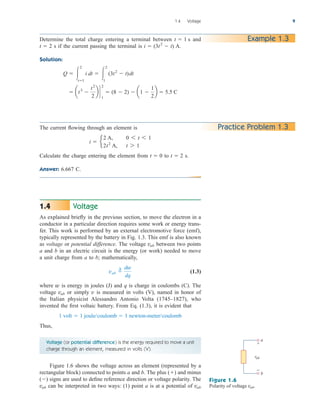
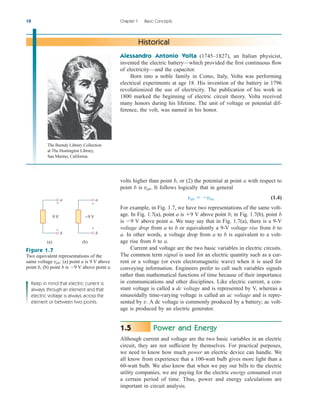
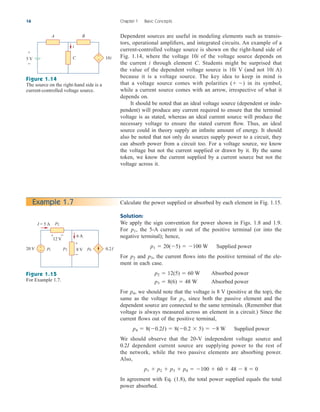
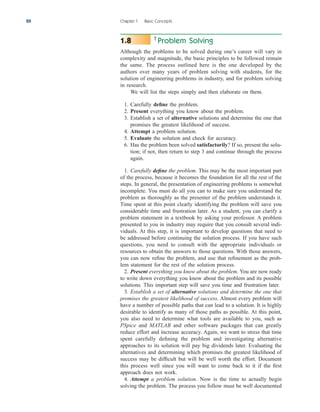
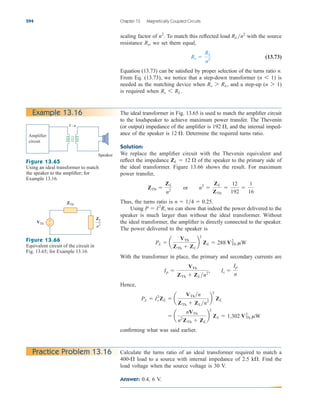
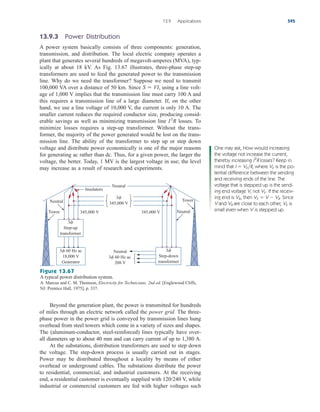
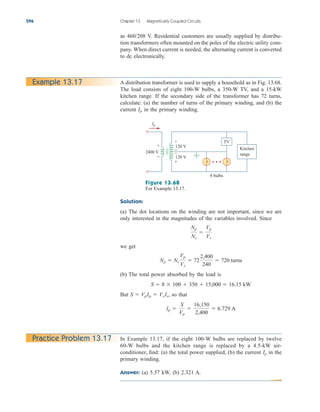
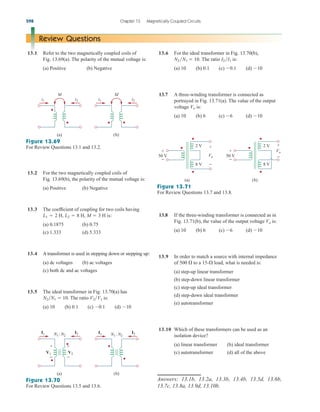
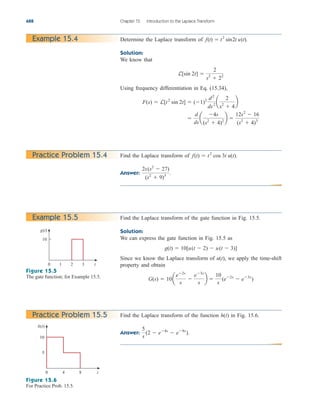
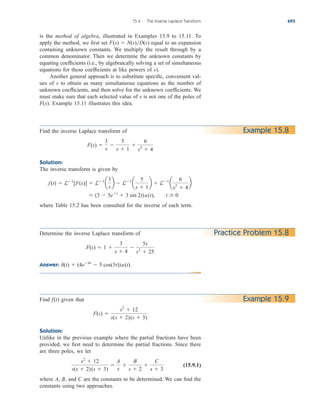
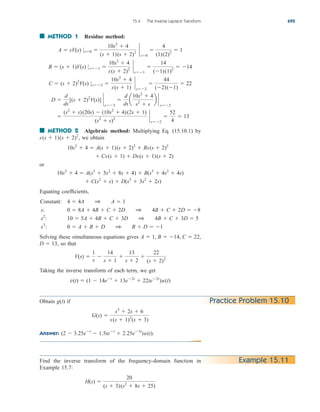
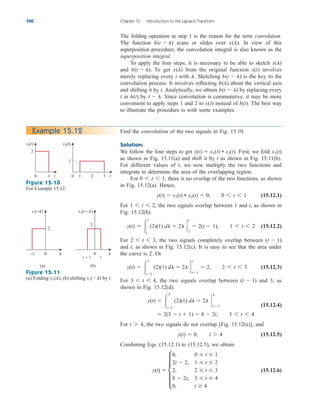
Each chapter devotes material to practical applications of the concepts covered in Fundamentals of Electric
Circuits to help the reader apply the concepts to real-life situations. Here is a sampling of the practical applications
found in the text:
• Rechargeable flashlight battery (Problem 1.11)
• Cost of operating toaster (Problem 1.25)
• Potentiometer (Section 2.8)
• Design a lighting system (Problem 2.61)
• Reading a voltmeter (Problem 2.66)
• Controlling speed of a motor (Problem 2.74)
• Electric pencil sharpener (Problem 2.78)
• Calculate voltage of transistor (Problem 3.86)
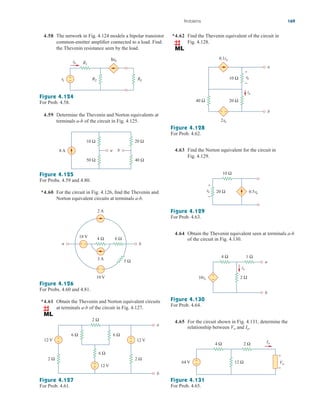
• Transducer modeling (Problem 4.87)
• Strain gauge (Problem 4.90)
• Wheatstone bridge (Problem 4.91)
• Design a six-bit DAC (Problem 5.83)
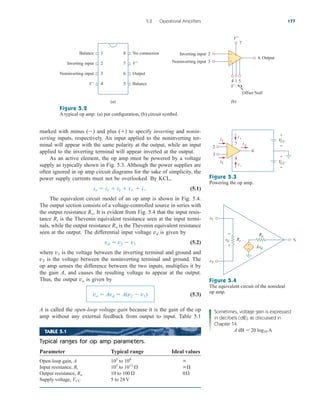
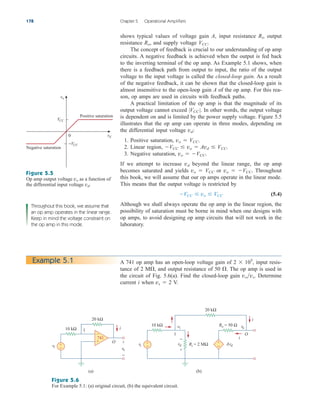
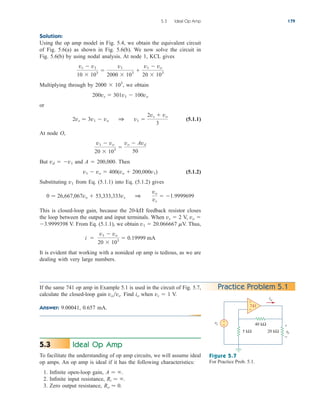
• Instrumentation amplifier (Problem 5.88)
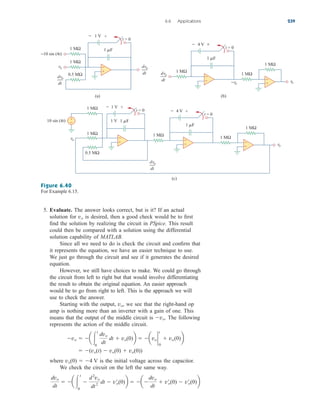
• Design an analog computer circuit (Example 6.15)
• Design an op amp circuit (Problem 6.71)
• Design analog computer to solve differential equation (Problem 6.79)
• Electric power plant substation—capacitor bank (Problem 6.83)
• Electronic photo flash unit (Section 7.9)
• Automobile ignition circuit (Section 7.9)
• Welding machine (Problem 7.86)
• Airbag igniter (Problem 8.78)
• Electrical analog to bodily functions—study of convulsions (Problem 8.82)
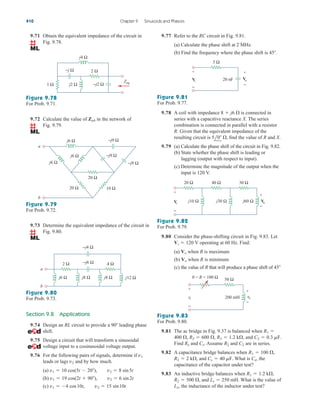
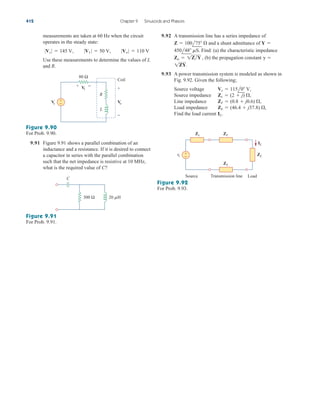
• Electronic sensing device (Problem 9.87)
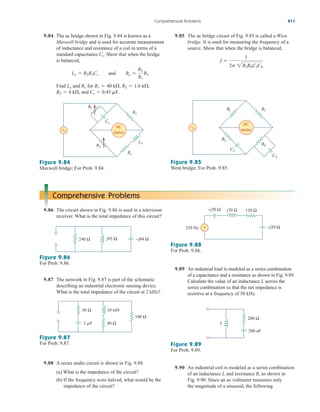
• Power transmission system (Problem 9.93)
• Design a Colpitts oscillator (Problem 10.94)
• Stereo amplifier circuit (Problem 13.85)
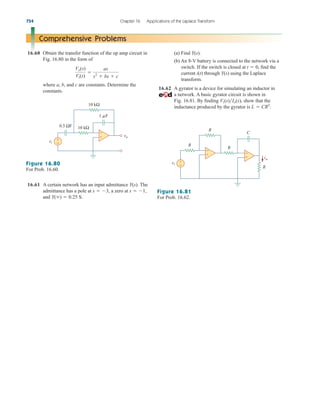
• Gyrator circuit (Problem 16.69)
• Calculate number of stations allowable in AM broadcast band (Problem 18.63)
• Voice signal—Nyquist rate (Problem 18.65)
ale29559_IFC.qxd 07/11/2008 07:40 PM Page 2
COMPUTER TOOLS promote flexibility and meet ABET requirements
• PSpice is introduced in Chapter 3 and appears in special sections throughout the text. Appendix D serves
as a tutorial on PSpice for Windows for readers not familiar with its use. The special sections contain exam-
ples and practice problems using PSpice. Additional homework problems at the end of each chapter also
provide an opportunity to use PSpice.
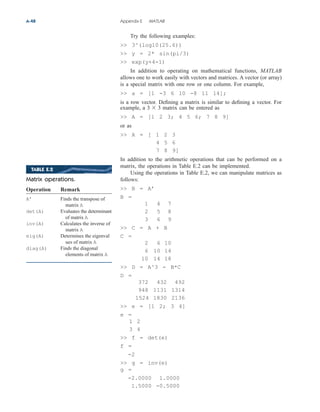
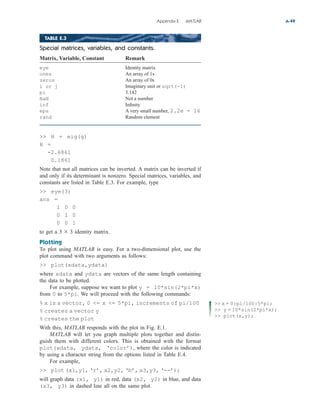
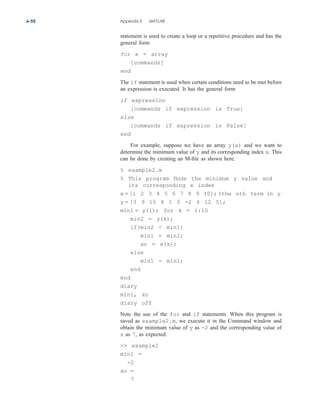
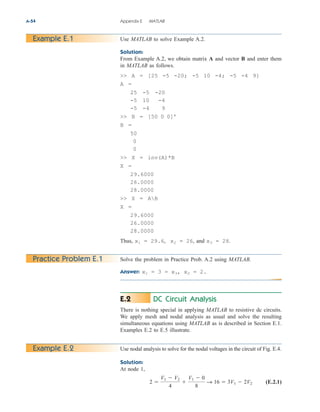
• MATLAB®
is introduced through a tutorial in Appendix E to show its usage in circuit analysis. A number

of examples and practice problems are presented throughout the book in a manner that will allow the student
to develop a facility with this powerful tool. A number of end-of-chapter problems will aid in understanding
how to effectively use MATLAB.
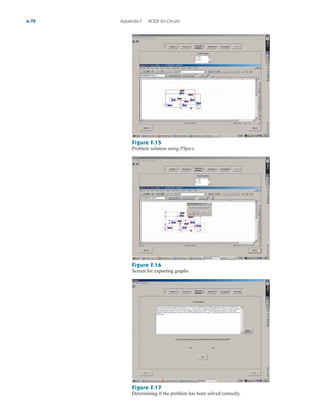
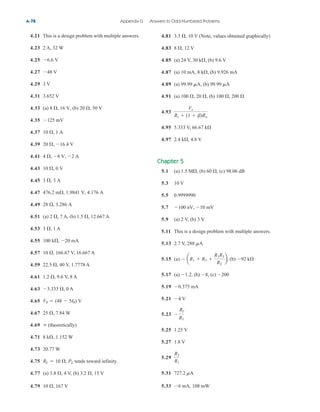
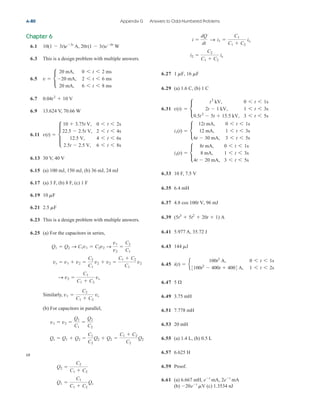
• KCIDE for Circuits is a working software environment developed at Cleveland State University. It is
designed to help the student work through circuit problems in an organized manner following the process
on problem-solving discussed in Section 1.8. Appendix F contains a description of how to use the software.
Additional examples can be found at the web site, http://kcide.fennresearch.org/. The actual software pack-
age can be downloaded for free from this site. One of the best benefits from using this package is that it
automatically generates a Word document and/or a PowerPoint presentation.
CAREERS AND HISTORY of electrical engineering pioneers
Since a course in circuit analysis may be a student’s first exposure to electrical engineering, each chapter opens
with discussions about how to enhance skills that contribute to successful problem-solving or career-oriented
talks on a sub-discipline of electrical engineering. The chapter openers are intended to help students grasp
the scope of electrical engineering and give thought to the various careers available to EE graduates. The open-
ing boxes include information on careers in electronics, instrumentation, electromagnetics, control systems,
engineering education, and the importance of good communication skills. Historicals throughout the text
provide brief biological sketches of such engineering pioneers as Faraday, Ampere, Edison, Henry, Fourier,
Volta, and Bell.
ale29559_IFC.qxd 07/11/2008 07:40 PM Page 3
OUR COMMITMENT TO ACCURACY
You have a right to expect an accurate textbook, and McGraw-Hill Engineering invests
considerable time and effort to ensure that we deliver one. Listed below are the many
steps we take in this process.
OUR ACCURACY VERIFICATION PROCESS
First Round
Step 1: Numerous college engineering instructors review the manuscript and report
errors to the editorial team. The authors review their comments and make the necessary
corrections in their manuscript.
Second Round
Step 2: An expert in the field works through every example and exercise in the final
manuscript to verify the accuracy of the examples, exercises, and solutions. The authors
review any resulting corrections and incorporate them into the final manuscript and solu-
tions manual.
Step 3: The manuscript goes to a copyeditor, who reviews the pages for grammatical and
stylistic considerations. At the same time, the expert in the field begins a second accuracy
check. All corrections are submitted simultaneously to the authors, who review and inte-
grate the editing, and then submit the manuscript pages for typesetting.
Third Round
Step 4: The authors review their page proofs for a dual purpose: 1) to make certain that
any previous corrections were properly made, and 2) to look for any errors they might
have missed.
Step 5: A proofreader is assigned to the project to examine the new page proofs, double
check the authors' work, and add a fresh, critical eye to the book. Revisions are incorpo-
rated into a new batch of pages which the authors check again.
Fourth Round
Step 6: The author team submits the solutions manual to the expert in the field, who
checks text pages against the solutions manual as a final review.
Step 7: The project manager, editorial team, and author team review the pages for a
final accuracy check.
The resulting engineering textbook has gone through several layers of quality assurance
and is verified to be as accurate and error-free as possible. Our authors and publishing
staff are confident that through this process we deliver textbooks that are industry leaders
in their correctness and technical integrity.
ale29559_IFC.qxd 07/11/2008 07:40 PM Page 4
Fundamentals of
Electric Circuits
ale29559_fm.qxd 07/28/2008 11:54 AM Page i
ale29559_fm.qxd 07/28/2008 11:54 AM Page ii
f o u r t h e d i t i o n
Fundamentals of
Electric Circuits
Charles K. Alexander
Department of Electrical and
Computer Engineering
Cleveland State University
Matthew N. O. Sadiku
Department of
Electrical Engineering
Prairie View A&M University
ale29559_fm.qxd 07/28/2008 11:54 AM Page iii
FUNDAMENTALS OF ELECTRIC CIRCUITS, FOURTH EDITION
Published by McGraw-Hill, a business unit of The McGraw-Hill Companies, Inc., 1221 Avenue of
the Americas, New York, NY 10020. Copyright © 2009 by The McGraw-Hill Companies, Inc.
All rights reserved. Previous editions © 2007, 2004, and 2000. No part of this publication may be
reproduced or distributed in any form or by any means, or stored in a database or retrieval system,
without the prior written consent of The McGraw-Hill Companies, Inc., including, but not limited to,
in any network or other electronic storage or transmission, or broadcast for distance learning.
Some ancillaries, including electronic and print components, may not be available to customers
outside the United States.
This book is printed on acid-free paper.
1 2 3 4 5 6 7 8 9 0 VNH/VNH 0 9 8
ISBN 978–0–07–352955–4
MHID 0–07–352955–9
Global Publisher: Raghothaman Srinivasan
Director of Development: Kristine Tibbetts
Developmental Editor: Lora Neyens
Senior Marketing Manager: Curt Reynolds
Project Manager: Joyce Watters
Senior Production Supervisor: Sherry L. Kane
Lead Media Project Manager: Stacy A. Patch
Associate Design Coordinator: Brenda A. Rolwes
Cover Designer: Studio Montage, St. Louis, Missouri
(USE) Cover Image: Astronauts Repairing Spacecraft: © StockTrek/Getty Images;
Printed Circuit Board: Photodisc Collection/Getty Images
Lead Photo Research Coordinator: Carrie K. Burger
Compositor: ICC Macmillan Inc.
Typeface: 10/12 Times Roman
Printer: R. R. Donnelley, Jefferson City, MO
Library of Congress Cataloging-in-Publication Data
Alexander, Charles K.
Fundamentals of electric circuits / Charles K. Alexander, Matthew N. O. Sadiku. — 4th ed.
p. cm.
Includes index.
ISBN 978–0–07–352955–4 — ISBN 0–07–352955–9 (hard copy : alk. paper) 1. Electric circuits.
I. Sadiku, Matthew N. O. II. Title.
TK454.A452 2009
621.319'24—dc22 2008023020
www.mhhe.com
ale29559_fm.qxd 07/28/2008 11:54 AM Page iv
Dedicated to our wives, Kikelomo and Hannah, whose understanding and
support have truly made this book possible.
Matthew
and
Chuck
ale29559_fm.qxd 07/28/2008 11:54 AM Page v
ale29559_fm.qxd 07/28/2008 11:54 AM Page vi
Contents
Preface xiii
Acknowledgments xviii
Guided Tour xx
A Note to the Student xxv
About the Authors xxvii
PART 1 DC Circuits 2
Chapter 1 Basic Concepts 3
1.1 Introduction 4
1.2 Systems of Units 4
1.3 Charge and Current 6
1.4 Voltage 9
1.5 Power and Energy 10
1.6 Circuit Elements 15
1.7 †
Applications 17
1.7.1 TV Picture Tube
1.7.2 Electricity Bills
1.8 †
Problem Solving 20
1.9 Summary 23
Review Questions 24
Problems 24
Comprehensive Problems 27
Chapter 2 Basic Laws 29
2.1 Introduction 30
2.2 Ohm’s Law 30
2.3 †
Nodes, Branches, and Loops 35
2.4 Kirchhoff’s Laws 37
2.5 Series Resistors and Voltage
Division 43
2.6 Parallel Resistors and Current
Division 45
2.7 †
Wye-Delta Transformations 52
2.8 †
Applications 58
2.8.1 Lighting Systems
2.8.2 Design of DC Meters
2.9 Summary 64
Review Questions 66
Problems 67
Comprehensive Problems 78
vii
Chapter 3 Methods of Analysis 81
3.1 Introduction 82
3.2 Nodal Analysis 82
3.3 Nodal Analysis with Voltage
Sources 88
3.4 Mesh Analysis 93
3.5 Mesh Analysis with Current
Sources 98
3.6 †
Nodal and Mesh Analyses
by Inspection 100
3.7 Nodal Versus Mesh Analysis 104
3.8 Circuit Analysis with PSpice 105
3.9 †
Applications: DC Transistor Circuits 107
3.10 Summary 112
Review Questions 113
Problems 114
Comprehensive Problem 126
Chapter 4 Circuit Theorems 127
4.1 Introduction 128
4.2 Linearity Property 128
4.3 Superposition 130
4.4 Source Transformation 135
4.5 Thevenin’s Theorem 139
4.6 Norton’s Theorem 145
4.7 †
Derivations of Thevenin’s and Norton’s
Theorems 149
4.8 Maximum Power Transfer 150
4.9 Verifying Circuit Theorems with
PSpice 152
4.10 †
Applications 155
4.10.1 Source Modeling
4.10.2 Resistance Measurement
4.11 Summary 160
Review Questions 161
Problems 162
Comprehensive Problems 173
Chapter 5 Operational Amplifiers 175
5.1 Introduction 176
5.2 Operational Amplifiers 176
ale29559_fm.qxd 07/28/2008 11:54 AM Page vii
viii Contents
5.3 Ideal Op Amp 179
5.4 Inverting Amplifier 181
5.5 Noninverting Amplifier 183
5.6 Summing Amplifier 185
5.7 Difference Amplifier 187
5.8 Cascaded Op Amp Circuits 191
5.9 Op Amp Circuit Analysis with PSpice 194
5.10 †
Applications 196
5.10.1 Digital-to-Analog Converter
5.10.2 Instrumentation Amplifiers
5.11 Summary 199
Review Questions 201
Problems 202
Comprehensive Problems 213
Chapter 6 Capacitors and
Inductors 215
6.1 Introduction 216
6.2 Capacitors 216
6.3 Series and Parallel Capacitors 222
6.4 Inductors 226
6.5 Series and Parallel Inductors 230
6.6 †
Applications 233
6.6.1 Integrator
6.6.2 Differentiator
6.6.3 Analog Computer
6.7 Summary 240
Review Questions 241
Problems 242
Comprehensive Problems 251
Chapter 7 First-Order Circuits 253
7.1 Introduction 254
7.2 The Source-Free RC Circuit 254
7.3 The Source-Free RL Circuit 259
7.4 Singularity Functions 265
7.5 Step Response of an RC Circuit 273
7.6 Step Response of an RL Circuit 280
7.7 †
First-Order Op Amp Circuits 284
7.8 Transient Analysis with PSpice 289
7.9 †
Applications 293
7.9.1 Delay Circuits
7.9.2 Photoflash Unit
7.9.3 Relay Circuits
7.9.4 Automobile Ignition Circuit
7.10 Summary 299
Review Questions 300
Problems 301
Comprehensive Problems 311
Chapter 8 Second-Order Circuits 313
8.1 Introduction 314
8.2 Finding Initial and Final Values 314
8.3 The Source-Free Series
RLC Circuit 319
8.4 The Source-Free Parallel RLC
Circuit 326
8.5 Step Response of a Series RLC
Circuit 331
8.6 Step Response of a Parallel RLC
Circuit 336
8.7 General Second-Order Circuits 339
8.8 Second-Order Op Amp Circuits 344
8.9 PSpice Analysis of RLC Circuits 346
8.10 †
Duality 350
8.11 †
Applications 353
8.11.1 Automobile Ignition System
8.11.2 Smoothing Circuits
8.12 Summary 356
Review Questions 357
Problems 358
Comprehensive Problems 367
PART 2 AC Circuits 368
Chapter 9 Sinusoids and Phasors 369
9.1 Introduction 370
9.2 Sinusoids 371
9.3 Phasors 376
9.4 Phasor Relationships for
Circuit Elements 385
9.5 Impedance and Admittance 387
9.6 †
Kirchhoff’s Laws in the Frequency
Domain 389
9.7 Impedance Combinations 390
9.8 †
Applications 396
9.8.1 Phase-Shifters
9.8.2 AC Bridges
9.9 Summary 402
Review Questions 403
Problems 403
Comprehensive Problems 411
Chapter 10 Sinusoidal Steady-State
Analysis 413
10.1 Introduction 414
10.2 Nodal Analysis 414
10.3 Mesh Analysis 417
ale29559_fm.qxd 07/28/2008 11:54 AM Page viii
Contents ix
12.11 Summary 543
Review Questions 543
Problems 544
Comprehensive Problems 553
Chapter 13 Magnetically Coupled
Circuits 555
13.1 Introduction 556
13.2 Mutual Inductance 557
13.3 Energy in a Coupled Circuit 564
13.4 Linear Transformers 567
13.5 Ideal Transformers 573
13.6 Ideal Autotransformers 581
13.7 †
Three-Phase Transformers 584
13.8 PSpice Analysis of Magnetically
Coupled Circuits 586
13.9 †
Applications 591
13.9.1 Transformer as an Isolation Device
13.9.2 Transformer as a Matching Device
13.9.3 Power Distribution
13.10 Summary 597
Review Questions 598
Problems 599
Comprehensive Problems 611
Chapter 14 Frequency Response 613
14.1 Introduction 614
14.2 Transfer Function 614
14.3 †
The Decibel Scale 617
14.4 Bode Plots 619
14.5 Series Resonance 629
14.6 Parallel Resonance 634
14.7 Passive Filters 637
14.7.1 Lowpass Filter
14.7.2 Highpass Filter
14.7.3 Bandpass Filter
14.7.4 Bandstop Filter
14.8 Active Filters 642
14.8.1 First-Order Lowpass Filter
14.8.2 First-Order Highpass Filter
14.8.3 Bandpass Filter
14.8.4 Bandreject (or Notch) Filter
14.9 Scaling 648
14.9.1 Magnitude Scaling
14.9.2 Frequency Scaling
14.9.3 Magnitude and Frequency Scaling
14.10 Frequency Response Using
PSpice 652
14.11 Computation Using MATLAB 655
10.4 Superposition Theorem 421
10.5 Source Transformation 424
10.6 Thevenin and Norton Equivalent
Circuits 426
10.7 Op Amp AC Circuits 431
10.8 AC Analysis Using PSpice 433
10.9 †
Applications 437
10.9.1 Capacitance Multiplier
10.9.2 Oscillators
10.10 Summary 441
Review Questions 441
Problems 443
Chapter 11 AC Power Analysis 457
11.1 Introduction 458
11.2 Instantaneous and Average
Power 458
11.3 Maximum Average Power
Transfer 464
11.4 Effective or RMS Value 467
11.5 Apparent Power and
Power Factor 470
11.6 Complex Power 473
11.7 †
Conservation of AC Power 477
11.8 Power Factor Correction 481
11.9 †
Applications 483
11.9.1 Power Measurement
11.9.2 Electricity Consumption Cost
11.10 Summary 488
Review Questions 490
Problems 490
Comprehensive Problems 500
Chapter 12 Three-Phase Circuits 503
12.1 Introduction 504
12.2 Balanced Three-Phase Voltages 505
12.3 Balanced Wye-Wye Connection 509
12.4 Balanced Wye-Delta Connection 512
12.5 Balanced Delta-Delta
Connection 514
12.6 Balanced Delta-Wye Connection 516
12.7 Power in a Balanced System 519
12.8 †
Unbalanced Three-Phase
Systems 525
12.9 PSpice for Three-Phase Circuits 529
12.10 †
Applications 534
12.10.1 Three-Phase Power Measurement
12.10.2 Residential Wiring
ale29559_fm.qxd 07/28/2008 11:54 AM Page ix
x Contents
14.12 †
Applications 657
14.12.1 Radio Receiver
14.12.2 Touch-Tone Telephone
14.12.3 Crossover Network
14.13 Summary 663
Review Questions 664
Problems 665
Comprehensive Problems 673
PART 3 Advanced Circuit
Analysis 674
Chapter 15 Introduction to the Laplace
Transform 675
15.1 Introduction 676
15.2 Definition of the Laplace Transform 677
15.3 Properties of the Laplace Transform 679
15.4 The Inverse Laplace Transform 690
15.4.1 Simple Poles
15.4.2 Repeated Poles
15.4.3 Complex Poles
15.5 The Convolution Integral 697
15.6 †
Application to Integrodifferential
Equations 705
15.7 Summary 708
Review Questions 708
Problems 709
Chapter 16 Applications of the Laplace
Transform 715
16.1 Introduction 716
16.2 Circuit Element Models 716
16.3 Circuit Analysis 722
16.4 Transfer Functions 726
16.5 State Variables 730
16.6 †
Applications 737
16.6.1 Network Stability
16.6.2 Network Synthesis
16.7 Summary 745
Review Questions 746
Problems 747
Comprehensive Problems 754
Chapter 17 The Fourier Series 755
17.1 Introduction 756
17.2 Trigonometric Fourier Series 756
17.3 Symmetry Considerations 764
17.3.1 Even Symmetry
17.3.2 Odd Symmetry
17.3.3 Half-Wave Symmetry
17.4 Circuit Applications 774
17.5 Average Power and RMS Values 778
17.6 Exponential Fourier Series 781
17.7 Fourier Analysis with PSpice 787
17.7.1 Discrete Fourier Transform
17.7.2 Fast Fourier Transform
17.8 †
Applications 793
17.8.1 Spectrum Analyzers
17.8.2 Filters
17.9 Summary 796
Review Questions 798
Problems 798
Comprehensive Problems 807
Chapter 18 Fourier Transform 809
18.1 Introduction 810
18.2 Definition of the Fourier Transform 810
18.3 Properties of the Fourier
Transform 816
18.4 Circuit Applications 829
18.5 Parseval’s Theorem 832
18.6 Comparing the Fourier and Laplace
Transforms 835
18.7 †
Applications 836
18.7.1 Amplitude Modulation
18.7.2 Sampling
18.8 Summary 839
Review Questions 840
Problems 841
Comprehensive Problems 847
Chapter 19 Two-Port Networks 849
19.1 Introduction 850
19.2 Impedance Parameters 850
19.3 Admittance Parameters 855
19.4 Hybrid Parameters 858
19.5 Transmission Parameters 863
19.6 †
Relationships Between
Parameters 868
19.7 Interconnection of Networks 871
19.8 Computing Two-Port Parameters
Using PSpice 877
19.9 †
Applications 880
19.9.1 Transistor Circuits
19.9.2 Ladder Network Synthesis
ale29559_fm.qxd 07/28/2008 11:54 AM Page x
Contents xi
19.10 Summary 889
Review Questions 890
Problems 890
Comprehensive Problems 901
Appendix A Simultaneous Equations and Matrix
Inversion A
Appendix B Complex Numbers A-9
Appendix C Mathematical Formulas A-16
Appendix D PSpice for Windows A-21
Appendix E MATLAB A-46
Appendix F KCIDE for Circuits A-65
Appendix G Answers to Odd-Numbered
Problems A-75
Selected Bibliography B-1
Index I-1
ale29559_fm.qxd 07/28/2008 11:54 AM Page xi
ale29559_fm.qxd 07/28/2008 11:54 AM Page xii
xiii
Preface
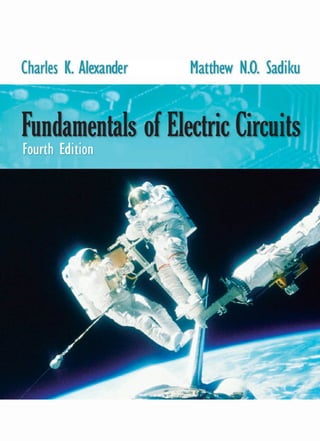
You may be wondering why we chose a photo of astronauts working
in space on the Space Station for the cover. We actually chose it for
several reasons. Obviously, it is very exciting; in fact, space represents
the most exciting frontier for the entire world! In addition, much of the
station itself consists of all kinds of circuits! One of the most signifi-
cant circuits within the station is its power distribution system. It is a
complete and self contained, modern power generation and distribution
system. That is why NASA (especially NASA-Glenn) continues to be
at the forefront of both theoretical as well as applied power system
research and development. The technology that has gone into the devel-
opment of space exploration continues to find itself impacting terres-
trial technology in many important ways. For some of you, this will be
an important career path.
FEATURES
New to This Edition
A course in circuit analysis is perhaps the first exposure students have
to electrical engineering. This is also a place where we can enhance
some of the skills that they will later need as they learn how to design.
In the fourth edition, we have included a very significant new
feature to help students enhance skills that are an important part of the
design process. We call this new feature, design a problem.
We know it is not possible to fully develop a student’s design skills
in a fundamental course like circuits. To fully develop design skills a
student needs a design experience normally reserved for their senior
year. This does not mean that some of those skills cannot be developed
and exercised in a circuits course. The text already included open-
ended questions that help students use creativity, which is an impor-
tant part of learning how to design. We already have some questions
that are open desired to add much more into our text in this important
area and have developed an approach to do just that. When we develop
problems for the student to solve our goal is that in solving the prob-
lem the student learn more about the theory and the problem solving
process. Why not have the students design problems like we do? That
is exactly what we will do in each chapter. Within the normal problem
set, we have a set of problems where we ask the student to design a
problem. This will have two very important results. The first will be a
better understanding of the basic theory and the second will be the
enhancement of some of the student’s basic design skills.
We are making effective use of the principle of learning by teach-
ing. Essentially we all learn better when we teach a subject. Design-
ing effective problems is a key part of the teaching process. Students
ale29559_fm.qxd 08/08/2008 10:16 AM Page xiii
xiv Preface
should also be encouraged to develop problems, when appropriate,
which have nice numbers and do not necessarily overemphasize com-
plicated mathematical manipulations.
Additionally we have changed almost 40% of the Practice Prob-
lems with the idea to better reflect more real component values and to
help the student better understand the problem and have added 121
design a problem problems. We have also changed and added a total
of 357 end-of-chapter problems (this number contains the new design
a problem problems). This brings up a very important advantage to our
textbook, we have a total of 2404 Examples, Practice Problems,
Review Questions, and end-of-chapter problems!
Retained from Previous Editions
The main objective of the fourth edition of this book remains the same
as the previous editions—to present circuit analysis in a manner that is
clearer, more interesting, and easier to understand than other circuit text,
and to assist the student in beginning to see the “fun” in engineering.
This objective is achieved in the following ways:
• Chapter Openers and Summaries
Each chapter opens with a discussion about how to enhance skills
which contribute to successful problem solving as well as suc-
cessful careers or a career-oriented talk on a sub-discipline of elec-
trical engineering. This is followed by an introduction that links the
chapter with the previous chapters and states the chapter objectives.
The chapter ends with a summary of key points and formulas.
• Problem Solving Methodology
Chapter 1 introduces a six-step method for solving circuit problems
which is used consistently throughout the book and media supple-
ments to promote best-practice problem-solving procedures.
• Student Friendly Writing Style
All principles are presented in a lucid, logical, step-by-step manner.
As much as possible, we avoid wordiness and giving too much
detail that could hide concepts and impede overall understanding of
the material.
• Boxed Formulas and Key Terms
Important formulas are boxed as a means of helping students sort
out what is essential from what is not. Also, to ensure that students
clearly understand the key elements of the subject matter, key
terms are defined and highlighted.
• Margin Notes
Marginal notes are used as a pedagogical aid. They serve multiple
uses such as hints, cross-references, more exposition, warnings,
reminders not to make some particular common mistakes, and
problem-solving insights.
• Worked Examples
Thoroughly worked examples are liberally given at the end of every
section. The examples are regarded as a part of the text and are
clearly explained without asking the reader to fill in missing steps.
Thoroughly worked examples give students a good understand-
ing of the solution process and the confidence to solve problems
ale29559_fm.qxd 07/28/2008 11:54 AM Page xiv
Preface xv
themselves. Some of the problems are solved in two or three dif-
ferent ways to facilitate a substantial comprehension of the subject
material as well as a comparison of different approaches.
• Practice Problems
To give students practice opportunity, each illustrative example is
immediately followed by a practice problem with the answer. The
student can follow the example step by step to aid in the solution
of the practice problem without flipping pages or looking at the
end of the book for answers. The practice problem is also intended
to test a student’s understanding of the preceding example. It will
reinforce their grasp of the material before the student can move
on to the next section. Complete solutions to the practice problems
are available to students on ARIS.
• Application Sections
The last section in each chapter is devoted to practical application
aspects of the concepts covered in the chapter. The material cov-
ered in the chapter is applied to at least one or two practical prob-
lems or devices. This helps students see how the concepts are
applied to real-life situations.
• Review Questions
Ten review questions in the form of multiple-choice objective items
are provided at the end of each chapter with answers. The review
questions are intended to cover the little “tricks” that the examples
and end-of-chapter problems may not cover. They serve as a self-
test device and help students determine how well they have mas-
tered the chapter.
• Computer Tools
In recognition of the requirements by ABET®
on integrating com-
puter tools, the use of PSpice, MATLAB, KCIDE for Circuits, and
developing design skills are encouraged in a student-friendly man-
ner. PSpice is covered early on in the text so that students can
become familiar and use it throughout the text. Appendix D serves
as a tutorial on PSpice for Windows. MATLAB is also introduced
early in the book with a tutorial available in Appendix E. KCIDE
for Circuits is a brand new, state-of-the-art software system designed
to help the students maximize their chance of success in problem
solving. It is introduced in Appendix F. Finally, design a problem
problems have been introduced, for the first time. These are meant
to help the student develop skills that will be needed in the design
process.
• Historical Tidbits
Historical sketches throughout the text provide profiles of important
pioneers and events relevant to the study of electrical engineering.
• Early Op Amp Discussion
The operational amplifier (op amp) as a basic element is introduced
early in the text.
• Fourier and Laplace Transforms Coverage
To ease the transition between the circuit course and signals and
systems courses, Fourier and Laplace transforms are covered
lucidly and thoroughly. The chapters are developed in a manner
that the interested instructor can go from solutions of first-order
ale29559_fm.qxd 07/28/2008 11:54 AM Page xv
circuits to Chapter 15. This then allows a very natural progression
from Laplace to Fourier to AC.
• Four Color Art Program
A completely redesigned interior design and four color art program
bring circuit drawings to life and enhance key pedagogical ele-
ments throughout the text.
• Extended Examples
Examples worked in detail according to the six-step problem solv-
ing method provide a roadmap for students to solve problems in a
consistent fashion. At least one example in each chapter is devel-
oped in this manner.
• EC 2000 Chapter Openers
Based on ABET’s new skill-based CRITERION 3, these chapter
openers are devoted to discussions as to how students can acquire
the skills that will lead to a significantly enhanced career as an
engineer. Because these skills are so very important to the student
while in college as well as in their career, we will use the head-
ing, “Enhancing your Skills and your Career.”
• Homework Problems
There are 358 new or changed end-of-chapter problems which will
provide students with plenty of practice as well as reinforce key
concepts.
• Homework Problem Icons
Icons are used to highlight problems that relate to engineering design
as well as problems that can be solved using PSpice or MATLAB.
• KCIDE for Circuits Appendix F
A new Appendix F provides a tutorial on the Knowledge Captur-
ing Integrated Design Environment (KCIDE for Circuits) software,
available on ARIS.
Organization
This book was written for a two-semester or three-quarter course in
linear circuit analysis. The book may also be used for a one-semester
course by a proper selection of chapters and sections by the instructor.
It is broadly divided into three parts.
• Part 1, consisting of Chapters 1 to 8, is devoted to dc circuits. It
covers the fundamental laws and theorems, circuits techniques, and
passive and active elements.
• Part 2, which contains Chapter 9 to 14, deals with ac circuits. It
introduces phasors, sinusoidal steady-state analysis, ac power, rms
values, three-phase systems, and frequency response.
• Part 3, consisting of Chapters 15 to 19, is devoted to advanced
techniques for network analysis. It provides students with a solid
introduction to the Laplace transform, Fourier series, Fourier trans-
form, and two-port network analysis.
The material in three parts is more than sufficient for a two-semester
course, so the instructor must select which chapters or sections to cover.
Sections marked with the dagger sign (†) may be skipped, explained
briefly, or assigned as homework. They can be omitted without loss of
xvi Preface
ale29559_fm.qxd 07/28/2008 11:54 AM Page xvi
Preface xvii
continuity. Each chapter has plenty of problems grouped according to
the sections of the related material and diverse enough that the instruc-
tor can choose some as examples and assign some as homework. As
stated earlier, we are using three icons with this edition. We are using
to denote problems that either require PSpice in the solution process,
where the circuit complexity is such that PSpice would make the solu-
tion process easier, and where PSpice makes a good check to see if the
problem has been solved correctly. We are using to denote problems
where MATLAB is required in the solution process, where MATLAB
makes sense because of the problem makeup and its complexity, and
where MATLAB makes a good check to see if the problem has been
solved correctly. Finally, we use to identify problems that help the
student develop skills that are needed for engineering design. More dif-
ficult problems are marked with an asterisk (*). Comprehensive prob-
lems follow the end-of-chapter problems. They are mostly applications
problems that require skills learned from that particular chapter.
Prerequisites
As with most introductory circuit courses, the main prerequisites, for
a course using the text, are physics and calculus. Although familiarity
with complex numbers is helpful in the later part of the book, it is not
required. A very important asset of this text is that ALL the mathe-
matical equations and fundamentals of physics needed by the student,
are included in the text.
Supplements
McGraw-Hill’s ARIS—Assessment, Review, and Instruction
System is a complete, online tutorial, electronic homework, and course
management system, designed for greater ease of use than any other
system available. Available on adoption, instructors can create and
share course materials and assignments with other instructors, edit ques-
tions and algorithms, import their own content, and create announce-
ments and due dates for assignments. ARIS has automatic grading and
reporting of easy-to-assign algorithmically-generated homework,
quizzing, and testing. Once a student is registered in the course, all stu-
dent activity within McGraw-Hill’s ARIS is automatically recorded and
available to the instructor through a fully integrated grade book that can
be downloaded to Excel. Also included on ARIS are a solutions man-
ual, text image files, transition guides to instructors, and Network
Analysis Tutorials, software downloads, complete solutions to text
practice problems, FE Exam questions, flashcards, and web links to stu-
dents. Visit www.mhhe.com/alexander.
Knowledge Capturing Integrated Design Environment for Circuits
(KCIDE for Circuits) This new software, developed at Cleveland State
University and funded by NASA, is designed to help the student work
through a circuits problem in an organized manner using the six-step
problem-solving methodology in the text. KCIDE for Circuits allows
students to work a circuit problem in PSpice and MATLAB, track the
ale29559_fm.qxd 07/28/2008 11:54 AM Page xvii
xviii Preface
evolution of their solution, and save a record of their process for future
reference. In addition, the software automatically generates a Word
document and/or a PowerPoint presentation. Appendix F contains a
description of how to use the software. Additional examples can be
found at the web site, http://kcide.fennresearch.org/, which is linked
from ARIS. The software package can be downloaded for free.
Problem Solving Made Almost Easy, a companion workbook to Fun-
damentals of Electric Circuits, is available on ARIS for students who
wish to practice their problem-solving techniques. The workbook con-
tains a discussion of problem-solving strategies and 150 additional
problems with complete solutions provided.
C.O.S.M.O.S This CD, available to instructors only, is a powerful solu-
tions manual tool to help instructors streamline the creation of assign-
ments, quizzes, and tests by using problems and solutions from the
textbook, as well as their own custom material. Instructors can edit
textbook end-of-chapter problems as well as track which problems have
been assigned.
Although the textbook is meant to be self-explanatory and act as
a tutor for the student, the personal contact in teaching is not forgot-
ten. It is hoped that the book and supplemental materials supply the
instructor with all the pedagogical tools necessary to effectively pres-
ent the material.
Acknowledgements
We would like to express our appreciation for the loving support we
have received from our wives (Hannah and Kikelomo), daughters
(Christina, Tamara, Jennifer, Motunrayo, Ann, and Joyce), son (Baixi),
and our extended family members.
At McGraw-Hill, we would like to thank the following editorial
and production staff: Raghu Srinivasan, publisher and senior sponsor-
ing editor; Lora Kalb-Neyens, developmental editors; Joyce Watters,
project manager; Carrie Burger, photo researcher; and Brenda Rolwes,
designer. Also, we appreciate the hard work of Tom Hartley at the Uni-
versity of Akron for his very detailed evaluation of various elements
of the text and his many valued suggestions for continued improve-
ment of this textbook.
We wish to thank Yongjian Fu and his outstanding team of stu-
dents, Bramarambha Elka and Saravaran Chinniah, for their efforts in
the development of KCIDE for Circuits. Their efforts to help us con-
tinue to improve this software are also appreciated.
The fourth edition has benefited greatly from the many outstand-
ing reviewers and symposium attendees who contributed to the success
of the first three editions! In addition, the following have made impor-
tant contributions to the fourth edition (in alphabetical order):
Tom Brewer, Georgia Tech
Andy Chan, City University of Hong Kong
Alan Tan Wee Chiat, Multimedia University
Norman Cox, University of Missouri-Rolla
Walter L. Green, University of Tennessee
ale29559_fm.qxd 07/28/2008 11:54 AM Page xviii
Preface xix
Dr. Gordon K. Lee, San Diego State University
Gary Perks, Cal Poly State University, San Luis Obispo
Dr. Raghu K. Settaluri, Oregon State University
Ramakant Srivastava, University of Florida
John Watkins, Wichita State University
Yik-Chung Wu, The University of Hong Kong
Xiao-Bang Xu, Clemson University
Finally, we appreciate the feedback received from instructors and stu-
dents who used the previous editions. We want this to continue, so please
keep sending us emails or direct them to the publisher. We can be reached
at c.alexander@ieee.org for Charles Alexander and sadiku@ieee.org for
Matthew Sadiku.
C. K. Alexander and M.N.O. Sadiku
ale29559_fm.qxd 07/28/2008 11:54 AM Page xix
xx
GUIDED TOUR
The main objective of this book is to present circuit analysis in a man-
ner that is clearer, more interesting, and easier to understand than other
texts. For you, the student, here are some features to help you study
and be successful in this course.
The four color art program brings circuit draw-
ings to life and enhances key concepts throughout
the text.
1.5 Power and Energy 11
To relate power and energy to voltage and current, we recall from
physics that:
Power is the time rate of expending or absorbing energy, measured in
watts (W).
We write this relationship as
(1.5)
where p is power in watts (W), w is energy in joules (J), and t is time
in seconds (s). From Eqs. (1.1), (1.3), and (1.5), it follows that
(1.6)
or
(1.7)
The power p in Eq. (1.7) is a time-varying quantity and is called the
instantaneous power. Thus, the power absorbed or supplied by an ele-
ment is the product of the voltage across the element and the current
through it. If the power has a sign, power is being delivered to or
absorbed by the element. If, on the other hand, the power has a sign,
power is being supplied by the element. But how do we know when
the power has a negative or a positive sign?
Current direction and voltage polarity play a major role in deter-
mining the sign of power. It is therefore important that we pay atten-
tion to the relationship between current i and voltage v in Fig. 1.8(a).
The voltage polarity and current direction must conform with those
shown in Fig. 1.8(a) in order for the power to have a positive sign.
This is known as the passive sign convention. By the passive sign con-
vention, current enters through the positive polarity of the voltage. In
this case, or implies that the element is absorbing
power. However, if or , as in Fig. 1.8(b), the element
is releasing or supplying power.
Passive sign convention is satisfied when the current enters through
the positive terminal of an element and p vi. If the current enters
through the negative terminal, p vi.
Unless otherwise stated, we will follow the passive sign conven-
tion throughout this text. For example, the element in both circuits of
Fig. 1.9 has an absorbing power of W because a positive current
enters the positive terminal in both cases. In Fig. 1.10, however, the
element is supplying power of W because a positive current enters
the negative terminal. Of course, an absorbing power of W is
equivalent to a supplying power of W. In general,
⫹Power absorbed ⫽ ⫺Power supplied
⫹12
⫺12
⫹12
⫹12
⫺
⫽
⫹
⫽
vi 6 0
p ⫽ ⫺vi
vi 7 0
p ⫽ ⫹vi
⫺
⫹
p ⫽ vi
p ⫽
dw
dt
⫽
dw
dq
ⴢ
dq
dt
⫽ vi
p ⫽
¢ dw
dt
p = +vi
(a)
v
+
−
p = −vi
(b)
v
+
−
i
i
Figure 1.8
Reference polarities for power using the
passive sign convention: (a) absorbing
power, (b) supplying power.
When the voltage and current directions
conform to Fig. 1.8(b), we have the ac-
tive sign convention and p vi.
⫹
⫽
(a)
4 V
3 A
(a)
+
−
3 A
4 V
3 A
(b)
+
−
Figure 1.9
Two cases of an element with an absorbing
power of 12 W: (a) W,
(b) W.
p ⫽ 4 ⫻ 3 ⫽ 12
p ⫽ 4 ⫻ 3 ⫽ 12
3 A
(a)
4 V
3 A
(a)
+
−
3 A
4 V
3 A
(b)
+
−
Figure 1.10
Two cases of an element with a supplying
power of 12 W: (a)
W, (b) W.
p ⫽ ⫺4 ⫻ 3 ⫽ ⫺12
⫺12
p ⫽ ⫺4 ⫻ 3 ⫽
Problem Solving
Although the problems to be solved during one’s career will vary in
complexity and magnitude, the basic principles to be followed remain
the same. The process outlined here is the one developed by the
authors over many years of problem solving with students, for the
solution of engineering problems in industry, and for problem solving
in research.
We will list the steps simply and then elaborate on them.
1. Carefully Define the problem.
2. Present everything you know about the problem.
3. Establish a set of Alternative solutions and determine the one that
promises the greatest likelihood of success.
4. Attempt a problem solution.
5. Evaluate the solution and check for accuracy.
6. Has the problem been solved Satisfactorily? If so, present the
solution; if not, then return to step 3 and continue through the
process again.
1. Carefully Define the problem. This may be the most important part
of the process, because it becomes the foundation for all the rest of the
steps. In general, the presentation of engineering problems is somewhat
incomplete. You must do all you can to make sure you understand the
problem as thoroughly as the presenter of the problem understands it.
Time spent at this point clearly identifying the problem will save you
considerable time and frustration later. As a student, you can clarify a
problem statement in a textbook by asking your professor. A problem
presented to you in industry may require that you consult several indi-
viduals. At this step, it is important to develop questions that need to
be addressed before continuing the solution process. If you have such
questions, you need to consult with the appropriate individuals or
resources to obtain the answers to those questions. With those answers,
you can now refine the problem, and use that refinement as the prob-
lem statement for the rest of the solution process.
2. Present everything you know about the problem. You are now ready
to write down everything you know about the problem and its possible
solutions. This important step will save you time and frustration later.
3. Establish a set of Alternative solutions and determine the one that
promises the greatest likelihood of success. Almost every problem will
have a number of possible paths that can lead to a solution. It is highly
desirable to identify as many of those paths as possible. At this point,
you also need to determine what tools are available to you, such as
PSpice and MATLAB and other software packages that can greatly
reduce effort and increase accuracy. Again, we want to stress that time
spent carefully defining the problem and investigating alternative
approaches to its solution will pay big dividends later. Evaluating the
alternatives and determining which promises the greatest likelihood of
success may be difficult but will be well worth the effort. Document
this process well since you will want to come back to it if the first
approach does not work.
4. Attempt a problem solution. Now is the time to actually begin
solving the problem. The process you follow must be well documented
1.8
20 Chapter 1 Basic Concepts
in order to present a detailed solution if successful, and to evaluate the
process if you are not successful. This detailed evaluation may lead to
corrections that can then lead to a successful solution. It can also lead
to new alternatives to try. Many times, it is wise to fully set up a solu-
tion before putting numbers into equations. This will help in checking
your results.
5. Evaluate the solution and check for accuracy. You now thoroughly
evaluate what you have accomplished. Decide if you have an acceptable
solution, one that you want to present to your team, boss, or professor.
6. Has the problem been solved Satisfactorily? If so, present the solu-
tion; if not, then return to step 3 and continue through the process
again. Now you need to present your solution or try another alterna-
tive. At this point, presenting your solution may bring closure to the
process. Often, however, presentation of a solution leads to further
refinement of the problem definition, and the process continues. Fol-
lowing this process will eventually lead to a satisfactory conclusion.
Now let us look at this process for a student taking an electrical
and computer engineering foundations course. (The basic process also
applies to almost every engineering course.) Keep in mind that
although the steps have been simplified to apply to academic types of
problems, the process as stated always needs to be followed. We con-
sider a simple example.
1.8 Problem Solving 21
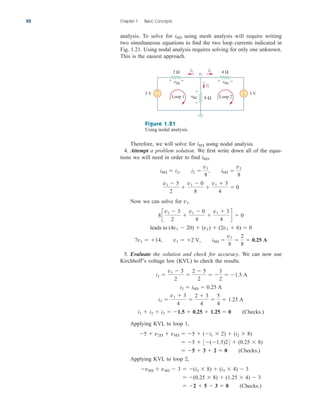
Figure 1.19
Illustrative example.
Example 1.10
Solve for the current flowing through the resistor in Fig. 1.19.
Solution:
1. Carefully Define the problem. This is only a simple example, but
we can already see that we do not know the polarity on the 3-V source.
We have the following options. We can ask the professor what the
polarity should be. If we cannot ask, then we need to make a decision
on what to do next. If we have time to work the problem both ways,
we can solve for the current when the 3-V source is plus on top and
then plus on the bottom. If we do not have the time to work it both
ways, assume a polarity and then carefully document your decision.
Let us assume that the professor tells us that the source is plus on the
bottom as shown in Fig. 1.20.
2. Present everything you know about the problem. Presenting all that
we know about the problem involves labeling the circuit clearly so that
we define what we seek.
Given the circuit shown in Fig. 1.20, solve for .
We now check with the professor, if reasonable, to see if the prob-
lem is properly defined.
3. Establish a set of Alternative solutions and determine the one that
promises the greatest likelihood of success. There are essentially three
techniques that can be used to solve this problem. Later in the text you
will see that you can use circuit analysis (using Kirchhoff’s laws and
Ohm’s law), nodal analysis, and mesh analysis.
To solve for using circuit analysis will eventually lead to a
solution, but it will likely take more work than either nodal or mesh
i8⍀
i8⍀
8-⍀
Figure 1.20
Problem defintion.
2 Ω 4 Ω
8 Ω
5 V 3 V
+
− +
−
i8Ω
2 Ω 4 Ω
8 Ω
5 V 3 V
+
−
analysis. To solve for using mesh analysis will require writing
two simultaneous equations to find the two loop currents indicated in
Fig. 1.21. Using nodal analysis requires solving for only one unknown.
This is the easiest approach.
i8⍀
22 Chapter 1 Basic Concepts
2 Ω 4 Ω
8 Ω
5 V 3 V
+
− +
−
i2
i1 i3
+ − + −
+
−
v8Ω
v4Ω
v2Ω
Loop 1 Loop 2
v1
Figure 1.21
Using nodal analysis.
Therefore, we will solve for using nodal analysis.
4. Attempt a problem solution. We first write down all of the equa-
tions we will need in order to find .
Now we can solve for
5. Evaluate the solution and check for accuracy. We can now use
Kirchhoff’s voltage law (KVL) to check the results.
Applying KVL to loop 1,
Applying KVL to loop 2,
⫽ ⫺2 ⫹ 5 ⫺ 3 ⫽ 0 (Checks.)
⫽ ⫺(0.25 ⫻ 8) ⫹ (1.25 ⫻ 4) ⫺ 3
⫺v8⍀ ⫹ v4⍀ ⫺ 3 ⫽ ⫺(i2 ⫻ 8) ⫹ (i3 ⫻ 4) ⫺ 3
⫽ ⫺5 ⫹ 3 ⫹ 2 ⫽ 0 (Checks.)
⫽ ⫺5 ⫹ (⫺(⫺1.5)2) ⫹ (0.25 ⫻ 8)
⫺5 ⫹ v2⍀ ⫹ v8⍀ ⫽ ⫺5 ⫹ (⫺i1 ⫻ 2) ⫹ (i2 ⫻ 8)
i1 ⫹ i2 ⫹ i3 ⫽ ⫺1.5 ⫹ 0.25 ⫹ 1.25 ⫽ 0 (Checks.)
i3 ⫽
v1 ⫹ 3
4
⫽
2 ⫹ 3
4
⫽
5
4
⫽ 1.25 A
i2 ⫽ i8⍀ ⫽ 0.25 A
i1 ⫽
v1 ⫺ 5
2
⫽
2 ⫺ 5
2
⫽ ⫺
3
2
⫽ ⫺1.5 A
7v1 ⫽ ⫹14, v1 ⫽ ⫹2 V, i8⍀ ⫽
v1
8
⫽
2
8
⫽ 0.25 A
leads to (4v1 ⫺ 20) ⫹ (v1) ⫹ (2v1 ⫹ 6) ⫽ 0
8c
v1 ⫺ 5
2
⫹
v1 ⫺ 0
8
⫹
v1 ⫹ 3
4
d ⫽ 0
v1.
v1 ⫺ 5
2
⫹
v1 ⫺ 0
8
⫹
v1 ⫹ 3
4
⫽ 0
i8⍀ ⫽ i2, i2 ⫽
v1
8
, i8⍀ ⫽
v1
8
i8⍀
i8⍀
So we now have a very high degree of confidence in the accuracy
of our answer.
6. Has the problem been solved Satisfactorily? If so, present the solu-
tion; if not, then return to step 3 and continue through the process
again. This problem has been solved satisfactorily.
The current through the 8- resistor is 0.25 A flowing down through
the 8- resistor.
⍀
⍀
1.9 Summary 23
Try applying this process to some of the more difficult problems at the
end of the chapter.
Practice Problem 1.10
Summary
1. An electric circuit consists of electrical elements connected
together.
2. The International System of Units (SI) is the international mea-
surement language, which enables engineers to communicate their
results. From the six principal units, the units of other physical
quantities can be derived.
3. Current is the rate of charge flow.
4. Voltage is the energy required to move 1 C of charge through an
element.
5. Power is the energy supplied or absorbed per unit time. It is also
the product of voltage and current.
6. According to the passive sign convention, power assumes a posi-
tive sign when the current enters the positive polarity of the voltage
across an element.
7. An ideal voltage source produces a specific potential difference
across its terminals regardless of what is connected to it. An ideal
current source produces a specific current through its terminals
regardless of what is connected to it.
8. Voltage and current sources can be dependent or independent. A
dependent source is one whose value depends on some other cir-
cuit variable.
9. Two areas of application of the concepts covered in this chapter
are the TV picture tube and electricity billing procedure.
p ⫽
dw
dt
⫽ vi
v ⫽
dw
dq
i ⫽
dq
dt
1.9
A six-step problem-solving method-
ology is introduced in Chapter 1 and
incorporated into worked examples
throughout the text to promote
sound, step-by-step problem-solving
practices.
ale29559_fm.qxd 07/28/2008 11:54 AM Page xx
Guided Tour xxi
Each illustrative example is immediately followed by
a practice problem and answer to test understanding of
the preceding example.
PSpice® for Windows is a student-friendly tool intro-
duced to students early in the text and used through-
out, with discussions and examples at the end of each
appropriate chapter.
90 Chapter 3 Methods of Analysis
For the circuit shown in Fig. 3.9, find the node voltages.
Solution:
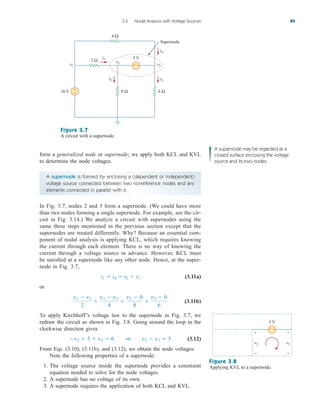
The supernode contains the 2-V source, nodes 1 and 2, and the 10-
resistor. Applying KCL to the supernode as shown in Fig. 3.10(a) gives
Expressing and in terms of the node voltages
or
(3.3.1)
To get the relationship between and we apply KVL to the circuit
in Fig. 3.10(b). Going around the loop, we obtain
(3.3.2)
From Eqs. (3.3.1) and (3.3.2), we write
or
and Note that the 10- resistor does not
make any difference because it is connected across the supernode.
⍀
v2 ⫽ v1 ⫹ 2 ⫽ ⫺5.333 V.
3v1 ⫽ ⫺22 1 v1 ⫽ ⫺7.333 V
v2 ⫽ v1 ⫹ 2 ⫽ ⫺20 ⫺ 2v1
⫺v1 ⫺ 2 ⫹ v2 ⫽ 0 1 v2 ⫽ v1 ⫹ 2
v2,
v1
v2 ⫽ ⫺20 ⫺ 2v1
2 ⫽
v1 ⫺ 0
2
⫹
v2 ⫺ 0
4
⫹ 7 1 8 ⫽ 2v1 ⫹ v2 ⫹ 28
i2
i1
2 ⫽ i1 ⫹ i2 ⫹ 7
⍀
Example 3.3
Figure 3.9
For Example 3.3.
+
−
2 A
2 V
7 A
4 Ω
10 Ω
2 Ω
v1 v2
2 A
2 A
7 A
7 A
2 Ω 4 Ω
v2
v1
i1 i2
1 2
(a)
+
−
(b)
2 V
1 2
+
+
− −
v1 v2
Figure 3.10
Applying: (a) KCL to the supernode, (b) KVL to the loop.
Figure 3.11
For Practice Prob. 3.3.
21 V
9 V
4 Ω
3 Ω 2 Ω 6 Ω
+
−
+
−
i
v
+
−
Practice Problem 3.3 Find v and i in the circuit of Fig. 3.11.
Answer: 4.2 A.
⫺0.6 V,
106 Chapter 3 Methods of Analysis
are displayed on VIEWPOINTS and also saved in output file
exam310.out. The output file includes the following:
NODE VOLTAGE NODE VOLTAGE NODE VOLTAGE
(1) 120.0000 (2) 81.2900 (3) 89.0320
indicating that V3 ⫽ 89.032 V.
V2 ⫽ 81.29 V,
V1 ⫽ 120 V,
+
−
R1 R3
20 10
120 V V1 R2 R4
30 40 I1 3 A
IDC
0
1 2 3
120.0000 81.2900 89.0320
Figure 3.32
For Example 3.10; the schematic of the circuit in Fig. 3.31.
For the circuit in Fig. 3.33, use PSpice to find the node voltages.
Practice Problem 3.10
+
−
2 A
200 V
30 Ω 60 Ω 50 Ω
100 Ω
25 Ω
1 2 3
0
Figure 3.33
For Practice Prob. 3.10.
Answer: V3 ⫽ 200 V.
V2 ⫽ 57.14 V,
V1 ⫽ ⫺40 V,
In the circuit of Fig. 3.34, determine the currents and i3.
i1, i2,
Example 3.11
+
−
+
−
24 V
1 Ω
i1 i2 i3
+
−
4 Ω 2 Ω
2 Ω 8 Ω 4 Ω
3vo
vo
Figure 3.34
For Example 3.11.
3.9 Applications: DC Transistor Circuits 107
Solution:
The schematic is shown in Fig. 3.35. (The schematic in Fig. 3.35
includes the output results, implying that it is the schematic displayed
on the screen after the simulation.) Notice that the voltage-controlled
voltage source E1 in Fig. 3.35 is connected so that its input is the
voltage across the 4- resistor; its gain is set equal to 3. In order to
display the required currents, we insert pseudocomponent IPROBES in
the appropriate branches. The schematic is saved as exam311.sch and
simulated by selecting Analysis/Simulate. The results are displayed on
IPROBES as shown in Fig. 3.35 and saved in output file exam311.out.
From the output file or the IPROBES, we obtain A and
A.
i3 ⫽ 2.667
i1 ⫽ i2 ⫽ 1.333
⍀
+
−
24 V V1
R1
4
R2 2 R3 8 R4 4
1.333E + 00 1.333E + 00 2.667E + 00
0
R6
1
R5
2
E E1
+
−
− +
Figure 3.35
The schematic of the circuit in Fig. 3.34.
Use PSpice to determine currents and in the circuit of Fig. 3.36.
Answer: A, A, A.
i3 ⫽ 2
i2 ⫽ 2.286
i1 ⫽ ⫺0.4286
i3
i1, i2, Practice Problem 3.11
+
−
2 A
10 V
2 Ω
i1
i1
i2
4 Ω
1 Ω 2 Ω
i3
Figure 3.36
For Practice Prob. 3.11.
Applications: DC Transistor Circuits
Most of us deal with electronic products on a routine basis and have
some experience with personal computers. A basic component for
the integrated circuits found in these electronics and computers is the
active, three-terminal device known as the transistor. Understanding
the transistor is essential before an engineer can start an electronic cir-
cuit design.
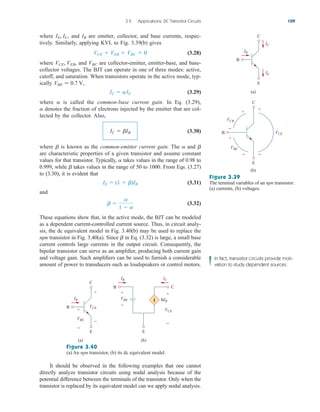
Figure 3.37 depicts various kinds of transistors commercially avail-
able. There are two basic types of transistors: bipolar junction transis-
tors (BJTs) and field-effect transistors (FETs). Here, we consider only
the BJTs, which were the first of the two and are still used today. Our
objective is to present enough detail about the BJT to enable us to apply
the techniques developed in this chapter to analyze dc transistor circuits.
p
3.9
369
Sinusoids and
Phasors
He who knows not, and knows not that he knows not, is a fool—
shun him. He who knows not, and knows that he knows not, is a child—
teach him. He who knows, and knows not that he knows, is asleep—wake
him up. He who knows, and knows that he knows, is wise—follow him.
—Persian Proverb
c h a p t e r
9
Enhancing Your Skills and Your Career
ABET EC 2000 criteria (3.d), “an ability to function on
multi-disciplinary teams.”
The “ability to function on multidisciplinary teams” is inherently crit-
ical for the working engineer. Engineers rarely, if ever, work by them-
selves. Engineers will always be part of some team. One of the things
I like to remind students is that you do not have to like everyone on a
team; you just have to be a successful part of that team.
Most frequently, these teams include individuals from of a variety
of engineering disciplines, as well as individuals from nonengineering
disciplines such as marketing and finance.
Students can easily develop and enhance this skill by working in
study groups in every course they take. Clearly, working in study
groups in nonengineering courses as well as engineering courses out-
side your discipline will also give you experience with multidiscipli-
nary teams.
Photo by Charles Alexander
The last section in each chapter is devoted to appli-
cations of the concepts covered in the chapter to help
students apply the concepts to real-life situations.
Icons next to the end-of-chapter homework problems
let students know which problems relate to engineer-
ing design and which problems can be solved using
PSpice or MATLAB. Appendices on these computer
programs provide tutorials for their use.
Each chapter opens with a discussion about how to
enhance skills that contribute to successful problem
solving as well as successful careers or a career-
oriented talk on a sub-discipline of electrical engi-
neering to give students some real-world applications
of what they are learning.
ale29559_fm.qxd 07/28/2008 11:54 AM Page xxi
xxii Guided Tour
Supplements for Students and Instructors
McGraw-Hill’s ARIS—Assessment, Review,
and Instruction System is a complete, online
tutorial, electronic homework, and course man-
agement system, designed for greater ease of
use than any other system available. With ARIS, instructors can create
and share course materials and assignments with other instructors, edit
questions and algorithms, import their own content, and create
announcements and due dates for assignments. ARIS has automatic
grading and reporting of easy-to-assign algorithmically-generated
homework, quizzing, and testing. Once a student is registered in the
course, all student activity within McGraw-Hill’s ARIS is automatically
recorded and available to the instructor through a fully integrated grade
book that can be downloaded to Excel.
www.mhhe.com/alexander
Knowledge Capturing Integrated Design Environment
for Circuits (KCIDE for Circuits) software, linked
from ARIS, enhances student understanding of the
six-step problem-solving methodology in the book.
KCIDE for Circuits allows students to work a circuit
problem in PSpice and MATLAB, track the evolution
of their solution, and save a record of their process for
future reference. Appendix F walks the user through
this program.
ale29559_fm.qxd 07/28/2008 11:54 AM Page xxii
Guided Tour xxiii
Other resources provided on ARIS.
For Students:
— Network Analysis Tutorials—a series of interactive quizzes to help
students practice fundamental concepts in circuits.
— FE Exam Interactive Review Quizzes—chapter based self-quizzes
provide hints for solutions and correct solution methods, and help
students prepare for the NCEES Fundamentals of Engineering
Examination.
— Problem Solving Made Almost Easy—a companion workbook to the
text, featuring 150 additional problems with complete solutions.
— Complete solutions to Practice Problems in the text
— Flashcards of key terms
— Web links
For Instructors:
— Image Sets—electronic files of text figures for easy integration into
your course presentations, exams, and assignments.
— Transition Guides—compare coverage of the third edition to other
popular circuits books at the section level to aid transition to teach-
ing from our text.
ale29559_fm.qxd 07/28/2008 11:54 AM Page xxiii
ale29559_fm.qxd 07/28/2008 11:54 AM Page xxiv
A Note to the Student
This may be your first course in electrical engineering. Although elec-
trical engineering is an exciting and challenging discipline, the course
may intimidate you. This book was written to prevent that. A good text-
book and a good professor are an advantage—but you are the one who
does the learning. If you keep the following ideas in mind, you will do
very well in this course.
• This course is the foundation on which most other courses in the
electrical engineering curriculum rest. For this reason, put in as
much effort as you can. Study the course regularly.
• Problem solving is an essential part of the learning process. Solve as
many problems as you can. Begin by solving the practice problem
following each example, and then proceed to the end-of-chapter
problems. The best way to learn is to solve a lot of problems. An
asterisk in front of a problem indicates a challenging problem.
• Spice, a computer circuit analysis program, is used throughout the
textbook. PSpice, the personal computer version of Spice, is the
popular standard circuit analysis program at most universities.
PSpice for Windows is described in Appendix D. Make an effort
to learn PSpice, because you can check any circuit problem with
PSpice and be sure you are handing in a correct problem solution.
• MATLAB is another software that is very useful in circuit analysis
and other courses you will be taking. A brief tutorial on MATLAB
is given in Appendix E to get you started. The best way to learn
MATLAB is to start working with it once you know a few commands.
• Each chapter ends with a section on how the material covered in
the chapter can be applied to real-life situations. The concepts in
this section may be new and advanced to you. No doubt, you will
learn more of the details in other courses. We are mainly interested
in gaining a general familiarity with these ideas.
• Attempt the review questions at the end of each chapter. They
will help you discover some “tricks” not revealed in class or in the
textbook.
• Clearly a lot of effort has gone into making the technical details in
this book easy to understand. It also contains all the mathematics
and physics necessary to understand the theory and will be very
useful in your other engineering courses. However, we have also
focused on creating a reference for you to use both in school as
well as when working in industry or seeking a graduate degree.
• It is very tempting to sell your book after you have completed your
classroom experience; however, our advice to you is DO NOT SELL
YOUR ENGINEERING BOOKS! Books have always been expen-
sive, however, the cost of this book is virtually the same as I paid
for my circuits text back in the early 60s in terms of real dollars.
In fact, it is actually cheaper. In addition, engineering books of
the past are no where near as complete as what is available now.
xxv
ale29559_fm.qxd 07/28/2008 11:54 AM Page xxv
When I was a student, I did not sell any of my engineering text-
books and was very glad I did not! I found that I needed most of
them throughout my career.
A short review on finding determinants is covered in Appendix A,
complex numbers in Appendix B, and mathematical formulas in Appen-
dix C. Answers to odd-numbered problems are given in Appendix G.
Have fun!
C. K. A. and M. N. O. S.
xxvi A Note to the Student
ale29559_fm.qxd 07/28/2008 11:54 AM Page xxvi
xxvii
About the Authors
Charles K. Alexander is professor of electrical and computer engi-
neering of the Fenn College of Engineering at Cleveland State Uni-
versity, Cleveland, Ohio. He is also the Director of The Center for
Research in Electronics and Aerospace Technology (CREATE), and is
the Managing Director of the Wright Center for Sensor Systems
(WCSSE). From 2002 until 2006 he was Dean of the Fenn College of
Engineering. From 2004 until 2007, he was Director of Ohio ICE, a
research center in instrumentation, controls, electronics, and sensors (a
coalition of CSU, Case, the University of Akron, and a number of Ohio
industries). From 1998 until 2002, he was interim director (2000 and
2001) of the Institute for Corrosion and Multiphase Technologies and
Stocker Visiting Professor of electrical engineering and computer sci-
ence at Ohio University. From 1994–1996 he was dean of engineering
and computer science at California State University, Northridge.
From 1989–1994 he was acting dean of the college of engineer-
ing at Temple University, and from 1986–1989 he was professor and
chairman of the department of electrical engineering at Temple. From
1980–1986 he held the same positions at Tennessee Technological
University. He was an associate professor and a professor of electrical
engineering at Youngstown State University from 1972–1980, where
he was named Distinguished Professor in 1977 in recognition of
“outstanding teaching and research.” He was assistant professor of
electrical engineering at Ohio University in 1971–1972. He received
the Ph.D. (1971) and M.S.E.E. (1967) from Ohio University and the
B.S.E.E. (1965) from Ohio Northern University.
Dr. Alexander has been a consultant to 23 companies and gov-
ernmental organizations, including the Air Force and Navy and sev-
eral law firms. He has received over $85 million in research and
development funds for projects ranging from solar energy to software
engineering. He has authored 40 publications, including a workbook
and a videotape lecture series, and is coauthor of Fundamentals of
Electric Circuits, Problem Solving Made Almost Easy, and the fifth
edition of the Standard Handbook of Electronic Engineering, with
McGraw-Hill. He has made more than 500 paper, professional, and
technical presentations.
Dr. Alexander is a fellow of the IEEE and served as its president
and CEO in 1997. In 1993 and 1994 he was IEEE vice president, pro-
fessional activities, and chair of the United States Activities Board
(USAB). In 1991–1992 he was region 2 director, serving on the
Regional Activities Board (RAB) and USAB. He has also been a mem-
ber of the Educational Activities Board. He served as chair of the USAB
Member Activities Council and vice chair of the USAB Professional
Activities Council for Engineers, and he chaired the RAB Student
Activities Committee and the USAB Student Professional Awareness
Committee.
Charles K. Alexander
ale29559_fm.qxd 07/28/2008 11:54 AM Page xxvii
In 1998 he received the Distinguished Engineering Education
Achievement Award from the Engineering Council, and in 1996 he
received the Distinguished Engineering Education Leadership Award
from the same group. When he became a fellow of the IEEE in 1994,
the citation read “for leadership in the field of engineering education
and the professional development of engineering students.” In 1984 he
received the IEEE Centennial Medal, and in 1983 he received the
IEEE/RAB Innovation Award, given to the IEEE member who best
contributes to RAB’s goals and objectives.
Matthew N. O. Sadiku is presently a professor at Prairie View A&M
University. Prior to joining Prairie View, he taught at Florida Atlantic
University, Boca Raton, and Temple University, Philadelphia. He has
also worked for Lucent/Avaya and Boeing Satellite Systems.
Dr. Sadiku is the author of over 170 professional papers and almost
30 books including Elements of Electromagnetics (Oxford University
Press, 3rd ed., 2001), Numerical Techniques in Electromagnetics (2nd
ed., CRC Press, 2000), Simulation of Local Area Networks (with M.
IIyas, CRC Press, 1994), Metropolitan Area Networks (CRC Press,
1994), and Fundamentals of Electric Circuits (with C. K. Alexander,
McGraw-Hill, 3rd ed., 2007). His books are used worldwide, and some
of them have been translated into Korean, Chinese, Italian, and Spanish.
He was the recipient of the 2000 McGraw-Hill/Jacob Millman Award for
outstanding contributions in the field of electrical engineering. He was
the IEEE region 2 Student Activities Committee chairman and is an asso-
ciate editor for IEEE “Transactions on Education.” He received his Ph.D.
at Tennessee Technological University, Cookeville.
xxviii About the Authors
Matthew N. O. Sadiku
ale29559_fm.qxd 07/28/2008 11:54 AM Page xxviii
Fundamentals of
Electric Circuits
ale29559_fm.qxd 07/28/2008 11:54 AM Page 1
P A R T O N E
DC Circuits
OUTLINE
1 Basic Concepts
2 Basic Laws
3 Methods of Analysis
4 Circuit Theorems
5 Operational Amplifiers
6 Capacitors and Inductors
7 First-Order Circuits
8 Second-Order Circuits
ale29559_ch01.qxd 07/08/2008 10:37 AM Page 2
3
Basic Concepts
Some books are to be tasted, others to be swallowed, and some few to
be chewed and digested.
—Francis Bacon
c h a p t e r
1
Enhancing Your Skills and Your Career
ABET EC 2000 criteria (3.a), “an ability to apply knowledge
of mathematics, science, and engineering.”
As students, you are required to study mathematics, science, and engi-
neering with the purpose of being able to apply that knowledge to the
solution of engineering problems. The skill here is the ability to apply
the fundamentals of these areas in the solution of a problem. So, how
do you develop and enhance this skill?
The best approach is to work as many problems as possible in all
of your courses. However, if you are really going to be successful with
this, you must spend time analyzing where and when and why you have
difficulty in easily arriving at successful solutions. You may be sur-
prised to learn that most of your problem-solving problems are with
mathematics rather than your understanding of theory. You may also
learn that you start working the problem too soon. Taking time to think
about the problem and how you should solve it will always save you
time and frustration in the end.
What I have found that works best for me is to apply our six-
step problem-solving technique. Then I carefully identify the areas
where I have difficulty solving the problem. Many times, my actual
deficiencies are in my understanding and ability to use correctly cer-
tain mathematical principles. I then return to my fundamental math
texts and carefully review the appropriate sections and in some cases
work some example problems in that text. This brings me to another
important thing you should always do: Keep nearby all your basic
mathematics, science, and engineering textbooks.
This process of continually looking up material you thought you
had acquired in earlier courses may seem very tedious at first; how-
ever, as your skills develop and your knowledge increases, this process
will become easier and easier. On a personal note, it is this very process
that led me from being a much less than average student to someone
who could earn a Ph.D. and become a successful researcher.
Photo by Charles Alexander
ale29559_ch01.qxd 07/08/2008 10:37 AM Page 3
Introduction
Electric circuit theory and electromagnetic theory are the two funda-
mental theories upon which all branches of electrical engineering are
built. Many branches of electrical engineering, such as power, electric
machines, control, electronics, communications, and instrumentation,
are based on electric circuit theory. Therefore, the basic electric circuit
theory course is the most important course for an electrical engineer-
ing student, and always an excellent starting point for a beginning stu-
dent in electrical engineering education. Circuit theory is also valuable
to students specializing in other branches of the physical sciences
because circuits are a good model for the study of energy systems in
general, and because of the applied mathematics, physics, and topol-
ogy involved.
In electrical engineering, we are often interested in communicating
or transferring energy from one point to another. To do this requires an
interconnection of electrical devices. Such interconnection is referred
to as an electric circuit, and each component of the circuit is known as
an element.
An electric circuit is an interconnection of electrical elements.
A simple electric circuit is shown in Fig. 1.1. It consists of three
basic elements: a battery, a lamp, and connecting wires. Such a simple
circuit can exist by itself; it has several applications, such as a flash-
light, a search light, and so forth.
A complicated real circuit is displayed in Fig. 1.2, representing the
schematic diagram for a radio receiver. Although it seems complicated,
this circuit can be analyzed using the techniques we cover in this book.
Our goal in this text is to learn various analytical techniques and
computer software applications for describing the behavior of a circuit
like this.
Electric circuits are used in numerous electrical systems to accom-
plish different tasks. Our objective in this book is not the study of
various uses and applications of circuits. Rather our major concern is
the analysis of the circuits. By the analysis of a circuit, we mean a
study of the behavior of the circuit: How does it respond to a given
input? How do the interconnected elements and devices in the circuit
interact?
We commence our study by defining some basic concepts. These
concepts include charge, current, voltage, circuit elements, power, and
energy. Before defining these concepts, we must first establish a sys-
tem of units that we will use throughout the text.
Systems of Units
As electrical engineers, we deal with measurable quantities. Our mea-
surement, however, must be communicated in a standard language that
virtually all professionals can understand, irrespective of the country
where the measurement is conducted. Such an international measurement
1.2
1.1
4 Chapter 1 Basic Concepts
+
−
Current
Lamp
Battery
Figure 1.1
A simple electric circuit.
ale29559_ch01.qxd 07/08/2008 10:37 AM Page 4
language is the International System of Units (SI), adopted by the
General Conference on Weights and Measures in 1960. In this system,
there are six principal units from which the units of all other physical
quantities can be derived. Table 1.1 shows the six units, their symbols,
and the physical quantities they represent. The SI units are used
throughout this text.
One great advantage of the SI unit is that it uses prefixes based on
the power of 10 to relate larger and smaller units to the basic unit.
Table 1.2 shows the SI prefixes and their symbols. For example, the
following are expressions of the same distance in meters (m):
600,000,000 mm 600,000 m 600 km
1.2 Systems of Units 5
2, 5, 6
C
Oscillator
E
B
R2
10 k
R3
10 k
R1 47
Y1
7 MHz
C6 5
L2
22.7 ␮H
(see text)
to
U1, Pin 8
R10
10 k
GAIN +
+
C16
100 ␮F
16 V
C11
100 ␮F
16 V
C10
1.0 ␮F
16 V
C9
1.0 ␮F
16 V
C15
0.47
16 V
C17
100 ␮F
16 V
+
−
12-V dc
Supply
Audio
Output
+
C18
0.1
R12
10
1
4
2
3
C14
0.0022
0.1
C13
U2A
1 2 TL072
U2B
1 2 TL072
R9
15 k
R5
100 k
R8
15 k
R6
100 k
5
6
R7
1 M
C12 0.0033
+
L3
1 mH
R11
47
C8
0.1
Q1
2N2222A
7
C3 0.1
L1
0.445 ␮H
Antenna C1
2200 pF
C2
2200 pF
1
8
7
U1
SBL-1
Mixer
3, 4
C7
532
C4
910
C5
910
R4
220
U3
LM386N
Audio power amp
5
4
6
3
2
+
+
−
+
−
+
−
+
8
Figure 1.2
Electric circuit of a radio receiver.
Reproduced with permission from QST, August 1995, p. 23.
TABLE 1.1
Six basic SI units and one derived unit relevant to this text.
Quantity Basic unit Symbol
Length meter m
Mass kilogram kg
Time second s
Electric current ampere A
Thermodynamic temperature kelvin K
Luminous intensity candela cd
Charge coulomb C
TABLE 1.2
The SI prefixes.
Multiplier Prefix Symbol
exa E
peta P
tera T
giga G
mega M
kilo k
hecto h
10 deka da
deci d
centi c
milli m
micro
nano n
pico p
femto f
atto a
1018
1015
1012
109
m
106
103
102
101
102
103
106
109
1012
1015
1018
ale29559_ch01.qxd 07/17/2008 11:15 AM Page 5
Charge and Current
The concept of electric charge is the underlying principle for explain-
ing all electrical phenomena. Also, the most basic quantity in an elec-
tric circuit is the electric charge. We all experience the effect of electric
charge when we try to remove our wool sweater and have it stick to
our body or walk across a carpet and receive a shock.
Charge is an electrical property of the atomic particles of which mat-
ter consists, measured in coulombs (C).
We know from elementary physics that all matter is made of funda-
mental building blocks known as atoms and that each atom consists of
electrons, protons, and neutrons. We also know that the charge e on an
electron is negative and equal in magnitude to C, while
a proton carries a positive charge of the same magnitude as the elec-
tron. The presence of equal numbers of protons and electrons leaves an
atom neutrally charged.
The following points should be noted about electric charge:
1. The coulomb is a large unit for charges. In 1 C of charge, there
are electrons. Thus realistic or
laboratory values of charges are on the order of pC, nC, or C.1
2. According to experimental observations, the only charges that
occur in nature are integral multiples of the electronic charge
3. The law of conservation of charge states that charge can neither
be created nor destroyed, only transferred. Thus the algebraic sum
of the electric charges in a system does not change.
We now consider the flow of electric charges. A unique feature of
electric charge or electricity is the fact that it is mobile; that is, it can
be transferred from one place to another, where it can be converted to
another form of energy.
When a conducting wire (consisting of several atoms) is con-
nected to a battery (a source of electromotive force), the charges are
compelled to move; positive charges move in one direction while neg-
ative charges move in the opposite direction. This motion of charges
creates electric current. It is conventional to take the current flow as
the movement of positive charges. That is, opposite to the flow of neg-
ative charges, as Fig. 1.3 illustrates. This convention was introduced
by Benjamin Franklin (1706–1790), the American scientist and inven-
tor. Although we now know that current in metallic conductors is due
to negatively charged electrons, we will follow the universally
accepted convention that current is the net flow of positive charges.
Thus,
Electric current is the time rate of change of charge, measured in
amperes (A).
e  1.602  1019
C.
m
1(1.602  1019
)  6.24  1018
1.602  1019
1.3
6 Chapter 1 Basic Concepts
1
However, a large power supply capacitor can store up to 0.5 C of charge.
Battery
I − −
− −
+ −
Figure 1.3
Electric current due to flow of electronic
charge in a conductor.
A convention is a standard way of
describing something so that others in
the profession can understand what
we mean. We will be using IEEE con-
ventions throughout this book.
ale29559_ch01.qxd 07/08/2008 10:38 AM Page 6
Mathematically, the relationship between current i, charge q, and time t is
(1.1)
where current is measured in amperes (A), and
The charge transferred between time and t is obtained by integrat-
ing both sides of Eq. (1.1). We obtain
(1.2)
The way we define current as i in Eq. (1.1) suggests that current need
not be a constant-valued function. As many of the examples and prob-
lems in this chapter and subsequent chapters suggest, there can be sev-
eral types of current; that is, charge can vary with time in several ways.
If the current does not change with time, but remains constant, we
call it a direct current (dc).
A direct current (dc) is a current that remains constant with time.
By convention the symbol I is used to represent such a constant current.
A time-varying current is represented by the symbol i. A common
form of time-varying current is the sinusoidal current or alternating
current (ac).
An alternating current (ac) is a current that varies sinusoidally with time.
Such current is used in your household, to run the air conditioner,
refrigerator, washing machine, and other electric appliances. Figure 1.4
Q 
¢

t
t0
i dt
t0
1 ampere  1 coulomb/second
i 
¢ dq
dt
1.3 Charge and Current 7
Andre-Marie Ampere (1775–1836), a French mathematician and
physicist, laid the foundation of electrodynamics. He defined the elec-
tric current and developed a way to measure it in the 1820s.
Born in Lyons, France, Ampere at age 12 mastered Latin in a few
weeks, as he was intensely interested in mathematics and many of the
best mathematical works were in Latin. He was a brilliant scientist and
a prolific writer. He formulated the laws of electromagnetics. He in-
vented the electromagnet and the ammeter. The unit of electric current,
the ampere, was named after him.
Historical
I
0 t
(a)
(b)
i
t
0
Figure 1.4
Two common types of current: (a) direct
current (dc), (b) alternating current (ac).
The Burndy Library Collection
at The Huntington Library,
San Marino, California.
ale29559_ch01.qxd 07/16/2008 12:22 PM Page 7
shows direct current and alternating current; these are the two most
common types of current. We will consider other types later in the
book.
Once we define current as the movement of charge, we expect cur-
rent to have an associated direction of flow. As mentioned earlier, the
direction of current flow is conventionally taken as the direction of pos-
itive charge movement. Based on this convention, a current of 5 A may
be represented positively or negatively as shown in Fig. 1.5. In other
words, a negative current of A flowing in one direction as shown
in Fig. 1.5(b) is the same as a current of A flowing in the opposite
direction.
5
5
8 Chapter 1 Basic Concepts
5 A
(a)
−5 A
(b)
Figure 1.5
Conventional current flow: (a) positive
current flow, (b) negative current flow.
How much charge is represented by 4,600 electrons?
Solution:
Each electron has C. Hence 4,600 electrons will have
1.602  1019
C/electron  4,600 electrons  7.369  1016
C
1.602  1019
Example 1.1
Practice Problem 1.2
Example 1.2
Calculate the amount of charge represented by four million protons.
Answer: C.
6.408  1013
Practice Problem 1.1
If in Example 1.2, find the current at s.
Answer: 7.36 mA.
t  0.5
q  (10  10e2t
) mC,
The total charge entering a terminal is given by mC.
Calculate the current at s.
Solution:
At
i  5 sin 2p  10p cos 2p  0  10p  31.42 mA
t  0.5,
i 
dq
dt

d
dt
(5t sin 4pt) mC/s  (5 sin 4pt  20pt cos 4pt) mA
t  0.5
q  5t sin 4pt
ale29559_ch01.qxd 07/08/2008 10:38 AM Page 8
Voltage
As explained briefly in the previous section, to move the electron in a
conductor in a particular direction requires some work or energy trans-
fer. This work is performed by an external electromotive force (emf),
typically represented by the battery in Fig. 1.3. This emf is also known
as voltage or potential difference. The voltage between two points
a and b in an electric circuit is the energy (or work) needed to move
a unit charge from a to b; mathematically,
(1.3)
where w is energy in joules (J) and q is charge in coulombs (C). The
voltage or simply v is measured in volts (V), named in honor of
the Italian physicist Alessandro Antonio Volta (1745–1827), who
invented the first voltaic battery. From Eq. (1.3), it is evident that
Thus,
Voltage (or potential difference) is the energy required to move a unit
charge through an element, measured in volts (V).
Figure 1.6 shows the voltage across an element (represented by a
rectangular block) connected to points a and b. The plus and minus
signs are used to define reference direction or voltage polarity. The
can be interpreted in two ways: (1) point a is at a potential of vab
vab
()
()
1 volt  1 joule/coulomb  1 newton-meter/coulomb
vab
vab 
¢ dw
dq
vab
1.4
1.4 Voltage 9
Example 1.3
Determine the total charge entering a terminal between and
s if the current passing the terminal is A.
Solution:
 at3

t2
2
b `
2
1
 (8  2)  a1 
1
2
b  5.5 C
Q  
2
t1
i dt  
2
1
(3t2
 t)dt
i  (3t2
 t)
t  2
t  1 s
The current flowing through an element is
Calculate the charge entering the element from to s.
Answer: 6.667 C.
t  2
t  0
i  e
2 A, 0 6 t 6 1
2t2
A, t 7 1
a
b
vab
+
−
Figure 1.6
Polarity of voltage .
vab
Practice Problem 1.3
ale29559_ch01.qxd 07/08/2008 10:38 AM Page 9
Historical
Alessandro Antonio Volta (1745–1827), an Italian physicist,
invented the electric battery—which provided the first continuous flow
of electricity—and the capacitor.
Born into a noble family in Como, Italy, Volta was performing
electrical experiments at age 18. His invention of the battery in 1796
revolutionized the use of electricity. The publication of his work in
1800 marked the beginning of electric circuit theory. Volta received
many honors during his lifetime. The unit of voltage or potential dif-
ference, the volt, was named in his honor.
volts higher than point b, or (2) the potential at point a with respect to
point b is . It follows logically that in general
(1.4)
For example, in Fig. 1.7, we have two representations of the same volt-
age. In Fig. 1.7(a), point a is V above point b; in Fig. 1.7(b), point b
is V above point a. We may say that in Fig. 1.7(a), there is a 9-V
voltage drop from a to b or equivalently a 9-V voltage rise from b to
a. In other words, a voltage drop from a to b is equivalent to a volt-
age rise from b to a.
Current and voltage are the two basic variables in electric circuits.
The common term signal is used for an electric quantity such as a cur-
rent or a voltage (or even electromagnetic wave) when it is used for
conveying information. Engineers prefer to call such variables signals
rather than mathematical functions of time because of their importance
in communications and other disciplines. Like electric current, a con-
stant voltage is called a dc voltage and is represented by V, whereas a
sinusoidally time-varying voltage is called an ac voltage and is repre-
sented by v. A dc voltage is commonly produced by a battery; ac volt-
age is produced by an electric generator.
Power and Energy
Although current and voltage are the two basic variables in an electric
circuit, they are not sufficient by themselves. For practical purposes,
we need to know how much power an electric device can handle. We
all know from experience that a 100-watt bulb gives more light than a
60-watt bulb. We also know that when we pay our bills to the electric
utility companies, we are paying for the electric energy consumed over
a certain period of time. Thus, power and energy calculations are
important in circuit analysis.
1.5
9
9
vab  vba
vab
10 Chapter 1 Basic Concepts
9 V
(a)
a
b
+
−
−9 V
(b)
a
b
+
−
Figure 1.7
Two equivalent representations of the
same voltage : (a) point a is 9 V above
point b, (b) point b is 9 V above point a.

vab
Keep in mind that electric current is
always through an element and that
electric voltage is always across the
element or between two points.
The Burndy Library Collection
at The Huntington Library,
San Marino, California.
ale29559_ch01.qxd 07/16/2008 12:23 PM Page 10
1.5 Power and Energy 11
To relate power and energy to voltage and current, we recall from
physics that:
Power is the time rate of expending or absorbing energy, measured in
watts (W).
We write this relationship as
(1.5)
where p is power in watts (W), w is energy in joules (J), and t is time
in seconds (s). From Eqs. (1.1), (1.3), and (1.5), it follows that
(1.6)
or
(1.7)
The power p in Eq. (1.7) is a time-varying quantity and is called the
instantaneous power. Thus, the power absorbed or supplied by an ele-
ment is the product of the voltage across the element and the current
through it. If the power has a sign, power is being delivered to or
absorbed by the element. If, on the other hand, the power has a sign,
power is being supplied by the element. But how do we know when
the power has a negative or a positive sign?
Current direction and voltage polarity play a major role in deter-
mining the sign of power. It is therefore important that we pay atten-
tion to the relationship between current i and voltage v in Fig. 1.8(a).
The voltage polarity and current direction must conform with those
shown in Fig. 1.8(a) in order for the power to have a positive sign.
This is known as the passive sign convention. By the passive sign con-
vention, current enters through the positive polarity of the voltage. In
this case, or implies that the element is absorbing
power. However, if or , as in Fig. 1.8(b), the element
is releasing or supplying power.
Passive sign convention is satisfied when the current enters through
the positive terminal of an element and p vi. If the current enters
through the negative terminal, p vi.
Unless otherwise stated, we will follow the passive sign conven-
tion throughout this text. For example, the element in both circuits of
Fig. 1.9 has an absorbing power of W because a positive current
enters the positive terminal in both cases. In Fig. 1.10, however, the
element is supplying power of W because a positive current enters
the negative terminal. Of course, an absorbing power of W is
equivalent to a supplying power of W. In general,
Power absorbed  Power supplied
12
12
12
12


vi 6 0
p  vi
vi 7 0
p  vi


p  vi
p 
dw
dt

dw
dq

dq
dt
 vi
p 
¢ dw
dt
p = +vi
(a)
v
+
−
p = −vi
(b)
v
+
−
i
i
Figure 1.8
Reference polarities for power using the
passive sign convention: (a) absorbing
power, (b) supplying power.
When the voltage and current directions
conform to Fig. 1.8(b), we have the ac-
tive sign convention and p vi.


(a)
4 V
3 A
(a)
+
−
3 A
4 V
3 A
(b)
+
−
Figure 1.9
Two cases of an element with an absorbing
power of 12 W: (a) W,
(b) W.
p  4  3  12
p  4  3  12
3 A
(a)
4 V
3 A
(a)
+
−
3 A
4 V
3 A
(b)
+
−
Figure 1.10
Two cases of an element with a supplying
power of 12 W: (a)
W, (b) W.
p  4  3  12
12
p  4  3 
ale29559_ch01.qxd 07/08/2008 10:38 AM Page 11
In fact, the law of conservation of energy must be obeyed in any
electric circuit. For this reason, the algebraic sum of power in a cir-
cuit, at any instant of time, must be zero:
(1.8)
This again confirms the fact that the total power supplied to the circuit
must balance the total power absorbed.
From Eq. (1.6), the energy absorbed or supplied by an element
from time to time t is
(1.9)
Energy is the capacity to do work, measured in joules (J).
The electric power utility companies measure energy in watt-hours
(Wh), where
1 Wh  3,600 J
w  
t
t0
p dt  
t
t0
vi dt
t0
a p  0
12 Chapter 1 Basic Concepts
An energy source forces a constant current of 2 A for 10 s to flow
through a lightbulb. If 2.3 kJ is given off in the form of light and heat
energy, calculate the voltage drop across the bulb.
Solution:
The total charge is
The voltage drop is
v 
¢w
¢q

2.3  103
20
 115 V
¢q  i ¢t  2  10  20 C
Example 1.4
To move charge q from point a to point b requires J. Find the
voltage drop if: (a) C, (b) C.
Answer: (a) V, (b) 5 V.
15
q  6
q  2
vab
30
Practice Problem 1.4
Find the power delivered to an element at ms if the current enter-
ing its positive terminal is
and the voltage is: (a) , (b) .
v  3 didt
v  3i
i  5 cos 60pt A
t  3
Example 1.5
ale29559_ch01.qxd 07/08/2008 10:38 AM Page 12
1.5 Power and Energy 13
Solution:
(a) The voltage is hence, the power is
At ms,
(b) We find the voltage and the power as
At ms,
 14137.167 sin 32.4 cos 32.4  6.396 kW
p  4500p sin 0.18p cos 0.18p W
t  3
p  vi  4500p sin 60pt cos 60pt W
v  3
di
dt
 3(60p)5 sin 60pt  900p sin 60pt V
p  75 cos2
(60p  3  103
)  75 cos2
0.18p  53.48 W
t  3
p  vi  75 cos2
60pt W
v  3i  15 cos 60pt;
Practice Problem 1.5
Find the power delivered to the element in Example 1.5 at ms
if the current remains the same but the voltage is: (a) V,
(b) V.
Answer: (a) 17.27 W, (b) 29.7 W.
v  a10  5
t
0
i dtb
v  2i
t  5
Example 1.6
How much energy does a 100-W electric bulb consume in two hours?
Solution:
This is the same as
w  pt  100 W  2 h  200 Wh
 720,000 J  720 kJ
w  pt  100 (W)  2 (h)  60 (min/h)  60 (s/min)
Practice Problem 1.6
A stove element draws 15 A when connected to a 240-V line. How
long does it take to consume 60 kJ?
Answer: 16.667 s.
ale29559_ch01.qxd 07/08/2008 10:38 AM Page 13
14 Chapter 1 Basic Concepts
Smithsonian Institution.
Historical
1884 Exhibition In the United States, nothing promoted the future
of electricity like the 1884 International Electrical Exhibition. Just
imagine a world without electricity, a world illuminated by candles and
gaslights, a world where the most common transportation was by walk-
ing and riding on horseback or by horse-drawn carriage. Into this world
an exhibition was created that highlighted Thomas Edison and reflected
his highly developed ability to promote his inventions and products.
His exhibit featured spectacular lighting displays powered by an impres-
sive 100-kW “Jumbo” generator.
Edward Weston’s dynamos and lamps were featured in the United
States Electric Lighting Company’s display. Weston’s well known col-
lection of scientific instruments was also shown.
Other prominent exhibitors included Frank Sprague, Elihu Thompson,
and the Brush Electric Company of Cleveland. The American Institute
of Electrical Engineers (AIEE) held its first technical meeting on Octo-
ber 7–8 at the Franklin Institute during the exhibit. AIEE merged with
the Institute of Radio Engineers (IRE) in 1964 to form the Institute of
Electrical and Electronics Engineers (IEEE).
ale29559_ch01.qxd 07/08/2008 10:38 AM Page 14
Circuit Elements
As we discussed in Section 1.1, an element is the basic building block
of a circuit. An electric circuit is simply an interconnection of the ele-
ments. Circuit analysis is the process of determining voltages across
(or the currents through) the elements of the circuit.
There are two types of elements found in electric circuits: pas-
sive elements and active elements. An active element is capable of
generating energy while a passive element is not. Examples of pas-
sive elements are resistors, capacitors, and inductors. Typical active
elements include generators, batteries, and operational amplifiers. Our
aim in this section is to gain familiarity with some important active
elements.
The most important active elements are voltage or current
sources that generally deliver power to the circuit connected to
them. There are two kinds of sources: independent and dependent
sources.
An ideal independent source is an active element that provides a
specified voltage or current that is completely independent of other
circuit elements.
In other words, an ideal independent voltage source delivers to the
circuit whatever current is necessary to maintain its terminal volt-
age. Physical sources such as batteries and generators may be
regarded as approximations to ideal voltage sources. Figure 1.11
shows the symbols for independent voltage sources. Notice that both
symbols in Fig. 1.11(a) and (b) can be used to represent a dc volt-
age source, but only the symbol in Fig. 1.11(a) can be used for a
time-varying voltage source. Similarly, an ideal independent current
source is an active element that provides a specified current com-
pletely independent of the voltage across the source. That is, the cur-
rent source delivers to the circuit whatever voltage is necessary to
maintain the designated current. The symbol for an independent cur-
rent source is displayed in Fig. 1.12, where the arrow indicates the
direction of current i.
An ideal dependent (or controlled) source is an active element in
which the source quantity is controlled by another voltage or current.
Dependent sources are usually designated by diamond-shaped symbols,
as shown in Fig. 1.13. Since the control of the dependent source is
achieved by a voltage or current of some other element in the circuit,
and the source can be voltage or current, it follows that there are four
possible types of dependent sources, namely:
1. A voltage-controlled voltage source (VCVS).
2. A current-controlled voltage source (CCVS).
3. A voltage-controlled current source (VCCS).
4. A current-controlled current source (CCCS).
1.6
1.6 Circuit Elements 15
Figure 1.11
Symbols for independent voltage sources:
(a) used for constant or time-varying volt-
age, (b) used for constant voltage (dc).
V
(b)
+
−
v
(a)
+
−
i
Figure 1.12
Symbol for independent current source.
(a) (b)
v +
− i
Figure 1.13
Symbols for: (a) dependent voltage
source, (b) dependent current source.
ale29559_ch01.qxd 07/08/2008 10:38 AM Page 15
Dependent sources are useful in modeling elements such as transis-
tors, operational amplifiers, and integrated circuits. An example of a
current-controlled voltage source is shown on the right-hand side of
Fig. 1.14, where the voltage of the voltage source depends on
the current i through element C. Students might be surprised that
the value of the dependent voltage source is V (and not A)
because it is a voltage source. The key idea to keep in mind is
that a voltage source comes with polarities in its symbol,
while a current source comes with an arrow, irrespective of what it
depends on.
It should be noted that an ideal voltage source (dependent or inde-
pendent) will produce any current required to ensure that the terminal
voltage is as stated, whereas an ideal current source will produce the
necessary voltage to ensure the stated current flow. Thus, an ideal
source could in theory supply an infinite amount of energy. It should
also be noted that not only do sources supply power to a circuit, they
can absorb power from a circuit too. For a voltage source, we know
the voltage but not the current supplied or drawn by it. By the same
token, we know the current supplied by a current source but not the
voltage across it.
( )
10i
10i
10i
16 Chapter 1 Basic Concepts
Calculate the power supplied or absorbed by each element in Fig. 1.15.
Solution:
We apply the sign convention for power shown in Figs. 1.8 and 1.9.
For , the 5-A current is out of the positive terminal (or into the
negative terminal); hence,
For and , the current flows into the positive terminal of the ele-
ment in each case.
For , we should note that the voltage is 8 V (positive at the top), the
same as the voltage for since both the passive element and the
dependent source are connected to the same terminals. (Remember that
voltage is always measured across an element in a circuit.) Since the
current flows out of the positive terminal,
We should observe that the 20-V independent voltage source and
dependent current source are supplying power to the rest of
the network, while the two passive elements are absorbing power.
Also,
In agreement with Eq. (1.8), the total power supplied equals the total
power absorbed.
p1  p2  p3  p4  100  60  48  8  0
0.2I
p4  8(0.2I)  8(0.2  5)  8 W Supplied power
p3,
p4
p3  8(6)  48 W Absorbed power
p2  12(5)  60 W Absorbed power
p3
p2
p1  20(5)  100 W Supplied power
p1
Example 1.7
p2
p3
I = 5 A
20 V
6 A
8 V 0.2I
12 V
+
−
+
−
+ −
p1 p4
Figure 1.15
For Example 1.7.
i
A B
C 10i
5 V
+
−
+
−
Figure 1.14
The source on the right-hand side is a
current-controlled voltage source.
ale29559_ch01.qxd 07/08/2008 10:38 AM Page 16
Applications2
In this section, we will consider two practical applications of the
concepts developed in this chapter. The first one deals with the TV
picture tube and the other with how electric utilities determine your
electric bill.
1.7.1 TV Picture Tube
One important application of the motion of electrons is found in both
the transmission and reception of TV signals. At the transmission end,
a TV camera reduces a scene from an optical image to an electrical
signal. Scanning is accomplished with a thin beam of electrons in an
iconoscope camera tube.
At the receiving end, the image is reconstructed by using a cathode-
ray tube (CRT) located in the TV receiver.3
The CRT is depicted in
Fig. 1.17. Unlike the iconoscope tube, which produces an electron
beam of constant intensity, the CRT beam varies in intensity accord-
ing to the incoming signal. The electron gun, maintained at a high
potential, fires the electron beam. The beam passes through two sets
of plates for vertical and horizontal deflections so that the spot on the
screen where the beam strikes can move right and left and up and
down. When the electron beam strikes the fluorescent screen, it gives
off light at that spot. Thus, the beam can be made to “paint” a picture
on the TV screen.
1.7
1.7 Applications 17
Compute the power absorbed or supplied by each component of the
circuit in Fig. 1.16.
Answer: W, W, W, W.
p4  15
p3  9
p2  16
p1  40
8 A
5 V 3 V
2 V
3 A
I = 5 A
0.6I
+
−
+ −
+
−
+
−
+
−
p2
p1 p3 p4
Figure 1.16
For Practice Prob. 1.7.
2
The dagger sign preceding a section heading indicates the section that may be skipped,
explained briefly, or assigned as homework.
3
Modern TV tubes use a different technology.
Vertical
deflection
plates
Horizontal
deflection
plates
Electron
trajectory
Bright spot on
fluorescent screen
Electron gun
Figure 1.17
Cathode-ray tube.
D. E. Tilley, Contemporary College Physics Menlo Park, CA: Benjamin/
Cummings, 1979, p. 319.
Practice Problem 1.7
ale29559_ch01.qxd 07/08/2008 10:38 AM Page 17
18 Chapter 1 Basic Concepts
Zworykin with an iconoscope.
© Bettmann/Corbis.
The electron beam in a TV picture tube carries electrons per sec-
ond. As a design engineer, determine the voltage needed to accel-
erate the electron beam to achieve 4 W.
Solution:
The charge on an electron is
If the number of electrons is n, then and
The negative sign indicates that the current flows in a direction
opposite to electron flow as shown in Fig. 1.18, which is a simplified
diagram of the CRT for the case when the vertical deflection plates
carry no charge. The beam power is
Thus, the required voltage is 25 kV.
p  Voi or Vo 
p
i

4
1.6  104
 25,000 V
i 
dq
dt
 e
dn
dt
 (1.6  1019
)(1015
)  1.6  104
A
q  ne
e  1.6  1019
C
Vo
1015
Example 1.8
If an electron beam in a TV picture tube carries electrons/second
and is passing through plates maintained at a potential difference of
30 kV, calculate the power in the beam.
Answer: 48 mW.
1013
Practice Problem 1.8
i
q
Vo
Figure 1.18
A simplified diagram of the cathode-ray
tube; for Example 1.8.
Karl Ferdinand Braun and Vladimir K. Zworykin
Karl Ferdinand Braun (1850–1918), of the University of Strasbourg,
invented the Braun cathode-ray tube in 1879. This then became the
basis for the picture tube used for so many years for televisions. It is
still the most economical device today, although the price of flat-screen
systems is rapidly becoming competitive. Before the Braun tube could
be used in television, it took the inventiveness of Vladimir K.
Zworykin (1889–1982) to develop the iconoscope so that the modern
television would become a reality. The iconoscope developed into the
orthicon and the image orthicon, which allowed images to be captured
and converted into signals that could be sent to the television receiver.
Thus, the television camera was born.
Historical
ale29559_ch01.qxd 07/08/2008 10:38 AM Page 18
1.7.2 Electricity Bills
The second application deals with how an electric utility company charges
their customers. The cost of electricity depends upon the amount of
energy consumed in kilowatt-hours (kWh). (Other factors that affect the
cost include demand and power factors; we will ignore these for now.)
However, even if a consumer uses no energy at all, there is a minimum
service charge the customer must pay because it costs money to stay con-
nected to the power line. As energy consumption increases, the cost per
kWh drops. It is interesting to note the average monthly consumption of
household appliances for a family of five, shown in Table 1.3.
1.7 Applications 19
Example 1.9
A homeowner consumes 700 kWh in January. Determine the electric-
ity bill for the month using the following residential rate schedule:
Base monthly charge of $12.00.
First 100 kWh per month at 16 cents/kWh.
Next 200 kWh per month at 10 cents/kWh.
Over 300 kWh per month at 6 cents/kWh.
Solution:
We calculate the electricity bill as follows.
Average cost 
$72
100  200  400
 10.2 cents/kWh
Base monthly charge  $12.00
First 100 kWh @ $0.16/kWh  $16.00
Next 200 kWh @ $0.10/kWh  $20.00
Remaining 400 kWh @ $0.06/kWh  $24.00
Total charge  $72.00
Practice Problem 1.9
Referring to the residential rate schedule in Example 1.9, calculate the
average cost per kWh if only 400 kWh are consumed in July when the
family is on vacation most of the time.
Answer: 13.5 cents/kWh.
TABLE 1.3
Typical average monthly consumption of household
appliances.
Appliance kWh consumed Appliance kWh consumed
Water heater 500 Washing machine 120
Freezer 100 Stove 100
Lighting 100 Dryer 80
Dishwasher 35 Microwave oven 25
Electric iron 15 Personal computer 12
TV 10 Radio 8
Toaster 4 Clock 2
ale29559_ch01.qxd 07/17/2008 11:15 AM Page 19
Problem Solving
Although the problems to be solved during one’s career will vary in
complexity and magnitude, the basic principles to be followed remain
the same. The process outlined here is the one developed by the
authors over many years of problem solving with students, for the
solution of engineering problems in industry, and for problem solving
in research.
We will list the steps simply and then elaborate on them.
1. Carefully define the problem.
2. Present everything you know about the problem.
3. Establish a set of alternative solutions and determine the one that
promises the greatest likelihood of success.
4. Attempt a problem solution.
5. Evaluate the solution and check for accuracy.
6. Has the problem been solved satisfactorily? If so, present the solu-
tion; if not, then return to step 3 and continue through the process
again.
1. Carefully define the problem. This may be the most important part
of the process, because it becomes the foundation for all the rest of the
steps. In general, the presentation of engineering problems is somewhat
incomplete. You must do all you can to make sure you understand the
problem as thoroughly as the presenter of the problem understands it.
Time spent at this point clearly identifying the problem will save you
considerable time and frustration later. As a student, you can clarify a
problem statement in a textbook by asking your professor. A problem
presented to you in industry may require that you consult several indi-
viduals. At this step, it is important to develop questions that need to
be addressed before continuing the solution process. If you have such
questions, you need to consult with the appropriate individuals or
resources to obtain the answers to those questions. With those answers,
you can now refine the problem, and use that refinement as the prob-
lem statement for the rest of the solution process.
2. Present everything you know about the problem. You are now ready
to write down everything you know about the problem and its possible
solutions. This important step will save you time and frustration later.
3. Establish a set of alternative solutions and determine the one that
promises the greatest likelihood of success. Almost every problem will
have a number of possible paths that can lead to a solution. It is highly
desirable to identify as many of those paths as possible. At this point,
you also need to determine what tools are available to you, such as
PSpice and MATLAB and other software packages that can greatly
reduce effort and increase accuracy. Again, we want to stress that time
spent carefully defining the problem and investigating alternative
approaches to its solution will pay big dividends later. Evaluating the
alternatives and determining which promises the greatest likelihood of
success may be difficult but will be well worth the effort. Document
this process well since you will want to come back to it if the first
approach does not work.
4. Attempt a problem solution. Now is the time to actually begin
solving the problem. The process you follow must be well documented
1.8
20 Chapter 1 Basic Concepts
ale29559_ch01.qxd 07/08/2008 10:38 AM Page 20
in order to present a detailed solution if successful, and to evaluate the
process if you are not successful. This detailed evaluation may lead to
corrections that can then lead to a successful solution. It can also lead
to new alternatives to try. Many times, it is wise to fully set up a solu-
tion before putting numbers into equations. This will help in checking
your results.
5. Evaluate the solution and check for accuracy. You now thoroughly
evaluate what you have accomplished. Decide if you have an acceptable
solution, one that you want to present to your team, boss, or professor.
6. Has the problem been solved satisfactorily? If so, present the solu-
tion; if not, then return to step 3 and continue through the process
again. Now you need to present your solution or try another alterna-
tive. At this point, presenting your solution may bring closure to the
process. Often, however, presentation of a solution leads to further
refinement of the problem definition, and the process continues. Fol-
lowing this process will eventually lead to a satisfactory conclusion.
Now let us look at this process for a student taking an electrical
and computer engineering foundations course. (The basic process also
applies to almost every engineering course.) Keep in mind that
although the steps have been simplified to apply to academic types of
problems, the process as stated always needs to be followed. We con-
sider a simple example.
1.8 Problem Solving 21
Figure 1.19
Illustrative example.
Example 1.10
Solve for the current flowing through the resistor in Fig. 1.19.
Solution:
1. Carefully define the problem. This is only a simple example, but
we can already see that we do not know the polarity on the 3-V source.
We have the following options. We can ask the professor what the
polarity should be. If we cannot ask, then we need to make a decision
on what to do next. If we have time to work the problem both ways,
we can solve for the current when the 3-V source is plus on top and
then plus on the bottom. If we do not have the time to work it both
ways, assume a polarity and then carefully document your decision.
Let us assume that the professor tells us that the source is plus on the
bottom as shown in Fig. 1.20.
2. Present everything you know about the problem. Presenting all that
we know about the problem involves labeling the circuit clearly so that
we define what we seek.
Given the circuit shown in Fig. 1.20, solve for .
We now check with the professor, if reasonable, to see if the prob-
lem is properly defined.
3. Establish a set of alternative solutions and determine the one that
promises the greatest likelihood of success. There are essentially three
techniques that can be used to solve this problem. Later in the text you
will see that you can use circuit analysis (using Kirchhoff’s laws and
Ohm’s law), nodal analysis, and mesh analysis.
To solve for using circuit analysis will eventually lead to a
solution, but it will likely take more work than either nodal or mesh
i8
i8
8-
Figure 1.20
Problem defintion.
2 Ω 4 Ω
8 Ω
5 V 3 V
+
− +
−
i8Ω
2 Ω 4 Ω
8 Ω
5 V 3 V
+
−
ale29559_ch01.qxd 07/08/2008 10:38 AM Page 21
analysis. To solve for using mesh analysis will require writing
two simultaneous equations to find the two loop currents indicated in
Fig. 1.21. Using nodal analysis requires solving for only one unknown.
This is the easiest approach.
i8
22 Chapter 1 Basic Concepts
2 Ω 4 Ω
8 Ω
5 V 3 V
+
− +
−
i2
i1 i3
+ − + −
+
−
v8Ω
v4Ω
v2Ω
Loop 1 Loop 2
v1
Figure 1.21
Using nodal analysis.
Therefore, we will solve for using nodal analysis.
4. Attempt a problem solution. We first write down all of the equa-
tions we will need in order to find .
Now we can solve for
5. Evaluate the solution and check for accuracy. We can now use
Kirchhoff’s voltage law (KVL) to check the results.
Applying KVL to loop 1,
Applying KVL to loop 2,
 2  5  3  0 (Checks.)
 (0.25  8)  (1.25  4)  3
v8  v4  3  (i2  8)  (i3  4)  3
 5  3  2  0 (Checks.)
 5  3(1.5)24  (0.25  8)
5  v2  v8  5  (i1  2)  (i2  8)
i1  i2  i3  1.5  0.25  1.25  0 (Checks.)
i3 
v1  3
4

2  3
4

5
4
 1.25 A
i2  i8  0.25 A
i1 
v1  5
2

2  5
2
 
3
2
 1.5 A
7v1  14, v1  2 V, i8 
v1
8

2
8
 0.25 A
leads to (4v1  20)  (v1)  (2v1  6)  0
8c
v1  5
2

v1  0
8

v1  3
4
d  0
v1.
v1  5
2

v1  0
8

v1  3
4
 0
i8  i2, i2 
v1
8
, i8 
v1
8
i8
i8
ale29559_ch01.qxd 07/08/2008 10:38 AM Page 22
So we now have a very high degree of confidence in the accuracy
of our answer.
6. Has the problem been solved satisfactorily? If so, present the solu-
tion; if not, then return to step 3 and continue through the process
again. This problem has been solved satisfactorily.
The current through the 8- resistor is 0.25 A flowing down through
the 8- resistor.


1.9 Summary 23
Try applying this process to some of the more difficult problems at the
end of the chapter.
Practice Problem 1.10
Summary
1. An electric circuit consists of electrical elements connected
together.
2. The International System of Units (SI) is the international mea-
surement language, which enables engineers to communicate their
results. From the six principal units, the units of other physical
quantities can be derived.
3. Current is the rate of charge flow.
4. Voltage is the energy required to move 1 C of charge through an
element.
5. Power is the energy supplied or absorbed per unit time. It is also
the product of voltage and current.
6. According to the passive sign convention, power assumes a posi-
tive sign when the current enters the positive polarity of the voltage
across an element.
7. An ideal voltage source produces a specific potential difference
across its terminals regardless of what is connected to it. An ideal
current source produces a specific current through its terminals
regardless of what is connected to it.
8. Voltage and current sources can be dependent or independent. A
dependent source is one whose value depends on some other cir-
cuit variable.
9. Two areas of application of the concepts covered in this chapter
are the TV picture tube and electricity billing procedure.
p 
dw
dt
 vi
v 
dw
dq
i 
dq
dt
1.9
ale29559_ch01.qxd 07/08/2008 10:38 AM Page 23
24 Chapter 1 Basic Concepts
1.8 The voltage across a 1.1-kW toaster that produces a
current of 10 A is:
(a) 11 kV (b) 1100 V (c) 110 V (d) 11 V
1.9 Which of these is not an electrical quantity?
(a) charge (b) time (c) voltage
(d) current (e) power
1.10 The dependent source in Fig. 1.22 is:
(a) voltage-controlled current source
(b) voltage-controlled voltage source
(c) current-controlled voltage source
(d) current-controlled current source
Review Questions
1.1 One millivolt is one millionth of a volt.
(a) True (b) False
1.2 The prefix micro stands for:
(a) (b) (c) (d)
1.3 The voltage 2,000,000 V can be expressed in powers
of 10 as:
(a) 2 mV (b) 2 kV (c) 2 MV (d) 2 GV
1.4 A charge of 2 C flowing past a given point each
second is a current of 2 A.
(a) True (b) False
1.5 The unit of current is:
(a) coulomb (b) ampere
(c) volt (d) joule
1.6 Voltage is measured in:
(a) watts (b) amperes
(c) volts (d) joules per second
1.7 A 4-A current charging a dielectric material will
accumulate a charge of 24 C after 6 s.
(a) True (b) False
106
103
103
106
vs
io
6io
+
−
Figure 1.22
For Review Question 1.10.
Answers: 1.1b, 1.2d, 1.3c, 1.4a, 1.5b, 1.6c, 1.7a, 1.8c,
1.9b, 1.10d.
Figure 1.23
For Prob. 1.6.
Problems
q(t) (mC)
t (ms)
0 2 4 6 8 10 12
80
1.4 A current of 3.2 A flows through a conductor.
Calculate how much charge passes through any
cross-section of the conductor in 20 s.
1.5 Determine the total charge transferred over the time
interval of s when A.
1.6 The charge entering a certain element is shown in
Fig. 1.23. Find the current at:
(a) ms (b) ms (c) ms
t  10
t  6
t  1
i(t)  1
2t
0  t  10
Section 1.3 Charge and Current
1.1 How many coulombs are represented by these
amounts of electrons?
(a) (b)
(c) (d)
1.2 Determine the current flowing through an element if
the charge flow is given by
(a) mC
(b) C
(c) nC
(d) pC
(e) C
1.3 Find the charge flowing through a device if the
current is:
(a) A, C
(b) mA,
(c) A, C
(d) A, q(0)  0
i(t)  10e30t
sin 40t
q(0)  2 m
i(t)  20 cos(10t  p6)m
q(0)  0
i(t)  (2t  5)
q(0)  1
i(t)  3
q(t)
q(t)  20e4t
cos 50tm
q(t)  10 sin 120pt
q(t)  (3et
 5e2t
)
q(t)  (8t2
 4t  2)
q(t)  (3t  8)
1.628  1020
2.46  1019
1.24  1018
6.482  1017
ale29559_ch01.qxd 07/08/2008 10:38 AM Page 24
Problems 25
Figure 1.24
For Prob. 1.7.
1.8 The current flowing past a point in a device is shown in
Fig. 1.25. Calculate the total charge through the point.
q (C)
t (s)
50
−50
0
2 4 6 8
Figure 1.25
For Prob. 1.8.
i (mA)
t (ms)
0 1 2
10
Figure 1.26
For Prob. 1.9.
1.9 The current through an element is shown in Fig. 1.26.
Determine the total charge that passed through the
element at:
(a) s (b) s (c) s
t  5
t  3
t  1
0 1 2 3 4 5
5
10
i (A)
t (s)
Sections 1.4 and 1.5 Voltage, Power, and Energy
1.10 A lightning bolt with 8 kA strikes an object for 15 s.
How much charge is deposited on the object?
1.11 A rechargeable flashlight battery is capable of
delivering 85 mA for about 12 h. How much charge
can it release at that rate? If its terminal voltage is
1.2 V, how much energy can the battery deliver?
1.12 If the current flowing through an element is given by
Plot the charge stored in the element over
s.
0 6 t 6 20
i(t)  µ
3tA, 0  t 6 6 s
18A, 6  t 6 10 s
12A, 10  t 6 15 s
0, t 	 15 s
m
1.7 The charge flowing in a wire is plotted in Fig. 1.24.
Sketch the corresponding current.
1.13 The charge entering the positive terminal of an
element is
while the voltage across the element (plus to minus) is
(a) Find the power delivered to the element at
s.
(b) Calculate the energy delivered to the element
between 0 and 0.6 s.
1.14 The voltage v across a device and the current i
through it are
Calculate:
(a) the total charge in the device at s
(b) the power consumed by the device at s.
1.15 The current entering the positive terminal of a device
is A and the voltage across the device is
V.
(a) Find the charge delivered to the device between
and s.
(b) Calculate the power absorbed.
(c) Determine the energy absorbed in 3 s.
Section 1.6 Circuit Elements
1.16 Find the power absorbed by each element in
Fig. 1.27.
t  2
t  0
v(t)  5didt
i(t)  3e2t
t  1
t  1
v(t)  5 cos 2t V, i(t)  10(1  e0.5t
) A
t  0.3
v  2 cos 4pt V
q  10 sin 4pt mC
Figure 1.27
For Prob. 1.16.
10 V
4 A
+
−
12 V
2 A
+
−
5 V
−3 A
−
+
1.17 Figure 1.28 shows a circuit with five elements. If
W, W, W, W,
calculate the power received or delivered by
element 3.
p3
p5  30
p4  45
p2  60
p1  205
Figure 1.28
For Prob. 1.17.
3
1
2 4
5
ale29559_ch01.qxd 07/08/2008 10:38 AM Page 25
1.19 Find I in the network of Fig. 1.30.
26 Chapter 1 Basic Concepts
Figure 1.29
For Prob. 1.18.
Figure 1.30
For Prob. 1.19.
1.20 Find in the circuit of Fig. 1.31.
Vo
4 A
9 V
(a)
4 A
3 V
2
6 V
1
+
−
+
−
+ −
10 V
+ −
Io = 3 A
3Io
24 V
(b)
5 V 3 A
1
2
+
−
− +
+
−
Section 1.7 Applications
1.21 A 60-W incandescent bulb operates at 120 V. How
many electrons and coulombs flow through the bulb
in one day?
1.22 A lightning bolt strikes an airplane with 30 kA for
2 ms. How many coulombs of charge are deposited
on the plane?
1.23 A 1.8-kW electric heater takes 15 min to boil a
quantity of water. If this is done once a day and
power costs 10 cents/kWh, what is the cost of its
operation for 30 days?
1.24 A utility company charges 8.5 cents/kWh. If a
consumer operates a 40-W light bulb continuously
for one day, how much is the consumer charged?
1.25 A 1.2-kW toaster takes roughly 4 minutes to heat
four slices of bread. Find the cost of operating the
toaster once per day for 1 month (30 days). Assume
energy costs 9 cents/kWh.
1.26 A 12-V car battery supported a current of 150 mA to
a bulb. Calculate:
(a) the power absorbed by the bulb,
(b) the energy absorbed by the bulb over an interval
of 20 minutes.
1.27 A constant current of 3 A for 4 hours is required
to charge an automotive battery. If the terminal
voltage is V, where t is in hours,
(a) how much charge is transported as a result of the
charging?
(b) how much energy is expended?
(c) how much does the charging cost? Assume
electricity costs 9 cents/kWh.
1.28 A 30-W incandescent lamp is connected to a 120-V
source and is left burning continuously in an
otherwise dark staircase. Determine:
(a) the current through the lamp.
(b) the cost of operating the light for one non-leap
year if electricity costs 12 cents per kWh.
1.29 An electric stove with four burners and an oven is
used in preparing a meal as follows.
Burner 1: 20 minutes Burner 2: 40 minutes
Burner 3: 15 minutes Burner 4: 45 minutes
Oven: 30 minutes
If each burner is rated at 1.2 kW and the oven at
1.8 kW, and electricity costs 12 cents per kWh,
calculate the cost of electricity used in preparing
the meal.
10  t2
9 V 9 V
4 A
1 A
I
+
−
3 V
6 V
+
−
+
−
+
−
Figure 1.31
For Prob. 1.20.
6 A
6 A
1 A
3 A
3 A
Vo 5Io
Io = 2 A
28 V
12 V
+
−
+ −
28 V
+ −
+ −
30 V
–
+
+
−
1.18 Calculate the power absorbed or supplied by each
element in Fig. 1.29.
ale29559_ch01.qxd 07/08/2008 10:38 AM Page 26
Comprehensive Problems 27
Comprehensive Problems
1.32 A telephone wire has a current of A flowing
through it. How long does it take for a charge of
15 C to pass through the wire?
1.33 A lightning bolt carried a current of 2 kA and lasted
for 3 ms. How many coulombs of charge were
contained in the lightning bolt?
1.34 Figure 1.32 shows the power consumption of a
certain household in 1 day. Calculate:
(a) the total energy consumed in kWh,
(b) the average power per hour.
20 m
12 2 4 6 8 10 12 2 4 6 10 12
8
p
800 W
200 W
noon
1200 W
t (h)
Figure 1.32
For Prob. 1.34.
1.35 The graph in Fig. 1.33 represents the power drawn
by an industrial plant between 8:00 and 8:30 A.M.
Calculate the total energy in MWh consumed by the
plant.
Figure 1.33
For Prob. 1.35.
8.00 8.05 8.10 8.15 8.20 8.25 8.30
5
4
3
8
p (MW)
t
1.36 A battery may be rated in ampere-hours (Ah). A
lead-acid battery is rated at 160 Ah.
(a) What is the maximum current it can supply for
40 h?
(b) How many days will it last if it is discharged at
1 mA?
1.37 A unit of power often used for electric motors is the
horsepower (hp), which equals 746 W. A small
electric car is equipped with a 40-hp electric motor.
How much energy does the motor deliver in one
hour, assuming the motor is operating at maximum
power for the whole time?
1.38 How much energy does a 10-hp motor deliver in
30 minutes? Assume that 1 horsepower W.
1.39 A 600-W TV receiver is turned on for 4 h with
nobody watching it. If electricity costs 10 cents/kWh,
how much money is wasted?
 746
1.30 Reliant Energy (the electric company in Houston,
Texas) charges customers as follows:
Monthly charge $6
First 250 kWh @ $0.02/kWh
All additional kWh @ $0.07/kWh
If a customer uses 1,218 kWh in one month, how
much will Reliant Energy charge?
1.31 In a household, a 120-W personal computer (PC) is
run for 4 h/day, while a 60-W bulb runs for 8 h/day.
If the utility company charges $0.12/kWh, calculate
how much the household pays per year on the PC
and the bulb.
ale29559_ch01.qxd 07/08/2008 10:38 AM Page 27
ale29559_ch01.qxd 07/08/2008 10:38 AM Page 28
29
Basic Laws
There are too many people praying for mountains of difficulty to be
removed, when what they really need is the courage to climb them!
—Unknown
c h a p t e r
2
Enhancing Your Skills and Your Career
ABET EC 2000 criteria (3.b), “an ability to design and con-
duct experiments, as well as to analyze and interpret data.
Engineers must be able to design and conduct experiments, as well as
analyze and interpret data. Most students have spent many hours per-
forming experiments in high school and in college. During this time,
you have been asked to analyze the data and to interpret the data.
Therefore, you should already be skilled in these two activities. My
recommendation is that, in the process of performing experiments in
the future, you spend more time in analyzing and interpreting the data
in the context of the experiment. What does this mean?
If you are looking at a plot of voltage versus resistance or current
versus resistance or power versus resistance, what do you actually see?
Does the curve make sense? Does it agree with what the theory tells
you? Does it differ from expectation, and, if so, why? Clearly, practice
with analyzing and interpreting data will enhance this skill.
Since most, if not all, the experiments you are required to do as a
student involve little or no practice in designing the experiment, how
can you develop and enhance this skill?
Actually, developing this skill under this constraint is not as diffi-
cult as it seems. What you need to do is to take the experiment and
analyze it. Just break it down into its simplest parts, reconstruct it try-
ing to understand why each element is there, and finally, determine
what the author of the experiment is trying to teach you. Even though
it may not always seem so, every experiment you do was designed by
someone who was sincerely motivated to teach you something.
Photo by Charles Alexander
ale29559_ch02.qxd 07/21/2008 10:49 AM Page 29
Introduction
Chapter 1 introduced basic concepts such as current, voltage, and
power in an electric circuit. To actually determine the values of these
variables in a given circuit requires that we understand some funda-
mental laws that govern electric circuits. These laws, known as Ohm’s
law and Kirchhoff’s laws, form the foundation upon which electric cir-
cuit analysis is built.
In this chapter, in addition to these laws, we shall discuss some
techniques commonly applied in circuit design and analysis. These tech-
niques include combining resistors in series or parallel, voltage division,
current division, and delta-to-wye and wye-to-delta transformations. The
application of these laws and techniques will be restricted to resistive
circuits in this chapter. We will finally apply the laws and techniques to
real-life problems of electrical lighting and the design of dc meters.
Ohm’s Law
Materials in general have a characteristic behavior of resisting the flow
of electric charge. This physical property, or ability to resist current, is
known as resistance and is represented by the symbol R. The resist-
ance of any material with a uniform cross-sectional area A depends on
A and its length , as shown in Fig. 2.1(a). We can represent resistance
(as measured in the laboratory), in mathematical form,
(2.1)
where is known as the resistivity of the material in ohm-meters. Good
conductors, such as copper and aluminum, have low resistivities, while
insulators, such as mica and paper, have high resistivities. Table 2.1
presents the values of for some common materials and shows which
materials are used for conductors, insulators, and semiconductors.
The circuit element used to model the current-resisting behavior of a
material is the resistor. For the purpose of constructing circuits, resistors
are usually made from metallic alloys and carbon compounds. The circuit
r
r
R  r
/
A
/
2.2
2.1
30 Chapter 2 Basic Laws
l
Cross-sectional
area A
(a)
Material with
resistivity ␳
v R
i
+
−
(b)
Figure 2.1
(a) Resistor, (b) Circuit symbol for
resistance.
TABLE 2.1
Resistivities of common materials.
Material Resistivity ( m) Usage
Silver Conductor
Copper Conductor
Aluminum Conductor
Gold Conductor
Carbon Semiconductor
Germanium Semiconductor
Silicon Semiconductor
Paper Insulator
Mica Insulator
Glass Insulator
Teflon Insulator
3  1012
1012
5  1011
1010
6.4  102
47  102
4  105
2.45  108
2.8  108
1.72  108
1.64  108

ale29559_ch02.qxd 07/17/2008 12:29 PM Page 30
symbol for the resistor is shown in Fig. 2.1(b), where R stands for the
resistance of the resistor. The resistor is the simplest passive element.
Georg Simon Ohm (1787–1854), a German physicist, is credited
with finding the relationship between current and voltage for a resis-
tor. This relationship is known as Ohm’s law.
Ohm’s law states that the voltage v across a resistor is directly propor-
tional to the current i flowing through the resistor.
That is,
(2.2)
Ohm defined the constant of proportionality for a resistor to be the
resistance, R. (The resistance is a material property which can change
if the internal or external conditions of the element are altered, e.g., if
there are changes in the temperature.) Thus, Eq. (2.2) becomes
(2.3)
which is the mathematical form of Ohm’s law. R in Eq. (2.3) is mea-
sured in the unit of ohms, designated . Thus,
The resistance R of an element denotes its ability to resist the flow of
electric current; it is measured in ohms ( ).
We may deduce from Eq. (2.3) that
(2.4)
so that
To apply Ohm’s law as stated in Eq. (2.3), we must pay careful
attention to the current direction and voltage polarity. The direction of
current i and the polarity of voltage v must conform with the passive
1   1 V/A
R 
v
i


v  iR
v r i
2.2 Ohm’s Law 31
Georg Simon Ohm (1787–1854), a German physicist, in 1826
experimentally determined the most basic law relating voltage and cur-
rent for a resistor. Ohm’s work was initially denied by critics.
Born of humble beginnings in Erlangen, Bavaria, Ohm threw him-
self into electrical research. His efforts resulted in his famous law.
He was awarded the Copley Medal in 1841 by the Royal Society of
London. In 1849, he was given the Professor of Physics chair by the
University of Munich. To honor him, the unit of resistance was named
the ohm.
Historical
ale29559_ch02.qxd 07/21/2008 10:49 AM Page 31
sign convention, as shown in Fig. 2.1(b). This implies that current flows
from a higher potential to a lower potential in order for . If cur-
rent flows from a lower potential to a higher potential, .
Since the value of R can range from zero to infinity, it is impor-
tant that we consider the two extreme possible values of R. An element
with is called a short circuit, as shown in Fig. 2.2(a). For a short
circuit,
(2.5)
showing that the voltage is zero but the current could be anything. In
practice, a short circuit is usually a connecting wire assumed to be a
perfect conductor. Thus,
A short circuit is a circuit element with resistance approaching zero.
Similarly, an element with is known as an open circuit, as
shown in Fig. 2.2(b). For an open circuit,
(2.6)
indicating that the current is zero though the voltage could be anything.
Thus,
An open circuit is a circuit element with resistance approaching infinity.
A resistor is either fixed or variable. Most resistors are of the fixed
type, meaning their resistance remains constant. The two common types
of fixed resistors (wirewound and composition) are shown in Fig. 2.3.
The composition resistors are used when large resistance is needed.
The circuit symbol in Fig. 2.1(b) is for a fixed resistor. Variable resis-
tors have adjustable resistance. The symbol for a variable resistor is
shown in Fig. 2.4(a). A common variable resistor is known as a poten-
tiometer or pot for short, with the symbol shown in Fig. 2.4(b). The
pot is a three-terminal element with a sliding contact or wiper. By slid-
ing the wiper, the resistances between the wiper terminal and the fixed
terminals vary. Like fixed resistors, variable resistors can be of either
wirewound or composition type, as shown in Fig. 2.5. Although resistors
like those in Figs. 2.3 and 2.5 are used in circuit designs, today most
i  lim
RS
v
R
 0
R  
v  iR  0
R  0
v  i R
v  i R
32 Chapter 2 Basic Laws
(a)
(b)
R = 0
i
R = ∞
i = 0
v = 0
+
−
v
+
−
Figure 2.2
(a) Short circuit , (b) Open circuit
.
(R  )
(R  0)
(a)
(b)
Figure 2.3
Fixed resistors: (a) wirewound type,
(b) carbon film type.
Courtesy of Tech America.
(a) (b)
Figure 2.4
Circuit symbol for: (a) a variable resistor
in general, (b) a potentiometer.
(a) (b)
Figure 2.5
Variable resistors: (a) composition type, (b) slider pot.
Courtesy of Tech America.
ale29559_ch02.qxd 07/21/2008 10:49 AM Page 32
circuit components including resistors are either surface mounted or
integrated, as typically shown in Fig. 2.6.
It should be pointed out that not all resistors obey Ohm’s law. A
resistor that obeys Ohm’s law is known as a linear resistor. It has a
constant resistance and thus its current-voltage characteristic is as illus-
trated in Fig. 2.7(a): its i-v graph is a straight line passing through the
origin. A nonlinear resistor does not obey Ohm’s law. Its resistance
varies with current and its i-v characteristic is typically shown in
Fig. 2.7(b). Examples of devices with nonlinear resistance are the light-
bulb and the diode. Although all practical resistors may exhibit nonlin-
ear behavior under certain conditions, we will assume in this book that
all elements actually designated as resistors are linear.
A useful quantity in circuit analysis is the reciprocal of resistance
R, known as conductance and denoted by G:
(2.7)
The conductance is a measure of how well an element will con-
duct electric current. The unit of conductance is the mho (ohm spelled
backward) or reciprocal ohm, with symbol , the inverted omega.
Although engineers often use the mho, in this book we prefer to use
the siemens (S), the SI unit of conductance:
(2.8)
Thus,
Conductance is the ability of an element to conduct electric current;
it is measured in mhos ( ) or siemens (S).
The same resistance can be expressed in ohms or siemens. For
example, is the same as 0.1 S. From Eq. (2.7), we may write
(2.9)
The power dissipated by a resistor can be expressed in terms of R.
Using Eqs. (1.7) and (2.3),
(2.10)
The power dissipated by a resistor may also be expressed in terms of
G as
(2.11)
We should note two things from Eqs. (2.10) and (2.11):
1. The power dissipated in a resistor is a nonlinear function of either
current or voltage.
2. Since R and G are positive quantities, the power dissipated in a
resistor is always positive. Thus, a resistor always absorbs power
from the circuit. This confirms the idea that a resistor is a passive
element, incapable of generating energy.
p  vi  v2
G 
i2
G
p  vi  i2
R 
v2
R
i  Gv
10 

 1 A/V

1 S  1

G 
1
R

i
v
2.2 Ohm’s Law 33
Figure 2.6
Resistors in a thick-film circuit.
G. Daryanani, Principles of Active Network
Synthesis and Design (New York: John Wiley,
1976), p. 461c.
Slope = R
(a)
v
i
Slope = R
(b)
v
i
Figure 2.7
The i-v characteristic of: (a) a linear
resistor, (b) a nonlinear resistor.
ale29559_ch02.qxd 07/09/2008 11:19 AM Page 33
34 Chapter 2 Basic Laws
An electric iron draws 2 A at 120 V. Find its resistance.
Solution:
From Ohm’s law,
R 
v
i

120
2
 60 
Example 2.1
The essential component of a toaster is an electrical element (a resis-
tor) that converts electrical energy to heat energy. How much current
is drawn by a toaster with resistance at 110 V?
Answer: 11 A.
10 
Practice Problem 2.1
In the circuit shown in Fig. 2.8, calculate the current i, the conductance
G, and the power p.
Solution:
The voltage across the resistor is the same as the source voltage (30 V)
because the resistor and the voltage source are connected to the same
pair of terminals. Hence, the current is
The conductance is
We can calculate the power in various ways using either Eqs. (1.7),
(2.10), or (2.11).
or
or
p  v2
G  (30)2
0.2  103
 180 mW
p  i2
R  (6  103
)2
5  103
 180 mW
p  vi  30(6  103
)  180 mW
G 
1
R

1
5  103
 0.2 mS
i 
v
R

30
5  103
 6 mA
Example 2.2
For the circuit shown in Fig. 2.9, calculate the voltage v, the conduc-
tance G, and the power p.
Answer: 20 V, 100 S, 40 mW.
m
Practice Problem 2.2
30 V
i
+
− 5 kΩ v
+
−
Figure 2.8
For Example 2.2.
Figure 2.9
For Practice Prob. 2.2
2 mA
i
10 kΩ v
+
−
ale29559_ch02.qxd 07/09/2008 11:19 AM Page 34
Nodes, Branches, and Loops
Since the elements of an electric circuit can be interconnected in sev-
eral ways, we need to understand some basic concepts of network
topology. To differentiate between a circuit and a network, we may
regard a network as an interconnection of elements or devices, whereas
a circuit is a network providing one or more closed paths. The con-
vention, when addressing network topology, is to use the word network
rather than circuit. We do this even though the words network and cir-
cuit mean the same thing when used in this context. In network topol-
ogy, we study the properties relating to the placement of elements in
the network and the geometric configuration of the network. Such ele-
ments include branches, nodes, and loops.
A branch represents a single element such as a voltage source or a
resistor.
In other words, a branch represents any two-terminal element. The cir-
cuit in Fig. 2.10 has five branches, namely, the 10-V voltage source,
the 2-A current source, and the three resistors.
A node is the point of connection between two or more branches.
A node is usually indicated by a dot in a circuit. If a short circuit (a
connecting wire) connects two nodes, the two nodes constitute a sin-
gle node. The circuit in Fig. 2.10 has three nodes , and c. Notice
that the three points that form node b are connected by perfectly con-
ducting wires and therefore constitute a single point. The same is true
of the four points forming node c. We demonstrate that the circuit in
Fig. 2.10 has only three nodes by redrawing the circuit in Fig. 2.11.
The two circuits in Figs. 2.10 and 2.11 are identical. However, for the
sake of clarity, nodes b and c are spread out with perfect conductors
as in Fig. 2.10.
a, b
2.3
2.3 Nodes, Branches, and Loops 35
Example 2.3
A voltage source of V is connected across a 5-k resistor.
Find the current through the resistor and the power dissipated.
Solution:
Hence,
p  vi  80 sin2
pt mW
i 
v
R

20 sinpt
5  103
 4 sinpt mA

20 sinpt
Practice Problem 2.3
A resistor absorbs an instantaneous power of mW when con-
nected to a voltage source V. Find i and R.
Answer: mA, 5 k .

2 cos t
v  10 cos t
20 cos2
t
10 V 2 A
a b
c
5 Ω
+
− 2 Ω 3 Ω
Figure 2.10
Nodes, branches, and loops.
b
c
a
10 V
5 Ω
2 Ω
3 Ω 2 A
+
−
Figure 2.11
The three-node circuit of Fig. 2.10 is
redrawn.
ale29559_ch02.qxd 07/09/2008 11:19 AM Page 35
36 Chapter 2 Basic Laws
A loop is any closed path in a circuit.
A loop is a closed path formed by starting at a node, passing through a
set of nodes, and returning to the starting node without passing through
any node more than once. A loop is said to be independent if it contains
at least one branch which is not a part of any other independent loop.
Independent loops or paths result in independent sets of equations.
It is possible to form an independent set of loops where one of the
loops does not contain such a branch. In Fig. 2.11, abca with the
resistor is independent. A second loop with the resistor and the cur-
rent source is independent. The third loop could be the one with the
resistor in parallel with the resistor. This does form an independent
set of loops.
A network with b branches, n nodes, and l independent loops will
satisfy the fundamental theorem of network topology:
(2.12)
As the next two definitions show, circuit topology is of great value
to the study of voltages and currents in an electric circuit.
Two or more elements are in series if they exclusively share a single
node and consequently carry the same current.
Two or more elements are in parallel if they are connected to the same
two nodes and consequently have the same voltage across them.
Elements are in series when they are chain-connected or connected
sequentially, end to end. For example, two elements are in series if
they share one common node and no other element is connected to
that common node. Elements in parallel are connected to the same pair
of terminals. Elements may be connected in a way that they are nei-
ther in series nor in parallel. In the circuit shown in Fig. 2.10, the volt-
age source and the 5- resistor are in series because the same current
will flow through them. The 2- resistor, the 3- resistor, and the cur-
rent source are in parallel because they are connected to the same two
nodes b and c and consequently have the same voltage across them.
The 5- and 2- resistors are neither in series nor in parallel with
each other.


b  l  n  1
3
2
3
2
Determine the number of branches and nodes in the circuit shown in
Fig. 2.12. Identify which elements are in series and which are in
parallel.
Solution:
Since there are four elements in the circuit, the circuit has four
branches: 10 V, , and 2 A. The circuit has three nodes as
identified in Fig. 2.13. The 5- resistor is in series with the 10-V
voltage source because the same current would flow in both. The 6-
resistor is in parallel with the 2-A current source because both are
connected to the same nodes 2 and 3.


5 , 6 
Example 2.4
ale29559_ch02.qxd 07/09/2008 11:19 AM Page 36
Kirchhoff’s Laws
Ohm’s law by itself is not sufficient to analyze circuits. However, when
it is coupled with Kirchhoff’s two laws, we have a sufficient, powerful
set of tools for analyzing a large variety of electric circuits. Kirchhoff’s
laws were first introduced in 1847 by the German physicist Gustav
Robert Kirchhoff (1824–1887). These laws are formally known as
Kirchhoff’s current law (KCL) and Kirchhoff’s voltage law (KVL).
Kirchhoff’s first law is based on the law of conservation of charge,
which requires that the algebraic sum of charges within a system cannot
change.
Kirchhoff’s current law (KCL) states that the algebraic sum of currents
entering a node (or a closed boundary) is zero.
Mathematically, KCL implies that
(2.13)
where N is the number of branches connected to the node and is
the nth current entering (or leaving) the node. By this law, currents
in
a
N
n1
in  0
2.4
2.4 Kirchhoff’s Laws 37
5 Ω
6 Ω 2 A
10 V +
−
1 2
5 Ω
6 Ω 2 A
10 V +
−
3
Figure 2.12
For Example 2.4. Figure 2.13
The three nodes in the circuit of
Fig. 2.12.
Practice Problem 2.4
How many branches and nodes does the circuit in Fig. 2.14 have? Iden-
tify the elements that are in series and in parallel.
Answer: Five branches and three nodes are identified in Fig. 2.15. The
1- and 2- resistors are in parallel. The 4- resistor and 10-V source
are also in parallel.


5 Ω
1 Ω 2 Ω 4 Ω
10 V
+
−
3 Ω
3
1 Ω 2 Ω 4 Ω
10 V
+
−
1 2
Figure 2.14
For Practice Prob. 2.4. Figure 2.15
Answer for Practice Prob. 2.4.
ale29559_ch02.qxd 07/09/2008 11:19 AM Page 37
entering a node may be regarded as positive, while currents leaving the
node may be taken as negative or vice versa.
To prove KCL, assume a set of currents flow
into a node. The algebraic sum of currents at the node is
(2.14)
Integrating both sides of Eq. (2.14) gives
(2.15)
where and But the law of conserva-
tion of electric charge requires that the algebraic sum of electric
charges at the node must not change; that is, the node stores no net
charge. Thus confirming the validity of KCL.
Consider the node in Fig. 2.16. Applying KCL gives
(2.16)
since currents , and are entering the node, while currents and
are leaving it. By rearranging the terms, we get
(2.17)
Equation (2.17) is an alternative form of KCL:
The sum of the currents entering a node is equal to the sum of the cur-
rents leaving the node.
Note that KCL also applies to a closed boundary. This may be
regarded as a generalized case, because a node may be regarded as a
closed surface shrunk to a point. In two dimensions, a closed bound-
ary is the same as a closed path. As typically illustrated in the circuit
of Fig. 2.17, the total current entering the closed surface is equal to the
total current leaving the surface.
A simple application of KCL is combining current sources in par-
allel. The combined current is the algebraic sum of the current supplied
by the individual sources. For example, the current sources shown in
i1  i3  i4  i2  i5
i5
i2
i4
i1, i3
i1  (i2)  i3  i4  (i5)  0
qT (t)  0 S iT (t)  0,
qT (t)  iT (t)dt.
qk (t)  ik (t)dt
qT (t)  q1(t)  q2(t)  q3(t)  p
iT (t)  i1(t)  i2(t)  i3(t)  p
ik (t), k  1, 2, p ,
38 Chapter 2 Basic Laws
Historical
i1
i5
i4
i3
i2
Figure 2.16
Currents at a node illustrating KCL.
Closed boundary
Figure 2.17
Applying KCL to a closed boundary.
Two sources (or circuits in general) are
said to be equivalent if they have the
same i-v relationship at a pair of
terminals.
Gustav Robert Kirchhoff (1824–1887), a German physicist, stated
two basic laws in 1847 concerning the relationship between the cur-
rents and voltages in an electrical network. Kirchhoff’s laws, along
with Ohm’s law, form the basis of circuit theory.
Born the son of a lawyer in Konigsberg, East Prussia, Kirchhoff
entered the University of Konigsberg at age 18 and later became a lec-
turer in Berlin. His collaborative work in spectroscopy with German
chemist Robert Bunsen led to the discovery of cesium in 1860 and
rubidium in 1861. Kirchhoff was also credited with the Kirchhoff law
of radiation. Thus Kirchhoff is famous among engineers, chemists, and
physicists.
ale29559_ch02.qxd 07/21/2008 10:49 AM Page 38
Fig. 2.18(a) can be combined as in Fig. 2.18(b). The combined or
equivalent current source can be found by applying KCL to node a.
or
(2.18)
A circuit cannot contain two different currents, and , in series,
unless ; otherwise KCL will be violated.
Kirchhoff’s second law is based on the principle of conservation
of energy:
Kirchhoff’s voltage law (KVL) states that the algebraic sum of all volt-
ages around a closed path (or loop) is zero.
Expressed mathematically, KVL states that
(2.19)
where M is the number of voltages in the loop (or the number of
branches in the loop) and is the mth voltage.
To illustrate KVL, consider the circuit in Fig. 2.19. The sign on
each voltage is the polarity of the terminal encountered first as we
travel around the loop. We can start with any branch and go around
the loop either clockwise or counterclockwise. Suppose we start with
the voltage source and go clockwise around the loop as shown; then
voltages would be and in that order. For
example, as we reach branch 3, the positive terminal is met first; hence,
we have For branch 4, we reach the negative terminal first; hence,
Thus, KVL yields
(2.20)
Rearranging terms gives
(2.21)
which may be interpreted as
(2.22)
This is an alternative form of KVL. Notice that if we had traveled
counterclockwise, the result would have been
and which is the same as before except that the signs are reversed.
Hence, Eqs. (2.20) and (2.21) remain the same.
When voltage sources are connected in series, KVL can be applied
to obtain the total voltage. The combined voltage is the algebraic sum
of the voltages of the individual sources. For example, for the voltage
sources shown in Fig. 2.20(a), the combined or equivalent voltage
source in Fig. 2.20(b) is obtained by applying KVL.
Vab  V1  V2  V3  0
v2,
v3,
v4,
v5,
v1,
Sum of voltage drops  Sum of voltage rises
v2  v3  v5  v1  v4
v1  v2  v3  v4  v5  0
v4.
v3.
v5,
v1, v2, v3, v4,
vm
a
M
m1
vm  0
I1  I2
I2
I1
IT  I1  I2  I3
IT  I2  I1  I3
2.4 Kirchhoff’s Laws 39
a
(a)
(b)
I1 I2 I3
b
a
IT = I1 – I2 + I3
b
IT
IT
Figure 2.18
Current sources in parallel: (a) original
circuit, (b) equivalent circuit.
KVL can be applied in two ways: by
taking either a clockwise or a counter-
clockwise trip around the loop. Either
way, the algebraic sum of voltages
around the loop is zero.
Figure 2.19
A single-loop circuit illustrating KVL.
v4
v1
+
− +
−
v3
v2
v5
+ − + −
+
−
ale29559_ch02.qxd 07/09/2008 11:19 AM Page 39
or
(2.23)
To avoid violating KVL, a circuit cannot contain two different voltages
and in parallel unless .
V1  V2
V2
V1
Vab  V1  V2  V3
40 Chapter 2 Basic Laws
Figure 2.20
Voltage sources in series: (a) original circuit, (b) equivalent circuit.
V1
V2
V3
a
b
(a)
VS = V1 + V2 − V3
a
b
(b)
+
−
+
−
+
−
Vab
+
−
Vab
+
−
+
−
For the circuit in Fig. 2.21(a), find voltages and v2.
v1
Example 2.5
Figure 2.21
For Example 2.5.
(a)
20 V +
− 3 Ω
v2
2 Ω
v1
+ −
+
−
(b)
20 V +
− 3 Ω
v2
2 Ω
v1
+ −
+
−
i
Solution:
To find and we apply Ohm’s law and Kirchhoff’s voltage law.
Assume that current i flows through the loop as shown in Fig. 2.21(b).
From Ohm’s law,
(2.5.1)
Applying KVL around the loop gives
(2.5.2)
Substituting Eq. (2.5.1) into Eq. (2.5.2), we obtain
Substituting i in Eq. (2.5.1) finally gives
v1  8 V, v2  12 V
20  2i  3i  0 or 5i  20 1 i  4 A
20  v1  v2  0
v1  2i, v2  3i
v2,
v1
ale29559_ch02.qxd 07/09/2008 11:19 AM Page 40
2.4 Kirchhoff’s Laws 41
Practice Problem 2.5
Find and in the circuit of Fig. 2.22.
Answer: 12 V, V.
6
v2
v1
Figure 2.22
For Practice Prob. 2.5.
10 V +
− 8 V
+
−
4 Ω
v1
2 Ω
v2
+ −
+ −
Example 2.6
Determine and i in the circuit shown in Fig. 2.23(a).
vo
Solution:
We apply KVL around the loop as shown in Fig. 2.23(b). The result is
(2.6.1)
Applying Ohm’s law to the 6- resistor gives
(2.6.2)
Substituting Eq. (2.6.2) into Eq. (2.6.1) yields
and V.
vo  48
16  10i  12i  0 1 i  8 A
vo  6i

12  4i  2vo  4  6i  0
Figure 2.23
For Example 2.6.
4 Ω
(a)
12 V
2vo
i
4 V
i
+ −
+
− +
−
4 Ω
(b)
12 V
2vo
4 V
+ −
+
− +
−
6 Ω
vo
6 Ω
vo
+ − + −
Practice Problem 2.6
Find and in the circuit of Fig. 2.24.
Answer: 10 V, V.
5
vo
vx
Figure 2.24
For Practice Prob. 2.6.
35 V 2vx
+
−
+
−
10 Ω
vx
5 Ω
vo
+ −
+ −
ale29559_ch02.qxd 07/09/2008 11:19 AM Page 41
42 Chapter 2 Basic Laws
Find current and voltage in the circuit shown in Fig. 2.25.
Solution:
Applying KCL to node a, we obtain
For the 4- resistor, Ohm’s law gives
vo  4io  24 V

3  0.5io  io 1 io  6 A
vo
io
Example 2.7
a
0.5io 3 A
io
4 Ω
vo
+
−
Figure 2.25
For Example 2.7.
Find and in the circuit of Fig. 2.26.
Answer: 8 V, 4 A.
io
vo
Practice Problem 2.7
Figure 2.26
For Practice Prob. 2.7.
io
4
6 A
io
2 Ω 8 Ω vo
+
−
Find currents and voltages in the circuit shown in Fig. 2.27(a).
Example 2.8
Figure 2.27
For Example 2.8.
8 Ω
30 V +
−
(a)
v1 i2
i3
i1
a
6 Ω
v3
3 Ω
v2
+ −
+
−
+
−
8 Ω
30 V +
−
(b)
v1 i2
i3
i1
a
6 Ω
v3
3 Ω
v2
+ −
+
−
+
−
Loop 2
Loop 1
Solution:
We apply Ohm’s law and Kirchhoff’s laws. By Ohm’s law,
(2.8.1)
v1  8i1, v2  3i2, v3  6i3
ale29559_ch02.qxd 07/09/2008 11:19 AM Page 42
2.5 Series Resistors and Voltage Division 43
Since the voltage and current of each resistor are related by Ohm’s
law as shown, we are really looking for three things: or
At node a, KCL gives
(2.8.2)
Applying KVL to loop 1 as in Fig. 2.27(b),
We express this in terms of and as in Eq. (2.8.1) to obtain
or
(2.8.3)
Applying KVL to loop 2,
(2.8.4)
as expected since the two resistors are in parallel. We express and
in terms of and as in Eq. (2.8.1). Equation (2.8.4) becomes
(2.8.5)
Substituting Eqs. (2.8.3) and (2.8.5) into (2.8.2) gives
or A. From the value of , we now use Eqs. (2.8.1) to (2.8.5)
to obtain
i1  3 A, i3  1 A, v1  24 V, v2  6 V, v3  6 V
i2
i2  2
30  3i2
8
 i2 
i2
2
 0
6i3  3i2 1 i3 
i2
2
i2
i1
v2
v1
v2  v3  0 1 v3  v2
i1 
(30  3i2)
8
30  8i1  3i2  0
i2
i1
30  v1  v2  0
i1  i2  i3  0
(i1, i2, i3).
(v1, v2, v3)
Practice Problem 2.8
Find the currents and voltages in the circuit shown in Fig. 2.28.
Answer: V, V, V, A, A,
A.
i3  1.25
i2  0.25
i1  1.5
v3  5
v2  2
v1  3
Figure 2.28
For Practice Prob. 2.8.
5 V 3 V
+
−
i2
i3
i1
8 Ω
v2
+
−
2 Ω
v1
4 Ω
v3
+
−
+ − + −
Series Resistors and Voltage Division
The need to combine resistors in series or in parallel occurs so fre-
quently that it warrants special attention. The process of combining the
resistors is facilitated by combining two of them at a time. With this
in mind, consider the single-loop circuit of Fig. 2.29. The two resistors
2.5
ale29559_ch02.qxd 07/09/2008 11:19 AM Page 43
are in series, since the same current i flows in both of them. Applying
Ohm’s law to each of the resistors, we obtain
(2.24)
If we apply KVL to the loop (moving in the clockwise direction), we
have
(2.25)
Combining Eqs. (2.24) and (2.25), we get
(2.26)
or
(2.27)
Notice that Eq. (2.26) can be written as
(2.28)
implying that the two resistors can be replaced by an equivalent resis-
tor ; that is,
(2.29)
Thus, Fig. 2.29 can be replaced by the equivalent circuit in Fig. 2.30.
The two circuits in Figs. 2.29 and 2.30 are equivalent because they
exhibit the same voltage-current relationships at the terminals a-b. An
equivalent circuit such as the one in Fig. 2.30 is useful in simplifying
the analysis of a circuit. In general,
The equivalent resistance of any number of resistors connected in
series is the sum of the individual resistances.
For N resistors in series then,
(2.30)
To determine the voltage across each resistor in Fig. 2.29, we sub-
stitute Eq. (2.26) into Eq. (2.24) and obtain
(2.31)
Notice that the source voltage v is divided among the resistors in direct
proportion to their resistances; the larger the resistance, the larger the
voltage drop. This is called the principle of voltage division, and the
circuit in Fig. 2.29 is called a voltage divider. In general, if a voltage
divider has N resistors in series with the source volt-
age v, the nth resistor ( ) will have a voltage drop of
(2.32)
vn 
Rn
R1  R2  p  RN
v
Rn
(R1, R2, ... , RN)
v1 
R1
R1  R2
v, v2 
R2
R1  R2
v
Req  R1  R2  p  RN  a
N
n1
Rn
Req  R1  R2
Req
v  iReq
i 
v
R1  R2
v  v1  v2  i(R1  R2)
v  v1  v2  0
v1  iR1, v2  iR2
44 Chapter 2 Basic Laws
Figure 2.30
Equivalent circuit of the Fig. 2.29 circuit.
v
Req
v
+
−
i
+ −
a
b
Resistors in series behave as a single
resistor whose resistance is equal to
the sum of the resistances of the
individual resistors.
Figure 2.29
A single-loop circuit with two resistors in
series.
v +
−
R1
v1
R2
v2
i
+ − + −
a
b
ale29559_ch02.qxd 07/09/2008 11:19 AM Page 44
Parallel Resistors
and Current Division
Consider the circuit in Fig. 2.31, where two resistors are connected
in parallel and therefore have the same voltage across them. From
Ohm’s law,
or
(2.33)
Applying KCL at node a gives the total current i as
(2.34)
Substituting Eq. (2.33) into Eq. (2.34), we get
(2.35)
where is the equivalent resistance of the resistors in parallel:
(2.36)
or
or
(2.37)
Thus,
The equivalent resistance of two parallel resistors is equal to the prod-
uct of their resistances divided by their sum.
It must be emphasized that this applies only to two resistors in paral-
lel. From Eq. (2.37), if then
We can extend the result in Eq. (2.36) to the general case of a cir-
cuit with N resistors in parallel. The equivalent resistance is
(2.38)
Note that is always smaller than the resistance of the smallest resis-
tor in the parallel combination. If , then
(2.39)
Req 
R
N
R1  R2  p  RN  R
Req
1
Req

1
R1

1
R2
 p 
1
RN
Req  R12.
R1  R2,
Req 
R1R2
R1  R2
1
Req

R1  R2
R1R2
1
Req

1
R1

1
R2
Req
i 
v
R1

v
R2
 v a
1
R1

1
R2
b 
v
Req
i  i1  i2
i1 
v
R1
, i2 
v
R2
v  i1R1  i2R2
2.6
2.6 Parallel Resistors and Current Division 45
Figure 2.31
Two resistors in parallel.
Node b
Node a
v +
− R1 R2
i1 i2
i
ale29559_ch02.qxd 07/09/2008 11:19 AM Page 45
R2 = 0
(a)
R1
i
i1 = 0 i2 = i
R2 = ∞
(b)
R1
i
i1 = i
i2 = 0
Figure 2.33
(a) A shorted circuit, (b) an open circuit.
For example, if four 100- resistors are connected in parallel, their
equivalent resistance is
It is often more convenient to use conductance rather than resist-
ance when dealing with resistors in parallel. From Eq. (2.38), the equiv-
alent conductance for N resistors in parallel is
(2.40)
where
Equation (2.40) states:
The equivalent conductance of resistors connected in parallel is the
sum of their individual conductances.
This means that we may replace the circuit in Fig. 2.31 with that in
Fig. 2.32. Notice the similarity between Eqs. (2.30) and (2.40). The
equivalent conductance of parallel resistors is obtained the same way
as the equivalent resistance of series resistors. In the same manner,
the equivalent conductance of resistors in series is obtained just
the same way as the resistance of resistors in parallel. Thus the
equivalent conductance of N resistors in series (such as shown in
Fig. 2.29) is
(2.41)
Given the total current i entering node a in Fig. 2.31, how do we
obtain current and We know that the equivalent resistor has the
same voltage, or
(2.42)
Combining Eqs. (2.33) and (2.42) results in
(2.43)
which shows that the total current i is shared by the resistors in
inverse proportion to their resistances. This is known as the princi-
ple of current division, and the circuit in Fig. 2.31 is known as a
current divider. Notice that the larger current flows through the
smaller resistance.
As an extreme case, suppose one of the resistors in Fig. 2.31 is
zero, say ; that is, is a short circuit, as shown in
Fig. 2.33(a). From Eq. (2.43), implies that . This
means that the entire current i bypasses and flows through the
short circuit , the path of least resistance. Thus when a circuit
R2  0
R1
i2  i
i1  0,
R2  0
R2
R2  0
i1 
R2 i
R1  R2
, i2 
R1 i
R1  R2
v  iReq 
iR1R2
R1  R2
i2?
i1
1
Geq

1
G1

1
G2

1
G3
 p 
1
GN
Geq
Geq  1Req, G1  1R1, G2  1R2, G3  1R3, p , GN  1RN.
Geq  G1  G2  G3  p  GN
25 .

46 Chapter 2 Basic Laws
Conductances in parallel behave as a
single conductance whose value is
equal to the sum of the individual
conductances.
Figure 2.32
Equivalent circuit to Fig. 2.31.
b
a
v +
− Req or Geq
v
i
ale29559_ch02.qxd 07/09/2008 11:19 AM Page 46
is short circuited, as shown in Fig. 2.33(a), two things should be kept
in mind:
1. The equivalent resistance [See what happens when
in Eq. (2.37).]
2. The entire current flows through the short circuit.
As another extreme case, suppose that is, is an open
circuit, as shown in Fig. 2.33(b). The current still flows through the
path of least resistance, By taking the limit of Eq. (2.37) as
we obtain in this case.
If we divide both the numerator and denominator by Eq. (2.43)
becomes
(2.44a)
(2.44b)
Thus, in general, if a current divider has N conductors
in parallel with the source current i, the nth conductor ( ) will have
current
(2.45)
In general, it is often convenient and possible to combine resis-
tors in series and parallel and reduce a resistive network to a single
equivalent resistance Such an equivalent resistance is the resist-
ance between the designated terminals of the network and must
exhibit the same i-v characteristics as the original network at the
terminals.
Req.
in 
Gn
G1  G2  p  GN
i
Gn
(G1, G2, p , GN)
i2 
G2
G1  G2
i
i1 
G1
G1  G2
i
R1R2,
Req  R1
R2 S ,
R1.
R2
R2  ,
R2  0
Req  0.
2.6 Parallel Resistors and Current Division 47
Example 2.9
Figure 2.34
For Example 2.9.
2 Ω
5 Ω
Req
4 Ω
8 Ω
1 Ω
6 Ω 3 Ω
Find for the circuit shown in Fig. 2.34.
Solution:
To get we combine resistors in series and in parallel. The 6- and
3- resistors are in parallel, so their equivalent resistance is
(The symbol  is used to indicate a parallel combination.) Also, the 1-
and 5- resistors are in series; hence their equivalent resistance is
Thus the circuit in Fig. 2.34 is reduced to that in Fig. 2.35(a). In
Fig. 2.35(a), we notice that the two 2- resistors are in series, so the
equivalent resistance is
2   2   4 

1   5   6 


6   3 
6  3
6  3
 2 


Req,
Req
ale29559_ch02.qxd 07/09/2008 11:19 AM Page 47
This 4- resistor is now in parallel with the 6- resistor in Fig. 2.35(a);
their equivalent resistance is
The circuit in Fig. 2.35(a) is now replaced with that in Fig. 2.35(b). In
Fig. 2.35(b), the three resistors are in series. Hence, the equivalent
resistance for the circuit is
Req  4   2.4   8   14.4 
4   6  
4  6
4  6
 2.4 


48 Chapter 2 Basic Laws
6 Ω
Req
4 Ω
(a)
8 Ω
2 Ω
2 Ω
2.4 Ω
Req
4 Ω
(b)
8 Ω
Figure 2.35
Equivalent circuits for Example 2.9.
Practice Problem 2.9 By combining the resistors in Fig. 2.36, find
Answer: 6 .
Req.
Figure 2.36
For Practice Prob. 2.9.
5 Ω
4 Ω
6 Ω
Req
2 Ω
1 Ω
3 Ω 4 Ω
3 Ω
Calculate the equivalent resistance in the circuit in Fig. 2.37.
Rab
Example 2.10
Figure 2.37
For Example 2.10.
a
b
b b
c d
6 Ω
12 Ω
5 Ω
4 Ω
10 Ω 1 Ω 1 Ω
Rab
3 Ω
Solution:
The 3- and 6- resistors are in parallel because they are connected
to the same two nodes c and b. Their combined resistance is
(2.10.1)
3   6  
3  6
3  6
 2 


ale29559_ch02.qxd 07/09/2008 11:19 AM Page 48
Similarly, the 12- and 4- resistors are in parallel since they are
connected to the same two nodes d and b. Hence
(2.10.2)
Also the 1- and 5- resistors are in series; hence, their equivalent
resistance is
(2.10.3)
With these three combinations, we can replace the circuit in Fig. 2.37 with
that in Fig. 2.38(a). In Fig. 2.38(a), 3- in parallel with 6- gives 2-
as calculated in Eq. (2.10.1). This 2- equivalent resistance is now in series
with the 1- resistance to give a combined resistance of
Thus, we replace the circuit in Fig. 2.38(a) with that in Fig. 2.38(b). In
Fig. 2.38(b), we combine the 2- and 3- resistors in parallel to get
This 1.2- resistor is in series with the 10- resistor, so that
Rab  10  1.2  11.2 


2   3  
2  3
2  3
 1.2 


1  2   3 .


,


1   5   6 


12   4  
12  4
12  4
 3 


2.6 Parallel Resistors and Current Division 49
(a)
b
b
d
b
c
3 Ω 6 Ω
2 Ω
10 Ω 1 Ω
a
b
(b)
b b
c
3 Ω
2 Ω
10 Ω
a
b
Figure 2.38
Equivalent circuits for Example 2.10.
Practice Problem 2.10
Find for the circuit in Fig. 2.39.
Answer: 11 .
Rab
Figure 2.39
For Practice Prob. 2.10.
1 Ω
9 Ω
18 Ω
20 Ω
20 Ω
2 Ω
5 Ω
8 Ω
a
b
Rab
Find the equivalent conductance for the circuit in Fig. 2.40(a).
Solution:
The 8-S and 12-S resistors are in parallel, so their conductance is
This 20-S resistor is now in series with 5 S as shown in Fig. 2.40(b)
so that the combined conductance is
This is in parallel with the 6-S resistor. Hence,
We should note that the circuit in Fig. 2.40(a) is the same as that
in Fig. 2.40(c). While the resistors in Fig. 2.40(a) are expressed in
Geq  6  4  10 S
20  5
20  5
 4 S
8 S  12 S  20 S
Geq Example 2.11
ale29559_ch02.qxd 07/09/2008 01:44 PM Page 49
siemens, those in Fig. 2.40(c) are expressed in ohms. To show that the
circuits are the same, we find for the circuit in Fig. 2.40(c).
This is the same as we obtained previously.
Geq 
1
Req
 10 S

1
6  1
4
1
6  1
4

1
10

Req 
1
6
g a
1
5

1
8
g
1
12
b 
1
6
g a
1
5

1
20
b 
1
6
g
1
4
Req
50 Chapter 2 Basic Laws
12 S
8 S
6 S
(a)
5 S
Geq
20 S
6 S
(b)
5 S
Geq
(c)
Req
Ω
1
5
Ω
1
6 Ω
1
8 Ω
1
12
Figure 2.40
For Example 2.11: (a) original circuit,
(b) its equivalent circuit, (c) same circuit as
in (a) but resistors are expressed in ohms.
Practice Problem 2.11 Calculate in the circuit of Fig. 2.41.
Answer: 4 S.
Geq
Figure 2.41
For Practice Prob. 2.11.
4 S
6 S
8 S
2 S
12 S
Geq
Find and in the circuit shown in Fig. 2.42(a). Calculate the power
dissipated in the 3- resistor.
Solution:
The 6- and 3- resistors are in parallel, so their combined resistance is
Thus our circuit reduces to that shown in Fig. 2.42(b). Notice that is
not affected by the combination of the resistors because the resistors are
in parallel and therefore have the same voltage From Fig. 2.42(b),
we can obtain in two ways. One way is to apply Ohm’s law to get
i 
12
4  2
 2 A
vo
vo.
vo
6   3  
6  3
6  3
 2 


vo
io
Example 2.12
ale29559_ch02.qxd 07/09/2008 11:19 AM Page 50
and hence, Another way is to apply voltage
division, since the 12 V in Fig. 2.42(b) is divided between the 4- and
2- resistors. Hence,
Similarly, can be obtained in two ways. One approach is to apply
Ohm’s law to the 3- resistor in Fig. 2.42(a) now that we know ; thus,
Another approach is to apply current division to the circuit in Fig. 2.42(a)
now that we know i, by writing
The power dissipated in the 3- resistor is
po  voio  4 a
4
3
b  5.333 W

io 
6
6  3
i 
2
3
(2 A) 
4
3
A
vo  3io  4 1 io 
4
3
A
vo

io
vo 
2
2  4
(12 V)  4 V


vo  2i  2  2  4 V.
2.6 Parallel Resistors and Current Division 51
a
b
(a)
12 V
4 Ω
i io
6 Ω 3 Ω
vo
+
−
a
b
(b)
12 V
4 Ω
i
+
− 2 Ω
vo
+
−
+
−
Figure 2.42
For Example 2.12: (a) original circuit,
(b) its equivalent circuit.
Find and in the circuit shown in Fig. 2.43. Also calculate and
and the power dissipated in the 12- and 40- resistors.
Answer: V, mA, W, V,
250 mA, W.
p2  2.5
i2 
v2  10
p1  2.083
i1  416.7
v1  5


i2
i1
v2
v1
Practice Problem 2.12
Figure 2.43
For Practice Prob. 2.12.
15 V
i1
+
− 40 Ω
v2
+
−
10 Ω
12 Ω
v1
6 Ω
i2
+ −
Example 2.13
For the circuit shown in Fig. 2.44(a), determine: (a) the voltage
(b) the power supplied by the current source, (c) the power absorbed
by each resistor.
Solution:
(a) The 6-k and 12-k resistors are in series so that their combined
value is k . Thus the circuit in Fig. 2.44(a) reduces to
that shown in Fig. 2.44(b). We now apply the current division technique
to find and
i2 
9,000
9,000  18,000
(30 mA)  10 mA
i1 
18,000
9,000  18,000
(30 mA)  20 mA
i2.
i1

6  12  18


vo,
ale29559_ch02.qxd 07/09/2008 11:19 AM Page 51
Notice that the voltage across the 9-k and 18-k resistors is the same,
and V, as expected.
(b) Power supplied by the source is
(c) Power absorbed by the 12-k resistor is
Power absorbed by the 6-k resistor is
Power absorbed by the 9-k resistor is
or
Notice that the power supplied (5.4 W) equals the power absorbed
W). This is one way of checking results.
(1.2  0.6  3.6  5.4
p  voi1  180(20) mW  3.6 W
p 
vo
2
R

(180)2
9,000
 3.6 W

p  i2
2
R  (10  103
)2
(6,000)  0.6 W

p  iv  i2 (i2 R)  i2
2 R  (10  103
)2
(12,000)  1.2 W

po  voio  180(30) mW  5.4 W
vo  9,000i1  18,000i2  180


52 Chapter 2 Basic Laws
(a)
30 mA 9 kΩ
vo
+
−
12 kΩ
6 kΩ
(b)
30 mA 9 kΩ
vo
+
−
18 kΩ
i1
io i2
Figure 2.44
For Example 2.13: (a) original circuit,
(b) its equivalent circuit.
Practice Problem 2.13
10 mA
3 kΩ 5 kΩ 20 kΩ
1 kΩ
v1
+
−
v2
+
−
Figure 2.45
For Practice Prob. 2.13.
For the circuit shown in Fig. 2.45, find: (a) and (b) the power
dissipated in the 3-k and 20-k resistors, and (c) the power supplied
by the current source.


v2,
v1
Answer: (a) 15 V, 20 V, (b) 75 mW, 20 mW, (c) 200 mW.
Wye-Delta Transformations
Situations often arise in circuit analysis when the resistors are neither in
parallel nor in series. For example, consider the bridge circuit in Fig. 2.46.
How do we combine resistors through when the resistors are neither
in series nor in parallel? Many circuits of the type shown in Fig. 2.46
can be simplified by using three-terminal equivalent networks. These are
R6
R1
2.7
vs
+
−
R1
R4
R2
R5
R3
R6
Figure 2.46
The bridge network.
ale29559_ch02.qxd 07/09/2008 11:19 AM Page 52
the wye (Y) or tee (T) network shown in Fig. 2.47 and the delta ( ) or
pi ( ) network shown in Fig. 2.48. These networks occur by themselves
or as part of a larger network. They are used in three-phase networks,
electrical filters, and matching networks. Our main interest here is in how
to identify them when they occur as part of a network and how to apply
wye-delta transformation in the analysis of that network.
ß
¢
2.7 Wye-Delta Transformations 53
1 3
2 4
R3
R2
R1
(a)
1 3
2 4
R3
R2
R1
(b)
Figure 2.47
Two forms of the same network: (a) Y, (b) T.
Delta to Wye Conversion
Suppose it is more convenient to work with a wye network in a place
where the circuit contains a delta configuration. We superimpose a wye
network on the existing delta network and find the equivalent resist-
ances in the wye network. To obtain the equivalent resistances in the
wye network, we compare the two networks and make sure that the
resistance between each pair of nodes in the (or ) network is the
same as the resistance between the same pair of nodes in the Y (or T)
network. For terminals 1 and 2 in Figs. 2.47 and 2.48, for example,
(2.46)
Setting (Y) gives
(2.47a)
Similarly,
(2.47b)
(2.47c)
Subtracting Eq. (2.47c) from Eq. (2.47a), we get
(2.48)
Adding Eqs. (2.47b) and (2.48) gives
(2.49)
R1 
Rb Rc
Ra  Rb  Rc
R1  R2 
Rc (Rb  Ra)
Ra  Rb  Rc
R34  R2  R3 
Ra (Rb  Rc)
Ra  Rb  Rc
R13  R1  R2 
Rc (Ra  Rb)
Ra  Rb  Rc
R12  R1  R3 
Rb (Ra  Rc)
Ra  Rb  Rc
 R12 (¢)
R12
R12(¢)  Rb 7 (Ra  Rc)
R12 (Y)  R1  R3
ß
¢
Figure 2.48
Two forms of the same network: (a) ,
(b) .
ß
¢
1 3
2 4
Rc
(a)
1 3
2 4
(b)
Ra
Rb
Rc
Ra
Rb
ale29559_ch02.qxd 07/09/2008 11:19 AM Page 53
Each resistor in the Y network is the product of the resistors in the two
adjacent branches, divided by the sum of the three resistors.
¢
¢
and subtracting Eq. (2.48) from Eq. (2.47b) yields
(2.50)
Subtracting Eq. (2.49) from Eq. (2.47a), we obtain
(2.51)
We do not need to memorize Eqs. (2.49) to (2.51). To transform a net-
work to Y, we create an extra node n as shown in Fig. 2.49 and follow
this conversion rule:
¢
R3 
Ra Rb
Ra  Rb  Rc
R2 
Rc Ra
Ra  Rb  Rc
54 Chapter 2 Basic Laws
Figure 2.49
Superposition of Y and networks as an
aid in transforming one to the other.
¢
R3
Ra
Rb
R1 R2
Rc
b
n
a
c
One can follow this rule and obtain Eqs. (2.49) to (2.51) from Fig. 2.49.
Wye to Delta Conversion
To obtain the conversion formulas for transforming a wye network to
an equivalent delta network, we note from Eqs. (2.49) to (2.51) that
(2.52)
Dividing Eq. (2.52) by each of Eqs. (2.49) to (2.51) leads to the fol-
lowing equations:
(2.53)
(2.54)
(2.55)
From Eqs. (2.53) to (2.55) and Fig. 2.49, the conversion rule for Y to
is as follows:
¢
Rc 
R1 R2  R2 R3  R3 R1
R3
Rb 
R1 R2  R2 R3  R3 R1
R2
Ra 
R1 R2  R2 R3  R3 R1
R1

Ra Rb Rc
Ra  Rb  Rc
R1 R2  R2 R3  R3 R1 
Ra Rb Rc (Ra  Rb  Rc)
(Ra  Rb  Rc)2
Each resistor in the network is the sum of all possible products of Y
resistors taken two at a time, divided by the opposite Y resistor.
¢
ale29559_ch02.qxd 07/09/2008 11:19 AM Page 54
2.7 Wye-Delta Transformations 55
The Y and networks are said to be balanced when
(2.56)
Under these conditions, conversion formulas become
(2.57)
One may wonder why is less than Well, we notice that the Y-
connection is like a “series” connection while the -connection is like
a “parallel” connection.
Note that in making the transformation, we do not take anything
out of the circuit or put in anything new. We are merely substituting
different but mathematically equivalent three-terminal network patterns
to create a circuit in which resistors are either in series or in parallel,
allowing us to calculate if necessary.
Req
¢
R¢.
RY
RY 
R¢
3
or R¢  3RY
R1  R2  R3  RY, Ra  Rb  Rc  R¢
¢
Example 2.14
Convert the network in Fig. 2.50(a) to an equivalent Y network.
¢
Figure 2.50
For Example 2.14: (a) original network, (b) Y equivalent network.
¢
c
b
a
10 Ω 15 Ω
(a)
Rb Ra
Rc
25 Ω
c
b
a
5 Ω
3 Ω
7.5 Ω
R2
R1
R3
(b)
Solution:
Using Eqs. (2.49) to (2.51), we obtain
The equivalent Y network is shown in Fig. 2.50(b).
R3 
Ra Rb
Ra  Rb  Rc

15  10
50
 3 
R2 
Rc Ra
Ra  Rb  Rc

25  15
50
 7.5 
R1 
Rb Rc
Ra  Rb  Rc

10  25
15  10  25

250
50
 5 
ale29559_ch02.qxd 07/09/2008 11:19 AM Page 55
56 Chapter 2 Basic Laws
Transform the wye network in Fig. 2.51 to a delta network.
Answer: Ra  140 , Rb  70 , Rc  35 .
Practice Problem 2.14
Figure 2.51
For Practice Prob. 2.14.
20 Ω
R2
b
a
c
10 Ω
R1
R3 40 Ω
Obtain the equivalent resistance for the circuit in Fig. 2.52 and use
it to find current i.
Solution:
1. Define. The problem is clearly defined. Please note, this part
normally will deservedly take much more time.
2. Present. Clearly, when we remove the voltage source, we end
up with a purely resistive circuit. Since it is composed of deltas
and wyes, we have a more complex process of combining the
elements together. We can use wye-delta transformations as one
approach to find a solution. It is useful to locate the wyes (there
are two of them, one at n and the other at c) and the deltas
(there are three: can, abn, cnb).
3. Alternative. There are different approaches that can be used to
solve this problem. Since the focus of Sec. 2.7 is the wye-delta
transformation, this should be the technique to use. Another
approach would be to solve for the equivalent resistance by
injecting one amp into the circuit and finding the voltage
between a and b; we will learn about this approach in Chap. 4.
The approach we can apply here as a check would be to use
a wye-delta transformation as the first solution to the problem.
Later we can check the solution by starting with a delta-wye
transformation.
4. Attempt. In this circuit, there are two Y networks and three
networks. Transforming just one of these will simplify the circuit.
If we convert the Y network comprising the 5- 10- and
20- resistors, we may select
Thus from Eqs. (2.53) to (2.55) we have
Rc 
R1R2  R2 R3  R3 R1
R3

350
5
 70 
Rb 
R1 R2  R2 R3  R3 R1
R2

350
20
 17.5 

350
10
 35 
Ra 
R1 R2  R2 R3  R3 R1
R1

10  20  20  5  5  10
10
R1  10 , R2  20 , R3  5 

,
,
¢
Rab
Example 2.15
a a
i
b
b
c n
120 V
5 Ω
30 Ω
12.5 Ω
15 Ω
10 Ω
20 Ω
+
−
Figure 2.52
For Example 2.15.
ale29559_ch02.qxd 07/09/2008 11:19 AM Page 56
With the Y converted to the equivalent circuit (with the
voltage source removed for now) is shown in Fig. 2.53(a).
Combining the three pairs of resistors in parallel, we obtain
so that the equivalent circuit is shown in Fig. 2.53(b). Hence, we
find
Then
We observe that we have successfully solved the problem.
Now we must evaluate the solution.
5. Evaluate. Now we must determine if the answer is correct and
then evaluate the final solution.
It is relatively easy to check the answer; we do this by
solving the problem starting with a delta-wye transformation. Let
us transform the delta, can, into a wye.
Let and This will lead
to (let d represent the middle of the wye):
Rnd 
Ra Rc
27.5

5  10
27.5
 1.8182 
Rcd 
Ra Rn
27.5

5  12.5
27.5
 2.273 
Rad 
Rc Rn
Ra  Rc  Rn

10  12.5
5  10  12.5
 4.545 
Rn  12.5 .
Ra  5 ,
Rc  10 ,
i 
vs
Rab

120
9.632
 12.458 A
Rab  (7.292  10.5)  21 
17.792  21
17.792  21
 9.632 
15  35 
15  35
15  35
 10.5 
12.5  17.5 
12.5  17.5
12.5  17.5
 7.292 
70  30 
70  30
70  30
 21 
¢,
2.7 Wye-Delta Transformations 57
a
b
30 Ω
70 Ω
17.5 Ω
35 Ω
12.5 Ω
15 Ω
(a)
a
b
21 Ω
(b)
7.292 Ω
10.5 Ω
a
b
c n
d
30 Ω
4.545 Ω
20 Ω
1.8182 Ω
2.273 Ω
15 Ω
(c)
Figure 2.53
Equivalent circuits to Fig. 2.52, with the voltage source removed.
ale29559_ch02.qxd 07/09/2008 11:19 AM Page 57
This now leads to the circuit shown in Figure 2.53(c). Looking
at the resistance between d and b, we have two series
combination in parallel, giving us
This is in series with the resistor, both of which are in
parallel with the resistor. This then gives us the equivalent
resistance of the circuit.
This now leads to
We note that using two variations on the wye-delta transformation
leads to the same results. This represents a very good check.
6. Satisfactory? Since we have found the desired answer by
determining the equivalent resistance of the circuit first and the
answer checks, then we clearly have a satisfactory solution. This
represents what can be presented to the individual assigning the
problem.
i 
vs
Rab

120
9.631
 12.46 A
Rab 
(9.642  4.545)30
9.642  4.545  30

425.6
44.19
 9.631 
30-
4.545-
Rdb 
(2.273  15)(1.8182  20)
2.273  15  1.8182  20

376.9
39.09
 9.642 
58 Chapter 2 Basic Laws
For the bridge network in Fig. 2.54, find and i.
Answer: 2.5 A.
40 ,
Rab
Practice Problem 2.15
24 Ω
100 V
i
30 Ω
10 Ω
50 Ω
13 Ω
20 Ω
+
−
b
a
Figure 2.54
For Practice Prob. 2.15.
So far, we have assumed that connect-
ing wires are perfect conductors (i.e.,
conductors of zero resistance). In real
physical systems, however, the resist-
ance of the connecting wire may be
appreciably large, and the modeling
of the system must include that
resistance.
Applications
Resistors are often used to model devices that convert electrical energy
into heat or other forms of energy. Such devices include conducting
wire, lightbulbs, electric heaters, stoves, ovens, and loudspeakers. In
this section, we will consider two real-life problems that apply the con-
cepts developed in this chapter: electrical lighting systems and design
of dc meters.
2.8.1. Lighting Systems
Lighting systems, such as in a house or on a Christmas tree, often con-
sist of N lamps connected either in parallel or in series, as shown in
Fig. 2.55. Each lamp is modeled as a resistor. Assuming that all the lamps
are identical and is the power-line voltage, the voltage across each
lamp is for the parallel connection and for the series connec-
tion. The series connection is easy to manufacture but is seldom used
in practice, for at least two reasons. First, it is less reliable; when a lamp
fails, all the lamps go out. Second, it is harder to maintain; when a lamp
is bad, one must test all the lamps one by one to detect the faulty one.
VoN
Vo
Vo
2.8
ale29559_ch02.qxd 07/09/2008 11:19 AM Page 58
2.8 Applications 59
Vo
+
−
Power
plug
1 2 3 N
Lamp
(a)
Vo
+
−
1
2
3
N
(b)
Figure 2.55
(a) Parallel connection of lightbulbs, (b) series connection of lightbulbs.
Three lightbulbs are connected to a 9-V battery as shown in Fig. 2.56(a).
Calculate: (a) the total current supplied by the battery, (b) the current
through each bulb, (c) the resistance of each bulb.
Example 2.16
(a)
9 V
10 W
15 W
20 W
(b)
9 V
+
−
+
−
+
−
I1
I2
V3
V2
V1 R1
I
R3
R2
Figure 2.56
(a) Lighting system with three bulbs, (b) resistive circuit equivalent model.
Thomas Alva Edison (1847–1931) was perhaps the greatest
American inventor. He patented 1093 inventions, including such
history-making inventions as the incandescent electric bulb, the phono-
graph, and the first commercial motion pictures.
Born in Milan, Ohio, the youngest of seven children, Edison received
only three months of formal education because he hated school. He was
home-schooled by his mother and quickly began to read on his own. In
1868, Edison read one of Faraday’s books and found his calling. He
moved to Menlo Park, New Jersey, in 1876, where he managed a well-
staffed research laboratory. Most of his inventions came out of this
laboratory. His laboratory served as a model for modern research organ-
izations. Because of his diverse interests and the overwhelming number
of his inventions and patents, Edison began to establish manufacturing
companies for making the devices he invented. He designed the first elec-
tric power station to supply electric light. Formal electrical engineering
education began in the mid-1880s with Edison as a role model and leader.
Historical
Library of Congress
ale29559_ch02.qxd 07/14/2008 02:40 PM Page 59
Solution:
(a) The total power supplied by the battery is equal to the total power
absorbed by the bulbs; that is,
Since then the total current supplied by the battery is
(b) The bulbs can be modeled as resistors as shown in Fig. 2.56(b).
Since (20-W bulb) is in parallel with the battery as well as the series
combination of and ,
The current through is
By KCL, the current through the series combination of and is
(c) Since
R3 
p3
I3
2

10
2.7772
 1.297 
R2 
p2
I2
2

15
2.7772
 1.945 
R1 
p1
I1
2

20
2.2222
 4.05 
p  I2
R,
I2  I  I1  5  2.222  2.778 A
R3
R2
I1 
p1
V1

20
9
 2.222 A
R1
V1  V2  V3  9 V
R3
R2
R1
I 
p
V

45
9
 5 A
p  V I,
p  15  10  20  45 W
60 Chapter 2 Basic Laws
2.8.2 Design of DC Meters
By their nature, resistors are used to control the flow of current. We
take advantage of this property in several applications, such as in a
potentiometer (Fig. 2.57). The word potentiometer, derived from the
words potential and meter, implies that potential can be metered out.
The potentiometer (or pot for short) is a three-terminal device that oper-
ates on the principle of voltage division. It is essentially an adjustable
voltage divider. As a voltage regulator, it is used as a volume or level
control on radios, TVs, and other devices. In Fig. 2.57,
(2.58)
Vout  Vbc 
Rbc
Rac
Vin
+
+
−
−
Vin
Vout
a
b
c
Max
Min
Figure 2.57
The potentiometer controlling potential
levels.
Refer to Fig. 2.55 and assume there are 10 lightbulbs that can be con-
nected in parallel and 10 lightbulbs that can be connected in series,
each with a power rating of 40 W. If the voltage at the plug is 110 V
for the parallel and series connections, calculate the current through
each bulb for both cases.
Answer: 0.364 A (parallel), 3.64 A (series).
Practice Problem 2.16
ale29559_ch02.qxd 07/09/2008 11:19 AM Page 60
where Thus, decreases or increases as the sliding
contact of the pot moves toward c or a, respectively.
Another application where resistors are used to control current flow
is in the analog dc meters—the ammeter, voltmeter, and ohmmeter,
which measure current, voltage, and resistance, respectively. Each of
these meters employs the d’Arsonval meter movement, shown in
Fig. 2.58. The movement consists essentially of a movable iron-core coil
mounted on a pivot between the poles of a permanent magnet. When
current flows through the coil, it creates a torque which causes the pointer
to deflect. The amount of current through the coil determines the deflec-
tion of the pointer, which is registered on a scale attached to the meter
movement. For example, if the meter movement is rated 1 mA, 50 it
would take 1 mA to cause a full-scale deflection of the meter movement.
By introducing additional circuitry to the d’Arsonval meter movement,
an ammeter, voltmeter, or ohmmeter can be constructed.
Consider Fig. 2.59, where an analog voltmeter and ammeter are
connected to an element. The voltmeter measures the voltage across a
load and is therefore connected in parallel with the element. As shown
,
Vout
Rac  Rab  Rbc.
2.8 Applications 61
An instrument capable of measuring
voltage, current, and resistance is
called a multimeter or a volt-ohm
meter (VOM).
A load is a component that is receiving
energy (an energy sink), as opposed
to a generator supplying energy (an
energy source). More about loading
will be discussed in Section 4.9.1.
scale
pointer
spring
permanent magnet
rotating coil
stationary iron core
spring
N
S
V
A
V
I
+
−
Voltmeter
Ammeter
Element
Figure 2.58
A d’Arsonval meter movement.
Figure 2.59
Connection of a voltmeter and an amme-
ter to an element.
in Fig. 2.60(a), the voltmeter consists of a d’Arsonval movement in
series with a resistor whose resistance is deliberately made very
large (theoretically, infinite), to minimize the current drawn from the
circuit. To extend the range of voltage that the meter can measure,
series multiplier resistors are often connected with the voltmeters, as
shown in Fig. 2.60(b). The multiple-range voltmeter in Fig. 2.60(b) can
measure voltage from 0 to 1 V, 0 to 10 V, or 0 to 100 V, depending on
whether the switch is connected to or respectively.
Let us calculate the multiplier resistor for the single-range volt-
meter in Fig. 2.60(a), or or for the multiple-range
voltmeter in Fig. 2.60(b). We need to determine the value of to be
connected in series with the internal resistance of the voltmeter. In
any design, we consider the worst-case condition. In this case, the
worst case occurs when the full-scale current flows through
the meter. This should also correspond to the maximum voltage read-
ing or the full-scale voltage Since the multiplier resistance is in
series with the internal resistance
(2.59)
Vfs  I fs (Rn  Rm)
Rm,
Rn
Vfs.
Ifs  Im
Rm
Rn
R3
Rn  R1, R2,
Rn
R3,
R2,
R1,
Rm
ale29559_ch02.qxd 07/09/2008 11:19 AM Page 61
From this, we obtain
(2.60)
Similarly, the ammeter measures the current through the load and
is connected in series with it. As shown in Fig. 2.61(a), the ammeter
consists of a d’Arsonval movement in parallel with a resistor whose
resistance is deliberately made very small (theoretically, zero) to
minimize the voltage drop across it. To allow multiple ranges, shunt
resistors are often connected in parallel with as shown in
Fig. 2.61(b). The shunt resistors allow the meter to measure in the
range 0–10 mA, 0–100 mA, or 0–1 A, depending on whether the switch
is connected to or respectively.
Now our objective is to obtain the multiplier shunt for the single-
range ammeter in Fig. 2.61(a), or or for the multiple-
range ammeter in Fig. 2.61(b). We notice that and are in parallel
and that at full-scale reading where is the current
through the shunt resistor Applying the current division principle
yields
or
(2.61)
The resistance of a linear resistor can be measured in two ways.
An indirect way is to measure the current I that flows through it by
Rx
Rn 
Im
Ifs  Im
Rm
Im 
Rn
Rn  Rm
Ifs
Rn.
In
I  Ifs  Im  In,
Rn
Rm
R3
Rn  R1, R2,
Rn
R3,
R2,
R1,
Rm
Rm
Rn 
Vfs
Ifs
 Rm
62 Chapter 2 Basic Laws
Figure 2.61
Ammeters: (a) single-range type,
(b) multiple-range type.
Im
I
Probes
(a)
Rn
In
(b)
R1
R2
R3
10 mA
100 mA
1 A
Switch
Im
I
Probes
Rm
Meter
Rm
Meter
Probes V
+
−
R1
R2
R3
1 V
10 V
100 V
Switch
Im
(b)
Rn
Im
Multiplier
Probes V
+
−
(a)
Rm
Meter
Rm
Meter
Figure 2.60
Voltmeters: (a) single-range type, (b) multiple-range type.
ale29559_ch02.qxd 07/09/2008 11:19 AM Page 62
connecting an ammeter in series with it and the voltage V across it by
connecting a voltmeter in parallel with it, as shown in Fig. 2.62(a).
Then
(2.62)
The direct method of measuring resistance is to use an ohmmeter. An
ohmmeter consists basically of a d’Arsonval movement, a variable
resistor or potentiometer, and a battery, as shown in Fig. 2.62(b).
Applying KVL to the circuit in Fig. 2.62(b) gives
or
(2.63)
The resistor R is selected such that the meter gives a full-scale deflec-
tion; that is, when . This implies that
(2.64)
Substituting Eq. (2.64) into Eq. (2.63) leads to
(2.65)
As mentioned, the types of meters we have discussed are known
as analog meters and are based on the d’Arsonval meter movement.
Another type of meter, called a digital meter, is based on active circuit
elements such as op amps. For example, a digital multimeter displays
measurements of dc or ac voltage, current, and resistance as discrete
numbers, instead of using a pointer deflection on a continuous scale as
in an analog multimeter. Digital meters are what you would most likely
use in a modern lab. However, the design of digital meters is beyond
the scope of this book.
Rx  a
Ifs
Im
 1b (R  Rm)
E  (R  Rm)Ifs
Rx  0
Im  Ifs
Rx 
E
Im
 (R  Rm)
E  (R  Rm  Rx)Im
Rx 
V
I
2.8 Applications 63
Samuel F. B. Morse (1791–1872), an American painter, invented
the telegraph, the first practical, commercialized application of
electricity.
Morse was born in Charlestown, Massachusetts and studied at Yale
and the Royal Academy of Arts in London to become an artist. In the
1830s, he became intrigued with developing a telegraph. He had a
working model by 1836 and applied for a patent in 1838. The U.S.
Senate appropriated funds for Morse to construct a telegraph line
between Baltimore and Washington, D.C. On May 24, 1844, he sent
the famous first message: “What hath God wrought!” Morse also devel-
oped a code of dots and dashes for letters and numbers, for sending
messages on the telegraph. The development of the telegraph led to the
invention of the telephone.
Historical
Im
R
E Rx
Ohmmeter
(b)
(a)
V
A
+
−
V
Rx
I
Rm
Figure 2.62
Two ways of measuring resistance:
(a) using an ammeter and a voltmeter,
(b) using an ohmmeter.
Library of Congress
ale29559_ch02.qxd 07/14/2008 02:40 PM Page 63
64 Chapter 2 Basic Laws
Following the voltmeter setup of Fig. 2.60, design a voltmeter for the
following multiple ranges:
(a) 0–1 V (b) 0–5 V (c) 0–50 V (d) 0–100 V
Assume that the internal resistance and the full-scale cur-
rent
Solution:
We apply Eq. (2.60) and assume that and correspond
with ranges 0–1 V, 0–5 V, 0–50 V, and 0–100 V, respectively.
(a) For range 0–1 V,
(b) For range 0–5 V,
(c) For range 0–50 V,
(d) For range 0–100 V,
Note that the ratio of the total resistance ( ) to the full-scale
voltage is constant and equal to for the four ranges. This ratio
(given in ohms per volt, or /V) is known as the sensitivity of the
voltmeter. The larger the sensitivity, the better the voltmeter.

1Ifs
Vfs
Rn  Rm
R4 
100 V
100  106
 2000  1,000,000  2000  998 k
R3 
50
100  106
 2000  500,000  2000  498 k
R2 
5
100  106
 2000  50,000  2000  48 k
R1 
1
100  106
 2000  10,000  2000  8 k
R4
R1, R2, R3,
Ifs  100 mA.
Rm  2 k
Example 2.17
Following the ammeter setup of Fig. 2.61, design an ammeter for the
following multiple ranges:
(a) 0–1 A (b) 0–100 mA (c) 0–10 mA
Take the full-scale meter current as mA and the internal resist-
ance of the ammeter as
Answer: Shunt resistors: .
0.05 , 0.505 , 5.556 
Rm  50 .
Im  1
Practice Problem 2.17
Summary
1. A resistor is a passive element in which the voltage v across it is
directly proportional to the current i through it. That is, a resistor
is a device that obeys Ohm’s law,
where R is the resistance of the resistor.
v  iR
2.9
ale29559_ch02.qxd 07/09/2008 11:19 AM Page 64
2. A short circuit is a resistor (a perfectly conducting wire) with zero
resistance ( ). An open circuit is a resistor with infinite resis-
tance ( ).
3. The conductance G of a resistor is the reciprocal of its resistance:
4. A branch is a single two-terminal element in an electric circuit. A
node is the point of connection between two or more branches. A
loop is a closed path in a circuit. The number of branches b, the
number of nodes n, and the number of independent loops l in a
network are related as
5. Kirchhoff’s current law (KCL) states that the currents at any node
algebraically sum to zero. In other words, the sum of the currents
entering a node equals the sum of currents leaving the node.
6. Kirchhoff’s voltage law (KVL) states that the voltages around a
closed path algebraically sum to zero. In other words, the sum of
voltage rises equals the sum of voltage drops.
7. Two elements are in series when they are connected sequentially,
end to end. When elements are in series, the same current flows
through them . They are in parallel if they are connected
to the same two nodes. Elements in parallel always have the same
voltage across them ( ).
8. When two resistors and are in series, their
equivalent resistance and equivalent conductance are
9. When two resistors and are in parallel,
their equivalent resistance and equivalent conductance are
10. The voltage division principle for two resistors in series is
11. The current division principle for two resistors in parallel is
12. The formulas for a delta-to-wye transformation are
R3 
Ra Rb
Ra  Rb  Rc
R1 
Rb Rc
Ra  Rb  Rc
, R2 
Rc Ra
Ra  Rb  Rc
i1 
R2
R1  R2
i, i2 
R1
R1  R2
i
v1 
R1
R1  R2
v, v2 
R2
R1  R2
v
Req 
R1R2
R1  R2
, Geq  G1  G2
Geq
Req
R2 (1G2)
R1 (1G1)
Req  R1  R2, Geq 
G1G2
G1  G2
Geq
Req
R2 (1G2)
R1 (1G1)
v1  v2
(i1  i2)
b  l  n  1
G 
1
R
R  
R  0
2.9 Summary 65
ale29559_ch02.qxd 07/09/2008 11:19 AM Page 65
13. The formulas for a wye-to-delta transformation are
14. The basic laws covered in this chapter can be applied to the prob-
lems of electrical lighting and design of dc meters.
Rc 
R1 R2  R2 R3  R3 R1
R3
Ra 
R1 R2  R2 R3  R3 R1
R1
, Rb 
R1 R2  R2 R3  R3 R1
R2
66 Chapter 2 Basic Laws
Review Questions
2.1 The reciprocal of resistance is:
(a) voltage (b) current
(c) conductance (d) coulombs
2.2 An electric heater draws 10 A from a 120-V line. The
resistance of the heater is:
(a) (b)
(c) (d)
2.3 The voltage drop across a 1.5-kW toaster that draws
12 A of current is:
(a) 18 kV (b) 125 V
(c) 120 V (d) 10.42 V
2.4 The maximum current that a 2W, 80 k resistor can
safely conduct is:
(a) 160 kA (b) 40 kA
(c) 5 mA (d)
2.5 A network has 12 branches and 8 independent
loops. How many nodes are there in the
network?
(a) 19 (b) 17 (c) 5 (d) 4
2.6 The current I in the circuit of Fig. 2.63 is:
(a) 0.8 A (b) 0.2 A
(c) 0.2 A (d) 0.8 A


25 mA

1.2 
12 
120 
1200 
2.7 The current of Fig. 2.64 is:
(a) A (b) A (c) 4 A (d) 16 A
2
4
Io
2.8 In the circuit in Fig. 2.65, V is:
(a) 30 V (b) 14 V (c) 10 V (d) 6 V
3 V 5 V
+
−
+
−
4 Ω I
6 Ω
Figure 2.63
For Review Question 2.6.
10 A
4 A
2 A
Io
Figure 2.64
For Review Question 2.7.
+
−
+
−
+ −
+ −
10 V
12 V 8 V
V
Figure 2.65
For Review Question 2.8.
ale29559_ch02.qxd 07/09/2008 11:19 AM Page 66
2.10 In the circuit of Fig. 2.67, a decrease in leads to a
decrease of:
(a) current through
(b) voltage across
(c) voltage across
(d) power dissipated in
(e) none of the above
R2
R1
R3
R3
R3
Problems 67
3 V
a
b
5 V
1 V
(a)
+
−
+ −
+ −
3 V
a
b
5 V
1 V
(b)
+
−
+
−
+ −
3 V
a
5 V
1 V
(c)
+
−
+ −
+
− b
3 V
a
5 V
1 V
(d)
+
−
+
−
+
− b
Figure 2.66
For Review Question 2.9.
Vs
R1
R2 R3
+
−
Figure 2.67
For Review Question 2.10.
Answers: 2.1c, 2.2c, 2.3b, 2.4c, 2.5c, 2.6b, 2.7a, 2.8d,
2.9d, 2.10b, d.
Problems
Section 2.2 Ohm’s Law
2.1 Design a problem, complete with a solution, to help
students to better understand Ohm’s Law. Use at
least two resistors and one voltage source. Hint, you
could use both resistors at once or one at a time, it is
up to you. Be creative.
2.2 Find the hot resistance of a lightbulb rated 60 W, 120 V.
2.3 A bar of silicon is 4 cm long with a circular cross sec-
tion. If the resistance of the bar is at room tem-
perature, what is the cross-sectional radius of the bar?
2.4 (a) Calculate current i in Fig. 2.68 when the switch is
in position 1.
(b) Find the current when the switch is in position 2.
240 
2.6 In the network graph shown in Fig. 2.70, determine
the number of branches and nodes.
+
−
150 Ω
100 Ω
15 V
1 2
i
Figure 2.68
For Prob. 2.4.
Figure 2.69
For Prob. 2.5.
2.9 Which of the circuits in Fig. 2.66 will give you
V?
Vab  7
Section 2.3 Nodes, Branches, and Loops
2.5 For the network graph in Fig. 2.69, find the number
of nodes, branches, and loops.
Figure 2.70
For Prob. 2.6.
ale29559_ch02.qxd 07/09/2008 11:19 AM Page 67
2.14 Given the circuit in Fig. 2.78, use KVL to find the
branch voltages to V4.
V1
2.7 Find the number of branches and nodes in each of
the circuits of Fig. 2.71.
Section 2.4 Kirchhoff’s Laws
2.8 Design a problem, complete with a solution, to help
other students better understand Kirchhoff’s Current
Law. Design the problem by specifying values of ia,
ib, and ic, shown in Fig. 2.72, and asking them to
solve for values of i1, i2, and i3. Be careful specify
realistic currents.
2.9 Find and in Fig. 2.73.
i3
i1, i2,
Figure 2.72
For Prob. 2.8.
Figure 2.73
For Prob. 2.9.
2.10 Determine and in the circuit of Fig. 2.74.
i2
i1
2.11 In the circuit of Fig. 2.75, calculate and V2.
V1
2.12 In the circuit of Fig. 2.76, obtain and v3.
v2,
v1,
2.13 For the circuit in Fig. 2.77, use KCL to find the
branch currents to I4.
I1
Figure 2.74
For Prob. 2.10.
68 Chapter 2 Basic Laws
2 Ω
1 Ω
5 Ω 3 Ω
4 V +
−
10 Ω
(a)
2 Ω
5 Ω
1 Ω
3 Ω
1 A
12 V
4 A
(b)
+
−
Figure 2.71
For Prob. 2.7.
ib
ic
ia
i1
i3
i2
10 A
4 A
8 A
2 A
A B
C
14 A
i1
i3
i2
12 A
3 A
4 A –2 A
i2
i1
5 V
+
−
−
+
−
+
+ −
1 V
+ −
2 V
V1 V2
Figure 2.75
For Prob. 2.11.
+
−
20 V
+
−
v1
+
−
v3
25 V 10 V
15 V
v2
+ −
+
− + − + −
Figure 2.76
For Prob. 2.12.
I1
I2 I4
I3
7 A
2 A
4 A
3 A
Figure 2.77
For Prob. 2.13.
V2
V4
V1
V3
3 V
4 V 5 V
+
–
– –
+
+
–
–
2 V
+ +
+
+ –
–
+ –
Figure 2.78
For Prob. 2.14.
ale29559_ch02.qxd 07/09/2008 11:19 AM Page 68
2.18 Find I and in the circuit of Fig. 2.82.
Vab
2.19 From the circuit in Fig. 2.83, find I, the power
dissipated by the resistor, and the power absorbed by
each source.
Problems 69
2.15 Calculate v and in the circuit of Fig. 2.79.
ix
2.16 Determine in the circuit of Fig. 2.80.
Vo
2.17 Obtain through in the circuit of Fig. 2.81.
v3
v1
Figure 2.79
For Prob. 2.15.
2 V
+
−
+ −
8 V
12 V +
−
12 Ω
+
− 3ix
v
+ −
ix
+
−
9 V 3 V
+
−
+
−
6 Ω 2 Ω
Vo
Figure 2.80
For Prob. 2.16.
24 V
12 V
10 V
v3
v2
+
−
+
−
+
−
+
−
+
−
v1
+ −
Figure 2.81
For Prob. 2.17.
5 Ω
3 Ω
+
−
+
−
+
−
Vab
30 V 8 V
b
a
+
−
10 V
I
Figure 2.82
For Prob. 2.18.
−4 V
10 V
20 V 3 Ω
+
−
+ −
+ −
I
Figure 2.83
For Prob. 2.19.
2.20 Determine in the circuit of Fig. 2.84.
io
Figure 2.84
For Prob. 2.20.
2.21 Find in the circuit of Fig. 2.85.
Vx
36 V +
−
4 Ω
+
− 5io
io
+
−
15 V +
−
1 Ω
2 Ω
5 Ω Vx
+
−
2 Vx
Figure 2.85
For Prob. 2.21.
2.22 Find in the circuit of Fig. 2.86 and the power
dissipated by the controlled source.
Vo
Figure 2.86
For Prob. 2.22.
10 A
6 Ω 2Vo
+ −
4 Ω
Vo
ale29559_ch02.qxd 07/09/2008 11:19 AM Page 69
2.30 Find for the circuit of Fig. 2.94.
Req
2.23 In the circuit shown in Fig. 2.87, determine and
the power absorbed by the resistor.
12-
vx
Sections 2.5 and 2.6 Series and Parallel Resistors
2.26 For the circuit in Fig. 2.90, Calculate
and the total power dissipated by the circuit.
ix
io  2 A.
70 Chapter 2 Basic Laws
6 A 2 Ω
4 Ω
3 Ω 6 Ω
8 Ω 12 Ω
1.2 Ω
1 Ω
vx
+ –
Figure 2.87
For Prob. 2.23.
2.24 For the circuit in Fig. 2.88, find in terms of
and If what
value of will produce |VoVs|  10?
a
R1  R2  R3  R4,
R4.
a, R1, R2, R3,
VoVs
2.25 For the network in Fig. 2.89, find the current,
voltage, and power associated with the 20-k
resistor.

Vo
+
−
+
−
R4
R3
R1
R2 ␣Io
Vs
Io
Figure 2.88
For Prob. 2.24.
0.01Vo
Vo
+
−
20 kΩ
5 kΩ
10 kΩ
5 mA
Figure 2.89
For Prob. 2.25.
16 Ω
2 Ω 4 Ω 8 Ω
ix
io
2.27 Calculate in the circuit of Fig. 2.91.
Vo
Figure 2.91
For Prob. 2.27.
Figure 2.90
For Prob. 2.26.
16 V +
− 6 Ω
4 Ω
+ −
Vo
2.28 Design a problem, using Fig. 2.92, to help other
students better understand series and parallel
circuits.
Vs
R1
R2
v1
v2
+
−
+ −
+
−
R3
v3
+
−
Figure 2.92
For Prob. 2.28.
2.29 All resistors in Fig. 2.93 are each. Find Req.
1 
Req
Figure 2.93
For Prob. 2.29.
Req
6 Ω 6 Ω
2 Ω
2 Ω
Figure 2.94
For Prob. 2.30.
ale29559_ch02.qxd 07/09/2008 11:19 AM Page 70
2.34 Using series/parallel resistance combination, find the
equivalent resistance seen by the source in the circuit
of Fig. 2.98. Find the overall dissipated power.
Problems 71
2.31 For the circuit in Fig. 2.95, determine to .
i5
i1
40 V
1 Ω 2 Ω
4 Ω
+
−
3 Ω
i2
i1
i4 i5
i3
Figure 2.95
For Prob. 2.31.
2.32 Find through in the circuit of Fig. 2.96.
i4
i1
20 A
10 Ω
40 Ω
i4
i3
20 Ω
30 Ω
i2
i1
Figure 2.96
For Prob. 2.32.
2.33 Obtain v and i in the circuit of Fig. 2.97.
9 A 2 S
1 S
4 S 6 S
3 S
+
−
v
i
Figure 2.97
For Prob. 2.33.
40 Ω
20 Ω 8 Ω
12 Ω
10 Ω
10 Ω
40 Ω 20 Ω
12 V +
−
Figure 2.98
For Prob. 2.34.
2.35 Calculate and in the circuit of Fig. 2.99.
Io
Vo
50 V
30 Ω
70 Ω
+
−
5 Ω
20 Ω
+
−
Vo
Io
Figure 2.99
For Prob. 2.35.
2.36 Find i and in the circuit of Fig. 2.100.
Vo
25 Ω
10 Ω 24 Ω 50 Ω
20 Ω
60 Ω 20 Ω
30 Ω
15 V +
−
i
−
+
Vo
Figure 2.100
For Prob. 2.36.
2.37 Find R for the circuit in Fig. 2.101.
20 V 30 V
+
− +
−
R 10 Ω
+ −
10 V
Figure 2.101
For Prob. 2.37.
2.38 Find and in the circuit of Fig. 2.102.
io
Req
6 Ω
60 Ω
15 Ω 20 Ω
80 Ω
io 5 Ω
40 V +
−
Req
12 Ω
Figure 2.102
For Prob. 2.38.
ale29559_ch02.qxd 07/09/2008 11:19 AM Page 71
2.44 For the circuit in Fig. 2.108, obtain the equivalent
resistance at terminals a-b.
2.42 Reduce each of the circuits in Fig. 2.106 to a single
resistor at terminals a-b.
72 Chapter 2 Basic Laws
2.40 For the ladder network in Fig. 2.104, find I and Req.
10 V 6 Ω
2 Ω
+
−
3 Ω 1 Ω
2 Ω
4 Ω
I
Req
Figure 2.104
For Prob. 2.40.
2.41 If in the circuit of Fig. 2.105, find R.
Req  50 
Req
30 Ω
10 Ω
60 Ω
R
12 Ω 12 Ω 12 Ω
Figure 2.105
For Prob. 2.41.
5 Ω
4 Ω
8 Ω
5 Ω
10 Ω
4 Ω
2 Ω
3 Ω
a b
(b)
Figure 2.106
For Prob. 2.42.
2.43 Calculate the equivalent resistance at terminals
a-b for each of the circuits in Fig. 2.107.
Rab
40 Ω
10 Ω
5 Ω
20 Ω
(a)
a
b
30 Ω
80 Ω
60 Ω
(b)
a
b
10 Ω
20 Ω
Figure 2.107
For Prob. 2.43.
5 Ω
10 Ω
20 Ω
20 Ω
a
b
Figure 2.108
For Prob. 2.44.
8 Ω
5 Ω
20 Ω
30 Ω
a b
(a)
2.39 Evaluate for each of the circuits shown in
Fig. 2.103.
Req
2 kΩ
1 kΩ
1 kΩ
2 kΩ
(a)
12 kΩ
4 kΩ
6 kΩ
12 kΩ
(b)
Figure 2.103
For Prob. 2.39.
ale29559_ch02.qxd 07/09/2008 11:19 AM Page 72
2.47 Find the equivalent resistance in the circuit of
Fig. 2.111.
Rab
Problems 73
2.45 Find the equivalent resistance at terminals a-b of
each circuit in Fig. 2.109.
10 Ω
40 Ω
20 Ω
30 Ω
50 Ω
(a)
5 Ω
a
b
(b)
5 Ω 20 Ω
25 Ω 60 Ω
12 Ω
15 Ω 10 Ω
30 Ω
Figure 2.109
For Prob. 2.45.
a
d e
f
b
c
6 Ω
3 Ω
5 Ω
20 Ω
10 Ω 8 Ω
Figure 2.111
For Prob. 2.47.
Section 2.7 Wye-Delta Transformations
2.48 Convert the circuits in Fig. 2.112 from Y to ¢.
10 Ω 10 Ω
10 Ω
b
a
c
(a)
20 Ω
30 Ω
50 Ω
a
(b)
b
c
Figure 2.112
For Prob. 2.48.
2.46 Find I in the circuit of Fig. 2.110.
15 Ω
15 Ω
5 Ω
20 Ω
5 Ω
24 Ω
8 Ω
15 Ω
4 Ω
48 V +
−
I
Figure 2.110
For Prob. 2.46.
2.49 Transform the circuits in Fig. 2.113 from to Y.
¢
12 Ω
12 Ω 12 Ω
(a)
a b
c
60 Ω
30 Ω 10 Ω
(b)
a b
c
Figure 2.113
For Prob. 2.49.
ale29559_ch02.qxd 07/09/2008 11:19 AM Page 73
*2.52 For the circuit shown in Fig. 2.116, find the
equivalent resistance. All resistors are 1 .
74 Chapter 2 Basic Laws
2.50 Design a problem to help other students better
understand wye-delta transformations using
Fig. 2.114.
9 mA
R R
R
R
R
Figure 2.114
For Prob. 2.50.
2.51 Obtain the equivalent resistance at the terminals a-b
for each of the circuits in Fig. 2.115.
(a)
b
a
30 Ω
10 Ω
10 Ω
20 Ω
20 Ω
10 Ω
20 Ω
10 Ω
30 Ω
25 Ω
(b)
b
a
15 Ω
5 Ω
Figure 2.115
For Prob. 2.51.
Req
Figure 2.116
For Prob. 2.52.
*2.53 Obtain the equivalent resistance in each of the
circuits of Fig. 2.117. In (b), all resistors have a
value of 30 .
Rab
* An asterisk indicates a challenging problem.
(b)
40 Ω
50 Ω
10 Ω
60 Ω
30 Ω
20 Ω
(a)
b
a
80 Ω
30 Ω
a
b
Figure 2.117
For Prob. 2.53.
2.54 Consider the circuit in Fig. 2.118. Find the
equivalent resistance at terminals: (a) a-b, (b) c-d.
50 Ω 60 Ω
100 Ω
150 Ω
150 Ω
100 Ω
a c
d
b
Figure 2.118
For Prob. 2.54.
2.55 Calculate in the circuit of Fig. 2.119.
Io
20 Ω
40 Ω
60 Ω
50 Ω
10 Ω
20 Ω
24 V +
−
Io
Figure 2.119
For Prob. 2.55.
ale29559_ch02.qxd 07/09/2008 11:19 AM Page 74
Problems 75
2.56 Determine V in the circuit of Fig. 2.120.
100 V
30 Ω
15 Ω 10 Ω
16 Ω
35 Ω 12 Ω 20 Ω
+
− V
+
−
Figure 2.120
For Prob. 2.56.
*2.57 Find and I in the circuit of Fig. 2.121.
Req
2 Ω
4 Ω
12 Ω
6 Ω 1 Ω
8 Ω 2 Ω
3 Ω
10 Ω
5 Ω
4 Ω
20 V +
−
Req
I
Figure 2.121
For Prob. 2.57.
Section 2.8 Applications
2.58 The lightbulb in Fig. 2.122 is rated 120 V, 0.75 A.
Calculate to make the lightbulb operate at the
rated conditions.
Vs
+
−
40 Ω
Vs 80 Ω
Bulb
Figure 2.122
For Prob. 2.58.
Figure 2.123
For Prob. 2.59.
30 W 40 W 50 W
100 V +
−
I
2.60 If the three bulbs of Prob. 2.59 are connected in
parallel to the 100-V battery, calculate the current
through each bulb.
2.61 As a design engineer, you are asked to design a
lighting system consisting of a 70-W power supply
and two lightbulbs as shown in Fig. 2.124. You must
select the two bulbs from the following three
available bulbs.
, cost $0.60 (standard size)
, cost $0.90 (standard size)
, cost $0.75 (nonstandard size)
The system should be designed for minimum cost
such that lies within the range A percent.
 5
I  1.2

R3  100 

R2  90 

R1  80 
I
Rx Ry
70 W
Power
Supply
+
−
Figure 2.124
For Prob. 2.61.
2.62 A three-wire system supplies two loads A and B as
shown in Fig. 2.125. Load A consists of a motor
drawing a current of 8 A, while load B is a PC
drawing 2 A. Assuming 10 h/day of use for 365 days
and 6 cents/kWh, calculate the annual energy cost of
the system.
B
A
110 V
110 V
+
–
+
–
Figure 2.125
For Prob. 2.62.
2.59 Three lightbulbs are connected in series to a 100-V
battery as shown in Fig. 2.123. Find the current I
through the bulbs.
2.63 If an ammeter with an internal resistance of 100
and a current capacity of 2 mA is to measure 5 A,
determine the value of the resistance needed.

ale29559_ch02.qxd 07/09/2008 11:19 AM Page 75
2.68 (a) Find the current I in the circuit of Fig. 2.128(a).
(b) An ammeter with an internal resistance of is
inserted in the network to measure as shown in
Fig. 2.128(b). What is
(c) Calculate the percent error introduced by the
meter as
`
I  I¿
I
`  100%
I¿?
I¿
1 
76 Chapter 2 Basic Laws
Calculate the power dissipated in the shunt
resistor.
2.64 The potentiometer (adjustable resistor) in Fig. 2.126
is to be designed to adjust current from 1 A to
10 A. Calculate the values of R and to achieve this.
Rx
ix
Rx
+
−
ix R
Rx
ix
110 V
Figure 2.126
For Prob. 2.64.
2.65 A d’Arsonval meter with an internal resistance of
1 k requires 10 mA to produce full-scale deflection.
Calculate the value of a series resistance needed to
measure 50 V of full scale.
2.66 A 20-k /V voltmeter reads 10 V full scale.
(a) What series resistance is required to make the
meter read 50 V full scale?
(b) What power will the series resistor dissipate
when the meter reads full scale?
2.67 (a) Obtain the voltage in the circuit of Fig. 2.127(a).
(b) Determine the voltage measured when a
voltmeter with 6-k internal resistance is
connected as shown in Fig. 2.127(b).
(c) The finite resistance of the meter introduces an
error into the measurement. Calculate the percent
error as
(d) Find the percent error if the internal resistance
were 36 k.
`
Vo  Vo
¿
Vo
`  100%

V¿
o
Vo


+
−
2 mA
1 kΩ
5 kΩ 4 kΩ Vo
(a)
(b)
2 mA
+
−
1 kΩ
5 kΩ 4 kΩ Voltmeter
Vo
Figure 2.127
For Prob. 2.67.
2.69 A voltmeter is used to measure in the circuit in
Fig. 2.129. The voltmeter model consists of an ideal
voltmeter in parallel with a 100-k resistor. Let
V, k and k Calculate
with and without the voltmeter when
(a) (b) k
(c) R2  100 k

R2  10
R2  1 k
Vo
.
R1  20
,
Rs  10
Vs  40

Vo
+
−
I
4 V
16 Ω
40 Ω 60 Ω
(a)
+
−
I'
4 V
16 Ω
40 Ω 60 Ω
(b)
Ammeter
Figure 2.128
For Prob. 2.68.
+
−
+
−
V
100 kΩ
Vo
Vs
Rs
R1
R2
Figure 2.129
For Prob. 2.69.
ale29559_ch02.qxd 07/09/2008 11:19 AM Page 76
2.70 (a) Consider the Wheatstone bridge shown in
Fig. 2.130. Calculate and
(b) Rework part (a) if the ground is placed at
a instead of o.
vab.
vb,
va,
Problems 77
2.71 Figure 2.131 represents a model of a solar
photovoltaic panel. Given that V,
and find RL.
iL  1 A,
R1  20 ,
Vs  30
25 V
o
8 kΩ 15 kΩ
12 kΩ 10 kΩ
+
– a b
Figure 2.130
For Prob. 2.70.
2.72 Find in the two-way power divider circuit in
Fig. 2.132.
Vo
Vs RL
R1
+
−
iL
Figure 2.131
For Prob. 2.71.
2.74 The circuit in Fig. 2.134 is to control the speed of a
motor such that the motor draws currents 5 A, 3 A,
and 1 A when the switch is at high, medium, and low
positions, respectively. The motor can be modeled as
a load resistance of 20 m Determine the series
dropping resistances and R3.
R2,
R1,
.
I
A
R
Rx
20 Ω
Ammeter
model
Figure 2.133
For Prob. 2.73.
1 Ω
1 Ω
1 Ω
1 Ω
1 Ω
2 Ω
10 V +
−
Vo
Figure 2.132
For Prob. 2.72.
2.73 An ammeter model consists of an ideal ammeter
in series with a 20- resistor. It is connected
with a current source and an unknown resistor
as shown in Fig. 2.133. The ammeter reading
is noted. When a potentiometer R is added and
adjusted until the ammeter reading drops to one
half its previous reading, then What
is the value of Rx?
R  65 .
Rx

6 V
High
Medium
Low
10-A, 0.01-Ω fuse
R1
R2
R3
Motor
Figure 2.134
For Prob. 2.74.
2.75 Find in the four-way power divider circuit in
Fig. 2.135. Assume each element is 1 .
Rab
1
1
1
1
1
1
1
1
1
1
1
1
1
1
b
a
Figure 2.135
For Prob. 2.75.
ale29559_ch02.qxd 07/09/2008 11:19 AM Page 77
2.79 An electric pencil sharpener rated 240 mW, 6 V is
connected to a 9-V battery as shown in Fig. 2.138.
Calculate the value of the series-dropping resistor
needed to power the sharpener.
Rx
2.81 In a certain application, the circuit in Fig. 2.140
must be designed to meet these two criteria:
(a) (b)
If the load resistor 5 k is fixed, find and to
meet the criteria.
R2
R1

Req  40 k
VoVs  0.05
78 Chapter 2 Basic Laws
Comprehensive Problems
2.76 Repeat Prob. 2.75 for the eight-way divider shown in
Fig. 2.136.
2.77 Suppose your circuit laboratory has the following
standard commercially available resistors in large
quantities:
Using series and parallel combinations and a
minimum number of available resistors, how would
you obtain the following resistances for an electronic
circuit design?
(a) (b)
(c) 40 k (d) 52.32 k
2.78 In the circuit in Fig. 2.137, the wiper divides the
potentiometer resistance between and
Find vovs.
0  a  1.
(1  a)R,
aR


311.8 
5 
1.8  20  300  24 k 56 k
1
1
1
1
1
1
1
1
1
1
1
1
1
1
1
1
1
1
1
1
1
1
1
1
1
1
1
1
1
1
b
a
Figure 2.136
For Prob. 2.76.
vo
+
−
+
− R
R
␣R
vs
Figure 2.137
For Prob. 2.78.
9 V
Switch Rx
Figure 2.138
For Prob. 2.79.
2.80 A loudspeaker is connected to an amplifier as shown
in Fig. 2.139. If a 10- loudspeaker draws the
maximum power of 12 W from the amplifier,
determine the maximum power a 4- loudspeaker
will draw.


Amplifier
Loudspeaker
Figure 2.139
For Prob. 2.80.
Vs
+
−
+
−
5 kΩ
Vo
R2
R1
Req
Figure 2.140
For Prob. 2.81.
ale29559_ch02.qxd 07/09/2008 11:19 AM Page 78
Comprehensive Problems 79
2.82 The pin diagram of a resistance array is shown in
Fig. 2.141. Find the equivalent resistance between
the following:
(a) 1 and 2
(b) 1 and 3
(c) 1 and 4
20 Ω 20 Ω
40 Ω
10 Ω
10 Ω
1 2
3
4
80 Ω
Figure 2.141
For Prob. 2.82.
2.83 Two delicate devices are rated as shown in Fig.
2.142. Find the values of the resistors and
needed to power the devices using a 24-V battery.
R2
R1
Device 1
Device 2
24 V
R1
R2
60-mA, 2-Ω fuse
9 V, 45 mW
24 V, 480 mW
Figure 2.142
For Prob. 2.83.
ale29559_ch02.qxd 07/09/2008 11:19 AM Page 79
ale29559_ch02.qxd 07/09/2008 11:19 AM Page 80
81
Methods of
Analysis
No great work is ever done in a hurry. To develop a great scientific
discovery, to print a great picture, to write an immortal poem, to
become a minister, or a famous general—to do anything great requires
time, patience, and perseverance. These things are done by degrees,
“little by little.”
—W. J. Wilmont Buxton
c h a p t e r
3
Enhancing Your Career
Career in Electronics
One area of application for electric circuit analysis is electronics. The
term electronics was originally used to distinguish circuits of very low
current levels. This distinction no longer holds, as power semiconduc-
tor devices operate at high levels of current. Today, electronics is
regarded as the science of the motion of charges in a gas, vacuum, or
semiconductor. Modern electronics involves transistors and transistor
circuits. The earlier electronic circuits were assembled from compo-
nents. Many electronic circuits are now produced as integrated circuits,
fabricated in a semiconductor substrate or chip.
Electronic circuits find applications in many areas, such as automa-
tion, broadcasting, computers, and instrumentation. The range of devices
that use electronic circuits is enormous and is limited only by our imag-
ination. Radio, television, computers, and stereo systems are but a few.
An electrical engineer usually performs diverse functions and is likely
to use, design, or construct systems that incorporate some form of elec-
tronic circuits. Therefore, an understanding of the operation and analysis
of electronics is essential to the electrical engineer. Electronics has
become a specialty distinct from other disciplines within electrical engi-
neering. Because the field of electronics is ever advancing, an electronics
engineer must update his/her knowledge from time to time. The best way
to do this is by being a member of a professional organization such as
the Institute of Electrical and Electronics Engineers (IEEE). With a mem-
bership of over 300,000, the IEEE is the largest professional organization
in the world. Members benefit immensely from the numerous magazines,
journals, transactions, and conference/symposium proceedings published
yearly by IEEE. You should consider becoming an IEEE member.
Troubleshooting an electronic circuit
board.
© BrandX Pictures/Punchstock
ale29559_ch03.qxd 07/14/2008 02:42 PM Page 81
Introduction
Having understood the fundamental laws of circuit theory (Ohm’s law
and Kirchhoff’s laws), we are now prepared to apply these laws to
develop two powerful techniques for circuit analysis: nodal analysis,
which is based on a systematic application of Kirchhoff’s current law
(KCL), and mesh analysis, which is based on a systematic application
of Kirchhoff’s voltage law (KVL). The two techniques are so impor-
tant that this chapter should be regarded as the most important in the
book. Students are therefore encouraged to pay careful attention.
With the two techniques to be developed in this chapter, we can ana-
lyze any linear circuit by obtaining a set of simultaneous equations that
are then solved to obtain the required values of current or voltage. One
method of solving simultaneous equations involves Cramer’s rule, which
allows us to calculate circuit variables as a quotient of determinants. The
examples in the chapter will illustrate this method; Appendix A also
briefly summarizes the essentials the reader needs to know for applying
Cramer’s rule. Another method of solving simultaneous equations is to
use MATLAB, a computer software discussed in Appendix E.
Also in this chapter, we introduce the use of PSpice for Windows,
a circuit simulation computer software program that we will use
throughout the text. Finally, we apply the techniques learned in this
chapter to analyze transistor circuits.
Nodal Analysis
Nodal analysis provides a general procedure for analyzing circuits
using node voltages as the circuit variables. Choosing node voltages
instead of element voltages as circuit variables is convenient and
reduces the number of equations one must solve simultaneously.
To simplify matters, we shall assume in this section that circuits
do not contain voltage sources. Circuits that contain voltage sources
will be analyzed in the next section.
In nodal analysis, we are interested in finding the node voltages.
Given a circuit with n nodes without voltage sources, the nodal analy-
sis of the circuit involves taking the following three steps.
3.2
3.1
82 Chapter 3 Methods of Analysis
Nodal analysis is also known as the
node-voltage method.
Steps to Determine Node Voltages:
1. Select a node as the reference node. Assign voltages
to the remaining nodes. The voltages are
referenced with respect to the reference node.
2. Apply KCL to each of the nonreference nodes. Use
Ohm’s law to express the branch currents in terms of node
voltages.
3. Solve the resulting simultaneous equations to obtain the
unknown node voltages.
n  1
n  1
v2, p , vn1
v1,
We shall now explain and apply these three steps.
The first step in nodal analysis is selecting a node as the reference
or datum node. The reference node is commonly called the ground
ale29559_ch03.qxd 07/08/2008 10:46 AM Page 82
since it is assumed to have zero potential. A reference node is indicated
by any of the three symbols in Fig. 3.1. The type of ground in Fig. 3.1(c)
is called a chassis ground and is used in devices where the case, enclo-
sure, or chassis acts as a reference point for all circuits. When the
potential of the earth is used as reference, we use the earth ground in
Fig. 3.1(a) or (b). We shall always use the symbol in Fig. 3.1(b).
Once we have selected a reference node, we assign voltage desig-
nations to nonreference nodes. Consider, for example, the circuit in
Fig. 3.2(a). Node 0 is the reference node while nodes 1 and
2 are assigned voltages and respectively. Keep in mind that the
node voltages are defined with respect to the reference node. As illus-
trated in Fig. 3.2(a), each node voltage is the voltage rise from the ref-
erence node to the corresponding nonreference node or simply the
voltage of that node with respect to the reference node.
As the second step, we apply KCL to each nonreference node in
the circuit. To avoid putting too much information on the same circuit,
the circuit in Fig. 3.2(a) is redrawn in Fig. 3.2(b), where we now add
and as the currents through resistors and respec-
tively. At node 1, applying KCL gives
(3.1)
At node 2,
(3.2)
We now apply Ohm’s law to express the unknown currents and
in terms of node voltages. The key idea to bear in mind is that, since
resistance is a passive element, by the passive sign convention, current
must always flow from a higher potential to a lower potential.
i3
i1, i2,
I2  i2  i3
I1  I2  i1  i2
R3,
R1, R2,
i3
i1, i2,
v2,
v1
(v  0),
3.2 Nodal Analysis 83
The number of nonreference nodes is
equal to the number of independent
equations that we will derive.
Figure 3.1
Common symbols for indicating a
reference node, (a) common ground,
(b) ground, (c) chassis ground.
(a) (b) (c)
Figure 3.2
Typical circuit for nodal analysis.
Current flows from a higher potential to a lower potential in a resistor.
We can express this principle as
(3.3)
Note that this principle is in agreement with the way we defined resist-
ance in Chapter 2 (see Fig. 2.1). With this in mind, we obtain from
Fig. 3.2(b),
(3.4)
Substituting Eq. (3.4) in Eqs. (3.1) and (3.2) results, respectively, in
(3.5)
(3.6)
I2 
v1  v2
R2

v2
R3
I1  I2 
v1
R1

v1  v2
R2
i3 
v2  0
R3
or i3  G3v2
i2 
v1  v2
R2
or i2  G2 (v1  v2)
i1 
v1  0
R1
or i1  G1v1
i 
vhigher  vlower
R
(a)
(b)
1 2
v1
i1
i2 i2
i3
v2
I2
0
R3
v2
+
−
R3
R1
v1
+
−
R1
I1
I2
R2
R2
I1
ale29559_ch03.qxd 07/08/2008 10:46 AM Page 83
In terms of the conductances, Eqs. (3.5) and (3.6) become
(3.7)
(3.8)
The third step in nodal analysis is to solve for the node voltages.
If we apply KCL to nonreference nodes, we obtain simul-
taneous equations such as Eqs. (3.5) and (3.6) or (3.7) and (3.8). For
the circuit of Fig. 3.2, we solve Eqs. (3.5) and (3.6) or (3.7) and (3.8)
to obtain the node voltages and using any standard method, such
as the substitution method, the elimination method, Cramer’s rule, or
matrix inversion. To use either of the last two methods, one must cast
the simultaneous equations in matrix form. For example, Eqs. (3.7) and
(3.8) can be cast in matrix form as
(3.9)
which can be solved to get and Equation 3.9 will be generalized
in Section 3.6. The simultaneous equations may also be solved using
calculators or with software packages such as MATLAB, Mathcad,
Maple, and Quattro Pro.
v2.
v1
c
G1  G2 G2
G2 G2  G3
d c
v1
v2
d  c
I1  I2
I2
d
v2
v1
n  1
n  1
I2  G2(v1  v2)  G3v2
I1  I2  G1v1  G2(v1  v2)
84 Chapter 3 Methods of Analysis
Appendix A discusses how to use
Cramer’s rule.
Calculate the node voltages in the circuit shown in Fig. 3.3(a).
Solution:
Consider Fig. 3.3(b), where the circuit in Fig. 3.3(a) has been prepared
for nodal analysis. Notice how the currents are selected for the
application of KCL. Except for the branches with current sources, the
labeling of the currents is arbitrary but consistent. (By consistent, we
mean that if, for example, we assume that enters the resistor
from the left-hand side, must leave the resistor from the right-hand
side.) The reference node is selected, and the node voltages and
are now to be determined.
At node 1, applying KCL and Ohm’s law gives
Multiplying each term in the last equation by 4, we obtain
or
(3.1.1)
At node 2, we do the same thing and get
Multiplying each term by 12 results in
or
(3.1.2)
3v1  5v2  60
3v1  3v2  120  60  2v2
i2  i4  i1  i5 1
v1  v2
4
 10  5 
v2  0
6
3v1  v2  20
20  v1  v2  2v1
i1  i2  i3 1 5 
v1  v2
4

v1  0
2
v2
v1
i2
4-
i2
Example 3.1
Figure 3.3
For Example 3.1: (a) original circuit,
(b) circuit for analysis.
2
1
5 A
10 A
2 Ω 6 Ω
4 Ω
(a)
5 A
10 A
2 Ω 6 Ω
4 Ω
(b)
i1 = 5 i1 = 5
i4 = 10
i2
i3
i2 i5
v2
v1
ale29559_ch03.qxd 07/08/2008 10:46 AM Page 84
3.2 Nodal Analysis 85
Now we have two simultaneous Eqs. (3.1.1) and (3.1.2). We can solve
the equations using any method and obtain the values of and
■ METHOD 1 Using the elimination technique, we add Eqs. (3.1.1)
and (3.1.2).
Substituting in Eq. (3.1.1) gives
■ METHOD 2 To use Cramer’s rule, we need to put Eqs. (3.1.1)
and (3.1.2) in matrix form as
(3.1.3)
The determinant of the matrix is
We now obtain and as
giving us the same result as did the elimination method.
If we need the currents, we can easily calculate them from the
values of the nodal voltages.
The fact that is negative shows that the current flows in the direction
opposite to the one assumed.
i2
i4  10 A, i5 
v2
6
 3.333 A
i1  5 A, i2 
v1  v2
4
 1.6668 A, i3 
v1
2
 6.666 A
v2 
¢2
¢

`
3 20
3 60
`
¢

180  60
12
 20 V
v1 
¢1
¢

`
20 1
60 5
`
¢

100  60
12
 13.333 V
v2
v1
¢  `
3 1
3 5
`  15  3  12
c
3 1
3 5
d c
v1
v2
d  c
20
60
d
3v1  20  20 1 v1 
40
3
 13.333 V
v2  20
4v2  80 1 v2  20 V
v2.
v1
Obtain the node voltages in the circuit of Fig. 3.4.
Answer: v1  2 V, v2  14 V.
Practice Problem 3.1
Figure 3.4
For Practice Prob. 3.1.
1 A 4 A
6 Ω
2 Ω 7 Ω
1 2
ale29559_ch03.qxd 07/08/2008 10:46 AM Page 85
86 Chapter 3 Methods of Analysis
Determine the voltages at the nodes in Fig. 3.5(a).
Solution:
The circuit in this example has three nonreference nodes, unlike the pre-
vious example which has two nonreference nodes. We assign voltages
to the three nodes as shown in Fig. 3.5(b) and label the currents.
Example 3.2
Figure 3.5
For Example 3.2: (a) original circuit, (b) circuit for analysis.
4 Ω
4 Ω
2 Ω 8 Ω
ix
1 3
2
0
3 A 2ix
(a)
ix ix
i3
4 Ω
4 Ω
2 Ω 8 Ω
i1
v1
v2
i2 i2
i1
v3
3 A
3 A
2ix
(b)
At node 1,
Multiplying by 4 and rearranging terms, we get
(3.2.1)
At node 2,
Multiplying by 8 and rearranging terms, we get
(3.2.2)
At node 3,
Multiplying by 8, rearranging terms, and dividing by 3, we get
(3.2.3)
We have three simultaneous equations to solve to get the node voltages
and We shall solve the equations in three ways.
■ METHOD 1 Using the elimination technique, we add Eqs. (3.2.1)
and (3.2.3).
or
(3.2.4)
Adding Eqs. (3.2.2) and (3.2.3) gives
(3.2.5)
2v1  4v2  0 1 v1  2v2
v1  v2 
12
5
 2.4
5v1  5v2  12
v3.
v1, v2,
2v1  3v2  v3  0
i1  i2  2ix 1
v1  v3
4

v2  v3
8

2(v1  v2)
2
4v1  7v2  v3  0
ix  i2  i3 1
v1  v2
2

v2  v3
8

v2  0
4
3v1  2v2  v3  12
3  i1  ix 1 3 
v1  v3
4

v1  v2
2
ale29559_ch03.qxd 07/08/2008 10:46 AM Page 86
3.2 Nodal Analysis 87
Substituting Eq. (3.2.5) into Eq. (3.2.4) yields
From Eq. (3.2.3), we get
Thus,
■ METHOD 2 To use Cramer’s rule, we put Eqs. (3.2.1) to (3.2.3)
in matrix form.
(3.2.6)
From this, we obtain
where and are the determinants to be calculated as
follows. As explained in Appendix A, to calculate the determinant of
a 3 by 3 matrix, we repeat the first two rows and cross multiply.
Similarly, we obtain
¢3 


5
3 2 12
4 7 0
2 3 0
3 2 12
4 7 0
5


 0  144  0  168  0  0  24
¢2 


5
3 12 1
4 0 1
2 0 1
3 12 1
4 0 1
5


 0  0  24  0  0  48  24
¢1 


5
12 2 1
0 7 1
0 3 1
12 2 1
0 7 1
5


 84  0  0  0  36  0  48
 21  12  4  14  9  8  10


5
3 2 1
4 7 1
2 3 1
3 2 1
4 7 1
5


3 2 1
¢  3 4 7 13 
2 3 1
¢3
¢2,
¢1,
¢,
v1 
¢1
¢
, v2 
¢2
¢
, v3 
¢3
¢
£
3 2 1
4 7 1
2 3 1
§ £
v1
v2
v3
§  £
12
0
0
§
v1  4.8 V, v2  2.4 V, v3  2.4 V
v3  3v2  2v1  3v2  4v2  v2  2.4 V
2v2  v2  2.4 1 v2  2.4, v1  2v2  4.8 V
ale29559_ch03.qxd 07/08/2008 10:46 AM Page 87
88 Chapter 3 Methods of Analysis
Thus, we find
as we obtained with Method 1.
■ METHOD 3 We now use MATLAB to solve the matrix. Equa-
tion (3.2.6) can be written as
where A is the 3 by 3 square matrix, B is the column vector, and V is
a column vector comprised of and that we want to determine.
We use MATLAB to determine V as follows:
A  [3 2 1; 4 7 1; 2 3 1];
B  [12 0 0];
V  inv(A) * B
Thus, and as obtained previously.
v3  2.4 V,
v2  2.4 V,
v1  4.8 V,
V 
4.8000
2.4000
2.4000
v3
v2,
v1,
AV  B 1 V  A1
B
v3 
¢3
¢

24
10
 2.4 V
v1 
¢1
¢

48
10
 4.8 V, v2 
¢2
¢

24
10
 2.4 V
Practice Problem 3.2 Find the voltages at the three nonreference nodes in the circuit of
Fig. 3.6.
Answer: v1  80 V, v2  64 V, v3  156 V.
Figure 3.6
For Practice Prob. 3.2.
10 A
2 Ω
3 Ω
4 Ω 6 Ω
ix
4ix
1 3
2
Nodal Analysis with Voltage Sources
We now consider how voltage sources affect nodal analysis. We use the
circuit in Fig. 3.7 for illustration. Consider the following two possibilities.
■ CASE 1 If a voltage source is connected between the reference
node and a nonreference node, we simply set the voltage at the non-
reference node equal to the voltage of the voltage source. In Fig. 3.7,
for example,
(3.10)
Thus, our analysis is somewhat simplified by this knowledge of the volt-
age at this node.
■ CASE 2 If the voltage source (dependent or independent) is con-
nected between two nonreference nodes, the two nonreference nodes
v1  10 V
3.3
ale29559_ch03.qxd 07/08/2008 10:46 AM Page 88
A supernode is formed by enclosing a (dependent or independent)
voltage source connected between two nonreference nodes and any
elements connected in parallel with it.
form a generalized node or supernode; we apply both KCL and KVL
to determine the node voltages.
3.3 Nodal Analysis with Voltage Sources 89
Figure 3.7
A circuit with a supernode.
10 V
5 V
4 Ω
8 Ω 6 Ω
2 Ω
v1 v3
v2
i3
i1
i2
i4
Supernode
+
−
+ −
A supernode may be regarded as a
closed surface enclosing the voltage
source and its two nodes.
In Fig. 3.7, nodes 2 and 3 form a supernode. (We could have more
than two nodes forming a single supernode. For example, see the cir-
cuit in Fig. 3.14.) We analyze a circuit with supernodes using the
same three steps mentioned in the previous section except that the
supernodes are treated differently. Why? Because an essential com-
ponent of nodal analysis is applying KCL, which requires knowing
the current through each element. There is no way of knowing the
current through a voltage source in advance. However, KCL must
be satisfied at a supernode like any other node. Hence, at the super-
node in Fig. 3.7,
(3.11a)
or
(3.11b)
To apply Kirchhoff’s voltage law to the supernode in Fig. 3.7, we
redraw the circuit as shown in Fig. 3.8. Going around the loop in the
clockwise direction gives
(3.12)
From Eqs. (3.10), (3.11b), and (3.12), we obtain the node voltages.
Note the following properties of a supernode:
1. The voltage source inside the supernode provides a constraint
equation needed to solve for the node voltages.
2. A supernode has no voltage of its own.
3. A supernode requires the application of both KCL and KVL.
v2  5  v3  0 1 v2  v3  5
v1  v2
2

v1  v3
4

v2  0
8

v3  0
6
i1  i4  i2  i3
+ −
v2 v3
5 V
+ +
− −
Figure 3.8
Applying KVL to a supernode.
ale29559_ch03.qxd 07/08/2008 10:46 AM Page 89
90 Chapter 3 Methods of Analysis
For the circuit shown in Fig. 3.9, find the node voltages.
Solution:
The supernode contains the 2-V source, nodes 1 and 2, and the 10-
resistor. Applying KCL to the supernode as shown in Fig. 3.10(a) gives
Expressing and in terms of the node voltages
or
(3.3.1)
To get the relationship between and we apply KVL to the circuit
in Fig. 3.10(b). Going around the loop, we obtain
(3.3.2)
From Eqs. (3.3.1) and (3.3.2), we write
or
and Note that the 10- resistor does not
make any difference because it is connected across the supernode.

v2  v1  2  5.333 V.
3v1  22 1 v1  7.333 V
v2  v1  2  20  2v1
v1  2  v2  0 1 v2  v1  2
v2,
v1
v2  20  2v1
2 
v1  0
2

v2  0
4
 7 1 8  2v1  v2  28
i2
i1
2  i1  i2  7

Example 3.3
Figure 3.9
For Example 3.3.
+
−
2 A
2 V
7 A
4 Ω
10 Ω
2 Ω
v1 v2
2 A
2 A
7 A
7 A
2 Ω 4 Ω
v2
v1
i1 i2
1 2
(a)
+
−
(b)
2 V
1 2
+
+
− −
v1 v2
Figure 3.10
Applying: (a) KCL to the supernode, (b) KVL to the loop.
Figure 3.11
For Practice Prob. 3.3.
21 V
9 V
4 Ω
3 Ω 2 Ω 6 Ω
+
−
+
−
i
v
+
−
Practice Problem 3.3 Find v and i in the circuit of Fig. 3.11.
Answer: 4.2 A.
0.6 V,
ale29559_ch03.qxd 07/08/2008 10:46 AM Page 90
Solution:
Nodes 1 and 2 form a supernode; so do nodes 3 and 4. We apply KCL
to the two supernodes as in Fig. 3.13(a). At supernode 1-2,
Expressing this in terms of the node voltages,
or
(3.4.1)
At supernode 3-4,
or
(3.4.2)
4v1  2v2  5v3  16v4  0
i1  i3  i4  i5 1
v1  v4
3

v3  v2
6

v4
1

v3
4
5v1  v2  v3  2v4  60
v3  v2
6
 10 
v1  v4
3

v1
2
i3  10  i1  i2
3.3 Nodal Analysis with Voltage Sources 91
Find the node voltages in the circuit of Fig. 3.12. Example 3.4
Figure 3.12
For Example 3.4.
20 V
2 Ω 4 Ω
6 Ω
3 Ω
1 Ω
vx
3vx
+ − + −
10 A
1 4
3
2
+ −
3 Ω
6 Ω
2 Ω 4 Ω 1 Ω
(a)
i1
i2
i3
i4
i5
v1
v2 v3
v4
vx
+ −
(b)
+ −
+ −
20 V
3 Ω
6 Ω
i3
v1 v2 v3 v4
vx
Loop 1 Loop 2
Loop 3
3vx
+ + +
+
− − − −
i1
i3
10 A
+ −
Figure 3.13
Applying: (a) KCL to the two supernodes, (b) KVL to the loops.
ale29559_ch03.qxd 07/08/2008 10:46 AM Page 91
We now apply KVL to the branches involving the voltage sources as
shown in Fig. 3.13(b). For loop 1,
(3.4.3)
For loop 2,
But so that
(3.4.4)
For loop 3,
But and Hence,
(3.4.5)
We need four node voltages, and and it requires only
four out of the five Eqs. (3.4.1) to (3.4.5) to find them. Although the fifth
equation is redundant, it can be used to check results. We can solve
Eqs. (3.4.1) to (3.4.4) directly using MATLAB. We can eliminate one
node voltage so that we solve three simultaneous equations instead of
four. From Eq. (3.4.3), Substituting this into Eqs. (3.4.1)
and (3.4.2), respectively, gives
(3.4.6)
and
(3.4.7)
Equations (3.4.4), (3.4.6), and (3.4.7) can be cast in matrix form as
Using Cramer’s rule gives
,
Thus, we arrive at the node voltages as
,
and We have not used Eq. (3.4.5); it can be
used to cross check results.
v2  v1  20  6.667 V.
v4 
¢4
¢

840
18
 46.67 V
v1 
¢1
¢

480
18
 26.67 V, v3 
¢3
¢

3120
18
 173.33 V
¢4  †
3 1 0
6 1 80
6 5 40
†  840
¢3  †
3 0 2
6 80 2
6 40 16
†  3120,
¢1  †
0 1 2
80 1 2
40 5 16
†  480
¢  †
3 1 2
6 1 2
6 5 16
†  18,
£
3 1 2
6 1 2
6 5 16
§ £
v1
v3
v4
§  £
0
80
40
§
6v1  5v3  16v4  40
6v1  v3  2v4  80
v2  v1  20.
v4,
v1, v2, v3,
2v1  v2  v3  2v4  20
vx  v1  v4.
6i3  v3  v2
vx  3vx  6i3  20  0
3v1  v3  2v4  0
vx  v1  v4
v3  3vx  v4  0
v1  20  v2  0 1 v1  v2  20
92 Chapter 3 Methods of Analysis
ale29559_ch03.qxd 07/08/2008 10:46 AM Page 92
A mesh is a loop which does not contain any other loops within it.
3.4 Mesh Analysis 93
Practice Problem 3.4
Figure 3.14
For Practice Prob. 3.4.
Find and in the circuit of Fig. 3.14 using nodal analysis.
Answer: v3  0.6522 V.
v2  6.956 V,
v1  3.043 V,
v3
v1, v2,
2 Ω 4 Ω 3 Ω
6 Ω
i
v1
v2
v3
+
−
5i
+
+ −
−
10 V
Mesh Analysis
Mesh analysis provides another general procedure for analyzing cir-
cuits, using mesh currents as the circuit variables. Using mesh currents
instead of element currents as circuit variables is convenient and
reduces the number of equations that must be solved simultaneously.
Recall that a loop is a closed path with no node passed more than once.
A mesh is a loop that does not contain any other loop within it.
Nodal analysis applies KCL to find unknown voltages in a given
circuit, while mesh analysis applies KVL to find unknown currents.
Mesh analysis is not quite as general as nodal analysis because it is
only applicable to a circuit that is planar. A planar circuit is one that
can be drawn in a plane with no branches crossing one another; oth-
erwise it is nonplanar. A circuit may have crossing branches and still
be planar if it can be redrawn such that it has no crossing branches.
For example, the circuit in Fig. 3.15(a) has two crossing branches, but
it can be redrawn as in Fig. 3.15(b). Hence, the circuit in Fig. 3.15(a)
is planar. However, the circuit in Fig. 3.16 is nonplanar, because there
is no way to redraw it and avoid the branches crossing. Nonplanar cir-
cuits can be handled using nodal analysis, but they will not be con-
sidered in this text.
3.4
Mesh analysis is also known as loop
analysis or the mesh-current method.
(a)
1 A
(b)
1 A
1 Ω
1 Ω 3 Ω
2 Ω
4 Ω
5 Ω
8 Ω 7 Ω
6 Ω
2 Ω
4 Ω
7 Ω
8 Ω
5 Ω 6 Ω 3 Ω
Figure 3.15
(a) A planar circuit with crossing branches,
(b) the same circuit redrawn with no cross-
ing branches.
Figure 3.16
A nonplanar circuit.
5 A
1 Ω
5 Ω
4 Ω
6 Ω
10 Ω
11 Ω
12 Ω
13 Ω
9 Ω
8 Ω
3 Ω
2 Ω
7 Ω
To understand mesh analysis, we should first explain more about
what we mean by a mesh.
ale29559_ch03.qxd 07/08/2008 10:46 AM Page 93
94 Chapter 3 Methods of Analysis
Figure 3.17
A circuit with two meshes.
+
−
+
−
I1 R1 R2
R3
i1
i2
I2
I3
V1 V2
a b c
d
e
f
To illustrate the steps, consider the circuit in Fig. 3.17. The first
step requires that mesh currents and are assigned to meshes 1 and
2. Although a mesh current may be assigned to each mesh in an arbi-
trary direction, it is conventional to assume that each mesh current
flows clockwise.
As the second step, we apply KVL to each mesh. Applying KVL
to mesh 1, we obtain
or
(3.13)
For mesh 2, applying KVL gives
or
(3.14)
Note in Eq. (3.13) that the coefficient of is the sum of the resistances
in the first mesh, while the coefficient of is the negative of the resis-
tance common to meshes 1 and 2. Now observe that the same is true
in Eq. (3.14). This can serve as a shortcut way of writing the mesh
equations. We will exploit this idea in Section 3.6.
i2
i1
R3 i1  (R2  R3)i2  V2
R2 i2  V2  R3(i2  i1)  0
(R1  R3)i1  R3i2  V1
V1  R1i1  R3 (i1  i2)  0
i2
i1
Steps to Determine Mesh Currents:
1. Assign mesh currents to the n meshes.
2. Apply KVL to each of the n meshes. Use Ohm’s law to
express the voltages in terms of the mesh currents.
3. Solve the resulting n simultaneous equations to get the mesh
currents.
i1, i2, p , in
The direction of the mesh current is
arbitrary—(clockwise or counterclock-
wise)—and does not affect the validity
of the solution.
Although path abcdefa is a loop and
not a mesh, KVL still holds. This is the
reason for loosely using the terms
loop analysis and mesh analysis to
mean the same thing.
In Fig. 3.17, for example, paths abefa and bcdeb are meshes, but path
abcdefa is not a mesh. The current through a mesh is known as mesh
current. In mesh analysis, we are interested in applying KVL to find
the mesh currents in a given circuit.
In this section, we will apply mesh analysis to planar circuits that
do not contain current sources. In the next section, we will consider
circuits with current sources. In the mesh analysis of a circuit with n
meshes, we take the following three steps.
The shortcut way will not apply if one
mesh current is assumed clockwise
and the other assumed counter-
clockwise, although this is permissible.
ale29559_ch03.qxd 07/08/2008 10:46 AM Page 94
The third step is to solve for the mesh currents. Putting Eqs. (3.13)
and (3.14) in matrix form yields
(3.15)
which can be solved to obtain the mesh currents and We are at
liberty to use any technique for solving the simultaneous equations.
According to Eq. (2.12), if a circuit has n nodes, b branches, and l inde-
pendent loops or meshes, then Hence, l independent
simultaneous equations are required to solve the circuit using mesh
analysis.
Notice that the branch currents are different from the mesh cur-
rents unless the mesh is isolated. To distinguish between the two types
of currents, we use i for a mesh current and I for a branch current. The
current elements and are algebraic sums of the mesh currents.
It is evident from Fig. 3.17 that
(3.16)
I1  i1, I2  i2, I3  i1  i2
I3
I1, I2,
l  b  n  1.
i2.
i1
c
R1  R3 R3
R3 R2  R3
d c
i1
i2
d  c
V1
V2
d
3.4 Mesh Analysis 95
For the circuit in Fig. 3.18, find the branch currents and using
mesh analysis.
Solution:
We first obtain the mesh currents using KVL. For mesh 1,
or
(3.5.1)
For mesh 2,
or
(3.5.2)
■ METHOD 1 Using the substitution method, we substitute
Eq. (3.5.2) into Eq. (3.5.1), and write
From Eq. (3.5.2), Thus,
■ METHOD 2 To use Cramer’s rule, we cast Eqs. (3.5.1) and
(3.5.2) in matrix form as
c
3 2
1 2
d c
i1
i2
d  c
1
1
d
I1  i1  1 A, I2  i2  1 A, I3  i1  i2  0
i1  2i2  1  2  1  1 A.
6i2  3  2i2  1 1 i2  1 A
i1  2i2  1
6i2  4i2  10(i2  i1)  10  0
3i1  2i2  1
15  5i1  10(i1  i2)  10  0
I3
I1, I2, Example 3.5
Figure 3.18
For Example 3.5.
+
−
+
−
15 V
10 V
5 Ω 6 Ω
10 Ω
4 Ω
I1
i1
I2
i2
I3
ale29559_ch03.qxd 07/08/2008 10:46 AM Page 95
We obtain the determinants
Thus,
as before.
i1 
¢1
¢
 1 A, i2 
¢2
¢
 1 A
¢2  `
3 1
1 1
`  3  1  4
¢1  `
1 2
1 2
`  2  2  4,
¢  `
3 2
1 2
`  6  2  4
96 Chapter 3 Methods of Analysis
Calculate the mesh currents and of the circuit of Fig. 3.19.
Answer: A, A.
i2  0
i1  2
i2
i1
Practice Problem 3.5
36 V 24 V
2 Ω
4 Ω 3 Ω
12 Ω
9 Ω
i1
i2
+
−
+
−
Figure 3.19
For Practice Prob. 3.5.
Example 3.6
+
−
+
−
24 V
12 Ω
4 Ω
10 Ω 24 Ω
i1
i1
i3
i2
i2
Io
4Io
A
Figure 3.20
For Example 3.6.
Use mesh analysis to find the current in the circuit of Fig. 3.20.
Solution:
We apply KVL to the three meshes in turn. For mesh 1,
or
(3.6.1)
For mesh 2,
or
(3.6.2)
For mesh 3,
4Io  12(i3  i1)  4(i3  i2)  0
5i1  19i2  2i3  0
24i2  4(i2  i3)  10(i2  i1)  0
11i1  5i2  6i3  12
24  10(i1  i2 )  12(i1  i3)  0
Io
ale29559_ch03.qxd 07/08/2008 10:46 AM Page 96
But at node A, so that
or
(3.6.3)
In matrix form, Eqs. (3.6.1) to (3.6.3) become
We obtain the determinants as
We calculate the mesh currents using Cramer’s rule as
,
Thus, A.
Io  i1  i2  1.5
i3 
¢3
¢

288
192
 1.5 A
i1 
¢1
¢

432
192
 2.25 A, i2 
¢2
¢

144
192
 0.75 A
¢3 


5
11 5 12
5 19 0
1 1 0
11 5 12
5 19 0
5


 60  228  288
¢2 


5
11 12 6
5 0 2
1 0 2
11 12 6
5 0 2
5


 24  120  144
¢1 


5
12 5 6
0 19 2
0 1 2
12 5 6
0 19 2
5


 456  24  432
 418  30  10  114  22  50  192
¢ 


5
11 5 6
5 19 2
1 1 2
11 5 6
5 19 2
5


£
11 5 6
5 19 2
1 1 2
§ £
i1
i2
i3
§  £
12
0
0
§
i1  i2  2i3  0
4(i1  i2)  12(i3  i1)  4(i3  i2)  0
Io  i1  i2,
3.4 Mesh Analysis 97
ale29559_ch03.qxd 07/08/2008 10:46 AM Page 97
98 Chapter 3 Methods of Analysis
Using mesh analysis, find in the circuit of Fig. 3.21.
Answer: A.
5
Io
Practice Problem 3.6
+
−
–
+
20 V
4 Ω 8 Ω
2 Ω
6 Ω
i1 i2
i3
10io
Io
Figure 3.21
For Practice Prob. 3.6.
+
− 5 A
10 V
4 Ω 3 Ω
6 Ω
i1 i2
Figure 3.22
A circuit with a current source.
A supermesh results when two meshes have a (dependent or inde-
pendent) current source in common.
(b)
20 V 4 Ω
6 Ω 10 Ω
i1 i2
+
−
+
−
6 A
20 V
6 Ω 10 Ω
2 Ω
4 Ω
i1
i1
i2
i2
0
(a)
Exclude these
elements
Figure 3.23
(a) Two meshes having a current source in common, (b) a supermesh, created by excluding the current
source.
Mesh Analysis with Current Sources
Applying mesh analysis to circuits containing current sources (dependent
or independent) may appear complicated. But it is actually much easier
than what we encountered in the previous section, because the presence
of the current sources reduces the number of equations. Consider the
following two possible cases.
■ CASE 1 When a current source exists only in one mesh: Consider
the circuit in Fig. 3.22, for example. We set A and write a
mesh equation for the other mesh in the usual way; that is,
(3.17)
■ CASE 2 When a current source exists between two meshes: Con-
sider the circuit in Fig. 3.23(a), for example. We create a supermesh
by excluding the current source and any elements connected in series
with it, as shown in Fig. 3.23(b). Thus,
10  4i1  6(i1  i2)  0 1 i1  2 A
i2  5
3.5
As shown in Fig. 3.23(b), we create a supermesh as the periphery of
the two meshes and treat it differently. (If a circuit has two or more
supermeshes that intersect, they should be combined to form a larger
supermesh.) Why treat the supermesh differently? Because mesh analy-
sis applies KVL—which requires that we know the voltage across each
branch—and we do not know the voltage across a current source in
advance. However, a supermesh must satisfy KVL like any other mesh.
Therefore, applying KVL to the supermesh in Fig. 3.23(b) gives
20  6i1  10i2  4i2  0
ale29559_ch03.qxd 07/08/2008 10:46 AM Page 98
or
(3.18)
We apply KCL to a node in the branch where the two meshes inter-
sect. Applying KCL to node 0 in Fig. 3.23(a) gives
(3.19)
Solving Eqs. (3.18) and (3.19), we get
(3.20)
Note the following properties of a supermesh:
1. The current source in the supermesh provides the constraint equa-
tion necessary to solve for the mesh currents.
2. A supermesh has no current of its own.
3. A supermesh requires the application of both KVL and KCL.
i1  3.2 A, i2  2.8 A
i2  i1  6
6i1  14i2  20
3.5 Mesh Analysis with Current Sources 99
For the circuit in Fig. 3.24, find to using mesh analysis.
i4
i1 Example 3.7
+
− 10 V
6 Ω 8 Ω
2 Ω
4 Ω
i1
i2 i3 i4
2 Ω
5 A
i1
i2
i2 i3
Io
P
Q
3Io
Figure 3.24
For Example 3.7.
Solution:
Note that meshes 1 and 2 form a supermesh since they have an
independent current source in common. Also, meshes 2 and 3 form
another supermesh because they have a dependent current source in
common. The two supermeshes intersect and form a larger supermesh
as shown. Applying KVL to the larger supermesh,
or
(3.7.1)
For the independent current source, we apply KCL to node P:
(3.7.2)
For the dependent current source, we apply KCL to node Q:
i2  i3  3Io
i2  i1  5
i1  3i2  6i3  4i4  0
2i1  4i3  8(i3  i4)  6i2  0
ale29559_ch03.qxd 07/08/2008 10:46 AM Page 99
But hence,
(3.7.3)
Applying KVL in mesh 4,
or
(3.7.4)
From Eqs. (3.7.1) to (3.7.4),
i1  7.5 A, i2  2.5 A, i3  3.93 A, i4  2.143 A
5i4  4i3  5
2i4  8(i4  i3)  10  0
i2  i3  3i4
Io  i4,
100 Chapter 3 Methods of Analysis
Use mesh analysis to determine and in Fig. 3.25.
Answer: i1  3.474 A, i2  0.4737 A, i3  1.1052 A.
i3
i1, i2,
Practice Problem 3.7
+
− 3 A
6 V
1 Ω
2 Ω 2 Ω
8 Ω
4 Ω
i1
i3
i2
Figure 3.25
For Practice Prob. 3.7.
I1
v1
G1 G3
G2
I2
v2
(a)
(b)
i1 i3
V1 V2
+
−
+
−
R1 R2
R3
Figure 3.26
(a) The circuit in Fig. 3.2, (b) the circuit
in Fig. 3.17.
Nodal and Mesh Analyses
by Inspection
This section presents a generalized procedure for nodal or mesh analy-
sis. It is a shortcut approach based on mere inspection of a circuit.
When all sources in a circuit are independent current sources, we
do not need to apply KCL to each node to obtain the node-voltage
equations as we did in Section 3.2. We can obtain the equations by
mere inspection of the circuit. As an example, let us reexamine the cir-
cuit in Fig. 3.2, shown again in Fig. 3.26(a) for convenience. The
circuit has two nonreference nodes and the node equations were
derived in Section 3.2 as
(3.21)
Observe that each of the diagonal terms is the sum of the conductances
connected directly to node 1 or 2, while the off-diagonal terms are the
negatives of the conductances connected between the nodes. Also, each
term on the right-hand side of Eq. (3.21) is the algebraic sum of the
currents entering the node.
In general, if a circuit with independent current sources has N non-
reference nodes, the node-voltage equations can be written in terms of
the conductances as
(3.22)
≥
G11 G12 p G1N
G21 G22 p G2N
o o o o
GN1 GN2 p GNN
¥ ≥
v1
v2
o
vN
¥  ≥
i1
i2
o
iN
¥
c
G1  G2 G2
G2 G2  G3
d c
v1
v2
d  c
I1  I2
I2
d
3.6
ale29559_ch03.qxd 07/08/2008 10:47 AM Page 100
or simply
(3.23)
where
Sum of the conductances connected to node k
Negative of the sum of the conductances directly
connecting nodes k and
Unknown voltage at node k
Sum of all independent current sources directly connected
to node k, with currents entering the node treated as positive
G is called the conductance matrix; v is the output vector; and i is the
input vector. Equation (3.22) can be solved to obtain the unknown node
voltages. Keep in mind that this is valid for circuits with only inde-
pendent current sources and linear resistors.
Similarly, we can obtain mesh-current equations by inspection
when a linear resistive circuit has only independent voltage sources.
Consider the circuit in Fig. 3.17, shown again in Fig. 3.26(b) for con-
venience. The circuit has two nonreference nodes and the node equa-
tions were derived in Section 3.4 as
(3.24)
We notice that each of the diagonal terms is the sum of the resistances
in the related mesh, while each of the off-diagonal terms is the nega-
tive of the resistance common to meshes 1 and 2. Each term on the
right-hand side of Eq. (3.24) is the algebraic sum taken clockwise of
all independent voltage sources in the related mesh.
In general, if the circuit has N meshes, the mesh-current equations
can be expressed in terms of the resistances as
(3.25)
or simply
(3.26)
where
Sum of the resistances in mesh k
Negative of the sum of the resistances in common
with meshes k and
Unknown mesh current for mesh k in the clockwise direction
Sum taken clockwise of all independent voltage sources in
mesh k, with voltage rise treated as positive
R is called the resistance matrix; i is the output vector; and v is
the input vector. We can solve Eq. (3.25) to obtain the unknown mesh
currents.
vk 
ik 
j, k  j
Rjk 
Rkj 
Rkk 
Ri  v
≥
R11 R12 p R1N
R21 R22 p R2N
o o o o
RN1 RN2 p RNN
¥ ≥
i1
i2
o
iN
¥  ≥
v1
v2
o
vN
¥
c
R1  R3 R3
R3 R2  R3
d c
i1
i2
d  c
v1
v2
d
ik 
vk 
j, k  j
Gjk 
Gkj 
Gkk 
Gv  i
3.6 Nodal and Mesh Analyses by Inspection 101
ale29559_ch03.qxd 07/08/2008 10:47 AM Page 101
102 Chapter 3 Methods of Analysis
Write the node-voltage matrix equations for the circuit in Fig. 3.27 by
inspection.
Example 3.8
3 A 1 A 4 A
2 A
10 Ω
5 Ω
1 Ω
8 Ω 8 Ω
v1 v2 v3 v4
4 Ω 2 Ω
Figure 3.27
For Example 3.8.
Solution:
The circuit in Fig. 3.27 has four nonreference nodes, so we need four
node equations. This implies that the size of the conductance matrix
G, is 4 by 4. The diagonal terms of G, in siemens, are
The off-diagonal terms are
The input current vector i has the following terms, in amperes:
Thus the node-voltage equations are
which can be solved using MATLAB to obtain the node voltages
and v4.
v3,
v1, v2,
≥
0.3 0.2 0 0
0.2 1.325 0.125 1
0 0.125 0.5 0.125
0 1 0.125 1.625
¥ ≥
v1
v2
v3
v4
¥  ≥
3
3
0
6
¥
i1  3, i2  1  2  3, i3  0, i4  2  4  6
G41  0, G42  1, G43  0.125
G31  0, G32  0.125, G34  
1
8
 0.125
G21  0.2, G23  
1
8
 0.125, G24  
1
1
 1
G12  
1
5
 0.2, G13  G14  0
G33 
1
8

1
8

1
4
 0.5, G44 
1
8

1
2

1
1
 1.625
G11 
1
5

1
10
 0.3, G22 
1
5

1
8

1
1
 1.325
ale29559_ch03.qxd 07/08/2008 10:47 AM Page 102
3.6 Nodal and Mesh Analyses by Inspection 103
By inspection, obtain the node-voltage equations for the circuit in
Fig. 3.28.
Answer:
≥
1.3 0.2 1 0
0.2 0.2 0 0
1 0 1.25 0.25
0 0 0.25 0.75
¥ ≥
v1
v2
v3
v4
¥  ≥
0
3
1
3
¥
Practice Problem 3.8
By inspection, write the mesh-current equations for the circuit in Fig. 3.29. Example 3.9
+
−
+ −
+
−
+
−
10 V
4 V
2 Ω
2 Ω
5 Ω
2 Ω
4 Ω
3 Ω
3 Ω
1 Ω 1 Ω
4 Ω
i1
i2
i3
i4 i5 6 V
12 V
Figure 3.29
For Example 3.9.
Solution:
We have five meshes, so the resistance matrix is 5 by 5. The diagonal
terms, in ohms, are:
,
The off-diagonal terms are:
,
,
,
,
The input voltage vector v has the following terms in volts:
,
v3  12  6  6, v4  0, v5  6
v1  4, v2  10  4  6
R51  0, R52  1, R53  0, R54  3
R41  0, R42  1, R43  0, R45  3
R31  2, R32  4, R34  0  R35
R21  2, R23  4, R24  1, R25  1
R12  2, R13  2, R14  0  R15
R33  2  3  4  9, R44  1  3  4  8, R55  1  3  4
R11  5  2  2  9, R22  2  4  1  1  2  10
Figure 3.28
For Practice Prob. 3.8.
1 A
2 A
3 A
10 Ω
1 Ω
5 Ω
4 Ω
2 Ω
v1
v2
v3 v4
ale29559_ch03.qxd 07/08/2008 10:47 AM Page 103
Thus, the mesh-current equations are:
From this, we can use MATLAB to obtain mesh currents
and i5.
i1, i2, i3, i4,
 E
4
6
6
0
6
U
E
i1
i2
i3
i4
i5
U
E
9 2 2 0 0
2 10 4 1 1
2 4 9 0 0
0 1 0 8 3
0 1 0 3 4
U
104 Chapter 3 Methods of Analysis
+
−
+
−
24 V
12 V
10 V
50 Ω
40 Ω
i1
i2 i3
i4 i5
10 Ω
30 Ω
20 Ω
60 Ω
80 Ω
+
−
Figure 3.30
For Practice Prob. 3.9.
By inspection, obtain the mesh-current equations for the circuit in
Fig. 3.30.
Practice Problem 3.9
Answer:
 E
24
0
12
10
10
U
E
i1
i2
i3
i4
i5
U
E
170 40 0 80 0
40 80 30 10 0
0 30 50 0 20
80 10 0 90 0
0 0 20 0 80
U
Nodal Versus Mesh Analysis
Both nodal and mesh analyses provide a systematic way of analyzing
a complex network. Someone may ask: Given a network to be ana-
lyzed, how do we know which method is better or more efficient? The
choice of the better method is dictated by two factors.
3.7
ale29559_ch03.qxd 07/08/2008 10:47 AM Page 104
The first factor is the nature of the particular network. Networks
that contain many series-connected elements, voltage sources, or super-
meshes are more suitable for mesh analysis, whereas networks with
parallel-connected elements, current sources, or supernodes are more
suitable for nodal analysis. Also, a circuit with fewer nodes than
meshes is better analyzed using nodal analysis, while a circuit with
fewer meshes than nodes is better analyzed using mesh analysis. The
key is to select the method that results in the smaller number of
equations.
The second factor is the information required. If node voltages are
required, it may be expedient to apply nodal analysis. If branch or mesh
currents are required, it may be better to use mesh analysis.
It is helpful to be familiar with both methods of analysis, for at
least two reasons. First, one method can be used to check the results
from the other method, if possible. Second, since each method has its
limitations, only one method may be suitable for a particular problem.
For example, mesh analysis is the only method to use in analyzing tran-
sistor circuits, as we shall see in Section 3.9. But mesh analysis can-
not easily be used to solve an op amp circuit, as we shall see in Chapter 5,
because there is no direct way to obtain the voltage across the op amp
itself. For nonplanar networks, nodal analysis is the only option,
because mesh analysis only applies to planar networks. Also, nodal
analysis is more amenable to solution by computer, as it is easy to pro-
gram. This allows one to analyze complicated circuits that defy hand
calculation. A computer software package based on nodal analysis is
introduced next.
Circuit Analysis with PSpice
PSpice is a computer software circuit analysis program that we will
gradually learn to use throughout the course of this text. This section
illustrates how to use PSpice for Windows to analyze the dc circuits we
have studied so far.
The reader is expected to review Sections D.1 through D.3 of
Appendix D before proceeding in this section. It should be noted that
PSpice is only helpful in determining branch voltages and currents
when the numerical values of all the circuit components are known.
3.8
3.8 Circuit Analysis with PSpice 105
Appendix D provides a tutorial on
using PSpice for Windows.
Use PSpice to find the node voltages in the circuit of Fig. 3.31.
Solution:
The first step is to draw the given circuit using Schematics. If one
follows the instructions given in Appendix sections D.2 and D.3, the
schematic in Fig. 3.32 is produced. Since this is a dc analysis, we use
voltage source VDC and current source IDC. The pseudocomponent
VIEWPOINTS are added to display the required node voltages. Once
the circuit is drawn and saved as exam310.sch, we run PSpice by
selecting Analysis/Simulate. The circuit is simulated and the results
Example 3.10
+
− 3 A
120 V
20 Ω
30 Ω 40 Ω
10 Ω
1 2 3
0
Figure 3.31
For Example 3.10.
ale29559_ch03.qxd 07/08/2008 10:47 AM Page 105
106 Chapter 3 Methods of Analysis
are displayed on VIEWPOINTS and also saved in output file
exam310.out. The output file includes the following:
NODE VOLTAGE NODE VOLTAGE NODE VOLTAGE
(1) 120.0000 (2) 81.2900 (3) 89.0320
indicating that V3  89.032 V.
V2  81.29 V,
V1  120 V,
+
−
R1 R3
20 10
120 V V1 R2 R4
30 40 I1 3 A
IDC
0
1 2 3
120.0000 81.2900 89.0320
Figure 3.32
For Example 3.10; the schematic of the circuit in Fig. 3.31.
For the circuit in Fig. 3.33, use PSpice to find the node voltages.
Practice Problem 3.10
+
−
2 A
200 V
30 Ω 60 Ω 50 Ω
100 Ω
25 Ω
1 2 3
0
Figure 3.33
For Practice Prob. 3.10.
Answer: V3  200 V.
V2  57.14 V,
V1  40 V,
In the circuit of Fig. 3.34, determine the currents and i3.
i1, i2,
Example 3.11
+
−
+
−
24 V
1 Ω
i1 i2 i3
+
−
4 Ω 2 Ω
2 Ω 8 Ω 4 Ω
3vo
vo
Figure 3.34
For Example 3.11.
ale29559_ch03.qxd 07/21/2008 11:21 AM Page 106
3.9 Applications: DC Transistor Circuits 107
Solution:
The schematic is shown in Fig. 3.35. (The schematic in Fig. 3.35
includes the output results, implying that it is the schematic displayed
on the screen after the simulation.) Notice that the voltage-controlled
voltage source E1 in Fig. 3.35 is connected so that its input is the
voltage across the 4- resistor; its gain is set equal to 3. In order to
display the required currents, we insert pseudocomponent IPROBES in
the appropriate branches. The schematic is saved as exam311.sch and
simulated by selecting Analysis/Simulate. The results are displayed on
IPROBES as shown in Fig. 3.35 and saved in output file exam311.out.
From the output file or the IPROBES, we obtain A and
A.
i3  2.667
i1  i2  1.333

+
−
24 V V1
R1
4
R2 2 R3 8 R4 4
1.333E + 00 1.333E + 00 2.667E + 00
0
R6
1
R5
2
E E1
+
−
− +
Figure 3.35
The schematic of the circuit in Fig. 3.34.
Use PSpice to determine currents and in the circuit of Fig. 3.36.
Answer: A, A, A.
i3  2
i2  2.286
i1  0.4286
i3
i1, i2, Practice Problem 3.11
+
−
2 A
10 V
2 Ω
i1
i1
i2
4 Ω
1 Ω 2 Ω
i3
Figure 3.36
For Practice Prob. 3.11.
Applications: DC Transistor Circuits
Most of us deal with electronic products on a routine basis and have
some experience with personal computers. A basic component for
the integrated circuits found in these electronics and computers is the
active, three-terminal device known as the transistor. Understanding
the transistor is essential before an engineer can start an electronic cir-
cuit design.
Figure 3.37 depicts various kinds of transistors commercially avail-
able. There are two basic types of transistors: bipolar junction transis-
tors (BJTs) and field-effect transistors (FETs). Here, we consider only
the BJTs, which were the first of the two and are still used today. Our
objective is to present enough detail about the BJT to enable us to apply
the techniques developed in this chapter to analyze dc transistor circuits.
3.9
ale29559_ch03.qxd 07/08/2008 10:47 AM Page 107
108 Chapter 3 Methods of Analysis
William Schockley (1910–1989), John Bardeen (1908–1991), and
Walter Brattain (1902–1987) co-invented the transistor.
Nothing has had a greater impact on the transition from the “Indus-
trial Age” to the “Age of the Engineer” than the transistor. I am sure
that Dr. Shockley, Dr. Bardeen, and Dr. Brattain had no idea they would
have this incredible effect on our history. While working at Bell Lab-
oratories, they successfully demonstrated the point-contact transistor,
invented by Bardeen and Brattain in 1947, and the junction transistor,
which Shockley conceived in 1948 and successfully produced in 1951.
It is interesting to note that the idea of the field-effect transistor,
the most commonly used one today, was first conceived in 1925–1928
by J. E. Lilienfeld, a German immigrant to the United States. This is
evident from his patents of what appears to be a field-effect transistor.
Unfortunately, the technology to realize this device had to wait until
1954 when Shockley’s field-effect transistor became a reality. Just think
what today would be like if we had this transistor 30 years earlier!
For their contributions to the creation of the transistor, Dr. Shockley,
Dr. Bardeen, and Dr. Brattain received, in 1956, the Nobel Prize in
physics. It should be noted that Dr. Bardeen is the only individual to
win two Nobel prizes in physics; the second came later for work in
superconductivity at the University of Illinois.
Historical
Figure 3.37
Various types of transistors.
(Courtesy of Tech America.)
n
n
p
Base
Collector
Emitter
E
B
C
(a)
p
p
n
Base
Collector
Emitter
E
B
C
(b)
Figure 3.38
Two types of BJTs and their circuit
symbols: (a) npn, (b) pnp.
There are two types of BJTs: npn and pnp, with their circuit sym-
bols as shown in Fig. 3.38. Each type has three terminals, designated
as emitter (E), base (B), and collector (C). For the npn transistor, the
currents and voltages of the transistor are specified as in Fig. 3.39.
Applying KCL to Fig. 3.39(a) gives
(3.27)
IE  IB  IC
Courtesy of Lucent
Technologies/Bell Labs
ale29559_ch03.qxd 07/08/2008 10:47 AM Page 108
3.9 Applications: DC Transistor Circuits 109
where and are emitter, collector, and base currents, respec-
tively. Similarly, applying KVL to Fig. 3.39(b) gives
(3.28)
where and are collector-emitter, emitter-base, and base-
collector voltages. The BJT can operate in one of three modes: active,
cutoff, and saturation. When transistors operate in the active mode, typ-
ically
(3.29)
where is called the common-base current gain. In Eq. (3.29),
denotes the fraction of electrons injected by the emitter that are col-
lected by the collector. Also,
(3.30)
where is known as the common-emitter current gain. The and
are characteristic properties of a given transistor and assume constant
values for that transistor. Typically, takes values in the range of 0.98 to
0.999, while takes values in the range of 50 to 1000. From Eqs. (3.27)
to (3.30), it is evident that
(3.31)
and
(3.32)
These equations show that, in the active mode, the BJT can be modeled
as a dependent current-controlled current source. Thus, in circuit analy-
sis, the dc equivalent model in Fig. 3.40(b) may be used to replace the
npn transistor in Fig. 3.40(a). Since in Eq. (3.32) is large, a small base
current controls large currents in the output circuit. Consequently, the
bipolar transistor can serve as an amplifier, producing both current gain
and voltage gain. Such amplifiers can be used to furnish a considerable
amount of power to transducers such as loudspeakers or control motors.
b
b 
a
1  a
IE  (1  b)IB
b
a
b
a
b
IC  bIB
a
a
IC  aIE
VBE  0.7 V,
VBC
VCE, VEB,
VCE  VEB  VBC  0
IB
IE, IC,
B
C
E
+
+
+
−
−
−
VCB
VCE
VBE
B
C
E
IB
IC
IE
(a)
(b)
Figure 3.39
The terminal variables of an npn transistor:
(a) currents, (b) voltages.
B C
E
IB IC
VBE
VCE
+
−
+
−
B
C
E
IB
(a) (b)
VBE
VCE
+
+
−
−
bIB
Figure 3.40
(a) An npn transistor, (b) its dc equivalent model.
It should be observed in the following examples that one cannot
directly analyze transistor circuits using nodal analysis because of the
potential difference between the terminals of the transistor. Only when the
transistor is replaced by its equivalent model can we apply nodal analysis.
In fact, transistor circuits provide moti-
vation to study dependent sources.
ale29559_ch03.qxd 07/08/2008 10:47 AM Page 109
110 Chapter 3 Methods of Analysis
Example 3.12
IC
+
−
+
+
−
−
+
−
4 V
6 V
20 kΩ
IB
VBE
vo
Output
loop
Input
loop
100 Ω
Figure 3.41
For Example 3.12.
Find and in the transistor circuit of Fig. 3.41. Assume that
the transistor operates in the active mode and that b  50.
vo
IB, IC,
Solution:
For the input loop, KVL gives
Since V in the active mode,
But
For the output loop, KVL gives
or
Note that in this case.
vo  VCE
vo  6  100IC  6  0.825  5.175 V
vo  100IC  6  0
IC  bIB  50  165 mA  8.25 mA
IB 
4  0.7
20  103
 165 mA
VBE  0.7
4  IB (20  103
)  VBE  0
For the transistor circuit in Fig. 3.42, let and
Determine and
Answer: 2.876 V, 1.984 V.
VCE.
vo
VBE  0.7 V.
b  100
Practice Problem 3.12
+
−
+
+
+
−
−
−
+
−
5 V
12 V
10 kΩ
500 Ω
VBE
VCE
200 Ω vo
Figure 3.42
For Practice Prob. 3.12.
ale29559_ch03.qxd 07/08/2008 10:47 AM Page 110
3.9 Applications: DC Transistor Circuits 111
For the BJT circuit in Fig. 3.43, and . Find
Solution:
1. Define. The circuit is clearly defined and the problem is clearly
stated. There appear to be no additional questions that need to
be asked.
2. Present. We are to determine the output voltage of the circuit
shown in Fig. 3.43. The circuit contains an ideal transistor with
and
3. Alternative. We can use mesh analysis to solve for We can
replace the transistor with its equivalent circuit and use nodal
analysis. We can try both approaches and use them to check
each other. As a third check, we can use the equivalent circuit
and solve it using PSpice.
4. Attempt.
■ METHOD 1 Working with Fig. 3.44(a), we start with the first loop.
or
(3.13.1)
3I1  2I2  2  105
2  100kI1  200k(I1  I2)  0
vo.
VBE  0.7 V.
b  150
vo.
VBE  0.7 V
b  150 Example 3.13
2 V
100 kΩ
+
−
+
−
16 V
200 kΩ
1 kΩ
+
−
vo
Figure 3.43
For Example 3.13.
Figure 3.44
Solution of the problem in Example 3.13: (a) Method 1, (b) Method 2,
(c) Method 3.
+
−
vo
+
−
1 kΩ
100 kΩ
200 kΩ
2 V
16 V
2 V
I1 I2
IB
V1
I3
(a)
(b)
+
−
+
−
0.7 V
100 kΩ
200 kΩ
1 kΩ
vo
150IB +
−
(c)
R1
100k
+
−
2 V 0.7 V
R2 200k
700.00mV 14.58 V
+
−
R3
1k
F1
F
+
−
+
−
16 V
+
−
16 V
ale29559_ch03.qxd 07/08/2008 10:47 AM Page 111
112 Chapter 3 Methods of Analysis
Now for loop 2.
(3.13.2)
Since we have two equations and two unknowns, we can solve for
and . Adding Eq. (3.13.1) to (3.13.2) we get;
Since , we can now solve for using loop 3:
■ METHOD 2 Replacing the transistor with its equivalent circuit
produces the circuit shown in Fig. 3.44(b). We can now use nodal
analysis to solve for
At node number 1:
At node number 2 we have:
5. Evaluate. The answers check, but to further check we can use
PSpice (Method 3), which gives us the solution shown in
Fig. 3.44(c).
6. Satisfactory? Clearly, we have obtained the desired answer with
a very high confidence level. We can now present our work as a
solution to the problem.
vo  16  150  103
 9.5  106
 14.575 V
150IB  (vo  16)1k  0 or
(0.7  2)100k  0.7200k  IB  0 or IB  9.5 mA
V1  0.7 V
vo.
vo  1
kI3  16  0 or vo  1.425  16  14.575 V
vo
I3  150I2  1.425 mA
I1  1.3  105
A and I2  (0.7  2.6)105
2  9.5 mA
I2
I1
200k(I2  I1)  VBE  0 or 2I1  2I2  0.7  105
Practice Problem 3.13
Figure 3.45
For Practice Prob. 3.13.
1 V
10 V
120 kΩ
20 kΩ
20 kΩ
+
−
Io
VBE
+
−
vo
+
−
+
−
The transistor circuit in Fig. 3.45 has and V. Find
and .
Answer: V, 150 mA.
3
Io
vo
VBE  0.7
b  80
Summary
1. Nodal analysis is the application of Kirchhoff’s current law at the
nonreference nodes. (It is applicable to both planar and nonplanar
circuits.) We express the result in terms of the node voltages. Solv-
ing the simultaneous equations yields the node voltages.
2. A supernode consists of two nonreference nodes connected by a
(dependent or independent) voltage source.
3. Mesh analysis is the application of Kirchhoff’s voltage law around
meshes in a planar circuit. We express the result in terms of mesh
currents. Solving the simultaneous equations yields the mesh
currents.
3.10
ale29559_ch03.qxd 07/08/2008 10:47 AM Page 112
Review Questions 113
4. A supermesh consists of two meshes that have a (dependent or
independent) current source in common.
5. Nodal analysis is normally used when a circuit has fewer node
equations than mesh equations. Mesh analysis is normally used
when a circuit has fewer mesh equations than node equations.
6. Circuit analysis can be carried out using PSpice.
7. DC transistor circuits can be analyzed using the techniques cov-
ered in this chapter.
3.2 In the circuit of Fig. 3.46, applying KCL at node 2
gives:
(a)
(b)
(c)
(d)
v2  v1
4

v2  12
8

v2
6
v1  v2
4

12  v2
8

v2
6
v1  v2
4

v2
8

v2
6
v2  v1
4

v2
8

v2
6
3.3 For the circuit in Fig. 3.47, and are related as:
(a) (b)
(c) (d) v1  6i  8  v2
v1  6i  8  v2
v1  6i  8  v2
v1  6i  8  v2
v2
v1
Review Questions
3.1 At node 1 in the circuit of Fig. 3.46, applying KCL
gives:
(a)
(b)
(c)
(d) 2 
v1  12
3

0  v1
6

v2  v1
4
2 
12  v1
3

0  v1
6

v1  v2
4
2 
v1  12
3

v1
6

v2  v1
4
2 
12  v1
3

v1
6

v1  v2
4
2 A
v1
1 2
v2
12 V +
−
3 Ω 4 Ω
6 Ω 6 Ω
8 Ω
Figure 3.46
For Review Questions 3.1 and 3.2.
10 V +
− 6 V
+
−
4 Ω
i
2 Ω
Figure 3.48
For Review Questions 3.5 and 3.6.
12 V +
− 4 Ω
6 Ω 8 V
v2
v1
i
+ −
Figure 3.47
For Review Questions 3.3 and 3.4.
3.4 In the circuit of Fig. 3.47, the voltage is:
(a) V (b) V
(c) 1.6 V (d) 8 V
3.5 The current i in the circuit of Fig. 3.48 is:
(a) A (b) A
(c) 0.667 A (d) 2.667 A
0.667
2.667
1.6
8
v2
3.6 The loop equation for the circuit in Fig. 3.48 is:
(a)
(b)
(c)
(d) 10  4i  6  2i  0
10  4i  6  2i  0
10  4i  6  2i  0
10  4i  6  2i  0
ale29559_ch03.qxd 07/08/2008 10:47 AM Page 113
114 Chapter 3 Methods of Analysis
Problems
Sections 3.2 and 3.3 Nodal Analysis
3.1 Using Fig. 3.50, design a problem to help other
students better understand nodal analysis.
3.3 Find the currents through and the voltage in
the circuit of Fig. 3.52.
vo
I4
I1
9 V
12 V
R1 R2
R3
+
−
+
−
Ix
Figure 3.50
For Prob. 3.1.
3.2 For the circuit in Fig. 3.51, obtain and .
v2
v1
Figure 3.51
For Prob. 3.2.
Figure 3.52
For Prob. 3.3.
Figure 3.53
For Prob. 3.4.
6 A
12 A
5 Ω
10 Ω
2 Ω
v1 v2
4 Ω
10 A 2 A 60 Ω
30 Ω
20 Ω
10 Ω
I1 I2 I3 I4
vo
4 A 5 A
2 A
5 Ω
10 Ω
10 Ω
5 Ω
I1 I2 I3 I4
3.7 In the circuit of Fig. 3.49, current is:
(a) 4 A (b) 3 A (c) 2 A (d) 1 A
i1 3.9 The PSpice part name for a current-controlled
voltage source is:
(a) EX (b) FX (c) HX (d) GX
3.10 Which of the following statements are not true of the
pseudocomponent IPROBE:
(a) It must be connected in series.
(b) It plots the branch current.
(c) It displays the current through the branch in
which it is connected.
(d) It can be used to display voltage by connecting it
in parallel.
(e) It is used only for dc analysis.
(f) It does not correspond to a particular circuit
element.
Answers: 3.1a, 3.2c, 3.3a, 3.4c, 3.5c, 3.6a, 3.7d, 3.8b,
3.9c, 3.10b,d.
i1 i2
2 A
20 V +
−
2 Ω 1 Ω
3 Ω 4 Ω
v
+
−
Figure 3.49
For Review Questions 3.7 and 3.8.
3.8 The voltage v across the current source in the circuit
of Fig. 3.49 is:
(a) 20 V (b) 15 V (c) 10 V (d) 5 V
3.4 Given the circuit in Fig. 3.53, calculate the currents
through .
I4
I1
ale29559_ch03.qxd 07/08/2008 10:47 AM Page 114
Problems 115
Figure 3.54
For Prob. 3.5.
Figure 3.55
For Prob. 3.6.
3.6 Use nodal analysis to obtain in the circuit of
Fig. 3.55.
vo
30 V +
−
2 kΩ
20 V +
−
5 kΩ
4 kΩ vo
+
−
6 Ω 2 Ω
12 V
10 V
+
−
+ −
4 Ω
I3
I2
vo
I1
10 Ω
2 A 0.2Vx
20 Ω
Vx
+
−
Figure 3.56
For Prob. 3.7.
3.5 Obtain in the circuit of Fig. 3.54.
vo
3.7 Apply nodal analysis to solve for in the circuit of
Fig. 3.56.
Vx
3.8 Using nodal analysis, find in the circuit of Fig. 3.57.
vo
Figure 3.57
For Prob. 3.8.
3 V
4vo
2 Ω
vo
+
− 1 Ω
3 Ω 5 Ω
+
−
+
−
3.9 Determine in the circuit of Fig. 3.58 using nodal
analysis.
Ib
Figure 3.58
For Prob. 3.9.
12 V +
− 50 Ω 150 Ω
60Ib
250 Ω
+ −
Ib
3.10 Find in the circuit of Fig. 3.59.
Io
Figure 3.59
For Prob. 3.10.
3.11 Find and the power dissipated in all the resistors
in the circuit of Fig. 3.60.
Vo
Figure 3.60
For Prob. 3.11.
2 Ω 4 Ω
8 Ω
1 Ω
4 A 2Io
Io
36 V +
−
−
+
2 Ω 12 V
1 Ω Vo
4 Ω
3.12 Using nodal analysis, determine in the circuit in
Fig. 3.61.
Vo
Figure 3.61
For Prob. 3.12.
2 Ω
5 Ω
10 Ω 1 Ω
30 V +
− 4 Ix
Ix
Vo
+
−
ale29559_ch03.qxd 07/08/2008 10:47 AM Page 115
3.13 Calculate and in the circuit of Fig. 3.62 using
nodal analysis.
v2
v1
Figure 3.62
For Prob. 3.13.
3.14 Using nodal analysis, find in the circuit of Fig. 3.63.
vo
Figure 3.63
For Prob. 3.14.
3.15 Apply nodal analysis to find and the power
dissipated in each resistor in the circuit of Fig. 3.64.
io
Figure 3.64
For Prob. 3.15.
116 Chapter 3 Methods of Analysis
8 Ω 4 Ω 3 A
2 Ω 2 V
v2
v1
+ −
2 Ω
5 A
8 Ω
+
−
+
−
4 Ω 20 V
vo
+
−
1 Ω
40 V
5 S
6 S
2 A
io
4 A
3 S
10 V
+ −
3.16 Determine voltages through in the circuit of
Fig. 3.65 using nodal analysis.
v3
v1
Figure 3.65
For Prob. 3.16.
3.17 Using nodal analysis, find current in the circuit of
Fig. 3.66.
io
Figure 3.66
For Prob. 3.17.
3.18 Determine the node voltages in the circuit of Fig. 3.67
using nodal analysis.
Figure 3.67
For Prob. 3.18.
Figure 3.68
For Prob. 3.19.
1 S 13 V
2 S
v1 v2
2vo
v3
8 S
2 A 4 S
vo
+
−
+
−
+ −
60 V
io
3io
10 Ω
8 Ω
2 Ω
+
−
4 Ω
5 A
2
3
1
2 Ω
2 Ω
10 V
+
−
8 Ω
4 Ω
4 Ω 2 Ω
4 Ω
2 Ω
3 A
12 V
8 Ω
8 Ω
v1
v2
v3
5 A
+
–
3.19 Use nodal analysis to find , , and in the circuit
of Fig. 3.68.
v3
v2
v1
ale29559_ch03.qxd 07/08/2008 10:47 AM Page 116
Problems 117
3.20 For the circuit in Fig. 3.69, find and using
nodal analysis.
v3
v2,
v1,
Figure 3.69
For Prob. 3.20.
3.21 For the circuit in Fig. 3.70, find and using
nodal analysis.
v2
v1
Figure 3.70
For Prob. 3.21.
3 mA
v2
v1
2 kΩ
4 kΩ
1 kΩ vo
3vo
+
−
+
−
3.22 Determine and in the circuit of Fig. 3.71.
v2
v1
Figure 3.71
For Prob. 3.22.
3 A
v2
5vo
v1
8 Ω
1 Ω
4 Ω
12 V
2 Ω
vo
+
−
–
+
+ −
3.23 Use nodal analysis to find in the circuit of Fig. 3.72.
Vo
Figure 3.72
For Prob. 3.23.
+
− 3 A
30 V
1 Ω
2 Ω 16 Ω
4 Ω
2Vo
+ −
Vo
+
−
3.24 Use nodal analysis and MATLAB to find in the
circuit of Fig. 3.73.
Vo
Figure 3.73
For Prob. 3.24.
3.25 Use nodal analysis along with MATLAB to determine
the node voltages in Fig. 3.74.
4 Ω
2 Ω
1 Ω 2 Ω
2 A
4 A
8 Ω
1 Ω
Vo
+ −
8 Ω
4 A 20 Ω
10 Ω
10 Ω
1 Ω
20 Ω
30 Ω
v3
v1
v2
v4
Figure 3.74
For Prob. 3.25.
3.26 Calculate the node voltages , , and in the
circuit of Fig. 3.75.
v3
v2
v1
Figure 3.75
For Prob. 3.26.
+
− +
−
3 A
15 V 10 V
5 Ω 5 Ω
10 Ω
5 Ω
20 Ω 15 Ω
io
4io
v2
v1 v3
+
−
2 Ω
1 Ω
i
4 Ω 4 Ω
v3
2i
–
+
12 V
v2
v1
+ –
ale29559_ch03.qxd 07/08/2008 10:47 AM Page 117
118 Chapter 3 Methods of Analysis
*3.27 Use nodal analysis to determine voltages , , and
in the circuit of Fig. 3.76.
v3
v2
v1
Figure 3.76
For Prob. 3.27.
*3.28 Use MATLAB to find the voltages at nodes a, b, c,
and d in the circuit of Fig. 3.77.
Figure 3.77
For Prob. 3.28.
2 S
2 A 4 S 2 S 4 A
io
1 S
4 S
1 S
v1
3io
v2 v3
10 Ω
60 V
5 Ω
16 Ω
4 Ω
4 Ω
8 Ω
20 Ω
8 Ω
90 V
b
c
a
d
+
−
+
−
* An asterisk indicates a challenging problem.
3.29 Use MATLAB to solve for the node voltages in the
circuit of Fig. 3.78.
Figure 3.78
For Prob. 3.29.
Figure 3.81
For Prob. 3.32.
3.30 Using nodal analysis, find and in the circuit of
Fig. 3.79.
Io
vo
Figure 3.79
For Prob. 3.30.
3.31 Find the node voltages for the circuit in Fig. 3.80.
Figure 3.80
For Prob. 3.31.
5 A
V1 V3
V4
V2
1 S 4 S
2 A
1 S 1 S
2 S 2 S 6 A
3 S
+
−
100 V 80 Ω vo
+
−
10 Ω 20 Ω
40 Ω
120 V
+
− 2Io
4vo
+
−
Io
4 Ω
1 A 1 Ω 4 Ω 10 V
Io
1 Ω
2 Ω
v1
2vo
4Io
v2 v3
+
−
vo
+
−
+ −
10 kΩ
4 mA
5 kΩ
v1
20 V
10 V v2
v3
12 V
+
−
+
− + −
*3.32 Obtain the node voltages , and in the circuit
of Fig. 3.81.
v3
v1, v2
ale29559_ch03.qxd 07/08/2008 10:47 AM Page 118
Problems 119
Sections 3.4 and 3.5 Mesh Analysis
3.33 Which of the circuits in Fig. 3.82 is planar? For the
planar circuit, redraw the circuits with no crossing
branches.
Figure 3.82
For Prob. 3.33.
3.34 Determine which of the circuits in Fig. 3.83 is planar
and redraw it with no crossing branches.
2 Ω
6 Ω
5 Ω
2 A
(a)
4 Ω
3 Ω
1 Ω
(b)
12 V +
− 2 Ω
3 Ω
5 Ω
4 Ω
1 Ω
10 V +
−
3 Ω
5 Ω
2 Ω
7 Ω
4 Ω
(a)
1 Ω
6 Ω
7 Ω
6 Ω
1 Ω 3 Ω
4 A
(b)
8 Ω
2 Ω
5 Ω 4 Ω
Figure 3.83
For Prob. 3.34.
3.35 Rework Prob. 3.5 using mesh analysis.
3.36 Rework Prob. 3.6 using mesh analysis.
3.37 Solve Prob. 3.8 using mesh analysis.
3.38 Apply mesh analysis to the circuit in Fig. 3.84 and
obtain Io.
Figure 3.84
For Prob. 3.38.
1 Ω
2 A
1 Ω
2 Ω 2 Ω
9 V
4 A
24 V 1 Ω
Io
4 Ω
4 Ω 3 Ω
+
−
+
−
3.39 Determine the mesh currents and in the circuit
shown in Fig. 3.85.
i2
i1
Figure 3.85
For Prob. 3.39.
4 Ω 2 Ω
6 Ω
+
−
+
−
10 V 12 V
2Ix
Ix
i1 i2
– +
ale29559_ch03.qxd 07/08/2008 10:47 AM Page 119
3.43 Use mesh analysis to find and in the circuit of
Fig. 3.89.
io
vab
120 Chapter 3 Methods of Analysis
Figure 3.86
For Prob. 3.40.
3.41 Apply mesh analysis to find i in Fig. 3.87.
Figure 3.87
For Prob. 3.41.
30 V +
−
2 kΩ
2 kΩ
6 kΩ 6 kΩ
4 kΩ
4 kΩ
io
+
−
+ −
10 Ω
2 Ω
5 Ω
1 Ω
8 V
6 V
i1
i2 i3
i
4 Ω
3.42 Using Fig. 3.88, design a problem to help students
better understand mesh analysis using matrices.
Figure 3.88
For Prob. 3.42.
20 Ω 30 Ω 10 Ω
V3
V2
V1
40 Ω
30 Ω
i1
i2
i3
+
–
+ –
–
+
Figure 3.89
For Prob. 3.43.
3.44 Use mesh analysis to obtain in the circuit of
Fig. 3.90.
io
Figure 3.90
For Prob. 3.44.
3.45 Find current i in the circuit of Fig. 3.91.
Figure 3.91
For Prob. 3.45.
3.46 Solve for the mesh currents in Fig. 3.92.
+
−
20 Ω
20 Ω
30 Ω
30 Ω
20 Ω
80 V
+
−
80 V
30 Ω vab
+
−
io
3 A
12 V
+
−
4 Ω
io 1 Ω
6 V
2 Ω
5 Ω
+ −
4 A
30 V
i
+
− 3 Ω 1 Ω
2 Ω 6 Ω
4 Ω 8 Ω
Figure 3.92
For Prob. 3.46.
2 Ω 3 Ω 6 Ω
2 A
4 Ω
60 V 1 Ω 1 Ω
i1
i3
–
+ i2
i4
3.40 For the bridge network in Fig. 3.86, find using
mesh analysis.
io
ale29559_ch03.qxd 07/08/2008 10:47 AM Page 120
Problems 121
3.47 Rework Prob. 3.19 using mesh analysis.
3.48 Determine the current through the 10-k resistor in
the circuit of Fig. 3.93 using mesh analysis.

Figure 3.93
For Prob. 3.48.
3.49 Find and in the circuit of Fig. 3.94.
io
vo
Figure 3.94
For Prob. 3.49.
3.50 Use mesh analysis to find the current in the circuit
of Fig. 3.95.
io
Figure 3.95
For Prob. 3.50.
12 V
8 V
6 V
10 kΩ
1 kΩ
4 kΩ 2 kΩ 5 kΩ
3 kΩ
+
− +
−
+
−
16 V
2io
3 Ω
1 Ω 2 Ω
2 Ω +
−
io
vo
3.51 Apply mesh analysis to find in the circuit of
Fig. 3.96.
vo
Figure 3.96
For Prob. 3.51.
3.52 Use mesh analysis to find and in the circuit
of Fig. 3.97.
i3
i2,
i1,
Figure 3.97
For Prob. 3.52.
3.53 Find the mesh currents in the circuit of Fig. 3.98
using MATLAB.
Figure 3.98
For Prob. 3.53.
20 V
5 A
2 Ω 8 Ω
1 Ω
40 V
vo
+
−
+
−
4 Ω
12 V +
−
8 Ω
4 Ω +
−
2 Ω
vo
2vo
i2
i3
i1
3 A
+
−
2 kΩ
I5
6 kΩ 8 kΩ
8 kΩ
3 kΩ
I3 I4
1 kΩ 4 kΩ
12 V +
−
I2
I1
3 mA
3io
10 Ω
4 Ω
60 V +
−
io
8 Ω
2 Ω
ale29559_ch03.qxd 07/08/2008 10:47 AM Page 121
3.58 Find and in the circuit of Fig. 3.103.
i3
i2,
i1,
Figure 3.103
For Prob. 3.58.
3.59 Rework Prob. 3.30 using mesh analysis.
3.60 Calculate the power dissipated in each resistor in the
circuit of Fig. 3.104.
Figure 3.104
For Prob. 3.60.
3.61 Calculate the current gain in the circuit of
Fig. 3.105.
iois
Figure 3.105
For Prob. 3.61.
*3.54 Given the circuit Fig. 3.99, use mesh analysis to find
the mesh currents.
Figure 3.99
For Prob. 3.54.
*3.55 In the circuit of Fig. 3.100, solve for and I3.
I2,
I1,
Figure 3.100
For Prob. 3.55.
3.56 Determine and in the circuit of Fig. 3.101.
v2
v1
Figure 3.101
For Prob. 3.56.
Figure 3.102
For Prob. 3.57.
3.57 In the circuit of Fig. 3.102, find the values of R,
and given that mA.
io  18
V2
V1,
122 Chapter 3 Methods of Analysis
3 Ω
3 Ω
3 Ω
3 Ω
3 Ω
3 Ω
10 V
2 A
4 V
9 V
6 V
12 V
i3 i4
i1 i2
+
−
+
−
+
−
+
−
+
−
4 A 2 Ω
1 A
I3
I1
I2
6 Ω
12 Ω 4 Ω
8 V
+ −
10 V
+ −
12 V
2 Ω 2 Ω
2 Ω
+
−
2 Ω
v1
2 Ω
v2
+
−
+ −
10 Ω
10 Ω
120 V 30 Ω
30 Ω
30 Ω
i3
i2
i1
+
−
10 V
0.5io
4 Ω 8 Ω
1 Ω 2 Ω
+
−
io
5vo
20 Ω 10 Ω
40 Ω
io
is 30 Ω
vo
+
−
–
+
100 V
V1
io
+
+
−
V2
+
−
−
R
4 kΩ
3 kΩ
ale29559_ch03.qxd 07/08/2008 10:47 AM Page 122
3.62 Find the mesh currents and in the network of
Fig. 3.106.
i3
i2,
i1,
3.63 Find and in the circuit shown in Fig. 3.107.
ix
vx
Figure 3.107
For Prob. 3.63.
3.64 Find and in the circuit of Fig. 3.108.
io
vo
Figure 3.108
For Prob. 3.64.
3.65 Use MATLAB to solve for the mesh currents in the
circuit of Fig. 3.109.
Figure 3.109
For Prob. 3.65.
Problems 123
4 kΩ 8 kΩ 2 kΩ
100 V 4 mA 2i1 40 V
+
−
+
−
i1 i2 i3
Figure 3.106
For Prob. 3.62.
ix
2 Ω
vx 4ix
+
−
5 Ω
50 V
3 A
+
−
+
−
vx
4
10 Ω
+
−
+
−
io
+ −
2 A
100 V 40 Ω
10 Ω
50 Ω 10 Ω
vo
0.2vo
4io
6 Ω
1 Ω
1 Ω
1 Ω
3 Ω 4 Ω
1 Ω
5 Ω
6 Ω 8 Ω
2 Ω
10 V
12 V
6 V
9 V
i4
i2
i1 i3
i5
+
−
+
−
+
− +
−
3.66 Write a set of mesh equations for the circuit in
Fig. 3.110. Use MATLAB to determine the mesh
currents.
8 Ω
10 Ω
6 Ω
2 Ω 2 Ω 6 Ω
8 Ω
4 Ω 4 Ω
30 V 32 V
+
−
+
−
12 V
+
− 24 V
+
−
+
−
10 Ω
4 Ω
8 Ω
40 V
8 Ω
i1 i2
i5
i4
i3
Figure 3.110
For Prob. 3.66.
Section 3.6 Nodal and Mesh Analyses
by Inspection
3.67 Obtain the node-voltage equations for the circuit in
Fig. 3.111 by inspection. Then solve for Vo.
Figure 3.111
For Prob. 3.67.
3.68 Using Fig. 3.112, design a problem, to solve for Vo,
to help other students better understand nodal
analysis. Try your best to come up with values to
make the calculations easier.
Figure 3.112
For Prob. 3.68.
2 A
4 Ω 2 Ω
10 Ω 5 Ω
3Vo 4 A
Vo
+ −
R1
I2
R2 R3
R4
I1 V1
+
−
Vo
+
−
ale29559_ch03.qxd 07/08/2008 10:47 AM Page 123
3.72 By inspection, write the mesh-current equations for
the circuit in Fig. 3.116.
3.73 Write the mesh-current equations for the circuit in
Fig. 3.117.
Figure 3.117
For Prob. 3.73.
3.74 By inspection, obtain the mesh-current equations for
the circuit in Fig. 3.118.
Figure 3.118
For Prob. 3.74.
3.69 For the circuit shown in Fig. 3.113, write the node-
voltage equations by inspection.
124 Chapter 3 Methods of Analysis
Figure 3.113
For Prob. 3.69.
3.70 Write the node-voltage equations by inspection and
then determine values of and in the circuit of
Fig. 3.114.
V2
V1
Figure 3.114
For Prob. 3.70.
3.71 Write the mesh-current equations for the circuit
in Fig. 3.115. Next, determine the values of
and i3.
i2,
i1,
Figure 3.115
For Prob. 3.71.
2 kΩ 2 kΩ 10 mA
20 mA
v1 4 kΩ 4 kΩ
1 kΩ
5 mA
v2
v3
1S
4 A 2 A
V2
V1
4ix
2 S 5 S
ix
+
−
+
−
10 V
5 V
4 Ω
5 Ω
2 Ω
3 Ω
i1
i3
i2
1 Ω
+
−
+
−
+
−
10 V
4 Ω
5 Ω 2 Ω 4 Ω
i1 i2 i3
8 V 4 V
i4
1 Ω
Figure 3.116
For Prob. 3.72.
+
−
+ −
+
−
+
−
6 V 4 V
1 Ω 1 Ω
3 Ω
1 Ω
i1 i2
i4
i3
2 V 3 V
2 Ω
4 Ω
5 Ω
+
−
+ −
+
−
i1
i3
V1
V3
V2
V4
i2
i4
R1 R2 R3
R4
R5
R6
R7
R8
+
−
Section 3.8 Circuit Analysis with PSpice
3.75 Use PSpice to solve Prob. 3.58.
3.76 Use PSpice to solve Prob. 3.27.
ale29559_ch03.qxd 07/08/2008 10:47 AM Page 124
Problems 125
3.78 Solve Prob. 3.20 using PSpice.
3.79 Rework Prob. 3.28 using PSpice.
3.80 Find the nodal voltages through in the circuit
of Fig. 3.120 using PSpice.
v4
v1
Figure 3.120
For Prob. 3.80.
3.81 Use PSpice to solve the problem in Example 3.4.
3.82 If the Schematics Netlist for a network is as follows,
draw the network.
R_R1 1 2 2K
R_R2 2 0 4K
R_R3 3 0 8K
R_R4 3 4 6K
R_R5 1 3 3K
V_VS 4 0 DC 100
I_IS 0 1 DC 4
F_F1 1 3 VF_F1 2
VF_F1 5 0 0V
E_E1 3 2 1 3 3
+
−
+ −
8 A
20 V
1 Ω
v1
2 Ω
4 Ω
10 Ω 12 Ω
v2
v3
Io
6Io
v4
3.77 Solve for and in the circuit of Fig. 3.119 using
PSpice.
V2
V1
Figure 3.119
For Prob. 3.77.
2 Ω
2ix
5 Ω
1 Ω
5 A 2 A
V2
ix
V1
3.83 The following program is the Schematics Netlist of a
particular circuit. Draw the circuit and determine the
voltage at node 2.
R_R1 1 2 20
R_R2 2 0 50
R_R3 2 3 70
R_R4 3 0 30
V_VS 1 0 20V
I_IS 2 0 DC 2A
Section 3.9 Applications
3.84 Calculate and in the circuit of Fig. 3.121.
Io
vo
3.87 For the circuit in Fig. 3.123, find the gain vovs.
Figure 3.121
For Prob. 3.84.
+
−
+
−
3 mV vo
+
−
4 kΩ
50Io
Io
vo
100
20 kΩ
3.85 An audio amplifier with a resistance of 9 supplies
power to a speaker. What should be the resistance of
the speaker for maximum power to be delivered?
3.86 For the simplified transistor circuit of Fig. 3.122,
calculate the voltage vo.

+
−
+
−
I
2 kΩ
5 kΩ
1 kΩ
30 mV vo
400I
Figure 3.122
For Prob. 3.86.
+
−
–
+
+
−
+
−
500 Ω 400 Ω
2 kΩ 200 Ω
vs vo
v1 60v1
Figure 3.123
For Prob. 3.87.
ale29559_ch03.qxd 07/08/2008 10:47 AM Page 125
3.92 Using Fig. 3.128, design a problem to help other
students better understand transistors. Make sure you
use reasonable numbers!
126 Chapter 3 Methods of Analysis
*3.88 Determine the gain of the transistor amplifier
circuit in Fig. 3.124.
vovs
Figure 3.124
For Prob. 3.88.
3.89 For the transistor circuit shown in Fig. 3.125, find
and Let and V.
VBE  0.7
b  100,
VCE.
IB
2 kΩ
100 Ω
200 Ω
vs 40Io
Io
vo 10 kΩ
vo
1000
+
−
+
−
+
−
+
− −
+
100 kΩ
15 V
3 V
0.7 V
+
−
1 kΩ
3.90 Calculate for the transistor in Fig. 3.126 given that
V.
VBE  0.7
b  150,
vo  4 V,
vs
Figure 3.125
For Prob. 3.89.
+
−
18 V
1 kΩ
vs
10 kΩ
+
−
500 Ω vo
Figure 3.126
For Prob. 3.90.
3.91 For the transistor circuit of Fig. 3.127, find
and Take V.
VBE  0.7
b  200,
vo.
VCE,
IB,
+
−
9 V
5 kΩ
3 V
6 kΩ
+
−
400 Ω vo
VCE
+
−
IB
2 kΩ
Figure 3.127
For Prob. 3.91.
+
−
IB
V1
R3
VC
R1
R2
Figure 3.128
For Prob. 3.92.
Comprehensive Problem
*3.93 Rework Example 3.11 with hand calculation.
ale29559_ch03.qxd 07/08/2008 10:47 AM Page 126
127
Circuit Theorems
Your success as an engineer will be directly proportional to your ability
to communicate!
—Charles K. Alexander
c h a p t e r
4
Enhancing Your Skills and Your Career
Enhancing Your Communication Skills
Taking a course in circuit analysis is one step in preparing yourself for
a career in electrical engineering. Enhancing your communication skills
while in school should also be part of that preparation, as a large part
of your time will be spent communicating.
People in industry have complained again and again that graduat-
ing engineers are ill-prepared in written and oral communication. An
engineer who communicates effectively becomes a valuable asset.
You can probably speak or write easily and quickly. But how effec-
tively do you communicate? The art of effective communication is of
the utmost importance to your success as an engineer.
For engineers in industry, communication is key to promotability.
Consider the result of a survey of U.S. corporations that asked what
factors influence managerial promotion. The survey includes a listing
of 22 personal qualities and their importance in advancement. You may
be surprised to note that “technical skill based on experience” placed
fourth from the bottom. Attributes such as self-confidence, ambition,
flexibility, maturity, ability to make sound decisions, getting things
done with and through people, and capacity for hard work all ranked
higher. At the top of the list was “ability to communicate.” The higher
your professional career progresses, the more you will need to com-
municate. Therefore, you should regard effective communication as an
important tool in your engineering tool chest.
Learning to communicate effectively is a lifelong task you should
always work toward. The best time to begin is while still in school.
Continually look for opportunities to develop and strengthen your read-
ing, writing, listening, and speaking skills. You can do this through
classroom presentations, team projects, active participation in student
organizations, and enrollment in communication courses. The risks are
less now than later in the workplace.
Ability to communicate effectively is re-
garded by many as the most important
step to an executive promotion.
© IT Stock/Punchstock
ale29559_ch04.qxd 07/14/2008 02:51 PM Page 127
Introduction
A major advantage of analyzing circuits using Kirchhoff’s laws as we
did in Chapter 3 is that we can analyze a circuit without tampering
with its original configuration. A major disadvantage of this approach
is that, for a large, complex circuit, tedious computation is involved.
The growth in areas of application of electric circuits has led to an
evolution from simple to complex circuits. To handle the complexity,
engineers over the years have developed some theorems to simplify cir-
cuit analysis. Such theorems include Thevenin’s and Norton’s theorems.
Since these theorems are applicable to linear circuits, we first discuss the
concept of circuit linearity. In addition to circuit theorems, we discuss the
concepts of superposition, source transformation, and maximum power
transfer in this chapter. The concepts we develop are applied in the last
section to source modeling and resistance measurement.
Linearity Property
Linearity is the property of an element describing a linear relationship
between cause and effect. Although the property applies to many cir-
cuit elements, we shall limit its applicability to resistors in this chap-
ter. The property is a combination of both the homogeneity (scaling)
property and the additivity property.
The homogeneity property requires that if the input (also called the
excitation) is multiplied by a constant, then the output (also called the
response) is multiplied by the same constant. For a resistor, for exam-
ple, Ohm’s law relates the input i to the output v,
(4.1)
If the current is increased by a constant k, then the voltage increases
correspondingly by k; that is,
(4.2)
The additivity property requires that the response to a sum of
inputs is the sum of the responses to each input applied separately.
Using the voltage-current relationship of a resistor, if
(4.3a)
and
(4.3b)
then applying gives
(4.4)
We say that a resistor is a linear element because the voltage-current
relationship satisfies both the homogeneity and the additivity properties.
In general, a circuit is linear if it is both additive and homoge-
neous. A linear circuit consists of only linear elements, linear depend-
ent sources, and independent sources.
v  (i1  i2)R  i1R  i2R  v1  v2
(i1  i2)
v2  i2R
v1  i1R
kiR  kv
v  iR
4.2
4.1
128 Chapter 4 Circuit Theorems
ale29559_ch04.qxd 07/08/2008 10:55 AM Page 128
Throughout this book we consider only linear circuits. Note that since
(making it a quadratic function rather than a linear one),
the relationship between power and voltage (or current) is nonlinear.
Therefore, the theorems covered in this chapter are not applicable to power.
To illustrate the linearity principle, consider the linear circuit
shown in Fig. 4.1. The linear circuit has no independent sources inside
it. It is excited by a voltage source which serves as the input. The
circuit is terminated by a load R. We may take the current i through R
as the output. Suppose gives According to the lin-
earity principle, will give By the same token,
must be due to vs  5 mV.
i  1 mA
i  0.2 A.
vs  1 V
i  2 A.
vs  10 V
vs,
p  i2
R  v2
R
4.2 Linearity Property 129
A linear circuit is one whose output is linearly related (or directly pro-
portional) to its input.
For example, when current i1 flows
through resistor R, the power is p1  Ri1
2
,
and when current i2 flows through R, the
power is p2  Ri2
2
. If current i1  i2 flows
through R, the power absorbed is p3 
R(i1  i2)2
 Ri1
2
 Ri2
2
 2Ri1i2  p1 
p2. Thus, the power relation is nonlinear.
vs R
i
+
− Linear circuit
Figure 4.1
A linear circuit with input and output i.
vs
Example 4.1
For the circuit in Fig. 4.2, find when and
Solution:
Applying KVL to the two loops, we obtain
(4.1.1)
(4.1.2)
But Equation (4.1.2) becomes
(4.1.3)
Adding Eqs. (4.1.1) and (4.1.3) yields
Substituting this in Eq. (4.1.1), we get
When
When
showing that when the source value is doubled, doubles.
Io
Io  i2 
24
76
A
vs  24 V,
Io  i2 
12
76
A
vs  12 V,
76i2  vs  0 1 i2 
vs
76
2i1  12i2  0 1 i1  6i2
10i1  16i2  vs  0
vx  2i1.
4i1  16i2  3vx  vs  0
12i1  4i2  vs  0
vs  24 V.
vs  12 V
Io
+
−
vs
vx
3vx
i1 i2
2 Ω 8 Ω
4 Ω
6 Ω
4 Ω
–
+
+ − Io
Figure 4.2
For Example 4.1.
Practice Problem 4.1
For the circuit in Fig. 4.3, find when and
Answer: 20 V, 40 V.
is  30 A.
is  15
vo
is
12 Ω
8 Ω
4 Ω
+
−
vo
Figure 4.3
For Practice Prob. 4.1.
ale29559_ch04.qxd 07/08/2008 10:55 AM Page 129
Superposition
If a circuit has two or more independent sources, one way to determine
the value of a specific variable (voltage or current) is to use nodal or
mesh analysis as in Chapter 3. Another way is to determine the con-
tribution of each independent source to the variable and then add them
up. The latter approach is known as the superposition.
The idea of superposition rests on the linearity property.
4.3
130 Chapter 4 Circuit Theorems
Example 4.2
Assume that and use linearity to calculate the actual value
of in the circuit of Fig. 4.5.
Answer: 12 V.
Vo
Vo  1 V
Practice Problem 4.2
Io
I4 I2
I3
V2
6 Ω 2 Ω
2
5 Ω
7 Ω
I1
V1
3 Ω
1
4 Ω
Is = 15 A
Figure 4.4
For Example 4.2.
Solution:
If A, then and Applying
KCL at node 1 gives
Applying KCL at node 2 gives
Therefore, This shows that assuming gives
the actual source current of 15 A will give as the actual value.
Io  3 A
Is  5 A,
Io  1
Is  5 A.
I4  I3  I2  5 A
V2  V1  2I2  8  6  14 V, I3 
V2
7
 2 A
I2  I1  Io  3 A
I1  V14  2 A.
V1  (3  5)Io  8 V
Io  1
Assume A and use linearity to find the actual value of in the
circuit of Fig. 4.4.
Io
Io  1
30 V
12 Ω
8 Ω
5 Ω
+
−
+
−
Vo
Figure 4.5
For Practice Prob. 4.2.
The superposition principle states that the voltage across (or current
through) an element in a linear circuit is the algebraic sum of the volt-
ages across (or currents through) that element due to each independ-
ent source acting alone.
Superposition is not limited to circuit
analysis but is applicable in many
fields where cause and effect bear a
linear relationship to one another.
ale29559_ch04.qxd 07/08/2008 10:55 AM Page 130
The principle of superposition helps us to analyze a linear circuit with
more than one independent source by calculating the contribution of
each independent source separately. However, to apply the superposi-
tion principle, we must keep two things in mind:
1. We consider one independent source at a time while all other inde-
pendent sources are turned off. This implies that we replace every
voltage source by 0 V (or a short circuit), and every current source
by 0 A (or an open circuit). This way we obtain a simpler and more
manageable circuit.
2. Dependent sources are left intact because they are controlled by
circuit variables.
With these in mind, we apply the superposition principle in three
steps:
4.3 Superposition 131
Other terms such as killed, made inac-
tive, deadened, or set equal to zero
are often used to convey the same
idea.
Steps to Apply Superposition Principle:
1. Turn off all independent sources except one source. Find the
output (voltage or current) due to that active source using
the techniques covered in Chapters 2 and 3.
2. Repeat step 1 for each of the other independent sources.
3. Find the total contribution by adding algebraically all the
contributions due to the independent sources.
Analyzing a circuit using superposition has one major disadvan-
tage: it may very likely involve more work. If the circuit has three inde-
pendent sources, we may have to analyze three simpler circuits each
providing the contribution due to the respective individual source.
However, superposition does help reduce a complex circuit to simpler
circuits through replacement of voltage sources by short circuits and
of current sources by open circuits.
Keep in mind that superposition is based on linearity. For this
reason, it is not applicable to the effect on power due to each source,
because the power absorbed by a resistor depends on the square of
the voltage or current. If the power value is needed, the current
through (or voltage across) the element must be calculated first using
superposition.
Example 4.3
6 V v 3 A
8 Ω
4 Ω
+
−
+
−
Figure 4.6
For Example 4.3.
Use the superposition theorem to find v in the circuit of Fig. 4.6.
Solution:
Since there are two sources, let
where and are the contributions due to the 6-V voltage source
and the 3-A current source, respectively. To obtain we set the current
source to zero, as shown in Fig. 4.7(a). Applying KVL to the loop in
Fig. 4.7(a) gives
12i1  6  0 1 i1  0.5 A
v1,
v2
v1
v  v1  v2
ale29559_ch04.qxd 07/08/2008 10:55 AM Page 131
Thus,
We may also use voltage division to get by writing
To get we set the voltage source to zero, as in Fig. 4.7(b). Using
current division,
Hence,
And we find
v  v1  v2  2  8  10 V
v2  4i3  8 V
i3 
8
4  8
(3)  2 A
v2,
v1 
4
4  8
(6)  2 V
v1
v1  4i1  2 V
132 Chapter 4 Circuit Theorems
+
−
6 V i1
8 Ω
v1
4 Ω
(a)
+
−
3 A
8 Ω
v2
i2
i3
4 Ω
(b)
+
−
Figure 4.7
For Example 4.3: (a) calculating
(b) calculating v2.
v1,
Practice Problem 4.3
3 Ω 5 Ω
2 Ω 4 A 10 V
+
−
+
−
vo
Figure 4.8
For Practice Prob. 4.3.
Find in the circuit of Fig. 4.9 using superposition.
Solution:
The circuit in Fig. 4.9 involves a dependent source, which must be left
intact. We let
(4.4.1)
where and are due to the 4-A current source and 20-V voltage
source respectively. To obtain we turn off the 20-V source so that
we have the circuit in Fig. 4.10(a). We apply mesh analysis in order to
obtain For loop 1,
(4.4.2)
For loop 2,
(4.4.3)
3i1  6i2  1i3  5i¿
o  0
i1  4 A
i¿
o.
i¿
o,
i–
o
i¿
o
io  i¿
o  i–
o
io
Example 4.4
4 A
20 V
3 Ω
5 Ω
1 Ω
2 Ω
4 Ω
+ −
5io
io
+ −
Figure 4.9
For Example 4.4.
Using the superposition theorem, find in the circuit of Fig. 4.8.
Answer: 6 V.
vo
ale29559_ch04.qxd 07/08/2008 10:55 AM Page 132
For loop 3,
(4.4.4)
But at node 0,
(4.4.5)
Substituting Eqs. (4.4.2) and (4.4.5) into Eqs. (4.4.3) and (4.4.4) gives
two simultaneous equations
(4.4.6)
(4.4.7)
which can be solved to get
(4.4.8)
To obtain we turn off the 4-A current source so that the circuit
becomes that shown in Fig. 4.10(b). For loop 4, KVL gives
(4.4.9)
and for loop 5,
(4.4.10)
But Substituting this in Eqs. (4.4.9) and (4.4.10) gives
(4.4.11)
(4.4.12)
which we solve to get
(4.4.13)
Now substituting Eqs. (4.4.8) and (4.4.13) into Eq. (4.4.1) gives
io  
8
17
 0.4706 A
i–
o  
60
17
A
i4  5i–
o  20
6i4  4i–
o  0
i5  i–
o.
i4  10i5  20  5i–
o  0
6i4  i5  5i–
o  0
i–
o,
i¿
o 
52
17
A
i2  5i¿
o  20
3i2  2i¿
o  8
i3  i1  i¿
o  4  i¿
o
5i1  1i2  10i3  5i¿
o  0
4.3 Superposition 133
4 A
3 Ω
5 Ω
1 Ω
2 Ω
4 Ω
+ −
i1 i3
i′
o
5i′
o
0
(a)
3 Ω
5 Ω
1 Ω
2 Ω
4 Ω
+ −
i′′
o
5i′′
o
(b)
20 V
+ −
i1
i2
i3
i5
i4
Figure 4.10
For Example 4.4: Applying superposition to (a) obtain (b) obtain i–
o.
i¿
o,
ale29559_ch04.qxd 07/08/2008 10:55 AM Page 133
134 Chapter 4 Circuit Theorems
Use superposition to find in the circuit of Fig. 4.11.
Answer: V.
vx  25
vx
Practice Problem 4.4
vx
20 Ω
0.1vx
4 Ω
20 V 4 A
+
−
Figure 4.11
For Practice Prob. 4.4.
For the circuit in Fig. 4.12, use the superposition theorem to find i.
Solution:
In this case, we have three sources. Let
where , and are due to the 12-V, 24-V, and 3-A sources respec-
tively. To get , consider the circuit in Fig. 4.13(a). Combining
(on the right-hand side) in series with gives . The in
parallel with gives . Thus,
To get , consider the circuit in Fig. 4.13(b). Applying mesh analysis
gives
(4.5.1)
(4.5.2)
Substituting Eq. (4.5.2) into Eq. (4.5.1) gives
To get , consider the circuit in Fig. 4.13(c). Using nodal analysis gives
(4.5.3)
(4.5.4)
Substituting Eq. (4.5.4) into Eq. (4.5.3) leads to and
Thus,
i  i1  i2  i3  2  1  1  2 A
i3 
v1
3
 1 A
v1  3
v2  v1
4

v1
4

v1
3
1 v2 
10
3
v1
3 
v2
8

v2  v1
4
1 24  3v2  2v1
i3
i2  ib  1
7ib  4ia  0 1 ia 
7
4
ib
16ia  4ib  24  0 1 4ia  ib  6
i2
i1 
12
6
 2 A
12  416  3 
4 
12 
12 
8 
4 
i1
i3
i1, i2
i  i1  i2  i3
Example 4.5
+ −
+
−
24 V 8 Ω
4 Ω
3 Ω 3 A
12 V
4 Ω
i
Figure 4.12
For Example 4.5.
ale29559_ch04.qxd 07/08/2008 10:55 AM Page 134
Answer: 0.75 A.
4.4 Source Transformation 135
8 Ω
4 Ω 4 Ω
3 Ω
12 V +
−
3 Ω
3 Ω
12 V +
−
(a)
8 Ω
24 V
4 Ω 4 Ω
3 Ω
(b)
+ −
ib
ia
8 Ω
4 Ω 4 Ω
3 Ω 3 A
v1
v2
(c)
i1
i2 i3
i1
Figure 4.13
For Example 4.5.
Find I in the circuit of Fig. 4.14 using the superposition principle. Practice Problem 4.5
16 V
8 Ω
2 Ω
4 A
6 Ω
+
− 12 V
+
−
I
Figure 4.14
For Practice Prob. 4.5.
Source Transformation
We have noticed that series-parallel combination and wye-delta trans-
formation help simplify circuits. Source transformation is another tool
for simplifying circuits. Basic to these tools is the concept of equiva-
lence. We recall that an equivalent circuit is one whose v-i character-
istics are identical with the original circuit.
In Section 3.6, we saw that node-voltage (or mesh-current) equa-
tions can be obtained by mere inspection of a circuit when the sources
are all independent current (or all independent voltage) sources. It is
therefore expedient in circuit analysis to be able to substitute a voltage
source in series with a resistor for a current source in parallel with a
4.4
ale29559_ch04.qxd 07/08/2008 10:55 AM Page 135
resistor, or vice versa, as shown in Fig. 4.15. Either substitution is
known as a source transformation.
136 Chapter 4 Circuit Theorems
A source transformation is the process of replacing a voltage source
vs in series with a resistor R by a current source is in parallel with a resis-
tor R, or vice versa.
+
−
vs
R
a
b
is R
a
b
Figure 4.15
Transformation of independent sources.
The two circuits in Fig. 4.15 are equivalent—provided they have the
same voltage-current relation at terminals It is easy to show that
they are indeed equivalent. If the sources are turned off, the equivalent
resistance at terminals a-b in both circuits is R. Also, when terminals
are short-circuited, the short-circuit current flowing from a to b is
in the circuit on the left-hand side and for the circuit
on the right-hand side. Thus, in order for the two circuits to
be equivalent. Hence, source transformation requires that
(4.5)
Source transformation also applies to dependent sources, provided
we carefully handle the dependent variable. As shown in Fig. 4.16, a
dependent voltage source in series with a resistor can be transformed
to a dependent current source in parallel with the resistor or vice versa
where we make sure that Eq. (4.5) is satisfied.
vs  isR or is 
vs
R
vsR  is
isc  is
isc  vsR
a-b
a-b.
vs
R
a
b
is R
a
b
+
−
Figure 4.16
Transformation of dependent sources.
Like the wye-delta transformation we studied in Chapter 2, a
source transformation does not affect the remaining part of the circuit.
When applicable, source transformation is a powerful tool that allows
circuit manipulations to ease circuit analysis. However, we should keep
the following points in mind when dealing with source transformation.
1. Note from Fig. 4.15 (or Fig. 4.16) that the arrow of the current source
is directed toward the positive terminal of the voltage source.
2. Note from Eq. (4.5) that source transformation is not possible when
, which is the case with an ideal voltage source. However, for
a practical, nonideal voltage source, . Similarly, an ideal cur-
rent source with cannot be replaced by a finite voltage source.
More will be said on ideal and nonideal sources in Section 4.10.1.
R  
R  0
R  0
ale29559_ch04.qxd 07/08/2008 10:55 AM Page 136
4.4 Source Transformation 137
Use source transformation to find in the circuit of Fig. 4.17.
Solution:
We first transform the current and voltage sources to obtain the circuit
in Fig. 4.18(a). Combining the and resistors in series and
transforming the 12-V voltage source gives us Fig. 4.18(b). We now
combine the and resistors in parallel to get . We also
combine the 2-A and 4-A current sources to get a 2-A source. Thus,
by repeatedly applying source transformations, we obtain the circuit in
Fig. 4.18(c).
2-
6-
3-
2-
4-
vo Example 4.6
4 Ω 2 Ω
4 A
8 Ω 3 Ω
12 V +
−
(a)
+
−
vo
4 A
8 Ω
6 Ω 3 Ω
2 A
(b)
2 A
8 Ω 2 Ω
(c)
i
+
−
vo
+
−
vo
2 Ω 3 Ω
12 V
8 Ω
4 Ω 3 A +
−
+
−
vo
Figure 4.17
For Example 4.6.
Figure 4.18
For Example 4.6.
Find in the circuit of Fig. 4.19 using source transformation.
io Practice Problem 4.6
4 Ω
5 A
5 V
7 Ω 3 A
3 Ω
1 Ω
6 Ω
− +
io
Answer: 1.78 A.
Figure 4.19
For Practice Prob. 4.6.
We use current division in Fig. 4.18(c) to get
and
Alternatively, since the and resistors in Fig. 4.18(c) are
in parallel, they have the same voltage across them. Hence,
vo  (8  2)(2 A) 
8  2
10
(2)  3.2 V
vo
2-
8-
vo  8i  8(0.4)  3.2 V
i 
2
2  8
(2)  0.4 A
ale29559_ch04.qxd 07/08/2008 10:55 AM Page 137
Applying KVL to the loop containing only the 3-V voltage source, the
resistor, and yields
(4.7.2)
Substituting this into Eq. (4.7.1), we obtain
Alternatively, we may apply KVL to the loop containing , the 4-
resistor, the voltage-controlled dependent voltage source, and the 18-V
voltage source in Fig. 4.21(b). We obtain
Thus, V.
vx  3  i  7.5
vx  4i  vx  18  0 1 i  4.5 A

vx
15  5i  3  i  0 1 i  4.5 A
3  1i  vx  0 1 vx  3  i
vx
1-
138 Chapter 4 Circuit Theorems
Find in Fig. 4.20 using source transformation.
Solution:
The circuit in Fig. 4.20 involves a voltage-controlled dependent current
source. We transform this dependent current source as well as the 6-V
independent voltage source as shown in Fig. 4.21(a). The 18-V voltage
source is not transformed because it is not connected in series with any
resistor. The two resistors in parallel combine to give a
resistor, which is in parallel with the 3-A current source. The current
source is transformed to a voltage source as shown in Fig. 4.21(b).
Notice that the terminals for are intact. Applying KVL around the
loop in Fig. 4.21(b) gives
(4.7.1)
3  5i  vx  18  0
vx
1-
2-
vx
Example 4.7
4 Ω
2 Ω
0.25vx
2 Ω
6 V 18 V
+
−
+
−
vx
+
−
Figure 4.20
For Example 4.7.
18 V
3 A
4 Ω
2 Ω
2 Ω
+ −
+
−
(a)
18 V
3 V
4 Ω
1 Ω
vx
vx
vx
+
−
+ −
+
−
+
−
(b)
i
+
−
vx
Figure 4.21
For Example 4.7: Applying source transformation to the circuit in Fig. 4.20.
Use source transformation to find in the circuit shown in Fig. 4.22.
Answer: 7.056 mA.
ix
Practice Problem 4.7
2ix
5 Ω
24 mA 10 Ω
–
+
ix
Figure 4.22
For Practice Prob. 4.7.
ale29559_ch04.qxd 07/08/2008 10:55 AM Page 138
Thevenin’s Theorem
It often occurs in practice that a particular element in a circuit is vari-
able (usually called the load) while other elements are fixed. As a typ-
ical example, a household outlet terminal may be connected to different
appliances constituting a variable load. Each time the variable element
is changed, the entire circuit has to be analyzed all over again. To avoid
this problem, Thevenin’s theorem provides a technique by which the
fixed part of the circuit is replaced by an equivalent circuit.
According to Thevenin’s theorem, the linear circuit in Fig. 4.23(a)
can be replaced by that in Fig. 4.23(b). (The load in Fig. 4.23 may be
a single resistor or another circuit.) The circuit to the left of the ter-
minals in Fig. 4.23(b) is known as the Thevenin equivalent circuit;
it was developed in 1883 by M. Leon Thevenin (1857–1926), a French
telegraph engineer.
a-b
4.5
4.5 Thevenin’s Theorem 139
Linear
two-terminal
circuit
Load
I a
b
V
+
−
(a)
Load
I a
b
V
+
−
(b)
+
−
VTh
RTh
Figure 4.23
Replacing a linear two-terminal circuit
by its Thevenin equivalent: (a) original
circuit, (b) the Thevenin equivalent
circuit.
Thevenin’s theorem states that a linear two-terminal circuit can be
replaced by an equivalent circuit consisting of a voltage source VTh in
series with a resistor RTh, where VTh is the open-circuit voltage at the
terminals and RTh is the input or equivalent resistance at the terminals
when the independent sources are turned off.
The proof of the theorem will be given later, in Section 4.7. Our
major concern right now is how to find the Thevenin equivalent volt-
age and resistance . To do so, suppose the two circuits in
Fig. 4.23 are equivalent. Two circuits are said to be equivalent if they
have the same voltage-current relation at their terminals. Let us find
out what will make the two circuits in Fig. 4.23 equivalent. If the ter-
minals are made open-circuited (by removing the load), no current
flows, so that the open-circuit voltage across the terminals in
Fig. 4.23(a) must be equal to the voltage source in Fig. 4.23(b),
since the two circuits are equivalent. Thus is the open-circuit volt-
age across the terminals as shown in Fig. 4.24(a); that is,
(4.6)
VTh  voc
VTh
VTh
a-b
a-b
RTh
VTh
Linear
two-terminal
circuit
a
b
voc
+
−
(a)
VTh = voc
Linear circuit with
all independent
sources set equal
to zero
a
b
Rin
(b)
RTh = Rin
Figure 4.24
Finding and .
RTh
VTh
Again, with the load disconnected and terminals open-
circuited, we turn off all independent sources. The input resistance
(or equivalent resistance) of the dead circuit at the terminals in
Fig. 4.23(a) must be equal to in Fig. 4.23(b) because the two circuits
are equivalent. Thus, is the input resistance at the terminals when the
independent sources are turned off, as shown in Fig. 4.24(b); that is,
(4.7)
RTh  Rin
RTh
RTh
a-b
a-b
ale29559_ch04.qxd 07/08/2008 10:55 AM Page 139
To apply this idea in finding the Thevenin resistance , we need
to consider two cases.
■ CASE 1 If the network has no dependent sources, we turn off all
independent sources. is the input resistance of the network look-
ing between terminals a and b, as shown in Fig. 4.24(b).
■ CASE 2 If the network has dependent sources, we turn off all
independent sources. As with superposition, dependent sources are not
to be turned off because they are controlled by circuit variables. We
apply a voltage source at terminals a and b and determine the result-
ing current . Then , as shown in Fig. 4.25(a). Alterna-
tively, we may insert a current source at terminals a-b as shown in
Fig. 4.25(b) and find the terminal voltage . Again . Either
of the two approaches will give the same result. In either approach we
may assume any value of and . For example, we may use
or A, or even use unspecified values of or .
It often occurs that takes a negative value. In this case, the
negative resistance ( ) implies that the circuit is supplying
power. This is possible in a circuit with dependent sources; Example 4.10
will illustrate this.
Thevenin’s theorem is very important in circuit analysis. It helps

simplify a circuit. A large circuit may be replaced by a single indepen-
dent voltage source and a single resistor. This replacement technique
is a powerful tool in circuit design.
As mentioned earlier, a linear circuit with a variable load can be
replaced by the Thevenin equivalent, exclusive of the load. The equiv-
alent network behaves the same way externally as the original circuit.
Consider a linear circuit terminated by a load , as shown in Fig. 4.26(a).
The current through the load and the voltage across the load are
easily determined once the Thevenin equivalent of the circuit at the
load’s terminals is obtained, as shown in Fig. 4.26(b). From Fig. 4.26(b),
we obtain
(4.8a)
(4.8b)
Note from Fig. 4.26(b) that the Thevenin equivalent is a simple volt-
age divider, yielding by mere inspection.
VL
VL  RLIL 
RL
RTh  RL
VTh
IL 
VTh
RTh  RL
VL
IL
RL
v  iR
RTh
io
vo
io  1
vo  1 V
io
vo
RTh  voio
vo
io
RTh  voio
io
vo
RTh
RTh
140 Chapter 4 Circuit Theorems
vo
Circuit with
all independent
sources set equal
to zero
a
b
(a)
RTh =
+
−
vo
io
io
io
vo
Circuit with
all independent
sources set equal
to zero
a
b
(b)
RTh =
vo
io
+
−
Find the Thevenin equivalent circuit of the circuit shown in Fig. 4.27, to
the left of the terminals Then find the current through
and
Solution:
We find by turning off the 32-V voltage source (replacing it
with a short circuit) and the 2-A current source (replacing it with an
RTh
36 .
RL  6, 16,
a-b.
Example 4.8
Figure 4.25
Finding when circuit has dependent
sources.
RTh
Later we will see that an alternative way
of finding RTh is RTh  vocisc.
Linear
circuit
a
b
(a)
RL
IL
a
b
(b)
RL
IL
+
−
VTh
RTh
Figure 4.26
A circuit with a load: (a) original circuit,
(b) Thevenin equivalent.
Figure 4.27
For Example 4.8.
RL
32 V 2 A
4 Ω 1 Ω
12 Ω
+
−
a
b
ale29559_ch04.qxd 07/08/2008 10:56 AM Page 140
4.5 Thevenin’s Theorem 141
32 V 2 A
4 Ω 1 Ω
12 Ω
+
− VTh
VTh
+
−
(b)
4 Ω 1 Ω
12 Ω
(a)
RTh
i1 i2
a
b
a
b
Figure 4.28
For Example 4.8: (a) finding , (b) finding .
VTh
RTh
To find consider the circuit in Fig. 4.28(b). Applying mesh
analysis to the two loops, we obtain
Solving for , we get Thus,
Alternatively, it is even easier to use nodal analysis. We ignore the
resistor since no current flows through it. At the top node, KCL
gives
or
as obtained before. We could also use source transformation to find
The Thevenin equivalent circuit is shown in Fig. 4.29. The current
through is
When
When
When
IL 
30
40
 0.75 A
RL  36,
IL 
30
20
 1.5 A
RL  16,
IL 
30
10
 3 A
RL  6,
IL 
VTh
RTh  RL

30
4  RL
RL
VTh.
96  3VTh  24  VTh 1 VTh  30 V
32  VTh
4
 2 
VTh
12
1-
VTh  12(i1  i2)  12(0.5  2.0)  30 V
i1  0.5 A.
i1
32  4i1  12(i1  i2)  0, i2  2 A
VTh,
RL
30 V
4 Ω
+
−
a
b
IL
Figure 4.29
The Thevenin equivalent circuit for
Example 4.8.
open circuit). The circuit becomes what is shown in Fig. 4.28(a).
Thus,
RTh  4  12  1 
4  12
16
 1  4 
ale29559_ch04.qxd 07/08/2008 10:56 AM Page 141
142 Chapter 4 Circuit Theorems
Using Thevenin’s theorem, find the equivalent circuit to the left of the
terminals in the circuit of Fig. 4.30. Then find I.
Answer: RTh  3 , I  2.25 A.
VTh  9 V,
Practice Problem 4.8
18 V 3 A
6 Ω 6 Ω
4 Ω 1 Ω
+
−
a
b
I
Figure 4.30
For Practice Prob. 4.8.
Example 4.9
5 A
2 Ω
2vx
2 Ω
6 Ω
4 Ω
a
b
− +
+
−
vx
Figure 4.31
For Example 4.9.
2 Ω
2vx
2 Ω
6 Ω
4 Ω
a
b
− +
+
− vo = 1 V
io
(a)
i1
i2
(b)
5 A
2 Ω
2vx
2 Ω
6 Ω
4 Ω
a
b
− +
voc
+
−
i3
i1 i2
i3
+
−
vx
+
−
vx
Figure 4.32
Finding and for Example 4.9.
VTh
RTh
Applying mesh analysis to loop 1 in the circuit of Fig. 4.32(a)
results in
But ; hence,
(4.9.1)
For loops 2 and 3, applying KVL produces
(4.9.2)
(4.9.3)
6(i3  i2)  2i3  1  0
4i2  2(i2  i1)  6(i2  i3)  0
i1  3i2
4i2  vx  i1  i2
2vx  2(i1  i2)  0 or vx  i1  i2
Find the Thevenin equivalent of the circuit in Fig. 4.31 at terminals a-b.
Solution:
This circuit contains a dependent source, unlike the circuit in the
previous example. To find we set the independent source equal to
zero but leave the dependent source alone. Because of the presence of
the dependent source, however, we excite the network with a voltage
source connected to the terminals as indicated in Fig. 4.32(a). We
may set to ease calculation, since the circuit is linear. Our
goal is to find the current through the terminals, and then obtain
(Alternatively, we may insert a 1-A current source, find the
corresponding voltage and obtain )
RTh  vo1.
vo,
RTh  1io.
io
vo  1 V
vo
RTh,
ale29559_ch04.qxd 07/08/2008 10:56 AM Page 142
Solving these equations gives
But Hence,
To get , we find in the circuit of Fig. 4.32(b). Applying
mesh analysis, we get
(4.9.4)
(4.9.5)
or
(4.9.6)
But Solving these equations leads to
Hence,
The Thevenin equivalent is as shown in Fig. 4.33.
VTh  voc  6i2  20 V
i2  103.
4(i1  i2)  vx.
12i2  4i1  2i3  0
4(i2  i1)  2(i2  i3)  6i2  0
2vx  2(i3  i2)  0 1 vx  i3  i2
i1  5
voc
VTh
RTh 
1 V
io
 6 
io  i3  16 A.
i3  
1
6
A
4.5 Thevenin’s Theorem 143
20 V
6 Ω
a
b
+
−
Figure 4.33
The Thevenin equivalent of the circuit in
Fig. 4.31.
Practice Problem 4.9
6 V
3 Ω
5 Ω
4 Ω
a
b
1.5Ix
+
−
Ix
Figure 4.34
For Practice Prob. 4.9.
Example 4.10
Find the Thevenin equivalent circuit of the circuit in Fig. 4.34 to the
left of the terminals.
Answer: RTh  0.44 .
VTh  5.33 V,
Determine the Thevenin equivalent of the circuit in Fig. 4.35(a) at
terminals a-b.
Solution:
1. Define. The problem is clearly defined; we are to determine the
Thevenin equivalent of the circuit shown in Fig. 4.35(a).
2. Present. The circuit contains a resistor in parallel with a
resistor. These are, in turn, in parallel with a dependent
current source. It is important to note that there are no
independent sources.
3. Alternative. The first thing to consider is that, since we have no
independent sources in this circuit, we must excite the circuit
externally. In addition, when you have no independent
sources you will not have a value for you will only have
to find RTh.
VTh;
4-
2-
ale29559_ch04.qxd 07/08/2008 10:56 AM Page 143
The simplest approach is to excite the circuit with either a
1-V voltage source or a 1-A current source. Since we will end
up with an equivalent resistance (either positive or negative), I
prefer to use the current source and nodal analysis which will
yield a voltage at the output terminals equal to the resistance
(with 1 A flowing in, is equal to 1 times the equivalent
resistance).
As an alternative, the circuit could also be excited by a 1-V
voltage source and mesh analysis could be used to find the
equivalent resistance.
4. Attempt. We start by writing the nodal equation at a in Fig. 4.35(b)
assuming
(4.10.1)
Since we have two unknowns and only one equation, we will
need a constraint equation.
(4.10.2)
Substituting Eq. (4.10.2) into Eq. (4.10.1) yields
Since
The negative value of the resistance tells us that, according
to the passive sign convention, the circuit in Fig. 4.35(a) is
supplying power. Of course, the resistors in Fig. 4.35(a) cannot
supply power (they absorb power); it is the dependent source
that supplies the power. This is an example of how a
dependent source and resistors could be used to simulate
negative resistance.
5. Evaluate. First of all, we note that the answer has a negative
value. We know this is not possible in a passive circuit, but in
this circuit we do have an active device (the dependent current
source). Thus, the equivalent circuit is essentially an active
circuit that can supply power.
Now we must evaluate the solution. The best way to do this
is to perform a check, using a different approach, and see if we
obtain the same solution. Let us try connecting a resistor in
series with a 10-V voltage source across the output terminals of
the original circuit and then the Thevenin equivalent. To make
the circuit easier to solve, we can take and change the parallel
current source and resistor to a series voltage source and
resistor by using source transformation. This, with the new
load, gives us the circuit shown in Fig. 4.35(c).
We can now write two mesh equations.
Note, we only have two equations but have 3 unknowns, so we
need a constraint equation. We can use
ix  i2  i1
2(i2  i1)  9i2  10  0
8ix  4i1  2(i1  i2)  0
4-
4-
9-
vo  1  RTh, then RTh  vo1  4 .
 (1  1
4  1
2)vo  1 or vo  4 V
2(vo2)  (vo  0)4  (vo  0)2  (1)  0
ix  (0  vo)2  vo2
2ix  (vo  0)4  (vo  0)2  (1)  0
io  1 A.
vo
144 Chapter 4 Circuit Theorems
2ix 4 Ω 2 Ω
a
b
ix
vo
(a)
2ix io
4 Ω 2 Ω
a
b
ix
(b)
Figure 4.35
For Example 4.10.
8ix
b
a
ix
−
+ 2 Ω
4 Ω 9 Ω
i2
+
− 10 V
i1
(c)
b
a
−4 Ω 9 Ω
+
− 10 V
i
(d)
ale29559_ch04.qxd 07/08/2008 10:56 AM Page 144
This leads to a new equation for loop 1. Simplifying leads to
or
Substituting the first equation into the second gives
Using the Thevenin equivalent is quite easy since we have only
one loop, as shown in Fig. 4.35(d).
6. Satisfactory? Clearly we have found the value of the equivalent
circuit as required by the problem statement. Checking does
validate that solution (we compared the answer we obtained by
using the equivalent circuit with one obtained by using the load
with the original circuit). We can present all this as a solution to
the problem.
4i  9i  10  0 or i  105  2 A
6i2  11i2  10 or i2  105  2 A
2i1  11i2  10
2i1  6i2  0 or i1  3i2
(4  2  8)i1  (2  8)i2  0
4.6 Norton’s Theorem 145
Obtain the Thevenin equivalent of the circuit in Fig. 4.36.
Answer: VTh  0 V, RTh  7.5 .
Practice Problem 4.10
5 Ω 15 Ω
a
b
10 Ω
4vx
+ −
+
−
vx
Figure 4.36
For Practice Prob. 4.10.
Norton’s Theorem
In 1926, about 43 years after Thevenin published his theorem, E. L.
Norton, an American engineer at Bell Telephone Laboratories, pro-
posed a similar theorem.
4.6
Norton’s theorem states that a linear two-terminal circuit can be
replaced by an equivalent circuit consisting of a current source IN in
parallel with a resistor RN, where IN is the short-circuit current through
the terminals and RN is the input or equivalent resistance at the termi-
nals when the independent sources are turned off.
Thus, the circuit in Fig. 4.37(a) can be replaced by the one in Fig. 4.37(b).
The proof of Norton’s theorem will be given in the next section.
For now, we are mainly concerned with how to get and We find
in the same way we find In fact, from what we know about
source transformation, the Thevenin and Norton resistances are equal;
that is,
(4.9)
To find the Norton current we determine the short-circuit current
flowing from terminal a to b in both circuits in Fig. 4.37. It is evident
IN,
RN  RTh
RTh.
RN
IN.
RN
Linear
two-terminal
circuit
a
b
(a)
(b)
RN
a
b
IN
Figure 4.37
(a) Original circuit, (b) Norton equivalent
circuit.
ale29559_ch04.qxd 07/08/2008 10:56 AM Page 145
that the short-circuit current in Fig. 4.37(b) is This must be the same
short-circuit current from terminal a to b in Fig. 4.37(a), since the two
circuits are equivalent. Thus,
(4.10)
shown in Fig. 4.38. Dependent and independent sources are treated the
same way as in Thevenin’s theorem.
Observe the close relationship between Norton’s and Thevenin’s
theorems: as in Eq. (4.9), and
(4.11)
This is essentially source transformation. For this reason, source trans-
formation is often called Thevenin-Norton transformation.
Since and are related according to Eq. (4.11), to deter-
mine the Thevenin or Norton equivalent circuit requires that we find:
• The open-circuit voltage across terminals a and b.
• The short-circuit current at terminals a and b.
• The equivalent or input resistance at terminals a and b when
all independent sources are turned off.
We can calculate any two of the three using the method that takes the
least effort and use them to get the third using Ohm’s law. Example 4.11
will illustrate this. Also, since
(4.12a)
(4.12b)
(4.12c)
the open-circuit and short-circuit tests are sufficient to find any Thevenin
or Norton equivalent, of a circuit which contains at least one inde-
pendent source.
RTh 
voc
isc
 RN
IN  isc
VTh  voc
Rin
isc
voc
RTh
IN,
VTh,
IN 
VTh
RTh
RN  RTh
IN  isc
IN.
146 Chapter 4 Circuit Theorems
Linear
two-terminal
circuit
a
b
isc = IN
Figure 4.38
Finding Norton current IN.
Example 4.11
2 A
8 Ω
8 Ω
5 Ω
4 Ω
12 V
a
b
+
−
The Thevenin and Norton equivalent
circuits are related by a source
transformation.
Figure 4.39
For Example 4.11.
Find the Norton equivalent circuit of the circuit in Fig. 4.39 at
terminals a-b.
Solution:
We find in the same way we find in the Thevenin equivalent
circuit. Set the independent sources equal to zero. This leads to the
circuit in Fig. 4.40(a), from which we find Thus,
To find we short-circuit terminals a and b, as shown in Fig. 4.40(b).
We ignore the resistor because it has been short-circuited.
Applying mesh analysis, we obtain
From these equations, we obtain
i2  1 A  isc  IN
i1  2 A, 20i2  4i1  12  0
5-
IN,
RN  5  (8  4  8)  5  20 
20  5
25
 4 
RN.
RTh
RN
ale29559_ch04.qxd 07/08/2008 10:56 AM Page 146
Alternatively, we may determine from We obtain
as the open-circuit voltage across terminals a and b in Fig. 4.40(c).
Using mesh analysis, we obtain
and
Hence,
as obtained previously. This also serves to confirm Eq. (4.12c) that
Thus, the Norton equivalent circuit is as
shown in Fig. 4.41.
RTh  voc isc  41  4 .
IN 
VTh
RTh

4
4
 1 A
voc  VTh  5i4  4 V
25i4  4i3  12  0 1 i4  0.8 A
i3  2 A
VTh
VThRTh.
IN
4.6 Norton’s Theorem 147
2 A
5 Ω
4 Ω
12 V
a
b
+
−
isc = IN
(b)
2 A 5 Ω
4 Ω
12 V
a
b
+
−
(c)
8 Ω
5 Ω
a
b
4 Ω
(a)
RN
VTh = voc
+
−
i1
i3
i4
i2
8 Ω 8 Ω
8 Ω
8 Ω
8 Ω
Figure 4.40
For Example 4.11; finding: (a) (b) (c) VTh  voc.
IN  isc,
RN,
1 A 4 Ω
a
b
Figure 4.41
Norton equivalent of the circuit in Fig. 4.39.
Practice Problem 4.11
4 A
15 V 6 Ω
a
b
3 Ω
+
−
3 Ω
Figure 4.42
For Practice Prob. 4.11.
Find the Norton equivalent circuit for the circuit in Fig. 4.42, at
terminals a-b.
Answer: RN  3 , IN  4.5 A.
ale29559_ch04.qxd 07/08/2008 10:56 AM Page 147
148 Chapter 4 Circuit Theorems
Example 4.12
5 Ω
2ix
ix
10 V
4 Ω
a
b
+
−
Figure 4.43
For Example 4.12.
Practice Problem 4.12
10 A
2vx
6 Ω 2 Ω
a
b
−
+
+
−
vx
5 Ω
2ix
vo = 1 V
io
4 Ω
a
b
+
−
(a)
5 Ω
2ix
isc = IN
4 Ω
a
b
(b)
10 V
+
−
ix ix
Figure 4.44
For Example 4.12: (a) finding (b) finding IN.
RN,
Figure 4.45
For Practice Prob. 4.12.
Find the Norton equivalent circuit of the circuit in Fig. 4.45 at
terminals a-b.
Answer: RN  1 , IN  10 A.
Using Norton’s theorem, find and of the circuit in Fig. 4.43 at
terminals a-b.
Solution:
To find we set the independent voltage source equal to zero and
connect a voltage source of (or any unspecified voltage )
to the terminals. We obtain the circuit in Fig. 4.44(a). We ignore the
resistor because it is short-circuited. Also due to the short circuit,
the resistor, the voltage source, and the dependent current source
are all in parallel. Hence, At node a, and
To find we short-circuit terminals a and b and find the current
as indicated in Fig. 4.44(b). Note from this figure that the
resistor, the 10-V voltage source, the resistor, and the dependent
current source are all in parallel. Hence,
At node a, KCL gives
Thus,
IN  7 A
isc 
10
5
 2ix  2  2(2.5)  7 A
ix 
10
4
 2.5 A
5-
4-
isc,
IN,
RN 
vo
io

1
0.2
 5 
io  1v
5  0.2 A,
ix  0.
5-
4-
vo
vo  1 V
RN,
IN
RN
ale29559_ch04.qxd 07/08/2008 10:56 AM Page 148
Derivations of Thevenin’s and
Norton’s Theorems
In this section, we will prove Thevenin’s and Norton’s theorems using
the superposition principle.
Consider the linear circuit in Fig. 4.46(a). It is assumed that the
circuit contains resistors, and dependent and independent sources. We
have access to the circuit via terminals a and b, through which current
from an external source is applied. Our objective is to ensure that the
voltage-current relation at terminals a and b is identical to that of the
Thevenin equivalent in Fig. 4.46(b). For the sake of simplicity, sup-
pose the linear circuit in Fig. 4.46(a) contains two independent voltage
sources and and two independent current sources and We
may obtain any circuit variable, such as the terminal voltage v, by
applying superposition. That is, we consider the contribution due to
each independent source including the external source i. By superpo-
sition, the terminal voltage v is
(4.13)
where and are constants. Each term on the right-hand
side of Eq. (4.13) is the contribution of the related independent source;
that is, is the contribution to v due to the external current source i,
is the contribution due to the voltage source and so on. We
may collect terms for the internal independent sources together as
so that Eq. (4.13) becomes
(4.14)
where We now want to evalu-
ate the values of constants and When the terminals a and b are
open-circuited, and Thus, is the open-circuit voltage
which is the same as so
(4.15)
When all the internal sources are turned off, The circuit can
then be replaced by an equivalent resistance which is the same as
and Eq. (4.14) becomes
(4.16)
Substituting the values of and in Eq. (4.14) gives
(4.17)
which expresses the voltage-current relation at terminals a and b of the
circuit in Fig. 4.46(b). Thus, the two circuits in Fig. 4.46(a) and 4.46(b)
are equivalent.
When the same linear circuit is driven by a voltage source v as
shown in Fig. 4.47(a), the current flowing into the circuit can be
obtained by superposition as
(4.18)
where is the contribution to i due to the external voltage source v
and contains the contributions to i due to all internal independent
sources. When the terminals a-b are short-circuited, so that
v  0
D0
C0v
i  C0v  D0
v  RThi  VTh
B0
A0
v  A0i  RThi 1 A0  RTh
RTh,
Req,
B0  0.
B0  VTh
VTh,
voc,
B0
v  B0.
i  0
B0.
A0
B0  A1vs1  A2vs2  A3is1  A4is2.
v  A0i  B0
B0,
vs1,
A1vs1
A0i
A4
A0, A1, A2, A3,
v  A0i  A1vs1  A2vs2  A3is1  A4is2
is2.
is1
vs2
vs1
4.7
4.7 Derivations of Thevenin’s and Norton’s Theorems 149
i
Linear
circuit
a
b
(a)
i
a
b
(b)
v
+
−
v
+
−
VTh
+
−
RTh
Figure 4.46
Derivation of Thevenin equivalent: (a) a
current-driven circuit, (b) its Thevenin
equivalent.
v
Linear
circuit
a
b
(a)
v
a
b
(b)
IN
RN
+
−
+
−
i
i
Figure 4.47
Derivation of Norton equivalent: (a) a
voltage-driven circuit, (b) its Norton
equivalent.
ale29559_ch04.qxd 07/08/2008 10:56 AM Page 149
where is the short-circuit current flowing out of ter-
minal a, which is the same as the Norton current i.e.,
(4.19)
When all the internal independent sources are turned off, and
the circuit can be replaced by an equivalent resistance (or an equiv-
alent conductance ), which is the same as or Thus
Eq. (4.19) becomes
(4.20)
This expresses the voltage-current relation at terminals a-b of the cir-
cuit in Fig. 4.47(b), confirming that the two circuits in Fig. 4.47(a) and
4.47(b) are equivalent.
Maximum Power Transfer
In many practical situations, a circuit is designed to provide power to
a load. There are applications in areas such as communications where
it is desirable to maximize the power delivered to a load. We now
address the problem of delivering the maximum power to a load when
given a system with known internal losses. It should be noted that this
will result in significant internal losses greater than or equal to the
power delivered to the load.
The Thevenin equivalent is useful in finding the maximum power
a linear circuit can deliver to a load. We assume that we can adjust the
load resistance If the entire circuit is replaced by its Thevenin
equivalent except for the load, as shown in Fig. 4.48, the power deliv-
ered to the load is
(4.21)
For a given circuit, and are fixed. By varying the load resist-
ance the power delivered to the load varies as sketched in Fig. 4.49.
We notice from Fig. 4.49 that the power is small for small or large val-
ues of but maximum for some value of between 0 and We
now want to show that this maximum power occurs when is equal
to This is known as the maximum power theorem.
RTh.
RL
.
RL
RL
RL,
RTh
VTh
p  i2
RL  a
VTh
RTh  RL
b
2
RL
RL.
4.8
i 
v
RTh
 IN
RN.
RTh
Geq  1Req
Req
D0  0
D0  IN
IN,
isc
i  D0  isc,
150 Chapter 4 Circuit Theorems
RL
VTh
RTh
+
−
a
b
i
Figure 4.48
The circuit used for maximum power
transfer.
p
RL
RTh
0
pmax
Figure 4.49
Power delivered to the load as a function
of RL.
Maximum power is transferred to the load when the load resistance
equals the Thevenin resistance as seen from the load (RL  RTh).
To prove the maximum power transfer theorem, we differentiate p
in Eq. (4.21) with respect to and set the result equal to zero. We
obtain
 V2
Th c
(RTh  RL  2RL)
(RTh  RL)3
d  0
dp
dRL
 V2
Th c
(RTh  RL)2
 2RL(RTh  RL)
(RTh  RL)4
d
RL
ale29559_ch04.qxd 07/08/2008 10:56 AM Page 150
This implies that
(4.22)
which yields
(4.23)
showing that the maximum power transfer takes place when the load
resistance equals the Thevenin resistance We can readily confirm
that Eq. (4.23) gives the maximum power by showing that
The maximum power transferred is obtained by substituting
Eq. (4.23) into Eq. (4.21), for
(4.24)
Equation (4.24) applies only when When we
compute the power delivered to the load using Eq. (4.21).
RL  RTh,
RL  RTh.
pmax 
V2
Th
4RTh
d2
pdR2
L 6 0.
RTh.
RL
RL  RTh
0  (RTh  RL  2RL)  (RTh  RL)
4.8 Maximum Power Transfer 151
The source and load are said to be
matched when RL  RTh.
Example 4.13
Find the value of for maximum power transfer in the circuit of
Fig. 4.50. Find the maximum power.
RL
12 V 2 A
6 Ω 3 Ω 2 Ω
12 Ω RL
+
−
a
b
Figure 4.50
For Example 4.13.
Solution:
We need to find the Thevenin resistance and the Thevenin voltage
across the terminals a-b. To get we use the circuit in Fig. 4.51(a)
and obtain
RTh  2  3  6 12  5 
6  12
18
 9 
RTh,
VTh
RTh
6 Ω 3 Ω 2 Ω
12 Ω
RTh
12 V 2 A
6 Ω 3 Ω 2 Ω
12 Ω
+
− VTh
+
−
(a) (b)
i1 i2
Figure 4.51
For Example 4.13: (a) finding (b) finding VTh.
RTh,
ale29559_ch04.qxd 07/08/2008 10:56 AM Page 151
To get we consider the circuit in Fig. 4.51(b). Applying mesh
analysis gives
Solving for we get Applying KVL around the outer loop
to get across terminals a-b, we obtain
For maximum power transfer,
and the maximum power is
pmax 
VTh
2
4RL

222
4  9
 13.44 W
RL  RTh  9 
12  6i1  3i2  2(0)  VTh  0 1 VTh  22 V
VTh
i1  23.
i1,
12  18i1  12i2  0, i2  2 A
VTh,
152 Chapter 4 Circuit Theorems
Practice Problem 4.13
9 V
4 Ω
2 Ω
RL
1 Ω
3vx
+
−
+
−
+ −
vx
Figure 4.52
For Practice Prob. 4.13.
Verifying Circuit Theorems with PSpice
In this section, we learn how to use PSpice to verify the theorems cov-
ered in this chapter. Specifically, we will consider using DC Sweep analy-
sis to find the Thevenin or Norton equivalent at any pair of nodes in a
circuit and the maximum power transfer to a load. The reader is advised
to read Section D.3 of Appendix D in preparation for this section.
To find the Thevenin equivalent of a circuit at a pair of open ter-
minals using PSpice, we use the schematic editor to draw the circuit
and insert an independent probing current source, say, Ip, at the termi-
nals. The probing current source must have a part name ISRC. We then
perform a DC Sweep on Ip, as discussed in Section D.3. Typically, we
may let the current through Ip vary from 0 to 1 A in 0.1-A increments.
After saving and simulating the circuit, we use Probe to display a plot
of the voltage across Ip versus the current through Ip. The zero inter-
cept of the plot gives us the Thevenin equivalent voltage, while the
slope of the plot is equal to the Thevenin resistance.
To find the Norton equivalent involves similar steps except that we
insert a probing independent voltage source (with a part name VSRC),
say, Vp, at the terminals. We perform a DC Sweep on Vp and let Vp
vary from 0 to 1 V in 0.1-V increments. A plot of the current through
Vp versus the voltage across Vp is obtained using the Probe menu after
simulation. The zero intercept is equal to the Norton current, while the
slope of the plot is equal to the Norton conductance.
To find the maximum power transfer to a load using PSpice
involves performing a DC parametric Sweep on the component value
of in Fig. 4.48 and plotting the power delivered to the load as a
function of According to Fig. 4.49, the maximum power occurs
RL.
RL
4.9
Determine the value of that will draw the maximum power from
the rest of the circuit in Fig. 4.52. Calculate the maximum power.
Answer: 2.901 W.
4.22 ,
RL
ale29559_ch04.qxd 07/08/2008 10:56 AM Page 152
when This is best illustrated with an example, and Ex-
ample 4.15 provides one.
We use VSRC and ISRC as part names for the independent volt-
age and current sources, respectively.
RL  RTh.
4.9 Verifying Circuit Theorems with PSpice 153
Consider the circuit in Fig. 4.31 (see Example 4.9). Use PSpice to find
the Thevenin and Norton equivalent circuits.
Solution:
(a) To find the Thevenin resistance and Thevenin voltage at
the terminals a-b in the circuit in Fig. 4.31, we first use Schematics to
draw the circuit as shown in Fig. 4.53(a). Notice that a probing current
source I2 is inserted at the terminals. Under Analysis/Setput, we select
DC Sweep. In the DC Sweep dialog box, we select Linear for the
Sweep Type and Current Source for the Sweep Var. Type. We enter I2
under the Name box, 0 as Start Value, 1 as End Value, and 0.1 as
Increment. After simulation, we add trace V(I2:–) from the PSpice A/D
window and obtain the plot shown in Fig. 4.53(b). From the plot, we
obtain
These agree with what we got analytically in Example 4.9.
VTh  Zero intercept  20 V, RTh  Slope 
26  20
1
 6 
VTh
RTh
Example 4.14
R2 R4
2 2
GAIN=2
E1
R4 4 R3 6 I2
I1
0
+
−
26 V
24 V
22 V
20 V
0 A 0.2 A 0.4 A 0.6 A 0.8 A 1.0 A
= V(I2:_)
+
−
(b)
(a)
Figure 4.53
For Example 4.14: (a) schematic and (b) plot for finding and VTh.
RTh
(b) To find the Norton equivalent, we modify the schematic in Fig. 4.53(a)
by replaying the probing current source with a probing voltage source
V1. The result is the schematic in Fig. 4.54(a). Again, in the DC Sweep
dialog box, we select Linear for the Sweep Type and Voltage Source
for the Sweep Var. Type. We enter V1 under Name box, 0 as Start Value,
1 as End Value, and 0.1 as Increment. Under the PSpice A/D Window,
we add trace I (V1) and obtain the plot in Fig. 4.54(b). From the plot,
we obtain
GN  Slope 
3.335  3.165
1
 0.17 S
IN  Zero intercept  3.335 A
ale29559_ch04.qxd 07/08/2008 10:56 AM Page 153
154 Chapter 4 Circuit Theorems
Rework Practice Prob. 4.9 using PSpice.
Answer: VTh  5.33 V, RTh  0.44 .
Practice Problem 4.14
RL
1 V
1 kΩ
+
−
Figure 4.55
For Example 4.15.
Example 4.15
R2 R1
2 2
GAIN=2
E1
R4 4 R3 6 V1
I1
0
+
−
3.4 A
3.3 A
3.2 A
3.1 A
0 V 0.2 V 0.4 V 0.6 V 0.8 V 1.0 V
I(V1) V_V1
+
−
+
−
(b)
(a)
Figure 4.54
For Example 4.14: (a) schematic and (b) plot for finding and IN.
GN
Refer to the circuit in Fig. 4.55. Use PSpice to find the maximum
power transfer to
Solution:
We need to perform a DC Sweep on to determine when the power
across it is maximum. We first draw the circuit using Schematics as
shown in Fig. 4.56. Once the circuit is drawn, we take the following
three steps to further prepare the circuit for a DC Sweep.
The first step involves defining the value of as a parameter,
since we want to vary it. To do this:
1. DCLICKL the value 1k of R2 (representing ) to open up the
Set Attribute Value dialog box.
2. Replace 1k with {RL} and click OK to accept the change.
Note that the curly brackets are necessary.
The second step is to define parameter. To achieve this:
1. Select Draw/Get New Part/Libraries /special.slb.
2. Type PARAM in the PartName box and click OK.
3. DRAG the box to any position near the circuit.
4. CLICKL to end placement mode.
5. DCLICKL to open up the PartName: PARAM dialog box.
6. CLICKL on NAME1  and enter RL (with no curly brackets)
in the Value box, and CLICKL Save Attr to accept change.
7. CLICKL on VALUE1  and
CLICKL Save Attr to accept change.
8. Click OK.
and enter 2k in the Value box,
p
RL
RL
RL
RL.
{RL}
DC=1 V +
−
0
R1
R2
1k
V1
PARAMETERS:
RL 2k
Figure 4.56
Schematic for the circuit in Fig. 4.55.
ale29559_ch04.qxd 07/08/2008 10:56 AM Page 154
The value 2k in item 7 is necessary for a bias point calculation; it
cannot be left blank.
The third step is to set up the DC Sweep to sweep the parameter.
To do this:
1. Select Analysis/Setput to bring up the DC Sweep dialog box.
2. For the Sweep Type, select Linear (or Octave for a wide range
of ).
3. For the Sweep Var. Type, select Global Parameter.
4. Under the Name box, enter RL.
5. In the Start Value box, enter 100.
6. In the End Value box, enter 5k.
7. In the Increment box, enter 100.
8. Click OK and Close to accept the parameters.
After taking these steps and saving the circuit, we are ready to
simulate. Select Analysis/Simulate. If there are no errors, we select
Add Trace in the PSpice window and type in
the Trace Command box. [The negative sign is needed since I(R2) is
negative.] This gives the plot of the power delivered to as varies
from to . We can also obtain the power absorbed by by
typing in the Trace Command box. Either way,
we obtain the plot in Fig. 4.57. It is evident from the plot that the
maximum power is Notice that the maximum occurs when
as expected analytically.
RL  1 k,
250 mW.
V(R2:2)*V(R2:2)/RL
RL
5 k
100 
RL
RL
V(R2:2)*I(R2)
A/D
RL
4.10 Applications 155
250 uW
150 uW
200 uW
100 uW
50 uW
0 2.0 K 4.0 K 6.0 K
–V(R2:2)*I(R2)
RL
Figure 4.57
For Example 4.15: the plot of power
across RL.
Practice Problem 4.15
Find the maximum power transferred to if the resistor in
Fig. 4.55 is replaced by a resistor.
Answer: 125 mW.
2-k
1-k
RL
Applications
In this section we will discuss two important practical applications of
the concepts covered in this chapter: source modeling and resistance
measurement.
4.10.1 Source Modeling
Source modeling provides an example of the usefulness of the
Thevenin or the Norton equivalent. An active source such as a battery
is often characterized by its Thevenin or Norton equivalent circuit. An
ideal voltage source provides a constant voltage irrespective of the cur-
rent drawn by the load, while an ideal current source supplies a con-
stant current regardless of the load voltage. As Fig. 4.58 shows,
practical voltage and current sources are not ideal, due to their inter-
nal resistances or source resistances and They become ideal as
To show that this is the case, consider the effect
Rs S 0 and Rp S .
Rp.
Rs
4.10
vs
Rs
+
−
(a)
is
Rp
(b)
Figure 4.58
(a) Practical voltage source, (b) practical
current source.
ale29559_ch04.qxd 07/08/2008 10:56 AM Page 155
of the load on voltage sources, as shown in Fig. 4.59(a). By the volt-
age division principle, the load voltage is
(4.25)
As increases, the load voltage approaches a source voltage as
illustrated in Fig. 4.59(b). From Eq. (4.25), we should note that:
1. The load voltage will be constant if the internal resistance of
the source is zero or, at least, In other words, the
smaller is compared with the closer the voltage source is to
being ideal.
RL,
Rs
Rs V RL.
Rs
vs,
RL
vL 
RL
Rs  RL
vs
156 Chapter 4 Circuit Theorems
RL
vs
Rs
+
− vL
+
−
(a) (b)
vL
RL
0
vs
Practical source
Ideal source
Figure 4.59
(a) Practical voltage source connected to a load , (b) load volt-
age decreases as decreases.
RL
RL
2. When the load is disconnected (i.e., the source is open-circuited so
that ), Thus, may be regarded as the unloaded
source voltage. The connection of the load causes the terminal volt-
age to drop in magnitude; this is known as the loading effect.
The same argument can be made for a practical current source when
connected to a load as shown in Fig. 4.60(a). By the current division
principle,
(4.26)
Figure 4.60(b) shows the variation in the load current as the load resist-
ance increases. Again, we notice a drop in current due to the load (load-
ing effect), and load current is constant (ideal current source) when the
internal resistance is very large (i.e., or, at least, ).
Sometimes, we need to know the unloaded source voltage and
the internal resistance of a voltage source. To find and we fol-
low the procedure illustrated in Fig. 4.61. First, we measure the open-
circuit voltage as in Fig. 4.61(a) and set
(4.27)
Then, we connect a variable load across the terminals as in
Fig. 4.61(b). We adjust the resistance until we measure a load volt-
age of exactly one-half of the open-circuit voltage,
because now At that point, we disconnect and
measure it. We set
(4.28)
For example, a car battery may have and Rs  0.05 .
vs  12 V
Rs  RL
RL
RL  RTh  Rs.
vL  voc 2,
RL
RL
vs  voc
voc
Rs,
vs
Rs
vs
Rp W RL
Rp S 
iL 
Rp
Rp  RL
is
vs
voc  vs.
RL S 
RL
(a)
is Rp
IL
(b)
IL
RL
0
is
Practical source
Ideal source
Figure 4.60
(a) Practical current source connected to a
load , (b) load current decreases as
increases.
RL
RL
ale29559_ch04.qxd 07/08/2008 10:56 AM Page 156
4.10 Applications 157
Signal
source
(a)
voc
+
−
Signal
source
(b)
vL
+
−
RL
Figure 4.61
(a) Measuring (b) measuring vL.
voc,
The terminal voltage of a voltage source is 12 V when connected to a
2-W load. When the load is disconnected, the terminal voltage rises to
12.4 V. (a) Calculate the source voltage and internal resistance .
(b) Determine the voltage when an load is connected to the source.
Solution:
(a) We replace the source by its Thevenin equivalent. The terminal
voltage when the load is disconnected is the open-circuit voltage,
When the load is connected, as shown in Fig. 4.62(a), and
Hence,
The load current is
The voltage across is the difference between the source voltage
and the load voltage or
(b) Now that we have the Thevenin equivalent of the source, we
connect the load across the Thevenin equivalent as shown in
Fig. 4.62(b). Using voltage division, we obtain
v 
8
8  2.4
(12.4)  9.538 V
8-
12.4  12  0.4  RsiL, Rs 
0.4
IL
 2.4 
vL,
vs
Rs
iL 
vL
RL

12
72

1
6
A
pL 
vL
2
RL
1 RL 
vL
2
pL

122
2
 72 
pL  2 W.
vL  12 V
vs  voc  12.4 V
8-
Rs
vs
Example 4.16
Rs
(a)
(b)
RL
vs
Rs iL
vL
+
−
8 Ω
12.4 V v
+
−
2.4 Ω
+
−
+
−
The measured open-circuit voltage across a certain amplifier is 9 V.
The voltage drops to 8 V when a loudspeaker is connected to the
amplifier. Calculate the voltage when a loudspeaker is used
instead.
Answer: 7.2 V.
10-
20-
Practice Problem 4.16
Figure 4.62
For Example 4.16.
ale29559_ch04.qxd 07/08/2008 10:56 AM Page 157
4.10.2 Resistance Measurement
Although the ohmmeter method provides the simplest way to measure
resistance, more accurate measurement may be obtained using the
Wheatstone bridge. While ohmmeters are designed to measure resist-
ance in low, mid, or high range, a Wheatstone bridge is used to mea-
sure resistance in the mid range, say, between and Very low
values of resistances are measured with a milliohmmeter, while very
high values are measured with a Megger tester.
The Wheatstone bridge (or resistance bridge) circuit is used in a
number of applications. Here we will use it to measure an unknown
resistance. The unknown resistance is connected to the bridge as
shown in Fig. 4.63. The variable resistance is adjusted until no current
flows through the galvanometer, which is essentially a d’Arsonval
movement operating as a sensitive current-indicating device like an
ammeter in the microamp range. Under this condition and the
bridge is said to be balanced. Since no current flows through the gal-
vanometer, and behave as though they were in series; so do
and . The fact that no current flows through the galvanometer also
implies that Applying the voltage division principle,
(4.29)
Hence, no current flows through the galvanometer when
or
(4.30)
If and is adjusted until no current flows through the gal-
vanometer, then
How do we find the current through the galvanometer when the
Wheatstone bridge is unbalanced? We find the Thevenin equivalent
( and ) with respect to the galvanometer terminals. If is the
resistance of the galvanometer, the current through it under the unbal-
anced condition is
(4.31)
Example 4.18 will illustrate this.
I 
VTh
RTh  Rm
Rm
RTh
VTh
Rx  R2.
R2
R1  R3,
Rx 
R3
R1
R2
R2
R1  R2

Rx
R3  Rx
1 R2R3  R1Rx
v1 
R2
R1  R2
v  v2 
Rx
R3  Rx
v
v1  v2.
Rx
R3
R2
R1
v1  v2,
Rx
1 M.
1 
158 Chapter 4 Circuit Theorems
Historical note: The bridge was
invented by Charles Wheatstone
(1802–1875), a British professor who
also invented the telegraph, as Samuel
Morse did independently in the
United States.
v
R1 R3
R2 Rx
+
−
Galvanometer
v1
+
−
+
−
v2
Figure 4.63
The Wheatstone bridge; is the
resistance to be measured.
Rx
In Fig. 4.63, and The bridge is balanced when
is adjusted to be Determine the unknown resistance .
Solution:
Using Eq. (4.30) gives
Rx 
R3
R1
R2 
200
500
125  50 
Rx
125 .
R2
R3  200 .
R1  500 
Example 4.17
ale29559_ch04.qxd 07/08/2008 10:56 AM Page 158
Solution:
We first need to replace the circuit by its Thevenin equivalent at
terminals a and b. The Thevenin resistance is found using the circuit
in Fig. 4.65(a). Notice that the and resistors are in parallel;
so are the and resistors. The two parallel combinations
form a series combination with respect to terminals a and b. Hence,
To find the Thevenin voltage, we consider the circuit in Fig. 4.65(b).
Using the voltage division principle gives
Applying KVL around loop ab gives
Having determined the Thevenin equivalent, we find the current
through the galvanometer using Fig. 4.65(c).
The negative sign indicates that the current flows in the direction
opposite to the one assumed, that is, from terminal b to terminal a.
IG 
VTh
RTh  Rm

77
990  40
 74.76 mA
v1  VTh  v2  0 or VTh  v1  v2  55  132  77 V
v2 
600
600  400
(220)  132 V
v1 
1000
1000  3000
(220)  55 V,

3000  1000
3000  1000

400  600
400  600
 750  240  990 
RTh  3000  1000  400  600
600-
400-
1-k
3-k
4.10 Applications 159
A Wheatstone bridge has is adjusted until no cur-
rent flows through the galvanometer. At that point, What
is the value of the unknown resistance?
Answer: 3.2 k.
R2  3.2 k.
R2
R1  R3  1 k. Practice Problem 4.17
The circuit in Fig. 4.64 represents an unbalanced bridge. If the gal-
vanometer has a resistance of find the current through the
galvanometer.
40 ,
Example 4.18
220 V
400 Ω
600 Ω
+
− G
3 kΩ
1 kΩ
40 Ω
a b
Figure 4.64
Unbalanced bridge of Example 4.18.
ale29559_ch04.qxd 07/08/2008 10:56 AM Page 159
Summary
1. A linear network consists of linear elements, linear dependent
sources, and linear independent sources.
2. Network theorems are used to reduce a complex circuit to a sim-
pler one, thereby making circuit analysis much simpler.
3. The superposition principle states that for a circuit having multi-
ple independent sources, the voltage across (or current through) an
element is equal to the algebraic sum of all the individual voltages
(or currents) due to each independent source acting one at a time.
4. Source transformation is a procedure for transforming a voltage
source in series with a resistor to a current source in parallel with
a resistor, or vice versa.
5. Thevenin’s and Norton’s theorems allow us to isolate a portion of
a network while the remaining portion of the network is replaced
by an equivalent network. The Thevenin equivalent consists of a
voltage source in series with a resistor while the Norton
equivalent consists of a current source in parallel with a resis-
tor The two theorems are related by source transformation.
RN  RTh, IN 
VTh
RTh
RN.
IN
RTh,
VTh
4.11
160 Chapter 4 Circuit Theorems
220 V
400 Ω
600 Ω
+
−
3 kΩ
1 kΩ
a b
+ −
VTh
(b)
VTh
40 Ω
+
−
(c)
400 Ω
600 Ω
3 kΩ
1 kΩ
a b
RTh
(a)
RTh a
b
G
IG
+
−
v1
+
−
v2
Figure 4.65
For Example 4.18: (a) Finding , (b) finding , (c) determining the current through the galvanometer.
VTh
RTh
Obtain the current through the galvanometer, having a resistance of
in the Wheatstone bridge shown in Fig. 4.66.
Answer: 64 mA.
14 ,
Practice Problem 4.18
14 Ω
60 Ω
16 V
40 Ω
20 Ω 30 Ω
G
Figure 4.66
For Practice Prob. 4.18.
ale29559_ch04.qxd 07/08/2008 10:56 AM Page 160
Review Questions 161
6. For a given Thevenin equivalent circuit, maximum power transfer
occurs when that is, when the load resistance is equal
to the Thevenin resistance.
7. The maximum power transfer theorem states that the maximum
power is delivered by a source to the load when is equal to
the Thevenin resistance at the terminals of the load.
8. PSpice can be used to verify the circuit theorems covered in this
chapter.
9. Source modeling and resistance measurement using the Wheat-
stone bridge provide applications for Thevenin’s theorem.
RTh,
RL
RL
RL  RTh;
Review Questions
4.1 The current through a branch in a linear network is
2 A when the input source voltage is 10 V. If the
voltage is reduced to 1 V and the polarity is reversed,
the current through the branch is:
(a) 2 A (b) 0.2 A (c) 0.2 A
(d) 2 A (e) 20 A
4.2 For superposition, it is not required that only one
independent source be considered at a time; any
number of independent sources may be considered
simultaneously.
(a) True (b) False
4.3 The superposition principle applies to power
calculation.
(a) True (b) False
4.4 Refer to Fig. 4.67. The Thevenin resistance at
terminals a and b is:
(a) (b)
(c) (d) 4 
5 
20 
25 
4.7 The Norton resistance is exactly equal to the
Thevenin resistance
(a) True (b) False
4.8 Which pair of circuits in Fig. 4.68 are equivalent?
(a) a and b (b) b and d
(c) a and c (d) c and d
RTh.
RN
50 V 20 Ω
+
−
5 Ω
a
b
Figure 4.67
For Review Questions 4.4 to 4.6.
4.5 The Thevenin voltage across terminals a and b of the
circuit in Fig. 4.67 is:
(a) 50 V (b) 40 V
(c) 20 V (d) 10 V
4.6 The Norton current at terminals a and b of the circuit
in Fig. 4.67 is:
(a) 10 A (b) 2.5 A
(c) 2 A (d) 0 A
+
−
20 V
5 Ω
(a)
4 A
5 Ω
(b)
5 Ω
(c)
+
−
20 V 5 Ω
(d)
4 A
4.9 A load is connected to a network. At the terminals to
which the load is connected, and
The maximum possible power supplied
to the load is:
(a) 160 W (b) 80 W
(c) 40 W (d) 1 W
4.10 The source is supplying the maximum power to the
load when the load resistance equals the source
resistance.
(a) True (b) False
Answers: 4.1b, 4.2a, 4.3b, 4.4d, 4.5b, 4.6a, 4.7a, 4.8c,
4.9c, 4.10a.
VTh  40 V.
RTh  10 
Figure 4.68
For Review Question 4.8.
ale29559_ch04.qxd 07/08/2008 10:56 AM Page 161
Figure 4.73
For Prob. 4.5.
4.6 For the linear circuit shown in Fig. 4.74, use linearity
to complete the following table.
Experiment Vs Vo
1 12 V 4 V
2 16 V
3 1 V
4 2 V
Figure 4.74
For Prob. 4.6.
4.7 Use linearity and the assumption that to
find the actual value of in Fig. 4.75.
Vo
Vo  1 V
Figure 4.75
For Prob. 4.7.
Section 4.3 Superposition
4.8 Using superposition, find in the circuit of Fig. 4.76.
Check with PSpice.
Vo
162 Chapter 4 Circuit Theorems
Problems
Section 4.2 Linearity Property
4.1 Calculate the current in the current of Fig. 4.69.
What does this current become when the input
voltage is raised to 10 V?
io
4.5 For the circuit in Fig. 4.73, assume and
use linearity to find the actual value of .
vo
vo  1 V,
+
−
io
1 Ω 5 Ω
3 Ω
8 Ω
1 V
Figure 4.69
For Prob. 4.1.
Figure 4.70
For Prob. 4.2.
4.2 Using Fig. 4.70, design a problem to help other
students better understand linearity.
R2 R4
R3
R1
I R5
+
−
vo
4.3 (a) In the circuit of Fig. 4.71, calculate and
when
(b) Find and when
(c) What are and when each of the
resistors is replaced by a resistor and
vs  10 V?
10-
1-
io
vo
vs  10 V.
io
vo
vs  1 V.
io
vo
+
−
1 Ω
1 Ω
1 Ω 1 Ω
vs
1 Ω
io
+
−
vo
Figure 4.71
For Prob. 4.3.
4.4 Use linearity to determine in the circuit of Fig. 4.72.
io
2 Ω
3 Ω
4 Ω
6 Ω 9 A
io
Figure 4.72
For Prob. 4.4.
2 Ω 3 Ω
4 Ω
6 Ω
vo 2 Ω
6 Ω
15 V +
−
Linear
circuit
+
Vo
–
Vs −
+
4 V −
+ 3 Ω
1 Ω 4 Ω
2 Ω Vo
+
–
9 V
+
−
3 V
+
−
3 Ω
5 Ω
4 Ω 1 Ω
Vo
Figure 4.76
For Prob. 4.8.
ale29559_ch04.qxd 07/08/2008 10:56 AM Page 162
4.9 Use superposition to find in the circuit of Fig. 4.77.
vo
Problems 163
Figure 4.77
For Prob. 4.9.
4.10 Using Fig. 4.78, design a problem to help other
students better understand superposition. Note, the
letter k is a gain you can specify to make the
problem easier to solve but must not be zero.
Figure 4.78
For Prob. 4.10.
4.11 Use the superposition principle to find and in
the circuit of Fig. 4.79.
vo
io
Figure 4.79
For Prob. 4.11.
4.12 Determine in the circuit of Fig. 4.80 using the
superposition principle.
vo
Figure 4.80
For Probs. 4.12 and 4.35.
4.13 Use superposition to find in the circuit of Fig. 4.81.
vo
4.14 Apply the superposition principle to find in the
circuit of Fig. 4.82.
vo
Figure 4.82
For Prob. 4.14.
4.15 For the circuit in Fig. 4.83, use superposition to find i.
Calculate the power delivered to the resistor.
3-
Figure 4.83
For Probs. 4.15 and 4.56.
Figure 4.84
For Prob. 4.16.
Figure 4.81
For Prob. 4.13.
1 Ω
vo
+
−
4 Ω
6 A
18 V
2 Ω 2 Ω
+
−
V I
a
b
R
kVab
+ −
+
− Vab
+
−
20 Ω
4io
6 A 40 Ω
io 10 Ω
vo
+ −
30 V
−
+
24 V
5 Ω
6 Ω
4 A
4 Ω
12 Ω
3 Ω
+
− 38 V
+
−
+ −
vo
2 A
4 A
10 Ω
8 Ω
5 Ω
12 V
−
+
vo
+
−
+
−
6 Ω
2 Ω
3 Ω
2 A
4 A
40 V
4 Ω
+
−
vo
20 V
2 A
3 Ω
2 Ω
1 Ω
4 Ω
16 V
−
+
i
+
−
12 V
3 Ω
4 Ω
2 A
2 Ω
5 Ω
10 Ω
+
− 4 A
io
4.16 Given the circuit in Fig. 4.84, use superposition to
get .
io
ale29559_ch04.qxd 07/08/2008 10:56 AM Page 163
4.17 Use superposition to obtain in the circuit of
Fig. 4.85. Check your result using PSpice.
vx
Figure 4.85
For Prob. 4.17.
4.18 Use superposition to find in the circuit of Fig. 4.86.
Vo
Figure 4.86
For Prob. 4.18.
4.19 Use superposition to solve for in the circuit of
Fig. 4.87.
vx
Figure 4.87
For Prob. 4.19.
Section 4.4 Source Transformation
4.20 Use source transformations to reduce the circuit in
Fig. 4.88 to a single voltage source in series with a
single resistor.
4.21 Using Fig. 4.89, design a problem to help other
students better understand source transformation.
Figure 4.89
For Prob. 4.21.
4.22 For the circuit in Fig. 4.90, use source
transformation to find i.
Figure 4.90
For Prob. 4.22.
4.23 Referring to Fig. 4.91, use source transformation to
determine the current and power in the resistor.
8-
Figure 4.91
For Prob. 4.23.
4.24 Use source transformation to find the voltage in
the circuit of Fig. 4.92.
Vx
164 Chapter 4 Circuit Theorems
90 V 6 A
30 Ω 10 Ω 20 Ω
60 Ω 30 Ω
+
− 40 V
+
−
+ −
vx
1 Ω
2 Ω
0.5Vo
2 A 4 Ω
10 V +
− Vo
+
−
8 Ω
2 Ω 6 A 4 A
− +
ix
4ix
+
−
vx
3 A
16 V
12 V +
−
+
−
20 Ω
10 Ω 40 Ω
Figure 4.88
For Prob. 4.20.
V I
R1
R2
+
−
io
+
−
vo
5 Ω 10 Ω
4 Ω
5 Ω
2 A 20 V
+
−
i
9 A 45 V
3 Ω
8 Ω
10 Ω 6 Ω −
+
40 V +
− 10 Ω 2Vx
3 A
10 Ω
8 Ω
Vx
+ −
Figure 4.92
For Prob. 4.24.
ale29559_ch04.qxd 07/08/2008 10:56 AM Page 164
4.25 Obtain in the circuit of Fig. 4.93 using source
transformation. Check your result using PSpice.
vo
Figure 4.93
For Prob. 4.25.
4.26 Use source transformation to find in the circuit of
Fig. 4.94.
io
Figure 4.94
For Prob. 4.26.
4.27 Apply source transformation to find in the circuit
of Fig. 4.95.
vx
Figure 4.95
For Probs. 4.27 and 4.40.
4.28 Use source transformation to find in Fig. 4.96.
Io
4.29 Use source transformation to find in the circuit of
Fig. 4.97.
vo
Figure 4.97
For Prob. 4.29.
4.30 Use source transformation on the circuit shown in
Fig 4.98 to find ix.
Figure 4.98
For Prob. 4.30.
4.31 Determine in the circuit of Fig. 4.99 using source
transformation.
vx
Figure 4.99
For Prob. 4.31.
Problems 165
3 A
9 Ω
2 Ω
2 A
30 V
5 Ω
4 Ω 6 A
+ −
+ −
vo
3 A 4 Ω
+
− 20 V
6 A
io
5 Ω
2 Ω
50 V 8 A
10 Ω 12 Ω 20 Ω
40 Ω
+
− 40 V
+
−
a b
+ −
vx
1 Ω 4 Ω
Io
3 Ω Vo
8 V −
+
+ −
Vo
1
3
Figure 4.96
For Prob. 4.28.
4 kΩ
1 kΩ
3 mA
2 kΩ
3vo
− +
+
−
vo
24 Ω 60 Ω
10 Ω
30 Ω
ix
12 V 0.7ix
−
+
+
−
3 Ω 6 Ω
2vx
8 Ω
12 V
+
−
+ −
vx
4.32 Use source transformation to find in the circuit of
Fig. 4.100.
ix
Figure 4.100
For Prob. 4.32.
10 Ω
15 Ω
0.5ix
40 Ω
60 V +
− 50 Ω
ix
ale29559_ch04.qxd 07/08/2008 10:56 AM Page 165
Sections 4.5 and 4.6 Thevenin’s and Norton’s
Theorems
4.33 Determine and at terminals 1-2 of each of
the circuits in Fig. 4.101.
VTh
RTh
166 Chapter 4 Circuit Theorems
Figure 4.101
For Probs. 4.33 and 4.46.
4.34 Using Fig. 4.102, design a problem that will help
other students better understand Thevenin equivalent
circuits.
Figure 4.102
For Probs. 4.34 and 4.49.
4.35 Use Thevenin’s theorem to find in Prob. 4.12.
4.36 Solve for the current i in the circuit of Fig. 4.103
using Thevenin’s theorem. (Hint: Find the Thevenin
equivalent seen by the 12- resistor.)

vo
Figure 4.103
For Prob. 4.36.
4.37 Find the Norton equivalent with respect to terminals
in the circuit shown in Fig. 4.104.
a-b
10 Ω
+
−
20 V 40 Ω
(a)
(b)
1
2
2 A 30 Ω 30 V
+
−
60 Ω
1
2
R3
R1
I
V R2
a
b
+
−
12 Ω
30 V
40 Ω
+
−
10 Ω
50 V +
−
i
Figure 4.104
For Prob. 4.37.
4.38 Apply Thevenin’s theorem to find in the circuit of
Fig. 4.105.
Vo
Figure 4.105
For Prob. 4.38.
4.39 Obtain the Thevenin equivalent at terminals of
the circuit in Fig. 4.106.
a-b
Figure 4.106
For Prob. 4.39.
4.40 Find the Thevenin equivalent at terminals of the
circuit in Fig. 4.107.
a-b
12 Ω
40 Ω
20 Ω
180 V
3 A
a
b
+
−
5 Ω
4 Ω 1 Ω
16 Ω
3 A Vo
12 V
10 Ω
+
–
−
+
8 V
1 A
a
b
5 Ω
10 Ω
16 Ω
10 Ω
+
−
Figure 4.107
For Prob. 4.40.
10 kΩ 20 kΩ
a
b
+ −
Vo
70 V −
+
−
+ 4Vo
ale29559_ch04.qxd 07/08/2008 10:56 AM Page 166
4.41 Find the Thevenin and Norton equivalents at
terminals of the circuit shown in Fig. 4.108.
a-b
Figure 4.108
For Prob. 4.41.
*4.42 For the circuit in Fig. 4.109, find the Thevenin
equivalent between terminals a and b.
Figure 4.109
For Prob. 4.42.
4.43 Find the Thevenin equivalent looking into terminals
of the circuit in Fig. 4.110 and solve for ix.
a-b
Figure 4.110
For Prob. 4.43.
4.44 For the circuit in Fig. 4.111, obtain the Thevenin
equivalent as seen from terminals:
(a) (b) b-c
a-b
4.45 Find the Norton equivalent of the circuit in
Fig. 4.112.
Figure 4.112
For Prob. 4.45.
4.46 Using Fig. 4.113, design a problem to help other
students better understand Norton equivalent circuits.
Figure 4.113
For Prob. 4.46.
4.47 Obtain the Thevenin and Norton equivalent circuits
of the circuit in Fig. 4.114 with respect to terminals a
and b.
Figure 4.114
For Prob. 4.47.
4.48 Determine the Norton equivalent at terminals for
the circuit in Fig. 4.115.
a-b
Problems 167
6 Ω
14 Ω
5 Ω
3 A
1 A
14 V
a
b
+
−
20 Ω
20 Ω
10 Ω
10 Ω
10 A 10 Ω
40 V
60 V +
−
−
+
10 Ω
a b
20 V 2 A
10 Ω 6 Ω
10 Ω
+
− 5 Ω
a b
ix
4 Ω
24 V
5 Ω
2 Ω
1 Ω
3 Ω
2 A
a
b
c
+
−
Figure 4.111
For Prob. 4.44.
* An asterisk indicates a challenging problem.
6 A 4 Ω
a
b
6 Ω
6 Ω
I
a
b
R1 R3
R2
12 Ω
60 Ω
50 V Vx 2Vx
a
b
+
–
−
+
4 A
a
b
8 Ω
4 Ω
10io
io
−
+
Figure 4.115
For Prob. 4.48.
4.49 Find the Norton equivalent looking into terminals
of the circuit in Fig. 4.102.
a-b
ale29559_ch04.qxd 07/08/2008 10:56 AM Page 167
4.50 Obtain the Norton equivalent of the circuit in
Fig. 4.116 to the left of terminals Use the
result to find current i.
a-b.
Figure 4.116
For Prob. 4.50.
4.51 Given the circuit in Fig. 4.117, obtain the Norton
equivalent as viewed from terminals:
(a) (b) c-d
a-b
Figure 4.117
For Prob. 4.51.
4.52 For the transistor model in Fig. 4.118, obtain the
Thevenin equivalent at terminals a-b.
Figure 4.118
For Prob. 4.52.
4.53 Find the Norton equivalent at terminals of the
circuit in Fig. 4.119.
a-b
Figure 4.119
For Prob. 4.53.
4.54 Find the Thevenin equivalent between terminals
of the circuit in Fig. 4.120.
a-b
Figure 4.120
For Prob. 4.54.
*4.55 Obtain the Norton equivalent at terminals of the
circuit in Fig. 4.121.
a-b
Figure 4.121
For Prob. 4.55.
4.56 Use Norton’s theorem to find in the circuit of
Fig. 4.122.
Vo
Figure 4.122
For Prob. 4.56.
168 Chapter 4 Circuit Theorems
2 A
a
b
4 A
4 Ω 5 Ω
12 V
6 Ω
+ −
i
120 V
c
a b
d
6 A 2 Ω
3 Ω
4 Ω
6 Ω
+
−
12 V 20Io
3 kΩ
2 kΩ
+
−
a
b
Io
2 Ω
6 Ω
0.25vo
3 Ω
18 V +
−
vo
+
−
a
b
1 kΩ
50 Ω
3 V
Io
40Io
2Vx Vx
a
b
+
–
−
+ +
−
2 V 80I
8 kΩ
50 kΩ
+
−
a
b
0.001Vab
+
−
I
+
−
Vab
360 V
10 kΩ
2 kΩ
12 kΩ
24 kΩ 1 kΩ
30 mA
−
+ Vo
+
−
4.57 Obtain the Thevenin and Norton equivalent circuits
at terminals for the circuit in Fig. 4.123.
a-b
50 V
3 Ω 2 Ω
10 Ω
+
−
a
b
0.5vx
6 Ω
+
−
vx
Figure 4.123
For Probs. 4.57 and 4.79.
ale29559_ch04.qxd 07/08/2008 10:56 AM Page 168
4.58 The network in Fig. 4.124 models a bipolar transistor
common-emitter amplifier connected to a load. Find
the Thevenin resistance seen by the load.
*4.62 Find the Thevenin equivalent of the circuit in
Fig. 4.128.
Problems 169
vs
R1
bib
RL
+
− R2
ib
Figure 4.124
For Prob. 4.58.
4.59 Determine the Thevenin and Norton equivalents at
terminals of the circuit in Fig. 4.125.
a-b
8 A
10 Ω 20 Ω
50 Ω 40 Ω
a b
Figure 4.125
For Probs. 4.59 and 4.80.
*4.60 For the circuit in Fig. 4.126, find the Thevenin and
Norton equivalent circuits at terminals a-b.
+ −
18 V
3 A
4 Ω 6 Ω
5 Ω
a b
2 A
10 V
+ −
Figure 4.126
For Probs. 4.60 and 4.81.
*4.61 Obtain the Thevenin and Norton equivalent circuits
at terminals of the circuit in Fig. 4.127.
a-b
12 V
6 Ω
2 Ω
6 Ω
2 Ω
6 Ω
+
− 12 V
2 Ω
+
−
12 V
+
−
a
b
Figure 4.127
For Prob. 4.61.
10 Ω
20 Ω
40 Ω
+ −
io
0.1io
2vo
+
−
vo
b
a
Figure 4.128
For Prob. 4.62.
4.63 Find the Norton equivalent for the circuit in
Fig. 4.129.
Figure 4.129
For Prob. 4.63.
4.64 Obtain the Thevenin equivalent seen at terminals
of the circuit in Fig. 4.130.
a-b
Figure 4.130
For Prob. 4.64.
0.5vo
10 Ω
+
−
vo 20 Ω
10ix
4 Ω
2 Ω
1 Ω
+
−
ix
a
b
4.65 For the circuit shown in Fig. 4.131, determine the
relationship between and Io.
Vo
4 Ω 2 Ω
12 Ω
64 V
Io
Vo
+
−
−
+
Figure 4.131
For Prob. 4.65.
ale29559_ch04.qxd 07/08/2008 10:56 AM Page 169
Section 4.8 Maximum Power Transfer
4.66 Find the maximum power that can be delivered to
the resistor R in the circuit of Fig. 4.132.
4.70 Determine the maximum power delivered to the
variable resistor R shown in the circuit of Fig. 4.136.
170 Chapter 4 Circuit Theorems
R
3 Ω
2 Ω
5 Ω
20 V 6 A
+
−
− +
10 V
Figure 4.132
For Prob. 4.66.
4.67 The variable resistor R in Fig. 4.133 is adjusted until
it absorbs the maximum power from the circuit.
(a) Calculate the value of R for maximum power.
(b) Determine the maximum power absorbed by R.
Figure 4.133
For Prob. 4.67.
*4.68 Compute the value of R that results in maximum
power transfer to the 10- resistor in Fig. 4.134.
Find the maximum power.

Figure 4.134
For Prob. 4.68.
4.69 Find the maximum power transferred to resistor R in
the circuit of Fig. 4.135.
10 Ω
20 Ω
80 Ω
90 Ω
40 V
−
+ R
+
−
+
−
R
20 Ω
10 Ω
8 V
12 V
R
40 kΩ 30 kΩ
100 V +
− 0.003vo
22 kΩ
10 kΩ
+
−
vo
Figure 4.135
For Prob. 4.69.
R
6 Ω
5 Ω
15 Ω
5 Ω
+ −
4 V
3 Vx
Vx
−
+
Figure 4.136
For Prob. 4.70.
4.71 For the circuit in Fig. 4.137, what resistor connected
across terminals will absorb maximum power
from the circuit? What is that power?
a-b
Figure 4.137
For Prob. 4.71.
4.72 (a) For the circuit in Fig. 4.138, obtain the Thevenin
equivalent at terminals
(b) Calculate the current in
(c) Find for maximum power deliverable to
(d) Determine that maximum power.
RL.
RL
RL  8 .
a-b.
Figure 4.138
For Prob. 4.72.
8 V 120vo
3 kΩ 10 kΩ
40 kΩ
1 kΩ
+
−
a
b
–
+
+
−
vo
6 Ω
4 Ω
2 A
20 V
4 A 2 Ω
a
b
RL
+ −
ale29559_ch04.qxd 07/08/2008 10:56 AM Page 170
4.73 Determine the maximum power that can be delivered
to the variable resistor R in the circuit of Fig. 4.139.
4.80 Use PSpice to find the Thevenin equivalent circuit at
terminals of the circuit in Fig. 4.125.
4.81 For the circuit in Fig. 4.126, use PSpice to find the
Thevenin equivalent at terminals
Section 4.10 Applications
4.82 A battery has a short-circuit current of 20 A and an
open-circuit voltage of 12 V. If the battery is
connected to an electric bulb of resistance
calculate the power dissipated by the bulb.
4.83 The following results were obtained from
measurements taken between the two terminals of a
resistive network.
Terminal Voltage 12 V 0 V
Terminal Current 0 A 1.5 A
Find the Thevenin equivalent of the network.
4.84 When connected to a 4- resistor, a battery has a
terminal voltage of 10.8 V but produces 12 V on an
open circuit. Determine the Thevenin equivalent
circuit for the battery.
4.85 The Thevenin equivalent at terminals of the
linear network shown in Fig. 4.142 is to be
determined by measurement. When a 10-k resistor
is connected to terminals a-b, the voltage is
measured as 6 V. When a 30-k resistor is connected
to the terminals, is measured as 12 V. Determine:
(a) the Thevenin equivalent at terminals a-b, (b)
when a 20-k resistor is connected to terminals a-b.

Vab
Vab

Vab

a-b

2 ,
a-b.
a-b
Problems 171
Figure 4.139
For Prob. 4.73.
20 Ω
25 Ω
10 Ω
5 Ω
60 V
R
−
+
4.74 For the bridge circuit shown in Fig. 4.140, find the
load for maximum power transfer and the
maximum power absorbed by the load.
RL
R3
RL
R4
R1
R2
vs
+
−
Figure 4.140
For Prob. 4.74.
*4.75 Looking into terminals of the circuit shown in
Fig. 4.141, from the right (the RL side), determine
the Thevenin equivalent circuit. What value of RL
produces maximum power to RL?
10 Ω
10 V
20I
RL
I
−
+
– +
b
a
Figure 4.141
For Prob. 4.75.
Section 4.9 Verifying Circuit Theorems
with PSpice
4.76 Solve Prob. 4.34 using PSpice.
4.77 Use PSpice to solve Prob. 4.44.
4.78 Use PSpice to solve Prob. 4.52.
4.79 Obtain the Thevenin equivalent of the circuit in
Fig. 4.123 using PSpice.
Linear
network
a
b
Figure 4.142
For Prob. 4.85.
4.86 A black box with a circuit in it is connected to a
variable resistor. An ideal ammeter (with zero
resistance) and an ideal voltmeter (with infinite
resistance) are used to measure current and voltage
as shown in Fig. 4.143. The results are shown in the
table on the next page.
Black
box
V
A
i
R
Figure 4.143
For Prob. 4.86.
ale29559_ch04.qxd 07/08/2008 10:56 AM Page 171
(a) Find i when
(b) Determine the maximum power from the box.
R() V(V) i(A)
2 3 1.5
8 8 1.0
14 10.5 0.75
4.87 A transducer is modeled with a current source and
a parallel resistance The current at the terminals
of the source is measured to be 9.975 mA when an
ammeter with an internal resistance of is used.
(a) If adding a 2-k resistor across the source
terminals causes the ammeter reading to fall to
9.876 mA, calculate and
(b) What will the ammeter reading be if the
resistance between the source terminals is
changed to 4 k ?
4.88 Consider the circuit in Fig. 4.144. An ammeter with
internal resistance is inserted between A and B to
measure Determine the reading of the ammeter if:
(a) (b) (Hint: Find the
Thevenin equivalent circuit at terminals )
a-b.
Ri  0 .
Ri  500 ,
Io.
Ri

Rs.
Is

20 
Rs.
Is
R  4 . 4.90 The Wheatstone bridge circuit shown in Fig. 4.146 is
used to measure the resistance of a strain gauge. The
adjustable resistor has a linear taper with a maximum
value of 100 If the resistance of the strain gauge
is found to be what fraction of the full slider
travel is the slider when the bridge is balanced?
42.6 ,
.
172 Chapter 4 Circuit Theorems
4 mA
30 kΩ
10 kΩ
2 kΩ 5 kΩ
20 kΩ 60 V
Io
b
a
−
+
Figure 4.144
For Prob. 4.88.
4.89 Consider the circuit in Fig. 4.145. (a) Replace the
resistor by a zero resistance ammeter and
determine the ammeter reading. (b) To verify the
reciprocity theorem, interchange the ammeter and
the 12-V source and determine the ammeter reading
again.
RL
20 kΩ
15 kΩ
10 kΩ
12 kΩ
12 V
RL
−
+
Figure 4.145
For Prob. 4.89.
4 kΩ
100 Ω
2 kΩ
+
−
vs
Rs
Rx
G
Figure 4.146
For Prob. 4.90.
4.91 (a) In the Wheatstone bridge circuit of Fig. 4.147,
select the values of and such that the bridge
can measure in the range of 0–10 .
Rx
R3
R1
R3
Rx
R1
V +
−
G
50 Ω
Figure 4.147
For Prob. 4.91.
(b) Repeat for the range of 0–100
*4.92 Consider the bridge circuit of Fig. 4.148. Is the
bridge balanced? If the 10-k resistor is replaced by
an 18-k resistor, what resistor connected between
terminals absorbs the maximum power? What is
this power?
a-b


.
220 V
2 kΩ
3 kΩ 6 kΩ
5 kΩ 10 kΩ
+
− a b
Figure 4.148
For Prob. 4.92.
ale29559_ch04.qxd 07/08/2008 10:56 AM Page 172
Comprehensive Problems 173
Comprehensive Problems
4.93 The circuit in Fig. 4.149 models a common-emitter
transistor amplifier. Find using source
transformation.
ix
*4.96 A resistance array is connected to a load resistor R
and a 9-V battery as shown in Fig. 4.151.
(a) Find the value of R such that
(b) Calculate the value of R that will draw the
maximum current. What is the maximum current?
Vo  1.8 V.
vs
Rs
+
− bix
Ro
ix
Figure 4.149
For Prob. 4.93.
4.94 An attenuator is an interface circuit that reduces the
voltage level without changing the output resistance.
(a) By specifying and of the interface circuit in
Fig. 4.150, design an attenuator that will meet the
following requirements:
(b) Using the interface designed in part (a), calculate
the current through a load of when
Vg  12 V.
RL  50 
Vo
Vg
 0.125, Req  RTh  Rg  100 
Rp
Rs
30 Ω 5 Ω
5 Ω
4 Ω 4 Ω
R
5 Ω 20 Ω
9 V
+ −
3
4
1
2
+ −
Vo
Figure 4.151
For Prob. 4.96.
Figure 4.150
For Prob. 4.94.
V
g
Rg Rs
RL
Req
+
− Rp Vo
+
−
Attenuator
Load
*4.95 A dc voltmeter with a sensitivity of is used
to find the Thevenin equivalent of a linear network.
Readings on two scales are as follows:
(a) 0–10 V scale: 4 V (b) 0–50 V scale: 5 V
Obtain the Thevenin voltage and the Thevenin
resistance of the network.
20 k/V
4.97 A common-emitter amplifier circuit is shown in
Fig. 4.152. Obtain the Thevenin equivalent to the
left of points B and E.
RL
Rc
E
4 kΩ
6 kΩ
12 V
B +
−
Figure 4.152
For Prob. 4.97.
*4.98 For Practice Prob. 4.18, determine the current
through the 40- resistor and the power dissipated
by the resistor.

ale29559_ch04.qxd 07/08/2008 10:56 AM Page 173
ale29559_ch04.qxd 07/08/2008 10:56 AM Page 174
Electronic Instrumentation used in
medical research.
© Royalty-Free/Corbis
Operational
Amplifiers
He who will not reason is a bigot; he who cannot is a fool; and he
who dares not is a slave
—Lord Byron
c h a p t e r
5
Enhancing Your Career
Career in Electronic Instrumentation
Engineering involves applying physical principles to design devices for
the benefit of humanity. But physical principles cannot be understood
without measurement. In fact, physicists often say that physics is the
science that measures reality. Just as measurements are a tool for under-
standing the physical world, instruments are tools for measurement.
The operational amplifier introduced in this chapter is a building block
of modern electronic instrumentation. Therefore, mastery of operational
amplifier fundamentals is paramount to any practical application of
electronic circuits.
Electronic instruments are used in all fields of science and engi-
neering. They have proliferated in science and technology to the extent
that it would be ridiculous to have a scientific or technical education
without exposure to electronic instruments. For example, physicists,
physiologists, chemists, and biologists must learn to use electronic
instruments. For electrical engineering students in particular, the skill
in operating digital and analog electronic instruments is crucial. Such
instruments include ammeters, voltmeters, ohmmeters, oscilloscopes,
spectrum analyzers, and signal generators.
Beyond developing the skill for operating the instruments, some
electrical engineers specialize in designing and constructing electronic
instruments. These engineers derive pleasure in building their own
instruments. Most of them invent and patent their inventions. Special-
ists in electronic instruments find employment in medical schools, hos-
pitals, research laboratories, aircraft industries, and thousands of other
industries where electronic instruments are routinely used.
175
ale29559_ch05.qxd 07/16/2008 05:19 PM Page 175
Introduction
Having learned the basic laws and theorems for circuit analysis, we are
now ready to study an active circuit element of paramount importance:
the operational amplifier, or op amp for short. The op amp is a versa-
tile circuit building block.
The op amp is an electronic unit that behaves like a voltage-controlled
voltage source.
It can also be used in making a voltage- or current-controlled current
source. An op amp can sum signals, amplify a signal, integrate it, or
differentiate it. The ability of the op amp to perform these mathemat-
ical operations is the reason it is called an operational amplifier. It is
also the reason for the widespread use of op amps in analog design.
Op amps are popular in practical circuit designs because they are ver-
satile, inexpensive, easy to use, and fun to work with.
We begin by discussing the ideal op amp and later consider the
nonideal op amp. Using nodal analysis as a tool, we consider ideal op
amp circuits such as the inverter, voltage follower, summer, and dif-
ference amplifier. We will also analyze op amp circuits with PSpice.
Finally, we learn how an op amp is used in digital-to-analog convert-
ers and instrumentation amplifiers.
Operational Amplifiers
An operational amplifier is designed so that it performs some mathe-
matical operations when external components, such as resistors and
capacitors, are connected to its terminals. Thus,
An op amp is an active circuit element designed to perform mathe-
matical operations of addition, subtraction, multiplication, division, dif-
ferentiation, and integration.
The op amp is an electronic device consisting of a complex
arrangement of resistors, transistors, capacitors, and diodes. A full dis-
cussion of what is inside the op amp is beyond the scope of this book.
It will suffice to treat the op amp as a circuit building block and sim-
ply study what takes place at its terminals.
Op amps are commercially available in integrated circuit packages
in several forms. Figure 5.1 shows a typical op amp package. A typical
one is the eight-pin dual in-line package (or DIP), shown in Fig. 5.2(a).
Pin or terminal 8 is unused, and terminals 1 and 5 are of little concern
to us. The five important terminals are:
1. The inverting input, pin 2.
2. The noninverting input, pin 3.
3. The output, pin 6.
4. The positive power supply V
, pin 7.
5. The negative power supply V
, pin 4.
The circuit symbol for the op amp is the triangle in Fig. 5.2(b); as
shown, the op amp has two inputs and one output. The inputs are
5.2
5.1
176 Chapter 5 Operational Amplifiers
The pin diagram in Fig. 5.2(a)
corresponds to the 741 general-
purpose op amp made by Fairchild
Semiconductor.
Figure 5.1
A typical operational amplifier.
Courtesy of Tech America.
An op amp may also be regarded as a
voltage amplifier with very high gain.
The term operational amplifier was in-
troduced in 1947 by John Ragazzini
and his colleagues, in their work on
analog computers for the National
Defense Research Council after World
War II. The first op amps used vacuum
tubes rather than transistors.
ale29559_ch05.qxd 07/16/2008 05:19 PM Page 176
marked with minus () and plus () to specify inverting and nonin-
verting inputs, respectively. An input applied to the noninverting ter-
minal will appear with the same polarity at the output, while an input
applied to the inverting terminal will appear inverted at the output.
As an active element, the op amp must be powered by a voltage
supply as typically shown in Fig. 5.3. Although the power supplies are
often ignored in op amp circuit diagrams for the sake of simplicity, the
power supply currents must not be overlooked. By KCL,
(5.1)
The equivalent circuit model of an op amp is shown in Fig. 5.4.
The output section consists of a voltage-controlled source in series with
the output resistance Ro. It is evident from Fig. 5.4 that the input resis-
tance Ri is the Thevenin equivalent resistance seen at the input termi-
nals, while the output resistance Ro is the Thevenin equivalent resistance
seen at the output. The differential input voltage vd is given by
(5.2)
where v1 is the voltage between the inverting terminal and ground and
v2 is the voltage between the noninverting terminal and ground. The
op amp senses the difference between the two inputs, multiplies it by
the gain A, and causes the resulting voltage to appear at the output.
Thus, the output vo is given by
(5.3)
A is called the open-loop voltage gain because it is the gain of the op
amp without any external feedback from output to input. Table 5.1
vo  Avd  A(v2  v1)
vd  v2  v1
io  i1  i2  i  i
5.2 Operational Amplifiers 177
Figure 5.2
A typical op amp: (a) pin configuration, (b) circuit symbol.
+
−
1
Balance
2
Inverting input
3
Noninverting input
4
V− 5 Balance
6 Output
7 V+
8 No connection
(a) (b)
2
Inverting input
3
Noninverting input
4
V−
V+
1 5
Offset Null
6 Output
7
7
4
6
VCC
VCC
+
−
+
−
io
i1
i2
i+
i−
2
3
v1
v2
vo
+
−
+
−
vd Ri
Ro
Avd
Figure 5.3
Powering the op amp.
Figure 5.4
The equivalent circuit of the nonideal
op amp.
Sometimes, voltage gain is expressed
in decibels (dB), as discussed in
Chapter 14.
A dB  20 log10 A
TABLE 5.1
Typical ranges for op amp parameters.
Parameter Typical range Ideal values
Open-loop gain, A 105
to 108

Input resistance, Ri 105
to 1013
 
Output resistance, Ro 10 to 100  0
Supply voltage, VCC 5 to 24 V
ale29559_ch05.qxd 07/16/2008 05:19 PM Page 177
shows typical values of voltage gain A, input resistance Ri, output
resistance Ro, and supply voltage VCC.
The concept of feedback is crucial to our understanding of op amp
circuits. A negative feedback is achieved when the output is fed back
to the inverting terminal of the op amp. As Example 5.1 shows, when
there is a feedback path from output to input, the ratio of the output
voltage to the input voltage is called the closed-loop gain. As a result
of the negative feedback, it can be shown that the closed-loop gain is
almost insensitive to the open-loop gain A of the op amp. For this rea-
son, op amps are used in circuits with feedback paths.
A practical limitation of the op amp is that the magnitude of its
output voltage cannot exceed |VCC |. In other words, the output voltage
is dependent on and is limited by the power supply voltage. Figure 5.5
illustrates that the op amp can operate in three modes, depending on
the differential input voltage vd:
1. Positive saturation, vo  VCC.
2. Linear region, VCC  vo  Avd  VCC.
3. Negative saturation, vo  VCC.
If we attempt to increase vd beyond the linear range, the op amp
becomes saturated and yields vo  VCC or vo  VCC. Throughout
this book, we will assume that our op amps operate in the linear mode.
This means that the output voltage is restricted by
(5.4)
Although we shall always operate the op amp in the linear region, the
possibility of saturation must be borne in mind when one designs with
op amps, to avoid designing op amp circuits that will not work in the
laboratory.
VCC  vo  VCC
178 Chapter 5 Operational Amplifiers
Example 5.1 A 741 op amp has an open-loop voltage gain of 2  105
, input resis-
tance of 2 M, and output resistance of 50 . The op amp is used in
the circuit of Fig. 5.6(a). Find the closed-loop gain vovs. Determine
current i when vs  2 V.
Throughout this book, we assume that
an op amp operates in the linear range.
Keep in mind the voltage constraint on
the op amp in this mode.
Figure 5.5
Op amp output voltage vo as a function of
the differential input voltage vd.
Positive saturation
Negative saturation
vd
vo
VCC
−VCC
0
10 kΩ
20 kΩ
vs
i
vo
+
−
+
−
1
O
(a) (b)
+
−
741
10 kΩ
20 kΩ
vs
i
i
Ro = 50 Ω
Ri = 2 MΩ
+
−
1 O
+
− Avd
v1 vo
−
+
vd
Figure 5.6
For Example 5.1: (a) original circuit, (b) the equivalent circuit.
ale29559_ch05.qxd 07/16/2008 05:19 PM Page 178
Solution:
Using the op amp model in Fig. 5.4, we obtain the equivalent circuit
of Fig. 5.6(a) as shown in Fig. 5.6(b). We now solve the circuit in
Fig. 5.6(b) by using nodal analysis. At node 1, KCL gives
Multiplying through by 2000  103
, we obtain
or
(5.1.1)
At node O,
But vd  v1 and A  200,000. Then
(5.1.2)
Substituting v1 from Eq. (5.1.1) into Eq. (5.1.2) gives
This is closed-loop gain, because the 20-k feedback resistor closes
the loop between the output and input terminals. When vs  2 V, vo 
3.9999398 V. From Eq. (5.1.1), we obtain v1  20.066667 V. Thus,
It is evident that working with a nonideal op amp is tedious, as we are
dealing with very large numbers.
i 
v1  vo
20  103
 0.19999 mA
0  26,667,067vo  53,333,333vs 1
vo
vs
 1.9999699
v1  vo  400(vo  200,000v1)
v1  vo
20  103

vo  Avd
50
2vs  3v1  vo 1 v1 
2vs  vo
3
200vs  301v1  100vo
vs  v1
10  103

v1
2000  103

v1  vo
20  103
5.3 Ideal Op Amp 179
Practice Problem 5.1
If the same 741 op amp in Example 5.1 is used in the circuit of Fig. 5.7,
calculate the closed-loop gain vovs. Find io when vs  1 V.
Answer: 9.00041, 0.657 mA.
40 kΩ
20 kΩ
5 kΩ
vs
vo
io
+
− +
−
+
−
741
Figure 5.7
For Practice Prob. 5.1.
Ideal Op Amp
To facilitate the understanding of op amp circuits, we will assume ideal
op amps. An op amp is ideal if it has the following characteristics:
1. Infinite open-loop gain,
2. Infinite input resistance,
3. Zero output resistance, Ro  0.
Ri  .
A  .
5.3
ale29559_ch05.qxd 07/16/2008 05:19 PM Page 179
An ideal op amp is an amplifier with infinite open-loop gain, infinite
input resistance, and zero output resistance.
Although assuming an ideal op amp provides only an approxi-
mate analysis, most modern amplifiers have such large gains and
input impedances that the approximate analysis is a good one. Unless
stated otherwise, we will assume from now on that every op amp is
ideal.
For circuit analysis, the ideal op amp is illustrated in Fig. 5.8,
which is derived from the nonideal model in Fig. 5.4. Two important
characteristics of the ideal op amp are:
1. The currents into both input terminals are zero:
(5.5)
This is due to infinite input resistance. An infinite resistance
between the input terminals implies that an open circuit exists there
and current cannot enter the op amp. But the output current is not
necessarily zero according to Eq. (5.1).
2. The voltage across the input terminals is equal to zero; i.e.,
(5.6)
or
(5.7)
Thus, an ideal op amp has zero current into its two input ter-
minals and the voltage between the two input terminals is equal
to zero. Equations (5.5) and (5.7) are extremely important
and should be regarded as the key handles to analyzing op amp
circuits.
v1  v2
vd  v2  v1  0
i1  0, i2  0
180 Chapter 5 Operational Amplifiers
i2 = 0
i1 = 0
v1
v2 = v1
+
−
vo
+
−
vd
+
−
+
−
+
−
40 kΩ
20 kΩ
5 kΩ
vs
i1 = 0
i2 = 0
i0
+
−
v1
v2
O
+
−
+
−
vo
Figure 5.8
Ideal op amp model.
The two characteristics can be ex-
ploited by noting that for voltage cal-
culations the input port behaves as a
short circuit, while for current calcula-
tions the input port behaves as an
open circuit.
Example 5.2 Rework Practice Prob. 5.1 using the ideal op amp model.
Solution:
We may replace the op amp in Fig. 5.7 by its equivalent model in
Fig. 5.9 as we did in Example 5.1. But we do not really need to do
this. We just need to keep Eqs. (5.5) and (5.7) in mind as we analyze
the circuit in Fig. 5.7. Thus, the Fig. 5.7 circuit is presented as in
Fig. 5.9. Notice that
(5.2.1)
Since i1  0, the 40-k and 5-k resistors are in series; the same
current flows through them. v1 is the voltage across the 5-k resistor.
Hence, using the voltage division principle,
(5.2.2)
v1 
5
5  40
vo 
vo
9
v2  vs
Figure 5.9
For Example 5.2.
ale29559_ch05.qxd 07/16/2008 05:19 PM Page 180
According to Eq. (5.7),
(5.2.3)
Substituting Eqs. (5.2.1) and (5.2.2) into Eq. (5.2.3) yields the closed-
loop gain,
(5.2.4)
which is very close to the value of 9.00041 obtained with the nonideal
model in Practice Prob. 5.1. This shows that negligibly small error
results from assuming ideal op amp characteristics.
At node O,
(5.2.5)
From Eq. (5.2.4), when vs  1 V, vo  9 V. Substituting for vo  9 V
in Eq. (5.2.5) produces
This, again, is close to the value of 0.657 mA obtained in Practice
Prob. 5.1 with the nonideal model.
io  0.2  0.45  0.65 mA
io 
vo
40  5

vo
20
mA
vs 
vo
9
1
vo
vs
 9
v2  v1
5.4 Inverting Amplifier 181
Practice Problem 5.2
Repeat Example 5.1 using the ideal op amp model.
Answer: 2, 0.2 mA.
Figure 5.10
The inverting amplifier.
R1
Rf
vi
vo
+
−
+
− v2
v1
0 A
0 V
+
−
+
−
1
i1
i2
Inverting Amplifier
In this and the following sections, we consider some useful op amp
circuits that often serve as modules for designing more complex cir-
cuits. The first of such op amp circuits is the inverting amplifier shown
in Fig. 5.10. In this circuit, the noninverting input is grounded, vi is
connected to the inverting input through R1, and the feedback resistor
Rf is connected between the inverting input and output. Our goal is to
obtain the relationship between the input voltage vi and the output volt-
age vo. Applying KCL at node 1,
(5.8)
But v1  v2  0 for an ideal op amp, since the noninverting terminal
is grounded. Hence,
vi
R1
 
vo
Rf
i1  i2 1
vi  v1
R1

v1  vo
Rf
5.4
A key feature of the inverting amplifier
is that both the input signal and the
feedback are applied at the inverting
terminal of the op amp.
ale29559_ch05.qxd 07/16/2008 05:19 PM Page 181
or
(5.9)
The voltage gain is Av  vovi  RfR1. The designation of the cir-
cuit in Fig. 5.10 as an inverter arises from the negative sign. Thus,
An inverting amplifier reverses the polarity of the input signal while
amplifying it.
Notice that the gain is the feedback resistance divided by the
input resistance which means that the gain depends only on the
external elements connected to the op amp. In view of Eq. (5.9), an
equivalent circuit for the inverting amplifier is shown in Fig. 5.11.
The inverting amplifier is used, for example, in a current-to-voltage
converter.
vo  
Rf
R1
vi
182 Chapter 5 Operational Amplifiers
Note there are two types of gains: the
one here is the closed-loop voltage
gain Av, while the op amp itself has an
open-loop voltage gain A.
–
+
+
−
vi
+
−
vo
R1
Rf
R1
vi
Figure 5.11
An equivalent circuit for the inverter in
Fig. 5.10.
Example 5.3 Refer to the op amp in Fig. 5.12. If vi  0.5 V, calculate: (a) the output
voltage vo, and (b) the current in the 10-k resistor.
Solution:
(a) Using Eq. (5.9),
(b) The current through the 10-k resistor is
i 
vi  0
R1

0.5  0
10  103
 50 mA
vo  2.5vi  2.5(0.5)  1.25 V
vo
vi
 
Rf
R1
 
25
10
 2.5
10 kΩ
25 kΩ
vi vo
+
−
+
−
+
−
Figure 5.12
For Example 5.3.
Find the output of the op amp circuit shown in Fig. 5.13. Calculate the
current through the feedback resistor.
Answer: 1.2 V, 10 A.
Practice Problem 5.3
3 kΩ
120 kΩ
30 mV vo
+
−
+
−
+
−
Figure 5.13
For Practice Prob. 5.3.
ale29559_ch05.qxd 07/16/2008 05:19 PM Page 182
5.5 Noninverting Amplifier 183
Example 5.4
Determine vo in the op amp circuit shown in Fig. 5.14.
Solution:
Applying KCL at node a,
But va  vb  2 V for an ideal op amp, because of the zero voltage
drop across the input terminals of the op amp. Hence,
Notice that if vb  0  va, then vo  12, as expected from Eq. (5.9).
vo  6  12  6 V
va  vo  12  2va 1 vo  3va  12
va  vo
40 k

6  va
20 k
20 kΩ
40 kΩ
6 V vo
+
−
2 V +
−
+
−
a
b +
−
Figure 5.14
For Example 5.4.
Practice Problem 5.4
Two kinds of current-to-voltage converters (also known as transresis-
tance amplifiers) are shown in Fig. 5.15.
(a) Show that for the converter in Fig. 5.15(a),
(b) Show that for the converter in Fig. 5.15(b),
Answer: Proof.
vo
is
 R1a1 
R3
R1

R3
R2
b
vo
is
 R
Figure 5.15
For Practice Prob. 5.4.
Figure 5.16
The noninverting amplifier.
R
is vo
+
−
(a)
+
−
R1
is
R2
vo
+
−
(b)
R3
+
−
Noninverting Amplifier
Another important application of the op amp is the noninverting ampli-
fier shown in Fig. 5.16. In this case, the input voltage vi is applied
directly at the noninverting input terminal, and resistor R1 is connected
5.5
R1
Rf
vo
+
−
v1
v2
vi
+
−
i2
i1
+
−
ale29559_ch05.qxd 07/16/2008 05:19 PM Page 183
between the ground and the inverting terminal. We are interested in the
output voltage and the voltage gain. Application of KCL at the invert-
ing terminal gives
(5.10)
But v1  v2  vi. Equation (5.10) becomes
or
(5.11)
The voltage gain is Av  vovi  1  RfR1, which does not have a
negative sign. Thus, the output has the same polarity as the input.
A noninverting amplifier is an op amp circuit designed to provide a
positive voltage gain.
Again we notice that the gain depends only on the external resistors.
Notice that if feedback resistor Rf  0 (short circuit) or R1  
(open circuit) or both, the gain becomes 1. Under these conditions
(Rf  0 and R1  ), the circuit in Fig. 5.16 becomes that shown
in Fig. 5.17, which is called a voltage follower (or unity gain
amplifier) because the output follows the input. Thus, for a voltage
follower
(5.12)
Such a circuit has a very high input impedance and is therefore use-
ful as an intermediate-stage (or buffer) amplifier to isolate one circuit
from another, as portrayed in Fig. 5.18. The voltage follower mini-
mizes interaction between the two stages and eliminates interstage
loading.
vo  vi
vo  a1 
Rf
R1
bvi
vi
R1

vi  vo
Rf
i1  i2 1
0  v1
R1

v1  vo
Rf
184 Chapter 5 Operational Amplifiers
Example 5.5 For the op amp circuit in Fig. 5.19, calculate the output voltage vo.
Solution:
We may solve this in two ways: using superposition and using nodal
analysis.
■ METHOD 1 Using superposition, we let
vo  vo1  vo2
vo = vi
+
−
vi
+
−
+
−
Figure 5.17
The voltage follower.
+
−
vi
+
−
vo
+
−
First
stage
Second
stage
Figure 5.18
A voltage follower used to isolate two
cascaded stages of a circuit.
ale29559_ch05.qxd 07/16/2008 05:19 PM Page 184
where vo1 is due to the 6-V voltage source, and vo2 is due to the 4-V
input. To get vo1, we set the 4-V source equal to zero. Under this
condition, the circuit becomes an inverter. Hence Eq. (5.9) gives
To get vo2, we set the 6-V source equal to zero. The circuit becomes
a noninverting amplifier so that Eq. (5.11) applies.
Thus,
■ METHOD 2 Applying KCL at node a,
But va  vb  4, and so
or vo  1 V, as before.
6  4
4

4  vo
10
1 5  4  vo
6  va
4

va  vo
10
vo  vo1  vo2  15  14  1 V
vo2  a1 
10
4
b4  14 V
vo1  
10
4
(6)  15 V
5.6 Summing Amplifier 185
Practice Problem 5.5
Calculate vo in the circuit of Fig. 5.20.
Answer: 7 V.
5 kΩ
4 kΩ
2 kΩ
3 V vo
+
−
+
− 8 kΩ
+
−
Figure 5.20
For Practice Prob. 5.5.
Summing Amplifier
Besides amplification, the op amp can perform addition and subtrac-
tion. The addition is performed by the summing amplifier covered in
this section; the subtraction is performed by the difference amplifier
covered in the next section.
A summing amplifier is an op amp circuit that combines several inputs
and produces an output that is the weighted sum of the inputs.
The summing amplifier, shown in Fig. 5.21, is a variation of the
inverting amplifier. It takes advantage of the fact that the inverting con-
figuration can handle many inputs at the same time. We keep in mind
5.6
i1
i2
i3
v1
v2
v3
i
i
+
−
vo
0
0
R1
Rf
R2
R3
a
+
−
Figure 5.21
The summing amplifier.
4 kΩ
10 kΩ
6 V vo
+
−
+
− 4 V +
−
a
b +
−
Figure 5.19
For Example 5.5.
ale29559_ch05.qxd 07/16/2008 05:19 PM Page 185
that the current entering each op amp input is zero. Applying KCL at
node a gives
(5.13)
But
(5.14)
We note that va  0 and substitute Eq. (5.14) into Eq. (5.13). We get
(5.15)
indicating that the output voltage is a weighted sum of the inputs. For
this reason, the circuit in Fig. 5.21 is called a summer. Needless to say,
the summer can have more than three inputs.
vo  a
Rf
R1
v1 
Rf
R2
v2 
Rf
R3
v3b
i3 
v3  va
R3
, i 
va  vo
Rf
i1 
v1  va
R1
, i2 
v2  va
R2
i  i1  i2  i3
186 Chapter 5 Operational Amplifiers
Example 5.6 Calculate vo and io in the op amp circuit in Fig. 5.22.
Solution:
This is a summer with two inputs. Using Eq. (5.15) gives
The current io is the sum of the currents through the 10-k and 2-k
resistors. Both of these resistors have voltage vo  8 V across them,
since va  vb  0. Hence,
io 
vo  0
10

vo  0
2
mA  0.8  4  4.8 mA
vo   c
10
5
(2) 
10
2.5
(1)d  (4  4)  8 V
10 kΩ
5 kΩ
2.5 kΩ
2 kΩ
io
vo
a
b
1 V
+
−
+
− +
−
2 V
+
−
Figure 5.22
For Example 5.6.
ale29559_ch05.qxd 07/16/2008 05:19 PM Page 186
Answer: 3.8 V, 1.425 mA.
5.7 Difference Amplifier 187
Practice Problem 5.6
Find vo and io in the op amp circuit shown in Fig. 5.23.
Figure 5.23
For Practice Prob. 5.6.
vo
io
+
−
20 kΩ
10 kΩ
6 kΩ
8 kΩ
4 kΩ
+
−
+
−
+
−
1.2 V
2 V
1.5 V
+
−
Difference Amplifier
Difference (or differential) amplifiers are used in various applications
where there is need to amplify the difference between two input sig-
nals. They are first cousins of the instrumentation amplifier, the most
useful and popular amplifier, which we will discuss in Section 5.10.
A difference amplifier is a device that amplifies the difference between
two inputs but rejects any signals common to the two inputs.
Consider the op amp circuit shown in Fig. 5.24. Keep in mind that
zero currents enter the op amp terminals. Applying KCL to node a,
or
(5.16)
vo  a
R2
R1
 1bva 
R2
R1
v1
v1  va
R1

va  vo
R2
5.7
The difference amplifier is also known
as the subtractor, for reasons to be
shown later.
v1
v2
+
−
vo
0
0
+
−
R1
R2
R3
R4
va
vb
+
−
+
−
Figure 5.24
Difference amplifier.
ale29559_ch05.qxd 07/16/2008 05:19 PM Page 187
Applying KCL to node b,
or
(5.17)
But va  vb. Substituting Eq. (5.17) into Eq. (5.16) yields
or
(5.18)
Since a difference amplifier must reject a signal common to the two
inputs, the amplifier must have the property that vo  0 when v1  v2.
This property exists when
(5.19)
Thus, when the op amp circuit is a difference amplifier, Eq. (5.18)
becomes
(5.20)
If R2  R1 and R3  R4, the difference amplifier becomes a subtractor,
with the output
(5.21)
vo  v2  v1
vo 
R2
R1
(v2  v1)
R1
R2

R3
R4
vo 
R2(1  R1R2)
R1(1  R3R4)
v2 
R2
R1
v1
vo  a
R2
R1
 1b
R4
R3  R4
v2 
R2
R1
v1
vb 
R4
R3  R4
v2
v2  vb
R3

vb  0
R4
188 Chapter 5 Operational Amplifiers
Example 5.7 Design an op amp circuit with inputs v1 and v2 such that
vo  5v1  3v2.
Solution:
The circuit requires that
(5.7.1)
This circuit can be realized in two ways.
Design 1 If we desire to use only one op amp, we can use the op
amp circuit of Fig. 5.24. Comparing Eq. (5.7.1) with Eq. (5.18), we see
(5.7.2)
R2
R1
 5 1 R2  5R1
vo  3v2  5v1
ale29559_ch05.qxd 07/16/2008 05:19 PM Page 188
Also,
or
(5.7.3)
If we choose R1  10 k and R3  20 k, then R2  50 k and
R4  20 k.
Design 2 If we desire to use more than one op amp, we may cascade
an inverting amplifier and a two-input inverting summer, as shown in
Fig. 5.25. For the summer,
(5.7.4)
and for the inverter,
(5.7.5)
Combining Eqs. (5.7.4) and (5.7.5) gives
which is the desired result. In Fig. 5.25, we may select R1  10 k
and R3  20 k or R1  R3  10 k.
vo  3v2  5v1
va  3v2
vo  va  5v1
2  1 
R3
R4
1 R3  R4
5
(1  R1R2)
(1  R3R4)
 3 1
6
5
1  R3R4

3
5
5.7 Difference Amplifier 189
vo
5R1
R3
R1
va +
−
+
−
v1
v2
3R3
5R1
Figure 5.25
For Example 5.7.
Practice Problem 5.7
Design a difference amplifier with gain 5.
Answer: Typical: R1  R3  10k, R2  R4  50 k.
Example 5.8
An instrumentation amplifier shown in Fig. 5.26 is an amplifier of low-
level signals used in process control or measurement applications and
commercially available in single-package units. Show that
Solution:
We recognize that the amplifier A3 in Fig. 5.26 is a difference amplifier.
Thus, from Eq. (5.20),
(5.8.1)
Since the op amps A1 and A2 draw no current, current i flows through
the three resistors as though they were in series. Hence,
(5.8.2)
vo1  vo2  i(R3  R4  R3)  i(2R3  R4)
vo 
R2
R1
(vo2  vo1)
vo 
R2
R1
a1 
2R3
R4
b(v2  v1)
ale29559_ch05.qxd 07/16/2008 05:19 PM Page 189
But
and va  v1, vb  v2. Therefore,
(5.8.3)
Inserting Eqs. (5.8.2) and (5.8.3) into Eq. (5.8.1) gives
as required. We will discuss the instrumentation amplifier in detail in
Section 5.10.
vo 
R2
R1
a1 
2R3
R4
b(v2  v1)
i 
v1  v2
R4
i 
va  vb
R4
190 Chapter 5 Operational Amplifiers
vo1
vo2
v1
v2
0
0
vo
+
−
+
−
+
−
A1
A2
A3
R3
R4
R1
R1
R2
R2
R3
va
vb
+
−
+
−
i
Figure 5.26
Instrumentation amplifier; for Example 5.8.
Obtain io in the instrumentation amplifier circuit of Fig. 5.27.
Practice Problem 5.8
Figure 5.27
Instrumentation amplifier; for Practice Prob. 5.8.
Answer: 20 A.
+
−
+
−
+
−
io
20 kΩ
20 kΩ
40 kΩ
1 kΩ
40 kΩ
8.00 V
8.01 V
ale29559_ch05.qxd 07/16/2008 05:19 PM Page 190
Cascaded Op Amp Circuits
As we know, op amp circuits are modules or building blocks for
designing complex circuits. It is often necessary in practical applica-
tions to connect op amp circuits in cascade (i.e., head to tail) to achieve
a large overall gain. In general, two circuits are cascaded when they
are connected in tandem, one behind another in a single file.
A cascade connection is a head-to-tail arrangement of two or more op
amp circuits such that the output of one is the input of the next.
When op amp circuits are cascaded, each circuit in the string is
called a stage; the original input signal is increased by the gain of the
individual stage. Op amp circuits have the advantage that they can be
cascaded without changing their input-output relationships. This is due to
the fact that each (ideal) op amp circuit has infinite input resistance and
zero output resistance. Figure 5.28 displays a block diagram represen-
tation of three op amp circuits in cascade. Since the output of one stage
is the input to the next stage, the overall gain of the cascade connection
is the product of the gains of the individual op amp circuits, or
(5.22)
Although the cascade connection does not affect the op amp input-
output relationships, care must be exercised in the design of an actual
op amp circuit to ensure that the load due to the next stage in the cas-
cade does not saturate the op amp.
A  A1 A2 A3
5.8
5.8 Cascaded Op Amp Circuits 191
Stage 1
v2 = A1v1
+
−
v1
+
−
+
−
A1
Stage 2
A2
v3 = A2v2 vo = A3v3
+
−
Stage 3
A3
Figure 5.28
A three-stage cascaded connection.
Example 5.9
Find vo and io in the circuit in Fig. 5.29.
Solution:
This circuit consists of two noninverting amplifiers cascaded. At the
output of the first op amp,
At the output of the second op amp,
The required current io is the current through the 10-k resistor.
io 
vo  vb
10
mA
vo  a1 
10
4
bva  (1  2.5)100  350 mV
va  a1 
12
3
b(20)  100 mV
10 kΩ
12 kΩ
4 kΩ
20 mV
vo
+
−
+
−
3 kΩ
a
b
io
+
−
+
−
Figure 5.29
For Example 5.9.
ale29559_ch05.qxd 07/16/2008 05:19 PM Page 191
But vb  va  100 mV. Hence,
io 
(350  100)  103
10  103
 25 mA
192 Chapter 5 Operational Amplifiers
Determine vo and io in the op amp circuit in Fig. 5.30.
Answer: 24 V, 2 mA.
Practice Problem 5.9
Figure 5.30
For Practice Prob. 5.9.
8 kΩ
4 kΩ
8 V vo
+
−
+
−
io
+
−
+
−
Example 5.10 If v1  1 V and v2  2 V, find vo in the op amp circuit of Fig. 5.31.
Solution:
1. Define. The problem is clearly defined.
2. Present. With an input of v1 of 1 V and of v2 of 2 V, determine
the output voltage of the circuit shown in Figure 5.31. The op
amp circuit is actually composed of three circuits. The first
circuit acts as an amplifier of gain 3(6 k2 k) for v1 and
the second functions as an amplifier of gain 2(8 k4 k)
for v2. The last circuit serves as a summer of two different gains
for the output of the other two circuits.
3. Alternative. There are different ways of working with this circuit.
Since it involves ideal op amps, then a purely mathematical
+
−
+
−
+
−
A
B
C
5 kΩ
15 kΩ
v1
10 kΩ
2 kΩ
4 kΩ
8 kΩ
6 kΩ
v2
vo
a
b
Figure 5.31
For Example 5.10.
ale29559_ch05.qxd 07/16/2008 05:19 PM Page 192
approach will work quite easily. A second approach would be to
use PSpice as a confirmation of the math.
4. Attempt. Let the output of the first op amp circuit be designated
as v11 and the output of the second op amp circuit be designated
as v22. Then we get
In the third circuit we have
5. Evaluate. In order to properly evaluate our solution, we need to
identify a reasonable check. Here we can easily use PSpice to
provide that check.
Now we can simulate this in PSpice. We see the results are
shown in Fig. 5.32.
 6  2.667  8.667 V
 2(3)  (23)(4)
vo  (10 k5 k)v11  3(10 k15 k)v22 4
v22  2v2  2  2  4 V
v11  3v1  3  1  3 V,
5.8 Cascaded Op Amp Circuits 193
We note that we obtain the same results using two entirely
different techniques (the first is to treat the op amp circuits as
just gains and a summer and the second is to use circuit analysis
with PSpice). This is a very good method of assuring that we
have the correct answer.
6. Satisfactory? We are satisfied we have obtained the asked for
results. We can now present our work as a solution to the
problem.
R6
2 kΩ
R4
6 kΩ
+
−
−3.000
+
−
1 V
v1
OPAMP
U1
R7
4 kΩ
R5
8 kΩ
+
−
−4.000
+
−
2 V
v2
OPAMP
U2
R1
10 kΩ
R2
5 kΩ
R3
15 kΩ
+
−
8.667 V
OPAMP
U3
Figure 5.32
For Example 5.10.
ale29559_ch05.qxd 07/16/2008 05:19 PM Page 193
Op Amp Circuit Analysis with PSpice
PSpice for Windows does not have a model for an ideal op amp, although
one may create one as a subcircuit using the Create Subcircuit line in
the Tools menu. Rather than creating an ideal op amp, we will use one
of the four nonideal, commercially available op amps supplied in the
PSpice library eval.slb. The op amp models have the part names LF411,
LM111, LM324, and uA741, as shown in Fig. 5.34. Each of them can
be obtained from Draw/Get New Part/libraries . . . /eval.lib or by sim-
ply selecting Draw/Get New Part and typing the part name in the
PartName dialog box, as usual. Note that each of them requires dc sup-
plies, without which the op amp will not work. The dc supplies should
be connected as shown in Fig. 5.3.
5.9
194 Chapter 5 Operational Amplifiers
If v1  4 V and v2  3 V, find vo in the op amp circuit of
Fig. 5.33.
Practice Problem 5.10
Figure 5.33
For Practice Prob. 5.10.
Answer: 18 V.
+
−
+
−
+
−
+
−
+
−
10 kΩ
v1
v2
vo
50 kΩ
20 kΩ
30 kΩ
60 kΩ
+
−
LM324
2
3
1
4 U1A
11
V+
V−
+
−
LM111
3
2
7
V+
V−
U2
8 5
6
1
4
G
BB ⁄S
(c) Five–
connection
op amp subcircuit
(b) Op amp
subcircuit
+
−
uA741
2
3
U3
4
V+
V−
+
−
LF411
2
3
6
7
5
1
U4
4
V+
V−
7
5
1
6
052
051
B2
B1
(d) Five–connection
op amp subcircuit
(a) JFET–input op
amp subcircuit
Figure 5.34
Nonideal op amp model available in PSpice.
ale29559_ch05.qxd 07/16/2008 05:19 PM Page 194
After saving the schematic, we simulate the circuit by selecting
Analysis/Simulate and have the results displayed on VIEWPOINT and
IPROBE. From the results, the closed-loop gain is
and i  0.1999 mA, in agreement with the results obtained analytically
in Example 5.1.
vo
vs

3.9983
2
 1.99915
5.9 Op Amp Circuit Analysis with PSpice 195
Example 5.11
Use PSpice to solve the op amp circuit for Example 5.1.
Solution:
Using Schematics, we draw the circuit in Fig. 5.6(a) as shown in
Fig. 5.35. Notice that the positive terminal of the voltage source vs is
connected to the inverting terminal (pin 2) via the 10-k resistor, while
the noninverting terminal (pin 3) is grounded as required in Fig. 5.6(a).
Also, notice how the op amp is powered; the positive power supply
terminal V (pin 7) is connected to a 15-V dc voltage source, while
the negative power supply terminal V (pin 4) is connected to 15 V.
Pins 1 and 5 are left floating because they are used for offset null
adjustment, which does not concern us in this chapter. Besides adding
the dc power supplies to the original circuit in Fig. 5.6(a), we have also
added pseudocomponents VIEWPOINT and IPROBE to respectively
measure the output voltage vo at pin 6 and the required current i
through the 20-k resistor.
+
−
uA741
2
3
U1
4
V+
V−
7
5
1
6
052
051
+
−
+
−
+
−
20 K
R2
1.999E–04
V3
15 V 0
15 V
V2
10 K
R1
VS 2 V
0
–3.9983
Figure 5.35
Schematic for Example 5.11.
Practice Problem 5.11
Rework Practice Prob. 5.1 using PSpice.
Answer: 9.0027, 0.6502 mA.
ale29559_ch05.qxd 07/16/2008 05:19 PM Page 195
Applications
The op amp is a fundamental building block in modern electronic
instrumentation. It is used extensively in many devices, along with
resistors and other passive elements. Its numerous practical applications
include instrumentation amplifiers, digital-to-analog converters, analog
computers, level shifters, filters, calibration circuits, inverters, sum-
mers, integrators, differentiators, subtractors, logarithmic amplifiers,
comparators, gyrators, oscillators, rectifiers, regulators, voltage-to-
current converters, current-to-voltage converters, and clippers. Some of
these we have already considered. We will consider two more applica-
tions here: the digital-to-analog converter and the instrumentation
amplifier.
5.10.1 Digital-to-Analog Converter
The digital-to-analog converter (DAC) transforms digital signals into
analog form. A typical example of a four-bit DAC is illustrated in
Fig. 5.36(a). The four-bit DAC can be realized in many ways. A sim-
ple realization is the binary weighted ladder, shown in Fig. 5.36(b).
The bits are weights according to the magnitude of their place value,
by descending value of RfRn so that each lesser bit has half the
weight of the next higher. This is obviously an inverting summing
amplifier. The output is related to the inputs as shown in Eq. (5.15).
Thus,
(5.23)
Input V1 is called the most significant bit (MSB), while input V4 is the
least significant bit (LSB). Each of the four binary inputs V1, ... , V4
can assume only two voltage levels: 0 or 1 V. By using the proper input
and feedback resistor values, the DAC provides a single output that is
proportional to the inputs.
Vo 
Rf
R1
V1 
Rf
R2
V2 
Rf
R3
V3 
Rf
R4
V4
5.10
196 Chapter 5 Operational Amplifiers
In practice, the voltage levels may be
typically 0 and ; 5 V.
Analog
output
Digital
input
(0000–1111)
Four-bit
DAC
(a)
+
−
V1 V2 V3 V4
R1 R2 R3 R4
Rf
V
o
MSB LSB
(b)
Figure 5.36
Four-bit DAC: (a) block diagram, (b)
binary weighted ladder type.
Example 5.12 In the op amp circuit of Fig. 5.36(b), let Rf  10 k, R1  10 k,
R2  20 k, R3  40 k, and R4  80 k. Obtain the analog output
for binary inputs [0000], [0001], [0010],..., [1111].
Solution:
Substituting the given values of the input and feedback resistors in
Eq. (5.23) gives
Using this equation, a digital input [V1V2V3V4]  [0000] produces an ana-
log output of Vo  0 V; [V1V2V3V4]  [0001] gives Vo  0.125 V.
 V1  0.5V2  0.25V3  0.125V4
Vo 
Rf
R1
V1 
Rf
R2
V2 
Rf
R3
V3 
Rf
R4
V4
ale29559_ch05.qxd 07/16/2008 05:19 PM Page 196
Similarly,
Table 5.2 summarizes the result of the digital-to-analog conversion.
Note that we have assumed that each bit has a value of 0.125 V. Thus,
in this system, we cannot represent a voltage between 1.000 and 1.125,
for example. This lack of resolution is a major limitation of digital-to-
analog conversions. For greater accuracy, a word representation with a
greater number of bits is required. Even then a digital representation
of an analog voltage is never exact. In spite of this inexact represen-
tation, digital representation has been used to accomplish remarkable
things such as audio CDs and digital photography.
 1.875 V
3V1 V2 V3 V4 4  311114 1 Vo  1  0.5  0.25  0.125
o
3V1 V2 V3 V4 4  301004 1 Vo  0.5 V
3V1 V2 V3 V4 4  300114 1 Vo  0.25  0.125  0.375 V
3V1 V2 V3 V4 4  300104 1 Vo  0.25 V
5.10 Applications 197
TABLE 5.2
Input and output values of the four-bit DAC.
Binary input Output
[V1V2V3V4] Decimal value Vo
0000 0 0
0001 1 0.125
0010 2 0.25
0011 3 0.375
0100 4 0.5
0101 5 0.625
0110 6 0.75
0111 7 0.875
1000 8 1.0
1001 9 1.125
1010 10 1.25
1011 11 1.375
1100 12 1.5
1101 13 1.625
1110 14 1.75
1111 15 1.875
Practice Problem 5.12
A three-bit DAC is shown in Fig. 5.37.
(a) Determine |Vo| for [V1V2V3]  [010].
(b) Find |Vo| if [V1V2V3]  [110].
(c) If |Vo|  1.25 V is desired, what should be [V1V2V3]?
(d) To get |Vo|  1.75 V, what should be [V1V2V3]?
Answer: 0.5 V, 1.5 V, [101], [111].
Figure 5.37
Three-bit DAC; for Practice Prob. 5.12.
+
−
10 kΩ
20 kΩ
40 kΩ
10 kΩ
v1
v2
v3
vo
ale29559_ch05.qxd 07/16/2008 05:19 PM Page 197
5.10.2 Instrumentation Amplifiers
One of the most useful and versatile op amp circuits for precision
measurement and process control is the instrumentation amplifier (IA),
so called because of its widespread use in measurement systems. Typ-
ical applications of IAs include isolation amplifiers, thermocouple
amplifiers, and data acquisition systems.
The instrumentation amplifier is an extension of the difference
amplifier in that it amplifies the difference between its input signals.
As shown in Fig. 5.26 (see Example 5.8), an instrumentation amplifier
typically consists of three op amps and seven resistors. For conven-
ience, the amplifier is shown again in Fig. 5.38(a), where the resistors are
made equal except for the external gain-setting resistor RG, connected
between the gain set terminals. Figure 5.38(b) shows its schematic
symbol. Example 5.8 showed that
(5.24)
vo  Av(v2  v1)
198 Chapter 5 Operational Amplifiers
+
−
RG
Small differential signals riding on larger
common-mode signals
Instrumentation amplifier Amplified differential signal,
No common-mode signal
Figure 5.39
The IA rejects common voltages but amplifies small signal voltages.
T. L. Floyd, Electronic Devices, 2nd ed., Englewood Cliffs, NJ: Prentice Hall, 1996, p. 795.
where the voltage gain is
(5.25)
As shown in Fig. 5.39, the instrumentation amplifier amplifies small
differential signal voltages superimposed on larger common-mode
Av  1 
2R
RG
+
−
+
−
+
−
1
2
3
R
R
R
R
R
R
RG
v1
v2
vo
Inverting input
Gain set
Gain set
Noninverting input
Output
(a) (b)
+
−
Figure 5.38
(a) The instrumentation amplifier with an external resistance to adjust the gain, (b) schematic diagram.
ale29559_ch05.qxd 07/16/2008 05:19 PM Page 198
voltages. Since the common-mode voltages are equal, they cancel each
other.
The IA has three major characteristics:
1. The voltage gain is adjusted by one external resistor RG.
2. The input impedance of both inputs is very high and does not vary
as the gain is adjusted.
3. The output vo depends on the difference between the inputs v1
and v2, not on the voltage common to them (common-mode
voltage).
Due to the widespread use of IAs, manufacturers have developed
these amplifiers on single-package units. A typical example is the
LH0036, developed by National Semiconductor. The gain can be var-
ied from 1 to 1,000 by an external resistor whose value may vary from
100  to 10 k.
5.11 Summary 199
Example 5.13
In Fig. 5.38, let R  10 k, v1  2.011 V, and v2  2.017 V. If RG
is adjusted to 500 , determine: (a) the voltage gain, (b) the output
voltage vo.
Solution:
(a) The voltage gain is
(b) The output voltage is
vo  Av(v2  v1)  41(2.017  2.011)  41(6) mV  246 mV
Av  1 
2R
RG
 1 
2  10,000
500
 41
Practice Problem 5.13
Determine the value of the external gain-setting resistor RG required
for the IA in Fig. 5.38 to produce a gain of 142 when R  25 k.
Answer: 354.6 .
Summary
1. The op amp is a high-gain amplifier that has high input resistance
and low output resistance.
2. Table 5.3 summarizes the op amp circuits considered in this chap-
ter. The expression for the gain of each amplifier circuit holds
whether the inputs are dc, ac, or time-varying in general.
5.11
ale29559_ch05.qxd 07/16/2008 05:19 PM Page 199
3. An ideal op amp has an infinite input resistance, a zero output
resistance, and an infinite gain.
4. For an ideal op amp, the current into each of its two input termi-
nals is zero, and the voltage across its input terminals is negligi-
bly small.
5. In an inverting amplifier, the output voltage is a negative multiple
of the input.
6. In a noninverting amplifier, the output is a positive multiple of the
input.
7. In a voltage follower, the output follows the input.
8. In a summing amplifier, the output is the weighted sum of the
inputs.
9. In a difference amplifier, the output is proportional to the differ-
ence of the two inputs.
10. Op amp circuits may be cascaded without changing their input-
output relationships.
11. PSpice can be used to analyze an op amp circuit.
12. Typical applications of the op amp considered in this chapter include
the digital-to-analog converter and the instrumentation amplifier.
200 Chapter 5 Operational Amplifiers
TABLE 5.3
Summary of basic op amp circuits.
Op amp circuit Name/output-input relationship
Inverting amplifier
Noninverting amplifier
Voltage follower
vo  vi
Summer
Difference amplifier
vo 
R2
R1
(v2  v1)
vo  a
Rf
R1
v1 
Rf
R2
v2 
Rf
R3
v3b
vo  a1 
R2
R1
bvi
vo  
R2
R1
vi
+
−
R2
R1
vi
vo
vo
R1
+
−
vi
R2
+
− vo
vi
v1
v2
v3
vo
R1
R2
R3
Rf
+
−
+
−
R2
R1
v1
R1 R2
v2
vo
ale29559_ch05.qxd 07/16/2008 05:19 PM Page 200
Review Questions 201
Review Questions
5.1 The two input terminals of an op amp are labeled as:
(a) high and low.
(b) positive and negative.
(c) inverting and noninverting.
(d) differential and nondifferential.
5.2 For an ideal op amp, which of the following statements
are not true?
(a) The differential voltage across the input terminals
is zero.
(b) The current into the input terminals is zero.
(c) The current from the output terminal is zero.
(d) The input resistance is zero.
(e) The output resistance is zero.
5.3 For the circuit in Fig. 5.40, voltage vo is:
(a) 6 V (b) 5 V
(c) 1.2 V (d) 0.2 V
5.6 If vs  8 mV in the circuit of Fig. 5.41, the output
voltage is:
(a) 44 mV (b) 8 mV
(c) 4 mV (d) 7 mV
5.7 Refer to Fig. 5.41. If vs  8 mV voltage va is:
(a) 8 mV (b) 0 mV
(c) 103 mV (d) 8 mV
5.8 The power absorbed by the 4-k resistor in
Fig. 5.42 is:
(a) 9 mW (b) 4 mW
(c) 2 mW (d) 1 mW
+
−
+
−
2 kΩ
ix
vo
1 V
10 kΩ
3 kΩ
+
−
Figure 5.40
For Review Questions 5.3 and 5.4.
Figure 5.42
For Review Questions 5.8.
5.4 For the circuit in Fig. 5.40, current ix is:
(a) 0.6 mA (b) 0.5 mA
(c) 0.2 mA (d) 112 mA
5.5 If vs  0 in the circuit of Fig. 5.41, current io is:
(a) 10 mA (b) 2.5 mA
(c) 1012 mA (d) 1014 mA
Figure 5.41
For Review Questions 5.5, 5.6, and 5.7.
+
−
+
− +
−
4 kΩ
io
vo
10 mV
8 kΩ
2 kΩ
+
−
vs
a
+
−
6 V 2 kΩ vo
+
−
4 kΩ
−
+
5.9 Which of these amplifiers is used in a digital-to-analog
converter?
(a) noninverter
(b) voltage follower
(c) summer
(d) difference amplifier
5.10 Difference amplifiers are used in:
(a) instrumentation amplifiers
(b) voltage followers
(c) voltage regulators
(d) buffers
(e) summing amplifiers
(f) subtracting amplifiers
Answers: 5.1c, 5.2c,d, 5.3b, 5.4b, 5.5a, 5.6c, 5.7d, 5.8b,
5.9c, 5.10a,f.
ale29559_ch05.qxd 07/16/2008 05:19 PM Page 201
5.6 Using the same parameters for the 741 op amp in
Example 5.1, find vo in the op amp circuit of
Fig. 5.45.
5.9 Determine vo for each of the op amp circuits in
Fig. 5.48.
202 Chapter 5 Operational Amplifiers
Problems
Section 5.2 Operational Amplifiers
5.1 The equivalent model of a certain op amp is shown
in Fig. 5.43. Determine:
(a) the input resistance
(b) the output resistance
(c) the voltage gain in dB.
5.7 The op amp in Fig. 5.46 has Ri  100 k,
Ro  100 , A  100,000. Find the differential
voltage vd and the output voltage vo.
Figure 5.45
For Prob. 5.6.
Figure 5.46
For Prob. 5.7.
Figure 5.47
For Prob. 5.8.
Figure 5.44
For Prob. 5.5.
Figure 5.43
For Prob. 5.1.
60 Ω
+
−
vd +
−
1.5 MΩ 8 × 10⁴
vd
5.2 The open-loop gain of an op amp is 100,000. Calculate
the output voltage when there are inputs of 10 V
on the inverting terminal and 20 V on the
noninverting terminal.
5.3 Determine the output voltage when 20 V is
applied to the inverting terminal of an op amp and
30 V to its noninverting terminal. Assume that
the op amp has an open-loop gain of 200,000.
5.4 The output voltage of an op amp is 4 V when the
noninverting input is 1 mV. If the open-loop gain
of the op amp is 2  106
, what is the inverting
input?
5.5 For the op amp circuit of Fig. 5.44, the op amp has
an open-loop gain of 100,000, an input resistance of
10 k, and an output resistance of 100 . Find the
voltage gain vovi using the nonideal model of the
op amp.
+
−
+
−
vo
vi
+
−
+
−
+ −
vo
741
1 mV
−
+
+
−
10 kΩ 100 kΩ
vo
vd
+
−
1 mV
+
−
Section 5.3 Ideal Op Amp
5.8 Obtain vo for the op amp circuit in Fig. 5.47.
5 kΩ
(a)
vo
+
−
1 mA
3 V
10 kΩ
(b)
vo
+
−
7 V 2 kΩ
+
−
+
−
+
− +
−
ale29559_ch05.qxd 07/16/2008 05:19 PM Page 202
5.10 Find the gain vovs of the circuit in Fig. 5.49.
5.13 Find vo and io in the circuit of Fig. 5.52.
Problems 203
Figure 5.48
For Prob. 5.9.
Figure 5.51
For Prob. 5.12.
Figure 5.52
For Prob. 5.13.
Figure 5.53
For Prob. 5.14.
Figure 5.49
For Prob. 5.10.
Figure 5.50
For Prob. 5.11.
Figure 5.54
For Prob. 5.15.
+
−
+
− 6 V
2 kΩ
vo
2 mA
+
− 2 V
2 kΩ vo
+
−
+
−
5 V
+
−
−
+
20 kΩ
10 kΩ
vo
+
−
+
−
37 kΩ
+
−
vs
5.11 Using Fig. 5.50, design a problem to help other
students better understand how ideal op amps work.
+
−
R3
R1
+
−
io
+
−
R2
R4
R5
V
vo
5.12 Calculate the voltage ratio vovs for the op amp
circuit of Fig. 5.51. Assume that the op amp is
ideal.
5 kΩ 30 kΩ
vs vo
+
−
+
−
+
−
30 kΩ
50 kΩ
vo
+
−
+
−
1 V
100 kΩ
90 kΩ
10 kΩ
io
10 kΩ
+
−
5.14 Determine the output voltage vo in the circuit of
Fig. 5.53.
5 kΩ vo
+
−
5 mA
20 kΩ
10 kΩ
10 kΩ
+
−
Section 5.4 Inverting Amplifier
5.15 (a) Determine the ratio vois in the op amp circuit of
Fig. 5.54.
(b) Evaluate the ratio for R1  20 k, R2  25 k,
R3  40 k.
is
R1 R3
R2
+
−
+
−
vo
ale29559_ch05.qxd 07/16/2008 05:19 PM Page 203
5.16 Using Fig. 5.55, design a problem to help students
better understand inverting op amps.
5.21 Calculate vo in the op amp circuit of Fig. 5.60.
204 Chapter 5 Operational Amplifiers
R4
R2
V
R1
R3
iy
ix
–
+
−
+
Figure 5.55
For Prob. 5.16.
Figure 5.58
For Prob. 5.19.
Figure 5.59
For Prob. 5.20.
Figure 5.60
For Prob. 5.21.
Figure 5.61
For Prob. 5.23.
Figure 5.56
For Prob. 5.17.
Figure 5.57
For Prob. 5.18.
5.17 Calculate the gain vovi when the switch in Fig. 5.56
is in:
(a) position 1 (b) position 2 (c) position 3
10 kΩ
1
vo
+
−
10 kΩ
+
−
vi
2 MΩ
80 kΩ
12 kΩ
2
3
+
−
*5.18 For the circuit shown in Figure 5.57, solve for the
Thevenin equivalent circuit looking into terminals A
and B.
+
−
5 V +
−
10 kΩ
10 kΩ
10 Ω
a
b
5.19 Determine io in the circuit of Fig. 5.58.
* An asterisk indicates a challenging problem.
1 V
5 kΩ
4 kΩ
io
+
−
4 kΩ 10 kΩ
2 kΩ
+
−
5.20 In the circuit of Fig. 5.59, calculate vo of vs  0.
+
− +
−
9 V
4 kΩ 4 kΩ
2 kΩ
8 kΩ
vo
+
−
vs
+
−
+
−
vo
+
−
3 V +
− 1 V +
−
10 kΩ
4 kΩ
5.22 Design an inverting amplifier with a gain of 15.
5.23 For the op amp circuit in Fig. 5.61, find the voltage
gain vovs.
+
+
−
−
Rf
R1
R2
vs vo
+
–
ale29559_ch05.qxd 07/16/2008 05:19 PM Page 204
5.24 In the circuit shown in Fig. 5.62, find k in the voltage
transfer function vo  kvs.
5.28 Find io in the op amp circuit of Fig. 5.66.
Problems 205
Figure 5.62
For Prob. 5.24.
Figure 5.66
For Prob. 5.28.
Figure 5.67
For Prob. 5.29.
Figure 5.68
For Prob. 5.30.
Figure 5.69
For Prob. 5.31.
Figure 5.63
For Prob. 5.25.
Figure 5.64
For Prob. 5.26.
Figure 5.65
For Prob. 5.27.
Section 5.5 Noninverting Amplifier
5.25 Calculate vo in the op amp circuit of Fig. 5.63.
5.26 Using Fig. 5.64, design a problem to help other
students better understand noninverting op amps.
5.27 Find vo in the op amp circuit of Fig. 5.65.
Rf
vo
vs
R1 R2
R4
R3
+
+
−
−
+
−
+
−
2 V
12 kΩ
+
−
+
−
vo
20 kΩ
R2
R3
R1
+
−
V
io
+
−
5 V +
−
16 Ω 8 Ω
+
−
24 Ω
+
−
vo
12 Ω
v2
v1
5.29 Determine the voltage gain vovi of the op amp
circuit in Fig. 5.67.
5.30 In the circuit shown in Fig. 5.68, find ix and the
power absorbed by the 20-k resistor.
5.31 For the circuit in Fig. 5.69, find ix.
+
− 10 V 20 kΩ
10 kΩ
io
50 kΩ
+
−
R2
R1
R2
R1
vo
vi
+
+
–
−
−
+
+
−
2.4 V 30 kΩ 20 kΩ
ix
60 kΩ
+
−
+
−
+
−
6 kΩ
6 kΩ
3 kΩ
4 mA
vo
12 kΩ
ix
ale29559_ch05.qxd 07/16/2008 05:19 PM Page 205
5.32 Calculate ix and vo in the circuit of Fig. 5.70. Find
the power dissipated by the 30-k resistor.
Section 5.6 Summing Amplifier
5.37 Determine the output of the summing amplifier in
Fig. 5.74.
206 Chapter 5 Operational Amplifiers
5.33 Refer to the op amp circuit in Fig. 5.71. Calculate ix
and the power dissipated by the 3-k resistor.
5.34 Given the op amp circuit shown in Fig. 5.72, express
vo in terms of v1 and v2.
5.35 Design a noninverting amplifier with a gain of 10.
5.36 For the circuit shown in Fig. 5.73, find the Thevenin
equivalent at terminals a-b. (Hint: To find RTh, apply
a current source io and calculate vo.)
+
−
vo
+
− 30 kΩ
60 kΩ
ix
4 mV
48 kΩ
50 kΩ
10 kΩ
+
−
Figure 5.70
For Prob. 5.32.
Figure 5.73
For Prob. 5.36.
Figure 5.74
For Prob. 5.37.
Figure 5.75
For Prob. 5.38.
Figure 5.76
For Prob. 5.39.
Figure 5.71
For Prob. 5.33.
Figure 5.72
For Prob. 5.34.
+
−
4 kΩ 2 kΩ
ix
3 mA 3 kΩ
1 kΩ
+
–
v1
v2
vin
R1
R2
R4
R3
vo
+
−
R1
R2
vs
a
b
+
−
−
+
30 kΩ
10 kΩ
1 V
20 kΩ
2 V
30 kΩ
3 V
+ −
+
−
+
−
vo
+
−
+
−
5.38 Using Fig. 5.75, design a problem to help other
students better understand summing amplifiers.
R5
R1
V1
R2
V2
R4
V4
+ −
+ −
R3
V3
+
−
+
−
vo
+
−
+
−
5.39 For the op amp circuit in Fig. 5.76, determine the
value of v2 in order to make vo  16.5 V.
10 kΩ
20 kΩ
50 kΩ
50 kΩ
+2 V
–1 V
vo
v2
+
−
ale29559_ch05.qxd 07/16/2008 05:19 PM Page 206
5.40 Find vo in terms of v1, v2, and v3 in the circuit of
Fig. 5.77.
5.46 Using only two op amps, design a circuit to solve
Section 5.7 Difference Amplifier
5.47 The circuit in Fig. 5.79 is for a difference amplifier.
Find vo given that v1  1 V and v2  2 V.
vout 
v1  v2
3

v3
2
Problems 207
Figure 5.77
For Prob. 5.40.
Figure 5.79
For Prob. 5.47.
Figure 5.80
For Prob. 5.48.
Figure 5.78
For Prob. 5.44.
vo
+
−
R R1
R
R
R2
v3
+
−
v2
+
−
v1
+
−
5.41 An averaging amplifier is a summer that provides
an output equal to the average of the inputs. By
using proper input and feedback resistor values,
one can get
Using a feedback resistor of 10 k design an
averaging amplifier with four inputs.
5.42 A three-input summing amplifier has input resistors
with R1  R2  R3  30 k. To produce an
averaging amplifier, what value of feedback resistor
is needed?
5.43 A four-input summing amplifier has R1  R2 
R3  R4  12 k. What value of feedback resistor
is needed to make it an averaging amplifier?
5.44 Show that the output voltage vo of the circuit in
Fig. 5.78 is
vo 
(R3  R4)
R3(R1  R2)
(R2v1  R1v2)
vout  1
4 (v1  v2  v3  v4)
R4
R3
R1
R2
vo
v1
v2
+
−
5.45 Design an op amp circuit to perform the following
operation:
All resistances must be  100 k.
vo  3v1  2v2
5.48 The circuit in Fig. 5.80 is a differential amplifier
driven by a brige. Find vo.
+
−
vo
+
−
v2
+
−
v1
+
−
30 kΩ
2 kΩ
2 kΩ
20 kΩ
20 kΩ
80 kΩ
20 kΩ
80 kΩ
vo
+ 5 mV
40 kΩ
10 kΩ
60 kΩ
30 kΩ
+
−
5.49 Design a difference amplifier to have a gain of 2 and
a common-mode input resistance of 10 k at each
input.
5.50 Design a circuit to amplify the difference between
two inputs by 2.
(a) Use only one op amp.
(b) Use two op amps.
ale29559_ch05.qxd 07/16/2008 05:19 PM Page 207
5.51 Using two op amps, design a subtractor.
*5.52 Design an op amp circuit such that
Let all the resistors be in the range of 5 to 100 k.
*5.53 The ordinary difference amplifier for fixed-gain
operation is shown in Fig. 5.81(a). It is simple and
reliable unless gain is made variable. One way of
providing gain adjustment without losing simplicity
and accuracy is to use the circuit in Fig. 5.81(b).
Another way is to use the circuit in Fig. 5.81(c).
Show that:
(a) for the circuit in Fig. 5.81(a),
(b) for the circuit in Fig. 5.81(b),
(c) for the circuit in Fig. 5.81(c),
vo
vi

R2
R1
a1 
R2
2RG
b
vo
vi

R2
R1
1
1 
R1
2RG
vo
vi

R2
R1
vo  2v1  4v2  5v3  v4
Section 5.8 Cascaded Op Amp Circuits
5.54 Determine the voltage transfer ratio vovs in the op
amp circuit of Fig. 5.82, where R  10 k.
208 Chapter 5 Operational Amplifiers
R1
R2
R2
R2
R1
(a)
R2
RG
(b)
R1
2
R1
2
R1
2
R1
2
vi
+
−
+
−
+
−
vi
+
−
vo
+
−
vo
+
−
vo
R2
2
R2
2
R2
2
R2
2
(c)
R1
R1
RG
+
−
vi
+
− +
−
Figure 5.81
For Prob. 5.53.
Figure 5.82
For Prob. 5.54.
Figure 5.83
For Prob. 5.56.
R
−
+
+
−
R
R
R
R
+
+
−
−
vo
vs
5.55 In a certain electronic device, a three-stage amplifier
is desired, whose overall voltage gain is 42 dB. The
individual voltage gains of the first two stages are to
be equal, while the gain of the third is to be one-
fourth of each of the first two. Calculate the voltage
gain of each.
5.56 Using Fig. 5.83, design a problem to help other
students better understand cascaded op amps.
+
−
+
−
R2 R4
R3
R1
vi
+
−
ale29559_ch05.qxd 07/16/2008 05:19 PM Page 208
5.57 Find vo in the op amp circuit of Fig. 5.84. 5.61 Determine vo in the circuit of Fig. 5.88.
Problems 209
Figure 5.84
For Prob. 5.57.
Figure 5.88
For Prob. 5.61.
Figure 5.89
For Prob. 5.62.
Figure 5.90
For Prob. 5.63.
Figure 5.91
For Prob. 5.64.
Figure 5.85
For Prob. 5.58.
Figure 5.86
For Prob. 5.59.
Figure 5.87
For Prob. 5.60.
25 kΩ
100 kΩ
50 kΩ
50 kΩ 100 kΩ 100 kΩ
vo
vs2
vs1
+
−
+
−
+
−
50 kΩ
5.58 Calculate io in the op amp circuit of Fig. 5.85.
1.2 V +
− 4 kΩ
io
1 kΩ
10 kΩ
5 kΩ
2 kΩ
+
−
+
−
3 kΩ
5.59 In the op amp circuit of Fig. 5.86, determine the
voltage gain vovs. Take R  20 k.
+
−
+
−
3R 4R
R
+
−
vs
R
vo
+
−
5.60 Calculate vovi in the op amp circuit of Fig. 5.87.
10 kΩ
2 kΩ
10 kΩ
5 kΩ
4 kΩ
+
−
+
− +
−
vo
+
−
vi
+
−
20 kΩ 10 kΩ
10 kΩ
−0.8 V
0.4 V
+
−
+
−
40 kΩ
+
−
vo
20 kΩ
5.62 Obtain the closed-loop voltage gain vovi of the
circuit in Fig. 5.89.
Rf
R2
R1
+
−
+
−
vi
R3
vo
R4
+
−
+
−
5.63 Determine the gain vovi of the circuit in Fig. 5.90.
+
−
+
+
−
−
R3
R2
R1
R4
R5
R6
vo
vi
+
−
5.64 For the op amp circuit shown in Fig. 5.91, find
vovs.
vs vo
+
–
G
G
G4
G3
G1
G2
+
–
+
–
−
+
ale29559_ch05.qxd 07/16/2008 05:20 PM Page 209
5.65 Find vo in the op amp circuit of Fig. 5.92. 5.68 Find vo in the circuit of Fig. 5.95, assuming that
Rf   (open circuit).
210 Chapter 5 Operational Amplifiers
50 kΩ 10 kΩ
20 kΩ
30 kΩ
8 kΩ
40 kΩ
6 mV vo
+
–
+
–
+
−
+
–
−
+
Figure 5.92
For Prob. 5.65.
Figure 5.95
For Prob. 5.68 and 5.69.
Figure 5.93
For Prob. 5.66.
Figure 5.94
For Prob. 5.67.
Figure 5.96
For Prob. 5.70.
5.66 For the circuit in Fig. 5.93, find vo.
+
−
+
−
+
−
+
−
+
−
25 kΩ
10 kΩ
40 kΩ 100 kΩ
20 kΩ
12 V
8 V
4 V
20 kΩ
vo
+
−
5.67 Obtain the output vo in the circuit of Fig. 5.94.
+
−
+
−
+
−
80 kΩ 80 kΩ
20 kΩ
0.4 V
40 kΩ
20 kΩ
vo
+
−
+
−
0.2 V
+
−
10 mV +
−
15 kΩ
6 kΩ
5 kΩ
Rf
+
−
+
−
1 kΩ
2 kΩ
+
−
vo
5.69 Repeat the previous problem if Rf  10 k.
5.70 Determine vo in the op amp circuit of Fig. 5.96.
+
−
30 kΩ
A
C
40 kΩ
10 kΩ
1 V
20 kΩ
60 kΩ
+
−
10 kΩ
2 V
+
−
20 kΩ
B
3 V
+
−
10 kΩ
4 V
10 kΩ
vo
+
−
+
−
+
−
10 kΩ
ale29559_ch05.qxd 07/16/2008 05:20 PM Page 210
5.71 Determine vo in the op amp circuit of Fig. 5.97. 5.74 Find io in the op amp circuit of Fig. 5.100.
Problems 211
Figure 5.97
For Prob. 5.71.
Figure 5.100
For Prob. 5.74.
Figure 5.101
For Prob. 5.78.
Figure 5.102
For Prob. 5.79.
Figure 5.98
For Prob. 5.72.
Figure 5.99
For Prob. 5.73.
100 kΩ
40 kΩ
80 kΩ
20 kΩ
10 kΩ
10 kΩ
50 kΩ
30 kΩ
5 kΩ
20 kΩ
2 V
3 V
vo
+
–
+
−
+
–
+
−
+
−
−
+
−
+
5.72 Find the load voltage vL in the circuit of Fig. 5.98.
+
−
+
−
+
−
100 kΩ 250 kΩ
0.4 V 2 kΩ
+
−
+
−
+
−
vL
20 kΩ
5.73 Determine the load voltage vL in the circuit of
Fig. 5.99.
50 kΩ
10 kΩ
5 kΩ
3 V
4 kΩ vL
+
−
+
−
+
−
+
−
+
−
+
−
+
−
100 kΩ 32 kΩ
10 kΩ
20 kΩ
1.6 kΩ
0.6 V
+
−
0.4 V
+
−
+
−
io
Section 5.9 Op Amp Circuit Analysis with
PSpice
5.75 Rework Example 5.11 using the nonideal op amp
LM324 instead of uA741.
5.76 Solve Prob. 5.19 using PSpice and op amp uA741.
5.77 Solve Prob. 5.48 using PSpice and op amp LM324.
5.78 Use PSpice to obtain vo in the circuit of Fig. 5.101.
+
−
20 kΩ 30 kΩ
10 kΩ
1 V +
−
+
−
+
−
40 kΩ
2 V +
−
+
−
vo
+
−
5.79 Determine vo in the op amp circuit of Fig. 5.102,
using PSpice.
vo
+
−
20 kΩ
5 V
1 V
10 kΩ
+
−
+
−
20 kΩ 10 kΩ 40 kΩ
+
−
100 kΩ
+
−
ale29559_ch05.qxd 07/16/2008 05:20 PM Page 211
5.80 Use PSpice to solve Prob. 5.70.
5.81 Use PSpice to verify the results in Example 5.9.
Assume nonideal op amps LM324.
Section 5.10 Applications
5.82 A five-bit DAC covers a voltage range of 0 to 7.75 V.
Calculate how much voltage each bit is worth.
5.83 Design a six-bit digital-to-analog converter.
(a) If |Vo|  1.1875 V is desired, what should
[V1V2V3V4V5V6] be?
(b) Calculate |Vo| if [V1V2V3V4V5V6]  [011011].
(c) What is the maximum value |Vo| can assume?
*5.84 A four-bit R-2R ladder DAC is presented in Fig. 5.103.
(a) Show that the output voltage is given by
(b) If Rf  12 k and R  10 k, find |Vo| for
[V1V2V3V4]  [1011] and [V1V2V3V4]  [0101].
Vo  Rf a
V1
2R

V2
4R

V3
8R

V4
16R
b
5.86 Design a voltage controlled ideal current source
(within the operating limits of the op amp) where the
output current is equal to .
5.87 Figure 5.105 displays a two-op-amp instrumentation
amplifier. Derive an expression for vo in terms of v1
and v2. How can this amplifier be used as a
subtractor?
200 vs(t) mA.
212 Chapter 5 Operational Amplifiers
R
R
R
R
V
o
+
−
V1
V2
V3
V4
2R
2R
2R
2R
Rf
Figure 5.103
For Prob. 5.84.
Figure 5.105
For Prob. 5.87.
Figure 5.106
For Prob. 5.88.
Figure 5.104
For Prob. 5.85.
5.85 In the op amp circuit of Fig. 5.104, find the value of
R so that the power absorbed by the 10-k resistor is
10 mW. Take vs  2 V.
R
vs
+
−
−
+
40 kΩ
10 kΩ
v2
v1
vo
R4
R3
R2
R1
+
−
+
−
*5.88 Figure 5.106 shows an instrumentation amplifier
driven by a bridge. Obtain the gain vovi of the
amplifier.
25 kΩ
10 kΩ
10 kΩ
500 kΩ
vo
25 kΩ
2 kΩ
30 kΩ
20 kΩ
vi
80 kΩ
40 kΩ
500 kΩ
+
−
+
−
+
−
ale29559_ch05.qxd 07/16/2008 05:20 PM Page 212
Comprehensive Problems 213
Figure 5.107
For Prob. 5.90.
Figure 5.109
For Prob. 5.92.
Figure 5.110
For Prob. 5.93.
Figure 5.108
For Prob. 5.91.
Comprehensive Problems
5.89 Design a circuit that provides a relationship between
output voltage vo and input voltage vs such that
vo  12vs  10. Two op amps, a 6-V battery, and
several resistors are available.
5.90 The op amp circuit in Fig. 5.107 is a current
amplifier. Find the current gain iois of the amplifier.
5.92 Refer to the bridge amplifier shown in Fig. 5.109.
Determine the voltage gain vovi.
5.91 A noninverting current amplifier is portrayed in
Fig. 5.108. Calculate the gain iois. Take R1  8 k
and R2  1 k.
*5.93 A voltage-to-current converter is shown in Fig. 5.110,
which means that iL  Avi if R1R2  R3R4. Find the
constant term A.
+
−
20 kΩ
4 kΩ
5 kΩ 2 kΩ
is
io
+
−
R1
R2
R2
is
io
+
−
60 kΩ
vi
vo
RL
+
−
+
−
+
−
50 kΩ
20 kΩ
30 kΩ
+
−
R3
R1
iL
R2
vi
RL
R4
+
−
ale29559_ch05.qxd 07/16/2008 05:20 PM Page 213
ale29559_ch05.qxd 07/16/2008 05:20 PM Page 214
215
Capacitors and
Inductors
But in science the credit goes to the man who convinces the world, not
to the man whom the idea first occurs.
—Francis Darwin
c h a p t e r
6
Enhancing Your Skills and Your Career
ABET EC 2000 criteria (3.c), “an ability to design a system,
component, or process to meet desired needs.”
The “ability to design a system, component, or process to meet
desired needs” is why engineers are hired. That is why this is the
most important technical skill that an engineer has. Interestingly, your
success as an engineer is directly proportional to your ability to com-
municate but your being able to design is why you will be hired in
the first place.
Design takes place when you have what is termed an open-ended
problem that eventually is defined by the solution. Within the context
of this course or textbook, we can only explore some of the elements
of design. Pursuing all of the steps of our problem-solving technique
teaches you several of the most important elements of the design
process.
Probably the most important part of design is clearly defining what
the system, component, process, or, in our case, problem is. Rarely is
an engineer given a perfectly clear assignment. Therefore, as a student,
you can develop and enhance this skill by asking yourself, your col-
leagues, or your professors questions designed to clarify the problem
statement.
Exploring alternative solutions is another important part of the
design process. Again, as a student, you can practice this part of the
design process on almost every problem you work.
Evaluating your solutions is critical to any engineering assignment.
Again, this is a skill that you as a student can practice on every prob-
lem you work.
Photo by Charles Alexander
ale29559_ch06.qxd 07/08/2008 10:59 AM Page 215
Introduction
So far we have limited our study to resistive circuits. In this chapter,
we shall introduce two new and important passive linear circuit ele-
ments: the capacitor and the inductor. Unlike resistors, which dissipate
energy, capacitors and inductors do not dissipate but store energy,
which can be retrieved at a later time. For this reason, capacitors and
inductors are called storage elements.
The application of resistive circuits is quite limited. With the intro-
duction of capacitors and inductors in this chapter, we will be able to
analyze more important and practical circuits. Be assured that the cir-
cuit analysis techniques covered in Chapters 3 and 4 are equally appli-
cable to circuits with capacitors and inductors.
We begin by introducing capacitors and describing how to com-
bine them in series or in parallel. Later, we do the same for inductors.
As typical applications, we explore how capacitors are combined with
op amps to form integrators, differentiators, and analog computers.
Capacitors
A capacitor is a passive element designed to store energy in its elec-
tric field. Besides resistors, capacitors are the most common electrical
components. Capacitors are used extensively in electronics, communi-
cations, computers, and power systems. For example, they are used in
the tuning circuits of radio receivers and as dynamic memory elements
in computer systems.
A capacitor is typically constructed as depicted in Fig. 6.1.
6.2
6.1
216 Chapter 6 Capacitors and Inductors
In contrast to a resistor, which spends
or dissipates energy irreversibly, an
inductor or capacitor stores or releases
energy (i.e., has a memory).
Metal plates,
each with area A
d
Dielectric with permittivity 
Figure 6.1
A typical capacitor.
−
−
−
−q
+q
+
+
+
+
+
+
−
+
v
Figure 6.2
A capacitor with applied voltage v.
Alternatively, capacitance is the amount
of charge stored per plate for a unit
voltage difference in a capacitor.
A capacitor consists of two conducting plates separated by an insu-
lator (or dielectric).
In many practical applications, the plates may be aluminum foil while
the dielectric may be air, ceramic, paper, or mica.
When a voltage source is connected to the capacitor, as in
Fig. 6.2, the source deposits a positive charge q on one plate and a neg-
ative charge on the other. The capacitor is said to store the electric
charge. The amount of charge stored, represented by q, is directly pro-
portional to the applied voltage so that
(6.1)
where C, the constant of proportionality, is known as the capacitance
of the capacitor. The unit of capacitance is the farad (F), in honor of
the English physicist Michael Faraday (1791–1867). From Eq. (6.1),
we may derive the following definition.
q  Cv
v
q
v
Capacitance is the ratio of the charge on one plate of a capacitor to
the voltage difference between the two plates, measured in farads (F).
Note from Eq. (6.1) that 1 farad  1 coulomb/volt.
ale29559_ch06.qxd 07/08/2008 10:59 AM Page 216
Although the capacitance C of a capacitor is the ratio of the charge
q per plate to the applied voltage it does not depend on q or It
depends on the physical dimensions of the capacitor. For example, for
the parallel-plate capacitor shown in Fig. 6.1, the capacitance is given by
(6.2)
where A is the surface area of each plate, d is the distance between
the plates, and is the permittivity of the dielectric material between
the plates. Although Eq. (6.2) applies to only parallel-plate capacitors,
we may infer from it that, in general, three factors determine the value
of the capacitance:
1. The surface area of the plates—the larger the area, the greater the
capacitance.
2. The spacing between the plates—the smaller the spacing, the greater
the capacitance.
3. The permittivity of the material—the higher the permittivity, the
greater the capacitance.
Capacitors are commercially available in different values and types.
Typically, capacitors have values in the picofarad (pF) to microfarad
range. They are described by the dielectric material they are made of and
by whether they are of fixed or variable type. Figure 6.3 shows the cir-
cuit symbols for fixed and variable capacitors. Note that according to the
passive sign convention, if and or if and the
capacitor is being charged, and if the capacitor is discharging.
Figure 6.4 shows common types of fixed-value capacitors. Poly-
ester capacitors are light in weight, stable, and their change with tem-
perature is predictable. Instead of polyester, other dielectric materials
such as mica and polystyrene may be used. Film capacitors are rolled
and housed in metal or plastic films. Electrolytic capacitors produce
very high capacitance. Figure 6.5 shows the most common types of
variable capacitors. The capacitance of a trimmer (or padder) capacitor
v  i 6 0,
i 6 0,
v 6 0
i 7 0
v 7 0
(mF)

C 
A
d
v.
v,
6.2 Capacitors 217
Michael Faraday (1791–1867), an English chemist and physicist,
was probably the greatest experimentalist who ever lived.
Born near London, Faraday realized his boyhood dream by work-
ing with the great chemist Sir Humphry Davy at the Royal Institu-
tion, where he worked for 54 years. He made several contributions
in all areas of physical science and coined such words as electroly-
sis, anode, and cathode. His discovery of electromagnetic induction
in 1831 was a major breakthrough in engineering because it provided
a way of generating electricity. The electric motor and generator oper-
ate on this principle. The unit of capacitance, the farad, was named
in his honor.
Historical
Capacitor voltage rating and capaci-
tance are typically inversely rated due
to the relationships in Eqs. (6.1) and
(6.2). Arcing occurs if d is small and V
is high.
Figure 6.3
Circuit symbols for capacitors: (a) fixed
capacitor, (b) variable capacitor.
i i
C
v
+ −
C
v
+ −
(a) (b)
The Burndy Library Collection
at The Huntington Library,
San Marino, California.
ale29559_ch06.qxd 07/16/2008 12:41 PM Page 217
is often placed in parallel with another capacitor so that the equivalent
capacitance can be varied slightly. The capacitance of the variable air
capacitor (meshed plates) is varied by turning the shaft. Variable capac-
itors are used in radio receivers allowing one to tune to various sta-
tions. In addition, capacitors are used to block dc, pass ac, shift phase,
store energy, start motors, and suppress noise.
To obtain the current-voltage relationship of the capacitor, we take
the derivative of both sides of Eq. (6.1). Since
(6.3)
differentiating both sides of Eq. (6.1) gives
(6.4)
This is the current-voltage relationship for a capacitor, assuming the
passive sign convention. The relationship is illustrated in Fig. 6.6 for
a capacitor whose capacitance is independent of voltage. Capacitors
that satisfy Eq. (6.4) are said to be linear. For a nonlinear capacitor,
the plot of the current-voltage relationship is not a straight line.
Although some capacitors are nonlinear, most are linear. We will
assume linear capacitors in this book.
The voltage-current relation of the capacitor can be obtained by
integrating both sides of Eq. (6.4). We get
(6.5)
or
(6.6)
where is the voltage across the capacitor at time
Equation (6.6) shows that capacitor voltage depends on the past history
t0.
v(t0)  q(t0)C
v 
1
C 
t
t0
i dt  v(t0)
v 
1
C 
t

i dt
i  C
dv
dt
i 
dq
dt
218 Chapter 6 Capacitors and Inductors
(a) (b) (c)
Figure 6.4
Fixed capacitors: (a) polyester capacitor, (b) ceramic capacitor, (c) electrolytic capacitor.
Courtesy of Tech America.
Figure 6.5
Variable capacitors: (a) trimmer capacitor,
(b) filmtrim capacitor.
Courtesy of Johanson.
According to Eq. (6.4), for a capacitor
to carry current, its voltage must vary
with time. Hence, for constant voltage,
i 0.

Slope = C
dv ⁄dt
0
i
Figure 6.6
Current-voltage relationship of a capacitor.
(a)
(b)
ale29559_ch06.qxd 07/08/2008 10:59 AM Page 218
of the capacitor current. Hence, the capacitor has memory—a property
that is often exploited.
The instantaneous power delivered to the capacitor is
(6.7)
The energy stored in the capacitor is therefore
(6.8)
We note that because the capacitor was uncharged at
Thus,
(6.9)
Using Eq. (6.1), we may rewrite Eq. (6.9) as
(6.10)
Equation (6.9) or (6.10) represents the energy stored in the electric field
that exists between the plates of the capacitor. This energy can be
retrieved, since an ideal capacitor cannot dissipate energy. In fact, the
word capacitor is derived from this element’s capacity to store energy
in an electric field.
We should note the following important properties of a capacitor:
1. Note from Eq. (6.4) that when the voltage across a capacitor is not
changing with time (i.e., dc voltage), the current through the capac-
itor is zero. Thus,
w 
q2
2C
w 
1
2
Cv2
t  .
v()  0,
w  
t

p dt  C 
t

v
dv
dt
dt  C 
v(t)
v()
v dv 
1
2
Cv2
`
v(t)
v()
p  vi  Cv
dv
dt
6.2 Capacitors 219
A capacitor is an open circuit to dc.
However, if a battery (dc voltage) is connected across a capacitor,
the capacitor charges.
2. The voltage on the capacitor must be continuous.
The voltage on a capacitor cannot change abruptly.
The capacitor resists an abrupt change in the voltage across it.
According to Eq. (6.4), a discontinuous change in voltage requires
an infinite current, which is physically impossible. For example,
the voltage across a capacitor may take the form shown in
Fig. 6.7(a), whereas it is not physically possible for the capacitor
voltage to take the form shown in Fig. 6.7(b) because of the abrupt
changes. Conversely, the current through a capacitor can change
instantaneously.
3. The ideal capacitor does not dissipate energy. It takes power from
the circuit when storing energy in its field and returns previously
stored energy when delivering power to the circuit.
4. A real, nonideal capacitor has a parallel-model leakage resistance,
as shown in Fig. 6.8. The leakage resistance may be as high as
v
t
(a)
v
t
(b)
Figure 6.7
Voltage across a capacitor: (a) allowed,
(b) not allowable; an abrupt change is not
possible.
An alternative way of looking at this is
using Eq. (6.9), which indicates that
energy is proportional to voltage
squared. Since injecting or extracting
energy can only be done over some
finite time, voltage cannot change
instantaneously across a capacitor.
Leakage resistance
Capacitance
Figure 6.8
Circuit model of a nonideal capacitor.
ale29559_ch06.qxd 07/08/2008 10:59 AM Page 219
and can be neglected for most practical applications. For
this reason, we will assume ideal capacitors in this book.
100 M
220 Chapter 6 Capacitors and Inductors
Example 6.1 (a) Calculate the charge stored on a 3-pF capacitor with 20 V across it.
(b) Find the energy stored in the capacitor.
Solution:
(a) Since
(b) The energy stored is
w 
1
2
Cv2

1
2
 3  1012
 400  600 pJ
q  3  1012
 20  60 pC
q  Cv,
What is the voltage across a capacitor if the charge on one plate
is 0.12 mC? How much energy is stored?
Answer: 40 V, 2.4 mJ.
3-mF
Practice Problem 6.1
The voltage across a capacitor is
Calculate the current through it.
Solution:
By definition, the current is
 5  106
 6000  10 sin 6000t  0.3 sin 6000t A
i(t)  C
dv
dt
 5  106 d
dt
(10 cos 6000t)
v(t)  10 cos 6000t V
5-mF
Example 6.2
If a capacitor is connected to a voltage source with
determine the current through the capacitor.
Answer: cos 2000t A.
v(t)  50 sin 2000t V
10-mF
Practice Problem 6.2
Determine the voltage across a capacitor if the current through it is
Assume that the initial capacitor voltage is zero.
i(t)  6e3000t
mA
2-mF
Example 6.3
ale29559_ch06.qxd 07/08/2008 10:59 AM Page 220
Solution:
Since and ,

3  103
3000
e3000t
`
0
t
 (1  e3000t
) V
v 
1
2  106 
t
0
6e3000t
dt  103
v(0)  0
v 
1
C 
t
0
i dt  v(0)
6.2 Capacitors 221
Practice Problem 6.3
Determine the current through a capacitor whose voltage is
shown in Fig. 6.9.
Solution:
The voltage waveform can be described mathematically as
Since and , we take the derivative of to obtain
Thus the current waveform is as shown in Fig. 6.10.
 d
10 mA 0 6 t 6 1
10 mA 1 6 t 6 3
10 mA 3 6 t 6 4
0 otherwise
i(t)  200  106
 d
50 0 6 t 6 1
50 1 6 t 6 3
50 3 6 t 6 4
0 otherwise
v
C  200 mF
i  C dvdt
v(t)  d
50t V 0 6 t 6 1
100  50t V 1 6 t 6 3
200  50t V 3 6 t 6 4
0 otherwise
200-mF Example 6.4
v(t)
0
4
3
2
1
50
−50
t
Figure 6.9
For Example 6.4.
i (mA)
0
4
3
2
1
10
−10
t
Figure 6.10
For Example 6.4.
An initially uncharged 1-mF capacitor has the current shown in
Fig. 6.11 across it. Calculate the voltage across it at and
Answer: 100 mV, 400 mV.
t  5 ms.
t  2 ms
Practice Problem 6.4
i (mA)
0
6
4
2
100
t (ms)
Figure 6.11
For Practice Prob. 6.4.
The current through a capacitor is
Calculate the voltage across it at and Take
Answer: 1.736 V.
93.14 mV,
v(0)  0.
t  5 ms.
t  1 ms
i(t)  50 sin 120pt mA.
100-mF
ale29559_ch06.qxd 07/08/2008 10:59 AM Page 221
Solution:
Under dc conditions, we replace each capacitor with an open circuit,
as shown in Fig. 6.12(b). The current through the series combination
of the and resistors is obtained by current division as
Hence, the voltages and across the capacitors are
and the energies stored in them are
w2 
1
2
C2v2
2

1
2
(4  103
)(8)2
 128 mJ
w1 
1
2
C1v1
2

1
2
(2  103
)(4)2
 16 mJ
v1  2000i  4 V v2  4000i  8 V
v2
v1
i 
3
3  2  4
(6 mA)  2 mA
4-k
2-k
222 Chapter 6 Capacitors and Inductors
Example 6.5 Obtain the energy stored in each capacitor in Fig. 6.12(a) under dc
conditions.
Figure 6.12
For Example 6.5.
Under dc conditions, find the energy stored in the capacitors in Fig. 6.13.
Answer: , 135 mJ.
810 mJ
Practice Problem 6.5
10 V +
− 6 kΩ
1 kΩ
30 F
20 F
3 kΩ
Figure 6.13
For Practice Prob. 6.5.
Series and Parallel Capacitors
We know from resistive circuits that the series-parallel combination is a
powerful tool for reducing circuits. This technique can be extended to
series-parallel connections of capacitors, which are sometimes encoun-
tered. We desire to replace these capacitors by a single equivalent
capacitor
In order to obtain the equivalent capacitor of N capacitors in
parallel, consider the circuit in Fig. 6.14(a). The equivalent circuit is
Ceq
Ceq.
6.3
v1
+ −
v2
+
−
6 mA 3 kΩ
5 kΩ
4 kΩ
2 kΩ
2 mF
4 mF
(a)
6 mA 3 kΩ
5 kΩ
4 kΩ
2 kΩ
(b)
i
ale29559_ch06.qxd 07/08/2008 10:59 AM Page 222
in Fig. 6.14(b). Note that the capacitors have the same voltage across
them. Applying KCL to Fig. 6.14(a),
(6.11)
But Hence,
(6.12)
where
(6.13)
Ceq  C1  C2  C3  p  CN
 a a
N
k1
Ckb
dv
dt
 Ceq
dv
dt
i  C1
dv
dt
 C2
dv
dt
 C3
dv
dt
 p  CN
dv
dt
ik  Ck dvdt.
i  i1  i2  i3  p  iN
v
6.3 Series and Parallel Capacitors 223
i C1
(a)
i1
C2 C3 CN
iN
v
+
−
i
(b)
Ceq v
+
−
i2 i3
Figure 6.14
(a) Parallel-connected N capacitors,
(b) equivalent circuit for the parallel
capacitors.
The equivalent capacitance of N parallel-connected capacitors is the
sum of the individual capacitances.
We observe that capacitors in parallel combine in the same manner as
resistors in series.
We now obtain of N capacitors connected in series by com-
paring the circuit in Fig. 6.15(a) with the equivalent circuit in
Fig. 6.15(b). Note that the same current i flows (and consequently
the same charge) through the capacitors. Applying KVL to the loop
in Fig. 6.15(a),
(6.14)
But Therefore,
(6.15)
where
(6.16)
1
Ceq

1
C1

1
C2

1
C3
 p 
1
CN

1
Ceq

t
t0
i(t) dt  v(t0)
 p  vN(t0)
 a
1
C1

1
C2
 p 
1
CN
b 
t
t0
i(t) dt  v1(t0)  v2(t0)
 p 
1
CN

t
t0
i(t) dt  vN (t0)
v 
1
C1

t
t0
i(t) dt  v1(t0) 
1
C2

t
t0
i(t) dt  v2 (t0)
vk 
1
Ck

t
t0
i(t) dt  vk(t0).
v  v1  v2  v3  p  vN
Ceq
v
C1
(a)
C2 C3 CN
v1 v2 v3 vN
+
−
i
+ −
+ −
+ − + −
v
(b)
Ceq v
+
−
i
+
−
Figure 6.15
(a) Series-connected N capacitors,
(b) equivalent circuit for the series
capacitor.
ale29559_ch06.qxd 07/08/2008 10:59 AM Page 223
The initial voltage across is required by KVL to be the sum
of the capacitor voltages at Or according to Eq. (6.15),
Thus, according to Eq. (6.16),
v(t0)  v1(t0)  v2(t0)  p  vN (t0)
t0.
Ceq
v(t0)
224 Chapter 6 Capacitors and Inductors
The equivalent capacitance of series-connected capacitors is the
reciprocal of the sum of the reciprocals of the individual capacitances.
Note that capacitors in series combine in the same manner as resistors
in parallel. For (i.e., two capacitors in series), Eq. (6.16)
becomes
or
(6.17)
Ceq 
C1C2
C1  C2
1
Ceq

1
C1

1
C2
N  2
Example 6.6 Find the equivalent capacitance seen between terminals a and b of the
circuit in Fig. 6.16.
a
b
Ceq
5 F
20 F 20 F
6 F
60 F
Figure 6.16
For Example 6.6.
Solution:
The and capacitors are in series; their equivalent capaci-
tance is
This capacitor is in parallel with the and capacitors;
their combined capacitance is
This capacitor is in series with the capacitor. Hence, the
equivalent capacitance for the entire circuit is
Ceq 
30  60
30  60
 20 mF
60-mF
30-mF
4  6  20  30 mF
20-mF
6-mF
4-mF
20  5
20  5
 4 mF
5-mF
20-mF
ale29559_ch06.qxd 07/08/2008 10:59 AM Page 224
6.3 Series and Parallel Capacitors 225
Find the equivalent capacitance seen at the terminals of the circuit in
Fig. 6.17.
Answer: 40 mF.
Practice Problem 6.6
Ceq
120 F
20 F
70 F
60 F
50 F
Figure 6.17
For Practice Prob. 6.6.
Example 6.7
20 mF
40 mF
30 mF
20 mF
30 V +
−
v1 v2
v3
+
−
+ − + −
Figure 6.18
For Example 6.7.
Ceq
30 V +
−
Figure 6.19
Equivalent circuit for Fig. 6.18.
Practice Problem 6.7
30 F
20 F
60 F
40 F
60 V +
−
v1 v3
v2 v4
+ − + −
+
−
+
−
Figure 6.20
For Practice Prob. 6.7.
For the circuit in Fig. 6.18, find the voltage across each capacitor.
Solution:
We first find the equivalent capacitance , shown in Fig. 6.19. The two
parallel capacitors in Fig. 6.18 can be combined to get
This 60-mF capacitor is in series with the 20-mF and 30-mF capacitors.
Thus,
The total charge is
This is the charge on the 20-mF and 30-mF capacitors, because they are
in series with the 30-V source. (A crude way to see this is to imagine
that charge acts like current, since ) Therefore,
Having determined and , we now use KVL to determine by
Alternatively, since the 40-mF and 20-mF capacitors are in parallel,
they have the same voltage and their combined capacitance is
This combined capacitance is in series with the 20-mF and
30-mF capacitors and consequently has the same charge on it. Hence,
v3 
q
60 mF

0.3
60  103
 5 V
20  60 mF.
40 
v3
v3  30  v1  v2  5 V
v3
v2
v1
v1 
q
C1

0.3
20  103
 15 V v2 
q
C2

0.3
30  103
 10 V
i  dqdt.
q  Ceqv  10  103
 30  0.3 C
Ceq 
1
1
60  1
30  1
20
mF  10 mF
60 mF.
40  20 
Ceq
Find the voltage across each of the capacitors in Fig. 6.20.
Answer: v4  20 V.
v3  10 V,
v2  30 V,
v1  30 V,
ale29559_ch06.qxd 07/08/2008 10:59 AM Page 225
Inductors
An inductor is a passive element designed to store energy in its mag-
netic field. Inductors find numerous applications in electronic and
power systems. They are used in power supplies, transformers, radios,
TVs, radars, and electric motors.
Any conductor of electric current has inductive properties and may
be regarded as an inductor. But in order to enhance the inductive effect,
a practical inductor is usually formed into a cylindrical coil with many
turns of conducting wire, as shown in Fig. 6.21.
6.4
226 Chapter 6 Capacitors and Inductors
An inductor consists of a coil of conducting wire.
If current is allowed to pass through an inductor, it is found that the
voltage across the inductor is directly proportional to the time rate of
change of the current. Using the passive sign convention,
(6.18)
where L is the constant of proportionality called the inductance of the
inductor. The unit of inductance is the henry (H), named in honor of
the American inventor Joseph Henry (1797–1878). It is clear from
Eq. (6.18) that 1 henry equals 1 volt-second per ampere.
v  L
di
dt
Length, ᐍ
Cross-sectional area, A
Core material
Number of turns, N
Figure 6.21
Typical form of an inductor.
In view of Eq. (6.18), for an inductor
to have voltage across its terminals, its
current must vary with time. Hence,
v  0 for constant current through
the inductor.
Inductance is the property whereby an inductor exhibits opposition
to the change of current flowing through it, measured in henrys (H).
The inductance of an inductor depends on its physical dimension
and construction. Formulas for calculating the inductance of inductors
of different shapes are derived from electromagnetic theory and can be
found in standard electrical engineering handbooks. For example, for
the inductor, (solenoid) shown in Fig. 6.21,
(6.19)
where N is the number of turns, is the length, A is the cross-sectional
area, and is the permeability of the core. We can see from Eq. (6.19)
that inductance can be increased by increasing the number of turns of
coil, using material with higher permeability as the core, increasing the
cross-sectional area, or reducing the length of the coil.
Like capacitors, commercially available inductors come in differ-
ent values and types. Typical practical inductors have inductance values
ranging from a few microhenrys ( ), as in communication systems,
to tens of henrys (H) as in power systems. Inductors may be fixed or
variable. The core may be made of iron, steel, plastic, or air. The terms
coil and choke are also used for inductors. Common inductors are
shown in Fig. 6.22. The circuit symbols for inductors are shown in
Fig. 6.23, following the passive sign convention.
Equation (6.18) is the voltage-current relationship for an inductor.
Figure 6.24 shows this relationship graphically for an inductor whose
mH
m
/
L 
N2
mA
/
(a)
(b)
(c)
Figure 6.22
Various types of inductors: (a) solenoidal
wound inductor, (b) toroidal inductor,
(c) chip inductor.
Courtesy of Tech America.
ale29559_ch06.qxd 07/08/2008 10:59 AM Page 226
inductance is independent of current. Such an inductor is known as a
linear inductor. For a nonlinear inductor, the plot of Eq. (6.18) will
not be a straight line because its inductance varies with current. We
will assume linear inductors in this textbook unless stated otherwise.
The current-voltage relationship is obtained from Eq. (6.18) as
Integrating gives
(6.20)
or
(6.21)
where is the total current for and The
idea of making is practical and reasonable, because there
must be a time in the past when there was no current in the inductor.
The inductor is designed to store energy in its magnetic field. The
energy stored can be obtained from Eq. (6.18). The power delivered to
the inductor is
(6.22)
The energy stored is
(6.23)
 L 
t

i di 
1
2
Li2
(t) 
1
2
Li2
()
w  
t

p dt  
t

aL
di
dt
bi dt
p  vi  aL
di
dt
bi
i()  0
i()  0.
 6 t 6 t0
i(t0)
i 
1
L 
t
t0
v(t) dt  i(t0)
i 
1
L 
t

v(t) dt
di 
1
L
v dt
6.4 Inductors 227
Joseph Henry (1797–1878), an American physicist, discovered induc-
tance and constructed an electric motor.
Born in Albany, New York, Henry graduated from Albany Acad-
emy and taught philosophy at Princeton University from 1832 to 1846.
He was the first secretary of the Smithsonian Institution. He conducted
several experiments on electromagnetism and developed powerful elec-
tromagnets that could lift objects weighing thousands of pounds. Inter-
estingly, Joseph Henry discovered electromagnetic induction before
Faraday but failed to publish his findings. The unit of inductance, the
henry, was named after him.
Historical
Slope = L
di ⁄dt
0
v
i i i
(a)
v L
+
−
(b)
v L
+
−
(c)
v L
+
−
Figure 6.23
Circuit symbols for inductors: (a) air-core,
(b) iron-core, (c) variable iron-core.
Figure 6.24
Voltage-current relationship of an inductor.
ale29559_ch06.qxd 07/08/2008 10:59 AM Page 227
Since
(6.24)
We should note the following important properties of an inductor.
1. Note from Eq. (6.18) that the voltage across an inductor is zero
when the current is constant. Thus,
w 
1
2
Li2
i()  0,
228 Chapter 6 Capacitors and Inductors
An inductor acts like a short circuit to dc.
2. An important property of the inductor is its opposition to the
change in current flowing through it.
The current through an inductor cannot change instantaneously.
According to Eq. (6.18), a discontinuous change in the current
through an inductor requires an infinite voltage, which is not phys-
ically possible. Thus, an inductor opposes an abrupt change in the
current through it. For example, the current through an inductor
may take the form shown in Fig. 6.25(a), whereas the inductor cur-
rent cannot take the form shown in Fig. 6.25(b) in real-life situa-
tions due to the discontinuities. However, the voltage across an
inductor can change abruptly.
3. Like the ideal capacitor, the ideal inductor does not dissipate
energy. The energy stored in it can be retrieved at a later time. The
inductor takes power from the circuit when storing energy and
delivers power to the circuit when returning previously stored
energy.
4. A practical, nonideal inductor has a significant resistive component,
as shown in Fig. 6.26. This is due to the fact that the inductor is
made of a conducting material such as copper, which has some
resistance. This resistance is called the winding resistance , and
it appears in series with the inductance of the inductor. The pres-
ence of makes it both an energy storage device and an energy
dissipation device. Since is usually very small, it is ignored in
most cases. The nonideal inductor also has a winding capacitance
due to the capacitive coupling between the conducting coils.
is very small and can be ignored in most cases, except at high fre-
quencies. We will assume ideal inductors in this book.
Cw
Cw
Rw
Rw
Rw
i
t
(a)
i
t
(b)
L Rw
Cw
Figure 6.25
Current through an inductor: (a) allowed,
(b) not allowable; an abrupt change is not
possible.
Figure 6.26
Circuit model for a practical inductor.
Since an inductor is often made of a
highly conducting wire, it has a very
small resistance.
Example 6.8 The current through a 0.1-H inductor is Find the volt-
age across the inductor and the energy stored in it.
Solution:
Since and
v  0.1
d
dt
(10te5t
)  e5t
 t(5)e5t
 e5t
(1  5t) V
L  0.1 H,
v  L didt
i(t)  10te5t
A.
ale29559_ch06.qxd 07/08/2008 10:59 AM Page 228
The energy stored is
w 
1
2
Li2

1
2
(0.1)100t2
e10t
 5t2
e10t
J
6.4 Inductors 229
Practice Problem 6.8
Find the current through a 5-H inductor if the voltage across it is
Also, find the energy stored at Assume
Solution:
Since and
The power and the energy stored is then
Alternatively, we can obtain the energy stored using Eq. (6.24), by
writing
as obtained before.
w05
0

1
2
Li2
(5) 
1
2
Li(0) 
1
2
(5)(2  53
)2
 0  156.25 kJ
w  p dt  
5
0
60t5
dt  60
t6
6
2
5
0
 156.25 kJ
p  vi  60t5
,
i 
1
5 
t
0
30t2
dt  0  6 
t3
3
 2t3
A
L  5 H,
i 
1
L 
t
t0
v(t) dt  i(t0)
i(v) 7 0.
t  5 s.
v(t)  b
30t2
, t 7 0
0, t 6 0
Example 6.9
The terminal voltage of a 2-H inductor is Find the
current flowing through it at and the energy stored in it at
Assume
Answer: 18 A, 320 J.
i(0)  2 A.
t  4 s.
t  4 s
v  10(1  t) V. Practice Problem 6.9
If the current through a 1-mH inductor is find
the terminal voltage and the energy stored.
Answer: 2 sin 100t mV, 0.2 cos2
100t mJ.
i(t)  20 cos 100t mA,
ale29559_ch06.qxd 07/08/2008 10:59 AM Page 229
Series and Parallel Inductors
Now that the inductor has been added to our list of passive elements, it is
necessary to extend the powerful tool of series-parallel combination. We
need to know how to find the equivalent inductance of a series-connected
or parallel-connected set of inductors found in practical circuits.
Consider a series connection of N inductors, as shown in Fig. 6.29(a),
with the equivalent circuit shown in Fig. 6.29(b). The inductors have
the same current through them. Applying KVL to the loop,
(6.25)
Substituting results in
(6.26)
where
(6.27)
Leq  L1  L2  L3  p  LN
 a a
N
k1
Lkb
di
dt
 Leq
di
dt
 (L1  L2  L3  p  LN)
di
dt
v  L1
di
dt
 L2
di
dt
 L3
di
dt
 p  LN
di
dt
vk  Lk didt
v  v1  v2  v3  p  vN
6.5
230 Chapter 6 Capacitors and Inductors
Example 6.10 Consider the circuit in Fig. 6.27(a). Under dc conditions, find: (a) i,
and (b) the energy stored in the capacitor and inductor.
Solution:
(a) Under dc conditions, we replace the capacitor with an open circuit
and the inductor with a short circuit, as in Fig. 6.27(b). It is evident
from Fig. 6.27(b) that
The voltage is the same as the voltage across the resistor. Hence,
(b) The energy in the capacitor is
and that in the inductor is
wL 
1
2
LiL
2

1
2
(2)(22
)  4 J
wC 
1
2
CvC
2

1
2
(1)(102
)  50 J
vC  5i  10 V
5-
vC
i  iL 
12
1  5
 2 A
iL,
vC,
12 V
1 F
+
−
4 Ω
5 Ω
1 Ω
2 H
i
iL
vC
+
−
(a)
vC
+
−
12 V +
−
4 Ω
5 Ω
1 Ω
i
iL
(b)
Figure 6.27
For Example 6.10.
Determine and the energy stored in the capacitor and inductor
in the circuit of Fig. 6.28 under dc conditions.
Answer: 6 V, 3 A, 72 J, 27 J.
vC, iL,
Practice Problem 6.10
4 A 4 F
6 Ω 2 Ω
6 H
iL
vC
+
−
Figure 6.28
For Practice Prob. 6.10.
L1
(a)
L2 L3 LN
i
v
+
−
(b)
Leq
i
v
+
−
+ −
v1
+ −
v2
+ −
v3
+ −
vN
. . .
Figure 6.29
(a) A series connection of N inductors,
(b) equivalent circuit for the series
inductors.
ale29559_ch06.qxd 07/08/2008 10:59 AM Page 230
Thus,
6.5 Series and Parallel Inductors 231
The equivalent inductance of series-connected inductors is the sum
of the individual inductances.
Inductors in series are combined in exactly the same way as resistors
in series.
We now consider a parallel connection of N inductors, as shown
in Fig. 6.30(a), with the equivalent circuit in Fig. 6.30(b). The induc-
tors have the same voltage across them. Using KCL,
(6.28)
But hence,
(6.29)
where
(6.30)
The initial current through at is expected by KCL to be
the sum of the inductor currents at Thus, according to Eq. (6.29),
According to Eq. (6.30),
i(t0)  i1(t0)  i2(t0)  p  iN(t0)
t0.
t  t0
Leq
i(t0)
1
Leq

1
L1

1
L2

1
L3
 p 
1
LN
 a a
N
k1
1
Lk
b 
t
t0
v dt  a
N
k1
ik(t0) 
1
Leq

t
t0
v dt  i(t0)
 p  iN (t0)
 a
1
L1

1
L2
 p 
1
LN
b 
t
t0
v dt  i1(t0)  i2(t0)
 p 
1
LN

t
t0
v dt  iN (t0)
i 
1
L1

t
t0
v dt  i1(t0) 
1
L2

t
t0
v dt  i2(t0)
ik 
1
Lk

t
t0
v dt  ik(t0);
i  i1  i2  i3  p  iN
The equivalent inductance of parallel inductors is the reciprocal of the
sum of the reciprocals of the individual inductances.
Note that the inductors in parallel are combined in the same way as
resistors in parallel.
For two inductors in parallel , Eq. (6.30) becomes
(6.31)
As long as all the elements are of the same type, the transforma-
tions for resistors discussed in Section 2.7 can be extended to capacitors
and inductors.
¢-Y
1
Leq

1
L1

1
L2
or Leq 
L1L2
L1  L2
(N  2)
(a)
v
+
−
(b)
Leq
i
v
+
−
L1 L2 L3 LN
i
i1 i2 i3 iN
Figure 6.30
(a) A parallel connection of N inductors,
(b) equivalent circuit for the parallel
inductors.
ale29559_ch06.qxd 07/08/2008 10:59 AM Page 231
It is appropriate at this point to summarize the most important
characteristics of the three basic circuit elements we have studied. The
summary is given in Table 6.1.
The wye-delta transformation discussed in Section 2.7 for resistors
can be extended to capacitors and inductors.
232 Chapter 6 Capacitors and Inductors
TABLE 6.1
Important characteristics of the basic elements.†
Relation Resistor (R) Capacitor (C) Inductor (L)
p or w:
Series:
Parallel:
At dc: Same Open circuit Short circuit
Circuit variable
that cannot
change abruptly: Not applicable v i
†
Passive sign convention is assumed.
Leq 
L1L2
L1  L2
Ceq  C1  C2
Req 
R1R2
R1  R2
Leq  L1  L2
Ceq 
C1C2
C1  C2
Req  R1  R2
w 
1
2
Li2
w 
1
2
Cv2
p  i2
R 
v2
R
i 
1
L 
t
t0
vdt  i(t0)
i  C
dv
dt
i  vR
i-v:
v  L
di
dt
v 
1
C 
t
t0
i dt  v(t0)
v  iR
v-i:
Find the equivalent inductance of the circuit shown in Fig. 6.31.
Solution:
The 10-H, 12-H, and 20-H inductors are in series; thus, combining
them gives a 42-H inductance. This 42-H inductor is in parallel with
the 7-H inductor so that they are combined, to give
This 6-H inductor is in series with the 4-H and 8-H inductors. Hence,
Leq  4  6  8  18 H
7  42
7  42
 6 H
Example 6.11
4 H 20 H
8 H 10 H
12 H
7 H
Leq
Figure 6.31
For Example 6.11.
Calculate the equivalent inductance for the inductive ladder network in
Fig. 6.32.
Practice Problem 6.11
20 mH 100 mH 40 mH
30 mH 20 mH
40 mH
50 mH
Leq
Answer: 25 mH.
Figure 6.32
For Practice Prob. 6.11.
ale29559_ch06.qxd 07/17/2008 11:59 AM Page 232
6.6 Applications 233
Example 6.12
For the circuit in Fig. 6.33, If
find: (a) ; (b) , , and ; (c) and
Solution:
(a) From Since
(b) The equivalent inductance is
Thus,
and
Since
(c) The current is obtained as
Similarly,
Note that i1(t)  i2(t)  i(t).
 e10t
0
t
0
 1 mA  e10t
 1  1  e10t
mA
i2(t) 
1
12 
t
0
v2 dt  i2(0) 
120
12 
t
0
e10t
dt  1 mA
 3e10t
0
t
0
 5 mA  3e10t
 3  5  8  3e10t
mA
i1(t) 
1
4 
t
0
v2 dt  i1(0) 
120
4 
t
0
e10t
dt  5 mA
i1
v2(t)  v(t)  v1(t)  120e10t
mV
v  v1  v2,
v1(t)  2
di
dt
 2(4)(10)e10t
mV  80e10t
mV
v(t)  Leq
di
dt
 5(4)(1)(10)e10t
mV  200e10t
mV
Leq  2  4  12  2  3  5 H
i1(0)  i(0)  i2(0)  4  (1)  5 mA
i1  i2,
i 
i(0)  4(2  1)  4 mA.
i(t)  4(2  e10t
) mA,
i2(t).
i1(t)
v2(t)
v1(t)
v(t)
i1(0)
i2(0)  1 mA,
i(t)  4(2  e10t
) mA.
2 H
12 H
4 H
v
+
−
v2
v1
+
+ −
−
i
i1 i2
Figure 6.33
For Example 6.12.
Practice Problem 6.12
3 H
6 H
8 H
v
+
−
v2
+
−
i
i1
i2
+ −
v1
Figure 6.34
For Practice Prob. 6.12.
Applications
Circuit elements such as resistors and capacitors are commercially
available in either discrete form or integrated-circuit (IC) form. Unlike
capacitors and resistors, inductors with appreciable inductance are dif-
ficult to produce on IC substrates. Therefore, inductors (coils) usually
6.6
In the circuit of Fig. 6.34, If find:
(a) (b) and (c) and
Answer: (a) 0.8 A, (b)
(c) 28.8e2t
V.
7.2e2t
V,
36e2t
V,
(0.4  1.8e2t
) A,
(0.4  1.2e2t
) A,
v(t).
v2(t),
v1(t),
i(t);
i2(t)
i2(0);
i(0)  1.4 A,
i1(t)  0.6e2t
A.
ale29559_ch06.qxd 07/08/2008 11:00 AM Page 233
come in discrete form and tend to be more bulky and expensive. For
this reason, inductors are not as versatile as capacitors and resistors,
and they are more limited in applications. However, there are several
applications in which inductors have no practical substitute. They are
routinely used in relays, delays, sensing devices, pick-up heads, tele-
phone circuits, radio and TV receivers, power supplies, electric motors,
microphones, and loudspeakers, to mention a few.
Capacitors and inductors possess the following three special prop-
erties that make them very useful in electric circuits:
1. The capacity to store energy makes them useful as temporary volt-
age or current sources. Thus, they can be used for generating a large
amount of current or voltage for a short period of time.
2. Capacitors oppose any abrupt change in voltage, while inductors
oppose any abrupt change in current. This property makes induc-
tors useful for spark or arc suppression and for converting pulsat-
ing dc voltage into relatively smooth dc voltage.
3. Capacitors and inductors are frequency sensitive. This property
makes them useful for frequency discrimination.
The first two properties are put to use in dc circuits, while the third
one is taken advantage of in ac circuits. We will see how useful these
properties are in later chapters. For now, consider three applications
involving capacitors and op amps: integrator, differentiator, and analog
computer.
6.6.1 Integrator
Important op amp circuits that use energy-storage elements include
integrators and differentiators. These op amp circuits often involve
resistors and capacitors; inductors (coils) tend to be more bulky and
expensive.
The op amp integrator is used in numerous applications, especially
in analog computers, to be discussed in Section 6.6.3.
234 Chapter 6 Capacitors and Inductors
An integrator is an op amp circuit whose output is proportional to the
integral of the input signal.
If the feedback resistor in the familiar inverting amplifier of
Fig. 6.35(a) is replaced by a capacitor, we obtain an ideal integrator,
as shown in Fig. 6.35(b). It is interesting that we can obtain a mathe-
matical representation of integration this way. At node a in Fig. 6.35(b),
(6.32)
But
Substituting these in Eq. (6.32), we obtain
(6.33a)
(6.33b)
dvo  
1
RC
vi dt
vi
R
 C
dvo
dt
iR 
vi
R
, iC  C
dvo
dt
iR  iC
Rf
R1
Rf
i1 v1
i2
vi
+
−
vo
+
−
v2
0 A
0 V
+
−
+
−
(a)
1
R
a
C
iR
iC
vi
+
−
vo
+
−
+
−
(b)
Figure 6.35
Replacing the feedback resistor in the
inverting amplifier in (a) produces an
integrator in (b).
ale29559_ch06.qxd 07/08/2008 11:00 AM Page 234
Integrating both sides gives
(6.34)
To ensure that , it is always necessary to discharge the integra-
tor’s capacitor prior to the application of a signal. Assuming
(6.35)
which shows that the circuit in Fig. 6.35(b) provides an output voltage
proportional to the integral of the input. In practice, the op amp inte-
grator requires a feedback resistor to reduce dc gain and prevent satu-
ration. Care must be taken that the op amp operates within the linear
range so that it does not saturate.
vo  
1
RC 
t
0
vi(t) dt
vo(0)  0,
vo(0)  0
vo(t)  vo(0)  
1
RC 
t
0
vi(t) dt
6.6 Applications 235
vo
v1
v2
2 F
3 MΩ
100 kΩ
+
−
Figure 6.36
For Example 6.13.
If and find in the op amp circuit
in Fig. 6.36. Assume that the voltage across the capacitor is initially zero.
Solution:
This is a summing integrator, and
 
1
6
10
2
sin 2t 
1
0.2
0.5t2
2
 0.833 sin 2t  1.25t2
mV

1
100  103
 2  106 
t
0
0.5t dt
 
1
3  106
 2  106 
t
0
10 cos 2t dt
vo  
1
R1C  v1 dt 
1
R2C  v2 dt
vo
v2  0.5t mV,
v1  10 cos 2t mV Example 6.13
Practice Problem 6.13
6.6.2 Differentiator
A differentiator is an op amp circuit whose output is proportional to
the rate of change of the input signal.
In Fig. 6.35(a), if the input resistor is replaced by a capacitor, the
resulting circuit is a differentiator, shown in Fig. 6.37. Applying KCL
at node a,
(6.36)
iR  iC
The integrator in Fig. 6.35(b) has , Determine
the output voltage when a dc voltage of 10 mV is applied at
Assume that the op amp is initially nulled.
Answer: 5t mV.
t  0.
C  20 mF.
R  100 k
ale29559_ch06.qxd 07/08/2008 11:00 AM Page 235
But
Substituting these in Eq. (6.36) yields
(6.37)
showing that the output is the derivative of the input. Differentiator cir-
cuits are electronically unstable because any electrical noise within the
circuit is exaggerated by the differentiator. For this reason, the differ-
entiator circuit in Fig. 6.37 is not as useful and popular as the inte-
grator. It is seldom used in practice.
vo  RC
dvi
dt
iR  
vo
R
, iC  C
dvi
dt
236 Chapter 6 Capacitors and Inductors
R
a
C
iC
iR
vi
+
−
vo
+
−
+
−
Figure 6.37
An op amp differentiator.
Example 6.14
vo
vi
+
−
(a)
+
−
0.2 F
5 kΩ
+
−
(b)
vo(V)
8
6
4
2
0
4
t (ms)
Figure 6.38
For Example 6.14.
vo (V)
8
6
4
2
2
0
−2
t (ms)
Figure 6.39
Output of the circuit in Fig. 6.38(a).
Practice Problem 6.14
Sketch the output voltage for the circuit in Fig. 6.38(a), given the input
voltage in Fig. 6.38(b). Take at
Solution:
This is a differentiator with
For , we can express the input voltage in Fig. 6.38(b) as
This is repeated for Using Eq. (6.37), the output is
obtained as
Thus, the output is as sketched in Fig. 6.39.
vo  RC
dvi
dt
 e
2 V 0 6 t 6 2 ms
2 V 2 6 t 6 4 ms
4 6 t 6 8 ms.
vi  e
2000t 0 6 t 6 2 ms
8  2000t 2 6 t 6 4 ms
0 6 t 6 4 ms
RC  5  103
 0.2  106
 103
s
t  0.
vo  0
The differentiator in Fig. 6.37 has and Given
that determine the output
Answer: 30 mV.
vo.
vi  3t V,
C  0.1 mF.
R  100 k
ale29559_ch06.qxd 07/08/2008 11:00 AM Page 236
6.6.3 Analog Computer
Op amps were initially developed for electronic analog computers.
Analog computers can be programmed to solve mathematical models of
mechanical or electrical systems. These models are usually expressed in
terms of differential equations.
To solve simple differential equations using the analog computer
requires cascading three types of op amp circuits: integrator circuits,
summing amplifiers, and inverting/noninverting amplifiers for negative/
positive scaling. The best way to illustrate how an analog computer solves
a differential equation is with an example.
Suppose we desire the solution of the equation
(6.38)
where a, b, and c are constants, and is an arbitrary forcing func-
tion. The solution is obtained by first solving the highest-order deriv-
ative term. Solving for yields
(6.39)
To obtain , the term is integrated and inverted. Finally,
to obtain x, the term is integrated and inverted. The forcing func-
tion is injected at the proper point. Thus, the analog computer for solv-
ing Eq. (6.38) is implemented by connecting the necessary summers,
inverters, and integrators. A plotter or oscilloscope may be used to view
the output x, or or depending on where it is connected
in the system.
Although the above example is on a second-order differential equa-
tion, any differential equation can be simulated by an analog computer
comprising integrators, inverters, and inverting summers. But care must
be exercised in selecting the values of the resistors and capacitors, to
ensure that the op amps do not saturate during the solution time interval.
The analog computers with vacuum tubes were built in the 1950s and
1960s. Recently their use has declined. They have been superseded by
modern digital computers. However, we still study analog computers for
two reasons. First, the availability of integrated op amps has made it pos-
sible to build analog computers easily and cheaply. Second, understand-
ing analog computers helps with the appreciation of the digital computers.
d2
xdt2
,
dxdt,
dxdt
d2
xdt2
dxdt
d2
x
dt2

f(t)
a

b
a
dx
dt

c
a
x
d2
xdt2
f(t)
a
d2
x
dt2
 b
dx
dt
 cx  f(t), t 7 0
x(t)
6.6 Applications 237
Design an analog computer circuit to solve the differential equation:
subject to , where the prime refers to the time
derivative.
Solution:
1. Define. We have a clearly defined problem and expected solution.
I might remind the student that many times the problem is not so
well defined and this portion of the problem-solving process could
vo(0)  4, v¿o(0)  1
d2
vo
dt2
 2
dvo
dt
 vo  10 sin 4t, t 7 0
Example 6.15
ale29559_ch06.qxd 07/08/2008 11:00 AM Page 237
require much more effort. If this is so, then you should always
keep in mind that time spent here will result in much less effort
later and most likely save you a lot of frustration in the process.
2. Present. Clearly, using the devices developed in Section 6.6.3
will allow us to create the desired analog computer circuit. We
will need the integrator circuits (possibly combined with a
summing capability) and one or more inverter circuits.
3. Alternative. The approach for solving this problem is straight-
forward. We will need to pick the correct values of resistances
and capacitors to allow us to realize the equation we are repre-
senting. The final output of the circuit will give the desired
result.
4. Attempt. There are an infinite number of possibilities for
picking the resistors and capacitors, many of which will result
in correct solutions. Extreme values of resistors and capacitors
will result in incorrect outputs. For example, low values of
resistors will overload the electronics. Picking values of
resistors that are too large will cause the op amps to stop
functioning as ideal devices. The limits can be determined from
the characteristics of the real op amp.
We first solve for the second derivative as
(6.15.1)
Solving this requires some mathematical operations, including
summing, scaling, and integration. Integrating both sides of
Eq. (6.15.1) gives
(6.15.2)
where We implement Eq. (6.15.2) using the summing
integrator shown in Fig. 6.40(a). The values of the resistors and
capacitors have been chosen so that for the term
Other terms in the summing integrator of Eq. (6.15.2) are
implemented accordingly. The initial condition is
implemented by connecting a 1-V battery with a switch across the
capacitor as shown in Fig. 6.40(a).
The next step is to obtain by integrating and
inverting the result,
(6.15.3)
This is implemented with the circuit in Fig. 6.40(b) with the
battery giving the initial condition of V. We now combine the
two circuits in Fig. 6.40(a) and (b) to obtain the complete circuit
shown in Fig. 6.40(c). When the input signal is applied,
we open the switches at to obtain the output waveform ,
which may be viewed on an oscilloscope.
vo
t  0
10 sin 4t
4
vo  
t
0
a
dvo
dt
bdt  v(0)
dvodt
vo
dvo(0)dt  1

1
RC 
t
0
vo dt
RC  1
v¿
o(0)  1.
dvo
dt
 
t
0
a10 sin 4t  2
dvo
dt
 vobdt  v¿
o(0)
d2
vo
dt2
 10 sin 4t  2
dvo
dt
 vo
238 Chapter 6 Capacitors and Inductors
ale29559_ch06.qxd 07/08/2008 11:00 AM Page 238
5. Evaluate. The answer looks correct, but is it? If an actual
solution for is desired, then a good check would be to first
find the solution by realizing the circuit in PSpice. This result
could then be compared with a solution using the differential
solution capability of MATLAB.
Since all we need to do is check the circuit and confirm that
it represents the equation, we have an easier technique to use.
We just go through the circuit and see if it generates the desired
equation.
However, we still have choices to make. We could go through
the circuit from left to right but that would involve differentiating
the result to obtain the original equation. An easier approach
would be to go from right to left. This is the approach we will
use to check the answer.
Starting with the output, we see that the right-hand op
amp is nothing more than an inverter with a gain of one. This
means that the output of the middle circuit is The following
represents the action of the middle circuit.
where is the initial voltage across the capacitor.
We check the circuit on the left the same way.
dvo
dt
 a 
t
0

d2
vo
dt2
dt  v¿
o(0)b  a
dvo
dt
 v¿
o(0)  v¿
o(0)b
vo(0)  4 V
 (vo(t)  vo(0)  vo(0))
vo  a 
t
0
dvo
dt
dt  vo(0)b  avo
2
0
t
 vo(0)b
vo.
vo,
vo
6.6 Applications 239
(a)
1 F
1 MΩ
1 V
0.5 MΩ
1 MΩ
dvo
dt
dvo
dt
t = 0
−10 sin (4t)
vo
(b)
1 F
4 V
1 MΩ
1 MΩ
dvo
dt
t = 0
−vo
vo
1 MΩ
+
−
+
−
+
−
+
−
− +
1 V
dvo
dt
1 F
1 MΩ 1 V
0.5 MΩ
1 MΩ
t = 0
10 sin (4t)
vo
(c)
1 F
4 V
1 MΩ
1 MΩ
t = 0
vo
1 MΩ
+
−
+
−
+
−
+
−
+
−
− +
Figure 6.40
For Example 6.15.
ale29559_ch06.qxd 07/08/2008 11:00 AM Page 239
Now all we need to verify is that the input to the first op amp is
Looking at the input we see that it is equal to
which does produce from the original equation.
6. Satisfactory? The solution we have obtained is satisfactory. We
can now present this work as a solution to the problem.
d2
vodt2
10 sin(4t)  vo 
1106
0.5 M
dvo
dt
 10 sin(4t)  vo  2
dvo
dt
d2
vodt2
.
240 Chapter 6 Capacitors and Inductors
Design an analog computer circuit to solve the differential equation:
subject to ,
Answer: See Fig. 6.41, where RC  1 s.
v¿
o(0)  0.
vo(0)  2
d2
vo
dt2
 3
dvo
dt
 2vo  4 cos 10t, t 7 0
Practice Problem 6.15
d2
vo
dt2
d2
vo
dt2
cos (10t)
2 V
t = 0
vo
+
−
C
R
R
2
R
C
R
R
R
R
3
R
4
+
−
+
−
+
−
+
−
+
−
R
R
Figure 6.41
For Practice Prob. 6.15.
Summary
1. The current through a capacitor is directly proportional to the time
rate of change of the voltage across it.
The current through a capacitor is zero unless the voltage is chang-
ing. Thus, a capacitor acts like an open circuit to a dc source.
i  C
dv
dt
6.7
ale29559_ch06.qxd 07/08/2008 11:00 AM Page 240
Review Questions 241
2. The voltage across a capacitor is directly proportional to the time
integral of the current through it.
The voltage across a capacitor cannot change instantly.
3. Capacitors in series and in parallel are combined in the same way
as conductances.
4. The voltage across an inductor is directly proportional to the time
rate of change of the current through it.
The voltage across the inductor is zero unless the current is chang-
ing. Thus, an inductor acts like a short circuit to a dc source.
5. The current through an inductor is directly proportional to the time
integral of the voltage across it.
The current through an inductor cannot change instantly.
6. Inductors in series and in parallel are combined in the same way
resistors in series and in parallel are combined.
7. At any given time t, the energy stored in a capacitor is while
the energy stored in an inductor is
8. Three application circuits, the integrator, the differentiator, and the
analog computer, can be realized using resistors, capacitors, and
op amps.
1
2Li2
.
1
2Cv2
,
i 
1
L 
t

v dt 
1
L 
t
t0
v dt  i(t0)
v  L
di
dt
v 
1
C 
t

i dt 
1
C 
t
t0
i dt  v(t0)
Review Questions
6.1 What charge is on a 5-F capacitor when it is
connected across a 120-V source?
(a) 600 C (b) 300 C
(c) 24 C (d) 12 C
6.2 Capacitance is measured in:
(a) coulombs (b) joules
(c) henrys (d) farads
6.3 When the total charge in a capacitor is doubled, the
energy stored:
(a) remains the same (b) is halved
(c) is doubled (d) is quadrupled
6.4 Can the voltage waveform in Fig. 6.42 be associated
with a real capacitor?
(a) Yes (b) No
6.5 The total capacitance of two 40-mF series-connected
capacitors in parallel with a 4-mF capacitor is:
(a) 3.8 mF (b) 5 mF (c) 24 mF
(d) 44 mF (e) 84 mF
0
2
1
10
−10
t
v(t)
Figure 6.42
For Review Question 6.4.
ale29559_ch06.qxd 07/08/2008 11:00 AM Page 241
6.6 In Fig. 6.43, if and the
element is:
(a) a resistor (b) a capacitor (c) an inductor
v  sin 4t,
i  cos 4t 6.9 Inductors in parallel can be combined just like
resistors in parallel.
(a) True (b) False
6.10 For the circuit in Fig. 6.44, the voltage divider
formula is:
(a) (b)
(c) (d) v1 
L1
L1  L2
vs
v1 
L2
L1  L2
vs
v1 
L1  L2
L2
vs
v1 
L1  L2
L1
vs
242 Chapter 6 Capacitors and Inductors
v +
−
i
Element
Figure 6.43
For Review Question 6.6.
6.7 A 5-H inductor changes its current by 3 A in 0.2 s. The
voltage produced at the terminals of the inductor is:
(a) 75 V (b) 8.888 V
(c) 3 V (d) 1.2 V
6.8 If the current through a 10-mH inductor increases
from zero to 2 A, how much energy is stored in the
inductor?
(a) 40 mJ (b) 20 mJ
(c) 10 mJ (d) 5 mJ
vs
+
−
v2
v1
L1
L2
+
−
+ −
Figure 6.44
For Review Question 6.10.
Answers: 6.1a, 6.2d, 6.3d, 6.4b, 6.5c, 6.6b, 6.7a, 6.8b,
6.9a, 6.10d.
Problems
Section 6.2 Capacitors
6.1 If the voltage across a 5-F capacitor is find
the current and the power.
6.2 A capacitor has energy
Determine the current through the capacitor.
6.3 Design a problem to help other students better
understand how capacitors work.
6.4 A current of A flows through a 2-F capacitor.
Find the voltage across the capacitor given that
6.5 The voltage across a capacitor is shown in
Fig. 6.45. Find the current waveform.
4-mF
v(0)  1 V.
v(t)
6 sin 4t
w(t)  10 cos2
377t J.
20-mF
2te3t
V,
6.6 The voltage waveform in Fig. 6.46 is applied across
a capacitor. Draw the current waveform
through it.
30-mF
0
10
−10
8
6
4
2 t (ms)
v(t) V
Figure 6.45
For Prob. 6.5.
v(t) V
0
6 8 10 12
4
2
10
−10
t (ms)
Figure 6.46
For Prob. 6.6.
6.7 At , the voltage across a 50-mF capacitor is 10 V.
Calculate the voltage across the capacitor for
when current 4t mA flows through it.
6.8 A 4-mF capacitor has the terminal voltage
If the capacitor has an initial current of 2 A, find:
(a) the constants A and B,
(b) the energy stored in the capacitor at
(c) the capacitor current for t 7 0.
t  0,
v  b
50 V, t  0
Ae100t
 Be600t
V, t  0
t 7 0
t  0
ale29559_ch06.qxd 07/08/2008 11:00 AM Page 242
6.9 The current through a 0.5-F capacitor is
Determine the voltage and power at Assume
6.10 The voltage across a 2-mF capacitor is shown in
Fig. 6.47. Determine the current through the capacitor.
v(0)  0.
t  2 s.
6(1  et
) A. 6.15 Two capacitors ( and ) are connected
to a 100-V source. Find the energy stored in each
capacitor if they are connected in:
(a) parallel (b) series
6.16 The equivalent capacitance at terminals a-b in the
circuit of Fig. 6.50 is Calculate the value of C.
30 mF.
30 mF
20 mF
Problems 243
16
0 1 2 3 4
v (t) (V)
t (s)
Figure 6.47
For Prob. 6.10.
6.11 A 4-mF capacitor has the current waveform shown in
Fig. 6.48. Assuming that sketch the
voltage waveform v(t).
v(0)  10 V,
i(t) (mA)
0
8
6
4
2
15
10
5
−5
−10
t (s)
Figure 6.48
For Prob. 6.11.
6.12 A voltage of appears across a parallel
combination of a 100-mF capacitor and a
resistor. Calculate the power absorbed by the parallel
combination.
6.13 Find the voltage across the capacitors in the circuit
of Fig. 6.49 under dc conditions.
12-
6e2000t
V
30 Ω
60 V
20 Ω
10 Ω 50 Ω
v2
v1
C1 C2
+
−
+
−
+
−
Figure 6.49
For Prob. 6.13.
Section 6.3 Series and Parallel Capacitors
6.14 Series-connected 20-pF and 60-pF capacitors are
placed in parallel with series-connected 30-pF and
70-pF capacitors. Determine the equivalent
capacitance.
14 F
80 F
C
a
b
Figure 6.50
For Prob. 6.16.
6.17 Determine the equivalent capacitance for each of the
circuits of Fig. 6.51.
4 F
4 F
6 F
3 F
12 F
(a)
6 F
4 F 2 F
5 F
(b)
2 F
3 F
(c)
6 F
3 F
4 F
Figure 6.51
For Prob. 6.17.
6.18 Find in the circuit of Fig. 6.52 if all capacitors
are 4 mF.
Ceq
Ceq
Figure 6.52
For Prob. 6.18.
ale29559_ch06.qxd 07/08/2008 11:00 AM Page 243
6.19 Find the equivalent capacitance between terminals
a and b in the circuit of Fig. 6.53. All capacitances
are in mF.
6.23 Using Fig. 6.57, design a problem that will help
other students better understand how capacitors work
together when connected in series and in parallel.
244 Chapter 6 Capacitors and Inductors
12
12
40
80
50
30
20
60
10
a
b
Figure 6.53
For Prob. 6.19.
6.20 Find the equivalent capacitance at terminals a-b of
the circuit in Fig. 6.54.
3 F
2 F 2 F 2 F
1 F 1 F
3 F 3 F 3 F
b
a
Figure 6.54
For Prob. 6.20.
6.21 Determine the equivalent capacitance at terminals
a-b of the circuit in Fig. 6.55.
6 F 4 F
5 F
3 F 12 F
2 F
a
b
Figure 6.55
For Prob. 6.21.
6.22 Obtain the equivalent capacitance of the circuit in
Fig. 6.56.
40 F
20 F
b
a
35 F 5 F
10 F
15 F 15 F
10 F
Figure 6.56
For Prob. 6.22.
C2
C3
C1
C4
+
−
V
Figure 6.57
For Prob. 6.23.
6.24 Repeat Prob. 6.23 for the circuit of Fig. 6.58.
60 F 20 F
14 F 80 F
30 F
+
−
90 V
Figure 6.58
For Prob. 6.24.
6.25 (a) Show that the voltage-division rule for two
capacitors in series as in Fig. 6.59(a) is
assuming that the initial conditions are zero.
v1 
C2
C1  C2
vs, v2 
C1
C1  C2
vs
C1
is C2
(b)
C1
vs
v1
v2 C2
(a)
+
−
+
−
+ − i1 i2
Figure 6.59
For Prob. 6.25.
ale29559_ch06.qxd 07/08/2008 11:00 AM Page 244
(b) For two capacitors in parallel as in Fig. 6.59(b),
show that the current-division rule is
assuming that the initial conditions are zero.
6.26 Three capacitors, and
are connected in parallel across a
150-V source. Determine:
(a) the total capacitance,
(b) the charge on each capacitor,
(c) the total energy stored in the parallel
combination.
6.27 Given that four capacitors can be connected in
series and in parallel, find the minimum and
maximum values that can be obtained by such
series/parallel combinations.
*6.28 Obtain the equivalent capacitance of the network
shown in Fig. 6.60.
4-mF
C3  20 mF,
C1  5 mF, C2  10 mF,
i1 
C1
C1  C2
is, i2 
C2
C1  C2
is
6.30 Assuming that the capacitors are initially uncharged,
find in the circuit of Fig. 6.62.
vo(t)
Problems 245
30 F
20 F
10 F
50 F
40 F
Figure 6.60
For Prob. 6.28.
6.29 Determine for each circuit in Fig. 6.61.
Ceq
C
C
C
C
C
Ceq
(a)
C
C
C
C
Ceq
(b)
Figure 6.61
For Prob. 6.29.
* An asterisk indicates a challenging problem.
Figure 6.62
For Prob. 6.30.
6.32 In the circuit of Fig. 6.64, let and
Determine: (a)
and (b) the energy in each capacitor at
t  0.5 s.
v2(t),
v1(t)
v1(0)  50 V, v2(0)  20 V.
is  30e2t
mA
Figure 6.63
For Prob. 6.31.
Figure 6.64
For Prob. 6.32.
is +
−
vo(t)
6 F
3 F
is (mA)
0
2
1
60
t (s)
6.31 If find and in the circuit of
Fig. 6.63.
i2(t)
v(t), i1(t),
v(0)  0,
i1
is
i2
v
6 F 4 F
is (mA)
5
3 4
1 2
20
0
−20
t
+
−
v1
v2
20 F
12 F
40 F
is
+ –
+
–
ale29559_ch06.qxd 07/08/2008 11:00 AM Page 245
6.33 Obtain the Thevenin equivalent at the terminals, a-b,
of the circuit shown in Fig. 6.65. Please note that
Thevenin equivalent circuits do not generally exist
for circuits involving capacitors and resistors. This is
a special case where the Thevenin equivalent circuit
does exist.
6.41 The voltage across a 2-H inductor is
If the initial current through the inductor is 0.3 A,
find the current and the energy stored in the inductor
at
6.42 If the voltage waveform in Fig. 6.67 is applied
across the terminals of a 10-H inductor, calculate the
current through the inductor. Assume i(0)  1 A.
t  1 s.
20(1  e2t
) V.
246 Chapter 6 Capacitors and Inductors
3 F
15 V
2 F
5 F
a
b
−
+
Figure 6.65
For Prob. 6.33.
Section 6.4 Inductors
6.34 The current through a 10-mH inductor is
Find the voltage and the power at
6.35 An inductor has a linear change in current from
50 mA to 100 mA in 2 ms and induces a voltage of
160 mV. Calculate the value of the inductor.
6.36 Design a problem to help other students better
understand how inductors work.
6.37 The current through a 12-mH inductor is
Find the voltage, across the inductor for
and the energy stored at
6.38 The current through a 40-mH inductor is
Find the voltage
6.39 The voltage across a 200-mH inductor is given by
Determine the current through the inductor.
Assume that
6.40 The current through a 10-mH inductor is shown in
Fig. 6.66. Determine the voltage across the inductor
at and 5 ms.
t  1, 3,
i(0)  1 A.
i(t)
v(t)  3t2
 2t  4 V for t 7 0.
v(t).
i(t)  b
0, t 6 0
te2t
A, t 7 0
t  p
200 s.
p200 s,
0 6 t 6
4 sin 100t A.
t  3 s.
6et2
A.
0
4
2
20
6 t (ms)
i(t) (A)
Figure 6.66
For Prob. 6.40.
v(t) (V)
5
4
2
1 3
30
0
t
Figure 6.67
For Prob. 6.42.
6.43 The current in an 80-mH inductor increases from 0
to 60 mA. How much energy is stored in the
inductor?
*6.44 A 100-mH inductor is connected in parallel with a
resistor. The current through the inductor is
(a) Find the voltage across
the inductor. (b) Find the voltage across the
resistor. (c) Does (d) Calculate
the energy in the inductor at
6.45 If the voltage waveform in Fig. 6.68 is applied to a
50-mH inductor, find the inductor current
Assume i(0)  0.
i(t).
t  0.
vR(t)  vL(t)  0?
vR
vL
i(t)  50e400t
mA.
2-k
v(t) (V)
0
2
1
10
–10
t
Figure 6.68
For Prob. 6.45.
6.46 Find and the energy stored in the capacitor
and inductor in the circuit of Fig. 6.69 under dc
conditions.
vC, iL,
5 Ω
2 Ω
4 Ω
2 F
6 A 0.5 H
vC
+
−
iL
Figure 6.69
For Prob. 6.46.
ale29559_ch06.qxd 07/08/2008 11:00 AM Page 246
6.47 For the circuit in Fig. 6.70, calculate the value of R that
will make the energy stored in the capacitor the same
as that stored in the inductor under dc conditions.
6.52 Using Fig. 6.74, design a problem to help other
students better understand how inductors behave
when connected in series and when connected in
parallel.
Problems 247
R
2 Ω
5 A 4 mH
160 F
Figure 6.70
For Prob. 6.47.
6.48 Under steady-state dc conditions, find i and in the
circuit of Fig. 6.71.
v
10 mA 30 kΩ 6 F 20 kΩ
2 mH
i
v
+
−
Figure 6.71
For Prob. 6.48.
Section 6.5 Series and Parallel Inductors
6.49 Find the equivalent inductance of the circuit in
Fig. 6.72. Assume all inductors are 10 mH.
Figure 6.72
For Prob. 6.49.
6.50 An energy-storage network consists of series-
connected 16-mH and 14-mH inductors in parallel
with series-connected 24-mH and 36-mH inductors.
Calculate the equivalent inductance.
6.51 Determine at terminals a-b of the circuit in
Fig. 6.73.
Leq
60 mH
20 mH
30 mH
25 mH
10 mH
a b
Figure 6.73
For Prob. 6.51.
L4
L2 L3
L5
L1
L6
Leq
Figure 6.74
For Prob. 6.52.
6.53 Find at the terminals of the circuit in Fig. 6.75.
Leq
8 mH
6 mH
8 mH
12 mH
4 mH
6 mH
5 mH
8 mH
10 mH
a
b
Figure 6.75
For Prob. 6.53.
6.54 Find the equivalent inductance looking into the
terminals of the circuit in Fig. 6.76.
9 H
6 H
4 H
3 H
12 H
10 H
a b
Figure 6.76
For Prob. 6.54.
ale29559_ch06.qxd 07/08/2008 11:00 AM Page 247
6.55 Find in each of the circuits in Fig. 6.77.
Leq
6.59 (a) For two inductors in series as in Fig. 6.81(a),
show that the voltage division principle is
assuming that the initial conditions are zero.
(b) For two inductors in parallel as in Fig. 6.81(b),
show that the current-division principle is
assuming that the initial conditions are zero.
i1 
L2
L1  L2
is, i2 
L1
L1  L2
is
v1 
L1
L1  L2
vs, v2 
L2
L1  L2
vs
248 Chapter 6 Capacitors and Inductors
Leq
(a)
L
L
L
L
L
Leq
L
L
L L
L
(b)
Figure 6.77
For Prob. 6.55.
6.56 Find in the circuit of Fig. 6.78.
Leq
L
L
L
L L
Leq
L
L
L
Figure 6.78
For Prob. 6.56.
*6.57 Determine that may be used to represent the
inductive network of Fig. 6.79 at the terminals.
Leq
3 H
4 H
5 H
Leq
+ −
i
a
b
dt
di
2
Figure 6.79
For Prob. 6.57.
6.58 The current waveform in Fig. 6.80 flows through a
3-H inductor. Sketch the voltage across the inductor
over the interval 0 6 t 6 6 s.
i(t)
0
2
3 4 5 6
2
1 t
Figure 6.80
For Prob. 6.58.
vs
+
−
+
−
v2
+ −
v1
L1
L2
(a)
is L1 L2
(b)
i1 i2
Figure 6.81
For Prob. 6.59.
6.60 In the circuit of Fig. 6.82, Determine
and for t 7 0.
vo(t)
io(t)
io(0)  2 A.
3 H 5 H
io (t)
4e–2t V
+
−
vo
Figure 6.82
For Prob. 6.60.
ale29559_ch06.qxd 07/08/2008 11:00 AM Page 248
6.62 Consider the circuit in Fig. 6.84. Given that
for and
find: (a) (b) and i2(t).
i1(t)
i2(0),
i1(0)  10 mA,
t 7 0
v(t)  12e3t
mV
6.65 The inductors in Fig. 6.87 are initially charged and are
connected to the black box at If
and find:
(a) the energy initially stored in each inductor,
(b) the total energy delivered to the black box from
to
(c) and
(d) i(t), t  0.
i2(t), t  0,
i1(t)
t  ,
t  0
v(t)  50e200t
mV, t  0,
i2(0)  2 A,
i1(0)  4 A,
t  0.
Problems 249
6.61 Consider the circuit in Fig. 6.83. Find: (a)
and if (b) (c) energy stored
in the 20-mH inductor at t  1 s.
vo(t),
is  3et
mA,
i2(t)
Leq, i1(t),
is 20 mH
4 mH
6 mH
i2
i1
Leq
+
vo
–
Figure 6.83
For Prob. 6.61.
25 mH
60 mH
20 mH
v(t)
+
–
i2(t)
i1(t)
Figure 6.84
For Prob. 6.62.
6.63 In the circuit of Fig. 6.85, sketch vo.
+
2 H i2(t)
i1(t)
i1(t) (A)
vo
–
3
0 3 6
i2(t) (A)
t (s)
t (s)
4
0 2 4 6
Figure 6.85
For Prob. 6.63.
t = 0
5 Ω
+
–
4 Ω B
0.5 H
40 V 20 A
i
v
+
–
A
Figure 6.86
For Prob. 6.64.
i1 i2
20 H
5 H
v
+
−
Black box
i(t)
t = 0
Figure 6.87
For Prob. 6.65.
6.66 The current i(t) through a 40-mH inductor is equal,
in magnitude, to the voltage across it for all values of
time. If find i(t).
Section 6.6 Applications
6.67 An op amp integrator has and
If the input voltage is
obtain the output voltage.
vi  10sin50t mV,
0.01 mF.
C 
R  100 k
i(0)  5 A,
6.64 The switch in Fig. 6.86 has been in position A for a
long time. At the switch moves from position
A to B. The switch is a make-before-break type so
that there is no interruption in the inductor current.
Find: (a) for (b) just after the switch has
been moved to position B, (c) long after the
switch is in position B.
v(t)
v
t 6 0,
i(t)
t  0,
ale29559_ch06.qxd 07/08/2008 11:00 AM Page 249
6.68 A 10-V dc voltage is applied to an integrator with
at How long will it
take for the op amp to saturate if the saturation
voltages are and Assume that the
initial capacitor voltage was zero.
6.69 An op amp integrator with and
has the input waveform shown in
Fig. 6.88. Plot the output waveform.
C  1 mF
R  4 M
12 V?
12 V
t  0.
R  50 k, C  100 mF
6.75 An op amp differentiator has and
The input voltage is a ramp
Find the output voltage.
6.76 A voltage waveform has the following characteristics:
a positive slope of 20 V/s for 5 ms followed by a
negative slope of 10 V/s for 10 ms. If the waveform
is applied to a differentiator with
sketch the output voltage waveform.
C  10 mF,
R  50 k,
r(t)  12t mV.
10 mF.
C 
R  250 k
250 Chapter 6 Capacitors and Inductors
1 V
2 F
10 kΩ
20 kΩ
vo
+
−
0.5 F
+
−
+
−
+
−
Figure 6.89
For Prob. 6.72.
6.70 Using a single op amp, a capacitor, and resistors of
or less, design a circuit to implement
Assume at
6.71 Show how you would use a single op amp to generate
If the integrating capacitor is obtain the
other component values.
6.72 At calculate due to the cascaded
integrators in Fig. 6.89. Assume that the integrators
are reset to 0 V at t  0.
vo
t  1.5 ms,
C  2 mF,
vo  
t
0
(v1  4v2  10v3)dt
t  0.
vo  0
vo  50 
t
0
vi(t) dt
100 k
vo
vi
+
−
+
−
R
R
R
C
R
+
−
Figure 6.90
For Prob. 6.73.
(a)
vi(t)
0
2
3 4
2
1 t (s)
−2
vo
vi
+
−
+
−
100 kΩ
0.01 F
(b)
+
−
Figure 6.91
For Prob. 6.74.
vi (mV)
0
20
10
–10
–20
3 4 5 6
2
1 t (ms)
Figure 6.88
For Prob. 6.69.
6.74 The triangular waveform in Fig. 6.91(a) is applied to
the input of the op amp differentiator in Fig. 6.91(b).
Plot the output.
6.73 Show that the circuit in Fig. 6.90 is a noninverting
integrator.
ale29559_ch06.qxd 07/08/2008 11:00 AM Page 250
*6.77 The output of the op amp circuit in Fig. 6.92(a) is
shown in Fig. 6.92(b). Let and
Determine the input voltage waveform
and sketch it.
C  1 mF.
Ri  Rf  1 M
vo
6.81 Design an analog computer to simulate the following
equation:
6.82 Design an op amp circuit such that
where and are the input voltage and output
voltage, respectively.
vo
vs
vo  10vs  2  vs dt
d2
v
dt2
 5v  2f(t)
Comprehensive Problems 251
(b)
(a)
0
4
3 4
2
1 t (s)
−4
vo
vi
vo
Ri
C
Rf
+
−
+
−
+
−
Figure 6.92
For Prob. 6.77.
6.78 Design an analog computer to simulate
where and v¿
0(0)  0.
v0(0)  2
d2
vo
dt2
 2
dvo
dt
 vo  10 sin 2t
vo(t)
−f(t)
1 F
1 F
1 MΩ
1 MΩ
1 MΩ
100 kΩ
200 kΩ
500 kΩ
100 kΩ
+
−
+
−
+
−
+
−
Figure 6.93
For Prob. 6.80.
6.79 Design an analog computer circuit to solve the
following ordinary differential equation.
where
6.80 Figure 6.93 presents an analog computer designed
to solve a differential equation. Assuming is
known, set up the equation for f(t).
f(t)
y(0)  1 V.
dy(t)
dt
 4y(t)  f(t)
Comprehensive Problems
6.83 Your laboratory has available a large number of
capacitors rated at 300 V. To design a
capacitor bank of rated at 600 V, how many
capacitors are needed and how would you
connect them?
10-mF
40 mF
10-mF
6.84 An 8-mH inductor is used in a fusion power
experiment. If the current through the inductor is
find the power being
delivered to the inductor and the energy stored in it
at t  0.5 s.
i(t)  5 sin2
pt mA, t 7 0,
ale29559_ch06.qxd 07/08/2008 11:00 AM Page 251
6.85 A square-wave generator produces the voltage
waveform shown in Fig. 6.94(a). What kind of a
circuit component is needed to convert the voltage
waveform to the triangular current waveform shown
in Fig. 6.94(b)? Calculate the value of the
component, assuming that it is initially uncharged.
6.86 An electric motor can be modeled as a series
combination of a resistor and 200-mH inductor.
If a current flows through the series
combination, find the voltage across the combination.
i(t)  2te10t
A
12-
252 Chapter 6 Capacitors and Inductors
v (V)
0
5
−5
3 4
2
1 t (ms)
(a)
(b)
i (A)
4
3 4
2
1
0 t (ms)
Figure 6.94
For Prob. 6.85.
ale29559_ch06.qxd 07/08/2008 11:00 AM Page 252
253
First-Order Circuits
We live in deeds, not years; in thoughts, not breaths; in feelings, not in
figures on a dial. We should count time in heart-throbs. He most lives
who thinks most, feels the noblest, acts the best.
—F. J. Bailey
c h a p t e r
7
Enhancing Your Career
Careers in Computer Engineering
Electrical engineering education has gone through drastic changes in
recent decades. Most departments have come to be known as Department
of Electrical and Computer Engineering, emphasizing the rapid changes
due to computers. Computers occupy a prominent place in modern soci-
ety and education. They have become commonplace and are helping to
change the face of research, development, production, business, and enter-
tainment. The scientist, engineer, doctor, attorney, teacher, airline pilot,
businessperson—almost anyone benefits from a computer’s abilities to
store large amounts of information and to process that information in very
short periods of time. The internet, a computer communication network,
is essential in business, education, and library science. Computer usage
continues to grow by leaps and bounds.
An education in computer engineering should provide breadth in soft-
ware, hardware design, and basic modeling techniques. It should include
courses in data structures, digital systems, computer architecture, micro-
processors, interfacing, software engineering, and operating systems.
Electrical engineers who specialize in computer engineering find
jobs in computer industries and in numerous fields where computers
are being used. Companies that produce software are growing rapidly
in number and size and providing employment for those who are skilled
in programming. An excellent way to advance one’s knowledge of
computers is to join the IEEE Computer Society, which sponsors
diverse magazines, journals, and conferences.
Computer design of very large scale
integrated (VLSI) circuits.
Courtesy Brian Fast, Cleveland State
University
ale29559_ch07.qxd 07/08/2008 11:49 AM Page 253
A first-order circuit is characterized by a first-order differential
equation.
Introduction
Now that we have considered the three passive elements (resistors,
capacitors, and inductors) and one active element (the op amp) indi-
vidually, we are prepared to consider circuits that contain various com-
binations of two or three of the passive elements. In this chapter, we
shall examine two types of simple circuits: a circuit comprising a resis-
tor and capacitor and a circuit comprising a resistor and an inductor.
These are called RC and RL circuits, respectively. As simple as these
circuits are, they find continual applications in electronics, communi-
cations, and control systems, as we shall see.
We carry out the analysis of RC and RL circuits by applying
Kirchhoff’s laws, as we did for resistive circuits. The only difference
is that applying Kirchhoff’s laws to purely resistive circuits results in
algebraic equations, while applying the laws to RC and RL circuits pro-
duces differential equations, which are more difficult to solve than
algebraic equations. The differential equations resulting from analyz-
ing RC and RL circuits are of the first order. Hence, the circuits are
collectively known as first-order circuits.
7.1
254 Chapter 7 First-Order Circuits
In addition to there being two types of first-order circuits (RC and
RL), there are two ways to excite the circuits. The first way is by ini-
tial conditions of the storage elements in the circuits. In these so-called
source-free circuits, we assume that energy is initially stored in the
capacitive or inductive element. The energy causes current to flow in
the circuit and is gradually dissipated in the resistors. Although source-
free circuits are by definition free of independent sources, they may
have dependent sources. The second way of exciting first-order circuits
is by independent sources. In this chapter, the independent sources we
will consider are dc sources. (In later chapters, we shall consider sinu-
soidal and exponential sources.) The two types of first-order circuits
and the two ways of exciting them add up to the four possible situa-
tions we will study in this chapter.
Finally, we consider four typical applications of RC and RL cir-
cuits: delay and relay circuits, a photoflash unit, and an automobile
ignition circuit.
The Source-Free RC Circuit
A source-free RC circuit occurs when its dc source is suddenly dis-
connected. The energy already stored in the capacitor is released to the
resistors.
Consider a series combination of a resistor and an initially charged
capacitor, as shown in Fig. 7.1. (The resistor and capacitor may be the
equivalent resistance and equivalent capacitance of combinations of
resistors and capacitors.) Our objective is to determine the circuit
response, which, for pedagogic reasons, we assume to be the voltage
7.2
Figure 7.1
A source-free RC circuit.
A circuit response is the manner in
which the circuit reacts to an
excitation.
v
+
−
iR
iC
R
C
ale29559_ch07.qxd 07/08/2008 11:49 AM Page 254
The natural response of a circuit refers to the behavior (in terms of
voltages and currents) of the circuit itself, with no external sources of
excitation.
across the capacitor. Since the capacitor is initially charged, we
can assume that at time the initial voltage is
(7.1)
with the corresponding value of the energy stored as
(7.2)
Applying KCL at the top node of the circuit in Fig. 7.1 yields
(7.3)
By definition, and Thus,
(7.4a)
or
(7.4b)
This is a first-order differential equation, since only the first derivative
of v is involved. To solve it, we rearrange the terms as
(7.5)
Integrating both sides, we get
where is the integration constant. Thus,
(7.6)
Taking powers of e produces
But from the initial conditions, Hence,
(7.7)
This shows that the voltage response of the RC circuit is an exponen-
tial decay of the initial voltage. Since the response is due to the initial
energy stored and the physical characteristics of the circuit and not due
to some external voltage or current source, it is called the natural
response of the circuit.
v(t)  V0 etRC
v(0)  A  V0.
v(t)  AetRC
ln
v
A
 
t
RC
ln A
ln v  
t
RC
 ln A
dv
v
 
1
RC
dt
dv
dt

v
RC
 0
C
dv
dt

v
R
 0
iR  vR.
iC  C dvdt
iC  iR  0
w(0) 
1
2
CV2
0
v(0)  V0
t  0,
v(t)
7.2 The Source-Free RC Circuit 255
The natural response is illustrated graphically in Fig. 7.2. Note that at
we have the correct initial condition as in Eq. (7.1). As t
increases, the voltage decreases toward zero. The rapidity with which
t  0,
The natural response depends on the
nature of the circuit alone, with no ex-
ternal sources. In fact, the circuit has a
response only because of the energy
initially stored in the capacitor.
ale29559_ch07.qxd 07/08/2008 11:49 AM Page 255
the voltage decreases is expressed in terms of the time constant,
denoted by the lowercase Greek letter tau.
t,
256 Chapter 7 First-Order Circuits
Figure 7.2
The voltage response of the RC circuit.
V0e−t ⁄
 t
0.368V0
V0
v
0
The time constant of a circuit is the time required for the response to
decay to a factor of 1e or 36.8 percent of its initial value.1
This implies that at Eq. (7.7) becomes
or
(7.8)
In terms of the time constant, Eq. (7.7) can be written as
(7.9)
With a calculator it is easy to show that the value of is as
shown in Table 7.1. It is evident from Table 7.1 that the voltage
is less than percent of after (five time constants). Thus, it is
customary to assume that the capacitor is fully discharged (or charged)
after five time constants. In other words, it takes for the circuit to
reach its final state or steady state when no changes take place with
time. Notice that for every time interval of the voltage is reduced
by 36.8 percent of its previous value,
regardless of the value of t.
Observe from Eq. (7.8) that the smaller the time constant, the more
rapidly the voltage decreases, that is, the faster the response. This is
illustrated in Fig. 7.4. A circuit with a small time constant gives a fast
response in that it reaches the steady state (or final state) quickly due
to quick dissipation of energy stored, whereas a circuit with a large
time constant gives a slow response because it takes longer to reach
steady state. At any rate, whether the time constant is small or large,
the circuit reaches steady state in five time constants.
With the voltage in Eq. (7.9), we can find the current
(7.10)
iR(t) 
v(t)
R

V0
R
ett
iR(t),
v(t)
v(t  t)  v(t)e  0.368v(t),
t,
5t
5t
V0
1
v(t)
v(t)V0
v(t)  V0ett
t  RC
V0etRC
 V0e1
 0.368V0
t  t,
1
The time constant may be viewed from another perspective. Evaluating the derivative
of in Eq. (7.7) at we obtain
Thus, the time constant is the initial rate of decay, or the time taken for to decay
from unity to zero, assuming a constant rate of decay. This initial slope interpretation of
the time constant is often used in the laboratory to find graphically from the response
curve displayed on an oscilloscope. To find from the response curve, draw the tangent
to the curve at as shown in Fig. 7.3. The tangent intercepts with the time axis at
t  t.
t  0,
t
t
vV0
d
dt
a
v
V0
b 2
t0
 
1
t
ett
2
t0
 
1
t
t  0,
v(t)
TABLE 7.1
Values of v(t)V0 et
.
t
0.36788
2 0.13534
3 0.04979
4 0.01832
5 0.00674
t
t
t
t
t
v(t)V0

Figure 7.3
Graphical determination of the time
constant from the response curve.
t
 2 3 4 5 t (s)
0
v
V0
0.37
0.25
0.75
1.0
0.50
Tangent at t = 0
ale29559_ch07.qxd 07/17/2008 11:23 AM Page 256
The power dissipated in the resistor is
(7.11)
The energy absorbed by the resistor up to time t is
(7.12)
Notice that as which is the same as
the energy initially stored in the capacitor. The energy that was initially
stored in the capacitor is eventually dissipated in the resistor.
In summary:
wC (0),
t S , wR() S 1
2CV0
2
,
 
tV0
2
2R
e2tt
2
t
0

1
2
CV0
2
(1  e2tt
), t  RC
wR(t)  
t
0
p dt  
t
0
V2
0
R
e2tt
dt
p(t)  viR 
V2
0
R
e2tt
7.2 The Source-Free RC Circuit 257
Figure 7.4
Plot of for various values of the time constant.
vV0  ett
The Key to Working with a Source-free RC Circuit
Is Finding:
1. The initial voltage across the capacitor.
2. The time constant t.
v(0)  V0
With these two items, we obtain the response as the capacitor voltage
Once the capacitor voltage is first obtained,
other variables (capacitor current resistor voltage and resistor cur-
rent ) can be determined. In finding the time constant R is
often the Thevenin equivalent resistance at the terminals of the capacitor;
that is, we take out the capacitor C and find at its terminals.
R  RTh
t  RC,
iR
vR,
iC,
vC(t)  v(t)  v(0)ett
.
The time constant is the same regard-
less of what the output is defined
to be.
When a circuit contains a single
capacitor and several resistors and
dependent sources, the Thevenin
equivalent can be found at the
terminals of the capacitor to form a
simple RC circuit. Also, one can use
Thevenin’s theorem when several
capacitors can be combined to form
a single equivalent capacitor.
In Fig. 7.5, let Find and for
Solution:
We first need to make the circuit in Fig. 7.5 conform with the standard
RC circuit in Fig. 7.1. We find the equivalent resistance or the Thevenin
t 7 0.
ix
vC, vx,
vC (0)  15 V. Example 7.1
0 t
1
3 4 5
1 2
v
V0
e−t ⁄
=
 = 0.5
 = 1
 = 2
ale29559_ch07.qxd 07/08/2008 11:49 AM Page 257
resistance at the capacitor terminals. Our objective is always to first
obtain capacitor voltage From this, we can determine and
The and resistors in series can be combined to give a
resistor. This resistor in parallel with the resistor can
be combined so that the equivalent resistance is
Hence, the equivalent circuit is as shown in Fig. 7.6, which is analogous
to Fig. 7.1. The time constant is
Thus,
From Fig. 7.5, we can use voltage division to get so
Finally,
ix 
vx
12
 0.75e2.5t
A
vx 
12
12  8
v  0.6(15e2.5t
)  9e2.5t
V
vx;
v  v(0)ett
 15et0.4
V, vC  v  15e2.5t
V
t  ReqC  4(0.1)  0.4 s
Req 
20  5
20  5
 4 
5-
20-
20-
12-
8-
ix.
vx
vC.
258 Chapter 7 First-Order Circuits
Figure 7.5
For Example 7.1.
Figure 7.6
Equivalent circuit for the circuit in
Fig. 7.5.
Practice Problem 7.1
Figure 7.7
For Practice Prob. 7.1.
The switch in the circuit in Fig. 7.8 has been closed for a long time,
and it is opened at Find for Calculate the initial
energy stored in the capacitor.
Solution:
For the switch is closed; the capacitor is an open circuit to dc,
as represented in Fig. 7.9(a). Using voltage division
Since the voltage across a capacitor cannot change instantaneously, the
voltage across the capacitor at is the same at or
vC (0)  V0  15 V
t  0,
t  0
vC (t) 
9
9  3
(20)  15 V, t 6 0
t 6 0,
t  0.
v(t)
t  0.
Example 7.2
Figure 7.8
For Example 7.2.
5 Ω
8 Ω
12 Ω
vC vx
ix
+
−
+
−
0.1 F
v
+
−
Req 0.1 F
12 Ω
8 Ω
vC
F
6 Ω
io
+
−
vx
+
−
1
3
3 Ω
20 V
+
−
v
9 Ω
t = 0
1 Ω
20 mF
+
−
Refer to the circuit in Fig. 7.7. Let Determine
and for
Answer: 45e0.25t
V, 15e0.25t
V, 3.75e0.25t
A.
t  0.
io
vC, vx,
vC(0)  45 V.
ale29559_ch07.qxd 07/08/2008 11:49 AM Page 258
For the switch is opened, and we have the RC circuit
shown in Fig. 7.9(b). [Notice that the RC circuit in Fig. 7.9(b) is
source free; the independent source in Fig. 7.8 is needed to provide
or the initial energy in the capacitor.] The and resistors
in series give
The time constant is
Thus, the voltage across the capacitor for is
or
The initial energy stored in the capacitor is
wC (0) 
1
2
Cv2
C (0) 
1
2
 20  103
 152
 2.25 J
v(t)  15e5t
V
v(t)  vC (0)ett
 15et0.2
V
t  0
t  ReqC  10  20  103
 0.2 s
Req  1  9  10 
9-
1-
V0
t 7 0,
7.3 The Source-Free RL Circuit 259
Figure 7.9
For Example 7.2: (a) (b) t 7 0.
t 6 0,
If the switch in Fig. 7.10 opens at find for and
Answer: 5.33 J.
8e2t
V,
wC (0).
t  0
v(t)
t  0, Practice Problem 7.2
Figure 7.10
For Practice Prob. 7.2.
The Source-Free RL Circuit
Consider the series connection of a resistor and an inductor, as shown
in Fig. 7.11. Our goal is to determine the circuit response, which we
will assume to be the current through the inductor. We select the
inductor current as the response in order to take advantage of the idea
that the inductor current cannot change instantaneously. At we
assume that the inductor has an initial current or
(7.13)
with the corresponding energy stored in the inductor as
(7.14)
Applying KVL around the loop in Fig. 7.11,
(7.15)
But and Thus,
L
di
dt
 Ri  0
vR  iR.
vL  L didt
vL  vR  0
w(0) 
1
2
L I2
0
i(0)  I0
I0,
t  0,
i(t)
7.3
Figure 7.11
A source-free RL circuit.
9 Ω
1 Ω
vC(0)
3 Ω
+
−
+
−
20 V
(a)
9 Ω
1 Ω
(b)
+
−
Vo = 15 V 20 mF
6 Ω
+
−
24 V
+
−
v 12 Ω 4 Ω
t = 0
F
1
6
vL
+
−
R
L
i
vR
+
−
ale29559_ch07.qxd 07/08/2008 11:49 AM Page 259
or
(7.16)
Rearranging terms and integrating gives
or
(7.17)
Taking the powers of e, we have
(7.18)
This shows that the natural response of the RL circuit is an exponen-
tial decay of the initial current. The current response is shown in
Fig. 7.12. It is evident from Eq. (7.18) that the time constant for the
RL circuit is
(7.19)
with again having the unit of seconds. Thus, Eq. (7.18) may be
written as
(7.20)
With the current in Eq. (7.20), we can find the voltage across the
resistor as
(7.21)
The power dissipated in the resistor is
(7.22)
The energy absorbed by the resistor is
or
(7.23)
Note that as which is the same as
the initial energy stored in the inductor as in Eq. (7.14). Again, the
energy initially stored in the inductor is eventually dissipated in
the resistor.
wL(0),
t S , wR() S 1
2 L I0
2
,
wR(t) 
1
2
L I2
0 (1  e2tt
)
wR(t)  
t
0
p dt  
t
0
I2
0 Re2tt
dt  
1
2
t I0
2
Re2tt
2
t
0
, t 
L
R
p  vRi  I2
0 Re2tt
vR(t)  iR  I0 Rett
i(t)  I0ett
t
t 
L
R
i(t)  I0eRtL
ln
i(t)
I0
 
Rt
L
ln i 2
i(t)
I0
 
Rt
L
2
t
0
1 ln i(t)  ln I0  
Rt
L
 0

i(t)
I0
di
i
 
t
0
R
L
dt
di
dt

R
L
i  0
260 Chapter 7 First-Order Circuits
Figure 7.12
The current response of the RL circuit.
The smaller the time constant of a
circuit, the faster the rate of decay of
the response. The larger the time con-
stant, the slower the rate of decay of
the response. At any rate, the response
decays to less than 1 percent of its
initial value (i.e., reaches steady state)
after 5t.
t
Figure 7.12 shows an initial slope inter-
pretation may be given to t.
Tangent at t = 0
I0e−t ⁄
 t
0.368I0
I0
i(t)
0
ale29559_ch07.qxd 07/08/2008 11:49 AM Page 260
In summary:
7.3 The Source-Free RL Circuit 261
The Key to Working with a Source-free RL Circuit
Is to Find:
1. The initial current through the inductor.
2. The time constant of the circuit.
t
i(0)  I0
With the two items, we obtain the response as the inductor current
Once we determine the inductor current
other variables (inductor voltage resistor voltage and resistor
current ) can be obtained. Note that in general, R in Eq. (7.19) is the
Thevenin resistance at the terminals of the inductor.
iR
vR,
vL,
iL,
iL(t)  i(t)  i(0)ett
.
When a circuit has a single inductor
and several resistors and dependent
sources, the Thevenin equivalent can
be found at the terminals of the induc-
tor to form a simple RL circuit. Also,
one can use Thevenin’s theorem when
several inductors can be combined to
form a single equivalent inductor.
Assuming that calculate and in the circuit of
Fig. 7.13.
Solution:
There are two ways we can solve this problem. One way is to obtain
the equivalent resistance at the inductor terminals and then use
Eq. (7.20). The other way is to start from scratch by using Kirchhoff’s
voltage law. Whichever approach is taken, it is always better to first
obtain the inductor current.
■ METHOD 1 The equivalent resistance is the same as the
Thevenin resistance at the inductor terminals. Because of the depend-
ent source, we insert a voltage source with at the inductor
terminals a-b, as in Fig. 7.14(a). (We could also insert a 1-A current
source at the terminals.) Applying KVL to the two loops results in
(7.3.1)
(7.3.2)
Substituting Eq. (7.3.2) into Eq. (7.3.1) gives
i1  3 A, io  i1  3 A
6i2  2i1  3i1  0 1 i2 
5
6
i1
2(i1  i2)  1  0 1 i1  i2  
1
2
vo  1 V
ix (t)
i(t)
i(0)  10 A, Example 7.3
Figure 7.13
For Example 7.3.
Figure 7.14
Solving the circuit in Fig. 7.13.
2 Ω
4 Ω
0.5 H
+
−
i
3i
ix
4 Ω
2 Ω
vo = 1 V +
−
+
−
io
i1 i2 3i1
(a)
a
b
4 Ω
2 Ω +
−
i1 i2 3i
(b)
0.5 H
ale29559_ch07.qxd 07/08/2008 11:49 AM Page 261
Hence,
The time constant is
Thus, the current through the inductor is
■ METHOD 2 We may directly apply KVL to the circuit as in
Fig. 7.14(b). For loop 1,
or
(7.3.3)
For loop 2,
(7.3.4)
Substituting Eq. (7.3.4) into Eq. (7.3.3) gives
Rearranging terms,
Since we may replace with i and integrate:
or
Taking the powers of e, we finally obtain
which is the same as by Method 1.
The voltage across the inductor is
v  L
di
dt
 0.5(10)a
2
3
be(23)t
 
10
3
e(23)t
V
i(t)  i(0)e(23)t
 10e(23)t
A, t 7 0
ln
i(t)
i(0)
 
2
3
t
ln i 2
i(t)
i(0)
 
2
3
t 2
0
t
i1
i1  i,
di1
i1
 
2
3
dt
di1
dt

2
3
i1  0
6i2  2i1  3i1  0 1 i2 
5
6
i1
di1
dt
 4i1  4i2  0
1
2
di1
dt
 2(i1  i2)  0
i(t)  i(0)ett
 10e(23)t
A, t 7 0
t 
L
Req

1
2
1
3

3
2
s
Req  RTh 
vo
io

1
3

262 Chapter 7 First-Order Circuits
ale29559_ch07.qxd 07/08/2008 11:49 AM Page 262
7.3 The Source-Free RL Circuit 263
Practice Problem 7.3
Figure 7.15
For Practice Prob. 7.3.
The switch in the circuit of Fig. 7.16 has been closed for a long time.
At the switch is opened. Calculate for
Solution:
When the switch is closed, and the inductor acts as a short
circuit to dc. The resistor is short-circuited; the resulting circuit
is shown in Fig. 7.17(a). To get in Fig. 7.17(a), we combine the
and resistors in parallel to get
Hence,
We obtain from in Fig. 7.17(a) using current division, by
writing
Since the current through an inductor cannot change instantaneously,
When the switch is open and the voltage source is
disconnected. We now have the source-free RL circuit in Fig. 7.17(b).
Combining the resistors, we have
The time constant is
Thus,
i(t)  i(0)ett
 6e4t
A
t 
L
Req

2
8

1
4
s
Req  (12  4)  16  8 
t 7 0,
i(0)  i(0
)  6 A
i(t) 
12
12  4
i1  6 A, t 6 0
i1
i(t)
i1 
40
2  3
 8 A
4  12
4  12
 3 
12-
4-
i1
16-
t 6 0,
t 7 0.
i(t)
t  0,
Example 7.4
Figure 7.16
For Example 7.4.
Figure 7.17
Solving the circuit of Fig. 7.16: (a) for
(b) for t 7 0.
t 6 0,
1 Ω
4 Ω
4 Ω
+
− 2vx
2 H
i + −
vx
2 Ω 4 Ω
+
− 40 V 16 Ω
12 Ω 2 H
t = 0
i(t)
4 Ω
12 Ω
2 Ω
+
−
i1
2 H
i(t)
40 V
i(t)
(a)
16 Ω
12 Ω
4 Ω
(b)
Since the inductor and the resistor are in parallel,
ix (t) 
v
2
 1.6667e(23)t
A, t 7 0
2-
Find i and in the circuit of Fig. 7.15. Let
Answer: 5e4t
V, 20e4t
V.
i(0)  5 A.
vx
ale29559_ch07.qxd 07/08/2008 11:49 AM Page 263
264 Chapter 7 First-Order Circuits
For the circuit in Fig. 7.18, find for
Answer: 2e2t
A, t 7 0.
t 7 0.
i(t)
Practice Problem 7.4
Figure 7.18
For Practice Prob. 7.4.
In the circuit shown in Fig. 7.19, find and i for all time, assum-
ing that the switch was open for a long time.
Solution:
It is better to first find the inductor current i and then obtain other
quantities from it.
For the switch is open. Since the inductor acts like a short
circuit to dc, the resistor is short-circuited, so that we have the
circuit shown in Fig. 7.20(a). Hence, and
Thus,
For the switch is closed, so that the voltage source is short-
circuited. We now have a source-free RL circuit as shown in
Fig. 7.20(b). At the inductor terminals,
so that the time constant is
Hence,
Since the inductor is in parallel with the and resistors,
and
io(t) 
vL
6
 
2
3
et
A, t 7 0
vo(t)  vL  L
di
dt
 2(2et
)  4et
V, t 7 0
3-
6-
i(t)  i(0)ett
 2et
A, t 7 0
t 
L
RTh
 1 s
RTh  3  6  2 
t 7 0,
i(0)  2.
vo (t)  3i(t)  6 V, t 6 0
i(t) 
10
2  3
 2 A, t 6 0
io  0,
6-
t 6 0,
io, vo,
Example 7.5
Figure 7.19
For Example 7.5.
Figure 7.20
The circuit in Fig. 7.19 for: (a)
(b) t 7 0.
t 6 0,
5 Ω
6 A
12 Ω
24 Ω
8 Ω
2 H
t = 0
i(t)
10 V 6 Ω 2 H
t = 0
i
io
+ −
vo
3 Ω
2 Ω
+
−
2 Ω
+
−
10 V 6 Ω
i
io
(a)
+ −
vo
(b)
6 Ω
3 Ω
+ −
vo
3 Ω
2 H
i
io
vL
+
−
ale29559_ch07.qxd 07/08/2008 11:49 AM Page 264
Thus, for all time,
We notice that the inductor current is continuous at while the
current through the resistor drops from 0 to at and
the voltage across the resistor drops from 6 to 4 at We also
notice that the time constant is the same regardless of what the output
is defined to be. Figure 7.21 plots i and io.
t  0.
3-
t  0,
23
6-
t  0,
i(t)  b
2 A, t 6 0
2et
A, t  0
io(t)  c
0 A, t 6 0

2
3
et
A, t 7 0
, vo(t)  b
6 V, t 6 0
4et
V, t 7 0
7.4 Singularity Functions 265
Figure 7.21
A plot of i and io.
Determine and for all t in the circuit shown in Fig. 7.22.
Assume that the switch was closed for a long time. It should be noted
that opening a switch in series with an ideal current source creates an
infinite voltage at the current source terminals. Clearly this is impossi-
ble. For the purposes of problem solving, we can place a shunt resis-
tor in parallel with the source (which now makes it a voltage source
in series with a resistor). In more practical circuits, devices that act like
current sources are, for the most part, electronic circuits. These circuits
will allow the source to act like an ideal current source over its oper-
ating range but voltage-limit it when the load resistor becomes too large
(as in an open circuit).
Answer:
vo  b
24 V, t 6 0
8e2t
V, t 7 0
i  b
12 A, t 6 0
12e2t
A, t  0
, io  b
6 A, t 6 0
4e2t
A, t 7 0
,
vo
i, io, Practice Problem 7.5
Figure 7.22
For Practice Prob. 7.5.
Singularity Functions
Before going on with the second half of this chapter, we need to digress
and consider some mathematical concepts that will aid our under-
standing of transient analysis. A basic understanding of singularity
functions will help us make sense of the response of first-order circuits
to a sudden application of an independent dc voltage or current source.
Singularity functions (also called switching functions) are very use-
ful in circuit analysis. They serve as good approximations to the
switching signals that arise in circuits with switching operations. They
are helpful in the neat, compact description of some circuit phenom-
ena, especially the step response of RC or RL circuits to be discussed
in the next sections. By definition,
7.4
Singularity functions are functions that either are discontinuous or have
discontinuous derivatives.
t
2
i(t)
2
3
−
io(t)
1 H
4 Ω 2 Ω
3 Ω
18 A
i
t = 0
io
vo
+
−
ale29559_ch07.qxd 07/08/2008 11:49 AM Page 265
The unit step function u(t) is 0 for negative values of t and 1 for pos-
itive values of t.
The three most widely used singularity functions in circuit analy-
sis are the unit step, the unit impulse, and the unit ramp functions.
266 Chapter 7 First-Order Circuits
In mathematical terms,
(7.24)
The unit step function is undefined at where it changes abruptly
from 0 to 1. It is dimensionless, like other mathematical functions such
as sine and cosine. Figure 7.23 depicts the unit step function. If the
abrupt change occurs at (where ) instead of the unit
step function becomes
(7.25)
which is the same as saying that is delayed by seconds, as shown
in Fig. 7.24(a). To get Eq. (7.25) from Eq. (7.24), we simply replace
every t by If the change is at the unit step function
becomes
(7.26)
meaning that is advanced by seconds, as shown in Fig. 7.24(b).
We use the step function to represent an abrupt change in voltage
or current, like the changes that occur in the circuits of control systems
and digital computers. For example, the voltage
(7.27)
may be expressed in terms of the unit step function as
(7.28)
If we let then is simply the step voltage A voltage
source of is shown in Fig. 7.25(a); its equivalent circuit is shown
in Fig. 7.25(b). It is evident in Fig. 7.25(b) that terminals a-b are short-
circuited ( ) for and that appears at the terminals
v  V0
t 6 0
v  0
V0 u(t)
V0 u(t).
v(t)
t0  0,
v(t)  V0u(t  t0)
v(t)  b
0, t 6 t0
V0, t 7 t0
t0
u(t)
u(t  t0)  b
0, t 6 t0
1, t 7 t0
t  t0,
t  t0.
t0
u(t)
u(t  t0)  b
0, t 6 t0
1, t 7 t0
t  0,
t0 7 0
t  t0
t  0,
u(t)  b
0, t 6 0
1, t 7 0
Figure 7.25
(a) Voltage source of (b) its equivalent circuit.
V0u(t),
Figure 7.23
The unit step function.
Figure 7.24
(a) The unit step function delayed by
(b) the unit step advanced by t0.
t0,
Alternatively, we may derive
Eqs. (7.25) and (7.26) from Eq. (7.24)
by writing u[f(t)] 1, f(t) 0,
where f(t) may be t t0 or t t0.


7

0 t
1
u(t)
0 t
1
u(t − t0)
t0
(a)
0 t
u(t + t0)
−t0
(b)
1
+
−
(a)
V0u(t) +
−
(b)
V0
b
a
b
a
t = 0
=
ale29559_ch07.qxd 07/08/2008 11:49 AM Page 266
for Similarly, a current source of is shown in Fig. 7.26(a),
while its equivalent circuit is in Fig. 7.26(b). Notice that for
there is an open circuit ( ), and that flows for t 7 0.
i  I0
i  0
t 6 0,
I0 u(t)
t 7 0.
7.4 Singularity Functions 267
Figure 7.26
(a) Current source of (b) its equivalent circuit.
I0u(t),
The derivative of the unit step function is the unit impulse
function which we write as
(7.29)
The unit impulse function—also known as the delta function—is
shown in Fig. 7.27.
d(t) 
d
dt
u(t)  c
0, t 6 0
Undefined, t  0
0, t 7 0
d(t),
u(t)
The unit impulse function (t) is zero everywhere except at t 0,
where it is undefined.

d
Impulsive currents and voltages occur in electric circuits as a result of
switching operations or impulsive sources. Although the unit impulse
function is not physically realizable (just like ideal sources, ideal
resistors, etc.), it is a very useful mathematical tool.
The unit impulse may be regarded as an applied or resulting shock.
It may be visualized as a very short duration pulse of unit area. This
may be expressed mathematically as
(7.30)
where denotes the time just before and is the time
just after For this reason, it is customary to write 1 (denoting
unit area) beside the arrow that is used to symbolize the unit impulse
function, as in Fig. 7.27. The unit area is known as the strength of the
impulse function. When an impulse function has a strength other than
unity, the area of the impulse is equal to its strength. For example, an
impulse function has an area of 10. Figure 7.28 shows the
impulse functions and
To illustrate how the impulse function affects other functions, let
us evaluate the integral
(7.31)

b
a
f(t)d(t  t0)dt
4d(t  3).
5d(t  2), 10d(t),
10d(t)
t  0.
t  0
t  0
t  0

0
0
d(t) dt  1
Figure 7.27
The unit impulse function.
Figure 7.28
Three impulse functions.
(a)
I0u(t)
(b)
I0
b
a
b
a
t = 0 i
=
0 t
(∞)
(t)
5(t + 2)
10(t)
−4(t − 3)
1
0 2 3 t
−1
−2
ale29559_ch07.qxd 07/08/2008 11:49 AM Page 267
268 Chapter 7 First-Order Circuits
Figure 7.29
The unit ramp function.
Figure 7.30
The unit ramp function: (a) delayed by
(b) advanced by t0.
t0,
The unit ramp function is zero for negative values of t and has a unit
slope for positive values of t.
Figure 7.29 shows the unit ramp function. In general, a ramp is a func-
tion that changes at a constant rate.
The unit ramp function may be delayed or advanced as shown in
Fig. 7.30. For the delayed unit ramp function,
(7.36)
and for the advanced unit ramp function,
(7.37)
We should keep in mind that the three singularity functions
(impulse, step, and ramp) are related by differentiation as
(7.38)
d(t) 
du(t)
dt
, u(t) 
dr(t)
dt
r(t  t0)  b
0, t  t0
t  t0, t  t0
r(t  t0)  b
0, t  t0
t  t0, t  t0
0 t
1
r(t)
1
(a)
0 t
−t0 + 1
−t0
1
r(t + t0)
r(t − t0)
(b)
0 t
t0 + 1
t0
1
where Since except at the integrand
is zero except at Thus,
or
(7.32)
This shows that when a function is integrated with the impulse func-
tion, we obtain the value of the function at the point where the impulse
occurs. This is a highly useful property of the impulse function known
as the sampling or sifting property. The special case of Eq. (7.31) is
for Then Eq. (7.32) becomes
(7.33)
Integrating the unit step function results in the unit ramp func-
tion we write
(7.34)
or
(7.35)
r(t)  b
0, t  0
t, t  0
r(t)  
t

u(t)dt  tu(t)
r(t);
u(t)

0
0
f(t)d(t)dt  f(0)
t0  0.

b
a
f(t)d(t  t0)dt  f(t0)
 f(t0) 
b
a
d(t  t0)dt  f(t0)

b
a
f (t)d(t  t0)dt  
b
a
f (t0)d(t  t0)dt
t0.
t  t0,
d(t  t0)  0
a 6 t0 6 b.
ale29559_ch07.qxd 07/08/2008 11:49 AM Page 268
or by integration as
(7.39)
Although there are many more singularity functions, we are only inter-
ested in these three (the impulse function, the unit step function, and
the ramp function) at this point.
u(t)  
t

d(t)dt, r(t)  
t

u(t)dt
7.4 Singularity Functions 269
Express the voltage pulse in Fig. 7.31 in terms of the unit step. Cal-
culate its derivative and sketch it.
Solution:
The type of pulse in Fig. 7.31 is called the gate function. It may be
regarded as a step function that switches on at one value of t and
switches off at another value of t. The gate function shown in Fig. 7.31
switches on at and switches off at It consists of the
sum of two unit step functions as shown in Fig. 7.32(a). From the
figure, it is evident that
Taking the derivative of this gives
which is shown in Fig. 7.32(b). We can obtain Fig. 7.32(b) directly
from Fig. 7.31 by simply observing that there is a sudden increase by
10 V at leading to At there is a sudden
decrease by 10 V leading to 10 V d(t  5).
t  5 s,
10d(t  2).
t  2 s
dv
dt
 10[d(t  2)  d(t  5)]
v(t)  10u(t  2)  10u(t  5)  10[u(t  2)  u(t  5)]
t  5 s.
t  2 s
Example 7.6
Gate functions are used along
with switches to pass or block
another signal.
Figure 7.31
For Example 7.6.
Figure 7.32
(a) Decomposition of the pulse in Fig. 7.31, (b) derivative of the pulse in Fig. 7.31.
0 t
10
v(t)
3 4 5
1 2
0 t
2
1
10
10u(t − 2) −10u(t − 5)
(a)
1 2
0
3 4 5 t
10
−10
+
(b)
10
3 4 5 t
1 2
0
−10
dv
dt
ale29559_ch07.qxd 07/08/2008 11:49 AM Page 269
270 Chapter 7 First-Order Circuits
Express the current pulse in Fig. 7.33 in terms of the unit step. Find
its integral and sketch it.
Answer:
See Fig. 7.34.
r(t  4)].
10[u(t)  2u(t  2)  u(t  4)], 10[r(t)  2r(t  2) 
Practice Problem 7.6
Figure 7.33
For Practice Prob. 7.6.
Figure 7.34
Integral of in Fig. 7.33.
i(t)
Express the sawtooth function shown in Fig. 7.35 in terms of singu-
larity functions.
Solution:
There are three ways of solving this problem. The first method is by
mere observation of the given function, while the other methods
involve some graphical manipulations of the function.
■ METHOD 1 By looking at the sketch of in Fig. 7.35, it is
not hard to notice that the given function is a combination of sin-
gularity functions. So we let
(7.7.1)
The function is the ramp function of slope 5, shown in Fig. 7.36(a);
that is,
(7.7.2)
v1(t)  5r(t)
v1(t)
v(t)  v1(t)  v2(t)  p
v(t)
v(t)
Example 7.7
Figure 7.35
For Example 7.7.
Figure 7.36
Partial decomposition of in Fig. 7.35.
v(t)
0
t
10
−10
i(t)
2 4
2
0 4 t
20
i dt
∫
0 t
10
v(t)
2
0 t
10
v1(t)
2 0 t
10
v1 + v2
2
0
t
−10
v2(t)
2
+
(a) (b) (c)
=
ale29559_ch07.qxd 07/08/2008 11:49 AM Page 270
Since goes to infinity, we need another function at in order to
get We let this function be which is a ramp function of slope
as shown in Fig. 7.36(b); that is,
(7.7.3)
Adding and gives us the signal in Fig. 7.36(c). Obviously, this is
not the same as in Fig. 7.35. But the difference is simply a constant
10 units for By adding a third signal where
(7.7.4)
we get as shown in Fig. 7.37. Substituting Eqs. (7.7.2) through
(7.7.4) into Eq. (7.7.1) gives
v(t)  5r(t)  5r(t  2)  10u(t  2)
v(t),
v3  10u(t  2)
v3,
t 7 2 s.
v(t)
v2
v1
v2(t)  5r(t  2)
5,
v2,
v(t).
t  2 s
v1(t)
7.4 Singularity Functions 271
Figure 7.37
Complete decomposition of in Fig. 7.35.
v(t)
■ METHOD 2 A close observation of Fig. 7.35 reveals that is
a multiplication of two functions: a ramp function and a gate function.
Thus,
the same as before.
■ METHOD 3 This method is similar to Method 2. We observe
from Fig. 7.35 that is a multiplication of a ramp function and a
unit step function, as shown in Fig. 7.38. Thus,
If we replace by then we can replace by
Hence,
which can be simplified as in Method 2 to get the same result.
v(t)  5r(t)[1  u(t  2)]
1  u(t  2).
u(t  2)
1  u(t),
u(t)
v(t)  5r(t)u(t  2)
v(t)
 5r(t)  5r(t  2)  10u(t  2)
 5r(t)  5(t  2)u(t  2)  10u(t  2)
 5r(t)  5(t  2  2)u(t  2)
 5tu(t)  5tu(t  2)
v(t)  5t[u(t)  u(t  2)]
v(t)
0 t
10
v1 + v2
2
+
(c)
(a)
=
0 t
10
v(t)
2
0
t
−10
v3(t)
2
(b)
ale29559_ch07.qxd 07/08/2008 11:49 AM Page 271
272 Chapter 7 First-Order Circuits
Refer to Fig. 7.39. Express in terms of singularity functions.
Answer: 2u(t)  2r(t)  4r(t  2)  2r(t  3).
i(t)
Practice Problem 7.7
Figure 7.38
Decomposition of in Fig. 7.35.
v(t)
Figure 7.39
For Practice Prob. 7.7.
Given the signal
express in terms of step and ramp functions.
Solution:
The signal may be regarded as the sum of three functions specified
within the three intervals and
For may be regarded as 3 multiplied by where
for and 0 for Within the time interval
the function may be considered as multiplied by a
gated function For the function may be
regarded as multiplied by the unit step function Thus,
One may avoid the trouble of using by replacing it with
Then
Alternatively, we may plot and apply Method 1 from Example 7.7.
g(t)
g(t)  3[1  u(t)]  2u(t)  2r(t  1)  3  5u(t)  2r(t  1)
1  u(t).
u(t)
 3u(t)  2u(t)  2r(t  1)
 3u(t)  2u(t)  2(t  1)u(t  1)
 3u(t)  2u(t)  (2t  4  2)u(t  1)
g(t)  3u(t)  2[u(t)  u(t  1)]  (2t  4)u(t  1)
u(t  1).
2t  4
t 7 1,
[u(t)  u(t  1)].
2
0 6 t 6 1,
t 7 0.
t 6 0
u(t)  1
u(t),
t 6 0, g(t)
t 7 1.
t 6 0, 0 6 t 6 1,
g(t)
g(t)
g(t)  c
3, t 6 0
2, 0 6 t 6 1
2t  4, t 7 1
Example 7.8
0 t
10
5r(t)
2
×
0 t
u(−t + 2)
2
1
i(t) (A)
1
0
2 3 t (s)
2
−2
ale29559_ch07.qxd 07/08/2008 11:49 AM Page 272
7.5 Step Response of an RC Circuit 273
If
express in terms of the singularity functions.
Answer: 8u(t)  2u(t  2)  2r(t  2)  18u(t  6)  2r(t  6).
h(t)
h(t)  d
0, t 6 0
8, 0 6 t 6 2
2t  6, 2 6 t 6 6
0, t 7 6
Practice Problem 7.8
Example 7.9
Evaluate the following integrals involving the impulse function:
Solution:
For the first integral, we apply the sifting property in Eq. (7.32).
Similarly, for the second integral,
 e1
cos 1  e1
sin (1)  0.1988  2.2873  2.0885
 et
cos t 0t1  et
sin t0t1


[d(t  1)et
cos t  d(t  1)et
sin t]dt

10
0
(t2
 4t  2)d(t  2)dt  (t2
 4t  2)0t2  4  8  2  10


[d(t  1)et
cos t  d(t  1)et
sin t]dt

10
0
(t2
 4t  2)d(t  2)dt
Evaluate the following integrals:
Answer: 28, 1.


(t3
 5t2
 10)d(t  3)dt, 
10
0
d(t  p) cos 3t dt
Practice Problem 7.9
Step Response of an RC Circuit
When the dc source of an RC circuit is suddenly applied, the voltage
or current source can be modeled as a step function, and the response
is known as a step response.
7.5
The step response of a circuit is its behavior when the excitation is the
step function, which may be a voltage or a current source.
ale29559_ch07.qxd 07/08/2008 11:49 AM Page 273
The step response is the response of the circuit due to a sudden appli-
cation of a dc voltage or current source.
Consider the RC circuit in Fig. 7.40(a) which can be replaced by
the circuit in Fig. 7.40(b), where is a constant dc voltage source.
Again, we select the capacitor voltage as the circuit response to be
determined. We assume an initial voltage on the capacitor, although
this is not necessary for the step response. Since the voltage of a capac-
itor cannot change instantaneously,
(7.40)
where is the voltage across the capacitor just before switching and
is its voltage immediately after switching. Applying KCL, we have
or
(7.41)
where v is the voltage across the capacitor. For Eq. (7.41) becomes
(7.42)
Rearranging terms gives
or
(7.43)
Integrating both sides and introducing the initial conditions,
or
(7.44)
Taking the exponential of both sides
or
(7.45)
Thus,
(7.46)
v(t)  b
V0, t 6 0
Vs  (V0  Vs)et/t
, t 7 0
v(t)  Vs  (V0  Vs)ett
, t 7 0
v  Vs  (V0  Vs)ett
v  Vs
V0  Vs
 ett
, t  RC
ln
v  Vs
V0  Vs
 
t
RC
ln(v(t)  Vs)  ln(V0  Vs)  
t
RC
 0
ln(v  Vs)2
v(t)
V0
 
t
RC
2
t
0
dv
v  Vs
 
dt
RC
dv
dt
 
v  Vs
RC
dv
dt

v
RC

Vs
RC
t 7 0,
dv
dt

v
RC

Vs
RC
u(t)
C
dv
dt

v  Vsu(t)
R
 0
v(0
)
v(0
)
v(0
)  v(0
)  V0
V0
Vs
274 Chapter 7 First-Order Circuits
Figure 7.40
An RC circuit with voltage step input.
R
C
t = 0
+
−
Vs
+
−
v
(a)
Vsu(t)
R
C
+
−
+
−
v
(b)
ale29559_ch07.qxd 07/08/2008 11:49 AM Page 274
This is known as the complete response (or total response) of the RC
circuit to a sudden application of a dc voltage source, assuming the
capacitor is initially charged. The reason for the term “complete” will
become evident a little later. Assuming that a plot of is
shown in Fig. 7.41.
If we assume that the capacitor is uncharged initially, we set
in Eq. (7.46) so that
(7.47)
which can be written alternatively as
(7.48)
This is the complete step response of the RC circuit when the capaci-
tor is initially uncharged. The current through the capacitor is obtained
from Eq. (7.47) using We get
or
(7.49)
Figure 7.42 shows the plots of capacitor voltage and capacitor cur-
rent
Rather than going through the derivations above, there is a sys-
tematic approach—or rather, a short-cut method—for finding the step
response of an RC or RL circuit. Let us reexamine Eq. (7.45), which is
more general than Eq. (7.48). It is evident that has two components.
Classically there are two ways of decomposing this into two compo-
nents. The first is to break it into a “natural response and a forced
response’’ and the second is to break it into a “transient response and
a steady-state response.’’ Starting with the natural response and forced
response, we write the total or complete response as
or
(7.50)
where
and
We are familiar with the natural response of the circuit, as discussed
in Section 7.2. is known as the forced response because it is pro-
duced by the circuit when an external “force’’ (a voltage source in this
case) is applied. It represents what the circuit is forced to do by the
input excitation. The natural response eventually dies out along with
the transient component of the forced response, leaving only the steady-
state component of the forced response.
vf
vn
vf  Vs(1  ett
)
vn  Voett
v  vn  vf
Complete response  natural response
stored energy
 forced response
independent source
v(t)
i(t).
v(t)
i(t) 
Vs
R
ett
u(t)
i(t)  C
dv
dt

C
t
Vsett
, t  RC, t 7 0
i(t)  Cdvdt.
v(t)  Vs(1  ett
)u(t)
v(t)  b
0, t 6 0
Vs(1  ett
), t 7 0
V0  0
v(t)
Vs 7 V0,
7.5 Step Response of an RC Circuit 275
Figure 7.41
Response of an RC circuit with initially
charged capacitor.
Figure 7.42
Step response of an RC circuit with
initially uncharged capacitor: (a) voltage
response, (b) current response.
0 t
Vs
v(t)
V0
0 t
Vs
v(t)
(a)
0 t
i(t)
Vs
R
(b)
ale29559_ch07.qxd 07/08/2008 11:49 AM Page 275
Another way of looking at the complete response is to break into
two components—one temporary and the other permanent, i.e.,
or
(7.51)
where
(7.52a)
and
(7.52b)
The transient response is temporary; it is the portion of the com-
plete response that decays to zero as time approaches infinity. Thus,
vt
vss  Vs
vt  (Vo  Vs)ett
v  vt  vss
Complete response  transient response
temporary part
 steady-state response
permanent part
276 Chapter 7 First-Order Circuits
The transient response is the circuit’s temporary response that will die
out with time.
The steady-state response is the portion of the complete response
that remains after the transient reponse has died out. Thus,
vss
The first decomposition of the complete response is in terms of the
source of the responses, while the second decomposition is in terms of
the permanency of the responses. Under certain conditions, the natural
response and transient response are the same. The same can be said
about the forced response and steady-state response.
Whichever way we look at it, the complete response in Eq. (7.45)
may be written as
(7.53)
where is the initial voltage at and is the final or steady-
state value. Thus, to find the step response of an RC circuit requires
three things:
v()
t  0
v(0)
v(t)  v()  [v(0)  v()]ett
The steady-state response is the behavior of the circuit a long time
after an external excitation is applied.
1. The initial capacitor voltage
2. The final capacitor voltage
3. The time constant t.
v().
v(0).
We obtain item 1 from the given circuit for and items 2 and 3
from the circuit for Once these items are determined, we obtain
t 7 0.
t 6 0
This is the same as saying that the com-
plete response is the sum of the tran-
sient response and the steady-state
response.
Once we know x(0), x( ), and ,
almost all the circuit problems in this
chapter can be solved using the
formula
x(t)  x()  3x(0)  x()4ett
t

ale29559_ch07.qxd 07/08/2008 11:49 AM Page 276
the response using Eq. (7.53). This technique equally applies to RL cir-
cuits, as we shall see in the next section.
Note that if the switch changes position at time instead of
at there is a time delay in the response so that Eq. (7.53)
becomes
(7.54)
where is the initial value at Keep in mind that Eq. (7.53)
or (7.54) applies only to step responses, that is, when the input exci-
tation is constant.
t  t0

.
v(t0)
v(t)  v()  [v(t0)  v()]e(tt0)t
t  0,
t  t0
7.5 Step Response of an RC Circuit 277
The switch in Fig. 7.43 has been in position A for a long time. At
the switch moves to B. Determine for and calculate its value
at and 4 s.
t  1 s
t 7 0
v(t)
t  0, Example 7.10
Figure 7.43
For Example 7.10.
Solution:
For the switch is at position A. The capacitor acts like an open
circuit to dc, but v is the same as the voltage across the resistor.
Hence, the voltage across the capacitor just before is obtained
by voltage division as
Using the fact that the capacitor voltage cannot change instantaneously,
For the switch is in position B. The Thevenin resistance
connected to the capacitor is and the time constant is
Since the capacitor acts like an open circuit to dc at steady state,
Thus,
At
At
v(4)  30  15e2
 27.97 V
t  4,
v(1)  30  15e0.5
 20.9 V
t  1,
 30  (15  30)et2
 (30  15e0.5t
) V
v(t)  v()  [v(0)  v()]ett
v()  30 V.
t  RThC  4  103
 0.5  103
 2 s
RTh  4 k,
t 7 0,
v(0)  v(0
)  v(0
)  15 V
v(0
) 
5
5  3
(24)  15 V
t  0
5-k
t 6 0,
3 kΩ
24 V 30 V
v
5 kΩ 0.5 mF
4 kΩ
+
−
+
−
t = 0
A B
+
−
ale29559_ch07.qxd 07/08/2008 11:49 AM Page 277
Solution:
The resistor current i can be discontinuous at while the capacitor
voltage cannot. Hence, it is always better to find and then obtain i
from
By definition of the unit step function,
For the switch is closed and so that the
voltage source is replaced by a short circuit and should be regarded as
contributing nothing to Since the switch has been closed for a long
time, the capacitor voltage has reached steady state and the capacitor
acts like an open circuit. Hence, the circuit becomes that shown in
Fig. 7.46(a) for From this circuit we obtain
Since the capacitor voltage cannot change instantaneously,
For the switch is opened and the 10-V voltage source is
disconnected from the circuit. The voltage source is now operative,
so the circuit becomes that shown in Fig. 7.46(b). After a long time, the
circuit reaches steady state and the capacitor acts like an open circuit
again. We obtain by using voltage division, writing
v() 
20
20  10
(30)  20 V
v()
30u(t)
t 7 0,
v(0)  v(0
)  10 V
v  10 V, i  
v
10
 1 A
t 6 0.
v.
30u(t)
30u(t)  0,
t 6 0,
30u(t)  b
0, t 6 0
30, t 7 0
v.
v
v
t  0,
278 Chapter 7 First-Order Circuits
Find for in the circuit of Fig. 7.44. Assume the switch has
been open for a long time and is closed at Calculate at
Answer: (6.25  3.75e2t
) V for all t 7 0, 7.63 V.
t  0.5.
v(t)
t  0.
t 7 0
v(t)
Practice Problem 7.10
Figure 7.44
For Practice Prob. 7.10.
In Fig. 7.45, the switch has been closed for a long time and is opened
at Find i and for all time.
v
t  0.
Example 7.11
Figure 7.45
For Example 7.11.
Figure 7.46
Solution of Example 7.11: (a) for
(b) for t 7 0.
t 6 0,
2 Ω
10 V 5 V
v
6 Ω
+
−
+
−
t = 0
F
1
3
+
−
10 Ω
30u(t) V 10 V
v
20 Ω
+
−
+
−
i t = 0
F
1
4
+
−
10 Ω
10 V
+
−
v
20 Ω +
−
i
(a)
10 Ω
30 V
+
−
v
20 Ω
+
−
i
(b)
F
1
4
ale29559_ch07.qxd 07/08/2008 11:49 AM Page 278
The Thevenin resistance at the capacitor terminals is
and the time constant is
Thus,
To obtain i, we notice from Fig. 7.46(b) that i is the sum of the currents
through the resistor and the capacitor; that is,
Notice from Fig. 7.46(b) that is satisfied, as expected.
Hence,
Notice that the capacitor voltage is continuous while the resistor current
is not.
i  b
1 A, t 6 0
(1  e0.6t
) A, t 7 0
v  b
10 V, t 6 0
(20  10e0.6t
) V, t  0
v  10i  30
 1  0.5e0.6t
 0.25(0.6)(10)e0.6t
 (1  e0.6t
) A
i 
v
20
 C
dv
dt
20-
 20  (10  20)e(35)t
 (20  10e0.6t
) V
v(t)  v()  [v(0)  v()]ett
t  RTh C 
20
3

1
4

5
3
s
RTh  10  20 
10  20
30

20
3

7.5 Step Response of an RC Circuit 279
Practice Problem 7.11
The switch in Fig. 7.47 is closed at Find and for all time.
Note that for and 0 for Also, u(t)  1  u(t).
t 7 0.
t 6 0
u(t)  1
v(t)
i(t)
t  0.
Figure 7.47
For Practice Prob. 7.11.
Answer:
v  b
20 V, t 6 0
10(1  e1.5t
) V, t 7 0
i(t)  b
0, t 6 0
2(1  e1.5t
) A, t 7 0
,
5 Ω
+
−
20u(−t) V 10 Ω
0.2 F 3 A
v
i t = 0
+
−
ale29559_ch07.qxd 07/08/2008 11:49 AM Page 279
Step Response of an RL Circuit
Consider the RL circuit in Fig. 7.48(a), which may be replaced by the
circuit in Fig. 7.48(b). Again, our goal is to find the inductor current i
as the circuit response. Rather than apply Kirchhoff’s laws, we will use
the simple technique in Eqs. (7.50) through (7.53). Let the response be
the sum of the transient response and the steady-state response,
(7.55)
We know that the transient response is always a decaying exponential,
that is,
(7.56)
where A is a constant to be determined.
The steady-state response is the value of the current a long time after
the switch in Fig. 7.48(a) is closed. We know that the transient response
essentially dies out after five time constants. At that time, the inductor
becomes a short circuit, and the voltage across it is zero. The entire
source voltage appears across R. Thus, the steady-state response is
(7.57)
Substituting Eqs. (7.56) and (7.57) into Eq. (7.55) gives
(7.58)
We now determine the constant A from the initial value of i. Let be
the initial current through the inductor, which may come from a source
other than Since the current through the inductor cannot change
instantaneously,
(7.59)
Thus, at Eq. (7.58) becomes
From this, we obtain A as
Substituting for A in Eq. (7.58), we get
(7.60)
This is the complete response of the RL circuit. It is illustrated in
Fig. 7.49. The response in Eq. (7.60) may be written as
(7.61)
i(t)  i()  [i(0)  i()]ett
i(t) 
Vs
R
 aI0 
Vs
R
bett
A  I0 
Vs
R
I0  A 
Vs
R
t  0,
i(0
)  i(0
)  I0
Vs.
I0
i  Aett

Vs
R
iss 
Vs
R
Vs
it  Aett
, t 
L
R
i  it  iss
7.6
280 Chapter 7 First-Order Circuits
Figure 7.48
An RL circuit with a step input voltage.
Figure 7.49
Total response of the RL circuit with
initial inductor current I0.
R
Vs
t = 0
i
+
−
+
−
v(t)
L
(a)
i
R
Vsu(t) +
−
+
−
v(t)
L
(b)
0 t
i(t)
Vs
R
I0
ale29559_ch07.qxd 07/08/2008 11:49 AM Page 280
where and are the initial and final values of i, respectively.
Thus, to find the step response of an RL circuit requires three things:
i()
i(0)
7.6 Step Response of an RL Circuit 281
1. The initial inductor current at
2. The final inductor current
3. The time constant t.
i().
t  0.
i(0)
We obtain item 1 from the given circuit for and items 2 and 3
from the circuit for Once these items are determined, we obtain
the response using Eq. (7.61). Keep in mind that this technique applies
only for step responses.
Again, if the switching takes place at time instead of
Eq. (7.61) becomes
(7.62)
If then
(7.63a)
or
(7.63b)
This is the step response of the RL circuit with no initial inductor cur-
rent. The voltage across the inductor is obtained from Eq. (7.63) using
We get
or
(7.64)
Figure 7.50 shows the step responses in Eqs. (7.63) and (7.64).
v(t)  Vsett
u(t)
v(t)  L
di
dt
 Vs
L
tR
ett
, t 
L
R
, t 7 0
v  L didt.
i(t) 
Vs
R
(1  ett
)u(t)
i(t)  c
0, t 6 0
Vs
R
(1  ett
), t 7 0
I0  0,
i(t)  i()  [i(t0)  i()]e(tt0)t
t  0,
t  t0
t 7 0.
t 6 0
Figure 7.50
Step responses of an RL circuit with no initial inductor
current: (a) current response, (b) voltage response.
0 t
v(t)
0 t
i(t)
Vs
R
(a) (b)
Vs
ale29559_ch07.qxd 07/08/2008 11:49 AM Page 281
282 Chapter 7 First-Order Circuits
Find in the circuit of Fig. 7.51 for Assume that the switch
has been closed for a long time.
Solution:
When the resistor is short-circuited, and the inductor acts
like a short circuit. The current through the inductor at (i.e., just
before ) is
Since the inductor current cannot change instantaneously,
When the switch is open. The and resistors are in series,
so that
The Thevenin resistance across the inductor terminals is
For the time constant,
Thus,
Check: In Fig. 7.51, for KVL must be satisfied; that is,
This confirms the result.
5i  L
di
dt
 [10  15e15t
]  c
1
3
(3)(15)e15t
d  10
10  5i  L
di
dt
t 7 0,
 2  (5  2)e15t
 2  3e15t
A, t 7 0
i(t)  i()  [i(0)  i()]ett
t 
L
RTh

1
3
5

1
15
s
RTh  2  3  5 
i() 
10
2  3
 2 A
3-
2-
t 7 0,
i(0)  i(0
)  i(0
)  5 A
i(0
) 
10
2
 5 A
t  0
t  0
3-
t 6 0,
t 7 0.
i(t)
Example 7.12
Figure 7.51
For Example 7.12.
The switch in Fig. 7.52 has been closed for a long time. It opens at
Find for
Answer: t 7 0.
(6  3e10t
) A for all
t 7 0.
i(t)
t  0.
Practice Problem 7.12
Figure 7.52
For Practice Prob. 7.12.
2 Ω 3 Ω
+
−
10 V
i
t = 0
H
1
3
1.5 H
10 Ω
5 Ω 9 A
t = 0
i
ale29559_ch07.qxd 07/08/2008 11:49 AM Page 282
7.6 Step Response of an RL Circuit 283
At switch 1 in Fig. 7.53 is closed, and switch 2 is closed 4 s later.
Find for Calculate i for and t  5 s.
t  2 s
t 7 0.
i(t)
t  0, Example 7.13
Figure 7.53
For Example 7.13.
Solution:
We need to consider the three time intervals and
separately. For switches and are open so that
Since the inductor current cannot change instantly,
For is closed so that the and resistors are
in series. (Remember, at this time, is still open.) Hence, assuming
for now that is closed forever,
Thus,
For is closed; the 10-V voltage source is connected, and
the circuit changes. This sudden change does not affect the inductor
current because the current cannot change abruptly. Thus, the initial
current is
To find let be the voltage at node P in Fig. 7.53. Using KCL,
The Thevenin resistance at the inductor terminals is
and
t 
L
RTh

5
22
3

15
22
s
RTh  4  2  6 
4  2
6
 6 
22
3

i() 
v
6

30
11
 2.727 A
40  v
4

10  v
2

v
6
1 v 
180
11
V
v
i(),
i(4)  i(4
)  4(1  e8
)  4 A
t  4, S2
 4  (0  4)e2t
 4(1  e2t
) A, 0  t  4
i(t)  i()  [i(0)  i()]ett
t 
L
RTh

5
10

1
2
s
i() 
40
4  6
 4 A, RTh  4  6  10 
S1
S2
6-
4-
0  t  4, S1
i(0
)  i(0)  i(0
)  0
i  0.
S2
S1
t 6 0,
t  4
t  0, 0  t  4,
4 Ω 6 Ω
+
−
+
−
40 V
10 V
2 Ω 5 H
i
t = 0
t = 4
S1
S2
P
ale29559_ch07.qxd 07/08/2008 11:49 AM Page 283
Hence,
We need in the exponential because of the time delay. Thus,
Putting all this together,
At
At
i(5)  2.727  1.273e1.4667
 3.02 A
t  5,
i(2)  4(1  e4
)  3.93 A
t  2,
i(t)  c
0, t  0
4(1  e2t
), 0  t  4
2.727  1.273e1.4667(t4)
, t  4
 2.727  1.273e1.4667(t4)
, t  4
i(t)  2.727  (4  2.727)e(t4)t
, t 
15
22
(t  4)
i(t)  i()  [i(4)  i()]e(t4)t
, t  4
284 Chapter 7 First-Order Circuits
Switch in Fig. 7.54 is closed at and switch is closed at
Calculate for all t. Find and
Answer:
i(3)  3.589 A.
i(1)  1.9997 A,
i(t)  c
0, t 6 0
2(1  e9t
), 0 6 t 6 2
3.6  1.6e5(t2)
, t 7 2
i(3).
i(1)
i(t)
t  2 s.
S2
t  0,
S1
Practice Problem 7.13
Figure 7.54
For Practice Prob. 7.13.
First-Order Op Amp Circuits
An op amp circuit containing a storage element will exhibit first-order
behavior. Differentiators and integrators treated in Section 6.6 are
examples of first-order op amp circuits. Again, for practical reasons,
inductors are hardly ever used in op amp circuits; therefore, the op amp
circuits we consider here are of the RC type.
As usual, we analyze op amp circuits using nodal analysis. Some-
times, the Thevenin equivalent circuit is used to reduce the op amp cir-
cuit to one that we can easily handle. The following three examples
illustrate the concepts. The first one deals with a source-free op amp
circuit, while the other two involve step responses. The three examples
have been carefully selected to cover all possible RC types of op amp
circuits, depending on the location of the capacitor with respect to the
op amp; that is, the capacitor can be located in the input, the output,
or the feedback loop.
7.7
10 Ω
15 Ω
20 Ω
6 A 5 H
t = 0
S1
t = 2
S2
i(t)
ale29559_ch07.qxd 07/08/2008 11:49 AM Page 284
Solution:
This problem can be solved in two ways:
■ METHOD 1 Consider the circuit in Fig. 7.55(a). Let us derive the
appropriate differential equation using nodal analysis. If is the volt-
age at node 1, at that node, KCL gives
(7.14.1)
Since nodes 2 and 3 must be at the same potential, the potential at node
2 is zero. Thus, or and Eq. (7.14.1) becomes
(7.14.2)
This is similar to Eq. (7.4b) so that the solution is obtained the same
way as in Section 7.2, i.e.,
(7.14.3)
where is the initial voltage across the capacitor. But
and Hence,
(7.14.4)
Applying KCL at node 2 gives
or
(7.14.5)
Now we can find as
vo  80  103
 5  106
(30e10t
)  12e10t
V, t 7 0
v0
vo  Rf C
dv
dt
C
dv
dt

0  vo
Rf
v(t)  3e10t
t  20  103
 5  106
 0.1.
v(0)  3  V0
V0
v(t)  V0ett
, t  R1C
dv
dt

v
CR1
 0
v1  v
v1  0  v
0  v1
R1
 C
dv
dt
v1
7.7 First-Order Op Amp Circuits 285
Example 7.14
For the op amp circuit in Fig. 7.55(a), find for given that
Let and C  5 mF.
Rf  80 k, R1  20 k,
v(0)  3 V.
t 7 0,
vo
Figure 7.55
For Example 7.14.
vo
v +
−
R1
Rf
(a)
+ −
3
2
1 1
vo (0+
)
3 V +
−
(b)
+ −
3
2
vo
v +
−
(c)
80 kΩ
80 kΩ
20 kΩ
20 kΩ
1 A
C
−
+
C
+
−
+
−
+
−
ale29559_ch07.qxd 07/08/2008 11:49 AM Page 285
■ METHOD 2 Let us apply the short-cut method from Eq. (7.53).
We need to find and Since we
apply KCL at node 2 in the circuit of Fig. 7.55(b) to obtain
or Since the circuit is source free, To find
we need the equivalent resistance across the capacitor terminals.
If we remove the capacitor and replace it by a 1-A current source, we
have the circuit shown in Fig. 7.55(c). Applying KVL to the input loop
yields
Then
and Thus,
as before.
 0  (12  0)e10t
 12e10t
V, t 7 0
vo(t)  vo()  [vo(0)  vo()]ett
t  ReqC  0.1.
Req 
v
1
 20 k
20,000(1)  v  0 1 v  20 kV
Req
t,
v()  0 V.
vo(0
)  12 V.
3
20,000

0  vo(0
)
80,000
 0
v(0
)  v(0
)  3 V,
t.
vo(0
), vo(),
286 Chapter 7 First-Order Circuits
For the op amp circuit in Fig. 7.56, find for if
Assume that and
Answer: 4e2t
V, t 7 0 .
C  10 mF.
R1  10 k,
Rf  50 k,
v(0)  4 V.
t 7 0
vo
Practice Problem 7.14
Figure 7.56
For Practice Prob. 7.14.
Determine and in the circuit of Fig. 7.57.
Solution:
This problem can be solved in two ways, just like the previous example.
However, we will apply only the second method. Since what we are
looking for is the step response, we can apply Eq. (7.53) and write
(7.15.1)
v(t)  v()  [v(0)  v()]ett
, t 7 0
vo(t)
v(t)
Example 7.15
vo
+
−
R1
Rf
v
+ −
C
+
−
ale29559_ch07.qxd 07/08/2008 11:49 AM Page 286
where we need only find the time constant the initial value and
the final value Notice that this applies strictly to the capacitor
voltage due a step input. Since no current enters the input terminals of
the op amp, the elements on the feedback loop of the op amp constitute
an RC circuit, with
(7.15.2)
For the switch is open and there is no voltage across the
capacitor. Hence, For we obtain the voltage at node
1 by voltage division as
(7.15.3)
Since there is no storage element in the input loop, remains constant
for all t. At steady state, the capacitor acts like an open circuit so that
the op amp circuit is a noninverting amplifier. Thus,
(7.15.4)
But
(7.15.5)
so that
Substituting and into Eq. (7.15.1) gives
(7.15.6)
From Eqs. (7.15.3), (7.15.5), and (7.15.6), we obtain
(7.15.7)
vo(t)  v1(t)  v(t)  7  5e20t
V, t 7 0
v(t)  5  [0  (5)]e20t
 5(e20t
 1) V, t 7 0
v()
t, v(0),
v()  2  7  5 V
v1  vo  v
vo()  a1 
50
20
bv1  3.5  2  7 V
v1
v1 
20
20  10
3  2 V
t 7 0,
v(0)  0.
t 6 0,
t  RC  50  103
 106
 0.05
v().
v(0),
t,
7.7 First-Order Op Amp Circuits 287
Figure 7.57
For Example 7.15.
Figure 7.58
For Practice Prob. 7.15.
Find and in the op amp circuit of Fig. 7.58.
Answer: (Note, the voltage across the capacitor and the output voltage
must be both equal to zero, for since the input was zero for all
) 40(e10t
 1) u(t) mV.
40(1  e10t
) u(t) mV,
t 6 0.
t 6 0,
vo(t)
v(t) Practice Problem 7.15
vo
v1
+
−
3 V
v
+ −
1 F
50 kΩ
20 kΩ
20 kΩ
+
−
t = 0
10 kΩ
+
−
vo
+
−
4 mV
v
+ −
1 F
100 kΩ
+
−
t = 0
10 kΩ
+
−
ale29559_ch07.qxd 07/08/2008 11:49 AM Page 287
To obtain consider the circuit in Fig. 7.60(b), where is the
output resistance of the op amp. Since we are assuming an ideal op amp,
and
Substituting the given numerical values,
The Thevenin equivalent circuit is shown in Fig. 7.61, which is similar
to Fig. 7.40. Hence, the solution is similar to that in Eq. (7.48); that is,
where Thus, the step response
for is
vo(t)  2.5(e100t
 1)u(t) V
t 7 0
t  RThC  5 103
2  106
 0.01.
vo(t)  2.5(1  ett
)u(t)
RTh 
R2R3
R2  R3
 5 k
VTh  
R3
R2  R3
Rf
R1
vi  
10
20
50
20
2u(t)  2.5u(t)
RTh  R2  R3 
R2R3
R2  R3
Ro  0,
Ro
RTh,
288 Chapter 7 First-Order Circuits
Example 7.16 Find the step response for in the op amp circuit of Fig. 7.59.
Let
Solution:
Notice that the capacitor in Example 7.14 is located in the input loop,
while the capacitor in Example 7.15 is located in the feedback loop. In
this example, the capacitor is located in the output of the op amp. Again,
we can solve this problem directly using nodal analysis. However, using
the Thevenin equivalent circuit may simplify the problem.
We temporarily remove the capacitor and find the Thevenin
equivalent at its terminals. To obtain consider the circuit in
Fig. 7.60(a). Since the circuit is an inverting amplifier,
By voltage division,
VTh 
R3
R2  R3
Vab  
R3
R2  R3
Rf
R1
vi
Vab  
Rf
R1
vi
VTh,
2 mF.
R2  R3  10 k, C 
Rf  50 k,
R1  20 k,
vi  2u(t) V,
t 7 0
vo(t)
Figure 7.59
For Example 7.16.
Figure 7.60
Obtaining and across the capacitor in Fig. 7.59.
RTh
VTh
Figure 7.61
Thevenin equivalent circuit of the circuit
in Fig. 7.59.
vi vo
+
− C
+
−
R1
Rf
R2
R3
+
−
vi
+
−
R1
Rf
R2
R3
+
−
Vab VTh
+
−
a
b
(a) (b)
RTh
Ro
R2
R3
+
−
5 kΩ
+
−
−2.5u(t) 2 F
ale29559_ch07.qxd 07/08/2008 11:49 AM Page 288
Transient Analysis with PSpice
As we discussed in Section 7.5, the transient response is the temporary
response of the circuit that soon disappears. PSpice can be used to
obtain the transient response of a circuit with storage elements. Sec-
tion D.4 in Appendix D provides a review of transient analysis using
PSpice for Windows. It is recommended that you read Section D.4
before continuing with this section.
If necessary, dc PSpice analysis is first carried out to determine the
initial conditions. Then the initial conditions are used in the transient
PSpice analysis to obtain the transient responses. It is recommended
but not necessary that during this dc analysis, all capacitors should be
open-circuited while all inductors should be short-circuited.
7.8
7.8 Transient Analysis with PSpice 289
Practice Problem 7.16
Obtain the step response for the circuit in Fig. 7.62. Let
Answer: 9(1  e50t
)u(t) V.
C  2 mF.
R2  R3  10 k,
Rf  40 k,
R1  20 k,
vi  3u(t) V,
vo(t)
Figure 7.62
For Practice Prob. 7.16.
Example 7.17
Use PSpice to find the response for in the circuit of Fig. 7.63.
Solution:
Solving this problem by hand gives
so that
To use PSpice, we first draw the schematic as shown in Fig. 7.64.
We recall from Appendix D that the part name for a closed switch is
Sw_tclose. We do not need to specify the initial condition of the
inductor because PSpice will determine that from the circuit. By
selecting Analysis/Setup/Transient, we set Print Step to 25 ms and
Final Step to After saving the circuit, we simulate by
selecting Analysis/Simulate. In the PSpice A/D window, we select
Trace/Add and display –I(L1) as the current through the inductor.
Figure 7.65 shows the plot of which agrees with that obtained by
hand calculation.
i(t),
5t  2.5 s.
i(t)  i()  3i(0)  i()4ett
 2(1  e2t
), t 7 0
36  0.5 s,
RTh  6, t 
i(0)  0, i()  2 A,
t 7 0
i(t)
PSpice uses “transient” to mean “func-
tion of time.” Therefore, the transient
response in PSpice may not actually
die out as expected.
Figure 7.63
For Example 7.17.
Figure 7.64
The schematic of the circuit in Fig. 7.63.
1.5 A
0.5 A
2.0 A
1.0 A
0 A
0 s 1.0 s 2.0 s 3.0 s
-I(L1)
Time
Figure 7.65
For Example 7.17; the response of the
circuit in Fig. 7.63.
Rf
+
−
R1
R2
R3
vo
vi
+
−
C
+
−
4 Ω
2 Ω
6 A 3 H
t = 0
i(t)
R2
2
6 A 3 H
IDC
R1 L1
tClose = 0
1 2
U1 4
0
ale29559_ch07.qxd 07/08/2008 11:49 AM Page 289
Note that the negative sign on I(L1) is needed because the current
enters through the upper terminal of the inductor, which happens to be
the negative terminal after one counterclockwise rotation. A way to avoid
the negative sign is to ensure that current enters pin 1 of the inductor.
To obtain this desired direction of positive current flow, the initially
horizontal inductor symbol should be rotated counterclockwise
and placed in the desired location.
270	
290 Chapter 7 First-Order Circuits
For the circuit in Fig. 7.66, use Pspice to find for
Answer: The response is similar in shape
to that in Fig. 7.65.
t 7 0.
v(t)  8(1  et
) V,
t 7 0.
v(t)
Practice Problem 7.17
3 Ω
+
−
12 V 6 Ω 0.5 F
+
−
v(t)
t = 0
Figure 7.66
For Practice Prob. 7.17.
Example 7.18
12 Ω
+
−
30 V 3 Ω
6 Ω
6 Ω
0.1 F
4 A
+ −
t = 0 t = 0
(a)
v(t)
6 Ω 6 Ω
12 Ω
+
−
0.1 F
+ −
v(t)
30 V
(b)
10 Ω
+
−
0.1 F
+ −
v(t)
10 V
(c)
Figure 7.67
For Example 7.18. Original circuit (a), circuit (b), and
reduced circuit for t 7 0 (c).
for t 7 0
In the circuit of Fig. 7.67(a), determine the response v(t).
ale29559_ch07.qxd 07/08/2008 11:49 AM Page 290
Solution:
1. Define. The problem is clearly stated and the circuit is clearly
labeled.
2. Present. Given the circuit shown in Fig. 7.67(a), determine the
response
3. Alternative. We can solve this circuit using circuit analysis
techniques, nodal analysis, mesh analysis, or PSpice. Let us
solve the problem using circuit analysis techniques (this time
Thevenin equivalent circuits) and then check the answer using
two methods of PSpice.
4. Attempt. For time the switch on the left is open and the
switch on the right is closed. Assume that the switch on the right
has been closed long enough for the circuit to reach steady state;
then the capacitor acts like an open circuit and the current from
the 4-A source flows through the parallel combination of the
and producing a voltage equal
to
At the switch on the left closes and the switch on
the right opens, producing the circuit shown in Fig. 7.67(b).
The easiest way to complete the solution is to find the
Thevenin equivalent circuit as seen by the capacitor. The open-
circuit voltage (with the capacitor removed) is equal to the
voltage drop across the resistor on the left, or 10 V (the
voltage drops uniformly across the resistor, 20 V, and
across the resistor, 10 V). This is The resistance
looking in where the capacitor was is equal to
which is This produces the Thevenin
equivalent circuit shown in Fig. 7.67(c). Matching up the
boundary conditions and
we get
5. Evaluate. There are two ways of solving the problem using
PSpice.
■ METHOD 1 One way is to first do the dc PSpice analysis to
determine the initial capacitor voltage. The schematic of the revelant
circuit is in Fig. 7.68(a). Two pseudocomponent VIEWPOINTs are
inserted to measure the voltages at nodes 1 and 2. When the circuit
is simulated, we obtain the displayed values in Fig. 7.68(a) as
and Thus, the initial capacitor voltage is
The PSpice transient analysis uses this value along
with the schematic in Fig. 7.68(b). Once the circuit in Fig. 7.68(b)
is drawn, we insert the capacitor initial voltage as We
select Analysis/Setup/Transient and set Print Step to 0.1 s and
Final Step to After saving the circuit, we select Analysis/
Simulate to simulate the circuit. In the PSpice A/D window, we
select Trace/Add and display
as the capacitor voltage The plot of is shown in
Fig. 7.69. This agrees with the result obtained by hand calculation,
v(t)  10  18 et
V.
v(t)
v(t).
V(C1:2)
V(R2:2)  V(R3:2) or V(C1:1) 
4t  4 s.
IC  8.
V1  V2  8 V.
v(0) 
V2  8 V.
V1  0 V
v(t)  10  18et
V
RC  1,
t 
(v(0)  8 V and v()  10 V)
Req.
7218  6  10 ,
12  6  6 
VTh.
6-
12-
6-
t  0,
8 V  v(0).
2  4 
3- resistors (6  3  189  2),
6-
60,
v(t).
7.8 Transient Analysis with PSpice 291
ale29559_ch07.qxd 07/08/2008 11:49 AM Page 291
■ METHOD 2 We can simulate the circuit in Fig. 7.67 directly,
since PSpice can handle the open and closed switches and determine
the initial conditions automatically. Using this approach, the schematic
is drawn as shown in Fig. 7.70. After drawing the circuit, we select
Analysis/Setup/Transient and set Print Step to 0.1 s and Final Step
to We save the circuit, then select Analysis/Simulate to sim-
ulate the circuit. In the PSpice A/D window, we select Trace/Add and
display as the capacitor voltage The plot of
is the same as that shown in Fig. 7.69.
v(t)
v(t).
V(R2:2)  V(R3:2)
4t  4 s.
292 Chapter 7 First-Order Circuits
0.0000 8.0000
6 4A
0.1
1
R3 3
R4 I1
2
6
R2
0
C1
(a)
6
12
R2 6
R3
30 V
0
R1
(b)
+
−
0.1
C1
V1
5 V
−5 V
10 V
0 V
−10 V
0 s 1.0 s 2.0 s 3.0 s 4.0 s
V(R2:2) − V(R3:2)
Time
Figure 7.68
(a) Schematic for dc analysis to get , (b) schematic
for transient analysis used in getting the response v(t).
v(0)
Figure 7.69
Response for the circuit in Fig. 7.67.
v(t)
R1
6
30 V 4 A
R2 6
R3 3
R4 I1
tClose = 0
1 2
12 U1
1 2
U2
0
+
−
tOpen = 0
0.1
C1
V1
Figure 7.70
For Example 7.18.
6. Satisfactory? Clearly, we have found the value of the output
response as required by the problem statement. Checking
does validate that solution. We can present all this as a complete
solution to the problem.
v(t),
ale29559_ch07.qxd 07/08/2008 11:49 AM Page 292
Applications
The various devices in which RC and RL circuits find applications
include filtering in dc power supplies, smoothing circuits in digital com-
munications, differentiators, integrators, delay circuits, and relay circuits.
Some of these applications take advantage of the short or long time con-
stants of the RC or RL circuits. We will consider four simple applica-
tions here. The first two are RC circuits, the last two are RL circuits.
7.9.1 Delay Circuits
An RC circuit can be used to provide various time delays. Figure 7.73
shows such a circuit. It basically consists of an RC circuit with the capac-
itor connected in parallel with a neon lamp. The voltage source can pro-
vide enough voltage to fire the lamp. When the switch is closed, the
capacitor voltage increases gradually toward 110 V at a rate determined
by the circuit’s time constant, The lamp will act as an open
(R1  R2)C.
7.9
7.9 Applications 293
The switch in Fig. 7.71 was open for a long time but closed at
If find for by hand and also by PSpice.
Answer: The plot of obtained by PSpice analy-
sis is shown in Fig. 7.72.
i(t)
i(t)  6  4e5t
A.
t 7 0
i(t)
i(0)  10 A,
t  0. Practice Problem 7.18
5 Ω
30 Ω
12 A 2 H
t = 0
6 Ω
i(t)
9 A
10 A
7 A
8 A
6 A
0 s 0.5 s 1.0 s
I(L1)
Time
Figure 7.71
For Practice Prob. 7.18.
Figure 7.72
For Practice Prob. 7.18.
R1
R2
110 V C 0.1 F
S
+
−
70 V
Neon
lamp
Figure 7.73
An RC delay circuit.
ale29559_ch07.qxd 07/08/2008 11:49 AM Page 293
circuit and not emit light until the voltage across it exceeds a particular
level, say 70 V. When the voltage level is reached, the lamp fires (goes
on), and the capacitor discharges through it. Due to the low resistance
of the lamp when on, the capacitor voltage drops fast and the lamp turns
off. The lamp acts again as an open circuit and the capacitor recharges.
By adjusting we can introduce either short or long time delays into
the circuit and make the lamp fire, recharge, and fire repeatedly every
time constant because it takes a time period to get
the capacitor voltage high enough to fire or low enough to turn off.
The warning blinkers commonly found on road construction sites
are one example of the usefulness of such an RC delay circuit.
t
t  (R1  R2)C,
R2,
294 Chapter 7 First-Order Circuits
Consider the circuit in Fig. 7.73, and assume that
(a) Calculate the extreme limits of the time con-
stant of the circuit. (b) How long does it take for the lamp to glow for
the first time after the switch is closed? Let assume its largest value.
Solution:
(a) The smallest value for is and the corresponding time constant
for the circuit is
The largest value for is and the corresponding time constant
for the circuit is
Thus, by proper circuit design, the time constant can be adjusted to
introduce a proper time delay in the circuit.
(b) Assuming that the capacitor is initially uncharged, while
But
where as calculated in part (a). The lamp glows when
If at then
or
Taking the natural logarithm of both sides gives
A more general formula for finding is
The lamp will fire repeatedly every seconds if and only if v(t0) 6 v().
t0
t0  t ln
v()
v(t0)  v()
t0
t0  t ln
11
4
 0.4 ln 2.75  0.4046 s
et0t

4
11
1 et0t

11
4
70  110[1  et0t
] 1
7
11
 1  et0t
t  t0,
vC(t)  70 V
vC  70 V.
t  0.4 s,
vC(t)  vC()  [vC(0)  vC()]ett
 110[1  ett
]
vC()  110.
vC(0)  0,
t  (R1  R2)C  (1.5  2.5)  106
 0.1  106
 0.4 s
2.5 M,
R2
t  (R1  R2)C  (1.5  106
 0)  0.1  106
 0.15 s
0 ,
R2
R2
0 6 R2 6 2.5 M.
R1  1.5 M,
Example 7.19
ale29559_ch07.qxd 07/08/2008 11:49 AM Page 294
7.9.2 Photoflash Unit
An electronic flash unit provides a common example of an RC circuit.
This application exploits the ability of the capacitor to oppose any
abrupt change in voltage. Figure 7.75 shows a simplified circuit. It con-
sists essentially of a high-voltage dc supply, a current-limiting large
resistor and a capacitor C in parallel with the flashlamp of low
resistance When the switch is in position 1, the capacitor charges
slowly due to the large time constant ( ). As shown in
Fig. 7.76(a), the capacitor voltage rises gradually from zero to while
its current decreases gradually from to zero. The charging
time is approximately five times the time constant,
(7.65)
With the switch in position 2, the capacitor voltage is discharged.
The low resistance of the photolamp permits a high discharge
current with peak in a short duration, as depicted in
Fig. 7.76(b). Discharging takes place in approximately five times the
time constant,
(7.66)
tdischarge  5R2C
I2  VsR2
R2
tcharge  5R1C
I1  VsR1
Vs,
t1  R1C
R2.
R1,
7.9 Applications 295
The RC circuit in Fig. 7.74 is designed to operate an alarm which
activates when the current through it exceeds If
find the range of the time delay that the variable resistor can
create.
Answer: Between 47.23 ms and 124 ms.
6 k,
0  R 
120 mA.
Practice Problem 7.19
10 kΩ R
9 V 80 F 4 kΩ
S
+
−
Alarm
Figure 7.74
For Practice Prob. 7.19.
R1
+
−
High
voltage
dc supply
R2
C v
vs
1
2
i
+
−
Figure 7.75
Circuit for a flash unit providing slow
charge in position 1 and fast discharge in
position 2.
Figures 7.76
(a) Capacitor voltage showing slow charge and fast discharge, (b) capacitor
current showing low charging current and high discharge current
I2  VsR2.
I1  VsR1
Thus, the simple RC circuit of Fig. 7.75 provides a short-duration, high-
current pulse. Such a circuit also finds applications in electric spot
welding and the radar transmitter tube.
0 t
Vs
v
0
(a) (b)
−I2
I1
i
ale29559_ch07.qxd 07/08/2008 11:49 AM Page 295
7.9.3 Relay Circuits
A magnetically controlled switch is called a relay. A relay is essen-
tially an electromagnetic device used to open or close a switch that
controls another circuit. Figure 7.77(a) shows a typical relay circuit.
296 Chapter 7 First-Order Circuits
An electronic flashgun has a current-limiting resistor and
electrolytic capacitor charged to 240 V. If the lamp resistance is
find: (a) the peak charging current, (b) the time required for the capac-
itor to fully charge, (c) the peak discharging current, (d) the total energy
stored in the capacitor, and (e) the average power dissipated by the
lamp.
Solution:
(a) The peak charging current is
(b) From Eq. (7.65),
(c) The peak discharging current is
(d) The energy stored is
(e) The energy stored in the capacitor is dissipated across the lamp
during the discharging period. From Eq. (7.66),
Thus, the average power dissipated is
p 
W
tdischarge

57.6
0.12
 480 watts
tdischarge  5R2C  5  12  2000  106
 0.12 s
W 
1
2
CV2
s 
1
2
 2000  106
 2402
 57.6 J
I2 
Vs
R2

240
12
 20 A
tcharge  5R1C  5  6  103
 2000  106
 60 s  1 minute
I1 
Vs
R1

240
6  103
 40 mA
12 ,
2000-mF
6-k
Example 7.20
Practice Problem 7.20 The flash unit of a camera has a 2-mF capacitor charged to 80 V.
(a) How much charge is on the capacitor?
(b) What is the energy stored in the capacitor?
(c) If the flash fires in 0.8 ms, what is the average current through
the flashtube?
(d) How much power is delivered to the flashtube?
(e) After a picture has been taken, the capacitor needs to be
recharged by a power unit that supplies a maximum of 5 mA.
How much time does it take to charge the capacitor?
Answer: (a) 0.16 C, (b) 6.4 J, (c) 200 A, (d) 8 kW, (e) 32 s.
ale29559_ch07.qxd 07/08/2008 11:49 AM Page 296
The coil circuit is an RL circuit like that in Fig. 7.77(b), where R and
L are the resistance and inductance of the coil. When switch in
Fig. 7.77(a) is closed, the coil circuit is energized. The coil current
gradually increases and produces a magnetic field. Eventually the mag-
netic field is sufficiently strong to pull the movable contact in the other
circuit and close switch At this point, the relay is said to be pulled
in. The time interval between the closure of switches and is
called the relay delay time.
Relays were used in the earliest digital circuits and are still used
for switching high-power circuits.
S2
S1
td
S2.
S1
7.9 Applications 297
S2
Coil
Magnetic field
S1
S1
Vs
(a) (b)
Vs
R
L
Figure 7.77
A relay circuit.
Example 7.21
The coil of a certain relay is operated by a 12-V battery. If the coil has
a resistance of and an inductance of 30 mH and the current
needed to pull in is 50 mA, calculate the relay delay time.
Solution:
The current through the coil is given by
where
Thus,
If then
or
etdt

3
8
1 etdt

8
3
50  80[1  etdt
] 1
5
8
 1  etdt
i(td)  50 mA,
i(t)  80[1  ett
] mA
t 
L
R

30  103
150
 0.2 ms
i(0)  0, i() 
12
150
 80 mA
i(t)  i()  [i(0)  i()]ett
150 
ale29559_ch07.qxd 07/08/2008 11:49 AM Page 297
By taking the natural logarithm of both sides, we get
Alternatively, we may find using
td  t ln
i(0)  i()
i(td)  i()
td
td  t ln
8
3
 0.2 ln
8
3
ms  0.1962 ms
298 Chapter 7 First-Order Circuits
A relay has a resistance of 200 and an inductance of 500 mH. The
relay contacts close when the current through the coil reaches 350 mA.
What time elapses between the application of 110 V to the coil and
contact closure?
Answer: 2.529 ms.

Practice Problem 7.21
7.9.4 Automobile Ignition Circuit
The ability of inductors to oppose rapid change in current makes them
useful for arc or spark generation. An automobile ignition system takes
advantage of this feature.
The gasoline engine of an automobile requires that the fuel-air
mixture in each cylinder be ignited at proper times. This is achieved
by means of a spark plug (Fig. 7.78), which essentially consists of a
pair of electrodes separated by an air gap. By creating a large voltage
(thousands of volts) between the electrodes, a spark is formed across
the air gap, thereby igniting the fuel. But how can such a large volt-
age be obtained from the car battery, which supplies only 12 V? This
is achieved by means of an inductor (the spark coil) L. Since the volt-
age across the inductor is we can make large by cre-
ating a large change in current in a very short time. When the ignition
switch in Fig. 7.78 is closed, the current through the inductor increases
gradually and reaches the final value of where
Again, the time taken for the inductor to charge is five times the time
constant of the circuit
(7.67)
Since at steady state, i is constant, and the inductor voltage
When the switch suddenly opens, a large voltage is developed
across the inductor (due to the rapidly collapsing field) causing a spark
or arc in the air gap. The spark continues until the energy stored in the
inductor is dissipated in the spark discharge. In laboratories, when one
is working with inductive circuits, this same effect causes a very nasty
shock, and one must exercise caution.
v  0.
didt  0
tcharge  5
L
R
(t  LR),
Vs  12 V.
i  VsR,
didt
v  L didt,
R
Vs v
+
−
i
Spark
plug
Air gap
L
Figure 7.78
Circuit for an automobile ignition system.
ale29559_ch07.qxd 07/08/2008 11:49 AM Page 298
Summary
1. The analysis in this chapter is applicable to any circuit that can be
reduced to an equivalent circuit comprising a resistor and a single
energy-storage element (inductor or capacitor). Such a circuit is
first-order because its behavior is described by a first-order differ-
ential equation. When analyzing RC and RL circuits, one must
always keep in mind that the capacitor is an open circuit to steady-
state dc conditions while the inductor is a short circuit to steady-
state dc conditions.
2. The natural response is obtained when no independent source is
present. It has the general form
where x represents current through (or voltage across) a resistor, a
capacitor, or an inductor, and is the initial value of x. Because
most practical resistors, capacitors, and inductors always have losses,
the natural response is a transient response, i.e. it dies out with time.
3. The time constant is the time required for a response to decay
to of its initial value. For RC circuits, and for RL cir-
cuits, t  LR.
t  RC
le
t
x(0)
x(t)  x(0)ett
7.10
7.10 Summary 299
A solenoid with resistance and inductance 6 mH is used in an auto-
mobile ignition circuit similar to that in Fig. 7.78. If the battery sup-
plies 12 V, determine: the final current through the solenoid when the
switch is closed, the energy stored in the coil, and the voltage across
the air gap, assuming that the switch takes to open.
Solution:
The final current through the coil is
The energy stored in the coil is
The voltage across the gap is
V  L
¢I
¢t
 6  103

3
1  106
 18 kV
W 
1
2
L I2

1
2
 6  103
 32
 27 mJ
I 
Vs
R

12
4
 3 A
1 ms
4  Example 7.22
The spark coil of an automobile ignition system has a 20-mH inductance
and a resistance. With a supply voltage of 12 V, calculate: the
time needed for the coil to fully charge, the energy stored in the coil,
and the voltage developed at the spark gap if the switch opens in
Answer: 20 ms, 57.6 mJ, and 24 kV.
2 ms.
5-
Practice Problem 7.22
ale29559_ch07.qxd 07/08/2008 11:49 AM Page 299
300 Chapter 7 First-Order Circuits
4. The singularity functions include the unit step, the unit ramp func-
tion, and the unit impulse functions. The unit step function is
The unit impulse function is
The unit ramp function is
5. The steady-state response is the behavior of the circuit after an
independent source has been applied for a long time. The transient
response is the component of the complete response that dies out
with time.
6. The total or complete response consists of the steady-state
response and the transient response.
7. The step response is the response of the circuit to a sudden appli-
cation of a dc current or voltage. Finding the step response of a
first-order circuit requires the initial value the final value
and the time constant With these three items, we obtain
the step response as
A more general form of this equation is
Or we may write it as
8. PSpice is very useful for obtaining the transient response of a circuit.
9. Four practical applications of RC and RL circuits are: a delay circuit,
a photoflash unit, a relay circuit, and an automobile ignition circuit.
Instantaneous value  Final  [Initial  Final]e(tt0)t
x(t)  x()  [x(t0

)  x()]e(tt0)t
x(t)  x()  [x(0
)  x()]ett
t.
x(),
x(0
),
r(t)  b
0, t  0
t, t  0
d(t)  c
0, t 6 0
Undefined, t  0
0, t 7 0
u(t)  b
0, t 6 0
1, t 7 0
u(t)
Review Questions
7.1 An RC circuit has and The time
constant is:
(a) 0.5 s (b) 2 s (c) 4 s
(d) 8 s (e) 15 s
7.2 The time constant for an RL circuit with
and is:
(a) 0.5 s (b) 2 s (c) 4 s
(d) 8 s (e) 15 s
7.3 A capacitor in an RC circuit with and
is being charged. The time required for the
C  4 F
R  2 
L  4 H
R  2 
C  4 F.
R  2  capacitor voltage to reach 63.2 percent of its steady-
state value is:
(a) 2 s (b) 4 s (c) 8 s
(d) 16 s (e) none of the above
7.4 An RL circuit has and The time
needed for the inductor current to reach 40 percent
of its steady-state value is:
(a) 0.5 s (b) 1 s (c) 2 s
(d) 4 s (e) none of the above
L  4 H.
R  2 
ale29559_ch07.qxd 07/08/2008 11:49 AM Page 300
7.5 In the circuit of Fig. 7.79, the capacitor voltage just
before is:
(a) 10 V (b) 7 V (c) 6 V
(d) 4 V (e) 0 V
t  0
7.8 In the circuit of Fig. 7.80, is:
(a) 10 A (b) 6 A (c) 4 A
(d) 2 A (e) 0 A
7.9 If changes from 2 V to 4 V at we may
express as:
(a) (b)
(c) (d)
(e)
7.10 The pulse in Fig. 7.116(a) can be expressed in terms
of singularity functions as:
(a) (b)
(c) (d)
Answers: 7.1d, 7.2b, 7.3c, 7.4b, 7.5d, 7.6a, 7.7c, 7.8e,
7.9c,d, 7.10b.
2u(t)  4u(t  1) V
2u(t)  4u(t  1) V
2u(t)  2u(t  1) V
2u(t)  2u(t  1) V
4u(t)  2 V
2  2u(t) V
2u(t)  4u(t) V
2u(t) V
d(t) V
vs
t  0,
vs
i()
Problems 301
v(t)
10 V
2 Ω
3 Ω
+
−
+
−
t = 0
7 F
Figure 7.79
For Review Questions 7.5 and 7.6.
7.6 In the circuit in Fig. 7.79, is:
(a) 10 V (b) 7 V (c) 6 V
(d) 4 V (e) 0 V
7.7 For the circuit in Fig. 7.80, the inductor current just
before is:
(a) 8 A (b) 6 A (c) 4 A
(d) 2 A (e) 0 A
t  0
v()
10 A
3 Ω
2 Ω
5 H
i(t)
t = 0
Figure 7.80
For Review Questions 7.7 and 7.8.
Problems
Section 7.2 The Source-Free RC Circuit
7.1 In the circuit shown in Fig. 7.81
(a) Find the values of R and C.
(b) Calculate the time constant
(c) Determine the time required for the voltage to
decay half its initial value at t  0.
t.
i(t)  8e200t
mA, t 7 0
v(t)  56e200t
V, t 7 0
7.2 Find the time constant for the RC circuit in Fig. 7.82.
C
R
i
v
+
−
Figure 7.81
For Prob. 7.1.
+
− 80 Ω
120 Ω 12 Ω
50 V 0.5 mF
40 kΩ 30 kΩ
10 kΩ 20 kΩ
100 pF
Figure 7.82
For Prob. 7.2.
Figure 7.83
For Prob. 7.3.
7.3 Determine the time constant for the circuit in Fig. 7.83.
ale29559_ch07.qxd 07/08/2008 11:49 AM Page 301
7.4 The switch in Fig. 7.84 has been in position A for a
long time. Assume the switch moves instantaneously
from A to B at Find for t 7 0.
v
t  0.
302 Chapter 7 First-Order Circuits
Figure 7.84
For Prob. 7.4.
7.5 Using Fig. 7.85, design a problem to help other
students better understand source-free RC circuits.
Figure 7.85
For Prob. 7.5.
7.6 The switch in Fig. 7.86 has been closed for a long
time, and it opens at Find for t  0.
v(t)
t  0.
Figure 7.86
For Prob. 7.6.
7.7 Assuming that the switch in Fig. 7.87 has been in
position A for a long time and is moved to position B
at find for t  0.
vo(t)
t  0,
Figure 7.87
For Prob. 7.7.
7.8 For the circuit in Fig. 7.88, if
(a) Find R and C.
(b) Determine the time constant.
(c) Calculate the initial energy in the capacitor.
(d) Obtain the time it takes to dissipate 50 percent of
the initial energy.
v  10e4t
V and i  0.2 e4t
A, t 7 0
+
−
2 kΩ
5 kΩ
40 V
B
A
10 F v
+
−
+
−
v
i
t = 0
C
R1
R2
R3
24 V
+
− 2 kΩ
10 kΩ
40 F
+
–
v(t)
t = 0
12 V
20 kΩ
2 mF
A B
t = 0
20 kΩ
40 kΩ
+
−
vo(t)
+
−
Figure 7.88
For Prob. 7.8.
7.9 The switch in Fig. 7.89 opens at Find for
t 7 0.
vo
t  0.
Figure 7.89
For Prob. 7.9.
7.10 For the circuit in Fig. 7.90, find for
Determine the time necessary for the capacitor
voltage to decay to one-third of its value at t  0.
t 7 0.
vo(t)
Figure 7.90
For Prob. 7.10.
Figure 7.91
For Prob. 7.11.
Section 7.3 The Source-Free RL Circuit
7.11 For the circuit in Fig. 7.91, find for t 7 0.
io
R v
i
C
+
−
6 V 4 kΩ 50 F
2 kΩ
+
−
t = 0
vo
+
−
60 V 20 F
3 kΩ
9 kΩ
+
−
t = 0
vo
+
−
3 Ω 4 H
+
−
24 V 4 Ω 8 Ω
t = 0
io
ale29559_ch07.qxd 07/08/2008 11:49 AM Page 302
7.12 Using Fig. 7.92, design a problem to help other
students better understand source-free RL circuits.
7.16 Determine the time constant for each of the circuits
in Fig. 7.96.
Problems 303
Figure 7.96
For Prob. 7.16.
7.17 Consider the circuit of Fig. 7.97. Find if
and v(t)  0.
i(0)  2 A
vo(t)
Figure 7.97
For Prob. 7.17.
7.18 For the circuit in Fig. 7.98, determine when
and v(t)  0.
i(0)  1 A
vo(t)
Figure 7.98
For Prob. 7.18.
7.19 In the circuit of Fig. 7.99, find for if
i(0)  2 A.
t 7 0
i(t)
Figure 7.99
For Prob. 7.19.
Figure 7.92
For Prob. 7.12.
R1
+
−
v R2
i(t)
t = 0
L
7.13 In the circuit of Fig. 7.93,
(a) Find R, L, and .
(b) Calculate the energy dissipated in the resistance
for 0 6 t 6 0.5 ms.
t
i(t)  4e103
t
mA, t 7 0
v(t)  20e103
t
V, t 7 0
Figure 7.93
For Prob. 7.13.
7.14 Calculate the time constant of the circuit in Fig. 7.94.
Figure 7.94
For Prob. 7.14.
7.15 Find the time constant for each of the circuits in
Fig. 7.95.
Figure 7.95
For Prob. 7.15.
L
R
i
v
+
−
5 mH 30 kΩ
40 kΩ
20 kΩ 10 kΩ
5 H
10 Ω
(a)
12 Ω
40 Ω
(b)
40 Ω
8 Ω
160 Ω
20 mH
L
R1
R2
R3
(a)
R1 R2
L2
L1
R3
(b)
vo(t)
v(t)
1 Ω
3 Ω +
−
+
−
i(t)
H
1
4
vo(t)
v(t) 3 Ω
+
−
+
−
i(t)
2 Ω
0.4 H
40 Ω
10 Ω 0.5i
6 H
i
ale29559_ch07.qxd 07/08/2008 11:50 AM Page 303
7.27 Express in Fig. 7.105 in terms of step functions.
v(t)
7.20 For the circuit in Fig. 7.100,
and
(a) Find L and R.
(b) Determine the time constant.
(c) Calculate the initial energy in the inductor.
(d) What fraction of the initial energy is dissipated
in 10 ms?
i  30e50t
A, t 7 0
v  150e50t
V
Section 7.4 Singularity Functions
7.24 Express the following signals in terms of singularity
functions.
(a)
(b)
(c)
(d)
7.25 Design a problem to help other students better
understand singularity functions.
7.26 Express the signals in Fig. 7.104 in terms of
singularity functions.
y(t)  c
2, t 6 0
5, 0 6 t 6 1
0, t 7 1
x(t)  d
t  1, 1 6 t 6 2
1, 2 6 t 6 3
4  t, 3 6 t 6 4
0, Otherwise
i(t)  d
0, t 6 1
10, 1 6 t 6 3
10, 3 6 t 6 5
0, t 7 5
v(t)  e
0, t 6 0
5, t 7 0
304 Chapter 7 First-Order Circuits
R
i
+
−
v
L
Figure 7.100
For Prob. 7.20.
7.21 In the circuit of Fig. 7.101, find the value of R for
which the steady-state energy stored in the inductor
will be 0.25 J.
40 Ω R
+
−
30 V 2 H
80 Ω
Figure 7.101
For Prob. 7.21.
7.22 Find and for in the circuit of Fig. 7.102
if i(0)  20 A.
t 7 0
v(t)
i(t)
Figure 7.102
For Prob. 7.22.
5 Ω 20 Ω
1 Ω
2 H +
−
v(t)
i(t)
7.23 Consider the circuit in Fig. 7.103. Given that
find and for t 7 0.
vx
vo
vo(0)  2 V,
3 Ω
1 Ω 2 Ω vo
+
−
vx H
1
3
+
−
Figure 7.103
For Prob. 7.23.
0 t
1
−1
v1(t)
1
−1
(a)
0
1 2 t
−1
−2
v4(t)
(d)
0 2 4 6 t
2
4
v3(t)
(c)
0 2 4 t
2
v2(t)
(b)
Figure 7.104
For Prob. 7.26.
ale29559_ch07.qxd 07/08/2008 11:50 AM Page 304
7.35 Find the solution to the following differential
equations:
(a)
(b)
7.36 Solve for in the following differential equations,
subject to the stated initial condition.
(a)
(b)
7.37 A circuit is described by
(a) What is the time constant of the circuit?
(b) What is the final value of v?
(c) If find for
7.38 A circuit is described by
Find for given that
Section 7.5 Step Response of an RC Circuit
7.39 Calculate the capacitor voltage for and
for each of the circuits in Fig. 7.106.
t 7 0
t 6 0
i(0)  0.
t 7 0
i(t)
di
dt
 3i  2u(t)
t  0.
v(t)
v(0)  2,
v(),
4
dv
dt
 v  10
2 dvdt  v  3u(t), v(0)  6
dvdt  v  u(t), v(0)  0
v
2
di
dt
 3i  0, i(0)  2
dv
dt
 2v  0, v(0)  1 V
Problems 305
0 3
2
1
−1
30
20
10
−20
−10
t
v(t)
Figure 7.105
For Prob. 7.27.
7.28 Sketch the waveform represented by
7.29 Sketch the following functions:
(a)
(b)
(c)
7.30 Evaluate the following integrals involving the
impulse functions:
(a)
(b)
7.31 Evaluate the following integrals:
(a)
(b)
7.32 Evaluate the following integrals:
(a)
(b)
(c)
7.33 The voltage across a 10-mH inductor is
Find the inductor current, assuming
that the inductor is initially uncharged.
7.34 Evaluate the following derivatives:
(a)
(b)
(c)
d
dt
[sin 4tu(t  3)]
d
dt
[r(t  6)u(t  2)]
d
dt
[u(t  1)u(t  1)]
20d(t  2) mV.

5
1
(t  6)2
d(t  2)dt

4
0
r(t  1)dt

t
1
u(l)dl


[5d(t)  et
d(t)  cos 2ptd(t)]dt


e4t2
d(t  2)dt


4t2
cos 2ptd(t  0.5)dt


4t2
d(t  1)dt
z(t)  5 cos 4td(t  1)
y(t)  20e(t1)
u(t)
x(t)  5et
u(t  1)
 r(t  3)  u(t  4)
i(t)  r(t)  r(t  1)  u(t  2)  r(t  2)
+
−
1 Ω
4 Ω
20 V
12 V
+
−
t = 0
v 2 F
(a)
(b)
3 Ω
2 A
4 Ω
+ −
+
− t = 0
2 F
v
Figure 7.106
For Prob. 7.39.
7.40 Find the capacitor voltage for and for
each of the circuits in Fig. 7.107.
t 7 0
t 6 0
ale29559_ch07.qxd 07/08/2008 11:50 AM Page 305
7.41 Using Fig. 7.108, design a problem to help other
students better understand the step response of an RC
circuit.
Figure 7.108
For Prob. 7.41.
7.42 (a) If the switch in Fig. 7.109 has been open for a
long time and is closed at find
(b) Suppose that the switch has been closed for a
long time and is opened at Find vo(t).
t  0.
vo(t).
t  0,
Figure 7.109
For Prob. 7.42.
Figure 7.110
For Prob. 7.43.
7.44 The switch in Fig. 7.111 has been in position a for a
long time. At it moves to position b. Calculate
for all t 7 0.
i(t)
t  0,
306 Chapter 7 First-Order Circuits
3 Ω 2 Ω
+
− 3 F
+
−
v
12 V 4 V +
−
t = 0
(a)
Figure 7.107
For Prob. 7.40.
C
+
−
vo
R1
R2
v
t = 0
+
−
(b)
4 Ω
2 Ω 5 F
6 A
+
−
v
t = 0
3 F
+
−
vo
2 Ω
4 Ω
18 V +
−
t = 0
7.43 Consider the circuit in Fig. 7.110. Find for
and t 7 0.
t 6 0
i(t)
3 F
40 Ω 30 Ω
50 Ω
0.5i
80 V +
−
t = 0
i
Figure 7.111
For Prob. 7.44.
7.45 Find in the circuit of Fig. 7.112 when
Assume that vo(0)  1 V.
vs  6u(t).
vo
Figure 7.112
For Prob. 7.45.
7.46 For the circuit in Fig. 7.113, Find v(t).
is(t)  5u(t).
Figure 7.113
For Prob. 7.46.
7.47 Determine for in the circuit of Fig. 7.114
if v(0)  0.
t 7 0
v(t)
Figure 7.114
For Prob. 7.47.
2 F
6 Ω
3 Ω
30 V +
− 12 V +
−
i
t = 0
a
b
+
− 40 Ω
10 kΩ
20 kΩ
vo
+
−
vs 3 F
is
+
0.25 F
–
6 Ω
2 Ω
v
6u(t − 1) A 6u(t) A
8 Ω
2 Ω
+ −
0.1 F
v
ale29559_ch07.qxd 07/08/2008 11:50 AM Page 306
7.48 Find and in the circuit of Fig. 7.115.
i(t)
v(t)
Figure 7.118
For Prob. 7.52.
7.53 Determine the inductor current for both
and for each of the circuits in Fig. 7.119.
t 7 0
t 6 0
i(t)
Figure 7.119
For Prob. 7.53.
7.54 Obtain the inductor current for both and
in each of the circuits in Fig. 7.120.
t 7 0
t 6 0
Figure 7.120
For Prob. 7.54.
Problems 307
* An asterisk indicates a challenging problem.
Figure 7.115
For Prob. 7.48.
7.49 If the waveform in Fig. 7.116(a) is applied to the
circuit of Fig. 7.116(b), find Assume v(0)  0.
v(t).
Figure 7.116
For Prob. 7.49 and Review Question 7.10.
*7.50 In the circuit of Fig. 7.117, find for Let
and C  0.25 mF.
R3  2 k,
R1  R2  1 k,
t 7 0.
ix
Figure 7.117
For Prob. 7.50.
Section 7.6 Step Response of an RL Circuit
7.51 Rather than applying the short-cut technique used in
Section 7.6, use KVL to obtain Eq. (7.60).
7.52 Using Fig. 7.118, design a problem to help other
students better understand the step response of an RL
circuit.
v
6(1 − u(t)) A 10 Ω
+
−
0.1 F
20 Ω
i
0 1 t (s)
2
is (A)
(a)
v
is 4 Ω
+
−
0.5 F
6 Ω
(b)
R2
R1
30 mA
t = 0
R3
ix
C
R2
v L
i
+
−
t = 0
R1
25 V 4 H
i
(a)
+
− t = 0
2 Ω
3 Ω
4 Ω
6 A 2 Ω 3 H
i
t = 0
(b)
4 Ω
3 A
12 Ω
3.5 H
i
4 Ω
(a)
t = 0
2 Ω 3 Ω
6 Ω
20 V 2 H
i
(b)
+
−
48 V +
−
t = 0
ale29559_ch07.qxd 07/08/2008 11:50 AM Page 307
7.55 Find for and in the circuit of
Fig. 7.121.
t 7 0
t 6 0
v(t)
308 Chapter 7 First-Order Circuits
Figure 7.121
For Prob. 7.55.
7.56 For the network shown in Fig. 7.122, find for
t 7 0.
v(t)
Figure 7.122
For Prob. 7.56.
*7.57 Find and for in the circuit of
Fig. 7.123.
t 7 0
i2(t)
i1(t)
Figure 7.123
For Prob. 7.57.
7.58 Rework Prob. 7.17 if and
7.59 Determine the step response to in
the circuit of Fig. 7.124.
vs  9u(t) V
vo(t)
v(t)  20u(t) V.
i(0)  10 A
7.60 Find for in the circuit of Fig. 7.125 if the
initial current in the inductor is zero.
t 7 0
v(t)
Figure 7.125
For Prob. 7.60.
7.61 In the circuit of Fig. 7.126, changes from 5 A to 10 A
at that is, Find and i.
v
is  (5  5u(t)) A.
t  0;
is
Figure 7.126
For Prob. 7.61.
7.62 For the circuit in Fig. 7.127, calculate if i(0)  0.
i(t)
Figure 7.127
For Prob. 7.62.
7.63 Obtain and in the circuit of Fig. 7.128.
i(t)
v(t)
Figure 7.128
For Prob. 7.63.
Figure 7.129
For Prob. 7.64.
8 Ω
4io
3 Ω
0.5 H
2 Ω
20 V +
−
24 V +
−
t = 0
+
−
io
+
−
v
Figure 7.124
For Prob. 7.59.
7.64 Find for in the circuit of Fig. 7.129.
t 7 0
vo(t)
6 Ω
12 Ω
2 A 0.5 H
20 Ω
5 Ω
+
−
v
+
− 20 V
t = 0
6 Ω
10 A
2.5 H
5 Ω 20 Ω
4 H
i1 i2
t = 0
3 Ω
6 Ω
vs
1.5 H
4 Ω
+
− +
−
vo
5 Ω 20 Ω
4u(t) A 8 H
+
−
v
4 Ω
is 50 mH
+
−
v
i
3 Ω 6 Ω
+
−
10u(t − 1) V 10u(t) V
2 H
i
+
−
5 Ω
+
−
20u(−t) V 20 Ω 0.5 H
i
+
−
v
6 Ω
2 Ω
3 Ω
+
−
+
−
vo
t = 0
4 H
10 V
ale29559_ch07.qxd 07/08/2008 11:50 AM Page 308
Problems 309
7.65 If the input pulse in Fig. 7.130(a) is applied to the
circuit in Fig. 7.130(b), determine the response i(t).
Figure 7.130
For Prob. 7.65.
Section 7.7 First-order Op Amp Circuits
7.66 Using Fig. 7.131, design a problem to help other
students better understand first-order op amp
circuits.
Figure 7.131
For Prob. 7.66.
7.67 If find for in the op amp
circuit of Fig. 7.132. Let and C  1 mF.
R  10 k
t 7 0
vo(t)
v(0)  10 V,
7.69 For the op amp circuit in Fig. 7.134, find for
t 7 0.
vo(t)
Figure 7.134
For Prob. 7.69.
7.70 Determine for when in the op
amp circuit of Fig. 7.135.
vs  20 mV
t 7 0
vo
Figure 7.135
For Prob. 7.70.
7.71 For the op amp circuit in Fig. 7.136, suppose
and Find for t 7 0.
v(t)
vs  3 V.
v0  0
Figure 7.136
For Prob. 7.71.
Figure 7.132
For Prob. 7.67.
7.68 Obtain for in the circuit of Fig. 7.133.
t 7 0
vo
Figure 7.133
For Prob. 7.68.
5 Ω
+
−
vs 20 Ω 2 H
i
(b)
(a)
0 t (s)
vs (V)
20
1
vo
+
−
C
R2
+
−
R1
+
−
vs
R
R
R v
vo
+
−
C
+
−
10 kΩ
10 kΩ
+
− vo
+
−
25 F
t = 0
6 V
+
−
20 kΩ 100 kΩ
10 kΩ
+
−
vo
+
−
25 mF
t = 0
4 V +
−
20 kΩ
+
−
vo
vs 5 F
t = 0
+
−
+
−
v
vs
+
−
+
−
10 kΩ
20 kΩ
10 kΩ
10 F
ale29559_ch07.qxd 07/08/2008 11:50 AM Page 309
Section 7.8 Transient Analysis with PSpice
7.76 Repeat Prob. 7.49 using PSpice.
7.77 The switch in Fig. 7.141 opens at Use PSpice
to determine for t 7 0.
v(t)
t  0.
Figure 7.141
For Prob. 7.77.
7.78 The switch in Fig. 7.142 moves from position a to b
at Use PSpice to find for t 7 0.
i(t)
t  0.
Figure 7.142
For Prob. 7.78.
7.79 In the circuit of Fig. 7.143, the switch has been in
position a for a long time but moves instantaneously
to position b at Determine io(t).
t  0.
Figure 7.143
For Prob. 7.79.
7.80 In the circuit of Fig. 7.144, assume that the switch
has been in position a for a long time, find:
(a) and
(b)
(c) and vo().
i2(),
i1(),
iL(t)
vo(0)
i1(0), i2 (0),
310 Chapter 7 First-Order Circuits
Figure 7.137
For Prob. 7.72.
7.73 For the circuit shown in Fig. 7.138, solve for io(t).
Figure 7.138
For Prob. 7.73.
7.74 Determine for in the circuit of Fig. 7.139.
Let and assume that the capacitor is
initially uncharged.
is  10u(t) mA
t 7 0
vo(t)
Figure 7.139
For Prob. 7.74.
7.75 In the circuit of Fig. 7.140, find and given that
and v(0)  1 V.
vs  4u(t) V
io,
vo
Figure 7.140
For Prob. 7.75.
4 V
0.1 H
5 Ω 4 Ω
3 Ω
t = 0
12 V
io
+
−
+
−
b
a
7.72 Find in the op amp circuit in Fig. 7.137. Assume
that and C  10 mF.
R  10 k,
v(0)  2 V,
io
R
+
−
v
3u(t)
io
+ −
C
+
−
+
−
5u(t) V
io(t)
+
−
10 kΩ
100 F
10 mF vo(t)
+
−
10 kΩ
50 kΩ vo
+
−
is
2 F
+
−
vo
vs
2 F
10 kΩ
20 kΩ
+ −
v
+
−
io
+
−
5 Ω
4 Ω
5 A 6 Ω 20 Ω +
− 30 V
t = 0 + −
v
100 mF
4 Ω
6 Ω
3 Ω
+
−
108 V 6 Ω 2 H
i(t)
t = 0
a
b
ale29559_ch07.qxd 07/08/2008 11:50 AM Page 310
Figure 7.144
For Prob. 7.80.
7.81 Repeat Prob. 7.65 using PSpice.
Section 7.9 Applications
7.82 In designing a signal-switching circuit, it was found
that a capacitor was needed for a time
constant of 3 ms. What value resistor is necessary for
the circuit?
7.83 An RC circuit consists of a series connection of a
120-V source, a switch, a resistor, and a
capacitor. The circuit is used in estimating the
speed of a horse running a 4-km racetrack. The
switch closes when the horse begins and opens when
the horse crosses the finish line. Assuming that the
capacitor charges to 85.6 V, calculate the speed of
the horse.
7.84 The resistance of a 160-mH coil is Find the
time required for the current to build up to 60
percent of its final value when voltage is applied to
the coil.
7.85 A simple relaxation oscillator circuit is shown in
Fig. 7.145. The neon lamp fires when its voltage
reaches 75 V and turns off when its voltage drops to
30 V. Its resistance is when on and infinitely
high when off.
(a) For how long is the lamp on each time the
capacitor discharges?
(b) What is the time interval between light flashes?
120 
8 .
15-mF
34-M
100-mF
Figure 7.145
For Prob. 7.85.
7.86 Figure 7.146 shows a circuit for setting the length of
time voltage is applied to the electrodes of a welding
machine. The time is taken as how long it takes the
capacitor to charge from 0 to 8 V. What is the time
range covered by the variable resistor?
Comprehensive Problems 311
30 V
+
−
3 Ω
10 Ω
5 Ω 6 Ω 4 H
i2 iL
i1
a
b
+
–
vo
t = 0
Figure 7.146
For Prob. 7.86.
7.87 A 120-V dc generator energizes a motor whose coil
has an inductance of 50 H and a resistance of
A field discharge resistor of is connected in
parallel with the motor to avoid damage to the
motor, as shown in Fig. 7.147. The system is at
steady state. Find the current through the discharge
resistor 100 ms after the breaker is tripped.
400 
100 .
Comprehensive Problems
7.88 The circuit in Fig. 7.148(a) can be designed as
an approximate differentiator or an integrator,
depending on whether the output is taken across
the resistor or the capacitor, and also on the time
constant of the circuit and the width T of
the input pulse in Fig. 7.148(b). The circuit is a
differentiator if say or an
integrator if say t 7 10T.
t W T,
t 6 0.1T,
t V T,
t  RC
Figure 7.147
For Prob. 7.87.
(a) What is the minimum pulse width that will allow
a differentiator output to appear across the
capacitor?
(b) If the output is to be an integrated form of the
input, what is the maximum value the pulse
width can assume?
120 V
4 MΩ
Neon lamp
6 F
+
−
100 kΩ to 1 MΩ
12 V 2 F
Welding
control
unit
Electrode
+
−
120 V 400 Ω
Circuit breaker
Motor
ale29559_ch07.qxd 07/08/2008 11:50 AM Page 311
7.89 An RL circuit may be used as a differentiator if the
output is taken across the inductor and (say
), where T is the width of the input pulse.
If R is fixed at determine the maximum
value of L required to differentiate a pulse with
7.90 An attenuator probe employed with oscilloscopes
was designed to reduce the magnitude of the input
voltage by a factor of 10. As shown in Fig. 7.149,
the oscilloscope has internal resistance and
capacitance while the probe has an internal
resistance If is fixed at find and
for the circuit to have a time constant of 15 ms.
Cs
Rs
6 M,
Rp
Rp.
Cs,
Rs
vi
T  10 ms.
200 k,
t 6 0.1T
t V T
312 Chapter 7 First-Order Circuits
Figure 7.148
For Prob. 7.88.
Figure 7.151
For Prob. 7.92.
Figure 7.149
For Prob. 7.90.
7.91 The circuit in Fig. 7.150 is used by a biology student
to study “frog kick.” She noticed that the frog kicked
a little when the switch was closed but kicked
violently for 5 s when the switch was opened. Model
the frog as a resistor and calculate its resistance.
Assume that it takes 10 mA for the frog to kick
violently.
Figure 7.150
For Prob. 7.91.
7.92 To move a spot of a cathode-ray tube across the
screen requires a linear increase in the voltage across
the deflection plates, as shown in Fig. 7.151. Given
that the capacitance of the plates is 4 nF, sketch the
current flowing through the plates.
300 kΩ
+
− 200 pF
vi
(a)
0 T t
Vm
vi
(b)
vo
vi
Probe Scope
Rp
Cs
+
−
+
−
Rs
50 Ω
2 H
+
−
12 V
Switch
Frog
Rise time = 2 ms Drop time = 5 s
t
10
v (V)
(not to scale)
ale29559_ch07.qxd 07/08/2008 11:50 AM Page 312
313
Second-Order
Circuits
Everyone who can earn a masters degree in engineering must earn a
masters degree in engineering in order to maximize the success of their
career! If you want to do research, state-of-the-art engineering, teach in
a university, or start your own business, you really need to earn a doctoral
degree!
—Charles K. Alexander
c h a p t e r
8
Enhancing Your Career
To increase your engineering career opportunities after graduation,
develop a strong fundamental understanding in a broad set of engineer-
ing areas. When possible, this might best be accomplished by working
toward a graduate degree immediately upon receiving your undergradu-
ate degree.
Each degree in engineering represents certain skills the student
acquires. At the Bachelor degree level, you learn the language of engi-
neering and the fundamentals of engineering and design. At the Mas-
ter’s level, you acquire the ability to do advanced engineering projects
and to communicate your work effectively both orally and in writing.
The Ph.D. represents a thorough understanding of the fundamentals of
electrical engineering and a mastery of the skills necessary both for
working at the frontiers of an engineering area and for communicating
one’s effort to others.
If you have no idea what career you should pursue after gradua-
tion, a graduate degree program will enhance your ability to explore
career options. Since your undergraduate degree will only provide you
with the fundamentals of engineering, a Master’s degree in engineer-
ing supplemented by business courses benefits more engineering stu-
dents than does getting a Master’s of Business Administration (MBA).
The best time to get your MBA is after you have been a practicing
engineer for some years and decide your career path would be
enhanced by strengthening your business skills.
Engineers should constantly educate themselves, formally and
informally, taking advantage of all means of education. Perhaps there
is no better way to enhance your career than to join a professional soci-
ety such as IEEE and be an active member.
Enhancing your career involves under-
standing your goals, adapting to changes,
anticipating opportunities, and planning
your own niche.
© 2005 Institute of Electrical and
Electronics Engineers (IEEE).
ale29559_ch08.qxd 07/08/2008 11:15 AM Page 313
Introduction
In the previous chapter we considered circuits with a single storage ele-
ment (a capacitor or an inductor). Such circuits are first-order because
the differential equations describing them are first-order. In this chap-
ter we will consider circuits containing two storage elements. These are
known as second-order circuits because their responses are described
by differential equations that contain second derivatives.
Typical examples of second-order circuits are RLC circuits, in
which the three kinds of passive elements are present. Examples of
such circuits are shown in Fig. 8.1(a) and (b). Other examples are RL
and RC circuits, as shown in Fig. 8.1(c) and (d). It is apparent from
Fig. 8.1 that a second-order circuit may have two storage elements of
different type or the same type (provided elements of the same type
cannot be represented by an equivalent single element). An op amp cir-
cuit with two storage elements may also be a second-order circuit. As
with first-order circuits, a second-order circuit may contain several
resistors and dependent and independent sources.
8.1
314 Chapter 8 Second-Order Circuits
A second-order circuit is characterized by a second-order differen-
tial equation. It consists of resistors and the equivalent of two energy
storage elements.
Our analysis of second-order circuits will be similar to that used for
first-order. We will first consider circuits that are excited by the ini-
tial conditions of the storage elements. Although these circuits may
contain dependent sources, they are free of independent sources.
These source-free circuits will give natural responses as expected.
Later we will consider circuits that are excited by independent
sources. These circuits will give both the transient response and the
steady-state response. We consider only dc independent sources in
this chapter. The case of sinusoidal and exponential sources is deferred
to later chapters.
We begin by learning how to obtain the initial conditions for the
circuit variables and their derivatives, as this is crucial to analyzing
second-order circuits. Then we consider series and parallel RLC cir-
cuits such as shown in Fig. 8.1 for the two cases of excitation: by
initial conditions of the energy storage elements and by step inputs.
Later we examine other types of second-order circuits, including op
amp circuits. We will consider PSpice analysis of second-order cir-
cuits. Finally, we will consider the automobile ignition system and
smoothing circuits as typical applications of the circuits treated in this
chapter. Other applications such as resonant circuits and filters will
be covered in Chapter 14.
Finding Initial and Final Values
Perhaps the major problem students face in handling second-order cir-
cuits is finding the initial and final conditions on circuit variables.
Students are usually comfortable getting the initial and final values
of v and i but often have difficulty finding the initial values of their
8.2
Figure 8.1
Typical examples of second-order circuits:
(a) series RLC circuit, (b) parallel RLC
circuit, (c) RL circuit, (d) RC circuit.
vs
R
R
L
C
+
−
(a)
is C L
R
(b)
vs
R1 R2
+
−
(c)
is C2
C1
(d)
L1 L2
ale29559_ch08.qxd 07/08/2008 11:15 AM Page 314
derivatives: and . For this reason, this section is explicitly
devoted to the subtleties of getting ,
and Unless otherwise stated in this chapter, v denotes capacitor
voltage, while i is the inductor current.
There are two key points to keep in mind in determining the ini-
tial conditions.
First—as always in circuit analysis—we must carefully handle the
polarity of voltage across the capacitor and the direction of the cur-
rent through the inductor. Keep in mind that v and i are defined
strictly according to the passive sign convention (see Figs. 6.3 and 6.23).
One should carefully observe how these are defined and apply them
accordingly.
Second, keep in mind that the capacitor voltage is always contin-
uous so that
(8.1a)
and the inductor current is always continuous so that
(8.1b)
where denotes the time just before a switching event and
is the time just after the switching event, assuming that the
switching event takes place at .
Thus, in finding initial conditions, we first focus on those vari-
ables that cannot change abruptly, capacitor voltage and inductor cur-
rent, by applying Eq. (8.1). The following examples illustrate these
ideas.
t  0
t  0
t  0
i(0
)  i(0
)
v(0
)  v(0
)
i(t)
v(t)
v().
v(0), i(0), dv(0)dt, di(0)dt, i()
didt
dvdt
8.2 Finding Initial and Final Values 315
The switch in Fig. 8.2 has been closed for a long time. It is open at
. Find: (a) , (b) , (c) .
Solution:
(a) If the switch is closed a long time before , it means that the
circuit has reached dc steady state at At dc steady state, the
inductor acts like a short circuit, while the capacitor acts like an open
circuit, so we have the circuit in Fig. 8.3(a) at Thus,
i(0
) 
12
4  2
 2 A, v(0
)  2i(0
)  4 V
t  0
.
t  0.
t  0
i(), v()
di(0
)dt, dv(0
)dt
i(0
), v(0
)
t  0
Example 8.1
Figure 8.2
For Example 8.1.
Figure 8.3
Equivalent circuit of that in Fig. 8.2 for: (a) (b) (c) t S .
t  0
,
t  0
,
12 V
4 Ω 0.25 H
+
− 0.1 F
i
v
+
−
2 Ω
t = 0
12 V
4 Ω 0.25 H
+
− 0.1 F
i
(b)
12 V
4 Ω
+
−
i
v
+
−
2 Ω
(a)
12 V
4 Ω
+
−
i
v
+
−
(c)
+ −
vL
v
+
−
ale29559_ch08.qxd 07/08/2008 11:15 AM Page 315
As the inductor current and the capacitor voltage cannot change
abruptly,
(b) At the switch is open; the equivalent circuit is as shown in
Fig. 8.3(b). The same current flows through both the inductor and
capacitor. Hence,
Since , and
Similarly, since We now obtain by
applying KVL to the loop in Fig. 8.3(b). The result is
or
Thus,
(c) For the circuit undergoes transience. But as the
circuit reaches steady state again. The inductor acts like a short circuit
and the capacitor like an open circuit, so that the circuit in Fig. 8.3(b)
becomes that shown in Fig. 8.3(c), from which we have
i()  0 A, v()  12 V
t S ,
t 7 0,
di(0
)
dt

vL(0
)
L

0
0.25
 0 A/s
vL(0
)  12  8  4  0
12  4i(0
)  vL(0
)  v(0
)  0
vL
L didt  vL, didt  vLL.
dv(0
)
dt

iC(0
)
C

2
0.1
 20 V/s
C dvdt  iC, dvdt  iCC
iC(0
)  i(0
)  2 A
t  0
,
i(0
)  i(0
)  2 A, v(0
)  v(0
)  4 V
316 Chapter 8 Second-Order Circuits
Practice Problem 8.1 The switch in Fig. 8.4 was open for a long time but closed at
Determine: (a) (b) (c) i(), v().
di(0
)dt, dv(0
)dt,
i(0
), v(0
),
t  0.
Figure 8.4
For Practice Prob. 8.1.
Answer: (a) 1 A, 2 V, (b) 25 A/s, 0 V/s, (c) 6 A, 12 V.
10 Ω
12 V
v
+
−
2 Ω +
−
i
t = 0
0.4 H
F
1
20
ale29559_ch08.qxd 07/08/2008 11:15 AM Page 316
8.2 Finding Initial and Final Values 317
Example 8.2
In the circuit of Fig. 8.5, calculate: (a)
(b) (c) iL(), vC(), vR().
diL(0
)dt, dvC(0
)dt, dvR(0
)dt,
iL(0
), vC(0
), vR(0
),
Figure 8.5
For Example 8.2.
Solution:
(a) For At since the circuit has reached
steady state, the inductor can be replaced by a short circuit, while the
capacitor is replaced by an open circuit as shown in Fig. 8.6(a). From
this figure we obtain
(8.2.1)
Although the derivatives of these quantities at are not required,
it is evident that they are all zero, since the circuit has reached steady
state and nothing changes.
t  0
iL(0
)  0, vR(0
)  0, vC(0
)  20 V
t  0
,
t 6 0, 3u(t)  0.
Figure 8.6
The circuit in Fig. 8.5 for: (a) (b) t  0
.
t  0
,
For so that the circuit is now equivalent to that
in Fig. 8.6(b). Since the inductor current and capacitor voltage cannot
change abruptly,
(8.2.2)
Although the voltage across the resistor is not required, we will
use it to apply KVL and KCL; let it be called Applying KCL at
node a in Fig. 8.6(b) gives
(8.2.3)
Applying KVL to the middle mesh in Fig. 8.6(b) yields
(8.2.4)
vR(0
)  vo(0
)  vC(0
)  20  0
3 
vR(0
)
2

vo(0
)
4
vo.
4-
iL(0
)  iL(0
)  0, vC(0
)  vC(0
)  20 V
t 7 0, 3u(t)  3,
3u(t) A
4 Ω
20 V
0.6 H
vC
+
−
vR
+
−
2 Ω
+
−
iL
F
1
2
3 A
4 Ω
20 V
0.6 H
vR
+
−
2 Ω
+
−
iL
iC
vL
(b)
a b
4 Ω
20 V
vC
+
−
vR
+
−
2 Ω
+
−
iL
(a)
vo
vC
+
−
+ −
+
−
F
1
2
ale29559_ch08.qxd 07/08/2008 11:15 AM Page 317
Since from Eq. (8.2.2), Eq. (8.2.4) implies that
(8.2.5)
From Eqs. (8.2.3) and (8.2.5), we obtain
(8.2.6)
(b) Since ,
But applying KVL to the right mesh in Fig. 8.6(b) gives
Hence,
(8.2.7)
Similarly, since , then We apply KCL at
node b in Fig. 8.6(b) to get :
(8.2.8)
Since and Then
(8.2.9)
To get , we apply KCL to node a and obtain
Taking the derivative of each term and setting gives
(8.2.10)
We also apply KVL to the middle mesh in Fig. 8.6(b) and obtain
Again, taking the derivative of each term and setting yields
Substituting for gives
(8.2.11)
From Eqs. (8.2.10) and (8.2.11), we get
dvR(0
)
dt

2
3
V/s
dvR(0
)
dt
 2 
dvo(0
)
dt
dvC(0
)dt  2

dvR(0
)
dt

dvC(0
)
dt

dvo(0
)
dt
 0
t  0
vR  vC  20  vo  0
0  2
dvR(0
)
dt

dvo(0
)
dt
t  0
3 
vR
2

vo
4
dvR(0
)dt
dvC(0
)
dt

iC(0
)
C

1
0.5
 2 V/s
iL(0
)  0, iC(0
)  44  1 A.
vo(0
)  4
vo(0
)
4
 iC (0
)  iL(0
)
iC
dvCdt  iCC.
C dvCdt  iC
diL(0
)
dt
 0
vL(0
)  vC(0
)  20  0
diL(0
)
dt

vL(0
)
L
L diLdt  vL
vR(0
)  vo(0
)  4 V
vR(0
)  vo(0
)
vC(0
)  20 V
318 Chapter 8 Second-Order Circuits
ale29559_ch08.qxd 07/08/2008 11:15 AM Page 318
We can find although it is not required. Since ,
(c) As the circuit reaches steady state. We have the equivalent
circuit in Fig. 8.6(a) except that the 3-A current source is now
operative. By current division principle,
(8.2.12)
iL() 
2
2  4
3 A  1 A
vR() 
4
2  4
3 A  2  4 V, vC()  20 V
t S ,
diR(0
)
dt

1
5
dvR(0
)
dt

1
5
2
3

2
15
A/s
vR  5iR
diR(0
)dt
8.3 The Source-Free Series RLC Circuit 319
Practice Problem 8.2
For the circuit in Fig. 8.7, find: (a)
(b) , (c) iL(), vC(), vR().
diL(0
)dt, dvC(0
)dt, dvR(0
)dt
iL(0
), vC(0
), vR(0
),
Figure 8.7
For Practice Prob. 8.2.
Answer: (a) 0, 0, (b) 0, 20 V/s, 0, (c) 20 V, 20 V.
2 A,
6 A,
The Source-Free Series RLC Circuit
An understanding of the natural response of the series RLC circuit is
a necessary background for future studies in filter design and commu-
nications networks.
Consider the series RLC circuit shown in Fig. 8.8. The circuit is
being excited by the energy initially stored in the capacitor and induc-
tor. The energy is represented by the initial capacitor voltage and
initial inductor current . Thus, at ,
(8.2a)
(8.2b)
Applying KVL around the loop in Fig. 8.8,
(8.3)
Ri  L
di
dt

1
C 
t

i dt  0
i(0)  I0
v(0) 
1
C 
0

i dt  V0
t  0
I0
V0
8.3
Figure 8.8
A source-free series RLC circuit.
4u(t) A 6 A
5 Ω
2 H
iC iL
vC
+
−
iR
vL
vR
+ −
+
−
F
1
5
i
R L
I0
V0 C
+
−
ale29559_ch08.qxd 07/08/2008 11:15 AM Page 319
To eliminate the integral, we differentiate with respect to t and
rearrange terms. We get
(8.4)
This is a second-order differential equation and is the reason for call-
ing the RLC circuits in this chapter second-order circuits. Our goal is
to solve Eq. (8.4). To solve such a second-order differential equation
requires that we have two initial conditions, such as the initial value
of i and its first derivative or initial values of some i and The ini-
tial value of i is given in Eq. (8.2b). We get the initial value of the
derivative of i from Eqs. (8.2a) and (8.3); that is,
or
(8.5)
With the two initial conditions in Eqs. (8.2b) and (8.5), we can now
solve Eq. (8.4). Our experience in the preceding chapter on first-order
circuits suggests that the solution is of exponential form. So we let
(8.6)
where A and s are constants to be determined. Substituting Eq. (8.6)
into Eq. (8.4) and carrying out the necessary differentiations, we obtain
or
(8.7)
Since is the assumed solution we are trying to find, only the
expression in parentheses can be zero:
(8.8)
This quadratic equation is known as the characteristic equation of the
differential Eq. (8.4), since the roots of the equation dictate the char-
acter of i. The two roots of Eq. (8.8) are
(8.9a)
(8.9b)
A more compact way of expressing the roots is
(8.10)
s1  a  2a2
 0
2
, s2  a  2a2
 0
2
s2  
R
2L

B
a
R
2L
b
2

1
LC
s1  
R
2L

B
a
R
2L
b
2

1
LC
s2

R
L
s 
1
LC
 0
i  Aest
Aest
as2

R
L
s 
1
LC
b  0
As2
est

AR
L
sest

A
LC
est
 0
i  Aest
di(0)
dt
 
1
L
(RI0  V0)
Ri(0)  L
di(0)
dt
 V0  0
v.
d2
i
dt2

R
L
di
dt

i
LC
 0
320 Chapter 8 Second-Order Circuits
See Appendix C.1 for the formula to
find the roots of a quadratic equation.
ale29559_ch08.qxd 07/08/2008 11:15 AM Page 320
where
(8.11)
The roots and are called natural frequencies, measured in
nepers per second (Np/s), because they are associated with the natural
response of the circuit; is known as the resonant frequency or
strictly as the undamped natural frequency, expressed in radians per
second (rad/s); and is the neper frequency or the damping factor,
expressed in nepers per second. In terms of and , Eq. (8.8) can be
written as
(8.8a)
The variables s and are important quantities we will be discussing
throughout the rest of the text.
The two values of s in Eq. (8.10) indicate that there are two pos-
sible solutions for i, each of which is of the form of the assumed solu-
tion in Eq. (8.6); that is,
(8.12)
Since Eq. (8.4) is a linear equation, any linear combination of the
two distinct solutions and is also a solution of Eq. (8.4). A com-
plete or total solution of Eq. (8.4) would therefore require a linear
combination of and . Thus, the natural response of the series RLC
circuit is
(8.13)
where the constants and are determined from the initial values
and in Eqs. (8.2b) and (8.5).
From Eq. (8.10), we can infer that there are three types of solutions:
1. If we have the overdamped case.
2. If we have the critically damped case.
3. If we have the underdamped case.
We will consider each of these cases separately.
Overdamped Case ( 0
)
From Eqs. (8.9) and (8.10), implies When this
happens, both roots and are negative and real. The response is
(8.14)
which decays and approaches zero as t increases. Figure 8.9(a) illus-
trates a typical overdamped response.
Critically Damped Case ( 0
)
When and
(8.15)
s1  s2  a  
R
2L
a  0, C  4LR2
A  
i(t)  A1es1t
 A2es2t
s2
s1
C 7 4LR2
.
a 7 0
A  
a 6 0,
a  0,
a 7 0,
di(0)dt
i(0)
A2
A1
i(t)  A1es1t
 A2es2t
i2
i1
i2
i1
i1  A1es1t
, i2  A2es2t
0
s2
 2as  0
2
 0
0
a
a
0
s2
s1
a 
R
2L
, 0 
1
2LC
8.3 The Source-Free Series RLC Circuit 321
The neper (Np) is a dimensionless unit
named after John Napier (1550–1617),
a Scottish mathematician.
The ratio  0 is known as the damp-
ing ratio .
z

a
The response is overdamped when
the roots of the circuit’s characteristic
equation are unequal and real, critically
damped when the roots are equal and
real, and underdamped when the
roots are complex.
ale29559_ch08.qxd 07/08/2008 11:15 AM Page 321
For this case, Eq. (8.13) yields
where . This cannot be the solution, because the two ini-
tial conditions cannot be satisfied with the single constant . What
then could be wrong? Our assumption of an exponential solution is
incorrect for the special case of critical damping. Let us go back to
Eq. (8.4). When , Eq. (8.4) becomes
or
(8.16)
If we let
(8.17)
then Eq. (8.16) becomes
which is a first-order differential equation with solution
where is a constant. Equation (8.17) then becomes
or
(8.18)
This can be written as
(8.19)
Integrating both sides yields
or
(8.20)
where is another constant. Hence, the natural response of the criti-
cally damped circuit is a sum of two terms: a negative exponential and
a negative exponential multiplied by a linear term, or
(8.21)
A typical critically damped response is shown in Fig. 8.9(b). In fact,
Fig. 8.9(b) is a sketch of which reaches a maximum value of
at one time constant, and then decays all the way to zero.
t  1a,
e1
a
i(t)  teat
,
i(t)  (A2  A1t)eat
A2
i  (A1t  A2)eat
eat
i  A1t  A2
d
dt
(eat
i)  A1
eat di
dt
 eat
ai  A1
di
dt
 ai  A1eat
A1
f  A1eat
,
df
dt
 af  0
f 
di
dt
 ai
d
dt
a
di
dt
 aib  aa
di
dt
 aib  0
d2
i
dt2
 2a
di
dt
 a2
i  0
a  0  R2L
A3
A3  A1  A2
i(t)  A1eat
 A2eat
 A3eat
322 Chapter 8 Second-Order Circuits
Figure 8.9
(a) Overdamped response, (b) critically
damped response, (c) underdamped
response.
t
i(t)
0
e–t
(c)
t
1

i(t)
0
(b)
t
i(t)
0
(a)
2
d
ale29559_ch08.qxd 07/08/2008 11:15 AM Page 322
Underdamped Case ( )
For The roots may be written as
(8.22a)
(8.22b)
where and which is called the damping
frequency. Both and are natural frequencies because they help
determine the natural response; while is often called the undamped
natural frequency, is called the damped natural frequency. The natural
response is
(8.23)
Using Euler’s identities,
(8.24)
we get
(8.25)
Replacing constants and with constants and
we write
(8.26)
With the presence of sine and cosine functions, it is clear that the nat-
ural response for this case is exponentially damped and oscillatory in
nature. The response has a time constant of and a period of
Figure 8.9(c) depicts a typical underdamped response.
[Figure 8.9 assumes for each case that .]
Once the inductor current is found for the RLC series circuit
as shown above, other circuit quantities such as individual element
voltages can easily be found. For example, the resistor voltage is
and the inductor voltage is . The inductor cur-
rent is selected as the key variable to be determined first in order
to take advantage of Eq. (8.1b).
We conclude this section by noting the following interesting, pecu-
liar properties of an RLC network:
1. The behavior of such a network is captured by the idea of damping,
which is the gradual loss of the initial stored energy, as evidenced by
the continuous decrease in the amplitude of the response. The damp-
ing effect is due to the presence of resistance R. The damping factor
determines the rate at which the response is damped. If
then and we have an LC circuit with as the
undamped natural frequency. Since in this case, the response
is not only undamped but also oscillatory. The circuit is said to be
loss-less, because the dissipating or damping element (R) is absent.
By adjusting the value of R, the response may be made undamped,
overdamped, critically damped, or underdamped.
2. Oscillatory response is possible due to the presence of the two
types of storage elements. Having both L and C allows the flow of
a 6 0
11LC
a  0,
R  0,
a
i(t)
vL  L didt
vR  Ri,
i(t)
i(0)  0
T  2pd.
1a
i(t)  eat
(B1 cosdt  B2 sin dt)
B2,
B1
j(A1  A2)
(A1  A2)
 eat
[(A1  A2) cos dt  j(A1  A2) sindt]
i(t)  eat
[A1(cosdt  j sin dt)  A2(cosdt  j sindt)]
eju
 cosu  j sin u, eju
 cos u  j sin u
i(t)  A1e(ajd)t
 A2e(ajd)t
 eat
(A1ejdt
 A2ejdt
)
d
0
d
0
d  20
2
 a2
,
j  21
s2  a  2(0
2
 a2
)  a  jd
s1  a  2(0
2
 a2
)  a  jd
a 6 0, C 6 4LR2
.
A  0
8.3 The Source-Free Series RLC Circuit 323
R 0 produces a perfectly sinusoidal
response. This response cannot be
practically accomplished with L and C
because of the inherent losses in them.
See Figs 6.8 and 6.26. An electronic
device called an oscillator can pro-
duce a perfectly sinusoidal response.

Examples 8.5 and 8.7 demonstrate the
effect of varying R.
The response of a second-order circuit
with two storage elements of the same
type, as in Fig. 8.1(c) and (d), cannot
be oscillatory.
ale29559_ch08.qxd 07/08/2008 11:15 AM Page 323
energy back and forth between the two. The damped oscillation
exhibited by the underdamped response is known as ringing. It
stems from the ability of the storage elements L and C to transfer
energy back and forth between them.
3. Observe from Fig. 8.9 that the waveforms of the responses differ.
In general, it is difficult to tell from the waveforms the difference
between the overdamped and critically damped responses. The crit-
ically damped case is the borderline between the underdamped and
overdamped cases and it decays the fastest. With the same initial
conditions, the overdamped case has the longest settling time,
because it takes the longest time to dissipate the initial stored
energy. If we desire the response that approaches the final value
most rapidly without oscillation or ringing, the critically damped
circuit is the right choice.
324 Chapter 8 Second-Order Circuits
What this means in most practical cir-
cuits is that we seek an overdamped
circuit that is as close as possible to a
critically damped circuit.
Example 8.3 In Fig. 8.8, and Calculate the charac-
teristic roots of the circuit. Is the natural response overdamped, under-
damped, or critically damped?
Solution:
We first calculate
The roots are
or
Since we conclude that the response is overdamped. This is
also evident from the fact that the roots are real and negative.
a 7 0,
s1  0.101, s2  9.899
s1,2  a  2a2
 0
2
 5  225  1
a 
R
2L

40
2(4)
 5, 0 
1
2LC

1
24  1
4
 1
C  14 F.
R  40 , L  4 H,
Practice Problem 8.3 If and in Fig. 8.8, find and
What type of natural response will the circuit have?
Answer: 1, 10, underdamped.
1  j9.95,
s2.
a, 0, s1,
C  2 mF
R  10 , L  5 H,
Find in the circuit of Fig. 8.10. Assume that the circuit has reached
steady state at .
Solution:
For , the switch is closed. The capacitor acts like an open circuit
while the inductor acts like a shunted circuit. The equivalent circuit is
shown in Fig. 8.11(a). Thus, at ,
i(0) 
10
4  6
 1 A, v(0)  6i(0)  6 V
t  0
t 6 0
t  0
i(t)
Example 8.4
ale29559_ch08.qxd 07/08/2008 11:15 AM Page 324
where is the initial current through the inductor and is the
initial voltage across the capacitor.
For the switch is opened and the voltage source is discon-
nected. The equivalent circuit is shown in Fig. 8.11(b), which is a source-
free series RLC circuit. Notice that the and resistors, which are
in series in Fig. 8.10 when the switch is opened, have been combined to
give in Fig. 8.11(b). The roots are calculated as follows:
or
Hence, the response is underdamped ( ); that is,
(8.4.1)
We now obtain and using the initial conditions. At
(8.4.2)
From Eq. (8.5),
(8.4.3)
Note that is used, because the polarity of v in
Fig. 8.11(b) is opposite that in Fig. 8.8. Taking the derivative of in
Eq. (8.4.1),
Imposing the condition in Eq. (8.4.3) at gives
But from Eq. (8.4.2). Then
Substituting the values of and in Eq. (8.4.1) yields the
complete solution as
i(t)  e9t
(cos 4.359t  0.6882 sin 4.359t) A
A2
A1
6  9  4.359A2 1 A2  0.6882
A1  1
6  9(A1  0)  4.359(0  A2)
t  0
 e9t
(4.359)(A1 sin 4.359t  A2 cos 4.359t)
di
dt
 9e9t
(A1 cos 4.359t  A2 sin 4.359t)
i(t)
v(0)  V0  6 V
di
dt
2
t0
 
1
L
[Ri(0)  v(0)]  2[9(1)  6]  6 A/s
i(0)  1  A1
t  0,
A2
A1
i(t)  e9t
(A1 cos 4.359t  A2 sin 4.359t)
a 6 
s1,2  9  j4.359
s1,2  a  2a2
 0
2
 9  281  100
a 
R
2L

9
2(1
2)
 9, 0 
1
2LC

1
21
2  1
50
 10
R  9 
6-
3-
t 7 0,
v(0)
i(0)
8.3 The Source-Free Series RLC Circuit 325
0.5 H
0.02 F
9 Ω
i
(b)
10 V
4 Ω
v
+
−
6 Ω
+
−
i
(a)
v
+
−
Figure 8.10
For Example 8.4.
Figure 8.11
The circuit in Fig. 8.10: (a) for , (b) for .
t 7 0
t 6 0
t = 0
10 V
4 Ω
0.5 H
0.02 F v
+
−
3 Ω
+
−
6 Ω
i
ale29559_ch08.qxd 07/08/2008 11:15 AM Page 325
326 Chapter 8 Second-Order Circuits
Practice Problem 8.4 The circuit in Fig. 8.12 has reached steady state at If the make-
before-break switch moves to position b at calculate for
Answer: e2.5t
(5 cos 1.6583t  7.5378 sin1.6583t) A.
t 7 0.
i(t)
t  0,
t  0
.
t = 0
a b
50 V
10 Ω
1 H
+
− 5 Ω
i(t)
F
1
9
Figure 8.12
For Practice Prob. 8.4.
v
R L C
I0
v
+
−
v
+
−
V0
+
−
Figure 8.13
A source-free parallel RLC circuit.
The Source-Free Parallel RLC Circuit
Parallel RLC circuits find many practical applications, notably in com-
munications networks and filter designs.
Consider the parallel RLC circuit shown in Fig. 8.13. Assume ini-
tial inductor current and initial capacitor voltage ,
(8.27a)
(8.27b)
Since the three elements are in parallel, they have the same voltage v
across them. According to passive sign convention, the current is enter-
ing each element; that is, the current through each element is leaving
the top node. Thus, applying KCL at the top node gives
(8.28)
Taking the derivative with respect to t and dividing by C results in
(8.29)
We obtain the characteristic equation by replacing the first derivative
by s and the second derivative by . By following the same reasoning
used in establishing Eqs. (8.4) through (8.8), the characteristic equa-
tion is obtained as
(8.30)
The roots of the characteristic equation are
or
(8.31)
where
(8.32)
a 
1
2RC
, 0 
1
2LC
s1,2  a  2a2
 0
2
s1,2  
1
2RC

B
a
1
2RC
b
2

1
LC
s2

1
RC
s 
1
LC
 0
s2
d2
v
dt2

1
RC
dv
dt

1
LC
v  0
v
R

1
L 
t

vdt  C
dv
dt
 0
v(0)  V0
i(0)  I0 
1
L 
0

v(t)dt
V0
I0
8.4
ale29559_ch08.qxd 07/08/2008 11:15 AM Page 326
The names of these terms remain the same as in the preceding section,
as they play the same role in the solution. Again, there are three pos-
sible solutions, depending on whether or
Let us consider these cases separately.
Overdamped Case ( )
From Eq. (8.32), when The roots of the charac-
teristic equation are real and negative. The response is
(8.33)
Critically Damped Case ( )
For The roots are real and equal so that the
response is
(8.34)
Underdamped Case ( )
When In this case the roots are complex and may
be expressed as
(8.35)
where
(8.36)
The response is
(8.37)
The constants and in each case can be determined from the
initial conditions. We need and The first term is known
from Eq. (8.27b). We find the second term by combining Eqs. (8.27)
and (8.28), as
or
(8.38)
The voltage waveforms are similar to those shown in Fig. 8.9 and will
depend on whether the circuit is overdamped, underdamped, or criti-
cally damped.
Having found the capacitor voltage for the parallel RLC cir-
cuit as shown above, we can readily obtain other circuit quantities such
as individual element currents. For example, the resistor current is
and the capacitor voltage is We have selected
the capacitor voltage as the key variable to be determined first in
order to take advantage of Eq. (8.1a). Notice that we first found the
inductor current for the RLC series circuit, whereas we first found
the capacitor voltage for the parallel RLC circuit.
v(t)
i(t)
v(t)
vC  C dvdt.
iR  vR
v(t)
dv(0)
dt
 
(V0  RI0)
RC
V0
R
 I0  C
dv(0)
dt
 0
dv(0)dt.
v(0)
A2
A1
v(t)  eat
(A1 cosdt  A2 sindt)
d  20
2
 a2
s1,2  a  jd
a 6 0, L 6 4R2
C.
A  0
v(t)  (A1  A2t)eat
L  4R2
C.
a  0,
A  0
v(t)  A1es1t
 A2es2t
L 7 4R2
C.
a 7 0
A  0
a 6 0.
a  0,
a 7 0,
8.4 The Source-Free Parallel RLC Circuit 327
ale29559_ch08.qxd 07/08/2008 11:15 AM Page 327
328 Chapter 8 Second-Order Circuits
In the parallel circuit of Fig. 8.13, find for assuming
and Consider these cases:
and
Solution:
■ CASE 1 If
Since in this case, the response is overdamped. The roots of
the characteristic equation are
and the corresponding response is
(8.5.1)
We now apply the initial conditions to get and
(8.5.2)
But differentiating Eq. (8.5.1),
At
(8.5.3)
From Eqs. (8.5.2) and (8.5.3), we obtain and
Substituting and in Eq. (8.5.1) yields
(8.5.4)
■ CASE 2 When
while remains the same. Since the response is
critically damped. Hence, and
(8.5.5)
To get and we apply the initial conditions
(8.5.6)
But differentiating Eq. (8.5.5),
dv
dt
 (10A1  10A2t  A2)e10t
dv(0)
dt
 
v(0)  Ri(0)
RC
 
5  0
5  10  103
 100
v(0)  5  A1
A2,
A1
v(t)  (A1  A2t)e10t
s1  s2  10,
a  0  10,
0  10
a 
1
2RC

1
2  5  10  103
 10
R  5 ,
v(t)  0.2083e2t
 5.208e50t
A2
A1
A2  5.208.
A1  0.2083
260  2A1  50A2
t  0,
dv
dt
 2A1e2t
 50A2e50t
dv(0)
dt
 
v(0)  Ri(0)
RC
 
5  0
1.923  10  103
 260
v(0)  5  A1  A2
A2.
A1
v(t)  A1e2t
 A2e50t
s1,2  a  2a2
 0
2
 2, 50
a 7 0
0 
1
2LC

1
21  10  103
 10
a 
1
2RC

1
2  1.923  10  103
 26
R  1.923 ,
R  6.25 .
R  1.923 , R  5 ,
C  10 mF.
i(0)  0, L  1 H,
v(0)  5 V,
t 7 0,
v(t)
Example 8.5
ale29559_ch08.qxd 07/08/2008 11:15 AM Page 328
At
(8.5.7)
From Eqs. (8.5.6) and (8.5.7), and Thus,
(8.5.8)
■ CASE 3 When
while remains the same. As in this case, the response
is underdamped. The roots of the characteristic equation are
Hence,
(8.5.9)
We now obtain and as
(8.5.10)
But differentiating Eq. (8.5.9),
At
(8.5.11)
From Eqs. (8.5.10) and (8.5.11), and . Thus,
(8.5.12)
Notice that by increasing the value of R, the degree of damping
decreases and the responses differ. Figure 8.14 plots the three cases.
v(t)  (5 cos 6t  6.667 sin 6t)e8t
A2  6.667
A1  5
80  8A1  6A2
t  0,
dv
dt
 (8A1 cos 6t  8A2 sin 6t  6A1 sin 6t  6A2 cos 6t)e8t
dv(0)
dt
 
v(0)  Ri(0)
RC
 
5  0
6.25  10  103
 80
v(0)  5  A1
A2,
A1
v(t)  (A1 cos6t  A2 sin6t)e8t
s1,2  a  2a2
 0
2
 8  j6
a 6 0
0  10
a 
1
2RC

1
2  6.25  10  103
 8
R  6.25 ,
v(t)  (5  50t)e10t
V
A2  50.
A1  5
100  10A1  A2
t  0,
8.4 The Source-Free Parallel RLC Circuit 329
Figure 8.14
For Example 8.5: responses for three degrees of damping.
0.5
0 1 1.5
–1
0
1
2
3
4
5
t (s)
v(t) V
Overdamped
Critically damped
Underdamped
ale29559_ch08.qxd 07/08/2008 11:15 AM Page 329
330 Chapter 8 Second-Order Circuits
In Fig. 8.13, let
Find for
Answer: 400te10t
u(t) mV.
t 7 0.
v(t)
R 2 , L 0.4 H, C 25 mF, v(0) 0, i(0)10 mA.
Practice Problem 8.5
Find for in the RLC circuit of Fig. 8.15.
t 7 0
v(t)
Example 8.6
40 V
0.4 H
50 Ω 20 F
30 Ω
+
−
i
t = 0 v
+
−
Figure 8.15
For Example 8.6.
Solution:
When the switch is open; the inductor acts like a short circuit
while the capacitor behaves like an open circuit. The initial voltage across
the capacitor is the same as the voltage across the - resistor; that is,
(8.6.1)
The initial current through the inductor is
The direction of i is as indicated in Fig. 8.15 to conform with the
direction of in Fig. 8.13, which is in agreement with the convention
that current flows into the positive terminal of an inductor (see Fig. 6.23).
We need to express this in terms of , since we are looking for v.
(8.6.2)
When , the switch is closed. The voltage source along with the
resistor is separated from the rest of the circuit. The parallel RLC
circuit acts independently of the voltage source, as illustrated in Fig. 8.16.
Next, we determine that the roots of the characteristic equation are
or
s1  854, s2  146
 500  2250,000  124,997.6  500  354
s1,2  a  2a2
 2
0
0 
1
2LC

1
20.4  20  106
 354
a 
1
2RC

1
2  50  20  106
 500
30-
t 7 0
dv(0)
dt
 
v(0)  Ri(0)
RC
 
25  50  0.5
50  20  106
 0
dvdt
I0
i(0)  
40
30  50
 0.5 A
v(0) 
50
30  50
(40) 
5
8
 40  25 V

50
t 6 0,
ale29559_ch08.qxd 07/08/2008 11:15 AM Page 330
3 A 4 mF
20 Ω 10 H
t = 0
v
+
−
Figure 8.17
For Practice Prob. 8.6.
Since we have the overdamped response
(8.6.3)
At we impose the condition in Eq. (8.6.1),
(8.6.4)
Taking the derivative of in Eq. (8.6.3),
Imposing the condition in Eq. (8.6.2),
or
(8.6.5)
Solving Eqs. (8.6.4) and (8.6.5) gives
Thus, the complete solution in Eq. (8.6.3) becomes
v(t)  5.156e854t
 30.16e146t
V
A1  5.156, A2  30.16
0  854A1  146A2
dv(0)
dt
 0  854A1  146A2
dv
dt
 854A1e854t
 146A2e146t
v(t)
v(0)  25  A1  A2 1 A2  25  A1
t  0,
v(t)  A1e854t
 A2e146t
a 7 0,
8.5 Step Response of a Series RLC Circuit 331
40 V
0.4 H
50 Ω 20 F
30 Ω
+
−
Figure 8.16
The circuit in Fig. 8.15 when . The parallel
RLC circuit on the right-hand side acts independently
of the circuit on the left-hand side of the junction.
t 7 0
Practice Problem 8.6
Refer to the circuit in Fig. 8.17. Find for .
Answer: 100(e10t
 e2.5t
) V.
t 7 0
v(t)
Step Response of a Series RLC Circuit
As we learned in the preceding chapter, the step response is obtained
by the sudden application of a dc source. Consider the series RLC cir-
cuit shown in Fig. 8.18. Applying KVL around the loop for ,
(8.39)
But
i  C
dv
dt
L
di
dt
 Ri  v  Vs
t 7 0
8.5
Vs
R L
C
+
−
i
t = 0
v
+
−
Figure 8.18
Step voltage applied to a series RLC circuit.
ale29559_ch08.qxd 07/08/2008 11:16 AM Page 331
Substituting for i in Eq. (8.39) and rearranging terms,
(8.40)
which has the same form as Eq. (8.4). More specifically, the coeffi-
cients are the same (and that is important in determining the frequency
parameters) but the variable is different. (Likewise, see Eq. (8.47).)
Hence, the characteristic equation for the series RLC circuit is not
affected by the presence of the dc source.
The solution to Eq. (8.40) has two components: the transient
response and the steady-state response that is,
(8.41)
The transient response is the component of the total response that
dies out with time. The form of the transient response is the same as the
form of the solution obtained in Section 8.3 for the source-free circuit,
given by Eqs. (8.14), (8.21), and (8.26). Therefore, the transient repsonse
for the overdamped, underdamped, and critically damped cases are:
(8.42a)
(8.42b)
(8.42c)
The steady-state response is the final value of . In the circuit in
Fig. 8.18, the final value of the capacitor voltage is the same as the
source voltage . Hence,
(8.43)
Thus, the complete solutions for the overdamped, underdamped, and
critically damped cases are:
(8.44a)
(8.44b)
(8.44c)
The values of the constants and are obtained from the initial con-
ditions: and Keep in mind that v and i are, respectively,
the voltage across the capacitor and the current through the inductor.
Therefore, Eq. (8.44) only applies for finding v. But once the capaci-
tor voltage is known, we can determine which is
the same current through the capacitor, inductor, and resistor. Hence,
the voltage across the resistor is while the inductor voltage is
Alternatively, the complete response for any variable can be
found directly, because it has the general form
(8.45)
where the is the final value and is the transient response.
The final value is found as in Section 8.2. The transient response has
the same form as in Eq. (8.42), and the associated constants are deter-
mined from Eq. (8.44) based on the values of and dx(0)dt.
x(0)
xt(t)
xss  x()
x(t)  xss(t)  xt(t)
x(t)
vL  L didt.
vR  iR,
i  C dvdt,
vC  v
dv(0)dt.
v(0)
A2
A1
v(t)  Vs  (A1 cos dt  A2 sin dt)eat
(Underdamped)
v(t)  Vs  (A1  A2t)eat
(Critically damped)
v(t)  Vs  A1es1t
 A2es2t
(Overdamped)
vss(t)  v()  Vs
Vs
v(t)
vt(t)  (A1 cos d t  A2 sin dt)eat
(Underdamped)
vt(t)  (A1  A2t)eat
(Critically damped)
vt(t)  A1es1t
 A2es2t
(Overdamped)
vt(t)
vt(t)
v(t)  vt(t)  vss(t)
vss(t);
vt(t)
d2
v
dt2

R
L
dv
dt

v
LC

Vs
LC
332 Chapter 8 Second-Order Circuits
ale29559_ch08.qxd 07/08/2008 11:16 AM Page 332
8.5 Step Response of a Series RLC Circuit 333
For the circuit in Fig. 8.19, find and for . Consider these
cases: , and .
Solution:
■ CASE 1 When For the switch is closed for a
long time. The capacitor behaves like an open circuit while the
inductor acts like a short circuit. The initial current through the
inductor is
and the initial voltage across the capacitor is the same as the voltage
across the resistor; that is,
For the switch is opened, so that we have the resistor
disconnected. What remains is the series RLC circuit with the voltage
source. The characteristic roots are determined as follows:
Since we have the overdamped natural response. The total
response is therefore
where is the steady-state response. It is the final value of the
capacitor voltage. In Fig. 8.19, Thus,
(8.7.1)
We now need to find and using the initial conditions.
or
(8.7.2)
The current through the inductor cannot change abruptly and is the
same current through the capacitor at because the inductor and
capacitor are now in series. Hence,
Before we use this condition, we need to take the derivative of v in
Eq. (8.7.1).
(8.7.3)
At
(8.7.4)
dv(0)
dt
 16  A1  4A2
t  0,
dv
dt
 A1et
 4A2e4t
i(0)  C
dv(0)
dt
 4 1
dv(0)
dt

4
C

4
0.25
 16
t  0
20  A1  A2
v(0)  4  24  A1  A2
A2
A1
v(t)  24  (A1et
 A2e4t
)
vf  24 V.
vss
v(t)  vss  (A1et
 A2e4t
)
a 7 0,
s1,2  a  2a2
 0
2
 1, 4
a 
R
2L

5
2  1
 2.5, 0 
1
2LC

1
21  0.25
 2
1-
t 7 0,
v(0)  1i(0)  4 V
1-
i(0) 
24
5  1
 4 A
t 6 0,
R  5 .
R  1 
R  5 , R  4 
t 7 0
i(t)
v(t) Example 8.7
Figure 8.19
For Example 8.7.
24 V
R 1 H
+
− 0.25 F 1 Ω
i
t = 0
v
+
−
ale29559_ch08.qxd 07/08/2008 11:16 AM Page 333
From Eqs. (8.7.2) and (8.7.4), and Substituting
and in Eq. (8.7.1), we get
(8.7.5)
Since the inductor and capacitor are in series for the inductor
current is the same as the capacitor current. Hence,
Multiplying Eq. (8.7.3) by and substituting the values of
and gives
(8.7.6)
Note that as expected.
■ CASE 2 When Again, the initial current through the
inductor is
and the initial capacitor voltage is
For the characteristic roots,
while remains the same. In this case, and
we have the critically damped natural response. The total response is
therefore
and, as before
(8.7.7)
To find and we use the initial conditions. We write
(8.7.8)
Since or
From Eq. (8.7.7),
(8.7.9)
At
(8.7.10)
dv(0)
dt
 19.2  2A1  A2
t  0,
dv
dt
 (2A1  2tA2  A2)e2t
dv(0)
dt

4.8
C
 19.2
i(0)  C dv(0)dt  4.8
v(0)  4.8  24  A1 1 A1  19.2
A2,
A1
v(t)  24  (A1  A2t)e2t
vss  24 V,
v(t)  vss  (A1  A2t)e2t
s1  s2  a  2,
0  2
a 
R
2L

4
2  1
 2
v(0)  1i(0)  4.8 V
i(0) 
24
4  1
 4.8 A
R  4 .
i(0)  4 A,
i(t) 
4
3
(4et
 e4t
) A
A2
A1
C  0.25
i(t)  C
dv
dt
t 7 0,
v(t)  24 
4
3
(16et
 e4t
) V
A2
A1
A2  43.
A1  643
334 Chapter 8 Second-Order Circuits
ale29559_ch08.qxd 07/08/2008 11:16 AM Page 334
From Eqs. (8.7.8) and (8.7.10), and . Thus,
Eq. (8.7.7) becomes
(8.7.11)
The inductor current is the same as the capacitor current; that is,
Multiplying Eq. (8.7.9) by and substituting the values of
and gives
(8.7.12)
Note that as expected.
■ CASE 3 When . The initial inductor current is
and the initial voltage across the capacitor is the same as the voltage
across the resistor,
Since , we have the underdamped response
The total response is therefore
(8.7.13)
We now determine and We write
(8.7.14)
Since
(8.7.15)
But
(8.7.16)
At
Substituting gives and Eq. (8.7.13) becomes
(8.7.17)
The inductor current is
i(t)  C
dv
dt
v(t)  24  (21.694 sin 1.936t  12 cos 1.936t)e0.5t
V
A2  21.694,
A1  12
dv(0)
dt
 48  (0  1.936A2)  0.5(A1  0)
t  0,
dv
dt
 e0.5t
(1.936A1 sin 1.936t  1.936A2 cos 1.936t)
 0.5e0.5t
(A1 cos 1.936t  A2 sin 1.936t)
dv(0)
dt

12
C
 48
i(0)  C dv(0)dt  12,
v(0)  12  24  A1 1 A1  12
A2.
A1
v(t)  24  (A1 cos 1.936t  A2 sin 1.936t)e0.5t
s1,2  a  2a2
 0
2
 0.5  j1.936
a  0.5 6 0  2
a 
R
2L

1
2  1
 0.5
v(0)  1i(0)  12 V
1-
i(0) 
24
1  1
 12 A
R  1 
i(0)  4.8 A,
i(t)  (4.8  9.6t)e2t
A
A2
A1
C  0.25
i(t)  C
dv
dt
v(t)  24  19.2(1  t)e2t
V
A2  19.2
A1  19.2
8.5 Step Response of a Series RLC Circuit 335
ale29559_ch08.qxd 07/08/2008 11:16 AM Page 335
Multiplying Eq. (8.7.16) by and substituting the values of
and gives
(8.7.18)
Note that as expected.
Figure 8.20 plots the responses for the three cases. From this
figure, we observe that the critically damped response approaches the
step input of 24 V the fastest.
i(0)  12 A,
i(t)  (3.1 sin 1.936t  12 cos 1.936t)e0.5t
A
A2
A1
C  0.25
336 Chapter 8 Second-Order Circuits
Figure 8.20
For Example 8.7: response for three degrees of damping.
Having been in position a for a long time, the switch in Fig. 8.21 is
moved to position b at Find and for t 7 0.
vR(t)
v(t)
t  0.
Practice Problem 8.7
Figure 8.21
For Practice Prob. 8.7.
Answer:
2.31e2t
sin 3.464t V.
10  (1.1547 sin 3.464t  2 cos 3.464t)e2t
V,
Step Response of a Parallel RLC Circuit
Consider the parallel RLC circuit shown in Fig. 8.22. We want to find
i due to a sudden application of a dc current. Applying KCL at the top
node for
(8.46)
v
R
 i  C
dv
dt
 Is
t 7 0,
8.6
Figure 8.22
Parallel RLC circuit with an applied
current.
t (s)
Underdamped
Overdamped
Critically damped
v(t) V
40
35
30
35
20
15
10
5
0
0 1 2 3 4 5 6 7 8
t = 0
a b
12 V
1 Ω
+
− 10 V +
−
10 Ω
2 Ω
2.5 H
− +
vR
v
+
−
F
1
40
Is C
R L
t = 0
i
v
+
−
ale29559_ch08.qxd 07/08/2008 11:16 AM Page 336
But
Substituting for v in Eq. (8.46) and dividing by LC, we get
(8.47)
which has the same characteristic equation as Eq. (8.29).
The complete solution to Eq. (8.47) consists of the transient
response and the steady-state response that is,
(8.48)
The transient response is the same as what we had in Section 8.4. The
steady-state response is the final value of i. In the circuit in Fig. 8.22,
the final value of the current through the inductor is the same as the
source current Thus,
(8.49)
The constants and in each case can be determined from the initial
conditions for i and Again, we should keep in mind that Eq. (8.49)
only applies for finding the inductor current i. But once the inductor
current is known, we can find which is the same
voltage across inductor, capacitor, and resistor. Hence, the current
through the resistor is while the capacitor current is
Alternatively, the complete response for any variable
may be found directly, using
(8.50)
where and are its final value and transient response, respectively.
xt
xss
x(t)  xss(t)  xt(t)
x(t)
iC  C dvdt.
iR  vR,
v  L didt,
iL  i
didt.
A2
A1
i(t)  Is  (A1 cosdt  A2 sindt)eat
(Underdamped)
i(t)  Is  (A1  A2t)eat
(Critically damped)
i(t)  Is  A1es1t
 A2es2t
(Overdamped)
Is.
i(t)  it(t)  iss(t)
iss;
it(t)
d2
i
dt2

1
RC
di
dt

i
LC

Is
LC
v  L
di
dt
8.6 Step Response of a Parallel RLC Circuit 337
Example 8.8
In the circuit of Fig. 8.23, find and for t 7 0.
iR(t)
i(t)
Figure 8.23
For Example 8.8.
Solution:
For the switch is open, and the circuit is partitioned into two inde-
pendent subcircuits. The 4-A current flows through the inductor, so that
i(0)  4 A
t 6 0,
4 A 20 Ω
20 H
iR
i
+
− 30u(–t) V
t = 0
8 mF
20 Ω
v
+
−
ale29559_ch08.qxd 07/08/2008 11:16 AM Page 337
Since when and 0 when the voltage source
is operative for . The capacitor acts like an open circuit and the
voltage across it is the same as the voltage across the resistor
connected in parallel with it. By voltage division, the initial capacitor
voltage is
For the switch is closed, and we have a parallel RLC circuit
with a current source. The voltage source is zero which means it acts
like a short-circuit. The two resistors are now in parallel. They
are combined to give The characteristic roots are
determined as follows:
or
Since we have the overdamped case. Hence,
(8.8.1)
where is the final value of . We now use the initial conditions
to determine and At
(8.8.2)
Taking the derivative of in Eq. (8.8.1),
so that at
(8.8.3)
But
Substituting this into Eq. (8.8.3) and incorporating Eq. (8.8.2), we get
Thus, and Inserting and in Eq. (8.8.1)
gives the complete solution as
From we obtain and
iR(t) 
v(t)
20

L
20
di
dt
 0.785e11.978t
 0.0342e0.5218t
A
v(t)  L didt
i(t),
i(t)  4  0.0655(e0.5218t
 e11.978t
) A
A2
A1
A2  0.0655.
A1  0.0655
0.75  (11.978  0.5218)A2 1 A2  0.0655
L
di(0)
dt
 v(0)  15 1
di(0)
dt

15
L

15
20
 0.75
di(0)
dt
 11.978A1  0.5218A2
t  0,
di
dt
 11.978A1e11.978t
 0.5218A2e0.5218t
i(t)
i(0)  4  4  A1  A2 1 A2  A1
t  0,
A2.
A1
i(t)
Is  4
i(t)  Is  A1e11.978t
 A2e0.5218t
a 7 0,
s1  11.978, s2  0.5218
 6.25  5.7282
s1,2  a  2a2
 0
2
 6.25  239.0625  6.25
0 
1
2LC

1
220  8  103
 2.5
a 
1
2RC

1
2  10  8  103
 6.25
R  20  20  10 .
20-
t 7 0,
v(0) 
20
20  20
(30)  15 V
20-
t 6 0
t 7 0,
t 6 0
30u(t)  30
338 Chapter 8 Second-Order Circuits
ale29559_ch08.qxd 07/08/2008 11:16 AM Page 338
General Second-Order Circuits
Now that we have mastered series and parallel RLC circuits, we are
prepared to apply the ideas to any second-order circuit having one or
more independent sources with constant values. Although the series and
parallel RLC circuits are the second-order circuits of greatest interest,
other second-order circuits including op amps are also useful. Given a
second-order circuit, we determine its step response (which may
be voltage or current) by taking the following four steps:
1. We first determine the initial conditions and and the
final value as discussed in Section 8.2.
2. We turn off the independent sources and find the form of the tran-
sient response by applying KCL and KVL. Once a second-order
differential equation is obtained, we determine its characteristic
roots. Depending on whether the response is overdamped, critically
damped, or underdamped, we obtain with two unknown con-
stants as we did in the previous sections.
3. We obtain the steady-state response as
(8.51)
where is the final value of x, obtained in step 1.
4. The total response is now found as the sum of the transient
response and steady-state response
(8.52)
We finally determine the constants associated with the transient
response by imposing the initial conditions and
determined in step 1.
We can apply this general procedure to find the step response of
any second-order circuit, including those with op amps. The following
examples illustrate the four steps.
dx(0)dt,
x(0)
x(t)  xt(t)  xss(t)
x()
xss (t)  x()
xt(t)
xt(t)
x(),
dx(0)dt
x(0)
x(t)
8.7
8.7 General Second-Order Circuits 339
Find and for in the circuit of Fig. 8.24.
Answer: 12(1  cost) A, 60 sint V.
t 7 0
v(t)
i(t) Practice Problem 8.8
Figure 8.24
For Practice Prob. 8.8.
A circuit may look complicated at first.
But once the sources are turned off in
an attempt to find the form of the tran-
sient response, it may be reducible to
a first-order circuit, when the storage
elements can be combined, or to a
parallel/series RLC circuit. If it is re-
ducible to a first-order circuit, the solu-
tion becomes simply what we had in
Chapter 7. If it is reducible to a parallel
or series RLC circuit, we apply the tech-
niques of previous sections in this
chapter.
Problems in this chapter can also be
solved by using Laplace transforms,
which are covered in Chapters 15
and 16.
Example 8.9
Find the complete response v and then i for in the circuit of
Fig. 8.25.
Solution:
We first find the initial and final values. At the circuit is at steady
state. The switch is open; the equivalent circuit is shown in Fig. 8.26(a).
It is evident from the figure that
At the switch is closed; the equivalent circuit is in Fig. 8.26(b).
By the continuity of capacitor voltage and inductor current, we know that
(8.9.1)
v(0
)  v(0
)  12 V, i(0
)  i(0
)  0
t  0
,
v(0
)  12 V, i(0
)  0
t  0
,
t 7 0
Figure 8.25
For Example 8.9.
12u(t) A 5 H
i
0.2 F
v
+
−
12 V +
−
4 Ω
2 Ω
t = 0
1 H
i
v
+
−
F
1
2
ale29559_ch08.qxd 07/08/2008 11:16 AM Page 339
To get we use or Applying
KCL at node a in Fig. 8.26(b),
Hence,
(8.9.2)
The final values are obtained when the inductor is replaced by a short
circuit and the capacitor by an open circuit in Fig. 8.26(b), giving
(8.9.3)
Next, we obtain the form of the transient response for By
turning off the 12-V voltage source, we have the circuit in Fig. 8.27.
Applying KCL at node a in Fig. 8.27 gives
(8.9.4)
Applying KVL to the left mesh results in
(8.9.5)
Since we are interested in v for the moment, we substitute i from
Eq. (8.9.4) into Eq. (8.9.5). We obtain
or
From this, we obtain the characteristic equation as
with roots and Thus, the natural response is
(8.9.6)
where A and B are unknown constants to be determined later. The
steady-state response is
(8.9.7)
The complete response is
(8.9.8)
We now determine A and B using the initial values. From Eq. (8.9.1),
. Substituting this into Eq. (8.9.8) at gives
(8.9.9)
12  4  A  B 1 A  B  8
t  0
v(0)  12
v(t)  vt  vss  4  Ae2t
 Be3t
vss (t)  v()  4
vn(t)  Ae2t
 Be3t
s  3.
s  2
s2
 5s  6  0
d2
v
dt2
 5
dv
dt
 6v  0
2v  2
dv
dt

1
2
dv
dt

1
2
d2
v
dt2
 v  0
4i  1
di
dt
 v  0
i 
v
2

1
2
dv
dt
t 7 0.
i() 
12
4  2
 2 A, v()  2i()  4 V
dv(0
)
dt

6
0.5
 12 V/s
0  iC(0
) 
12
2
1 iC(0
)  6 A
i(0
)  iC(0
) 
v(0
)
2
dvdt  iCC.
C dvdt  iC
dv(0
)dt,
340 Chapter 8 Second-Order Circuits
Figure 8.26
Equivalent circuit of the circuit in Fig. 8.25
for: (a) (b) t 7 0.
t 6 0,
Figure 8.27
Obtaining the form of the transient
response for Example 8.9.
12 V +
−
4 Ω i
v
+
−
(a)
12 V +
−
4 Ω
2 Ω
1 H i
0.5 F
v
+
−
iC
(b)
a
4 Ω
2 Ω
1 H
i
a
v
v
+
−
F
1
2
ale29559_ch08.qxd 07/08/2008 11:16 AM Page 340
Taking the derivative of in Eq. (8.9.8),
(8.9.10)
Substituting Eq. (8.9.2) into Eq. (8.9.10) at gives
(8.9.11)
From Eqs. (8.9.9) and (8.9.11), we obtain
so that Eq. (8.9.8) becomes
(8.9.12)
From we can obtain other quantities of interest by referring to
Fig. 8.26(b). To obtain i, for example,
(8.9.13)
Notice that in agreement with Eq. (8.9.1).
i(0)  0,
 2  6e2t
 4e3t
A, t 7 0
i 
v
2

1
2
dv
dt
 2  6e2t
 2e3t
 12e2t
 6e3t
v,
v(t)  4  12e2t
 4e3t
V, t 7 0
A  12, B  4
12  2A  3B 1 2A  3B  12
t  0
dv
dt
 2Ae2t
 3Be3t
v
8.7 General Second-Order Circuits 341
Practice Problem 8.9
Determine and i for in the circuit of Fig. 8.28. (See comments
about current sources in Practice Prob. 7.5.)
Answer: 3(1  e5t
) A.
12(1  e5t
) V,
t 7 0
v
Figure 8.28
For Practice Prob. 8.9.
Example 8.10
Find for in the circuit of Fig. 8.29.
Solution:
This is an example of a second-order circuit with two inductors. We
first obtain the mesh currents and which happen to be the currents
through the inductors. We need to obtain the initial and final values of
these currents.
For so that For
so that the equivalent circuit is as shown in Fig. 8.30(a). Due
to the continuity of inductor current,
(8.10.1)
(8.10.2)
Applying KVL to the left loop in Fig. 8.30(a) at
7  3i1(0
)  vL1
(0
)  vo(0
)
t  0
,
vL2
(0
)  vo(0
)  1[(i1(0
)  i2(0
)]  0
i1(0
)  i1(0
)  0, i2(0
)  i2(0
)  0
7u(t)  7,
t 7 0,
i1(0
)  0  i2(0
).
7u(t)  0,
t 6 0,
i2,
i1
t 7 0
vo(t)
Figure 8.29
For Example 8.10.
t = 0
3 A
10 Ω 4 Ω
2 H
i
v
+
−
F
1
20
7u(t) V +
−
3 Ω
1 Ω vo
+
−
i1
i2
H
1
2
H
1
5
ale29559_ch08.qxd 07/08/2008 11:16 AM Page 341
342 Chapter 8 Second-Order Circuits
Figure 8.30
Equivalent circuit of that in Fig. 8.29 for: (a) (b) t S .
t 7 0,
or
Since
(8.10.3)
Similarly, since
(8.10.4)
As the circuit reaches steady state, and the inductors can be
replaced by short circuits, as shown in Fig. 8.30(b). From this figure,
(8.10.5)
Next, we obtain the form of the transient responses by removing
the voltage source, as shown in Fig. 8.31. Applying KVL to the two
meshes yields
(8.10.6)
and
(8.10.7)
From Eq. (8.10.6),
(8.10.8)
Substituting Eq. (8.10.8) into Eq. (8.10.7) gives
From this we obtain the characteristic equation as
which has roots and Hence, the form of the transient
response is
(8.10.9)
i1n  Ae3t
 Be10t
s  10.
s  3
s2
 13s  30  0
d2
i1
dt2
 13
di1
dt
 30i1  0
4i1 
1
2
di1
dt

4
5
di1
dt

1
10
d2
i1
dt2
 i1  0
i2  4i1 
1
2
di1
dt
i2 
1
5
di2
dt
 i1  0
4i1  i2 
1
2
di1
dt
 0
i1()  i2() 
7
3
A
t S ,
di2(0
)
dt

vL2
L2
 0
L2 di2dt  vL2
,
di1(0
)
dt

vL1
L1

7
1
2
 14 V/s
L1 di1dt  vL1
,
vL1
(0
)  7 V
Figure 8.31
Obtaining the form of the transient
response for Example 8.10.
7 V +
−
3 Ω
1 Ω vo vL2
+
−
+ −
vL1
i1
+
−
i2
(a)
7 V +
−
3 Ω
1 Ω
i1
i2
(b)
L1 = 1
2 H
L2 = 1
5 H
3 Ω
1 Ω
i1 i2
H
1
2
H
1
5
ale29559_ch08.qxd 07/08/2008 11:16 AM Page 342
Figure 8.32
For Practice Prob. 8.10.
where A and B are constants. The steady-state response is
(8.10.10)
From Eqs. (8.10.9) and (8.10.10), we obtain the complete response as
(8.10.11)
We finally obtain A and B from the initial values. From Eqs. (8.10.1)
and (8.10.11),
(8.10.12)
Taking the derivative of Eq. (8.10.11), setting in the derivative,
and enforcing Eq. (8.10.3), we obtain
(8.10.13)
From Eqs. (8.10.12) and (8.10.13), and . Thus,
(8.10.14)
We now obtain from Applying KVL to the left loop in
Fig. 8.30(a) gives
Substituting for in Eq. (8.10.14) gives
(8.10.15)
From Fig. 8.29,
(8.10.16)
Substituting Eqs. (8.10.14) and (8.10.15) into Eq. (8.10.16) yields
(8.10.17)
Note that as expected from Eq. (8.10.2).
vo(0)  0,
vo(t)  2(e3t
 e10t
)
vo(t)  1[i1(t)  i2(t)]

7
3

10
3
e3t
 e10t
i2(t)  7 
28
3

16
3
e3t
 4e10t
 2e3t
 5e10t
i1
7  4i1  i2 
1
2
di1
dt
1 i2  7  4i1 
1
2
di1
dt
i1.
i2
i1(t) 
7
3

4
3
e3t
 e10t
B  1
A  43
14  3A  10B
t  0
0 
7
3
 A  B
i1(t) 
7
3
 Ae3t
 Be10t
i1ss  i1() 
7
3
A
8.7 General Second-Order Circuits 343
Practice Problem 8.10
For obtain in the circuit of Fig. 8.32. (Hint: First find
and )
Answer: t 7 0.
8(et
 e6t
) V,
v2.
v1
vo(t)
t 7 0,
20u(t) V +
−
1 Ω 1 Ω
+ −
vo
v1 v2
F
1
2 F
1
3
ale29559_ch08.qxd 07/08/2008 11:16 AM Page 343
Second-Order Op Amp Circuits
An op amp circuit with two storage elements that cannot be combined
into a single equivalent element is second-order. Because inductors are
bulky and heavy, they are rarely used in practical op amp circuits. For
this reason, we will only consider RC second-order op amp circuits
here. Such circuits find a wide range of applications in devices such as
filters and oscillators.
The analysis of a second-order op amp circuit follows the same
four steps given and demonstrated in the previous section.
8.8
344 Chapter 8 Second-Order Circuits
In the op amp circuit of Fig. 8.33, find for when
Let and C2  100 mF.
C1  20 mF,
R1  R2  10 k,
10u(t) mV.
vs 
t 7 0
vo(t)
Example 8.11
The use of op amps in second-order
circuits avoids the use of inductors,
which are undesirable in some
applications.
Figure 8.33
For Example 8.11.
Solution:
Although we could follow the same four steps given in the previous
section to solve this problem, we will solve it a little differently. Due
to the voltage follower configuration, the voltage across is
Applying KCL at node 1,
(8.11.1)
At node 2, KCL gives
(8.11.2)
But
(8.11.3)
We now try to eliminate and in Eqs. (8.11.1) to (8.11.3).
Substituting Eqs. (8.11.2) and (8.11.3) into Eq. (8.11.1) yields
(8.11.4)
From Eq. (8.11.2),
(8.11.5)
v1  vo  R2C1
dvo
dt
vs  v1
R1
 C2
dv1
dt
 C2
dvo
dt
 C1
dvo
dt
v2
v1
v2  v1  vo
v1  vo
R2
 C1
dvo
dt
vs  v1
R1
 C2
dv2
dt

v1  vo
R2
vo.
C1
vs
R1 v1
+
− C1
vo
R2
–
+
C2
v2
+ −
1
2
vo
+
−
ale29559_ch08.qxd 07/08/2008 11:16 AM Page 344
Substituting Eq. (8.11.5) into Eq. (8.11.4), we obtain
or
(8.11.6)
With the given values of and Eq. (8.11.6) becomes
(8.11.7)
To obtain the form of the transient response, set in Eq. (8.11.7),
which is the same as turning off the source. The characteristic equation is
which has complex roots Hence, the form of the
transient response is
(8.11.8)
where A and B are unknown constants to be determined.
As the circuit reaches the steady-state condition, and the
capacitors can be replaced by open circuits. Since no current flows through
and under steady-state conditions and no current can enter the input
terminals of the ideal op amp, current does not flow through and
Thus,
The steady-state response is then
(8.11.9)
The complete response is
(8.11.10)
To determine A and B, we need the initial conditions. For
so that
For the source is operative. However, due to capacitor voltage
continuity,
(8.11.11)
From Eq. (8.11.3),
and hence, from Eq. (8.11.2),
(8.11.12)
We now impose Eq. (8.11.11) on the complete response in Eq. (8.11.10)
at for
(8.11.13)
0  10  A 1 A  10
t  0,
dvo(0
)
dt

v1  vo
R2C1
 0
v1(0
)  v2(0
)  vo(0
)  0
vo(0
)  v2(0
)  0
t 7 0,
vo(0
)  v2(0
)  0
vs  0,
t 6 0,
vo(t)  vot  voss  10  et
(A cos 2t  B sin 2t) mV
voss  vo()  vs  10 mV, t 7 0
vo()  v1()  vs
R2.
R1
C2
C1
t S ,
vot  et
(A cos 2t  B sin 2t)
s1,2  1  j2.
s2
 2s  5  0
vs  0
d2
vo
dt2
 2
dvo
dt
 5vo  5vs
C2,
R1, R2, C1,
d2
vo
dt2
 a
1
R1C2

1
R2C2
b
dvo
dt

vo
R1R2C1C2

vs
R1R2C1C2
vs
R1

vo
R1

R2C1
R1
dvo
dt
 C2
dvo
dt
 R2C1C2
d2
vo
dt2
 C2
dvo
dt
 C1
dvo
dt
8.8 Second-Order Op Amp Circuits 345
ale29559_ch08.qxd 07/08/2008 11:16 AM Page 345
Taking the derivative of Eq. (8.11.10),
Setting and incorporating Eq. (8.11.12), we obtain
(8.11.14)
From Eqs. (8.11.13) and (8.11.14), and Thus, the
step response becomes
vo(t)  10  et
(10 cos 2t  5 sin 2t) mV, t 7 0
B  5.
A  10
0  A  2B
t  0
dvo
dt
 et
(A cos 2t  B sin 2t  2A sin 2t  2B cos 2t)
346 Chapter 8 Second-Order Circuits
In the op amp circuit shown in Fig. 8.34, find for
Assume that and
Answer: (10  12.5et
 2.5e5t
) V, t 7 0.
C2  100 mF.
C1  20 mF,
R1  R2  10 k,
t 7 0.
vo(t)
vs  10u(t) V,
Practice Problem 8.11
Figure 8.34
For Practice Prob. 8.11.
PSpice Analysis of RLC Circuits
RLC circuits can be analyzed with great ease using PSpice, just like
the RC or RL circuits of Chapter 7. The following two examples will
illustrate this. The reader may review Section D.4 in Appendix D on
PSpice for transient analysis.
8.9
The input voltage in Fig. 8.35(a) is applied to the circuit in Fig. 8.35(b).
Use PSpice to plot for
Solution:
1. Define. As true with most textbook problems, the problem is
clearly defined.
2. Present. The input is equal to a single square wave of
amplitude 12 V with a period of 2 s. We are asked to plot the
output, using PSpice.
3. Alternative. Since we are required to use PSpice, that is the
only alternative for a solution. However, we can check it using
the technique illustrated in Section 8.5 (a step response for a
series RLC circuit).
4. Attempt. The given circuit is drawn using Schematics as in
Fig. 8.36. The pulse is specified using VPWL voltage source,
but VPULSE could be used instead. Using the piecewise linear
function, we set the attributes of VPWL as
and so forth, as shown in Fig. 8.36.
Two voltage markers are inserted to plot the input and output
voltages. Once the circuit is drawn and the attributes are set,
we select Analysis/Setup/Transient to open up the Transient
Analysis dialog box. As a parallel RLC circuit, the roots of the
characteristic equation are and Thus, we may set Final
Time as 4 s (four times the magnitude of the lower root). When
9.
1
V2  12,
T2  0.001,
V1  0,
T1  0,
0 6 t 6 4 s.
v(t)
Example 8.12
Figure 8.35
For Example 8.12.
vs
R1
+
− C2 vo
+
−
R2
C1
–
+
2
0 t (s)
12
vs
(a)
(b)
vs
3 H
60 Ω
60 Ω
+
− v
+
−
F
1
27
ale29559_ch08.qxd 07/08/2008 11:16 AM Page 346
the schematic is saved, we select Analysis/Simulate and obtain
the plots for the input and output voltages under the PSpice A/D
window as shown in Fig. 8.37.
8.9 PSPice Analysis of RLC Circuits 347
Figure 8.36
Schematic for the circuit in Fig. 8.35(b).
Figure 8.37
For Example 8.12: input and output.
Now we check using the technique from Section 8.5. We
can start by realizing the Thevenin equivalent for the resistor-
source combination is (the open circuit voltage
divides equally across both resistors) The equivalent
resistance is Thus, we can now solve for the
response using
We first need to solve for and
Since 5 is greater than 3, we have the overdamped case
where
which yields Substituting this into the above, we get
At
At
Note that from which implies that
Therefore,
At
i(t) 
(A3e(t2)
 9A4e9(t2)
)
27
A3  A4  5.086.
t  2 s,
v(t)  (A3e(t2)
 A4e9(t2)
)u(t  2) V.
v()  0.
VTh  0,
2 6 t 6 4 s,
v(2)  6.75e2
 0  6  5.086 V.
t  2 s,
6  3.552 V.
6.75e1
 0.75e9
 2.483  0.0001 
t  1 s, v(1) 
v(t)  (6.75et
 0.75e9t
 6)u(t) V for all 0 6 t 6 2 s.
0  9A2  A2  6, or A2  0.75 and A1  6.75.
A1  9A2.
i(0)  0  C(A1  9A2)
v(0)  0  A1  A2  6
v(t)  A1et
 A2e9t
 6
i(t)  C
dv(t)
dt
,
v()  6 V, i(0)  0
v(0)  0,
s1,2  5  252
 9  1, 9,
a  R(2L)  306  5 and 0 
1
B
3
1
27
 3
0:
a
R  30 , L  3 H, and C  (127) F.
(60  60).
30 
 6 V.
VTh  122
T1=0
T2=0.0001
T3=2
T4=2.0001
V1=0
V2=12
V3=12
V4=0
V1
R1
60
R2 60 C1 0.03703
3H
L1
+
−
V V
6 V
2 V
8 V
10 V
12 V
4 V
0 V
0s 1.0s 2.0s 3.0s 4.0s
V(L1:2) V(R1:1)
Time
ale29559_ch08.qxd 07/08/2008 11:16 AM Page 347
and
Therefore,
Combining the two equations, we get
which leads to and
At At
5. Evaluate. A check between the values calculated above and the
plot shown in Figure 8.37 shows good agreement within the
obvious level of accuracy.
6. Satisfactory? Yes, we have agreement and the results can be
presented as a solution to the problem.
0.7897 V.
t  4 s, v(4) 
v(3)  (2.147  0)  2.147 V.
t  3 s,
v(t)  (5.835e(t2)
 0.749e9(t2)
) u(t  2) V
A4  0.749.
A3  5.835
0.9135,
A3  9(5.086  A3) 
A3  9A4  0.9135.
i(2) 
(6.75e2
 6.75e18
)
27
 33.83 mA
348 Chapter 8 Second-Order Circuits
Find using PSpice for if the pulse voltage in Fig. 8.35(a)
is applied to the circuit in Fig. 8.38.
Answer: See Fig. 8.39.
0 6 t 6 4 s
i(t)
Practice Problem 8.12
Figure 8.38
For Practice Prob. 8.12.
Figure 8.39
Plot of i(t) for Practice Prob. 8.12.
For the circuit in Fig. 8.40, use PSpice to obtain i(t) for 0 6 t 6 3 s.
Example 8.13
Figure 8.40
For Example 8.13.
Solution:
When the switch is in position a, the resistor is redundant. The
schematic for this case is shown in Fig. 8.41(a). To ensure that current
6-
vs
5 Ω
1 mF 2 H
+
−
i
3.0 A
1.0 A
2.0 A
0 A
0 s 1.0 s 2.0 s 3.0 s 4.0 s
I(L1)
Time
4 A 7 H
5 Ω 6 Ω
i(t)
t = 0
a
b
F
1
42
ale29559_ch08.qxd 07/08/2008 11:16 AM Page 348
8.9 PSPice Analysis of RLC Circuits 349
Figure 8.41
For Example 8.13: (a) for dc analysis, (b) for transient analysis.
enters pin 1, the inductor is rotated three times before it is placed in
the circuit. The same applies for the capacitor. We insert pseudo-
components VIEWPOINT and IPROBE to determine the initial capacitor
voltage and initial inductor current. We carry out a dc PSpice analysis
by selecting Analysis/Simulate. As shown in Fig. 8.41(a), we obtain
the initial capacitor voltage as 0 V and the initial inductor current
as 4 A from the dc analysis. These initial values will be used in the
transient analysis.
When the switch is moved to position b, the circuit becomes a source-
free parallel RLC circuit with the schematic in Fig. 8.41(b). We set the
initial condition for the capacitor and for the inductor.
A current marker is inserted at pin 1 of the inductor. We select Analysis/
Setup/Transient to open up the Transient Analysis dialog box and set
Final Time to 3 s. After saving the schematic, we select Analysis/
Transient. Figure 8.42 shows the plot of . The plot agrees with
which is the solution by hand calculation.
i(t)  4.8et
 0.8e6t
A,
i(t)
IC  4 A
IC  0
i(0)
i(t)
Figure 8.42
Plot of for Example 8.13.
i(t)
Refer to the circuit in Fig. 8.21 (see Practice Prob. 8.7). Use PSpice to
obtain for
Answer: See Fig. 8.43.
0 6 t 6 2.
v(t)
Practice Problem 8.13
Figure 8.43
Plot of for Practice Prob. 8.13.
v(t)
IDC
4A R1 5 7H L1
0
23.81m C1
(a)
R2 6 7H L1
0
23.81m C1
IC=0
IC=4A
(b)
I
0.0000 4.000E+00
11 V
9 V
10 V
8 V
0 s 0.5 s 1.0 s 1.5 s 2.0 s
V(C1:1)
Time
4.00 A
3.92 A
3.96 A
3.88 A
0 s 1.0 s 2.0 s 3.0 s
I(L1)
Time
ale29559_ch08.qxd 07/08/2008 11:16 AM Page 349
Duality
The concept of duality is a time-saving, effort-effective measure of
solving circuit problems. Consider the similarity between Eq. (8.4) and
Eq. (8.29). The two equations are the same, except that we must inter-
change the following quantities: (1) voltage and current, (2) resistance
and conductance, (3) capacitance and inductance. Thus, it sometimes
occurs in circuit analysis that two different circuits have the same equa-
tions and solutions, except that the roles of certain complementary ele-
ments are interchanged. This interchangeability is known as the
principle of duality.
8.10
350 Chapter 8 Second-Order Circuits
The duality principle asserts a parallelism between pairs of characteriz-
ing equations and theorems of electric circuits.
Dual pairs are shown in Table 8.1. Note that power does not appear in
Table 8.1, because power has no dual. The reason for this is the prin-
ciple of linearity; since power is not linear, duality does not apply. Also
notice from Table 8.1 that the principle of duality extends to circuit
elements, configurations, and theorems.
Two circuits that are described by equations of the same form, but
in which the variables are interchanged, are said to be dual to each
other.
Two circuits are said to be duals of one another if they are described
by the same characterizing equations with dual quantities interchanged.
The usefulness of the duality principle is self-evident. Once we
know the solution to one circuit, we automatically have the solution
for the dual circuit. It is obvious that the circuits in Figs. 8.8 and 8.13
are dual. Consequently, the result in Eq. (8.32) is the dual of that in
Eq. (8.11). We must keep in mind that the principle of duality is lim-
ited to planar circuits. Nonplanar circuits have no duals, as they can-
not be described by a system of mesh equations.
To find the dual of a given circuit, we do not need to write down
the mesh or node equations. We can use a graphical technique. Given
a planar circuit, we construct the dual circuit by taking the following
three steps:
1. Place a node at the center of each mesh of the given circuit. Place
the reference node (the ground) of the dual circuit outside the
given circuit.
2. Draw lines between the nodes such that each line crosses an ele-
ment. Replace that element by its dual (see Table 8.1).
3. To determine the polarity of voltage sources and direction of cur-
rent sources, follow this rule: A voltage source that produces a pos-
itive (clockwise) mesh current has as its dual a current source whose
reference direction is from the ground to the nonreference node.
In case of doubt, one may verify the dual circuit by writing the nodal
or mesh equations. The mesh (or nodal) equations of the original circuit
are similar to the nodal (or mesh) equations of the dual circuit. The
duality principle is illustrated with the following two examples.
TABLE 8.1
Dual pairs.
Resistance R Conductance G
Inductance L Capacitance C
Voltage Current i
Voltage source Current source
Node Mesh
Series path Parallel path
Open circuit Short circuit
KVL KCL
Thevenin Norton
v
Even when the principle of linearity
applies, a circuit element or variable
may not have a dual. For example,
mutual inductance (to be covered in
Chapter 13) has no dual.
ale29559_ch08.qxd 07/17/2008 11:26 AM Page 350
8.10 Duality 351
Construct the dual of the circuit in Fig. 8.44.
Solution:
As shown in Fig. 8.45(a), we first locate nodes 1 and 2 in the two
meshes and also the ground node 0 for the dual circuit. We draw a line
between one node and another crossing an element. We replace the line
joining the nodes by the duals of the elements which it crosses. For
example, a line between nodes 1 and 2 crosses a 2-H inductor, and we
place a 2-F capacitor (an inductor’s dual) on the line. A line between
nodes 1 and 0 crossing the 6-V voltage source will contain a 6-A
current source. By drawing lines crossing all the elements, we construct
the dual circuit on the given circuit as in Fig. 8.45(a). The dual circuit
is redrawn in Fig. 8.45(b) for clarity.
Example 8.14
Figure 8.44
For Example 8.14.
Figure 8.45
(a) Construction of the dual circuit of Fig. 8.44, (b) dual circuit redrawn.
Draw the dual circuit of the one in Fig. 8.46.
Answer: See Fig. 8.47.
Practice Problem 8.14
Figure 8.46
For Practice Prob. 8.14.
Figure 8.47
Dual of the circuit in Fig. 8.46.
Example 8.15
Obtain the dual of the circuit in Fig. 8.48.
Solution:
The dual circuit is constructed on the original circuit as in Fig. 8.49(a).
We first locate nodes 1 to 3 and the reference node 0. Joining nodes
1 and 2, we cross the 2-F capacitor, which is replaced by a 2-H
inductor.
6 V
2 Ω
10 mF
2 H
+
−
t = 0
6 V
6 A
10 mF
10 mH
2 H
2 F
+
−
2 F
t = 0
2
0
1
1 2
2 Ω
0.5 Ω
t = 0
6 A 10 mH
0.5 Ω
t = 0
0
(a) (b)
50 mA 4 H
3 F
10 Ω 50 mV 4 F
+
− 0.1 Ω
3 H
ale29559_ch08.qxd 07/08/2008 11:16 AM Page 351
Joining nodes 2 and 3, we cross the resistor, which is replaced
by a resistor. We keep doing this until all the elements are crossed.
The result is in Fig. 8.49(a). The dual circuit is redrawn in Fig. 8.49(b).
1
20-Æ
20-
352 Chapter 8 Second-Order Circuits
Figure 8.48
For Example 8.15.
Figure 8.49
For Example 8.15: (a) construction of the dual circuit of Fig. 8.48, (b) dual circuit redrawn.
To verify the polarity of the voltage source and the direction of
the current source, we may apply mesh currents and (all in the
clockwise direction) in the original circuit in Fig. 8.48. The 10-V
voltage source produces positive mesh current so that its dual is a
10-A current source directed from 0 to 1. Also, in Fig. 8.48
has as its dual in Fig. 8.49(b).
v3  3 V
i3  3 A
i1,
i3
i1, i2,
For the circuit in Fig. 8.50, obtain the dual circuit.
Answer: See Fig. 8.51.
Practice Problem 8.15
Figure 8.50
For Practice Prob. 8.15.
Figure 8.51
Dual of the circuit in Fig. 8.50.
10 V +
− 20 Ω
5 H
3 A
i2 i3
i1 2 F
1 2 3
0
10 A 3 V
5 F
0
2 H
+
−
1 2 3
(b)
(a)
10 V
10 A
+
− 20 Ω
5 H
3 A
3 V
2 F
2 H
5 F
+
−
Ω
1
20
Ω
1
20
2 A 20 V
3 Ω
0.2 F 4 H
+
−
5 Ω
2 V 20 A
4 F
0.2 H
+
−
Ω
1
3
Ω
1
5
ale29559_ch08.qxd 07/08/2008 11:16 AM Page 352
Applications
Practical applications of RLC circuits are found in control and com-
munications circuits such as ringing circuits, peaking circuits, resonant
circuits, smoothing circuits, and filters. Most of these circuits cannot
be covered until we treat ac sources. For now, we will limit ourselves
to two simple applications: automobile ignition and smoothing circuits.
8.11.1 Automobile Ignition System
In Section 7.9.4, we considered the automobile ignition system as a
charging system. That was only a part of the system. Here, we con-
sider another part—the voltage generating system. The system is mod-
eled by the circuit shown in Fig. 8.52. The 12-V source is due to the
battery and alternator. The resistor represents the resistance of the
wiring. The ignition coil is modeled by the 8-mH inductor. The
capacitor (known as the condenser to automechanics) is in parallel with
the switch (known as the breaking points or electronic ignition). In the
following example, we determine how the RLC circuit in Fig. 8.52 is
used in generating high voltage.
1-mF
4-
8.11
8.11 Applications 353
Figure 8.52
Automobile ignition circuit.
Example 8.16
Assuming that the switch in Fig. 8.52 is closed prior to find
the inductor voltage for .
Solution:
If the switch is closed prior to and the circuit is in steady state,
then
At , the switch is opened. The continuity conditions require that
(8.16.1)
We obtain from . Applying KVL to the mesh at
yields
12  4  3  vL(0
)  0  0 1 vL(0
)  0
12  4i(0
)  vL(0
)  vC(0
)  0
t  0
vL(0
)
di(0
)dt
i(0
)  3 A, vC(0
)  0
t  0
i(0
) 
12
4
 3 A, vC(0
)  0
t  0
t 7 0
vL
t  0
,
12 V
4 Ω
8 mH
i
vL
+
−
t = 0
1 F
vC
+ −
Ignition coil
Spark plug
ale29559_ch08.qxd 07/08/2008 11:16 AM Page 353
Hence,
(8.16.2)
As the system reaches steady state, so that the capacitor acts
like an open circuit. Then
(8.16.3)
If we apply KVL to the mesh for we obtain
Taking the derivative of each term yields
(8.16.4)
We obtain the form of the transient response by following the procedure
in Section 8.3. Substituting and we get
Since the response is underdamped. The damped natural
frequency is
The form of the transient response is
(8.16.5)
where A and B are constants. The steady-state response is
(8.16.6)
so that the complete response is
(8.16.7)
We now determine A and B.
Taking the derivative of Eq. (8.16.7),
Setting and incorporating Eq. (8.16.2),
Thus,
(8.16.8)
The voltage across the inductor is then
(8.16.9)
vL(t)  L
di
dt
 268e250t
sin 11,180t
i(t)  e250t
(3 cos 11,180t  0.0671 sin 11,180t)
0  250A  11,180B 1 B  0.0671
t  0
 e250t
(11,180A sin 11,180t  11,180B cos 11,180t)
di
dt
 250e250t
(A cos 11,180t  B sin 11,180t)
i(0)  3  A  0 1 A  3
i(t)  it(t)  iss (t)  e250t
(A cos 11,180t  B sin 11,180t)
iss (t)  i()  0
it(t)  ea
(A cosdt  B sindt)
d  22
0  a2
 0  1.118  104
a 6 0,
a 
R
2L
 250, 0 
1
2LC
 1.118  104
C  1 mF,
R  4 , L  8 mH,
d2
i
dt2

R
L
di
dt

i
LC
 0
12  Ri  L
di
dt

1
C 
t
0
i dt  vC(0)
t 7 0,
i()  0
t S ,
di(0
)
dt

vL(0
)
L
 0
354 Chapter 8 Second-Order Circuits
ale29559_ch08.qxd 07/08/2008 11:16 AM Page 354
This has a maximum value when sine is unity, that is, at
or At , the inductor voltage reaches its
peak, which is
(8.16.10)
Although this is far less than the voltage range of 6000 to 10,000 V
required to fire the spark plug in a typical automobile, a device known
as a transformer (to be discussed in Chapter 13) is used to step up the
inductor voltage to the required level.
vL(t0)  268e250t0
 259 V
time  t0
t0  140.5 ms.
p2
11,180t0 
8.11 Applications 355
In Fig. 8.52, find the capacitor voltage for .
Answer:
8.11.2 Smoothing Circuits
In a typical digital communication system, the signal to be transmitted
is first sampled. Sampling refers to the procedure of selecting samples
of a signal for processing, as opposed to processing the entire signal.
Each sample is converted into a binary number represented by a series
of pulses. The pulses are transmitted by a transmission line such as a
coaxial cable, twisted pair, or optical fiber. At the receiving end, the
signal is applied to a digital-to-analog (D/A) converter whose output is
a “staircase” function, that is, constant at each time interval. In order
to recover the transmitted analog signal, the output is smoothed by let-
ting it pass through a “smoothing” circuit, as illustrated in Fig. 8.53.
An RLC circuit may be used as the smoothing circuit.
12  12e250t
cos 11,180t  267.7e250t
sin 11,180t V.
t 7 0
vC Practice Problem 8.16
vs(t)
Smoothing
circuit
p(t)
D/A
v0(t)
Figure 8.53
A series of pulses is applied to the digital-
to-analog (D/A) converter, whose output
is applied to the smoothing circuit.
Example 8.17
The output of a D/A converter is shown in Fig. 8.54(a). If the RLC
circuit in Fig. 8.54(b) is used as the smoothing circuit, determine the
output voltage vo(t).
Figure 8.54
For Example 8.17: (a) output of a D/A converter, (b) an RLC
smoothing circuit.
Solution:
This problem is best solved using PSpice. The schematic is shown in
Fig. 8.55(a). The pulse in Fig. 8.54(a) is specified using the piecewise
vs
1 Ω 1 H
1 F
+
−
1 3
0 0
2
(b)
(a)
t (s)
–2
0
4
10
v0
+
−
vs
ale29559_ch08.qxd 07/08/2008 11:16 AM Page 355
linear function. The attributes of V1 are set as
and so on. To be able to plot both
input and output voltages, we insert two voltage markers as shown. We
select Analysis/Setup/Transient to open up the Transient Analysis dialog
box and set Final Time as 6 s. Once the schematic is saved, we select
Analysis/Simulate to run and obtain the plots shown in Fig. 8.55(b).
V3  4,
T3  1,
V2  4,
T2  0.001,
V1  0,
T1  0,
356 Chapter 8 Second-Order Circuits
Figure 8.55
For Example 8.17: (a) schematic, (b) input and output voltages.
Rework Example 8.17 if the output of the D/A converter is as shown
in Fig. 8.56.
Answer: See Fig. 8.57.
Practice Problem 8.17
Figure 8.56
For Practice Prob. 8.17.
Figure 8.57
Result of Practice Prob. 8.17.
Summary
1. The determination of the initial values and and final
value is crucial to analyzing second-order circuits.
2. The RLC circuit is second-order because it is described by a
second-order differential equation. Its characteristic equation is
x()
dx(0)dt
x(0)
8.12
T1=0
T2=0.001
T3=1
T4=1.001
T5=2
T6=2.001
T7=3
T8=3.001
V1=0
V2=4
V3=4
V4=10
V5=10
V6=−2
V7=−2
V8=0
V1
R1
1
1 C1
0
1H
L1
+
−
V V
10 V
0 V
5 V
−5 V
0 s 2.0 s 4.0 s 6.0 s
V(V1:+)
Time
V(C1:1)
(a) (b)
t (s)
–3
–1
0
8
7
1 2 3 4
vs 8.0 V
0 V
4.0 V
−4.0 V
0 s 2.0 s 4.0 s 6.0 s
V(V1:+)
Time
V(C1:1)
ale29559_ch08.qxd 07/08/2008 11:16 AM Page 356
where is the damping factor and is the
undamped natural frequency. For a series circuit, for a
parallel circuit and for both cases
3. If there are no independent sources in the circuit after switching
(or sudden change), we regard the circuit as source-free. The com-
plete solution is the natural response.
4. The natural response of an RLC circuit is overdamped, under-
damped, or critically damped, depending on the roots of the char-
acteristic equation. The response is critically damped when the
roots are equal ( or ), overdamped when the roots
are real and unequal ( or ), or underdamped when
the roots are complex conjugate ( or ).
5. If independent sources are present in the circuit after switching,
the complete response is the sum of the transient response and the
steady-state response.
6. PSpice is used to analyze RLC circuits in the same way as for RC
or RL circuits.
7. Two circuits are dual if the mesh equations that describe one circuit
have the same form as the nodal equations that describe the other.
The analysis of one circuit gives the analysis of its dual circuit.
8. The automobile ignition circuit and the smoothing circuit are typ-
ical applications of the material covered in this chapter.
a 6 0
s1  s2
*
a 7 0
s1  s2
a  0
s1  s2
0  101LC.
a  12RC,
a  R2L,
0
a
s2
 2as  0
2
 0,
Review Questions 357
Review Questions
8.1 For the circuit in Fig. 8.58, the capacitor voltage at
(just before the switch is closed) is:
(a) 0 V (b) 4 V (c) 8 V (d) 12 V
t  0
8.4 If the roots of the characteristic equation of an RLC
circuit are and , the response is:
(a)
(b)
(c)
(d)
where A and B are constants.
8.5 In a series RLC circuit, setting will produce:
(a) an overdamped response
(b) a critically damped response
(c) an underdamped response
(d) an undamped response
(e) none of the above
8.6 A parallel RLC circuit has and
The value of R that will produce unity damping factor is:
(a) (b) (c) (d)
8.7 Refer to the series RLC circuit in Fig. 8.59. What
kind of response will it produce?
(a) overdamped
(b) underdamped
(c) critically damped
(d) none of the above
4 
2 
1 
0.5 
C  0.25 F.
L  2 H
R  0
Ae2t
 Be3t
Ae2t
 Bte3t
(A  2Bt)e3t
(A cos2t  B sin 2t)e3t
3
2
Figure 8.58
For Review Questions 8.1 and 8.2.
8.2 For the circuit in Fig. 8.58, the initial inductor
current (at ) is:
(a) 0 A (b) 2 A (c) 6 A (d) 12 A
8.3 When a step input is applied to a second-order
circuit, the final values of the circuit variables are
found by:
(a) Replacing capacitors with closed circuits and
inductors with open circuits.
(b) Replacing capacitors with open circuits and
inductors with closed circuits.
(c) Doing neither of the above.
t  0
4 Ω
2 F
1 H
12 V +
−
t = 0
2 Ω
ale29559_ch08.qxd 07/08/2008 11:16 AM Page 357
358 Chapter 8 Second-Order Circuits
Figure 8.59
For Review Question 8.7.
8.8 Consider the parallel RLC circuit in Fig. 8.60. What
type of response will it produce?
(a) overdamped
(b) underdamped
(c) critically damped
(d) none of the above
Figure 8.60
For Review Question 8.8.
8.9 Match the circuits in Fig. 8.61 with the following
items:
(i) first-order circuit
(ii) second-order series circuit
(iii) second-order parallel circuit
(iv) none of the above
Figure 8.61
For Review Question 8.9.
8.10 In an electric circuit, the dual of resistance is:
(a) conductance (b) inductance
(c) capacitance (d) open circuit
(e) short circuit
Answers: 8.1a, 8.2c, 8.3b, 8.4d, 8.5d, 8.6c, 8.7b, 8.8b,
8.9 (i)-c, (ii)-b, e, (iii)-a, (iv)-d, f, 8.10a.
Problems
Section 8.2 Finding Initial and Final Values
8.1 For the circuit in Fig. 8.62, find:
(a) and
(b) and
(c) and v().
i()
dv(0
)dt,
di(0
)dt
v(0
),
i(0
)
Figure 8.62
For Prob. 8.1.
8.2 Using Fig. 8.63, design a problem to help other
students better understand finding initial and final
values.
Figure 8.63
For Prob. 8.2.
1 H
1 F
1 Ω
1 F
1 H
1 Ω
vs
R
C1
(c)
is C2
C1
L
R1
L
(d)
(e)
is
C
(f)
R1
C2
R2
vs
R L
+
−
(a)
is C
(b)
R
C
+
−
vs
R1 R2
+
− L
L
C
R2
12 V
0.4 F
6 Ω
+
−
2 H
4 Ω
i
t = 0
v
+
−
v
R2
L
C
R3
+
−
iL
iC
R1
iR
t = 0
ale29559_ch08.qxd 07/08/2008 11:16 AM Page 358
8.3 Refer to the circuit shown in Fig. 8.64. Calculate:
(a) and
(b) and
(c) and vR().
iL(), vC(),
dvR(0
)dt,
diL(0
)dt, dvC(0
)dt,
vR(0
),
iL(0
), vC(0
),
Section 8.3 Source-Free Series RLC Circuit
8.7 A series RLC circuit has
and What type of damping is exhibited
by the circuit?
8.8 Design a problem to help other students better
understand source-free RLC circuits.
8.9 The current in an RLC circuit is described by
If and find for
8.10 The differential equation that describes the voltage
in an RLC network is
Given that obtain
8.11 The natural response of an RLC circuit is described
by the differential equation
for which the initial conditions are and
Solve for
8.12 If what value of C will make
an RLC series circuit:
(a) overdamped,
(b) critically damped,
(c) underdamped?
8.13 For the circuit in Fig. 8.68, calculate the value of R
needed to have a critically damped response.
R  20 , L  0.6 H,
v(t).
dv(0)dt  0.
v(0)  20 V
d2
v
dt2
 2
dv
dt
 v  0
v(t).
v(0)  0, dv(0)dt  5 V/s,
d2
v
dt2
 5
dv
dt
 4v  0
t 7 0.
i(t)
di(0)dt  0,
i(0)  2 A
d2
i
dt2
 10
di
dt
 25i  0
C  10 mF.
R  10 k, L  0.1 mH,
Problems 359
Figure 8.64
For Prob. 8.3.
8.4 In the circuit of Fig. 8.65, find:
(a) and
(b) and
(c) and i().
v()
di(0
)dt,
dv(0
)dt
i(0
),
v(0
)
Figure 8.65
For Prob. 8.4.
8.5 Refer to the circuit in Fig. 8.66. Determine:
(a) and
(b) and
(c) and v().
i()
dv(0
)dt,
di(0
)dt
v(0
),
i(0
)
Figure 8.66
For Prob. 8.5.
8.6 In the circuit of Fig. 8.67, find:
(a) and
(b) and
(c) and vL().
vR()
dvL(0
)dt,
dvR(0
)dt
vL(0
),
vR(0
)
Figure 8.67
For Prob. 8.6.
Figure 8.68
For Prob. 8.13.
2u(t) A
40 Ω
10 V
vR
+
−
10 Ω
+
−
IL
vC
+
−
F
1
4
H
1
8
10u(–t) V 1u(t) A
3 Ω 0.25 H
0.1 F 5 Ω
+
−
i
v
+
−
4u(t) A
1 H
4 Ω v
+
−
6 Ω
i
F
1
4
Vsu(t)
Rs R
+
− L
C
+ −
vR +
−
vL
R 4 H
0.01 F
60 Ω
ale29559_ch08.qxd 07/08/2008 11:16 AM Page 359
8.14 The switch in Fig. 8.69 moves from position A to
position B at (please note that the switch must
connect to point B before it breaks the connection at
A, a make-before-break switch). Find v(t) for t 7 0.
t  0
8.19 Obtain for in the circuit of Fig. 8.73.
t 7 0
v(t)
360 Chapter 8 Second-Order Circuits
Figure 8.69
For Prob. 8.14.
8.15 The responses of a series RLC circuit are
where and are the capacitor voltage and
inductor current, respectively. Determine the values
of R, L, and C.
8.16 Find for in the circuit of Fig. 8.70.
t 7 0
i(t)
iL
vC
iL(t)  40e20t
 60e10t
mA
vC(t)  30  10e20t
 30e10t
V
Figure 8.70
For Prob. 8.16.
8.17 In the circuit of Fig. 8.71, the switch instantaneously
moves from position A to B at Find for all
t 	 0.
v(t)
t  0.
Figure 8.71
For Prob. 8.17.
8.18 Find the voltage across the capacitor as a function of
time for for the circuit in Fig. 8.72. Assume
steady-state conditions exist at t  0
.
t 7 0
Figure 8.73
For Prob. 8.19.
Figure 8.72
For Prob. 8.18.
8.20 The switch in the circuit of Fig. 8.74 has been closed
for a long time but is opened at Determine
for t 7 0.
i(t)
t  0.
Figure 8.74
For Prob. 8.20.
*8.21 Calculate for in the circuit of Fig. 8.75.
t 7 0
v(t)
Figure 8.75
For Prob. 8.21.
* An asterisk indicates a challenging problem.
30 Ω
10 Ω
4 H
20 V
t = 0
0.25 F
−
+ +
−
A
B
v(t)
t = 0
20 V
10 Ω
2.5 H
1 mF
40 Ω
+
−
60 Ω
i(t)
4 Ω 10 Ω
0.04 F
+
–
v (t)
B
A
t = 0
15 A
0.25 H
1 Ω
5 Ω
t = 0
20 V 0.25 H 1 F
−
+
t = 0
90 V
10 Ω
4 H
1 F
v
+
−
+
−
2 Ω
12 V
i(t)
+ −
t = 0
H
1
2
F
1
4
t = 0
24 V
12 Ω
60 Ω
+
−
3 H
6 Ω
15 Ω
25 Ω
v
+
−
F
1
27
ale29559_ch08.qxd 07/08/2008 11:16 AM Page 360
Section 8.4 Source-Free Parallel RLC Circuit
8.22 Assuming design a parallel RLC circuit
that has the characteristic equation
8.23 For the network in Fig. 8.76, what value of C is
needed to make the response underdamped with
unity damping factor ( )?
a  1
s2
 100s  106
 0.
R  2 k,
If the initial conditions are
find
8.28 A series RLC circuit is described by
Find the response when
Let
8.29 Solve the following differential equations subject to
the specified initial conditions
(a)
(b)
(c)
(d)
8.30 The step responses of a series RLC circuit are
(a) Find C. (b) Determine what type of damping is
exhibited by the circuit.
8.31 Consider the circuit in Fig. 8.79. Find and
vC(0
).
vL(0
)
iL(t)  3e2000t
 6e4000t
mA, t 7 0
vC  40  10e2000t
 10e4000t
V, t 7 0
di(0)dt  2
d2
idt2
 2 didt  5i  10, i(0)  4,
dv(0)dt  1
d2
vdt2
 2 dvdt  v  3, v(0)  5,
di(0)dt  0
d2
idt2
 5 didt  4i  8, i(0)  1,
d2
vdt2
 4v  12, v(0)  0, dv(0)dt  2
i(0)  1, di(0)dt  0.
and C  0.2 F.
L  0.5 H, R  4 ,
L
d2
i
dt2
 R
di
dt

i
C
 2
v(t).
v(0)  0  dv(0)dt,
Problems 361
Figure 8.76
For Prob. 8.23.
8.24 The switch in Fig. 8.77 moves from position A to
position B at (please note that the switch must
connect to point B before it breaks the connection at
A, a make-before-break switch). Determine i(t) for
t 7 0.
t  0
Figure 8.77
For Prob. 8.24.
Figure 8.78
For Prob. 8.25.
8.25 Using Fig. 8.78, design a problem to help other
students better understand source-free RLC circuits.
Section 8.5 Step Response of a Series RLC Circuit
8.26 The step response of an RLC circuit is described by
Given that and solve
for
8.27 A branch voltage in an RLC circuit is described by
d2
v
dt2
 4
dv
dt
 8v  48
i(t).
di(0)dt  12 A/s,
i(0)  6 A
d2
i
dt2
 2
di
dt
 5i  10
Figure 8.79
For Prob. 8.31.
Figure 8.80
For Prob. 8.32.
8.32 For the circuit in Fig. 8.80, find for t 7 0.
v(t)
0.5 H 10 mF
C
10 Ω
10 Ω
10 mF
20 Ω
A
B
12 A
t = 0
0.25 H
i(t)
t = 0
v
R1
vo(t)
R2
+
−
io(t)
L
+
−
C
2u(t)
40 Ω
50 V
1 F
vL
+
−
0.5 H +
−
10 Ω
vC
+
−
1 H
4 Ω
100u(t) V
4u(–t) A
0.04 F
+ −
2 Ω
v
+ −
ale29559_ch08.qxd 07/08/2008 11:16 AM Page 361
8.33 Find for in the circuit of Fig. 8.81.
t 7 0
v(t) *8.37 For the network in Fig. 8.85, solve for for t 7 0.
i(t)
362 Chapter 8 Second-Order Circuits
Figure 8.81
For Prob. 8.33.
8.34 Calculate for in the circuit of Fig. 8.82.
t 7 0
i(t)
Figure 8.82
For Prob. 8.34.
8.35 Using Fig. 8.83, design a problem to help other
students better understand the step response of series
RLC circuits.
Figure 8.83
For Prob. 8.35.
8.36 Obtain and for in the circuit of
Fig. 8.84.
t 7 0
i(t)
v(t)
Figure 8.85
For Prob. 8.37.
Figure 8.86
For Prob. 8.38.
Figure 8.87
For Prob. 8.39.
8.38 Refer to the circuit in Fig. 8.86. Calculate for
t 7 0.
i(t)
8.39 Determine for in the circuit of Fig. 8.87.
t 7 0
v(t)
8.40 The switch in the circuit of Fig. 8.88 is moved from
position a to b at Determine for t 7 0.
i(t)
t  0.
Figure 8.88
For Prob. 8.40.
3 A
1 H
10 Ω 5 Ω
4 F
t = 0
4u(t) A
v
+
−
20u(−t) V
5 Ω
+
−
i
v
+ −
F
1
16
H
1
4
t = 0
V1
+
− V2
+
−
L
R
v
+
−
C
Figure 8.84
For Prob. 8.36.
3u(t) A
5 H
0.2 F
2 Ω
1 Ω
20 V
5 Ω
+ −
i(t)
v(t)
+
−
30 V
6 Ω
+
− 10 V +
−
6 Ω
t = 0
6 Ω
i(t)
H
1
2
F
1
8
10 Ω
6(1 − u(t)) A
10 Ω
5 Ω
i(t)
F
1
3
H
3
4
60u(t) V +
− 30u(t) V
+
−
20 Ω
0.25 H
30 Ω 0.5 F
v
+ −
12 V
2 H
+
−
2 Ω
14 Ω
6 Ω
4 A
i(t)
a
b
0.02 F
t = 0
ale29559_ch08.qxd 07/08/2008 11:16 AM Page 362
*8.41 For the network in Fig. 8.89, find for t 7 0.
i(t) 8.46 Using Fig. 8.93, design a problem to help other
students better understand the step response of a
parallel RLC circuit.
Problems 363
Figure 8.89
For Prob. 8.41.
*8.42 Given the network in Fig. 8.90, find for t 7 0.
v(t)
Figure 8.90
For Prob. 8.42.
8.43 The switch in Fig. 8.91 is opened at after the
circuit has reached steady state. Choose R and C
such that and d  30 rad/s.
a  8 Np/s
t  0
Figure 8.91
For Prob. 8.43.
8.44 A series RLC circuit has the following parameters:
and What type of
damping does this circuit exhibit?
Section 8.6 Step Response of a Parallel
RLC Circuit
8.45 In the circuit of Fig. 8.92, find and for
Assume and i(0)  1 A.
v(0)  0 V
t 7 0.
i(t)
v(t)
C  10 nF.
R  1 k, L  1 H,
Figure 8.92
For Prob. 8.45.
Figure 8.93
For Prob. 8.46.
8.47 Find the output voltage in the circuit of
Fig. 8.94.
vo(t)
Figure 8.94
For Prob. 8.47.
8.48 Given the circuit in Fig. 8.95, find and for
t 7 0.
v(t)
i(t)
Figure 8.95
For Prob. 8.48.
8.49 Determine for in the circuit of Fig. 8.96.
t 7 0
i(t)
Figure 8.96
For Prob. 8.49.
5 Ω
1 H
50 V 5 Ω
+
−
t = 0
20 Ω
i
F
1
25
4 A 1 Ω t = 0
2 A
6 Ω
1 H
v
+
−
F
1
25
10 Ω
0.5 H
t = 0
40 V
R
C
−
+
4u(t) A 0.5 F 1 H
2 Ω
i
v
+
−
v +
−
L
R
i(t)
C
3 A 10 mF
5 Ω 1 H
10 Ω
t = 0
vo
+
−
1 Ω
12 V +
−
2 Ω
t = 0
1 H
i(t)
v(t)
+
−
F
1
4
3 A
5 Ω
5 H
i(t)
12 V
t = 0
4 Ω
F
1
20
+
−
ale29559_ch08.qxd 07/08/2008 11:16 AM Page 363
8.50 For the circuit in Fig. 8.97, find for t 7 0.
i(t) 8.55 For the circuit in Fig. 8.101, find for
Assume that and i(0
)  2 A.
v(0
)  4 V
t 7 0.
v(t)
364 Chapter 8 Second-Order Circuits
Figure 8.97
For Prob. 8.50.
8.51 Find for in the circuit of Fig. 8.98.
t 7 0
v(t)
Figure 8.98
For Prob. 8.51.
8.52 The step response of a parallel RLC circuit is
when the inductor is 50 mH. Find R and C.
Section 8.7 General Second-Order Circuits
8.53 After being open for a day, the switch in the circuit
of Fig. 8.99 is closed at Find the differential
equation describing t 7 0.
i(t),
t  0.
v  10  20e300t
(cos 400t  2 sin 400t) V, t 	 0
Figure 8.99
For Prob. 8.53.
8.54 Using Fig. 8.100, design a problem to help other
students better understand general second-order
circuits.
Figure 8.100
For Prob. 8.54.
Figure 8.101
For Prob. 8.55.
8.56 In the circuit of Fig. 8.102, find for t 7 0.
i(t)
Figure 8.102
For Prob. 8.56.
8.57 If the switch in Fig. 8.103 has been closed for a long
time before but is opened at determine:
(a) the characteristic equation of the circuit,
(b) and for t 7 0.
vR
ix
t  0,
t  0
Figure 8.103
For Prob. 8.57.
8.58 In the circuit of Fig. 8.104, the switch has been in
position 1 for a long time but moved to position 2 at
Find:
(a)
(b) for t 	 0.
v(t)
v(0
), dv(0
)dt
t  0.
Figure 8.104
For Prob. 8.58.
6u(t) A 40 Ω
10 mF 4 H
i(t)
30 V +
−
10 Ω
io C
L
R
t = 0
v
+
−
80 Ω
10 mF 0.25 H
120 V +
−
t = 0
i
R2
R3
C
R1
A
B
I
t = 0
L
i
v
+
−
2 Ω
0.5 F
0.1 F
i
4
v
+
−
i
50 V
6 Ω
4 Ω
t = 0
+
−
i
F
1
25
H
1
4
t = 0
16 V
1 H
+
−
8 Ω
12 Ω
vR
+
−
ix
F
1
36
0.5 Ω
8 Ω
0.25 H
1 F 4 V
2
t = 0
1
+
–
v −
+
ale29559_ch08.qxd 07/08/2008 11:16 AM Page 364
8.59 The make before break switch in Fig. 8.105 has been
in position 1 for At it is moved
instantaneously to position 2. Determine v(t).
t  0,
t 6 0.
8.64 Using Fig. 8.109, design a problem to help other
students better understand second-order op amp
circuits.
Problems 365
Figure 8.105
For Prob. 8.59.
8.60 Obtain and for in the circuit of Fig. 8.106.
t 7 0
i2
i1
Figure 8.106
For Prob. 8.60.
8.61 For the circuit in Prob. 8.5, find i and for
8.62 Find the response for in the circuit of
Fig. 8.107. Let 2 H, and C  118 F.
R  3 , L 
t 7 0
vR(t)
t 7 0.
v
Figure 8.107
For Prob. 8.62.
Section 8.8 Second-Order Op Amp Circuits
8.63 For the op amp circuit in Fig. 8.108, find the
differential equation for i(t).
Figure 8.108
For Prob. 8.63.
Figure 8.109
For Prob. 8.64.
Figure 8.110
For Prob. 8.65.
8.66 Obtain the differential equations for in the op
amp circuit of Fig. 8.111.
vo(t)
Figure 8.111
For Prob. 8.66.
8.65 Determine the differential equation for the op amp
circuit in Fig. 8.110. If and
find for Let
and C  1 mF.
R  100 k
t 7 0.
vo
v2(0
)  0 V,
v1(0
)  2 V
4 Ω
16 Ω
4 H
40 V
+
1 t = 0
–
v F
1
16
−
+
4u(t) A 1 H
2 Ω
i2
i1
1 H
3 Ω
10u(t) V
R
+
− L
C
+ −
vR
C
R
+
−
L
+
−
i
vs
vs
+
−
+
− vo
−
+
C2
C1
R1 R2
R
vo
+
−
−
C
v2
+ −
C
v1
+ −
R
+
+
−
vs
+
−
+
−
vo
−
+
10 pF
20 pF
60 kΩ
60 kΩ
ale29559_ch08.qxd 07/08/2008 11:16 AM Page 365
8.75 Obtain the dual of the circuit in Fig. 8.119.
8.71 Obtain for in the circuit of Fig. 8.116
using PSpice.
0 6 t 6 4 s
v(t)
366 Chapter 8 Second-Order Circuits
Section 8.9 PSpice Analysis of RLC Circuit
8.68 For the step function use PSpice to find
the response for in the circuit of
Fig. 8.113.
0 6 t 6 6 s
v(t)
vs  u(t),
Figure 8.113
For Prob. 8.68.
8.69 Given the source-free circuit in Fig. 8.114, use PSpice
to get for Take and
i(0)  2 A.
v(0)  30 V
0 6 t 6 20 s.
i(t)
Figure 8.114
For Prob. 8.69.
8.70 For the circuit in Fig. 8.115, use PSpice to obtain
for Assume that the capacitor
voltage and inductor current at are both zero.
t  0
0 6 t 6 4 s.
v(t)
Figure 8.115
For Prob. 8.70.
Figure 8.116
For Prob. 8.71.
8.72 The switch in Fig. 8.117 has been in position 1 for a
long time. At it is switched to position 2. Use
PSpice to find for 0 6 t 6 0.2 s.
i(t)
t  0,
Figure 8.117
For Prob. 8.72.
8.73 Design a problem, to be solved using PSpice, to help
other students better understand source-free RLC
circuits.
Section 8.10 Duality
8.74 Draw the dual of the circuit shown in Fig. 8.118.
Figure 8.118
For Prob. 8.74.
Figure 8.119
For Prob. 8.75.
*8.67 In the op amp circuit of Fig. 8.112, determine
for Let
C1  C2  100 mF.
vin  u(t) V, R1  R2  10 k,
t 7 0.
vo(t)
Figure 8.112
For Prob. 8.67.
R2
C1
R1
C2
vin
vo
+
−
2 Ω
vs
+
−
1 H
1 F v(t)
+
−
1 Ω 10 H 2.5 F
i
v
+
−
3 Ω
6 Ω
24 V 0.4 F
2 H
+
–
v
−
+
13u(t) A 39u(t) V
6 Ω
6 Ω
+
−
1 H
v(t)
+
−
20 Ω
0.4 F
2 kΩ
4 kΩ 1 kΩ
i
10 V
1 2
t = 0
100 F
100 mH
−
+
12 V +
−
24 V
+
−
4 Ω
10 Ω
2 H
0.5 F
9 V 3 A
2 Ω 4 Ω
6 Ω 1 Ω
−
+
ale29559_ch08.qxd 07/08/2008 11:16 AM Page 366
8.77 Draw the dual of the circuit in Fig. 8.121.
Comprehensive Problems 367
Figure 8.124
For Prob. 8.83.
Figure 8.120
For Prob. 8.76.
8.76 Find the dual of the circuit in Fig. 8.120.
Figure 8.121
For Prob. 8.77.
Section 8.11 Applications
8.78 An automobile airbag igniter is modeled by the
circuit in Fig. 8.122. Determine the time it takes the
voltage across the igniter to reach its first peak after
switching from A to B. Let
and L  60 mH.
R  3 , C  130 F,
Figure 8.122
For Prob. 8.78.
8.79 A load is modeled as a 250-mH inductor in parallel
with a resistor. A capacitor is needed to be
connected to the load so that the network is
critically damped at 60 Hz. Calculate the size of
the capacitor.
12-
Comprehensive Problems
8.80 A mechanical system is modeled by a series RLC
circuit. It is desired to produce an overdamped response
with time constants 0.1 ms and 0.5 ms. If a series
resistor is used, find the values of L and C.
8.81 An oscillogram can be adequately modeled by a
second-order system in the form of a parallel RLC
circuit. It is desired to give an underdamped voltage
across a resistor. If the damping frequency is
4 kHz and the time constant of the envelope is 0.25 s,
find the necessary values of L and C.
8.82 The circuit in Fig. 8.123 is the electrical analog of
body functions used in medical schools to study
convulsions. The analog is as follows:
Find for given that
and v0  60u(t) V.
R1  5 M, R2  2.5 M,
5 mF,
C2 
C1  0.5 mF,
t 7 0
v(t)
v(t)  Percentage of the drug in the blood stream
v0  Initial concentration of the drug dosage
such as kidney, etc.
R2  Resistance of the excretion mechanism,
the input to the blood stream
R1  Resistance in the passage of the drug from
C2  Volume of blood stream in a specified region
C1  Volume of fluid in a drug
200-
50-k
Figure 8.123
For Prob. 8.82.
8.83 Figure 8.124 shows a typical tunnel-diode oscillator
circuit. The diode is modeled as a nonlinear
resistor with i.e., the diode current is a
nonlinear function of the voltage across the diode.
Derive the differential equation for the circuit in
terms of and iD.
v
iD  f(vD),
20 Ω
10 Ω 30 Ω
4 H
60 V
1 F 2 A
+ −
120 V
− +
+
−
2 Ω 3 Ω
12 V
5 A
1 Ω
0.25 H
1 F
t = 0
A B
12 V +
− L R
C
Airbag igniter
R1
t = 0
C2
C1
vo
+
−
R2
v(t)
+
−
R L i
C
v
+
−
+
−
vs
ID
vD
+
−
ale29559_ch08.qxd 07/08/2008 11:16 AM Page 367
P A R T T W O
AC Circuits
OUTLINE
9 Sinusoids and Phasors
10 Sinusoidal Steady-State Analysis
11 AC Power Analysis
12 Three-Phase Circuits
13 Magnetically Coupled Circuits
14 Frequency Response
ale29559_ch09.qxd 07/08/2008 11:54 AM Page 368
369
Sinusoids and
Phasors
He who knows not, and knows not that he knows not, is a fool—
shun him. He who knows not, and knows that he knows not, is a child—
teach him. He who knows, and knows not that he knows, is asleep—wake
him up. He who knows, and knows that he knows, is wise—follow him.
—Persian Proverb
c h a p t e r
9
Enhancing Your Skills and Your Career
ABET EC 2000 criteria (3.d), “an ability to function on
multi-disciplinary teams.”
The “ability to function on multidisciplinary teams” is inherently crit-
ical for the working engineer. Engineers rarely, if ever, work by them-
selves. Engineers will always be part of some team. One of the things
I like to remind students is that you do not have to like everyone on a
team; you just have to be a successful part of that team.
Most frequently, these teams include individuals from of a variety
of engineering disciplines, as well as individuals from nonengineering
disciplines such as marketing and finance.
Students can easily develop and enhance this skill by working in
study groups in every course they take. Clearly, working in study
groups in nonengineering courses as well as engineering courses out-
side your discipline will also give you experience with multidiscipli-
nary teams.
Photo by Charles Alexander
ale29559_ch09.qxd 07/08/2008 11:54 AM Page 369
Introduction
Thus far our analysis has been limited for the most part to dc circuits:
those circuits excited by constant or time-invariant sources. We have
restricted the forcing function to dc sources for the sake of simplicity,
for pedagogic reasons, and also for historic reasons. Historically, dc
sources were the main means of providing electric power up until the
late 1800s. At the end of that century, the battle of direct current ver-
sus alternating current began. Both had their advocates among the elec-
trical engineers of the time. Because ac is more efficient and economical
to transmit over long distances, ac systems ended up the winner. Thus,
it is in keeping with the historical sequence of events that we consid-
ered dc sources first.
We now begin the analysis of circuits in which the source voltage or
current is time-varying. In this chapter, we are particularly interested in
sinusoidally time-varying excitation, or simply, excitation by a sinusoid.
9.1
370 Chapter 9 Sinusoids and Phasors
Nikola Tesla (1856–1943) and George Westinghouse (1846–1914)
helped establish alternating current as the primary mode of electricity
transmission and distribution.
Today it is obvious that ac generation is well established as the form
of electric power that makes widespread distribution of electric power
efficient and economical. However, at the end of the 19th century, which
was the better—ac or dc—was hotly debated and had extremely out-
spoken supporters on both sides. The dc side was lead by Thomas
Edison, who had earned a lot of respect for his many contributions.
Power generation using ac really began to build after the successful con-
tributions of Tesla. The real commercial success in ac came from George
Westinghouse and the outstanding team, including Tesla, he assembled.
In addition, two other big names were C. F. Scott and B. G. Lamme.
The most significant contribution to the early success of ac was
the patenting of the polyphase ac motor by Tesla in 1888. The induc-
tion motor and polyphase generation and distribution systems doomed
the use of dc as the prime energy source.
Historical
A sinusoid is a signal that has the form of the sine or cosine function.
A sinusoidal current is usually referred to as alternating current (ac).
Such a current reverses at regular time intervals and has alternately pos-
itive and negative values. Circuits driven by sinusoidal current or volt-
age sources are called ac circuits.
We are interested in sinusoids for a number of reasons. First, nature
itself is characteristically sinusoidal. We experience sinusoidal varia-
tion in the motion of a pendulum, the vibration of a string, the ripples
on the ocean surface, and the natural response of underdamped second-
order systems, to mention but a few. Second, a sinusoidal signal is easy
to generate and transmit. It is the form of voltage generated throughout
George Westinghouse. Photo
© Bettmann/Corbis
ale29559_ch09.qxd 07/08/2008 11:54 AM Page 370
the world and supplied to homes, factories, laboratories, and so on. It
is the dominant form of signal in the communications and electric
power industries. Third, through Fourier analysis, any practical peri-
odic signal can be represented by a sum of sinusoids. Sinusoids,
therefore, play an important role in the analysis of periodic signals.
Lastly, a sinusoid is easy to handle mathematically. The derivative
and integral of a sinusoid are themselves sinusoids. For these and
other reasons, the sinusoid is an extremely important function in
circuit analysis.
A sinusoidal forcing function produces both a transient response
and a steady-state response, much like the step function, which we stud-
ied in Chapters 7 and 8. The transient response dies out with time so
that only the steady-state response remains. When the transient response
has become negligibly small compared with the steady-state response,
we say that the circuit is operating at sinusoidal steady state. It is this
sinusoidal steady-state response that is of main interest to us in this
chapter.
We begin with a basic discussion of sinusoids and phasors. We
then introduce the concepts of impedance and admittance. The basic
circuit laws, Kirchhoff’s and Ohm’s, introduced for dc circuits, will be
applied to ac circuits. Finally, we consider applications of ac circuits
in phase-shifters and bridges.
Sinusoids
Consider the sinusoidal voltage
(9.1)
where
The sinusoid is shown in Fig. 9.1(a) as a function of its argument and
in Fig. 9.1(b) as a function of time. It is evident that the sinusoid
repeats itself every T seconds; thus, T is called the period of the sinu-
soid. From the two plots in Fig. 9.1, we observe that
(9.2)
T 
2p

T  2p,
t  the argument of the sinusoid
  the angular frequency in radians/s
Vm  the amplitude of the sinusoid
v(t)  Vm sint
9.2
9.2 Sinusoids 371
Figure 9.1
A sketch of : (a) as a function of (b) as a function of t.
t,
Vm sint
0
Vm
–Vm
π 2π 4π t
(a)
v(t)
0
Vm
–Vm
(b)
v(t)
T
2
T 2T t
3π 3T
2
ale29559_ch09.qxd 07/08/2008 11:54 AM Page 371
As mentioned, the period T of the periodic function is the time of one
complete cycle or the number of seconds per cycle. The reciprocal of
this quantity is the number of cycles per second, known as the cyclic
frequency f of the sinusoid. Thus,
(9.5)
From Eqs. (9.2) and (9.5), it is clear that
(9.6)
While is in radians per second (rad/s), f is in hertz (Hz).

  2pf
f 
1
T
372 Chapter 9 Sinusoids and Phasors
A periodic function is one that satisfies f (t) f (t nT), for all t and
for all integers n.


The fact that repeats itself every T seconds is shown by replacing
t by in Eq. (9.1). We get
(9.3)
Hence,
(9.4)
that is, has the same value at as it does at t and is said to
be periodic. In general,
v(t)
t  T
v
v(t  T)  v(t)
 Vm sin(t  2p)  Vm sint  v(t)
v(t  T)  Vm sin(t  T)  Vm sinat 
2p

b
t  T
v(t)
Heinrich Rudorf Hertz (1857–1894), a German experimental physi-
cist, demonstrated that electromagnetic waves obey the same funda-
mental laws as light. His work confirmed James Clerk Maxwell’s
celebrated 1864 theory and prediction that such waves existed.
Hertz was born into a prosperous family in Hamburg, Germany.
He attended the University of Berlin and did his doctorate under the
prominent physicist Hermann von Helmholtz. He became a professor
at Karlsruhe, where he began his quest for electromagnetic waves.
Hertz successfully generated and detected electromagnetic waves; he
was the first to show that light is electromagnetic energy. In 1887, Hertz
noted for the first time the photoelectric effect of electrons in a molec-
ular structure. Although Hertz only lived to the age of 37, his discov-
ery of electromagnetic waves paved the way for the practical use of
such waves in radio, television, and other communication systems. The
unit of frequency, the hertz, bears his name.
Historical
The unit of f is named after the German
physicist Heinrich R. Hertz (1857–1894).
The Burndy Library Collection
at The Huntington Library,
San Marino, California.
ale29559_ch09.qxd 07/16/2008 12:31 PM Page 372
Let us now consider a more general expression for the sinusoid,
(9.7)
where is the argument and is the phase. Both argument and
phase can be in radians or degrees.
Let us examine the two sinusoids
(9.8)
shown in Fig. 9.2. The starting point of in Fig. 9.2 occurs first in
time. Therefore, we say that leads by or that lags by
If we also say that and are out of phase. If then
and are said to be in phase; they reach their minima and max-
ima at exactly the same time. We can compare and in this man-
ner because they operate at the same frequency; they do not need to
have the same amplitude.
v2
v1
v2
v1
f  0,
v2
v1
f  0,
f.
v2
v1
f
v1
v2
v2
v1(t)  Vm sint and v2 (t)  Vm sin(t  f)
f
(t  f)
v(t)  Vm sin(t  f)
9.2 Sinusoids 373
Figure 9.2
Two sinusoids with different phases.
A sinusoid can be expressed in either sine or cosine form. When
comparing two sinusoids, it is expedient to express both as either sine
or cosine with positive amplitudes. This is achieved by using the fol-
lowing trigonometric identities:
(9.9)
With these identities, it is easy to show that
(9.10)
Using these relationships, we can transform a sinusoid from sine form
to cosine form or vice versa.
sin(t  180)  sint
cos(t  180)  cost
sin(t  90)  cost
cos(t  90)  sin t
sin(A  B)  sin A cos B  cos A sin B
cos(A  B)  cos A cos B  sin A sin B
Vm
–Vm
t

v2 = Vm sin(t + )
v1 = Vm sin t
π 2π
ale29559_ch09.qxd 07/08/2008 11:54 AM Page 373
A graphical approach may be used to relate or compare sinusoids
as an alternative to using the trigonometric identities in Eqs. (9.9) and
(9.10). Consider the set of axes shown in Fig. 9.3(a). The horizontal axis
represents the magnitude of cosine, while the vertical axis (pointing
down) denotes the magnitude of sine. Angles are measured positively
counterclockwise from the horizontal, as usual in polar coordinates.
This graphical technique can be used to relate two sinusoids. For exam-
ple, we see in Fig. 9.3(a) that subtracting from the argument of
gives or Similarly, adding to
the argument of gives or as
shown in Fig. 9.3(b).
The graphical technique can also be used to add two sinusoids of
the same frequency when one is in sine form and the other is in cosine
form. To add and we note that A is the magnitude of
while B is the magnitude of as shown in Fig. 9.4(a). The
magnitude and argument of the resultant sinusoid in cosine form is
readily obtained from the triangle. Thus,
(9.11)
where
(9.12)
For example, we may add and as shown in Fig. 9.4(b)
and obtain
(9.13)
Compared with the trigonometric identities in Eqs. (9.9) and
(9.10), the graphical approach eliminates memorization. However, we
must not confuse the sine and cosine axes with the axes for complex
numbers to be discussed in the next section. Something else to note in
Figs. 9.3 and 9.4 is that although the natural tendency is to have the
vertical axis point up, the positive direction of the sine function is down
in the present case.
3 cost  4 sint  5 cos(t  53.1)
4 sin t
3 cos t
C  2A2
 B2
, u  tan1 B
A
A cost  B sint  C cos(t  u)
sint,
cost
B sint,
A cost
sin(t  180)  sint,
sint,
sint
180
cos(t  90)  sint.
sint,
cost
90
374 Chapter 9 Sinusoids and Phasors
Figure 9.3
A graphical means of relating cosine
and sine: (a)
(b) sin(t  180)  sint.
cos(t  90)  sint,
Figure 9.4
(a) Adding and (b) adding and 4 sint.
3 cost
B sint,
A cost
–90°
180°
+ sin t
+ sin t
+ cos t
+ cos t
(a)
(b)
A
C
B
–
sin t
cos t
(a)
sin t
cos t
0
53.1°
+3
–4
5
(b)
ale29559_ch09.qxd 07/08/2008 11:54 AM Page 374
9.2 Sinusoids 375
Find the amplitude, phase, period, and frequency of the sinusoid
Solution:
The amplitude is
The phase is
The angular frequency is
The period
The frequency is f 
1
T
 7.958 Hz.
T 
2p


2p
50
 0.1257 s.
  50 rad/s.
f  10.
Vm  12 V.
v(t)  12 cos(50t  10)
Example 9.1
Practice Problem 9.1
Given the sinusoid calculate its amplitude, phase,
angular frequency, period, and frequency.
Answer: 5, 12.57 rad/s, 0.5 s, 2 Hz.
60,
5 sin(4pt  60),
Example 9.2
Calculate the phase angle between and
State which sinusoid is leading.
Solution:
Let us calculate the phase in three ways. The first two methods use
trigonometric identities, while the third method uses the graphical
approach.
■ METHOD 1 In order to compare and we must express
them in the same form. If we express them in cosine form with pos-
itive amplitudes,
(9.2.1)
and
(9.2.2)
It can be deduced from Eqs. (9.2.1) and (9.2.2) that the phase differ-
ence between and is We can write as
(9.2.3)
Comparing Eqs. (9.2.1) and (9.2.3) shows clearly that leads by
■ METHOD 2 Alternatively, we may express in sine form:
 10 sin(t  40)  10 sin(t  10  30)
v1  10 cos(t  50)  10 sin(t  50  90)
v1
30.
v1
v2
v2  12 cos(t  130  30) or v2  12 cos(t  260)
v2
30.
v2
v1
v2  12 cos(t  100)
v2  12 sin(t  10)  12 cos(t  10  90)
v1  10 cos(t  130) or v1  10 cos(t  230)
v1  10 cos(t  50)  10 cos(t  50  180)
v2,
v1
12 sin(t  10).
v2 
v1  10 cos(t  50)
ale29559_ch09.qxd 07/08/2008 11:54 AM Page 375
But Comparing the two shows that lags
by This is the same as saying that leads by
■ METHOD 3 We may regard as simply with a
phase shift of Hence, is as shown in Fig. 9.5. Similarly,
is with a phase shift of as shown in Fig. 9.5. It is easy
to see from Fig. 9.5 that leads by that is, 90  50  10.
30,
v1
v2
10,
12 sint
v2
v1
50.
10 cost
v1
30.
v1
v2
30.
v2
v1
v2  12 sin(t  10).
376 Chapter 9 Sinusoids and Phasors
50°
10°
v1
v2
sin t
cos t
Figure 9.5
For Example 9.2.
Find the phase angle between
Does lead or lag ?
Answer: leads
Phasors
Sinusoids are easily expressed in terms of phasors, which are more con-
venient to work with than sine and cosine functions.
9.3
i2.
155, i1
i2
i1
i1  4 sin(377t  25) and i2  5 cos(377t  40)
Practice Problem 9.2
A phasor is a complex number that represents the amplitude and
phase of a sinusoid.
Phasors provide a simple means of analyzing linear circuits excited by
sinusoidal sources; solutions of such circuits would be intractable oth-
erwise. The notion of solving ac circuits using phasors was first intro-
duced by Charles Steinmetz in 1893. Before we completely define
phasors and apply them to circuit analysis, we need to be thoroughly
familiar with complex numbers.
A complex number z can be written in rectangular form as
(9.14a)
where x is the real part of z; y is the imaginary part of z.
In this context, the variables x and y do not represent a location as in
two-dimensional vector analysis but rather the real and imaginary parts
of z in the complex plane. Nevertheless, we note that there are some
resemblances between manipulating complex numbers and manipulat-
ing two-dimensional vectors.
The complex number z can also be written in polar or exponential
form as
(9.14b)
z  rlf  rejf
j  11;
z  x  jy
Charles Proteus Steinmetz (1865–1923)
was a German-Austrian mathematician
and electrical engineer.
Appendix B presents a short tutorial on
complex numbers.
ale29559_ch09.qxd 07/08/2008 11:54 AM Page 376
where r is the magnitude of z, and is the phase of z. We notice that
z can be represented in three ways:
(9.15)
The relationship between the rectangular form and the polar form
is shown in Fig. 9.6, where the x axis represents the real part and the
y axis represents the imaginary part of a complex number. Given x and
y, we can get r and as
(9.16a)
On the other hand, if we know r and we can obtain x and y as
(9.16b)
Thus, z may be written as
(9.17)
Addition and subtraction of complex numbers are better performed
in rectangular form; multiplication and division are better done in polar
form. Given the complex numbers
the following operations are important.
Addition:
(9.18a)
z1  z2  (x1  x2)  j(y1  y2)
z2  x2  jy2  r2 lf2
z  x  jy  rlf, z1  x1  jy1  r1 lf1
z  x  jy  rlf  r(cosf  j sinf)
x  r cosf, y  r sinf
f,
r  2x2
 y2
, f  tan1 y
x
f
z  rejf
Exponential form
z  rlf Polar form
z  x  jy Rectangular form
f
9.3 Phasors 377
Charles Proteus Steinmetz (1865–1923), a German-Austrian
mathematician and engineer, introduced the phasor method (covered in
this chapter) in ac circuit analysis. He is also noted for his work on the

theory of hysteresis.
Steinmetz was born in Breslau, Germany, and lost his mother at the
age of one. As a youth, he was forced to leave Germany because of
his political activities just as he was about to complete his doctoral dis-
sertation in mathematics at the University of Breslau. He migrated to
Switzerland and later to the United States, where he was employed by
General Electric in 1893. That same year, he published a paper in
which complex numbers were used to analyze ac circuits for the first
time. This led to one of his many textbooks, Theory and Calculation
of ac Phenomena, published by McGraw-Hill in 1897. In 1901, he
became the president of the American Institute of Electrical Engineers,
which later became the IEEE.
Historical
0
2j
j
–2j
–j
z
y
r
x
Real axis
Imaginary axis

Figure 9.6
Representation of a complex number
x  jy  r lf.
z 
ale29559_ch09.qxd 07/08/2008 11:54 AM Page 377
Subtraction:
(9.18b)
Multiplication:
(9.18c)
Division:
(9.18d)
Reciprocal:
(9.18e)
Square Root:
(9.18f)
Complex Conjugate:
(9.18g)
Note that from Eq. (9.18e),
(9.18h)
These are the basic properties of complex numbers we need. Other
properties of complex numbers can be found in Appendix B.
The idea of phasor representation is based on Euler’s identity. In
general,
(9.19)
which shows that we may regard and as the real and imag-
inary parts of we may write
(9.20a)
(9.20b)
where Re and Im stand for the real part of and the imaginary part of.
Given a sinusoid we use Eq. (9.20a) to express
as
(9.21)
or
(9.22)
Thus,
(9.23)
where
(9.24)
V  Vmejf
 Vm lf
v(t)  Re(Vejt
)
v(t)  Re(Vme jf
e jt
)
v(t)  Vm cos(t  f)  Re(Vmej(tf)
)
v(t)
v(t)  Vm cos(t  f),
sin f  Im(e jf
)
cosf  Re(e jf
)
ejf
;
sinf
cosf
ejf
 cosf  j sinf
1
j
 j
z*  x  jy  rlf  rejf
2z  2r lf2
1
z

1
r
lf
z1
z2

r1
r2
lf1  f2
z1z2  r1r2 lf1  f2
z1  z2  (x1  x2)  j(y1  y2)
378 Chapter 9 Sinusoids and Phasors
ale29559_ch09.qxd 07/08/2008 11:54 AM Page 378
V is thus the phasor representation of the sinusoid as we said ear-
lier. In other words, a phasor is a complex representation of the mag-
nitude and phase of a sinusoid. Either Eq. (9.20a) or Eq. (9.20b) can
be used to develop the phasor, but the standard convention is to use
Eq. (9.20a).
One way of looking at Eqs. (9.23) and (9.24) is to consider the plot
of the sinor on the complex plane. As time increases,
the sinor rotates on a circle of radius at an angular velocity in the
counterclockwise direction, as shown in Fig. 9.7(a). We may regard
as the projection of the sinor on the real axis, as shown in
Fig. 9.7(b). The value of the sinor at time is the phasor V of the
sinusoid The sinor may be regarded as a rotating phasor. Thus, when-
ever a sinusoid is expressed as a phasor, the term is implicitly pres-
ent. It is therefore important, when dealing with phasors, to keep in mind
the frequency of the phasor; otherwise we can make serious mistakes.

e jt
v(t).
t  0
Vejt
v(t)

Vm
Vejt
 Vmej(tf)
v(t),
9.3 Phasors 379
A phasor may be regarded as a mathe-
matical equivalent of a sinusoid with
the time dependence dropped.
If we use sine for the phasor instead of
cosine, then v(t) Vm sin( t )
Im(Vme j( t )
) and the corresponding
phasor is the same as that in Eq. (9.24).
f


 f


Rotation at  rad ⁄s
at t = t0

Vm
Re
Im
t0
t
Vm
–Vm
v(t) = Re(Ve jt
)
(a) (b)
Figure 9.7
Representation of (a) sinor rotating counterclockwise, (b) its projection
on the real axis, as a function of time.
Vejt
:
Equation (9.23) states that to obtain the sinusoid corresponding to
a given phasor V, multiply the phasor by the time factor and take
the real part. As a complex quantity, a phasor may be expressed in rec-
tangular form, polar form, or exponential form. Since a phasor has
magnitude and phase (“direction”), it behaves as a vector and is printed
in boldface. For example, phasors and are
graphically represented in Fig. 9.8. Such a graphical representation of
phasors is known as a phasor diagram.
Equations (9.21) through (9.23) reveal that to get the phasor cor-
responding to a sinusoid, we first express the sinusoid in the cosine
form so that the sinusoid can be written as the real part of a complex
number. Then we take out the time factor and whatever is left is
the phasor corresponding to the sinusoid. By suppressing the time fac-
tor, we transform the sinusoid from the time domain to the phasor
domain. This transformation is summarized as follows:
(9.25)
(Time-domain (Phasor-domain
representation) representation)
v(t)  Vm cos(t  f) 3 V  Vmlf
ejt
,
I  Im lu
V  Vm lf
ejt
We use lightface italic letters such as
z to represent complex numbers but
boldface letters such as V to represent
phasors, because phasors are vector-
like quantities.
ale29559_ch09.qxd 07/08/2008 11:54 AM Page 379
Given a sinusoid we obtain the corre-
sponding phasor as Equation (9.25) is also demonstrated
in Table 9.1, where the sine function is considered in addition to the
cosine function. From Eq. (9.25), we see that to get the phasor repre-
sentation of a sinusoid, we express it in cosine form and take the
magnitude and phase. Given a phasor, we obtain the time domain
representation as the cosine function with the same magnitude as the
phasor and the argument as plus the phase of the phasor. The idea
of expressing information in alternate domains is fundamental to all
areas of engineering.
t
V  Vm lf.
v(t)  Vm cos(t  f),
380 Chapter 9 Sinusoids and Phasors
TABLE 9.1
Sinusoid-phasor transformation.
Time domain representation Phasor domain representation
Im lu  90
Im sin(t  u)
Im lu
Im cos(t  u)
Vm lf  90
Vm sin(t  f)
Vm lf
Vm cos(t  f)
Note that in Eq. (9.25) the frequency (or time) factor is sup-
pressed, and the frequency is not explicitly shown in the phasor domain
representation because is constant. However, the response depends
on For this reason, the phasor domain is also known as the frequency
domain.
From Eqs. (9.23) and (9.24),
so that
(9.26)
 Re(Vmejt
ejf
ej90
)  Re(jVejt
)
dv
dt
 Vm sin(t  f)  Vm cos(t  f  90)
(t  f),
v(t)  Re(Vejt
)  Vm cos
.

ejt
Lagging direction
Leading direction
Real axis
Imaginary axis
Vm
Im


V
I
–

Figure 9.8
A phasor diagram showing and I  Im lu.
V  Vm lf
ale29559_ch09.qxd 07/17/2008 11:46 AM Page 380
This shows that the derivative is transformed to the phasor domain
as
(9.27)
(Time domain) (Phasor domain)
Similarly, the integral of is transformed to the phasor domain
as
(9.28)
(Time domain) (Phasor domain)
Equation (9.27) allows the replacement of a derivative with respect
to time with multiplication of in the phasor domain, whereas
Eq. (9.28) allows the replacement of an integral with respect to time
with division by in the phasor domain. Equations (9.27) and (9.28)
are useful in finding the steady-state solution, which does not require
knowing the initial values of the variable involved. This is one of the
important applications of phasors.
Besides time differentiation and integration, another important
use of phasors is found in summing sinusoids of the same fre-
quency. This is best illustrated with an example, and Example 9.6
provides one.
The differences between and V should be emphasized:
1. is the instantaneous or time domain representation, while is
the frequency or phasor domain representation.
2. is time dependent, while is not. (This fact is often forgot-
ten by students.)
3. is always real with no complex term, while is generally
complex.
Finally, we should bear in mind that phasor analysis applies only when
frequency is constant; it applies in manipulating two or more sinusoidal
signals only if they are of the same frequency.
V
v(t)
V
v(t)
V
v(t)
v(t)
j
j
V
j
3
 v dt
Vj
v(t)
jV
3
dv
dt
jV
v(t)
9.3 Phasors 381
Differentiating a sinusoid is equivalent
to multiplying its corresponding phasor
by j .

Integrating a sinusoid is equivalent to
dividing its corresponding phasor
by j .

Adding sinusoids of the same fre-
quency is equivalent to adding their
corresponding phasors.
Evaluate these complex numbers:
(a)
(b)
Solution:
(a) Using polar to rectangular transformation,
Adding them up gives
40l50  20l30  43.03  j20.64  47.72l25.63
20l30  20[cos(30)  j sin(30)]  17.32  j10
40l50  40(cos50  j sin50)  25.71  j30.64
10l30  (3  j4)
(2  j4)(3  j5)*
(40l50  20l30)12
Example 9.3
ale29559_ch09.qxd 07/08/2008 11:54 AM Page 381
Taking the square root of this,
(b) Using polar-rectangular transformation, addition, multiplication,
and division,
 0.565l160.13

11.66  j9
14  j22

14.73l37.66
26.08l122.47
10l30  (3  j4)
(2  j4)(3  j5)*

8.66  j5  (3  j4)
(2  j4)(3  j5)
(40l50  20l30)12
 6.91l12.81
382 Chapter 9 Sinusoids and Phasors
Evaluate the following complex numbers:
(a)
(b)
Answer: (a) (b) 8.293  j7.2.
15.5  j13.67,
10  j5  3l40
3  j4
 10l30  j5
[(5  j2)(1  j4)  5l60]*
Practice Problem 9.3
Transform these sinusoids to phasors:
(a)
(b)
Solution:
(a) has the phasor
(b) Since
The phasor form of is
V  4l140 V
v
 4 cos(30t  140) V
v  4 sin(30t  50)  4 cos(30t  50  90)
sin A  cos(A  90),
I  6l40 A
i  6 cos(50t  40)
v  4 sin(30t  50) V
i  6 cos(50t  40) A
Example 9.4
Express these sinusoids as phasors:
(a)
(b)
Answer: (a) (b) I  4l100 A.
V  7l40 V,
i  4 sin(10t  10) A
v  7 cos(2t  40) V
Practice Problem 9.4
ale29559_ch09.qxd 07/08/2008 11:54 AM Page 382
9.3 Phasors 383
Find the sinusoids represented by these phasors:
(a)
(b)
Solution:
(a) Transforming this to the time domain
gives
(b) Since
Converting this to the time domain gives
v(t)  8 cos(t  70) V
 8l90  20  8l70 V
V  j8l20  (1l90)(8l20)
j  1l90,
i(t)  5 cos(t  126.87) A
I  3  j4  5l126.87.
V  j8ej20
V
I  3  j4 A
Example 9.5
Find the sinusoids corresponding to these phasors:
(a)
(b)
Answer: (a)
(b) i(t)  13 cos(t  22.62) A.
v(t)  10 cos(t  210) V or 10 cos(t  150) V,
I  j(5  j12) A
V  10l30 V
Practice Problem 9.5
Example 9.6
Given and find
their sum.
Solution:
Here is an important use of phasors—for summing sinusoids of the
same frequency. Current is in the standard form. Its phasor is
We need to express in cosine form. The rule for converting sine
to cosine is to subtract Hence,
and its phasor is
If we let then
 3.218l56.97 A
 3.464  j2  1.71  j4.698  1.754  j2.698
I  I1  I2  4l30  5l110
i  i1  i2,
I2  5l110
i2  5 cos(t  20  90)  5 cos(t  110)
90.
i2(t)
I1  4l30
i1(t)
i2(t)  5 sin(t  20) A,
i1(t)  4 cos(t  30) A
ale29559_ch09.qxd 07/08/2008 11:54 AM Page 383
Transforming this to the time domain, we get
Of course, we can find using Eq. (9.9), but that is the hard way.
i1  i2
i(t)  3.218 cos(t  56.97) A
384 Chapter 9 Sinusoids and Phasors
Practice Problem 9.6 If and find
Answer: v(t)  12.158 cos(t  55.95) V.
v1  v2.
v 
v2  20 cos(t  45) V,
v1  10 sin(t  30) V
Example 9.7
Find the voltage in a circuit described by the integrodifferential
equation
using the phasor approach.
Answer: v(t)  5.3 cos(5t  88) V.
2
dv
dt
 5v  10  v dt  50 cos(5t  30)
v(t)
Practice Problem 9.7
Using the phasor approach, determine the current in a circuit
described by the integrodifferential equation
Solution:
We transform each term in the equation from time domain to phasor
domain. Keeping Eqs. (9.27) and (9.28) in mind, we obtain the phasor
form of the given equation as
But so
Converting this to the time domain,
Keep in mind that this is only the steady-state solution, and it does not
require knowing the initial values.
i(t)  4.642 cos(2t  143.2) A
I 
50l75
4  j10

50l75
10.77l68.2
 4.642l143.2 A
I(4  j4  j6)  50l75
  2,
4I 
8I
j
 3jI  50l75
4i  8  i dt  3
di
dt
 50 cos(2t  75)
i(t)
ale29559_ch09.qxd 07/08/2008 11:54 AM Page 384
Phasor Relationships
for Circuit Elements
Now that we know how to represent a voltage or current in the pha-
sor or frequency domain, one may legitimately ask how we apply this
to circuits involving the passive elements R, L, and C. What we need
to do is to transform the voltage-current relationship from the time
domain to the frequency domain for each element. Again, we will
assume the passive sign convention.
We begin with the resistor. If the current through a resistor R is
the voltage across it is given by Ohm’s law as
(9.29)
The phasor form of this voltage is
(9.30)
But the phasor representation of the current is Hence,
(9.31)
showing that the voltage-current relation for the resistor in the phasor
domain continues to be Ohm’s law, as in the time domain. Figure 9.9
illustrates the voltage-current relations of a resistor. We should note
from Eq. (9.31) that voltage and current are in phase, as illustrated in
the phasor diagram in Fig. 9.10.
For the inductor L, assume the current through it is
The voltage across the inductor is
(9.32)
Recall from Eq. (9.10) that We can write the
voltage as
(9.33)
which transforms to the phasor
(9.34)
But and from Eq. (9.19), Thus,
(9.35)
showing that the voltage has a magnitude of and a phase of
The voltage and current are out of phase. Specifically, the
current lags the voltage by Figure 9.11 shows the voltage-current
relations for the inductor. Figure 9.12 shows the phasor diagram.
For the capacitor C, assume the voltage across it is
The current through the capacitor is
(9.36)
By following the same steps as we took for the inductor or by apply-
ing Eq. (9.27) on Eq. (9.36), we obtain
(9.37)
I  jCV 1 V 
I
jC
i  C
dv
dt
Vm cos(t  f).
v 
90.
90
f  90.
LIm
V  jLI
ej90
 j.
 I,
Im lf
V  LIm ej(f90)
 LImejf
ej90
 LIm lf  90
v  LIm cos(t  f  90)
sin A  cos(A  90).
v  L
di
dt
 LIm sin(t  f)
Im cos(t  f).
i 
V  RI
I  Im lf.
V  RIm lf
v  iR  RIm cos(t  f)
i  Im cos(t  f),
9.4
9.4 Phasor Relationships for Circuit Elements 385
(a)
i
v
+
−
R
v = iR
(b)
I
V
+
−
R
V = IR
Figure 9.9
Voltage-current relations for a resistor in
the: (a) time domain, (b) frequency domain.
I

V
0 Re
Im
Figure 9.10
Phasor diagram for the resistor.
Although it is equally correct to say
that the inductor voltage leads the cur-
rent by , convention gives the current
phase relative to the voltage.
90
i
v
+
−
L
v = L di
dt
(a)
I
V
+
−
L
V = jLI
(b)
Figure 9.11
Voltage-current relations for an inductor in
the: (a) time domain, (b) frequency domain.

Re
Im
V
I
0

Figure 9.12
Phasor diagram for the inductor;
I lags V.
ale29559_ch09.qxd 07/08/2008 11:54 AM Page 385
showing that the current and voltage are out of phase. To be spe-
cific, the current leads the voltage by Figure 9.13 shows the voltage-
current relations for the capacitor; Fig. 9.14 gives the phasor diagram.
Table 9.2 summarizes the time domain and phasor domain representa-
tions of the circuit elements.
90.
90
386 Chapter 9 Sinusoids and Phasors
i
v
+
−
C
(a)
i = C
dv
dt
I
V
+
−
C
(b)
I = jCV
Figure 9.13
Voltage-current relations for
a capacitor in the: (a) time
domain, (b) frequency
domain.

Re
Im
I
V
0

Figure 9.14
Phasor diagram for the capacitor; I
leads V.
TABLE 9.2
Summary of voltage-current relationships.
Element Time domain Frequency domain
R
L
C V 
I
jC
i  C
dv
dt
V  jLI
v  L
di
dt
V  RI
v  Ri
Example 9.8 The voltage is applied to a 0.1-H inductor. Find
the steady-state current through the inductor.
Solution:
For the inductor, where and
Hence,
Converting this to the time domain,
i(t)  2 cos(60t  45) A
I 
V
jL

12l45
j60  0.1

12l45
6l90
 2l45 A
V  12l45 V.
  60 rad/s
V  jLI,
v  12 cos(60t  45)
Practice Problem 9.8 If voltage is applied to a capacitor, cal-
culate the current through the capacitor.
Answer: 50 cos(100t  120) mA.
50 mF
v  10 cos(100t  30)
ale29559_ch09.qxd 07/17/2008 11:46 AM Page 386
Impedance and Admittance
In the preceding section, we obtained the voltage-current relations for
the three passive elements as
(9.38)
These equations may be written in terms of the ratio of the phasor volt-
age to the phasor current as
(9.39)
From these three expressions, we obtain Ohm’s law in phasor form for
any type of element as
(9.40)
where Z is a frequency-dependent quantity known as impedance, mea-
sured in ohms.
Z 
V
I
or V  ZI
V
I
 R,
V
I
 jL,
V
I

1
jC
V  RI, V  jLI, V 
I
jC
9.5
9.5 Impedance and Admittance 387
The impedance represents the opposition that the circuit exhibits to
the flow of sinusoidal current. Although the impedance is the ratio of
two phasors, it is not a phasor, because it does not correspond to a sinu-
soidally varying quantity.
The impedances of resistors, inductors, and capacitors can be
readily obtained from Eq. (9.39). Table 9.3 summarizes their imped-
ances. From the table we notice that and
Consider two extreme cases of angular frequency. When (i.e.,
for dc sources), and confirming what we already
know—that the inductor acts like a short circuit, while the capacitor
acts like an open circuit. When (i.e., for high frequencies),
and indicating that the inductor is an open circuit
to high frequencies, while the capacitor is a short circuit. Figure 9.15
illustrates this.
As a complex quantity, the impedence may be expressed in rec-
tangular form as
(9.41)
where is the resistance and is the reactance. The
reactance X may be positive or negative. We say that the impedance is
inductive when X is positive or capacitive when X is negative. Thus,
impedance is said to be inductive or lagging since current
lags voltage, while impedance is capacitive or leading
because current leads voltage. The impedance, resistance, and reactance
are all measured in ohms. The impedance may also be expressed in
polar form as
(9.42)
Z  0Z0 lu
Z  R  jX
Z  R  jX
X  Im Z
R  Re Z
Z  R  jX
ZC  0,
ZL S 
 S 
ZC S ,
ZL  0
  0
ZC  jC.
ZL  jL
TABLE 9.3
Impedances and admittances
of passive elements.
Element Impedance Admittance
R
L
C Y  jC
Z 
1
jC
Y 
1
jL
Z  jL
Y 
1
R
Z  R
Short circuit at dc
Open circuit at
high frequencies
(a)
Open circuit at dc
Short circuit at
high frequencies
(b)
L
C
Figure 9.15
Equivalent circuits at dc and high
frequencies: (a) inductor, (b) capacitor.
The impedance Z of a circuit is the ratio of the phasor voltage V to the
phasor current I, measured in ohms ( ).

ale29559_ch09.qxd 07/17/2008 11:46 AM Page 387
Comparing Eqs. (9.41) and (9.42), we infer that
(9.43)
where
(9.44)
and
(9.45)
It is sometimes convenient to work with the reciprocal of imped-
ance, known as admittance.
R  0Z0 cosu, X  0Z0 sinu
0Z0  2R2
 X2
, u  tan1 X
R
Z  R  jX  0Z0lu
388 Chapter 9 Sinusoids and Phasors
The admittance Y is the reciprocal of impedance, measured in
siemens (S).
The admittance of an element (or a circuit) is the ratio of the pha-
sor current through it to the phasor voltage across it, or
(9.46)
The admittances of resistors, inductors, and capacitors can be obtained
from Eq. (9.39). They are also summarized in Table 9.3.
As a complex quantity, we may write Y as
(9.47)
where is called the conductance and is called
the susceptance. Admittance, conductance, and susceptance are
all expressed in the unit of siemens (or mhos). From Eqs. (9.41)
and (9.47),
(9.48)
By rationalization,
(9.49)
Equating the real and imaginary parts gives
(9.50)
showing that as it is in resistive circuits. Of course, if
then G  1R.
X  0,
G  1R
G 
R
R2
 X2
, B  
X
R2
 X2
G  jB 
1
R  jX

R  jX
R  jX

R  jX
R2
 X2
G  jB 
1
R  jX
B  Im Y
G  Re Y
Y  G  jB
Y 
1
Z

I
V
Y
ale29559_ch09.qxd 07/08/2008 11:54 AM Page 388
9.6 Kirchhoff’s Laws in the Frequency Domain 389
Example 9.9
+
−
i
+
−
5 Ω
v
0.1 F
vs = 10 cos 4t
Figure 9.16
For Example 9.9.
Practice Problem 9.9
Kirchhoff’s Laws in the
Frequency Domain
We cannot do circuit analysis in the frequency domain without Kirch-
hoff’s current and voltage laws. Therefore, we need to express them in
the frequency domain.
For KVL, let be the voltages around a closed loop.
Then
(9.51)
In the sinusoidal steady state, each voltage may be written in cosine
form, so that Eq. (9.51) becomes
(9.52)
 p  Vmn cos(t  un)  0
Vm1 cos(t  u1)  Vm2 cos(t  u2)
v1  v2  p  vn  0
v1, v2, p , vn
9.6
+
−
i 4 Ω
v
0.2 H
vs = 20 sin(10t + 30°) V
+
−
Figure 9.17
For Practice Prob. 9.9.
Find and in the circuit shown in Fig. 9.16.
Solution:
From the voltage source
The impedance is
Hence the current
(9.9.1)
The voltage across the capacitor is
(9.9.2)
Converting I and V in Eqs. (9.9.1) and (9.9.2) to the time domain, we get
Notice that leads by as expected.
90
v(t)
i(t)
v(t)  4.47 cos(4t  63.43) V
i(t)  1.789 cos(4t  26.57) A

1.789l26.57
0.4l90
 4.47l63.43 V
V  IZC 
I
jC

1.789l26.57
j4  0.1
 1.6  j0.8  1.789l26.57 A
I 
Vs
Z

10l0
5  j2.5

10(5  j2.5)
52
 2.52
Z  5 
1
jC
 5 
1
j4  0.1
 5  j2.5 

Vs  10l0 V
  4,
10 cos 4t,
i(t)
v(t)
Refer to Fig. 9.17. Determine and
Answer: 4.472 sin(10t  3.43) A.
8.944 sin(10t  93.43) V,
i(t).
v(t)
ale29559_ch09.qxd 07/08/2008 11:54 AM Page 389
This can be written as
or
(9.53)
If we let then
(9.54)
Since
(9.55)
indicating that Kirchhoff’s voltage law holds for phasors.
By following a similar procedure, we can show that Kirchhoff’s
current law holds for phasors. If we let be the current leav-
ing or entering a closed surface in a network at time t, then
(9.56)
If are the phasor forms of the sinusoids then
(9.57)
which is Kirchhoff’s current law in the frequency domain.
Once we have shown that both KVL and KCL hold in the frequency
domain, it is easy to do many things, such as impedance combination,
nodal and mesh analyses, superposition, and source transformation.
Impedance Combinations
Consider the N series-connected impedances shown in Fig. 9.18. The
same current I flows through the impedances. Applying KVL around
the loop gives
(9.58)
V  V1  V2  p  VN  I(Z1  Z2  p  ZN)
9.7
I1  I2  p  In  0
i1, i2, p , in,
I1, I2, p , In
i1  i2  p  in  0
i1, i2, p , in
V1  V2  p  Vn  0
ejt
 0,
Re[(V1  V2  p  Vn)ejt
]  0
Vk  Vmkejuk
,
Re[(Vm1eju1
 Vm2eju2
 p  Vmnejun
)ejt
]  0
Re(Vm1eju1
ejt
)  Re(Vm2eju2
ejt
)  p  Re(Vmnejun
ejt
)  0
390 Chapter 9 Sinusoids and Phasors
+ − + − + −
+
−
I Z1
Zeq
Z2 ZN
V1
V
V2 V
N
Figure 9.18
N impedances in series.
The equivalent impedance at the input terminals is
or
(9.59)
Zeq  Z1  Z2  p  ZN
Zeq 
V
I
 Z1  Z2  p  ZN
ale29559_ch09.qxd 07/08/2008 11:54 AM Page 390
showing that the total or equivalent impedance of series-connected
impedances is the sum of the individual impedances. This is similar to
the series connection of resistances.
If as shown in Fig. 9.19, the current through the imped-
ances is
(9.60)
Since and then
(9.61)
which is the voltage-division relationship.
In the same manner, we can obtain the equivalent impedance or
admittance of the N parallel-connected impedances shown in Fig. 9.20.
The voltage across each impedance is the same. Applying KCL at the
top node,
(9.62)
I  I1  I2  p  IN  Va
1
Z1

1
Z2
 p 
1
ZN
b
V1 
Z1
Z1  Z2
V, V2 
Z2
Z1  Z2
V
V2  Z2I,
V1  Z1I
I 
V
Z1  Z2
N  2,
9.7 Impedance Combinations 391
+
−
+ −
I
+
−
Z1
V
1
Z2
V2
V
Figure 9.19
Voltage division.
I
+
−
I1 I2 IN
V
I Z1 Z2 ZN
Zeq
Figure 9.20
N impedances in parallel.
The equivalent impedance is
(9.63)
and the equivalent admittance is
(9.64)
This indicates that the equivalent admittance of a parallel connection
of admittances is the sum of the individual admittances.
When as shown in Fig. 9.21, the equivalent impedance
becomes
(9.65)
Zeq 
1
Yeq

1
Y1  Y2

1
1Z1  1Z2

Z1Z2
Z1  Z2
N  2,
Yeq  Y1  Y2  p  YN
1
Zeq

I
V

1
Z1

1
Z2
 p 
1
ZN
I1 I2
+
−
I Z1 Z2
V
Figure 9.21
Current division.
ale29559_ch09.qxd 07/08/2008 11:54 AM Page 391
Also, since
the currents in the impedances are
(9.66)
which is the current-division principle.
The delta-to-wye and wye-to-delta transformations that we applied
to resistive circuits are also valid for impedances. With reference to
Fig. 9.22, the conversion formulas are as follows.
I1 
Z2
Z1  Z2
I, I2 
Z1
Z1  Z2
I
V  IZeq  I1Z1  I2Z2
392 Chapter 9 Sinusoids and Phasors
a b
c
n
Z1
Zb
Zc
Za
Z2
Z3
Figure 9.22
Superimposed Y and networks.
¢
Conversion:
(9.67)
Conversion:
(9.68)
Z1 
Zb Zc
Za  Zb  Zc
Z2 
Zc Za
Za  Zb  Zc
Z3 
Za Zb
Za  Zb  Zc
¢-Y
Za 
Z1Z2  Z2Z3  Z3Z1
Z1
Zb 
Z1Z2  Z2Z3  Z3Z1
Z2
Zc 
Z1Z2  Z2Z3  Z3Z1
Z3
Y-¢
ale29559_ch09.qxd 07/08/2008 11:54 AM Page 392
When a circuit is balanced, Eqs. (9.67) and (9.68) become
(9.69)
where and
As you see in this section, the principles of voltage division, cur-
rent division, circuit reduction, impedance equivalence, and trans-
formation all apply to ac circuits. Chapter 10 will show that other
circuit techniques—such as superposition, nodal analysis, mesh analysis,
source transformation, the Thevenin theorem, and the Norton theorem—
are all applied to ac circuits in a manner similar to their application in
dc circuits.
Y-¢
Z¢  Za  Zb  Zc.
ZY  Z1  Z2  Z3
Z¢  3ZY or ZY 
1
3
Z¢
¢-Y
9.7 Impedance Combinations 393
A delta or wye circuit is said to be balanced if it has equal imped-
ances in all three branches.
Find the input impedance of the circuit in Fig. 9.23. Assume that the
circuit operates at
Solution:
Let
capacitor
resistor
Then
The input impedance is
Thus,
Zin  3.22  j11.07 

 j10 
(44  j14)(11  j8)
112
 82
 j10  3.22  j1.07 

Zin  Z1  Z2  Z3  j10 
(3  j2)(8  j10)
11  j8
Z3  8  jL  8  j50  0.2  (8  j10) 

Z2  3 
1
jC
 3 
1
j50  10  103
 (3  j2) 

Z1 
1
jC

1
j50  2  103
 j10 

Z3  Impedance of the 0.2-H inductor in series with the 8-

Z2  Impedance of the 3-
 resistor in series with the10-mF
Z1  Impedance of the 2-mF capacitor
  50 rad/s.
Example 9.10
3 Ω
10 mF
Zin
8 Ω
2 mF 0.2 H
Figure 9.23
For Example 9.10.
ale29559_ch09.qxd 07/08/2008 11:54 AM Page 393
394 Chapter 9 Sinusoids and Phasors
Example 9.11
+
−
+
−
60 Ω
10 mF vo
20 cos(4t − 15°) 5 H
Figure 9.25
For Example 9.11.
+
−
+
−
−j25 Ω j20 Ω
60 Ω
20 −15° V
o
Figure 9.26
The frequency domain equivalent of the
circuit in Fig. 9.25.
+
−
+
−
10 Ω vo
0.5 H
F
20 cos(10t + 100°)
1
20
Figure 9.27
For Practice Prob. 9.11.
80 Ω
1 mF
0.5 mF
Zin
200 Ω
8 H
Figure 9.24
For Practice Prob. 9.10.
Practice Problem 9.10
Calculate in the circuit of Fig. 9.27.
Answer: vo(t)  14.142 cos(10t  35) V.
vo
Practice Problem 9.11
Determine in the circuit of Fig. 9.25.
Solution:
To do the analysis in the frequency domain, we must first transform
the time domain circuit in Fig. 9.25 to the phasor domain equivalent in
Fig. 9.26. The transformation produces
Let
Then and
By the voltage-division principle,
We convert this to the time domain and obtain
vo (t)  17.15 cos(4t  15.96) V
 (0.8575l30.96)(20l15)  17.15l15.96 V
Vo 
Z2
Z1  Z2
Vs 
j100
60  j100
(20l15)
Z2  j25  j20 
j25  j20
j25  j20
 j100 

Z1  60 

10-mF capacitor and the 5-H inductor
Z2  Impedance of the parallel combination of the
Z1  Impedance of the 60-
 resistor
5 H 1 jL  j4  5  j20 

 j25 

10 mF 1
1
jC

1
j4  10  103
vs  20 cos(4t  15) 1 Vs  20l15 V,   4
vo (t)
Determine the input impedance of the circuit in Fig. 9.24 at
Answer: (129.52  j295)
10 rad/s.
 
ale29559_ch09.qxd 07/08/2008 11:54 AM Page 394
Solution:
The delta network connected to nodes a, b, and c can be converted to
the Y network of Fig. 9.29. We obtain the Y impedances as follows
using Eq. (9.68):
The total impedance at the source terminals is
The desired current is
I 
V
Z

50l0
13.64l4.204
 3.666l4.204 A
 13.6  j1  13.64l4.204 

 13.6  j0.8 
j0.2(9.6  j2.8)
9.6  j3
 12  1.6  j0.8  (j0.2)  (9.6  j2.8)
Z  12  Zan  (Zbn  j3)  (Zcn  j6  8)
Zbn 
j4(8)
10
 j3.2 
, Zcn 
8(2  j4)
10
 (1.6  j3.2) 

Zan 
j4(2  j4)
j4  2  j4  8

4(4  j2)
10
 (1.6  j0.8) 

9.7 Impedance Combinations 395
Find current I in the circuit of Fig. 9.28. Example 9.12
+
−
12 Ω 8 Ω
8 Ω
j4 Ω
j6 Ω
−j4 Ω
−j3 Ω
2 Ω
50 0°
I
a
b
c
Figure 9.28
For Example 9.12.
Zcn
+
−
I
Zan Zcn
50 0°
12 Ω
8 Ω
j6 Ω
−j3 Ω
c
b
a
n
Zbn
Figure 9.29
The circuit in Fig. 9.28 after delta-to-wye transformation.
ale29559_ch09.qxd 07/08/2008 11:54 AM Page 395
Applications
In Chapters 7 and 8, we saw certain uses of RC, RL, and RLC circuits
in dc applications. These circuits also have ac applications; among them
are coupling circuits, phase-shifting circuits, filters, resonant circuits, ac
bridge circuits, and transformers. This list of applications is inexhaus-
tive. We will consider some of them later. It will suffice here to observe
two simple ones: RC phase-shifting circuits, and ac bridge circuits.
9.8.1 Phase-Shifters
A phase-shifting circuit is often employed to correct an undesirable
phase shift already present in a circuit or to produce special desired
effects. An RC circuit is suitable for this purpose because its capacitor
causes the circuit current to lead the applied voltage. Two commonly
used RC circuits are shown in Fig. 9.31. (RL circuits or any reactive
circuits could also serve the same purpose.)
In Fig. 9.31(a), the circuit current I leads the applied voltage
by some phase angle where depending on the values
of R and C. If then the total impedance is
and the phase shift is given by
(9.70)
This shows that the amount of phase shift depends on the values of R,
C, and the operating frequency. Since the output voltage across the
resistor is in phase with the current, leads (positive phase shift)
as shown in Fig. 9.32(a).
In Fig. 9.31(b), the output is taken across the capacitor. The cur-
rent I leads the input voltage by but the output voltage across
the capacitor lags (negative phase shift) the input voltage as illus-
trated in Fig. 9.32(b).
vi(t)
vo(t)
u,
Vi
Vi
Vo
Vo
u  tan1 XC
R
Z  R  jXC,
XC  1C,
0 6 u 6 90,
u,
Vi
9.8
396 Chapter 9 Sinusoids and Phasors
Find I in the circuit of Fig. 9.30.
Answer: 6.364l3.8 A.
Practice Problem 9.12
+
−
I
−j2 Ω
−j3 Ω
j5 Ω
j4 Ω
5 Ω
10 Ω
8 Ω
30 0° V
Figure 9.30
For Practice Prob. 9.12.
(a)
I
+
−
+
−
V
o
Vi R
C
(b)
I
+
−
Vo
Vi
+
−
R
C
Figure 9.31
Series RC shift circuits: (a) leading
output, (b) lagging output.
vo
t
vi
(a)
t
vi
vo
(b)

Phase shift

Phase shift
Figure 9.32
Phase shift in RC circuits: (a) leading output, (b) lagging output.
ale29559_ch09.qxd 07/08/2008 11:54 AM Page 396
We should keep in mind that the simple RC circuits in Fig. 9.31
also act as voltage dividers. Therefore, as the phase shift approaches
the output voltage approaches zero. For this reason, these
simple RC circuits are used only when small amounts of phase shift
are required. If it is desired to have phase shifts greater than
simple RC networks are cascaded, thereby providing a total phase
shift equal to the sum of the individual phase shifts. In practice, the
phase shifts due to the stages are not equal, because the succeeding
stages load down the earlier stages unless op amps are used to sep-
arate the stages.
60,
Vo
90,
u
9.8 Applications 397
Design an RC circuit to provide a phase of leading.
Solution:
If we select circuit components of equal ohmic value, say
at a particular frequency, according to Eq. (9.70), the phase shift
is exactly By cascading two similar RC circuits in Fig. 9.31(a), we
obtain the circuit in Fig. 9.33, providing a positive or leading phase
shift of as we shall soon show. Using the series-parallel combination
technique, Z in Fig. 9.33 is obtained as
(9.13.1)
Using voltage division,
(9.13.2)
and
(9.13.3)
Substituting Eq. (9.13.2) into Eq. (9.13.3) yields
Thus, the output leads the input by but its magnitude is only about
33 percent of the input.
90
Vo  a
12
2
l45b a
12
3
l45 Vib 
1
3
l90 Vi
Vo 
20
20  j20
V1 
12
2
l45 V1
V1 
Z
Z  j20
Vi 
12  j4
12  j24
Vi 
12
3
l45 Vi
Z  20  (20  j20) 
20(20  j20)
40  j20
 12  j4 

90,
45.
20 
,
R  0XC 0 
90 Example 9.13
+
−
+
−
20 Ω 20 Ω
Vi
−j20 Ω −j20 Ω
V
o
Z
V1
Figure 9.33
An RC phase shift circuit with leading
phase shift; for Example 9.13.
90
Design an RC circuit to provide a lagging phase shift of the out-
put voltage relative to the input voltage. If an ac voltage of 10 V rms
is applied, what is the output voltage?
Answer: Figure 9.34 shows a typical design; 3.33 V rms.
90 Practice Problem 9.13
+
−
+
−
10 Ω 10 Ω
−j10 Ω −j10 Ω V
o
V
i
Figure 9.34
For Practice Prob. 9.13.
ale29559_ch09.qxd 07/08/2008 11:54 AM Page 397
398 Chapter 9 Sinusoids and Phasors
For the RL circuit shown in Fig. 9.35(a), calculate the amount of phase
shift produced at 2 kHz.
Solution:
At 2 kHz, we transform the 10-mH and 5-mH inductances to the
corresponding impedances.
Consider the circuit in Fig. 9.35(b). The impedance Z is the parallel
combination of Hence,
(9.14.1)
Using voltage division,
(9.14.2)
and
(9.14.3)
Combining Eqs. (9.14.2) and (9.14.3),
showing that the output is about 19 percent of the input in magnitude
but leading the input by If the circuit is terminated by a load, the
load will affect the phase shift.
100.
Vo  (0.532l57.86)(0.3582l42.02) Vi  0.1906l100 Vi
Vo 
j62.832
100  j62.832
V1  0.532l57.86 V1
 0.3582l42.02 Vi
V1 
Z
Z  150
Vi 
69.56l60.1
184.7  j60.3
Vi

j125.7(100  j62.83)
100  j188.5
 69.56l60.1 

Z  j125.7 7 (100  j62.83)
j125.7 
 and 100  j62.83 
.
 20p  62.83 

5 mH 1 XL  L  2p  2  103
 5  103
 40p  125.7 

10 mH 1 XL  L  2p  2  103
 10  103
Example 9.14
150 Ω 100 Ω
10 mH 5 mH
(a)
150 Ω 100 Ω
(b)
+
−
+
−
Z
Vi
V1
V
o
j125.7 Ω j62.83 Ω
Figure 9.35
For Example 9.14.
Refer to the RL circuit in Fig. 9.36. If 1 V is applied, find the magni-
tude and the phase shift produced at 5 kHz. Specify whether the phase
shift is leading or lagging.
Answer: lagging.
9.8.2 AC Bridges
An ac bridge circuit is used in measuring the inductance L of an
inductor or the capacitance C of a capacitor. It is similar in form to
the Wheatstone bridge for measuring an unknown resistance (dis-
cussed in Section 4.10) and follows the same principle. To measure
L and C, however, an ac source is needed as well as an ac meter
0.172, 120.4,
Practice Problem 9.14
10 Ω 50 Ω
+
−
+
−
Vi V
o
1 mH 2 mH
Figure 9.36
For Practice Prob. 9.14.
ale29559_ch09.qxd 07/08/2008 11:54 AM Page 398
instead of the galvanometer. The ac meter may be a sensitive ac
ammeter or voltmeter.
Consider the general ac bridge circuit displayed in Fig. 9.37. The
bridge is balanced when no current flows through the meter. This
means that Applying the voltage division principle,
(9.71)
Thus,
(9.72)
or
(9.73)
This is the balanced equation for the ac bridge and is similar to Eq. (4.30)
for the resistance bridge except that the R’s are replaced by Z’s.
Specific ac bridges for measuring L and C are shown in Fig. 9.38,
where and are the unknown inductance and capacitance to be
measured while and are a standard inductance and capacitance
(the values of which are known to great precision). In each case, two
resistors, and are varied until the ac meter reads zero. Then the
bridge is balanced. From Eq. (9.73), we obtain
(9.74)
and
(9.75)
Notice that the balancing of the ac bridges in Fig. 9.38 does not depend
on the frequency f of the ac source, since f does not appear in the rela-
tionships in Eqs. (9.74) and (9.75).
Cx 
R1
R2
Cs
Lx 
R2
R1
Ls
R2,
R1
Cs
Ls
Cx
Lx
Zx 
Z3
Z1
Z2
Z2
Z1  Z2

Zx
Z3  Zx
1 Z2Z3  Z1Zx
V1 
Z2
Z1  Z2
Vs  V2 
Zx
Z3  Zx
Vs
V1  V2.
9.8 Applications 399
AC
meter
+
−
+
−
≈
V
s
Z1 Z3
Z2 V1 V2
Zx
Figure 9.37
A general ac bridge.
AC
meter
≈
R1 R2
Ls Lx
(a)
AC
meter
≈
R1 R2
Cs Cx
(b)
Figure 9.38
Specific ac bridges: (a) for measuring L, (b) for measuring C.
ale29559_ch09.qxd 07/08/2008 11:54 AM Page 399
400 Chapter 9 Sinusoids and Phasors
The ac bridge circuit of Fig. 9.37 balances when is a resistor,
is a resistor, is a parallel combination of a
resistor and a 12-pF capacitor, and Find: (a) the series com-
ponents that make up and (b) the parallel components that make
up
Solution:
1. Define. The problem is clearly stated.
2. Present. We are to determine the unknown components subject
to the fact that they balance the given quantities. Since a parallel
and series equivalent exists for this circuit, we need to find both.
3. Alternative. Although there are alternative techniques that can
be used to find the unknown values, a straightforward equality
works best. Once we have answers, we can check them by using
hand techniques such as nodal analysis or just using PSpice.
4. Attempt. From Eq. (9.73),
(9.15.1)
where
(9.15.2)
and
Since and
or
(9.15.3)
(a) Assuming that is made up of series components, we
substitute Eqs. (9.15.2) and (9.15.3) in Eq. (9.15.1) and obtain
(9.15.4)
Equating the real and imaginary parts yields and
a capacitive reactance
or
C 
1
Xx

1
2p  2  103
 1.356  106
 58.69 pF
Xx 
1
C
 1.356  106
Rx  5.993 M

 (5.993  j1.356) M

Rx  jXx 
4200
1000
(1.427  j0.3228)  106
Zx
Z3  1.427  j0.3228 M

Z3 
1.5  106
1  j2p  2  103
 1.5  106
 12  1012

1.5  106
1  j0.2262
C3  12 pF,
R3  1.5 M

Z3  R3 
1
jC3

R3
jC3
R3  1jC3

R3
1  jR3C3
Z1  1000 
, Z2  4200 

Zx  Rx  jXx,
Zx 
Z3
Z1
Z2
Zx.
Zx,
f  2 kHz.
1.5-M

Z3
4.2-k

Z2
1-k

Z1
Example 9.15
ale29559_ch09.qxd 07/08/2008 11:54 AM Page 400
(b) remains the same as in Eq. (9.15.4) but and are in
parallel. Assuming an RC parallel combination,
By equating the real and imaginary parts, we obtain
We have assumed a parallel RC combination which works in
this case.
5. Evaluate. Let us now use PSpice to see if we indeed have the
correct equalities. Running PSpice with the equivalent circuits,
an open circuit between the “bridge” portion of the circuit,
and a 10-volt input voltage yields the following voltages at the
ends of the “bridge” relative to a reference at the bottom of
the circuit:
FREQ VM($N_0002) VP($N_0002)
2.000E+03 9.993E+00 -8.634E-03
2.000E+03 9.993E+00 -8.637E-03
Since the voltages are essentially the same, then no measurable
current can flow through the “bridge” portion of the circuit for
any element that connects the two points together and we have a
balanced bridge, which is to be expected. This indicates we have
properly determined the unknowns.
There is a very important problem with what we have done!
Do you know what that is? We have what can be called an
ideal, “theoretical” answer, but one that really is not very good
in the real world. The difference between the magnitudes of the
upper impedances and the lower impedances is much too large
and would never be accepted in a real bridge circuit. For
greatest accuracy, the overall magnitude of the impedances must
at least be within the same relative order. To increase the
accuracy of the solution of this problem, I would recommend
increasing the magnitude of the top impedances to be in the
range of to One additional real-world comment:
the size of these impedances also creates serious problems in
making actual measurements, so the appropriate instruments
must be used in order to minimize their loading (which would
change the actual voltage readings) on the circuit.
6. Satisfactory? Since we solved for the unknown terms and then
tested to see if they woked, we validated the results. They can
now be presented as a solution to the problem.
1.5 M
.
500 k

 
1.356
2p(2000)(5.9172
 1.3562
)
 2.852 mF
Cx  
Imag(Zx)
[Real(Zx)2
 Imag(Zx)2
]
Rx 
Real(Zx)2
 Imag(Zx)2
Real(Zx)

5.9932
 1.3562
5.993
 6.3 M

 Rx 
1
jCx

Rx
1  jRxCx
Zx  (5.993  j1.356) M

Xx
Rx
Zx
9.8 Applications 401
ale29559_ch09.qxd 07/08/2008 11:54 AM Page 401
Summary
1. A sinusoid is a signal in the form of the sine or cosine function.
It has the general form
where is the amplitude, is the angular frequency,
is the argument, and is the phase.
2. A phasor is a complex quantity that represents both the magni-
tude and the phase of a sinusoid. Given the sinusoid
its phasor V is
3. In ac circuits, voltage and current phasors always have a fixed
relation to one another at any moment of time. If
represents the voltage through an element and
represents the current through the element,
then if the element is a resistor, leads by if the
element is a capacitor, and lags by if the element is an
inductor.
4. The impedance Z of a circuit is the ratio of the phasor voltage
across it to the phasor current through it:
The admittance Y is the reciprocal of impedance:
Impedances are combined in series or in parallel the same way as
resistances in series or parallel; that is, impedances in series add
while admittances in parallel add.
5. For a resistor for an inductor and for a
capacitor
6. Basic circuit laws (Ohm’s and Kirchhoff’s) apply to ac circuits in
the same manner as they do for dc circuits; that is,
 Vk  0 (KVL)
 Ik  0 (KCL)
V  ZI
Z  jX  1jC.
Z  jX  jL,
Z  R,
Y 
1
Z
 G()  jB()
Z 
V
I
 R()  jX()
90
fv
fi
90
fv
fi
fi  fv
Im cos(t  fi)
i(t) 
Vm cos(t  fv)
v(t) 
V  Vmlf
Vm cos(t  f),
v(t) 
f
(t  f)
  2pf
Vm
v(t)  Vm cos(t  f)
9.9
402 Chapter 9 Sinusoids and Phasors
In the ac bridge circuit of Fig. 9.37, suppose that balance is achieved
when is a resistor, is a resistor in series with a
inductor, is a resistor, and Determine
the series components that make up
Answer: A resistor in series with a inductor.
0.625-mH
25-

Zx.
f  6 MHz.
12-k

Z3
0.25-mH
10-

Z2
4.8-k

Z1
Practice Problem 9.15
ale29559_ch09.qxd 07/08/2008 11:54 AM Page 402
Problems 403
7. The techniques of voltage/current division, series/parallel combi-
nation of impedance/admittance, circuit reduction, and trans-
formation all apply to ac circuit analysis.
8. AC circuits are applied in phase-shifters and bridges.
Y-¢
Review Questions
9.1 Which of the following is not a right way to express
the sinusoid
(a) (b)
(c) (d)
9.2 A function that repeats itself after fixed intervals is
said to be:
(a) a phasor (b) harmonic
(c) periodic (d) reactive
9.3 Which of these frequencies has the shorter period?
(a) 1 krad/s (b) 1 kHz
9.4 If and
which of these statements are true?
(a) leads (b) leads
(c) lags (d) lags
(e) and are in phase
9.5 The voltage across an inductor leads the current
through it by
(a) True (b) False
9.6 The imaginary part of impedance is called:
(a) resistance (b) admittance
(c) susceptance (d) conductance
(e) reactance
9.7 The impedance of a capacitor increases with
increasing frequency.
(a) True (b) False
90.
v2
v1
v2
v1
v1
v2
v1
v2
v2
v1
v2  20 sin(t  50),
v1  30 sin(t  10)
A sin(t  90)
A cos(t  T)
A cos(2ptT)
A cos 2p ft
A cost?
9.9 A series RC circuit has and
The magnitude of the supply voltage is:
(a) (b) 7 V (c) 13 V (d) 17 V
9.10 A series RCL circuit has and
The impedance of the circuit is:
(a) (b)
(c) (d)
(e)
Answers: 9.1d, 9.2c, 9.3b, 9.4b,d, 9.5a, 9.6e, 9.7b, 9.8d,
9.9c, 9.10b.
30  j40 

30  j40 

30  j40 

30  j40 

30  j140 

XL  90 
.
R  30 
, XC  50 
,
7 V
0VC 0  5 V.
0VR 0  12 V
+
−
+
−
1 Ω
H
v(t) vo(t)
1
4
Figure 9.39
For Review Question 9.8.
9.8 At what frequency will the output voltage in
Fig. 9.39 be equal to the input voltage ?
(a) 0 rad/s (b) 1 rad/s (c) 4 rad/s
(d) (e) none of the above
	 rad/s
v(t)
vo(t)
Problems
Section 9.2 Sinusoids
9.1 Given the sinusoidal voltage
find: (a) the amplitude
(b) the period T, (c) the frequency f, and
(d) at
9.2 A current source in a linear circuit has
is  8 cos(500pt  25) A
t  10 ms.
v(t)
Vm,
50 cos(30t  10) V,
v(t) 
(a) What is the amplitude of the current?
(b) What is the angular frequency?
(c) Find the frequency of the current.
(d) Calculate at
9.3 Express the following functions in cosine form:
(a) (b)
(c) 10 sin(t  20)
2 sin 6t
4 sin(t  30)
t  2 ms.
is
ale29559_ch09.qxd 07/08/2008 11:54 AM Page 403
9.13 Evaluate the following complex numbers:
(a)
(b)
(c)
9.14 Simplify the following expressions:
(a)
(b)
(c)
9.15 Evaluate these determinants:
(a)
(b)
(c)
9.16 Transform the following sinusoids to phasors:
(a) (b)
(c)
9.17 Two voltages and appear in series so that their
sum is If
and find
9.18 Obtain the sinusoids corresponding to each of the
following phasors:
(a)
(b)
(c)
(d)
9.19 Using phasors, find:
(a)
(b)
(c)
9.20 A linear network has a current input
and a voltage output
Determine the associated
impedance.
10 cos(t  110) V.
4 cos(t  20) A
5 sin(400t  20)
20 sin 400t  10 cos(400t  60)
40 sin 50t  30 cos(50t  45)
3 cos(20t  10)  5 cos(20t  30)
I2  0.5  j1.2 A,   103
I1  2.8ejp3
A,   377
V2  6  j8 V,   40
V1  60l15 V,   1
v.
v2  12 cos(50t  30) V,
v1  10 cos(50t  p3) V
v  v1  v2.
v2
v1
4 cos 2t  3 sin2t
5 sin(20t  10)
10 cos(4t  75)
3
1  j
j
1
j
1
j
0
j
1  j
3
2
20l30 4l10
16l0 3l45
2
2
10  j6 2  j3
5 1  j
2
a
10  j20
3  j4
b
2
1(10  j5)(16  j20)
(240l75  160l30)(60  j80)
(67  j84)(20l32)
(5  j6)  (2  j8)
(3  j4)(5  j)  (4  j6)
2
2  j3 j2
j2 8  j5
2
(5l10)(10l40)
(4l80)(6l50)
2  j3
1  j6

7  j8
5  j11
9.4 Design a problem to help other students better
understand sinusoids.
9.5 Given and
determine the phase angle
between the two sinusoids and which one lags
the other.
9.6 For the following pairs of sinusoids, determine
which one leads and by how much.
(a) and
(b) and
(c) and
Section 9.3 Phasors
9.7 If show that
9.8 Calculate these complex numbers and express your
results in rectangular form:
(a)
(b)
(c)
9.9 Evaluate the following complex numbers and leave
your results in polar form:
(a)
(b)
9.10 Design a problem to help other students better
understand phasors.
9.11 Find the phasors corresponding to the following
signals:
(a)
(b)
(c)
(d)
9.12 Let and Evaluate the
following quantities and express your results in
polar form:
(a)
(b)
(c) (X  Y)X
(X  Y)*
(X  Y)X*
Y  10l30.
X  8l40
i(t)  60 cos(30t  10) mA
v(t)  120 sin(10t  50) V
i(t)  8 sin(10t  70) mA
v(t)  21 cos(4t  15) V
(10l60)(35l50)
(2  j6)  (5  j)
5l30 a6  j8 
3l60
2  j
b
10  (8l50)(5  j12)
8l20
(2  j)(3  j4)

10
5  j12
15l45
3  j4
 j2
f(f)  ejf
.
f(f)  cosf  j sinf,
y(t)  15 cos(2t  11.8)
x(t)  13 cos2t  5 sin 2t
v2(t)  20 cos 377t
v1(t)  4 cos(377t  10)
i(t)  4 sin(4t  50)
v(t)  10 cos(4t  60)
60 cos(t  10),
v2 
v1  20 sin(t  60)
404 Chapter 9 Sinusoids and Phasors
ale29559_ch09.qxd 07/08/2008 11:55 AM Page 404
9.21 Simplify the following:
(a)
(b)
(c)
9.22 An alternating voltage is given by
Use phasors to find
Assume that the value of the integral is zero at
9.23 Apply phasor analysis to evaluate the following.
(a)
(b)
9.24 Find in the following integrodifferential
equations using the phasor approach:
(a)
(b)
9.25 Using phasors, determine in the following
equations:
(a)
(b)
9.26 The loop equation for a series RLC circuit gives
Assuming that the value of the integral at is
zero, find using the phasor method.
9.27 A parallel RLC circuit has the node equation
Determine using the phasor method. You may
assume that the value of the integral at is zero.
Section 9.4 Phasor Relationships for Circuit
Elements
9.28 Determine the current that flows through an
resistor connected to a voltage source
9.29 What is the instantaneous voltage across a
capacitor when the current through it is
i  4 sin(106
t  25) A?
2-mF
vs  110 cos 377t V.
8-

t  	
v(t)
dv
dt
 50v  100  v dt  110 cos(377t  10) V
i(t)
t  	
di
dt
 2i  
t
	
i dt  cos 2t A
10 i dt 
di
dt
 6i(t)  5 cos(5t  22) A
2
di
dt
 3i(t)  4 cos(2t  45)
i(t)
dv
dt
 5v(t)  4  v dt  20 sin(4t  10) V
v(t)   v dt  5 cos(t  45) V
v(t)
i  15 cos(t  45)  10 sin(t  45) A
v  50 cos(t  30)  30 cos(t  90) V
t  	.
10v(t)  4
dv
dt
 2 
t
	
v(t)dt
20 cos(5t  30) V.
v(t) 
h(t)  
t
0
(10 cos 40t  50 sin 40t)dt
g(t)  8 sint  4 cos(t  50)
f(t)  5 cos(2t  15)  4 sin(2t  30)
9.30 A voltage is applied to
a parallel combination of a resistor and a
capacitor. Find the steady-state currents
through the resistor and the capacitor.
9.31 A series RLC circuit has
and If the input voltage is
find the currrent flowing through the circuit.
9.32 Using Fig. 9.40, design a problem to help other
students better understand phasor relationships for
circuit elements.
10 cos 2t,
v(t) 
C  5 mF.
R  80 
, L  240 mH,
50-mF
40-k

v(t)  100 cos(60t  20) V
Problems 405
Load
(R + jL)
+
−
v
IL
Figure 9.40
For Prob. 9.32.
9.33 A series RL circuit is connected to a 110-V ac
source. If the voltage across the resistor is 85 V, find
the voltage across the inductor.
9.34 What value of will cause the forced response in
Fig. 9.41 to be zero?
vo

+
−
2 Ω
+
−
5 mF
vo
100 cos(t + 45°) V
20 mH
Figure 9.41
For Prob. 9.34.
Section 9.5 Impedance and Admittance
9.35 Find current i in the circuit of Fig. 9.42, when
vs(t)  50 cos200t V.
+
−
10 Ω 5 mF
vs 20 mH
i
Figure 9.42
For Prob. 9.35.
ale29559_ch09.qxd 07/08/2008 11:55 AM Page 405
9.36 Using Fig. 9.43, design a problem to help other
students better understand impedance.
9.40 In the circuit of Fig. 9.47, find when:
(a) (b)
(c)   10 rad/s
  5 rad/s
  1 rad/s
io
406 Chapter 9 Sinusoids and Phasors
R1
R2 R3
C
L
+
−
vs
i
Figure 9.43
For Prob. 9.36.
9.37 Determine the admittance Y for the circuit in Fig. 9.44.
j4 Ω −j5 Ω
2 Ω
Y
Figure 9.44
For Prob. 9.37.
9.38 Using Fig. 9.45, design a problem to help other
students better understand admittance.
+
−
v
i
R C
is(t)
(a)
i
R1
R2
C
vs(t) +
− +
−
L
(b)
v
Figure 9.45
For Prob. 9.38.
9.39 For the circuit shown in Fig. 9.46, find and use
that to find current I. Let   10 rad/s.
Zeq
16 Ω j25 Ω
j20 Ω −j14 Ω
4 Ω
+
−
12 0° V
I
Figure 9.46
For Prob. 9.39.
+
− 2 Ω
10 cos t V 0.05 F
io 1 H
Figure 9.47
For Prob. 9.40.
9.41 Find in the RLC circuit of Fig. 9.48.
v(t)
+
−
+
−
1 Ω
1 Ω
1 H
1 F v(t)
25 cos t V
Figure 9.48
For Prob. 9.41.
9.42 Calculate in the circuit of Fig. 9.49.
vo (t)
+
−
+
−
30 Ω
vo(t)
50 Ω
0.1 H
100 sin 200t V
50 F
Figure 9.49
For Prob. 9.42.
9.43 Find current in the circuit shown in Fig. 9.50.
Io
50 Ω 100 Ω
−j40 Ω
j80 Ω
+
−
60 0° V
Io
Figure 9.50
For Prob. 9.43.
9.44 Calculate in the circuit of Fig. 9.51.
i(t)
Figure 9.51
For prob. 9.44.
+
− 3 Ω
10 mH
5 mF
50 cos 200t V 4 Ω
5 Ω
i
ale29559_ch09.qxd 07/08/2008 11:55 AM Page 406
9.45 Find current in the network of Fig. 9.52.
Io 9.50 Determine in the circuit of Fig. 9.57. Let
5 cos(100t  40) A.
is(t) 
vx
Problems 407
2 Ω
2 Ω
Io
−j2 Ω
j4 Ω
−j2 Ω
5 0° A
Figure 9.52
For Prob. 9.45.
9.46 If in the circuit of
Fig. 9.53, find io.
is  20 cos(10t  15) A
0.2 H 0.1 F
4 Ω 3 Ω
io
is
Figure 9.53
For Prob. 9.46.
9.47 In the circuit of Fig. 9.54, determine the value
of is(t).
2 Ω 2 mH
20 Ω
50 F
+
−
is (t)
20 cos 2000t V
Figure 9.54
For Prob. 9.47.
9.48 Given that in Fig. 9.55,
determine ix(t).
vs(t)  20 sin(100t  40)
10 Ω 30 Ω
0.2 H
ix
0.5 mF
vs (t) −
+
Figure 9.55
For Prob. 9.48.
9.49 Find in the circuit of Fig. 9.56 if the current
through the resistor is 0.5 sin 200t A.
1-

ix
vs(t)
+
−
1 Ω
2 Ω
vs j2 Ω −j1 Ω
ix
Figure 9.56
For Prob. 9.49.
vx
0.1 H
1 mF 20 Ω
is (t)
+
–
Figure 9.57
For Prob. 9.50.
9.51 If the voltage across the resistor in the circuit
of Fig. 9.58 is obtain is.
5 cos2t V,
2-

vo
+
−
vo
0.1 F
1 Ω 2 Ω
is
0.5 H
Figure 9.58
For Prob. 9.51.
9.52 If in the circuit of Fig. 9.59, find Is.
Vo  20l45 V
Figure 9.59
For Prob. 9.52.
9.53 Find in the circuit of Fig. 9.60.
Io
4 Ω
j6 Ω
8 Ω 10 Ω
–j2 Ω
2 Ω
Io
60 –30° V −
+
Figure 9.60
For Prob. 9.53.
9.54 In the circuit of Fig. 9.61, find if Io  2l0 A.
Vs
+ −
Io
1 Ω
2 Ω
Vs
j2 Ω
j4 Ω
−j2 Ω −j1 Ω
Figure 9.61
For Prob. 9.54.
+
−
5 Ω
10 Ω Vo
−j5 Ω
j5 Ω
Is
ale29559_ch09.qxd 07/08/2008 11:55 AM Page 407
*9.55 Find Z in the network of Fig. 9.62, given that
Vo  8l0 V.
9.59 For the network in Fig. 9.66, find Let
10 rad/s.
 
Zin.
408 Chapter 9 Sinusoids and Phasors
+
−
+
−
Z
12 Ω
V
o
40 −90° V j8 Ω
−j4 Ω
Figure 9.62
For Prob. 9.55.
Section 9.7 Impedance Combinations
9.56 At find the input impedance of the
circuit shown in Fig. 9.63.
  377 rad/s,
60 mH 40 Ω
50 F
12 Ω
Figure 9.63
For Prob. 9.56.
9.57 At obtain the input admittance in the
circuit of Fig. 9.64.
  1 rad/s,
1 Ω 2 Ω
2 H 1 F
Yin
Figure 9.64
For Prob. 9.57.
9.58 Using Fig. 9.65, design a problem to help other
students better understand impedance combinations.
R1 L
R2
C
Figure 9.65
For Prob. 9.58.
Figure 9.66
For Prob. 9.59.
9.60 Obtain for the circuit in Fig. 9.67.
Zin
0.5 H 5 Ω
Zin
1
4
F
50 Ω j30 Ω
j20 Ω
60 Ω
40 Ω
Zin
–j100 Ω
Figure 9.67
For Prob. 9.60.
9.61 Find in the circuit of Fig. 9.68.
Zeq
Zeq 1 − j Ω
1 + j2 Ω
j5 Ω
1 + j3 Ω
Figure 9.68
For Prob. 9.61.
9.62 For the circuit in Fig. 9.69, find the input impedance
at 10 krad/s.
Zin
Figure 9.69
For Prob. 9.62.
+
−
+ −
v
2v
50 Ω 2 mH
Zin
1 F
* An asterisk indicates a challenging problem.
ale29559_ch09.qxd 07/08/2008 11:55 AM Page 408
9.63 For the circuit in Fig. 9.70, find the value of ZT. 9.67 At find the input admittance of each
of the circuits in Fig. 9.74.
  103
rad/s,
Problems 409
8 Ω
20 Ω
j15 Ω
–j16 Ω
–j12 Ω
–j16 Ω
10 Ω
10 Ω
10 Ω
ZT
Figure 9.70
For Prob. 9.63.
9.64 Find and I in the circuit of Fig. 9.71.
ZT
6 Ω
j8 Ω
50 60°
I
ZT
4 Ω
−j10 Ω
V −
+
Figure 9.71
For Prob. 9.64.
9.65 Determine and I for the circuit in Fig. 9.72.
ZT
+
−
2 Ω
3 Ω
4 Ω
ZT
120 10° V
j4 Ω
−j6 Ω
I
Figure 9.72
For Prob. 9.65.
9.66 For the circuit in Fig. 9.73, calculate and Vab.
ZT
+
−
20 Ω
+ −
ZT
V
ab
60 90° V
j10 Ω
−j5 Ω 40 Ω
a b
Figure 9.73
For Prob. 9.66.
Yin
(a)
20 mH 12.5 F
60 Ω 60 Ω
Yin
(b)
30 Ω 10 mH
20 F
60 Ω
40 Ω
Figure 9.74
For Prob. 9.67.
9.68 Determine for the circuit in Fig. 9.75.
Yeq
Yeq
3 Ω
5 Ω
j1 Ω
−j2 Ω
−j4 Ω
Figure 9.75
For Prob. 9.68.
9.69 Find the equivalent admittance of the circuit in
Fig. 9.76.
Yeq
2 S
4 S
1 S
j5 S j1 S
−j3 S −j2 S
Figure 9.76
For Prob. 9.69.
9.70 Find the equivalent impedance of the circuit in
Fig. 9.77.
10 Ω
Zeq
j15 Ω
−j5 Ω
−j10 Ω
2 Ω
5 Ω
8 Ω
Figure 9.77
For Prob. 9.70.
ale29559_ch09.qxd 07/08/2008 11:55 AM Page 409
9.71 Obtain the equivalent impedance of the circuit in
Fig. 9.78.
9.77 Refer to the RC circuit in Fig. 9.81.
(a) Calculate the phase shift at 2 MHz.
(b) Find the frequency where the phase shift is 45.
410 Chapter 9 Sinusoids and Phasors
Zeq
1 Ω j2 Ω
j4 Ω
−j2 Ω
−j Ω 2 Ω
Figure 9.78
For Prob. 9.71.
9.72 Calculate the value of in the network of
Fig. 9.79.
Zab
20 Ω
20 Ω
j6 Ω −j9 Ω
10 Ω
−j9 Ω
−j9 Ω
j6 Ω
j6 Ω
a
b
Figure 9.79
For Prob. 9.72.
9.73 Determine the equivalent impedance of the circuit in
Fig. 9.80.
2 Ω 4 Ω
j6 Ω j8 Ω j8 Ω j12 Ω
−j4 Ω
−j6 Ω
a
b
Figure 9.80
For Prob. 9.73.
Section 9.8 Applications
9.74 Design an RL circuit to provide a leading phase
shift.
9.75 Design a circuit that will transform a sinusoidal
voltage input to a cosinusoidal voltage output.
9.76 For the following pairs of signals, determine if
leads or lags and by how much.
(a)
(b)
(c) v1  4 cos 10t, v2  15 sin10t
v1  19 cos(2t  90), v2  6 sin2t
v1  10 cos(5t  20), v2  8 sin5t
v2
v1
90
+
−
+
−
5 Ω
20 nF V
o
V
i
Figure 9.81
For Prob. 9.77.
9.78 A coil with impedance is connected in
series with a capacitive reactance X. The series
combination is connected in parallel with a resistor
R. Given that the equivalent impedance of the
resulting circuit is find the value of R and X.
9.79 (a) Calculate the phase shift of the circuit in Fig. 9.82.
(b) State whether the phase shift is leading or
lagging (output with respect to input).
(c) Determine the magnitude of the output when the
input is 120 V.
5l0 
,
8  j6 

+
−
+
−
20 Ω 40 Ω 30 Ω
V
o
j10 Ω j30 Ω j60 Ω
V
i
Figure 9.82
For Prob. 9.79.
9.80 Consider the phase-shifting circuit in Fig. 9.83. Let
operating at 60 Hz. Find:
(a) when R is maximum
(b) when R is minimum
(c) the value of R that will produce a phase shift of 45
Vo
Vo
Vi  120 V
+
−
+
−
50 Ω
200 mH vo
vi
0  R  100 Ω
Figure 9.83
For Prob. 9.80.
9.81 The ac bridge in Fig. 9.37 is balanced when
and
Find and Assume and are in series.
9.82 A capacitance bridge balances when
and What is the
capacitance of the capacitor under test?
9.83 An inductive bridge balances when
and What is the value of
the inductance of the inductor under test?
Lx,
Ls  250 mH.
R2  500 
,
R1  1.2 k
,
Cx,
Cs  40 mF.
R2  2 k
,
R1  100 
,
C2
R2
Cx.
Rx
C2  0.3 mF.
400 
, R2  600 
, R3  1.2 k
,
R1 
ale29559_ch09.qxd 07/08/2008 11:55 AM Page 410
9.84 The ac bridge shown in Fig. 9.84 is known as a
Maxwell bridge and is used for accurate measurement
of inductance and resistance of a coil in terms of a
standard capacitance Show that when the bridge
is balanced,
Find and for
and Cs  0.45 mF.
R3  4 k
,
R2  1.6 k
,
R1  40 k
,
Rx
Lx
Lx  R2R3Cs and Rx 
R2
R1
R3
Cs.
9.85 The ac bridge circuit of Fig. 9.85 is called a Wien
bridge. It is used for measuring the frequency of a
source. Show that when the bridge is balanced,
f 
1
2p 2R2R4C2C4
Comprehensive Problems 411
AC
meter
R3
Lx
Rx
R2
R1
Cs
Figure 9.84
Maxwell bridge; For Prob. 9.84.
AC
meter
R3
R2
R1
C4
C2
R4
Figure 9.85
Wein bridge; For Prob. 9.85.
Comprehensive Problems
9.86 The circuit shown in Fig. 9.86 is used in a television
receiver. What is the total impedance of this circuit?
9.88 A series audio circuit is shown in Fig. 9.88.
(a) What is the impedance of the circuit?
(b) If the frequency were halved, what would be the
impedance of the circuit?
240 Ω j95 Ω −j84 Ω
Figure 9.86
For Prob. 9.86.
9.87 The network in Fig. 9.87 is part of the schematic
describing an industrial electronic sensing device.
What is the total impedance of the circuit at 2 kHz?
50 Ω 10 mH
2 F 80 Ω
100 Ω
Figure 9.87
For Prob. 9.87.
9.89 An industrial load is modeled as a series combination
of a capacitance and a resistance as shown in Fig. 9.89.
Calculate the value of an inductance L across the
series combination so that the net impedance is
resistive at a frequency of 50 kHz.
200 Ω
200 nF
L
Figure 9.89
For Prob. 9.89.
250 Hz ≈
j30 Ω 120 Ω
−j20 Ω
−j20 Ω
Figure 9.88
For Prob. 9.88.
9.90 An industrial coil is modeled as a series combination
of an inductance L and resistance R, as shown in
Fig. 9.90. Since an ac voltmeter measures only
the magnitude of a sinusoid, the following
ale29559_ch09.qxd 07/08/2008 11:55 AM Page 411
measurements are taken at 60 Hz when the circuit
operates in the steady state:
Use these measurements to determine the values of L
and R.
0Vs 0  145 V, 0V1 0  50 V, 0Vo 0  110 V
9.92 A transmission line has a series impedance of
and a shunt admittance of
Find: (a) the characteristic impedance
(b) the propagation constant
9.93 A power transmission system is modeled as shown in
Fig. 9.92. Given the following;
Source voltage
Source impedance
Line impedance
Load impedance
Find the load current IL.
ZL  (46.4  j37.8) 
,
Z/  (0.8  j0.6) 
,
Zs  (2  j) 
,
Vs  115l0 V,
1ZY.
g 
Zo  1ZY ,
450l48 mS.
Y 
100l75 

Z 
412 Chapter 9 Sinusoids and Phasors
80 Ω
+
−
+ −
V
1
V
s
+
− V
o
R
L
Coil
Figure 9.90
For Prob. 9.90.
9.91 Figure 9.91 shows a parallel combination of an
inductance and a resistance. If it is desired to connect
a capacitor in series with the parallel combination
such that the net impedance is resistive at 10 MHz,
what is the required value of C?
300 Ω 20 H
C
Figure 9.91
For Prob. 9.91.
+
−
vs
Zᐉ
Zs
Zᐉ
ZL
IL
Source Transmission line Load
Figure 9.92
For Prob. 9.93.
ale29559_ch09.qxd 07/08/2008 11:55 AM Page 412
413
Sinusoidal Steady-
State Analysis
Three men are my friends—he that loves me, he that hates me, he that
is indifferent to me. Who loves me, teaches me tenderness; who hates
me, teaches me caution; who is indifferent to me, teaches me self-
reliance.
—J. E. Dinger
c h a p t e r
10
Enhancing Your Career
Career in Software Engineering
Software engineering is that aspect of engineering that deals with the
practical application of scientific knowledge in the design, construction,
and validation of computer programs and the associated documentation
required to develop, operate, and maintain them. It is a branch of elec-
trical engineering that is becoming increasingly important as more and
more disciplines require one form of software package or another to per-
form routine tasks and as programmable microelectronic systems are
used in more and more applications.
The role of a software engineer should not be confused with
that of a computer scientist; the software engineer is a practitioner,
not a theoretician. A software engineer should have good computer-
programming skills and be familiar with programming languages, in
particular which is becoming increasingly popular. Because hard-
ware and software are closely interlinked, it is essential that a software
engineer have a thorough understanding of hardware design. Most
important, the software engineer should have some specialized knowl-
edge of the area in which the software development skill is to be
applied.
All in all, the field of software engineering offers a great career to
those who enjoy programming and developing software packages. The
higher rewards will go to those having the best preparation, with the
most interesting and challenging opportunities going to those with
graduate education.
C
,
Output of a modeling software.
Courtesy Ansoft
ale29559_ch10.qxd 07/08/2008 11:58 AM Page 413
Introduction
In Chapter 9, we learned that the forced or steady-state response of cir-
cuits to sinusoidal inputs can be obtained by using phasors. We also
know that Ohm’s and Kirchhoff’s laws are applicable to ac circuits. In
this chapter, we want to see how nodal analysis, mesh analysis,
Thevenin’s theorem, Norton’s theorem, superposition, and source trans-
formations are applied in analyzing ac circuits. Since these techniques
were already introduced for dc circuits, our major effort here will be
to illustrate with examples.
Analyzing ac circuits usually requires three steps.
10.1
414 Chapter 10 Sinusoidal Steady-State Analysis
Steps to Analyze AC Circuits:
1. Transform the circuit to the phasor or frequency domain.
2. Solve the problem using circuit techniques (nodal analysis,
mesh analysis, superposition, etc.).
3. Transform the resulting phasor to the time domain.
Step 1 is not necessary if the problem is specified in the frequency
domain. In step 2, the analysis is performed in the same manner as dc
circuit analysis except that complex numbers are involved. Having read
Chapter 9, we are adept at handling step 3.
Toward the end of the chapter, we learn how to apply PSpice in
solving ac circuit problems. We finally apply ac circuit analysis to two
practical ac circuits: oscillators and ac transistor circuits.
Nodal Analysis
The basis of nodal analysis is Kirchhoff’s current law. Since KCL is
valid for phasors, as demonstrated in Section 9.6, we can analyze ac
circuits by nodal analysis. The following examples illustrate this.

10.2
Frequency domain analysis of an ac
circuit via phasors is much easier
than analysis of the circuit in the
time domain.
Find in the circuit of Fig. 10.1 using nodal analysis.
ix
Example 10.1
0.5 H
0.1 F
1 H
10 Ω
2ix
ix
+
−
20 cos 4t V
Figure 10.1
For Example 10.1.
ale29559_ch10.qxd 07/08/2008 11:58 AM Page 414
Solution:
We first convert the circuit to the frequency domain:
Thus, the frequency domain equivalent circuit is as shown in Fig. 10.2.
0.1 F 1
1
jC
 j2.5
0.5 H 1 jL  j2
1 H 1 jL  j4
20 cos 4t 1 20l0,   4 rad/s
10.2 Nodal Analysis 415
–j2.5 Ω j2 Ω
j4 Ω
10 Ω
2Ix
Ix
+
−
V
1 V2
20 0° V
Figure 10.2
Frequency domain equivalent of the circuit in Fig. 10.1.
Applying KCL at node 1,
or
(10.1.1)
At node 2,
But Substituting this gives
By simplifying, we get
(10.1.2)
Equations (10.1.1) and (10.1.2) can be put in matrix form as
We obtain the determinants as
V2 
¢2
¢

220
15  j5
 13.91l198.3 V
V1 
¢1
¢

300
15  j5
 18.97l18.43 V
¢1  2
20 j2.5
0 15
2  300, ¢2  2
1  j1.5 20
11 0
2  220
¢  2
1  j1.5 j2.5
11 15
2  15  j5
B
1  j1.5 j2.5
11 15
R B
V1
V2
R  B
20
0
R
11V1  15V2  0
2V1
j2.5

V1  V2
j4

V2
j2
Ix  V1j2.5.
2Ix 
V1  V2
j4

V2
j2
(1  j1.5)V1  j2.5V2  20
20  V1
10

V1
j2.5

V1  V2
j4
ale29559_ch10.qxd 07/08/2008 11:58 AM Page 415
The current is given by
Transforming this to the time domain,
ix  7.59 cos(4t  108.4) A
Ix 
V1
j2.5

18.97l18.43
2.5l90
 7.59l108.4 A
Ix
416 Chapter 10 Sinusoidal Steady-State Analysis
Using nodal analysis, find and in the circuit of Fig. 10.3.
v2
v1
Practice Problem 10.1
4 Ω
2 Ω 3vx
vx 2 H
0.2 F
v1 v2
+
−
+
−
30 sin 2t A
Figure 10.3
For Practice Prob. 10.1.
Answer:
v2(t)  99.06 sin(2t  57.12) V.
v1(t)  33.96 sin(2t  60.01) V,
Compute and in the circuit of Fig. 10.4.
V2
V1
Example 10.2
4 Ω
12 Ω
1 2
V1 V2
–j3 Ω j6 Ω
+ −
10 45° V
3 0° A
Figure 10.4
For Example 10.2.
Solution:
Nodes 1 and 2 form a supernode as shown in Fig. 10.5. Applying KCL
at the supernode gives
or
(10.2.1)
36  j4V1  (1  j2)V2
3 
V1
j3

V2
j6

V2
12
ale29559_ch10.qxd 07/08/2008 11:58 AM Page 416
But a voltage source is connected between nodes 1 and 2, so that
(10.2.2)
Substituting Eq. (10.2.2) in Eq. (10.2.1) results in
From Eq. (10.2.2),
V1  V2  10l45  25.78l70.48 V
36  40l135  (1  j2)V2 1 V2  31.41l87.18 V
V1  V2  10l45
10.3 Mesh Analysis 417
–j3 Ω j6 Ω 12 Ω
3 A
Supernode
V1 V2
Figure 10.5
A supernode in the circuit of Fig. 10.4.
Calculate and in the circuit shown in Fig. 10.6.
V2
V1 Practice Problem 10.2
4 Ω
2 Ω
j4 Ω –j1 Ω
+ −
+
−
V1 V2
30 0° V
40 60° V
Figure 10.6
For Practice Prob. 10.2.
Answer:
Mesh Analysis
Kirchhoff’s voltage law (KVL) forms the basis of mesh analysis. The
validity of KVL for ac circuits was shown in Section 9.6 and is illus-
trated in the following examples. Keep in mind that the very nature of
using mesh analysis is that it is to be applied to planar circuits.
10.3
V1  38.72l69.67 V, V2  6.752l165.7 V.
Example 10.3
Determine current in the circuit of Fig. 10.7 using mesh analysis.
Solution:
Applying KVL to mesh 1, we obtain
(10.3.1)
(8  j10  j2)I1  (j2)I2  j10I3  0
Io
ale29559_ch10.qxd 07/08/2008 11:58 AM Page 417
For mesh 2,
(10.3.2)
For mesh 3, Substituting this in Eqs. (10.3.1) and (10.3.2), we get
(10.3.3)
(10.3.4)
Equations (10.3.3) and (10.3.4) can be put in matrix form as
from which we obtain the determinants
The desired current is
Io  I2  6.12l144.78 A
I2 
¢2
¢

416.17l35.22
68
 6.12l35.22 A
¢2  2
8  j8 j50
j2 j30
2  340  j240  416.17l35.22
¢  2
8  j8 j2
j2 4  j4
2  32(1  j)(1  j)  4  68
B
8  j8 j2
j2 4  j4
R B
I1
I2
R  B
j50
j30
R
j2I1  (4  j4)I2  j20  j10
(8  j8)I1  j2I2  j50
I3  5.
(4  j2  j2)I2  (j2)I1  (j2)I3  20l90  0
418 Chapter 10 Sinusoidal Steady-State Analysis
4 Ω
8 Ω –j2 Ω
–j2 Ω
j10 Ω
+
−
Io
I2
I3
I1
5 0° A
20 90° V
Figure 10.7
For Example 10.3.
Practice Problem 10.3
8 Ω
j4 Ω
–j2 Ω 6 Ω
+
−
Io
6 0° A
30 30° V
Figure 10.8
For Practice Prob. 10.3.
Find in Fig. 10.8 using mesh analysis.
Answer: 3.582l65.45 A.
Io
ale29559_ch10.qxd 07/08/2008 11:58 AM Page 418
Solution:
As shown in Fig. 10.10, meshes 3 and 4 form a supermesh due to the
current source between the meshes. For mesh 1, KVL gives
or
(10.4.1)
For mesh 2,
(10.4.2)
For the supermesh,
(10.4.3)
Due to the current source between meshes 3 and 4, at node A,
(10.4.4)
■ METHOD 1 Instead of solving the above four equations, we
reduce them to two by elimination.
Combining Eqs. (10.4.1) and (10.4.2),
(10.4.5)
Combining Eqs. (10.4.2) to (10.4.4),
(10.4.6)
8I1  (14  j)I3  24  j35
(8  j2)I1  8I3  10  j6
I4  I3  4
(8  j4)I3  8I1  (6  j5)I4  j5I2  0
I2  3
(8  j2)I1  j2I2  8I3  10
10  (8  j2)I1  (j2)I2  8I3  0
10.3 Mesh Analysis 419
Example 10.4
8 Ω
6 Ω
–j2 Ω
–j4 Ω
j5 Ω
4 0° A
+
− Vo
+
−
3 0° A
10 0° V
Figure 10.9
For Example 10.4.
8 Ω
6 Ω
–j2 Ω
–j4 Ω
j5 Ω
10 V 3 A
4 A
A
+
−
+
−
I2
I3
I3 I4
I4
I1
Supermesh
Vo
Figure 10.10
Analysis of the circuit in Fig. 10.9.
Solve for in the circuit of Fig. 10.9 using mesh analysis.
Vo
ale29559_ch10.qxd 07/08/2008 11:58 AM Page 419
420 Chapter 10 Sinusoidal Steady-State Analysis
From Eqs. (10.4.5) and (10.4.6), we obtain the matrix equation
We obtain the following determinants
Current is obtained as
The required voltage is
■ METHOD 2 We can use MATLAB to solve Eqs. (10.4.1) to
(10.4.4). We first cast the equations as
(10.4.7a)
or
By inverting A, we can obtain I as
(10.4.7b)
We now apply MATLAB as follows:
 A = [(8-j*2) j*2 -8 0;
0 1 0 0;
-8 -j*5 (8-j*4) (6+j*5);
0 0 -1 1];
 B = [10 -3 0 4]’;
 I = inv(A)*B
I =
0.2828 - 3.6069i
-3.0000
-1.8690 - 4.4276i
2.1310 - 4.4276i
 Vo = -2*j*(I(1) - I(2))
Vo =
-7.2138 - 6.5655i
as obtained previously.
I  A1
B
AI  B
D
8  j2 j2 8 0
0 1 0 0
8 j5 8  j4 6  j5
0 0 1 1
T D
I1
I2
I3
I4
T  D
10
3
0
4
T
 7.2134  j6.568  9.756l222.32 V
Vo  j2(I1  I2)  j2(3.618l274.5  3)
V0
I1 
¢1
¢

58  j186
50  j20
 3.618l274.5 A
I1
 58  j186
¢1  `
10  j6 8
24  j35 14  j
`  140  j10  j84  6  192  j280
¢  `
8  j2 8
8 14  j
`  112  j8  j28  2  64  50  j20
c
8  j2 8
8 14  j
d B
I1
I3
R  B
10  j6
24  j35
R
ale29559_ch10.qxd 07/08/2008 11:58 AM Page 420
Superposition Theorem
Since ac circuits are linear, the superposition theorem applies to ac
circuits the same way it applies to dc circuits. The theorem becomes
important if the circuit has sources operating at different frequencies.
In this case, since the impedances depend on frequency, we must have
a different frequency domain circuit for each frequency. The total
response must be obtained by adding the individual responses in the
time domain. It is incorrect to try to add the responses in the phasor
or frequency domain. Why? Because the exponential factor is
implicit in sinusoidal analysis, and that factor would change for every
angular frequency It would therefore not make sense to add responses
at different frequencies in the phasor domain. Thus, when a circuit has
sources operating at different frequencies, one must add the responses
due to the individual frequencies in the time domain.
.
ejt
10.4
10.4 Superposition Theorem 421
Practice Problem 10.4
j8 Ω
–j6 Ω
–j4 Ω
5 Ω
10 Ω
Io
+
−
25 0° V
1 0° A
Figure 10.11
For Practice Prob. 10.4.
Use the superposition theorem to find in the circuit in Fig. 10.7.
Solution:
Let
(10.5.1)
where and are due to the voltage and current sources, respectively.
To find consider the circuit in Fig. 10.12(a). If we let Z be the
parallel combination of and then
and current is
or
(10.5.2)
To get consider the circuit in Fig. 10.12(b). For mesh 1,
(10.5.3)
For mesh 2,
(10.5.4)
For mesh 3,
(10.5.5)
I3  5
(4  j4)I2  j2I1  j2I3  0
(8  j8)I1  j10I3  j2I2  0
I–
o,
I¿
o  2.353  j2.353
I¿
o 
j20
4  j2  Z

j20
4.25  j4.25
I¿
o
Z 
j2(8  j10)
2j  8  j10
 0.25  j2.25
8  j10,
j2
I¿
o,
I–
o
I¿
o
Io  I¿
o  I–
o
Io Example 10.5
4 Ω
8 Ω –j2 Ω
–j2 Ω
j10 Ω
j20 V
+
−
I'o
(a)
(b)
4 Ω
8 Ω –j2 Ω
–j2 Ω
j10 Ω
5 A
I''
o
I2
I3
I1
Figure 10.12
Solution of Example 10.5.
Calculate current in the circuit of Fig. 10.11.
Answer: 2.538l5.943 A.
Io
ale29559_ch10.qxd 07/08/2008 11:58 AM Page 421
From Eqs. (10.5.4) and (10.5.5),
Expressing in terms of gives
(10.5.6)
Substituting Eqs. (10.5.5) and (10.5.6) into Eq. (10.5.3), we get
or
Current is obtained as
(10.5.7)
From Eqs. (10.5.2) and (10.5.7), we write
which agrees with what we got in Example 10.3. It should be noted
that applying the superposition theorem is not the best way to solve
this problem. It seems that we have made the problem twice as hard
as the original one by using superposition. However, in Example 10.6,
superposition is clearly the easiest approach.
Io  I¿
o  I–
o  5  j3.529  6.12l144.78 A
I–
o  I2  2.647  j1.176
I–
o
I2 
90  j40
34
 2.647  j1.176
(8  j8)[(2  j2)I2  5]  j50  j2I2  0
I1  (2  j2)I2  5
I2
I1
(4  j4)I2  j2I1  j10  0
422 Chapter 10 Sinusoidal Steady-State Analysis
Find current in the circuit of Fig. 10.8 using the superposition
theorem.
Answer: 3.582l65.45 A.
Io
Practice Problem 10.5
Example 10.6
2 H 1 Ω 4 Ω
0.1 F 5 V
+
−
+
−
10 cos 2t V 2 sin 5t A
−
+ vo
Figure 10.13
For Example 10.6.
Solution:
Since the circuit operates at three different frequencies for the
dc voltage source), one way to obtain a solution is to use superposition,
which breaks the problem into single-frequency problems. So we let
(10.6.1)
vo  v1  v2  v3
(  0
Find of the circuit of Fig. 10.13 using the superposition theorem.
vo
ale29559_ch10.qxd 07/08/2008 11:58 AM Page 422
where is due to the 5-V dc voltage source, is due to the
voltage source, and is due to the current source.
To find we set to zero all sources except the 5-V dc source.
We recall that at steady state, a capacitor is an open circuit to
dc while an inductor is a short circuit to dc. There is an alternative
way of looking at this. Since Either
way, the equivalent circuit is as shown in Fig. 10.14(a). By voltage
division,
(10.6.2)
To find we set to zero both the 5-V source and the current
source and transform the circuit to the frequency domain.
The equivalent circuit is now as shown in Fig. 10.14(b). Let
Z  j5  4 
j5  4
4  j5
 2.439  j1.951
0.1 F 1
1
jC
 j5 
2 H 1 jL  j4 
10 cos 2t 1 10l0,   2 rad/s
2 sin 5t
v2,
v1 
1
1  4
(5)  1 V
  0, jL  0, 1jC  .
v1,
2 sin 5t A
v3
10 cos2t V
v2
v1
10.4 Superposition Theorem 423
1 Ω 4 Ω
5 V
+
−
−
+ v1
(a) (b) (c)
1 Ω
j4 Ω
–j5 Ω
4 Ω
+
−
1 Ω
4 Ω
–j2 Ω
j10 Ω
I1
10 0° V 2 –90° A
+ −
V2
+ −
V3
Figure 10.14
Solution of Example 10.6: (a) setting all sources to zero except the 5-V dc source, (b) setting all sources to zero except the ac
voltage source, (c) setting all sources to zero except the ac current source.
By voltage division,
In the time domain,
(10.6.3)
To obtain we set the voltage sources to zero and transform what
is left to the frequency domain.
0.1 F 1
1
jC
 j2 
2 H 1 jL  j10 
2 sin 5t 1 2l90,   5 rad/s
v3,
v2  2.498 cos(2t  30.79)
V2 
1
1  j4  Z
(10l0) 
10
3.439  j2.049
 2.498l30.79
ale29559_ch10.qxd 07/08/2008 11:58 AM Page 423
The equivalent circuit is in Fig. 10.14(c). Let
By current division,
In the time domain,
(10.6.4)
Substituting Eqs. (10.6.2) to (10.6.4) into Eq. (10.6.1), we have
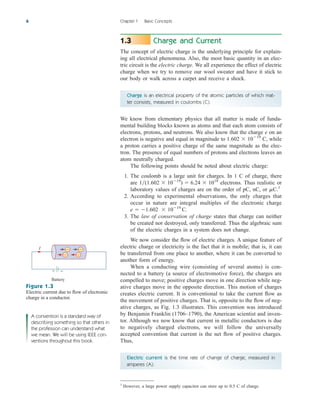
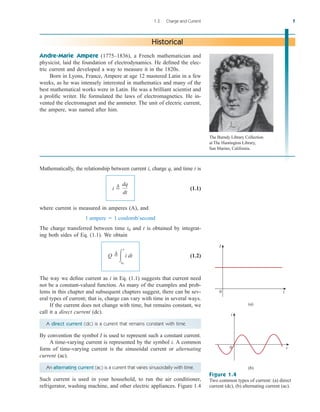
vo(t)  1  2.498 cos(2t  30.79)  2.33 sin(5t  10) V
v3  2.33 cos(5t  80)  2.33 sin(5t  10) V
V3  I1  1 
j10
1.8  j8.4
(j2)  2.328l80 V
I1 
j10
j10  1  Z1
(2l90) A
Z1  j2  4 
j2  4
4  j2
 0.8  j1.6 
424 Chapter 10 Sinusoidal Steady-State Analysis
Practice Problem 10.6 Calculate in the circuit of Fig. 10.15 using the superposition
theorem.
vo
Answer: 7.718 sin(5t  81.12)  2.102 cos(10t  86.24) V.
8 Ω
0.2 F 1 H
+
−
50 sin 5t V 4 cos 10t A
+
−
vo
Figure 10.15
For Practice Prob. 10.6.
Source Transformation
As Fig. 10.16 shows, source transformation in the frequency domain
involves transforming a voltage source in series with an impedance to
a current source in parallel with an impedance, or vice versa. As we
go from one source type to another, we must keep the following rela-
tionship in mind:
(10.1)
Vs  Zs Is 3 Is 
Vs
Zs
10.5
ale29559_ch10.qxd 07/08/2008 11:58 AM Page 424
Solution:
We transform the voltage source to a current source and obtain the
circuit in Fig. 10.18(a), where
The parallel combination of resistance and impedance gives
Converting the current source to a voltage source yields the circuit in
Fig. 10.18(b), where
Vs  IsZ1  j4(2.5  j1.25)  5  j10 V
Z1 
5(3  j4)
8  j4
 2.5  j1.25 
(3  j4)
5-
Is 
20l90
5
 4l90  j4 A
10.5 Source Transformation 425
Calculate in the circuit of Fig. 10.17 using the method of source
transformation.
Vx Example 10.7
a
b
Vs
Vs = ZsIs
Zs
Zs
+
−
a
b
Is
Is =
Zs
Vs
Figure 10.16
Source transformation.
5 Ω
j4 Ω
–j13 Ω
3 Ω
10 Ω
4 Ω
+
−
+
−
Vx
20 –90° V
Figure 10.17
For Example 10.7.
5 Ω
j4 Ω
–j13 Ω
3 Ω
10 Ω
4 Ω
+
−
+
−
Vx
Is = –j4 Α
–j13 Ω
10 Ω
4 Ω
2.5 Ω j1.25 Ω
Vx
Vs = 5 – j10 V +
−
(a) (b)
Figure 10.18
Solution of the circuit in Fig. 10.17.
By voltage division,
Vx 
10
10  2.5  j1.25  4  j13
(5  j10)  5.519l28 V
ale29559_ch10.qxd 07/08/2008 11:58 AM Page 425
Answer: 6.576l99.46 A.
426 Chapter 10 Sinusoidal Steady-State Analysis
Practice Problem 10.7 Find in the circuit of Fig. 10.19 using the concept of source
transformation.
Io
–j3 Ω
j5 Ω
j1 Ω
2 Ω
Io
–j2 Ω
8 90° Α
4 Ω
1 Ω
Figure 10.19
For Practice Prob. 10.7.
Thevenin and Norton
Equivalent Circuits
Thevenin’s and Norton’s theorems are applied to ac circuits in the same
way as they are to dc circuits. The only additional effort arises from
the need to manipulate complex numbers. The frequency domain ver-
sion of a Thevenin equivalent circuit is depicted in Fig. 10.20, where
a linear circuit is replaced by a voltage source in series with an imped-
ance. The Norton equivalent circuit is illustrated in Fig. 10.21, where
a linear circuit is replaced by a current source in parallel with an imped-
ance. Keep in mind that the two equivalent circuits are related as
(10.2)
just as in source transformation. is the open-circuit voltage while
is the short-circuit current.
If the circuit has sources operating at different frequencies (see
Example 10.6, for example), the Thevenin or Norton equivalent circuit
must be determined at each frequency. This leads to entirely different
equivalent circuits, one for each frequency, not one equivalent circuit
with equivalent sources and equivalent impedances.
IN
VTh
VTh  ZNIN, ZTh  ZN
10.6
a
b
ZTh
a
b
VTh
Linear
circuit
+
−
a
b
ZN
a
b
IN
Linear
circuit
Figure 10.20
Thevenin equivalent.
Figure 10.21
Norton equivalent.
Obtain the Thevenin equivalent at terminals a-b of the circuit in Fig. 10.22.
Example 10.8
4 Ω
d
f
c
e
–j6 Ω
j12 Ω
8 Ω
+
−
a b
120 75° V
Figure 10.22
For Example 10.8.
ale29559_ch10.qxd 07/08/2008 11:58 AM Page 426
Solution:
We find by setting the voltage source to zero. As shown in
Fig. 10.23(a), the resistance is now in parallel with the
reactance, so that their combination gives
Similarly, the resistance is in parallel with the j12 reactance, and
their combination gives
Z2  4  j12 
j12  4
4  j12
 3.6  j1.2 
4-
Z1  j6  8 
j6  8
8  j6
 2.88  j3.84 
j6
8-
ZTh
10.6 Thevenin and Norton Equivalent Circuits 427
4 Ω
8 Ω – j6 Ω j12 Ω
ZTh
VTh
a
e c
f,d f,d
b
(a)
(b)
8 Ω
4 Ω
j12 Ω
–j6 Ω
+
−
I2
I1
d
e
a b
c
f
−
+
120 75° V
Figure 10.23
Solution of the circuit in Fig. 10.22: (a) finding (b) finding VTh.
ZTh,
The Thevenin impedance is the series combination of and
that is,
To find consider the circuit in Fig. 10.23(b). Currents and
are obtained as
Applying KVL around loop bcdeab in Fig. 10.23(b) gives
or
 28.936  j24.55  37.95l220.31 V
 37.95l3.43  72l201.87
VTh  4I2  j6I1 
480l75
4  j12

720l75  90
8  j6
VTh  4I2  (j6)I1  0
I1 
120l75
8  j6
A, I2 
120l75
4  j12
A
I2
I1
VTh,
ZTh  Z1  Z2  6.48  j2.64 
Z2;
Z1
ale29559_ch10.qxd 07/08/2008 11:58 AM Page 427
Solution:
To find we apply KCL at node 1 in Fig. 10.26(a).
Applying KVL to the loop on the right-hand side in Fig. 10.26(a), we
obtain
or
Thus, the Thevenin voltage is
VTh  55l90 V
VTh  10(2  j4)  5(4  j3)  j55
Io(2  j4)  0.5Io(4  j3)  VTh  0
15  Io  0.5Io 1 Io  10 A
VTh,
428 Chapter 10 Sinusoidal Steady-State Analysis
Find the Thevenin equivalent at terminals a-b of the circuit in Fig. 10.24.
Practice Problem 10.8
–j4 Ω
j2 Ω
6 Ω
10 Ω
+
−
a b
75 20° V
Figure 10.24
For Practice Prob. 10.8.
Answer: ZTh  12.4  j3.2 , VTh  47.42l51.57 V.
Find the Thevenin equivalent of the circuit in Fig. 10.25 as seen from
terminals a-b.
Example 10.9
–j4 Ω
j3 Ω
4 Ω
2 Ω
a
b
Io
0.5Io
15 0° A
Figure 10.25
For Example 10.9.
4 + j3 Ω
2 – j4 Ω
a
b
Io
0.5Io
0.5Io VTh
15 A
+
−
2
1
4 + j3 Ω
2 – j4 Ω
a
b
Vs Is
0.5Io
Io
Is = 3 0° A
(a) (b)
+
−
V
s
Figure 10.26
Solution of the problem in Fig. 10.25: (a) finding (b) finding ZTh.
VTh,
ale29559_ch10.qxd 07/08/2008 11:58 AM Page 428
To obtain we remove the independent source. Due to the
presence of the dependent current source, we connect a 3-A current
source (3 is an arbitrary value chosen for convenience here, a number
divisible by the sum of currents leaving the node) to terminals a-b as
shown in Fig. 10.26(b). At the node, KCL gives
Applying KVL to the outer loop in Fig. 10.26(b) gives
The Thevenin impedance is
ZTh 
Vs
Is

2(6  j)
3
 4  j0.6667 
Vs  Io(4  j3  2  j4)  2(6  j)
3  Io  0.5Io 1 Io  2 A
ZTh,
10.6 Thevenin and Norton Equivalent Circuits 429
Determine the Thevenin equivalent of the circuit in Fig. 10.27 as seen
from the terminals
Answer: ZTh  4.473l7.64 , VTh  29.4l72.9 V.
a-b.
Practice Problem 10.9
–j2 Ω
j4 Ω
8 Ω
4 Ω
a
b
0.2Vo
20 0° A
−
+ V
o
Figure 10.27
For Practice Prob. 10.9.
Obtain current in Fig. 10.28 using Norton’s theorem.
Io Example 10.10
3 0° A
40 90° V
8 Ω
5 Ω
20 Ω
10 Ω
–j2 Ω
j4 Ω
j15 Ω
+
−
Io
a
b
Figure 10.28
For Example 10.10.
Solution:
Our first objective is to find the Norton equivalent at terminals a-b.
is found in the same way as We set the sources to zero as shown
in Fig. 10.29(a). As evident from the figure, the and
impedances are short-circuited, so that
To get we short-circuit terminals a-b as in Fig. 10.29(b) and
apply mesh analysis. Notice that meshes 2 and 3 form a supermesh
because of the current source linking them. For mesh 1,
(10.10.1)
j40  (18  j2)I1  (8  j2)I2  (10  j4)I3  0
IN,
ZN  5 
(10  j4)
(8  j2)
ZTh.
ZN
ale29559_ch10.qxd 07/08/2008 11:58 AM Page 429
For the supermesh,
(10.10.2)
At node a, due to the current source between meshes 2 and 3,
(10.10.3)
Adding Eqs. (10.10.1) and (10.10.2) gives
From Eq. (10.10.3),
The Norton current is
Figure 10.29(c) shows the Norton equivalent circuit along with the
impedance at terminals a-b. By current division,
Io 
5
5  20  j15
IN 
3  j8
5  j3
 1.465l38.48 A
IN  I3  (3  j8) A
I3  I2  3  3  j8
j40  5I2  0 1 I2  j8
I3  I2  3
(13  j2)I2  (10  j4)I3  (18  j2)I1  0
430 Chapter 10 Sinusoidal Steady-State Analysis
3
8
5
10
–j2
j4
j40 +
−
IN
I3
I2
I3
I2
I1
a
b
(b)
5
20
j15
3 + j8
Io
(c)
8
5
10
–j2
j4
ZN
(a)
a
a
b b
Figure 10.29
Solution of the circuit in Fig. 10.28: (a) finding (b) finding (c) calculating Io.
VN,
ZN,
Determine the Norton equivalent of the circuit in Fig. 10.30 as seen
from terminals a-b. Use the equivalent to find Io.
Practice Problem 10.10
Answer:
Io  985.5l2.101 mA.
ZN  3.176  j0.706 , IN  4.198l32.68 A,
j2 Ω
a
b
Io
– j3 Ω
–j5 Ω
+
−
8 Ω
4 Ω
1 Ω
10 Ω
10 0° V 2 –90° A
Figure 10.30
For Practice Prob. 10.10.
ale29559_ch10.qxd 07/08/2008 11:58 AM Page 430
Op Amp AC Circuits
The three steps stated in Section 10.1 also apply to op amp circuits, as
long as the op amp is operating in the linear region. As usual, we will
assume ideal op amps. (See Section 5.2.) As discussed in Chapter 5,
the key to analyzing op amp circuits is to keep two important proper-
ties of an ideal op amp in mind:
1. No current enters either of its input terminals.
2. The voltage across its input terminals is zero.
The following examples will illustrate these ideas.
10.7
10.7 Op Amp AC Circuits 431
Determine for the op amp circuit in Fig. 10.31(a) if
3 cos 1000t V.
vs 
vo(t) Example 10.11
+
−
+
−
Vo
Vo
V1
– j5 kΩ
– j10 kΩ
10 kΩ 10 kΩ
20 kΩ
3 0° V
+
−
+
−
vs
vo
10 kΩ 10 kΩ
0.1 F
0.2 F
20 kΩ
1 2
0 V
(a) (b)
Figure 10.31
For Example 10.11: (a) the original circuit in the time domain, (b) its frequency domain equivalent.
Solution:
We first transform the circuit to the frequency domain, as shown in
Fig. 10.31(b), where Applying KCL at
node 1, we obtain
or
(10.11.1)
At node 2, KCL gives
which leads to
(10.11.2)
Substituting Eq. (10.11.2) into Eq. (10.11.1) yields
Hence,
vo(t)  1.029 cos(1000t  59.04) V
Vo 
6
3  j5
 1.029l59.04
6  j(5  j4)Vo  Vo  (3  j5)Vo
V1  jVo
V1  0
10

0  Vo
j10
6  (5  j4)V1  Vo
3l0  V1
10

V1
j5

V1  0
10

V1  Vo
20
Vs  3l0,   1000 rad/s.
ale29559_ch10.qxd 07/08/2008 11:58 AM Page 431
Answer: 1.3333 sin 5000t V, 133.33 sin 5000t mA.
432 Chapter 10 Sinusoidal Steady-State Analysis
Practice Problem 10.11
+
−
+
−
vs
vo
10 kΩ
20 kΩ
20 nF
10 nF
io
Figure 10.32
For Practice Prob. 10.11.
Example 10.12 Compute the closed-loop gain and phase shift for the circuit in Fig. 10.33.
Assume that
Solution:
The feedback and input impedances are calculated as
Since the circuit in Fig. 10.33 is an inverting amplifier, the closed-loop
gain is given by
Substituting the given values of and we obtain
Thus, the closed-loop gain is 0.434 and the phase shift is 130.6.
G 
j4
(1  j4)(1  j2)
 0.434l130.6
,
R1, R2, C1, C2,
G 
Vo
Vs
 
Zf
Zi

jC1R2
(1  jR1C1)(1  jR2C2)
Zi  R1 
1
jC1

1  jR1C1
jC1
Zf  R2 2 2
1
jC2

R2
1  jR2C2
200 rad/s.
R1  R2  10 k, C1  2 mF, C2  1 mF, and  
+
−
+
−
vs vo
R1
R2
C2
C1
+
−
Figure 10.33
For Example 10.12.
Practice Problem 10.12 Obtain the closed-loop gain and phase shift for the circuit in Fig. 10.34.
Let
Answer: 1.015, 5.6.
R  10 k, C  1 mF, and   1000 rad/s.
+
−
+
−
vs
vo
R
R
C
Figure 10.34
For Practice Prob. 10.12.
Find and in the op amp circuit of Fig. 10.32. Let
4 cos 5000t V.
vs 
io
vo
ale29559_ch10.qxd 07/08/2008 11:58 AM Page 432
AC Analysis Using PSpice
PSpice affords a big relief from the tedious task of manipulating com-
plex numbers in ac circuit analysis. The procedure for using PSpice for
ac analysis is quite similar to that required for dc analysis. The reader
should read Section D.5 in Appendix D for a review of PSpice con-
cepts for ac analysis. AC circuit analysis is done in the phasor or fre-
quency domain, and all sources must have the same frequency.
Although ac analysis with PSpice involves using AC Sweep, our
analysis in this chapter requires a single frequency The out-
put file of PSpice contains voltage and current phasors. If necessary,
the impedances can be calculated using the voltages and currents in the
output file.
f  2p.
10.8
10.8 AC Analysis Using PSpice 433
Example 10.13
Obtain and in the circuit of Fig. 10.35 using PSpice.
io
vo
2 F
50 mH
4 kΩ
2 kΩ
io
0.5io
+
−
8 sin(1000t + 50°) V vo
+
−
Figure 10.35
For Example 10.13.
Solution:
We first convert the sine function to cosine.
The frequency f is obtained from as
The schematic for the circuit is shown in Fig. 10.36. Notice that the
current-controlled current source F1 is connected such that its current
flows from node 0 to node 3 in conformity with the original circuit in
Fig. 10.35. Since we only want the magnitude and phase of and we
set the attributes of IPRINT and VPRINT1 each to
As a single-frequency analysis, we select Analysis/
Setup/AC Sweep and enter and
After saving the schematic, we simulate it by
selecting Analysis/Simulate. The output file includes the source
frequency in addition to the attributes checked for the pseudocomponents
IPRINT and VPRINT1,
FREQ IM(V_PRINT3) IP(V_PRINT3)
1.592E+02 3.264E–03 –3.743E+01
FREQ VM(3) VP(3)
1.592E+02 1.550E+00 –9.518E+01
Final Freq  159.155.
Total Pts  1, Start Freq  159.155,
PHASE  yes.
MAG  yes,
AC  yes,
io,
vo
f 

2p

1000
2p
 159.155 Hz

 8 cos(1000t  40)
8 sin(1000t  50)  8 cos(1000t  50  90)
ale29559_ch10.qxd 07/08/2008 11:58 AM Page 433
From this output file, we obtain
which are the phasors for
and
io  3.264 cos(1000t  37.43) mA
vo  1.55 cos(1000t  95.18)  1.55 sin(1000t  5.18) V
Vo  1.55l95.18 V, Io  3.264l37.43 mA
434 Chapter 10 Sinusoidal Steady-State Analysis
ACMAG=8
ACPHASE=-40
AC=ok
MAG=ok
PHASE=ok
AC=yes
MAG=yes
PHASE=ok
V
R1
C1 2u
L1
F1
4k
IPRINT
50mH
GAIN=0.5 2k
R2
0
2 3
+
−
Figure 10.36
The schematic of the circuit in Fig. 10.35.
Use PSpice to obtain and in the circuit of Fig. 10.37.
io
vo
Practice Problem 10.13
1 F
2 H
2 kΩ
3 kΩ
1 kΩ
io
2vo
+
−
20 cos 3000t A vo
+
−
+
−
Figure 10.37
For Practice Prob. 10.13.
Answer: 536.4 cos(3000t 154.6)mV, 1.088 cos(3000t55.12) mA.
Find and in the circuit of Fig. 10.38.
Solution:
1. Define. In its present form, the problem is clearly stated. Again,
we must emphasize that time spent here will save lots of time
and expense later on! One thing that might have created a
problem for you is that, if the reference was missing for this
problem, you would then need to ask the individual assigning
V2
V1
Example 10.14
ale29559_ch10.qxd 07/08/2008 11:58 AM Page 434
the problem where it is to be located. If you could not do that,
then you would need to assume where it should be and then
clearly state what you did and why you did it.
2. Present. The given circuit is a frequency domain circuit and the
unknown node voltages and are also frequency domain
values. Clearly, we need a process to solve for these unknowns
in the frequency domain.
3. Alternative. We have two direct alternative solution techniques
that we can easily use. We can do a straightforward nodal
analysis approach or use PSpice. Since this example is in a
section dedicated to using PSpice to solve problems, we will
use PSpice to find and We can then use nodal analysis
to check the answer.
4. Attempt. The circuit in Fig. 10.35 is in the time domain, whereas
the one in Fig. 10.38 is in the frequency domain. Since we are not
given a particular frequency and PSpice requires one, we select any
frequency consistent with the given impedances. For example, if
we select the corresponding frequency is
We obtain the values of the capacitance
and inductances Making these changes
results in the schematic in Fig. 10.39. To ease wiring, we have
(L  XL).
1XC)
(C 
0.15916 Hz.
f  2p 
  1 rad/s,
V2.
V1
V2
V1
10.8 AC Analysis Using PSpice 435
2 Ω 2 Ω
V1 V2
–j1 Ω
–j2
j2 Ω
–j1 Ω
1 Ω
3 0° A 18 30° V
+
−
j2 Ω
0.2Vx
−
+
Vx
Figure 10.38
For Example 10.14.
ACMAG=3A
ACPHASE=0
R1
I1
R2 L1 L2 R3
C1
G
G1 V1
1C
1
2
0.5C
2H 2H 2
1
1C
C3
C2
AC=ok
MAG=ok
PHASE=yes
AC=ok
MAG=ok
PHASE=yes
ACMAG=18V
ACPHASE=30
+ −
+
−
−
−
GAIN=0.2
Figure 10.39
Schematic for circuit in the Fig. 10.38.
ale29559_ch10.qxd 07/08/2008 11:58 AM Page 435
exchanged the positions of the voltage-controlled current source G1
and the impedance. Notice that the current of G1 flows
from node 1 to node 3, while the controlling voltage is across the
capacitor C2, as required in Fig. 10.38. The attributes of pseudo-
components VPRINT1 are set as shown. As a single-frequency
analysis, we select Analysis/Setup/AC Sweep and enter
and .
After saving the schematic, we select Analysis/Simulate
to simulate the circuit. When this is done, the output file
includes
FREQ VM(1) VP(1)
1.592E–01 2.708E+00 –5.673E+01
FREQ VM(3) VP(3)
1.592E-01 4.468E+00 –1.026E+02
from which we obtain,
5. Evaluate. One of the most important lessons to be learned is
that when using programs such as PSpice you still need to
validate the answer. There are many opportunities for making a
mistake, including coming across an unknown “bug” in PSpice
that yields incorrect results.
So, how can we validate this solution? Obviously, we can
rework the entire problem with nodal analysis, and perhaps
using MATLAB, to see if we obtain the same results. There is
another way we will use here: write the nodal equations and
substitute the answers obtained in the PSpice solution, and see
if the nodal equations are satisfied.
The nodal equations for this circuit are given below. Note
we have substituted into the dependent source.
Now, to check the answer, we substitute the PSpice answers into
this.
6. Satisfactory? Although we used only the equation from node 1
to check the answer, this is more than satisfactory to validate the
answer from the PSpice solution. We can now present our work
as a solution to the problem.
 3  j0.0003 [Answer checks]
4.984  j1.4272  1.9842  j1.4269
 5.184l15.98  2.444l35.72
1.9144l40.76  2.708l56.74  0.3536l45  6.911l80.72
1.9144l40.76 V1  0.3536l45 V2  3
(1.45  j1.25)V1  (0.25  j0.25)V2  3
 (0.25  j0.25  j0.5)V2  3
(1  j  0.25  j0.25  0.2  j0.5)V1
3 
V1  0
1

V1  0
j1

V1  V2
2  j2
 0.2V1 
V1  V2
j2
 0
V1  Vx
V1  2.708l56.74 V and V2  6.911l80.72 V
Final Freq  0.15916
Total Pts  1, Start Freq  0.15916,
2  j2 
436 Chapter 10 Sinusoidal Steady-State Analysis
ale29559_ch10.qxd 07/08/2008 11:58 AM Page 436
Applications
The concepts learned in this chapter will be applied in later chapters
to calculate electric power and determine frequency response. The con-
cepts are also used in analyzing coupled circuits, three-phase circuits,
ac transistor circuits, filters, oscillators, and other ac circuits. In this
section, we apply the concepts to develop two practical ac circuits: the
capacitance multiplier and the sine wave oscillators.
10.9.1 Capacitance Multiplier
The op amp circuit in Fig. 10.41 is known as a capacitance multiplier,
for reasons that will become obvious. Such a circuit is used in integrated-
circuit technology to produce a multiple of a small physical capaci-
tance C when a large capacitance is needed. The circuit in Fig. 10.41
can be used to multiply capacitance values by a factor up to 1000.
For example, a 10-pF capacitor can be made to behave like a 100-nF
capacitor.
10.9
10.9 Applications 437
Obtain and in the circuit depicted in Fig. 10.40.
Ix
Vx Practice Problem 10.14
1 Ω 1 Ω
Vx
Ix
4Ix
–j1 Ω
j2 Ω
2 Ω
4 60° A
12 0° V
j2 Ω
– j 0.25
+ −
+
−
Figure 10.40
For Practice Prob. 10.14.
Answer: 9.842l44.78 V, 2.584l158 A.
+
−
R1
A1
R2
+
−
Vo
Ii
Zi
Vi
A2
C
0 V
2
1
+
−
Vi
Figure 10.41
Capacitance multiplier.
ale29559_ch10.qxd 07/08/2008 11:58 AM Page 437
In Fig. 10.41, the first op amp operates as a voltage follower, while
the second one is an inverting amplifier. The voltage follower isolates
the capacitance formed by the circuit from the loading imposed by the
inverting amplifier. Since no current enters the input terminals of the
op amp, the input current flows through the feedback capacitor.
Hence, at node 1,
(10.3)
Applying KCL at node 2 gives
or
(10.4)
Substituting Eq. (10.4) into (10.3) gives
or
(10.5)
The input impedance is
(10.6)
where
(10.7)
Thus, by a proper selection of the values of and the op amp cir-
cuit in Fig. 10.41 can be made to produce an effective capacitance
between the input terminal and ground, which is a multiple of the phys-
ical capacitance C. The size of the effective capacitance is practically
limited by the inverted output voltage limitation. Thus, the larger the
capacitance multiplication, the smaller is the allowable input voltage to
prevent the op amps from reaching saturation.
A similar op amp circuit can be designed to simulate inductance.
(See Prob. 10.89.) There is also an op amp circuit configuration to cre-
ate a resistance multiplier.
R2,
R1
Ceq  a1 
R2
R1
b C
Zi 
Vi
Ii

1
jCeq
Ii
Vi
 ja1 
R2
R1
b C
Ii  jC a1 
R2
R1
b Vi
Vo  
R2
R1
Vi
Vi  0
R1

0  Vo
R2
Ii 
Vi  Vo
1jC
 jC(Vi  Vo)
Ii
438 Chapter 10 Sinusoidal Steady-State Analysis
Example 10.15 Calculate in Fig. 10.41 when and
Solution:
From Eq. (10.7)
Ceq  a1 
R2
R1
b C  a1 
1  106
10  103
b 1 nF  101 nF
C  1 nF.
R1  10 k, R2  1 M,
Ceq
ale29559_ch10.qxd 07/08/2008 11:58 AM Page 438
10.9.2 Oscillators
We know that dc is produced by batteries. But how do we produce ac?
One way is using oscillators, which are circuits that convert dc to ac.
10.9 Applications 439
Determine the equivalent capacitance of the op amp circuit in Fig. 10.41
if
Answer: 10 mF.
R1  10 k, R2  10 M, and C  10 nF.
Practice Problem 10.15
An oscillator is a circuit that produces an ac waveform as output when
powered by a dc input.
The only external source an oscillator needs is the dc power sup-
ply. Ironically, the dc power supply is usually obtained by converting
the ac supplied by the electric utility company to dc. Having gone
through the trouble of conversion, one may wonder why we need to
use the oscillator to convert the dc to ac again. The problem is that the
ac supplied by the utility company operates at a preset frequency of
60 Hz in the United States (50 Hz in some other nations), whereas
many applications such as electronic circuits, communication systems,
and microwave devices require internally generated frequencies that
range from 0 to 10 GHz or higher. Oscillators are used for generating
these frequencies.
In order for sine wave oscillators to sustain oscillations, they must
meet the Barkhausen criteria:
1. The overall gain of the oscillator must be unity or greater. There-
fore, losses must be compensated for by an amplifying device.
2. The overall phase shift (from input to output and back to the input)
must be zero.
Three common types of sine wave oscillators are phase-shift, twin T, and
Wien-bridge oscillators. Here we consider only the Wien-bridge oscillator.
The Wien-bridge oscillator is widely used for generating sinusoids
in the frequency range below 1 MHz. It is an RC op amp circuit with
only a few components, easily tunable and easy to design. As shown
in Fig. 10.42, the oscillator essentially consists of a noninverting ampli-
fier with two feedback paths: the positive feedback path to the nonin-
verting input creates oscillations, while the negative feedback path to
the inverting input controls the gain. If we define the impedances of
the RC series and parallel combinations as and then
(10.8)
(10.9)
The feedback ratio is
(10.10)
V2
Vo

Zp
Zs  Zp
Zp  R2 
1
jC2

R2
1  jR2C2
Zs  R1 
1
jC1
 R1 
j
C1
Zp,
Zs
This corresponds to 2 f
377 rad/s.

p
 
+
−
Rf
Rg
R1
R2
C1
C2
+
−
v2
+
−
vo
Positive feedback path
to create oscillations
Negative feedback
path to control gain
Figure 10.42
Wien-bridge oscillator.
ale29559_ch10.qxd 07/08/2008 11:58 AM Page 439
Substituting Eqs. (10.8) and (10.9) into Eq. (10.10) gives
(10.11)
To satisfy the second Barkhausen criterion, must be in phase with
which implies that the ratio in Eq. (10.11) must be purely real.
Hence, the imaginary part must be zero. Setting the imaginary part
equal to zero gives the oscillation frequency as
or
(10.12)
In most practical applications, and so that
(10.13)
or
(10.14)
Substituting Eq. (10.13) and into Eq. (10.11)
yields
(10.15)
Thus, in order to satisfy the first Barkhausen criterion, the op amp must
compensate by providing a gain of 3 or greater so that the overall gain
is at least 1 or unity. We recall that for a noninverting amplifier,
(10.16)
or
(10.17)
Due to the inherent delay caused by the op amp, Wien-bridge oscil-
lators are limited to operating in the frequency range of 1 MHz or less.
Rf  2Rg
Vo
V2
 1 
Rf
Rg
 3
V2
Vo

1
3
C1  C2  C
R1  R2  R,
fo 
1
2pRC
o 
1
RC
 2pfo
C1  C2  C,
R1  R2  R
o 
1
1R1R2C1C2
o
2
R1C1R2C2  1  0
o
Vo,
V2

R2C1
(R2C1  R1C1  R2C2)  j(2
R1C1R2C2  1)
V2
Vo

R2
R2  aR1 
j
C1
b(1  jR2C2)
440 Chapter 10 Sinusoidal Steady-State Analysis
Design a Wien-bridge circuit to oscillate at 100 kHz.
Solution:
Using Eq. (10.14), we obtain the time constant of the circuit as
(10.16.1)
If we select then we can select to satisfy
Eq. (10.16.1). Since the gain must be 3, We could select
while Rg  10 k.
Rf  20 k
Rf Rg  2.
C  159 pF
R  10 k,
RC 
1
2pfo

1
2p  100  103
 1.59  106
Example 10.16
ale29559_ch10.qxd 07/08/2008 11:59 AM Page 440
Review Questions 441
In the Wien-bridge oscillator circuit in Fig. 10.42, let
Determine the frequency of the oscillator.
Answer: 63.66 kHz.
fo
2.5 k, C1  C2  1 nF.
R1  R2  Practice Problem 10.16
Summary
1. We apply nodal and mesh analysis to ac circuits by applying KCL
and KVL to the phasor form of the circuits.
2. In solving for the steady-state response of a circuit that has inde-
pendent sources with different frequencies, each independent
source must be considered separately. The most natural approach
to analyzing such circuits is to apply the superposition theorem. A
separate phasor circuit for each frequency must be solved inde-
pendently, and the corresponding response should be obtained in
the time domain. The overall response is the sum of the time
domain responses of all the individual phasor circuits.
3. The concept of source transformation is also applicable in the fre-
quency domain.
4. The Thevenin equivalent of an ac circuit consists of a voltage
source in series with the Thevenin impedance
5. The Norton equivalent of an ac circuit consists of a current source
in parallel with the Norton impedance
6. PSpice is a simple and powerful tool for solving ac circuit prob-
lems. It relieves us of the tedious task of working with the com-
plex numbers involved in steady-state analysis.
7. The capacitance multiplier and the ac oscillator provide two typi-
cal applications for the concepts presented in this chapter. A capac-
itance multiplier is an op amp circuit used in producing a multiple
of a physical capacitance. An oscillator is a device that uses a dc
input to generate an ac output.
ZN (ZTh).
IN
ZTh.
VTh
10.10
Review Questions
10.1 The voltage across the capacitor in Fig. 10.43 is:
(a) (b)
(c) (d) 5l45 V
7.071l45 V
7.071l45 V
5l0 V
Vo 10.2 The value of the current in the circuit of Fig. 10.44 is:
(a) (b)
(c) (d) 1 A
0.6l0 A
2.4l90 A
4l0 A
Io
1 Ω
+
−
Vo
+
−
–j1 Ω
10 0° V
Figure 10.43
For Review Question 10.1.
j8 Ω –j2 Ω
3 0° A
Io
Figure 10.44
For Review Question 10.2.
ale29559_ch10.qxd 07/08/2008 11:59 AM Page 441
10.3 Using nodal analysis, the value of in the circuit of
Fig. 10.45 is:
(a) (b)
(c) 8 V (d) 24 V
8 V
24 V
Vo
10.7 In the circuit of Fig. 10.48, the Thevenin voltage at
terminals a-b is:
(a) (b)
(c) (d)
10.8 Refer to the circuit in Fig. 10.49. The Norton
equivalent impedance at terminals a-b is:
(a) (b)
(c) (d) j4 
j2 
j2 
j4 
7.071l45 V
7.071l45 V
3.535l45 V
3.535l45 V
442 Chapter 10 Sinusoidal Steady-State Analysis
–j3 Ω
j6 Ω 4 90° A
V
o
Figure 10.45
For Review Question 10.3.
10.4 In the circuit of Fig. 10.46, current is:
(a) (b) (c)
(d) (e) 4.472 cos(t  63.43) A
5 sin t A
5 cos t A
10 sin t A
10 cos t A
i(t)
1 H 1 F
+
− 1 Ω
10 cos t V i(t)
Figure 10.46
For Review Question 10.4.
10.5 Refer to the circuit in Fig. 10.47 and observe that the
two sources do not have the same frequency. The
current can be obtained by:
(a) source transformation
(b) the superposition theorem
(c) PSpice
ix(t)
1 F
+
−
+
−
sin 2t V sin 10t V
1 H 1 Ω
ix
Figure 10.47
For Review Question 10.5.
10.6 For the circuit in Fig. 10.48, the Thevenin
impedance at terminals a-b is:
(a) (b)
(c) (d)
(e) 1  j2 
1  j2 
0.5  j0.5 
0.5  j0.5 
1 
1 Ω 1 H
+
− 1 F
a
b
5 cos t V
Figure 10.48
For Review Questions 10.6 and 10.7.
–j2 Ω
j4 Ω
+
−
a
b
6 0° V
Figure 10.49
For Review Questions 10.8 and 10.9.
10.9 The Norton current at terminals a-b in the circuit of
Fig. 10.49 is:
(a) (b)
(c) (d)
10.10 PSpice can handle a circuit with two independent
sources of different frequencies.
(a) True (b) False
Answers: 10.1c, 10.2a, 10.3d, 10.4a, 10.5b, 10.6c,
10.7a, 10.8a, 10.9d, 10.10b.
3l90 A
1.5l90 A
1.5 l90 A
1l0 A
ale29559_ch10.qxd 07/08/2008 11:59 AM Page 442
10.2 Using Fig. 10.51, design a problem to help other
students better understand nodal analysis.
10.7 Use nodal analysis to find V in the circuit of
Fig. 10.56.
Problems 443
Problems
Section 10.2 Nodal Analysis
10.1 Determine i in the circuit of Fig. 10.50.
10.6 Determine in Fig. 10.55.
Vx
1 F 1 H
+
−
1 Ω
1 Ω
2 cos 10t V
i
Figure 10.50
For Prob. 10.1.
+
−
2 Ω
j4 Ω
4 0° V –j5 Ω Vo
+
−
Figure 10.51
For Prob. 10.2.
10.3 Determine in the circuit of Fig. 10.52.
vo
+
−
2 H
4 Ω
vo
32 sin 4t V 4 cos 4t A
+
−
1 Ω 6 Ω
F
1
12
Figure 10.52
For Prob. 10.3.
10.4 Determine in the circuit of Fig. 10.53.
i1
+
−
2 kΩ 2 ␮F
0.5 H
100 cos 103t V
i1
30i1
+
−
Figure 10.53
For Prob. 10.4.
10.5 Find in the circuit of Fig. 10.54.
io
2 kΩ
0.25 H 10io
+
−
+
−
25 cos(4  103t) V
2 ␮F
io
Figure 10.54
For Prob. 10.5.
20 Ω j10 Ω
20 Ω Vx
4Vx 4.5 0° A
+
+
–
–
Figure 10.55
For Prob. 10.6.
40 Ω j20 Ω
120 –15° V 6 30° A
V
+
− 50 Ω
–j30 Ω
Figure 10.56
For Prob. 10.7.
10.8 Use nodal analysis to find current in the circuit of
Fig. 10.57. Let is  6 cos(200t  15) A.
io
40 Ω
20 Ω 100 mH
50 F
io
0.1 vo
is vo
+
–
Figure 10.57
For Prob. 10.8.
10.9 Use nodal analysis to find in the circuit of Fig. 10.58.
vo
+
−
10 mH
50 F
20 Ω
20 Ω 30 Ω
10 cos 103
t V
io
4io vo
+
−
Figure 10.58
For Prob. 10.9.
ale29559_ch10.qxd 07/08/2008 11:59 AM Page 443
10.10 Use nodal analysis to find in the circuit of
Fig. 10.59. Let   2 krad/s.
vo 10.14 Calculate the voltage at nodes 1 and 2 in the circuit
of Fig. 10.63 using nodal analysis.
444 Chapter 10 Sinusoidal Steady-State Analysis
10 sin t A 2 kΩ 4 kΩ
2 F
50 mH 0.1 vx
vx vo
+
–
+
–
Figure 10.59
For Prob. 10.10.
10.11 Apply nodal analysis to the circuit in Fig. 10.60 and
determine Io.
2Io
+
−
2 Ω 2 Ω
j8 Ω
j5 Ω
Io
10 0° V
Figure 10.60
For Prob. 10.11.
10.12 Using Fig. 10.61, design a problem to help other
students better understand nodal analysis.
R2
R1 C L
is
2io
io
Figure 10.61
For Prob. 10.12.
10.13 Determine in the circuit of Fig. 10.62 using any
method of your choice.
Vx
–j2 Ω
3 Ω 10 Ω
j6 Ω
8 Ω
+
−
+
–
Vx
40 30° V 5 0° A
Figure 10.62
For Prob. 10.13.
10 Ω
1 2
–j2 Ω –j5 Ω
j2 Ω
j4 Ω
20 30° A
Figure 10.63
For Prob. 10.14.
10.15 Solve for the current I in the circuit of Fig. 10.64
using nodal analysis.
2 Ω
4 Ω
–j2 Ω
j1 Ω
2I
10 0° A
40 –90° V +
−
I
Figure 10.64
For Prob. 10.15.
10.16 Use nodal analysis to find in the circuit shown in
Fig. 10.65.
Vx
j4 Ω
−
+ Vx
5 Ω 3 45° A
2 0° A –j3 Ω
Figure 10.65
For Prob. 10.16.
10.17 By nodal analysis, obtain current in the circuit of
Fig. 10.66.
Io
3 Ω
2 Ω
1 Ω
j4 Ω
–j2 Ω
+
−
150 20° V
Io
Figure 10.66
For Prob. 10.17.
ale29559_ch10.qxd 07/08/2008 11:59 AM Page 444
10.18 Use nodal analysis to obtain in the circuit of Fig. 10.67 below.
Vo
10.22 For the circuit in Fig. 10.71, determine VoVs.
Problems 445
8 Ω
2 Ω –j1 Ω –j2 Ω
j6 Ω 4 Ω j5 Ω
2Vx Vo
8 45° A
+
−
Vx
+
−
Figure 10.67
For Prob. 10.18.
10.19 Obtain in Fig. 10.68 using nodal analysis.
Vo
4 Ω
2 Ω –j4 Ω
j2 Ω
Vo 0.2Vo
+
−
+ −
12 0° V
Figure 10.68
For Prob. 10.19.
10.20 Refer to Fig. 10.69. If and
derive the expressions for
A and f.
vo(t)  A sin(t  f),
vs(t)  Vm sint
+
− vo(t)
vs(t)
+
−
L
R
C
Figure 10.69
For Prob. 10.20.
10.21 For each of the circuits in Fig. 10.70, find for
and 2
 1LC.
  0,  S ,
VoVi
Vo
+
−
Vo
+
−
Vi
+
−
Vi
+
−
C
R R C
L
L
(b)
(a)
Figure 10.70
For Prob. 10.21.
+
−
Vs Vo
+
−
L
R1
R2
C
Figure 10.71
For Prob. 10.22.
10.23 Using nodal analysis obtain V in the circuit of
Fig. 10.72.
+
−
Vs
R
V
jL
jC
jC
1
1
+
–
Figure 10.72
For Prob. 10.23.
Section 10.3 Mesh Analysis
10.24 Design a problem to help other students better
understand mesh analysis.
10.25 Solve for in Fig. 10.73 using mesh analysis.
io
+
−
+
−
2 H
0.25 F
4 Ω
20 cos 2t V 12 sin 2t V
io
Figure 10.73
For Prob. 10.25.
ale29559_ch10.qxd 07/08/2008 11:59 AM Page 445
10.26 Use mesh analysis to find current in the circuit of
Fig. 10.74.
io
10.30 Use mesh analysis to find in the circuit of
Fig. 10.78. Let
vs2  160 cos 100t V.
vs1  240 cos(100t  90) V,
vo
446 Chapter 10 Sinusoidal Steady-State Analysis
0.4 H
+
−
+
−
5 cos 103t V 10 sin 103t V
2 kΩ 1 F
io
Figure 10.74
For Prob. 10.26.
10.27 Using mesh analysis, find and in the circuit of
Fig. 10.75.
I2
I1
+
−
+
−
I2
I1
j10 Ω
–j20 Ω
40 Ω
50 0° V
40 30° V
Figure 10.75
For Prob. 10.27.
10.28 In the circuit of Fig. 10.76, determine the mesh
currents and Let and
v2  20 cos(4t  30) V.
v1  10 cos 4t V
i2.
i1
1 Ω 1 Ω
1 Ω
1 H 1 H
1 F
i2 v2
v1
i1
+
−
+
−
Figure 10.76
For Prob. 10.28.
10.29 Using Fig. 10.77, design a problem to help other
students better understand mesh analysis.
I2
I1
jXL1
jXL3
jXL2
−jXC
R3
R2
Vs
R1
+ −
Figure 10.77
For Prob. 10.29.
+
−
200 mH
400 mH
20 Ω
10 Ω
+
−
vs1
vs2
50 F
300 mH vo
+
−
Figure 10.78
For Prob. 10.30.
10.31 Use mesh analysis to determine current in the
circuit of Fig. 10.79 below.
Io
Figure 10.79
For Prob. 10.31.
–j40 Ω –j40 Ω
j60 Ω
80 Ω 20 Ω
Io
+
−
+
−
100 120° V 60 –30° V
ale29559_ch10.qxd 07/08/2008 11:59 AM Page 446
10.32 Determine and in the circuit of Fig. 10.80
using mesh analysis.
Io
Vo
10.39 Find and in the circuit of Fig. 10.84.
Ix
I3,
I2,
I1,
Problems 447
j4 Ω
Io
3Vo
–j2 Ω
4 –30° A 2 Ω +
−
Vo
+
−
Figure 10.80
For Prob. 10.32.
10.33 Compute I in Prob. 10.15 using mesh analysis.
10.34 Use mesh analysis to find in Fig. 10.28 (for
Example 10.10).
10.35 Calculate in Fig. 10.30 (for Practice Prob. 10.10)
using mesh analysis.
10.36 Compute in the circuit of Fig. 10.81 using mesh
analysis.
Vo
Io
Io
–j3 Ω
2 Ω
j4 Ω
+
−
2 Ω
2 Ω
24 0° V
4 0° A
8 90° A V
o
+
−
Figure 10.81
For Prob. 10.36.
10.37 Use mesh analysis to find currents and in
the circuit of Fig. 10.82.
I3
I2,
I1,
+
−
+
−
I1
I2
Z
Z = 80 – j35 Ω
120 –90° V
120 –30° V Z
I3
Figure 10.82
For Prob. 10.37.
10.38 Using mesh analysis, obtain in the circuit shown
in Fig. 10.83.
Io
–j4 Ω
j2 Ω
2 Ω
1 Ω 1 Ω
Io
+
− 10 90° V
4 0° A
2 0° A
Figure 10.83
For Prob. 10.38.
20 Ω –j15 Ω
8 Ω
j16 Ω
10 Ω
–j25 Ω
+
−
20 64° V
Ix
I1 I2
I3
Figure 10.84
For Prob. 10.39.
Section 10.4 Superposition Theorem
10.40 Find in the circuit shown in Fig. 10.85 using
superposition.
io
4 Ω
+
−
+
−
2 Ω
16 V
1 H
20 cos 4t V
io
Figure 10.85
For Prob. 10.40.
10.41 Find for the circuit in Fig. 10.86, assuming that
vs  3 cos 2t  8 sin 4t V.
vo
0.25 F
2 Ω vo
vs
+
–
+
−
Figure 10.86
For Prob. 10.41.
ale29559_ch10.qxd 07/08/2008 11:59 AM Page 447
10.42 Using Fig. 10.87, design a problem to help other
students better understand the superposition theorem.
10.46 Solve for in the circuit of Fig. 10.91 using the
superposition principle.
vo(t)
448 Chapter 10 Sinusoidal Steady-State Analysis
jXL
−jXC
R1
R2
+
−
+
−
Io
V2
V1
Figure 10.87
For Prob. 10.42.
10.43 Using the superposition principle, find in the
circuit of Fig. 10.88.
ix
+
−
3 Ω
4 H 10 cos(2t – 60°) V
5 cos(2t + 10°) A
ix
F
1
8
Figure 10.88
For Prob. 10.43.
10.44 Use the superposition principle to obtain in the
circuit of Fig. 10.89. Let and
is  6 cos(6t  10) A.
vs  25 sin 2t V
vx
vs
vx
+
−
20 Ω
16 Ω
5 H
+
–
is
Figure 10.89
For Prob. 10.44.
10.45 Use superposition to find in the circuit of
Fig. 10.90.
i(t)
20 Ω
300 mH
+
−
+
−
i
20 cos(10t + 30°) V 10 sin 4t V
Figure 10.90
For Prob. 10.45.
+
−
+
−
6 Ω 2 H
20 V
12 cos 3t V 4 sin 2t A
+
−
vo
F
1
12
Figure 10.91
For Prob. 10.46.
10.47 Determine in the circuit of Fig. 10.92, using the
superposition principle.
io
+
−
1 Ω 2 H
24 V
2 cos 3t
2 Ω 4 Ω
+
−
io
10 sin(t – 30°) V
F
1
6
Figure 10.92
For Prob. 10.47.
10.48 Find in the circuit of Fig. 10.93 using superposition.
io
80 Ω
60 Ω
40 mH
20 F
24 V
100 Ω
+
−
+
−
50 cos 2000t V
2 sin 4000t A
io
Figure 10.93
For Prob. 10.48.
Section 10.5 Source Transformation
10.49 Using source transformation, find i in the circuit of
Fig. 10.94.
3 Ω
5 Ω
5 mH
1 mF
16 sin(200t + 30°) A
i
Figure 10.94
For Prob. 10.49.
ale29559_ch10.qxd 07/08/2008 11:59 AM Page 448
10.50 Using Fig. 10.95, design a problem to help other
students understand source transformation.
10.56 For each of the circuits in Fig. 10.99, obtain Thevenin
and Norton equivalent circuits at terminals a-b.
Problems 449
R1
R2
L
C
+
vs(t) vo
+
Figure 10.95
For Prob. 10.50.
10.51 Use source transformation to find in the circuit of
Prob. 10.42.
10.52 Use the method of source transformation to find in
the circuit of Fig. 10.96.
Ix
Io
+
−
2 Ω j4 Ω –j2 Ω
–j3 Ω
6 Ω
4 Ω
Ix
30 0° V 2.5 90° A
Figure 10.96
For Prob. 10.52.
10.53 Use the concept of source transformation to find
in the circuit of Fig. 10.97.
Vo
+
−
4 Ω j4 Ω
–j3 Ω
–j2 Ω
j2 Ω 2 Ω
20 0° V Vo
+
−
Figure 10.97
For Prob. 10.53.
10.54 Rework Prob. 10.7 using source transformation.
Section 10.6 Thevenin and Norton
Equivalent Circuits
10.55 Find the Thevenin and Norton equivalent circuits at
terminals a-b for each of the circuits in Fig. 10.98.
–j10 Ω
j20 Ω 10 Ω
a
b
50 30° V +
−
(a)
a
b
4 0° A
–j5 Ω
j10 Ω
8 Ω
(b)
Figure 10.98
For Prob. 10.55.
j4 Ω
6 Ω
a
b
2 0° A
–j2 Ω
(a)
–j5 Ω
30 Ω
a
b
120 45° V
j10 Ω
60 Ω
(b)
+
−
Figure 10.99
For Prob. 10.56.
10.57 Using Fig. 10.100, design a problem to help other
students better understand Thevenin and Norton
equivalent circuits.
jXL
R1 R2
Vs
+
−
–jXC
Figure 10.100
For Prob. 10.57.
10.58 For the circuit depicted in Fig. 10.101, find the
Thevenin equivalent circuit at terminals a-b.
a
b
2 30° A j10 Ω
8 Ω
–j6 Ω
Figure 10.101
For Prob. 10.58.
ale29559_ch10.qxd 07/08/2008 11:59 AM Page 449
10.59 Calculate the output impedance of the circuit shown
in Fig. 10.102.
10.63 Obtain the Norton equivalent of the circuit depicted
in Fig. 10.106 at terminals a-b.
450 Chapter 10 Sinusoidal Steady-State Analysis
j40 Ω
10 Ω
–j2 Ω
0.2Vo
+ −
Vo
Figure 10.102
For Prob. 10.59.
Figure 10.103
For Prob. 10.60.
10.60 Find the Thevenin equivalent of the circuit in
Fig. 10.103 as seen from:
(a) terminals a-b (b) terminals c-d
10 Ω
a
b
8 0° A
40 0° V
–j4 Ω
j5 Ω 4 Ω
+
−
c d
10.61 Find the Thevenin equivalent at terminals a-b of the
circuit in Fig. 10.104.
–j3 Ω
4 Ω
a
b
Ix
1.5Ix
2 0° A
Figure 10.104
For Prob. 10.61.
10.62 Using Thevenin’s theorem, find in the circuit of
Fig. 10.105.
vo
2 H
4 Ω
2 Ω vo
io
3io
+
−
20 cos(t + 30°) V
+
−
F
1
4 F
1
8
Figure 10.105
For Prob. 10.62.
a
b
5 F
10 H 2 kΩ
4 cos(200t + 30°) A
Figure 10.106
For Prob. 10.63.
10.64 For the circuit shown in Fig. 10.107, find the Norton
equivalent circuit at terminals a-b.
60 Ω 40 Ω
–j30 Ω
j80 Ω
a b
3 60° A
Figure 10.107
For Prob. 10.64.
10.65 Using Fig. 10.108, design a problem to help other
students better understand Norton’s theorem.
R
L
vs(t)
+ −
io
C1 C2
Figure 10.108
For Prob. 10.65.
10.66 At terminals a-b, obtain Thevenin and Norton
equivalent circuits for the network depicted in
Fig. 10.109. Take   10 rad/s.
a
b
10 mF
10 Ω
2 sin t A
12 cos t V
+
−
vo 2vo
+
−
H
1
2
Figure 10.109
For Prob. 10.66.
ale29559_ch10.qxd 07/08/2008 11:59 AM Page 450
10.67 Find the Thevenin and Norton equivalent circuits at
terminals a-b in the circuit of Fig. 10.110.
10.71 Find in the op amp circuit of Fig. 10.114.
vo
Problems 451
13 Ω 12 Ω
–j5 Ω
a b
j6 Ω
8 Ω
10 Ω
+
−
60 45° V
Figure 10.110
For Prob. 10.67.
10.68 Find the Thevenin equivalent at terminals a-b in the
circuit of Fig. 10.111.
4 Ω
1 H
4io
vo
3
1
20
io
6 sin10t V
a
b
+ +
+
− −
−
vo
F
Figure 10.111
For Prob. 10.68.
Section 10.7 Op Amp AC Circuits
10.69 For the differentiator shown in Fig. 10.112, obtain
Find when and
  1RC.
vs(t)  Vm sint
vo(t)
VoVs.
+
−
vs vo
R
C
+
−
+
−
Figure 10.112
For Prob. 10.69.
10.70 Using Fig. 10.113, design a problem to help other
students better understand op amps in AC circuits.
+
−
vs vo
+
−
C
R2
R1
+
−
Figure 10.113
For Prob. 10.70.
10 kΩ
2 kΩ
16 cos(2t + 45°) V +
−
0.5 F
+
–
vo
+
−
Figure 10.114
For Prob. 10.71.
10.72 Compute in the op amp circuit in Fig. 10.115 if
vs  10 cos(104
t  30) V.
io(t)
+
−
vs
50 kΩ
1 nF
100 kΩ
io
+
−
Figure 10.115
For Prob. 10.72.
10.73 If the input impedance is defined as
find the input impedance of the op amp circuit in
Fig. 10.116 when
and   5000 rad/s.
10 nF, C2  20 nF,
R1  10 k, R2  20 k, C1 
Zin  VsIs,
Vs C2
C1
R1 R2
Is
Zin
Vo
+
−
+
−
Figure 10.116
For Prob. 10.73.
ale29559_ch10.qxd 07/08/2008 11:59 AM Page 451
10.74 Evaluate the voltage gain in the op amp
circuit of Fig. 10.117. Find
and   1R2C2.
  1R1C1,
Av at   0,  S ,
Av  VoVs
10.77 Compute the closed-loop gain for the op amp
circuit of Fig. 10.120.
VoVs
452 Chapter 10 Sinusoidal Steady-State Analysis
+
−
Vs Vo
+
−
C1
R1
C2
R2
+
−
Figure 10.117
For Prob. 10.74.
10.75 In the op amp circuit of Fig. 10.118, find the closed-
loop gain and phase shift of the output voltage with
respect to the input voltage if
and
  2000 rad/s.
R2  100 k, R3  20 k, R4  40 k,
C1  C2  1 nF, R1 
vs vo
C1
R1
R2
+
−
C2
R4
R3
+
−
+
−
Figure 10.118
For Prob. 10.75.
10.76 Determine and in the op amp circuit of
Fig. 10.119.
Io
Vo
+
−
20 kΩ
10 kΩ
–j2 kΩ
20 30° mV
–j4 kΩ
+
−
Io
+
−
Vo
Figure 10.119
For Prob. 10.76.
+
−
+
−
vs
vo
+
−
C1
R1
R3
C2 R2
Figure 10.120
For Prob. 10.77.
10.78 Determine in the op amp circuit in Fig. 10.121
below.
vo(t)
vo
+
−
10 kΩ
20 kΩ
20 kΩ
40 kΩ
10 kΩ
0.25 F
0.5 F
+
−
4 sin(400t) mV
Figure 10.121
For Prob. 10.78.
ale29559_ch10.qxd 07/08/2008 11:59 AM Page 452
10.79 For the op amp circuit in Fig. 10.122, obtain vo(t).
10.84 Obtain in the circuit of Fig. 10.126 using PSpice.
Vo
Problems 453
vo
+
−
10 kΩ
20 kΩ
40 kΩ
0.1 F
0.2 F
+
−
+
−
+
−
500 cos(103
t) mV
Figure 10.122
For Prob. 10.79.
10.80 Obtain for the op amp circuit in Fig. 10.123 if
vs  4 cos(1000t  60) V.
vo(t)
vo
vs +
−
10 kΩ
50 kΩ
20 kΩ 0.2 F
0.1 F
+
−
+
−
+
−
Figure 10.123
For Prob. 10.80.
Section 10.8 AC Analysis Using PSpice
10.81 Use PSpice to determine in the circuit of
Fig. 10.124. Assume   1 rad/s.
Vo
4 0° A
24 0° V
40 Ω
30 Ω
25 Ω
10 Ω
–j2 Ω
j4 Ω
+
−
Vo
+
−
Figure 10.124
For Prob. 10.81.
10.82 Solve Prob. 10.19 using PSpice.
10.83 Use PSpice to find in the circuit of Fig. 10.125.
Let is  2 cos(103
t) A.
vo(t)
2 Ω
6 Ω 8 Ω
4 Ω
10 mH
4 F
is +
–
vo
Figure 10.125
For Prob. 10.83.
1 Ω
j4 Ω
–j2 Ω
2 Ω
+
−
Vx
2Vx
+
−
Vo
3 0° A
Figure 10.126
For Prob. 10.84.
10.85 Using Fig. 10.127, design a problem to help other
students better understand performing AC analysis
with PSpice.
R1
R2
–jXC
jXL R4
R3 Vo
0.25Vx
+
–
Vx
Is
+ –
Figure 10.127
For Prob. 10.85.
10.86 Use PSpice to find and in the network of
Fig. 10.128.
V3
V2,
V1,
+
−
8 Ω
j10 Ω j10 Ω
–j4 Ω –j4 Ω
V1 V3
V2
60 30° V 4 0° A
Figure 10.128
For Prob. 10.86.
ale29559_ch10.qxd 07/08/2008 11:59 AM Page 453
10.87 Determine and in the circuit of
Fig. 10.129 using PSpice.
V3
V2,
V1, 10.90 Figure 10.132 shows a Wien-bridge network. Show
that the frequency at which the phase shift between
the input and output signals is zero is
and that the necessary gain is at
that frequency.
Av  VoVi  3
f  1
2p RC,
454 Chapter 10 Sinusoidal Steady-State Analysis
8 Ω
j10 Ω
1 Ω
2 Ω
j6 Ω –j2 Ω
–j4 Ω
V1 V3
V2
4 0° A 2 0° A
Figure 10.129
For Prob. 10.87.
10.88 Use PSpice to find and in the circuit of
Fig. 10.130 below.
io
vo
20 mF
25 mF
2 H
4 Ω
10 Ω vo
0.5vo
io
4io
+
−
6 cos 4t V
+
−
+
−
Vin
Iin
+
−
+
−
R1 R2 R3
C R4
+
−
Figure 10.131
For Prob. 10.89.
Figure 10.130
For Prob. 10.88.
Vi
+
−
R
R1
R2
R
C
C
+ −
Vo
Figure 10.132
For Prob. 10.90.
10.91 Consider the oscillator in Fig. 10.133.
(a) Determine the oscillation frequency.
(b) Obtain the minimum value of R for which
oscillation takes place.
+
−
R
10 kΩ
20 kΩ
80 kΩ
0.4 mH 2 nF
Figure 10.133
For Prob. 10.91.
Section 10.9 Applications
10.89 The op amp circuit in Fig. 10.131 is called an
inductance simulator. Show that the input
impedance is given by
where
Leq 
R1R3R4
R2
C
Zin 
Vin
Iin
 jLeq
ale29559_ch10.qxd 07/08/2008 11:59 AM Page 454
10.93 Figure 10.135 shows a Colpitts oscillator. Show that
the oscillation frequency is
where Assume Ri W XC2
.
CT  C1C2(C1  C2).
fo 
1
2p1LCT
10.96 Refer to the oscillator in Fig. 10.137.
(a) Show that
(b) Determine the oscillation frequency
(c) Obtain the relationship between and in
order for oscillation to occur.
R2
R1
fo.
V2
Vo

1
3  j(LR  RL)
Problems 455
10.92 The oscillator circuit in Fig. 10.134 uses an ideal
op amp.
(a) Calculate the minimum value of that will
cause oscillation to occur.
(b) Find the frequency of oscillation.
Ro
+
−
10 kΩ
100 kΩ
1 MΩ
10 H 2 nF
Ro
Figure 10.134
For Prob. 10.92.
+
−
Rf
Ri
C2 C1
L
V
o
Figure 10.135
A Colpitts oscillator; for Prob. 10.93.
(Hint: Set the imaginary part of the impedance in the
feedback circuit equal to zero.)
10.94 Design a Colpitts oscillator that will operate at 50 kHz.
+
−
Rf
Ri
L2 L1
C
V
o
Figure 10.136
A Hartley oscillator; for Prob. 10.95.
+
−
R L
R
L
R1
R2
V
o
V2
Figure 10.137
For Prob. 10.96.
10.95 Figure 10.136 shows a Hartley oscillator. Show that
the frequency of oscillation is
fo 
1
2p1C(L1  L2)
ale29559_ch10.qxd 07/08/2008 11:59 AM Page 455
ale29559_ch10.qxd 07/08/2008 11:59 AM Page 456
457
AC Power Analysis
Four things come not back: the spoken word; the sped arrow; time
past; the neglected opportunity.
—Al Halif Omar Ibn
c h a p t e r
11
Enhancing Your Career
Career in Power Systems
The discovery of the principle of an ac generator by Michael Faraday
in 1831 was a major breakthrough in engineering; it provided a con-
venient way of generating the electric power that is needed in every
electronic, electrical, or electromechanical device we use now.
Electric power is obtained by converting energy from sources such
as fossil fuels (gas, oil, and coal), nuclear fuel (uranium), hydro energy
(water falling through a head), geothermal energy (hot water, steam),
wind energy, tidal energy, and biomass energy (wastes). These various
ways of generating electric power are studied in detail in the field of
power engineering, which has become an indispensable subdiscipline
of electrical engineering. An electrical engineer should be familiar with
the analysis, generation, transmission, distribution, and cost of electric
power.
The electric power industry is a very large employer of electrical
engineers. The industry includes thousands of electric utility systems
ranging from large, interconnected systems serving large regional areas
to small power companies serving individual communities or factories.
Due to the complexity of the power industry, there are numerous elec-
trical engineering jobs in different areas of the industry: power plant
(generation), transmission and distribution, maintenance, research, data
acquisition and flow control, and management. Since electric power is
used everywhere, electric utility companies are everywhere, offering
exciting training and steady employment for men and women in thou-
sands of communities throughout the world.
A pole-type transformer with a low-
voltage, three-wire distribution system.
© Vol. 129 PhotoDisc/Getty
ale29559_ch11.qxd 07/08/2008 12:01 PM Page 457
Introduction
Our effort in ac circuit analysis so far has been focused mainly on cal-
culating voltage and current. Our major concern in this chapter is
power analysis.
Power analysis is of paramount importance. Power is the most
important quantity in electric utilities, electronic, and communication
systems, because such systems involve transmission of power from one
point to another. Also, every industrial and household electrical
device—every fan, motor, lamp, pressing iron, TV, personal computer—
has a power rating that indicates how much power the equipment
requires; exceeding the power rating can do permanent damage to an
appliance. The most common form of electric power is 50- or 60-Hz
ac power. The choice of ac over dc allowed high-voltage power trans-
mission from the power generating plant to the consumer.
We will begin by defining and deriving instantaneous power and
average power. We will then introduce other power concepts. As prac-
tical applications of these concepts, we will discuss how power is
measured and reconsider how electric utility companies charge their
customers.
Instantaneous and Average Power
As mentioned in Chapter 2, the instantaneous power p(t) absorbed by
an element is the product of the instantaneous voltage v(t) across the
element and the instantaneous current i(t) through it. Assuming the pas-
sive sign convention,
(11.1)
p(t)  v(t)i(t)
11.2
11.1
458 Chapter 11 AC Power Analysis
The instantaneous power (in watts) is the power at any instant of time.
It is the rate at which an element absorbs energy.
Consider the general case of instantaneous power absorbed by an
arbitrary combination of circuit elements under sinusoidal excitation,
as shown in Fig. 11.1. Let the voltage and current at the terminals of
the circuit be
(11.2a)
(11.2b)
where and are the amplitudes (or peak values), and and are
the phase angles of the voltage and current, respectively. The instanta-
neous power absorbed by the circuit is
(11.3)
We apply the trigonometric identity
(11.4)
cos A cos B 
1
2
[cos(A  B)  cos(A  B)]
p(t)  v(t)i(t)  VmIm cos(t  uv) cos(t  ui)
ui
uv
Im
Vm
i(t)  Im cos(t  ui)
v(t)  Vm cos(t  uv)
Sinusoidal
source
Passive
linear
network
i(t)
+
−
v(t)
We can also think of the instantaneous
power as the power absorbed by the
element at a specific instant of time.
Instantaneous quantities are denoted
by lowercase letters.
Figure 11.1
Sinusoidal source and passive linear circuit.
ale29559_ch11.qxd 07/08/2008 12:01 PM Page 458
and express Eq. (11.3) as
(11.5)
This shows us that the instantaneous power has two parts. The first part
is constant or time independent. Its value depends on the phase differ-
ence between the voltage and the current. The second part is a sinu-
soidal function whose frequency is which is twice the angular
frequency of the voltage or current.
A sketch of p(t) in Eq. (11.5) is shown in Fig. 11.2, where
is the period of voltage or current. We observe that p(t) is peri-
odic, and has a period of since its fre-
quency is twice that of voltage or current. We also observe that p(t)
is positive for some part of each cycle and negative for the rest of
the cycle. When p(t) is positive, power is absorbed by the circuit.
When p(t) is negative, power is absorbed by the source; that is,
power is transferred from the circuit to the source. This is possible
because of the storage elements (capacitors and inductors) in the
circuit.
T0  T2,
p(t)  p(t  T0),
2p
T 
2,
p(t) 
1
2
VmIm cos(uv  ui) 
1
2
VmIm cos(2t  uv  ui)
11.2 Instantaneous and Average Power 459
The average power, in watts, is the average of the instantaneous power
over one period.
Thus, the average power is given by
(11.6)
Although Eq. (11.6) shows the averaging done over T, we would get
the same result if we performed the integration over the actual period
of p(t) which is T0  T2.
P 
1
T 
T
0
p(t) dt
0
VmIm cos(v − i )
VmIm
p(t)
T
2
T t
1
2
1
2
Figure 11.2
The instantaneous power entering a circuit.
p(t)
The instantaneous power changes with time and is therefore diffi-
cult to measure. The average power is more convenient to measure. In
fact, the wattmeter, the instrument for measuring power, responds to
average power.
ale29559_ch11.qxd 07/08/2008 12:01 PM Page 459
Substituting p(t) in Eq. (11.5) into Eq. (11.6) gives
(11.7)
The first integrand is constant, and the average of a constant is the same
constant. The second integrand is a sinusoid. We know that the aver-
age of a sinusoid over its period is zero because the area under the
sinusoid during a positive half-cycle is canceled by the area under it
during the following negative half-cycle. Thus, the second term in
Eq. (11.7) vanishes and the average power becomes
(11.8)
Since what is important is the difference
in the phases of the voltage and current.
Note that p(t) is time-varying while P does not depend on time. To
find the instantaneous power, we must necessarily have v(t) and i(t) in
the time domain. But we can find the average power when voltage and
current are expressed in the time domain, as in Eq. (11.8), or when they
are expressed in the frequency domain. The phasor forms of v(t) and i(t)
in Eq. (11.2) are and respectively. P is calculated
using Eq. (11.8) or using phasors V and I. To use phasors, we notice that
(11.9)
We recognize the real part of this expression as the average power P
according to Eq. (11.8). Thus,
(11.10)
Consider two special cases of Eq. (11.10). When the volt-
age and current are in phase. This implies a purely resistive circuit or
resistive load and
(11.11)
where Equation (11.11) shows that a purely resistive cir-
cuit absorbs power at all times. When we have a purely
reactive circuit, and
(11.12)
P 
1
2
VmIm cos 90  0
uv  ui  90,
0I0 2
 I  I*.
P 
1
2
VmIm 
1
2
I2
mR 
1
2
0I 02
R
R,
uv  ui,
P 
1
2
Re[VI*] 
1
2
VmIm cos(uv  ui)

1
2
VmIm[cos(uv  ui)  j sin(uv  ui)]
1
2
VI* 
1
2
VmImluv  ui
I  Imlui,
V  Vmluv
cos(uv  ui)  cos(ui  uv),
P 
1
2
VmIm cos(uv  ui)

1
2
VmIm
1
T 
T
0
cos(2t  uv  ui) dt

1
2
VmIm cos(uv  ui)
1
T 
T
0
dt

1
T 
T
0
1
2
VmIm cos(2t  uv  ui) dt
P 
1
T 
T
0
1
2
VmIm cos(uv  ui) dt
460 Chapter 11 AC Power Analysis
ale29559_ch11.qxd 07/08/2008 12:01 PM Page 460
Calculate the average power absorbed by an impedance
when a voltage is applied across it.
Solution:
The current through the impedance is
I 
V
Z

120l0
30  j70

120l0
76.16l66.8
 1.576l66.8 A
V  120l0
Z  30  j70 
showing that a purely reactive circuit absorbs no average power. In
summary,
11.2 Instantaneous and Average Power 461
A resistive load (R) absorbs power at all times, while a reactive load
(L or C) absorbs zero average power.
Given that
find the instantaneous power and the average power absorbed by the
passive linear network of Fig. 11.1.
Solution:
The instantaneous power is given by
Applying the trigonometric identity
gives
or
The average power is
which is the constant part of p(t) above.
 600 cos 55  344.2 W
P 
1
2
VmIm cos(uv  ui) 
1
2
120(10) cos[45  (10)]
p(t)  344.2  600 cos(754t  35) W
p  600[cos(754t  35)  cos 55]
cos A cos B 
1
2
[cos(A  B)  cos(A  B)]
p  vi  1200 cos(377t  45) cos(377t  10)
v(t)  120 cos(377t  45) V and i(t)  10 cos(377t  10) A
Example 11.1
Calculate the instantaneous power and average power absorbed by the
passive linear network of Fig. 11.1 if
Answer: 1.0606 kW.
1.0606  1.65 cos(20t  10) kW,
v(t)  165 cos(10t  20) V and i(t)  20 sin(10t  60) A
Practice Problem 11.1
Example 11.2
ale29559_ch11.qxd 07/08/2008 12:01 PM Page 461
The average power is
P 
1
2
VmIm cos(uv  ui) 
1
2
(120)(1.576) cos(0  66.8)  37.24 W
462 Chapter 11 AC Power Analysis
Practice Problem 11.2 A current flows through an impedance
Find the average power delivered to the impedance.
Answer: 3.709 kW.
Z  40l22 .
I  20l30 A
Example 11.3
4 Ω
+
−
I
−j2 Ω
5 30° V
Figure 11.3
For Example 11.3.
In the circuit of Fig. 11.4, calculate the average power absorbed by the
resistor and inductor. Find the average power supplied by the voltage
source.
Answer: 3.84 kW, 0 W, 3.84 kW.
Practice Problem 11.3
3 Ω
+
− j1 Ω
160 45° V
Figure 11.4
For Practice Prob. 11.3.
For the circuit shown in Fig. 11.3, find the average power supplied by
the source and the average power absorbed by the resistor.
Solution:
The current I is given by
The average power supplied by the voltage source is
The current through the resistor is
and the voltage across it is
The average power absorbed by the resistor is
which is the same as the average power supplied. Zero average power
is absorbed by the capacitor.
P 
1
2
(4.472)(1.118)  2.5 W
VR  4IR  4.472l56.57 V
IR  I  1.118l56.57 A
P 
1
2
(5)(1.118) cos(30  56.57)  2.5 W
I 
5l30
4  j2

5l30
4.472l26.57
 1.118l56.57 A
ale29559_ch11.qxd 07/08/2008 12:01 PM Page 462
Solution:
We apply mesh analysis as shown in Fig. 11.5(b). For mesh 1,
For mesh 2,
or
For the voltage source, the current flowing from it is
and the voltage across it is so that the average power is
Following the passive sign convention (see Fig. 1.8), this average power
is absorbed by the source, in view of the direction of and the polarity
of the voltage source. That is, the circuit is delivering average power to
the voltage source.
For the current source, the current through it is and the
voltage across it is
The average power supplied by the current source is
It is negative according to the passive sign convention, meaning that
the current source is supplying power to the circuit.
For the resistor, the current through it is and the voltage
across it is so that the power absorbed by the resistor is
P2 
1
2
(80)(4)  160 W
20I1  80l0,
I1  4l0
P1  
1
2
(184.984)(4) cos(6.21  0)  367.8 W
 183.9  j20  184.984l6.21 V
V1  20I1  j10(I1  I2)  80  j10(4  2  j10.39)
I1  4l0
I2
P5 
1
2
(60)(10.58) cos(30  79.1)  207.8 W
60l30 V,
I2  10.58l79.1 A
 10.58l79.1 A
j5I2  60l30  j40 1 I2  12l60  8
(j10  j5)I2  j10I1  60l30  0, I1  4 A
I1  4 A
11.2 Instantaneous and Average Power 463
Example 11.4
Determine the average power generated by each source and the average
power absorbed by each passive element in the circuit of Fig. 11.5(a).
20 Ω
+
−
j10 Ω
−j5 Ω
4 0° Α 60 30° V
1 3 5
4
2
(a)
20 Ω
+
−
j10 Ω
−j5 Ω
4 0° Α 60 30° V
(b)
+
−
+ −
V2
V1
I1 I2
Figure 11.5
For Example 11.4.
ale29559_ch11.qxd 07/08/2008 12:01 PM Page 463
Answer: 40-V Voltage source: j20-V Voltage source:
resistor: 100 W; others: 0 W.
40 W;
60 W;
For the capacitor, the current through it is and the volt-
age across it is
The average power absorbed by the capacitor is
For the inductor, the current through it is
The voltage across it is
Hence, the average power absorbed by the
inductor is
Notice that the inductor and the capacitor absorb zero average power
and that the total power supplied by the current source equals the power
absorbed by the resistor and the voltage source, or
indicating that power is conserved.
P1  P2  P3  P4  P5  367.8  160  0  0  207.8  0
P3 
1
2
(105.8)(10.58) cos 90  0
10.58l79.190.
j10(I1 I2)
2  j10.39  10.58l79.1.
I1  I2 
P4 
1
2
(52.9)(10.58) cos(90)  0
j5I2  (5l90)(10.58l79.1)  52.9l79.1  90.
I2  10.58l79.1
464 Chapter 11 AC Power Analysis
Calculate the average power absorbed by each of the five elements in
the circuit of Fig. 11.6.
Practice Problem 11.4
8 Ω
+
−
+
− −j2 Ω
j4 Ω
40 0° V 20 90° V
Figure 11.6
For Practice Prob. 11.4.
Maximum Average Power Transfer
In Section 4.8 we solved the problem of maximizing the power deliv-
ered by a power-supplying resistive network to a load Represent-
ing the circuit by its Thevenin equivalent, we proved that the
maximum power would be delivered to the load if the load resistance
is equal to the Thevenin resistance We now extend that
result to ac circuits.
Consider the circuit in Fig. 11.7, where an ac circuit is connected
to a load and is represented by its Thevenin equivalent. The load is
usually represented by an impedance, which may model an electric
ZL
RL  RTh.
RL.
11.3
ale29559_ch11.qxd 07/08/2008 12:01 PM Page 464
motor, an antenna, a TV, and so forth. In rectangular form, the
Thevenin impedance and the load impedance are
(11.13a)
(11.13b)
The current through the load is
(11.14)
From Eq. (11.11), the average power delivered to the load is
(11.15)
Our objective is to adjust the load parameters and so that P is
maximum. To do this we set and equal to zero. From
Eq. (11.15), we obtain
(11.16a)
(11.16b)
Setting to zero gives
(11.17)
and setting to zero results in
(11.18)
Combining Eqs. (11.17) and (11.18) leads to the conclusion that for max-
imum average power transfer, must be selected so that
and i.e.,
(11.19)
ZL  RL  jXL  RTh  jXTh  Z*
Th
RL  RTh,
XL  XTh
ZL
RL  2R2
Th  (XTh  XL)2
0P0RL
XL  XTh
0P0XL
0P
0RL

0VTh 02
[(RTh  RL)2
 (XTh  XL)2
 2RL(RTh  RL)]
2[(RTh  RL)2
 (XTh  XL)2
]2
0P
0XL
 
0VTh 02
RL(XTh  XL)
[(RTh  RL)2
 (XTh  XL)2
]2
0P0XL
0P0RL
XL
RL
P 
1
2
0I02
RL 
0VTh 02
RL2
(RTh  RL)2
 (XTh  XL )2
I 
VTh
ZTh  ZL

VTh
(RTh  jXTh)  (RL  jXL)
ZL  RL  jXL
ZTh  RTh  jXTh
ZL
ZTh
11.3 Maximum Average Power Transfer 465
I
ZL
(a)
VTh
ZTh
(b)
ZL
+
−
Linear
circuit
Figure 11.7
Finding the maximum average power
transfer: (a) circuit with a load, (b) the
Thevenin equivalent.
For maximum average power transfer, the load impedance ZL must
be equal to the complex conjugate of the Thevenin impedance ZTh.
This result is known as the maximum average power transfer theorem
for the sinusoidal steady state. Setting and in
Eq. (11.15) gives us the maximum average power as
(11.20)
In a situation in which the load is purely real, the condition for
maximum power transfer is obtained from Eq. (11.18) by setting
; that is,
(11.21)
RL  2R2
Th  X2
Th  0ZTh 0
XL  0
Pmax 
0VTh 02
8RTh
XL  XTh
RL  RTh
When ZL Z*
Th, we say that the load is
matched to the source.

ale29559_ch11.qxd 07/08/2008 12:01 PM Page 465
This means that for maximum average power transfer to a purely resis-
tive load, the load impedance (or resistance) is equal to the magnitude
of the Thevenin impedance.
466 Chapter 11 AC Power Analysis
Determine the load impedance that maximizes the average power
drawn from the circuit of Fig. 11.8. What is the maximum average
power?
Solution:
First we obtain the Thevenin equivalent at the load terminals. To get
consider the circuit shown in Fig. 11.9(a). We find
ZTh  j5  4  (8  j6)  j5 
4(8  j6)
4  8  j6
 2.933  j4.467 
ZTh,
ZL
Example 11.5
4 Ω
8 Ω
+
−
−j6 Ω
j5 Ω
10 0° V ZL
Figure 11.8
For Example 11.5.
4 Ω
8 Ω
−j6 Ω
j5 Ω
10 V
ZTh
(a)
4 Ω
8 Ω
−j6 Ω
j5 Ω
VTh
(b)
+
−
+
−
Figure 11.9
Finding the Thevenin equivalent of the circuit in Fig. 11.8.
To find consider the circuit in Fig. 11.8(b). By voltage division,
The load impedance draws the maximum power from the circuit when
According to Eq. (11.20), the maximum average power is
Pmax 
0VTh 02
8RTh

(7.454)2
8(2.933)
 2.368 W
ZL  Z*
Th  2.933  j4.467 
VTh 
8  j6
4  8  j6
(10)  7.454l10.3 V
VTh,
For the circuit shown in Fig. 11.10, find the load impedance that
absorbs the maximum average power. Calculate that maximum aver-
age power.
Answer: 12.861 W.
3.415  j0.7317 ,
ZL
Practice Problem 11.5
5 Ω
8 Ω
−j4 Ω j10 Ω
ZL
6 A
Figure 11.10
For Practice Prob. 11.5.
ale29559_ch11.qxd 07/08/2008 12:01 PM Page 466
11.4 Effective or RMS Value 467
In the circuit in Fig. 11.11, find the value of that will absorb the
maximum average power. Calculate that power.
Solution:
We first find the Thevenin equivalent at the terminals of
By voltage division,
The value of that will absorb the maximum average power is
The current through the load is
The maximum average power absorbed by is
Pmax 
1
2
0I02
RL 
1
2
(1.8)2
(24.25)  39.29 W
RL
I 
VTh
ZTh  RL

72.76l134
33.66  j22.35
 1.8l100.42 A
RL  0ZTh 0  29.4122
 22.352
 24.25 
RL
VTh 
j20
j20  40  j30
(150l30)  72.76l134 V
ZTh  (40  j30)  j20 
j20(40  j30)
j20  40  j30
 9.412  j22.35 
RL.
RL Example 11.6
40 Ω
+
− j20 Ω
−j30 Ω
150 30° V RL
Figure 11.11
For Example 11.6.
In Fig. 11.12, the resistor is adjusted until it absorbs the maximum
average power. Calculate and the maximum average power
absorbed by it.
RL
RL Practice Problem 11.6
80 Ω
+
− 90 Ω
j60 Ω
120 60° V RL
−j30 Ω
Figure 11.12
For Practice Prob. 11.6.
Answer: 30 , 6.863 W.
Effective or RMS Value
The idea of effective value arises from the need to measure the effective-
ness of a voltage or current source in delivering power to a resistive load.
11.4
The effective value of a periodic current is the dc current that deliv-
ers the same average power to a resistor as the periodic current.
ale29559_ch11.qxd 07/08/2008 12:01 PM Page 467
In Fig. 11.13, the circuit in (a) is ac while that of (b) is dc. Our objective
is to find that will transfer the same power to resistor R as the sinu-
soid i. The average power absorbed by the resistor in the ac circuit is
(11.22)
while the power absorbed by the resistor in the dc circuit is
(11.23)
Equating the expressions in Eqs. (11.22) and (11.23) and solving for
, we obtain
(11.24)
The effective value of the voltage is found in the same way as current;
that is,
(11.25)
This indicates that the effective value is the (square) root of the mean
(or average) of the square of the periodic signal. Thus, the effective
value is often known as the root-mean-square value, or rms value for
short; and we write
(11.26)
For any periodic function x(t) in general, the rms value is given by
(11.27)
Xrms 
B
1
T 
T
0
x2
dt
Ieff  Irms, Veff  Vrms
Veff 
B
1
T 
T
0
v2
dt
Ieff 
B
1
T 
T
0
i2
dt
Ieff
P  I2
eff R
P 
1
T 
T
0
i2
R dt 
R
T 
T
0
i2
dt
Ieff
468 Chapter 11 AC Power Analysis
R
+
−
i(t)
v(t)
(a)
R
Ieff
Veff
(b)
+
−
Figure 11.13
Finding the effective current: (a) ac circuit,
(b) dc circuit.
Equation 11.27 states that to find the rms value of x(t), we first
find its square and then find the mean of that, or
and then the square root ( ) of that mean. The rms value of a
constant is the constant itself. For the sinusoid , the
effective or rms value is
(11.28)
Similarly, for
(11.29)
Keep in mind that Eqs. (11.28) and (11.29) are only valid for sinusoidal
signals.
Vrms 
Vm
12
v(t)  Vm cost,

B
I2
m
T 
T
0
1
2
(1  cos 2t) dt 
Im
12
Irms 
B
1
T 
T
0
I2
m cos2
t dt
i(t)  Im cost
1
1
T 
T
0
x2
dt
x2
The effective value of a periodic signal is its root mean square (rms) value.
ale29559_ch11.qxd 07/08/2008 12:01 PM Page 468
The average power in Eq. (11.8) can be written in terms of the rms
values.
(11.30)
Similarly, the average power absorbed by a resistor R in Eq. (11.11)
can be written as
(11.31)
When a sinusoidal voltage or current is specified, it is often in terms
of its maximum (or peak) value or its rms value, since its average value
is zero. The power industries specify phasor magnitudes in terms of their
rms values rather than peak values. For instance, the 110 V available at
every household is the rms value of the voltage from the power com-
pany. It is convenient in power analysis to express voltage and current
in their rms values. Also, analog voltmeters and ammeters are designed
to read directly the rms value of voltage and current, respectively.
P  I2
rms R 
V2
rms
R
 Vrms Irms cos(uv  ui)
P 
1
2
Vm Im cos(uv  ui) 
Vm
12
Im
12
cos(uv  ui)
11.4 Effective or RMS Value 469
Determine the rms value of the current waveform in Fig. 11.14. If the
current is passed through a resistor, find the average power absorbed
by the resistor.
Solution:
The period of the waveform is Over a period, we can write the
current waveform as
The rms value is
The power absorbed by a resistor is
P  I2
rms R  (8.165)2
(2)  133.3 W
2-

B
1
4
c25
t3
3
`
2
0
 100t `
4
2
d 
B
1
4
a
200
3
 200b  8.165 A
Irms 
B
1
T 
T
0
i2
dt 
B
1
4
c 
2
0
(5t)2
dt  
4
2
(10)2
dt d
i(t)  b
5t, 0 6 t 6 2
10, 2 6 t 6 4
T  4.
2-
Example 11.7
0
t
10
−10
i(t)
2 4 6 8 10
Figure 11.14
For Example 11.7.
Practice Problem 11.7
Find the rms value of the current waveform of Fig. 11.15. If the current
flows through a resistor, calculate the average power absorbed by
the resistor.
Answer: 4.318 A, 192 W.
9-
2 3
1
0 4 5 6 t
8
i(t)
Figure 11.15
For Practice Prob. 11.7.
ale29559_ch11.qxd 07/08/2008 12:01 PM Page 469
Apparent Power and Power Factor
In Section 11.2 we saw that if the voltage and current at the terminals
of a circuit are
(11.32)
or, in phasor form, and the average power is
(11.33)
In Section 11.4, we saw that
(11.34)
We have added a new term to the equation:
(11.35)
S  Vrms Irms
P  VrmsIrms cos(uv  ui)  S cos(uv  ui)
P 
1
2
Vm Im cos(uv  ui)
I  Imlui,
V  Vmluv
v(t)  Vm cos(t  uv) and i(t)  Im cos(t  ui)
11.5
470 Chapter 11 AC Power Analysis
The waveform shown in Fig. 11.16 is a half-wave rectified sine wave.
Find the rms value and the amount of average power dissipated in a
resistor.
Solution:
The period of the voltage waveform is and
The rms value is obtained as
But . Hence,
The average power absorbed is
P 
V2
rms
R

52
10
 2.5 W

50
2p
ap 
1
2
sin 2p  0b  25, Vrms  5 V
V2
rms 
1
2p 
p
0
100
2
(1  cos 2t) dt 
50
2p
at 
sin 2t
2
b `
p
0
sin2
t  1
2 (1  cos 2t)
V2
rms 
1
T 
T
0
v2
(t) dt 
1
2p
c 
p
0
(10 sint)2
dt  
2p
p
02
dt d
v(t)  b
10 sint, 0 6 t 6 p
0, p 6 t 6 2p
T  2p,
10-
Example 11.8
Practice Problem 11.8
0 t
10
v(t)
 2 3
0 t
10
v(t)
 2 3
Figure 11.16
For Example 11.8.
Figure 11.17
For Practice Prob. 11.8.
Find the rms value of the full-wave rectified sine wave in Fig. 11.17.
Calculate the average power dissipated in a resistor.
Answer: 7.071 V, 8.333 W.
6-
ale29559_ch11.qxd 07/08/2008 12:01 PM Page 470
The average power is a product of two terms. The product is
known as the apparent power S. The factor is called the
power factor (pf).
cos(uv  ui)
Vrms Irms
11.5 Apparent Power and Power Factor 471
The apparent power is so called because it seems apparent that the power
should be the voltage-current product, by analogy with dc resistive cir-
cuits. It is measured in volt-amperes or VA to distinguish it from the
average or real power, which is measured in watts. The power factor is
dimensionless, since it is the ratio of the average power to the apparent
power,
(11.36)
The angle is called the power factor angle, since it is the
angle whose cosine is the power factor. The power factor angle is equal
to the angle of the load impedance if V is the voltage across the load
and I is the current through it. This is evident from the fact that
(11.37)
Alternatively, since
(11.38a)
and
(11.38b)
the impedance is
(11.39)
Z 
V
I

Vrms
Irms

Vrms
Irms
luv  ui
Irms 
I
12
 Irmslui
Vrms 
V
12
 Vrmsluv
Z 
V
I

Vmluv
Imlui

Vm
Im
luv  ui
uv  ui
pf 
P
S
 cos(uv  ui)
The apparent power (in VA) is the product of the rms values of volt-
age and current.
The power factor is the cosine of the phase difference between volt-
age and current. It is also the cosine of the angle of the load impedance.
From Eq. (11.36), the power factor may be seen as that factor by which
the apparent power must be multiplied to obtain the real or average
power. The value of pf ranges between zero and unity. For a purely
resistive load, the voltage and current are in phase, so that
and . This implies that the apparent power is equal to the aver-
age power. For a purely reactive load, and . In
this case the average power is zero. In between these two extreme
cases, pf is said to be leading or lagging. Leading power factor means
that current leads voltage, which implies a capacitive load. Lagging
power factor means that current lags voltage, implying an inductive
pf  0
uv  ui  90
pf  1
uv  ui  0
From Eq. (11.36), the power factor
may also be regarded as the ratio of
the real power dissipated in the load
to the apparent power of the load.
ale29559_ch11.qxd 07/08/2008 12:01 PM Page 471
load. Power factor affects the electric bills consumers pay the electric
utility companies, as we will see in Section 11.9.2.
472 Chapter 11 AC Power Analysis
Example 11.9 A series-connected load draws a current
when the applied voltage is Find the
apparent power and the power factor of the load. Determine the ele-
ment values that form the series-connected load.
Solution:
The apparent power is
The power factor is
The pf is leading because the current leads the voltage. The pf may
also be obtained from the load impedance.
The load impedance Z can be modeled by a resistor in series
with a capacitor with
or
C 
1
15

1
15  100p
 212.2 mF
XC  15  
1
C
25.98-
pf  cos(30)  0.866 (leading)
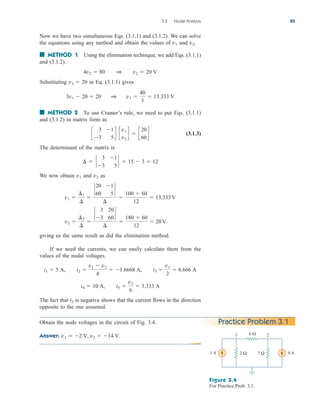
Z 
V
I

120l20
4l10
 30l30  25.98  j15 
pf  cos(uv  ui)  cos(20  10)  0.866 (leading)
S  Vrms Irms 
120
12
4
12
 240 VA
v(t)  120 cos(100pt  20) V.
i(t)  4 cos(100pt  10) A
Practice Problem 11.9 Obtain the power factor and the apparent power of a load whose
impedance is when the applied voltage is
Answer: 0.8321 lagging, 177.5l33.69 VA.
160 cos(377t  10) V.
v(t) 
Z  60  j40 
Determine the power factor of the entire circuit of Fig. 11.18 as seen
by the source. Calculate the average power delivered by the source.
Solution:
The total impedance is
Z  6  4  (j2)  6 
j2  4
4  j2
 6.8  j1.6  7l13.24 
Example 11.10
ale29559_ch11.qxd 07/08/2008 12:01 PM Page 472
The power factor is
since the impedance is capacitive. The rms value of the current is
The average power supplied by the source is
or
where R is the resistive part of Z.
P  I2
rms R  (4.286)2
(6.8)  125 W
P  Vrms Irms pf  (30)(4.286)0.9734  125 W
Irms 
Vrms
Z

30l0
7l13.24
 4.286l13.24 A
pf  cos(13.24)  0.9734 (leading)
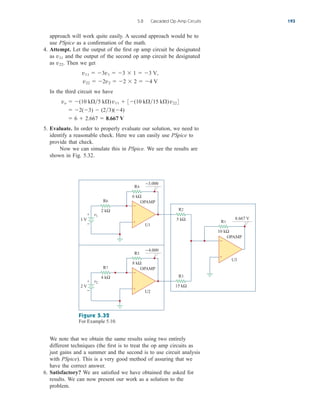
11.6 Complex Power 473
6 Ω
4 Ω
+
−
30 0° V rms −j2 Ω
Figure 11.18
For Example 11.10.
Calculate the power factor of the entire circuit of Fig. 11.19 as seen by
the source. What is the average power supplied by the source?
Answer: 0.936 lagging, 1.062 kW.
Practice Problem 11.10
10 Ω
+
−
8 Ω
j4 Ω −j6 Ω
120 0° V rms
Figure 11.19
For Practice Prob. 11.10.
Complex Power
Considerable effort has been expended over the years to express
power relations as simply as possible. Power engineers have coined
the term complex power, which they use to find the total effect of
parallel loads. Complex power is important in power analysis because
it contains all the information pertaining to the power absorbed by a
given load.
Consider the ac load in Fig. 11.20. Given the phasor form
and of voltage and current the complex
power S absorbed by the ac load is the product of the voltage and the
complex conjugate of the current, or
(11.40)
assuming the passive sign convention (see Fig. 11.20). In terms of the
rms values,
(11.41)
where
(11.42)
and
(11.43)
Irms 
I
12
 Irmslui
Vrms 
V
12
 Vrmsluv
S  VrmsI*
rms
S 
1
2
VI*
i(t),
v(t)
I  Imlui
Vmluv
V 
11.6
V
I
+
−
Load
Z
Figure 11.20
The voltage and current phasors associated
with a load.
ale29559_ch11.qxd 07/08/2008 12:01 PM Page 473
Thus we may write Eq. (11.41) as
(11.44)
This equation can also be obtained from Eq. (11.9). We notice from
Eq. (11.44) that the magnitude of the complex power is the apparent
power; hence, the complex power is measured in volt-amperes (VA). Also,
we notice that the angle of the complex power is the power factor angle.
The complex power may be expressed in terms of the load imped-
ance Z. From Eq. (11.37), the load impedance Z may be written as
(11.45)
Thus, Substituting this into Eq. (11.41) gives
(11.46)
Since Eq. (11.46) becomes
(11.47)
where P and Q are the real and imaginary parts of the complex power;
that is,
(11.48)
(11.49)
P is the average or real power and it depends on the load’s resistance
R. Q depends on the load’s reactance X and is called the reactive (or
quadrature) power.
Comparing Eq. (11.44) with Eq. (11.47), we notice that
(11.50)
The real power P is the average power in watts delivered to a load; it
is the only useful power. It is the actual power dissipated by the load.
The reactive power Q is a measure of the energy exchange between the
source and the reactive part of the load. The unit of Q is the volt-ampere
reactive (VAR) to distinguish it from the real power, whose unit is the
watt. We know from Chapter 6 that energy storage elements neither dis-
sipate nor supply power, but exchange power back and forth with the
rest of the network. In the same way, the reactive power is being trans-
ferred back and forth between the load and the source. It represents a
lossless interchange between the load and the source. Notice that:
1. for resistive loads (unity pf).
2. for capacitive loads (leading pf).
3. for inductive loads (lagging pf).
Thus,
Q 7 0
Q 6 0
Q  0
P  Vrms Irms cos(uv  ui), Q  Vrms Irms sin(uv  ui)
Q  Im(S)  I2
rms X
P  Re(S)  I2
rmsR
S  I2
rms(R  jX)  P  jQ
Z  R  jX,
S  I2
rmsZ 
Vrms
2
Z*
 Vrms I*
rms
Vrms  ZIrms.
Z 
V
I

Vrms
Irms

Vrms
Irms
luv  ui
 VrmsIrms cos(uv  ui)  jVrmsIrms sin(uv  ui)
S  VrmsIrmsluv  ui
474 Chapter 11 AC Power Analysis
When working with the rms values of
currents or voltages, we may drop the
subscript rms if no confusion will be
caused by doing so.
Complex power (in VA) is the product of the rms voltage phasor and
the complex conjugate of the rms current phasor. As a complex quantity,
its real part is real power P and its imaginary part is reactive power Q.
ale29559_ch11.qxd 07/08/2008 12:01 PM Page 474
Introducing the complex power enables us to obtain the real and reac-
tive powers directly from voltage and current phasors.
(11.51)
This shows how the complex power contains all the relevant power
information in a given load.
It is a standard practice to represent S, P, and Q in the form of a
triangle, known as the power triangle, shown in Fig. 11.21(a). This is
similar to the impedance triangle showing the relationship between Z,
R, and X, illustrated in Fig. 11.21(b). The power triangle has four
items—the apparent/complex power, real power, reactive power, and
the power factor angle. Given two of these items, the other two can
easily be obtained from the triangle. As shown in Fig. 11.22, when S
lies in the first quadrant, we have an inductive load and a lagging pf.
When S lies in the fourth quadrant, the load is capacitive and the pf is
leading. It is also possible for the complex power to lie in the second
or third quadrant. This requires that the load impedance have a nega-
tive resistance, which is possible with active circuits.
Power Factor 
P
S
 cos(uv  ui)
Reactive Power  Q  Im(S)  S sin(uv  ui)
Real Power  P  Re(S)  S cos(uv  ui)
Apparent Power  S  0S0  Vrms Irms  2P2
 Q2
 Vrms Irmsluv  ui
Complex Power  S  P  jQ  Vrms(Irms)*
11.6 Complex Power 475
S contains all power information of
a load. The real part of S is the real
power P; its imaginary part is the reac-
tive power Q; its magnitude is the ap-
parent power S; and the cosine of its
phase angle is the power factor pf.
S Q
P

(a)
|Z| X
R

(b)
Figure 11.21
(a) Power triangle, (b) impedance triangle.
P Re
Im
S
S
+Q (lagging pf)
−Q (leading pf)
v − i
v − i
Figure 11.22
Power triangle.
Example 11.11
The voltage across a load is and the current
through the element in the direction of the voltage drop is
Find: (a) the complex and apparent powers,
(b) the real and reactive powers, and (c) the power factor and the load
impedance.
1.5 cos(t  50) A.
i(t) 
v(t)  60 cos(t  10) V
ale29559_ch11.qxd 07/22/2008 01:25 PM Page 475
Solution:
(a) For the rms values of the voltage and current, we write
The complex power is
The apparent power is
(b) We can express the complex power in rectangular form as
Since the real power is
while the reactive power is
(c) The power factor is
It is leading, because the reactive power is negative. The load impedance is
which is a capacitive impedance.
Z 
V
I

60l10
1.5l50
 40l60 
pf  cos(60)  0.5 (leading)
Q  38.97 VAR
P  22.5 W
S  P  jQ,
S  45l60  45[cos(60)  j sin(60)]  22.5  j38.97
S  0S0  45 VA
S  Vrms I*
rms  a
60
22
l10ba
1.5
22
l50b  45l60 VA
Vrms 
60
22
l10, Irms 
1.5
22
l50
476 Chapter 11 AC Power Analysis
Practice Problem 11.11 For a load, Determine: (a) the
complex and apparent powers, (b) the real and reactive powers, and
(c) the power factor and the load impedance.
Answer: (a) VA, 44 VA, (b) 15.05 W, 41.35 VAR, (c) 0.342
lagging, 94.06  j258.4 .
44l70
Vrms  110l85 V, Irms  0.4l15 A.
Example 11.12 A load Z draws 12 kVA at a power factor of 0.856 lagging from a
120-V rms sinusoidal source. Calculate: (a) the average and reactive pow-
ers delivered to the load, (b) the peak current, and (c) the load impedance.
Solution:
(a) Given that we obtain the power angle as
If the apparent power is VA,
then the average or real power is
P  S cosu  12,000  0.856  10.272 kW
S  12,000
u  cos1
0.856  31.13.
pf  cosu  0.856,
ale29559_ch11.qxd 07/08/2008 12:02 PM Page 476
while the reactive power is
(b) Since the pf is lagging, the complex power is
From we obtain
Thus and the peak current is
(c) The load impedance
which is an inductive impedance.
Z 
Vrms
Irms

120l0
100l31.13
 1.2l31.13 
Im  22Irms  22(100)  141.4 A
Irms  100l31.13
I*
rms 
S
Vrms

10,272  j6204
120l0
 85.6  j51.7 A  100l31.13 A
S  Vrms I*
rms,
S  P  jQ  10.272  j6.204 kVA
Q  S sinu  12,000  0.517  6.204 kVA
11.7 Conservation of AC Power 477
Practice Problem 11.12
A sinusoidal source supplies 20 kVAR reactive power to load
Determine: (a) the power factor, (b) the apparent power
delivered to the load, and (c) the rms voltage.
Answer: (a) 0.2588 leading, (b) (c) 2.275 kV.
20.71 kVA,
250l75 .
Z 
Conservation of AC Power
The principle of conservation of power applies to ac circuits as well as
to dc circuits (see Section 1.5).
To see this, consider the circuit in Fig. 11.23(a), where two load
impedances and are connected in parallel across an ac source V.
KCL gives
(11.52)
The complex power supplied by the source is (from now on, unless
otherwise specified, all values of voltages and currents will be assumed
to be rms values)
(11.53)
S  VI*  V(I1
*  I2
*)  VI*
1  VI*
2  S1  S2
I  I1  I2
Z2
Z1
11.7
In fact, we already saw in Examples
11.3 and 11.4 that average power is
conserved in ac circuits.
(a) (b)
I
V Z2
Z1
Z2
Z1
+
−
I1 I2
I
V +
−
+ −
V1
+ −
V2
Figure 11.23
An ac voltage source supplied loads connected in: (a) parallel, (b) series.
ale29559_ch11.qxd 07/08/2008 12:02 PM Page 477
where and denote the complex powers delivered to loads and
respectively.
If the loads are connected in series with the voltage source, as
shown in Fig. 11.23(b), KVL yields
(11.54)
The complex power supplied by the source is
(11.55)
where and denote the complex powers delivered to loads and
respectively.
We conclude from Eqs. (11.53) and (11.55) that whether the loads
are connected in series or in parallel (or in general), the total power
supplied by the source equals the total power delivered to the load.
Thus, in general, for a source connected to N loads,
(11.56)
This means that the total complex power in a network is the sum of
the complex powers of the individual components. (This is also true of
real power and reactive power, but not true of apparent power.) This
expresses the principle of conservation of ac power:
S  S1  S2  p  SN
Z2,
Z1
S2
S1
S  VI*  (V1  V2)I*  V1I*  V2I*  S1  S2
V  V1  V2
Z2,
Z1
S2
S1
478 Chapter 11 AC Power Analysis
In fact, all forms of ac power are con-
served: instantaneous, real, reactive,
and complex.
The complex, real, and reactive powers of the sources equal the
respective sums of the complex, real, and reactive powers of the indi-
vidual loads.
From this we imply that the real (or reactive) power flow from sources
in a network equals the real (or reactive) power flow into the other ele-
ments in the network.
Figure 11.24 shows a load being fed by a voltage source through a
transmission line. The impedance of the line is represented by the
impedance and a return path. Find the real power and reac-
tive power absorbed by: (a) the source, (b) the line, and (c) the load.
(4  j2) 
Example 11.13
4 Ω
+
−
j2 Ω
220 0° V rms
−j10 Ω
15 Ω
I
Source Line Load
Figure 11.24
For Example 11.13.
Solution:
The total impedance is
Z  (4  j2)  (15  j10)  19  j8  20.62l22.83 
ale29559_ch11.qxd 07/08/2008 12:02 PM Page 478
The current through the circuit is
(a) For the source, the complex power is
From this, we obtain the real power as 2163.5 W and the reactive
power as 910.8 VAR (leading).
(b) For the line, the voltage is
The complex power absorbed by the line is
or
That is, the real power is 455.4 W and the reactive power is 227.76
VAR (lagging).
(c) For the load, the voltage is
The complex power absorbed by the load is
The real power is 1708 W and the reactive power is 1139 VAR
(leading). Note that as expected. We have used the rms
values of voltages and currents.
Ss  Sline  SL,
 2053l33.7  (1708  j1139) VA
SL  VLI*  (192.38l10.87)(10.67l22.83)
 192.38l10.87 V rms
VL  (15  j10)I  (18.03l33.7)(10.67l22.83)
Sline  0I 02
Zline  (10.67)2
(4  j2)  455.4  j227.7 VA
 509.2l26.57  455.4  j227.7 VA
Sline  Vline I*  (47.72l49.4)(10.67l22.83)
 47.72l49.4 V rms
Vline  (4  j2)I  (4.472l26.57)(10.67l22.83)
 2347.4l22.83  (2163.5  j910.8) VA
Ss  VsI*  (220l0)(10.67l22.83)
I 
Vs
Z

220l0
20.62l22.83
 10.67l22.83 A rms
11.7 Conservation of AC Power 479
In the circuit in Fig. 11.25, the resistor absorbs an average power
of 240 W. Find V and the complex power of each branch of the cir-
cuit. What is the overall complex power of the circuit? (Assume the
current through the resistor has no phase shift.)
Answer: the resistor: 656 VA; the
impedance: the imped-
ance: overall: 1376  j80 VA.
240  j80 VA;
(60  j20) 
480  j160 VA;
(30  j10) 
20-
240.67l21.45 V (rms);
60-
60- Practice Problem 11.13
20 Ω
30 Ω
+
−
−j10 Ω
j20 Ω
V
60 Ω
Figure 11.25
For Practice Prob. 11.13.
ale29559_ch11.qxd 07/08/2008 12:02 PM Page 479
480 Chapter 11 AC Power Analysis
Example 11.14 In the circuit of Fig. 11.26, and
Calculate the total: (a) apparent power, (b) real power, (c) reactive
power, and (d) pf, supplied by the source and seen by the source.
Solution:
The current through is
while the current through is
The complex powers absorbed by the impedances are
The total complex power is
(a) The total apparent power is
(b) The total real power is
(c) The total reactive power is
(d) The (lagging).
We may cross check the result by finding the complex power supplied
by the source.
which is the same as before.
 482.88l16.21  463  j135 VA
Ss  VI*
t  (120l10)(4.024l6.21)
 4  j0.435  4.024l6.21 A rms
It  I1  I2  (1.532  j1.286)  (2.457  j1.721)
Ss
pf  Pt0St 0  462.4481.6  0.96
Qt  Im(St)  134.6 VAR or Qt  Q1  Q2.
Pt  Re(St)  462.4 W or Pt  P1  P2.
0 St 0  2462.42
 134.62
 481.6 VA.
St  S1  S2  462.4  j134.6 VA
S2 
V2
rms
Z*
2

(120)2
40l45
 360l45  254.6  j254.6 VA
S1 
V2
rms
Z*
1

(120)2
60l30
 240l30  207.85  j120 VA
I2 
V
Z2

120l10
40l45
 3l35 A rms
Z2
I1 
V
Z1

120l10
60l30
 2l40 A rms
Z1
Z2  40l45 .
Z1  60l30 
It
Z2
Z1
+
−
I1 I2
120 10° V rms
Figure 11.26
For Example 11.14.
Two loads connected in parallel are respectively 2 kW at a pf of 0.75
leading and 4 kW at a pf of 0.95 lagging. Calculate the pf of the two
loads. Find the complex power supplied by the source.
Answer: 0.9972 (leading), 6  j0.4495 kVA.
Practice Problem 11.14
ale29559_ch11.qxd 07/08/2008 12:02 PM Page 480
Power Factor Correction
Most domestic loads (such as washing machines, air conditioners, and
refrigerators) and industrial loads (such as induction motors) are induc-
tive and operate at a low lagging power factor. Although the inductive
nature of the load cannot be changed, we can increase its power factor.
11.8
11.8 Power Factor Correction 481
The process of increasing the power factor without altering the voltage
or current to the original load is known as power factor correction.
Since most loads are inductive, as shown in Fig. 11.27(a), a load’s
power factor is improved or corrected by deliberately installing a
capacitor in parallel with the load, as shown in Fig. 11.27(b). The effect
of adding the capacitor can be illustrated using either the power trian-
gle or the phasor diagram of the currents involved. Figure 11.28 shows
the latter, where it is assumed that the circuit in Fig. 11.27(a) has a
power factor of while the one in Fig. 11.27(b) has a power fac-
tor of It is evident from Fig. 11.28 that adding the capacitor has
caused the phase angle between the supplied voltage and current to
reduce from to thereby increasing the power factor. We also
notice from the magnitudes of the vectors in Fig. 11.28 that with the
same supplied voltage, the circuit in Fig. 11.27(a) draws larger current
than the current I drawn by the circuit in Fig. 11.27(b). Power com-
panies charge more for larger currents, because they result in increased
power losses (by a squared factor, since ). Therefore, it is ben-
eficial to both the power company and the consumer that every effort
is made to minimize current level or keep the power factor as close to
unity as possible. By choosing a suitable size for the capacitor, the cur-
rent can be made to be completely in phase with the voltage, imply-
ing unity power factor.
P  IL
2
R
IL
u2,
u1
cosu2.
cosu1,
Alternatively, power factor correction
may be viewed as the addition of a re-
active element (usually a capacitor) in
parallel with the load in order to make
the power factor closer to unity.
An inductive load is modeled as a
series combination of an inductor and
a resistor.
V
+
−
(a)
IL
Inductive
load
V
+
−
(b)
IL IC
Inductive
load
C
I
Figure 11.27
Power factor correction: (a) original inductive load,
(b) inductive load with improved power factor.
V
IC
IC
IL
I
1
2
Figure 11.28
Phasor diagram showing the effect of
adding a capacitor in parallel with the
inductive load.
We can look at the power factor correction from another perspec-
tive. Consider the power triangle in Fig. 11.29. If the original inductive
load has apparent power then
(11.57)
P  S1 cosu1, Q1  S1 sinu1  P tanu1
S1,
ale29559_ch11.qxd 07/08/2008 12:02 PM Page 481
If we desire to increase the power factor from to without
altering the real power (i.e., ), then the new reactive power is
(11.58)
The reduction in the reactive power is caused by the shunt capacitor;
that is,
(11.59)
But from Eq. (11.46), The value of the
required shunt capacitance C is determined as
(11.60)
Note that the real power P dissipated by the load is not affected by the
power factor correction because the average power due to the capaci-
tance is zero.
Although the most common situation in practice is that of an
inductive load, it is also possible that the load is capacitive; that is, the
load is operating at a leading power factor. In this case, an inductor
should be connected across the load for power factor correction. The
required shunt inductance L can be calculated from
(11.61)
where the difference between the new and old reac-
tive powers.
QL  Q1  Q2,
QL 
V2
rms
XL

V2
rms
L
1 L 
V2
rms
QL
C 
QC
V 2
rms

P(tanu1  tanu2)
V2
rms
QC  V2
rmsXC  CV2
rms.
QC  Q1  Q2  P(tanu1  tanu2)
Q2  P tanu2
P  S2 cosu2
cosu2
cosu1
482 Chapter 11 AC Power Analysis
S1
S2
QC
Q2
Q1
1
2
P
Figure 11.29
Power triangle illustrating power factor
correction.
When connected to a 120-V (rms), 60-Hz power line, a load absorbs
4 kW at a lagging power factor of 0.8. Find the value of capacitance
necessary to raise the pf to 0.95.
Solution:
If the then
where is the phase difference between voltage and current. We
obtain the apparent power from the real power and the pf as
The reactive power is
When the pf is raised to 0.95,
cosu2  0.95 1 u2  18.19
Q1  S1 sinu  5000 sin 36.87  3000 VAR
S1 
P
cosu1

4000
0.8
 5000 VA
u1
cosu1  0.8 1 u1  36.87
pf  0.8,
Example 11.15
ale29559_ch11.qxd 07/08/2008 12:02 PM Page 482
The real power P has not changed. But the apparent power has
changed; its new value is
The new reactive power is
The difference between the new and old reactive powers is due to the
parallel addition of the capacitor to the load. The reactive power due
to the capacitor is
and
Note: Capacitors are normally purchased for voltages they expect to
see. In this case, the maximum voltage this capacitor will see is about
170 V peak. We would suggest purchasing a capacitor with a voltage
rating equal to, say, 200 V.
C 
QC
V2
rms

1685.6
2p  60  1202
 310.5 mF
QC  Q1  Q2  3000  1314.4  1685.6 VAR
Q2  S2 sinu2  1314.4 VAR
S2 
P
cosu2

4000
0.95
 4210.5 VA
11.9 Applications 483
Find the value of parallel capacitance needed to correct a load of
140 kVAR at 0.85 lagging pf to unity pf. Assume that the load is sup-
plied by a 110-V (rms), 60-Hz line.
Answer: 30.69 mF.
Practice Problem 11.15
Applications
In this section, we consider two important application areas: how power
is measured and how electric utility companies determine the cost of
electricity consumption.
11.9.1 Power Measurement
The average power absorbed by a load is measured by an instrument
called the wattmeter.
11.9
The wattmeter is the instrument for measuring the average power.
Figure 11.30 shows a wattmeter that consists essentially of two
coils: the current coil and the voltage coil. A current coil with very low
impedance (ideally zero) is connected in series with the load (Fig. 11.31)
and responds to the load current. The voltage coil with very high imped-
ance (ideally infinite) is connected in parallel with the load as shown
in Fig. 11.31 and responds to the load voltage. The current coil acts
like a short circuit because of its low impedance; the voltage coil
Reactive power is measured by an
instrument called the varmeter. The
varmeter is often connected to the
load in the same way as the wattmeter.
Some wattmeters do not have coils;
the wattmeter considered here is the
electromagnetic type.
ale29559_ch11.qxd 07/08/2008 12:02 PM Page 483
behaves like an open circuit because of its high impedance. As a result,
the presence of the wattmeter does not disturb the circuit or have an
effect on the power measurement.
When the two coils are energized, the mechanical inertia of the mov-
ing system produces a deflection angle that is proportional to the aver-
age value of the product If the current and voltage of the load
are and their corre-
sponding rms phasors are
(11.62)
and the wattmeter measures the average power given by
(11.63)
As shown in Fig. 11.31, each wattmeter coil has two terminals with
one marked To ensure upscale deflection, the terminal of the cur-
rent coil is toward the source, while the terminal of the voltage coil
is connected to the same line as the current coil. Reversing both coil
connections still results in upscale deflection. However, reversing one
coil and not the other results in downscale deflection and no wattmeter
reading.


.
P  |Vrms||Irms| cos(uv  ui)  Vrms Irms cos(uv  ui)
Vrms 
Vm
22
luv and Irms 
Im
22
lui
i(t)  Im cos(t  ui),
v(t)  Vm cos(t  uv)
v(t)i(t).
484 Chapter 11 AC Power Analysis
i
+
−
v
R
±
±
i
i
+
−
v
Current coil
Voltage coil
±
±
ZL
Figure 11.30
A wattmeter.
Figure 11.31
The wattmeter connected to the load.
Find the wattmeter reading of the circuit in Fig. 11.32.
Example 11.16
±
±
+
−
12 Ω
150 0° V rms
j10 Ω
−j6 Ω
8 Ω
Figure 11.32
For Example 11.16.
Solution:
1. Define. The problem is clearly defined. Interestingly, this is a
problem where the student could actually validate the results by
doing the problem in the laboratory with a real wattmeter.
ale29559_ch11.qxd 07/08/2008 12:02 PM Page 484
2. Present. This problem consists of finding the average power
delivered to a load by an external source with a series impedance.
3. Alternative. This is a straightforward circuit problem where all
we need to do is find the magnitude and phase of the current
through the load and the magnitude and the phase of the voltage
across the load. These quantities could also be found by using
PSpice, which we will use as a check.
4. Attempt. In Fig. 11.32, the wattmeter reads the average power
absorbed by the impedance because the current coil
is in series with the impedance while the voltage coil is in
parallel with it. The current through the circuit is
The voltage across the impedance is
The complex power is
The wattmeter reads
5. Evaluate. We can check our results by using PSpice.
P  Re(S)  432.7 W
 423.7  j324.6 VA
S  Vrms I*
rms 
150(8  j6)
20  j4

150
20  j4

1502
(8  j6)
202
 42
Vrms  Irms(8  j6) 
150(8  j6)
20  j4
V
(8  j6) 
Irms 
150l0
(12  j10)  (8  j6)

150
20  j4
A
(8  j6) 
11.9 Applications 485
ACMAG=150V
ACPHASE=0
AC=ok
MAG=ok
PHASE=yes
AC=ok
MAG=ok
PHASE=yes
V1
R1 L1
12 10
+
−
8
R2
C2 0.16667
IPRINT
Simulation yields:
FREQ IM(V_PRINT2) IP(V_PRINT2)
1.592E-01 7.354E+00 -1.131E+01
and
FREQ VM($N_0004) VP($N_0004)
1.592E-01 7.354E+01 -4.818E+01
ale29559_ch11.qxd 07/08/2008 12:02 PM Page 485
To check our answer, all we need is the magnitude of the current
(7.354 A) flowing through the load resistor:
As expected, the answer does check!
6. Satisfactory? We have satisfactorily solved the problem and the
results can now be presented as a solution to the problem.
P  (IL)2
R  (7.354)2
8  432.7 W
486 Chapter 11 AC Power Analysis
±
±
+
−
4 Ω
120 30° V rms j9 Ω
−j2 Ω
12 Ω
For the circuit in Fig. 11.33, find the wattmeter reading.
Practice Problem 11.16
Figure 11.33
For Practice Prob. 11.16.
Answer: 1437 W.
11.9.2 Electricity Consumption Cost
In Section 1.7, we considered a simplified model of the way the cost of
electricity consumption is determined. But the concept of power factor
was not included in the calculations. Now we consider the importance
of power factor in electricity consumption cost.
Loads with low power factors are costly to serve because they
require large currents, as explained in Section 11.8. The ideal situa-
tion would be to draw minimum current from a supply so that
and . A load with nonzero Q means that energy flows
back and forth between the load and the source, giving rise to addi-
tional power losses. In view of this, power companies often encour-
age their customers to have power factors as close to unity as possible
and penalize some customers who do not improve their load power
factors.
Utility companies divide their customers into categories: as resi-
dential (domestic), commercial, and industrial, or as small power,
medium power, and large power. They have different rate structures for
each category. The amount of energy consumed in units of kilowatt-
hours (kWh) is measured using a kilowatt-hour meter installed at the
customer’s premises.
Although utility companies use different methods for charging cus-
tomers, the tariff or charge to a consumer is often two-part. The first
part is fixed and corresponds to the cost of generation, transmission,
and distribution of electricity to meet the load requirements of the con-
sumers. This part of the tariff is generally expressed as a certain price
pf  1
P, Q  0,
S 
ale29559_ch11.qxd 07/08/2008 12:02 PM Page 486
per kW of maximum demand. Or it may be based on kVA of maxi-
mum demand, to account for the power factor (pf) of the consumer. A
pf penalty charge may be imposed on the consumer whereby a certain
percentage of kW or kVA maximum demand is charged for every 0.01
fall in pf below a prescribed value, say 0.85 or 0.9. On the other hand,
a pf credit may be given for every 0.01 that the pf exceeds the pre-
scribed value.
The second part is proportional to the energy consumed in kWh;
it may be in graded form, for example, the first 100 kWh at 16 cents/kWh,
the next 200 kWh at 10 cents/kWh and so forth. Thus, the bill is deter-
mined based on the following equation:
(11.64)
Total Cost  Fixed Cost  Cost of Energy
11.9 Applications 487
A manufacturing industry consumes 200 MWh in one month. If the
maximum demand is 1600 kW, calculate the electricity bill based on
the following two-part rate:
Demand charge: $5.00 per month per kW of billing demand.
Energy charge: 8 cents per kWh for the first 50,000 kWh,
5 cents per kWh for the remaining energy.
Solution:
The demand charge is
(11.17.1)
The energy charge for the first 50,000 kWh is
(11.17.2)
The remaining energy is
and the corresponding energy charge is
(11.17.3)
Adding the results of Eqs. (11.17.1) to (11.17.3) gives
It may appear that the cost of electricity is too high. But this is often a
small fraction of the overall cost of production of the goods manufactured
or the selling price of the finished product.
Total bill for the month  $8000  $4000  $7500  $19,500
$0.05  150,000  $7500
200,000 kWh  50,000 kWh  150,000 kWh,
$0.08  50,000  $4000
$5.00  1600  $8000
Example 11.17
The monthly reading of a paper mill’s meter is as follows:
Maximum demand: 32,000 kW
Energy consumed: 500 MWh
Using the two-part rate in Example 11.17, calculate the monthly bill
for the paper mill.
Answer: $186,500.
Practice Problem 11.17
ale29559_ch11.qxd 07/08/2008 12:02 PM Page 487
488 Chapter 11 AC Power Analysis
A 300-kW load supplied at 13 kV (rms) operates 520 hours a month
at 80 percent power factor. Calculate the average cost per month based
on this simplified tariff:
Energy charge: 6 cents per kWh
Power-factor penalty: 0.1 percent of energy charge for every 0.01
that pf falls below 0.85.
Power-factor credit: 0.1 percent of energy charge for every 0.01
that pf exceeds 0.85.
Solution:
The energy consumed is
The operating power factor is below the
prescribed power factor of 0.85. Since there is 0.1 percent energy charge
for every 0.01, there is a power-factor penalty charge of 0.5 percent.
This amounts to an energy charge of
The total energy is
The cost per month is given by
Cost  6 cents  Wt  $0.06  156,780  $9,406.80
Wt  W  ¢W  156,000  780  156,780 kWh
¢W  156,000 
5  0.1
100
 780 kWh
5  0.01
pf  80%  0.8
W  300 kW  520 h  156,000 kWh
Example 11.18
An 800-kW induction furnace at 0.88 power factor operates 20 hours
per day for 26 days in a month. Determine the electricity bill per month
based on the tariff in Example 11.18.
Answer: $24,885.12.
Practice Problem 11.18
Summary
1. The instantaneous power absorbed by an element is the product of
the element’s terminal voltage and the current through the element:
2. Average or real power P (in watts) is the average of instantaneous
power p:
If and then
and
P 
1
2
Vm Im cos(uv  ui)  Vrms Irms cos(uv  ui)
Vm12, Irms  Im12,
Vrms 
i(t)  Im cos(t  ui),
v(t)  Vm cos(t  uv)
P 
1
T 
T
0
p dt
p  vi.
11.10
ale29559_ch11.qxd 07/08/2008 12:02 PM Page 488
Inductors and capacitors absorb no average power, while the aver-
age power absorbed by a resistor is
3. Maximum average power is transferred to a load when the load
impedance is the complex conjugate of the Thevenin impedance
as seen from the load terminals,
4. The effective value of a periodic signal x(t) is its root-mean-square
(rms) value.
For a sinusoid, the effective or rms value is its amplitude divided
by
5. The power factor is the cosine of the phase difference between
voltage and current:
It is also the cosine of the angle of the load impedance or the ratio
of real power to apparent power. The pf is lagging if the current
lags voltage (inductive load) and is leading when the current leads
voltage (capacitive load).
6. Apparent power S (in VA) is the product of the rms values of volt-
age and current:
It is also given by where P is the real
power and Q is reactive power.
7. Reactive power (in VAR) is:
8. Complex power S (in VA) is the product of the rms voltage pha-
sor and the complex conjugate of the rms current phasor. It is also
the complex sum of real power P and reactive power Q.
Also,
9. The total complex power in a network is the sum of the complex
powers of the individual components. Total real power and reac-
tive power are also, respectively, the sums of the individual real
powers and the reactive powers, but the total apparent power is
not calculated by the process.
10. Power factor correction is necessary for economic reasons; it is the
process of improving the power factor of a load by reducing the
overall reactive power.
11. The wattmeter is the instrument for measuring the average power.
Energy consumed is measured with a kilowatt-hour meter.
S  I2
rms Z 
Vrms
2
Z*
S  Vrms I*
rms  Vrms Irmsluv  ui  P  jQ
Q 
1
2
Vm Im sin(uv  ui)  Vrms Irms sin(uv  ui)
S  0S0  2P2
 Q2
,
S  Vrms Irms
pf  cos(uv  ui)
12.
Xeff  Xrms 
B
1
T 
T
0
x2
dt
ZL  Z*
Th.
(12)Im
2
R  I2
rms R.
11.10 Summary 489
ale29559_ch11.qxd 07/08/2008 12:02 PM Page 489
490 Chapter 11 AC Power Analysis
Review Questions
11.1 The average power absorbed by an inductor is zero.
(a) True (b) False
11.2 The Thevenin impedance of a network seen from the
load terminals is For maximum power
transfer, the load impedance must be:
(a) (b)
(c) (d)
11.3 The amplitude of the voltage available in the 60-Hz,
120-V power outlet in your home is:
(a) 110 V (b) 120 V
(c) 170 V (d) 210 V
11.4 If the load impedance is the power factor is
(a) (b) 0 (c) 1
(d) 0.7071 (e) none of these
11.5 A quantity that contains all the power information in
a given load is the
(a) power factor (b) apparent power
(c) average power (d) reactive power
(e) complex power
11.6 Reactive power is measured in:
(a) watts (b) VA
(c) VAR (d) none of these
11.7 In the power triangle shown in Fig. 11.34(a), the
reactive power is:
(a) 1000 VAR leading (b) 1000 VAR lagging
(c) 866 VAR leading (d) 866 VAR lagging
l45
20  j20,
80  j55 
80  j55 
80  j55 
80  j55 
80  j55 .
(a) (b)
60°
500 W
30°
1000 VAR
Figure 11.34
For Review Questions 11.7 and 11.8.
11.8 For the power triangle in Fig. 11.34(b), the apparent
power is:
(a) 2000 VA (b) 1000 VAR
(c) 866 VAR (d) 500 VAR
11.9 A source is connected to three loads , and
in parallel. Which of these is not true?
(a) (b)
(c) (d)
11.10 The instrument for measuring average power is the:
(a) voltmeter (b) ammeter
(c) wattmeter (d) varmeter
(e) kilowatt-hour meter
Answers: 11.1a, 11.2c, 11.3c, 11.4d, 11.5e, 11.6c, 11.7d,
11.8a, 11.9c, 11.10c.
S  S1  S2  S3
S  S1  S2  S3
Q  Q1  Q2  Q3
P  P1  P2  P3
Z3
Z1, Z2
Problems1
Section 11.2 Instantaneous and Average Power
11.1 If and
calculate the instantaneous
power and the average power.
11.2 Given the circuit in Fig. 11.35, find the average
power supplied or absorbed by each element.
20 sin(50t  30) A,
i(t) 
v(t)  160 cos 50t V
11.3 A load consists of a resistor in parallel with a
capacitor. If the load is connected to a voltage
source find the average power
delivered to the load.
11.4 Using Fig. 11.36, design a problem to help other
students better understand instantaneous and average
power.
vs(t)  40 cos 2000t,
90-mF
60-
j4 Ω
j1 Ω
5 Ω
6 0° Α
Figure 11.35
For Prob. 11.2.
Figure 11.36
For Prob. 11.4.
R1
−jXC
R2
jXL
Vs
+
−
1
Starting with problem 11.22, unless otherwise specified, assume that all values of currents and voltages are rms.
ale29559_ch11.qxd 07/08/2008 12:02 PM Page 490
11.5 Assuming that in the
circuit of Fig. 11.37, find the average power
delivered to each of the passive elements.
vs  16 cos(2t  40) V 11.9 For the op amp circuit in Fig. 11.41,
Find the average power absorbed by the
resistor.
20-k
Vs  2l30 V.
Problems 491
Figure 11.37
For Prob. 11.5.
11.6 For the circuit in Fig. 11.38, Find
the average power absorbed by the resistor.
50-
is  3 cos 103
t A.
Figure 11.38
For Prob. 11.6.
11.7 Given the circuit of Fig. 11.39, find the average
power absorbed by the resistor.
10-
Figure 11.39
For Prob. 11.7.
11.8 In the circuit of Fig. 11.40, determine the average
power absorbed by the resistor.
40-
Figure 11.40
For Prob. 11.8.
1 Ω 2 Ω
+
− 3 H 0.25 F
vs
20ix
20 mH
10 Ω
40 F
is
+ −
50 Ω
ix
+
− 10 Ω
+
−
Io
8 20° V 0.1Vo
4 Ω
j5 Ω
−j5 Ω
8Io
+
−
Vo
Io
5 0° A j10 Ω 0.5Io 40 Ω
−j20 Ω
j4 kΩ
j12 kΩ
10 kΩ
2 kΩ 20 kΩ
j6 kΩ
–
+
Vs
+
−
Figure 11.41
For Prob. 11.9.
11.10 In the op amp circuit in Fig. 11.42, find the total
average power absorbed by the resistors.
+
−
R
R
R
Vo cos t V
+
−
+
−
Figure 11.42
For Prob. 11.10.
11.11 For the network in Fig. 11.43, assume that the port
impedance is
Find the average power consumed by the network
when
2 sin(377t  22) mA.
R  10 k, C  200 nF, and i 
Zab 
R
21  2
R2
C2
ltan1
RC
Figure 11.43
For Prob. 11.11.
Section 11.3 Maximum Average Power Transfer
11.12 For the circuit shown in Fig. 11.44, determine the
load impedance Z for maximum power transfer
(to Z). Calculate the maximum power absorbed by
the load.
v
i
+
−
Linear
network
a
b
ale29559_ch11.qxd 07/08/2008 12:02 PM Page 491
11.13 The Thevenin impedance of a source is
while the peak Thevenin voltage is
Determine the maximum
available average power from the source.
11.14 Using Fig. 11.45, design a problem to help other
students better understand maximum average power
transfer.
VTh  110  j0 V.
120  j60 ,
ZTh 
11.17 Calculate the value of in the circuit of Fig. 11.48
in order for to receive maximum average power.
What is the maximum average power received by ZL?
ZL
ZL
492 Chapter 11 AC Power Analysis
j3 Ω
4 Ω
j2 Ω
5 Ω
ZL
+
−
40 0° V
Figure 11.44
For Prob. 11.12.
is
C
R1
L
R2
Z
Figure 11.45
For Prob. 11.14.
11.15 In the circuit of Fig. 11.46, find the value of that
will absorb the maximum power and the value of the
maximum power.
ZL
Figure 11.46
For Prob. 11.15.
j1 Ω
1 Ω −j1 Ω
120 0° V +
−
+
−
Vo 2Vo ZL
11.16 For the circuit of Fig. 11.47, find the maximum
power delivered to the load .
ZL
2 Ω
160 cos 4t V
4 Ω
0.5 vo
1 H ZL
F
1
20
+
–
vo
+
−
Figure 11.47
For Prob. 11.16.
Figure 11.48
For Prob. 11.17.
11.18 Find the value of in the circuit of Fig. 11.49 for
maximum power transfer.
ZL
Figure 11.49
For Prob. 11.18.
11.19 The variable resistor R in the circuit of Fig. 11.50 is
adjusted until it absorbs the maximum average
power. Find R and the maximum average power
absorbed.
Figure 11.50
For Prob. 11.19.
11.20 The load resistance in Fig. 11.51 is adjusted until
it absorbs the maximum average power. Calculate
the value of and the maximum average power.
RL
RL
Figure 11.51
For Prob. 11.20.
−j10 Ω
j20 Ω
30 Ω
40 Ω
2 90° A
ZL
40 Ω
40 Ω −j10 Ω
j20 Ω
+
−
80 Ω
60 0° V
5 0° A ZL
j1 Ω
−j2 Ω
3 Ω
6 Ω
4 0° A R
−j10 Ω
−j10 Ω
+
−
Io
120 0° V
40 Ω
j20 Ω
4Io
RL
+ −
ale29559_ch11.qxd 07/08/2008 12:02 PM Page 492
11.21 Assuming that the load impedance is to be purely
resistive, what load should be connected to terminals
a-b of the circuits in Fig. 11.52 so that the maximum
power is transferred to the load?
11.25 Find the rms value of the signal shown in Fig. 11.56.
Problems 493
Figure 11.52
For Prob. 11.21.
Section 11.4 Effective or RMS Value
11.22 Find the rms value of the offset sine wave shown in
Fig. 11.53.
Figure 11.53
For Prob. 11.22.
11.23 Using Fig. 11.54, design a problem to help other
students better understand how to find the rms value
of a waveshape.
Figure 11.54
For Prob. 11.23.
11.24 Determine the rms value of the waveform in
Fig. 11.55.
Figure 11.55
For Prob. 11.24.
100 Ω
40 Ω
−j10 Ω
j30 Ω
50 Ω
+
−
120 60° V 2 90° A
a
b
i(t)
t
4
0  2 3
v(t)
Vp
T 4T/3
2T/3
T/3
0 t
1
0
2 3 4 t
10
−10
v(t)
Figure 11.56
For Prob. 11.25.
11.26 Find the effective value of the voltage waveform in
Fig. 11.57.
Figure 11.57
For Prob. 11.26.
11.27 Calculate the rms value of the current waveform of
Fig. 11.58.
Figure 11.58
For Prob. 11.27.
11.28 Find the rms value of the voltage waveform of
Fig. 11.59 as well as the average power absorbed by
a resistor when the voltage is applied across the
resistor.
2-
Figure 11.59
For Prob. 11.28.
f(t)
10
–10
–1 5 t
0 1 2 3 4
2
0 4 6 8 10 t
5
10
v(t)
5
0 10 15 20 25 t
5
i(t)
2
0 5 7 10 12 t
10
v(t)
ale29559_ch11.qxd 07/08/2008 12:02 PM Page 493
11.29 Calculate the effective value of the current waveform
in Fig. 11.60 and the average power delivered to a
resistor when the current runs through the
resistor.
12-
11.33 Determine the rms value for the waveform in
Fig. 11.64.
494 Chapter 11 AC Power Analysis
Figure 11.60
For Prob. 11.29.
11.30 Compute the rms value of the waveform depicted in
Fig. 11.61.
Figure 11.61
For Prob. 11.30.
11.31 Find the rms value of the signal shown in Fig. 11.62.
Figure 11.62
For Prob. 11.31.
11.32 Obtain the rms value of the current waveform shown
in Fig. 11.63.
Figure 11.63
For Prob. 11.32.
5
0
15 25 t
10
−10
i(t)
10 20 30
2
−1
0
4 6 8 10 t
2
v(t)
v(t)
2
0
–4
1 2 3 4 5 t
1
0 2 3 4 5 t
10
i(t)
10t2
Figure 11.64
For Prob. 11.33.
11.34 Find the effective value of f(t) defined in Fig. 11.65.
Figure 11.65
For Prob. 11.34.
11.35 One cycle of a periodic voltage waveform is depicted
in Fig. 11.66. Find the effective value of the voltage.
Note that the cycle starts at and ends at t  6 s.
t  0
Figure 11.66
For Prob. 11.35.
11.36 Calculate the rms value for each of the following
functions:
(a) (b)
(c) (d)
11.37 Design a problem to help other students better
understand how to determine the rms value of the
sum of multiple currents.
Section 11.5 Apparent Power and Power Factor
11.38 For the power system in Fig. 11.67, find: (a) the
average power, (b) the reactive power, (c) the power
factor. Note that 220 V is an rms value.
v(t)  5 sint  4 cost V
i(t)  8  6 sin 2t A
v(t)  4  3 cos 5t V
i(t)  10 A
0 1 2 3 4 5 6 7 8 9 10
i(t)
10
t
f(t)
10
–1 0 1 2 3 4 5 t
1
0 2 3 4 6
5 t
10
20
30
v(t)
ale29559_ch11.qxd 07/08/2008 12:02 PM Page 494
11.39 An ac motor with impedance is
supplied by a 220-V, 60-Hz source. (a) Find pf, P,
and Q. (b) Determine the capacitor required to be
connected in parallel with the motor so that the
power factor is corrected to unity.
11.40 Design a problem to help other students better
understand apparent power and power factor.
11.41 Obtain the power factor for each of the circuits in
Fig. 11.68. Specify each power factor as leading or
lagging.
ZL  4.2  j3.6 
11.43 Design a problem to help other students understand
complex power.
11.44 Find the complex power delivered by to the
network in Fig. 11.69. Let vs  160 cos 2000t V.
vs
Problems 495
Figure 11.67
For Prob. 11.38.
+
−
220 V, 60 Hz
20 − j25 Ω
90 + j80 Ω
124 0° Ω
−j2 Ω
j2 Ω j1 Ω
−j1 Ω
1 Ω
−j2 Ω
(a)
4 Ω
(b)
j5 Ω
4 Ω
Figure 11.68
For Prob. 11.41.
Section 11.6 Complex Power
11.42 A 110-V rms, 60-Hz source is applied to a load
impedance Z. The apparent power entering the load
is 120 VA at a power factor of 0.707 lagging.
(a) Calculate the complex power.
(b) Find the rms current supplied to the load.
(c) Determine Z.
(d) Assuming that find the values of
R and L.
Z  R  jL,
30 Ω 40 F
+
−
20 Ω
60 mH
vs
ix
+
−
4ix
Figure 11.69
For Prob. 11.44.
11.45 The voltage across a load and the current through it
are given by
Find:
(a) the rms values of the voltage and of the current
(b) the average power dissipated in the load
11.46 For the following voltage and current phasors,
calculate the complex power, apparent power, real
power, and reactive power. Specify whether the pf is
leading or lagging.
(a)
(b)
(c)
(d)
11.47 For each of the following cases, find the complex
power, the average power, and the reactive power:
(a)
(b)
(c)
(d)
11.48 Determine the complex power for the following
cases:
(a)
(b)
(c)
(d)
0Z0  40  (inductive)
Vrms  220 V, P  1 kW,
S  600 VA, Q  450 VAR (inductive)
Q  2000 VAR, pf  0.9 (leading)
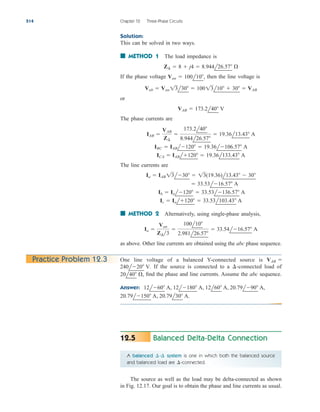
P  269 W, Q  150 VAR (capacitive)
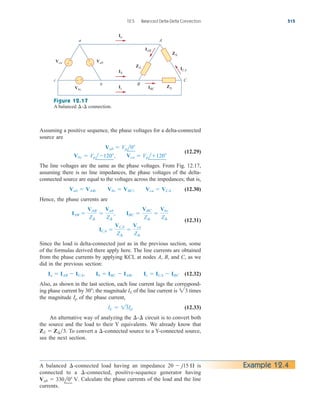
I  10l60 A rms, Z  100l45 
V  80l60 V rms, Z  50l30 
i(t)  4 cos(377t  45) A
v(t)  160 cos 377t V,
i(t)  4 cos(t  50) A
v(t)  112 cos(t  10) V,
V  160l45 V rms, I  8.5l90 A rms
V  120l0 V rms, I  2.4l15 A rms
I  6.2l25 A rms
V  250l10 V rms,
V  220l30 V rms, I  0.5l60 A rms
i(t)  1  0.5 sin 100t A
v(t)  20  60 cos 100t V
ale29559_ch11.qxd 07/08/2008 12:02 PM Page 495
11.49 Find the complex power for the following cases:
(a)
(b)
(c)
(d)
11.50 Obtain the overall impedance for the following cases:
(a)
(b)
(c)
11.51 For the entire circuit in Fig. 11.70, calculate:
(a) the power factor
(b) the average power delivered by the source
(c) the reactive power
(d) the apparent power
(e) the complex power
S  4500l60 VA, V  120l45 V
Irms  12 A
P  1500 W, Q  2000 VAR (inductive),
Vrms  220 V
P  1000 W, pf  0.8 (leading),
Vrms  120l30 V, Z  40  j60 
Vrms  208l20 V, Irms  6.5l50 A
S  2 kVA, P  1.6 kW (capacitive)
P  4 kW, pf  0.86 (lagging)
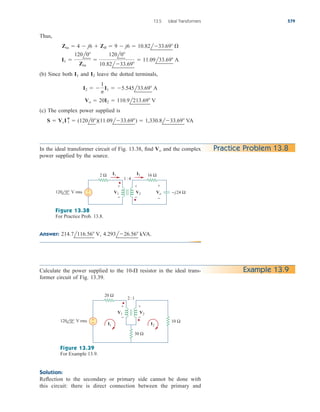
Section 11.7 Conservation of AC Power
11.54 For the network in Fig. 11.73, find the complex
power absorbed by each element.
496 Chapter 11 AC Power Analysis
2 Ω
10 Ω
+
−
−j5 Ω j6 Ω
8 Ω
120 45° V
Figure 11.70
For Prob. 11.51.
11.52 In the circuit of Fig. 11.71, device A receives 2 kW
at 0.8 pf lagging, device B receives 3 kVA at 0.4 pf
leading, while device C is inductive and consumes
1 kW and receives 500 VAR.
(a) Determine the power factor of the entire system.
(b) Find I given that Vs  240l45 V rms.
B
I
Vs C
A
+
–
Figure 11.71
For Prob. 11.52.
11.53 In the circuit of Fig. 11.72, load A receives 4 kVA
at 0.8 pf leading. Load B receives 2.4 kVA at 0.6 pf
lagging. Box C is an inductive load that consumes
1 kW and receives 500 VAR.
(a) Determine I.
(b) Calculate the power factor of the combination.
120 30° V
+
–
I
A
C
B
Figure 11.72
For Prob. 11.53.
Figure 11.73
For Prob. 11.54.
11.55 Using Fig. 11.74, design a problem to help other
students better understand the conservation of AC
power.
Figure 11.74
For Prob. 11.55.
11.56 Obtain the complex power delivered by the source in
the circuit of Fig. 11.75.
Figure 11.75
For Prob. 11.56.
4 Ω
+
−
−j3 Ω
j5 Ω
120 −20° V
+
−
+
−
R
jXL
−jXC
V2
V1
−j2 Ω
j4 Ω
5 Ω
3 Ω
10 30° Α 6 Ω
11.57 For the circuit in Fig. 11.76, find the average, reactive,
and complex power delivered by the dependent
current source.
4 Ω
1 Ω
−j1 Ω
j2 Ω
24 0° V
2 Ω
+
− 2Vo
+
−
Vo
Figure 11.76
For Prob. 11.57.
ale29559_ch11.qxd 07/08/2008 12:02 PM Page 496
11.58 Obtain the complex power delivered to the
resistor in Fig. 11.77 below.
10-k
Problems 497
11.59 Calculate the reactive power in the inductor and
capacitor in the circuit of Fig. 11.78.
11.60 For the circuit in Fig. 11.79, find and the input
power factor.
Vo
Figure 11.79
For Prob. 11.60.
Figure 11.78
For Prob. 11.59.
11.61 Given the circuit in Fig. 11.80, find and the overall
complex power supplied.
Io
Figure 11.80
For Prob. 11.61.
Figure 11.81
For Prob. 11.62.
11.62 For the circuit in Fig. 11.81, find .
Vs
+
− 10 kΩ
Io
0.6 0° V rms
500 Ω −j3 kΩ j1 kΩ
20Io 4 kΩ
Figure 11.77
For Prob. 11.58.
−j20 Ω
j30 Ω
50 Ω
240 0° V 4 0° A 40 Ω
+
−
12 0° A rms
+
−
Vo
20 kW
0.8 pf lagging
16 kW
0.9 pf lagging
200 90° V 2 kVA
0.707 pf leading
1.2 kW
0.8 kVAR (cap)
4 kW
0.9 pf lagging
Io
+
−
V
s
+
−
120 V rms
10 W
0.9 pf lagging
15 W
0.8 pf leading
0.2 Ω 0.3 Ω
j0.04 Ω j0.15 Ω
+
−
11.63 Find in the circuit of Fig. 11.82.
Io
110 0° V
12 kW
0.866 pf leading
20 kVAR
0.6 pf lagging
16 kW
0.85 pf lagging
Io
+
−
Figure 11.82
For Prob. 11.63.
ale29559_ch11.qxd 07/08/2008 12:02 PM Page 497
11.64 Determine in the circuit of Fig. 11.83, if the
voltage source supplies 2.5 kW and 0.4 kVAR
(leading).
Is 11.68 Compute the complex power supplied by the current
source in the series RLC circuit in Fig. 11.87.
498 Chapter 11 AC Power Analysis
Figure 11.83
For Prob. 11.64.
8 Ω
j12 Ω
120 0° V
+
−
Is
11.65 In the op amp circuit of Fig. 11.84,
Find the average power delivered to the
resistor.
50-k
vs  4 cos104
t V.
+
−
100 kΩ
+
−
vs 50 kΩ
1 nF
Figure 11.84
For Prob. 11.65.
Figure 11.85
For Prob. 11.66.
11.66 Obtain the average power absorbed by the
resistor in the op amp circuit in Fig. 11.85.
6-k
+
−
4 kΩ j3 kΩ
−j2 kΩ
j4 kΩ
+
−
6 kΩ
2 kΩ
2 45° V
11.67 For the op amp circuit in Fig. 11.86, calculate:
(a) the complex power delivered by the voltage source
(b) the average power dissipated in the resistor
12-
4 Ω 1.5 H
10 Ω
12 Ω
+
−
0.6 sin(2t + 20°) V
0.1 F
+
−
Figure 11.86
For Prob. 11.67.
Figure 11.87
For Prob. 11.68.
Section 11.8 Power Factor Correction
11.69 Refer to the circuit shown in Fig. 11.88.
(a) What is the power factor?
(b) What is the average power dissipated?
(c) What is the value of the capacitance that will give
a unity power factor when connected to the load?
Figure 11.88
For Prob. 11.69.
11.70 Design a problem to help other students better
understand power factor correction.
11.71 Three loads are connected in parallel to a
source. Load 1 absorbs 60 kVAR
at lagging, load 2 absorbs 90 kW and
50 kVAR leading, and load 3 absorbs 100 kW at
(a) Find the equivalent impedance.
(b) Calculate the power factor of the parallel
combination. (c) Determine the current supplied
by the source.
11.72 Two loads connected in parallel draw a total of
2.4 kW at 0.8 pf lagging from a 120-V rms, 60-Hz
line. One load absorbs 1.5 kW at a 0.707 pf lagging.
Determine: (a) the pf of the second load, (b) the
parallel element required to correct the pf to
0.9 lagging for the two loads.
11.73 A 240-V rms 60-Hz supply serves a load that is
10 kW (resistive), 15 kVAR (capacitive), and 22 kVAR
(inductive). Find:
(a) the apparent power
(b) the current drawn from the supply
(c) the kVAR rating and capacitance required to
improve the power factor to 0.96 lagging
(d) the current drawn from the supply under the new
power-factor conditions
pf  1.
pf  0.85
120l0 V rms
L
R
Io cos t C
Z = 10 + j12 Ω
+
− C
120 V rms
60 Hz
ale29559_ch11.qxd 07/08/2008 12:02 PM Page 498
11.74 A 120-V rms 60-Hz source supplies two loads
connected in parallel, as shown in Fig. 11.89.
(a) Find the power factor of the parallel combination.
(b) Calculate the value of the capacitance connected
in parallel that will raise the power factor to unity.
11.78 Find the wattmeter reading of the circuit shown in
Fig. 11.93.
Problems 499
Load 1
24 kW
pf = 0.8
lagging
Load 2
40 kW
pf = 0.95
lagging
Figure 11.89
For Prob. 11.74.
11.75 Consider the power system shown in Fig. 11.90.
Calculate:
(a) the total complex power
(b) the power factor
Figure 11.90
For Prob. 11.75.
Section 11.9 Applications
11.76 Obtain the wattmeter reading of the circuit in
Fig. 11.91.
Figure 11.91
For Prob. 11.76.
11.77 What is the reading of the wattmeter in the network
of Fig. 11.92?
+
−
240 V rms, 50 Hz
80 − j50 Ω
120 + j70 Ω
60 + j0
4 Ω −j3 Ω
j2 Ω 8 Ω
+
−
12 0° V 3 30° A
±
±
6 Ω 4 H
15 Ω
0.1 F
+
−
120 cos 2t V
±
±
Figure 11.92
For Prob. 11.77.
10 Ω
4 Ω
+
−
5 Ω 1 H
20 cos 4t V
±
±
F
1
12
Figure 11.93
For Prob. 11.78.
11.79 Determine the wattmeter reading of the circuit in
Fig. 11.94.
20 Ω
40 Ω
+
−
i
2 i
10 cos100t
10 mH
500 F
±
±
Figure 11.94
For Prob. 11.79.
11.80 The circuit of Fig. 11.95 portrays a wattmeter
connected into an ac network.
(a) Find the load current.
(b) Calculate the wattmeter reading.
ZL = 6.4 Ω
pf = 0.825
+
−
110 V
WM
Figure 11.95
For Prob. 11.80.
ale29559_ch11.qxd 07/08/2008 12:02 PM Page 499
11.81 Designaproblemtohelpotherstudentsbetterunderstand
how to correct power factor to values other than unity.
11.82 A 240-V rms 60-Hz source supplies a parallel combi-
nation of a 5-kW heater and a 30-kVA induction
motor whose power factor is 0.82. Determine:
(a) the system apparent power
(b) the system reactive power
(c) the kVA rating of a capacitor required to adjust
the system power factor to 0.9 lagging
(d) the value of the capacitor required
11.83 Oscilloscope measurements indicate that the peak
voltage across a load and the peak current through
it are, respectively, and .
Determine:
(a) the real power
(b) the apparent power
(c) the reactive power
(d) the power factor
11.84 A consumer has an annual consumption of 1200
MWh with a maximum demand of 2.4 MVA. The
maximum demand charge is $30 per kVA per annum,
and the energy charge per kWh is 4 cents.
(a) Determine the annual cost of energy.
8l25 A
210l60 V
(b) Calculate the charge per kWh with a flat-rate
tariff if the revenue to the utility company is to
remain the same as for the two-part tariff.
11.85 A regular household system of a single-phase three-
wire circuit allows the operation of both 120-V and
240-V, 60-Hz appliances. The household circuit is
modeled as shown in Fig. 11.96. Calculate:
(a) the currents and
(b) the total complex power supplied
(c) the overall power factor of the circuit
In
I2,
I1,
500 Chapter 11 AC Power Analysis
I2
I1
In
10 Ω
30 Ω
10 Ω
+
−
+
−
15 mH
120 0° V Lamp
Refrigerator
Kitchen ramp
120 0° V
Figure 11.96
For Prob. 11.85.
Comprehensive Problems
11.86 A transmitter delivers maximum power to an antenna
when the antenna is adjusted to represent a load of
resistance in series with an inductance of
If the transmitter operates at 4.12 MHz, find
its internal impedance.
11.87 In a TV transmitter, a series circuit has an impedance
of and a total current of 50 mA. If the voltage
across the resistor is 80 V, what is the power factor
of the circuit?
11.88 A certain electronic circuit is connected to a 110-V
ac line. The root-mean-square value of the current
drawn is 2 A, with a phase angle of
(a) Find the true power drawn by the circuit.
(b) Calculate the apparent power.
11.89 An industrial heater has a nameplate that reads:
210 V 60 Hz 12 kVA 0.78 pf lagging
Determine:
(a) the apparent and the complex power
(b) the impedance of the heater
*11.90 A 2000-kW turbine-generator of 0.85 power factor
operates at the rated load. An additional load of
300 kW at 0.8 power factor is added.What kVAR
55.
3 k
4 mH.
75-
of capacitors is required to operate the turbine-
generator but keep it from being overloaded?
11.91 The nameplate of an electric motor has the following
information:
Line voltage: 220 V rms
Line current: 15 A rms
Line frequency: 60 Hz
Power: 2700 W
Determine the power factor (lagging) of the motor.
Find the value of the capacitance C that must be
connected across the motor to raise the pf to unity.
11.92 As shown in Fig. 11.97, a 550-V feeder line supplies
an industrial plant consisting of a motor drawing
60 kW at 0.75 pf (inductive), a capacitor with a
rating of 20 kVAR, and lighting drawing 20 kW.
(a) Calculate the total reactive power and apparent
power absorbed by the plant.
(b) Determine the overall pf.
(c) Find the current in the feeder line.
* An asterisk indicates a challenging problem.
ale29559_ch11.qxd 07/08/2008 12:02 PM Page 500
11.96 A power amplifier has an output impedance of
It produces a no-load output voltage of
146 V at 300 Hz.
(a) Determine the impedance of the load that
achieves maximum power transfer.
(b) Calculate the load power under this matching
condition.
11.97 A power transmission system is modeled as shown in
Fig. 11.99. If find the average
power absorbed by the load.
Vs  240l0 rms,
40  j8 .
Comprehensive Problems 501
60 kW
pf = 0.75
550 V 20 kVAR 20 kW
+
−
Figure 11.97
For Prob. 11.92.
11.93 A factory has the following four major loads:
• A motor rated at 5 hp, 0.8 pf lagging
( ).
• A heater rated at 1.2 kW, 1.0 pf.
• Ten 120-W lightbulbs.
• A synchronous motor rated at 1.6 kVAR, 0.6 pf
leading.
(a) Calculate the total real and reactive power.
(b) Find the overall power factor.
11.94 A 1-MVA substation operates at full load at 0.7 power
factor. It is desired to improve the power factor to 0.95
by installing capacitors. Assume that new substation
and distribution facilities cost $120 per kVA installed,
and capacitors cost $30 per kVA installed.
(a) Calculate the cost of capacitors needed.
(b) Find the savings in substation capacity released.
(c) Are capacitors economical for releasing the
amount of substation capacity?
11.95 A coupling capacitor is used to block dc current from
an amplifier as shown in Fig. 11.98(a). The amplifier
and the capacitor act as the source, while the speaker
is the load as in Fig. 11.98(b).
(a) At what frequency is maximum power
transferred to the speaker?
(b) If how much power is delivered
to the speaker at that frequency?
Vs  4.6 V rms,
1 hp  0.7457 kW
Amplifier
Vin Speaker
Coupling capacitor
(a)
10 Ω 40 nF
80 mH
4 Ω
vs
Amplifier Speaker
(b)
Figure 11.98
For Prob. 11.95.
0.1 Ω
0.1 Ω
j1 Ω
j1 Ω
+
−
j20 Ω
100 Ω
Vs
Source Line Load
Figure 11.99
For Prob. 11.97.
ale29559_ch11.qxd 07/08/2008 12:02 PM Page 501
ale29559_ch11.qxd 07/08/2008 12:02 PM Page 502
503
Three-Phase Circuits
He who cannot forgive others breaks the bridge over which he must
pass himself.
—G. Herbert
c h a p t e r
12
Enhancing Your Skills and Your Career
ABET EC 2000 criteria (3.e), “an ability to identify, formulate,
and solve engineering problems.”
Developing and enhancing your “ability to identify, formulate, and
solve engineering problems” is a primary focus of textbook. Follow-
ing our six step problem-solving process is the best way to practice
this skill. Our recommendation is that you use this process whenever
possible. You may be pleased to learn that this process works well for
nonengineering courses.
ABET EC 2000 criteria (f), “an understanding of professional
and ethical responsibility.”
“An understanding of professional and ethical responsibility” is required
of every engineer. To some extent, this understanding is very personal
for each of us. Let us identify some pointers to help you develop this
understanding. One of my favorite examples is that an engineer has the
responsibility to answer what I call the “unasked question.” For
instance, assume that you own a car that has a problem with the trans-
mission. In the process of selling that car, the prospective buyer asks
you if there is a problem in the right-front wheel bearing. You answer
no. However, as an engineer, you are required to inform the buyer that
there is a problem with the transmission without being asked.
Your responsibility both professionally and ethically is to perform
in a manner that does not harm those around you and to whom you are
responsible. Clearly, developing this capability will take time and matu-
rity on your part. I recommend practicing this by looking for profes-
sional and ethical components in your day-to-day activities.
Photo by Charles Alexander
ale29559_ch12.qxd 07/08/2008 12:05 PM Page 503
Introduction
So far in this text, we have dealt with single-phase circuits. A single-phase
ac power system consists of a generator connected through a pair of wires
(a transmission line) to a load. Figure 12.1(a) depicts a single-phase two-
wire system, where is the rms magnitude of the source voltage and
is the phase. What is more common in practice is a single-phase three-
wire system, shown in Fig. 12.1(b). It contains two identical sources
(equal magnitude and the same phase) that are connected to two loads by
two outer wires and the neutral. For example, the normal household sys-
tem is a single-phase three-wire system because the terminal voltages
have the same magnitude and the same phase. Such a system allows the
connection of both 120-V and 240-V appliances.
f
Vp
12.1
504 Chapter 12 Three-Phase Circuits
ZL
Vp
+
−
(a)

ZL1
Vp
a A
n N
b B
+
−
(b)

ZL2
Vp
+
−

Figure 12.1
Single-phase systems: (a) two-wire type, (b) three-wire type.
Circuits or systems in which the ac sources operate at the same fre-
quency but different phases are known as polyphase. Figure 12.2 shows
a two-phase three-wire system, and Fig. 12.3 shows a three-phase four-
wire system. As distinct from a single-phase system, a two-phase system
is produced by a generator consisting of two coils placed perpendicular
to each other so that the voltage generated by one lags the other by
By the same token, a three-phase system is produced by a generator con-
sisting of three sources having the same amplitude and frequency but out
of phase with each other by Since the three-phase system is by far
the most prevalent and most economical polyphase system, discussion in
this chapter is mainly on three-phase systems.
Three-phase systems are important for at least three reasons. First,
nearly all electric power is generated and distributed in three-phase, at
the operating frequency of 60 Hz (or ) in the United
States or 50 Hz (or ) in some other parts of the world.
When one-phase or two-phase inputs are required, they are taken from
the three-phase system rather than generated independently. Even when
more than three phases are needed—such as in the aluminum industry,
where 48 phases are required for melting purposes—they can be provided
by manipulating the three phases supplied. Second, the instantaneous
power in a three-phase system can be constant (not pulsating), as we
will see in Section 12.7. This results in uniform power transmission
and less vibration of three-phase machines. Third, for the same amount
of power, the three-phase system is more economical than the single-
phase. The amount of wire required for a three-phase system is less
than that required for an equivalent single-phase system.
  314 rad/s
  377 rad/s
120.
90.
Historical note: Thomas Edison invented
a three-wire system, using three wires
instead of four.
ZL1
Vp
a A
n N
b B
+
−
ZL2
+
−
−90°
Vp 0°
ZL1
a A
b B
c C
n N
Vp 0°
− +
ZL2
Vp −120°
Vp +120°
− +
ZL3
− +
Figure 12.2
Two-phase three-wire system.
Figure 12.3
Three-phase four-wire system.
ale29559_ch12.qxd 07/08/2008 12:05 PM Page 504
We begin with a discussion of balanced three-phase voltages. Then
we analyze each of the four possible configurations of balanced three-
phase systems. We also discuss the analysis of unbalanced three-phase
systems. We learn how to use PSpice for Windows to analyze a bal-
anced or unbalanced three-phase system. Finally, we apply the concepts
developed in this chapter to three-phase power measurement and resi-
dential electrical wiring.
Balanced Three-Phase Voltages
Three-phase voltages are often produced with a three-phase ac gener-
ator (or alternator) whose cross-sectional view is shown in Fig. 12.4.
The generator basically consists of a rotating magnet (called the rotor)
surrounded by a stationary winding (called the stator). Three separate
12.2
12.2 Balanced Three-Phase Voltages 505
Nikola Tesla (1856–1943) was a Croatian-American engineer whose
inventions—among them the induction motor and the first polyphase ac
power system—greatly influenced the settlement of the ac versus dc de-
bate in favor of ac. He was also responsible for the adoption of 60 Hz as
the standard for ac power systems in the United States.
Born in Austria-Hungary (now Croatia), to a clergyman, Tesla had
an incredible memory and a keen affinity for mathematics. He moved
to the United States in 1884 and first worked for Thomas Edison. At
that time, the country was in the “battle of the currents” with George
Westinghouse (1846–1914) promoting ac and Thomas Edison rigidly
leading the dc forces. Tesla left Edison and joined Westinghouse
because of his interest in ac. Through Westinghouse, Tesla gained the
reputation and acceptance of his polyphase ac generation, transmission,
and distribution system. He held 700 patents in his lifetime. His other
inventions include high-voltage apparatus (the tesla coil) and a wire-
less transmission system. The unit of magnetic flux density, the tesla,
was named in honor of him.
Historical
Stator
Three-
phase
output
a
b
c
n
c
N
S
b′
c′
b
a
a′
Rotor
Figure 12.4
A three-phase generator.
Courtesy Smithsonian
Institution
ale29559_ch12.qxd 07/08/2008 12:05 PM Page 505
windings or coils with terminals and are physically
placed apart around the stator. Terminals a and for example,
stand for one of the ends of coils going into and the other end coming
out of the page. As the rotor rotates, its magnetic field “cuts” the flux
from the three coils and induces voltages in the coils. Because the coils
are placed apart, the induced voltages in the coils are equal in
magnitude but out of phase by (Fig. 12.5). Since each coil can be
regarded as a single-phase generator by itself, the three-phase genera-
tor can supply power to both single-phase and three-phase loads.
A typical three-phase system consists of three voltage sources con-
nected to loads by three or four wires (or transmission lines). (Three-
phase current sources are very scarce.) A three-phase system is
equivalent to three single-phase circuits. The voltage sources can be
either wye-connected as shown in Fig. 12.6(a) or delta-connected as in
Fig. 12.6(b).
120
120
a¿,
120
c-c¿
a-a¿, b-b¿,
506 Chapter 12 Three-Phase Circuits
0
120°
Van
t
Vbn Vcn
240°
Figure 12.5
The generated voltages are apart
from each other.
120
+
−
+
−
+
−
(a)
a
Van
Vbn
Vcn
Vca Vab
Vbc
n
b
c
+
−
+
−
(b)
a
b
c
− +
Figure 12.6
Three-phase voltage sources: (a) Y-connected source, (b) -connected
source.
¢
Let us consider the wye-connected voltages in Fig. 12.6(a) for
now. The voltages and are respectively between lines a, b,
and c, and the neutral line n. These voltages are called phase voltages.
If the voltage sources have the same amplitude and frequency and
are out of phase with each other by the voltages are said to be
balanced. This implies that
(12.1)
(12.2)
Thus,
0Van 0  0Vbn 0  0Vcn 0
Van  Vbn  Vcn  0
120,

Vcn
Van, Vbn,
Balanced phase voltages are equal in magnitude and are out of phase
with each other by 120.
Since the three-phase voltages are out of phase with each
other, there are two possible combinations. One possibility is shown in
Fig. 12.7(a) and expressed mathematically as
(12.3)
Vcn  Vpl240  Vpl120
Vbn  Vpl120
Van  Vpl0
120
120°
Vcn
Van
Vbn
120°
−120°
(a)
120°
Vbn
Van
Vcn
120°
−120°
(b)


Figure 12.7
Phase sequences: (a) abc or positive
sequence, (b) acb or negative sequence.
ale29559_ch12.qxd 07/08/2008 12:05 PM Page 506
where is the effective or rms value of the phase voltages. This is
known as the abc sequence or positive sequence. In this phase sequence,
leads which in turn leads This sequence is produced when
the rotor in Fig. 12.4 rotates counterclockwise. The other possibility is
shown in Fig. 12.7(b) and is given by
(12.4)
This is called the acb sequence or negative sequence. For this phase
sequence, leads which in turn leads The acb sequence is
produced when the rotor in Fig. 12.4 rotates in the clockwise direction.
It is easy to show that the voltages in Eqs. (12.3) or (12.4) satisfy
Eqs. (12.1) and (12.2). For example, from Eq. (12.3),
(12.5)
 0
 Vp(1.0  0.5  j0.866  0.5  j0.866)
Van  Vbn  Vcn  Vpl0  Vpl120  Vpl120
Vbn.
Vcn,
Van
Vbn  Vpl240  Vpl120
Vcn  Vpl120
Van  Vpl0
Vcn.
Vbn,
Van
Vp
12.2 Balanced Three-Phase Voltages 507
As a common tradition in power
systems, voltage and current in this
chapter are in rms values unless
otherwise stated.
Reminder: As time increases, each
phasor (or sinor) rotates at an angular
velocity .

The phase sequence is the time order in which the voltages pass
through their respective maximum values.
The phase sequence is determined by the order in which the phasors
pass through a fixed point in the phase diagram.
In Fig. 12.7(a), as the phasors rotate in the counterclockwise
direction with frequency they pass through the horizontal axis in a
sequence Thus, the sequence is abc or bca or cab. Sim-
ilarly, for the phasors in Fig. 12.7(b), as they rotate in the counter-
clockwise direction, they pass the horizontal axis in a sequence
This describes the acb sequence. The phase sequence is
important in three-phase power distribution. It determines the direc-
tion of the rotation of a motor connected to the power source, for
example.
Like the generator connections, a three-phase load can be either
wye-connected or delta-connected, depending on the end application.
Figure 12.8(a) shows a wye-connected load, and Fig. 12.8(b) shows a
delta-connected load. The neutral line in Fig. 12.8(a) may or may not
be there, depending on whether the system is four- or three-wire. (And,
of course, a neutral connection is topologically impossible for a delta
connection.) A wye- or delta-connected load is said to be unbalanced
if the phase impedances are not equal in magnitude or phase.
acbacba . . . .
abcabca . . . .
,
The phase sequence may also be re-
garded as the order in which the phase
voltages reach their peak (or maximum)
values with respect to time.
a
b
n
c
(a)
Z2
Z1
Z3
a
b
c
(b)
Zb
Zc
Za
Figure 12.8
Two possible three-phase load configura-
tions: (a) a Y-connected load, (b) a
-connected load.
¢
A balanced load is one in which the phase impedances are equal in
magnitude and in phase.
For a balanced wye-connected load,
(12.6)
Z1  Z2  Z3  ZY
ale29559_ch12.qxd 07/08/2008 12:05 PM Page 507
where is the load impedance per phase. For a balanced delta-
connected load,
(12.7)
where is the load impedance per phase in this case. We recall from
Eq. (9.69) that
(12.8)
so we know that a wye-connected load can be transformed into a delta-
connected load, or vice versa, using Eq. (12.8).
Since both the three-phase source and the three-phase load can be
either wye- or delta-connected, we have four possible connections:
• Y-Y connection (i.e., Y-connected source with a Y-connected
load).
• connection.
• connection.
• -Y connection.
In subsequent sections, we will consider each of these possible con-
figurations.
It is appropriate to mention here that a balanced delta-connected
load is more common than a balanced wye-connected load. This is due
to the ease with which loads may be added or removed from each phase
of a delta-connected load. This is very difficult with a wye-connected
load because the neutral may not be accessible. On the other hand,
delta-connected sources are not common in practice because of the cir-
culating current that will result in the delta-mesh if the three-phase volt-
ages are slightly unbalanced.
¢
¢-¢
Y-¢
Z¢  3ZY or ZY 
1
3
Z¢
Z¢
Za  Zb  Zc  Z¢
ZY
508 Chapter 12 Three-Phase Circuits
Reminder: A Y-connected load consists
of three impedances connected to a
neutral node, while a -connected
load consists of three impedances
connected around a loop. The load is
balanced when the three impedances
are equal in either case.
¢
Example 12.1 Determine the phase sequence of the set of voltages
Solution:
The voltages can be expressed in phasor form as
We notice that leads by and in turn leads by
Hence, we have an acb sequence.
120.
Vbn
Vcn
120
Vcn
Van
Van  200l10 V, Vbn  200l230 V, Vcn  200l110 V
vbn  200 cos(t  230), vcn  200 cos(t  110)
van  200 cos(t  10)
Practice Problem 12.1 Given that find and assuming a positive
(abc) sequence.
Answer: 110l150 V, 110l90 V.
Vcn,
Van
Vbn  110l30 V,
ale29559_ch12.qxd 07/08/2008 12:05 PM Page 508
Balanced Wye-Wye Connection
We begin with the Y-Y system, because any balanced three-phase sys-
tem can be reduced to an equivalent Y-Y system. Therefore, analysis
of this system should be regarded as the key to solving all balanced
three-phase systems.
12.3
12.3 Balanced Wye-Wye Connection 509
A balanced Y-Y system is a three-phase system with a balanced
Y-connected source and a balanced Y-connected load.
Consider the balanced four-wire Y-Y system of Fig. 12.9, where a
Y-connected load is connected to a Y-connected source. We assume a
balanced load so that load impedances are equal. Although the imped-
ance is the total load impedance per phase, it may also be regarded
as the sum of the source impedance line impedance and load
impedance for each phase, since these impedances are in series. As
illustrated in Fig. 12.9, denotes the internal impedance of the phase
winding of the generator; is the impedance of the line joining a
phase of the source with a phase of the load; is the impedance of
each phase of the load; and is the impedance of the neutral line.
Thus, in general
(12.9)
ZY  Zs  Z/  ZL
Zn
ZL
Z/
Zs
ZL
Z/,
Zs,
ZY
+
−
Zl
Zl
Zl
Zn
Zs
Zs Zs
ZL
ZL
ZL
Van
Vcn Vbn
A
N
B
C
b
n
c
a
+
−
+
−
+
− ZY
ZY
ZY
Van
Vcn Vbn
A
N
B
C
b
n
c
a
In
Ib
Ia
Ic
+
−
+
−
Figure 12.9
A balanced Y-Y system, showing the source, line,
and load impedances.
Figure 12.10
Balanced Y-Y connection.
and are often very small compared with so one can assume
that if no source or line impedance is given. In any event, by
lumping the impedances together, the Y-Y system in Fig. 12.9 can be
simplified to that shown in Fig. 12.10.
Assuming the positive sequence, the phase voltages (or line-to-
neutral voltages) are
(12.10)
Vbn  Vpl120, Vcn  Vpl120
Van  Vpl0
ZY  ZL
ZL,
Z/
Zs
ale29559_ch12.qxd 07/08/2008 12:05 PM Page 509
The line-to-line voltages or simply line voltages and are
related to the phase voltages. For example,
(12.11a)
Similarly, we can obtain
(12.11b)
(12.11c)
Thus, the magnitude of the line voltages is times the magnitude
of the phase voltages or
(12.12)
where
(12.13)
and
(12.14)
Also the line voltages lead their corresponding phase voltages by
Figure 12.11(a) illustrates this. Figure 12.11(a) also shows how to
determine from the phase voltages, while Fig. 12.11(b) shows the
same for the three line voltages. Notice that leads by and
leads by so that the line voltages sum up to zero as do
the phase voltages.
Applying KVL to each phase in Fig. 12.10, we obtain the line cur-
rents as
(12.15)
We can readily infer that the line currents add up to zero,
(12.16)
so that
(12.17a)
or
(12.17b)
that is, the voltage across the neutral wire is zero. The neutral line can
thus be removed without affecting the system. In fact, in long distance
power transmission, conductors in multiples of three are used with the
earth itself acting as the neutral conductor. Power systems designed in
this way are well grounded at all critical points to ensure safety.
While the line current is the current in each line, the phase current
is the current in each phase of the source or load. In the Y-Y system, the
line current is the same as the phase current. We will use single subscripts
VnN  ZnIn  0
In  (Ia  Ib  Ic)  0
Ia  Ib  Ic  0
Ic 
Vcn
ZY

Vanl240
ZY
 Ial240
Ia 
Van
ZY
, Ib 
Vbn
ZY

Vanl120
ZY
 Ial120
120,
Vca
Vbc
120,
Vbc
Vab
Vab
30.
VL  0Vab 0  0Vbc 0  0Vca 0
Vp  0Van 0  0Vbn 0  0Vcn 0
VL  13Vp
Vp,
13
VL
Vca  Vcn  Van  13Vpl210
Vbc  Vbn  Vcn  13Vpl90
 Vp a1 
1
2
 j
13
2
)  13Vpl30
Vab  Van  Vnb  Van  Vbn  Vpl0  Vpl120
Vca
Vbc,
Vab,
510 Chapter 12 Three-Phase Circuits
(a)
30°
Vcn
Vnb Vab = Van + Vnb
Van
Vbn
(b)
Vca Vcn Vab
Van
Vbc
Vbn
Figure 12.11
Phasor diagrams illustrating the relation-
ship between line voltages and phase
voltages.
ale29559_ch12.qxd 07/08/2008 12:05 PM Page 510
for line currents because it is natural and conventional to assume that line
currents flow from the source to the load.
An alternative way of analyzing a balanced Y-Y system is to do
so on a “per phase” basis. We look at one phase, say phase a, and ana-
lyze the single-phase equivalent circuit in Fig. 12.12. The single-phase
analysis yields the line current as
(12.18)
From we use the phase sequence to obtain other line currents. Thus,
as long as the system is balanced, we need only analyze one phase.
We may do this even if the neutral line is absent, as in the three-wire
system.
Ia,
Ia 
Van
ZY
Ia
12.3 Balanced Wye-Wye Connection 511
ZY
Van
+
−
a A
n N
Ia
Figure 12.12
A single-phase equivalent circuit.
Calculate the line currents in the three-wire Y-Y system of Fig. 12.13. Example 12.2
+
−
5 – j2 Ω
10 + j8 Ω
10 + j8 Ω
A
B
c
b
a
5 – j2 Ω 10 + j8 Ω
C
5 – j2 Ω
110 −120° V
110 −240° V
110 0° V
+
−
+
−
Figure 12.13
Three-wire Y-Y system; for Example 12.2.
Solution:
The three-phase circuit in Fig. 12.13 is balanced; we may replace it
with its single-phase equivalent circuit such as in Fig. 12.12. We obtain
from the single-phase analysis as
where Hence,
Since the source voltages in Fig. 12.13 are in positive sequence, the
line currents are also in positive sequence:
Ic  Ial240  6.81l261.8 A  6.81l98.2 A
Ib  Ial120  6.81l141.8 A
Ia 
110l0
16.155l21.8
 6.81l21.8 A
ZY  (5  j2)  (10  j8)  15  j6  16.155l21.8.
Ia 
Van
ZY
Ia
ale29559_ch12.qxd 07/08/2008 12:05 PM Page 511
Balanced Wye-Delta Connection
12.4
512 Chapter 12 Three-Phase Circuits
A Y-connected balanced three-phase generator with an impedance of
per phase is connected to a Y-connected balanced load
with an impedance of per phase. The line joining the gen-
erator and the load has an impedance of per phase.
Assuming a positive sequence for the source voltages and that
find: (a) the line voltages, (b) the line currents.
Answer: (a)
(b) 3.75l8.66 A, 3.75l128.66 A, 3.75l111.34 A.
207.85l60 V, 207.85l60 V, 207.85l180 V,
120l30 V,
Van 
0.6  j0.7 
24  j19 
0.4  j0.3 
Practice Problem 12.2
A balanced Y- system consists of a balanced Y-connected source
feeding a balanced -connected load.
¢
¢
The balanced Y-delta system is shown in Fig. 12.14, where the
source is Y-connected and the load is -connected. There is, of course,
no neutral connection from source to load for this case. Assuming the
positive sequence, the phase voltages are again
(12.19)
As shown in Section 12.3, the line voltages are
(12.20)
showing that the line voltages are equal to the voltages across the load
impedances for this system configuration. From these voltages, we can
obtain the phase currents as
(12.21)
These currents have the same magnitude but are out of phase with each
other by 120.
IAB 
VAB
Z¢
, IBC 
VBC
Z¢
, ICA 
VCA
Z¢
Vca  13Vpl150  VCA
Vab  13Vpl30  VAB, Vbc  13Vpl90  VBC
Vbn  Vpl120, Vcn  Vpl120
Van  Vpl0
¢
+
−
Z∆
Z∆
Z∆
Van
Vcn Vbn
IAB
ICA
A
C
b
c
B
n
a
+
−
+
−
Ia
Ib
IBC
Ic
Figure 12.14
Balanced Y- connection.
¢
This is perhaps the most practical
three-phase system, as the three-phase
sources are usually Y-connected while
the three-phase loads are usually
-connected.
¢
ale29559_ch12.qxd 07/08/2008 12:05 PM Page 512
Another way to get these phase currents is to apply KVL. For
example, applying KVL around loop aABbna gives
or
(12.22)
which is the same as Eq. (12.21). This is the more general way of find-
ing the phase currents.
The line currents are obtained from the phase currents by apply-
ing KCL at nodes A, B, and C. Thus,
(12.23)
Since
(12.24)
showing that the magnitude of the line current is times the mag-
nitude of the phase current, or
(12.25)
where
(12.26)
and
(12.27)
Also, the line currents lag the corresponding phase currents by
assuming the positive sequence. Figure 12.15 is a phasor diagram illus-
trating the relationship between the phase and line currents.
An alternative way of analyzing the circuit is to transform
the -connected load to an equivalent Y-connected load. Using the
transformation formula in Eq. (12.8),
(12.28)
After this transformation, we now have a Y-Y system as in Fig. 12.10.
The three-phase system in Fig. 12.14 can be replaced by the single-
phase equivalent circuit in Fig. 12.16. This allows us to calculate only
the line currents. The phase currents are obtained using Eq. (12.25) and
utilizing the fact that each of the phase currents leads the correspon-
ding line current by 30.
Y-¢
ZY 
Z¢
3
¢-Y
Y-¢
30,
Ip  0IAB 0  0IBC 0  0ICA 0
IL  0Ia 0  0Ib 0  0Ic 0
IL  13Ip
Ip
13
IL
 IAB(1  0.5  j0.866)  IAB 13l30
Ia  IAB  ICA  IAB(1  1l240)
ICA  IABl240,
Ia  IAB  ICA, Ib  IBC  IAB, Ic  ICA  IBC
IAB 
Van  Vbn
Z¢

Vab
Z¢

VAB
Z¢
Van  Z¢IAB  Vbn  0
12.4 Balanced Wye-Delta Connection 513
30°
30°
30°
ICA
IAB
Ib IBC
Ia
Ic
Figure 12.15
Phasor diagram illustrating the relationship
between phase and line currents.
Example 12.3
Van
+
−
Ia
Z∆
3
Figure 12.16
A single-phase equivalent circuit of a bal-
anced circuit.
Y-¢
A balanced abc-sequence Y-connected source with
is connected to a -connected balanced load per phase. Cal-
culate the phase and line currents.
(8  j4) 
¢
Van  100l10 V
ale29559_ch12.qxd 07/08/2008 12:05 PM Page 513
Solution:
This can be solved in two ways.
■ METHOD 1 The load impedance is
If the phase voltage then the line voltage is
or
The phase currents are
The line currents are
■ METHOD 2 Alternatively, using single-phase analysis,
as above. Other line currents are obtained using the abc phase sequence.
Ia 
Van
Z¢3

100l10
2.981l26.57
 33.54l16.57 A
Ic  Ial120  33.53l103.43 A
Ib  Ial120  33.53l136.57 A
 33.53l16.57 A
Ia  IAB 13l30  13(19.36)l13.43  30
ICA  IABl120  19.36l133.43 A
IBC  IABl120  19.36l106.57 A
IAB 
VAB
Z¢

173.2l40
8.944l26.57
 19.36l13.43 A
VAB  173.2l40 V
Vab  Van 13l30  10013l10  30  VAB
Van  100l10,
Z¢  8  j4  8.944l26.57 
514 Chapter 12 Three-Phase Circuits
Practice Problem 12.3 One line voltage of a balanced Y-connected source is
If the source is connected to a -connected load of
find the phase and line currents. Assume the abc sequence.
Answer:
20.79l150 A, 20.79l30 A.
12l60 A, 12l180 A, 12l60 A, 20.79l90 A,
20l40 ,
¢
240l20 V.
VAB 
Balanced Delta-Delta Connection
12.5
A balanced system is one in which both the balanced source
and balanced load are -connected.
¢
¢-
¢
The source as well as the load may be delta-connected as shown
in Fig. 12.17. Our goal is to obtain the phase and line currents as usual.
ale29559_ch12.qxd 07/22/2008 01:38 PM Page 514
Assuming a positive sequence, the phase voltages for a delta-connected
source are
(12.29)
The line voltages are the same as the phase voltages. From Fig. 12.17,
assuming there is no line impedances, the phase voltages of the delta-
connected source are equal to the voltages across the impedances; that is,
(12.30)
Hence, the phase currents are
(12.31)
Since the load is delta-connected just as in the previous section, some
of the formulas derived there apply here. The line currents are obtained
from the phase currents by applying KCL at nodes A, B, and C, as we
did in the previous section:
(12.32)
Also, as shown in the last section, each line current lags the correspond-
ing phase current by the magnitude of the line current is times
the magnitude of the phase current,
(12.33)
An alternative way of analyzing the circuit is to convert both
the source and the load to their Y equivalents. We already know that
To convert a -connected source to a Y-connected source,
see the next section.
¢
ZY  Z¢3.
¢-¢
IL  13Ip
Ip
23
IL
30;
Ia  IAB  ICA, Ib  IBC  IAB, Ic  ICA  IBC
ICA 
VCA
Z¢

Vca
Z¢
IAB 
VAB
Z¢

Vab
Z¢
, IBC 
VBC
Z¢

Vbc
Z¢
Vab  VAB, Vbc  VBC, Vca  VCA
Vbc  Vpl120, Vca  Vpl120
Vab  Vpl0
12.5 Balanced Delta-Delta Connection 515
Z∆
Z∆
Z∆
Vca
Vbc
Vab
IAB
ICA
A
C
b
c
B
a
+
−
Ia
Ib
IBC
Ic
+
−
− +
Figure 12.17
A balanced connection.
¢-¢
Example 12.4
A balanced -connected load having an impedance is
connected to a -connected, positive-sequence generator having
Calculate the phase currents of the load and the line
currents.
Vab  330l0 V.
¢
20  j15 
¢
ale29559_ch12.qxd 07/08/2008 12:05 PM Page 515
Solution:
The load impedance per phase is
Since the phase currents are
For a delta load, the line current always lags the corresponding phase
current by and has a magnitude times that of the phase current.
Hence, the line currents are
Ic  Ial120  22.86l126.87 A
Ib  Ial120  22.86l113.13 A
 22.86l6.87 A
Ia  IAB 13l30  (13.2l36.87)(13l30)
13
30
ICA  IABl120  13.2l156.87 A
IBC  IABl120  13.2l83.13 A
IAB 
VAB
Z¢

330l0
25l36.87
 13.2l36.87 A
VAB  Vab,
Z¢  20  j15  25l36.87 
516 Chapter 12 Three-Phase Circuits
A positive-sequence, balanced -connected source supplies a balanced
-connected load. If the impedance per phase of the load is
and find and
Answer: 11.094l65 A, 240l98.69 V.
VAB.
IAB
Ia  19.202l35 A,
18  j12 
¢
¢
Practice Problem 12.4
Balanced Delta-Wye Connection
12.6
A balanced -Y system consists of a balanced -connected source
feeding a balanced Y-connected load.
¢
¢
Consider the circuit in Fig. 12.18. Again, assuming the abc
sequence, the phase voltages of a delta-connected source are
(12.34)
These are also the line voltages as well as the phase voltages.
We can obtain the line currents in many ways. One way is to apply
KVL to loop aANBba in Fig. 12.18, writing
or
Thus,
(12.35)
Ia  Ib 
Vpl0
ZY
ZY(Ia  Ib)  Vab  Vpl0
Vab  ZYIa  ZYIb  0
Vca  Vpl120
Vab  Vpl0, Vbc  Vpl120
¢-Y
ale29559_ch12.qxd 07/08/2008 12:05 PM Page 516
But lags by since we assumed the abc sequence; that is,
Hence,
(12.36)
Substituting Eq. (12.36) into Eq. (12.35) gives
(12.37)
From this, we obtain the other line currents and using the posi-
tive phase sequence, i.e., The phase
currents are equal to the line currents.
Another way to obtain the line currents is to replace the delta-
connected source with its equivalent wye-connected source, as shown
in Fig. 12.19. In Section 12.3, we found that the line-to-line voltages
of a wye-connected source lead their corresponding phase voltages by
Therefore, we obtain each phase voltage of the equivalent wye-
connected source by dividing the corresponding line voltage of the
delta-connected source by and shifting its phase by Thus,
the equivalent wye-connected source has the phase voltages
(12.38)
If the delta-connected source has source impedance per phase, the
equivalent wye-connected source will have a source impedance of
per phase, according to Eq. (9.69).
Once the source is transformed to wye, the circuit becomes a wye-
wye system. Therefore, we can use the equivalent single-phase circuit
shown in Fig. 12.20, from which the line current for phase a is
(12.39)
which is the same as Eq. (12.37).
Ia 
Vp13l30
ZY
Zs3
Zs
Vbn 
Vp
13
l150, Vcn 
Vp
13
l90
Van 
Vp
13
l30
30.
13
30.
Ib  Ial120, Ic  Ial120.
Ic
Ib
Ia 
Vp13l30
ZY
 Iaa1 
1
2
 j
13
2
b  Ia 13l30
Ia  Ib  Ia(1  1l120)
Ib  Ial120.
120,
Ia
Ib
12.6 Balanced Delta-Wye Connection 517
ZY
ZY
ZY
Vca
Vbc
Vab
A
C
b
c
B
N
a
+
−
Ia
Ib
Ic
+
−
− +
Figure 12.18
A balanced connection.
¢-Y
Van
Vab
Vca
Vbn
Vbc
Vcn
a
c b
n
+
−
+ −
+ −
− +
+
−
+
−
Figure 12.19
Transforming a -connected source to an
equivalent Y-connected source.
¢
ZY
+
−
Ia
Vp −30°
√3
Figure 12.20
The single-phase equivalent circuit.
ale29559_ch12.qxd 07/08/2008 12:05 PM Page 517
Alternatively, we may transform the wye-connected load to an
equivalent delta-connected load. This results in a delta-delta system,
which can be analyzed as in Section 12.5. Note that
(12.40)
As stated earlier, the delta-connected load is more desirable than
the wye-connected load. It is easier to alter the loads in any one phase
of the delta-connected loads, as the individual loads are connected
directly across the lines. However, the delta-connected source is hardly
used in practice, because any slight imbalance in the phase voltages
will result in unwanted circulating currents.
Table 12.1 presents a summary of the formulas for phase cur-
rents and voltages and line currents and voltages for the four con-
nections. Students are advised not to memorize the formulas but to
understand how they are derived. The formulas can always be
VBN  VANl120, VCN  VANl120
VAN  IaZY 
Vp
13
l30
518 Chapter 12 Three-Phase Circuits
TABLE 12.1
Summary of phase and line voltages/currents for
balanced three-phase systems.1
Connection Phase voltages/currents Line voltages/currents
Y-Y
Same as line currents
Same as phase voltages
Same as line currents
1
Positive or abc sequence is assumed.
Ic  Ial120
Ib  Ial120
Ia 
Vpl30
13ZY
Vca  Vpl120
Vbc  Vpl120
Vab  Vpl0
¢-Y
Ic  Ial120
ICA  VcaZ¢
Ib  Ial120
IBC  VbcZ¢
Ia  IAB 13l30
IAB  VabZ¢
Vca  Vpl120
Vbc  Vpl120
Vab  Vpl0
¢-¢
Ic  Ial120
ICA  VCAZ¢
Ib  Ial120
IBC  VBCZ¢
Ia  IAB 13l30
IAB  VABZ¢
Vca  VCA  Vabl120
Vcn  Vpl120
Vbc  VBC  Vabl120
Vbn  Vpl120
Vab  VAB  13Vpl30
Van  Vpl0
Y-¢
Ic  Ial120
Ib  Ial120
Ia  VanZY
Vca  Vabl120
Vcn  Vpl120
Vbc  Vabl120
Vbn  Vpl120
Vab  13Vpl30
Van  Vpl0
ale29559_ch12.qxd 07/17/2008 11:49 AM Page 518
12.7 Power in a Balanced System 519
A balanced Y-connected load with a phase impedance of is
supplied by a balanced, positive sequence -connected source with a line
voltage of 210 V. Calculate the phase currents. Use as reference.
Solution:
The load impedance is
and the source voltage is
When the -connected source is transformed to a Y-connected source,
The line currents are
which are the same as the phase currents.
Ic  Ial120  2.57l58 A
Ib  Ial120  2.57l178 A
Ia 
Van
ZY

121.2l30
47.12l32
 2.57l62 A
Van 
Vab
13
l30  121.2l30 V
¢
Vab  210l0 V
ZY  40  j25  47.17l32 
Vab
¢
40  j25  Example 12.5
Practice Problem 12.5
In a balanced circuit, and
Calculate the line currents.
Answer: 7.21l66.34 A, 7.21l173.66 A, 7.21l53.66 A.
ZY  (12  j15) .
Vab  240l15
¢-Y
Power in a Balanced System
Let us now consider the power in a balanced three-phase system. We
begin by examining the instantaneous power absorbed by the load. This
requires that the analysis be done in the time domain. For a Y-connected
load, the phase voltages are
(12.41)
where the factor is necessary because has been defined as the rms
value of the phase voltage. If the phase currents lag behind
their corresponding phase voltages by Thus,
(12.42)
ic  12Ip cos(t  u  120)
ia  12Ip cos(t  u), ib  12Ip cos(t  u  120)
u.
ZY  Zlu,
Vp
12
vCN  12Vp cos(t  120)
vAN  12Vp cos t, vBN  12Vp cos(t  120)
12.7
obtained by directly applying KCL and KVL to the appropriate three-
phase circuits.
ale29559_ch12.qxd 07/08/2008 12:05 PM Page 519
where is the rms value of the phase current. The total instantaneous
power in the load is the sum of the instantaneous powers in the three
phases; that is,
(12.43)
Applying the trigonometric identity
(12.44)
gives
(12.45)
where
Thus the total instantaneous power in a balanced three-phase system is
constant—it does not change with time as the instantaneous power of
each phase does. This result is true whether the load is Y- or -connected.
This is one important reason for using a three-phase system to generate
and distribute power. We will look into another reason a little later.
Since the total instantaneous power is independent of time, the
average power per phase for either the -connected load or the
Y-connected load is or
(12.46)
and the reactive power per phase is
(12.47)
The apparent power per phase is
(12.48)
The complex power per phase is
(12.49)
where and are the phase voltage and phase current with magni-
tudes and respectively. The total average power is the sum of the
average powers in the phases:
(12.50)
For a Y-connected load, but whereas for a
-connected load, but Thus, Eq. (12.50) applies
for both Y-connected and -connected loads. Similarly, the total reac-
tive power is
(12.51)
Q  3VpIp sinu  3Qp  13VL IL sinu
¢
VL  Vp.
IL  13Ip
¢
VL  13Vp,
IL  Ip
P  Pa  Pb  Pc  3Pp  3VpIp cosu  13VLIL cosu
Ip,
Vp
Ip
Vp
Sp  Pp  jQp  VpI*
p
Sp  VpIp
Qp  VpIp sinu
Pp  VpIp cosu
p3,
¢
Pp
¢
 VpIp c3 cos u  cos a  2a
1
2
bcosad  3Vp Ip cos u
a  2t  u
 cos a cos 240  sin a sin 240]
 Vp Ip[3 cos u  cos a  cos a cos 240  sin a sin 240
 cos(2t  u  240)]
p  Vp Ip[3 cos u  cos(2t  u)  cos(2t  u  240)
cos A cos B 
1
2
[cos(A  B)  cos(A  B)]
 cos(t  120) cos(t  u  120)]
 cos(t  120) cos(t  u  120)
 2Vp Ip[cos t cos(t  u)
p  pa  pb  pc  vANia  vBNib  vCNic
Ip
520 Chapter 12 Three-Phase Circuits
ale29559_ch12.qxd 07/08/2008 12:05 PM Page 520
and the total complex power is
(12.52)
where is the load impedance per phase. ( could be or
) Alternatively, we may write Eq. (12.52) as
(12.53)
Remember that and are all rms values and that is the
angle of the load impedance or the angle between the phase voltage
and the phase current.
A second major advantage of three-phase systems for power dis-
tribution is that the three-phase system uses a lesser amount of wire
than the single-phase system for the same line voltage and the same
absorbed power We will compare these cases and assume in both
that the wires are of the same material (e.g., copper with resistivity ),
of the same length and that the loads are resistive (i.e., unity power
factor). For the two-wire single-phase system in Fig. 12.21(a),
so the power loss in the two wires is
(12.54)
Ploss  2IL
2
R  2R
PL
2
VL
2
IL  PLVL,
/,
r
PL.
VL
u
IL
Vp, Ip, VL,
S  P  jQ  13VL ILlu
Z¢.
ZY
Zp
Zp  Zplu
S  3Sp  3VpI*
p  3Ip
2
Zp 
3Vp
2
Z*
p
12.7 Power in a Balanced System 521
Single-
phase
source
R
R
Transmission lines
(a)
PL
IL
Load
−
+
VL
Three-
phase
balanced
load
Three-
phase
balanced
source
R′
R′
R′
Transmission lines
(b)
Ia
Ib
Ic −
+
−
+
VL
VL −120°
0°
Figure 12.21
Comparing the power loss in (a) a single-phase system, and (b) a three-phase system.
For the three-wire three-phase system in Fig. 12.21(b),
from Eq. (12.50). The power loss in the three wires is
(12.55)
Equations (12.54) and (12.55) show that for the same total power deliv-
ered and same line voltage
(12.56)
Ploss
P¿
loss

2R
R¿
VL,
PL
P¿
loss  3(I¿
L)2
R¿  3R¿
PL
2
3VL
2
 R¿
PL
2
VL
2
0Ic 0  PL13VL
I¿
L  0Ia 0  0Ib 0 
ale29559_ch12.qxd 07/08/2008 12:05 PM Page 521
But from Chapter 2, and where r and
are the radii of the wires. Thus,
(12.57)
If the same power loss is tolerated in both systems, then The
ratio of material required is determined by the number of wires and
their volumes, so
(12.58)
since Equation (12.58) shows that the single-phase system
uses 33 percent more material than the three-phase system or that the
three-phase system uses only 75 percent of the material used in the
equivalent single-phase system. In other words, considerably less mate-
rial is needed to deliver the same power with a three-phase system than
is required for a single-phase system.
r2
 2r¿2
.

2
3
(2)  1.333
Material for single-phase
Material for three-phase

2(pr2
/)
3(pr¿2
/)

2r2
3r¿2
r2
 2r¿2
.
Ploss
P¿
loss

2r¿2
r2
r¿
R¿  r/pr¿2
,
R  r/pr2
522 Chapter 12 Three-Phase Circuits
Refer to the circuit in Fig. 12.13 (in Example 12.2). Determine the total
average power, reactive power, and complex power at the source and
at the load.
Solution:
It is sufficient to consider one phase, as the system is balanced. For
phase a,
Thus, at the source, the complex power absorbed is
The real or average power absorbed is W and the reactive
power is VAR.
At the load, the complex power absorbed is
where and Hence,
The real power absorbed is 1391.7 W and the reactive power absorbed
is 1113.3 VAR. The difference between the two complex powers is
absorbed by the line impedance To show that this is the
case, we find the complex power absorbed by the line as
which is the difference between and that is,
as expected.
Ss  S/  SL  0,
SL;
Ss
S/  30Ip 02
Z/  3(6.81)2
(5  j2)  695.6  j278.3 VA
(5  j2) .
 (1392  j1113) VA
SL  3(6.81)2
12.81l38.66  1782l38.66
Ip  Ia  6.81l21.8.
Zp  10  j8  12.81l38.66
SL  30Ip 02
Zp
834.6
2087
 2247l21.8  (2087  j834.6) VA
Ss  3VpI*
p  3(110l0)(6.81l21.8)
Vp  110l0 V and Ip  6.81l21.8 A
Example 12.6
ale29559_ch12.qxd 07/08/2008 12:05 PM Page 522
12.7 Power in a Balanced System 523
For the Y-Y circuit in Practice Prob. 12.2, calculate the complex power
at the source and at the load.
Answer: (1054  j843.3) VA, (1012  j801.6) VA.
Practice Problem 12.6
A three-phase motor can be regarded as a balanced Y-load. A three-
phase motor draws 5.6 kW when the line voltage is 220 V and the line
current is 18.2 A. Determine the power factor of the motor.
Solution:
The apparent power is
Since the real power is
the power factor is
pf  cosu 
P
S

5600
6935.13
 0.8075
P  S cosu  5600 W
S  13VLIL  13(220)(18.2)  6935.13 VA
Example 12.7
Calculate the line current required for a 30-kW three-phase motor hav-
ing a power factor of 0.85 lagging if it is connected to a balanced
source with a line voltage of 440 V.
Answer: 46.31 A.
Practice Problem 12.7
Two balanced loads are connected to a 240-kV rms 60-Hz line, as
shown in Fig. 12.22(a). Load 1 draws 30 kW at a power factor of 0.6
lagging, while load 2 draws 45 kVAR at a power factor of 0.8 lagging.
Assuming the abc sequence, determine: (a) the complex, real, and reac-
tive powers absorbed by the combined load, (b) the line currents, and
(c) the kVAR rating of the three capacitors -connected in parallel with
the load that will raise the power factor to 0.9 lagging and the capac-
itance of each capacitor.
Solution:
(a) For load 1, given that and then
Hence,
and Thus, the complex power
due to load 1 is
(12.8.1)
S1  P1  jQ1  30  j40 kVA
Q1  S1 sin u1  50(0.8)  40 kVAR.
S1 
P1
cosu1

30 kW
0.6
 50 kVA
sinu1  0.8.
cosu1  0.6,
P1  30 kW
¢
Example 12.8
ale29559_ch12.qxd 07/08/2008 12:05 PM Page 523
For load 2, if kVAR and then We find
and Therefore the complex power due
to load 2 is
(12.8.2)
From Eqs. (12.8.1) and (12.8.2), the total complex power absorbed by
the load is
(12.8.3)
which has a power factor of lagging. The real
power is then 90 kW, while the reactive power is 85 kVAR.
(b) Since the line current is
(12.8.4)
We apply this to each load, keeping in mind that for both loads,
For load 1,
Since the power factor is lagging, the line current lags the line voltage
by Thus,
For load 2,
and the line current lags the line voltage by
Hence,
The total line current is
Alternatively, we could obtain the current from the total complex
power using Eq. (12.8.4) as
and
which is the same as before. The other line currents, and can be
obtained according to the abc sequence (i.e.,
and ).
(c) We can find the reactive power needed to bring the power factor to
0.9 lagging using Eq. (11.59),
QC  P(tanuold  tanunew)
Ic  297.82l76.64 mA
297.82l163.36 mA
Ib 
Ica,
Ib2
Ia  297.82l43.36 mA
IL 
123,800
13 240,000
 297.82 mA
 216.5  j204.472  297.8l43.36 mA
 (72.168  j96.224)  (144.336  j108.252)
Ia  Ia1  Ia2  120.28l53.13  180.42l36.87
Ia2  180.42l36.87
u2  cos1
0.8  36.87.
IL2 
75,000
13 240,000
 180.42 mA
Ia1  120.28l53.13
u1  cos1
0.6  53.13.
IL1 
50,000
13 240,000
 120.28 mA
240 kV.
VL 
IL 
S
13VL
S  13VL IL,
cos 43.36  0.727
S  S1  S2  90  j85 kVA  123.8l43.36 kVA
S2  P2  jQ2  60  j45 kVA
P2 S2 cosu2  75(0.8)  60 kW.
S2 
Q2
sinu2

45 kVA
0.6
 75 kVA
sinu2  0.6.
cosu2  0.8,
Q2  45
524 Chapter 12 Three-Phase Circuits
(a)
C
C
C
Balanced
load 1
Balanced
load 2
(b)
Combined
load
Figure 12.22
For Example 12.8: (a) The original
balanced loads, (b) the combined load
with improved power factor.
ale29559_ch12.qxd 07/08/2008 12:05 PM Page 524
where kW, and
Hence,
This reactive power is for the three capacitors. For each capacitor, the
rating From Eq. (11.60), the required capacitance is
Since the capacitors are -connected as shown in Fig. 12.22(b),
in the above formula is the line-to-line or line voltage, which is 240 kV.
Thus,
C 
13,800
(2p60)(240,000)2
 635.5 pF
Vrms
¢
C 
Q¿
C
V2
rms
Q¿
C  13.8 kVAR.
QC  90,000(tan 43.36  tan 25.84)  41.4 kVAR
unew  cos1
0.9  25.84.
uold  43.36,
P  90
12.8 Unbalanced Three-Phase Systems 525
Assume that the two balanced loads in Fig. 12.22(a) are supplied by
an 840-V rms 60-Hz line. Load 1 is Y-connected with per
phase, while load 2 is a balanced three-phase motor drawing 48 kW at
a power factor of 0.8 lagging. Assuming the abc sequence, calculate:
(a) the complex power absorbed by the combined load, (b) the kVAR
rating of each of the three capacitors -connected in parallel with the
load to raise the power factor to unity, and (c) the current drawn from
the supply at unity power factor condition.
Answer: (a) (b) 15.7 kVAR, (c) 38.813 A.
56.47  j47.29 kVA,
¢
30  j40 
Practice Problem 12.8
Unbalanced Three-Phase Systems
This chapter would be incomplete without mentioning unbalanced
three-phase systems. An unbalanced system is caused by two possible
situations: (1) the source voltages are not equal in magnitude and/or
differ in phase by angles that are unequal, or (2) load impedances are
unequal. Thus,
12.8
An unbalanced system is due to unbalanced voltage sources or an
unbalanced load.
To simplify analysis, we will assume balanced source voltages, but an
unbalanced load.
Unbalanced three-phase systems are solved by direct application
of mesh and nodal analysis. Figure 12.23 shows an example of an
unbalanced three-phase system that consists of balanced source volt-
ages (not shown in the figure) and an unbalanced Y-connected load
(shown in the figure). Since the load is unbalanced, and are
not equal. The line currents are determined by Ohm’s law as
(12.59)
Ia 
VAN
ZA
, Ib 
VBN
ZB
, Ic 
VCN
ZC
ZC
ZA, ZB,
A special technique for handling un-
balanced three-phase systems is the
method of symmetrical components,
which is beyond the scope of this text.
ZA
ZC
ZB
A
N
C
B
Ia
In
Ib
Ic
VAN
VBN
VCN
Figure 12.23
Unbalanced three-phase Y-connected
load.
ale29559_ch12.qxd 07/08/2008 12:05 PM Page 525
This set of unbalanced line currents produces current in the neutral line,
which is not zero as in a balanced system. Applying KCL at node N
gives the neutral line current as
(12.60)
In a three-wire system where the neutral line is absent, we can still
find the line currents and using mesh analysis. At node N,
KCL must be satisfied so that in this case. The same
could be done for an unbalanced -Y, Y- or three-wire system.
As mentioned earlier, in long distance power transmission, conductors
in multiples of three (multiple three-wire systems) are used, with the
earth itself acting as the neutral conductor.
To calculate power in an unbalanced three-phase system requires
that we find the power in each phase using Eqs. (12.46) to (12.49). The
total power is not simply three times the power in one phase but the
sum of the powers in the three phases.
¢-¢
¢,
¢
Ia  Ib  Ic  0
Ic
Ia, Ib,
In  (Ia  Ib  Ic)
526 Chapter 12 Three-Phase Circuits
The unbalanced Y-load of Fig. 12.23 has balanced voltages of 100 V
and the acb sequence. Calculate the line currents and the neutral cur-
rent. Take
Solution:
Using Eq. (12.59), the line currents are
Using Eq. (12.60), the current in the neutral line is
 10.06  j0.28  10.06l178.4 A
In  (Ia  Ib  Ic)  (6.67  0.54  j8.92  3.93  j9.2)
Ic 
100l120
6  j8

100l120
10l53.13
 10l66.87 A
Ib 
100l120
10  j5

100l120
11.18l26.56
 8.94l93.44 A
Ia 
100l0
15
 6.67l0 A
ZA  15 , ZB  10  j5 , ZC  6  j8 .
Example 12.9
16 Ω
8 Ω
j6 Ω
10 Ω
– j5 Ω
A
C
B
Ia
Ib
Ic
Figure 12.24
Unbalanced -load; for Practice Prob. 12.9.
¢
The unbalanced -load of Fig. 12.24 is supplied by balanced line-to-line
voltages of 240 V in the positive sequence. Find the line currents. Take
as reference.
Answer: 21.66l41.06 A, 34.98l139.8 A, 38.24l74.27 A.
Vab
¢
Practice Problem 12.9
ale29559_ch12.qxd 07/08/2008 12:05 PM Page 526
12.8 Unbalanced Three-Phase Systems 527
For the unbalanced circuit in Fig. 12.25, find: (a) the line currents, (b) the
total complex power absorbed by the load, and (c) the total
complex power absorbed by the source.
Example 12.10
+
− j5 Ω
A
N
10 Ω
– j10 Ω
C
b B
n
c
a
Ib
Ic
Ia
120 0° rms
120 120° rms 120 −120° rms
+
− −
+
I2
I1
Figure 12.25
For Example 12.10.
Solution:
(a) We use mesh analysis to find the required currents. For mesh 1,
or
(12.10.1)
For mesh 2,
or
(12.10.2)
Equations (12.10.1) and (12.10.2) form a matrix equation:
The determinants are
The mesh currents are
I2 
¢2
¢

3023.4l20.1
70.71l45
 42.75l24.9 A
I1 
¢1
¢

4015.23l45
70.71l45
 56.78 A
 3023.4l20.1
¢2  2
10  j5 12013l30
10 12013l90
2  207.85(13.66  j5)
 4015l45
¢1  2
12013l30 10
12013l90 10  j10
2  207.85(13.66  j13.66)
¢  2
10  j5 10
10 10  j10
2  50  j50  70.71l45
B
10  j5 10
10 10  j10
R B
I1
I2
R  B
12013l30
12013l90
R
10I1  (10  j10)I2  12013l90
120l120  120l120  (10  j10)I2  10I1  0
(10  j5)I1  10I2  12013l30
120l120  120l0  (10  j5)I1  10I2  0
ale29559_ch12.qxd 07/08/2008 12:05 PM Page 527
The line currents are
(b) We can now calculate the complex power absorbed by the load. For
phase A,
For phase B,
For phase C,
The total complex power absorbed by the load is
(c) We check the result above by finding the power absorbed by the
source. For the voltage source in phase a,
For the source in phase b,
For the source in phase c,
The total complex power absorbed by the three-phase source is
showing that and confirming the conservation principle of
ac power.
Ss  SL  0
Ss  Sa  Sb  Sc  6480  j2156 VA
 5130l275.1  456.03  j5109.7 VA
Sc  VbnI*
c  (120l120)(42.75l155.1)
 3055.2l105  790  j2951.1 VA
Sb  Vbn I*
b  (120l120)(25.46l135)
Sa  VanI*
a  (120l0)(56.78)  6813.6 VA
SL  SA  SB  SC  6480  j2156 VA
SC  0Ic 02
ZC  (42.75)2
(j10)  j18,276 VA
SB  0Ib 02
ZB  (25.46)2
(10)  6480 VA
SA  0Ia 02
ZA  (56.78)2
( j5)  j16,120 VA
Ib  I2  I1  38.78  j18  56.78  25.46l135 A
Ia  I1  56.78 A, Ic  I2  42.75l155.1 A
528 Chapter 12 Three-Phase Circuits
Find the line currents in the unbalanced three-phase circuit of Fig. 12.26
and the real power absorbed by the load.
Practice Problem 12.10
10 Ω
A
j10 Ω
− j5 Ω
C
b B
c
a
220 0° rms V
220 120° rms V
+
− +
−
− +
220 −120° rms V
Figure 12.26
For Practice Prob. 12.10.
Answer: 4.84 kW.
64l80.1 A, 38.1l60 A, 42.5l225 A,
ale29559_ch12.qxd 07/08/2008 12:05 PM Page 528
PSpice for Three-Phase Circuits
PSpice can be used to analyze three-phase balanced or unbalanced cir-
cuits in the same way it is used to analyze single-phase ac circuits.
However, a delta-connected source presents two major problems to
PSpice. First, a delta-connected source is a loop of voltage sources—
which PSpice does not like. To avoid this problem, we insert a resis-
tor of negligible resistance (say, per phase) into each phase of
the delta-connected source. Second, the delta-connected source does
not provide a convenient node for the ground node, which is necessary
to run PSpice. This problem can be eliminated by inserting balanced
wye-connected large resistors (say, per phase) in the delta-
connected source so that the neutral node of the wye-connected resis-
tors serves as the ground node 0. Example 12.12 will illustrate this.
1 M
1 m
12.9
12.9 PSpice for Three-Phase Circuits 529
For the balanced circuit in Fig. 12.27, use PSpice to find the line
current the phase voltage and the phase current Assume
that the source frequency is 60 Hz.
IAC.
VAB,
IaA,
Y-¢ Example 12.11
100 0° V
a
n
A
C
B
100 Ω
100 Ω
1 Ω
0.2 H
0.2 H
100 Ω
0.2 H
− +
100 −120° V
b 1 Ω
− +
100 120° V
c 1 Ω
− +
Figure 12.27
For Example 12.11.
Solution:
The schematic is shown in Fig. 12.28. The pseudocomponents IPRINT
are inserted in the appropriate lines to obtain and while VPRINT2
is inserted between nodes A and B to print differential voltage
We set the attributes of IPRINT and VPRINT2 each to
to print only the magnitude and phase of
the currents and voltages. As a single-frequency analysis, we select
Analysis/Setup/AC Sweep and enter
and Once the circuit is saved, it is simulated by
selecting Analysis/Simulate. The output file includes the following:
FREQ V(A,B) VP(A,B)
6.000E+01 1.699E+02 3.081E+01
FREQ IM(V_PRINT2) IP(V_PRINT2)
6.000E+01 2.350E+00 -3.620E+01
FREQ IM(V_PRINT3) IP(V_PRINT3)
6.000E+01 1.357E+00 -6.620E+01
Final Freq  60.
Total Pts  1, Start Freq  60,
MAG  yes, PHASE  yes,
AC  yes,
VAB.
IAC,
IaA
ale29559_ch12.qxd 07/22/2008 01:38 PM Page 529
From this, we obtain
VAB  169.9l30.81 V, IAC  1.357l66.2 A
IaA  2.35l36.2 A
530 Chapter 12 Three-Phase Circuits
A
B
C
R4
R6
100
0.2H L1
AC = yes
MAG = yes
PHASE = yes
AC = yes
MAG = yes
PHASE = yes
AC = yes
MAG = yes
PHASE = yes
ACMAG = 100 V
ACPHASE = 0
1
IPRINT
IPRINT
ACMAG = 100
ACPHASE = −120
1
R2
R1
V2
V1
ACMAG = 100 V
ACPHASE = 120
1
R3
V3
R5 100
0.2H
0.2H
L3
L2
100
−
+
−
+
−
+
0
Figure 12.28
Schematic for the circuit in Fig. 12.27.
Refer to the balanced Y-Y circuit of Fig. 12.29. Use PSpice to find the
line current and the phase voltage Take f  100 Hz.
VAN.
IbB
Practice Problem 12.11
120 60° V
a
n
A
C
N
10 Ω
2 Ω
10 mH
− +
120 −60° V
b 2 Ω
− +
120 180° V
c 2 Ω
1.6 mH
1.6 mH
1.6 mH
− +
10 Ω 10 mH
10 Ω
10 mH
B
Figure 12.29
For Practice Prob. 12.11.
Answer: 100.9l60.87 V, 8.547l91.27 A.
Consider the unbalanced circuit in Fig. 12.30. Use PSpice to
find the generator current the line current and the phase
current IBC.
IbB,
Iab,
¢-¢
Example 12.12
ale29559_ch12.qxd 07/08/2008 12:05 PM Page 530
Solution:
1. Define. The problem and solution process are clearly defined.
2. Present. We are to find the generator current flowing from a to
b, the line current flowing from b to B, and the phase current
flowing from B to C.
3. Alternative. Although, there are different approaches to solving
this problem, the use of PSpice is mandated. Therefore, we will
not use another approach.
4. Attempt. As mentioned above, we avoid the loop of voltage
sources by inserting a series resistor in the delta-
connected source. To provide a ground node 0, we insert
balanced wye-connected resistors ( per phase) in the
delta-connected source, as shown in the schematic in
Fig. 12.31. Three IPRINT pseudocomponents with their
1 M
1-m
12.9 PSpice for Three-Phase Circuits 531
208 130° V
208 −110° V
208 10° V
A
B
b
C
c
a
50 Ω
2 Ω
j30 Ω
j5 Ω
− j40 Ω
2 Ω j5 Ω
2 Ω j5 Ω
+
−
+
−
+
−
Figure 12.30
For Example 12.12.
IPRINT
PRINT2
ACPHASE = 130
ACPHASE = 10
ACMAG = 208 V
ACPHASE = –110
V3
L4 30
0.025
C1
1Meg
R8
R1
2
L1
5
R2
2
L2
5
R5 1Meg
R4 1u
R6 1Meg
R7 1u
R9 1u
−
+
V2
−
+
V1
−
+
IPRINT
PRINT3
R10 50
AC = yes
MAG = yes
PHASE = yes
AC = yes
MAG = yes
PHASE = yes
AC = yes
MAG = yes
PHASE = yes
IPRINT
PRINT1
ACMAG = 208 V
ACMAG = 208 V
R3
2
L3
5
Figure 12.31
Schematic for the circuit in Fig. 12.30.
ale29559_ch12.qxd 07/08/2008 12:05 PM Page 531
attributes are inserted to be able to get the required currents
and Since the operating frequency is not given
and the inductances and capacitances should be specified
instead of impedances, we assume so that
Thus,
We select Analysis/Setup/AC Sweep and enter
and Once the
schematic is saved, we select Analysis/Simulate to simulate the
circuit. The output file includes:
FREQ IM(V_PRINT1) IP(V_PRINT1)
1.592E-01 9.106E+00 1.685E+02
FREQ IM(V_PRINT2) IP(V_PRINT2)
1.592E-01 5.959E+00 -1.772E+02
FREQ IM(V_PRINT3) IP(V_PRINT3)
1.592E-01 5.500E+00 1.725E+02
which yields
5. Evaluate. We can check our results by using mesh analysis. Let
the loop aABb be loop 1, the loop bBCc be loop 2, and the loop
ACB be loop 3, with the three loop currents all flowing in the
clockwise direction. We then end up with the following loop
equations:
Loop 1
Loop 2
Loop 3
Using MATLAB to solve this we get,
Z=[(54+10i),(-2-5i),-50;(-2-5i),(4+40i),
-30i;-50,-30i,(50-10i)]
Z=
54.0000+10.0000i-2.0000-5.0000i-50.0000
-2.0000-5.0000i 4.0000+40.0000i 0-30.0000i
-50.0000 0-30.0000i 50.0000-10.0000i
(50)I1  ( j30)I2  (50  j10)I3  0
 71.14  j195.46
(2  j5)I1  (4  j40)I2  ( j30)I3  208l110
(54  j10)I1  (2  j5)I2  (50)I3  208l10  204.8  j36.12
IBC  5.5l172.5 A
Iab  5.595l177.2 A, IbB  9.106l168.5 A, and
Final Freq  0.159155.
Start Freq  0.159155,
Total Pts  1,
L 
XL

and C 
1
XC
f  12p  0.159155 Hz.
  1 rad/s
IBC.
Iab, IbB,
532 Chapter 12 Three-Phase Circuits
ale29559_ch12.qxd 07/22/2008 01:38 PM Page 532
V=[(204.8+36.12i);(-71.14-195.46i);0]
V=
1.0e+002*
2.0480+0.3612i
-0.7114-1.9546i
0
I=inv(Z)*V
I=
8.9317+2.6983i
0.0096+4.5175i
5.4619+3.7964i
Answer checks
Answer checks
Now to solve for If we assume a small internal impedance
for each source, we can obtain a reasonably good estimate for
Adding in internal resistors of and adding a fourth
loop around the source circuit, we now get
Loop 1
Loop 2
Loop 3
Loop 4
Z=[(54.01+10i),(-2-5i),-50,-0.01;(-2-5i),
(4.01+40i),-30i,-0.01;-50,-30i,(50-10i),
0;-0.01,-0.01,0,0.03]
(0.01)I1  (0.01)I2  (0.03)I4  0
(50)I1  (j30)I2  (50  j10)I3  0
 208l110  71.14  j195.46
(2  j5)I1  (4.01  j40)I2  (j30)I3  0.01I4
 204.8  j36.12
(54.01  j10)I1  (2  j5)I2  (50)I3  0.01I4  208l10
0.01,
Iab.
Iab.
 5.452  j0.722  5.5l172.46 A
IBC  I2  I3  (0.0096  j4.518)  (5.462  j3.796)
 8.922  j1.82  9.106l168.47 A
IbB  I1  I2  (8.932  j2.698)  (0.0096  j4.518)
12.9 PSpice for Three-Phase Circuits 533
Z=
54.0100+10.0000i -2.0000-5.0000i, -50.0000 -0.0100
-2.0000-5.0000i 4.0100-40.0000i 0-30.0000i 0.0100
-50.0000 0-30.0000i 50.0000-10.0000i 0
-0.0100 -0.0100 0 0.0300
V=[(204.8+36.12i);(-71.14-195.46i);0;0]
ale29559_ch12.qxd 07/22/2008 01:38 PM Page 533
V=
1.0e+002*
2.0480+0.3612i
-0.7114-1.9546i
0
0
I=inv(Z)*V
I=
8.9309+2.6973i
0.0093+4.5159i
5.4623+3.7954i
2.9801+2.4044i
Answer checks.
6. Satisfactory? We have a satisfactory solution and an adequate
check for the solution. We can now present the results as a
solution to the problem.
 5.958l177.18 A.
 5.951  j0.293
Iab  I1  I4  (8.931  j2.697)  (2.98  j2.404)
534 Chapter 12 Three-Phase Circuits
Practice Problem 12.12
220 90° V
220 −150° V
220 −30° V
A
B
b
C
c
a
10 Ω
j10 Ω
10 Ω
+
−
+
−
+
−
10 Ω
− j10 Ω
Figure 12.32
For Practice Prob. 12.12.
Answer: 24.68l90 A, 37.25l83.8 A, 15.556l75 A.
Applications
Both wye and delta source connections have important practical appli-
cations. The wye source connection is used for long distance trans-
mission of electric power, where resistive losses ( ) should be
I2
R
12.10
For the unbalanced circuit in Fig. 12.32, use PSpice to find the generator
current the line current and the phase current IAB.
IcC,
Ica,
ale29559_ch12.qxd 07/08/2008 12:05 PM Page 534
minimal. This is due to the fact that the wye connection gives a line
voltage that is greater than the delta connection; hence, for the
same power, the line current is smaller. The delta source con-
nection is used when three single-phase circuits are desired from a
three-phase source. This conversion from three-phase to single-phase
is required in residential wiring, because household lighting and
appliances use single-phase power. Three-phase power is used in
industrial wiring where a large power is required. In some applica-
tions, it is immaterial whether the load is wye- or delta-connected.
For example, both connections are satisfactory with induction motors.
In fact, some manufacturers connect a motor in delta for 220 V and
in wye for 440 V so that one line of motors can be readily adapted
to two different voltages.
Here we consider two practical applications of those concepts cov-
ered in this chapter: power measurement in three-phase circuits and
residential wiring.
12.10.1 Three-Phase Power Measurement
Section 11.9 presented the wattmeter as the instrument for measuring
the average (or real) power in single-phase circuits. A single wattmeter
can also measure the average power in a three-phase system that is bal-
anced, so that the total power is three times the read-
ing of that one wattmeter. However, two or three single-phase wattmeters
are necessary to measure power if the system is unbalanced. The three-
wattmeter method of power measurement, shown in Fig. 12.33, will
work regardless of whether the load is balanced or unbalanced, wye-
or delta-connected. The three-wattmeter method is well suited for
power measurement in a three-phase system where the power factor is
constantly changing. The total average power is the algebraic sum of
the three wattmeter readings,
(12.61)
where and correspond to the readings of wattmeters
and respectively. Notice that the common or reference point o in
Fig. 12.33 is selected arbitrarily. If the load is wye-connected, point o
can be connected to the neutral point n. For a delta-connected load,
point o can be connected to any point. If point o is connected to point
b, for example, the voltage coil in wattmeter reads zero and
indicating that wattmeter is not necessary. Thus, two wattmeters are
sufficient to measure the total power.
The two-wattmeter method is the most commonly used method for
three-phase power measurement. The two wattmeters must be properly
connected to any two phases, as shown typically in Fig. 12.34. Notice
that the current coil of each wattmeter measures the line current, while
the respective voltage coil is connected between the line and the third
line and measures the line voltage. Also notice that the terminal of
the voltage coil is connected to the line to which the corresponding
current coil is connected. Although the individual wattmeters no longer
read the power taken by any particular phase, the algebraic sum of the
two wattmeter readings equals the total average power absorbed by the
load, regardless of whether it is wye- or delta-connected, balanced or

W2
P2  0,
W2
W3,
W1, W2,
P3
P1, P2,
PT  P1  P2  P3
P1  P2  P3;
13
13
12.10 Applications 535
Three-phase
load (wye
or delta,
balanced or
unbalanced)
W1
a
b
c
W3
±
±
W2
±
±
±
±
o
Figure 12.33
Three-wattmeter method for measuring
three-phase power.
Three-phase
load (wye
or delta,
balanced or
unbalanced)
W1
a
b
c
W2
±
±
±
±
Figure 12.34
Two-wattmeter method for measuring
three-phase power.
ale29559_ch12.qxd 07/08/2008 12:05 PM Page 535
unbalanced. The total real power is equal to the algebraic sum of the
two wattmeter readings,
(12.62)
We will show here that the method works for a balanced three-phase
system.
Consider the balanced, wye-connected load in Fig. 12.35. Our
objective is to apply the two-wattmeter method to find the average
power absorbed by the load. Assume the source is in the abc sequence
and the load impedance Due to the load impedance, each
voltage coil leads its current coil by so that the power factor is
We recall that each line voltage leads the corresponding phase voltage
by Thus, the total phase difference between the phase current
and line voltage is and the average power read by
wattmeter is
(12.63)
P1  Re[Vab I*
a]  Vab Ia cos(u  30)  VL IL cos(u  30)
W1
u  30,
Vab
Ia
30.
cosu.
u,
ZY  ZYlu.
PT  P1  P2
536 Chapter 12 Three-Phase Circuits
W1
a
b
c
W2
± ±
±
±
Ib
Ic
Ia
ZY ZY
ZY
+
−
Vab
−
+
Vcb
Figure 12.35
Two-wattmeter method applied to a balanced wye load.
Similarly, we can show that the average power read by wattmeter 2 is
(12.64)
We now use the trigonometric identities
(12.65)
to find the sum and the difference of the two wattmeter readings in
Eqs. (12.63) and (12.64):
(12.66)
since Comparing Eq. (12.66) with Eq. (12.50) shows
that the sum of the wattmeter readings gives the total average power,
(12.67)
PT  P1  P2
2 cos 30  13.
 VL IL2 cos 30 cosu  13VL IL cosu
cosu cos 30  sinu sin 30)
 VL IL(cosu cos 30  sinu sin 30
P1  P2  VL IL[cos(u  30)  cos(u  30)]
cos(A  B)  cos A cos B  sin A sin B
P2  Re[Vcb I*
c]  Vcb Ic cos(u  30)  VL IL cos(u  30)
ale29559_ch12.qxd 07/08/2008 12:05 PM Page 536
Similarly,
(12.68)
since Comparing Eq. (12.68) with Eq. (12.51) shows
that the difference of the wattmeter readings is proportional to the total
reactive power, or
(12.69)
From Eqs. (12.67) and (12.69), the total apparent power can be
obtained as
(12.70)
Dividing Eq. (12.69) by Eq. (12.67) gives the tangent of the power fac-
tor angle as
(12.71)
from which we can obtain the power factor as Thus, the
two-wattmeter method not only provides the total real and reactive pow-
ers, it can also be used to compute the power factor. From Eqs. (12.67),
(12.69), and (12.71), we conclude that:
1. If the load is resistive.
2. If the load is inductive.
3. If the load is capacitive.
Although these results are derived from a balanced wye-connected
load, they are equally valid for a balanced delta-connected load. How-
ever, the two-wattmeter method cannot be used for power measurement
in a three-phase four-wire system unless the current through the neu-
tral line is zero. We use the three-wattmeter method to measure the real
power in a three-phase four-wire system.
P2 6 P1,
P2 7 P1,
P2  P1,
pf  cosu.
tanu 
QT
PT
 13
P2  P1
P2  P1
ST  2PT
2
 QT
2
QT  13(P2  P1)
2 sin 30  1.
P2  P1  VL IL sinu
 VL IL2 sin 30 sinu
cosu cos 30  sinu sin 30)
 Vl IL(cosu cos 30  sinu sin 30
P1  P2  VL IL[cos(u  30)  cos(u  30)]
12.10 Applications 537
Three wattmeters and are connected, respectively, to phases
a, b, and c to measure the total power absorbed by the unbalanced wye-
connected load in Example 12.9 (see Fig. 12.23). (a) Predict the
wattmeter readings. (b) Find the total power absorbed.
Solution:
Part of the problem is already solved in Example 12.9. Assume that
the wattmeters are properly connected as in Fig. 12.36.
W3
W1, W2, Example 12.13
ale29559_ch12.qxd 07/08/2008 12:05 PM Page 537
(a) From Example 12.9,
while
We calculate the wattmeter readings as follows:
(b) The total power absorbed is
We can find the power absorbed by the resistors in Fig. 12.36 and use
that to check or confirm this result.
which is exactly the same thing.
 667  800  600  2067 W
 6.672
(15)  8.942
(10)  102
(6)
PT  0Ia 02
(15)  0Ib 02
(10)  0Ic 02
(6)
PT  P1  P2  P3  667  800  600  2067 W
 100  10  cos(120  66.87)  600 W
P3  Re(VCN I*
c )  VCN Ic cos(uVCN
 uIc
)
 100  8.94  cos(120  93.44)  800 W
P2  Re(VBN I*
b)  VBN Ib cos(uVBN
 uIb
)
 100  6.67  cos(0  0)  667 W
P1  Re(VAN I*
a)  VAN Ia cos(uVAN
 uIa
)
Ia  6.67l0, Ib  8.94l93.44, Ic  10l66.87 A
VAN  100l0, VBN  100l120, VCN  100l120 V
538 Chapter 12 Three-Phase Circuits
−
+
VCN
−
+
VAN
−
+
VBN
W3
Ia
Ib
Ic
In
W1
A
N
C
B
W2
j5 Ω
− j8 Ω
10 Ω 6 Ω
15 Ω
Figure 12.36
For Example 12.13.
Practice Problem 12.13 Repeat Example 12.13 for the network in Fig. 12.24 (see Practice
Prob. 12.9). Hint: Connect the reference point o in Fig. 12.33 to point B.
Answer: (a) 3.92 kW, 0 W, 8.895 kW, (b) 12.815 kW.
The two-wattmeter method produces wattmeter readings
and when connected to a delta-connected load. If the line
voltage is 220 V, calculate: (a) the per-phase average power, (b) the per-
phase reactive power, (c) the power factor, and (d) the phase impedance.
P2  2100 W
P1  1560 W
Example 12.14
ale29559_ch12.qxd 07/08/2008 12:05 PM Page 538
Solution:
We can apply the given results to the delta-connected load. (a) The total
real or average power is
The per-phase average power is then
(b) The total reactive power is
so that the per-phase reactive power is
(c) The power angle is
Hence, the power factor is
It is a lagging pf because is positive or
(c) The phase impedance is We know that is the same as
the pf angle; that is,
We recall that for a delta-connected load, From
Eq. (12.46),
Hence,
and
Zp  38.44l14.33 
Zp 
Vp
Ip

220
5.723
 38.44 
Pp  Vp Ip cosu 1 Ip 
1220
220  0.9689
 5.723 A
Vp  VL  220 V.
Zp 
Vp
Ip
u  14.33.
u
Zp  Zplu.
P2 7 P1.
QT
cosu  0.9689 (lagging)
u  tan1 QT
PT
 tan1 935.3
3660
 14.33
Qp 
1
3
QT  311.77 VAR
QT  13(P2  P1)  13(2100  1560)  935.3 VAR
Pp 
1
3
PT  1220 W
PT  P1  P2  1560  2100  3660 W
12.10 Applications 539
Let the line voltage and the wattmeter readings of the
balanced system in Fig. 12.35 be and
Determine:
(a) the total average power
(b) the total reactive power
(c) the power factor
(d) the phase impedance
Is the impedance inductive or capacitive?
Answer: (a) 240 W, (b) 2355.6 VAR, (c) 0.1014, (d)
inductive.
18.25l84.18 ,
P2  800 W.
P1  560 W
VL  208 V Practice Problem 12.14
ale29559_ch12.qxd 07/08/2008 12:05 PM Page 539
540 Chapter 12 Three-Phase Circuits
The three-phase balanced load in Fig. 12.35 has impedance per phase
of If the load is connected to 208-V lines, predict the
readings of the wattmeters and Find and
Solution:
The impedance per phase is
so that the pf angle is Since the line voltage the
line current is
Then
Thus, wattmeter 1 reads 980.48 W, while wattmeter 2 reads 2478.1 W.
Since the load is inductive. This is evident from the load
itself. Next,
and
QT  13(P2  P1)  13(1497.6) VAR  2.594 kVAR
PT  P1  P2  3.459 kW
ZY
P2 7 P1,
 2478.1 W
P2  VL IL cos(u  30)  208  12  cos(36.87  30)
 980.48 W
P1  VL IL cos(u  30)  208  12  cos(36.87  30)
IL 
Vp
0ZY 0

20813
10
 12 A
VL  208 V,
36.87.
ZY  8  j6  10l36.87 
QT.
PT
W2.
W1
ZY  8  j6 .
Example 12.15
If the load in Fig. 12.35 is delta-connected with impedance per phase
of and predict the readings of the
wattmeters and Calculate and
Answer: 6.166 kW, 0.8021 kW, 6.968 kW, 9.291 kVAR.
QT.
PT
W2.
W1
VL  440 V,
Zp  30  j40 
Practice Problem 12.15
12.10.2 Residential Wiring
In the United States, most household lighting and appliances operate on
120-V, 60-Hz, single-phase alternating current. (The electricity may also
be supplied at 110, 115, or 117 V, depending on the location.) The local
power company supplies the house with a three-wire ac system. Typi-
cally, as in Fig. 12.37, the line voltage of, say, 12,000 V is stepped down
to 120/240 V with a transformer (more details on transformers in the next
chapter). The three wires coming from the transformer are typically col-
ored red (hot), black (hot), and white (neutral). As shown in Fig. 12.38,
the two 120-V voltages are opposite in phase and hence add up to zero.
That is,
(12.72)
VBR  VB  VR  VB  (VB)  2VB  240l0
VW  0l0, VB  120l0, VR  120l180  VB.
ale29559_ch12.qxd 07/08/2008 12:05 PM Page 540
Since most appliances are designed to operate with 120 V, the lighting
and appliances are connected to the 120-V lines, as illustrated in
Fig. 12.39 for a room. Notice in Fig. 12.37 that all appliances are con-
nected in parallel. Heavy appliances that consume large currents, such
as air conditioners, dishwashers, ovens, and laundry machines, are con-
nected to the 240-V power line.
Because of the dangers of electricity, house wiring is carefully reg-
ulated by a code drawn by local ordinances and by the National Elec-
trical Code (NEC). To avoid trouble, insulation, grounding, fuses, and
circuit breakers are used. Modern wiring codes require a third wire for
a separate ground. The ground wire does not carry power like the neu-
tral wire but enables appliances to have a separate ground connection.
Figure 12.40 shows the connection of the receptacle to a 120-V rms
line and to the ground. As shown in the figure, the neutral line is con-
nected to the ground (the earth) at many critical locations. Although
the ground line seems redundant, grounding is important for many
reasons. First, it is required by NEC. Second, grounding provides a
12.10 Applications 541
Light
pole
Grounded metal
stake
Ground
Wall of
house
Circuit
# 1
120 V
Circuit
# 2
120 V
Circuit
# 3
240 V
Fuse
Fuse Fuses
Switch
Watt-hour meter
Step-down
transformer
Figure 12.37
A 120/240 household power system.
A. Marcus and C. M. Thomson, Electricity for Technicians, 2nd ed. [Englewood Cliffs,
NJ: Prentice Hall, 1975], p. 324.
120 V
lights
120 V
appliance
120 V
lights
120 V
appliance
120 V
120 V
−
+
+
− 240 V
appliance
Black
(hot) B
White
(neutral)
Red (hot)
W
R
Ground
To other houses
Transformer
House
Figure 12.38
Single-phase three-wire residential wiring.
Lamp sockets
Base outlets
120 volts
Ungrounded conductor
Switch
Neutral
Figure 12.39
A typical wiring diagram of a room.
A. Marcus and C. M. Thomson, Electricity for
Technicians, 2nd ed. [Englewood Cliffs, NJ:
Prentice Hall, 1975], p. 325.
ale29559_ch12.qxd 07/08/2008 12:05 PM Page 541
convenient path to ground for lightning that strikes the power line.
Third, grounds minimize the risk of electric shock. What causes shock
is the passage of current from one part of the body to another. The
human body is like a big resistor R. If V is the potential difference
between the body and the ground, the current through the body is deter-
mined by Ohm’s law as
(12.73)
The value of R varies from person to person and depends on whether
the body is wet or dry. How great or how deadly the shock is depends
on the amount of current, the pathway of the current through the
body, and the length of time the body is exposed to the current. Cur-
rents less than 1 mA may not be harmful to the body, but currents
greater than 10 mA can cause severe shock. A modern safety device
is the ground-fault circuit interrupter (GFCI), used in outdoor circuits
and in bathrooms, where the risk of electric shock is greatest. It is
essentially a circuit breaker that opens when the sum of the currents
and through the red, white, and the black lines is not equal
to zero, or
The best way to avoid electric shock is to follow safety guide-
lines concerning electrical systems and appliances. Here are some of
them:
• Never assume that an electrical circuit is dead. Always check to
be sure.
• Use safety devices when necessary, and wear suitable clothing
(insulated shoes, gloves, etc.).
• Never use two hands when testing high-voltage circuits, since the
current through one hand to the other hand has a direct path
through your chest and heart.
• Do not touch an electrical appliance when you are wet. Remem-
ber that water conducts electricity.
• Be extremely careful when working with electronic appliances
such as radio and TV because these appliances have large capac-
itors in them. The capacitors take time to discharge after the power
is disconnected.
• Always have another person present when working on a wiring
system, just in case of an accident.
iR  iW  iB 	 0.
iB
iR, iW,
I 
V
R
542 Chapter 12 Three-Phase Circuits
+
−
Fuse or circuit breaker
120 V rms
Hot wire
Receptacle
To other appliances
Neutral wire
Power system
ground
Service
panel ground
Ground wire
Figure 12.40
Connection of a receptacle to the hot line and to the ground.
ale29559_ch12.qxd 07/08/2008 12:05 PM Page 542
Summary
1. The phase sequence is the order in which the phase voltages of a
three-phase generator occur with respect to time. In an abc
sequence of balanced source voltages, leads by
which in turn leads by In an acb sequence of balanced
voltages, leads by which in turn leads by
2. A balanced wye- or delta-connected load is one in which the three-
phase impedances are equal.
3. The easiest way to analyze a balanced three-phase circuit is to
transform both the source and the load to a Y-Y system and then
analyze the single-phase equivalent circuit. Table 12.1 presents a
summary of the formulas for phase currents and voltages and line
currents and voltages for the four possible configurations.
4. The line current is the current flowing from the generator to the
load in each transmission line in a three-phase system. The line
voltage is the voltage between each pair of lines, excluding the
neutral line if it exists. The phase current is the current flowing
through each phase in a three-phase load. The phase voltage is
the voltage of each phase. For a wye-connected load,
For a delta-connected load,
5. The total instantaneous power in a balanced three-phase system is
constant and equal to the average power.
6. The total complex power absorbed by a balanced three-phase
Y-connected or -connected load is
where is the angle of the load impedances.
7. An unbalanced three-phase system can be analyzed using nodal or
mesh analysis.
8. PSpice is used to analyze three-phase circuits in the same way as
it is used for analyzing single-phase circuits.
9. The total real power is measured in three-phase systems using
either the three-wattmeter method or the two-wattmeter method.
10. Residential wiring uses a 120/240-V, single-phase, three-wire system.
u
S  P  jQ  13VLILlu
¢
VL  Vp and IL  13Ip
VL  13Vp and IL  Ip
Vp
Ip
VL
IL
120.
Vbn
120,
Vcn
Van
120.
Vcn
120,
Vbn
Van
12.11
Review Questions 543
Review Questions
12.1 What is the phase sequence of a three-phase motor
for which V and
(a) abc (b) acb
12.2 If in an acb phase sequence, then
is:
(a) (b)
(c) (d) 100l10
100l50
100l100
100l140
Vcn
Van  100l20,
VBN  220l140 V?
VAN  220l100
12.3 Which of these is not a required condition for a
balanced system:
(a)
(b)
(c)
(d) Source voltages are out of phase with each
other.
(e) Load impedances for the three phases are equal.
120
Van  Vbn  Vcn  0
Ia  Ib  Ic  0
0Van 0  0Vbn 0  0Vcn 0
ale29559_ch12.qxd 07/08/2008 12:05 PM Page 543
544 Chapter 12 Three-Phase Circuits
12.4 In a Y-connected load, the line current and phase
current are equal.
(a) True (b) False
12.5 In a -connected load, the line current and phase
current are equal.
(a) True (b) False
12.6 In a Y-Y system, a line voltage of 220 V produces a
phase voltage of:
(a) 381 V (b) 311 V (c) 220 V
(d) 156 V (e) 127 V
12.7 In a system, a phase voltage of 100 V produces
a line voltage of:
(a) 58 V (b) 71 V (c) 100 V
(d) 173 V (e) 141 V
¢-¢
¢
12.8 When a Y-connected load is supplied by voltages in
abc phase sequence, the line voltages lag the
corresponding phase voltages by
(a) True (b) False
12.9 In a balanced three-phase circuit, the total
instantaneous power is equal to the average power.
(a) True (b) False
12.10 The total power supplied to a balanced -load is
found in the same way as for a balanced Y-load.
(a) True (b) False
Answers: 12.1a, 12.2a, 12.3c, 12.4a, 12.5b, 12.6e, 12.7c,
12.8b, 12.9a, 12.10a.
¢
30.
Problems1
Section 12.2 Balanced Three-Phase Voltages
12.1 If V in a balanced Y-connected three-
phase generator, find the phase voltages, assuming
the phase sequence is:
(a) abc (b) acb
12.2 What is the phase sequence of a balanced three-
phase circuit for which V and
V? Find
12.3 Determine the phase sequence of a balanced three-
phase circuit in which V and
V. Obtain
12.4 A three-phase system with abc sequence and
V feeds a Y-connected load with
Find the line currents.
12.5 For a Y-connected load, the time-domain expressions
for three line-to-neutral voltages at the terminals are:
Write the time-domain expressions for the line-to-
line voltages and
Section 12.3 Balanced Wye-Wye Connection
12.6 Using Fig. 12.41, design a problem to help other
students better understand balanced wye-wye
connected circuits.
vCA.
vAB, vBC,
vCN  150 cos(t  152) V
vBN  150 cos(t  88) V
vAN  150 cos(t  32) V
ZL  40l30 .
VL  200
Van.
Vcn  208l10
Vbn  208l130
Vbn.
Vcn  160l90
Van  160l30
Vab  400
12.7 Obtain the line currents in the three-phase circuit of
Fig. 12.42 on the next page.
12.8 In a balanced three-phase Y-Y system, the source is an
abc sequence of voltages and
The line impedance per phase is
while the per-phase impedance of the load is
Calculate the line currents and the
load voltages.
12.9 A balanced Y-Y four-wire system has phase voltages
The load impedance per phase is and the
line impedance per phase is Solve for
the line currents and neutral current.
1  j2 .
19  j13 ,
Vcn  120l120 V
Van  120l0, Vbn  120l120
10  j14 .
0.6  j1.2 ,
Van  220l20 V rms.
a A
b B
c C
n N
− +
− +
− +
VP 0° V
VP −120° V
VP 120° V
R jXL
R jXL
R jXL
Figure 12.41
For Prob. 12.6.
1
Remember that unless stated otherwise, all given voltages and currents are rms values.
ale29559_ch12.qxd 07/08/2008 12:05 PM Page 544
12.10 For the circuit in Fig. 12.43, determine the current in
the neutral line.
12.13 In the balanced three-phase Y- system in Fig. 12.46,
find the line current and the average power delivered
to the load.
IL
¢
Problems 545
+
−
A
N
n
a
440 0° V
440 120° V 440 −120° V
+
− −
+
6 − j8 Ω 6 − j8 Ω
6 − j8 Ω
Ia
Ib
Ic
Figure 12.42
For Prob. 12.7.
+
−
+
−
− +
2 Ω
2 Ω
20 Ω
2 Ω
220 −120° V
220 120° V
10 + j5 Ω
25 − j10 Ω
220 0° V
Figure 12.43
For Prob. 12.10.
Section 12.4 Balanced Wye-Delta Connection
12.11 In the Y- system shown in Fig. 12.44, the source is
a positive sequence with V and phase
impedance Calculate the line
voltage and the line current IL.
VL
Zp  2  j3 .
Van  120l0
¢
− +
Zp
Zp
Zp
Vbn
− +
Van
− +
Vcn
n
b
a
c
Figure 12.44
For Prob. 12.11.
12.12 Using Fig. 12.45, design a problem to help other
students better understand wye-delta connected
circuits.
Z∆
A
C
c
B
a
+
−
+
−
Ia
Ib
Ic
+
−
n
b
Z∆ Z∆
VP 0° V
VP 120° V VP −120° V
Figure 12.45
For Prob. 12.12.
− +
− +
− +
220 ⫺120° V rms
220 120° V rms
220 0° V rms
2 Ω
2 Ω
2 Ω
9⫺j6 Ω
9⫺j6 Ω
9⫺j6 Ω
Figure 12.46
For Prob. 12.13.
12.14 Obtain the line currents in the three-phase circuit of
Fig. 12.47 on the next page.
ale29559_ch12.qxd 07/08/2008 12:05 PM Page 545
12.15 The circuit in Fig. 12.48 is excited by a balanced
three-phase source with a line voltage of 210 V. If
and
determine the magnitude of the
line current of the combined loads.
ZY  12  j5 ,
Zl  1  j1 , Z¢  24  j30 ,
Section 12.5 Balanced Delta-Delta Connection
12.19 For the circuit of Fig. 12.50, calculate the phase
and line currents.
¢-¢
546 Chapter 12 Three-Phase Circuits
V
1 + j2 Ω
1 + j2 Ω
1 + j2 Ω
ZL = 12 + j2 Ω
+
−
a
n
C B
A
ZL ZL
b
c
120 120° V
120 –120°
120 0° V
+
− +
−
Figure 12.47
For Prob. 12.14.
a
b
c
Zl
Zl
Zl
Z∆
Z∆
Z∆
ZY
ZY
ZY
Figure 12.48
For Prob. 12.15.
12.16 A balanced delta-connected load has a phase current
A.
(a) Determine the three line currents assuming that
the circuit operates in the positive phase sequence.
(b) Calculate the load impedance if the line voltage
is V.
12.17 A balanced delta-connected load has line current
Find the phase currents
and
12.18 If V in the network of Fig. 12.49,
find the load phase currents and ICA.
IAB, IBC,
Van  440l60
ICA.
IAB, IBC,
Ia  10l25 A.
VAB  110l0
IAC  10l30
Three-phase,
Y-connected
generator
(+) phase
sequence
12 Ω
j9 Ω
j9 Ω
12 Ω
12 Ω j9 Ω
a
b
c
A
B
C
Figure 12.49
For Prob. 12.18.
+
−
+
−
+
−
30 Ω
30 Ω
173 −120° V
173 0° V
j10 Ω
j10 Ω 30 Ω
j10 Ω
A
B
a
b
c C
173 120° V
Figure 12.50
For Prob. 12.19.
12.20 Using Fig. 12.51, design a problem to help other
students better understand balanced delta-delta
connected circuits.
A
C
B
Ia
Ib
Ic
+
−
+
−
− +
VL 0° V
VL −120° V
VL 120° V
IBC
IAB
ICA
ZL
ZL
ZL
Figure 12.51
For Prob. 12.20.
ale29559_ch12.qxd 07/08/2008 12:05 PM Page 546
12.21 Three 440-V generators form a delta-connected source
that is connected to a balanced delta-connected load of
per phase as shown in Fig. 12.52.
(a) Determine the value of
(b) What is the value of ?
IbB
IAC.
ZL  10  j8 
Section 12.6 Balanced Delta-Wye Connection
12.25 In the circuit of Fig. 12.54, if
V, find the line
currents.
Vbc  220l110, Vca  220l130
Vab  220l10,
Problems 547
440 0°
440 120°
440 –120°
+
−
a
c
b B
ZL ZL
ZL
A
C
+
+ −
−
Figure 12.52
For Prob. 12.21.
12.22 Find the line currents and in the three-phase
network of Fig. 12.53 below. Take
and
12.23 A three-phase balanced system with a line voltage of
202 V rms feeds a delta-connected load with
(a) Find the line current.
(b) Determine the total power supplied to the load
using two wattmeters connected to the A and C
lines.
12.24 A balanced delta-connected source has phase voltage
V and a positive phase sequence. If
this is connected to a balanced delta-connected load,
find the line and phase currents. Take the load
impedance per phase as and line
impedance per phase as 1  j1 .
60l30 
Vab  440l30
Zp  25l60 .
Zl  2 .
ZY  4  j6 ,
Z¢  12  j15 ,
Ic
Ia, Ib,
Figure 12.53
For Prob. 12.22.
Figure 12.54
For Prob. 12.25.
A
C
B
Ia
Ib
Ic
+
−
+
−
− +
208 0° V
208 −120° V
208 120° V
Zl
Zl
Zl
ZY
ZY
Z∆ Z∆
Z∆
ZY
b
c
a
3 + j2 Ω
3 + j2 Ω 10 − j8 Ω
10 − j8 Ω
10 − j8 Ω
3 + j2 Ω
+
−
+
−
+
−
Vca
Vab
Vbc
Ib
Ic
Ia
12.26 Using Fig. 12.55, design a problem to help other
students better understand balanced delta connected
sources delivering power to balanced wye connected
loads.
N
IbB
IcC
IaA
R
R
R
− jXC
− jXC
− jXC
a
b
c
A
C
B
Three-phase,
∆-connected
generator
(+) phase
sequence
Figure 12.55
For Prob. 12.26.
ale29559_ch12.qxd 07/08/2008 12:05 PM Page 547
12.27 A -connected source supplies power to a Y-
connected load in a three-phase balanced system.
Given that the line impedance is per phase
while the load impedance is per phase, find
the magnitude of the line voltage at the load. Assume
the source phase voltage V rms.
12.28 The line-to-line voltages in a Y-load have a magnitude
of 220 V and are in the positive sequence at 60 Hz. If
the loads are balanced with
find all line currents and phase voltages.
Section 12.7 Power in a Balanced System
12.29 A balanced three-phase Y- system has
V rms and If the line impedance
per phase is find the total complex
power delivered to the load.
12.30 In Fig. 12.56, the rms value of the line voltage is
208 V. Find the average power delivered to the load.
0.4  j1.2 ,
Z¢  51  j45 .
Van  120l0
¢
Z1  Z2  Z3  25l30,
Vab  208l0
6  j4 
2  j1 
¢ 12.32 Design a problem to help other students better
understand power in a balanced three-phase
system.
12.33 A three-phase source delivers 9.6 kVA to a wye-
connected load with a phase voltage of 208 V and a
power factor of 0.9 lagging. Calculate the source line
current and the source line voltage.
12.34 A balanced wye-connected load with a phase
impedance of is connected to a balanced
three-phase generator with a line voltage of 220 V.
Determine the line current and the complex power
absorbed by the load.
12.35 Three equal impedances, each, are delta-
connected to a 230-V rms, three-phase circuit.
Another three equal impedances, each,
are wye-connected across the same circuit at the
same points. Determine:
(a) the line current
(b) the total complex power supplied to the two
loads
(c) the power factor of the two loads combined
12.36 A 4200-V, three-phase transmission line has an
impedance of per phase. If it supplies a load
of 1 MVA at 0.75 power factor (lagging), find:
(a) the complex power
(b) the power loss in the line
(c) the voltage at the sending end
12.37 The total power measured in a three-phase system
feeding a balanced wye-connected load is 12 kW
at a power factor of 0.6 leading. If the line voltage
is 208 V, calculate the line current and the load
impedance
12.38 Given the circuit in Fig. 12.57 below, find the total
complex power absorbed by the load.
ZY.
IL
4  j 
40  j10 
60  j30 
10  j16 
548 Chapter 12 Three-Phase Circuits
+
−
a
c
b
n N
B
C
A
Va Vb
Vc
= 30 45°
ZL ZL
ZL
+
+
−
−
Figure 12.56
For Prob. 12.30.
12.31 A balanced delta-connected load is supplied by a
60-Hz three-phase source with a line voltage of 240 V.
Each load phase draws 6 kW at a lagging power
factor of 0.8. Find:
(a) the load impedance per phase
(b) the line current
(c) the value of capacitance needed to be connected
in parallel with each load phase to minimize the
current from the source
+
−
+
−
− +
1 Ω 9 Ω
9 Ω
9 Ω
208 120° V
j2 Ω
1 Ω j2 Ω
1 Ω j2 Ω
1 Ω j2 Ω
j12 Ω j12 Ω
j12 Ω
208 240° V
208 0° V
Figure 12.57
For Prob. 12.38.
ale29559_ch12.qxd 07/09/2008 11:41 AM Page 548
12.39 Find the real power absorbed by the load in Fig. 12.58. 12.45 A balanced wye-connected load is connected to the
generator by a balanced transmission line with an
impedance of per phase. If the load is
rated at 450 kW, 0.708 power factor lagging, 440-V
line voltage, find the line voltage at the generator.
12.46 A three-phase load consists of three 100- resistors
that can be wye- or delta-connected. Determine
which connection will absorb the most average
power from a three-phase source with a line voltage
of 110 V. Assume zero line impedance.
12.47 The following three parallel-connected three-phase
loads are fed by a balanced three-phase source:
Load 1: 250 kVA, 0.8 pf lagging
Load 2: 300 kVA, 0.95 pf leading
Load 3: 450 kVA, unity pf
If the line voltage is 13.8 kV, calculate the line
current and the power factor of the source. Assume
that the line impedance is zero.
12.48 A balanced, positive-sequence wye-connected source
has V rms and supplies an unbalanced
delta-connected load via a transmission line with
impedance per phase.
(a) Calculate the line currents if
(b) Find the complex power supplied by the source.
12.49 Each phase load consists of a resistor and a
inductive reactance. With a line voltage of 220 V rms,
calculate the average power taken by the load if:
(a) the three-phase loads are delta-connected
(b) the loads are wye-connected
12.50 A balanced three-phase source with V rms
is supplying 8 kVA at 0.6 power factor lagging to
two wye-connected parallel loads. If one load draws
3 kW at unity power factor, calculate the impedance
per phase of the second load.
Section 12.8 Unbalanced Three-Phase Systems
12.51 Consider the system shown in Fig. 12.60. Take
Z1  8  j6 , Z2  4.2  j2.2 , Z3  10  j0 .
¢-¢
VL  240
10-
20-
ZBC  60 , ZCA  18  j12 .
ZAB  40  j15 ,
2  j3 
Van  240l0

0.5  j2 
Problems 549
A
− j6 Ω
j3 Ω
C
b B
c
a
100 −120° V
− +
+
−
+
−
100 120° V 100 0° V
5 Ω
5 Ω
5 Ω
8 Ω
4 Ω
10 Ω
Figure 12.58
For Prob. 12.39.
12.40 For the three-phase circuit in Fig. 12.59, find the
average power absorbed by the delta-connected load
with Z¢  21  j24 .
Figure 12.59
For Prob. 12.40.
12.41 A balanced delta-connected load draws 5 kW at a
power factor of 0.8 lagging. If the three-phase system
has an effective line voltage of 400 V, find the line
current.
12.42 A balanced three-phase generator delivers 9.6 kW to a
wye-connected load with impedance per
phase. Find the line current and the line voltage
12.43 Refer to Fig. 12.48. Obtain the complex power
absorbed by the combined loads.
12.44 A three-phase line has an impedance of per
phase. The line feeds a balanced delta-connected load,
which absorbs a total complex power of kVA.
If the line voltage at the load end has a magnitude of
240 V, calculate the magnitude of the line voltage at
the source end and the source power factor.
12  j5
1  j3 
VL.
IL
30  j40 
1 Ω
− +
1 Ω
1 Ω
j0.5 Ω
j0.5 Ω
j0.5 Ω
100 0° V rms
100 −120° V rms
100 120° V rms
− +
− +
Z∆
Z∆
Z∆
A
B
c C
b
a
+ −
+
− +
−
240 0° V 240 −120° V
240 120° V
Z1
Z2
Z3
Figure 12.60
For Prob. 12.51.
ale29559_ch12.qxd 07/08/2008 12:05 PM Page 549
(a) Find the phase current
(b) Calculate line currents and
12.52 A four-wire wye-wye circuit has
If the impedances are
find the current in the neutral line.
12.53 Using Fig. 12.61, design a problem that will help
other students better understand unbalanced three-
phase systems.
Zcn  40l30 
ZAN  20l60, ZBN  30l0
Vcn  120l120 V
Van  120l120, Vbn  120l0
IcC.
IaA, IbB,
IAB, IBC, and ICA. 12.56 Using Fig. 12.63, design a problem to help other
students to better understand unbalanced three-phase
systems.
550 Chapter 12 Three-Phase Circuits
+
−
Ib
Ic
Ia
Vp −120°
Vp 120°
Vp 0°
+
− −
+
jXL
R2
R1
Figure 12.61
For Prob. 12.53.
12.54 A balanced three-phase Y-source with
drives a Y-connected three-phase load with phase
impedance and
Calculate the line currents and total
complex power delivered to the load. Assume that
the neutrals are connected.
12.55 A three-phase supply, with the line voltage 240 V rms
positively phased, has an unbalanced delta-connected
load as shown in Fig. 12.62. Find the phase currents
and the total complex power.
ZC  j80 .
ZA  80 , ZB  60  j90 ,
VP 210 V rms
40 Ω
j25 Ω
A
C
B
30 30° Ω
Figure 12.62
For Prob. 12.55.
VP 0° V
VP 120° V VP –120° V
−
−
−
+
+
+
a
b B
c
A
C
R
jXL
− jXC
Figure 12.63
For Prob. 12.56.
12.57 Determine the line currents for the three-phase
circuit of Fig. 12.64. Let
Vc  110l120 V.
110l120,
Va  110l0, Vb 
Ib
Ic
Ia
20 + j30 Ω
80 + j50 Ω
60 – j40 Ω
Vc
Va
+
−
+
− −
+
Figure 12.64
For Prob. 12.57.
Section 12.9 PSpice for Three-Phase Circuits
12.58 Solve Prob. 12.10 using PSpice.
12.59 The source in Fig. 12.65 is balanced and exhibits a
positive phase sequence. If Hz, use PSpice to
find and VCN.
VAN, VBN,
f  60
100 0° V
−
−
−
+
+
+
a
b B
c
A
C
40 Ω
n N
0.2 mF
10 mF
Figure 12.65
For Prob. 12.59.
ale29559_ch12.qxd 07/08/2008 12:05 PM Page 550
12.60 Use PSpice to determine in the single-phase,
three-wire circuit of Fig. 12.66. Let
and Z3  12  j5 .
Z2  30  j20 ,
Z1  15  j10 ,
Io 12.63 Use PSpice to find currents and in the unbal-
anced three-phase system shown in Fig. 12.69. Let
Z2  50  j30 , Z3  25 
Zl  2  j, Z1  40  j20 ,
IAC
IaA
Problems 551
Z1
Z2
Z3
4 Ω
4 Ω
4 Ω
+
−
+
−
220 0° V
220 0° V
Io
Figure 12.66
For Prob. 12.60.
12.61 Given the circuit in Fig. 12.67, use PSpice to
determine currents and voltage VBN.
IaA
a
n
A
C
N
4 Ω
− +
b 4 Ω
c 4 Ω
10 Ω
B
j3 Ω j15 Ω
j15 Ω
j3 Ω
j3 Ω
− j36 Ω − j36 Ω
240 0° V
240 −120° V
240 120° V
− j36 Ω
− +
10 Ω j15 Ω
10 Ω
− +
Figure 12.67
For Prob. 12.61.
12.62 Using Fig. 12.68, design a problem to help other
students better understand how to use PSpice to
analyze three-phase circuits.
A
N
b
c
a
+
−
+
−
+
−
B
C
120° V
−120° V
0° V
VL
VL
VL
Rline
Rline
Rline
R
L
C
Lline
Lline
Lline
Figure 12.68
For Prob. 12.62.
+
−
+
−
+
−
220 0° V
220 –120° V
A
B
C
220 120° V
Z1
Z1
Z1
Z1
Z2
Z3
a
b
c
Figure 12.69
For Prob. 12.63.
12.64 For the circuit in Fig. 12.58, use PSpice to find the
line currents and the phase currents.
12.65 A balanced three-phase circuit is shown in Fig. 12.70
on the next page. Use PSpice to find the line currents
and
Section 12.10 Applications
12.66 A three-phase, four-wire system operating with a
208-V line voltage is shown in Fig. 12.71. The
source voltages are balanced. The power absorbed
by the resistive wye-connected load is measured by
the three-wattmeter method. Calculate:
(a) the voltage to neutral
(b) the currents and
(c) the readings of the wattmeters
(d) the total power absorbed by the load
*12.67 As shown in Fig. 12.72, a three-phase four-wire line
with a phase voltage of 120 V rms and positive
phase sequence supplies a balanced motor load at
260 kVA at 0.85 pf lagging. The motor load is
connected to the three main lines marked a, b, and c.
In addition, incandescent lamps (unity pf) are
connected as follows: 24 kW from line c to the
neutral, 15 kW from line b to the neutral, and 9 kW
from line c to the neutral.
(a) If three wattmeters are arranged to measure the
power in each line, calculate the reading of each
meter.
(b) Find the magnitude of the current in the neutral
line.
12.68 Meter readings for a three-phase wye-connected
alternator supplying power to a motor indicate that
In
I1, I2, I3,
IcC.
IaA, IbB,
* An asterisk indicates a challenging problem.
ale29559_ch12.qxd 07/08/2008 12:06 PM Page 551
the line voltages are 330 V, the line currents are 8.4 A,
and the total line power is 4.5 kW. Find:
(a) the load in VA
(b) the load pf
(c) the phase current
(d) the phase voltage
12.69 A certain store contains three balanced three-phase
loads. The three loads are:
Load 1: 16 kVA at 0.85 pf lagging
Load 2: 12 kVA at 0.6 pf lagging
Load 3: 8 kW at unity pf
The line voltage at the load is 208 V rms at 60 Hz,
and the line impedance is Determine
the line current and the complex power delivered to
the loads.
12.70 The two-wattmeter method gives W and
W for a three-phase motor running on a
P2  400
P1  1200
0.4  j0.8 .
240-V line. Assume that the motor load is wye-
connected and that it draws a line current of 6 A.
Calculate the pf of the motor and its phase
impedance.
12.71 In Fig. 12.73, two wattmeters are properly connected
to the unbalanced load supplied by a balanced source
such that V with positive phase
sequence.
(a) Determine the reading of each wattmeter.
(b) Calculate the total apparent power absorbed by
the load.
Vab  208l0
552 Chapter 12 Three-Phase Circuits
A
b
c
a 0.6 Ω
0.2 Ω
0.2 Ω
30 Ω
j0.5 Ω
j1 Ω
j1 Ω
−j20 Ω
j0.5 Ω
j0.5 Ω
0.2 Ω
j1 Ω
0.6 Ω
0.6 Ω
30 Ω
−j20 Ω
+
−
+
−
+
−
B
C
240 130° V
240 −110° V
240 10° V
30 Ω
−j20 Ω
Figure 12.70
For Prob. 12.65.
n
I2
In
I3
I1
40 Ω
48 Ω
60 Ω
W1
W2
W3
a
b
c
d
24 kW 15 kW 9 kW
Motor load
260 kVA,
0.85 pf, lagging
Lighting loads
Figure 12.71
For Prob. 12.66.
Figure 12.72
For Prob. 12.67.
a
b
0 B
c
A
C
10 Ω
12 Ω
20 Ω
j5 Ω
− j10 Ω
W1
W2
Figure 12.73
For Prob. 12.71.
ale29559_ch12.qxd 07/08/2008 12:06 PM Page 552
12.72 If wattmeters and are properly connected
respectively between lines a and b and lines b and c
to measure the power absorbed by the delta-
connected load in Fig. 12.44, predict their readings.
12.73 For the circuit displayed in Fig. 12.74, find the
wattmeter readings.
W2
W1
Comprehensive Problems 553
Z
Z
Z = 10 + j30 Ω
+
−
+
−
240 − 60° V
240 −120° V
±
±
±
±
W1
W2
Figure 12.74
For Prob. 12.73.
12.74 Predict the wattmeter readings for the circuit in
Fig. 12.75.
Z
Z
Z = 60 − j30 Ω
+
−
+
−
208 0° V
208 −60° V
±
±
±
±
W1
W2
Figure 12.75
For Prob. 12.74.
12.75 A man has a body resistance of How much
current flows through his ungrounded body:
(a) when he touches the terminals of a 12-V
autobattery?
(b) when he sticks his finger into a 120-V light socket?
12.76 Show that the losses will be higher for a 120-V
appliance than for a 240-V appliance if both have the
same power rating.
I2
R
600 .
Comprehensive Problems
12.77 A three-phase generator supplied 3.6 kVA at a power
factor of 0.85 lagging. If 2500 W are delivered to the
load and line losses are 80 W per phase, what are the
losses in the generator?
12.78 A three-phase 440-V, 51-kW, 60-kVA inductive load
operates at 60 Hz and is wye-connected. It is desired
to correct the power factor to 0.95 lagging. What
value of capacitor should be placed in parallel with
each load impedance?
12.79 A balanced three-phase generator has an abc phase
sequence with phase voltage V. The
generator feeds an induction motor which may be
represented by a balanced Y-connected load with an
impedance of per phase. Find the line
currents and the load voltages. Assume a line
impedance of per phase.
12.80 A balanced three-phase source furnishes power to
the following three loads:
Load 1: 6 kVA at 0.83 pf lagging
Load 2: unknown
Load 3: 8 kW at 0.7071 pf leading
If the line current is 84.6 A rms, the line voltage at
the load is 208 V rms, and the combined load has a
0.8 pf lagging, determine the unknown load.
2 
12  j5 
Van  255l0
12.81 A professional center is supplied by a balanced
three-phase source. The center has four balanced
three-phase loads as follows:
Load 1: 150 kVA at 0.8 pf leading
Load 2: 100 kW at unity pf
Load 3: 200 kVA at 0.6 pf lagging
Load 4: 80 kW and 95 kVAR (inductive)
If the line impedance is per phase
and the line voltage at the loads is 480 V, find the
magnitude of the line voltage at the source.
12.82 A balanced three-phase system has a distribution
wire with impedance per phase. The
system supplies two three-phase loads that are
connected in parallel. The first is a balanced wye-
connected load that absorbs 400 kVA at a power
factor of 0.8 lagging. The second load is a balanced
delta-connected load with impedance of
per phase. If the magnitude of the line voltage at the
loads is 2400 V rms, calculate the magnitude of the
line voltage at the source and the total complex
power supplied to the two loads.
12.83 A commercially available three-phase inductive
motor operates at a full load of 120 hp (1 hp  746 W)
at 95 percent efficiency at a lagging power factor of
10  j8 
2  j6 
0.02  j0.05 
ale29559_ch12.qxd 07/08/2008 12:06 PM Page 553
0.707. The motor is connected in parallel to a
80-kW balanced three-phase heater at unity power
factor. If the magnitude of the line voltage is
480 V rms, calculate the line current.
*12.84 Figure 12.76 displays a three-phase delta-connected
motor load which is connected to a line voltage of
440 V and draws 4 kVA at a power factor of 72 per-
cent lagging. In addition, a single 1.8 kVAR capacitor
is connected between lines a and b, while a 800-W
lighting load is connected between line c and neutral.
Assuming the abc sequence and taking
find the magnitude and phase angle of currents
and In.
Ia, Ib, Ic,
Van  Vpl0,
554 Chapter 12 Three-Phase Circuits
a
b
c
d
Motor load
4 kVA,
pf = 72%, lagging
800 W lighting load
Ia
Ib
Ic
In
1.8 kVAR
Figure 12.76
For Prob. 12.84.
12.85 Design a three-phase heater with suitable symmetric
loads using wye-connected pure resistance. Assume
that the heater is supplied by a 240-V line voltage
and is to give 27 kW of heat.
24 − j2 Ω
15 + j4 Ω
1 Ω
1 Ω
1 Ω
+
−
+
−
240 0° V rms
240 0° V rms
a A
n
b B
N
Figure 12.77
For Prob. 12.86.
12.87 Consider the single-phase three-wire system shown
in Fig. 12.78. Find the current in the neutral wire and
the complex power supplied by each source. Take
as a -V, 60-Hz source.
115l0
Vs
1 Ω
2 Ω
20 Ω
15 Ω
30 Ω 50 mH
1 Ω
+
−
+
−
Vs
Vs
Figure 12.78
For Prob. 12.87.
12.86 For the single-phase three-wire system in Fig. 12.77,
find currents and InN.
IaA, IbB,
ale29559_ch12.qxd 07/08/2008 12:06 PM Page 554
555
Magnetically
Coupled Circuits
If you would increase your happiness and prolong your life, forget your
neighbor’s faults . . . . Forget the peculiarities of your friends, and only
remember the good points which make you fond of them . . . . Obliterate
everything disagreeable from yesterday; write upon today’s clean sheet
those things lovely and lovable.
—Anonymous
c h a p t e r
13
Enhancing Your Career
Career in Electromagnetics
Electromagnetics is the branch of electrical engineering (or physics)
that deals with the analysis and application of electric and magnetic
fields. In electromagnetics, electric circuit analysis is applied at low
frequencies.
The principles of electromagnetics (EM) are applied in various allied
disciplines, such as electric machines, electromechanical energy conver-
sion, radar meteorology, remote sensing, satellite communications, bio-
electromagnetics, electromagnetic interference and compatibility, plasmas,
and fiber optics. EM devices include electric motors and generators, trans-
formers, electromagnets, magnetic levitation, antennas, radars, microwave
ovens, microwave dishes, superconductors, and electrocardiograms. The
design of these devices requires a thorough knowledge of the laws and
principles of EM.
EM is regarded as one of the more difficult disciplines in electri-
cal engineering. One reason is that EM phenomena are rather abstract.
But if one enjoys working with mathematics and can visualize the
invisible, one should consider being a specialist in EM, since few elec-
trical engineers specialize in this area. Electrical engineers who special-
ize in EM are needed in microwave industries, radio/TV broadcasting
stations, electromagnetic research laboratories, and several communi-
cations industries.
Telemetry receiving station for space
satellites. © DV169/Getty Images
ale29559_ch13.qxd 07/14/2008 01:00 PM Page 555
556 Chapter 13 Magnetically Coupled Circuits
Introduction
The circuits we have considered so far may be regarded as conduc-
tively coupled, because one loop affects the neighboring loop through
current conduction. When two loops with or without contacts between
them affect each other through the magnetic field generated by one of
them, they are said to be magnetically coupled.
The transformer is an electrical device designed on the basis of the
concept of magnetic coupling. It uses magnetically coupled coils to
transfer energy from one circuit to another. Transformers are key cir-
cuit elements. They are used in power systems for stepping up or step-
ping down ac voltages or currents. They are used in electronic circuits
such as radio and television receivers for such purposes as impedance
matching, isolating one part of a circuit from another, and again for
stepping up or down ac voltages and currents.
We will begin with the concept of mutual inductance and intro-
duce the dot convention used for determining the voltage polarities of
inductively coupled components. Based on the notion of mutual induc-
tance, we then introduce the circuit element known as the transformer.
We will consider the linear transformer, the ideal transformer, the ideal
autotransformer, and the three-phase transformer. Finally, among their
13.1
James Clerk Maxwell (1831–1879), a graduate in mathematics from
Cambridge University, in 1865 wrote a most remarkable paper in which
he mathematically unified the laws of Faraday and Ampere. This rela-
tionship between the electric field and magnetic field served as the basis
for what was later called electromagnetic fields and waves, a major
field of study in electrical engineering. The Institute of Electrical and
Electronics Engineers (IEEE) uses a graphical representation of this
principle in its logo, in which a straight arrow represents current and
a curved arrow represents the electromagnetic field. This relationship
is commonly known as the right-hand rule. Maxwell was a very active
theoretician and scientist. He is best known for the “Maxwell equa-
tions.” The maxwell, a unit of magnetic flux, was named after him.
Historical
© Bettmann/Corbis © Bettmann/Corbis
ale29559_ch13.qxd 07/10/2008 03:59 PM Page 556
important applications, we look at transformers as isolating and match-
ing devices and their use in power distribution.
Mutual Inductance
When two inductors (or coils) are in a close proximity to each other,
the magnetic flux caused by current in one coil links with the other
coil, thereby inducing voltage in the latter. This phenomenon is known
as mutual inductance.
Let us first consider a single inductor, a coil with N turns. When
current i flows through the coil, a magnetic flux is produced around
it (Fig. 13.1). According to Faraday’s law, the voltage induced in the
coil is proportional to the number of turns N and the time rate of change
of the magnetic flux ; that is,
(13.1)
But the flux is produced by current i so that any change in is
caused by a change in the current. Hence, Eq. (13.1) can be written as
(13.2)
or
(13.3)
which is the voltage-current relationship for the inductor. From Eqs. (13.2)
and (13.3), the inductance L of the inductor is thus given by
(13.4)
This inductance is commonly called self-inductance, because it relates
the voltage induced in a coil by a time-varying current in the same coil.
Now consider two coils with self-inductances and that are
in close proximity with each other (Fig. 13.2). Coil 1 has turns,
while coil 2 has turns. For the sake of simplicity, assume that the
second inductor carries no current. The magnetic flux emanating
from coil 1 has two components: one component links only coil 1,
and another component links both coils. Hence,
(13.5)
Although the two coils are physically separated, they are said to be
magnetically coupled. Since the entire flux links coil 1, the voltage
induced in coil 1 is
(13.6)
Only flux links coil 2, so the voltage induced in coil 2 is
(13.7)
v2  N2
df12
dt
f12
v1  N1
df1
dt
f1
f1  f11  f12
f12
f11
f1
N2
N1
L2
L1
L  N
df
di
v  L
di
dt
v  N
df
di
di
dt
f
f
v  N
df
dt
f
v
f
13.2
13.2 Mutual Inductance 557
i(t) v
+
−

Figure 13.1
Magnetic flux produced by a single coil
with N turns.
i1(t) v1
+
−
v2
+
−
11
12
L1 L2
N1 turns N2 turns
Figure 13.2
Mutual inductance of coil 2 with
respect to coil 1.
M21
ale29559_ch13.qxd 07/10/2008 03:59 PM Page 557
Again, as the fluxes are caused by the current flowing in coil 1,
Eq. (13.6) can be written as
(13.8)
where is the self-inductance of coil 1. Similarly,
Eq. (13.7) can be written as
(13.9)
where
(13.10)
is known as the mutual inductance of coil 2 with respect to coil 1.
Subscript 21 indicates that the inductance relates the voltage
induced in coil 2 to the current in coil 1. Thus, the open-circuit mutual
voltage (or induced voltage) across coil 2 is
(13.11)
Suppose we now let current flow in coil 2, while coil 1 carries
no current (Fig. 13.3). The magnetic flux emanating from coil 2
comprises flux that links only coil 2 and flux that links both
coils. Hence,
(13.12)
The entire flux links coil 2, so the voltage induced in coil 2 is
(13.13)
where is the self-inductance of coil 2. Since only flux
links coil 1, the voltage induced in coil 1 is
(13.14)
where
(13.15)
which is the mutual inductance of coil 1 with respect to coil 2. Thus,
the open-circuit mutual voltage across coil 1 is
(13.16)
We will see in the next section that and are equal; that is,
(13.17)
M12  M21  M
M21
M12
v1  M12
di2
dt
M12  N1
df21
di2
v1  N1
df21
dt
 N1
df21
di2
di2
dt
 M12
di2
dt
f21
L2  N2 df2di2
v2  N2
df2
dt
 N2
df2
di2
di2
dt
 L2
di2
dt
f2
f2  f21  f22
f21
f22
f2
i2
v2  M21
di1
dt
M21
M21
M21  N2
df12
di1
v2  N2
df12
di1
di1
dt
 M21
di1
dt
L1  N1 df1di1
v1  N1
df1
di1
di1
dt
 L1
di1
dt
i1
558 Chapter 13 Magnetically Coupled Circuits
v1
+
−
v2
+
−
i2(t)
22
21
L1 L2
N1 turns N2 turns
Figure 13.3
Mutual inductance of coil 1 with
respect to coil 2.
M12
ale29559_ch13.qxd 07/10/2008 03:59 PM Page 558
and we refer to M as the mutual inductance between the two coils. Like
self-inductance L, mutual inductance M is measured in henrys (H).
Keep in mind that mutual coupling only exists when the inductors or
coils are in close proximity, and the circuits are driven by time-varying
sources. We recall that inductors act like short circuits to dc.
From the two cases in Figs. 13.2 and 13.3, we conclude that
mutual inductance results if a voltage is induced by a time-varying
current in another circuit. It is the property of an inductor to produce
a voltage in reaction to a time-varying current in another inductor near
it. Thus,
13.2 Mutual Inductance 559
Mutual inductance is the ability of one inductor to induce a voltage
across a neighboring inductor, measured in henrys (H).
Although mutual inductance M is always a positive quantity, the
mutual voltage may be negative or positive, just like the self-
induced voltage However, unlike the self-induced
whose polarity is determined by the reference direction of the current
and the reference polarity of the voltage (according to the passive sign
convention), the polarity of mutual voltage is not easy to deter-
mine, because four terminals are involved. The choice of the correct
polarity for is made by examining the orientation or particu-
lar way in which both coils are physically wound and applying Lenz’s
law in conjunction with the right-hand rule. Since it is inconvenient to
show the construction details of coils on a circuit schematic, we apply
the dot convention in circuit analysis. By this convention, a dot is
placed in the circuit at one end of each of the two magnetically cou-
pled coils to indicate the direction of the magnetic flux if current enters
that dotted terminal of the coil. This is illustrated in Fig. 13.4. Given
a circuit, the dots are already placed beside the coils so that we need
not bother about how to place them. The dots are used along with the
dot convention to determine the polarity of the mutual voltage. The dot
convention is stated as follows:
M didt
M didt
L didt,
L didt.
M didt
If a current enters the dotted terminal of one coil, the reference polarity
of the mutual voltage in the second coil is positive at the dotted
terminal of the second coil.
i1
21
11 22
12
v1
+
−
i2
Coil 1 Coil 2
v2
+
−
Figure 13.4
Illustration of the dot convention.
ale29559_ch13.qxd 07/10/2008 03:59 PM Page 559
Alternatively,
560 Chapter 13 Magnetically Coupled Circuits
If a current leaves the dotted terminal of one coil, the reference polar-
ity of the mutual voltage in the second coil is negative at the dotted
terminal of the second coil.
Thus, the reference polarity of the mutual voltage depends on the ref-
erence direction of the inducing current and the dots on the coupled
coils. Application of the dot convention is illustrated in the four pairs
of mutually coupled coils in Fig. 13.5. For the coupled coils in
Fig. 13.5(a), the sign of the mutual voltage is determined by the ref-
erence polarity for and the direction of . Since enters the dotted
terminal of coil 1 and is positive at the dotted terminal of coil 2, the
mutual voltage is . For the coils in Fig. 13.5(b), the current
enters the dotted terminal of coil 1 and is negative at the dotted
terminal of coil 2. Hence, the mutual voltage is . The same
reasoning applies to the coils in Fig. 13.5(c) and 13.5(d).
Figure 13.6 shows the dot convention for coupled coils in series.
For the coils in Fig. 13.6(a), the total inductance is
(13.18)
For the coils in Fig. 13.6(b),
(13.19)
Now that we know how to determine the polarity of the mutual
voltage, we are prepared to analyze circuits involving mutual induc-
tance. As the first example, consider the circuit in Fig. 13.7. Applying
KVL to coil 1 gives
(13.20a)
For coil 2, KVL gives
(13.20b)
We can write Eq. (13.20) in the frequency domain as
(13.21a)
(13.21b)
V2  jMI1  (R2  jL2)I2
V1  (R1  jL1)I1  jMI2
v2  i2R2  L2
di2
dt
 M
di1
dt
v1  i1R1  L1
di1
dt
 M
di2
dt
L  L1  L2  2M (Series-opposing connection)
L  L1  L2  2M (Series-aiding connection)
M di1dt
v2
i1
M di1dt
v2
i1
i1
v2
v2
+
−
M
i1
v2 = M
di1
dt
(a)
+
−
M
i1
v2 = –M
di1
dt
v1 = –M
di2
dt
(b)
+
−
M
(c)
(d)
i2
v1 = M
di2
dt
+
−
M
i2
Figure 13.5
Examples illustrating how to apply the
dot convention.
i i
L1 L2
M
(+)
(a)
i i
L1 L2
M
(−)
(b)
Figure 13.6
Dot convention for coils in series; the sign indicates the polarity of the mutual voltage:
(a) series-aiding connection, (b) series-opposing connection.
ale29559_ch13.qxd 07/10/2008 03:59 PM Page 560
As a second example, consider the circuit in Fig. 13.8. We analyze this
in the frequency domain. Applying KVL to coil 1, we get
(13.22a)
For coil 2, KVL yields
(13.22b)
Equations (13.21) and (13.22) are solved in the usual manner to deter-
mine the currents.
At this introductory level we are not concerned with the determina-
tion of the mutual inductances of the coils and their dot placements. Like
R, L, and C, calculation of M would involve applying the theory of elec-
tromagnetics to the actual physical properties of the coils. In this text, we
assume that the mutual inductance and the placement of the dots are the
“givens’’ of the circuit problem, like the circuit components R, L, and C.
0  jMI1  (ZL  jL2)I2
V  (Z1  jL1)I1  jMI2
13.2 Mutual Inductance 561
v1 v2
R1 R2
+
− L1 L2
i1 i2
M
+
− V ZL
Z1
+
− jL1 jL2
I1 I2
jM
Figure 13.7
Time-domain analysis of a circuit containing
coupled coils.
Figure 13.8
Frequency-domain analysis of a circuit containing
coupled coils.
Calculate the phasor currents and in the circuit of Fig. 13.9.
I2
I1 Example 13.1
V 12 Ω
−j4 Ω
+
− j5 Ω j6 Ω
I1 I2
j3 Ω
12 0°
Figure 13.9
For Example 13.1.
Solution:
For coil 1, KVL gives
or
(13.1.1)
For coil 2, KVL gives.
or
(13.1.2)
I1 
(12  j6)I2
j3
 (2  j4)I2
j3I1  (12  j6)I2  0
jI1  j3I2  12
12  (j4  j5)I1  j3I2  0
ale29559_ch13.qxd 07/10/2008 03:59 PM Page 561
Substituting this in Eq. (13.1.1), we get
or
(13.1.3)
From Eqs. (13.1.2) and (13.1.3),
 13.01l49.39 A
I1  (2  j4)I2  (4.472l63.43)(2.91l14.04)
I2 
12
4  j
 2.91l14.04 A
(j2  4  j3)I2  (4  j)I2  12
562 Chapter 13 Magnetically Coupled Circuits
Determine the voltage in the circuit of Fig. 13.10.
Vo
Practice Problem 13.1
V 10 Ω
4 Ω
+
− j8 Ω j5 Ω
I1 I2
j1 Ω
Vo
+
−
100 45°
Figure 13.10
For Practice Prob. 13.1.
Answer: 10l135 V.
Calculate the mesh currents in the circuit of Fig. 13.11.
Example 13.2
V 5 Ω
4 Ω j8 Ω
+
− j6 Ω
j2 Ω
I1
I2
−j3 Ω
100 0°
Figure 13.11
For Example 13.2.
Solution:
The key to analyzing a magnetically coupled circuit is knowing
the polarity of the mutual voltage. We need to apply the dot rule. In
Fig. 13.11, suppose coil 1 is the one whose reactance is and coil
2 is the one whose reactance is To figure out the polarity of the
mutual voltage in coil 1 due to current we observe that leaves the
dotted terminal of coil 2. Since we are applying KVL in the clockwise
direction, it implies that the mutual voltage is negative, that is,
Alternatively, it might be best to figure out the mutual voltage by
redrawing the relevant portion of the circuit, as shown in Fig. 13.12(a),
where it becomes clear that the mutual voltage is .
V1  2jI2
j2I2.
I2
I2,
8 .
6 ,
ale29559_ch13.qxd 07/10/2008 03:59 PM Page 562
Thus, for mesh 1 in Fig. 13.11, KVL gives
or
(13.2.1)
Similarly, to figure out the mutual voltage in coil 2 due to current ,
consider the relevant portion of the circuit, as shown in Fig. 13.12(b).
Applying the dot convention gives the mutual voltage as
Also, current sees the two coupled coils in series in Fig. 13.11; since
it leaves the dotted terminals in both coils, Eq. (13.18) applies.
Therefore, for mesh 2 in Fig. 13.11, KVL gives
or
(13.2.2)
Putting Eqs. (13.2.1) and (13.2.2) in matrix form, we get
The determinants are
Thus, we obtain the mesh currents as
I2 
¢2
¢

j800
30  j87

800l90
92.03l71
 8.693l19 A
I1 
¢1
¢

100(5  j18)
30  j87

1,868.2l74.5
92.03l71
 20.3l3.5 A
¢2  2
4  j3 100
j8 0
2  j800
¢1  2
100 j8
0 5  j18
2  100(5  j18)
¢  2
4  j3
j8
j8
5  j18
2  30  j87
c
100
0
d  c
4  j3 j8
j8 5  j18
d c
I1
I2
d
0  j8I1  (5  j18)I2
0  2 jI1  j6I1  ( j6  j8  j2  2  5)I2
I2
V2  2 jI1.
I1
100  (4  j3)I1  j8I2
100  I1(4  j3  j6)  j6I2  j2I2  0
13.2 Mutual Inductance 563
+
−
j2
I2
V1
(a) V1 = –2jI2
I1 j6 Ω j8 Ω
Coil 1 Coil 2
−
+
j2 Ω
I1
V2
(b) V2 = –2jI1
I2
j6 Ω j8 Ω
Coil 1 Coil 2
Figure 13.12
For Example 13.2; redrawing the relevant
portion of the circuit in Fig. 13.11 to find
mutual voltages by the dot convention.
Determine the phasor currents and in the circuit of Fig. 13.13.
I2
I1 Practice Problem 13.2
V
5 Ω j2 Ω
+
− j6 Ω
j3 Ω
I1 I2 −j4 Ω
20 60°
Figure 13.13
For Practice Prob. 13.2.
Answer: , 5.383l86.56 A.
3.583l86.56
ale29559_ch13.qxd 07/10/2008 03:59 PM Page 563
Energy in a Coupled Circuit
In Chapter 6, we saw that the energy stored in an inductor is given by
(13.23)
We now want to determine the energy stored in magnetically coupled
coils.
Consider the circuit in Fig. 13.14. We assume that currents and
are zero initially, so that the energy stored in the coils is zero. If we let
increase from zero to while maintaining , the power in coil 1 is
(13.24)
and the energy stored in the circuit is
(13.25)
If we now maintain and increase from zero to the mutual
voltage induced in coil 1 is while the mutual voltage induced
in coil 2 is zero, since does not change. The power in the coils is now
(13.26)
and the energy stored in the circuit is
(13.27)
The total energy stored in the coils when both and have reached
constant values is
(13.28)
If we reverse the order by which the currents reach their final values,
that is, if we first increase from zero to and later increase from
zero to the total energy stored in the coils is
(13.29)
Since the total energy stored should be the same regardless of how we
reach the final conditions, comparing Eqs. (13.28) and (13.29) leads us
to conclude that
(13.30a)
and
(13.30b)
This equation was derived based on the assumption that the coil
currents both entered the dotted terminals. If one current enters one
w 
1
2
L1I1
2

1
2
L2I2
2
 MI1I2
M12  M21  M
w 
1
2
L1I1
2

1
2
L2I2
2
 M21I1I2
I1,
i1
I2
i2
w  w1  w2 
1
2
L1I1
2

1
2
L2I2
2
 M12I1I2
i2
i1
 M12I1I2 
1
2
L2I2
2
w2   p2dt  M12 I1 
I2
0
di2  L2 
I2
0
i2 di2
p2(t)  i1M12
di2
dt
 i2v2  I1M12
di2
dt
 i2L2
di2
dt
i1
M12 di2dt,
I2,
i2
i1  I1
w1  p1 dt  L1 
I1
0
i1 di1 
1
2
L1I1
2
p1(t)  v1i1  i1L1
di1
dt
i2  0
I1
i1
i2
i1
w 
1
2
Li2
13.3
564 Chapter 13 Magnetically Coupled Circuits
+
−
M
i1
v1
+
−
v2
i2
L1 L2
Figure 13.14
The circuit for deriving energy stored
in a coupled circuit.
ale29559_ch13.qxd 07/10/2008 03:59 PM Page 564
dotted terminal while the other current leaves the other dotted termi-
nal, the mutual voltage is negative, so that the mutual energy is
also negative. In that case,
(13.31)
Also, since and are arbitrary values, they may be replaced by and
which gives the instantaneous energy stored in the circuit the general
expression
(13.32)
The positive sign is selected for the mutual term if both currents enter
or leave the dotted terminals of the coils; the negative sign is selected
otherwise.
We will now establish an upper limit for the mutual inductance M.
The energy stored in the circuit cannot be negative because the circuit
is passive. This means that the quantity
must be greater than or equal to zero:
(13.33)
To complete the square, we both add and subtract the term
on the right-hand side of Eq. (13.33) and obtain
(13.34)
The squared term is never negative; at its least it is zero. Therefore,
the second term on the right-hand side of Eq. (13.34) must be greater
than zero; that is,
or
(13.35)
Thus, the mutual inductance cannot be greater than the geometric mean
of the self-inductances of the coils. The extent to which the mutual
inductance M approaches the upper limit is specified by the coefficient
of coupling k, given by
(13.36)
or
(13.37)
where or equivalently The coupling coef-
ficient is the fraction of the total flux emanating from one coil that links
the other coil. For example, in Fig. 13.2,
(13.38)
k 
f12
f1

f12
f11  f12
0  M  1L1L2.
0  k  1
M  k1L1L2
k 
M
1L1L2
M  1L1L2
1L1L2  M  0
1
2
(i1 1L1  i2 1L2)2
 i1i2(1L1L2  M)  0
i1i2 1L1L2
1
2
L1i1
2

1
2
L2i2
2
 Mi1i2  0
12L1i1
2
 12L2i2
2
 Mi1i2
w 
1
2
L1i1
2

1
2
L2i2
2
	 Mi1i2
i2,
i1
I2
I1
w 
1
2
L1I1
2

1
2
L2I2
2
 MI1I2
MI1I2
13.3 Energy in a Coupled Circuit 565
ale29559_ch13.qxd 07/10/2008 03:59 PM Page 565
and in Fig. 13.3,
(13.39)
If the entire flux produced by one coil links another coil, then
and we have 100 percent coupling, or the coils are said to be perfectly
coupled. For coils are said to be loosely coupled; and for
they are said to be tightly coupled. Thus,
k 7 0.5,
k 6 0.5,
k  1
k 
f21
f2

f21
f21  f22
566 Chapter 13 Magnetically Coupled Circuits
The coupling coefficient k is a measure of the magnetic coupling
between two coils; 0 k 1.


We expect k to depend on the closeness of the two coils, their
core, their orientation, and their windings. Figure 13.15 shows loosely
coupled windings and tightly coupled windings. The air-core trans-
formers used in radio frequency circuits are loosely coupled, whereas
iron-core transformers used in power systems are tightly coupled. The
linear transformers discussed in Section 3.4 are mostly air-core; the
ideal transformers discussed in Sections 13.5 and 13.6 are principally
iron-core.
(a) (b)
Air or ferrite core
Figure 13.15
Windings: (a) loosely coupled, (b) tightly
coupled; cutaway view demonstrates both
windings.
Consider the circuit in Fig. 13.16. Determine the coupling coefficient.
Calculate the energy stored in the coupled inductors at time if
Solution:
The coupling coefficient is
indicating that the inductors are tightly coupled. To find the energy
stored, we need to calculate the current. To find the current, we need
to obtain the frequency-domain equivalent of the circuit.
The frequency-domain equivalent is shown in Fig. 13.17. We now apply
mesh analysis. For mesh 1,
(13.3.1)
For mesh 2,
or
(13.3.2)
I1  1.2I2
j10I1  ( j16  j4)I2  0
(10  j20)I1  j10I2  60l30
1
16
F 1
1
jC
 j4 
4 H 1 jL2  j16 
2.5 H 1 jM  j10 
5 H 1 jL1  j20 
60 cos(4t  30) 1 60l30,   4 rad/s
k 
M
1L1L2

2.5
120
 0.56
v  60cos(4t  30) V.
t  1 s
Example 13.3
v
10 Ω
+
− 5 H 4 H
2.5 H
F
1
16
Figure 13.16
For Example 13.3.
ale29559_ch13.qxd 07/10/2008 03:59 PM Page 566
Substituting this into Eq. (13.3.1) yields
and
In the time-domain,
At time , and
The total energy stored in the coupled inductors is

1
2
(5)(3.389)2

1
2
(4)(2.824)2
 2.5(3.389)(2.824)  20.73 J
w 
1
2
L1i1
2

1
2
L2i2
2
 Mi1i2
i2  3.254 cos(229.2  160.6)  2.824 A
i1  3.905 cos(229.2  19.4)  3.389 A
t  1 s, 4t  4 rad  229.2
i1  3.905 cos(4t  19.4), i2  3.254 cos(4t  160.6)
I1  1.2I2  3.905l19.4 A
I2(12  j14)  60l30 1 I2  3.254l160.6 A
13.4 Linear Transformers 567
V
10 Ω
+
− j20 Ω j16 Ω
I1 I2
j10 Ω
−j4 Ω
60 30°
Figure 13.17
Frequency-domain equivalent of the circuit in Fig. 13.16.
For the circuit in Fig. 13.18, determine the coupling coefficient and the
energy stored in the coupled inductors at t  1.5 s.
Practice Problem 13.3
40 cos 2t V
4 Ω
+
− 2 H 1 H
1 H
2 Ω
F
1
8
Figure 13.18
For Practice Prob. 13.3.
Answer: 0.7071, 39.4 J.
Linear Transformers
Here we introduce the transformer as a new circuit element. A trans-
former is a magnetic device that takes advantage of the phenomenon
of mutual inductance.
13.4
ale29559_ch13.qxd 07/10/2008 03:59 PM Page 567
568 Chapter 13 Magnetically Coupled Circuits
A transformer is generally a four-terminal device comprising two (or
more) magnetically coupled coils.
As shown in Fig. 13.19, the coil that is directly connected to the volt-
age source is called the primary winding. The coil connected to the
load is called the secondary winding. The resistances and are
included to account for the losses (power dissipation) in the coils. The
transformer is said to be linear if the coils are wound on a magneti-
cally linear material—a material for which the magnetic permeability
is constant. Such materials include air, plastic, Bakelite, and wood. In
fact, most materials are magnetically linear. Linear transformers are
sometimes called air-core transformers, although not all of them are
necessarily air-core. They are used in radio and TV sets. Figure 13.20
portrays different types of transformers.
R2
R1
V ZL
+
− L1 L2
I1 I2
M
R1 R2
Primary coil Secondary coil
Figure 13.19
A linear transformer.
A linear transformer may also be re-
garded as one whose flux is propor-
tional to the currents in its windings.
(b)
(a)
Figure 13.20
Different types of transformers: (a) copper wound dry power transformer, (b) audio transformers.
Courtesy of: (a) Electric Service Co., (b) Jensen Transformers.
ale29559_ch13.qxd 07/10/2008 03:59 PM Page 568
We would like to obtain the input impedance as seen from the
source, because governs the behavior of the primary circuit. Apply-
ing KVL to the two meshes in Fig. 13.19 gives
(13.40a)
(13.40b)
In Eq. (13.40b), we express in terms of and substitute it into
Eq. (13.40a). We get the input impedance as
(13.41)
Notice that the input impedance comprises two terms. The first term,
( ), is the primary impedance. The second term is due to the
coupling between the primary and secondary windings. It is as though
this impedance is reflected to the prima
Fundamentals_of_Electric_Circuits_4th_Ed.pdf

Fundamentals_of_Electric_Circuits_4th_Ed.pdf

  • 2.
    PRACTICAL APPLICATIONS Each chapterdevotes material to practical applications of the concepts covered in Fundamentals of Electric Circuits to help the reader apply the concepts to real-life situations. Here is a sampling of the practical applications found in the text: • Rechargeable flashlight battery (Problem 1.11) • Cost of operating toaster (Problem 1.25) • Potentiometer (Section 2.8) • Design a lighting system (Problem 2.61) • Reading a voltmeter (Problem 2.66) • Controlling speed of a motor (Problem 2.74) • Electric pencil sharpener (Problem 2.78) • Calculate voltage of transistor (Problem 3.86) • Transducer modeling (Problem 4.87) • Strain gauge (Problem 4.90) • Wheatstone bridge (Problem 4.91) • Design a six-bit DAC (Problem 5.83) • Instrumentation amplifier (Problem 5.88) • Design an analog computer circuit (Example 6.15) • Design an op amp circuit (Problem 6.71) • Design analog computer to solve differential equation (Problem 6.79) • Electric power plant substation—capacitor bank (Problem 6.83) • Electronic photo flash unit (Section 7.9) • Automobile ignition circuit (Section 7.9) • Welding machine (Problem 7.86) • Airbag igniter (Problem 8.78) • Electrical analog to bodily functions—study of convulsions (Problem 8.82) • Electronic sensing device (Problem 9.87) • Power transmission system (Problem 9.93) • Design a Colpitts oscillator (Problem 10.94) • Stereo amplifier circuit (Problem 13.85) • Gyrator circuit (Problem 16.69) • Calculate number of stations allowable in AM broadcast band (Problem 18.63) • Voice signal—Nyquist rate (Problem 18.65) ale29559_IFC.qxd 07/11/2008 07:40 PM Page 2
  • 3.
    COMPUTER TOOLS promoteflexibility and meet ABET requirements • PSpice is introduced in Chapter 3 and appears in special sections throughout the text. Appendix D serves as a tutorial on PSpice for Windows for readers not familiar with its use. The special sections contain exam- ples and practice problems using PSpice. Additional homework problems at the end of each chapter also provide an opportunity to use PSpice. • MATLAB® is introduced through a tutorial in Appendix E to show its usage in circuit analysis. A number of examples and practice problems are presented throughout the book in a manner that will allow the student to develop a facility with this powerful tool. A number of end-of-chapter problems will aid in understanding how to effectively use MATLAB. • KCIDE for Circuits is a working software environment developed at Cleveland State University. It is designed to help the student work through circuit problems in an organized manner following the process on problem-solving discussed in Section 1.8. Appendix F contains a description of how to use the software. Additional examples can be found at the web site, http://kcide.fennresearch.org/. The actual software pack- age can be downloaded for free from this site. One of the best benefits from using this package is that it automatically generates a Word document and/or a PowerPoint presentation. CAREERS AND HISTORY of electrical engineering pioneers Since a course in circuit analysis may be a student’s first exposure to electrical engineering, each chapter opens with discussions about how to enhance skills that contribute to successful problem-solving or career-oriented talks on a sub-discipline of electrical engineering. The chapter openers are intended to help students grasp the scope of electrical engineering and give thought to the various careers available to EE graduates. The open- ing boxes include information on careers in electronics, instrumentation, electromagnetics, control systems, engineering education, and the importance of good communication skills. Historicals throughout the text provide brief biological sketches of such engineering pioneers as Faraday, Ampere, Edison, Henry, Fourier, Volta, and Bell. ale29559_IFC.qxd 07/11/2008 07:40 PM Page 3
  • 4.
    OUR COMMITMENT TOACCURACY You have a right to expect an accurate textbook, and McGraw-Hill Engineering invests considerable time and effort to ensure that we deliver one. Listed below are the many steps we take in this process. OUR ACCURACY VERIFICATION PROCESS First Round Step 1: Numerous college engineering instructors review the manuscript and report errors to the editorial team. The authors review their comments and make the necessary corrections in their manuscript. Second Round Step 2: An expert in the field works through every example and exercise in the final manuscript to verify the accuracy of the examples, exercises, and solutions. The authors review any resulting corrections and incorporate them into the final manuscript and solu- tions manual. Step 3: The manuscript goes to a copyeditor, who reviews the pages for grammatical and stylistic considerations. At the same time, the expert in the field begins a second accuracy check. All corrections are submitted simultaneously to the authors, who review and inte- grate the editing, and then submit the manuscript pages for typesetting. Third Round Step 4: The authors review their page proofs for a dual purpose: 1) to make certain that any previous corrections were properly made, and 2) to look for any errors they might have missed. Step 5: A proofreader is assigned to the project to examine the new page proofs, double check the authors' work, and add a fresh, critical eye to the book. Revisions are incorpo- rated into a new batch of pages which the authors check again. Fourth Round Step 6: The author team submits the solutions manual to the expert in the field, who checks text pages against the solutions manual as a final review. Step 7: The project manager, editorial team, and author team review the pages for a final accuracy check. The resulting engineering textbook has gone through several layers of quality assurance and is verified to be as accurate and error-free as possible. Our authors and publishing staff are confident that through this process we deliver textbooks that are industry leaders in their correctness and technical integrity. ale29559_IFC.qxd 07/11/2008 07:40 PM Page 4
  • 5.
  • 6.
  • 7.
    f o ur t h e d i t i o n Fundamentals of Electric Circuits Charles K. Alexander Department of Electrical and Computer Engineering Cleveland State University Matthew N. O. Sadiku Department of Electrical Engineering Prairie View A&M University ale29559_fm.qxd 07/28/2008 11:54 AM Page iii
  • 8.
    FUNDAMENTALS OF ELECTRICCIRCUITS, FOURTH EDITION Published by McGraw-Hill, a business unit of The McGraw-Hill Companies, Inc., 1221 Avenue of the Americas, New York, NY 10020. Copyright © 2009 by The McGraw-Hill Companies, Inc. All rights reserved. Previous editions © 2007, 2004, and 2000. No part of this publication may be reproduced or distributed in any form or by any means, or stored in a database or retrieval system, without the prior written consent of The McGraw-Hill Companies, Inc., including, but not limited to, in any network or other electronic storage or transmission, or broadcast for distance learning. Some ancillaries, including electronic and print components, may not be available to customers outside the United States. This book is printed on acid-free paper. 1 2 3 4 5 6 7 8 9 0 VNH/VNH 0 9 8 ISBN 978–0–07–352955–4 MHID 0–07–352955–9 Global Publisher: Raghothaman Srinivasan Director of Development: Kristine Tibbetts Developmental Editor: Lora Neyens Senior Marketing Manager: Curt Reynolds Project Manager: Joyce Watters Senior Production Supervisor: Sherry L. Kane Lead Media Project Manager: Stacy A. Patch Associate Design Coordinator: Brenda A. Rolwes Cover Designer: Studio Montage, St. Louis, Missouri (USE) Cover Image: Astronauts Repairing Spacecraft: © StockTrek/Getty Images; Printed Circuit Board: Photodisc Collection/Getty Images Lead Photo Research Coordinator: Carrie K. Burger Compositor: ICC Macmillan Inc. Typeface: 10/12 Times Roman Printer: R. R. Donnelley, Jefferson City, MO Library of Congress Cataloging-in-Publication Data Alexander, Charles K. Fundamentals of electric circuits / Charles K. Alexander, Matthew N. O. Sadiku. — 4th ed. p. cm. Includes index. ISBN 978–0–07–352955–4 — ISBN 0–07–352955–9 (hard copy : alk. paper) 1. Electric circuits. I. Sadiku, Matthew N. O. II. Title. TK454.A452 2009 621.319'24—dc22 2008023020 www.mhhe.com ale29559_fm.qxd 07/28/2008 11:54 AM Page iv
  • 9.
    Dedicated to ourwives, Kikelomo and Hannah, whose understanding and support have truly made this book possible. Matthew and Chuck ale29559_fm.qxd 07/28/2008 11:54 AM Page v
  • 10.
  • 11.
    Contents Preface xiii Acknowledgments xviii GuidedTour xx A Note to the Student xxv About the Authors xxvii PART 1 DC Circuits 2 Chapter 1 Basic Concepts 3 1.1 Introduction 4 1.2 Systems of Units 4 1.3 Charge and Current 6 1.4 Voltage 9 1.5 Power and Energy 10 1.6 Circuit Elements 15 1.7 † Applications 17 1.7.1 TV Picture Tube 1.7.2 Electricity Bills 1.8 † Problem Solving 20 1.9 Summary 23 Review Questions 24 Problems 24 Comprehensive Problems 27 Chapter 2 Basic Laws 29 2.1 Introduction 30 2.2 Ohm’s Law 30 2.3 † Nodes, Branches, and Loops 35 2.4 Kirchhoff’s Laws 37 2.5 Series Resistors and Voltage Division 43 2.6 Parallel Resistors and Current Division 45 2.7 † Wye-Delta Transformations 52 2.8 † Applications 58 2.8.1 Lighting Systems 2.8.2 Design of DC Meters 2.9 Summary 64 Review Questions 66 Problems 67 Comprehensive Problems 78 vii Chapter 3 Methods of Analysis 81 3.1 Introduction 82 3.2 Nodal Analysis 82 3.3 Nodal Analysis with Voltage Sources 88 3.4 Mesh Analysis 93 3.5 Mesh Analysis with Current Sources 98 3.6 † Nodal and Mesh Analyses by Inspection 100 3.7 Nodal Versus Mesh Analysis 104 3.8 Circuit Analysis with PSpice 105 3.9 † Applications: DC Transistor Circuits 107 3.10 Summary 112 Review Questions 113 Problems 114 Comprehensive Problem 126 Chapter 4 Circuit Theorems 127 4.1 Introduction 128 4.2 Linearity Property 128 4.3 Superposition 130 4.4 Source Transformation 135 4.5 Thevenin’s Theorem 139 4.6 Norton’s Theorem 145 4.7 † Derivations of Thevenin’s and Norton’s Theorems 149 4.8 Maximum Power Transfer 150 4.9 Verifying Circuit Theorems with PSpice 152 4.10 † Applications 155 4.10.1 Source Modeling 4.10.2 Resistance Measurement 4.11 Summary 160 Review Questions 161 Problems 162 Comprehensive Problems 173 Chapter 5 Operational Amplifiers 175 5.1 Introduction 176 5.2 Operational Amplifiers 176 ale29559_fm.qxd 07/28/2008 11:54 AM Page vii
  • 12.
    viii Contents 5.3 IdealOp Amp 179 5.4 Inverting Amplifier 181 5.5 Noninverting Amplifier 183 5.6 Summing Amplifier 185 5.7 Difference Amplifier 187 5.8 Cascaded Op Amp Circuits 191 5.9 Op Amp Circuit Analysis with PSpice 194 5.10 † Applications 196 5.10.1 Digital-to-Analog Converter 5.10.2 Instrumentation Amplifiers 5.11 Summary 199 Review Questions 201 Problems 202 Comprehensive Problems 213 Chapter 6 Capacitors and Inductors 215 6.1 Introduction 216 6.2 Capacitors 216 6.3 Series and Parallel Capacitors 222 6.4 Inductors 226 6.5 Series and Parallel Inductors 230 6.6 † Applications 233 6.6.1 Integrator 6.6.2 Differentiator 6.6.3 Analog Computer 6.7 Summary 240 Review Questions 241 Problems 242 Comprehensive Problems 251 Chapter 7 First-Order Circuits 253 7.1 Introduction 254 7.2 The Source-Free RC Circuit 254 7.3 The Source-Free RL Circuit 259 7.4 Singularity Functions 265 7.5 Step Response of an RC Circuit 273 7.6 Step Response of an RL Circuit 280 7.7 † First-Order Op Amp Circuits 284 7.8 Transient Analysis with PSpice 289 7.9 † Applications 293 7.9.1 Delay Circuits 7.9.2 Photoflash Unit 7.9.3 Relay Circuits 7.9.4 Automobile Ignition Circuit 7.10 Summary 299 Review Questions 300 Problems 301 Comprehensive Problems 311 Chapter 8 Second-Order Circuits 313 8.1 Introduction 314 8.2 Finding Initial and Final Values 314 8.3 The Source-Free Series RLC Circuit 319 8.4 The Source-Free Parallel RLC Circuit 326 8.5 Step Response of a Series RLC Circuit 331 8.6 Step Response of a Parallel RLC Circuit 336 8.7 General Second-Order Circuits 339 8.8 Second-Order Op Amp Circuits 344 8.9 PSpice Analysis of RLC Circuits 346 8.10 † Duality 350 8.11 † Applications 353 8.11.1 Automobile Ignition System 8.11.2 Smoothing Circuits 8.12 Summary 356 Review Questions 357 Problems 358 Comprehensive Problems 367 PART 2 AC Circuits 368 Chapter 9 Sinusoids and Phasors 369 9.1 Introduction 370 9.2 Sinusoids 371 9.3 Phasors 376 9.4 Phasor Relationships for Circuit Elements 385 9.5 Impedance and Admittance 387 9.6 † Kirchhoff’s Laws in the Frequency Domain 389 9.7 Impedance Combinations 390 9.8 † Applications 396 9.8.1 Phase-Shifters 9.8.2 AC Bridges 9.9 Summary 402 Review Questions 403 Problems 403 Comprehensive Problems 411 Chapter 10 Sinusoidal Steady-State Analysis 413 10.1 Introduction 414 10.2 Nodal Analysis 414 10.3 Mesh Analysis 417 ale29559_fm.qxd 07/28/2008 11:54 AM Page viii
  • 13.
    Contents ix 12.11 Summary543 Review Questions 543 Problems 544 Comprehensive Problems 553 Chapter 13 Magnetically Coupled Circuits 555 13.1 Introduction 556 13.2 Mutual Inductance 557 13.3 Energy in a Coupled Circuit 564 13.4 Linear Transformers 567 13.5 Ideal Transformers 573 13.6 Ideal Autotransformers 581 13.7 † Three-Phase Transformers 584 13.8 PSpice Analysis of Magnetically Coupled Circuits 586 13.9 † Applications 591 13.9.1 Transformer as an Isolation Device 13.9.2 Transformer as a Matching Device 13.9.3 Power Distribution 13.10 Summary 597 Review Questions 598 Problems 599 Comprehensive Problems 611 Chapter 14 Frequency Response 613 14.1 Introduction 614 14.2 Transfer Function 614 14.3 † The Decibel Scale 617 14.4 Bode Plots 619 14.5 Series Resonance 629 14.6 Parallel Resonance 634 14.7 Passive Filters 637 14.7.1 Lowpass Filter 14.7.2 Highpass Filter 14.7.3 Bandpass Filter 14.7.4 Bandstop Filter 14.8 Active Filters 642 14.8.1 First-Order Lowpass Filter 14.8.2 First-Order Highpass Filter 14.8.3 Bandpass Filter 14.8.4 Bandreject (or Notch) Filter 14.9 Scaling 648 14.9.1 Magnitude Scaling 14.9.2 Frequency Scaling 14.9.3 Magnitude and Frequency Scaling 14.10 Frequency Response Using PSpice 652 14.11 Computation Using MATLAB 655 10.4 Superposition Theorem 421 10.5 Source Transformation 424 10.6 Thevenin and Norton Equivalent Circuits 426 10.7 Op Amp AC Circuits 431 10.8 AC Analysis Using PSpice 433 10.9 † Applications 437 10.9.1 Capacitance Multiplier 10.9.2 Oscillators 10.10 Summary 441 Review Questions 441 Problems 443 Chapter 11 AC Power Analysis 457 11.1 Introduction 458 11.2 Instantaneous and Average Power 458 11.3 Maximum Average Power Transfer 464 11.4 Effective or RMS Value 467 11.5 Apparent Power and Power Factor 470 11.6 Complex Power 473 11.7 † Conservation of AC Power 477 11.8 Power Factor Correction 481 11.9 † Applications 483 11.9.1 Power Measurement 11.9.2 Electricity Consumption Cost 11.10 Summary 488 Review Questions 490 Problems 490 Comprehensive Problems 500 Chapter 12 Three-Phase Circuits 503 12.1 Introduction 504 12.2 Balanced Three-Phase Voltages 505 12.3 Balanced Wye-Wye Connection 509 12.4 Balanced Wye-Delta Connection 512 12.5 Balanced Delta-Delta Connection 514 12.6 Balanced Delta-Wye Connection 516 12.7 Power in a Balanced System 519 12.8 † Unbalanced Three-Phase Systems 525 12.9 PSpice for Three-Phase Circuits 529 12.10 † Applications 534 12.10.1 Three-Phase Power Measurement 12.10.2 Residential Wiring ale29559_fm.qxd 07/28/2008 11:54 AM Page ix
  • 14.
    x Contents 14.12 † Applications657 14.12.1 Radio Receiver 14.12.2 Touch-Tone Telephone 14.12.3 Crossover Network 14.13 Summary 663 Review Questions 664 Problems 665 Comprehensive Problems 673 PART 3 Advanced Circuit Analysis 674 Chapter 15 Introduction to the Laplace Transform 675 15.1 Introduction 676 15.2 Definition of the Laplace Transform 677 15.3 Properties of the Laplace Transform 679 15.4 The Inverse Laplace Transform 690 15.4.1 Simple Poles 15.4.2 Repeated Poles 15.4.3 Complex Poles 15.5 The Convolution Integral 697 15.6 † Application to Integrodifferential Equations 705 15.7 Summary 708 Review Questions 708 Problems 709 Chapter 16 Applications of the Laplace Transform 715 16.1 Introduction 716 16.2 Circuit Element Models 716 16.3 Circuit Analysis 722 16.4 Transfer Functions 726 16.5 State Variables 730 16.6 † Applications 737 16.6.1 Network Stability 16.6.2 Network Synthesis 16.7 Summary 745 Review Questions 746 Problems 747 Comprehensive Problems 754 Chapter 17 The Fourier Series 755 17.1 Introduction 756 17.2 Trigonometric Fourier Series 756 17.3 Symmetry Considerations 764 17.3.1 Even Symmetry 17.3.2 Odd Symmetry 17.3.3 Half-Wave Symmetry 17.4 Circuit Applications 774 17.5 Average Power and RMS Values 778 17.6 Exponential Fourier Series 781 17.7 Fourier Analysis with PSpice 787 17.7.1 Discrete Fourier Transform 17.7.2 Fast Fourier Transform 17.8 † Applications 793 17.8.1 Spectrum Analyzers 17.8.2 Filters 17.9 Summary 796 Review Questions 798 Problems 798 Comprehensive Problems 807 Chapter 18 Fourier Transform 809 18.1 Introduction 810 18.2 Definition of the Fourier Transform 810 18.3 Properties of the Fourier Transform 816 18.4 Circuit Applications 829 18.5 Parseval’s Theorem 832 18.6 Comparing the Fourier and Laplace Transforms 835 18.7 † Applications 836 18.7.1 Amplitude Modulation 18.7.2 Sampling 18.8 Summary 839 Review Questions 840 Problems 841 Comprehensive Problems 847 Chapter 19 Two-Port Networks 849 19.1 Introduction 850 19.2 Impedance Parameters 850 19.3 Admittance Parameters 855 19.4 Hybrid Parameters 858 19.5 Transmission Parameters 863 19.6 † Relationships Between Parameters 868 19.7 Interconnection of Networks 871 19.8 Computing Two-Port Parameters Using PSpice 877 19.9 † Applications 880 19.9.1 Transistor Circuits 19.9.2 Ladder Network Synthesis ale29559_fm.qxd 07/28/2008 11:54 AM Page x
  • 15.
    Contents xi 19.10 Summary889 Review Questions 890 Problems 890 Comprehensive Problems 901 Appendix A Simultaneous Equations and Matrix Inversion A Appendix B Complex Numbers A-9 Appendix C Mathematical Formulas A-16 Appendix D PSpice for Windows A-21 Appendix E MATLAB A-46 Appendix F KCIDE for Circuits A-65 Appendix G Answers to Odd-Numbered Problems A-75 Selected Bibliography B-1 Index I-1 ale29559_fm.qxd 07/28/2008 11:54 AM Page xi
  • 16.
  • 17.
    xiii Preface You may bewondering why we chose a photo of astronauts working in space on the Space Station for the cover. We actually chose it for several reasons. Obviously, it is very exciting; in fact, space represents the most exciting frontier for the entire world! In addition, much of the station itself consists of all kinds of circuits! One of the most signifi- cant circuits within the station is its power distribution system. It is a complete and self contained, modern power generation and distribution system. That is why NASA (especially NASA-Glenn) continues to be at the forefront of both theoretical as well as applied power system research and development. The technology that has gone into the devel- opment of space exploration continues to find itself impacting terres- trial technology in many important ways. For some of you, this will be an important career path. FEATURES New to This Edition A course in circuit analysis is perhaps the first exposure students have to electrical engineering. This is also a place where we can enhance some of the skills that they will later need as they learn how to design. In the fourth edition, we have included a very significant new feature to help students enhance skills that are an important part of the design process. We call this new feature, design a problem. We know it is not possible to fully develop a student’s design skills in a fundamental course like circuits. To fully develop design skills a student needs a design experience normally reserved for their senior year. This does not mean that some of those skills cannot be developed and exercised in a circuits course. The text already included open- ended questions that help students use creativity, which is an impor- tant part of learning how to design. We already have some questions that are open desired to add much more into our text in this important area and have developed an approach to do just that. When we develop problems for the student to solve our goal is that in solving the prob- lem the student learn more about the theory and the problem solving process. Why not have the students design problems like we do? That is exactly what we will do in each chapter. Within the normal problem set, we have a set of problems where we ask the student to design a problem. This will have two very important results. The first will be a better understanding of the basic theory and the second will be the enhancement of some of the student’s basic design skills. We are making effective use of the principle of learning by teach- ing. Essentially we all learn better when we teach a subject. Design- ing effective problems is a key part of the teaching process. Students ale29559_fm.qxd 08/08/2008 10:16 AM Page xiii
  • 18.
    xiv Preface should alsobe encouraged to develop problems, when appropriate, which have nice numbers and do not necessarily overemphasize com- plicated mathematical manipulations. Additionally we have changed almost 40% of the Practice Prob- lems with the idea to better reflect more real component values and to help the student better understand the problem and have added 121 design a problem problems. We have also changed and added a total of 357 end-of-chapter problems (this number contains the new design a problem problems). This brings up a very important advantage to our textbook, we have a total of 2404 Examples, Practice Problems, Review Questions, and end-of-chapter problems! Retained from Previous Editions The main objective of the fourth edition of this book remains the same as the previous editions—to present circuit analysis in a manner that is clearer, more interesting, and easier to understand than other circuit text, and to assist the student in beginning to see the “fun” in engineering. This objective is achieved in the following ways: • Chapter Openers and Summaries Each chapter opens with a discussion about how to enhance skills which contribute to successful problem solving as well as suc- cessful careers or a career-oriented talk on a sub-discipline of elec- trical engineering. This is followed by an introduction that links the chapter with the previous chapters and states the chapter objectives. The chapter ends with a summary of key points and formulas. • Problem Solving Methodology Chapter 1 introduces a six-step method for solving circuit problems which is used consistently throughout the book and media supple- ments to promote best-practice problem-solving procedures. • Student Friendly Writing Style All principles are presented in a lucid, logical, step-by-step manner. As much as possible, we avoid wordiness and giving too much detail that could hide concepts and impede overall understanding of the material. • Boxed Formulas and Key Terms Important formulas are boxed as a means of helping students sort out what is essential from what is not. Also, to ensure that students clearly understand the key elements of the subject matter, key terms are defined and highlighted. • Margin Notes Marginal notes are used as a pedagogical aid. They serve multiple uses such as hints, cross-references, more exposition, warnings, reminders not to make some particular common mistakes, and problem-solving insights. • Worked Examples Thoroughly worked examples are liberally given at the end of every section. The examples are regarded as a part of the text and are clearly explained without asking the reader to fill in missing steps. Thoroughly worked examples give students a good understand- ing of the solution process and the confidence to solve problems ale29559_fm.qxd 07/28/2008 11:54 AM Page xiv
  • 19.
    Preface xv themselves. Someof the problems are solved in two or three dif- ferent ways to facilitate a substantial comprehension of the subject material as well as a comparison of different approaches. • Practice Problems To give students practice opportunity, each illustrative example is immediately followed by a practice problem with the answer. The student can follow the example step by step to aid in the solution of the practice problem without flipping pages or looking at the end of the book for answers. The practice problem is also intended to test a student’s understanding of the preceding example. It will reinforce their grasp of the material before the student can move on to the next section. Complete solutions to the practice problems are available to students on ARIS. • Application Sections The last section in each chapter is devoted to practical application aspects of the concepts covered in the chapter. The material cov- ered in the chapter is applied to at least one or two practical prob- lems or devices. This helps students see how the concepts are applied to real-life situations. • Review Questions Ten review questions in the form of multiple-choice objective items are provided at the end of each chapter with answers. The review questions are intended to cover the little “tricks” that the examples and end-of-chapter problems may not cover. They serve as a self- test device and help students determine how well they have mas- tered the chapter. • Computer Tools In recognition of the requirements by ABET® on integrating com- puter tools, the use of PSpice, MATLAB, KCIDE for Circuits, and developing design skills are encouraged in a student-friendly man- ner. PSpice is covered early on in the text so that students can become familiar and use it throughout the text. Appendix D serves as a tutorial on PSpice for Windows. MATLAB is also introduced early in the book with a tutorial available in Appendix E. KCIDE for Circuits is a brand new, state-of-the-art software system designed to help the students maximize their chance of success in problem solving. It is introduced in Appendix F. Finally, design a problem problems have been introduced, for the first time. These are meant to help the student develop skills that will be needed in the design process. • Historical Tidbits Historical sketches throughout the text provide profiles of important pioneers and events relevant to the study of electrical engineering. • Early Op Amp Discussion The operational amplifier (op amp) as a basic element is introduced early in the text. • Fourier and Laplace Transforms Coverage To ease the transition between the circuit course and signals and systems courses, Fourier and Laplace transforms are covered lucidly and thoroughly. The chapters are developed in a manner that the interested instructor can go from solutions of first-order ale29559_fm.qxd 07/28/2008 11:54 AM Page xv
  • 20.
    circuits to Chapter15. This then allows a very natural progression from Laplace to Fourier to AC. • Four Color Art Program A completely redesigned interior design and four color art program bring circuit drawings to life and enhance key pedagogical ele- ments throughout the text. • Extended Examples Examples worked in detail according to the six-step problem solv- ing method provide a roadmap for students to solve problems in a consistent fashion. At least one example in each chapter is devel- oped in this manner. • EC 2000 Chapter Openers Based on ABET’s new skill-based CRITERION 3, these chapter openers are devoted to discussions as to how students can acquire the skills that will lead to a significantly enhanced career as an engineer. Because these skills are so very important to the student while in college as well as in their career, we will use the head- ing, “Enhancing your Skills and your Career.” • Homework Problems There are 358 new or changed end-of-chapter problems which will provide students with plenty of practice as well as reinforce key concepts. • Homework Problem Icons Icons are used to highlight problems that relate to engineering design as well as problems that can be solved using PSpice or MATLAB. • KCIDE for Circuits Appendix F A new Appendix F provides a tutorial on the Knowledge Captur- ing Integrated Design Environment (KCIDE for Circuits) software, available on ARIS. Organization This book was written for a two-semester or three-quarter course in linear circuit analysis. The book may also be used for a one-semester course by a proper selection of chapters and sections by the instructor. It is broadly divided into three parts. • Part 1, consisting of Chapters 1 to 8, is devoted to dc circuits. It covers the fundamental laws and theorems, circuits techniques, and passive and active elements. • Part 2, which contains Chapter 9 to 14, deals with ac circuits. It introduces phasors, sinusoidal steady-state analysis, ac power, rms values, three-phase systems, and frequency response. • Part 3, consisting of Chapters 15 to 19, is devoted to advanced techniques for network analysis. It provides students with a solid introduction to the Laplace transform, Fourier series, Fourier trans- form, and two-port network analysis. The material in three parts is more than sufficient for a two-semester course, so the instructor must select which chapters or sections to cover. Sections marked with the dagger sign (†) may be skipped, explained briefly, or assigned as homework. They can be omitted without loss of xvi Preface ale29559_fm.qxd 07/28/2008 11:54 AM Page xvi
  • 21.
    Preface xvii continuity. Eachchapter has plenty of problems grouped according to the sections of the related material and diverse enough that the instruc- tor can choose some as examples and assign some as homework. As stated earlier, we are using three icons with this edition. We are using to denote problems that either require PSpice in the solution process, where the circuit complexity is such that PSpice would make the solu- tion process easier, and where PSpice makes a good check to see if the problem has been solved correctly. We are using to denote problems where MATLAB is required in the solution process, where MATLAB makes sense because of the problem makeup and its complexity, and where MATLAB makes a good check to see if the problem has been solved correctly. Finally, we use to identify problems that help the student develop skills that are needed for engineering design. More dif- ficult problems are marked with an asterisk (*). Comprehensive prob- lems follow the end-of-chapter problems. They are mostly applications problems that require skills learned from that particular chapter. Prerequisites As with most introductory circuit courses, the main prerequisites, for a course using the text, are physics and calculus. Although familiarity with complex numbers is helpful in the later part of the book, it is not required. A very important asset of this text is that ALL the mathe- matical equations and fundamentals of physics needed by the student, are included in the text. Supplements McGraw-Hill’s ARIS—Assessment, Review, and Instruction System is a complete, online tutorial, electronic homework, and course management system, designed for greater ease of use than any other system available. Available on adoption, instructors can create and share course materials and assignments with other instructors, edit ques- tions and algorithms, import their own content, and create announce- ments and due dates for assignments. ARIS has automatic grading and reporting of easy-to-assign algorithmically-generated homework, quizzing, and testing. Once a student is registered in the course, all stu- dent activity within McGraw-Hill’s ARIS is automatically recorded and available to the instructor through a fully integrated grade book that can be downloaded to Excel. Also included on ARIS are a solutions man- ual, text image files, transition guides to instructors, and Network Analysis Tutorials, software downloads, complete solutions to text practice problems, FE Exam questions, flashcards, and web links to stu- dents. Visit www.mhhe.com/alexander. Knowledge Capturing Integrated Design Environment for Circuits (KCIDE for Circuits) This new software, developed at Cleveland State University and funded by NASA, is designed to help the student work through a circuits problem in an organized manner using the six-step problem-solving methodology in the text. KCIDE for Circuits allows students to work a circuit problem in PSpice and MATLAB, track the ale29559_fm.qxd 07/28/2008 11:54 AM Page xvii
  • 22.
    xviii Preface evolution oftheir solution, and save a record of their process for future reference. In addition, the software automatically generates a Word document and/or a PowerPoint presentation. Appendix F contains a description of how to use the software. Additional examples can be found at the web site, http://kcide.fennresearch.org/, which is linked from ARIS. The software package can be downloaded for free. Problem Solving Made Almost Easy, a companion workbook to Fun- damentals of Electric Circuits, is available on ARIS for students who wish to practice their problem-solving techniques. The workbook con- tains a discussion of problem-solving strategies and 150 additional problems with complete solutions provided. C.O.S.M.O.S This CD, available to instructors only, is a powerful solu- tions manual tool to help instructors streamline the creation of assign- ments, quizzes, and tests by using problems and solutions from the textbook, as well as their own custom material. Instructors can edit textbook end-of-chapter problems as well as track which problems have been assigned. Although the textbook is meant to be self-explanatory and act as a tutor for the student, the personal contact in teaching is not forgot- ten. It is hoped that the book and supplemental materials supply the instructor with all the pedagogical tools necessary to effectively pres- ent the material. Acknowledgements We would like to express our appreciation for the loving support we have received from our wives (Hannah and Kikelomo), daughters (Christina, Tamara, Jennifer, Motunrayo, Ann, and Joyce), son (Baixi), and our extended family members. At McGraw-Hill, we would like to thank the following editorial and production staff: Raghu Srinivasan, publisher and senior sponsor- ing editor; Lora Kalb-Neyens, developmental editors; Joyce Watters, project manager; Carrie Burger, photo researcher; and Brenda Rolwes, designer. Also, we appreciate the hard work of Tom Hartley at the Uni- versity of Akron for his very detailed evaluation of various elements of the text and his many valued suggestions for continued improve- ment of this textbook. We wish to thank Yongjian Fu and his outstanding team of stu- dents, Bramarambha Elka and Saravaran Chinniah, for their efforts in the development of KCIDE for Circuits. Their efforts to help us con- tinue to improve this software are also appreciated. The fourth edition has benefited greatly from the many outstand- ing reviewers and symposium attendees who contributed to the success of the first three editions! In addition, the following have made impor- tant contributions to the fourth edition (in alphabetical order): Tom Brewer, Georgia Tech Andy Chan, City University of Hong Kong Alan Tan Wee Chiat, Multimedia University Norman Cox, University of Missouri-Rolla Walter L. Green, University of Tennessee ale29559_fm.qxd 07/28/2008 11:54 AM Page xviii
  • 23.
    Preface xix Dr. GordonK. Lee, San Diego State University Gary Perks, Cal Poly State University, San Luis Obispo Dr. Raghu K. Settaluri, Oregon State University Ramakant Srivastava, University of Florida John Watkins, Wichita State University Yik-Chung Wu, The University of Hong Kong Xiao-Bang Xu, Clemson University Finally, we appreciate the feedback received from instructors and stu- dents who used the previous editions. We want this to continue, so please keep sending us emails or direct them to the publisher. We can be reached at c.alexander@ieee.org for Charles Alexander and sadiku@ieee.org for Matthew Sadiku. C. K. Alexander and M.N.O. Sadiku ale29559_fm.qxd 07/28/2008 11:54 AM Page xix
  • 24.
    xx GUIDED TOUR The mainobjective of this book is to present circuit analysis in a man- ner that is clearer, more interesting, and easier to understand than other texts. For you, the student, here are some features to help you study and be successful in this course. The four color art program brings circuit draw- ings to life and enhances key concepts throughout the text. 1.5 Power and Energy 11 To relate power and energy to voltage and current, we recall from physics that: Power is the time rate of expending or absorbing energy, measured in watts (W). We write this relationship as (1.5) where p is power in watts (W), w is energy in joules (J), and t is time in seconds (s). From Eqs. (1.1), (1.3), and (1.5), it follows that (1.6) or (1.7) The power p in Eq. (1.7) is a time-varying quantity and is called the instantaneous power. Thus, the power absorbed or supplied by an ele- ment is the product of the voltage across the element and the current through it. If the power has a sign, power is being delivered to or absorbed by the element. If, on the other hand, the power has a sign, power is being supplied by the element. But how do we know when the power has a negative or a positive sign? Current direction and voltage polarity play a major role in deter- mining the sign of power. It is therefore important that we pay atten- tion to the relationship between current i and voltage v in Fig. 1.8(a). The voltage polarity and current direction must conform with those shown in Fig. 1.8(a) in order for the power to have a positive sign. This is known as the passive sign convention. By the passive sign con- vention, current enters through the positive polarity of the voltage. In this case, or implies that the element is absorbing power. However, if or , as in Fig. 1.8(b), the element is releasing or supplying power. Passive sign convention is satisfied when the current enters through the positive terminal of an element and p vi. If the current enters through the negative terminal, p vi. Unless otherwise stated, we will follow the passive sign conven- tion throughout this text. For example, the element in both circuits of Fig. 1.9 has an absorbing power of W because a positive current enters the positive terminal in both cases. In Fig. 1.10, however, the element is supplying power of W because a positive current enters the negative terminal. Of course, an absorbing power of W is equivalent to a supplying power of W. In general, ⫹Power absorbed ⫽ ⫺Power supplied ⫹12 ⫺12 ⫹12 ⫹12 ⫺ ⫽ ⫹ ⫽ vi 6 0 p ⫽ ⫺vi vi 7 0 p ⫽ ⫹vi ⫺ ⫹ p ⫽ vi p ⫽ dw dt ⫽ dw dq ⴢ dq dt ⫽ vi p ⫽ ¢ dw dt p = +vi (a) v + − p = −vi (b) v + − i i Figure 1.8 Reference polarities for power using the passive sign convention: (a) absorbing power, (b) supplying power. When the voltage and current directions conform to Fig. 1.8(b), we have the ac- tive sign convention and p vi. ⫹ ⫽ (a) 4 V 3 A (a) + − 3 A 4 V 3 A (b) + − Figure 1.9 Two cases of an element with an absorbing power of 12 W: (a) W, (b) W. p ⫽ 4 ⫻ 3 ⫽ 12 p ⫽ 4 ⫻ 3 ⫽ 12 3 A (a) 4 V 3 A (a) + − 3 A 4 V 3 A (b) + − Figure 1.10 Two cases of an element with a supplying power of 12 W: (a) W, (b) W. p ⫽ ⫺4 ⫻ 3 ⫽ ⫺12 ⫺12 p ⫽ ⫺4 ⫻ 3 ⫽ Problem Solving Although the problems to be solved during one’s career will vary in complexity and magnitude, the basic principles to be followed remain the same. The process outlined here is the one developed by the authors over many years of problem solving with students, for the solution of engineering problems in industry, and for problem solving in research. We will list the steps simply and then elaborate on them. 1. Carefully Define the problem. 2. Present everything you know about the problem. 3. Establish a set of Alternative solutions and determine the one that promises the greatest likelihood of success. 4. Attempt a problem solution. 5. Evaluate the solution and check for accuracy. 6. Has the problem been solved Satisfactorily? If so, present the solution; if not, then return to step 3 and continue through the process again. 1. Carefully Define the problem. This may be the most important part of the process, because it becomes the foundation for all the rest of the steps. In general, the presentation of engineering problems is somewhat incomplete. You must do all you can to make sure you understand the problem as thoroughly as the presenter of the problem understands it. Time spent at this point clearly identifying the problem will save you considerable time and frustration later. As a student, you can clarify a problem statement in a textbook by asking your professor. A problem presented to you in industry may require that you consult several indi- viduals. At this step, it is important to develop questions that need to be addressed before continuing the solution process. If you have such questions, you need to consult with the appropriate individuals or resources to obtain the answers to those questions. With those answers, you can now refine the problem, and use that refinement as the prob- lem statement for the rest of the solution process. 2. Present everything you know about the problem. You are now ready to write down everything you know about the problem and its possible solutions. This important step will save you time and frustration later. 3. Establish a set of Alternative solutions and determine the one that promises the greatest likelihood of success. Almost every problem will have a number of possible paths that can lead to a solution. It is highly desirable to identify as many of those paths as possible. At this point, you also need to determine what tools are available to you, such as PSpice and MATLAB and other software packages that can greatly reduce effort and increase accuracy. Again, we want to stress that time spent carefully defining the problem and investigating alternative approaches to its solution will pay big dividends later. Evaluating the alternatives and determining which promises the greatest likelihood of success may be difficult but will be well worth the effort. Document this process well since you will want to come back to it if the first approach does not work. 4. Attempt a problem solution. Now is the time to actually begin solving the problem. The process you follow must be well documented 1.8 20 Chapter 1 Basic Concepts in order to present a detailed solution if successful, and to evaluate the process if you are not successful. This detailed evaluation may lead to corrections that can then lead to a successful solution. It can also lead to new alternatives to try. Many times, it is wise to fully set up a solu- tion before putting numbers into equations. This will help in checking your results. 5. Evaluate the solution and check for accuracy. You now thoroughly evaluate what you have accomplished. Decide if you have an acceptable solution, one that you want to present to your team, boss, or professor. 6. Has the problem been solved Satisfactorily? If so, present the solu- tion; if not, then return to step 3 and continue through the process again. Now you need to present your solution or try another alterna- tive. At this point, presenting your solution may bring closure to the process. Often, however, presentation of a solution leads to further refinement of the problem definition, and the process continues. Fol- lowing this process will eventually lead to a satisfactory conclusion. Now let us look at this process for a student taking an electrical and computer engineering foundations course. (The basic process also applies to almost every engineering course.) Keep in mind that although the steps have been simplified to apply to academic types of problems, the process as stated always needs to be followed. We con- sider a simple example. 1.8 Problem Solving 21 Figure 1.19 Illustrative example. Example 1.10 Solve for the current flowing through the resistor in Fig. 1.19. Solution: 1. Carefully Define the problem. This is only a simple example, but we can already see that we do not know the polarity on the 3-V source. We have the following options. We can ask the professor what the polarity should be. If we cannot ask, then we need to make a decision on what to do next. If we have time to work the problem both ways, we can solve for the current when the 3-V source is plus on top and then plus on the bottom. If we do not have the time to work it both ways, assume a polarity and then carefully document your decision. Let us assume that the professor tells us that the source is plus on the bottom as shown in Fig. 1.20. 2. Present everything you know about the problem. Presenting all that we know about the problem involves labeling the circuit clearly so that we define what we seek. Given the circuit shown in Fig. 1.20, solve for . We now check with the professor, if reasonable, to see if the prob- lem is properly defined. 3. Establish a set of Alternative solutions and determine the one that promises the greatest likelihood of success. There are essentially three techniques that can be used to solve this problem. Later in the text you will see that you can use circuit analysis (using Kirchhoff’s laws and Ohm’s law), nodal analysis, and mesh analysis. To solve for using circuit analysis will eventually lead to a solution, but it will likely take more work than either nodal or mesh i8⍀ i8⍀ 8-⍀ Figure 1.20 Problem defintion. 2 Ω 4 Ω 8 Ω 5 V 3 V + − + − i8Ω 2 Ω 4 Ω 8 Ω 5 V 3 V + − analysis. To solve for using mesh analysis will require writing two simultaneous equations to find the two loop currents indicated in Fig. 1.21. Using nodal analysis requires solving for only one unknown. This is the easiest approach. i8⍀ 22 Chapter 1 Basic Concepts 2 Ω 4 Ω 8 Ω 5 V 3 V + − + − i2 i1 i3 + − + − + − v8Ω v4Ω v2Ω Loop 1 Loop 2 v1 Figure 1.21 Using nodal analysis. Therefore, we will solve for using nodal analysis. 4. Attempt a problem solution. We first write down all of the equa- tions we will need in order to find . Now we can solve for 5. Evaluate the solution and check for accuracy. We can now use Kirchhoff’s voltage law (KVL) to check the results. Applying KVL to loop 1, Applying KVL to loop 2, ⫽ ⫺2 ⫹ 5 ⫺ 3 ⫽ 0 (Checks.) ⫽ ⫺(0.25 ⫻ 8) ⫹ (1.25 ⫻ 4) ⫺ 3 ⫺v8⍀ ⫹ v4⍀ ⫺ 3 ⫽ ⫺(i2 ⫻ 8) ⫹ (i3 ⫻ 4) ⫺ 3 ⫽ ⫺5 ⫹ 3 ⫹ 2 ⫽ 0 (Checks.) ⫽ ⫺5 ⫹ (⫺(⫺1.5)2) ⫹ (0.25 ⫻ 8) ⫺5 ⫹ v2⍀ ⫹ v8⍀ ⫽ ⫺5 ⫹ (⫺i1 ⫻ 2) ⫹ (i2 ⫻ 8) i1 ⫹ i2 ⫹ i3 ⫽ ⫺1.5 ⫹ 0.25 ⫹ 1.25 ⫽ 0 (Checks.) i3 ⫽ v1 ⫹ 3 4 ⫽ 2 ⫹ 3 4 ⫽ 5 4 ⫽ 1.25 A i2 ⫽ i8⍀ ⫽ 0.25 A i1 ⫽ v1 ⫺ 5 2 ⫽ 2 ⫺ 5 2 ⫽ ⫺ 3 2 ⫽ ⫺1.5 A 7v1 ⫽ ⫹14, v1 ⫽ ⫹2 V, i8⍀ ⫽ v1 8 ⫽ 2 8 ⫽ 0.25 A leads to (4v1 ⫺ 20) ⫹ (v1) ⫹ (2v1 ⫹ 6) ⫽ 0 8c v1 ⫺ 5 2 ⫹ v1 ⫺ 0 8 ⫹ v1 ⫹ 3 4 d ⫽ 0 v1. v1 ⫺ 5 2 ⫹ v1 ⫺ 0 8 ⫹ v1 ⫹ 3 4 ⫽ 0 i8⍀ ⫽ i2, i2 ⫽ v1 8 , i8⍀ ⫽ v1 8 i8⍀ i8⍀ So we now have a very high degree of confidence in the accuracy of our answer. 6. Has the problem been solved Satisfactorily? If so, present the solu- tion; if not, then return to step 3 and continue through the process again. This problem has been solved satisfactorily. The current through the 8- resistor is 0.25 A flowing down through the 8- resistor. ⍀ ⍀ 1.9 Summary 23 Try applying this process to some of the more difficult problems at the end of the chapter. Practice Problem 1.10 Summary 1. An electric circuit consists of electrical elements connected together. 2. The International System of Units (SI) is the international mea- surement language, which enables engineers to communicate their results. From the six principal units, the units of other physical quantities can be derived. 3. Current is the rate of charge flow. 4. Voltage is the energy required to move 1 C of charge through an element. 5. Power is the energy supplied or absorbed per unit time. It is also the product of voltage and current. 6. According to the passive sign convention, power assumes a posi- tive sign when the current enters the positive polarity of the voltage across an element. 7. An ideal voltage source produces a specific potential difference across its terminals regardless of what is connected to it. An ideal current source produces a specific current through its terminals regardless of what is connected to it. 8. Voltage and current sources can be dependent or independent. A dependent source is one whose value depends on some other cir- cuit variable. 9. Two areas of application of the concepts covered in this chapter are the TV picture tube and electricity billing procedure. p ⫽ dw dt ⫽ vi v ⫽ dw dq i ⫽ dq dt 1.9 A six-step problem-solving method- ology is introduced in Chapter 1 and incorporated into worked examples throughout the text to promote sound, step-by-step problem-solving practices. ale29559_fm.qxd 07/28/2008 11:54 AM Page xx
  • 25.
    Guided Tour xxi Eachillustrative example is immediately followed by a practice problem and answer to test understanding of the preceding example. PSpice® for Windows is a student-friendly tool intro- duced to students early in the text and used through- out, with discussions and examples at the end of each appropriate chapter. 90 Chapter 3 Methods of Analysis For the circuit shown in Fig. 3.9, find the node voltages. Solution: The supernode contains the 2-V source, nodes 1 and 2, and the 10- resistor. Applying KCL to the supernode as shown in Fig. 3.10(a) gives Expressing and in terms of the node voltages or (3.3.1) To get the relationship between and we apply KVL to the circuit in Fig. 3.10(b). Going around the loop, we obtain (3.3.2) From Eqs. (3.3.1) and (3.3.2), we write or and Note that the 10- resistor does not make any difference because it is connected across the supernode. ⍀ v2 ⫽ v1 ⫹ 2 ⫽ ⫺5.333 V. 3v1 ⫽ ⫺22 1 v1 ⫽ ⫺7.333 V v2 ⫽ v1 ⫹ 2 ⫽ ⫺20 ⫺ 2v1 ⫺v1 ⫺ 2 ⫹ v2 ⫽ 0 1 v2 ⫽ v1 ⫹ 2 v2, v1 v2 ⫽ ⫺20 ⫺ 2v1 2 ⫽ v1 ⫺ 0 2 ⫹ v2 ⫺ 0 4 ⫹ 7 1 8 ⫽ 2v1 ⫹ v2 ⫹ 28 i2 i1 2 ⫽ i1 ⫹ i2 ⫹ 7 ⍀ Example 3.3 Figure 3.9 For Example 3.3. + − 2 A 2 V 7 A 4 Ω 10 Ω 2 Ω v1 v2 2 A 2 A 7 A 7 A 2 Ω 4 Ω v2 v1 i1 i2 1 2 (a) + − (b) 2 V 1 2 + + − − v1 v2 Figure 3.10 Applying: (a) KCL to the supernode, (b) KVL to the loop. Figure 3.11 For Practice Prob. 3.3. 21 V 9 V 4 Ω 3 Ω 2 Ω 6 Ω + − + − i v + − Practice Problem 3.3 Find v and i in the circuit of Fig. 3.11. Answer: 4.2 A. ⫺0.6 V, 106 Chapter 3 Methods of Analysis are displayed on VIEWPOINTS and also saved in output file exam310.out. The output file includes the following: NODE VOLTAGE NODE VOLTAGE NODE VOLTAGE (1) 120.0000 (2) 81.2900 (3) 89.0320 indicating that V3 ⫽ 89.032 V. V2 ⫽ 81.29 V, V1 ⫽ 120 V, + − R1 R3 20 10 120 V V1 R2 R4 30 40 I1 3 A IDC 0 1 2 3 120.0000 81.2900 89.0320 Figure 3.32 For Example 3.10; the schematic of the circuit in Fig. 3.31. For the circuit in Fig. 3.33, use PSpice to find the node voltages. Practice Problem 3.10 + − 2 A 200 V 30 Ω 60 Ω 50 Ω 100 Ω 25 Ω 1 2 3 0 Figure 3.33 For Practice Prob. 3.10. Answer: V3 ⫽ 200 V. V2 ⫽ 57.14 V, V1 ⫽ ⫺40 V, In the circuit of Fig. 3.34, determine the currents and i3. i1, i2, Example 3.11 + − + − 24 V 1 Ω i1 i2 i3 + − 4 Ω 2 Ω 2 Ω 8 Ω 4 Ω 3vo vo Figure 3.34 For Example 3.11. 3.9 Applications: DC Transistor Circuits 107 Solution: The schematic is shown in Fig. 3.35. (The schematic in Fig. 3.35 includes the output results, implying that it is the schematic displayed on the screen after the simulation.) Notice that the voltage-controlled voltage source E1 in Fig. 3.35 is connected so that its input is the voltage across the 4- resistor; its gain is set equal to 3. In order to display the required currents, we insert pseudocomponent IPROBES in the appropriate branches. The schematic is saved as exam311.sch and simulated by selecting Analysis/Simulate. The results are displayed on IPROBES as shown in Fig. 3.35 and saved in output file exam311.out. From the output file or the IPROBES, we obtain A and A. i3 ⫽ 2.667 i1 ⫽ i2 ⫽ 1.333 ⍀ + − 24 V V1 R1 4 R2 2 R3 8 R4 4 1.333E + 00 1.333E + 00 2.667E + 00 0 R6 1 R5 2 E E1 + − − + Figure 3.35 The schematic of the circuit in Fig. 3.34. Use PSpice to determine currents and in the circuit of Fig. 3.36. Answer: A, A, A. i3 ⫽ 2 i2 ⫽ 2.286 i1 ⫽ ⫺0.4286 i3 i1, i2, Practice Problem 3.11 + − 2 A 10 V 2 Ω i1 i1 i2 4 Ω 1 Ω 2 Ω i3 Figure 3.36 For Practice Prob. 3.11. Applications: DC Transistor Circuits Most of us deal with electronic products on a routine basis and have some experience with personal computers. A basic component for the integrated circuits found in these electronics and computers is the active, three-terminal device known as the transistor. Understanding the transistor is essential before an engineer can start an electronic cir- cuit design. Figure 3.37 depicts various kinds of transistors commercially avail- able. There are two basic types of transistors: bipolar junction transis- tors (BJTs) and field-effect transistors (FETs). Here, we consider only the BJTs, which were the first of the two and are still used today. Our objective is to present enough detail about the BJT to enable us to apply the techniques developed in this chapter to analyze dc transistor circuits. p 3.9 369 Sinusoids and Phasors He who knows not, and knows not that he knows not, is a fool— shun him. He who knows not, and knows that he knows not, is a child— teach him. He who knows, and knows not that he knows, is asleep—wake him up. He who knows, and knows that he knows, is wise—follow him. —Persian Proverb c h a p t e r 9 Enhancing Your Skills and Your Career ABET EC 2000 criteria (3.d), “an ability to function on multi-disciplinary teams.” The “ability to function on multidisciplinary teams” is inherently crit- ical for the working engineer. Engineers rarely, if ever, work by them- selves. Engineers will always be part of some team. One of the things I like to remind students is that you do not have to like everyone on a team; you just have to be a successful part of that team. Most frequently, these teams include individuals from of a variety of engineering disciplines, as well as individuals from nonengineering disciplines such as marketing and finance. Students can easily develop and enhance this skill by working in study groups in every course they take. Clearly, working in study groups in nonengineering courses as well as engineering courses out- side your discipline will also give you experience with multidiscipli- nary teams. Photo by Charles Alexander The last section in each chapter is devoted to appli- cations of the concepts covered in the chapter to help students apply the concepts to real-life situations. Icons next to the end-of-chapter homework problems let students know which problems relate to engineer- ing design and which problems can be solved using PSpice or MATLAB. Appendices on these computer programs provide tutorials for their use. Each chapter opens with a discussion about how to enhance skills that contribute to successful problem solving as well as successful careers or a career- oriented talk on a sub-discipline of electrical engi- neering to give students some real-world applications of what they are learning. ale29559_fm.qxd 07/28/2008 11:54 AM Page xxi
  • 26.
    xxii Guided Tour Supplementsfor Students and Instructors McGraw-Hill’s ARIS—Assessment, Review, and Instruction System is a complete, online tutorial, electronic homework, and course man- agement system, designed for greater ease of use than any other system available. With ARIS, instructors can create and share course materials and assignments with other instructors, edit questions and algorithms, import their own content, and create announcements and due dates for assignments. ARIS has automatic grading and reporting of easy-to-assign algorithmically-generated homework, quizzing, and testing. Once a student is registered in the course, all student activity within McGraw-Hill’s ARIS is automatically recorded and available to the instructor through a fully integrated grade book that can be downloaded to Excel. www.mhhe.com/alexander Knowledge Capturing Integrated Design Environment for Circuits (KCIDE for Circuits) software, linked from ARIS, enhances student understanding of the six-step problem-solving methodology in the book. KCIDE for Circuits allows students to work a circuit problem in PSpice and MATLAB, track the evolution of their solution, and save a record of their process for future reference. Appendix F walks the user through this program. ale29559_fm.qxd 07/28/2008 11:54 AM Page xxii
  • 27.
    Guided Tour xxiii Otherresources provided on ARIS. For Students: — Network Analysis Tutorials—a series of interactive quizzes to help students practice fundamental concepts in circuits. — FE Exam Interactive Review Quizzes—chapter based self-quizzes provide hints for solutions and correct solution methods, and help students prepare for the NCEES Fundamentals of Engineering Examination. — Problem Solving Made Almost Easy—a companion workbook to the text, featuring 150 additional problems with complete solutions. — Complete solutions to Practice Problems in the text — Flashcards of key terms — Web links For Instructors: — Image Sets—electronic files of text figures for easy integration into your course presentations, exams, and assignments. — Transition Guides—compare coverage of the third edition to other popular circuits books at the section level to aid transition to teach- ing from our text. ale29559_fm.qxd 07/28/2008 11:54 AM Page xxiii
  • 28.
  • 29.
    A Note tothe Student This may be your first course in electrical engineering. Although elec- trical engineering is an exciting and challenging discipline, the course may intimidate you. This book was written to prevent that. A good text- book and a good professor are an advantage—but you are the one who does the learning. If you keep the following ideas in mind, you will do very well in this course. • This course is the foundation on which most other courses in the electrical engineering curriculum rest. For this reason, put in as much effort as you can. Study the course regularly. • Problem solving is an essential part of the learning process. Solve as many problems as you can. Begin by solving the practice problem following each example, and then proceed to the end-of-chapter problems. The best way to learn is to solve a lot of problems. An asterisk in front of a problem indicates a challenging problem. • Spice, a computer circuit analysis program, is used throughout the textbook. PSpice, the personal computer version of Spice, is the popular standard circuit analysis program at most universities. PSpice for Windows is described in Appendix D. Make an effort to learn PSpice, because you can check any circuit problem with PSpice and be sure you are handing in a correct problem solution. • MATLAB is another software that is very useful in circuit analysis and other courses you will be taking. A brief tutorial on MATLAB is given in Appendix E to get you started. The best way to learn MATLAB is to start working with it once you know a few commands. • Each chapter ends with a section on how the material covered in the chapter can be applied to real-life situations. The concepts in this section may be new and advanced to you. No doubt, you will learn more of the details in other courses. We are mainly interested in gaining a general familiarity with these ideas. • Attempt the review questions at the end of each chapter. They will help you discover some “tricks” not revealed in class or in the textbook. • Clearly a lot of effort has gone into making the technical details in this book easy to understand. It also contains all the mathematics and physics necessary to understand the theory and will be very useful in your other engineering courses. However, we have also focused on creating a reference for you to use both in school as well as when working in industry or seeking a graduate degree. • It is very tempting to sell your book after you have completed your classroom experience; however, our advice to you is DO NOT SELL YOUR ENGINEERING BOOKS! Books have always been expen- sive, however, the cost of this book is virtually the same as I paid for my circuits text back in the early 60s in terms of real dollars. In fact, it is actually cheaper. In addition, engineering books of the past are no where near as complete as what is available now. xxv ale29559_fm.qxd 07/28/2008 11:54 AM Page xxv
  • 30.
    When I wasa student, I did not sell any of my engineering text- books and was very glad I did not! I found that I needed most of them throughout my career. A short review on finding determinants is covered in Appendix A, complex numbers in Appendix B, and mathematical formulas in Appen- dix C. Answers to odd-numbered problems are given in Appendix G. Have fun! C. K. A. and M. N. O. S. xxvi A Note to the Student ale29559_fm.qxd 07/28/2008 11:54 AM Page xxvi
  • 31.
    xxvii About the Authors CharlesK. Alexander is professor of electrical and computer engi- neering of the Fenn College of Engineering at Cleveland State Uni- versity, Cleveland, Ohio. He is also the Director of The Center for Research in Electronics and Aerospace Technology (CREATE), and is the Managing Director of the Wright Center for Sensor Systems (WCSSE). From 2002 until 2006 he was Dean of the Fenn College of Engineering. From 2004 until 2007, he was Director of Ohio ICE, a research center in instrumentation, controls, electronics, and sensors (a coalition of CSU, Case, the University of Akron, and a number of Ohio industries). From 1998 until 2002, he was interim director (2000 and 2001) of the Institute for Corrosion and Multiphase Technologies and Stocker Visiting Professor of electrical engineering and computer sci- ence at Ohio University. From 1994–1996 he was dean of engineering and computer science at California State University, Northridge. From 1989–1994 he was acting dean of the college of engineer- ing at Temple University, and from 1986–1989 he was professor and chairman of the department of electrical engineering at Temple. From 1980–1986 he held the same positions at Tennessee Technological University. He was an associate professor and a professor of electrical engineering at Youngstown State University from 1972–1980, where he was named Distinguished Professor in 1977 in recognition of “outstanding teaching and research.” He was assistant professor of electrical engineering at Ohio University in 1971–1972. He received the Ph.D. (1971) and M.S.E.E. (1967) from Ohio University and the B.S.E.E. (1965) from Ohio Northern University. Dr. Alexander has been a consultant to 23 companies and gov- ernmental organizations, including the Air Force and Navy and sev- eral law firms. He has received over $85 million in research and development funds for projects ranging from solar energy to software engineering. He has authored 40 publications, including a workbook and a videotape lecture series, and is coauthor of Fundamentals of Electric Circuits, Problem Solving Made Almost Easy, and the fifth edition of the Standard Handbook of Electronic Engineering, with McGraw-Hill. He has made more than 500 paper, professional, and technical presentations. Dr. Alexander is a fellow of the IEEE and served as its president and CEO in 1997. In 1993 and 1994 he was IEEE vice president, pro- fessional activities, and chair of the United States Activities Board (USAB). In 1991–1992 he was region 2 director, serving on the Regional Activities Board (RAB) and USAB. He has also been a mem- ber of the Educational Activities Board. He served as chair of the USAB Member Activities Council and vice chair of the USAB Professional Activities Council for Engineers, and he chaired the RAB Student Activities Committee and the USAB Student Professional Awareness Committee. Charles K. Alexander ale29559_fm.qxd 07/28/2008 11:54 AM Page xxvii
  • 32.
    In 1998 hereceived the Distinguished Engineering Education Achievement Award from the Engineering Council, and in 1996 he received the Distinguished Engineering Education Leadership Award from the same group. When he became a fellow of the IEEE in 1994, the citation read “for leadership in the field of engineering education and the professional development of engineering students.” In 1984 he received the IEEE Centennial Medal, and in 1983 he received the IEEE/RAB Innovation Award, given to the IEEE member who best contributes to RAB’s goals and objectives. Matthew N. O. Sadiku is presently a professor at Prairie View A&M University. Prior to joining Prairie View, he taught at Florida Atlantic University, Boca Raton, and Temple University, Philadelphia. He has also worked for Lucent/Avaya and Boeing Satellite Systems. Dr. Sadiku is the author of over 170 professional papers and almost 30 books including Elements of Electromagnetics (Oxford University Press, 3rd ed., 2001), Numerical Techniques in Electromagnetics (2nd ed., CRC Press, 2000), Simulation of Local Area Networks (with M. IIyas, CRC Press, 1994), Metropolitan Area Networks (CRC Press, 1994), and Fundamentals of Electric Circuits (with C. K. Alexander, McGraw-Hill, 3rd ed., 2007). His books are used worldwide, and some of them have been translated into Korean, Chinese, Italian, and Spanish. He was the recipient of the 2000 McGraw-Hill/Jacob Millman Award for outstanding contributions in the field of electrical engineering. He was the IEEE region 2 Student Activities Committee chairman and is an asso- ciate editor for IEEE “Transactions on Education.” He received his Ph.D. at Tennessee Technological University, Cookeville. xxviii About the Authors Matthew N. O. Sadiku ale29559_fm.qxd 07/28/2008 11:54 AM Page xxviii
  • 33.
  • 34.
    P A RT O N E DC Circuits OUTLINE 1 Basic Concepts 2 Basic Laws 3 Methods of Analysis 4 Circuit Theorems 5 Operational Amplifiers 6 Capacitors and Inductors 7 First-Order Circuits 8 Second-Order Circuits ale29559_ch01.qxd 07/08/2008 10:37 AM Page 2
  • 35.
    3 Basic Concepts Some booksare to be tasted, others to be swallowed, and some few to be chewed and digested. —Francis Bacon c h a p t e r 1 Enhancing Your Skills and Your Career ABET EC 2000 criteria (3.a), “an ability to apply knowledge of mathematics, science, and engineering.” As students, you are required to study mathematics, science, and engi- neering with the purpose of being able to apply that knowledge to the solution of engineering problems. The skill here is the ability to apply the fundamentals of these areas in the solution of a problem. So, how do you develop and enhance this skill? The best approach is to work as many problems as possible in all of your courses. However, if you are really going to be successful with this, you must spend time analyzing where and when and why you have difficulty in easily arriving at successful solutions. You may be sur- prised to learn that most of your problem-solving problems are with mathematics rather than your understanding of theory. You may also learn that you start working the problem too soon. Taking time to think about the problem and how you should solve it will always save you time and frustration in the end. What I have found that works best for me is to apply our six- step problem-solving technique. Then I carefully identify the areas where I have difficulty solving the problem. Many times, my actual deficiencies are in my understanding and ability to use correctly cer- tain mathematical principles. I then return to my fundamental math texts and carefully review the appropriate sections and in some cases work some example problems in that text. This brings me to another important thing you should always do: Keep nearby all your basic mathematics, science, and engineering textbooks. This process of continually looking up material you thought you had acquired in earlier courses may seem very tedious at first; how- ever, as your skills develop and your knowledge increases, this process will become easier and easier. On a personal note, it is this very process that led me from being a much less than average student to someone who could earn a Ph.D. and become a successful researcher. Photo by Charles Alexander ale29559_ch01.qxd 07/08/2008 10:37 AM Page 3
  • 36.
    Introduction Electric circuit theoryand electromagnetic theory are the two funda- mental theories upon which all branches of electrical engineering are built. Many branches of electrical engineering, such as power, electric machines, control, electronics, communications, and instrumentation, are based on electric circuit theory. Therefore, the basic electric circuit theory course is the most important course for an electrical engineer- ing student, and always an excellent starting point for a beginning stu- dent in electrical engineering education. Circuit theory is also valuable to students specializing in other branches of the physical sciences because circuits are a good model for the study of energy systems in general, and because of the applied mathematics, physics, and topol- ogy involved. In electrical engineering, we are often interested in communicating or transferring energy from one point to another. To do this requires an interconnection of electrical devices. Such interconnection is referred to as an electric circuit, and each component of the circuit is known as an element. An electric circuit is an interconnection of electrical elements. A simple electric circuit is shown in Fig. 1.1. It consists of three basic elements: a battery, a lamp, and connecting wires. Such a simple circuit can exist by itself; it has several applications, such as a flash- light, a search light, and so forth. A complicated real circuit is displayed in Fig. 1.2, representing the schematic diagram for a radio receiver. Although it seems complicated, this circuit can be analyzed using the techniques we cover in this book. Our goal in this text is to learn various analytical techniques and computer software applications for describing the behavior of a circuit like this. Electric circuits are used in numerous electrical systems to accom- plish different tasks. Our objective in this book is not the study of various uses and applications of circuits. Rather our major concern is the analysis of the circuits. By the analysis of a circuit, we mean a study of the behavior of the circuit: How does it respond to a given input? How do the interconnected elements and devices in the circuit interact? We commence our study by defining some basic concepts. These concepts include charge, current, voltage, circuit elements, power, and energy. Before defining these concepts, we must first establish a sys- tem of units that we will use throughout the text. Systems of Units As electrical engineers, we deal with measurable quantities. Our mea- surement, however, must be communicated in a standard language that virtually all professionals can understand, irrespective of the country where the measurement is conducted. Such an international measurement 1.2 1.1 4 Chapter 1 Basic Concepts + − Current Lamp Battery Figure 1.1 A simple electric circuit. ale29559_ch01.qxd 07/08/2008 10:37 AM Page 4
  • 37.
    language is theInternational System of Units (SI), adopted by the General Conference on Weights and Measures in 1960. In this system, there are six principal units from which the units of all other physical quantities can be derived. Table 1.1 shows the six units, their symbols, and the physical quantities they represent. The SI units are used throughout this text. One great advantage of the SI unit is that it uses prefixes based on the power of 10 to relate larger and smaller units to the basic unit. Table 1.2 shows the SI prefixes and their symbols. For example, the following are expressions of the same distance in meters (m): 600,000,000 mm 600,000 m 600 km 1.2 Systems of Units 5 2, 5, 6 C Oscillator E B R2 10 k R3 10 k R1 47 Y1 7 MHz C6 5 L2 22.7 ␮H (see text) to U1, Pin 8 R10 10 k GAIN + + C16 100 ␮F 16 V C11 100 ␮F 16 V C10 1.0 ␮F 16 V C9 1.0 ␮F 16 V C15 0.47 16 V C17 100 ␮F 16 V + − 12-V dc Supply Audio Output + C18 0.1 R12 10 1 4 2 3 C14 0.0022 0.1 C13 U2A 1 2 TL072 U2B 1 2 TL072 R9 15 k R5 100 k R8 15 k R6 100 k 5 6 R7 1 M C12 0.0033 + L3 1 mH R11 47 C8 0.1 Q1 2N2222A 7 C3 0.1 L1 0.445 ␮H Antenna C1 2200 pF C2 2200 pF 1 8 7 U1 SBL-1 Mixer 3, 4 C7 532 C4 910 C5 910 R4 220 U3 LM386N Audio power amp 5 4 6 3 2 + + − + − + − + 8 Figure 1.2 Electric circuit of a radio receiver. Reproduced with permission from QST, August 1995, p. 23. TABLE 1.1 Six basic SI units and one derived unit relevant to this text. Quantity Basic unit Symbol Length meter m Mass kilogram kg Time second s Electric current ampere A Thermodynamic temperature kelvin K Luminous intensity candela cd Charge coulomb C TABLE 1.2 The SI prefixes. Multiplier Prefix Symbol exa E peta P tera T giga G mega M kilo k hecto h 10 deka da deci d centi c milli m micro nano n pico p femto f atto a 1018 1015 1012 109 m 106 103 102 101 102 103 106 109 1012 1015 1018 ale29559_ch01.qxd 07/17/2008 11:15 AM Page 5
  • 38.
    Charge and Current Theconcept of electric charge is the underlying principle for explain- ing all electrical phenomena. Also, the most basic quantity in an elec- tric circuit is the electric charge. We all experience the effect of electric charge when we try to remove our wool sweater and have it stick to our body or walk across a carpet and receive a shock. Charge is an electrical property of the atomic particles of which mat- ter consists, measured in coulombs (C). We know from elementary physics that all matter is made of funda- mental building blocks known as atoms and that each atom consists of electrons, protons, and neutrons. We also know that the charge e on an electron is negative and equal in magnitude to C, while a proton carries a positive charge of the same magnitude as the elec- tron. The presence of equal numbers of protons and electrons leaves an atom neutrally charged. The following points should be noted about electric charge: 1. The coulomb is a large unit for charges. In 1 C of charge, there are electrons. Thus realistic or laboratory values of charges are on the order of pC, nC, or C.1 2. According to experimental observations, the only charges that occur in nature are integral multiples of the electronic charge 3. The law of conservation of charge states that charge can neither be created nor destroyed, only transferred. Thus the algebraic sum of the electric charges in a system does not change. We now consider the flow of electric charges. A unique feature of electric charge or electricity is the fact that it is mobile; that is, it can be transferred from one place to another, where it can be converted to another form of energy. When a conducting wire (consisting of several atoms) is con- nected to a battery (a source of electromotive force), the charges are compelled to move; positive charges move in one direction while neg- ative charges move in the opposite direction. This motion of charges creates electric current. It is conventional to take the current flow as the movement of positive charges. That is, opposite to the flow of neg- ative charges, as Fig. 1.3 illustrates. This convention was introduced by Benjamin Franklin (1706–1790), the American scientist and inven- tor. Although we now know that current in metallic conductors is due to negatively charged electrons, we will follow the universally accepted convention that current is the net flow of positive charges. Thus, Electric current is the time rate of change of charge, measured in amperes (A). e 1.602 1019 C. m 1(1.602 1019 ) 6.24 1018 1.602 1019 1.3 6 Chapter 1 Basic Concepts 1 However, a large power supply capacitor can store up to 0.5 C of charge. Battery I − − − − + − Figure 1.3 Electric current due to flow of electronic charge in a conductor. A convention is a standard way of describing something so that others in the profession can understand what we mean. We will be using IEEE con- ventions throughout this book. ale29559_ch01.qxd 07/08/2008 10:38 AM Page 6
  • 39.
    Mathematically, the relationshipbetween current i, charge q, and time t is (1.1) where current is measured in amperes (A), and The charge transferred between time and t is obtained by integrat- ing both sides of Eq. (1.1). We obtain (1.2) The way we define current as i in Eq. (1.1) suggests that current need not be a constant-valued function. As many of the examples and prob- lems in this chapter and subsequent chapters suggest, there can be sev- eral types of current; that is, charge can vary with time in several ways. If the current does not change with time, but remains constant, we call it a direct current (dc). A direct current (dc) is a current that remains constant with time. By convention the symbol I is used to represent such a constant current. A time-varying current is represented by the symbol i. A common form of time-varying current is the sinusoidal current or alternating current (ac). An alternating current (ac) is a current that varies sinusoidally with time. Such current is used in your household, to run the air conditioner, refrigerator, washing machine, and other electric appliances. Figure 1.4 Q ¢ t t0 i dt t0 1 ampere 1 coulomb/second i ¢ dq dt 1.3 Charge and Current 7 Andre-Marie Ampere (1775–1836), a French mathematician and physicist, laid the foundation of electrodynamics. He defined the elec- tric current and developed a way to measure it in the 1820s. Born in Lyons, France, Ampere at age 12 mastered Latin in a few weeks, as he was intensely interested in mathematics and many of the best mathematical works were in Latin. He was a brilliant scientist and a prolific writer. He formulated the laws of electromagnetics. He in- vented the electromagnet and the ammeter. The unit of electric current, the ampere, was named after him. Historical I 0 t (a) (b) i t 0 Figure 1.4 Two common types of current: (a) direct current (dc), (b) alternating current (ac). The Burndy Library Collection at The Huntington Library, San Marino, California. ale29559_ch01.qxd 07/16/2008 12:22 PM Page 7
  • 40.
    shows direct currentand alternating current; these are the two most common types of current. We will consider other types later in the book. Once we define current as the movement of charge, we expect cur- rent to have an associated direction of flow. As mentioned earlier, the direction of current flow is conventionally taken as the direction of pos- itive charge movement. Based on this convention, a current of 5 A may be represented positively or negatively as shown in Fig. 1.5. In other words, a negative current of A flowing in one direction as shown in Fig. 1.5(b) is the same as a current of A flowing in the opposite direction. 5 5 8 Chapter 1 Basic Concepts 5 A (a) −5 A (b) Figure 1.5 Conventional current flow: (a) positive current flow, (b) negative current flow. How much charge is represented by 4,600 electrons? Solution: Each electron has C. Hence 4,600 electrons will have 1.602 1019 C/electron 4,600 electrons 7.369 1016 C 1.602 1019 Example 1.1 Practice Problem 1.2 Example 1.2 Calculate the amount of charge represented by four million protons. Answer: C. 6.408 1013 Practice Problem 1.1 If in Example 1.2, find the current at s. Answer: 7.36 mA. t 0.5 q (10 10e2t ) mC, The total charge entering a terminal is given by mC. Calculate the current at s. Solution: At i 5 sin 2p 10p cos 2p 0 10p 31.42 mA t 0.5, i dq dt d dt (5t sin 4pt) mC/s (5 sin 4pt 20pt cos 4pt) mA t 0.5 q 5t sin 4pt ale29559_ch01.qxd 07/08/2008 10:38 AM Page 8
  • 41.
    Voltage As explained brieflyin the previous section, to move the electron in a conductor in a particular direction requires some work or energy trans- fer. This work is performed by an external electromotive force (emf), typically represented by the battery in Fig. 1.3. This emf is also known as voltage or potential difference. The voltage between two points a and b in an electric circuit is the energy (or work) needed to move a unit charge from a to b; mathematically, (1.3) where w is energy in joules (J) and q is charge in coulombs (C). The voltage or simply v is measured in volts (V), named in honor of the Italian physicist Alessandro Antonio Volta (1745–1827), who invented the first voltaic battery. From Eq. (1.3), it is evident that Thus, Voltage (or potential difference) is the energy required to move a unit charge through an element, measured in volts (V). Figure 1.6 shows the voltage across an element (represented by a rectangular block) connected to points a and b. The plus and minus signs are used to define reference direction or voltage polarity. The can be interpreted in two ways: (1) point a is at a potential of vab vab () () 1 volt 1 joule/coulomb 1 newton-meter/coulomb vab vab ¢ dw dq vab 1.4 1.4 Voltage 9 Example 1.3 Determine the total charge entering a terminal between and s if the current passing the terminal is A. Solution: at3 t2 2 b ` 2 1 (8 2) a1 1 2 b 5.5 C Q 2 t1 i dt 2 1 (3t2 t)dt i (3t2 t) t 2 t 1 s The current flowing through an element is Calculate the charge entering the element from to s. Answer: 6.667 C. t 2 t 0 i e 2 A, 0 6 t 6 1 2t2 A, t 7 1 a b vab + − Figure 1.6 Polarity of voltage . vab Practice Problem 1.3 ale29559_ch01.qxd 07/08/2008 10:38 AM Page 9
  • 42.
    Historical Alessandro Antonio Volta(1745–1827), an Italian physicist, invented the electric battery—which provided the first continuous flow of electricity—and the capacitor. Born into a noble family in Como, Italy, Volta was performing electrical experiments at age 18. His invention of the battery in 1796 revolutionized the use of electricity. The publication of his work in 1800 marked the beginning of electric circuit theory. Volta received many honors during his lifetime. The unit of voltage or potential dif- ference, the volt, was named in his honor. volts higher than point b, or (2) the potential at point a with respect to point b is . It follows logically that in general (1.4) For example, in Fig. 1.7, we have two representations of the same volt- age. In Fig. 1.7(a), point a is V above point b; in Fig. 1.7(b), point b is V above point a. We may say that in Fig. 1.7(a), there is a 9-V voltage drop from a to b or equivalently a 9-V voltage rise from b to a. In other words, a voltage drop from a to b is equivalent to a volt- age rise from b to a. Current and voltage are the two basic variables in electric circuits. The common term signal is used for an electric quantity such as a cur- rent or a voltage (or even electromagnetic wave) when it is used for conveying information. Engineers prefer to call such variables signals rather than mathematical functions of time because of their importance in communications and other disciplines. Like electric current, a con- stant voltage is called a dc voltage and is represented by V, whereas a sinusoidally time-varying voltage is called an ac voltage and is repre- sented by v. A dc voltage is commonly produced by a battery; ac volt- age is produced by an electric generator. Power and Energy Although current and voltage are the two basic variables in an electric circuit, they are not sufficient by themselves. For practical purposes, we need to know how much power an electric device can handle. We all know from experience that a 100-watt bulb gives more light than a 60-watt bulb. We also know that when we pay our bills to the electric utility companies, we are paying for the electric energy consumed over a certain period of time. Thus, power and energy calculations are important in circuit analysis. 1.5 9 9 vab vba vab 10 Chapter 1 Basic Concepts 9 V (a) a b + − −9 V (b) a b + − Figure 1.7 Two equivalent representations of the same voltage : (a) point a is 9 V above point b, (b) point b is 9 V above point a. vab Keep in mind that electric current is always through an element and that electric voltage is always across the element or between two points. The Burndy Library Collection at The Huntington Library, San Marino, California. ale29559_ch01.qxd 07/16/2008 12:23 PM Page 10
  • 43.
    1.5 Power andEnergy 11 To relate power and energy to voltage and current, we recall from physics that: Power is the time rate of expending or absorbing energy, measured in watts (W). We write this relationship as (1.5) where p is power in watts (W), w is energy in joules (J), and t is time in seconds (s). From Eqs. (1.1), (1.3), and (1.5), it follows that (1.6) or (1.7) The power p in Eq. (1.7) is a time-varying quantity and is called the instantaneous power. Thus, the power absorbed or supplied by an ele- ment is the product of the voltage across the element and the current through it. If the power has a sign, power is being delivered to or absorbed by the element. If, on the other hand, the power has a sign, power is being supplied by the element. But how do we know when the power has a negative or a positive sign? Current direction and voltage polarity play a major role in deter- mining the sign of power. It is therefore important that we pay atten- tion to the relationship between current i and voltage v in Fig. 1.8(a). The voltage polarity and current direction must conform with those shown in Fig. 1.8(a) in order for the power to have a positive sign. This is known as the passive sign convention. By the passive sign con- vention, current enters through the positive polarity of the voltage. In this case, or implies that the element is absorbing power. However, if or , as in Fig. 1.8(b), the element is releasing or supplying power. Passive sign convention is satisfied when the current enters through the positive terminal of an element and p vi. If the current enters through the negative terminal, p vi. Unless otherwise stated, we will follow the passive sign conven- tion throughout this text. For example, the element in both circuits of Fig. 1.9 has an absorbing power of W because a positive current enters the positive terminal in both cases. In Fig. 1.10, however, the element is supplying power of W because a positive current enters the negative terminal. Of course, an absorbing power of W is equivalent to a supplying power of W. In general, Power absorbed Power supplied 12 12 12 12 vi 6 0 p vi vi 7 0 p vi p vi p dw dt dw dq dq dt vi p ¢ dw dt p = +vi (a) v + − p = −vi (b) v + − i i Figure 1.8 Reference polarities for power using the passive sign convention: (a) absorbing power, (b) supplying power. When the voltage and current directions conform to Fig. 1.8(b), we have the ac- tive sign convention and p vi. (a) 4 V 3 A (a) + − 3 A 4 V 3 A (b) + − Figure 1.9 Two cases of an element with an absorbing power of 12 W: (a) W, (b) W. p 4 3 12 p 4 3 12 3 A (a) 4 V 3 A (a) + − 3 A 4 V 3 A (b) + − Figure 1.10 Two cases of an element with a supplying power of 12 W: (a) W, (b) W. p 4 3 12 12 p 4 3 ale29559_ch01.qxd 07/08/2008 10:38 AM Page 11
  • 44.
    In fact, thelaw of conservation of energy must be obeyed in any electric circuit. For this reason, the algebraic sum of power in a cir- cuit, at any instant of time, must be zero: (1.8) This again confirms the fact that the total power supplied to the circuit must balance the total power absorbed. From Eq. (1.6), the energy absorbed or supplied by an element from time to time t is (1.9) Energy is the capacity to do work, measured in joules (J). The electric power utility companies measure energy in watt-hours (Wh), where 1 Wh 3,600 J w t t0 p dt t t0 vi dt t0 a p 0 12 Chapter 1 Basic Concepts An energy source forces a constant current of 2 A for 10 s to flow through a lightbulb. If 2.3 kJ is given off in the form of light and heat energy, calculate the voltage drop across the bulb. Solution: The total charge is The voltage drop is v ¢w ¢q 2.3 103 20 115 V ¢q i ¢t 2 10 20 C Example 1.4 To move charge q from point a to point b requires J. Find the voltage drop if: (a) C, (b) C. Answer: (a) V, (b) 5 V. 15 q 6 q 2 vab 30 Practice Problem 1.4 Find the power delivered to an element at ms if the current enter- ing its positive terminal is and the voltage is: (a) , (b) . v 3 didt v 3i i 5 cos 60pt A t 3 Example 1.5 ale29559_ch01.qxd 07/08/2008 10:38 AM Page 12
  • 45.
    1.5 Power andEnergy 13 Solution: (a) The voltage is hence, the power is At ms, (b) We find the voltage and the power as At ms, 14137.167 sin 32.4 cos 32.4 6.396 kW p 4500p sin 0.18p cos 0.18p W t 3 p vi 4500p sin 60pt cos 60pt W v 3 di dt 3(60p)5 sin 60pt 900p sin 60pt V p 75 cos2 (60p 3 103 ) 75 cos2 0.18p 53.48 W t 3 p vi 75 cos2 60pt W v 3i 15 cos 60pt; Practice Problem 1.5 Find the power delivered to the element in Example 1.5 at ms if the current remains the same but the voltage is: (a) V, (b) V. Answer: (a) 17.27 W, (b) 29.7 W. v a10 5 t 0 i dtb v 2i t 5 Example 1.6 How much energy does a 100-W electric bulb consume in two hours? Solution: This is the same as w pt 100 W 2 h 200 Wh 720,000 J 720 kJ w pt 100 (W) 2 (h) 60 (min/h) 60 (s/min) Practice Problem 1.6 A stove element draws 15 A when connected to a 240-V line. How long does it take to consume 60 kJ? Answer: 16.667 s. ale29559_ch01.qxd 07/08/2008 10:38 AM Page 13
  • 46.
    14 Chapter 1Basic Concepts Smithsonian Institution. Historical 1884 Exhibition In the United States, nothing promoted the future of electricity like the 1884 International Electrical Exhibition. Just imagine a world without electricity, a world illuminated by candles and gaslights, a world where the most common transportation was by walk- ing and riding on horseback or by horse-drawn carriage. Into this world an exhibition was created that highlighted Thomas Edison and reflected his highly developed ability to promote his inventions and products. His exhibit featured spectacular lighting displays powered by an impres- sive 100-kW “Jumbo” generator. Edward Weston’s dynamos and lamps were featured in the United States Electric Lighting Company’s display. Weston’s well known col- lection of scientific instruments was also shown. Other prominent exhibitors included Frank Sprague, Elihu Thompson, and the Brush Electric Company of Cleveland. The American Institute of Electrical Engineers (AIEE) held its first technical meeting on Octo- ber 7–8 at the Franklin Institute during the exhibit. AIEE merged with the Institute of Radio Engineers (IRE) in 1964 to form the Institute of Electrical and Electronics Engineers (IEEE). ale29559_ch01.qxd 07/08/2008 10:38 AM Page 14
  • 47.
    Circuit Elements As wediscussed in Section 1.1, an element is the basic building block of a circuit. An electric circuit is simply an interconnection of the ele- ments. Circuit analysis is the process of determining voltages across (or the currents through) the elements of the circuit. There are two types of elements found in electric circuits: pas- sive elements and active elements. An active element is capable of generating energy while a passive element is not. Examples of pas- sive elements are resistors, capacitors, and inductors. Typical active elements include generators, batteries, and operational amplifiers. Our aim in this section is to gain familiarity with some important active elements. The most important active elements are voltage or current sources that generally deliver power to the circuit connected to them. There are two kinds of sources: independent and dependent sources. An ideal independent source is an active element that provides a specified voltage or current that is completely independent of other circuit elements. In other words, an ideal independent voltage source delivers to the circuit whatever current is necessary to maintain its terminal volt- age. Physical sources such as batteries and generators may be regarded as approximations to ideal voltage sources. Figure 1.11 shows the symbols for independent voltage sources. Notice that both symbols in Fig. 1.11(a) and (b) can be used to represent a dc volt- age source, but only the symbol in Fig. 1.11(a) can be used for a time-varying voltage source. Similarly, an ideal independent current source is an active element that provides a specified current com- pletely independent of the voltage across the source. That is, the cur- rent source delivers to the circuit whatever voltage is necessary to maintain the designated current. The symbol for an independent cur- rent source is displayed in Fig. 1.12, where the arrow indicates the direction of current i. An ideal dependent (or controlled) source is an active element in which the source quantity is controlled by another voltage or current. Dependent sources are usually designated by diamond-shaped symbols, as shown in Fig. 1.13. Since the control of the dependent source is achieved by a voltage or current of some other element in the circuit, and the source can be voltage or current, it follows that there are four possible types of dependent sources, namely: 1. A voltage-controlled voltage source (VCVS). 2. A current-controlled voltage source (CCVS). 3. A voltage-controlled current source (VCCS). 4. A current-controlled current source (CCCS). 1.6 1.6 Circuit Elements 15 Figure 1.11 Symbols for independent voltage sources: (a) used for constant or time-varying volt- age, (b) used for constant voltage (dc). V (b) + − v (a) + − i Figure 1.12 Symbol for independent current source. (a) (b) v + − i Figure 1.13 Symbols for: (a) dependent voltage source, (b) dependent current source. ale29559_ch01.qxd 07/08/2008 10:38 AM Page 15
  • 48.
    Dependent sources areuseful in modeling elements such as transis- tors, operational amplifiers, and integrated circuits. An example of a current-controlled voltage source is shown on the right-hand side of Fig. 1.14, where the voltage of the voltage source depends on the current i through element C. Students might be surprised that the value of the dependent voltage source is V (and not A) because it is a voltage source. The key idea to keep in mind is that a voltage source comes with polarities in its symbol, while a current source comes with an arrow, irrespective of what it depends on. It should be noted that an ideal voltage source (dependent or inde- pendent) will produce any current required to ensure that the terminal voltage is as stated, whereas an ideal current source will produce the necessary voltage to ensure the stated current flow. Thus, an ideal source could in theory supply an infinite amount of energy. It should also be noted that not only do sources supply power to a circuit, they can absorb power from a circuit too. For a voltage source, we know the voltage but not the current supplied or drawn by it. By the same token, we know the current supplied by a current source but not the voltage across it. ( ) 10i 10i 10i 16 Chapter 1 Basic Concepts Calculate the power supplied or absorbed by each element in Fig. 1.15. Solution: We apply the sign convention for power shown in Figs. 1.8 and 1.9. For , the 5-A current is out of the positive terminal (or into the negative terminal); hence, For and , the current flows into the positive terminal of the ele- ment in each case. For , we should note that the voltage is 8 V (positive at the top), the same as the voltage for since both the passive element and the dependent source are connected to the same terminals. (Remember that voltage is always measured across an element in a circuit.) Since the current flows out of the positive terminal, We should observe that the 20-V independent voltage source and dependent current source are supplying power to the rest of the network, while the two passive elements are absorbing power. Also, In agreement with Eq. (1.8), the total power supplied equals the total power absorbed. p1 p2 p3 p4 100 60 48 8 0 0.2I p4 8(0.2I) 8(0.2 5) 8 W Supplied power p3, p4 p3 8(6) 48 W Absorbed power p2 12(5) 60 W Absorbed power p3 p2 p1 20(5) 100 W Supplied power p1 Example 1.7 p2 p3 I = 5 A 20 V 6 A 8 V 0.2I 12 V + − + − + − p1 p4 Figure 1.15 For Example 1.7. i A B C 10i 5 V + − + − Figure 1.14 The source on the right-hand side is a current-controlled voltage source. ale29559_ch01.qxd 07/08/2008 10:38 AM Page 16
  • 49.
    Applications2 In this section,we will consider two practical applications of the concepts developed in this chapter. The first one deals with the TV picture tube and the other with how electric utilities determine your electric bill. 1.7.1 TV Picture Tube One important application of the motion of electrons is found in both the transmission and reception of TV signals. At the transmission end, a TV camera reduces a scene from an optical image to an electrical signal. Scanning is accomplished with a thin beam of electrons in an iconoscope camera tube. At the receiving end, the image is reconstructed by using a cathode- ray tube (CRT) located in the TV receiver.3 The CRT is depicted in Fig. 1.17. Unlike the iconoscope tube, which produces an electron beam of constant intensity, the CRT beam varies in intensity accord- ing to the incoming signal. The electron gun, maintained at a high potential, fires the electron beam. The beam passes through two sets of plates for vertical and horizontal deflections so that the spot on the screen where the beam strikes can move right and left and up and down. When the electron beam strikes the fluorescent screen, it gives off light at that spot. Thus, the beam can be made to “paint” a picture on the TV screen. 1.7 1.7 Applications 17 Compute the power absorbed or supplied by each component of the circuit in Fig. 1.16. Answer: W, W, W, W. p4 15 p3 9 p2 16 p1 40 8 A 5 V 3 V 2 V 3 A I = 5 A 0.6I + − + − + − + − + − p2 p1 p3 p4 Figure 1.16 For Practice Prob. 1.7. 2 The dagger sign preceding a section heading indicates the section that may be skipped, explained briefly, or assigned as homework. 3 Modern TV tubes use a different technology. Vertical deflection plates Horizontal deflection plates Electron trajectory Bright spot on fluorescent screen Electron gun Figure 1.17 Cathode-ray tube. D. E. Tilley, Contemporary College Physics Menlo Park, CA: Benjamin/ Cummings, 1979, p. 319. Practice Problem 1.7 ale29559_ch01.qxd 07/08/2008 10:38 AM Page 17
  • 50.
    18 Chapter 1Basic Concepts Zworykin with an iconoscope. © Bettmann/Corbis. The electron beam in a TV picture tube carries electrons per sec- ond. As a design engineer, determine the voltage needed to accel- erate the electron beam to achieve 4 W. Solution: The charge on an electron is If the number of electrons is n, then and The negative sign indicates that the current flows in a direction opposite to electron flow as shown in Fig. 1.18, which is a simplified diagram of the CRT for the case when the vertical deflection plates carry no charge. The beam power is Thus, the required voltage is 25 kV. p Voi or Vo p i 4 1.6 104 25,000 V i dq dt e dn dt (1.6 1019 )(1015 ) 1.6 104 A q ne e 1.6 1019 C Vo 1015 Example 1.8 If an electron beam in a TV picture tube carries electrons/second and is passing through plates maintained at a potential difference of 30 kV, calculate the power in the beam. Answer: 48 mW. 1013 Practice Problem 1.8 i q Vo Figure 1.18 A simplified diagram of the cathode-ray tube; for Example 1.8. Karl Ferdinand Braun and Vladimir K. Zworykin Karl Ferdinand Braun (1850–1918), of the University of Strasbourg, invented the Braun cathode-ray tube in 1879. This then became the basis for the picture tube used for so many years for televisions. It is still the most economical device today, although the price of flat-screen systems is rapidly becoming competitive. Before the Braun tube could be used in television, it took the inventiveness of Vladimir K. Zworykin (1889–1982) to develop the iconoscope so that the modern television would become a reality. The iconoscope developed into the orthicon and the image orthicon, which allowed images to be captured and converted into signals that could be sent to the television receiver. Thus, the television camera was born. Historical ale29559_ch01.qxd 07/08/2008 10:38 AM Page 18
  • 51.
    1.7.2 Electricity Bills Thesecond application deals with how an electric utility company charges their customers. The cost of electricity depends upon the amount of energy consumed in kilowatt-hours (kWh). (Other factors that affect the cost include demand and power factors; we will ignore these for now.) However, even if a consumer uses no energy at all, there is a minimum service charge the customer must pay because it costs money to stay con- nected to the power line. As energy consumption increases, the cost per kWh drops. It is interesting to note the average monthly consumption of household appliances for a family of five, shown in Table 1.3. 1.7 Applications 19 Example 1.9 A homeowner consumes 700 kWh in January. Determine the electric- ity bill for the month using the following residential rate schedule: Base monthly charge of $12.00. First 100 kWh per month at 16 cents/kWh. Next 200 kWh per month at 10 cents/kWh. Over 300 kWh per month at 6 cents/kWh. Solution: We calculate the electricity bill as follows. Average cost $72 100 200 400 10.2 cents/kWh Base monthly charge $12.00 First 100 kWh @ $0.16/kWh $16.00 Next 200 kWh @ $0.10/kWh $20.00 Remaining 400 kWh @ $0.06/kWh $24.00 Total charge $72.00 Practice Problem 1.9 Referring to the residential rate schedule in Example 1.9, calculate the average cost per kWh if only 400 kWh are consumed in July when the family is on vacation most of the time. Answer: 13.5 cents/kWh. TABLE 1.3 Typical average monthly consumption of household appliances. Appliance kWh consumed Appliance kWh consumed Water heater 500 Washing machine 120 Freezer 100 Stove 100 Lighting 100 Dryer 80 Dishwasher 35 Microwave oven 25 Electric iron 15 Personal computer 12 TV 10 Radio 8 Toaster 4 Clock 2 ale29559_ch01.qxd 07/17/2008 11:15 AM Page 19
  • 52.
    Problem Solving Although theproblems to be solved during one’s career will vary in complexity and magnitude, the basic principles to be followed remain the same. The process outlined here is the one developed by the authors over many years of problem solving with students, for the solution of engineering problems in industry, and for problem solving in research. We will list the steps simply and then elaborate on them. 1. Carefully define the problem. 2. Present everything you know about the problem. 3. Establish a set of alternative solutions and determine the one that promises the greatest likelihood of success. 4. Attempt a problem solution. 5. Evaluate the solution and check for accuracy. 6. Has the problem been solved satisfactorily? If so, present the solu- tion; if not, then return to step 3 and continue through the process again. 1. Carefully define the problem. This may be the most important part of the process, because it becomes the foundation for all the rest of the steps. In general, the presentation of engineering problems is somewhat incomplete. You must do all you can to make sure you understand the problem as thoroughly as the presenter of the problem understands it. Time spent at this point clearly identifying the problem will save you considerable time and frustration later. As a student, you can clarify a problem statement in a textbook by asking your professor. A problem presented to you in industry may require that you consult several indi- viduals. At this step, it is important to develop questions that need to be addressed before continuing the solution process. If you have such questions, you need to consult with the appropriate individuals or resources to obtain the answers to those questions. With those answers, you can now refine the problem, and use that refinement as the prob- lem statement for the rest of the solution process. 2. Present everything you know about the problem. You are now ready to write down everything you know about the problem and its possible solutions. This important step will save you time and frustration later. 3. Establish a set of alternative solutions and determine the one that promises the greatest likelihood of success. Almost every problem will have a number of possible paths that can lead to a solution. It is highly desirable to identify as many of those paths as possible. At this point, you also need to determine what tools are available to you, such as PSpice and MATLAB and other software packages that can greatly reduce effort and increase accuracy. Again, we want to stress that time spent carefully defining the problem and investigating alternative approaches to its solution will pay big dividends later. Evaluating the alternatives and determining which promises the greatest likelihood of success may be difficult but will be well worth the effort. Document this process well since you will want to come back to it if the first approach does not work. 4. Attempt a problem solution. Now is the time to actually begin solving the problem. The process you follow must be well documented 1.8 20 Chapter 1 Basic Concepts ale29559_ch01.qxd 07/08/2008 10:38 AM Page 20
  • 53.
    in order topresent a detailed solution if successful, and to evaluate the process if you are not successful. This detailed evaluation may lead to corrections that can then lead to a successful solution. It can also lead to new alternatives to try. Many times, it is wise to fully set up a solu- tion before putting numbers into equations. This will help in checking your results. 5. Evaluate the solution and check for accuracy. You now thoroughly evaluate what you have accomplished. Decide if you have an acceptable solution, one that you want to present to your team, boss, or professor. 6. Has the problem been solved satisfactorily? If so, present the solu- tion; if not, then return to step 3 and continue through the process again. Now you need to present your solution or try another alterna- tive. At this point, presenting your solution may bring closure to the process. Often, however, presentation of a solution leads to further refinement of the problem definition, and the process continues. Fol- lowing this process will eventually lead to a satisfactory conclusion. Now let us look at this process for a student taking an electrical and computer engineering foundations course. (The basic process also applies to almost every engineering course.) Keep in mind that although the steps have been simplified to apply to academic types of problems, the process as stated always needs to be followed. We con- sider a simple example. 1.8 Problem Solving 21 Figure 1.19 Illustrative example. Example 1.10 Solve for the current flowing through the resistor in Fig. 1.19. Solution: 1. Carefully define the problem. This is only a simple example, but we can already see that we do not know the polarity on the 3-V source. We have the following options. We can ask the professor what the polarity should be. If we cannot ask, then we need to make a decision on what to do next. If we have time to work the problem both ways, we can solve for the current when the 3-V source is plus on top and then plus on the bottom. If we do not have the time to work it both ways, assume a polarity and then carefully document your decision. Let us assume that the professor tells us that the source is plus on the bottom as shown in Fig. 1.20. 2. Present everything you know about the problem. Presenting all that we know about the problem involves labeling the circuit clearly so that we define what we seek. Given the circuit shown in Fig. 1.20, solve for . We now check with the professor, if reasonable, to see if the prob- lem is properly defined. 3. Establish a set of alternative solutions and determine the one that promises the greatest likelihood of success. There are essentially three techniques that can be used to solve this problem. Later in the text you will see that you can use circuit analysis (using Kirchhoff’s laws and Ohm’s law), nodal analysis, and mesh analysis. To solve for using circuit analysis will eventually lead to a solution, but it will likely take more work than either nodal or mesh i8 i8 8- Figure 1.20 Problem defintion. 2 Ω 4 Ω 8 Ω 5 V 3 V + − + − i8Ω 2 Ω 4 Ω 8 Ω 5 V 3 V + − ale29559_ch01.qxd 07/08/2008 10:38 AM Page 21
  • 54.
    analysis. To solvefor using mesh analysis will require writing two simultaneous equations to find the two loop currents indicated in Fig. 1.21. Using nodal analysis requires solving for only one unknown. This is the easiest approach. i8 22 Chapter 1 Basic Concepts 2 Ω 4 Ω 8 Ω 5 V 3 V + − + − i2 i1 i3 + − + − + − v8Ω v4Ω v2Ω Loop 1 Loop 2 v1 Figure 1.21 Using nodal analysis. Therefore, we will solve for using nodal analysis. 4. Attempt a problem solution. We first write down all of the equa- tions we will need in order to find . Now we can solve for 5. Evaluate the solution and check for accuracy. We can now use Kirchhoff’s voltage law (KVL) to check the results. Applying KVL to loop 1, Applying KVL to loop 2, 2 5 3 0 (Checks.) (0.25 8) (1.25 4) 3 v8 v4 3 (i2 8) (i3 4) 3 5 3 2 0 (Checks.) 5 3(1.5)24 (0.25 8) 5 v2 v8 5 (i1 2) (i2 8) i1 i2 i3 1.5 0.25 1.25 0 (Checks.) i3 v1 3 4 2 3 4 5 4 1.25 A i2 i8 0.25 A i1 v1 5 2 2 5 2 3 2 1.5 A 7v1 14, v1 2 V, i8 v1 8 2 8 0.25 A leads to (4v1 20) (v1) (2v1 6) 0 8c v1 5 2 v1 0 8 v1 3 4 d 0 v1. v1 5 2 v1 0 8 v1 3 4 0 i8 i2, i2 v1 8 , i8 v1 8 i8 i8 ale29559_ch01.qxd 07/08/2008 10:38 AM Page 22
  • 55.
    So we nowhave a very high degree of confidence in the accuracy of our answer. 6. Has the problem been solved satisfactorily? If so, present the solu- tion; if not, then return to step 3 and continue through the process again. This problem has been solved satisfactorily. The current through the 8- resistor is 0.25 A flowing down through the 8- resistor. 1.9 Summary 23 Try applying this process to some of the more difficult problems at the end of the chapter. Practice Problem 1.10 Summary 1. An electric circuit consists of electrical elements connected together. 2. The International System of Units (SI) is the international mea- surement language, which enables engineers to communicate their results. From the six principal units, the units of other physical quantities can be derived. 3. Current is the rate of charge flow. 4. Voltage is the energy required to move 1 C of charge through an element. 5. Power is the energy supplied or absorbed per unit time. It is also the product of voltage and current. 6. According to the passive sign convention, power assumes a posi- tive sign when the current enters the positive polarity of the voltage across an element. 7. An ideal voltage source produces a specific potential difference across its terminals regardless of what is connected to it. An ideal current source produces a specific current through its terminals regardless of what is connected to it. 8. Voltage and current sources can be dependent or independent. A dependent source is one whose value depends on some other cir- cuit variable. 9. Two areas of application of the concepts covered in this chapter are the TV picture tube and electricity billing procedure. p dw dt vi v dw dq i dq dt 1.9 ale29559_ch01.qxd 07/08/2008 10:38 AM Page 23
  • 56.
    24 Chapter 1Basic Concepts 1.8 The voltage across a 1.1-kW toaster that produces a current of 10 A is: (a) 11 kV (b) 1100 V (c) 110 V (d) 11 V 1.9 Which of these is not an electrical quantity? (a) charge (b) time (c) voltage (d) current (e) power 1.10 The dependent source in Fig. 1.22 is: (a) voltage-controlled current source (b) voltage-controlled voltage source (c) current-controlled voltage source (d) current-controlled current source Review Questions 1.1 One millivolt is one millionth of a volt. (a) True (b) False 1.2 The prefix micro stands for: (a) (b) (c) (d) 1.3 The voltage 2,000,000 V can be expressed in powers of 10 as: (a) 2 mV (b) 2 kV (c) 2 MV (d) 2 GV 1.4 A charge of 2 C flowing past a given point each second is a current of 2 A. (a) True (b) False 1.5 The unit of current is: (a) coulomb (b) ampere (c) volt (d) joule 1.6 Voltage is measured in: (a) watts (b) amperes (c) volts (d) joules per second 1.7 A 4-A current charging a dielectric material will accumulate a charge of 24 C after 6 s. (a) True (b) False 106 103 103 106 vs io 6io + − Figure 1.22 For Review Question 1.10. Answers: 1.1b, 1.2d, 1.3c, 1.4a, 1.5b, 1.6c, 1.7a, 1.8c, 1.9b, 1.10d. Figure 1.23 For Prob. 1.6. Problems q(t) (mC) t (ms) 0 2 4 6 8 10 12 80 1.4 A current of 3.2 A flows through a conductor. Calculate how much charge passes through any cross-section of the conductor in 20 s. 1.5 Determine the total charge transferred over the time interval of s when A. 1.6 The charge entering a certain element is shown in Fig. 1.23. Find the current at: (a) ms (b) ms (c) ms t 10 t 6 t 1 i(t) 1 2t 0 t 10 Section 1.3 Charge and Current 1.1 How many coulombs are represented by these amounts of electrons? (a) (b) (c) (d) 1.2 Determine the current flowing through an element if the charge flow is given by (a) mC (b) C (c) nC (d) pC (e) C 1.3 Find the charge flowing through a device if the current is: (a) A, C (b) mA, (c) A, C (d) A, q(0) 0 i(t) 10e30t sin 40t q(0) 2 m i(t) 20 cos(10t p6)m q(0) 0 i(t) (2t 5) q(0) 1 i(t) 3 q(t) q(t) 20e4t cos 50tm q(t) 10 sin 120pt q(t) (3et 5e2t ) q(t) (8t2 4t 2) q(t) (3t 8) 1.628 1020 2.46 1019 1.24 1018 6.482 1017 ale29559_ch01.qxd 07/08/2008 10:38 AM Page 24
  • 57.
    Problems 25 Figure 1.24 ForProb. 1.7. 1.8 The current flowing past a point in a device is shown in Fig. 1.25. Calculate the total charge through the point. q (C) t (s) 50 −50 0 2 4 6 8 Figure 1.25 For Prob. 1.8. i (mA) t (ms) 0 1 2 10 Figure 1.26 For Prob. 1.9. 1.9 The current through an element is shown in Fig. 1.26. Determine the total charge that passed through the element at: (a) s (b) s (c) s t 5 t 3 t 1 0 1 2 3 4 5 5 10 i (A) t (s) Sections 1.4 and 1.5 Voltage, Power, and Energy 1.10 A lightning bolt with 8 kA strikes an object for 15 s. How much charge is deposited on the object? 1.11 A rechargeable flashlight battery is capable of delivering 85 mA for about 12 h. How much charge can it release at that rate? If its terminal voltage is 1.2 V, how much energy can the battery deliver? 1.12 If the current flowing through an element is given by Plot the charge stored in the element over s. 0 6 t 6 20 i(t) µ 3tA, 0 t 6 6 s 18A, 6 t 6 10 s 12A, 10 t 6 15 s 0, t 15 s m 1.7 The charge flowing in a wire is plotted in Fig. 1.24. Sketch the corresponding current. 1.13 The charge entering the positive terminal of an element is while the voltage across the element (plus to minus) is (a) Find the power delivered to the element at s. (b) Calculate the energy delivered to the element between 0 and 0.6 s. 1.14 The voltage v across a device and the current i through it are Calculate: (a) the total charge in the device at s (b) the power consumed by the device at s. 1.15 The current entering the positive terminal of a device is A and the voltage across the device is V. (a) Find the charge delivered to the device between and s. (b) Calculate the power absorbed. (c) Determine the energy absorbed in 3 s. Section 1.6 Circuit Elements 1.16 Find the power absorbed by each element in Fig. 1.27. t 2 t 0 v(t) 5didt i(t) 3e2t t 1 t 1 v(t) 5 cos 2t V, i(t) 10(1 e0.5t ) A t 0.3 v 2 cos 4pt V q 10 sin 4pt mC Figure 1.27 For Prob. 1.16. 10 V 4 A + − 12 V 2 A + − 5 V −3 A − + 1.17 Figure 1.28 shows a circuit with five elements. If W, W, W, W, calculate the power received or delivered by element 3. p3 p5 30 p4 45 p2 60 p1 205 Figure 1.28 For Prob. 1.17. 3 1 2 4 5 ale29559_ch01.qxd 07/08/2008 10:38 AM Page 25
  • 58.
    1.19 Find Iin the network of Fig. 1.30. 26 Chapter 1 Basic Concepts Figure 1.29 For Prob. 1.18. Figure 1.30 For Prob. 1.19. 1.20 Find in the circuit of Fig. 1.31. Vo 4 A 9 V (a) 4 A 3 V 2 6 V 1 + − + − + − 10 V + − Io = 3 A 3Io 24 V (b) 5 V 3 A 1 2 + − − + + − Section 1.7 Applications 1.21 A 60-W incandescent bulb operates at 120 V. How many electrons and coulombs flow through the bulb in one day? 1.22 A lightning bolt strikes an airplane with 30 kA for 2 ms. How many coulombs of charge are deposited on the plane? 1.23 A 1.8-kW electric heater takes 15 min to boil a quantity of water. If this is done once a day and power costs 10 cents/kWh, what is the cost of its operation for 30 days? 1.24 A utility company charges 8.5 cents/kWh. If a consumer operates a 40-W light bulb continuously for one day, how much is the consumer charged? 1.25 A 1.2-kW toaster takes roughly 4 minutes to heat four slices of bread. Find the cost of operating the toaster once per day for 1 month (30 days). Assume energy costs 9 cents/kWh. 1.26 A 12-V car battery supported a current of 150 mA to a bulb. Calculate: (a) the power absorbed by the bulb, (b) the energy absorbed by the bulb over an interval of 20 minutes. 1.27 A constant current of 3 A for 4 hours is required to charge an automotive battery. If the terminal voltage is V, where t is in hours, (a) how much charge is transported as a result of the charging? (b) how much energy is expended? (c) how much does the charging cost? Assume electricity costs 9 cents/kWh. 1.28 A 30-W incandescent lamp is connected to a 120-V source and is left burning continuously in an otherwise dark staircase. Determine: (a) the current through the lamp. (b) the cost of operating the light for one non-leap year if electricity costs 12 cents per kWh. 1.29 An electric stove with four burners and an oven is used in preparing a meal as follows. Burner 1: 20 minutes Burner 2: 40 minutes Burner 3: 15 minutes Burner 4: 45 minutes Oven: 30 minutes If each burner is rated at 1.2 kW and the oven at 1.8 kW, and electricity costs 12 cents per kWh, calculate the cost of electricity used in preparing the meal. 10 t2 9 V 9 V 4 A 1 A I + − 3 V 6 V + − + − + − Figure 1.31 For Prob. 1.20. 6 A 6 A 1 A 3 A 3 A Vo 5Io Io = 2 A 28 V 12 V + − + − 28 V + − + − 30 V – + + − 1.18 Calculate the power absorbed or supplied by each element in Fig. 1.29. ale29559_ch01.qxd 07/08/2008 10:38 AM Page 26
  • 59.
    Comprehensive Problems 27 ComprehensiveProblems 1.32 A telephone wire has a current of A flowing through it. How long does it take for a charge of 15 C to pass through the wire? 1.33 A lightning bolt carried a current of 2 kA and lasted for 3 ms. How many coulombs of charge were contained in the lightning bolt? 1.34 Figure 1.32 shows the power consumption of a certain household in 1 day. Calculate: (a) the total energy consumed in kWh, (b) the average power per hour. 20 m 12 2 4 6 8 10 12 2 4 6 10 12 8 p 800 W 200 W noon 1200 W t (h) Figure 1.32 For Prob. 1.34. 1.35 The graph in Fig. 1.33 represents the power drawn by an industrial plant between 8:00 and 8:30 A.M. Calculate the total energy in MWh consumed by the plant. Figure 1.33 For Prob. 1.35. 8.00 8.05 8.10 8.15 8.20 8.25 8.30 5 4 3 8 p (MW) t 1.36 A battery may be rated in ampere-hours (Ah). A lead-acid battery is rated at 160 Ah. (a) What is the maximum current it can supply for 40 h? (b) How many days will it last if it is discharged at 1 mA? 1.37 A unit of power often used for electric motors is the horsepower (hp), which equals 746 W. A small electric car is equipped with a 40-hp electric motor. How much energy does the motor deliver in one hour, assuming the motor is operating at maximum power for the whole time? 1.38 How much energy does a 10-hp motor deliver in 30 minutes? Assume that 1 horsepower W. 1.39 A 600-W TV receiver is turned on for 4 h with nobody watching it. If electricity costs 10 cents/kWh, how much money is wasted? 746 1.30 Reliant Energy (the electric company in Houston, Texas) charges customers as follows: Monthly charge $6 First 250 kWh @ $0.02/kWh All additional kWh @ $0.07/kWh If a customer uses 1,218 kWh in one month, how much will Reliant Energy charge? 1.31 In a household, a 120-W personal computer (PC) is run for 4 h/day, while a 60-W bulb runs for 8 h/day. If the utility company charges $0.12/kWh, calculate how much the household pays per year on the PC and the bulb. ale29559_ch01.qxd 07/08/2008 10:38 AM Page 27
  • 60.
  • 61.
    29 Basic Laws There aretoo many people praying for mountains of difficulty to be removed, when what they really need is the courage to climb them! —Unknown c h a p t e r 2 Enhancing Your Skills and Your Career ABET EC 2000 criteria (3.b), “an ability to design and con- duct experiments, as well as to analyze and interpret data. Engineers must be able to design and conduct experiments, as well as analyze and interpret data. Most students have spent many hours per- forming experiments in high school and in college. During this time, you have been asked to analyze the data and to interpret the data. Therefore, you should already be skilled in these two activities. My recommendation is that, in the process of performing experiments in the future, you spend more time in analyzing and interpreting the data in the context of the experiment. What does this mean? If you are looking at a plot of voltage versus resistance or current versus resistance or power versus resistance, what do you actually see? Does the curve make sense? Does it agree with what the theory tells you? Does it differ from expectation, and, if so, why? Clearly, practice with analyzing and interpreting data will enhance this skill. Since most, if not all, the experiments you are required to do as a student involve little or no practice in designing the experiment, how can you develop and enhance this skill? Actually, developing this skill under this constraint is not as diffi- cult as it seems. What you need to do is to take the experiment and analyze it. Just break it down into its simplest parts, reconstruct it try- ing to understand why each element is there, and finally, determine what the author of the experiment is trying to teach you. Even though it may not always seem so, every experiment you do was designed by someone who was sincerely motivated to teach you something. Photo by Charles Alexander ale29559_ch02.qxd 07/21/2008 10:49 AM Page 29
  • 62.
    Introduction Chapter 1 introducedbasic concepts such as current, voltage, and power in an electric circuit. To actually determine the values of these variables in a given circuit requires that we understand some funda- mental laws that govern electric circuits. These laws, known as Ohm’s law and Kirchhoff’s laws, form the foundation upon which electric cir- cuit analysis is built. In this chapter, in addition to these laws, we shall discuss some techniques commonly applied in circuit design and analysis. These tech- niques include combining resistors in series or parallel, voltage division, current division, and delta-to-wye and wye-to-delta transformations. The application of these laws and techniques will be restricted to resistive circuits in this chapter. We will finally apply the laws and techniques to real-life problems of electrical lighting and the design of dc meters. Ohm’s Law Materials in general have a characteristic behavior of resisting the flow of electric charge. This physical property, or ability to resist current, is known as resistance and is represented by the symbol R. The resist- ance of any material with a uniform cross-sectional area A depends on A and its length , as shown in Fig. 2.1(a). We can represent resistance (as measured in the laboratory), in mathematical form, (2.1) where is known as the resistivity of the material in ohm-meters. Good conductors, such as copper and aluminum, have low resistivities, while insulators, such as mica and paper, have high resistivities. Table 2.1 presents the values of for some common materials and shows which materials are used for conductors, insulators, and semiconductors. The circuit element used to model the current-resisting behavior of a material is the resistor. For the purpose of constructing circuits, resistors are usually made from metallic alloys and carbon compounds. The circuit r r R r / A / 2.2 2.1 30 Chapter 2 Basic Laws l Cross-sectional area A (a) Material with resistivity ␳ v R i + − (b) Figure 2.1 (a) Resistor, (b) Circuit symbol for resistance. TABLE 2.1 Resistivities of common materials. Material Resistivity ( m) Usage Silver Conductor Copper Conductor Aluminum Conductor Gold Conductor Carbon Semiconductor Germanium Semiconductor Silicon Semiconductor Paper Insulator Mica Insulator Glass Insulator Teflon Insulator 3 1012 1012 5 1011 1010 6.4 102 47 102 4 105 2.45 108 2.8 108 1.72 108 1.64 108 ale29559_ch02.qxd 07/17/2008 12:29 PM Page 30
  • 63.
    symbol for theresistor is shown in Fig. 2.1(b), where R stands for the resistance of the resistor. The resistor is the simplest passive element. Georg Simon Ohm (1787–1854), a German physicist, is credited with finding the relationship between current and voltage for a resis- tor. This relationship is known as Ohm’s law. Ohm’s law states that the voltage v across a resistor is directly propor- tional to the current i flowing through the resistor. That is, (2.2) Ohm defined the constant of proportionality for a resistor to be the resistance, R. (The resistance is a material property which can change if the internal or external conditions of the element are altered, e.g., if there are changes in the temperature.) Thus, Eq. (2.2) becomes (2.3) which is the mathematical form of Ohm’s law. R in Eq. (2.3) is mea- sured in the unit of ohms, designated . Thus, The resistance R of an element denotes its ability to resist the flow of electric current; it is measured in ohms ( ). We may deduce from Eq. (2.3) that (2.4) so that To apply Ohm’s law as stated in Eq. (2.3), we must pay careful attention to the current direction and voltage polarity. The direction of current i and the polarity of voltage v must conform with the passive 1 1 V/A R v i v iR v r i 2.2 Ohm’s Law 31 Georg Simon Ohm (1787–1854), a German physicist, in 1826 experimentally determined the most basic law relating voltage and cur- rent for a resistor. Ohm’s work was initially denied by critics. Born of humble beginnings in Erlangen, Bavaria, Ohm threw him- self into electrical research. His efforts resulted in his famous law. He was awarded the Copley Medal in 1841 by the Royal Society of London. In 1849, he was given the Professor of Physics chair by the University of Munich. To honor him, the unit of resistance was named the ohm. Historical ale29559_ch02.qxd 07/21/2008 10:49 AM Page 31
  • 64.
    sign convention, asshown in Fig. 2.1(b). This implies that current flows from a higher potential to a lower potential in order for . If cur- rent flows from a lower potential to a higher potential, . Since the value of R can range from zero to infinity, it is impor- tant that we consider the two extreme possible values of R. An element with is called a short circuit, as shown in Fig. 2.2(a). For a short circuit, (2.5) showing that the voltage is zero but the current could be anything. In practice, a short circuit is usually a connecting wire assumed to be a perfect conductor. Thus, A short circuit is a circuit element with resistance approaching zero. Similarly, an element with is known as an open circuit, as shown in Fig. 2.2(b). For an open circuit, (2.6) indicating that the current is zero though the voltage could be anything. Thus, An open circuit is a circuit element with resistance approaching infinity. A resistor is either fixed or variable. Most resistors are of the fixed type, meaning their resistance remains constant. The two common types of fixed resistors (wirewound and composition) are shown in Fig. 2.3. The composition resistors are used when large resistance is needed. The circuit symbol in Fig. 2.1(b) is for a fixed resistor. Variable resis- tors have adjustable resistance. The symbol for a variable resistor is shown in Fig. 2.4(a). A common variable resistor is known as a poten- tiometer or pot for short, with the symbol shown in Fig. 2.4(b). The pot is a three-terminal element with a sliding contact or wiper. By slid- ing the wiper, the resistances between the wiper terminal and the fixed terminals vary. Like fixed resistors, variable resistors can be of either wirewound or composition type, as shown in Fig. 2.5. Although resistors like those in Figs. 2.3 and 2.5 are used in circuit designs, today most i lim RS v R 0 R v iR 0 R 0 v i R v i R 32 Chapter 2 Basic Laws (a) (b) R = 0 i R = ∞ i = 0 v = 0 + − v + − Figure 2.2 (a) Short circuit , (b) Open circuit . (R ) (R 0) (a) (b) Figure 2.3 Fixed resistors: (a) wirewound type, (b) carbon film type. Courtesy of Tech America. (a) (b) Figure 2.4 Circuit symbol for: (a) a variable resistor in general, (b) a potentiometer. (a) (b) Figure 2.5 Variable resistors: (a) composition type, (b) slider pot. Courtesy of Tech America. ale29559_ch02.qxd 07/21/2008 10:49 AM Page 32
  • 65.
    circuit components includingresistors are either surface mounted or integrated, as typically shown in Fig. 2.6. It should be pointed out that not all resistors obey Ohm’s law. A resistor that obeys Ohm’s law is known as a linear resistor. It has a constant resistance and thus its current-voltage characteristic is as illus- trated in Fig. 2.7(a): its i-v graph is a straight line passing through the origin. A nonlinear resistor does not obey Ohm’s law. Its resistance varies with current and its i-v characteristic is typically shown in Fig. 2.7(b). Examples of devices with nonlinear resistance are the light- bulb and the diode. Although all practical resistors may exhibit nonlin- ear behavior under certain conditions, we will assume in this book that all elements actually designated as resistors are linear. A useful quantity in circuit analysis is the reciprocal of resistance R, known as conductance and denoted by G: (2.7) The conductance is a measure of how well an element will con- duct electric current. The unit of conductance is the mho (ohm spelled backward) or reciprocal ohm, with symbol , the inverted omega. Although engineers often use the mho, in this book we prefer to use the siemens (S), the SI unit of conductance: (2.8) Thus, Conductance is the ability of an element to conduct electric current; it is measured in mhos ( ) or siemens (S). The same resistance can be expressed in ohms or siemens. For example, is the same as 0.1 S. From Eq. (2.7), we may write (2.9) The power dissipated by a resistor can be expressed in terms of R. Using Eqs. (1.7) and (2.3), (2.10) The power dissipated by a resistor may also be expressed in terms of G as (2.11) We should note two things from Eqs. (2.10) and (2.11): 1. The power dissipated in a resistor is a nonlinear function of either current or voltage. 2. Since R and G are positive quantities, the power dissipated in a resistor is always positive. Thus, a resistor always absorbs power from the circuit. This confirms the idea that a resistor is a passive element, incapable of generating energy. p vi v2 G i2 G p vi i2 R v2 R i Gv 10 1 A/V 1 S 1 G 1 R i v 2.2 Ohm’s Law 33 Figure 2.6 Resistors in a thick-film circuit. G. Daryanani, Principles of Active Network Synthesis and Design (New York: John Wiley, 1976), p. 461c. Slope = R (a) v i Slope = R (b) v i Figure 2.7 The i-v characteristic of: (a) a linear resistor, (b) a nonlinear resistor. ale29559_ch02.qxd 07/09/2008 11:19 AM Page 33
  • 66.
    34 Chapter 2Basic Laws An electric iron draws 2 A at 120 V. Find its resistance. Solution: From Ohm’s law, R v i 120 2 60 Example 2.1 The essential component of a toaster is an electrical element (a resis- tor) that converts electrical energy to heat energy. How much current is drawn by a toaster with resistance at 110 V? Answer: 11 A. 10 Practice Problem 2.1 In the circuit shown in Fig. 2.8, calculate the current i, the conductance G, and the power p. Solution: The voltage across the resistor is the same as the source voltage (30 V) because the resistor and the voltage source are connected to the same pair of terminals. Hence, the current is The conductance is We can calculate the power in various ways using either Eqs. (1.7), (2.10), or (2.11). or or p v2 G (30)2 0.2 103 180 mW p i2 R (6 103 )2 5 103 180 mW p vi 30(6 103 ) 180 mW G 1 R 1 5 103 0.2 mS i v R 30 5 103 6 mA Example 2.2 For the circuit shown in Fig. 2.9, calculate the voltage v, the conduc- tance G, and the power p. Answer: 20 V, 100 S, 40 mW. m Practice Problem 2.2 30 V i + − 5 kΩ v + − Figure 2.8 For Example 2.2. Figure 2.9 For Practice Prob. 2.2 2 mA i 10 kΩ v + − ale29559_ch02.qxd 07/09/2008 11:19 AM Page 34
  • 67.
    Nodes, Branches, andLoops Since the elements of an electric circuit can be interconnected in sev- eral ways, we need to understand some basic concepts of network topology. To differentiate between a circuit and a network, we may regard a network as an interconnection of elements or devices, whereas a circuit is a network providing one or more closed paths. The con- vention, when addressing network topology, is to use the word network rather than circuit. We do this even though the words network and cir- cuit mean the same thing when used in this context. In network topol- ogy, we study the properties relating to the placement of elements in the network and the geometric configuration of the network. Such ele- ments include branches, nodes, and loops. A branch represents a single element such as a voltage source or a resistor. In other words, a branch represents any two-terminal element. The cir- cuit in Fig. 2.10 has five branches, namely, the 10-V voltage source, the 2-A current source, and the three resistors. A node is the point of connection between two or more branches. A node is usually indicated by a dot in a circuit. If a short circuit (a connecting wire) connects two nodes, the two nodes constitute a sin- gle node. The circuit in Fig. 2.10 has three nodes , and c. Notice that the three points that form node b are connected by perfectly con- ducting wires and therefore constitute a single point. The same is true of the four points forming node c. We demonstrate that the circuit in Fig. 2.10 has only three nodes by redrawing the circuit in Fig. 2.11. The two circuits in Figs. 2.10 and 2.11 are identical. However, for the sake of clarity, nodes b and c are spread out with perfect conductors as in Fig. 2.10. a, b 2.3 2.3 Nodes, Branches, and Loops 35 Example 2.3 A voltage source of V is connected across a 5-k resistor. Find the current through the resistor and the power dissipated. Solution: Hence, p vi 80 sin2 pt mW i v R 20 sinpt 5 103 4 sinpt mA 20 sinpt Practice Problem 2.3 A resistor absorbs an instantaneous power of mW when con- nected to a voltage source V. Find i and R. Answer: mA, 5 k . 2 cos t v 10 cos t 20 cos2 t 10 V 2 A a b c 5 Ω + − 2 Ω 3 Ω Figure 2.10 Nodes, branches, and loops. b c a 10 V 5 Ω 2 Ω 3 Ω 2 A + − Figure 2.11 The three-node circuit of Fig. 2.10 is redrawn. ale29559_ch02.qxd 07/09/2008 11:19 AM Page 35
  • 68.
    36 Chapter 2Basic Laws A loop is any closed path in a circuit. A loop is a closed path formed by starting at a node, passing through a set of nodes, and returning to the starting node without passing through any node more than once. A loop is said to be independent if it contains at least one branch which is not a part of any other independent loop. Independent loops or paths result in independent sets of equations. It is possible to form an independent set of loops where one of the loops does not contain such a branch. In Fig. 2.11, abca with the resistor is independent. A second loop with the resistor and the cur- rent source is independent. The third loop could be the one with the resistor in parallel with the resistor. This does form an independent set of loops. A network with b branches, n nodes, and l independent loops will satisfy the fundamental theorem of network topology: (2.12) As the next two definitions show, circuit topology is of great value to the study of voltages and currents in an electric circuit. Two or more elements are in series if they exclusively share a single node and consequently carry the same current. Two or more elements are in parallel if they are connected to the same two nodes and consequently have the same voltage across them. Elements are in series when they are chain-connected or connected sequentially, end to end. For example, two elements are in series if they share one common node and no other element is connected to that common node. Elements in parallel are connected to the same pair of terminals. Elements may be connected in a way that they are nei- ther in series nor in parallel. In the circuit shown in Fig. 2.10, the volt- age source and the 5- resistor are in series because the same current will flow through them. The 2- resistor, the 3- resistor, and the cur- rent source are in parallel because they are connected to the same two nodes b and c and consequently have the same voltage across them. The 5- and 2- resistors are neither in series nor in parallel with each other. b l n 1 3 2 3 2 Determine the number of branches and nodes in the circuit shown in Fig. 2.12. Identify which elements are in series and which are in parallel. Solution: Since there are four elements in the circuit, the circuit has four branches: 10 V, , and 2 A. The circuit has three nodes as identified in Fig. 2.13. The 5- resistor is in series with the 10-V voltage source because the same current would flow in both. The 6- resistor is in parallel with the 2-A current source because both are connected to the same nodes 2 and 3. 5 , 6 Example 2.4 ale29559_ch02.qxd 07/09/2008 11:19 AM Page 36
  • 69.
    Kirchhoff’s Laws Ohm’s lawby itself is not sufficient to analyze circuits. However, when it is coupled with Kirchhoff’s two laws, we have a sufficient, powerful set of tools for analyzing a large variety of electric circuits. Kirchhoff’s laws were first introduced in 1847 by the German physicist Gustav Robert Kirchhoff (1824–1887). These laws are formally known as Kirchhoff’s current law (KCL) and Kirchhoff’s voltage law (KVL). Kirchhoff’s first law is based on the law of conservation of charge, which requires that the algebraic sum of charges within a system cannot change. Kirchhoff’s current law (KCL) states that the algebraic sum of currents entering a node (or a closed boundary) is zero. Mathematically, KCL implies that (2.13) where N is the number of branches connected to the node and is the nth current entering (or leaving) the node. By this law, currents in a N n1 in 0 2.4 2.4 Kirchhoff’s Laws 37 5 Ω 6 Ω 2 A 10 V + − 1 2 5 Ω 6 Ω 2 A 10 V + − 3 Figure 2.12 For Example 2.4. Figure 2.13 The three nodes in the circuit of Fig. 2.12. Practice Problem 2.4 How many branches and nodes does the circuit in Fig. 2.14 have? Iden- tify the elements that are in series and in parallel. Answer: Five branches and three nodes are identified in Fig. 2.15. The 1- and 2- resistors are in parallel. The 4- resistor and 10-V source are also in parallel. 5 Ω 1 Ω 2 Ω 4 Ω 10 V + − 3 Ω 3 1 Ω 2 Ω 4 Ω 10 V + − 1 2 Figure 2.14 For Practice Prob. 2.4. Figure 2.15 Answer for Practice Prob. 2.4. ale29559_ch02.qxd 07/09/2008 11:19 AM Page 37
  • 70.
    entering a nodemay be regarded as positive, while currents leaving the node may be taken as negative or vice versa. To prove KCL, assume a set of currents flow into a node. The algebraic sum of currents at the node is (2.14) Integrating both sides of Eq. (2.14) gives (2.15) where and But the law of conserva- tion of electric charge requires that the algebraic sum of electric charges at the node must not change; that is, the node stores no net charge. Thus confirming the validity of KCL. Consider the node in Fig. 2.16. Applying KCL gives (2.16) since currents , and are entering the node, while currents and are leaving it. By rearranging the terms, we get (2.17) Equation (2.17) is an alternative form of KCL: The sum of the currents entering a node is equal to the sum of the cur- rents leaving the node. Note that KCL also applies to a closed boundary. This may be regarded as a generalized case, because a node may be regarded as a closed surface shrunk to a point. In two dimensions, a closed bound- ary is the same as a closed path. As typically illustrated in the circuit of Fig. 2.17, the total current entering the closed surface is equal to the total current leaving the surface. A simple application of KCL is combining current sources in par- allel. The combined current is the algebraic sum of the current supplied by the individual sources. For example, the current sources shown in i1 i3 i4 i2 i5 i5 i2 i4 i1, i3 i1 (i2) i3 i4 (i5) 0 qT (t) 0 S iT (t) 0, qT (t) iT (t)dt. qk (t) ik (t)dt qT (t) q1(t) q2(t) q3(t) p iT (t) i1(t) i2(t) i3(t) p ik (t), k 1, 2, p , 38 Chapter 2 Basic Laws Historical i1 i5 i4 i3 i2 Figure 2.16 Currents at a node illustrating KCL. Closed boundary Figure 2.17 Applying KCL to a closed boundary. Two sources (or circuits in general) are said to be equivalent if they have the same i-v relationship at a pair of terminals. Gustav Robert Kirchhoff (1824–1887), a German physicist, stated two basic laws in 1847 concerning the relationship between the cur- rents and voltages in an electrical network. Kirchhoff’s laws, along with Ohm’s law, form the basis of circuit theory. Born the son of a lawyer in Konigsberg, East Prussia, Kirchhoff entered the University of Konigsberg at age 18 and later became a lec- turer in Berlin. His collaborative work in spectroscopy with German chemist Robert Bunsen led to the discovery of cesium in 1860 and rubidium in 1861. Kirchhoff was also credited with the Kirchhoff law of radiation. Thus Kirchhoff is famous among engineers, chemists, and physicists. ale29559_ch02.qxd 07/21/2008 10:49 AM Page 38
  • 71.
    Fig. 2.18(a) canbe combined as in Fig. 2.18(b). The combined or equivalent current source can be found by applying KCL to node a. or (2.18) A circuit cannot contain two different currents, and , in series, unless ; otherwise KCL will be violated. Kirchhoff’s second law is based on the principle of conservation of energy: Kirchhoff’s voltage law (KVL) states that the algebraic sum of all volt- ages around a closed path (or loop) is zero. Expressed mathematically, KVL states that (2.19) where M is the number of voltages in the loop (or the number of branches in the loop) and is the mth voltage. To illustrate KVL, consider the circuit in Fig. 2.19. The sign on each voltage is the polarity of the terminal encountered first as we travel around the loop. We can start with any branch and go around the loop either clockwise or counterclockwise. Suppose we start with the voltage source and go clockwise around the loop as shown; then voltages would be and in that order. For example, as we reach branch 3, the positive terminal is met first; hence, we have For branch 4, we reach the negative terminal first; hence, Thus, KVL yields (2.20) Rearranging terms gives (2.21) which may be interpreted as (2.22) This is an alternative form of KVL. Notice that if we had traveled counterclockwise, the result would have been and which is the same as before except that the signs are reversed. Hence, Eqs. (2.20) and (2.21) remain the same. When voltage sources are connected in series, KVL can be applied to obtain the total voltage. The combined voltage is the algebraic sum of the voltages of the individual sources. For example, for the voltage sources shown in Fig. 2.20(a), the combined or equivalent voltage source in Fig. 2.20(b) is obtained by applying KVL. Vab V1 V2 V3 0 v2, v3, v4, v5, v1, Sum of voltage drops Sum of voltage rises v2 v3 v5 v1 v4 v1 v2 v3 v4 v5 0 v4. v3. v5, v1, v2, v3, v4, vm a M m1 vm 0 I1 I2 I2 I1 IT I1 I2 I3 IT I2 I1 I3 2.4 Kirchhoff’s Laws 39 a (a) (b) I1 I2 I3 b a IT = I1 – I2 + I3 b IT IT Figure 2.18 Current sources in parallel: (a) original circuit, (b) equivalent circuit. KVL can be applied in two ways: by taking either a clockwise or a counter- clockwise trip around the loop. Either way, the algebraic sum of voltages around the loop is zero. Figure 2.19 A single-loop circuit illustrating KVL. v4 v1 + − + − v3 v2 v5 + − + − + − ale29559_ch02.qxd 07/09/2008 11:19 AM Page 39
  • 72.
    or (2.23) To avoid violatingKVL, a circuit cannot contain two different voltages and in parallel unless . V1 V2 V2 V1 Vab V1 V2 V3 40 Chapter 2 Basic Laws Figure 2.20 Voltage sources in series: (a) original circuit, (b) equivalent circuit. V1 V2 V3 a b (a) VS = V1 + V2 − V3 a b (b) + − + − + − Vab + − Vab + − + − For the circuit in Fig. 2.21(a), find voltages and v2. v1 Example 2.5 Figure 2.21 For Example 2.5. (a) 20 V + − 3 Ω v2 2 Ω v1 + − + − (b) 20 V + − 3 Ω v2 2 Ω v1 + − + − i Solution: To find and we apply Ohm’s law and Kirchhoff’s voltage law. Assume that current i flows through the loop as shown in Fig. 2.21(b). From Ohm’s law, (2.5.1) Applying KVL around the loop gives (2.5.2) Substituting Eq. (2.5.1) into Eq. (2.5.2), we obtain Substituting i in Eq. (2.5.1) finally gives v1 8 V, v2 12 V 20 2i 3i 0 or 5i 20 1 i 4 A 20 v1 v2 0 v1 2i, v2 3i v2, v1 ale29559_ch02.qxd 07/09/2008 11:19 AM Page 40
  • 73.
    2.4 Kirchhoff’s Laws41 Practice Problem 2.5 Find and in the circuit of Fig. 2.22. Answer: 12 V, V. 6 v2 v1 Figure 2.22 For Practice Prob. 2.5. 10 V + − 8 V + − 4 Ω v1 2 Ω v2 + − + − Example 2.6 Determine and i in the circuit shown in Fig. 2.23(a). vo Solution: We apply KVL around the loop as shown in Fig. 2.23(b). The result is (2.6.1) Applying Ohm’s law to the 6- resistor gives (2.6.2) Substituting Eq. (2.6.2) into Eq. (2.6.1) yields and V. vo 48 16 10i 12i 0 1 i 8 A vo 6i 12 4i 2vo 4 6i 0 Figure 2.23 For Example 2.6. 4 Ω (a) 12 V 2vo i 4 V i + − + − + − 4 Ω (b) 12 V 2vo 4 V + − + − + − 6 Ω vo 6 Ω vo + − + − Practice Problem 2.6 Find and in the circuit of Fig. 2.24. Answer: 10 V, V. 5 vo vx Figure 2.24 For Practice Prob. 2.6. 35 V 2vx + − + − 10 Ω vx 5 Ω vo + − + − ale29559_ch02.qxd 07/09/2008 11:19 AM Page 41
  • 74.
    42 Chapter 2Basic Laws Find current and voltage in the circuit shown in Fig. 2.25. Solution: Applying KCL to node a, we obtain For the 4- resistor, Ohm’s law gives vo 4io 24 V 3 0.5io io 1 io 6 A vo io Example 2.7 a 0.5io 3 A io 4 Ω vo + − Figure 2.25 For Example 2.7. Find and in the circuit of Fig. 2.26. Answer: 8 V, 4 A. io vo Practice Problem 2.7 Figure 2.26 For Practice Prob. 2.7. io 4 6 A io 2 Ω 8 Ω vo + − Find currents and voltages in the circuit shown in Fig. 2.27(a). Example 2.8 Figure 2.27 For Example 2.8. 8 Ω 30 V + − (a) v1 i2 i3 i1 a 6 Ω v3 3 Ω v2 + − + − + − 8 Ω 30 V + − (b) v1 i2 i3 i1 a 6 Ω v3 3 Ω v2 + − + − + − Loop 2 Loop 1 Solution: We apply Ohm’s law and Kirchhoff’s laws. By Ohm’s law, (2.8.1) v1 8i1, v2 3i2, v3 6i3 ale29559_ch02.qxd 07/09/2008 11:19 AM Page 42
  • 75.
    2.5 Series Resistorsand Voltage Division 43 Since the voltage and current of each resistor are related by Ohm’s law as shown, we are really looking for three things: or At node a, KCL gives (2.8.2) Applying KVL to loop 1 as in Fig. 2.27(b), We express this in terms of and as in Eq. (2.8.1) to obtain or (2.8.3) Applying KVL to loop 2, (2.8.4) as expected since the two resistors are in parallel. We express and in terms of and as in Eq. (2.8.1). Equation (2.8.4) becomes (2.8.5) Substituting Eqs. (2.8.3) and (2.8.5) into (2.8.2) gives or A. From the value of , we now use Eqs. (2.8.1) to (2.8.5) to obtain i1 3 A, i3 1 A, v1 24 V, v2 6 V, v3 6 V i2 i2 2 30 3i2 8 i2 i2 2 0 6i3 3i2 1 i3 i2 2 i2 i1 v2 v1 v2 v3 0 1 v3 v2 i1 (30 3i2) 8 30 8i1 3i2 0 i2 i1 30 v1 v2 0 i1 i2 i3 0 (i1, i2, i3). (v1, v2, v3) Practice Problem 2.8 Find the currents and voltages in the circuit shown in Fig. 2.28. Answer: V, V, V, A, A, A. i3 1.25 i2 0.25 i1 1.5 v3 5 v2 2 v1 3 Figure 2.28 For Practice Prob. 2.8. 5 V 3 V + − i2 i3 i1 8 Ω v2 + − 2 Ω v1 4 Ω v3 + − + − + − Series Resistors and Voltage Division The need to combine resistors in series or in parallel occurs so fre- quently that it warrants special attention. The process of combining the resistors is facilitated by combining two of them at a time. With this in mind, consider the single-loop circuit of Fig. 2.29. The two resistors 2.5 ale29559_ch02.qxd 07/09/2008 11:19 AM Page 43
  • 76.
    are in series,since the same current i flows in both of them. Applying Ohm’s law to each of the resistors, we obtain (2.24) If we apply KVL to the loop (moving in the clockwise direction), we have (2.25) Combining Eqs. (2.24) and (2.25), we get (2.26) or (2.27) Notice that Eq. (2.26) can be written as (2.28) implying that the two resistors can be replaced by an equivalent resis- tor ; that is, (2.29) Thus, Fig. 2.29 can be replaced by the equivalent circuit in Fig. 2.30. The two circuits in Figs. 2.29 and 2.30 are equivalent because they exhibit the same voltage-current relationships at the terminals a-b. An equivalent circuit such as the one in Fig. 2.30 is useful in simplifying the analysis of a circuit. In general, The equivalent resistance of any number of resistors connected in series is the sum of the individual resistances. For N resistors in series then, (2.30) To determine the voltage across each resistor in Fig. 2.29, we sub- stitute Eq. (2.26) into Eq. (2.24) and obtain (2.31) Notice that the source voltage v is divided among the resistors in direct proportion to their resistances; the larger the resistance, the larger the voltage drop. This is called the principle of voltage division, and the circuit in Fig. 2.29 is called a voltage divider. In general, if a voltage divider has N resistors in series with the source volt- age v, the nth resistor ( ) will have a voltage drop of (2.32) vn Rn R1 R2 p RN v Rn (R1, R2, ... , RN) v1 R1 R1 R2 v, v2 R2 R1 R2 v Req R1 R2 p RN a N n1 Rn Req R1 R2 Req v iReq i v R1 R2 v v1 v2 i(R1 R2) v v1 v2 0 v1 iR1, v2 iR2 44 Chapter 2 Basic Laws Figure 2.30 Equivalent circuit of the Fig. 2.29 circuit. v Req v + − i + − a b Resistors in series behave as a single resistor whose resistance is equal to the sum of the resistances of the individual resistors. Figure 2.29 A single-loop circuit with two resistors in series. v + − R1 v1 R2 v2 i + − + − a b ale29559_ch02.qxd 07/09/2008 11:19 AM Page 44
  • 77.
    Parallel Resistors and CurrentDivision Consider the circuit in Fig. 2.31, where two resistors are connected in parallel and therefore have the same voltage across them. From Ohm’s law, or (2.33) Applying KCL at node a gives the total current i as (2.34) Substituting Eq. (2.33) into Eq. (2.34), we get (2.35) where is the equivalent resistance of the resistors in parallel: (2.36) or or (2.37) Thus, The equivalent resistance of two parallel resistors is equal to the prod- uct of their resistances divided by their sum. It must be emphasized that this applies only to two resistors in paral- lel. From Eq. (2.37), if then We can extend the result in Eq. (2.36) to the general case of a cir- cuit with N resistors in parallel. The equivalent resistance is (2.38) Note that is always smaller than the resistance of the smallest resis- tor in the parallel combination. If , then (2.39) Req R N R1 R2 p RN R Req 1 Req 1 R1 1 R2 p 1 RN Req R12. R1 R2, Req R1R2 R1 R2 1 Req R1 R2 R1R2 1 Req 1 R1 1 R2 Req i v R1 v R2 v a 1 R1 1 R2 b v Req i i1 i2 i1 v R1 , i2 v R2 v i1R1 i2R2 2.6 2.6 Parallel Resistors and Current Division 45 Figure 2.31 Two resistors in parallel. Node b Node a v + − R1 R2 i1 i2 i ale29559_ch02.qxd 07/09/2008 11:19 AM Page 45
  • 78.
    R2 = 0 (a) R1 i i1= 0 i2 = i R2 = ∞ (b) R1 i i1 = i i2 = 0 Figure 2.33 (a) A shorted circuit, (b) an open circuit. For example, if four 100- resistors are connected in parallel, their equivalent resistance is It is often more convenient to use conductance rather than resist- ance when dealing with resistors in parallel. From Eq. (2.38), the equiv- alent conductance for N resistors in parallel is (2.40) where Equation (2.40) states: The equivalent conductance of resistors connected in parallel is the sum of their individual conductances. This means that we may replace the circuit in Fig. 2.31 with that in Fig. 2.32. Notice the similarity between Eqs. (2.30) and (2.40). The equivalent conductance of parallel resistors is obtained the same way as the equivalent resistance of series resistors. In the same manner, the equivalent conductance of resistors in series is obtained just the same way as the resistance of resistors in parallel. Thus the equivalent conductance of N resistors in series (such as shown in Fig. 2.29) is (2.41) Given the total current i entering node a in Fig. 2.31, how do we obtain current and We know that the equivalent resistor has the same voltage, or (2.42) Combining Eqs. (2.33) and (2.42) results in (2.43) which shows that the total current i is shared by the resistors in inverse proportion to their resistances. This is known as the princi- ple of current division, and the circuit in Fig. 2.31 is known as a current divider. Notice that the larger current flows through the smaller resistance. As an extreme case, suppose one of the resistors in Fig. 2.31 is zero, say ; that is, is a short circuit, as shown in Fig. 2.33(a). From Eq. (2.43), implies that . This means that the entire current i bypasses and flows through the short circuit , the path of least resistance. Thus when a circuit R2 0 R1 i2 i i1 0, R2 0 R2 R2 0 i1 R2 i R1 R2 , i2 R1 i R1 R2 v iReq iR1R2 R1 R2 i2? i1 1 Geq 1 G1 1 G2 1 G3 p 1 GN Geq Geq 1Req, G1 1R1, G2 1R2, G3 1R3, p , GN 1RN. Geq G1 G2 G3 p GN 25 . 46 Chapter 2 Basic Laws Conductances in parallel behave as a single conductance whose value is equal to the sum of the individual conductances. Figure 2.32 Equivalent circuit to Fig. 2.31. b a v + − Req or Geq v i ale29559_ch02.qxd 07/09/2008 11:19 AM Page 46
  • 79.
    is short circuited,as shown in Fig. 2.33(a), two things should be kept in mind: 1. The equivalent resistance [See what happens when in Eq. (2.37).] 2. The entire current flows through the short circuit. As another extreme case, suppose that is, is an open circuit, as shown in Fig. 2.33(b). The current still flows through the path of least resistance, By taking the limit of Eq. (2.37) as we obtain in this case. If we divide both the numerator and denominator by Eq. (2.43) becomes (2.44a) (2.44b) Thus, in general, if a current divider has N conductors in parallel with the source current i, the nth conductor ( ) will have current (2.45) In general, it is often convenient and possible to combine resis- tors in series and parallel and reduce a resistive network to a single equivalent resistance Such an equivalent resistance is the resist- ance between the designated terminals of the network and must exhibit the same i-v characteristics as the original network at the terminals. Req. in Gn G1 G2 p GN i Gn (G1, G2, p , GN) i2 G2 G1 G2 i i1 G1 G1 G2 i R1R2, Req R1 R2 S , R1. R2 R2 , R2 0 Req 0. 2.6 Parallel Resistors and Current Division 47 Example 2.9 Figure 2.34 For Example 2.9. 2 Ω 5 Ω Req 4 Ω 8 Ω 1 Ω 6 Ω 3 Ω Find for the circuit shown in Fig. 2.34. Solution: To get we combine resistors in series and in parallel. The 6- and 3- resistors are in parallel, so their equivalent resistance is (The symbol is used to indicate a parallel combination.) Also, the 1- and 5- resistors are in series; hence their equivalent resistance is Thus the circuit in Fig. 2.34 is reduced to that in Fig. 2.35(a). In Fig. 2.35(a), we notice that the two 2- resistors are in series, so the equivalent resistance is 2 2 4 1 5 6 6 3 6 3 6 3 2 Req, Req ale29559_ch02.qxd 07/09/2008 11:19 AM Page 47
  • 80.
    This 4- resistoris now in parallel with the 6- resistor in Fig. 2.35(a); their equivalent resistance is The circuit in Fig. 2.35(a) is now replaced with that in Fig. 2.35(b). In Fig. 2.35(b), the three resistors are in series. Hence, the equivalent resistance for the circuit is Req 4 2.4 8 14.4 4 6 4 6 4 6 2.4 48 Chapter 2 Basic Laws 6 Ω Req 4 Ω (a) 8 Ω 2 Ω 2 Ω 2.4 Ω Req 4 Ω (b) 8 Ω Figure 2.35 Equivalent circuits for Example 2.9. Practice Problem 2.9 By combining the resistors in Fig. 2.36, find Answer: 6 . Req. Figure 2.36 For Practice Prob. 2.9. 5 Ω 4 Ω 6 Ω Req 2 Ω 1 Ω 3 Ω 4 Ω 3 Ω Calculate the equivalent resistance in the circuit in Fig. 2.37. Rab Example 2.10 Figure 2.37 For Example 2.10. a b b b c d 6 Ω 12 Ω 5 Ω 4 Ω 10 Ω 1 Ω 1 Ω Rab 3 Ω Solution: The 3- and 6- resistors are in parallel because they are connected to the same two nodes c and b. Their combined resistance is (2.10.1) 3 6 3 6 3 6 2 ale29559_ch02.qxd 07/09/2008 11:19 AM Page 48
  • 81.
    Similarly, the 12-and 4- resistors are in parallel since they are connected to the same two nodes d and b. Hence (2.10.2) Also the 1- and 5- resistors are in series; hence, their equivalent resistance is (2.10.3) With these three combinations, we can replace the circuit in Fig. 2.37 with that in Fig. 2.38(a). In Fig. 2.38(a), 3- in parallel with 6- gives 2- as calculated in Eq. (2.10.1). This 2- equivalent resistance is now in series with the 1- resistance to give a combined resistance of Thus, we replace the circuit in Fig. 2.38(a) with that in Fig. 2.38(b). In Fig. 2.38(b), we combine the 2- and 3- resistors in parallel to get This 1.2- resistor is in series with the 10- resistor, so that Rab 10 1.2 11.2 2 3 2 3 2 3 1.2 1 2 3 . , 1 5 6 12 4 12 4 12 4 3 2.6 Parallel Resistors and Current Division 49 (a) b b d b c 3 Ω 6 Ω 2 Ω 10 Ω 1 Ω a b (b) b b c 3 Ω 2 Ω 10 Ω a b Figure 2.38 Equivalent circuits for Example 2.10. Practice Problem 2.10 Find for the circuit in Fig. 2.39. Answer: 11 . Rab Figure 2.39 For Practice Prob. 2.10. 1 Ω 9 Ω 18 Ω 20 Ω 20 Ω 2 Ω 5 Ω 8 Ω a b Rab Find the equivalent conductance for the circuit in Fig. 2.40(a). Solution: The 8-S and 12-S resistors are in parallel, so their conductance is This 20-S resistor is now in series with 5 S as shown in Fig. 2.40(b) so that the combined conductance is This is in parallel with the 6-S resistor. Hence, We should note that the circuit in Fig. 2.40(a) is the same as that in Fig. 2.40(c). While the resistors in Fig. 2.40(a) are expressed in Geq 6 4 10 S 20 5 20 5 4 S 8 S 12 S 20 S Geq Example 2.11 ale29559_ch02.qxd 07/09/2008 01:44 PM Page 49
  • 82.
    siemens, those inFig. 2.40(c) are expressed in ohms. To show that the circuits are the same, we find for the circuit in Fig. 2.40(c). This is the same as we obtained previously. Geq 1 Req 10 S 1 6 1 4 1 6 1 4 1 10 Req 1 6 g a 1 5 1 8 g 1 12 b 1 6 g a 1 5 1 20 b 1 6 g 1 4 Req 50 Chapter 2 Basic Laws 12 S 8 S 6 S (a) 5 S Geq 20 S 6 S (b) 5 S Geq (c) Req Ω 1 5 Ω 1 6 Ω 1 8 Ω 1 12 Figure 2.40 For Example 2.11: (a) original circuit, (b) its equivalent circuit, (c) same circuit as in (a) but resistors are expressed in ohms. Practice Problem 2.11 Calculate in the circuit of Fig. 2.41. Answer: 4 S. Geq Figure 2.41 For Practice Prob. 2.11. 4 S 6 S 8 S 2 S 12 S Geq Find and in the circuit shown in Fig. 2.42(a). Calculate the power dissipated in the 3- resistor. Solution: The 6- and 3- resistors are in parallel, so their combined resistance is Thus our circuit reduces to that shown in Fig. 2.42(b). Notice that is not affected by the combination of the resistors because the resistors are in parallel and therefore have the same voltage From Fig. 2.42(b), we can obtain in two ways. One way is to apply Ohm’s law to get i 12 4 2 2 A vo vo. vo 6 3 6 3 6 3 2 vo io Example 2.12 ale29559_ch02.qxd 07/09/2008 11:19 AM Page 50
  • 83.
    and hence, Anotherway is to apply voltage division, since the 12 V in Fig. 2.42(b) is divided between the 4- and 2- resistors. Hence, Similarly, can be obtained in two ways. One approach is to apply Ohm’s law to the 3- resistor in Fig. 2.42(a) now that we know ; thus, Another approach is to apply current division to the circuit in Fig. 2.42(a) now that we know i, by writing The power dissipated in the 3- resistor is po voio 4 a 4 3 b 5.333 W io 6 6 3 i 2 3 (2 A) 4 3 A vo 3io 4 1 io 4 3 A vo io vo 2 2 4 (12 V) 4 V vo 2i 2 2 4 V. 2.6 Parallel Resistors and Current Division 51 a b (a) 12 V 4 Ω i io 6 Ω 3 Ω vo + − a b (b) 12 V 4 Ω i + − 2 Ω vo + − + − Figure 2.42 For Example 2.12: (a) original circuit, (b) its equivalent circuit. Find and in the circuit shown in Fig. 2.43. Also calculate and and the power dissipated in the 12- and 40- resistors. Answer: V, mA, W, V, 250 mA, W. p2 2.5 i2 v2 10 p1 2.083 i1 416.7 v1 5 i2 i1 v2 v1 Practice Problem 2.12 Figure 2.43 For Practice Prob. 2.12. 15 V i1 + − 40 Ω v2 + − 10 Ω 12 Ω v1 6 Ω i2 + − Example 2.13 For the circuit shown in Fig. 2.44(a), determine: (a) the voltage (b) the power supplied by the current source, (c) the power absorbed by each resistor. Solution: (a) The 6-k and 12-k resistors are in series so that their combined value is k . Thus the circuit in Fig. 2.44(a) reduces to that shown in Fig. 2.44(b). We now apply the current division technique to find and i2 9,000 9,000 18,000 (30 mA) 10 mA i1 18,000 9,000 18,000 (30 mA) 20 mA i2. i1 6 12 18 vo, ale29559_ch02.qxd 07/09/2008 11:19 AM Page 51
  • 84.
    Notice that thevoltage across the 9-k and 18-k resistors is the same, and V, as expected. (b) Power supplied by the source is (c) Power absorbed by the 12-k resistor is Power absorbed by the 6-k resistor is Power absorbed by the 9-k resistor is or Notice that the power supplied (5.4 W) equals the power absorbed W). This is one way of checking results. (1.2 0.6 3.6 5.4 p voi1 180(20) mW 3.6 W p vo 2 R (180)2 9,000 3.6 W p i2 2 R (10 103 )2 (6,000) 0.6 W p iv i2 (i2 R) i2 2 R (10 103 )2 (12,000) 1.2 W po voio 180(30) mW 5.4 W vo 9,000i1 18,000i2 180 52 Chapter 2 Basic Laws (a) 30 mA 9 kΩ vo + − 12 kΩ 6 kΩ (b) 30 mA 9 kΩ vo + − 18 kΩ i1 io i2 Figure 2.44 For Example 2.13: (a) original circuit, (b) its equivalent circuit. Practice Problem 2.13 10 mA 3 kΩ 5 kΩ 20 kΩ 1 kΩ v1 + − v2 + − Figure 2.45 For Practice Prob. 2.13. For the circuit shown in Fig. 2.45, find: (a) and (b) the power dissipated in the 3-k and 20-k resistors, and (c) the power supplied by the current source. v2, v1 Answer: (a) 15 V, 20 V, (b) 75 mW, 20 mW, (c) 200 mW. Wye-Delta Transformations Situations often arise in circuit analysis when the resistors are neither in parallel nor in series. For example, consider the bridge circuit in Fig. 2.46. How do we combine resistors through when the resistors are neither in series nor in parallel? Many circuits of the type shown in Fig. 2.46 can be simplified by using three-terminal equivalent networks. These are R6 R1 2.7 vs + − R1 R4 R2 R5 R3 R6 Figure 2.46 The bridge network. ale29559_ch02.qxd 07/09/2008 11:19 AM Page 52
  • 85.
    the wye (Y)or tee (T) network shown in Fig. 2.47 and the delta ( ) or pi ( ) network shown in Fig. 2.48. These networks occur by themselves or as part of a larger network. They are used in three-phase networks, electrical filters, and matching networks. Our main interest here is in how to identify them when they occur as part of a network and how to apply wye-delta transformation in the analysis of that network. ß ¢ 2.7 Wye-Delta Transformations 53 1 3 2 4 R3 R2 R1 (a) 1 3 2 4 R3 R2 R1 (b) Figure 2.47 Two forms of the same network: (a) Y, (b) T. Delta to Wye Conversion Suppose it is more convenient to work with a wye network in a place where the circuit contains a delta configuration. We superimpose a wye network on the existing delta network and find the equivalent resist- ances in the wye network. To obtain the equivalent resistances in the wye network, we compare the two networks and make sure that the resistance between each pair of nodes in the (or ) network is the same as the resistance between the same pair of nodes in the Y (or T) network. For terminals 1 and 2 in Figs. 2.47 and 2.48, for example, (2.46) Setting (Y) gives (2.47a) Similarly, (2.47b) (2.47c) Subtracting Eq. (2.47c) from Eq. (2.47a), we get (2.48) Adding Eqs. (2.47b) and (2.48) gives (2.49) R1 Rb Rc Ra Rb Rc R1 R2 Rc (Rb Ra) Ra Rb Rc R34 R2 R3 Ra (Rb Rc) Ra Rb Rc R13 R1 R2 Rc (Ra Rb) Ra Rb Rc R12 R1 R3 Rb (Ra Rc) Ra Rb Rc R12 (¢) R12 R12(¢) Rb 7 (Ra Rc) R12 (Y) R1 R3 ß ¢ Figure 2.48 Two forms of the same network: (a) , (b) . ß ¢ 1 3 2 4 Rc (a) 1 3 2 4 (b) Ra Rb Rc Ra Rb ale29559_ch02.qxd 07/09/2008 11:19 AM Page 53
  • 86.
    Each resistor inthe Y network is the product of the resistors in the two adjacent branches, divided by the sum of the three resistors. ¢ ¢ and subtracting Eq. (2.48) from Eq. (2.47b) yields (2.50) Subtracting Eq. (2.49) from Eq. (2.47a), we obtain (2.51) We do not need to memorize Eqs. (2.49) to (2.51). To transform a net- work to Y, we create an extra node n as shown in Fig. 2.49 and follow this conversion rule: ¢ R3 Ra Rb Ra Rb Rc R2 Rc Ra Ra Rb Rc 54 Chapter 2 Basic Laws Figure 2.49 Superposition of Y and networks as an aid in transforming one to the other. ¢ R3 Ra Rb R1 R2 Rc b n a c One can follow this rule and obtain Eqs. (2.49) to (2.51) from Fig. 2.49. Wye to Delta Conversion To obtain the conversion formulas for transforming a wye network to an equivalent delta network, we note from Eqs. (2.49) to (2.51) that (2.52) Dividing Eq. (2.52) by each of Eqs. (2.49) to (2.51) leads to the fol- lowing equations: (2.53) (2.54) (2.55) From Eqs. (2.53) to (2.55) and Fig. 2.49, the conversion rule for Y to is as follows: ¢ Rc R1 R2 R2 R3 R3 R1 R3 Rb R1 R2 R2 R3 R3 R1 R2 Ra R1 R2 R2 R3 R3 R1 R1 Ra Rb Rc Ra Rb Rc R1 R2 R2 R3 R3 R1 Ra Rb Rc (Ra Rb Rc) (Ra Rb Rc)2 Each resistor in the network is the sum of all possible products of Y resistors taken two at a time, divided by the opposite Y resistor. ¢ ale29559_ch02.qxd 07/09/2008 11:19 AM Page 54
  • 87.
    2.7 Wye-Delta Transformations55 The Y and networks are said to be balanced when (2.56) Under these conditions, conversion formulas become (2.57) One may wonder why is less than Well, we notice that the Y- connection is like a “series” connection while the -connection is like a “parallel” connection. Note that in making the transformation, we do not take anything out of the circuit or put in anything new. We are merely substituting different but mathematically equivalent three-terminal network patterns to create a circuit in which resistors are either in series or in parallel, allowing us to calculate if necessary. Req ¢ R¢. RY RY R¢ 3 or R¢ 3RY R1 R2 R3 RY, Ra Rb Rc R¢ ¢ Example 2.14 Convert the network in Fig. 2.50(a) to an equivalent Y network. ¢ Figure 2.50 For Example 2.14: (a) original network, (b) Y equivalent network. ¢ c b a 10 Ω 15 Ω (a) Rb Ra Rc 25 Ω c b a 5 Ω 3 Ω 7.5 Ω R2 R1 R3 (b) Solution: Using Eqs. (2.49) to (2.51), we obtain The equivalent Y network is shown in Fig. 2.50(b). R3 Ra Rb Ra Rb Rc 15 10 50 3 R2 Rc Ra Ra Rb Rc 25 15 50 7.5 R1 Rb Rc Ra Rb Rc 10 25 15 10 25 250 50 5 ale29559_ch02.qxd 07/09/2008 11:19 AM Page 55
  • 88.
    56 Chapter 2Basic Laws Transform the wye network in Fig. 2.51 to a delta network. Answer: Ra 140 , Rb 70 , Rc 35 . Practice Problem 2.14 Figure 2.51 For Practice Prob. 2.14. 20 Ω R2 b a c 10 Ω R1 R3 40 Ω Obtain the equivalent resistance for the circuit in Fig. 2.52 and use it to find current i. Solution: 1. Define. The problem is clearly defined. Please note, this part normally will deservedly take much more time. 2. Present. Clearly, when we remove the voltage source, we end up with a purely resistive circuit. Since it is composed of deltas and wyes, we have a more complex process of combining the elements together. We can use wye-delta transformations as one approach to find a solution. It is useful to locate the wyes (there are two of them, one at n and the other at c) and the deltas (there are three: can, abn, cnb). 3. Alternative. There are different approaches that can be used to solve this problem. Since the focus of Sec. 2.7 is the wye-delta transformation, this should be the technique to use. Another approach would be to solve for the equivalent resistance by injecting one amp into the circuit and finding the voltage between a and b; we will learn about this approach in Chap. 4. The approach we can apply here as a check would be to use a wye-delta transformation as the first solution to the problem. Later we can check the solution by starting with a delta-wye transformation. 4. Attempt. In this circuit, there are two Y networks and three networks. Transforming just one of these will simplify the circuit. If we convert the Y network comprising the 5- 10- and 20- resistors, we may select Thus from Eqs. (2.53) to (2.55) we have Rc R1R2 R2 R3 R3 R1 R3 350 5 70 Rb R1 R2 R2 R3 R3 R1 R2 350 20 17.5 350 10 35 Ra R1 R2 R2 R3 R3 R1 R1 10 20 20 5 5 10 10 R1 10 , R2 20 , R3 5 , , ¢ Rab Example 2.15 a a i b b c n 120 V 5 Ω 30 Ω 12.5 Ω 15 Ω 10 Ω 20 Ω + − Figure 2.52 For Example 2.15. ale29559_ch02.qxd 07/09/2008 11:19 AM Page 56
  • 89.
    With the Yconverted to the equivalent circuit (with the voltage source removed for now) is shown in Fig. 2.53(a). Combining the three pairs of resistors in parallel, we obtain so that the equivalent circuit is shown in Fig. 2.53(b). Hence, we find Then We observe that we have successfully solved the problem. Now we must evaluate the solution. 5. Evaluate. Now we must determine if the answer is correct and then evaluate the final solution. It is relatively easy to check the answer; we do this by solving the problem starting with a delta-wye transformation. Let us transform the delta, can, into a wye. Let and This will lead to (let d represent the middle of the wye): Rnd Ra Rc 27.5 5 10 27.5 1.8182 Rcd Ra Rn 27.5 5 12.5 27.5 2.273 Rad Rc Rn Ra Rc Rn 10 12.5 5 10 12.5 4.545 Rn 12.5 . Ra 5 , Rc 10 , i vs Rab 120 9.632 12.458 A Rab (7.292 10.5) 21 17.792 21 17.792 21 9.632 15 35 15 35 15 35 10.5 12.5 17.5 12.5 17.5 12.5 17.5 7.292 70 30 70 30 70 30 21 ¢, 2.7 Wye-Delta Transformations 57 a b 30 Ω 70 Ω 17.5 Ω 35 Ω 12.5 Ω 15 Ω (a) a b 21 Ω (b) 7.292 Ω 10.5 Ω a b c n d 30 Ω 4.545 Ω 20 Ω 1.8182 Ω 2.273 Ω 15 Ω (c) Figure 2.53 Equivalent circuits to Fig. 2.52, with the voltage source removed. ale29559_ch02.qxd 07/09/2008 11:19 AM Page 57
  • 90.
    This now leadsto the circuit shown in Figure 2.53(c). Looking at the resistance between d and b, we have two series combination in parallel, giving us This is in series with the resistor, both of which are in parallel with the resistor. This then gives us the equivalent resistance of the circuit. This now leads to We note that using two variations on the wye-delta transformation leads to the same results. This represents a very good check. 6. Satisfactory? Since we have found the desired answer by determining the equivalent resistance of the circuit first and the answer checks, then we clearly have a satisfactory solution. This represents what can be presented to the individual assigning the problem. i vs Rab 120 9.631 12.46 A Rab (9.642 4.545)30 9.642 4.545 30 425.6 44.19 9.631 30- 4.545- Rdb (2.273 15)(1.8182 20) 2.273 15 1.8182 20 376.9 39.09 9.642 58 Chapter 2 Basic Laws For the bridge network in Fig. 2.54, find and i. Answer: 2.5 A. 40 , Rab Practice Problem 2.15 24 Ω 100 V i 30 Ω 10 Ω 50 Ω 13 Ω 20 Ω + − b a Figure 2.54 For Practice Prob. 2.15. So far, we have assumed that connect- ing wires are perfect conductors (i.e., conductors of zero resistance). In real physical systems, however, the resist- ance of the connecting wire may be appreciably large, and the modeling of the system must include that resistance. Applications Resistors are often used to model devices that convert electrical energy into heat or other forms of energy. Such devices include conducting wire, lightbulbs, electric heaters, stoves, ovens, and loudspeakers. In this section, we will consider two real-life problems that apply the con- cepts developed in this chapter: electrical lighting systems and design of dc meters. 2.8.1. Lighting Systems Lighting systems, such as in a house or on a Christmas tree, often con- sist of N lamps connected either in parallel or in series, as shown in Fig. 2.55. Each lamp is modeled as a resistor. Assuming that all the lamps are identical and is the power-line voltage, the voltage across each lamp is for the parallel connection and for the series connec- tion. The series connection is easy to manufacture but is seldom used in practice, for at least two reasons. First, it is less reliable; when a lamp fails, all the lamps go out. Second, it is harder to maintain; when a lamp is bad, one must test all the lamps one by one to detect the faulty one. VoN Vo Vo 2.8 ale29559_ch02.qxd 07/09/2008 11:19 AM Page 58
  • 91.
    2.8 Applications 59 Vo + − Power plug 12 3 N Lamp (a) Vo + − 1 2 3 N (b) Figure 2.55 (a) Parallel connection of lightbulbs, (b) series connection of lightbulbs. Three lightbulbs are connected to a 9-V battery as shown in Fig. 2.56(a). Calculate: (a) the total current supplied by the battery, (b) the current through each bulb, (c) the resistance of each bulb. Example 2.16 (a) 9 V 10 W 15 W 20 W (b) 9 V + − + − + − I1 I2 V3 V2 V1 R1 I R3 R2 Figure 2.56 (a) Lighting system with three bulbs, (b) resistive circuit equivalent model. Thomas Alva Edison (1847–1931) was perhaps the greatest American inventor. He patented 1093 inventions, including such history-making inventions as the incandescent electric bulb, the phono- graph, and the first commercial motion pictures. Born in Milan, Ohio, the youngest of seven children, Edison received only three months of formal education because he hated school. He was home-schooled by his mother and quickly began to read on his own. In 1868, Edison read one of Faraday’s books and found his calling. He moved to Menlo Park, New Jersey, in 1876, where he managed a well- staffed research laboratory. Most of his inventions came out of this laboratory. His laboratory served as a model for modern research organ- izations. Because of his diverse interests and the overwhelming number of his inventions and patents, Edison began to establish manufacturing companies for making the devices he invented. He designed the first elec- tric power station to supply electric light. Formal electrical engineering education began in the mid-1880s with Edison as a role model and leader. Historical Library of Congress ale29559_ch02.qxd 07/14/2008 02:40 PM Page 59
  • 92.
    Solution: (a) The totalpower supplied by the battery is equal to the total power absorbed by the bulbs; that is, Since then the total current supplied by the battery is (b) The bulbs can be modeled as resistors as shown in Fig. 2.56(b). Since (20-W bulb) is in parallel with the battery as well as the series combination of and , The current through is By KCL, the current through the series combination of and is (c) Since R3 p3 I3 2 10 2.7772 1.297 R2 p2 I2 2 15 2.7772 1.945 R1 p1 I1 2 20 2.2222 4.05 p I2 R, I2 I I1 5 2.222 2.778 A R3 R2 I1 p1 V1 20 9 2.222 A R1 V1 V2 V3 9 V R3 R2 R1 I p V 45 9 5 A p V I, p 15 10 20 45 W 60 Chapter 2 Basic Laws 2.8.2 Design of DC Meters By their nature, resistors are used to control the flow of current. We take advantage of this property in several applications, such as in a potentiometer (Fig. 2.57). The word potentiometer, derived from the words potential and meter, implies that potential can be metered out. The potentiometer (or pot for short) is a three-terminal device that oper- ates on the principle of voltage division. It is essentially an adjustable voltage divider. As a voltage regulator, it is used as a volume or level control on radios, TVs, and other devices. In Fig. 2.57, (2.58) Vout Vbc Rbc Rac Vin + + − − Vin Vout a b c Max Min Figure 2.57 The potentiometer controlling potential levels. Refer to Fig. 2.55 and assume there are 10 lightbulbs that can be con- nected in parallel and 10 lightbulbs that can be connected in series, each with a power rating of 40 W. If the voltage at the plug is 110 V for the parallel and series connections, calculate the current through each bulb for both cases. Answer: 0.364 A (parallel), 3.64 A (series). Practice Problem 2.16 ale29559_ch02.qxd 07/09/2008 11:19 AM Page 60
  • 93.
    where Thus, decreasesor increases as the sliding contact of the pot moves toward c or a, respectively. Another application where resistors are used to control current flow is in the analog dc meters—the ammeter, voltmeter, and ohmmeter, which measure current, voltage, and resistance, respectively. Each of these meters employs the d’Arsonval meter movement, shown in Fig. 2.58. The movement consists essentially of a movable iron-core coil mounted on a pivot between the poles of a permanent magnet. When current flows through the coil, it creates a torque which causes the pointer to deflect. The amount of current through the coil determines the deflec- tion of the pointer, which is registered on a scale attached to the meter movement. For example, if the meter movement is rated 1 mA, 50 it would take 1 mA to cause a full-scale deflection of the meter movement. By introducing additional circuitry to the d’Arsonval meter movement, an ammeter, voltmeter, or ohmmeter can be constructed. Consider Fig. 2.59, where an analog voltmeter and ammeter are connected to an element. The voltmeter measures the voltage across a load and is therefore connected in parallel with the element. As shown , Vout Rac Rab Rbc. 2.8 Applications 61 An instrument capable of measuring voltage, current, and resistance is called a multimeter or a volt-ohm meter (VOM). A load is a component that is receiving energy (an energy sink), as opposed to a generator supplying energy (an energy source). More about loading will be discussed in Section 4.9.1. scale pointer spring permanent magnet rotating coil stationary iron core spring N S V A V I + − Voltmeter Ammeter Element Figure 2.58 A d’Arsonval meter movement. Figure 2.59 Connection of a voltmeter and an amme- ter to an element. in Fig. 2.60(a), the voltmeter consists of a d’Arsonval movement in series with a resistor whose resistance is deliberately made very large (theoretically, infinite), to minimize the current drawn from the circuit. To extend the range of voltage that the meter can measure, series multiplier resistors are often connected with the voltmeters, as shown in Fig. 2.60(b). The multiple-range voltmeter in Fig. 2.60(b) can measure voltage from 0 to 1 V, 0 to 10 V, or 0 to 100 V, depending on whether the switch is connected to or respectively. Let us calculate the multiplier resistor for the single-range volt- meter in Fig. 2.60(a), or or for the multiple-range voltmeter in Fig. 2.60(b). We need to determine the value of to be connected in series with the internal resistance of the voltmeter. In any design, we consider the worst-case condition. In this case, the worst case occurs when the full-scale current flows through the meter. This should also correspond to the maximum voltage read- ing or the full-scale voltage Since the multiplier resistance is in series with the internal resistance (2.59) Vfs I fs (Rn Rm) Rm, Rn Vfs. Ifs Im Rm Rn R3 Rn R1, R2, Rn R3, R2, R1, Rm ale29559_ch02.qxd 07/09/2008 11:19 AM Page 61
  • 94.
    From this, weobtain (2.60) Similarly, the ammeter measures the current through the load and is connected in series with it. As shown in Fig. 2.61(a), the ammeter consists of a d’Arsonval movement in parallel with a resistor whose resistance is deliberately made very small (theoretically, zero) to minimize the voltage drop across it. To allow multiple ranges, shunt resistors are often connected in parallel with as shown in Fig. 2.61(b). The shunt resistors allow the meter to measure in the range 0–10 mA, 0–100 mA, or 0–1 A, depending on whether the switch is connected to or respectively. Now our objective is to obtain the multiplier shunt for the single- range ammeter in Fig. 2.61(a), or or for the multiple- range ammeter in Fig. 2.61(b). We notice that and are in parallel and that at full-scale reading where is the current through the shunt resistor Applying the current division principle yields or (2.61) The resistance of a linear resistor can be measured in two ways. An indirect way is to measure the current I that flows through it by Rx Rn Im Ifs Im Rm Im Rn Rn Rm Ifs Rn. In I Ifs Im In, Rn Rm R3 Rn R1, R2, Rn R3, R2, R1, Rm Rm Rn Vfs Ifs Rm 62 Chapter 2 Basic Laws Figure 2.61 Ammeters: (a) single-range type, (b) multiple-range type. Im I Probes (a) Rn In (b) R1 R2 R3 10 mA 100 mA 1 A Switch Im I Probes Rm Meter Rm Meter Probes V + − R1 R2 R3 1 V 10 V 100 V Switch Im (b) Rn Im Multiplier Probes V + − (a) Rm Meter Rm Meter Figure 2.60 Voltmeters: (a) single-range type, (b) multiple-range type. ale29559_ch02.qxd 07/09/2008 11:19 AM Page 62
  • 95.
    connecting an ammeterin series with it and the voltage V across it by connecting a voltmeter in parallel with it, as shown in Fig. 2.62(a). Then (2.62) The direct method of measuring resistance is to use an ohmmeter. An ohmmeter consists basically of a d’Arsonval movement, a variable resistor or potentiometer, and a battery, as shown in Fig. 2.62(b). Applying KVL to the circuit in Fig. 2.62(b) gives or (2.63) The resistor R is selected such that the meter gives a full-scale deflec- tion; that is, when . This implies that (2.64) Substituting Eq. (2.64) into Eq. (2.63) leads to (2.65) As mentioned, the types of meters we have discussed are known as analog meters and are based on the d’Arsonval meter movement. Another type of meter, called a digital meter, is based on active circuit elements such as op amps. For example, a digital multimeter displays measurements of dc or ac voltage, current, and resistance as discrete numbers, instead of using a pointer deflection on a continuous scale as in an analog multimeter. Digital meters are what you would most likely use in a modern lab. However, the design of digital meters is beyond the scope of this book. Rx a Ifs Im 1b (R Rm) E (R Rm)Ifs Rx 0 Im Ifs Rx E Im (R Rm) E (R Rm Rx)Im Rx V I 2.8 Applications 63 Samuel F. B. Morse (1791–1872), an American painter, invented the telegraph, the first practical, commercialized application of electricity. Morse was born in Charlestown, Massachusetts and studied at Yale and the Royal Academy of Arts in London to become an artist. In the 1830s, he became intrigued with developing a telegraph. He had a working model by 1836 and applied for a patent in 1838. The U.S. Senate appropriated funds for Morse to construct a telegraph line between Baltimore and Washington, D.C. On May 24, 1844, he sent the famous first message: “What hath God wrought!” Morse also devel- oped a code of dots and dashes for letters and numbers, for sending messages on the telegraph. The development of the telegraph led to the invention of the telephone. Historical Im R E Rx Ohmmeter (b) (a) V A + − V Rx I Rm Figure 2.62 Two ways of measuring resistance: (a) using an ammeter and a voltmeter, (b) using an ohmmeter. Library of Congress ale29559_ch02.qxd 07/14/2008 02:40 PM Page 63
  • 96.
    64 Chapter 2Basic Laws Following the voltmeter setup of Fig. 2.60, design a voltmeter for the following multiple ranges: (a) 0–1 V (b) 0–5 V (c) 0–50 V (d) 0–100 V Assume that the internal resistance and the full-scale cur- rent Solution: We apply Eq. (2.60) and assume that and correspond with ranges 0–1 V, 0–5 V, 0–50 V, and 0–100 V, respectively. (a) For range 0–1 V, (b) For range 0–5 V, (c) For range 0–50 V, (d) For range 0–100 V, Note that the ratio of the total resistance ( ) to the full-scale voltage is constant and equal to for the four ranges. This ratio (given in ohms per volt, or /V) is known as the sensitivity of the voltmeter. The larger the sensitivity, the better the voltmeter. 1Ifs Vfs Rn Rm R4 100 V 100 106 2000 1,000,000 2000 998 k R3 50 100 106 2000 500,000 2000 498 k R2 5 100 106 2000 50,000 2000 48 k R1 1 100 106 2000 10,000 2000 8 k R4 R1, R2, R3, Ifs 100 mA. Rm 2 k Example 2.17 Following the ammeter setup of Fig. 2.61, design an ammeter for the following multiple ranges: (a) 0–1 A (b) 0–100 mA (c) 0–10 mA Take the full-scale meter current as mA and the internal resist- ance of the ammeter as Answer: Shunt resistors: . 0.05 , 0.505 , 5.556 Rm 50 . Im 1 Practice Problem 2.17 Summary 1. A resistor is a passive element in which the voltage v across it is directly proportional to the current i through it. That is, a resistor is a device that obeys Ohm’s law, where R is the resistance of the resistor. v iR 2.9 ale29559_ch02.qxd 07/09/2008 11:19 AM Page 64
  • 97.
    2. A shortcircuit is a resistor (a perfectly conducting wire) with zero resistance ( ). An open circuit is a resistor with infinite resis- tance ( ). 3. The conductance G of a resistor is the reciprocal of its resistance: 4. A branch is a single two-terminal element in an electric circuit. A node is the point of connection between two or more branches. A loop is a closed path in a circuit. The number of branches b, the number of nodes n, and the number of independent loops l in a network are related as 5. Kirchhoff’s current law (KCL) states that the currents at any node algebraically sum to zero. In other words, the sum of the currents entering a node equals the sum of currents leaving the node. 6. Kirchhoff’s voltage law (KVL) states that the voltages around a closed path algebraically sum to zero. In other words, the sum of voltage rises equals the sum of voltage drops. 7. Two elements are in series when they are connected sequentially, end to end. When elements are in series, the same current flows through them . They are in parallel if they are connected to the same two nodes. Elements in parallel always have the same voltage across them ( ). 8. When two resistors and are in series, their equivalent resistance and equivalent conductance are 9. When two resistors and are in parallel, their equivalent resistance and equivalent conductance are 10. The voltage division principle for two resistors in series is 11. The current division principle for two resistors in parallel is 12. The formulas for a delta-to-wye transformation are R3 Ra Rb Ra Rb Rc R1 Rb Rc Ra Rb Rc , R2 Rc Ra Ra Rb Rc i1 R2 R1 R2 i, i2 R1 R1 R2 i v1 R1 R1 R2 v, v2 R2 R1 R2 v Req R1R2 R1 R2 , Geq G1 G2 Geq Req R2 (1G2) R1 (1G1) Req R1 R2, Geq G1G2 G1 G2 Geq Req R2 (1G2) R1 (1G1) v1 v2 (i1 i2) b l n 1 G 1 R R R 0 2.9 Summary 65 ale29559_ch02.qxd 07/09/2008 11:19 AM Page 65
  • 98.
    13. The formulasfor a wye-to-delta transformation are 14. The basic laws covered in this chapter can be applied to the prob- lems of electrical lighting and design of dc meters. Rc R1 R2 R2 R3 R3 R1 R3 Ra R1 R2 R2 R3 R3 R1 R1 , Rb R1 R2 R2 R3 R3 R1 R2 66 Chapter 2 Basic Laws Review Questions 2.1 The reciprocal of resistance is: (a) voltage (b) current (c) conductance (d) coulombs 2.2 An electric heater draws 10 A from a 120-V line. The resistance of the heater is: (a) (b) (c) (d) 2.3 The voltage drop across a 1.5-kW toaster that draws 12 A of current is: (a) 18 kV (b) 125 V (c) 120 V (d) 10.42 V 2.4 The maximum current that a 2W, 80 k resistor can safely conduct is: (a) 160 kA (b) 40 kA (c) 5 mA (d) 2.5 A network has 12 branches and 8 independent loops. How many nodes are there in the network? (a) 19 (b) 17 (c) 5 (d) 4 2.6 The current I in the circuit of Fig. 2.63 is: (a) 0.8 A (b) 0.2 A (c) 0.2 A (d) 0.8 A 25 mA 1.2 12 120 1200 2.7 The current of Fig. 2.64 is: (a) A (b) A (c) 4 A (d) 16 A 2 4 Io 2.8 In the circuit in Fig. 2.65, V is: (a) 30 V (b) 14 V (c) 10 V (d) 6 V 3 V 5 V + − + − 4 Ω I 6 Ω Figure 2.63 For Review Question 2.6. 10 A 4 A 2 A Io Figure 2.64 For Review Question 2.7. + − + − + − + − 10 V 12 V 8 V V Figure 2.65 For Review Question 2.8. ale29559_ch02.qxd 07/09/2008 11:19 AM Page 66
  • 99.
    2.10 In thecircuit of Fig. 2.67, a decrease in leads to a decrease of: (a) current through (b) voltage across (c) voltage across (d) power dissipated in (e) none of the above R2 R1 R3 R3 R3 Problems 67 3 V a b 5 V 1 V (a) + − + − + − 3 V a b 5 V 1 V (b) + − + − + − 3 V a 5 V 1 V (c) + − + − + − b 3 V a 5 V 1 V (d) + − + − + − b Figure 2.66 For Review Question 2.9. Vs R1 R2 R3 + − Figure 2.67 For Review Question 2.10. Answers: 2.1c, 2.2c, 2.3b, 2.4c, 2.5c, 2.6b, 2.7a, 2.8d, 2.9d, 2.10b, d. Problems Section 2.2 Ohm’s Law 2.1 Design a problem, complete with a solution, to help students to better understand Ohm’s Law. Use at least two resistors and one voltage source. Hint, you could use both resistors at once or one at a time, it is up to you. Be creative. 2.2 Find the hot resistance of a lightbulb rated 60 W, 120 V. 2.3 A bar of silicon is 4 cm long with a circular cross sec- tion. If the resistance of the bar is at room tem- perature, what is the cross-sectional radius of the bar? 2.4 (a) Calculate current i in Fig. 2.68 when the switch is in position 1. (b) Find the current when the switch is in position 2. 240 2.6 In the network graph shown in Fig. 2.70, determine the number of branches and nodes. + − 150 Ω 100 Ω 15 V 1 2 i Figure 2.68 For Prob. 2.4. Figure 2.69 For Prob. 2.5. 2.9 Which of the circuits in Fig. 2.66 will give you V? Vab 7 Section 2.3 Nodes, Branches, and Loops 2.5 For the network graph in Fig. 2.69, find the number of nodes, branches, and loops. Figure 2.70 For Prob. 2.6. ale29559_ch02.qxd 07/09/2008 11:19 AM Page 67
  • 100.
    2.14 Given thecircuit in Fig. 2.78, use KVL to find the branch voltages to V4. V1 2.7 Find the number of branches and nodes in each of the circuits of Fig. 2.71. Section 2.4 Kirchhoff’s Laws 2.8 Design a problem, complete with a solution, to help other students better understand Kirchhoff’s Current Law. Design the problem by specifying values of ia, ib, and ic, shown in Fig. 2.72, and asking them to solve for values of i1, i2, and i3. Be careful specify realistic currents. 2.9 Find and in Fig. 2.73. i3 i1, i2, Figure 2.72 For Prob. 2.8. Figure 2.73 For Prob. 2.9. 2.10 Determine and in the circuit of Fig. 2.74. i2 i1 2.11 In the circuit of Fig. 2.75, calculate and V2. V1 2.12 In the circuit of Fig. 2.76, obtain and v3. v2, v1, 2.13 For the circuit in Fig. 2.77, use KCL to find the branch currents to I4. I1 Figure 2.74 For Prob. 2.10. 68 Chapter 2 Basic Laws 2 Ω 1 Ω 5 Ω 3 Ω 4 V + − 10 Ω (a) 2 Ω 5 Ω 1 Ω 3 Ω 1 A 12 V 4 A (b) + − Figure 2.71 For Prob. 2.7. ib ic ia i1 i3 i2 10 A 4 A 8 A 2 A A B C 14 A i1 i3 i2 12 A 3 A 4 A –2 A i2 i1 5 V + − − + − + + − 1 V + − 2 V V1 V2 Figure 2.75 For Prob. 2.11. + − 20 V + − v1 + − v3 25 V 10 V 15 V v2 + − + − + − + − Figure 2.76 For Prob. 2.12. I1 I2 I4 I3 7 A 2 A 4 A 3 A Figure 2.77 For Prob. 2.13. V2 V4 V1 V3 3 V 4 V 5 V + – – – + + – – 2 V + + + + – – + – Figure 2.78 For Prob. 2.14. ale29559_ch02.qxd 07/09/2008 11:19 AM Page 68
  • 101.
    2.18 Find Iand in the circuit of Fig. 2.82. Vab 2.19 From the circuit in Fig. 2.83, find I, the power dissipated by the resistor, and the power absorbed by each source. Problems 69 2.15 Calculate v and in the circuit of Fig. 2.79. ix 2.16 Determine in the circuit of Fig. 2.80. Vo 2.17 Obtain through in the circuit of Fig. 2.81. v3 v1 Figure 2.79 For Prob. 2.15. 2 V + − + − 8 V 12 V + − 12 Ω + − 3ix v + − ix + − 9 V 3 V + − + − 6 Ω 2 Ω Vo Figure 2.80 For Prob. 2.16. 24 V 12 V 10 V v3 v2 + − + − + − + − + − v1 + − Figure 2.81 For Prob. 2.17. 5 Ω 3 Ω + − + − + − Vab 30 V 8 V b a + − 10 V I Figure 2.82 For Prob. 2.18. −4 V 10 V 20 V 3 Ω + − + − + − I Figure 2.83 For Prob. 2.19. 2.20 Determine in the circuit of Fig. 2.84. io Figure 2.84 For Prob. 2.20. 2.21 Find in the circuit of Fig. 2.85. Vx 36 V + − 4 Ω + − 5io io + − 15 V + − 1 Ω 2 Ω 5 Ω Vx + − 2 Vx Figure 2.85 For Prob. 2.21. 2.22 Find in the circuit of Fig. 2.86 and the power dissipated by the controlled source. Vo Figure 2.86 For Prob. 2.22. 10 A 6 Ω 2Vo + − 4 Ω Vo ale29559_ch02.qxd 07/09/2008 11:19 AM Page 69
  • 102.
    2.30 Find forthe circuit of Fig. 2.94. Req 2.23 In the circuit shown in Fig. 2.87, determine and the power absorbed by the resistor. 12- vx Sections 2.5 and 2.6 Series and Parallel Resistors 2.26 For the circuit in Fig. 2.90, Calculate and the total power dissipated by the circuit. ix io 2 A. 70 Chapter 2 Basic Laws 6 A 2 Ω 4 Ω 3 Ω 6 Ω 8 Ω 12 Ω 1.2 Ω 1 Ω vx + – Figure 2.87 For Prob. 2.23. 2.24 For the circuit in Fig. 2.88, find in terms of and If what value of will produce |VoVs| 10? a R1 R2 R3 R4, R4. a, R1, R2, R3, VoVs 2.25 For the network in Fig. 2.89, find the current, voltage, and power associated with the 20-k resistor. Vo + − + − R4 R3 R1 R2 ␣Io Vs Io Figure 2.88 For Prob. 2.24. 0.01Vo Vo + − 20 kΩ 5 kΩ 10 kΩ 5 mA Figure 2.89 For Prob. 2.25. 16 Ω 2 Ω 4 Ω 8 Ω ix io 2.27 Calculate in the circuit of Fig. 2.91. Vo Figure 2.91 For Prob. 2.27. Figure 2.90 For Prob. 2.26. 16 V + − 6 Ω 4 Ω + − Vo 2.28 Design a problem, using Fig. 2.92, to help other students better understand series and parallel circuits. Vs R1 R2 v1 v2 + − + − + − R3 v3 + − Figure 2.92 For Prob. 2.28. 2.29 All resistors in Fig. 2.93 are each. Find Req. 1 Req Figure 2.93 For Prob. 2.29. Req 6 Ω 6 Ω 2 Ω 2 Ω Figure 2.94 For Prob. 2.30. ale29559_ch02.qxd 07/09/2008 11:19 AM Page 70
  • 103.
    2.34 Using series/parallelresistance combination, find the equivalent resistance seen by the source in the circuit of Fig. 2.98. Find the overall dissipated power. Problems 71 2.31 For the circuit in Fig. 2.95, determine to . i5 i1 40 V 1 Ω 2 Ω 4 Ω + − 3 Ω i2 i1 i4 i5 i3 Figure 2.95 For Prob. 2.31. 2.32 Find through in the circuit of Fig. 2.96. i4 i1 20 A 10 Ω 40 Ω i4 i3 20 Ω 30 Ω i2 i1 Figure 2.96 For Prob. 2.32. 2.33 Obtain v and i in the circuit of Fig. 2.97. 9 A 2 S 1 S 4 S 6 S 3 S + − v i Figure 2.97 For Prob. 2.33. 40 Ω 20 Ω 8 Ω 12 Ω 10 Ω 10 Ω 40 Ω 20 Ω 12 V + − Figure 2.98 For Prob. 2.34. 2.35 Calculate and in the circuit of Fig. 2.99. Io Vo 50 V 30 Ω 70 Ω + − 5 Ω 20 Ω + − Vo Io Figure 2.99 For Prob. 2.35. 2.36 Find i and in the circuit of Fig. 2.100. Vo 25 Ω 10 Ω 24 Ω 50 Ω 20 Ω 60 Ω 20 Ω 30 Ω 15 V + − i − + Vo Figure 2.100 For Prob. 2.36. 2.37 Find R for the circuit in Fig. 2.101. 20 V 30 V + − + − R 10 Ω + − 10 V Figure 2.101 For Prob. 2.37. 2.38 Find and in the circuit of Fig. 2.102. io Req 6 Ω 60 Ω 15 Ω 20 Ω 80 Ω io 5 Ω 40 V + − Req 12 Ω Figure 2.102 For Prob. 2.38. ale29559_ch02.qxd 07/09/2008 11:19 AM Page 71
  • 104.
    2.44 For thecircuit in Fig. 2.108, obtain the equivalent resistance at terminals a-b. 2.42 Reduce each of the circuits in Fig. 2.106 to a single resistor at terminals a-b. 72 Chapter 2 Basic Laws 2.40 For the ladder network in Fig. 2.104, find I and Req. 10 V 6 Ω 2 Ω + − 3 Ω 1 Ω 2 Ω 4 Ω I Req Figure 2.104 For Prob. 2.40. 2.41 If in the circuit of Fig. 2.105, find R. Req 50 Req 30 Ω 10 Ω 60 Ω R 12 Ω 12 Ω 12 Ω Figure 2.105 For Prob. 2.41. 5 Ω 4 Ω 8 Ω 5 Ω 10 Ω 4 Ω 2 Ω 3 Ω a b (b) Figure 2.106 For Prob. 2.42. 2.43 Calculate the equivalent resistance at terminals a-b for each of the circuits in Fig. 2.107. Rab 40 Ω 10 Ω 5 Ω 20 Ω (a) a b 30 Ω 80 Ω 60 Ω (b) a b 10 Ω 20 Ω Figure 2.107 For Prob. 2.43. 5 Ω 10 Ω 20 Ω 20 Ω a b Figure 2.108 For Prob. 2.44. 8 Ω 5 Ω 20 Ω 30 Ω a b (a) 2.39 Evaluate for each of the circuits shown in Fig. 2.103. Req 2 kΩ 1 kΩ 1 kΩ 2 kΩ (a) 12 kΩ 4 kΩ 6 kΩ 12 kΩ (b) Figure 2.103 For Prob. 2.39. ale29559_ch02.qxd 07/09/2008 11:19 AM Page 72
  • 105.
    2.47 Find theequivalent resistance in the circuit of Fig. 2.111. Rab Problems 73 2.45 Find the equivalent resistance at terminals a-b of each circuit in Fig. 2.109. 10 Ω 40 Ω 20 Ω 30 Ω 50 Ω (a) 5 Ω a b (b) 5 Ω 20 Ω 25 Ω 60 Ω 12 Ω 15 Ω 10 Ω 30 Ω Figure 2.109 For Prob. 2.45. a d e f b c 6 Ω 3 Ω 5 Ω 20 Ω 10 Ω 8 Ω Figure 2.111 For Prob. 2.47. Section 2.7 Wye-Delta Transformations 2.48 Convert the circuits in Fig. 2.112 from Y to ¢. 10 Ω 10 Ω 10 Ω b a c (a) 20 Ω 30 Ω 50 Ω a (b) b c Figure 2.112 For Prob. 2.48. 2.46 Find I in the circuit of Fig. 2.110. 15 Ω 15 Ω 5 Ω 20 Ω 5 Ω 24 Ω 8 Ω 15 Ω 4 Ω 48 V + − I Figure 2.110 For Prob. 2.46. 2.49 Transform the circuits in Fig. 2.113 from to Y. ¢ 12 Ω 12 Ω 12 Ω (a) a b c 60 Ω 30 Ω 10 Ω (b) a b c Figure 2.113 For Prob. 2.49. ale29559_ch02.qxd 07/09/2008 11:19 AM Page 73
  • 106.
    *2.52 For thecircuit shown in Fig. 2.116, find the equivalent resistance. All resistors are 1 . 74 Chapter 2 Basic Laws 2.50 Design a problem to help other students better understand wye-delta transformations using Fig. 2.114. 9 mA R R R R R Figure 2.114 For Prob. 2.50. 2.51 Obtain the equivalent resistance at the terminals a-b for each of the circuits in Fig. 2.115. (a) b a 30 Ω 10 Ω 10 Ω 20 Ω 20 Ω 10 Ω 20 Ω 10 Ω 30 Ω 25 Ω (b) b a 15 Ω 5 Ω Figure 2.115 For Prob. 2.51. Req Figure 2.116 For Prob. 2.52. *2.53 Obtain the equivalent resistance in each of the circuits of Fig. 2.117. In (b), all resistors have a value of 30 . Rab * An asterisk indicates a challenging problem. (b) 40 Ω 50 Ω 10 Ω 60 Ω 30 Ω 20 Ω (a) b a 80 Ω 30 Ω a b Figure 2.117 For Prob. 2.53. 2.54 Consider the circuit in Fig. 2.118. Find the equivalent resistance at terminals: (a) a-b, (b) c-d. 50 Ω 60 Ω 100 Ω 150 Ω 150 Ω 100 Ω a c d b Figure 2.118 For Prob. 2.54. 2.55 Calculate in the circuit of Fig. 2.119. Io 20 Ω 40 Ω 60 Ω 50 Ω 10 Ω 20 Ω 24 V + − Io Figure 2.119 For Prob. 2.55. ale29559_ch02.qxd 07/09/2008 11:19 AM Page 74
  • 107.
    Problems 75 2.56 DetermineV in the circuit of Fig. 2.120. 100 V 30 Ω 15 Ω 10 Ω 16 Ω 35 Ω 12 Ω 20 Ω + − V + − Figure 2.120 For Prob. 2.56. *2.57 Find and I in the circuit of Fig. 2.121. Req 2 Ω 4 Ω 12 Ω 6 Ω 1 Ω 8 Ω 2 Ω 3 Ω 10 Ω 5 Ω 4 Ω 20 V + − Req I Figure 2.121 For Prob. 2.57. Section 2.8 Applications 2.58 The lightbulb in Fig. 2.122 is rated 120 V, 0.75 A. Calculate to make the lightbulb operate at the rated conditions. Vs + − 40 Ω Vs 80 Ω Bulb Figure 2.122 For Prob. 2.58. Figure 2.123 For Prob. 2.59. 30 W 40 W 50 W 100 V + − I 2.60 If the three bulbs of Prob. 2.59 are connected in parallel to the 100-V battery, calculate the current through each bulb. 2.61 As a design engineer, you are asked to design a lighting system consisting of a 70-W power supply and two lightbulbs as shown in Fig. 2.124. You must select the two bulbs from the following three available bulbs. , cost $0.60 (standard size) , cost $0.90 (standard size) , cost $0.75 (nonstandard size) The system should be designed for minimum cost such that lies within the range A percent. 5 I 1.2 R3 100 R2 90 R1 80 I Rx Ry 70 W Power Supply + − Figure 2.124 For Prob. 2.61. 2.62 A three-wire system supplies two loads A and B as shown in Fig. 2.125. Load A consists of a motor drawing a current of 8 A, while load B is a PC drawing 2 A. Assuming 10 h/day of use for 365 days and 6 cents/kWh, calculate the annual energy cost of the system. B A 110 V 110 V + – + – Figure 2.125 For Prob. 2.62. 2.59 Three lightbulbs are connected in series to a 100-V battery as shown in Fig. 2.123. Find the current I through the bulbs. 2.63 If an ammeter with an internal resistance of 100 and a current capacity of 2 mA is to measure 5 A, determine the value of the resistance needed. ale29559_ch02.qxd 07/09/2008 11:19 AM Page 75
  • 108.
    2.68 (a) Findthe current I in the circuit of Fig. 2.128(a). (b) An ammeter with an internal resistance of is inserted in the network to measure as shown in Fig. 2.128(b). What is (c) Calculate the percent error introduced by the meter as ` I I¿ I ` 100% I¿? I¿ 1 76 Chapter 2 Basic Laws Calculate the power dissipated in the shunt resistor. 2.64 The potentiometer (adjustable resistor) in Fig. 2.126 is to be designed to adjust current from 1 A to 10 A. Calculate the values of R and to achieve this. Rx ix Rx + − ix R Rx ix 110 V Figure 2.126 For Prob. 2.64. 2.65 A d’Arsonval meter with an internal resistance of 1 k requires 10 mA to produce full-scale deflection. Calculate the value of a series resistance needed to measure 50 V of full scale. 2.66 A 20-k /V voltmeter reads 10 V full scale. (a) What series resistance is required to make the meter read 50 V full scale? (b) What power will the series resistor dissipate when the meter reads full scale? 2.67 (a) Obtain the voltage in the circuit of Fig. 2.127(a). (b) Determine the voltage measured when a voltmeter with 6-k internal resistance is connected as shown in Fig. 2.127(b). (c) The finite resistance of the meter introduces an error into the measurement. Calculate the percent error as (d) Find the percent error if the internal resistance were 36 k. ` Vo Vo ¿ Vo ` 100% V¿ o Vo + − 2 mA 1 kΩ 5 kΩ 4 kΩ Vo (a) (b) 2 mA + − 1 kΩ 5 kΩ 4 kΩ Voltmeter Vo Figure 2.127 For Prob. 2.67. 2.69 A voltmeter is used to measure in the circuit in Fig. 2.129. The voltmeter model consists of an ideal voltmeter in parallel with a 100-k resistor. Let V, k and k Calculate with and without the voltmeter when (a) (b) k (c) R2 100 k R2 10 R2 1 k Vo . R1 20 , Rs 10 Vs 40 Vo + − I 4 V 16 Ω 40 Ω 60 Ω (a) + − I' 4 V 16 Ω 40 Ω 60 Ω (b) Ammeter Figure 2.128 For Prob. 2.68. + − + − V 100 kΩ Vo Vs Rs R1 R2 Figure 2.129 For Prob. 2.69. ale29559_ch02.qxd 07/09/2008 11:19 AM Page 76
  • 109.
    2.70 (a) Considerthe Wheatstone bridge shown in Fig. 2.130. Calculate and (b) Rework part (a) if the ground is placed at a instead of o. vab. vb, va, Problems 77 2.71 Figure 2.131 represents a model of a solar photovoltaic panel. Given that V, and find RL. iL 1 A, R1 20 , Vs 30 25 V o 8 kΩ 15 kΩ 12 kΩ 10 kΩ + – a b Figure 2.130 For Prob. 2.70. 2.72 Find in the two-way power divider circuit in Fig. 2.132. Vo Vs RL R1 + − iL Figure 2.131 For Prob. 2.71. 2.74 The circuit in Fig. 2.134 is to control the speed of a motor such that the motor draws currents 5 A, 3 A, and 1 A when the switch is at high, medium, and low positions, respectively. The motor can be modeled as a load resistance of 20 m Determine the series dropping resistances and R3. R2, R1, . I A R Rx 20 Ω Ammeter model Figure 2.133 For Prob. 2.73. 1 Ω 1 Ω 1 Ω 1 Ω 1 Ω 2 Ω 10 V + − Vo Figure 2.132 For Prob. 2.72. 2.73 An ammeter model consists of an ideal ammeter in series with a 20- resistor. It is connected with a current source and an unknown resistor as shown in Fig. 2.133. The ammeter reading is noted. When a potentiometer R is added and adjusted until the ammeter reading drops to one half its previous reading, then What is the value of Rx? R 65 . Rx 6 V High Medium Low 10-A, 0.01-Ω fuse R1 R2 R3 Motor Figure 2.134 For Prob. 2.74. 2.75 Find in the four-way power divider circuit in Fig. 2.135. Assume each element is 1 . Rab 1 1 1 1 1 1 1 1 1 1 1 1 1 1 b a Figure 2.135 For Prob. 2.75. ale29559_ch02.qxd 07/09/2008 11:19 AM Page 77
  • 110.
    2.79 An electricpencil sharpener rated 240 mW, 6 V is connected to a 9-V battery as shown in Fig. 2.138. Calculate the value of the series-dropping resistor needed to power the sharpener. Rx 2.81 In a certain application, the circuit in Fig. 2.140 must be designed to meet these two criteria: (a) (b) If the load resistor 5 k is fixed, find and to meet the criteria. R2 R1 Req 40 k VoVs 0.05 78 Chapter 2 Basic Laws Comprehensive Problems 2.76 Repeat Prob. 2.75 for the eight-way divider shown in Fig. 2.136. 2.77 Suppose your circuit laboratory has the following standard commercially available resistors in large quantities: Using series and parallel combinations and a minimum number of available resistors, how would you obtain the following resistances for an electronic circuit design? (a) (b) (c) 40 k (d) 52.32 k 2.78 In the circuit in Fig. 2.137, the wiper divides the potentiometer resistance between and Find vovs. 0 a 1. (1 a)R, aR 311.8 5 1.8 20 300 24 k 56 k 1 1 1 1 1 1 1 1 1 1 1 1 1 1 1 1 1 1 1 1 1 1 1 1 1 1 1 1 1 1 b a Figure 2.136 For Prob. 2.76. vo + − + − R R ␣R vs Figure 2.137 For Prob. 2.78. 9 V Switch Rx Figure 2.138 For Prob. 2.79. 2.80 A loudspeaker is connected to an amplifier as shown in Fig. 2.139. If a 10- loudspeaker draws the maximum power of 12 W from the amplifier, determine the maximum power a 4- loudspeaker will draw. Amplifier Loudspeaker Figure 2.139 For Prob. 2.80. Vs + − + − 5 kΩ Vo R2 R1 Req Figure 2.140 For Prob. 2.81. ale29559_ch02.qxd 07/09/2008 11:19 AM Page 78
  • 111.
    Comprehensive Problems 79 2.82The pin diagram of a resistance array is shown in Fig. 2.141. Find the equivalent resistance between the following: (a) 1 and 2 (b) 1 and 3 (c) 1 and 4 20 Ω 20 Ω 40 Ω 10 Ω 10 Ω 1 2 3 4 80 Ω Figure 2.141 For Prob. 2.82. 2.83 Two delicate devices are rated as shown in Fig. 2.142. Find the values of the resistors and needed to power the devices using a 24-V battery. R2 R1 Device 1 Device 2 24 V R1 R2 60-mA, 2-Ω fuse 9 V, 45 mW 24 V, 480 mW Figure 2.142 For Prob. 2.83. ale29559_ch02.qxd 07/09/2008 11:19 AM Page 79
  • 112.
  • 113.
    81 Methods of Analysis No greatwork is ever done in a hurry. To develop a great scientific discovery, to print a great picture, to write an immortal poem, to become a minister, or a famous general—to do anything great requires time, patience, and perseverance. These things are done by degrees, “little by little.” —W. J. Wilmont Buxton c h a p t e r 3 Enhancing Your Career Career in Electronics One area of application for electric circuit analysis is electronics. The term electronics was originally used to distinguish circuits of very low current levels. This distinction no longer holds, as power semiconduc- tor devices operate at high levels of current. Today, electronics is regarded as the science of the motion of charges in a gas, vacuum, or semiconductor. Modern electronics involves transistors and transistor circuits. The earlier electronic circuits were assembled from compo- nents. Many electronic circuits are now produced as integrated circuits, fabricated in a semiconductor substrate or chip. Electronic circuits find applications in many areas, such as automa- tion, broadcasting, computers, and instrumentation. The range of devices that use electronic circuits is enormous and is limited only by our imag- ination. Radio, television, computers, and stereo systems are but a few. An electrical engineer usually performs diverse functions and is likely to use, design, or construct systems that incorporate some form of elec- tronic circuits. Therefore, an understanding of the operation and analysis of electronics is essential to the electrical engineer. Electronics has become a specialty distinct from other disciplines within electrical engi- neering. Because the field of electronics is ever advancing, an electronics engineer must update his/her knowledge from time to time. The best way to do this is by being a member of a professional organization such as the Institute of Electrical and Electronics Engineers (IEEE). With a mem- bership of over 300,000, the IEEE is the largest professional organization in the world. Members benefit immensely from the numerous magazines, journals, transactions, and conference/symposium proceedings published yearly by IEEE. You should consider becoming an IEEE member. Troubleshooting an electronic circuit board. © BrandX Pictures/Punchstock ale29559_ch03.qxd 07/14/2008 02:42 PM Page 81
  • 114.
    Introduction Having understood thefundamental laws of circuit theory (Ohm’s law and Kirchhoff’s laws), we are now prepared to apply these laws to develop two powerful techniques for circuit analysis: nodal analysis, which is based on a systematic application of Kirchhoff’s current law (KCL), and mesh analysis, which is based on a systematic application of Kirchhoff’s voltage law (KVL). The two techniques are so impor- tant that this chapter should be regarded as the most important in the book. Students are therefore encouraged to pay careful attention. With the two techniques to be developed in this chapter, we can ana- lyze any linear circuit by obtaining a set of simultaneous equations that are then solved to obtain the required values of current or voltage. One method of solving simultaneous equations involves Cramer’s rule, which allows us to calculate circuit variables as a quotient of determinants. The examples in the chapter will illustrate this method; Appendix A also briefly summarizes the essentials the reader needs to know for applying Cramer’s rule. Another method of solving simultaneous equations is to use MATLAB, a computer software discussed in Appendix E. Also in this chapter, we introduce the use of PSpice for Windows, a circuit simulation computer software program that we will use throughout the text. Finally, we apply the techniques learned in this chapter to analyze transistor circuits. Nodal Analysis Nodal analysis provides a general procedure for analyzing circuits using node voltages as the circuit variables. Choosing node voltages instead of element voltages as circuit variables is convenient and reduces the number of equations one must solve simultaneously. To simplify matters, we shall assume in this section that circuits do not contain voltage sources. Circuits that contain voltage sources will be analyzed in the next section. In nodal analysis, we are interested in finding the node voltages. Given a circuit with n nodes without voltage sources, the nodal analy- sis of the circuit involves taking the following three steps. 3.2 3.1 82 Chapter 3 Methods of Analysis Nodal analysis is also known as the node-voltage method. Steps to Determine Node Voltages: 1. Select a node as the reference node. Assign voltages to the remaining nodes. The voltages are referenced with respect to the reference node. 2. Apply KCL to each of the nonreference nodes. Use Ohm’s law to express the branch currents in terms of node voltages. 3. Solve the resulting simultaneous equations to obtain the unknown node voltages. n 1 n 1 v2, p , vn1 v1, We shall now explain and apply these three steps. The first step in nodal analysis is selecting a node as the reference or datum node. The reference node is commonly called the ground ale29559_ch03.qxd 07/08/2008 10:46 AM Page 82
  • 115.
    since it isassumed to have zero potential. A reference node is indicated by any of the three symbols in Fig. 3.1. The type of ground in Fig. 3.1(c) is called a chassis ground and is used in devices where the case, enclo- sure, or chassis acts as a reference point for all circuits. When the potential of the earth is used as reference, we use the earth ground in Fig. 3.1(a) or (b). We shall always use the symbol in Fig. 3.1(b). Once we have selected a reference node, we assign voltage desig- nations to nonreference nodes. Consider, for example, the circuit in Fig. 3.2(a). Node 0 is the reference node while nodes 1 and 2 are assigned voltages and respectively. Keep in mind that the node voltages are defined with respect to the reference node. As illus- trated in Fig. 3.2(a), each node voltage is the voltage rise from the ref- erence node to the corresponding nonreference node or simply the voltage of that node with respect to the reference node. As the second step, we apply KCL to each nonreference node in the circuit. To avoid putting too much information on the same circuit, the circuit in Fig. 3.2(a) is redrawn in Fig. 3.2(b), where we now add and as the currents through resistors and respec- tively. At node 1, applying KCL gives (3.1) At node 2, (3.2) We now apply Ohm’s law to express the unknown currents and in terms of node voltages. The key idea to bear in mind is that, since resistance is a passive element, by the passive sign convention, current must always flow from a higher potential to a lower potential. i3 i1, i2, I2 i2 i3 I1 I2 i1 i2 R3, R1, R2, i3 i1, i2, v2, v1 (v 0), 3.2 Nodal Analysis 83 The number of nonreference nodes is equal to the number of independent equations that we will derive. Figure 3.1 Common symbols for indicating a reference node, (a) common ground, (b) ground, (c) chassis ground. (a) (b) (c) Figure 3.2 Typical circuit for nodal analysis. Current flows from a higher potential to a lower potential in a resistor. We can express this principle as (3.3) Note that this principle is in agreement with the way we defined resist- ance in Chapter 2 (see Fig. 2.1). With this in mind, we obtain from Fig. 3.2(b), (3.4) Substituting Eq. (3.4) in Eqs. (3.1) and (3.2) results, respectively, in (3.5) (3.6) I2 v1 v2 R2 v2 R3 I1 I2 v1 R1 v1 v2 R2 i3 v2 0 R3 or i3 G3v2 i2 v1 v2 R2 or i2 G2 (v1 v2) i1 v1 0 R1 or i1 G1v1 i vhigher vlower R (a) (b) 1 2 v1 i1 i2 i2 i3 v2 I2 0 R3 v2 + − R3 R1 v1 + − R1 I1 I2 R2 R2 I1 ale29559_ch03.qxd 07/08/2008 10:46 AM Page 83
  • 116.
    In terms ofthe conductances, Eqs. (3.5) and (3.6) become (3.7) (3.8) The third step in nodal analysis is to solve for the node voltages. If we apply KCL to nonreference nodes, we obtain simul- taneous equations such as Eqs. (3.5) and (3.6) or (3.7) and (3.8). For the circuit of Fig. 3.2, we solve Eqs. (3.5) and (3.6) or (3.7) and (3.8) to obtain the node voltages and using any standard method, such as the substitution method, the elimination method, Cramer’s rule, or matrix inversion. To use either of the last two methods, one must cast the simultaneous equations in matrix form. For example, Eqs. (3.7) and (3.8) can be cast in matrix form as (3.9) which can be solved to get and Equation 3.9 will be generalized in Section 3.6. The simultaneous equations may also be solved using calculators or with software packages such as MATLAB, Mathcad, Maple, and Quattro Pro. v2. v1 c G1 G2 G2 G2 G2 G3 d c v1 v2 d c I1 I2 I2 d v2 v1 n 1 n 1 I2 G2(v1 v2) G3v2 I1 I2 G1v1 G2(v1 v2) 84 Chapter 3 Methods of Analysis Appendix A discusses how to use Cramer’s rule. Calculate the node voltages in the circuit shown in Fig. 3.3(a). Solution: Consider Fig. 3.3(b), where the circuit in Fig. 3.3(a) has been prepared for nodal analysis. Notice how the currents are selected for the application of KCL. Except for the branches with current sources, the labeling of the currents is arbitrary but consistent. (By consistent, we mean that if, for example, we assume that enters the resistor from the left-hand side, must leave the resistor from the right-hand side.) The reference node is selected, and the node voltages and are now to be determined. At node 1, applying KCL and Ohm’s law gives Multiplying each term in the last equation by 4, we obtain or (3.1.1) At node 2, we do the same thing and get Multiplying each term by 12 results in or (3.1.2) 3v1 5v2 60 3v1 3v2 120 60 2v2 i2 i4 i1 i5 1 v1 v2 4 10 5 v2 0 6 3v1 v2 20 20 v1 v2 2v1 i1 i2 i3 1 5 v1 v2 4 v1 0 2 v2 v1 i2 4- i2 Example 3.1 Figure 3.3 For Example 3.1: (a) original circuit, (b) circuit for analysis. 2 1 5 A 10 A 2 Ω 6 Ω 4 Ω (a) 5 A 10 A 2 Ω 6 Ω 4 Ω (b) i1 = 5 i1 = 5 i4 = 10 i2 i3 i2 i5 v2 v1 ale29559_ch03.qxd 07/08/2008 10:46 AM Page 84
  • 117.
    3.2 Nodal Analysis85 Now we have two simultaneous Eqs. (3.1.1) and (3.1.2). We can solve the equations using any method and obtain the values of and ■ METHOD 1 Using the elimination technique, we add Eqs. (3.1.1) and (3.1.2). Substituting in Eq. (3.1.1) gives ■ METHOD 2 To use Cramer’s rule, we need to put Eqs. (3.1.1) and (3.1.2) in matrix form as (3.1.3) The determinant of the matrix is We now obtain and as giving us the same result as did the elimination method. If we need the currents, we can easily calculate them from the values of the nodal voltages. The fact that is negative shows that the current flows in the direction opposite to the one assumed. i2 i4 10 A, i5 v2 6 3.333 A i1 5 A, i2 v1 v2 4 1.6668 A, i3 v1 2 6.666 A v2 ¢2 ¢ ` 3 20 3 60 ` ¢ 180 60 12 20 V v1 ¢1 ¢ ` 20 1 60 5 ` ¢ 100 60 12 13.333 V v2 v1 ¢ ` 3 1 3 5 ` 15 3 12 c 3 1 3 5 d c v1 v2 d c 20 60 d 3v1 20 20 1 v1 40 3 13.333 V v2 20 4v2 80 1 v2 20 V v2. v1 Obtain the node voltages in the circuit of Fig. 3.4. Answer: v1 2 V, v2 14 V. Practice Problem 3.1 Figure 3.4 For Practice Prob. 3.1. 1 A 4 A 6 Ω 2 Ω 7 Ω 1 2 ale29559_ch03.qxd 07/08/2008 10:46 AM Page 85
  • 118.
    86 Chapter 3Methods of Analysis Determine the voltages at the nodes in Fig. 3.5(a). Solution: The circuit in this example has three nonreference nodes, unlike the pre- vious example which has two nonreference nodes. We assign voltages to the three nodes as shown in Fig. 3.5(b) and label the currents. Example 3.2 Figure 3.5 For Example 3.2: (a) original circuit, (b) circuit for analysis. 4 Ω 4 Ω 2 Ω 8 Ω ix 1 3 2 0 3 A 2ix (a) ix ix i3 4 Ω 4 Ω 2 Ω 8 Ω i1 v1 v2 i2 i2 i1 v3 3 A 3 A 2ix (b) At node 1, Multiplying by 4 and rearranging terms, we get (3.2.1) At node 2, Multiplying by 8 and rearranging terms, we get (3.2.2) At node 3, Multiplying by 8, rearranging terms, and dividing by 3, we get (3.2.3) We have three simultaneous equations to solve to get the node voltages and We shall solve the equations in three ways. ■ METHOD 1 Using the elimination technique, we add Eqs. (3.2.1) and (3.2.3). or (3.2.4) Adding Eqs. (3.2.2) and (3.2.3) gives (3.2.5) 2v1 4v2 0 1 v1 2v2 v1 v2 12 5 2.4 5v1 5v2 12 v3. v1, v2, 2v1 3v2 v3 0 i1 i2 2ix 1 v1 v3 4 v2 v3 8 2(v1 v2) 2 4v1 7v2 v3 0 ix i2 i3 1 v1 v2 2 v2 v3 8 v2 0 4 3v1 2v2 v3 12 3 i1 ix 1 3 v1 v3 4 v1 v2 2 ale29559_ch03.qxd 07/08/2008 10:46 AM Page 86
  • 119.
    3.2 Nodal Analysis87 Substituting Eq. (3.2.5) into Eq. (3.2.4) yields From Eq. (3.2.3), we get Thus, ■ METHOD 2 To use Cramer’s rule, we put Eqs. (3.2.1) to (3.2.3) in matrix form. (3.2.6) From this, we obtain where and are the determinants to be calculated as follows. As explained in Appendix A, to calculate the determinant of a 3 by 3 matrix, we repeat the first two rows and cross multiply. Similarly, we obtain ¢3 5 3 2 12 4 7 0 2 3 0 3 2 12 4 7 0 5 0 144 0 168 0 0 24 ¢2 5 3 12 1 4 0 1 2 0 1 3 12 1 4 0 1 5 0 0 24 0 0 48 24 ¢1 5 12 2 1 0 7 1 0 3 1 12 2 1 0 7 1 5 84 0 0 0 36 0 48 21 12 4 14 9 8 10 5 3 2 1 4 7 1 2 3 1 3 2 1 4 7 1 5 3 2 1 ¢ 3 4 7 13 2 3 1 ¢3 ¢2, ¢1, ¢, v1 ¢1 ¢ , v2 ¢2 ¢ , v3 ¢3 ¢ £ 3 2 1 4 7 1 2 3 1 § £ v1 v2 v3 § £ 12 0 0 § v1 4.8 V, v2 2.4 V, v3 2.4 V v3 3v2 2v1 3v2 4v2 v2 2.4 V 2v2 v2 2.4 1 v2 2.4, v1 2v2 4.8 V ale29559_ch03.qxd 07/08/2008 10:46 AM Page 87
  • 120.
    88 Chapter 3Methods of Analysis Thus, we find as we obtained with Method 1. ■ METHOD 3 We now use MATLAB to solve the matrix. Equa- tion (3.2.6) can be written as where A is the 3 by 3 square matrix, B is the column vector, and V is a column vector comprised of and that we want to determine. We use MATLAB to determine V as follows: A [3 2 1; 4 7 1; 2 3 1]; B [12 0 0]; V inv(A) * B Thus, and as obtained previously. v3 2.4 V, v2 2.4 V, v1 4.8 V, V 4.8000 2.4000 2.4000 v3 v2, v1, AV B 1 V A1 B v3 ¢3 ¢ 24 10 2.4 V v1 ¢1 ¢ 48 10 4.8 V, v2 ¢2 ¢ 24 10 2.4 V Practice Problem 3.2 Find the voltages at the three nonreference nodes in the circuit of Fig. 3.6. Answer: v1 80 V, v2 64 V, v3 156 V. Figure 3.6 For Practice Prob. 3.2. 10 A 2 Ω 3 Ω 4 Ω 6 Ω ix 4ix 1 3 2 Nodal Analysis with Voltage Sources We now consider how voltage sources affect nodal analysis. We use the circuit in Fig. 3.7 for illustration. Consider the following two possibilities. ■ CASE 1 If a voltage source is connected between the reference node and a nonreference node, we simply set the voltage at the non- reference node equal to the voltage of the voltage source. In Fig. 3.7, for example, (3.10) Thus, our analysis is somewhat simplified by this knowledge of the volt- age at this node. ■ CASE 2 If the voltage source (dependent or independent) is con- nected between two nonreference nodes, the two nonreference nodes v1 10 V 3.3 ale29559_ch03.qxd 07/08/2008 10:46 AM Page 88
  • 121.
    A supernode isformed by enclosing a (dependent or independent) voltage source connected between two nonreference nodes and any elements connected in parallel with it. form a generalized node or supernode; we apply both KCL and KVL to determine the node voltages. 3.3 Nodal Analysis with Voltage Sources 89 Figure 3.7 A circuit with a supernode. 10 V 5 V 4 Ω 8 Ω 6 Ω 2 Ω v1 v3 v2 i3 i1 i2 i4 Supernode + − + − A supernode may be regarded as a closed surface enclosing the voltage source and its two nodes. In Fig. 3.7, nodes 2 and 3 form a supernode. (We could have more than two nodes forming a single supernode. For example, see the cir- cuit in Fig. 3.14.) We analyze a circuit with supernodes using the same three steps mentioned in the previous section except that the supernodes are treated differently. Why? Because an essential com- ponent of nodal analysis is applying KCL, which requires knowing the current through each element. There is no way of knowing the current through a voltage source in advance. However, KCL must be satisfied at a supernode like any other node. Hence, at the super- node in Fig. 3.7, (3.11a) or (3.11b) To apply Kirchhoff’s voltage law to the supernode in Fig. 3.7, we redraw the circuit as shown in Fig. 3.8. Going around the loop in the clockwise direction gives (3.12) From Eqs. (3.10), (3.11b), and (3.12), we obtain the node voltages. Note the following properties of a supernode: 1. The voltage source inside the supernode provides a constraint equation needed to solve for the node voltages. 2. A supernode has no voltage of its own. 3. A supernode requires the application of both KCL and KVL. v2 5 v3 0 1 v2 v3 5 v1 v2 2 v1 v3 4 v2 0 8 v3 0 6 i1 i4 i2 i3 + − v2 v3 5 V + + − − Figure 3.8 Applying KVL to a supernode. ale29559_ch03.qxd 07/08/2008 10:46 AM Page 89
  • 122.
    90 Chapter 3Methods of Analysis For the circuit shown in Fig. 3.9, find the node voltages. Solution: The supernode contains the 2-V source, nodes 1 and 2, and the 10- resistor. Applying KCL to the supernode as shown in Fig. 3.10(a) gives Expressing and in terms of the node voltages or (3.3.1) To get the relationship between and we apply KVL to the circuit in Fig. 3.10(b). Going around the loop, we obtain (3.3.2) From Eqs. (3.3.1) and (3.3.2), we write or and Note that the 10- resistor does not make any difference because it is connected across the supernode. v2 v1 2 5.333 V. 3v1 22 1 v1 7.333 V v2 v1 2 20 2v1 v1 2 v2 0 1 v2 v1 2 v2, v1 v2 20 2v1 2 v1 0 2 v2 0 4 7 1 8 2v1 v2 28 i2 i1 2 i1 i2 7 Example 3.3 Figure 3.9 For Example 3.3. + − 2 A 2 V 7 A 4 Ω 10 Ω 2 Ω v1 v2 2 A 2 A 7 A 7 A 2 Ω 4 Ω v2 v1 i1 i2 1 2 (a) + − (b) 2 V 1 2 + + − − v1 v2 Figure 3.10 Applying: (a) KCL to the supernode, (b) KVL to the loop. Figure 3.11 For Practice Prob. 3.3. 21 V 9 V 4 Ω 3 Ω 2 Ω 6 Ω + − + − i v + − Practice Problem 3.3 Find v and i in the circuit of Fig. 3.11. Answer: 4.2 A. 0.6 V, ale29559_ch03.qxd 07/08/2008 10:46 AM Page 90
  • 123.
    Solution: Nodes 1 and2 form a supernode; so do nodes 3 and 4. We apply KCL to the two supernodes as in Fig. 3.13(a). At supernode 1-2, Expressing this in terms of the node voltages, or (3.4.1) At supernode 3-4, or (3.4.2) 4v1 2v2 5v3 16v4 0 i1 i3 i4 i5 1 v1 v4 3 v3 v2 6 v4 1 v3 4 5v1 v2 v3 2v4 60 v3 v2 6 10 v1 v4 3 v1 2 i3 10 i1 i2 3.3 Nodal Analysis with Voltage Sources 91 Find the node voltages in the circuit of Fig. 3.12. Example 3.4 Figure 3.12 For Example 3.4. 20 V 2 Ω 4 Ω 6 Ω 3 Ω 1 Ω vx 3vx + − + − 10 A 1 4 3 2 + − 3 Ω 6 Ω 2 Ω 4 Ω 1 Ω (a) i1 i2 i3 i4 i5 v1 v2 v3 v4 vx + − (b) + − + − 20 V 3 Ω 6 Ω i3 v1 v2 v3 v4 vx Loop 1 Loop 2 Loop 3 3vx + + + + − − − − i1 i3 10 A + − Figure 3.13 Applying: (a) KCL to the two supernodes, (b) KVL to the loops. ale29559_ch03.qxd 07/08/2008 10:46 AM Page 91
  • 124.
    We now applyKVL to the branches involving the voltage sources as shown in Fig. 3.13(b). For loop 1, (3.4.3) For loop 2, But so that (3.4.4) For loop 3, But and Hence, (3.4.5) We need four node voltages, and and it requires only four out of the five Eqs. (3.4.1) to (3.4.5) to find them. Although the fifth equation is redundant, it can be used to check results. We can solve Eqs. (3.4.1) to (3.4.4) directly using MATLAB. We can eliminate one node voltage so that we solve three simultaneous equations instead of four. From Eq. (3.4.3), Substituting this into Eqs. (3.4.1) and (3.4.2), respectively, gives (3.4.6) and (3.4.7) Equations (3.4.4), (3.4.6), and (3.4.7) can be cast in matrix form as Using Cramer’s rule gives , Thus, we arrive at the node voltages as , and We have not used Eq. (3.4.5); it can be used to cross check results. v2 v1 20 6.667 V. v4 ¢4 ¢ 840 18 46.67 V v1 ¢1 ¢ 480 18 26.67 V, v3 ¢3 ¢ 3120 18 173.33 V ¢4 † 3 1 0 6 1 80 6 5 40 † 840 ¢3 † 3 0 2 6 80 2 6 40 16 † 3120, ¢1 † 0 1 2 80 1 2 40 5 16 † 480 ¢ † 3 1 2 6 1 2 6 5 16 † 18, £ 3 1 2 6 1 2 6 5 16 § £ v1 v3 v4 § £ 0 80 40 § 6v1 5v3 16v4 40 6v1 v3 2v4 80 v2 v1 20. v4, v1, v2, v3, 2v1 v2 v3 2v4 20 vx v1 v4. 6i3 v3 v2 vx 3vx 6i3 20 0 3v1 v3 2v4 0 vx v1 v4 v3 3vx v4 0 v1 20 v2 0 1 v1 v2 20 92 Chapter 3 Methods of Analysis ale29559_ch03.qxd 07/08/2008 10:46 AM Page 92
  • 125.
    A mesh isa loop which does not contain any other loops within it. 3.4 Mesh Analysis 93 Practice Problem 3.4 Figure 3.14 For Practice Prob. 3.4. Find and in the circuit of Fig. 3.14 using nodal analysis. Answer: v3 0.6522 V. v2 6.956 V, v1 3.043 V, v3 v1, v2, 2 Ω 4 Ω 3 Ω 6 Ω i v1 v2 v3 + − 5i + + − − 10 V Mesh Analysis Mesh analysis provides another general procedure for analyzing cir- cuits, using mesh currents as the circuit variables. Using mesh currents instead of element currents as circuit variables is convenient and reduces the number of equations that must be solved simultaneously. Recall that a loop is a closed path with no node passed more than once. A mesh is a loop that does not contain any other loop within it. Nodal analysis applies KCL to find unknown voltages in a given circuit, while mesh analysis applies KVL to find unknown currents. Mesh analysis is not quite as general as nodal analysis because it is only applicable to a circuit that is planar. A planar circuit is one that can be drawn in a plane with no branches crossing one another; oth- erwise it is nonplanar. A circuit may have crossing branches and still be planar if it can be redrawn such that it has no crossing branches. For example, the circuit in Fig. 3.15(a) has two crossing branches, but it can be redrawn as in Fig. 3.15(b). Hence, the circuit in Fig. 3.15(a) is planar. However, the circuit in Fig. 3.16 is nonplanar, because there is no way to redraw it and avoid the branches crossing. Nonplanar cir- cuits can be handled using nodal analysis, but they will not be con- sidered in this text. 3.4 Mesh analysis is also known as loop analysis or the mesh-current method. (a) 1 A (b) 1 A 1 Ω 1 Ω 3 Ω 2 Ω 4 Ω 5 Ω 8 Ω 7 Ω 6 Ω 2 Ω 4 Ω 7 Ω 8 Ω 5 Ω 6 Ω 3 Ω Figure 3.15 (a) A planar circuit with crossing branches, (b) the same circuit redrawn with no cross- ing branches. Figure 3.16 A nonplanar circuit. 5 A 1 Ω 5 Ω 4 Ω 6 Ω 10 Ω 11 Ω 12 Ω 13 Ω 9 Ω 8 Ω 3 Ω 2 Ω 7 Ω To understand mesh analysis, we should first explain more about what we mean by a mesh. ale29559_ch03.qxd 07/08/2008 10:46 AM Page 93
  • 126.
    94 Chapter 3Methods of Analysis Figure 3.17 A circuit with two meshes. + − + − I1 R1 R2 R3 i1 i2 I2 I3 V1 V2 a b c d e f To illustrate the steps, consider the circuit in Fig. 3.17. The first step requires that mesh currents and are assigned to meshes 1 and 2. Although a mesh current may be assigned to each mesh in an arbi- trary direction, it is conventional to assume that each mesh current flows clockwise. As the second step, we apply KVL to each mesh. Applying KVL to mesh 1, we obtain or (3.13) For mesh 2, applying KVL gives or (3.14) Note in Eq. (3.13) that the coefficient of is the sum of the resistances in the first mesh, while the coefficient of is the negative of the resis- tance common to meshes 1 and 2. Now observe that the same is true in Eq. (3.14). This can serve as a shortcut way of writing the mesh equations. We will exploit this idea in Section 3.6. i2 i1 R3 i1 (R2 R3)i2 V2 R2 i2 V2 R3(i2 i1) 0 (R1 R3)i1 R3i2 V1 V1 R1i1 R3 (i1 i2) 0 i2 i1 Steps to Determine Mesh Currents: 1. Assign mesh currents to the n meshes. 2. Apply KVL to each of the n meshes. Use Ohm’s law to express the voltages in terms of the mesh currents. 3. Solve the resulting n simultaneous equations to get the mesh currents. i1, i2, p , in The direction of the mesh current is arbitrary—(clockwise or counterclock- wise)—and does not affect the validity of the solution. Although path abcdefa is a loop and not a mesh, KVL still holds. This is the reason for loosely using the terms loop analysis and mesh analysis to mean the same thing. In Fig. 3.17, for example, paths abefa and bcdeb are meshes, but path abcdefa is not a mesh. The current through a mesh is known as mesh current. In mesh analysis, we are interested in applying KVL to find the mesh currents in a given circuit. In this section, we will apply mesh analysis to planar circuits that do not contain current sources. In the next section, we will consider circuits with current sources. In the mesh analysis of a circuit with n meshes, we take the following three steps. The shortcut way will not apply if one mesh current is assumed clockwise and the other assumed counter- clockwise, although this is permissible. ale29559_ch03.qxd 07/08/2008 10:46 AM Page 94
  • 127.
    The third stepis to solve for the mesh currents. Putting Eqs. (3.13) and (3.14) in matrix form yields (3.15) which can be solved to obtain the mesh currents and We are at liberty to use any technique for solving the simultaneous equations. According to Eq. (2.12), if a circuit has n nodes, b branches, and l inde- pendent loops or meshes, then Hence, l independent simultaneous equations are required to solve the circuit using mesh analysis. Notice that the branch currents are different from the mesh cur- rents unless the mesh is isolated. To distinguish between the two types of currents, we use i for a mesh current and I for a branch current. The current elements and are algebraic sums of the mesh currents. It is evident from Fig. 3.17 that (3.16) I1 i1, I2 i2, I3 i1 i2 I3 I1, I2, l b n 1. i2. i1 c R1 R3 R3 R3 R2 R3 d c i1 i2 d c V1 V2 d 3.4 Mesh Analysis 95 For the circuit in Fig. 3.18, find the branch currents and using mesh analysis. Solution: We first obtain the mesh currents using KVL. For mesh 1, or (3.5.1) For mesh 2, or (3.5.2) ■ METHOD 1 Using the substitution method, we substitute Eq. (3.5.2) into Eq. (3.5.1), and write From Eq. (3.5.2), Thus, ■ METHOD 2 To use Cramer’s rule, we cast Eqs. (3.5.1) and (3.5.2) in matrix form as c 3 2 1 2 d c i1 i2 d c 1 1 d I1 i1 1 A, I2 i2 1 A, I3 i1 i2 0 i1 2i2 1 2 1 1 A. 6i2 3 2i2 1 1 i2 1 A i1 2i2 1 6i2 4i2 10(i2 i1) 10 0 3i1 2i2 1 15 5i1 10(i1 i2) 10 0 I3 I1, I2, Example 3.5 Figure 3.18 For Example 3.5. + − + − 15 V 10 V 5 Ω 6 Ω 10 Ω 4 Ω I1 i1 I2 i2 I3 ale29559_ch03.qxd 07/08/2008 10:46 AM Page 95
  • 128.
    We obtain thedeterminants Thus, as before. i1 ¢1 ¢ 1 A, i2 ¢2 ¢ 1 A ¢2 ` 3 1 1 1 ` 3 1 4 ¢1 ` 1 2 1 2 ` 2 2 4, ¢ ` 3 2 1 2 ` 6 2 4 96 Chapter 3 Methods of Analysis Calculate the mesh currents and of the circuit of Fig. 3.19. Answer: A, A. i2 0 i1 2 i2 i1 Practice Problem 3.5 36 V 24 V 2 Ω 4 Ω 3 Ω 12 Ω 9 Ω i1 i2 + − + − Figure 3.19 For Practice Prob. 3.5. Example 3.6 + − + − 24 V 12 Ω 4 Ω 10 Ω 24 Ω i1 i1 i3 i2 i2 Io 4Io A Figure 3.20 For Example 3.6. Use mesh analysis to find the current in the circuit of Fig. 3.20. Solution: We apply KVL to the three meshes in turn. For mesh 1, or (3.6.1) For mesh 2, or (3.6.2) For mesh 3, 4Io 12(i3 i1) 4(i3 i2) 0 5i1 19i2 2i3 0 24i2 4(i2 i3) 10(i2 i1) 0 11i1 5i2 6i3 12 24 10(i1 i2 ) 12(i1 i3) 0 Io ale29559_ch03.qxd 07/08/2008 10:46 AM Page 96
  • 129.
    But at nodeA, so that or (3.6.3) In matrix form, Eqs. (3.6.1) to (3.6.3) become We obtain the determinants as We calculate the mesh currents using Cramer’s rule as , Thus, A. Io i1 i2 1.5 i3 ¢3 ¢ 288 192 1.5 A i1 ¢1 ¢ 432 192 2.25 A, i2 ¢2 ¢ 144 192 0.75 A ¢3 5 11 5 12 5 19 0 1 1 0 11 5 12 5 19 0 5 60 228 288 ¢2 5 11 12 6 5 0 2 1 0 2 11 12 6 5 0 2 5 24 120 144 ¢1 5 12 5 6 0 19 2 0 1 2 12 5 6 0 19 2 5 456 24 432 418 30 10 114 22 50 192 ¢ 5 11 5 6 5 19 2 1 1 2 11 5 6 5 19 2 5 £ 11 5 6 5 19 2 1 1 2 § £ i1 i2 i3 § £ 12 0 0 § i1 i2 2i3 0 4(i1 i2) 12(i3 i1) 4(i3 i2) 0 Io i1 i2, 3.4 Mesh Analysis 97 ale29559_ch03.qxd 07/08/2008 10:46 AM Page 97
  • 130.
    98 Chapter 3Methods of Analysis Using mesh analysis, find in the circuit of Fig. 3.21. Answer: A. 5 Io Practice Problem 3.6 + − – + 20 V 4 Ω 8 Ω 2 Ω 6 Ω i1 i2 i3 10io Io Figure 3.21 For Practice Prob. 3.6. + − 5 A 10 V 4 Ω 3 Ω 6 Ω i1 i2 Figure 3.22 A circuit with a current source. A supermesh results when two meshes have a (dependent or inde- pendent) current source in common. (b) 20 V 4 Ω 6 Ω 10 Ω i1 i2 + − + − 6 A 20 V 6 Ω 10 Ω 2 Ω 4 Ω i1 i1 i2 i2 0 (a) Exclude these elements Figure 3.23 (a) Two meshes having a current source in common, (b) a supermesh, created by excluding the current source. Mesh Analysis with Current Sources Applying mesh analysis to circuits containing current sources (dependent or independent) may appear complicated. But it is actually much easier than what we encountered in the previous section, because the presence of the current sources reduces the number of equations. Consider the following two possible cases. ■ CASE 1 When a current source exists only in one mesh: Consider the circuit in Fig. 3.22, for example. We set A and write a mesh equation for the other mesh in the usual way; that is, (3.17) ■ CASE 2 When a current source exists between two meshes: Con- sider the circuit in Fig. 3.23(a), for example. We create a supermesh by excluding the current source and any elements connected in series with it, as shown in Fig. 3.23(b). Thus, 10 4i1 6(i1 i2) 0 1 i1 2 A i2 5 3.5 As shown in Fig. 3.23(b), we create a supermesh as the periphery of the two meshes and treat it differently. (If a circuit has two or more supermeshes that intersect, they should be combined to form a larger supermesh.) Why treat the supermesh differently? Because mesh analy- sis applies KVL—which requires that we know the voltage across each branch—and we do not know the voltage across a current source in advance. However, a supermesh must satisfy KVL like any other mesh. Therefore, applying KVL to the supermesh in Fig. 3.23(b) gives 20 6i1 10i2 4i2 0 ale29559_ch03.qxd 07/08/2008 10:46 AM Page 98
  • 131.
    or (3.18) We apply KCLto a node in the branch where the two meshes inter- sect. Applying KCL to node 0 in Fig. 3.23(a) gives (3.19) Solving Eqs. (3.18) and (3.19), we get (3.20) Note the following properties of a supermesh: 1. The current source in the supermesh provides the constraint equa- tion necessary to solve for the mesh currents. 2. A supermesh has no current of its own. 3. A supermesh requires the application of both KVL and KCL. i1 3.2 A, i2 2.8 A i2 i1 6 6i1 14i2 20 3.5 Mesh Analysis with Current Sources 99 For the circuit in Fig. 3.24, find to using mesh analysis. i4 i1 Example 3.7 + − 10 V 6 Ω 8 Ω 2 Ω 4 Ω i1 i2 i3 i4 2 Ω 5 A i1 i2 i2 i3 Io P Q 3Io Figure 3.24 For Example 3.7. Solution: Note that meshes 1 and 2 form a supermesh since they have an independent current source in common. Also, meshes 2 and 3 form another supermesh because they have a dependent current source in common. The two supermeshes intersect and form a larger supermesh as shown. Applying KVL to the larger supermesh, or (3.7.1) For the independent current source, we apply KCL to node P: (3.7.2) For the dependent current source, we apply KCL to node Q: i2 i3 3Io i2 i1 5 i1 3i2 6i3 4i4 0 2i1 4i3 8(i3 i4) 6i2 0 ale29559_ch03.qxd 07/08/2008 10:46 AM Page 99
  • 132.
    But hence, (3.7.3) Applying KVLin mesh 4, or (3.7.4) From Eqs. (3.7.1) to (3.7.4), i1 7.5 A, i2 2.5 A, i3 3.93 A, i4 2.143 A 5i4 4i3 5 2i4 8(i4 i3) 10 0 i2 i3 3i4 Io i4, 100 Chapter 3 Methods of Analysis Use mesh analysis to determine and in Fig. 3.25. Answer: i1 3.474 A, i2 0.4737 A, i3 1.1052 A. i3 i1, i2, Practice Problem 3.7 + − 3 A 6 V 1 Ω 2 Ω 2 Ω 8 Ω 4 Ω i1 i3 i2 Figure 3.25 For Practice Prob. 3.7. I1 v1 G1 G3 G2 I2 v2 (a) (b) i1 i3 V1 V2 + − + − R1 R2 R3 Figure 3.26 (a) The circuit in Fig. 3.2, (b) the circuit in Fig. 3.17. Nodal and Mesh Analyses by Inspection This section presents a generalized procedure for nodal or mesh analy- sis. It is a shortcut approach based on mere inspection of a circuit. When all sources in a circuit are independent current sources, we do not need to apply KCL to each node to obtain the node-voltage equations as we did in Section 3.2. We can obtain the equations by mere inspection of the circuit. As an example, let us reexamine the cir- cuit in Fig. 3.2, shown again in Fig. 3.26(a) for convenience. The circuit has two nonreference nodes and the node equations were derived in Section 3.2 as (3.21) Observe that each of the diagonal terms is the sum of the conductances connected directly to node 1 or 2, while the off-diagonal terms are the negatives of the conductances connected between the nodes. Also, each term on the right-hand side of Eq. (3.21) is the algebraic sum of the currents entering the node. In general, if a circuit with independent current sources has N non- reference nodes, the node-voltage equations can be written in terms of the conductances as (3.22) ≥ G11 G12 p G1N G21 G22 p G2N o o o o GN1 GN2 p GNN ¥ ≥ v1 v2 o vN ¥ ≥ i1 i2 o iN ¥ c G1 G2 G2 G2 G2 G3 d c v1 v2 d c I1 I2 I2 d 3.6 ale29559_ch03.qxd 07/08/2008 10:47 AM Page 100
  • 133.
    or simply (3.23) where Sum ofthe conductances connected to node k Negative of the sum of the conductances directly connecting nodes k and Unknown voltage at node k Sum of all independent current sources directly connected to node k, with currents entering the node treated as positive G is called the conductance matrix; v is the output vector; and i is the input vector. Equation (3.22) can be solved to obtain the unknown node voltages. Keep in mind that this is valid for circuits with only inde- pendent current sources and linear resistors. Similarly, we can obtain mesh-current equations by inspection when a linear resistive circuit has only independent voltage sources. Consider the circuit in Fig. 3.17, shown again in Fig. 3.26(b) for con- venience. The circuit has two nonreference nodes and the node equa- tions were derived in Section 3.4 as (3.24) We notice that each of the diagonal terms is the sum of the resistances in the related mesh, while each of the off-diagonal terms is the nega- tive of the resistance common to meshes 1 and 2. Each term on the right-hand side of Eq. (3.24) is the algebraic sum taken clockwise of all independent voltage sources in the related mesh. In general, if the circuit has N meshes, the mesh-current equations can be expressed in terms of the resistances as (3.25) or simply (3.26) where Sum of the resistances in mesh k Negative of the sum of the resistances in common with meshes k and Unknown mesh current for mesh k in the clockwise direction Sum taken clockwise of all independent voltage sources in mesh k, with voltage rise treated as positive R is called the resistance matrix; i is the output vector; and v is the input vector. We can solve Eq. (3.25) to obtain the unknown mesh currents. vk ik j, k j Rjk Rkj Rkk Ri v ≥ R11 R12 p R1N R21 R22 p R2N o o o o RN1 RN2 p RNN ¥ ≥ i1 i2 o iN ¥ ≥ v1 v2 o vN ¥ c R1 R3 R3 R3 R2 R3 d c i1 i2 d c v1 v2 d ik vk j, k j Gjk Gkj Gkk Gv i 3.6 Nodal and Mesh Analyses by Inspection 101 ale29559_ch03.qxd 07/08/2008 10:47 AM Page 101
  • 134.
    102 Chapter 3Methods of Analysis Write the node-voltage matrix equations for the circuit in Fig. 3.27 by inspection. Example 3.8 3 A 1 A 4 A 2 A 10 Ω 5 Ω 1 Ω 8 Ω 8 Ω v1 v2 v3 v4 4 Ω 2 Ω Figure 3.27 For Example 3.8. Solution: The circuit in Fig. 3.27 has four nonreference nodes, so we need four node equations. This implies that the size of the conductance matrix G, is 4 by 4. The diagonal terms of G, in siemens, are The off-diagonal terms are The input current vector i has the following terms, in amperes: Thus the node-voltage equations are which can be solved using MATLAB to obtain the node voltages and v4. v3, v1, v2, ≥ 0.3 0.2 0 0 0.2 1.325 0.125 1 0 0.125 0.5 0.125 0 1 0.125 1.625 ¥ ≥ v1 v2 v3 v4 ¥ ≥ 3 3 0 6 ¥ i1 3, i2 1 2 3, i3 0, i4 2 4 6 G41 0, G42 1, G43 0.125 G31 0, G32 0.125, G34 1 8 0.125 G21 0.2, G23 1 8 0.125, G24 1 1 1 G12 1 5 0.2, G13 G14 0 G33 1 8 1 8 1 4 0.5, G44 1 8 1 2 1 1 1.625 G11 1 5 1 10 0.3, G22 1 5 1 8 1 1 1.325 ale29559_ch03.qxd 07/08/2008 10:47 AM Page 102
  • 135.
    3.6 Nodal andMesh Analyses by Inspection 103 By inspection, obtain the node-voltage equations for the circuit in Fig. 3.28. Answer: ≥ 1.3 0.2 1 0 0.2 0.2 0 0 1 0 1.25 0.25 0 0 0.25 0.75 ¥ ≥ v1 v2 v3 v4 ¥ ≥ 0 3 1 3 ¥ Practice Problem 3.8 By inspection, write the mesh-current equations for the circuit in Fig. 3.29. Example 3.9 + − + − + − + − 10 V 4 V 2 Ω 2 Ω 5 Ω 2 Ω 4 Ω 3 Ω 3 Ω 1 Ω 1 Ω 4 Ω i1 i2 i3 i4 i5 6 V 12 V Figure 3.29 For Example 3.9. Solution: We have five meshes, so the resistance matrix is 5 by 5. The diagonal terms, in ohms, are: , The off-diagonal terms are: , , , , The input voltage vector v has the following terms in volts: , v3 12 6 6, v4 0, v5 6 v1 4, v2 10 4 6 R51 0, R52 1, R53 0, R54 3 R41 0, R42 1, R43 0, R45 3 R31 2, R32 4, R34 0 R35 R21 2, R23 4, R24 1, R25 1 R12 2, R13 2, R14 0 R15 R33 2 3 4 9, R44 1 3 4 8, R55 1 3 4 R11 5 2 2 9, R22 2 4 1 1 2 10 Figure 3.28 For Practice Prob. 3.8. 1 A 2 A 3 A 10 Ω 1 Ω 5 Ω 4 Ω 2 Ω v1 v2 v3 v4 ale29559_ch03.qxd 07/08/2008 10:47 AM Page 103
  • 136.
    Thus, the mesh-currentequations are: From this, we can use MATLAB to obtain mesh currents and i5. i1, i2, i3, i4, E 4 6 6 0 6 U E i1 i2 i3 i4 i5 U E 9 2 2 0 0 2 10 4 1 1 2 4 9 0 0 0 1 0 8 3 0 1 0 3 4 U 104 Chapter 3 Methods of Analysis + − + − 24 V 12 V 10 V 50 Ω 40 Ω i1 i2 i3 i4 i5 10 Ω 30 Ω 20 Ω 60 Ω 80 Ω + − Figure 3.30 For Practice Prob. 3.9. By inspection, obtain the mesh-current equations for the circuit in Fig. 3.30. Practice Problem 3.9 Answer: E 24 0 12 10 10 U E i1 i2 i3 i4 i5 U E 170 40 0 80 0 40 80 30 10 0 0 30 50 0 20 80 10 0 90 0 0 0 20 0 80 U Nodal Versus Mesh Analysis Both nodal and mesh analyses provide a systematic way of analyzing a complex network. Someone may ask: Given a network to be ana- lyzed, how do we know which method is better or more efficient? The choice of the better method is dictated by two factors. 3.7 ale29559_ch03.qxd 07/08/2008 10:47 AM Page 104
  • 137.
    The first factoris the nature of the particular network. Networks that contain many series-connected elements, voltage sources, or super- meshes are more suitable for mesh analysis, whereas networks with parallel-connected elements, current sources, or supernodes are more suitable for nodal analysis. Also, a circuit with fewer nodes than meshes is better analyzed using nodal analysis, while a circuit with fewer meshes than nodes is better analyzed using mesh analysis. The key is to select the method that results in the smaller number of equations. The second factor is the information required. If node voltages are required, it may be expedient to apply nodal analysis. If branch or mesh currents are required, it may be better to use mesh analysis. It is helpful to be familiar with both methods of analysis, for at least two reasons. First, one method can be used to check the results from the other method, if possible. Second, since each method has its limitations, only one method may be suitable for a particular problem. For example, mesh analysis is the only method to use in analyzing tran- sistor circuits, as we shall see in Section 3.9. But mesh analysis can- not easily be used to solve an op amp circuit, as we shall see in Chapter 5, because there is no direct way to obtain the voltage across the op amp itself. For nonplanar networks, nodal analysis is the only option, because mesh analysis only applies to planar networks. Also, nodal analysis is more amenable to solution by computer, as it is easy to pro- gram. This allows one to analyze complicated circuits that defy hand calculation. A computer software package based on nodal analysis is introduced next. Circuit Analysis with PSpice PSpice is a computer software circuit analysis program that we will gradually learn to use throughout the course of this text. This section illustrates how to use PSpice for Windows to analyze the dc circuits we have studied so far. The reader is expected to review Sections D.1 through D.3 of Appendix D before proceeding in this section. It should be noted that PSpice is only helpful in determining branch voltages and currents when the numerical values of all the circuit components are known. 3.8 3.8 Circuit Analysis with PSpice 105 Appendix D provides a tutorial on using PSpice for Windows. Use PSpice to find the node voltages in the circuit of Fig. 3.31. Solution: The first step is to draw the given circuit using Schematics. If one follows the instructions given in Appendix sections D.2 and D.3, the schematic in Fig. 3.32 is produced. Since this is a dc analysis, we use voltage source VDC and current source IDC. The pseudocomponent VIEWPOINTS are added to display the required node voltages. Once the circuit is drawn and saved as exam310.sch, we run PSpice by selecting Analysis/Simulate. The circuit is simulated and the results Example 3.10 + − 3 A 120 V 20 Ω 30 Ω 40 Ω 10 Ω 1 2 3 0 Figure 3.31 For Example 3.10. ale29559_ch03.qxd 07/08/2008 10:47 AM Page 105
  • 138.
    106 Chapter 3Methods of Analysis are displayed on VIEWPOINTS and also saved in output file exam310.out. The output file includes the following: NODE VOLTAGE NODE VOLTAGE NODE VOLTAGE (1) 120.0000 (2) 81.2900 (3) 89.0320 indicating that V3 89.032 V. V2 81.29 V, V1 120 V, + − R1 R3 20 10 120 V V1 R2 R4 30 40 I1 3 A IDC 0 1 2 3 120.0000 81.2900 89.0320 Figure 3.32 For Example 3.10; the schematic of the circuit in Fig. 3.31. For the circuit in Fig. 3.33, use PSpice to find the node voltages. Practice Problem 3.10 + − 2 A 200 V 30 Ω 60 Ω 50 Ω 100 Ω 25 Ω 1 2 3 0 Figure 3.33 For Practice Prob. 3.10. Answer: V3 200 V. V2 57.14 V, V1 40 V, In the circuit of Fig. 3.34, determine the currents and i3. i1, i2, Example 3.11 + − + − 24 V 1 Ω i1 i2 i3 + − 4 Ω 2 Ω 2 Ω 8 Ω 4 Ω 3vo vo Figure 3.34 For Example 3.11. ale29559_ch03.qxd 07/21/2008 11:21 AM Page 106
  • 139.
    3.9 Applications: DCTransistor Circuits 107 Solution: The schematic is shown in Fig. 3.35. (The schematic in Fig. 3.35 includes the output results, implying that it is the schematic displayed on the screen after the simulation.) Notice that the voltage-controlled voltage source E1 in Fig. 3.35 is connected so that its input is the voltage across the 4- resistor; its gain is set equal to 3. In order to display the required currents, we insert pseudocomponent IPROBES in the appropriate branches. The schematic is saved as exam311.sch and simulated by selecting Analysis/Simulate. The results are displayed on IPROBES as shown in Fig. 3.35 and saved in output file exam311.out. From the output file or the IPROBES, we obtain A and A. i3 2.667 i1 i2 1.333 + − 24 V V1 R1 4 R2 2 R3 8 R4 4 1.333E + 00 1.333E + 00 2.667E + 00 0 R6 1 R5 2 E E1 + − − + Figure 3.35 The schematic of the circuit in Fig. 3.34. Use PSpice to determine currents and in the circuit of Fig. 3.36. Answer: A, A, A. i3 2 i2 2.286 i1 0.4286 i3 i1, i2, Practice Problem 3.11 + − 2 A 10 V 2 Ω i1 i1 i2 4 Ω 1 Ω 2 Ω i3 Figure 3.36 For Practice Prob. 3.11. Applications: DC Transistor Circuits Most of us deal with electronic products on a routine basis and have some experience with personal computers. A basic component for the integrated circuits found in these electronics and computers is the active, three-terminal device known as the transistor. Understanding the transistor is essential before an engineer can start an electronic cir- cuit design. Figure 3.37 depicts various kinds of transistors commercially avail- able. There are two basic types of transistors: bipolar junction transis- tors (BJTs) and field-effect transistors (FETs). Here, we consider only the BJTs, which were the first of the two and are still used today. Our objective is to present enough detail about the BJT to enable us to apply the techniques developed in this chapter to analyze dc transistor circuits. 3.9 ale29559_ch03.qxd 07/08/2008 10:47 AM Page 107
  • 140.
    108 Chapter 3Methods of Analysis William Schockley (1910–1989), John Bardeen (1908–1991), and Walter Brattain (1902–1987) co-invented the transistor. Nothing has had a greater impact on the transition from the “Indus- trial Age” to the “Age of the Engineer” than the transistor. I am sure that Dr. Shockley, Dr. Bardeen, and Dr. Brattain had no idea they would have this incredible effect on our history. While working at Bell Lab- oratories, they successfully demonstrated the point-contact transistor, invented by Bardeen and Brattain in 1947, and the junction transistor, which Shockley conceived in 1948 and successfully produced in 1951. It is interesting to note that the idea of the field-effect transistor, the most commonly used one today, was first conceived in 1925–1928 by J. E. Lilienfeld, a German immigrant to the United States. This is evident from his patents of what appears to be a field-effect transistor. Unfortunately, the technology to realize this device had to wait until 1954 when Shockley’s field-effect transistor became a reality. Just think what today would be like if we had this transistor 30 years earlier! For their contributions to the creation of the transistor, Dr. Shockley, Dr. Bardeen, and Dr. Brattain received, in 1956, the Nobel Prize in physics. It should be noted that Dr. Bardeen is the only individual to win two Nobel prizes in physics; the second came later for work in superconductivity at the University of Illinois. Historical Figure 3.37 Various types of transistors. (Courtesy of Tech America.) n n p Base Collector Emitter E B C (a) p p n Base Collector Emitter E B C (b) Figure 3.38 Two types of BJTs and their circuit symbols: (a) npn, (b) pnp. There are two types of BJTs: npn and pnp, with their circuit sym- bols as shown in Fig. 3.38. Each type has three terminals, designated as emitter (E), base (B), and collector (C). For the npn transistor, the currents and voltages of the transistor are specified as in Fig. 3.39. Applying KCL to Fig. 3.39(a) gives (3.27) IE IB IC Courtesy of Lucent Technologies/Bell Labs ale29559_ch03.qxd 07/08/2008 10:47 AM Page 108
  • 141.
    3.9 Applications: DCTransistor Circuits 109 where and are emitter, collector, and base currents, respec- tively. Similarly, applying KVL to Fig. 3.39(b) gives (3.28) where and are collector-emitter, emitter-base, and base- collector voltages. The BJT can operate in one of three modes: active, cutoff, and saturation. When transistors operate in the active mode, typ- ically (3.29) where is called the common-base current gain. In Eq. (3.29), denotes the fraction of electrons injected by the emitter that are col- lected by the collector. Also, (3.30) where is known as the common-emitter current gain. The and are characteristic properties of a given transistor and assume constant values for that transistor. Typically, takes values in the range of 0.98 to 0.999, while takes values in the range of 50 to 1000. From Eqs. (3.27) to (3.30), it is evident that (3.31) and (3.32) These equations show that, in the active mode, the BJT can be modeled as a dependent current-controlled current source. Thus, in circuit analy- sis, the dc equivalent model in Fig. 3.40(b) may be used to replace the npn transistor in Fig. 3.40(a). Since in Eq. (3.32) is large, a small base current controls large currents in the output circuit. Consequently, the bipolar transistor can serve as an amplifier, producing both current gain and voltage gain. Such amplifiers can be used to furnish a considerable amount of power to transducers such as loudspeakers or control motors. b b a 1 a IE (1 b)IB b a b a b IC bIB a a IC aIE VBE 0.7 V, VBC VCE, VEB, VCE VEB VBC 0 IB IE, IC, B C E + + + − − − VCB VCE VBE B C E IB IC IE (a) (b) Figure 3.39 The terminal variables of an npn transistor: (a) currents, (b) voltages. B C E IB IC VBE VCE + − + − B C E IB (a) (b) VBE VCE + + − − bIB Figure 3.40 (a) An npn transistor, (b) its dc equivalent model. It should be observed in the following examples that one cannot directly analyze transistor circuits using nodal analysis because of the potential difference between the terminals of the transistor. Only when the transistor is replaced by its equivalent model can we apply nodal analysis. In fact, transistor circuits provide moti- vation to study dependent sources. ale29559_ch03.qxd 07/08/2008 10:47 AM Page 109
  • 142.
    110 Chapter 3Methods of Analysis Example 3.12 IC + − + + − − + − 4 V 6 V 20 kΩ IB VBE vo Output loop Input loop 100 Ω Figure 3.41 For Example 3.12. Find and in the transistor circuit of Fig. 3.41. Assume that the transistor operates in the active mode and that b 50. vo IB, IC, Solution: For the input loop, KVL gives Since V in the active mode, But For the output loop, KVL gives or Note that in this case. vo VCE vo 6 100IC 6 0.825 5.175 V vo 100IC 6 0 IC bIB 50 165 mA 8.25 mA IB 4 0.7 20 103 165 mA VBE 0.7 4 IB (20 103 ) VBE 0 For the transistor circuit in Fig. 3.42, let and Determine and Answer: 2.876 V, 1.984 V. VCE. vo VBE 0.7 V. b 100 Practice Problem 3.12 + − + + + − − − + − 5 V 12 V 10 kΩ 500 Ω VBE VCE 200 Ω vo Figure 3.42 For Practice Prob. 3.12. ale29559_ch03.qxd 07/08/2008 10:47 AM Page 110
  • 143.
    3.9 Applications: DCTransistor Circuits 111 For the BJT circuit in Fig. 3.43, and . Find Solution: 1. Define. The circuit is clearly defined and the problem is clearly stated. There appear to be no additional questions that need to be asked. 2. Present. We are to determine the output voltage of the circuit shown in Fig. 3.43. The circuit contains an ideal transistor with and 3. Alternative. We can use mesh analysis to solve for We can replace the transistor with its equivalent circuit and use nodal analysis. We can try both approaches and use them to check each other. As a third check, we can use the equivalent circuit and solve it using PSpice. 4. Attempt. ■ METHOD 1 Working with Fig. 3.44(a), we start with the first loop. or (3.13.1) 3I1 2I2 2 105 2 100kI1 200k(I1 I2) 0 vo. VBE 0.7 V. b 150 vo. VBE 0.7 V b 150 Example 3.13 2 V 100 kΩ + − + − 16 V 200 kΩ 1 kΩ + − vo Figure 3.43 For Example 3.13. Figure 3.44 Solution of the problem in Example 3.13: (a) Method 1, (b) Method 2, (c) Method 3. + − vo + − 1 kΩ 100 kΩ 200 kΩ 2 V 16 V 2 V I1 I2 IB V1 I3 (a) (b) + − + − 0.7 V 100 kΩ 200 kΩ 1 kΩ vo 150IB + − (c) R1 100k + − 2 V 0.7 V R2 200k 700.00mV 14.58 V + − R3 1k F1 F + − + − 16 V + − 16 V ale29559_ch03.qxd 07/08/2008 10:47 AM Page 111
  • 144.
    112 Chapter 3Methods of Analysis Now for loop 2. (3.13.2) Since we have two equations and two unknowns, we can solve for and . Adding Eq. (3.13.1) to (3.13.2) we get; Since , we can now solve for using loop 3: ■ METHOD 2 Replacing the transistor with its equivalent circuit produces the circuit shown in Fig. 3.44(b). We can now use nodal analysis to solve for At node number 1: At node number 2 we have: 5. Evaluate. The answers check, but to further check we can use PSpice (Method 3), which gives us the solution shown in Fig. 3.44(c). 6. Satisfactory? Clearly, we have obtained the desired answer with a very high confidence level. We can now present our work as a solution to the problem. vo 16 150 103 9.5 106 14.575 V 150IB (vo 16)1k 0 or (0.7 2)100k 0.7200k IB 0 or IB 9.5 mA V1 0.7 V vo. vo 1 kI3 16 0 or vo 1.425 16 14.575 V vo I3 150I2 1.425 mA I1 1.3 105 A and I2 (0.7 2.6)105 2 9.5 mA I2 I1 200k(I2 I1) VBE 0 or 2I1 2I2 0.7 105 Practice Problem 3.13 Figure 3.45 For Practice Prob. 3.13. 1 V 10 V 120 kΩ 20 kΩ 20 kΩ + − Io VBE + − vo + − + − The transistor circuit in Fig. 3.45 has and V. Find and . Answer: V, 150 mA. 3 Io vo VBE 0.7 b 80 Summary 1. Nodal analysis is the application of Kirchhoff’s current law at the nonreference nodes. (It is applicable to both planar and nonplanar circuits.) We express the result in terms of the node voltages. Solv- ing the simultaneous equations yields the node voltages. 2. A supernode consists of two nonreference nodes connected by a (dependent or independent) voltage source. 3. Mesh analysis is the application of Kirchhoff’s voltage law around meshes in a planar circuit. We express the result in terms of mesh currents. Solving the simultaneous equations yields the mesh currents. 3.10 ale29559_ch03.qxd 07/08/2008 10:47 AM Page 112
  • 145.
    Review Questions 113 4.A supermesh consists of two meshes that have a (dependent or independent) current source in common. 5. Nodal analysis is normally used when a circuit has fewer node equations than mesh equations. Mesh analysis is normally used when a circuit has fewer mesh equations than node equations. 6. Circuit analysis can be carried out using PSpice. 7. DC transistor circuits can be analyzed using the techniques cov- ered in this chapter. 3.2 In the circuit of Fig. 3.46, applying KCL at node 2 gives: (a) (b) (c) (d) v2 v1 4 v2 12 8 v2 6 v1 v2 4 12 v2 8 v2 6 v1 v2 4 v2 8 v2 6 v2 v1 4 v2 8 v2 6 3.3 For the circuit in Fig. 3.47, and are related as: (a) (b) (c) (d) v1 6i 8 v2 v1 6i 8 v2 v1 6i 8 v2 v1 6i 8 v2 v2 v1 Review Questions 3.1 At node 1 in the circuit of Fig. 3.46, applying KCL gives: (a) (b) (c) (d) 2 v1 12 3 0 v1 6 v2 v1 4 2 12 v1 3 0 v1 6 v1 v2 4 2 v1 12 3 v1 6 v2 v1 4 2 12 v1 3 v1 6 v1 v2 4 2 A v1 1 2 v2 12 V + − 3 Ω 4 Ω 6 Ω 6 Ω 8 Ω Figure 3.46 For Review Questions 3.1 and 3.2. 10 V + − 6 V + − 4 Ω i 2 Ω Figure 3.48 For Review Questions 3.5 and 3.6. 12 V + − 4 Ω 6 Ω 8 V v2 v1 i + − Figure 3.47 For Review Questions 3.3 and 3.4. 3.4 In the circuit of Fig. 3.47, the voltage is: (a) V (b) V (c) 1.6 V (d) 8 V 3.5 The current i in the circuit of Fig. 3.48 is: (a) A (b) A (c) 0.667 A (d) 2.667 A 0.667 2.667 1.6 8 v2 3.6 The loop equation for the circuit in Fig. 3.48 is: (a) (b) (c) (d) 10 4i 6 2i 0 10 4i 6 2i 0 10 4i 6 2i 0 10 4i 6 2i 0 ale29559_ch03.qxd 07/08/2008 10:47 AM Page 113
  • 146.
    114 Chapter 3Methods of Analysis Problems Sections 3.2 and 3.3 Nodal Analysis 3.1 Using Fig. 3.50, design a problem to help other students better understand nodal analysis. 3.3 Find the currents through and the voltage in the circuit of Fig. 3.52. vo I4 I1 9 V 12 V R1 R2 R3 + − + − Ix Figure 3.50 For Prob. 3.1. 3.2 For the circuit in Fig. 3.51, obtain and . v2 v1 Figure 3.51 For Prob. 3.2. Figure 3.52 For Prob. 3.3. Figure 3.53 For Prob. 3.4. 6 A 12 A 5 Ω 10 Ω 2 Ω v1 v2 4 Ω 10 A 2 A 60 Ω 30 Ω 20 Ω 10 Ω I1 I2 I3 I4 vo 4 A 5 A 2 A 5 Ω 10 Ω 10 Ω 5 Ω I1 I2 I3 I4 3.7 In the circuit of Fig. 3.49, current is: (a) 4 A (b) 3 A (c) 2 A (d) 1 A i1 3.9 The PSpice part name for a current-controlled voltage source is: (a) EX (b) FX (c) HX (d) GX 3.10 Which of the following statements are not true of the pseudocomponent IPROBE: (a) It must be connected in series. (b) It plots the branch current. (c) It displays the current through the branch in which it is connected. (d) It can be used to display voltage by connecting it in parallel. (e) It is used only for dc analysis. (f) It does not correspond to a particular circuit element. Answers: 3.1a, 3.2c, 3.3a, 3.4c, 3.5c, 3.6a, 3.7d, 3.8b, 3.9c, 3.10b,d. i1 i2 2 A 20 V + − 2 Ω 1 Ω 3 Ω 4 Ω v + − Figure 3.49 For Review Questions 3.7 and 3.8. 3.8 The voltage v across the current source in the circuit of Fig. 3.49 is: (a) 20 V (b) 15 V (c) 10 V (d) 5 V 3.4 Given the circuit in Fig. 3.53, calculate the currents through . I4 I1 ale29559_ch03.qxd 07/08/2008 10:47 AM Page 114
  • 147.
    Problems 115 Figure 3.54 ForProb. 3.5. Figure 3.55 For Prob. 3.6. 3.6 Use nodal analysis to obtain in the circuit of Fig. 3.55. vo 30 V + − 2 kΩ 20 V + − 5 kΩ 4 kΩ vo + − 6 Ω 2 Ω 12 V 10 V + − + − 4 Ω I3 I2 vo I1 10 Ω 2 A 0.2Vx 20 Ω Vx + − Figure 3.56 For Prob. 3.7. 3.5 Obtain in the circuit of Fig. 3.54. vo 3.7 Apply nodal analysis to solve for in the circuit of Fig. 3.56. Vx 3.8 Using nodal analysis, find in the circuit of Fig. 3.57. vo Figure 3.57 For Prob. 3.8. 3 V 4vo 2 Ω vo + − 1 Ω 3 Ω 5 Ω + − + − 3.9 Determine in the circuit of Fig. 3.58 using nodal analysis. Ib Figure 3.58 For Prob. 3.9. 12 V + − 50 Ω 150 Ω 60Ib 250 Ω + − Ib 3.10 Find in the circuit of Fig. 3.59. Io Figure 3.59 For Prob. 3.10. 3.11 Find and the power dissipated in all the resistors in the circuit of Fig. 3.60. Vo Figure 3.60 For Prob. 3.11. 2 Ω 4 Ω 8 Ω 1 Ω 4 A 2Io Io 36 V + − − + 2 Ω 12 V 1 Ω Vo 4 Ω 3.12 Using nodal analysis, determine in the circuit in Fig. 3.61. Vo Figure 3.61 For Prob. 3.12. 2 Ω 5 Ω 10 Ω 1 Ω 30 V + − 4 Ix Ix Vo + − ale29559_ch03.qxd 07/08/2008 10:47 AM Page 115
  • 148.
    3.13 Calculate andin the circuit of Fig. 3.62 using nodal analysis. v2 v1 Figure 3.62 For Prob. 3.13. 3.14 Using nodal analysis, find in the circuit of Fig. 3.63. vo Figure 3.63 For Prob. 3.14. 3.15 Apply nodal analysis to find and the power dissipated in each resistor in the circuit of Fig. 3.64. io Figure 3.64 For Prob. 3.15. 116 Chapter 3 Methods of Analysis 8 Ω 4 Ω 3 A 2 Ω 2 V v2 v1 + − 2 Ω 5 A 8 Ω + − + − 4 Ω 20 V vo + − 1 Ω 40 V 5 S 6 S 2 A io 4 A 3 S 10 V + − 3.16 Determine voltages through in the circuit of Fig. 3.65 using nodal analysis. v3 v1 Figure 3.65 For Prob. 3.16. 3.17 Using nodal analysis, find current in the circuit of Fig. 3.66. io Figure 3.66 For Prob. 3.17. 3.18 Determine the node voltages in the circuit of Fig. 3.67 using nodal analysis. Figure 3.67 For Prob. 3.18. Figure 3.68 For Prob. 3.19. 1 S 13 V 2 S v1 v2 2vo v3 8 S 2 A 4 S vo + − + − + − 60 V io 3io 10 Ω 8 Ω 2 Ω + − 4 Ω 5 A 2 3 1 2 Ω 2 Ω 10 V + − 8 Ω 4 Ω 4 Ω 2 Ω 4 Ω 2 Ω 3 A 12 V 8 Ω 8 Ω v1 v2 v3 5 A + – 3.19 Use nodal analysis to find , , and in the circuit of Fig. 3.68. v3 v2 v1 ale29559_ch03.qxd 07/08/2008 10:47 AM Page 116
  • 149.
    Problems 117 3.20 Forthe circuit in Fig. 3.69, find and using nodal analysis. v3 v2, v1, Figure 3.69 For Prob. 3.20. 3.21 For the circuit in Fig. 3.70, find and using nodal analysis. v2 v1 Figure 3.70 For Prob. 3.21. 3 mA v2 v1 2 kΩ 4 kΩ 1 kΩ vo 3vo + − + − 3.22 Determine and in the circuit of Fig. 3.71. v2 v1 Figure 3.71 For Prob. 3.22. 3 A v2 5vo v1 8 Ω 1 Ω 4 Ω 12 V 2 Ω vo + − – + + − 3.23 Use nodal analysis to find in the circuit of Fig. 3.72. Vo Figure 3.72 For Prob. 3.23. + − 3 A 30 V 1 Ω 2 Ω 16 Ω 4 Ω 2Vo + − Vo + − 3.24 Use nodal analysis and MATLAB to find in the circuit of Fig. 3.73. Vo Figure 3.73 For Prob. 3.24. 3.25 Use nodal analysis along with MATLAB to determine the node voltages in Fig. 3.74. 4 Ω 2 Ω 1 Ω 2 Ω 2 A 4 A 8 Ω 1 Ω Vo + − 8 Ω 4 A 20 Ω 10 Ω 10 Ω 1 Ω 20 Ω 30 Ω v3 v1 v2 v4 Figure 3.74 For Prob. 3.25. 3.26 Calculate the node voltages , , and in the circuit of Fig. 3.75. v3 v2 v1 Figure 3.75 For Prob. 3.26. + − + − 3 A 15 V 10 V 5 Ω 5 Ω 10 Ω 5 Ω 20 Ω 15 Ω io 4io v2 v1 v3 + − 2 Ω 1 Ω i 4 Ω 4 Ω v3 2i – + 12 V v2 v1 + – ale29559_ch03.qxd 07/08/2008 10:47 AM Page 117
  • 150.
    118 Chapter 3Methods of Analysis *3.27 Use nodal analysis to determine voltages , , and in the circuit of Fig. 3.76. v3 v2 v1 Figure 3.76 For Prob. 3.27. *3.28 Use MATLAB to find the voltages at nodes a, b, c, and d in the circuit of Fig. 3.77. Figure 3.77 For Prob. 3.28. 2 S 2 A 4 S 2 S 4 A io 1 S 4 S 1 S v1 3io v2 v3 10 Ω 60 V 5 Ω 16 Ω 4 Ω 4 Ω 8 Ω 20 Ω 8 Ω 90 V b c a d + − + − * An asterisk indicates a challenging problem. 3.29 Use MATLAB to solve for the node voltages in the circuit of Fig. 3.78. Figure 3.78 For Prob. 3.29. Figure 3.81 For Prob. 3.32. 3.30 Using nodal analysis, find and in the circuit of Fig. 3.79. Io vo Figure 3.79 For Prob. 3.30. 3.31 Find the node voltages for the circuit in Fig. 3.80. Figure 3.80 For Prob. 3.31. 5 A V1 V3 V4 V2 1 S 4 S 2 A 1 S 1 S 2 S 2 S 6 A 3 S + − 100 V 80 Ω vo + − 10 Ω 20 Ω 40 Ω 120 V + − 2Io 4vo + − Io 4 Ω 1 A 1 Ω 4 Ω 10 V Io 1 Ω 2 Ω v1 2vo 4Io v2 v3 + − vo + − + − 10 kΩ 4 mA 5 kΩ v1 20 V 10 V v2 v3 12 V + − + − + − *3.32 Obtain the node voltages , and in the circuit of Fig. 3.81. v3 v1, v2 ale29559_ch03.qxd 07/08/2008 10:47 AM Page 118
  • 151.
    Problems 119 Sections 3.4and 3.5 Mesh Analysis 3.33 Which of the circuits in Fig. 3.82 is planar? For the planar circuit, redraw the circuits with no crossing branches. Figure 3.82 For Prob. 3.33. 3.34 Determine which of the circuits in Fig. 3.83 is planar and redraw it with no crossing branches. 2 Ω 6 Ω 5 Ω 2 A (a) 4 Ω 3 Ω 1 Ω (b) 12 V + − 2 Ω 3 Ω 5 Ω 4 Ω 1 Ω 10 V + − 3 Ω 5 Ω 2 Ω 7 Ω 4 Ω (a) 1 Ω 6 Ω 7 Ω 6 Ω 1 Ω 3 Ω 4 A (b) 8 Ω 2 Ω 5 Ω 4 Ω Figure 3.83 For Prob. 3.34. 3.35 Rework Prob. 3.5 using mesh analysis. 3.36 Rework Prob. 3.6 using mesh analysis. 3.37 Solve Prob. 3.8 using mesh analysis. 3.38 Apply mesh analysis to the circuit in Fig. 3.84 and obtain Io. Figure 3.84 For Prob. 3.38. 1 Ω 2 A 1 Ω 2 Ω 2 Ω 9 V 4 A 24 V 1 Ω Io 4 Ω 4 Ω 3 Ω + − + − 3.39 Determine the mesh currents and in the circuit shown in Fig. 3.85. i2 i1 Figure 3.85 For Prob. 3.39. 4 Ω 2 Ω 6 Ω + − + − 10 V 12 V 2Ix Ix i1 i2 – + ale29559_ch03.qxd 07/08/2008 10:47 AM Page 119
  • 152.
    3.43 Use meshanalysis to find and in the circuit of Fig. 3.89. io vab 120 Chapter 3 Methods of Analysis Figure 3.86 For Prob. 3.40. 3.41 Apply mesh analysis to find i in Fig. 3.87. Figure 3.87 For Prob. 3.41. 30 V + − 2 kΩ 2 kΩ 6 kΩ 6 kΩ 4 kΩ 4 kΩ io + − + − 10 Ω 2 Ω 5 Ω 1 Ω 8 V 6 V i1 i2 i3 i 4 Ω 3.42 Using Fig. 3.88, design a problem to help students better understand mesh analysis using matrices. Figure 3.88 For Prob. 3.42. 20 Ω 30 Ω 10 Ω V3 V2 V1 40 Ω 30 Ω i1 i2 i3 + – + – – + Figure 3.89 For Prob. 3.43. 3.44 Use mesh analysis to obtain in the circuit of Fig. 3.90. io Figure 3.90 For Prob. 3.44. 3.45 Find current i in the circuit of Fig. 3.91. Figure 3.91 For Prob. 3.45. 3.46 Solve for the mesh currents in Fig. 3.92. + − 20 Ω 20 Ω 30 Ω 30 Ω 20 Ω 80 V + − 80 V 30 Ω vab + − io 3 A 12 V + − 4 Ω io 1 Ω 6 V 2 Ω 5 Ω + − 4 A 30 V i + − 3 Ω 1 Ω 2 Ω 6 Ω 4 Ω 8 Ω Figure 3.92 For Prob. 3.46. 2 Ω 3 Ω 6 Ω 2 A 4 Ω 60 V 1 Ω 1 Ω i1 i3 – + i2 i4 3.40 For the bridge network in Fig. 3.86, find using mesh analysis. io ale29559_ch03.qxd 07/08/2008 10:47 AM Page 120
  • 153.
    Problems 121 3.47 ReworkProb. 3.19 using mesh analysis. 3.48 Determine the current through the 10-k resistor in the circuit of Fig. 3.93 using mesh analysis. Figure 3.93 For Prob. 3.48. 3.49 Find and in the circuit of Fig. 3.94. io vo Figure 3.94 For Prob. 3.49. 3.50 Use mesh analysis to find the current in the circuit of Fig. 3.95. io Figure 3.95 For Prob. 3.50. 12 V 8 V 6 V 10 kΩ 1 kΩ 4 kΩ 2 kΩ 5 kΩ 3 kΩ + − + − + − 16 V 2io 3 Ω 1 Ω 2 Ω 2 Ω + − io vo 3.51 Apply mesh analysis to find in the circuit of Fig. 3.96. vo Figure 3.96 For Prob. 3.51. 3.52 Use mesh analysis to find and in the circuit of Fig. 3.97. i3 i2, i1, Figure 3.97 For Prob. 3.52. 3.53 Find the mesh currents in the circuit of Fig. 3.98 using MATLAB. Figure 3.98 For Prob. 3.53. 20 V 5 A 2 Ω 8 Ω 1 Ω 40 V vo + − + − 4 Ω 12 V + − 8 Ω 4 Ω + − 2 Ω vo 2vo i2 i3 i1 3 A + − 2 kΩ I5 6 kΩ 8 kΩ 8 kΩ 3 kΩ I3 I4 1 kΩ 4 kΩ 12 V + − I2 I1 3 mA 3io 10 Ω 4 Ω 60 V + − io 8 Ω 2 Ω ale29559_ch03.qxd 07/08/2008 10:47 AM Page 121
  • 154.
    3.58 Find andin the circuit of Fig. 3.103. i3 i2, i1, Figure 3.103 For Prob. 3.58. 3.59 Rework Prob. 3.30 using mesh analysis. 3.60 Calculate the power dissipated in each resistor in the circuit of Fig. 3.104. Figure 3.104 For Prob. 3.60. 3.61 Calculate the current gain in the circuit of Fig. 3.105. iois Figure 3.105 For Prob. 3.61. *3.54 Given the circuit Fig. 3.99, use mesh analysis to find the mesh currents. Figure 3.99 For Prob. 3.54. *3.55 In the circuit of Fig. 3.100, solve for and I3. I2, I1, Figure 3.100 For Prob. 3.55. 3.56 Determine and in the circuit of Fig. 3.101. v2 v1 Figure 3.101 For Prob. 3.56. Figure 3.102 For Prob. 3.57. 3.57 In the circuit of Fig. 3.102, find the values of R, and given that mA. io 18 V2 V1, 122 Chapter 3 Methods of Analysis 3 Ω 3 Ω 3 Ω 3 Ω 3 Ω 3 Ω 10 V 2 A 4 V 9 V 6 V 12 V i3 i4 i1 i2 + − + − + − + − + − 4 A 2 Ω 1 A I3 I1 I2 6 Ω 12 Ω 4 Ω 8 V + − 10 V + − 12 V 2 Ω 2 Ω 2 Ω + − 2 Ω v1 2 Ω v2 + − + − 10 Ω 10 Ω 120 V 30 Ω 30 Ω 30 Ω i3 i2 i1 + − 10 V 0.5io 4 Ω 8 Ω 1 Ω 2 Ω + − io 5vo 20 Ω 10 Ω 40 Ω io is 30 Ω vo + − – + 100 V V1 io + + − V2 + − − R 4 kΩ 3 kΩ ale29559_ch03.qxd 07/08/2008 10:47 AM Page 122
  • 155.
    3.62 Find themesh currents and in the network of Fig. 3.106. i3 i2, i1, 3.63 Find and in the circuit shown in Fig. 3.107. ix vx Figure 3.107 For Prob. 3.63. 3.64 Find and in the circuit of Fig. 3.108. io vo Figure 3.108 For Prob. 3.64. 3.65 Use MATLAB to solve for the mesh currents in the circuit of Fig. 3.109. Figure 3.109 For Prob. 3.65. Problems 123 4 kΩ 8 kΩ 2 kΩ 100 V 4 mA 2i1 40 V + − + − i1 i2 i3 Figure 3.106 For Prob. 3.62. ix 2 Ω vx 4ix + − 5 Ω 50 V 3 A + − + − vx 4 10 Ω + − + − io + − 2 A 100 V 40 Ω 10 Ω 50 Ω 10 Ω vo 0.2vo 4io 6 Ω 1 Ω 1 Ω 1 Ω 3 Ω 4 Ω 1 Ω 5 Ω 6 Ω 8 Ω 2 Ω 10 V 12 V 6 V 9 V i4 i2 i1 i3 i5 + − + − + − + − 3.66 Write a set of mesh equations for the circuit in Fig. 3.110. Use MATLAB to determine the mesh currents. 8 Ω 10 Ω 6 Ω 2 Ω 2 Ω 6 Ω 8 Ω 4 Ω 4 Ω 30 V 32 V + − + − 12 V + − 24 V + − + − 10 Ω 4 Ω 8 Ω 40 V 8 Ω i1 i2 i5 i4 i3 Figure 3.110 For Prob. 3.66. Section 3.6 Nodal and Mesh Analyses by Inspection 3.67 Obtain the node-voltage equations for the circuit in Fig. 3.111 by inspection. Then solve for Vo. Figure 3.111 For Prob. 3.67. 3.68 Using Fig. 3.112, design a problem, to solve for Vo, to help other students better understand nodal analysis. Try your best to come up with values to make the calculations easier. Figure 3.112 For Prob. 3.68. 2 A 4 Ω 2 Ω 10 Ω 5 Ω 3Vo 4 A Vo + − R1 I2 R2 R3 R4 I1 V1 + − Vo + − ale29559_ch03.qxd 07/08/2008 10:47 AM Page 123
  • 156.
    3.72 By inspection,write the mesh-current equations for the circuit in Fig. 3.116. 3.73 Write the mesh-current equations for the circuit in Fig. 3.117. Figure 3.117 For Prob. 3.73. 3.74 By inspection, obtain the mesh-current equations for the circuit in Fig. 3.118. Figure 3.118 For Prob. 3.74. 3.69 For the circuit shown in Fig. 3.113, write the node- voltage equations by inspection. 124 Chapter 3 Methods of Analysis Figure 3.113 For Prob. 3.69. 3.70 Write the node-voltage equations by inspection and then determine values of and in the circuit of Fig. 3.114. V2 V1 Figure 3.114 For Prob. 3.70. 3.71 Write the mesh-current equations for the circuit in Fig. 3.115. Next, determine the values of and i3. i2, i1, Figure 3.115 For Prob. 3.71. 2 kΩ 2 kΩ 10 mA 20 mA v1 4 kΩ 4 kΩ 1 kΩ 5 mA v2 v3 1S 4 A 2 A V2 V1 4ix 2 S 5 S ix + − + − 10 V 5 V 4 Ω 5 Ω 2 Ω 3 Ω i1 i3 i2 1 Ω + − + − + − 10 V 4 Ω 5 Ω 2 Ω 4 Ω i1 i2 i3 8 V 4 V i4 1 Ω Figure 3.116 For Prob. 3.72. + − + − + − + − 6 V 4 V 1 Ω 1 Ω 3 Ω 1 Ω i1 i2 i4 i3 2 V 3 V 2 Ω 4 Ω 5 Ω + − + − + − i1 i3 V1 V3 V2 V4 i2 i4 R1 R2 R3 R4 R5 R6 R7 R8 + − Section 3.8 Circuit Analysis with PSpice 3.75 Use PSpice to solve Prob. 3.58. 3.76 Use PSpice to solve Prob. 3.27. ale29559_ch03.qxd 07/08/2008 10:47 AM Page 124
  • 157.
    Problems 125 3.78 SolveProb. 3.20 using PSpice. 3.79 Rework Prob. 3.28 using PSpice. 3.80 Find the nodal voltages through in the circuit of Fig. 3.120 using PSpice. v4 v1 Figure 3.120 For Prob. 3.80. 3.81 Use PSpice to solve the problem in Example 3.4. 3.82 If the Schematics Netlist for a network is as follows, draw the network. R_R1 1 2 2K R_R2 2 0 4K R_R3 3 0 8K R_R4 3 4 6K R_R5 1 3 3K V_VS 4 0 DC 100 I_IS 0 1 DC 4 F_F1 1 3 VF_F1 2 VF_F1 5 0 0V E_E1 3 2 1 3 3 + − + − 8 A 20 V 1 Ω v1 2 Ω 4 Ω 10 Ω 12 Ω v2 v3 Io 6Io v4 3.77 Solve for and in the circuit of Fig. 3.119 using PSpice. V2 V1 Figure 3.119 For Prob. 3.77. 2 Ω 2ix 5 Ω 1 Ω 5 A 2 A V2 ix V1 3.83 The following program is the Schematics Netlist of a particular circuit. Draw the circuit and determine the voltage at node 2. R_R1 1 2 20 R_R2 2 0 50 R_R3 2 3 70 R_R4 3 0 30 V_VS 1 0 20V I_IS 2 0 DC 2A Section 3.9 Applications 3.84 Calculate and in the circuit of Fig. 3.121. Io vo 3.87 For the circuit in Fig. 3.123, find the gain vovs. Figure 3.121 For Prob. 3.84. + − + − 3 mV vo + − 4 kΩ 50Io Io vo 100 20 kΩ 3.85 An audio amplifier with a resistance of 9 supplies power to a speaker. What should be the resistance of the speaker for maximum power to be delivered? 3.86 For the simplified transistor circuit of Fig. 3.122, calculate the voltage vo. + − + − I 2 kΩ 5 kΩ 1 kΩ 30 mV vo 400I Figure 3.122 For Prob. 3.86. + − – + + − + − 500 Ω 400 Ω 2 kΩ 200 Ω vs vo v1 60v1 Figure 3.123 For Prob. 3.87. ale29559_ch03.qxd 07/08/2008 10:47 AM Page 125
  • 158.
    3.92 Using Fig.3.128, design a problem to help other students better understand transistors. Make sure you use reasonable numbers! 126 Chapter 3 Methods of Analysis *3.88 Determine the gain of the transistor amplifier circuit in Fig. 3.124. vovs Figure 3.124 For Prob. 3.88. 3.89 For the transistor circuit shown in Fig. 3.125, find and Let and V. VBE 0.7 b 100, VCE. IB 2 kΩ 100 Ω 200 Ω vs 40Io Io vo 10 kΩ vo 1000 + − + − + − + − − + 100 kΩ 15 V 3 V 0.7 V + − 1 kΩ 3.90 Calculate for the transistor in Fig. 3.126 given that V. VBE 0.7 b 150, vo 4 V, vs Figure 3.125 For Prob. 3.89. + − 18 V 1 kΩ vs 10 kΩ + − 500 Ω vo Figure 3.126 For Prob. 3.90. 3.91 For the transistor circuit of Fig. 3.127, find and Take V. VBE 0.7 b 200, vo. VCE, IB, + − 9 V 5 kΩ 3 V 6 kΩ + − 400 Ω vo VCE + − IB 2 kΩ Figure 3.127 For Prob. 3.91. + − IB V1 R3 VC R1 R2 Figure 3.128 For Prob. 3.92. Comprehensive Problem *3.93 Rework Example 3.11 with hand calculation. ale29559_ch03.qxd 07/08/2008 10:47 AM Page 126
  • 159.
    127 Circuit Theorems Your successas an engineer will be directly proportional to your ability to communicate! —Charles K. Alexander c h a p t e r 4 Enhancing Your Skills and Your Career Enhancing Your Communication Skills Taking a course in circuit analysis is one step in preparing yourself for a career in electrical engineering. Enhancing your communication skills while in school should also be part of that preparation, as a large part of your time will be spent communicating. People in industry have complained again and again that graduat- ing engineers are ill-prepared in written and oral communication. An engineer who communicates effectively becomes a valuable asset. You can probably speak or write easily and quickly. But how effec- tively do you communicate? The art of effective communication is of the utmost importance to your success as an engineer. For engineers in industry, communication is key to promotability. Consider the result of a survey of U.S. corporations that asked what factors influence managerial promotion. The survey includes a listing of 22 personal qualities and their importance in advancement. You may be surprised to note that “technical skill based on experience” placed fourth from the bottom. Attributes such as self-confidence, ambition, flexibility, maturity, ability to make sound decisions, getting things done with and through people, and capacity for hard work all ranked higher. At the top of the list was “ability to communicate.” The higher your professional career progresses, the more you will need to com- municate. Therefore, you should regard effective communication as an important tool in your engineering tool chest. Learning to communicate effectively is a lifelong task you should always work toward. The best time to begin is while still in school. Continually look for opportunities to develop and strengthen your read- ing, writing, listening, and speaking skills. You can do this through classroom presentations, team projects, active participation in student organizations, and enrollment in communication courses. The risks are less now than later in the workplace. Ability to communicate effectively is re- garded by many as the most important step to an executive promotion. © IT Stock/Punchstock ale29559_ch04.qxd 07/14/2008 02:51 PM Page 127
  • 160.
    Introduction A major advantageof analyzing circuits using Kirchhoff’s laws as we did in Chapter 3 is that we can analyze a circuit without tampering with its original configuration. A major disadvantage of this approach is that, for a large, complex circuit, tedious computation is involved. The growth in areas of application of electric circuits has led to an evolution from simple to complex circuits. To handle the complexity, engineers over the years have developed some theorems to simplify cir- cuit analysis. Such theorems include Thevenin’s and Norton’s theorems. Since these theorems are applicable to linear circuits, we first discuss the concept of circuit linearity. In addition to circuit theorems, we discuss the concepts of superposition, source transformation, and maximum power transfer in this chapter. The concepts we develop are applied in the last section to source modeling and resistance measurement. Linearity Property Linearity is the property of an element describing a linear relationship between cause and effect. Although the property applies to many cir- cuit elements, we shall limit its applicability to resistors in this chap- ter. The property is a combination of both the homogeneity (scaling) property and the additivity property. The homogeneity property requires that if the input (also called the excitation) is multiplied by a constant, then the output (also called the response) is multiplied by the same constant. For a resistor, for exam- ple, Ohm’s law relates the input i to the output v, (4.1) If the current is increased by a constant k, then the voltage increases correspondingly by k; that is, (4.2) The additivity property requires that the response to a sum of inputs is the sum of the responses to each input applied separately. Using the voltage-current relationship of a resistor, if (4.3a) and (4.3b) then applying gives (4.4) We say that a resistor is a linear element because the voltage-current relationship satisfies both the homogeneity and the additivity properties. In general, a circuit is linear if it is both additive and homoge- neous. A linear circuit consists of only linear elements, linear depend- ent sources, and independent sources. v (i1 i2)R i1R i2R v1 v2 (i1 i2) v2 i2R v1 i1R kiR kv v iR 4.2 4.1 128 Chapter 4 Circuit Theorems ale29559_ch04.qxd 07/08/2008 10:55 AM Page 128
  • 161.
    Throughout this bookwe consider only linear circuits. Note that since (making it a quadratic function rather than a linear one), the relationship between power and voltage (or current) is nonlinear. Therefore, the theorems covered in this chapter are not applicable to power. To illustrate the linearity principle, consider the linear circuit shown in Fig. 4.1. The linear circuit has no independent sources inside it. It is excited by a voltage source which serves as the input. The circuit is terminated by a load R. We may take the current i through R as the output. Suppose gives According to the lin- earity principle, will give By the same token, must be due to vs 5 mV. i 1 mA i 0.2 A. vs 1 V i 2 A. vs 10 V vs, p i2 R v2 R 4.2 Linearity Property 129 A linear circuit is one whose output is linearly related (or directly pro- portional) to its input. For example, when current i1 flows through resistor R, the power is p1 Ri1 2 , and when current i2 flows through R, the power is p2 Ri2 2 . If current i1 i2 flows through R, the power absorbed is p3 R(i1 i2)2 Ri1 2 Ri2 2 2Ri1i2 p1 p2. Thus, the power relation is nonlinear. vs R i + − Linear circuit Figure 4.1 A linear circuit with input and output i. vs Example 4.1 For the circuit in Fig. 4.2, find when and Solution: Applying KVL to the two loops, we obtain (4.1.1) (4.1.2) But Equation (4.1.2) becomes (4.1.3) Adding Eqs. (4.1.1) and (4.1.3) yields Substituting this in Eq. (4.1.1), we get When When showing that when the source value is doubled, doubles. Io Io i2 24 76 A vs 24 V, Io i2 12 76 A vs 12 V, 76i2 vs 0 1 i2 vs 76 2i1 12i2 0 1 i1 6i2 10i1 16i2 vs 0 vx 2i1. 4i1 16i2 3vx vs 0 12i1 4i2 vs 0 vs 24 V. vs 12 V Io + − vs vx 3vx i1 i2 2 Ω 8 Ω 4 Ω 6 Ω 4 Ω – + + − Io Figure 4.2 For Example 4.1. Practice Problem 4.1 For the circuit in Fig. 4.3, find when and Answer: 20 V, 40 V. is 30 A. is 15 vo is 12 Ω 8 Ω 4 Ω + − vo Figure 4.3 For Practice Prob. 4.1. ale29559_ch04.qxd 07/08/2008 10:55 AM Page 129
  • 162.
    Superposition If a circuithas two or more independent sources, one way to determine the value of a specific variable (voltage or current) is to use nodal or mesh analysis as in Chapter 3. Another way is to determine the con- tribution of each independent source to the variable and then add them up. The latter approach is known as the superposition. The idea of superposition rests on the linearity property. 4.3 130 Chapter 4 Circuit Theorems Example 4.2 Assume that and use linearity to calculate the actual value of in the circuit of Fig. 4.5. Answer: 12 V. Vo Vo 1 V Practice Problem 4.2 Io I4 I2 I3 V2 6 Ω 2 Ω 2 5 Ω 7 Ω I1 V1 3 Ω 1 4 Ω Is = 15 A Figure 4.4 For Example 4.2. Solution: If A, then and Applying KCL at node 1 gives Applying KCL at node 2 gives Therefore, This shows that assuming gives the actual source current of 15 A will give as the actual value. Io 3 A Is 5 A, Io 1 Is 5 A. I4 I3 I2 5 A V2 V1 2I2 8 6 14 V, I3 V2 7 2 A I2 I1 Io 3 A I1 V14 2 A. V1 (3 5)Io 8 V Io 1 Assume A and use linearity to find the actual value of in the circuit of Fig. 4.4. Io Io 1 30 V 12 Ω 8 Ω 5 Ω + − + − Vo Figure 4.5 For Practice Prob. 4.2. The superposition principle states that the voltage across (or current through) an element in a linear circuit is the algebraic sum of the volt- ages across (or currents through) that element due to each independ- ent source acting alone. Superposition is not limited to circuit analysis but is applicable in many fields where cause and effect bear a linear relationship to one another. ale29559_ch04.qxd 07/08/2008 10:55 AM Page 130
  • 163.
    The principle ofsuperposition helps us to analyze a linear circuit with more than one independent source by calculating the contribution of each independent source separately. However, to apply the superposi- tion principle, we must keep two things in mind: 1. We consider one independent source at a time while all other inde- pendent sources are turned off. This implies that we replace every voltage source by 0 V (or a short circuit), and every current source by 0 A (or an open circuit). This way we obtain a simpler and more manageable circuit. 2. Dependent sources are left intact because they are controlled by circuit variables. With these in mind, we apply the superposition principle in three steps: 4.3 Superposition 131 Other terms such as killed, made inac- tive, deadened, or set equal to zero are often used to convey the same idea. Steps to Apply Superposition Principle: 1. Turn off all independent sources except one source. Find the output (voltage or current) due to that active source using the techniques covered in Chapters 2 and 3. 2. Repeat step 1 for each of the other independent sources. 3. Find the total contribution by adding algebraically all the contributions due to the independent sources. Analyzing a circuit using superposition has one major disadvan- tage: it may very likely involve more work. If the circuit has three inde- pendent sources, we may have to analyze three simpler circuits each providing the contribution due to the respective individual source. However, superposition does help reduce a complex circuit to simpler circuits through replacement of voltage sources by short circuits and of current sources by open circuits. Keep in mind that superposition is based on linearity. For this reason, it is not applicable to the effect on power due to each source, because the power absorbed by a resistor depends on the square of the voltage or current. If the power value is needed, the current through (or voltage across) the element must be calculated first using superposition. Example 4.3 6 V v 3 A 8 Ω 4 Ω + − + − Figure 4.6 For Example 4.3. Use the superposition theorem to find v in the circuit of Fig. 4.6. Solution: Since there are two sources, let where and are the contributions due to the 6-V voltage source and the 3-A current source, respectively. To obtain we set the current source to zero, as shown in Fig. 4.7(a). Applying KVL to the loop in Fig. 4.7(a) gives 12i1 6 0 1 i1 0.5 A v1, v2 v1 v v1 v2 ale29559_ch04.qxd 07/08/2008 10:55 AM Page 131
  • 164.
    Thus, We may alsouse voltage division to get by writing To get we set the voltage source to zero, as in Fig. 4.7(b). Using current division, Hence, And we find v v1 v2 2 8 10 V v2 4i3 8 V i3 8 4 8 (3) 2 A v2, v1 4 4 8 (6) 2 V v1 v1 4i1 2 V 132 Chapter 4 Circuit Theorems + − 6 V i1 8 Ω v1 4 Ω (a) + − 3 A 8 Ω v2 i2 i3 4 Ω (b) + − Figure 4.7 For Example 4.3: (a) calculating (b) calculating v2. v1, Practice Problem 4.3 3 Ω 5 Ω 2 Ω 4 A 10 V + − + − vo Figure 4.8 For Practice Prob. 4.3. Find in the circuit of Fig. 4.9 using superposition. Solution: The circuit in Fig. 4.9 involves a dependent source, which must be left intact. We let (4.4.1) where and are due to the 4-A current source and 20-V voltage source respectively. To obtain we turn off the 20-V source so that we have the circuit in Fig. 4.10(a). We apply mesh analysis in order to obtain For loop 1, (4.4.2) For loop 2, (4.4.3) 3i1 6i2 1i3 5i¿ o 0 i1 4 A i¿ o. i¿ o, i– o i¿ o io i¿ o i– o io Example 4.4 4 A 20 V 3 Ω 5 Ω 1 Ω 2 Ω 4 Ω + − 5io io + − Figure 4.9 For Example 4.4. Using the superposition theorem, find in the circuit of Fig. 4.8. Answer: 6 V. vo ale29559_ch04.qxd 07/08/2008 10:55 AM Page 132
  • 165.
    For loop 3, (4.4.4) Butat node 0, (4.4.5) Substituting Eqs. (4.4.2) and (4.4.5) into Eqs. (4.4.3) and (4.4.4) gives two simultaneous equations (4.4.6) (4.4.7) which can be solved to get (4.4.8) To obtain we turn off the 4-A current source so that the circuit becomes that shown in Fig. 4.10(b). For loop 4, KVL gives (4.4.9) and for loop 5, (4.4.10) But Substituting this in Eqs. (4.4.9) and (4.4.10) gives (4.4.11) (4.4.12) which we solve to get (4.4.13) Now substituting Eqs. (4.4.8) and (4.4.13) into Eq. (4.4.1) gives io 8 17 0.4706 A i– o 60 17 A i4 5i– o 20 6i4 4i– o 0 i5 i– o. i4 10i5 20 5i– o 0 6i4 i5 5i– o 0 i– o, i¿ o 52 17 A i2 5i¿ o 20 3i2 2i¿ o 8 i3 i1 i¿ o 4 i¿ o 5i1 1i2 10i3 5i¿ o 0 4.3 Superposition 133 4 A 3 Ω 5 Ω 1 Ω 2 Ω 4 Ω + − i1 i3 i′ o 5i′ o 0 (a) 3 Ω 5 Ω 1 Ω 2 Ω 4 Ω + − i′′ o 5i′′ o (b) 20 V + − i1 i2 i3 i5 i4 Figure 4.10 For Example 4.4: Applying superposition to (a) obtain (b) obtain i– o. i¿ o, ale29559_ch04.qxd 07/08/2008 10:55 AM Page 133
  • 166.
    134 Chapter 4Circuit Theorems Use superposition to find in the circuit of Fig. 4.11. Answer: V. vx 25 vx Practice Problem 4.4 vx 20 Ω 0.1vx 4 Ω 20 V 4 A + − Figure 4.11 For Practice Prob. 4.4. For the circuit in Fig. 4.12, use the superposition theorem to find i. Solution: In this case, we have three sources. Let where , and are due to the 12-V, 24-V, and 3-A sources respec- tively. To get , consider the circuit in Fig. 4.13(a). Combining (on the right-hand side) in series with gives . The in parallel with gives . Thus, To get , consider the circuit in Fig. 4.13(b). Applying mesh analysis gives (4.5.1) (4.5.2) Substituting Eq. (4.5.2) into Eq. (4.5.1) gives To get , consider the circuit in Fig. 4.13(c). Using nodal analysis gives (4.5.3) (4.5.4) Substituting Eq. (4.5.4) into Eq. (4.5.3) leads to and Thus, i i1 i2 i3 2 1 1 2 A i3 v1 3 1 A v1 3 v2 v1 4 v1 4 v1 3 1 v2 10 3 v1 3 v2 8 v2 v1 4 1 24 3v2 2v1 i3 i2 ib 1 7ib 4ia 0 1 ia 7 4 ib 16ia 4ib 24 0 1 4ia ib 6 i2 i1 12 6 2 A 12 416 3 4 12 12 8 4 i1 i3 i1, i2 i i1 i2 i3 Example 4.5 + − + − 24 V 8 Ω 4 Ω 3 Ω 3 A 12 V 4 Ω i Figure 4.12 For Example 4.5. ale29559_ch04.qxd 07/08/2008 10:55 AM Page 134
  • 167.
    Answer: 0.75 A. 4.4Source Transformation 135 8 Ω 4 Ω 4 Ω 3 Ω 12 V + − 3 Ω 3 Ω 12 V + − (a) 8 Ω 24 V 4 Ω 4 Ω 3 Ω (b) + − ib ia 8 Ω 4 Ω 4 Ω 3 Ω 3 A v1 v2 (c) i1 i2 i3 i1 Figure 4.13 For Example 4.5. Find I in the circuit of Fig. 4.14 using the superposition principle. Practice Problem 4.5 16 V 8 Ω 2 Ω 4 A 6 Ω + − 12 V + − I Figure 4.14 For Practice Prob. 4.5. Source Transformation We have noticed that series-parallel combination and wye-delta trans- formation help simplify circuits. Source transformation is another tool for simplifying circuits. Basic to these tools is the concept of equiva- lence. We recall that an equivalent circuit is one whose v-i character- istics are identical with the original circuit. In Section 3.6, we saw that node-voltage (or mesh-current) equa- tions can be obtained by mere inspection of a circuit when the sources are all independent current (or all independent voltage) sources. It is therefore expedient in circuit analysis to be able to substitute a voltage source in series with a resistor for a current source in parallel with a 4.4 ale29559_ch04.qxd 07/08/2008 10:55 AM Page 135
  • 168.
    resistor, or viceversa, as shown in Fig. 4.15. Either substitution is known as a source transformation. 136 Chapter 4 Circuit Theorems A source transformation is the process of replacing a voltage source vs in series with a resistor R by a current source is in parallel with a resis- tor R, or vice versa. + − vs R a b is R a b Figure 4.15 Transformation of independent sources. The two circuits in Fig. 4.15 are equivalent—provided they have the same voltage-current relation at terminals It is easy to show that they are indeed equivalent. If the sources are turned off, the equivalent resistance at terminals a-b in both circuits is R. Also, when terminals are short-circuited, the short-circuit current flowing from a to b is in the circuit on the left-hand side and for the circuit on the right-hand side. Thus, in order for the two circuits to be equivalent. Hence, source transformation requires that (4.5) Source transformation also applies to dependent sources, provided we carefully handle the dependent variable. As shown in Fig. 4.16, a dependent voltage source in series with a resistor can be transformed to a dependent current source in parallel with the resistor or vice versa where we make sure that Eq. (4.5) is satisfied. vs isR or is vs R vsR is isc is isc vsR a-b a-b. vs R a b is R a b + − Figure 4.16 Transformation of dependent sources. Like the wye-delta transformation we studied in Chapter 2, a source transformation does not affect the remaining part of the circuit. When applicable, source transformation is a powerful tool that allows circuit manipulations to ease circuit analysis. However, we should keep the following points in mind when dealing with source transformation. 1. Note from Fig. 4.15 (or Fig. 4.16) that the arrow of the current source is directed toward the positive terminal of the voltage source. 2. Note from Eq. (4.5) that source transformation is not possible when , which is the case with an ideal voltage source. However, for a practical, nonideal voltage source, . Similarly, an ideal cur- rent source with cannot be replaced by a finite voltage source. More will be said on ideal and nonideal sources in Section 4.10.1. R R 0 R 0 ale29559_ch04.qxd 07/08/2008 10:55 AM Page 136
  • 169.
    4.4 Source Transformation137 Use source transformation to find in the circuit of Fig. 4.17. Solution: We first transform the current and voltage sources to obtain the circuit in Fig. 4.18(a). Combining the and resistors in series and transforming the 12-V voltage source gives us Fig. 4.18(b). We now combine the and resistors in parallel to get . We also combine the 2-A and 4-A current sources to get a 2-A source. Thus, by repeatedly applying source transformations, we obtain the circuit in Fig. 4.18(c). 2- 6- 3- 2- 4- vo Example 4.6 4 Ω 2 Ω 4 A 8 Ω 3 Ω 12 V + − (a) + − vo 4 A 8 Ω 6 Ω 3 Ω 2 A (b) 2 A 8 Ω 2 Ω (c) i + − vo + − vo 2 Ω 3 Ω 12 V 8 Ω 4 Ω 3 A + − + − vo Figure 4.17 For Example 4.6. Figure 4.18 For Example 4.6. Find in the circuit of Fig. 4.19 using source transformation. io Practice Problem 4.6 4 Ω 5 A 5 V 7 Ω 3 A 3 Ω 1 Ω 6 Ω − + io Answer: 1.78 A. Figure 4.19 For Practice Prob. 4.6. We use current division in Fig. 4.18(c) to get and Alternatively, since the and resistors in Fig. 4.18(c) are in parallel, they have the same voltage across them. Hence, vo (8 2)(2 A) 8 2 10 (2) 3.2 V vo 2- 8- vo 8i 8(0.4) 3.2 V i 2 2 8 (2) 0.4 A ale29559_ch04.qxd 07/08/2008 10:55 AM Page 137
  • 170.
    Applying KVL tothe loop containing only the 3-V voltage source, the resistor, and yields (4.7.2) Substituting this into Eq. (4.7.1), we obtain Alternatively, we may apply KVL to the loop containing , the 4- resistor, the voltage-controlled dependent voltage source, and the 18-V voltage source in Fig. 4.21(b). We obtain Thus, V. vx 3 i 7.5 vx 4i vx 18 0 1 i 4.5 A vx 15 5i 3 i 0 1 i 4.5 A 3 1i vx 0 1 vx 3 i vx 1- 138 Chapter 4 Circuit Theorems Find in Fig. 4.20 using source transformation. Solution: The circuit in Fig. 4.20 involves a voltage-controlled dependent current source. We transform this dependent current source as well as the 6-V independent voltage source as shown in Fig. 4.21(a). The 18-V voltage source is not transformed because it is not connected in series with any resistor. The two resistors in parallel combine to give a resistor, which is in parallel with the 3-A current source. The current source is transformed to a voltage source as shown in Fig. 4.21(b). Notice that the terminals for are intact. Applying KVL around the loop in Fig. 4.21(b) gives (4.7.1) 3 5i vx 18 0 vx 1- 2- vx Example 4.7 4 Ω 2 Ω 0.25vx 2 Ω 6 V 18 V + − + − vx + − Figure 4.20 For Example 4.7. 18 V 3 A 4 Ω 2 Ω 2 Ω + − + − (a) 18 V 3 V 4 Ω 1 Ω vx vx vx + − + − + − + − (b) i + − vx Figure 4.21 For Example 4.7: Applying source transformation to the circuit in Fig. 4.20. Use source transformation to find in the circuit shown in Fig. 4.22. Answer: 7.056 mA. ix Practice Problem 4.7 2ix 5 Ω 24 mA 10 Ω – + ix Figure 4.22 For Practice Prob. 4.7. ale29559_ch04.qxd 07/08/2008 10:55 AM Page 138
  • 171.
    Thevenin’s Theorem It oftenoccurs in practice that a particular element in a circuit is vari- able (usually called the load) while other elements are fixed. As a typ- ical example, a household outlet terminal may be connected to different appliances constituting a variable load. Each time the variable element is changed, the entire circuit has to be analyzed all over again. To avoid this problem, Thevenin’s theorem provides a technique by which the fixed part of the circuit is replaced by an equivalent circuit. According to Thevenin’s theorem, the linear circuit in Fig. 4.23(a) can be replaced by that in Fig. 4.23(b). (The load in Fig. 4.23 may be a single resistor or another circuit.) The circuit to the left of the ter- minals in Fig. 4.23(b) is known as the Thevenin equivalent circuit; it was developed in 1883 by M. Leon Thevenin (1857–1926), a French telegraph engineer. a-b 4.5 4.5 Thevenin’s Theorem 139 Linear two-terminal circuit Load I a b V + − (a) Load I a b V + − (b) + − VTh RTh Figure 4.23 Replacing a linear two-terminal circuit by its Thevenin equivalent: (a) original circuit, (b) the Thevenin equivalent circuit. Thevenin’s theorem states that a linear two-terminal circuit can be replaced by an equivalent circuit consisting of a voltage source VTh in series with a resistor RTh, where VTh is the open-circuit voltage at the terminals and RTh is the input or equivalent resistance at the terminals when the independent sources are turned off. The proof of the theorem will be given later, in Section 4.7. Our major concern right now is how to find the Thevenin equivalent volt- age and resistance . To do so, suppose the two circuits in Fig. 4.23 are equivalent. Two circuits are said to be equivalent if they have the same voltage-current relation at their terminals. Let us find out what will make the two circuits in Fig. 4.23 equivalent. If the ter- minals are made open-circuited (by removing the load), no current flows, so that the open-circuit voltage across the terminals in Fig. 4.23(a) must be equal to the voltage source in Fig. 4.23(b), since the two circuits are equivalent. Thus is the open-circuit volt- age across the terminals as shown in Fig. 4.24(a); that is, (4.6) VTh voc VTh VTh a-b a-b RTh VTh Linear two-terminal circuit a b voc + − (a) VTh = voc Linear circuit with all independent sources set equal to zero a b Rin (b) RTh = Rin Figure 4.24 Finding and . RTh VTh Again, with the load disconnected and terminals open- circuited, we turn off all independent sources. The input resistance (or equivalent resistance) of the dead circuit at the terminals in Fig. 4.23(a) must be equal to in Fig. 4.23(b) because the two circuits are equivalent. Thus, is the input resistance at the terminals when the independent sources are turned off, as shown in Fig. 4.24(b); that is, (4.7) RTh Rin RTh RTh a-b a-b ale29559_ch04.qxd 07/08/2008 10:55 AM Page 139
  • 172.
    To apply thisidea in finding the Thevenin resistance , we need to consider two cases. ■ CASE 1 If the network has no dependent sources, we turn off all independent sources. is the input resistance of the network look- ing between terminals a and b, as shown in Fig. 4.24(b). ■ CASE 2 If the network has dependent sources, we turn off all independent sources. As with superposition, dependent sources are not to be turned off because they are controlled by circuit variables. We apply a voltage source at terminals a and b and determine the result- ing current . Then , as shown in Fig. 4.25(a). Alterna- tively, we may insert a current source at terminals a-b as shown in Fig. 4.25(b) and find the terminal voltage . Again . Either of the two approaches will give the same result. In either approach we may assume any value of and . For example, we may use or A, or even use unspecified values of or . It often occurs that takes a negative value. In this case, the negative resistance ( ) implies that the circuit is supplying power. This is possible in a circuit with dependent sources; Example 4.10 will illustrate this. Thevenin’s theorem is very important in circuit analysis. It helps simplify a circuit. A large circuit may be replaced by a single indepen- dent voltage source and a single resistor. This replacement technique is a powerful tool in circuit design. As mentioned earlier, a linear circuit with a variable load can be replaced by the Thevenin equivalent, exclusive of the load. The equiv- alent network behaves the same way externally as the original circuit. Consider a linear circuit terminated by a load , as shown in Fig. 4.26(a). The current through the load and the voltage across the load are easily determined once the Thevenin equivalent of the circuit at the load’s terminals is obtained, as shown in Fig. 4.26(b). From Fig. 4.26(b), we obtain (4.8a) (4.8b) Note from Fig. 4.26(b) that the Thevenin equivalent is a simple volt- age divider, yielding by mere inspection. VL VL RLIL RL RTh RL VTh IL VTh RTh RL VL IL RL v iR RTh io vo io 1 vo 1 V io vo RTh voio vo io RTh voio io vo RTh RTh 140 Chapter 4 Circuit Theorems vo Circuit with all independent sources set equal to zero a b (a) RTh = + − vo io io io vo Circuit with all independent sources set equal to zero a b (b) RTh = vo io + − Find the Thevenin equivalent circuit of the circuit shown in Fig. 4.27, to the left of the terminals Then find the current through and Solution: We find by turning off the 32-V voltage source (replacing it with a short circuit) and the 2-A current source (replacing it with an RTh 36 . RL 6, 16, a-b. Example 4.8 Figure 4.25 Finding when circuit has dependent sources. RTh Later we will see that an alternative way of finding RTh is RTh vocisc. Linear circuit a b (a) RL IL a b (b) RL IL + − VTh RTh Figure 4.26 A circuit with a load: (a) original circuit, (b) Thevenin equivalent. Figure 4.27 For Example 4.8. RL 32 V 2 A 4 Ω 1 Ω 12 Ω + − a b ale29559_ch04.qxd 07/08/2008 10:56 AM Page 140
  • 173.
    4.5 Thevenin’s Theorem141 32 V 2 A 4 Ω 1 Ω 12 Ω + − VTh VTh + − (b) 4 Ω 1 Ω 12 Ω (a) RTh i1 i2 a b a b Figure 4.28 For Example 4.8: (a) finding , (b) finding . VTh RTh To find consider the circuit in Fig. 4.28(b). Applying mesh analysis to the two loops, we obtain Solving for , we get Thus, Alternatively, it is even easier to use nodal analysis. We ignore the resistor since no current flows through it. At the top node, KCL gives or as obtained before. We could also use source transformation to find The Thevenin equivalent circuit is shown in Fig. 4.29. The current through is When When When IL 30 40 0.75 A RL 36, IL 30 20 1.5 A RL 16, IL 30 10 3 A RL 6, IL VTh RTh RL 30 4 RL RL VTh. 96 3VTh 24 VTh 1 VTh 30 V 32 VTh 4 2 VTh 12 1- VTh 12(i1 i2) 12(0.5 2.0) 30 V i1 0.5 A. i1 32 4i1 12(i1 i2) 0, i2 2 A VTh, RL 30 V 4 Ω + − a b IL Figure 4.29 The Thevenin equivalent circuit for Example 4.8. open circuit). The circuit becomes what is shown in Fig. 4.28(a). Thus, RTh 4 12 1 4 12 16 1 4 ale29559_ch04.qxd 07/08/2008 10:56 AM Page 141
  • 174.
    142 Chapter 4Circuit Theorems Using Thevenin’s theorem, find the equivalent circuit to the left of the terminals in the circuit of Fig. 4.30. Then find I. Answer: RTh 3 , I 2.25 A. VTh 9 V, Practice Problem 4.8 18 V 3 A 6 Ω 6 Ω 4 Ω 1 Ω + − a b I Figure 4.30 For Practice Prob. 4.8. Example 4.9 5 A 2 Ω 2vx 2 Ω 6 Ω 4 Ω a b − + + − vx Figure 4.31 For Example 4.9. 2 Ω 2vx 2 Ω 6 Ω 4 Ω a b − + + − vo = 1 V io (a) i1 i2 (b) 5 A 2 Ω 2vx 2 Ω 6 Ω 4 Ω a b − + voc + − i3 i1 i2 i3 + − vx + − vx Figure 4.32 Finding and for Example 4.9. VTh RTh Applying mesh analysis to loop 1 in the circuit of Fig. 4.32(a) results in But ; hence, (4.9.1) For loops 2 and 3, applying KVL produces (4.9.2) (4.9.3) 6(i3 i2) 2i3 1 0 4i2 2(i2 i1) 6(i2 i3) 0 i1 3i2 4i2 vx i1 i2 2vx 2(i1 i2) 0 or vx i1 i2 Find the Thevenin equivalent of the circuit in Fig. 4.31 at terminals a-b. Solution: This circuit contains a dependent source, unlike the circuit in the previous example. To find we set the independent source equal to zero but leave the dependent source alone. Because of the presence of the dependent source, however, we excite the network with a voltage source connected to the terminals as indicated in Fig. 4.32(a). We may set to ease calculation, since the circuit is linear. Our goal is to find the current through the terminals, and then obtain (Alternatively, we may insert a 1-A current source, find the corresponding voltage and obtain ) RTh vo1. vo, RTh 1io. io vo 1 V vo RTh, ale29559_ch04.qxd 07/08/2008 10:56 AM Page 142
  • 175.
    Solving these equationsgives But Hence, To get , we find in the circuit of Fig. 4.32(b). Applying mesh analysis, we get (4.9.4) (4.9.5) or (4.9.6) But Solving these equations leads to Hence, The Thevenin equivalent is as shown in Fig. 4.33. VTh voc 6i2 20 V i2 103. 4(i1 i2) vx. 12i2 4i1 2i3 0 4(i2 i1) 2(i2 i3) 6i2 0 2vx 2(i3 i2) 0 1 vx i3 i2 i1 5 voc VTh RTh 1 V io 6 io i3 16 A. i3 1 6 A 4.5 Thevenin’s Theorem 143 20 V 6 Ω a b + − Figure 4.33 The Thevenin equivalent of the circuit in Fig. 4.31. Practice Problem 4.9 6 V 3 Ω 5 Ω 4 Ω a b 1.5Ix + − Ix Figure 4.34 For Practice Prob. 4.9. Example 4.10 Find the Thevenin equivalent circuit of the circuit in Fig. 4.34 to the left of the terminals. Answer: RTh 0.44 . VTh 5.33 V, Determine the Thevenin equivalent of the circuit in Fig. 4.35(a) at terminals a-b. Solution: 1. Define. The problem is clearly defined; we are to determine the Thevenin equivalent of the circuit shown in Fig. 4.35(a). 2. Present. The circuit contains a resistor in parallel with a resistor. These are, in turn, in parallel with a dependent current source. It is important to note that there are no independent sources. 3. Alternative. The first thing to consider is that, since we have no independent sources in this circuit, we must excite the circuit externally. In addition, when you have no independent sources you will not have a value for you will only have to find RTh. VTh; 4- 2- ale29559_ch04.qxd 07/08/2008 10:56 AM Page 143
  • 176.
    The simplest approachis to excite the circuit with either a 1-V voltage source or a 1-A current source. Since we will end up with an equivalent resistance (either positive or negative), I prefer to use the current source and nodal analysis which will yield a voltage at the output terminals equal to the resistance (with 1 A flowing in, is equal to 1 times the equivalent resistance). As an alternative, the circuit could also be excited by a 1-V voltage source and mesh analysis could be used to find the equivalent resistance. 4. Attempt. We start by writing the nodal equation at a in Fig. 4.35(b) assuming (4.10.1) Since we have two unknowns and only one equation, we will need a constraint equation. (4.10.2) Substituting Eq. (4.10.2) into Eq. (4.10.1) yields Since The negative value of the resistance tells us that, according to the passive sign convention, the circuit in Fig. 4.35(a) is supplying power. Of course, the resistors in Fig. 4.35(a) cannot supply power (they absorb power); it is the dependent source that supplies the power. This is an example of how a dependent source and resistors could be used to simulate negative resistance. 5. Evaluate. First of all, we note that the answer has a negative value. We know this is not possible in a passive circuit, but in this circuit we do have an active device (the dependent current source). Thus, the equivalent circuit is essentially an active circuit that can supply power. Now we must evaluate the solution. The best way to do this is to perform a check, using a different approach, and see if we obtain the same solution. Let us try connecting a resistor in series with a 10-V voltage source across the output terminals of the original circuit and then the Thevenin equivalent. To make the circuit easier to solve, we can take and change the parallel current source and resistor to a series voltage source and resistor by using source transformation. This, with the new load, gives us the circuit shown in Fig. 4.35(c). We can now write two mesh equations. Note, we only have two equations but have 3 unknowns, so we need a constraint equation. We can use ix i2 i1 2(i2 i1) 9i2 10 0 8ix 4i1 2(i1 i2) 0 4- 4- 9- vo 1 RTh, then RTh vo1 4 . (1 1 4 1 2)vo 1 or vo 4 V 2(vo2) (vo 0)4 (vo 0)2 (1) 0 ix (0 vo)2 vo2 2ix (vo 0)4 (vo 0)2 (1) 0 io 1 A. vo 144 Chapter 4 Circuit Theorems 2ix 4 Ω 2 Ω a b ix vo (a) 2ix io 4 Ω 2 Ω a b ix (b) Figure 4.35 For Example 4.10. 8ix b a ix − + 2 Ω 4 Ω 9 Ω i2 + − 10 V i1 (c) b a −4 Ω 9 Ω + − 10 V i (d) ale29559_ch04.qxd 07/08/2008 10:56 AM Page 144
  • 177.
    This leads toa new equation for loop 1. Simplifying leads to or Substituting the first equation into the second gives Using the Thevenin equivalent is quite easy since we have only one loop, as shown in Fig. 4.35(d). 6. Satisfactory? Clearly we have found the value of the equivalent circuit as required by the problem statement. Checking does validate that solution (we compared the answer we obtained by using the equivalent circuit with one obtained by using the load with the original circuit). We can present all this as a solution to the problem. 4i 9i 10 0 or i 105 2 A 6i2 11i2 10 or i2 105 2 A 2i1 11i2 10 2i1 6i2 0 or i1 3i2 (4 2 8)i1 (2 8)i2 0 4.6 Norton’s Theorem 145 Obtain the Thevenin equivalent of the circuit in Fig. 4.36. Answer: VTh 0 V, RTh 7.5 . Practice Problem 4.10 5 Ω 15 Ω a b 10 Ω 4vx + − + − vx Figure 4.36 For Practice Prob. 4.10. Norton’s Theorem In 1926, about 43 years after Thevenin published his theorem, E. L. Norton, an American engineer at Bell Telephone Laboratories, pro- posed a similar theorem. 4.6 Norton’s theorem states that a linear two-terminal circuit can be replaced by an equivalent circuit consisting of a current source IN in parallel with a resistor RN, where IN is the short-circuit current through the terminals and RN is the input or equivalent resistance at the termi- nals when the independent sources are turned off. Thus, the circuit in Fig. 4.37(a) can be replaced by the one in Fig. 4.37(b). The proof of Norton’s theorem will be given in the next section. For now, we are mainly concerned with how to get and We find in the same way we find In fact, from what we know about source transformation, the Thevenin and Norton resistances are equal; that is, (4.9) To find the Norton current we determine the short-circuit current flowing from terminal a to b in both circuits in Fig. 4.37. It is evident IN, RN RTh RTh. RN IN. RN Linear two-terminal circuit a b (a) (b) RN a b IN Figure 4.37 (a) Original circuit, (b) Norton equivalent circuit. ale29559_ch04.qxd 07/08/2008 10:56 AM Page 145
  • 178.
    that the short-circuitcurrent in Fig. 4.37(b) is This must be the same short-circuit current from terminal a to b in Fig. 4.37(a), since the two circuits are equivalent. Thus, (4.10) shown in Fig. 4.38. Dependent and independent sources are treated the same way as in Thevenin’s theorem. Observe the close relationship between Norton’s and Thevenin’s theorems: as in Eq. (4.9), and (4.11) This is essentially source transformation. For this reason, source trans- formation is often called Thevenin-Norton transformation. Since and are related according to Eq. (4.11), to deter- mine the Thevenin or Norton equivalent circuit requires that we find: • The open-circuit voltage across terminals a and b. • The short-circuit current at terminals a and b. • The equivalent or input resistance at terminals a and b when all independent sources are turned off. We can calculate any two of the three using the method that takes the least effort and use them to get the third using Ohm’s law. Example 4.11 will illustrate this. Also, since (4.12a) (4.12b) (4.12c) the open-circuit and short-circuit tests are sufficient to find any Thevenin or Norton equivalent, of a circuit which contains at least one inde- pendent source. RTh voc isc RN IN isc VTh voc Rin isc voc RTh IN, VTh, IN VTh RTh RN RTh IN isc IN. 146 Chapter 4 Circuit Theorems Linear two-terminal circuit a b isc = IN Figure 4.38 Finding Norton current IN. Example 4.11 2 A 8 Ω 8 Ω 5 Ω 4 Ω 12 V a b + − The Thevenin and Norton equivalent circuits are related by a source transformation. Figure 4.39 For Example 4.11. Find the Norton equivalent circuit of the circuit in Fig. 4.39 at terminals a-b. Solution: We find in the same way we find in the Thevenin equivalent circuit. Set the independent sources equal to zero. This leads to the circuit in Fig. 4.40(a), from which we find Thus, To find we short-circuit terminals a and b, as shown in Fig. 4.40(b). We ignore the resistor because it has been short-circuited. Applying mesh analysis, we obtain From these equations, we obtain i2 1 A isc IN i1 2 A, 20i2 4i1 12 0 5- IN, RN 5 (8 4 8) 5 20 20 5 25 4 RN. RTh RN ale29559_ch04.qxd 07/08/2008 10:56 AM Page 146
  • 179.
    Alternatively, we maydetermine from We obtain as the open-circuit voltage across terminals a and b in Fig. 4.40(c). Using mesh analysis, we obtain and Hence, as obtained previously. This also serves to confirm Eq. (4.12c) that Thus, the Norton equivalent circuit is as shown in Fig. 4.41. RTh voc isc 41 4 . IN VTh RTh 4 4 1 A voc VTh 5i4 4 V 25i4 4i3 12 0 1 i4 0.8 A i3 2 A VTh VThRTh. IN 4.6 Norton’s Theorem 147 2 A 5 Ω 4 Ω 12 V a b + − isc = IN (b) 2 A 5 Ω 4 Ω 12 V a b + − (c) 8 Ω 5 Ω a b 4 Ω (a) RN VTh = voc + − i1 i3 i4 i2 8 Ω 8 Ω 8 Ω 8 Ω 8 Ω Figure 4.40 For Example 4.11; finding: (a) (b) (c) VTh voc. IN isc, RN, 1 A 4 Ω a b Figure 4.41 Norton equivalent of the circuit in Fig. 4.39. Practice Problem 4.11 4 A 15 V 6 Ω a b 3 Ω + − 3 Ω Figure 4.42 For Practice Prob. 4.11. Find the Norton equivalent circuit for the circuit in Fig. 4.42, at terminals a-b. Answer: RN 3 , IN 4.5 A. ale29559_ch04.qxd 07/08/2008 10:56 AM Page 147
  • 180.
    148 Chapter 4Circuit Theorems Example 4.12 5 Ω 2ix ix 10 V 4 Ω a b + − Figure 4.43 For Example 4.12. Practice Problem 4.12 10 A 2vx 6 Ω 2 Ω a b − + + − vx 5 Ω 2ix vo = 1 V io 4 Ω a b + − (a) 5 Ω 2ix isc = IN 4 Ω a b (b) 10 V + − ix ix Figure 4.44 For Example 4.12: (a) finding (b) finding IN. RN, Figure 4.45 For Practice Prob. 4.12. Find the Norton equivalent circuit of the circuit in Fig. 4.45 at terminals a-b. Answer: RN 1 , IN 10 A. Using Norton’s theorem, find and of the circuit in Fig. 4.43 at terminals a-b. Solution: To find we set the independent voltage source equal to zero and connect a voltage source of (or any unspecified voltage ) to the terminals. We obtain the circuit in Fig. 4.44(a). We ignore the resistor because it is short-circuited. Also due to the short circuit, the resistor, the voltage source, and the dependent current source are all in parallel. Hence, At node a, and To find we short-circuit terminals a and b and find the current as indicated in Fig. 4.44(b). Note from this figure that the resistor, the 10-V voltage source, the resistor, and the dependent current source are all in parallel. Hence, At node a, KCL gives Thus, IN 7 A isc 10 5 2ix 2 2(2.5) 7 A ix 10 4 2.5 A 5- 4- isc, IN, RN vo io 1 0.2 5 io 1v 5 0.2 A, ix 0. 5- 4- vo vo 1 V RN, IN RN ale29559_ch04.qxd 07/08/2008 10:56 AM Page 148
  • 181.
    Derivations of Thevenin’sand Norton’s Theorems In this section, we will prove Thevenin’s and Norton’s theorems using the superposition principle. Consider the linear circuit in Fig. 4.46(a). It is assumed that the circuit contains resistors, and dependent and independent sources. We have access to the circuit via terminals a and b, through which current from an external source is applied. Our objective is to ensure that the voltage-current relation at terminals a and b is identical to that of the Thevenin equivalent in Fig. 4.46(b). For the sake of simplicity, sup- pose the linear circuit in Fig. 4.46(a) contains two independent voltage sources and and two independent current sources and We may obtain any circuit variable, such as the terminal voltage v, by applying superposition. That is, we consider the contribution due to each independent source including the external source i. By superpo- sition, the terminal voltage v is (4.13) where and are constants. Each term on the right-hand side of Eq. (4.13) is the contribution of the related independent source; that is, is the contribution to v due to the external current source i, is the contribution due to the voltage source and so on. We may collect terms for the internal independent sources together as so that Eq. (4.13) becomes (4.14) where We now want to evalu- ate the values of constants and When the terminals a and b are open-circuited, and Thus, is the open-circuit voltage which is the same as so (4.15) When all the internal sources are turned off, The circuit can then be replaced by an equivalent resistance which is the same as and Eq. (4.14) becomes (4.16) Substituting the values of and in Eq. (4.14) gives (4.17) which expresses the voltage-current relation at terminals a and b of the circuit in Fig. 4.46(b). Thus, the two circuits in Fig. 4.46(a) and 4.46(b) are equivalent. When the same linear circuit is driven by a voltage source v as shown in Fig. 4.47(a), the current flowing into the circuit can be obtained by superposition as (4.18) where is the contribution to i due to the external voltage source v and contains the contributions to i due to all internal independent sources. When the terminals a-b are short-circuited, so that v 0 D0 C0v i C0v D0 v RThi VTh B0 A0 v A0i RThi 1 A0 RTh RTh, Req, B0 0. B0 VTh VTh, voc, B0 v B0. i 0 B0. A0 B0 A1vs1 A2vs2 A3is1 A4is2. v A0i B0 B0, vs1, A1vs1 A0i A4 A0, A1, A2, A3, v A0i A1vs1 A2vs2 A3is1 A4is2 is2. is1 vs2 vs1 4.7 4.7 Derivations of Thevenin’s and Norton’s Theorems 149 i Linear circuit a b (a) i a b (b) v + − v + − VTh + − RTh Figure 4.46 Derivation of Thevenin equivalent: (a) a current-driven circuit, (b) its Thevenin equivalent. v Linear circuit a b (a) v a b (b) IN RN + − + − i i Figure 4.47 Derivation of Norton equivalent: (a) a voltage-driven circuit, (b) its Norton equivalent. ale29559_ch04.qxd 07/08/2008 10:56 AM Page 149
  • 182.
    where is theshort-circuit current flowing out of ter- minal a, which is the same as the Norton current i.e., (4.19) When all the internal independent sources are turned off, and the circuit can be replaced by an equivalent resistance (or an equiv- alent conductance ), which is the same as or Thus Eq. (4.19) becomes (4.20) This expresses the voltage-current relation at terminals a-b of the cir- cuit in Fig. 4.47(b), confirming that the two circuits in Fig. 4.47(a) and 4.47(b) are equivalent. Maximum Power Transfer In many practical situations, a circuit is designed to provide power to a load. There are applications in areas such as communications where it is desirable to maximize the power delivered to a load. We now address the problem of delivering the maximum power to a load when given a system with known internal losses. It should be noted that this will result in significant internal losses greater than or equal to the power delivered to the load. The Thevenin equivalent is useful in finding the maximum power a linear circuit can deliver to a load. We assume that we can adjust the load resistance If the entire circuit is replaced by its Thevenin equivalent except for the load, as shown in Fig. 4.48, the power deliv- ered to the load is (4.21) For a given circuit, and are fixed. By varying the load resist- ance the power delivered to the load varies as sketched in Fig. 4.49. We notice from Fig. 4.49 that the power is small for small or large val- ues of but maximum for some value of between 0 and We now want to show that this maximum power occurs when is equal to This is known as the maximum power theorem. RTh. RL . RL RL RL, RTh VTh p i2 RL a VTh RTh RL b 2 RL RL. 4.8 i v RTh IN RN. RTh Geq 1Req Req D0 0 D0 IN IN, isc i D0 isc, 150 Chapter 4 Circuit Theorems RL VTh RTh + − a b i Figure 4.48 The circuit used for maximum power transfer. p RL RTh 0 pmax Figure 4.49 Power delivered to the load as a function of RL. Maximum power is transferred to the load when the load resistance equals the Thevenin resistance as seen from the load (RL RTh). To prove the maximum power transfer theorem, we differentiate p in Eq. (4.21) with respect to and set the result equal to zero. We obtain V2 Th c (RTh RL 2RL) (RTh RL)3 d 0 dp dRL V2 Th c (RTh RL)2 2RL(RTh RL) (RTh RL)4 d RL ale29559_ch04.qxd 07/08/2008 10:56 AM Page 150
  • 183.
    This implies that (4.22) whichyields (4.23) showing that the maximum power transfer takes place when the load resistance equals the Thevenin resistance We can readily confirm that Eq. (4.23) gives the maximum power by showing that The maximum power transferred is obtained by substituting Eq. (4.23) into Eq. (4.21), for (4.24) Equation (4.24) applies only when When we compute the power delivered to the load using Eq. (4.21). RL RTh, RL RTh. pmax V2 Th 4RTh d2 pdR2 L 6 0. RTh. RL RL RTh 0 (RTh RL 2RL) (RTh RL) 4.8 Maximum Power Transfer 151 The source and load are said to be matched when RL RTh. Example 4.13 Find the value of for maximum power transfer in the circuit of Fig. 4.50. Find the maximum power. RL 12 V 2 A 6 Ω 3 Ω 2 Ω 12 Ω RL + − a b Figure 4.50 For Example 4.13. Solution: We need to find the Thevenin resistance and the Thevenin voltage across the terminals a-b. To get we use the circuit in Fig. 4.51(a) and obtain RTh 2 3 6 12 5 6 12 18 9 RTh, VTh RTh 6 Ω 3 Ω 2 Ω 12 Ω RTh 12 V 2 A 6 Ω 3 Ω 2 Ω 12 Ω + − VTh + − (a) (b) i1 i2 Figure 4.51 For Example 4.13: (a) finding (b) finding VTh. RTh, ale29559_ch04.qxd 07/08/2008 10:56 AM Page 151
  • 184.
    To get weconsider the circuit in Fig. 4.51(b). Applying mesh analysis gives Solving for we get Applying KVL around the outer loop to get across terminals a-b, we obtain For maximum power transfer, and the maximum power is pmax VTh 2 4RL 222 4 9 13.44 W RL RTh 9 12 6i1 3i2 2(0) VTh 0 1 VTh 22 V VTh i1 23. i1, 12 18i1 12i2 0, i2 2 A VTh, 152 Chapter 4 Circuit Theorems Practice Problem 4.13 9 V 4 Ω 2 Ω RL 1 Ω 3vx + − + − + − vx Figure 4.52 For Practice Prob. 4.13. Verifying Circuit Theorems with PSpice In this section, we learn how to use PSpice to verify the theorems cov- ered in this chapter. Specifically, we will consider using DC Sweep analy- sis to find the Thevenin or Norton equivalent at any pair of nodes in a circuit and the maximum power transfer to a load. The reader is advised to read Section D.3 of Appendix D in preparation for this section. To find the Thevenin equivalent of a circuit at a pair of open ter- minals using PSpice, we use the schematic editor to draw the circuit and insert an independent probing current source, say, Ip, at the termi- nals. The probing current source must have a part name ISRC. We then perform a DC Sweep on Ip, as discussed in Section D.3. Typically, we may let the current through Ip vary from 0 to 1 A in 0.1-A increments. After saving and simulating the circuit, we use Probe to display a plot of the voltage across Ip versus the current through Ip. The zero inter- cept of the plot gives us the Thevenin equivalent voltage, while the slope of the plot is equal to the Thevenin resistance. To find the Norton equivalent involves similar steps except that we insert a probing independent voltage source (with a part name VSRC), say, Vp, at the terminals. We perform a DC Sweep on Vp and let Vp vary from 0 to 1 V in 0.1-V increments. A plot of the current through Vp versus the voltage across Vp is obtained using the Probe menu after simulation. The zero intercept is equal to the Norton current, while the slope of the plot is equal to the Norton conductance. To find the maximum power transfer to a load using PSpice involves performing a DC parametric Sweep on the component value of in Fig. 4.48 and plotting the power delivered to the load as a function of According to Fig. 4.49, the maximum power occurs RL. RL 4.9 Determine the value of that will draw the maximum power from the rest of the circuit in Fig. 4.52. Calculate the maximum power. Answer: 2.901 W. 4.22 , RL ale29559_ch04.qxd 07/08/2008 10:56 AM Page 152
  • 185.
    when This isbest illustrated with an example, and Ex- ample 4.15 provides one. We use VSRC and ISRC as part names for the independent volt- age and current sources, respectively. RL RTh. 4.9 Verifying Circuit Theorems with PSpice 153 Consider the circuit in Fig. 4.31 (see Example 4.9). Use PSpice to find the Thevenin and Norton equivalent circuits. Solution: (a) To find the Thevenin resistance and Thevenin voltage at the terminals a-b in the circuit in Fig. 4.31, we first use Schematics to draw the circuit as shown in Fig. 4.53(a). Notice that a probing current source I2 is inserted at the terminals. Under Analysis/Setput, we select DC Sweep. In the DC Sweep dialog box, we select Linear for the Sweep Type and Current Source for the Sweep Var. Type. We enter I2 under the Name box, 0 as Start Value, 1 as End Value, and 0.1 as Increment. After simulation, we add trace V(I2:–) from the PSpice A/D window and obtain the plot shown in Fig. 4.53(b). From the plot, we obtain These agree with what we got analytically in Example 4.9. VTh Zero intercept 20 V, RTh Slope 26 20 1 6 VTh RTh Example 4.14 R2 R4 2 2 GAIN=2 E1 R4 4 R3 6 I2 I1 0 + − 26 V 24 V 22 V 20 V 0 A 0.2 A 0.4 A 0.6 A 0.8 A 1.0 A = V(I2:_) + − (b) (a) Figure 4.53 For Example 4.14: (a) schematic and (b) plot for finding and VTh. RTh (b) To find the Norton equivalent, we modify the schematic in Fig. 4.53(a) by replaying the probing current source with a probing voltage source V1. The result is the schematic in Fig. 4.54(a). Again, in the DC Sweep dialog box, we select Linear for the Sweep Type and Voltage Source for the Sweep Var. Type. We enter V1 under Name box, 0 as Start Value, 1 as End Value, and 0.1 as Increment. Under the PSpice A/D Window, we add trace I (V1) and obtain the plot in Fig. 4.54(b). From the plot, we obtain GN Slope 3.335 3.165 1 0.17 S IN Zero intercept 3.335 A ale29559_ch04.qxd 07/08/2008 10:56 AM Page 153
  • 186.
    154 Chapter 4Circuit Theorems Rework Practice Prob. 4.9 using PSpice. Answer: VTh 5.33 V, RTh 0.44 . Practice Problem 4.14 RL 1 V 1 kΩ + − Figure 4.55 For Example 4.15. Example 4.15 R2 R1 2 2 GAIN=2 E1 R4 4 R3 6 V1 I1 0 + − 3.4 A 3.3 A 3.2 A 3.1 A 0 V 0.2 V 0.4 V 0.6 V 0.8 V 1.0 V I(V1) V_V1 + − + − (b) (a) Figure 4.54 For Example 4.14: (a) schematic and (b) plot for finding and IN. GN Refer to the circuit in Fig. 4.55. Use PSpice to find the maximum power transfer to Solution: We need to perform a DC Sweep on to determine when the power across it is maximum. We first draw the circuit using Schematics as shown in Fig. 4.56. Once the circuit is drawn, we take the following three steps to further prepare the circuit for a DC Sweep. The first step involves defining the value of as a parameter, since we want to vary it. To do this: 1. DCLICKL the value 1k of R2 (representing ) to open up the Set Attribute Value dialog box. 2. Replace 1k with {RL} and click OK to accept the change. Note that the curly brackets are necessary. The second step is to define parameter. To achieve this: 1. Select Draw/Get New Part/Libraries /special.slb. 2. Type PARAM in the PartName box and click OK. 3. DRAG the box to any position near the circuit. 4. CLICKL to end placement mode. 5. DCLICKL to open up the PartName: PARAM dialog box. 6. CLICKL on NAME1 and enter RL (with no curly brackets) in the Value box, and CLICKL Save Attr to accept change. 7. CLICKL on VALUE1 and CLICKL Save Attr to accept change. 8. Click OK. and enter 2k in the Value box, p RL RL RL RL. {RL} DC=1 V + − 0 R1 R2 1k V1 PARAMETERS: RL 2k Figure 4.56 Schematic for the circuit in Fig. 4.55. ale29559_ch04.qxd 07/08/2008 10:56 AM Page 154
  • 187.
    The value 2kin item 7 is necessary for a bias point calculation; it cannot be left blank. The third step is to set up the DC Sweep to sweep the parameter. To do this: 1. Select Analysis/Setput to bring up the DC Sweep dialog box. 2. For the Sweep Type, select Linear (or Octave for a wide range of ). 3. For the Sweep Var. Type, select Global Parameter. 4. Under the Name box, enter RL. 5. In the Start Value box, enter 100. 6. In the End Value box, enter 5k. 7. In the Increment box, enter 100. 8. Click OK and Close to accept the parameters. After taking these steps and saving the circuit, we are ready to simulate. Select Analysis/Simulate. If there are no errors, we select Add Trace in the PSpice window and type in the Trace Command box. [The negative sign is needed since I(R2) is negative.] This gives the plot of the power delivered to as varies from to . We can also obtain the power absorbed by by typing in the Trace Command box. Either way, we obtain the plot in Fig. 4.57. It is evident from the plot that the maximum power is Notice that the maximum occurs when as expected analytically. RL 1 k, 250 mW. V(R2:2)*V(R2:2)/RL RL 5 k 100 RL RL V(R2:2)*I(R2) A/D RL 4.10 Applications 155 250 uW 150 uW 200 uW 100 uW 50 uW 0 2.0 K 4.0 K 6.0 K –V(R2:2)*I(R2) RL Figure 4.57 For Example 4.15: the plot of power across RL. Practice Problem 4.15 Find the maximum power transferred to if the resistor in Fig. 4.55 is replaced by a resistor. Answer: 125 mW. 2-k 1-k RL Applications In this section we will discuss two important practical applications of the concepts covered in this chapter: source modeling and resistance measurement. 4.10.1 Source Modeling Source modeling provides an example of the usefulness of the Thevenin or the Norton equivalent. An active source such as a battery is often characterized by its Thevenin or Norton equivalent circuit. An ideal voltage source provides a constant voltage irrespective of the cur- rent drawn by the load, while an ideal current source supplies a con- stant current regardless of the load voltage. As Fig. 4.58 shows, practical voltage and current sources are not ideal, due to their inter- nal resistances or source resistances and They become ideal as To show that this is the case, consider the effect Rs S 0 and Rp S . Rp. Rs 4.10 vs Rs + − (a) is Rp (b) Figure 4.58 (a) Practical voltage source, (b) practical current source. ale29559_ch04.qxd 07/08/2008 10:56 AM Page 155
  • 188.
    of the loadon voltage sources, as shown in Fig. 4.59(a). By the volt- age division principle, the load voltage is (4.25) As increases, the load voltage approaches a source voltage as illustrated in Fig. 4.59(b). From Eq. (4.25), we should note that: 1. The load voltage will be constant if the internal resistance of the source is zero or, at least, In other words, the smaller is compared with the closer the voltage source is to being ideal. RL, Rs Rs V RL. Rs vs, RL vL RL Rs RL vs 156 Chapter 4 Circuit Theorems RL vs Rs + − vL + − (a) (b) vL RL 0 vs Practical source Ideal source Figure 4.59 (a) Practical voltage source connected to a load , (b) load volt- age decreases as decreases. RL RL 2. When the load is disconnected (i.e., the source is open-circuited so that ), Thus, may be regarded as the unloaded source voltage. The connection of the load causes the terminal volt- age to drop in magnitude; this is known as the loading effect. The same argument can be made for a practical current source when connected to a load as shown in Fig. 4.60(a). By the current division principle, (4.26) Figure 4.60(b) shows the variation in the load current as the load resist- ance increases. Again, we notice a drop in current due to the load (load- ing effect), and load current is constant (ideal current source) when the internal resistance is very large (i.e., or, at least, ). Sometimes, we need to know the unloaded source voltage and the internal resistance of a voltage source. To find and we fol- low the procedure illustrated in Fig. 4.61. First, we measure the open- circuit voltage as in Fig. 4.61(a) and set (4.27) Then, we connect a variable load across the terminals as in Fig. 4.61(b). We adjust the resistance until we measure a load volt- age of exactly one-half of the open-circuit voltage, because now At that point, we disconnect and measure it. We set (4.28) For example, a car battery may have and Rs 0.05 . vs 12 V Rs RL RL RL RTh Rs. vL voc 2, RL RL vs voc voc Rs, vs Rs vs Rp W RL Rp S iL Rp Rp RL is vs voc vs. RL S RL (a) is Rp IL (b) IL RL 0 is Practical source Ideal source Figure 4.60 (a) Practical current source connected to a load , (b) load current decreases as increases. RL RL ale29559_ch04.qxd 07/08/2008 10:56 AM Page 156
  • 189.
    4.10 Applications 157 Signal source (a) voc + − Signal source (b) vL + − RL Figure4.61 (a) Measuring (b) measuring vL. voc, The terminal voltage of a voltage source is 12 V when connected to a 2-W load. When the load is disconnected, the terminal voltage rises to 12.4 V. (a) Calculate the source voltage and internal resistance . (b) Determine the voltage when an load is connected to the source. Solution: (a) We replace the source by its Thevenin equivalent. The terminal voltage when the load is disconnected is the open-circuit voltage, When the load is connected, as shown in Fig. 4.62(a), and Hence, The load current is The voltage across is the difference between the source voltage and the load voltage or (b) Now that we have the Thevenin equivalent of the source, we connect the load across the Thevenin equivalent as shown in Fig. 4.62(b). Using voltage division, we obtain v 8 8 2.4 (12.4) 9.538 V 8- 12.4 12 0.4 RsiL, Rs 0.4 IL 2.4 vL, vs Rs iL vL RL 12 72 1 6 A pL vL 2 RL 1 RL vL 2 pL 122 2 72 pL 2 W. vL 12 V vs voc 12.4 V 8- Rs vs Example 4.16 Rs (a) (b) RL vs Rs iL vL + − 8 Ω 12.4 V v + − 2.4 Ω + − + − The measured open-circuit voltage across a certain amplifier is 9 V. The voltage drops to 8 V when a loudspeaker is connected to the amplifier. Calculate the voltage when a loudspeaker is used instead. Answer: 7.2 V. 10- 20- Practice Problem 4.16 Figure 4.62 For Example 4.16. ale29559_ch04.qxd 07/08/2008 10:56 AM Page 157
  • 190.
    4.10.2 Resistance Measurement Althoughthe ohmmeter method provides the simplest way to measure resistance, more accurate measurement may be obtained using the Wheatstone bridge. While ohmmeters are designed to measure resist- ance in low, mid, or high range, a Wheatstone bridge is used to mea- sure resistance in the mid range, say, between and Very low values of resistances are measured with a milliohmmeter, while very high values are measured with a Megger tester. The Wheatstone bridge (or resistance bridge) circuit is used in a number of applications. Here we will use it to measure an unknown resistance. The unknown resistance is connected to the bridge as shown in Fig. 4.63. The variable resistance is adjusted until no current flows through the galvanometer, which is essentially a d’Arsonval movement operating as a sensitive current-indicating device like an ammeter in the microamp range. Under this condition and the bridge is said to be balanced. Since no current flows through the gal- vanometer, and behave as though they were in series; so do and . The fact that no current flows through the galvanometer also implies that Applying the voltage division principle, (4.29) Hence, no current flows through the galvanometer when or (4.30) If and is adjusted until no current flows through the gal- vanometer, then How do we find the current through the galvanometer when the Wheatstone bridge is unbalanced? We find the Thevenin equivalent ( and ) with respect to the galvanometer terminals. If is the resistance of the galvanometer, the current through it under the unbal- anced condition is (4.31) Example 4.18 will illustrate this. I VTh RTh Rm Rm RTh VTh Rx R2. R2 R1 R3, Rx R3 R1 R2 R2 R1 R2 Rx R3 Rx 1 R2R3 R1Rx v1 R2 R1 R2 v v2 Rx R3 Rx v v1 v2. Rx R3 R2 R1 v1 v2, Rx 1 M. 1 158 Chapter 4 Circuit Theorems Historical note: The bridge was invented by Charles Wheatstone (1802–1875), a British professor who also invented the telegraph, as Samuel Morse did independently in the United States. v R1 R3 R2 Rx + − Galvanometer v1 + − + − v2 Figure 4.63 The Wheatstone bridge; is the resistance to be measured. Rx In Fig. 4.63, and The bridge is balanced when is adjusted to be Determine the unknown resistance . Solution: Using Eq. (4.30) gives Rx R3 R1 R2 200 500 125 50 Rx 125 . R2 R3 200 . R1 500 Example 4.17 ale29559_ch04.qxd 07/08/2008 10:56 AM Page 158
  • 191.
    Solution: We first needto replace the circuit by its Thevenin equivalent at terminals a and b. The Thevenin resistance is found using the circuit in Fig. 4.65(a). Notice that the and resistors are in parallel; so are the and resistors. The two parallel combinations form a series combination with respect to terminals a and b. Hence, To find the Thevenin voltage, we consider the circuit in Fig. 4.65(b). Using the voltage division principle gives Applying KVL around loop ab gives Having determined the Thevenin equivalent, we find the current through the galvanometer using Fig. 4.65(c). The negative sign indicates that the current flows in the direction opposite to the one assumed, that is, from terminal b to terminal a. IG VTh RTh Rm 77 990 40 74.76 mA v1 VTh v2 0 or VTh v1 v2 55 132 77 V v2 600 600 400 (220) 132 V v1 1000 1000 3000 (220) 55 V, 3000 1000 3000 1000 400 600 400 600 750 240 990 RTh 3000 1000 400 600 600- 400- 1-k 3-k 4.10 Applications 159 A Wheatstone bridge has is adjusted until no cur- rent flows through the galvanometer. At that point, What is the value of the unknown resistance? Answer: 3.2 k. R2 3.2 k. R2 R1 R3 1 k. Practice Problem 4.17 The circuit in Fig. 4.64 represents an unbalanced bridge. If the gal- vanometer has a resistance of find the current through the galvanometer. 40 , Example 4.18 220 V 400 Ω 600 Ω + − G 3 kΩ 1 kΩ 40 Ω a b Figure 4.64 Unbalanced bridge of Example 4.18. ale29559_ch04.qxd 07/08/2008 10:56 AM Page 159
  • 192.
    Summary 1. A linearnetwork consists of linear elements, linear dependent sources, and linear independent sources. 2. Network theorems are used to reduce a complex circuit to a sim- pler one, thereby making circuit analysis much simpler. 3. The superposition principle states that for a circuit having multi- ple independent sources, the voltage across (or current through) an element is equal to the algebraic sum of all the individual voltages (or currents) due to each independent source acting one at a time. 4. Source transformation is a procedure for transforming a voltage source in series with a resistor to a current source in parallel with a resistor, or vice versa. 5. Thevenin’s and Norton’s theorems allow us to isolate a portion of a network while the remaining portion of the network is replaced by an equivalent network. The Thevenin equivalent consists of a voltage source in series with a resistor while the Norton equivalent consists of a current source in parallel with a resis- tor The two theorems are related by source transformation. RN RTh, IN VTh RTh RN. IN RTh, VTh 4.11 160 Chapter 4 Circuit Theorems 220 V 400 Ω 600 Ω + − 3 kΩ 1 kΩ a b + − VTh (b) VTh 40 Ω + − (c) 400 Ω 600 Ω 3 kΩ 1 kΩ a b RTh (a) RTh a b G IG + − v1 + − v2 Figure 4.65 For Example 4.18: (a) Finding , (b) finding , (c) determining the current through the galvanometer. VTh RTh Obtain the current through the galvanometer, having a resistance of in the Wheatstone bridge shown in Fig. 4.66. Answer: 64 mA. 14 , Practice Problem 4.18 14 Ω 60 Ω 16 V 40 Ω 20 Ω 30 Ω G Figure 4.66 For Practice Prob. 4.18. ale29559_ch04.qxd 07/08/2008 10:56 AM Page 160
  • 193.
    Review Questions 161 6.For a given Thevenin equivalent circuit, maximum power transfer occurs when that is, when the load resistance is equal to the Thevenin resistance. 7. The maximum power transfer theorem states that the maximum power is delivered by a source to the load when is equal to the Thevenin resistance at the terminals of the load. 8. PSpice can be used to verify the circuit theorems covered in this chapter. 9. Source modeling and resistance measurement using the Wheat- stone bridge provide applications for Thevenin’s theorem. RTh, RL RL RL RTh; Review Questions 4.1 The current through a branch in a linear network is 2 A when the input source voltage is 10 V. If the voltage is reduced to 1 V and the polarity is reversed, the current through the branch is: (a) 2 A (b) 0.2 A (c) 0.2 A (d) 2 A (e) 20 A 4.2 For superposition, it is not required that only one independent source be considered at a time; any number of independent sources may be considered simultaneously. (a) True (b) False 4.3 The superposition principle applies to power calculation. (a) True (b) False 4.4 Refer to Fig. 4.67. The Thevenin resistance at terminals a and b is: (a) (b) (c) (d) 4 5 20 25 4.7 The Norton resistance is exactly equal to the Thevenin resistance (a) True (b) False 4.8 Which pair of circuits in Fig. 4.68 are equivalent? (a) a and b (b) b and d (c) a and c (d) c and d RTh. RN 50 V 20 Ω + − 5 Ω a b Figure 4.67 For Review Questions 4.4 to 4.6. 4.5 The Thevenin voltage across terminals a and b of the circuit in Fig. 4.67 is: (a) 50 V (b) 40 V (c) 20 V (d) 10 V 4.6 The Norton current at terminals a and b of the circuit in Fig. 4.67 is: (a) 10 A (b) 2.5 A (c) 2 A (d) 0 A + − 20 V 5 Ω (a) 4 A 5 Ω (b) 5 Ω (c) + − 20 V 5 Ω (d) 4 A 4.9 A load is connected to a network. At the terminals to which the load is connected, and The maximum possible power supplied to the load is: (a) 160 W (b) 80 W (c) 40 W (d) 1 W 4.10 The source is supplying the maximum power to the load when the load resistance equals the source resistance. (a) True (b) False Answers: 4.1b, 4.2a, 4.3b, 4.4d, 4.5b, 4.6a, 4.7a, 4.8c, 4.9c, 4.10a. VTh 40 V. RTh 10 Figure 4.68 For Review Question 4.8. ale29559_ch04.qxd 07/08/2008 10:56 AM Page 161
  • 194.
    Figure 4.73 For Prob.4.5. 4.6 For the linear circuit shown in Fig. 4.74, use linearity to complete the following table. Experiment Vs Vo 1 12 V 4 V 2 16 V 3 1 V 4 2 V Figure 4.74 For Prob. 4.6. 4.7 Use linearity and the assumption that to find the actual value of in Fig. 4.75. Vo Vo 1 V Figure 4.75 For Prob. 4.7. Section 4.3 Superposition 4.8 Using superposition, find in the circuit of Fig. 4.76. Check with PSpice. Vo 162 Chapter 4 Circuit Theorems Problems Section 4.2 Linearity Property 4.1 Calculate the current in the current of Fig. 4.69. What does this current become when the input voltage is raised to 10 V? io 4.5 For the circuit in Fig. 4.73, assume and use linearity to find the actual value of . vo vo 1 V, + − io 1 Ω 5 Ω 3 Ω 8 Ω 1 V Figure 4.69 For Prob. 4.1. Figure 4.70 For Prob. 4.2. 4.2 Using Fig. 4.70, design a problem to help other students better understand linearity. R2 R4 R3 R1 I R5 + − vo 4.3 (a) In the circuit of Fig. 4.71, calculate and when (b) Find and when (c) What are and when each of the resistors is replaced by a resistor and vs 10 V? 10- 1- io vo vs 10 V. io vo vs 1 V. io vo + − 1 Ω 1 Ω 1 Ω 1 Ω vs 1 Ω io + − vo Figure 4.71 For Prob. 4.3. 4.4 Use linearity to determine in the circuit of Fig. 4.72. io 2 Ω 3 Ω 4 Ω 6 Ω 9 A io Figure 4.72 For Prob. 4.4. 2 Ω 3 Ω 4 Ω 6 Ω vo 2 Ω 6 Ω 15 V + − Linear circuit + Vo – Vs − + 4 V − + 3 Ω 1 Ω 4 Ω 2 Ω Vo + – 9 V + − 3 V + − 3 Ω 5 Ω 4 Ω 1 Ω Vo Figure 4.76 For Prob. 4.8. ale29559_ch04.qxd 07/08/2008 10:56 AM Page 162
  • 195.
    4.9 Use superpositionto find in the circuit of Fig. 4.77. vo Problems 163 Figure 4.77 For Prob. 4.9. 4.10 Using Fig. 4.78, design a problem to help other students better understand superposition. Note, the letter k is a gain you can specify to make the problem easier to solve but must not be zero. Figure 4.78 For Prob. 4.10. 4.11 Use the superposition principle to find and in the circuit of Fig. 4.79. vo io Figure 4.79 For Prob. 4.11. 4.12 Determine in the circuit of Fig. 4.80 using the superposition principle. vo Figure 4.80 For Probs. 4.12 and 4.35. 4.13 Use superposition to find in the circuit of Fig. 4.81. vo 4.14 Apply the superposition principle to find in the circuit of Fig. 4.82. vo Figure 4.82 For Prob. 4.14. 4.15 For the circuit in Fig. 4.83, use superposition to find i. Calculate the power delivered to the resistor. 3- Figure 4.83 For Probs. 4.15 and 4.56. Figure 4.84 For Prob. 4.16. Figure 4.81 For Prob. 4.13. 1 Ω vo + − 4 Ω 6 A 18 V 2 Ω 2 Ω + − V I a b R kVab + − + − Vab + − 20 Ω 4io 6 A 40 Ω io 10 Ω vo + − 30 V − + 24 V 5 Ω 6 Ω 4 A 4 Ω 12 Ω 3 Ω + − 38 V + − + − vo 2 A 4 A 10 Ω 8 Ω 5 Ω 12 V − + vo + − + − 6 Ω 2 Ω 3 Ω 2 A 4 A 40 V 4 Ω + − vo 20 V 2 A 3 Ω 2 Ω 1 Ω 4 Ω 16 V − + i + − 12 V 3 Ω 4 Ω 2 A 2 Ω 5 Ω 10 Ω + − 4 A io 4.16 Given the circuit in Fig. 4.84, use superposition to get . io ale29559_ch04.qxd 07/08/2008 10:56 AM Page 163
  • 196.
    4.17 Use superpositionto obtain in the circuit of Fig. 4.85. Check your result using PSpice. vx Figure 4.85 For Prob. 4.17. 4.18 Use superposition to find in the circuit of Fig. 4.86. Vo Figure 4.86 For Prob. 4.18. 4.19 Use superposition to solve for in the circuit of Fig. 4.87. vx Figure 4.87 For Prob. 4.19. Section 4.4 Source Transformation 4.20 Use source transformations to reduce the circuit in Fig. 4.88 to a single voltage source in series with a single resistor. 4.21 Using Fig. 4.89, design a problem to help other students better understand source transformation. Figure 4.89 For Prob. 4.21. 4.22 For the circuit in Fig. 4.90, use source transformation to find i. Figure 4.90 For Prob. 4.22. 4.23 Referring to Fig. 4.91, use source transformation to determine the current and power in the resistor. 8- Figure 4.91 For Prob. 4.23. 4.24 Use source transformation to find the voltage in the circuit of Fig. 4.92. Vx 164 Chapter 4 Circuit Theorems 90 V 6 A 30 Ω 10 Ω 20 Ω 60 Ω 30 Ω + − 40 V + − + − vx 1 Ω 2 Ω 0.5Vo 2 A 4 Ω 10 V + − Vo + − 8 Ω 2 Ω 6 A 4 A − + ix 4ix + − vx 3 A 16 V 12 V + − + − 20 Ω 10 Ω 40 Ω Figure 4.88 For Prob. 4.20. V I R1 R2 + − io + − vo 5 Ω 10 Ω 4 Ω 5 Ω 2 A 20 V + − i 9 A 45 V 3 Ω 8 Ω 10 Ω 6 Ω − + 40 V + − 10 Ω 2Vx 3 A 10 Ω 8 Ω Vx + − Figure 4.92 For Prob. 4.24. ale29559_ch04.qxd 07/08/2008 10:56 AM Page 164
  • 197.
    4.25 Obtain inthe circuit of Fig. 4.93 using source transformation. Check your result using PSpice. vo Figure 4.93 For Prob. 4.25. 4.26 Use source transformation to find in the circuit of Fig. 4.94. io Figure 4.94 For Prob. 4.26. 4.27 Apply source transformation to find in the circuit of Fig. 4.95. vx Figure 4.95 For Probs. 4.27 and 4.40. 4.28 Use source transformation to find in Fig. 4.96. Io 4.29 Use source transformation to find in the circuit of Fig. 4.97. vo Figure 4.97 For Prob. 4.29. 4.30 Use source transformation on the circuit shown in Fig 4.98 to find ix. Figure 4.98 For Prob. 4.30. 4.31 Determine in the circuit of Fig. 4.99 using source transformation. vx Figure 4.99 For Prob. 4.31. Problems 165 3 A 9 Ω 2 Ω 2 A 30 V 5 Ω 4 Ω 6 A + − + − vo 3 A 4 Ω + − 20 V 6 A io 5 Ω 2 Ω 50 V 8 A 10 Ω 12 Ω 20 Ω 40 Ω + − 40 V + − a b + − vx 1 Ω 4 Ω Io 3 Ω Vo 8 V − + + − Vo 1 3 Figure 4.96 For Prob. 4.28. 4 kΩ 1 kΩ 3 mA 2 kΩ 3vo − + + − vo 24 Ω 60 Ω 10 Ω 30 Ω ix 12 V 0.7ix − + + − 3 Ω 6 Ω 2vx 8 Ω 12 V + − + − vx 4.32 Use source transformation to find in the circuit of Fig. 4.100. ix Figure 4.100 For Prob. 4.32. 10 Ω 15 Ω 0.5ix 40 Ω 60 V + − 50 Ω ix ale29559_ch04.qxd 07/08/2008 10:56 AM Page 165
  • 198.
    Sections 4.5 and4.6 Thevenin’s and Norton’s Theorems 4.33 Determine and at terminals 1-2 of each of the circuits in Fig. 4.101. VTh RTh 166 Chapter 4 Circuit Theorems Figure 4.101 For Probs. 4.33 and 4.46. 4.34 Using Fig. 4.102, design a problem that will help other students better understand Thevenin equivalent circuits. Figure 4.102 For Probs. 4.34 and 4.49. 4.35 Use Thevenin’s theorem to find in Prob. 4.12. 4.36 Solve for the current i in the circuit of Fig. 4.103 using Thevenin’s theorem. (Hint: Find the Thevenin equivalent seen by the 12- resistor.) vo Figure 4.103 For Prob. 4.36. 4.37 Find the Norton equivalent with respect to terminals in the circuit shown in Fig. 4.104. a-b 10 Ω + − 20 V 40 Ω (a) (b) 1 2 2 A 30 Ω 30 V + − 60 Ω 1 2 R3 R1 I V R2 a b + − 12 Ω 30 V 40 Ω + − 10 Ω 50 V + − i Figure 4.104 For Prob. 4.37. 4.38 Apply Thevenin’s theorem to find in the circuit of Fig. 4.105. Vo Figure 4.105 For Prob. 4.38. 4.39 Obtain the Thevenin equivalent at terminals of the circuit in Fig. 4.106. a-b Figure 4.106 For Prob. 4.39. 4.40 Find the Thevenin equivalent at terminals of the circuit in Fig. 4.107. a-b 12 Ω 40 Ω 20 Ω 180 V 3 A a b + − 5 Ω 4 Ω 1 Ω 16 Ω 3 A Vo 12 V 10 Ω + – − + 8 V 1 A a b 5 Ω 10 Ω 16 Ω 10 Ω + − Figure 4.107 For Prob. 4.40. 10 kΩ 20 kΩ a b + − Vo 70 V − + − + 4Vo ale29559_ch04.qxd 07/08/2008 10:56 AM Page 166
  • 199.
    4.41 Find theThevenin and Norton equivalents at terminals of the circuit shown in Fig. 4.108. a-b Figure 4.108 For Prob. 4.41. *4.42 For the circuit in Fig. 4.109, find the Thevenin equivalent between terminals a and b. Figure 4.109 For Prob. 4.42. 4.43 Find the Thevenin equivalent looking into terminals of the circuit in Fig. 4.110 and solve for ix. a-b Figure 4.110 For Prob. 4.43. 4.44 For the circuit in Fig. 4.111, obtain the Thevenin equivalent as seen from terminals: (a) (b) b-c a-b 4.45 Find the Norton equivalent of the circuit in Fig. 4.112. Figure 4.112 For Prob. 4.45. 4.46 Using Fig. 4.113, design a problem to help other students better understand Norton equivalent circuits. Figure 4.113 For Prob. 4.46. 4.47 Obtain the Thevenin and Norton equivalent circuits of the circuit in Fig. 4.114 with respect to terminals a and b. Figure 4.114 For Prob. 4.47. 4.48 Determine the Norton equivalent at terminals for the circuit in Fig. 4.115. a-b Problems 167 6 Ω 14 Ω 5 Ω 3 A 1 A 14 V a b + − 20 Ω 20 Ω 10 Ω 10 Ω 10 A 10 Ω 40 V 60 V + − − + 10 Ω a b 20 V 2 A 10 Ω 6 Ω 10 Ω + − 5 Ω a b ix 4 Ω 24 V 5 Ω 2 Ω 1 Ω 3 Ω 2 A a b c + − Figure 4.111 For Prob. 4.44. * An asterisk indicates a challenging problem. 6 A 4 Ω a b 6 Ω 6 Ω I a b R1 R3 R2 12 Ω 60 Ω 50 V Vx 2Vx a b + – − + 4 A a b 8 Ω 4 Ω 10io io − + Figure 4.115 For Prob. 4.48. 4.49 Find the Norton equivalent looking into terminals of the circuit in Fig. 4.102. a-b ale29559_ch04.qxd 07/08/2008 10:56 AM Page 167
  • 200.
    4.50 Obtain theNorton equivalent of the circuit in Fig. 4.116 to the left of terminals Use the result to find current i. a-b. Figure 4.116 For Prob. 4.50. 4.51 Given the circuit in Fig. 4.117, obtain the Norton equivalent as viewed from terminals: (a) (b) c-d a-b Figure 4.117 For Prob. 4.51. 4.52 For the transistor model in Fig. 4.118, obtain the Thevenin equivalent at terminals a-b. Figure 4.118 For Prob. 4.52. 4.53 Find the Norton equivalent at terminals of the circuit in Fig. 4.119. a-b Figure 4.119 For Prob. 4.53. 4.54 Find the Thevenin equivalent between terminals of the circuit in Fig. 4.120. a-b Figure 4.120 For Prob. 4.54. *4.55 Obtain the Norton equivalent at terminals of the circuit in Fig. 4.121. a-b Figure 4.121 For Prob. 4.55. 4.56 Use Norton’s theorem to find in the circuit of Fig. 4.122. Vo Figure 4.122 For Prob. 4.56. 168 Chapter 4 Circuit Theorems 2 A a b 4 A 4 Ω 5 Ω 12 V 6 Ω + − i 120 V c a b d 6 A 2 Ω 3 Ω 4 Ω 6 Ω + − 12 V 20Io 3 kΩ 2 kΩ + − a b Io 2 Ω 6 Ω 0.25vo 3 Ω 18 V + − vo + − a b 1 kΩ 50 Ω 3 V Io 40Io 2Vx Vx a b + – − + + − 2 V 80I 8 kΩ 50 kΩ + − a b 0.001Vab + − I + − Vab 360 V 10 kΩ 2 kΩ 12 kΩ 24 kΩ 1 kΩ 30 mA − + Vo + − 4.57 Obtain the Thevenin and Norton equivalent circuits at terminals for the circuit in Fig. 4.123. a-b 50 V 3 Ω 2 Ω 10 Ω + − a b 0.5vx 6 Ω + − vx Figure 4.123 For Probs. 4.57 and 4.79. ale29559_ch04.qxd 07/08/2008 10:56 AM Page 168
  • 201.
    4.58 The networkin Fig. 4.124 models a bipolar transistor common-emitter amplifier connected to a load. Find the Thevenin resistance seen by the load. *4.62 Find the Thevenin equivalent of the circuit in Fig. 4.128. Problems 169 vs R1 bib RL + − R2 ib Figure 4.124 For Prob. 4.58. 4.59 Determine the Thevenin and Norton equivalents at terminals of the circuit in Fig. 4.125. a-b 8 A 10 Ω 20 Ω 50 Ω 40 Ω a b Figure 4.125 For Probs. 4.59 and 4.80. *4.60 For the circuit in Fig. 4.126, find the Thevenin and Norton equivalent circuits at terminals a-b. + − 18 V 3 A 4 Ω 6 Ω 5 Ω a b 2 A 10 V + − Figure 4.126 For Probs. 4.60 and 4.81. *4.61 Obtain the Thevenin and Norton equivalent circuits at terminals of the circuit in Fig. 4.127. a-b 12 V 6 Ω 2 Ω 6 Ω 2 Ω 6 Ω + − 12 V 2 Ω + − 12 V + − a b Figure 4.127 For Prob. 4.61. 10 Ω 20 Ω 40 Ω + − io 0.1io 2vo + − vo b a Figure 4.128 For Prob. 4.62. 4.63 Find the Norton equivalent for the circuit in Fig. 4.129. Figure 4.129 For Prob. 4.63. 4.64 Obtain the Thevenin equivalent seen at terminals of the circuit in Fig. 4.130. a-b Figure 4.130 For Prob. 4.64. 0.5vo 10 Ω + − vo 20 Ω 10ix 4 Ω 2 Ω 1 Ω + − ix a b 4.65 For the circuit shown in Fig. 4.131, determine the relationship between and Io. Vo 4 Ω 2 Ω 12 Ω 64 V Io Vo + − − + Figure 4.131 For Prob. 4.65. ale29559_ch04.qxd 07/08/2008 10:56 AM Page 169
  • 202.
    Section 4.8 MaximumPower Transfer 4.66 Find the maximum power that can be delivered to the resistor R in the circuit of Fig. 4.132. 4.70 Determine the maximum power delivered to the variable resistor R shown in the circuit of Fig. 4.136. 170 Chapter 4 Circuit Theorems R 3 Ω 2 Ω 5 Ω 20 V 6 A + − − + 10 V Figure 4.132 For Prob. 4.66. 4.67 The variable resistor R in Fig. 4.133 is adjusted until it absorbs the maximum power from the circuit. (a) Calculate the value of R for maximum power. (b) Determine the maximum power absorbed by R. Figure 4.133 For Prob. 4.67. *4.68 Compute the value of R that results in maximum power transfer to the 10- resistor in Fig. 4.134. Find the maximum power. Figure 4.134 For Prob. 4.68. 4.69 Find the maximum power transferred to resistor R in the circuit of Fig. 4.135. 10 Ω 20 Ω 80 Ω 90 Ω 40 V − + R + − + − R 20 Ω 10 Ω 8 V 12 V R 40 kΩ 30 kΩ 100 V + − 0.003vo 22 kΩ 10 kΩ + − vo Figure 4.135 For Prob. 4.69. R 6 Ω 5 Ω 15 Ω 5 Ω + − 4 V 3 Vx Vx − + Figure 4.136 For Prob. 4.70. 4.71 For the circuit in Fig. 4.137, what resistor connected across terminals will absorb maximum power from the circuit? What is that power? a-b Figure 4.137 For Prob. 4.71. 4.72 (a) For the circuit in Fig. 4.138, obtain the Thevenin equivalent at terminals (b) Calculate the current in (c) Find for maximum power deliverable to (d) Determine that maximum power. RL. RL RL 8 . a-b. Figure 4.138 For Prob. 4.72. 8 V 120vo 3 kΩ 10 kΩ 40 kΩ 1 kΩ + − a b – + + − vo 6 Ω 4 Ω 2 A 20 V 4 A 2 Ω a b RL + − ale29559_ch04.qxd 07/08/2008 10:56 AM Page 170
  • 203.
    4.73 Determine themaximum power that can be delivered to the variable resistor R in the circuit of Fig. 4.139. 4.80 Use PSpice to find the Thevenin equivalent circuit at terminals of the circuit in Fig. 4.125. 4.81 For the circuit in Fig. 4.126, use PSpice to find the Thevenin equivalent at terminals Section 4.10 Applications 4.82 A battery has a short-circuit current of 20 A and an open-circuit voltage of 12 V. If the battery is connected to an electric bulb of resistance calculate the power dissipated by the bulb. 4.83 The following results were obtained from measurements taken between the two terminals of a resistive network. Terminal Voltage 12 V 0 V Terminal Current 0 A 1.5 A Find the Thevenin equivalent of the network. 4.84 When connected to a 4- resistor, a battery has a terminal voltage of 10.8 V but produces 12 V on an open circuit. Determine the Thevenin equivalent circuit for the battery. 4.85 The Thevenin equivalent at terminals of the linear network shown in Fig. 4.142 is to be determined by measurement. When a 10-k resistor is connected to terminals a-b, the voltage is measured as 6 V. When a 30-k resistor is connected to the terminals, is measured as 12 V. Determine: (a) the Thevenin equivalent at terminals a-b, (b) when a 20-k resistor is connected to terminals a-b. Vab Vab Vab a-b 2 , a-b. a-b Problems 171 Figure 4.139 For Prob. 4.73. 20 Ω 25 Ω 10 Ω 5 Ω 60 V R − + 4.74 For the bridge circuit shown in Fig. 4.140, find the load for maximum power transfer and the maximum power absorbed by the load. RL R3 RL R4 R1 R2 vs + − Figure 4.140 For Prob. 4.74. *4.75 Looking into terminals of the circuit shown in Fig. 4.141, from the right (the RL side), determine the Thevenin equivalent circuit. What value of RL produces maximum power to RL? 10 Ω 10 V 20I RL I − + – + b a Figure 4.141 For Prob. 4.75. Section 4.9 Verifying Circuit Theorems with PSpice 4.76 Solve Prob. 4.34 using PSpice. 4.77 Use PSpice to solve Prob. 4.44. 4.78 Use PSpice to solve Prob. 4.52. 4.79 Obtain the Thevenin equivalent of the circuit in Fig. 4.123 using PSpice. Linear network a b Figure 4.142 For Prob. 4.85. 4.86 A black box with a circuit in it is connected to a variable resistor. An ideal ammeter (with zero resistance) and an ideal voltmeter (with infinite resistance) are used to measure current and voltage as shown in Fig. 4.143. The results are shown in the table on the next page. Black box V A i R Figure 4.143 For Prob. 4.86. ale29559_ch04.qxd 07/08/2008 10:56 AM Page 171
  • 204.
    (a) Find iwhen (b) Determine the maximum power from the box. R() V(V) i(A) 2 3 1.5 8 8 1.0 14 10.5 0.75 4.87 A transducer is modeled with a current source and a parallel resistance The current at the terminals of the source is measured to be 9.975 mA when an ammeter with an internal resistance of is used. (a) If adding a 2-k resistor across the source terminals causes the ammeter reading to fall to 9.876 mA, calculate and (b) What will the ammeter reading be if the resistance between the source terminals is changed to 4 k ? 4.88 Consider the circuit in Fig. 4.144. An ammeter with internal resistance is inserted between A and B to measure Determine the reading of the ammeter if: (a) (b) (Hint: Find the Thevenin equivalent circuit at terminals ) a-b. Ri 0 . Ri 500 , Io. Ri Rs. Is 20 Rs. Is R 4 . 4.90 The Wheatstone bridge circuit shown in Fig. 4.146 is used to measure the resistance of a strain gauge. The adjustable resistor has a linear taper with a maximum value of 100 If the resistance of the strain gauge is found to be what fraction of the full slider travel is the slider when the bridge is balanced? 42.6 , . 172 Chapter 4 Circuit Theorems 4 mA 30 kΩ 10 kΩ 2 kΩ 5 kΩ 20 kΩ 60 V Io b a − + Figure 4.144 For Prob. 4.88. 4.89 Consider the circuit in Fig. 4.145. (a) Replace the resistor by a zero resistance ammeter and determine the ammeter reading. (b) To verify the reciprocity theorem, interchange the ammeter and the 12-V source and determine the ammeter reading again. RL 20 kΩ 15 kΩ 10 kΩ 12 kΩ 12 V RL − + Figure 4.145 For Prob. 4.89. 4 kΩ 100 Ω 2 kΩ + − vs Rs Rx G Figure 4.146 For Prob. 4.90. 4.91 (a) In the Wheatstone bridge circuit of Fig. 4.147, select the values of and such that the bridge can measure in the range of 0–10 . Rx R3 R1 R3 Rx R1 V + − G 50 Ω Figure 4.147 For Prob. 4.91. (b) Repeat for the range of 0–100 *4.92 Consider the bridge circuit of Fig. 4.148. Is the bridge balanced? If the 10-k resistor is replaced by an 18-k resistor, what resistor connected between terminals absorbs the maximum power? What is this power? a-b . 220 V 2 kΩ 3 kΩ 6 kΩ 5 kΩ 10 kΩ + − a b Figure 4.148 For Prob. 4.92. ale29559_ch04.qxd 07/08/2008 10:56 AM Page 172
  • 205.
    Comprehensive Problems 173 ComprehensiveProblems 4.93 The circuit in Fig. 4.149 models a common-emitter transistor amplifier. Find using source transformation. ix *4.96 A resistance array is connected to a load resistor R and a 9-V battery as shown in Fig. 4.151. (a) Find the value of R such that (b) Calculate the value of R that will draw the maximum current. What is the maximum current? Vo 1.8 V. vs Rs + − bix Ro ix Figure 4.149 For Prob. 4.93. 4.94 An attenuator is an interface circuit that reduces the voltage level without changing the output resistance. (a) By specifying and of the interface circuit in Fig. 4.150, design an attenuator that will meet the following requirements: (b) Using the interface designed in part (a), calculate the current through a load of when Vg 12 V. RL 50 Vo Vg 0.125, Req RTh Rg 100 Rp Rs 30 Ω 5 Ω 5 Ω 4 Ω 4 Ω R 5 Ω 20 Ω 9 V + − 3 4 1 2 + − Vo Figure 4.151 For Prob. 4.96. Figure 4.150 For Prob. 4.94. V g Rg Rs RL Req + − Rp Vo + − Attenuator Load *4.95 A dc voltmeter with a sensitivity of is used to find the Thevenin equivalent of a linear network. Readings on two scales are as follows: (a) 0–10 V scale: 4 V (b) 0–50 V scale: 5 V Obtain the Thevenin voltage and the Thevenin resistance of the network. 20 k/V 4.97 A common-emitter amplifier circuit is shown in Fig. 4.152. Obtain the Thevenin equivalent to the left of points B and E. RL Rc E 4 kΩ 6 kΩ 12 V B + − Figure 4.152 For Prob. 4.97. *4.98 For Practice Prob. 4.18, determine the current through the 40- resistor and the power dissipated by the resistor. ale29559_ch04.qxd 07/08/2008 10:56 AM Page 173
  • 206.
  • 207.
    Electronic Instrumentation usedin medical research. © Royalty-Free/Corbis Operational Amplifiers He who will not reason is a bigot; he who cannot is a fool; and he who dares not is a slave —Lord Byron c h a p t e r 5 Enhancing Your Career Career in Electronic Instrumentation Engineering involves applying physical principles to design devices for the benefit of humanity. But physical principles cannot be understood without measurement. In fact, physicists often say that physics is the science that measures reality. Just as measurements are a tool for under- standing the physical world, instruments are tools for measurement. The operational amplifier introduced in this chapter is a building block of modern electronic instrumentation. Therefore, mastery of operational amplifier fundamentals is paramount to any practical application of electronic circuits. Electronic instruments are used in all fields of science and engi- neering. They have proliferated in science and technology to the extent that it would be ridiculous to have a scientific or technical education without exposure to electronic instruments. For example, physicists, physiologists, chemists, and biologists must learn to use electronic instruments. For electrical engineering students in particular, the skill in operating digital and analog electronic instruments is crucial. Such instruments include ammeters, voltmeters, ohmmeters, oscilloscopes, spectrum analyzers, and signal generators. Beyond developing the skill for operating the instruments, some electrical engineers specialize in designing and constructing electronic instruments. These engineers derive pleasure in building their own instruments. Most of them invent and patent their inventions. Special- ists in electronic instruments find employment in medical schools, hos- pitals, research laboratories, aircraft industries, and thousands of other industries where electronic instruments are routinely used. 175 ale29559_ch05.qxd 07/16/2008 05:19 PM Page 175
  • 208.
    Introduction Having learned thebasic laws and theorems for circuit analysis, we are now ready to study an active circuit element of paramount importance: the operational amplifier, or op amp for short. The op amp is a versa- tile circuit building block. The op amp is an electronic unit that behaves like a voltage-controlled voltage source. It can also be used in making a voltage- or current-controlled current source. An op amp can sum signals, amplify a signal, integrate it, or differentiate it. The ability of the op amp to perform these mathemat- ical operations is the reason it is called an operational amplifier. It is also the reason for the widespread use of op amps in analog design. Op amps are popular in practical circuit designs because they are ver- satile, inexpensive, easy to use, and fun to work with. We begin by discussing the ideal op amp and later consider the nonideal op amp. Using nodal analysis as a tool, we consider ideal op amp circuits such as the inverter, voltage follower, summer, and dif- ference amplifier. We will also analyze op amp circuits with PSpice. Finally, we learn how an op amp is used in digital-to-analog convert- ers and instrumentation amplifiers. Operational Amplifiers An operational amplifier is designed so that it performs some mathe- matical operations when external components, such as resistors and capacitors, are connected to its terminals. Thus, An op amp is an active circuit element designed to perform mathe- matical operations of addition, subtraction, multiplication, division, dif- ferentiation, and integration. The op amp is an electronic device consisting of a complex arrangement of resistors, transistors, capacitors, and diodes. A full dis- cussion of what is inside the op amp is beyond the scope of this book. It will suffice to treat the op amp as a circuit building block and sim- ply study what takes place at its terminals. Op amps are commercially available in integrated circuit packages in several forms. Figure 5.1 shows a typical op amp package. A typical one is the eight-pin dual in-line package (or DIP), shown in Fig. 5.2(a). Pin or terminal 8 is unused, and terminals 1 and 5 are of little concern to us. The five important terminals are: 1. The inverting input, pin 2. 2. The noninverting input, pin 3. 3. The output, pin 6. 4. The positive power supply V , pin 7. 5. The negative power supply V , pin 4. The circuit symbol for the op amp is the triangle in Fig. 5.2(b); as shown, the op amp has two inputs and one output. The inputs are 5.2 5.1 176 Chapter 5 Operational Amplifiers The pin diagram in Fig. 5.2(a) corresponds to the 741 general- purpose op amp made by Fairchild Semiconductor. Figure 5.1 A typical operational amplifier. Courtesy of Tech America. An op amp may also be regarded as a voltage amplifier with very high gain. The term operational amplifier was in- troduced in 1947 by John Ragazzini and his colleagues, in their work on analog computers for the National Defense Research Council after World War II. The first op amps used vacuum tubes rather than transistors. ale29559_ch05.qxd 07/16/2008 05:19 PM Page 176
  • 209.
    marked with minus() and plus () to specify inverting and nonin- verting inputs, respectively. An input applied to the noninverting ter- minal will appear with the same polarity at the output, while an input applied to the inverting terminal will appear inverted at the output. As an active element, the op amp must be powered by a voltage supply as typically shown in Fig. 5.3. Although the power supplies are often ignored in op amp circuit diagrams for the sake of simplicity, the power supply currents must not be overlooked. By KCL, (5.1) The equivalent circuit model of an op amp is shown in Fig. 5.4. The output section consists of a voltage-controlled source in series with the output resistance Ro. It is evident from Fig. 5.4 that the input resis- tance Ri is the Thevenin equivalent resistance seen at the input termi- nals, while the output resistance Ro is the Thevenin equivalent resistance seen at the output. The differential input voltage vd is given by (5.2) where v1 is the voltage between the inverting terminal and ground and v2 is the voltage between the noninverting terminal and ground. The op amp senses the difference between the two inputs, multiplies it by the gain A, and causes the resulting voltage to appear at the output. Thus, the output vo is given by (5.3) A is called the open-loop voltage gain because it is the gain of the op amp without any external feedback from output to input. Table 5.1 vo Avd A(v2 v1) vd v2 v1 io i1 i2 i i 5.2 Operational Amplifiers 177 Figure 5.2 A typical op amp: (a) pin configuration, (b) circuit symbol. + − 1 Balance 2 Inverting input 3 Noninverting input 4 V− 5 Balance 6 Output 7 V+ 8 No connection (a) (b) 2 Inverting input 3 Noninverting input 4 V− V+ 1 5 Offset Null 6 Output 7 7 4 6 VCC VCC + − + − io i1 i2 i+ i− 2 3 v1 v2 vo + − + − vd Ri Ro Avd Figure 5.3 Powering the op amp. Figure 5.4 The equivalent circuit of the nonideal op amp. Sometimes, voltage gain is expressed in decibels (dB), as discussed in Chapter 14. A dB 20 log10 A TABLE 5.1 Typical ranges for op amp parameters. Parameter Typical range Ideal values Open-loop gain, A 105 to 108 Input resistance, Ri 105 to 1013 Output resistance, Ro 10 to 100 0 Supply voltage, VCC 5 to 24 V ale29559_ch05.qxd 07/16/2008 05:19 PM Page 177
  • 210.
    shows typical valuesof voltage gain A, input resistance Ri, output resistance Ro, and supply voltage VCC. The concept of feedback is crucial to our understanding of op amp circuits. A negative feedback is achieved when the output is fed back to the inverting terminal of the op amp. As Example 5.1 shows, when there is a feedback path from output to input, the ratio of the output voltage to the input voltage is called the closed-loop gain. As a result of the negative feedback, it can be shown that the closed-loop gain is almost insensitive to the open-loop gain A of the op amp. For this rea- son, op amps are used in circuits with feedback paths. A practical limitation of the op amp is that the magnitude of its output voltage cannot exceed |VCC |. In other words, the output voltage is dependent on and is limited by the power supply voltage. Figure 5.5 illustrates that the op amp can operate in three modes, depending on the differential input voltage vd: 1. Positive saturation, vo VCC. 2. Linear region, VCC vo Avd VCC. 3. Negative saturation, vo VCC. If we attempt to increase vd beyond the linear range, the op amp becomes saturated and yields vo VCC or vo VCC. Throughout this book, we will assume that our op amps operate in the linear mode. This means that the output voltage is restricted by (5.4) Although we shall always operate the op amp in the linear region, the possibility of saturation must be borne in mind when one designs with op amps, to avoid designing op amp circuits that will not work in the laboratory. VCC vo VCC 178 Chapter 5 Operational Amplifiers Example 5.1 A 741 op amp has an open-loop voltage gain of 2 105 , input resis- tance of 2 M, and output resistance of 50 . The op amp is used in the circuit of Fig. 5.6(a). Find the closed-loop gain vovs. Determine current i when vs 2 V. Throughout this book, we assume that an op amp operates in the linear range. Keep in mind the voltage constraint on the op amp in this mode. Figure 5.5 Op amp output voltage vo as a function of the differential input voltage vd. Positive saturation Negative saturation vd vo VCC −VCC 0 10 kΩ 20 kΩ vs i vo + − + − 1 O (a) (b) + − 741 10 kΩ 20 kΩ vs i i Ro = 50 Ω Ri = 2 MΩ + − 1 O + − Avd v1 vo − + vd Figure 5.6 For Example 5.1: (a) original circuit, (b) the equivalent circuit. ale29559_ch05.qxd 07/16/2008 05:19 PM Page 178
  • 211.
    Solution: Using the opamp model in Fig. 5.4, we obtain the equivalent circuit of Fig. 5.6(a) as shown in Fig. 5.6(b). We now solve the circuit in Fig. 5.6(b) by using nodal analysis. At node 1, KCL gives Multiplying through by 2000 103 , we obtain or (5.1.1) At node O, But vd v1 and A 200,000. Then (5.1.2) Substituting v1 from Eq. (5.1.1) into Eq. (5.1.2) gives This is closed-loop gain, because the 20-k feedback resistor closes the loop between the output and input terminals. When vs 2 V, vo 3.9999398 V. From Eq. (5.1.1), we obtain v1 20.066667 V. Thus, It is evident that working with a nonideal op amp is tedious, as we are dealing with very large numbers. i v1 vo 20 103 0.19999 mA 0 26,667,067vo 53,333,333vs 1 vo vs 1.9999699 v1 vo 400(vo 200,000v1) v1 vo 20 103 vo Avd 50 2vs 3v1 vo 1 v1 2vs vo 3 200vs 301v1 100vo vs v1 10 103 v1 2000 103 v1 vo 20 103 5.3 Ideal Op Amp 179 Practice Problem 5.1 If the same 741 op amp in Example 5.1 is used in the circuit of Fig. 5.7, calculate the closed-loop gain vovs. Find io when vs 1 V. Answer: 9.00041, 0.657 mA. 40 kΩ 20 kΩ 5 kΩ vs vo io + − + − + − 741 Figure 5.7 For Practice Prob. 5.1. Ideal Op Amp To facilitate the understanding of op amp circuits, we will assume ideal op amps. An op amp is ideal if it has the following characteristics: 1. Infinite open-loop gain, 2. Infinite input resistance, 3. Zero output resistance, Ro 0. Ri . A . 5.3 ale29559_ch05.qxd 07/16/2008 05:19 PM Page 179
  • 212.
    An ideal opamp is an amplifier with infinite open-loop gain, infinite input resistance, and zero output resistance. Although assuming an ideal op amp provides only an approxi- mate analysis, most modern amplifiers have such large gains and input impedances that the approximate analysis is a good one. Unless stated otherwise, we will assume from now on that every op amp is ideal. For circuit analysis, the ideal op amp is illustrated in Fig. 5.8, which is derived from the nonideal model in Fig. 5.4. Two important characteristics of the ideal op amp are: 1. The currents into both input terminals are zero: (5.5) This is due to infinite input resistance. An infinite resistance between the input terminals implies that an open circuit exists there and current cannot enter the op amp. But the output current is not necessarily zero according to Eq. (5.1). 2. The voltage across the input terminals is equal to zero; i.e., (5.6) or (5.7) Thus, an ideal op amp has zero current into its two input ter- minals and the voltage between the two input terminals is equal to zero. Equations (5.5) and (5.7) are extremely important and should be regarded as the key handles to analyzing op amp circuits. v1 v2 vd v2 v1 0 i1 0, i2 0 180 Chapter 5 Operational Amplifiers i2 = 0 i1 = 0 v1 v2 = v1 + − vo + − vd + − + − + − 40 kΩ 20 kΩ 5 kΩ vs i1 = 0 i2 = 0 i0 + − v1 v2 O + − + − vo Figure 5.8 Ideal op amp model. The two characteristics can be ex- ploited by noting that for voltage cal- culations the input port behaves as a short circuit, while for current calcula- tions the input port behaves as an open circuit. Example 5.2 Rework Practice Prob. 5.1 using the ideal op amp model. Solution: We may replace the op amp in Fig. 5.7 by its equivalent model in Fig. 5.9 as we did in Example 5.1. But we do not really need to do this. We just need to keep Eqs. (5.5) and (5.7) in mind as we analyze the circuit in Fig. 5.7. Thus, the Fig. 5.7 circuit is presented as in Fig. 5.9. Notice that (5.2.1) Since i1 0, the 40-k and 5-k resistors are in series; the same current flows through them. v1 is the voltage across the 5-k resistor. Hence, using the voltage division principle, (5.2.2) v1 5 5 40 vo vo 9 v2 vs Figure 5.9 For Example 5.2. ale29559_ch05.qxd 07/16/2008 05:19 PM Page 180
  • 213.
    According to Eq.(5.7), (5.2.3) Substituting Eqs. (5.2.1) and (5.2.2) into Eq. (5.2.3) yields the closed- loop gain, (5.2.4) which is very close to the value of 9.00041 obtained with the nonideal model in Practice Prob. 5.1. This shows that negligibly small error results from assuming ideal op amp characteristics. At node O, (5.2.5) From Eq. (5.2.4), when vs 1 V, vo 9 V. Substituting for vo 9 V in Eq. (5.2.5) produces This, again, is close to the value of 0.657 mA obtained in Practice Prob. 5.1 with the nonideal model. io 0.2 0.45 0.65 mA io vo 40 5 vo 20 mA vs vo 9 1 vo vs 9 v2 v1 5.4 Inverting Amplifier 181 Practice Problem 5.2 Repeat Example 5.1 using the ideal op amp model. Answer: 2, 0.2 mA. Figure 5.10 The inverting amplifier. R1 Rf vi vo + − + − v2 v1 0 A 0 V + − + − 1 i1 i2 Inverting Amplifier In this and the following sections, we consider some useful op amp circuits that often serve as modules for designing more complex cir- cuits. The first of such op amp circuits is the inverting amplifier shown in Fig. 5.10. In this circuit, the noninverting input is grounded, vi is connected to the inverting input through R1, and the feedback resistor Rf is connected between the inverting input and output. Our goal is to obtain the relationship between the input voltage vi and the output volt- age vo. Applying KCL at node 1, (5.8) But v1 v2 0 for an ideal op amp, since the noninverting terminal is grounded. Hence, vi R1 vo Rf i1 i2 1 vi v1 R1 v1 vo Rf 5.4 A key feature of the inverting amplifier is that both the input signal and the feedback are applied at the inverting terminal of the op amp. ale29559_ch05.qxd 07/16/2008 05:19 PM Page 181
  • 214.
    or (5.9) The voltage gainis Av vovi RfR1. The designation of the cir- cuit in Fig. 5.10 as an inverter arises from the negative sign. Thus, An inverting amplifier reverses the polarity of the input signal while amplifying it. Notice that the gain is the feedback resistance divided by the input resistance which means that the gain depends only on the external elements connected to the op amp. In view of Eq. (5.9), an equivalent circuit for the inverting amplifier is shown in Fig. 5.11. The inverting amplifier is used, for example, in a current-to-voltage converter. vo Rf R1 vi 182 Chapter 5 Operational Amplifiers Note there are two types of gains: the one here is the closed-loop voltage gain Av, while the op amp itself has an open-loop voltage gain A. – + + − vi + − vo R1 Rf R1 vi Figure 5.11 An equivalent circuit for the inverter in Fig. 5.10. Example 5.3 Refer to the op amp in Fig. 5.12. If vi 0.5 V, calculate: (a) the output voltage vo, and (b) the current in the 10-k resistor. Solution: (a) Using Eq. (5.9), (b) The current through the 10-k resistor is i vi 0 R1 0.5 0 10 103 50 mA vo 2.5vi 2.5(0.5) 1.25 V vo vi Rf R1 25 10 2.5 10 kΩ 25 kΩ vi vo + − + − + − Figure 5.12 For Example 5.3. Find the output of the op amp circuit shown in Fig. 5.13. Calculate the current through the feedback resistor. Answer: 1.2 V, 10 A. Practice Problem 5.3 3 kΩ 120 kΩ 30 mV vo + − + − + − Figure 5.13 For Practice Prob. 5.3. ale29559_ch05.qxd 07/16/2008 05:19 PM Page 182
  • 215.
    5.5 Noninverting Amplifier183 Example 5.4 Determine vo in the op amp circuit shown in Fig. 5.14. Solution: Applying KCL at node a, But va vb 2 V for an ideal op amp, because of the zero voltage drop across the input terminals of the op amp. Hence, Notice that if vb 0 va, then vo 12, as expected from Eq. (5.9). vo 6 12 6 V va vo 12 2va 1 vo 3va 12 va vo 40 k 6 va 20 k 20 kΩ 40 kΩ 6 V vo + − 2 V + − + − a b + − Figure 5.14 For Example 5.4. Practice Problem 5.4 Two kinds of current-to-voltage converters (also known as transresis- tance amplifiers) are shown in Fig. 5.15. (a) Show that for the converter in Fig. 5.15(a), (b) Show that for the converter in Fig. 5.15(b), Answer: Proof. vo is R1a1 R3 R1 R3 R2 b vo is R Figure 5.15 For Practice Prob. 5.4. Figure 5.16 The noninverting amplifier. R is vo + − (a) + − R1 is R2 vo + − (b) R3 + − Noninverting Amplifier Another important application of the op amp is the noninverting ampli- fier shown in Fig. 5.16. In this case, the input voltage vi is applied directly at the noninverting input terminal, and resistor R1 is connected 5.5 R1 Rf vo + − v1 v2 vi + − i2 i1 + − ale29559_ch05.qxd 07/16/2008 05:19 PM Page 183
  • 216.
    between the groundand the inverting terminal. We are interested in the output voltage and the voltage gain. Application of KCL at the invert- ing terminal gives (5.10) But v1 v2 vi. Equation (5.10) becomes or (5.11) The voltage gain is Av vovi 1 RfR1, which does not have a negative sign. Thus, the output has the same polarity as the input. A noninverting amplifier is an op amp circuit designed to provide a positive voltage gain. Again we notice that the gain depends only on the external resistors. Notice that if feedback resistor Rf 0 (short circuit) or R1 (open circuit) or both, the gain becomes 1. Under these conditions (Rf 0 and R1 ), the circuit in Fig. 5.16 becomes that shown in Fig. 5.17, which is called a voltage follower (or unity gain amplifier) because the output follows the input. Thus, for a voltage follower (5.12) Such a circuit has a very high input impedance and is therefore use- ful as an intermediate-stage (or buffer) amplifier to isolate one circuit from another, as portrayed in Fig. 5.18. The voltage follower mini- mizes interaction between the two stages and eliminates interstage loading. vo vi vo a1 Rf R1 bvi vi R1 vi vo Rf i1 i2 1 0 v1 R1 v1 vo Rf 184 Chapter 5 Operational Amplifiers Example 5.5 For the op amp circuit in Fig. 5.19, calculate the output voltage vo. Solution: We may solve this in two ways: using superposition and using nodal analysis. ■ METHOD 1 Using superposition, we let vo vo1 vo2 vo = vi + − vi + − + − Figure 5.17 The voltage follower. + − vi + − vo + − First stage Second stage Figure 5.18 A voltage follower used to isolate two cascaded stages of a circuit. ale29559_ch05.qxd 07/16/2008 05:19 PM Page 184
  • 217.
    where vo1 isdue to the 6-V voltage source, and vo2 is due to the 4-V input. To get vo1, we set the 4-V source equal to zero. Under this condition, the circuit becomes an inverter. Hence Eq. (5.9) gives To get vo2, we set the 6-V source equal to zero. The circuit becomes a noninverting amplifier so that Eq. (5.11) applies. Thus, ■ METHOD 2 Applying KCL at node a, But va vb 4, and so or vo 1 V, as before. 6 4 4 4 vo 10 1 5 4 vo 6 va 4 va vo 10 vo vo1 vo2 15 14 1 V vo2 a1 10 4 b4 14 V vo1 10 4 (6) 15 V 5.6 Summing Amplifier 185 Practice Problem 5.5 Calculate vo in the circuit of Fig. 5.20. Answer: 7 V. 5 kΩ 4 kΩ 2 kΩ 3 V vo + − + − 8 kΩ + − Figure 5.20 For Practice Prob. 5.5. Summing Amplifier Besides amplification, the op amp can perform addition and subtrac- tion. The addition is performed by the summing amplifier covered in this section; the subtraction is performed by the difference amplifier covered in the next section. A summing amplifier is an op amp circuit that combines several inputs and produces an output that is the weighted sum of the inputs. The summing amplifier, shown in Fig. 5.21, is a variation of the inverting amplifier. It takes advantage of the fact that the inverting con- figuration can handle many inputs at the same time. We keep in mind 5.6 i1 i2 i3 v1 v2 v3 i i + − vo 0 0 R1 Rf R2 R3 a + − Figure 5.21 The summing amplifier. 4 kΩ 10 kΩ 6 V vo + − + − 4 V + − a b + − Figure 5.19 For Example 5.5. ale29559_ch05.qxd 07/16/2008 05:19 PM Page 185
  • 218.
    that the currententering each op amp input is zero. Applying KCL at node a gives (5.13) But (5.14) We note that va 0 and substitute Eq. (5.14) into Eq. (5.13). We get (5.15) indicating that the output voltage is a weighted sum of the inputs. For this reason, the circuit in Fig. 5.21 is called a summer. Needless to say, the summer can have more than three inputs. vo a Rf R1 v1 Rf R2 v2 Rf R3 v3b i3 v3 va R3 , i va vo Rf i1 v1 va R1 , i2 v2 va R2 i i1 i2 i3 186 Chapter 5 Operational Amplifiers Example 5.6 Calculate vo and io in the op amp circuit in Fig. 5.22. Solution: This is a summer with two inputs. Using Eq. (5.15) gives The current io is the sum of the currents through the 10-k and 2-k resistors. Both of these resistors have voltage vo 8 V across them, since va vb 0. Hence, io vo 0 10 vo 0 2 mA 0.8 4 4.8 mA vo c 10 5 (2) 10 2.5 (1)d (4 4) 8 V 10 kΩ 5 kΩ 2.5 kΩ 2 kΩ io vo a b 1 V + − + − + − 2 V + − Figure 5.22 For Example 5.6. ale29559_ch05.qxd 07/16/2008 05:19 PM Page 186
  • 219.
    Answer: 3.8 V,1.425 mA. 5.7 Difference Amplifier 187 Practice Problem 5.6 Find vo and io in the op amp circuit shown in Fig. 5.23. Figure 5.23 For Practice Prob. 5.6. vo io + − 20 kΩ 10 kΩ 6 kΩ 8 kΩ 4 kΩ + − + − + − 1.2 V 2 V 1.5 V + − Difference Amplifier Difference (or differential) amplifiers are used in various applications where there is need to amplify the difference between two input sig- nals. They are first cousins of the instrumentation amplifier, the most useful and popular amplifier, which we will discuss in Section 5.10. A difference amplifier is a device that amplifies the difference between two inputs but rejects any signals common to the two inputs. Consider the op amp circuit shown in Fig. 5.24. Keep in mind that zero currents enter the op amp terminals. Applying KCL to node a, or (5.16) vo a R2 R1 1bva R2 R1 v1 v1 va R1 va vo R2 5.7 The difference amplifier is also known as the subtractor, for reasons to be shown later. v1 v2 + − vo 0 0 + − R1 R2 R3 R4 va vb + − + − Figure 5.24 Difference amplifier. ale29559_ch05.qxd 07/16/2008 05:19 PM Page 187
  • 220.
    Applying KCL tonode b, or (5.17) But va vb. Substituting Eq. (5.17) into Eq. (5.16) yields or (5.18) Since a difference amplifier must reject a signal common to the two inputs, the amplifier must have the property that vo 0 when v1 v2. This property exists when (5.19) Thus, when the op amp circuit is a difference amplifier, Eq. (5.18) becomes (5.20) If R2 R1 and R3 R4, the difference amplifier becomes a subtractor, with the output (5.21) vo v2 v1 vo R2 R1 (v2 v1) R1 R2 R3 R4 vo R2(1 R1R2) R1(1 R3R4) v2 R2 R1 v1 vo a R2 R1 1b R4 R3 R4 v2 R2 R1 v1 vb R4 R3 R4 v2 v2 vb R3 vb 0 R4 188 Chapter 5 Operational Amplifiers Example 5.7 Design an op amp circuit with inputs v1 and v2 such that vo 5v1 3v2. Solution: The circuit requires that (5.7.1) This circuit can be realized in two ways. Design 1 If we desire to use only one op amp, we can use the op amp circuit of Fig. 5.24. Comparing Eq. (5.7.1) with Eq. (5.18), we see (5.7.2) R2 R1 5 1 R2 5R1 vo 3v2 5v1 ale29559_ch05.qxd 07/16/2008 05:19 PM Page 188
  • 221.
    Also, or (5.7.3) If we chooseR1 10 k and R3 20 k, then R2 50 k and R4 20 k. Design 2 If we desire to use more than one op amp, we may cascade an inverting amplifier and a two-input inverting summer, as shown in Fig. 5.25. For the summer, (5.7.4) and for the inverter, (5.7.5) Combining Eqs. (5.7.4) and (5.7.5) gives which is the desired result. In Fig. 5.25, we may select R1 10 k and R3 20 k or R1 R3 10 k. vo 3v2 5v1 va 3v2 vo va 5v1 2 1 R3 R4 1 R3 R4 5 (1 R1R2) (1 R3R4) 3 1 6 5 1 R3R4 3 5 5.7 Difference Amplifier 189 vo 5R1 R3 R1 va + − + − v1 v2 3R3 5R1 Figure 5.25 For Example 5.7. Practice Problem 5.7 Design a difference amplifier with gain 5. Answer: Typical: R1 R3 10k, R2 R4 50 k. Example 5.8 An instrumentation amplifier shown in Fig. 5.26 is an amplifier of low- level signals used in process control or measurement applications and commercially available in single-package units. Show that Solution: We recognize that the amplifier A3 in Fig. 5.26 is a difference amplifier. Thus, from Eq. (5.20), (5.8.1) Since the op amps A1 and A2 draw no current, current i flows through the three resistors as though they were in series. Hence, (5.8.2) vo1 vo2 i(R3 R4 R3) i(2R3 R4) vo R2 R1 (vo2 vo1) vo R2 R1 a1 2R3 R4 b(v2 v1) ale29559_ch05.qxd 07/16/2008 05:19 PM Page 189
  • 222.
    But and va v1, vb v2. Therefore, (5.8.3) Inserting Eqs. (5.8.2) and (5.8.3) into Eq. (5.8.1) gives as required. We will discuss the instrumentation amplifier in detail in Section 5.10. vo R2 R1 a1 2R3 R4 b(v2 v1) i v1 v2 R4 i va vb R4 190 Chapter 5 Operational Amplifiers vo1 vo2 v1 v2 0 0 vo + − + − + − A1 A2 A3 R3 R4 R1 R1 R2 R2 R3 va vb + − + − i Figure 5.26 Instrumentation amplifier; for Example 5.8. Obtain io in the instrumentation amplifier circuit of Fig. 5.27. Practice Problem 5.8 Figure 5.27 Instrumentation amplifier; for Practice Prob. 5.8. Answer: 20 A. + − + − + − io 20 kΩ 20 kΩ 40 kΩ 1 kΩ 40 kΩ 8.00 V 8.01 V ale29559_ch05.qxd 07/16/2008 05:19 PM Page 190
  • 223.
    Cascaded Op AmpCircuits As we know, op amp circuits are modules or building blocks for designing complex circuits. It is often necessary in practical applica- tions to connect op amp circuits in cascade (i.e., head to tail) to achieve a large overall gain. In general, two circuits are cascaded when they are connected in tandem, one behind another in a single file. A cascade connection is a head-to-tail arrangement of two or more op amp circuits such that the output of one is the input of the next. When op amp circuits are cascaded, each circuit in the string is called a stage; the original input signal is increased by the gain of the individual stage. Op amp circuits have the advantage that they can be cascaded without changing their input-output relationships. This is due to the fact that each (ideal) op amp circuit has infinite input resistance and zero output resistance. Figure 5.28 displays a block diagram represen- tation of three op amp circuits in cascade. Since the output of one stage is the input to the next stage, the overall gain of the cascade connection is the product of the gains of the individual op amp circuits, or (5.22) Although the cascade connection does not affect the op amp input- output relationships, care must be exercised in the design of an actual op amp circuit to ensure that the load due to the next stage in the cas- cade does not saturate the op amp. A A1 A2 A3 5.8 5.8 Cascaded Op Amp Circuits 191 Stage 1 v2 = A1v1 + − v1 + − + − A1 Stage 2 A2 v3 = A2v2 vo = A3v3 + − Stage 3 A3 Figure 5.28 A three-stage cascaded connection. Example 5.9 Find vo and io in the circuit in Fig. 5.29. Solution: This circuit consists of two noninverting amplifiers cascaded. At the output of the first op amp, At the output of the second op amp, The required current io is the current through the 10-k resistor. io vo vb 10 mA vo a1 10 4 bva (1 2.5)100 350 mV va a1 12 3 b(20) 100 mV 10 kΩ 12 kΩ 4 kΩ 20 mV vo + − + − 3 kΩ a b io + − + − Figure 5.29 For Example 5.9. ale29559_ch05.qxd 07/16/2008 05:19 PM Page 191
  • 224.
    But vb va 100 mV. Hence, io (350 100) 103 10 103 25 mA 192 Chapter 5 Operational Amplifiers Determine vo and io in the op amp circuit in Fig. 5.30. Answer: 24 V, 2 mA. Practice Problem 5.9 Figure 5.30 For Practice Prob. 5.9. 8 kΩ 4 kΩ 8 V vo + − + − io + − + − Example 5.10 If v1 1 V and v2 2 V, find vo in the op amp circuit of Fig. 5.31. Solution: 1. Define. The problem is clearly defined. 2. Present. With an input of v1 of 1 V and of v2 of 2 V, determine the output voltage of the circuit shown in Figure 5.31. The op amp circuit is actually composed of three circuits. The first circuit acts as an amplifier of gain 3(6 k2 k) for v1 and the second functions as an amplifier of gain 2(8 k4 k) for v2. The last circuit serves as a summer of two different gains for the output of the other two circuits. 3. Alternative. There are different ways of working with this circuit. Since it involves ideal op amps, then a purely mathematical + − + − + − A B C 5 kΩ 15 kΩ v1 10 kΩ 2 kΩ 4 kΩ 8 kΩ 6 kΩ v2 vo a b Figure 5.31 For Example 5.10. ale29559_ch05.qxd 07/16/2008 05:19 PM Page 192
  • 225.
    approach will workquite easily. A second approach would be to use PSpice as a confirmation of the math. 4. Attempt. Let the output of the first op amp circuit be designated as v11 and the output of the second op amp circuit be designated as v22. Then we get In the third circuit we have 5. Evaluate. In order to properly evaluate our solution, we need to identify a reasonable check. Here we can easily use PSpice to provide that check. Now we can simulate this in PSpice. We see the results are shown in Fig. 5.32. 6 2.667 8.667 V 2(3) (23)(4) vo (10 k5 k)v11 3(10 k15 k)v22 4 v22 2v2 2 2 4 V v11 3v1 3 1 3 V, 5.8 Cascaded Op Amp Circuits 193 We note that we obtain the same results using two entirely different techniques (the first is to treat the op amp circuits as just gains and a summer and the second is to use circuit analysis with PSpice). This is a very good method of assuring that we have the correct answer. 6. Satisfactory? We are satisfied we have obtained the asked for results. We can now present our work as a solution to the problem. R6 2 kΩ R4 6 kΩ + − −3.000 + − 1 V v1 OPAMP U1 R7 4 kΩ R5 8 kΩ + − −4.000 + − 2 V v2 OPAMP U2 R1 10 kΩ R2 5 kΩ R3 15 kΩ + − 8.667 V OPAMP U3 Figure 5.32 For Example 5.10. ale29559_ch05.qxd 07/16/2008 05:19 PM Page 193
  • 226.
    Op Amp CircuitAnalysis with PSpice PSpice for Windows does not have a model for an ideal op amp, although one may create one as a subcircuit using the Create Subcircuit line in the Tools menu. Rather than creating an ideal op amp, we will use one of the four nonideal, commercially available op amps supplied in the PSpice library eval.slb. The op amp models have the part names LF411, LM111, LM324, and uA741, as shown in Fig. 5.34. Each of them can be obtained from Draw/Get New Part/libraries . . . /eval.lib or by sim- ply selecting Draw/Get New Part and typing the part name in the PartName dialog box, as usual. Note that each of them requires dc sup- plies, without which the op amp will not work. The dc supplies should be connected as shown in Fig. 5.3. 5.9 194 Chapter 5 Operational Amplifiers If v1 4 V and v2 3 V, find vo in the op amp circuit of Fig. 5.33. Practice Problem 5.10 Figure 5.33 For Practice Prob. 5.10. Answer: 18 V. + − + − + − + − + − 10 kΩ v1 v2 vo 50 kΩ 20 kΩ 30 kΩ 60 kΩ + − LM324 2 3 1 4 U1A 11 V+ V− + − LM111 3 2 7 V+ V− U2 8 5 6 1 4 G BB ⁄S (c) Five– connection op amp subcircuit (b) Op amp subcircuit + − uA741 2 3 U3 4 V+ V− + − LF411 2 3 6 7 5 1 U4 4 V+ V− 7 5 1 6 052 051 B2 B1 (d) Five–connection op amp subcircuit (a) JFET–input op amp subcircuit Figure 5.34 Nonideal op amp model available in PSpice. ale29559_ch05.qxd 07/16/2008 05:19 PM Page 194
  • 227.
    After saving theschematic, we simulate the circuit by selecting Analysis/Simulate and have the results displayed on VIEWPOINT and IPROBE. From the results, the closed-loop gain is and i 0.1999 mA, in agreement with the results obtained analytically in Example 5.1. vo vs 3.9983 2 1.99915 5.9 Op Amp Circuit Analysis with PSpice 195 Example 5.11 Use PSpice to solve the op amp circuit for Example 5.1. Solution: Using Schematics, we draw the circuit in Fig. 5.6(a) as shown in Fig. 5.35. Notice that the positive terminal of the voltage source vs is connected to the inverting terminal (pin 2) via the 10-k resistor, while the noninverting terminal (pin 3) is grounded as required in Fig. 5.6(a). Also, notice how the op amp is powered; the positive power supply terminal V (pin 7) is connected to a 15-V dc voltage source, while the negative power supply terminal V (pin 4) is connected to 15 V. Pins 1 and 5 are left floating because they are used for offset null adjustment, which does not concern us in this chapter. Besides adding the dc power supplies to the original circuit in Fig. 5.6(a), we have also added pseudocomponents VIEWPOINT and IPROBE to respectively measure the output voltage vo at pin 6 and the required current i through the 20-k resistor. + − uA741 2 3 U1 4 V+ V− 7 5 1 6 052 051 + − + − + − 20 K R2 1.999E–04 V3 15 V 0 15 V V2 10 K R1 VS 2 V 0 –3.9983 Figure 5.35 Schematic for Example 5.11. Practice Problem 5.11 Rework Practice Prob. 5.1 using PSpice. Answer: 9.0027, 0.6502 mA. ale29559_ch05.qxd 07/16/2008 05:19 PM Page 195
  • 228.
    Applications The op ampis a fundamental building block in modern electronic instrumentation. It is used extensively in many devices, along with resistors and other passive elements. Its numerous practical applications include instrumentation amplifiers, digital-to-analog converters, analog computers, level shifters, filters, calibration circuits, inverters, sum- mers, integrators, differentiators, subtractors, logarithmic amplifiers, comparators, gyrators, oscillators, rectifiers, regulators, voltage-to- current converters, current-to-voltage converters, and clippers. Some of these we have already considered. We will consider two more applica- tions here: the digital-to-analog converter and the instrumentation amplifier. 5.10.1 Digital-to-Analog Converter The digital-to-analog converter (DAC) transforms digital signals into analog form. A typical example of a four-bit DAC is illustrated in Fig. 5.36(a). The four-bit DAC can be realized in many ways. A sim- ple realization is the binary weighted ladder, shown in Fig. 5.36(b). The bits are weights according to the magnitude of their place value, by descending value of RfRn so that each lesser bit has half the weight of the next higher. This is obviously an inverting summing amplifier. The output is related to the inputs as shown in Eq. (5.15). Thus, (5.23) Input V1 is called the most significant bit (MSB), while input V4 is the least significant bit (LSB). Each of the four binary inputs V1, ... , V4 can assume only two voltage levels: 0 or 1 V. By using the proper input and feedback resistor values, the DAC provides a single output that is proportional to the inputs. Vo Rf R1 V1 Rf R2 V2 Rf R3 V3 Rf R4 V4 5.10 196 Chapter 5 Operational Amplifiers In practice, the voltage levels may be typically 0 and ; 5 V. Analog output Digital input (0000–1111) Four-bit DAC (a) + − V1 V2 V3 V4 R1 R2 R3 R4 Rf V o MSB LSB (b) Figure 5.36 Four-bit DAC: (a) block diagram, (b) binary weighted ladder type. Example 5.12 In the op amp circuit of Fig. 5.36(b), let Rf 10 k, R1 10 k, R2 20 k, R3 40 k, and R4 80 k. Obtain the analog output for binary inputs [0000], [0001], [0010],..., [1111]. Solution: Substituting the given values of the input and feedback resistors in Eq. (5.23) gives Using this equation, a digital input [V1V2V3V4] [0000] produces an ana- log output of Vo 0 V; [V1V2V3V4] [0001] gives Vo 0.125 V. V1 0.5V2 0.25V3 0.125V4 Vo Rf R1 V1 Rf R2 V2 Rf R3 V3 Rf R4 V4 ale29559_ch05.qxd 07/16/2008 05:19 PM Page 196
  • 229.
    Similarly, Table 5.2 summarizesthe result of the digital-to-analog conversion. Note that we have assumed that each bit has a value of 0.125 V. Thus, in this system, we cannot represent a voltage between 1.000 and 1.125, for example. This lack of resolution is a major limitation of digital-to- analog conversions. For greater accuracy, a word representation with a greater number of bits is required. Even then a digital representation of an analog voltage is never exact. In spite of this inexact represen- tation, digital representation has been used to accomplish remarkable things such as audio CDs and digital photography. 1.875 V 3V1 V2 V3 V4 4 311114 1 Vo 1 0.5 0.25 0.125 o 3V1 V2 V3 V4 4 301004 1 Vo 0.5 V 3V1 V2 V3 V4 4 300114 1 Vo 0.25 0.125 0.375 V 3V1 V2 V3 V4 4 300104 1 Vo 0.25 V 5.10 Applications 197 TABLE 5.2 Input and output values of the four-bit DAC. Binary input Output [V1V2V3V4] Decimal value Vo 0000 0 0 0001 1 0.125 0010 2 0.25 0011 3 0.375 0100 4 0.5 0101 5 0.625 0110 6 0.75 0111 7 0.875 1000 8 1.0 1001 9 1.125 1010 10 1.25 1011 11 1.375 1100 12 1.5 1101 13 1.625 1110 14 1.75 1111 15 1.875 Practice Problem 5.12 A three-bit DAC is shown in Fig. 5.37. (a) Determine |Vo| for [V1V2V3] [010]. (b) Find |Vo| if [V1V2V3] [110]. (c) If |Vo| 1.25 V is desired, what should be [V1V2V3]? (d) To get |Vo| 1.75 V, what should be [V1V2V3]? Answer: 0.5 V, 1.5 V, [101], [111]. Figure 5.37 Three-bit DAC; for Practice Prob. 5.12. + − 10 kΩ 20 kΩ 40 kΩ 10 kΩ v1 v2 v3 vo ale29559_ch05.qxd 07/16/2008 05:19 PM Page 197
  • 230.
    5.10.2 Instrumentation Amplifiers Oneof the most useful and versatile op amp circuits for precision measurement and process control is the instrumentation amplifier (IA), so called because of its widespread use in measurement systems. Typ- ical applications of IAs include isolation amplifiers, thermocouple amplifiers, and data acquisition systems. The instrumentation amplifier is an extension of the difference amplifier in that it amplifies the difference between its input signals. As shown in Fig. 5.26 (see Example 5.8), an instrumentation amplifier typically consists of three op amps and seven resistors. For conven- ience, the amplifier is shown again in Fig. 5.38(a), where the resistors are made equal except for the external gain-setting resistor RG, connected between the gain set terminals. Figure 5.38(b) shows its schematic symbol. Example 5.8 showed that (5.24) vo Av(v2 v1) 198 Chapter 5 Operational Amplifiers + − RG Small differential signals riding on larger common-mode signals Instrumentation amplifier Amplified differential signal, No common-mode signal Figure 5.39 The IA rejects common voltages but amplifies small signal voltages. T. L. Floyd, Electronic Devices, 2nd ed., Englewood Cliffs, NJ: Prentice Hall, 1996, p. 795. where the voltage gain is (5.25) As shown in Fig. 5.39, the instrumentation amplifier amplifies small differential signal voltages superimposed on larger common-mode Av 1 2R RG + − + − + − 1 2 3 R R R R R R RG v1 v2 vo Inverting input Gain set Gain set Noninverting input Output (a) (b) + − Figure 5.38 (a) The instrumentation amplifier with an external resistance to adjust the gain, (b) schematic diagram. ale29559_ch05.qxd 07/16/2008 05:19 PM Page 198
  • 231.
    voltages. Since thecommon-mode voltages are equal, they cancel each other. The IA has three major characteristics: 1. The voltage gain is adjusted by one external resistor RG. 2. The input impedance of both inputs is very high and does not vary as the gain is adjusted. 3. The output vo depends on the difference between the inputs v1 and v2, not on the voltage common to them (common-mode voltage). Due to the widespread use of IAs, manufacturers have developed these amplifiers on single-package units. A typical example is the LH0036, developed by National Semiconductor. The gain can be var- ied from 1 to 1,000 by an external resistor whose value may vary from 100 to 10 k. 5.11 Summary 199 Example 5.13 In Fig. 5.38, let R 10 k, v1 2.011 V, and v2 2.017 V. If RG is adjusted to 500 , determine: (a) the voltage gain, (b) the output voltage vo. Solution: (a) The voltage gain is (b) The output voltage is vo Av(v2 v1) 41(2.017 2.011) 41(6) mV 246 mV Av 1 2R RG 1 2 10,000 500 41 Practice Problem 5.13 Determine the value of the external gain-setting resistor RG required for the IA in Fig. 5.38 to produce a gain of 142 when R 25 k. Answer: 354.6 . Summary 1. The op amp is a high-gain amplifier that has high input resistance and low output resistance. 2. Table 5.3 summarizes the op amp circuits considered in this chap- ter. The expression for the gain of each amplifier circuit holds whether the inputs are dc, ac, or time-varying in general. 5.11 ale29559_ch05.qxd 07/16/2008 05:19 PM Page 199
  • 232.
    3. An idealop amp has an infinite input resistance, a zero output resistance, and an infinite gain. 4. For an ideal op amp, the current into each of its two input termi- nals is zero, and the voltage across its input terminals is negligi- bly small. 5. In an inverting amplifier, the output voltage is a negative multiple of the input. 6. In a noninverting amplifier, the output is a positive multiple of the input. 7. In a voltage follower, the output follows the input. 8. In a summing amplifier, the output is the weighted sum of the inputs. 9. In a difference amplifier, the output is proportional to the differ- ence of the two inputs. 10. Op amp circuits may be cascaded without changing their input- output relationships. 11. PSpice can be used to analyze an op amp circuit. 12. Typical applications of the op amp considered in this chapter include the digital-to-analog converter and the instrumentation amplifier. 200 Chapter 5 Operational Amplifiers TABLE 5.3 Summary of basic op amp circuits. Op amp circuit Name/output-input relationship Inverting amplifier Noninverting amplifier Voltage follower vo vi Summer Difference amplifier vo R2 R1 (v2 v1) vo a Rf R1 v1 Rf R2 v2 Rf R3 v3b vo a1 R2 R1 bvi vo R2 R1 vi + − R2 R1 vi vo vo R1 + − vi R2 + − vo vi v1 v2 v3 vo R1 R2 R3 Rf + − + − R2 R1 v1 R1 R2 v2 vo ale29559_ch05.qxd 07/16/2008 05:19 PM Page 200
  • 233.
    Review Questions 201 ReviewQuestions 5.1 The two input terminals of an op amp are labeled as: (a) high and low. (b) positive and negative. (c) inverting and noninverting. (d) differential and nondifferential. 5.2 For an ideal op amp, which of the following statements are not true? (a) The differential voltage across the input terminals is zero. (b) The current into the input terminals is zero. (c) The current from the output terminal is zero. (d) The input resistance is zero. (e) The output resistance is zero. 5.3 For the circuit in Fig. 5.40, voltage vo is: (a) 6 V (b) 5 V (c) 1.2 V (d) 0.2 V 5.6 If vs 8 mV in the circuit of Fig. 5.41, the output voltage is: (a) 44 mV (b) 8 mV (c) 4 mV (d) 7 mV 5.7 Refer to Fig. 5.41. If vs 8 mV voltage va is: (a) 8 mV (b) 0 mV (c) 103 mV (d) 8 mV 5.8 The power absorbed by the 4-k resistor in Fig. 5.42 is: (a) 9 mW (b) 4 mW (c) 2 mW (d) 1 mW + − + − 2 kΩ ix vo 1 V 10 kΩ 3 kΩ + − Figure 5.40 For Review Questions 5.3 and 5.4. Figure 5.42 For Review Questions 5.8. 5.4 For the circuit in Fig. 5.40, current ix is: (a) 0.6 mA (b) 0.5 mA (c) 0.2 mA (d) 112 mA 5.5 If vs 0 in the circuit of Fig. 5.41, current io is: (a) 10 mA (b) 2.5 mA (c) 1012 mA (d) 1014 mA Figure 5.41 For Review Questions 5.5, 5.6, and 5.7. + − + − + − 4 kΩ io vo 10 mV 8 kΩ 2 kΩ + − vs a + − 6 V 2 kΩ vo + − 4 kΩ − + 5.9 Which of these amplifiers is used in a digital-to-analog converter? (a) noninverter (b) voltage follower (c) summer (d) difference amplifier 5.10 Difference amplifiers are used in: (a) instrumentation amplifiers (b) voltage followers (c) voltage regulators (d) buffers (e) summing amplifiers (f) subtracting amplifiers Answers: 5.1c, 5.2c,d, 5.3b, 5.4b, 5.5a, 5.6c, 5.7d, 5.8b, 5.9c, 5.10a,f. ale29559_ch05.qxd 07/16/2008 05:19 PM Page 201
  • 234.
    5.6 Using thesame parameters for the 741 op amp in Example 5.1, find vo in the op amp circuit of Fig. 5.45. 5.9 Determine vo for each of the op amp circuits in Fig. 5.48. 202 Chapter 5 Operational Amplifiers Problems Section 5.2 Operational Amplifiers 5.1 The equivalent model of a certain op amp is shown in Fig. 5.43. Determine: (a) the input resistance (b) the output resistance (c) the voltage gain in dB. 5.7 The op amp in Fig. 5.46 has Ri 100 k, Ro 100 , A 100,000. Find the differential voltage vd and the output voltage vo. Figure 5.45 For Prob. 5.6. Figure 5.46 For Prob. 5.7. Figure 5.47 For Prob. 5.8. Figure 5.44 For Prob. 5.5. Figure 5.43 For Prob. 5.1. 60 Ω + − vd + − 1.5 MΩ 8 × 10⁴ vd 5.2 The open-loop gain of an op amp is 100,000. Calculate the output voltage when there are inputs of 10 V on the inverting terminal and 20 V on the noninverting terminal. 5.3 Determine the output voltage when 20 V is applied to the inverting terminal of an op amp and 30 V to its noninverting terminal. Assume that the op amp has an open-loop gain of 200,000. 5.4 The output voltage of an op amp is 4 V when the noninverting input is 1 mV. If the open-loop gain of the op amp is 2 106 , what is the inverting input? 5.5 For the op amp circuit of Fig. 5.44, the op amp has an open-loop gain of 100,000, an input resistance of 10 k, and an output resistance of 100 . Find the voltage gain vovi using the nonideal model of the op amp. + − + − vo vi + − + − + − vo 741 1 mV − + + − 10 kΩ 100 kΩ vo vd + − 1 mV + − Section 5.3 Ideal Op Amp 5.8 Obtain vo for the op amp circuit in Fig. 5.47. 5 kΩ (a) vo + − 1 mA 3 V 10 kΩ (b) vo + − 7 V 2 kΩ + − + − + − + − ale29559_ch05.qxd 07/16/2008 05:19 PM Page 202
  • 235.
    5.10 Find thegain vovs of the circuit in Fig. 5.49. 5.13 Find vo and io in the circuit of Fig. 5.52. Problems 203 Figure 5.48 For Prob. 5.9. Figure 5.51 For Prob. 5.12. Figure 5.52 For Prob. 5.13. Figure 5.53 For Prob. 5.14. Figure 5.49 For Prob. 5.10. Figure 5.50 For Prob. 5.11. Figure 5.54 For Prob. 5.15. + − + − 6 V 2 kΩ vo 2 mA + − 2 V 2 kΩ vo + − + − 5 V + − − + 20 kΩ 10 kΩ vo + − + − 37 kΩ + − vs 5.11 Using Fig. 5.50, design a problem to help other students better understand how ideal op amps work. + − R3 R1 + − io + − R2 R4 R5 V vo 5.12 Calculate the voltage ratio vovs for the op amp circuit of Fig. 5.51. Assume that the op amp is ideal. 5 kΩ 30 kΩ vs vo + − + − + − 30 kΩ 50 kΩ vo + − + − 1 V 100 kΩ 90 kΩ 10 kΩ io 10 kΩ + − 5.14 Determine the output voltage vo in the circuit of Fig. 5.53. 5 kΩ vo + − 5 mA 20 kΩ 10 kΩ 10 kΩ + − Section 5.4 Inverting Amplifier 5.15 (a) Determine the ratio vois in the op amp circuit of Fig. 5.54. (b) Evaluate the ratio for R1 20 k, R2 25 k, R3 40 k. is R1 R3 R2 + − + − vo ale29559_ch05.qxd 07/16/2008 05:19 PM Page 203
  • 236.
    5.16 Using Fig.5.55, design a problem to help students better understand inverting op amps. 5.21 Calculate vo in the op amp circuit of Fig. 5.60. 204 Chapter 5 Operational Amplifiers R4 R2 V R1 R3 iy ix – + − + Figure 5.55 For Prob. 5.16. Figure 5.58 For Prob. 5.19. Figure 5.59 For Prob. 5.20. Figure 5.60 For Prob. 5.21. Figure 5.61 For Prob. 5.23. Figure 5.56 For Prob. 5.17. Figure 5.57 For Prob. 5.18. 5.17 Calculate the gain vovi when the switch in Fig. 5.56 is in: (a) position 1 (b) position 2 (c) position 3 10 kΩ 1 vo + − 10 kΩ + − vi 2 MΩ 80 kΩ 12 kΩ 2 3 + − *5.18 For the circuit shown in Figure 5.57, solve for the Thevenin equivalent circuit looking into terminals A and B. + − 5 V + − 10 kΩ 10 kΩ 10 Ω a b 5.19 Determine io in the circuit of Fig. 5.58. * An asterisk indicates a challenging problem. 1 V 5 kΩ 4 kΩ io + − 4 kΩ 10 kΩ 2 kΩ + − 5.20 In the circuit of Fig. 5.59, calculate vo of vs 0. + − + − 9 V 4 kΩ 4 kΩ 2 kΩ 8 kΩ vo + − vs + − + − vo + − 3 V + − 1 V + − 10 kΩ 4 kΩ 5.22 Design an inverting amplifier with a gain of 15. 5.23 For the op amp circuit in Fig. 5.61, find the voltage gain vovs. + + − − Rf R1 R2 vs vo + – ale29559_ch05.qxd 07/16/2008 05:19 PM Page 204
  • 237.
    5.24 In thecircuit shown in Fig. 5.62, find k in the voltage transfer function vo kvs. 5.28 Find io in the op amp circuit of Fig. 5.66. Problems 205 Figure 5.62 For Prob. 5.24. Figure 5.66 For Prob. 5.28. Figure 5.67 For Prob. 5.29. Figure 5.68 For Prob. 5.30. Figure 5.69 For Prob. 5.31. Figure 5.63 For Prob. 5.25. Figure 5.64 For Prob. 5.26. Figure 5.65 For Prob. 5.27. Section 5.5 Noninverting Amplifier 5.25 Calculate vo in the op amp circuit of Fig. 5.63. 5.26 Using Fig. 5.64, design a problem to help other students better understand noninverting op amps. 5.27 Find vo in the op amp circuit of Fig. 5.65. Rf vo vs R1 R2 R4 R3 + + − − + − + − 2 V 12 kΩ + − + − vo 20 kΩ R2 R3 R1 + − V io + − 5 V + − 16 Ω 8 Ω + − 24 Ω + − vo 12 Ω v2 v1 5.29 Determine the voltage gain vovi of the op amp circuit in Fig. 5.67. 5.30 In the circuit shown in Fig. 5.68, find ix and the power absorbed by the 20-k resistor. 5.31 For the circuit in Fig. 5.69, find ix. + − 10 V 20 kΩ 10 kΩ io 50 kΩ + − R2 R1 R2 R1 vo vi + + – − − + + − 2.4 V 30 kΩ 20 kΩ ix 60 kΩ + − + − + − 6 kΩ 6 kΩ 3 kΩ 4 mA vo 12 kΩ ix ale29559_ch05.qxd 07/16/2008 05:19 PM Page 205
  • 238.
    5.32 Calculate ixand vo in the circuit of Fig. 5.70. Find the power dissipated by the 30-k resistor. Section 5.6 Summing Amplifier 5.37 Determine the output of the summing amplifier in Fig. 5.74. 206 Chapter 5 Operational Amplifiers 5.33 Refer to the op amp circuit in Fig. 5.71. Calculate ix and the power dissipated by the 3-k resistor. 5.34 Given the op amp circuit shown in Fig. 5.72, express vo in terms of v1 and v2. 5.35 Design a noninverting amplifier with a gain of 10. 5.36 For the circuit shown in Fig. 5.73, find the Thevenin equivalent at terminals a-b. (Hint: To find RTh, apply a current source io and calculate vo.) + − vo + − 30 kΩ 60 kΩ ix 4 mV 48 kΩ 50 kΩ 10 kΩ + − Figure 5.70 For Prob. 5.32. Figure 5.73 For Prob. 5.36. Figure 5.74 For Prob. 5.37. Figure 5.75 For Prob. 5.38. Figure 5.76 For Prob. 5.39. Figure 5.71 For Prob. 5.33. Figure 5.72 For Prob. 5.34. + − 4 kΩ 2 kΩ ix 3 mA 3 kΩ 1 kΩ + – v1 v2 vin R1 R2 R4 R3 vo + − R1 R2 vs a b + − − + 30 kΩ 10 kΩ 1 V 20 kΩ 2 V 30 kΩ 3 V + − + − + − vo + − + − 5.38 Using Fig. 5.75, design a problem to help other students better understand summing amplifiers. R5 R1 V1 R2 V2 R4 V4 + − + − R3 V3 + − + − vo + − + − 5.39 For the op amp circuit in Fig. 5.76, determine the value of v2 in order to make vo 16.5 V. 10 kΩ 20 kΩ 50 kΩ 50 kΩ +2 V –1 V vo v2 + − ale29559_ch05.qxd 07/16/2008 05:19 PM Page 206
  • 239.
    5.40 Find voin terms of v1, v2, and v3 in the circuit of Fig. 5.77. 5.46 Using only two op amps, design a circuit to solve Section 5.7 Difference Amplifier 5.47 The circuit in Fig. 5.79 is for a difference amplifier. Find vo given that v1 1 V and v2 2 V. vout v1 v2 3 v3 2 Problems 207 Figure 5.77 For Prob. 5.40. Figure 5.79 For Prob. 5.47. Figure 5.80 For Prob. 5.48. Figure 5.78 For Prob. 5.44. vo + − R R1 R R R2 v3 + − v2 + − v1 + − 5.41 An averaging amplifier is a summer that provides an output equal to the average of the inputs. By using proper input and feedback resistor values, one can get Using a feedback resistor of 10 k design an averaging amplifier with four inputs. 5.42 A three-input summing amplifier has input resistors with R1 R2 R3 30 k. To produce an averaging amplifier, what value of feedback resistor is needed? 5.43 A four-input summing amplifier has R1 R2 R3 R4 12 k. What value of feedback resistor is needed to make it an averaging amplifier? 5.44 Show that the output voltage vo of the circuit in Fig. 5.78 is vo (R3 R4) R3(R1 R2) (R2v1 R1v2) vout 1 4 (v1 v2 v3 v4) R4 R3 R1 R2 vo v1 v2 + − 5.45 Design an op amp circuit to perform the following operation: All resistances must be 100 k. vo 3v1 2v2 5.48 The circuit in Fig. 5.80 is a differential amplifier driven by a brige. Find vo. + − vo + − v2 + − v1 + − 30 kΩ 2 kΩ 2 kΩ 20 kΩ 20 kΩ 80 kΩ 20 kΩ 80 kΩ vo + 5 mV 40 kΩ 10 kΩ 60 kΩ 30 kΩ + − 5.49 Design a difference amplifier to have a gain of 2 and a common-mode input resistance of 10 k at each input. 5.50 Design a circuit to amplify the difference between two inputs by 2. (a) Use only one op amp. (b) Use two op amps. ale29559_ch05.qxd 07/16/2008 05:19 PM Page 207
  • 240.
    5.51 Using twoop amps, design a subtractor. *5.52 Design an op amp circuit such that Let all the resistors be in the range of 5 to 100 k. *5.53 The ordinary difference amplifier for fixed-gain operation is shown in Fig. 5.81(a). It is simple and reliable unless gain is made variable. One way of providing gain adjustment without losing simplicity and accuracy is to use the circuit in Fig. 5.81(b). Another way is to use the circuit in Fig. 5.81(c). Show that: (a) for the circuit in Fig. 5.81(a), (b) for the circuit in Fig. 5.81(b), (c) for the circuit in Fig. 5.81(c), vo vi R2 R1 a1 R2 2RG b vo vi R2 R1 1 1 R1 2RG vo vi R2 R1 vo 2v1 4v2 5v3 v4 Section 5.8 Cascaded Op Amp Circuits 5.54 Determine the voltage transfer ratio vovs in the op amp circuit of Fig. 5.82, where R 10 k. 208 Chapter 5 Operational Amplifiers R1 R2 R2 R2 R1 (a) R2 RG (b) R1 2 R1 2 R1 2 R1 2 vi + − + − + − vi + − vo + − vo + − vo R2 2 R2 2 R2 2 R2 2 (c) R1 R1 RG + − vi + − + − Figure 5.81 For Prob. 5.53. Figure 5.82 For Prob. 5.54. Figure 5.83 For Prob. 5.56. R − + + − R R R R + + − − vo vs 5.55 In a certain electronic device, a three-stage amplifier is desired, whose overall voltage gain is 42 dB. The individual voltage gains of the first two stages are to be equal, while the gain of the third is to be one- fourth of each of the first two. Calculate the voltage gain of each. 5.56 Using Fig. 5.83, design a problem to help other students better understand cascaded op amps. + − + − R2 R4 R3 R1 vi + − ale29559_ch05.qxd 07/16/2008 05:19 PM Page 208
  • 241.
    5.57 Find voin the op amp circuit of Fig. 5.84. 5.61 Determine vo in the circuit of Fig. 5.88. Problems 209 Figure 5.84 For Prob. 5.57. Figure 5.88 For Prob. 5.61. Figure 5.89 For Prob. 5.62. Figure 5.90 For Prob. 5.63. Figure 5.91 For Prob. 5.64. Figure 5.85 For Prob. 5.58. Figure 5.86 For Prob. 5.59. Figure 5.87 For Prob. 5.60. 25 kΩ 100 kΩ 50 kΩ 50 kΩ 100 kΩ 100 kΩ vo vs2 vs1 + − + − + − 50 kΩ 5.58 Calculate io in the op amp circuit of Fig. 5.85. 1.2 V + − 4 kΩ io 1 kΩ 10 kΩ 5 kΩ 2 kΩ + − + − 3 kΩ 5.59 In the op amp circuit of Fig. 5.86, determine the voltage gain vovs. Take R 20 k. + − + − 3R 4R R + − vs R vo + − 5.60 Calculate vovi in the op amp circuit of Fig. 5.87. 10 kΩ 2 kΩ 10 kΩ 5 kΩ 4 kΩ + − + − + − vo + − vi + − 20 kΩ 10 kΩ 10 kΩ −0.8 V 0.4 V + − + − 40 kΩ + − vo 20 kΩ 5.62 Obtain the closed-loop voltage gain vovi of the circuit in Fig. 5.89. Rf R2 R1 + − + − vi R3 vo R4 + − + − 5.63 Determine the gain vovi of the circuit in Fig. 5.90. + − + + − − R3 R2 R1 R4 R5 R6 vo vi + − 5.64 For the op amp circuit shown in Fig. 5.91, find vovs. vs vo + – G G G4 G3 G1 G2 + – + – − + ale29559_ch05.qxd 07/16/2008 05:20 PM Page 209
  • 242.
    5.65 Find voin the op amp circuit of Fig. 5.92. 5.68 Find vo in the circuit of Fig. 5.95, assuming that Rf (open circuit). 210 Chapter 5 Operational Amplifiers 50 kΩ 10 kΩ 20 kΩ 30 kΩ 8 kΩ 40 kΩ 6 mV vo + – + – + − + – − + Figure 5.92 For Prob. 5.65. Figure 5.95 For Prob. 5.68 and 5.69. Figure 5.93 For Prob. 5.66. Figure 5.94 For Prob. 5.67. Figure 5.96 For Prob. 5.70. 5.66 For the circuit in Fig. 5.93, find vo. + − + − + − + − + − 25 kΩ 10 kΩ 40 kΩ 100 kΩ 20 kΩ 12 V 8 V 4 V 20 kΩ vo + − 5.67 Obtain the output vo in the circuit of Fig. 5.94. + − + − + − 80 kΩ 80 kΩ 20 kΩ 0.4 V 40 kΩ 20 kΩ vo + − + − 0.2 V + − 10 mV + − 15 kΩ 6 kΩ 5 kΩ Rf + − + − 1 kΩ 2 kΩ + − vo 5.69 Repeat the previous problem if Rf 10 k. 5.70 Determine vo in the op amp circuit of Fig. 5.96. + − 30 kΩ A C 40 kΩ 10 kΩ 1 V 20 kΩ 60 kΩ + − 10 kΩ 2 V + − 20 kΩ B 3 V + − 10 kΩ 4 V 10 kΩ vo + − + − + − 10 kΩ ale29559_ch05.qxd 07/16/2008 05:20 PM Page 210
  • 243.
    5.71 Determine voin the op amp circuit of Fig. 5.97. 5.74 Find io in the op amp circuit of Fig. 5.100. Problems 211 Figure 5.97 For Prob. 5.71. Figure 5.100 For Prob. 5.74. Figure 5.101 For Prob. 5.78. Figure 5.102 For Prob. 5.79. Figure 5.98 For Prob. 5.72. Figure 5.99 For Prob. 5.73. 100 kΩ 40 kΩ 80 kΩ 20 kΩ 10 kΩ 10 kΩ 50 kΩ 30 kΩ 5 kΩ 20 kΩ 2 V 3 V vo + – + − + – + − + − − + − + 5.72 Find the load voltage vL in the circuit of Fig. 5.98. + − + − + − 100 kΩ 250 kΩ 0.4 V 2 kΩ + − + − + − vL 20 kΩ 5.73 Determine the load voltage vL in the circuit of Fig. 5.99. 50 kΩ 10 kΩ 5 kΩ 3 V 4 kΩ vL + − + − + − + − + − + − + − 100 kΩ 32 kΩ 10 kΩ 20 kΩ 1.6 kΩ 0.6 V + − 0.4 V + − + − io Section 5.9 Op Amp Circuit Analysis with PSpice 5.75 Rework Example 5.11 using the nonideal op amp LM324 instead of uA741. 5.76 Solve Prob. 5.19 using PSpice and op amp uA741. 5.77 Solve Prob. 5.48 using PSpice and op amp LM324. 5.78 Use PSpice to obtain vo in the circuit of Fig. 5.101. + − 20 kΩ 30 kΩ 10 kΩ 1 V + − + − + − 40 kΩ 2 V + − + − vo + − 5.79 Determine vo in the op amp circuit of Fig. 5.102, using PSpice. vo + − 20 kΩ 5 V 1 V 10 kΩ + − + − 20 kΩ 10 kΩ 40 kΩ + − 100 kΩ + − ale29559_ch05.qxd 07/16/2008 05:20 PM Page 211
  • 244.
    5.80 Use PSpiceto solve Prob. 5.70. 5.81 Use PSpice to verify the results in Example 5.9. Assume nonideal op amps LM324. Section 5.10 Applications 5.82 A five-bit DAC covers a voltage range of 0 to 7.75 V. Calculate how much voltage each bit is worth. 5.83 Design a six-bit digital-to-analog converter. (a) If |Vo| 1.1875 V is desired, what should [V1V2V3V4V5V6] be? (b) Calculate |Vo| if [V1V2V3V4V5V6] [011011]. (c) What is the maximum value |Vo| can assume? *5.84 A four-bit R-2R ladder DAC is presented in Fig. 5.103. (a) Show that the output voltage is given by (b) If Rf 12 k and R 10 k, find |Vo| for [V1V2V3V4] [1011] and [V1V2V3V4] [0101]. Vo Rf a V1 2R V2 4R V3 8R V4 16R b 5.86 Design a voltage controlled ideal current source (within the operating limits of the op amp) where the output current is equal to . 5.87 Figure 5.105 displays a two-op-amp instrumentation amplifier. Derive an expression for vo in terms of v1 and v2. How can this amplifier be used as a subtractor? 200 vs(t) mA. 212 Chapter 5 Operational Amplifiers R R R R V o + − V1 V2 V3 V4 2R 2R 2R 2R Rf Figure 5.103 For Prob. 5.84. Figure 5.105 For Prob. 5.87. Figure 5.106 For Prob. 5.88. Figure 5.104 For Prob. 5.85. 5.85 In the op amp circuit of Fig. 5.104, find the value of R so that the power absorbed by the 10-k resistor is 10 mW. Take vs 2 V. R vs + − − + 40 kΩ 10 kΩ v2 v1 vo R4 R3 R2 R1 + − + − *5.88 Figure 5.106 shows an instrumentation amplifier driven by a bridge. Obtain the gain vovi of the amplifier. 25 kΩ 10 kΩ 10 kΩ 500 kΩ vo 25 kΩ 2 kΩ 30 kΩ 20 kΩ vi 80 kΩ 40 kΩ 500 kΩ + − + − + − ale29559_ch05.qxd 07/16/2008 05:20 PM Page 212
  • 245.
    Comprehensive Problems 213 Figure5.107 For Prob. 5.90. Figure 5.109 For Prob. 5.92. Figure 5.110 For Prob. 5.93. Figure 5.108 For Prob. 5.91. Comprehensive Problems 5.89 Design a circuit that provides a relationship between output voltage vo and input voltage vs such that vo 12vs 10. Two op amps, a 6-V battery, and several resistors are available. 5.90 The op amp circuit in Fig. 5.107 is a current amplifier. Find the current gain iois of the amplifier. 5.92 Refer to the bridge amplifier shown in Fig. 5.109. Determine the voltage gain vovi. 5.91 A noninverting current amplifier is portrayed in Fig. 5.108. Calculate the gain iois. Take R1 8 k and R2 1 k. *5.93 A voltage-to-current converter is shown in Fig. 5.110, which means that iL Avi if R1R2 R3R4. Find the constant term A. + − 20 kΩ 4 kΩ 5 kΩ 2 kΩ is io + − R1 R2 R2 is io + − 60 kΩ vi vo RL + − + − + − 50 kΩ 20 kΩ 30 kΩ + − R3 R1 iL R2 vi RL R4 + − ale29559_ch05.qxd 07/16/2008 05:20 PM Page 213
  • 246.
  • 247.
    215 Capacitors and Inductors But inscience the credit goes to the man who convinces the world, not to the man whom the idea first occurs. —Francis Darwin c h a p t e r 6 Enhancing Your Skills and Your Career ABET EC 2000 criteria (3.c), “an ability to design a system, component, or process to meet desired needs.” The “ability to design a system, component, or process to meet desired needs” is why engineers are hired. That is why this is the most important technical skill that an engineer has. Interestingly, your success as an engineer is directly proportional to your ability to com- municate but your being able to design is why you will be hired in the first place. Design takes place when you have what is termed an open-ended problem that eventually is defined by the solution. Within the context of this course or textbook, we can only explore some of the elements of design. Pursuing all of the steps of our problem-solving technique teaches you several of the most important elements of the design process. Probably the most important part of design is clearly defining what the system, component, process, or, in our case, problem is. Rarely is an engineer given a perfectly clear assignment. Therefore, as a student, you can develop and enhance this skill by asking yourself, your col- leagues, or your professors questions designed to clarify the problem statement. Exploring alternative solutions is another important part of the design process. Again, as a student, you can practice this part of the design process on almost every problem you work. Evaluating your solutions is critical to any engineering assignment. Again, this is a skill that you as a student can practice on every prob- lem you work. Photo by Charles Alexander ale29559_ch06.qxd 07/08/2008 10:59 AM Page 215
  • 248.
    Introduction So far wehave limited our study to resistive circuits. In this chapter, we shall introduce two new and important passive linear circuit ele- ments: the capacitor and the inductor. Unlike resistors, which dissipate energy, capacitors and inductors do not dissipate but store energy, which can be retrieved at a later time. For this reason, capacitors and inductors are called storage elements. The application of resistive circuits is quite limited. With the intro- duction of capacitors and inductors in this chapter, we will be able to analyze more important and practical circuits. Be assured that the cir- cuit analysis techniques covered in Chapters 3 and 4 are equally appli- cable to circuits with capacitors and inductors. We begin by introducing capacitors and describing how to com- bine them in series or in parallel. Later, we do the same for inductors. As typical applications, we explore how capacitors are combined with op amps to form integrators, differentiators, and analog computers. Capacitors A capacitor is a passive element designed to store energy in its elec- tric field. Besides resistors, capacitors are the most common electrical components. Capacitors are used extensively in electronics, communi- cations, computers, and power systems. For example, they are used in the tuning circuits of radio receivers and as dynamic memory elements in computer systems. A capacitor is typically constructed as depicted in Fig. 6.1. 6.2 6.1 216 Chapter 6 Capacitors and Inductors In contrast to a resistor, which spends or dissipates energy irreversibly, an inductor or capacitor stores or releases energy (i.e., has a memory). Metal plates, each with area A d Dielectric with permittivity Figure 6.1 A typical capacitor. − − − −q +q + + + + + + − + v Figure 6.2 A capacitor with applied voltage v. Alternatively, capacitance is the amount of charge stored per plate for a unit voltage difference in a capacitor. A capacitor consists of two conducting plates separated by an insu- lator (or dielectric). In many practical applications, the plates may be aluminum foil while the dielectric may be air, ceramic, paper, or mica. When a voltage source is connected to the capacitor, as in Fig. 6.2, the source deposits a positive charge q on one plate and a neg- ative charge on the other. The capacitor is said to store the electric charge. The amount of charge stored, represented by q, is directly pro- portional to the applied voltage so that (6.1) where C, the constant of proportionality, is known as the capacitance of the capacitor. The unit of capacitance is the farad (F), in honor of the English physicist Michael Faraday (1791–1867). From Eq. (6.1), we may derive the following definition. q Cv v q v Capacitance is the ratio of the charge on one plate of a capacitor to the voltage difference between the two plates, measured in farads (F). Note from Eq. (6.1) that 1 farad 1 coulomb/volt. ale29559_ch06.qxd 07/08/2008 10:59 AM Page 216
  • 249.
    Although the capacitanceC of a capacitor is the ratio of the charge q per plate to the applied voltage it does not depend on q or It depends on the physical dimensions of the capacitor. For example, for the parallel-plate capacitor shown in Fig. 6.1, the capacitance is given by (6.2) where A is the surface area of each plate, d is the distance between the plates, and is the permittivity of the dielectric material between the plates. Although Eq. (6.2) applies to only parallel-plate capacitors, we may infer from it that, in general, three factors determine the value of the capacitance: 1. The surface area of the plates—the larger the area, the greater the capacitance. 2. The spacing between the plates—the smaller the spacing, the greater the capacitance. 3. The permittivity of the material—the higher the permittivity, the greater the capacitance. Capacitors are commercially available in different values and types. Typically, capacitors have values in the picofarad (pF) to microfarad range. They are described by the dielectric material they are made of and by whether they are of fixed or variable type. Figure 6.3 shows the cir- cuit symbols for fixed and variable capacitors. Note that according to the passive sign convention, if and or if and the capacitor is being charged, and if the capacitor is discharging. Figure 6.4 shows common types of fixed-value capacitors. Poly- ester capacitors are light in weight, stable, and their change with tem- perature is predictable. Instead of polyester, other dielectric materials such as mica and polystyrene may be used. Film capacitors are rolled and housed in metal or plastic films. Electrolytic capacitors produce very high capacitance. Figure 6.5 shows the most common types of variable capacitors. The capacitance of a trimmer (or padder) capacitor v i 6 0, i 6 0, v 6 0 i 7 0 v 7 0 (mF) C A d v. v, 6.2 Capacitors 217 Michael Faraday (1791–1867), an English chemist and physicist, was probably the greatest experimentalist who ever lived. Born near London, Faraday realized his boyhood dream by work- ing with the great chemist Sir Humphry Davy at the Royal Institu- tion, where he worked for 54 years. He made several contributions in all areas of physical science and coined such words as electroly- sis, anode, and cathode. His discovery of electromagnetic induction in 1831 was a major breakthrough in engineering because it provided a way of generating electricity. The electric motor and generator oper- ate on this principle. The unit of capacitance, the farad, was named in his honor. Historical Capacitor voltage rating and capaci- tance are typically inversely rated due to the relationships in Eqs. (6.1) and (6.2). Arcing occurs if d is small and V is high. Figure 6.3 Circuit symbols for capacitors: (a) fixed capacitor, (b) variable capacitor. i i C v + − C v + − (a) (b) The Burndy Library Collection at The Huntington Library, San Marino, California. ale29559_ch06.qxd 07/16/2008 12:41 PM Page 217
  • 250.
    is often placedin parallel with another capacitor so that the equivalent capacitance can be varied slightly. The capacitance of the variable air capacitor (meshed plates) is varied by turning the shaft. Variable capac- itors are used in radio receivers allowing one to tune to various sta- tions. In addition, capacitors are used to block dc, pass ac, shift phase, store energy, start motors, and suppress noise. To obtain the current-voltage relationship of the capacitor, we take the derivative of both sides of Eq. (6.1). Since (6.3) differentiating both sides of Eq. (6.1) gives (6.4) This is the current-voltage relationship for a capacitor, assuming the passive sign convention. The relationship is illustrated in Fig. 6.6 for a capacitor whose capacitance is independent of voltage. Capacitors that satisfy Eq. (6.4) are said to be linear. For a nonlinear capacitor, the plot of the current-voltage relationship is not a straight line. Although some capacitors are nonlinear, most are linear. We will assume linear capacitors in this book. The voltage-current relation of the capacitor can be obtained by integrating both sides of Eq. (6.4). We get (6.5) or (6.6) where is the voltage across the capacitor at time Equation (6.6) shows that capacitor voltage depends on the past history t0. v(t0) q(t0)C v 1 C t t0 i dt v(t0) v 1 C t i dt i C dv dt i dq dt 218 Chapter 6 Capacitors and Inductors (a) (b) (c) Figure 6.4 Fixed capacitors: (a) polyester capacitor, (b) ceramic capacitor, (c) electrolytic capacitor. Courtesy of Tech America. Figure 6.5 Variable capacitors: (a) trimmer capacitor, (b) filmtrim capacitor. Courtesy of Johanson. According to Eq. (6.4), for a capacitor to carry current, its voltage must vary with time. Hence, for constant voltage, i 0. Slope = C dv ⁄dt 0 i Figure 6.6 Current-voltage relationship of a capacitor. (a) (b) ale29559_ch06.qxd 07/08/2008 10:59 AM Page 218
  • 251.
    of the capacitorcurrent. Hence, the capacitor has memory—a property that is often exploited. The instantaneous power delivered to the capacitor is (6.7) The energy stored in the capacitor is therefore (6.8) We note that because the capacitor was uncharged at Thus, (6.9) Using Eq. (6.1), we may rewrite Eq. (6.9) as (6.10) Equation (6.9) or (6.10) represents the energy stored in the electric field that exists between the plates of the capacitor. This energy can be retrieved, since an ideal capacitor cannot dissipate energy. In fact, the word capacitor is derived from this element’s capacity to store energy in an electric field. We should note the following important properties of a capacitor: 1. Note from Eq. (6.4) that when the voltage across a capacitor is not changing with time (i.e., dc voltage), the current through the capac- itor is zero. Thus, w q2 2C w 1 2 Cv2 t . v() 0, w t p dt C t v dv dt dt C v(t) v() v dv 1 2 Cv2 ` v(t) v() p vi Cv dv dt 6.2 Capacitors 219 A capacitor is an open circuit to dc. However, if a battery (dc voltage) is connected across a capacitor, the capacitor charges. 2. The voltage on the capacitor must be continuous. The voltage on a capacitor cannot change abruptly. The capacitor resists an abrupt change in the voltage across it. According to Eq. (6.4), a discontinuous change in voltage requires an infinite current, which is physically impossible. For example, the voltage across a capacitor may take the form shown in Fig. 6.7(a), whereas it is not physically possible for the capacitor voltage to take the form shown in Fig. 6.7(b) because of the abrupt changes. Conversely, the current through a capacitor can change instantaneously. 3. The ideal capacitor does not dissipate energy. It takes power from the circuit when storing energy in its field and returns previously stored energy when delivering power to the circuit. 4. A real, nonideal capacitor has a parallel-model leakage resistance, as shown in Fig. 6.8. The leakage resistance may be as high as v t (a) v t (b) Figure 6.7 Voltage across a capacitor: (a) allowed, (b) not allowable; an abrupt change is not possible. An alternative way of looking at this is using Eq. (6.9), which indicates that energy is proportional to voltage squared. Since injecting or extracting energy can only be done over some finite time, voltage cannot change instantaneously across a capacitor. Leakage resistance Capacitance Figure 6.8 Circuit model of a nonideal capacitor. ale29559_ch06.qxd 07/08/2008 10:59 AM Page 219
  • 252.
    and can beneglected for most practical applications. For this reason, we will assume ideal capacitors in this book. 100 M 220 Chapter 6 Capacitors and Inductors Example 6.1 (a) Calculate the charge stored on a 3-pF capacitor with 20 V across it. (b) Find the energy stored in the capacitor. Solution: (a) Since (b) The energy stored is w 1 2 Cv2 1 2 3 1012 400 600 pJ q 3 1012 20 60 pC q Cv, What is the voltage across a capacitor if the charge on one plate is 0.12 mC? How much energy is stored? Answer: 40 V, 2.4 mJ. 3-mF Practice Problem 6.1 The voltage across a capacitor is Calculate the current through it. Solution: By definition, the current is 5 106 6000 10 sin 6000t 0.3 sin 6000t A i(t) C dv dt 5 106 d dt (10 cos 6000t) v(t) 10 cos 6000t V 5-mF Example 6.2 If a capacitor is connected to a voltage source with determine the current through the capacitor. Answer: cos 2000t A. v(t) 50 sin 2000t V 10-mF Practice Problem 6.2 Determine the voltage across a capacitor if the current through it is Assume that the initial capacitor voltage is zero. i(t) 6e3000t mA 2-mF Example 6.3 ale29559_ch06.qxd 07/08/2008 10:59 AM Page 220
  • 253.
    Solution: Since and , 3 103 3000 e3000t ` 0 t (1 e3000t ) V v 1 2 106 t 0 6e3000t dt 103 v(0) 0 v 1 C t 0 i dt v(0) 6.2 Capacitors 221 Practice Problem 6.3 Determine the current through a capacitor whose voltage is shown in Fig. 6.9. Solution: The voltage waveform can be described mathematically as Since and , we take the derivative of to obtain Thus the current waveform is as shown in Fig. 6.10. d 10 mA 0 6 t 6 1 10 mA 1 6 t 6 3 10 mA 3 6 t 6 4 0 otherwise i(t) 200 106 d 50 0 6 t 6 1 50 1 6 t 6 3 50 3 6 t 6 4 0 otherwise v C 200 mF i C dvdt v(t) d 50t V 0 6 t 6 1 100 50t V 1 6 t 6 3 200 50t V 3 6 t 6 4 0 otherwise 200-mF Example 6.4 v(t) 0 4 3 2 1 50 −50 t Figure 6.9 For Example 6.4. i (mA) 0 4 3 2 1 10 −10 t Figure 6.10 For Example 6.4. An initially uncharged 1-mF capacitor has the current shown in Fig. 6.11 across it. Calculate the voltage across it at and Answer: 100 mV, 400 mV. t 5 ms. t 2 ms Practice Problem 6.4 i (mA) 0 6 4 2 100 t (ms) Figure 6.11 For Practice Prob. 6.4. The current through a capacitor is Calculate the voltage across it at and Take Answer: 1.736 V. 93.14 mV, v(0) 0. t 5 ms. t 1 ms i(t) 50 sin 120pt mA. 100-mF ale29559_ch06.qxd 07/08/2008 10:59 AM Page 221
  • 254.
    Solution: Under dc conditions,we replace each capacitor with an open circuit, as shown in Fig. 6.12(b). The current through the series combination of the and resistors is obtained by current division as Hence, the voltages and across the capacitors are and the energies stored in them are w2 1 2 C2v2 2 1 2 (4 103 )(8)2 128 mJ w1 1 2 C1v1 2 1 2 (2 103 )(4)2 16 mJ v1 2000i 4 V v2 4000i 8 V v2 v1 i 3 3 2 4 (6 mA) 2 mA 4-k 2-k 222 Chapter 6 Capacitors and Inductors Example 6.5 Obtain the energy stored in each capacitor in Fig. 6.12(a) under dc conditions. Figure 6.12 For Example 6.5. Under dc conditions, find the energy stored in the capacitors in Fig. 6.13. Answer: , 135 mJ. 810 mJ Practice Problem 6.5 10 V + − 6 kΩ 1 kΩ 30 F 20 F 3 kΩ Figure 6.13 For Practice Prob. 6.5. Series and Parallel Capacitors We know from resistive circuits that the series-parallel combination is a powerful tool for reducing circuits. This technique can be extended to series-parallel connections of capacitors, which are sometimes encoun- tered. We desire to replace these capacitors by a single equivalent capacitor In order to obtain the equivalent capacitor of N capacitors in parallel, consider the circuit in Fig. 6.14(a). The equivalent circuit is Ceq Ceq. 6.3 v1 + − v2 + − 6 mA 3 kΩ 5 kΩ 4 kΩ 2 kΩ 2 mF 4 mF (a) 6 mA 3 kΩ 5 kΩ 4 kΩ 2 kΩ (b) i ale29559_ch06.qxd 07/08/2008 10:59 AM Page 222
  • 255.
    in Fig. 6.14(b).Note that the capacitors have the same voltage across them. Applying KCL to Fig. 6.14(a), (6.11) But Hence, (6.12) where (6.13) Ceq C1 C2 C3 p CN a a N k1 Ckb dv dt Ceq dv dt i C1 dv dt C2 dv dt C3 dv dt p CN dv dt ik Ck dvdt. i i1 i2 i3 p iN v 6.3 Series and Parallel Capacitors 223 i C1 (a) i1 C2 C3 CN iN v + − i (b) Ceq v + − i2 i3 Figure 6.14 (a) Parallel-connected N capacitors, (b) equivalent circuit for the parallel capacitors. The equivalent capacitance of N parallel-connected capacitors is the sum of the individual capacitances. We observe that capacitors in parallel combine in the same manner as resistors in series. We now obtain of N capacitors connected in series by com- paring the circuit in Fig. 6.15(a) with the equivalent circuit in Fig. 6.15(b). Note that the same current i flows (and consequently the same charge) through the capacitors. Applying KVL to the loop in Fig. 6.15(a), (6.14) But Therefore, (6.15) where (6.16) 1 Ceq 1 C1 1 C2 1 C3 p 1 CN 1 Ceq t t0 i(t) dt v(t0) p vN(t0) a 1 C1 1 C2 p 1 CN b t t0 i(t) dt v1(t0) v2(t0) p 1 CN t t0 i(t) dt vN (t0) v 1 C1 t t0 i(t) dt v1(t0) 1 C2 t t0 i(t) dt v2 (t0) vk 1 Ck t t0 i(t) dt vk(t0). v v1 v2 v3 p vN Ceq v C1 (a) C2 C3 CN v1 v2 v3 vN + − i + − + − + − + − v (b) Ceq v + − i + − Figure 6.15 (a) Series-connected N capacitors, (b) equivalent circuit for the series capacitor. ale29559_ch06.qxd 07/08/2008 10:59 AM Page 223
  • 256.
    The initial voltageacross is required by KVL to be the sum of the capacitor voltages at Or according to Eq. (6.15), Thus, according to Eq. (6.16), v(t0) v1(t0) v2(t0) p vN (t0) t0. Ceq v(t0) 224 Chapter 6 Capacitors and Inductors The equivalent capacitance of series-connected capacitors is the reciprocal of the sum of the reciprocals of the individual capacitances. Note that capacitors in series combine in the same manner as resistors in parallel. For (i.e., two capacitors in series), Eq. (6.16) becomes or (6.17) Ceq C1C2 C1 C2 1 Ceq 1 C1 1 C2 N 2 Example 6.6 Find the equivalent capacitance seen between terminals a and b of the circuit in Fig. 6.16. a b Ceq 5 F 20 F 20 F 6 F 60 F Figure 6.16 For Example 6.6. Solution: The and capacitors are in series; their equivalent capaci- tance is This capacitor is in parallel with the and capacitors; their combined capacitance is This capacitor is in series with the capacitor. Hence, the equivalent capacitance for the entire circuit is Ceq 30 60 30 60 20 mF 60-mF 30-mF 4 6 20 30 mF 20-mF 6-mF 4-mF 20 5 20 5 4 mF 5-mF 20-mF ale29559_ch06.qxd 07/08/2008 10:59 AM Page 224
  • 257.
    6.3 Series andParallel Capacitors 225 Find the equivalent capacitance seen at the terminals of the circuit in Fig. 6.17. Answer: 40 mF. Practice Problem 6.6 Ceq 120 F 20 F 70 F 60 F 50 F Figure 6.17 For Practice Prob. 6.6. Example 6.7 20 mF 40 mF 30 mF 20 mF 30 V + − v1 v2 v3 + − + − + − Figure 6.18 For Example 6.7. Ceq 30 V + − Figure 6.19 Equivalent circuit for Fig. 6.18. Practice Problem 6.7 30 F 20 F 60 F 40 F 60 V + − v1 v3 v2 v4 + − + − + − + − Figure 6.20 For Practice Prob. 6.7. For the circuit in Fig. 6.18, find the voltage across each capacitor. Solution: We first find the equivalent capacitance , shown in Fig. 6.19. The two parallel capacitors in Fig. 6.18 can be combined to get This 60-mF capacitor is in series with the 20-mF and 30-mF capacitors. Thus, The total charge is This is the charge on the 20-mF and 30-mF capacitors, because they are in series with the 30-V source. (A crude way to see this is to imagine that charge acts like current, since ) Therefore, Having determined and , we now use KVL to determine by Alternatively, since the 40-mF and 20-mF capacitors are in parallel, they have the same voltage and their combined capacitance is This combined capacitance is in series with the 20-mF and 30-mF capacitors and consequently has the same charge on it. Hence, v3 q 60 mF 0.3 60 103 5 V 20 60 mF. 40 v3 v3 30 v1 v2 5 V v3 v2 v1 v1 q C1 0.3 20 103 15 V v2 q C2 0.3 30 103 10 V i dqdt. q Ceqv 10 103 30 0.3 C Ceq 1 1 60 1 30 1 20 mF 10 mF 60 mF. 40 20 Ceq Find the voltage across each of the capacitors in Fig. 6.20. Answer: v4 20 V. v3 10 V, v2 30 V, v1 30 V, ale29559_ch06.qxd 07/08/2008 10:59 AM Page 225
  • 258.
    Inductors An inductor isa passive element designed to store energy in its mag- netic field. Inductors find numerous applications in electronic and power systems. They are used in power supplies, transformers, radios, TVs, radars, and electric motors. Any conductor of electric current has inductive properties and may be regarded as an inductor. But in order to enhance the inductive effect, a practical inductor is usually formed into a cylindrical coil with many turns of conducting wire, as shown in Fig. 6.21. 6.4 226 Chapter 6 Capacitors and Inductors An inductor consists of a coil of conducting wire. If current is allowed to pass through an inductor, it is found that the voltage across the inductor is directly proportional to the time rate of change of the current. Using the passive sign convention, (6.18) where L is the constant of proportionality called the inductance of the inductor. The unit of inductance is the henry (H), named in honor of the American inventor Joseph Henry (1797–1878). It is clear from Eq. (6.18) that 1 henry equals 1 volt-second per ampere. v L di dt Length, ᐍ Cross-sectional area, A Core material Number of turns, N Figure 6.21 Typical form of an inductor. In view of Eq. (6.18), for an inductor to have voltage across its terminals, its current must vary with time. Hence, v 0 for constant current through the inductor. Inductance is the property whereby an inductor exhibits opposition to the change of current flowing through it, measured in henrys (H). The inductance of an inductor depends on its physical dimension and construction. Formulas for calculating the inductance of inductors of different shapes are derived from electromagnetic theory and can be found in standard electrical engineering handbooks. For example, for the inductor, (solenoid) shown in Fig. 6.21, (6.19) where N is the number of turns, is the length, A is the cross-sectional area, and is the permeability of the core. We can see from Eq. (6.19) that inductance can be increased by increasing the number of turns of coil, using material with higher permeability as the core, increasing the cross-sectional area, or reducing the length of the coil. Like capacitors, commercially available inductors come in differ- ent values and types. Typical practical inductors have inductance values ranging from a few microhenrys ( ), as in communication systems, to tens of henrys (H) as in power systems. Inductors may be fixed or variable. The core may be made of iron, steel, plastic, or air. The terms coil and choke are also used for inductors. Common inductors are shown in Fig. 6.22. The circuit symbols for inductors are shown in Fig. 6.23, following the passive sign convention. Equation (6.18) is the voltage-current relationship for an inductor. Figure 6.24 shows this relationship graphically for an inductor whose mH m / L N2 mA / (a) (b) (c) Figure 6.22 Various types of inductors: (a) solenoidal wound inductor, (b) toroidal inductor, (c) chip inductor. Courtesy of Tech America. ale29559_ch06.qxd 07/08/2008 10:59 AM Page 226
  • 259.
    inductance is independentof current. Such an inductor is known as a linear inductor. For a nonlinear inductor, the plot of Eq. (6.18) will not be a straight line because its inductance varies with current. We will assume linear inductors in this textbook unless stated otherwise. The current-voltage relationship is obtained from Eq. (6.18) as Integrating gives (6.20) or (6.21) where is the total current for and The idea of making is practical and reasonable, because there must be a time in the past when there was no current in the inductor. The inductor is designed to store energy in its magnetic field. The energy stored can be obtained from Eq. (6.18). The power delivered to the inductor is (6.22) The energy stored is (6.23) L t i di 1 2 Li2 (t) 1 2 Li2 () w t p dt t aL di dt bi dt p vi aL di dt bi i() 0 i() 0. 6 t 6 t0 i(t0) i 1 L t t0 v(t) dt i(t0) i 1 L t v(t) dt di 1 L v dt 6.4 Inductors 227 Joseph Henry (1797–1878), an American physicist, discovered induc- tance and constructed an electric motor. Born in Albany, New York, Henry graduated from Albany Acad- emy and taught philosophy at Princeton University from 1832 to 1846. He was the first secretary of the Smithsonian Institution. He conducted several experiments on electromagnetism and developed powerful elec- tromagnets that could lift objects weighing thousands of pounds. Inter- estingly, Joseph Henry discovered electromagnetic induction before Faraday but failed to publish his findings. The unit of inductance, the henry, was named after him. Historical Slope = L di ⁄dt 0 v i i i (a) v L + − (b) v L + − (c) v L + − Figure 6.23 Circuit symbols for inductors: (a) air-core, (b) iron-core, (c) variable iron-core. Figure 6.24 Voltage-current relationship of an inductor. ale29559_ch06.qxd 07/08/2008 10:59 AM Page 227
  • 260.
    Since (6.24) We should notethe following important properties of an inductor. 1. Note from Eq. (6.18) that the voltage across an inductor is zero when the current is constant. Thus, w 1 2 Li2 i() 0, 228 Chapter 6 Capacitors and Inductors An inductor acts like a short circuit to dc. 2. An important property of the inductor is its opposition to the change in current flowing through it. The current through an inductor cannot change instantaneously. According to Eq. (6.18), a discontinuous change in the current through an inductor requires an infinite voltage, which is not phys- ically possible. Thus, an inductor opposes an abrupt change in the current through it. For example, the current through an inductor may take the form shown in Fig. 6.25(a), whereas the inductor cur- rent cannot take the form shown in Fig. 6.25(b) in real-life situa- tions due to the discontinuities. However, the voltage across an inductor can change abruptly. 3. Like the ideal capacitor, the ideal inductor does not dissipate energy. The energy stored in it can be retrieved at a later time. The inductor takes power from the circuit when storing energy and delivers power to the circuit when returning previously stored energy. 4. A practical, nonideal inductor has a significant resistive component, as shown in Fig. 6.26. This is due to the fact that the inductor is made of a conducting material such as copper, which has some resistance. This resistance is called the winding resistance , and it appears in series with the inductance of the inductor. The pres- ence of makes it both an energy storage device and an energy dissipation device. Since is usually very small, it is ignored in most cases. The nonideal inductor also has a winding capacitance due to the capacitive coupling between the conducting coils. is very small and can be ignored in most cases, except at high fre- quencies. We will assume ideal inductors in this book. Cw Cw Rw Rw Rw i t (a) i t (b) L Rw Cw Figure 6.25 Current through an inductor: (a) allowed, (b) not allowable; an abrupt change is not possible. Figure 6.26 Circuit model for a practical inductor. Since an inductor is often made of a highly conducting wire, it has a very small resistance. Example 6.8 The current through a 0.1-H inductor is Find the volt- age across the inductor and the energy stored in it. Solution: Since and v 0.1 d dt (10te5t ) e5t t(5)e5t e5t (1 5t) V L 0.1 H, v L didt i(t) 10te5t A. ale29559_ch06.qxd 07/08/2008 10:59 AM Page 228
  • 261.
    The energy storedis w 1 2 Li2 1 2 (0.1)100t2 e10t 5t2 e10t J 6.4 Inductors 229 Practice Problem 6.8 Find the current through a 5-H inductor if the voltage across it is Also, find the energy stored at Assume Solution: Since and The power and the energy stored is then Alternatively, we can obtain the energy stored using Eq. (6.24), by writing as obtained before. w05 0 1 2 Li2 (5) 1 2 Li(0) 1 2 (5)(2 53 )2 0 156.25 kJ w p dt 5 0 60t5 dt 60 t6 6 2 5 0 156.25 kJ p vi 60t5 , i 1 5 t 0 30t2 dt 0 6 t3 3 2t3 A L 5 H, i 1 L t t0 v(t) dt i(t0) i(v) 7 0. t 5 s. v(t) b 30t2 , t 7 0 0, t 6 0 Example 6.9 The terminal voltage of a 2-H inductor is Find the current flowing through it at and the energy stored in it at Assume Answer: 18 A, 320 J. i(0) 2 A. t 4 s. t 4 s v 10(1 t) V. Practice Problem 6.9 If the current through a 1-mH inductor is find the terminal voltage and the energy stored. Answer: 2 sin 100t mV, 0.2 cos2 100t mJ. i(t) 20 cos 100t mA, ale29559_ch06.qxd 07/08/2008 10:59 AM Page 229
  • 262.
    Series and ParallelInductors Now that the inductor has been added to our list of passive elements, it is necessary to extend the powerful tool of series-parallel combination. We need to know how to find the equivalent inductance of a series-connected or parallel-connected set of inductors found in practical circuits. Consider a series connection of N inductors, as shown in Fig. 6.29(a), with the equivalent circuit shown in Fig. 6.29(b). The inductors have the same current through them. Applying KVL to the loop, (6.25) Substituting results in (6.26) where (6.27) Leq L1 L2 L3 p LN a a N k1 Lkb di dt Leq di dt (L1 L2 L3 p LN) di dt v L1 di dt L2 di dt L3 di dt p LN di dt vk Lk didt v v1 v2 v3 p vN 6.5 230 Chapter 6 Capacitors and Inductors Example 6.10 Consider the circuit in Fig. 6.27(a). Under dc conditions, find: (a) i, and (b) the energy stored in the capacitor and inductor. Solution: (a) Under dc conditions, we replace the capacitor with an open circuit and the inductor with a short circuit, as in Fig. 6.27(b). It is evident from Fig. 6.27(b) that The voltage is the same as the voltage across the resistor. Hence, (b) The energy in the capacitor is and that in the inductor is wL 1 2 LiL 2 1 2 (2)(22 ) 4 J wC 1 2 CvC 2 1 2 (1)(102 ) 50 J vC 5i 10 V 5- vC i iL 12 1 5 2 A iL, vC, 12 V 1 F + − 4 Ω 5 Ω 1 Ω 2 H i iL vC + − (a) vC + − 12 V + − 4 Ω 5 Ω 1 Ω i iL (b) Figure 6.27 For Example 6.10. Determine and the energy stored in the capacitor and inductor in the circuit of Fig. 6.28 under dc conditions. Answer: 6 V, 3 A, 72 J, 27 J. vC, iL, Practice Problem 6.10 4 A 4 F 6 Ω 2 Ω 6 H iL vC + − Figure 6.28 For Practice Prob. 6.10. L1 (a) L2 L3 LN i v + − (b) Leq i v + − + − v1 + − v2 + − v3 + − vN . . . Figure 6.29 (a) A series connection of N inductors, (b) equivalent circuit for the series inductors. ale29559_ch06.qxd 07/08/2008 10:59 AM Page 230
  • 263.
    Thus, 6.5 Series andParallel Inductors 231 The equivalent inductance of series-connected inductors is the sum of the individual inductances. Inductors in series are combined in exactly the same way as resistors in series. We now consider a parallel connection of N inductors, as shown in Fig. 6.30(a), with the equivalent circuit in Fig. 6.30(b). The induc- tors have the same voltage across them. Using KCL, (6.28) But hence, (6.29) where (6.30) The initial current through at is expected by KCL to be the sum of the inductor currents at Thus, according to Eq. (6.29), According to Eq. (6.30), i(t0) i1(t0) i2(t0) p iN(t0) t0. t t0 Leq i(t0) 1 Leq 1 L1 1 L2 1 L3 p 1 LN a a N k1 1 Lk b t t0 v dt a N k1 ik(t0) 1 Leq t t0 v dt i(t0) p iN (t0) a 1 L1 1 L2 p 1 LN b t t0 v dt i1(t0) i2(t0) p 1 LN t t0 v dt iN (t0) i 1 L1 t t0 v dt i1(t0) 1 L2 t t0 v dt i2(t0) ik 1 Lk t t0 v dt ik(t0); i i1 i2 i3 p iN The equivalent inductance of parallel inductors is the reciprocal of the sum of the reciprocals of the individual inductances. Note that the inductors in parallel are combined in the same way as resistors in parallel. For two inductors in parallel , Eq. (6.30) becomes (6.31) As long as all the elements are of the same type, the transforma- tions for resistors discussed in Section 2.7 can be extended to capacitors and inductors. ¢-Y 1 Leq 1 L1 1 L2 or Leq L1L2 L1 L2 (N 2) (a) v + − (b) Leq i v + − L1 L2 L3 LN i i1 i2 i3 iN Figure 6.30 (a) A parallel connection of N inductors, (b) equivalent circuit for the parallel inductors. ale29559_ch06.qxd 07/08/2008 10:59 AM Page 231
  • 264.
    It is appropriateat this point to summarize the most important characteristics of the three basic circuit elements we have studied. The summary is given in Table 6.1. The wye-delta transformation discussed in Section 2.7 for resistors can be extended to capacitors and inductors. 232 Chapter 6 Capacitors and Inductors TABLE 6.1 Important characteristics of the basic elements.† Relation Resistor (R) Capacitor (C) Inductor (L) p or w: Series: Parallel: At dc: Same Open circuit Short circuit Circuit variable that cannot change abruptly: Not applicable v i † Passive sign convention is assumed. Leq L1L2 L1 L2 Ceq C1 C2 Req R1R2 R1 R2 Leq L1 L2 Ceq C1C2 C1 C2 Req R1 R2 w 1 2 Li2 w 1 2 Cv2 p i2 R v2 R i 1 L t t0 vdt i(t0) i C dv dt i vR i-v: v L di dt v 1 C t t0 i dt v(t0) v iR v-i: Find the equivalent inductance of the circuit shown in Fig. 6.31. Solution: The 10-H, 12-H, and 20-H inductors are in series; thus, combining them gives a 42-H inductance. This 42-H inductor is in parallel with the 7-H inductor so that they are combined, to give This 6-H inductor is in series with the 4-H and 8-H inductors. Hence, Leq 4 6 8 18 H 7 42 7 42 6 H Example 6.11 4 H 20 H 8 H 10 H 12 H 7 H Leq Figure 6.31 For Example 6.11. Calculate the equivalent inductance for the inductive ladder network in Fig. 6.32. Practice Problem 6.11 20 mH 100 mH 40 mH 30 mH 20 mH 40 mH 50 mH Leq Answer: 25 mH. Figure 6.32 For Practice Prob. 6.11. ale29559_ch06.qxd 07/17/2008 11:59 AM Page 232
  • 265.
    6.6 Applications 233 Example6.12 For the circuit in Fig. 6.33, If find: (a) ; (b) , , and ; (c) and Solution: (a) From Since (b) The equivalent inductance is Thus, and Since (c) The current is obtained as Similarly, Note that i1(t) i2(t) i(t). e10t 0 t 0 1 mA e10t 1 1 e10t mA i2(t) 1 12 t 0 v2 dt i2(0) 120 12 t 0 e10t dt 1 mA 3e10t 0 t 0 5 mA 3e10t 3 5 8 3e10t mA i1(t) 1 4 t 0 v2 dt i1(0) 120 4 t 0 e10t dt 5 mA i1 v2(t) v(t) v1(t) 120e10t mV v v1 v2, v1(t) 2 di dt 2(4)(10)e10t mV 80e10t mV v(t) Leq di dt 5(4)(1)(10)e10t mV 200e10t mV Leq 2 4 12 2 3 5 H i1(0) i(0) i2(0) 4 (1) 5 mA i1 i2, i i(0) 4(2 1) 4 mA. i(t) 4(2 e10t ) mA, i2(t). i1(t) v2(t) v1(t) v(t) i1(0) i2(0) 1 mA, i(t) 4(2 e10t ) mA. 2 H 12 H 4 H v + − v2 v1 + + − − i i1 i2 Figure 6.33 For Example 6.12. Practice Problem 6.12 3 H 6 H 8 H v + − v2 + − i i1 i2 + − v1 Figure 6.34 For Practice Prob. 6.12. Applications Circuit elements such as resistors and capacitors are commercially available in either discrete form or integrated-circuit (IC) form. Unlike capacitors and resistors, inductors with appreciable inductance are dif- ficult to produce on IC substrates. Therefore, inductors (coils) usually 6.6 In the circuit of Fig. 6.34, If find: (a) (b) and (c) and Answer: (a) 0.8 A, (b) (c) 28.8e2t V. 7.2e2t V, 36e2t V, (0.4 1.8e2t ) A, (0.4 1.2e2t ) A, v(t). v2(t), v1(t), i(t); i2(t) i2(0); i(0) 1.4 A, i1(t) 0.6e2t A. ale29559_ch06.qxd 07/08/2008 11:00 AM Page 233
  • 266.
    come in discreteform and tend to be more bulky and expensive. For this reason, inductors are not as versatile as capacitors and resistors, and they are more limited in applications. However, there are several applications in which inductors have no practical substitute. They are routinely used in relays, delays, sensing devices, pick-up heads, tele- phone circuits, radio and TV receivers, power supplies, electric motors, microphones, and loudspeakers, to mention a few. Capacitors and inductors possess the following three special prop- erties that make them very useful in electric circuits: 1. The capacity to store energy makes them useful as temporary volt- age or current sources. Thus, they can be used for generating a large amount of current or voltage for a short period of time. 2. Capacitors oppose any abrupt change in voltage, while inductors oppose any abrupt change in current. This property makes induc- tors useful for spark or arc suppression and for converting pulsat- ing dc voltage into relatively smooth dc voltage. 3. Capacitors and inductors are frequency sensitive. This property makes them useful for frequency discrimination. The first two properties are put to use in dc circuits, while the third one is taken advantage of in ac circuits. We will see how useful these properties are in later chapters. For now, consider three applications involving capacitors and op amps: integrator, differentiator, and analog computer. 6.6.1 Integrator Important op amp circuits that use energy-storage elements include integrators and differentiators. These op amp circuits often involve resistors and capacitors; inductors (coils) tend to be more bulky and expensive. The op amp integrator is used in numerous applications, especially in analog computers, to be discussed in Section 6.6.3. 234 Chapter 6 Capacitors and Inductors An integrator is an op amp circuit whose output is proportional to the integral of the input signal. If the feedback resistor in the familiar inverting amplifier of Fig. 6.35(a) is replaced by a capacitor, we obtain an ideal integrator, as shown in Fig. 6.35(b). It is interesting that we can obtain a mathe- matical representation of integration this way. At node a in Fig. 6.35(b), (6.32) But Substituting these in Eq. (6.32), we obtain (6.33a) (6.33b) dvo 1 RC vi dt vi R C dvo dt iR vi R , iC C dvo dt iR iC Rf R1 Rf i1 v1 i2 vi + − vo + − v2 0 A 0 V + − + − (a) 1 R a C iR iC vi + − vo + − + − (b) Figure 6.35 Replacing the feedback resistor in the inverting amplifier in (a) produces an integrator in (b). ale29559_ch06.qxd 07/08/2008 11:00 AM Page 234
  • 267.
    Integrating both sidesgives (6.34) To ensure that , it is always necessary to discharge the integra- tor’s capacitor prior to the application of a signal. Assuming (6.35) which shows that the circuit in Fig. 6.35(b) provides an output voltage proportional to the integral of the input. In practice, the op amp inte- grator requires a feedback resistor to reduce dc gain and prevent satu- ration. Care must be taken that the op amp operates within the linear range so that it does not saturate. vo 1 RC t 0 vi(t) dt vo(0) 0, vo(0) 0 vo(t) vo(0) 1 RC t 0 vi(t) dt 6.6 Applications 235 vo v1 v2 2 F 3 MΩ 100 kΩ + − Figure 6.36 For Example 6.13. If and find in the op amp circuit in Fig. 6.36. Assume that the voltage across the capacitor is initially zero. Solution: This is a summing integrator, and 1 6 10 2 sin 2t 1 0.2 0.5t2 2 0.833 sin 2t 1.25t2 mV 1 100 103 2 106 t 0 0.5t dt 1 3 106 2 106 t 0 10 cos 2t dt vo 1 R1C v1 dt 1 R2C v2 dt vo v2 0.5t mV, v1 10 cos 2t mV Example 6.13 Practice Problem 6.13 6.6.2 Differentiator A differentiator is an op amp circuit whose output is proportional to the rate of change of the input signal. In Fig. 6.35(a), if the input resistor is replaced by a capacitor, the resulting circuit is a differentiator, shown in Fig. 6.37. Applying KCL at node a, (6.36) iR iC The integrator in Fig. 6.35(b) has , Determine the output voltage when a dc voltage of 10 mV is applied at Assume that the op amp is initially nulled. Answer: 5t mV. t 0. C 20 mF. R 100 k ale29559_ch06.qxd 07/08/2008 11:00 AM Page 235
  • 268.
    But Substituting these inEq. (6.36) yields (6.37) showing that the output is the derivative of the input. Differentiator cir- cuits are electronically unstable because any electrical noise within the circuit is exaggerated by the differentiator. For this reason, the differ- entiator circuit in Fig. 6.37 is not as useful and popular as the inte- grator. It is seldom used in practice. vo RC dvi dt iR vo R , iC C dvi dt 236 Chapter 6 Capacitors and Inductors R a C iC iR vi + − vo + − + − Figure 6.37 An op amp differentiator. Example 6.14 vo vi + − (a) + − 0.2 F 5 kΩ + − (b) vo(V) 8 6 4 2 0 4 t (ms) Figure 6.38 For Example 6.14. vo (V) 8 6 4 2 2 0 −2 t (ms) Figure 6.39 Output of the circuit in Fig. 6.38(a). Practice Problem 6.14 Sketch the output voltage for the circuit in Fig. 6.38(a), given the input voltage in Fig. 6.38(b). Take at Solution: This is a differentiator with For , we can express the input voltage in Fig. 6.38(b) as This is repeated for Using Eq. (6.37), the output is obtained as Thus, the output is as sketched in Fig. 6.39. vo RC dvi dt e 2 V 0 6 t 6 2 ms 2 V 2 6 t 6 4 ms 4 6 t 6 8 ms. vi e 2000t 0 6 t 6 2 ms 8 2000t 2 6 t 6 4 ms 0 6 t 6 4 ms RC 5 103 0.2 106 103 s t 0. vo 0 The differentiator in Fig. 6.37 has and Given that determine the output Answer: 30 mV. vo. vi 3t V, C 0.1 mF. R 100 k ale29559_ch06.qxd 07/08/2008 11:00 AM Page 236
  • 269.
    6.6.3 Analog Computer Opamps were initially developed for electronic analog computers. Analog computers can be programmed to solve mathematical models of mechanical or electrical systems. These models are usually expressed in terms of differential equations. To solve simple differential equations using the analog computer requires cascading three types of op amp circuits: integrator circuits, summing amplifiers, and inverting/noninverting amplifiers for negative/ positive scaling. The best way to illustrate how an analog computer solves a differential equation is with an example. Suppose we desire the solution of the equation (6.38) where a, b, and c are constants, and is an arbitrary forcing func- tion. The solution is obtained by first solving the highest-order deriv- ative term. Solving for yields (6.39) To obtain , the term is integrated and inverted. Finally, to obtain x, the term is integrated and inverted. The forcing func- tion is injected at the proper point. Thus, the analog computer for solv- ing Eq. (6.38) is implemented by connecting the necessary summers, inverters, and integrators. A plotter or oscilloscope may be used to view the output x, or or depending on where it is connected in the system. Although the above example is on a second-order differential equa- tion, any differential equation can be simulated by an analog computer comprising integrators, inverters, and inverting summers. But care must be exercised in selecting the values of the resistors and capacitors, to ensure that the op amps do not saturate during the solution time interval. The analog computers with vacuum tubes were built in the 1950s and 1960s. Recently their use has declined. They have been superseded by modern digital computers. However, we still study analog computers for two reasons. First, the availability of integrated op amps has made it pos- sible to build analog computers easily and cheaply. Second, understand- ing analog computers helps with the appreciation of the digital computers. d2 xdt2 , dxdt, dxdt d2 xdt2 dxdt d2 x dt2 f(t) a b a dx dt c a x d2 xdt2 f(t) a d2 x dt2 b dx dt cx f(t), t 7 0 x(t) 6.6 Applications 237 Design an analog computer circuit to solve the differential equation: subject to , where the prime refers to the time derivative. Solution: 1. Define. We have a clearly defined problem and expected solution. I might remind the student that many times the problem is not so well defined and this portion of the problem-solving process could vo(0) 4, v¿o(0) 1 d2 vo dt2 2 dvo dt vo 10 sin 4t, t 7 0 Example 6.15 ale29559_ch06.qxd 07/08/2008 11:00 AM Page 237
  • 270.
    require much moreeffort. If this is so, then you should always keep in mind that time spent here will result in much less effort later and most likely save you a lot of frustration in the process. 2. Present. Clearly, using the devices developed in Section 6.6.3 will allow us to create the desired analog computer circuit. We will need the integrator circuits (possibly combined with a summing capability) and one or more inverter circuits. 3. Alternative. The approach for solving this problem is straight- forward. We will need to pick the correct values of resistances and capacitors to allow us to realize the equation we are repre- senting. The final output of the circuit will give the desired result. 4. Attempt. There are an infinite number of possibilities for picking the resistors and capacitors, many of which will result in correct solutions. Extreme values of resistors and capacitors will result in incorrect outputs. For example, low values of resistors will overload the electronics. Picking values of resistors that are too large will cause the op amps to stop functioning as ideal devices. The limits can be determined from the characteristics of the real op amp. We first solve for the second derivative as (6.15.1) Solving this requires some mathematical operations, including summing, scaling, and integration. Integrating both sides of Eq. (6.15.1) gives (6.15.2) where We implement Eq. (6.15.2) using the summing integrator shown in Fig. 6.40(a). The values of the resistors and capacitors have been chosen so that for the term Other terms in the summing integrator of Eq. (6.15.2) are implemented accordingly. The initial condition is implemented by connecting a 1-V battery with a switch across the capacitor as shown in Fig. 6.40(a). The next step is to obtain by integrating and inverting the result, (6.15.3) This is implemented with the circuit in Fig. 6.40(b) with the battery giving the initial condition of V. We now combine the two circuits in Fig. 6.40(a) and (b) to obtain the complete circuit shown in Fig. 6.40(c). When the input signal is applied, we open the switches at to obtain the output waveform , which may be viewed on an oscilloscope. vo t 0 10 sin 4t 4 vo t 0 a dvo dt bdt v(0) dvodt vo dvo(0)dt 1 1 RC t 0 vo dt RC 1 v¿ o(0) 1. dvo dt t 0 a10 sin 4t 2 dvo dt vobdt v¿ o(0) d2 vo dt2 10 sin 4t 2 dvo dt vo 238 Chapter 6 Capacitors and Inductors ale29559_ch06.qxd 07/08/2008 11:00 AM Page 238
  • 271.
    5. Evaluate. Theanswer looks correct, but is it? If an actual solution for is desired, then a good check would be to first find the solution by realizing the circuit in PSpice. This result could then be compared with a solution using the differential solution capability of MATLAB. Since all we need to do is check the circuit and confirm that it represents the equation, we have an easier technique to use. We just go through the circuit and see if it generates the desired equation. However, we still have choices to make. We could go through the circuit from left to right but that would involve differentiating the result to obtain the original equation. An easier approach would be to go from right to left. This is the approach we will use to check the answer. Starting with the output, we see that the right-hand op amp is nothing more than an inverter with a gain of one. This means that the output of the middle circuit is The following represents the action of the middle circuit. where is the initial voltage across the capacitor. We check the circuit on the left the same way. dvo dt a t 0 d2 vo dt2 dt v¿ o(0)b a dvo dt v¿ o(0) v¿ o(0)b vo(0) 4 V (vo(t) vo(0) vo(0)) vo a t 0 dvo dt dt vo(0)b avo 2 0 t vo(0)b vo. vo, vo 6.6 Applications 239 (a) 1 F 1 MΩ 1 V 0.5 MΩ 1 MΩ dvo dt dvo dt t = 0 −10 sin (4t) vo (b) 1 F 4 V 1 MΩ 1 MΩ dvo dt t = 0 −vo vo 1 MΩ + − + − + − + − − + 1 V dvo dt 1 F 1 MΩ 1 V 0.5 MΩ 1 MΩ t = 0 10 sin (4t) vo (c) 1 F 4 V 1 MΩ 1 MΩ t = 0 vo 1 MΩ + − + − + − + − + − − + Figure 6.40 For Example 6.15. ale29559_ch06.qxd 07/08/2008 11:00 AM Page 239
  • 272.
    Now all weneed to verify is that the input to the first op amp is Looking at the input we see that it is equal to which does produce from the original equation. 6. Satisfactory? The solution we have obtained is satisfactory. We can now present this work as a solution to the problem. d2 vodt2 10 sin(4t) vo 1106 0.5 M dvo dt 10 sin(4t) vo 2 dvo dt d2 vodt2 . 240 Chapter 6 Capacitors and Inductors Design an analog computer circuit to solve the differential equation: subject to , Answer: See Fig. 6.41, where RC 1 s. v¿ o(0) 0. vo(0) 2 d2 vo dt2 3 dvo dt 2vo 4 cos 10t, t 7 0 Practice Problem 6.15 d2 vo dt2 d2 vo dt2 cos (10t) 2 V t = 0 vo + − C R R 2 R C R R R R 3 R 4 + − + − + − + − + − R R Figure 6.41 For Practice Prob. 6.15. Summary 1. The current through a capacitor is directly proportional to the time rate of change of the voltage across it. The current through a capacitor is zero unless the voltage is chang- ing. Thus, a capacitor acts like an open circuit to a dc source. i C dv dt 6.7 ale29559_ch06.qxd 07/08/2008 11:00 AM Page 240
  • 273.
    Review Questions 241 2.The voltage across a capacitor is directly proportional to the time integral of the current through it. The voltage across a capacitor cannot change instantly. 3. Capacitors in series and in parallel are combined in the same way as conductances. 4. The voltage across an inductor is directly proportional to the time rate of change of the current through it. The voltage across the inductor is zero unless the current is chang- ing. Thus, an inductor acts like a short circuit to a dc source. 5. The current through an inductor is directly proportional to the time integral of the voltage across it. The current through an inductor cannot change instantly. 6. Inductors in series and in parallel are combined in the same way resistors in series and in parallel are combined. 7. At any given time t, the energy stored in a capacitor is while the energy stored in an inductor is 8. Three application circuits, the integrator, the differentiator, and the analog computer, can be realized using resistors, capacitors, and op amps. 1 2Li2 . 1 2Cv2 , i 1 L t v dt 1 L t t0 v dt i(t0) v L di dt v 1 C t i dt 1 C t t0 i dt v(t0) Review Questions 6.1 What charge is on a 5-F capacitor when it is connected across a 120-V source? (a) 600 C (b) 300 C (c) 24 C (d) 12 C 6.2 Capacitance is measured in: (a) coulombs (b) joules (c) henrys (d) farads 6.3 When the total charge in a capacitor is doubled, the energy stored: (a) remains the same (b) is halved (c) is doubled (d) is quadrupled 6.4 Can the voltage waveform in Fig. 6.42 be associated with a real capacitor? (a) Yes (b) No 6.5 The total capacitance of two 40-mF series-connected capacitors in parallel with a 4-mF capacitor is: (a) 3.8 mF (b) 5 mF (c) 24 mF (d) 44 mF (e) 84 mF 0 2 1 10 −10 t v(t) Figure 6.42 For Review Question 6.4. ale29559_ch06.qxd 07/08/2008 11:00 AM Page 241
  • 274.
    6.6 In Fig.6.43, if and the element is: (a) a resistor (b) a capacitor (c) an inductor v sin 4t, i cos 4t 6.9 Inductors in parallel can be combined just like resistors in parallel. (a) True (b) False 6.10 For the circuit in Fig. 6.44, the voltage divider formula is: (a) (b) (c) (d) v1 L1 L1 L2 vs v1 L2 L1 L2 vs v1 L1 L2 L2 vs v1 L1 L2 L1 vs 242 Chapter 6 Capacitors and Inductors v + − i Element Figure 6.43 For Review Question 6.6. 6.7 A 5-H inductor changes its current by 3 A in 0.2 s. The voltage produced at the terminals of the inductor is: (a) 75 V (b) 8.888 V (c) 3 V (d) 1.2 V 6.8 If the current through a 10-mH inductor increases from zero to 2 A, how much energy is stored in the inductor? (a) 40 mJ (b) 20 mJ (c) 10 mJ (d) 5 mJ vs + − v2 v1 L1 L2 + − + − Figure 6.44 For Review Question 6.10. Answers: 6.1a, 6.2d, 6.3d, 6.4b, 6.5c, 6.6b, 6.7a, 6.8b, 6.9a, 6.10d. Problems Section 6.2 Capacitors 6.1 If the voltage across a 5-F capacitor is find the current and the power. 6.2 A capacitor has energy Determine the current through the capacitor. 6.3 Design a problem to help other students better understand how capacitors work. 6.4 A current of A flows through a 2-F capacitor. Find the voltage across the capacitor given that 6.5 The voltage across a capacitor is shown in Fig. 6.45. Find the current waveform. 4-mF v(0) 1 V. v(t) 6 sin 4t w(t) 10 cos2 377t J. 20-mF 2te3t V, 6.6 The voltage waveform in Fig. 6.46 is applied across a capacitor. Draw the current waveform through it. 30-mF 0 10 −10 8 6 4 2 t (ms) v(t) V Figure 6.45 For Prob. 6.5. v(t) V 0 6 8 10 12 4 2 10 −10 t (ms) Figure 6.46 For Prob. 6.6. 6.7 At , the voltage across a 50-mF capacitor is 10 V. Calculate the voltage across the capacitor for when current 4t mA flows through it. 6.8 A 4-mF capacitor has the terminal voltage If the capacitor has an initial current of 2 A, find: (a) the constants A and B, (b) the energy stored in the capacitor at (c) the capacitor current for t 7 0. t 0, v b 50 V, t 0 Ae100t Be600t V, t 0 t 7 0 t 0 ale29559_ch06.qxd 07/08/2008 11:00 AM Page 242
  • 275.
    6.9 The currentthrough a 0.5-F capacitor is Determine the voltage and power at Assume 6.10 The voltage across a 2-mF capacitor is shown in Fig. 6.47. Determine the current through the capacitor. v(0) 0. t 2 s. 6(1 et ) A. 6.15 Two capacitors ( and ) are connected to a 100-V source. Find the energy stored in each capacitor if they are connected in: (a) parallel (b) series 6.16 The equivalent capacitance at terminals a-b in the circuit of Fig. 6.50 is Calculate the value of C. 30 mF. 30 mF 20 mF Problems 243 16 0 1 2 3 4 v (t) (V) t (s) Figure 6.47 For Prob. 6.10. 6.11 A 4-mF capacitor has the current waveform shown in Fig. 6.48. Assuming that sketch the voltage waveform v(t). v(0) 10 V, i(t) (mA) 0 8 6 4 2 15 10 5 −5 −10 t (s) Figure 6.48 For Prob. 6.11. 6.12 A voltage of appears across a parallel combination of a 100-mF capacitor and a resistor. Calculate the power absorbed by the parallel combination. 6.13 Find the voltage across the capacitors in the circuit of Fig. 6.49 under dc conditions. 12- 6e2000t V 30 Ω 60 V 20 Ω 10 Ω 50 Ω v2 v1 C1 C2 + − + − + − Figure 6.49 For Prob. 6.13. Section 6.3 Series and Parallel Capacitors 6.14 Series-connected 20-pF and 60-pF capacitors are placed in parallel with series-connected 30-pF and 70-pF capacitors. Determine the equivalent capacitance. 14 F 80 F C a b Figure 6.50 For Prob. 6.16. 6.17 Determine the equivalent capacitance for each of the circuits of Fig. 6.51. 4 F 4 F 6 F 3 F 12 F (a) 6 F 4 F 2 F 5 F (b) 2 F 3 F (c) 6 F 3 F 4 F Figure 6.51 For Prob. 6.17. 6.18 Find in the circuit of Fig. 6.52 if all capacitors are 4 mF. Ceq Ceq Figure 6.52 For Prob. 6.18. ale29559_ch06.qxd 07/08/2008 11:00 AM Page 243
  • 276.
    6.19 Find theequivalent capacitance between terminals a and b in the circuit of Fig. 6.53. All capacitances are in mF. 6.23 Using Fig. 6.57, design a problem that will help other students better understand how capacitors work together when connected in series and in parallel. 244 Chapter 6 Capacitors and Inductors 12 12 40 80 50 30 20 60 10 a b Figure 6.53 For Prob. 6.19. 6.20 Find the equivalent capacitance at terminals a-b of the circuit in Fig. 6.54. 3 F 2 F 2 F 2 F 1 F 1 F 3 F 3 F 3 F b a Figure 6.54 For Prob. 6.20. 6.21 Determine the equivalent capacitance at terminals a-b of the circuit in Fig. 6.55. 6 F 4 F 5 F 3 F 12 F 2 F a b Figure 6.55 For Prob. 6.21. 6.22 Obtain the equivalent capacitance of the circuit in Fig. 6.56. 40 F 20 F b a 35 F 5 F 10 F 15 F 15 F 10 F Figure 6.56 For Prob. 6.22. C2 C3 C1 C4 + − V Figure 6.57 For Prob. 6.23. 6.24 Repeat Prob. 6.23 for the circuit of Fig. 6.58. 60 F 20 F 14 F 80 F 30 F + − 90 V Figure 6.58 For Prob. 6.24. 6.25 (a) Show that the voltage-division rule for two capacitors in series as in Fig. 6.59(a) is assuming that the initial conditions are zero. v1 C2 C1 C2 vs, v2 C1 C1 C2 vs C1 is C2 (b) C1 vs v1 v2 C2 (a) + − + − + − i1 i2 Figure 6.59 For Prob. 6.25. ale29559_ch06.qxd 07/08/2008 11:00 AM Page 244
  • 277.
    (b) For twocapacitors in parallel as in Fig. 6.59(b), show that the current-division rule is assuming that the initial conditions are zero. 6.26 Three capacitors, and are connected in parallel across a 150-V source. Determine: (a) the total capacitance, (b) the charge on each capacitor, (c) the total energy stored in the parallel combination. 6.27 Given that four capacitors can be connected in series and in parallel, find the minimum and maximum values that can be obtained by such series/parallel combinations. *6.28 Obtain the equivalent capacitance of the network shown in Fig. 6.60. 4-mF C3 20 mF, C1 5 mF, C2 10 mF, i1 C1 C1 C2 is, i2 C2 C1 C2 is 6.30 Assuming that the capacitors are initially uncharged, find in the circuit of Fig. 6.62. vo(t) Problems 245 30 F 20 F 10 F 50 F 40 F Figure 6.60 For Prob. 6.28. 6.29 Determine for each circuit in Fig. 6.61. Ceq C C C C C Ceq (a) C C C C Ceq (b) Figure 6.61 For Prob. 6.29. * An asterisk indicates a challenging problem. Figure 6.62 For Prob. 6.30. 6.32 In the circuit of Fig. 6.64, let and Determine: (a) and (b) the energy in each capacitor at t 0.5 s. v2(t), v1(t) v1(0) 50 V, v2(0) 20 V. is 30e2t mA Figure 6.63 For Prob. 6.31. Figure 6.64 For Prob. 6.32. is + − vo(t) 6 F 3 F is (mA) 0 2 1 60 t (s) 6.31 If find and in the circuit of Fig. 6.63. i2(t) v(t), i1(t), v(0) 0, i1 is i2 v 6 F 4 F is (mA) 5 3 4 1 2 20 0 −20 t + − v1 v2 20 F 12 F 40 F is + – + – ale29559_ch06.qxd 07/08/2008 11:00 AM Page 245
  • 278.
    6.33 Obtain theThevenin equivalent at the terminals, a-b, of the circuit shown in Fig. 6.65. Please note that Thevenin equivalent circuits do not generally exist for circuits involving capacitors and resistors. This is a special case where the Thevenin equivalent circuit does exist. 6.41 The voltage across a 2-H inductor is If the initial current through the inductor is 0.3 A, find the current and the energy stored in the inductor at 6.42 If the voltage waveform in Fig. 6.67 is applied across the terminals of a 10-H inductor, calculate the current through the inductor. Assume i(0) 1 A. t 1 s. 20(1 e2t ) V. 246 Chapter 6 Capacitors and Inductors 3 F 15 V 2 F 5 F a b − + Figure 6.65 For Prob. 6.33. Section 6.4 Inductors 6.34 The current through a 10-mH inductor is Find the voltage and the power at 6.35 An inductor has a linear change in current from 50 mA to 100 mA in 2 ms and induces a voltage of 160 mV. Calculate the value of the inductor. 6.36 Design a problem to help other students better understand how inductors work. 6.37 The current through a 12-mH inductor is Find the voltage, across the inductor for and the energy stored at 6.38 The current through a 40-mH inductor is Find the voltage 6.39 The voltage across a 200-mH inductor is given by Determine the current through the inductor. Assume that 6.40 The current through a 10-mH inductor is shown in Fig. 6.66. Determine the voltage across the inductor at and 5 ms. t 1, 3, i(0) 1 A. i(t) v(t) 3t2 2t 4 V for t 7 0. v(t). i(t) b 0, t 6 0 te2t A, t 7 0 t p 200 s. p200 s, 0 6 t 6 4 sin 100t A. t 3 s. 6et2 A. 0 4 2 20 6 t (ms) i(t) (A) Figure 6.66 For Prob. 6.40. v(t) (V) 5 4 2 1 3 30 0 t Figure 6.67 For Prob. 6.42. 6.43 The current in an 80-mH inductor increases from 0 to 60 mA. How much energy is stored in the inductor? *6.44 A 100-mH inductor is connected in parallel with a resistor. The current through the inductor is (a) Find the voltage across the inductor. (b) Find the voltage across the resistor. (c) Does (d) Calculate the energy in the inductor at 6.45 If the voltage waveform in Fig. 6.68 is applied to a 50-mH inductor, find the inductor current Assume i(0) 0. i(t). t 0. vR(t) vL(t) 0? vR vL i(t) 50e400t mA. 2-k v(t) (V) 0 2 1 10 –10 t Figure 6.68 For Prob. 6.45. 6.46 Find and the energy stored in the capacitor and inductor in the circuit of Fig. 6.69 under dc conditions. vC, iL, 5 Ω 2 Ω 4 Ω 2 F 6 A 0.5 H vC + − iL Figure 6.69 For Prob. 6.46. ale29559_ch06.qxd 07/08/2008 11:00 AM Page 246
  • 279.
    6.47 For thecircuit in Fig. 6.70, calculate the value of R that will make the energy stored in the capacitor the same as that stored in the inductor under dc conditions. 6.52 Using Fig. 6.74, design a problem to help other students better understand how inductors behave when connected in series and when connected in parallel. Problems 247 R 2 Ω 5 A 4 mH 160 F Figure 6.70 For Prob. 6.47. 6.48 Under steady-state dc conditions, find i and in the circuit of Fig. 6.71. v 10 mA 30 kΩ 6 F 20 kΩ 2 mH i v + − Figure 6.71 For Prob. 6.48. Section 6.5 Series and Parallel Inductors 6.49 Find the equivalent inductance of the circuit in Fig. 6.72. Assume all inductors are 10 mH. Figure 6.72 For Prob. 6.49. 6.50 An energy-storage network consists of series- connected 16-mH and 14-mH inductors in parallel with series-connected 24-mH and 36-mH inductors. Calculate the equivalent inductance. 6.51 Determine at terminals a-b of the circuit in Fig. 6.73. Leq 60 mH 20 mH 30 mH 25 mH 10 mH a b Figure 6.73 For Prob. 6.51. L4 L2 L3 L5 L1 L6 Leq Figure 6.74 For Prob. 6.52. 6.53 Find at the terminals of the circuit in Fig. 6.75. Leq 8 mH 6 mH 8 mH 12 mH 4 mH 6 mH 5 mH 8 mH 10 mH a b Figure 6.75 For Prob. 6.53. 6.54 Find the equivalent inductance looking into the terminals of the circuit in Fig. 6.76. 9 H 6 H 4 H 3 H 12 H 10 H a b Figure 6.76 For Prob. 6.54. ale29559_ch06.qxd 07/08/2008 11:00 AM Page 247
  • 280.
    6.55 Find ineach of the circuits in Fig. 6.77. Leq 6.59 (a) For two inductors in series as in Fig. 6.81(a), show that the voltage division principle is assuming that the initial conditions are zero. (b) For two inductors in parallel as in Fig. 6.81(b), show that the current-division principle is assuming that the initial conditions are zero. i1 L2 L1 L2 is, i2 L1 L1 L2 is v1 L1 L1 L2 vs, v2 L2 L1 L2 vs 248 Chapter 6 Capacitors and Inductors Leq (a) L L L L L Leq L L L L L (b) Figure 6.77 For Prob. 6.55. 6.56 Find in the circuit of Fig. 6.78. Leq L L L L L Leq L L L Figure 6.78 For Prob. 6.56. *6.57 Determine that may be used to represent the inductive network of Fig. 6.79 at the terminals. Leq 3 H 4 H 5 H Leq + − i a b dt di 2 Figure 6.79 For Prob. 6.57. 6.58 The current waveform in Fig. 6.80 flows through a 3-H inductor. Sketch the voltage across the inductor over the interval 0 6 t 6 6 s. i(t) 0 2 3 4 5 6 2 1 t Figure 6.80 For Prob. 6.58. vs + − + − v2 + − v1 L1 L2 (a) is L1 L2 (b) i1 i2 Figure 6.81 For Prob. 6.59. 6.60 In the circuit of Fig. 6.82, Determine and for t 7 0. vo(t) io(t) io(0) 2 A. 3 H 5 H io (t) 4e–2t V + − vo Figure 6.82 For Prob. 6.60. ale29559_ch06.qxd 07/08/2008 11:00 AM Page 248
  • 281.
    6.62 Consider thecircuit in Fig. 6.84. Given that for and find: (a) (b) and i2(t). i1(t) i2(0), i1(0) 10 mA, t 7 0 v(t) 12e3t mV 6.65 The inductors in Fig. 6.87 are initially charged and are connected to the black box at If and find: (a) the energy initially stored in each inductor, (b) the total energy delivered to the black box from to (c) and (d) i(t), t 0. i2(t), t 0, i1(t) t , t 0 v(t) 50e200t mV, t 0, i2(0) 2 A, i1(0) 4 A, t 0. Problems 249 6.61 Consider the circuit in Fig. 6.83. Find: (a) and if (b) (c) energy stored in the 20-mH inductor at t 1 s. vo(t), is 3et mA, i2(t) Leq, i1(t), is 20 mH 4 mH 6 mH i2 i1 Leq + vo – Figure 6.83 For Prob. 6.61. 25 mH 60 mH 20 mH v(t) + – i2(t) i1(t) Figure 6.84 For Prob. 6.62. 6.63 In the circuit of Fig. 6.85, sketch vo. + 2 H i2(t) i1(t) i1(t) (A) vo – 3 0 3 6 i2(t) (A) t (s) t (s) 4 0 2 4 6 Figure 6.85 For Prob. 6.63. t = 0 5 Ω + – 4 Ω B 0.5 H 40 V 20 A i v + – A Figure 6.86 For Prob. 6.64. i1 i2 20 H 5 H v + − Black box i(t) t = 0 Figure 6.87 For Prob. 6.65. 6.66 The current i(t) through a 40-mH inductor is equal, in magnitude, to the voltage across it for all values of time. If find i(t). Section 6.6 Applications 6.67 An op amp integrator has and If the input voltage is obtain the output voltage. vi 10sin50t mV, 0.01 mF. C R 100 k i(0) 5 A, 6.64 The switch in Fig. 6.86 has been in position A for a long time. At the switch moves from position A to B. The switch is a make-before-break type so that there is no interruption in the inductor current. Find: (a) for (b) just after the switch has been moved to position B, (c) long after the switch is in position B. v(t) v t 6 0, i(t) t 0, ale29559_ch06.qxd 07/08/2008 11:00 AM Page 249
  • 282.
    6.68 A 10-Vdc voltage is applied to an integrator with at How long will it take for the op amp to saturate if the saturation voltages are and Assume that the initial capacitor voltage was zero. 6.69 An op amp integrator with and has the input waveform shown in Fig. 6.88. Plot the output waveform. C 1 mF R 4 M 12 V? 12 V t 0. R 50 k, C 100 mF 6.75 An op amp differentiator has and The input voltage is a ramp Find the output voltage. 6.76 A voltage waveform has the following characteristics: a positive slope of 20 V/s for 5 ms followed by a negative slope of 10 V/s for 10 ms. If the waveform is applied to a differentiator with sketch the output voltage waveform. C 10 mF, R 50 k, r(t) 12t mV. 10 mF. C R 250 k 250 Chapter 6 Capacitors and Inductors 1 V 2 F 10 kΩ 20 kΩ vo + − 0.5 F + − + − + − Figure 6.89 For Prob. 6.72. 6.70 Using a single op amp, a capacitor, and resistors of or less, design a circuit to implement Assume at 6.71 Show how you would use a single op amp to generate If the integrating capacitor is obtain the other component values. 6.72 At calculate due to the cascaded integrators in Fig. 6.89. Assume that the integrators are reset to 0 V at t 0. vo t 1.5 ms, C 2 mF, vo t 0 (v1 4v2 10v3)dt t 0. vo 0 vo 50 t 0 vi(t) dt 100 k vo vi + − + − R R R C R + − Figure 6.90 For Prob. 6.73. (a) vi(t) 0 2 3 4 2 1 t (s) −2 vo vi + − + − 100 kΩ 0.01 F (b) + − Figure 6.91 For Prob. 6.74. vi (mV) 0 20 10 –10 –20 3 4 5 6 2 1 t (ms) Figure 6.88 For Prob. 6.69. 6.74 The triangular waveform in Fig. 6.91(a) is applied to the input of the op amp differentiator in Fig. 6.91(b). Plot the output. 6.73 Show that the circuit in Fig. 6.90 is a noninverting integrator. ale29559_ch06.qxd 07/08/2008 11:00 AM Page 250
  • 283.
    *6.77 The outputof the op amp circuit in Fig. 6.92(a) is shown in Fig. 6.92(b). Let and Determine the input voltage waveform and sketch it. C 1 mF. Ri Rf 1 M vo 6.81 Design an analog computer to simulate the following equation: 6.82 Design an op amp circuit such that where and are the input voltage and output voltage, respectively. vo vs vo 10vs 2 vs dt d2 v dt2 5v 2f(t) Comprehensive Problems 251 (b) (a) 0 4 3 4 2 1 t (s) −4 vo vi vo Ri C Rf + − + − + − Figure 6.92 For Prob. 6.77. 6.78 Design an analog computer to simulate where and v¿ 0(0) 0. v0(0) 2 d2 vo dt2 2 dvo dt vo 10 sin 2t vo(t) −f(t) 1 F 1 F 1 MΩ 1 MΩ 1 MΩ 100 kΩ 200 kΩ 500 kΩ 100 kΩ + − + − + − + − Figure 6.93 For Prob. 6.80. 6.79 Design an analog computer circuit to solve the following ordinary differential equation. where 6.80 Figure 6.93 presents an analog computer designed to solve a differential equation. Assuming is known, set up the equation for f(t). f(t) y(0) 1 V. dy(t) dt 4y(t) f(t) Comprehensive Problems 6.83 Your laboratory has available a large number of capacitors rated at 300 V. To design a capacitor bank of rated at 600 V, how many capacitors are needed and how would you connect them? 10-mF 40 mF 10-mF 6.84 An 8-mH inductor is used in a fusion power experiment. If the current through the inductor is find the power being delivered to the inductor and the energy stored in it at t 0.5 s. i(t) 5 sin2 pt mA, t 7 0, ale29559_ch06.qxd 07/08/2008 11:00 AM Page 251
  • 284.
    6.85 A square-wavegenerator produces the voltage waveform shown in Fig. 6.94(a). What kind of a circuit component is needed to convert the voltage waveform to the triangular current waveform shown in Fig. 6.94(b)? Calculate the value of the component, assuming that it is initially uncharged. 6.86 An electric motor can be modeled as a series combination of a resistor and 200-mH inductor. If a current flows through the series combination, find the voltage across the combination. i(t) 2te10t A 12- 252 Chapter 6 Capacitors and Inductors v (V) 0 5 −5 3 4 2 1 t (ms) (a) (b) i (A) 4 3 4 2 1 0 t (ms) Figure 6.94 For Prob. 6.85. ale29559_ch06.qxd 07/08/2008 11:00 AM Page 252
  • 285.
    253 First-Order Circuits We livein deeds, not years; in thoughts, not breaths; in feelings, not in figures on a dial. We should count time in heart-throbs. He most lives who thinks most, feels the noblest, acts the best. —F. J. Bailey c h a p t e r 7 Enhancing Your Career Careers in Computer Engineering Electrical engineering education has gone through drastic changes in recent decades. Most departments have come to be known as Department of Electrical and Computer Engineering, emphasizing the rapid changes due to computers. Computers occupy a prominent place in modern soci- ety and education. They have become commonplace and are helping to change the face of research, development, production, business, and enter- tainment. The scientist, engineer, doctor, attorney, teacher, airline pilot, businessperson—almost anyone benefits from a computer’s abilities to store large amounts of information and to process that information in very short periods of time. The internet, a computer communication network, is essential in business, education, and library science. Computer usage continues to grow by leaps and bounds. An education in computer engineering should provide breadth in soft- ware, hardware design, and basic modeling techniques. It should include courses in data structures, digital systems, computer architecture, micro- processors, interfacing, software engineering, and operating systems. Electrical engineers who specialize in computer engineering find jobs in computer industries and in numerous fields where computers are being used. Companies that produce software are growing rapidly in number and size and providing employment for those who are skilled in programming. An excellent way to advance one’s knowledge of computers is to join the IEEE Computer Society, which sponsors diverse magazines, journals, and conferences. Computer design of very large scale integrated (VLSI) circuits. Courtesy Brian Fast, Cleveland State University ale29559_ch07.qxd 07/08/2008 11:49 AM Page 253
  • 286.
    A first-order circuitis characterized by a first-order differential equation. Introduction Now that we have considered the three passive elements (resistors, capacitors, and inductors) and one active element (the op amp) indi- vidually, we are prepared to consider circuits that contain various com- binations of two or three of the passive elements. In this chapter, we shall examine two types of simple circuits: a circuit comprising a resis- tor and capacitor and a circuit comprising a resistor and an inductor. These are called RC and RL circuits, respectively. As simple as these circuits are, they find continual applications in electronics, communi- cations, and control systems, as we shall see. We carry out the analysis of RC and RL circuits by applying Kirchhoff’s laws, as we did for resistive circuits. The only difference is that applying Kirchhoff’s laws to purely resistive circuits results in algebraic equations, while applying the laws to RC and RL circuits pro- duces differential equations, which are more difficult to solve than algebraic equations. The differential equations resulting from analyz- ing RC and RL circuits are of the first order. Hence, the circuits are collectively known as first-order circuits. 7.1 254 Chapter 7 First-Order Circuits In addition to there being two types of first-order circuits (RC and RL), there are two ways to excite the circuits. The first way is by ini- tial conditions of the storage elements in the circuits. In these so-called source-free circuits, we assume that energy is initially stored in the capacitive or inductive element. The energy causes current to flow in the circuit and is gradually dissipated in the resistors. Although source- free circuits are by definition free of independent sources, they may have dependent sources. The second way of exciting first-order circuits is by independent sources. In this chapter, the independent sources we will consider are dc sources. (In later chapters, we shall consider sinu- soidal and exponential sources.) The two types of first-order circuits and the two ways of exciting them add up to the four possible situa- tions we will study in this chapter. Finally, we consider four typical applications of RC and RL cir- cuits: delay and relay circuits, a photoflash unit, and an automobile ignition circuit. The Source-Free RC Circuit A source-free RC circuit occurs when its dc source is suddenly dis- connected. The energy already stored in the capacitor is released to the resistors. Consider a series combination of a resistor and an initially charged capacitor, as shown in Fig. 7.1. (The resistor and capacitor may be the equivalent resistance and equivalent capacitance of combinations of resistors and capacitors.) Our objective is to determine the circuit response, which, for pedagogic reasons, we assume to be the voltage 7.2 Figure 7.1 A source-free RC circuit. A circuit response is the manner in which the circuit reacts to an excitation. v + − iR iC R C ale29559_ch07.qxd 07/08/2008 11:49 AM Page 254
  • 287.
    The natural responseof a circuit refers to the behavior (in terms of voltages and currents) of the circuit itself, with no external sources of excitation. across the capacitor. Since the capacitor is initially charged, we can assume that at time the initial voltage is (7.1) with the corresponding value of the energy stored as (7.2) Applying KCL at the top node of the circuit in Fig. 7.1 yields (7.3) By definition, and Thus, (7.4a) or (7.4b) This is a first-order differential equation, since only the first derivative of v is involved. To solve it, we rearrange the terms as (7.5) Integrating both sides, we get where is the integration constant. Thus, (7.6) Taking powers of e produces But from the initial conditions, Hence, (7.7) This shows that the voltage response of the RC circuit is an exponen- tial decay of the initial voltage. Since the response is due to the initial energy stored and the physical characteristics of the circuit and not due to some external voltage or current source, it is called the natural response of the circuit. v(t) V0 etRC v(0) A V0. v(t) AetRC ln v A t RC ln A ln v t RC ln A dv v 1 RC dt dv dt v RC 0 C dv dt v R 0 iR vR. iC C dvdt iC iR 0 w(0) 1 2 CV2 0 v(0) V0 t 0, v(t) 7.2 The Source-Free RC Circuit 255 The natural response is illustrated graphically in Fig. 7.2. Note that at we have the correct initial condition as in Eq. (7.1). As t increases, the voltage decreases toward zero. The rapidity with which t 0, The natural response depends on the nature of the circuit alone, with no ex- ternal sources. In fact, the circuit has a response only because of the energy initially stored in the capacitor. ale29559_ch07.qxd 07/08/2008 11:49 AM Page 255
  • 288.
    the voltage decreasesis expressed in terms of the time constant, denoted by the lowercase Greek letter tau. t, 256 Chapter 7 First-Order Circuits Figure 7.2 The voltage response of the RC circuit. V0e−t ⁄ t 0.368V0 V0 v 0 The time constant of a circuit is the time required for the response to decay to a factor of 1e or 36.8 percent of its initial value.1 This implies that at Eq. (7.7) becomes or (7.8) In terms of the time constant, Eq. (7.7) can be written as (7.9) With a calculator it is easy to show that the value of is as shown in Table 7.1. It is evident from Table 7.1 that the voltage is less than percent of after (five time constants). Thus, it is customary to assume that the capacitor is fully discharged (or charged) after five time constants. In other words, it takes for the circuit to reach its final state or steady state when no changes take place with time. Notice that for every time interval of the voltage is reduced by 36.8 percent of its previous value, regardless of the value of t. Observe from Eq. (7.8) that the smaller the time constant, the more rapidly the voltage decreases, that is, the faster the response. This is illustrated in Fig. 7.4. A circuit with a small time constant gives a fast response in that it reaches the steady state (or final state) quickly due to quick dissipation of energy stored, whereas a circuit with a large time constant gives a slow response because it takes longer to reach steady state. At any rate, whether the time constant is small or large, the circuit reaches steady state in five time constants. With the voltage in Eq. (7.9), we can find the current (7.10) iR(t) v(t) R V0 R ett iR(t), v(t) v(t t) v(t)e 0.368v(t), t, 5t 5t V0 1 v(t) v(t)V0 v(t) V0ett t RC V0etRC V0e1 0.368V0 t t, 1 The time constant may be viewed from another perspective. Evaluating the derivative of in Eq. (7.7) at we obtain Thus, the time constant is the initial rate of decay, or the time taken for to decay from unity to zero, assuming a constant rate of decay. This initial slope interpretation of the time constant is often used in the laboratory to find graphically from the response curve displayed on an oscilloscope. To find from the response curve, draw the tangent to the curve at as shown in Fig. 7.3. The tangent intercepts with the time axis at t t. t 0, t t vV0 d dt a v V0 b 2 t0 1 t ett 2 t0 1 t t 0, v(t) TABLE 7.1 Values of v(t)V0 et . t 0.36788 2 0.13534 3 0.04979 4 0.01832 5 0.00674 t t t t t v(t)V0 Figure 7.3 Graphical determination of the time constant from the response curve. t 2 3 4 5 t (s) 0 v V0 0.37 0.25 0.75 1.0 0.50 Tangent at t = 0 ale29559_ch07.qxd 07/17/2008 11:23 AM Page 256
  • 289.
    The power dissipatedin the resistor is (7.11) The energy absorbed by the resistor up to time t is (7.12) Notice that as which is the same as the energy initially stored in the capacitor. The energy that was initially stored in the capacitor is eventually dissipated in the resistor. In summary: wC (0), t S , wR() S 1 2CV0 2 , tV0 2 2R e2tt 2 t 0 1 2 CV0 2 (1 e2tt ), t RC wR(t) t 0 p dt t 0 V2 0 R e2tt dt p(t) viR V2 0 R e2tt 7.2 The Source-Free RC Circuit 257 Figure 7.4 Plot of for various values of the time constant. vV0 ett The Key to Working with a Source-free RC Circuit Is Finding: 1. The initial voltage across the capacitor. 2. The time constant t. v(0) V0 With these two items, we obtain the response as the capacitor voltage Once the capacitor voltage is first obtained, other variables (capacitor current resistor voltage and resistor cur- rent ) can be determined. In finding the time constant R is often the Thevenin equivalent resistance at the terminals of the capacitor; that is, we take out the capacitor C and find at its terminals. R RTh t RC, iR vR, iC, vC(t) v(t) v(0)ett . The time constant is the same regard- less of what the output is defined to be. When a circuit contains a single capacitor and several resistors and dependent sources, the Thevenin equivalent can be found at the terminals of the capacitor to form a simple RC circuit. Also, one can use Thevenin’s theorem when several capacitors can be combined to form a single equivalent capacitor. In Fig. 7.5, let Find and for Solution: We first need to make the circuit in Fig. 7.5 conform with the standard RC circuit in Fig. 7.1. We find the equivalent resistance or the Thevenin t 7 0. ix vC, vx, vC (0) 15 V. Example 7.1 0 t 1 3 4 5 1 2 v V0 e−t ⁄ = = 0.5 = 1 = 2 ale29559_ch07.qxd 07/08/2008 11:49 AM Page 257
  • 290.
    resistance at thecapacitor terminals. Our objective is always to first obtain capacitor voltage From this, we can determine and The and resistors in series can be combined to give a resistor. This resistor in parallel with the resistor can be combined so that the equivalent resistance is Hence, the equivalent circuit is as shown in Fig. 7.6, which is analogous to Fig. 7.1. The time constant is Thus, From Fig. 7.5, we can use voltage division to get so Finally, ix vx 12 0.75e2.5t A vx 12 12 8 v 0.6(15e2.5t ) 9e2.5t V vx; v v(0)ett 15et0.4 V, vC v 15e2.5t V t ReqC 4(0.1) 0.4 s Req 20 5 20 5 4 5- 20- 20- 12- 8- ix. vx vC. 258 Chapter 7 First-Order Circuits Figure 7.5 For Example 7.1. Figure 7.6 Equivalent circuit for the circuit in Fig. 7.5. Practice Problem 7.1 Figure 7.7 For Practice Prob. 7.1. The switch in the circuit in Fig. 7.8 has been closed for a long time, and it is opened at Find for Calculate the initial energy stored in the capacitor. Solution: For the switch is closed; the capacitor is an open circuit to dc, as represented in Fig. 7.9(a). Using voltage division Since the voltage across a capacitor cannot change instantaneously, the voltage across the capacitor at is the same at or vC (0) V0 15 V t 0, t 0 vC (t) 9 9 3 (20) 15 V, t 6 0 t 6 0, t 0. v(t) t 0. Example 7.2 Figure 7.8 For Example 7.2. 5 Ω 8 Ω 12 Ω vC vx ix + − + − 0.1 F v + − Req 0.1 F 12 Ω 8 Ω vC F 6 Ω io + − vx + − 1 3 3 Ω 20 V + − v 9 Ω t = 0 1 Ω 20 mF + − Refer to the circuit in Fig. 7.7. Let Determine and for Answer: 45e0.25t V, 15e0.25t V, 3.75e0.25t A. t 0. io vC, vx, vC(0) 45 V. ale29559_ch07.qxd 07/08/2008 11:49 AM Page 258
  • 291.
    For the switchis opened, and we have the RC circuit shown in Fig. 7.9(b). [Notice that the RC circuit in Fig. 7.9(b) is source free; the independent source in Fig. 7.8 is needed to provide or the initial energy in the capacitor.] The and resistors in series give The time constant is Thus, the voltage across the capacitor for is or The initial energy stored in the capacitor is wC (0) 1 2 Cv2 C (0) 1 2 20 103 152 2.25 J v(t) 15e5t V v(t) vC (0)ett 15et0.2 V t 0 t ReqC 10 20 103 0.2 s Req 1 9 10 9- 1- V0 t 7 0, 7.3 The Source-Free RL Circuit 259 Figure 7.9 For Example 7.2: (a) (b) t 7 0. t 6 0, If the switch in Fig. 7.10 opens at find for and Answer: 5.33 J. 8e2t V, wC (0). t 0 v(t) t 0, Practice Problem 7.2 Figure 7.10 For Practice Prob. 7.2. The Source-Free RL Circuit Consider the series connection of a resistor and an inductor, as shown in Fig. 7.11. Our goal is to determine the circuit response, which we will assume to be the current through the inductor. We select the inductor current as the response in order to take advantage of the idea that the inductor current cannot change instantaneously. At we assume that the inductor has an initial current or (7.13) with the corresponding energy stored in the inductor as (7.14) Applying KVL around the loop in Fig. 7.11, (7.15) But and Thus, L di dt Ri 0 vR iR. vL L didt vL vR 0 w(0) 1 2 L I2 0 i(0) I0 I0, t 0, i(t) 7.3 Figure 7.11 A source-free RL circuit. 9 Ω 1 Ω vC(0) 3 Ω + − + − 20 V (a) 9 Ω 1 Ω (b) + − Vo = 15 V 20 mF 6 Ω + − 24 V + − v 12 Ω 4 Ω t = 0 F 1 6 vL + − R L i vR + − ale29559_ch07.qxd 07/08/2008 11:49 AM Page 259
  • 292.
    or (7.16) Rearranging terms andintegrating gives or (7.17) Taking the powers of e, we have (7.18) This shows that the natural response of the RL circuit is an exponen- tial decay of the initial current. The current response is shown in Fig. 7.12. It is evident from Eq. (7.18) that the time constant for the RL circuit is (7.19) with again having the unit of seconds. Thus, Eq. (7.18) may be written as (7.20) With the current in Eq. (7.20), we can find the voltage across the resistor as (7.21) The power dissipated in the resistor is (7.22) The energy absorbed by the resistor is or (7.23) Note that as which is the same as the initial energy stored in the inductor as in Eq. (7.14). Again, the energy initially stored in the inductor is eventually dissipated in the resistor. wL(0), t S , wR() S 1 2 L I0 2 , wR(t) 1 2 L I2 0 (1 e2tt ) wR(t) t 0 p dt t 0 I2 0 Re2tt dt 1 2 t I0 2 Re2tt 2 t 0 , t L R p vRi I2 0 Re2tt vR(t) iR I0 Rett i(t) I0ett t t L R i(t) I0eRtL ln i(t) I0 Rt L ln i 2 i(t) I0 Rt L 2 t 0 1 ln i(t) ln I0 Rt L 0 i(t) I0 di i t 0 R L dt di dt R L i 0 260 Chapter 7 First-Order Circuits Figure 7.12 The current response of the RL circuit. The smaller the time constant of a circuit, the faster the rate of decay of the response. The larger the time con- stant, the slower the rate of decay of the response. At any rate, the response decays to less than 1 percent of its initial value (i.e., reaches steady state) after 5t. t Figure 7.12 shows an initial slope inter- pretation may be given to t. Tangent at t = 0 I0e−t ⁄ t 0.368I0 I0 i(t) 0 ale29559_ch07.qxd 07/08/2008 11:49 AM Page 260
  • 293.
    In summary: 7.3 TheSource-Free RL Circuit 261 The Key to Working with a Source-free RL Circuit Is to Find: 1. The initial current through the inductor. 2. The time constant of the circuit. t i(0) I0 With the two items, we obtain the response as the inductor current Once we determine the inductor current other variables (inductor voltage resistor voltage and resistor current ) can be obtained. Note that in general, R in Eq. (7.19) is the Thevenin resistance at the terminals of the inductor. iR vR, vL, iL, iL(t) i(t) i(0)ett . When a circuit has a single inductor and several resistors and dependent sources, the Thevenin equivalent can be found at the terminals of the induc- tor to form a simple RL circuit. Also, one can use Thevenin’s theorem when several inductors can be combined to form a single equivalent inductor. Assuming that calculate and in the circuit of Fig. 7.13. Solution: There are two ways we can solve this problem. One way is to obtain the equivalent resistance at the inductor terminals and then use Eq. (7.20). The other way is to start from scratch by using Kirchhoff’s voltage law. Whichever approach is taken, it is always better to first obtain the inductor current. ■ METHOD 1 The equivalent resistance is the same as the Thevenin resistance at the inductor terminals. Because of the depend- ent source, we insert a voltage source with at the inductor terminals a-b, as in Fig. 7.14(a). (We could also insert a 1-A current source at the terminals.) Applying KVL to the two loops results in (7.3.1) (7.3.2) Substituting Eq. (7.3.2) into Eq. (7.3.1) gives i1 3 A, io i1 3 A 6i2 2i1 3i1 0 1 i2 5 6 i1 2(i1 i2) 1 0 1 i1 i2 1 2 vo 1 V ix (t) i(t) i(0) 10 A, Example 7.3 Figure 7.13 For Example 7.3. Figure 7.14 Solving the circuit in Fig. 7.13. 2 Ω 4 Ω 0.5 H + − i 3i ix 4 Ω 2 Ω vo = 1 V + − + − io i1 i2 3i1 (a) a b 4 Ω 2 Ω + − i1 i2 3i (b) 0.5 H ale29559_ch07.qxd 07/08/2008 11:49 AM Page 261
  • 294.
    Hence, The time constantis Thus, the current through the inductor is ■ METHOD 2 We may directly apply KVL to the circuit as in Fig. 7.14(b). For loop 1, or (7.3.3) For loop 2, (7.3.4) Substituting Eq. (7.3.4) into Eq. (7.3.3) gives Rearranging terms, Since we may replace with i and integrate: or Taking the powers of e, we finally obtain which is the same as by Method 1. The voltage across the inductor is v L di dt 0.5(10)a 2 3 be(23)t 10 3 e(23)t V i(t) i(0)e(23)t 10e(23)t A, t 7 0 ln i(t) i(0) 2 3 t ln i 2 i(t) i(0) 2 3 t 2 0 t i1 i1 i, di1 i1 2 3 dt di1 dt 2 3 i1 0 6i2 2i1 3i1 0 1 i2 5 6 i1 di1 dt 4i1 4i2 0 1 2 di1 dt 2(i1 i2) 0 i(t) i(0)ett 10e(23)t A, t 7 0 t L Req 1 2 1 3 3 2 s Req RTh vo io 1 3 262 Chapter 7 First-Order Circuits ale29559_ch07.qxd 07/08/2008 11:49 AM Page 262
  • 295.
    7.3 The Source-FreeRL Circuit 263 Practice Problem 7.3 Figure 7.15 For Practice Prob. 7.3. The switch in the circuit of Fig. 7.16 has been closed for a long time. At the switch is opened. Calculate for Solution: When the switch is closed, and the inductor acts as a short circuit to dc. The resistor is short-circuited; the resulting circuit is shown in Fig. 7.17(a). To get in Fig. 7.17(a), we combine the and resistors in parallel to get Hence, We obtain from in Fig. 7.17(a) using current division, by writing Since the current through an inductor cannot change instantaneously, When the switch is open and the voltage source is disconnected. We now have the source-free RL circuit in Fig. 7.17(b). Combining the resistors, we have The time constant is Thus, i(t) i(0)ett 6e4t A t L Req 2 8 1 4 s Req (12 4) 16 8 t 7 0, i(0) i(0 ) 6 A i(t) 12 12 4 i1 6 A, t 6 0 i1 i(t) i1 40 2 3 8 A 4 12 4 12 3 12- 4- i1 16- t 6 0, t 7 0. i(t) t 0, Example 7.4 Figure 7.16 For Example 7.4. Figure 7.17 Solving the circuit of Fig. 7.16: (a) for (b) for t 7 0. t 6 0, 1 Ω 4 Ω 4 Ω + − 2vx 2 H i + − vx 2 Ω 4 Ω + − 40 V 16 Ω 12 Ω 2 H t = 0 i(t) 4 Ω 12 Ω 2 Ω + − i1 2 H i(t) 40 V i(t) (a) 16 Ω 12 Ω 4 Ω (b) Since the inductor and the resistor are in parallel, ix (t) v 2 1.6667e(23)t A, t 7 0 2- Find i and in the circuit of Fig. 7.15. Let Answer: 5e4t V, 20e4t V. i(0) 5 A. vx ale29559_ch07.qxd 07/08/2008 11:49 AM Page 263
  • 296.
    264 Chapter 7First-Order Circuits For the circuit in Fig. 7.18, find for Answer: 2e2t A, t 7 0. t 7 0. i(t) Practice Problem 7.4 Figure 7.18 For Practice Prob. 7.4. In the circuit shown in Fig. 7.19, find and i for all time, assum- ing that the switch was open for a long time. Solution: It is better to first find the inductor current i and then obtain other quantities from it. For the switch is open. Since the inductor acts like a short circuit to dc, the resistor is short-circuited, so that we have the circuit shown in Fig. 7.20(a). Hence, and Thus, For the switch is closed, so that the voltage source is short- circuited. We now have a source-free RL circuit as shown in Fig. 7.20(b). At the inductor terminals, so that the time constant is Hence, Since the inductor is in parallel with the and resistors, and io(t) vL 6 2 3 et A, t 7 0 vo(t) vL L di dt 2(2et ) 4et V, t 7 0 3- 6- i(t) i(0)ett 2et A, t 7 0 t L RTh 1 s RTh 3 6 2 t 7 0, i(0) 2. vo (t) 3i(t) 6 V, t 6 0 i(t) 10 2 3 2 A, t 6 0 io 0, 6- t 6 0, io, vo, Example 7.5 Figure 7.19 For Example 7.5. Figure 7.20 The circuit in Fig. 7.19 for: (a) (b) t 7 0. t 6 0, 5 Ω 6 A 12 Ω 24 Ω 8 Ω 2 H t = 0 i(t) 10 V 6 Ω 2 H t = 0 i io + − vo 3 Ω 2 Ω + − 2 Ω + − 10 V 6 Ω i io (a) + − vo (b) 6 Ω 3 Ω + − vo 3 Ω 2 H i io vL + − ale29559_ch07.qxd 07/08/2008 11:49 AM Page 264
  • 297.
    Thus, for alltime, We notice that the inductor current is continuous at while the current through the resistor drops from 0 to at and the voltage across the resistor drops from 6 to 4 at We also notice that the time constant is the same regardless of what the output is defined to be. Figure 7.21 plots i and io. t 0. 3- t 0, 23 6- t 0, i(t) b 2 A, t 6 0 2et A, t 0 io(t) c 0 A, t 6 0 2 3 et A, t 7 0 , vo(t) b 6 V, t 6 0 4et V, t 7 0 7.4 Singularity Functions 265 Figure 7.21 A plot of i and io. Determine and for all t in the circuit shown in Fig. 7.22. Assume that the switch was closed for a long time. It should be noted that opening a switch in series with an ideal current source creates an infinite voltage at the current source terminals. Clearly this is impossi- ble. For the purposes of problem solving, we can place a shunt resis- tor in parallel with the source (which now makes it a voltage source in series with a resistor). In more practical circuits, devices that act like current sources are, for the most part, electronic circuits. These circuits will allow the source to act like an ideal current source over its oper- ating range but voltage-limit it when the load resistor becomes too large (as in an open circuit). Answer: vo b 24 V, t 6 0 8e2t V, t 7 0 i b 12 A, t 6 0 12e2t A, t 0 , io b 6 A, t 6 0 4e2t A, t 7 0 , vo i, io, Practice Problem 7.5 Figure 7.22 For Practice Prob. 7.5. Singularity Functions Before going on with the second half of this chapter, we need to digress and consider some mathematical concepts that will aid our under- standing of transient analysis. A basic understanding of singularity functions will help us make sense of the response of first-order circuits to a sudden application of an independent dc voltage or current source. Singularity functions (also called switching functions) are very use- ful in circuit analysis. They serve as good approximations to the switching signals that arise in circuits with switching operations. They are helpful in the neat, compact description of some circuit phenom- ena, especially the step response of RC or RL circuits to be discussed in the next sections. By definition, 7.4 Singularity functions are functions that either are discontinuous or have discontinuous derivatives. t 2 i(t) 2 3 − io(t) 1 H 4 Ω 2 Ω 3 Ω 18 A i t = 0 io vo + − ale29559_ch07.qxd 07/08/2008 11:49 AM Page 265
  • 298.
    The unit stepfunction u(t) is 0 for negative values of t and 1 for pos- itive values of t. The three most widely used singularity functions in circuit analy- sis are the unit step, the unit impulse, and the unit ramp functions. 266 Chapter 7 First-Order Circuits In mathematical terms, (7.24) The unit step function is undefined at where it changes abruptly from 0 to 1. It is dimensionless, like other mathematical functions such as sine and cosine. Figure 7.23 depicts the unit step function. If the abrupt change occurs at (where ) instead of the unit step function becomes (7.25) which is the same as saying that is delayed by seconds, as shown in Fig. 7.24(a). To get Eq. (7.25) from Eq. (7.24), we simply replace every t by If the change is at the unit step function becomes (7.26) meaning that is advanced by seconds, as shown in Fig. 7.24(b). We use the step function to represent an abrupt change in voltage or current, like the changes that occur in the circuits of control systems and digital computers. For example, the voltage (7.27) may be expressed in terms of the unit step function as (7.28) If we let then is simply the step voltage A voltage source of is shown in Fig. 7.25(a); its equivalent circuit is shown in Fig. 7.25(b). It is evident in Fig. 7.25(b) that terminals a-b are short- circuited ( ) for and that appears at the terminals v V0 t 6 0 v 0 V0 u(t) V0 u(t). v(t) t0 0, v(t) V0u(t t0) v(t) b 0, t 6 t0 V0, t 7 t0 t0 u(t) u(t t0) b 0, t 6 t0 1, t 7 t0 t t0, t t0. t0 u(t) u(t t0) b 0, t 6 t0 1, t 7 t0 t 0, t0 7 0 t t0 t 0, u(t) b 0, t 6 0 1, t 7 0 Figure 7.25 (a) Voltage source of (b) its equivalent circuit. V0u(t), Figure 7.23 The unit step function. Figure 7.24 (a) The unit step function delayed by (b) the unit step advanced by t0. t0, Alternatively, we may derive Eqs. (7.25) and (7.26) from Eq. (7.24) by writing u[f(t)] 1, f(t) 0, where f(t) may be t t0 or t t0. 7 0 t 1 u(t) 0 t 1 u(t − t0) t0 (a) 0 t u(t + t0) −t0 (b) 1 + − (a) V0u(t) + − (b) V0 b a b a t = 0 = ale29559_ch07.qxd 07/08/2008 11:49 AM Page 266
  • 299.
    for Similarly, acurrent source of is shown in Fig. 7.26(a), while its equivalent circuit is in Fig. 7.26(b). Notice that for there is an open circuit ( ), and that flows for t 7 0. i I0 i 0 t 6 0, I0 u(t) t 7 0. 7.4 Singularity Functions 267 Figure 7.26 (a) Current source of (b) its equivalent circuit. I0u(t), The derivative of the unit step function is the unit impulse function which we write as (7.29) The unit impulse function—also known as the delta function—is shown in Fig. 7.27. d(t) d dt u(t) c 0, t 6 0 Undefined, t 0 0, t 7 0 d(t), u(t) The unit impulse function (t) is zero everywhere except at t 0, where it is undefined. d Impulsive currents and voltages occur in electric circuits as a result of switching operations or impulsive sources. Although the unit impulse function is not physically realizable (just like ideal sources, ideal resistors, etc.), it is a very useful mathematical tool. The unit impulse may be regarded as an applied or resulting shock. It may be visualized as a very short duration pulse of unit area. This may be expressed mathematically as (7.30) where denotes the time just before and is the time just after For this reason, it is customary to write 1 (denoting unit area) beside the arrow that is used to symbolize the unit impulse function, as in Fig. 7.27. The unit area is known as the strength of the impulse function. When an impulse function has a strength other than unity, the area of the impulse is equal to its strength. For example, an impulse function has an area of 10. Figure 7.28 shows the impulse functions and To illustrate how the impulse function affects other functions, let us evaluate the integral (7.31) b a f(t)d(t t0)dt 4d(t 3). 5d(t 2), 10d(t), 10d(t) t 0. t 0 t 0 t 0 0 0 d(t) dt 1 Figure 7.27 The unit impulse function. Figure 7.28 Three impulse functions. (a) I0u(t) (b) I0 b a b a t = 0 i = 0 t (∞) (t) 5(t + 2) 10(t) −4(t − 3) 1 0 2 3 t −1 −2 ale29559_ch07.qxd 07/08/2008 11:49 AM Page 267
  • 300.
    268 Chapter 7First-Order Circuits Figure 7.29 The unit ramp function. Figure 7.30 The unit ramp function: (a) delayed by (b) advanced by t0. t0, The unit ramp function is zero for negative values of t and has a unit slope for positive values of t. Figure 7.29 shows the unit ramp function. In general, a ramp is a func- tion that changes at a constant rate. The unit ramp function may be delayed or advanced as shown in Fig. 7.30. For the delayed unit ramp function, (7.36) and for the advanced unit ramp function, (7.37) We should keep in mind that the three singularity functions (impulse, step, and ramp) are related by differentiation as (7.38) d(t) du(t) dt , u(t) dr(t) dt r(t t0) b 0, t t0 t t0, t t0 r(t t0) b 0, t t0 t t0, t t0 0 t 1 r(t) 1 (a) 0 t −t0 + 1 −t0 1 r(t + t0) r(t − t0) (b) 0 t t0 + 1 t0 1 where Since except at the integrand is zero except at Thus, or (7.32) This shows that when a function is integrated with the impulse func- tion, we obtain the value of the function at the point where the impulse occurs. This is a highly useful property of the impulse function known as the sampling or sifting property. The special case of Eq. (7.31) is for Then Eq. (7.32) becomes (7.33) Integrating the unit step function results in the unit ramp func- tion we write (7.34) or (7.35) r(t) b 0, t 0 t, t 0 r(t) t u(t)dt tu(t) r(t); u(t) 0 0 f(t)d(t)dt f(0) t0 0. b a f(t)d(t t0)dt f(t0) f(t0) b a d(t t0)dt f(t0) b a f (t)d(t t0)dt b a f (t0)d(t t0)dt t0. t t0, d(t t0) 0 a 6 t0 6 b. ale29559_ch07.qxd 07/08/2008 11:49 AM Page 268
  • 301.
    or by integrationas (7.39) Although there are many more singularity functions, we are only inter- ested in these three (the impulse function, the unit step function, and the ramp function) at this point. u(t) t d(t)dt, r(t) t u(t)dt 7.4 Singularity Functions 269 Express the voltage pulse in Fig. 7.31 in terms of the unit step. Cal- culate its derivative and sketch it. Solution: The type of pulse in Fig. 7.31 is called the gate function. It may be regarded as a step function that switches on at one value of t and switches off at another value of t. The gate function shown in Fig. 7.31 switches on at and switches off at It consists of the sum of two unit step functions as shown in Fig. 7.32(a). From the figure, it is evident that Taking the derivative of this gives which is shown in Fig. 7.32(b). We can obtain Fig. 7.32(b) directly from Fig. 7.31 by simply observing that there is a sudden increase by 10 V at leading to At there is a sudden decrease by 10 V leading to 10 V d(t 5). t 5 s, 10d(t 2). t 2 s dv dt 10[d(t 2) d(t 5)] v(t) 10u(t 2) 10u(t 5) 10[u(t 2) u(t 5)] t 5 s. t 2 s Example 7.6 Gate functions are used along with switches to pass or block another signal. Figure 7.31 For Example 7.6. Figure 7.32 (a) Decomposition of the pulse in Fig. 7.31, (b) derivative of the pulse in Fig. 7.31. 0 t 10 v(t) 3 4 5 1 2 0 t 2 1 10 10u(t − 2) −10u(t − 5) (a) 1 2 0 3 4 5 t 10 −10 + (b) 10 3 4 5 t 1 2 0 −10 dv dt ale29559_ch07.qxd 07/08/2008 11:49 AM Page 269
  • 302.
    270 Chapter 7First-Order Circuits Express the current pulse in Fig. 7.33 in terms of the unit step. Find its integral and sketch it. Answer: See Fig. 7.34. r(t 4)]. 10[u(t) 2u(t 2) u(t 4)], 10[r(t) 2r(t 2) Practice Problem 7.6 Figure 7.33 For Practice Prob. 7.6. Figure 7.34 Integral of in Fig. 7.33. i(t) Express the sawtooth function shown in Fig. 7.35 in terms of singu- larity functions. Solution: There are three ways of solving this problem. The first method is by mere observation of the given function, while the other methods involve some graphical manipulations of the function. ■ METHOD 1 By looking at the sketch of in Fig. 7.35, it is not hard to notice that the given function is a combination of sin- gularity functions. So we let (7.7.1) The function is the ramp function of slope 5, shown in Fig. 7.36(a); that is, (7.7.2) v1(t) 5r(t) v1(t) v(t) v1(t) v2(t) p v(t) v(t) Example 7.7 Figure 7.35 For Example 7.7. Figure 7.36 Partial decomposition of in Fig. 7.35. v(t) 0 t 10 −10 i(t) 2 4 2 0 4 t 20 i dt ∫ 0 t 10 v(t) 2 0 t 10 v1(t) 2 0 t 10 v1 + v2 2 0 t −10 v2(t) 2 + (a) (b) (c) = ale29559_ch07.qxd 07/08/2008 11:49 AM Page 270
  • 303.
    Since goes toinfinity, we need another function at in order to get We let this function be which is a ramp function of slope as shown in Fig. 7.36(b); that is, (7.7.3) Adding and gives us the signal in Fig. 7.36(c). Obviously, this is not the same as in Fig. 7.35. But the difference is simply a constant 10 units for By adding a third signal where (7.7.4) we get as shown in Fig. 7.37. Substituting Eqs. (7.7.2) through (7.7.4) into Eq. (7.7.1) gives v(t) 5r(t) 5r(t 2) 10u(t 2) v(t), v3 10u(t 2) v3, t 7 2 s. v(t) v2 v1 v2(t) 5r(t 2) 5, v2, v(t). t 2 s v1(t) 7.4 Singularity Functions 271 Figure 7.37 Complete decomposition of in Fig. 7.35. v(t) ■ METHOD 2 A close observation of Fig. 7.35 reveals that is a multiplication of two functions: a ramp function and a gate function. Thus, the same as before. ■ METHOD 3 This method is similar to Method 2. We observe from Fig. 7.35 that is a multiplication of a ramp function and a unit step function, as shown in Fig. 7.38. Thus, If we replace by then we can replace by Hence, which can be simplified as in Method 2 to get the same result. v(t) 5r(t)[1 u(t 2)] 1 u(t 2). u(t 2) 1 u(t), u(t) v(t) 5r(t)u(t 2) v(t) 5r(t) 5r(t 2) 10u(t 2) 5r(t) 5(t 2)u(t 2) 10u(t 2) 5r(t) 5(t 2 2)u(t 2) 5tu(t) 5tu(t 2) v(t) 5t[u(t) u(t 2)] v(t) 0 t 10 v1 + v2 2 + (c) (a) = 0 t 10 v(t) 2 0 t −10 v3(t) 2 (b) ale29559_ch07.qxd 07/08/2008 11:49 AM Page 271
  • 304.
    272 Chapter 7First-Order Circuits Refer to Fig. 7.39. Express in terms of singularity functions. Answer: 2u(t) 2r(t) 4r(t 2) 2r(t 3). i(t) Practice Problem 7.7 Figure 7.38 Decomposition of in Fig. 7.35. v(t) Figure 7.39 For Practice Prob. 7.7. Given the signal express in terms of step and ramp functions. Solution: The signal may be regarded as the sum of three functions specified within the three intervals and For may be regarded as 3 multiplied by where for and 0 for Within the time interval the function may be considered as multiplied by a gated function For the function may be regarded as multiplied by the unit step function Thus, One may avoid the trouble of using by replacing it with Then Alternatively, we may plot and apply Method 1 from Example 7.7. g(t) g(t) 3[1 u(t)] 2u(t) 2r(t 1) 3 5u(t) 2r(t 1) 1 u(t). u(t) 3u(t) 2u(t) 2r(t 1) 3u(t) 2u(t) 2(t 1)u(t 1) 3u(t) 2u(t) (2t 4 2)u(t 1) g(t) 3u(t) 2[u(t) u(t 1)] (2t 4)u(t 1) u(t 1). 2t 4 t 7 1, [u(t) u(t 1)]. 2 0 6 t 6 1, t 7 0. t 6 0 u(t) 1 u(t), t 6 0, g(t) t 7 1. t 6 0, 0 6 t 6 1, g(t) g(t) g(t) c 3, t 6 0 2, 0 6 t 6 1 2t 4, t 7 1 Example 7.8 0 t 10 5r(t) 2 × 0 t u(−t + 2) 2 1 i(t) (A) 1 0 2 3 t (s) 2 −2 ale29559_ch07.qxd 07/08/2008 11:49 AM Page 272
  • 305.
    7.5 Step Responseof an RC Circuit 273 If express in terms of the singularity functions. Answer: 8u(t) 2u(t 2) 2r(t 2) 18u(t 6) 2r(t 6). h(t) h(t) d 0, t 6 0 8, 0 6 t 6 2 2t 6, 2 6 t 6 6 0, t 7 6 Practice Problem 7.8 Example 7.9 Evaluate the following integrals involving the impulse function: Solution: For the first integral, we apply the sifting property in Eq. (7.32). Similarly, for the second integral, e1 cos 1 e1 sin (1) 0.1988 2.2873 2.0885 et cos t 0t1 et sin t0t1 [d(t 1)et cos t d(t 1)et sin t]dt 10 0 (t2 4t 2)d(t 2)dt (t2 4t 2)0t2 4 8 2 10 [d(t 1)et cos t d(t 1)et sin t]dt 10 0 (t2 4t 2)d(t 2)dt Evaluate the following integrals: Answer: 28, 1. (t3 5t2 10)d(t 3)dt, 10 0 d(t p) cos 3t dt Practice Problem 7.9 Step Response of an RC Circuit When the dc source of an RC circuit is suddenly applied, the voltage or current source can be modeled as a step function, and the response is known as a step response. 7.5 The step response of a circuit is its behavior when the excitation is the step function, which may be a voltage or a current source. ale29559_ch07.qxd 07/08/2008 11:49 AM Page 273
  • 306.
    The step responseis the response of the circuit due to a sudden appli- cation of a dc voltage or current source. Consider the RC circuit in Fig. 7.40(a) which can be replaced by the circuit in Fig. 7.40(b), where is a constant dc voltage source. Again, we select the capacitor voltage as the circuit response to be determined. We assume an initial voltage on the capacitor, although this is not necessary for the step response. Since the voltage of a capac- itor cannot change instantaneously, (7.40) where is the voltage across the capacitor just before switching and is its voltage immediately after switching. Applying KCL, we have or (7.41) where v is the voltage across the capacitor. For Eq. (7.41) becomes (7.42) Rearranging terms gives or (7.43) Integrating both sides and introducing the initial conditions, or (7.44) Taking the exponential of both sides or (7.45) Thus, (7.46) v(t) b V0, t 6 0 Vs (V0 Vs)et/t , t 7 0 v(t) Vs (V0 Vs)ett , t 7 0 v Vs (V0 Vs)ett v Vs V0 Vs ett , t RC ln v Vs V0 Vs t RC ln(v(t) Vs) ln(V0 Vs) t RC 0 ln(v Vs)2 v(t) V0 t RC 2 t 0 dv v Vs dt RC dv dt v Vs RC dv dt v RC Vs RC t 7 0, dv dt v RC Vs RC u(t) C dv dt v Vsu(t) R 0 v(0 ) v(0 ) v(0 ) v(0 ) V0 V0 Vs 274 Chapter 7 First-Order Circuits Figure 7.40 An RC circuit with voltage step input. R C t = 0 + − Vs + − v (a) Vsu(t) R C + − + − v (b) ale29559_ch07.qxd 07/08/2008 11:49 AM Page 274
  • 307.
    This is knownas the complete response (or total response) of the RC circuit to a sudden application of a dc voltage source, assuming the capacitor is initially charged. The reason for the term “complete” will become evident a little later. Assuming that a plot of is shown in Fig. 7.41. If we assume that the capacitor is uncharged initially, we set in Eq. (7.46) so that (7.47) which can be written alternatively as (7.48) This is the complete step response of the RC circuit when the capaci- tor is initially uncharged. The current through the capacitor is obtained from Eq. (7.47) using We get or (7.49) Figure 7.42 shows the plots of capacitor voltage and capacitor cur- rent Rather than going through the derivations above, there is a sys- tematic approach—or rather, a short-cut method—for finding the step response of an RC or RL circuit. Let us reexamine Eq. (7.45), which is more general than Eq. (7.48). It is evident that has two components. Classically there are two ways of decomposing this into two compo- nents. The first is to break it into a “natural response and a forced response’’ and the second is to break it into a “transient response and a steady-state response.’’ Starting with the natural response and forced response, we write the total or complete response as or (7.50) where and We are familiar with the natural response of the circuit, as discussed in Section 7.2. is known as the forced response because it is pro- duced by the circuit when an external “force’’ (a voltage source in this case) is applied. It represents what the circuit is forced to do by the input excitation. The natural response eventually dies out along with the transient component of the forced response, leaving only the steady- state component of the forced response. vf vn vf Vs(1 ett ) vn Voett v vn vf Complete response natural response stored energy forced response independent source v(t) i(t). v(t) i(t) Vs R ett u(t) i(t) C dv dt C t Vsett , t RC, t 7 0 i(t) Cdvdt. v(t) Vs(1 ett )u(t) v(t) b 0, t 6 0 Vs(1 ett ), t 7 0 V0 0 v(t) Vs 7 V0, 7.5 Step Response of an RC Circuit 275 Figure 7.41 Response of an RC circuit with initially charged capacitor. Figure 7.42 Step response of an RC circuit with initially uncharged capacitor: (a) voltage response, (b) current response. 0 t Vs v(t) V0 0 t Vs v(t) (a) 0 t i(t) Vs R (b) ale29559_ch07.qxd 07/08/2008 11:49 AM Page 275
  • 308.
    Another way oflooking at the complete response is to break into two components—one temporary and the other permanent, i.e., or (7.51) where (7.52a) and (7.52b) The transient response is temporary; it is the portion of the com- plete response that decays to zero as time approaches infinity. Thus, vt vss Vs vt (Vo Vs)ett v vt vss Complete response transient response temporary part steady-state response permanent part 276 Chapter 7 First-Order Circuits The transient response is the circuit’s temporary response that will die out with time. The steady-state response is the portion of the complete response that remains after the transient reponse has died out. Thus, vss The first decomposition of the complete response is in terms of the source of the responses, while the second decomposition is in terms of the permanency of the responses. Under certain conditions, the natural response and transient response are the same. The same can be said about the forced response and steady-state response. Whichever way we look at it, the complete response in Eq. (7.45) may be written as (7.53) where is the initial voltage at and is the final or steady- state value. Thus, to find the step response of an RC circuit requires three things: v() t 0 v(0) v(t) v() [v(0) v()]ett The steady-state response is the behavior of the circuit a long time after an external excitation is applied. 1. The initial capacitor voltage 2. The final capacitor voltage 3. The time constant t. v(). v(0). We obtain item 1 from the given circuit for and items 2 and 3 from the circuit for Once these items are determined, we obtain t 7 0. t 6 0 This is the same as saying that the com- plete response is the sum of the tran- sient response and the steady-state response. Once we know x(0), x( ), and , almost all the circuit problems in this chapter can be solved using the formula x(t) x() 3x(0) x()4ett t ale29559_ch07.qxd 07/08/2008 11:49 AM Page 276
  • 309.
    the response usingEq. (7.53). This technique equally applies to RL cir- cuits, as we shall see in the next section. Note that if the switch changes position at time instead of at there is a time delay in the response so that Eq. (7.53) becomes (7.54) where is the initial value at Keep in mind that Eq. (7.53) or (7.54) applies only to step responses, that is, when the input exci- tation is constant. t t0 . v(t0) v(t) v() [v(t0) v()]e(tt0)t t 0, t t0 7.5 Step Response of an RC Circuit 277 The switch in Fig. 7.43 has been in position A for a long time. At the switch moves to B. Determine for and calculate its value at and 4 s. t 1 s t 7 0 v(t) t 0, Example 7.10 Figure 7.43 For Example 7.10. Solution: For the switch is at position A. The capacitor acts like an open circuit to dc, but v is the same as the voltage across the resistor. Hence, the voltage across the capacitor just before is obtained by voltage division as Using the fact that the capacitor voltage cannot change instantaneously, For the switch is in position B. The Thevenin resistance connected to the capacitor is and the time constant is Since the capacitor acts like an open circuit to dc at steady state, Thus, At At v(4) 30 15e2 27.97 V t 4, v(1) 30 15e0.5 20.9 V t 1, 30 (15 30)et2 (30 15e0.5t ) V v(t) v() [v(0) v()]ett v() 30 V. t RThC 4 103 0.5 103 2 s RTh 4 k, t 7 0, v(0) v(0 ) v(0 ) 15 V v(0 ) 5 5 3 (24) 15 V t 0 5-k t 6 0, 3 kΩ 24 V 30 V v 5 kΩ 0.5 mF 4 kΩ + − + − t = 0 A B + − ale29559_ch07.qxd 07/08/2008 11:49 AM Page 277
  • 310.
    Solution: The resistor currenti can be discontinuous at while the capacitor voltage cannot. Hence, it is always better to find and then obtain i from By definition of the unit step function, For the switch is closed and so that the voltage source is replaced by a short circuit and should be regarded as contributing nothing to Since the switch has been closed for a long time, the capacitor voltage has reached steady state and the capacitor acts like an open circuit. Hence, the circuit becomes that shown in Fig. 7.46(a) for From this circuit we obtain Since the capacitor voltage cannot change instantaneously, For the switch is opened and the 10-V voltage source is disconnected from the circuit. The voltage source is now operative, so the circuit becomes that shown in Fig. 7.46(b). After a long time, the circuit reaches steady state and the capacitor acts like an open circuit again. We obtain by using voltage division, writing v() 20 20 10 (30) 20 V v() 30u(t) t 7 0, v(0) v(0 ) 10 V v 10 V, i v 10 1 A t 6 0. v. 30u(t) 30u(t) 0, t 6 0, 30u(t) b 0, t 6 0 30, t 7 0 v. v v t 0, 278 Chapter 7 First-Order Circuits Find for in the circuit of Fig. 7.44. Assume the switch has been open for a long time and is closed at Calculate at Answer: (6.25 3.75e2t ) V for all t 7 0, 7.63 V. t 0.5. v(t) t 0. t 7 0 v(t) Practice Problem 7.10 Figure 7.44 For Practice Prob. 7.10. In Fig. 7.45, the switch has been closed for a long time and is opened at Find i and for all time. v t 0. Example 7.11 Figure 7.45 For Example 7.11. Figure 7.46 Solution of Example 7.11: (a) for (b) for t 7 0. t 6 0, 2 Ω 10 V 5 V v 6 Ω + − + − t = 0 F 1 3 + − 10 Ω 30u(t) V 10 V v 20 Ω + − + − i t = 0 F 1 4 + − 10 Ω 10 V + − v 20 Ω + − i (a) 10 Ω 30 V + − v 20 Ω + − i (b) F 1 4 ale29559_ch07.qxd 07/08/2008 11:49 AM Page 278
  • 311.
    The Thevenin resistanceat the capacitor terminals is and the time constant is Thus, To obtain i, we notice from Fig. 7.46(b) that i is the sum of the currents through the resistor and the capacitor; that is, Notice from Fig. 7.46(b) that is satisfied, as expected. Hence, Notice that the capacitor voltage is continuous while the resistor current is not. i b 1 A, t 6 0 (1 e0.6t ) A, t 7 0 v b 10 V, t 6 0 (20 10e0.6t ) V, t 0 v 10i 30 1 0.5e0.6t 0.25(0.6)(10)e0.6t (1 e0.6t ) A i v 20 C dv dt 20- 20 (10 20)e(35)t (20 10e0.6t ) V v(t) v() [v(0) v()]ett t RTh C 20 3 1 4 5 3 s RTh 10 20 10 20 30 20 3 7.5 Step Response of an RC Circuit 279 Practice Problem 7.11 The switch in Fig. 7.47 is closed at Find and for all time. Note that for and 0 for Also, u(t) 1 u(t). t 7 0. t 6 0 u(t) 1 v(t) i(t) t 0. Figure 7.47 For Practice Prob. 7.11. Answer: v b 20 V, t 6 0 10(1 e1.5t ) V, t 7 0 i(t) b 0, t 6 0 2(1 e1.5t ) A, t 7 0 , 5 Ω + − 20u(−t) V 10 Ω 0.2 F 3 A v i t = 0 + − ale29559_ch07.qxd 07/08/2008 11:49 AM Page 279
  • 312.
    Step Response ofan RL Circuit Consider the RL circuit in Fig. 7.48(a), which may be replaced by the circuit in Fig. 7.48(b). Again, our goal is to find the inductor current i as the circuit response. Rather than apply Kirchhoff’s laws, we will use the simple technique in Eqs. (7.50) through (7.53). Let the response be the sum of the transient response and the steady-state response, (7.55) We know that the transient response is always a decaying exponential, that is, (7.56) where A is a constant to be determined. The steady-state response is the value of the current a long time after the switch in Fig. 7.48(a) is closed. We know that the transient response essentially dies out after five time constants. At that time, the inductor becomes a short circuit, and the voltage across it is zero. The entire source voltage appears across R. Thus, the steady-state response is (7.57) Substituting Eqs. (7.56) and (7.57) into Eq. (7.55) gives (7.58) We now determine the constant A from the initial value of i. Let be the initial current through the inductor, which may come from a source other than Since the current through the inductor cannot change instantaneously, (7.59) Thus, at Eq. (7.58) becomes From this, we obtain A as Substituting for A in Eq. (7.58), we get (7.60) This is the complete response of the RL circuit. It is illustrated in Fig. 7.49. The response in Eq. (7.60) may be written as (7.61) i(t) i() [i(0) i()]ett i(t) Vs R aI0 Vs R bett A I0 Vs R I0 A Vs R t 0, i(0 ) i(0 ) I0 Vs. I0 i Aett Vs R iss Vs R Vs it Aett , t L R i it iss 7.6 280 Chapter 7 First-Order Circuits Figure 7.48 An RL circuit with a step input voltage. Figure 7.49 Total response of the RL circuit with initial inductor current I0. R Vs t = 0 i + − + − v(t) L (a) i R Vsu(t) + − + − v(t) L (b) 0 t i(t) Vs R I0 ale29559_ch07.qxd 07/08/2008 11:49 AM Page 280
  • 313.
    where and arethe initial and final values of i, respectively. Thus, to find the step response of an RL circuit requires three things: i() i(0) 7.6 Step Response of an RL Circuit 281 1. The initial inductor current at 2. The final inductor current 3. The time constant t. i(). t 0. i(0) We obtain item 1 from the given circuit for and items 2 and 3 from the circuit for Once these items are determined, we obtain the response using Eq. (7.61). Keep in mind that this technique applies only for step responses. Again, if the switching takes place at time instead of Eq. (7.61) becomes (7.62) If then (7.63a) or (7.63b) This is the step response of the RL circuit with no initial inductor cur- rent. The voltage across the inductor is obtained from Eq. (7.63) using We get or (7.64) Figure 7.50 shows the step responses in Eqs. (7.63) and (7.64). v(t) Vsett u(t) v(t) L di dt Vs L tR ett , t L R , t 7 0 v L didt. i(t) Vs R (1 ett )u(t) i(t) c 0, t 6 0 Vs R (1 ett ), t 7 0 I0 0, i(t) i() [i(t0) i()]e(tt0)t t 0, t t0 t 7 0. t 6 0 Figure 7.50 Step responses of an RL circuit with no initial inductor current: (a) current response, (b) voltage response. 0 t v(t) 0 t i(t) Vs R (a) (b) Vs ale29559_ch07.qxd 07/08/2008 11:49 AM Page 281
  • 314.
    282 Chapter 7First-Order Circuits Find in the circuit of Fig. 7.51 for Assume that the switch has been closed for a long time. Solution: When the resistor is short-circuited, and the inductor acts like a short circuit. The current through the inductor at (i.e., just before ) is Since the inductor current cannot change instantaneously, When the switch is open. The and resistors are in series, so that The Thevenin resistance across the inductor terminals is For the time constant, Thus, Check: In Fig. 7.51, for KVL must be satisfied; that is, This confirms the result. 5i L di dt [10 15e15t ] c 1 3 (3)(15)e15t d 10 10 5i L di dt t 7 0, 2 (5 2)e15t 2 3e15t A, t 7 0 i(t) i() [i(0) i()]ett t L RTh 1 3 5 1 15 s RTh 2 3 5 i() 10 2 3 2 A 3- 2- t 7 0, i(0) i(0 ) i(0 ) 5 A i(0 ) 10 2 5 A t 0 t 0 3- t 6 0, t 7 0. i(t) Example 7.12 Figure 7.51 For Example 7.12. The switch in Fig. 7.52 has been closed for a long time. It opens at Find for Answer: t 7 0. (6 3e10t ) A for all t 7 0. i(t) t 0. Practice Problem 7.12 Figure 7.52 For Practice Prob. 7.12. 2 Ω 3 Ω + − 10 V i t = 0 H 1 3 1.5 H 10 Ω 5 Ω 9 A t = 0 i ale29559_ch07.qxd 07/08/2008 11:49 AM Page 282
  • 315.
    7.6 Step Responseof an RL Circuit 283 At switch 1 in Fig. 7.53 is closed, and switch 2 is closed 4 s later. Find for Calculate i for and t 5 s. t 2 s t 7 0. i(t) t 0, Example 7.13 Figure 7.53 For Example 7.13. Solution: We need to consider the three time intervals and separately. For switches and are open so that Since the inductor current cannot change instantly, For is closed so that the and resistors are in series. (Remember, at this time, is still open.) Hence, assuming for now that is closed forever, Thus, For is closed; the 10-V voltage source is connected, and the circuit changes. This sudden change does not affect the inductor current because the current cannot change abruptly. Thus, the initial current is To find let be the voltage at node P in Fig. 7.53. Using KCL, The Thevenin resistance at the inductor terminals is and t L RTh 5 22 3 15 22 s RTh 4 2 6 4 2 6 6 22 3 i() v 6 30 11 2.727 A 40 v 4 10 v 2 v 6 1 v 180 11 V v i(), i(4) i(4 ) 4(1 e8 ) 4 A t 4, S2 4 (0 4)e2t 4(1 e2t ) A, 0 t 4 i(t) i() [i(0) i()]ett t L RTh 5 10 1 2 s i() 40 4 6 4 A, RTh 4 6 10 S1 S2 6- 4- 0 t 4, S1 i(0 ) i(0) i(0 ) 0 i 0. S2 S1 t 6 0, t 4 t 0, 0 t 4, 4 Ω 6 Ω + − + − 40 V 10 V 2 Ω 5 H i t = 0 t = 4 S1 S2 P ale29559_ch07.qxd 07/08/2008 11:49 AM Page 283
  • 316.
    Hence, We need inthe exponential because of the time delay. Thus, Putting all this together, At At i(5) 2.727 1.273e1.4667 3.02 A t 5, i(2) 4(1 e4 ) 3.93 A t 2, i(t) c 0, t 0 4(1 e2t ), 0 t 4 2.727 1.273e1.4667(t4) , t 4 2.727 1.273e1.4667(t4) , t 4 i(t) 2.727 (4 2.727)e(t4)t , t 15 22 (t 4) i(t) i() [i(4) i()]e(t4)t , t 4 284 Chapter 7 First-Order Circuits Switch in Fig. 7.54 is closed at and switch is closed at Calculate for all t. Find and Answer: i(3) 3.589 A. i(1) 1.9997 A, i(t) c 0, t 6 0 2(1 e9t ), 0 6 t 6 2 3.6 1.6e5(t2) , t 7 2 i(3). i(1) i(t) t 2 s. S2 t 0, S1 Practice Problem 7.13 Figure 7.54 For Practice Prob. 7.13. First-Order Op Amp Circuits An op amp circuit containing a storage element will exhibit first-order behavior. Differentiators and integrators treated in Section 6.6 are examples of first-order op amp circuits. Again, for practical reasons, inductors are hardly ever used in op amp circuits; therefore, the op amp circuits we consider here are of the RC type. As usual, we analyze op amp circuits using nodal analysis. Some- times, the Thevenin equivalent circuit is used to reduce the op amp cir- cuit to one that we can easily handle. The following three examples illustrate the concepts. The first one deals with a source-free op amp circuit, while the other two involve step responses. The three examples have been carefully selected to cover all possible RC types of op amp circuits, depending on the location of the capacitor with respect to the op amp; that is, the capacitor can be located in the input, the output, or the feedback loop. 7.7 10 Ω 15 Ω 20 Ω 6 A 5 H t = 0 S1 t = 2 S2 i(t) ale29559_ch07.qxd 07/08/2008 11:49 AM Page 284
  • 317.
    Solution: This problem canbe solved in two ways: ■ METHOD 1 Consider the circuit in Fig. 7.55(a). Let us derive the appropriate differential equation using nodal analysis. If is the volt- age at node 1, at that node, KCL gives (7.14.1) Since nodes 2 and 3 must be at the same potential, the potential at node 2 is zero. Thus, or and Eq. (7.14.1) becomes (7.14.2) This is similar to Eq. (7.4b) so that the solution is obtained the same way as in Section 7.2, i.e., (7.14.3) where is the initial voltage across the capacitor. But and Hence, (7.14.4) Applying KCL at node 2 gives or (7.14.5) Now we can find as vo 80 103 5 106 (30e10t ) 12e10t V, t 7 0 v0 vo Rf C dv dt C dv dt 0 vo Rf v(t) 3e10t t 20 103 5 106 0.1. v(0) 3 V0 V0 v(t) V0ett , t R1C dv dt v CR1 0 v1 v v1 0 v 0 v1 R1 C dv dt v1 7.7 First-Order Op Amp Circuits 285 Example 7.14 For the op amp circuit in Fig. 7.55(a), find for given that Let and C 5 mF. Rf 80 k, R1 20 k, v(0) 3 V. t 7 0, vo Figure 7.55 For Example 7.14. vo v + − R1 Rf (a) + − 3 2 1 1 vo (0+ ) 3 V + − (b) + − 3 2 vo v + − (c) 80 kΩ 80 kΩ 20 kΩ 20 kΩ 1 A C − + C + − + − + − ale29559_ch07.qxd 07/08/2008 11:49 AM Page 285
  • 318.
    ■ METHOD 2Let us apply the short-cut method from Eq. (7.53). We need to find and Since we apply KCL at node 2 in the circuit of Fig. 7.55(b) to obtain or Since the circuit is source free, To find we need the equivalent resistance across the capacitor terminals. If we remove the capacitor and replace it by a 1-A current source, we have the circuit shown in Fig. 7.55(c). Applying KVL to the input loop yields Then and Thus, as before. 0 (12 0)e10t 12e10t V, t 7 0 vo(t) vo() [vo(0) vo()]ett t ReqC 0.1. Req v 1 20 k 20,000(1) v 0 1 v 20 kV Req t, v() 0 V. vo(0 ) 12 V. 3 20,000 0 vo(0 ) 80,000 0 v(0 ) v(0 ) 3 V, t. vo(0 ), vo(), 286 Chapter 7 First-Order Circuits For the op amp circuit in Fig. 7.56, find for if Assume that and Answer: 4e2t V, t 7 0 . C 10 mF. R1 10 k, Rf 50 k, v(0) 4 V. t 7 0 vo Practice Problem 7.14 Figure 7.56 For Practice Prob. 7.14. Determine and in the circuit of Fig. 7.57. Solution: This problem can be solved in two ways, just like the previous example. However, we will apply only the second method. Since what we are looking for is the step response, we can apply Eq. (7.53) and write (7.15.1) v(t) v() [v(0) v()]ett , t 7 0 vo(t) v(t) Example 7.15 vo + − R1 Rf v + − C + − ale29559_ch07.qxd 07/08/2008 11:49 AM Page 286
  • 319.
    where we needonly find the time constant the initial value and the final value Notice that this applies strictly to the capacitor voltage due a step input. Since no current enters the input terminals of the op amp, the elements on the feedback loop of the op amp constitute an RC circuit, with (7.15.2) For the switch is open and there is no voltage across the capacitor. Hence, For we obtain the voltage at node 1 by voltage division as (7.15.3) Since there is no storage element in the input loop, remains constant for all t. At steady state, the capacitor acts like an open circuit so that the op amp circuit is a noninverting amplifier. Thus, (7.15.4) But (7.15.5) so that Substituting and into Eq. (7.15.1) gives (7.15.6) From Eqs. (7.15.3), (7.15.5), and (7.15.6), we obtain (7.15.7) vo(t) v1(t) v(t) 7 5e20t V, t 7 0 v(t) 5 [0 (5)]e20t 5(e20t 1) V, t 7 0 v() t, v(0), v() 2 7 5 V v1 vo v vo() a1 50 20 bv1 3.5 2 7 V v1 v1 20 20 10 3 2 V t 7 0, v(0) 0. t 6 0, t RC 50 103 106 0.05 v(). v(0), t, 7.7 First-Order Op Amp Circuits 287 Figure 7.57 For Example 7.15. Figure 7.58 For Practice Prob. 7.15. Find and in the op amp circuit of Fig. 7.58. Answer: (Note, the voltage across the capacitor and the output voltage must be both equal to zero, for since the input was zero for all ) 40(e10t 1) u(t) mV. 40(1 e10t ) u(t) mV, t 6 0. t 6 0, vo(t) v(t) Practice Problem 7.15 vo v1 + − 3 V v + − 1 F 50 kΩ 20 kΩ 20 kΩ + − t = 0 10 kΩ + − vo + − 4 mV v + − 1 F 100 kΩ + − t = 0 10 kΩ + − ale29559_ch07.qxd 07/08/2008 11:49 AM Page 287
  • 320.
    To obtain considerthe circuit in Fig. 7.60(b), where is the output resistance of the op amp. Since we are assuming an ideal op amp, and Substituting the given numerical values, The Thevenin equivalent circuit is shown in Fig. 7.61, which is similar to Fig. 7.40. Hence, the solution is similar to that in Eq. (7.48); that is, where Thus, the step response for is vo(t) 2.5(e100t 1)u(t) V t 7 0 t RThC 5 103 2 106 0.01. vo(t) 2.5(1 ett )u(t) RTh R2R3 R2 R3 5 k VTh R3 R2 R3 Rf R1 vi 10 20 50 20 2u(t) 2.5u(t) RTh R2 R3 R2R3 R2 R3 Ro 0, Ro RTh, 288 Chapter 7 First-Order Circuits Example 7.16 Find the step response for in the op amp circuit of Fig. 7.59. Let Solution: Notice that the capacitor in Example 7.14 is located in the input loop, while the capacitor in Example 7.15 is located in the feedback loop. In this example, the capacitor is located in the output of the op amp. Again, we can solve this problem directly using nodal analysis. However, using the Thevenin equivalent circuit may simplify the problem. We temporarily remove the capacitor and find the Thevenin equivalent at its terminals. To obtain consider the circuit in Fig. 7.60(a). Since the circuit is an inverting amplifier, By voltage division, VTh R3 R2 R3 Vab R3 R2 R3 Rf R1 vi Vab Rf R1 vi VTh, 2 mF. R2 R3 10 k, C Rf 50 k, R1 20 k, vi 2u(t) V, t 7 0 vo(t) Figure 7.59 For Example 7.16. Figure 7.60 Obtaining and across the capacitor in Fig. 7.59. RTh VTh Figure 7.61 Thevenin equivalent circuit of the circuit in Fig. 7.59. vi vo + − C + − R1 Rf R2 R3 + − vi + − R1 Rf R2 R3 + − Vab VTh + − a b (a) (b) RTh Ro R2 R3 + − 5 kΩ + − −2.5u(t) 2 F ale29559_ch07.qxd 07/08/2008 11:49 AM Page 288
  • 321.
    Transient Analysis withPSpice As we discussed in Section 7.5, the transient response is the temporary response of the circuit that soon disappears. PSpice can be used to obtain the transient response of a circuit with storage elements. Sec- tion D.4 in Appendix D provides a review of transient analysis using PSpice for Windows. It is recommended that you read Section D.4 before continuing with this section. If necessary, dc PSpice analysis is first carried out to determine the initial conditions. Then the initial conditions are used in the transient PSpice analysis to obtain the transient responses. It is recommended but not necessary that during this dc analysis, all capacitors should be open-circuited while all inductors should be short-circuited. 7.8 7.8 Transient Analysis with PSpice 289 Practice Problem 7.16 Obtain the step response for the circuit in Fig. 7.62. Let Answer: 9(1 e50t )u(t) V. C 2 mF. R2 R3 10 k, Rf 40 k, R1 20 k, vi 3u(t) V, vo(t) Figure 7.62 For Practice Prob. 7.16. Example 7.17 Use PSpice to find the response for in the circuit of Fig. 7.63. Solution: Solving this problem by hand gives so that To use PSpice, we first draw the schematic as shown in Fig. 7.64. We recall from Appendix D that the part name for a closed switch is Sw_tclose. We do not need to specify the initial condition of the inductor because PSpice will determine that from the circuit. By selecting Analysis/Setup/Transient, we set Print Step to 25 ms and Final Step to After saving the circuit, we simulate by selecting Analysis/Simulate. In the PSpice A/D window, we select Trace/Add and display –I(L1) as the current through the inductor. Figure 7.65 shows the plot of which agrees with that obtained by hand calculation. i(t), 5t 2.5 s. i(t) i() 3i(0) i()4ett 2(1 e2t ), t 7 0 36 0.5 s, RTh 6, t i(0) 0, i() 2 A, t 7 0 i(t) PSpice uses “transient” to mean “func- tion of time.” Therefore, the transient response in PSpice may not actually die out as expected. Figure 7.63 For Example 7.17. Figure 7.64 The schematic of the circuit in Fig. 7.63. 1.5 A 0.5 A 2.0 A 1.0 A 0 A 0 s 1.0 s 2.0 s 3.0 s -I(L1) Time Figure 7.65 For Example 7.17; the response of the circuit in Fig. 7.63. Rf + − R1 R2 R3 vo vi + − C + − 4 Ω 2 Ω 6 A 3 H t = 0 i(t) R2 2 6 A 3 H IDC R1 L1 tClose = 0 1 2 U1 4 0 ale29559_ch07.qxd 07/08/2008 11:49 AM Page 289
  • 322.
    Note that thenegative sign on I(L1) is needed because the current enters through the upper terminal of the inductor, which happens to be the negative terminal after one counterclockwise rotation. A way to avoid the negative sign is to ensure that current enters pin 1 of the inductor. To obtain this desired direction of positive current flow, the initially horizontal inductor symbol should be rotated counterclockwise and placed in the desired location. 270 290 Chapter 7 First-Order Circuits For the circuit in Fig. 7.66, use Pspice to find for Answer: The response is similar in shape to that in Fig. 7.65. t 7 0. v(t) 8(1 et ) V, t 7 0. v(t) Practice Problem 7.17 3 Ω + − 12 V 6 Ω 0.5 F + − v(t) t = 0 Figure 7.66 For Practice Prob. 7.17. Example 7.18 12 Ω + − 30 V 3 Ω 6 Ω 6 Ω 0.1 F 4 A + − t = 0 t = 0 (a) v(t) 6 Ω 6 Ω 12 Ω + − 0.1 F + − v(t) 30 V (b) 10 Ω + − 0.1 F + − v(t) 10 V (c) Figure 7.67 For Example 7.18. Original circuit (a), circuit (b), and reduced circuit for t 7 0 (c). for t 7 0 In the circuit of Fig. 7.67(a), determine the response v(t). ale29559_ch07.qxd 07/08/2008 11:49 AM Page 290
  • 323.
    Solution: 1. Define. Theproblem is clearly stated and the circuit is clearly labeled. 2. Present. Given the circuit shown in Fig. 7.67(a), determine the response 3. Alternative. We can solve this circuit using circuit analysis techniques, nodal analysis, mesh analysis, or PSpice. Let us solve the problem using circuit analysis techniques (this time Thevenin equivalent circuits) and then check the answer using two methods of PSpice. 4. Attempt. For time the switch on the left is open and the switch on the right is closed. Assume that the switch on the right has been closed long enough for the circuit to reach steady state; then the capacitor acts like an open circuit and the current from the 4-A source flows through the parallel combination of the and producing a voltage equal to At the switch on the left closes and the switch on the right opens, producing the circuit shown in Fig. 7.67(b). The easiest way to complete the solution is to find the Thevenin equivalent circuit as seen by the capacitor. The open- circuit voltage (with the capacitor removed) is equal to the voltage drop across the resistor on the left, or 10 V (the voltage drops uniformly across the resistor, 20 V, and across the resistor, 10 V). This is The resistance looking in where the capacitor was is equal to which is This produces the Thevenin equivalent circuit shown in Fig. 7.67(c). Matching up the boundary conditions and we get 5. Evaluate. There are two ways of solving the problem using PSpice. ■ METHOD 1 One way is to first do the dc PSpice analysis to determine the initial capacitor voltage. The schematic of the revelant circuit is in Fig. 7.68(a). Two pseudocomponent VIEWPOINTs are inserted to measure the voltages at nodes 1 and 2. When the circuit is simulated, we obtain the displayed values in Fig. 7.68(a) as and Thus, the initial capacitor voltage is The PSpice transient analysis uses this value along with the schematic in Fig. 7.68(b). Once the circuit in Fig. 7.68(b) is drawn, we insert the capacitor initial voltage as We select Analysis/Setup/Transient and set Print Step to 0.1 s and Final Step to After saving the circuit, we select Analysis/ Simulate to simulate the circuit. In the PSpice A/D window, we select Trace/Add and display as the capacitor voltage The plot of is shown in Fig. 7.69. This agrees with the result obtained by hand calculation, v(t) 10 18 et V. v(t) v(t). V(C1:2) V(R2:2) V(R3:2) or V(C1:1) 4t 4 s. IC 8. V1 V2 8 V. v(0) V2 8 V. V1 0 V v(t) 10 18et V RC 1, t (v(0) 8 V and v() 10 V) Req. 7218 6 10 , 12 6 6 VTh. 6- 12- 6- t 0, 8 V v(0). 2 4 3- resistors (6 3 189 2), 6- 60, v(t). 7.8 Transient Analysis with PSpice 291 ale29559_ch07.qxd 07/08/2008 11:49 AM Page 291
  • 324.
    ■ METHOD 2We can simulate the circuit in Fig. 7.67 directly, since PSpice can handle the open and closed switches and determine the initial conditions automatically. Using this approach, the schematic is drawn as shown in Fig. 7.70. After drawing the circuit, we select Analysis/Setup/Transient and set Print Step to 0.1 s and Final Step to We save the circuit, then select Analysis/Simulate to sim- ulate the circuit. In the PSpice A/D window, we select Trace/Add and display as the capacitor voltage The plot of is the same as that shown in Fig. 7.69. v(t) v(t). V(R2:2) V(R3:2) 4t 4 s. 292 Chapter 7 First-Order Circuits 0.0000 8.0000 6 4A 0.1 1 R3 3 R4 I1 2 6 R2 0 C1 (a) 6 12 R2 6 R3 30 V 0 R1 (b) + − 0.1 C1 V1 5 V −5 V 10 V 0 V −10 V 0 s 1.0 s 2.0 s 3.0 s 4.0 s V(R2:2) − V(R3:2) Time Figure 7.68 (a) Schematic for dc analysis to get , (b) schematic for transient analysis used in getting the response v(t). v(0) Figure 7.69 Response for the circuit in Fig. 7.67. v(t) R1 6 30 V 4 A R2 6 R3 3 R4 I1 tClose = 0 1 2 12 U1 1 2 U2 0 + − tOpen = 0 0.1 C1 V1 Figure 7.70 For Example 7.18. 6. Satisfactory? Clearly, we have found the value of the output response as required by the problem statement. Checking does validate that solution. We can present all this as a complete solution to the problem. v(t), ale29559_ch07.qxd 07/08/2008 11:49 AM Page 292
  • 325.
    Applications The various devicesin which RC and RL circuits find applications include filtering in dc power supplies, smoothing circuits in digital com- munications, differentiators, integrators, delay circuits, and relay circuits. Some of these applications take advantage of the short or long time con- stants of the RC or RL circuits. We will consider four simple applica- tions here. The first two are RC circuits, the last two are RL circuits. 7.9.1 Delay Circuits An RC circuit can be used to provide various time delays. Figure 7.73 shows such a circuit. It basically consists of an RC circuit with the capac- itor connected in parallel with a neon lamp. The voltage source can pro- vide enough voltage to fire the lamp. When the switch is closed, the capacitor voltage increases gradually toward 110 V at a rate determined by the circuit’s time constant, The lamp will act as an open (R1 R2)C. 7.9 7.9 Applications 293 The switch in Fig. 7.71 was open for a long time but closed at If find for by hand and also by PSpice. Answer: The plot of obtained by PSpice analy- sis is shown in Fig. 7.72. i(t) i(t) 6 4e5t A. t 7 0 i(t) i(0) 10 A, t 0. Practice Problem 7.18 5 Ω 30 Ω 12 A 2 H t = 0 6 Ω i(t) 9 A 10 A 7 A 8 A 6 A 0 s 0.5 s 1.0 s I(L1) Time Figure 7.71 For Practice Prob. 7.18. Figure 7.72 For Practice Prob. 7.18. R1 R2 110 V C 0.1 F S + − 70 V Neon lamp Figure 7.73 An RC delay circuit. ale29559_ch07.qxd 07/08/2008 11:49 AM Page 293
  • 326.
    circuit and notemit light until the voltage across it exceeds a particular level, say 70 V. When the voltage level is reached, the lamp fires (goes on), and the capacitor discharges through it. Due to the low resistance of the lamp when on, the capacitor voltage drops fast and the lamp turns off. The lamp acts again as an open circuit and the capacitor recharges. By adjusting we can introduce either short or long time delays into the circuit and make the lamp fire, recharge, and fire repeatedly every time constant because it takes a time period to get the capacitor voltage high enough to fire or low enough to turn off. The warning blinkers commonly found on road construction sites are one example of the usefulness of such an RC delay circuit. t t (R1 R2)C, R2, 294 Chapter 7 First-Order Circuits Consider the circuit in Fig. 7.73, and assume that (a) Calculate the extreme limits of the time con- stant of the circuit. (b) How long does it take for the lamp to glow for the first time after the switch is closed? Let assume its largest value. Solution: (a) The smallest value for is and the corresponding time constant for the circuit is The largest value for is and the corresponding time constant for the circuit is Thus, by proper circuit design, the time constant can be adjusted to introduce a proper time delay in the circuit. (b) Assuming that the capacitor is initially uncharged, while But where as calculated in part (a). The lamp glows when If at then or Taking the natural logarithm of both sides gives A more general formula for finding is The lamp will fire repeatedly every seconds if and only if v(t0) 6 v(). t0 t0 t ln v() v(t0) v() t0 t0 t ln 11 4 0.4 ln 2.75 0.4046 s et0t 4 11 1 et0t 11 4 70 110[1 et0t ] 1 7 11 1 et0t t t0, vC(t) 70 V vC 70 V. t 0.4 s, vC(t) vC() [vC(0) vC()]ett 110[1 ett ] vC() 110. vC(0) 0, t (R1 R2)C (1.5 2.5) 106 0.1 106 0.4 s 2.5 M, R2 t (R1 R2)C (1.5 106 0) 0.1 106 0.15 s 0 , R2 R2 0 6 R2 6 2.5 M. R1 1.5 M, Example 7.19 ale29559_ch07.qxd 07/08/2008 11:49 AM Page 294
  • 327.
    7.9.2 Photoflash Unit Anelectronic flash unit provides a common example of an RC circuit. This application exploits the ability of the capacitor to oppose any abrupt change in voltage. Figure 7.75 shows a simplified circuit. It con- sists essentially of a high-voltage dc supply, a current-limiting large resistor and a capacitor C in parallel with the flashlamp of low resistance When the switch is in position 1, the capacitor charges slowly due to the large time constant ( ). As shown in Fig. 7.76(a), the capacitor voltage rises gradually from zero to while its current decreases gradually from to zero. The charging time is approximately five times the time constant, (7.65) With the switch in position 2, the capacitor voltage is discharged. The low resistance of the photolamp permits a high discharge current with peak in a short duration, as depicted in Fig. 7.76(b). Discharging takes place in approximately five times the time constant, (7.66) tdischarge 5R2C I2 VsR2 R2 tcharge 5R1C I1 VsR1 Vs, t1 R1C R2. R1, 7.9 Applications 295 The RC circuit in Fig. 7.74 is designed to operate an alarm which activates when the current through it exceeds If find the range of the time delay that the variable resistor can create. Answer: Between 47.23 ms and 124 ms. 6 k, 0 R 120 mA. Practice Problem 7.19 10 kΩ R 9 V 80 F 4 kΩ S + − Alarm Figure 7.74 For Practice Prob. 7.19. R1 + − High voltage dc supply R2 C v vs 1 2 i + − Figure 7.75 Circuit for a flash unit providing slow charge in position 1 and fast discharge in position 2. Figures 7.76 (a) Capacitor voltage showing slow charge and fast discharge, (b) capacitor current showing low charging current and high discharge current I2 VsR2. I1 VsR1 Thus, the simple RC circuit of Fig. 7.75 provides a short-duration, high- current pulse. Such a circuit also finds applications in electric spot welding and the radar transmitter tube. 0 t Vs v 0 (a) (b) −I2 I1 i ale29559_ch07.qxd 07/08/2008 11:49 AM Page 295
  • 328.
    7.9.3 Relay Circuits Amagnetically controlled switch is called a relay. A relay is essen- tially an electromagnetic device used to open or close a switch that controls another circuit. Figure 7.77(a) shows a typical relay circuit. 296 Chapter 7 First-Order Circuits An electronic flashgun has a current-limiting resistor and electrolytic capacitor charged to 240 V. If the lamp resistance is find: (a) the peak charging current, (b) the time required for the capac- itor to fully charge, (c) the peak discharging current, (d) the total energy stored in the capacitor, and (e) the average power dissipated by the lamp. Solution: (a) The peak charging current is (b) From Eq. (7.65), (c) The peak discharging current is (d) The energy stored is (e) The energy stored in the capacitor is dissipated across the lamp during the discharging period. From Eq. (7.66), Thus, the average power dissipated is p W tdischarge 57.6 0.12 480 watts tdischarge 5R2C 5 12 2000 106 0.12 s W 1 2 CV2 s 1 2 2000 106 2402 57.6 J I2 Vs R2 240 12 20 A tcharge 5R1C 5 6 103 2000 106 60 s 1 minute I1 Vs R1 240 6 103 40 mA 12 , 2000-mF 6-k Example 7.20 Practice Problem 7.20 The flash unit of a camera has a 2-mF capacitor charged to 80 V. (a) How much charge is on the capacitor? (b) What is the energy stored in the capacitor? (c) If the flash fires in 0.8 ms, what is the average current through the flashtube? (d) How much power is delivered to the flashtube? (e) After a picture has been taken, the capacitor needs to be recharged by a power unit that supplies a maximum of 5 mA. How much time does it take to charge the capacitor? Answer: (a) 0.16 C, (b) 6.4 J, (c) 200 A, (d) 8 kW, (e) 32 s. ale29559_ch07.qxd 07/08/2008 11:49 AM Page 296
  • 329.
    The coil circuitis an RL circuit like that in Fig. 7.77(b), where R and L are the resistance and inductance of the coil. When switch in Fig. 7.77(a) is closed, the coil circuit is energized. The coil current gradually increases and produces a magnetic field. Eventually the mag- netic field is sufficiently strong to pull the movable contact in the other circuit and close switch At this point, the relay is said to be pulled in. The time interval between the closure of switches and is called the relay delay time. Relays were used in the earliest digital circuits and are still used for switching high-power circuits. S2 S1 td S2. S1 7.9 Applications 297 S2 Coil Magnetic field S1 S1 Vs (a) (b) Vs R L Figure 7.77 A relay circuit. Example 7.21 The coil of a certain relay is operated by a 12-V battery. If the coil has a resistance of and an inductance of 30 mH and the current needed to pull in is 50 mA, calculate the relay delay time. Solution: The current through the coil is given by where Thus, If then or etdt 3 8 1 etdt 8 3 50 80[1 etdt ] 1 5 8 1 etdt i(td) 50 mA, i(t) 80[1 ett ] mA t L R 30 103 150 0.2 ms i(0) 0, i() 12 150 80 mA i(t) i() [i(0) i()]ett 150 ale29559_ch07.qxd 07/08/2008 11:49 AM Page 297
  • 330.
    By taking thenatural logarithm of both sides, we get Alternatively, we may find using td t ln i(0) i() i(td) i() td td t ln 8 3 0.2 ln 8 3 ms 0.1962 ms 298 Chapter 7 First-Order Circuits A relay has a resistance of 200 and an inductance of 500 mH. The relay contacts close when the current through the coil reaches 350 mA. What time elapses between the application of 110 V to the coil and contact closure? Answer: 2.529 ms. Practice Problem 7.21 7.9.4 Automobile Ignition Circuit The ability of inductors to oppose rapid change in current makes them useful for arc or spark generation. An automobile ignition system takes advantage of this feature. The gasoline engine of an automobile requires that the fuel-air mixture in each cylinder be ignited at proper times. This is achieved by means of a spark plug (Fig. 7.78), which essentially consists of a pair of electrodes separated by an air gap. By creating a large voltage (thousands of volts) between the electrodes, a spark is formed across the air gap, thereby igniting the fuel. But how can such a large volt- age be obtained from the car battery, which supplies only 12 V? This is achieved by means of an inductor (the spark coil) L. Since the volt- age across the inductor is we can make large by cre- ating a large change in current in a very short time. When the ignition switch in Fig. 7.78 is closed, the current through the inductor increases gradually and reaches the final value of where Again, the time taken for the inductor to charge is five times the time constant of the circuit (7.67) Since at steady state, i is constant, and the inductor voltage When the switch suddenly opens, a large voltage is developed across the inductor (due to the rapidly collapsing field) causing a spark or arc in the air gap. The spark continues until the energy stored in the inductor is dissipated in the spark discharge. In laboratories, when one is working with inductive circuits, this same effect causes a very nasty shock, and one must exercise caution. v 0. didt 0 tcharge 5 L R (t LR), Vs 12 V. i VsR, didt v L didt, R Vs v + − i Spark plug Air gap L Figure 7.78 Circuit for an automobile ignition system. ale29559_ch07.qxd 07/08/2008 11:49 AM Page 298
  • 331.
    Summary 1. The analysisin this chapter is applicable to any circuit that can be reduced to an equivalent circuit comprising a resistor and a single energy-storage element (inductor or capacitor). Such a circuit is first-order because its behavior is described by a first-order differ- ential equation. When analyzing RC and RL circuits, one must always keep in mind that the capacitor is an open circuit to steady- state dc conditions while the inductor is a short circuit to steady- state dc conditions. 2. The natural response is obtained when no independent source is present. It has the general form where x represents current through (or voltage across) a resistor, a capacitor, or an inductor, and is the initial value of x. Because most practical resistors, capacitors, and inductors always have losses, the natural response is a transient response, i.e. it dies out with time. 3. The time constant is the time required for a response to decay to of its initial value. For RC circuits, and for RL cir- cuits, t LR. t RC le t x(0) x(t) x(0)ett 7.10 7.10 Summary 299 A solenoid with resistance and inductance 6 mH is used in an auto- mobile ignition circuit similar to that in Fig. 7.78. If the battery sup- plies 12 V, determine: the final current through the solenoid when the switch is closed, the energy stored in the coil, and the voltage across the air gap, assuming that the switch takes to open. Solution: The final current through the coil is The energy stored in the coil is The voltage across the gap is V L ¢I ¢t 6 103 3 1 106 18 kV W 1 2 L I2 1 2 6 103 32 27 mJ I Vs R 12 4 3 A 1 ms 4 Example 7.22 The spark coil of an automobile ignition system has a 20-mH inductance and a resistance. With a supply voltage of 12 V, calculate: the time needed for the coil to fully charge, the energy stored in the coil, and the voltage developed at the spark gap if the switch opens in Answer: 20 ms, 57.6 mJ, and 24 kV. 2 ms. 5- Practice Problem 7.22 ale29559_ch07.qxd 07/08/2008 11:49 AM Page 299
  • 332.
    300 Chapter 7First-Order Circuits 4. The singularity functions include the unit step, the unit ramp func- tion, and the unit impulse functions. The unit step function is The unit impulse function is The unit ramp function is 5. The steady-state response is the behavior of the circuit after an independent source has been applied for a long time. The transient response is the component of the complete response that dies out with time. 6. The total or complete response consists of the steady-state response and the transient response. 7. The step response is the response of the circuit to a sudden appli- cation of a dc current or voltage. Finding the step response of a first-order circuit requires the initial value the final value and the time constant With these three items, we obtain the step response as A more general form of this equation is Or we may write it as 8. PSpice is very useful for obtaining the transient response of a circuit. 9. Four practical applications of RC and RL circuits are: a delay circuit, a photoflash unit, a relay circuit, and an automobile ignition circuit. Instantaneous value Final [Initial Final]e(tt0)t x(t) x() [x(t0 ) x()]e(tt0)t x(t) x() [x(0 ) x()]ett t. x(), x(0 ), r(t) b 0, t 0 t, t 0 d(t) c 0, t 6 0 Undefined, t 0 0, t 7 0 u(t) b 0, t 6 0 1, t 7 0 u(t) Review Questions 7.1 An RC circuit has and The time constant is: (a) 0.5 s (b) 2 s (c) 4 s (d) 8 s (e) 15 s 7.2 The time constant for an RL circuit with and is: (a) 0.5 s (b) 2 s (c) 4 s (d) 8 s (e) 15 s 7.3 A capacitor in an RC circuit with and is being charged. The time required for the C 4 F R 2 L 4 H R 2 C 4 F. R 2 capacitor voltage to reach 63.2 percent of its steady- state value is: (a) 2 s (b) 4 s (c) 8 s (d) 16 s (e) none of the above 7.4 An RL circuit has and The time needed for the inductor current to reach 40 percent of its steady-state value is: (a) 0.5 s (b) 1 s (c) 2 s (d) 4 s (e) none of the above L 4 H. R 2 ale29559_ch07.qxd 07/08/2008 11:49 AM Page 300
  • 333.
    7.5 In thecircuit of Fig. 7.79, the capacitor voltage just before is: (a) 10 V (b) 7 V (c) 6 V (d) 4 V (e) 0 V t 0 7.8 In the circuit of Fig. 7.80, is: (a) 10 A (b) 6 A (c) 4 A (d) 2 A (e) 0 A 7.9 If changes from 2 V to 4 V at we may express as: (a) (b) (c) (d) (e) 7.10 The pulse in Fig. 7.116(a) can be expressed in terms of singularity functions as: (a) (b) (c) (d) Answers: 7.1d, 7.2b, 7.3c, 7.4b, 7.5d, 7.6a, 7.7c, 7.8e, 7.9c,d, 7.10b. 2u(t) 4u(t 1) V 2u(t) 4u(t 1) V 2u(t) 2u(t 1) V 2u(t) 2u(t 1) V 4u(t) 2 V 2 2u(t) V 2u(t) 4u(t) V 2u(t) V d(t) V vs t 0, vs i() Problems 301 v(t) 10 V 2 Ω 3 Ω + − + − t = 0 7 F Figure 7.79 For Review Questions 7.5 and 7.6. 7.6 In the circuit in Fig. 7.79, is: (a) 10 V (b) 7 V (c) 6 V (d) 4 V (e) 0 V 7.7 For the circuit in Fig. 7.80, the inductor current just before is: (a) 8 A (b) 6 A (c) 4 A (d) 2 A (e) 0 A t 0 v() 10 A 3 Ω 2 Ω 5 H i(t) t = 0 Figure 7.80 For Review Questions 7.7 and 7.8. Problems Section 7.2 The Source-Free RC Circuit 7.1 In the circuit shown in Fig. 7.81 (a) Find the values of R and C. (b) Calculate the time constant (c) Determine the time required for the voltage to decay half its initial value at t 0. t. i(t) 8e200t mA, t 7 0 v(t) 56e200t V, t 7 0 7.2 Find the time constant for the RC circuit in Fig. 7.82. C R i v + − Figure 7.81 For Prob. 7.1. + − 80 Ω 120 Ω 12 Ω 50 V 0.5 mF 40 kΩ 30 kΩ 10 kΩ 20 kΩ 100 pF Figure 7.82 For Prob. 7.2. Figure 7.83 For Prob. 7.3. 7.3 Determine the time constant for the circuit in Fig. 7.83. ale29559_ch07.qxd 07/08/2008 11:49 AM Page 301
  • 334.
    7.4 The switchin Fig. 7.84 has been in position A for a long time. Assume the switch moves instantaneously from A to B at Find for t 7 0. v t 0. 302 Chapter 7 First-Order Circuits Figure 7.84 For Prob. 7.4. 7.5 Using Fig. 7.85, design a problem to help other students better understand source-free RC circuits. Figure 7.85 For Prob. 7.5. 7.6 The switch in Fig. 7.86 has been closed for a long time, and it opens at Find for t 0. v(t) t 0. Figure 7.86 For Prob. 7.6. 7.7 Assuming that the switch in Fig. 7.87 has been in position A for a long time and is moved to position B at find for t 0. vo(t) t 0, Figure 7.87 For Prob. 7.7. 7.8 For the circuit in Fig. 7.88, if (a) Find R and C. (b) Determine the time constant. (c) Calculate the initial energy in the capacitor. (d) Obtain the time it takes to dissipate 50 percent of the initial energy. v 10e4t V and i 0.2 e4t A, t 7 0 + − 2 kΩ 5 kΩ 40 V B A 10 F v + − + − v i t = 0 C R1 R2 R3 24 V + − 2 kΩ 10 kΩ 40 F + – v(t) t = 0 12 V 20 kΩ 2 mF A B t = 0 20 kΩ 40 kΩ + − vo(t) + − Figure 7.88 For Prob. 7.8. 7.9 The switch in Fig. 7.89 opens at Find for t 7 0. vo t 0. Figure 7.89 For Prob. 7.9. 7.10 For the circuit in Fig. 7.90, find for Determine the time necessary for the capacitor voltage to decay to one-third of its value at t 0. t 7 0. vo(t) Figure 7.90 For Prob. 7.10. Figure 7.91 For Prob. 7.11. Section 7.3 The Source-Free RL Circuit 7.11 For the circuit in Fig. 7.91, find for t 7 0. io R v i C + − 6 V 4 kΩ 50 F 2 kΩ + − t = 0 vo + − 60 V 20 F 3 kΩ 9 kΩ + − t = 0 vo + − 3 Ω 4 H + − 24 V 4 Ω 8 Ω t = 0 io ale29559_ch07.qxd 07/08/2008 11:49 AM Page 302
  • 335.
    7.12 Using Fig.7.92, design a problem to help other students better understand source-free RL circuits. 7.16 Determine the time constant for each of the circuits in Fig. 7.96. Problems 303 Figure 7.96 For Prob. 7.16. 7.17 Consider the circuit of Fig. 7.97. Find if and v(t) 0. i(0) 2 A vo(t) Figure 7.97 For Prob. 7.17. 7.18 For the circuit in Fig. 7.98, determine when and v(t) 0. i(0) 1 A vo(t) Figure 7.98 For Prob. 7.18. 7.19 In the circuit of Fig. 7.99, find for if i(0) 2 A. t 7 0 i(t) Figure 7.99 For Prob. 7.19. Figure 7.92 For Prob. 7.12. R1 + − v R2 i(t) t = 0 L 7.13 In the circuit of Fig. 7.93, (a) Find R, L, and . (b) Calculate the energy dissipated in the resistance for 0 6 t 6 0.5 ms. t i(t) 4e103 t mA, t 7 0 v(t) 20e103 t V, t 7 0 Figure 7.93 For Prob. 7.13. 7.14 Calculate the time constant of the circuit in Fig. 7.94. Figure 7.94 For Prob. 7.14. 7.15 Find the time constant for each of the circuits in Fig. 7.95. Figure 7.95 For Prob. 7.15. L R i v + − 5 mH 30 kΩ 40 kΩ 20 kΩ 10 kΩ 5 H 10 Ω (a) 12 Ω 40 Ω (b) 40 Ω 8 Ω 160 Ω 20 mH L R1 R2 R3 (a) R1 R2 L2 L1 R3 (b) vo(t) v(t) 1 Ω 3 Ω + − + − i(t) H 1 4 vo(t) v(t) 3 Ω + − + − i(t) 2 Ω 0.4 H 40 Ω 10 Ω 0.5i 6 H i ale29559_ch07.qxd 07/08/2008 11:50 AM Page 303
  • 336.
    7.27 Express inFig. 7.105 in terms of step functions. v(t) 7.20 For the circuit in Fig. 7.100, and (a) Find L and R. (b) Determine the time constant. (c) Calculate the initial energy in the inductor. (d) What fraction of the initial energy is dissipated in 10 ms? i 30e50t A, t 7 0 v 150e50t V Section 7.4 Singularity Functions 7.24 Express the following signals in terms of singularity functions. (a) (b) (c) (d) 7.25 Design a problem to help other students better understand singularity functions. 7.26 Express the signals in Fig. 7.104 in terms of singularity functions. y(t) c 2, t 6 0 5, 0 6 t 6 1 0, t 7 1 x(t) d t 1, 1 6 t 6 2 1, 2 6 t 6 3 4 t, 3 6 t 6 4 0, Otherwise i(t) d 0, t 6 1 10, 1 6 t 6 3 10, 3 6 t 6 5 0, t 7 5 v(t) e 0, t 6 0 5, t 7 0 304 Chapter 7 First-Order Circuits R i + − v L Figure 7.100 For Prob. 7.20. 7.21 In the circuit of Fig. 7.101, find the value of R for which the steady-state energy stored in the inductor will be 0.25 J. 40 Ω R + − 30 V 2 H 80 Ω Figure 7.101 For Prob. 7.21. 7.22 Find and for in the circuit of Fig. 7.102 if i(0) 20 A. t 7 0 v(t) i(t) Figure 7.102 For Prob. 7.22. 5 Ω 20 Ω 1 Ω 2 H + − v(t) i(t) 7.23 Consider the circuit in Fig. 7.103. Given that find and for t 7 0. vx vo vo(0) 2 V, 3 Ω 1 Ω 2 Ω vo + − vx H 1 3 + − Figure 7.103 For Prob. 7.23. 0 t 1 −1 v1(t) 1 −1 (a) 0 1 2 t −1 −2 v4(t) (d) 0 2 4 6 t 2 4 v3(t) (c) 0 2 4 t 2 v2(t) (b) Figure 7.104 For Prob. 7.26. ale29559_ch07.qxd 07/08/2008 11:50 AM Page 304
  • 337.
    7.35 Find thesolution to the following differential equations: (a) (b) 7.36 Solve for in the following differential equations, subject to the stated initial condition. (a) (b) 7.37 A circuit is described by (a) What is the time constant of the circuit? (b) What is the final value of v? (c) If find for 7.38 A circuit is described by Find for given that Section 7.5 Step Response of an RC Circuit 7.39 Calculate the capacitor voltage for and for each of the circuits in Fig. 7.106. t 7 0 t 6 0 i(0) 0. t 7 0 i(t) di dt 3i 2u(t) t 0. v(t) v(0) 2, v(), 4 dv dt v 10 2 dvdt v 3u(t), v(0) 6 dvdt v u(t), v(0) 0 v 2 di dt 3i 0, i(0) 2 dv dt 2v 0, v(0) 1 V Problems 305 0 3 2 1 −1 30 20 10 −20 −10 t v(t) Figure 7.105 For Prob. 7.27. 7.28 Sketch the waveform represented by 7.29 Sketch the following functions: (a) (b) (c) 7.30 Evaluate the following integrals involving the impulse functions: (a) (b) 7.31 Evaluate the following integrals: (a) (b) 7.32 Evaluate the following integrals: (a) (b) (c) 7.33 The voltage across a 10-mH inductor is Find the inductor current, assuming that the inductor is initially uncharged. 7.34 Evaluate the following derivatives: (a) (b) (c) d dt [sin 4tu(t 3)] d dt [r(t 6)u(t 2)] d dt [u(t 1)u(t 1)] 20d(t 2) mV. 5 1 (t 6)2 d(t 2)dt 4 0 r(t 1)dt t 1 u(l)dl [5d(t) et d(t) cos 2ptd(t)]dt e4t2 d(t 2)dt 4t2 cos 2ptd(t 0.5)dt 4t2 d(t 1)dt z(t) 5 cos 4td(t 1) y(t) 20e(t1) u(t) x(t) 5et u(t 1) r(t 3) u(t 4) i(t) r(t) r(t 1) u(t 2) r(t 2) + − 1 Ω 4 Ω 20 V 12 V + − t = 0 v 2 F (a) (b) 3 Ω 2 A 4 Ω + − + − t = 0 2 F v Figure 7.106 For Prob. 7.39. 7.40 Find the capacitor voltage for and for each of the circuits in Fig. 7.107. t 7 0 t 6 0 ale29559_ch07.qxd 07/08/2008 11:50 AM Page 305
  • 338.
    7.41 Using Fig.7.108, design a problem to help other students better understand the step response of an RC circuit. Figure 7.108 For Prob. 7.41. 7.42 (a) If the switch in Fig. 7.109 has been open for a long time and is closed at find (b) Suppose that the switch has been closed for a long time and is opened at Find vo(t). t 0. vo(t). t 0, Figure 7.109 For Prob. 7.42. Figure 7.110 For Prob. 7.43. 7.44 The switch in Fig. 7.111 has been in position a for a long time. At it moves to position b. Calculate for all t 7 0. i(t) t 0, 306 Chapter 7 First-Order Circuits 3 Ω 2 Ω + − 3 F + − v 12 V 4 V + − t = 0 (a) Figure 7.107 For Prob. 7.40. C + − vo R1 R2 v t = 0 + − (b) 4 Ω 2 Ω 5 F 6 A + − v t = 0 3 F + − vo 2 Ω 4 Ω 18 V + − t = 0 7.43 Consider the circuit in Fig. 7.110. Find for and t 7 0. t 6 0 i(t) 3 F 40 Ω 30 Ω 50 Ω 0.5i 80 V + − t = 0 i Figure 7.111 For Prob. 7.44. 7.45 Find in the circuit of Fig. 7.112 when Assume that vo(0) 1 V. vs 6u(t). vo Figure 7.112 For Prob. 7.45. 7.46 For the circuit in Fig. 7.113, Find v(t). is(t) 5u(t). Figure 7.113 For Prob. 7.46. 7.47 Determine for in the circuit of Fig. 7.114 if v(0) 0. t 7 0 v(t) Figure 7.114 For Prob. 7.47. 2 F 6 Ω 3 Ω 30 V + − 12 V + − i t = 0 a b + − 40 Ω 10 kΩ 20 kΩ vo + − vs 3 F is + 0.25 F – 6 Ω 2 Ω v 6u(t − 1) A 6u(t) A 8 Ω 2 Ω + − 0.1 F v ale29559_ch07.qxd 07/08/2008 11:50 AM Page 306
  • 339.
    7.48 Find andin the circuit of Fig. 7.115. i(t) v(t) Figure 7.118 For Prob. 7.52. 7.53 Determine the inductor current for both and for each of the circuits in Fig. 7.119. t 7 0 t 6 0 i(t) Figure 7.119 For Prob. 7.53. 7.54 Obtain the inductor current for both and in each of the circuits in Fig. 7.120. t 7 0 t 6 0 Figure 7.120 For Prob. 7.54. Problems 307 * An asterisk indicates a challenging problem. Figure 7.115 For Prob. 7.48. 7.49 If the waveform in Fig. 7.116(a) is applied to the circuit of Fig. 7.116(b), find Assume v(0) 0. v(t). Figure 7.116 For Prob. 7.49 and Review Question 7.10. *7.50 In the circuit of Fig. 7.117, find for Let and C 0.25 mF. R3 2 k, R1 R2 1 k, t 7 0. ix Figure 7.117 For Prob. 7.50. Section 7.6 Step Response of an RL Circuit 7.51 Rather than applying the short-cut technique used in Section 7.6, use KVL to obtain Eq. (7.60). 7.52 Using Fig. 7.118, design a problem to help other students better understand the step response of an RL circuit. v 6(1 − u(t)) A 10 Ω + − 0.1 F 20 Ω i 0 1 t (s) 2 is (A) (a) v is 4 Ω + − 0.5 F 6 Ω (b) R2 R1 30 mA t = 0 R3 ix C R2 v L i + − t = 0 R1 25 V 4 H i (a) + − t = 0 2 Ω 3 Ω 4 Ω 6 A 2 Ω 3 H i t = 0 (b) 4 Ω 3 A 12 Ω 3.5 H i 4 Ω (a) t = 0 2 Ω 3 Ω 6 Ω 20 V 2 H i (b) + − 48 V + − t = 0 ale29559_ch07.qxd 07/08/2008 11:50 AM Page 307
  • 340.
    7.55 Find forand in the circuit of Fig. 7.121. t 7 0 t 6 0 v(t) 308 Chapter 7 First-Order Circuits Figure 7.121 For Prob. 7.55. 7.56 For the network shown in Fig. 7.122, find for t 7 0. v(t) Figure 7.122 For Prob. 7.56. *7.57 Find and for in the circuit of Fig. 7.123. t 7 0 i2(t) i1(t) Figure 7.123 For Prob. 7.57. 7.58 Rework Prob. 7.17 if and 7.59 Determine the step response to in the circuit of Fig. 7.124. vs 9u(t) V vo(t) v(t) 20u(t) V. i(0) 10 A 7.60 Find for in the circuit of Fig. 7.125 if the initial current in the inductor is zero. t 7 0 v(t) Figure 7.125 For Prob. 7.60. 7.61 In the circuit of Fig. 7.126, changes from 5 A to 10 A at that is, Find and i. v is (5 5u(t)) A. t 0; is Figure 7.126 For Prob. 7.61. 7.62 For the circuit in Fig. 7.127, calculate if i(0) 0. i(t) Figure 7.127 For Prob. 7.62. 7.63 Obtain and in the circuit of Fig. 7.128. i(t) v(t) Figure 7.128 For Prob. 7.63. Figure 7.129 For Prob. 7.64. 8 Ω 4io 3 Ω 0.5 H 2 Ω 20 V + − 24 V + − t = 0 + − io + − v Figure 7.124 For Prob. 7.59. 7.64 Find for in the circuit of Fig. 7.129. t 7 0 vo(t) 6 Ω 12 Ω 2 A 0.5 H 20 Ω 5 Ω + − v + − 20 V t = 0 6 Ω 10 A 2.5 H 5 Ω 20 Ω 4 H i1 i2 t = 0 3 Ω 6 Ω vs 1.5 H 4 Ω + − + − vo 5 Ω 20 Ω 4u(t) A 8 H + − v 4 Ω is 50 mH + − v i 3 Ω 6 Ω + − 10u(t − 1) V 10u(t) V 2 H i + − 5 Ω + − 20u(−t) V 20 Ω 0.5 H i + − v 6 Ω 2 Ω 3 Ω + − + − vo t = 0 4 H 10 V ale29559_ch07.qxd 07/08/2008 11:50 AM Page 308
  • 341.
    Problems 309 7.65 Ifthe input pulse in Fig. 7.130(a) is applied to the circuit in Fig. 7.130(b), determine the response i(t). Figure 7.130 For Prob. 7.65. Section 7.7 First-order Op Amp Circuits 7.66 Using Fig. 7.131, design a problem to help other students better understand first-order op amp circuits. Figure 7.131 For Prob. 7.66. 7.67 If find for in the op amp circuit of Fig. 7.132. Let and C 1 mF. R 10 k t 7 0 vo(t) v(0) 10 V, 7.69 For the op amp circuit in Fig. 7.134, find for t 7 0. vo(t) Figure 7.134 For Prob. 7.69. 7.70 Determine for when in the op amp circuit of Fig. 7.135. vs 20 mV t 7 0 vo Figure 7.135 For Prob. 7.70. 7.71 For the op amp circuit in Fig. 7.136, suppose and Find for t 7 0. v(t) vs 3 V. v0 0 Figure 7.136 For Prob. 7.71. Figure 7.132 For Prob. 7.67. 7.68 Obtain for in the circuit of Fig. 7.133. t 7 0 vo Figure 7.133 For Prob. 7.68. 5 Ω + − vs 20 Ω 2 H i (b) (a) 0 t (s) vs (V) 20 1 vo + − C R2 + − R1 + − vs R R R v vo + − C + − 10 kΩ 10 kΩ + − vo + − 25 F t = 0 6 V + − 20 kΩ 100 kΩ 10 kΩ + − vo + − 25 mF t = 0 4 V + − 20 kΩ + − vo vs 5 F t = 0 + − + − v vs + − + − 10 kΩ 20 kΩ 10 kΩ 10 F ale29559_ch07.qxd 07/08/2008 11:50 AM Page 309
  • 342.
    Section 7.8 TransientAnalysis with PSpice 7.76 Repeat Prob. 7.49 using PSpice. 7.77 The switch in Fig. 7.141 opens at Use PSpice to determine for t 7 0. v(t) t 0. Figure 7.141 For Prob. 7.77. 7.78 The switch in Fig. 7.142 moves from position a to b at Use PSpice to find for t 7 0. i(t) t 0. Figure 7.142 For Prob. 7.78. 7.79 In the circuit of Fig. 7.143, the switch has been in position a for a long time but moves instantaneously to position b at Determine io(t). t 0. Figure 7.143 For Prob. 7.79. 7.80 In the circuit of Fig. 7.144, assume that the switch has been in position a for a long time, find: (a) and (b) (c) and vo(). i2(), i1(), iL(t) vo(0) i1(0), i2 (0), 310 Chapter 7 First-Order Circuits Figure 7.137 For Prob. 7.72. 7.73 For the circuit shown in Fig. 7.138, solve for io(t). Figure 7.138 For Prob. 7.73. 7.74 Determine for in the circuit of Fig. 7.139. Let and assume that the capacitor is initially uncharged. is 10u(t) mA t 7 0 vo(t) Figure 7.139 For Prob. 7.74. 7.75 In the circuit of Fig. 7.140, find and given that and v(0) 1 V. vs 4u(t) V io, vo Figure 7.140 For Prob. 7.75. 4 V 0.1 H 5 Ω 4 Ω 3 Ω t = 0 12 V io + − + − b a 7.72 Find in the op amp circuit in Fig. 7.137. Assume that and C 10 mF. R 10 k, v(0) 2 V, io R + − v 3u(t) io + − C + − + − 5u(t) V io(t) + − 10 kΩ 100 F 10 mF vo(t) + − 10 kΩ 50 kΩ vo + − is 2 F + − vo vs 2 F 10 kΩ 20 kΩ + − v + − io + − 5 Ω 4 Ω 5 A 6 Ω 20 Ω + − 30 V t = 0 + − v 100 mF 4 Ω 6 Ω 3 Ω + − 108 V 6 Ω 2 H i(t) t = 0 a b ale29559_ch07.qxd 07/08/2008 11:50 AM Page 310
  • 343.
    Figure 7.144 For Prob.7.80. 7.81 Repeat Prob. 7.65 using PSpice. Section 7.9 Applications 7.82 In designing a signal-switching circuit, it was found that a capacitor was needed for a time constant of 3 ms. What value resistor is necessary for the circuit? 7.83 An RC circuit consists of a series connection of a 120-V source, a switch, a resistor, and a capacitor. The circuit is used in estimating the speed of a horse running a 4-km racetrack. The switch closes when the horse begins and opens when the horse crosses the finish line. Assuming that the capacitor charges to 85.6 V, calculate the speed of the horse. 7.84 The resistance of a 160-mH coil is Find the time required for the current to build up to 60 percent of its final value when voltage is applied to the coil. 7.85 A simple relaxation oscillator circuit is shown in Fig. 7.145. The neon lamp fires when its voltage reaches 75 V and turns off when its voltage drops to 30 V. Its resistance is when on and infinitely high when off. (a) For how long is the lamp on each time the capacitor discharges? (b) What is the time interval between light flashes? 120 8 . 15-mF 34-M 100-mF Figure 7.145 For Prob. 7.85. 7.86 Figure 7.146 shows a circuit for setting the length of time voltage is applied to the electrodes of a welding machine. The time is taken as how long it takes the capacitor to charge from 0 to 8 V. What is the time range covered by the variable resistor? Comprehensive Problems 311 30 V + − 3 Ω 10 Ω 5 Ω 6 Ω 4 H i2 iL i1 a b + – vo t = 0 Figure 7.146 For Prob. 7.86. 7.87 A 120-V dc generator energizes a motor whose coil has an inductance of 50 H and a resistance of A field discharge resistor of is connected in parallel with the motor to avoid damage to the motor, as shown in Fig. 7.147. The system is at steady state. Find the current through the discharge resistor 100 ms after the breaker is tripped. 400 100 . Comprehensive Problems 7.88 The circuit in Fig. 7.148(a) can be designed as an approximate differentiator or an integrator, depending on whether the output is taken across the resistor or the capacitor, and also on the time constant of the circuit and the width T of the input pulse in Fig. 7.148(b). The circuit is a differentiator if say or an integrator if say t 7 10T. t W T, t 6 0.1T, t V T, t RC Figure 7.147 For Prob. 7.87. (a) What is the minimum pulse width that will allow a differentiator output to appear across the capacitor? (b) If the output is to be an integrated form of the input, what is the maximum value the pulse width can assume? 120 V 4 MΩ Neon lamp 6 F + − 100 kΩ to 1 MΩ 12 V 2 F Welding control unit Electrode + − 120 V 400 Ω Circuit breaker Motor ale29559_ch07.qxd 07/08/2008 11:50 AM Page 311
  • 344.
    7.89 An RLcircuit may be used as a differentiator if the output is taken across the inductor and (say ), where T is the width of the input pulse. If R is fixed at determine the maximum value of L required to differentiate a pulse with 7.90 An attenuator probe employed with oscilloscopes was designed to reduce the magnitude of the input voltage by a factor of 10. As shown in Fig. 7.149, the oscilloscope has internal resistance and capacitance while the probe has an internal resistance If is fixed at find and for the circuit to have a time constant of 15 ms. Cs Rs 6 M, Rp Rp. Cs, Rs vi T 10 ms. 200 k, t 6 0.1T t V T 312 Chapter 7 First-Order Circuits Figure 7.148 For Prob. 7.88. Figure 7.151 For Prob. 7.92. Figure 7.149 For Prob. 7.90. 7.91 The circuit in Fig. 7.150 is used by a biology student to study “frog kick.” She noticed that the frog kicked a little when the switch was closed but kicked violently for 5 s when the switch was opened. Model the frog as a resistor and calculate its resistance. Assume that it takes 10 mA for the frog to kick violently. Figure 7.150 For Prob. 7.91. 7.92 To move a spot of a cathode-ray tube across the screen requires a linear increase in the voltage across the deflection plates, as shown in Fig. 7.151. Given that the capacitance of the plates is 4 nF, sketch the current flowing through the plates. 300 kΩ + − 200 pF vi (a) 0 T t Vm vi (b) vo vi Probe Scope Rp Cs + − + − Rs 50 Ω 2 H + − 12 V Switch Frog Rise time = 2 ms Drop time = 5 s t 10 v (V) (not to scale) ale29559_ch07.qxd 07/08/2008 11:50 AM Page 312
  • 345.
    313 Second-Order Circuits Everyone who canearn a masters degree in engineering must earn a masters degree in engineering in order to maximize the success of their career! If you want to do research, state-of-the-art engineering, teach in a university, or start your own business, you really need to earn a doctoral degree! —Charles K. Alexander c h a p t e r 8 Enhancing Your Career To increase your engineering career opportunities after graduation, develop a strong fundamental understanding in a broad set of engineer- ing areas. When possible, this might best be accomplished by working toward a graduate degree immediately upon receiving your undergradu- ate degree. Each degree in engineering represents certain skills the student acquires. At the Bachelor degree level, you learn the language of engi- neering and the fundamentals of engineering and design. At the Mas- ter’s level, you acquire the ability to do advanced engineering projects and to communicate your work effectively both orally and in writing. The Ph.D. represents a thorough understanding of the fundamentals of electrical engineering and a mastery of the skills necessary both for working at the frontiers of an engineering area and for communicating one’s effort to others. If you have no idea what career you should pursue after gradua- tion, a graduate degree program will enhance your ability to explore career options. Since your undergraduate degree will only provide you with the fundamentals of engineering, a Master’s degree in engineer- ing supplemented by business courses benefits more engineering stu- dents than does getting a Master’s of Business Administration (MBA). The best time to get your MBA is after you have been a practicing engineer for some years and decide your career path would be enhanced by strengthening your business skills. Engineers should constantly educate themselves, formally and informally, taking advantage of all means of education. Perhaps there is no better way to enhance your career than to join a professional soci- ety such as IEEE and be an active member. Enhancing your career involves under- standing your goals, adapting to changes, anticipating opportunities, and planning your own niche. © 2005 Institute of Electrical and Electronics Engineers (IEEE). ale29559_ch08.qxd 07/08/2008 11:15 AM Page 313
  • 346.
    Introduction In the previouschapter we considered circuits with a single storage ele- ment (a capacitor or an inductor). Such circuits are first-order because the differential equations describing them are first-order. In this chap- ter we will consider circuits containing two storage elements. These are known as second-order circuits because their responses are described by differential equations that contain second derivatives. Typical examples of second-order circuits are RLC circuits, in which the three kinds of passive elements are present. Examples of such circuits are shown in Fig. 8.1(a) and (b). Other examples are RL and RC circuits, as shown in Fig. 8.1(c) and (d). It is apparent from Fig. 8.1 that a second-order circuit may have two storage elements of different type or the same type (provided elements of the same type cannot be represented by an equivalent single element). An op amp cir- cuit with two storage elements may also be a second-order circuit. As with first-order circuits, a second-order circuit may contain several resistors and dependent and independent sources. 8.1 314 Chapter 8 Second-Order Circuits A second-order circuit is characterized by a second-order differen- tial equation. It consists of resistors and the equivalent of two energy storage elements. Our analysis of second-order circuits will be similar to that used for first-order. We will first consider circuits that are excited by the ini- tial conditions of the storage elements. Although these circuits may contain dependent sources, they are free of independent sources. These source-free circuits will give natural responses as expected. Later we will consider circuits that are excited by independent sources. These circuits will give both the transient response and the steady-state response. We consider only dc independent sources in this chapter. The case of sinusoidal and exponential sources is deferred to later chapters. We begin by learning how to obtain the initial conditions for the circuit variables and their derivatives, as this is crucial to analyzing second-order circuits. Then we consider series and parallel RLC cir- cuits such as shown in Fig. 8.1 for the two cases of excitation: by initial conditions of the energy storage elements and by step inputs. Later we examine other types of second-order circuits, including op amp circuits. We will consider PSpice analysis of second-order cir- cuits. Finally, we will consider the automobile ignition system and smoothing circuits as typical applications of the circuits treated in this chapter. Other applications such as resonant circuits and filters will be covered in Chapter 14. Finding Initial and Final Values Perhaps the major problem students face in handling second-order cir- cuits is finding the initial and final conditions on circuit variables. Students are usually comfortable getting the initial and final values of v and i but often have difficulty finding the initial values of their 8.2 Figure 8.1 Typical examples of second-order circuits: (a) series RLC circuit, (b) parallel RLC circuit, (c) RL circuit, (d) RC circuit. vs R R L C + − (a) is C L R (b) vs R1 R2 + − (c) is C2 C1 (d) L1 L2 ale29559_ch08.qxd 07/08/2008 11:15 AM Page 314
  • 347.
    derivatives: and .For this reason, this section is explicitly devoted to the subtleties of getting , and Unless otherwise stated in this chapter, v denotes capacitor voltage, while i is the inductor current. There are two key points to keep in mind in determining the ini- tial conditions. First—as always in circuit analysis—we must carefully handle the polarity of voltage across the capacitor and the direction of the cur- rent through the inductor. Keep in mind that v and i are defined strictly according to the passive sign convention (see Figs. 6.3 and 6.23). One should carefully observe how these are defined and apply them accordingly. Second, keep in mind that the capacitor voltage is always contin- uous so that (8.1a) and the inductor current is always continuous so that (8.1b) where denotes the time just before a switching event and is the time just after the switching event, assuming that the switching event takes place at . Thus, in finding initial conditions, we first focus on those vari- ables that cannot change abruptly, capacitor voltage and inductor cur- rent, by applying Eq. (8.1). The following examples illustrate these ideas. t 0 t 0 t 0 i(0 ) i(0 ) v(0 ) v(0 ) i(t) v(t) v(). v(0), i(0), dv(0)dt, di(0)dt, i() didt dvdt 8.2 Finding Initial and Final Values 315 The switch in Fig. 8.2 has been closed for a long time. It is open at . Find: (a) , (b) , (c) . Solution: (a) If the switch is closed a long time before , it means that the circuit has reached dc steady state at At dc steady state, the inductor acts like a short circuit, while the capacitor acts like an open circuit, so we have the circuit in Fig. 8.3(a) at Thus, i(0 ) 12 4 2 2 A, v(0 ) 2i(0 ) 4 V t 0 . t 0. t 0 i(), v() di(0 )dt, dv(0 )dt i(0 ), v(0 ) t 0 Example 8.1 Figure 8.2 For Example 8.1. Figure 8.3 Equivalent circuit of that in Fig. 8.2 for: (a) (b) (c) t S . t 0 , t 0 , 12 V 4 Ω 0.25 H + − 0.1 F i v + − 2 Ω t = 0 12 V 4 Ω 0.25 H + − 0.1 F i (b) 12 V 4 Ω + − i v + − 2 Ω (a) 12 V 4 Ω + − i v + − (c) + − vL v + − ale29559_ch08.qxd 07/08/2008 11:15 AM Page 315
  • 348.
    As the inductorcurrent and the capacitor voltage cannot change abruptly, (b) At the switch is open; the equivalent circuit is as shown in Fig. 8.3(b). The same current flows through both the inductor and capacitor. Hence, Since , and Similarly, since We now obtain by applying KVL to the loop in Fig. 8.3(b). The result is or Thus, (c) For the circuit undergoes transience. But as the circuit reaches steady state again. The inductor acts like a short circuit and the capacitor like an open circuit, so that the circuit in Fig. 8.3(b) becomes that shown in Fig. 8.3(c), from which we have i() 0 A, v() 12 V t S , t 7 0, di(0 ) dt vL(0 ) L 0 0.25 0 A/s vL(0 ) 12 8 4 0 12 4i(0 ) vL(0 ) v(0 ) 0 vL L didt vL, didt vLL. dv(0 ) dt iC(0 ) C 2 0.1 20 V/s C dvdt iC, dvdt iCC iC(0 ) i(0 ) 2 A t 0 , i(0 ) i(0 ) 2 A, v(0 ) v(0 ) 4 V 316 Chapter 8 Second-Order Circuits Practice Problem 8.1 The switch in Fig. 8.4 was open for a long time but closed at Determine: (a) (b) (c) i(), v(). di(0 )dt, dv(0 )dt, i(0 ), v(0 ), t 0. Figure 8.4 For Practice Prob. 8.1. Answer: (a) 1 A, 2 V, (b) 25 A/s, 0 V/s, (c) 6 A, 12 V. 10 Ω 12 V v + − 2 Ω + − i t = 0 0.4 H F 1 20 ale29559_ch08.qxd 07/08/2008 11:15 AM Page 316
  • 349.
    8.2 Finding Initialand Final Values 317 Example 8.2 In the circuit of Fig. 8.5, calculate: (a) (b) (c) iL(), vC(), vR(). diL(0 )dt, dvC(0 )dt, dvR(0 )dt, iL(0 ), vC(0 ), vR(0 ), Figure 8.5 For Example 8.2. Solution: (a) For At since the circuit has reached steady state, the inductor can be replaced by a short circuit, while the capacitor is replaced by an open circuit as shown in Fig. 8.6(a). From this figure we obtain (8.2.1) Although the derivatives of these quantities at are not required, it is evident that they are all zero, since the circuit has reached steady state and nothing changes. t 0 iL(0 ) 0, vR(0 ) 0, vC(0 ) 20 V t 0 , t 6 0, 3u(t) 0. Figure 8.6 The circuit in Fig. 8.5 for: (a) (b) t 0 . t 0 , For so that the circuit is now equivalent to that in Fig. 8.6(b). Since the inductor current and capacitor voltage cannot change abruptly, (8.2.2) Although the voltage across the resistor is not required, we will use it to apply KVL and KCL; let it be called Applying KCL at node a in Fig. 8.6(b) gives (8.2.3) Applying KVL to the middle mesh in Fig. 8.6(b) yields (8.2.4) vR(0 ) vo(0 ) vC(0 ) 20 0 3 vR(0 ) 2 vo(0 ) 4 vo. 4- iL(0 ) iL(0 ) 0, vC(0 ) vC(0 ) 20 V t 7 0, 3u(t) 3, 3u(t) A 4 Ω 20 V 0.6 H vC + − vR + − 2 Ω + − iL F 1 2 3 A 4 Ω 20 V 0.6 H vR + − 2 Ω + − iL iC vL (b) a b 4 Ω 20 V vC + − vR + − 2 Ω + − iL (a) vo vC + − + − + − F 1 2 ale29559_ch08.qxd 07/08/2008 11:15 AM Page 317
  • 350.
    Since from Eq.(8.2.2), Eq. (8.2.4) implies that (8.2.5) From Eqs. (8.2.3) and (8.2.5), we obtain (8.2.6) (b) Since , But applying KVL to the right mesh in Fig. 8.6(b) gives Hence, (8.2.7) Similarly, since , then We apply KCL at node b in Fig. 8.6(b) to get : (8.2.8) Since and Then (8.2.9) To get , we apply KCL to node a and obtain Taking the derivative of each term and setting gives (8.2.10) We also apply KVL to the middle mesh in Fig. 8.6(b) and obtain Again, taking the derivative of each term and setting yields Substituting for gives (8.2.11) From Eqs. (8.2.10) and (8.2.11), we get dvR(0 ) dt 2 3 V/s dvR(0 ) dt 2 dvo(0 ) dt dvC(0 )dt 2 dvR(0 ) dt dvC(0 ) dt dvo(0 ) dt 0 t 0 vR vC 20 vo 0 0 2 dvR(0 ) dt dvo(0 ) dt t 0 3 vR 2 vo 4 dvR(0 )dt dvC(0 ) dt iC(0 ) C 1 0.5 2 V/s iL(0 ) 0, iC(0 ) 44 1 A. vo(0 ) 4 vo(0 ) 4 iC (0 ) iL(0 ) iC dvCdt iCC. C dvCdt iC diL(0 ) dt 0 vL(0 ) vC(0 ) 20 0 diL(0 ) dt vL(0 ) L L diLdt vL vR(0 ) vo(0 ) 4 V vR(0 ) vo(0 ) vC(0 ) 20 V 318 Chapter 8 Second-Order Circuits ale29559_ch08.qxd 07/08/2008 11:15 AM Page 318
  • 351.
    We can findalthough it is not required. Since , (c) As the circuit reaches steady state. We have the equivalent circuit in Fig. 8.6(a) except that the 3-A current source is now operative. By current division principle, (8.2.12) iL() 2 2 4 3 A 1 A vR() 4 2 4 3 A 2 4 V, vC() 20 V t S , diR(0 ) dt 1 5 dvR(0 ) dt 1 5 2 3 2 15 A/s vR 5iR diR(0 )dt 8.3 The Source-Free Series RLC Circuit 319 Practice Problem 8.2 For the circuit in Fig. 8.7, find: (a) (b) , (c) iL(), vC(), vR(). diL(0 )dt, dvC(0 )dt, dvR(0 )dt iL(0 ), vC(0 ), vR(0 ), Figure 8.7 For Practice Prob. 8.2. Answer: (a) 0, 0, (b) 0, 20 V/s, 0, (c) 20 V, 20 V. 2 A, 6 A, The Source-Free Series RLC Circuit An understanding of the natural response of the series RLC circuit is a necessary background for future studies in filter design and commu- nications networks. Consider the series RLC circuit shown in Fig. 8.8. The circuit is being excited by the energy initially stored in the capacitor and induc- tor. The energy is represented by the initial capacitor voltage and initial inductor current . Thus, at , (8.2a) (8.2b) Applying KVL around the loop in Fig. 8.8, (8.3) Ri L di dt 1 C t i dt 0 i(0) I0 v(0) 1 C 0 i dt V0 t 0 I0 V0 8.3 Figure 8.8 A source-free series RLC circuit. 4u(t) A 6 A 5 Ω 2 H iC iL vC + − iR vL vR + − + − F 1 5 i R L I0 V0 C + − ale29559_ch08.qxd 07/08/2008 11:15 AM Page 319
  • 352.
    To eliminate theintegral, we differentiate with respect to t and rearrange terms. We get (8.4) This is a second-order differential equation and is the reason for call- ing the RLC circuits in this chapter second-order circuits. Our goal is to solve Eq. (8.4). To solve such a second-order differential equation requires that we have two initial conditions, such as the initial value of i and its first derivative or initial values of some i and The ini- tial value of i is given in Eq. (8.2b). We get the initial value of the derivative of i from Eqs. (8.2a) and (8.3); that is, or (8.5) With the two initial conditions in Eqs. (8.2b) and (8.5), we can now solve Eq. (8.4). Our experience in the preceding chapter on first-order circuits suggests that the solution is of exponential form. So we let (8.6) where A and s are constants to be determined. Substituting Eq. (8.6) into Eq. (8.4) and carrying out the necessary differentiations, we obtain or (8.7) Since is the assumed solution we are trying to find, only the expression in parentheses can be zero: (8.8) This quadratic equation is known as the characteristic equation of the differential Eq. (8.4), since the roots of the equation dictate the char- acter of i. The two roots of Eq. (8.8) are (8.9a) (8.9b) A more compact way of expressing the roots is (8.10) s1 a 2a2 0 2 , s2 a 2a2 0 2 s2 R 2L B a R 2L b 2 1 LC s1 R 2L B a R 2L b 2 1 LC s2 R L s 1 LC 0 i Aest Aest as2 R L s 1 LC b 0 As2 est AR L sest A LC est 0 i Aest di(0) dt 1 L (RI0 V0) Ri(0) L di(0) dt V0 0 v. d2 i dt2 R L di dt i LC 0 320 Chapter 8 Second-Order Circuits See Appendix C.1 for the formula to find the roots of a quadratic equation. ale29559_ch08.qxd 07/08/2008 11:15 AM Page 320
  • 353.
    where (8.11) The roots andare called natural frequencies, measured in nepers per second (Np/s), because they are associated with the natural response of the circuit; is known as the resonant frequency or strictly as the undamped natural frequency, expressed in radians per second (rad/s); and is the neper frequency or the damping factor, expressed in nepers per second. In terms of and , Eq. (8.8) can be written as (8.8a) The variables s and are important quantities we will be discussing throughout the rest of the text. The two values of s in Eq. (8.10) indicate that there are two pos- sible solutions for i, each of which is of the form of the assumed solu- tion in Eq. (8.6); that is, (8.12) Since Eq. (8.4) is a linear equation, any linear combination of the two distinct solutions and is also a solution of Eq. (8.4). A com- plete or total solution of Eq. (8.4) would therefore require a linear combination of and . Thus, the natural response of the series RLC circuit is (8.13) where the constants and are determined from the initial values and in Eqs. (8.2b) and (8.5). From Eq. (8.10), we can infer that there are three types of solutions: 1. If we have the overdamped case. 2. If we have the critically damped case. 3. If we have the underdamped case. We will consider each of these cases separately. Overdamped Case ( 0 ) From Eqs. (8.9) and (8.10), implies When this happens, both roots and are negative and real. The response is (8.14) which decays and approaches zero as t increases. Figure 8.9(a) illus- trates a typical overdamped response. Critically Damped Case ( 0 ) When and (8.15) s1 s2 a R 2L a 0, C 4LR2 A i(t) A1es1t A2es2t s2 s1 C 7 4LR2 . a 7 0 A a 6 0, a 0, a 7 0, di(0)dt i(0) A2 A1 i(t) A1es1t A2es2t i2 i1 i2 i1 i1 A1es1t , i2 A2es2t 0 s2 2as 0 2 0 0 a a 0 s2 s1 a R 2L , 0 1 2LC 8.3 The Source-Free Series RLC Circuit 321 The neper (Np) is a dimensionless unit named after John Napier (1550–1617), a Scottish mathematician. The ratio 0 is known as the damp- ing ratio . z a The response is overdamped when the roots of the circuit’s characteristic equation are unequal and real, critically damped when the roots are equal and real, and underdamped when the roots are complex. ale29559_ch08.qxd 07/08/2008 11:15 AM Page 321
  • 354.
    For this case,Eq. (8.13) yields where . This cannot be the solution, because the two ini- tial conditions cannot be satisfied with the single constant . What then could be wrong? Our assumption of an exponential solution is incorrect for the special case of critical damping. Let us go back to Eq. (8.4). When , Eq. (8.4) becomes or (8.16) If we let (8.17) then Eq. (8.16) becomes which is a first-order differential equation with solution where is a constant. Equation (8.17) then becomes or (8.18) This can be written as (8.19) Integrating both sides yields or (8.20) where is another constant. Hence, the natural response of the criti- cally damped circuit is a sum of two terms: a negative exponential and a negative exponential multiplied by a linear term, or (8.21) A typical critically damped response is shown in Fig. 8.9(b). In fact, Fig. 8.9(b) is a sketch of which reaches a maximum value of at one time constant, and then decays all the way to zero. t 1a, e1 a i(t) teat , i(t) (A2 A1t)eat A2 i (A1t A2)eat eat i A1t A2 d dt (eat i) A1 eat di dt eat ai A1 di dt ai A1eat A1 f A1eat , df dt af 0 f di dt ai d dt a di dt aib aa di dt aib 0 d2 i dt2 2a di dt a2 i 0 a 0 R2L A3 A3 A1 A2 i(t) A1eat A2eat A3eat 322 Chapter 8 Second-Order Circuits Figure 8.9 (a) Overdamped response, (b) critically damped response, (c) underdamped response. t i(t) 0 e–t (c) t 1 i(t) 0 (b) t i(t) 0 (a) 2 d ale29559_ch08.qxd 07/08/2008 11:15 AM Page 322
  • 355.
    Underdamped Case () For The roots may be written as (8.22a) (8.22b) where and which is called the damping frequency. Both and are natural frequencies because they help determine the natural response; while is often called the undamped natural frequency, is called the damped natural frequency. The natural response is (8.23) Using Euler’s identities, (8.24) we get (8.25) Replacing constants and with constants and we write (8.26) With the presence of sine and cosine functions, it is clear that the nat- ural response for this case is exponentially damped and oscillatory in nature. The response has a time constant of and a period of Figure 8.9(c) depicts a typical underdamped response. [Figure 8.9 assumes for each case that .] Once the inductor current is found for the RLC series circuit as shown above, other circuit quantities such as individual element voltages can easily be found. For example, the resistor voltage is and the inductor voltage is . The inductor cur- rent is selected as the key variable to be determined first in order to take advantage of Eq. (8.1b). We conclude this section by noting the following interesting, pecu- liar properties of an RLC network: 1. The behavior of such a network is captured by the idea of damping, which is the gradual loss of the initial stored energy, as evidenced by the continuous decrease in the amplitude of the response. The damp- ing effect is due to the presence of resistance R. The damping factor determines the rate at which the response is damped. If then and we have an LC circuit with as the undamped natural frequency. Since in this case, the response is not only undamped but also oscillatory. The circuit is said to be loss-less, because the dissipating or damping element (R) is absent. By adjusting the value of R, the response may be made undamped, overdamped, critically damped, or underdamped. 2. Oscillatory response is possible due to the presence of the two types of storage elements. Having both L and C allows the flow of a 6 0 11LC a 0, R 0, a i(t) vL L didt vR Ri, i(t) i(0) 0 T 2pd. 1a i(t) eat (B1 cosdt B2 sin dt) B2, B1 j(A1 A2) (A1 A2) eat [(A1 A2) cos dt j(A1 A2) sindt] i(t) eat [A1(cosdt j sin dt) A2(cosdt j sindt)] eju cosu j sin u, eju cos u j sin u i(t) A1e(ajd)t A2e(ajd)t eat (A1ejdt A2ejdt ) d 0 d 0 d 20 2 a2 , j 21 s2 a 2(0 2 a2 ) a jd s1 a 2(0 2 a2 ) a jd a 6 0, C 6 4LR2 . A 0 8.3 The Source-Free Series RLC Circuit 323 R 0 produces a perfectly sinusoidal response. This response cannot be practically accomplished with L and C because of the inherent losses in them. See Figs 6.8 and 6.26. An electronic device called an oscillator can pro- duce a perfectly sinusoidal response. Examples 8.5 and 8.7 demonstrate the effect of varying R. The response of a second-order circuit with two storage elements of the same type, as in Fig. 8.1(c) and (d), cannot be oscillatory. ale29559_ch08.qxd 07/08/2008 11:15 AM Page 323
  • 356.
    energy back andforth between the two. The damped oscillation exhibited by the underdamped response is known as ringing. It stems from the ability of the storage elements L and C to transfer energy back and forth between them. 3. Observe from Fig. 8.9 that the waveforms of the responses differ. In general, it is difficult to tell from the waveforms the difference between the overdamped and critically damped responses. The crit- ically damped case is the borderline between the underdamped and overdamped cases and it decays the fastest. With the same initial conditions, the overdamped case has the longest settling time, because it takes the longest time to dissipate the initial stored energy. If we desire the response that approaches the final value most rapidly without oscillation or ringing, the critically damped circuit is the right choice. 324 Chapter 8 Second-Order Circuits What this means in most practical cir- cuits is that we seek an overdamped circuit that is as close as possible to a critically damped circuit. Example 8.3 In Fig. 8.8, and Calculate the charac- teristic roots of the circuit. Is the natural response overdamped, under- damped, or critically damped? Solution: We first calculate The roots are or Since we conclude that the response is overdamped. This is also evident from the fact that the roots are real and negative. a 7 0, s1 0.101, s2 9.899 s1,2 a 2a2 0 2 5 225 1 a R 2L 40 2(4) 5, 0 1 2LC 1 24 1 4 1 C 14 F. R 40 , L 4 H, Practice Problem 8.3 If and in Fig. 8.8, find and What type of natural response will the circuit have? Answer: 1, 10, underdamped. 1 j9.95, s2. a, 0, s1, C 2 mF R 10 , L 5 H, Find in the circuit of Fig. 8.10. Assume that the circuit has reached steady state at . Solution: For , the switch is closed. The capacitor acts like an open circuit while the inductor acts like a shunted circuit. The equivalent circuit is shown in Fig. 8.11(a). Thus, at , i(0) 10 4 6 1 A, v(0) 6i(0) 6 V t 0 t 6 0 t 0 i(t) Example 8.4 ale29559_ch08.qxd 07/08/2008 11:15 AM Page 324
  • 357.
    where is theinitial current through the inductor and is the initial voltage across the capacitor. For the switch is opened and the voltage source is discon- nected. The equivalent circuit is shown in Fig. 8.11(b), which is a source- free series RLC circuit. Notice that the and resistors, which are in series in Fig. 8.10 when the switch is opened, have been combined to give in Fig. 8.11(b). The roots are calculated as follows: or Hence, the response is underdamped ( ); that is, (8.4.1) We now obtain and using the initial conditions. At (8.4.2) From Eq. (8.5), (8.4.3) Note that is used, because the polarity of v in Fig. 8.11(b) is opposite that in Fig. 8.8. Taking the derivative of in Eq. (8.4.1), Imposing the condition in Eq. (8.4.3) at gives But from Eq. (8.4.2). Then Substituting the values of and in Eq. (8.4.1) yields the complete solution as i(t) e9t (cos 4.359t 0.6882 sin 4.359t) A A2 A1 6 9 4.359A2 1 A2 0.6882 A1 1 6 9(A1 0) 4.359(0 A2) t 0 e9t (4.359)(A1 sin 4.359t A2 cos 4.359t) di dt 9e9t (A1 cos 4.359t A2 sin 4.359t) i(t) v(0) V0 6 V di dt 2 t0 1 L [Ri(0) v(0)] 2[9(1) 6] 6 A/s i(0) 1 A1 t 0, A2 A1 i(t) e9t (A1 cos 4.359t A2 sin 4.359t) a 6 s1,2 9 j4.359 s1,2 a 2a2 0 2 9 281 100 a R 2L 9 2(1 2) 9, 0 1 2LC 1 21 2 1 50 10 R 9 6- 3- t 7 0, v(0) i(0) 8.3 The Source-Free Series RLC Circuit 325 0.5 H 0.02 F 9 Ω i (b) 10 V 4 Ω v + − 6 Ω + − i (a) v + − Figure 8.10 For Example 8.4. Figure 8.11 The circuit in Fig. 8.10: (a) for , (b) for . t 7 0 t 6 0 t = 0 10 V 4 Ω 0.5 H 0.02 F v + − 3 Ω + − 6 Ω i ale29559_ch08.qxd 07/08/2008 11:15 AM Page 325
  • 358.
    326 Chapter 8Second-Order Circuits Practice Problem 8.4 The circuit in Fig. 8.12 has reached steady state at If the make- before-break switch moves to position b at calculate for Answer: e2.5t (5 cos 1.6583t 7.5378 sin1.6583t) A. t 7 0. i(t) t 0, t 0 . t = 0 a b 50 V 10 Ω 1 H + − 5 Ω i(t) F 1 9 Figure 8.12 For Practice Prob. 8.4. v R L C I0 v + − v + − V0 + − Figure 8.13 A source-free parallel RLC circuit. The Source-Free Parallel RLC Circuit Parallel RLC circuits find many practical applications, notably in com- munications networks and filter designs. Consider the parallel RLC circuit shown in Fig. 8.13. Assume ini- tial inductor current and initial capacitor voltage , (8.27a) (8.27b) Since the three elements are in parallel, they have the same voltage v across them. According to passive sign convention, the current is enter- ing each element; that is, the current through each element is leaving the top node. Thus, applying KCL at the top node gives (8.28) Taking the derivative with respect to t and dividing by C results in (8.29) We obtain the characteristic equation by replacing the first derivative by s and the second derivative by . By following the same reasoning used in establishing Eqs. (8.4) through (8.8), the characteristic equa- tion is obtained as (8.30) The roots of the characteristic equation are or (8.31) where (8.32) a 1 2RC , 0 1 2LC s1,2 a 2a2 0 2 s1,2 1 2RC B a 1 2RC b 2 1 LC s2 1 RC s 1 LC 0 s2 d2 v dt2 1 RC dv dt 1 LC v 0 v R 1 L t vdt C dv dt 0 v(0) V0 i(0) I0 1 L 0 v(t)dt V0 I0 8.4 ale29559_ch08.qxd 07/08/2008 11:15 AM Page 326
  • 359.
    The names ofthese terms remain the same as in the preceding section, as they play the same role in the solution. Again, there are three pos- sible solutions, depending on whether or Let us consider these cases separately. Overdamped Case ( ) From Eq. (8.32), when The roots of the charac- teristic equation are real and negative. The response is (8.33) Critically Damped Case ( ) For The roots are real and equal so that the response is (8.34) Underdamped Case ( ) When In this case the roots are complex and may be expressed as (8.35) where (8.36) The response is (8.37) The constants and in each case can be determined from the initial conditions. We need and The first term is known from Eq. (8.27b). We find the second term by combining Eqs. (8.27) and (8.28), as or (8.38) The voltage waveforms are similar to those shown in Fig. 8.9 and will depend on whether the circuit is overdamped, underdamped, or criti- cally damped. Having found the capacitor voltage for the parallel RLC cir- cuit as shown above, we can readily obtain other circuit quantities such as individual element currents. For example, the resistor current is and the capacitor voltage is We have selected the capacitor voltage as the key variable to be determined first in order to take advantage of Eq. (8.1a). Notice that we first found the inductor current for the RLC series circuit, whereas we first found the capacitor voltage for the parallel RLC circuit. v(t) i(t) v(t) vC C dvdt. iR vR v(t) dv(0) dt (V0 RI0) RC V0 R I0 C dv(0) dt 0 dv(0)dt. v(0) A2 A1 v(t) eat (A1 cosdt A2 sindt) d 20 2 a2 s1,2 a jd a 6 0, L 6 4R2 C. A 0 v(t) (A1 A2t)eat L 4R2 C. a 0, A 0 v(t) A1es1t A2es2t L 7 4R2 C. a 7 0 A 0 a 6 0. a 0, a 7 0, 8.4 The Source-Free Parallel RLC Circuit 327 ale29559_ch08.qxd 07/08/2008 11:15 AM Page 327
  • 360.
    328 Chapter 8Second-Order Circuits In the parallel circuit of Fig. 8.13, find for assuming and Consider these cases: and Solution: ■ CASE 1 If Since in this case, the response is overdamped. The roots of the characteristic equation are and the corresponding response is (8.5.1) We now apply the initial conditions to get and (8.5.2) But differentiating Eq. (8.5.1), At (8.5.3) From Eqs. (8.5.2) and (8.5.3), we obtain and Substituting and in Eq. (8.5.1) yields (8.5.4) ■ CASE 2 When while remains the same. Since the response is critically damped. Hence, and (8.5.5) To get and we apply the initial conditions (8.5.6) But differentiating Eq. (8.5.5), dv dt (10A1 10A2t A2)e10t dv(0) dt v(0) Ri(0) RC 5 0 5 10 103 100 v(0) 5 A1 A2, A1 v(t) (A1 A2t)e10t s1 s2 10, a 0 10, 0 10 a 1 2RC 1 2 5 10 103 10 R 5 , v(t) 0.2083e2t 5.208e50t A2 A1 A2 5.208. A1 0.2083 260 2A1 50A2 t 0, dv dt 2A1e2t 50A2e50t dv(0) dt v(0) Ri(0) RC 5 0 1.923 10 103 260 v(0) 5 A1 A2 A2. A1 v(t) A1e2t A2e50t s1,2 a 2a2 0 2 2, 50 a 7 0 0 1 2LC 1 21 10 103 10 a 1 2RC 1 2 1.923 10 103 26 R 1.923 , R 6.25 . R 1.923 , R 5 , C 10 mF. i(0) 0, L 1 H, v(0) 5 V, t 7 0, v(t) Example 8.5 ale29559_ch08.qxd 07/08/2008 11:15 AM Page 328
  • 361.
    At (8.5.7) From Eqs. (8.5.6)and (8.5.7), and Thus, (8.5.8) ■ CASE 3 When while remains the same. As in this case, the response is underdamped. The roots of the characteristic equation are Hence, (8.5.9) We now obtain and as (8.5.10) But differentiating Eq. (8.5.9), At (8.5.11) From Eqs. (8.5.10) and (8.5.11), and . Thus, (8.5.12) Notice that by increasing the value of R, the degree of damping decreases and the responses differ. Figure 8.14 plots the three cases. v(t) (5 cos 6t 6.667 sin 6t)e8t A2 6.667 A1 5 80 8A1 6A2 t 0, dv dt (8A1 cos 6t 8A2 sin 6t 6A1 sin 6t 6A2 cos 6t)e8t dv(0) dt v(0) Ri(0) RC 5 0 6.25 10 103 80 v(0) 5 A1 A2, A1 v(t) (A1 cos6t A2 sin6t)e8t s1,2 a 2a2 0 2 8 j6 a 6 0 0 10 a 1 2RC 1 2 6.25 10 103 8 R 6.25 , v(t) (5 50t)e10t V A2 50. A1 5 100 10A1 A2 t 0, 8.4 The Source-Free Parallel RLC Circuit 329 Figure 8.14 For Example 8.5: responses for three degrees of damping. 0.5 0 1 1.5 –1 0 1 2 3 4 5 t (s) v(t) V Overdamped Critically damped Underdamped ale29559_ch08.qxd 07/08/2008 11:15 AM Page 329
  • 362.
    330 Chapter 8Second-Order Circuits In Fig. 8.13, let Find for Answer: 400te10t u(t) mV. t 7 0. v(t) R 2 , L 0.4 H, C 25 mF, v(0) 0, i(0)10 mA. Practice Problem 8.5 Find for in the RLC circuit of Fig. 8.15. t 7 0 v(t) Example 8.6 40 V 0.4 H 50 Ω 20 F 30 Ω + − i t = 0 v + − Figure 8.15 For Example 8.6. Solution: When the switch is open; the inductor acts like a short circuit while the capacitor behaves like an open circuit. The initial voltage across the capacitor is the same as the voltage across the - resistor; that is, (8.6.1) The initial current through the inductor is The direction of i is as indicated in Fig. 8.15 to conform with the direction of in Fig. 8.13, which is in agreement with the convention that current flows into the positive terminal of an inductor (see Fig. 6.23). We need to express this in terms of , since we are looking for v. (8.6.2) When , the switch is closed. The voltage source along with the resistor is separated from the rest of the circuit. The parallel RLC circuit acts independently of the voltage source, as illustrated in Fig. 8.16. Next, we determine that the roots of the characteristic equation are or s1 854, s2 146 500 2250,000 124,997.6 500 354 s1,2 a 2a2 2 0 0 1 2LC 1 20.4 20 106 354 a 1 2RC 1 2 50 20 106 500 30- t 7 0 dv(0) dt v(0) Ri(0) RC 25 50 0.5 50 20 106 0 dvdt I0 i(0) 40 30 50 0.5 A v(0) 50 30 50 (40) 5 8 40 25 V 50 t 6 0, ale29559_ch08.qxd 07/08/2008 11:15 AM Page 330
  • 363.
    3 A 4mF 20 Ω 10 H t = 0 v + − Figure 8.17 For Practice Prob. 8.6. Since we have the overdamped response (8.6.3) At we impose the condition in Eq. (8.6.1), (8.6.4) Taking the derivative of in Eq. (8.6.3), Imposing the condition in Eq. (8.6.2), or (8.6.5) Solving Eqs. (8.6.4) and (8.6.5) gives Thus, the complete solution in Eq. (8.6.3) becomes v(t) 5.156e854t 30.16e146t V A1 5.156, A2 30.16 0 854A1 146A2 dv(0) dt 0 854A1 146A2 dv dt 854A1e854t 146A2e146t v(t) v(0) 25 A1 A2 1 A2 25 A1 t 0, v(t) A1e854t A2e146t a 7 0, 8.5 Step Response of a Series RLC Circuit 331 40 V 0.4 H 50 Ω 20 F 30 Ω + − Figure 8.16 The circuit in Fig. 8.15 when . The parallel RLC circuit on the right-hand side acts independently of the circuit on the left-hand side of the junction. t 7 0 Practice Problem 8.6 Refer to the circuit in Fig. 8.17. Find for . Answer: 100(e10t e2.5t ) V. t 7 0 v(t) Step Response of a Series RLC Circuit As we learned in the preceding chapter, the step response is obtained by the sudden application of a dc source. Consider the series RLC cir- cuit shown in Fig. 8.18. Applying KVL around the loop for , (8.39) But i C dv dt L di dt Ri v Vs t 7 0 8.5 Vs R L C + − i t = 0 v + − Figure 8.18 Step voltage applied to a series RLC circuit. ale29559_ch08.qxd 07/08/2008 11:16 AM Page 331
  • 364.
    Substituting for iin Eq. (8.39) and rearranging terms, (8.40) which has the same form as Eq. (8.4). More specifically, the coeffi- cients are the same (and that is important in determining the frequency parameters) but the variable is different. (Likewise, see Eq. (8.47).) Hence, the characteristic equation for the series RLC circuit is not affected by the presence of the dc source. The solution to Eq. (8.40) has two components: the transient response and the steady-state response that is, (8.41) The transient response is the component of the total response that dies out with time. The form of the transient response is the same as the form of the solution obtained in Section 8.3 for the source-free circuit, given by Eqs. (8.14), (8.21), and (8.26). Therefore, the transient repsonse for the overdamped, underdamped, and critically damped cases are: (8.42a) (8.42b) (8.42c) The steady-state response is the final value of . In the circuit in Fig. 8.18, the final value of the capacitor voltage is the same as the source voltage . Hence, (8.43) Thus, the complete solutions for the overdamped, underdamped, and critically damped cases are: (8.44a) (8.44b) (8.44c) The values of the constants and are obtained from the initial con- ditions: and Keep in mind that v and i are, respectively, the voltage across the capacitor and the current through the inductor. Therefore, Eq. (8.44) only applies for finding v. But once the capaci- tor voltage is known, we can determine which is the same current through the capacitor, inductor, and resistor. Hence, the voltage across the resistor is while the inductor voltage is Alternatively, the complete response for any variable can be found directly, because it has the general form (8.45) where the is the final value and is the transient response. The final value is found as in Section 8.2. The transient response has the same form as in Eq. (8.42), and the associated constants are deter- mined from Eq. (8.44) based on the values of and dx(0)dt. x(0) xt(t) xss x() x(t) xss(t) xt(t) x(t) vL L didt. vR iR, i C dvdt, vC v dv(0)dt. v(0) A2 A1 v(t) Vs (A1 cos dt A2 sin dt)eat (Underdamped) v(t) Vs (A1 A2t)eat (Critically damped) v(t) Vs A1es1t A2es2t (Overdamped) vss(t) v() Vs Vs v(t) vt(t) (A1 cos d t A2 sin dt)eat (Underdamped) vt(t) (A1 A2t)eat (Critically damped) vt(t) A1es1t A2es2t (Overdamped) vt(t) vt(t) v(t) vt(t) vss(t) vss(t); vt(t) d2 v dt2 R L dv dt v LC Vs LC 332 Chapter 8 Second-Order Circuits ale29559_ch08.qxd 07/08/2008 11:16 AM Page 332
  • 365.
    8.5 Step Responseof a Series RLC Circuit 333 For the circuit in Fig. 8.19, find and for . Consider these cases: , and . Solution: ■ CASE 1 When For the switch is closed for a long time. The capacitor behaves like an open circuit while the inductor acts like a short circuit. The initial current through the inductor is and the initial voltage across the capacitor is the same as the voltage across the resistor; that is, For the switch is opened, so that we have the resistor disconnected. What remains is the series RLC circuit with the voltage source. The characteristic roots are determined as follows: Since we have the overdamped natural response. The total response is therefore where is the steady-state response. It is the final value of the capacitor voltage. In Fig. 8.19, Thus, (8.7.1) We now need to find and using the initial conditions. or (8.7.2) The current through the inductor cannot change abruptly and is the same current through the capacitor at because the inductor and capacitor are now in series. Hence, Before we use this condition, we need to take the derivative of v in Eq. (8.7.1). (8.7.3) At (8.7.4) dv(0) dt 16 A1 4A2 t 0, dv dt A1et 4A2e4t i(0) C dv(0) dt 4 1 dv(0) dt 4 C 4 0.25 16 t 0 20 A1 A2 v(0) 4 24 A1 A2 A2 A1 v(t) 24 (A1et A2e4t ) vf 24 V. vss v(t) vss (A1et A2e4t ) a 7 0, s1,2 a 2a2 0 2 1, 4 a R 2L 5 2 1 2.5, 0 1 2LC 1 21 0.25 2 1- t 7 0, v(0) 1i(0) 4 V 1- i(0) 24 5 1 4 A t 6 0, R 5 . R 1 R 5 , R 4 t 7 0 i(t) v(t) Example 8.7 Figure 8.19 For Example 8.7. 24 V R 1 H + − 0.25 F 1 Ω i t = 0 v + − ale29559_ch08.qxd 07/08/2008 11:16 AM Page 333
  • 366.
    From Eqs. (8.7.2)and (8.7.4), and Substituting and in Eq. (8.7.1), we get (8.7.5) Since the inductor and capacitor are in series for the inductor current is the same as the capacitor current. Hence, Multiplying Eq. (8.7.3) by and substituting the values of and gives (8.7.6) Note that as expected. ■ CASE 2 When Again, the initial current through the inductor is and the initial capacitor voltage is For the characteristic roots, while remains the same. In this case, and we have the critically damped natural response. The total response is therefore and, as before (8.7.7) To find and we use the initial conditions. We write (8.7.8) Since or From Eq. (8.7.7), (8.7.9) At (8.7.10) dv(0) dt 19.2 2A1 A2 t 0, dv dt (2A1 2tA2 A2)e2t dv(0) dt 4.8 C 19.2 i(0) C dv(0)dt 4.8 v(0) 4.8 24 A1 1 A1 19.2 A2, A1 v(t) 24 (A1 A2t)e2t vss 24 V, v(t) vss (A1 A2t)e2t s1 s2 a 2, 0 2 a R 2L 4 2 1 2 v(0) 1i(0) 4.8 V i(0) 24 4 1 4.8 A R 4 . i(0) 4 A, i(t) 4 3 (4et e4t ) A A2 A1 C 0.25 i(t) C dv dt t 7 0, v(t) 24 4 3 (16et e4t ) V A2 A1 A2 43. A1 643 334 Chapter 8 Second-Order Circuits ale29559_ch08.qxd 07/08/2008 11:16 AM Page 334
  • 367.
    From Eqs. (8.7.8)and (8.7.10), and . Thus, Eq. (8.7.7) becomes (8.7.11) The inductor current is the same as the capacitor current; that is, Multiplying Eq. (8.7.9) by and substituting the values of and gives (8.7.12) Note that as expected. ■ CASE 3 When . The initial inductor current is and the initial voltage across the capacitor is the same as the voltage across the resistor, Since , we have the underdamped response The total response is therefore (8.7.13) We now determine and We write (8.7.14) Since (8.7.15) But (8.7.16) At Substituting gives and Eq. (8.7.13) becomes (8.7.17) The inductor current is i(t) C dv dt v(t) 24 (21.694 sin 1.936t 12 cos 1.936t)e0.5t V A2 21.694, A1 12 dv(0) dt 48 (0 1.936A2) 0.5(A1 0) t 0, dv dt e0.5t (1.936A1 sin 1.936t 1.936A2 cos 1.936t) 0.5e0.5t (A1 cos 1.936t A2 sin 1.936t) dv(0) dt 12 C 48 i(0) C dv(0)dt 12, v(0) 12 24 A1 1 A1 12 A2. A1 v(t) 24 (A1 cos 1.936t A2 sin 1.936t)e0.5t s1,2 a 2a2 0 2 0.5 j1.936 a 0.5 6 0 2 a R 2L 1 2 1 0.5 v(0) 1i(0) 12 V 1- i(0) 24 1 1 12 A R 1 i(0) 4.8 A, i(t) (4.8 9.6t)e2t A A2 A1 C 0.25 i(t) C dv dt v(t) 24 19.2(1 t)e2t V A2 19.2 A1 19.2 8.5 Step Response of a Series RLC Circuit 335 ale29559_ch08.qxd 07/08/2008 11:16 AM Page 335
  • 368.
    Multiplying Eq. (8.7.16)by and substituting the values of and gives (8.7.18) Note that as expected. Figure 8.20 plots the responses for the three cases. From this figure, we observe that the critically damped response approaches the step input of 24 V the fastest. i(0) 12 A, i(t) (3.1 sin 1.936t 12 cos 1.936t)e0.5t A A2 A1 C 0.25 336 Chapter 8 Second-Order Circuits Figure 8.20 For Example 8.7: response for three degrees of damping. Having been in position a for a long time, the switch in Fig. 8.21 is moved to position b at Find and for t 7 0. vR(t) v(t) t 0. Practice Problem 8.7 Figure 8.21 For Practice Prob. 8.7. Answer: 2.31e2t sin 3.464t V. 10 (1.1547 sin 3.464t 2 cos 3.464t)e2t V, Step Response of a Parallel RLC Circuit Consider the parallel RLC circuit shown in Fig. 8.22. We want to find i due to a sudden application of a dc current. Applying KCL at the top node for (8.46) v R i C dv dt Is t 7 0, 8.6 Figure 8.22 Parallel RLC circuit with an applied current. t (s) Underdamped Overdamped Critically damped v(t) V 40 35 30 35 20 15 10 5 0 0 1 2 3 4 5 6 7 8 t = 0 a b 12 V 1 Ω + − 10 V + − 10 Ω 2 Ω 2.5 H − + vR v + − F 1 40 Is C R L t = 0 i v + − ale29559_ch08.qxd 07/08/2008 11:16 AM Page 336
  • 369.
    But Substituting for vin Eq. (8.46) and dividing by LC, we get (8.47) which has the same characteristic equation as Eq. (8.29). The complete solution to Eq. (8.47) consists of the transient response and the steady-state response that is, (8.48) The transient response is the same as what we had in Section 8.4. The steady-state response is the final value of i. In the circuit in Fig. 8.22, the final value of the current through the inductor is the same as the source current Thus, (8.49) The constants and in each case can be determined from the initial conditions for i and Again, we should keep in mind that Eq. (8.49) only applies for finding the inductor current i. But once the inductor current is known, we can find which is the same voltage across inductor, capacitor, and resistor. Hence, the current through the resistor is while the capacitor current is Alternatively, the complete response for any variable may be found directly, using (8.50) where and are its final value and transient response, respectively. xt xss x(t) xss(t) xt(t) x(t) iC C dvdt. iR vR, v L didt, iL i didt. A2 A1 i(t) Is (A1 cosdt A2 sindt)eat (Underdamped) i(t) Is (A1 A2t)eat (Critically damped) i(t) Is A1es1t A2es2t (Overdamped) Is. i(t) it(t) iss(t) iss; it(t) d2 i dt2 1 RC di dt i LC Is LC v L di dt 8.6 Step Response of a Parallel RLC Circuit 337 Example 8.8 In the circuit of Fig. 8.23, find and for t 7 0. iR(t) i(t) Figure 8.23 For Example 8.8. Solution: For the switch is open, and the circuit is partitioned into two inde- pendent subcircuits. The 4-A current flows through the inductor, so that i(0) 4 A t 6 0, 4 A 20 Ω 20 H iR i + − 30u(–t) V t = 0 8 mF 20 Ω v + − ale29559_ch08.qxd 07/08/2008 11:16 AM Page 337
  • 370.
    Since when and0 when the voltage source is operative for . The capacitor acts like an open circuit and the voltage across it is the same as the voltage across the resistor connected in parallel with it. By voltage division, the initial capacitor voltage is For the switch is closed, and we have a parallel RLC circuit with a current source. The voltage source is zero which means it acts like a short-circuit. The two resistors are now in parallel. They are combined to give The characteristic roots are determined as follows: or Since we have the overdamped case. Hence, (8.8.1) where is the final value of . We now use the initial conditions to determine and At (8.8.2) Taking the derivative of in Eq. (8.8.1), so that at (8.8.3) But Substituting this into Eq. (8.8.3) and incorporating Eq. (8.8.2), we get Thus, and Inserting and in Eq. (8.8.1) gives the complete solution as From we obtain and iR(t) v(t) 20 L 20 di dt 0.785e11.978t 0.0342e0.5218t A v(t) L didt i(t), i(t) 4 0.0655(e0.5218t e11.978t ) A A2 A1 A2 0.0655. A1 0.0655 0.75 (11.978 0.5218)A2 1 A2 0.0655 L di(0) dt v(0) 15 1 di(0) dt 15 L 15 20 0.75 di(0) dt 11.978A1 0.5218A2 t 0, di dt 11.978A1e11.978t 0.5218A2e0.5218t i(t) i(0) 4 4 A1 A2 1 A2 A1 t 0, A2. A1 i(t) Is 4 i(t) Is A1e11.978t A2e0.5218t a 7 0, s1 11.978, s2 0.5218 6.25 5.7282 s1,2 a 2a2 0 2 6.25 239.0625 6.25 0 1 2LC 1 220 8 103 2.5 a 1 2RC 1 2 10 8 103 6.25 R 20 20 10 . 20- t 7 0, v(0) 20 20 20 (30) 15 V 20- t 6 0 t 7 0, t 6 0 30u(t) 30 338 Chapter 8 Second-Order Circuits ale29559_ch08.qxd 07/08/2008 11:16 AM Page 338
  • 371.
    General Second-Order Circuits Nowthat we have mastered series and parallel RLC circuits, we are prepared to apply the ideas to any second-order circuit having one or more independent sources with constant values. Although the series and parallel RLC circuits are the second-order circuits of greatest interest, other second-order circuits including op amps are also useful. Given a second-order circuit, we determine its step response (which may be voltage or current) by taking the following four steps: 1. We first determine the initial conditions and and the final value as discussed in Section 8.2. 2. We turn off the independent sources and find the form of the tran- sient response by applying KCL and KVL. Once a second-order differential equation is obtained, we determine its characteristic roots. Depending on whether the response is overdamped, critically damped, or underdamped, we obtain with two unknown con- stants as we did in the previous sections. 3. We obtain the steady-state response as (8.51) where is the final value of x, obtained in step 1. 4. The total response is now found as the sum of the transient response and steady-state response (8.52) We finally determine the constants associated with the transient response by imposing the initial conditions and determined in step 1. We can apply this general procedure to find the step response of any second-order circuit, including those with op amps. The following examples illustrate the four steps. dx(0)dt, x(0) x(t) xt(t) xss(t) x() xss (t) x() xt(t) xt(t) x(), dx(0)dt x(0) x(t) 8.7 8.7 General Second-Order Circuits 339 Find and for in the circuit of Fig. 8.24. Answer: 12(1 cost) A, 60 sint V. t 7 0 v(t) i(t) Practice Problem 8.8 Figure 8.24 For Practice Prob. 8.8. A circuit may look complicated at first. But once the sources are turned off in an attempt to find the form of the tran- sient response, it may be reducible to a first-order circuit, when the storage elements can be combined, or to a parallel/series RLC circuit. If it is re- ducible to a first-order circuit, the solu- tion becomes simply what we had in Chapter 7. If it is reducible to a parallel or series RLC circuit, we apply the tech- niques of previous sections in this chapter. Problems in this chapter can also be solved by using Laplace transforms, which are covered in Chapters 15 and 16. Example 8.9 Find the complete response v and then i for in the circuit of Fig. 8.25. Solution: We first find the initial and final values. At the circuit is at steady state. The switch is open; the equivalent circuit is shown in Fig. 8.26(a). It is evident from the figure that At the switch is closed; the equivalent circuit is in Fig. 8.26(b). By the continuity of capacitor voltage and inductor current, we know that (8.9.1) v(0 ) v(0 ) 12 V, i(0 ) i(0 ) 0 t 0 , v(0 ) 12 V, i(0 ) 0 t 0 , t 7 0 Figure 8.25 For Example 8.9. 12u(t) A 5 H i 0.2 F v + − 12 V + − 4 Ω 2 Ω t = 0 1 H i v + − F 1 2 ale29559_ch08.qxd 07/08/2008 11:16 AM Page 339
  • 372.
    To get weuse or Applying KCL at node a in Fig. 8.26(b), Hence, (8.9.2) The final values are obtained when the inductor is replaced by a short circuit and the capacitor by an open circuit in Fig. 8.26(b), giving (8.9.3) Next, we obtain the form of the transient response for By turning off the 12-V voltage source, we have the circuit in Fig. 8.27. Applying KCL at node a in Fig. 8.27 gives (8.9.4) Applying KVL to the left mesh results in (8.9.5) Since we are interested in v for the moment, we substitute i from Eq. (8.9.4) into Eq. (8.9.5). We obtain or From this, we obtain the characteristic equation as with roots and Thus, the natural response is (8.9.6) where A and B are unknown constants to be determined later. The steady-state response is (8.9.7) The complete response is (8.9.8) We now determine A and B using the initial values. From Eq. (8.9.1), . Substituting this into Eq. (8.9.8) at gives (8.9.9) 12 4 A B 1 A B 8 t 0 v(0) 12 v(t) vt vss 4 Ae2t Be3t vss (t) v() 4 vn(t) Ae2t Be3t s 3. s 2 s2 5s 6 0 d2 v dt2 5 dv dt 6v 0 2v 2 dv dt 1 2 dv dt 1 2 d2 v dt2 v 0 4i 1 di dt v 0 i v 2 1 2 dv dt t 7 0. i() 12 4 2 2 A, v() 2i() 4 V dv(0 ) dt 6 0.5 12 V/s 0 iC(0 ) 12 2 1 iC(0 ) 6 A i(0 ) iC(0 ) v(0 ) 2 dvdt iCC. C dvdt iC dv(0 )dt, 340 Chapter 8 Second-Order Circuits Figure 8.26 Equivalent circuit of the circuit in Fig. 8.25 for: (a) (b) t 7 0. t 6 0, Figure 8.27 Obtaining the form of the transient response for Example 8.9. 12 V + − 4 Ω i v + − (a) 12 V + − 4 Ω 2 Ω 1 H i 0.5 F v + − iC (b) a 4 Ω 2 Ω 1 H i a v v + − F 1 2 ale29559_ch08.qxd 07/08/2008 11:16 AM Page 340
  • 373.
    Taking the derivativeof in Eq. (8.9.8), (8.9.10) Substituting Eq. (8.9.2) into Eq. (8.9.10) at gives (8.9.11) From Eqs. (8.9.9) and (8.9.11), we obtain so that Eq. (8.9.8) becomes (8.9.12) From we can obtain other quantities of interest by referring to Fig. 8.26(b). To obtain i, for example, (8.9.13) Notice that in agreement with Eq. (8.9.1). i(0) 0, 2 6e2t 4e3t A, t 7 0 i v 2 1 2 dv dt 2 6e2t 2e3t 12e2t 6e3t v, v(t) 4 12e2t 4e3t V, t 7 0 A 12, B 4 12 2A 3B 1 2A 3B 12 t 0 dv dt 2Ae2t 3Be3t v 8.7 General Second-Order Circuits 341 Practice Problem 8.9 Determine and i for in the circuit of Fig. 8.28. (See comments about current sources in Practice Prob. 7.5.) Answer: 3(1 e5t ) A. 12(1 e5t ) V, t 7 0 v Figure 8.28 For Practice Prob. 8.9. Example 8.10 Find for in the circuit of Fig. 8.29. Solution: This is an example of a second-order circuit with two inductors. We first obtain the mesh currents and which happen to be the currents through the inductors. We need to obtain the initial and final values of these currents. For so that For so that the equivalent circuit is as shown in Fig. 8.30(a). Due to the continuity of inductor current, (8.10.1) (8.10.2) Applying KVL to the left loop in Fig. 8.30(a) at 7 3i1(0 ) vL1 (0 ) vo(0 ) t 0 , vL2 (0 ) vo(0 ) 1[(i1(0 ) i2(0 )] 0 i1(0 ) i1(0 ) 0, i2(0 ) i2(0 ) 0 7u(t) 7, t 7 0, i1(0 ) 0 i2(0 ). 7u(t) 0, t 6 0, i2, i1 t 7 0 vo(t) Figure 8.29 For Example 8.10. t = 0 3 A 10 Ω 4 Ω 2 H i v + − F 1 20 7u(t) V + − 3 Ω 1 Ω vo + − i1 i2 H 1 2 H 1 5 ale29559_ch08.qxd 07/08/2008 11:16 AM Page 341
  • 374.
    342 Chapter 8Second-Order Circuits Figure 8.30 Equivalent circuit of that in Fig. 8.29 for: (a) (b) t S . t 7 0, or Since (8.10.3) Similarly, since (8.10.4) As the circuit reaches steady state, and the inductors can be replaced by short circuits, as shown in Fig. 8.30(b). From this figure, (8.10.5) Next, we obtain the form of the transient responses by removing the voltage source, as shown in Fig. 8.31. Applying KVL to the two meshes yields (8.10.6) and (8.10.7) From Eq. (8.10.6), (8.10.8) Substituting Eq. (8.10.8) into Eq. (8.10.7) gives From this we obtain the characteristic equation as which has roots and Hence, the form of the transient response is (8.10.9) i1n Ae3t Be10t s 10. s 3 s2 13s 30 0 d2 i1 dt2 13 di1 dt 30i1 0 4i1 1 2 di1 dt 4 5 di1 dt 1 10 d2 i1 dt2 i1 0 i2 4i1 1 2 di1 dt i2 1 5 di2 dt i1 0 4i1 i2 1 2 di1 dt 0 i1() i2() 7 3 A t S , di2(0 ) dt vL2 L2 0 L2 di2dt vL2 , di1(0 ) dt vL1 L1 7 1 2 14 V/s L1 di1dt vL1 , vL1 (0 ) 7 V Figure 8.31 Obtaining the form of the transient response for Example 8.10. 7 V + − 3 Ω 1 Ω vo vL2 + − + − vL1 i1 + − i2 (a) 7 V + − 3 Ω 1 Ω i1 i2 (b) L1 = 1 2 H L2 = 1 5 H 3 Ω 1 Ω i1 i2 H 1 2 H 1 5 ale29559_ch08.qxd 07/08/2008 11:16 AM Page 342
  • 375.
    Figure 8.32 For PracticeProb. 8.10. where A and B are constants. The steady-state response is (8.10.10) From Eqs. (8.10.9) and (8.10.10), we obtain the complete response as (8.10.11) We finally obtain A and B from the initial values. From Eqs. (8.10.1) and (8.10.11), (8.10.12) Taking the derivative of Eq. (8.10.11), setting in the derivative, and enforcing Eq. (8.10.3), we obtain (8.10.13) From Eqs. (8.10.12) and (8.10.13), and . Thus, (8.10.14) We now obtain from Applying KVL to the left loop in Fig. 8.30(a) gives Substituting for in Eq. (8.10.14) gives (8.10.15) From Fig. 8.29, (8.10.16) Substituting Eqs. (8.10.14) and (8.10.15) into Eq. (8.10.16) yields (8.10.17) Note that as expected from Eq. (8.10.2). vo(0) 0, vo(t) 2(e3t e10t ) vo(t) 1[i1(t) i2(t)] 7 3 10 3 e3t e10t i2(t) 7 28 3 16 3 e3t 4e10t 2e3t 5e10t i1 7 4i1 i2 1 2 di1 dt 1 i2 7 4i1 1 2 di1 dt i1. i2 i1(t) 7 3 4 3 e3t e10t B 1 A 43 14 3A 10B t 0 0 7 3 A B i1(t) 7 3 Ae3t Be10t i1ss i1() 7 3 A 8.7 General Second-Order Circuits 343 Practice Problem 8.10 For obtain in the circuit of Fig. 8.32. (Hint: First find and ) Answer: t 7 0. 8(et e6t ) V, v2. v1 vo(t) t 7 0, 20u(t) V + − 1 Ω 1 Ω + − vo v1 v2 F 1 2 F 1 3 ale29559_ch08.qxd 07/08/2008 11:16 AM Page 343
  • 376.
    Second-Order Op AmpCircuits An op amp circuit with two storage elements that cannot be combined into a single equivalent element is second-order. Because inductors are bulky and heavy, they are rarely used in practical op amp circuits. For this reason, we will only consider RC second-order op amp circuits here. Such circuits find a wide range of applications in devices such as filters and oscillators. The analysis of a second-order op amp circuit follows the same four steps given and demonstrated in the previous section. 8.8 344 Chapter 8 Second-Order Circuits In the op amp circuit of Fig. 8.33, find for when Let and C2 100 mF. C1 20 mF, R1 R2 10 k, 10u(t) mV. vs t 7 0 vo(t) Example 8.11 The use of op amps in second-order circuits avoids the use of inductors, which are undesirable in some applications. Figure 8.33 For Example 8.11. Solution: Although we could follow the same four steps given in the previous section to solve this problem, we will solve it a little differently. Due to the voltage follower configuration, the voltage across is Applying KCL at node 1, (8.11.1) At node 2, KCL gives (8.11.2) But (8.11.3) We now try to eliminate and in Eqs. (8.11.1) to (8.11.3). Substituting Eqs. (8.11.2) and (8.11.3) into Eq. (8.11.1) yields (8.11.4) From Eq. (8.11.2), (8.11.5) v1 vo R2C1 dvo dt vs v1 R1 C2 dv1 dt C2 dvo dt C1 dvo dt v2 v1 v2 v1 vo v1 vo R2 C1 dvo dt vs v1 R1 C2 dv2 dt v1 vo R2 vo. C1 vs R1 v1 + − C1 vo R2 – + C2 v2 + − 1 2 vo + − ale29559_ch08.qxd 07/08/2008 11:16 AM Page 344
  • 377.
    Substituting Eq. (8.11.5)into Eq. (8.11.4), we obtain or (8.11.6) With the given values of and Eq. (8.11.6) becomes (8.11.7) To obtain the form of the transient response, set in Eq. (8.11.7), which is the same as turning off the source. The characteristic equation is which has complex roots Hence, the form of the transient response is (8.11.8) where A and B are unknown constants to be determined. As the circuit reaches the steady-state condition, and the capacitors can be replaced by open circuits. Since no current flows through and under steady-state conditions and no current can enter the input terminals of the ideal op amp, current does not flow through and Thus, The steady-state response is then (8.11.9) The complete response is (8.11.10) To determine A and B, we need the initial conditions. For so that For the source is operative. However, due to capacitor voltage continuity, (8.11.11) From Eq. (8.11.3), and hence, from Eq. (8.11.2), (8.11.12) We now impose Eq. (8.11.11) on the complete response in Eq. (8.11.10) at for (8.11.13) 0 10 A 1 A 10 t 0, dvo(0 ) dt v1 vo R2C1 0 v1(0 ) v2(0 ) vo(0 ) 0 vo(0 ) v2(0 ) 0 t 7 0, vo(0 ) v2(0 ) 0 vs 0, t 6 0, vo(t) vot voss 10 et (A cos 2t B sin 2t) mV voss vo() vs 10 mV, t 7 0 vo() v1() vs R2. R1 C2 C1 t S , vot et (A cos 2t B sin 2t) s1,2 1 j2. s2 2s 5 0 vs 0 d2 vo dt2 2 dvo dt 5vo 5vs C2, R1, R2, C1, d2 vo dt2 a 1 R1C2 1 R2C2 b dvo dt vo R1R2C1C2 vs R1R2C1C2 vs R1 vo R1 R2C1 R1 dvo dt C2 dvo dt R2C1C2 d2 vo dt2 C2 dvo dt C1 dvo dt 8.8 Second-Order Op Amp Circuits 345 ale29559_ch08.qxd 07/08/2008 11:16 AM Page 345
  • 378.
    Taking the derivativeof Eq. (8.11.10), Setting and incorporating Eq. (8.11.12), we obtain (8.11.14) From Eqs. (8.11.13) and (8.11.14), and Thus, the step response becomes vo(t) 10 et (10 cos 2t 5 sin 2t) mV, t 7 0 B 5. A 10 0 A 2B t 0 dvo dt et (A cos 2t B sin 2t 2A sin 2t 2B cos 2t) 346 Chapter 8 Second-Order Circuits In the op amp circuit shown in Fig. 8.34, find for Assume that and Answer: (10 12.5et 2.5e5t ) V, t 7 0. C2 100 mF. C1 20 mF, R1 R2 10 k, t 7 0. vo(t) vs 10u(t) V, Practice Problem 8.11 Figure 8.34 For Practice Prob. 8.11. PSpice Analysis of RLC Circuits RLC circuits can be analyzed with great ease using PSpice, just like the RC or RL circuits of Chapter 7. The following two examples will illustrate this. The reader may review Section D.4 in Appendix D on PSpice for transient analysis. 8.9 The input voltage in Fig. 8.35(a) is applied to the circuit in Fig. 8.35(b). Use PSpice to plot for Solution: 1. Define. As true with most textbook problems, the problem is clearly defined. 2. Present. The input is equal to a single square wave of amplitude 12 V with a period of 2 s. We are asked to plot the output, using PSpice. 3. Alternative. Since we are required to use PSpice, that is the only alternative for a solution. However, we can check it using the technique illustrated in Section 8.5 (a step response for a series RLC circuit). 4. Attempt. The given circuit is drawn using Schematics as in Fig. 8.36. The pulse is specified using VPWL voltage source, but VPULSE could be used instead. Using the piecewise linear function, we set the attributes of VPWL as and so forth, as shown in Fig. 8.36. Two voltage markers are inserted to plot the input and output voltages. Once the circuit is drawn and the attributes are set, we select Analysis/Setup/Transient to open up the Transient Analysis dialog box. As a parallel RLC circuit, the roots of the characteristic equation are and Thus, we may set Final Time as 4 s (four times the magnitude of the lower root). When 9. 1 V2 12, T2 0.001, V1 0, T1 0, 0 6 t 6 4 s. v(t) Example 8.12 Figure 8.35 For Example 8.12. vs R1 + − C2 vo + − R2 C1 – + 2 0 t (s) 12 vs (a) (b) vs 3 H 60 Ω 60 Ω + − v + − F 1 27 ale29559_ch08.qxd 07/08/2008 11:16 AM Page 346
  • 379.
    the schematic issaved, we select Analysis/Simulate and obtain the plots for the input and output voltages under the PSpice A/D window as shown in Fig. 8.37. 8.9 PSPice Analysis of RLC Circuits 347 Figure 8.36 Schematic for the circuit in Fig. 8.35(b). Figure 8.37 For Example 8.12: input and output. Now we check using the technique from Section 8.5. We can start by realizing the Thevenin equivalent for the resistor- source combination is (the open circuit voltage divides equally across both resistors) The equivalent resistance is Thus, we can now solve for the response using We first need to solve for and Since 5 is greater than 3, we have the overdamped case where which yields Substituting this into the above, we get At At Note that from which implies that Therefore, At i(t) (A3e(t2) 9A4e9(t2) ) 27 A3 A4 5.086. t 2 s, v(t) (A3e(t2) A4e9(t2) )u(t 2) V. v() 0. VTh 0, 2 6 t 6 4 s, v(2) 6.75e2 0 6 5.086 V. t 2 s, 6 3.552 V. 6.75e1 0.75e9 2.483 0.0001 t 1 s, v(1) v(t) (6.75et 0.75e9t 6)u(t) V for all 0 6 t 6 2 s. 0 9A2 A2 6, or A2 0.75 and A1 6.75. A1 9A2. i(0) 0 C(A1 9A2) v(0) 0 A1 A2 6 v(t) A1et A2e9t 6 i(t) C dv(t) dt , v() 6 V, i(0) 0 v(0) 0, s1,2 5 252 9 1, 9, a R(2L) 306 5 and 0 1 B 3 1 27 3 0: a R 30 , L 3 H, and C (127) F. (60 60). 30 6 V. VTh 122 T1=0 T2=0.0001 T3=2 T4=2.0001 V1=0 V2=12 V3=12 V4=0 V1 R1 60 R2 60 C1 0.03703 3H L1 + − V V 6 V 2 V 8 V 10 V 12 V 4 V 0 V 0s 1.0s 2.0s 3.0s 4.0s V(L1:2) V(R1:1) Time ale29559_ch08.qxd 07/08/2008 11:16 AM Page 347
  • 380.
    and Therefore, Combining the twoequations, we get which leads to and At At 5. Evaluate. A check between the values calculated above and the plot shown in Figure 8.37 shows good agreement within the obvious level of accuracy. 6. Satisfactory? Yes, we have agreement and the results can be presented as a solution to the problem. 0.7897 V. t 4 s, v(4) v(3) (2.147 0) 2.147 V. t 3 s, v(t) (5.835e(t2) 0.749e9(t2) ) u(t 2) V A4 0.749. A3 5.835 0.9135, A3 9(5.086 A3) A3 9A4 0.9135. i(2) (6.75e2 6.75e18 ) 27 33.83 mA 348 Chapter 8 Second-Order Circuits Find using PSpice for if the pulse voltage in Fig. 8.35(a) is applied to the circuit in Fig. 8.38. Answer: See Fig. 8.39. 0 6 t 6 4 s i(t) Practice Problem 8.12 Figure 8.38 For Practice Prob. 8.12. Figure 8.39 Plot of i(t) for Practice Prob. 8.12. For the circuit in Fig. 8.40, use PSpice to obtain i(t) for 0 6 t 6 3 s. Example 8.13 Figure 8.40 For Example 8.13. Solution: When the switch is in position a, the resistor is redundant. The schematic for this case is shown in Fig. 8.41(a). To ensure that current 6- vs 5 Ω 1 mF 2 H + − i 3.0 A 1.0 A 2.0 A 0 A 0 s 1.0 s 2.0 s 3.0 s 4.0 s I(L1) Time 4 A 7 H 5 Ω 6 Ω i(t) t = 0 a b F 1 42 ale29559_ch08.qxd 07/08/2008 11:16 AM Page 348
  • 381.
    8.9 PSPice Analysisof RLC Circuits 349 Figure 8.41 For Example 8.13: (a) for dc analysis, (b) for transient analysis. enters pin 1, the inductor is rotated three times before it is placed in the circuit. The same applies for the capacitor. We insert pseudo- components VIEWPOINT and IPROBE to determine the initial capacitor voltage and initial inductor current. We carry out a dc PSpice analysis by selecting Analysis/Simulate. As shown in Fig. 8.41(a), we obtain the initial capacitor voltage as 0 V and the initial inductor current as 4 A from the dc analysis. These initial values will be used in the transient analysis. When the switch is moved to position b, the circuit becomes a source- free parallel RLC circuit with the schematic in Fig. 8.41(b). We set the initial condition for the capacitor and for the inductor. A current marker is inserted at pin 1 of the inductor. We select Analysis/ Setup/Transient to open up the Transient Analysis dialog box and set Final Time to 3 s. After saving the schematic, we select Analysis/ Transient. Figure 8.42 shows the plot of . The plot agrees with which is the solution by hand calculation. i(t) 4.8et 0.8e6t A, i(t) IC 4 A IC 0 i(0) i(t) Figure 8.42 Plot of for Example 8.13. i(t) Refer to the circuit in Fig. 8.21 (see Practice Prob. 8.7). Use PSpice to obtain for Answer: See Fig. 8.43. 0 6 t 6 2. v(t) Practice Problem 8.13 Figure 8.43 Plot of for Practice Prob. 8.13. v(t) IDC 4A R1 5 7H L1 0 23.81m C1 (a) R2 6 7H L1 0 23.81m C1 IC=0 IC=4A (b) I 0.0000 4.000E+00 11 V 9 V 10 V 8 V 0 s 0.5 s 1.0 s 1.5 s 2.0 s V(C1:1) Time 4.00 A 3.92 A 3.96 A 3.88 A 0 s 1.0 s 2.0 s 3.0 s I(L1) Time ale29559_ch08.qxd 07/08/2008 11:16 AM Page 349
  • 382.
    Duality The concept ofduality is a time-saving, effort-effective measure of solving circuit problems. Consider the similarity between Eq. (8.4) and Eq. (8.29). The two equations are the same, except that we must inter- change the following quantities: (1) voltage and current, (2) resistance and conductance, (3) capacitance and inductance. Thus, it sometimes occurs in circuit analysis that two different circuits have the same equa- tions and solutions, except that the roles of certain complementary ele- ments are interchanged. This interchangeability is known as the principle of duality. 8.10 350 Chapter 8 Second-Order Circuits The duality principle asserts a parallelism between pairs of characteriz- ing equations and theorems of electric circuits. Dual pairs are shown in Table 8.1. Note that power does not appear in Table 8.1, because power has no dual. The reason for this is the prin- ciple of linearity; since power is not linear, duality does not apply. Also notice from Table 8.1 that the principle of duality extends to circuit elements, configurations, and theorems. Two circuits that are described by equations of the same form, but in which the variables are interchanged, are said to be dual to each other. Two circuits are said to be duals of one another if they are described by the same characterizing equations with dual quantities interchanged. The usefulness of the duality principle is self-evident. Once we know the solution to one circuit, we automatically have the solution for the dual circuit. It is obvious that the circuits in Figs. 8.8 and 8.13 are dual. Consequently, the result in Eq. (8.32) is the dual of that in Eq. (8.11). We must keep in mind that the principle of duality is lim- ited to planar circuits. Nonplanar circuits have no duals, as they can- not be described by a system of mesh equations. To find the dual of a given circuit, we do not need to write down the mesh or node equations. We can use a graphical technique. Given a planar circuit, we construct the dual circuit by taking the following three steps: 1. Place a node at the center of each mesh of the given circuit. Place the reference node (the ground) of the dual circuit outside the given circuit. 2. Draw lines between the nodes such that each line crosses an ele- ment. Replace that element by its dual (see Table 8.1). 3. To determine the polarity of voltage sources and direction of cur- rent sources, follow this rule: A voltage source that produces a pos- itive (clockwise) mesh current has as its dual a current source whose reference direction is from the ground to the nonreference node. In case of doubt, one may verify the dual circuit by writing the nodal or mesh equations. The mesh (or nodal) equations of the original circuit are similar to the nodal (or mesh) equations of the dual circuit. The duality principle is illustrated with the following two examples. TABLE 8.1 Dual pairs. Resistance R Conductance G Inductance L Capacitance C Voltage Current i Voltage source Current source Node Mesh Series path Parallel path Open circuit Short circuit KVL KCL Thevenin Norton v Even when the principle of linearity applies, a circuit element or variable may not have a dual. For example, mutual inductance (to be covered in Chapter 13) has no dual. ale29559_ch08.qxd 07/17/2008 11:26 AM Page 350
  • 383.
    8.10 Duality 351 Constructthe dual of the circuit in Fig. 8.44. Solution: As shown in Fig. 8.45(a), we first locate nodes 1 and 2 in the two meshes and also the ground node 0 for the dual circuit. We draw a line between one node and another crossing an element. We replace the line joining the nodes by the duals of the elements which it crosses. For example, a line between nodes 1 and 2 crosses a 2-H inductor, and we place a 2-F capacitor (an inductor’s dual) on the line. A line between nodes 1 and 0 crossing the 6-V voltage source will contain a 6-A current source. By drawing lines crossing all the elements, we construct the dual circuit on the given circuit as in Fig. 8.45(a). The dual circuit is redrawn in Fig. 8.45(b) for clarity. Example 8.14 Figure 8.44 For Example 8.14. Figure 8.45 (a) Construction of the dual circuit of Fig. 8.44, (b) dual circuit redrawn. Draw the dual circuit of the one in Fig. 8.46. Answer: See Fig. 8.47. Practice Problem 8.14 Figure 8.46 For Practice Prob. 8.14. Figure 8.47 Dual of the circuit in Fig. 8.46. Example 8.15 Obtain the dual of the circuit in Fig. 8.48. Solution: The dual circuit is constructed on the original circuit as in Fig. 8.49(a). We first locate nodes 1 to 3 and the reference node 0. Joining nodes 1 and 2, we cross the 2-F capacitor, which is replaced by a 2-H inductor. 6 V 2 Ω 10 mF 2 H + − t = 0 6 V 6 A 10 mF 10 mH 2 H 2 F + − 2 F t = 0 2 0 1 1 2 2 Ω 0.5 Ω t = 0 6 A 10 mH 0.5 Ω t = 0 0 (a) (b) 50 mA 4 H 3 F 10 Ω 50 mV 4 F + − 0.1 Ω 3 H ale29559_ch08.qxd 07/08/2008 11:16 AM Page 351
  • 384.
    Joining nodes 2and 3, we cross the resistor, which is replaced by a resistor. We keep doing this until all the elements are crossed. The result is in Fig. 8.49(a). The dual circuit is redrawn in Fig. 8.49(b). 1 20-Æ 20- 352 Chapter 8 Second-Order Circuits Figure 8.48 For Example 8.15. Figure 8.49 For Example 8.15: (a) construction of the dual circuit of Fig. 8.48, (b) dual circuit redrawn. To verify the polarity of the voltage source and the direction of the current source, we may apply mesh currents and (all in the clockwise direction) in the original circuit in Fig. 8.48. The 10-V voltage source produces positive mesh current so that its dual is a 10-A current source directed from 0 to 1. Also, in Fig. 8.48 has as its dual in Fig. 8.49(b). v3 3 V i3 3 A i1, i3 i1, i2, For the circuit in Fig. 8.50, obtain the dual circuit. Answer: See Fig. 8.51. Practice Problem 8.15 Figure 8.50 For Practice Prob. 8.15. Figure 8.51 Dual of the circuit in Fig. 8.50. 10 V + − 20 Ω 5 H 3 A i2 i3 i1 2 F 1 2 3 0 10 A 3 V 5 F 0 2 H + − 1 2 3 (b) (a) 10 V 10 A + − 20 Ω 5 H 3 A 3 V 2 F 2 H 5 F + − Ω 1 20 Ω 1 20 2 A 20 V 3 Ω 0.2 F 4 H + − 5 Ω 2 V 20 A 4 F 0.2 H + − Ω 1 3 Ω 1 5 ale29559_ch08.qxd 07/08/2008 11:16 AM Page 352
  • 385.
    Applications Practical applications ofRLC circuits are found in control and com- munications circuits such as ringing circuits, peaking circuits, resonant circuits, smoothing circuits, and filters. Most of these circuits cannot be covered until we treat ac sources. For now, we will limit ourselves to two simple applications: automobile ignition and smoothing circuits. 8.11.1 Automobile Ignition System In Section 7.9.4, we considered the automobile ignition system as a charging system. That was only a part of the system. Here, we con- sider another part—the voltage generating system. The system is mod- eled by the circuit shown in Fig. 8.52. The 12-V source is due to the battery and alternator. The resistor represents the resistance of the wiring. The ignition coil is modeled by the 8-mH inductor. The capacitor (known as the condenser to automechanics) is in parallel with the switch (known as the breaking points or electronic ignition). In the following example, we determine how the RLC circuit in Fig. 8.52 is used in generating high voltage. 1-mF 4- 8.11 8.11 Applications 353 Figure 8.52 Automobile ignition circuit. Example 8.16 Assuming that the switch in Fig. 8.52 is closed prior to find the inductor voltage for . Solution: If the switch is closed prior to and the circuit is in steady state, then At , the switch is opened. The continuity conditions require that (8.16.1) We obtain from . Applying KVL to the mesh at yields 12 4 3 vL(0 ) 0 0 1 vL(0 ) 0 12 4i(0 ) vL(0 ) vC(0 ) 0 t 0 vL(0 ) di(0 )dt i(0 ) 3 A, vC(0 ) 0 t 0 i(0 ) 12 4 3 A, vC(0 ) 0 t 0 t 7 0 vL t 0 , 12 V 4 Ω 8 mH i vL + − t = 0 1 F vC + − Ignition coil Spark plug ale29559_ch08.qxd 07/08/2008 11:16 AM Page 353
  • 386.
    Hence, (8.16.2) As the systemreaches steady state, so that the capacitor acts like an open circuit. Then (8.16.3) If we apply KVL to the mesh for we obtain Taking the derivative of each term yields (8.16.4) We obtain the form of the transient response by following the procedure in Section 8.3. Substituting and we get Since the response is underdamped. The damped natural frequency is The form of the transient response is (8.16.5) where A and B are constants. The steady-state response is (8.16.6) so that the complete response is (8.16.7) We now determine A and B. Taking the derivative of Eq. (8.16.7), Setting and incorporating Eq. (8.16.2), Thus, (8.16.8) The voltage across the inductor is then (8.16.9) vL(t) L di dt 268e250t sin 11,180t i(t) e250t (3 cos 11,180t 0.0671 sin 11,180t) 0 250A 11,180B 1 B 0.0671 t 0 e250t (11,180A sin 11,180t 11,180B cos 11,180t) di dt 250e250t (A cos 11,180t B sin 11,180t) i(0) 3 A 0 1 A 3 i(t) it(t) iss (t) e250t (A cos 11,180t B sin 11,180t) iss (t) i() 0 it(t) ea (A cosdt B sindt) d 22 0 a2 0 1.118 104 a 6 0, a R 2L 250, 0 1 2LC 1.118 104 C 1 mF, R 4 , L 8 mH, d2 i dt2 R L di dt i LC 0 12 Ri L di dt 1 C t 0 i dt vC(0) t 7 0, i() 0 t S , di(0 ) dt vL(0 ) L 0 354 Chapter 8 Second-Order Circuits ale29559_ch08.qxd 07/08/2008 11:16 AM Page 354
  • 387.
    This has amaximum value when sine is unity, that is, at or At , the inductor voltage reaches its peak, which is (8.16.10) Although this is far less than the voltage range of 6000 to 10,000 V required to fire the spark plug in a typical automobile, a device known as a transformer (to be discussed in Chapter 13) is used to step up the inductor voltage to the required level. vL(t0) 268e250t0 259 V time t0 t0 140.5 ms. p2 11,180t0 8.11 Applications 355 In Fig. 8.52, find the capacitor voltage for . Answer: 8.11.2 Smoothing Circuits In a typical digital communication system, the signal to be transmitted is first sampled. Sampling refers to the procedure of selecting samples of a signal for processing, as opposed to processing the entire signal. Each sample is converted into a binary number represented by a series of pulses. The pulses are transmitted by a transmission line such as a coaxial cable, twisted pair, or optical fiber. At the receiving end, the signal is applied to a digital-to-analog (D/A) converter whose output is a “staircase” function, that is, constant at each time interval. In order to recover the transmitted analog signal, the output is smoothed by let- ting it pass through a “smoothing” circuit, as illustrated in Fig. 8.53. An RLC circuit may be used as the smoothing circuit. 12 12e250t cos 11,180t 267.7e250t sin 11,180t V. t 7 0 vC Practice Problem 8.16 vs(t) Smoothing circuit p(t) D/A v0(t) Figure 8.53 A series of pulses is applied to the digital- to-analog (D/A) converter, whose output is applied to the smoothing circuit. Example 8.17 The output of a D/A converter is shown in Fig. 8.54(a). If the RLC circuit in Fig. 8.54(b) is used as the smoothing circuit, determine the output voltage vo(t). Figure 8.54 For Example 8.17: (a) output of a D/A converter, (b) an RLC smoothing circuit. Solution: This problem is best solved using PSpice. The schematic is shown in Fig. 8.55(a). The pulse in Fig. 8.54(a) is specified using the piecewise vs 1 Ω 1 H 1 F + − 1 3 0 0 2 (b) (a) t (s) –2 0 4 10 v0 + − vs ale29559_ch08.qxd 07/08/2008 11:16 AM Page 355
  • 388.
    linear function. Theattributes of V1 are set as and so on. To be able to plot both input and output voltages, we insert two voltage markers as shown. We select Analysis/Setup/Transient to open up the Transient Analysis dialog box and set Final Time as 6 s. Once the schematic is saved, we select Analysis/Simulate to run and obtain the plots shown in Fig. 8.55(b). V3 4, T3 1, V2 4, T2 0.001, V1 0, T1 0, 356 Chapter 8 Second-Order Circuits Figure 8.55 For Example 8.17: (a) schematic, (b) input and output voltages. Rework Example 8.17 if the output of the D/A converter is as shown in Fig. 8.56. Answer: See Fig. 8.57. Practice Problem 8.17 Figure 8.56 For Practice Prob. 8.17. Figure 8.57 Result of Practice Prob. 8.17. Summary 1. The determination of the initial values and and final value is crucial to analyzing second-order circuits. 2. The RLC circuit is second-order because it is described by a second-order differential equation. Its characteristic equation is x() dx(0)dt x(0) 8.12 T1=0 T2=0.001 T3=1 T4=1.001 T5=2 T6=2.001 T7=3 T8=3.001 V1=0 V2=4 V3=4 V4=10 V5=10 V6=−2 V7=−2 V8=0 V1 R1 1 1 C1 0 1H L1 + − V V 10 V 0 V 5 V −5 V 0 s 2.0 s 4.0 s 6.0 s V(V1:+) Time V(C1:1) (a) (b) t (s) –3 –1 0 8 7 1 2 3 4 vs 8.0 V 0 V 4.0 V −4.0 V 0 s 2.0 s 4.0 s 6.0 s V(V1:+) Time V(C1:1) ale29559_ch08.qxd 07/08/2008 11:16 AM Page 356
  • 389.
    where is thedamping factor and is the undamped natural frequency. For a series circuit, for a parallel circuit and for both cases 3. If there are no independent sources in the circuit after switching (or sudden change), we regard the circuit as source-free. The com- plete solution is the natural response. 4. The natural response of an RLC circuit is overdamped, under- damped, or critically damped, depending on the roots of the char- acteristic equation. The response is critically damped when the roots are equal ( or ), overdamped when the roots are real and unequal ( or ), or underdamped when the roots are complex conjugate ( or ). 5. If independent sources are present in the circuit after switching, the complete response is the sum of the transient response and the steady-state response. 6. PSpice is used to analyze RLC circuits in the same way as for RC or RL circuits. 7. Two circuits are dual if the mesh equations that describe one circuit have the same form as the nodal equations that describe the other. The analysis of one circuit gives the analysis of its dual circuit. 8. The automobile ignition circuit and the smoothing circuit are typ- ical applications of the material covered in this chapter. a 6 0 s1 s2 * a 7 0 s1 s2 a 0 s1 s2 0 101LC. a 12RC, a R2L, 0 a s2 2as 0 2 0, Review Questions 357 Review Questions 8.1 For the circuit in Fig. 8.58, the capacitor voltage at (just before the switch is closed) is: (a) 0 V (b) 4 V (c) 8 V (d) 12 V t 0 8.4 If the roots of the characteristic equation of an RLC circuit are and , the response is: (a) (b) (c) (d) where A and B are constants. 8.5 In a series RLC circuit, setting will produce: (a) an overdamped response (b) a critically damped response (c) an underdamped response (d) an undamped response (e) none of the above 8.6 A parallel RLC circuit has and The value of R that will produce unity damping factor is: (a) (b) (c) (d) 8.7 Refer to the series RLC circuit in Fig. 8.59. What kind of response will it produce? (a) overdamped (b) underdamped (c) critically damped (d) none of the above 4 2 1 0.5 C 0.25 F. L 2 H R 0 Ae2t Be3t Ae2t Bte3t (A 2Bt)e3t (A cos2t B sin 2t)e3t 3 2 Figure 8.58 For Review Questions 8.1 and 8.2. 8.2 For the circuit in Fig. 8.58, the initial inductor current (at ) is: (a) 0 A (b) 2 A (c) 6 A (d) 12 A 8.3 When a step input is applied to a second-order circuit, the final values of the circuit variables are found by: (a) Replacing capacitors with closed circuits and inductors with open circuits. (b) Replacing capacitors with open circuits and inductors with closed circuits. (c) Doing neither of the above. t 0 4 Ω 2 F 1 H 12 V + − t = 0 2 Ω ale29559_ch08.qxd 07/08/2008 11:16 AM Page 357
  • 390.
    358 Chapter 8Second-Order Circuits Figure 8.59 For Review Question 8.7. 8.8 Consider the parallel RLC circuit in Fig. 8.60. What type of response will it produce? (a) overdamped (b) underdamped (c) critically damped (d) none of the above Figure 8.60 For Review Question 8.8. 8.9 Match the circuits in Fig. 8.61 with the following items: (i) first-order circuit (ii) second-order series circuit (iii) second-order parallel circuit (iv) none of the above Figure 8.61 For Review Question 8.9. 8.10 In an electric circuit, the dual of resistance is: (a) conductance (b) inductance (c) capacitance (d) open circuit (e) short circuit Answers: 8.1a, 8.2c, 8.3b, 8.4d, 8.5d, 8.6c, 8.7b, 8.8b, 8.9 (i)-c, (ii)-b, e, (iii)-a, (iv)-d, f, 8.10a. Problems Section 8.2 Finding Initial and Final Values 8.1 For the circuit in Fig. 8.62, find: (a) and (b) and (c) and v(). i() dv(0 )dt, di(0 )dt v(0 ), i(0 ) Figure 8.62 For Prob. 8.1. 8.2 Using Fig. 8.63, design a problem to help other students better understand finding initial and final values. Figure 8.63 For Prob. 8.2. 1 H 1 F 1 Ω 1 F 1 H 1 Ω vs R C1 (c) is C2 C1 L R1 L (d) (e) is C (f) R1 C2 R2 vs R L + − (a) is C (b) R C + − vs R1 R2 + − L L C R2 12 V 0.4 F 6 Ω + − 2 H 4 Ω i t = 0 v + − v R2 L C R3 + − iL iC R1 iR t = 0 ale29559_ch08.qxd 07/08/2008 11:16 AM Page 358
  • 391.
    8.3 Refer tothe circuit shown in Fig. 8.64. Calculate: (a) and (b) and (c) and vR(). iL(), vC(), dvR(0 )dt, diL(0 )dt, dvC(0 )dt, vR(0 ), iL(0 ), vC(0 ), Section 8.3 Source-Free Series RLC Circuit 8.7 A series RLC circuit has and What type of damping is exhibited by the circuit? 8.8 Design a problem to help other students better understand source-free RLC circuits. 8.9 The current in an RLC circuit is described by If and find for 8.10 The differential equation that describes the voltage in an RLC network is Given that obtain 8.11 The natural response of an RLC circuit is described by the differential equation for which the initial conditions are and Solve for 8.12 If what value of C will make an RLC series circuit: (a) overdamped, (b) critically damped, (c) underdamped? 8.13 For the circuit in Fig. 8.68, calculate the value of R needed to have a critically damped response. R 20 , L 0.6 H, v(t). dv(0)dt 0. v(0) 20 V d2 v dt2 2 dv dt v 0 v(t). v(0) 0, dv(0)dt 5 V/s, d2 v dt2 5 dv dt 4v 0 t 7 0. i(t) di(0)dt 0, i(0) 2 A d2 i dt2 10 di dt 25i 0 C 10 mF. R 10 k, L 0.1 mH, Problems 359 Figure 8.64 For Prob. 8.3. 8.4 In the circuit of Fig. 8.65, find: (a) and (b) and (c) and i(). v() di(0 )dt, dv(0 )dt i(0 ), v(0 ) Figure 8.65 For Prob. 8.4. 8.5 Refer to the circuit in Fig. 8.66. Determine: (a) and (b) and (c) and v(). i() dv(0 )dt, di(0 )dt v(0 ), i(0 ) Figure 8.66 For Prob. 8.5. 8.6 In the circuit of Fig. 8.67, find: (a) and (b) and (c) and vL(). vR() dvL(0 )dt, dvR(0 )dt vL(0 ), vR(0 ) Figure 8.67 For Prob. 8.6. Figure 8.68 For Prob. 8.13. 2u(t) A 40 Ω 10 V vR + − 10 Ω + − IL vC + − F 1 4 H 1 8 10u(–t) V 1u(t) A 3 Ω 0.25 H 0.1 F 5 Ω + − i v + − 4u(t) A 1 H 4 Ω v + − 6 Ω i F 1 4 Vsu(t) Rs R + − L C + − vR + − vL R 4 H 0.01 F 60 Ω ale29559_ch08.qxd 07/08/2008 11:16 AM Page 359
  • 392.
    8.14 The switchin Fig. 8.69 moves from position A to position B at (please note that the switch must connect to point B before it breaks the connection at A, a make-before-break switch). Find v(t) for t 7 0. t 0 8.19 Obtain for in the circuit of Fig. 8.73. t 7 0 v(t) 360 Chapter 8 Second-Order Circuits Figure 8.69 For Prob. 8.14. 8.15 The responses of a series RLC circuit are where and are the capacitor voltage and inductor current, respectively. Determine the values of R, L, and C. 8.16 Find for in the circuit of Fig. 8.70. t 7 0 i(t) iL vC iL(t) 40e20t 60e10t mA vC(t) 30 10e20t 30e10t V Figure 8.70 For Prob. 8.16. 8.17 In the circuit of Fig. 8.71, the switch instantaneously moves from position A to B at Find for all t 0. v(t) t 0. Figure 8.71 For Prob. 8.17. 8.18 Find the voltage across the capacitor as a function of time for for the circuit in Fig. 8.72. Assume steady-state conditions exist at t 0 . t 7 0 Figure 8.73 For Prob. 8.19. Figure 8.72 For Prob. 8.18. 8.20 The switch in the circuit of Fig. 8.74 has been closed for a long time but is opened at Determine for t 7 0. i(t) t 0. Figure 8.74 For Prob. 8.20. *8.21 Calculate for in the circuit of Fig. 8.75. t 7 0 v(t) Figure 8.75 For Prob. 8.21. * An asterisk indicates a challenging problem. 30 Ω 10 Ω 4 H 20 V t = 0 0.25 F − + + − A B v(t) t = 0 20 V 10 Ω 2.5 H 1 mF 40 Ω + − 60 Ω i(t) 4 Ω 10 Ω 0.04 F + – v (t) B A t = 0 15 A 0.25 H 1 Ω 5 Ω t = 0 20 V 0.25 H 1 F − + t = 0 90 V 10 Ω 4 H 1 F v + − + − 2 Ω 12 V i(t) + − t = 0 H 1 2 F 1 4 t = 0 24 V 12 Ω 60 Ω + − 3 H 6 Ω 15 Ω 25 Ω v + − F 1 27 ale29559_ch08.qxd 07/08/2008 11:16 AM Page 360
  • 393.
    Section 8.4 Source-FreeParallel RLC Circuit 8.22 Assuming design a parallel RLC circuit that has the characteristic equation 8.23 For the network in Fig. 8.76, what value of C is needed to make the response underdamped with unity damping factor ( )? a 1 s2 100s 106 0. R 2 k, If the initial conditions are find 8.28 A series RLC circuit is described by Find the response when Let 8.29 Solve the following differential equations subject to the specified initial conditions (a) (b) (c) (d) 8.30 The step responses of a series RLC circuit are (a) Find C. (b) Determine what type of damping is exhibited by the circuit. 8.31 Consider the circuit in Fig. 8.79. Find and vC(0 ). vL(0 ) iL(t) 3e2000t 6e4000t mA, t 7 0 vC 40 10e2000t 10e4000t V, t 7 0 di(0)dt 2 d2 idt2 2 didt 5i 10, i(0) 4, dv(0)dt 1 d2 vdt2 2 dvdt v 3, v(0) 5, di(0)dt 0 d2 idt2 5 didt 4i 8, i(0) 1, d2 vdt2 4v 12, v(0) 0, dv(0)dt 2 i(0) 1, di(0)dt 0. and C 0.2 F. L 0.5 H, R 4 , L d2 i dt2 R di dt i C 2 v(t). v(0) 0 dv(0)dt, Problems 361 Figure 8.76 For Prob. 8.23. 8.24 The switch in Fig. 8.77 moves from position A to position B at (please note that the switch must connect to point B before it breaks the connection at A, a make-before-break switch). Determine i(t) for t 7 0. t 0 Figure 8.77 For Prob. 8.24. Figure 8.78 For Prob. 8.25. 8.25 Using Fig. 8.78, design a problem to help other students better understand source-free RLC circuits. Section 8.5 Step Response of a Series RLC Circuit 8.26 The step response of an RLC circuit is described by Given that and solve for 8.27 A branch voltage in an RLC circuit is described by d2 v dt2 4 dv dt 8v 48 i(t). di(0)dt 12 A/s, i(0) 6 A d2 i dt2 2 di dt 5i 10 Figure 8.79 For Prob. 8.31. Figure 8.80 For Prob. 8.32. 8.32 For the circuit in Fig. 8.80, find for t 7 0. v(t) 0.5 H 10 mF C 10 Ω 10 Ω 10 mF 20 Ω A B 12 A t = 0 0.25 H i(t) t = 0 v R1 vo(t) R2 + − io(t) L + − C 2u(t) 40 Ω 50 V 1 F vL + − 0.5 H + − 10 Ω vC + − 1 H 4 Ω 100u(t) V 4u(–t) A 0.04 F + − 2 Ω v + − ale29559_ch08.qxd 07/08/2008 11:16 AM Page 361
  • 394.
    8.33 Find forin the circuit of Fig. 8.81. t 7 0 v(t) *8.37 For the network in Fig. 8.85, solve for for t 7 0. i(t) 362 Chapter 8 Second-Order Circuits Figure 8.81 For Prob. 8.33. 8.34 Calculate for in the circuit of Fig. 8.82. t 7 0 i(t) Figure 8.82 For Prob. 8.34. 8.35 Using Fig. 8.83, design a problem to help other students better understand the step response of series RLC circuits. Figure 8.83 For Prob. 8.35. 8.36 Obtain and for in the circuit of Fig. 8.84. t 7 0 i(t) v(t) Figure 8.85 For Prob. 8.37. Figure 8.86 For Prob. 8.38. Figure 8.87 For Prob. 8.39. 8.38 Refer to the circuit in Fig. 8.86. Calculate for t 7 0. i(t) 8.39 Determine for in the circuit of Fig. 8.87. t 7 0 v(t) 8.40 The switch in the circuit of Fig. 8.88 is moved from position a to b at Determine for t 7 0. i(t) t 0. Figure 8.88 For Prob. 8.40. 3 A 1 H 10 Ω 5 Ω 4 F t = 0 4u(t) A v + − 20u(−t) V 5 Ω + − i v + − F 1 16 H 1 4 t = 0 V1 + − V2 + − L R v + − C Figure 8.84 For Prob. 8.36. 3u(t) A 5 H 0.2 F 2 Ω 1 Ω 20 V 5 Ω + − i(t) v(t) + − 30 V 6 Ω + − 10 V + − 6 Ω t = 0 6 Ω i(t) H 1 2 F 1 8 10 Ω 6(1 − u(t)) A 10 Ω 5 Ω i(t) F 1 3 H 3 4 60u(t) V + − 30u(t) V + − 20 Ω 0.25 H 30 Ω 0.5 F v + − 12 V 2 H + − 2 Ω 14 Ω 6 Ω 4 A i(t) a b 0.02 F t = 0 ale29559_ch08.qxd 07/08/2008 11:16 AM Page 362
  • 395.
    *8.41 For thenetwork in Fig. 8.89, find for t 7 0. i(t) 8.46 Using Fig. 8.93, design a problem to help other students better understand the step response of a parallel RLC circuit. Problems 363 Figure 8.89 For Prob. 8.41. *8.42 Given the network in Fig. 8.90, find for t 7 0. v(t) Figure 8.90 For Prob. 8.42. 8.43 The switch in Fig. 8.91 is opened at after the circuit has reached steady state. Choose R and C such that and d 30 rad/s. a 8 Np/s t 0 Figure 8.91 For Prob. 8.43. 8.44 A series RLC circuit has the following parameters: and What type of damping does this circuit exhibit? Section 8.6 Step Response of a Parallel RLC Circuit 8.45 In the circuit of Fig. 8.92, find and for Assume and i(0) 1 A. v(0) 0 V t 7 0. i(t) v(t) C 10 nF. R 1 k, L 1 H, Figure 8.92 For Prob. 8.45. Figure 8.93 For Prob. 8.46. 8.47 Find the output voltage in the circuit of Fig. 8.94. vo(t) Figure 8.94 For Prob. 8.47. 8.48 Given the circuit in Fig. 8.95, find and for t 7 0. v(t) i(t) Figure 8.95 For Prob. 8.48. 8.49 Determine for in the circuit of Fig. 8.96. t 7 0 i(t) Figure 8.96 For Prob. 8.49. 5 Ω 1 H 50 V 5 Ω + − t = 0 20 Ω i F 1 25 4 A 1 Ω t = 0 2 A 6 Ω 1 H v + − F 1 25 10 Ω 0.5 H t = 0 40 V R C − + 4u(t) A 0.5 F 1 H 2 Ω i v + − v + − L R i(t) C 3 A 10 mF 5 Ω 1 H 10 Ω t = 0 vo + − 1 Ω 12 V + − 2 Ω t = 0 1 H i(t) v(t) + − F 1 4 3 A 5 Ω 5 H i(t) 12 V t = 0 4 Ω F 1 20 + − ale29559_ch08.qxd 07/08/2008 11:16 AM Page 363
  • 396.
    8.50 For thecircuit in Fig. 8.97, find for t 7 0. i(t) 8.55 For the circuit in Fig. 8.101, find for Assume that and i(0 ) 2 A. v(0 ) 4 V t 7 0. v(t) 364 Chapter 8 Second-Order Circuits Figure 8.97 For Prob. 8.50. 8.51 Find for in the circuit of Fig. 8.98. t 7 0 v(t) Figure 8.98 For Prob. 8.51. 8.52 The step response of a parallel RLC circuit is when the inductor is 50 mH. Find R and C. Section 8.7 General Second-Order Circuits 8.53 After being open for a day, the switch in the circuit of Fig. 8.99 is closed at Find the differential equation describing t 7 0. i(t), t 0. v 10 20e300t (cos 400t 2 sin 400t) V, t 0 Figure 8.99 For Prob. 8.53. 8.54 Using Fig. 8.100, design a problem to help other students better understand general second-order circuits. Figure 8.100 For Prob. 8.54. Figure 8.101 For Prob. 8.55. 8.56 In the circuit of Fig. 8.102, find for t 7 0. i(t) Figure 8.102 For Prob. 8.56. 8.57 If the switch in Fig. 8.103 has been closed for a long time before but is opened at determine: (a) the characteristic equation of the circuit, (b) and for t 7 0. vR ix t 0, t 0 Figure 8.103 For Prob. 8.57. 8.58 In the circuit of Fig. 8.104, the switch has been in position 1 for a long time but moved to position 2 at Find: (a) (b) for t 0. v(t) v(0 ), dv(0 )dt t 0. Figure 8.104 For Prob. 8.58. 6u(t) A 40 Ω 10 mF 4 H i(t) 30 V + − 10 Ω io C L R t = 0 v + − 80 Ω 10 mF 0.25 H 120 V + − t = 0 i R2 R3 C R1 A B I t = 0 L i v + − 2 Ω 0.5 F 0.1 F i 4 v + − i 50 V 6 Ω 4 Ω t = 0 + − i F 1 25 H 1 4 t = 0 16 V 1 H + − 8 Ω 12 Ω vR + − ix F 1 36 0.5 Ω 8 Ω 0.25 H 1 F 4 V 2 t = 0 1 + – v − + ale29559_ch08.qxd 07/08/2008 11:16 AM Page 364
  • 397.
    8.59 The makebefore break switch in Fig. 8.105 has been in position 1 for At it is moved instantaneously to position 2. Determine v(t). t 0, t 6 0. 8.64 Using Fig. 8.109, design a problem to help other students better understand second-order op amp circuits. Problems 365 Figure 8.105 For Prob. 8.59. 8.60 Obtain and for in the circuit of Fig. 8.106. t 7 0 i2 i1 Figure 8.106 For Prob. 8.60. 8.61 For the circuit in Prob. 8.5, find i and for 8.62 Find the response for in the circuit of Fig. 8.107. Let 2 H, and C 118 F. R 3 , L t 7 0 vR(t) t 7 0. v Figure 8.107 For Prob. 8.62. Section 8.8 Second-Order Op Amp Circuits 8.63 For the op amp circuit in Fig. 8.108, find the differential equation for i(t). Figure 8.108 For Prob. 8.63. Figure 8.109 For Prob. 8.64. Figure 8.110 For Prob. 8.65. 8.66 Obtain the differential equations for in the op amp circuit of Fig. 8.111. vo(t) Figure 8.111 For Prob. 8.66. 8.65 Determine the differential equation for the op amp circuit in Fig. 8.110. If and find for Let and C 1 mF. R 100 k t 7 0. vo v2(0 ) 0 V, v1(0 ) 2 V 4 Ω 16 Ω 4 H 40 V + 1 t = 0 – v F 1 16 − + 4u(t) A 1 H 2 Ω i2 i1 1 H 3 Ω 10u(t) V R + − L C + − vR C R + − L + − i vs vs + − + − vo − + C2 C1 R1 R2 R vo + − − C v2 + − C v1 + − R + + − vs + − + − vo − + 10 pF 20 pF 60 kΩ 60 kΩ ale29559_ch08.qxd 07/08/2008 11:16 AM Page 365
  • 398.
    8.75 Obtain thedual of the circuit in Fig. 8.119. 8.71 Obtain for in the circuit of Fig. 8.116 using PSpice. 0 6 t 6 4 s v(t) 366 Chapter 8 Second-Order Circuits Section 8.9 PSpice Analysis of RLC Circuit 8.68 For the step function use PSpice to find the response for in the circuit of Fig. 8.113. 0 6 t 6 6 s v(t) vs u(t), Figure 8.113 For Prob. 8.68. 8.69 Given the source-free circuit in Fig. 8.114, use PSpice to get for Take and i(0) 2 A. v(0) 30 V 0 6 t 6 20 s. i(t) Figure 8.114 For Prob. 8.69. 8.70 For the circuit in Fig. 8.115, use PSpice to obtain for Assume that the capacitor voltage and inductor current at are both zero. t 0 0 6 t 6 4 s. v(t) Figure 8.115 For Prob. 8.70. Figure 8.116 For Prob. 8.71. 8.72 The switch in Fig. 8.117 has been in position 1 for a long time. At it is switched to position 2. Use PSpice to find for 0 6 t 6 0.2 s. i(t) t 0, Figure 8.117 For Prob. 8.72. 8.73 Design a problem, to be solved using PSpice, to help other students better understand source-free RLC circuits. Section 8.10 Duality 8.74 Draw the dual of the circuit shown in Fig. 8.118. Figure 8.118 For Prob. 8.74. Figure 8.119 For Prob. 8.75. *8.67 In the op amp circuit of Fig. 8.112, determine for Let C1 C2 100 mF. vin u(t) V, R1 R2 10 k, t 7 0. vo(t) Figure 8.112 For Prob. 8.67. R2 C1 R1 C2 vin vo + − 2 Ω vs + − 1 H 1 F v(t) + − 1 Ω 10 H 2.5 F i v + − 3 Ω 6 Ω 24 V 0.4 F 2 H + – v − + 13u(t) A 39u(t) V 6 Ω 6 Ω + − 1 H v(t) + − 20 Ω 0.4 F 2 kΩ 4 kΩ 1 kΩ i 10 V 1 2 t = 0 100 F 100 mH − + 12 V + − 24 V + − 4 Ω 10 Ω 2 H 0.5 F 9 V 3 A 2 Ω 4 Ω 6 Ω 1 Ω − + ale29559_ch08.qxd 07/08/2008 11:16 AM Page 366
  • 399.
    8.77 Draw thedual of the circuit in Fig. 8.121. Comprehensive Problems 367 Figure 8.124 For Prob. 8.83. Figure 8.120 For Prob. 8.76. 8.76 Find the dual of the circuit in Fig. 8.120. Figure 8.121 For Prob. 8.77. Section 8.11 Applications 8.78 An automobile airbag igniter is modeled by the circuit in Fig. 8.122. Determine the time it takes the voltage across the igniter to reach its first peak after switching from A to B. Let and L 60 mH. R 3 , C 130 F, Figure 8.122 For Prob. 8.78. 8.79 A load is modeled as a 250-mH inductor in parallel with a resistor. A capacitor is needed to be connected to the load so that the network is critically damped at 60 Hz. Calculate the size of the capacitor. 12- Comprehensive Problems 8.80 A mechanical system is modeled by a series RLC circuit. It is desired to produce an overdamped response with time constants 0.1 ms and 0.5 ms. If a series resistor is used, find the values of L and C. 8.81 An oscillogram can be adequately modeled by a second-order system in the form of a parallel RLC circuit. It is desired to give an underdamped voltage across a resistor. If the damping frequency is 4 kHz and the time constant of the envelope is 0.25 s, find the necessary values of L and C. 8.82 The circuit in Fig. 8.123 is the electrical analog of body functions used in medical schools to study convulsions. The analog is as follows: Find for given that and v0 60u(t) V. R1 5 M, R2 2.5 M, 5 mF, C2 C1 0.5 mF, t 7 0 v(t) v(t) Percentage of the drug in the blood stream v0 Initial concentration of the drug dosage such as kidney, etc. R2 Resistance of the excretion mechanism, the input to the blood stream R1 Resistance in the passage of the drug from C2 Volume of blood stream in a specified region C1 Volume of fluid in a drug 200- 50-k Figure 8.123 For Prob. 8.82. 8.83 Figure 8.124 shows a typical tunnel-diode oscillator circuit. The diode is modeled as a nonlinear resistor with i.e., the diode current is a nonlinear function of the voltage across the diode. Derive the differential equation for the circuit in terms of and iD. v iD f(vD), 20 Ω 10 Ω 30 Ω 4 H 60 V 1 F 2 A + − 120 V − + + − 2 Ω 3 Ω 12 V 5 A 1 Ω 0.25 H 1 F t = 0 A B 12 V + − L R C Airbag igniter R1 t = 0 C2 C1 vo + − R2 v(t) + − R L i C v + − + − vs ID vD + − ale29559_ch08.qxd 07/08/2008 11:16 AM Page 367
  • 400.
    P A RT T W O AC Circuits OUTLINE 9 Sinusoids and Phasors 10 Sinusoidal Steady-State Analysis 11 AC Power Analysis 12 Three-Phase Circuits 13 Magnetically Coupled Circuits 14 Frequency Response ale29559_ch09.qxd 07/08/2008 11:54 AM Page 368
  • 401.
    369 Sinusoids and Phasors He whoknows not, and knows not that he knows not, is a fool— shun him. He who knows not, and knows that he knows not, is a child— teach him. He who knows, and knows not that he knows, is asleep—wake him up. He who knows, and knows that he knows, is wise—follow him. —Persian Proverb c h a p t e r 9 Enhancing Your Skills and Your Career ABET EC 2000 criteria (3.d), “an ability to function on multi-disciplinary teams.” The “ability to function on multidisciplinary teams” is inherently crit- ical for the working engineer. Engineers rarely, if ever, work by them- selves. Engineers will always be part of some team. One of the things I like to remind students is that you do not have to like everyone on a team; you just have to be a successful part of that team. Most frequently, these teams include individuals from of a variety of engineering disciplines, as well as individuals from nonengineering disciplines such as marketing and finance. Students can easily develop and enhance this skill by working in study groups in every course they take. Clearly, working in study groups in nonengineering courses as well as engineering courses out- side your discipline will also give you experience with multidiscipli- nary teams. Photo by Charles Alexander ale29559_ch09.qxd 07/08/2008 11:54 AM Page 369
  • 402.
    Introduction Thus far ouranalysis has been limited for the most part to dc circuits: those circuits excited by constant or time-invariant sources. We have restricted the forcing function to dc sources for the sake of simplicity, for pedagogic reasons, and also for historic reasons. Historically, dc sources were the main means of providing electric power up until the late 1800s. At the end of that century, the battle of direct current ver- sus alternating current began. Both had their advocates among the elec- trical engineers of the time. Because ac is more efficient and economical to transmit over long distances, ac systems ended up the winner. Thus, it is in keeping with the historical sequence of events that we consid- ered dc sources first. We now begin the analysis of circuits in which the source voltage or current is time-varying. In this chapter, we are particularly interested in sinusoidally time-varying excitation, or simply, excitation by a sinusoid. 9.1 370 Chapter 9 Sinusoids and Phasors Nikola Tesla (1856–1943) and George Westinghouse (1846–1914) helped establish alternating current as the primary mode of electricity transmission and distribution. Today it is obvious that ac generation is well established as the form of electric power that makes widespread distribution of electric power efficient and economical. However, at the end of the 19th century, which was the better—ac or dc—was hotly debated and had extremely out- spoken supporters on both sides. The dc side was lead by Thomas Edison, who had earned a lot of respect for his many contributions. Power generation using ac really began to build after the successful con- tributions of Tesla. The real commercial success in ac came from George Westinghouse and the outstanding team, including Tesla, he assembled. In addition, two other big names were C. F. Scott and B. G. Lamme. The most significant contribution to the early success of ac was the patenting of the polyphase ac motor by Tesla in 1888. The induc- tion motor and polyphase generation and distribution systems doomed the use of dc as the prime energy source. Historical A sinusoid is a signal that has the form of the sine or cosine function. A sinusoidal current is usually referred to as alternating current (ac). Such a current reverses at regular time intervals and has alternately pos- itive and negative values. Circuits driven by sinusoidal current or volt- age sources are called ac circuits. We are interested in sinusoids for a number of reasons. First, nature itself is characteristically sinusoidal. We experience sinusoidal varia- tion in the motion of a pendulum, the vibration of a string, the ripples on the ocean surface, and the natural response of underdamped second- order systems, to mention but a few. Second, a sinusoidal signal is easy to generate and transmit. It is the form of voltage generated throughout George Westinghouse. Photo © Bettmann/Corbis ale29559_ch09.qxd 07/08/2008 11:54 AM Page 370
  • 403.
    the world andsupplied to homes, factories, laboratories, and so on. It is the dominant form of signal in the communications and electric power industries. Third, through Fourier analysis, any practical peri- odic signal can be represented by a sum of sinusoids. Sinusoids, therefore, play an important role in the analysis of periodic signals. Lastly, a sinusoid is easy to handle mathematically. The derivative and integral of a sinusoid are themselves sinusoids. For these and other reasons, the sinusoid is an extremely important function in circuit analysis. A sinusoidal forcing function produces both a transient response and a steady-state response, much like the step function, which we stud- ied in Chapters 7 and 8. The transient response dies out with time so that only the steady-state response remains. When the transient response has become negligibly small compared with the steady-state response, we say that the circuit is operating at sinusoidal steady state. It is this sinusoidal steady-state response that is of main interest to us in this chapter. We begin with a basic discussion of sinusoids and phasors. We then introduce the concepts of impedance and admittance. The basic circuit laws, Kirchhoff’s and Ohm’s, introduced for dc circuits, will be applied to ac circuits. Finally, we consider applications of ac circuits in phase-shifters and bridges. Sinusoids Consider the sinusoidal voltage (9.1) where The sinusoid is shown in Fig. 9.1(a) as a function of its argument and in Fig. 9.1(b) as a function of time. It is evident that the sinusoid repeats itself every T seconds; thus, T is called the period of the sinu- soid. From the two plots in Fig. 9.1, we observe that (9.2) T 2p T 2p, t the argument of the sinusoid the angular frequency in radians/s Vm the amplitude of the sinusoid v(t) Vm sint 9.2 9.2 Sinusoids 371 Figure 9.1 A sketch of : (a) as a function of (b) as a function of t. t, Vm sint 0 Vm –Vm π 2π 4π t (a) v(t) 0 Vm –Vm (b) v(t) T 2 T 2T t 3π 3T 2 ale29559_ch09.qxd 07/08/2008 11:54 AM Page 371
  • 404.
    As mentioned, theperiod T of the periodic function is the time of one complete cycle or the number of seconds per cycle. The reciprocal of this quantity is the number of cycles per second, known as the cyclic frequency f of the sinusoid. Thus, (9.5) From Eqs. (9.2) and (9.5), it is clear that (9.6) While is in radians per second (rad/s), f is in hertz (Hz). 2pf f 1 T 372 Chapter 9 Sinusoids and Phasors A periodic function is one that satisfies f (t) f (t nT), for all t and for all integers n. The fact that repeats itself every T seconds is shown by replacing t by in Eq. (9.1). We get (9.3) Hence, (9.4) that is, has the same value at as it does at t and is said to be periodic. In general, v(t) t T v v(t T) v(t) Vm sin(t 2p) Vm sint v(t) v(t T) Vm sin(t T) Vm sinat 2p b t T v(t) Heinrich Rudorf Hertz (1857–1894), a German experimental physi- cist, demonstrated that electromagnetic waves obey the same funda- mental laws as light. His work confirmed James Clerk Maxwell’s celebrated 1864 theory and prediction that such waves existed. Hertz was born into a prosperous family in Hamburg, Germany. He attended the University of Berlin and did his doctorate under the prominent physicist Hermann von Helmholtz. He became a professor at Karlsruhe, where he began his quest for electromagnetic waves. Hertz successfully generated and detected electromagnetic waves; he was the first to show that light is electromagnetic energy. In 1887, Hertz noted for the first time the photoelectric effect of electrons in a molec- ular structure. Although Hertz only lived to the age of 37, his discov- ery of electromagnetic waves paved the way for the practical use of such waves in radio, television, and other communication systems. The unit of frequency, the hertz, bears his name. Historical The unit of f is named after the German physicist Heinrich R. Hertz (1857–1894). The Burndy Library Collection at The Huntington Library, San Marino, California. ale29559_ch09.qxd 07/16/2008 12:31 PM Page 372
  • 405.
    Let us nowconsider a more general expression for the sinusoid, (9.7) where is the argument and is the phase. Both argument and phase can be in radians or degrees. Let us examine the two sinusoids (9.8) shown in Fig. 9.2. The starting point of in Fig. 9.2 occurs first in time. Therefore, we say that leads by or that lags by If we also say that and are out of phase. If then and are said to be in phase; they reach their minima and max- ima at exactly the same time. We can compare and in this man- ner because they operate at the same frequency; they do not need to have the same amplitude. v2 v1 v2 v1 f 0, v2 v1 f 0, f. v2 v1 f v1 v2 v2 v1(t) Vm sint and v2 (t) Vm sin(t f) f (t f) v(t) Vm sin(t f) 9.2 Sinusoids 373 Figure 9.2 Two sinusoids with different phases. A sinusoid can be expressed in either sine or cosine form. When comparing two sinusoids, it is expedient to express both as either sine or cosine with positive amplitudes. This is achieved by using the fol- lowing trigonometric identities: (9.9) With these identities, it is easy to show that (9.10) Using these relationships, we can transform a sinusoid from sine form to cosine form or vice versa. sin(t 180) sint cos(t 180) cost sin(t 90) cost cos(t 90) sin t sin(A B) sin A cos B cos A sin B cos(A B) cos A cos B sin A sin B Vm –Vm t v2 = Vm sin(t + ) v1 = Vm sin t π 2π ale29559_ch09.qxd 07/08/2008 11:54 AM Page 373
  • 406.
    A graphical approachmay be used to relate or compare sinusoids as an alternative to using the trigonometric identities in Eqs. (9.9) and (9.10). Consider the set of axes shown in Fig. 9.3(a). The horizontal axis represents the magnitude of cosine, while the vertical axis (pointing down) denotes the magnitude of sine. Angles are measured positively counterclockwise from the horizontal, as usual in polar coordinates. This graphical technique can be used to relate two sinusoids. For exam- ple, we see in Fig. 9.3(a) that subtracting from the argument of gives or Similarly, adding to the argument of gives or as shown in Fig. 9.3(b). The graphical technique can also be used to add two sinusoids of the same frequency when one is in sine form and the other is in cosine form. To add and we note that A is the magnitude of while B is the magnitude of as shown in Fig. 9.4(a). The magnitude and argument of the resultant sinusoid in cosine form is readily obtained from the triangle. Thus, (9.11) where (9.12) For example, we may add and as shown in Fig. 9.4(b) and obtain (9.13) Compared with the trigonometric identities in Eqs. (9.9) and (9.10), the graphical approach eliminates memorization. However, we must not confuse the sine and cosine axes with the axes for complex numbers to be discussed in the next section. Something else to note in Figs. 9.3 and 9.4 is that although the natural tendency is to have the vertical axis point up, the positive direction of the sine function is down in the present case. 3 cost 4 sint 5 cos(t 53.1) 4 sin t 3 cos t C 2A2 B2 , u tan1 B A A cost B sint C cos(t u) sint, cost B sint, A cost sin(t 180) sint, sint, sint 180 cos(t 90) sint. sint, cost 90 374 Chapter 9 Sinusoids and Phasors Figure 9.3 A graphical means of relating cosine and sine: (a) (b) sin(t 180) sint. cos(t 90) sint, Figure 9.4 (a) Adding and (b) adding and 4 sint. 3 cost B sint, A cost –90° 180° + sin t + sin t + cos t + cos t (a) (b) A C B – sin t cos t (a) sin t cos t 0 53.1° +3 –4 5 (b) ale29559_ch09.qxd 07/08/2008 11:54 AM Page 374
  • 407.
    9.2 Sinusoids 375 Findthe amplitude, phase, period, and frequency of the sinusoid Solution: The amplitude is The phase is The angular frequency is The period The frequency is f 1 T 7.958 Hz. T 2p 2p 50 0.1257 s. 50 rad/s. f 10. Vm 12 V. v(t) 12 cos(50t 10) Example 9.1 Practice Problem 9.1 Given the sinusoid calculate its amplitude, phase, angular frequency, period, and frequency. Answer: 5, 12.57 rad/s, 0.5 s, 2 Hz. 60, 5 sin(4pt 60), Example 9.2 Calculate the phase angle between and State which sinusoid is leading. Solution: Let us calculate the phase in three ways. The first two methods use trigonometric identities, while the third method uses the graphical approach. ■ METHOD 1 In order to compare and we must express them in the same form. If we express them in cosine form with pos- itive amplitudes, (9.2.1) and (9.2.2) It can be deduced from Eqs. (9.2.1) and (9.2.2) that the phase differ- ence between and is We can write as (9.2.3) Comparing Eqs. (9.2.1) and (9.2.3) shows clearly that leads by ■ METHOD 2 Alternatively, we may express in sine form: 10 sin(t 40) 10 sin(t 10 30) v1 10 cos(t 50) 10 sin(t 50 90) v1 30. v1 v2 v2 12 cos(t 130 30) or v2 12 cos(t 260) v2 30. v2 v1 v2 12 cos(t 100) v2 12 sin(t 10) 12 cos(t 10 90) v1 10 cos(t 130) or v1 10 cos(t 230) v1 10 cos(t 50) 10 cos(t 50 180) v2, v1 12 sin(t 10). v2 v1 10 cos(t 50) ale29559_ch09.qxd 07/08/2008 11:54 AM Page 375
  • 408.
    But Comparing thetwo shows that lags by This is the same as saying that leads by ■ METHOD 3 We may regard as simply with a phase shift of Hence, is as shown in Fig. 9.5. Similarly, is with a phase shift of as shown in Fig. 9.5. It is easy to see from Fig. 9.5 that leads by that is, 90 50 10. 30, v1 v2 10, 12 sint v2 v1 50. 10 cost v1 30. v1 v2 30. v2 v1 v2 12 sin(t 10). 376 Chapter 9 Sinusoids and Phasors 50° 10° v1 v2 sin t cos t Figure 9.5 For Example 9.2. Find the phase angle between Does lead or lag ? Answer: leads Phasors Sinusoids are easily expressed in terms of phasors, which are more con- venient to work with than sine and cosine functions. 9.3 i2. 155, i1 i2 i1 i1 4 sin(377t 25) and i2 5 cos(377t 40) Practice Problem 9.2 A phasor is a complex number that represents the amplitude and phase of a sinusoid. Phasors provide a simple means of analyzing linear circuits excited by sinusoidal sources; solutions of such circuits would be intractable oth- erwise. The notion of solving ac circuits using phasors was first intro- duced by Charles Steinmetz in 1893. Before we completely define phasors and apply them to circuit analysis, we need to be thoroughly familiar with complex numbers. A complex number z can be written in rectangular form as (9.14a) where x is the real part of z; y is the imaginary part of z. In this context, the variables x and y do not represent a location as in two-dimensional vector analysis but rather the real and imaginary parts of z in the complex plane. Nevertheless, we note that there are some resemblances between manipulating complex numbers and manipulat- ing two-dimensional vectors. The complex number z can also be written in polar or exponential form as (9.14b) z rlf rejf j 11; z x jy Charles Proteus Steinmetz (1865–1923) was a German-Austrian mathematician and electrical engineer. Appendix B presents a short tutorial on complex numbers. ale29559_ch09.qxd 07/08/2008 11:54 AM Page 376
  • 409.
    where r isthe magnitude of z, and is the phase of z. We notice that z can be represented in three ways: (9.15) The relationship between the rectangular form and the polar form is shown in Fig. 9.6, where the x axis represents the real part and the y axis represents the imaginary part of a complex number. Given x and y, we can get r and as (9.16a) On the other hand, if we know r and we can obtain x and y as (9.16b) Thus, z may be written as (9.17) Addition and subtraction of complex numbers are better performed in rectangular form; multiplication and division are better done in polar form. Given the complex numbers the following operations are important. Addition: (9.18a) z1 z2 (x1 x2) j(y1 y2) z2 x2 jy2 r2 lf2 z x jy rlf, z1 x1 jy1 r1 lf1 z x jy rlf r(cosf j sinf) x r cosf, y r sinf f, r 2x2 y2 , f tan1 y x f z rejf Exponential form z rlf Polar form z x jy Rectangular form f 9.3 Phasors 377 Charles Proteus Steinmetz (1865–1923), a German-Austrian mathematician and engineer, introduced the phasor method (covered in this chapter) in ac circuit analysis. He is also noted for his work on the theory of hysteresis. Steinmetz was born in Breslau, Germany, and lost his mother at the age of one. As a youth, he was forced to leave Germany because of his political activities just as he was about to complete his doctoral dis- sertation in mathematics at the University of Breslau. He migrated to Switzerland and later to the United States, where he was employed by General Electric in 1893. That same year, he published a paper in which complex numbers were used to analyze ac circuits for the first time. This led to one of his many textbooks, Theory and Calculation of ac Phenomena, published by McGraw-Hill in 1897. In 1901, he became the president of the American Institute of Electrical Engineers, which later became the IEEE. Historical 0 2j j –2j –j z y r x Real axis Imaginary axis Figure 9.6 Representation of a complex number x jy r lf. z ale29559_ch09.qxd 07/08/2008 11:54 AM Page 377
  • 410.
    Subtraction: (9.18b) Multiplication: (9.18c) Division: (9.18d) Reciprocal: (9.18e) Square Root: (9.18f) Complex Conjugate: (9.18g) Notethat from Eq. (9.18e), (9.18h) These are the basic properties of complex numbers we need. Other properties of complex numbers can be found in Appendix B. The idea of phasor representation is based on Euler’s identity. In general, (9.19) which shows that we may regard and as the real and imag- inary parts of we may write (9.20a) (9.20b) where Re and Im stand for the real part of and the imaginary part of. Given a sinusoid we use Eq. (9.20a) to express as (9.21) or (9.22) Thus, (9.23) where (9.24) V Vmejf Vm lf v(t) Re(Vejt ) v(t) Re(Vme jf e jt ) v(t) Vm cos(t f) Re(Vmej(tf) ) v(t) v(t) Vm cos(t f), sin f Im(e jf ) cosf Re(e jf ) ejf ; sinf cosf ejf cosf j sinf 1 j j z* x jy rlf rejf 2z 2r lf2 1 z 1 r lf z1 z2 r1 r2 lf1 f2 z1z2 r1r2 lf1 f2 z1 z2 (x1 x2) j(y1 y2) 378 Chapter 9 Sinusoids and Phasors ale29559_ch09.qxd 07/08/2008 11:54 AM Page 378
  • 411.
    V is thusthe phasor representation of the sinusoid as we said ear- lier. In other words, a phasor is a complex representation of the mag- nitude and phase of a sinusoid. Either Eq. (9.20a) or Eq. (9.20b) can be used to develop the phasor, but the standard convention is to use Eq. (9.20a). One way of looking at Eqs. (9.23) and (9.24) is to consider the plot of the sinor on the complex plane. As time increases, the sinor rotates on a circle of radius at an angular velocity in the counterclockwise direction, as shown in Fig. 9.7(a). We may regard as the projection of the sinor on the real axis, as shown in Fig. 9.7(b). The value of the sinor at time is the phasor V of the sinusoid The sinor may be regarded as a rotating phasor. Thus, when- ever a sinusoid is expressed as a phasor, the term is implicitly pres- ent. It is therefore important, when dealing with phasors, to keep in mind the frequency of the phasor; otherwise we can make serious mistakes. e jt v(t). t 0 Vejt v(t) Vm Vejt Vmej(tf) v(t), 9.3 Phasors 379 A phasor may be regarded as a mathe- matical equivalent of a sinusoid with the time dependence dropped. If we use sine for the phasor instead of cosine, then v(t) Vm sin( t ) Im(Vme j( t ) ) and the corresponding phasor is the same as that in Eq. (9.24). f f Rotation at rad ⁄s at t = t0 Vm Re Im t0 t Vm –Vm v(t) = Re(Ve jt ) (a) (b) Figure 9.7 Representation of (a) sinor rotating counterclockwise, (b) its projection on the real axis, as a function of time. Vejt : Equation (9.23) states that to obtain the sinusoid corresponding to a given phasor V, multiply the phasor by the time factor and take the real part. As a complex quantity, a phasor may be expressed in rec- tangular form, polar form, or exponential form. Since a phasor has magnitude and phase (“direction”), it behaves as a vector and is printed in boldface. For example, phasors and are graphically represented in Fig. 9.8. Such a graphical representation of phasors is known as a phasor diagram. Equations (9.21) through (9.23) reveal that to get the phasor cor- responding to a sinusoid, we first express the sinusoid in the cosine form so that the sinusoid can be written as the real part of a complex number. Then we take out the time factor and whatever is left is the phasor corresponding to the sinusoid. By suppressing the time fac- tor, we transform the sinusoid from the time domain to the phasor domain. This transformation is summarized as follows: (9.25) (Time-domain (Phasor-domain representation) representation) v(t) Vm cos(t f) 3 V Vmlf ejt , I Im lu V Vm lf ejt We use lightface italic letters such as z to represent complex numbers but boldface letters such as V to represent phasors, because phasors are vector- like quantities. ale29559_ch09.qxd 07/08/2008 11:54 AM Page 379
  • 412.
    Given a sinusoidwe obtain the corre- sponding phasor as Equation (9.25) is also demonstrated in Table 9.1, where the sine function is considered in addition to the cosine function. From Eq. (9.25), we see that to get the phasor repre- sentation of a sinusoid, we express it in cosine form and take the magnitude and phase. Given a phasor, we obtain the time domain representation as the cosine function with the same magnitude as the phasor and the argument as plus the phase of the phasor. The idea of expressing information in alternate domains is fundamental to all areas of engineering. t V Vm lf. v(t) Vm cos(t f), 380 Chapter 9 Sinusoids and Phasors TABLE 9.1 Sinusoid-phasor transformation. Time domain representation Phasor domain representation Im lu 90 Im sin(t u) Im lu Im cos(t u) Vm lf 90 Vm sin(t f) Vm lf Vm cos(t f) Note that in Eq. (9.25) the frequency (or time) factor is sup- pressed, and the frequency is not explicitly shown in the phasor domain representation because is constant. However, the response depends on For this reason, the phasor domain is also known as the frequency domain. From Eqs. (9.23) and (9.24), so that (9.26) Re(Vmejt ejf ej90 ) Re(jVejt ) dv dt Vm sin(t f) Vm cos(t f 90) (t f), v(t) Re(Vejt ) Vm cos . ejt Lagging direction Leading direction Real axis Imaginary axis Vm Im V I – Figure 9.8 A phasor diagram showing and I Im lu. V Vm lf ale29559_ch09.qxd 07/17/2008 11:46 AM Page 380
  • 413.
    This shows thatthe derivative is transformed to the phasor domain as (9.27) (Time domain) (Phasor domain) Similarly, the integral of is transformed to the phasor domain as (9.28) (Time domain) (Phasor domain) Equation (9.27) allows the replacement of a derivative with respect to time with multiplication of in the phasor domain, whereas Eq. (9.28) allows the replacement of an integral with respect to time with division by in the phasor domain. Equations (9.27) and (9.28) are useful in finding the steady-state solution, which does not require knowing the initial values of the variable involved. This is one of the important applications of phasors. Besides time differentiation and integration, another important use of phasors is found in summing sinusoids of the same fre- quency. This is best illustrated with an example, and Example 9.6 provides one. The differences between and V should be emphasized: 1. is the instantaneous or time domain representation, while is the frequency or phasor domain representation. 2. is time dependent, while is not. (This fact is often forgot- ten by students.) 3. is always real with no complex term, while is generally complex. Finally, we should bear in mind that phasor analysis applies only when frequency is constant; it applies in manipulating two or more sinusoidal signals only if they are of the same frequency. V v(t) V v(t) V v(t) v(t) j j V j 3 v dt Vj v(t) jV 3 dv dt jV v(t) 9.3 Phasors 381 Differentiating a sinusoid is equivalent to multiplying its corresponding phasor by j . Integrating a sinusoid is equivalent to dividing its corresponding phasor by j . Adding sinusoids of the same fre- quency is equivalent to adding their corresponding phasors. Evaluate these complex numbers: (a) (b) Solution: (a) Using polar to rectangular transformation, Adding them up gives 40l50 20l30 43.03 j20.64 47.72l25.63 20l30 20[cos(30) j sin(30)] 17.32 j10 40l50 40(cos50 j sin50) 25.71 j30.64 10l30 (3 j4) (2 j4)(3 j5)* (40l50 20l30)12 Example 9.3 ale29559_ch09.qxd 07/08/2008 11:54 AM Page 381
  • 414.
    Taking the squareroot of this, (b) Using polar-rectangular transformation, addition, multiplication, and division, 0.565l160.13 11.66 j9 14 j22 14.73l37.66 26.08l122.47 10l30 (3 j4) (2 j4)(3 j5)* 8.66 j5 (3 j4) (2 j4)(3 j5) (40l50 20l30)12 6.91l12.81 382 Chapter 9 Sinusoids and Phasors Evaluate the following complex numbers: (a) (b) Answer: (a) (b) 8.293 j7.2. 15.5 j13.67, 10 j5 3l40 3 j4 10l30 j5 [(5 j2)(1 j4) 5l60]* Practice Problem 9.3 Transform these sinusoids to phasors: (a) (b) Solution: (a) has the phasor (b) Since The phasor form of is V 4l140 V v 4 cos(30t 140) V v 4 sin(30t 50) 4 cos(30t 50 90) sin A cos(A 90), I 6l40 A i 6 cos(50t 40) v 4 sin(30t 50) V i 6 cos(50t 40) A Example 9.4 Express these sinusoids as phasors: (a) (b) Answer: (a) (b) I 4l100 A. V 7l40 V, i 4 sin(10t 10) A v 7 cos(2t 40) V Practice Problem 9.4 ale29559_ch09.qxd 07/08/2008 11:54 AM Page 382
  • 415.
    9.3 Phasors 383 Findthe sinusoids represented by these phasors: (a) (b) Solution: (a) Transforming this to the time domain gives (b) Since Converting this to the time domain gives v(t) 8 cos(t 70) V 8l90 20 8l70 V V j8l20 (1l90)(8l20) j 1l90, i(t) 5 cos(t 126.87) A I 3 j4 5l126.87. V j8ej20 V I 3 j4 A Example 9.5 Find the sinusoids corresponding to these phasors: (a) (b) Answer: (a) (b) i(t) 13 cos(t 22.62) A. v(t) 10 cos(t 210) V or 10 cos(t 150) V, I j(5 j12) A V 10l30 V Practice Problem 9.5 Example 9.6 Given and find their sum. Solution: Here is an important use of phasors—for summing sinusoids of the same frequency. Current is in the standard form. Its phasor is We need to express in cosine form. The rule for converting sine to cosine is to subtract Hence, and its phasor is If we let then 3.218l56.97 A 3.464 j2 1.71 j4.698 1.754 j2.698 I I1 I2 4l30 5l110 i i1 i2, I2 5l110 i2 5 cos(t 20 90) 5 cos(t 110) 90. i2(t) I1 4l30 i1(t) i2(t) 5 sin(t 20) A, i1(t) 4 cos(t 30) A ale29559_ch09.qxd 07/08/2008 11:54 AM Page 383
  • 416.
    Transforming this tothe time domain, we get Of course, we can find using Eq. (9.9), but that is the hard way. i1 i2 i(t) 3.218 cos(t 56.97) A 384 Chapter 9 Sinusoids and Phasors Practice Problem 9.6 If and find Answer: v(t) 12.158 cos(t 55.95) V. v1 v2. v v2 20 cos(t 45) V, v1 10 sin(t 30) V Example 9.7 Find the voltage in a circuit described by the integrodifferential equation using the phasor approach. Answer: v(t) 5.3 cos(5t 88) V. 2 dv dt 5v 10 v dt 50 cos(5t 30) v(t) Practice Problem 9.7 Using the phasor approach, determine the current in a circuit described by the integrodifferential equation Solution: We transform each term in the equation from time domain to phasor domain. Keeping Eqs. (9.27) and (9.28) in mind, we obtain the phasor form of the given equation as But so Converting this to the time domain, Keep in mind that this is only the steady-state solution, and it does not require knowing the initial values. i(t) 4.642 cos(2t 143.2) A I 50l75 4 j10 50l75 10.77l68.2 4.642l143.2 A I(4 j4 j6) 50l75 2, 4I 8I j 3jI 50l75 4i 8 i dt 3 di dt 50 cos(2t 75) i(t) ale29559_ch09.qxd 07/08/2008 11:54 AM Page 384
  • 417.
    Phasor Relationships for CircuitElements Now that we know how to represent a voltage or current in the pha- sor or frequency domain, one may legitimately ask how we apply this to circuits involving the passive elements R, L, and C. What we need to do is to transform the voltage-current relationship from the time domain to the frequency domain for each element. Again, we will assume the passive sign convention. We begin with the resistor. If the current through a resistor R is the voltage across it is given by Ohm’s law as (9.29) The phasor form of this voltage is (9.30) But the phasor representation of the current is Hence, (9.31) showing that the voltage-current relation for the resistor in the phasor domain continues to be Ohm’s law, as in the time domain. Figure 9.9 illustrates the voltage-current relations of a resistor. We should note from Eq. (9.31) that voltage and current are in phase, as illustrated in the phasor diagram in Fig. 9.10. For the inductor L, assume the current through it is The voltage across the inductor is (9.32) Recall from Eq. (9.10) that We can write the voltage as (9.33) which transforms to the phasor (9.34) But and from Eq. (9.19), Thus, (9.35) showing that the voltage has a magnitude of and a phase of The voltage and current are out of phase. Specifically, the current lags the voltage by Figure 9.11 shows the voltage-current relations for the inductor. Figure 9.12 shows the phasor diagram. For the capacitor C, assume the voltage across it is The current through the capacitor is (9.36) By following the same steps as we took for the inductor or by apply- ing Eq. (9.27) on Eq. (9.36), we obtain (9.37) I jCV 1 V I jC i C dv dt Vm cos(t f). v 90. 90 f 90. LIm V jLI ej90 j. I, Im lf V LIm ej(f90) LImejf ej90 LIm lf 90 v LIm cos(t f 90) sin A cos(A 90). v L di dt LIm sin(t f) Im cos(t f). i V RI I Im lf. V RIm lf v iR RIm cos(t f) i Im cos(t f), 9.4 9.4 Phasor Relationships for Circuit Elements 385 (a) i v + − R v = iR (b) I V + − R V = IR Figure 9.9 Voltage-current relations for a resistor in the: (a) time domain, (b) frequency domain. I V 0 Re Im Figure 9.10 Phasor diagram for the resistor. Although it is equally correct to say that the inductor voltage leads the cur- rent by , convention gives the current phase relative to the voltage. 90 i v + − L v = L di dt (a) I V + − L V = jLI (b) Figure 9.11 Voltage-current relations for an inductor in the: (a) time domain, (b) frequency domain. Re Im V I 0 Figure 9.12 Phasor diagram for the inductor; I lags V. ale29559_ch09.qxd 07/08/2008 11:54 AM Page 385
  • 418.
    showing that thecurrent and voltage are out of phase. To be spe- cific, the current leads the voltage by Figure 9.13 shows the voltage- current relations for the capacitor; Fig. 9.14 gives the phasor diagram. Table 9.2 summarizes the time domain and phasor domain representa- tions of the circuit elements. 90. 90 386 Chapter 9 Sinusoids and Phasors i v + − C (a) i = C dv dt I V + − C (b) I = jCV Figure 9.13 Voltage-current relations for a capacitor in the: (a) time domain, (b) frequency domain. Re Im I V 0 Figure 9.14 Phasor diagram for the capacitor; I leads V. TABLE 9.2 Summary of voltage-current relationships. Element Time domain Frequency domain R L C V I jC i C dv dt V jLI v L di dt V RI v Ri Example 9.8 The voltage is applied to a 0.1-H inductor. Find the steady-state current through the inductor. Solution: For the inductor, where and Hence, Converting this to the time domain, i(t) 2 cos(60t 45) A I V jL 12l45 j60 0.1 12l45 6l90 2l45 A V 12l45 V. 60 rad/s V jLI, v 12 cos(60t 45) Practice Problem 9.8 If voltage is applied to a capacitor, cal- culate the current through the capacitor. Answer: 50 cos(100t 120) mA. 50 mF v 10 cos(100t 30) ale29559_ch09.qxd 07/17/2008 11:46 AM Page 386
  • 419.
    Impedance and Admittance Inthe preceding section, we obtained the voltage-current relations for the three passive elements as (9.38) These equations may be written in terms of the ratio of the phasor volt- age to the phasor current as (9.39) From these three expressions, we obtain Ohm’s law in phasor form for any type of element as (9.40) where Z is a frequency-dependent quantity known as impedance, mea- sured in ohms. Z V I or V ZI V I R, V I jL, V I 1 jC V RI, V jLI, V I jC 9.5 9.5 Impedance and Admittance 387 The impedance represents the opposition that the circuit exhibits to the flow of sinusoidal current. Although the impedance is the ratio of two phasors, it is not a phasor, because it does not correspond to a sinu- soidally varying quantity. The impedances of resistors, inductors, and capacitors can be readily obtained from Eq. (9.39). Table 9.3 summarizes their imped- ances. From the table we notice that and Consider two extreme cases of angular frequency. When (i.e., for dc sources), and confirming what we already know—that the inductor acts like a short circuit, while the capacitor acts like an open circuit. When (i.e., for high frequencies), and indicating that the inductor is an open circuit to high frequencies, while the capacitor is a short circuit. Figure 9.15 illustrates this. As a complex quantity, the impedence may be expressed in rec- tangular form as (9.41) where is the resistance and is the reactance. The reactance X may be positive or negative. We say that the impedance is inductive when X is positive or capacitive when X is negative. Thus, impedance is said to be inductive or lagging since current lags voltage, while impedance is capacitive or leading because current leads voltage. The impedance, resistance, and reactance are all measured in ohms. The impedance may also be expressed in polar form as (9.42) Z 0Z0 lu Z R jX Z R jX X Im Z R Re Z Z R jX ZC 0, ZL S S ZC S , ZL 0 0 ZC jC. ZL jL TABLE 9.3 Impedances and admittances of passive elements. Element Impedance Admittance R L C Y jC Z 1 jC Y 1 jL Z jL Y 1 R Z R Short circuit at dc Open circuit at high frequencies (a) Open circuit at dc Short circuit at high frequencies (b) L C Figure 9.15 Equivalent circuits at dc and high frequencies: (a) inductor, (b) capacitor. The impedance Z of a circuit is the ratio of the phasor voltage V to the phasor current I, measured in ohms ( ). ale29559_ch09.qxd 07/17/2008 11:46 AM Page 387
  • 420.
    Comparing Eqs. (9.41)and (9.42), we infer that (9.43) where (9.44) and (9.45) It is sometimes convenient to work with the reciprocal of imped- ance, known as admittance. R 0Z0 cosu, X 0Z0 sinu 0Z0 2R2 X2 , u tan1 X R Z R jX 0Z0lu 388 Chapter 9 Sinusoids and Phasors The admittance Y is the reciprocal of impedance, measured in siemens (S). The admittance of an element (or a circuit) is the ratio of the pha- sor current through it to the phasor voltage across it, or (9.46) The admittances of resistors, inductors, and capacitors can be obtained from Eq. (9.39). They are also summarized in Table 9.3. As a complex quantity, we may write Y as (9.47) where is called the conductance and is called the susceptance. Admittance, conductance, and susceptance are all expressed in the unit of siemens (or mhos). From Eqs. (9.41) and (9.47), (9.48) By rationalization, (9.49) Equating the real and imaginary parts gives (9.50) showing that as it is in resistive circuits. Of course, if then G 1R. X 0, G 1R G R R2 X2 , B X R2 X2 G jB 1 R jX R jX R jX R jX R2 X2 G jB 1 R jX B Im Y G Re Y Y G jB Y 1 Z I V Y ale29559_ch09.qxd 07/08/2008 11:54 AM Page 388
  • 421.
    9.6 Kirchhoff’s Lawsin the Frequency Domain 389 Example 9.9 + − i + − 5 Ω v 0.1 F vs = 10 cos 4t Figure 9.16 For Example 9.9. Practice Problem 9.9 Kirchhoff’s Laws in the Frequency Domain We cannot do circuit analysis in the frequency domain without Kirch- hoff’s current and voltage laws. Therefore, we need to express them in the frequency domain. For KVL, let be the voltages around a closed loop. Then (9.51) In the sinusoidal steady state, each voltage may be written in cosine form, so that Eq. (9.51) becomes (9.52) p Vmn cos(t un) 0 Vm1 cos(t u1) Vm2 cos(t u2) v1 v2 p vn 0 v1, v2, p , vn 9.6 + − i 4 Ω v 0.2 H vs = 20 sin(10t + 30°) V + − Figure 9.17 For Practice Prob. 9.9. Find and in the circuit shown in Fig. 9.16. Solution: From the voltage source The impedance is Hence the current (9.9.1) The voltage across the capacitor is (9.9.2) Converting I and V in Eqs. (9.9.1) and (9.9.2) to the time domain, we get Notice that leads by as expected. 90 v(t) i(t) v(t) 4.47 cos(4t 63.43) V i(t) 1.789 cos(4t 26.57) A 1.789l26.57 0.4l90 4.47l63.43 V V IZC I jC 1.789l26.57 j4 0.1 1.6 j0.8 1.789l26.57 A I Vs Z 10l0 5 j2.5 10(5 j2.5) 52 2.52 Z 5 1 jC 5 1 j4 0.1 5 j2.5 Vs 10l0 V 4, 10 cos 4t, i(t) v(t) Refer to Fig. 9.17. Determine and Answer: 4.472 sin(10t 3.43) A. 8.944 sin(10t 93.43) V, i(t). v(t) ale29559_ch09.qxd 07/08/2008 11:54 AM Page 389
  • 422.
    This can bewritten as or (9.53) If we let then (9.54) Since (9.55) indicating that Kirchhoff’s voltage law holds for phasors. By following a similar procedure, we can show that Kirchhoff’s current law holds for phasors. If we let be the current leav- ing or entering a closed surface in a network at time t, then (9.56) If are the phasor forms of the sinusoids then (9.57) which is Kirchhoff’s current law in the frequency domain. Once we have shown that both KVL and KCL hold in the frequency domain, it is easy to do many things, such as impedance combination, nodal and mesh analyses, superposition, and source transformation. Impedance Combinations Consider the N series-connected impedances shown in Fig. 9.18. The same current I flows through the impedances. Applying KVL around the loop gives (9.58) V V1 V2 p VN I(Z1 Z2 p ZN) 9.7 I1 I2 p In 0 i1, i2, p , in, I1, I2, p , In i1 i2 p in 0 i1, i2, p , in V1 V2 p Vn 0 ejt 0, Re[(V1 V2 p Vn)ejt ] 0 Vk Vmkejuk , Re[(Vm1eju1 Vm2eju2 p Vmnejun )ejt ] 0 Re(Vm1eju1 ejt ) Re(Vm2eju2 ejt ) p Re(Vmnejun ejt ) 0 390 Chapter 9 Sinusoids and Phasors + − + − + − + − I Z1 Zeq Z2 ZN V1 V V2 V N Figure 9.18 N impedances in series. The equivalent impedance at the input terminals is or (9.59) Zeq Z1 Z2 p ZN Zeq V I Z1 Z2 p ZN ale29559_ch09.qxd 07/08/2008 11:54 AM Page 390
  • 423.
    showing that thetotal or equivalent impedance of series-connected impedances is the sum of the individual impedances. This is similar to the series connection of resistances. If as shown in Fig. 9.19, the current through the imped- ances is (9.60) Since and then (9.61) which is the voltage-division relationship. In the same manner, we can obtain the equivalent impedance or admittance of the N parallel-connected impedances shown in Fig. 9.20. The voltage across each impedance is the same. Applying KCL at the top node, (9.62) I I1 I2 p IN Va 1 Z1 1 Z2 p 1 ZN b V1 Z1 Z1 Z2 V, V2 Z2 Z1 Z2 V V2 Z2I, V1 Z1I I V Z1 Z2 N 2, 9.7 Impedance Combinations 391 + − + − I + − Z1 V 1 Z2 V2 V Figure 9.19 Voltage division. I + − I1 I2 IN V I Z1 Z2 ZN Zeq Figure 9.20 N impedances in parallel. The equivalent impedance is (9.63) and the equivalent admittance is (9.64) This indicates that the equivalent admittance of a parallel connection of admittances is the sum of the individual admittances. When as shown in Fig. 9.21, the equivalent impedance becomes (9.65) Zeq 1 Yeq 1 Y1 Y2 1 1Z1 1Z2 Z1Z2 Z1 Z2 N 2, Yeq Y1 Y2 p YN 1 Zeq I V 1 Z1 1 Z2 p 1 ZN I1 I2 + − I Z1 Z2 V Figure 9.21 Current division. ale29559_ch09.qxd 07/08/2008 11:54 AM Page 391
  • 424.
    Also, since the currentsin the impedances are (9.66) which is the current-division principle. The delta-to-wye and wye-to-delta transformations that we applied to resistive circuits are also valid for impedances. With reference to Fig. 9.22, the conversion formulas are as follows. I1 Z2 Z1 Z2 I, I2 Z1 Z1 Z2 I V IZeq I1Z1 I2Z2 392 Chapter 9 Sinusoids and Phasors a b c n Z1 Zb Zc Za Z2 Z3 Figure 9.22 Superimposed Y and networks. ¢ Conversion: (9.67) Conversion: (9.68) Z1 Zb Zc Za Zb Zc Z2 Zc Za Za Zb Zc Z3 Za Zb Za Zb Zc ¢-Y Za Z1Z2 Z2Z3 Z3Z1 Z1 Zb Z1Z2 Z2Z3 Z3Z1 Z2 Zc Z1Z2 Z2Z3 Z3Z1 Z3 Y-¢ ale29559_ch09.qxd 07/08/2008 11:54 AM Page 392
  • 425.
    When a circuitis balanced, Eqs. (9.67) and (9.68) become (9.69) where and As you see in this section, the principles of voltage division, cur- rent division, circuit reduction, impedance equivalence, and trans- formation all apply to ac circuits. Chapter 10 will show that other circuit techniques—such as superposition, nodal analysis, mesh analysis, source transformation, the Thevenin theorem, and the Norton theorem— are all applied to ac circuits in a manner similar to their application in dc circuits. Y-¢ Z¢ Za Zb Zc. ZY Z1 Z2 Z3 Z¢ 3ZY or ZY 1 3 Z¢ ¢-Y 9.7 Impedance Combinations 393 A delta or wye circuit is said to be balanced if it has equal imped- ances in all three branches. Find the input impedance of the circuit in Fig. 9.23. Assume that the circuit operates at Solution: Let capacitor resistor Then The input impedance is Thus, Zin 3.22 j11.07 j10 (44 j14)(11 j8) 112 82 j10 3.22 j1.07 Zin Z1 Z2 Z3 j10 (3 j2)(8 j10) 11 j8 Z3 8 jL 8 j50 0.2 (8 j10) Z2 3 1 jC 3 1 j50 10 103 (3 j2) Z1 1 jC 1 j50 2 103 j10 Z3 Impedance of the 0.2-H inductor in series with the 8- Z2 Impedance of the 3- resistor in series with the10-mF Z1 Impedance of the 2-mF capacitor 50 rad/s. Example 9.10 3 Ω 10 mF Zin 8 Ω 2 mF 0.2 H Figure 9.23 For Example 9.10. ale29559_ch09.qxd 07/08/2008 11:54 AM Page 393
  • 426.
    394 Chapter 9Sinusoids and Phasors Example 9.11 + − + − 60 Ω 10 mF vo 20 cos(4t − 15°) 5 H Figure 9.25 For Example 9.11. + − + − −j25 Ω j20 Ω 60 Ω 20 −15° V o Figure 9.26 The frequency domain equivalent of the circuit in Fig. 9.25. + − + − 10 Ω vo 0.5 H F 20 cos(10t + 100°) 1 20 Figure 9.27 For Practice Prob. 9.11. 80 Ω 1 mF 0.5 mF Zin 200 Ω 8 H Figure 9.24 For Practice Prob. 9.10. Practice Problem 9.10 Calculate in the circuit of Fig. 9.27. Answer: vo(t) 14.142 cos(10t 35) V. vo Practice Problem 9.11 Determine in the circuit of Fig. 9.25. Solution: To do the analysis in the frequency domain, we must first transform the time domain circuit in Fig. 9.25 to the phasor domain equivalent in Fig. 9.26. The transformation produces Let Then and By the voltage-division principle, We convert this to the time domain and obtain vo (t) 17.15 cos(4t 15.96) V (0.8575l30.96)(20l15) 17.15l15.96 V Vo Z2 Z1 Z2 Vs j100 60 j100 (20l15) Z2 j25 j20 j25 j20 j25 j20 j100 Z1 60 10-mF capacitor and the 5-H inductor Z2 Impedance of the parallel combination of the Z1 Impedance of the 60- resistor 5 H 1 jL j4 5 j20 j25 10 mF 1 1 jC 1 j4 10 103 vs 20 cos(4t 15) 1 Vs 20l15 V, 4 vo (t) Determine the input impedance of the circuit in Fig. 9.24 at Answer: (129.52 j295) 10 rad/s. ale29559_ch09.qxd 07/08/2008 11:54 AM Page 394
  • 427.
    Solution: The delta networkconnected to nodes a, b, and c can be converted to the Y network of Fig. 9.29. We obtain the Y impedances as follows using Eq. (9.68): The total impedance at the source terminals is The desired current is I V Z 50l0 13.64l4.204 3.666l4.204 A 13.6 j1 13.64l4.204 13.6 j0.8 j0.2(9.6 j2.8) 9.6 j3 12 1.6 j0.8 (j0.2) (9.6 j2.8) Z 12 Zan (Zbn j3) (Zcn j6 8) Zbn j4(8) 10 j3.2 , Zcn 8(2 j4) 10 (1.6 j3.2) Zan j4(2 j4) j4 2 j4 8 4(4 j2) 10 (1.6 j0.8) 9.7 Impedance Combinations 395 Find current I in the circuit of Fig. 9.28. Example 9.12 + − 12 Ω 8 Ω 8 Ω j4 Ω j6 Ω −j4 Ω −j3 Ω 2 Ω 50 0° I a b c Figure 9.28 For Example 9.12. Zcn + − I Zan Zcn 50 0° 12 Ω 8 Ω j6 Ω −j3 Ω c b a n Zbn Figure 9.29 The circuit in Fig. 9.28 after delta-to-wye transformation. ale29559_ch09.qxd 07/08/2008 11:54 AM Page 395
  • 428.
    Applications In Chapters 7and 8, we saw certain uses of RC, RL, and RLC circuits in dc applications. These circuits also have ac applications; among them are coupling circuits, phase-shifting circuits, filters, resonant circuits, ac bridge circuits, and transformers. This list of applications is inexhaus- tive. We will consider some of them later. It will suffice here to observe two simple ones: RC phase-shifting circuits, and ac bridge circuits. 9.8.1 Phase-Shifters A phase-shifting circuit is often employed to correct an undesirable phase shift already present in a circuit or to produce special desired effects. An RC circuit is suitable for this purpose because its capacitor causes the circuit current to lead the applied voltage. Two commonly used RC circuits are shown in Fig. 9.31. (RL circuits or any reactive circuits could also serve the same purpose.) In Fig. 9.31(a), the circuit current I leads the applied voltage by some phase angle where depending on the values of R and C. If then the total impedance is and the phase shift is given by (9.70) This shows that the amount of phase shift depends on the values of R, C, and the operating frequency. Since the output voltage across the resistor is in phase with the current, leads (positive phase shift) as shown in Fig. 9.32(a). In Fig. 9.31(b), the output is taken across the capacitor. The cur- rent I leads the input voltage by but the output voltage across the capacitor lags (negative phase shift) the input voltage as illus- trated in Fig. 9.32(b). vi(t) vo(t) u, Vi Vi Vo Vo u tan1 XC R Z R jXC, XC 1C, 0 6 u 6 90, u, Vi 9.8 396 Chapter 9 Sinusoids and Phasors Find I in the circuit of Fig. 9.30. Answer: 6.364l3.8 A. Practice Problem 9.12 + − I −j2 Ω −j3 Ω j5 Ω j4 Ω 5 Ω 10 Ω 8 Ω 30 0° V Figure 9.30 For Practice Prob. 9.12. (a) I + − + − V o Vi R C (b) I + − Vo Vi + − R C Figure 9.31 Series RC shift circuits: (a) leading output, (b) lagging output. vo t vi (a) t vi vo (b) Phase shift Phase shift Figure 9.32 Phase shift in RC circuits: (a) leading output, (b) lagging output. ale29559_ch09.qxd 07/08/2008 11:54 AM Page 396
  • 429.
    We should keepin mind that the simple RC circuits in Fig. 9.31 also act as voltage dividers. Therefore, as the phase shift approaches the output voltage approaches zero. For this reason, these simple RC circuits are used only when small amounts of phase shift are required. If it is desired to have phase shifts greater than simple RC networks are cascaded, thereby providing a total phase shift equal to the sum of the individual phase shifts. In practice, the phase shifts due to the stages are not equal, because the succeeding stages load down the earlier stages unless op amps are used to sep- arate the stages. 60, Vo 90, u 9.8 Applications 397 Design an RC circuit to provide a phase of leading. Solution: If we select circuit components of equal ohmic value, say at a particular frequency, according to Eq. (9.70), the phase shift is exactly By cascading two similar RC circuits in Fig. 9.31(a), we obtain the circuit in Fig. 9.33, providing a positive or leading phase shift of as we shall soon show. Using the series-parallel combination technique, Z in Fig. 9.33 is obtained as (9.13.1) Using voltage division, (9.13.2) and (9.13.3) Substituting Eq. (9.13.2) into Eq. (9.13.3) yields Thus, the output leads the input by but its magnitude is only about 33 percent of the input. 90 Vo a 12 2 l45b a 12 3 l45 Vib 1 3 l90 Vi Vo 20 20 j20 V1 12 2 l45 V1 V1 Z Z j20 Vi 12 j4 12 j24 Vi 12 3 l45 Vi Z 20 (20 j20) 20(20 j20) 40 j20 12 j4 90, 45. 20 , R 0XC 0 90 Example 9.13 + − + − 20 Ω 20 Ω Vi −j20 Ω −j20 Ω V o Z V1 Figure 9.33 An RC phase shift circuit with leading phase shift; for Example 9.13. 90 Design an RC circuit to provide a lagging phase shift of the out- put voltage relative to the input voltage. If an ac voltage of 10 V rms is applied, what is the output voltage? Answer: Figure 9.34 shows a typical design; 3.33 V rms. 90 Practice Problem 9.13 + − + − 10 Ω 10 Ω −j10 Ω −j10 Ω V o V i Figure 9.34 For Practice Prob. 9.13. ale29559_ch09.qxd 07/08/2008 11:54 AM Page 397
  • 430.
    398 Chapter 9Sinusoids and Phasors For the RL circuit shown in Fig. 9.35(a), calculate the amount of phase shift produced at 2 kHz. Solution: At 2 kHz, we transform the 10-mH and 5-mH inductances to the corresponding impedances. Consider the circuit in Fig. 9.35(b). The impedance Z is the parallel combination of Hence, (9.14.1) Using voltage division, (9.14.2) and (9.14.3) Combining Eqs. (9.14.2) and (9.14.3), showing that the output is about 19 percent of the input in magnitude but leading the input by If the circuit is terminated by a load, the load will affect the phase shift. 100. Vo (0.532l57.86)(0.3582l42.02) Vi 0.1906l100 Vi Vo j62.832 100 j62.832 V1 0.532l57.86 V1 0.3582l42.02 Vi V1 Z Z 150 Vi 69.56l60.1 184.7 j60.3 Vi j125.7(100 j62.83) 100 j188.5 69.56l60.1 Z j125.7 7 (100 j62.83) j125.7 and 100 j62.83 . 20p 62.83 5 mH 1 XL L 2p 2 103 5 103 40p 125.7 10 mH 1 XL L 2p 2 103 10 103 Example 9.14 150 Ω 100 Ω 10 mH 5 mH (a) 150 Ω 100 Ω (b) + − + − Z Vi V1 V o j125.7 Ω j62.83 Ω Figure 9.35 For Example 9.14. Refer to the RL circuit in Fig. 9.36. If 1 V is applied, find the magni- tude and the phase shift produced at 5 kHz. Specify whether the phase shift is leading or lagging. Answer: lagging. 9.8.2 AC Bridges An ac bridge circuit is used in measuring the inductance L of an inductor or the capacitance C of a capacitor. It is similar in form to the Wheatstone bridge for measuring an unknown resistance (dis- cussed in Section 4.10) and follows the same principle. To measure L and C, however, an ac source is needed as well as an ac meter 0.172, 120.4, Practice Problem 9.14 10 Ω 50 Ω + − + − Vi V o 1 mH 2 mH Figure 9.36 For Practice Prob. 9.14. ale29559_ch09.qxd 07/08/2008 11:54 AM Page 398
  • 431.
    instead of thegalvanometer. The ac meter may be a sensitive ac ammeter or voltmeter. Consider the general ac bridge circuit displayed in Fig. 9.37. The bridge is balanced when no current flows through the meter. This means that Applying the voltage division principle, (9.71) Thus, (9.72) or (9.73) This is the balanced equation for the ac bridge and is similar to Eq. (4.30) for the resistance bridge except that the R’s are replaced by Z’s. Specific ac bridges for measuring L and C are shown in Fig. 9.38, where and are the unknown inductance and capacitance to be measured while and are a standard inductance and capacitance (the values of which are known to great precision). In each case, two resistors, and are varied until the ac meter reads zero. Then the bridge is balanced. From Eq. (9.73), we obtain (9.74) and (9.75) Notice that the balancing of the ac bridges in Fig. 9.38 does not depend on the frequency f of the ac source, since f does not appear in the rela- tionships in Eqs. (9.74) and (9.75). Cx R1 R2 Cs Lx R2 R1 Ls R2, R1 Cs Ls Cx Lx Zx Z3 Z1 Z2 Z2 Z1 Z2 Zx Z3 Zx 1 Z2Z3 Z1Zx V1 Z2 Z1 Z2 Vs V2 Zx Z3 Zx Vs V1 V2. 9.8 Applications 399 AC meter + − + − ≈ V s Z1 Z3 Z2 V1 V2 Zx Figure 9.37 A general ac bridge. AC meter ≈ R1 R2 Ls Lx (a) AC meter ≈ R1 R2 Cs Cx (b) Figure 9.38 Specific ac bridges: (a) for measuring L, (b) for measuring C. ale29559_ch09.qxd 07/08/2008 11:54 AM Page 399
  • 432.
    400 Chapter 9Sinusoids and Phasors The ac bridge circuit of Fig. 9.37 balances when is a resistor, is a resistor, is a parallel combination of a resistor and a 12-pF capacitor, and Find: (a) the series com- ponents that make up and (b) the parallel components that make up Solution: 1. Define. The problem is clearly stated. 2. Present. We are to determine the unknown components subject to the fact that they balance the given quantities. Since a parallel and series equivalent exists for this circuit, we need to find both. 3. Alternative. Although there are alternative techniques that can be used to find the unknown values, a straightforward equality works best. Once we have answers, we can check them by using hand techniques such as nodal analysis or just using PSpice. 4. Attempt. From Eq. (9.73), (9.15.1) where (9.15.2) and Since and or (9.15.3) (a) Assuming that is made up of series components, we substitute Eqs. (9.15.2) and (9.15.3) in Eq. (9.15.1) and obtain (9.15.4) Equating the real and imaginary parts yields and a capacitive reactance or C 1 Xx 1 2p 2 103 1.356 106 58.69 pF Xx 1 C 1.356 106 Rx 5.993 M (5.993 j1.356) M Rx jXx 4200 1000 (1.427 j0.3228) 106 Zx Z3 1.427 j0.3228 M Z3 1.5 106 1 j2p 2 103 1.5 106 12 1012 1.5 106 1 j0.2262 C3 12 pF, R3 1.5 M Z3 R3 1 jC3 R3 jC3 R3 1jC3 R3 1 jR3C3 Z1 1000 , Z2 4200 Zx Rx jXx, Zx Z3 Z1 Z2 Zx. Zx, f 2 kHz. 1.5-M Z3 4.2-k Z2 1-k Z1 Example 9.15 ale29559_ch09.qxd 07/08/2008 11:54 AM Page 400
  • 433.
    (b) remains thesame as in Eq. (9.15.4) but and are in parallel. Assuming an RC parallel combination, By equating the real and imaginary parts, we obtain We have assumed a parallel RC combination which works in this case. 5. Evaluate. Let us now use PSpice to see if we indeed have the correct equalities. Running PSpice with the equivalent circuits, an open circuit between the “bridge” portion of the circuit, and a 10-volt input voltage yields the following voltages at the ends of the “bridge” relative to a reference at the bottom of the circuit: FREQ VM($N_0002) VP($N_0002) 2.000E+03 9.993E+00 -8.634E-03 2.000E+03 9.993E+00 -8.637E-03 Since the voltages are essentially the same, then no measurable current can flow through the “bridge” portion of the circuit for any element that connects the two points together and we have a balanced bridge, which is to be expected. This indicates we have properly determined the unknowns. There is a very important problem with what we have done! Do you know what that is? We have what can be called an ideal, “theoretical” answer, but one that really is not very good in the real world. The difference between the magnitudes of the upper impedances and the lower impedances is much too large and would never be accepted in a real bridge circuit. For greatest accuracy, the overall magnitude of the impedances must at least be within the same relative order. To increase the accuracy of the solution of this problem, I would recommend increasing the magnitude of the top impedances to be in the range of to One additional real-world comment: the size of these impedances also creates serious problems in making actual measurements, so the appropriate instruments must be used in order to minimize their loading (which would change the actual voltage readings) on the circuit. 6. Satisfactory? Since we solved for the unknown terms and then tested to see if they woked, we validated the results. They can now be presented as a solution to the problem. 1.5 M . 500 k 1.356 2p(2000)(5.9172 1.3562 ) 2.852 mF Cx Imag(Zx) [Real(Zx)2 Imag(Zx)2 ] Rx Real(Zx)2 Imag(Zx)2 Real(Zx) 5.9932 1.3562 5.993 6.3 M Rx 1 jCx Rx 1 jRxCx Zx (5.993 j1.356) M Xx Rx Zx 9.8 Applications 401 ale29559_ch09.qxd 07/08/2008 11:54 AM Page 401
  • 434.
    Summary 1. A sinusoidis a signal in the form of the sine or cosine function. It has the general form where is the amplitude, is the angular frequency, is the argument, and is the phase. 2. A phasor is a complex quantity that represents both the magni- tude and the phase of a sinusoid. Given the sinusoid its phasor V is 3. In ac circuits, voltage and current phasors always have a fixed relation to one another at any moment of time. If represents the voltage through an element and represents the current through the element, then if the element is a resistor, leads by if the element is a capacitor, and lags by if the element is an inductor. 4. The impedance Z of a circuit is the ratio of the phasor voltage across it to the phasor current through it: The admittance Y is the reciprocal of impedance: Impedances are combined in series or in parallel the same way as resistances in series or parallel; that is, impedances in series add while admittances in parallel add. 5. For a resistor for an inductor and for a capacitor 6. Basic circuit laws (Ohm’s and Kirchhoff’s) apply to ac circuits in the same manner as they do for dc circuits; that is, Vk 0 (KVL) Ik 0 (KCL) V ZI Z jX 1jC. Z jX jL, Z R, Y 1 Z G() jB() Z V I R() jX() 90 fv fi 90 fv fi fi fv Im cos(t fi) i(t) Vm cos(t fv) v(t) V Vmlf Vm cos(t f), v(t) f (t f) 2pf Vm v(t) Vm cos(t f) 9.9 402 Chapter 9 Sinusoids and Phasors In the ac bridge circuit of Fig. 9.37, suppose that balance is achieved when is a resistor, is a resistor in series with a inductor, is a resistor, and Determine the series components that make up Answer: A resistor in series with a inductor. 0.625-mH 25- Zx. f 6 MHz. 12-k Z3 0.25-mH 10- Z2 4.8-k Z1 Practice Problem 9.15 ale29559_ch09.qxd 07/08/2008 11:54 AM Page 402
  • 435.
    Problems 403 7. Thetechniques of voltage/current division, series/parallel combi- nation of impedance/admittance, circuit reduction, and trans- formation all apply to ac circuit analysis. 8. AC circuits are applied in phase-shifters and bridges. Y-¢ Review Questions 9.1 Which of the following is not a right way to express the sinusoid (a) (b) (c) (d) 9.2 A function that repeats itself after fixed intervals is said to be: (a) a phasor (b) harmonic (c) periodic (d) reactive 9.3 Which of these frequencies has the shorter period? (a) 1 krad/s (b) 1 kHz 9.4 If and which of these statements are true? (a) leads (b) leads (c) lags (d) lags (e) and are in phase 9.5 The voltage across an inductor leads the current through it by (a) True (b) False 9.6 The imaginary part of impedance is called: (a) resistance (b) admittance (c) susceptance (d) conductance (e) reactance 9.7 The impedance of a capacitor increases with increasing frequency. (a) True (b) False 90. v2 v1 v2 v1 v1 v2 v1 v2 v2 v1 v2 20 sin(t 50), v1 30 sin(t 10) A sin(t 90) A cos(t T) A cos(2ptT) A cos 2p ft A cost? 9.9 A series RC circuit has and The magnitude of the supply voltage is: (a) (b) 7 V (c) 13 V (d) 17 V 9.10 A series RCL circuit has and The impedance of the circuit is: (a) (b) (c) (d) (e) Answers: 9.1d, 9.2c, 9.3b, 9.4b,d, 9.5a, 9.6e, 9.7b, 9.8d, 9.9c, 9.10b. 30 j40 30 j40 30 j40 30 j40 30 j140 XL 90 . R 30 , XC 50 , 7 V 0VC 0 5 V. 0VR 0 12 V + − + − 1 Ω H v(t) vo(t) 1 4 Figure 9.39 For Review Question 9.8. 9.8 At what frequency will the output voltage in Fig. 9.39 be equal to the input voltage ? (a) 0 rad/s (b) 1 rad/s (c) 4 rad/s (d) (e) none of the above rad/s v(t) vo(t) Problems Section 9.2 Sinusoids 9.1 Given the sinusoidal voltage find: (a) the amplitude (b) the period T, (c) the frequency f, and (d) at 9.2 A current source in a linear circuit has is 8 cos(500pt 25) A t 10 ms. v(t) Vm, 50 cos(30t 10) V, v(t) (a) What is the amplitude of the current? (b) What is the angular frequency? (c) Find the frequency of the current. (d) Calculate at 9.3 Express the following functions in cosine form: (a) (b) (c) 10 sin(t 20) 2 sin 6t 4 sin(t 30) t 2 ms. is ale29559_ch09.qxd 07/08/2008 11:54 AM Page 403
  • 436.
    9.13 Evaluate thefollowing complex numbers: (a) (b) (c) 9.14 Simplify the following expressions: (a) (b) (c) 9.15 Evaluate these determinants: (a) (b) (c) 9.16 Transform the following sinusoids to phasors: (a) (b) (c) 9.17 Two voltages and appear in series so that their sum is If and find 9.18 Obtain the sinusoids corresponding to each of the following phasors: (a) (b) (c) (d) 9.19 Using phasors, find: (a) (b) (c) 9.20 A linear network has a current input and a voltage output Determine the associated impedance. 10 cos(t 110) V. 4 cos(t 20) A 5 sin(400t 20) 20 sin 400t 10 cos(400t 60) 40 sin 50t 30 cos(50t 45) 3 cos(20t 10) 5 cos(20t 30) I2 0.5 j1.2 A, 103 I1 2.8ejp3 A, 377 V2 6 j8 V, 40 V1 60l15 V, 1 v. v2 12 cos(50t 30) V, v1 10 cos(50t p3) V v v1 v2. v2 v1 4 cos 2t 3 sin2t 5 sin(20t 10) 10 cos(4t 75) 3 1 j j 1 j 1 j 0 j 1 j 3 2 20l30 4l10 16l0 3l45 2 2 10 j6 2 j3 5 1 j 2 a 10 j20 3 j4 b 2 1(10 j5)(16 j20) (240l75 160l30)(60 j80) (67 j84)(20l32) (5 j6) (2 j8) (3 j4)(5 j) (4 j6) 2 2 j3 j2 j2 8 j5 2 (5l10)(10l40) (4l80)(6l50) 2 j3 1 j6 7 j8 5 j11 9.4 Design a problem to help other students better understand sinusoids. 9.5 Given and determine the phase angle between the two sinusoids and which one lags the other. 9.6 For the following pairs of sinusoids, determine which one leads and by how much. (a) and (b) and (c) and Section 9.3 Phasors 9.7 If show that 9.8 Calculate these complex numbers and express your results in rectangular form: (a) (b) (c) 9.9 Evaluate the following complex numbers and leave your results in polar form: (a) (b) 9.10 Design a problem to help other students better understand phasors. 9.11 Find the phasors corresponding to the following signals: (a) (b) (c) (d) 9.12 Let and Evaluate the following quantities and express your results in polar form: (a) (b) (c) (X Y)X (X Y)* (X Y)X* Y 10l30. X 8l40 i(t) 60 cos(30t 10) mA v(t) 120 sin(10t 50) V i(t) 8 sin(10t 70) mA v(t) 21 cos(4t 15) V (10l60)(35l50) (2 j6) (5 j) 5l30 a6 j8 3l60 2 j b 10 (8l50)(5 j12) 8l20 (2 j)(3 j4) 10 5 j12 15l45 3 j4 j2 f(f) ejf . f(f) cosf j sinf, y(t) 15 cos(2t 11.8) x(t) 13 cos2t 5 sin 2t v2(t) 20 cos 377t v1(t) 4 cos(377t 10) i(t) 4 sin(4t 50) v(t) 10 cos(4t 60) 60 cos(t 10), v2 v1 20 sin(t 60) 404 Chapter 9 Sinusoids and Phasors ale29559_ch09.qxd 07/08/2008 11:55 AM Page 404
  • 437.
    9.21 Simplify thefollowing: (a) (b) (c) 9.22 An alternating voltage is given by Use phasors to find Assume that the value of the integral is zero at 9.23 Apply phasor analysis to evaluate the following. (a) (b) 9.24 Find in the following integrodifferential equations using the phasor approach: (a) (b) 9.25 Using phasors, determine in the following equations: (a) (b) 9.26 The loop equation for a series RLC circuit gives Assuming that the value of the integral at is zero, find using the phasor method. 9.27 A parallel RLC circuit has the node equation Determine using the phasor method. You may assume that the value of the integral at is zero. Section 9.4 Phasor Relationships for Circuit Elements 9.28 Determine the current that flows through an resistor connected to a voltage source 9.29 What is the instantaneous voltage across a capacitor when the current through it is i 4 sin(106 t 25) A? 2-mF vs 110 cos 377t V. 8- t v(t) dv dt 50v 100 v dt 110 cos(377t 10) V i(t) t di dt 2i t i dt cos 2t A 10 i dt di dt 6i(t) 5 cos(5t 22) A 2 di dt 3i(t) 4 cos(2t 45) i(t) dv dt 5v(t) 4 v dt 20 sin(4t 10) V v(t) v dt 5 cos(t 45) V v(t) i 15 cos(t 45) 10 sin(t 45) A v 50 cos(t 30) 30 cos(t 90) V t . 10v(t) 4 dv dt 2 t v(t)dt 20 cos(5t 30) V. v(t) h(t) t 0 (10 cos 40t 50 sin 40t)dt g(t) 8 sint 4 cos(t 50) f(t) 5 cos(2t 15) 4 sin(2t 30) 9.30 A voltage is applied to a parallel combination of a resistor and a capacitor. Find the steady-state currents through the resistor and the capacitor. 9.31 A series RLC circuit has and If the input voltage is find the currrent flowing through the circuit. 9.32 Using Fig. 9.40, design a problem to help other students better understand phasor relationships for circuit elements. 10 cos 2t, v(t) C 5 mF. R 80 , L 240 mH, 50-mF 40-k v(t) 100 cos(60t 20) V Problems 405 Load (R + jL) + − v IL Figure 9.40 For Prob. 9.32. 9.33 A series RL circuit is connected to a 110-V ac source. If the voltage across the resistor is 85 V, find the voltage across the inductor. 9.34 What value of will cause the forced response in Fig. 9.41 to be zero? vo + − 2 Ω + − 5 mF vo 100 cos(t + 45°) V 20 mH Figure 9.41 For Prob. 9.34. Section 9.5 Impedance and Admittance 9.35 Find current i in the circuit of Fig. 9.42, when vs(t) 50 cos200t V. + − 10 Ω 5 mF vs 20 mH i Figure 9.42 For Prob. 9.35. ale29559_ch09.qxd 07/08/2008 11:55 AM Page 405
  • 438.
    9.36 Using Fig.9.43, design a problem to help other students better understand impedance. 9.40 In the circuit of Fig. 9.47, find when: (a) (b) (c) 10 rad/s 5 rad/s 1 rad/s io 406 Chapter 9 Sinusoids and Phasors R1 R2 R3 C L + − vs i Figure 9.43 For Prob. 9.36. 9.37 Determine the admittance Y for the circuit in Fig. 9.44. j4 Ω −j5 Ω 2 Ω Y Figure 9.44 For Prob. 9.37. 9.38 Using Fig. 9.45, design a problem to help other students better understand admittance. + − v i R C is(t) (a) i R1 R2 C vs(t) + − + − L (b) v Figure 9.45 For Prob. 9.38. 9.39 For the circuit shown in Fig. 9.46, find and use that to find current I. Let 10 rad/s. Zeq 16 Ω j25 Ω j20 Ω −j14 Ω 4 Ω + − 12 0° V I Figure 9.46 For Prob. 9.39. + − 2 Ω 10 cos t V 0.05 F io 1 H Figure 9.47 For Prob. 9.40. 9.41 Find in the RLC circuit of Fig. 9.48. v(t) + − + − 1 Ω 1 Ω 1 H 1 F v(t) 25 cos t V Figure 9.48 For Prob. 9.41. 9.42 Calculate in the circuit of Fig. 9.49. vo (t) + − + − 30 Ω vo(t) 50 Ω 0.1 H 100 sin 200t V 50 F Figure 9.49 For Prob. 9.42. 9.43 Find current in the circuit shown in Fig. 9.50. Io 50 Ω 100 Ω −j40 Ω j80 Ω + − 60 0° V Io Figure 9.50 For Prob. 9.43. 9.44 Calculate in the circuit of Fig. 9.51. i(t) Figure 9.51 For prob. 9.44. + − 3 Ω 10 mH 5 mF 50 cos 200t V 4 Ω 5 Ω i ale29559_ch09.qxd 07/08/2008 11:55 AM Page 406
  • 439.
    9.45 Find currentin the network of Fig. 9.52. Io 9.50 Determine in the circuit of Fig. 9.57. Let 5 cos(100t 40) A. is(t) vx Problems 407 2 Ω 2 Ω Io −j2 Ω j4 Ω −j2 Ω 5 0° A Figure 9.52 For Prob. 9.45. 9.46 If in the circuit of Fig. 9.53, find io. is 20 cos(10t 15) A 0.2 H 0.1 F 4 Ω 3 Ω io is Figure 9.53 For Prob. 9.46. 9.47 In the circuit of Fig. 9.54, determine the value of is(t). 2 Ω 2 mH 20 Ω 50 F + − is (t) 20 cos 2000t V Figure 9.54 For Prob. 9.47. 9.48 Given that in Fig. 9.55, determine ix(t). vs(t) 20 sin(100t 40) 10 Ω 30 Ω 0.2 H ix 0.5 mF vs (t) − + Figure 9.55 For Prob. 9.48. 9.49 Find in the circuit of Fig. 9.56 if the current through the resistor is 0.5 sin 200t A. 1- ix vs(t) + − 1 Ω 2 Ω vs j2 Ω −j1 Ω ix Figure 9.56 For Prob. 9.49. vx 0.1 H 1 mF 20 Ω is (t) + – Figure 9.57 For Prob. 9.50. 9.51 If the voltage across the resistor in the circuit of Fig. 9.58 is obtain is. 5 cos2t V, 2- vo + − vo 0.1 F 1 Ω 2 Ω is 0.5 H Figure 9.58 For Prob. 9.51. 9.52 If in the circuit of Fig. 9.59, find Is. Vo 20l45 V Figure 9.59 For Prob. 9.52. 9.53 Find in the circuit of Fig. 9.60. Io 4 Ω j6 Ω 8 Ω 10 Ω –j2 Ω 2 Ω Io 60 –30° V − + Figure 9.60 For Prob. 9.53. 9.54 In the circuit of Fig. 9.61, find if Io 2l0 A. Vs + − Io 1 Ω 2 Ω Vs j2 Ω j4 Ω −j2 Ω −j1 Ω Figure 9.61 For Prob. 9.54. + − 5 Ω 10 Ω Vo −j5 Ω j5 Ω Is ale29559_ch09.qxd 07/08/2008 11:55 AM Page 407
  • 440.
    *9.55 Find Zin the network of Fig. 9.62, given that Vo 8l0 V. 9.59 For the network in Fig. 9.66, find Let 10 rad/s. Zin. 408 Chapter 9 Sinusoids and Phasors + − + − Z 12 Ω V o 40 −90° V j8 Ω −j4 Ω Figure 9.62 For Prob. 9.55. Section 9.7 Impedance Combinations 9.56 At find the input impedance of the circuit shown in Fig. 9.63. 377 rad/s, 60 mH 40 Ω 50 F 12 Ω Figure 9.63 For Prob. 9.56. 9.57 At obtain the input admittance in the circuit of Fig. 9.64. 1 rad/s, 1 Ω 2 Ω 2 H 1 F Yin Figure 9.64 For Prob. 9.57. 9.58 Using Fig. 9.65, design a problem to help other students better understand impedance combinations. R1 L R2 C Figure 9.65 For Prob. 9.58. Figure 9.66 For Prob. 9.59. 9.60 Obtain for the circuit in Fig. 9.67. Zin 0.5 H 5 Ω Zin 1 4 F 50 Ω j30 Ω j20 Ω 60 Ω 40 Ω Zin –j100 Ω Figure 9.67 For Prob. 9.60. 9.61 Find in the circuit of Fig. 9.68. Zeq Zeq 1 − j Ω 1 + j2 Ω j5 Ω 1 + j3 Ω Figure 9.68 For Prob. 9.61. 9.62 For the circuit in Fig. 9.69, find the input impedance at 10 krad/s. Zin Figure 9.69 For Prob. 9.62. + − + − v 2v 50 Ω 2 mH Zin 1 F * An asterisk indicates a challenging problem. ale29559_ch09.qxd 07/08/2008 11:55 AM Page 408
  • 441.
    9.63 For thecircuit in Fig. 9.70, find the value of ZT. 9.67 At find the input admittance of each of the circuits in Fig. 9.74. 103 rad/s, Problems 409 8 Ω 20 Ω j15 Ω –j16 Ω –j12 Ω –j16 Ω 10 Ω 10 Ω 10 Ω ZT Figure 9.70 For Prob. 9.63. 9.64 Find and I in the circuit of Fig. 9.71. ZT 6 Ω j8 Ω 50 60° I ZT 4 Ω −j10 Ω V − + Figure 9.71 For Prob. 9.64. 9.65 Determine and I for the circuit in Fig. 9.72. ZT + − 2 Ω 3 Ω 4 Ω ZT 120 10° V j4 Ω −j6 Ω I Figure 9.72 For Prob. 9.65. 9.66 For the circuit in Fig. 9.73, calculate and Vab. ZT + − 20 Ω + − ZT V ab 60 90° V j10 Ω −j5 Ω 40 Ω a b Figure 9.73 For Prob. 9.66. Yin (a) 20 mH 12.5 F 60 Ω 60 Ω Yin (b) 30 Ω 10 mH 20 F 60 Ω 40 Ω Figure 9.74 For Prob. 9.67. 9.68 Determine for the circuit in Fig. 9.75. Yeq Yeq 3 Ω 5 Ω j1 Ω −j2 Ω −j4 Ω Figure 9.75 For Prob. 9.68. 9.69 Find the equivalent admittance of the circuit in Fig. 9.76. Yeq 2 S 4 S 1 S j5 S j1 S −j3 S −j2 S Figure 9.76 For Prob. 9.69. 9.70 Find the equivalent impedance of the circuit in Fig. 9.77. 10 Ω Zeq j15 Ω −j5 Ω −j10 Ω 2 Ω 5 Ω 8 Ω Figure 9.77 For Prob. 9.70. ale29559_ch09.qxd 07/08/2008 11:55 AM Page 409
  • 442.
    9.71 Obtain theequivalent impedance of the circuit in Fig. 9.78. 9.77 Refer to the RC circuit in Fig. 9.81. (a) Calculate the phase shift at 2 MHz. (b) Find the frequency where the phase shift is 45. 410 Chapter 9 Sinusoids and Phasors Zeq 1 Ω j2 Ω j4 Ω −j2 Ω −j Ω 2 Ω Figure 9.78 For Prob. 9.71. 9.72 Calculate the value of in the network of Fig. 9.79. Zab 20 Ω 20 Ω j6 Ω −j9 Ω 10 Ω −j9 Ω −j9 Ω j6 Ω j6 Ω a b Figure 9.79 For Prob. 9.72. 9.73 Determine the equivalent impedance of the circuit in Fig. 9.80. 2 Ω 4 Ω j6 Ω j8 Ω j8 Ω j12 Ω −j4 Ω −j6 Ω a b Figure 9.80 For Prob. 9.73. Section 9.8 Applications 9.74 Design an RL circuit to provide a leading phase shift. 9.75 Design a circuit that will transform a sinusoidal voltage input to a cosinusoidal voltage output. 9.76 For the following pairs of signals, determine if leads or lags and by how much. (a) (b) (c) v1 4 cos 10t, v2 15 sin10t v1 19 cos(2t 90), v2 6 sin2t v1 10 cos(5t 20), v2 8 sin5t v2 v1 90 + − + − 5 Ω 20 nF V o V i Figure 9.81 For Prob. 9.77. 9.78 A coil with impedance is connected in series with a capacitive reactance X. The series combination is connected in parallel with a resistor R. Given that the equivalent impedance of the resulting circuit is find the value of R and X. 9.79 (a) Calculate the phase shift of the circuit in Fig. 9.82. (b) State whether the phase shift is leading or lagging (output with respect to input). (c) Determine the magnitude of the output when the input is 120 V. 5l0 , 8 j6 + − + − 20 Ω 40 Ω 30 Ω V o j10 Ω j30 Ω j60 Ω V i Figure 9.82 For Prob. 9.79. 9.80 Consider the phase-shifting circuit in Fig. 9.83. Let operating at 60 Hz. Find: (a) when R is maximum (b) when R is minimum (c) the value of R that will produce a phase shift of 45 Vo Vo Vi 120 V + − + − 50 Ω 200 mH vo vi 0 R 100 Ω Figure 9.83 For Prob. 9.80. 9.81 The ac bridge in Fig. 9.37 is balanced when and Find and Assume and are in series. 9.82 A capacitance bridge balances when and What is the capacitance of the capacitor under test? 9.83 An inductive bridge balances when and What is the value of the inductance of the inductor under test? Lx, Ls 250 mH. R2 500 , R1 1.2 k , Cx, Cs 40 mF. R2 2 k , R1 100 , C2 R2 Cx. Rx C2 0.3 mF. 400 , R2 600 , R3 1.2 k , R1 ale29559_ch09.qxd 07/08/2008 11:55 AM Page 410
  • 443.
    9.84 The acbridge shown in Fig. 9.84 is known as a Maxwell bridge and is used for accurate measurement of inductance and resistance of a coil in terms of a standard capacitance Show that when the bridge is balanced, Find and for and Cs 0.45 mF. R3 4 k , R2 1.6 k , R1 40 k , Rx Lx Lx R2R3Cs and Rx R2 R1 R3 Cs. 9.85 The ac bridge circuit of Fig. 9.85 is called a Wien bridge. It is used for measuring the frequency of a source. Show that when the bridge is balanced, f 1 2p 2R2R4C2C4 Comprehensive Problems 411 AC meter R3 Lx Rx R2 R1 Cs Figure 9.84 Maxwell bridge; For Prob. 9.84. AC meter R3 R2 R1 C4 C2 R4 Figure 9.85 Wein bridge; For Prob. 9.85. Comprehensive Problems 9.86 The circuit shown in Fig. 9.86 is used in a television receiver. What is the total impedance of this circuit? 9.88 A series audio circuit is shown in Fig. 9.88. (a) What is the impedance of the circuit? (b) If the frequency were halved, what would be the impedance of the circuit? 240 Ω j95 Ω −j84 Ω Figure 9.86 For Prob. 9.86. 9.87 The network in Fig. 9.87 is part of the schematic describing an industrial electronic sensing device. What is the total impedance of the circuit at 2 kHz? 50 Ω 10 mH 2 F 80 Ω 100 Ω Figure 9.87 For Prob. 9.87. 9.89 An industrial load is modeled as a series combination of a capacitance and a resistance as shown in Fig. 9.89. Calculate the value of an inductance L across the series combination so that the net impedance is resistive at a frequency of 50 kHz. 200 Ω 200 nF L Figure 9.89 For Prob. 9.89. 250 Hz ≈ j30 Ω 120 Ω −j20 Ω −j20 Ω Figure 9.88 For Prob. 9.88. 9.90 An industrial coil is modeled as a series combination of an inductance L and resistance R, as shown in Fig. 9.90. Since an ac voltmeter measures only the magnitude of a sinusoid, the following ale29559_ch09.qxd 07/08/2008 11:55 AM Page 411
  • 444.
    measurements are takenat 60 Hz when the circuit operates in the steady state: Use these measurements to determine the values of L and R. 0Vs 0 145 V, 0V1 0 50 V, 0Vo 0 110 V 9.92 A transmission line has a series impedance of and a shunt admittance of Find: (a) the characteristic impedance (b) the propagation constant 9.93 A power transmission system is modeled as shown in Fig. 9.92. Given the following; Source voltage Source impedance Line impedance Load impedance Find the load current IL. ZL (46.4 j37.8) , Z/ (0.8 j0.6) , Zs (2 j) , Vs 115l0 V, 1ZY. g Zo 1ZY , 450l48 mS. Y 100l75 Z 412 Chapter 9 Sinusoids and Phasors 80 Ω + − + − V 1 V s + − V o R L Coil Figure 9.90 For Prob. 9.90. 9.91 Figure 9.91 shows a parallel combination of an inductance and a resistance. If it is desired to connect a capacitor in series with the parallel combination such that the net impedance is resistive at 10 MHz, what is the required value of C? 300 Ω 20 H C Figure 9.91 For Prob. 9.91. + − vs Zᐉ Zs Zᐉ ZL IL Source Transmission line Load Figure 9.92 For Prob. 9.93. ale29559_ch09.qxd 07/08/2008 11:55 AM Page 412
  • 445.
    413 Sinusoidal Steady- State Analysis Threemen are my friends—he that loves me, he that hates me, he that is indifferent to me. Who loves me, teaches me tenderness; who hates me, teaches me caution; who is indifferent to me, teaches me self- reliance. —J. E. Dinger c h a p t e r 10 Enhancing Your Career Career in Software Engineering Software engineering is that aspect of engineering that deals with the practical application of scientific knowledge in the design, construction, and validation of computer programs and the associated documentation required to develop, operate, and maintain them. It is a branch of elec- trical engineering that is becoming increasingly important as more and more disciplines require one form of software package or another to per- form routine tasks and as programmable microelectronic systems are used in more and more applications. The role of a software engineer should not be confused with that of a computer scientist; the software engineer is a practitioner, not a theoretician. A software engineer should have good computer- programming skills and be familiar with programming languages, in particular which is becoming increasingly popular. Because hard- ware and software are closely interlinked, it is essential that a software engineer have a thorough understanding of hardware design. Most important, the software engineer should have some specialized knowl- edge of the area in which the software development skill is to be applied. All in all, the field of software engineering offers a great career to those who enjoy programming and developing software packages. The higher rewards will go to those having the best preparation, with the most interesting and challenging opportunities going to those with graduate education. C , Output of a modeling software. Courtesy Ansoft ale29559_ch10.qxd 07/08/2008 11:58 AM Page 413
  • 446.
    Introduction In Chapter 9,we learned that the forced or steady-state response of cir- cuits to sinusoidal inputs can be obtained by using phasors. We also know that Ohm’s and Kirchhoff’s laws are applicable to ac circuits. In this chapter, we want to see how nodal analysis, mesh analysis, Thevenin’s theorem, Norton’s theorem, superposition, and source trans- formations are applied in analyzing ac circuits. Since these techniques were already introduced for dc circuits, our major effort here will be to illustrate with examples. Analyzing ac circuits usually requires three steps. 10.1 414 Chapter 10 Sinusoidal Steady-State Analysis Steps to Analyze AC Circuits: 1. Transform the circuit to the phasor or frequency domain. 2. Solve the problem using circuit techniques (nodal analysis, mesh analysis, superposition, etc.). 3. Transform the resulting phasor to the time domain. Step 1 is not necessary if the problem is specified in the frequency domain. In step 2, the analysis is performed in the same manner as dc circuit analysis except that complex numbers are involved. Having read Chapter 9, we are adept at handling step 3. Toward the end of the chapter, we learn how to apply PSpice in solving ac circuit problems. We finally apply ac circuit analysis to two practical ac circuits: oscillators and ac transistor circuits. Nodal Analysis The basis of nodal analysis is Kirchhoff’s current law. Since KCL is valid for phasors, as demonstrated in Section 9.6, we can analyze ac circuits by nodal analysis. The following examples illustrate this. 10.2 Frequency domain analysis of an ac circuit via phasors is much easier than analysis of the circuit in the time domain. Find in the circuit of Fig. 10.1 using nodal analysis. ix Example 10.1 0.5 H 0.1 F 1 H 10 Ω 2ix ix + − 20 cos 4t V Figure 10.1 For Example 10.1. ale29559_ch10.qxd 07/08/2008 11:58 AM Page 414
  • 447.
    Solution: We first convertthe circuit to the frequency domain: Thus, the frequency domain equivalent circuit is as shown in Fig. 10.2. 0.1 F 1 1 jC j2.5 0.5 H 1 jL j2 1 H 1 jL j4 20 cos 4t 1 20l0, 4 rad/s 10.2 Nodal Analysis 415 –j2.5 Ω j2 Ω j4 Ω 10 Ω 2Ix Ix + − V 1 V2 20 0° V Figure 10.2 Frequency domain equivalent of the circuit in Fig. 10.1. Applying KCL at node 1, or (10.1.1) At node 2, But Substituting this gives By simplifying, we get (10.1.2) Equations (10.1.1) and (10.1.2) can be put in matrix form as We obtain the determinants as V2 ¢2 ¢ 220 15 j5 13.91l198.3 V V1 ¢1 ¢ 300 15 j5 18.97l18.43 V ¢1 2 20 j2.5 0 15 2 300, ¢2 2 1 j1.5 20 11 0 2 220 ¢ 2 1 j1.5 j2.5 11 15 2 15 j5 B 1 j1.5 j2.5 11 15 R B V1 V2 R B 20 0 R 11V1 15V2 0 2V1 j2.5 V1 V2 j4 V2 j2 Ix V1j2.5. 2Ix V1 V2 j4 V2 j2 (1 j1.5)V1 j2.5V2 20 20 V1 10 V1 j2.5 V1 V2 j4 ale29559_ch10.qxd 07/08/2008 11:58 AM Page 415
  • 448.
    The current isgiven by Transforming this to the time domain, ix 7.59 cos(4t 108.4) A Ix V1 j2.5 18.97l18.43 2.5l90 7.59l108.4 A Ix 416 Chapter 10 Sinusoidal Steady-State Analysis Using nodal analysis, find and in the circuit of Fig. 10.3. v2 v1 Practice Problem 10.1 4 Ω 2 Ω 3vx vx 2 H 0.2 F v1 v2 + − + − 30 sin 2t A Figure 10.3 For Practice Prob. 10.1. Answer: v2(t) 99.06 sin(2t 57.12) V. v1(t) 33.96 sin(2t 60.01) V, Compute and in the circuit of Fig. 10.4. V2 V1 Example 10.2 4 Ω 12 Ω 1 2 V1 V2 –j3 Ω j6 Ω + − 10 45° V 3 0° A Figure 10.4 For Example 10.2. Solution: Nodes 1 and 2 form a supernode as shown in Fig. 10.5. Applying KCL at the supernode gives or (10.2.1) 36 j4V1 (1 j2)V2 3 V1 j3 V2 j6 V2 12 ale29559_ch10.qxd 07/08/2008 11:58 AM Page 416
  • 449.
    But a voltagesource is connected between nodes 1 and 2, so that (10.2.2) Substituting Eq. (10.2.2) in Eq. (10.2.1) results in From Eq. (10.2.2), V1 V2 10l45 25.78l70.48 V 36 40l135 (1 j2)V2 1 V2 31.41l87.18 V V1 V2 10l45 10.3 Mesh Analysis 417 –j3 Ω j6 Ω 12 Ω 3 A Supernode V1 V2 Figure 10.5 A supernode in the circuit of Fig. 10.4. Calculate and in the circuit shown in Fig. 10.6. V2 V1 Practice Problem 10.2 4 Ω 2 Ω j4 Ω –j1 Ω + − + − V1 V2 30 0° V 40 60° V Figure 10.6 For Practice Prob. 10.2. Answer: Mesh Analysis Kirchhoff’s voltage law (KVL) forms the basis of mesh analysis. The validity of KVL for ac circuits was shown in Section 9.6 and is illus- trated in the following examples. Keep in mind that the very nature of using mesh analysis is that it is to be applied to planar circuits. 10.3 V1 38.72l69.67 V, V2 6.752l165.7 V. Example 10.3 Determine current in the circuit of Fig. 10.7 using mesh analysis. Solution: Applying KVL to mesh 1, we obtain (10.3.1) (8 j10 j2)I1 (j2)I2 j10I3 0 Io ale29559_ch10.qxd 07/08/2008 11:58 AM Page 417
  • 450.
    For mesh 2, (10.3.2) Formesh 3, Substituting this in Eqs. (10.3.1) and (10.3.2), we get (10.3.3) (10.3.4) Equations (10.3.3) and (10.3.4) can be put in matrix form as from which we obtain the determinants The desired current is Io I2 6.12l144.78 A I2 ¢2 ¢ 416.17l35.22 68 6.12l35.22 A ¢2 2 8 j8 j50 j2 j30 2 340 j240 416.17l35.22 ¢ 2 8 j8 j2 j2 4 j4 2 32(1 j)(1 j) 4 68 B 8 j8 j2 j2 4 j4 R B I1 I2 R B j50 j30 R j2I1 (4 j4)I2 j20 j10 (8 j8)I1 j2I2 j50 I3 5. (4 j2 j2)I2 (j2)I1 (j2)I3 20l90 0 418 Chapter 10 Sinusoidal Steady-State Analysis 4 Ω 8 Ω –j2 Ω –j2 Ω j10 Ω + − Io I2 I3 I1 5 0° A 20 90° V Figure 10.7 For Example 10.3. Practice Problem 10.3 8 Ω j4 Ω –j2 Ω 6 Ω + − Io 6 0° A 30 30° V Figure 10.8 For Practice Prob. 10.3. Find in Fig. 10.8 using mesh analysis. Answer: 3.582l65.45 A. Io ale29559_ch10.qxd 07/08/2008 11:58 AM Page 418
  • 451.
    Solution: As shown inFig. 10.10, meshes 3 and 4 form a supermesh due to the current source between the meshes. For mesh 1, KVL gives or (10.4.1) For mesh 2, (10.4.2) For the supermesh, (10.4.3) Due to the current source between meshes 3 and 4, at node A, (10.4.4) ■ METHOD 1 Instead of solving the above four equations, we reduce them to two by elimination. Combining Eqs. (10.4.1) and (10.4.2), (10.4.5) Combining Eqs. (10.4.2) to (10.4.4), (10.4.6) 8I1 (14 j)I3 24 j35 (8 j2)I1 8I3 10 j6 I4 I3 4 (8 j4)I3 8I1 (6 j5)I4 j5I2 0 I2 3 (8 j2)I1 j2I2 8I3 10 10 (8 j2)I1 (j2)I2 8I3 0 10.3 Mesh Analysis 419 Example 10.4 8 Ω 6 Ω –j2 Ω –j4 Ω j5 Ω 4 0° A + − Vo + − 3 0° A 10 0° V Figure 10.9 For Example 10.4. 8 Ω 6 Ω –j2 Ω –j4 Ω j5 Ω 10 V 3 A 4 A A + − + − I2 I3 I3 I4 I4 I1 Supermesh Vo Figure 10.10 Analysis of the circuit in Fig. 10.9. Solve for in the circuit of Fig. 10.9 using mesh analysis. Vo ale29559_ch10.qxd 07/08/2008 11:58 AM Page 419
  • 452.
    420 Chapter 10Sinusoidal Steady-State Analysis From Eqs. (10.4.5) and (10.4.6), we obtain the matrix equation We obtain the following determinants Current is obtained as The required voltage is ■ METHOD 2 We can use MATLAB to solve Eqs. (10.4.1) to (10.4.4). We first cast the equations as (10.4.7a) or By inverting A, we can obtain I as (10.4.7b) We now apply MATLAB as follows: A = [(8-j*2) j*2 -8 0; 0 1 0 0; -8 -j*5 (8-j*4) (6+j*5); 0 0 -1 1]; B = [10 -3 0 4]’; I = inv(A)*B I = 0.2828 - 3.6069i -3.0000 -1.8690 - 4.4276i 2.1310 - 4.4276i Vo = -2*j*(I(1) - I(2)) Vo = -7.2138 - 6.5655i as obtained previously. I A1 B AI B D 8 j2 j2 8 0 0 1 0 0 8 j5 8 j4 6 j5 0 0 1 1 T D I1 I2 I3 I4 T D 10 3 0 4 T 7.2134 j6.568 9.756l222.32 V Vo j2(I1 I2) j2(3.618l274.5 3) V0 I1 ¢1 ¢ 58 j186 50 j20 3.618l274.5 A I1 58 j186 ¢1 ` 10 j6 8 24 j35 14 j ` 140 j10 j84 6 192 j280 ¢ ` 8 j2 8 8 14 j ` 112 j8 j28 2 64 50 j20 c 8 j2 8 8 14 j d B I1 I3 R B 10 j6 24 j35 R ale29559_ch10.qxd 07/08/2008 11:58 AM Page 420
  • 453.
    Superposition Theorem Since accircuits are linear, the superposition theorem applies to ac circuits the same way it applies to dc circuits. The theorem becomes important if the circuit has sources operating at different frequencies. In this case, since the impedances depend on frequency, we must have a different frequency domain circuit for each frequency. The total response must be obtained by adding the individual responses in the time domain. It is incorrect to try to add the responses in the phasor or frequency domain. Why? Because the exponential factor is implicit in sinusoidal analysis, and that factor would change for every angular frequency It would therefore not make sense to add responses at different frequencies in the phasor domain. Thus, when a circuit has sources operating at different frequencies, one must add the responses due to the individual frequencies in the time domain. . ejt 10.4 10.4 Superposition Theorem 421 Practice Problem 10.4 j8 Ω –j6 Ω –j4 Ω 5 Ω 10 Ω Io + − 25 0° V 1 0° A Figure 10.11 For Practice Prob. 10.4. Use the superposition theorem to find in the circuit in Fig. 10.7. Solution: Let (10.5.1) where and are due to the voltage and current sources, respectively. To find consider the circuit in Fig. 10.12(a). If we let Z be the parallel combination of and then and current is or (10.5.2) To get consider the circuit in Fig. 10.12(b). For mesh 1, (10.5.3) For mesh 2, (10.5.4) For mesh 3, (10.5.5) I3 5 (4 j4)I2 j2I1 j2I3 0 (8 j8)I1 j10I3 j2I2 0 I– o, I¿ o 2.353 j2.353 I¿ o j20 4 j2 Z j20 4.25 j4.25 I¿ o Z j2(8 j10) 2j 8 j10 0.25 j2.25 8 j10, j2 I¿ o, I– o I¿ o Io I¿ o I– o Io Example 10.5 4 Ω 8 Ω –j2 Ω –j2 Ω j10 Ω j20 V + − I'o (a) (b) 4 Ω 8 Ω –j2 Ω –j2 Ω j10 Ω 5 A I'' o I2 I3 I1 Figure 10.12 Solution of Example 10.5. Calculate current in the circuit of Fig. 10.11. Answer: 2.538l5.943 A. Io ale29559_ch10.qxd 07/08/2008 11:58 AM Page 421
  • 454.
    From Eqs. (10.5.4)and (10.5.5), Expressing in terms of gives (10.5.6) Substituting Eqs. (10.5.5) and (10.5.6) into Eq. (10.5.3), we get or Current is obtained as (10.5.7) From Eqs. (10.5.2) and (10.5.7), we write which agrees with what we got in Example 10.3. It should be noted that applying the superposition theorem is not the best way to solve this problem. It seems that we have made the problem twice as hard as the original one by using superposition. However, in Example 10.6, superposition is clearly the easiest approach. Io I¿ o I– o 5 j3.529 6.12l144.78 A I– o I2 2.647 j1.176 I– o I2 90 j40 34 2.647 j1.176 (8 j8)[(2 j2)I2 5] j50 j2I2 0 I1 (2 j2)I2 5 I2 I1 (4 j4)I2 j2I1 j10 0 422 Chapter 10 Sinusoidal Steady-State Analysis Find current in the circuit of Fig. 10.8 using the superposition theorem. Answer: 3.582l65.45 A. Io Practice Problem 10.5 Example 10.6 2 H 1 Ω 4 Ω 0.1 F 5 V + − + − 10 cos 2t V 2 sin 5t A − + vo Figure 10.13 For Example 10.6. Solution: Since the circuit operates at three different frequencies for the dc voltage source), one way to obtain a solution is to use superposition, which breaks the problem into single-frequency problems. So we let (10.6.1) vo v1 v2 v3 ( 0 Find of the circuit of Fig. 10.13 using the superposition theorem. vo ale29559_ch10.qxd 07/08/2008 11:58 AM Page 422
  • 455.
    where is dueto the 5-V dc voltage source, is due to the voltage source, and is due to the current source. To find we set to zero all sources except the 5-V dc source. We recall that at steady state, a capacitor is an open circuit to dc while an inductor is a short circuit to dc. There is an alternative way of looking at this. Since Either way, the equivalent circuit is as shown in Fig. 10.14(a). By voltage division, (10.6.2) To find we set to zero both the 5-V source and the current source and transform the circuit to the frequency domain. The equivalent circuit is now as shown in Fig. 10.14(b). Let Z j5 4 j5 4 4 j5 2.439 j1.951 0.1 F 1 1 jC j5 2 H 1 jL j4 10 cos 2t 1 10l0, 2 rad/s 2 sin 5t v2, v1 1 1 4 (5) 1 V 0, jL 0, 1jC . v1, 2 sin 5t A v3 10 cos2t V v2 v1 10.4 Superposition Theorem 423 1 Ω 4 Ω 5 V + − − + v1 (a) (b) (c) 1 Ω j4 Ω –j5 Ω 4 Ω + − 1 Ω 4 Ω –j2 Ω j10 Ω I1 10 0° V 2 –90° A + − V2 + − V3 Figure 10.14 Solution of Example 10.6: (a) setting all sources to zero except the 5-V dc source, (b) setting all sources to zero except the ac voltage source, (c) setting all sources to zero except the ac current source. By voltage division, In the time domain, (10.6.3) To obtain we set the voltage sources to zero and transform what is left to the frequency domain. 0.1 F 1 1 jC j2 2 H 1 jL j10 2 sin 5t 1 2l90, 5 rad/s v3, v2 2.498 cos(2t 30.79) V2 1 1 j4 Z (10l0) 10 3.439 j2.049 2.498l30.79 ale29559_ch10.qxd 07/08/2008 11:58 AM Page 423
  • 456.
    The equivalent circuitis in Fig. 10.14(c). Let By current division, In the time domain, (10.6.4) Substituting Eqs. (10.6.2) to (10.6.4) into Eq. (10.6.1), we have vo(t) 1 2.498 cos(2t 30.79) 2.33 sin(5t 10) V v3 2.33 cos(5t 80) 2.33 sin(5t 10) V V3 I1 1 j10 1.8 j8.4 (j2) 2.328l80 V I1 j10 j10 1 Z1 (2l90) A Z1 j2 4 j2 4 4 j2 0.8 j1.6 424 Chapter 10 Sinusoidal Steady-State Analysis Practice Problem 10.6 Calculate in the circuit of Fig. 10.15 using the superposition theorem. vo Answer: 7.718 sin(5t 81.12) 2.102 cos(10t 86.24) V. 8 Ω 0.2 F 1 H + − 50 sin 5t V 4 cos 10t A + − vo Figure 10.15 For Practice Prob. 10.6. Source Transformation As Fig. 10.16 shows, source transformation in the frequency domain involves transforming a voltage source in series with an impedance to a current source in parallel with an impedance, or vice versa. As we go from one source type to another, we must keep the following rela- tionship in mind: (10.1) Vs Zs Is 3 Is Vs Zs 10.5 ale29559_ch10.qxd 07/08/2008 11:58 AM Page 424
  • 457.
    Solution: We transform thevoltage source to a current source and obtain the circuit in Fig. 10.18(a), where The parallel combination of resistance and impedance gives Converting the current source to a voltage source yields the circuit in Fig. 10.18(b), where Vs IsZ1 j4(2.5 j1.25) 5 j10 V Z1 5(3 j4) 8 j4 2.5 j1.25 (3 j4) 5- Is 20l90 5 4l90 j4 A 10.5 Source Transformation 425 Calculate in the circuit of Fig. 10.17 using the method of source transformation. Vx Example 10.7 a b Vs Vs = ZsIs Zs Zs + − a b Is Is = Zs Vs Figure 10.16 Source transformation. 5 Ω j4 Ω –j13 Ω 3 Ω 10 Ω 4 Ω + − + − Vx 20 –90° V Figure 10.17 For Example 10.7. 5 Ω j4 Ω –j13 Ω 3 Ω 10 Ω 4 Ω + − + − Vx Is = –j4 Α –j13 Ω 10 Ω 4 Ω 2.5 Ω j1.25 Ω Vx Vs = 5 – j10 V + − (a) (b) Figure 10.18 Solution of the circuit in Fig. 10.17. By voltage division, Vx 10 10 2.5 j1.25 4 j13 (5 j10) 5.519l28 V ale29559_ch10.qxd 07/08/2008 11:58 AM Page 425
  • 458.
    Answer: 6.576l99.46 A. 426Chapter 10 Sinusoidal Steady-State Analysis Practice Problem 10.7 Find in the circuit of Fig. 10.19 using the concept of source transformation. Io –j3 Ω j5 Ω j1 Ω 2 Ω Io –j2 Ω 8 90° Α 4 Ω 1 Ω Figure 10.19 For Practice Prob. 10.7. Thevenin and Norton Equivalent Circuits Thevenin’s and Norton’s theorems are applied to ac circuits in the same way as they are to dc circuits. The only additional effort arises from the need to manipulate complex numbers. The frequency domain ver- sion of a Thevenin equivalent circuit is depicted in Fig. 10.20, where a linear circuit is replaced by a voltage source in series with an imped- ance. The Norton equivalent circuit is illustrated in Fig. 10.21, where a linear circuit is replaced by a current source in parallel with an imped- ance. Keep in mind that the two equivalent circuits are related as (10.2) just as in source transformation. is the open-circuit voltage while is the short-circuit current. If the circuit has sources operating at different frequencies (see Example 10.6, for example), the Thevenin or Norton equivalent circuit must be determined at each frequency. This leads to entirely different equivalent circuits, one for each frequency, not one equivalent circuit with equivalent sources and equivalent impedances. IN VTh VTh ZNIN, ZTh ZN 10.6 a b ZTh a b VTh Linear circuit + − a b ZN a b IN Linear circuit Figure 10.20 Thevenin equivalent. Figure 10.21 Norton equivalent. Obtain the Thevenin equivalent at terminals a-b of the circuit in Fig. 10.22. Example 10.8 4 Ω d f c e –j6 Ω j12 Ω 8 Ω + − a b 120 75° V Figure 10.22 For Example 10.8. ale29559_ch10.qxd 07/08/2008 11:58 AM Page 426
  • 459.
    Solution: We find bysetting the voltage source to zero. As shown in Fig. 10.23(a), the resistance is now in parallel with the reactance, so that their combination gives Similarly, the resistance is in parallel with the j12 reactance, and their combination gives Z2 4 j12 j12 4 4 j12 3.6 j1.2 4- Z1 j6 8 j6 8 8 j6 2.88 j3.84 j6 8- ZTh 10.6 Thevenin and Norton Equivalent Circuits 427 4 Ω 8 Ω – j6 Ω j12 Ω ZTh VTh a e c f,d f,d b (a) (b) 8 Ω 4 Ω j12 Ω –j6 Ω + − I2 I1 d e a b c f − + 120 75° V Figure 10.23 Solution of the circuit in Fig. 10.22: (a) finding (b) finding VTh. ZTh, The Thevenin impedance is the series combination of and that is, To find consider the circuit in Fig. 10.23(b). Currents and are obtained as Applying KVL around loop bcdeab in Fig. 10.23(b) gives or 28.936 j24.55 37.95l220.31 V 37.95l3.43 72l201.87 VTh 4I2 j6I1 480l75 4 j12 720l75 90 8 j6 VTh 4I2 (j6)I1 0 I1 120l75 8 j6 A, I2 120l75 4 j12 A I2 I1 VTh, ZTh Z1 Z2 6.48 j2.64 Z2; Z1 ale29559_ch10.qxd 07/08/2008 11:58 AM Page 427
  • 460.
    Solution: To find weapply KCL at node 1 in Fig. 10.26(a). Applying KVL to the loop on the right-hand side in Fig. 10.26(a), we obtain or Thus, the Thevenin voltage is VTh 55l90 V VTh 10(2 j4) 5(4 j3) j55 Io(2 j4) 0.5Io(4 j3) VTh 0 15 Io 0.5Io 1 Io 10 A VTh, 428 Chapter 10 Sinusoidal Steady-State Analysis Find the Thevenin equivalent at terminals a-b of the circuit in Fig. 10.24. Practice Problem 10.8 –j4 Ω j2 Ω 6 Ω 10 Ω + − a b 75 20° V Figure 10.24 For Practice Prob. 10.8. Answer: ZTh 12.4 j3.2 , VTh 47.42l51.57 V. Find the Thevenin equivalent of the circuit in Fig. 10.25 as seen from terminals a-b. Example 10.9 –j4 Ω j3 Ω 4 Ω 2 Ω a b Io 0.5Io 15 0° A Figure 10.25 For Example 10.9. 4 + j3 Ω 2 – j4 Ω a b Io 0.5Io 0.5Io VTh 15 A + − 2 1 4 + j3 Ω 2 – j4 Ω a b Vs Is 0.5Io Io Is = 3 0° A (a) (b) + − V s Figure 10.26 Solution of the problem in Fig. 10.25: (a) finding (b) finding ZTh. VTh, ale29559_ch10.qxd 07/08/2008 11:58 AM Page 428
  • 461.
    To obtain weremove the independent source. Due to the presence of the dependent current source, we connect a 3-A current source (3 is an arbitrary value chosen for convenience here, a number divisible by the sum of currents leaving the node) to terminals a-b as shown in Fig. 10.26(b). At the node, KCL gives Applying KVL to the outer loop in Fig. 10.26(b) gives The Thevenin impedance is ZTh Vs Is 2(6 j) 3 4 j0.6667 Vs Io(4 j3 2 j4) 2(6 j) 3 Io 0.5Io 1 Io 2 A ZTh, 10.6 Thevenin and Norton Equivalent Circuits 429 Determine the Thevenin equivalent of the circuit in Fig. 10.27 as seen from the terminals Answer: ZTh 4.473l7.64 , VTh 29.4l72.9 V. a-b. Practice Problem 10.9 –j2 Ω j4 Ω 8 Ω 4 Ω a b 0.2Vo 20 0° A − + V o Figure 10.27 For Practice Prob. 10.9. Obtain current in Fig. 10.28 using Norton’s theorem. Io Example 10.10 3 0° A 40 90° V 8 Ω 5 Ω 20 Ω 10 Ω –j2 Ω j4 Ω j15 Ω + − Io a b Figure 10.28 For Example 10.10. Solution: Our first objective is to find the Norton equivalent at terminals a-b. is found in the same way as We set the sources to zero as shown in Fig. 10.29(a). As evident from the figure, the and impedances are short-circuited, so that To get we short-circuit terminals a-b as in Fig. 10.29(b) and apply mesh analysis. Notice that meshes 2 and 3 form a supermesh because of the current source linking them. For mesh 1, (10.10.1) j40 (18 j2)I1 (8 j2)I2 (10 j4)I3 0 IN, ZN 5 (10 j4) (8 j2) ZTh. ZN ale29559_ch10.qxd 07/08/2008 11:58 AM Page 429
  • 462.
    For the supermesh, (10.10.2) Atnode a, due to the current source between meshes 2 and 3, (10.10.3) Adding Eqs. (10.10.1) and (10.10.2) gives From Eq. (10.10.3), The Norton current is Figure 10.29(c) shows the Norton equivalent circuit along with the impedance at terminals a-b. By current division, Io 5 5 20 j15 IN 3 j8 5 j3 1.465l38.48 A IN I3 (3 j8) A I3 I2 3 3 j8 j40 5I2 0 1 I2 j8 I3 I2 3 (13 j2)I2 (10 j4)I3 (18 j2)I1 0 430 Chapter 10 Sinusoidal Steady-State Analysis 3 8 5 10 –j2 j4 j40 + − IN I3 I2 I3 I2 I1 a b (b) 5 20 j15 3 + j8 Io (c) 8 5 10 –j2 j4 ZN (a) a a b b Figure 10.29 Solution of the circuit in Fig. 10.28: (a) finding (b) finding (c) calculating Io. VN, ZN, Determine the Norton equivalent of the circuit in Fig. 10.30 as seen from terminals a-b. Use the equivalent to find Io. Practice Problem 10.10 Answer: Io 985.5l2.101 mA. ZN 3.176 j0.706 , IN 4.198l32.68 A, j2 Ω a b Io – j3 Ω –j5 Ω + − 8 Ω 4 Ω 1 Ω 10 Ω 10 0° V 2 –90° A Figure 10.30 For Practice Prob. 10.10. ale29559_ch10.qxd 07/08/2008 11:58 AM Page 430
  • 463.
    Op Amp ACCircuits The three steps stated in Section 10.1 also apply to op amp circuits, as long as the op amp is operating in the linear region. As usual, we will assume ideal op amps. (See Section 5.2.) As discussed in Chapter 5, the key to analyzing op amp circuits is to keep two important proper- ties of an ideal op amp in mind: 1. No current enters either of its input terminals. 2. The voltage across its input terminals is zero. The following examples will illustrate these ideas. 10.7 10.7 Op Amp AC Circuits 431 Determine for the op amp circuit in Fig. 10.31(a) if 3 cos 1000t V. vs vo(t) Example 10.11 + − + − Vo Vo V1 – j5 kΩ – j10 kΩ 10 kΩ 10 kΩ 20 kΩ 3 0° V + − + − vs vo 10 kΩ 10 kΩ 0.1 F 0.2 F 20 kΩ 1 2 0 V (a) (b) Figure 10.31 For Example 10.11: (a) the original circuit in the time domain, (b) its frequency domain equivalent. Solution: We first transform the circuit to the frequency domain, as shown in Fig. 10.31(b), where Applying KCL at node 1, we obtain or (10.11.1) At node 2, KCL gives which leads to (10.11.2) Substituting Eq. (10.11.2) into Eq. (10.11.1) yields Hence, vo(t) 1.029 cos(1000t 59.04) V Vo 6 3 j5 1.029l59.04 6 j(5 j4)Vo Vo (3 j5)Vo V1 jVo V1 0 10 0 Vo j10 6 (5 j4)V1 Vo 3l0 V1 10 V1 j5 V1 0 10 V1 Vo 20 Vs 3l0, 1000 rad/s. ale29559_ch10.qxd 07/08/2008 11:58 AM Page 431
  • 464.
    Answer: 1.3333 sin5000t V, 133.33 sin 5000t mA. 432 Chapter 10 Sinusoidal Steady-State Analysis Practice Problem 10.11 + − + − vs vo 10 kΩ 20 kΩ 20 nF 10 nF io Figure 10.32 For Practice Prob. 10.11. Example 10.12 Compute the closed-loop gain and phase shift for the circuit in Fig. 10.33. Assume that Solution: The feedback and input impedances are calculated as Since the circuit in Fig. 10.33 is an inverting amplifier, the closed-loop gain is given by Substituting the given values of and we obtain Thus, the closed-loop gain is 0.434 and the phase shift is 130.6. G j4 (1 j4)(1 j2) 0.434l130.6 , R1, R2, C1, C2, G Vo Vs Zf Zi jC1R2 (1 jR1C1)(1 jR2C2) Zi R1 1 jC1 1 jR1C1 jC1 Zf R2 2 2 1 jC2 R2 1 jR2C2 200 rad/s. R1 R2 10 k, C1 2 mF, C2 1 mF, and + − + − vs vo R1 R2 C2 C1 + − Figure 10.33 For Example 10.12. Practice Problem 10.12 Obtain the closed-loop gain and phase shift for the circuit in Fig. 10.34. Let Answer: 1.015, 5.6. R 10 k, C 1 mF, and 1000 rad/s. + − + − vs vo R R C Figure 10.34 For Practice Prob. 10.12. Find and in the op amp circuit of Fig. 10.32. Let 4 cos 5000t V. vs io vo ale29559_ch10.qxd 07/08/2008 11:58 AM Page 432
  • 465.
    AC Analysis UsingPSpice PSpice affords a big relief from the tedious task of manipulating com- plex numbers in ac circuit analysis. The procedure for using PSpice for ac analysis is quite similar to that required for dc analysis. The reader should read Section D.5 in Appendix D for a review of PSpice con- cepts for ac analysis. AC circuit analysis is done in the phasor or fre- quency domain, and all sources must have the same frequency. Although ac analysis with PSpice involves using AC Sweep, our analysis in this chapter requires a single frequency The out- put file of PSpice contains voltage and current phasors. If necessary, the impedances can be calculated using the voltages and currents in the output file. f 2p. 10.8 10.8 AC Analysis Using PSpice 433 Example 10.13 Obtain and in the circuit of Fig. 10.35 using PSpice. io vo 2 F 50 mH 4 kΩ 2 kΩ io 0.5io + − 8 sin(1000t + 50°) V vo + − Figure 10.35 For Example 10.13. Solution: We first convert the sine function to cosine. The frequency f is obtained from as The schematic for the circuit is shown in Fig. 10.36. Notice that the current-controlled current source F1 is connected such that its current flows from node 0 to node 3 in conformity with the original circuit in Fig. 10.35. Since we only want the magnitude and phase of and we set the attributes of IPRINT and VPRINT1 each to As a single-frequency analysis, we select Analysis/ Setup/AC Sweep and enter and After saving the schematic, we simulate it by selecting Analysis/Simulate. The output file includes the source frequency in addition to the attributes checked for the pseudocomponents IPRINT and VPRINT1, FREQ IM(V_PRINT3) IP(V_PRINT3) 1.592E+02 3.264E–03 –3.743E+01 FREQ VM(3) VP(3) 1.592E+02 1.550E+00 –9.518E+01 Final Freq 159.155. Total Pts 1, Start Freq 159.155, PHASE yes. MAG yes, AC yes, io, vo f 2p 1000 2p 159.155 Hz 8 cos(1000t 40) 8 sin(1000t 50) 8 cos(1000t 50 90) ale29559_ch10.qxd 07/08/2008 11:58 AM Page 433
  • 466.
    From this outputfile, we obtain which are the phasors for and io 3.264 cos(1000t 37.43) mA vo 1.55 cos(1000t 95.18) 1.55 sin(1000t 5.18) V Vo 1.55l95.18 V, Io 3.264l37.43 mA 434 Chapter 10 Sinusoidal Steady-State Analysis ACMAG=8 ACPHASE=-40 AC=ok MAG=ok PHASE=ok AC=yes MAG=yes PHASE=ok V R1 C1 2u L1 F1 4k IPRINT 50mH GAIN=0.5 2k R2 0 2 3 + − Figure 10.36 The schematic of the circuit in Fig. 10.35. Use PSpice to obtain and in the circuit of Fig. 10.37. io vo Practice Problem 10.13 1 F 2 H 2 kΩ 3 kΩ 1 kΩ io 2vo + − 20 cos 3000t A vo + − + − Figure 10.37 For Practice Prob. 10.13. Answer: 536.4 cos(3000t 154.6)mV, 1.088 cos(3000t55.12) mA. Find and in the circuit of Fig. 10.38. Solution: 1. Define. In its present form, the problem is clearly stated. Again, we must emphasize that time spent here will save lots of time and expense later on! One thing that might have created a problem for you is that, if the reference was missing for this problem, you would then need to ask the individual assigning V2 V1 Example 10.14 ale29559_ch10.qxd 07/08/2008 11:58 AM Page 434
  • 467.
    the problem whereit is to be located. If you could not do that, then you would need to assume where it should be and then clearly state what you did and why you did it. 2. Present. The given circuit is a frequency domain circuit and the unknown node voltages and are also frequency domain values. Clearly, we need a process to solve for these unknowns in the frequency domain. 3. Alternative. We have two direct alternative solution techniques that we can easily use. We can do a straightforward nodal analysis approach or use PSpice. Since this example is in a section dedicated to using PSpice to solve problems, we will use PSpice to find and We can then use nodal analysis to check the answer. 4. Attempt. The circuit in Fig. 10.35 is in the time domain, whereas the one in Fig. 10.38 is in the frequency domain. Since we are not given a particular frequency and PSpice requires one, we select any frequency consistent with the given impedances. For example, if we select the corresponding frequency is We obtain the values of the capacitance and inductances Making these changes results in the schematic in Fig. 10.39. To ease wiring, we have (L XL). 1XC) (C 0.15916 Hz. f 2p 1 rad/s, V2. V1 V2 V1 10.8 AC Analysis Using PSpice 435 2 Ω 2 Ω V1 V2 –j1 Ω –j2 j2 Ω –j1 Ω 1 Ω 3 0° A 18 30° V + − j2 Ω 0.2Vx − + Vx Figure 10.38 For Example 10.14. ACMAG=3A ACPHASE=0 R1 I1 R2 L1 L2 R3 C1 G G1 V1 1C 1 2 0.5C 2H 2H 2 1 1C C3 C2 AC=ok MAG=ok PHASE=yes AC=ok MAG=ok PHASE=yes ACMAG=18V ACPHASE=30 + − + − − − GAIN=0.2 Figure 10.39 Schematic for circuit in the Fig. 10.38. ale29559_ch10.qxd 07/08/2008 11:58 AM Page 435
  • 468.
    exchanged the positionsof the voltage-controlled current source G1 and the impedance. Notice that the current of G1 flows from node 1 to node 3, while the controlling voltage is across the capacitor C2, as required in Fig. 10.38. The attributes of pseudo- components VPRINT1 are set as shown. As a single-frequency analysis, we select Analysis/Setup/AC Sweep and enter and . After saving the schematic, we select Analysis/Simulate to simulate the circuit. When this is done, the output file includes FREQ VM(1) VP(1) 1.592E–01 2.708E+00 –5.673E+01 FREQ VM(3) VP(3) 1.592E-01 4.468E+00 –1.026E+02 from which we obtain, 5. Evaluate. One of the most important lessons to be learned is that when using programs such as PSpice you still need to validate the answer. There are many opportunities for making a mistake, including coming across an unknown “bug” in PSpice that yields incorrect results. So, how can we validate this solution? Obviously, we can rework the entire problem with nodal analysis, and perhaps using MATLAB, to see if we obtain the same results. There is another way we will use here: write the nodal equations and substitute the answers obtained in the PSpice solution, and see if the nodal equations are satisfied. The nodal equations for this circuit are given below. Note we have substituted into the dependent source. Now, to check the answer, we substitute the PSpice answers into this. 6. Satisfactory? Although we used only the equation from node 1 to check the answer, this is more than satisfactory to validate the answer from the PSpice solution. We can now present our work as a solution to the problem. 3 j0.0003 [Answer checks] 4.984 j1.4272 1.9842 j1.4269 5.184l15.98 2.444l35.72 1.9144l40.76 2.708l56.74 0.3536l45 6.911l80.72 1.9144l40.76 V1 0.3536l45 V2 3 (1.45 j1.25)V1 (0.25 j0.25)V2 3 (0.25 j0.25 j0.5)V2 3 (1 j 0.25 j0.25 0.2 j0.5)V1 3 V1 0 1 V1 0 j1 V1 V2 2 j2 0.2V1 V1 V2 j2 0 V1 Vx V1 2.708l56.74 V and V2 6.911l80.72 V Final Freq 0.15916 Total Pts 1, Start Freq 0.15916, 2 j2 436 Chapter 10 Sinusoidal Steady-State Analysis ale29559_ch10.qxd 07/08/2008 11:58 AM Page 436
  • 469.
    Applications The concepts learnedin this chapter will be applied in later chapters to calculate electric power and determine frequency response. The con- cepts are also used in analyzing coupled circuits, three-phase circuits, ac transistor circuits, filters, oscillators, and other ac circuits. In this section, we apply the concepts to develop two practical ac circuits: the capacitance multiplier and the sine wave oscillators. 10.9.1 Capacitance Multiplier The op amp circuit in Fig. 10.41 is known as a capacitance multiplier, for reasons that will become obvious. Such a circuit is used in integrated- circuit technology to produce a multiple of a small physical capaci- tance C when a large capacitance is needed. The circuit in Fig. 10.41 can be used to multiply capacitance values by a factor up to 1000. For example, a 10-pF capacitor can be made to behave like a 100-nF capacitor. 10.9 10.9 Applications 437 Obtain and in the circuit depicted in Fig. 10.40. Ix Vx Practice Problem 10.14 1 Ω 1 Ω Vx Ix 4Ix –j1 Ω j2 Ω 2 Ω 4 60° A 12 0° V j2 Ω – j 0.25 + − + − Figure 10.40 For Practice Prob. 10.14. Answer: 9.842l44.78 V, 2.584l158 A. + − R1 A1 R2 + − Vo Ii Zi Vi A2 C 0 V 2 1 + − Vi Figure 10.41 Capacitance multiplier. ale29559_ch10.qxd 07/08/2008 11:58 AM Page 437
  • 470.
    In Fig. 10.41,the first op amp operates as a voltage follower, while the second one is an inverting amplifier. The voltage follower isolates the capacitance formed by the circuit from the loading imposed by the inverting amplifier. Since no current enters the input terminals of the op amp, the input current flows through the feedback capacitor. Hence, at node 1, (10.3) Applying KCL at node 2 gives or (10.4) Substituting Eq. (10.4) into (10.3) gives or (10.5) The input impedance is (10.6) where (10.7) Thus, by a proper selection of the values of and the op amp cir- cuit in Fig. 10.41 can be made to produce an effective capacitance between the input terminal and ground, which is a multiple of the phys- ical capacitance C. The size of the effective capacitance is practically limited by the inverted output voltage limitation. Thus, the larger the capacitance multiplication, the smaller is the allowable input voltage to prevent the op amps from reaching saturation. A similar op amp circuit can be designed to simulate inductance. (See Prob. 10.89.) There is also an op amp circuit configuration to cre- ate a resistance multiplier. R2, R1 Ceq a1 R2 R1 b C Zi Vi Ii 1 jCeq Ii Vi ja1 R2 R1 b C Ii jC a1 R2 R1 b Vi Vo R2 R1 Vi Vi 0 R1 0 Vo R2 Ii Vi Vo 1jC jC(Vi Vo) Ii 438 Chapter 10 Sinusoidal Steady-State Analysis Example 10.15 Calculate in Fig. 10.41 when and Solution: From Eq. (10.7) Ceq a1 R2 R1 b C a1 1 106 10 103 b 1 nF 101 nF C 1 nF. R1 10 k, R2 1 M, Ceq ale29559_ch10.qxd 07/08/2008 11:58 AM Page 438
  • 471.
    10.9.2 Oscillators We knowthat dc is produced by batteries. But how do we produce ac? One way is using oscillators, which are circuits that convert dc to ac. 10.9 Applications 439 Determine the equivalent capacitance of the op amp circuit in Fig. 10.41 if Answer: 10 mF. R1 10 k, R2 10 M, and C 10 nF. Practice Problem 10.15 An oscillator is a circuit that produces an ac waveform as output when powered by a dc input. The only external source an oscillator needs is the dc power sup- ply. Ironically, the dc power supply is usually obtained by converting the ac supplied by the electric utility company to dc. Having gone through the trouble of conversion, one may wonder why we need to use the oscillator to convert the dc to ac again. The problem is that the ac supplied by the utility company operates at a preset frequency of 60 Hz in the United States (50 Hz in some other nations), whereas many applications such as electronic circuits, communication systems, and microwave devices require internally generated frequencies that range from 0 to 10 GHz or higher. Oscillators are used for generating these frequencies. In order for sine wave oscillators to sustain oscillations, they must meet the Barkhausen criteria: 1. The overall gain of the oscillator must be unity or greater. There- fore, losses must be compensated for by an amplifying device. 2. The overall phase shift (from input to output and back to the input) must be zero. Three common types of sine wave oscillators are phase-shift, twin T, and Wien-bridge oscillators. Here we consider only the Wien-bridge oscillator. The Wien-bridge oscillator is widely used for generating sinusoids in the frequency range below 1 MHz. It is an RC op amp circuit with only a few components, easily tunable and easy to design. As shown in Fig. 10.42, the oscillator essentially consists of a noninverting ampli- fier with two feedback paths: the positive feedback path to the nonin- verting input creates oscillations, while the negative feedback path to the inverting input controls the gain. If we define the impedances of the RC series and parallel combinations as and then (10.8) (10.9) The feedback ratio is (10.10) V2 Vo Zp Zs Zp Zp R2 1 jC2 R2 1 jR2C2 Zs R1 1 jC1 R1 j C1 Zp, Zs This corresponds to 2 f 377 rad/s. p + − Rf Rg R1 R2 C1 C2 + − v2 + − vo Positive feedback path to create oscillations Negative feedback path to control gain Figure 10.42 Wien-bridge oscillator. ale29559_ch10.qxd 07/08/2008 11:58 AM Page 439
  • 472.
    Substituting Eqs. (10.8)and (10.9) into Eq. (10.10) gives (10.11) To satisfy the second Barkhausen criterion, must be in phase with which implies that the ratio in Eq. (10.11) must be purely real. Hence, the imaginary part must be zero. Setting the imaginary part equal to zero gives the oscillation frequency as or (10.12) In most practical applications, and so that (10.13) or (10.14) Substituting Eq. (10.13) and into Eq. (10.11) yields (10.15) Thus, in order to satisfy the first Barkhausen criterion, the op amp must compensate by providing a gain of 3 or greater so that the overall gain is at least 1 or unity. We recall that for a noninverting amplifier, (10.16) or (10.17) Due to the inherent delay caused by the op amp, Wien-bridge oscil- lators are limited to operating in the frequency range of 1 MHz or less. Rf 2Rg Vo V2 1 Rf Rg 3 V2 Vo 1 3 C1 C2 C R1 R2 R, fo 1 2pRC o 1 RC 2pfo C1 C2 C, R1 R2 R o 1 1R1R2C1C2 o 2 R1C1R2C2 1 0 o Vo, V2 R2C1 (R2C1 R1C1 R2C2) j(2 R1C1R2C2 1) V2 Vo R2 R2 aR1 j C1 b(1 jR2C2) 440 Chapter 10 Sinusoidal Steady-State Analysis Design a Wien-bridge circuit to oscillate at 100 kHz. Solution: Using Eq. (10.14), we obtain the time constant of the circuit as (10.16.1) If we select then we can select to satisfy Eq. (10.16.1). Since the gain must be 3, We could select while Rg 10 k. Rf 20 k Rf Rg 2. C 159 pF R 10 k, RC 1 2pfo 1 2p 100 103 1.59 106 Example 10.16 ale29559_ch10.qxd 07/08/2008 11:59 AM Page 440
  • 473.
    Review Questions 441 Inthe Wien-bridge oscillator circuit in Fig. 10.42, let Determine the frequency of the oscillator. Answer: 63.66 kHz. fo 2.5 k, C1 C2 1 nF. R1 R2 Practice Problem 10.16 Summary 1. We apply nodal and mesh analysis to ac circuits by applying KCL and KVL to the phasor form of the circuits. 2. In solving for the steady-state response of a circuit that has inde- pendent sources with different frequencies, each independent source must be considered separately. The most natural approach to analyzing such circuits is to apply the superposition theorem. A separate phasor circuit for each frequency must be solved inde- pendently, and the corresponding response should be obtained in the time domain. The overall response is the sum of the time domain responses of all the individual phasor circuits. 3. The concept of source transformation is also applicable in the fre- quency domain. 4. The Thevenin equivalent of an ac circuit consists of a voltage source in series with the Thevenin impedance 5. The Norton equivalent of an ac circuit consists of a current source in parallel with the Norton impedance 6. PSpice is a simple and powerful tool for solving ac circuit prob- lems. It relieves us of the tedious task of working with the com- plex numbers involved in steady-state analysis. 7. The capacitance multiplier and the ac oscillator provide two typi- cal applications for the concepts presented in this chapter. A capac- itance multiplier is an op amp circuit used in producing a multiple of a physical capacitance. An oscillator is a device that uses a dc input to generate an ac output. ZN (ZTh). IN ZTh. VTh 10.10 Review Questions 10.1 The voltage across the capacitor in Fig. 10.43 is: (a) (b) (c) (d) 5l45 V 7.071l45 V 7.071l45 V 5l0 V Vo 10.2 The value of the current in the circuit of Fig. 10.44 is: (a) (b) (c) (d) 1 A 0.6l0 A 2.4l90 A 4l0 A Io 1 Ω + − Vo + − –j1 Ω 10 0° V Figure 10.43 For Review Question 10.1. j8 Ω –j2 Ω 3 0° A Io Figure 10.44 For Review Question 10.2. ale29559_ch10.qxd 07/08/2008 11:59 AM Page 441
  • 474.
    10.3 Using nodalanalysis, the value of in the circuit of Fig. 10.45 is: (a) (b) (c) 8 V (d) 24 V 8 V 24 V Vo 10.7 In the circuit of Fig. 10.48, the Thevenin voltage at terminals a-b is: (a) (b) (c) (d) 10.8 Refer to the circuit in Fig. 10.49. The Norton equivalent impedance at terminals a-b is: (a) (b) (c) (d) j4 j2 j2 j4 7.071l45 V 7.071l45 V 3.535l45 V 3.535l45 V 442 Chapter 10 Sinusoidal Steady-State Analysis –j3 Ω j6 Ω 4 90° A V o Figure 10.45 For Review Question 10.3. 10.4 In the circuit of Fig. 10.46, current is: (a) (b) (c) (d) (e) 4.472 cos(t 63.43) A 5 sin t A 5 cos t A 10 sin t A 10 cos t A i(t) 1 H 1 F + − 1 Ω 10 cos t V i(t) Figure 10.46 For Review Question 10.4. 10.5 Refer to the circuit in Fig. 10.47 and observe that the two sources do not have the same frequency. The current can be obtained by: (a) source transformation (b) the superposition theorem (c) PSpice ix(t) 1 F + − + − sin 2t V sin 10t V 1 H 1 Ω ix Figure 10.47 For Review Question 10.5. 10.6 For the circuit in Fig. 10.48, the Thevenin impedance at terminals a-b is: (a) (b) (c) (d) (e) 1 j2 1 j2 0.5 j0.5 0.5 j0.5 1 1 Ω 1 H + − 1 F a b 5 cos t V Figure 10.48 For Review Questions 10.6 and 10.7. –j2 Ω j4 Ω + − a b 6 0° V Figure 10.49 For Review Questions 10.8 and 10.9. 10.9 The Norton current at terminals a-b in the circuit of Fig. 10.49 is: (a) (b) (c) (d) 10.10 PSpice can handle a circuit with two independent sources of different frequencies. (a) True (b) False Answers: 10.1c, 10.2a, 10.3d, 10.4a, 10.5b, 10.6c, 10.7a, 10.8a, 10.9d, 10.10b. 3l90 A 1.5l90 A 1.5 l90 A 1l0 A ale29559_ch10.qxd 07/08/2008 11:59 AM Page 442
  • 475.
    10.2 Using Fig.10.51, design a problem to help other students better understand nodal analysis. 10.7 Use nodal analysis to find V in the circuit of Fig. 10.56. Problems 443 Problems Section 10.2 Nodal Analysis 10.1 Determine i in the circuit of Fig. 10.50. 10.6 Determine in Fig. 10.55. Vx 1 F 1 H + − 1 Ω 1 Ω 2 cos 10t V i Figure 10.50 For Prob. 10.1. + − 2 Ω j4 Ω 4 0° V –j5 Ω Vo + − Figure 10.51 For Prob. 10.2. 10.3 Determine in the circuit of Fig. 10.52. vo + − 2 H 4 Ω vo 32 sin 4t V 4 cos 4t A + − 1 Ω 6 Ω F 1 12 Figure 10.52 For Prob. 10.3. 10.4 Determine in the circuit of Fig. 10.53. i1 + − 2 kΩ 2 ␮F 0.5 H 100 cos 103t V i1 30i1 + − Figure 10.53 For Prob. 10.4. 10.5 Find in the circuit of Fig. 10.54. io 2 kΩ 0.25 H 10io + − + − 25 cos(4 103t) V 2 ␮F io Figure 10.54 For Prob. 10.5. 20 Ω j10 Ω 20 Ω Vx 4Vx 4.5 0° A + + – – Figure 10.55 For Prob. 10.6. 40 Ω j20 Ω 120 –15° V 6 30° A V + − 50 Ω –j30 Ω Figure 10.56 For Prob. 10.7. 10.8 Use nodal analysis to find current in the circuit of Fig. 10.57. Let is 6 cos(200t 15) A. io 40 Ω 20 Ω 100 mH 50 F io 0.1 vo is vo + – Figure 10.57 For Prob. 10.8. 10.9 Use nodal analysis to find in the circuit of Fig. 10.58. vo + − 10 mH 50 F 20 Ω 20 Ω 30 Ω 10 cos 103 t V io 4io vo + − Figure 10.58 For Prob. 10.9. ale29559_ch10.qxd 07/08/2008 11:59 AM Page 443
  • 476.
    10.10 Use nodalanalysis to find in the circuit of Fig. 10.59. Let 2 krad/s. vo 10.14 Calculate the voltage at nodes 1 and 2 in the circuit of Fig. 10.63 using nodal analysis. 444 Chapter 10 Sinusoidal Steady-State Analysis 10 sin t A 2 kΩ 4 kΩ 2 F 50 mH 0.1 vx vx vo + – + – Figure 10.59 For Prob. 10.10. 10.11 Apply nodal analysis to the circuit in Fig. 10.60 and determine Io. 2Io + − 2 Ω 2 Ω j8 Ω j5 Ω Io 10 0° V Figure 10.60 For Prob. 10.11. 10.12 Using Fig. 10.61, design a problem to help other students better understand nodal analysis. R2 R1 C L is 2io io Figure 10.61 For Prob. 10.12. 10.13 Determine in the circuit of Fig. 10.62 using any method of your choice. Vx –j2 Ω 3 Ω 10 Ω j6 Ω 8 Ω + − + – Vx 40 30° V 5 0° A Figure 10.62 For Prob. 10.13. 10 Ω 1 2 –j2 Ω –j5 Ω j2 Ω j4 Ω 20 30° A Figure 10.63 For Prob. 10.14. 10.15 Solve for the current I in the circuit of Fig. 10.64 using nodal analysis. 2 Ω 4 Ω –j2 Ω j1 Ω 2I 10 0° A 40 –90° V + − I Figure 10.64 For Prob. 10.15. 10.16 Use nodal analysis to find in the circuit shown in Fig. 10.65. Vx j4 Ω − + Vx 5 Ω 3 45° A 2 0° A –j3 Ω Figure 10.65 For Prob. 10.16. 10.17 By nodal analysis, obtain current in the circuit of Fig. 10.66. Io 3 Ω 2 Ω 1 Ω j4 Ω –j2 Ω + − 150 20° V Io Figure 10.66 For Prob. 10.17. ale29559_ch10.qxd 07/08/2008 11:59 AM Page 444
  • 477.
    10.18 Use nodalanalysis to obtain in the circuit of Fig. 10.67 below. Vo 10.22 For the circuit in Fig. 10.71, determine VoVs. Problems 445 8 Ω 2 Ω –j1 Ω –j2 Ω j6 Ω 4 Ω j5 Ω 2Vx Vo 8 45° A + − Vx + − Figure 10.67 For Prob. 10.18. 10.19 Obtain in Fig. 10.68 using nodal analysis. Vo 4 Ω 2 Ω –j4 Ω j2 Ω Vo 0.2Vo + − + − 12 0° V Figure 10.68 For Prob. 10.19. 10.20 Refer to Fig. 10.69. If and derive the expressions for A and f. vo(t) A sin(t f), vs(t) Vm sint + − vo(t) vs(t) + − L R C Figure 10.69 For Prob. 10.20. 10.21 For each of the circuits in Fig. 10.70, find for and 2 1LC. 0, S , VoVi Vo + − Vo + − Vi + − Vi + − C R R C L L (b) (a) Figure 10.70 For Prob. 10.21. + − Vs Vo + − L R1 R2 C Figure 10.71 For Prob. 10.22. 10.23 Using nodal analysis obtain V in the circuit of Fig. 10.72. + − Vs R V jL jC jC 1 1 + – Figure 10.72 For Prob. 10.23. Section 10.3 Mesh Analysis 10.24 Design a problem to help other students better understand mesh analysis. 10.25 Solve for in Fig. 10.73 using mesh analysis. io + − + − 2 H 0.25 F 4 Ω 20 cos 2t V 12 sin 2t V io Figure 10.73 For Prob. 10.25. ale29559_ch10.qxd 07/08/2008 11:59 AM Page 445
  • 478.
    10.26 Use meshanalysis to find current in the circuit of Fig. 10.74. io 10.30 Use mesh analysis to find in the circuit of Fig. 10.78. Let vs2 160 cos 100t V. vs1 240 cos(100t 90) V, vo 446 Chapter 10 Sinusoidal Steady-State Analysis 0.4 H + − + − 5 cos 103t V 10 sin 103t V 2 kΩ 1 F io Figure 10.74 For Prob. 10.26. 10.27 Using mesh analysis, find and in the circuit of Fig. 10.75. I2 I1 + − + − I2 I1 j10 Ω –j20 Ω 40 Ω 50 0° V 40 30° V Figure 10.75 For Prob. 10.27. 10.28 In the circuit of Fig. 10.76, determine the mesh currents and Let and v2 20 cos(4t 30) V. v1 10 cos 4t V i2. i1 1 Ω 1 Ω 1 Ω 1 H 1 H 1 F i2 v2 v1 i1 + − + − Figure 10.76 For Prob. 10.28. 10.29 Using Fig. 10.77, design a problem to help other students better understand mesh analysis. I2 I1 jXL1 jXL3 jXL2 −jXC R3 R2 Vs R1 + − Figure 10.77 For Prob. 10.29. + − 200 mH 400 mH 20 Ω 10 Ω + − vs1 vs2 50 F 300 mH vo + − Figure 10.78 For Prob. 10.30. 10.31 Use mesh analysis to determine current in the circuit of Fig. 10.79 below. Io Figure 10.79 For Prob. 10.31. –j40 Ω –j40 Ω j60 Ω 80 Ω 20 Ω Io + − + − 100 120° V 60 –30° V ale29559_ch10.qxd 07/08/2008 11:59 AM Page 446
  • 479.
    10.32 Determine andin the circuit of Fig. 10.80 using mesh analysis. Io Vo 10.39 Find and in the circuit of Fig. 10.84. Ix I3, I2, I1, Problems 447 j4 Ω Io 3Vo –j2 Ω 4 –30° A 2 Ω + − Vo + − Figure 10.80 For Prob. 10.32. 10.33 Compute I in Prob. 10.15 using mesh analysis. 10.34 Use mesh analysis to find in Fig. 10.28 (for Example 10.10). 10.35 Calculate in Fig. 10.30 (for Practice Prob. 10.10) using mesh analysis. 10.36 Compute in the circuit of Fig. 10.81 using mesh analysis. Vo Io Io –j3 Ω 2 Ω j4 Ω + − 2 Ω 2 Ω 24 0° V 4 0° A 8 90° A V o + − Figure 10.81 For Prob. 10.36. 10.37 Use mesh analysis to find currents and in the circuit of Fig. 10.82. I3 I2, I1, + − + − I1 I2 Z Z = 80 – j35 Ω 120 –90° V 120 –30° V Z I3 Figure 10.82 For Prob. 10.37. 10.38 Using mesh analysis, obtain in the circuit shown in Fig. 10.83. Io –j4 Ω j2 Ω 2 Ω 1 Ω 1 Ω Io + − 10 90° V 4 0° A 2 0° A Figure 10.83 For Prob. 10.38. 20 Ω –j15 Ω 8 Ω j16 Ω 10 Ω –j25 Ω + − 20 64° V Ix I1 I2 I3 Figure 10.84 For Prob. 10.39. Section 10.4 Superposition Theorem 10.40 Find in the circuit shown in Fig. 10.85 using superposition. io 4 Ω + − + − 2 Ω 16 V 1 H 20 cos 4t V io Figure 10.85 For Prob. 10.40. 10.41 Find for the circuit in Fig. 10.86, assuming that vs 3 cos 2t 8 sin 4t V. vo 0.25 F 2 Ω vo vs + – + − Figure 10.86 For Prob. 10.41. ale29559_ch10.qxd 07/08/2008 11:59 AM Page 447
  • 480.
    10.42 Using Fig.10.87, design a problem to help other students better understand the superposition theorem. 10.46 Solve for in the circuit of Fig. 10.91 using the superposition principle. vo(t) 448 Chapter 10 Sinusoidal Steady-State Analysis jXL −jXC R1 R2 + − + − Io V2 V1 Figure 10.87 For Prob. 10.42. 10.43 Using the superposition principle, find in the circuit of Fig. 10.88. ix + − 3 Ω 4 H 10 cos(2t – 60°) V 5 cos(2t + 10°) A ix F 1 8 Figure 10.88 For Prob. 10.43. 10.44 Use the superposition principle to obtain in the circuit of Fig. 10.89. Let and is 6 cos(6t 10) A. vs 25 sin 2t V vx vs vx + − 20 Ω 16 Ω 5 H + – is Figure 10.89 For Prob. 10.44. 10.45 Use superposition to find in the circuit of Fig. 10.90. i(t) 20 Ω 300 mH + − + − i 20 cos(10t + 30°) V 10 sin 4t V Figure 10.90 For Prob. 10.45. + − + − 6 Ω 2 H 20 V 12 cos 3t V 4 sin 2t A + − vo F 1 12 Figure 10.91 For Prob. 10.46. 10.47 Determine in the circuit of Fig. 10.92, using the superposition principle. io + − 1 Ω 2 H 24 V 2 cos 3t 2 Ω 4 Ω + − io 10 sin(t – 30°) V F 1 6 Figure 10.92 For Prob. 10.47. 10.48 Find in the circuit of Fig. 10.93 using superposition. io 80 Ω 60 Ω 40 mH 20 F 24 V 100 Ω + − + − 50 cos 2000t V 2 sin 4000t A io Figure 10.93 For Prob. 10.48. Section 10.5 Source Transformation 10.49 Using source transformation, find i in the circuit of Fig. 10.94. 3 Ω 5 Ω 5 mH 1 mF 16 sin(200t + 30°) A i Figure 10.94 For Prob. 10.49. ale29559_ch10.qxd 07/08/2008 11:59 AM Page 448
  • 481.
    10.50 Using Fig.10.95, design a problem to help other students understand source transformation. 10.56 For each of the circuits in Fig. 10.99, obtain Thevenin and Norton equivalent circuits at terminals a-b. Problems 449 R1 R2 L C + vs(t) vo + Figure 10.95 For Prob. 10.50. 10.51 Use source transformation to find in the circuit of Prob. 10.42. 10.52 Use the method of source transformation to find in the circuit of Fig. 10.96. Ix Io + − 2 Ω j4 Ω –j2 Ω –j3 Ω 6 Ω 4 Ω Ix 30 0° V 2.5 90° A Figure 10.96 For Prob. 10.52. 10.53 Use the concept of source transformation to find in the circuit of Fig. 10.97. Vo + − 4 Ω j4 Ω –j3 Ω –j2 Ω j2 Ω 2 Ω 20 0° V Vo + − Figure 10.97 For Prob. 10.53. 10.54 Rework Prob. 10.7 using source transformation. Section 10.6 Thevenin and Norton Equivalent Circuits 10.55 Find the Thevenin and Norton equivalent circuits at terminals a-b for each of the circuits in Fig. 10.98. –j10 Ω j20 Ω 10 Ω a b 50 30° V + − (a) a b 4 0° A –j5 Ω j10 Ω 8 Ω (b) Figure 10.98 For Prob. 10.55. j4 Ω 6 Ω a b 2 0° A –j2 Ω (a) –j5 Ω 30 Ω a b 120 45° V j10 Ω 60 Ω (b) + − Figure 10.99 For Prob. 10.56. 10.57 Using Fig. 10.100, design a problem to help other students better understand Thevenin and Norton equivalent circuits. jXL R1 R2 Vs + − –jXC Figure 10.100 For Prob. 10.57. 10.58 For the circuit depicted in Fig. 10.101, find the Thevenin equivalent circuit at terminals a-b. a b 2 30° A j10 Ω 8 Ω –j6 Ω Figure 10.101 For Prob. 10.58. ale29559_ch10.qxd 07/08/2008 11:59 AM Page 449
  • 482.
    10.59 Calculate theoutput impedance of the circuit shown in Fig. 10.102. 10.63 Obtain the Norton equivalent of the circuit depicted in Fig. 10.106 at terminals a-b. 450 Chapter 10 Sinusoidal Steady-State Analysis j40 Ω 10 Ω –j2 Ω 0.2Vo + − Vo Figure 10.102 For Prob. 10.59. Figure 10.103 For Prob. 10.60. 10.60 Find the Thevenin equivalent of the circuit in Fig. 10.103 as seen from: (a) terminals a-b (b) terminals c-d 10 Ω a b 8 0° A 40 0° V –j4 Ω j5 Ω 4 Ω + − c d 10.61 Find the Thevenin equivalent at terminals a-b of the circuit in Fig. 10.104. –j3 Ω 4 Ω a b Ix 1.5Ix 2 0° A Figure 10.104 For Prob. 10.61. 10.62 Using Thevenin’s theorem, find in the circuit of Fig. 10.105. vo 2 H 4 Ω 2 Ω vo io 3io + − 20 cos(t + 30°) V + − F 1 4 F 1 8 Figure 10.105 For Prob. 10.62. a b 5 F 10 H 2 kΩ 4 cos(200t + 30°) A Figure 10.106 For Prob. 10.63. 10.64 For the circuit shown in Fig. 10.107, find the Norton equivalent circuit at terminals a-b. 60 Ω 40 Ω –j30 Ω j80 Ω a b 3 60° A Figure 10.107 For Prob. 10.64. 10.65 Using Fig. 10.108, design a problem to help other students better understand Norton’s theorem. R L vs(t) + − io C1 C2 Figure 10.108 For Prob. 10.65. 10.66 At terminals a-b, obtain Thevenin and Norton equivalent circuits for the network depicted in Fig. 10.109. Take 10 rad/s. a b 10 mF 10 Ω 2 sin t A 12 cos t V + − vo 2vo + − H 1 2 Figure 10.109 For Prob. 10.66. ale29559_ch10.qxd 07/08/2008 11:59 AM Page 450
  • 483.
    10.67 Find theThevenin and Norton equivalent circuits at terminals a-b in the circuit of Fig. 10.110. 10.71 Find in the op amp circuit of Fig. 10.114. vo Problems 451 13 Ω 12 Ω –j5 Ω a b j6 Ω 8 Ω 10 Ω + − 60 45° V Figure 10.110 For Prob. 10.67. 10.68 Find the Thevenin equivalent at terminals a-b in the circuit of Fig. 10.111. 4 Ω 1 H 4io vo 3 1 20 io 6 sin10t V a b + + + − − − vo F Figure 10.111 For Prob. 10.68. Section 10.7 Op Amp AC Circuits 10.69 For the differentiator shown in Fig. 10.112, obtain Find when and 1RC. vs(t) Vm sint vo(t) VoVs. + − vs vo R C + − + − Figure 10.112 For Prob. 10.69. 10.70 Using Fig. 10.113, design a problem to help other students better understand op amps in AC circuits. + − vs vo + − C R2 R1 + − Figure 10.113 For Prob. 10.70. 10 kΩ 2 kΩ 16 cos(2t + 45°) V + − 0.5 F + – vo + − Figure 10.114 For Prob. 10.71. 10.72 Compute in the op amp circuit in Fig. 10.115 if vs 10 cos(104 t 30) V. io(t) + − vs 50 kΩ 1 nF 100 kΩ io + − Figure 10.115 For Prob. 10.72. 10.73 If the input impedance is defined as find the input impedance of the op amp circuit in Fig. 10.116 when and 5000 rad/s. 10 nF, C2 20 nF, R1 10 k, R2 20 k, C1 Zin VsIs, Vs C2 C1 R1 R2 Is Zin Vo + − + − Figure 10.116 For Prob. 10.73. ale29559_ch10.qxd 07/08/2008 11:59 AM Page 451
  • 484.
    10.74 Evaluate thevoltage gain in the op amp circuit of Fig. 10.117. Find and 1R2C2. 1R1C1, Av at 0, S , Av VoVs 10.77 Compute the closed-loop gain for the op amp circuit of Fig. 10.120. VoVs 452 Chapter 10 Sinusoidal Steady-State Analysis + − Vs Vo + − C1 R1 C2 R2 + − Figure 10.117 For Prob. 10.74. 10.75 In the op amp circuit of Fig. 10.118, find the closed- loop gain and phase shift of the output voltage with respect to the input voltage if and 2000 rad/s. R2 100 k, R3 20 k, R4 40 k, C1 C2 1 nF, R1 vs vo C1 R1 R2 + − C2 R4 R3 + − + − Figure 10.118 For Prob. 10.75. 10.76 Determine and in the op amp circuit of Fig. 10.119. Io Vo + − 20 kΩ 10 kΩ –j2 kΩ 20 30° mV –j4 kΩ + − Io + − Vo Figure 10.119 For Prob. 10.76. + − + − vs vo + − C1 R1 R3 C2 R2 Figure 10.120 For Prob. 10.77. 10.78 Determine in the op amp circuit in Fig. 10.121 below. vo(t) vo + − 10 kΩ 20 kΩ 20 kΩ 40 kΩ 10 kΩ 0.25 F 0.5 F + − 4 sin(400t) mV Figure 10.121 For Prob. 10.78. ale29559_ch10.qxd 07/08/2008 11:59 AM Page 452
  • 485.
    10.79 For theop amp circuit in Fig. 10.122, obtain vo(t). 10.84 Obtain in the circuit of Fig. 10.126 using PSpice. Vo Problems 453 vo + − 10 kΩ 20 kΩ 40 kΩ 0.1 F 0.2 F + − + − + − 500 cos(103 t) mV Figure 10.122 For Prob. 10.79. 10.80 Obtain for the op amp circuit in Fig. 10.123 if vs 4 cos(1000t 60) V. vo(t) vo vs + − 10 kΩ 50 kΩ 20 kΩ 0.2 F 0.1 F + − + − + − Figure 10.123 For Prob. 10.80. Section 10.8 AC Analysis Using PSpice 10.81 Use PSpice to determine in the circuit of Fig. 10.124. Assume 1 rad/s. Vo 4 0° A 24 0° V 40 Ω 30 Ω 25 Ω 10 Ω –j2 Ω j4 Ω + − Vo + − Figure 10.124 For Prob. 10.81. 10.82 Solve Prob. 10.19 using PSpice. 10.83 Use PSpice to find in the circuit of Fig. 10.125. Let is 2 cos(103 t) A. vo(t) 2 Ω 6 Ω 8 Ω 4 Ω 10 mH 4 F is + – vo Figure 10.125 For Prob. 10.83. 1 Ω j4 Ω –j2 Ω 2 Ω + − Vx 2Vx + − Vo 3 0° A Figure 10.126 For Prob. 10.84. 10.85 Using Fig. 10.127, design a problem to help other students better understand performing AC analysis with PSpice. R1 R2 –jXC jXL R4 R3 Vo 0.25Vx + – Vx Is + – Figure 10.127 For Prob. 10.85. 10.86 Use PSpice to find and in the network of Fig. 10.128. V3 V2, V1, + − 8 Ω j10 Ω j10 Ω –j4 Ω –j4 Ω V1 V3 V2 60 30° V 4 0° A Figure 10.128 For Prob. 10.86. ale29559_ch10.qxd 07/08/2008 11:59 AM Page 453
  • 486.
    10.87 Determine andin the circuit of Fig. 10.129 using PSpice. V3 V2, V1, 10.90 Figure 10.132 shows a Wien-bridge network. Show that the frequency at which the phase shift between the input and output signals is zero is and that the necessary gain is at that frequency. Av VoVi 3 f 1 2p RC, 454 Chapter 10 Sinusoidal Steady-State Analysis 8 Ω j10 Ω 1 Ω 2 Ω j6 Ω –j2 Ω –j4 Ω V1 V3 V2 4 0° A 2 0° A Figure 10.129 For Prob. 10.87. 10.88 Use PSpice to find and in the circuit of Fig. 10.130 below. io vo 20 mF 25 mF 2 H 4 Ω 10 Ω vo 0.5vo io 4io + − 6 cos 4t V + − + − Vin Iin + − + − R1 R2 R3 C R4 + − Figure 10.131 For Prob. 10.89. Figure 10.130 For Prob. 10.88. Vi + − R R1 R2 R C C + − Vo Figure 10.132 For Prob. 10.90. 10.91 Consider the oscillator in Fig. 10.133. (a) Determine the oscillation frequency. (b) Obtain the minimum value of R for which oscillation takes place. + − R 10 kΩ 20 kΩ 80 kΩ 0.4 mH 2 nF Figure 10.133 For Prob. 10.91. Section 10.9 Applications 10.89 The op amp circuit in Fig. 10.131 is called an inductance simulator. Show that the input impedance is given by where Leq R1R3R4 R2 C Zin Vin Iin jLeq ale29559_ch10.qxd 07/08/2008 11:59 AM Page 454
  • 487.
    10.93 Figure 10.135shows a Colpitts oscillator. Show that the oscillation frequency is where Assume Ri W XC2 . CT C1C2(C1 C2). fo 1 2p1LCT 10.96 Refer to the oscillator in Fig. 10.137. (a) Show that (b) Determine the oscillation frequency (c) Obtain the relationship between and in order for oscillation to occur. R2 R1 fo. V2 Vo 1 3 j(LR RL) Problems 455 10.92 The oscillator circuit in Fig. 10.134 uses an ideal op amp. (a) Calculate the minimum value of that will cause oscillation to occur. (b) Find the frequency of oscillation. Ro + − 10 kΩ 100 kΩ 1 MΩ 10 H 2 nF Ro Figure 10.134 For Prob. 10.92. + − Rf Ri C2 C1 L V o Figure 10.135 A Colpitts oscillator; for Prob. 10.93. (Hint: Set the imaginary part of the impedance in the feedback circuit equal to zero.) 10.94 Design a Colpitts oscillator that will operate at 50 kHz. + − Rf Ri L2 L1 C V o Figure 10.136 A Hartley oscillator; for Prob. 10.95. + − R L R L R1 R2 V o V2 Figure 10.137 For Prob. 10.96. 10.95 Figure 10.136 shows a Hartley oscillator. Show that the frequency of oscillation is fo 1 2p1C(L1 L2) ale29559_ch10.qxd 07/08/2008 11:59 AM Page 455
  • 488.
  • 489.
    457 AC Power Analysis Fourthings come not back: the spoken word; the sped arrow; time past; the neglected opportunity. —Al Halif Omar Ibn c h a p t e r 11 Enhancing Your Career Career in Power Systems The discovery of the principle of an ac generator by Michael Faraday in 1831 was a major breakthrough in engineering; it provided a con- venient way of generating the electric power that is needed in every electronic, electrical, or electromechanical device we use now. Electric power is obtained by converting energy from sources such as fossil fuels (gas, oil, and coal), nuclear fuel (uranium), hydro energy (water falling through a head), geothermal energy (hot water, steam), wind energy, tidal energy, and biomass energy (wastes). These various ways of generating electric power are studied in detail in the field of power engineering, which has become an indispensable subdiscipline of electrical engineering. An electrical engineer should be familiar with the analysis, generation, transmission, distribution, and cost of electric power. The electric power industry is a very large employer of electrical engineers. The industry includes thousands of electric utility systems ranging from large, interconnected systems serving large regional areas to small power companies serving individual communities or factories. Due to the complexity of the power industry, there are numerous elec- trical engineering jobs in different areas of the industry: power plant (generation), transmission and distribution, maintenance, research, data acquisition and flow control, and management. Since electric power is used everywhere, electric utility companies are everywhere, offering exciting training and steady employment for men and women in thou- sands of communities throughout the world. A pole-type transformer with a low- voltage, three-wire distribution system. © Vol. 129 PhotoDisc/Getty ale29559_ch11.qxd 07/08/2008 12:01 PM Page 457
  • 490.
    Introduction Our effort inac circuit analysis so far has been focused mainly on cal- culating voltage and current. Our major concern in this chapter is power analysis. Power analysis is of paramount importance. Power is the most important quantity in electric utilities, electronic, and communication systems, because such systems involve transmission of power from one point to another. Also, every industrial and household electrical device—every fan, motor, lamp, pressing iron, TV, personal computer— has a power rating that indicates how much power the equipment requires; exceeding the power rating can do permanent damage to an appliance. The most common form of electric power is 50- or 60-Hz ac power. The choice of ac over dc allowed high-voltage power trans- mission from the power generating plant to the consumer. We will begin by defining and deriving instantaneous power and average power. We will then introduce other power concepts. As prac- tical applications of these concepts, we will discuss how power is measured and reconsider how electric utility companies charge their customers. Instantaneous and Average Power As mentioned in Chapter 2, the instantaneous power p(t) absorbed by an element is the product of the instantaneous voltage v(t) across the element and the instantaneous current i(t) through it. Assuming the pas- sive sign convention, (11.1) p(t) v(t)i(t) 11.2 11.1 458 Chapter 11 AC Power Analysis The instantaneous power (in watts) is the power at any instant of time. It is the rate at which an element absorbs energy. Consider the general case of instantaneous power absorbed by an arbitrary combination of circuit elements under sinusoidal excitation, as shown in Fig. 11.1. Let the voltage and current at the terminals of the circuit be (11.2a) (11.2b) where and are the amplitudes (or peak values), and and are the phase angles of the voltage and current, respectively. The instanta- neous power absorbed by the circuit is (11.3) We apply the trigonometric identity (11.4) cos A cos B 1 2 [cos(A B) cos(A B)] p(t) v(t)i(t) VmIm cos(t uv) cos(t ui) ui uv Im Vm i(t) Im cos(t ui) v(t) Vm cos(t uv) Sinusoidal source Passive linear network i(t) + − v(t) We can also think of the instantaneous power as the power absorbed by the element at a specific instant of time. Instantaneous quantities are denoted by lowercase letters. Figure 11.1 Sinusoidal source and passive linear circuit. ale29559_ch11.qxd 07/08/2008 12:01 PM Page 458
  • 491.
    and express Eq.(11.3) as (11.5) This shows us that the instantaneous power has two parts. The first part is constant or time independent. Its value depends on the phase differ- ence between the voltage and the current. The second part is a sinu- soidal function whose frequency is which is twice the angular frequency of the voltage or current. A sketch of p(t) in Eq. (11.5) is shown in Fig. 11.2, where is the period of voltage or current. We observe that p(t) is peri- odic, and has a period of since its fre- quency is twice that of voltage or current. We also observe that p(t) is positive for some part of each cycle and negative for the rest of the cycle. When p(t) is positive, power is absorbed by the circuit. When p(t) is negative, power is absorbed by the source; that is, power is transferred from the circuit to the source. This is possible because of the storage elements (capacitors and inductors) in the circuit. T0 T2, p(t) p(t T0), 2p T 2, p(t) 1 2 VmIm cos(uv ui) 1 2 VmIm cos(2t uv ui) 11.2 Instantaneous and Average Power 459 The average power, in watts, is the average of the instantaneous power over one period. Thus, the average power is given by (11.6) Although Eq. (11.6) shows the averaging done over T, we would get the same result if we performed the integration over the actual period of p(t) which is T0 T2. P 1 T T 0 p(t) dt 0 VmIm cos(v − i ) VmIm p(t) T 2 T t 1 2 1 2 Figure 11.2 The instantaneous power entering a circuit. p(t) The instantaneous power changes with time and is therefore diffi- cult to measure. The average power is more convenient to measure. In fact, the wattmeter, the instrument for measuring power, responds to average power. ale29559_ch11.qxd 07/08/2008 12:01 PM Page 459
  • 492.
    Substituting p(t) inEq. (11.5) into Eq. (11.6) gives (11.7) The first integrand is constant, and the average of a constant is the same constant. The second integrand is a sinusoid. We know that the aver- age of a sinusoid over its period is zero because the area under the sinusoid during a positive half-cycle is canceled by the area under it during the following negative half-cycle. Thus, the second term in Eq. (11.7) vanishes and the average power becomes (11.8) Since what is important is the difference in the phases of the voltage and current. Note that p(t) is time-varying while P does not depend on time. To find the instantaneous power, we must necessarily have v(t) and i(t) in the time domain. But we can find the average power when voltage and current are expressed in the time domain, as in Eq. (11.8), or when they are expressed in the frequency domain. The phasor forms of v(t) and i(t) in Eq. (11.2) are and respectively. P is calculated using Eq. (11.8) or using phasors V and I. To use phasors, we notice that (11.9) We recognize the real part of this expression as the average power P according to Eq. (11.8). Thus, (11.10) Consider two special cases of Eq. (11.10). When the volt- age and current are in phase. This implies a purely resistive circuit or resistive load and (11.11) where Equation (11.11) shows that a purely resistive cir- cuit absorbs power at all times. When we have a purely reactive circuit, and (11.12) P 1 2 VmIm cos 90 0 uv ui 90, 0I0 2 I I*. P 1 2 VmIm 1 2 I2 mR 1 2 0I 02 R R, uv ui, P 1 2 Re[VI*] 1 2 VmIm cos(uv ui) 1 2 VmIm[cos(uv ui) j sin(uv ui)] 1 2 VI* 1 2 VmImluv ui I Imlui, V Vmluv cos(uv ui) cos(ui uv), P 1 2 VmIm cos(uv ui) 1 2 VmIm 1 T T 0 cos(2t uv ui) dt 1 2 VmIm cos(uv ui) 1 T T 0 dt 1 T T 0 1 2 VmIm cos(2t uv ui) dt P 1 T T 0 1 2 VmIm cos(uv ui) dt 460 Chapter 11 AC Power Analysis ale29559_ch11.qxd 07/08/2008 12:01 PM Page 460
  • 493.
    Calculate the averagepower absorbed by an impedance when a voltage is applied across it. Solution: The current through the impedance is I V Z 120l0 30 j70 120l0 76.16l66.8 1.576l66.8 A V 120l0 Z 30 j70 showing that a purely reactive circuit absorbs no average power. In summary, 11.2 Instantaneous and Average Power 461 A resistive load (R) absorbs power at all times, while a reactive load (L or C) absorbs zero average power. Given that find the instantaneous power and the average power absorbed by the passive linear network of Fig. 11.1. Solution: The instantaneous power is given by Applying the trigonometric identity gives or The average power is which is the constant part of p(t) above. 600 cos 55 344.2 W P 1 2 VmIm cos(uv ui) 1 2 120(10) cos[45 (10)] p(t) 344.2 600 cos(754t 35) W p 600[cos(754t 35) cos 55] cos A cos B 1 2 [cos(A B) cos(A B)] p vi 1200 cos(377t 45) cos(377t 10) v(t) 120 cos(377t 45) V and i(t) 10 cos(377t 10) A Example 11.1 Calculate the instantaneous power and average power absorbed by the passive linear network of Fig. 11.1 if Answer: 1.0606 kW. 1.0606 1.65 cos(20t 10) kW, v(t) 165 cos(10t 20) V and i(t) 20 sin(10t 60) A Practice Problem 11.1 Example 11.2 ale29559_ch11.qxd 07/08/2008 12:01 PM Page 461
  • 494.
    The average poweris P 1 2 VmIm cos(uv ui) 1 2 (120)(1.576) cos(0 66.8) 37.24 W 462 Chapter 11 AC Power Analysis Practice Problem 11.2 A current flows through an impedance Find the average power delivered to the impedance. Answer: 3.709 kW. Z 40l22 . I 20l30 A Example 11.3 4 Ω + − I −j2 Ω 5 30° V Figure 11.3 For Example 11.3. In the circuit of Fig. 11.4, calculate the average power absorbed by the resistor and inductor. Find the average power supplied by the voltage source. Answer: 3.84 kW, 0 W, 3.84 kW. Practice Problem 11.3 3 Ω + − j1 Ω 160 45° V Figure 11.4 For Practice Prob. 11.3. For the circuit shown in Fig. 11.3, find the average power supplied by the source and the average power absorbed by the resistor. Solution: The current I is given by The average power supplied by the voltage source is The current through the resistor is and the voltage across it is The average power absorbed by the resistor is which is the same as the average power supplied. Zero average power is absorbed by the capacitor. P 1 2 (4.472)(1.118) 2.5 W VR 4IR 4.472l56.57 V IR I 1.118l56.57 A P 1 2 (5)(1.118) cos(30 56.57) 2.5 W I 5l30 4 j2 5l30 4.472l26.57 1.118l56.57 A ale29559_ch11.qxd 07/08/2008 12:01 PM Page 462
  • 495.
    Solution: We apply meshanalysis as shown in Fig. 11.5(b). For mesh 1, For mesh 2, or For the voltage source, the current flowing from it is and the voltage across it is so that the average power is Following the passive sign convention (see Fig. 1.8), this average power is absorbed by the source, in view of the direction of and the polarity of the voltage source. That is, the circuit is delivering average power to the voltage source. For the current source, the current through it is and the voltage across it is The average power supplied by the current source is It is negative according to the passive sign convention, meaning that the current source is supplying power to the circuit. For the resistor, the current through it is and the voltage across it is so that the power absorbed by the resistor is P2 1 2 (80)(4) 160 W 20I1 80l0, I1 4l0 P1 1 2 (184.984)(4) cos(6.21 0) 367.8 W 183.9 j20 184.984l6.21 V V1 20I1 j10(I1 I2) 80 j10(4 2 j10.39) I1 4l0 I2 P5 1 2 (60)(10.58) cos(30 79.1) 207.8 W 60l30 V, I2 10.58l79.1 A 10.58l79.1 A j5I2 60l30 j40 1 I2 12l60 8 (j10 j5)I2 j10I1 60l30 0, I1 4 A I1 4 A 11.2 Instantaneous and Average Power 463 Example 11.4 Determine the average power generated by each source and the average power absorbed by each passive element in the circuit of Fig. 11.5(a). 20 Ω + − j10 Ω −j5 Ω 4 0° Α 60 30° V 1 3 5 4 2 (a) 20 Ω + − j10 Ω −j5 Ω 4 0° Α 60 30° V (b) + − + − V2 V1 I1 I2 Figure 11.5 For Example 11.4. ale29559_ch11.qxd 07/08/2008 12:01 PM Page 463
  • 496.
    Answer: 40-V Voltagesource: j20-V Voltage source: resistor: 100 W; others: 0 W. 40 W; 60 W; For the capacitor, the current through it is and the volt- age across it is The average power absorbed by the capacitor is For the inductor, the current through it is The voltage across it is Hence, the average power absorbed by the inductor is Notice that the inductor and the capacitor absorb zero average power and that the total power supplied by the current source equals the power absorbed by the resistor and the voltage source, or indicating that power is conserved. P1 P2 P3 P4 P5 367.8 160 0 0 207.8 0 P3 1 2 (105.8)(10.58) cos 90 0 10.58l79.190. j10(I1 I2) 2 j10.39 10.58l79.1. I1 I2 P4 1 2 (52.9)(10.58) cos(90) 0 j5I2 (5l90)(10.58l79.1) 52.9l79.1 90. I2 10.58l79.1 464 Chapter 11 AC Power Analysis Calculate the average power absorbed by each of the five elements in the circuit of Fig. 11.6. Practice Problem 11.4 8 Ω + − + − −j2 Ω j4 Ω 40 0° V 20 90° V Figure 11.6 For Practice Prob. 11.4. Maximum Average Power Transfer In Section 4.8 we solved the problem of maximizing the power deliv- ered by a power-supplying resistive network to a load Represent- ing the circuit by its Thevenin equivalent, we proved that the maximum power would be delivered to the load if the load resistance is equal to the Thevenin resistance We now extend that result to ac circuits. Consider the circuit in Fig. 11.7, where an ac circuit is connected to a load and is represented by its Thevenin equivalent. The load is usually represented by an impedance, which may model an electric ZL RL RTh. RL. 11.3 ale29559_ch11.qxd 07/08/2008 12:01 PM Page 464
  • 497.
    motor, an antenna,a TV, and so forth. In rectangular form, the Thevenin impedance and the load impedance are (11.13a) (11.13b) The current through the load is (11.14) From Eq. (11.11), the average power delivered to the load is (11.15) Our objective is to adjust the load parameters and so that P is maximum. To do this we set and equal to zero. From Eq. (11.15), we obtain (11.16a) (11.16b) Setting to zero gives (11.17) and setting to zero results in (11.18) Combining Eqs. (11.17) and (11.18) leads to the conclusion that for max- imum average power transfer, must be selected so that and i.e., (11.19) ZL RL jXL RTh jXTh Z* Th RL RTh, XL XTh ZL RL 2R2 Th (XTh XL)2 0P0RL XL XTh 0P0XL 0P 0RL 0VTh 02 [(RTh RL)2 (XTh XL)2 2RL(RTh RL)] 2[(RTh RL)2 (XTh XL)2 ]2 0P 0XL 0VTh 02 RL(XTh XL) [(RTh RL)2 (XTh XL)2 ]2 0P0XL 0P0RL XL RL P 1 2 0I02 RL 0VTh 02 RL2 (RTh RL)2 (XTh XL )2 I VTh ZTh ZL VTh (RTh jXTh) (RL jXL) ZL RL jXL ZTh RTh jXTh ZL ZTh 11.3 Maximum Average Power Transfer 465 I ZL (a) VTh ZTh (b) ZL + − Linear circuit Figure 11.7 Finding the maximum average power transfer: (a) circuit with a load, (b) the Thevenin equivalent. For maximum average power transfer, the load impedance ZL must be equal to the complex conjugate of the Thevenin impedance ZTh. This result is known as the maximum average power transfer theorem for the sinusoidal steady state. Setting and in Eq. (11.15) gives us the maximum average power as (11.20) In a situation in which the load is purely real, the condition for maximum power transfer is obtained from Eq. (11.18) by setting ; that is, (11.21) RL 2R2 Th X2 Th 0ZTh 0 XL 0 Pmax 0VTh 02 8RTh XL XTh RL RTh When ZL Z* Th, we say that the load is matched to the source. ale29559_ch11.qxd 07/08/2008 12:01 PM Page 465
  • 498.
    This means thatfor maximum average power transfer to a purely resis- tive load, the load impedance (or resistance) is equal to the magnitude of the Thevenin impedance. 466 Chapter 11 AC Power Analysis Determine the load impedance that maximizes the average power drawn from the circuit of Fig. 11.8. What is the maximum average power? Solution: First we obtain the Thevenin equivalent at the load terminals. To get consider the circuit shown in Fig. 11.9(a). We find ZTh j5 4 (8 j6) j5 4(8 j6) 4 8 j6 2.933 j4.467 ZTh, ZL Example 11.5 4 Ω 8 Ω + − −j6 Ω j5 Ω 10 0° V ZL Figure 11.8 For Example 11.5. 4 Ω 8 Ω −j6 Ω j5 Ω 10 V ZTh (a) 4 Ω 8 Ω −j6 Ω j5 Ω VTh (b) + − + − Figure 11.9 Finding the Thevenin equivalent of the circuit in Fig. 11.8. To find consider the circuit in Fig. 11.8(b). By voltage division, The load impedance draws the maximum power from the circuit when According to Eq. (11.20), the maximum average power is Pmax 0VTh 02 8RTh (7.454)2 8(2.933) 2.368 W ZL Z* Th 2.933 j4.467 VTh 8 j6 4 8 j6 (10) 7.454l10.3 V VTh, For the circuit shown in Fig. 11.10, find the load impedance that absorbs the maximum average power. Calculate that maximum aver- age power. Answer: 12.861 W. 3.415 j0.7317 , ZL Practice Problem 11.5 5 Ω 8 Ω −j4 Ω j10 Ω ZL 6 A Figure 11.10 For Practice Prob. 11.5. ale29559_ch11.qxd 07/08/2008 12:01 PM Page 466
  • 499.
    11.4 Effective orRMS Value 467 In the circuit in Fig. 11.11, find the value of that will absorb the maximum average power. Calculate that power. Solution: We first find the Thevenin equivalent at the terminals of By voltage division, The value of that will absorb the maximum average power is The current through the load is The maximum average power absorbed by is Pmax 1 2 0I02 RL 1 2 (1.8)2 (24.25) 39.29 W RL I VTh ZTh RL 72.76l134 33.66 j22.35 1.8l100.42 A RL 0ZTh 0 29.4122 22.352 24.25 RL VTh j20 j20 40 j30 (150l30) 72.76l134 V ZTh (40 j30) j20 j20(40 j30) j20 40 j30 9.412 j22.35 RL. RL Example 11.6 40 Ω + − j20 Ω −j30 Ω 150 30° V RL Figure 11.11 For Example 11.6. In Fig. 11.12, the resistor is adjusted until it absorbs the maximum average power. Calculate and the maximum average power absorbed by it. RL RL Practice Problem 11.6 80 Ω + − 90 Ω j60 Ω 120 60° V RL −j30 Ω Figure 11.12 For Practice Prob. 11.6. Answer: 30 , 6.863 W. Effective or RMS Value The idea of effective value arises from the need to measure the effective- ness of a voltage or current source in delivering power to a resistive load. 11.4 The effective value of a periodic current is the dc current that deliv- ers the same average power to a resistor as the periodic current. ale29559_ch11.qxd 07/08/2008 12:01 PM Page 467
  • 500.
    In Fig. 11.13,the circuit in (a) is ac while that of (b) is dc. Our objective is to find that will transfer the same power to resistor R as the sinu- soid i. The average power absorbed by the resistor in the ac circuit is (11.22) while the power absorbed by the resistor in the dc circuit is (11.23) Equating the expressions in Eqs. (11.22) and (11.23) and solving for , we obtain (11.24) The effective value of the voltage is found in the same way as current; that is, (11.25) This indicates that the effective value is the (square) root of the mean (or average) of the square of the periodic signal. Thus, the effective value is often known as the root-mean-square value, or rms value for short; and we write (11.26) For any periodic function x(t) in general, the rms value is given by (11.27) Xrms B 1 T T 0 x2 dt Ieff Irms, Veff Vrms Veff B 1 T T 0 v2 dt Ieff B 1 T T 0 i2 dt Ieff P I2 eff R P 1 T T 0 i2 R dt R T T 0 i2 dt Ieff 468 Chapter 11 AC Power Analysis R + − i(t) v(t) (a) R Ieff Veff (b) + − Figure 11.13 Finding the effective current: (a) ac circuit, (b) dc circuit. Equation 11.27 states that to find the rms value of x(t), we first find its square and then find the mean of that, or and then the square root ( ) of that mean. The rms value of a constant is the constant itself. For the sinusoid , the effective or rms value is (11.28) Similarly, for (11.29) Keep in mind that Eqs. (11.28) and (11.29) are only valid for sinusoidal signals. Vrms Vm 12 v(t) Vm cost, B I2 m T T 0 1 2 (1 cos 2t) dt Im 12 Irms B 1 T T 0 I2 m cos2 t dt i(t) Im cost 1 1 T T 0 x2 dt x2 The effective value of a periodic signal is its root mean square (rms) value. ale29559_ch11.qxd 07/08/2008 12:01 PM Page 468
  • 501.
    The average powerin Eq. (11.8) can be written in terms of the rms values. (11.30) Similarly, the average power absorbed by a resistor R in Eq. (11.11) can be written as (11.31) When a sinusoidal voltage or current is specified, it is often in terms of its maximum (or peak) value or its rms value, since its average value is zero. The power industries specify phasor magnitudes in terms of their rms values rather than peak values. For instance, the 110 V available at every household is the rms value of the voltage from the power com- pany. It is convenient in power analysis to express voltage and current in their rms values. Also, analog voltmeters and ammeters are designed to read directly the rms value of voltage and current, respectively. P I2 rms R V2 rms R Vrms Irms cos(uv ui) P 1 2 Vm Im cos(uv ui) Vm 12 Im 12 cos(uv ui) 11.4 Effective or RMS Value 469 Determine the rms value of the current waveform in Fig. 11.14. If the current is passed through a resistor, find the average power absorbed by the resistor. Solution: The period of the waveform is Over a period, we can write the current waveform as The rms value is The power absorbed by a resistor is P I2 rms R (8.165)2 (2) 133.3 W 2- B 1 4 c25 t3 3 ` 2 0 100t ` 4 2 d B 1 4 a 200 3 200b 8.165 A Irms B 1 T T 0 i2 dt B 1 4 c 2 0 (5t)2 dt 4 2 (10)2 dt d i(t) b 5t, 0 6 t 6 2 10, 2 6 t 6 4 T 4. 2- Example 11.7 0 t 10 −10 i(t) 2 4 6 8 10 Figure 11.14 For Example 11.7. Practice Problem 11.7 Find the rms value of the current waveform of Fig. 11.15. If the current flows through a resistor, calculate the average power absorbed by the resistor. Answer: 4.318 A, 192 W. 9- 2 3 1 0 4 5 6 t 8 i(t) Figure 11.15 For Practice Prob. 11.7. ale29559_ch11.qxd 07/08/2008 12:01 PM Page 469
  • 502.
    Apparent Power andPower Factor In Section 11.2 we saw that if the voltage and current at the terminals of a circuit are (11.32) or, in phasor form, and the average power is (11.33) In Section 11.4, we saw that (11.34) We have added a new term to the equation: (11.35) S Vrms Irms P VrmsIrms cos(uv ui) S cos(uv ui) P 1 2 Vm Im cos(uv ui) I Imlui, V Vmluv v(t) Vm cos(t uv) and i(t) Im cos(t ui) 11.5 470 Chapter 11 AC Power Analysis The waveform shown in Fig. 11.16 is a half-wave rectified sine wave. Find the rms value and the amount of average power dissipated in a resistor. Solution: The period of the voltage waveform is and The rms value is obtained as But . Hence, The average power absorbed is P V2 rms R 52 10 2.5 W 50 2p ap 1 2 sin 2p 0b 25, Vrms 5 V V2 rms 1 2p p 0 100 2 (1 cos 2t) dt 50 2p at sin 2t 2 b ` p 0 sin2 t 1 2 (1 cos 2t) V2 rms 1 T T 0 v2 (t) dt 1 2p c p 0 (10 sint)2 dt 2p p 02 dt d v(t) b 10 sint, 0 6 t 6 p 0, p 6 t 6 2p T 2p, 10- Example 11.8 Practice Problem 11.8 0 t 10 v(t) 2 3 0 t 10 v(t) 2 3 Figure 11.16 For Example 11.8. Figure 11.17 For Practice Prob. 11.8. Find the rms value of the full-wave rectified sine wave in Fig. 11.17. Calculate the average power dissipated in a resistor. Answer: 7.071 V, 8.333 W. 6- ale29559_ch11.qxd 07/08/2008 12:01 PM Page 470
  • 503.
    The average poweris a product of two terms. The product is known as the apparent power S. The factor is called the power factor (pf). cos(uv ui) Vrms Irms 11.5 Apparent Power and Power Factor 471 The apparent power is so called because it seems apparent that the power should be the voltage-current product, by analogy with dc resistive cir- cuits. It is measured in volt-amperes or VA to distinguish it from the average or real power, which is measured in watts. The power factor is dimensionless, since it is the ratio of the average power to the apparent power, (11.36) The angle is called the power factor angle, since it is the angle whose cosine is the power factor. The power factor angle is equal to the angle of the load impedance if V is the voltage across the load and I is the current through it. This is evident from the fact that (11.37) Alternatively, since (11.38a) and (11.38b) the impedance is (11.39) Z V I Vrms Irms Vrms Irms luv ui Irms I 12 Irmslui Vrms V 12 Vrmsluv Z V I Vmluv Imlui Vm Im luv ui uv ui pf P S cos(uv ui) The apparent power (in VA) is the product of the rms values of volt- age and current. The power factor is the cosine of the phase difference between volt- age and current. It is also the cosine of the angle of the load impedance. From Eq. (11.36), the power factor may be seen as that factor by which the apparent power must be multiplied to obtain the real or average power. The value of pf ranges between zero and unity. For a purely resistive load, the voltage and current are in phase, so that and . This implies that the apparent power is equal to the aver- age power. For a purely reactive load, and . In this case the average power is zero. In between these two extreme cases, pf is said to be leading or lagging. Leading power factor means that current leads voltage, which implies a capacitive load. Lagging power factor means that current lags voltage, implying an inductive pf 0 uv ui 90 pf 1 uv ui 0 From Eq. (11.36), the power factor may also be regarded as the ratio of the real power dissipated in the load to the apparent power of the load. ale29559_ch11.qxd 07/08/2008 12:01 PM Page 471
  • 504.
    load. Power factoraffects the electric bills consumers pay the electric utility companies, as we will see in Section 11.9.2. 472 Chapter 11 AC Power Analysis Example 11.9 A series-connected load draws a current when the applied voltage is Find the apparent power and the power factor of the load. Determine the ele- ment values that form the series-connected load. Solution: The apparent power is The power factor is The pf is leading because the current leads the voltage. The pf may also be obtained from the load impedance. The load impedance Z can be modeled by a resistor in series with a capacitor with or C 1 15 1 15 100p 212.2 mF XC 15 1 C 25.98- pf cos(30) 0.866 (leading) Z V I 120l20 4l10 30l30 25.98 j15 pf cos(uv ui) cos(20 10) 0.866 (leading) S Vrms Irms 120 12 4 12 240 VA v(t) 120 cos(100pt 20) V. i(t) 4 cos(100pt 10) A Practice Problem 11.9 Obtain the power factor and the apparent power of a load whose impedance is when the applied voltage is Answer: 0.8321 lagging, 177.5l33.69 VA. 160 cos(377t 10) V. v(t) Z 60 j40 Determine the power factor of the entire circuit of Fig. 11.18 as seen by the source. Calculate the average power delivered by the source. Solution: The total impedance is Z 6 4 (j2) 6 j2 4 4 j2 6.8 j1.6 7l13.24 Example 11.10 ale29559_ch11.qxd 07/08/2008 12:01 PM Page 472
  • 505.
    The power factoris since the impedance is capacitive. The rms value of the current is The average power supplied by the source is or where R is the resistive part of Z. P I2 rms R (4.286)2 (6.8) 125 W P Vrms Irms pf (30)(4.286)0.9734 125 W Irms Vrms Z 30l0 7l13.24 4.286l13.24 A pf cos(13.24) 0.9734 (leading) 11.6 Complex Power 473 6 Ω 4 Ω + − 30 0° V rms −j2 Ω Figure 11.18 For Example 11.10. Calculate the power factor of the entire circuit of Fig. 11.19 as seen by the source. What is the average power supplied by the source? Answer: 0.936 lagging, 1.062 kW. Practice Problem 11.10 10 Ω + − 8 Ω j4 Ω −j6 Ω 120 0° V rms Figure 11.19 For Practice Prob. 11.10. Complex Power Considerable effort has been expended over the years to express power relations as simply as possible. Power engineers have coined the term complex power, which they use to find the total effect of parallel loads. Complex power is important in power analysis because it contains all the information pertaining to the power absorbed by a given load. Consider the ac load in Fig. 11.20. Given the phasor form and of voltage and current the complex power S absorbed by the ac load is the product of the voltage and the complex conjugate of the current, or (11.40) assuming the passive sign convention (see Fig. 11.20). In terms of the rms values, (11.41) where (11.42) and (11.43) Irms I 12 Irmslui Vrms V 12 Vrmsluv S VrmsI* rms S 1 2 VI* i(t), v(t) I Imlui Vmluv V 11.6 V I + − Load Z Figure 11.20 The voltage and current phasors associated with a load. ale29559_ch11.qxd 07/08/2008 12:01 PM Page 473
  • 506.
    Thus we maywrite Eq. (11.41) as (11.44) This equation can also be obtained from Eq. (11.9). We notice from Eq. (11.44) that the magnitude of the complex power is the apparent power; hence, the complex power is measured in volt-amperes (VA). Also, we notice that the angle of the complex power is the power factor angle. The complex power may be expressed in terms of the load imped- ance Z. From Eq. (11.37), the load impedance Z may be written as (11.45) Thus, Substituting this into Eq. (11.41) gives (11.46) Since Eq. (11.46) becomes (11.47) where P and Q are the real and imaginary parts of the complex power; that is, (11.48) (11.49) P is the average or real power and it depends on the load’s resistance R. Q depends on the load’s reactance X and is called the reactive (or quadrature) power. Comparing Eq. (11.44) with Eq. (11.47), we notice that (11.50) The real power P is the average power in watts delivered to a load; it is the only useful power. It is the actual power dissipated by the load. The reactive power Q is a measure of the energy exchange between the source and the reactive part of the load. The unit of Q is the volt-ampere reactive (VAR) to distinguish it from the real power, whose unit is the watt. We know from Chapter 6 that energy storage elements neither dis- sipate nor supply power, but exchange power back and forth with the rest of the network. In the same way, the reactive power is being trans- ferred back and forth between the load and the source. It represents a lossless interchange between the load and the source. Notice that: 1. for resistive loads (unity pf). 2. for capacitive loads (leading pf). 3. for inductive loads (lagging pf). Thus, Q 7 0 Q 6 0 Q 0 P Vrms Irms cos(uv ui), Q Vrms Irms sin(uv ui) Q Im(S) I2 rms X P Re(S) I2 rmsR S I2 rms(R jX) P jQ Z R jX, S I2 rmsZ Vrms 2 Z* Vrms I* rms Vrms ZIrms. Z V I Vrms Irms Vrms Irms luv ui VrmsIrms cos(uv ui) jVrmsIrms sin(uv ui) S VrmsIrmsluv ui 474 Chapter 11 AC Power Analysis When working with the rms values of currents or voltages, we may drop the subscript rms if no confusion will be caused by doing so. Complex power (in VA) is the product of the rms voltage phasor and the complex conjugate of the rms current phasor. As a complex quantity, its real part is real power P and its imaginary part is reactive power Q. ale29559_ch11.qxd 07/08/2008 12:01 PM Page 474
  • 507.
    Introducing the complexpower enables us to obtain the real and reac- tive powers directly from voltage and current phasors. (11.51) This shows how the complex power contains all the relevant power information in a given load. It is a standard practice to represent S, P, and Q in the form of a triangle, known as the power triangle, shown in Fig. 11.21(a). This is similar to the impedance triangle showing the relationship between Z, R, and X, illustrated in Fig. 11.21(b). The power triangle has four items—the apparent/complex power, real power, reactive power, and the power factor angle. Given two of these items, the other two can easily be obtained from the triangle. As shown in Fig. 11.22, when S lies in the first quadrant, we have an inductive load and a lagging pf. When S lies in the fourth quadrant, the load is capacitive and the pf is leading. It is also possible for the complex power to lie in the second or third quadrant. This requires that the load impedance have a nega- tive resistance, which is possible with active circuits. Power Factor P S cos(uv ui) Reactive Power Q Im(S) S sin(uv ui) Real Power P Re(S) S cos(uv ui) Apparent Power S 0S0 Vrms Irms 2P2 Q2 Vrms Irmsluv ui Complex Power S P jQ Vrms(Irms)* 11.6 Complex Power 475 S contains all power information of a load. The real part of S is the real power P; its imaginary part is the reac- tive power Q; its magnitude is the ap- parent power S; and the cosine of its phase angle is the power factor pf. S Q P (a) |Z| X R (b) Figure 11.21 (a) Power triangle, (b) impedance triangle. P Re Im S S +Q (lagging pf) −Q (leading pf) v − i v − i Figure 11.22 Power triangle. Example 11.11 The voltage across a load is and the current through the element in the direction of the voltage drop is Find: (a) the complex and apparent powers, (b) the real and reactive powers, and (c) the power factor and the load impedance. 1.5 cos(t 50) A. i(t) v(t) 60 cos(t 10) V ale29559_ch11.qxd 07/22/2008 01:25 PM Page 475
  • 508.
    Solution: (a) For therms values of the voltage and current, we write The complex power is The apparent power is (b) We can express the complex power in rectangular form as Since the real power is while the reactive power is (c) The power factor is It is leading, because the reactive power is negative. The load impedance is which is a capacitive impedance. Z V I 60l10 1.5l50 40l60 pf cos(60) 0.5 (leading) Q 38.97 VAR P 22.5 W S P jQ, S 45l60 45[cos(60) j sin(60)] 22.5 j38.97 S 0S0 45 VA S Vrms I* rms a 60 22 l10ba 1.5 22 l50b 45l60 VA Vrms 60 22 l10, Irms 1.5 22 l50 476 Chapter 11 AC Power Analysis Practice Problem 11.11 For a load, Determine: (a) the complex and apparent powers, (b) the real and reactive powers, and (c) the power factor and the load impedance. Answer: (a) VA, 44 VA, (b) 15.05 W, 41.35 VAR, (c) 0.342 lagging, 94.06 j258.4 . 44l70 Vrms 110l85 V, Irms 0.4l15 A. Example 11.12 A load Z draws 12 kVA at a power factor of 0.856 lagging from a 120-V rms sinusoidal source. Calculate: (a) the average and reactive pow- ers delivered to the load, (b) the peak current, and (c) the load impedance. Solution: (a) Given that we obtain the power angle as If the apparent power is VA, then the average or real power is P S cosu 12,000 0.856 10.272 kW S 12,000 u cos1 0.856 31.13. pf cosu 0.856, ale29559_ch11.qxd 07/08/2008 12:02 PM Page 476
  • 509.
    while the reactivepower is (b) Since the pf is lagging, the complex power is From we obtain Thus and the peak current is (c) The load impedance which is an inductive impedance. Z Vrms Irms 120l0 100l31.13 1.2l31.13 Im 22Irms 22(100) 141.4 A Irms 100l31.13 I* rms S Vrms 10,272 j6204 120l0 85.6 j51.7 A 100l31.13 A S Vrms I* rms, S P jQ 10.272 j6.204 kVA Q S sinu 12,000 0.517 6.204 kVA 11.7 Conservation of AC Power 477 Practice Problem 11.12 A sinusoidal source supplies 20 kVAR reactive power to load Determine: (a) the power factor, (b) the apparent power delivered to the load, and (c) the rms voltage. Answer: (a) 0.2588 leading, (b) (c) 2.275 kV. 20.71 kVA, 250l75 . Z Conservation of AC Power The principle of conservation of power applies to ac circuits as well as to dc circuits (see Section 1.5). To see this, consider the circuit in Fig. 11.23(a), where two load impedances and are connected in parallel across an ac source V. KCL gives (11.52) The complex power supplied by the source is (from now on, unless otherwise specified, all values of voltages and currents will be assumed to be rms values) (11.53) S VI* V(I1 * I2 *) VI* 1 VI* 2 S1 S2 I I1 I2 Z2 Z1 11.7 In fact, we already saw in Examples 11.3 and 11.4 that average power is conserved in ac circuits. (a) (b) I V Z2 Z1 Z2 Z1 + − I1 I2 I V + − + − V1 + − V2 Figure 11.23 An ac voltage source supplied loads connected in: (a) parallel, (b) series. ale29559_ch11.qxd 07/08/2008 12:02 PM Page 477
  • 510.
    where and denotethe complex powers delivered to loads and respectively. If the loads are connected in series with the voltage source, as shown in Fig. 11.23(b), KVL yields (11.54) The complex power supplied by the source is (11.55) where and denote the complex powers delivered to loads and respectively. We conclude from Eqs. (11.53) and (11.55) that whether the loads are connected in series or in parallel (or in general), the total power supplied by the source equals the total power delivered to the load. Thus, in general, for a source connected to N loads, (11.56) This means that the total complex power in a network is the sum of the complex powers of the individual components. (This is also true of real power and reactive power, but not true of apparent power.) This expresses the principle of conservation of ac power: S S1 S2 p SN Z2, Z1 S2 S1 S VI* (V1 V2)I* V1I* V2I* S1 S2 V V1 V2 Z2, Z1 S2 S1 478 Chapter 11 AC Power Analysis In fact, all forms of ac power are con- served: instantaneous, real, reactive, and complex. The complex, real, and reactive powers of the sources equal the respective sums of the complex, real, and reactive powers of the indi- vidual loads. From this we imply that the real (or reactive) power flow from sources in a network equals the real (or reactive) power flow into the other ele- ments in the network. Figure 11.24 shows a load being fed by a voltage source through a transmission line. The impedance of the line is represented by the impedance and a return path. Find the real power and reac- tive power absorbed by: (a) the source, (b) the line, and (c) the load. (4 j2) Example 11.13 4 Ω + − j2 Ω 220 0° V rms −j10 Ω 15 Ω I Source Line Load Figure 11.24 For Example 11.13. Solution: The total impedance is Z (4 j2) (15 j10) 19 j8 20.62l22.83 ale29559_ch11.qxd 07/08/2008 12:02 PM Page 478
  • 511.
    The current throughthe circuit is (a) For the source, the complex power is From this, we obtain the real power as 2163.5 W and the reactive power as 910.8 VAR (leading). (b) For the line, the voltage is The complex power absorbed by the line is or That is, the real power is 455.4 W and the reactive power is 227.76 VAR (lagging). (c) For the load, the voltage is The complex power absorbed by the load is The real power is 1708 W and the reactive power is 1139 VAR (leading). Note that as expected. We have used the rms values of voltages and currents. Ss Sline SL, 2053l33.7 (1708 j1139) VA SL VLI* (192.38l10.87)(10.67l22.83) 192.38l10.87 V rms VL (15 j10)I (18.03l33.7)(10.67l22.83) Sline 0I 02 Zline (10.67)2 (4 j2) 455.4 j227.7 VA 509.2l26.57 455.4 j227.7 VA Sline Vline I* (47.72l49.4)(10.67l22.83) 47.72l49.4 V rms Vline (4 j2)I (4.472l26.57)(10.67l22.83) 2347.4l22.83 (2163.5 j910.8) VA Ss VsI* (220l0)(10.67l22.83) I Vs Z 220l0 20.62l22.83 10.67l22.83 A rms 11.7 Conservation of AC Power 479 In the circuit in Fig. 11.25, the resistor absorbs an average power of 240 W. Find V and the complex power of each branch of the cir- cuit. What is the overall complex power of the circuit? (Assume the current through the resistor has no phase shift.) Answer: the resistor: 656 VA; the impedance: the imped- ance: overall: 1376 j80 VA. 240 j80 VA; (60 j20) 480 j160 VA; (30 j10) 20- 240.67l21.45 V (rms); 60- 60- Practice Problem 11.13 20 Ω 30 Ω + − −j10 Ω j20 Ω V 60 Ω Figure 11.25 For Practice Prob. 11.13. ale29559_ch11.qxd 07/08/2008 12:02 PM Page 479
  • 512.
    480 Chapter 11AC Power Analysis Example 11.14 In the circuit of Fig. 11.26, and Calculate the total: (a) apparent power, (b) real power, (c) reactive power, and (d) pf, supplied by the source and seen by the source. Solution: The current through is while the current through is The complex powers absorbed by the impedances are The total complex power is (a) The total apparent power is (b) The total real power is (c) The total reactive power is (d) The (lagging). We may cross check the result by finding the complex power supplied by the source. which is the same as before. 482.88l16.21 463 j135 VA Ss VI* t (120l10)(4.024l6.21) 4 j0.435 4.024l6.21 A rms It I1 I2 (1.532 j1.286) (2.457 j1.721) Ss pf Pt0St 0 462.4481.6 0.96 Qt Im(St) 134.6 VAR or Qt Q1 Q2. Pt Re(St) 462.4 W or Pt P1 P2. 0 St 0 2462.42 134.62 481.6 VA. St S1 S2 462.4 j134.6 VA S2 V2 rms Z* 2 (120)2 40l45 360l45 254.6 j254.6 VA S1 V2 rms Z* 1 (120)2 60l30 240l30 207.85 j120 VA I2 V Z2 120l10 40l45 3l35 A rms Z2 I1 V Z1 120l10 60l30 2l40 A rms Z1 Z2 40l45 . Z1 60l30 It Z2 Z1 + − I1 I2 120 10° V rms Figure 11.26 For Example 11.14. Two loads connected in parallel are respectively 2 kW at a pf of 0.75 leading and 4 kW at a pf of 0.95 lagging. Calculate the pf of the two loads. Find the complex power supplied by the source. Answer: 0.9972 (leading), 6 j0.4495 kVA. Practice Problem 11.14 ale29559_ch11.qxd 07/08/2008 12:02 PM Page 480
  • 513.
    Power Factor Correction Mostdomestic loads (such as washing machines, air conditioners, and refrigerators) and industrial loads (such as induction motors) are induc- tive and operate at a low lagging power factor. Although the inductive nature of the load cannot be changed, we can increase its power factor. 11.8 11.8 Power Factor Correction 481 The process of increasing the power factor without altering the voltage or current to the original load is known as power factor correction. Since most loads are inductive, as shown in Fig. 11.27(a), a load’s power factor is improved or corrected by deliberately installing a capacitor in parallel with the load, as shown in Fig. 11.27(b). The effect of adding the capacitor can be illustrated using either the power trian- gle or the phasor diagram of the currents involved. Figure 11.28 shows the latter, where it is assumed that the circuit in Fig. 11.27(a) has a power factor of while the one in Fig. 11.27(b) has a power fac- tor of It is evident from Fig. 11.28 that adding the capacitor has caused the phase angle between the supplied voltage and current to reduce from to thereby increasing the power factor. We also notice from the magnitudes of the vectors in Fig. 11.28 that with the same supplied voltage, the circuit in Fig. 11.27(a) draws larger current than the current I drawn by the circuit in Fig. 11.27(b). Power com- panies charge more for larger currents, because they result in increased power losses (by a squared factor, since ). Therefore, it is ben- eficial to both the power company and the consumer that every effort is made to minimize current level or keep the power factor as close to unity as possible. By choosing a suitable size for the capacitor, the cur- rent can be made to be completely in phase with the voltage, imply- ing unity power factor. P IL 2 R IL u2, u1 cosu2. cosu1, Alternatively, power factor correction may be viewed as the addition of a re- active element (usually a capacitor) in parallel with the load in order to make the power factor closer to unity. An inductive load is modeled as a series combination of an inductor and a resistor. V + − (a) IL Inductive load V + − (b) IL IC Inductive load C I Figure 11.27 Power factor correction: (a) original inductive load, (b) inductive load with improved power factor. V IC IC IL I 1 2 Figure 11.28 Phasor diagram showing the effect of adding a capacitor in parallel with the inductive load. We can look at the power factor correction from another perspec- tive. Consider the power triangle in Fig. 11.29. If the original inductive load has apparent power then (11.57) P S1 cosu1, Q1 S1 sinu1 P tanu1 S1, ale29559_ch11.qxd 07/08/2008 12:02 PM Page 481
  • 514.
    If we desireto increase the power factor from to without altering the real power (i.e., ), then the new reactive power is (11.58) The reduction in the reactive power is caused by the shunt capacitor; that is, (11.59) But from Eq. (11.46), The value of the required shunt capacitance C is determined as (11.60) Note that the real power P dissipated by the load is not affected by the power factor correction because the average power due to the capaci- tance is zero. Although the most common situation in practice is that of an inductive load, it is also possible that the load is capacitive; that is, the load is operating at a leading power factor. In this case, an inductor should be connected across the load for power factor correction. The required shunt inductance L can be calculated from (11.61) where the difference between the new and old reac- tive powers. QL Q1 Q2, QL V2 rms XL V2 rms L 1 L V2 rms QL C QC V 2 rms P(tanu1 tanu2) V2 rms QC V2 rmsXC CV2 rms. QC Q1 Q2 P(tanu1 tanu2) Q2 P tanu2 P S2 cosu2 cosu2 cosu1 482 Chapter 11 AC Power Analysis S1 S2 QC Q2 Q1 1 2 P Figure 11.29 Power triangle illustrating power factor correction. When connected to a 120-V (rms), 60-Hz power line, a load absorbs 4 kW at a lagging power factor of 0.8. Find the value of capacitance necessary to raise the pf to 0.95. Solution: If the then where is the phase difference between voltage and current. We obtain the apparent power from the real power and the pf as The reactive power is When the pf is raised to 0.95, cosu2 0.95 1 u2 18.19 Q1 S1 sinu 5000 sin 36.87 3000 VAR S1 P cosu1 4000 0.8 5000 VA u1 cosu1 0.8 1 u1 36.87 pf 0.8, Example 11.15 ale29559_ch11.qxd 07/08/2008 12:02 PM Page 482
  • 515.
    The real powerP has not changed. But the apparent power has changed; its new value is The new reactive power is The difference between the new and old reactive powers is due to the parallel addition of the capacitor to the load. The reactive power due to the capacitor is and Note: Capacitors are normally purchased for voltages they expect to see. In this case, the maximum voltage this capacitor will see is about 170 V peak. We would suggest purchasing a capacitor with a voltage rating equal to, say, 200 V. C QC V2 rms 1685.6 2p 60 1202 310.5 mF QC Q1 Q2 3000 1314.4 1685.6 VAR Q2 S2 sinu2 1314.4 VAR S2 P cosu2 4000 0.95 4210.5 VA 11.9 Applications 483 Find the value of parallel capacitance needed to correct a load of 140 kVAR at 0.85 lagging pf to unity pf. Assume that the load is sup- plied by a 110-V (rms), 60-Hz line. Answer: 30.69 mF. Practice Problem 11.15 Applications In this section, we consider two important application areas: how power is measured and how electric utility companies determine the cost of electricity consumption. 11.9.1 Power Measurement The average power absorbed by a load is measured by an instrument called the wattmeter. 11.9 The wattmeter is the instrument for measuring the average power. Figure 11.30 shows a wattmeter that consists essentially of two coils: the current coil and the voltage coil. A current coil with very low impedance (ideally zero) is connected in series with the load (Fig. 11.31) and responds to the load current. The voltage coil with very high imped- ance (ideally infinite) is connected in parallel with the load as shown in Fig. 11.31 and responds to the load voltage. The current coil acts like a short circuit because of its low impedance; the voltage coil Reactive power is measured by an instrument called the varmeter. The varmeter is often connected to the load in the same way as the wattmeter. Some wattmeters do not have coils; the wattmeter considered here is the electromagnetic type. ale29559_ch11.qxd 07/08/2008 12:02 PM Page 483
  • 516.
    behaves like anopen circuit because of its high impedance. As a result, the presence of the wattmeter does not disturb the circuit or have an effect on the power measurement. When the two coils are energized, the mechanical inertia of the mov- ing system produces a deflection angle that is proportional to the aver- age value of the product If the current and voltage of the load are and their corre- sponding rms phasors are (11.62) and the wattmeter measures the average power given by (11.63) As shown in Fig. 11.31, each wattmeter coil has two terminals with one marked To ensure upscale deflection, the terminal of the cur- rent coil is toward the source, while the terminal of the voltage coil is connected to the same line as the current coil. Reversing both coil connections still results in upscale deflection. However, reversing one coil and not the other results in downscale deflection and no wattmeter reading. . P |Vrms||Irms| cos(uv ui) Vrms Irms cos(uv ui) Vrms Vm 22 luv and Irms Im 22 lui i(t) Im cos(t ui), v(t) Vm cos(t uv) v(t)i(t). 484 Chapter 11 AC Power Analysis i + − v R ± ± i i + − v Current coil Voltage coil ± ± ZL Figure 11.30 A wattmeter. Figure 11.31 The wattmeter connected to the load. Find the wattmeter reading of the circuit in Fig. 11.32. Example 11.16 ± ± + − 12 Ω 150 0° V rms j10 Ω −j6 Ω 8 Ω Figure 11.32 For Example 11.16. Solution: 1. Define. The problem is clearly defined. Interestingly, this is a problem where the student could actually validate the results by doing the problem in the laboratory with a real wattmeter. ale29559_ch11.qxd 07/08/2008 12:02 PM Page 484
  • 517.
    2. Present. Thisproblem consists of finding the average power delivered to a load by an external source with a series impedance. 3. Alternative. This is a straightforward circuit problem where all we need to do is find the magnitude and phase of the current through the load and the magnitude and the phase of the voltage across the load. These quantities could also be found by using PSpice, which we will use as a check. 4. Attempt. In Fig. 11.32, the wattmeter reads the average power absorbed by the impedance because the current coil is in series with the impedance while the voltage coil is in parallel with it. The current through the circuit is The voltage across the impedance is The complex power is The wattmeter reads 5. Evaluate. We can check our results by using PSpice. P Re(S) 432.7 W 423.7 j324.6 VA S Vrms I* rms 150(8 j6) 20 j4 150 20 j4 1502 (8 j6) 202 42 Vrms Irms(8 j6) 150(8 j6) 20 j4 V (8 j6) Irms 150l0 (12 j10) (8 j6) 150 20 j4 A (8 j6) 11.9 Applications 485 ACMAG=150V ACPHASE=0 AC=ok MAG=ok PHASE=yes AC=ok MAG=ok PHASE=yes V1 R1 L1 12 10 + − 8 R2 C2 0.16667 IPRINT Simulation yields: FREQ IM(V_PRINT2) IP(V_PRINT2) 1.592E-01 7.354E+00 -1.131E+01 and FREQ VM($N_0004) VP($N_0004) 1.592E-01 7.354E+01 -4.818E+01 ale29559_ch11.qxd 07/08/2008 12:02 PM Page 485
  • 518.
    To check ouranswer, all we need is the magnitude of the current (7.354 A) flowing through the load resistor: As expected, the answer does check! 6. Satisfactory? We have satisfactorily solved the problem and the results can now be presented as a solution to the problem. P (IL)2 R (7.354)2 8 432.7 W 486 Chapter 11 AC Power Analysis ± ± + − 4 Ω 120 30° V rms j9 Ω −j2 Ω 12 Ω For the circuit in Fig. 11.33, find the wattmeter reading. Practice Problem 11.16 Figure 11.33 For Practice Prob. 11.16. Answer: 1437 W. 11.9.2 Electricity Consumption Cost In Section 1.7, we considered a simplified model of the way the cost of electricity consumption is determined. But the concept of power factor was not included in the calculations. Now we consider the importance of power factor in electricity consumption cost. Loads with low power factors are costly to serve because they require large currents, as explained in Section 11.8. The ideal situa- tion would be to draw minimum current from a supply so that and . A load with nonzero Q means that energy flows back and forth between the load and the source, giving rise to addi- tional power losses. In view of this, power companies often encour- age their customers to have power factors as close to unity as possible and penalize some customers who do not improve their load power factors. Utility companies divide their customers into categories: as resi- dential (domestic), commercial, and industrial, or as small power, medium power, and large power. They have different rate structures for each category. The amount of energy consumed in units of kilowatt- hours (kWh) is measured using a kilowatt-hour meter installed at the customer’s premises. Although utility companies use different methods for charging cus- tomers, the tariff or charge to a consumer is often two-part. The first part is fixed and corresponds to the cost of generation, transmission, and distribution of electricity to meet the load requirements of the con- sumers. This part of the tariff is generally expressed as a certain price pf 1 P, Q 0, S ale29559_ch11.qxd 07/08/2008 12:02 PM Page 486
  • 519.
    per kW ofmaximum demand. Or it may be based on kVA of maxi- mum demand, to account for the power factor (pf) of the consumer. A pf penalty charge may be imposed on the consumer whereby a certain percentage of kW or kVA maximum demand is charged for every 0.01 fall in pf below a prescribed value, say 0.85 or 0.9. On the other hand, a pf credit may be given for every 0.01 that the pf exceeds the pre- scribed value. The second part is proportional to the energy consumed in kWh; it may be in graded form, for example, the first 100 kWh at 16 cents/kWh, the next 200 kWh at 10 cents/kWh and so forth. Thus, the bill is deter- mined based on the following equation: (11.64) Total Cost Fixed Cost Cost of Energy 11.9 Applications 487 A manufacturing industry consumes 200 MWh in one month. If the maximum demand is 1600 kW, calculate the electricity bill based on the following two-part rate: Demand charge: $5.00 per month per kW of billing demand. Energy charge: 8 cents per kWh for the first 50,000 kWh, 5 cents per kWh for the remaining energy. Solution: The demand charge is (11.17.1) The energy charge for the first 50,000 kWh is (11.17.2) The remaining energy is and the corresponding energy charge is (11.17.3) Adding the results of Eqs. (11.17.1) to (11.17.3) gives It may appear that the cost of electricity is too high. But this is often a small fraction of the overall cost of production of the goods manufactured or the selling price of the finished product. Total bill for the month $8000 $4000 $7500 $19,500 $0.05 150,000 $7500 200,000 kWh 50,000 kWh 150,000 kWh, $0.08 50,000 $4000 $5.00 1600 $8000 Example 11.17 The monthly reading of a paper mill’s meter is as follows: Maximum demand: 32,000 kW Energy consumed: 500 MWh Using the two-part rate in Example 11.17, calculate the monthly bill for the paper mill. Answer: $186,500. Practice Problem 11.17 ale29559_ch11.qxd 07/08/2008 12:02 PM Page 487
  • 520.
    488 Chapter 11AC Power Analysis A 300-kW load supplied at 13 kV (rms) operates 520 hours a month at 80 percent power factor. Calculate the average cost per month based on this simplified tariff: Energy charge: 6 cents per kWh Power-factor penalty: 0.1 percent of energy charge for every 0.01 that pf falls below 0.85. Power-factor credit: 0.1 percent of energy charge for every 0.01 that pf exceeds 0.85. Solution: The energy consumed is The operating power factor is below the prescribed power factor of 0.85. Since there is 0.1 percent energy charge for every 0.01, there is a power-factor penalty charge of 0.5 percent. This amounts to an energy charge of The total energy is The cost per month is given by Cost 6 cents Wt $0.06 156,780 $9,406.80 Wt W ¢W 156,000 780 156,780 kWh ¢W 156,000 5 0.1 100 780 kWh 5 0.01 pf 80% 0.8 W 300 kW 520 h 156,000 kWh Example 11.18 An 800-kW induction furnace at 0.88 power factor operates 20 hours per day for 26 days in a month. Determine the electricity bill per month based on the tariff in Example 11.18. Answer: $24,885.12. Practice Problem 11.18 Summary 1. The instantaneous power absorbed by an element is the product of the element’s terminal voltage and the current through the element: 2. Average or real power P (in watts) is the average of instantaneous power p: If and then and P 1 2 Vm Im cos(uv ui) Vrms Irms cos(uv ui) Vm12, Irms Im12, Vrms i(t) Im cos(t ui), v(t) Vm cos(t uv) P 1 T T 0 p dt p vi. 11.10 ale29559_ch11.qxd 07/08/2008 12:02 PM Page 488
  • 521.
    Inductors and capacitorsabsorb no average power, while the aver- age power absorbed by a resistor is 3. Maximum average power is transferred to a load when the load impedance is the complex conjugate of the Thevenin impedance as seen from the load terminals, 4. The effective value of a periodic signal x(t) is its root-mean-square (rms) value. For a sinusoid, the effective or rms value is its amplitude divided by 5. The power factor is the cosine of the phase difference between voltage and current: It is also the cosine of the angle of the load impedance or the ratio of real power to apparent power. The pf is lagging if the current lags voltage (inductive load) and is leading when the current leads voltage (capacitive load). 6. Apparent power S (in VA) is the product of the rms values of volt- age and current: It is also given by where P is the real power and Q is reactive power. 7. Reactive power (in VAR) is: 8. Complex power S (in VA) is the product of the rms voltage pha- sor and the complex conjugate of the rms current phasor. It is also the complex sum of real power P and reactive power Q. Also, 9. The total complex power in a network is the sum of the complex powers of the individual components. Total real power and reac- tive power are also, respectively, the sums of the individual real powers and the reactive powers, but the total apparent power is not calculated by the process. 10. Power factor correction is necessary for economic reasons; it is the process of improving the power factor of a load by reducing the overall reactive power. 11. The wattmeter is the instrument for measuring the average power. Energy consumed is measured with a kilowatt-hour meter. S I2 rms Z Vrms 2 Z* S Vrms I* rms Vrms Irmsluv ui P jQ Q 1 2 Vm Im sin(uv ui) Vrms Irms sin(uv ui) S 0S0 2P2 Q2 , S Vrms Irms pf cos(uv ui) 12. Xeff Xrms B 1 T T 0 x2 dt ZL Z* Th. (12)Im 2 R I2 rms R. 11.10 Summary 489 ale29559_ch11.qxd 07/08/2008 12:02 PM Page 489
  • 522.
    490 Chapter 11AC Power Analysis Review Questions 11.1 The average power absorbed by an inductor is zero. (a) True (b) False 11.2 The Thevenin impedance of a network seen from the load terminals is For maximum power transfer, the load impedance must be: (a) (b) (c) (d) 11.3 The amplitude of the voltage available in the 60-Hz, 120-V power outlet in your home is: (a) 110 V (b) 120 V (c) 170 V (d) 210 V 11.4 If the load impedance is the power factor is (a) (b) 0 (c) 1 (d) 0.7071 (e) none of these 11.5 A quantity that contains all the power information in a given load is the (a) power factor (b) apparent power (c) average power (d) reactive power (e) complex power 11.6 Reactive power is measured in: (a) watts (b) VA (c) VAR (d) none of these 11.7 In the power triangle shown in Fig. 11.34(a), the reactive power is: (a) 1000 VAR leading (b) 1000 VAR lagging (c) 866 VAR leading (d) 866 VAR lagging l45 20 j20, 80 j55 80 j55 80 j55 80 j55 80 j55 . (a) (b) 60° 500 W 30° 1000 VAR Figure 11.34 For Review Questions 11.7 and 11.8. 11.8 For the power triangle in Fig. 11.34(b), the apparent power is: (a) 2000 VA (b) 1000 VAR (c) 866 VAR (d) 500 VAR 11.9 A source is connected to three loads , and in parallel. Which of these is not true? (a) (b) (c) (d) 11.10 The instrument for measuring average power is the: (a) voltmeter (b) ammeter (c) wattmeter (d) varmeter (e) kilowatt-hour meter Answers: 11.1a, 11.2c, 11.3c, 11.4d, 11.5e, 11.6c, 11.7d, 11.8a, 11.9c, 11.10c. S S1 S2 S3 S S1 S2 S3 Q Q1 Q2 Q3 P P1 P2 P3 Z3 Z1, Z2 Problems1 Section 11.2 Instantaneous and Average Power 11.1 If and calculate the instantaneous power and the average power. 11.2 Given the circuit in Fig. 11.35, find the average power supplied or absorbed by each element. 20 sin(50t 30) A, i(t) v(t) 160 cos 50t V 11.3 A load consists of a resistor in parallel with a capacitor. If the load is connected to a voltage source find the average power delivered to the load. 11.4 Using Fig. 11.36, design a problem to help other students better understand instantaneous and average power. vs(t) 40 cos 2000t, 90-mF 60- j4 Ω j1 Ω 5 Ω 6 0° Α Figure 11.35 For Prob. 11.2. Figure 11.36 For Prob. 11.4. R1 −jXC R2 jXL Vs + − 1 Starting with problem 11.22, unless otherwise specified, assume that all values of currents and voltages are rms. ale29559_ch11.qxd 07/08/2008 12:02 PM Page 490
  • 523.
    11.5 Assuming thatin the circuit of Fig. 11.37, find the average power delivered to each of the passive elements. vs 16 cos(2t 40) V 11.9 For the op amp circuit in Fig. 11.41, Find the average power absorbed by the resistor. 20-k Vs 2l30 V. Problems 491 Figure 11.37 For Prob. 11.5. 11.6 For the circuit in Fig. 11.38, Find the average power absorbed by the resistor. 50- is 3 cos 103 t A. Figure 11.38 For Prob. 11.6. 11.7 Given the circuit of Fig. 11.39, find the average power absorbed by the resistor. 10- Figure 11.39 For Prob. 11.7. 11.8 In the circuit of Fig. 11.40, determine the average power absorbed by the resistor. 40- Figure 11.40 For Prob. 11.8. 1 Ω 2 Ω + − 3 H 0.25 F vs 20ix 20 mH 10 Ω 40 F is + − 50 Ω ix + − 10 Ω + − Io 8 20° V 0.1Vo 4 Ω j5 Ω −j5 Ω 8Io + − Vo Io 5 0° A j10 Ω 0.5Io 40 Ω −j20 Ω j4 kΩ j12 kΩ 10 kΩ 2 kΩ 20 kΩ j6 kΩ – + Vs + − Figure 11.41 For Prob. 11.9. 11.10 In the op amp circuit in Fig. 11.42, find the total average power absorbed by the resistors. + − R R R Vo cos t V + − + − Figure 11.42 For Prob. 11.10. 11.11 For the network in Fig. 11.43, assume that the port impedance is Find the average power consumed by the network when 2 sin(377t 22) mA. R 10 k, C 200 nF, and i Zab R 21 2 R2 C2 ltan1 RC Figure 11.43 For Prob. 11.11. Section 11.3 Maximum Average Power Transfer 11.12 For the circuit shown in Fig. 11.44, determine the load impedance Z for maximum power transfer (to Z). Calculate the maximum power absorbed by the load. v i + − Linear network a b ale29559_ch11.qxd 07/08/2008 12:02 PM Page 491
  • 524.
    11.13 The Theveninimpedance of a source is while the peak Thevenin voltage is Determine the maximum available average power from the source. 11.14 Using Fig. 11.45, design a problem to help other students better understand maximum average power transfer. VTh 110 j0 V. 120 j60 , ZTh 11.17 Calculate the value of in the circuit of Fig. 11.48 in order for to receive maximum average power. What is the maximum average power received by ZL? ZL ZL 492 Chapter 11 AC Power Analysis j3 Ω 4 Ω j2 Ω 5 Ω ZL + − 40 0° V Figure 11.44 For Prob. 11.12. is C R1 L R2 Z Figure 11.45 For Prob. 11.14. 11.15 In the circuit of Fig. 11.46, find the value of that will absorb the maximum power and the value of the maximum power. ZL Figure 11.46 For Prob. 11.15. j1 Ω 1 Ω −j1 Ω 120 0° V + − + − Vo 2Vo ZL 11.16 For the circuit of Fig. 11.47, find the maximum power delivered to the load . ZL 2 Ω 160 cos 4t V 4 Ω 0.5 vo 1 H ZL F 1 20 + – vo + − Figure 11.47 For Prob. 11.16. Figure 11.48 For Prob. 11.17. 11.18 Find the value of in the circuit of Fig. 11.49 for maximum power transfer. ZL Figure 11.49 For Prob. 11.18. 11.19 The variable resistor R in the circuit of Fig. 11.50 is adjusted until it absorbs the maximum average power. Find R and the maximum average power absorbed. Figure 11.50 For Prob. 11.19. 11.20 The load resistance in Fig. 11.51 is adjusted until it absorbs the maximum average power. Calculate the value of and the maximum average power. RL RL Figure 11.51 For Prob. 11.20. −j10 Ω j20 Ω 30 Ω 40 Ω 2 90° A ZL 40 Ω 40 Ω −j10 Ω j20 Ω + − 80 Ω 60 0° V 5 0° A ZL j1 Ω −j2 Ω 3 Ω 6 Ω 4 0° A R −j10 Ω −j10 Ω + − Io 120 0° V 40 Ω j20 Ω 4Io RL + − ale29559_ch11.qxd 07/08/2008 12:02 PM Page 492
  • 525.
    11.21 Assuming thatthe load impedance is to be purely resistive, what load should be connected to terminals a-b of the circuits in Fig. 11.52 so that the maximum power is transferred to the load? 11.25 Find the rms value of the signal shown in Fig. 11.56. Problems 493 Figure 11.52 For Prob. 11.21. Section 11.4 Effective or RMS Value 11.22 Find the rms value of the offset sine wave shown in Fig. 11.53. Figure 11.53 For Prob. 11.22. 11.23 Using Fig. 11.54, design a problem to help other students better understand how to find the rms value of a waveshape. Figure 11.54 For Prob. 11.23. 11.24 Determine the rms value of the waveform in Fig. 11.55. Figure 11.55 For Prob. 11.24. 100 Ω 40 Ω −j10 Ω j30 Ω 50 Ω + − 120 60° V 2 90° A a b i(t) t 4 0 2 3 v(t) Vp T 4T/3 2T/3 T/3 0 t 1 0 2 3 4 t 10 −10 v(t) Figure 11.56 For Prob. 11.25. 11.26 Find the effective value of the voltage waveform in Fig. 11.57. Figure 11.57 For Prob. 11.26. 11.27 Calculate the rms value of the current waveform of Fig. 11.58. Figure 11.58 For Prob. 11.27. 11.28 Find the rms value of the voltage waveform of Fig. 11.59 as well as the average power absorbed by a resistor when the voltage is applied across the resistor. 2- Figure 11.59 For Prob. 11.28. f(t) 10 –10 –1 5 t 0 1 2 3 4 2 0 4 6 8 10 t 5 10 v(t) 5 0 10 15 20 25 t 5 i(t) 2 0 5 7 10 12 t 10 v(t) ale29559_ch11.qxd 07/08/2008 12:02 PM Page 493
  • 526.
    11.29 Calculate theeffective value of the current waveform in Fig. 11.60 and the average power delivered to a resistor when the current runs through the resistor. 12- 11.33 Determine the rms value for the waveform in Fig. 11.64. 494 Chapter 11 AC Power Analysis Figure 11.60 For Prob. 11.29. 11.30 Compute the rms value of the waveform depicted in Fig. 11.61. Figure 11.61 For Prob. 11.30. 11.31 Find the rms value of the signal shown in Fig. 11.62. Figure 11.62 For Prob. 11.31. 11.32 Obtain the rms value of the current waveform shown in Fig. 11.63. Figure 11.63 For Prob. 11.32. 5 0 15 25 t 10 −10 i(t) 10 20 30 2 −1 0 4 6 8 10 t 2 v(t) v(t) 2 0 –4 1 2 3 4 5 t 1 0 2 3 4 5 t 10 i(t) 10t2 Figure 11.64 For Prob. 11.33. 11.34 Find the effective value of f(t) defined in Fig. 11.65. Figure 11.65 For Prob. 11.34. 11.35 One cycle of a periodic voltage waveform is depicted in Fig. 11.66. Find the effective value of the voltage. Note that the cycle starts at and ends at t 6 s. t 0 Figure 11.66 For Prob. 11.35. 11.36 Calculate the rms value for each of the following functions: (a) (b) (c) (d) 11.37 Design a problem to help other students better understand how to determine the rms value of the sum of multiple currents. Section 11.5 Apparent Power and Power Factor 11.38 For the power system in Fig. 11.67, find: (a) the average power, (b) the reactive power, (c) the power factor. Note that 220 V is an rms value. v(t) 5 sint 4 cost V i(t) 8 6 sin 2t A v(t) 4 3 cos 5t V i(t) 10 A 0 1 2 3 4 5 6 7 8 9 10 i(t) 10 t f(t) 10 –1 0 1 2 3 4 5 t 1 0 2 3 4 6 5 t 10 20 30 v(t) ale29559_ch11.qxd 07/08/2008 12:02 PM Page 494
  • 527.
    11.39 An acmotor with impedance is supplied by a 220-V, 60-Hz source. (a) Find pf, P, and Q. (b) Determine the capacitor required to be connected in parallel with the motor so that the power factor is corrected to unity. 11.40 Design a problem to help other students better understand apparent power and power factor. 11.41 Obtain the power factor for each of the circuits in Fig. 11.68. Specify each power factor as leading or lagging. ZL 4.2 j3.6 11.43 Design a problem to help other students understand complex power. 11.44 Find the complex power delivered by to the network in Fig. 11.69. Let vs 160 cos 2000t V. vs Problems 495 Figure 11.67 For Prob. 11.38. + − 220 V, 60 Hz 20 − j25 Ω 90 + j80 Ω 124 0° Ω −j2 Ω j2 Ω j1 Ω −j1 Ω 1 Ω −j2 Ω (a) 4 Ω (b) j5 Ω 4 Ω Figure 11.68 For Prob. 11.41. Section 11.6 Complex Power 11.42 A 110-V rms, 60-Hz source is applied to a load impedance Z. The apparent power entering the load is 120 VA at a power factor of 0.707 lagging. (a) Calculate the complex power. (b) Find the rms current supplied to the load. (c) Determine Z. (d) Assuming that find the values of R and L. Z R jL, 30 Ω 40 F + − 20 Ω 60 mH vs ix + − 4ix Figure 11.69 For Prob. 11.44. 11.45 The voltage across a load and the current through it are given by Find: (a) the rms values of the voltage and of the current (b) the average power dissipated in the load 11.46 For the following voltage and current phasors, calculate the complex power, apparent power, real power, and reactive power. Specify whether the pf is leading or lagging. (a) (b) (c) (d) 11.47 For each of the following cases, find the complex power, the average power, and the reactive power: (a) (b) (c) (d) 11.48 Determine the complex power for the following cases: (a) (b) (c) (d) 0Z0 40 (inductive) Vrms 220 V, P 1 kW, S 600 VA, Q 450 VAR (inductive) Q 2000 VAR, pf 0.9 (leading) P 269 W, Q 150 VAR (capacitive) I 10l60 A rms, Z 100l45 V 80l60 V rms, Z 50l30 i(t) 4 cos(377t 45) A v(t) 160 cos 377t V, i(t) 4 cos(t 50) A v(t) 112 cos(t 10) V, V 160l45 V rms, I 8.5l90 A rms V 120l0 V rms, I 2.4l15 A rms I 6.2l25 A rms V 250l10 V rms, V 220l30 V rms, I 0.5l60 A rms i(t) 1 0.5 sin 100t A v(t) 20 60 cos 100t V ale29559_ch11.qxd 07/08/2008 12:02 PM Page 495
  • 528.
    11.49 Find thecomplex power for the following cases: (a) (b) (c) (d) 11.50 Obtain the overall impedance for the following cases: (a) (b) (c) 11.51 For the entire circuit in Fig. 11.70, calculate: (a) the power factor (b) the average power delivered by the source (c) the reactive power (d) the apparent power (e) the complex power S 4500l60 VA, V 120l45 V Irms 12 A P 1500 W, Q 2000 VAR (inductive), Vrms 220 V P 1000 W, pf 0.8 (leading), Vrms 120l30 V, Z 40 j60 Vrms 208l20 V, Irms 6.5l50 A S 2 kVA, P 1.6 kW (capacitive) P 4 kW, pf 0.86 (lagging) Section 11.7 Conservation of AC Power 11.54 For the network in Fig. 11.73, find the complex power absorbed by each element. 496 Chapter 11 AC Power Analysis 2 Ω 10 Ω + − −j5 Ω j6 Ω 8 Ω 120 45° V Figure 11.70 For Prob. 11.51. 11.52 In the circuit of Fig. 11.71, device A receives 2 kW at 0.8 pf lagging, device B receives 3 kVA at 0.4 pf leading, while device C is inductive and consumes 1 kW and receives 500 VAR. (a) Determine the power factor of the entire system. (b) Find I given that Vs 240l45 V rms. B I Vs C A + – Figure 11.71 For Prob. 11.52. 11.53 In the circuit of Fig. 11.72, load A receives 4 kVA at 0.8 pf leading. Load B receives 2.4 kVA at 0.6 pf lagging. Box C is an inductive load that consumes 1 kW and receives 500 VAR. (a) Determine I. (b) Calculate the power factor of the combination. 120 30° V + – I A C B Figure 11.72 For Prob. 11.53. Figure 11.73 For Prob. 11.54. 11.55 Using Fig. 11.74, design a problem to help other students better understand the conservation of AC power. Figure 11.74 For Prob. 11.55. 11.56 Obtain the complex power delivered by the source in the circuit of Fig. 11.75. Figure 11.75 For Prob. 11.56. 4 Ω + − −j3 Ω j5 Ω 120 −20° V + − + − R jXL −jXC V2 V1 −j2 Ω j4 Ω 5 Ω 3 Ω 10 30° Α 6 Ω 11.57 For the circuit in Fig. 11.76, find the average, reactive, and complex power delivered by the dependent current source. 4 Ω 1 Ω −j1 Ω j2 Ω 24 0° V 2 Ω + − 2Vo + − Vo Figure 11.76 For Prob. 11.57. ale29559_ch11.qxd 07/08/2008 12:02 PM Page 496
  • 529.
    11.58 Obtain thecomplex power delivered to the resistor in Fig. 11.77 below. 10-k Problems 497 11.59 Calculate the reactive power in the inductor and capacitor in the circuit of Fig. 11.78. 11.60 For the circuit in Fig. 11.79, find and the input power factor. Vo Figure 11.79 For Prob. 11.60. Figure 11.78 For Prob. 11.59. 11.61 Given the circuit in Fig. 11.80, find and the overall complex power supplied. Io Figure 11.80 For Prob. 11.61. Figure 11.81 For Prob. 11.62. 11.62 For the circuit in Fig. 11.81, find . Vs + − 10 kΩ Io 0.6 0° V rms 500 Ω −j3 kΩ j1 kΩ 20Io 4 kΩ Figure 11.77 For Prob. 11.58. −j20 Ω j30 Ω 50 Ω 240 0° V 4 0° A 40 Ω + − 12 0° A rms + − Vo 20 kW 0.8 pf lagging 16 kW 0.9 pf lagging 200 90° V 2 kVA 0.707 pf leading 1.2 kW 0.8 kVAR (cap) 4 kW 0.9 pf lagging Io + − V s + − 120 V rms 10 W 0.9 pf lagging 15 W 0.8 pf leading 0.2 Ω 0.3 Ω j0.04 Ω j0.15 Ω + − 11.63 Find in the circuit of Fig. 11.82. Io 110 0° V 12 kW 0.866 pf leading 20 kVAR 0.6 pf lagging 16 kW 0.85 pf lagging Io + − Figure 11.82 For Prob. 11.63. ale29559_ch11.qxd 07/08/2008 12:02 PM Page 497
  • 530.
    11.64 Determine inthe circuit of Fig. 11.83, if the voltage source supplies 2.5 kW and 0.4 kVAR (leading). Is 11.68 Compute the complex power supplied by the current source in the series RLC circuit in Fig. 11.87. 498 Chapter 11 AC Power Analysis Figure 11.83 For Prob. 11.64. 8 Ω j12 Ω 120 0° V + − Is 11.65 In the op amp circuit of Fig. 11.84, Find the average power delivered to the resistor. 50-k vs 4 cos104 t V. + − 100 kΩ + − vs 50 kΩ 1 nF Figure 11.84 For Prob. 11.65. Figure 11.85 For Prob. 11.66. 11.66 Obtain the average power absorbed by the resistor in the op amp circuit in Fig. 11.85. 6-k + − 4 kΩ j3 kΩ −j2 kΩ j4 kΩ + − 6 kΩ 2 kΩ 2 45° V 11.67 For the op amp circuit in Fig. 11.86, calculate: (a) the complex power delivered by the voltage source (b) the average power dissipated in the resistor 12- 4 Ω 1.5 H 10 Ω 12 Ω + − 0.6 sin(2t + 20°) V 0.1 F + − Figure 11.86 For Prob. 11.67. Figure 11.87 For Prob. 11.68. Section 11.8 Power Factor Correction 11.69 Refer to the circuit shown in Fig. 11.88. (a) What is the power factor? (b) What is the average power dissipated? (c) What is the value of the capacitance that will give a unity power factor when connected to the load? Figure 11.88 For Prob. 11.69. 11.70 Design a problem to help other students better understand power factor correction. 11.71 Three loads are connected in parallel to a source. Load 1 absorbs 60 kVAR at lagging, load 2 absorbs 90 kW and 50 kVAR leading, and load 3 absorbs 100 kW at (a) Find the equivalent impedance. (b) Calculate the power factor of the parallel combination. (c) Determine the current supplied by the source. 11.72 Two loads connected in parallel draw a total of 2.4 kW at 0.8 pf lagging from a 120-V rms, 60-Hz line. One load absorbs 1.5 kW at a 0.707 pf lagging. Determine: (a) the pf of the second load, (b) the parallel element required to correct the pf to 0.9 lagging for the two loads. 11.73 A 240-V rms 60-Hz supply serves a load that is 10 kW (resistive), 15 kVAR (capacitive), and 22 kVAR (inductive). Find: (a) the apparent power (b) the current drawn from the supply (c) the kVAR rating and capacitance required to improve the power factor to 0.96 lagging (d) the current drawn from the supply under the new power-factor conditions pf 1. pf 0.85 120l0 V rms L R Io cos t C Z = 10 + j12 Ω + − C 120 V rms 60 Hz ale29559_ch11.qxd 07/08/2008 12:02 PM Page 498
  • 531.
    11.74 A 120-Vrms 60-Hz source supplies two loads connected in parallel, as shown in Fig. 11.89. (a) Find the power factor of the parallel combination. (b) Calculate the value of the capacitance connected in parallel that will raise the power factor to unity. 11.78 Find the wattmeter reading of the circuit shown in Fig. 11.93. Problems 499 Load 1 24 kW pf = 0.8 lagging Load 2 40 kW pf = 0.95 lagging Figure 11.89 For Prob. 11.74. 11.75 Consider the power system shown in Fig. 11.90. Calculate: (a) the total complex power (b) the power factor Figure 11.90 For Prob. 11.75. Section 11.9 Applications 11.76 Obtain the wattmeter reading of the circuit in Fig. 11.91. Figure 11.91 For Prob. 11.76. 11.77 What is the reading of the wattmeter in the network of Fig. 11.92? + − 240 V rms, 50 Hz 80 − j50 Ω 120 + j70 Ω 60 + j0 4 Ω −j3 Ω j2 Ω 8 Ω + − 12 0° V 3 30° A ± ± 6 Ω 4 H 15 Ω 0.1 F + − 120 cos 2t V ± ± Figure 11.92 For Prob. 11.77. 10 Ω 4 Ω + − 5 Ω 1 H 20 cos 4t V ± ± F 1 12 Figure 11.93 For Prob. 11.78. 11.79 Determine the wattmeter reading of the circuit in Fig. 11.94. 20 Ω 40 Ω + − i 2 i 10 cos100t 10 mH 500 F ± ± Figure 11.94 For Prob. 11.79. 11.80 The circuit of Fig. 11.95 portrays a wattmeter connected into an ac network. (a) Find the load current. (b) Calculate the wattmeter reading. ZL = 6.4 Ω pf = 0.825 + − 110 V WM Figure 11.95 For Prob. 11.80. ale29559_ch11.qxd 07/08/2008 12:02 PM Page 499
  • 532.
    11.81 Designaproblemtohelpotherstudentsbetterunderstand how tocorrect power factor to values other than unity. 11.82 A 240-V rms 60-Hz source supplies a parallel combi- nation of a 5-kW heater and a 30-kVA induction motor whose power factor is 0.82. Determine: (a) the system apparent power (b) the system reactive power (c) the kVA rating of a capacitor required to adjust the system power factor to 0.9 lagging (d) the value of the capacitor required 11.83 Oscilloscope measurements indicate that the peak voltage across a load and the peak current through it are, respectively, and . Determine: (a) the real power (b) the apparent power (c) the reactive power (d) the power factor 11.84 A consumer has an annual consumption of 1200 MWh with a maximum demand of 2.4 MVA. The maximum demand charge is $30 per kVA per annum, and the energy charge per kWh is 4 cents. (a) Determine the annual cost of energy. 8l25 A 210l60 V (b) Calculate the charge per kWh with a flat-rate tariff if the revenue to the utility company is to remain the same as for the two-part tariff. 11.85 A regular household system of a single-phase three- wire circuit allows the operation of both 120-V and 240-V, 60-Hz appliances. The household circuit is modeled as shown in Fig. 11.96. Calculate: (a) the currents and (b) the total complex power supplied (c) the overall power factor of the circuit In I2, I1, 500 Chapter 11 AC Power Analysis I2 I1 In 10 Ω 30 Ω 10 Ω + − + − 15 mH 120 0° V Lamp Refrigerator Kitchen ramp 120 0° V Figure 11.96 For Prob. 11.85. Comprehensive Problems 11.86 A transmitter delivers maximum power to an antenna when the antenna is adjusted to represent a load of resistance in series with an inductance of If the transmitter operates at 4.12 MHz, find its internal impedance. 11.87 In a TV transmitter, a series circuit has an impedance of and a total current of 50 mA. If the voltage across the resistor is 80 V, what is the power factor of the circuit? 11.88 A certain electronic circuit is connected to a 110-V ac line. The root-mean-square value of the current drawn is 2 A, with a phase angle of (a) Find the true power drawn by the circuit. (b) Calculate the apparent power. 11.89 An industrial heater has a nameplate that reads: 210 V 60 Hz 12 kVA 0.78 pf lagging Determine: (a) the apparent and the complex power (b) the impedance of the heater *11.90 A 2000-kW turbine-generator of 0.85 power factor operates at the rated load. An additional load of 300 kW at 0.8 power factor is added.What kVAR 55. 3 k 4 mH. 75- of capacitors is required to operate the turbine- generator but keep it from being overloaded? 11.91 The nameplate of an electric motor has the following information: Line voltage: 220 V rms Line current: 15 A rms Line frequency: 60 Hz Power: 2700 W Determine the power factor (lagging) of the motor. Find the value of the capacitance C that must be connected across the motor to raise the pf to unity. 11.92 As shown in Fig. 11.97, a 550-V feeder line supplies an industrial plant consisting of a motor drawing 60 kW at 0.75 pf (inductive), a capacitor with a rating of 20 kVAR, and lighting drawing 20 kW. (a) Calculate the total reactive power and apparent power absorbed by the plant. (b) Determine the overall pf. (c) Find the current in the feeder line. * An asterisk indicates a challenging problem. ale29559_ch11.qxd 07/08/2008 12:02 PM Page 500
  • 533.
    11.96 A poweramplifier has an output impedance of It produces a no-load output voltage of 146 V at 300 Hz. (a) Determine the impedance of the load that achieves maximum power transfer. (b) Calculate the load power under this matching condition. 11.97 A power transmission system is modeled as shown in Fig. 11.99. If find the average power absorbed by the load. Vs 240l0 rms, 40 j8 . Comprehensive Problems 501 60 kW pf = 0.75 550 V 20 kVAR 20 kW + − Figure 11.97 For Prob. 11.92. 11.93 A factory has the following four major loads: • A motor rated at 5 hp, 0.8 pf lagging ( ). • A heater rated at 1.2 kW, 1.0 pf. • Ten 120-W lightbulbs. • A synchronous motor rated at 1.6 kVAR, 0.6 pf leading. (a) Calculate the total real and reactive power. (b) Find the overall power factor. 11.94 A 1-MVA substation operates at full load at 0.7 power factor. It is desired to improve the power factor to 0.95 by installing capacitors. Assume that new substation and distribution facilities cost $120 per kVA installed, and capacitors cost $30 per kVA installed. (a) Calculate the cost of capacitors needed. (b) Find the savings in substation capacity released. (c) Are capacitors economical for releasing the amount of substation capacity? 11.95 A coupling capacitor is used to block dc current from an amplifier as shown in Fig. 11.98(a). The amplifier and the capacitor act as the source, while the speaker is the load as in Fig. 11.98(b). (a) At what frequency is maximum power transferred to the speaker? (b) If how much power is delivered to the speaker at that frequency? Vs 4.6 V rms, 1 hp 0.7457 kW Amplifier Vin Speaker Coupling capacitor (a) 10 Ω 40 nF 80 mH 4 Ω vs Amplifier Speaker (b) Figure 11.98 For Prob. 11.95. 0.1 Ω 0.1 Ω j1 Ω j1 Ω + − j20 Ω 100 Ω Vs Source Line Load Figure 11.99 For Prob. 11.97. ale29559_ch11.qxd 07/08/2008 12:02 PM Page 501
  • 534.
  • 535.
    503 Three-Phase Circuits He whocannot forgive others breaks the bridge over which he must pass himself. —G. Herbert c h a p t e r 12 Enhancing Your Skills and Your Career ABET EC 2000 criteria (3.e), “an ability to identify, formulate, and solve engineering problems.” Developing and enhancing your “ability to identify, formulate, and solve engineering problems” is a primary focus of textbook. Follow- ing our six step problem-solving process is the best way to practice this skill. Our recommendation is that you use this process whenever possible. You may be pleased to learn that this process works well for nonengineering courses. ABET EC 2000 criteria (f), “an understanding of professional and ethical responsibility.” “An understanding of professional and ethical responsibility” is required of every engineer. To some extent, this understanding is very personal for each of us. Let us identify some pointers to help you develop this understanding. One of my favorite examples is that an engineer has the responsibility to answer what I call the “unasked question.” For instance, assume that you own a car that has a problem with the trans- mission. In the process of selling that car, the prospective buyer asks you if there is a problem in the right-front wheel bearing. You answer no. However, as an engineer, you are required to inform the buyer that there is a problem with the transmission without being asked. Your responsibility both professionally and ethically is to perform in a manner that does not harm those around you and to whom you are responsible. Clearly, developing this capability will take time and matu- rity on your part. I recommend practicing this by looking for profes- sional and ethical components in your day-to-day activities. Photo by Charles Alexander ale29559_ch12.qxd 07/08/2008 12:05 PM Page 503
  • 536.
    Introduction So far inthis text, we have dealt with single-phase circuits. A single-phase ac power system consists of a generator connected through a pair of wires (a transmission line) to a load. Figure 12.1(a) depicts a single-phase two- wire system, where is the rms magnitude of the source voltage and is the phase. What is more common in practice is a single-phase three- wire system, shown in Fig. 12.1(b). It contains two identical sources (equal magnitude and the same phase) that are connected to two loads by two outer wires and the neutral. For example, the normal household sys- tem is a single-phase three-wire system because the terminal voltages have the same magnitude and the same phase. Such a system allows the connection of both 120-V and 240-V appliances. f Vp 12.1 504 Chapter 12 Three-Phase Circuits ZL Vp + − (a) ZL1 Vp a A n N b B + − (b) ZL2 Vp + − Figure 12.1 Single-phase systems: (a) two-wire type, (b) three-wire type. Circuits or systems in which the ac sources operate at the same fre- quency but different phases are known as polyphase. Figure 12.2 shows a two-phase three-wire system, and Fig. 12.3 shows a three-phase four- wire system. As distinct from a single-phase system, a two-phase system is produced by a generator consisting of two coils placed perpendicular to each other so that the voltage generated by one lags the other by By the same token, a three-phase system is produced by a generator con- sisting of three sources having the same amplitude and frequency but out of phase with each other by Since the three-phase system is by far the most prevalent and most economical polyphase system, discussion in this chapter is mainly on three-phase systems. Three-phase systems are important for at least three reasons. First, nearly all electric power is generated and distributed in three-phase, at the operating frequency of 60 Hz (or ) in the United States or 50 Hz (or ) in some other parts of the world. When one-phase or two-phase inputs are required, they are taken from the three-phase system rather than generated independently. Even when more than three phases are needed—such as in the aluminum industry, where 48 phases are required for melting purposes—they can be provided by manipulating the three phases supplied. Second, the instantaneous power in a three-phase system can be constant (not pulsating), as we will see in Section 12.7. This results in uniform power transmission and less vibration of three-phase machines. Third, for the same amount of power, the three-phase system is more economical than the single- phase. The amount of wire required for a three-phase system is less than that required for an equivalent single-phase system. 314 rad/s 377 rad/s 120. 90. Historical note: Thomas Edison invented a three-wire system, using three wires instead of four. ZL1 Vp a A n N b B + − ZL2 + − −90° Vp 0° ZL1 a A b B c C n N Vp 0° − + ZL2 Vp −120° Vp +120° − + ZL3 − + Figure 12.2 Two-phase three-wire system. Figure 12.3 Three-phase four-wire system. ale29559_ch12.qxd 07/08/2008 12:05 PM Page 504
  • 537.
    We begin witha discussion of balanced three-phase voltages. Then we analyze each of the four possible configurations of balanced three- phase systems. We also discuss the analysis of unbalanced three-phase systems. We learn how to use PSpice for Windows to analyze a bal- anced or unbalanced three-phase system. Finally, we apply the concepts developed in this chapter to three-phase power measurement and resi- dential electrical wiring. Balanced Three-Phase Voltages Three-phase voltages are often produced with a three-phase ac gener- ator (or alternator) whose cross-sectional view is shown in Fig. 12.4. The generator basically consists of a rotating magnet (called the rotor) surrounded by a stationary winding (called the stator). Three separate 12.2 12.2 Balanced Three-Phase Voltages 505 Nikola Tesla (1856–1943) was a Croatian-American engineer whose inventions—among them the induction motor and the first polyphase ac power system—greatly influenced the settlement of the ac versus dc de- bate in favor of ac. He was also responsible for the adoption of 60 Hz as the standard for ac power systems in the United States. Born in Austria-Hungary (now Croatia), to a clergyman, Tesla had an incredible memory and a keen affinity for mathematics. He moved to the United States in 1884 and first worked for Thomas Edison. At that time, the country was in the “battle of the currents” with George Westinghouse (1846–1914) promoting ac and Thomas Edison rigidly leading the dc forces. Tesla left Edison and joined Westinghouse because of his interest in ac. Through Westinghouse, Tesla gained the reputation and acceptance of his polyphase ac generation, transmission, and distribution system. He held 700 patents in his lifetime. His other inventions include high-voltage apparatus (the tesla coil) and a wire- less transmission system. The unit of magnetic flux density, the tesla, was named in honor of him. Historical Stator Three- phase output a b c n c N S b′ c′ b a a′ Rotor Figure 12.4 A three-phase generator. Courtesy Smithsonian Institution ale29559_ch12.qxd 07/08/2008 12:05 PM Page 505
  • 538.
    windings or coilswith terminals and are physically placed apart around the stator. Terminals a and for example, stand for one of the ends of coils going into and the other end coming out of the page. As the rotor rotates, its magnetic field “cuts” the flux from the three coils and induces voltages in the coils. Because the coils are placed apart, the induced voltages in the coils are equal in magnitude but out of phase by (Fig. 12.5). Since each coil can be regarded as a single-phase generator by itself, the three-phase genera- tor can supply power to both single-phase and three-phase loads. A typical three-phase system consists of three voltage sources con- nected to loads by three or four wires (or transmission lines). (Three- phase current sources are very scarce.) A three-phase system is equivalent to three single-phase circuits. The voltage sources can be either wye-connected as shown in Fig. 12.6(a) or delta-connected as in Fig. 12.6(b). 120 120 a¿, 120 c-c¿ a-a¿, b-b¿, 506 Chapter 12 Three-Phase Circuits 0 120° Van t Vbn Vcn 240° Figure 12.5 The generated voltages are apart from each other. 120 + − + − + − (a) a Van Vbn Vcn Vca Vab Vbc n b c + − + − (b) a b c − + Figure 12.6 Three-phase voltage sources: (a) Y-connected source, (b) -connected source. ¢ Let us consider the wye-connected voltages in Fig. 12.6(a) for now. The voltages and are respectively between lines a, b, and c, and the neutral line n. These voltages are called phase voltages. If the voltage sources have the same amplitude and frequency and are out of phase with each other by the voltages are said to be balanced. This implies that (12.1) (12.2) Thus, 0Van 0 0Vbn 0 0Vcn 0 Van Vbn Vcn 0 120, Vcn Van, Vbn, Balanced phase voltages are equal in magnitude and are out of phase with each other by 120. Since the three-phase voltages are out of phase with each other, there are two possible combinations. One possibility is shown in Fig. 12.7(a) and expressed mathematically as (12.3) Vcn Vpl240 Vpl120 Vbn Vpl120 Van Vpl0 120 120° Vcn Van Vbn 120° −120° (a) 120° Vbn Van Vcn 120° −120° (b) Figure 12.7 Phase sequences: (a) abc or positive sequence, (b) acb or negative sequence. ale29559_ch12.qxd 07/08/2008 12:05 PM Page 506
  • 539.
    where is theeffective or rms value of the phase voltages. This is known as the abc sequence or positive sequence. In this phase sequence, leads which in turn leads This sequence is produced when the rotor in Fig. 12.4 rotates counterclockwise. The other possibility is shown in Fig. 12.7(b) and is given by (12.4) This is called the acb sequence or negative sequence. For this phase sequence, leads which in turn leads The acb sequence is produced when the rotor in Fig. 12.4 rotates in the clockwise direction. It is easy to show that the voltages in Eqs. (12.3) or (12.4) satisfy Eqs. (12.1) and (12.2). For example, from Eq. (12.3), (12.5) 0 Vp(1.0 0.5 j0.866 0.5 j0.866) Van Vbn Vcn Vpl0 Vpl120 Vpl120 Vbn. Vcn, Van Vbn Vpl240 Vpl120 Vcn Vpl120 Van Vpl0 Vcn. Vbn, Van Vp 12.2 Balanced Three-Phase Voltages 507 As a common tradition in power systems, voltage and current in this chapter are in rms values unless otherwise stated. Reminder: As time increases, each phasor (or sinor) rotates at an angular velocity . The phase sequence is the time order in which the voltages pass through their respective maximum values. The phase sequence is determined by the order in which the phasors pass through a fixed point in the phase diagram. In Fig. 12.7(a), as the phasors rotate in the counterclockwise direction with frequency they pass through the horizontal axis in a sequence Thus, the sequence is abc or bca or cab. Sim- ilarly, for the phasors in Fig. 12.7(b), as they rotate in the counter- clockwise direction, they pass the horizontal axis in a sequence This describes the acb sequence. The phase sequence is important in three-phase power distribution. It determines the direc- tion of the rotation of a motor connected to the power source, for example. Like the generator connections, a three-phase load can be either wye-connected or delta-connected, depending on the end application. Figure 12.8(a) shows a wye-connected load, and Fig. 12.8(b) shows a delta-connected load. The neutral line in Fig. 12.8(a) may or may not be there, depending on whether the system is four- or three-wire. (And, of course, a neutral connection is topologically impossible for a delta connection.) A wye- or delta-connected load is said to be unbalanced if the phase impedances are not equal in magnitude or phase. acbacba . . . . abcabca . . . . , The phase sequence may also be re- garded as the order in which the phase voltages reach their peak (or maximum) values with respect to time. a b n c (a) Z2 Z1 Z3 a b c (b) Zb Zc Za Figure 12.8 Two possible three-phase load configura- tions: (a) a Y-connected load, (b) a -connected load. ¢ A balanced load is one in which the phase impedances are equal in magnitude and in phase. For a balanced wye-connected load, (12.6) Z1 Z2 Z3 ZY ale29559_ch12.qxd 07/08/2008 12:05 PM Page 507
  • 540.
    where is theload impedance per phase. For a balanced delta- connected load, (12.7) where is the load impedance per phase in this case. We recall from Eq. (9.69) that (12.8) so we know that a wye-connected load can be transformed into a delta- connected load, or vice versa, using Eq. (12.8). Since both the three-phase source and the three-phase load can be either wye- or delta-connected, we have four possible connections: • Y-Y connection (i.e., Y-connected source with a Y-connected load). • connection. • connection. • -Y connection. In subsequent sections, we will consider each of these possible con- figurations. It is appropriate to mention here that a balanced delta-connected load is more common than a balanced wye-connected load. This is due to the ease with which loads may be added or removed from each phase of a delta-connected load. This is very difficult with a wye-connected load because the neutral may not be accessible. On the other hand, delta-connected sources are not common in practice because of the cir- culating current that will result in the delta-mesh if the three-phase volt- ages are slightly unbalanced. ¢ ¢-¢ Y-¢ Z¢ 3ZY or ZY 1 3 Z¢ Z¢ Za Zb Zc Z¢ ZY 508 Chapter 12 Three-Phase Circuits Reminder: A Y-connected load consists of three impedances connected to a neutral node, while a -connected load consists of three impedances connected around a loop. The load is balanced when the three impedances are equal in either case. ¢ Example 12.1 Determine the phase sequence of the set of voltages Solution: The voltages can be expressed in phasor form as We notice that leads by and in turn leads by Hence, we have an acb sequence. 120. Vbn Vcn 120 Vcn Van Van 200l10 V, Vbn 200l230 V, Vcn 200l110 V vbn 200 cos(t 230), vcn 200 cos(t 110) van 200 cos(t 10) Practice Problem 12.1 Given that find and assuming a positive (abc) sequence. Answer: 110l150 V, 110l90 V. Vcn, Van Vbn 110l30 V, ale29559_ch12.qxd 07/08/2008 12:05 PM Page 508
  • 541.
    Balanced Wye-Wye Connection Webegin with the Y-Y system, because any balanced three-phase sys- tem can be reduced to an equivalent Y-Y system. Therefore, analysis of this system should be regarded as the key to solving all balanced three-phase systems. 12.3 12.3 Balanced Wye-Wye Connection 509 A balanced Y-Y system is a three-phase system with a balanced Y-connected source and a balanced Y-connected load. Consider the balanced four-wire Y-Y system of Fig. 12.9, where a Y-connected load is connected to a Y-connected source. We assume a balanced load so that load impedances are equal. Although the imped- ance is the total load impedance per phase, it may also be regarded as the sum of the source impedance line impedance and load impedance for each phase, since these impedances are in series. As illustrated in Fig. 12.9, denotes the internal impedance of the phase winding of the generator; is the impedance of the line joining a phase of the source with a phase of the load; is the impedance of each phase of the load; and is the impedance of the neutral line. Thus, in general (12.9) ZY Zs Z/ ZL Zn ZL Z/ Zs ZL Z/, Zs, ZY + − Zl Zl Zl Zn Zs Zs Zs ZL ZL ZL Van Vcn Vbn A N B C b n c a + − + − + − ZY ZY ZY Van Vcn Vbn A N B C b n c a In Ib Ia Ic + − + − Figure 12.9 A balanced Y-Y system, showing the source, line, and load impedances. Figure 12.10 Balanced Y-Y connection. and are often very small compared with so one can assume that if no source or line impedance is given. In any event, by lumping the impedances together, the Y-Y system in Fig. 12.9 can be simplified to that shown in Fig. 12.10. Assuming the positive sequence, the phase voltages (or line-to- neutral voltages) are (12.10) Vbn Vpl120, Vcn Vpl120 Van Vpl0 ZY ZL ZL, Z/ Zs ale29559_ch12.qxd 07/08/2008 12:05 PM Page 509
  • 542.
    The line-to-line voltagesor simply line voltages and are related to the phase voltages. For example, (12.11a) Similarly, we can obtain (12.11b) (12.11c) Thus, the magnitude of the line voltages is times the magnitude of the phase voltages or (12.12) where (12.13) and (12.14) Also the line voltages lead their corresponding phase voltages by Figure 12.11(a) illustrates this. Figure 12.11(a) also shows how to determine from the phase voltages, while Fig. 12.11(b) shows the same for the three line voltages. Notice that leads by and leads by so that the line voltages sum up to zero as do the phase voltages. Applying KVL to each phase in Fig. 12.10, we obtain the line cur- rents as (12.15) We can readily infer that the line currents add up to zero, (12.16) so that (12.17a) or (12.17b) that is, the voltage across the neutral wire is zero. The neutral line can thus be removed without affecting the system. In fact, in long distance power transmission, conductors in multiples of three are used with the earth itself acting as the neutral conductor. Power systems designed in this way are well grounded at all critical points to ensure safety. While the line current is the current in each line, the phase current is the current in each phase of the source or load. In the Y-Y system, the line current is the same as the phase current. We will use single subscripts VnN ZnIn 0 In (Ia Ib Ic) 0 Ia Ib Ic 0 Ic Vcn ZY Vanl240 ZY Ial240 Ia Van ZY , Ib Vbn ZY Vanl120 ZY Ial120 120, Vca Vbc 120, Vbc Vab Vab 30. VL 0Vab 0 0Vbc 0 0Vca 0 Vp 0Van 0 0Vbn 0 0Vcn 0 VL 13Vp Vp, 13 VL Vca Vcn Van 13Vpl210 Vbc Vbn Vcn 13Vpl90 Vp a1 1 2 j 13 2 ) 13Vpl30 Vab Van Vnb Van Vbn Vpl0 Vpl120 Vca Vbc, Vab, 510 Chapter 12 Three-Phase Circuits (a) 30° Vcn Vnb Vab = Van + Vnb Van Vbn (b) Vca Vcn Vab Van Vbc Vbn Figure 12.11 Phasor diagrams illustrating the relation- ship between line voltages and phase voltages. ale29559_ch12.qxd 07/08/2008 12:05 PM Page 510
  • 543.
    for line currentsbecause it is natural and conventional to assume that line currents flow from the source to the load. An alternative way of analyzing a balanced Y-Y system is to do so on a “per phase” basis. We look at one phase, say phase a, and ana- lyze the single-phase equivalent circuit in Fig. 12.12. The single-phase analysis yields the line current as (12.18) From we use the phase sequence to obtain other line currents. Thus, as long as the system is balanced, we need only analyze one phase. We may do this even if the neutral line is absent, as in the three-wire system. Ia, Ia Van ZY Ia 12.3 Balanced Wye-Wye Connection 511 ZY Van + − a A n N Ia Figure 12.12 A single-phase equivalent circuit. Calculate the line currents in the three-wire Y-Y system of Fig. 12.13. Example 12.2 + − 5 – j2 Ω 10 + j8 Ω 10 + j8 Ω A B c b a 5 – j2 Ω 10 + j8 Ω C 5 – j2 Ω 110 −120° V 110 −240° V 110 0° V + − + − Figure 12.13 Three-wire Y-Y system; for Example 12.2. Solution: The three-phase circuit in Fig. 12.13 is balanced; we may replace it with its single-phase equivalent circuit such as in Fig. 12.12. We obtain from the single-phase analysis as where Hence, Since the source voltages in Fig. 12.13 are in positive sequence, the line currents are also in positive sequence: Ic Ial240 6.81l261.8 A 6.81l98.2 A Ib Ial120 6.81l141.8 A Ia 110l0 16.155l21.8 6.81l21.8 A ZY (5 j2) (10 j8) 15 j6 16.155l21.8. Ia Van ZY Ia ale29559_ch12.qxd 07/08/2008 12:05 PM Page 511
  • 544.
    Balanced Wye-Delta Connection 12.4 512Chapter 12 Three-Phase Circuits A Y-connected balanced three-phase generator with an impedance of per phase is connected to a Y-connected balanced load with an impedance of per phase. The line joining the gen- erator and the load has an impedance of per phase. Assuming a positive sequence for the source voltages and that find: (a) the line voltages, (b) the line currents. Answer: (a) (b) 3.75l8.66 A, 3.75l128.66 A, 3.75l111.34 A. 207.85l60 V, 207.85l60 V, 207.85l180 V, 120l30 V, Van 0.6 j0.7 24 j19 0.4 j0.3 Practice Problem 12.2 A balanced Y- system consists of a balanced Y-connected source feeding a balanced -connected load. ¢ ¢ The balanced Y-delta system is shown in Fig. 12.14, where the source is Y-connected and the load is -connected. There is, of course, no neutral connection from source to load for this case. Assuming the positive sequence, the phase voltages are again (12.19) As shown in Section 12.3, the line voltages are (12.20) showing that the line voltages are equal to the voltages across the load impedances for this system configuration. From these voltages, we can obtain the phase currents as (12.21) These currents have the same magnitude but are out of phase with each other by 120. IAB VAB Z¢ , IBC VBC Z¢ , ICA VCA Z¢ Vca 13Vpl150 VCA Vab 13Vpl30 VAB, Vbc 13Vpl90 VBC Vbn Vpl120, Vcn Vpl120 Van Vpl0 ¢ + − Z∆ Z∆ Z∆ Van Vcn Vbn IAB ICA A C b c B n a + − + − Ia Ib IBC Ic Figure 12.14 Balanced Y- connection. ¢ This is perhaps the most practical three-phase system, as the three-phase sources are usually Y-connected while the three-phase loads are usually -connected. ¢ ale29559_ch12.qxd 07/08/2008 12:05 PM Page 512
  • 545.
    Another way toget these phase currents is to apply KVL. For example, applying KVL around loop aABbna gives or (12.22) which is the same as Eq. (12.21). This is the more general way of find- ing the phase currents. The line currents are obtained from the phase currents by apply- ing KCL at nodes A, B, and C. Thus, (12.23) Since (12.24) showing that the magnitude of the line current is times the mag- nitude of the phase current, or (12.25) where (12.26) and (12.27) Also, the line currents lag the corresponding phase currents by assuming the positive sequence. Figure 12.15 is a phasor diagram illus- trating the relationship between the phase and line currents. An alternative way of analyzing the circuit is to transform the -connected load to an equivalent Y-connected load. Using the transformation formula in Eq. (12.8), (12.28) After this transformation, we now have a Y-Y system as in Fig. 12.10. The three-phase system in Fig. 12.14 can be replaced by the single- phase equivalent circuit in Fig. 12.16. This allows us to calculate only the line currents. The phase currents are obtained using Eq. (12.25) and utilizing the fact that each of the phase currents leads the correspon- ding line current by 30. Y-¢ ZY Z¢ 3 ¢-Y Y-¢ 30, Ip 0IAB 0 0IBC 0 0ICA 0 IL 0Ia 0 0Ib 0 0Ic 0 IL 13Ip Ip 13 IL IAB(1 0.5 j0.866) IAB 13l30 Ia IAB ICA IAB(1 1l240) ICA IABl240, Ia IAB ICA, Ib IBC IAB, Ic ICA IBC IAB Van Vbn Z¢ Vab Z¢ VAB Z¢ Van Z¢IAB Vbn 0 12.4 Balanced Wye-Delta Connection 513 30° 30° 30° ICA IAB Ib IBC Ia Ic Figure 12.15 Phasor diagram illustrating the relationship between phase and line currents. Example 12.3 Van + − Ia Z∆ 3 Figure 12.16 A single-phase equivalent circuit of a bal- anced circuit. Y-¢ A balanced abc-sequence Y-connected source with is connected to a -connected balanced load per phase. Cal- culate the phase and line currents. (8 j4) ¢ Van 100l10 V ale29559_ch12.qxd 07/08/2008 12:05 PM Page 513
  • 546.
    Solution: This can besolved in two ways. ■ METHOD 1 The load impedance is If the phase voltage then the line voltage is or The phase currents are The line currents are ■ METHOD 2 Alternatively, using single-phase analysis, as above. Other line currents are obtained using the abc phase sequence. Ia Van Z¢3 100l10 2.981l26.57 33.54l16.57 A Ic Ial120 33.53l103.43 A Ib Ial120 33.53l136.57 A 33.53l16.57 A Ia IAB 13l30 13(19.36)l13.43 30 ICA IABl120 19.36l133.43 A IBC IABl120 19.36l106.57 A IAB VAB Z¢ 173.2l40 8.944l26.57 19.36l13.43 A VAB 173.2l40 V Vab Van 13l30 10013l10 30 VAB Van 100l10, Z¢ 8 j4 8.944l26.57 514 Chapter 12 Three-Phase Circuits Practice Problem 12.3 One line voltage of a balanced Y-connected source is If the source is connected to a -connected load of find the phase and line currents. Assume the abc sequence. Answer: 20.79l150 A, 20.79l30 A. 12l60 A, 12l180 A, 12l60 A, 20.79l90 A, 20l40 , ¢ 240l20 V. VAB Balanced Delta-Delta Connection 12.5 A balanced system is one in which both the balanced source and balanced load are -connected. ¢ ¢- ¢ The source as well as the load may be delta-connected as shown in Fig. 12.17. Our goal is to obtain the phase and line currents as usual. ale29559_ch12.qxd 07/22/2008 01:38 PM Page 514
  • 547.
    Assuming a positivesequence, the phase voltages for a delta-connected source are (12.29) The line voltages are the same as the phase voltages. From Fig. 12.17, assuming there is no line impedances, the phase voltages of the delta- connected source are equal to the voltages across the impedances; that is, (12.30) Hence, the phase currents are (12.31) Since the load is delta-connected just as in the previous section, some of the formulas derived there apply here. The line currents are obtained from the phase currents by applying KCL at nodes A, B, and C, as we did in the previous section: (12.32) Also, as shown in the last section, each line current lags the correspond- ing phase current by the magnitude of the line current is times the magnitude of the phase current, (12.33) An alternative way of analyzing the circuit is to convert both the source and the load to their Y equivalents. We already know that To convert a -connected source to a Y-connected source, see the next section. ¢ ZY Z¢3. ¢-¢ IL 13Ip Ip 23 IL 30; Ia IAB ICA, Ib IBC IAB, Ic ICA IBC ICA VCA Z¢ Vca Z¢ IAB VAB Z¢ Vab Z¢ , IBC VBC Z¢ Vbc Z¢ Vab VAB, Vbc VBC, Vca VCA Vbc Vpl120, Vca Vpl120 Vab Vpl0 12.5 Balanced Delta-Delta Connection 515 Z∆ Z∆ Z∆ Vca Vbc Vab IAB ICA A C b c B a + − Ia Ib IBC Ic + − − + Figure 12.17 A balanced connection. ¢-¢ Example 12.4 A balanced -connected load having an impedance is connected to a -connected, positive-sequence generator having Calculate the phase currents of the load and the line currents. Vab 330l0 V. ¢ 20 j15 ¢ ale29559_ch12.qxd 07/08/2008 12:05 PM Page 515
  • 548.
    Solution: The load impedanceper phase is Since the phase currents are For a delta load, the line current always lags the corresponding phase current by and has a magnitude times that of the phase current. Hence, the line currents are Ic Ial120 22.86l126.87 A Ib Ial120 22.86l113.13 A 22.86l6.87 A Ia IAB 13l30 (13.2l36.87)(13l30) 13 30 ICA IABl120 13.2l156.87 A IBC IABl120 13.2l83.13 A IAB VAB Z¢ 330l0 25l36.87 13.2l36.87 A VAB Vab, Z¢ 20 j15 25l36.87 516 Chapter 12 Three-Phase Circuits A positive-sequence, balanced -connected source supplies a balanced -connected load. If the impedance per phase of the load is and find and Answer: 11.094l65 A, 240l98.69 V. VAB. IAB Ia 19.202l35 A, 18 j12 ¢ ¢ Practice Problem 12.4 Balanced Delta-Wye Connection 12.6 A balanced -Y system consists of a balanced -connected source feeding a balanced Y-connected load. ¢ ¢ Consider the circuit in Fig. 12.18. Again, assuming the abc sequence, the phase voltages of a delta-connected source are (12.34) These are also the line voltages as well as the phase voltages. We can obtain the line currents in many ways. One way is to apply KVL to loop aANBba in Fig. 12.18, writing or Thus, (12.35) Ia Ib Vpl0 ZY ZY(Ia Ib) Vab Vpl0 Vab ZYIa ZYIb 0 Vca Vpl120 Vab Vpl0, Vbc Vpl120 ¢-Y ale29559_ch12.qxd 07/08/2008 12:05 PM Page 516
  • 549.
    But lags bysince we assumed the abc sequence; that is, Hence, (12.36) Substituting Eq. (12.36) into Eq. (12.35) gives (12.37) From this, we obtain the other line currents and using the posi- tive phase sequence, i.e., The phase currents are equal to the line currents. Another way to obtain the line currents is to replace the delta- connected source with its equivalent wye-connected source, as shown in Fig. 12.19. In Section 12.3, we found that the line-to-line voltages of a wye-connected source lead their corresponding phase voltages by Therefore, we obtain each phase voltage of the equivalent wye- connected source by dividing the corresponding line voltage of the delta-connected source by and shifting its phase by Thus, the equivalent wye-connected source has the phase voltages (12.38) If the delta-connected source has source impedance per phase, the equivalent wye-connected source will have a source impedance of per phase, according to Eq. (9.69). Once the source is transformed to wye, the circuit becomes a wye- wye system. Therefore, we can use the equivalent single-phase circuit shown in Fig. 12.20, from which the line current for phase a is (12.39) which is the same as Eq. (12.37). Ia Vp13l30 ZY Zs3 Zs Vbn Vp 13 l150, Vcn Vp 13 l90 Van Vp 13 l30 30. 13 30. Ib Ial120, Ic Ial120. Ic Ib Ia Vp13l30 ZY Iaa1 1 2 j 13 2 b Ia 13l30 Ia Ib Ia(1 1l120) Ib Ial120. 120, Ia Ib 12.6 Balanced Delta-Wye Connection 517 ZY ZY ZY Vca Vbc Vab A C b c B N a + − Ia Ib Ic + − − + Figure 12.18 A balanced connection. ¢-Y Van Vab Vca Vbn Vbc Vcn a c b n + − + − + − − + + − + − Figure 12.19 Transforming a -connected source to an equivalent Y-connected source. ¢ ZY + − Ia Vp −30° √3 Figure 12.20 The single-phase equivalent circuit. ale29559_ch12.qxd 07/08/2008 12:05 PM Page 517
  • 550.
    Alternatively, we maytransform the wye-connected load to an equivalent delta-connected load. This results in a delta-delta system, which can be analyzed as in Section 12.5. Note that (12.40) As stated earlier, the delta-connected load is more desirable than the wye-connected load. It is easier to alter the loads in any one phase of the delta-connected loads, as the individual loads are connected directly across the lines. However, the delta-connected source is hardly used in practice, because any slight imbalance in the phase voltages will result in unwanted circulating currents. Table 12.1 presents a summary of the formulas for phase cur- rents and voltages and line currents and voltages for the four con- nections. Students are advised not to memorize the formulas but to understand how they are derived. The formulas can always be VBN VANl120, VCN VANl120 VAN IaZY Vp 13 l30 518 Chapter 12 Three-Phase Circuits TABLE 12.1 Summary of phase and line voltages/currents for balanced three-phase systems.1 Connection Phase voltages/currents Line voltages/currents Y-Y Same as line currents Same as phase voltages Same as phase voltages Same as line currents 1 Positive or abc sequence is assumed. Ic Ial120 Ib Ial120 Ia Vpl30 13ZY Vca Vpl120 Vbc Vpl120 Vab Vpl0 ¢-Y Ic Ial120 ICA VcaZ¢ Ib Ial120 IBC VbcZ¢ Ia IAB 13l30 IAB VabZ¢ Vca Vpl120 Vbc Vpl120 Vab Vpl0 ¢-¢ Ic Ial120 ICA VCAZ¢ Ib Ial120 IBC VBCZ¢ Ia IAB 13l30 IAB VABZ¢ Vca VCA Vabl120 Vcn Vpl120 Vbc VBC Vabl120 Vbn Vpl120 Vab VAB 13Vpl30 Van Vpl0 Y-¢ Ic Ial120 Ib Ial120 Ia VanZY Vca Vabl120 Vcn Vpl120 Vbc Vabl120 Vbn Vpl120 Vab 13Vpl30 Van Vpl0 ale29559_ch12.qxd 07/17/2008 11:49 AM Page 518
  • 551.
    12.7 Power ina Balanced System 519 A balanced Y-connected load with a phase impedance of is supplied by a balanced, positive sequence -connected source with a line voltage of 210 V. Calculate the phase currents. Use as reference. Solution: The load impedance is and the source voltage is When the -connected source is transformed to a Y-connected source, The line currents are which are the same as the phase currents. Ic Ial120 2.57l58 A Ib Ial120 2.57l178 A Ia Van ZY 121.2l30 47.12l32 2.57l62 A Van Vab 13 l30 121.2l30 V ¢ Vab 210l0 V ZY 40 j25 47.17l32 Vab ¢ 40 j25 Example 12.5 Practice Problem 12.5 In a balanced circuit, and Calculate the line currents. Answer: 7.21l66.34 A, 7.21l173.66 A, 7.21l53.66 A. ZY (12 j15) . Vab 240l15 ¢-Y Power in a Balanced System Let us now consider the power in a balanced three-phase system. We begin by examining the instantaneous power absorbed by the load. This requires that the analysis be done in the time domain. For a Y-connected load, the phase voltages are (12.41) where the factor is necessary because has been defined as the rms value of the phase voltage. If the phase currents lag behind their corresponding phase voltages by Thus, (12.42) ic 12Ip cos(t u 120) ia 12Ip cos(t u), ib 12Ip cos(t u 120) u. ZY Zlu, Vp 12 vCN 12Vp cos(t 120) vAN 12Vp cos t, vBN 12Vp cos(t 120) 12.7 obtained by directly applying KCL and KVL to the appropriate three- phase circuits. ale29559_ch12.qxd 07/08/2008 12:05 PM Page 519
  • 552.
    where is therms value of the phase current. The total instantaneous power in the load is the sum of the instantaneous powers in the three phases; that is, (12.43) Applying the trigonometric identity (12.44) gives (12.45) where Thus the total instantaneous power in a balanced three-phase system is constant—it does not change with time as the instantaneous power of each phase does. This result is true whether the load is Y- or -connected. This is one important reason for using a three-phase system to generate and distribute power. We will look into another reason a little later. Since the total instantaneous power is independent of time, the average power per phase for either the -connected load or the Y-connected load is or (12.46) and the reactive power per phase is (12.47) The apparent power per phase is (12.48) The complex power per phase is (12.49) where and are the phase voltage and phase current with magni- tudes and respectively. The total average power is the sum of the average powers in the phases: (12.50) For a Y-connected load, but whereas for a -connected load, but Thus, Eq. (12.50) applies for both Y-connected and -connected loads. Similarly, the total reac- tive power is (12.51) Q 3VpIp sinu 3Qp 13VL IL sinu ¢ VL Vp. IL 13Ip ¢ VL 13Vp, IL Ip P Pa Pb Pc 3Pp 3VpIp cosu 13VLIL cosu Ip, Vp Ip Vp Sp Pp jQp VpI* p Sp VpIp Qp VpIp sinu Pp VpIp cosu p3, ¢ Pp ¢ VpIp c3 cos u cos a 2a 1 2 bcosad 3Vp Ip cos u a 2t u cos a cos 240 sin a sin 240] Vp Ip[3 cos u cos a cos a cos 240 sin a sin 240 cos(2t u 240)] p Vp Ip[3 cos u cos(2t u) cos(2t u 240) cos A cos B 1 2 [cos(A B) cos(A B)] cos(t 120) cos(t u 120)] cos(t 120) cos(t u 120) 2Vp Ip[cos t cos(t u) p pa pb pc vANia vBNib vCNic Ip 520 Chapter 12 Three-Phase Circuits ale29559_ch12.qxd 07/08/2008 12:05 PM Page 520
  • 553.
    and the totalcomplex power is (12.52) where is the load impedance per phase. ( could be or ) Alternatively, we may write Eq. (12.52) as (12.53) Remember that and are all rms values and that is the angle of the load impedance or the angle between the phase voltage and the phase current. A second major advantage of three-phase systems for power dis- tribution is that the three-phase system uses a lesser amount of wire than the single-phase system for the same line voltage and the same absorbed power We will compare these cases and assume in both that the wires are of the same material (e.g., copper with resistivity ), of the same length and that the loads are resistive (i.e., unity power factor). For the two-wire single-phase system in Fig. 12.21(a), so the power loss in the two wires is (12.54) Ploss 2IL 2 R 2R PL 2 VL 2 IL PLVL, /, r PL. VL u IL Vp, Ip, VL, S P jQ 13VL ILlu Z¢. ZY Zp Zp Zplu S 3Sp 3VpI* p 3Ip 2 Zp 3Vp 2 Z* p 12.7 Power in a Balanced System 521 Single- phase source R R Transmission lines (a) PL IL Load − + VL Three- phase balanced load Three- phase balanced source R′ R′ R′ Transmission lines (b) Ia Ib Ic − + − + VL VL −120° 0° Figure 12.21 Comparing the power loss in (a) a single-phase system, and (b) a three-phase system. For the three-wire three-phase system in Fig. 12.21(b), from Eq. (12.50). The power loss in the three wires is (12.55) Equations (12.54) and (12.55) show that for the same total power deliv- ered and same line voltage (12.56) Ploss P¿ loss 2R R¿ VL, PL P¿ loss 3(I¿ L)2 R¿ 3R¿ PL 2 3VL 2 R¿ PL 2 VL 2 0Ic 0 PL13VL I¿ L 0Ia 0 0Ib 0 ale29559_ch12.qxd 07/08/2008 12:05 PM Page 521
  • 554.
    But from Chapter2, and where r and are the radii of the wires. Thus, (12.57) If the same power loss is tolerated in both systems, then The ratio of material required is determined by the number of wires and their volumes, so (12.58) since Equation (12.58) shows that the single-phase system uses 33 percent more material than the three-phase system or that the three-phase system uses only 75 percent of the material used in the equivalent single-phase system. In other words, considerably less mate- rial is needed to deliver the same power with a three-phase system than is required for a single-phase system. r2 2r¿2 . 2 3 (2) 1.333 Material for single-phase Material for three-phase 2(pr2 /) 3(pr¿2 /) 2r2 3r¿2 r2 2r¿2 . Ploss P¿ loss 2r¿2 r2 r¿ R¿ r/pr¿2 , R r/pr2 522 Chapter 12 Three-Phase Circuits Refer to the circuit in Fig. 12.13 (in Example 12.2). Determine the total average power, reactive power, and complex power at the source and at the load. Solution: It is sufficient to consider one phase, as the system is balanced. For phase a, Thus, at the source, the complex power absorbed is The real or average power absorbed is W and the reactive power is VAR. At the load, the complex power absorbed is where and Hence, The real power absorbed is 1391.7 W and the reactive power absorbed is 1113.3 VAR. The difference between the two complex powers is absorbed by the line impedance To show that this is the case, we find the complex power absorbed by the line as which is the difference between and that is, as expected. Ss S/ SL 0, SL; Ss S/ 30Ip 02 Z/ 3(6.81)2 (5 j2) 695.6 j278.3 VA (5 j2) . (1392 j1113) VA SL 3(6.81)2 12.81l38.66 1782l38.66 Ip Ia 6.81l21.8. Zp 10 j8 12.81l38.66 SL 30Ip 02 Zp 834.6 2087 2247l21.8 (2087 j834.6) VA Ss 3VpI* p 3(110l0)(6.81l21.8) Vp 110l0 V and Ip 6.81l21.8 A Example 12.6 ale29559_ch12.qxd 07/08/2008 12:05 PM Page 522
  • 555.
    12.7 Power ina Balanced System 523 For the Y-Y circuit in Practice Prob. 12.2, calculate the complex power at the source and at the load. Answer: (1054 j843.3) VA, (1012 j801.6) VA. Practice Problem 12.6 A three-phase motor can be regarded as a balanced Y-load. A three- phase motor draws 5.6 kW when the line voltage is 220 V and the line current is 18.2 A. Determine the power factor of the motor. Solution: The apparent power is Since the real power is the power factor is pf cosu P S 5600 6935.13 0.8075 P S cosu 5600 W S 13VLIL 13(220)(18.2) 6935.13 VA Example 12.7 Calculate the line current required for a 30-kW three-phase motor hav- ing a power factor of 0.85 lagging if it is connected to a balanced source with a line voltage of 440 V. Answer: 46.31 A. Practice Problem 12.7 Two balanced loads are connected to a 240-kV rms 60-Hz line, as shown in Fig. 12.22(a). Load 1 draws 30 kW at a power factor of 0.6 lagging, while load 2 draws 45 kVAR at a power factor of 0.8 lagging. Assuming the abc sequence, determine: (a) the complex, real, and reac- tive powers absorbed by the combined load, (b) the line currents, and (c) the kVAR rating of the three capacitors -connected in parallel with the load that will raise the power factor to 0.9 lagging and the capac- itance of each capacitor. Solution: (a) For load 1, given that and then Hence, and Thus, the complex power due to load 1 is (12.8.1) S1 P1 jQ1 30 j40 kVA Q1 S1 sin u1 50(0.8) 40 kVAR. S1 P1 cosu1 30 kW 0.6 50 kVA sinu1 0.8. cosu1 0.6, P1 30 kW ¢ Example 12.8 ale29559_ch12.qxd 07/08/2008 12:05 PM Page 523
  • 556.
    For load 2,if kVAR and then We find and Therefore the complex power due to load 2 is (12.8.2) From Eqs. (12.8.1) and (12.8.2), the total complex power absorbed by the load is (12.8.3) which has a power factor of lagging. The real power is then 90 kW, while the reactive power is 85 kVAR. (b) Since the line current is (12.8.4) We apply this to each load, keeping in mind that for both loads, For load 1, Since the power factor is lagging, the line current lags the line voltage by Thus, For load 2, and the line current lags the line voltage by Hence, The total line current is Alternatively, we could obtain the current from the total complex power using Eq. (12.8.4) as and which is the same as before. The other line currents, and can be obtained according to the abc sequence (i.e., and ). (c) We can find the reactive power needed to bring the power factor to 0.9 lagging using Eq. (11.59), QC P(tanuold tanunew) Ic 297.82l76.64 mA 297.82l163.36 mA Ib Ica, Ib2 Ia 297.82l43.36 mA IL 123,800 13 240,000 297.82 mA 216.5 j204.472 297.8l43.36 mA (72.168 j96.224) (144.336 j108.252) Ia Ia1 Ia2 120.28l53.13 180.42l36.87 Ia2 180.42l36.87 u2 cos1 0.8 36.87. IL2 75,000 13 240,000 180.42 mA Ia1 120.28l53.13 u1 cos1 0.6 53.13. IL1 50,000 13 240,000 120.28 mA 240 kV. VL IL S 13VL S 13VL IL, cos 43.36 0.727 S S1 S2 90 j85 kVA 123.8l43.36 kVA S2 P2 jQ2 60 j45 kVA P2 S2 cosu2 75(0.8) 60 kW. S2 Q2 sinu2 45 kVA 0.6 75 kVA sinu2 0.6. cosu2 0.8, Q2 45 524 Chapter 12 Three-Phase Circuits (a) C C C Balanced load 1 Balanced load 2 (b) Combined load Figure 12.22 For Example 12.8: (a) The original balanced loads, (b) the combined load with improved power factor. ale29559_ch12.qxd 07/08/2008 12:05 PM Page 524
  • 557.
    where kW, and Hence, Thisreactive power is for the three capacitors. For each capacitor, the rating From Eq. (11.60), the required capacitance is Since the capacitors are -connected as shown in Fig. 12.22(b), in the above formula is the line-to-line or line voltage, which is 240 kV. Thus, C 13,800 (2p60)(240,000)2 635.5 pF Vrms ¢ C Q¿ C V2 rms Q¿ C 13.8 kVAR. QC 90,000(tan 43.36 tan 25.84) 41.4 kVAR unew cos1 0.9 25.84. uold 43.36, P 90 12.8 Unbalanced Three-Phase Systems 525 Assume that the two balanced loads in Fig. 12.22(a) are supplied by an 840-V rms 60-Hz line. Load 1 is Y-connected with per phase, while load 2 is a balanced three-phase motor drawing 48 kW at a power factor of 0.8 lagging. Assuming the abc sequence, calculate: (a) the complex power absorbed by the combined load, (b) the kVAR rating of each of the three capacitors -connected in parallel with the load to raise the power factor to unity, and (c) the current drawn from the supply at unity power factor condition. Answer: (a) (b) 15.7 kVAR, (c) 38.813 A. 56.47 j47.29 kVA, ¢ 30 j40 Practice Problem 12.8 Unbalanced Three-Phase Systems This chapter would be incomplete without mentioning unbalanced three-phase systems. An unbalanced system is caused by two possible situations: (1) the source voltages are not equal in magnitude and/or differ in phase by angles that are unequal, or (2) load impedances are unequal. Thus, 12.8 An unbalanced system is due to unbalanced voltage sources or an unbalanced load. To simplify analysis, we will assume balanced source voltages, but an unbalanced load. Unbalanced three-phase systems are solved by direct application of mesh and nodal analysis. Figure 12.23 shows an example of an unbalanced three-phase system that consists of balanced source volt- ages (not shown in the figure) and an unbalanced Y-connected load (shown in the figure). Since the load is unbalanced, and are not equal. The line currents are determined by Ohm’s law as (12.59) Ia VAN ZA , Ib VBN ZB , Ic VCN ZC ZC ZA, ZB, A special technique for handling un- balanced three-phase systems is the method of symmetrical components, which is beyond the scope of this text. ZA ZC ZB A N C B Ia In Ib Ic VAN VBN VCN Figure 12.23 Unbalanced three-phase Y-connected load. ale29559_ch12.qxd 07/08/2008 12:05 PM Page 525
  • 558.
    This set ofunbalanced line currents produces current in the neutral line, which is not zero as in a balanced system. Applying KCL at node N gives the neutral line current as (12.60) In a three-wire system where the neutral line is absent, we can still find the line currents and using mesh analysis. At node N, KCL must be satisfied so that in this case. The same could be done for an unbalanced -Y, Y- or three-wire system. As mentioned earlier, in long distance power transmission, conductors in multiples of three (multiple three-wire systems) are used, with the earth itself acting as the neutral conductor. To calculate power in an unbalanced three-phase system requires that we find the power in each phase using Eqs. (12.46) to (12.49). The total power is not simply three times the power in one phase but the sum of the powers in the three phases. ¢-¢ ¢, ¢ Ia Ib Ic 0 Ic Ia, Ib, In (Ia Ib Ic) 526 Chapter 12 Three-Phase Circuits The unbalanced Y-load of Fig. 12.23 has balanced voltages of 100 V and the acb sequence. Calculate the line currents and the neutral cur- rent. Take Solution: Using Eq. (12.59), the line currents are Using Eq. (12.60), the current in the neutral line is 10.06 j0.28 10.06l178.4 A In (Ia Ib Ic) (6.67 0.54 j8.92 3.93 j9.2) Ic 100l120 6 j8 100l120 10l53.13 10l66.87 A Ib 100l120 10 j5 100l120 11.18l26.56 8.94l93.44 A Ia 100l0 15 6.67l0 A ZA 15 , ZB 10 j5 , ZC 6 j8 . Example 12.9 16 Ω 8 Ω j6 Ω 10 Ω – j5 Ω A C B Ia Ib Ic Figure 12.24 Unbalanced -load; for Practice Prob. 12.9. ¢ The unbalanced -load of Fig. 12.24 is supplied by balanced line-to-line voltages of 240 V in the positive sequence. Find the line currents. Take as reference. Answer: 21.66l41.06 A, 34.98l139.8 A, 38.24l74.27 A. Vab ¢ Practice Problem 12.9 ale29559_ch12.qxd 07/08/2008 12:05 PM Page 526
  • 559.
    12.8 Unbalanced Three-PhaseSystems 527 For the unbalanced circuit in Fig. 12.25, find: (a) the line currents, (b) the total complex power absorbed by the load, and (c) the total complex power absorbed by the source. Example 12.10 + − j5 Ω A N 10 Ω – j10 Ω C b B n c a Ib Ic Ia 120 0° rms 120 120° rms 120 −120° rms + − − + I2 I1 Figure 12.25 For Example 12.10. Solution: (a) We use mesh analysis to find the required currents. For mesh 1, or (12.10.1) For mesh 2, or (12.10.2) Equations (12.10.1) and (12.10.2) form a matrix equation: The determinants are The mesh currents are I2 ¢2 ¢ 3023.4l20.1 70.71l45 42.75l24.9 A I1 ¢1 ¢ 4015.23l45 70.71l45 56.78 A 3023.4l20.1 ¢2 2 10 j5 12013l30 10 12013l90 2 207.85(13.66 j5) 4015l45 ¢1 2 12013l30 10 12013l90 10 j10 2 207.85(13.66 j13.66) ¢ 2 10 j5 10 10 10 j10 2 50 j50 70.71l45 B 10 j5 10 10 10 j10 R B I1 I2 R B 12013l30 12013l90 R 10I1 (10 j10)I2 12013l90 120l120 120l120 (10 j10)I2 10I1 0 (10 j5)I1 10I2 12013l30 120l120 120l0 (10 j5)I1 10I2 0 ale29559_ch12.qxd 07/08/2008 12:05 PM Page 527
  • 560.
    The line currentsare (b) We can now calculate the complex power absorbed by the load. For phase A, For phase B, For phase C, The total complex power absorbed by the load is (c) We check the result above by finding the power absorbed by the source. For the voltage source in phase a, For the source in phase b, For the source in phase c, The total complex power absorbed by the three-phase source is showing that and confirming the conservation principle of ac power. Ss SL 0 Ss Sa Sb Sc 6480 j2156 VA 5130l275.1 456.03 j5109.7 VA Sc VbnI* c (120l120)(42.75l155.1) 3055.2l105 790 j2951.1 VA Sb Vbn I* b (120l120)(25.46l135) Sa VanI* a (120l0)(56.78) 6813.6 VA SL SA SB SC 6480 j2156 VA SC 0Ic 02 ZC (42.75)2 (j10) j18,276 VA SB 0Ib 02 ZB (25.46)2 (10) 6480 VA SA 0Ia 02 ZA (56.78)2 ( j5) j16,120 VA Ib I2 I1 38.78 j18 56.78 25.46l135 A Ia I1 56.78 A, Ic I2 42.75l155.1 A 528 Chapter 12 Three-Phase Circuits Find the line currents in the unbalanced three-phase circuit of Fig. 12.26 and the real power absorbed by the load. Practice Problem 12.10 10 Ω A j10 Ω − j5 Ω C b B c a 220 0° rms V 220 120° rms V + − + − − + 220 −120° rms V Figure 12.26 For Practice Prob. 12.10. Answer: 4.84 kW. 64l80.1 A, 38.1l60 A, 42.5l225 A, ale29559_ch12.qxd 07/08/2008 12:05 PM Page 528
  • 561.
    PSpice for Three-PhaseCircuits PSpice can be used to analyze three-phase balanced or unbalanced cir- cuits in the same way it is used to analyze single-phase ac circuits. However, a delta-connected source presents two major problems to PSpice. First, a delta-connected source is a loop of voltage sources— which PSpice does not like. To avoid this problem, we insert a resis- tor of negligible resistance (say, per phase) into each phase of the delta-connected source. Second, the delta-connected source does not provide a convenient node for the ground node, which is necessary to run PSpice. This problem can be eliminated by inserting balanced wye-connected large resistors (say, per phase) in the delta- connected source so that the neutral node of the wye-connected resis- tors serves as the ground node 0. Example 12.12 will illustrate this. 1 M 1 m 12.9 12.9 PSpice for Three-Phase Circuits 529 For the balanced circuit in Fig. 12.27, use PSpice to find the line current the phase voltage and the phase current Assume that the source frequency is 60 Hz. IAC. VAB, IaA, Y-¢ Example 12.11 100 0° V a n A C B 100 Ω 100 Ω 1 Ω 0.2 H 0.2 H 100 Ω 0.2 H − + 100 −120° V b 1 Ω − + 100 120° V c 1 Ω − + Figure 12.27 For Example 12.11. Solution: The schematic is shown in Fig. 12.28. The pseudocomponents IPRINT are inserted in the appropriate lines to obtain and while VPRINT2 is inserted between nodes A and B to print differential voltage We set the attributes of IPRINT and VPRINT2 each to to print only the magnitude and phase of the currents and voltages. As a single-frequency analysis, we select Analysis/Setup/AC Sweep and enter and Once the circuit is saved, it is simulated by selecting Analysis/Simulate. The output file includes the following: FREQ V(A,B) VP(A,B) 6.000E+01 1.699E+02 3.081E+01 FREQ IM(V_PRINT2) IP(V_PRINT2) 6.000E+01 2.350E+00 -3.620E+01 FREQ IM(V_PRINT3) IP(V_PRINT3) 6.000E+01 1.357E+00 -6.620E+01 Final Freq 60. Total Pts 1, Start Freq 60, MAG yes, PHASE yes, AC yes, VAB. IAC, IaA ale29559_ch12.qxd 07/22/2008 01:38 PM Page 529
  • 562.
    From this, weobtain VAB 169.9l30.81 V, IAC 1.357l66.2 A IaA 2.35l36.2 A 530 Chapter 12 Three-Phase Circuits A B C R4 R6 100 0.2H L1 AC = yes MAG = yes PHASE = yes AC = yes MAG = yes PHASE = yes AC = yes MAG = yes PHASE = yes ACMAG = 100 V ACPHASE = 0 1 IPRINT IPRINT ACMAG = 100 ACPHASE = −120 1 R2 R1 V2 V1 ACMAG = 100 V ACPHASE = 120 1 R3 V3 R5 100 0.2H 0.2H L3 L2 100 − + − + − + 0 Figure 12.28 Schematic for the circuit in Fig. 12.27. Refer to the balanced Y-Y circuit of Fig. 12.29. Use PSpice to find the line current and the phase voltage Take f 100 Hz. VAN. IbB Practice Problem 12.11 120 60° V a n A C N 10 Ω 2 Ω 10 mH − + 120 −60° V b 2 Ω − + 120 180° V c 2 Ω 1.6 mH 1.6 mH 1.6 mH − + 10 Ω 10 mH 10 Ω 10 mH B Figure 12.29 For Practice Prob. 12.11. Answer: 100.9l60.87 V, 8.547l91.27 A. Consider the unbalanced circuit in Fig. 12.30. Use PSpice to find the generator current the line current and the phase current IBC. IbB, Iab, ¢-¢ Example 12.12 ale29559_ch12.qxd 07/08/2008 12:05 PM Page 530
  • 563.
    Solution: 1. Define. Theproblem and solution process are clearly defined. 2. Present. We are to find the generator current flowing from a to b, the line current flowing from b to B, and the phase current flowing from B to C. 3. Alternative. Although, there are different approaches to solving this problem, the use of PSpice is mandated. Therefore, we will not use another approach. 4. Attempt. As mentioned above, we avoid the loop of voltage sources by inserting a series resistor in the delta- connected source. To provide a ground node 0, we insert balanced wye-connected resistors ( per phase) in the delta-connected source, as shown in the schematic in Fig. 12.31. Three IPRINT pseudocomponents with their 1 M 1-m 12.9 PSpice for Three-Phase Circuits 531 208 130° V 208 −110° V 208 10° V A B b C c a 50 Ω 2 Ω j30 Ω j5 Ω − j40 Ω 2 Ω j5 Ω 2 Ω j5 Ω + − + − + − Figure 12.30 For Example 12.12. IPRINT PRINT2 ACPHASE = 130 ACPHASE = 10 ACMAG = 208 V ACPHASE = –110 V3 L4 30 0.025 C1 1Meg R8 R1 2 L1 5 R2 2 L2 5 R5 1Meg R4 1u R6 1Meg R7 1u R9 1u − + V2 − + V1 − + IPRINT PRINT3 R10 50 AC = yes MAG = yes PHASE = yes AC = yes MAG = yes PHASE = yes AC = yes MAG = yes PHASE = yes IPRINT PRINT1 ACMAG = 208 V ACMAG = 208 V R3 2 L3 5 Figure 12.31 Schematic for the circuit in Fig. 12.30. ale29559_ch12.qxd 07/08/2008 12:05 PM Page 531
  • 564.
    attributes are insertedto be able to get the required currents and Since the operating frequency is not given and the inductances and capacitances should be specified instead of impedances, we assume so that Thus, We select Analysis/Setup/AC Sweep and enter and Once the schematic is saved, we select Analysis/Simulate to simulate the circuit. The output file includes: FREQ IM(V_PRINT1) IP(V_PRINT1) 1.592E-01 9.106E+00 1.685E+02 FREQ IM(V_PRINT2) IP(V_PRINT2) 1.592E-01 5.959E+00 -1.772E+02 FREQ IM(V_PRINT3) IP(V_PRINT3) 1.592E-01 5.500E+00 1.725E+02 which yields 5. Evaluate. We can check our results by using mesh analysis. Let the loop aABb be loop 1, the loop bBCc be loop 2, and the loop ACB be loop 3, with the three loop currents all flowing in the clockwise direction. We then end up with the following loop equations: Loop 1 Loop 2 Loop 3 Using MATLAB to solve this we get, Z=[(54+10i),(-2-5i),-50;(-2-5i),(4+40i), -30i;-50,-30i,(50-10i)] Z= 54.0000+10.0000i-2.0000-5.0000i-50.0000 -2.0000-5.0000i 4.0000+40.0000i 0-30.0000i -50.0000 0-30.0000i 50.0000-10.0000i (50)I1 ( j30)I2 (50 j10)I3 0 71.14 j195.46 (2 j5)I1 (4 j40)I2 ( j30)I3 208l110 (54 j10)I1 (2 j5)I2 (50)I3 208l10 204.8 j36.12 IBC 5.5l172.5 A Iab 5.595l177.2 A, IbB 9.106l168.5 A, and Final Freq 0.159155. Start Freq 0.159155, Total Pts 1, L XL and C 1 XC f 12p 0.159155 Hz. 1 rad/s IBC. Iab, IbB, 532 Chapter 12 Three-Phase Circuits ale29559_ch12.qxd 07/22/2008 01:38 PM Page 532
  • 565.
    V=[(204.8+36.12i);(-71.14-195.46i);0] V= 1.0e+002* 2.0480+0.3612i -0.7114-1.9546i 0 I=inv(Z)*V I= 8.9317+2.6983i 0.0096+4.5175i 5.4619+3.7964i Answer checks Answer checks Nowto solve for If we assume a small internal impedance for each source, we can obtain a reasonably good estimate for Adding in internal resistors of and adding a fourth loop around the source circuit, we now get Loop 1 Loop 2 Loop 3 Loop 4 Z=[(54.01+10i),(-2-5i),-50,-0.01;(-2-5i), (4.01+40i),-30i,-0.01;-50,-30i,(50-10i), 0;-0.01,-0.01,0,0.03] (0.01)I1 (0.01)I2 (0.03)I4 0 (50)I1 (j30)I2 (50 j10)I3 0 208l110 71.14 j195.46 (2 j5)I1 (4.01 j40)I2 (j30)I3 0.01I4 204.8 j36.12 (54.01 j10)I1 (2 j5)I2 (50)I3 0.01I4 208l10 0.01, Iab. Iab. 5.452 j0.722 5.5l172.46 A IBC I2 I3 (0.0096 j4.518) (5.462 j3.796) 8.922 j1.82 9.106l168.47 A IbB I1 I2 (8.932 j2.698) (0.0096 j4.518) 12.9 PSpice for Three-Phase Circuits 533 Z= 54.0100+10.0000i -2.0000-5.0000i, -50.0000 -0.0100 -2.0000-5.0000i 4.0100-40.0000i 0-30.0000i 0.0100 -50.0000 0-30.0000i 50.0000-10.0000i 0 -0.0100 -0.0100 0 0.0300 V=[(204.8+36.12i);(-71.14-195.46i);0;0] ale29559_ch12.qxd 07/22/2008 01:38 PM Page 533
  • 566.
    V= 1.0e+002* 2.0480+0.3612i -0.7114-1.9546i 0 0 I=inv(Z)*V I= 8.9309+2.6973i 0.0093+4.5159i 5.4623+3.7954i 2.9801+2.4044i Answer checks. 6. Satisfactory?We have a satisfactory solution and an adequate check for the solution. We can now present the results as a solution to the problem. 5.958l177.18 A. 5.951 j0.293 Iab I1 I4 (8.931 j2.697) (2.98 j2.404) 534 Chapter 12 Three-Phase Circuits Practice Problem 12.12 220 90° V 220 −150° V 220 −30° V A B b C c a 10 Ω j10 Ω 10 Ω + − + − + − 10 Ω − j10 Ω Figure 12.32 For Practice Prob. 12.12. Answer: 24.68l90 A, 37.25l83.8 A, 15.556l75 A. Applications Both wye and delta source connections have important practical appli- cations. The wye source connection is used for long distance trans- mission of electric power, where resistive losses ( ) should be I2 R 12.10 For the unbalanced circuit in Fig. 12.32, use PSpice to find the generator current the line current and the phase current IAB. IcC, Ica, ale29559_ch12.qxd 07/08/2008 12:05 PM Page 534
  • 567.
    minimal. This isdue to the fact that the wye connection gives a line voltage that is greater than the delta connection; hence, for the same power, the line current is smaller. The delta source con- nection is used when three single-phase circuits are desired from a three-phase source. This conversion from three-phase to single-phase is required in residential wiring, because household lighting and appliances use single-phase power. Three-phase power is used in industrial wiring where a large power is required. In some applica- tions, it is immaterial whether the load is wye- or delta-connected. For example, both connections are satisfactory with induction motors. In fact, some manufacturers connect a motor in delta for 220 V and in wye for 440 V so that one line of motors can be readily adapted to two different voltages. Here we consider two practical applications of those concepts cov- ered in this chapter: power measurement in three-phase circuits and residential wiring. 12.10.1 Three-Phase Power Measurement Section 11.9 presented the wattmeter as the instrument for measuring the average (or real) power in single-phase circuits. A single wattmeter can also measure the average power in a three-phase system that is bal- anced, so that the total power is three times the read- ing of that one wattmeter. However, two or three single-phase wattmeters are necessary to measure power if the system is unbalanced. The three- wattmeter method of power measurement, shown in Fig. 12.33, will work regardless of whether the load is balanced or unbalanced, wye- or delta-connected. The three-wattmeter method is well suited for power measurement in a three-phase system where the power factor is constantly changing. The total average power is the algebraic sum of the three wattmeter readings, (12.61) where and correspond to the readings of wattmeters and respectively. Notice that the common or reference point o in Fig. 12.33 is selected arbitrarily. If the load is wye-connected, point o can be connected to the neutral point n. For a delta-connected load, point o can be connected to any point. If point o is connected to point b, for example, the voltage coil in wattmeter reads zero and indicating that wattmeter is not necessary. Thus, two wattmeters are sufficient to measure the total power. The two-wattmeter method is the most commonly used method for three-phase power measurement. The two wattmeters must be properly connected to any two phases, as shown typically in Fig. 12.34. Notice that the current coil of each wattmeter measures the line current, while the respective voltage coil is connected between the line and the third line and measures the line voltage. Also notice that the terminal of the voltage coil is connected to the line to which the corresponding current coil is connected. Although the individual wattmeters no longer read the power taken by any particular phase, the algebraic sum of the two wattmeter readings equals the total average power absorbed by the load, regardless of whether it is wye- or delta-connected, balanced or W2 P2 0, W2 W3, W1, W2, P3 P1, P2, PT P1 P2 P3 P1 P2 P3; 13 13 12.10 Applications 535 Three-phase load (wye or delta, balanced or unbalanced) W1 a b c W3 ± ± W2 ± ± ± ± o Figure 12.33 Three-wattmeter method for measuring three-phase power. Three-phase load (wye or delta, balanced or unbalanced) W1 a b c W2 ± ± ± ± Figure 12.34 Two-wattmeter method for measuring three-phase power. ale29559_ch12.qxd 07/08/2008 12:05 PM Page 535
  • 568.
    unbalanced. The totalreal power is equal to the algebraic sum of the two wattmeter readings, (12.62) We will show here that the method works for a balanced three-phase system. Consider the balanced, wye-connected load in Fig. 12.35. Our objective is to apply the two-wattmeter method to find the average power absorbed by the load. Assume the source is in the abc sequence and the load impedance Due to the load impedance, each voltage coil leads its current coil by so that the power factor is We recall that each line voltage leads the corresponding phase voltage by Thus, the total phase difference between the phase current and line voltage is and the average power read by wattmeter is (12.63) P1 Re[Vab I* a] Vab Ia cos(u 30) VL IL cos(u 30) W1 u 30, Vab Ia 30. cosu. u, ZY ZYlu. PT P1 P2 536 Chapter 12 Three-Phase Circuits W1 a b c W2 ± ± ± ± Ib Ic Ia ZY ZY ZY + − Vab − + Vcb Figure 12.35 Two-wattmeter method applied to a balanced wye load. Similarly, we can show that the average power read by wattmeter 2 is (12.64) We now use the trigonometric identities (12.65) to find the sum and the difference of the two wattmeter readings in Eqs. (12.63) and (12.64): (12.66) since Comparing Eq. (12.66) with Eq. (12.50) shows that the sum of the wattmeter readings gives the total average power, (12.67) PT P1 P2 2 cos 30 13. VL IL2 cos 30 cosu 13VL IL cosu cosu cos 30 sinu sin 30) VL IL(cosu cos 30 sinu sin 30 P1 P2 VL IL[cos(u 30) cos(u 30)] cos(A B) cos A cos B sin A sin B cos(A B) cos A cos B sin A sin B P2 Re[Vcb I* c] Vcb Ic cos(u 30) VL IL cos(u 30) ale29559_ch12.qxd 07/08/2008 12:05 PM Page 536
  • 569.
    Similarly, (12.68) since Comparing Eq.(12.68) with Eq. (12.51) shows that the difference of the wattmeter readings is proportional to the total reactive power, or (12.69) From Eqs. (12.67) and (12.69), the total apparent power can be obtained as (12.70) Dividing Eq. (12.69) by Eq. (12.67) gives the tangent of the power fac- tor angle as (12.71) from which we can obtain the power factor as Thus, the two-wattmeter method not only provides the total real and reactive pow- ers, it can also be used to compute the power factor. From Eqs. (12.67), (12.69), and (12.71), we conclude that: 1. If the load is resistive. 2. If the load is inductive. 3. If the load is capacitive. Although these results are derived from a balanced wye-connected load, they are equally valid for a balanced delta-connected load. How- ever, the two-wattmeter method cannot be used for power measurement in a three-phase four-wire system unless the current through the neu- tral line is zero. We use the three-wattmeter method to measure the real power in a three-phase four-wire system. P2 6 P1, P2 7 P1, P2 P1, pf cosu. tanu QT PT 13 P2 P1 P2 P1 ST 2PT 2 QT 2 QT 13(P2 P1) 2 sin 30 1. P2 P1 VL IL sinu VL IL2 sin 30 sinu cosu cos 30 sinu sin 30) Vl IL(cosu cos 30 sinu sin 30 P1 P2 VL IL[cos(u 30) cos(u 30)] 12.10 Applications 537 Three wattmeters and are connected, respectively, to phases a, b, and c to measure the total power absorbed by the unbalanced wye- connected load in Example 12.9 (see Fig. 12.23). (a) Predict the wattmeter readings. (b) Find the total power absorbed. Solution: Part of the problem is already solved in Example 12.9. Assume that the wattmeters are properly connected as in Fig. 12.36. W3 W1, W2, Example 12.13 ale29559_ch12.qxd 07/08/2008 12:05 PM Page 537
  • 570.
    (a) From Example12.9, while We calculate the wattmeter readings as follows: (b) The total power absorbed is We can find the power absorbed by the resistors in Fig. 12.36 and use that to check or confirm this result. which is exactly the same thing. 667 800 600 2067 W 6.672 (15) 8.942 (10) 102 (6) PT 0Ia 02 (15) 0Ib 02 (10) 0Ic 02 (6) PT P1 P2 P3 667 800 600 2067 W 100 10 cos(120 66.87) 600 W P3 Re(VCN I* c ) VCN Ic cos(uVCN uIc ) 100 8.94 cos(120 93.44) 800 W P2 Re(VBN I* b) VBN Ib cos(uVBN uIb ) 100 6.67 cos(0 0) 667 W P1 Re(VAN I* a) VAN Ia cos(uVAN uIa ) Ia 6.67l0, Ib 8.94l93.44, Ic 10l66.87 A VAN 100l0, VBN 100l120, VCN 100l120 V 538 Chapter 12 Three-Phase Circuits − + VCN − + VAN − + VBN W3 Ia Ib Ic In W1 A N C B W2 j5 Ω − j8 Ω 10 Ω 6 Ω 15 Ω Figure 12.36 For Example 12.13. Practice Problem 12.13 Repeat Example 12.13 for the network in Fig. 12.24 (see Practice Prob. 12.9). Hint: Connect the reference point o in Fig. 12.33 to point B. Answer: (a) 3.92 kW, 0 W, 8.895 kW, (b) 12.815 kW. The two-wattmeter method produces wattmeter readings and when connected to a delta-connected load. If the line voltage is 220 V, calculate: (a) the per-phase average power, (b) the per- phase reactive power, (c) the power factor, and (d) the phase impedance. P2 2100 W P1 1560 W Example 12.14 ale29559_ch12.qxd 07/08/2008 12:05 PM Page 538
  • 571.
    Solution: We can applythe given results to the delta-connected load. (a) The total real or average power is The per-phase average power is then (b) The total reactive power is so that the per-phase reactive power is (c) The power angle is Hence, the power factor is It is a lagging pf because is positive or (c) The phase impedance is We know that is the same as the pf angle; that is, We recall that for a delta-connected load, From Eq. (12.46), Hence, and Zp 38.44l14.33 Zp Vp Ip 220 5.723 38.44 Pp Vp Ip cosu 1 Ip 1220 220 0.9689 5.723 A Vp VL 220 V. Zp Vp Ip u 14.33. u Zp Zplu. P2 7 P1. QT cosu 0.9689 (lagging) u tan1 QT PT tan1 935.3 3660 14.33 Qp 1 3 QT 311.77 VAR QT 13(P2 P1) 13(2100 1560) 935.3 VAR Pp 1 3 PT 1220 W PT P1 P2 1560 2100 3660 W 12.10 Applications 539 Let the line voltage and the wattmeter readings of the balanced system in Fig. 12.35 be and Determine: (a) the total average power (b) the total reactive power (c) the power factor (d) the phase impedance Is the impedance inductive or capacitive? Answer: (a) 240 W, (b) 2355.6 VAR, (c) 0.1014, (d) inductive. 18.25l84.18 , P2 800 W. P1 560 W VL 208 V Practice Problem 12.14 ale29559_ch12.qxd 07/08/2008 12:05 PM Page 539
  • 572.
    540 Chapter 12Three-Phase Circuits The three-phase balanced load in Fig. 12.35 has impedance per phase of If the load is connected to 208-V lines, predict the readings of the wattmeters and Find and Solution: The impedance per phase is so that the pf angle is Since the line voltage the line current is Then Thus, wattmeter 1 reads 980.48 W, while wattmeter 2 reads 2478.1 W. Since the load is inductive. This is evident from the load itself. Next, and QT 13(P2 P1) 13(1497.6) VAR 2.594 kVAR PT P1 P2 3.459 kW ZY P2 7 P1, 2478.1 W P2 VL IL cos(u 30) 208 12 cos(36.87 30) 980.48 W P1 VL IL cos(u 30) 208 12 cos(36.87 30) IL Vp 0ZY 0 20813 10 12 A VL 208 V, 36.87. ZY 8 j6 10l36.87 QT. PT W2. W1 ZY 8 j6 . Example 12.15 If the load in Fig. 12.35 is delta-connected with impedance per phase of and predict the readings of the wattmeters and Calculate and Answer: 6.166 kW, 0.8021 kW, 6.968 kW, 9.291 kVAR. QT. PT W2. W1 VL 440 V, Zp 30 j40 Practice Problem 12.15 12.10.2 Residential Wiring In the United States, most household lighting and appliances operate on 120-V, 60-Hz, single-phase alternating current. (The electricity may also be supplied at 110, 115, or 117 V, depending on the location.) The local power company supplies the house with a three-wire ac system. Typi- cally, as in Fig. 12.37, the line voltage of, say, 12,000 V is stepped down to 120/240 V with a transformer (more details on transformers in the next chapter). The three wires coming from the transformer are typically col- ored red (hot), black (hot), and white (neutral). As shown in Fig. 12.38, the two 120-V voltages are opposite in phase and hence add up to zero. That is, (12.72) VBR VB VR VB (VB) 2VB 240l0 VW 0l0, VB 120l0, VR 120l180 VB. ale29559_ch12.qxd 07/08/2008 12:05 PM Page 540
  • 573.
    Since most appliancesare designed to operate with 120 V, the lighting and appliances are connected to the 120-V lines, as illustrated in Fig. 12.39 for a room. Notice in Fig. 12.37 that all appliances are con- nected in parallel. Heavy appliances that consume large currents, such as air conditioners, dishwashers, ovens, and laundry machines, are con- nected to the 240-V power line. Because of the dangers of electricity, house wiring is carefully reg- ulated by a code drawn by local ordinances and by the National Elec- trical Code (NEC). To avoid trouble, insulation, grounding, fuses, and circuit breakers are used. Modern wiring codes require a third wire for a separate ground. The ground wire does not carry power like the neu- tral wire but enables appliances to have a separate ground connection. Figure 12.40 shows the connection of the receptacle to a 120-V rms line and to the ground. As shown in the figure, the neutral line is con- nected to the ground (the earth) at many critical locations. Although the ground line seems redundant, grounding is important for many reasons. First, it is required by NEC. Second, grounding provides a 12.10 Applications 541 Light pole Grounded metal stake Ground Wall of house Circuit # 1 120 V Circuit # 2 120 V Circuit # 3 240 V Fuse Fuse Fuses Switch Watt-hour meter Step-down transformer Figure 12.37 A 120/240 household power system. A. Marcus and C. M. Thomson, Electricity for Technicians, 2nd ed. [Englewood Cliffs, NJ: Prentice Hall, 1975], p. 324. 120 V lights 120 V appliance 120 V lights 120 V appliance 120 V 120 V − + + − 240 V appliance Black (hot) B White (neutral) Red (hot) W R Ground To other houses Transformer House Figure 12.38 Single-phase three-wire residential wiring. Lamp sockets Base outlets 120 volts Ungrounded conductor Switch Neutral Figure 12.39 A typical wiring diagram of a room. A. Marcus and C. M. Thomson, Electricity for Technicians, 2nd ed. [Englewood Cliffs, NJ: Prentice Hall, 1975], p. 325. ale29559_ch12.qxd 07/08/2008 12:05 PM Page 541
  • 574.
    convenient path toground for lightning that strikes the power line. Third, grounds minimize the risk of electric shock. What causes shock is the passage of current from one part of the body to another. The human body is like a big resistor R. If V is the potential difference between the body and the ground, the current through the body is deter- mined by Ohm’s law as (12.73) The value of R varies from person to person and depends on whether the body is wet or dry. How great or how deadly the shock is depends on the amount of current, the pathway of the current through the body, and the length of time the body is exposed to the current. Cur- rents less than 1 mA may not be harmful to the body, but currents greater than 10 mA can cause severe shock. A modern safety device is the ground-fault circuit interrupter (GFCI), used in outdoor circuits and in bathrooms, where the risk of electric shock is greatest. It is essentially a circuit breaker that opens when the sum of the currents and through the red, white, and the black lines is not equal to zero, or The best way to avoid electric shock is to follow safety guide- lines concerning electrical systems and appliances. Here are some of them: • Never assume that an electrical circuit is dead. Always check to be sure. • Use safety devices when necessary, and wear suitable clothing (insulated shoes, gloves, etc.). • Never use two hands when testing high-voltage circuits, since the current through one hand to the other hand has a direct path through your chest and heart. • Do not touch an electrical appliance when you are wet. Remem- ber that water conducts electricity. • Be extremely careful when working with electronic appliances such as radio and TV because these appliances have large capac- itors in them. The capacitors take time to discharge after the power is disconnected. • Always have another person present when working on a wiring system, just in case of an accident. iR iW iB 0. iB iR, iW, I V R 542 Chapter 12 Three-Phase Circuits + − Fuse or circuit breaker 120 V rms Hot wire Receptacle To other appliances Neutral wire Power system ground Service panel ground Ground wire Figure 12.40 Connection of a receptacle to the hot line and to the ground. ale29559_ch12.qxd 07/08/2008 12:05 PM Page 542
  • 575.
    Summary 1. The phasesequence is the order in which the phase voltages of a three-phase generator occur with respect to time. In an abc sequence of balanced source voltages, leads by which in turn leads by In an acb sequence of balanced voltages, leads by which in turn leads by 2. A balanced wye- or delta-connected load is one in which the three- phase impedances are equal. 3. The easiest way to analyze a balanced three-phase circuit is to transform both the source and the load to a Y-Y system and then analyze the single-phase equivalent circuit. Table 12.1 presents a summary of the formulas for phase currents and voltages and line currents and voltages for the four possible configurations. 4. The line current is the current flowing from the generator to the load in each transmission line in a three-phase system. The line voltage is the voltage between each pair of lines, excluding the neutral line if it exists. The phase current is the current flowing through each phase in a three-phase load. The phase voltage is the voltage of each phase. For a wye-connected load, For a delta-connected load, 5. The total instantaneous power in a balanced three-phase system is constant and equal to the average power. 6. The total complex power absorbed by a balanced three-phase Y-connected or -connected load is where is the angle of the load impedances. 7. An unbalanced three-phase system can be analyzed using nodal or mesh analysis. 8. PSpice is used to analyze three-phase circuits in the same way as it is used for analyzing single-phase circuits. 9. The total real power is measured in three-phase systems using either the three-wattmeter method or the two-wattmeter method. 10. Residential wiring uses a 120/240-V, single-phase, three-wire system. u S P jQ 13VLILlu ¢ VL Vp and IL 13Ip VL 13Vp and IL Ip Vp Ip VL IL 120. Vbn 120, Vcn Van 120. Vcn 120, Vbn Van 12.11 Review Questions 543 Review Questions 12.1 What is the phase sequence of a three-phase motor for which V and (a) abc (b) acb 12.2 If in an acb phase sequence, then is: (a) (b) (c) (d) 100l10 100l50 100l100 100l140 Vcn Van 100l20, VBN 220l140 V? VAN 220l100 12.3 Which of these is not a required condition for a balanced system: (a) (b) (c) (d) Source voltages are out of phase with each other. (e) Load impedances for the three phases are equal. 120 Van Vbn Vcn 0 Ia Ib Ic 0 0Van 0 0Vbn 0 0Vcn 0 ale29559_ch12.qxd 07/08/2008 12:05 PM Page 543
  • 576.
    544 Chapter 12Three-Phase Circuits 12.4 In a Y-connected load, the line current and phase current are equal. (a) True (b) False 12.5 In a -connected load, the line current and phase current are equal. (a) True (b) False 12.6 In a Y-Y system, a line voltage of 220 V produces a phase voltage of: (a) 381 V (b) 311 V (c) 220 V (d) 156 V (e) 127 V 12.7 In a system, a phase voltage of 100 V produces a line voltage of: (a) 58 V (b) 71 V (c) 100 V (d) 173 V (e) 141 V ¢-¢ ¢ 12.8 When a Y-connected load is supplied by voltages in abc phase sequence, the line voltages lag the corresponding phase voltages by (a) True (b) False 12.9 In a balanced three-phase circuit, the total instantaneous power is equal to the average power. (a) True (b) False 12.10 The total power supplied to a balanced -load is found in the same way as for a balanced Y-load. (a) True (b) False Answers: 12.1a, 12.2a, 12.3c, 12.4a, 12.5b, 12.6e, 12.7c, 12.8b, 12.9a, 12.10a. ¢ 30. Problems1 Section 12.2 Balanced Three-Phase Voltages 12.1 If V in a balanced Y-connected three- phase generator, find the phase voltages, assuming the phase sequence is: (a) abc (b) acb 12.2 What is the phase sequence of a balanced three- phase circuit for which V and V? Find 12.3 Determine the phase sequence of a balanced three- phase circuit in which V and V. Obtain 12.4 A three-phase system with abc sequence and V feeds a Y-connected load with Find the line currents. 12.5 For a Y-connected load, the time-domain expressions for three line-to-neutral voltages at the terminals are: Write the time-domain expressions for the line-to- line voltages and Section 12.3 Balanced Wye-Wye Connection 12.6 Using Fig. 12.41, design a problem to help other students better understand balanced wye-wye connected circuits. vCA. vAB, vBC, vCN 150 cos(t 152) V vBN 150 cos(t 88) V vAN 150 cos(t 32) V ZL 40l30 . VL 200 Van. Vcn 208l10 Vbn 208l130 Vbn. Vcn 160l90 Van 160l30 Vab 400 12.7 Obtain the line currents in the three-phase circuit of Fig. 12.42 on the next page. 12.8 In a balanced three-phase Y-Y system, the source is an abc sequence of voltages and The line impedance per phase is while the per-phase impedance of the load is Calculate the line currents and the load voltages. 12.9 A balanced Y-Y four-wire system has phase voltages The load impedance per phase is and the line impedance per phase is Solve for the line currents and neutral current. 1 j2 . 19 j13 , Vcn 120l120 V Van 120l0, Vbn 120l120 10 j14 . 0.6 j1.2 , Van 220l20 V rms. a A b B c C n N − + − + − + VP 0° V VP −120° V VP 120° V R jXL R jXL R jXL Figure 12.41 For Prob. 12.6. 1 Remember that unless stated otherwise, all given voltages and currents are rms values. ale29559_ch12.qxd 07/08/2008 12:05 PM Page 544
  • 577.
    12.10 For thecircuit in Fig. 12.43, determine the current in the neutral line. 12.13 In the balanced three-phase Y- system in Fig. 12.46, find the line current and the average power delivered to the load. IL ¢ Problems 545 + − A N n a 440 0° V 440 120° V 440 −120° V + − − + 6 − j8 Ω 6 − j8 Ω 6 − j8 Ω Ia Ib Ic Figure 12.42 For Prob. 12.7. + − + − − + 2 Ω 2 Ω 20 Ω 2 Ω 220 −120° V 220 120° V 10 + j5 Ω 25 − j10 Ω 220 0° V Figure 12.43 For Prob. 12.10. Section 12.4 Balanced Wye-Delta Connection 12.11 In the Y- system shown in Fig. 12.44, the source is a positive sequence with V and phase impedance Calculate the line voltage and the line current IL. VL Zp 2 j3 . Van 120l0 ¢ − + Zp Zp Zp Vbn − + Van − + Vcn n b a c Figure 12.44 For Prob. 12.11. 12.12 Using Fig. 12.45, design a problem to help other students better understand wye-delta connected circuits. Z∆ A C c B a + − + − Ia Ib Ic + − n b Z∆ Z∆ VP 0° V VP 120° V VP −120° V Figure 12.45 For Prob. 12.12. − + − + − + 220 ⫺120° V rms 220 120° V rms 220 0° V rms 2 Ω 2 Ω 2 Ω 9⫺j6 Ω 9⫺j6 Ω 9⫺j6 Ω Figure 12.46 For Prob. 12.13. 12.14 Obtain the line currents in the three-phase circuit of Fig. 12.47 on the next page. ale29559_ch12.qxd 07/08/2008 12:05 PM Page 545
  • 578.
    12.15 The circuitin Fig. 12.48 is excited by a balanced three-phase source with a line voltage of 210 V. If and determine the magnitude of the line current of the combined loads. ZY 12 j5 , Zl 1 j1 , Z¢ 24 j30 , Section 12.5 Balanced Delta-Delta Connection 12.19 For the circuit of Fig. 12.50, calculate the phase and line currents. ¢-¢ 546 Chapter 12 Three-Phase Circuits V 1 + j2 Ω 1 + j2 Ω 1 + j2 Ω ZL = 12 + j2 Ω + − a n C B A ZL ZL b c 120 120° V 120 –120° 120 0° V + − + − Figure 12.47 For Prob. 12.14. a b c Zl Zl Zl Z∆ Z∆ Z∆ ZY ZY ZY Figure 12.48 For Prob. 12.15. 12.16 A balanced delta-connected load has a phase current A. (a) Determine the three line currents assuming that the circuit operates in the positive phase sequence. (b) Calculate the load impedance if the line voltage is V. 12.17 A balanced delta-connected load has line current Find the phase currents and 12.18 If V in the network of Fig. 12.49, find the load phase currents and ICA. IAB, IBC, Van 440l60 ICA. IAB, IBC, Ia 10l25 A. VAB 110l0 IAC 10l30 Three-phase, Y-connected generator (+) phase sequence 12 Ω j9 Ω j9 Ω 12 Ω 12 Ω j9 Ω a b c A B C Figure 12.49 For Prob. 12.18. + − + − + − 30 Ω 30 Ω 173 −120° V 173 0° V j10 Ω j10 Ω 30 Ω j10 Ω A B a b c C 173 120° V Figure 12.50 For Prob. 12.19. 12.20 Using Fig. 12.51, design a problem to help other students better understand balanced delta-delta connected circuits. A C B Ia Ib Ic + − + − − + VL 0° V VL −120° V VL 120° V IBC IAB ICA ZL ZL ZL Figure 12.51 For Prob. 12.20. ale29559_ch12.qxd 07/08/2008 12:05 PM Page 546
  • 579.
    12.21 Three 440-Vgenerators form a delta-connected source that is connected to a balanced delta-connected load of per phase as shown in Fig. 12.52. (a) Determine the value of (b) What is the value of ? IbB IAC. ZL 10 j8 Section 12.6 Balanced Delta-Wye Connection 12.25 In the circuit of Fig. 12.54, if V, find the line currents. Vbc 220l110, Vca 220l130 Vab 220l10, Problems 547 440 0° 440 120° 440 –120° + − a c b B ZL ZL ZL A C + + − − Figure 12.52 For Prob. 12.21. 12.22 Find the line currents and in the three-phase network of Fig. 12.53 below. Take and 12.23 A three-phase balanced system with a line voltage of 202 V rms feeds a delta-connected load with (a) Find the line current. (b) Determine the total power supplied to the load using two wattmeters connected to the A and C lines. 12.24 A balanced delta-connected source has phase voltage V and a positive phase sequence. If this is connected to a balanced delta-connected load, find the line and phase currents. Take the load impedance per phase as and line impedance per phase as 1 j1 . 60l30 Vab 440l30 Zp 25l60 . Zl 2 . ZY 4 j6 , Z¢ 12 j15 , Ic Ia, Ib, Figure 12.53 For Prob. 12.22. Figure 12.54 For Prob. 12.25. A C B Ia Ib Ic + − + − − + 208 0° V 208 −120° V 208 120° V Zl Zl Zl ZY ZY Z∆ Z∆ Z∆ ZY b c a 3 + j2 Ω 3 + j2 Ω 10 − j8 Ω 10 − j8 Ω 10 − j8 Ω 3 + j2 Ω + − + − + − Vca Vab Vbc Ib Ic Ia 12.26 Using Fig. 12.55, design a problem to help other students better understand balanced delta connected sources delivering power to balanced wye connected loads. N IbB IcC IaA R R R − jXC − jXC − jXC a b c A C B Three-phase, ∆-connected generator (+) phase sequence Figure 12.55 For Prob. 12.26. ale29559_ch12.qxd 07/08/2008 12:05 PM Page 547
  • 580.
    12.27 A -connectedsource supplies power to a Y- connected load in a three-phase balanced system. Given that the line impedance is per phase while the load impedance is per phase, find the magnitude of the line voltage at the load. Assume the source phase voltage V rms. 12.28 The line-to-line voltages in a Y-load have a magnitude of 220 V and are in the positive sequence at 60 Hz. If the loads are balanced with find all line currents and phase voltages. Section 12.7 Power in a Balanced System 12.29 A balanced three-phase Y- system has V rms and If the line impedance per phase is find the total complex power delivered to the load. 12.30 In Fig. 12.56, the rms value of the line voltage is 208 V. Find the average power delivered to the load. 0.4 j1.2 , Z¢ 51 j45 . Van 120l0 ¢ Z1 Z2 Z3 25l30, Vab 208l0 6 j4 2 j1 ¢ 12.32 Design a problem to help other students better understand power in a balanced three-phase system. 12.33 A three-phase source delivers 9.6 kVA to a wye- connected load with a phase voltage of 208 V and a power factor of 0.9 lagging. Calculate the source line current and the source line voltage. 12.34 A balanced wye-connected load with a phase impedance of is connected to a balanced three-phase generator with a line voltage of 220 V. Determine the line current and the complex power absorbed by the load. 12.35 Three equal impedances, each, are delta- connected to a 230-V rms, three-phase circuit. Another three equal impedances, each, are wye-connected across the same circuit at the same points. Determine: (a) the line current (b) the total complex power supplied to the two loads (c) the power factor of the two loads combined 12.36 A 4200-V, three-phase transmission line has an impedance of per phase. If it supplies a load of 1 MVA at 0.75 power factor (lagging), find: (a) the complex power (b) the power loss in the line (c) the voltage at the sending end 12.37 The total power measured in a three-phase system feeding a balanced wye-connected load is 12 kW at a power factor of 0.6 leading. If the line voltage is 208 V, calculate the line current and the load impedance 12.38 Given the circuit in Fig. 12.57 below, find the total complex power absorbed by the load. ZY. IL 4 j 40 j10 60 j30 10 j16 548 Chapter 12 Three-Phase Circuits + − a c b n N B C A Va Vb Vc = 30 45° ZL ZL ZL + + − − Figure 12.56 For Prob. 12.30. 12.31 A balanced delta-connected load is supplied by a 60-Hz three-phase source with a line voltage of 240 V. Each load phase draws 6 kW at a lagging power factor of 0.8. Find: (a) the load impedance per phase (b) the line current (c) the value of capacitance needed to be connected in parallel with each load phase to minimize the current from the source + − + − − + 1 Ω 9 Ω 9 Ω 9 Ω 208 120° V j2 Ω 1 Ω j2 Ω 1 Ω j2 Ω 1 Ω j2 Ω j12 Ω j12 Ω j12 Ω 208 240° V 208 0° V Figure 12.57 For Prob. 12.38. ale29559_ch12.qxd 07/09/2008 11:41 AM Page 548
  • 581.
    12.39 Find thereal power absorbed by the load in Fig. 12.58. 12.45 A balanced wye-connected load is connected to the generator by a balanced transmission line with an impedance of per phase. If the load is rated at 450 kW, 0.708 power factor lagging, 440-V line voltage, find the line voltage at the generator. 12.46 A three-phase load consists of three 100- resistors that can be wye- or delta-connected. Determine which connection will absorb the most average power from a three-phase source with a line voltage of 110 V. Assume zero line impedance. 12.47 The following three parallel-connected three-phase loads are fed by a balanced three-phase source: Load 1: 250 kVA, 0.8 pf lagging Load 2: 300 kVA, 0.95 pf leading Load 3: 450 kVA, unity pf If the line voltage is 13.8 kV, calculate the line current and the power factor of the source. Assume that the line impedance is zero. 12.48 A balanced, positive-sequence wye-connected source has V rms and supplies an unbalanced delta-connected load via a transmission line with impedance per phase. (a) Calculate the line currents if (b) Find the complex power supplied by the source. 12.49 Each phase load consists of a resistor and a inductive reactance. With a line voltage of 220 V rms, calculate the average power taken by the load if: (a) the three-phase loads are delta-connected (b) the loads are wye-connected 12.50 A balanced three-phase source with V rms is supplying 8 kVA at 0.6 power factor lagging to two wye-connected parallel loads. If one load draws 3 kW at unity power factor, calculate the impedance per phase of the second load. Section 12.8 Unbalanced Three-Phase Systems 12.51 Consider the system shown in Fig. 12.60. Take Z1 8 j6 , Z2 4.2 j2.2 , Z3 10 j0 . ¢-¢ VL 240 10- 20- ZBC 60 , ZCA 18 j12 . ZAB 40 j15 , 2 j3 Van 240l0 0.5 j2 Problems 549 A − j6 Ω j3 Ω C b B c a 100 −120° V − + + − + − 100 120° V 100 0° V 5 Ω 5 Ω 5 Ω 8 Ω 4 Ω 10 Ω Figure 12.58 For Prob. 12.39. 12.40 For the three-phase circuit in Fig. 12.59, find the average power absorbed by the delta-connected load with Z¢ 21 j24 . Figure 12.59 For Prob. 12.40. 12.41 A balanced delta-connected load draws 5 kW at a power factor of 0.8 lagging. If the three-phase system has an effective line voltage of 400 V, find the line current. 12.42 A balanced three-phase generator delivers 9.6 kW to a wye-connected load with impedance per phase. Find the line current and the line voltage 12.43 Refer to Fig. 12.48. Obtain the complex power absorbed by the combined loads. 12.44 A three-phase line has an impedance of per phase. The line feeds a balanced delta-connected load, which absorbs a total complex power of kVA. If the line voltage at the load end has a magnitude of 240 V, calculate the magnitude of the line voltage at the source end and the source power factor. 12 j5 1 j3 VL. IL 30 j40 1 Ω − + 1 Ω 1 Ω j0.5 Ω j0.5 Ω j0.5 Ω 100 0° V rms 100 −120° V rms 100 120° V rms − + − + Z∆ Z∆ Z∆ A B c C b a + − + − + − 240 0° V 240 −120° V 240 120° V Z1 Z2 Z3 Figure 12.60 For Prob. 12.51. ale29559_ch12.qxd 07/08/2008 12:05 PM Page 549
  • 582.
    (a) Find thephase current (b) Calculate line currents and 12.52 A four-wire wye-wye circuit has If the impedances are find the current in the neutral line. 12.53 Using Fig. 12.61, design a problem that will help other students better understand unbalanced three- phase systems. Zcn 40l30 ZAN 20l60, ZBN 30l0 Vcn 120l120 V Van 120l120, Vbn 120l0 IcC. IaA, IbB, IAB, IBC, and ICA. 12.56 Using Fig. 12.63, design a problem to help other students to better understand unbalanced three-phase systems. 550 Chapter 12 Three-Phase Circuits + − Ib Ic Ia Vp −120° Vp 120° Vp 0° + − − + jXL R2 R1 Figure 12.61 For Prob. 12.53. 12.54 A balanced three-phase Y-source with drives a Y-connected three-phase load with phase impedance and Calculate the line currents and total complex power delivered to the load. Assume that the neutrals are connected. 12.55 A three-phase supply, with the line voltage 240 V rms positively phased, has an unbalanced delta-connected load as shown in Fig. 12.62. Find the phase currents and the total complex power. ZC j80 . ZA 80 , ZB 60 j90 , VP 210 V rms 40 Ω j25 Ω A C B 30 30° Ω Figure 12.62 For Prob. 12.55. VP 0° V VP 120° V VP –120° V − − − + + + a b B c A C R jXL − jXC Figure 12.63 For Prob. 12.56. 12.57 Determine the line currents for the three-phase circuit of Fig. 12.64. Let Vc 110l120 V. 110l120, Va 110l0, Vb Ib Ic Ia 20 + j30 Ω 80 + j50 Ω 60 – j40 Ω Vc Va + − + − − + Figure 12.64 For Prob. 12.57. Section 12.9 PSpice for Three-Phase Circuits 12.58 Solve Prob. 12.10 using PSpice. 12.59 The source in Fig. 12.65 is balanced and exhibits a positive phase sequence. If Hz, use PSpice to find and VCN. VAN, VBN, f 60 100 0° V − − − + + + a b B c A C 40 Ω n N 0.2 mF 10 mF Figure 12.65 For Prob. 12.59. ale29559_ch12.qxd 07/08/2008 12:05 PM Page 550
  • 583.
    12.60 Use PSpiceto determine in the single-phase, three-wire circuit of Fig. 12.66. Let and Z3 12 j5 . Z2 30 j20 , Z1 15 j10 , Io 12.63 Use PSpice to find currents and in the unbal- anced three-phase system shown in Fig. 12.69. Let Z2 50 j30 , Z3 25 Zl 2 j, Z1 40 j20 , IAC IaA Problems 551 Z1 Z2 Z3 4 Ω 4 Ω 4 Ω + − + − 220 0° V 220 0° V Io Figure 12.66 For Prob. 12.60. 12.61 Given the circuit in Fig. 12.67, use PSpice to determine currents and voltage VBN. IaA a n A C N 4 Ω − + b 4 Ω c 4 Ω 10 Ω B j3 Ω j15 Ω j15 Ω j3 Ω j3 Ω − j36 Ω − j36 Ω 240 0° V 240 −120° V 240 120° V − j36 Ω − + 10 Ω j15 Ω 10 Ω − + Figure 12.67 For Prob. 12.61. 12.62 Using Fig. 12.68, design a problem to help other students better understand how to use PSpice to analyze three-phase circuits. A N b c a + − + − + − B C 120° V −120° V 0° V VL VL VL Rline Rline Rline R L C Lline Lline Lline Figure 12.68 For Prob. 12.62. + − + − + − 220 0° V 220 –120° V A B C 220 120° V Z1 Z1 Z1 Z1 Z2 Z3 a b c Figure 12.69 For Prob. 12.63. 12.64 For the circuit in Fig. 12.58, use PSpice to find the line currents and the phase currents. 12.65 A balanced three-phase circuit is shown in Fig. 12.70 on the next page. Use PSpice to find the line currents and Section 12.10 Applications 12.66 A three-phase, four-wire system operating with a 208-V line voltage is shown in Fig. 12.71. The source voltages are balanced. The power absorbed by the resistive wye-connected load is measured by the three-wattmeter method. Calculate: (a) the voltage to neutral (b) the currents and (c) the readings of the wattmeters (d) the total power absorbed by the load *12.67 As shown in Fig. 12.72, a three-phase four-wire line with a phase voltage of 120 V rms and positive phase sequence supplies a balanced motor load at 260 kVA at 0.85 pf lagging. The motor load is connected to the three main lines marked a, b, and c. In addition, incandescent lamps (unity pf) are connected as follows: 24 kW from line c to the neutral, 15 kW from line b to the neutral, and 9 kW from line c to the neutral. (a) If three wattmeters are arranged to measure the power in each line, calculate the reading of each meter. (b) Find the magnitude of the current in the neutral line. 12.68 Meter readings for a three-phase wye-connected alternator supplying power to a motor indicate that In I1, I2, I3, IcC. IaA, IbB, * An asterisk indicates a challenging problem. ale29559_ch12.qxd 07/08/2008 12:06 PM Page 551
  • 584.
    the line voltagesare 330 V, the line currents are 8.4 A, and the total line power is 4.5 kW. Find: (a) the load in VA (b) the load pf (c) the phase current (d) the phase voltage 12.69 A certain store contains three balanced three-phase loads. The three loads are: Load 1: 16 kVA at 0.85 pf lagging Load 2: 12 kVA at 0.6 pf lagging Load 3: 8 kW at unity pf The line voltage at the load is 208 V rms at 60 Hz, and the line impedance is Determine the line current and the complex power delivered to the loads. 12.70 The two-wattmeter method gives W and W for a three-phase motor running on a P2 400 P1 1200 0.4 j0.8 . 240-V line. Assume that the motor load is wye- connected and that it draws a line current of 6 A. Calculate the pf of the motor and its phase impedance. 12.71 In Fig. 12.73, two wattmeters are properly connected to the unbalanced load supplied by a balanced source such that V with positive phase sequence. (a) Determine the reading of each wattmeter. (b) Calculate the total apparent power absorbed by the load. Vab 208l0 552 Chapter 12 Three-Phase Circuits A b c a 0.6 Ω 0.2 Ω 0.2 Ω 30 Ω j0.5 Ω j1 Ω j1 Ω −j20 Ω j0.5 Ω j0.5 Ω 0.2 Ω j1 Ω 0.6 Ω 0.6 Ω 30 Ω −j20 Ω + − + − + − B C 240 130° V 240 −110° V 240 10° V 30 Ω −j20 Ω Figure 12.70 For Prob. 12.65. n I2 In I3 I1 40 Ω 48 Ω 60 Ω W1 W2 W3 a b c d 24 kW 15 kW 9 kW Motor load 260 kVA, 0.85 pf, lagging Lighting loads Figure 12.71 For Prob. 12.66. Figure 12.72 For Prob. 12.67. a b 0 B c A C 10 Ω 12 Ω 20 Ω j5 Ω − j10 Ω W1 W2 Figure 12.73 For Prob. 12.71. ale29559_ch12.qxd 07/08/2008 12:06 PM Page 552
  • 585.
    12.72 If wattmetersand are properly connected respectively between lines a and b and lines b and c to measure the power absorbed by the delta- connected load in Fig. 12.44, predict their readings. 12.73 For the circuit displayed in Fig. 12.74, find the wattmeter readings. W2 W1 Comprehensive Problems 553 Z Z Z = 10 + j30 Ω + − + − 240 − 60° V 240 −120° V ± ± ± ± W1 W2 Figure 12.74 For Prob. 12.73. 12.74 Predict the wattmeter readings for the circuit in Fig. 12.75. Z Z Z = 60 − j30 Ω + − + − 208 0° V 208 −60° V ± ± ± ± W1 W2 Figure 12.75 For Prob. 12.74. 12.75 A man has a body resistance of How much current flows through his ungrounded body: (a) when he touches the terminals of a 12-V autobattery? (b) when he sticks his finger into a 120-V light socket? 12.76 Show that the losses will be higher for a 120-V appliance than for a 240-V appliance if both have the same power rating. I2 R 600 . Comprehensive Problems 12.77 A three-phase generator supplied 3.6 kVA at a power factor of 0.85 lagging. If 2500 W are delivered to the load and line losses are 80 W per phase, what are the losses in the generator? 12.78 A three-phase 440-V, 51-kW, 60-kVA inductive load operates at 60 Hz and is wye-connected. It is desired to correct the power factor to 0.95 lagging. What value of capacitor should be placed in parallel with each load impedance? 12.79 A balanced three-phase generator has an abc phase sequence with phase voltage V. The generator feeds an induction motor which may be represented by a balanced Y-connected load with an impedance of per phase. Find the line currents and the load voltages. Assume a line impedance of per phase. 12.80 A balanced three-phase source furnishes power to the following three loads: Load 1: 6 kVA at 0.83 pf lagging Load 2: unknown Load 3: 8 kW at 0.7071 pf leading If the line current is 84.6 A rms, the line voltage at the load is 208 V rms, and the combined load has a 0.8 pf lagging, determine the unknown load. 2 12 j5 Van 255l0 12.81 A professional center is supplied by a balanced three-phase source. The center has four balanced three-phase loads as follows: Load 1: 150 kVA at 0.8 pf leading Load 2: 100 kW at unity pf Load 3: 200 kVA at 0.6 pf lagging Load 4: 80 kW and 95 kVAR (inductive) If the line impedance is per phase and the line voltage at the loads is 480 V, find the magnitude of the line voltage at the source. 12.82 A balanced three-phase system has a distribution wire with impedance per phase. The system supplies two three-phase loads that are connected in parallel. The first is a balanced wye- connected load that absorbs 400 kVA at a power factor of 0.8 lagging. The second load is a balanced delta-connected load with impedance of per phase. If the magnitude of the line voltage at the loads is 2400 V rms, calculate the magnitude of the line voltage at the source and the total complex power supplied to the two loads. 12.83 A commercially available three-phase inductive motor operates at a full load of 120 hp (1 hp 746 W) at 95 percent efficiency at a lagging power factor of 10 j8 2 j6 0.02 j0.05 ale29559_ch12.qxd 07/08/2008 12:06 PM Page 553
  • 586.
    0.707. The motoris connected in parallel to a 80-kW balanced three-phase heater at unity power factor. If the magnitude of the line voltage is 480 V rms, calculate the line current. *12.84 Figure 12.76 displays a three-phase delta-connected motor load which is connected to a line voltage of 440 V and draws 4 kVA at a power factor of 72 per- cent lagging. In addition, a single 1.8 kVAR capacitor is connected between lines a and b, while a 800-W lighting load is connected between line c and neutral. Assuming the abc sequence and taking find the magnitude and phase angle of currents and In. Ia, Ib, Ic, Van Vpl0, 554 Chapter 12 Three-Phase Circuits a b c d Motor load 4 kVA, pf = 72%, lagging 800 W lighting load Ia Ib Ic In 1.8 kVAR Figure 12.76 For Prob. 12.84. 12.85 Design a three-phase heater with suitable symmetric loads using wye-connected pure resistance. Assume that the heater is supplied by a 240-V line voltage and is to give 27 kW of heat. 24 − j2 Ω 15 + j4 Ω 1 Ω 1 Ω 1 Ω + − + − 240 0° V rms 240 0° V rms a A n b B N Figure 12.77 For Prob. 12.86. 12.87 Consider the single-phase three-wire system shown in Fig. 12.78. Find the current in the neutral wire and the complex power supplied by each source. Take as a -V, 60-Hz source. 115l0 Vs 1 Ω 2 Ω 20 Ω 15 Ω 30 Ω 50 mH 1 Ω + − + − Vs Vs Figure 12.78 For Prob. 12.87. 12.86 For the single-phase three-wire system in Fig. 12.77, find currents and InN. IaA, IbB, ale29559_ch12.qxd 07/08/2008 12:06 PM Page 554
  • 587.
    555 Magnetically Coupled Circuits If youwould increase your happiness and prolong your life, forget your neighbor’s faults . . . . Forget the peculiarities of your friends, and only remember the good points which make you fond of them . . . . Obliterate everything disagreeable from yesterday; write upon today’s clean sheet those things lovely and lovable. —Anonymous c h a p t e r 13 Enhancing Your Career Career in Electromagnetics Electromagnetics is the branch of electrical engineering (or physics) that deals with the analysis and application of electric and magnetic fields. In electromagnetics, electric circuit analysis is applied at low frequencies. The principles of electromagnetics (EM) are applied in various allied disciplines, such as electric machines, electromechanical energy conver- sion, radar meteorology, remote sensing, satellite communications, bio- electromagnetics, electromagnetic interference and compatibility, plasmas, and fiber optics. EM devices include electric motors and generators, trans- formers, electromagnets, magnetic levitation, antennas, radars, microwave ovens, microwave dishes, superconductors, and electrocardiograms. The design of these devices requires a thorough knowledge of the laws and principles of EM. EM is regarded as one of the more difficult disciplines in electri- cal engineering. One reason is that EM phenomena are rather abstract. But if one enjoys working with mathematics and can visualize the invisible, one should consider being a specialist in EM, since few elec- trical engineers specialize in this area. Electrical engineers who special- ize in EM are needed in microwave industries, radio/TV broadcasting stations, electromagnetic research laboratories, and several communi- cations industries. Telemetry receiving station for space satellites. © DV169/Getty Images ale29559_ch13.qxd 07/14/2008 01:00 PM Page 555
  • 588.
    556 Chapter 13Magnetically Coupled Circuits Introduction The circuits we have considered so far may be regarded as conduc- tively coupled, because one loop affects the neighboring loop through current conduction. When two loops with or without contacts between them affect each other through the magnetic field generated by one of them, they are said to be magnetically coupled. The transformer is an electrical device designed on the basis of the concept of magnetic coupling. It uses magnetically coupled coils to transfer energy from one circuit to another. Transformers are key cir- cuit elements. They are used in power systems for stepping up or step- ping down ac voltages or currents. They are used in electronic circuits such as radio and television receivers for such purposes as impedance matching, isolating one part of a circuit from another, and again for stepping up or down ac voltages and currents. We will begin with the concept of mutual inductance and intro- duce the dot convention used for determining the voltage polarities of inductively coupled components. Based on the notion of mutual induc- tance, we then introduce the circuit element known as the transformer. We will consider the linear transformer, the ideal transformer, the ideal autotransformer, and the three-phase transformer. Finally, among their 13.1 James Clerk Maxwell (1831–1879), a graduate in mathematics from Cambridge University, in 1865 wrote a most remarkable paper in which he mathematically unified the laws of Faraday and Ampere. This rela- tionship between the electric field and magnetic field served as the basis for what was later called electromagnetic fields and waves, a major field of study in electrical engineering. The Institute of Electrical and Electronics Engineers (IEEE) uses a graphical representation of this principle in its logo, in which a straight arrow represents current and a curved arrow represents the electromagnetic field. This relationship is commonly known as the right-hand rule. Maxwell was a very active theoretician and scientist. He is best known for the “Maxwell equa- tions.” The maxwell, a unit of magnetic flux, was named after him. Historical © Bettmann/Corbis © Bettmann/Corbis ale29559_ch13.qxd 07/10/2008 03:59 PM Page 556
  • 589.
    important applications, welook at transformers as isolating and match- ing devices and their use in power distribution. Mutual Inductance When two inductors (or coils) are in a close proximity to each other, the magnetic flux caused by current in one coil links with the other coil, thereby inducing voltage in the latter. This phenomenon is known as mutual inductance. Let us first consider a single inductor, a coil with N turns. When current i flows through the coil, a magnetic flux is produced around it (Fig. 13.1). According to Faraday’s law, the voltage induced in the coil is proportional to the number of turns N and the time rate of change of the magnetic flux ; that is, (13.1) But the flux is produced by current i so that any change in is caused by a change in the current. Hence, Eq. (13.1) can be written as (13.2) or (13.3) which is the voltage-current relationship for the inductor. From Eqs. (13.2) and (13.3), the inductance L of the inductor is thus given by (13.4) This inductance is commonly called self-inductance, because it relates the voltage induced in a coil by a time-varying current in the same coil. Now consider two coils with self-inductances and that are in close proximity with each other (Fig. 13.2). Coil 1 has turns, while coil 2 has turns. For the sake of simplicity, assume that the second inductor carries no current. The magnetic flux emanating from coil 1 has two components: one component links only coil 1, and another component links both coils. Hence, (13.5) Although the two coils are physically separated, they are said to be magnetically coupled. Since the entire flux links coil 1, the voltage induced in coil 1 is (13.6) Only flux links coil 2, so the voltage induced in coil 2 is (13.7) v2 N2 df12 dt f12 v1 N1 df1 dt f1 f1 f11 f12 f12 f11 f1 N2 N1 L2 L1 L N df di v L di dt v N df di di dt f f v N df dt f v f 13.2 13.2 Mutual Inductance 557 i(t) v + − Figure 13.1 Magnetic flux produced by a single coil with N turns. i1(t) v1 + − v2 + − 11 12 L1 L2 N1 turns N2 turns Figure 13.2 Mutual inductance of coil 2 with respect to coil 1. M21 ale29559_ch13.qxd 07/10/2008 03:59 PM Page 557
  • 590.
    Again, as thefluxes are caused by the current flowing in coil 1, Eq. (13.6) can be written as (13.8) where is the self-inductance of coil 1. Similarly, Eq. (13.7) can be written as (13.9) where (13.10) is known as the mutual inductance of coil 2 with respect to coil 1. Subscript 21 indicates that the inductance relates the voltage induced in coil 2 to the current in coil 1. Thus, the open-circuit mutual voltage (or induced voltage) across coil 2 is (13.11) Suppose we now let current flow in coil 2, while coil 1 carries no current (Fig. 13.3). The magnetic flux emanating from coil 2 comprises flux that links only coil 2 and flux that links both coils. Hence, (13.12) The entire flux links coil 2, so the voltage induced in coil 2 is (13.13) where is the self-inductance of coil 2. Since only flux links coil 1, the voltage induced in coil 1 is (13.14) where (13.15) which is the mutual inductance of coil 1 with respect to coil 2. Thus, the open-circuit mutual voltage across coil 1 is (13.16) We will see in the next section that and are equal; that is, (13.17) M12 M21 M M21 M12 v1 M12 di2 dt M12 N1 df21 di2 v1 N1 df21 dt N1 df21 di2 di2 dt M12 di2 dt f21 L2 N2 df2di2 v2 N2 df2 dt N2 df2 di2 di2 dt L2 di2 dt f2 f2 f21 f22 f21 f22 f2 i2 v2 M21 di1 dt M21 M21 M21 N2 df12 di1 v2 N2 df12 di1 di1 dt M21 di1 dt L1 N1 df1di1 v1 N1 df1 di1 di1 dt L1 di1 dt i1 558 Chapter 13 Magnetically Coupled Circuits v1 + − v2 + − i2(t) 22 21 L1 L2 N1 turns N2 turns Figure 13.3 Mutual inductance of coil 1 with respect to coil 2. M12 ale29559_ch13.qxd 07/10/2008 03:59 PM Page 558
  • 591.
    and we referto M as the mutual inductance between the two coils. Like self-inductance L, mutual inductance M is measured in henrys (H). Keep in mind that mutual coupling only exists when the inductors or coils are in close proximity, and the circuits are driven by time-varying sources. We recall that inductors act like short circuits to dc. From the two cases in Figs. 13.2 and 13.3, we conclude that mutual inductance results if a voltage is induced by a time-varying current in another circuit. It is the property of an inductor to produce a voltage in reaction to a time-varying current in another inductor near it. Thus, 13.2 Mutual Inductance 559 Mutual inductance is the ability of one inductor to induce a voltage across a neighboring inductor, measured in henrys (H). Although mutual inductance M is always a positive quantity, the mutual voltage may be negative or positive, just like the self- induced voltage However, unlike the self-induced whose polarity is determined by the reference direction of the current and the reference polarity of the voltage (according to the passive sign convention), the polarity of mutual voltage is not easy to deter- mine, because four terminals are involved. The choice of the correct polarity for is made by examining the orientation or particu- lar way in which both coils are physically wound and applying Lenz’s law in conjunction with the right-hand rule. Since it is inconvenient to show the construction details of coils on a circuit schematic, we apply the dot convention in circuit analysis. By this convention, a dot is placed in the circuit at one end of each of the two magnetically cou- pled coils to indicate the direction of the magnetic flux if current enters that dotted terminal of the coil. This is illustrated in Fig. 13.4. Given a circuit, the dots are already placed beside the coils so that we need not bother about how to place them. The dots are used along with the dot convention to determine the polarity of the mutual voltage. The dot convention is stated as follows: M didt M didt L didt, L didt. M didt If a current enters the dotted terminal of one coil, the reference polarity of the mutual voltage in the second coil is positive at the dotted terminal of the second coil. i1 21 11 22 12 v1 + − i2 Coil 1 Coil 2 v2 + − Figure 13.4 Illustration of the dot convention. ale29559_ch13.qxd 07/10/2008 03:59 PM Page 559
  • 592.
    Alternatively, 560 Chapter 13Magnetically Coupled Circuits If a current leaves the dotted terminal of one coil, the reference polar- ity of the mutual voltage in the second coil is negative at the dotted terminal of the second coil. Thus, the reference polarity of the mutual voltage depends on the ref- erence direction of the inducing current and the dots on the coupled coils. Application of the dot convention is illustrated in the four pairs of mutually coupled coils in Fig. 13.5. For the coupled coils in Fig. 13.5(a), the sign of the mutual voltage is determined by the ref- erence polarity for and the direction of . Since enters the dotted terminal of coil 1 and is positive at the dotted terminal of coil 2, the mutual voltage is . For the coils in Fig. 13.5(b), the current enters the dotted terminal of coil 1 and is negative at the dotted terminal of coil 2. Hence, the mutual voltage is . The same reasoning applies to the coils in Fig. 13.5(c) and 13.5(d). Figure 13.6 shows the dot convention for coupled coils in series. For the coils in Fig. 13.6(a), the total inductance is (13.18) For the coils in Fig. 13.6(b), (13.19) Now that we know how to determine the polarity of the mutual voltage, we are prepared to analyze circuits involving mutual induc- tance. As the first example, consider the circuit in Fig. 13.7. Applying KVL to coil 1 gives (13.20a) For coil 2, KVL gives (13.20b) We can write Eq. (13.20) in the frequency domain as (13.21a) (13.21b) V2 jMI1 (R2 jL2)I2 V1 (R1 jL1)I1 jMI2 v2 i2R2 L2 di2 dt M di1 dt v1 i1R1 L1 di1 dt M di2 dt L L1 L2 2M (Series-opposing connection) L L1 L2 2M (Series-aiding connection) M di1dt v2 i1 M di1dt v2 i1 i1 v2 v2 + − M i1 v2 = M di1 dt (a) + − M i1 v2 = –M di1 dt v1 = –M di2 dt (b) + − M (c) (d) i2 v1 = M di2 dt + − M i2 Figure 13.5 Examples illustrating how to apply the dot convention. i i L1 L2 M (+) (a) i i L1 L2 M (−) (b) Figure 13.6 Dot convention for coils in series; the sign indicates the polarity of the mutual voltage: (a) series-aiding connection, (b) series-opposing connection. ale29559_ch13.qxd 07/10/2008 03:59 PM Page 560
  • 593.
    As a secondexample, consider the circuit in Fig. 13.8. We analyze this in the frequency domain. Applying KVL to coil 1, we get (13.22a) For coil 2, KVL yields (13.22b) Equations (13.21) and (13.22) are solved in the usual manner to deter- mine the currents. At this introductory level we are not concerned with the determina- tion of the mutual inductances of the coils and their dot placements. Like R, L, and C, calculation of M would involve applying the theory of elec- tromagnetics to the actual physical properties of the coils. In this text, we assume that the mutual inductance and the placement of the dots are the “givens’’ of the circuit problem, like the circuit components R, L, and C. 0 jMI1 (ZL jL2)I2 V (Z1 jL1)I1 jMI2 13.2 Mutual Inductance 561 v1 v2 R1 R2 + − L1 L2 i1 i2 M + − V ZL Z1 + − jL1 jL2 I1 I2 jM Figure 13.7 Time-domain analysis of a circuit containing coupled coils. Figure 13.8 Frequency-domain analysis of a circuit containing coupled coils. Calculate the phasor currents and in the circuit of Fig. 13.9. I2 I1 Example 13.1 V 12 Ω −j4 Ω + − j5 Ω j6 Ω I1 I2 j3 Ω 12 0° Figure 13.9 For Example 13.1. Solution: For coil 1, KVL gives or (13.1.1) For coil 2, KVL gives. or (13.1.2) I1 (12 j6)I2 j3 (2 j4)I2 j3I1 (12 j6)I2 0 jI1 j3I2 12 12 (j4 j5)I1 j3I2 0 ale29559_ch13.qxd 07/10/2008 03:59 PM Page 561
  • 594.
    Substituting this inEq. (13.1.1), we get or (13.1.3) From Eqs. (13.1.2) and (13.1.3), 13.01l49.39 A I1 (2 j4)I2 (4.472l63.43)(2.91l14.04) I2 12 4 j 2.91l14.04 A (j2 4 j3)I2 (4 j)I2 12 562 Chapter 13 Magnetically Coupled Circuits Determine the voltage in the circuit of Fig. 13.10. Vo Practice Problem 13.1 V 10 Ω 4 Ω + − j8 Ω j5 Ω I1 I2 j1 Ω Vo + − 100 45° Figure 13.10 For Practice Prob. 13.1. Answer: 10l135 V. Calculate the mesh currents in the circuit of Fig. 13.11. Example 13.2 V 5 Ω 4 Ω j8 Ω + − j6 Ω j2 Ω I1 I2 −j3 Ω 100 0° Figure 13.11 For Example 13.2. Solution: The key to analyzing a magnetically coupled circuit is knowing the polarity of the mutual voltage. We need to apply the dot rule. In Fig. 13.11, suppose coil 1 is the one whose reactance is and coil 2 is the one whose reactance is To figure out the polarity of the mutual voltage in coil 1 due to current we observe that leaves the dotted terminal of coil 2. Since we are applying KVL in the clockwise direction, it implies that the mutual voltage is negative, that is, Alternatively, it might be best to figure out the mutual voltage by redrawing the relevant portion of the circuit, as shown in Fig. 13.12(a), where it becomes clear that the mutual voltage is . V1 2jI2 j2I2. I2 I2, 8 . 6 , ale29559_ch13.qxd 07/10/2008 03:59 PM Page 562
  • 595.
    Thus, for mesh1 in Fig. 13.11, KVL gives or (13.2.1) Similarly, to figure out the mutual voltage in coil 2 due to current , consider the relevant portion of the circuit, as shown in Fig. 13.12(b). Applying the dot convention gives the mutual voltage as Also, current sees the two coupled coils in series in Fig. 13.11; since it leaves the dotted terminals in both coils, Eq. (13.18) applies. Therefore, for mesh 2 in Fig. 13.11, KVL gives or (13.2.2) Putting Eqs. (13.2.1) and (13.2.2) in matrix form, we get The determinants are Thus, we obtain the mesh currents as I2 ¢2 ¢ j800 30 j87 800l90 92.03l71 8.693l19 A I1 ¢1 ¢ 100(5 j18) 30 j87 1,868.2l74.5 92.03l71 20.3l3.5 A ¢2 2 4 j3 100 j8 0 2 j800 ¢1 2 100 j8 0 5 j18 2 100(5 j18) ¢ 2 4 j3 j8 j8 5 j18 2 30 j87 c 100 0 d c 4 j3 j8 j8 5 j18 d c I1 I2 d 0 j8I1 (5 j18)I2 0 2 jI1 j6I1 ( j6 j8 j2 2 5)I2 I2 V2 2 jI1. I1 100 (4 j3)I1 j8I2 100 I1(4 j3 j6) j6I2 j2I2 0 13.2 Mutual Inductance 563 + − j2 I2 V1 (a) V1 = –2jI2 I1 j6 Ω j8 Ω Coil 1 Coil 2 − + j2 Ω I1 V2 (b) V2 = –2jI1 I2 j6 Ω j8 Ω Coil 1 Coil 2 Figure 13.12 For Example 13.2; redrawing the relevant portion of the circuit in Fig. 13.11 to find mutual voltages by the dot convention. Determine the phasor currents and in the circuit of Fig. 13.13. I2 I1 Practice Problem 13.2 V 5 Ω j2 Ω + − j6 Ω j3 Ω I1 I2 −j4 Ω 20 60° Figure 13.13 For Practice Prob. 13.2. Answer: , 5.383l86.56 A. 3.583l86.56 ale29559_ch13.qxd 07/10/2008 03:59 PM Page 563
  • 596.
    Energy in aCoupled Circuit In Chapter 6, we saw that the energy stored in an inductor is given by (13.23) We now want to determine the energy stored in magnetically coupled coils. Consider the circuit in Fig. 13.14. We assume that currents and are zero initially, so that the energy stored in the coils is zero. If we let increase from zero to while maintaining , the power in coil 1 is (13.24) and the energy stored in the circuit is (13.25) If we now maintain and increase from zero to the mutual voltage induced in coil 1 is while the mutual voltage induced in coil 2 is zero, since does not change. The power in the coils is now (13.26) and the energy stored in the circuit is (13.27) The total energy stored in the coils when both and have reached constant values is (13.28) If we reverse the order by which the currents reach their final values, that is, if we first increase from zero to and later increase from zero to the total energy stored in the coils is (13.29) Since the total energy stored should be the same regardless of how we reach the final conditions, comparing Eqs. (13.28) and (13.29) leads us to conclude that (13.30a) and (13.30b) This equation was derived based on the assumption that the coil currents both entered the dotted terminals. If one current enters one w 1 2 L1I1 2 1 2 L2I2 2 MI1I2 M12 M21 M w 1 2 L1I1 2 1 2 L2I2 2 M21I1I2 I1, i1 I2 i2 w w1 w2 1 2 L1I1 2 1 2 L2I2 2 M12I1I2 i2 i1 M12I1I2 1 2 L2I2 2 w2 p2dt M12 I1 I2 0 di2 L2 I2 0 i2 di2 p2(t) i1M12 di2 dt i2v2 I1M12 di2 dt i2L2 di2 dt i1 M12 di2dt, I2, i2 i1 I1 w1 p1 dt L1 I1 0 i1 di1 1 2 L1I1 2 p1(t) v1i1 i1L1 di1 dt i2 0 I1 i1 i2 i1 w 1 2 Li2 13.3 564 Chapter 13 Magnetically Coupled Circuits + − M i1 v1 + − v2 i2 L1 L2 Figure 13.14 The circuit for deriving energy stored in a coupled circuit. ale29559_ch13.qxd 07/10/2008 03:59 PM Page 564
  • 597.
    dotted terminal whilethe other current leaves the other dotted termi- nal, the mutual voltage is negative, so that the mutual energy is also negative. In that case, (13.31) Also, since and are arbitrary values, they may be replaced by and which gives the instantaneous energy stored in the circuit the general expression (13.32) The positive sign is selected for the mutual term if both currents enter or leave the dotted terminals of the coils; the negative sign is selected otherwise. We will now establish an upper limit for the mutual inductance M. The energy stored in the circuit cannot be negative because the circuit is passive. This means that the quantity must be greater than or equal to zero: (13.33) To complete the square, we both add and subtract the term on the right-hand side of Eq. (13.33) and obtain (13.34) The squared term is never negative; at its least it is zero. Therefore, the second term on the right-hand side of Eq. (13.34) must be greater than zero; that is, or (13.35) Thus, the mutual inductance cannot be greater than the geometric mean of the self-inductances of the coils. The extent to which the mutual inductance M approaches the upper limit is specified by the coefficient of coupling k, given by (13.36) or (13.37) where or equivalently The coupling coef- ficient is the fraction of the total flux emanating from one coil that links the other coil. For example, in Fig. 13.2, (13.38) k f12 f1 f12 f11 f12 0 M 1L1L2. 0 k 1 M k1L1L2 k M 1L1L2 M 1L1L2 1L1L2 M 0 1 2 (i1 1L1 i2 1L2)2 i1i2(1L1L2 M) 0 i1i2 1L1L2 1 2 L1i1 2 1 2 L2i2 2 Mi1i2 0 12L1i1 2 12L2i2 2 Mi1i2 w 1 2 L1i1 2 1 2 L2i2 2 Mi1i2 i2, i1 I2 I1 w 1 2 L1I1 2 1 2 L2I2 2 MI1I2 MI1I2 13.3 Energy in a Coupled Circuit 565 ale29559_ch13.qxd 07/10/2008 03:59 PM Page 565
  • 598.
    and in Fig.13.3, (13.39) If the entire flux produced by one coil links another coil, then and we have 100 percent coupling, or the coils are said to be perfectly coupled. For coils are said to be loosely coupled; and for they are said to be tightly coupled. Thus, k 7 0.5, k 6 0.5, k 1 k f21 f2 f21 f21 f22 566 Chapter 13 Magnetically Coupled Circuits The coupling coefficient k is a measure of the magnetic coupling between two coils; 0 k 1. We expect k to depend on the closeness of the two coils, their core, their orientation, and their windings. Figure 13.15 shows loosely coupled windings and tightly coupled windings. The air-core trans- formers used in radio frequency circuits are loosely coupled, whereas iron-core transformers used in power systems are tightly coupled. The linear transformers discussed in Section 3.4 are mostly air-core; the ideal transformers discussed in Sections 13.5 and 13.6 are principally iron-core. (a) (b) Air or ferrite core Figure 13.15 Windings: (a) loosely coupled, (b) tightly coupled; cutaway view demonstrates both windings. Consider the circuit in Fig. 13.16. Determine the coupling coefficient. Calculate the energy stored in the coupled inductors at time if Solution: The coupling coefficient is indicating that the inductors are tightly coupled. To find the energy stored, we need to calculate the current. To find the current, we need to obtain the frequency-domain equivalent of the circuit. The frequency-domain equivalent is shown in Fig. 13.17. We now apply mesh analysis. For mesh 1, (13.3.1) For mesh 2, or (13.3.2) I1 1.2I2 j10I1 ( j16 j4)I2 0 (10 j20)I1 j10I2 60l30 1 16 F 1 1 jC j4 4 H 1 jL2 j16 2.5 H 1 jM j10 5 H 1 jL1 j20 60 cos(4t 30) 1 60l30, 4 rad/s k M 1L1L2 2.5 120 0.56 v 60cos(4t 30) V. t 1 s Example 13.3 v 10 Ω + − 5 H 4 H 2.5 H F 1 16 Figure 13.16 For Example 13.3. ale29559_ch13.qxd 07/10/2008 03:59 PM Page 566
  • 599.
    Substituting this intoEq. (13.3.1) yields and In the time-domain, At time , and The total energy stored in the coupled inductors is 1 2 (5)(3.389)2 1 2 (4)(2.824)2 2.5(3.389)(2.824) 20.73 J w 1 2 L1i1 2 1 2 L2i2 2 Mi1i2 i2 3.254 cos(229.2 160.6) 2.824 A i1 3.905 cos(229.2 19.4) 3.389 A t 1 s, 4t 4 rad 229.2 i1 3.905 cos(4t 19.4), i2 3.254 cos(4t 160.6) I1 1.2I2 3.905l19.4 A I2(12 j14) 60l30 1 I2 3.254l160.6 A 13.4 Linear Transformers 567 V 10 Ω + − j20 Ω j16 Ω I1 I2 j10 Ω −j4 Ω 60 30° Figure 13.17 Frequency-domain equivalent of the circuit in Fig. 13.16. For the circuit in Fig. 13.18, determine the coupling coefficient and the energy stored in the coupled inductors at t 1.5 s. Practice Problem 13.3 40 cos 2t V 4 Ω + − 2 H 1 H 1 H 2 Ω F 1 8 Figure 13.18 For Practice Prob. 13.3. Answer: 0.7071, 39.4 J. Linear Transformers Here we introduce the transformer as a new circuit element. A trans- former is a magnetic device that takes advantage of the phenomenon of mutual inductance. 13.4 ale29559_ch13.qxd 07/10/2008 03:59 PM Page 567
  • 600.
    568 Chapter 13Magnetically Coupled Circuits A transformer is generally a four-terminal device comprising two (or more) magnetically coupled coils. As shown in Fig. 13.19, the coil that is directly connected to the volt- age source is called the primary winding. The coil connected to the load is called the secondary winding. The resistances and are included to account for the losses (power dissipation) in the coils. The transformer is said to be linear if the coils are wound on a magneti- cally linear material—a material for which the magnetic permeability is constant. Such materials include air, plastic, Bakelite, and wood. In fact, most materials are magnetically linear. Linear transformers are sometimes called air-core transformers, although not all of them are necessarily air-core. They are used in radio and TV sets. Figure 13.20 portrays different types of transformers. R2 R1 V ZL + − L1 L2 I1 I2 M R1 R2 Primary coil Secondary coil Figure 13.19 A linear transformer. A linear transformer may also be re- garded as one whose flux is propor- tional to the currents in its windings. (b) (a) Figure 13.20 Different types of transformers: (a) copper wound dry power transformer, (b) audio transformers. Courtesy of: (a) Electric Service Co., (b) Jensen Transformers. ale29559_ch13.qxd 07/10/2008 03:59 PM Page 568
  • 601.
    We would liketo obtain the input impedance as seen from the source, because governs the behavior of the primary circuit. Apply- ing KVL to the two meshes in Fig. 13.19 gives (13.40a) (13.40b) In Eq. (13.40b), we express in terms of and substitute it into Eq. (13.40a). We get the input impedance as (13.41) Notice that the input impedance comprises two terms. The first term, ( ), is the primary impedance. The second term is due to the coupling between the primary and secondary windings. It is as though this impedance is reflected to the prima