Basic Encryption
Cryptography (from Greek kryptós, "to hide, to
conceal, to obscure", and graphein, "to etch, to
inscribe, to write down") is, traditionally, the
study of means of converting information from
its normal, comprehensible form into an
incomprehensible format, rendering it
unreadable without secret knowledge — the art
of encryption.

The purpose of encryption is to ensure that
only somebody who is authorized to access
data (e.g. a text message or a file), will be
able to read it, using the decryption key.

Somebody who is not authorized can be
excluded, because he or she does not have
the required key, without which it is
impossible to read the encrypted information.

Using a key to determine it's behavior, a
cipher changes raw data into encrypted data,
hiding it's original content.

The data is then transmitted over some
medium (ex. The Internet)

The data reaches it's recipient, who uses the
same key as the sender to run the cipher,
which turns the data back to it's original form.
Early Encryption

The earliest form of encryption was simple
writing.

In very early times the number of people who
were literate (able to read) was so limited,
simply writing your message down was semi-
effective encryption

As a higher percentage of the population
became literate, more effective methods to
disguise a message's contents were
needed.
Early Encryption Cont.

Nearly all civilizations that possessed a written
language created some form of encryption

The early Greeks used a cylinder of a specific
circumference which, when a strip of paper was
wound around it, arranged the letters into a
readable form

The “Caesar” cipher was supposedly used by
Julius Caesar to communicate with his generals

In this simple scheme, every letter would be replaced
with the letter 3 places down in the alphabet

D replacing A, E replacing B, etc etc.

In India, the 2,000 year old Kamasutra lists two
different methods of encryption

One method replaces vowels with consonants,
and the other replaces one letter with another

All these methods were rendered breakable
through frequency analysis

Using math to compare how frequently a
encrypted letter is used, vs how frequently a
letter is used in the alphabet.

This requires knowing the language patterns of
the message's language.
Example of modern encryption

Let's take an ATM pin for example. You
wouldn't want your pin broadcast from the
ATM, through the internet, to your bank to
verify that you can pull money from an ATM,
unencrypted, open for everyone to see.

Encryption solves this issue.

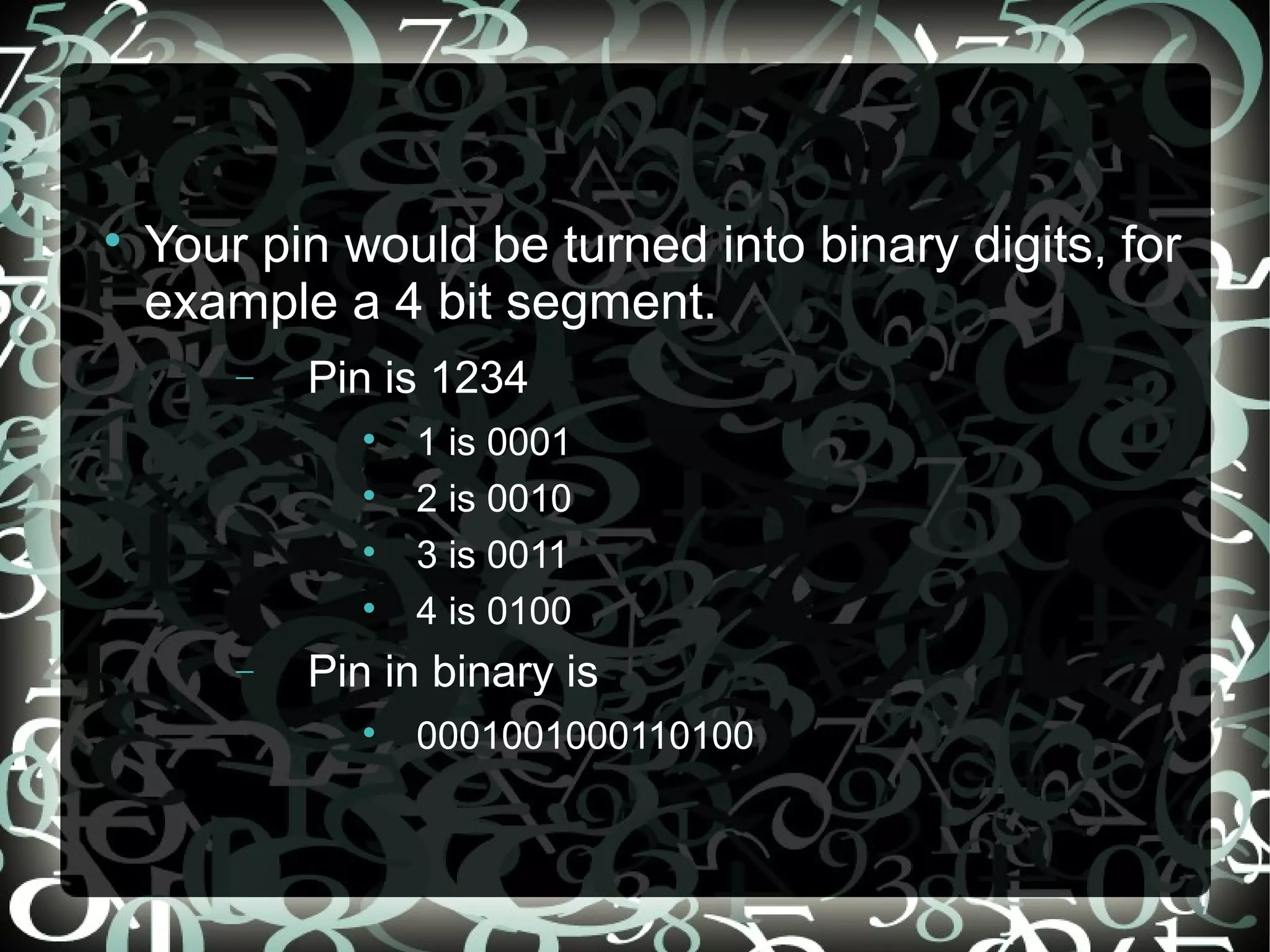
Your pin would be turned into binary digits, for
example a 4 bit segment.
− Pin is 1234

1 is 0001

2 is 0010

3 is 0011

4 is 0100
− Pin in binary is

0001001000110100

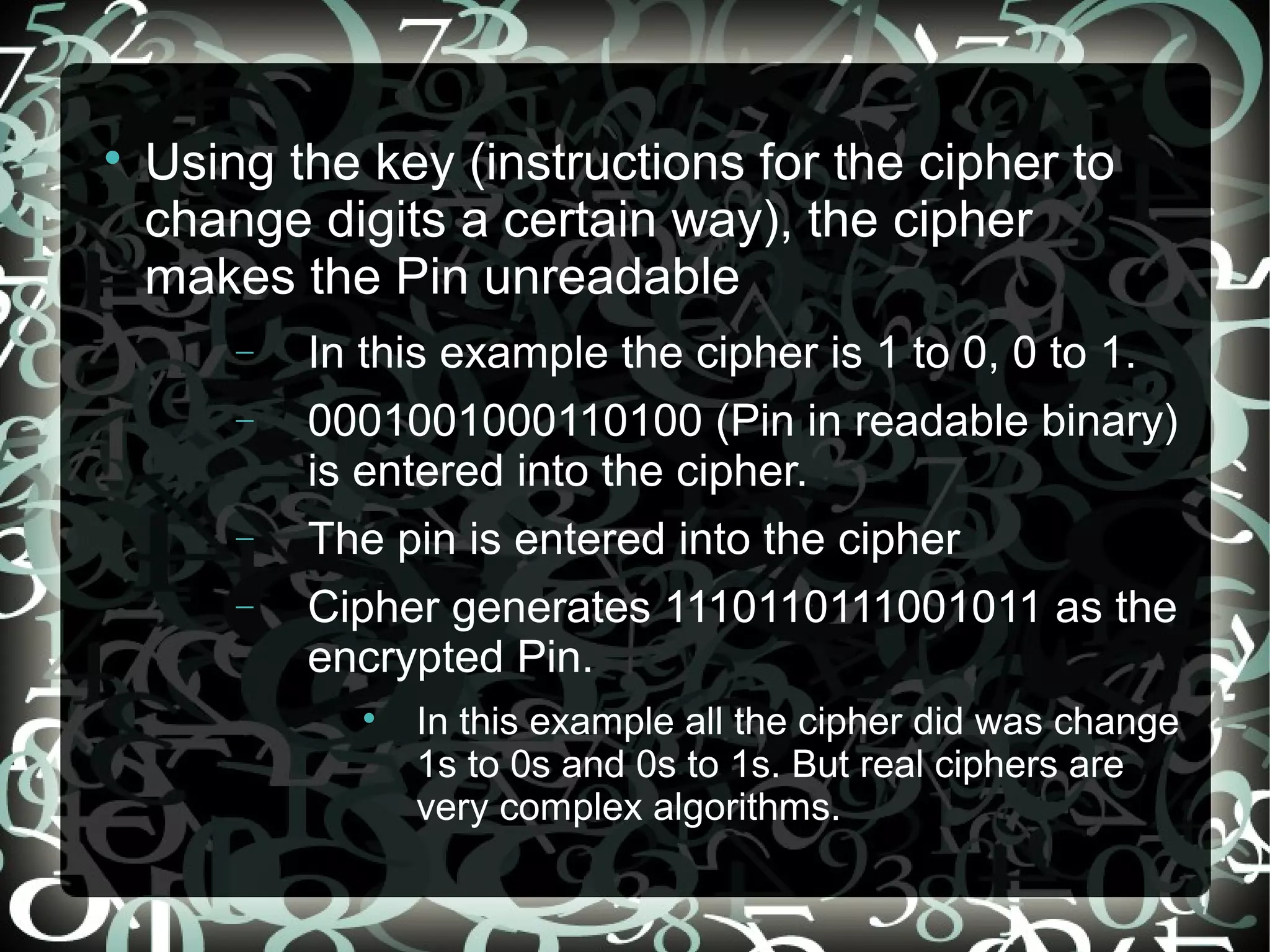
Using the key (instructions for the cipher to
change digits a certain way), the cipher
makes the Pin unreadable
− In this example the cipher is 1 to 0, 0 to 1.
− 0001001000110100 (Pin in readable binary)
is entered into the cipher.
− The pin is entered into the cipher
− Cipher generates 1110110111001011 as the
encrypted Pin.

In this example all the cipher did was change
1s to 0s and 0s to 1s. But real ciphers are
very complex algorithms.

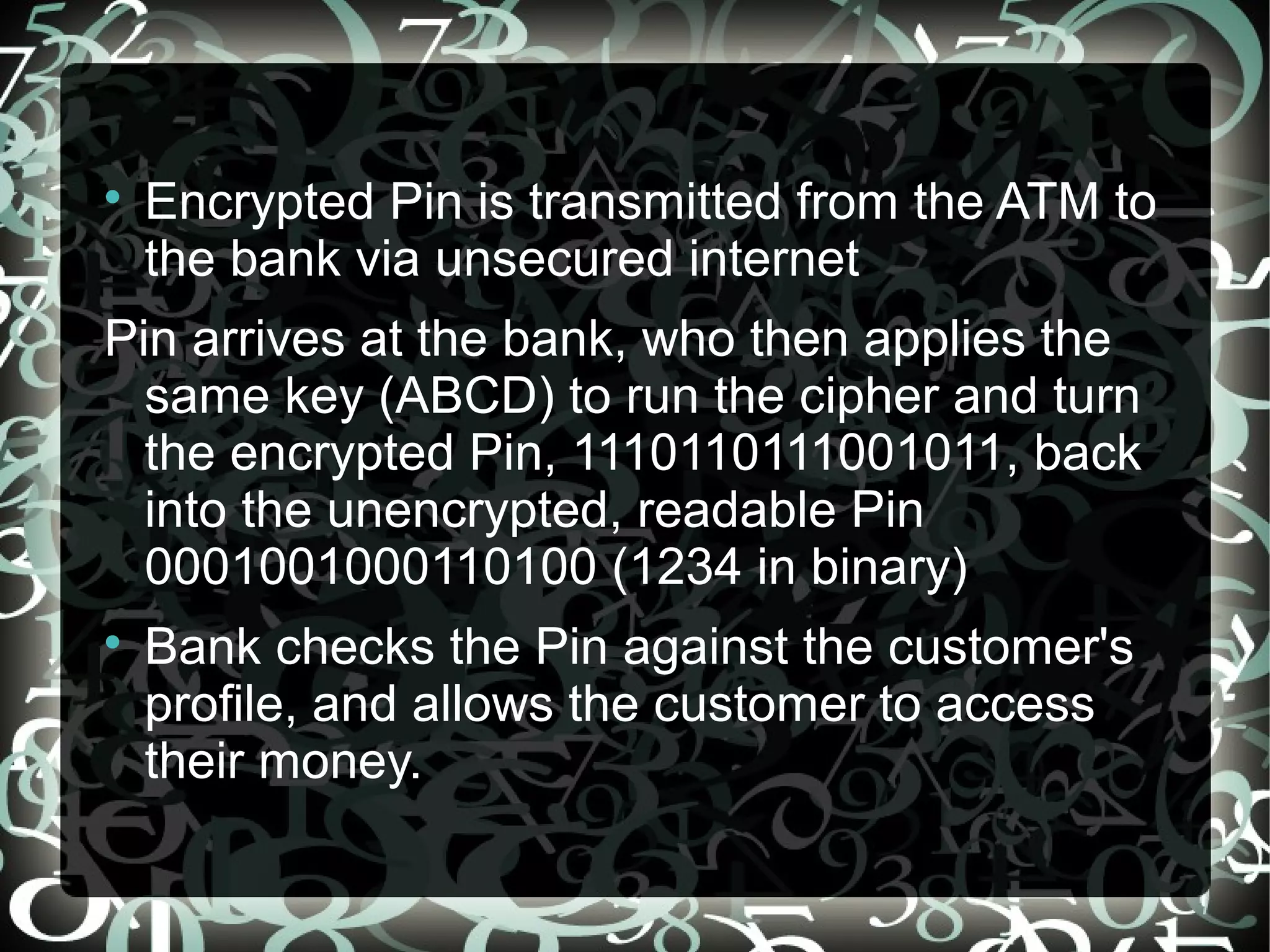
Encrypted Pin is transmitted from the ATM to
the bank via unsecured internet
Pin arrives at the bank, who then applies the
same key (ABCD) to run the cipher and turn
the encrypted Pin, 1110110111001011, back
into the unencrypted, readable Pin
0001001000110100 (1234 in binary)

Bank checks the Pin against the customer's
profile, and allows the customer to access
their money.

All of this happens very fast

Most customers are completely unaware of
what happened behind the scenes to make
sure that no one could steal their Pin number
while it traveled to the bank's servers.

Basic encryption

  • 1.
    Basic Encryption Cryptography (fromGreek kryptós, "to hide, to conceal, to obscure", and graphein, "to etch, to inscribe, to write down") is, traditionally, the study of means of converting information from its normal, comprehensible form into an incomprehensible format, rendering it unreadable without secret knowledge — the art of encryption.
  • 2.
     The purpose ofencryption is to ensure that only somebody who is authorized to access data (e.g. a text message or a file), will be able to read it, using the decryption key.  Somebody who is not authorized can be excluded, because he or she does not have the required key, without which it is impossible to read the encrypted information.
  • 3.
     Using a keyto determine it's behavior, a cipher changes raw data into encrypted data, hiding it's original content.  The data is then transmitted over some medium (ex. The Internet)  The data reaches it's recipient, who uses the same key as the sender to run the cipher, which turns the data back to it's original form.
  • 4.
    Early Encryption  The earliestform of encryption was simple writing.  In very early times the number of people who were literate (able to read) was so limited, simply writing your message down was semi- effective encryption  As a higher percentage of the population became literate, more effective methods to disguise a message's contents were needed.
  • 5.
    Early Encryption Cont.  Nearlyall civilizations that possessed a written language created some form of encryption  The early Greeks used a cylinder of a specific circumference which, when a strip of paper was wound around it, arranged the letters into a readable form  The “Caesar” cipher was supposedly used by Julius Caesar to communicate with his generals  In this simple scheme, every letter would be replaced with the letter 3 places down in the alphabet  D replacing A, E replacing B, etc etc.
  • 6.
     In India, the2,000 year old Kamasutra lists two different methods of encryption  One method replaces vowels with consonants, and the other replaces one letter with another  All these methods were rendered breakable through frequency analysis  Using math to compare how frequently a encrypted letter is used, vs how frequently a letter is used in the alphabet.  This requires knowing the language patterns of the message's language.
  • 7.
    Example of modernencryption  Let's take an ATM pin for example. You wouldn't want your pin broadcast from the ATM, through the internet, to your bank to verify that you can pull money from an ATM, unencrypted, open for everyone to see.  Encryption solves this issue.
  • 8.
     Your pin wouldbe turned into binary digits, for example a 4 bit segment. − Pin is 1234  1 is 0001  2 is 0010  3 is 0011  4 is 0100 − Pin in binary is  0001001000110100
  • 9.
     Using the key(instructions for the cipher to change digits a certain way), the cipher makes the Pin unreadable − In this example the cipher is 1 to 0, 0 to 1. − 0001001000110100 (Pin in readable binary) is entered into the cipher. − The pin is entered into the cipher − Cipher generates 1110110111001011 as the encrypted Pin.  In this example all the cipher did was change 1s to 0s and 0s to 1s. But real ciphers are very complex algorithms.
  • 10.
     Encrypted Pin istransmitted from the ATM to the bank via unsecured internet Pin arrives at the bank, who then applies the same key (ABCD) to run the cipher and turn the encrypted Pin, 1110110111001011, back into the unencrypted, readable Pin 0001001000110100 (1234 in binary)  Bank checks the Pin against the customer's profile, and allows the customer to access their money.
  • 11.
     All of thishappens very fast  Most customers are completely unaware of what happened behind the scenes to make sure that no one could steal their Pin number while it traveled to the bank's servers.