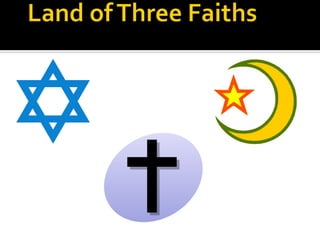
What does monotheism mean?

(If theism means belief in a god,
what do you think mono-theism
means?)
 Began in present day Israel
 Founded by Abraham (a key figure in ALL 3 of
  these religions)
 Moses led Israelites from Egypt out of
  slavery.
 David: 2nd King of Israel, the young boy who
  defeated Goliath, eventually succeeds Saul as
  King of Israel and Judah.
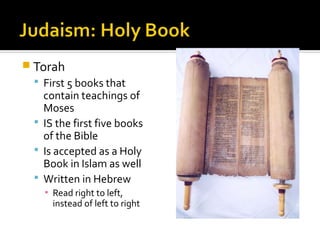
 Torah
  First 5 books that
   contain teachings of
   Moses
  IS the first five books
   of the Bible
  Is accepted as a Holy
   Book in Islam as well
  Written in Hebrew
   ▪ Read right to left,
     instead of left to right
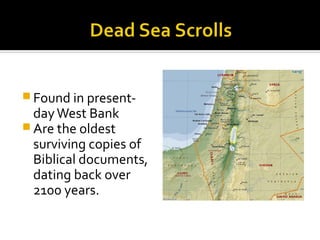
 Found in present-
  day West Bank
 Are the oldest
  surviving copies of
  Biblical documents,
  dating back over
  2100 years.
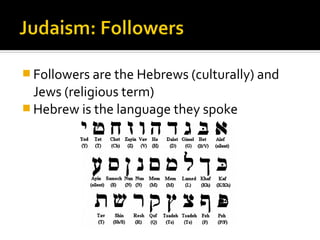
 Followers are the Hebrews (culturally) and
  Jews (religious term)
 Hebrew is the language they spoke
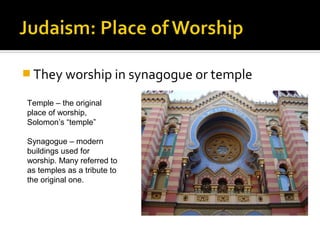
 They worship in synagogue or temple

Temple – the original
place of worship,
Solomon’s “temple”

Synagogue – modern
buildings used for
worship. Many referred to
as temples as a tribute to
the original one.
 Orthodox (very religious)
 Conservative   (traditional, but less rigid than
  Orthodox)
 Reform (the most liberal of the three)
God
Yahweh

Judaism: Teacher/Religious Leader

•Rabbi
 10 Commandments given to Moses by God
 Kosher—strict dietary laws (“free of
  contamination”)
 Shabbat (Sabbath)-Holy Day—Sundown on
  Friday to Sundown Saturday – Spent in prayer,
  resting, family feasting.
 Calendar includes five major festivals (including
  Passover, Rosh Hashanah, Yom Kippur) and two
  minor ones – Hanukkah, Purim
   (Pa-celebrates Exodus from Egypt. R.H.-Jewish New Year, YK – Day of
    Atonement/pray for forgiveness, H – celebrates religious freedom/victory over
    Maccabees)
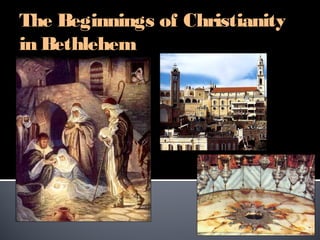
The Beginnings of Christianity
in Bethlehem      Present day Israel
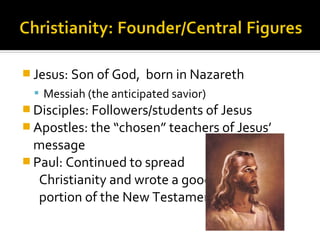
 Jesus: Son of God,    born in Nazareth
   Messiah (the anticipated savior)
 Disciples: Followers/students of Jesus
 Apostles: the “chosen” teachers of Jesus’
  message
 Paul: Continued to spread
   Christianity and wrote a good
   portion of the New Testament
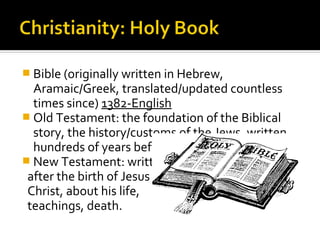
 Bible (originally written in Hebrew,
  Aramaic/Greek, translated/updated countless
  times since) 1382-English
 Old Testament: the foundation of the Biblical
  story, the history/customs of the Jews, written
  hundreds of years before the life of Jesus.
 New Testament: written
 after the birth of Jesus
 Christ, about his life,
 teachings, death.
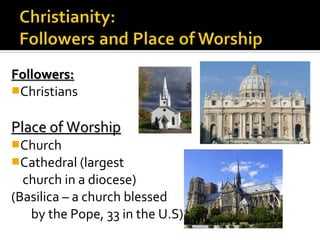
Followers:
Christians


Place of Worship
Church
Cathedral (largest
  church in a diocese)
(Basilica – a church blessed
   by the Pope, 33 in the U.S)
 Reformation led by Martin Luther in 16th
 Century, resulted in formation of many
 different “branches” of Christianity: Catholic
 and Protestants

- Protestants, Baptists, Orthodox,
  Presbyterians, Anglicans, Pentecostals,
  Methodists………..
 “Holy Trinity”: God the Father, Jesus the Son
 and the Holy Spirit

      Teacher/Religious Leader
 Pastor, Priest, Reverend, Preacher
 Gospels: First 4 books of New Testament
   Matthew, Mark, Luke, John
   Tells story of Jesus
 Jesus’ message of love/forgiveness
 Drew large crowds
 Resurrection: Jesus died on the cross, rose 3
  days later and ascended to Heaven 40 days
  later (Easter)
 Sunday is Holy Day
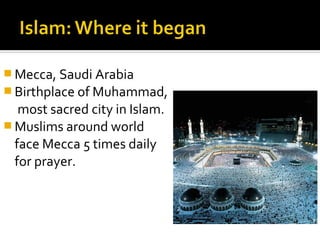
 Mecca, Saudi Arabia
 Birthplace of Muhammad,
   most sacred city in Islam.
 Muslims around world
  face Mecca 5 times daily
  for prayer.
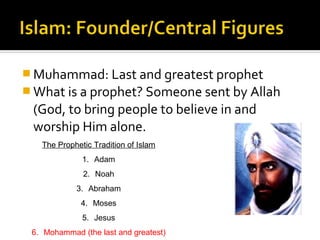
 Muhammad: Last and greatest prophet
 What is a prophet? Someone sent by Allah
 (God, to bring people to believe in and
 worship Him alone.
   The Prophetic Tradition of Islam
              1. Adam
              2. Noah
            3. Abraham
              4. Moses
              5. Jesus
 6. Mohammad (the last and greatest)
 Sunni   - believed there was no successor
  appointed by Muhammad, recognize 4 post-
  Muhammad caliphs, do not recognize any
  caliphs alive today; since the 1920s (Most
  Muslims are Sunni)
 Shi’ite (pronounce She-Ite) – believe there
  were 12 Imams (followers of Muhammad),
  one in hiding because of sins of Islamic
  Communnity, but will return before “the end
  times.”
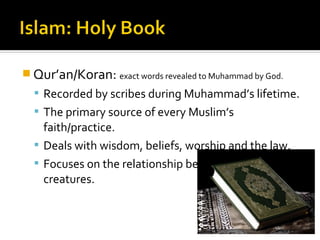
 Qur’an/Koran: exact words revealed to Muhammad by God.
   Recorded by scribes during Muhammad’s lifetime.
   The primary source of every Muslim’s
    faith/practice.
   Deals with wisdom, beliefs, worship and the law.
   Focuses on the relationship between God and His
    creatures.
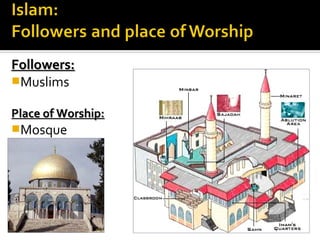
Followers:
Muslims

Place of Worship:
Mosque
 Allah (Arabic for “God”)
 Central Theme/Belief: Monotheism – belief in
  one all-powerful God.
 Purpose of humanity is to serve Allah,
  worship him alone, and lead a moral life.
      Teacher/Religious Leader
 Imam
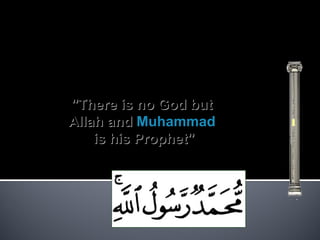
1. The Shahada
The declaration of faith:


"There is no God but
Allah and Muhammad          1
    is his Prophet"
2. The Salat
 The mandatory prayers
    performed 5 times a day:
       * dawn
       * noon
                                       2
       * late afternoon
       * sunset
       * before going to bed
   Wash before praying.
   Face Mecca and use a prayer rug.
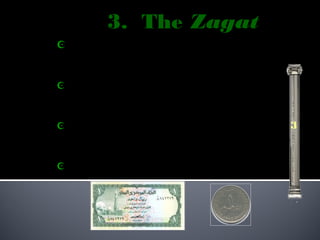
3. The Zagat
 Almsgiving (charitable
    donations).
   Muslims believe that all things
    belong to God.
   Zagat means both “purification”   3
    and “growth.”
   About 2.5% of your income.
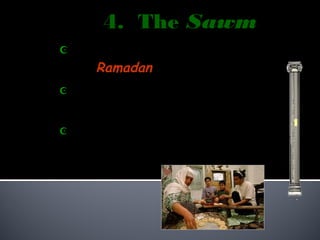
4. The Sawm
 Fasting during the holy month
    of Ramadan.
   Considered a method of self-
    purification.
                                   4
   No eating or drinking from
    sunrise to sunset during
    Ramadan.
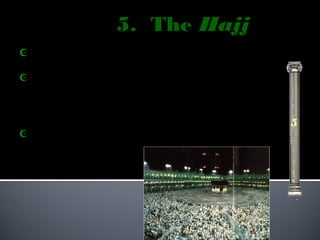
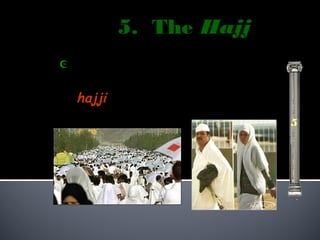
5. The Hajj
 The pilgrimage to Mecca.

 Must be done at least once in a
  Muslim’s lifetime by all that
are physically/financially able.
                                    5
   2-3 million Muslims make the
    pilgrimage
    every year.
5. The Hajj
 Those who complete the
  pilgrimage can add the title
  hajji to their name.
                                 5
Other Islamic Religious
       Practices
 Up to four wives allowed at once.

   No alcohol or pork.
   No gambling.
   Sharia  body of Islamic law to
             regulate daily living.
   Three holiest cities in Islam:
       * Mecca, Medina, Jerusalem.
Name one thing that all three
religions have in common?

Week 4 day 1- religion

  • 1.
    What does monotheismmean? (If theism means belief in a god, what do you think mono-theism means?)
  • 3.
     Began inpresent day Israel  Founded by Abraham (a key figure in ALL 3 of these religions)  Moses led Israelites from Egypt out of slavery.  David: 2nd King of Israel, the young boy who defeated Goliath, eventually succeeds Saul as King of Israel and Judah.
  • 4.
     Torah First 5 books that contain teachings of Moses  IS the first five books of the Bible  Is accepted as a Holy Book in Islam as well  Written in Hebrew ▪ Read right to left, instead of left to right
  • 5.
     Found inpresent- day West Bank  Are the oldest surviving copies of Biblical documents, dating back over 2100 years.
  • 6.
     Followers arethe Hebrews (culturally) and Jews (religious term)  Hebrew is the language they spoke
  • 7.
     They worshipin synagogue or temple Temple – the original place of worship, Solomon’s “temple” Synagogue – modern buildings used for worship. Many referred to as temples as a tribute to the original one.
  • 8.
     Orthodox (veryreligious)  Conservative (traditional, but less rigid than Orthodox)  Reform (the most liberal of the three)
  • 9.
  • 10.
     10 Commandmentsgiven to Moses by God  Kosher—strict dietary laws (“free of contamination”)  Shabbat (Sabbath)-Holy Day—Sundown on Friday to Sundown Saturday – Spent in prayer, resting, family feasting.  Calendar includes five major festivals (including Passover, Rosh Hashanah, Yom Kippur) and two minor ones – Hanukkah, Purim  (Pa-celebrates Exodus from Egypt. R.H.-Jewish New Year, YK – Day of Atonement/pray for forgiveness, H – celebrates religious freedom/victory over Maccabees)
  • 11.
    The Beginnings ofChristianity in Bethlehem Present day Israel
  • 12.
     Jesus: Sonof God, born in Nazareth  Messiah (the anticipated savior)  Disciples: Followers/students of Jesus  Apostles: the “chosen” teachers of Jesus’ message  Paul: Continued to spread Christianity and wrote a good portion of the New Testament
  • 13.
     Bible (originallywritten in Hebrew, Aramaic/Greek, translated/updated countless times since) 1382-English  Old Testament: the foundation of the Biblical story, the history/customs of the Jews, written hundreds of years before the life of Jesus.  New Testament: written after the birth of Jesus Christ, about his life, teachings, death.
  • 14.
    Followers: Christians Place of Worship Church Cathedral(largest church in a diocese) (Basilica – a church blessed by the Pope, 33 in the U.S)
  • 15.
     Reformation ledby Martin Luther in 16th Century, resulted in formation of many different “branches” of Christianity: Catholic and Protestants - Protestants, Baptists, Orthodox, Presbyterians, Anglicans, Pentecostals, Methodists………..
  • 16.
     “Holy Trinity”:God the Father, Jesus the Son and the Holy Spirit Teacher/Religious Leader  Pastor, Priest, Reverend, Preacher
  • 17.
     Gospels: First4 books of New Testament  Matthew, Mark, Luke, John  Tells story of Jesus  Jesus’ message of love/forgiveness  Drew large crowds  Resurrection: Jesus died on the cross, rose 3 days later and ascended to Heaven 40 days later (Easter)  Sunday is Holy Day
  • 18.
     Mecca, SaudiArabia  Birthplace of Muhammad, most sacred city in Islam.  Muslims around world face Mecca 5 times daily for prayer.
  • 19.
     Muhammad: Lastand greatest prophet  What is a prophet? Someone sent by Allah (God, to bring people to believe in and worship Him alone. The Prophetic Tradition of Islam 1. Adam 2. Noah 3. Abraham 4. Moses 5. Jesus 6. Mohammad (the last and greatest)
  • 20.
     Sunni - believed there was no successor appointed by Muhammad, recognize 4 post- Muhammad caliphs, do not recognize any caliphs alive today; since the 1920s (Most Muslims are Sunni)  Shi’ite (pronounce She-Ite) – believe there were 12 Imams (followers of Muhammad), one in hiding because of sins of Islamic Communnity, but will return before “the end times.”
  • 21.
     Qur’an/Koran: exactwords revealed to Muhammad by God.  Recorded by scribes during Muhammad’s lifetime.  The primary source of every Muslim’s faith/practice.  Deals with wisdom, beliefs, worship and the law.  Focuses on the relationship between God and His creatures.
  • 22.
  • 23.
     Allah (Arabicfor “God”)  Central Theme/Belief: Monotheism – belief in one all-powerful God.  Purpose of humanity is to serve Allah, worship him alone, and lead a moral life. Teacher/Religious Leader  Imam
  • 25.
    1. The Shahada Thedeclaration of faith: "There is no God but Allah and Muhammad 1 is his Prophet"
  • 26.
    2. The Salat The mandatory prayers performed 5 times a day: * dawn * noon 2 * late afternoon * sunset * before going to bed  Wash before praying.  Face Mecca and use a prayer rug.
  • 27.
    3. The Zagat Almsgiving (charitable donations).  Muslims believe that all things belong to God.  Zagat means both “purification” 3 and “growth.”  About 2.5% of your income.
  • 28.
    4. The Sawm Fasting during the holy month of Ramadan.  Considered a method of self- purification. 4  No eating or drinking from sunrise to sunset during Ramadan.
  • 29.
    5. The Hajj The pilgrimage to Mecca.  Must be done at least once in a Muslim’s lifetime by all that are physically/financially able. 5  2-3 million Muslims make the pilgrimage every year.
  • 30.
    5. The Hajj Those who complete the pilgrimage can add the title hajji to their name. 5
  • 31.
    Other Islamic Religious Practices  Up to four wives allowed at once.  No alcohol or pork.  No gambling.  Sharia  body of Islamic law to regulate daily living.  Three holiest cities in Islam: * Mecca, Medina, Jerusalem.
  • 32.
    Name one thingthat all three religions have in common?