DEPARTMENT OF CHEMICAL ENGINEERING
SUBJECT :
I.P.C
ENROLLMENT No. :
1824002007
SUBMITTED TO :
PROF. CHIRAG PARMAR
SUBMITTED BY :
GAURAV SOLANKI
COURSE :
B.TECH (5TH SEM)
 Topic : The Control System
• Concept :
• Introduction
• Important terms
• Types of Systems 1) Open loop system 2) Close Loop system
• Comparison of Systems
• Requirements of a good control system
• Feed Forward system
• Design Process
 Introduction :
• Control system are an integral part of our lives and play very
important role.
• From a simple bread toaster to complex power plant, control
system are all around us and inseparable part of modern society.
• Launching a satellite in orbit, regulating a power plant,
tracking enemy on radar are some of man made control system.
• Control system occur in nature also. Human body is a great
example of complex Control system, because we've so many
control system by nature i.e. respiratory, Digestive system etc.
 Important terms :
• Control system : A control system is an arrangement or a
combination of various physical components, also called sub-
systems, connected in such a manner so as to attain a certain
objective.
• Input : The excitation applied to the system from an external
source to attain a output is called input signal.
• Output : The actual signal attain from system is called output
signal.
• Control action : is a quantity responsible for activating the
system.
 Must have things in the control system:
1. Inputs
2. Outputs
3. An arrangement of subsystems to achieve the input-output
combination.
• There are two types of systems depending on the
configuration of components:
1) Open loop system
2) Close loop system
 Open loop system :
• Those systems in which the output has no effect on the control
action are called open-loop control systems. i.e. It doesn’t
automatically correct the changes in the output
• A system in which control action is independent of the output of
the system is called as open loop system.
• In open loop system, the output remains constant for a given
input provided the external conditions are the same.
• There is no connecting action taking place in an open loop
system i.e. No Feedback
 Examples of Open loop system :
1)Electric Hand Drier
2)Automatic Washing Machine
3)Bread Toaster
 Advantages
1) Simple Construction & Design
2) Economic
3) Easy maintenance
4) Stability
 Disadvantages
1) Incorrect and unreliable
2) Internal Disturbance
3) Recalibration is required time to time
 Close loop system :
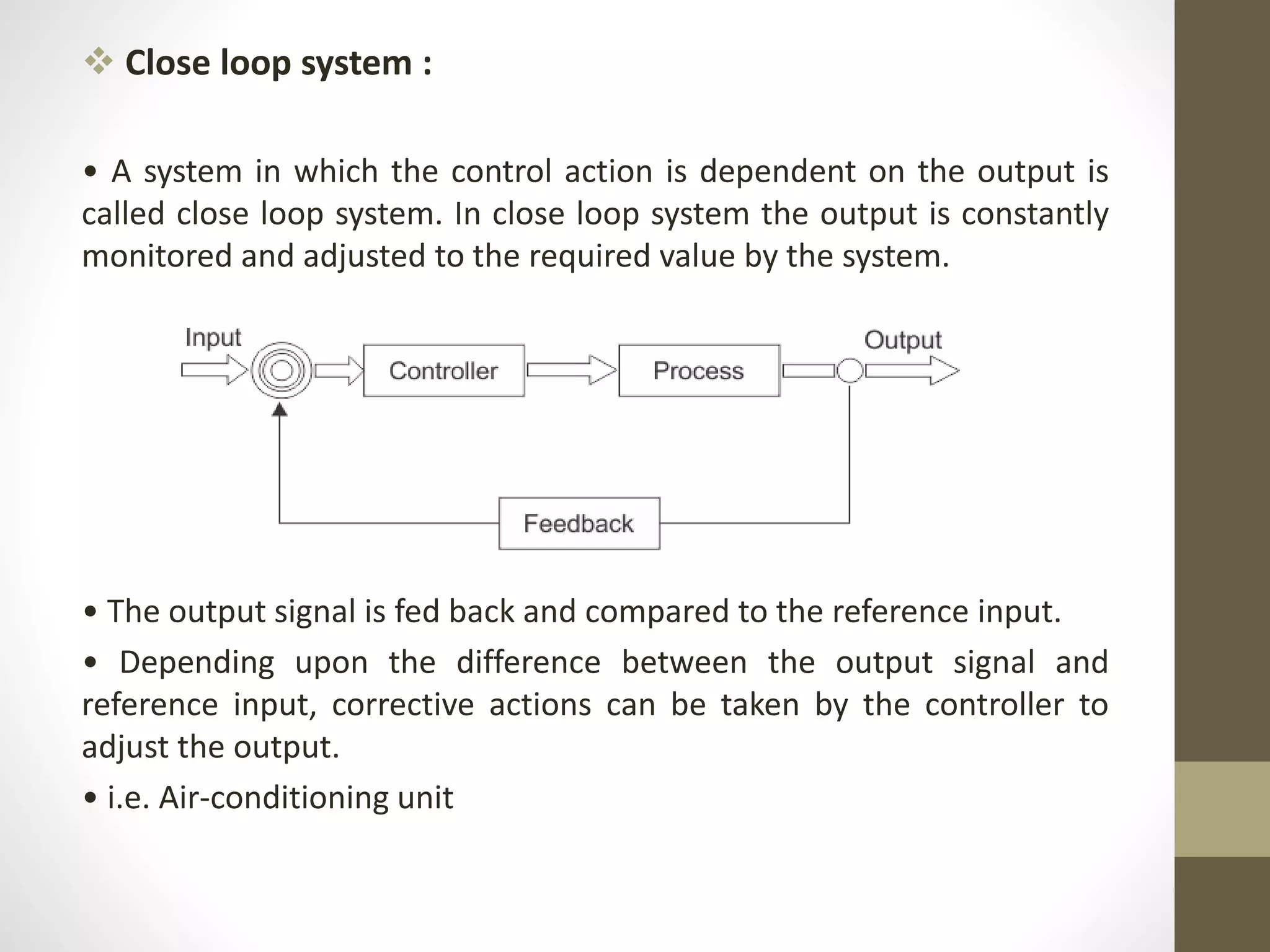
• A system in which the control action is dependent on the output is
called close loop system. In close loop system the output is constantly
monitored and adjusted to the required value by the system.
• The output signal is fed back and compared to the reference input.
• Depending upon the difference between the output signal and
reference input, corrective actions can be taken by the controller to
adjust the output.
• i.e. Air-conditioning unit
• Example of close loop system :
• Automatic Electric Irons
• Voltage Stabilizer
• DC motor speed control by Tachometer
• Missile Launcher
• Advantages :
1) Accuracy is high
2) Reduced effect of non-linearties
3) High Bandwidth
4) Facilitates Automation
• Disadvantages :
1) Complicated in design and maintenance costlier
2) Problem of Stability
 Comparison of Open loop and Close loop system :
Open Loop System Close loop System
No feedback. Hence feedback
element is absent.
Feedback exists. Hence feedback
elements are exists.
No error detector. Error detector is present.
It is inaccurate. It is accurate.
Highly sensitive to parameter
changes.
Less sensitive to parameter changes.
Small bandwidth. Large bandwidth.
Stable. May become unstable.
Economical. Costly
• Feed forward System :
• In feed forward systems the output of one stage of control system is
sent to improve the overall performance of control system.
• It is used whenever there is disturbance.
 The Design Process :
Analyze by
checking for
stability and
see if
specification s
are met
Obtain a
precise block
diagram or
signal flow
chart
Convert
into a
schematic
Draw a
functional
block
diagram
Get a
transfer
Function
Physical
system
THANK YOU

The control system

  • 1.
    DEPARTMENT OF CHEMICALENGINEERING SUBJECT : I.P.C ENROLLMENT No. : 1824002007 SUBMITTED TO : PROF. CHIRAG PARMAR SUBMITTED BY : GAURAV SOLANKI COURSE : B.TECH (5TH SEM)
  • 2.
     Topic :The Control System • Concept : • Introduction • Important terms • Types of Systems 1) Open loop system 2) Close Loop system • Comparison of Systems • Requirements of a good control system • Feed Forward system • Design Process
  • 3.
     Introduction : •Control system are an integral part of our lives and play very important role. • From a simple bread toaster to complex power plant, control system are all around us and inseparable part of modern society. • Launching a satellite in orbit, regulating a power plant, tracking enemy on radar are some of man made control system. • Control system occur in nature also. Human body is a great example of complex Control system, because we've so many control system by nature i.e. respiratory, Digestive system etc.
  • 4.
     Important terms: • Control system : A control system is an arrangement or a combination of various physical components, also called sub- systems, connected in such a manner so as to attain a certain objective. • Input : The excitation applied to the system from an external source to attain a output is called input signal. • Output : The actual signal attain from system is called output signal. • Control action : is a quantity responsible for activating the system.
  • 5.
     Must havethings in the control system: 1. Inputs 2. Outputs 3. An arrangement of subsystems to achieve the input-output combination. • There are two types of systems depending on the configuration of components: 1) Open loop system 2) Close loop system
  • 6.
     Open loopsystem : • Those systems in which the output has no effect on the control action are called open-loop control systems. i.e. It doesn’t automatically correct the changes in the output • A system in which control action is independent of the output of the system is called as open loop system. • In open loop system, the output remains constant for a given input provided the external conditions are the same. • There is no connecting action taking place in an open loop system i.e. No Feedback
  • 7.
     Examples ofOpen loop system : 1)Electric Hand Drier 2)Automatic Washing Machine 3)Bread Toaster  Advantages 1) Simple Construction & Design 2) Economic 3) Easy maintenance 4) Stability  Disadvantages 1) Incorrect and unreliable 2) Internal Disturbance 3) Recalibration is required time to time
  • 8.
     Close loopsystem : • A system in which the control action is dependent on the output is called close loop system. In close loop system the output is constantly monitored and adjusted to the required value by the system. • The output signal is fed back and compared to the reference input. • Depending upon the difference between the output signal and reference input, corrective actions can be taken by the controller to adjust the output. • i.e. Air-conditioning unit
  • 9.
    • Example ofclose loop system : • Automatic Electric Irons • Voltage Stabilizer • DC motor speed control by Tachometer • Missile Launcher • Advantages : 1) Accuracy is high 2) Reduced effect of non-linearties 3) High Bandwidth 4) Facilitates Automation • Disadvantages : 1) Complicated in design and maintenance costlier 2) Problem of Stability
  • 10.
     Comparison ofOpen loop and Close loop system : Open Loop System Close loop System No feedback. Hence feedback element is absent. Feedback exists. Hence feedback elements are exists. No error detector. Error detector is present. It is inaccurate. It is accurate. Highly sensitive to parameter changes. Less sensitive to parameter changes. Small bandwidth. Large bandwidth. Stable. May become unstable. Economical. Costly
  • 11.
    • Feed forwardSystem : • In feed forward systems the output of one stage of control system is sent to improve the overall performance of control system. • It is used whenever there is disturbance.
  • 12.
     The DesignProcess : Analyze by checking for stability and see if specification s are met Obtain a precise block diagram or signal flow chart Convert into a schematic Draw a functional block diagram Get a transfer Function Physical system
  • 13.