Leaching and its equipment
❖ It is defined as the extraction of soluble constituent from solid
material using selective liquid solvent.
❖ It is also defined as the separation of solute from solid
mixture by dissolving it in a liquid phase.
❖ There are two phases involved in Leaching:
1.Overflow phase-solute + solvent
2.Underflow phase-solid +solvent
Process(or)Stages involved in Leaching:
There are three major stages involved in the leaching
process.They are:
❏ Dissolution of solute in selective solvent.
❏ Diffusion of solutes through pores of particles.
❏ Transfer of solute into bulk solvent.
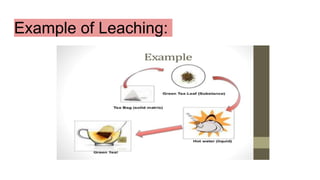
Example of Leaching:
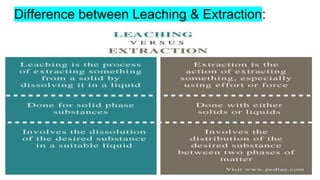
Difference between Leaching & Extraction:
Factors influencing the rate of Leaching:
1.Particle size.
2.Solvent.
3.Temperature.
4.Agitation.
➔ Basically leaching is simply known as the solid-liquid
extraction.
➔ Another example for leaching (or) solid-liquid extraction is:
1.Separation of sugar from sugar beets with hot water.
In general leaching is classified into:
a)Physical leaching.
b)Chemical leaching.
c)Bacterial leaching.
Classification of Leaching:
★ Fixed bed leaching.
★ Moving bed leaching.
★ Agitated leaching.
Leaching is further classified into continuous leaching and
batch leaching. The continuous leaching is classified into
co-current and countercurrent leaching. The
countercurrent leaching is further divided into variable
underflow and constant underflow. But the most used
leaching is Batch leaching.
Principle of leaching and its uses:
➢ Leaching can be batch,semi batch or continuous.
➢ It usually operates at an elevated temperature to increase
the solubility of solute in the solvent.
➢ Feed to a leaching system typically is solid,consisting of
basically insoluble career material and a (usually
desirable)solid compound.The feed usually must be
prepared by grinding or chopping.It is then mixed with
liquid solvent.The desired material dissolves and leaves
when liquid is drawn off as overflow.
Equipments of Leaching:
Some of the equipments of leaching are:
1. Agitated vessels.
2. Dorr thickeners.
3. Kennedy extractor.
4. Bollman extractor.
5. Rotocel extractor.
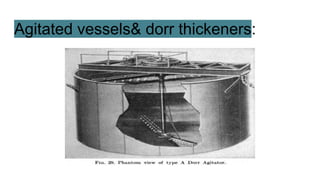
Agitated vessels& dorr thickeners:
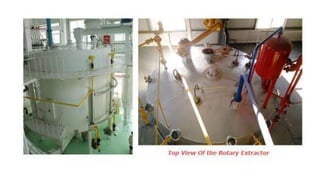
Rotating extractor:
● It is actually a horizontally revolving cylindrical vessel.
● It is provided with large hatch for loading and unloading
the solids to be extracted and a drain line for loading the
extractant and draining off the extract.
● The vessel provided with baffle plates perpendicular on
interfacial surface.
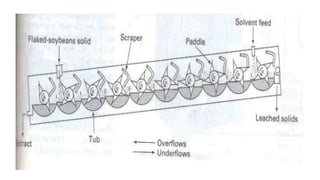
Kennedy extractor:
1. It is originally used for leaching tannins from tanbark. It is
now used for oilseed.
2. The solids are leached in a series of tubs and are pushed
from one to next in cascade by paddles, while the solvent
flows in counter-current .
3. Perforation in paddles permit drainage of solids between
stages.
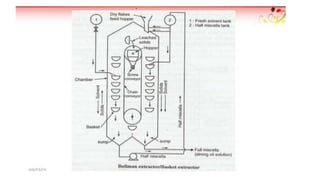
Bollman extractor:
❏ It is mainly used for the recovery of additional oil from the
residues obtained after mechanical pressing of solids.
❏ The bollman extractor essentially consists of vapour tight
vertical chamber in which a series of perforated baskets
are attached to chain conveyor.
❏ As the solids and solvent flow co-currently down the right
hand side of machine, the solvent extracts more oil.
❏ Simultaneously fine solids are filtered out of solvent,so
that clean full miscella pumped at outlet provided at right
hand bottom.
❏ The liquid percolates down through moving baskets and is
collected at bottom as strong solution or full miscella.
❏ The baskets moving upward on left are leached counter
currently by fresh solvent sprayed on top basket.
❏ The wet flakes are dumped and are removed continuously
using spray conveyor.
❏ Usually the conveyor speed is one revolution per hour and
solvent to fresh meal ratio is 1.
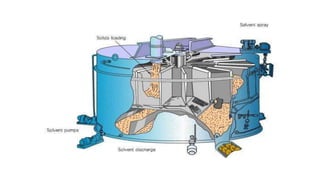
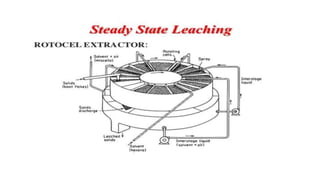
Rotocel extractor:
★ A horizontal basket is divided into walled compartments
with floor that is permeable to liquids rotates slowly about
vertical axis.
★ The solids are admitted to each compartment at the feed
point.
★ It is mainly made up of stainless steel.
Koushik sn   assignment - leaching equipment (1)

Koushik sn assignment - leaching equipment (1)

  • 1.
    Leaching and itsequipment ❖ It is defined as the extraction of soluble constituent from solid material using selective liquid solvent. ❖ It is also defined as the separation of solute from solid mixture by dissolving it in a liquid phase. ❖ There are two phases involved in Leaching: 1.Overflow phase-solute + solvent 2.Underflow phase-solid +solvent
  • 2.
    Process(or)Stages involved inLeaching: There are three major stages involved in the leaching process.They are: ❏ Dissolution of solute in selective solvent. ❏ Diffusion of solutes through pores of particles. ❏ Transfer of solute into bulk solvent.
  • 3.
  • 4.
  • 5.
    Factors influencing therate of Leaching: 1.Particle size. 2.Solvent. 3.Temperature. 4.Agitation.
  • 6.
    ➔ Basically leachingis simply known as the solid-liquid extraction. ➔ Another example for leaching (or) solid-liquid extraction is: 1.Separation of sugar from sugar beets with hot water. In general leaching is classified into: a)Physical leaching. b)Chemical leaching. c)Bacterial leaching.
  • 7.
    Classification of Leaching: ★Fixed bed leaching. ★ Moving bed leaching. ★ Agitated leaching. Leaching is further classified into continuous leaching and batch leaching. The continuous leaching is classified into co-current and countercurrent leaching. The countercurrent leaching is further divided into variable underflow and constant underflow. But the most used leaching is Batch leaching.
  • 8.
    Principle of leachingand its uses: ➢ Leaching can be batch,semi batch or continuous. ➢ It usually operates at an elevated temperature to increase the solubility of solute in the solvent. ➢ Feed to a leaching system typically is solid,consisting of basically insoluble career material and a (usually desirable)solid compound.The feed usually must be prepared by grinding or chopping.It is then mixed with liquid solvent.The desired material dissolves and leaves when liquid is drawn off as overflow.
  • 9.
    Equipments of Leaching: Someof the equipments of leaching are: 1. Agitated vessels. 2. Dorr thickeners. 3. Kennedy extractor. 4. Bollman extractor. 5. Rotocel extractor.
  • 10.
  • 11.
    Rotating extractor: ● Itis actually a horizontally revolving cylindrical vessel. ● It is provided with large hatch for loading and unloading the solids to be extracted and a drain line for loading the extractant and draining off the extract. ● The vessel provided with baffle plates perpendicular on interfacial surface.
  • 13.
    Kennedy extractor: 1. Itis originally used for leaching tannins from tanbark. It is now used for oilseed. 2. The solids are leached in a series of tubs and are pushed from one to next in cascade by paddles, while the solvent flows in counter-current . 3. Perforation in paddles permit drainage of solids between stages.
  • 15.
    Bollman extractor: ❏ Itis mainly used for the recovery of additional oil from the residues obtained after mechanical pressing of solids. ❏ The bollman extractor essentially consists of vapour tight vertical chamber in which a series of perforated baskets are attached to chain conveyor. ❏ As the solids and solvent flow co-currently down the right hand side of machine, the solvent extracts more oil. ❏ Simultaneously fine solids are filtered out of solvent,so that clean full miscella pumped at outlet provided at right hand bottom.
  • 16.
    ❏ The liquidpercolates down through moving baskets and is collected at bottom as strong solution or full miscella. ❏ The baskets moving upward on left are leached counter currently by fresh solvent sprayed on top basket. ❏ The wet flakes are dumped and are removed continuously using spray conveyor. ❏ Usually the conveyor speed is one revolution per hour and solvent to fresh meal ratio is 1.
  • 18.
    Rotocel extractor: ★ Ahorizontal basket is divided into walled compartments with floor that is permeable to liquids rotates slowly about vertical axis. ★ The solids are admitted to each compartment at the feed point. ★ It is mainly made up of stainless steel.