1
Class – IstYear – I/II Semester: B.Tech.
Subject –Basic Civil Engineering
UNIT -1 (Introduction)
Presented by – Sudhir Panwar (Assistant Professor)
Sudhir Panwar (Assistant Professor), JECRC, Jaipur
JAIPUR ENGINEERING COLLEGE AND RESEARCH CENTER
1
2.
1
Sudhir Panwar (AssistantProfessor), JECRC, Jaipur
Vision
To become a renowned centre of outcome based learning, and work towards
academic, professional, cultural and social enrichment of the lives of
individuals and communities.
Mission
M1. Focus on evaluation of learning outcomes and motivate students to
inculcate research aptitude by project based learning.
M2. Identify, based on informed perception of Indian, regional and global
needs, areas of focus and provide platform to gain knowledge and solutions.
M3. Offer opportunities for interaction between academia and industry.
M4. Develop human potential to its fullest extent so that intellectually
capable and imaginatively gifted leaders can emerge in a range of
professions.
2
VISSION AND MISSION OF INSTITUE
3.
1
Sudhir Panwar (AssistantProfessor), JECRC, Jaipur
VISSION AND MISSION OF DEPARTMENT
3
Vision
To become a role model in the field of Civil Engineering for the sustainable
development of the society.
Mission
M1.To provide outcome base education.
M2.To create a learning environment conducive for achieving academic
excellence.
M3.To prepare civil engineers for the society with high ethical values.
4.
1
Sudhir Panwar (AssistantProfessor), JECRC, Jaipur
CONTENTS
4
1. Introduction
2. Scope
3. Outcome
4. Specialization of Civil Engineering
5. Role of civil Engineer in Society
5.
1
Sudhir Panwar (AssistantProfessor), JECRC, Jaipur
1. Introduction
5
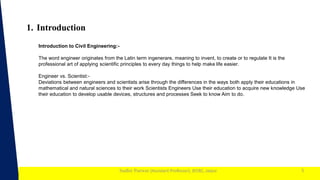
Introduction to Civil Engineering:-
The word engineer originates from the Latin term ingenerare, meaning to invent, to create or to regulate It is the
professional art of applying scientific principles to every day things to help make life easier.
Engineer vs. Scientist:-
Deviations between engineers and scientists arise through the differences in the ways both apply their educations in
mathematical and natural sciences to their work Scientists Engineers Use their education to acquire new knowledge Use
their education to develop usable devices, structures and processes Seek to know Aim to do.
6.
1
Sudhir Panwar (AssistantProfessor), JECRC, Jaipur
Cont..
6
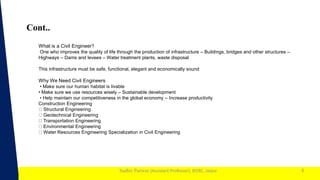
What is a Civil Engineer?
One who improves the quality of life through the production of infrastructure – Buildings, bridges and other structures –
Highways – Dams and levees – Water treatment plants, waste disposal
This infrastructure must be safe, functional, elegant and economically sound
Why We Need Civil Engineers
• Make sure our human habitat is livable
• Make sure we use resources wisely – Sustainable development
• Help maintain our competitiveness in the global economy – Increase productivity
Construction Engineering
Structural Engineering
Geotechnical Engineering
Transportation Engineering
Environmental Engineering
Water Resources Engineering Specialization in Civil Engineering
7.
1
Sudhir Panwar (AssistantProfessor), JECRC, Jaipur 7
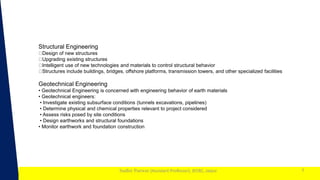
Structural Engineering
Design of new structures
Upgrading existing structures
Intelligent use of new technologies and materials to control structural behavior
Structures include buildings, bridges, offshore platforms, transmission towers, and other specialized facilities
Geotechnical Engineering
• Geotechnical Engineering is concerned with engineering behavior of earth materials
• Geotechnical engineers:
• Investigate existing subsurface conditions (tunnels excavations, pipelines)
• Determine physical and chemical properties relevant to project considered
• Assess risks posed by site conditions
• Design earthworks and structural foundations
• Monitor earthwork and foundation construction
8.
1
Sudhir Panwar (AssistantProfessor), JECRC, Jaipur 8
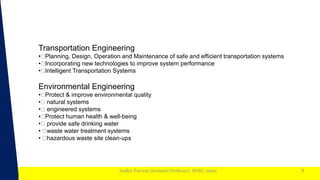
Transportation Engineering
• Planning, Design, Operation and Maintenance of safe and efficient transportation systems
• Incorporating new technologies to improve system performance
• Intelligent Transportation Systems
Environmental Engineering
• Protect & improve environmental quality
• natural systems
• engineered systems
• Protect human health & well-being
• provide safe drinking water
• waste water treatment systems
• hazardous waste site clean-ups
9.
1
Sudhir Panwar (AssistantProfessor), JECRC, Jaipur
2. Scope
9
The main scope of civil engineering or the task of civil engineering is planning, designing,
estimating, supervising construction, managing construction, execution, and maintenance of
structures like building, roads, bridges, dams, etc.
Civil engineering is a wide field and includes many types of structure such as residential buildings,
public buildings, industrial building, roads, bridges, tunnels, railway, dams, and canal ,airport,
harbours, and ports, water treatment plant, water supply network and drainage network. main
branches of civil engineering are classified as follows.
1.Surveying and Leveling
2. Building, Planning and Construction
3. Advanced Construction4. Structural Engineering
5. Geotechnical Engineering6. Water Resources Engineering
7. Transportation Engineering
8. Environmental Engineering
9. Town planning
10.
1
Sudhir Panwar (AssistantProfessor), JECRC, Jaipur
3. Outcome
10
an ability to design and conduct experiments, as well as to analyze and interpret data. an ability to
design a system, component, or process to meet desired needs within realistic constraints such as
economic, environmental, social, political, ethical, health and safety, manufacturability, and
sustainability.
11.
1
Sudhir Panwar (AssistantProfessor), JECRC, Jaipur
4. Specialization of Civil Engineering
11
Specializations to Explore as a Civil Engineering Major:-
1. Construction Management
2. Environmental Engineer
3. Geotechnical Engineering
4. Structural Engineering
5. Transportation Engineering
6. Water Resources Engineering
12.
1
Sudhir Panwar (AssistantProfessor), JECRC, Jaipur
Cont…
12
1. Construction Management:-
These civil engineers oversee a building project from start to finish, coordinating all the different
professionals involved in such a project, including architects, builders, electricians, plumbers, and
financiers. Much of construction management involves keeping risk to a minimum by focusing on
safety and compliance with local, state and federal building codes.
2. Environmental Engineering:-
This specialty focuses specifically on creating projects that sustain or improve the environment in
which they exist. Many advances have been made in sustainability in recent years, including the use
of alternative energy sources like solar, wind or water, better insulation to reduce energy usage, and
plumbing fixtures that use less water, among other methods. Environmental engineers may also
position buildings in more sustainable ways to take advantage of natural lighting or solar energy
collection, for example.
13.
1
Sudhir Panwar (AssistantProfessor), JECRC, Jaipur
Cont…
13
3. Geotechnical Engineering:-
The stability of the soil and rock on which a project is built as well as its chemical composition are
the main considerations of the geotechnical engineering specialty. Softer ground requires different
building methods than harder ground or rock, and geotechnical engineers can prevent foundations
from crumbling or damaging erosion occurring from runoff patterns on a building project’s land.
4. Structural Engineering:-
Structural engineers need to ensure that buildings or other structures can support their own
weight as well as the weight of those who will be using them. By calculating the load that a
structure is likely to encounter, structural engineers help to determine which building materials
are used and how the skeleton of the structure is assembled.
14.
1
Sudhir Panwar (AssistantProfessor), JECRC, Jaipur
Cont…
14
5. Transportation Engineering
Transportation engineers build systems like railways, subways, roads and bridges that are used
by people in traveling to work, home, or on vacation, among other destinations. Safety and
capacity are major considerations of transportation engineers—it doesn’t do much good to build
transportation systems that aren’t safe or can’t meet the transportation needs of those who are
intended to use them.
6. Water Resources Engineering
Having safe and adequate drinking water may be taken for granted in the industrialized nations
of the world, but developing and developed nations alike need water resources engineers to build
the infrastructure that provides clean water to those who depend on it for their survival.
15.
1
Sudhir Panwar (AssistantProfessor), JECRC, Jaipur
Role of civil Engineer in Society
15
A civil engineer has to conceive, plan, estimate, get approval, create and maintain all civil
engineering activities.
Civil engineer has very important role in the development of the following infrastructure:
(i) Measure and map the earth’s surface.
(ii) Plan new townships and extension of existing towns.
(iii) Build the suitable structures for the rural and urban areas for various utilities.
(iv) Build tanks and dams to exploit water resources.
(v) Build river navigation and flood control projects.
(vi) Build canals and distributaries to take water to agricultural fields.
(vii) Purify and supply water to the needy areas like houses, schools, offices etc.
(viii) Provide and maintain communication systems like roads, railways, harbors and airports.
(ix) Devise systems for control and efficient flow of traffic.
(x) Provide and maintain solid and waste water disposal system.
(xi) Monitor land, water and air pollution and take measures to control them.
Fast growing industrialization has put heavy responsibilities on civil engineers to preserve and
protect environment.
16.
1
Sudhir Panwar (AssistantProfessor), JECRC, Jaipur
Impact of infrastructural development on economy of country
16
Civil engineering activities in the infrastructural development are: (i) Good planning of towns and
extension areas in the cities. Each extension area should be self sufficient in accommodating offices,
educational institutions, markets, hospitals, recreational facilities and residential accommodation.
(ii) Assured water supply.
(iii) A good drainage system.
(iv) Pollution free environmental conditions.
(v) A well planned and built network of roads and road crossings.
(vi) Railways connections to all important cities and towns.
(vii) Airports and harbors of national and international standards.
Infrastructure also involves electricity supply, without assured electric supply no city town can
develop.
Internet and telephones are also desirable features.
Educational facility also forms part of infrastructure.
Proximity of good primary and secondary schools to residential areas is desirable. Collegiate and
professional education also form part of infrastructure of a city.
17.
1
Sudhir Panwar (AssistantProfessor), JECRC, Jaipur
Cont…
17
Good health care facility is a necessity. Primary health centers, specialized hospitals and doctors
add to the desirable infrastructure facility.
Effect of infrastructure facilities are:
1. Connecting producing centers to marketing places minimize exploitation of producers by
middlemen. Imports and exports became easy and as a result of which whole world becomes a
village.
2. Improved irrigation facility enhances agricultural products and hence producers as well as
consumers are benefitted.
3. Infrastructural facility develops scope for a number of industries and it creates job opportunities.
4. Improved education and health care give rise to skilled and healthy work force. Quality of life of
the people is improved.
5.
18.
1
Sudhir Panwar (AssistantProfessor), JECRC, Jaipur
Cont…
18
Utilization of manpower for the benefit of mankind brings down antisocial activities.
6. In case of natural calamities assistance can be easily extended to the affected areas and misery
of affected people minimized.
7. Infrastructural facility improves defense system and peace exists in the country.
8. Improved economical power of the country brings a respectable status in the world. The world has
realized that a government should not involve itself in production and distribution but should develop
infrastructure to create an atmosphere for economical development