CONTROL & COORDINATION
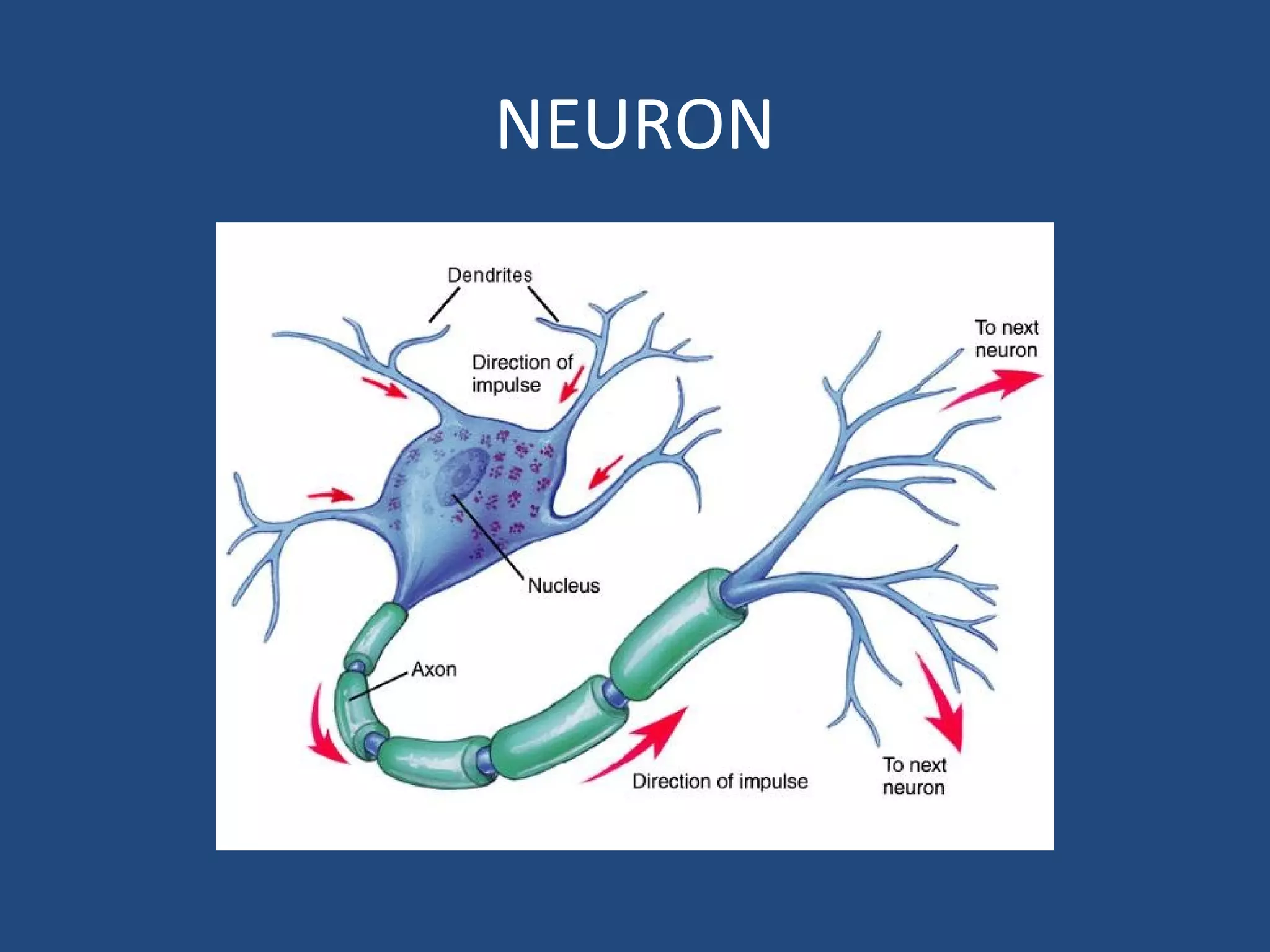
NEURON
GROUP ACTIVITY
Group A
Define Neuron
Group B
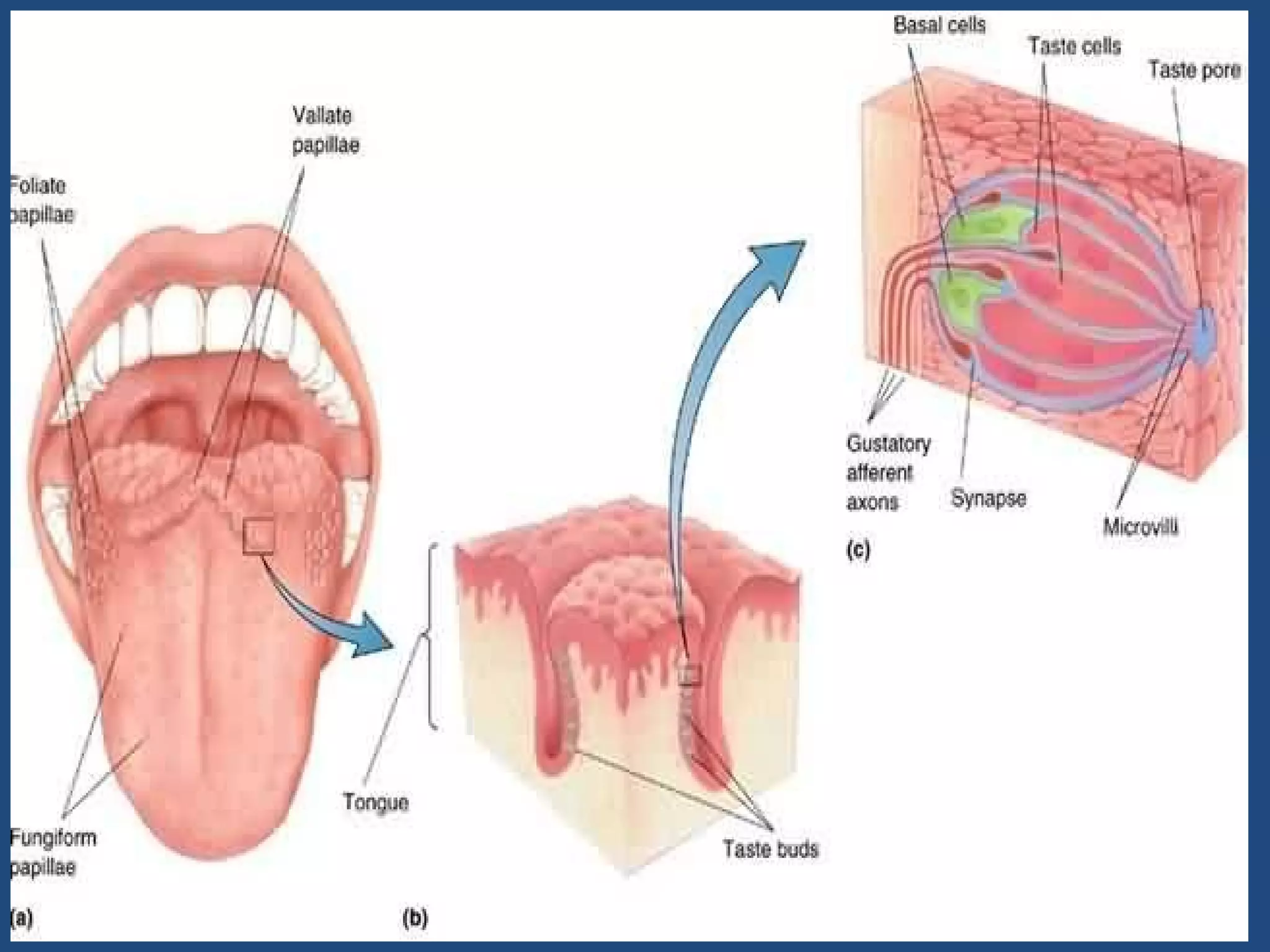
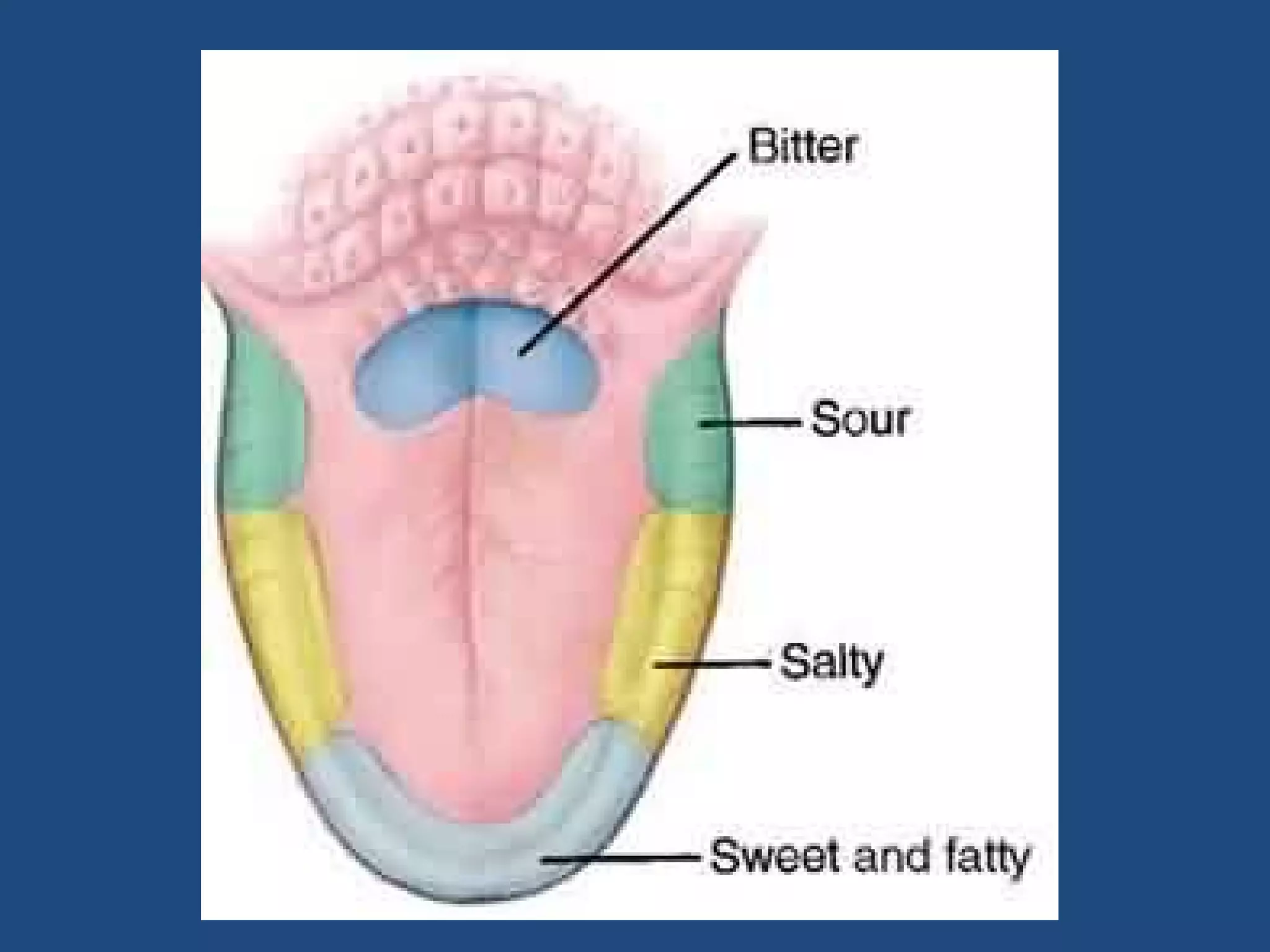
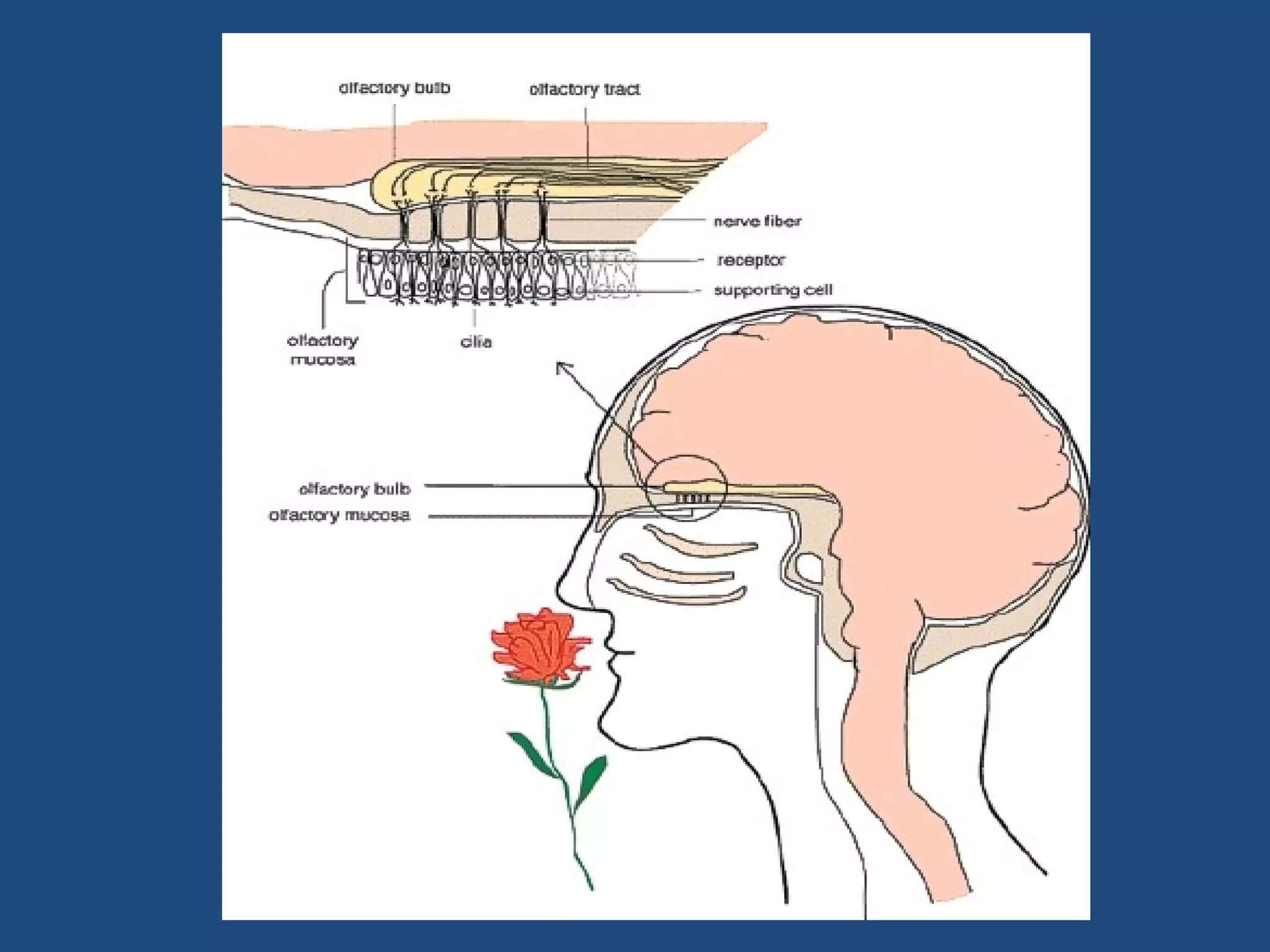
Compare gustatory receptors and olfactory receptors
Group C
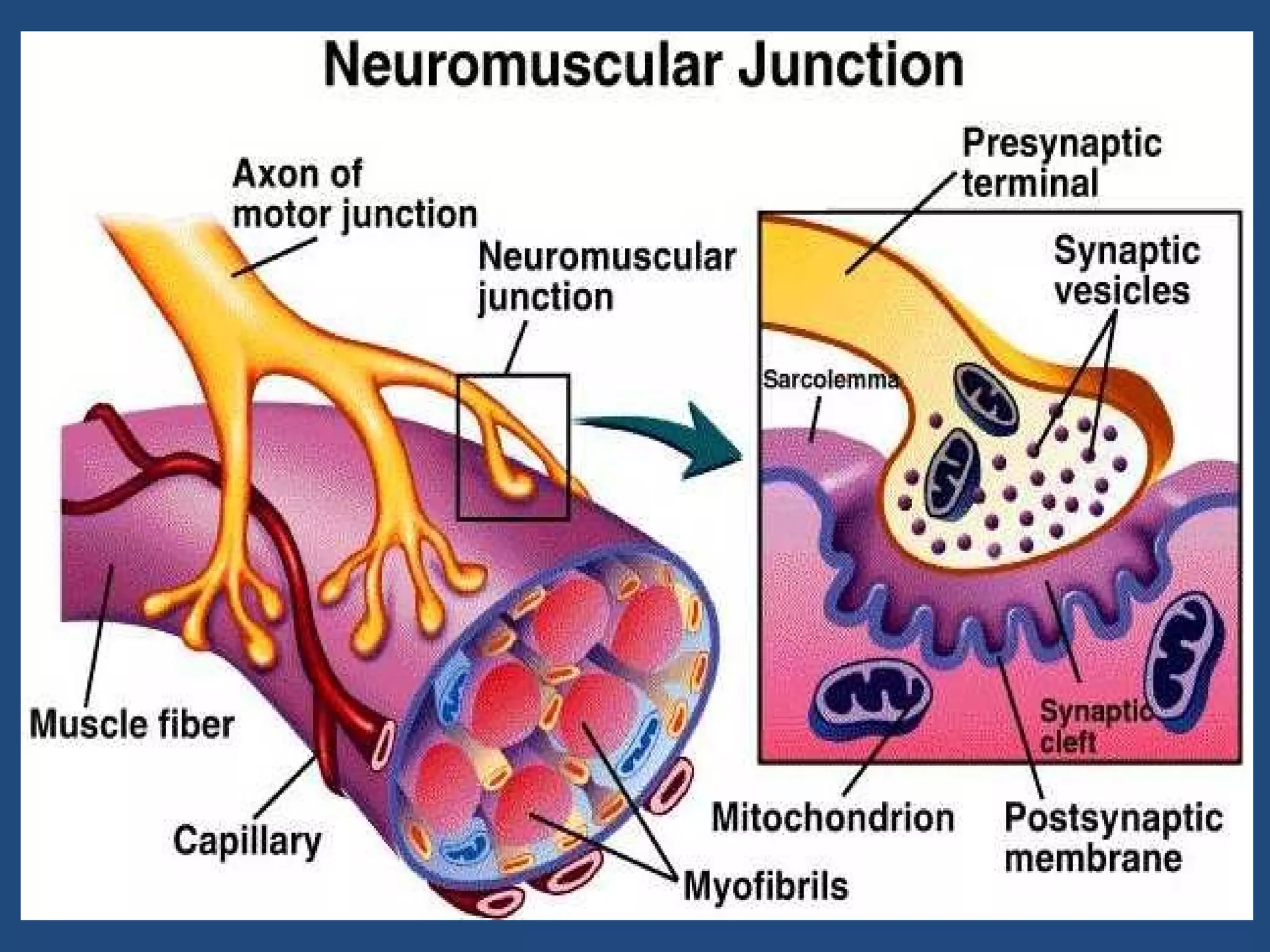
Identify the transmission of energy taking place in nerve
impulse conduction.
REFLEX ACTION
• When the stimulation of a receptor results in
a spontaneous, involuntary reaction, it is
called reflex action or simply reflex.
SPINAL REFLEX ACTION
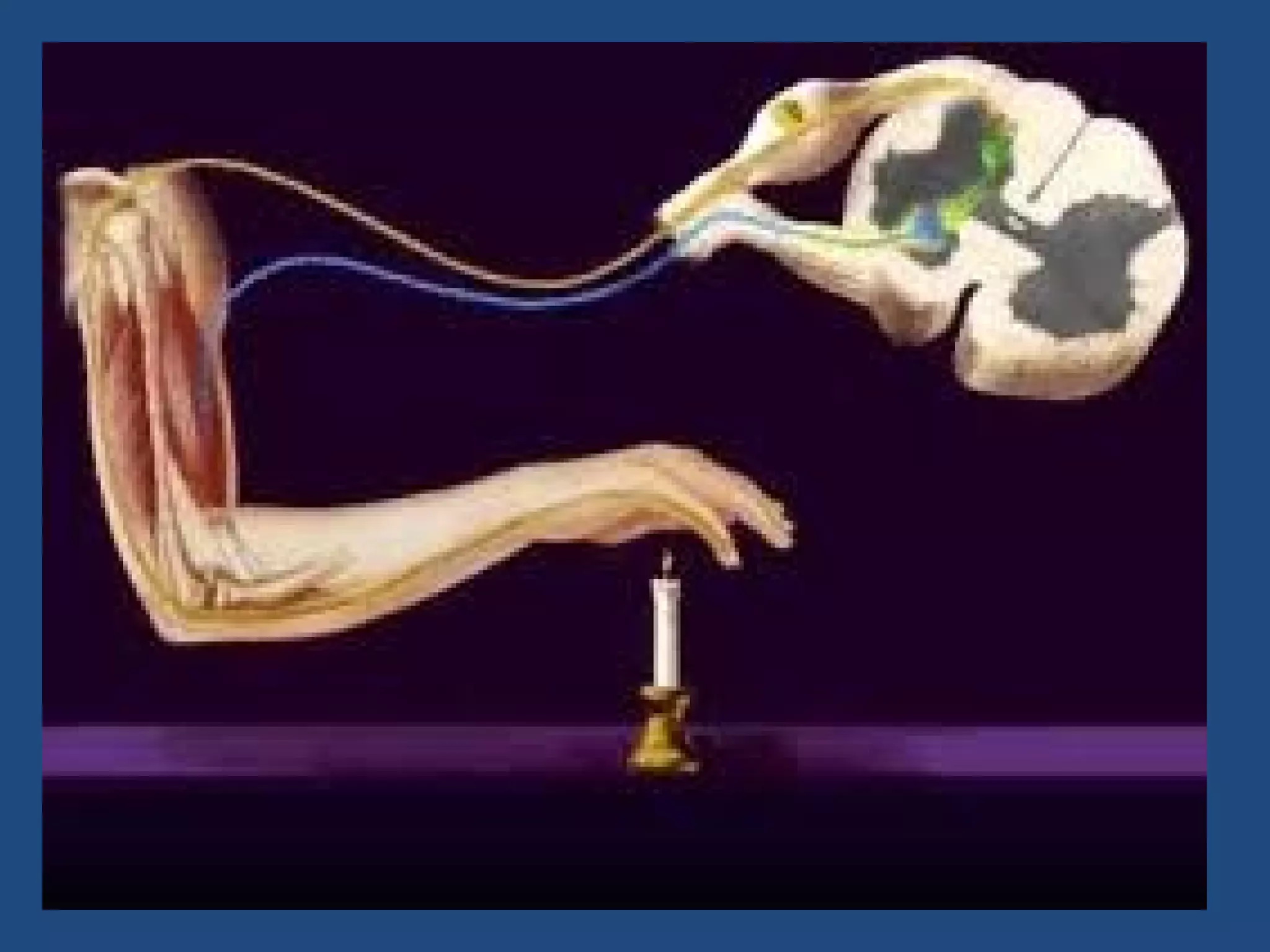
• The reflexes of this type which involve only the
spinal cord are called spinal reflexes.
• Please note that when we lift a hot plate, then
along with heat, the pain produced by heat also
acts as a 'stimulus'.
• Most of the reflex actions involve only the spinal
cord. They are called spinal reflexes.
BRAIN REFLEX ACTION
• Reflex actions which involve brain are called
cerebral reflexes.
• Cerebral reflexes occur in the organs present in the
head because these organs are directly connected
to the brain.
• Example. Our eyes are present in the head. In dim
light, the pupil (a hole in the front of eye) is large so
that more light can enter into the eye and make us
see properly even in dim light.
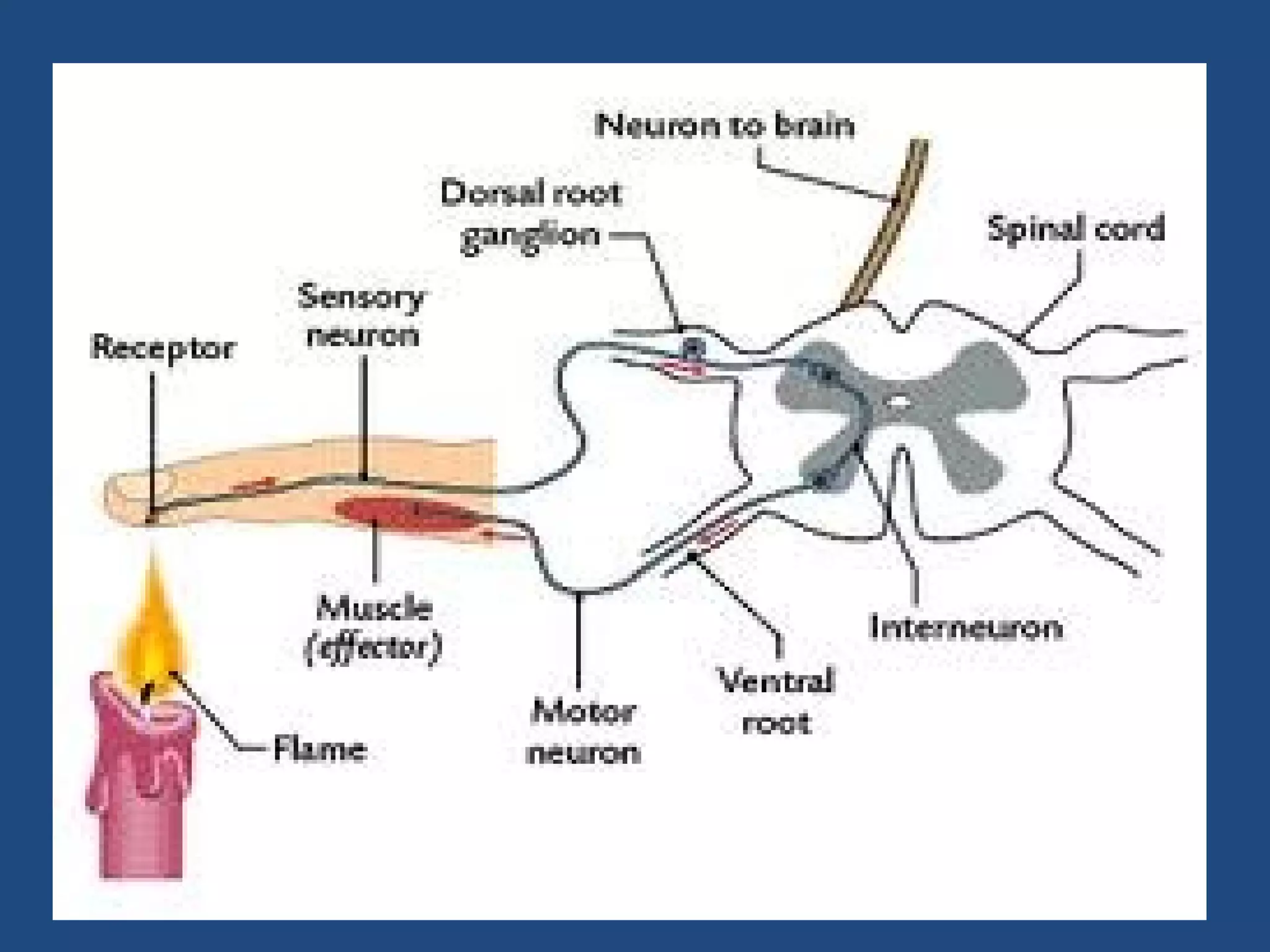
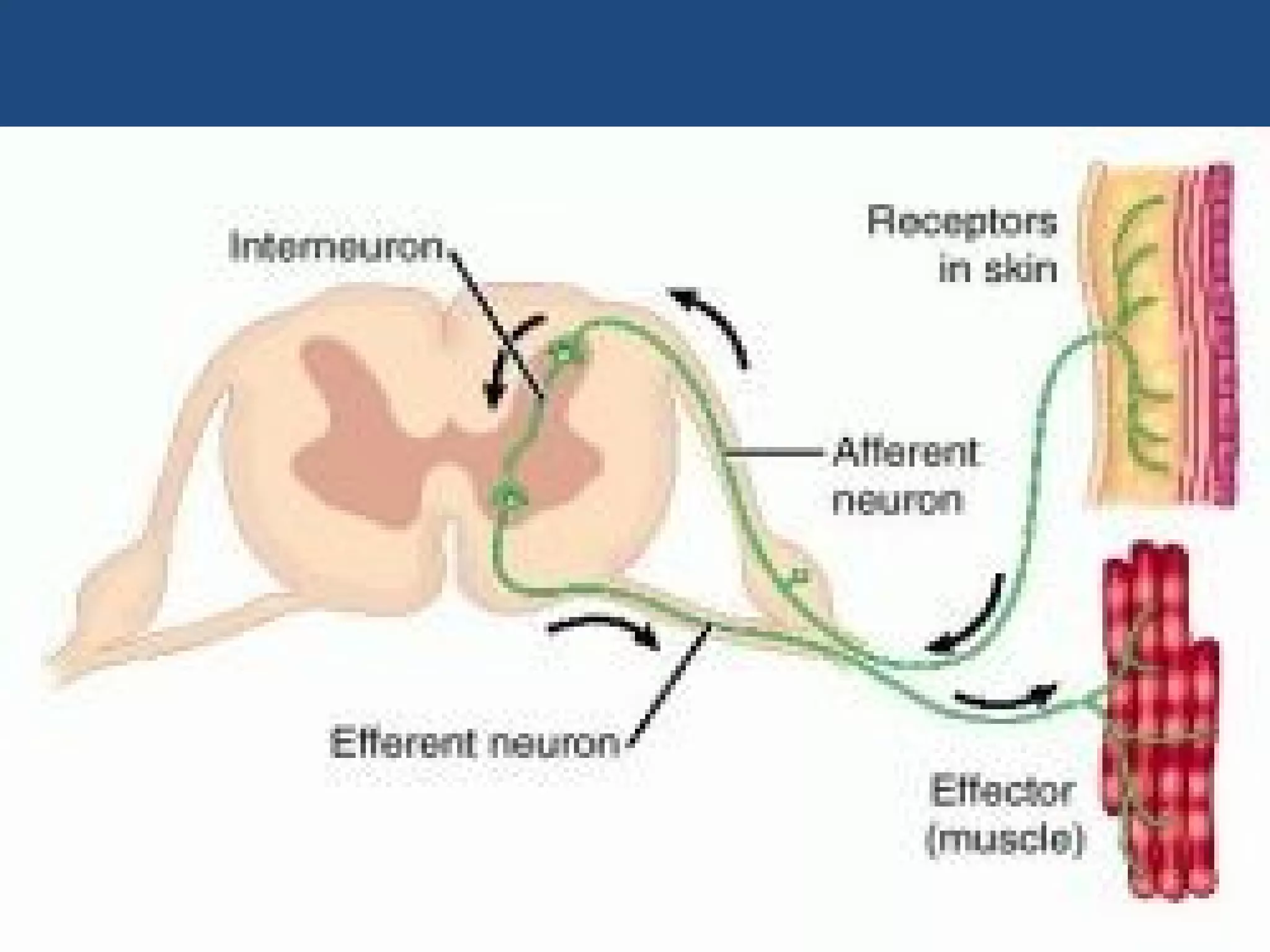
Reflex arc
• Rather than think about the sensation of heat if
the nerves detect heat were to be connected to
the nerves that move muscles in a simpler way,
the process of detecting the signal or the input
and responding to it by an output action might be
completed quickly. Such connections commonly
called as reflex arc.
Group activity
• Group A
• Define reflex action.
• Group B
• Components of reflex action.
• Group C
• Discuss the process of reflex action.
The Cerebrum
Part I:
Lobes, the Cerebral Cortex, and
Cortical Regions of the Brain
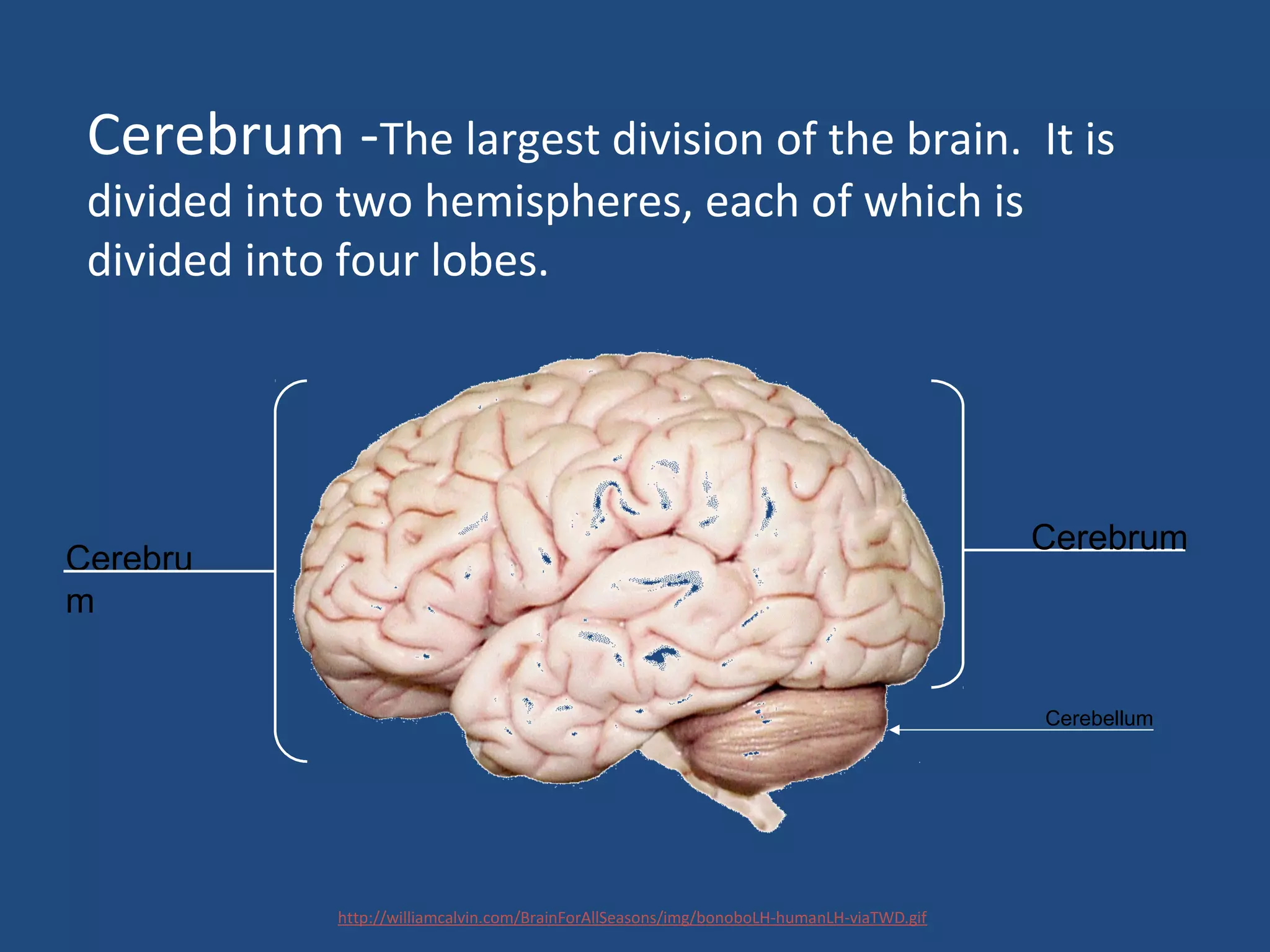
Cerebrum -The largest division of the brain. It is
divided into two hemispheres, each of which is
divided into four lobes.
Cerebru
m
Cerebrum
Cerebellum
http://williamcalvin.com/BrainForAllSeasons/img/bonoboLH-humanLH-viaTWD.gif
Cerebral Cortex
Cerebral
Cortex
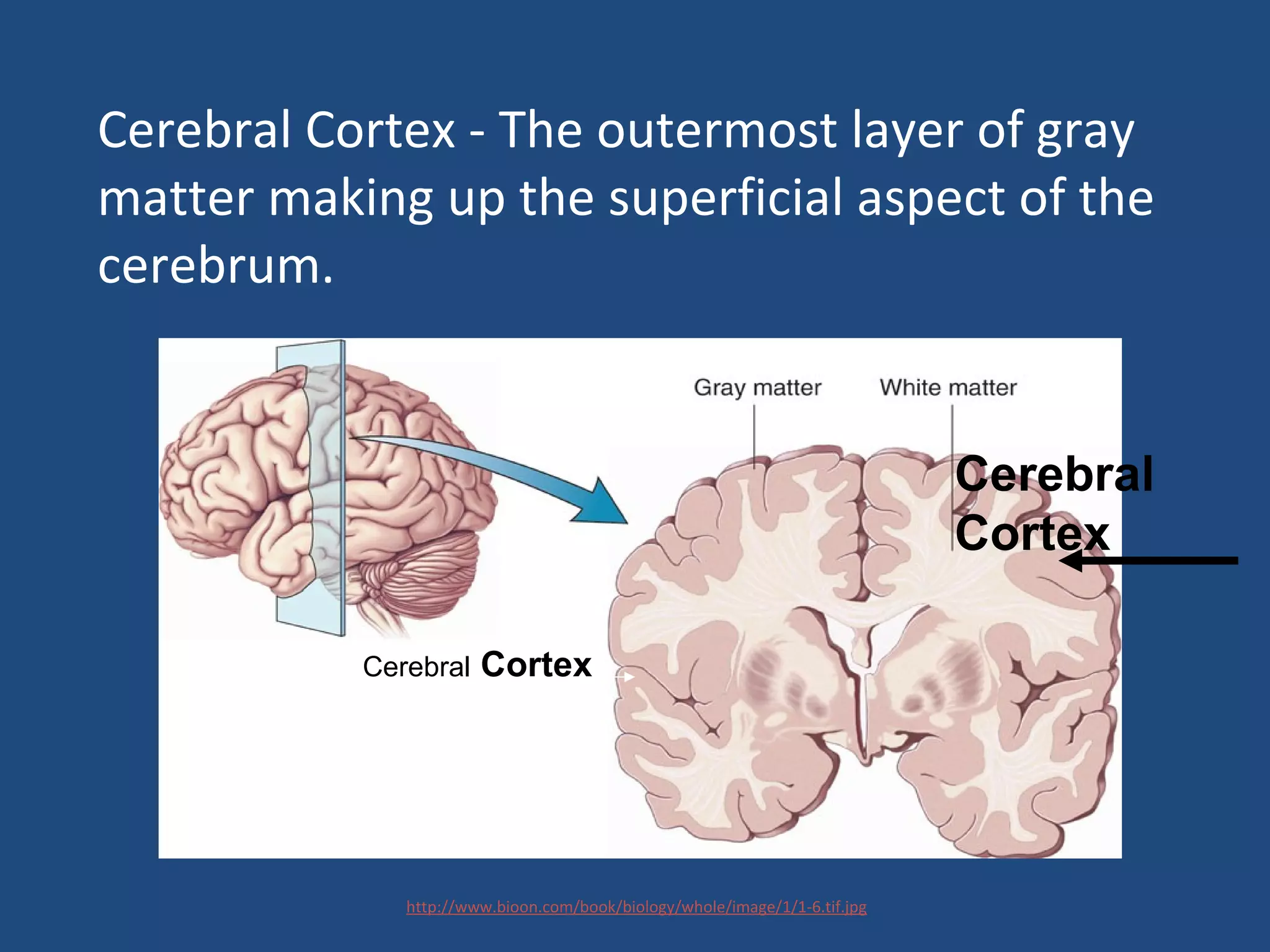
Cerebral Cortex - The outermost layer of gray
matter making up the superficial aspect of the
cerebrum.
http://www.bioon.com/book/biology/whole/image/1/1-6.tif.jpg
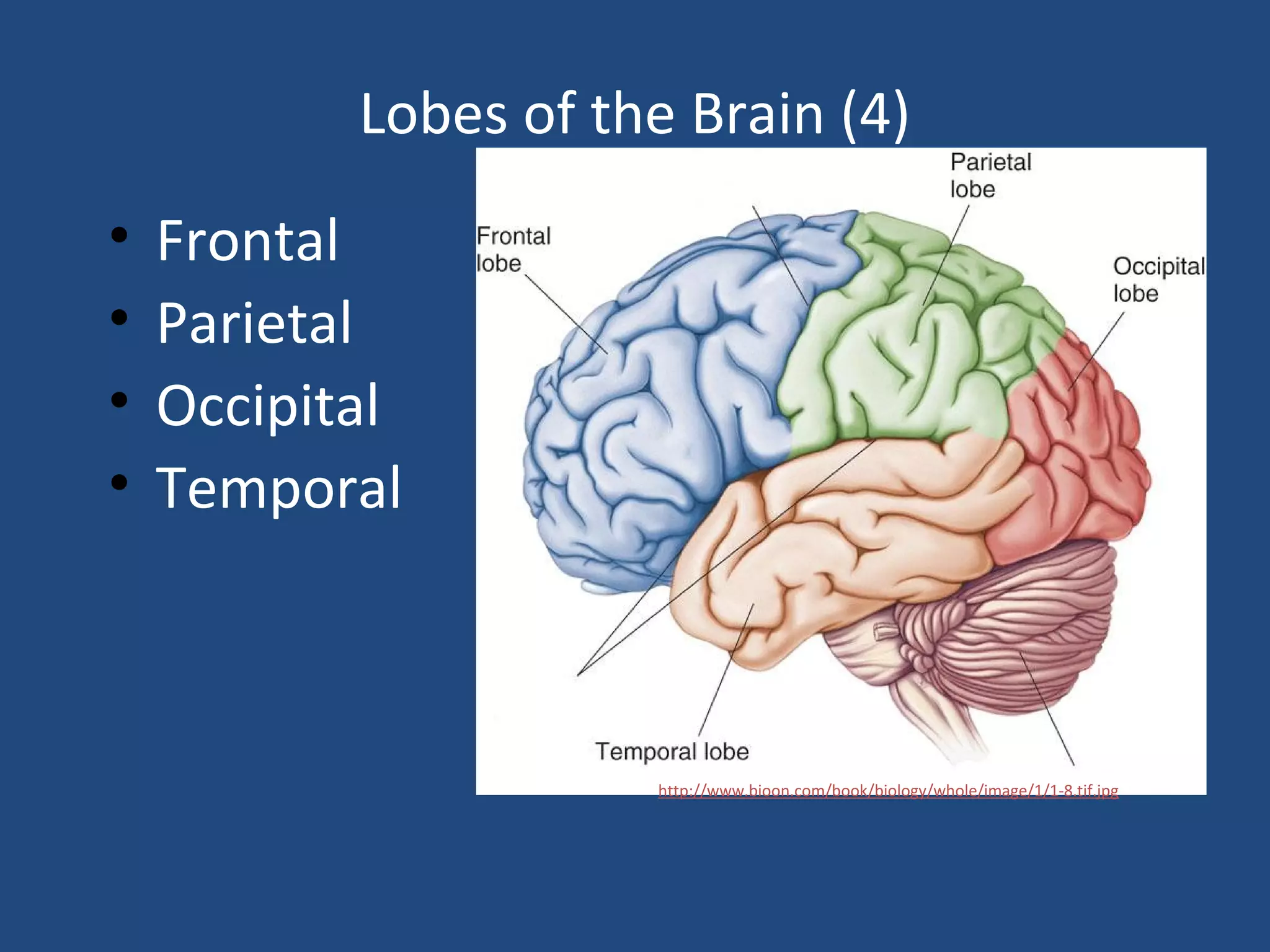
Lobes of the Brain (4)
• Frontal
• Parietal
• Occipital
• Temporal
http://www.bioon.com/book/biology/whole/image/1/1-8.tif.jpg
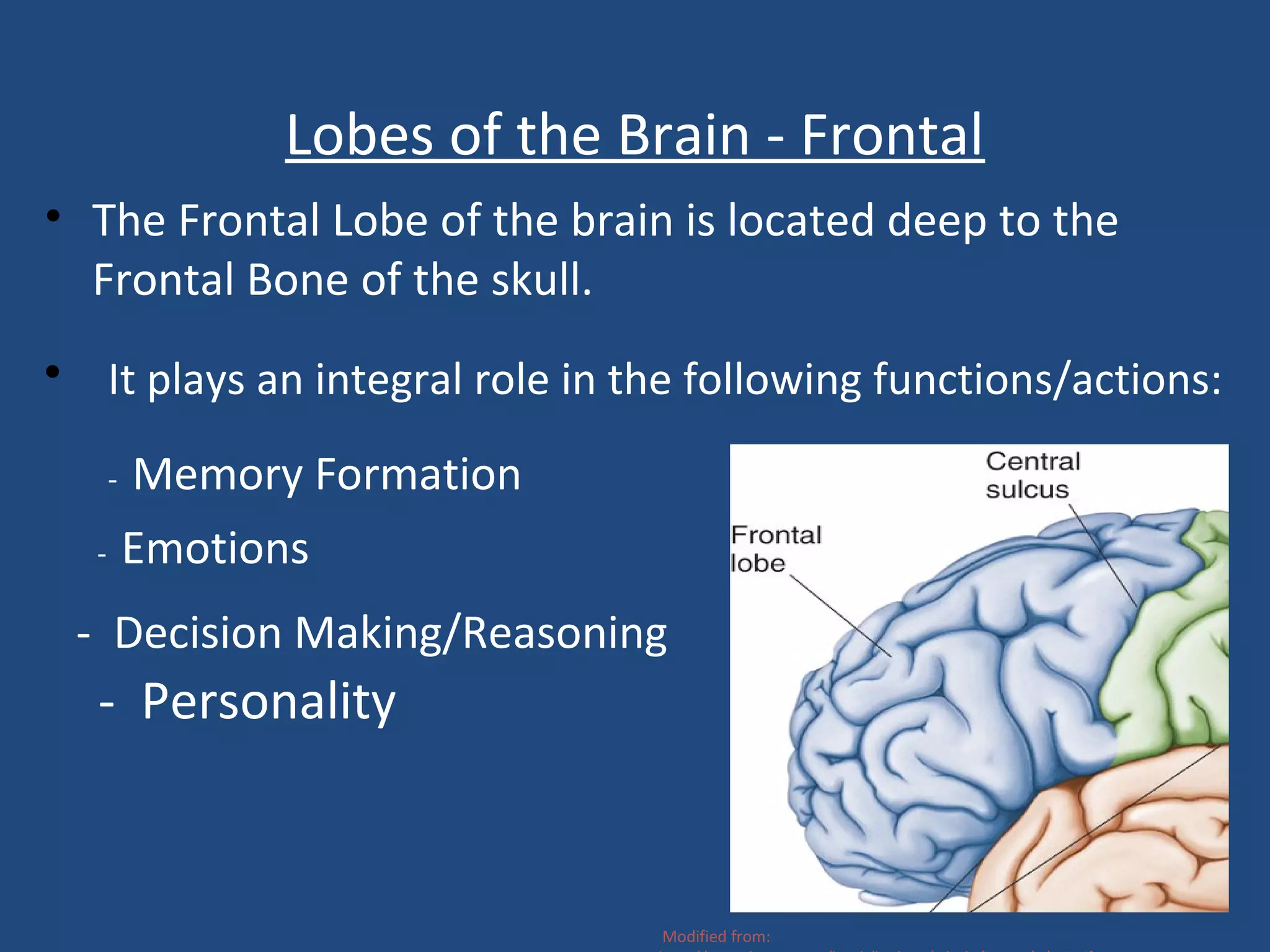
Lobes of the Brain - Frontal
• The Frontal Lobe of the brain is located deep to the
Frontal Bone of the skull.
• It plays an integral role in the following functions/actions:
- Memory Formation
- Emotions
- Decision Making/Reasoning
- Personality
Modified from:
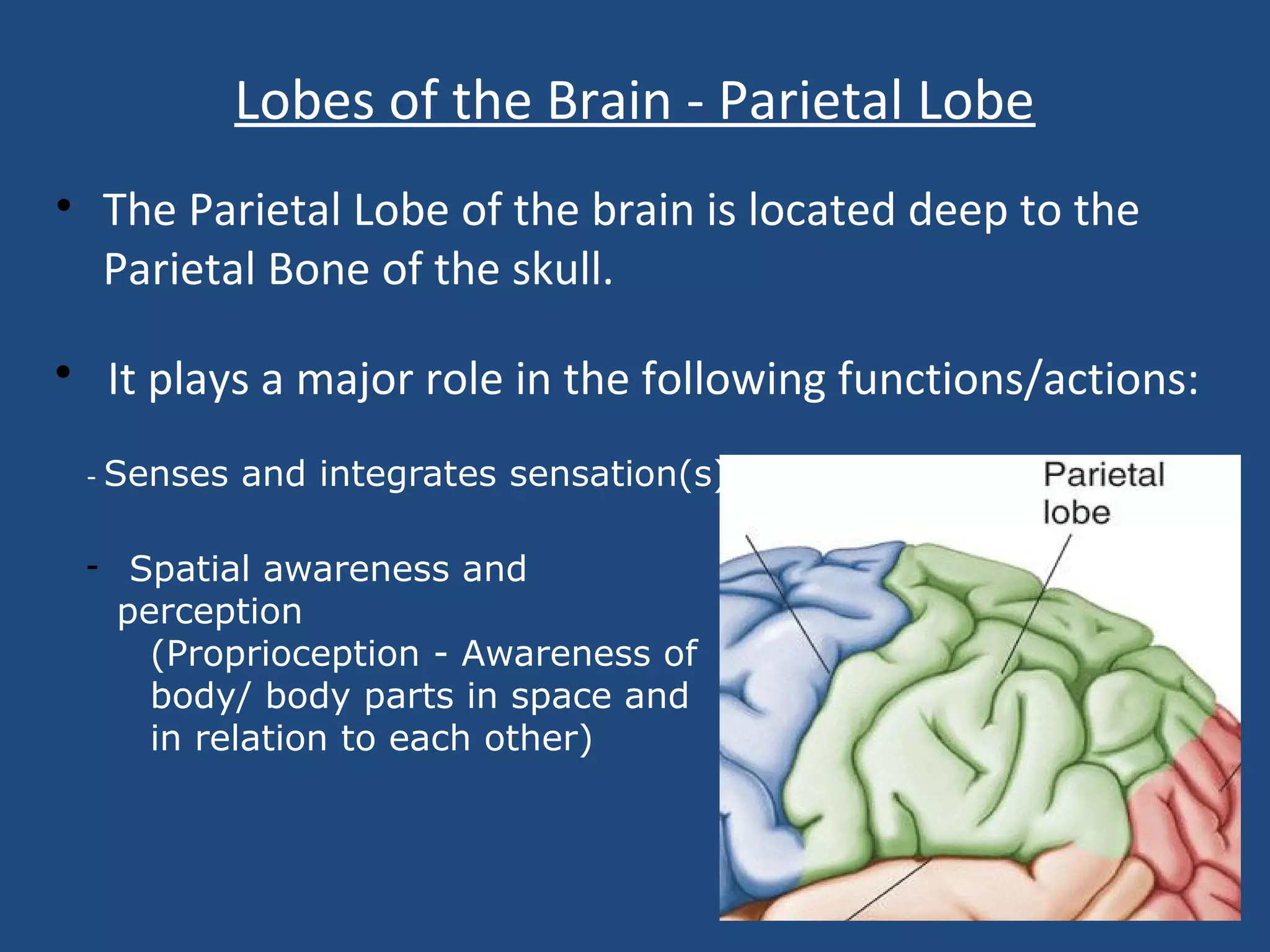
Lobes of the Brain - Parietal Lobe
• The Parietal Lobe of the brain is located deep to the
Parietal Bone of the skull.
• It plays a major role in the following functions/actions:
- Senses and integrates sensation(s)
- Spatial awareness and
perception
(Proprioception - Awareness of
body/ body parts in space and
in relation to each other)
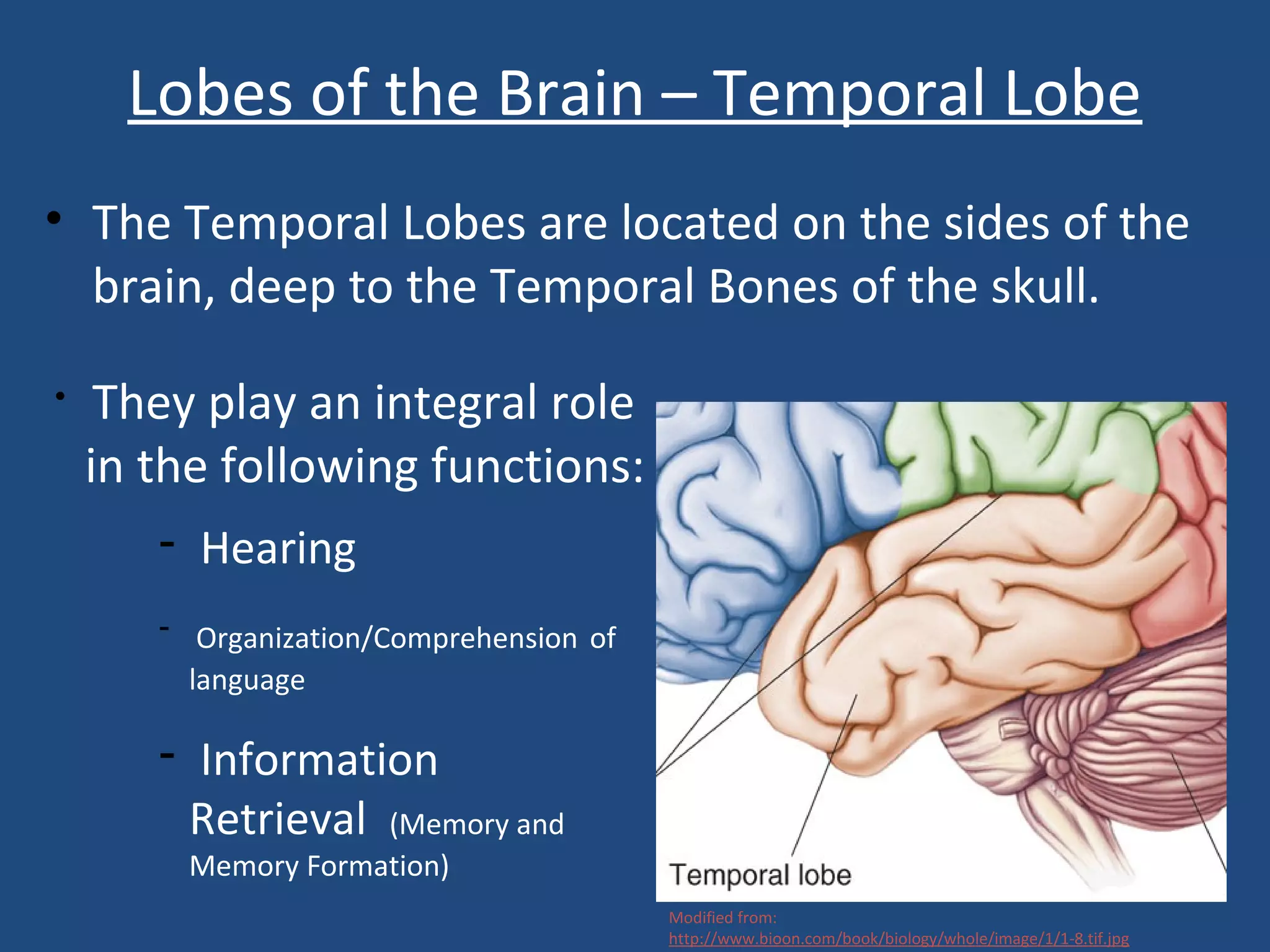
Lobes of the Brain – Temporal Lobe
• The Temporal Lobes are located on the sides of the
brain, deep to the Temporal Bones of the skull.
• They play an integral role
in the following functions:
- Hearing
- Organization/Comprehension of
language
- Information
Retrieval (Memory and
Memory Formation)
Modified from:
http://www.bioon.com/book/biology/whole/image/1/1-8.tif.jpg
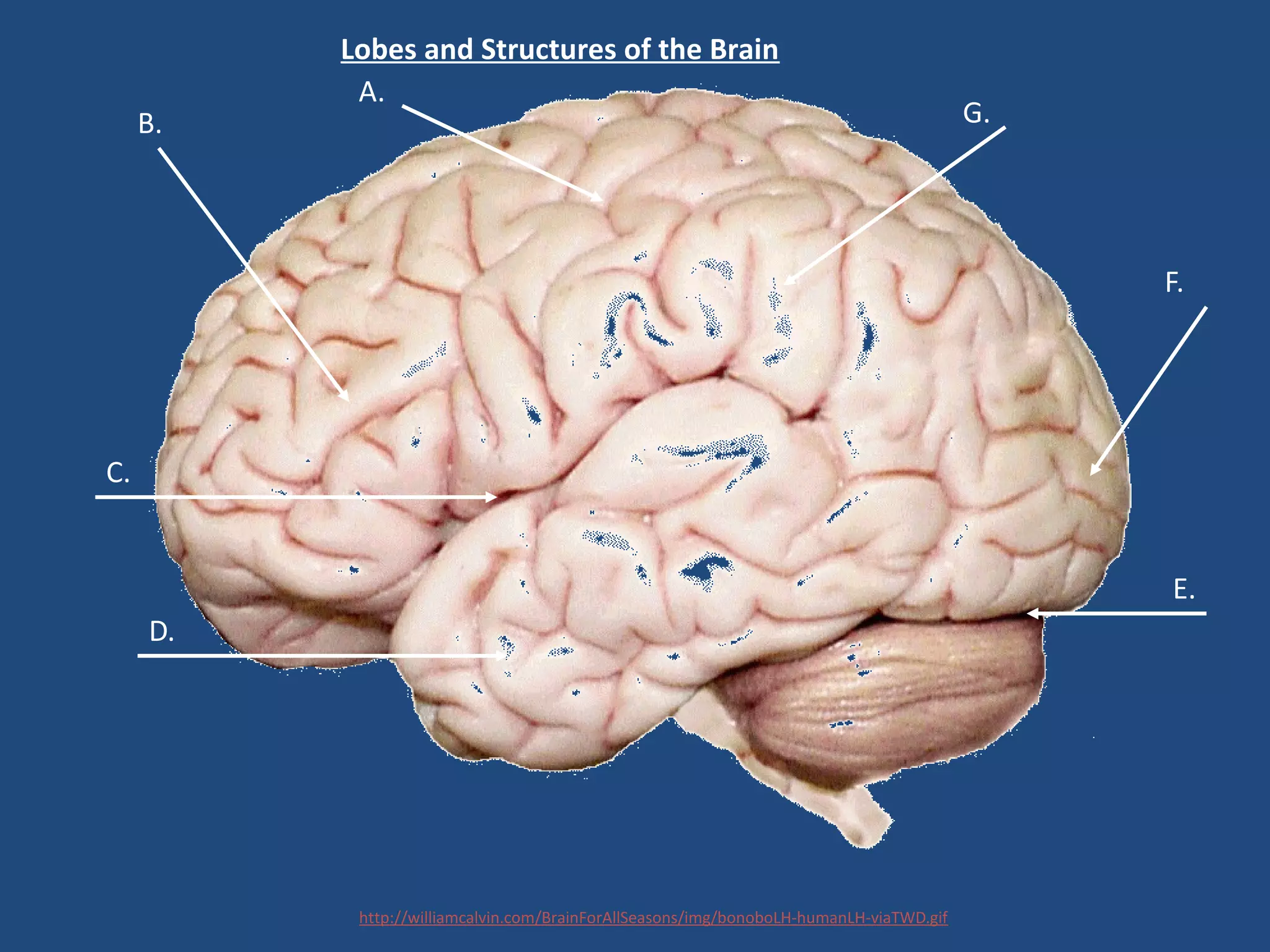
Lobes and Structures of the Brain
B.
A.
C.
D.
E.
F.
G.
http://williamcalvin.com/BrainForAllSeasons/img/bonoboLH-humanLH-viaTWD.gif
Group activity
• Group A
• What do you mean by CNS?
• Group B
• Give the components of peripheral nervous
system.
• Group C
• Distinguish between voluntary and involuntary
action.
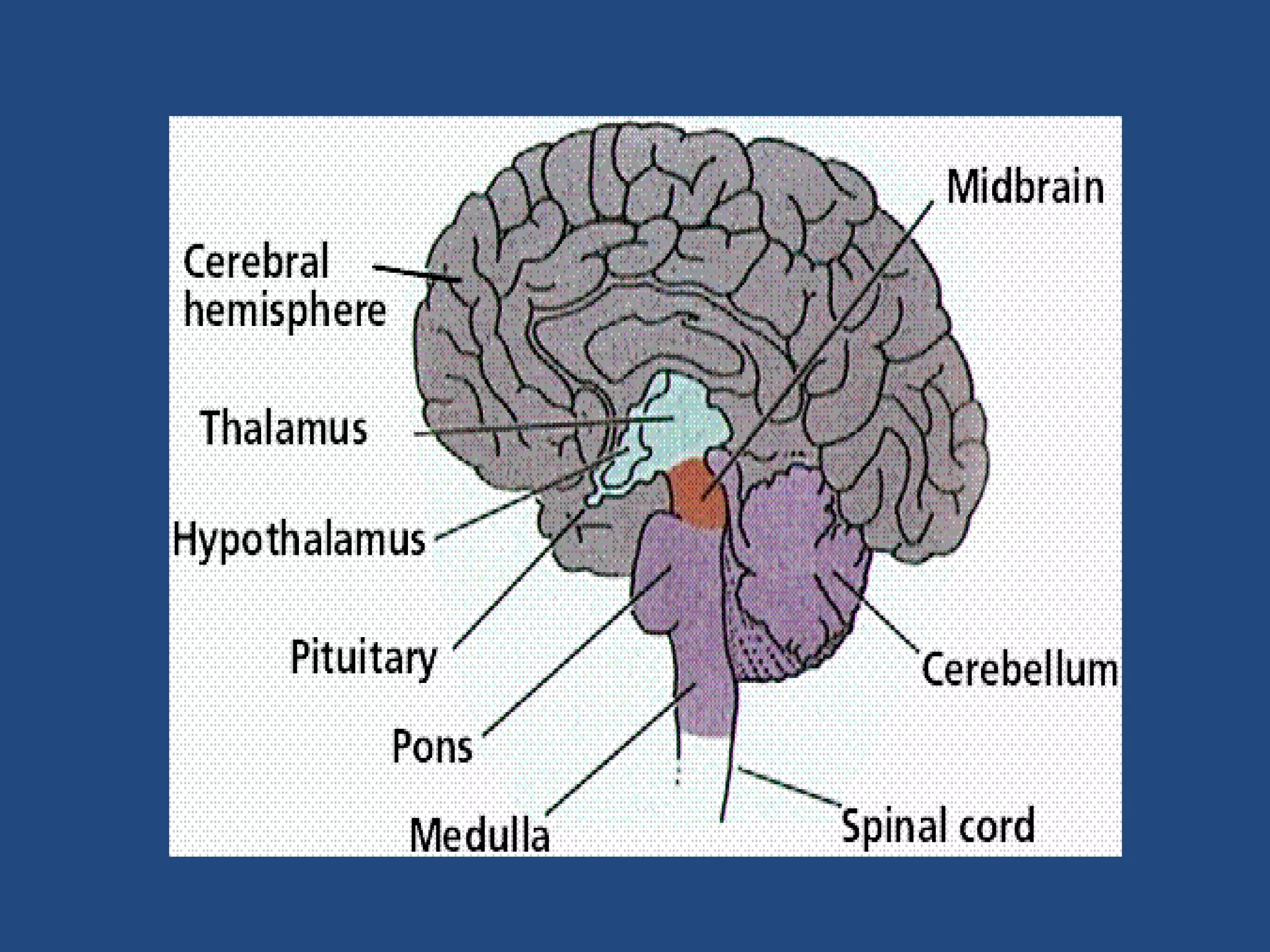
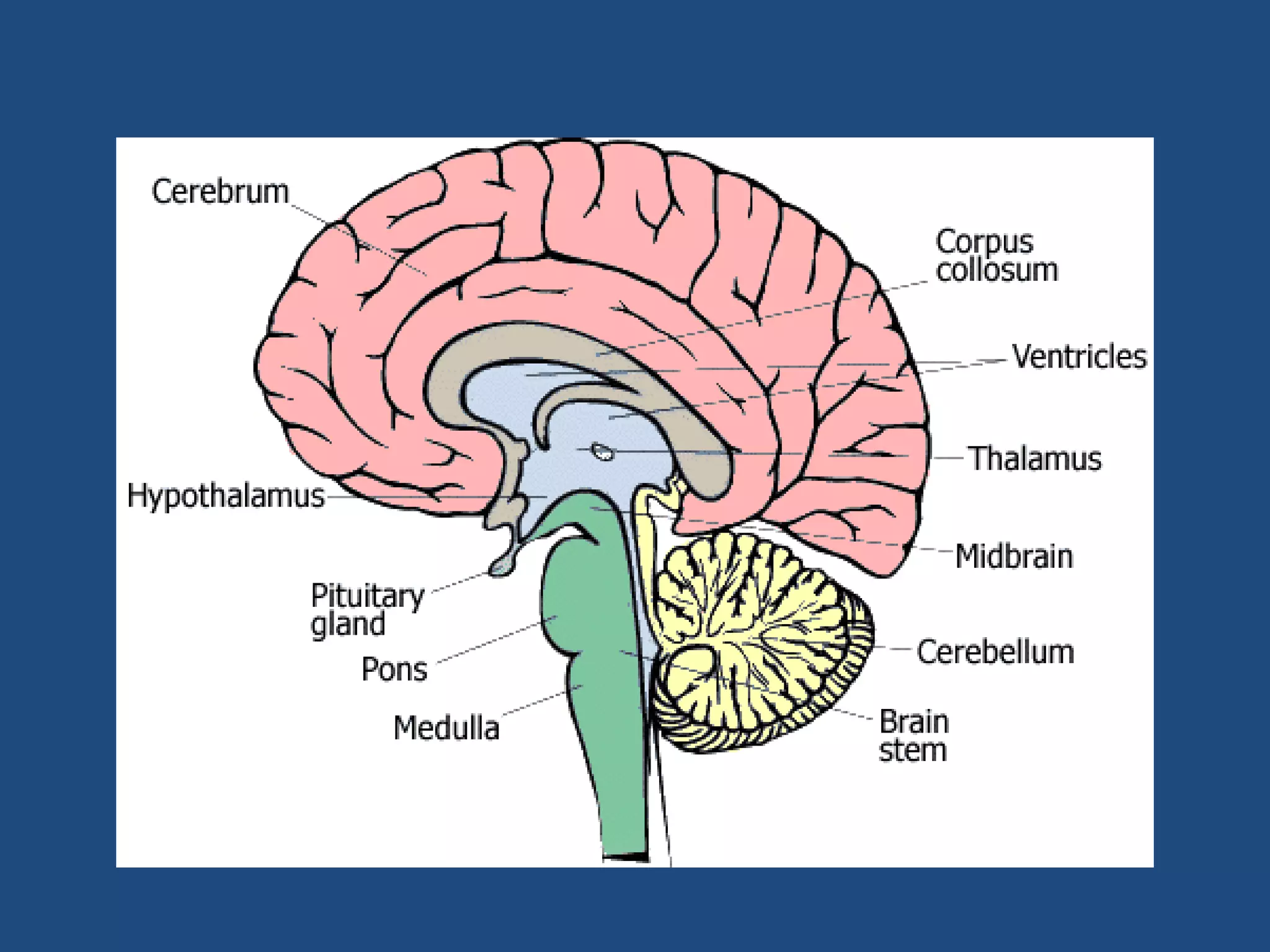
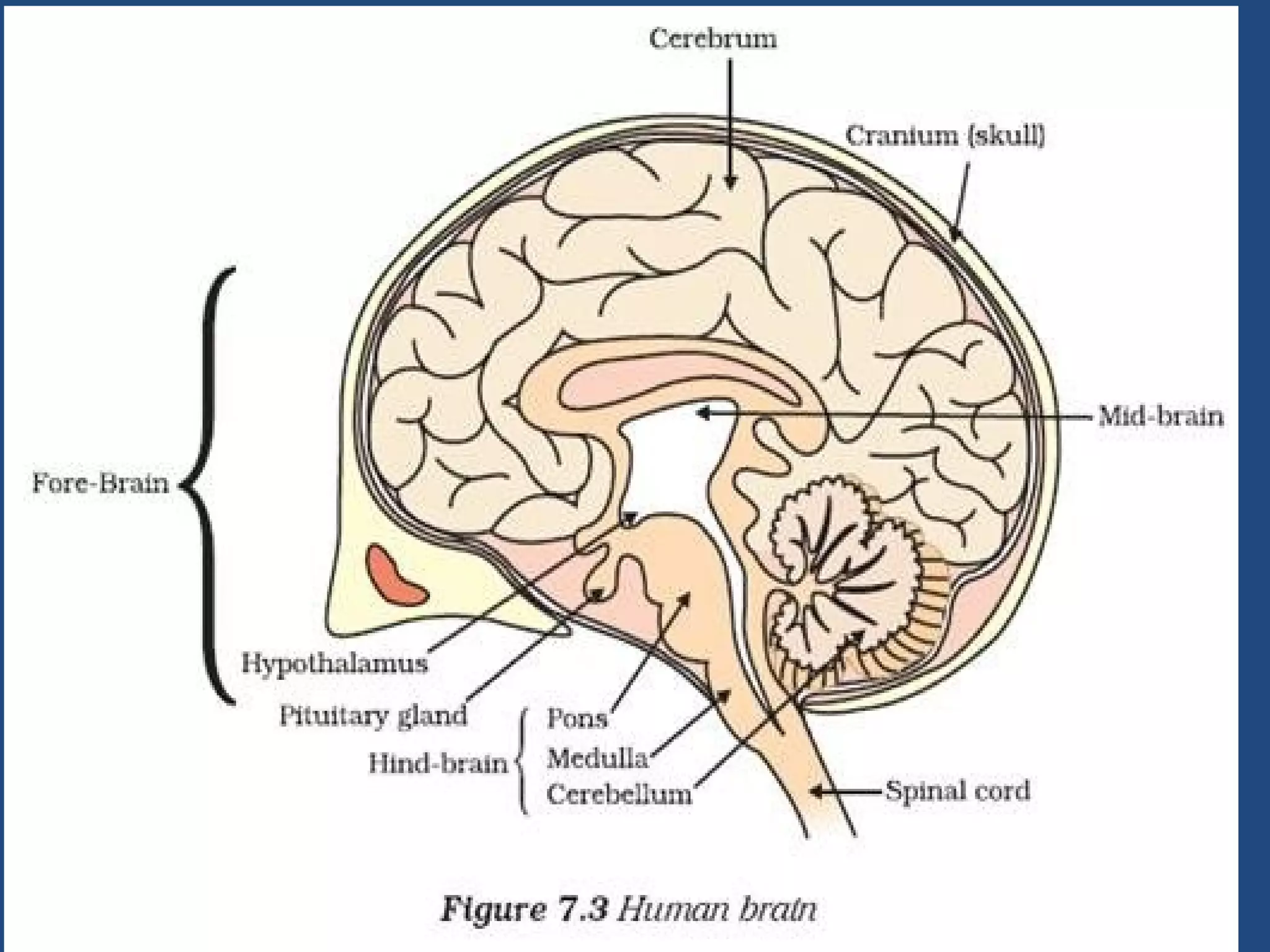
Brain has 3 regions
• Fore- Brain - cerebrum, thalamus, and
hypothalamus (part of the limbic system).
• Mid-brain - The midbrain consists of the tectum
and tegmentum.
• Hind-brain - cerebellum, pons and medulla. Often
the midbrain, pons, and medulla are referred to
together as the brainstem.
Fore- brain
• The forebrain is divided into 2 halves – the right and left
cerebral hemispheres.
• The cerebral hemispheres control your movement,
thinking, memory, emotions, senses and speech.
• As the nerve fibres leave the brain, they cross over from
one side to the other.
• This means that the nerves that come from the right
side of your brain control the left side of your body.
• Each hemisphere is divided into 4 areas called the
• Frontal lobe
• Temporal lobe
• Parietal lobe
• Occipital lobe
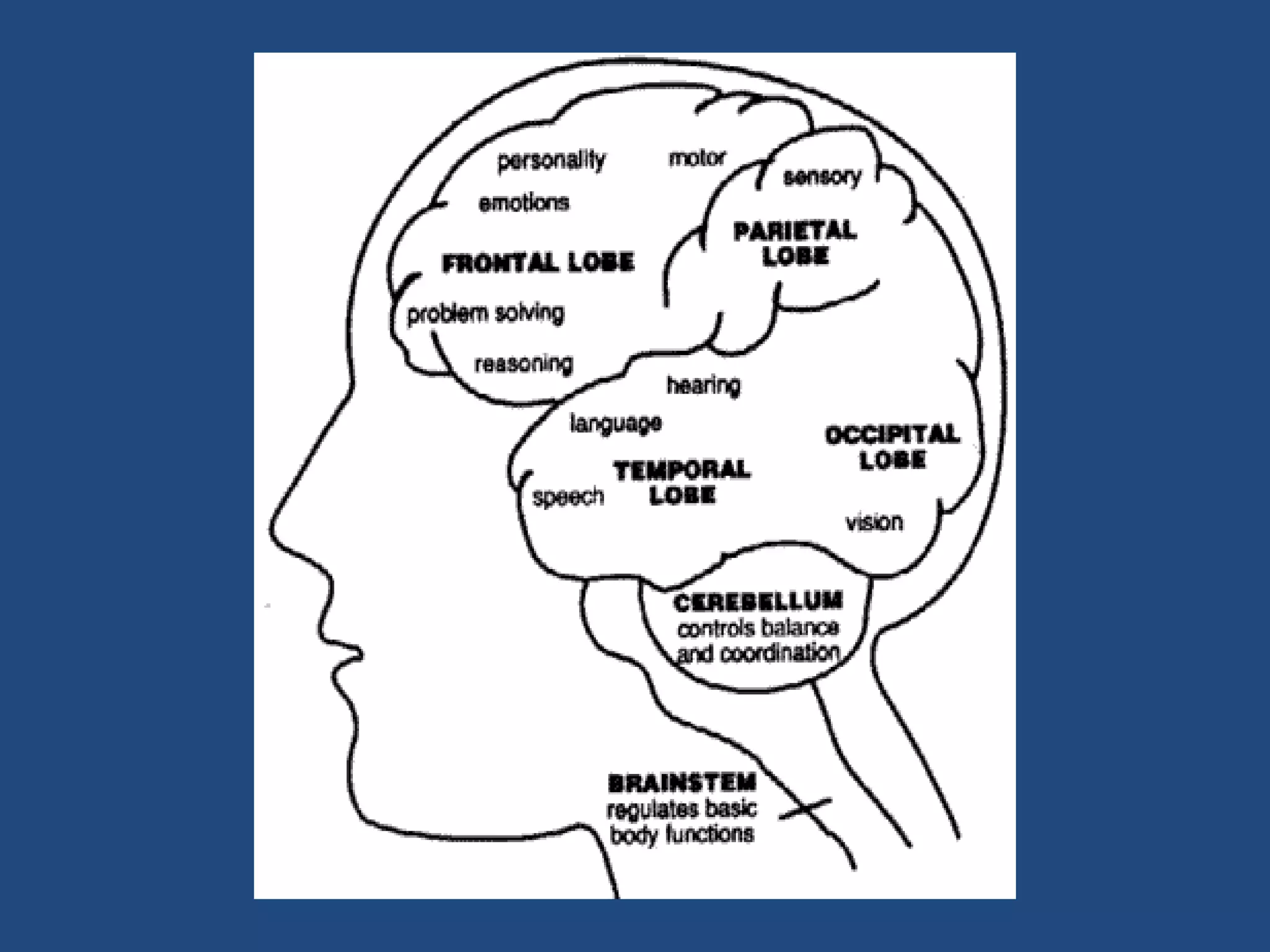
• The frontal lobe contains areas that control your
personality, thought, memory and behaviour.
• Towards the back of the frontal lobe are areas that
control movement and feeling.
• The temporal lobe helps to control behaviour,
memory, hearing, sight and your emotions.
• The parietal lobe is mainly to do with language. It is
responsible for your speech, reading, writing or
understanding of words.
• The occipital lobe is the visual centre of the brain.
Functions
• Cerebellum - This structure is associated with
regulation and coordination of movement, posture,
and balance.
• Brain Stem: This structure is responsible for basic
vital life functions such as breathing, heartbeat, and
blood pressure.
How brain tissues are protected?
• The brain is protected by a series of bone, membrane, and fluid.
• The outermost protection is the cranium, or skull, which protects
the brain from blows that could easily damage it.
• Then there are three membranes called meninges.
• Then brain is protected by a clear liquid called cerebrospinal fluid.
This forms a cushion between the soft brain tissue and the hard
cranial bones. This same fluid also fills spaces inside the brain.
• Tissues inside the spaces produce cerebrospinal fluid, which flow
through the spaces between the membranes.
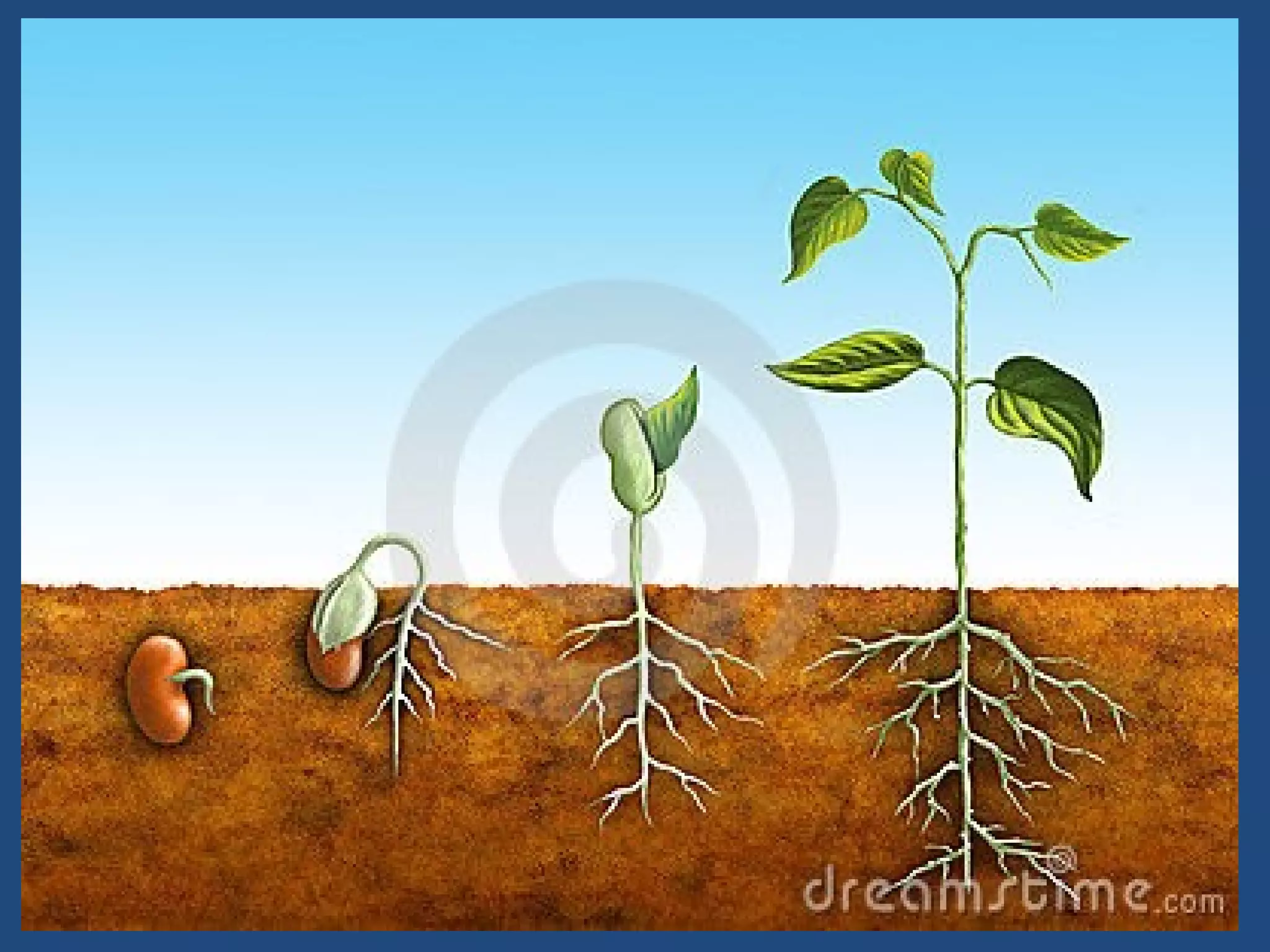
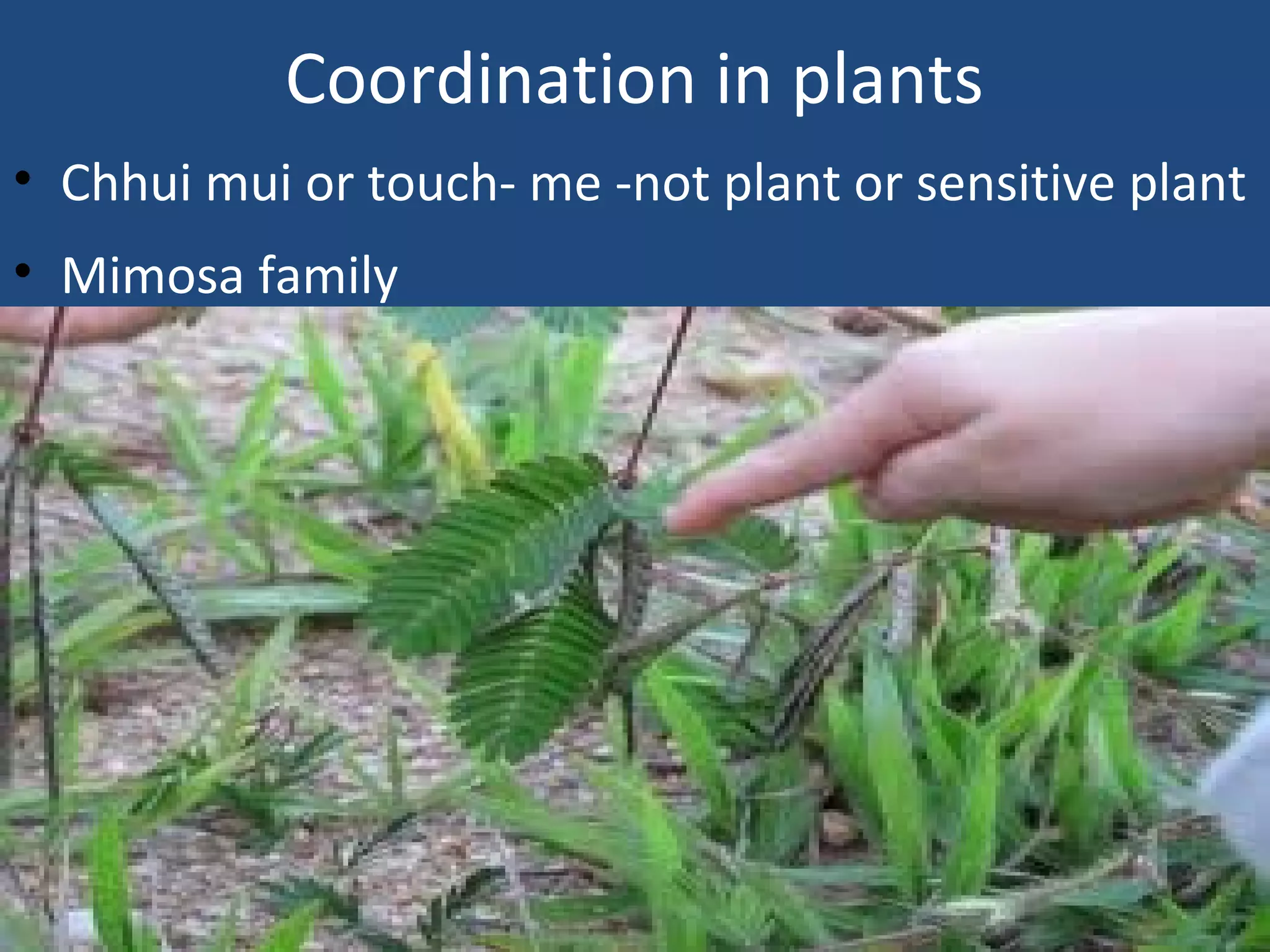
Coordination in plants
• Chhui mui or touch- me -not plant or sensitive plant
• Mimosa family
Two different types of movement in plants
• 1. Growth dependent movement
• 2. Growth independent movement
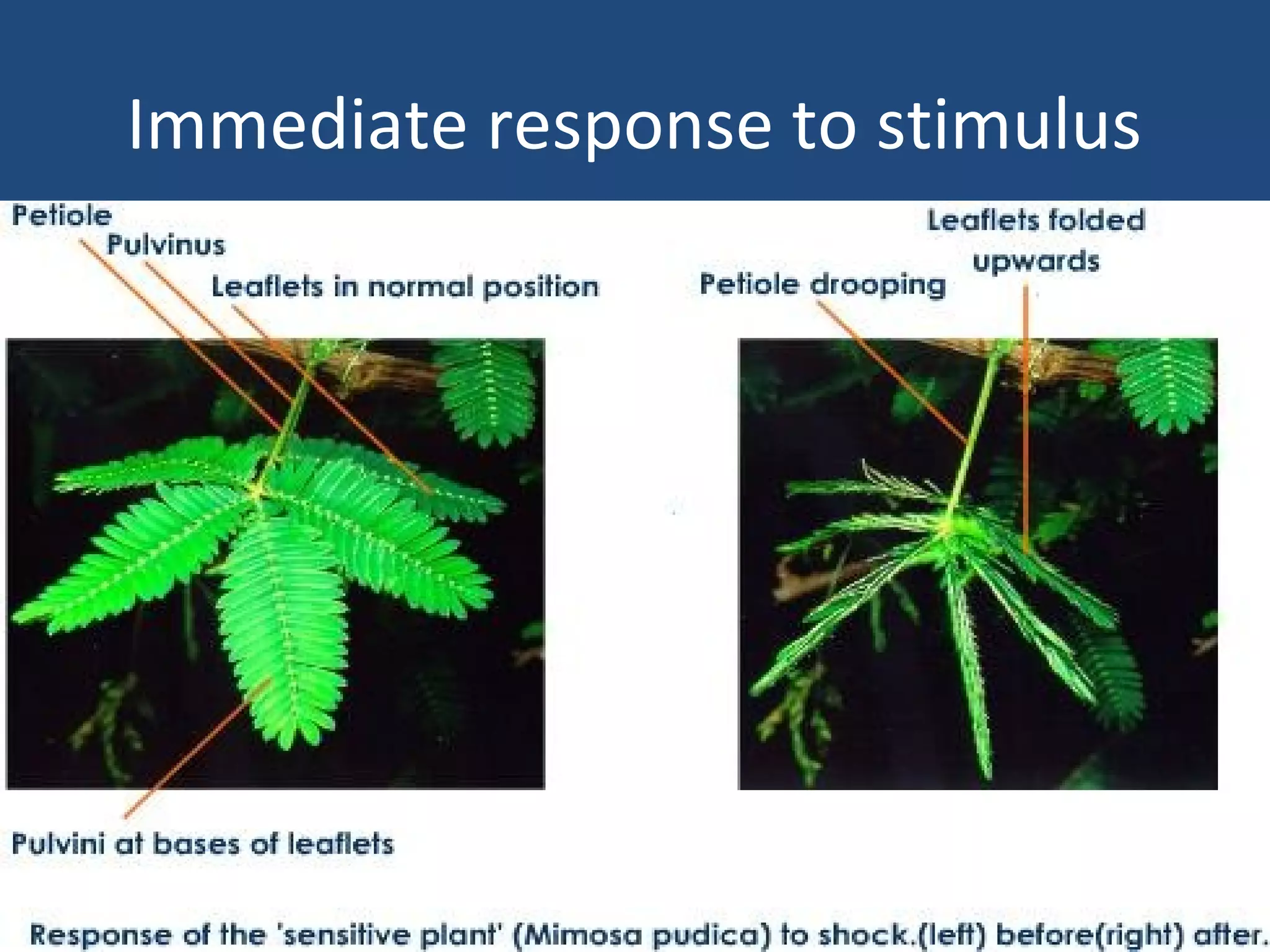
Immediate response to stimulus
• Immediate response ……
• No nervous tissues/ muscle tissues involved in plant
body.
• Plants undergo cell to cell communication system
different from nervous system and muscular system
in animals.
• They use chemical signals followed by cells swelling
due to uptake of more water and shrinking of cells
due to loss of water from plant cells. So the cell
shapes change due to response.
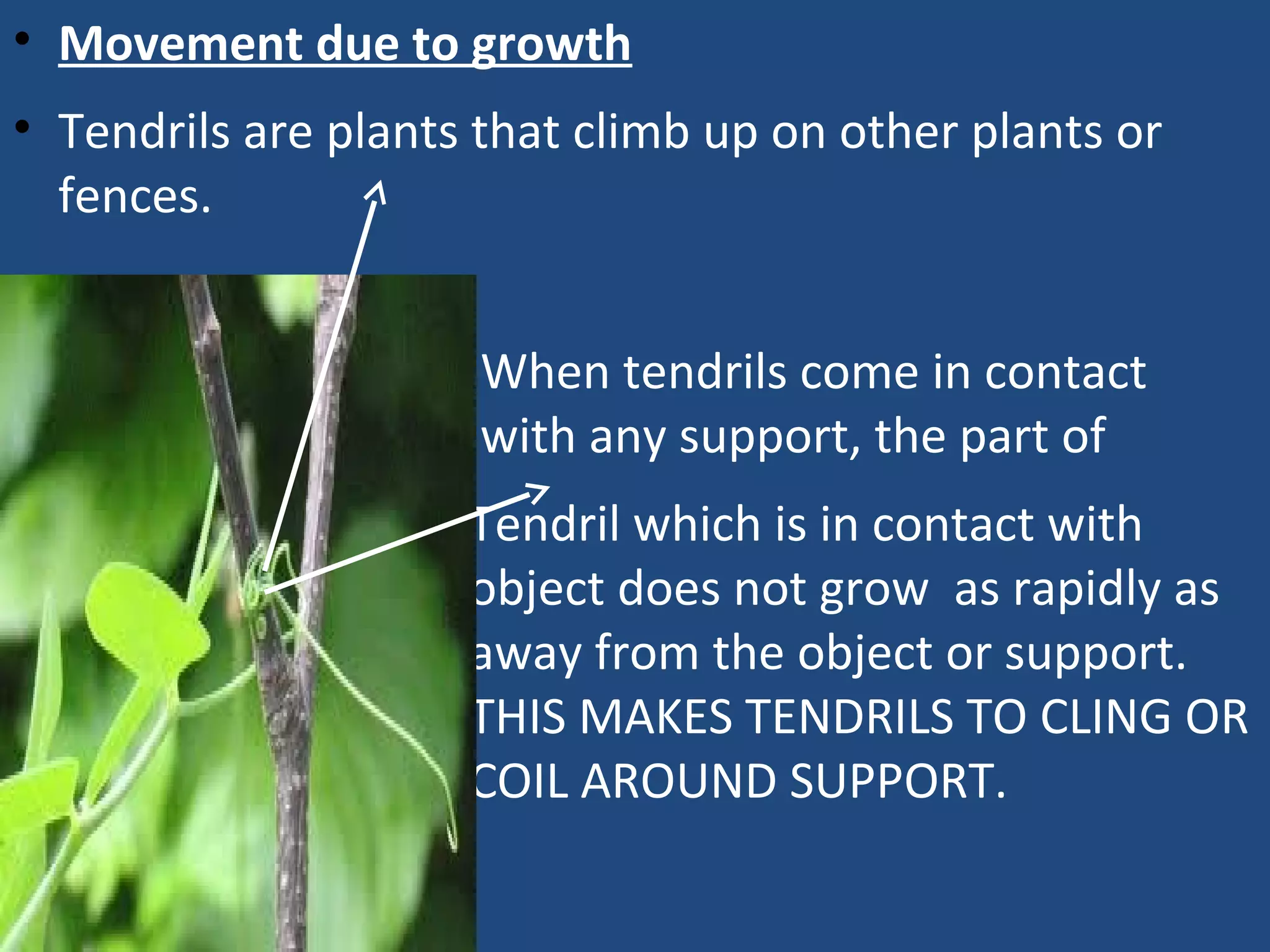
• Movement due to growth
• Tendrils are plants that climb up on other plants or
fences.
• When tendrils come in contact
with any support, the part of
●
Tendril which is in contact with
object does not grow as rapidly as
away from the object or support.
THIS MAKES TENDRILS TO CLING OR
COIL AROUND SUPPORT.
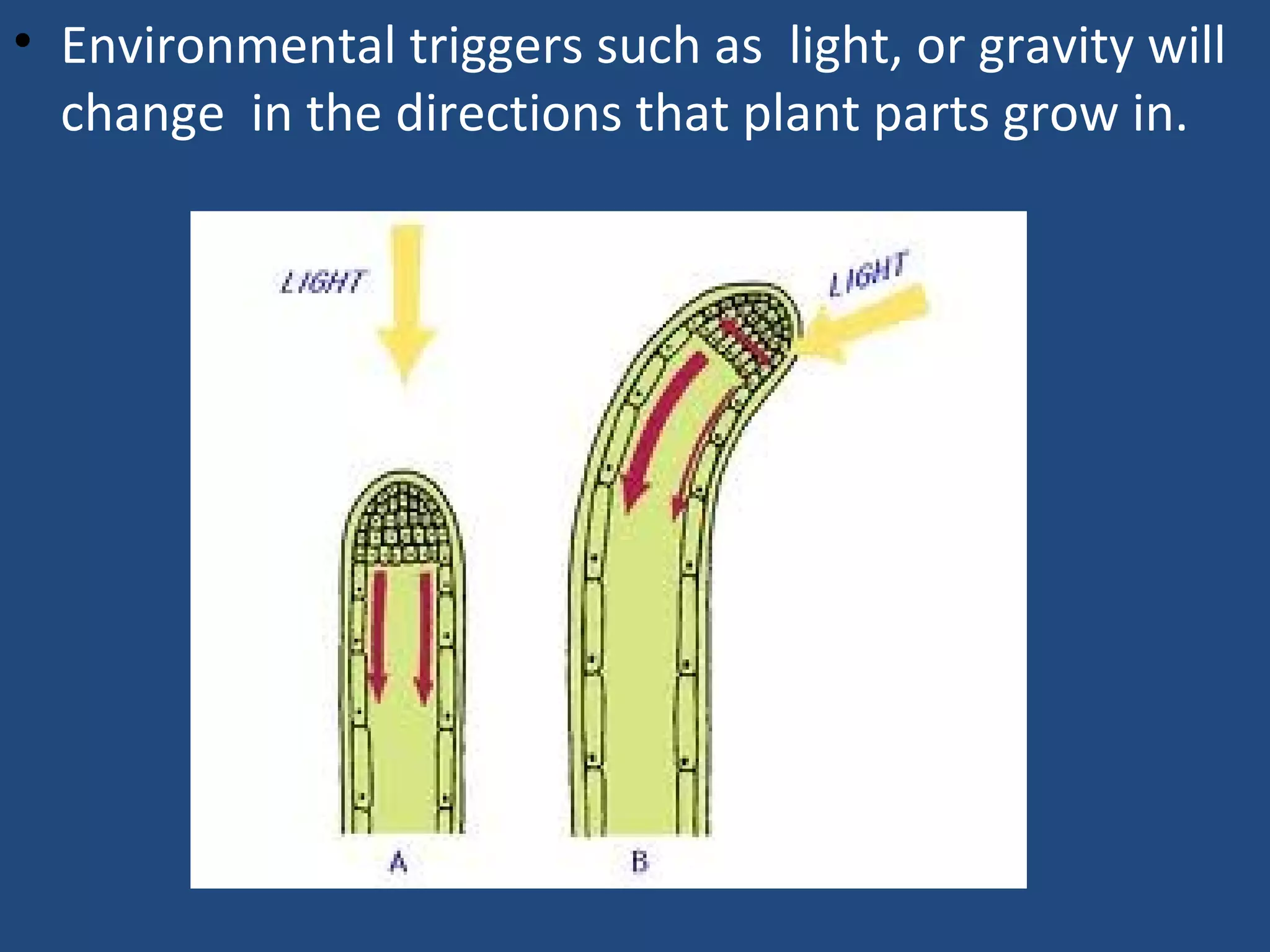
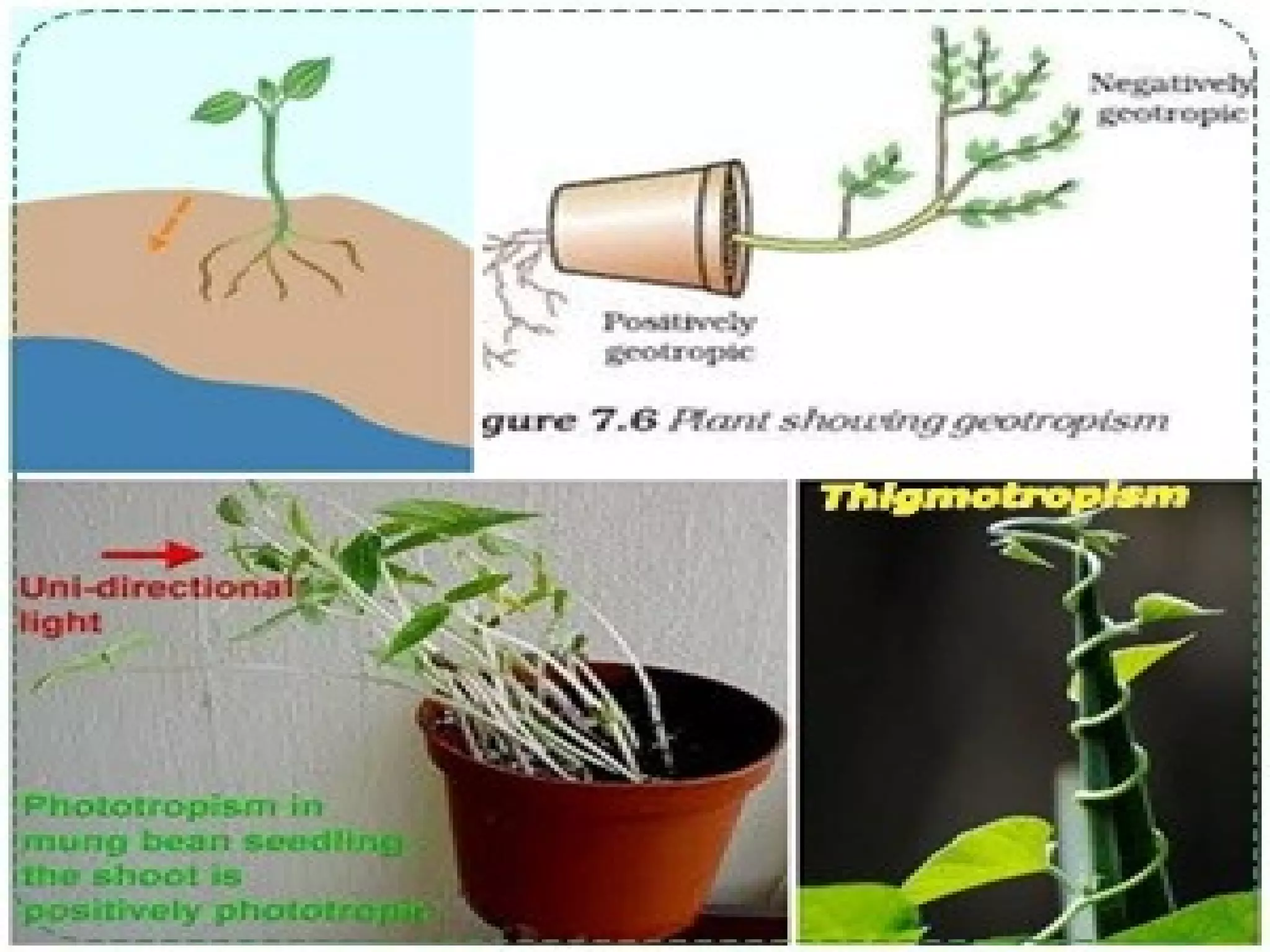
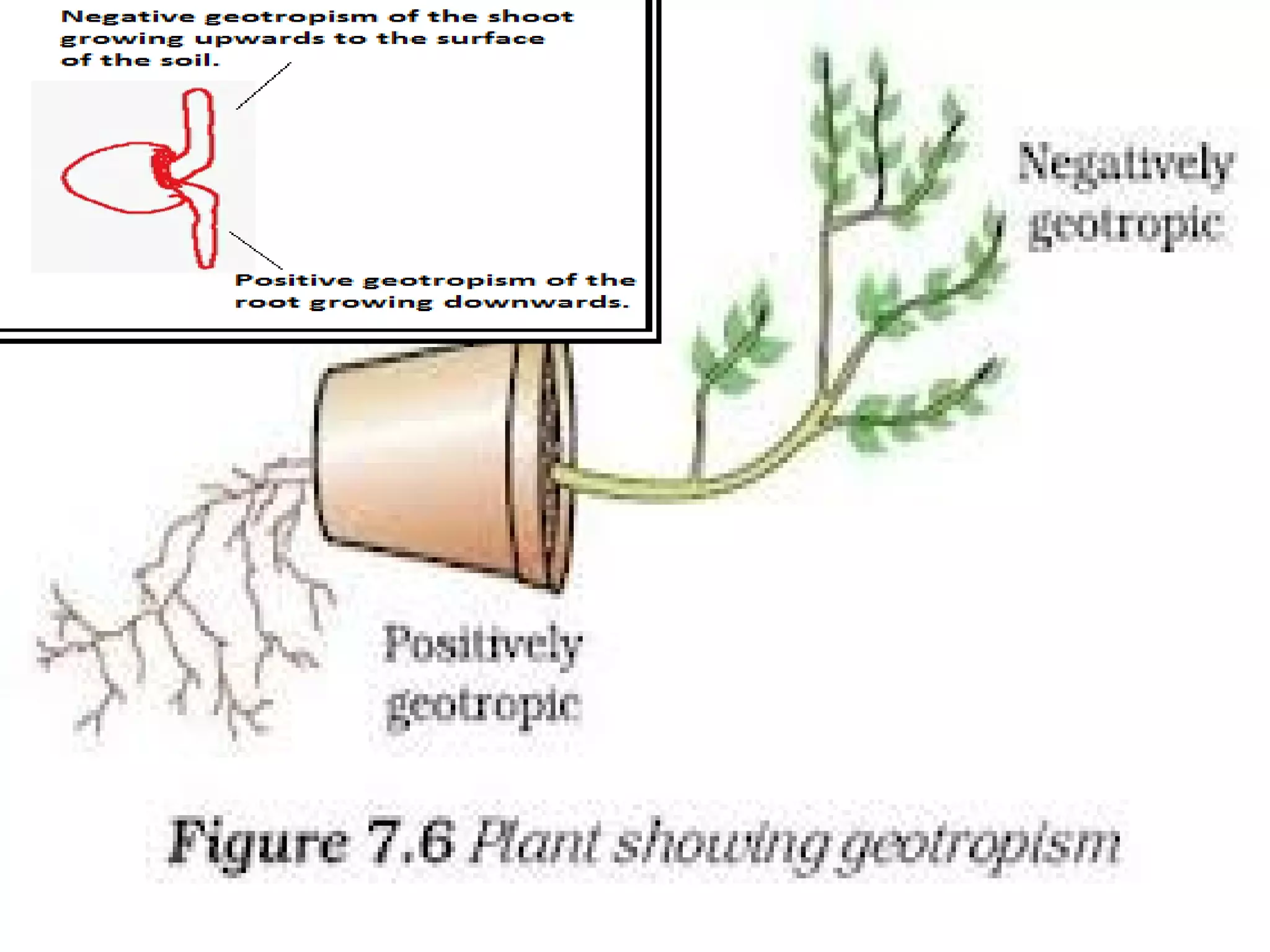
• Environmental triggers such as light, or gravity will
change in the directions that plant parts grow in.
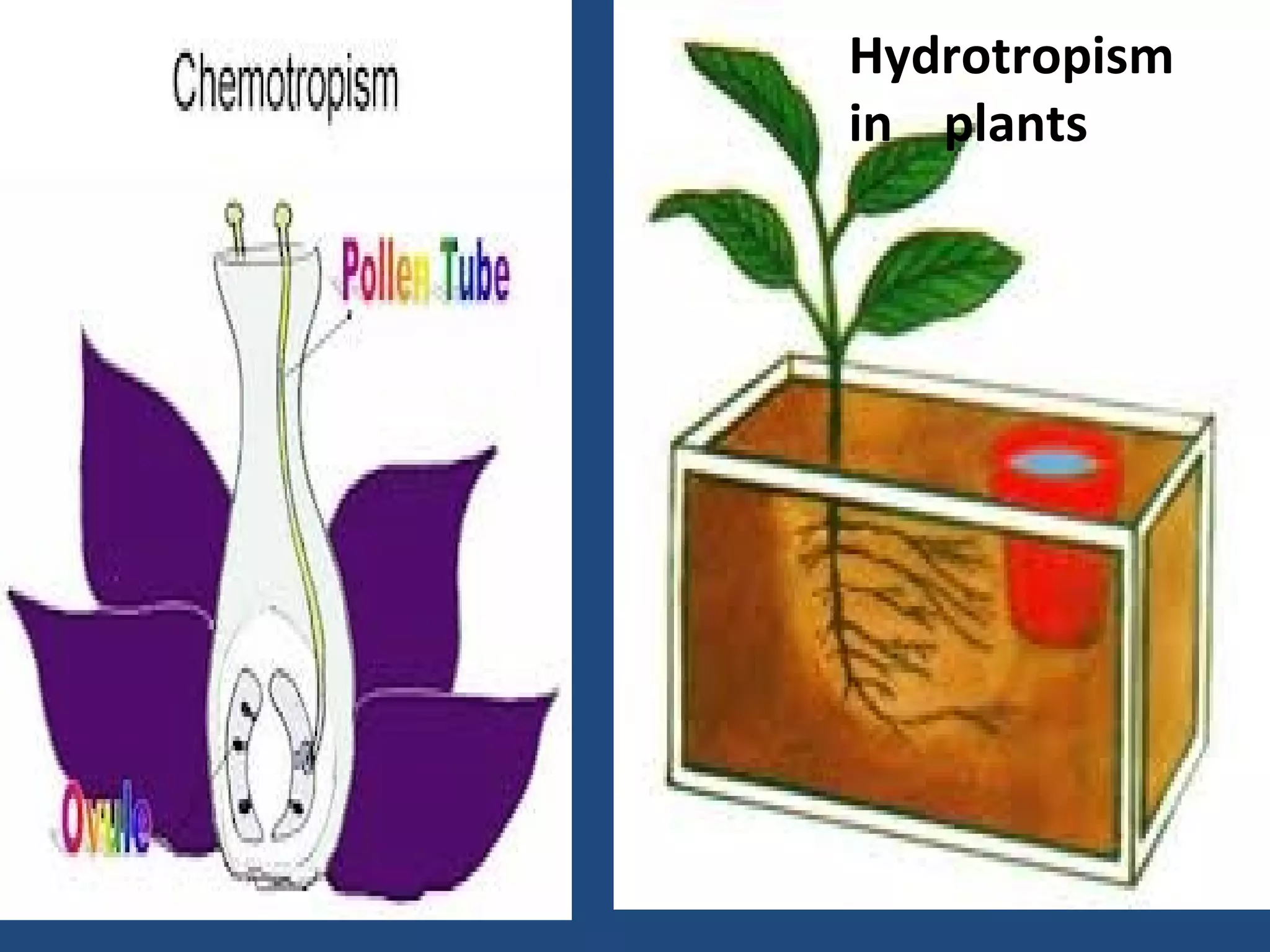
Hydrotropism
in plants
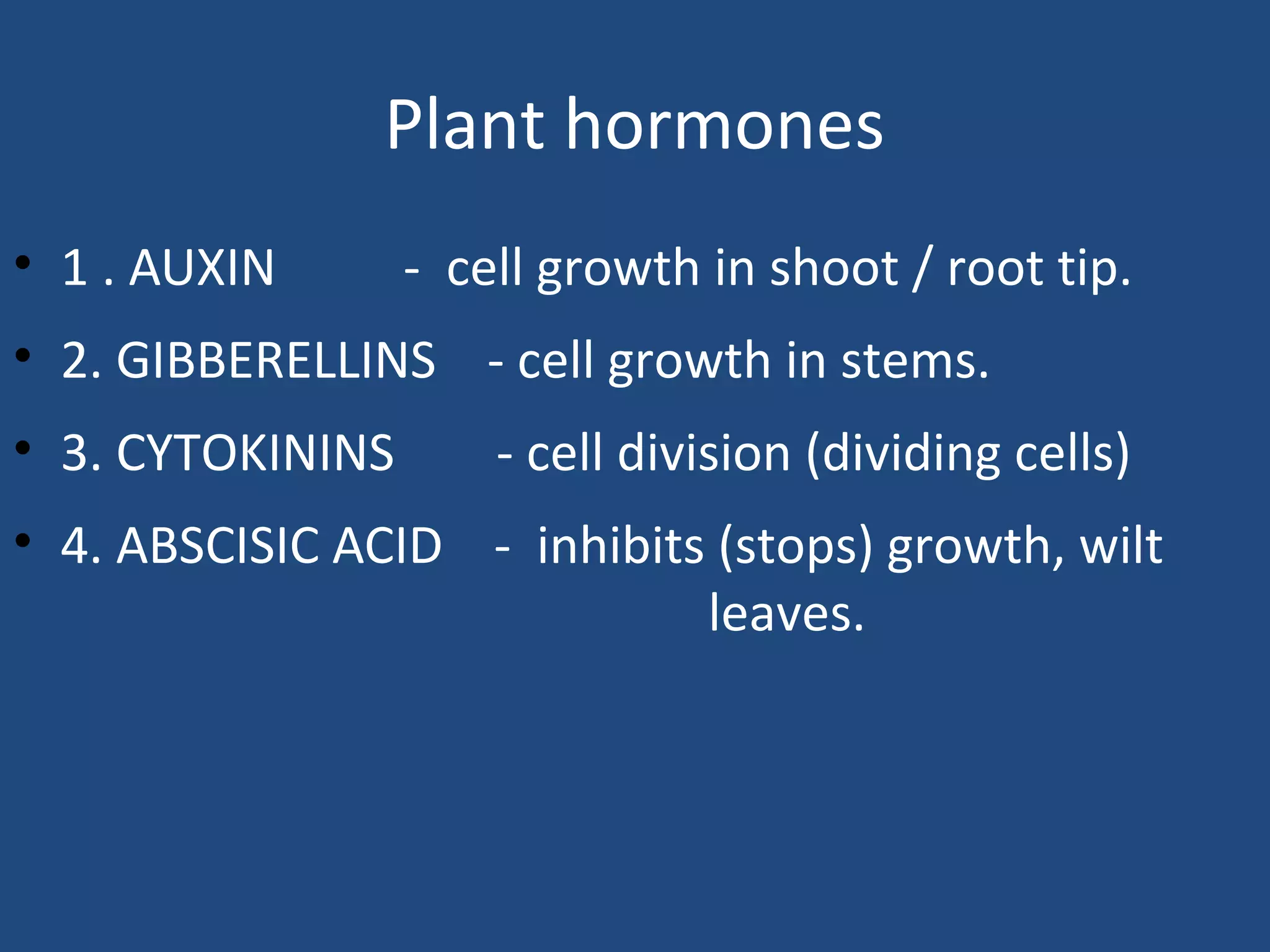
Plant hormones
• 1 . AUXIN - cell growth in shoot / root tip.
• 2. GIBBERELLINS - cell growth in stems.
• 3. CYTOKININS - cell division (dividing cells)
• 4. ABSCISIC ACID - inhibits (stops) growth, wilt
leaves.
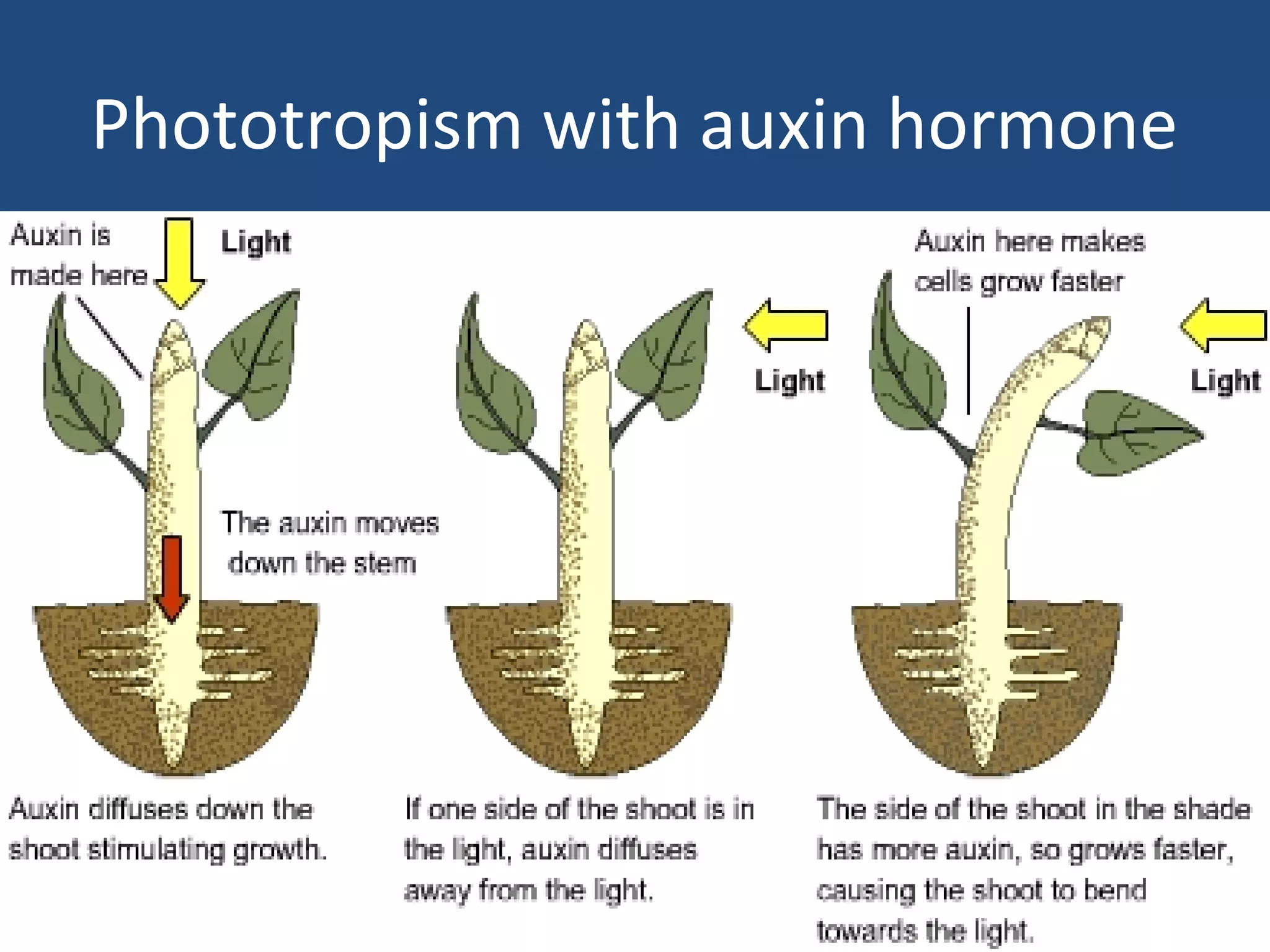
Phototropism with auxin hormone
The endocrine system
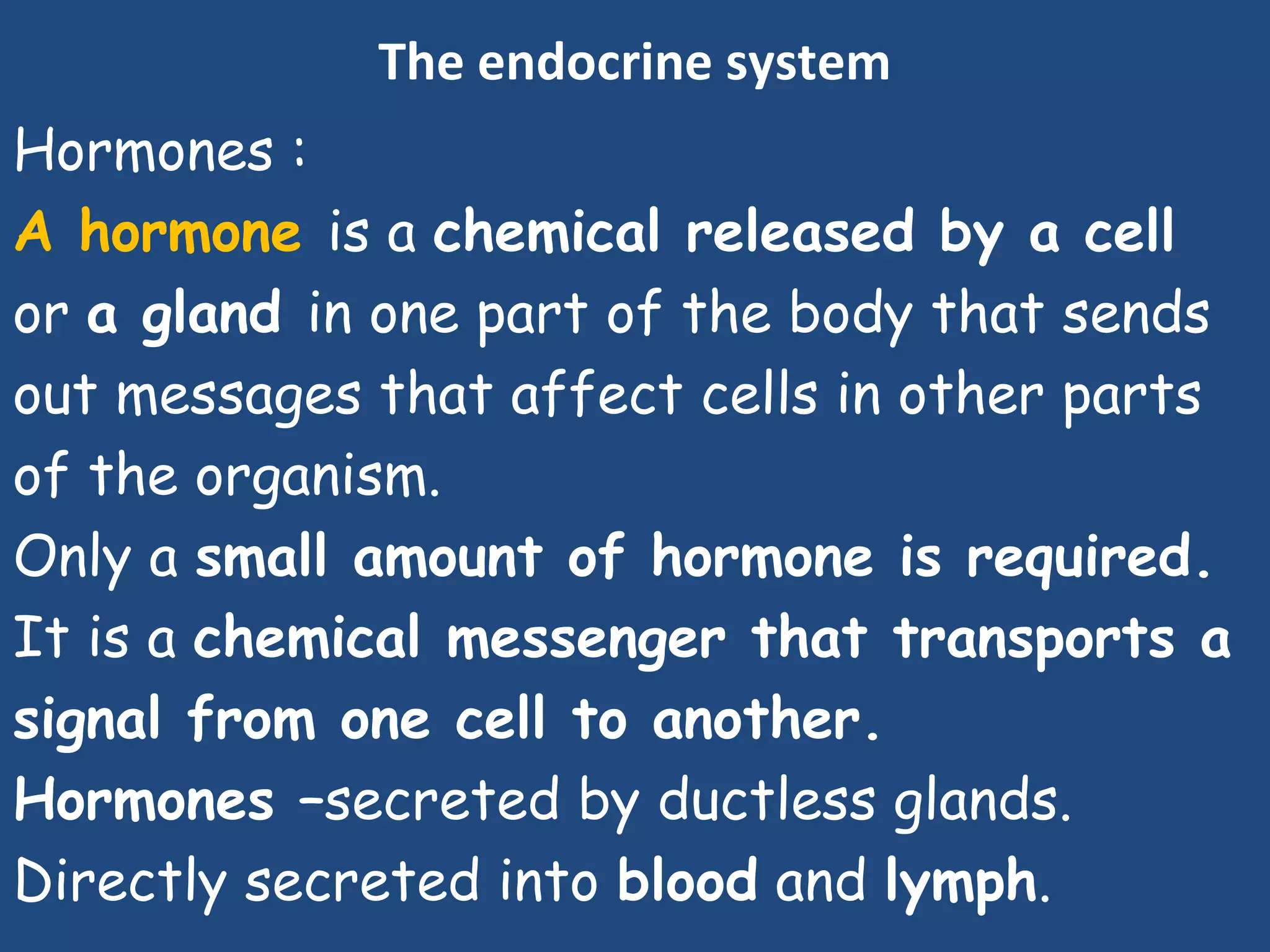
Hormones :
A hormone is a chemical released by a cell
or a gland in one part of the body that sends
out messages that affect cells in other parts
of the organism.
Only a small amount of hormone is required.
It is a chemical messenger that transports a
signal from one cell to another.
Hormones –secreted by ductless glands.
Directly secreted into blood and lymph.
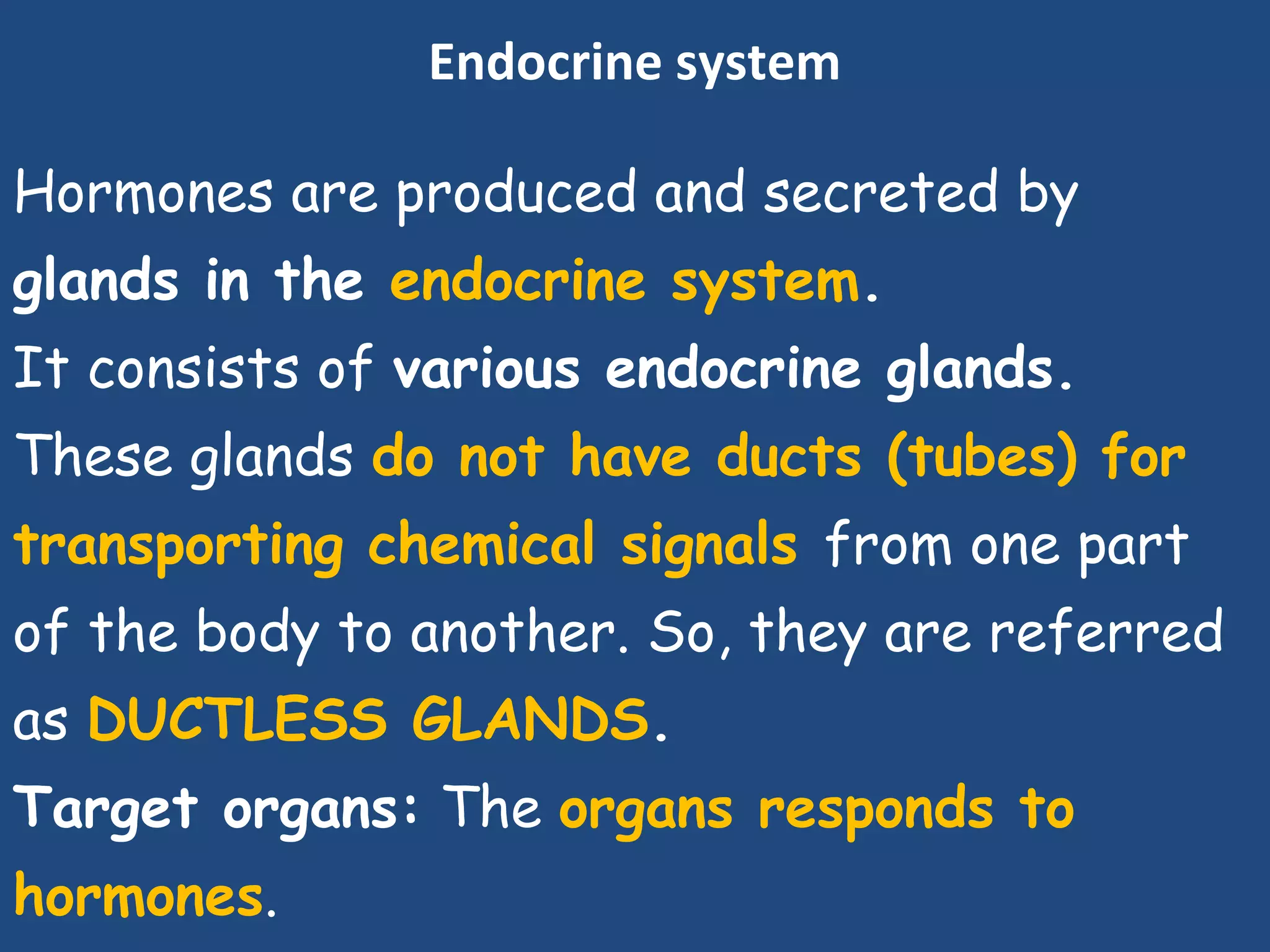
Endocrine system
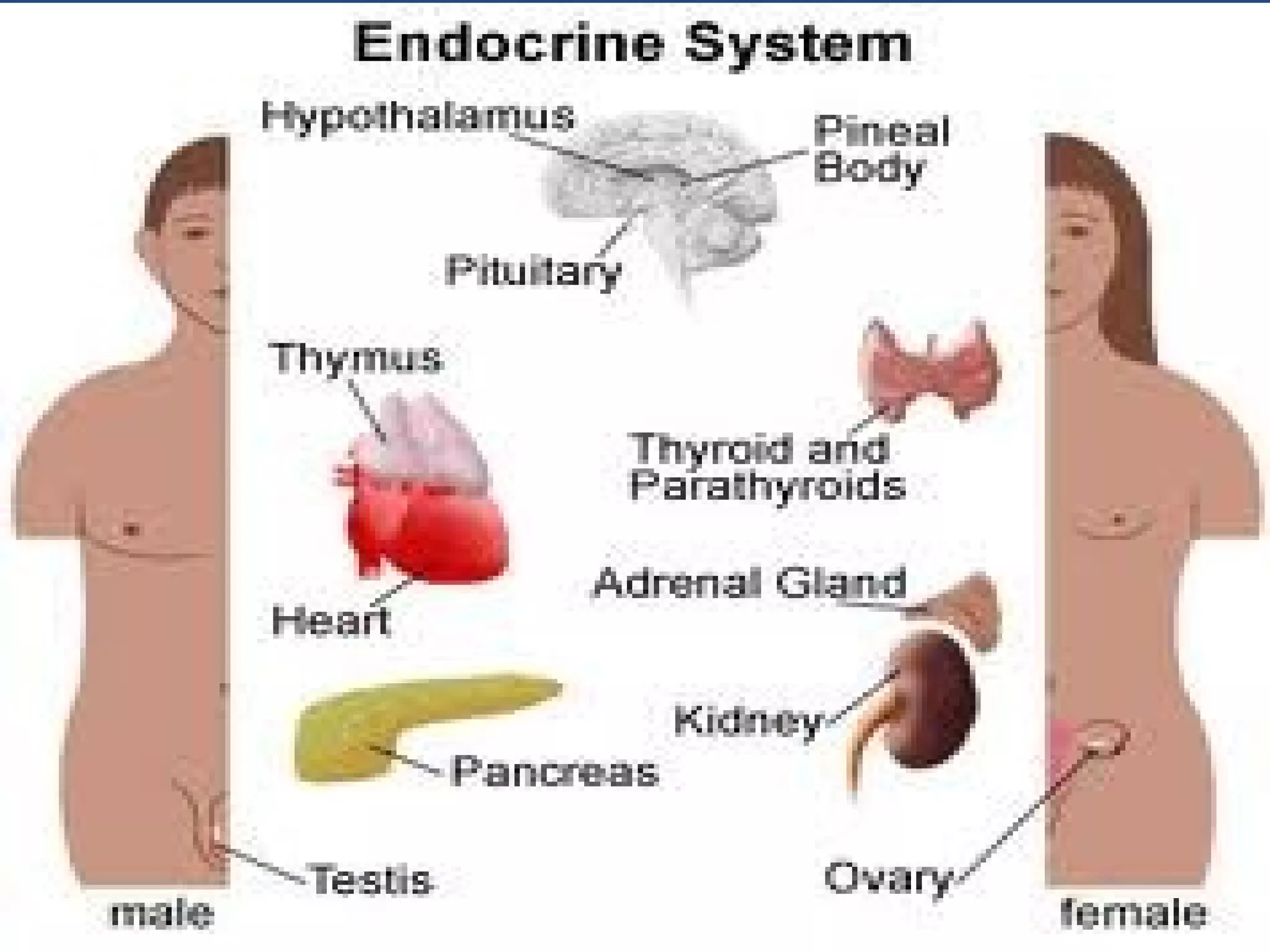
Hormones are produced and secreted by
glands in the endocrine system.
It consists of various endocrine glands.
These glands do not have ducts (tubes) for
transporting chemical signals from one part
of the body to another. So, they are referred
as DUCTLESS GLANDS.
Target organs: The organs responds to
hormones.
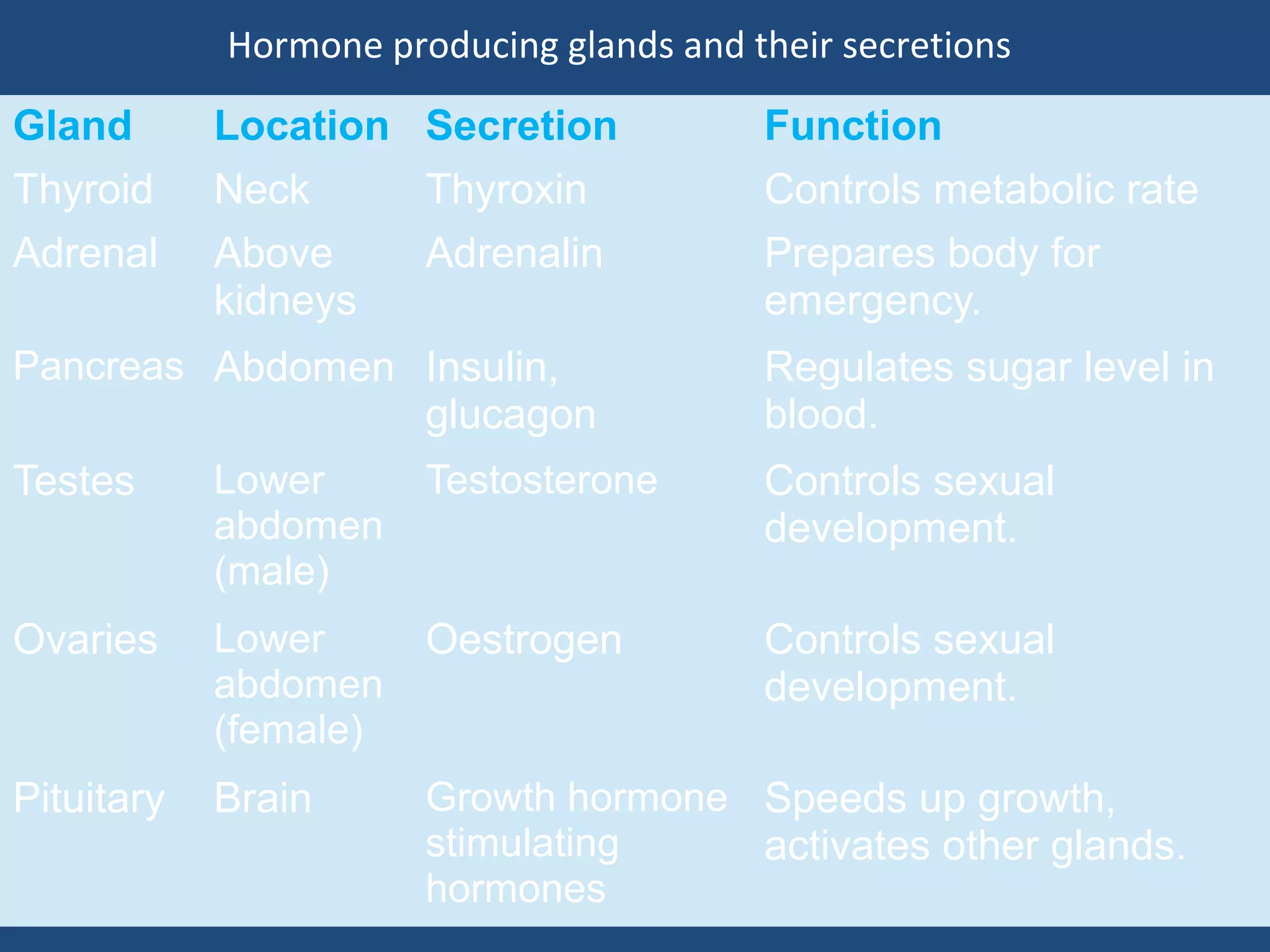
Hormone producing glands and their secretions
Gland Location Secretion Function
Thyroid Neck Thyroxin Controls metabolic rate
Adrenal Above
kidneys
Adrenalin Prepares body for
emergency.
Pancreas Abdomen Insulin,
glucagon
Regulates sugar level in
blood.
Testes Lower
abdomen
(male)
Testosterone Controls sexual
development.
Ovaries Lower
abdomen
(female)
Oestrogen Controls sexual
development.
Pituitary Brain Growth hormone
stimulating
hormones
Speeds up growth,
activates other glands.

Control & coordination

  • 1.
  • 6.
  • 8.
    GROUP ACTIVITY Group A DefineNeuron Group B Compare gustatory receptors and olfactory receptors Group C Identify the transmission of energy taking place in nerve impulse conduction.
  • 9.
  • 10.
    • When thestimulation of a receptor results in a spontaneous, involuntary reaction, it is called reflex action or simply reflex.
  • 11.
    SPINAL REFLEX ACTION •The reflexes of this type which involve only the spinal cord are called spinal reflexes. • Please note that when we lift a hot plate, then along with heat, the pain produced by heat also acts as a 'stimulus'. • Most of the reflex actions involve only the spinal cord. They are called spinal reflexes.
  • 12.
    BRAIN REFLEX ACTION •Reflex actions which involve brain are called cerebral reflexes. • Cerebral reflexes occur in the organs present in the head because these organs are directly connected to the brain. • Example. Our eyes are present in the head. In dim light, the pupil (a hole in the front of eye) is large so that more light can enter into the eye and make us see properly even in dim light.
  • 15.
    Reflex arc • Ratherthan think about the sensation of heat if the nerves detect heat were to be connected to the nerves that move muscles in a simpler way, the process of detecting the signal or the input and responding to it by an output action might be completed quickly. Such connections commonly called as reflex arc.
  • 17.
    Group activity • GroupA • Define reflex action. • Group B • Components of reflex action. • Group C • Discuss the process of reflex action.
  • 20.
    The Cerebrum Part I: Lobes,the Cerebral Cortex, and Cortical Regions of the Brain
  • 21.
    Cerebrum -The largestdivision of the brain. It is divided into two hemispheres, each of which is divided into four lobes. Cerebru m Cerebrum Cerebellum http://williamcalvin.com/BrainForAllSeasons/img/bonoboLH-humanLH-viaTWD.gif
  • 22.
    Cerebral Cortex Cerebral Cortex Cerebral Cortex- The outermost layer of gray matter making up the superficial aspect of the cerebrum. http://www.bioon.com/book/biology/whole/image/1/1-6.tif.jpg
  • 23.
    Lobes of theBrain (4) • Frontal • Parietal • Occipital • Temporal http://www.bioon.com/book/biology/whole/image/1/1-8.tif.jpg
  • 25.
    Lobes of theBrain - Frontal • The Frontal Lobe of the brain is located deep to the Frontal Bone of the skull. • It plays an integral role in the following functions/actions: - Memory Formation - Emotions - Decision Making/Reasoning - Personality Modified from:
  • 26.
    Lobes of theBrain - Parietal Lobe • The Parietal Lobe of the brain is located deep to the Parietal Bone of the skull. • It plays a major role in the following functions/actions: - Senses and integrates sensation(s) - Spatial awareness and perception (Proprioception - Awareness of body/ body parts in space and in relation to each other)
  • 27.
    Lobes of theBrain – Temporal Lobe • The Temporal Lobes are located on the sides of the brain, deep to the Temporal Bones of the skull. • They play an integral role in the following functions: - Hearing - Organization/Comprehension of language - Information Retrieval (Memory and Memory Formation) Modified from: http://www.bioon.com/book/biology/whole/image/1/1-8.tif.jpg
  • 28.
    Lobes and Structuresof the Brain B. A. C. D. E. F. G. http://williamcalvin.com/BrainForAllSeasons/img/bonoboLH-humanLH-viaTWD.gif
  • 29.
    Group activity • GroupA • What do you mean by CNS? • Group B • Give the components of peripheral nervous system. • Group C • Distinguish between voluntary and involuntary action.
  • 31.
    Brain has 3regions • Fore- Brain - cerebrum, thalamus, and hypothalamus (part of the limbic system). • Mid-brain - The midbrain consists of the tectum and tegmentum. • Hind-brain - cerebellum, pons and medulla. Often the midbrain, pons, and medulla are referred to together as the brainstem.
  • 32.
    Fore- brain • Theforebrain is divided into 2 halves – the right and left cerebral hemispheres. • The cerebral hemispheres control your movement, thinking, memory, emotions, senses and speech. • As the nerve fibres leave the brain, they cross over from one side to the other. • This means that the nerves that come from the right side of your brain control the left side of your body. • Each hemisphere is divided into 4 areas called the
  • 33.
    • Frontal lobe •Temporal lobe • Parietal lobe • Occipital lobe
  • 34.
    • The frontallobe contains areas that control your personality, thought, memory and behaviour. • Towards the back of the frontal lobe are areas that control movement and feeling. • The temporal lobe helps to control behaviour, memory, hearing, sight and your emotions. • The parietal lobe is mainly to do with language. It is responsible for your speech, reading, writing or understanding of words. • The occipital lobe is the visual centre of the brain.
  • 35.
    Functions • Cerebellum -This structure is associated with regulation and coordination of movement, posture, and balance. • Brain Stem: This structure is responsible for basic vital life functions such as breathing, heartbeat, and blood pressure.
  • 36.
    How brain tissuesare protected? • The brain is protected by a series of bone, membrane, and fluid. • The outermost protection is the cranium, or skull, which protects the brain from blows that could easily damage it. • Then there are three membranes called meninges. • Then brain is protected by a clear liquid called cerebrospinal fluid. This forms a cushion between the soft brain tissue and the hard cranial bones. This same fluid also fills spaces inside the brain. • Tissues inside the spaces produce cerebrospinal fluid, which flow through the spaces between the membranes.
  • 37.
    Coordination in plants •Chhui mui or touch- me -not plant or sensitive plant • Mimosa family
  • 38.
    Two different typesof movement in plants • 1. Growth dependent movement • 2. Growth independent movement
  • 39.
  • 40.
    • Immediate response…… • No nervous tissues/ muscle tissues involved in plant body. • Plants undergo cell to cell communication system different from nervous system and muscular system in animals. • They use chemical signals followed by cells swelling due to uptake of more water and shrinking of cells due to loss of water from plant cells. So the cell shapes change due to response.
  • 41.
    • Movement dueto growth • Tendrils are plants that climb up on other plants or fences. • When tendrils come in contact with any support, the part of ● Tendril which is in contact with object does not grow as rapidly as away from the object or support. THIS MAKES TENDRILS TO CLING OR COIL AROUND SUPPORT.
  • 42.
    • Environmental triggerssuch as light, or gravity will change in the directions that plant parts grow in.
  • 45.
  • 46.
    Plant hormones • 1. AUXIN - cell growth in shoot / root tip. • 2. GIBBERELLINS - cell growth in stems. • 3. CYTOKININS - cell division (dividing cells) • 4. ABSCISIC ACID - inhibits (stops) growth, wilt leaves.
  • 47.
  • 48.
    The endocrine system Hormones: A hormone is a chemical released by a cell or a gland in one part of the body that sends out messages that affect cells in other parts of the organism. Only a small amount of hormone is required. It is a chemical messenger that transports a signal from one cell to another. Hormones –secreted by ductless glands. Directly secreted into blood and lymph.
  • 49.
    Endocrine system Hormones areproduced and secreted by glands in the endocrine system. It consists of various endocrine glands. These glands do not have ducts (tubes) for transporting chemical signals from one part of the body to another. So, they are referred as DUCTLESS GLANDS. Target organs: The organs responds to hormones.
  • 51.
    Hormone producing glandsand their secretions Gland Location Secretion Function Thyroid Neck Thyroxin Controls metabolic rate Adrenal Above kidneys Adrenalin Prepares body for emergency. Pancreas Abdomen Insulin, glucagon Regulates sugar level in blood. Testes Lower abdomen (male) Testosterone Controls sexual development. Ovaries Lower abdomen (female) Oestrogen Controls sexual development. Pituitary Brain Growth hormone stimulating hormones Speeds up growth, activates other glands.