Street-Food Project Kolkata
Implemented by Gana Unnayan Parshad &
Joygopalpur Gram Vikash Kendra
1. Motivation of the project
2. Methodology
3. Summary Statistics from the Baseline
Survey
 Geographical Area
 Demographic data
 Business data
 Hygiene Indicators
 Street-Vendors
 Represent 2% of urban population
 Source of self employment for the urban poor
 Source of affordable food to large part of the
urban population
 In Kolkata estimates say there are 150.000
street-food vendors (NCEUS, 2007)
Project Motivation
 However, street vendors suffer a welfare loss
because they work in the informal sector:
 They are subject to arbitrary evictions
 They are potential victims of abuses from
authorities
 They cannot demand any right
Formalization may help vendors!
 The national government is working to
formalize street-vendors expecting that…
“Vendors will suddenly change their
behaviours”
 The main hypothesis of the study is that
street-food vendors lack the necessary
awareness and capability to make alone such
a change in behaviour
 Project offers an innovative training to help
vendors in this process: specifically, to
improve their awareness and capability
 Awareness about:
 National hawkers act for protection and
livelihood
 Maintaining minimum Hygienic standards
 Health hazards
 Capability about:
 How to deal with hygienic standards and health
hazards
 How to improve their business
 Project offers a training designed for street-food
vendors in urban India
 Three workshops & follow-up visits at each kiosk
 Study took place in April,15-June,16
 How can we test the impact of the training?
 How can we explain the change in behavior?
 Impact Evaluation: Randomized Control Trial
2. Methodology
 The workshop offered to about 600 vendors
 Vendors have been randomly selected
 We selected vendors from different areas of the city
to have a representative sample of all the areas of
Kolkata
 We use a statistical software (STATA) to implement
the randomization and the statistical analysis
 Vendors are randomly assigned to different groups in
order to test the most effective way to improve
vendors’ performances!
 Vendors are randomly assigned to 4 groups:
 Group 1: pilot group for field testing
 Group 2: 3 –trainings within a period of 75 days
 Group 3: 3 –trainings within a period of 75 days along
with promotional materials
 Group 4: control group ( nothing done except
monitoring)
 The first baseline survey has been
collected in the period March-May 2015
 The following analysis is based on 924
collected surveys
 86% of vendors interviewed are owners of
the kiosk
Ultadanga: 57
Beliaghata: 80
Eden Garden: 42
Indian Museum: 37
Dalhousie: 254
Victoria Memorial: 68
Park Circus: 46
Rash Behari: 120
Behala: 84
Gariahat: 136
Dalhousi is the area
having the highest
vendors followed by
Rashbehari
87%
13%
0%
20%
40%
60%
80%
100%
Men Women
Gender
• Men: 805; Women: 109
• Average age: 40 for men, 42 for women
29%
27%
23%
12%
5%
3%
0%
10%
20%
30%
40%
no school primary upper primary secondary high secondary university
Education
• Less than 50% of vendors completed primary school
• 70% of vendors in Ultadanga own their house;
• Only 25% of vendors in Park Circus own their house
56%
41%
2%
0%
10%
20%
30%
40%
50%
60%
Bengali Hindi Other
Native Language
40%
20%
40%
0%
5%
10%
15%
20%
25%
30%
35%
40%
45%
No Yes Other
Are you originally from the Bengal…
• On average, they moved to Kolkata 26 years ago
15%
36%
47%
2%
0%
10%
20%
30%
40%
50%
Yes, a lot Yes, a little Maybe, I don't know No
Do you expect this training can improve your earnings?
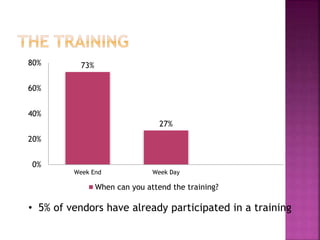
• 93% of vendors are interested in participating in a
training
73%
27%
0%
20%
40%
60%
80%
Week End Week Day
When can you attend the training?
• 5% of vendors have already participated in a training
42%
38%
11%
9%
0%
10%
20%
30%
40%
50%
1 2 3 4 or more
How many people work in the stall (owner…
53%
13%
20%
9% 7% 6%
2% 1%
0%
20%
40%
60% type of food sold
• 72% of vendors sell cooked food
 Average Revenue (per day): Rs. 1462
 Average Expenditure (per day): Rs. 1100
 Daily profits (per day): Rs. 360
• Highest revenue in Dalhousi & Ultadanga, lowest in
Victoria Memorial
Average revenue across 10 areas:
• Highest profits in Ultadanga, lowest in Victoria
Average profits across 10 areas:
3% 3%
41%
9%
3% 3% 1%
21%
2% 1%
6% 8%
0%
10%
20%
30%
40%
50% Union Name
• 30% of vendors are not part of a union
• 35% of vendors pay extra-money to the police
• Highest percentage in Indian Museum, lowest in
Beliaghata
50%
32%
14%
2%
54%
50%
16%
2% 1%
0%
20%
40%
60%
Do you face any of these problem?
• 12% of vendors know of the National Act for Urban
Street Vendors 2014
Water & other tools
 95% of vendors providing water, use water
from a common container
 68% has a dustbin
 Only 1% uses an apron
 29% have “dirty” towels/cloths
Hygiene of the kiosk & cooking area
 38% had dirt or food debris on the floor
 26% had dust in the cooking area
Food
 35% Have raw food not covered
 25% Have cooked food not covered
Disposable Tools
 32% of vendors use disposable plates
 9% of vendors use disposable forks/spoons
 32% of vendors use disposable glasses
 Using STATA, we created an index which
measures vendors’ hygienic standards based
on the previous indicators
 This index aggregates all the observed
behaviour into a unique number
 The index takes value 0 for the lowest level
of hygiene and value 1 for the highest level
 Note: “1” can be interpreted as “behaving
according to the National Act”
• The average value is 0.57
Less Hygiene More Hygiene
• No big differences across areas!
Less Hygiene More Hygiene
Baseline ppt

Baseline ppt

  • 1.
    Street-Food Project Kolkata Implementedby Gana Unnayan Parshad & Joygopalpur Gram Vikash Kendra
  • 2.
    1. Motivation ofthe project 2. Methodology 3. Summary Statistics from the Baseline Survey  Geographical Area  Demographic data  Business data  Hygiene Indicators
  • 3.
     Street-Vendors  Represent2% of urban population  Source of self employment for the urban poor  Source of affordable food to large part of the urban population  In Kolkata estimates say there are 150.000 street-food vendors (NCEUS, 2007) Project Motivation
  • 4.
     However, streetvendors suffer a welfare loss because they work in the informal sector:  They are subject to arbitrary evictions  They are potential victims of abuses from authorities  They cannot demand any right Formalization may help vendors!
  • 5.
     The nationalgovernment is working to formalize street-vendors expecting that… “Vendors will suddenly change their behaviours”  The main hypothesis of the study is that street-food vendors lack the necessary awareness and capability to make alone such a change in behaviour  Project offers an innovative training to help vendors in this process: specifically, to improve their awareness and capability
  • 6.
     Awareness about: National hawkers act for protection and livelihood  Maintaining minimum Hygienic standards  Health hazards  Capability about:  How to deal with hygienic standards and health hazards  How to improve their business
  • 7.
     Project offersa training designed for street-food vendors in urban India  Three workshops & follow-up visits at each kiosk  Study took place in April,15-June,16  How can we test the impact of the training?  How can we explain the change in behavior?  Impact Evaluation: Randomized Control Trial 2. Methodology
  • 8.
     The workshopoffered to about 600 vendors  Vendors have been randomly selected  We selected vendors from different areas of the city to have a representative sample of all the areas of Kolkata  We use a statistical software (STATA) to implement the randomization and the statistical analysis
  • 9.
     Vendors arerandomly assigned to different groups in order to test the most effective way to improve vendors’ performances!  Vendors are randomly assigned to 4 groups:  Group 1: pilot group for field testing  Group 2: 3 –trainings within a period of 75 days  Group 3: 3 –trainings within a period of 75 days along with promotional materials  Group 4: control group ( nothing done except monitoring)
  • 10.
     The firstbaseline survey has been collected in the period March-May 2015  The following analysis is based on 924 collected surveys  86% of vendors interviewed are owners of the kiosk
  • 12.
    Ultadanga: 57 Beliaghata: 80 EdenGarden: 42 Indian Museum: 37 Dalhousie: 254 Victoria Memorial: 68 Park Circus: 46 Rash Behari: 120 Behala: 84 Gariahat: 136 Dalhousi is the area having the highest vendors followed by Rashbehari
  • 14.
    87% 13% 0% 20% 40% 60% 80% 100% Men Women Gender • Men:805; Women: 109 • Average age: 40 for men, 42 for women
  • 15.
    29% 27% 23% 12% 5% 3% 0% 10% 20% 30% 40% no school primaryupper primary secondary high secondary university Education • Less than 50% of vendors completed primary school
  • 16.
    • 70% ofvendors in Ultadanga own their house; • Only 25% of vendors in Park Circus own their house
  • 17.
  • 18.
    40% 20% 40% 0% 5% 10% 15% 20% 25% 30% 35% 40% 45% No Yes Other Areyou originally from the Bengal… • On average, they moved to Kolkata 26 years ago
  • 19.
    15% 36% 47% 2% 0% 10% 20% 30% 40% 50% Yes, a lotYes, a little Maybe, I don't know No Do you expect this training can improve your earnings? • 93% of vendors are interested in participating in a training
  • 20.
    73% 27% 0% 20% 40% 60% 80% Week End WeekDay When can you attend the training? • 5% of vendors have already participated in a training
  • 22.
    42% 38% 11% 9% 0% 10% 20% 30% 40% 50% 1 2 34 or more How many people work in the stall (owner…
  • 23.
    53% 13% 20% 9% 7% 6% 2%1% 0% 20% 40% 60% type of food sold • 72% of vendors sell cooked food
  • 25.
     Average Revenue(per day): Rs. 1462  Average Expenditure (per day): Rs. 1100  Daily profits (per day): Rs. 360
  • 26.
    • Highest revenuein Dalhousi & Ultadanga, lowest in Victoria Memorial Average revenue across 10 areas:
  • 27.
    • Highest profitsin Ultadanga, lowest in Victoria Average profits across 10 areas:
  • 28.
    3% 3% 41% 9% 3% 3%1% 21% 2% 1% 6% 8% 0% 10% 20% 30% 40% 50% Union Name • 30% of vendors are not part of a union
  • 30.
    • 35% ofvendors pay extra-money to the police • Highest percentage in Indian Museum, lowest in Beliaghata
  • 31.
    50% 32% 14% 2% 54% 50% 16% 2% 1% 0% 20% 40% 60% Do youface any of these problem? • 12% of vendors know of the National Act for Urban Street Vendors 2014
  • 33.
    Water & othertools  95% of vendors providing water, use water from a common container  68% has a dustbin  Only 1% uses an apron  29% have “dirty” towels/cloths
  • 34.
    Hygiene of thekiosk & cooking area  38% had dirt or food debris on the floor  26% had dust in the cooking area
  • 35.
    Food  35% Haveraw food not covered  25% Have cooked food not covered
  • 36.
    Disposable Tools  32%of vendors use disposable plates  9% of vendors use disposable forks/spoons  32% of vendors use disposable glasses
  • 37.
     Using STATA,we created an index which measures vendors’ hygienic standards based on the previous indicators  This index aggregates all the observed behaviour into a unique number  The index takes value 0 for the lowest level of hygiene and value 1 for the highest level  Note: “1” can be interpreted as “behaving according to the National Act”
  • 38.
    • The averagevalue is 0.57 Less Hygiene More Hygiene
  • 39.
    • No bigdifferences across areas! Less Hygiene More Hygiene