Outcome Measurement
Determining & Selecting Outcomes
A General Framework

12/6/2013

Rebecca Rodriguez
For the Philanthropist

1
Agenda












Purpose & Importance
Literature Review
How To implement
Outcomes
Logic Models
Data Collection Methods
Recommendations
References

12/6/2013

Rebecca Rodriguez
For the Philanthropist

2
Introduction


Outcome Measurement is the regular,
systematic tracking of the extent to
which program participants
experience the benefits or changes
intended.
- United Way of America

12/6/2013

Retrieved from the United Way of
America web site:
http://www.liveunited.org/outcomes

3
Digging Deeper…


The observance, tracking and analysis
of changes to participants in a program.






12/6/2013

Measurable & meaningful.
Directly linked to program activities.
Useful for program improvement.
Outcomes for Success! Organizational
Research Services, Inc. & Clegg and
Assoc., Inc.

4
Importance of Outcome
Measurement








Accountability, Responsiveness, Efficiency
Helps staff make informed decisions.
To learn that your efforts are helping and
not harming.
Helps organization learn to tell “their story”
effectively.
Can support fundraising efforts.

12/6/2013

Outcomes for Success!; United Way of
America, Center for What Works

5
Outcome Measurement is NOT







12/6/2013

Formal evaluation.
The end all and answer to all our
program questions/ problems.
A one-size- fits all solution.
A quick and easy fix.
6
Literature Review
Plethora of information that falls into two
main areas:
- Importance of
- Implementation Process




Common elements:
- Complexity; general lack of understanding
- Sharing of best practices

12/6/2013

7
Implementation Steps

7.

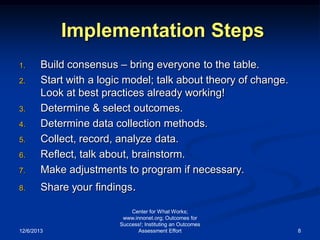
Build consensus – bring everyone to the table.
Start with a logic model; talk about theory of change.
Look at best practices already working!
Determine & select outcomes.
Determine data collection methods.
Collect, record, analyze data.
Reflect, talk about, brainstorm.
Make adjustments to program if necessary.

8.

Share your findings.

1.

2.

3.
4.

5.
6.

12/6/2013

Center for What Works;
www.innonet.org; Outcomes for
Success!; Instituting an Outcomes
Assessment Effort

8
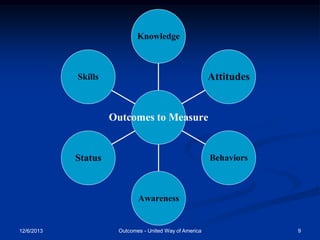
Knowledge

Attitudes

Skills

Outcomes to Measure

Status

Behaviors

Awareness

12/6/2013

Outcomes - United Way of America

9
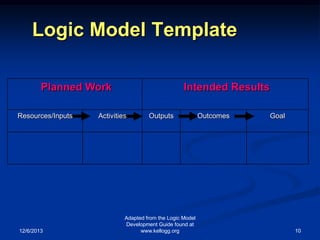
Logic Model Template
Planned Work
Resources/Inputs

12/6/2013

Intended Results

Activities

Outputs

Adapted from the Logic Model
Development Guide found at
www.kellogg.org

Outcomes

Goal

10
What Area Agencies on Aging
Measure


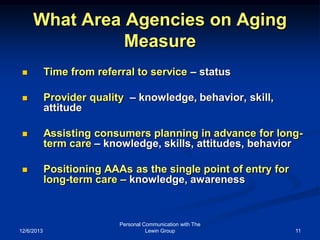
Time from referral to service – status



Provider quality – knowledge, behavior, skill,
attitude



Assisting consumers planning in advance for longterm care – knowledge, skills, attitudes, behavior



Positioning AAAs as the single point of entry for
long-term care – knowledge, awareness

12/6/2013

Personal Communication with The
Lewin Group

11
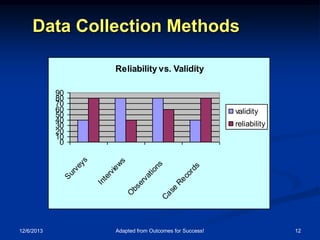
Data Collection Methods
Reliability vs. Validity

12/6/2013

validity

O
bs
er
va
t io
ns
Ca
se
Re
co
rd
s

ws

reliability

In
te
rv
ie

Su
rv
ey
s

90
80
70
60
50
40
30
20
10
0

Adapted from Outcomes for Success!

12
Elements for Success








Build consensus.
A strong desire to demonstrate impact.
Willingness to make change.
Be disciplined in collecting / analyzing
data.
Keep it simple.

12/6/2013

Rebecca Rodriguez
For thePhilanthropist

13
Recommendations
Proposed 18 - 24 month timeline:


Build consensus.



Assign an outcome measurement driver.



Start with a logic model.



Agree upon one/two outcome(s). Start simple!



Choose method of data collection: surveys or
interviews



Collect, record, analyze data.

12/6/2013

14
Resources












12/6/2013

www.whatworks.org
Collins, J. (2005). Good To Great And The Social Sectors. Boulder, CO: Jim Collins.
www.grantcraft.org
W.K. Kellogg Foundation
United Way of America. (2000). Agency Experiences with Outcome Measurement.
Virginia: United Way of America.
www.innonet.org (registration required)
Edna McConnell Foundation
Charting Impact – Initiative of Guidestar collaborative effort
American Evaluation Association

15

A Framework Example on Outcome Measurement

  • 1.
    Outcome Measurement Determining &Selecting Outcomes A General Framework 12/6/2013 Rebecca Rodriguez For the Philanthropist 1
  • 2.
    Agenda         Purpose & Importance LiteratureReview How To implement Outcomes Logic Models Data Collection Methods Recommendations References 12/6/2013 Rebecca Rodriguez For the Philanthropist 2
  • 3.
    Introduction  Outcome Measurement isthe regular, systematic tracking of the extent to which program participants experience the benefits or changes intended. - United Way of America 12/6/2013 Retrieved from the United Way of America web site: http://www.liveunited.org/outcomes 3
  • 4.
    Digging Deeper…  The observance,tracking and analysis of changes to participants in a program.    12/6/2013 Measurable & meaningful. Directly linked to program activities. Useful for program improvement. Outcomes for Success! Organizational Research Services, Inc. & Clegg and Assoc., Inc. 4
  • 5.
    Importance of Outcome Measurement      Accountability,Responsiveness, Efficiency Helps staff make informed decisions. To learn that your efforts are helping and not harming. Helps organization learn to tell “their story” effectively. Can support fundraising efforts. 12/6/2013 Outcomes for Success!; United Way of America, Center for What Works 5
  • 6.
    Outcome Measurement isNOT     12/6/2013 Formal evaluation. The end all and answer to all our program questions/ problems. A one-size- fits all solution. A quick and easy fix. 6
  • 7.
    Literature Review Plethora ofinformation that falls into two main areas: - Importance of - Implementation Process   Common elements: - Complexity; general lack of understanding - Sharing of best practices 12/6/2013 7
  • 8.
    Implementation Steps 7. Build consensus– bring everyone to the table. Start with a logic model; talk about theory of change. Look at best practices already working! Determine & select outcomes. Determine data collection methods. Collect, record, analyze data. Reflect, talk about, brainstorm. Make adjustments to program if necessary. 8. Share your findings. 1. 2. 3. 4. 5. 6. 12/6/2013 Center for What Works; www.innonet.org; Outcomes for Success!; Instituting an Outcomes Assessment Effort 8
  • 9.
  • 10.
    Logic Model Template PlannedWork Resources/Inputs 12/6/2013 Intended Results Activities Outputs Adapted from the Logic Model Development Guide found at www.kellogg.org Outcomes Goal 10
  • 11.
    What Area Agencieson Aging Measure  Time from referral to service – status  Provider quality – knowledge, behavior, skill, attitude  Assisting consumers planning in advance for longterm care – knowledge, skills, attitudes, behavior  Positioning AAAs as the single point of entry for long-term care – knowledge, awareness 12/6/2013 Personal Communication with The Lewin Group 11
  • 12.
    Data Collection Methods Reliabilityvs. Validity 12/6/2013 validity O bs er va t io ns Ca se Re co rd s ws reliability In te rv ie Su rv ey s 90 80 70 60 50 40 30 20 10 0 Adapted from Outcomes for Success! 12
  • 13.
    Elements for Success      Buildconsensus. A strong desire to demonstrate impact. Willingness to make change. Be disciplined in collecting / analyzing data. Keep it simple. 12/6/2013 Rebecca Rodriguez For thePhilanthropist 13
  • 14.
    Recommendations Proposed 18 -24 month timeline:  Build consensus.  Assign an outcome measurement driver.  Start with a logic model.  Agree upon one/two outcome(s). Start simple!  Choose method of data collection: surveys or interviews  Collect, record, analyze data. 12/6/2013 14
  • 15.
    Resources          12/6/2013 www.whatworks.org Collins, J. (2005).Good To Great And The Social Sectors. Boulder, CO: Jim Collins. www.grantcraft.org W.K. Kellogg Foundation United Way of America. (2000). Agency Experiences with Outcome Measurement. Virginia: United Way of America. www.innonet.org (registration required) Edna McConnell Foundation Charting Impact – Initiative of Guidestar collaborative effort American Evaluation Association 15