THE BODY PACKERS
HAIFA ALSHWIKH
What do we mean by body packers ?
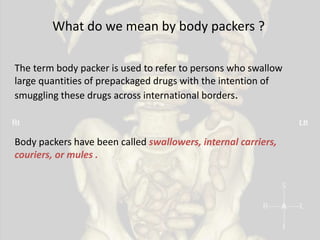
The term body packer is used to refer to persons who swallow
large quantities of prepackaged drugs with the intention of
smuggling these drugs across international borders.
Body packers have been called swallowers, internal carriers,
couriers, or mules .
The drug is usually of a single type and meticulously packaged in
plastic, latex, condoms or balloons.
Other methods of carrying drugs within the body include insertion
of the package directly into the anus or vagina
Many hours have usually
passed before presentation
to the emergency department,
so most packets have already
entered the small or large intestine.
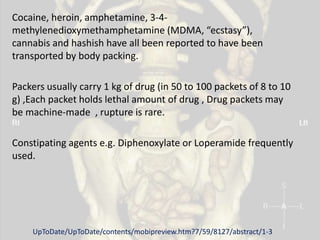
Cocaine, heroin, amphetamine, 3-4-
methylenedioxymethamphetamine (MDMA, “ecstasy”),
cannabis and hashish have all been reported to have been
transported by body packing.
Packers usually carry 1 kg of drug (in 50 to 100 packets of 8 to 10
g) ,Each packet holds lethal amount of drug , Drug packets may
be machine-made , rupture is rare.
Constipating agents e.g. Diphenoxylate or Loperamide frequently
used.
UpToDate/UpToDate/contents/mobipreview.htm?7/59/8127/abstract/1-3
International "professional" carriers
of well packed illicit drugs(body
packers) is Different to body
stuffers:
Stuffers :
swallowing or inserting relatively
small amounts of loosely wrapped
drug because of the fear of arrest.
body packers vs stuffers
Body packers stuffers
Introduction of the drug Oral , vaginal , rectal Oral always
type of conduct scheduled spontaneous
packets number numerous few
protection High Often , no
risk medium to high very high
HISTORY & EPIDEMIOLOGY
Body packing, first reported over 30 years ago(1970, 1973 )
It is difficult to estimate the number of body packers who attempt
to cross into the United States or other countries. This number,
however, may be increasing.
There was a 60 percent increase in the number of body packer
arrests at New York's Kennedy Airport in 2001, although it is not
clear if this is due to increased traffic, increased surveillance, or a
combination of both factors.
The internal concealment of drugs of abuse resulted in at least 50
deaths in the greater New York City area between 1990 and
2001, most of which were related to acute intoxication
The informations are missing in libya
The internal concealment of drugs of abuse requires a packing
method that allows ingestion and retrieval of intact packets.
Primitive wrapping methods, such as duct tape, condoms, or
plastics bags tied at one end , have largely been replaced by a
more professional method involving several layers of latex and
an outer wax coating , Each of these packets contains
approximately 8-10 grams of drug , These packets are ingested
by body packers, who swallow 50-100 drug containers prior to
departure.
How the drugs are packed ?
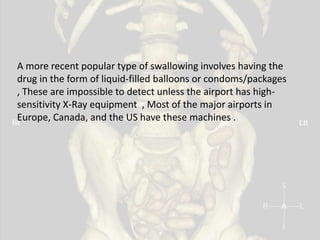
A more recent popular type of swallowing involves having the
drug in the form of liquid-filled balloons or condoms/packages
, These are impossible to detect unless the airport has high-
sensitivity X-Ray equipment , Most of the major airports in
Europe, Canada, and the US have these machines .
Intact drug packet recovered from the bowel
movement of a body packer
A US quarter is shown for size comparison.
Reproduced with permission from: Traub, SJ, Hoffman, RS, Nelson, LS. Body packing--
the internal concealment of illicit drugs. N Engl J Med 2003; 349:2519. Copyright ©
2003 Massachusetts Medical Society. All rights reserved.
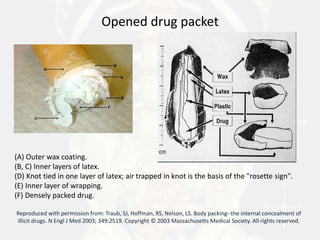
Opened drug packet
(A) Outer wax coating.
(B, C) Inner layers of latex.
(D) Knot tied in one layer of latex; air trapped in knot is the basis of the "rosette sign".
(E) Inner layer of wrapping.
(F) Densely packed drug.
Reproduced with permission from: Traub, SJ, Hoffman, RS, Nelson, LS. Body packing--the internal concealment of
illicit drugs. N Engl J Med 2003; 349:2519. Copyright © 2003 Massachusetts Medical Society. All rights reserved.
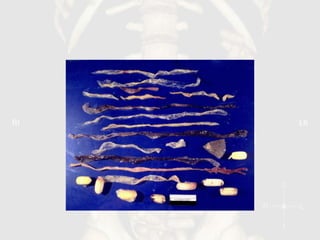
This picture show the finger cots found in the
stomach of a packer
http://deep6inc.com/previewcoc07.html
Presentation to ER
When body packers present to health care providers, it may be for
one (or more) of the following reasons :
-The body packer is asymptomatic and in custody, but needs medical
evaluation and monitoring.
-A packet has ruptured, resulting in systemic drug toxicity
-Symptoms of gastrointestinal obstruction
or perforation have led the body packer to
seek medical care
•
DIAGNOSIS
History and physical examination
Although body packers may (for obvious reasons) be unreliable
historians, every attempt should be made to illicit an accurate
history that includes the following:
-Drug being carried
-Type of packet wrapping
-Number of packets ingested
-Presence of gastrointestinal symptoms
(pain, distension, or constipation) suggesting
obstruction or perforation.
-presence of symptoms of toxicity.
Physical Examination :
Packets may be felt on abdominal or rectal examination, and
provide clear evidence of body packing prior to diagnostic
imaging.
The presence of a toxidrome (a constellation of physical findings
suggesting toxicity from a particular drug) suggests rupture of a
drug packet.
The opioid toxidrome (seen with heroin) consists of :
a depressed mental status
decreased respiration
miotic pupils
decreased bowel sounds.
The cocaine toxidrome consists of :
agitation
hypertension
tachycardia
mydriatic pupils
diaphoresis
Intestinal obstruction or perforation :
Abdominal distension, tenderness, and abnormal bowel sounds
(which may be high-pitched, tinkling, or absent) all suggest
bowel obstruction; peritoneal signs suggest bowel perforation
Radiographic evaluation
Screening imaging
Abdominal x ray
USS
Advanced imaging :
Barium study
CT scan
Radiographic evaluation of the body packer generally begins with
plain abdominal radiography.
There are several signs on the plain abdominal radiograph that
suggest body packing:
-Repeating geometric patterns
-A rim of air trapped between two condoms, making the drug
packets stand out in relief (the "double condom sign")
-Air in the tied ends of condoms (the "rosette sign")
Repeating geometric patterns
Plain abdominal radiography demonstrating drug packets
In both radiographs, drug packets are clearly visible in the descending colon; on the left, they
are also visible in the rectum.
Courtesy of Stephen Traub, MD.
A rim of air trapped between two condoms, making the drug packets stand
out in relief (the "double condom sign")
Arrows point to radiolucent stripes referred to
as the "double condom sign", formed by air
trapped between two layers of latex.
Pelvic x-ray demonstrates multiple radiopaque foreign bodies. Double-condom sign (black
arrows), as air trapped between layers of latex and rosette-like appearance (white arrow), made
by air trapped in condom knot are depicted.
Sensitivity of x ray :
Pooled data suggests that the sensitivity of a single abdominal film
is 85-90 percent
However, the true sensitivity is difficult to assess, and a substantial
number of drug packets are not visualized on plain films , In
addition, false positive studies may occur in the setting of
bladder stones, hardened stool or intraabdominal
calcifications.
False positive abdominal radiograph
An admitted body packer presented to the Emergency Department
for medical clearance, and a plain abdominal radiograph
demonstrated a radiolucency overlying the L1 vertebral body.
Although suspicious for a drug packet, the lucency was subsequently
determined to be due to intra-abdominal calcifications, in this case
in the pancreas.
Advanced abdominal imaging :
Advanced radiographic imaging (barium-enhanced abdominal
radiography or contrast-enhanced abdominal computerized
tomography (CT)) is indicated in one of two circumstances :
-it is used to diagnose body packers in whom the initial screening
study (plain radiography) is negative, but in whom the index of
suspicion is very high.
-used to confirm clearance of the gastrointestinal tract after
treatment.
A,Barium enema was performed in a suspected body packer. Notice that there is no
suggestion of abnormal foreign bodies in the descending colon; B, Post-evacuation
image clearly shows the barium coated packets.
Body Packing and Its Radiologic Manifestations: A Review Article ( iranian journal of radiology)
CT scan of body packer
TREATMENT
Once a body packer has been identified, specific treatment will
depend on the drug involved, as well as the presenting
symptoms.
All identified body packers should be admitted to an intensive
care setting, regardless of symptoms.
Asymptomatic
Intoxicated
Intestinal obstruction
Asymptomatic patients :
Patients who are asymptomatic can be treated conservatively
WBI has been used safely in body packers, and probably helps speed
passage of packets.
Activated charcoal should also be given to cocaine body packers, as it
has been shown to reduce the lethality of orally administered
cocaine in mice and would be expected to improve outcome in
humans in the event of packet rupture.
It is less important to administer activated charcoal to heroin body
packers because an effective antidote, naloxone (Narcan), is
available.
Intoxicated : heroin or cocaine ?
Heroin toxicity
Body packers who present with heroin toxicity should be treated
with naloxone (Narcan).
Naloxone is a competitive antagonist at the opiate receptor that
reverses the depression in mental status, hypoventilation,
pinpoint pupils, decreased bowel motility, and piloerection of
opiate overdose.
Enormous amounts of heroin are released when a single packet
ruptures; consequently, very high doses of naloxone may be
required to reverse toxicity in body packers.
(initial dose is 2 to 5 mg IV, with repeat doses of 2 mg given every
5 minutes until the patient is responsive) , The total amount
given to achieve a response should then be given every hour as
a continuous infusion until all packets have passed.
Once the body packer with heroin toxicity has been stabilized with
naloxone, he or she may be managed in a similar fashion to the
asymptomatic body packer.
Cocaine toxicity
Body packers who present with cocaine toxicity should receive
immediate, emergent surgical evaluation and be taken to the
operating room for manual decontamination.
There is no "antidote" for cocaine toxicity, and therefore no place
for conservative management of these patients.
Pharmacologic stabilization of symptomatic cocaine toxicity is appropriate, but
not definitive, and should not delay a trip to the operating room.
It includes the following :
Hyperthermia — active external cooling (fan and mist, ice water immersion) and
intravenous benzodiazepine therapy (lorazepam, 1 to 2 mg IV, repeat as
necessary)
Hypertension — Intravenous benzodiazepine therapy (lorazepam, 1 to 2 mg IV,
repeat as necessary); phentolamine, 1 to 5 mg IV; nitroprusside, 0.3 to 3
mcg/kg/min; nitroglycerin, 0.25 to 0.5 mcg/kg/min
Seizures — Intravenous benzodiazepine therapy (lorazepam, 1 to 2 mg IV, repeat
as necessary)
Ventricular dysrhythmias — Intravenous benzodiazepine therapy (lorazepam, 1
to 2 mg IV, repeat as necessary
Obstruction or perforation
Gastrointestinal obstruction or perforation occurs in less than 5
percent of patients.
The treatment of these patients is surgical. The patient with
evidence of gastrointestinal perforation should undergo
immediate exploratory laparotomy. One or more enterotomies
can be made in the bowel; packets are then "milked" towards
the enterotomy site or the anus.
After surgical decontamination, the patient may require an
advanced radiographic imaging study to document a clear GI
tract, as packets may be missed during operative evaluation.
30 y/o male pt who presents to Englewood Hospital ER after being found in bed at a
rooming house, unresponsive , Noticed to have laxative bottles in floor.
SUMMARY
-Body packing : Internal transport of illegal drugs
-“Body Packer” = “Mule” = “Swallower”
-Cocaine, heroin; (also amphetamines, marijuana)
-Pt often unable/unwilling to give accurate hx, therefore radiology is
crucial in diagnosis
-They may present in custody and without symptoms, with evidence of
drug toxicity if a packet ruptures, or with symptoms due to intestinal
obstruction or perforation.
-Diagnosis is usually confirmed through radiographic imaging .
-The treatment of these patients depends on the drug being concealed,
as well as the clinical presentation.
THANK YOU

Body packers

  • 1.
  • 2.
    What do wemean by body packers ? The term body packer is used to refer to persons who swallow large quantities of prepackaged drugs with the intention of smuggling these drugs across international borders. Body packers have been called swallowers, internal carriers, couriers, or mules .
  • 3.
    The drug isusually of a single type and meticulously packaged in plastic, latex, condoms or balloons. Other methods of carrying drugs within the body include insertion of the package directly into the anus or vagina Many hours have usually passed before presentation to the emergency department, so most packets have already entered the small or large intestine.
  • 4.
    Cocaine, heroin, amphetamine,3-4- methylenedioxymethamphetamine (MDMA, “ecstasy”), cannabis and hashish have all been reported to have been transported by body packing. Packers usually carry 1 kg of drug (in 50 to 100 packets of 8 to 10 g) ,Each packet holds lethal amount of drug , Drug packets may be machine-made , rupture is rare. Constipating agents e.g. Diphenoxylate or Loperamide frequently used. UpToDate/UpToDate/contents/mobipreview.htm?7/59/8127/abstract/1-3
  • 5.
    International "professional" carriers ofwell packed illicit drugs(body packers) is Different to body stuffers: Stuffers : swallowing or inserting relatively small amounts of loosely wrapped drug because of the fear of arrest. body packers vs stuffers
  • 6.
    Body packers stuffers Introductionof the drug Oral , vaginal , rectal Oral always type of conduct scheduled spontaneous packets number numerous few protection High Often , no risk medium to high very high
  • 7.
    HISTORY & EPIDEMIOLOGY Bodypacking, first reported over 30 years ago(1970, 1973 ) It is difficult to estimate the number of body packers who attempt to cross into the United States or other countries. This number, however, may be increasing. There was a 60 percent increase in the number of body packer arrests at New York's Kennedy Airport in 2001, although it is not clear if this is due to increased traffic, increased surveillance, or a combination of both factors.
  • 8.
    The internal concealmentof drugs of abuse resulted in at least 50 deaths in the greater New York City area between 1990 and 2001, most of which were related to acute intoxication The informations are missing in libya
  • 9.
    The internal concealmentof drugs of abuse requires a packing method that allows ingestion and retrieval of intact packets. Primitive wrapping methods, such as duct tape, condoms, or plastics bags tied at one end , have largely been replaced by a more professional method involving several layers of latex and an outer wax coating , Each of these packets contains approximately 8-10 grams of drug , These packets are ingested by body packers, who swallow 50-100 drug containers prior to departure. How the drugs are packed ?
  • 10.
    A more recentpopular type of swallowing involves having the drug in the form of liquid-filled balloons or condoms/packages , These are impossible to detect unless the airport has high- sensitivity X-Ray equipment , Most of the major airports in Europe, Canada, and the US have these machines .
  • 12.
    Intact drug packetrecovered from the bowel movement of a body packer A US quarter is shown for size comparison. Reproduced with permission from: Traub, SJ, Hoffman, RS, Nelson, LS. Body packing-- the internal concealment of illicit drugs. N Engl J Med 2003; 349:2519. Copyright © 2003 Massachusetts Medical Society. All rights reserved.
  • 13.
    Opened drug packet (A)Outer wax coating. (B, C) Inner layers of latex. (D) Knot tied in one layer of latex; air trapped in knot is the basis of the "rosette sign". (E) Inner layer of wrapping. (F) Densely packed drug. Reproduced with permission from: Traub, SJ, Hoffman, RS, Nelson, LS. Body packing--the internal concealment of illicit drugs. N Engl J Med 2003; 349:2519. Copyright © 2003 Massachusetts Medical Society. All rights reserved.
  • 14.
    This picture showthe finger cots found in the stomach of a packer http://deep6inc.com/previewcoc07.html
  • 15.
    Presentation to ER Whenbody packers present to health care providers, it may be for one (or more) of the following reasons : -The body packer is asymptomatic and in custody, but needs medical evaluation and monitoring. -A packet has ruptured, resulting in systemic drug toxicity -Symptoms of gastrointestinal obstruction or perforation have led the body packer to seek medical care •
  • 16.
    DIAGNOSIS History and physicalexamination Although body packers may (for obvious reasons) be unreliable historians, every attempt should be made to illicit an accurate history that includes the following: -Drug being carried -Type of packet wrapping -Number of packets ingested -Presence of gastrointestinal symptoms (pain, distension, or constipation) suggesting obstruction or perforation. -presence of symptoms of toxicity.
  • 17.
    Physical Examination : Packetsmay be felt on abdominal or rectal examination, and provide clear evidence of body packing prior to diagnostic imaging.
  • 18.
    The presence ofa toxidrome (a constellation of physical findings suggesting toxicity from a particular drug) suggests rupture of a drug packet. The opioid toxidrome (seen with heroin) consists of : a depressed mental status decreased respiration miotic pupils decreased bowel sounds. The cocaine toxidrome consists of : agitation hypertension tachycardia mydriatic pupils diaphoresis
  • 19.
    Intestinal obstruction orperforation : Abdominal distension, tenderness, and abnormal bowel sounds (which may be high-pitched, tinkling, or absent) all suggest bowel obstruction; peritoneal signs suggest bowel perforation
  • 20.
    Radiographic evaluation Screening imaging Abdominalx ray USS Advanced imaging : Barium study CT scan
  • 21.
    Radiographic evaluation ofthe body packer generally begins with plain abdominal radiography. There are several signs on the plain abdominal radiograph that suggest body packing: -Repeating geometric patterns -A rim of air trapped between two condoms, making the drug packets stand out in relief (the "double condom sign") -Air in the tied ends of condoms (the "rosette sign")
  • 22.
    Repeating geometric patterns Plainabdominal radiography demonstrating drug packets In both radiographs, drug packets are clearly visible in the descending colon; on the left, they are also visible in the rectum. Courtesy of Stephen Traub, MD.
  • 23.
    A rim ofair trapped between two condoms, making the drug packets stand out in relief (the "double condom sign") Arrows point to radiolucent stripes referred to as the "double condom sign", formed by air trapped between two layers of latex.
  • 24.
    Pelvic x-ray demonstratesmultiple radiopaque foreign bodies. Double-condom sign (black arrows), as air trapped between layers of latex and rosette-like appearance (white arrow), made by air trapped in condom knot are depicted.
  • 25.
    Sensitivity of xray : Pooled data suggests that the sensitivity of a single abdominal film is 85-90 percent However, the true sensitivity is difficult to assess, and a substantial number of drug packets are not visualized on plain films , In addition, false positive studies may occur in the setting of bladder stones, hardened stool or intraabdominal calcifications.
  • 26.
    False positive abdominalradiograph An admitted body packer presented to the Emergency Department for medical clearance, and a plain abdominal radiograph demonstrated a radiolucency overlying the L1 vertebral body. Although suspicious for a drug packet, the lucency was subsequently determined to be due to intra-abdominal calcifications, in this case in the pancreas.
  • 27.
    Advanced abdominal imaging: Advanced radiographic imaging (barium-enhanced abdominal radiography or contrast-enhanced abdominal computerized tomography (CT)) is indicated in one of two circumstances : -it is used to diagnose body packers in whom the initial screening study (plain radiography) is negative, but in whom the index of suspicion is very high. -used to confirm clearance of the gastrointestinal tract after treatment.
  • 28.
    A,Barium enema wasperformed in a suspected body packer. Notice that there is no suggestion of abnormal foreign bodies in the descending colon; B, Post-evacuation image clearly shows the barium coated packets. Body Packing and Its Radiologic Manifestations: A Review Article ( iranian journal of radiology)
  • 29.
    CT scan ofbody packer
  • 31.
    TREATMENT Once a bodypacker has been identified, specific treatment will depend on the drug involved, as well as the presenting symptoms. All identified body packers should be admitted to an intensive care setting, regardless of symptoms. Asymptomatic Intoxicated Intestinal obstruction
  • 32.
    Asymptomatic patients : Patientswho are asymptomatic can be treated conservatively WBI has been used safely in body packers, and probably helps speed passage of packets. Activated charcoal should also be given to cocaine body packers, as it has been shown to reduce the lethality of orally administered cocaine in mice and would be expected to improve outcome in humans in the event of packet rupture. It is less important to administer activated charcoal to heroin body packers because an effective antidote, naloxone (Narcan), is available.
  • 33.
    Intoxicated : heroinor cocaine ? Heroin toxicity Body packers who present with heroin toxicity should be treated with naloxone (Narcan). Naloxone is a competitive antagonist at the opiate receptor that reverses the depression in mental status, hypoventilation, pinpoint pupils, decreased bowel motility, and piloerection of opiate overdose.
  • 34.
    Enormous amounts ofheroin are released when a single packet ruptures; consequently, very high doses of naloxone may be required to reverse toxicity in body packers. (initial dose is 2 to 5 mg IV, with repeat doses of 2 mg given every 5 minutes until the patient is responsive) , The total amount given to achieve a response should then be given every hour as a continuous infusion until all packets have passed. Once the body packer with heroin toxicity has been stabilized with naloxone, he or she may be managed in a similar fashion to the asymptomatic body packer.
  • 35.
    Cocaine toxicity Body packerswho present with cocaine toxicity should receive immediate, emergent surgical evaluation and be taken to the operating room for manual decontamination. There is no "antidote" for cocaine toxicity, and therefore no place for conservative management of these patients.
  • 36.
    Pharmacologic stabilization ofsymptomatic cocaine toxicity is appropriate, but not definitive, and should not delay a trip to the operating room. It includes the following : Hyperthermia — active external cooling (fan and mist, ice water immersion) and intravenous benzodiazepine therapy (lorazepam, 1 to 2 mg IV, repeat as necessary) Hypertension — Intravenous benzodiazepine therapy (lorazepam, 1 to 2 mg IV, repeat as necessary); phentolamine, 1 to 5 mg IV; nitroprusside, 0.3 to 3 mcg/kg/min; nitroglycerin, 0.25 to 0.5 mcg/kg/min Seizures — Intravenous benzodiazepine therapy (lorazepam, 1 to 2 mg IV, repeat as necessary) Ventricular dysrhythmias — Intravenous benzodiazepine therapy (lorazepam, 1 to 2 mg IV, repeat as necessary
  • 37.
    Obstruction or perforation Gastrointestinalobstruction or perforation occurs in less than 5 percent of patients. The treatment of these patients is surgical. The patient with evidence of gastrointestinal perforation should undergo immediate exploratory laparotomy. One or more enterotomies can be made in the bowel; packets are then "milked" towards the enterotomy site or the anus. After surgical decontamination, the patient may require an advanced radiographic imaging study to document a clear GI tract, as packets may be missed during operative evaluation.
  • 39.
    30 y/o malept who presents to Englewood Hospital ER after being found in bed at a rooming house, unresponsive , Noticed to have laxative bottles in floor.
  • 41.
    SUMMARY -Body packing :Internal transport of illegal drugs -“Body Packer” = “Mule” = “Swallower” -Cocaine, heroin; (also amphetamines, marijuana) -Pt often unable/unwilling to give accurate hx, therefore radiology is crucial in diagnosis -They may present in custody and without symptoms, with evidence of drug toxicity if a packet ruptures, or with symptoms due to intestinal obstruction or perforation. -Diagnosis is usually confirmed through radiographic imaging . -The treatment of these patients depends on the drug being concealed, as well as the clinical presentation.
  • 42.