10/17/2022 1
Antidepressants
• Understand the meaning of depression
• Classify the different antidepressants
according to mode of action
• Identify general chemical structure of
antidepressants
• Distinguish between different
pharmacological classes according to
structure features.
• Predict different metabolic pathways
10/17/2022 2
Depression
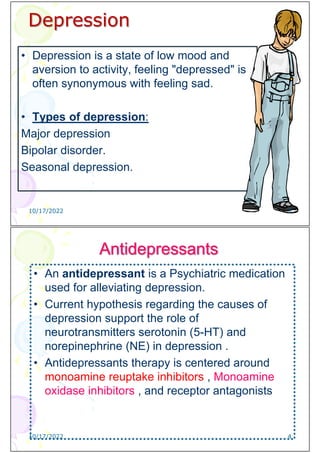
• Depression is a state of low mood and
aversion to activity, feeling "depressed" is
often synonymous with feeling sad.
• Types of depression:
Major depression
Bipolar disorder.
Seasonal depression.
10/17/2022 3
Antidepressants
• An antidepressant is a Psychiatric medication
used for alleviating depression.
• Current hypothesis regarding the causes of
depression support the role of
neurotransmitters serotonin (5-HT) and
norepinephrine (NE) in depression .
• Antidepressants therapy is centered around
monoamine reuptake inhibitors , Monoamine
oxidase inhibitors , and receptor antagonists
10/17/2022 4
10/17/2022 5
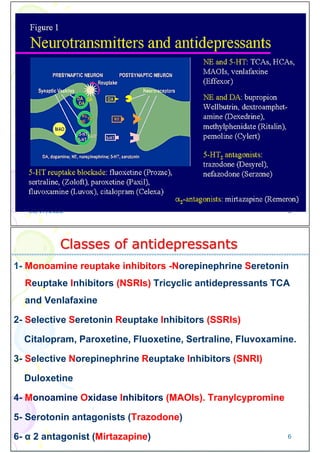
Classes of antidepressants
1- Monoamine reuptake inhibitors -Norepinephrine Seretonin
Reuptake Inhibitors (NSRIs) Tricyclic antidepressants TCA
and Venlafaxine
2- Selective Seretonin Reuptake Inhibitors (SSRIs)
Citalopram, Paroxetine, Fluoxetine, Sertraline, Fluvoxamine.
3- Selective Norepinephrine Reuptake Inhibitors (SNRI)
Duloxetine
4- Monoamine Oxidase Inhibitors (MAOIs). Tranylcypromine
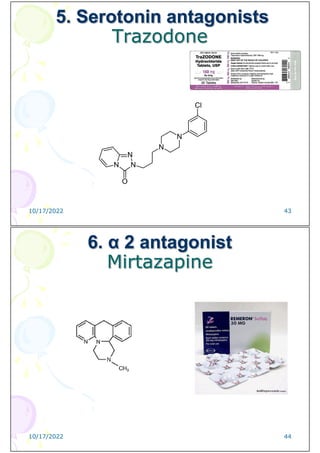
5- Serotonin antagonists (Trazodone)
6- α 2 antagonist (Mirtazapine) 6
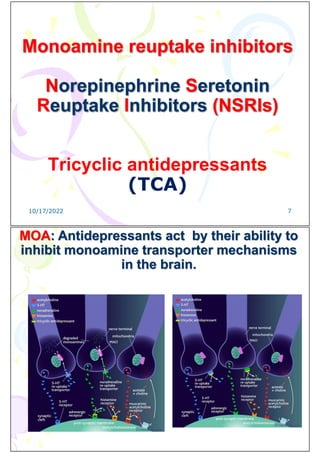
Monoamine reuptake inhibitors
Norepinephrine Seretonin
Reuptake Inhibitors (NSRIs)
Tricyclic antidepressants
(TCA)
10/17/2022 7
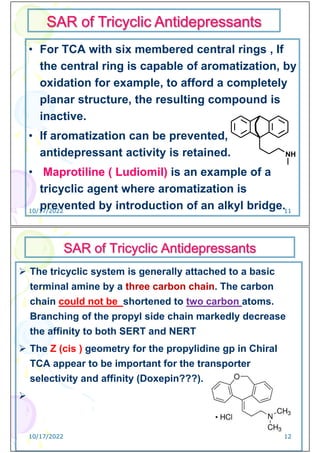
MOA: Antidepressants act by their ability to
inhibit monoamine transporter mechanisms
in the brain.
SAR of Tricyclic Antidepressants
 TCA have in common a tricyclic ring structure
consisting of a central six membered or more
commonly a seven –membered ring flanked by two
benzene rings held in a skewed arrangement. This
tricyclic bulky structure lacks coplanarity
N
N
1
2
3
4
5
6
7
8
9
10 11
R
5-[3-(Dimethylamino)propyl]-10,11-dihydro-5H-dibenz[b,f]azepine HCl
Imipramine R=CH3
Desipramine R=H
10/17/2022 9
 Ring Nitrogen atom is not required for
antidepressant activity, replacement with sp3 or sp2
carbon enhances antidepressant activity.
 The side chain must be three carbon atoms ,either
saturated (propyl) or unsaturated (propylidine)
NH
Protriptyline
SAR of Tricyclic Antidepressants
N
N
1
2
3
4
5
6
7
8
9
10 11
R
Imipramine
Amitriptyline
10
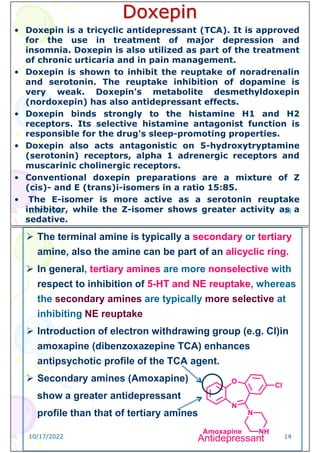
• For TCA with six membered central rings , If
the central ring is capable of aromatization, by
oxidation for example, to afford a completely
planar structure, the resulting compound is
inactive.
• If aromatization can be prevented,
antidepressant activity is retained.
• Maprotiline ( Ludiomil) is an example of a
tricyclic agent where aromatization is
prevented by introduction of an alkyl bridge.
SAR of Tricyclic Antidepressants
NH
10/17/2022 11
SAR of Tricyclic Antidepressants
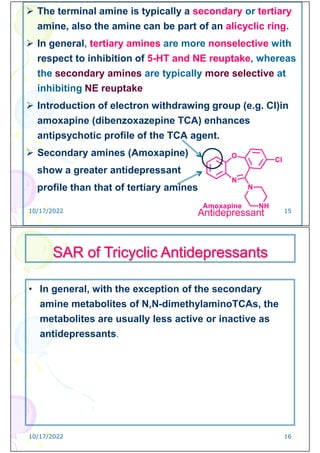
 The tricyclic system is generally attached to a basic
terminal amine by a three carbon chain. The carbon
chain could not be shortened to two carbon atoms.
Branching of the propyl side chain markedly decrease
the affinity to both SERT and NERT
 The Z (cis ) geometry for the propylidine gp in Chiral
TCA appear to be important for the transporter
selectivity and affinity (Doxepin???).

10/17/2022 12
Doxepin
• Doxepin is a tricyclic antidepressant (TCA). It is approved
for the use in treatment of major depression and
insomnia. Doxepin is also utilized as part of the treatment
of chronic urticaria and in pain management.
• Doxepin is shown to inhibit the reuptake of noradrenalin
and serotonin. The reuptake inhibition of dopamine is
very weak. Doxepin's metabolite desmethyldoxepin
(nordoxepin) has also antidepressant effects.
• Doxepin binds strongly to the histamine H1 and H2
receptors. Its selective histamine antagonist function is
responsible for the drug's sleep-promoting properties.
• Doxepin also acts antagonistic on 5-hydroxytryptamine
(serotonin) receptors, alpha 1 adrenergic receptors and
muscarinic cholinergic receptors.
• Conventional doxepin preparations are a mixture of Z
(cis)- and E (trans)i-isomers in a ratio 15:85.
• The E-isomer is more active as a serotonin reuptake
inhibitor, while the Z-isomer shows greater activity as a
sedative.
10/17/2022 13
 The terminal amine is typically a secondary or tertiary
amine, also the amine can be part of an alicyclic ring.
 In general, tertiary amines are more nonselective with
respect to inhibition of 5-HT and NE reuptake, whereas
the secondary amines are typically more selective at
inhibiting NE reuptake
 Introduction of electron withdrawing group (e.g. Cl)in
amoxapine (dibenzoxazepine TCA) enhances
antipsychotic profile of the TCA agent.
 Secondary amines (Amoxapine)
show a greater antidepressant
profile than that of tertiary amines
Antidepressant
10/17/2022 14
 The terminal amine is typically a secondary or tertiary
amine, also the amine can be part of an alicyclic ring.
 In general, tertiary amines are more nonselective with
respect to inhibition of 5-HT and NE reuptake, whereas
the secondary amines are typically more selective at
inhibiting NE reuptake
 Introduction of electron withdrawing group (e.g. Cl)in
amoxapine (dibenzoxazepine TCA) enhances
antipsychotic profile of the TCA agent.
 Secondary amines (Amoxapine)
show a greater antidepressant
profile than that of tertiary amines
Antidepressant
10/17/2022 15
• In general, with the exception of the secondary
amine metabolites of N,N-dimethylaminoTCAs, the
metabolites are usually less active or inactive as
antidepressants.
SAR of Tricyclic Antidepressants
10/17/2022 16
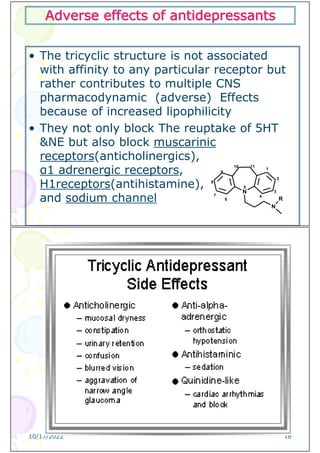
Adverse effects of antidepressants
• The tricyclic structure is not associated
with affinity to any particular receptor but
rather contributes to multiple CNS
pharmacodynamic (adverse) Effects
because of increased lipophilicity
• They not only block The reuptake of 5HT
&NE but also block muscarinic
receptors(anticholinergics),
α1 adrenergic receptors,
H1receptors(antihistamine),
and sodium channel
N
N
1
2
3
4
5
6
7
8
9
10 11
R
10/17/2022 18
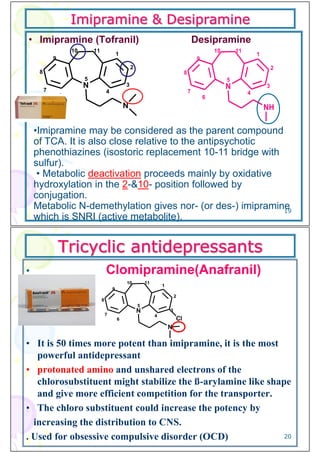
Imipramine & Desipramine
• Imipramine (Tofranil) Desipramine
N
N
1
2
3
4
5
6
7
8
9
10 11
N
NH
1
2
3
4
5
6
7
8
9
10 11
•Imipramine may be considered as the parent compound
of TCA. It is also close relative to the antipsychotic
phenothiazines (isostoric replacement 10-11 bridge with
sulfur).
• Metabolic deactivation proceeds mainly by oxidative
hydroxylation in the 2-&10- position followed by
conjugation.
Metabolic N-demethylation gives nor- (or des-) imipramine
which is SNRI (active metabolite).
19
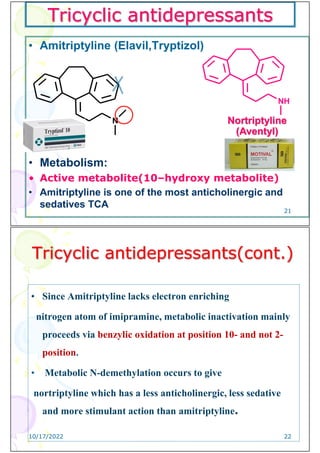
Tricyclic antidepressants
• Clomipramine(Anafranil)
• It is 50 times more potent than imipramine, it is the most
powerful antidepressant
• protonated amino and unshared electrons of the
chlorosubstituent might stabilize the ß-arylamine like shape
and give more efficient competition for the transporter.
• The chloro substituent could increase the potency by
increasing the distribution to CNS.
. Used for obsessive compulsive disorder (OCD)
N
N
1
2
3
4
5
6
7
8
9
10 11
Cl
20
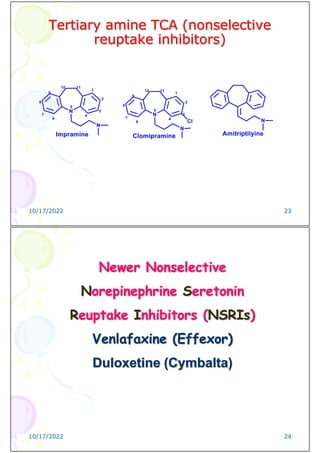
Tricyclic antidepressants
• Amitriptyline (Elavil,Tryptizol)
• Metabolism:
• Active metabolite(10–hydroxy metabolite)
• Amitriptyline is one of the most anticholinergic and
sedatives TCA
N
NH
Nortriptyline
(Aventyl)
21
Tricyclic antidepressants(cont.)
• Since Amitriptyline lacks electron enriching
nitrogen atom of imipramine, metabolic inactivation mainly
proceeds via benzylic oxidation at position 10- and not 2-
position.
• Metabolic N-demethylation occurs to give
nortriptyline which has a less anticholinergic, less sedative
and more stimulant action than amitriptyline.
10/17/2022 22
Tertiary amine TCA (nonselective
reuptake inhibitors)
10/17/2022 23
10/17/2022 24
Newer Nonselective
Norepinephrine Seretonin
Reuptake Inhibitors (NSRIs)
Venlafaxine (Effexor)
Duloxetine (Cymbalta)
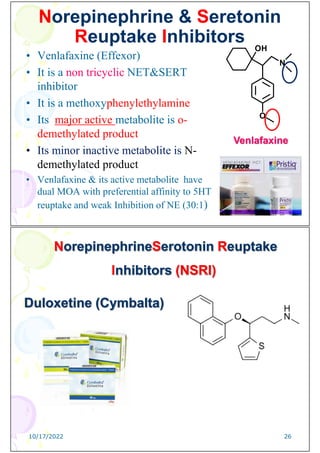
Norepinephrine & Seretonin
Reuptake Inhibitors
• Venlafaxine (Effexor)
• It is a non tricyclic NET&SERT
inhibitor
• It is a methoxyphenylethylamine
• Its major active metabolite is o-
demethylated product
• Its minor inactive metabolite is N-
demethylated product
• Venlafaxine & its active metabolite have
dual MOA with preferential affinity to 5HT
reuptake and weak Inhibition of NE (30:1)
Venlafaxine
NorepinephrineSerotonin Reuptake
Inhibitors (NSRI)
10/17/2022 26
Duloxetine (Cymbalta)
2- Selective seretonin
reuptake inhibitors
(SSRIs)
10/17/2022 27
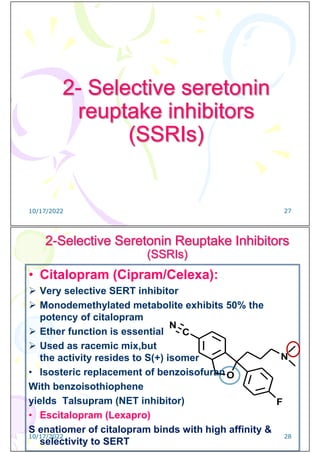
2-Selective Seretonin Reuptake Inhibitors
(SSRIs)
• Citalopram (Cipram/Celexa):
 Very selective SERT inhibitor
 Monodemethylated metabolite exhibits 50% the
potency of citalopram
 Ether function is essential
 Used as racemic mix,but
the activity resides to S(+) isomer
• Isosteric replacement of benzoisofuran
With benzoisothiophene
yields Talsupram (NET inhibitor)
• Escitalopram (Lexapro)
S enatiomer of citalopram binds with high affinity &
selectivity to SERT
O
N
F
C
N
10/17/2022 28
2-Selective Seretonin Reuptake Inhibitors
(SSRIs)
• Fluoxetine (Prozac)
N-methyl-3-phenyl-3-
[4-(trifluoromethyl) phenoxy]-
propan-1-amine
Monosubstitution in 4 position of phenoxy gp with
electron withdrawing gp (CF3)results in selective
inhibition of 5HT
Disubstitution 2,3 or 3,4 results in loss of SERT
selectivity
Metabolism : N-demethyl compound(Nor fluoxetine)is
as potent as the parent compound and more
selective SERT inhibitor
O
HN
CF3
10/17/2022 29
SSRIs(Fluoxetine cont.)
• Both enantiomer(R,S) display
similar affinities for SERT .
• The S- enantiomer is 100 times more selective
for SERT rather than NET
• If the para substituent is
moved to the ortho
position and substituted
by methoxy group,
a SNERI is obtained as in Nisoxetine.
• Fkuoxetine is Used in ttt of bulimia nervosa nisoxetine
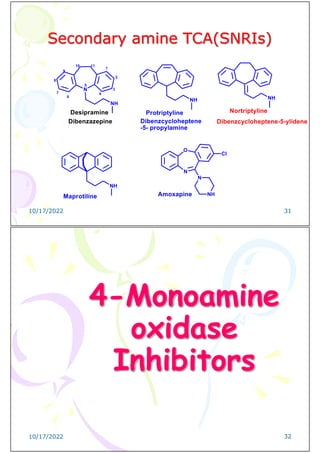
Secondary amine TCA(SNRIs)
10/17/2022 31
4-Monoamine
oxidase
Inhibitors
10/17/2022 32
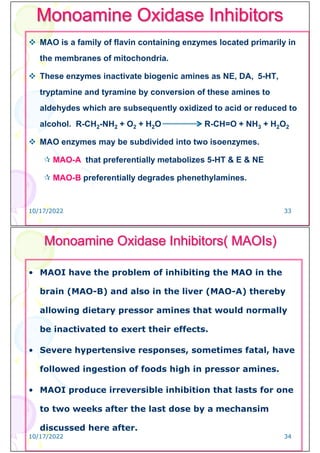
Monoamine Oxidase Inhibitors
 MAO is a family of flavin containing enzymes located primarily in
the membranes of mitochondria.
 These enzymes inactivate biogenic amines as NE, DA, 5-HT,
tryptamine and tyramine by conversion of these amines to
aldehydes which are subsequently oxidized to acid or reduced to
alcohol. R-CH2-NH2 + O2 + H2O R-CH=O + NH3 + H2O2
 MAO enzymes may be subdivided into two isoenzymes.
 MAO-A that preferentially metabolizes 5-HT & E & NE
 MAO-B preferentially degrades phenethylamines.
10/17/2022 33
Monoamine Oxidase Inhibitors( MAOIs)
• MAOI have the problem of inhibiting the MAO in the
brain (MAO-B) and also in the liver (MAO-A) thereby
allowing dietary pressor amines that would normally
be inactivated to exert their effects.
• Severe hypertensive responses, sometimes fatal, have
followed ingestion of foods high in pressor amines.
• MAOI produce irreversible inhibition that lasts for one
to two weeks after the last dose by a mechansim
discussed here after.
10/17/2022 34
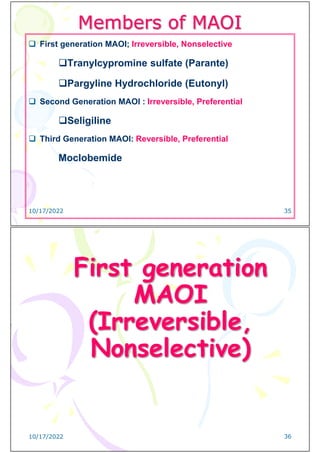
Members of MAOI
 First generation MAOI; Irreversible, Nonselective
Tranylcypromine sulfate (Parante)
Pargyline Hydrochloride (Eutonyl)
 Second Generation MAOI : Irreversible, Preferential
Seligiline
 Third Generation MAOI: Reversible, Preferential
Moclobemide
10/17/2022 35
First generation
MAOI
(Irreversible,
Nonselective)
10/17/2022 36
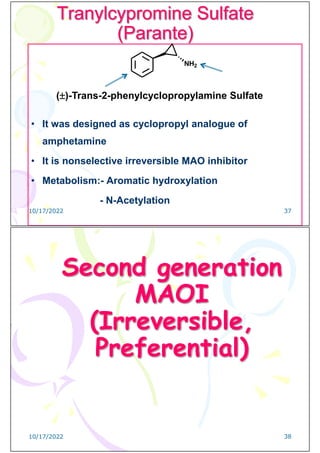
Tranylcypromine Sulfate
(Parante)
• It was designed as cyclopropyl analogue of
amphetamine
• It is nonselective irreversible MAO inhibitor
• Metabolism:- Aromatic hydroxylation
- N-Acetylation
NH2
()-Trans-2-phenylcyclopropylamine Sulfate
10/17/2022 37
Second generation
MAOI
(Irreversible,
Preferential)
10/17/2022 38
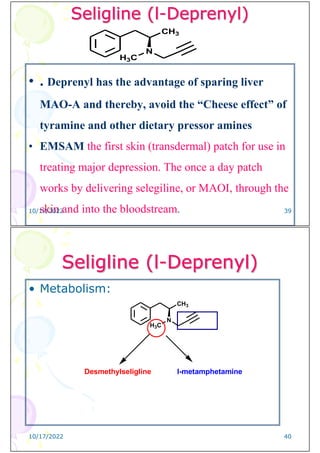
Seligline (l-Deprenyl)
• . Deprenyl has the advantage of sparing liver
MAO-A and thereby, avoid the “Cheese effect” of
tyramine and other dietary pressor amines
• EMSAM the first skin (transdermal) patch for use in
treating major depression. The once a day patch
works by delivering selegiline, or MAOI, through the
skin and into the bloodstream.
CH3
N
H3C
10/17/2022 39
Seligline (l-Deprenyl)
• Metabolism:
CH3
N
H3C
Desmethylseligline l-metamphetamine
10/17/2022 40
Third
generation
MAOI
(Reversible,
Preferential)
10/17/2022 41
Moclobemide
•
• 4-Fluoro-N-[2-(N-morpholino)ethyl]benzamide
• Moclobamide is a reversible MAO inhibitor ,thereby
increasing conc. of 5-HT, NE and other
Catecholamines in the synaptic cleft and in the
storage sites
N
H
N O
F
O
10/17/2022 42
5. Serotonin antagonists
Trazodone
10/17/2022 43
6. α 2 antagonist
Mirtazapine
10/17/2022 44

4th-Year-Medicinal-Chemistry-3rd-Lecture (1).pdf

  • 1.
    10/17/2022 1 Antidepressants • Understandthe meaning of depression • Classify the different antidepressants according to mode of action • Identify general chemical structure of antidepressants • Distinguish between different pharmacological classes according to structure features. • Predict different metabolic pathways 10/17/2022 2
  • 2.
    Depression • Depression isa state of low mood and aversion to activity, feeling "depressed" is often synonymous with feeling sad. • Types of depression: Major depression Bipolar disorder. Seasonal depression. 10/17/2022 3 Antidepressants • An antidepressant is a Psychiatric medication used for alleviating depression. • Current hypothesis regarding the causes of depression support the role of neurotransmitters serotonin (5-HT) and norepinephrine (NE) in depression . • Antidepressants therapy is centered around monoamine reuptake inhibitors , Monoamine oxidase inhibitors , and receptor antagonists 10/17/2022 4
  • 3.
    10/17/2022 5 Classes ofantidepressants 1- Monoamine reuptake inhibitors -Norepinephrine Seretonin Reuptake Inhibitors (NSRIs) Tricyclic antidepressants TCA and Venlafaxine 2- Selective Seretonin Reuptake Inhibitors (SSRIs) Citalopram, Paroxetine, Fluoxetine, Sertraline, Fluvoxamine. 3- Selective Norepinephrine Reuptake Inhibitors (SNRI) Duloxetine 4- Monoamine Oxidase Inhibitors (MAOIs). Tranylcypromine 5- Serotonin antagonists (Trazodone) 6- α 2 antagonist (Mirtazapine) 6
  • 4.
    Monoamine reuptake inhibitors NorepinephrineSeretonin Reuptake Inhibitors (NSRIs) Tricyclic antidepressants (TCA) 10/17/2022 7 MOA: Antidepressants act by their ability to inhibit monoamine transporter mechanisms in the brain.
  • 5.
    SAR of TricyclicAntidepressants  TCA have in common a tricyclic ring structure consisting of a central six membered or more commonly a seven –membered ring flanked by two benzene rings held in a skewed arrangement. This tricyclic bulky structure lacks coplanarity N N 1 2 3 4 5 6 7 8 9 10 11 R 5-[3-(Dimethylamino)propyl]-10,11-dihydro-5H-dibenz[b,f]azepine HCl Imipramine R=CH3 Desipramine R=H 10/17/2022 9  Ring Nitrogen atom is not required for antidepressant activity, replacement with sp3 or sp2 carbon enhances antidepressant activity.  The side chain must be three carbon atoms ,either saturated (propyl) or unsaturated (propylidine) NH Protriptyline SAR of Tricyclic Antidepressants N N 1 2 3 4 5 6 7 8 9 10 11 R Imipramine Amitriptyline 10
  • 6.
    • For TCAwith six membered central rings , If the central ring is capable of aromatization, by oxidation for example, to afford a completely planar structure, the resulting compound is inactive. • If aromatization can be prevented, antidepressant activity is retained. • Maprotiline ( Ludiomil) is an example of a tricyclic agent where aromatization is prevented by introduction of an alkyl bridge. SAR of Tricyclic Antidepressants NH 10/17/2022 11 SAR of Tricyclic Antidepressants  The tricyclic system is generally attached to a basic terminal amine by a three carbon chain. The carbon chain could not be shortened to two carbon atoms. Branching of the propyl side chain markedly decrease the affinity to both SERT and NERT  The Z (cis ) geometry for the propylidine gp in Chiral TCA appear to be important for the transporter selectivity and affinity (Doxepin???).  10/17/2022 12
  • 7.
    Doxepin • Doxepin isa tricyclic antidepressant (TCA). It is approved for the use in treatment of major depression and insomnia. Doxepin is also utilized as part of the treatment of chronic urticaria and in pain management. • Doxepin is shown to inhibit the reuptake of noradrenalin and serotonin. The reuptake inhibition of dopamine is very weak. Doxepin's metabolite desmethyldoxepin (nordoxepin) has also antidepressant effects. • Doxepin binds strongly to the histamine H1 and H2 receptors. Its selective histamine antagonist function is responsible for the drug's sleep-promoting properties. • Doxepin also acts antagonistic on 5-hydroxytryptamine (serotonin) receptors, alpha 1 adrenergic receptors and muscarinic cholinergic receptors. • Conventional doxepin preparations are a mixture of Z (cis)- and E (trans)i-isomers in a ratio 15:85. • The E-isomer is more active as a serotonin reuptake inhibitor, while the Z-isomer shows greater activity as a sedative. 10/17/2022 13  The terminal amine is typically a secondary or tertiary amine, also the amine can be part of an alicyclic ring.  In general, tertiary amines are more nonselective with respect to inhibition of 5-HT and NE reuptake, whereas the secondary amines are typically more selective at inhibiting NE reuptake  Introduction of electron withdrawing group (e.g. Cl)in amoxapine (dibenzoxazepine TCA) enhances antipsychotic profile of the TCA agent.  Secondary amines (Amoxapine) show a greater antidepressant profile than that of tertiary amines Antidepressant 10/17/2022 14
  • 8.
     The terminalamine is typically a secondary or tertiary amine, also the amine can be part of an alicyclic ring.  In general, tertiary amines are more nonselective with respect to inhibition of 5-HT and NE reuptake, whereas the secondary amines are typically more selective at inhibiting NE reuptake  Introduction of electron withdrawing group (e.g. Cl)in amoxapine (dibenzoxazepine TCA) enhances antipsychotic profile of the TCA agent.  Secondary amines (Amoxapine) show a greater antidepressant profile than that of tertiary amines Antidepressant 10/17/2022 15 • In general, with the exception of the secondary amine metabolites of N,N-dimethylaminoTCAs, the metabolites are usually less active or inactive as antidepressants. SAR of Tricyclic Antidepressants 10/17/2022 16
  • 9.
    Adverse effects ofantidepressants • The tricyclic structure is not associated with affinity to any particular receptor but rather contributes to multiple CNS pharmacodynamic (adverse) Effects because of increased lipophilicity • They not only block The reuptake of 5HT &NE but also block muscarinic receptors(anticholinergics), α1 adrenergic receptors, H1receptors(antihistamine), and sodium channel N N 1 2 3 4 5 6 7 8 9 10 11 R 10/17/2022 18
  • 10.
    Imipramine & Desipramine •Imipramine (Tofranil) Desipramine N N 1 2 3 4 5 6 7 8 9 10 11 N NH 1 2 3 4 5 6 7 8 9 10 11 •Imipramine may be considered as the parent compound of TCA. It is also close relative to the antipsychotic phenothiazines (isostoric replacement 10-11 bridge with sulfur). • Metabolic deactivation proceeds mainly by oxidative hydroxylation in the 2-&10- position followed by conjugation. Metabolic N-demethylation gives nor- (or des-) imipramine which is SNRI (active metabolite). 19 Tricyclic antidepressants • Clomipramine(Anafranil) • It is 50 times more potent than imipramine, it is the most powerful antidepressant • protonated amino and unshared electrons of the chlorosubstituent might stabilize the ß-arylamine like shape and give more efficient competition for the transporter. • The chloro substituent could increase the potency by increasing the distribution to CNS. . Used for obsessive compulsive disorder (OCD) N N 1 2 3 4 5 6 7 8 9 10 11 Cl 20
  • 11.
    Tricyclic antidepressants • Amitriptyline(Elavil,Tryptizol) • Metabolism: • Active metabolite(10–hydroxy metabolite) • Amitriptyline is one of the most anticholinergic and sedatives TCA N NH Nortriptyline (Aventyl) 21 Tricyclic antidepressants(cont.) • Since Amitriptyline lacks electron enriching nitrogen atom of imipramine, metabolic inactivation mainly proceeds via benzylic oxidation at position 10- and not 2- position. • Metabolic N-demethylation occurs to give nortriptyline which has a less anticholinergic, less sedative and more stimulant action than amitriptyline. 10/17/2022 22
  • 12.
    Tertiary amine TCA(nonselective reuptake inhibitors) 10/17/2022 23 10/17/2022 24 Newer Nonselective Norepinephrine Seretonin Reuptake Inhibitors (NSRIs) Venlafaxine (Effexor) Duloxetine (Cymbalta)
  • 13.
    Norepinephrine & Seretonin ReuptakeInhibitors • Venlafaxine (Effexor) • It is a non tricyclic NET&SERT inhibitor • It is a methoxyphenylethylamine • Its major active metabolite is o- demethylated product • Its minor inactive metabolite is N- demethylated product • Venlafaxine & its active metabolite have dual MOA with preferential affinity to 5HT reuptake and weak Inhibition of NE (30:1) Venlafaxine NorepinephrineSerotonin Reuptake Inhibitors (NSRI) 10/17/2022 26 Duloxetine (Cymbalta)
  • 14.
    2- Selective seretonin reuptakeinhibitors (SSRIs) 10/17/2022 27 2-Selective Seretonin Reuptake Inhibitors (SSRIs) • Citalopram (Cipram/Celexa):  Very selective SERT inhibitor  Monodemethylated metabolite exhibits 50% the potency of citalopram  Ether function is essential  Used as racemic mix,but the activity resides to S(+) isomer • Isosteric replacement of benzoisofuran With benzoisothiophene yields Talsupram (NET inhibitor) • Escitalopram (Lexapro) S enatiomer of citalopram binds with high affinity & selectivity to SERT O N F C N 10/17/2022 28
  • 15.
    2-Selective Seretonin ReuptakeInhibitors (SSRIs) • Fluoxetine (Prozac) N-methyl-3-phenyl-3- [4-(trifluoromethyl) phenoxy]- propan-1-amine Monosubstitution in 4 position of phenoxy gp with electron withdrawing gp (CF3)results in selective inhibition of 5HT Disubstitution 2,3 or 3,4 results in loss of SERT selectivity Metabolism : N-demethyl compound(Nor fluoxetine)is as potent as the parent compound and more selective SERT inhibitor O HN CF3 10/17/2022 29 SSRIs(Fluoxetine cont.) • Both enantiomer(R,S) display similar affinities for SERT . • The S- enantiomer is 100 times more selective for SERT rather than NET • If the para substituent is moved to the ortho position and substituted by methoxy group, a SNERI is obtained as in Nisoxetine. • Fkuoxetine is Used in ttt of bulimia nervosa nisoxetine
  • 16.
    Secondary amine TCA(SNRIs) 10/17/202231 4-Monoamine oxidase Inhibitors 10/17/2022 32
  • 17.
    Monoamine Oxidase Inhibitors MAO is a family of flavin containing enzymes located primarily in the membranes of mitochondria.  These enzymes inactivate biogenic amines as NE, DA, 5-HT, tryptamine and tyramine by conversion of these amines to aldehydes which are subsequently oxidized to acid or reduced to alcohol. R-CH2-NH2 + O2 + H2O R-CH=O + NH3 + H2O2  MAO enzymes may be subdivided into two isoenzymes.  MAO-A that preferentially metabolizes 5-HT & E & NE  MAO-B preferentially degrades phenethylamines. 10/17/2022 33 Monoamine Oxidase Inhibitors( MAOIs) • MAOI have the problem of inhibiting the MAO in the brain (MAO-B) and also in the liver (MAO-A) thereby allowing dietary pressor amines that would normally be inactivated to exert their effects. • Severe hypertensive responses, sometimes fatal, have followed ingestion of foods high in pressor amines. • MAOI produce irreversible inhibition that lasts for one to two weeks after the last dose by a mechansim discussed here after. 10/17/2022 34
  • 18.
    Members of MAOI First generation MAOI; Irreversible, Nonselective Tranylcypromine sulfate (Parante) Pargyline Hydrochloride (Eutonyl)  Second Generation MAOI : Irreversible, Preferential Seligiline  Third Generation MAOI: Reversible, Preferential Moclobemide 10/17/2022 35 First generation MAOI (Irreversible, Nonselective) 10/17/2022 36
  • 19.
    Tranylcypromine Sulfate (Parante) • Itwas designed as cyclopropyl analogue of amphetamine • It is nonselective irreversible MAO inhibitor • Metabolism:- Aromatic hydroxylation - N-Acetylation NH2 ()-Trans-2-phenylcyclopropylamine Sulfate 10/17/2022 37 Second generation MAOI (Irreversible, Preferential) 10/17/2022 38
  • 20.
    Seligline (l-Deprenyl) • .Deprenyl has the advantage of sparing liver MAO-A and thereby, avoid the “Cheese effect” of tyramine and other dietary pressor amines • EMSAM the first skin (transdermal) patch for use in treating major depression. The once a day patch works by delivering selegiline, or MAOI, through the skin and into the bloodstream. CH3 N H3C 10/17/2022 39 Seligline (l-Deprenyl) • Metabolism: CH3 N H3C Desmethylseligline l-metamphetamine 10/17/2022 40
  • 21.
    Third generation MAOI (Reversible, Preferential) 10/17/2022 41 Moclobemide • • 4-Fluoro-N-[2-(N-morpholino)ethyl]benzamide •Moclobamide is a reversible MAO inhibitor ,thereby increasing conc. of 5-HT, NE and other Catecholamines in the synaptic cleft and in the storage sites N H N O F O 10/17/2022 42
  • 22.
    5. Serotonin antagonists Trazodone 10/17/202243 6. α 2 antagonist Mirtazapine 10/17/2022 44