Bar Models for Elementary
        Grades


          Peggy Foo
 Marshall Cavendish Institute
Learning Outcomes
Participants should be able to
   understand the rationale of model method
    as a heuristic/ problem-solving tool.
   Draw different types of models to solve a
    variety of word problems.
Origin
Developed by a project team in MOE in the 1980s

Objective: Help students who have great difficulty with
word problems in the early years of primary school.

Drawing a pictorial model to represent mathematical
quantities (known and unknowns) and their relationships
given in a problem.
Rationale
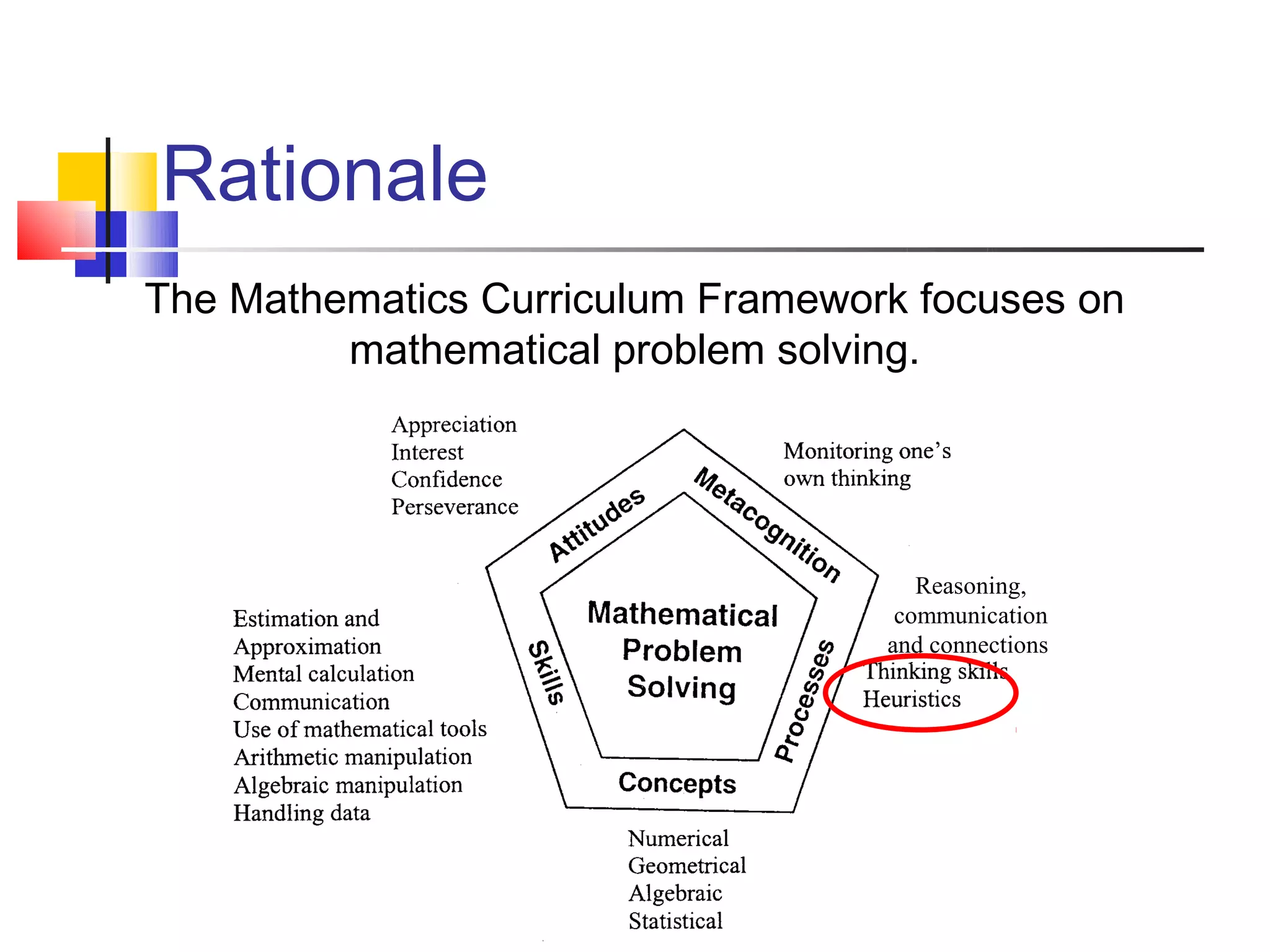
The Mathematics Curriculum Framework focuses on
         mathematical problem solving.


                                      Reasoning,
                                    communication
                                   and connections
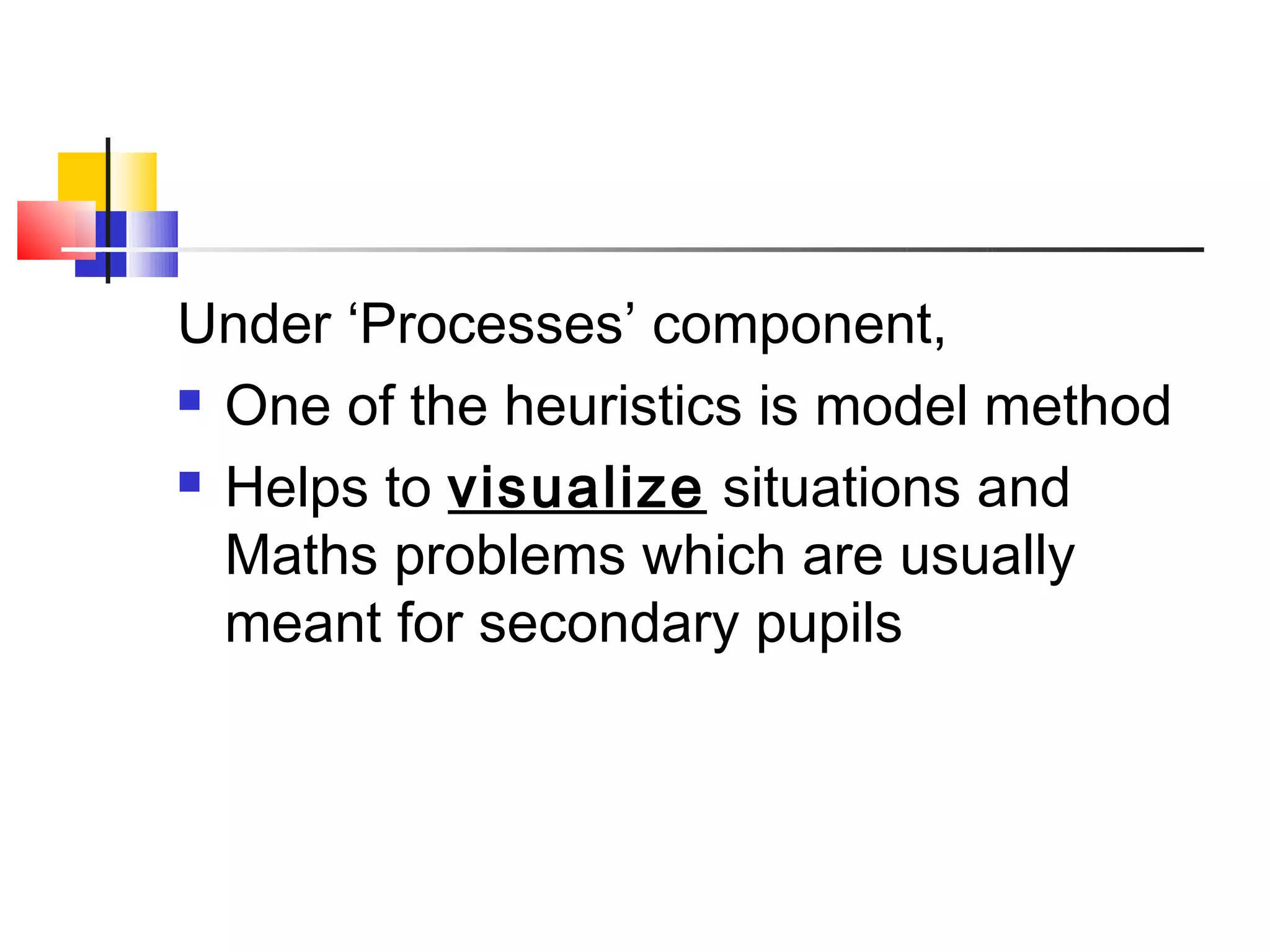
Under ‘Processes’ component,
 One of the heuristics is model method

 Helps to visualize situations and

  Maths problems which are usually
  meant for secondary pupils
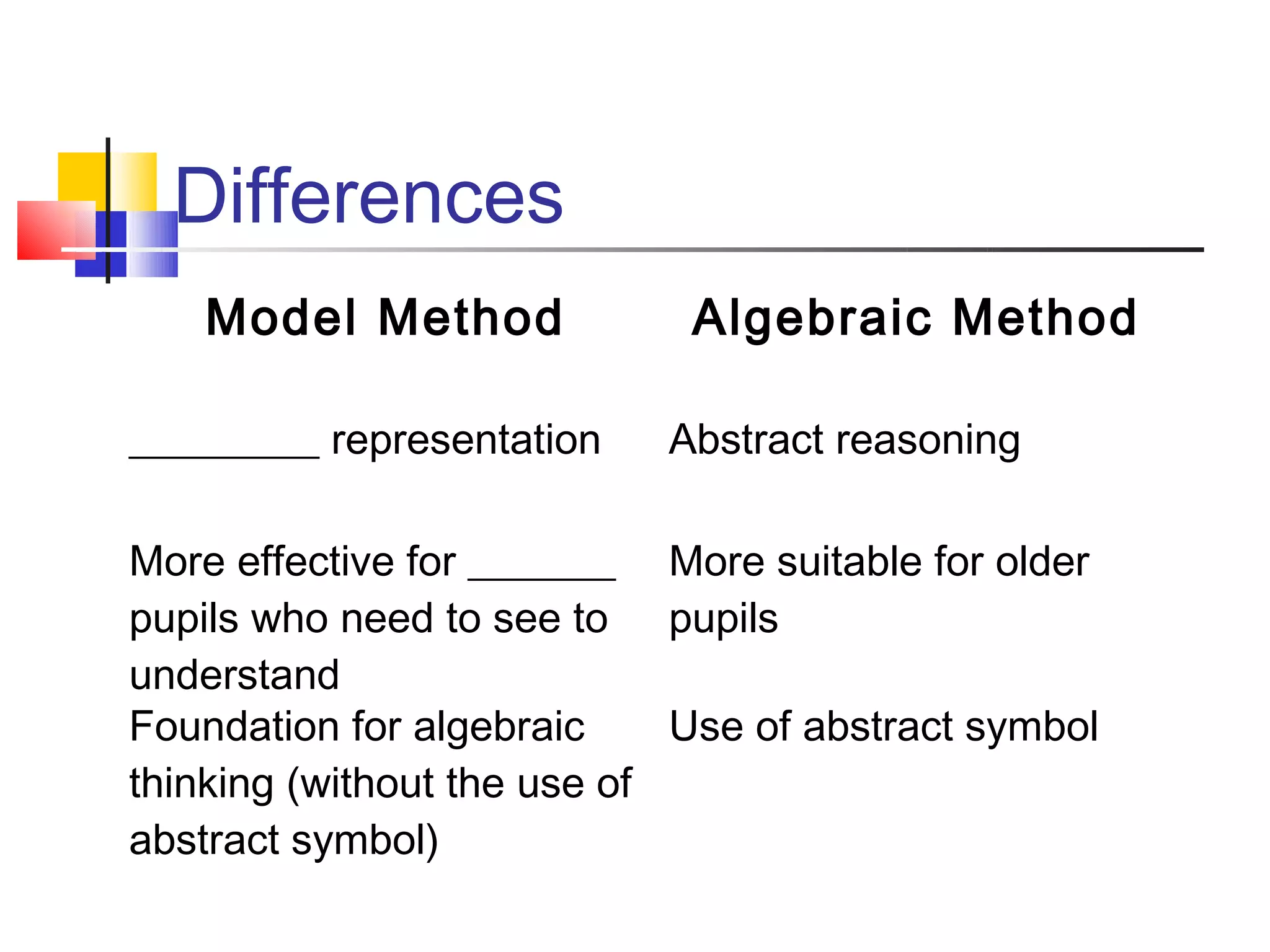
Differences
    Model Method             Algebraic Method

_________ representation    Abstract reasoning

More effective for _______ More suitable for older
pupils who need to see to pupils
understand
Foundation for algebraic     Use of abstract symbol
thinking (without the use of
abstract symbol)
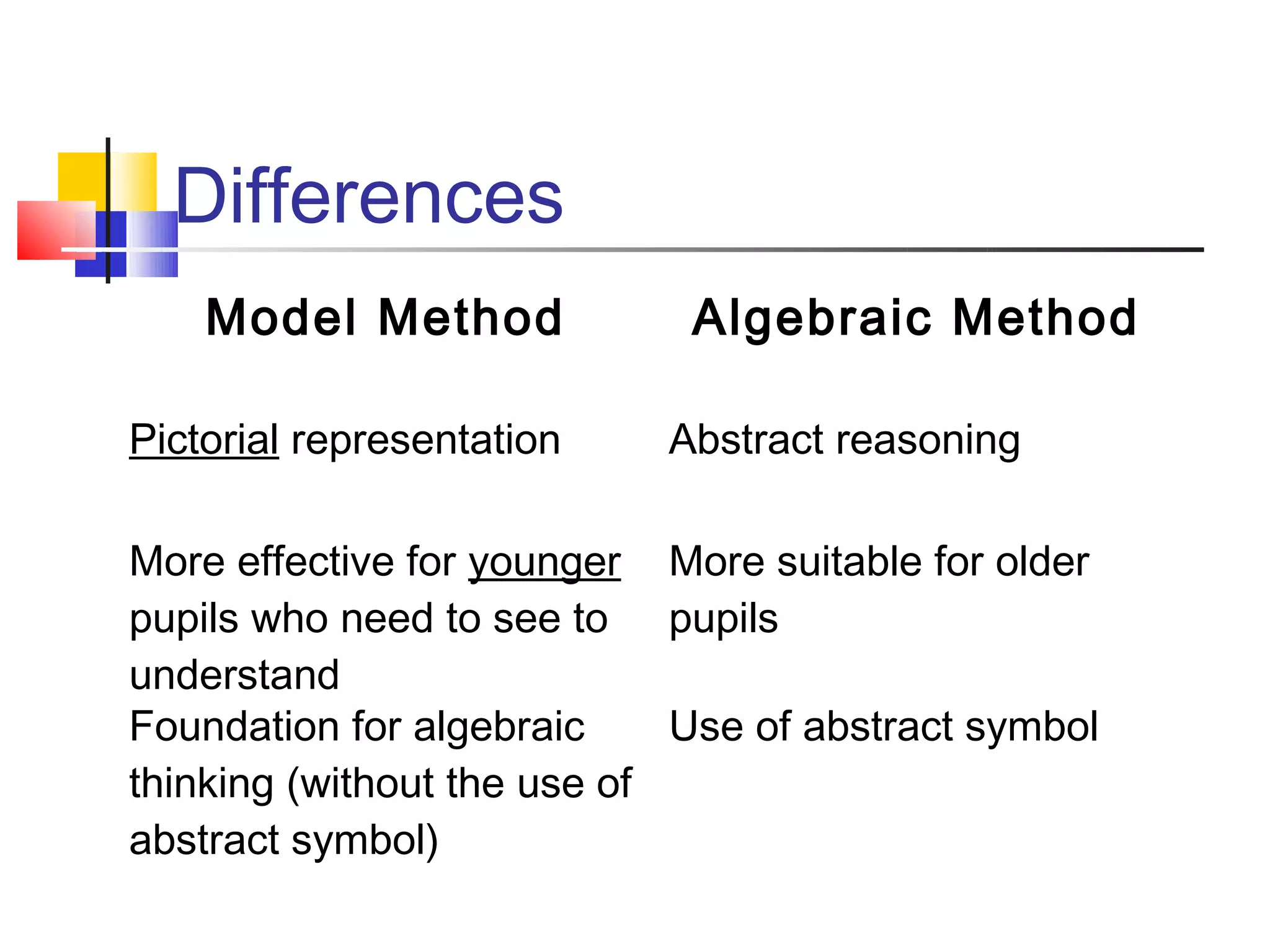
Differences
    Model Method             Algebraic Method

Pictorial representation    Abstract reasoning

More effective for younger More suitable for older
pupils who need to see to pupils
understand
Foundation for algebraic     Use of abstract symbol
thinking (without the use of
abstract symbol)
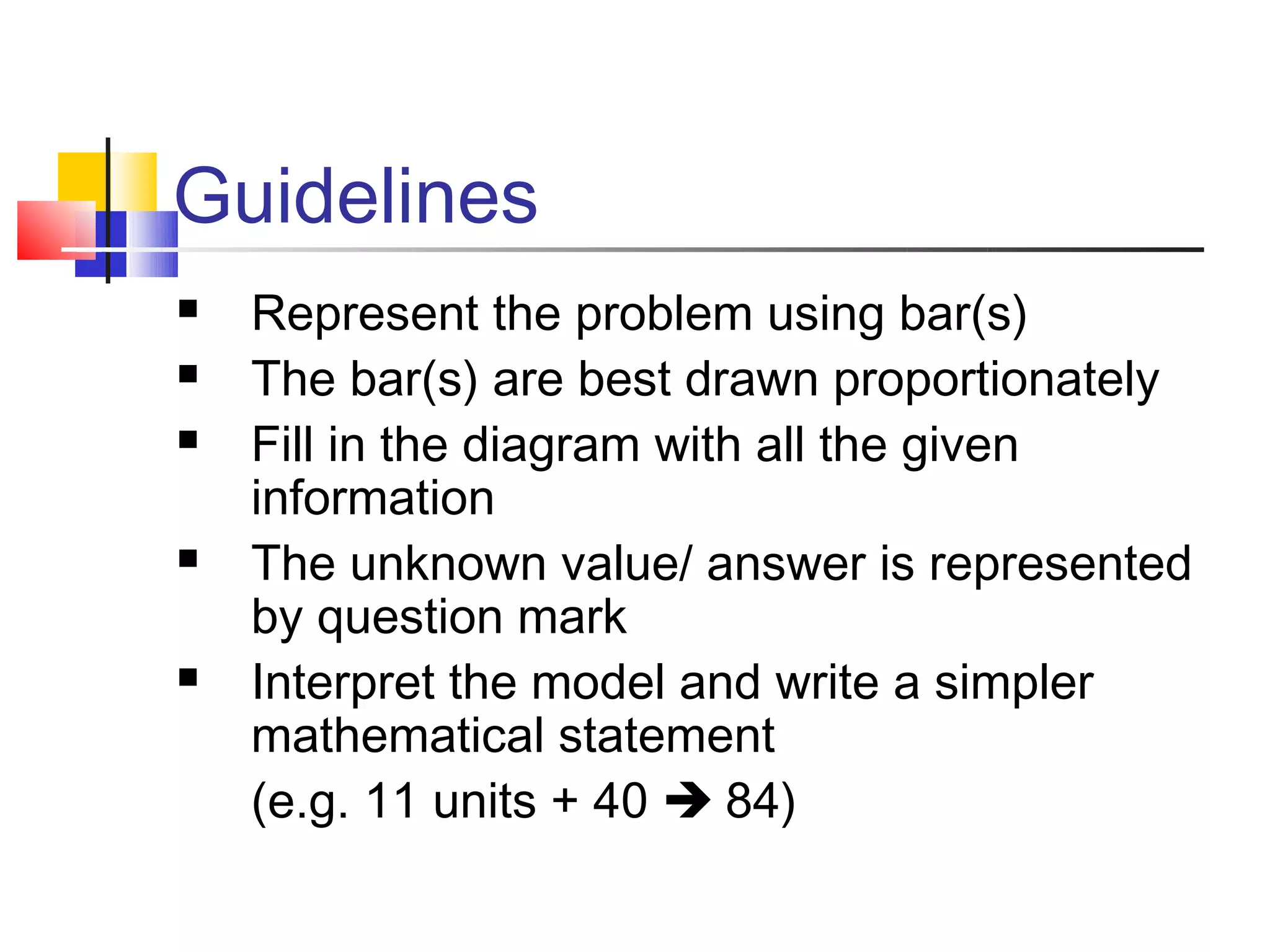
Guidelines
   Represent the problem using bar(s)
   The bar(s) are best drawn proportionately
   Fill in the diagram with all the given
    information
   The unknown value/ answer is represented
    by question mark
   Interpret the model and write a simpler
    mathematical statement
    (e.g. 11 units + 40  84)
Different types of models

   Part-Whole Model
   Comparative Model
   Change/ Transforming Model
Part-Whole Model
♠ Shows various parts which make up a
 whole
♠ Find the whole by addition
♠ Find the other part by subtraction
Part-Whole Model
(using concrete materials)

Ann had 5 books.
Bill gave her 7 more books.
How many books did Ann have altogether?
Part-Whole Model
               ?

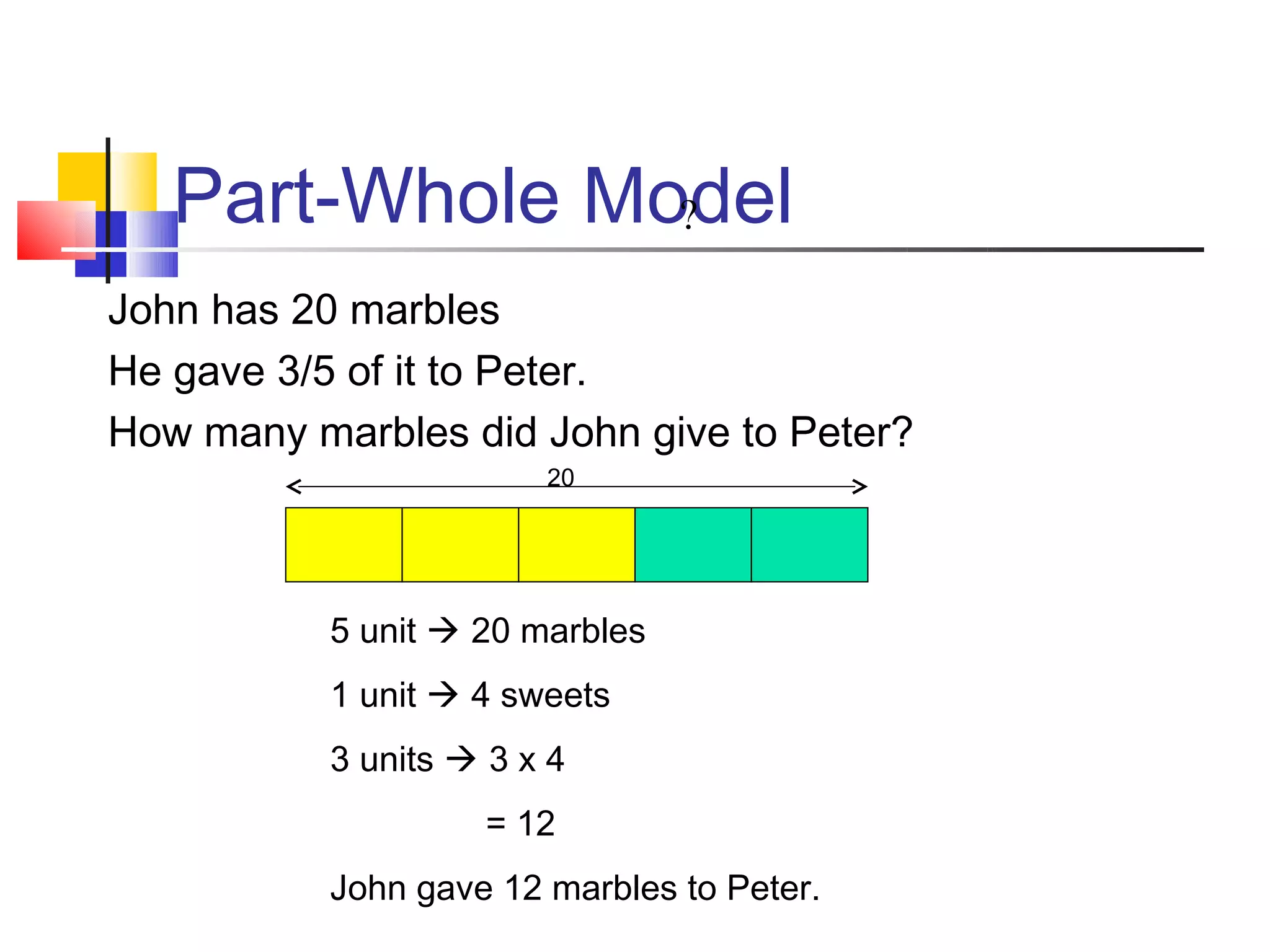
John has 20 marbles
He gave 3/5 of it to Peter.
How many marbles did John give to Peter?
Part-Whole Model
                ?

John has 20 marbles
He gave 3/5 of it to Peter.
How many marbles did John give to Peter?
                        20


           5 unit  20 marbles
           1 unit  4 sweets
           3 units  3 x 4
                    = 12
           John gave 12 marbles to Peter.
Comparsion Model
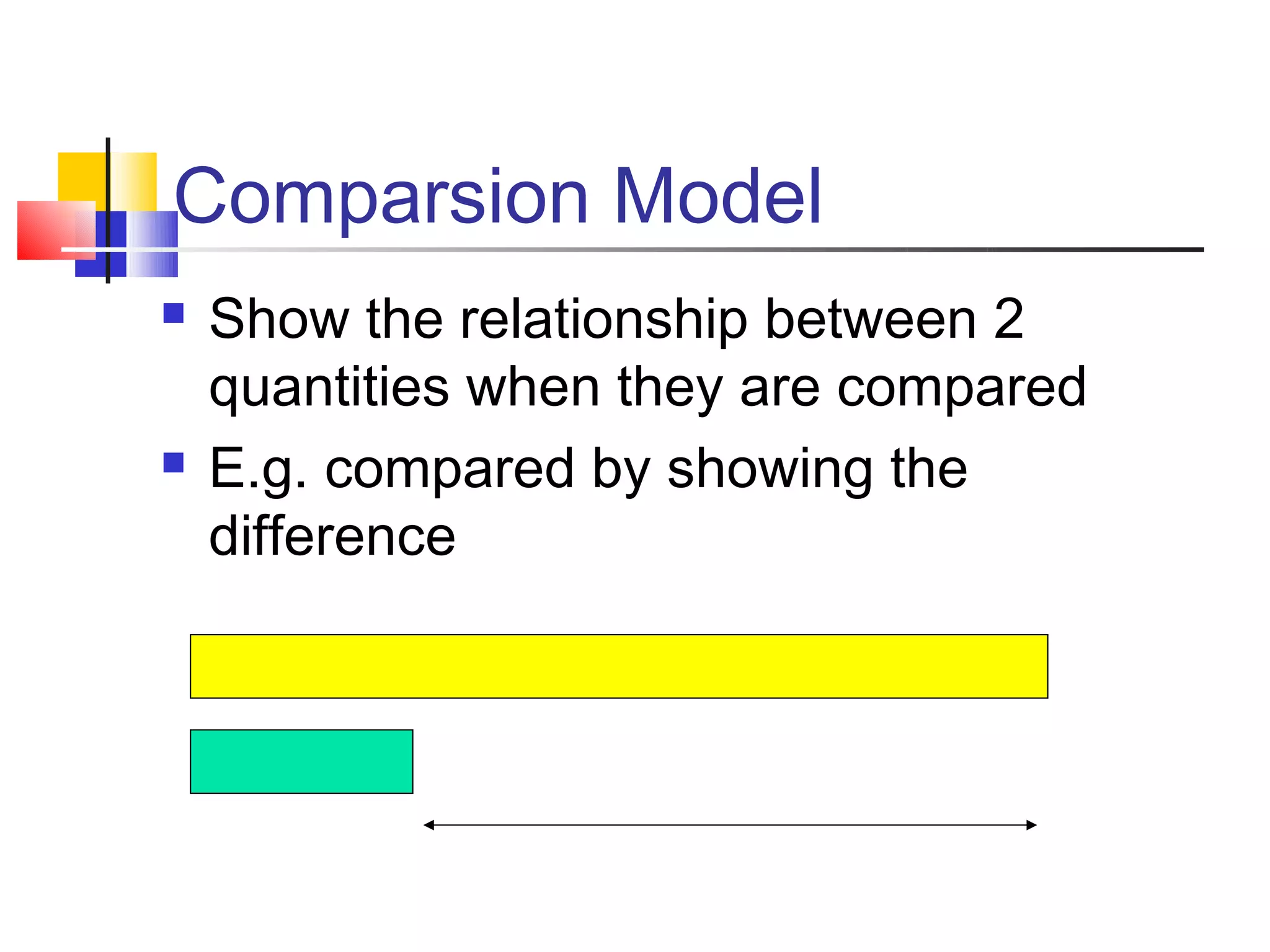
   Show the relationship between 2
    quantities when they are compared
   E.g. compared by showing the
    difference
Comparsion Model (Try it)

Alice had 3 books.
She had 9 books less than Beth.
How many books did Beth have?
Comparsion Model
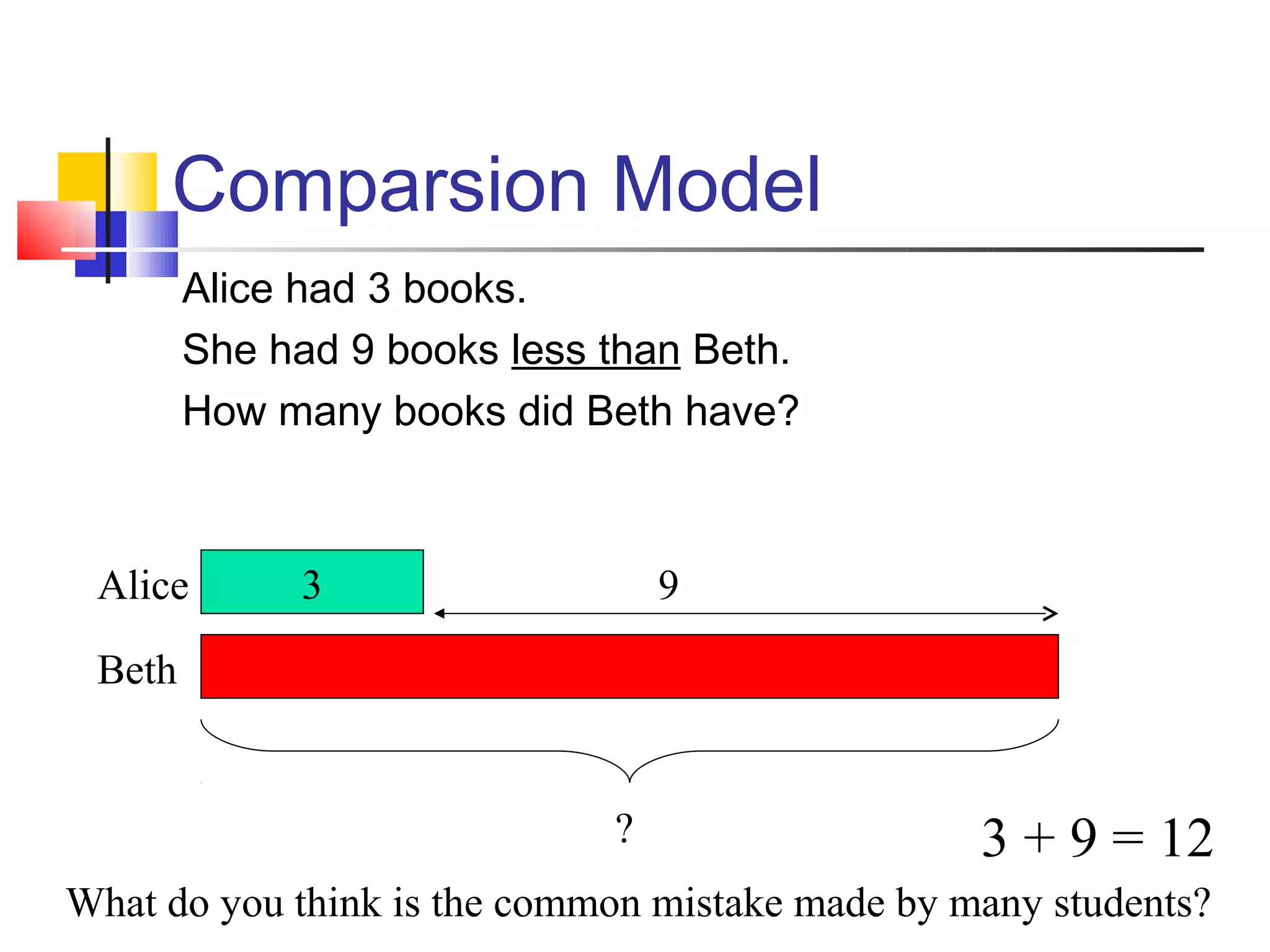
        Alice had 3 books.
        She had 9 books less than Beth.
        How many books did Beth have?


 Alice       3                   9

 Beth


                             ?                   3 + 9 = 12
What do you think is the common mistake made by many students?
Comparsion Model
(to find the difference)
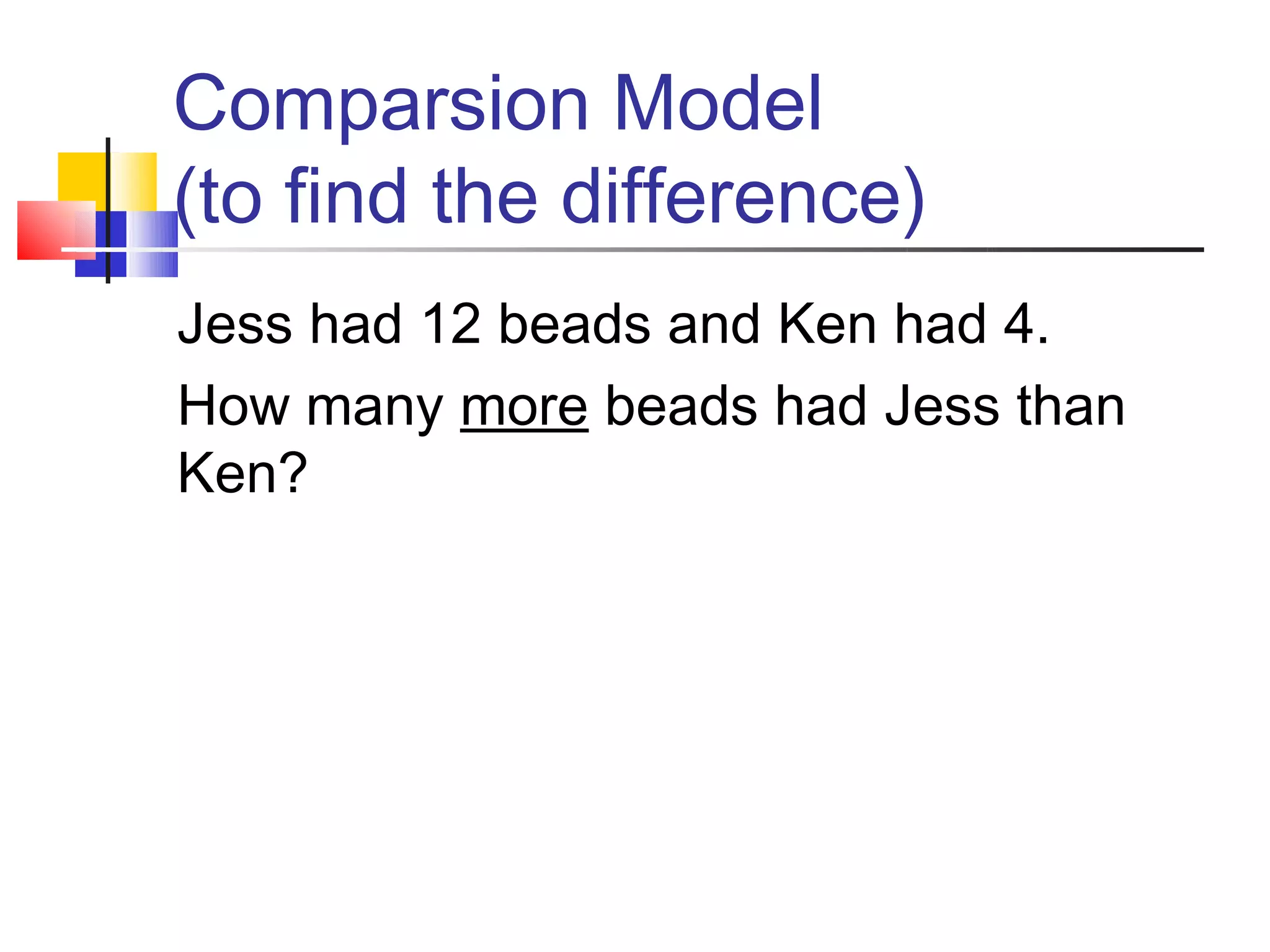
Jess had 12 beads and Ken had 4.
How many more beads had Jess than
Ken?
Comparsion Model
        (to find the difference)
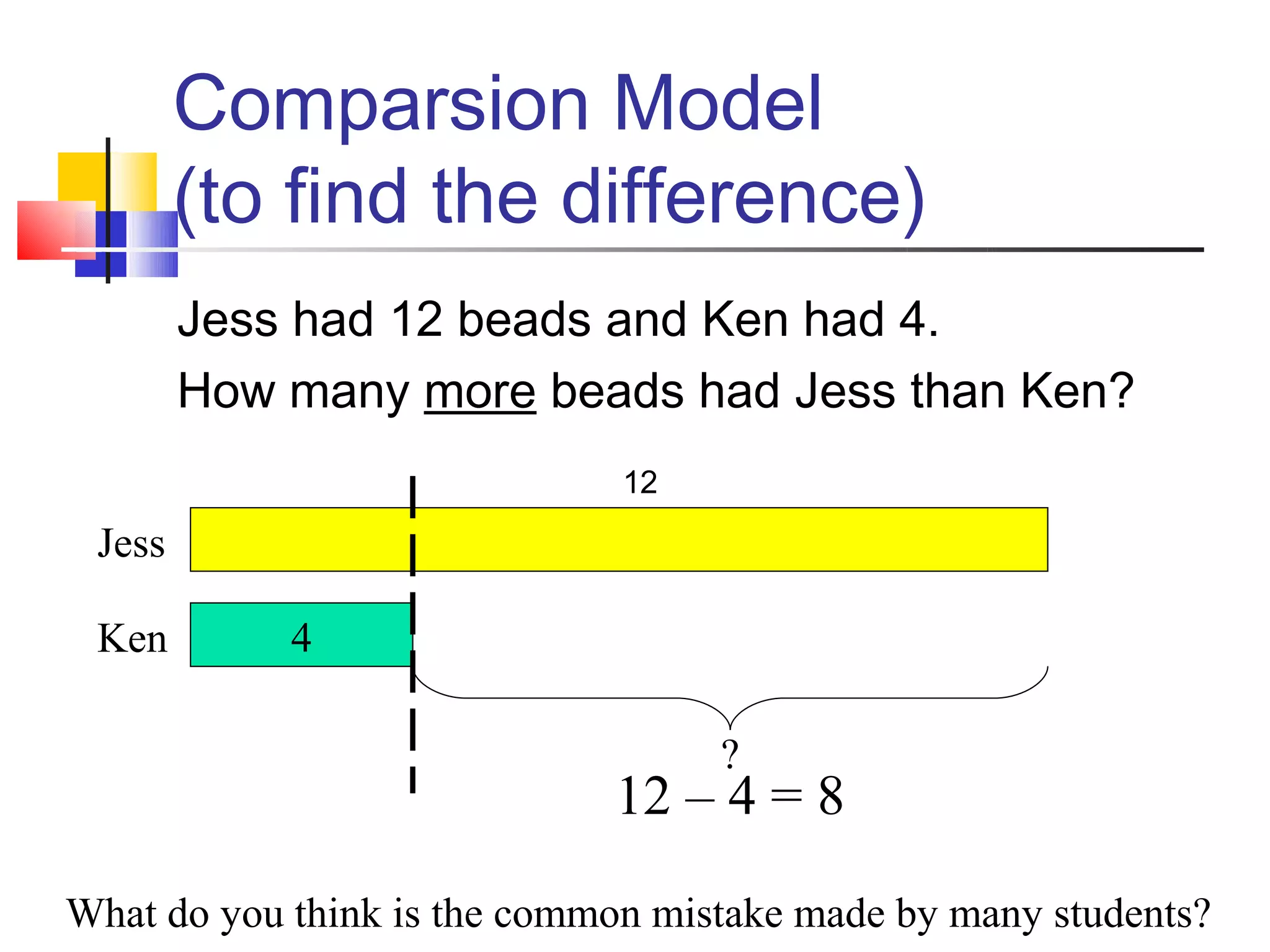
        Jess had 12 beads and Ken had 4.
        How many more beads had Jess than Ken?
                              12

 Jess

 Ken        4

                                   ?
                             12 – 4 = 8

What do you think is the common mistake made by many students?
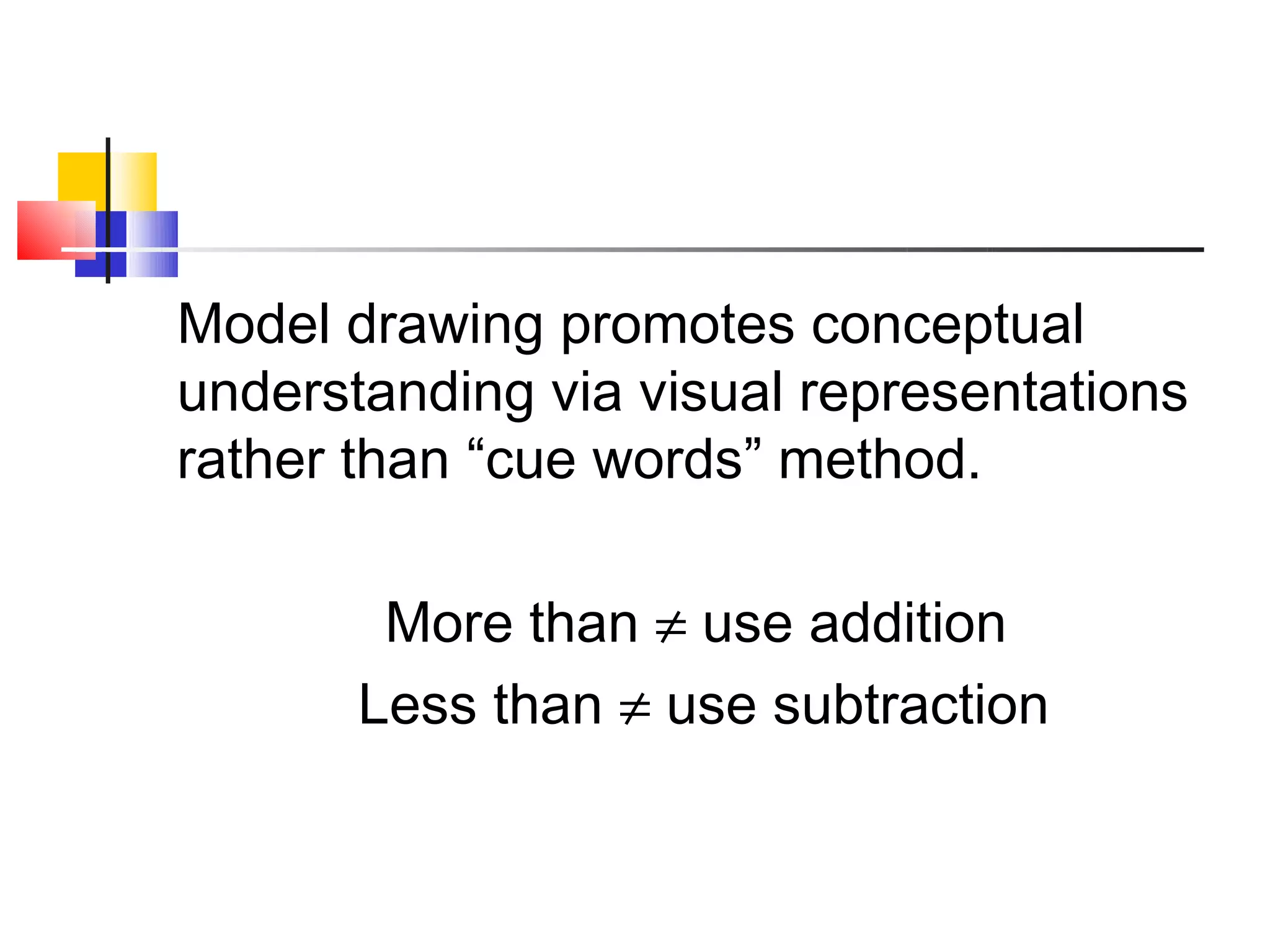
Model drawing promotes conceptual
understanding via visual representations
rather than “cue words” method.

        More than ≠ use addition
       Less than ≠ use subtraction
Comparsion Model
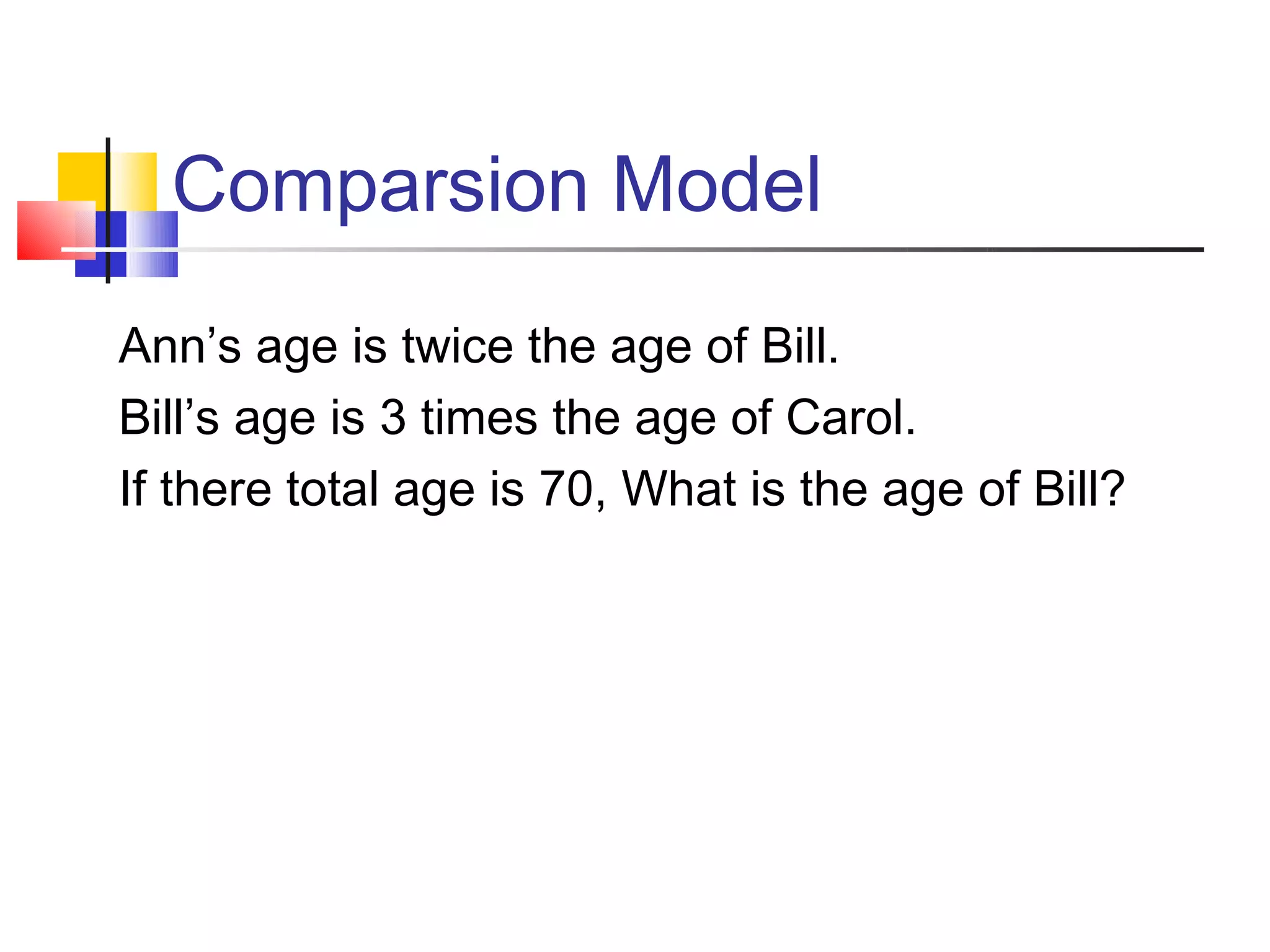
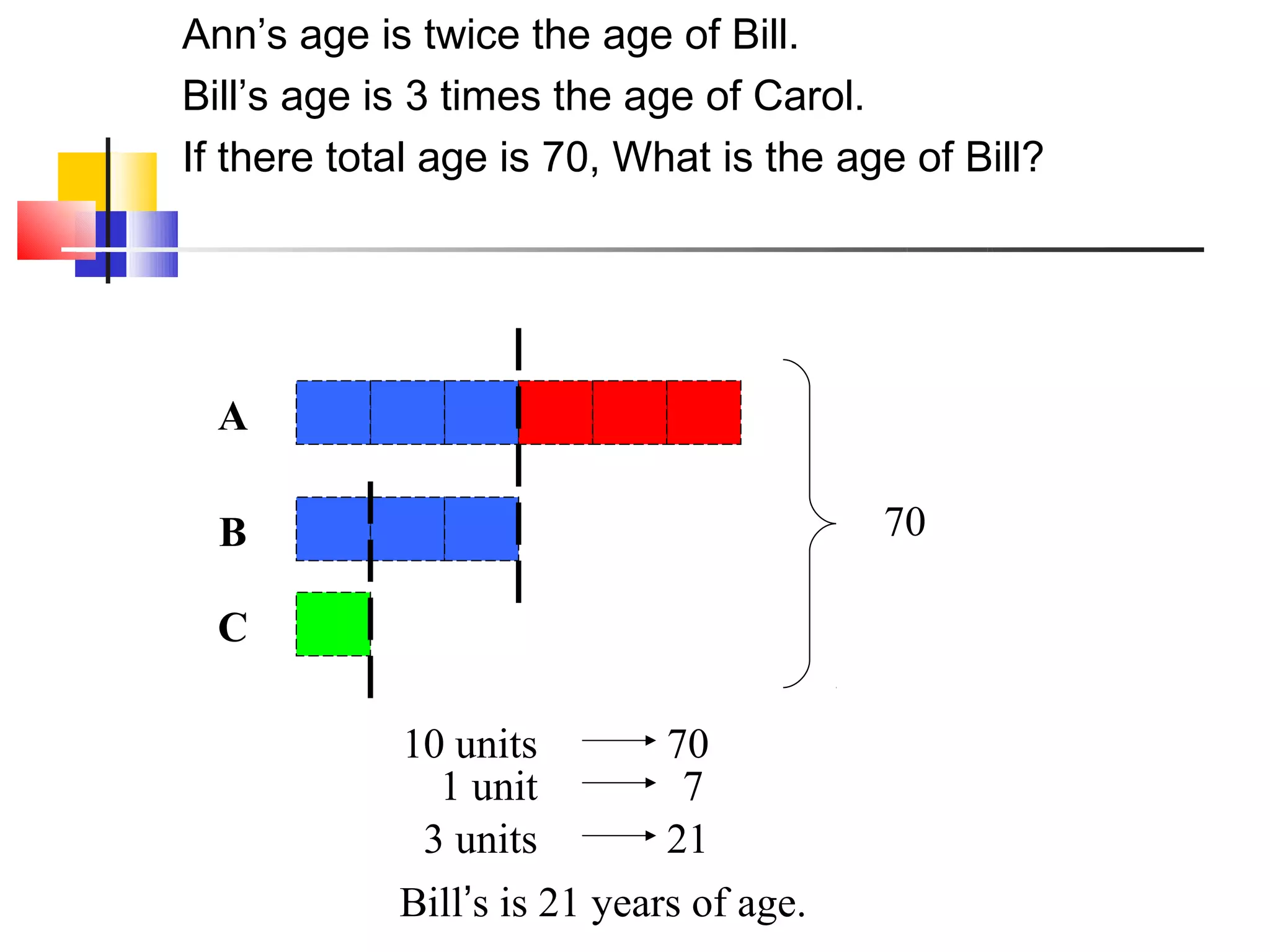
Ann’s age is twice the age of Bill.
Bill’s age is 3 times the age of Carol.
If there total age is 70, What is the age of Bill?
Ann’s age is twice the age of Bill.
Bill’s age is 3 times the age of Carol.
If there total age is 70, What is the age of Bill?


  A

  B                                      70

  C

            10 units         70
              1 unit          7
             3 units         21
            Bill’s is 21 years of age.
Change/ Transforming Model
   This type of model can be used to solve
    complex problems
   The parts can be transformed into
    smaller units.
   This type of model is useful for tacking
    problems which involve before-and-
    after situations.
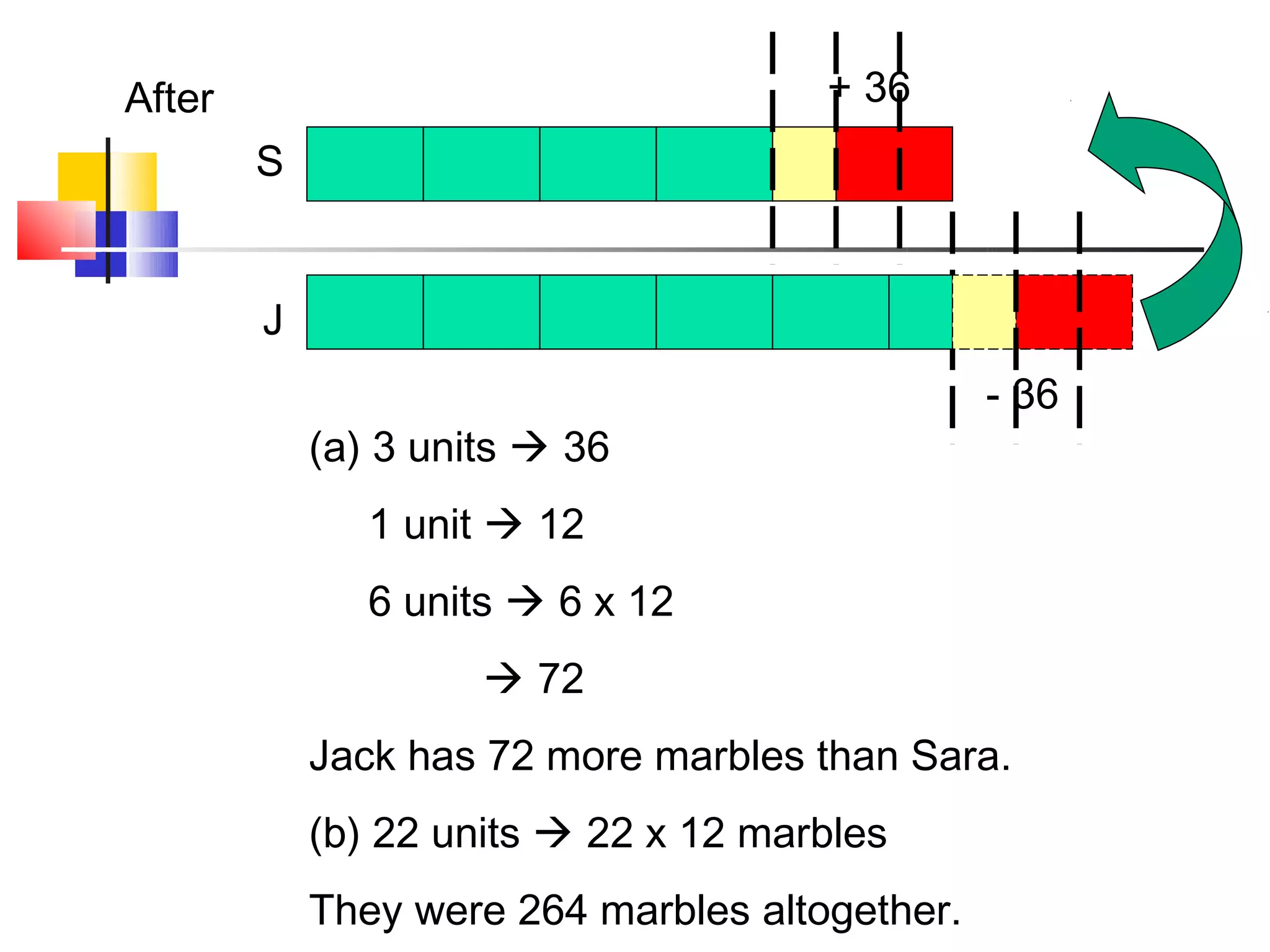
At first, Sara had 4/7 of the number of marbles
Jack had. When Sara received 36 marbles from
Jack, both had the same number of marbles.
      (a) How many more marbles did Jack have
          than Sara at first?
      (b) How many marbles were there
          together?
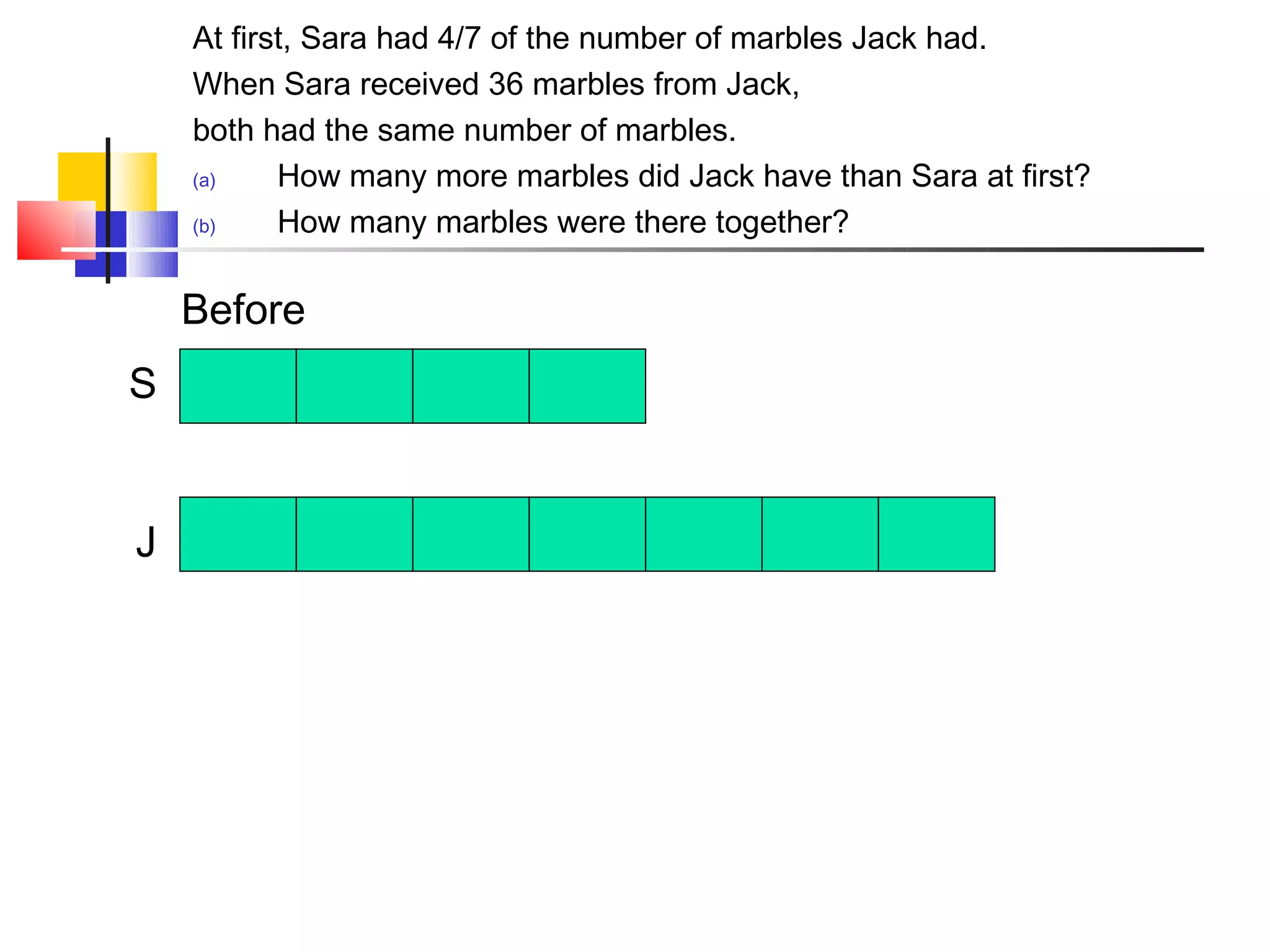
At first, Sara had 4/7 of the number of marbles Jack had.
    When Sara received 36 marbles from Jack,
    both had the same number of marbles.
    (a)    How many more marbles did Jack have than Sara at first?
    (b)    How many marbles were there together?

    Before
S


J
After                                 + 36
        S


        J
                                                - 36
            (a) 3 units  36
               1 unit  12
               6 units  6 x 12
                      72
            Jack has 72 more marbles than Sara.
            (b) 22 units  22 x 12 marbles
            They were 264 marbles altogether.
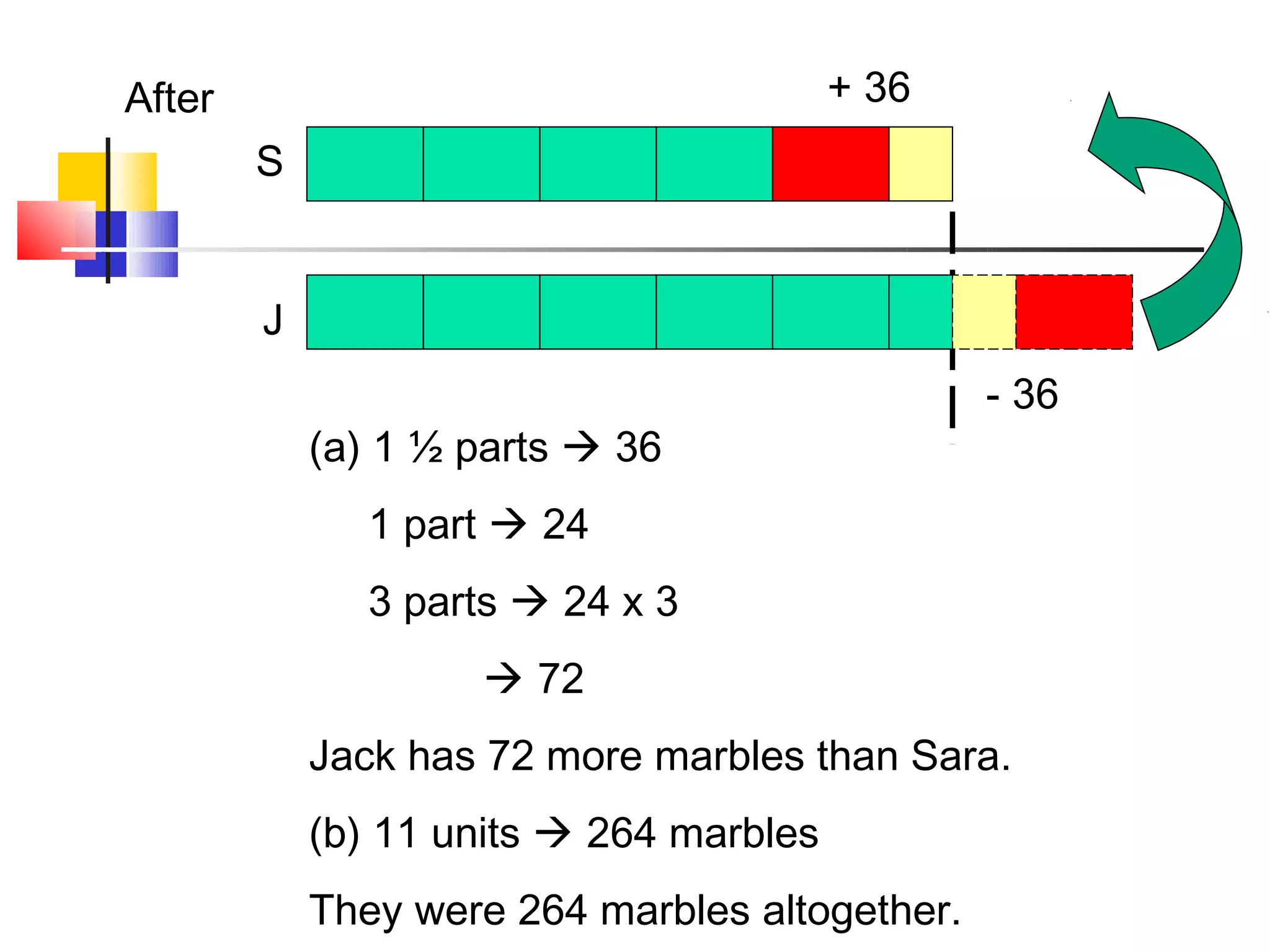
After                                    + 36
        S


        J
                                                - 36
            (a) 1 ½ parts  36
               1 part  24
               3 parts  24 x 3
                     72
            Jack has 72 more marbles than Sara.
            (b) 11 units  264 marbles
            They were 264 marbles altogether.
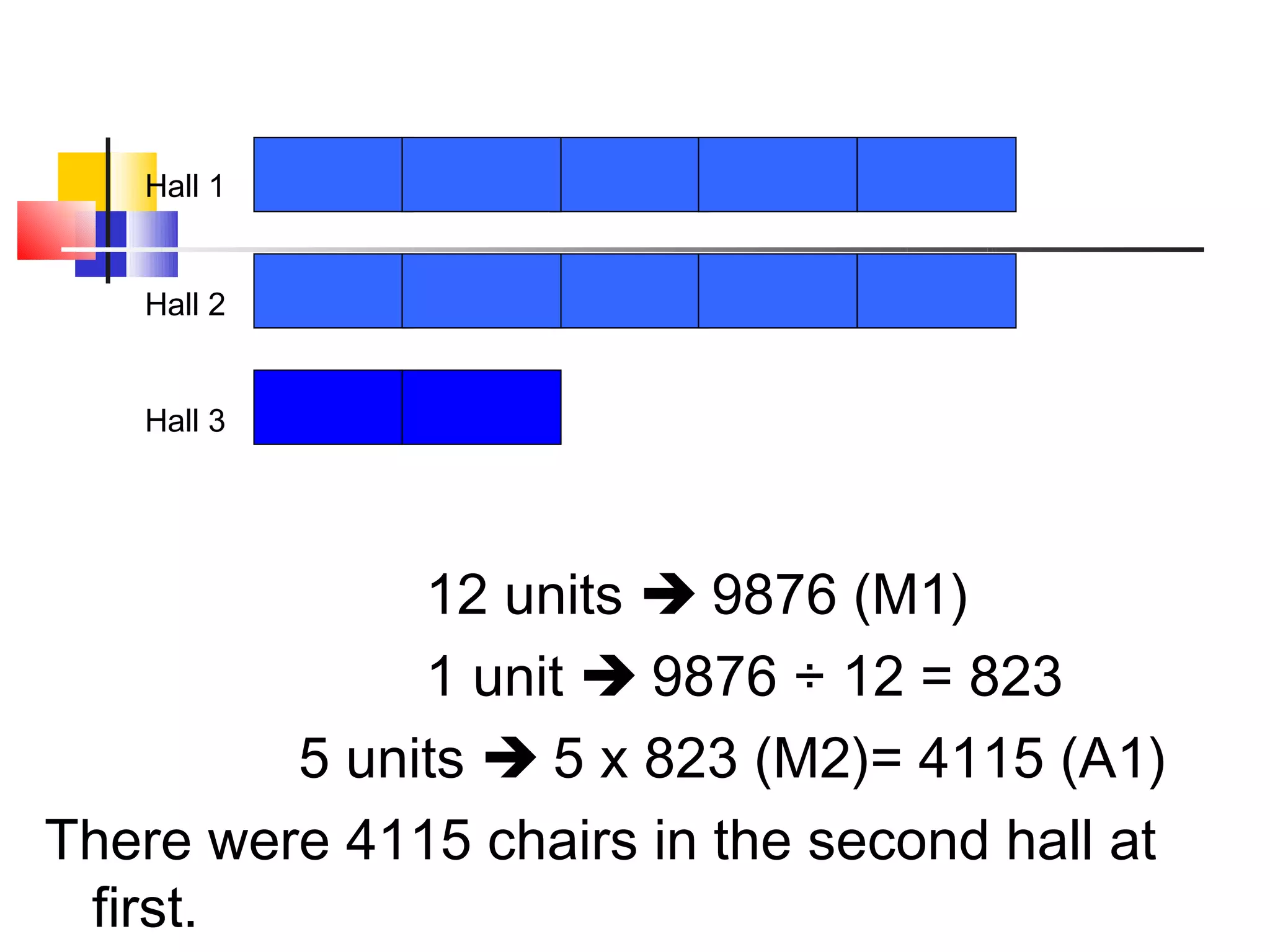
Three halls contained 9,876 chairs
altogether. One-fifth of the chairs were
transferred from the first hall to the
second hall. Then, one-third of the
chairs were transferred from the second
hall to the third hall and the number of
chairs in the third hall doubled. In the
end, the number of chairs in the three
halls became the same. How many
chairs were in the second hall at first?
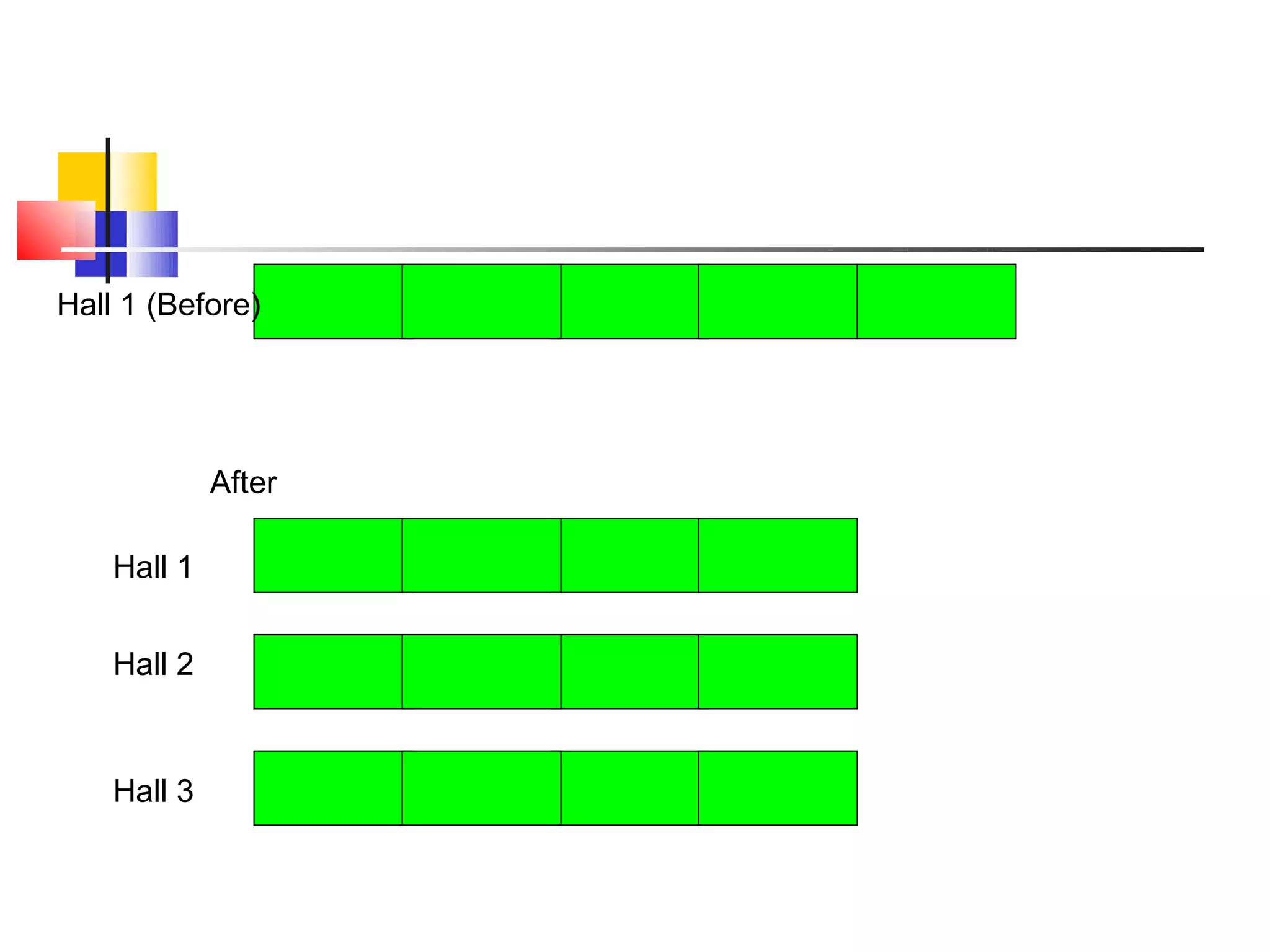
Hall 1 (Before)


             After

    Hall 1


    Hall 2


    Hall 3
After
Hall 1


Hall 2


Hall 3


                 Before
Hall 1


Hall 2


Hall 3
Hall 1


   Hall 2


   Hall 3


              12 units  9876 (M1)
              1 unit  9876 ÷ 12 = 823
         5 units  5 x 823 (M2)= 4115 (A1)
There were 4115 chairs in the second hall at
 first.
Thank you

Bar Models for Elementary Grades

  • 1.
    Bar Models forElementary Grades Peggy Foo Marshall Cavendish Institute
  • 2.
    Learning Outcomes Participants shouldbe able to  understand the rationale of model method as a heuristic/ problem-solving tool.  Draw different types of models to solve a variety of word problems.
  • 3.
    Origin Developed by aproject team in MOE in the 1980s Objective: Help students who have great difficulty with word problems in the early years of primary school. Drawing a pictorial model to represent mathematical quantities (known and unknowns) and their relationships given in a problem.
  • 4.
    Rationale The Mathematics CurriculumFramework focuses on mathematical problem solving. Reasoning, communication and connections
  • 5.
    Under ‘Processes’ component, One of the heuristics is model method  Helps to visualize situations and Maths problems which are usually meant for secondary pupils
  • 6.
    Differences Model Method Algebraic Method _________ representation Abstract reasoning More effective for _______ More suitable for older pupils who need to see to pupils understand Foundation for algebraic Use of abstract symbol thinking (without the use of abstract symbol)
  • 7.
    Differences Model Method Algebraic Method Pictorial representation Abstract reasoning More effective for younger More suitable for older pupils who need to see to pupils understand Foundation for algebraic Use of abstract symbol thinking (without the use of abstract symbol)
  • 8.
    Guidelines  Represent the problem using bar(s)  The bar(s) are best drawn proportionately  Fill in the diagram with all the given information  The unknown value/ answer is represented by question mark  Interpret the model and write a simpler mathematical statement (e.g. 11 units + 40  84)
  • 9.
    Different types ofmodels  Part-Whole Model  Comparative Model  Change/ Transforming Model
  • 10.
    Part-Whole Model ♠ Showsvarious parts which make up a whole ♠ Find the whole by addition ♠ Find the other part by subtraction
  • 11.
    Part-Whole Model (using concretematerials) Ann had 5 books. Bill gave her 7 more books. How many books did Ann have altogether?
  • 12.
    Part-Whole Model ? John has 20 marbles He gave 3/5 of it to Peter. How many marbles did John give to Peter?
  • 13.
    Part-Whole Model ? John has 20 marbles He gave 3/5 of it to Peter. How many marbles did John give to Peter? 20 5 unit  20 marbles 1 unit  4 sweets 3 units  3 x 4 = 12 John gave 12 marbles to Peter.
  • 14.
    Comparsion Model  Show the relationship between 2 quantities when they are compared  E.g. compared by showing the difference
  • 15.
    Comparsion Model (Tryit) Alice had 3 books. She had 9 books less than Beth. How many books did Beth have?
  • 16.
    Comparsion Model Alice had 3 books. She had 9 books less than Beth. How many books did Beth have? Alice 3 9 Beth ? 3 + 9 = 12 What do you think is the common mistake made by many students?
  • 17.
    Comparsion Model (to findthe difference) Jess had 12 beads and Ken had 4. How many more beads had Jess than Ken?
  • 18.
    Comparsion Model (to find the difference) Jess had 12 beads and Ken had 4. How many more beads had Jess than Ken? 12 Jess Ken 4 ? 12 – 4 = 8 What do you think is the common mistake made by many students?
  • 19.
    Model drawing promotesconceptual understanding via visual representations rather than “cue words” method. More than ≠ use addition Less than ≠ use subtraction
  • 20.
    Comparsion Model Ann’s ageis twice the age of Bill. Bill’s age is 3 times the age of Carol. If there total age is 70, What is the age of Bill?
  • 21.
    Ann’s age istwice the age of Bill. Bill’s age is 3 times the age of Carol. If there total age is 70, What is the age of Bill? A B 70 C 10 units 70 1 unit 7 3 units 21 Bill’s is 21 years of age.
  • 22.
    Change/ Transforming Model  This type of model can be used to solve complex problems  The parts can be transformed into smaller units.  This type of model is useful for tacking problems which involve before-and- after situations.
  • 23.
    At first, Sarahad 4/7 of the number of marbles Jack had. When Sara received 36 marbles from Jack, both had the same number of marbles. (a) How many more marbles did Jack have than Sara at first? (b) How many marbles were there together?
  • 24.
    At first, Sarahad 4/7 of the number of marbles Jack had. When Sara received 36 marbles from Jack, both had the same number of marbles. (a) How many more marbles did Jack have than Sara at first? (b) How many marbles were there together? Before S J
  • 25.
    After + 36 S J - 36 (a) 3 units  36 1 unit  12 6 units  6 x 12  72 Jack has 72 more marbles than Sara. (b) 22 units  22 x 12 marbles They were 264 marbles altogether.
  • 26.
    After + 36 S J - 36 (a) 1 ½ parts  36 1 part  24 3 parts  24 x 3  72 Jack has 72 more marbles than Sara. (b) 11 units  264 marbles They were 264 marbles altogether.
  • 27.
    Three halls contained9,876 chairs altogether. One-fifth of the chairs were transferred from the first hall to the second hall. Then, one-third of the chairs were transferred from the second hall to the third hall and the number of chairs in the third hall doubled. In the end, the number of chairs in the three halls became the same. How many chairs were in the second hall at first?
  • 28.
    Hall 1 (Before) After Hall 1 Hall 2 Hall 3
  • 29.
    After Hall 1 Hall 2 Hall3 Before Hall 1 Hall 2 Hall 3
  • 30.
    Hall 1 Hall 2 Hall 3 12 units  9876 (M1) 1 unit  9876 ÷ 12 = 823 5 units  5 x 823 (M2)= 4115 (A1) There were 4115 chairs in the second hall at first.
  • 31.

Editor's Notes

  • #4 The central of the framework is mathematical problem solving. This ability is dependent of 5 components. Under processes, it states Thinking skills and heuristics Heuristics – problem solving strategy 1 kind o heuristics is model drawing (give a representation)
  • #5 The central of the framework is mathematical problem solving. This ability is dependent of 5 components. Under processes, it states Thinking skills and heuristics Heuristics – problem solving strategy 1 kind o heuristics is model drawing (give a representation)
  • #7 Pictorial representation – helps pupils to visualize
  • #8 Pictorial representation – helps pupils to visualize
  • #10 +
  • #12 Concrete model bars
  • #13 multiplication
  • #18 Cue word method
  • #19 Cue word method
  • #26 Moving the units
  • #27 Moving the units