

PEM 121
Helping Children with Primary Mathematics
with a focus on Primary 4 – 6
Dr Yeap Ban Har
Marshall Cavendish Institute
Singapore
banhar@sg.marshallcavendish.com
Slides are available at www.facebook.com/MCISingapore
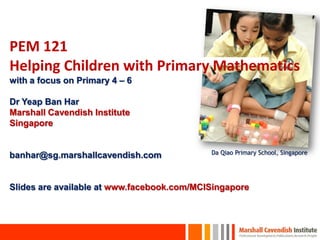
Da Qiao Primary School, Singapore
Mathematics is “an excellent vehicle for the
development and improvement of a person’s
intellectual competence”.
Ministry of Education, Singapore (2006)
thinkingschools
learningnation
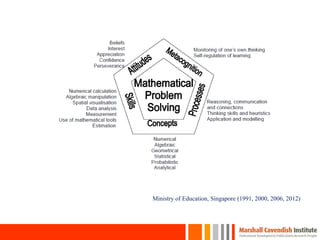
Ministry of Education, Singapore (1991, 2000, 2006, 2012)
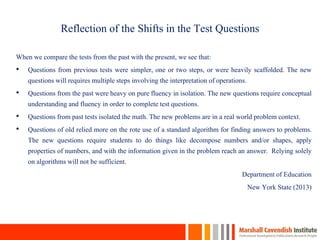
Reflection of the Shifts in the Test Questions
When we compare the tests from the past with the present, we see that:
• Questions from previous tests were simpler, one or two steps, or were heavily scaffolded. The new
questions will requires multiple steps involving the interpretation of operations.
• Questions from the past were heavy on pure fluency in isolation. The new questions require conceptual
understanding and fluency in order to complete test questions.
• Questions from past tests isolated the math. The new problems are in a real world problem context.
• Questions of old relied more on the rote use of a standard algorithm for finding answers to problems.
The new questions require students to do things like decompose numbers and/or shapes, apply
properties of numbers, and with the information given in the problem reach an answer. Relying solely
on algorithms will not be sufficient.
Department of Education
New York State (2013)
5
What is Happening
Around the World?Bringing Up Children Who Are Ready for the Global, Technological World
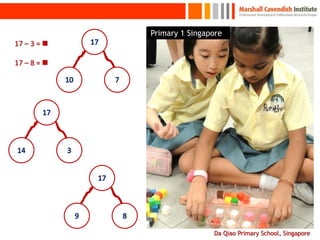
Da Qiao Primary School, Singapore
17 – 3 = 
17 – 8 = 
Primary 1 Singapore
7
Da Qiao Primary School, Singapore
Primary 1 Singapore
8
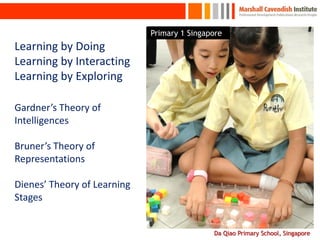
Learning by Doing
Learning by Interacting
Learning by Exploring
Gardner’s Theory of
Intelligences
Bruner’s Theory of
Representations
Dienes’ Theory of Learning
Stages
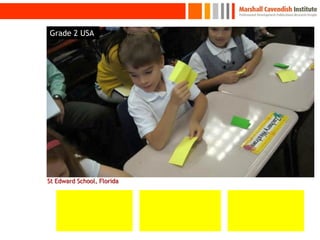
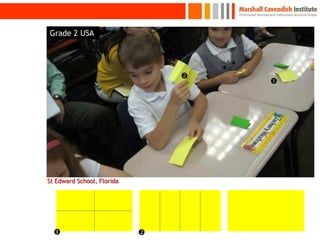
St Edward School, Florida
Grade 2 USA
9
St Edward School, Florida


 
Grade 2 USA
10
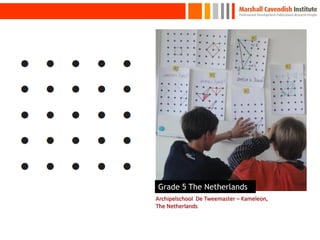
Archipelschool De Tweemaster – Kameleon,
The Netherlands
Grade 5 The Netherlands
11
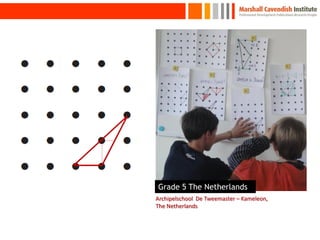
Archipelschool De Tweemaster – Kameleon,
The Netherlands
Grade 5 The Netherlands
12
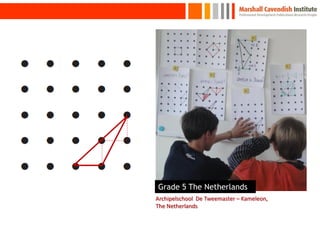
Archipelschool De Tweemaster – Kameleon,
The Netherlands
Grade 5 The Netherlands
13
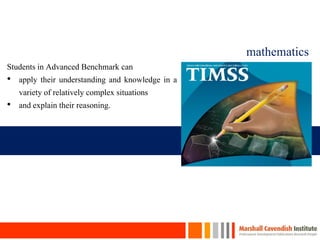
mathematics
14
Students in Advanced Benchmark can
• apply their understanding and knowledge in a
variety of relatively complex situations
• and explain their reasoning.
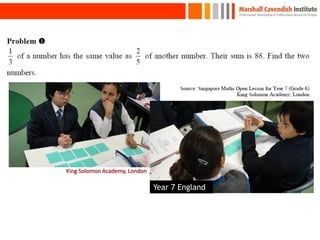
King Solomon Academy, London
Year 7 England
15
16
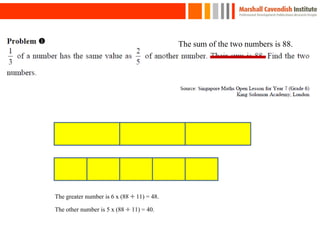
The sum of the two numbers is 88.
The greater number is 6 x (88  11) = 48.
The other number is 5 x (88  11) = 40.
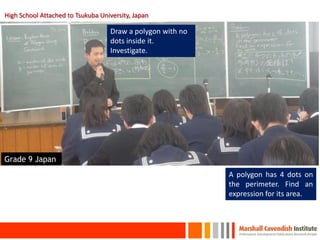
High School Attached to Tsukuba University, Japan
Draw a polygon with no
dots inside it.
Investigate.
A polygon has 4 dots on
the perimeter. Find an
expression for its area.
Grade 9 Japan
17
What Do Children
Learn in School
Mathematics?
And How You Can Coach Them
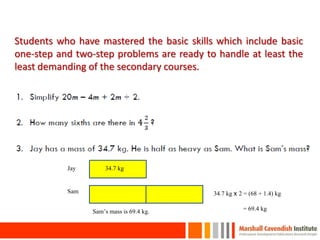
Students who have mastered the basic skills which include basic
one-step and two-step problems are ready to handle at least the
least demanding of the secondary courses.
Jay
Sam
34.7 kg
34.7 kg x 2 = (68 + 1.4) kg
34.7 kg x 2 = 69.4 kgSam’s mass is 69.4 kg.
19
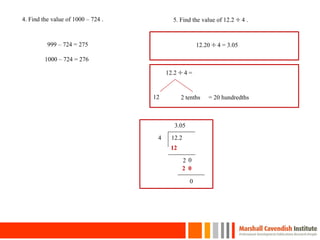
4. Find the value of 1000 – 724 . 5. Find the value of 12.2  4 .
20
999 – 724 = 275
1000 – 724 = 276
12.20  4 = 3.05
12.2  4 =
12 2 tenths = 20 hundredths
12.24
12
2 0
2 0
0
3.05
What Are the
Challenging
Aspects of
Mathematics?
And How Children Develop Competencies to Handle Them
Problem 1
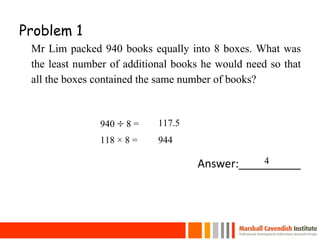
Mr Lim packed 940 books equally into 8 boxes. What was
the least number of additional books he would need so that
all the boxes contained the same number of books?
Answer:__________
22
940  8 = 117.5
4
118 × 8 = 944
Problem 1
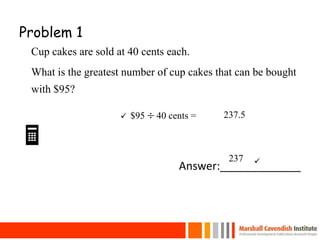
Cup cakes are sold at 40 cents each.
What is the greatest number of cup cakes that can be bought
with $95?

Answer:_____________
23
$95  40 cents = 237.5
237


Problem 1
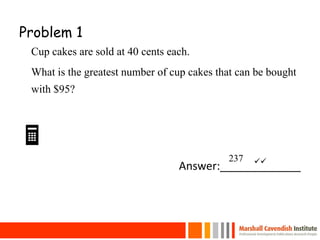
Cup cakes are sold at 40 cents each.
What is the greatest number of cup cakes that can be bought
with $95?

Answer:_____________
24
237 
Problem 2
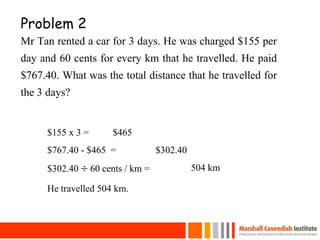
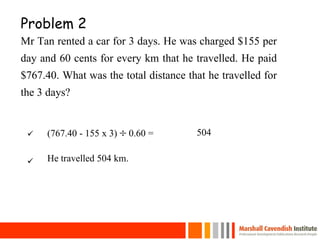
Mr Tan rented a car for 3 days. He was charged $155 per
day and 60 cents for every km that he travelled. He paid
$767.40. What was the total distance that he travelled for
the 3 days?
25
$155 x 3 = $465
$767.40 - $465 = $302.40
$302.40  60 cents / km = 504 km
He travelled 504 km.
Problem 2
Mr Tan rented a car for 3 days. He was charged $155 per
day and 60 cents for every km that he travelled. He paid
$767.40. What was the total distance that he travelled for
the 3 days?
26
(767.40 - 155 x 3)  0.60 = 504
He travelled 504 km.


27
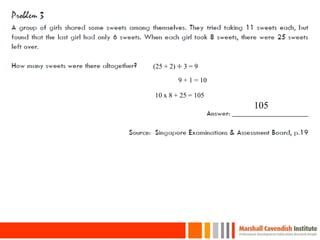
(25 + 2)  3 = 9
9 + 1 = 10
10 x 8 + 25 = 105
105
28
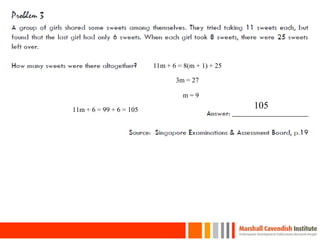
11m + 6 = 8(m + 1) + 25
3m = 27
m = 9
10511m + 6 = 99 + 6 = 105
29
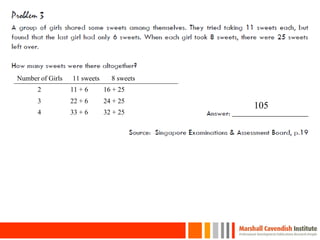
Number of Girls 11 sweets 8 sweets
105
2 11 + 6 16 + 25
3 22 + 6 24 + 25
4 33 + 6 32 + 25
30
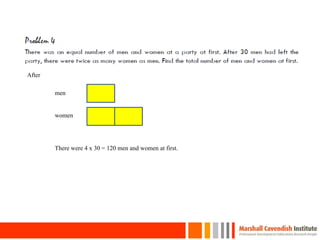
men
women
There were 4 x 30 = 120 men and women at first.
After
31
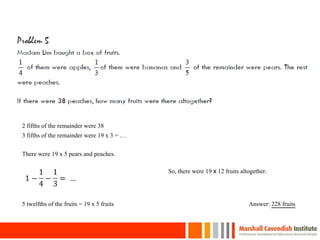
2 fifths of the remainder were 38
3 fifths of the remainder were 19 x 3 = …
There were 19 x 5 pears and peaches.
5 twelfths of the fruits = 19 x 5 fruits
So, there were 19 x 12 fruits altogether.
Answer: 228 fruits
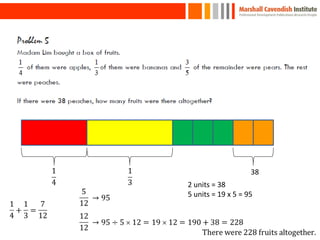
38
2 units = 38
5 units = 19 x 5 = 95
32
33
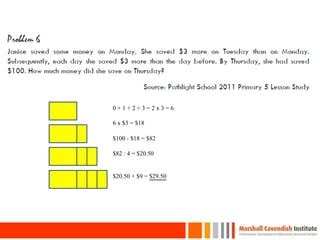
0 + 1 + 2 + 3 = 2 x 3 = 6
6 x $3 = $18
$100 - $18 = $82
$82 : 4 = $20.50
$20.50 + $9 = $29.50
• Number Sense
• Patterns
• Visualization
• Communication
• Metacognition
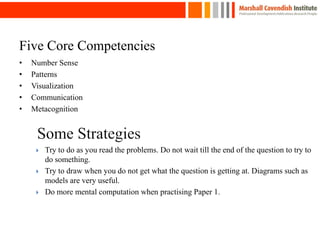
Five Core Competencies
 Try to do as you read the problems. Do not wait till the end of the question to try to
do something.
 Try to draw when you do not get what the question is getting at. Diagrams such as
models are very useful.
 Do more mental computation when practising Paper 1.
Problem 7
35
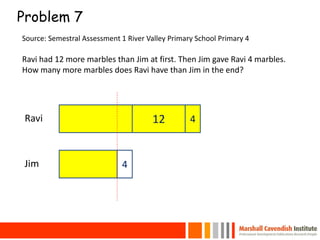
Source: Semestral Assessment 1 River Valley Primary School Primary 4
Ravi had 12 more marbles than Jim at first. Then Jim gave Ravi 4 marbles.
How many more marbles does Ravi have than Jim in the end?
12Ravi
Jim 4
4
Problem 8
36
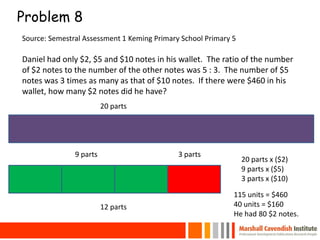
Source: Semestral Assessment 1 Keming Primary School Primary 5
Daniel had only $2, $5 and $10 notes in his wallet. The ratio of the number
of $2 notes to the number of the other notes was 5 : 3. The number of $5
notes was 3 times as many as that of $10 notes. If there were $460 in his
wallet, how many $2 notes did he have?
12 parts
20 parts
9 parts 3 parts
20 parts x ($2)
9 parts x ($5)
3 parts x ($10)
115 units = $460
40 units = $160
He had 80 $2 notes.
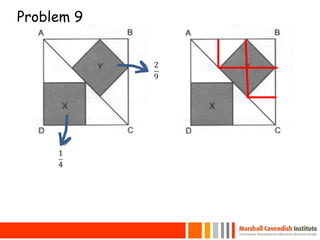
Problem 9
37
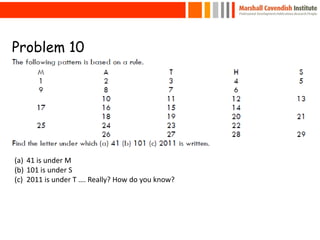
(a) 41 is under M
(b) 101 is under S
(c) 2011 is under T …. Really? How do you know?
Problem 10
Problem 11
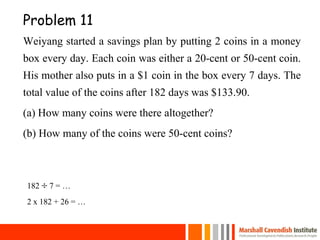
Weiyang started a savings plan by putting 2 coins in a money
box every day. Each coin was either a 20-cent or 50-cent coin.
His mother also puts in a $1 coin in the box every 7 days. The
total value of the coins after 182 days was $133.90.
(a) How many coins were there altogether?
(b) How many of the coins were 50-cent coins?
182  7 = …
2 x 182 + 26 = …
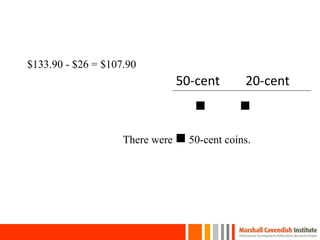
$133.90 - $26 = $107.90
There were  50-cent coins.
50-cent 20-cent
 
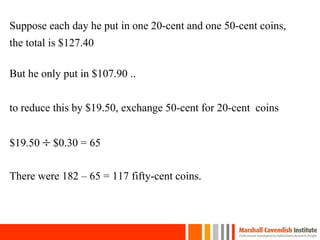
Suppose each day he put in one 20-cent and one 50-cent coins,
the total is $127.40
But he only put in $107.90 ..
to reduce this by $19.50, exchange 50-cent for 20-cent coins
$19.50  $0.30 = 65
There were 182 – 65 = 117 fifty-cent coins.

Bendermeer Primary School Seminar for Parents

  • 1.
    PEM 121 Helping Childrenwith Primary Mathematics with a focus on Primary 4 – 6 Dr Yeap Ban Har Marshall Cavendish Institute Singapore banhar@sg.marshallcavendish.com Slides are available at www.facebook.com/MCISingapore Da Qiao Primary School, Singapore
  • 2.
    Mathematics is “anexcellent vehicle for the development and improvement of a person’s intellectual competence”. Ministry of Education, Singapore (2006) thinkingschools learningnation
  • 3.
    Ministry of Education,Singapore (1991, 2000, 2006, 2012)
  • 5.
    Reflection of theShifts in the Test Questions When we compare the tests from the past with the present, we see that: • Questions from previous tests were simpler, one or two steps, or were heavily scaffolded. The new questions will requires multiple steps involving the interpretation of operations. • Questions from the past were heavy on pure fluency in isolation. The new questions require conceptual understanding and fluency in order to complete test questions. • Questions from past tests isolated the math. The new problems are in a real world problem context. • Questions of old relied more on the rote use of a standard algorithm for finding answers to problems. The new questions require students to do things like decompose numbers and/or shapes, apply properties of numbers, and with the information given in the problem reach an answer. Relying solely on algorithms will not be sufficient. Department of Education New York State (2013) 5
  • 6.
    What is Happening Aroundthe World?Bringing Up Children Who Are Ready for the Global, Technological World
  • 7.
    Da Qiao PrimarySchool, Singapore 17 – 3 =  17 – 8 =  Primary 1 Singapore 7
  • 8.
    Da Qiao PrimarySchool, Singapore Primary 1 Singapore 8 Learning by Doing Learning by Interacting Learning by Exploring Gardner’s Theory of Intelligences Bruner’s Theory of Representations Dienes’ Theory of Learning Stages
  • 9.
    St Edward School,Florida Grade 2 USA 9
  • 10.
    St Edward School,Florida     Grade 2 USA 10
  • 11.
    Archipelschool De Tweemaster– Kameleon, The Netherlands Grade 5 The Netherlands 11
  • 12.
    Archipelschool De Tweemaster– Kameleon, The Netherlands Grade 5 The Netherlands 12
  • 13.
    Archipelschool De Tweemaster– Kameleon, The Netherlands Grade 5 The Netherlands 13
  • 14.
    mathematics 14 Students in AdvancedBenchmark can • apply their understanding and knowledge in a variety of relatively complex situations • and explain their reasoning.
  • 15.
    King Solomon Academy,London Year 7 England 15
  • 16.
    16 The sum ofthe two numbers is 88. The greater number is 6 x (88  11) = 48. The other number is 5 x (88  11) = 40.
  • 17.
    High School Attachedto Tsukuba University, Japan Draw a polygon with no dots inside it. Investigate. A polygon has 4 dots on the perimeter. Find an expression for its area. Grade 9 Japan 17
  • 18.
    What Do Children Learnin School Mathematics? And How You Can Coach Them
  • 19.
    Students who havemastered the basic skills which include basic one-step and two-step problems are ready to handle at least the least demanding of the secondary courses. Jay Sam 34.7 kg 34.7 kg x 2 = (68 + 1.4) kg 34.7 kg x 2 = 69.4 kgSam’s mass is 69.4 kg. 19
  • 20.
    4. Find thevalue of 1000 – 724 . 5. Find the value of 12.2  4 . 20 999 – 724 = 275 1000 – 724 = 276 12.20  4 = 3.05 12.2  4 = 12 2 tenths = 20 hundredths 12.24 12 2 0 2 0 0 3.05
  • 21.
    What Are the Challenging Aspectsof Mathematics? And How Children Develop Competencies to Handle Them
  • 22.
    Problem 1 Mr Limpacked 940 books equally into 8 boxes. What was the least number of additional books he would need so that all the boxes contained the same number of books? Answer:__________ 22 940  8 = 117.5 4 118 × 8 = 944
  • 23.
    Problem 1 Cup cakesare sold at 40 cents each. What is the greatest number of cup cakes that can be bought with $95?  Answer:_____________ 23 $95  40 cents = 237.5 237  
  • 24.
    Problem 1 Cup cakesare sold at 40 cents each. What is the greatest number of cup cakes that can be bought with $95?  Answer:_____________ 24 237 
  • 25.
    Problem 2 Mr Tanrented a car for 3 days. He was charged $155 per day and 60 cents for every km that he travelled. He paid $767.40. What was the total distance that he travelled for the 3 days? 25 $155 x 3 = $465 $767.40 - $465 = $302.40 $302.40  60 cents / km = 504 km He travelled 504 km.
  • 26.
    Problem 2 Mr Tanrented a car for 3 days. He was charged $155 per day and 60 cents for every km that he travelled. He paid $767.40. What was the total distance that he travelled for the 3 days? 26 (767.40 - 155 x 3)  0.60 = 504 He travelled 504 km.  
  • 27.
    27 (25 + 2) 3 = 9 9 + 1 = 10 10 x 8 + 25 = 105 105
  • 28.
    28 11m + 6= 8(m + 1) + 25 3m = 27 m = 9 10511m + 6 = 99 + 6 = 105
  • 29.
    29 Number of Girls11 sweets 8 sweets 105 2 11 + 6 16 + 25 3 22 + 6 24 + 25 4 33 + 6 32 + 25
  • 30.
    30 men women There were 4x 30 = 120 men and women at first. After
  • 31.
    31 2 fifths ofthe remainder were 38 3 fifths of the remainder were 19 x 3 = … There were 19 x 5 pears and peaches. 5 twelfths of the fruits = 19 x 5 fruits So, there were 19 x 12 fruits altogether. Answer: 228 fruits
  • 32.
    38 2 units =38 5 units = 19 x 5 = 95 32
  • 33.
    33 0 + 1+ 2 + 3 = 2 x 3 = 6 6 x $3 = $18 $100 - $18 = $82 $82 : 4 = $20.50 $20.50 + $9 = $29.50
  • 34.
    • Number Sense •Patterns • Visualization • Communication • Metacognition Five Core Competencies  Try to do as you read the problems. Do not wait till the end of the question to try to do something.  Try to draw when you do not get what the question is getting at. Diagrams such as models are very useful.  Do more mental computation when practising Paper 1.
  • 35.
    Problem 7 35 Source: SemestralAssessment 1 River Valley Primary School Primary 4 Ravi had 12 more marbles than Jim at first. Then Jim gave Ravi 4 marbles. How many more marbles does Ravi have than Jim in the end? 12Ravi Jim 4 4
  • 36.
    Problem 8 36 Source: SemestralAssessment 1 Keming Primary School Primary 5 Daniel had only $2, $5 and $10 notes in his wallet. The ratio of the number of $2 notes to the number of the other notes was 5 : 3. The number of $5 notes was 3 times as many as that of $10 notes. If there were $460 in his wallet, how many $2 notes did he have? 12 parts 20 parts 9 parts 3 parts 20 parts x ($2) 9 parts x ($5) 3 parts x ($10) 115 units = $460 40 units = $160 He had 80 $2 notes.
  • 37.
  • 38.
    (a) 41 isunder M (b) 101 is under S (c) 2011 is under T …. Really? How do you know? Problem 10
  • 39.
    Problem 11 Weiyang starteda savings plan by putting 2 coins in a money box every day. Each coin was either a 20-cent or 50-cent coin. His mother also puts in a $1 coin in the box every 7 days. The total value of the coins after 182 days was $133.90. (a) How many coins were there altogether? (b) How many of the coins were 50-cent coins? 182  7 = … 2 x 182 + 26 = …
  • 40.
    $133.90 - $26= $107.90 There were  50-cent coins. 50-cent 20-cent  
  • 41.
    Suppose each dayhe put in one 20-cent and one 50-cent coins, the total is $127.40 But he only put in $107.90 .. to reduce this by $19.50, exchange 50-cent for 20-cent coins $19.50  $0.30 = 65 There were 182 – 65 = 117 fifty-cent coins.