Core Concepts

    Skills

  Strategies
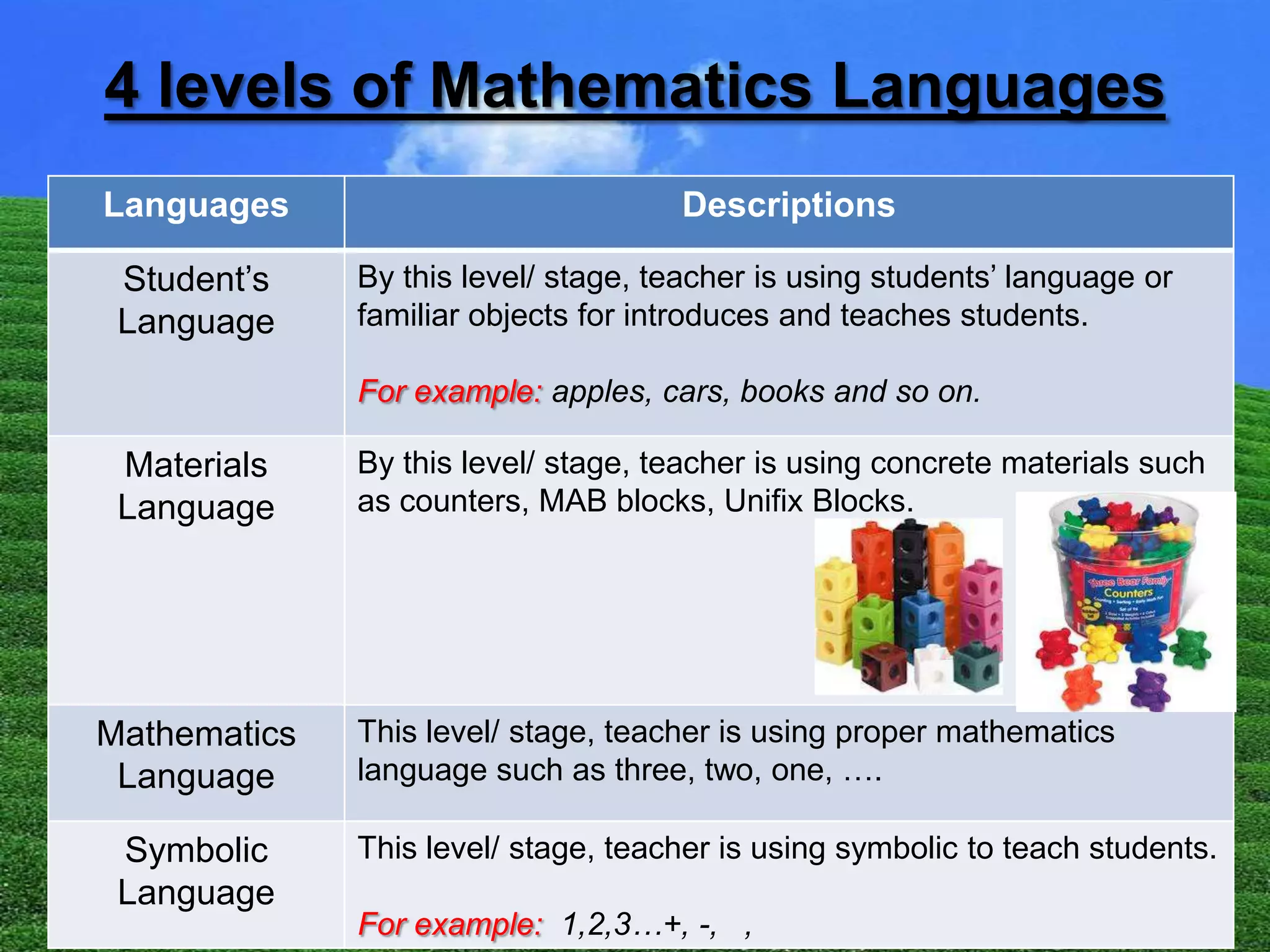
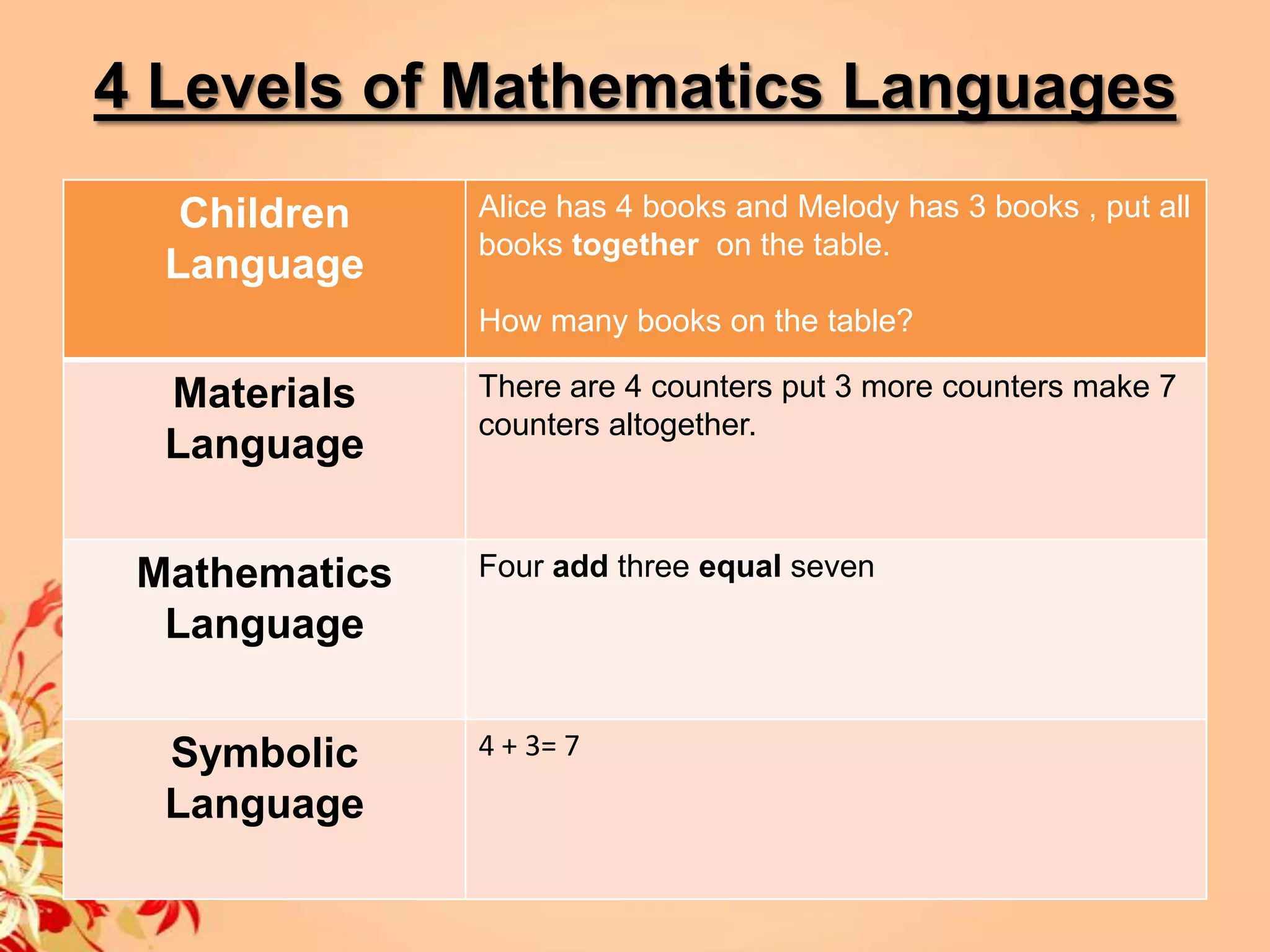
4 levels of Mathematics Languages
Languages                            Descriptions

 Student’s    By this level/ stage, teacher is using students’ language or
 Language     familiar objects for introduces and teaches students.

              For example: apples, cars, books and so on.

 Materials    By this level/ stage, teacher is using concrete materials such
 Language     as counters, MAB blocks, Unifix Blocks.


Mathematics   This level/ stage, teacher is using proper mathematics
 Language     language such as three, two, one, ….

 Symbolic     This level/ stage, teacher is using symbolic to teach students.
 Language
              For example: 1,2,3…+, -, ,
Addition
Strategies:
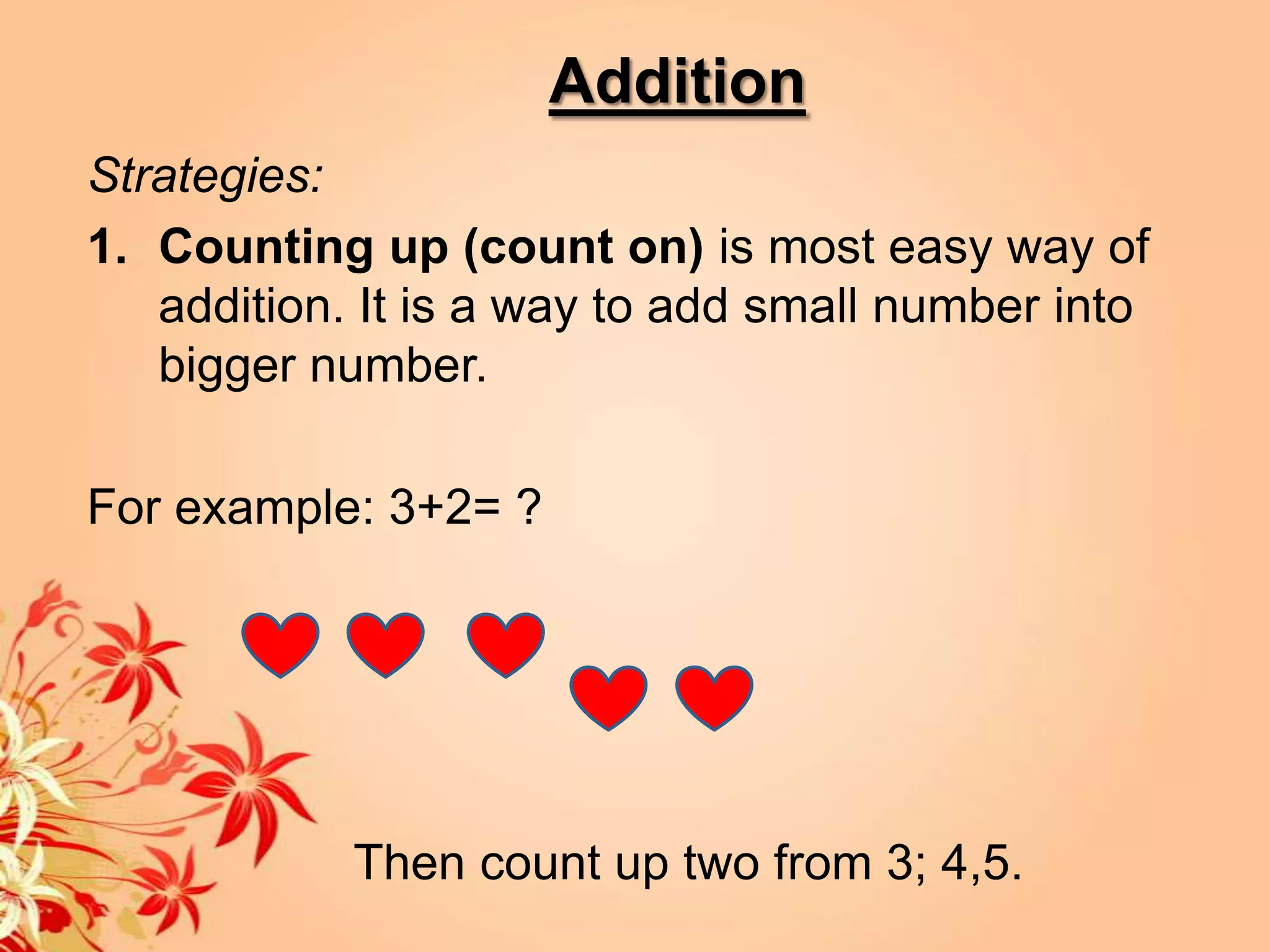
1. Counting up (count on) is most easy way of
   addition. It is a way to add small number into
   bigger number.

For example: 3+2= ?


            Then count up two from 3; 4,5.
Addition Strategies
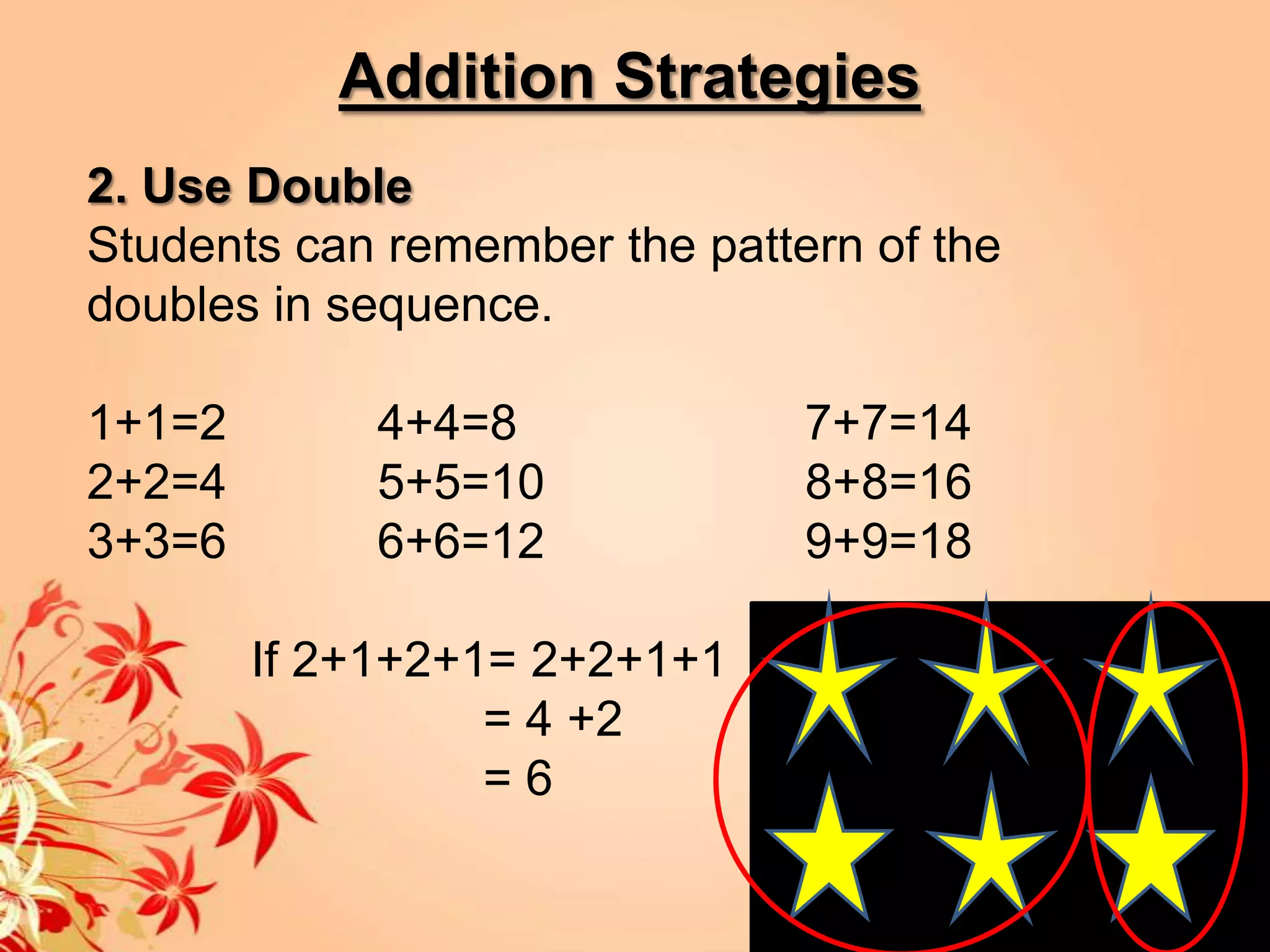
2. Use Double
Students can remember the pattern of the
doubles in sequence.

1+1=2        4+4=8             7+7=14
2+2=4        5+5=10            8+8=16
3+3=6        6+6=12            9+9=18

        If 2+1+2+1= 2+2+1+1
                  = 4 +2
                  =6
4 Levels of Mathematics Languages
   Children    Alice has 4 books and Melody has 3 books , put all
               books together on the table.
  Language
               How many books on the table?

  Materials    There are 4 counters put 3 more counters make 7
               counters altogether.
  Language


 Mathematics   Four add three equal seven
  Language


  Symbolic     4 + 3= 7
  Language
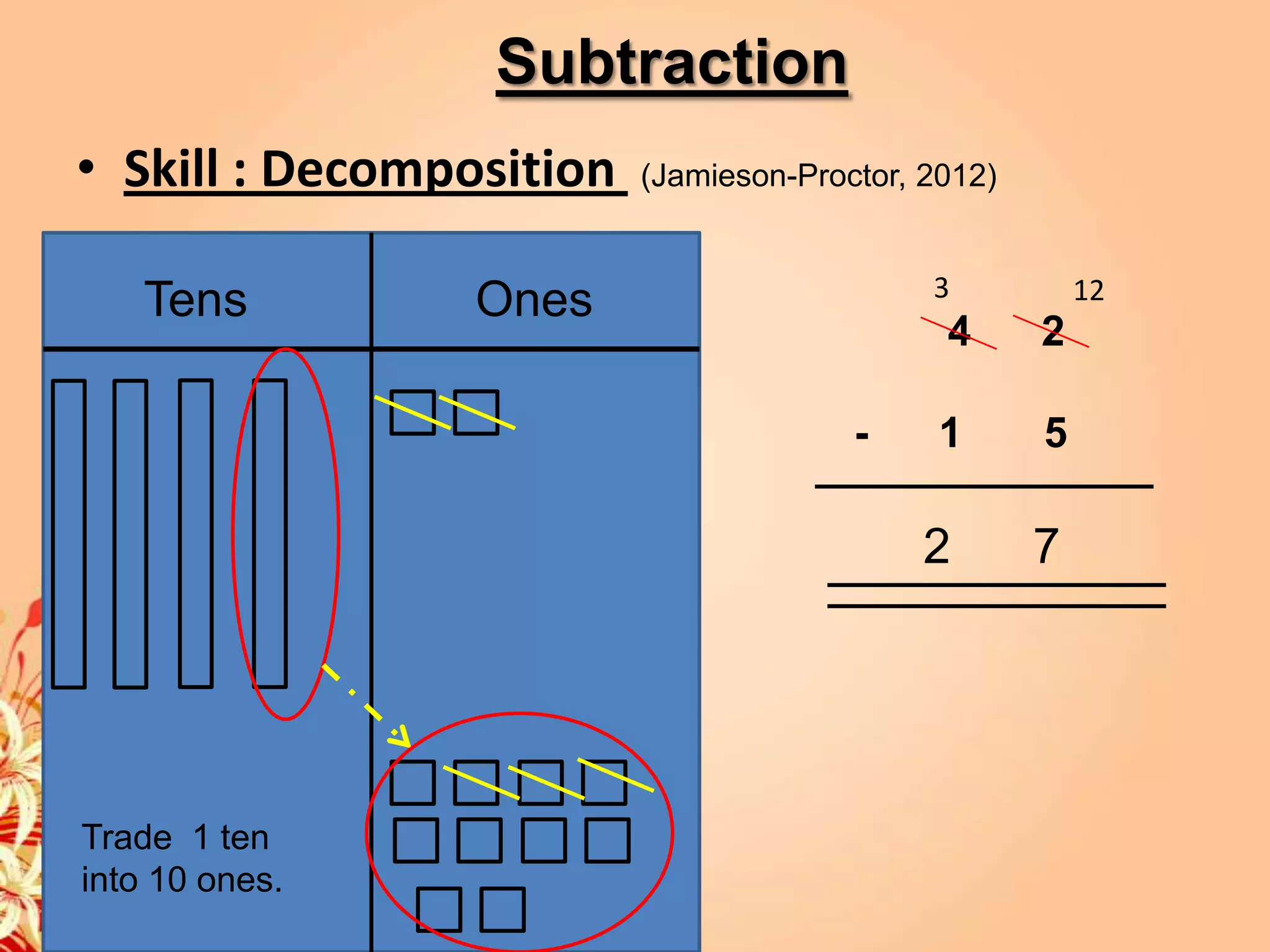
Subtraction
• Skill : Decomposition   (Jamieson-Proctor, 2012)


                                             3           12
    Tens         Ones
                                              4      2

                                        -     1      5

                                             2       7


Trade 1 ten
into 10 ones.
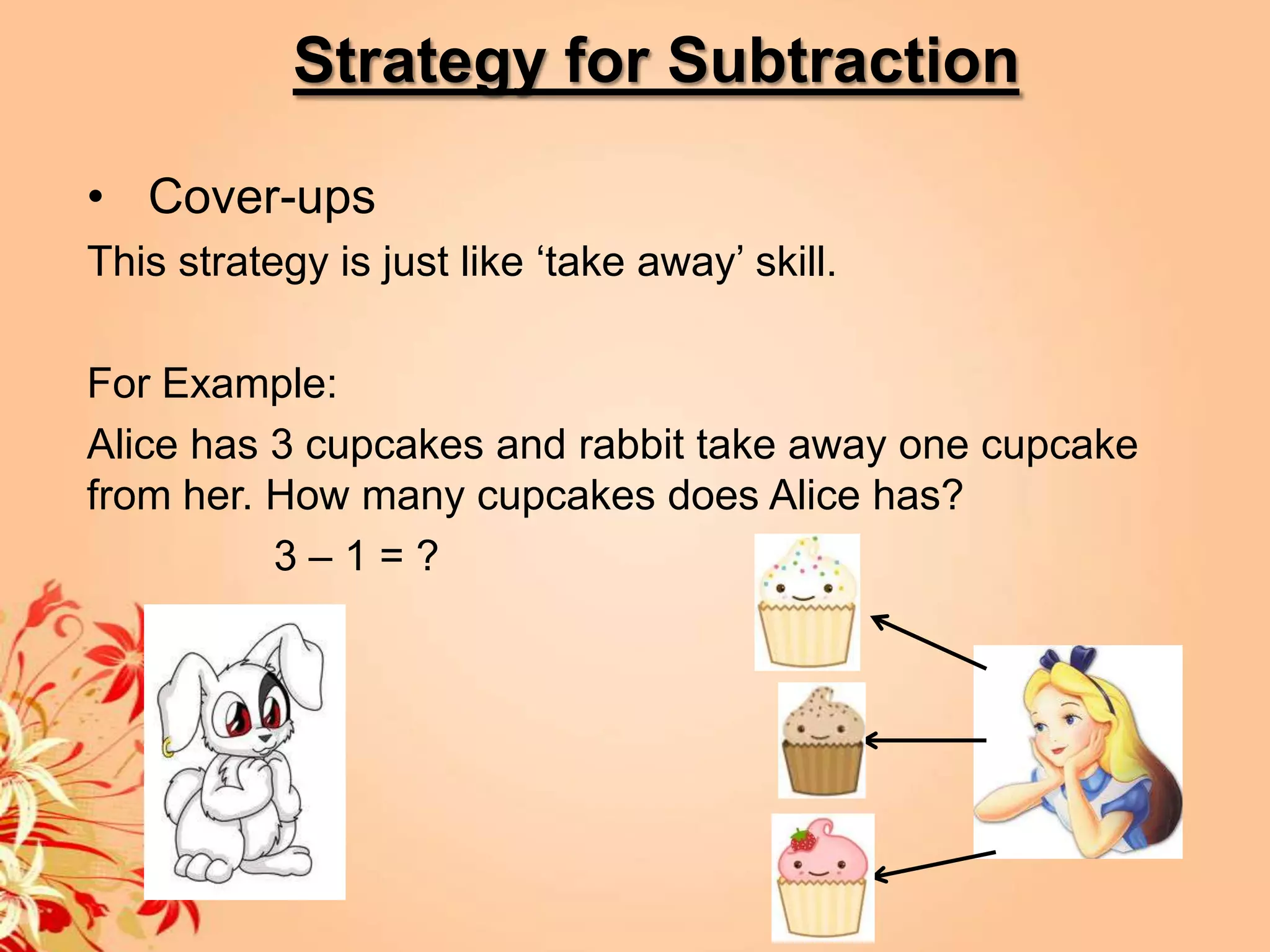
Strategy for Subtraction

• Cover-ups
This strategy is just like ‘take away’ skill.

For Example:
Alice has 3 cupcakes and rabbit take away one cupcake
from her. How many cupcakes does Alice has?
          3–1=?
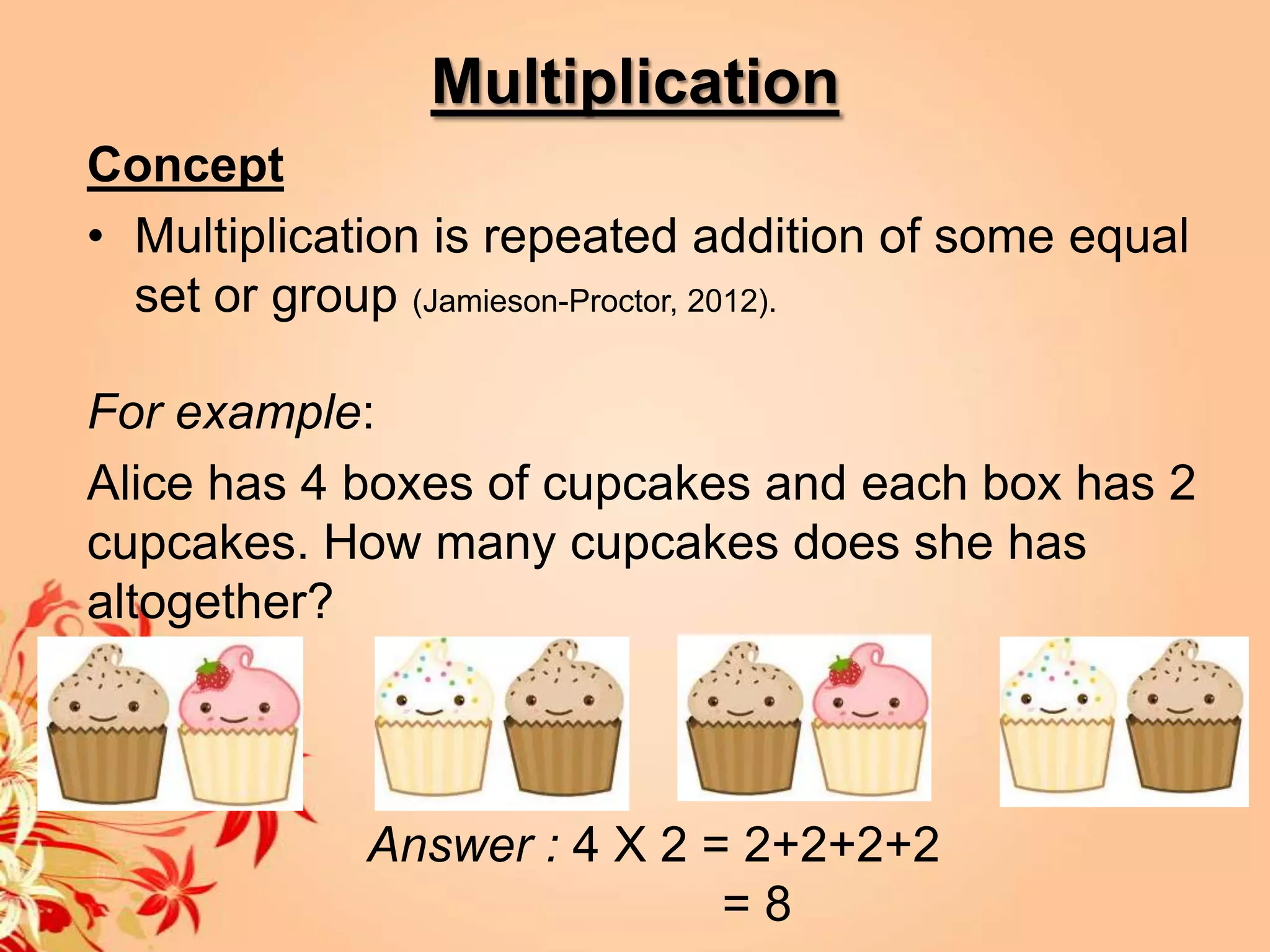
Multiplication
Concept
• Multiplication is repeated addition of some equal
  set or group (Jamieson-Proctor, 2012).

For example:
Alice has 4 boxes of cupcakes and each box has 2
cupcakes. How many cupcakes does she has
altogether?


            Answer : 4 X 2 = 2+2+2+2
                            =8
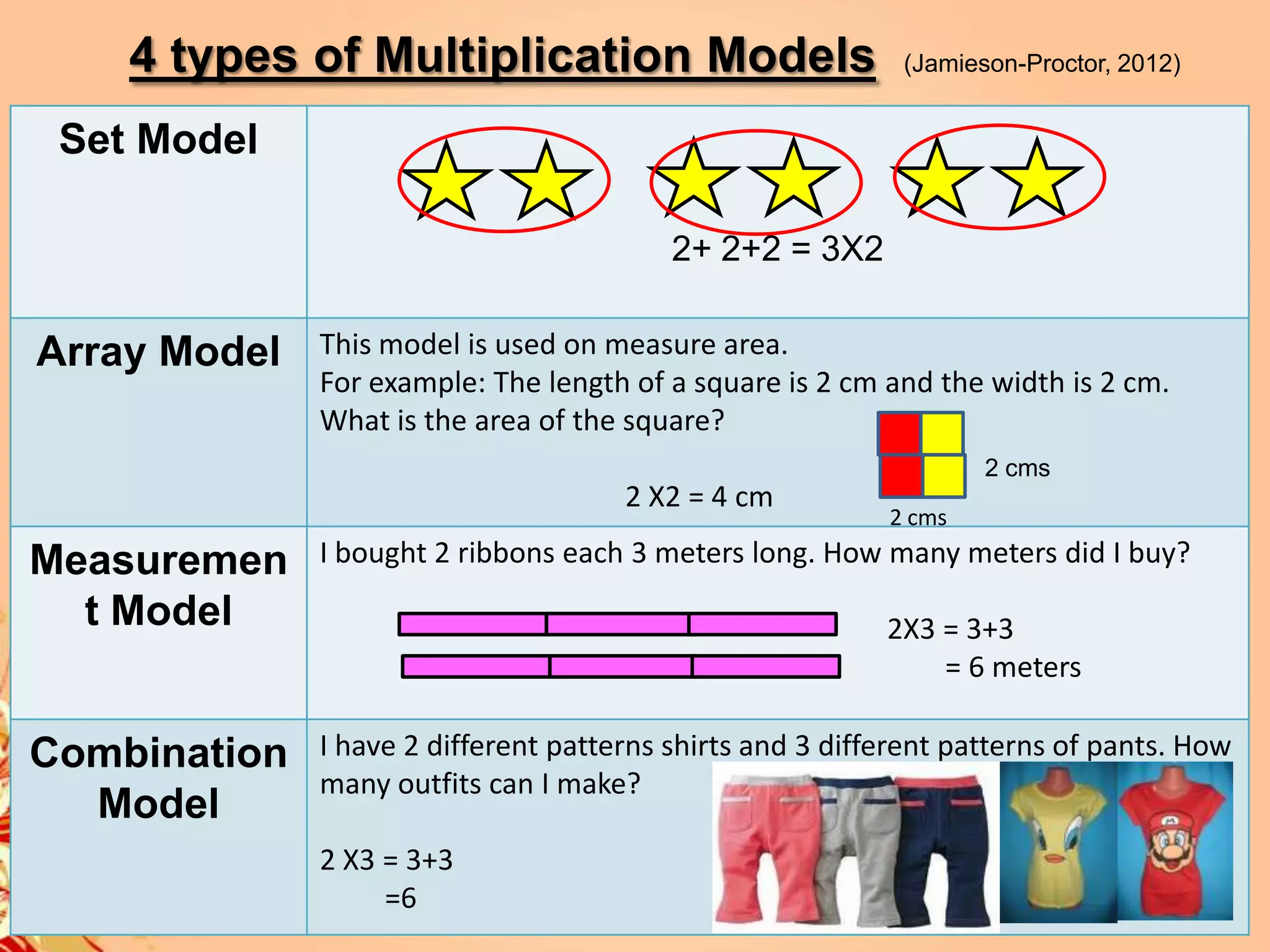
4 types of Multiplication Models                        (Jamieson-Proctor, 2012)


 Set Model

                                          2+ 2+2 = 3X2

Array Model   This model is used on measure area.
              For example: The length of a square is 2 cm and the width is 2 cm.
              What is the area of the square?
                                                                   2 cms
                                      2 X2 = 4 cm
                                                           2 cms
Measuremen    I bought 2 ribbons each 3 meters long. How many meters did I buy?
  t Model                                                  2X3 = 3+3
                                                               = 6 meters

Combination   I have 2 different patterns shirts and 3 different patterns of pants. How
              many outfits can I make?
  Model
              2 X3 = 3+3
                   =6
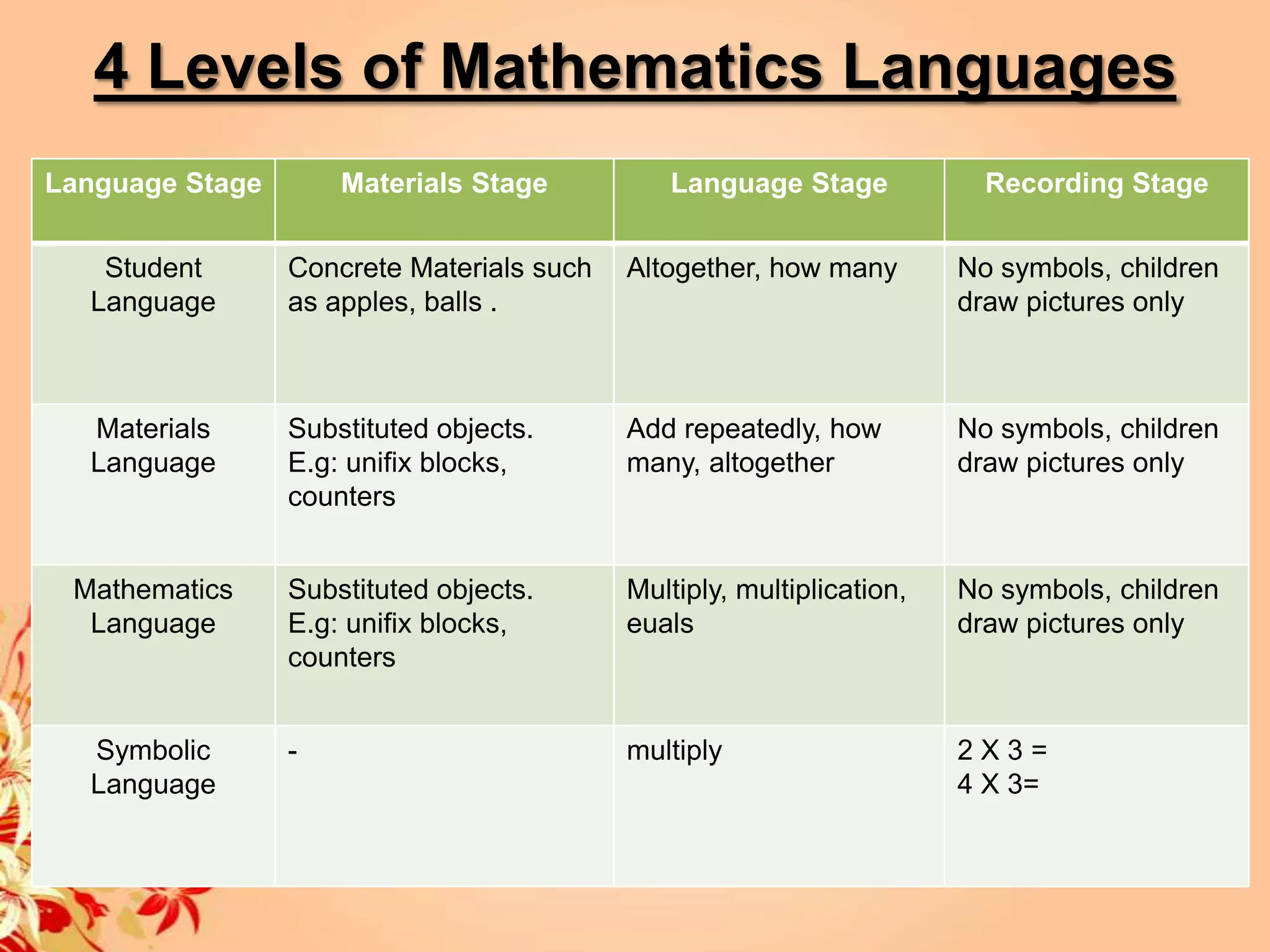
4 Levels of Mathematics Languages
Language Stage       Materials Stage          Language Stage             Recording Stage


   Student       Concrete Materials such   Altogether, how many        No symbols, children
  Language       as apples, balls .                                    draw pictures only


  Materials      Substituted objects.      Add repeatedly, how         No symbols, children
  Language       E.g: unifix blocks,       many, altogether            draw pictures only
                 counters


 Mathematics     Substituted objects.      Multiply, multiplication,   No symbols, children
  Language       E.g: unifix blocks,       euals                       draw pictures only
                 counters


  Symbolic       -                         multiply                    2X3=
  Language                                                             4 X 3=
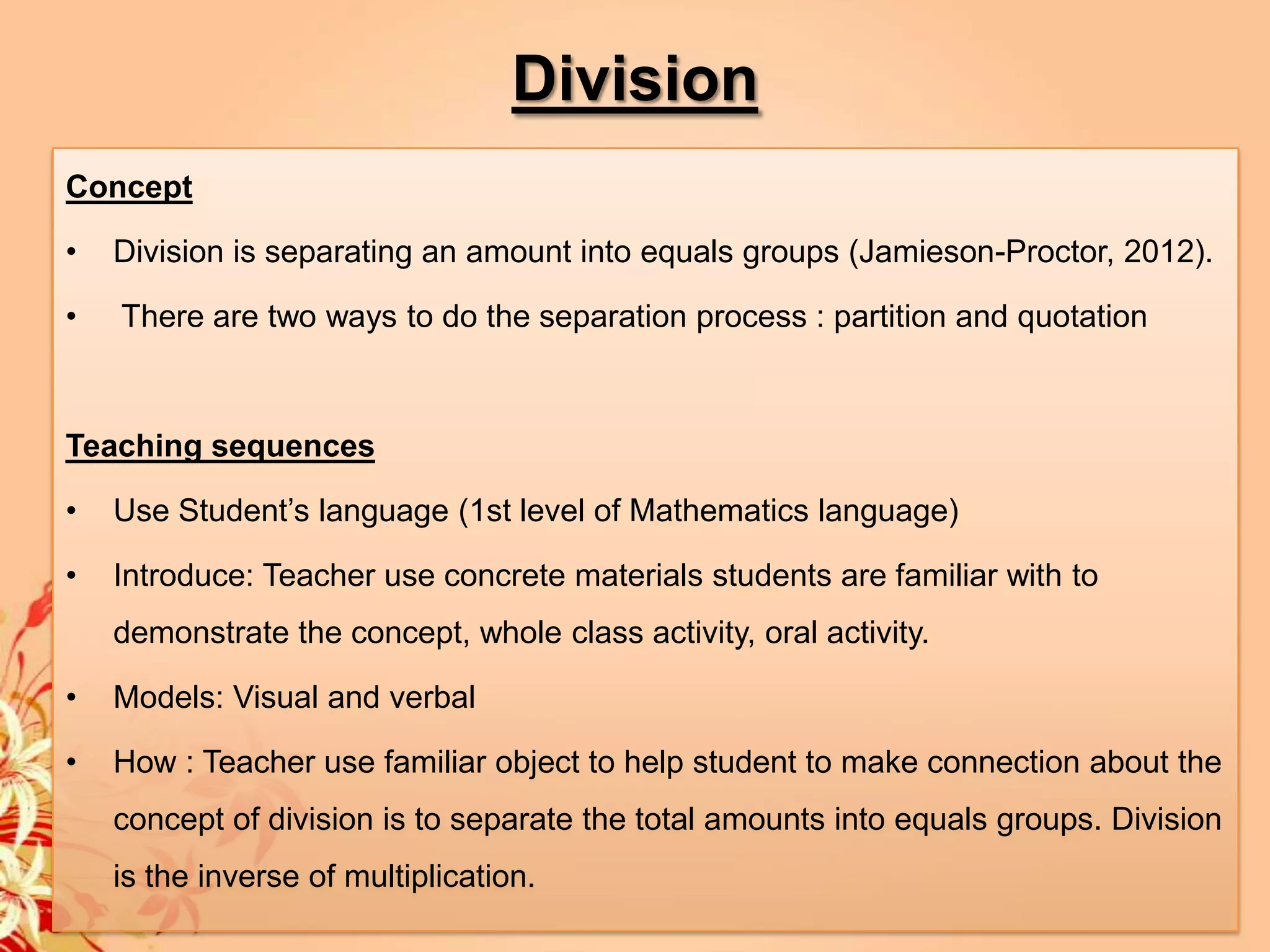
Division
Concept

•   Division is separating an amount into equals groups (Jamieson-Proctor, 2012).

•   There are two ways to do the separation process : partition and quotation


Teaching sequences

•   Use Student’s language (1st level of Mathematics language)

•   Introduce: Teacher use concrete materials students are familiar with to
    demonstrate the concept, whole class activity, oral activity.

•   Models: Visual and verbal

•   How : Teacher use familiar object to help student to make connection about the
    concept of division is to separate the total amounts into equals groups. Division
    is the inverse of multiplication.
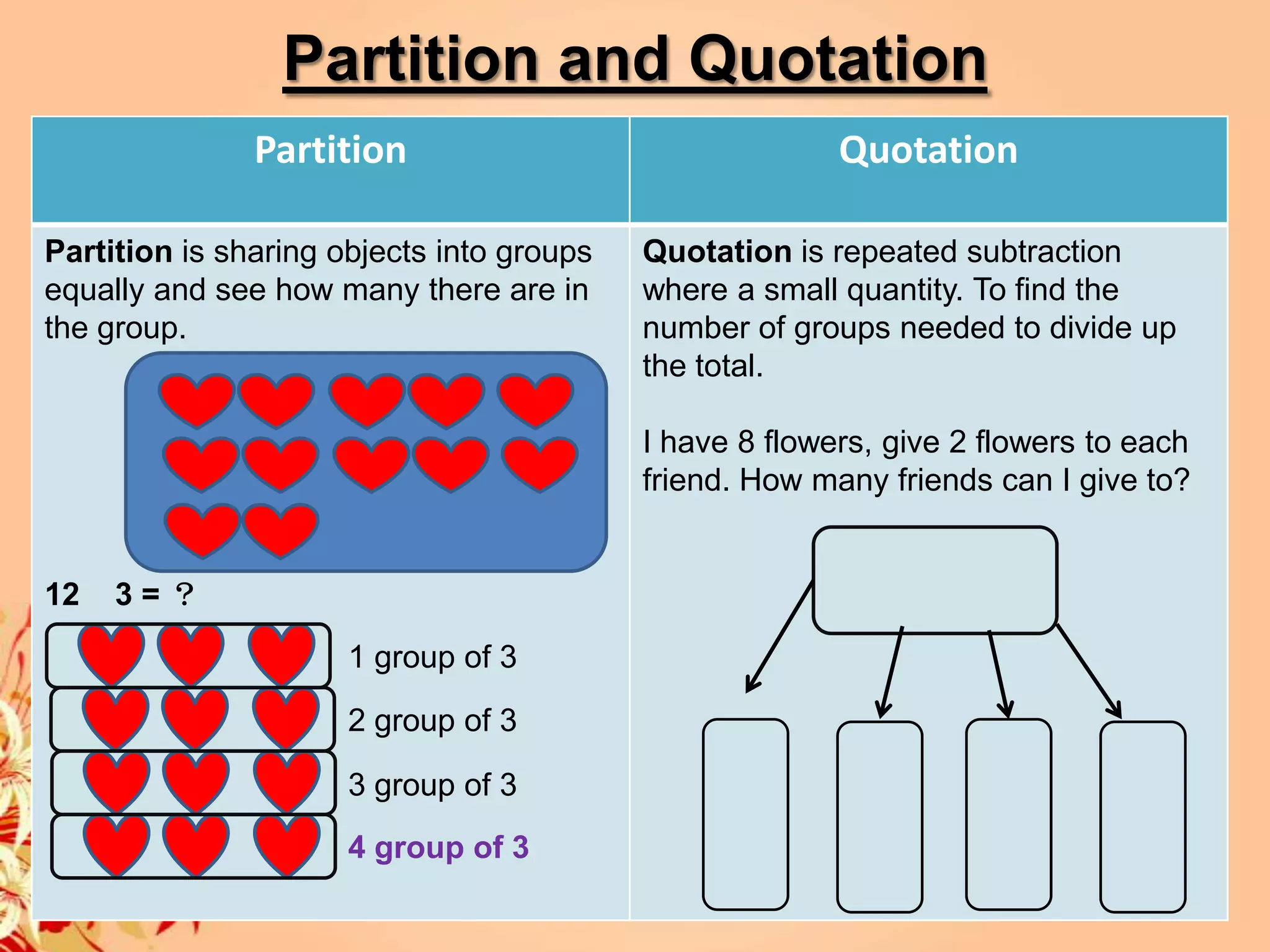
Partition and Quotation
               Partition                                 Quotation

Partition is sharing objects into groups   Quotation is repeated subtraction
equally and see how many there are in      where a small quantity. To find the
the group.                                 number of groups needed to divide up
                                           the total.

                                           I have 8 flowers, give 2 flowers to each
                                           friend. How many friends can I give to?


12   3=?
                      1 group of 3

                      2 group of 3

                      3 group of 3
                      4 group of 3

Concepts, Skills & Strategies

  • 1.
    Core Concepts Skills Strategies
  • 2.
    4 levels ofMathematics Languages Languages Descriptions Student’s By this level/ stage, teacher is using students’ language or Language familiar objects for introduces and teaches students. For example: apples, cars, books and so on. Materials By this level/ stage, teacher is using concrete materials such Language as counters, MAB blocks, Unifix Blocks. Mathematics This level/ stage, teacher is using proper mathematics Language language such as three, two, one, …. Symbolic This level/ stage, teacher is using symbolic to teach students. Language For example: 1,2,3…+, -, ,
  • 3.
    Addition Strategies: 1. Counting up(count on) is most easy way of addition. It is a way to add small number into bigger number. For example: 3+2= ? Then count up two from 3; 4,5.
  • 4.
    Addition Strategies 2. UseDouble Students can remember the pattern of the doubles in sequence. 1+1=2 4+4=8 7+7=14 2+2=4 5+5=10 8+8=16 3+3=6 6+6=12 9+9=18 If 2+1+2+1= 2+2+1+1 = 4 +2 =6
  • 5.
    4 Levels ofMathematics Languages Children Alice has 4 books and Melody has 3 books , put all books together on the table. Language How many books on the table? Materials There are 4 counters put 3 more counters make 7 counters altogether. Language Mathematics Four add three equal seven Language Symbolic 4 + 3= 7 Language
  • 6.
    Subtraction • Skill :Decomposition (Jamieson-Proctor, 2012) 3 12 Tens Ones 4 2 - 1 5 2 7 Trade 1 ten into 10 ones.
  • 7.
    Strategy for Subtraction •Cover-ups This strategy is just like ‘take away’ skill. For Example: Alice has 3 cupcakes and rabbit take away one cupcake from her. How many cupcakes does Alice has? 3–1=?
  • 8.
    Multiplication Concept • Multiplication isrepeated addition of some equal set or group (Jamieson-Proctor, 2012). For example: Alice has 4 boxes of cupcakes and each box has 2 cupcakes. How many cupcakes does she has altogether? Answer : 4 X 2 = 2+2+2+2 =8
  • 9.
    4 types ofMultiplication Models (Jamieson-Proctor, 2012) Set Model 2+ 2+2 = 3X2 Array Model This model is used on measure area. For example: The length of a square is 2 cm and the width is 2 cm. What is the area of the square? 2 cms 2 X2 = 4 cm 2 cms Measuremen I bought 2 ribbons each 3 meters long. How many meters did I buy? t Model 2X3 = 3+3 = 6 meters Combination I have 2 different patterns shirts and 3 different patterns of pants. How many outfits can I make? Model 2 X3 = 3+3 =6
  • 10.
    4 Levels ofMathematics Languages Language Stage Materials Stage Language Stage Recording Stage Student Concrete Materials such Altogether, how many No symbols, children Language as apples, balls . draw pictures only Materials Substituted objects. Add repeatedly, how No symbols, children Language E.g: unifix blocks, many, altogether draw pictures only counters Mathematics Substituted objects. Multiply, multiplication, No symbols, children Language E.g: unifix blocks, euals draw pictures only counters Symbolic - multiply 2X3= Language 4 X 3=
  • 11.
    Division Concept • Division is separating an amount into equals groups (Jamieson-Proctor, 2012). • There are two ways to do the separation process : partition and quotation Teaching sequences • Use Student’s language (1st level of Mathematics language) • Introduce: Teacher use concrete materials students are familiar with to demonstrate the concept, whole class activity, oral activity. • Models: Visual and verbal • How : Teacher use familiar object to help student to make connection about the concept of division is to separate the total amounts into equals groups. Division is the inverse of multiplication.
  • 12.
    Partition and Quotation Partition Quotation Partition is sharing objects into groups Quotation is repeated subtraction equally and see how many there are in where a small quantity. To find the the group. number of groups needed to divide up the total. I have 8 flowers, give 2 flowers to each friend. How many friends can I give to? 12 3=? 1 group of 3 2 group of 3 3 group of 3 4 group of 3