Solid State Physics
NEARLY FREE ELECTRON
MODEL (Contd)
Lecture 19
A.H. Harker
Physics and Astronomy
UCL
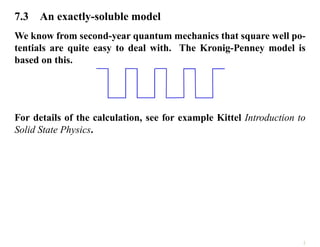
7.3 An exactly-soluble model
We know from second-year quantum mechanics that square well po-
tentials are quite easy to deal with. The Kronig-Penney model is
based on this.
For details of the calculation, see for example Kittel Introduction to
Solid State Physics.
2
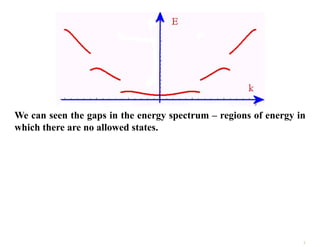
We can seen the gaps in the energy spectrum – regions of energy in
which there are no allowed states.
3
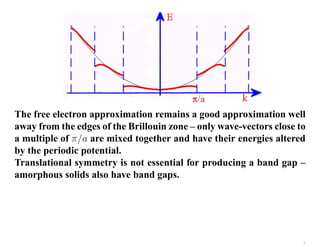
The free electron approximation remains a good approximation well
away from the edges of the Brillouin zone – only wave-vectors close to
a multiple of π/a are mixed together and have their energies altered
by the periodic potential.
Translational symmetry is not essential for producing a band gap –
amorphous solids also have band gaps.
4
7.4 Sketching energy bands
7.4.1 The empty lattice
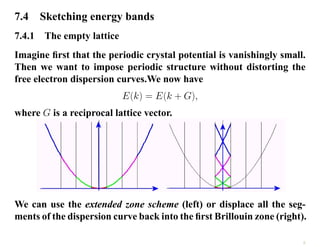
Imagine first that the periodic crystal potential is vanishingly small.
Then we want to impose periodic structure without distorting the
free electron dispersion curves.We now have
E(k) = E(k + G),
where G is a reciprocal lattice vector.
We can use the extended zone scheme (left) or displace all the seg-
ments of the dispersion curve back into the first Brillouin zone (right).
5
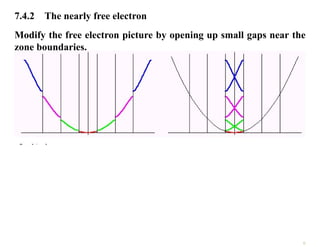
7.4.2 The nearly free electron
Modify the free electron picture by opening up small gaps near the
zone boundaries.
6
7.5 Consequences of the energy gap
7.5.1 Density of states
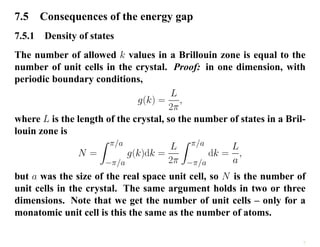
The number of allowed k values in a Brillouin zone is equal to the
number of unit cells in the crystal. Proof: in one dimension, with
periodic boundary conditions,
g(k) =
L
2π
,
where L is the length of the crystal, so the number of states in a Bril-
louin zone is
N =
Z π/a
−π/a
g(k)dk =
L
2π
Z π/a
−π/a
dk =
L
a
,
but a was the size of the real space unit cell, so N is the number of
unit cells in the crystal. The same argument holds in two or three
dimensions. Note that we get the number of unit cells – only for a
monatomic unit cell is this the same as the number of atoms.
7
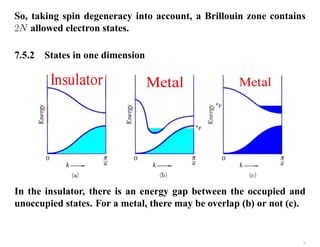
So, taking spin degeneracy into account, a Brillouin zone contains
2N allowed electron states.
7.5.2 States in one dimension
In the insulator, there is an energy gap between the occupied and
unoccupied states. For a metal, there may be overlap (b) or not (c).
8
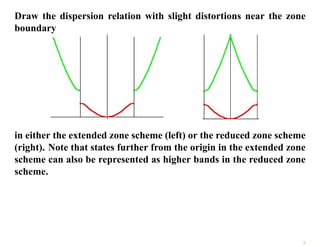
Draw the dispersion relation with slight distortions near the zone
boundary
in either the extended zone scheme (left) or the reduced zone scheme
(right). Note that states further from the origin in the extended zone
scheme can also be represented as higher bands in the reduced zone
scheme.
9
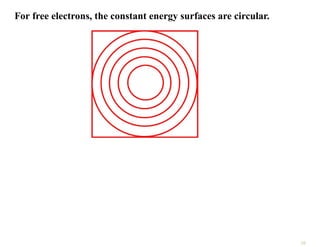
For free electrons, the constant energy surfaces are circular.
10
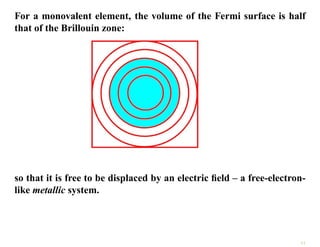
For a monovalent element, the volume of the Fermi surface is half
that of the Brillouin zone:
so that it is free to be displaced by an electric field – a free-electron-
like metallic system.
11
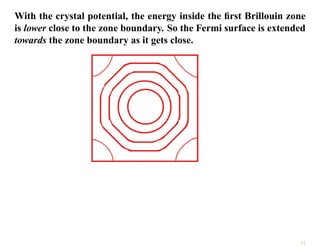
With the crystal potential, the energy inside the first Brillouin zone
is lower close to the zone boundary. So the Fermi surface is extended
towards the zone boundary as it gets close.
12
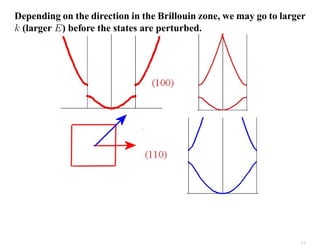
Depending on the direction in the Brillouin zone, we may go to larger
k (larger E) before the states are perturbed.
13
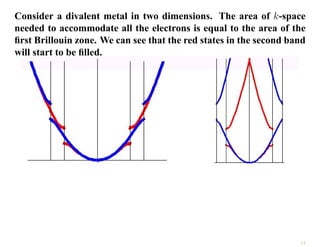
Consider a divalent metal in two dimensions. The area of k-space
needed to accommodate all the electrons is equal to the area of the
first Brillouin zone. We can see that the red states in the second band
will start to be filled.
14
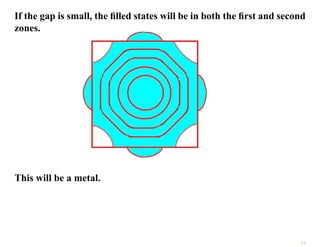
If the gap is small, the filled states will be in both the first and second
zones.
This will be a metal.
15
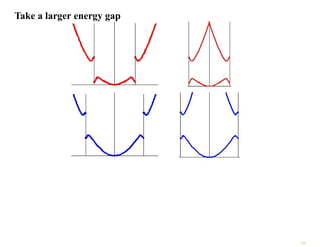
Take a larger energy gap
16
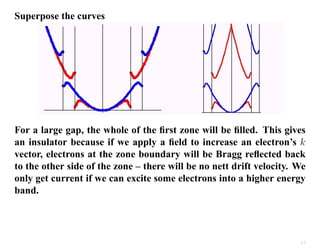
Superpose the curves
For a large gap, the whole of the first zone will be filled. This gives
an insulator because if we apply a field to increase an electron’s k
vector, electrons at the zone boundary will be Bragg reflected back
to the other side of the zone – there will be no nett drift velocity. We
only get current if we can excite some electrons into a higher energy
band.
17
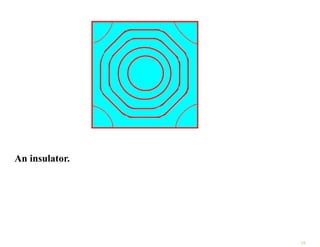
An insulator.
18
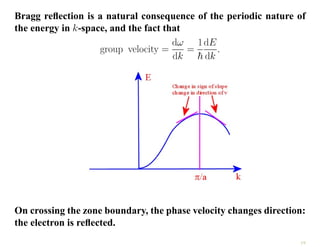
Bragg reflection is a natural consequence of the periodic nature of
the energy in k-space, and the fact that
group velocity =
dω
dk
=
1
~
dE
dk
.
On crossing the zone boundary, the phase velocity changes direction:
the electron is reflected.
19
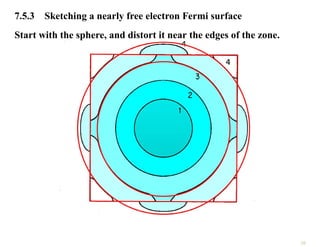
7.5.3 Sketching a nearly free electron Fermi surface
Start with the sphere, and distort it near the edges of the zone.
20
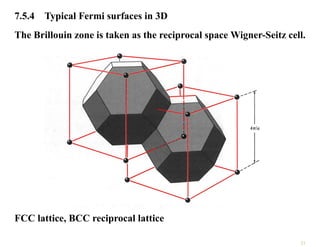
7.5.4 Typical Fermi surfaces in 3D
The Brillouin zone is taken as the reciprocal space Wigner-Seitz cell.
FCC lattice, BCC reciprocal lattice
21
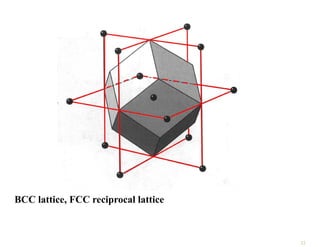
BCC lattice, FCC reciprocal lattice
22
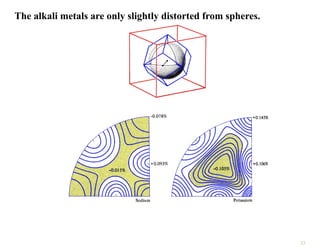
The alkali metals are only slightly distorted from spheres.
23
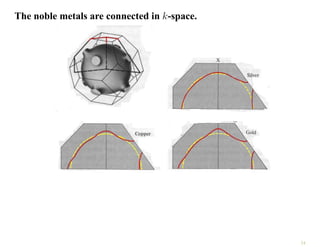
The noble metals are connected in k-space.
24
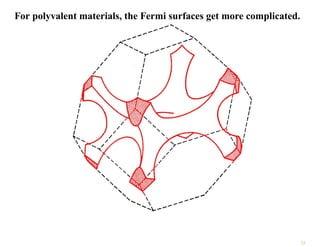
For polyvalent materials, the Fermi surfaces get more complicated.
25
7.5.5 Effects of fields on electrons in bands
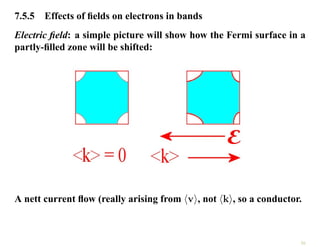
Electric field: a simple picture will show how the Fermi surface in a
partly-filled zone will be shifted:
A nett current flow (really arising from hvi, not hki, so a conductor.
26
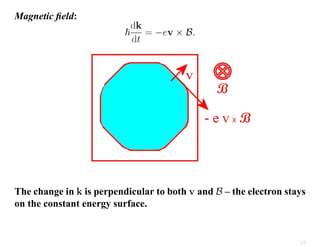
Magnetic field:
~
dk
dt
= −ev × B.
The change in k is perpendicular to both v and B – the electron stays
on the constant energy surface.
27
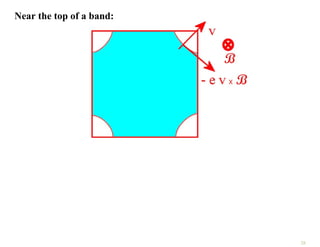
Near the top of a band:
28
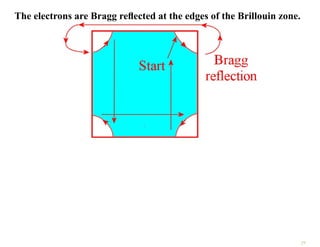
The electrons are Bragg reflected at the edges of the Brillouin zone.
29
The electrons orbit, in k-space, the opposite way round occupied or
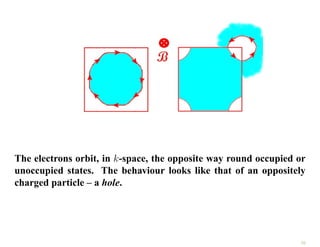
unoccupied states. The behaviour looks like that of an oppositely
charged particle – a hole.
30
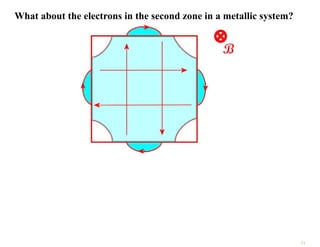
What about the electrons in the second zone in a metallic system?
31
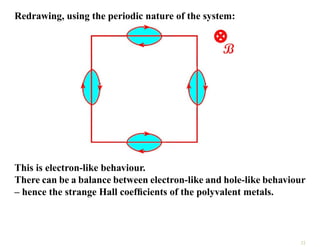
Redrawing, using the periodic nature of the system:
This is electron-like behaviour.
There can be a balance between electron-like and hole-like behaviour
– hence the strange Hall coefficients of the polyvalent metals.
32

nearly free electron model and Bloch theorem.pdf

  • 1.
    Solid State Physics NEARLYFREE ELECTRON MODEL (Contd) Lecture 19 A.H. Harker Physics and Astronomy UCL
  • 2.
    7.3 An exactly-solublemodel We know from second-year quantum mechanics that square well po- tentials are quite easy to deal with. The Kronig-Penney model is based on this. For details of the calculation, see for example Kittel Introduction to Solid State Physics. 2
  • 3.
    We can seenthe gaps in the energy spectrum – regions of energy in which there are no allowed states. 3
  • 4.
    The free electronapproximation remains a good approximation well away from the edges of the Brillouin zone – only wave-vectors close to a multiple of π/a are mixed together and have their energies altered by the periodic potential. Translational symmetry is not essential for producing a band gap – amorphous solids also have band gaps. 4
  • 5.
    7.4 Sketching energybands 7.4.1 The empty lattice Imagine first that the periodic crystal potential is vanishingly small. Then we want to impose periodic structure without distorting the free electron dispersion curves.We now have E(k) = E(k + G), where G is a reciprocal lattice vector. We can use the extended zone scheme (left) or displace all the seg- ments of the dispersion curve back into the first Brillouin zone (right). 5
  • 6.
    7.4.2 The nearlyfree electron Modify the free electron picture by opening up small gaps near the zone boundaries. 6
  • 7.
    7.5 Consequences ofthe energy gap 7.5.1 Density of states The number of allowed k values in a Brillouin zone is equal to the number of unit cells in the crystal. Proof: in one dimension, with periodic boundary conditions, g(k) = L 2π , where L is the length of the crystal, so the number of states in a Bril- louin zone is N = Z π/a −π/a g(k)dk = L 2π Z π/a −π/a dk = L a , but a was the size of the real space unit cell, so N is the number of unit cells in the crystal. The same argument holds in two or three dimensions. Note that we get the number of unit cells – only for a monatomic unit cell is this the same as the number of atoms. 7
  • 8.
    So, taking spindegeneracy into account, a Brillouin zone contains 2N allowed electron states. 7.5.2 States in one dimension In the insulator, there is an energy gap between the occupied and unoccupied states. For a metal, there may be overlap (b) or not (c). 8
  • 9.
    Draw the dispersionrelation with slight distortions near the zone boundary in either the extended zone scheme (left) or the reduced zone scheme (right). Note that states further from the origin in the extended zone scheme can also be represented as higher bands in the reduced zone scheme. 9
  • 10.
    For free electrons,the constant energy surfaces are circular. 10
  • 11.
    For a monovalentelement, the volume of the Fermi surface is half that of the Brillouin zone: so that it is free to be displaced by an electric field – a free-electron- like metallic system. 11
  • 12.
    With the crystalpotential, the energy inside the first Brillouin zone is lower close to the zone boundary. So the Fermi surface is extended towards the zone boundary as it gets close. 12
  • 13.
    Depending on thedirection in the Brillouin zone, we may go to larger k (larger E) before the states are perturbed. 13
  • 14.
    Consider a divalentmetal in two dimensions. The area of k-space needed to accommodate all the electrons is equal to the area of the first Brillouin zone. We can see that the red states in the second band will start to be filled. 14
  • 15.
    If the gapis small, the filled states will be in both the first and second zones. This will be a metal. 15
  • 16.
    Take a largerenergy gap 16
  • 17.
    Superpose the curves Fora large gap, the whole of the first zone will be filled. This gives an insulator because if we apply a field to increase an electron’s k vector, electrons at the zone boundary will be Bragg reflected back to the other side of the zone – there will be no nett drift velocity. We only get current if we can excite some electrons into a higher energy band. 17
  • 18.
  • 19.
    Bragg reflection isa natural consequence of the periodic nature of the energy in k-space, and the fact that group velocity = dω dk = 1 ~ dE dk . On crossing the zone boundary, the phase velocity changes direction: the electron is reflected. 19
  • 20.
    7.5.3 Sketching anearly free electron Fermi surface Start with the sphere, and distort it near the edges of the zone. 20
  • 21.
    7.5.4 Typical Fermisurfaces in 3D The Brillouin zone is taken as the reciprocal space Wigner-Seitz cell. FCC lattice, BCC reciprocal lattice 21
  • 22.
    BCC lattice, FCCreciprocal lattice 22
  • 23.
    The alkali metalsare only slightly distorted from spheres. 23
  • 24.
    The noble metalsare connected in k-space. 24
  • 25.
    For polyvalent materials,the Fermi surfaces get more complicated. 25
  • 26.
    7.5.5 Effects offields on electrons in bands Electric field: a simple picture will show how the Fermi surface in a partly-filled zone will be shifted: A nett current flow (really arising from hvi, not hki, so a conductor. 26
  • 27.
    Magnetic field: ~ dk dt = −ev× B. The change in k is perpendicular to both v and B – the electron stays on the constant energy surface. 27
  • 28.
    Near the topof a band: 28
  • 29.
    The electrons areBragg reflected at the edges of the Brillouin zone. 29
  • 30.
    The electrons orbit,in k-space, the opposite way round occupied or unoccupied states. The behaviour looks like that of an oppositely charged particle – a hole. 30
  • 31.
    What about theelectrons in the second zone in a metallic system? 31
  • 32.
    Redrawing, using theperiodic nature of the system: This is electron-like behaviour. There can be a balance between electron-like and hole-like behaviour – hence the strange Hall coefficients of the polyvalent metals. 32