Ningappa Kirasur
2014-12-129
Dept. of Olericulture
COH, Vellanikkara 1
Mango
o Mangifera indica L.
o Anacardaceae
o 2n=4x=40
o South East Asia
o Occupies a pre-eminent place among fruit crops in India
o It is ‘King of fruits’ in the country
o Malformation is the most threatening malady
o Causes 50-80% yield loss
2
Mango Malformation
o Fusarium moniliforme var. subglutinans
o It was first reported by Watt in 1891 Darbhanga
district of Bihar
Types of malformation
o Vegetative Malformation
o Floral Malformation
3
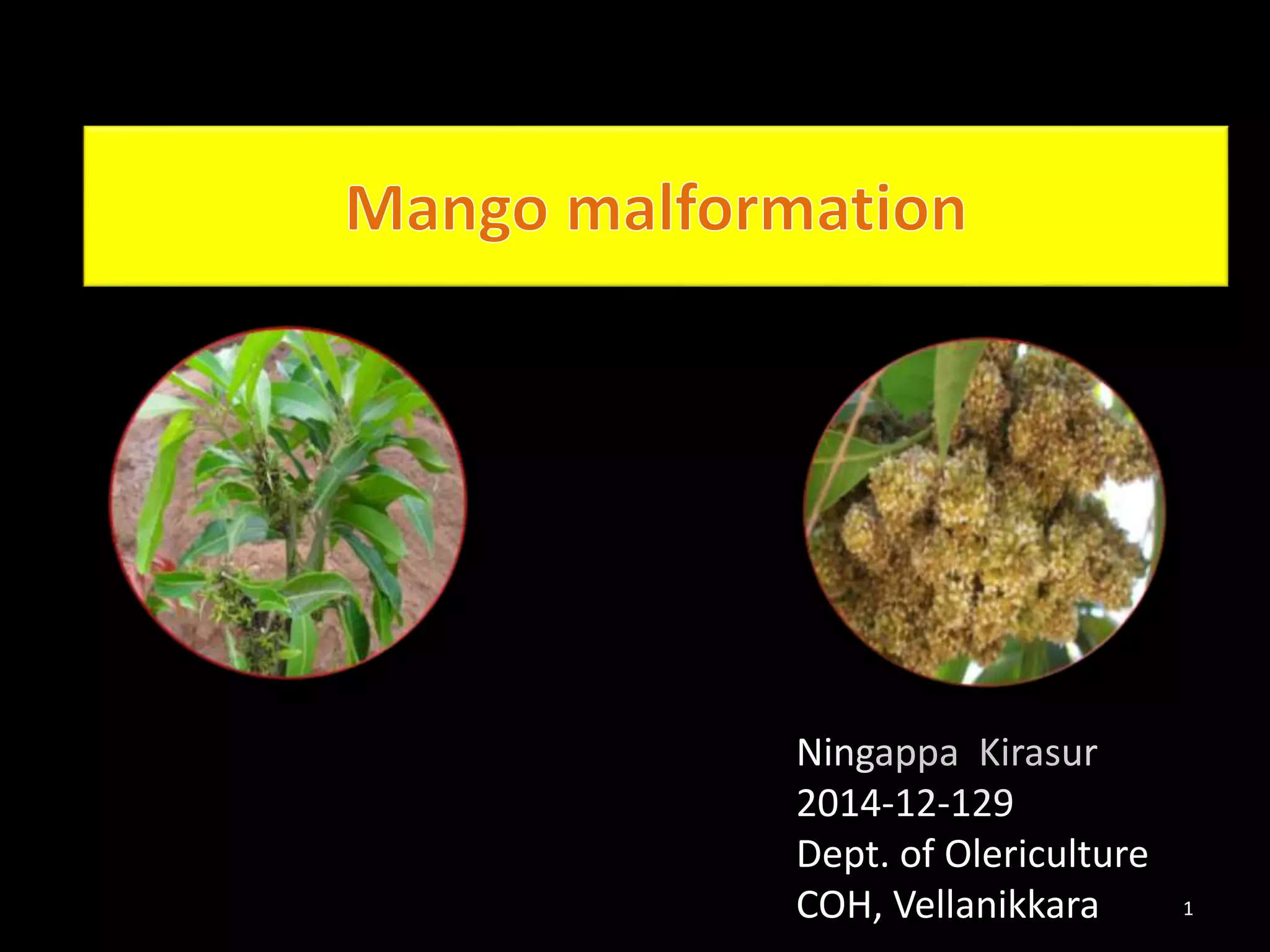
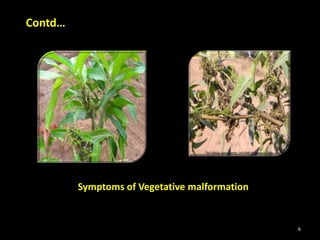
Vegetative Malformation
o Is more commonly found on young seedlings
o It is characterised by disrupting of apical growth
resulting in several small flushes
o Quite short internodes at the apical ends of various
branches
o These shoots bear small leafy structures
4
Contd…
o The multi-branching of shoot apex with scaly leaves
is known as “Bunchy Top” or “Witche’s Broom”
o The malformed seedlings, becomes remain stunted
and die
5
Symptoms of Vegetative malformation
Contd…
6
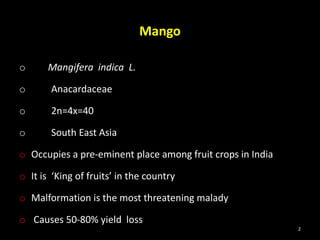
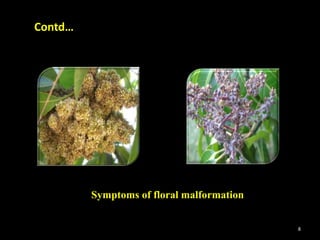
Floral Malformation
o The primary, secondary and tertiary rachises become
short, thickened and hypertrophied
o Such panicles are greener and heavier with
increased crowded branches
o These panicles have numerous flowers that remain
unopened and are predominantly male flowers
7
Symptoms of floral malformation
Contd…
8
Cultivar susceptibility
o The susceptibility to malformation in mango varieties is
variable
o Is governed by the different factors like temperature, age of
the tree, time
o Amrapalli was found highly susceptible to mango
malformation
9
Contd…
o The 60% diseased panicles in cv. Neelum during the
flowering of February-March
o whereas the same plant had only 4-5%
malformation during off season flowering in June
o Incidence of disease is more in young plants than in
older ones
o About 91% incidence in 4-8 years plants 9.6% in
older plants was reported
10
Abiotic factors
Temperature:
o The low temperature at the time of flowering was
correlated with the intensity of malformation
o The incidence of disease is most severe in north-
west region of India
o where mean temperature during flowering remains
between 10-15°C
o It is mild where corresponding temperature is
15-20°C, sporadic at 20-25°C
11
Nutritional aspects
Micronutrient:
o The micronutrient deficiency, particularly iron and
zinc and copper has been associated with the cause
of malformation
12
Ethylene
 As some of the symptoms of mango malformation
resemble with those of ethylene effects
 The role for ethylene in mango malformation
Significantly higher level
13
Other Factors
Malformin:
o The presence of malformin- like substances in fully
grown malformed panicles has been reported
o The stem and root of malformed vegetative seedlings
contain higher level of malformin as compared to
healthy seedlings
14
Mangiferin
o Mangiferin is either absent or present. only in traces
in healthy mango panicles but in malformed ones
contains higher concentration
15
MANAGEMENT
Plant Growth regulators:
o The application of NAA 100-200 ppm, at flower bud
differentiation stage reduce the malformation
o Spraying of 500 ppm ethrel in February was highly
effective in reducing floral malformation
16
Contd…
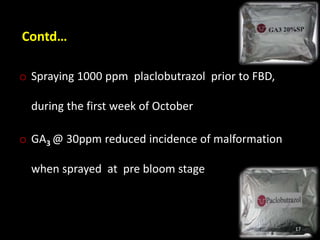
o Spraying 1000 ppm placlobutrazol prior to FBD,
during the first week of October
o GA3 @ 30ppm reduced incidence of malformation
when sprayed at pre bloom stage
17
Deblossoming
o Deblossoming at bud burst stage, spraying of 200
ppm NAA was reported to be very effective in
controlling malformation
o Application of cyclohexamide at 250 ppm was very
effective in deblossoming the panicles
18
Pruning
o Prune the malformed branches
o Pruning followed by spraying with the mixture of
fungicide (Captan 0.1%), helps in controlling the
spread of the disease
19
Insecticides and fungicides
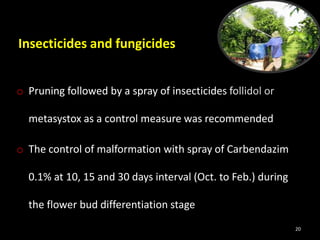
o Pruning followed by a spray of insecticides follidol or
metasystox as a control measure was recommended
o The control of malformation with spray of Carbendazim
0.1% at 10, 15 and 30 days interval (Oct. to Feb.) during
the flower bud differentiation stage
20
Management through bio-pesticides
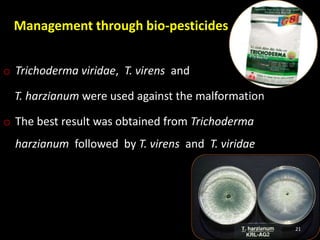
o Trichoderma viridae, T. virens and
T. harzianum were used against the malformation
o The best result was obtained from Trichoderma
harzianum followed by T. virens and T. viridae
21
22

Mango malformation

  • 1.
    Ningappa Kirasur 2014-12-129 Dept. ofOlericulture COH, Vellanikkara 1
  • 2.
    Mango o Mangifera indicaL. o Anacardaceae o 2n=4x=40 o South East Asia o Occupies a pre-eminent place among fruit crops in India o It is ‘King of fruits’ in the country o Malformation is the most threatening malady o Causes 50-80% yield loss 2
  • 3.
    Mango Malformation o Fusariummoniliforme var. subglutinans o It was first reported by Watt in 1891 Darbhanga district of Bihar Types of malformation o Vegetative Malformation o Floral Malformation 3
  • 4.
    Vegetative Malformation o Ismore commonly found on young seedlings o It is characterised by disrupting of apical growth resulting in several small flushes o Quite short internodes at the apical ends of various branches o These shoots bear small leafy structures 4
  • 5.
    Contd… o The multi-branchingof shoot apex with scaly leaves is known as “Bunchy Top” or “Witche’s Broom” o The malformed seedlings, becomes remain stunted and die 5
  • 6.
    Symptoms of Vegetativemalformation Contd… 6
  • 7.
    Floral Malformation o Theprimary, secondary and tertiary rachises become short, thickened and hypertrophied o Such panicles are greener and heavier with increased crowded branches o These panicles have numerous flowers that remain unopened and are predominantly male flowers 7
  • 8.
    Symptoms of floralmalformation Contd… 8
  • 9.
    Cultivar susceptibility o Thesusceptibility to malformation in mango varieties is variable o Is governed by the different factors like temperature, age of the tree, time o Amrapalli was found highly susceptible to mango malformation 9
  • 10.
    Contd… o The 60%diseased panicles in cv. Neelum during the flowering of February-March o whereas the same plant had only 4-5% malformation during off season flowering in June o Incidence of disease is more in young plants than in older ones o About 91% incidence in 4-8 years plants 9.6% in older plants was reported 10
  • 11.
    Abiotic factors Temperature: o Thelow temperature at the time of flowering was correlated with the intensity of malformation o The incidence of disease is most severe in north- west region of India o where mean temperature during flowering remains between 10-15°C o It is mild where corresponding temperature is 15-20°C, sporadic at 20-25°C 11
  • 12.
    Nutritional aspects Micronutrient: o Themicronutrient deficiency, particularly iron and zinc and copper has been associated with the cause of malformation 12
  • 13.
    Ethylene  As someof the symptoms of mango malformation resemble with those of ethylene effects  The role for ethylene in mango malformation Significantly higher level 13
  • 14.
    Other Factors Malformin: o Thepresence of malformin- like substances in fully grown malformed panicles has been reported o The stem and root of malformed vegetative seedlings contain higher level of malformin as compared to healthy seedlings 14
  • 15.
    Mangiferin o Mangiferin iseither absent or present. only in traces in healthy mango panicles but in malformed ones contains higher concentration 15
  • 16.
    MANAGEMENT Plant Growth regulators: oThe application of NAA 100-200 ppm, at flower bud differentiation stage reduce the malformation o Spraying of 500 ppm ethrel in February was highly effective in reducing floral malformation 16
  • 17.
    Contd… o Spraying 1000ppm placlobutrazol prior to FBD, during the first week of October o GA3 @ 30ppm reduced incidence of malformation when sprayed at pre bloom stage 17
  • 18.
    Deblossoming o Deblossoming atbud burst stage, spraying of 200 ppm NAA was reported to be very effective in controlling malformation o Application of cyclohexamide at 250 ppm was very effective in deblossoming the panicles 18
  • 19.
    Pruning o Prune themalformed branches o Pruning followed by spraying with the mixture of fungicide (Captan 0.1%), helps in controlling the spread of the disease 19
  • 20.
    Insecticides and fungicides oPruning followed by a spray of insecticides follidol or metasystox as a control measure was recommended o The control of malformation with spray of Carbendazim 0.1% at 10, 15 and 30 days interval (Oct. to Feb.) during the flower bud differentiation stage 20
  • 21.
    Management through bio-pesticides oTrichoderma viridae, T. virens and T. harzianum were used against the malformation o The best result was obtained from Trichoderma harzianum followed by T. virens and T. viridae 21
  • 22.