1
By,
Gopika Babu
1st
Year MSc. Forensic
science Lovely
Professional University
2
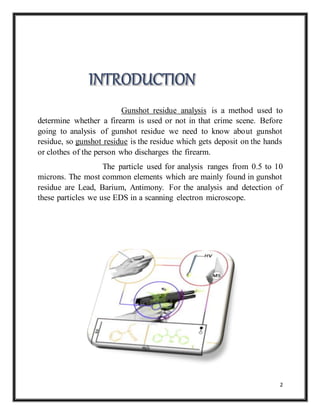
Gunshot residue analysis is a method used to
determine whether a firearm is used or not in that crime scene. Before
going to analysis of gunshot residue we need to know about gunshot
residue, so gunshot residue is the residue which gets deposit on the hands
or clothes of the person who discharges the firearm.
The particle used for analysis ranges from 0.5 to 10
microns. The most common elements which are mainly found in gunshot
residue are Lead, Barium, Antimony. For the analysis and detection of
these particles we use EDS in a scanning electron microscope.
3
Gunshot residue are the residue which
gets deposited on the hands or clothes of person who discharges the firearm.
These are the residues which get discharged by the projectile and cartridge
from the muzzle end and other openings of the firearm. Commonly seen
gunshot residues are primer, gunpowder residues as well as some metal
particles.
GSR is usually found on the skin and clothing of the person
who fired the gun. It may also be found in the entrance wound of the victim.
This depends on how close the victim was to the gun when it was fired.
Collection of gunshot residue: - As we know GSR can be found in
clothes as well as hand, it plays an important role in crime investigation. So,
it’s very important to collect GSR. In practice, GSR cannot be expected after
six hours from a living subject but it can last longer on clothing and deceased
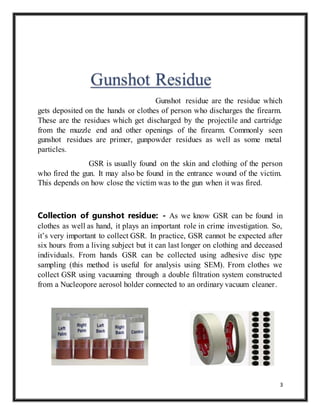
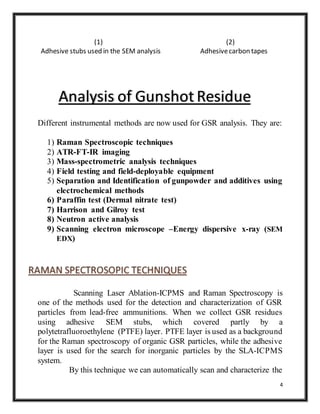
individuals. From hands GSR can be collected using adhesive disc type
sampling (this method is useful for analysis using SEM). From clothes we
collect GSR using vacuuming through a double filtration system constructed
from a Nucleopore aerosol holder connected to an ordinary vacuum cleaner.
4
(1) (2)
Adhesive stubs used in the SEM analysis Adhesivecarbon tapes
Different instrumental methods are now used for GSR analysis. They are:
1) Raman Spectroscopic techniques
2) ATR-FT-IR imaging
3) Mass-spectrometric analysis techniques
4) Field testing and field-deployable equipment
5) Separation and Identification of gunpowder and additives using
electrochemical methods
6) Paraffin test (Dermal nitrate test)
7) Harrison and Gilroy test
8) Neutron active analysis
9) Scanning electron microscope –Energy dispersive x-ray (SEM
EDX)
Scanning Laser Ablation-ICPMS and Raman Spectroscopy is
one of the methods used for the detection and characterization of GSR
particles from lead-free ammunitions. When we collect GSR residues
using adhesive SEM stubs, which covered partly by a
polytetrafluoroethylene (PTFE) layer. PTFE layer is used as a background
for the Raman spectroscopy of organic GSR particles, while the adhesive
layer is used for the search for inorganic particles by the SLA-ICPMS
system.
By this technique we can automatically scan and characterize the
Analysis of Gunshot Residue
5
composition of the inorganic GSR particles based on 20 elements
commonly found in leadfree GSR and compare this to cartridge
information in a case. Bueno and Lednev reported that by this advance
method it will be able to find GSR particles and classify them without
expert intervention.
Attenuated Total Reflectance (ATR) imaging and FT-IR spectroscopy
can be used for finding and characterizing GSR particles on a cloth
substrate. It is based on the principal that is total internal reflection where
infrared (IR) light and sample interact only at the point where IR light is
reflected. Both organic and inorganic GSR particles show a characteristic
vibrational fingerprint, allowing them to be identified on a sample.
This method helps in a larger collection of vibrational
fingerprint spectra and so to minimize the risks of false positive
assignments.
This technique is used for analysis of the lead-free and metal-free
primers. It is used to analyze the characteristic GSR particles - even from
different types of surfaces (e.g. wood, metal, plastic) after a secondary
transfer had been performed by touching them with contaminated fingers.
By analyzing correlation between Na+ and K+ ions, which are naturally
found in the excretion of sweat and with the elements of the characteristic
particles, it shows that the GSR particles were transferred to the surfaces
on the fingerprint ridges of the contaminating person. Finally, the
composition of the GSR particles could be confirmed by SEM/EDX
analysis of particles from the cartridge cases.
Mass-spectrometric analysis techniques
6
PDT method (Photo Dynamic Therapy) is used to visualize the presence
of Fe (II) on the hand palms of shooters in the crime scene. This method
is more used in children who come into contact with firearms in their
home and are sometimes involved in accidental or juvenile shootings. In
comparison with using this test in adults, the test tends to give better
results with the children, because of the elevated acidity of their sweat
when compared with that of adults.
Another field test is use of p-dmac as a presumptive color
test for nitroglycerin. It is a simple field test to analyze the nature of
unburned powder pellets which originates from single or double-based
powder. This can be confirmed by the confirmatory test like GC-MS in
the lab on twenty-five different brands of smokeless double-base
powders.
XCAT is a field testing for the screening of potential shooter
based on modified sodium rhodizonate test.
Electroanalytical device or ‘forensic finger’ consists of
two components: a screen-printed carbon electrode, worn on the index
finger cot of the glove, and a solid ionogel dot, cured onto the thumb cot
of the glove. By rubbing over a contaminated surface with the index
finger, the GSR particles present there will transfer to the electrode of the
Field testing and field-deployable equipment
7
glove. By subsequently pressing the index finger and thumb together the
ionogel dot and electrode will complete the electric circuit and a Square
Wave Voltammetric Scan can be performed there. As the electrochemical
analyzer is coupled to a notebook computer, the results can readily be
displayed on the screen. This technique can be used both on GSR (Pb, Sb
and Cu metals) and explosives residue (reduction of DNT nitro-groups)
without modification of the gloves’ sensor electrode. Square Wave
Voltammetry is a selective technique used to detect metals such as Pb, Sb
and Cu on a surface.
This technique is used to identify the shooter. The residues are
picked using paraffin wax cast and then they are treated with
diphenylamine dissolved in strong Sulphuric acid. The appearance of the
blue color indicates the presence of nitrates.
This technique is used to analyze the presence of antimony, lead
and barium in the GSR. For analyzing, take a cotton swab and dip it in
0.1N hydrochloric acid and apply on back of the shooter’s thumb, trigger
finger and the web of the palm. When 2-10 % of triphenyl methyl
arsonium, if orange color ring is formed, It shows the presence of the
antimony.
Then dry it and add rhodizonate solution, if the red color appears
it shows the presence of lead or barium. Then again dry it and add 1:20
HCL. If red color changes to blue it shows presence of lead and if red is
still in it, it shows the presence of barium.
Dermal Nitrate Test
Harrison and Gilroy Test
8
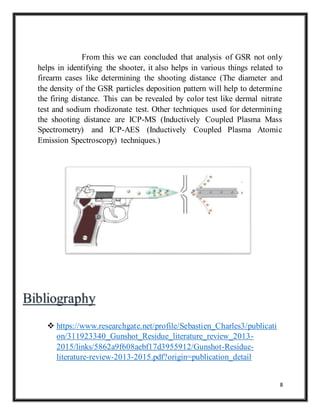
From this we can concluded that analysis of GSR not only
helps in identifying the shooter, it also helps in various things related to
firearm cases like determining the shooting distance (The diameter and
the density of the GSR particles deposition pattern will help to determine
the firing distance. This can be revealed by color test like dermal nitrate
test and sodium rhodizonate test. Other techniques used for determining
the shooting distance are ICP-MS (Inductively Coupled Plasma Mass
Spectrometry) and ICP-AES (Inductively Coupled Plasma Atomic
Emission Spectroscopy) techniques.)
 https://www.researchgate.net/profile/Sebastien_Charles3/publicati
on/311923340_Gunshot_Residue_literature_review_2013-
2015/links/5862a9f608aebf17d3955912/Gunshot-Residue-
literature-review-2013-2015.pdf?origin=publication_detail
9
 https://www.sciencedirect.com/science/article/pii/S037907381830
2330
 https://www.arcgis.com/apps/Cascade/index.html?appid=22d1e72e
7d5a43c8bd46e4bc49ef0049
 Chang KH, Jayaprakash PT, Yew CH, Abdullah AFL. Gunshot
residue analysis and its evidential values: a review. Australian
Journal of Forensic Sciences 2013
 Saverio Romolo F, Margot P. Identification of gunshot residue: a
critical review. Forensic Science International 2001

Introduction to gsr analysis

  • 1.
    1 By, Gopika Babu 1st Year MSc.Forensic science Lovely Professional University
  • 2.
    2 Gunshot residue analysisis a method used to determine whether a firearm is used or not in that crime scene. Before going to analysis of gunshot residue we need to know about gunshot residue, so gunshot residue is the residue which gets deposit on the hands or clothes of the person who discharges the firearm. The particle used for analysis ranges from 0.5 to 10 microns. The most common elements which are mainly found in gunshot residue are Lead, Barium, Antimony. For the analysis and detection of these particles we use EDS in a scanning electron microscope.
  • 3.
    3 Gunshot residue arethe residue which gets deposited on the hands or clothes of person who discharges the firearm. These are the residues which get discharged by the projectile and cartridge from the muzzle end and other openings of the firearm. Commonly seen gunshot residues are primer, gunpowder residues as well as some metal particles. GSR is usually found on the skin and clothing of the person who fired the gun. It may also be found in the entrance wound of the victim. This depends on how close the victim was to the gun when it was fired. Collection of gunshot residue: - As we know GSR can be found in clothes as well as hand, it plays an important role in crime investigation. So, it’s very important to collect GSR. In practice, GSR cannot be expected after six hours from a living subject but it can last longer on clothing and deceased individuals. From hands GSR can be collected using adhesive disc type sampling (this method is useful for analysis using SEM). From clothes we collect GSR using vacuuming through a double filtration system constructed from a Nucleopore aerosol holder connected to an ordinary vacuum cleaner.
  • 4.
    4 (1) (2) Adhesive stubsused in the SEM analysis Adhesivecarbon tapes Different instrumental methods are now used for GSR analysis. They are: 1) Raman Spectroscopic techniques 2) ATR-FT-IR imaging 3) Mass-spectrometric analysis techniques 4) Field testing and field-deployable equipment 5) Separation and Identification of gunpowder and additives using electrochemical methods 6) Paraffin test (Dermal nitrate test) 7) Harrison and Gilroy test 8) Neutron active analysis 9) Scanning electron microscope –Energy dispersive x-ray (SEM EDX) Scanning Laser Ablation-ICPMS and Raman Spectroscopy is one of the methods used for the detection and characterization of GSR particles from lead-free ammunitions. When we collect GSR residues using adhesive SEM stubs, which covered partly by a polytetrafluoroethylene (PTFE) layer. PTFE layer is used as a background for the Raman spectroscopy of organic GSR particles, while the adhesive layer is used for the search for inorganic particles by the SLA-ICPMS system. By this technique we can automatically scan and characterize the Analysis of Gunshot Residue
  • 5.
    5 composition of theinorganic GSR particles based on 20 elements commonly found in leadfree GSR and compare this to cartridge information in a case. Bueno and Lednev reported that by this advance method it will be able to find GSR particles and classify them without expert intervention. Attenuated Total Reflectance (ATR) imaging and FT-IR spectroscopy can be used for finding and characterizing GSR particles on a cloth substrate. It is based on the principal that is total internal reflection where infrared (IR) light and sample interact only at the point where IR light is reflected. Both organic and inorganic GSR particles show a characteristic vibrational fingerprint, allowing them to be identified on a sample. This method helps in a larger collection of vibrational fingerprint spectra and so to minimize the risks of false positive assignments. This technique is used for analysis of the lead-free and metal-free primers. It is used to analyze the characteristic GSR particles - even from different types of surfaces (e.g. wood, metal, plastic) after a secondary transfer had been performed by touching them with contaminated fingers. By analyzing correlation between Na+ and K+ ions, which are naturally found in the excretion of sweat and with the elements of the characteristic particles, it shows that the GSR particles were transferred to the surfaces on the fingerprint ridges of the contaminating person. Finally, the composition of the GSR particles could be confirmed by SEM/EDX analysis of particles from the cartridge cases. Mass-spectrometric analysis techniques
  • 6.
    6 PDT method (PhotoDynamic Therapy) is used to visualize the presence of Fe (II) on the hand palms of shooters in the crime scene. This method is more used in children who come into contact with firearms in their home and are sometimes involved in accidental or juvenile shootings. In comparison with using this test in adults, the test tends to give better results with the children, because of the elevated acidity of their sweat when compared with that of adults. Another field test is use of p-dmac as a presumptive color test for nitroglycerin. It is a simple field test to analyze the nature of unburned powder pellets which originates from single or double-based powder. This can be confirmed by the confirmatory test like GC-MS in the lab on twenty-five different brands of smokeless double-base powders. XCAT is a field testing for the screening of potential shooter based on modified sodium rhodizonate test. Electroanalytical device or ‘forensic finger’ consists of two components: a screen-printed carbon electrode, worn on the index finger cot of the glove, and a solid ionogel dot, cured onto the thumb cot of the glove. By rubbing over a contaminated surface with the index finger, the GSR particles present there will transfer to the electrode of the Field testing and field-deployable equipment
  • 7.
    7 glove. By subsequentlypressing the index finger and thumb together the ionogel dot and electrode will complete the electric circuit and a Square Wave Voltammetric Scan can be performed there. As the electrochemical analyzer is coupled to a notebook computer, the results can readily be displayed on the screen. This technique can be used both on GSR (Pb, Sb and Cu metals) and explosives residue (reduction of DNT nitro-groups) without modification of the gloves’ sensor electrode. Square Wave Voltammetry is a selective technique used to detect metals such as Pb, Sb and Cu on a surface. This technique is used to identify the shooter. The residues are picked using paraffin wax cast and then they are treated with diphenylamine dissolved in strong Sulphuric acid. The appearance of the blue color indicates the presence of nitrates. This technique is used to analyze the presence of antimony, lead and barium in the GSR. For analyzing, take a cotton swab and dip it in 0.1N hydrochloric acid and apply on back of the shooter’s thumb, trigger finger and the web of the palm. When 2-10 % of triphenyl methyl arsonium, if orange color ring is formed, It shows the presence of the antimony. Then dry it and add rhodizonate solution, if the red color appears it shows the presence of lead or barium. Then again dry it and add 1:20 HCL. If red color changes to blue it shows presence of lead and if red is still in it, it shows the presence of barium. Dermal Nitrate Test Harrison and Gilroy Test
  • 8.
    8 From this wecan concluded that analysis of GSR not only helps in identifying the shooter, it also helps in various things related to firearm cases like determining the shooting distance (The diameter and the density of the GSR particles deposition pattern will help to determine the firing distance. This can be revealed by color test like dermal nitrate test and sodium rhodizonate test. Other techniques used for determining the shooting distance are ICP-MS (Inductively Coupled Plasma Mass Spectrometry) and ICP-AES (Inductively Coupled Plasma Atomic Emission Spectroscopy) techniques.)  https://www.researchgate.net/profile/Sebastien_Charles3/publicati on/311923340_Gunshot_Residue_literature_review_2013- 2015/links/5862a9f608aebf17d3955912/Gunshot-Residue- literature-review-2013-2015.pdf?origin=publication_detail
  • 9.
    9  https://www.sciencedirect.com/science/article/pii/S037907381830 2330  https://www.arcgis.com/apps/Cascade/index.html?appid=22d1e72e 7d5a43c8bd46e4bc49ef0049 Chang KH, Jayaprakash PT, Yew CH, Abdullah AFL. Gunshot residue analysis and its evidential values: a review. Australian Journal of Forensic Sciences 2013  Saverio Romolo F, Margot P. Identification of gunshot residue: a critical review. Forensic Science International 2001