Introduction to
Forensic Ballistics
Prof. Nandini Katare
Assistant Professor
Department of Forensic Science
Kristu Jayanti College Bangalore
Email: nandini.psharma79@gmail.com
Contents
•Firearms: History, Classification, and Components
•Rifling: Definition, Purpose, Types, and Methods
•Trigger and Firing Mechanism
•Shotguns: Classification, Choking, and Bore Determination
•Identification of Origin
•Improvised Firearms
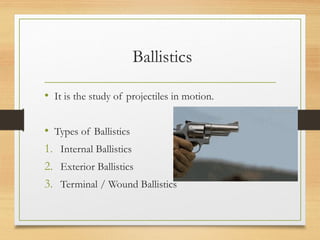
Ballistics
• It is the study of projectiles in motion.
• Types of Ballistics
1. Internal Ballistics
2. Exterior Ballistics
3. Terminal / Wound Ballistics
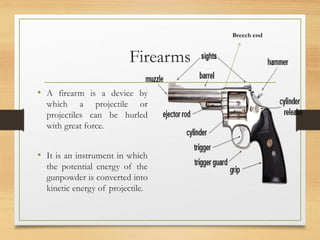
Firearms
• A firearm is a device by
which a projectile or
projectiles can be hurled
with great force.
• It is an instrument in which
the potential energy of the
gunpowder is converted into
kinetic energy of projectile.
Breech end
Contd…
• According to Indian Arms Act, a firearm means arm of
any description, designed or adopted to discharge a
projectile or projectiles of any kind by the action of
any explosive or other forms of energy and includes –
• Artillery, hand grenades, riot pistols or weapons of any
kind, designed or adopted for the discharge of any
noxious liquid, gas or other such things
Contd….
• Accessories for any such firearm designed or adapted
to diminish the noise or flash caused by firing
• Parts and machinery for manufacturing firearms and
cartridges, platforms and appliances for mounting,
transporting and servicing artillery.
Important Terminologies related
to Firearms
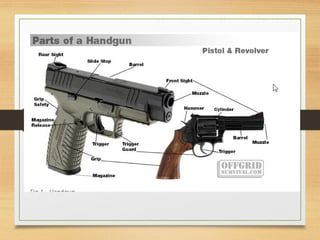
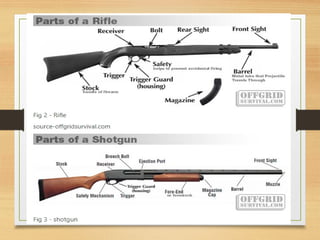
• Action-Moving Part
• Receiver-Frame containing moving parts
• Bolt-Blocks rear of the chamber (locking mechanism)
• Barrel-Long tube
• Extractor-ejects a cartridge case
• Ejector-withdraws the cartridge case from the chamber
• Firing pin- small rod of steel, with the end that strikes the primer rounded into a
hemispherical contour
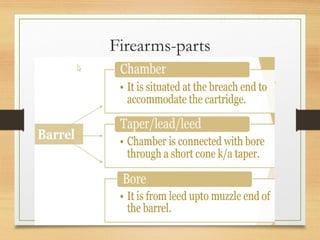
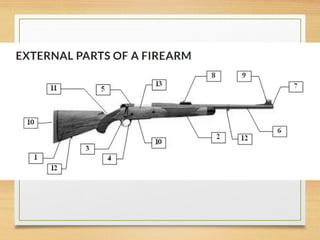
Firearms-parts
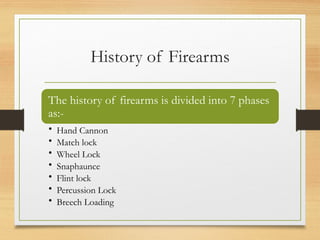
History of Firearms
The history of firearms is divided into 7 phases
as:-
• Hand Cannon
• Match lock
• Wheel Lock
• Snaphaunce
• Flint lock
• Percussion Lock
• Breech Loading
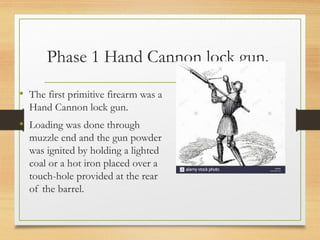
Phase 1 Hand Cannon lock gun.
• The first primitive firearm was a
Hand Cannon lock gun.
• Loading was done through
muzzle end and the gun powder
was ignited by holding a lighted
coal or a hot iron placed over a
touch-hole provided at the rear
of the barrel.
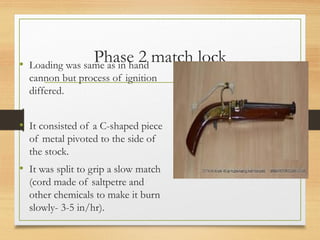
Phase 2 match lock
• Loading was same as in hand
cannon but process of ignition
differed.
• It consisted of a C-shaped piece
of metal pivoted to the side of
the stock.
• It was split to grip a slow match
(cord made of saltpetre and
other chemicals to make it burn
slowly- 3-5 in/hr).
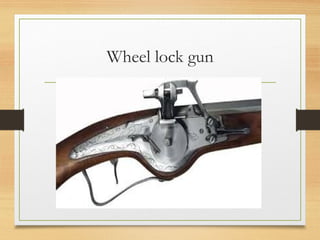
Phase 3 Wheel lock
• The principle of its working is similar to the lighter;
spin a serrated steel wheel against a flint to get off a
shower of sparks which ignite the priming mixture.
• True wheel lock principle involved the use of a steel
wheel with knurled or groove edge mounted on a
flame and connected
Wheel lock gun
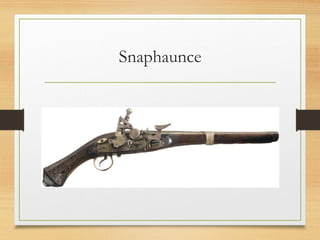
Phase 4 Snaphaunce
• Its an adaptation of old match lock ‘light snapping lock’ .
• In this system, a piece of pyrite is fastened in the jaws of the cock.
• On pulling the trigger, the cock is released and spring holes forces
it ahead.
• The pyrite strikes a glancing blow at the steel anvil and throws the
spark into priming mixture.
Snaphaunce
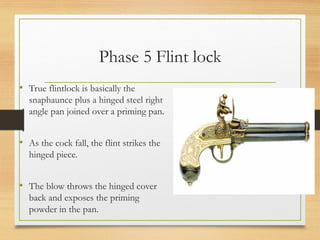
Phase 5 Flint lock
• True flintlock is basically the
snaphaunce plus a hinged steel right
angle pan joined over a priming pan.
• As the cock fall, the flint strikes the
hinged piece.
• The blow throws the hinged cover
back and exposes the priming
powder in the pan.
Contd…
• The flint lock marked the end of a period of mechanical
changes to furnish ignition for firearm use.
• The next stage of development was introduction of
percussion lock.
• This was the beginning of the chemistry age wherein the
concept of detonation eliminated the need for direct fire
through sparks.
Phase 6 percussion lock
• The system of the use of percussion lock to ignite the
propellant required the use of an explosive which would
detonate when struck by a sharp blow.
• In earlier time, the priming mixture was the fulminate of
Mercury.
• When the hammer fell, it struck the fulminate which in turn
exploded it.
Phase 7 Breech Loading
Loading of gun was from breech end instead
of muzzle end.
They require three things in its ammunition:
• They must have a fixed charge and bullet.
• The material of the cartridge shell should be made from a
metal ductile in nature.
• The primer must have been built in a mechanical anvil in
centre fires or in a folded head in rim fires .
Classification of firearms:
• Loading Characteristics
• Handling/ Size Characteristics
• Bore /Barrel Characteristics
It may be based on:
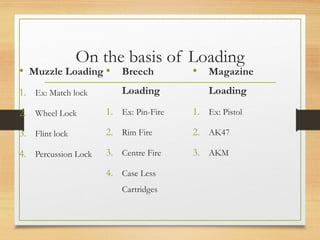
On the basis of Loading
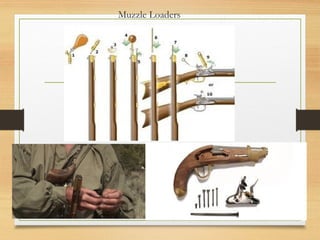
• Muzzle Loading
1. Ex: Match lock
2. Wheel Lock
3. Flint lock
4. Percussion Lock
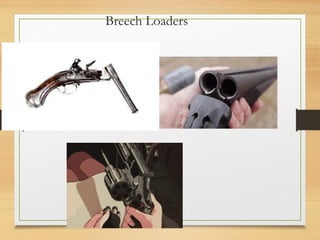
• Breech
Loading
1. Ex: Pin-Fire
2. Rim Fire
3. Centre Fire
4. Case Less
Cartridges
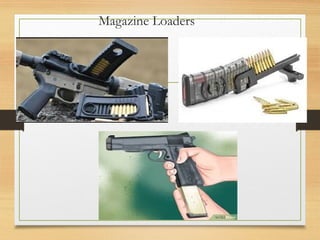
• Magazine
Loading
1. Ex: Pistol
2. AK47
3. AKM
Muzzle Loaders
Breech Loaders
Magazine Loaders
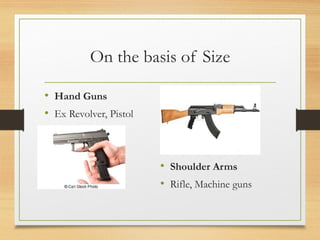
On the basis of Size
• Hand Guns
• Ex Revolver, Pistol
• Shoulder Arms
• Rifle, Machine guns
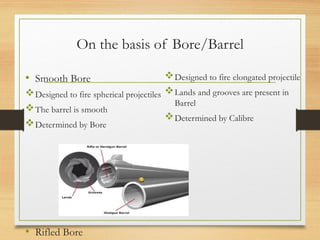
On the basis of Bore/Barrel
• Smooth Bore
Designed to fire spherical projectiles
The barrel is smooth
Determined by Bore
• Rifled Bore
Designed to fire elongated projectile
Lands and grooves are present in
Barrel
Determined by Calibre
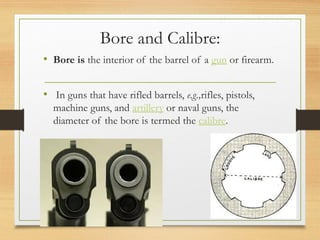
Bore and Calibre:
• Bore is the interior of the barrel of a gun or firearm.
• In guns that have rifled barrels, e.g.,rifles, pistols,
machine guns, and artillery or naval guns, the
diameter of the bore is termed the calibre.
Rifling
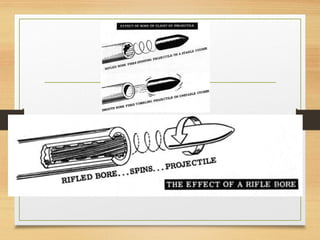
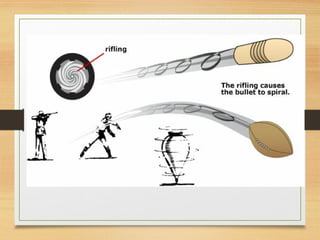
• Rifling refers to the spiral grooves that are machined or
formed into the internal surface of a gun barrel.
• These grooves cause the bullet or projectile to spin as it
is fired, improving its aerodynamic stability and accuracy.
• The lands are the raised portions between the grooves,
and together with the grooves, they constitute the rifling.
Purpose of Rifling:
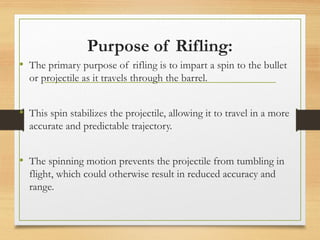
• The primary purpose of rifling is to impart a spin to the bullet
or projectile as it travels through the barrel.
• This spin stabilizes the projectile, allowing it to travel in a more
accurate and predictable trajectory.
• The spinning motion prevents the projectile from tumbling in
flight, which could otherwise result in reduced accuracy and
range.
What are the advantages of a
rifled bore?
• Rifle, firearm with a rifled bore—i.e., having shallow
spiral grooves cut inside the barrel to impart a spin to
the projectile, thus stabilizing it in flight.
• A rifled barrel imparts much greater accuracy to a
projectile, as compared with a smoothbore barrel.
Types of Rifling:
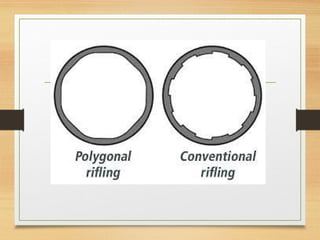
• Conventional Rifling:
• This is the most common form of rifling, consisting of a
series of equally spaced grooves cut into the barrel.
• Characteristics: The grooves and lands are symmetrical,
and the rifling is typically uniform along the barrel length.
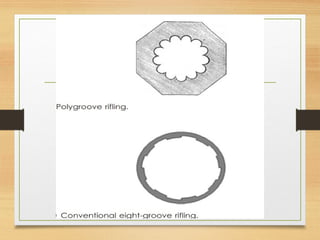
Polygonal Rifling:
• Instead of traditional grooves, polygonal rifling uses
a series of flat sides or polygons within the barrel.
• Characteristics: This type of rifling results in less
bullet deformation and a tighter gas seal, leading to
increased velocity and potentially longer barrel life.
Cont..
• The advantages of polygonal rifling include:
• • no sharp edges to wear;
• • no corners for fouling to build up;
• • less metal fouling on driving surfaces of the rifling and
• • lower friction between bullet and rifling resulting in
higher velocity.
Micro-Groove Rifling:
• Developed by Marlin Firearms, micro-groove rifling
features numerous shallow grooves.
• Characteristics: It is designed to reduce bullet
deformation and increase accuracy, particularly with
certain types of ammunition.
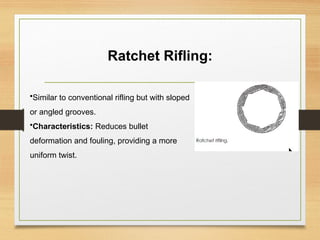
Ratchet Rifling:
•Similar to conventional rifling but with sloped
or angled grooves.
•Characteristics: Reduces bullet
deformation and fouling, providing a more
uniform twist.
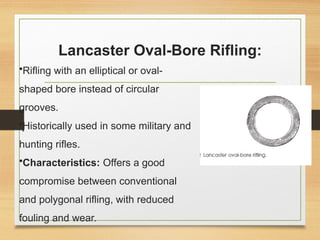
Lancaster Oval-Bore Rifling:
•Rifling with an elliptical or oval-
shaped bore instead of circular
grooves.
•Historically used in some military and
hunting rifles.
•Characteristics: Offers a good
compromise between conventional
and polygonal rifling, with reduced
fouling and wear.
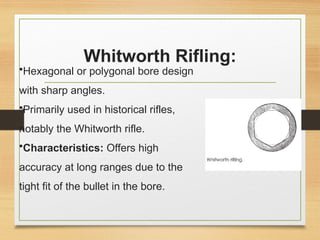
Whitworth Rifling:
•Hexagonal or polygonal bore design
with sharp angles.
•Primarily used in historical rifles,
notably the Whitworth rifle.
•Characteristics: Offers high
accuracy at long ranges due to the
tight fit of the bullet in the bore.
Methods of Rifling
• There are five barrel-rifling methods in general use:
• Cut (Hook and Scraper)
• Broach
• button
• hammer forging
• ECM (electrolytic cationic machining).
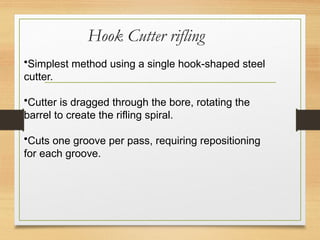
Hook Cutter rifling
•Simplest method using a single hook-shaped steel
cutter.
•Cutter is dragged through the bore, rotating the
barrel to create the rifling spiral.
•Cuts one groove per pass, requiring repositioning
for each groove.
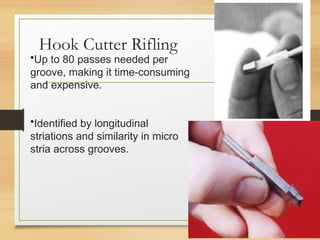
Hook Cutter Rifling
•Up to 80 passes needed per
groove, making it time-consuming
and expensive.
•Identified by longitudinal
striations and similarity in micro
stria across grooves.
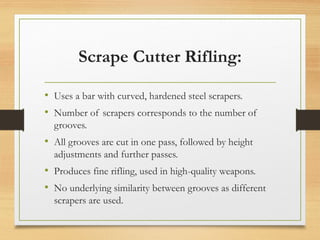
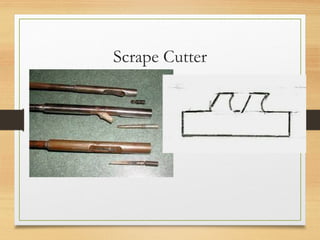
Scrape Cutter Rifling:
• Uses a bar with curved, hardened steel scrapers.
• Number of scrapers corresponds to the number of
grooves.
• All grooves are cut in one pass, followed by height
adjustments and further passes.
• Produces fine rifling, used in high-quality weapons.
• No underlying similarity between grooves as different
scrapers are used.
Scrape Cutter
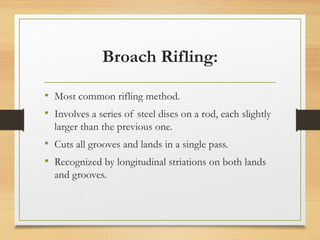
Broach Rifling:
• Most common rifling method.
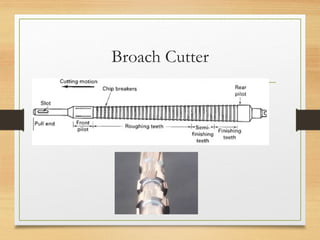
• Involves a series of steel discs on a rod, each slightly
larger than the previous one.
• Cuts all grooves and lands in a single pass.
• Recognized by longitudinal striations on both lands
and grooves.
Broach Cutter
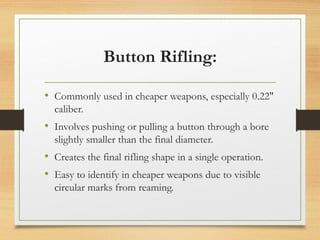
Button Rifling:
• Commonly used in cheaper weapons, especially 0.22″
caliber.
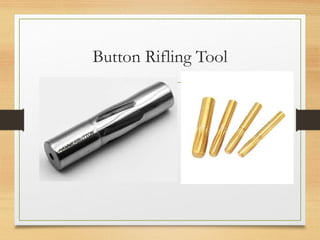
• Involves pushing or pulling a button through a bore
slightly smaller than the final diameter.
• Creates the final rifling shape in a single operation.
• Easy to identify in cheaper weapons due to visible
circular marks from reaming.
Button Rifling Tool
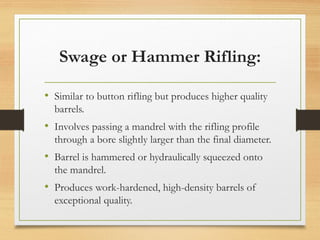
Swage or Hammer Rifling:
• Similar to button rifling but produces higher quality
barrels.
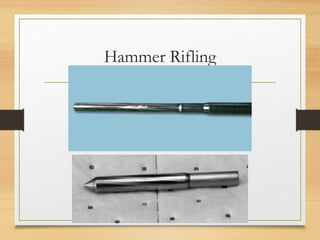
• Involves passing a mandrel with the rifling profile
through a bore slightly larger than the final diameter.
• Barrel is hammered or hydraulically squeezed onto
the mandrel.
• Produces work-hardened, high-density barrels of
exceptional quality.
Hammer Rifling
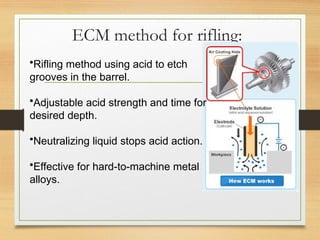
ECM method for rifling:
•Rifling method using acid to etch
grooves in the barrel.
•Adjustable acid strength and time for
desired depth.
•Neutralizing liquid stops acid action.
•Effective for hard-to-machine metal
alloys.
Cont..
Advantages:
Uses no cutters, no buttons and no mandrels.
Flexible system that can easily vary size and number of grooves
and twist rate.
Produces excellent bore finish.
Does not impose stress on the barrel.
Disadvantages:
Equipment is expensive.
Requires storage and handling of strong acids and neutralizers.
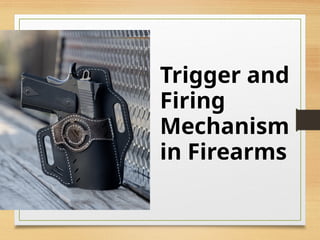
Trigger and
Firing
Mechanism
in Firearms
Firing Mechanism
• 1) Manual Mechanisms
• 2) Automatic Mechanisms
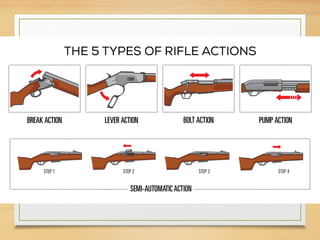
Bolt Action
• Bolt-action is a type of manual firearm
action that is operated by directly
manipulating the bolt via a bolt handle,
most commonly placed on the right-
hand side of the firearm (as most users
are right-handed)
Lever Action
• Lever Below the Trigger
In a lever-action mechanism, a lever is
positioned below the trigger that is used to
extract the spent cartridge and load a new
one.
• Pulling the Lever Forward
Pulling the lever forward extracts the fired
case and simultaneously cocks the action,
readying the firearm for the next shot.
• Pushing the Lever Back
Pushing the lever back chambers a new
round, loading the firearm with a fresh
cartridge and preparing it to be fired.
• Fast Rate of Fire
Lever-action firearms are known for their
fast rate of fire compared to bolt-action
designs, making them suitable for short- and
medium-range hunting in forests, scrub, or
bush land.
Slide Action (Pump Action)
Slide-action or Pump-
action Mechanism
use a movable fore-end (or
pump) to operate the action.
Pulling the fore-end back
extracts the spent cartridge
case and cocks the action,
while pushing it forward
chambers a new round.
Pump-action Shotguns
Pump-action shotguns are a
common example of this
slide-action mechanism. The
user pulls back the fore-stock
to open the chamber, eject
the empty case, and pick up
the next round from the
magazine, usually a tubular
magazine.
Mechanism Overview
The breech block is attached
to the movable fore-end via
operating rods. Pulling the
fore-end back releases the
mechanism locking the
breech block to the barrel,
allowing the action to cycle
and a new round to be
chambered.
• Barrel(s) are hinged and can be “broken open” to expose
the breech.
• When the barrels are closed back in place, the user turns
the lever in front of the trigger guard, which pushes a
projection into the slot, thereby keeping the barrels from
moving upwards.
• When the barrels are tilted upwards, the user can
remove the old cartridges, insert the new cartridges into
the barrels and then close and lock the mechanism.
BREAK ACTION
Automatic Mechanism
• Self-loading firearm that continuously
chambers and fires rounds when the trigger
mechanism is actuated.
• An automatic rifle fires repeatedly as long as
the trigger is held down, until the magazine is
exhausted. That fully automatic firing is
achieved by weapons such as the machine
gun and submachine gun.
Semi-automatic Firearm
• A semi-automatic firearm is a repeating firearm
whose action mechanism automatically loads a following
round of cartridge into the chamber and prepares it for
subsequent firing, but requires the shooter to manually
actuate the trigger in order to discharge each shot.
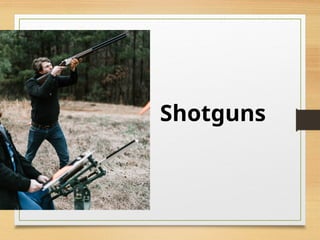
Shotguns
Classification of Shotguns
Action Type
• Shotguns are
classified by their
action type, which
refers to the
mechanism used to
load and fire the
gun.
• Common action
types include pump-
action, semi-
automatic, and
break-action.
Gauge
• The gauge of a
shotgun refers to
the diameter of the
barrel and the size of
the shells it can
accommodate.
• Common gauges
include 12-gauge,
20-gauge, and 410-
gauge.
Barrel Configuration
• Shotguns can have
different barrel
configurations,
such as single-
barrel, double-
barrel (over/under
or side-by-side),
and multi-barrel
designs.
Action Types
• Break-Action
Shotguns with a hinged design that
allows the breech to open, enabling
loading and unloading of individual
shells.
• Pump-Action
Shotguns that require the user to
manually cycle the action by
pumping the forend back and forth
to load a new shell and prepare the
gun for firing.
• Bolt-Action
Shotguns that require the user to
manually operate a bolt handle to
eject a spent shell and load a new
one from the magazine.
• Lever-Action
Shotguns that use a lever
mechanism, typically located
beneath the receiver, to cycle the
action and load a new shell.
• Semi-Automatic
Shotguns that automatically load a new shell from
the magazine and prepare the gun for the next shot
with each pull of the trigger, without the need for
manual cycling of the action.
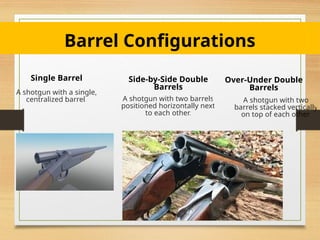
Barrel Configurations
Single Barrel
A shotgun with a single,
centralized barrel.
Side-by-Side Double
Barrels
A shotgun with two barrels
positioned horizontally next
to each other.
Over-Under Double
Barrels
A shotgun with two
barrels stacked vertically
on top of each other.
Shotgun Purposes
• Hunting
• Shotguns are commonly used for
hunting various game birds, small
mammals, and waterfowl due to
their wide spread and effective
range at close quarters.
• Sporting/Target
Shooting
• Shotguns are popular for recreational
and competitive shooting sports such as
clay target shooting (e.g., trap, skeet, and
sporting clays) due to their accuracy and
handling characteristics.
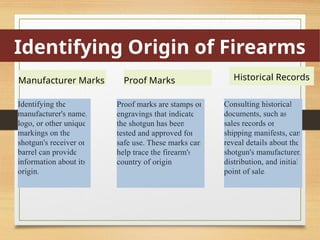
Identifying Origin of Firearms
Manufacturer Marks
Identifying the
manufacturer's name,
logo, or other unique
markings on the
shotgun's receiver or
barrel can provide
information about its
origin.
Proof Marks
Proof marks are stamps or
engravings that indicate
the shotgun has been
tested and approved for
safe use. These marks can
help trace the firearm's
country of origin.
Historical Records
Consulting historical
documents, such as
sales records or
shipping manifests, can
reveal details about the
shotgun's manufacturer,
distribution, and initial
point of sale.
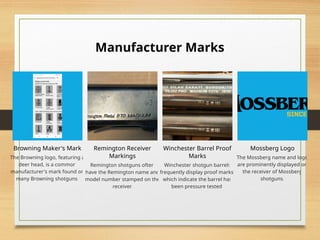
Manufacturer Marks
Browning Maker's Mark
The Browning logo, featuring a
deer head, is a common
manufacturer's mark found on
many Browning shotguns.
Remington Receiver
Markings
Remington shotguns often
have the Remington name and
model number stamped on the
receiver.
Winchester Barrel Proof
Marks
Winchester shotgun barrels
frequently display proof marks,
which indicate the barrel has
been pressure tested.
Mossberg Logo
The Mossberg name and logo
are prominently displayed on
the receiver of Mossberg
shotguns.
Proof Marks
Country of Origin
Proof marks indicate the country where
the shotgun was manufactured.
Safety Testing
Proof marks show that the shotgun has
undergone rigorous safety testing to
ensure it meets safety standards.
Caliber/Gauge
Proof marks may also indicate the
specific caliber or gauge of the
shotgun.
Proof marks are an important feature of shotguns that provide valuable
information about the firearm's origin and safety testing. Understanding
these markings can help ensure safe and responsible firearm ownership.
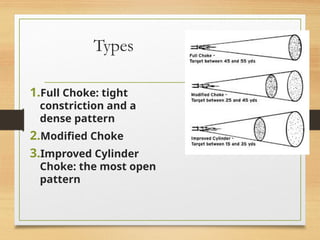
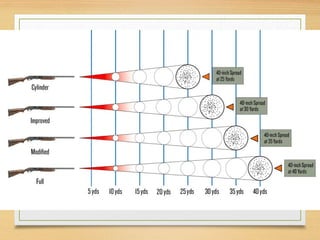
Choke
• A choke is a tapered constriction of a firearm barrel at
its muzzle end. Chokes are most commonly seen on
shotguns, but are also used on some rifles, pistols, or
even airguns.
Used to:
• shape the spread of the shot "cloud" or "string" to gain
better range and accuracy,
• deliver the optimum pattern of pellet density, for the
particular target
Types
1.Full Choke: tight
constriction and a
dense pattern
2.Modified Choke
3.Improved Cylinder
Choke: the most open
pattern
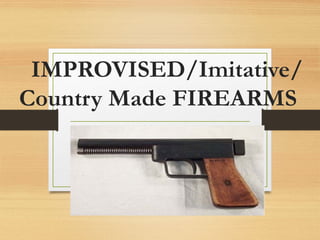
IMPROVISED/Imitative/
Country Made FIREARMS
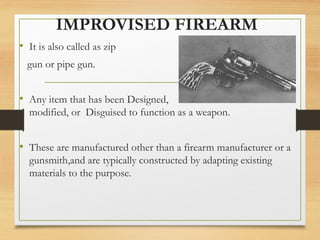
IMPROVISED FIREARM
• It is also called as zip
gun or pipe gun.
• Any item that has been Designed,
modified, or Disguised to function as a weapon.
• These are manufactured other than a firearm manufacturer or a
gunsmith,and are typically constructed by adapting existing
materials to the purpose.
TYPES OF IMPROVISED FIREARMS:
• Zip Guns
• Pen Guns
• Pipe Guns
• Concealed Bolt-guns
• Mobile Cellphone Gun
• Folding Gun
• Necklace Gun
• Tear Gas Gun
• Pocket Gun
• Cigarette Packet Gun
• Briefcase Gun
• Double-barrel Keychain Gun
• Real “Colorized” Handgun , Etc.
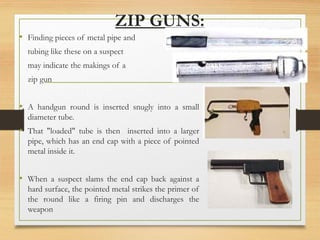
ZIP GUNS:
• Finding pieces of metal pipe and
tubing like these on a suspect
may indicate the makings of a
zip gun
• A handgun round is inserted snugly into a small
diameter tube.
• That "loaded" tube is then inserted into a larger
pipe, which has an end cap with a piece of pointed
metal inside it.
• When a suspect slams the end cap back against a
hard surface, the pointed metal strikes the primer of
the round like a firing pin and discharges the
weapon
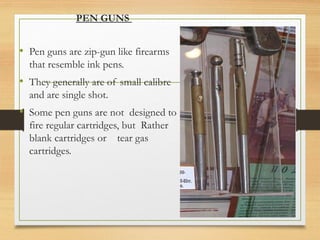
PEN GUNS
• Pen guns are zip-gun like firearms
that resemble ink pens.
• They generally are of small calibre
and are single shot.
• Some pen guns are not designed to
fire regular cartridges, but Rather
blank cartridges or tear gas
cartridges.
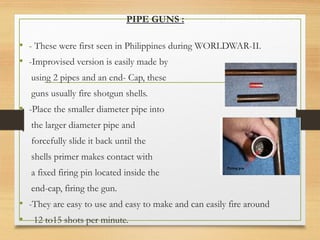
PIPE GUNS :
• - These were first seen in Philippines during WORLDWAR-II.
• -Improvised version is easily made by
using 2 pipes and an end- Cap, these
guns usually fire shotgun shells.
• -Place the smaller diameter pipe into
the larger diameter pipe and
forcefully slide it back until the
shells primer makes contact with
a fixed firing pin located inside the
end-cap, firing the gun.
• -They are easy to use and easy to make and can easily fire around
• 12 to15 shots per minute.
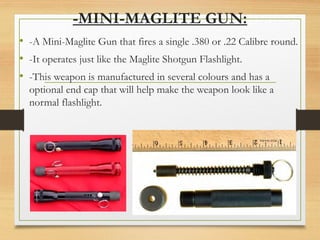
-MINI-MAGLITE GUN:
• -A Mini-Maglite Gun that fires a single .380 or .22 Calibre round.
• -It operates just like the Maglite Shotgun Flashlight.
• -This weapon is manufactured in several colours and has a
optional end cap that will help make the weapon look like a
normal flashlight.
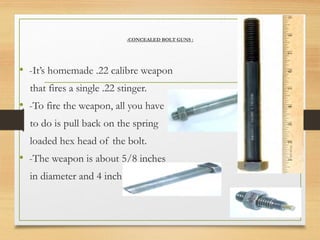
-CONCEALED BOLT GUNS :
• -It’s homemade .22 calibre weapon
that fires a single .22 stinger.
• -To fire the weapon, all you have
to do is pull back on the spring
loaded hex head of the bolt.
• -The weapon is about 5/8 inches
in diameter and 4 inch long.
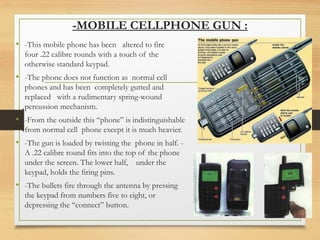
-MOBILE CELLPHONE GUN :
• -This mobile phone has been altered to fire
four .22 calibre rounds with a touch of the
otherwise standard keypad.
• -The phone does not function as normal cell
phones and has been completely gutted and
replaced with a rudimentary spring-wound
percussion mechanism.
• -From the outside this “phone” is indistinguishable
from normal cell phone except it is much heavier.
• -The gun is loaded by twisting the phone in half. -
A .22 calibre round fits into the top of the phone
under the screen. The lower half, under the
keypad, holds the firing pins.
• -The bullets fire through the antenna by pressing
the keypad from numbers five to eight, or
depressing the “connect” button.
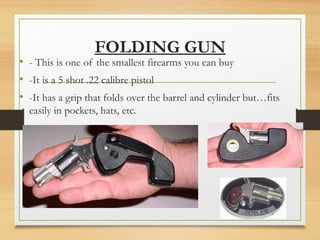
FOLDING GUN
• - This is one of the smallest firearms you can buy
• -It is a 5 shot .22 calibre pistol
• -It has a grip that folds over the barrel and cylinder but…fits
easily in pockets, hats, etc.
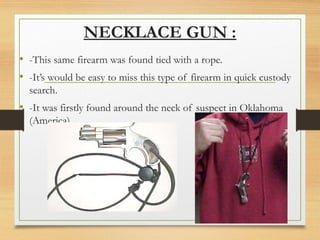
NECKLACE GUN :
• -This same firearm was found tied with a rope.
• -It’s would be easy to miss this type of firearm in quick custody
search.
• -It was firstly found around the neck of suspect in Oklahoma
(America).
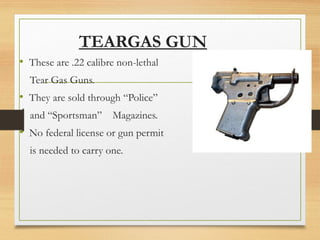
TEARGAS GUN
• These are .22 calibre non-lethal
Tear Gas Guns.
• They are sold through “Police”
and “Sportsman” Magazines.
• No federal license or gun permit
is needed to carry one.
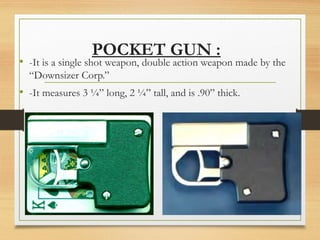
POCKET GUN :
• -It is a single shot weapon, double action weapon made by the
“Downsizer Corp.”
• -It measures 3 ¼” long, 2 ¼” tall, and is .90” thick.
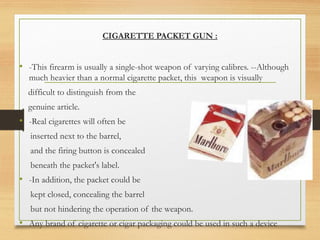
CIGARETTE PACKET GUN :
• -This firearm is usually a single-shot weapon of varying calibres. --Although
much heavier than a normal cigarette packet, this weapon is visually
difficult to distinguish from the
genuine article.
• -Real cigarettes will often be
inserted next to the barrel,
and the firing button is concealed
beneath the packet's label.
• -In addition, the packet could be
kept closed, concealing the barrel
but not hindering the operation of the weapon.
• Any brand of cigarette or cigar packaging could be used in such a device
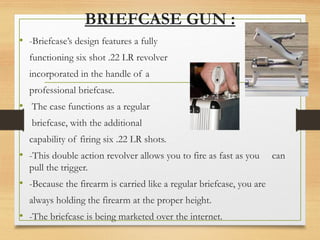
BRIEFCASE GUN :
• -Briefcase’s design features a fully
functioning six shot .22 LR revolver
incorporated in the handle of a
professional briefcase.
• The case functions as a regular
briefcase, with the additional
capability of firing six .22 LR shots.
• -This double action revolver allows you to fire as fast as you can
pull the trigger.
• -Because the firearm is carried like a regular briefcase, you are
always holding the firearm at the proper height.
• -The briefcase is being marketed over the internet.
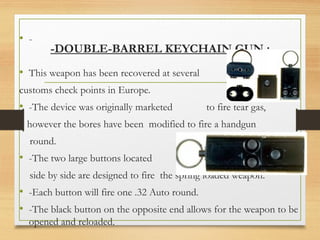
-DOUBLE-BARREL KEYCHAIN GUN :
• -
• This weapon has been recovered at several
customs check points in Europe.
• -The device was originally marketed to fire tear gas,
however the bores have been modified to fire a handgun
round.
• -The two large buttons located
side by side are designed to fire the spring loaded weapon.
• -Each button will fire one .32 Auto round.
• -The black button on the opposite end allows for the weapon to be
opened and reloaded.
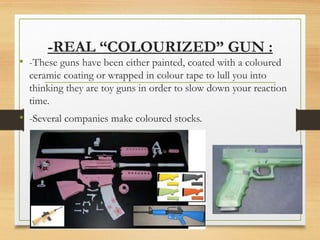
-REAL “COLOURIZED” GUN :
• -These guns have been either painted, coated with a coloured
ceramic coating or wrapped in colour tape to lull you into
thinking they are toy guns in order to slow down your reaction
time.
• -Several companies make coloured stocks.
DRAWBACKS OF USING
IMPROVISED FIREARMS :
• Path: Bullet may deviate from its path because of
improper assembly of parts of firearms.
• Range: Before reaching target the bullet may fall down
because defect in barrel or muzzle.
• Direction: Using improper materials, sometimes
firearm may backfire i.e. get fired in wrong direction.
References
•Handbook of Forensic Ballistics by Brain J Heard
•https://www.hunter-ed.com/national/studyGuide/Animation-Parts-
of-a-Pump-Action-Shotgun/201099_92798/
;
•https://offgridsurvival.com/basicpartsofagun/
Introduction to Forensic Ballistics.pptx

Introduction to Forensic Ballistics.pptx

  • 1.
    Introduction to Forensic Ballistics Prof.Nandini Katare Assistant Professor Department of Forensic Science Kristu Jayanti College Bangalore Email: nandini.psharma79@gmail.com
  • 2.
    Contents •Firearms: History, Classification,and Components •Rifling: Definition, Purpose, Types, and Methods •Trigger and Firing Mechanism •Shotguns: Classification, Choking, and Bore Determination •Identification of Origin •Improvised Firearms
  • 3.
    Ballistics • It isthe study of projectiles in motion. • Types of Ballistics 1. Internal Ballistics 2. Exterior Ballistics 3. Terminal / Wound Ballistics
  • 4.
    Firearms • A firearmis a device by which a projectile or projectiles can be hurled with great force. • It is an instrument in which the potential energy of the gunpowder is converted into kinetic energy of projectile. Breech end
  • 5.
    Contd… • According toIndian Arms Act, a firearm means arm of any description, designed or adopted to discharge a projectile or projectiles of any kind by the action of any explosive or other forms of energy and includes – • Artillery, hand grenades, riot pistols or weapons of any kind, designed or adopted for the discharge of any noxious liquid, gas or other such things
  • 6.
    Contd…. • Accessories forany such firearm designed or adapted to diminish the noise or flash caused by firing • Parts and machinery for manufacturing firearms and cartridges, platforms and appliances for mounting, transporting and servicing artillery.
  • 7.
    Important Terminologies related toFirearms • Action-Moving Part • Receiver-Frame containing moving parts • Bolt-Blocks rear of the chamber (locking mechanism) • Barrel-Long tube • Extractor-ejects a cartridge case • Ejector-withdraws the cartridge case from the chamber • Firing pin- small rod of steel, with the end that strikes the primer rounded into a hemispherical contour
  • 8.
  • 12.
    History of Firearms Thehistory of firearms is divided into 7 phases as:- • Hand Cannon • Match lock • Wheel Lock • Snaphaunce • Flint lock • Percussion Lock • Breech Loading
  • 13.
    Phase 1 HandCannon lock gun. • The first primitive firearm was a Hand Cannon lock gun. • Loading was done through muzzle end and the gun powder was ignited by holding a lighted coal or a hot iron placed over a touch-hole provided at the rear of the barrel.
  • 14.
    Phase 2 matchlock • Loading was same as in hand cannon but process of ignition differed. • It consisted of a C-shaped piece of metal pivoted to the side of the stock. • It was split to grip a slow match (cord made of saltpetre and other chemicals to make it burn slowly- 3-5 in/hr).
  • 15.
    Phase 3 Wheellock • The principle of its working is similar to the lighter; spin a serrated steel wheel against a flint to get off a shower of sparks which ignite the priming mixture. • True wheel lock principle involved the use of a steel wheel with knurled or groove edge mounted on a flame and connected
  • 16.
  • 17.
    Phase 4 Snaphaunce •Its an adaptation of old match lock ‘light snapping lock’ . • In this system, a piece of pyrite is fastened in the jaws of the cock. • On pulling the trigger, the cock is released and spring holes forces it ahead. • The pyrite strikes a glancing blow at the steel anvil and throws the spark into priming mixture.
  • 18.
  • 19.
    Phase 5 Flintlock • True flintlock is basically the snaphaunce plus a hinged steel right angle pan joined over a priming pan. • As the cock fall, the flint strikes the hinged piece. • The blow throws the hinged cover back and exposes the priming powder in the pan.
  • 20.
    Contd… • The flintlock marked the end of a period of mechanical changes to furnish ignition for firearm use. • The next stage of development was introduction of percussion lock. • This was the beginning of the chemistry age wherein the concept of detonation eliminated the need for direct fire through sparks.
  • 21.
    Phase 6 percussionlock • The system of the use of percussion lock to ignite the propellant required the use of an explosive which would detonate when struck by a sharp blow. • In earlier time, the priming mixture was the fulminate of Mercury. • When the hammer fell, it struck the fulminate which in turn exploded it.
  • 22.
    Phase 7 BreechLoading Loading of gun was from breech end instead of muzzle end. They require three things in its ammunition: • They must have a fixed charge and bullet. • The material of the cartridge shell should be made from a metal ductile in nature. • The primer must have been built in a mechanical anvil in centre fires or in a folded head in rim fires .
  • 23.
  • 24.
    Classification of firearms: •Loading Characteristics • Handling/ Size Characteristics • Bore /Barrel Characteristics It may be based on:
  • 25.
    On the basisof Loading • Muzzle Loading 1. Ex: Match lock 2. Wheel Lock 3. Flint lock 4. Percussion Lock • Breech Loading 1. Ex: Pin-Fire 2. Rim Fire 3. Centre Fire 4. Case Less Cartridges • Magazine Loading 1. Ex: Pistol 2. AK47 3. AKM
  • 26.
  • 27.
  • 28.
  • 29.
    On the basisof Size • Hand Guns • Ex Revolver, Pistol • Shoulder Arms • Rifle, Machine guns
  • 30.
    On the basisof Bore/Barrel • Smooth Bore Designed to fire spherical projectiles The barrel is smooth Determined by Bore • Rifled Bore Designed to fire elongated projectile Lands and grooves are present in Barrel Determined by Calibre
  • 31.
    Bore and Calibre: •Bore is the interior of the barrel of a gun or firearm. • In guns that have rifled barrels, e.g.,rifles, pistols, machine guns, and artillery or naval guns, the diameter of the bore is termed the calibre.
  • 32.
    Rifling • Rifling refersto the spiral grooves that are machined or formed into the internal surface of a gun barrel. • These grooves cause the bullet or projectile to spin as it is fired, improving its aerodynamic stability and accuracy. • The lands are the raised portions between the grooves, and together with the grooves, they constitute the rifling.
  • 35.
    Purpose of Rifling: •The primary purpose of rifling is to impart a spin to the bullet or projectile as it travels through the barrel. • This spin stabilizes the projectile, allowing it to travel in a more accurate and predictable trajectory. • The spinning motion prevents the projectile from tumbling in flight, which could otherwise result in reduced accuracy and range.
  • 36.
    What are theadvantages of a rifled bore? • Rifle, firearm with a rifled bore—i.e., having shallow spiral grooves cut inside the barrel to impart a spin to the projectile, thus stabilizing it in flight. • A rifled barrel imparts much greater accuracy to a projectile, as compared with a smoothbore barrel.
  • 37.
    Types of Rifling: •Conventional Rifling: • This is the most common form of rifling, consisting of a series of equally spaced grooves cut into the barrel. • Characteristics: The grooves and lands are symmetrical, and the rifling is typically uniform along the barrel length.
  • 38.
    Polygonal Rifling: • Insteadof traditional grooves, polygonal rifling uses a series of flat sides or polygons within the barrel. • Characteristics: This type of rifling results in less bullet deformation and a tighter gas seal, leading to increased velocity and potentially longer barrel life.
  • 39.
    Cont.. • The advantagesof polygonal rifling include: • • no sharp edges to wear; • • no corners for fouling to build up; • • less metal fouling on driving surfaces of the rifling and • • lower friction between bullet and rifling resulting in higher velocity.
  • 41.
    Micro-Groove Rifling: • Developedby Marlin Firearms, micro-groove rifling features numerous shallow grooves. • Characteristics: It is designed to reduce bullet deformation and increase accuracy, particularly with certain types of ammunition.
  • 43.
    Ratchet Rifling: •Similar toconventional rifling but with sloped or angled grooves. •Characteristics: Reduces bullet deformation and fouling, providing a more uniform twist.
  • 44.
    Lancaster Oval-Bore Rifling: •Riflingwith an elliptical or oval- shaped bore instead of circular grooves. •Historically used in some military and hunting rifles. •Characteristics: Offers a good compromise between conventional and polygonal rifling, with reduced fouling and wear.
  • 45.
    Whitworth Rifling: •Hexagonal orpolygonal bore design with sharp angles. •Primarily used in historical rifles, notably the Whitworth rifle. •Characteristics: Offers high accuracy at long ranges due to the tight fit of the bullet in the bore.
  • 46.
    Methods of Rifling •There are five barrel-rifling methods in general use: • Cut (Hook and Scraper) • Broach • button • hammer forging • ECM (electrolytic cationic machining).
  • 47.
    Hook Cutter rifling •Simplestmethod using a single hook-shaped steel cutter. •Cutter is dragged through the bore, rotating the barrel to create the rifling spiral. •Cuts one groove per pass, requiring repositioning for each groove.
  • 48.
    Hook Cutter Rifling •Upto 80 passes needed per groove, making it time-consuming and expensive. •Identified by longitudinal striations and similarity in micro stria across grooves.
  • 49.
    Scrape Cutter Rifling: •Uses a bar with curved, hardened steel scrapers. • Number of scrapers corresponds to the number of grooves. • All grooves are cut in one pass, followed by height adjustments and further passes. • Produces fine rifling, used in high-quality weapons. • No underlying similarity between grooves as different scrapers are used.
  • 50.
  • 51.
    Broach Rifling: • Mostcommon rifling method. • Involves a series of steel discs on a rod, each slightly larger than the previous one. • Cuts all grooves and lands in a single pass. • Recognized by longitudinal striations on both lands and grooves.
  • 52.
  • 53.
    Button Rifling: • Commonlyused in cheaper weapons, especially 0.22″ caliber. • Involves pushing or pulling a button through a bore slightly smaller than the final diameter. • Creates the final rifling shape in a single operation. • Easy to identify in cheaper weapons due to visible circular marks from reaming.
  • 54.
  • 55.
    Swage or HammerRifling: • Similar to button rifling but produces higher quality barrels. • Involves passing a mandrel with the rifling profile through a bore slightly larger than the final diameter. • Barrel is hammered or hydraulically squeezed onto the mandrel. • Produces work-hardened, high-density barrels of exceptional quality.
  • 56.
  • 57.
    ECM method forrifling: •Rifling method using acid to etch grooves in the barrel. •Adjustable acid strength and time for desired depth. •Neutralizing liquid stops acid action. •Effective for hard-to-machine metal alloys.
  • 58.
    Cont.. Advantages: Uses no cutters,no buttons and no mandrels. Flexible system that can easily vary size and number of grooves and twist rate. Produces excellent bore finish. Does not impose stress on the barrel. Disadvantages: Equipment is expensive. Requires storage and handling of strong acids and neutralizers.
  • 59.
  • 60.
    Firing Mechanism • 1)Manual Mechanisms • 2) Automatic Mechanisms
  • 62.
    Bolt Action • Bolt-actionis a type of manual firearm action that is operated by directly manipulating the bolt via a bolt handle, most commonly placed on the right- hand side of the firearm (as most users are right-handed)
  • 63.
    Lever Action • LeverBelow the Trigger In a lever-action mechanism, a lever is positioned below the trigger that is used to extract the spent cartridge and load a new one. • Pulling the Lever Forward Pulling the lever forward extracts the fired case and simultaneously cocks the action, readying the firearm for the next shot. • Pushing the Lever Back Pushing the lever back chambers a new round, loading the firearm with a fresh cartridge and preparing it to be fired. • Fast Rate of Fire Lever-action firearms are known for their fast rate of fire compared to bolt-action designs, making them suitable for short- and medium-range hunting in forests, scrub, or bush land.
  • 64.
    Slide Action (PumpAction) Slide-action or Pump- action Mechanism use a movable fore-end (or pump) to operate the action. Pulling the fore-end back extracts the spent cartridge case and cocks the action, while pushing it forward chambers a new round. Pump-action Shotguns Pump-action shotguns are a common example of this slide-action mechanism. The user pulls back the fore-stock to open the chamber, eject the empty case, and pick up the next round from the magazine, usually a tubular magazine. Mechanism Overview The breech block is attached to the movable fore-end via operating rods. Pulling the fore-end back releases the mechanism locking the breech block to the barrel, allowing the action to cycle and a new round to be chambered.
  • 65.
    • Barrel(s) arehinged and can be “broken open” to expose the breech. • When the barrels are closed back in place, the user turns the lever in front of the trigger guard, which pushes a projection into the slot, thereby keeping the barrels from moving upwards. • When the barrels are tilted upwards, the user can remove the old cartridges, insert the new cartridges into the barrels and then close and lock the mechanism. BREAK ACTION
  • 66.
    Automatic Mechanism • Self-loadingfirearm that continuously chambers and fires rounds when the trigger mechanism is actuated. • An automatic rifle fires repeatedly as long as the trigger is held down, until the magazine is exhausted. That fully automatic firing is achieved by weapons such as the machine gun and submachine gun.
  • 67.
    Semi-automatic Firearm • Asemi-automatic firearm is a repeating firearm whose action mechanism automatically loads a following round of cartridge into the chamber and prepares it for subsequent firing, but requires the shooter to manually actuate the trigger in order to discharge each shot.
  • 68.
  • 69.
    Classification of Shotguns ActionType • Shotguns are classified by their action type, which refers to the mechanism used to load and fire the gun. • Common action types include pump- action, semi- automatic, and break-action. Gauge • The gauge of a shotgun refers to the diameter of the barrel and the size of the shells it can accommodate. • Common gauges include 12-gauge, 20-gauge, and 410- gauge. Barrel Configuration • Shotguns can have different barrel configurations, such as single- barrel, double- barrel (over/under or side-by-side), and multi-barrel designs.
  • 70.
    Action Types • Break-Action Shotgunswith a hinged design that allows the breech to open, enabling loading and unloading of individual shells. • Pump-Action Shotguns that require the user to manually cycle the action by pumping the forend back and forth to load a new shell and prepare the gun for firing. • Bolt-Action Shotguns that require the user to manually operate a bolt handle to eject a spent shell and load a new one from the magazine. • Lever-Action Shotguns that use a lever mechanism, typically located beneath the receiver, to cycle the action and load a new shell. • Semi-Automatic Shotguns that automatically load a new shell from the magazine and prepare the gun for the next shot with each pull of the trigger, without the need for manual cycling of the action.
  • 71.
    Barrel Configurations Single Barrel Ashotgun with a single, centralized barrel. Side-by-Side Double Barrels A shotgun with two barrels positioned horizontally next to each other. Over-Under Double Barrels A shotgun with two barrels stacked vertically on top of each other.
  • 72.
    Shotgun Purposes • Hunting •Shotguns are commonly used for hunting various game birds, small mammals, and waterfowl due to their wide spread and effective range at close quarters. • Sporting/Target Shooting • Shotguns are popular for recreational and competitive shooting sports such as clay target shooting (e.g., trap, skeet, and sporting clays) due to their accuracy and handling characteristics.
  • 73.
    Identifying Origin ofFirearms Manufacturer Marks Identifying the manufacturer's name, logo, or other unique markings on the shotgun's receiver or barrel can provide information about its origin. Proof Marks Proof marks are stamps or engravings that indicate the shotgun has been tested and approved for safe use. These marks can help trace the firearm's country of origin. Historical Records Consulting historical documents, such as sales records or shipping manifests, can reveal details about the shotgun's manufacturer, distribution, and initial point of sale.
  • 74.
    Manufacturer Marks Browning Maker'sMark The Browning logo, featuring a deer head, is a common manufacturer's mark found on many Browning shotguns. Remington Receiver Markings Remington shotguns often have the Remington name and model number stamped on the receiver. Winchester Barrel Proof Marks Winchester shotgun barrels frequently display proof marks, which indicate the barrel has been pressure tested. Mossberg Logo The Mossberg name and logo are prominently displayed on the receiver of Mossberg shotguns.
  • 75.
    Proof Marks Country ofOrigin Proof marks indicate the country where the shotgun was manufactured. Safety Testing Proof marks show that the shotgun has undergone rigorous safety testing to ensure it meets safety standards. Caliber/Gauge Proof marks may also indicate the specific caliber or gauge of the shotgun. Proof marks are an important feature of shotguns that provide valuable information about the firearm's origin and safety testing. Understanding these markings can help ensure safe and responsible firearm ownership.
  • 76.
    Choke • A chokeis a tapered constriction of a firearm barrel at its muzzle end. Chokes are most commonly seen on shotguns, but are also used on some rifles, pistols, or even airguns. Used to: • shape the spread of the shot "cloud" or "string" to gain better range and accuracy, • deliver the optimum pattern of pellet density, for the particular target
  • 77.
    Types 1.Full Choke: tight constrictionand a dense pattern 2.Modified Choke 3.Improved Cylinder Choke: the most open pattern
  • 79.
  • 80.
    IMPROVISED FIREARM • Itis also called as zip gun or pipe gun. • Any item that has been Designed, modified, or Disguised to function as a weapon. • These are manufactured other than a firearm manufacturer or a gunsmith,and are typically constructed by adapting existing materials to the purpose.
  • 81.
    TYPES OF IMPROVISEDFIREARMS: • Zip Guns • Pen Guns • Pipe Guns • Concealed Bolt-guns • Mobile Cellphone Gun • Folding Gun • Necklace Gun • Tear Gas Gun • Pocket Gun • Cigarette Packet Gun • Briefcase Gun • Double-barrel Keychain Gun • Real “Colorized” Handgun , Etc.
  • 82.
    ZIP GUNS: • Findingpieces of metal pipe and tubing like these on a suspect may indicate the makings of a zip gun • A handgun round is inserted snugly into a small diameter tube. • That "loaded" tube is then inserted into a larger pipe, which has an end cap with a piece of pointed metal inside it. • When a suspect slams the end cap back against a hard surface, the pointed metal strikes the primer of the round like a firing pin and discharges the weapon
  • 83.
    PEN GUNS • Penguns are zip-gun like firearms that resemble ink pens. • They generally are of small calibre and are single shot. • Some pen guns are not designed to fire regular cartridges, but Rather blank cartridges or tear gas cartridges.
  • 84.
    PIPE GUNS : •- These were first seen in Philippines during WORLDWAR-II. • -Improvised version is easily made by using 2 pipes and an end- Cap, these guns usually fire shotgun shells. • -Place the smaller diameter pipe into the larger diameter pipe and forcefully slide it back until the shells primer makes contact with a fixed firing pin located inside the end-cap, firing the gun. • -They are easy to use and easy to make and can easily fire around • 12 to15 shots per minute.
  • 85.
    -MINI-MAGLITE GUN: • -AMini-Maglite Gun that fires a single .380 or .22 Calibre round. • -It operates just like the Maglite Shotgun Flashlight. • -This weapon is manufactured in several colours and has a optional end cap that will help make the weapon look like a normal flashlight.
  • 86.
    -CONCEALED BOLT GUNS: • -It’s homemade .22 calibre weapon that fires a single .22 stinger. • -To fire the weapon, all you have to do is pull back on the spring loaded hex head of the bolt. • -The weapon is about 5/8 inches in diameter and 4 inch long.
  • 87.
    -MOBILE CELLPHONE GUN: • -This mobile phone has been altered to fire four .22 calibre rounds with a touch of the otherwise standard keypad. • -The phone does not function as normal cell phones and has been completely gutted and replaced with a rudimentary spring-wound percussion mechanism. • -From the outside this “phone” is indistinguishable from normal cell phone except it is much heavier. • -The gun is loaded by twisting the phone in half. - A .22 calibre round fits into the top of the phone under the screen. The lower half, under the keypad, holds the firing pins. • -The bullets fire through the antenna by pressing the keypad from numbers five to eight, or depressing the “connect” button.
  • 88.
    FOLDING GUN • -This is one of the smallest firearms you can buy • -It is a 5 shot .22 calibre pistol • -It has a grip that folds over the barrel and cylinder but…fits easily in pockets, hats, etc.
  • 89.
    NECKLACE GUN : •-This same firearm was found tied with a rope. • -It’s would be easy to miss this type of firearm in quick custody search. • -It was firstly found around the neck of suspect in Oklahoma (America).
  • 90.
    TEARGAS GUN • Theseare .22 calibre non-lethal Tear Gas Guns. • They are sold through “Police” and “Sportsman” Magazines. • No federal license or gun permit is needed to carry one.
  • 91.
    POCKET GUN : •-It is a single shot weapon, double action weapon made by the “Downsizer Corp.” • -It measures 3 ¼” long, 2 ¼” tall, and is .90” thick.
  • 92.
    CIGARETTE PACKET GUN: • -This firearm is usually a single-shot weapon of varying calibres. --Although much heavier than a normal cigarette packet, this weapon is visually difficult to distinguish from the genuine article. • -Real cigarettes will often be inserted next to the barrel, and the firing button is concealed beneath the packet's label. • -In addition, the packet could be kept closed, concealing the barrel but not hindering the operation of the weapon. • Any brand of cigarette or cigar packaging could be used in such a device
  • 93.
    BRIEFCASE GUN : •-Briefcase’s design features a fully functioning six shot .22 LR revolver incorporated in the handle of a professional briefcase. • The case functions as a regular briefcase, with the additional capability of firing six .22 LR shots. • -This double action revolver allows you to fire as fast as you can pull the trigger. • -Because the firearm is carried like a regular briefcase, you are always holding the firearm at the proper height. • -The briefcase is being marketed over the internet.
  • 94.
    -DOUBLE-BARREL KEYCHAIN GUN: • - • This weapon has been recovered at several customs check points in Europe. • -The device was originally marketed to fire tear gas, however the bores have been modified to fire a handgun round. • -The two large buttons located side by side are designed to fire the spring loaded weapon. • -Each button will fire one .32 Auto round. • -The black button on the opposite end allows for the weapon to be opened and reloaded.
  • 95.
    -REAL “COLOURIZED” GUN: • -These guns have been either painted, coated with a coloured ceramic coating or wrapped in colour tape to lull you into thinking they are toy guns in order to slow down your reaction time. • -Several companies make coloured stocks.
  • 96.
    DRAWBACKS OF USING IMPROVISEDFIREARMS : • Path: Bullet may deviate from its path because of improper assembly of parts of firearms. • Range: Before reaching target the bullet may fall down because defect in barrel or muzzle. • Direction: Using improper materials, sometimes firearm may backfire i.e. get fired in wrong direction.
  • 97.
    References •Handbook of ForensicBallistics by Brain J Heard •https://www.hunter-ed.com/national/studyGuide/Animation-Parts- of-a-Pump-Action-Shotgun/201099_92798/ ; •https://offgridsurvival.com/basicpartsofagun/

Editor's Notes

  • #25 The AKM is an assault rifle designed by Soviet small arms designer Mikhail Kalashnikov in 1959. The AK-47, officially known as the Avtomat Kalashnikova is an assault rifle that is chambered for the 7.62×39mm cartridge.