Anu Bhagat
RECOMMENDED DAILY ALLOWANCES
INTRODUCTION
• The dietary reference intake is a system of nutrition
recommendations from the institute of medicine of
National Academies.
• It was introduced in 1997 in order to broaden the
existing guidelines known as Recommended Dietary
Allowances.
DEFINITION
• Recommended Dietary Allowances (RDA) is defined as the
nutrients present in the diet which satisfies the daily
requirement of nearly all individuals in a population.
• Recommended Dietary Allowances are defined as average
daily intake of nutrients in sufficient amount to meet the
nutrient requirement of maximum, individual of healthy
population in particular age, gender, group etc.
• The RDA’s are periodically revised by expert group of ICMR.
The RDA was revised in 1988 by expert group of Indian
council of medical research.
RECOMMENDED DIETARY
ALLOWANCES (RDA)
This implies addition of safety factor amount to the estimated
requirement tocover
• Variationamongindividuals
• Lossesduring cooking
• Lackof precision in estimatedrequirement
RecommendedDietaryAllowances = Requirements + Safetyfactor
FACTORS WHICH DETERMINES
RDA
Variation in nutrient requirements
Absorption tendency
1. VARIATION IN NUTRIENT
REQUIREMENTS
• The requirement of various nutrients depends on age,
gender of an individual. During infancy and
childhood nutrients are required for growth and
development.
• In adulthood these are calculated in accordance to
height, weight and special physiological needs like
pregnancy and lactation.
• While in old age maintenance is the important
function of nutrients.
2. ABSORPTION TENDENCY
• The amount of nutrients to be consumed also depends
on amount which our body easily absorbs.
• E.g. Animal proteins are absorbed more than 80%
while plant proteins are poorly absorbed. So, RDA
are calculated by keeping safe margin.
FACTORS THAT
EFFECTS RDA
RDA of an individual depends on many factors like:
1. Age
2. Sex
3. Physical work
• Sedentary
• Moderate
• Hard (Heavy)
4. Physiological stress
• Pregnancy
• Lactation
FACTORS THAT
EFFECTS RDA
• For all the nutrients (except energy) estimates of allowances
are arrived at by determining the average. Taking mean
requirement of nutrients and adding to it twice the standard
deviation of the mean.
Requirement = Mean ± 2SD
• The value will meet more than 97.5% of the population which
is composed of individuals with a satisfactory normal
distribution of requirements.
• ICMR has defined well nourished Indian adults who
had satisfactory growth during childhood as:
I. Reference man
II. Reference woman
RDA FOR INDIAN NATIONALS
ICMR’S REFERENCE
WOMAN
1. Between 20-39 yearsofage
2. Healthy and weighs50kg.
3. May be engaged 8 hours in general
household work or in light industry or
in anyother moderately activework.
4. 8 hours inbed
5. Spends 4-6 hours sitting or moving around in
light activity
6. 2 hours walking or active recreation or
household chores.
ICMR’S REFERENCE
MEN
1. between 20 – 39 yearsofage
2. weighs 60 kg
3. free from diseaseand physically fit for active
work.
4. employed for 8hours
5. 4-6 hours sitting and movingabout
6. 2 hours in walkingor in active
recreation or household duties
7. 8 hours in bed
ICMR’S
REFERENCE MEN
Scientists have prescribed RDA for adults, depending on the
level of activity of individual.
1.Sedentary workers:Thosewho sit and do work using brain and hands.
• Ex:teachers; clerks, typists,officers
ICMR’S REFERENCE
MEN
2.Moderate workers: Works vigorously for a few
hours using many
parts of the body like hands, feet and muscles.
• Ex: postman; mali; maid servant; housewife doing
all
household work.
3.Heavy workers: Use different parts of body for
several hours.
• Ex: rickshaw pullers; coolies; workersin
mines; sports persons, masons etc.
NUTRIENT REQUIREMENTS AND
RECOMMENDED DIETARY
ALLOWANCES FOR INDIANS
ENERGY REQUIREMENTS
• The unit of energy, which has been in use in nutrition
for a long time, is Kilocalories (kcal).
• Physical Activity Ratio (PAR) is expressed as the
ratio of the energy cost of an individual activity per
minute to the cost of the basal metabolic rate (BMR)
per minute.
Energy cost of an activity perminute
PhysicalActivity Ratio (PAR)=
Energy cost of basal metabolism per minute
BMR
ENERGY REQUIREMENTS
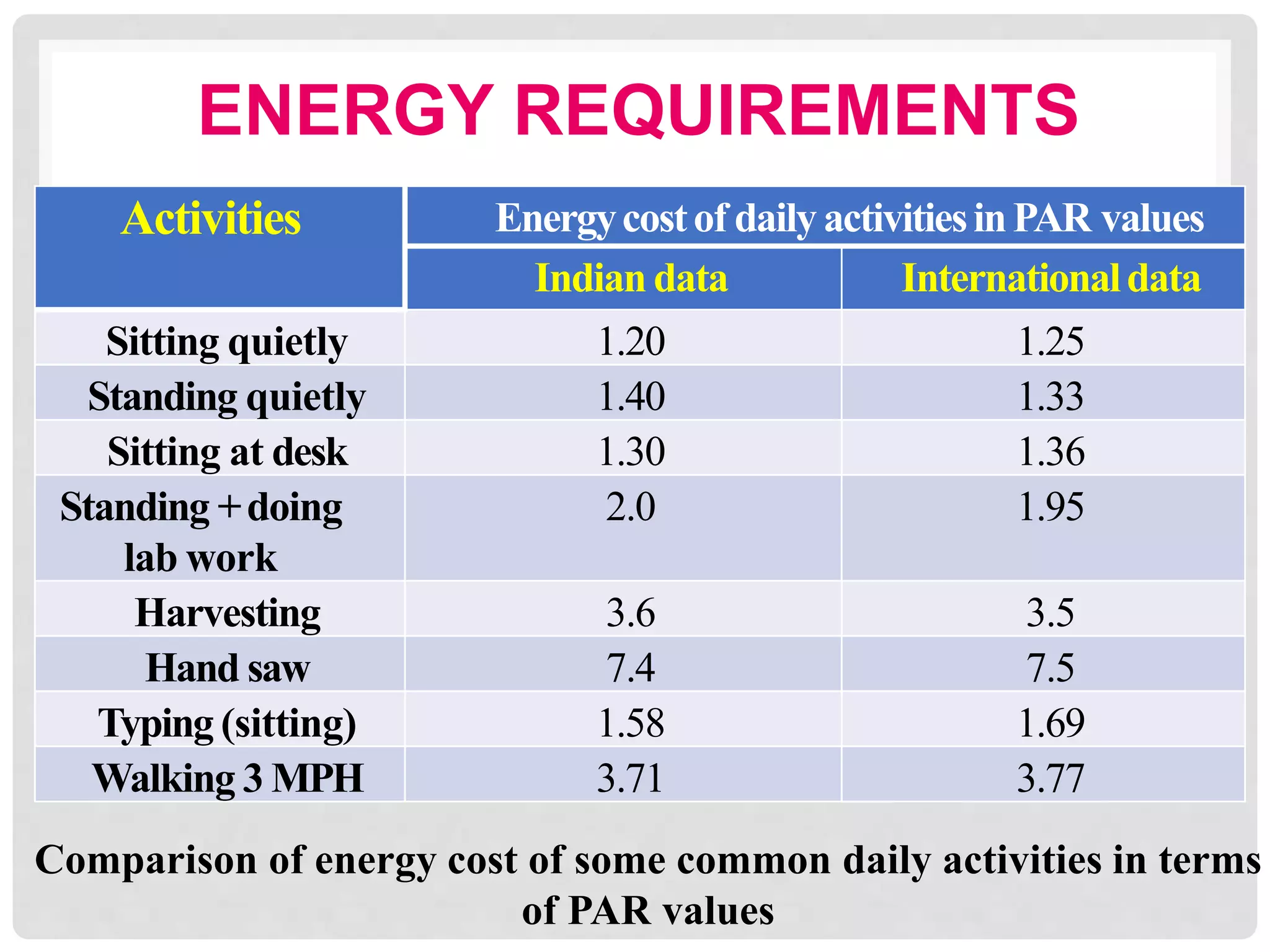
Comparison of energy cost of some common daily activities in terms
of PAR values
Activities Energycostof dailyactivitiesinPAR values
Indian data Internationaldata
Sitting quietly 1.20 1.25
Standing quietly 1.40 1.33
Sitting at desk 1.30 1.36
Standing +doing
lab work
2.0 1.95
Harvesting 3.6 3.5
Hand saw 7.4 7.5
Typing (sitting) 1.58 1.69
Walking 3 MPH 3.71 3.77
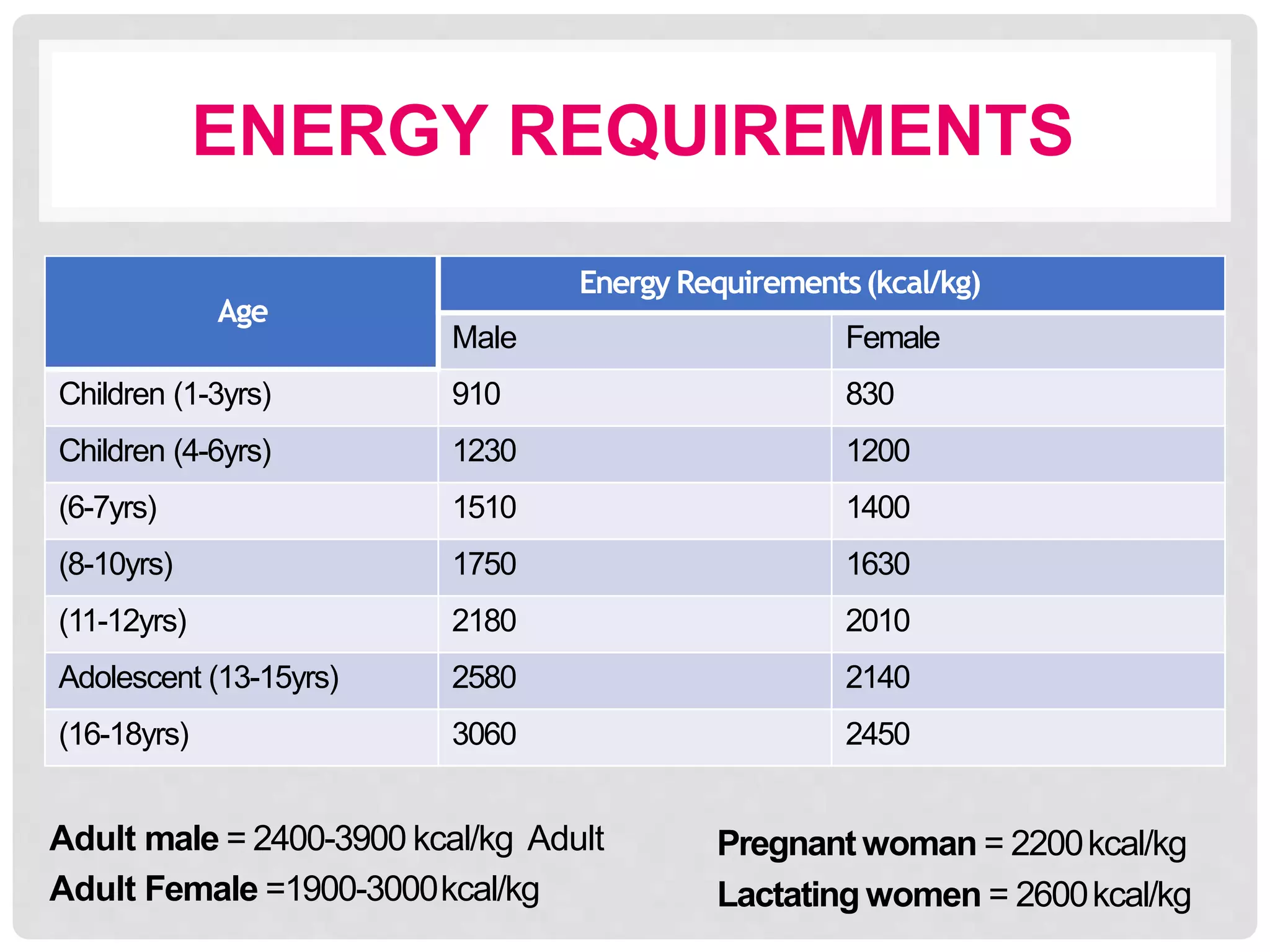
ENERGY REQUIREMENTS
Age
Energy Requirements(kcal/kg)
Male Female
Children (1-3yrs) 910 830
Children (4-6yrs) 1230 1200
(6-7yrs) 1510 1400
(8-10yrs) 1750 1630
(11-12yrs) 2180 2010
Adolescent (13-15yrs) 2580 2140
(16-18yrs) 3060 2450
Adult male = 2400-3900 kcal/kg Adult
Adult Female =1900-3000kcal/kg
Pregnant woman = 2200kcal/kg
Lactating women = 2600kcal/kg
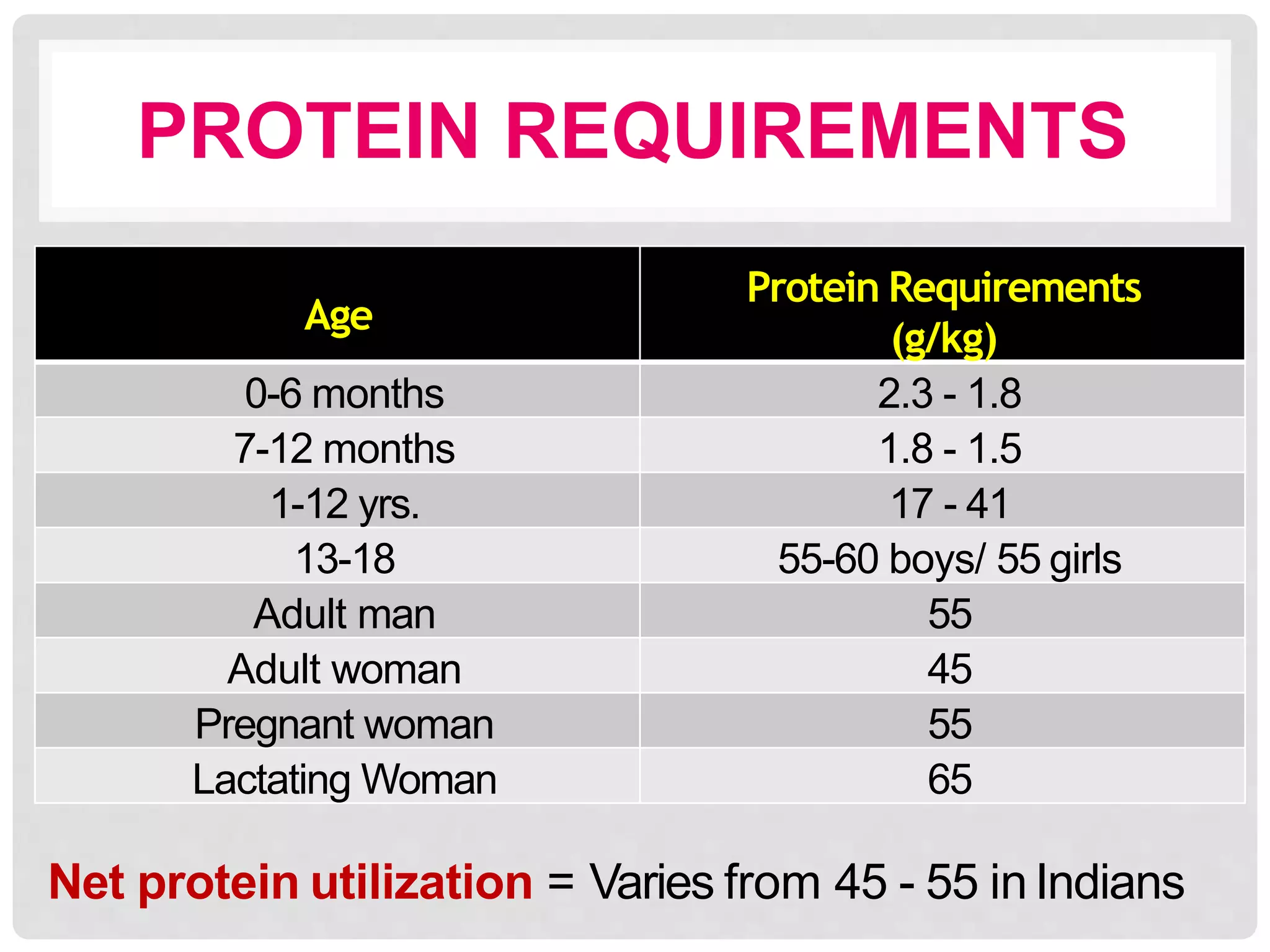
PROTEIN REQUIREMENTS
Age
Protein Requirements
(g/kg)
0-6 months 2.3 - 1.8
7-12 months 1.8 - 1.5
1-12 yrs. 17 - 41
13-18 55-60 boys/ 55 girls
Adult man 55
Adult woman 45
Pregnant woman 55
Lactating Woman 65
Net protein utilization = Varies from 45 - 55 in Indians
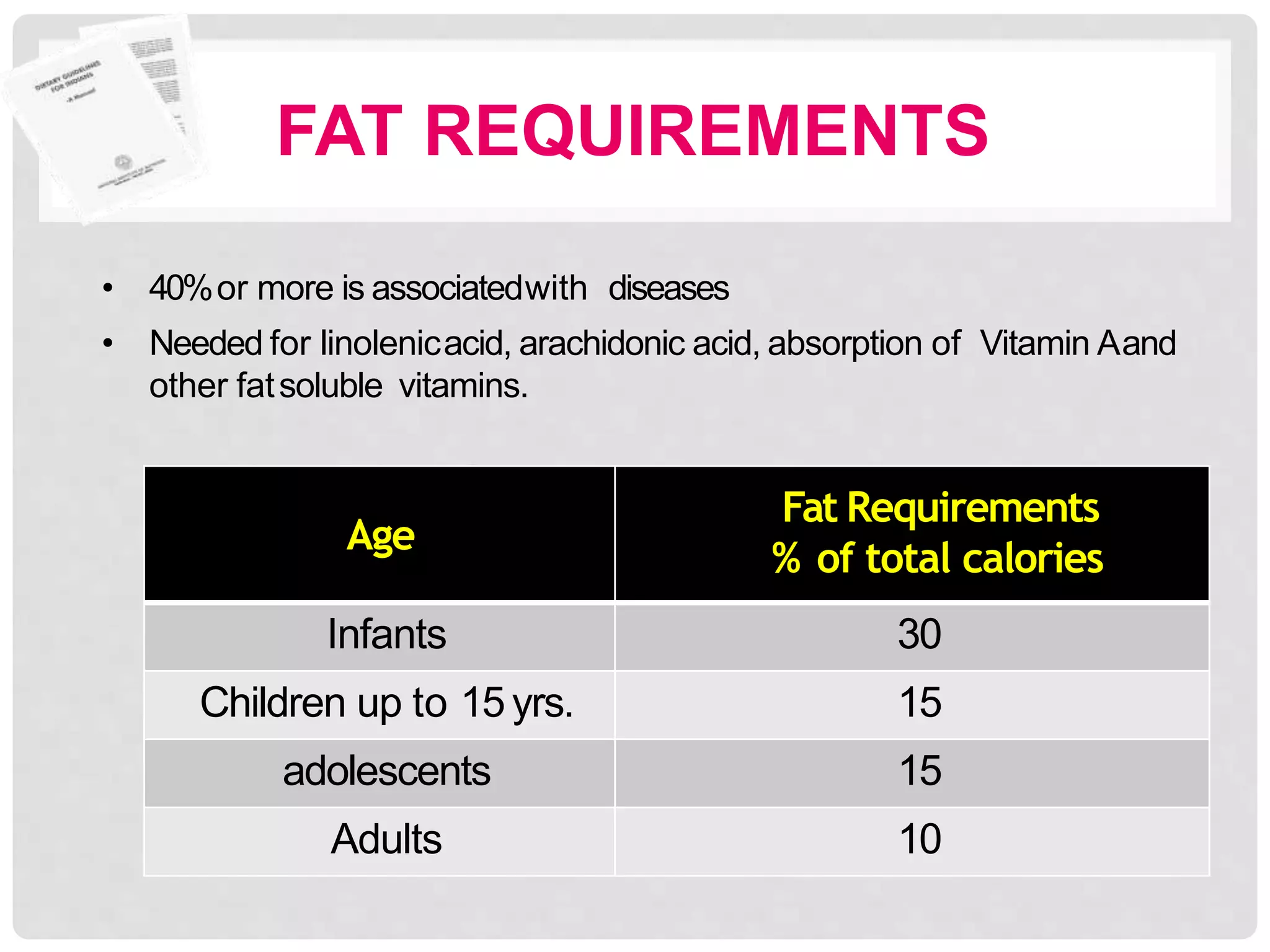
FAT REQUIREMENTS
Age
Fat Requirements
% of total calories
Infants 30
Children up to 15yrs. 15
adolescents 15
Adults 10
• 40%or more is associatedwith diseases
• Needed for linolenicacid, arachidonic acid, absorption of Vitamin Aand
other fatsoluble vitamins.
IRON
REQUIREMENTS
Age
Iron Requirements
mg/kg
Infants 1
Children up to 12yrs. 15-20
Adolescents 25 boys/ 35 girls
Adults 20 man / 30 woman
Pregnancy 40
Lactation 30
• It is assumed that 10%offood iron isabsorbed
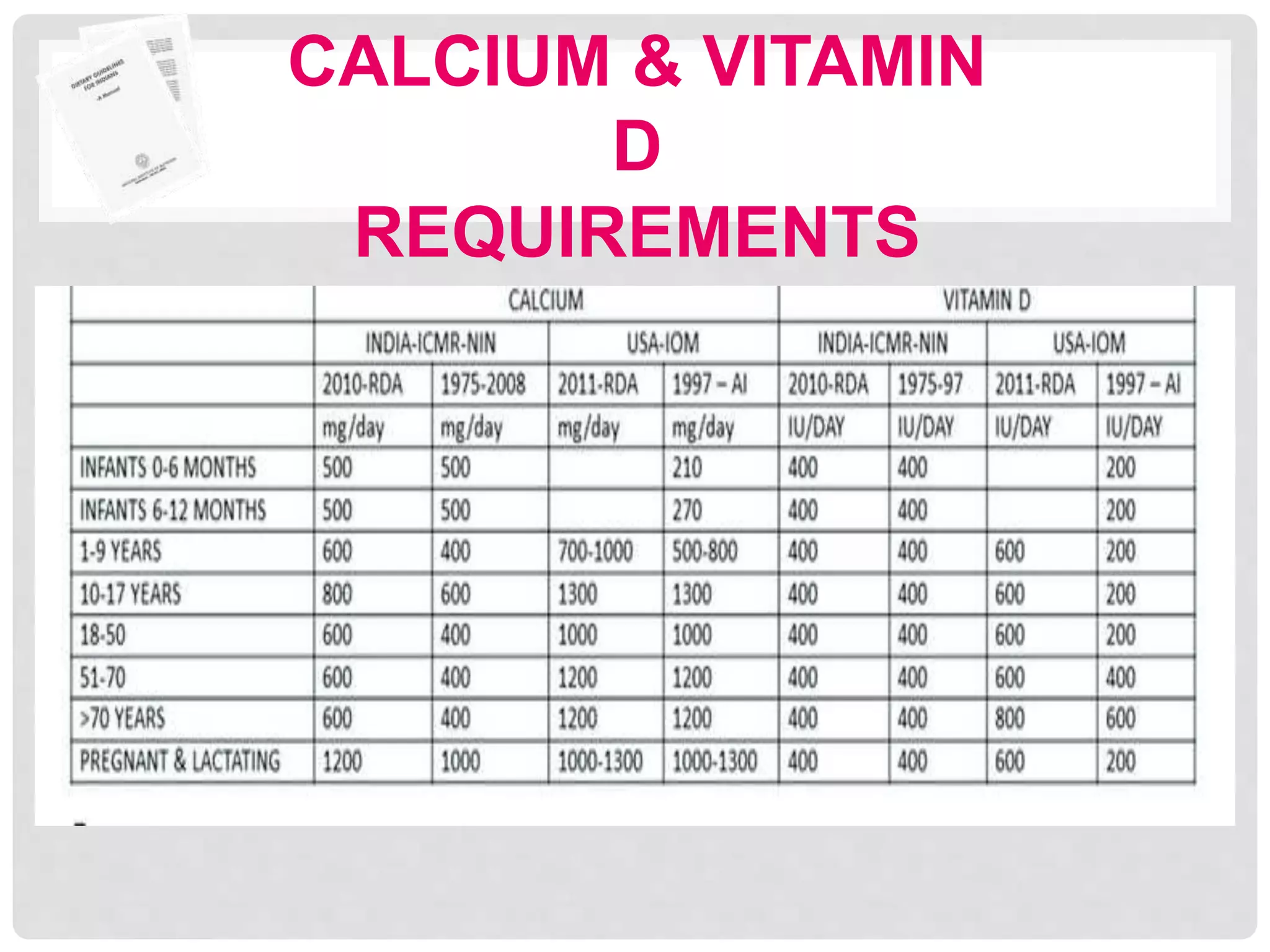
CALCIUM & VITAMIN
D
REQUIREMENTS
VITAMINA& B
REQUIREMENTS
Recommended daily allowances anu

Recommended daily allowances anu

  • 1.
  • 2.
    INTRODUCTION • The dietaryreference intake is a system of nutrition recommendations from the institute of medicine of National Academies. • It was introduced in 1997 in order to broaden the existing guidelines known as Recommended Dietary Allowances.
  • 3.
    DEFINITION • Recommended DietaryAllowances (RDA) is defined as the nutrients present in the diet which satisfies the daily requirement of nearly all individuals in a population. • Recommended Dietary Allowances are defined as average daily intake of nutrients in sufficient amount to meet the nutrient requirement of maximum, individual of healthy population in particular age, gender, group etc. • The RDA’s are periodically revised by expert group of ICMR. The RDA was revised in 1988 by expert group of Indian council of medical research.
  • 4.
    RECOMMENDED DIETARY ALLOWANCES (RDA) Thisimplies addition of safety factor amount to the estimated requirement tocover • Variationamongindividuals • Lossesduring cooking • Lackof precision in estimatedrequirement RecommendedDietaryAllowances = Requirements + Safetyfactor
  • 5.
    FACTORS WHICH DETERMINES RDA Variationin nutrient requirements Absorption tendency
  • 6.
    1. VARIATION INNUTRIENT REQUIREMENTS • The requirement of various nutrients depends on age, gender of an individual. During infancy and childhood nutrients are required for growth and development. • In adulthood these are calculated in accordance to height, weight and special physiological needs like pregnancy and lactation. • While in old age maintenance is the important function of nutrients.
  • 7.
    2. ABSORPTION TENDENCY •The amount of nutrients to be consumed also depends on amount which our body easily absorbs. • E.g. Animal proteins are absorbed more than 80% while plant proteins are poorly absorbed. So, RDA are calculated by keeping safe margin.
  • 8.
    FACTORS THAT EFFECTS RDA RDAof an individual depends on many factors like: 1. Age 2. Sex 3. Physical work • Sedentary • Moderate • Hard (Heavy) 4. Physiological stress • Pregnancy • Lactation
  • 9.
    FACTORS THAT EFFECTS RDA •For all the nutrients (except energy) estimates of allowances are arrived at by determining the average. Taking mean requirement of nutrients and adding to it twice the standard deviation of the mean. Requirement = Mean ± 2SD • The value will meet more than 97.5% of the population which is composed of individuals with a satisfactory normal distribution of requirements.
  • 10.
    • ICMR hasdefined well nourished Indian adults who had satisfactory growth during childhood as: I. Reference man II. Reference woman RDA FOR INDIAN NATIONALS
  • 11.
    ICMR’S REFERENCE WOMAN 1. Between20-39 yearsofage 2. Healthy and weighs50kg. 3. May be engaged 8 hours in general household work or in light industry or in anyother moderately activework. 4. 8 hours inbed 5. Spends 4-6 hours sitting or moving around in light activity 6. 2 hours walking or active recreation or household chores.
  • 12.
    ICMR’S REFERENCE MEN 1. between20 – 39 yearsofage 2. weighs 60 kg 3. free from diseaseand physically fit for active work. 4. employed for 8hours 5. 4-6 hours sitting and movingabout 6. 2 hours in walkingor in active recreation or household duties 7. 8 hours in bed
  • 13.
    ICMR’S REFERENCE MEN Scientists haveprescribed RDA for adults, depending on the level of activity of individual. 1.Sedentary workers:Thosewho sit and do work using brain and hands. • Ex:teachers; clerks, typists,officers
  • 14.
    ICMR’S REFERENCE MEN 2.Moderate workers:Works vigorously for a few hours using many parts of the body like hands, feet and muscles. • Ex: postman; mali; maid servant; housewife doing all household work. 3.Heavy workers: Use different parts of body for several hours. • Ex: rickshaw pullers; coolies; workersin mines; sports persons, masons etc.
  • 15.
    NUTRIENT REQUIREMENTS AND RECOMMENDEDDIETARY ALLOWANCES FOR INDIANS
  • 16.
    ENERGY REQUIREMENTS • Theunit of energy, which has been in use in nutrition for a long time, is Kilocalories (kcal). • Physical Activity Ratio (PAR) is expressed as the ratio of the energy cost of an individual activity per minute to the cost of the basal metabolic rate (BMR) per minute. Energy cost of an activity perminute PhysicalActivity Ratio (PAR)= Energy cost of basal metabolism per minute
  • 19.
  • 20.
    ENERGY REQUIREMENTS Comparison ofenergy cost of some common daily activities in terms of PAR values Activities Energycostof dailyactivitiesinPAR values Indian data Internationaldata Sitting quietly 1.20 1.25 Standing quietly 1.40 1.33 Sitting at desk 1.30 1.36 Standing +doing lab work 2.0 1.95 Harvesting 3.6 3.5 Hand saw 7.4 7.5 Typing (sitting) 1.58 1.69 Walking 3 MPH 3.71 3.77
  • 21.
    ENERGY REQUIREMENTS Age Energy Requirements(kcal/kg) MaleFemale Children (1-3yrs) 910 830 Children (4-6yrs) 1230 1200 (6-7yrs) 1510 1400 (8-10yrs) 1750 1630 (11-12yrs) 2180 2010 Adolescent (13-15yrs) 2580 2140 (16-18yrs) 3060 2450 Adult male = 2400-3900 kcal/kg Adult Adult Female =1900-3000kcal/kg Pregnant woman = 2200kcal/kg Lactating women = 2600kcal/kg
  • 22.
    PROTEIN REQUIREMENTS Age Protein Requirements (g/kg) 0-6months 2.3 - 1.8 7-12 months 1.8 - 1.5 1-12 yrs. 17 - 41 13-18 55-60 boys/ 55 girls Adult man 55 Adult woman 45 Pregnant woman 55 Lactating Woman 65 Net protein utilization = Varies from 45 - 55 in Indians
  • 23.
    FAT REQUIREMENTS Age Fat Requirements %of total calories Infants 30 Children up to 15yrs. 15 adolescents 15 Adults 10 • 40%or more is associatedwith diseases • Needed for linolenicacid, arachidonic acid, absorption of Vitamin Aand other fatsoluble vitamins.
  • 24.
    IRON REQUIREMENTS Age Iron Requirements mg/kg Infants 1 Childrenup to 12yrs. 15-20 Adolescents 25 boys/ 35 girls Adults 20 man / 30 woman Pregnancy 40 Lactation 30 • It is assumed that 10%offood iron isabsorbed
  • 25.
  • 26.