LIFESTYLE AND
BALANCED DIET
Made by :
Swati Kodan & Manita Makan
AIM OF PRESENTATION
•What is Health?
•To inform and discuss what a ‘healthy lifestyle’
means
•A healthy diet and our body
•Healthy Eating Pyramid
•The main food groups
•Do’s and Don’ts for healthy lifestyle
•Eat well plate
What Is Health?
Health is a state of complete physical,
mental, and social well-being and not
merely the absence of disease or infirmity.
World Health Organization
What is a healthy lifestyle
Balance
Basic health behaviors‘
• Nutrition
• Physical Activity, Sedentary
Time
• Sleep
• Coping and Emotional
Development
Daily living activities
•Work
•Chores
•Extracurricular activities
•Family needs
•Time with family and
friends
What is Food?
If our bodies are human machines food is our fuel.
How well we eat, affects how well our bodies work,
and how long we live.
A Healthy Diet and Our Body
•It is especially important that we eat healthily
as children, as we are still growing and
developing; a young plant not given proper
nutrients grows up to be a poor specimen .
•A healthy diet is sometimes called a balanced
diet
A balanced diet should provide
around 50-60% of total calories
from carbohydrates, preferably
from complex carbohydrates, about
10-15% from proteins and 20-30%
from both visible and invisible fat.
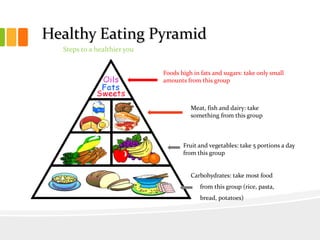
Healthy Eating Pyramid
Steps to a healthier you
Carbohydrates: take most food
from this group (rice, pasta,
bread, potatoes)
Fruit and vegetables: take 5 portions a day
from this group
Meat, fish and dairy: take
something from this group
Foods high in fats and sugars: take only small
amounts from this group
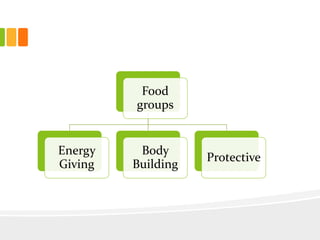
Food
groups
Energy
Giving
Body
Building
Protective
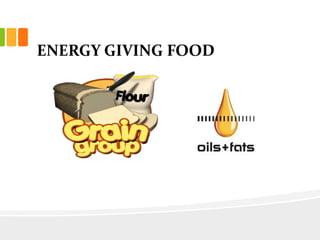
ENERGY GIVING FOOD
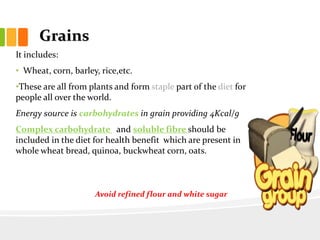
Grains
It includes:
• Wheat, corn, barley, rice,etc.
•These are all from plants and form staple part of the diet for
people all over the world.
Energy source is carbohydrates in grain providing 4Kcal/g
Complex carbohydrate and soluble fibre should be
included in the diet for health benefit which are present in
whole wheat bread, quinoa, buckwheat corn, oats.
Avoid processed
flour
Avoid refined flour and white sugar
Fats and oils
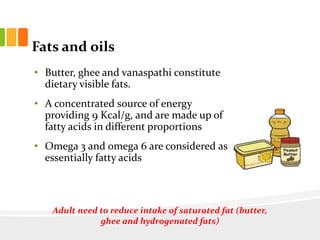
• Butter, ghee and vanaspathi constitute
dietary visible fats.
• A concentrated source of energy
providing 9 Kcal/g, and are made up of
fatty acids in different proportions
• Omega 3 and omega 6 are considered as
essentially fatty acids
to
Adult need to reduce intake of saturated fat (butter,
ghee and hydrogenated fats)
Fats and oils
Blending of Oils
 It has healthful gains,acceptability and helps in equalizing
SFA : MUFA :PUFA to 1:1:1
 It magnifies hypocholesterolemic effect and prevent heart
diseases
E.g.
– rice bran oil is blended with safflower oil (7:3)
– palm oil is blended with rice bran oil (3:1)
Adults need to be cautioned to
omega-6:omega 3 ratio of 5-10 is recommended
Fats and oils
Omega 3 sources
 Flaxseeds
 Chia Seeds
 Hemp seeds
 Olive oil
 Walnuts
 Salmon
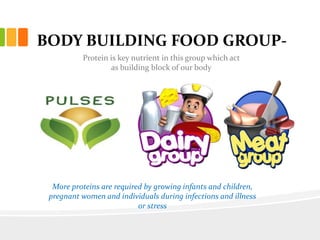
BODY BUILDING FOOD GROUP-
Protein is key nutrient in this group which act
as building block of our body
More proteins are required by growing infants and children,
pregnant women and individuals during infections and illness
or stress
Plant sources
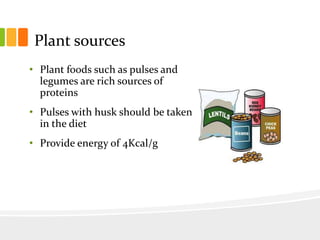
• Plant foods such as pulses and
legumes are rich sources of
proteins
• Pulses with husk should be taken
in the diet
• Provide energy of 4Kcal/g
Dairy Products
These are good source of protein
Animal proteins are of high quality as they provide all the
essential amino acids in right proportions
It include: Cheese (hard, soft, cottage);Yogurt ;Food high
in milk or milk products.
Meat, Fish and Eggs
The meat and fish group includes:
Chicken and all poultry;
Fish and shellfish;
Eggs are included in this group too
Athletes eat lots of protein; they help
to build muscles.
Whole egg and fish can be taken thrice a week as these are good
source of protein
We need to restrict intake of red meat, organ meat.
Instead of these chicken and fish can be taken in diet
PROTECTIVE GROUP
Fruit and Vegetables
Fruit and vegetables give us fibre and vitamins and
minerals
Green leafy vegetables
•Rich in Antioxidants, fibre and phytochemicals
Every day we should eat at least 5 portions of fruit and vegetables.
Fruit and Vegetables
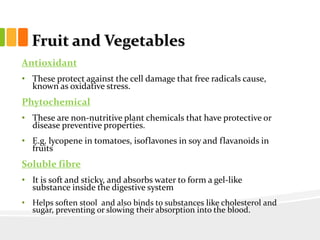
Antioxidant
• These protect against the cell damage that free radicals cause,
known as oxidative stress.
Phytochemical
• These are non-nutritive plant chemicals that have protective or
disease preventive properties.
• E.g. lycopene in tomatoes, isoflavones in soy and flavanoids in
fruits
Soluble fibre
• It is soft and sticky, and absorbs water to form a gel-like
substance inside the digestive system
• Helps soften stool and also binds to substances like cholesterol and
sugar, preventing or slowing their absorption into the blood.
DO’S & DON’TS FOR HEALTHY DIET
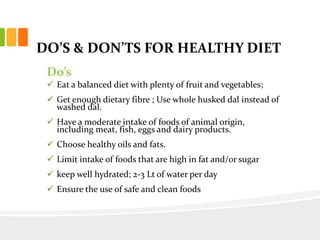
Do’s
 Eat a balanced diet with plenty of fruit and vegetables;
 Get enough dietary fibre ; Use whole husked dal instead of
washed dal.
 Have a moderate intake of foods of animal origin,
including meat, fish, eggs and dairy products.
 Choose healthy oils and fats.
 Limit intake of foods that are high in fat and/or sugar
 keep well hydrated; 2-3 Lt of water per day
 Ensure the use of safe and clean foods
DO’S & DON’TS FOR HEALTHY DIET
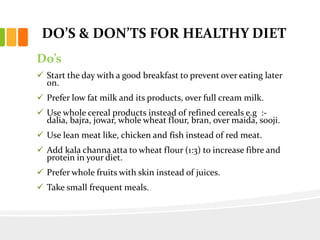
Do’s
 Start the day with a good breakfast to prevent over eating later
on.
 Prefer low fat milk and its products, over full cream milk.
 Use whole cereal products instead of refined cereals e.g :-
dalia, bajra, jowar, whole wheat flour, bran, over maida, sooji.
 Use lean meat like, chicken and fish instead of red meat.
 Add kala channa atta to wheat flour (1:3) to increase fibre and
protein in your diet.
 Prefer whole fruits with skin instead of juices.
 Take small frequent meals.
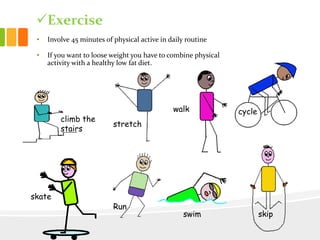
Exercise
• Involve 45 minutes of physical active in daily routine
• If you want to loose weight you have to combine physical
activity with a healthy low fat diet.
climb the
stairs
stretch
walk cycle
skate
swim
Run
skip
Don’ts
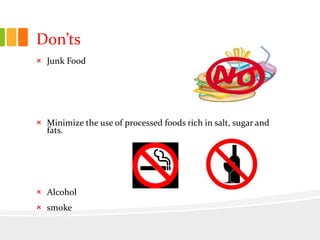
× Junk Food
× Minimize the use of processed foods rich in salt, sugar and
fats.
× Alcohol
× smoke
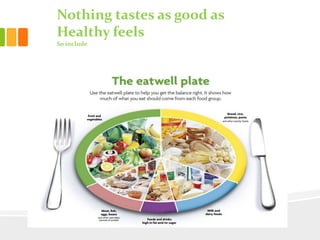
Nothing tastes as good as
Healthy feels
So include
Remember, it’s all
about balance!
• Balance is the key to healthy nutrition
• Balance a variety of foods from all of the
food groups throughout the day
• Balance healthy meals and snacks with
occasional treats
• Balance nutrition with fun physical activity
Thank You

111Lifestyle & balanced diet .pptx

  • 1.
    LIFESTYLE AND BALANCED DIET Madeby : Swati Kodan & Manita Makan
  • 2.
    AIM OF PRESENTATION •Whatis Health? •To inform and discuss what a ‘healthy lifestyle’ means •A healthy diet and our body •Healthy Eating Pyramid •The main food groups •Do’s and Don’ts for healthy lifestyle •Eat well plate
  • 3.
    What Is Health? Healthis a state of complete physical, mental, and social well-being and not merely the absence of disease or infirmity. World Health Organization
  • 4.
    What is ahealthy lifestyle Balance Basic health behaviors‘ • Nutrition • Physical Activity, Sedentary Time • Sleep • Coping and Emotional Development Daily living activities •Work •Chores •Extracurricular activities •Family needs •Time with family and friends
  • 5.
    What is Food? Ifour bodies are human machines food is our fuel. How well we eat, affects how well our bodies work, and how long we live.
  • 6.
    A Healthy Dietand Our Body •It is especially important that we eat healthily as children, as we are still growing and developing; a young plant not given proper nutrients grows up to be a poor specimen . •A healthy diet is sometimes called a balanced diet
  • 7.
    A balanced dietshould provide around 50-60% of total calories from carbohydrates, preferably from complex carbohydrates, about 10-15% from proteins and 20-30% from both visible and invisible fat.
  • 8.
    Healthy Eating Pyramid Stepsto a healthier you Carbohydrates: take most food from this group (rice, pasta, bread, potatoes) Fruit and vegetables: take 5 portions a day from this group Meat, fish and dairy: take something from this group Foods high in fats and sugars: take only small amounts from this group
  • 9.
  • 10.
  • 11.
    Grains It includes: • Wheat,corn, barley, rice,etc. •These are all from plants and form staple part of the diet for people all over the world. Energy source is carbohydrates in grain providing 4Kcal/g Complex carbohydrate and soluble fibre should be included in the diet for health benefit which are present in whole wheat bread, quinoa, buckwheat corn, oats. Avoid processed flour Avoid refined flour and white sugar
  • 12.
    Fats and oils •Butter, ghee and vanaspathi constitute dietary visible fats. • A concentrated source of energy providing 9 Kcal/g, and are made up of fatty acids in different proportions • Omega 3 and omega 6 are considered as essentially fatty acids to Adult need to reduce intake of saturated fat (butter, ghee and hydrogenated fats)
  • 13.
    Fats and oils Blendingof Oils  It has healthful gains,acceptability and helps in equalizing SFA : MUFA :PUFA to 1:1:1  It magnifies hypocholesterolemic effect and prevent heart diseases E.g. – rice bran oil is blended with safflower oil (7:3) – palm oil is blended with rice bran oil (3:1) Adults need to be cautioned to omega-6:omega 3 ratio of 5-10 is recommended
  • 14.
    Fats and oils Omega3 sources  Flaxseeds  Chia Seeds  Hemp seeds  Olive oil  Walnuts  Salmon
  • 15.
    BODY BUILDING FOODGROUP- Protein is key nutrient in this group which act as building block of our body More proteins are required by growing infants and children, pregnant women and individuals during infections and illness or stress
  • 16.
    Plant sources • Plantfoods such as pulses and legumes are rich sources of proteins • Pulses with husk should be taken in the diet • Provide energy of 4Kcal/g
  • 17.
    Dairy Products These aregood source of protein Animal proteins are of high quality as they provide all the essential amino acids in right proportions It include: Cheese (hard, soft, cottage);Yogurt ;Food high in milk or milk products.
  • 18.
    Meat, Fish andEggs The meat and fish group includes: Chicken and all poultry; Fish and shellfish; Eggs are included in this group too Athletes eat lots of protein; they help to build muscles. Whole egg and fish can be taken thrice a week as these are good source of protein We need to restrict intake of red meat, organ meat. Instead of these chicken and fish can be taken in diet
  • 19.
  • 20.
    Fruit and Vegetables Fruitand vegetables give us fibre and vitamins and minerals Green leafy vegetables •Rich in Antioxidants, fibre and phytochemicals Every day we should eat at least 5 portions of fruit and vegetables.
  • 21.
    Fruit and Vegetables Antioxidant •These protect against the cell damage that free radicals cause, known as oxidative stress. Phytochemical • These are non-nutritive plant chemicals that have protective or disease preventive properties. • E.g. lycopene in tomatoes, isoflavones in soy and flavanoids in fruits Soluble fibre • It is soft and sticky, and absorbs water to form a gel-like substance inside the digestive system • Helps soften stool and also binds to substances like cholesterol and sugar, preventing or slowing their absorption into the blood.
  • 22.
    DO’S & DON’TSFOR HEALTHY DIET Do’s  Eat a balanced diet with plenty of fruit and vegetables;  Get enough dietary fibre ; Use whole husked dal instead of washed dal.  Have a moderate intake of foods of animal origin, including meat, fish, eggs and dairy products.  Choose healthy oils and fats.  Limit intake of foods that are high in fat and/or sugar  keep well hydrated; 2-3 Lt of water per day  Ensure the use of safe and clean foods
  • 23.
    DO’S & DON’TSFOR HEALTHY DIET Do’s  Start the day with a good breakfast to prevent over eating later on.  Prefer low fat milk and its products, over full cream milk.  Use whole cereal products instead of refined cereals e.g :- dalia, bajra, jowar, whole wheat flour, bran, over maida, sooji.  Use lean meat like, chicken and fish instead of red meat.  Add kala channa atta to wheat flour (1:3) to increase fibre and protein in your diet.  Prefer whole fruits with skin instead of juices.  Take small frequent meals.
  • 24.
    Exercise • Involve 45minutes of physical active in daily routine • If you want to loose weight you have to combine physical activity with a healthy low fat diet. climb the stairs stretch walk cycle skate swim Run skip
  • 25.
    Don’ts × Junk Food ×Minimize the use of processed foods rich in salt, sugar and fats. × Alcohol × smoke
  • 26.
    Nothing tastes asgood as Healthy feels So include
  • 27.
    Remember, it’s all aboutbalance! • Balance is the key to healthy nutrition • Balance a variety of foods from all of the food groups throughout the day • Balance healthy meals and snacks with occasional treats • Balance nutrition with fun physical activity
  • 28.

Editor's Notes

  • #27 The eatwell plate shows how much of what most adults eat should come from each food group. This includes everything you eat during the day, including snacks. So, try to eat: – plenty of fruit and vegetables – plenty of bread, rice, potatoes, pasta and other starchy foods – choose wholegrain varieties whenever you can – some milk and dairy foods – some meat, fish, eggs, beans and other non-dairy sources of protein – just a small amount of foods and drinks high in fat and/or sugar