Wireless without Compromise™ Tim MacMillan Integra Data Systems Corp. 705-761-3645 [email_address]
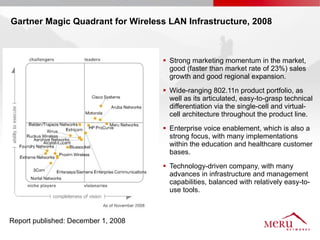
Gartner Magic Quadrant for Wireless LAN Infrastructure, 2008 Strong marketing momentum in the market, good (faster than market rate of 23%) sales growth and good regional expansion. Wide-ranging 802.11n product portfolio, as well as its articulated, easy-to-grasp technical differentiation via the single-cell and virtual-cell architecture throughout the product line. Enterprise voice enablement, which is also a strong focus, with many implementations within the education and healthcare customer bases. Technology-driven company, with many advances in infrastructure and management capabilities, balanced with relatively easy-to-use tools. Report published: December 1, 2008
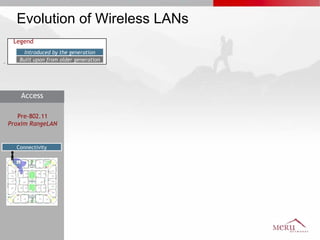
Evolution of Wireless LANs Pre-802.11 Proxim RangeLAN Access Connectivity Built upon from older generation Introduced by the generation Legend
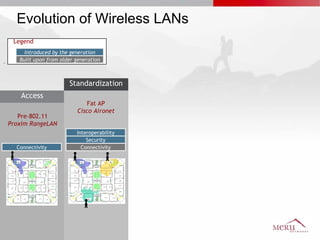
Evolution of Wireless LANs Pre-802.11 Proxim RangeLAN Access Connectivity Fat AP Cisco Aironet Standardization Connectivity Security Interoperability Built upon from older generation Introduced by the generation Legend
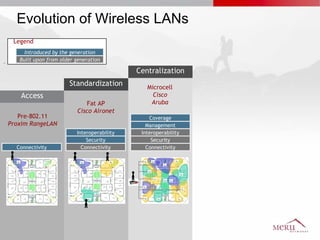
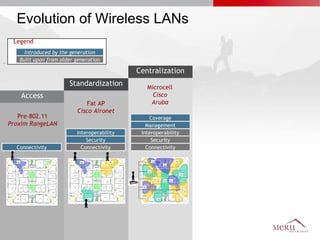
Evolution of Wireless LANs Pre-802.11 Proxim RangeLAN Access Connectivity Fat AP Cisco Aironet Standardization Connectivity Security Interoperability Microcell Cisco Aruba Centralization Connectivity Security Interoperability Management Coverage Built upon from older generation Introduced by the generation Legend
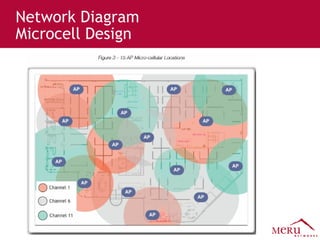
Network Diagram  Microcell Design
Evolution of Wireless LANs Pre-802.11 Proxim RangeLAN Access Connectivity Fat AP Cisco Aironet Standardization Connectivity Security Interoperability Microcell Cisco Aruba Centralization Connectivity Security Interoperability Management Coverage Built upon from older generation Introduced by the generation Legend
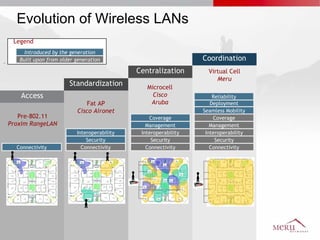
Evolution of Wireless LANs Virtual Cell Meru Coordination Pre-802.11 Proxim RangeLAN Access Connectivity Fat AP Cisco Aironet Standardization Connectivity Security Interoperability Microcell Cisco Aruba Centralization Connectivity Security Interoperability Management Coverage Connectivity Security Interoperability Management Coverage Seamless Mobility Deployment Reliability Built upon from older generation Introduced by the generation Legend
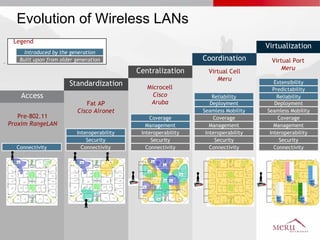
Evolution of Wireless LANs Virtual Cell Meru Coordination Pre-802.11 Proxim RangeLAN Access Connectivity Fat AP Cisco Aironet Standardization Connectivity Security Interoperability Microcell Cisco Aruba Centralization Connectivity Security Interoperability Management Coverage Virtual Port Meru Virtualization Connectivity Security Interoperability Management Coverage Seamless Mobility Deployment Reliability Predictability Extensibility Connectivity Security Interoperability Management Coverage Seamless Mobility Deployment Reliability Built upon from older generation Introduced by the generation Legend
Why Do Customers Choose Meru Over Other Solutions? Better Performance and Scale Predictable performance and fair access to clients Improved performance in mixed 802.11b/g networks Toll-quality Voice Improved Mobility / Zero-Handoff Lower Costs of Deployment and Operations Reduced need for site-survey, channel planning Less APs to deliver same application performance Lower operational complexity No Compromise Security No tradeoff between security and application performance Security policies based on application, location Air-Firewall – blocking rogues, protecting transactions over the air Best Architecture for the Future Supporting new applications: voice, video Scaling capacity with 802.11 a/b/g Migrating to 802.11n
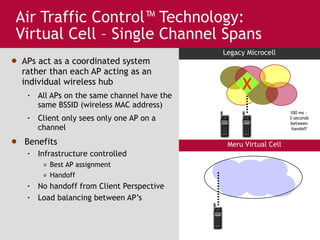
Air Traffic Control™ Technology: Virtual Cell – Single Channel Spans APs act as a coordinated system rather than each AP acting as an individual wireless hub All APs on the same channel have the same BSSID (wireless MAC address) Client only sees only one AP on a channel Benefits Infrastructure controlled Best AP assignment Handoff No handoff from Client Perspective Load balancing between AP’s 100 ms –  3 seconds between handoff X   Legacy Microcell Meru Virtual Cell
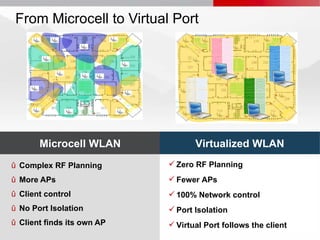
From Microcell to Virtual Port Complex RF Planning More APs Client control No Port Isolation Client finds its own AP Microcell WLAN Virtualized WLAN Zero RF Planning Fewer APs 100% Network control Port Isolation Virtual Port follows the client
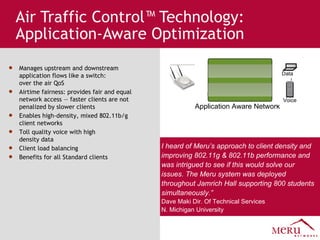
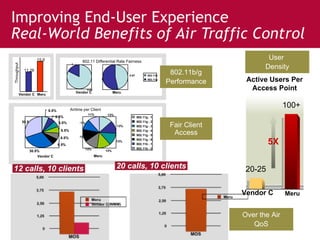
Air Traffic Control™ Technology: Application-Aware Optimization Application Aware Network Data Voice Manages upstream and downstream application flows like a switch:  over the air QoS Airtime fairness: provides fair and equal network access — faster clients are not penalized by slower clients  Enables high-density, mixed 802.11b/g client networks  Toll quality voice with high  density data Client load balancing Benefits for all Standard clients I heard of Meru’s approach to client density and improving 802.11g & 802.11b performance and was intrigued to see if this would solve our issues. The Meru system was deployed throughout Jamrich Hall supporting 800 students simultaneously.” Dave Maki Dir. Of Technical Services  N. Michigan University
Improving End-User Experience Real-World Benefits of Air Traffic Control Active Users Per Access Point Vendor C Meru 12 calls, 10 clients 20 calls, 10 clients 20-25 100+ 5X User  Density 11% 13% 13% 13% 13% 13% 13% 11% 802.11g - 1 802.11g - 2 802.11g - 3 802.11g - 4 802.11g - 5 802.11g - 6 802.11b - 1 802.11b - 2 Meru 11.26 15.9 Meru Vendor C Throughput 4.68 1 802.11b 802.11g 0.87 1 802.11b 802.11g Vendor C Meru Vendor C 30.5% 6.5% 6.5% 6.5% 6.5% 6.5% 6.5% 30.5 802.11 Differential Rate Fairness Airtime per Client 802.11b/g Performance Fair Client Access Over the Air QoS
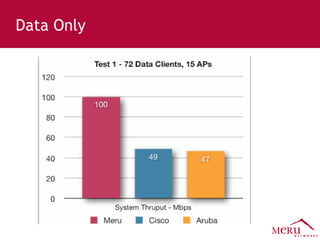
Data Only
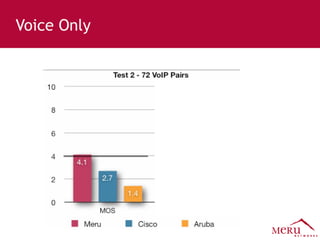
Voice Only
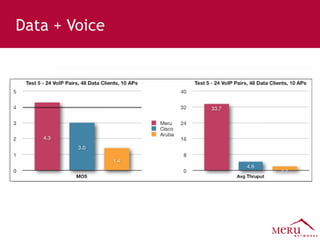
Data + Voice
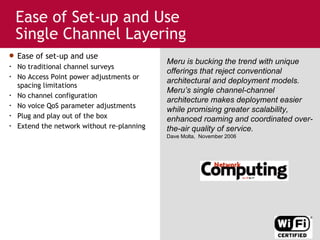
Ease of Set-up and Use Single Channel Layering Meru is bucking the trend with unique offerings that reject conventional architectural and deployment models.   Meru’s single channel-channel architecture makes deployment easier while promising greater scalability, enhanced roaming and coordinated over-the-air quality of service.   Dave Molta,  November 2006 Ease of set-up and use No traditional channel surveys No Access Point power adjustments or spacing limitations No channel configuration No voice QoS parameter adjustments Plug and play out of the box Extend the network without re-planning
Authentication & Encryption Layer Secures traffic for valid flows Protects the identity and location of valid users  Key Features: WPA, and WPA2, 802.1x, 802.11i MAC Access Control Lists (ACLs) Encrypted management traffic (AES, 3DES, SSL) Multi-factor authentication and policy control
Authorization & Isolation Layer Captive portal for guest-access; traffic separation based on type of user Access control decisions with NAC/NAP In partnership with leading NAC vendors: Microsoft NAP, Cisco, Juniper, Consentry, Bradford, Vernier, Lockdown Access determined based on user’s: access rights, location, client security state Example:  Objective – laptops with only the latest virus protection software allowed network access. Remediation – non-conforming clients placed in quarantine VLAN for SW updates
Wireless IPS Layer Rogue Detection and Mitigation Scans activity to detect rogues Mitigates while serving traffic Preserves WLAN performance and bandwidth Detects wired and wireless exploits
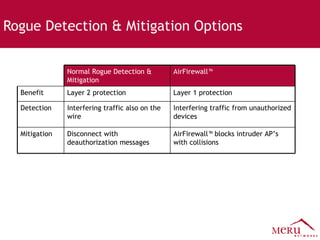
Rogue Detection & Mitigation Options   Normal Rogue Detection & Mitigation AirFirewall™  Benefit Layer 2 protection Layer 1 protection Detection Interfering traffic also on the wire Interfering traffic from unauthorized devices Mitigation Disconnect with deauthorization messages AirFirewall™ blocks intruder AP’s with collisions
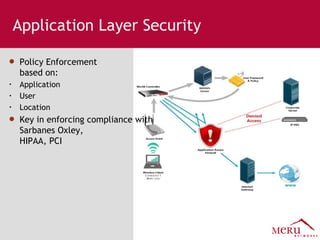
Application Layer Security Policy Enforcement  based on: Application User Location Key in enforcing compliance with  Sarbanes Oxley,  HIPAA, PCI
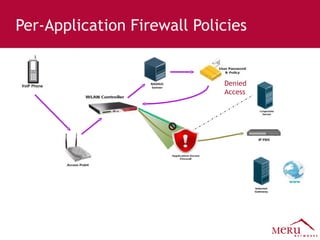
Per-Application Firewall Policies Denied  Access VoiP Phone
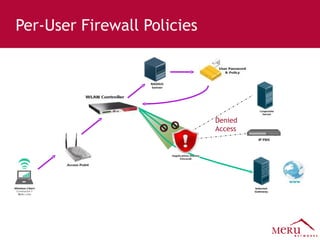
Per-User Firewall Policies Denied  Access
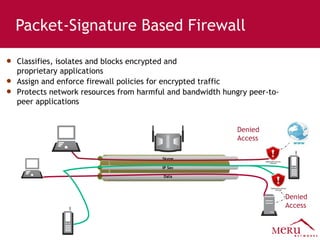
Packet-Signature Based Firewall Denied  Access Denied  Access Classifies, isolates and blocks encrypted and  proprietary applications  Assign and enforce firewall policies for encrypted traffic  Protects network resources from harmful and bandwidth hungry peer-to-peer applications Data IP Sec Skype
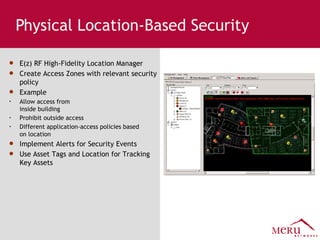
Physical Location-Based Security E(z) RF High-Fidelity Location Manager Create Access Zones with relevant security policy Example Allow access from  inside building Prohibit outside access  Different application-access policies based  on location Implement Alerts for Security Events Use Asset Tags and Location for Tracking Key Assets
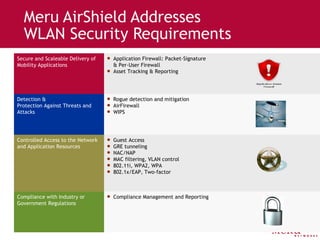
Meru AirShield Addresses  WLAN Security Requirements Secure and Scaleable Delivery of Mobility Applications Application Firewall: Packet-Signature  & Per-User Firewall Asset Tracking & Reporting Detection & Protection Against Threats and Attacks Rogue detection and mitigation AirFirewall WIPS Controlled Access to the Network and Application Resources Guest Access GRE tunneling NAC/NAP MAC filtering, VLAN control 802.11i, WPA2, WPA 802.1x/EAP, Two-factor Compliance with Industry or Government Regulations Compliance Management and Reporting
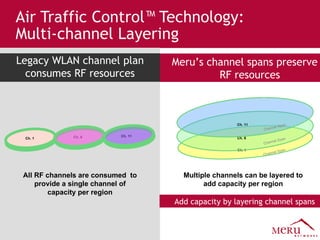
Air Traffic Control™ Technology: Multi-channel Layering All RF channels are consumed  to provide a single channel of capacity per region Ch. 1 Channel Span Multiple channels can be layered to add capacity per region Ch. 1 Meru’s channel spans preserve RF resources Legacy WLAN channel plan consumes RF resources Ch. 11 Ch. 6 Ch. 1 Ch. 6 Channel Span Add capacity by layering channel spans Ch. 11 Channel Span
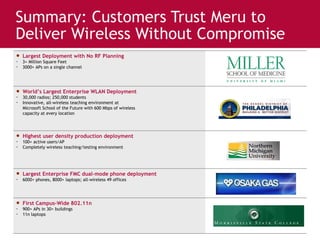
Summary: Customers Trust Meru to Deliver Wireless Without Compromise Largest Deployment with No RF Planning   3+ Million Square Feet 3000+ APs on a single channel World’s Largest Enterprise WLAN Deployment   30,000 radios; 250,000 students Innovative, all-wireless teaching environment at  Microsoft School of the Future with 600 Mbps of wireless  capacity at every location Highest user density production deployment 100+ active users/AP Completely wireless teaching/testing environment Largest Enterprise FMC dual-mode phone deployment  6000+ phones, 8000+ laptops; all-wireless 49 offices First Campus-Wide 802.11n  900+ APs in 30+ buildings 11n laptops
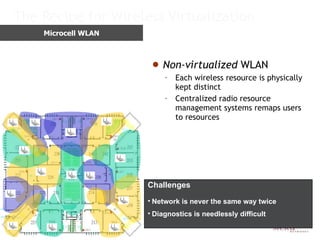
Non-virtualized  WLAN Each wireless resource is physically kept distinct Centralized radio resource management systems remaps users to resources The Recipe for Wireless Virtualization Challenges Network is never the same way twice Diagnostics is needlessly difficult Microcell WLAN
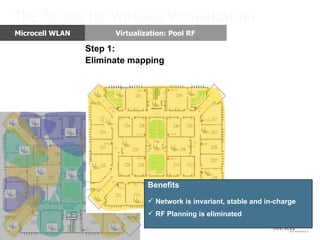
The Recipe for Wireless Virtualization Step 1:  Eliminate mapping Benefits Network is invariant, stable and in-charge RF Planning is eliminated Virtualization: Pool RF Microcell WLAN
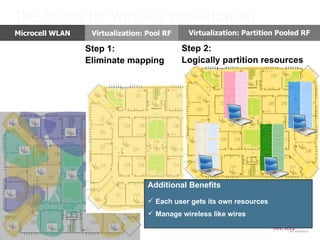
The Recipe for Wireless Virtualization Step 1:  Eliminate mapping Additional Benefits Each user gets its own resources Manage wireless like wires Step 2:  Logically partition resources Virtualization: Pool RF Virtualization: Partition Pooled RF Microcell WLAN
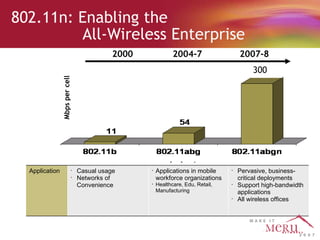
802.11n: Enabling the    All-Wireless Enterprise 2000 2004-7 2007-8 Mbps per cell Application Casual usage Networks of Convenience Applications in mobile workforce organizations Healthcare, Edu, Retail, Manufacturing Pervasive, business-critical deployments Support high-bandwidth  applications  All wireless offices 300
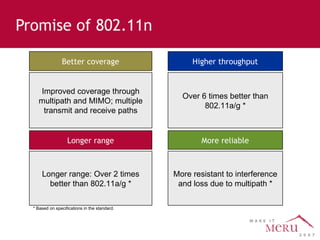
Promise of 802.11n * Based on specifications in the standard. Improved coverage through multipath and MIMO; multiple transmit and receive paths Better coverage Longer range: Over 2 times better than 802.11a/g * Longer range Over 6 times better than 802.11a/g * Higher throughput More resistant to interference and loss due to multipath * More reliable
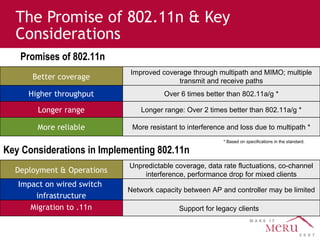
The Promise of 802.11n & Key Considerations * Based on specifications in the standard. Promises of 802.11n Key Considerations in Implementing 802.11n Improved coverage through multipath and MIMO; multiple transmit and receive paths Better coverage Longer range: Over 2 times better than 802.11a/g * Longer range Over 6 times better than 802.11a/g * Higher throughput More resistant to interference and loss due to multipath * More reliable Unpredictable coverage, data rate fluctuations, co-channel interference, performance drop for mixed clients Deployment & Operations Support for legacy clients  Migration to .11n Network capacity between AP and controller may be limited Impact on wired switch  infrastructure
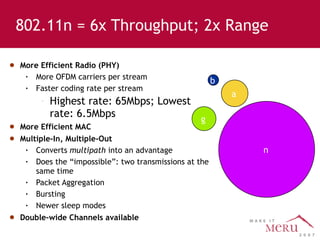
More Efficient Radio (PHY) More OFDM carriers per stream Faster coding rate per stream Highest rate: 65Mbps; Lowest rate: 6.5Mbps More Efficient MAC Multiple-In, Multiple-Out Converts  multipath  into an advantage Does the “impossible”: two transmissions at the same time Packet Aggregation Bursting Newer sleep modes Double-wide Channels available 802.11n = 6x Throughput; 2x Range n a g b
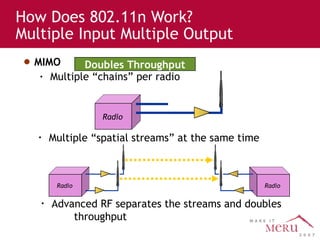
How Does 802.11n Work?  Multiple Input Multiple Output MIMO Multiple “chains” per radio Multiple “spatial streams” at the same time Advanced RF separates the streams and doubles   throughput Radio Radio Radio Doubles Throughput
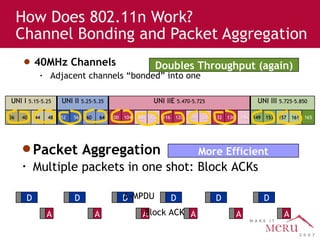
How Does 802.11n Work?  Channel Bonding and Packet Aggregation 40MHz Channels Adjacent channels “bonded” into one Packet Aggregation Multiple packets in one shot: Block ACKs A-MPDU Block ACK UNI I  5.15-5.25 UNI II  5.25-5.35 UNI IIE  5.470-5.725 UNI III  5.725-5.850 36 40 44 48 52 56 60 64 100 104 108 112 116 120 124 128 132 136 140 149 153 157 161 165 UNI I  5.15-5.25 UNI II  5.25-5.35 UNI IIE  5.470-5.725 UNI III  5.725-5.850 36 40 44 48 52 56 60 64 100 104 108 112 116 120 124 128 132 136 140 149 153 157 161 165 Doubles Throughput (again) More Efficient A A A A A A D D D D D D
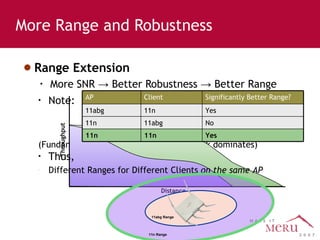
More Range and Robustness Range Extension More SNR  ->  Better Robustness  ->  Better Range Note: (Fundamental to 802.11n: the weakest link dominates) Throughput Distance Thus, Different Ranges for Different Clients  on the same AP AP Client Significantly Better Range? 11abg 11n Yes 11n 11abg No 11n 11n Yes 11abg Range 11n Range
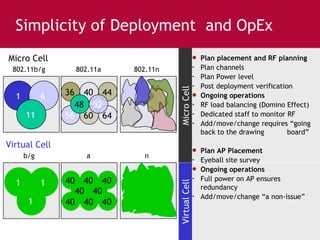
Simplicity of Deployment  and OpEx Plan placement and RF planning Plan channels Plan Power level Post deployment verification Ongoing operations RF load balancing (Domino Effect) Dedicated staff to monitor RF Add/move/change requires “going back to the drawing  board” Plan AP Placement Eyeball site survey Ongoing operations Full power on AP ensures redundancy Add/move/change “a non-issue” Micro Cell Virtual Cell 1 6 11 1 1 1 802.11b/g b/g 36 40 44 56 60 64 48 52 40 40 40 40 40 40 40 40 802.11a a 802.11n n Micro Cell Virtual Cell
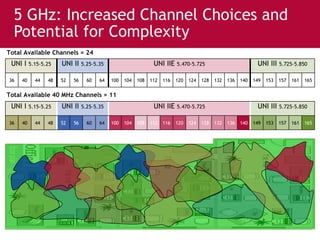
5 GHz: Increased Channel Choices and Potential for Complexity Total Available Channels = 24 Total Available 40 MHz Channels = 11 UNI I  5.15-5.25 UNI II  5.25-5.35 UNI IIE  5.470-5.725 UNI III  5.725-5.850 36 40 44 48 52 56 60 64 100 104 108 112 116 120 124 128 132 136 140 149 153 157 161 165 UNI I  5.15-5.25 UNI II  5.25-5.35 UNI IIE  5.470-5.725 UNI III  5.725-5.850 36 40 44 48 52 56 60 64 100 104 108 112 116 120 124 128 132 136 140 149 153 157 161 165
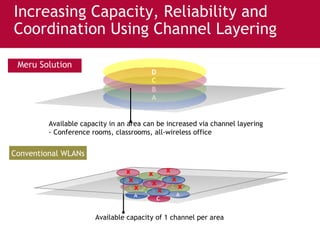
Available capacity of 1 channel per area Available capacity in an area can be increased via channel layering - Conference rooms, classrooms, all-wireless office X X X X X X X X X Increasing Capacity, Reliability and Coordination Using Channel Layering  A C A B C B C A B A B C Meru Solution Conventional WLANs D
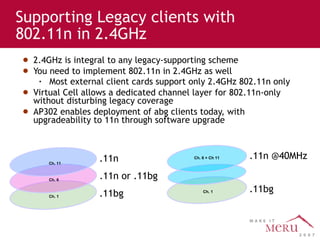
Supporting Legacy clients with 802.11n in 2.4GHz 2.4GHz is integral to any legacy-supporting scheme You need to implement 802.11n in 2.4GHz as well Most external client cards support only 2.4GHz 802.11n only Virtual Cell allows a dedicated channel layer for 802.11n-only without disturbing legacy coverage AP302 enables deployment of abg clients today, with upgradeability to 11n through software upgrade Ch. 1 Ch. 6 + Ch 11 .11bg .11n @40MHz Ch. 1 Ch. 6 Ch. 11 .11bg .11n or .11bg .11n
Benefits of Deploying 802.11n on Meru WLAN Infrastructure Ease of deployment  Deploy the next PHY standard without re-deigning the network Coverage holes are easily filled with additional APs Scalability and Capacity Start with Fast Ethernet equivalent speed and  layer channels to achieve multi-gigabit capacity  Backward Compatibility Support legacy devices on 2.4Ghz, while also using 5Ghz for newer devices No Wired LAN Upgrade Required   Choice of distributed or centralized architectures 3TDS does not require wired switching infrastructure upgrades MC5000 enables path to 100+ Gbps,  AP300 offers flexibility for either 802.3af PoE or 802.3at high power PoE
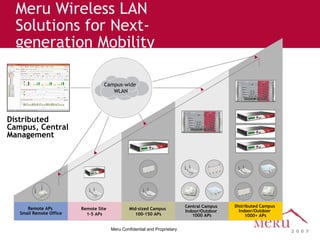
Meru Wireless LAN Solutions for Next-generation Mobility    Meru Confidential and Proprietary Distributed Campus, Central Management Campus-wide  WLAN Distributed Campus  Indoor/Outdoor  1000+ APs Central Campus  Indoor/Outdoor  1000 APs Mid-sized Campus  100-150 APs Remote Site  1-5 APs Remote APs  Small Remote Office
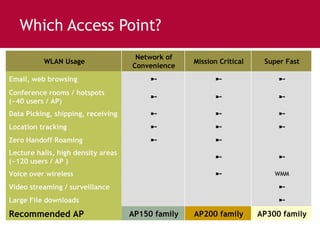
Which Access Point? WLAN Usage Network of Convenience Mission Critical Super Fast Email, web browsing ➼ ➼ ➼ Conference rooms / hotspots (~40 users / AP) ➼ ➼ ➼ Data Picking, shipping, receiving ➼ ➼ ➼ Location tracking ➼ ➼ ➼ Zero Handoff Roaming ➼ ➼ Lecture halls, high density areas (~120 users / AP ) ➼ ➼ Voice over wireless ➼ WMM Video streaming / surveillance ➼ Large File downloads ➼ Recommended AP AP150 family AP200 family AP300 family
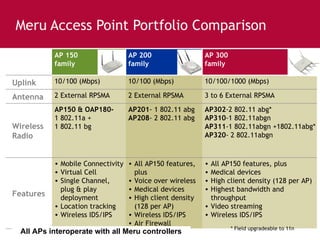
Meru Access Point Portfolio Comparison * Field upgradeable to 11n AP 150  family AP 200  family AP 300 family Uplink 10/100 (Mbps) 10/100 (Mbps) 10/100/1000 (Mbps) Antenna 2 External RPSMA 2 External RPSMA 3 to 6 External RPSMA Wireless Radio AP150 & OAP180- 1 802.11a + 1 802.11 bg AP201 - 1 802.11 abg AP208 - 2 802.11 abg AP302 -2 802.11 abg* AP310 -1 802.11abgn AP311 -1 802.11abgn +1802.11abg* AP320 - 2 802.11abgn Features Mobile Connectivity Virtual Cell Single Channel, plug & play deployment Location tracking Wireless IDS/IPS All AP150 features, plus Voice over wireless Medical devices High client density (128 per AP) Wireless IDS/IPS Air Firewall All AP150 features, plus Medical devices  High client density (128 per AP) Highest bandwidth and throughput Video streaming Wireless IDS/IPS All APs interoperate with all Meru controllers
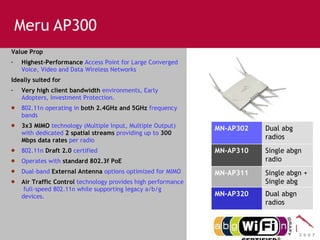
Meru AP300  * Antenna on shipping units will be Meru white color MN-AP302 Dual abg radios MN-AP310 Single abgn radio MN-AP311 Single abgn + Single abg MN-AP320 Dual abgn radios Value Prop Highest-Performance   Access Point for Large Converged Voice, Video and Data Wireless Networks Ideally suited for Very high client bandwidth   environments, Early Adopters, Investment Protection. 802.11n operating in   both 2.4GHz and 5GHz   frequency bands 3x3 MIMO   technology (Multiple Input, Multiple Output)   with dedicated   2 spatial streams   providing up to   300 Mbps data rates  per radio  802.11n  Draft 2.0   certified   Operates with   standard 802.3f PoE Dual-band  External Antenna   options optimized for   MIMO Air Traffic Control   technology provides high performance  full-speed 802.11n while supporting legacy a/b/g devices.
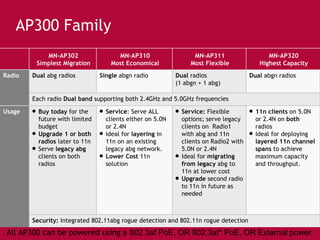
AP300 Family MN-AP302 Simplest Migration MN-AP310 Most Economical MN-AP311 Most Flexible MN-AP320 Highest Capacity Radio Dual  abg radios  Single  abgn radio Dual  radios  (1 abgn + 1 abg) Dual  abgn radios Each radio  Dual band  supporting both 2.4GHz and 5.0GHz frequencies Usage Buy today  for the future with limited budget Upgrade 1 or both radios  later   to 11n  Serve  legacy abg   clients on both radios Service : Serve ALL clients either on 5.0N or 2.4N Ideal for  layering  in 11n on an existing legacy abg network.  Lower Cost  11n solution Service:  Flexible options; serve legacy clients on  Radio1 with abg and 11n clients on Radio2 with 5.0N or 2.4N  Ideal for  migrating from legacy  abg to 11n at lower cost Upgrade  second radio to 11n in future as needed 11n clients  on 5.0N or 2.4N on  both  radios Ideal for deploying  layered 11n channel spans  to achieve maximum capacity and throughput. Security:  Integrated   802.11abg rogue detection and 802.11n rogue detection All AP300 can be powered using a  802.3af PoE, OR 802.3at* PoE, OR External power.
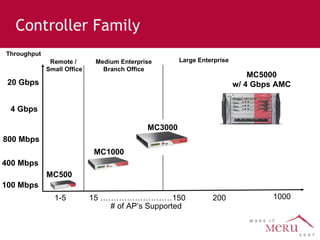
Controller Family 1-5 15 ………………………150 200 Remote /  Small Office Medium Enterprise Branch Office Large Enterprise Throughput 100 Mbps # of AP’s Supported 400 Mbps 4 Gbps 20 Gbps MC500 800 Mbps MC1000 MC3000 MC5000 w/ 4 Gbps AMC 1000
For more information on WLAN virtualization and Meru product offerings, please visit  www.merunetworks.com   or contact me for a personal presentation: Tim MacMillan 705-761-3645 [email_address] Questions and Answers ? ? ?
Make It Meru!

Meru Presentation

  • 1.
    Wireless without Compromise™Tim MacMillan Integra Data Systems Corp. 705-761-3645 [email_address]
  • 2.
    Gartner Magic Quadrantfor Wireless LAN Infrastructure, 2008 Strong marketing momentum in the market, good (faster than market rate of 23%) sales growth and good regional expansion. Wide-ranging 802.11n product portfolio, as well as its articulated, easy-to-grasp technical differentiation via the single-cell and virtual-cell architecture throughout the product line. Enterprise voice enablement, which is also a strong focus, with many implementations within the education and healthcare customer bases. Technology-driven company, with many advances in infrastructure and management capabilities, balanced with relatively easy-to-use tools. Report published: December 1, 2008
  • 3.
    Evolution of WirelessLANs Pre-802.11 Proxim RangeLAN Access Connectivity Built upon from older generation Introduced by the generation Legend
  • 4.
    Evolution of WirelessLANs Pre-802.11 Proxim RangeLAN Access Connectivity Fat AP Cisco Aironet Standardization Connectivity Security Interoperability Built upon from older generation Introduced by the generation Legend
  • 5.
    Evolution of WirelessLANs Pre-802.11 Proxim RangeLAN Access Connectivity Fat AP Cisco Aironet Standardization Connectivity Security Interoperability Microcell Cisco Aruba Centralization Connectivity Security Interoperability Management Coverage Built upon from older generation Introduced by the generation Legend
  • 6.
    Network Diagram Microcell Design
  • 7.
    Evolution of WirelessLANs Pre-802.11 Proxim RangeLAN Access Connectivity Fat AP Cisco Aironet Standardization Connectivity Security Interoperability Microcell Cisco Aruba Centralization Connectivity Security Interoperability Management Coverage Built upon from older generation Introduced by the generation Legend
  • 8.
    Evolution of WirelessLANs Virtual Cell Meru Coordination Pre-802.11 Proxim RangeLAN Access Connectivity Fat AP Cisco Aironet Standardization Connectivity Security Interoperability Microcell Cisco Aruba Centralization Connectivity Security Interoperability Management Coverage Connectivity Security Interoperability Management Coverage Seamless Mobility Deployment Reliability Built upon from older generation Introduced by the generation Legend
  • 9.
    Evolution of WirelessLANs Virtual Cell Meru Coordination Pre-802.11 Proxim RangeLAN Access Connectivity Fat AP Cisco Aironet Standardization Connectivity Security Interoperability Microcell Cisco Aruba Centralization Connectivity Security Interoperability Management Coverage Virtual Port Meru Virtualization Connectivity Security Interoperability Management Coverage Seamless Mobility Deployment Reliability Predictability Extensibility Connectivity Security Interoperability Management Coverage Seamless Mobility Deployment Reliability Built upon from older generation Introduced by the generation Legend
  • 10.
    Why Do CustomersChoose Meru Over Other Solutions? Better Performance and Scale Predictable performance and fair access to clients Improved performance in mixed 802.11b/g networks Toll-quality Voice Improved Mobility / Zero-Handoff Lower Costs of Deployment and Operations Reduced need for site-survey, channel planning Less APs to deliver same application performance Lower operational complexity No Compromise Security No tradeoff between security and application performance Security policies based on application, location Air-Firewall – blocking rogues, protecting transactions over the air Best Architecture for the Future Supporting new applications: voice, video Scaling capacity with 802.11 a/b/g Migrating to 802.11n
  • 11.
    Air Traffic Control™Technology: Virtual Cell – Single Channel Spans APs act as a coordinated system rather than each AP acting as an individual wireless hub All APs on the same channel have the same BSSID (wireless MAC address) Client only sees only one AP on a channel Benefits Infrastructure controlled Best AP assignment Handoff No handoff from Client Perspective Load balancing between AP’s 100 ms – 3 seconds between handoff X Legacy Microcell Meru Virtual Cell
  • 12.
    From Microcell toVirtual Port Complex RF Planning More APs Client control No Port Isolation Client finds its own AP Microcell WLAN Virtualized WLAN Zero RF Planning Fewer APs 100% Network control Port Isolation Virtual Port follows the client
  • 13.
    Air Traffic Control™Technology: Application-Aware Optimization Application Aware Network Data Voice Manages upstream and downstream application flows like a switch: over the air QoS Airtime fairness: provides fair and equal network access — faster clients are not penalized by slower clients Enables high-density, mixed 802.11b/g client networks Toll quality voice with high density data Client load balancing Benefits for all Standard clients I heard of Meru’s approach to client density and improving 802.11g & 802.11b performance and was intrigued to see if this would solve our issues. The Meru system was deployed throughout Jamrich Hall supporting 800 students simultaneously.” Dave Maki Dir. Of Technical Services N. Michigan University
  • 14.
    Improving End-User ExperienceReal-World Benefits of Air Traffic Control Active Users Per Access Point Vendor C Meru 12 calls, 10 clients 20 calls, 10 clients 20-25 100+ 5X User Density 11% 13% 13% 13% 13% 13% 13% 11% 802.11g - 1 802.11g - 2 802.11g - 3 802.11g - 4 802.11g - 5 802.11g - 6 802.11b - 1 802.11b - 2 Meru 11.26 15.9 Meru Vendor C Throughput 4.68 1 802.11b 802.11g 0.87 1 802.11b 802.11g Vendor C Meru Vendor C 30.5% 6.5% 6.5% 6.5% 6.5% 6.5% 6.5% 30.5 802.11 Differential Rate Fairness Airtime per Client 802.11b/g Performance Fair Client Access Over the Air QoS
  • 15.
  • 16.
  • 17.
  • 18.
    Ease of Set-upand Use Single Channel Layering Meru is bucking the trend with unique offerings that reject conventional architectural and deployment models. Meru’s single channel-channel architecture makes deployment easier while promising greater scalability, enhanced roaming and coordinated over-the-air quality of service. Dave Molta, November 2006 Ease of set-up and use No traditional channel surveys No Access Point power adjustments or spacing limitations No channel configuration No voice QoS parameter adjustments Plug and play out of the box Extend the network without re-planning
  • 19.
    Authentication & EncryptionLayer Secures traffic for valid flows Protects the identity and location of valid users Key Features: WPA, and WPA2, 802.1x, 802.11i MAC Access Control Lists (ACLs) Encrypted management traffic (AES, 3DES, SSL) Multi-factor authentication and policy control
  • 20.
    Authorization & IsolationLayer Captive portal for guest-access; traffic separation based on type of user Access control decisions with NAC/NAP In partnership with leading NAC vendors: Microsoft NAP, Cisco, Juniper, Consentry, Bradford, Vernier, Lockdown Access determined based on user’s: access rights, location, client security state Example: Objective – laptops with only the latest virus protection software allowed network access. Remediation – non-conforming clients placed in quarantine VLAN for SW updates
  • 21.
    Wireless IPS LayerRogue Detection and Mitigation Scans activity to detect rogues Mitigates while serving traffic Preserves WLAN performance and bandwidth Detects wired and wireless exploits
  • 22.
    Rogue Detection &Mitigation Options Normal Rogue Detection & Mitigation AirFirewall™ Benefit Layer 2 protection Layer 1 protection Detection Interfering traffic also on the wire Interfering traffic from unauthorized devices Mitigation Disconnect with deauthorization messages AirFirewall™ blocks intruder AP’s with collisions
  • 23.
    Application Layer SecurityPolicy Enforcement based on: Application User Location Key in enforcing compliance with Sarbanes Oxley, HIPAA, PCI
  • 24.
    Per-Application Firewall PoliciesDenied Access VoiP Phone
  • 25.
  • 26.
    Packet-Signature Based FirewallDenied Access Denied Access Classifies, isolates and blocks encrypted and proprietary applications Assign and enforce firewall policies for encrypted traffic Protects network resources from harmful and bandwidth hungry peer-to-peer applications Data IP Sec Skype
  • 27.
    Physical Location-Based SecurityE(z) RF High-Fidelity Location Manager Create Access Zones with relevant security policy Example Allow access from inside building Prohibit outside access Different application-access policies based on location Implement Alerts for Security Events Use Asset Tags and Location for Tracking Key Assets
  • 28.
    Meru AirShield Addresses WLAN Security Requirements Secure and Scaleable Delivery of Mobility Applications Application Firewall: Packet-Signature & Per-User Firewall Asset Tracking & Reporting Detection & Protection Against Threats and Attacks Rogue detection and mitigation AirFirewall WIPS Controlled Access to the Network and Application Resources Guest Access GRE tunneling NAC/NAP MAC filtering, VLAN control 802.11i, WPA2, WPA 802.1x/EAP, Two-factor Compliance with Industry or Government Regulations Compliance Management and Reporting
  • 29.
    Air Traffic Control™Technology: Multi-channel Layering All RF channels are consumed to provide a single channel of capacity per region Ch. 1 Channel Span Multiple channels can be layered to add capacity per region Ch. 1 Meru’s channel spans preserve RF resources Legacy WLAN channel plan consumes RF resources Ch. 11 Ch. 6 Ch. 1 Ch. 6 Channel Span Add capacity by layering channel spans Ch. 11 Channel Span
  • 30.
    Summary: Customers TrustMeru to Deliver Wireless Without Compromise Largest Deployment with No RF Planning 3+ Million Square Feet 3000+ APs on a single channel World’s Largest Enterprise WLAN Deployment 30,000 radios; 250,000 students Innovative, all-wireless teaching environment at Microsoft School of the Future with 600 Mbps of wireless capacity at every location Highest user density production deployment 100+ active users/AP Completely wireless teaching/testing environment Largest Enterprise FMC dual-mode phone deployment 6000+ phones, 8000+ laptops; all-wireless 49 offices First Campus-Wide 802.11n 900+ APs in 30+ buildings 11n laptops
  • 31.
    Non-virtualized WLANEach wireless resource is physically kept distinct Centralized radio resource management systems remaps users to resources The Recipe for Wireless Virtualization Challenges Network is never the same way twice Diagnostics is needlessly difficult Microcell WLAN
  • 32.
    The Recipe forWireless Virtualization Step 1: Eliminate mapping Benefits Network is invariant, stable and in-charge RF Planning is eliminated Virtualization: Pool RF Microcell WLAN
  • 33.
    The Recipe forWireless Virtualization Step 1: Eliminate mapping Additional Benefits Each user gets its own resources Manage wireless like wires Step 2: Logically partition resources Virtualization: Pool RF Virtualization: Partition Pooled RF Microcell WLAN
  • 34.
    802.11n: Enabling the All-Wireless Enterprise 2000 2004-7 2007-8 Mbps per cell Application Casual usage Networks of Convenience Applications in mobile workforce organizations Healthcare, Edu, Retail, Manufacturing Pervasive, business-critical deployments Support high-bandwidth applications All wireless offices 300
  • 35.
    Promise of 802.11n* Based on specifications in the standard. Improved coverage through multipath and MIMO; multiple transmit and receive paths Better coverage Longer range: Over 2 times better than 802.11a/g * Longer range Over 6 times better than 802.11a/g * Higher throughput More resistant to interference and loss due to multipath * More reliable
  • 36.
    The Promise of802.11n & Key Considerations * Based on specifications in the standard. Promises of 802.11n Key Considerations in Implementing 802.11n Improved coverage through multipath and MIMO; multiple transmit and receive paths Better coverage Longer range: Over 2 times better than 802.11a/g * Longer range Over 6 times better than 802.11a/g * Higher throughput More resistant to interference and loss due to multipath * More reliable Unpredictable coverage, data rate fluctuations, co-channel interference, performance drop for mixed clients Deployment & Operations Support for legacy clients Migration to .11n Network capacity between AP and controller may be limited Impact on wired switch infrastructure
  • 37.
    More Efficient Radio(PHY) More OFDM carriers per stream Faster coding rate per stream Highest rate: 65Mbps; Lowest rate: 6.5Mbps More Efficient MAC Multiple-In, Multiple-Out Converts multipath into an advantage Does the “impossible”: two transmissions at the same time Packet Aggregation Bursting Newer sleep modes Double-wide Channels available 802.11n = 6x Throughput; 2x Range n a g b
  • 38.
    How Does 802.11nWork? Multiple Input Multiple Output MIMO Multiple “chains” per radio Multiple “spatial streams” at the same time Advanced RF separates the streams and doubles throughput Radio Radio Radio Doubles Throughput
  • 39.
    How Does 802.11nWork? Channel Bonding and Packet Aggregation 40MHz Channels Adjacent channels “bonded” into one Packet Aggregation Multiple packets in one shot: Block ACKs A-MPDU Block ACK UNI I 5.15-5.25 UNI II 5.25-5.35 UNI IIE 5.470-5.725 UNI III 5.725-5.850 36 40 44 48 52 56 60 64 100 104 108 112 116 120 124 128 132 136 140 149 153 157 161 165 UNI I 5.15-5.25 UNI II 5.25-5.35 UNI IIE 5.470-5.725 UNI III 5.725-5.850 36 40 44 48 52 56 60 64 100 104 108 112 116 120 124 128 132 136 140 149 153 157 161 165 Doubles Throughput (again) More Efficient A A A A A A D D D D D D
  • 40.
    More Range andRobustness Range Extension More SNR -> Better Robustness -> Better Range Note: (Fundamental to 802.11n: the weakest link dominates) Throughput Distance Thus, Different Ranges for Different Clients on the same AP AP Client Significantly Better Range? 11abg 11n Yes 11n 11abg No 11n 11n Yes 11abg Range 11n Range
  • 41.
    Simplicity of Deployment and OpEx Plan placement and RF planning Plan channels Plan Power level Post deployment verification Ongoing operations RF load balancing (Domino Effect) Dedicated staff to monitor RF Add/move/change requires “going back to the drawing board” Plan AP Placement Eyeball site survey Ongoing operations Full power on AP ensures redundancy Add/move/change “a non-issue” Micro Cell Virtual Cell 1 6 11 1 1 1 802.11b/g b/g 36 40 44 56 60 64 48 52 40 40 40 40 40 40 40 40 802.11a a 802.11n n Micro Cell Virtual Cell
  • 42.
    5 GHz: IncreasedChannel Choices and Potential for Complexity Total Available Channels = 24 Total Available 40 MHz Channels = 11 UNI I 5.15-5.25 UNI II 5.25-5.35 UNI IIE 5.470-5.725 UNI III 5.725-5.850 36 40 44 48 52 56 60 64 100 104 108 112 116 120 124 128 132 136 140 149 153 157 161 165 UNI I 5.15-5.25 UNI II 5.25-5.35 UNI IIE 5.470-5.725 UNI III 5.725-5.850 36 40 44 48 52 56 60 64 100 104 108 112 116 120 124 128 132 136 140 149 153 157 161 165
  • 43.
    Available capacity of1 channel per area Available capacity in an area can be increased via channel layering - Conference rooms, classrooms, all-wireless office X X X X X X X X X Increasing Capacity, Reliability and Coordination Using Channel Layering A C A B C B C A B A B C Meru Solution Conventional WLANs D
  • 44.
    Supporting Legacy clientswith 802.11n in 2.4GHz 2.4GHz is integral to any legacy-supporting scheme You need to implement 802.11n in 2.4GHz as well Most external client cards support only 2.4GHz 802.11n only Virtual Cell allows a dedicated channel layer for 802.11n-only without disturbing legacy coverage AP302 enables deployment of abg clients today, with upgradeability to 11n through software upgrade Ch. 1 Ch. 6 + Ch 11 .11bg .11n @40MHz Ch. 1 Ch. 6 Ch. 11 .11bg .11n or .11bg .11n
  • 45.
    Benefits of Deploying802.11n on Meru WLAN Infrastructure Ease of deployment Deploy the next PHY standard without re-deigning the network Coverage holes are easily filled with additional APs Scalability and Capacity Start with Fast Ethernet equivalent speed and layer channels to achieve multi-gigabit capacity Backward Compatibility Support legacy devices on 2.4Ghz, while also using 5Ghz for newer devices No Wired LAN Upgrade Required Choice of distributed or centralized architectures 3TDS does not require wired switching infrastructure upgrades MC5000 enables path to 100+ Gbps, AP300 offers flexibility for either 802.3af PoE or 802.3at high power PoE
  • 46.
    Meru Wireless LANSolutions for Next-generation Mobility Meru Confidential and Proprietary Distributed Campus, Central Management Campus-wide WLAN Distributed Campus Indoor/Outdoor 1000+ APs Central Campus Indoor/Outdoor 1000 APs Mid-sized Campus 100-150 APs Remote Site 1-5 APs Remote APs Small Remote Office
  • 47.
    Which Access Point?WLAN Usage Network of Convenience Mission Critical Super Fast Email, web browsing ➼ ➼ ➼ Conference rooms / hotspots (~40 users / AP) ➼ ➼ ➼ Data Picking, shipping, receiving ➼ ➼ ➼ Location tracking ➼ ➼ ➼ Zero Handoff Roaming ➼ ➼ Lecture halls, high density areas (~120 users / AP ) ➼ ➼ Voice over wireless ➼ WMM Video streaming / surveillance ➼ Large File downloads ➼ Recommended AP AP150 family AP200 family AP300 family
  • 48.
    Meru Access PointPortfolio Comparison * Field upgradeable to 11n AP 150 family AP 200 family AP 300 family Uplink 10/100 (Mbps) 10/100 (Mbps) 10/100/1000 (Mbps) Antenna 2 External RPSMA 2 External RPSMA 3 to 6 External RPSMA Wireless Radio AP150 & OAP180- 1 802.11a + 1 802.11 bg AP201 - 1 802.11 abg AP208 - 2 802.11 abg AP302 -2 802.11 abg* AP310 -1 802.11abgn AP311 -1 802.11abgn +1802.11abg* AP320 - 2 802.11abgn Features Mobile Connectivity Virtual Cell Single Channel, plug & play deployment Location tracking Wireless IDS/IPS All AP150 features, plus Voice over wireless Medical devices High client density (128 per AP) Wireless IDS/IPS Air Firewall All AP150 features, plus Medical devices High client density (128 per AP) Highest bandwidth and throughput Video streaming Wireless IDS/IPS All APs interoperate with all Meru controllers
  • 49.
    Meru AP300 * Antenna on shipping units will be Meru white color MN-AP302 Dual abg radios MN-AP310 Single abgn radio MN-AP311 Single abgn + Single abg MN-AP320 Dual abgn radios Value Prop Highest-Performance Access Point for Large Converged Voice, Video and Data Wireless Networks Ideally suited for Very high client bandwidth environments, Early Adopters, Investment Protection. 802.11n operating in both 2.4GHz and 5GHz frequency bands 3x3 MIMO technology (Multiple Input, Multiple Output) with dedicated 2 spatial streams providing up to 300 Mbps data rates per radio 802.11n Draft 2.0 certified Operates with standard 802.3f PoE Dual-band External Antenna options optimized for MIMO Air Traffic Control technology provides high performance full-speed 802.11n while supporting legacy a/b/g devices.
  • 50.
    AP300 Family MN-AP302Simplest Migration MN-AP310 Most Economical MN-AP311 Most Flexible MN-AP320 Highest Capacity Radio Dual abg radios Single abgn radio Dual radios (1 abgn + 1 abg) Dual abgn radios Each radio Dual band supporting both 2.4GHz and 5.0GHz frequencies Usage Buy today for the future with limited budget Upgrade 1 or both radios later to 11n Serve legacy abg clients on both radios Service : Serve ALL clients either on 5.0N or 2.4N Ideal for layering in 11n on an existing legacy abg network. Lower Cost 11n solution Service: Flexible options; serve legacy clients on Radio1 with abg and 11n clients on Radio2 with 5.0N or 2.4N Ideal for migrating from legacy abg to 11n at lower cost Upgrade second radio to 11n in future as needed 11n clients on 5.0N or 2.4N on both radios Ideal for deploying layered 11n channel spans to achieve maximum capacity and throughput. Security: Integrated 802.11abg rogue detection and 802.11n rogue detection All AP300 can be powered using a 802.3af PoE, OR 802.3at* PoE, OR External power.
  • 51.
    Controller Family 1-515 ………………………150 200 Remote / Small Office Medium Enterprise Branch Office Large Enterprise Throughput 100 Mbps # of AP’s Supported 400 Mbps 4 Gbps 20 Gbps MC500 800 Mbps MC1000 MC3000 MC5000 w/ 4 Gbps AMC 1000
  • 52.
    For more informationon WLAN virtualization and Meru product offerings, please visit www.merunetworks.com or contact me for a personal presentation: Tim MacMillan 705-761-3645 [email_address] Questions and Answers ? ? ?
  • 53.

Editor's Notes

  • #27 We are the only ones that can Packet signature based Firewall. We look at arrival rates, size of the packet and then statistically we can determine if it is a skype packet or VoIP Packet in the tunnel.
  • #30 Meru’s single channel architecture enables better performance and a dramatic reduction in installation and IT management costs: Fewer AP’s, wired infrastructure and cable pulls Elimination of channel planning for site survey Operating and maintenance costs related to adds and changes Using all three non-overlapping channels at any location**, Meru’s 4th generation architecture achieves far higher system capacity than our competitors with far lower complexity: Channels can be stacked as needed to add capacity 802.11n ready without a forklift upgrade
  • #36 802.11 N is a framework of standards. Designed to enhance
  • #37 802.11 N is a framework of standards. Designed to enhance
  • #46 repeating the exercise for every new PHY can be very costly and time consuming