KQI & QoE
15th Dec
Confidential
Reliance Jio Infocomm Limited
2
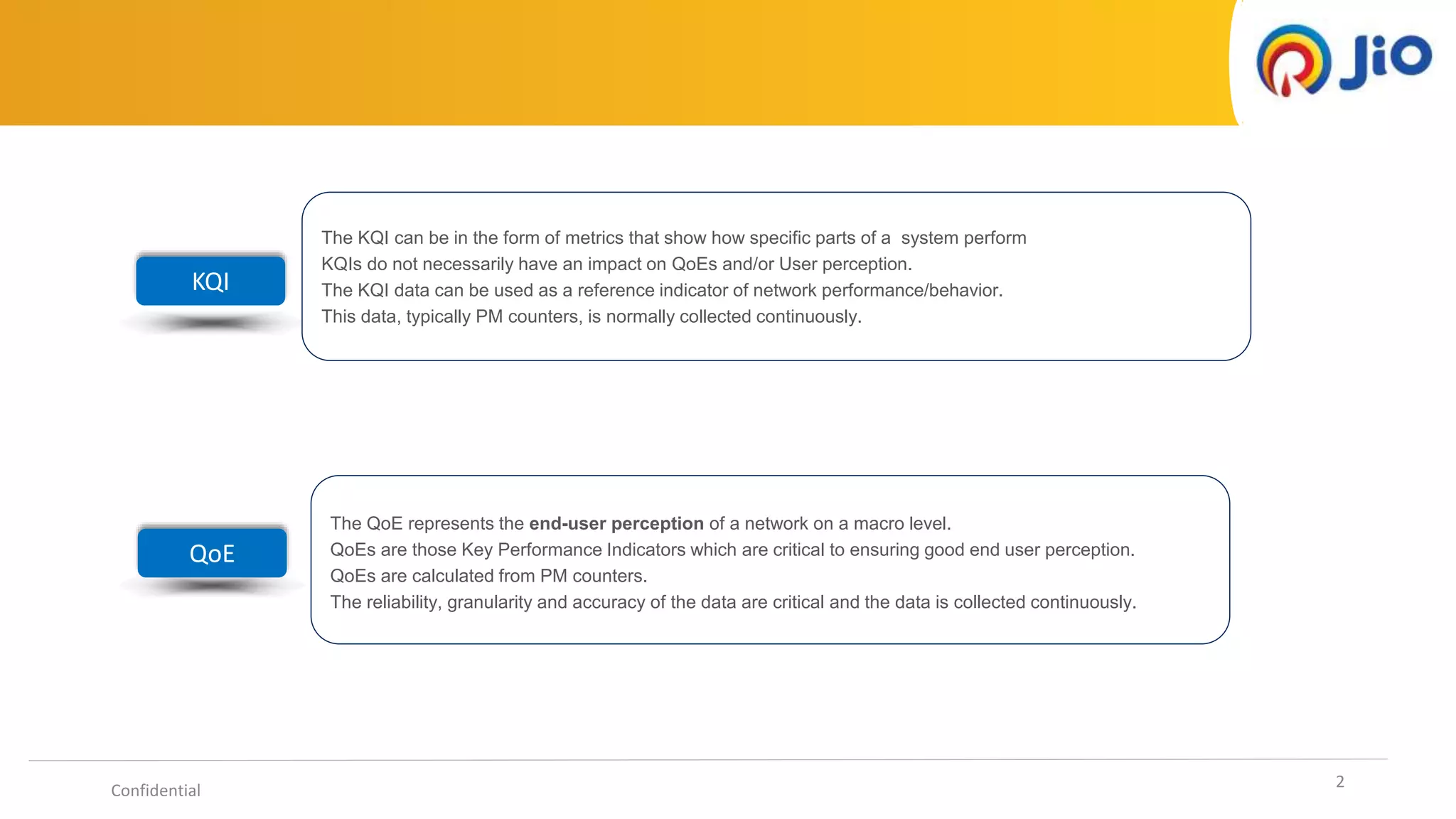
QoE
The QoE represents the end-user perception of a network on a macro level.
QoEs are those Key Performance Indicators which are critical to ensuring good end user perception.
QoEs are calculated from PM counters.
The reliability, granularity and accuracy of the data are critical and the data is collected continuously.
KQI
The KQI can be in the form of metrics that show how specific parts of a system perform
KQIs do not necessarily have an impact on QoEs and/or User perception.
The KQI data can be used as a reference indicator of network performance/behavior.
This data, typically PM counters, is normally collected continuously.
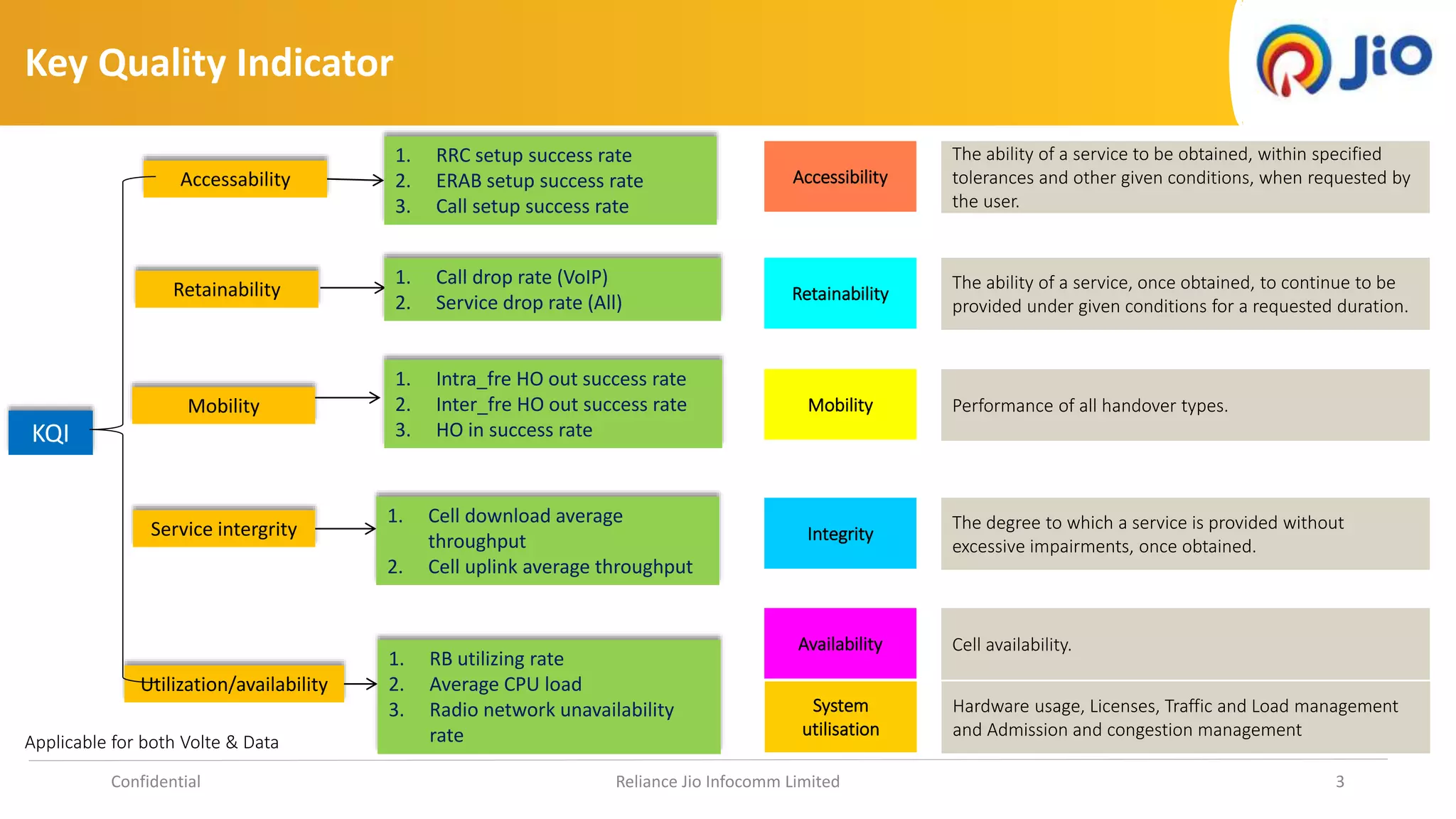
Key Quality Indicator
Confidential Reliance Jio Infocomm Limited 3
Accessability
Retainability
Mobility
Utilization/availability
KQI
1. RRC setup success rate
2. ERAB setup success rate
3. Call setup success rate
1. Call drop rate (VoIP)
2. Service drop rate (All)
1. Intra_fre HO out success rate
2. Inter_fre HO out success rate
3. HO in success rate
1. RB utilizing rate
2. Average CPU load
3. Radio network unavailability
rate
Service intergrity
1. Cell download average
throughput
2. Cell uplink average throughput
Applicable for both Volte & Data
Accessibility
The ability of a service to be obtained, within specified
tolerances and other given conditions, when requested by
the user.
Retainability
The ability of a service, once obtained, to continue to be
provided under given conditions for a requested duration.
Integrity
The degree to which a service is provided without
excessive impairments, once obtained.
Mobility Performance of all handover types.
System
utilisation
Hardware usage, Licenses, Traffic and Load management
and Admission and congestion management
Availability Cell availability.
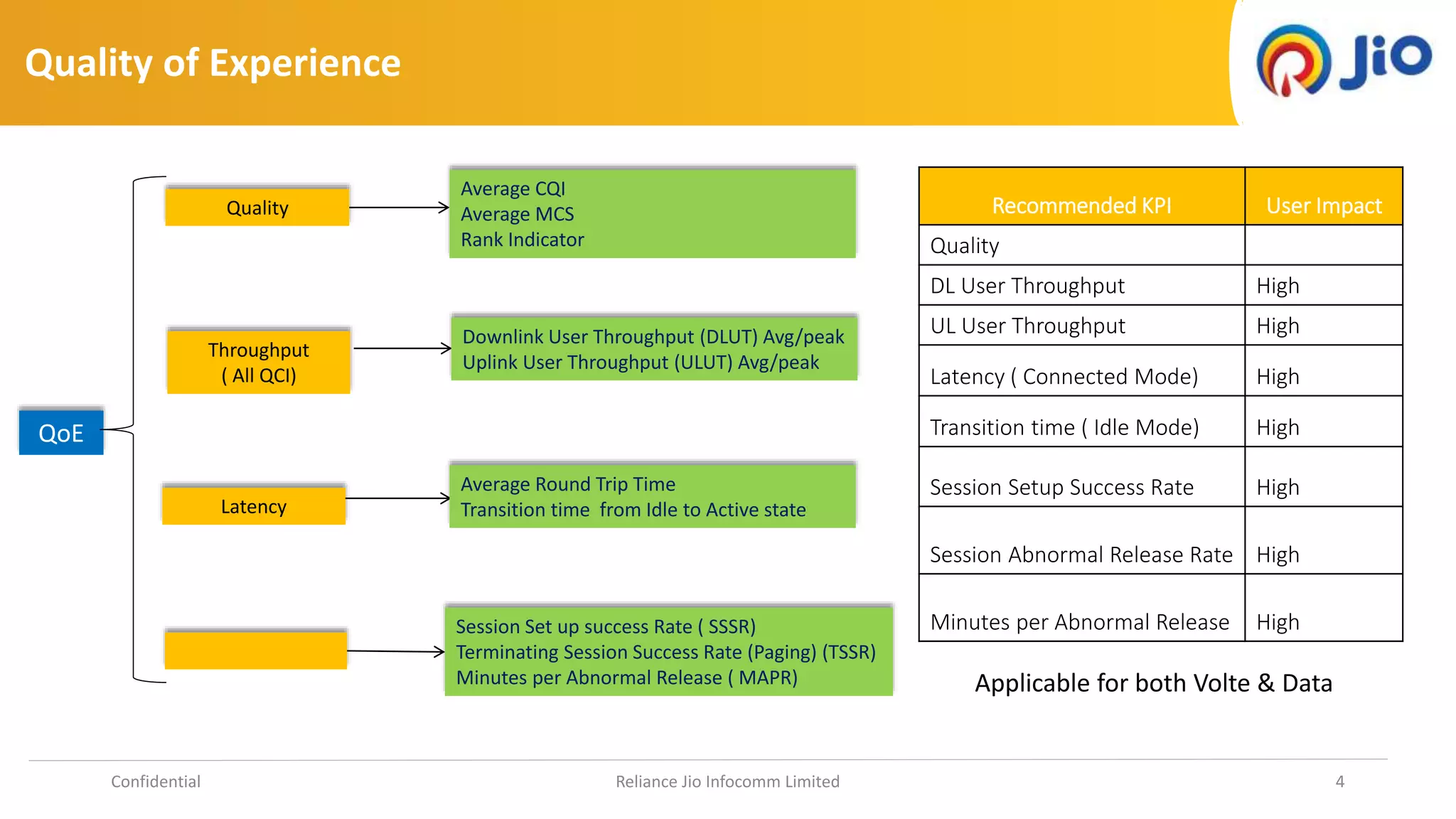
Quality of Experience
Confidential Reliance Jio Infocomm Limited 4
Quality
Throughput
( All QCI)
Latency
QoE
Average CQI
Average MCS
Rank Indicator
Downlink User Throughput (DLUT) Avg/peak
Uplink User Throughput (ULUT) Avg/peak
Average Round Trip Time
Transition time from Idle to Active state
Session Set up success Rate ( SSSR)
Terminating Session Success Rate (Paging) (TSSR)
Minutes per Abnormal Release ( MAPR) Applicable for both Volte & Data
Recommended KPI User Impact
Quality
DL User Throughput High
UL User Throughput High
Latency ( Connected Mode) High
Transition time ( Idle Mode) High
Session Setup Success Rate High
Session Abnormal Release Rate High
Minutes per Abnormal Release High
KQI Defenition
Confidential Reliance Jio Infocomm Limited 5
QoE Definitions
Confidential Reliance Jio Infocomm Limited 6
• The Session Setup Success Rate (SSSR) is defined as the ratio of successful session setups, divided by the total number of session setup attempts.
• A combined metric which includes RRC, S1 and E-RAB establishment success.
• The Session Abnormal Release Rate (SARR) is defined as the ratio of abnormal session disconnections, divided by the total number of successful session setups.
• It is the probability of successfully holding and then terminating a data session from an end user perspective.
• The Minutes per Abnormal Release (MPAR) is defined as the ratio of the total end user time where a data session is maintained after being successfully set up divided by the abnormal call
disconnections.
• It represents the probable length of time a data session call can be held by the end user before it is abnormally terminated.
• The DL User Throughput (DLUT) is the average user throughput for data in the Downlink on a Radio Bearer.
• DLUT includes user data but excluding retransmissions, padding bits, data PDU headers and RLC control PDU's.
• The UL User Throughput (ULUT) is the average user throughput for data in the Uplink on a Radio Bearer.
• ULUT includes user data but excluding retransmissions, padding bits, data PDU headers and RLC control PDU's.
• The Round Trip Time (RTT) is defined as the time taken for an IP packet to travel from a UE through to a server located in the core network and back to the UE.
• The Control Plane Latency (Idle to Active) (CPL) is defined as the time taken for a UE to transition from an idle state to an active state.
• It is the time to initiate a new session when the UE starts in an idle mode.

Qo e kqi

  • 1.
  • 2.
    Confidential Reliance Jio InfocommLimited 2 QoE The QoE represents the end-user perception of a network on a macro level. QoEs are those Key Performance Indicators which are critical to ensuring good end user perception. QoEs are calculated from PM counters. The reliability, granularity and accuracy of the data are critical and the data is collected continuously. KQI The KQI can be in the form of metrics that show how specific parts of a system perform KQIs do not necessarily have an impact on QoEs and/or User perception. The KQI data can be used as a reference indicator of network performance/behavior. This data, typically PM counters, is normally collected continuously.
  • 3.
    Key Quality Indicator ConfidentialReliance Jio Infocomm Limited 3 Accessability Retainability Mobility Utilization/availability KQI 1. RRC setup success rate 2. ERAB setup success rate 3. Call setup success rate 1. Call drop rate (VoIP) 2. Service drop rate (All) 1. Intra_fre HO out success rate 2. Inter_fre HO out success rate 3. HO in success rate 1. RB utilizing rate 2. Average CPU load 3. Radio network unavailability rate Service intergrity 1. Cell download average throughput 2. Cell uplink average throughput Applicable for both Volte & Data Accessibility The ability of a service to be obtained, within specified tolerances and other given conditions, when requested by the user. Retainability The ability of a service, once obtained, to continue to be provided under given conditions for a requested duration. Integrity The degree to which a service is provided without excessive impairments, once obtained. Mobility Performance of all handover types. System utilisation Hardware usage, Licenses, Traffic and Load management and Admission and congestion management Availability Cell availability.
  • 4.
    Quality of Experience ConfidentialReliance Jio Infocomm Limited 4 Quality Throughput ( All QCI) Latency QoE Average CQI Average MCS Rank Indicator Downlink User Throughput (DLUT) Avg/peak Uplink User Throughput (ULUT) Avg/peak Average Round Trip Time Transition time from Idle to Active state Session Set up success Rate ( SSSR) Terminating Session Success Rate (Paging) (TSSR) Minutes per Abnormal Release ( MAPR) Applicable for both Volte & Data Recommended KPI User Impact Quality DL User Throughput High UL User Throughput High Latency ( Connected Mode) High Transition time ( Idle Mode) High Session Setup Success Rate High Session Abnormal Release Rate High Minutes per Abnormal Release High
  • 5.
  • 6.
    QoE Definitions Confidential RelianceJio Infocomm Limited 6 • The Session Setup Success Rate (SSSR) is defined as the ratio of successful session setups, divided by the total number of session setup attempts. • A combined metric which includes RRC, S1 and E-RAB establishment success. • The Session Abnormal Release Rate (SARR) is defined as the ratio of abnormal session disconnections, divided by the total number of successful session setups. • It is the probability of successfully holding and then terminating a data session from an end user perspective. • The Minutes per Abnormal Release (MPAR) is defined as the ratio of the total end user time where a data session is maintained after being successfully set up divided by the abnormal call disconnections. • It represents the probable length of time a data session call can be held by the end user before it is abnormally terminated. • The DL User Throughput (DLUT) is the average user throughput for data in the Downlink on a Radio Bearer. • DLUT includes user data but excluding retransmissions, padding bits, data PDU headers and RLC control PDU's. • The UL User Throughput (ULUT) is the average user throughput for data in the Uplink on a Radio Bearer. • ULUT includes user data but excluding retransmissions, padding bits, data PDU headers and RLC control PDU's. • The Round Trip Time (RTT) is defined as the time taken for an IP packet to travel from a UE through to a server located in the core network and back to the UE. • The Control Plane Latency (Idle to Active) (CPL) is defined as the time taken for a UE to transition from an idle state to an active state. • It is the time to initiate a new session when the UE starts in an idle mode.