Ethernet Services: Global Market Drivers & Winning Portfolios David Hold, Joel Stradling & Siow Meng Soh June 24 & 25, 2009 To listen to a replay of this presentation, go to:  http://www.currentanlysis.com/t/2009/ethernet/ethernetserv0609.htm
Introductions Siow Meng Soh, Senior Analyst, Telecom Services Asia  David Hold, Senior Analyst, Business Network Services, North America Joel Stradling, Senior Analyst, Business Telecom Services Europe
Agenda 1. Broad Trends in Ethernet Services and Market Penetration 2. Current Controversies:  Ethernet vs. IP VPLS, MPLS & Scalability 3. Reaching Customers:  Topics in Ethernet access:  Ethernet over Fiber, Bonded Copper & TDM circuits Off-net Access via E-NNIs 4. Market Verticals & Applications Who is buying Ethernet and why 5. Buying Criteria – What makes a Winning Portfolio? Regional Market Landscape and Leaders U.S, Europe & Asia Pacific 6. Future Directions – Taking Ethernet to the Next Level
Broad Trends Ethernet is replacing legacy data networks Different country-by-country and cross-border landscapes around the world:  Regulatory environment, network legacy/next-generation, competition, and so on Business applications are driving take-up: Software as a Service (SaaS), hosted UC & VoIP Additional ICT trends driving Ethernet take-up:  Data centre consolidation, virtualization, ICT outsourcing
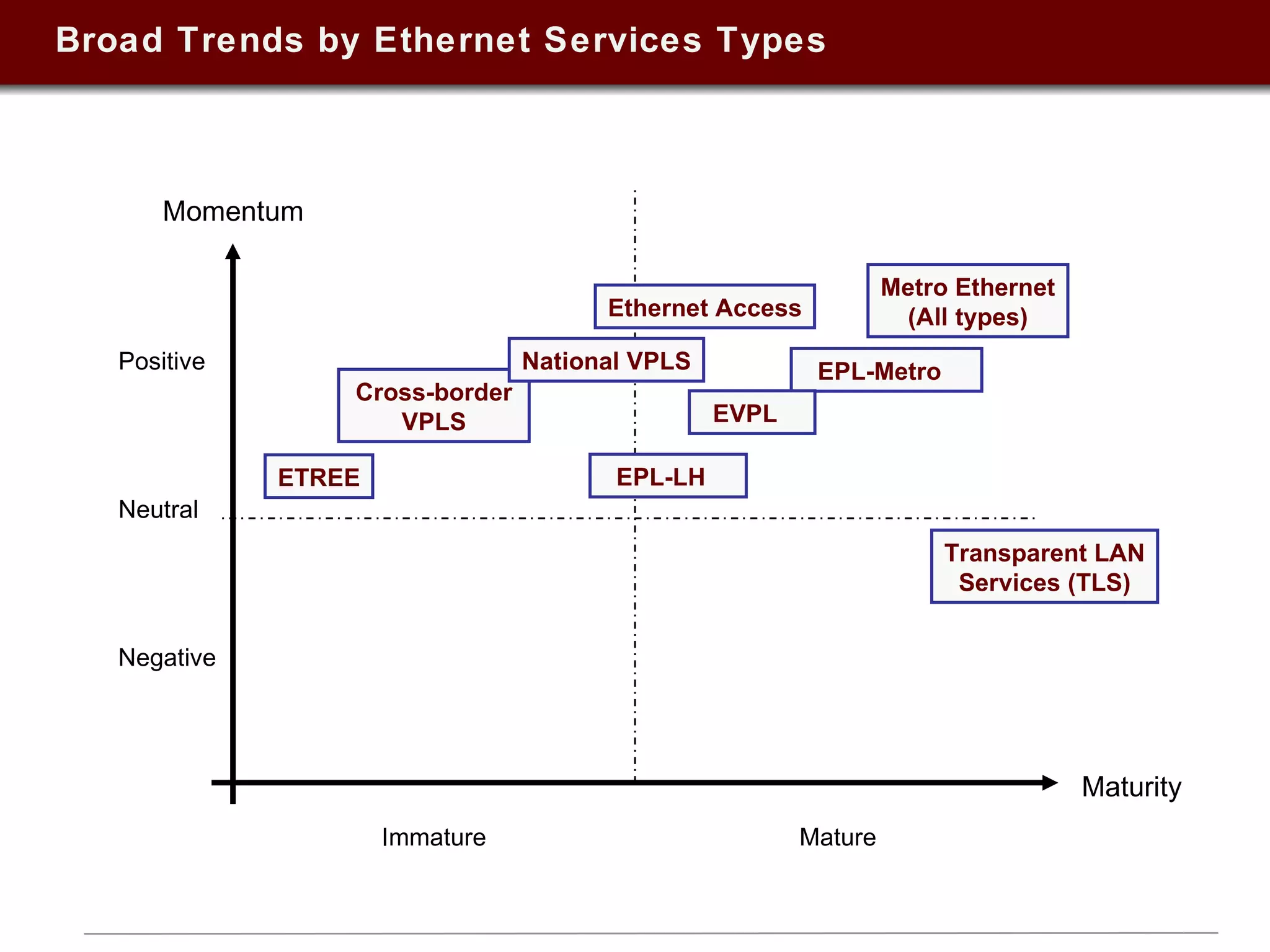
Broad Trends by Ethernet Services Types Positive Immature Mature EPL-Metro  Metro Ethernet (All types) Cross-border VPLS Ethernet Access National VPLS Negative Momentum Maturity Neutral EVPL  ETREE Transparent LAN Services (TLS) EPL-LH
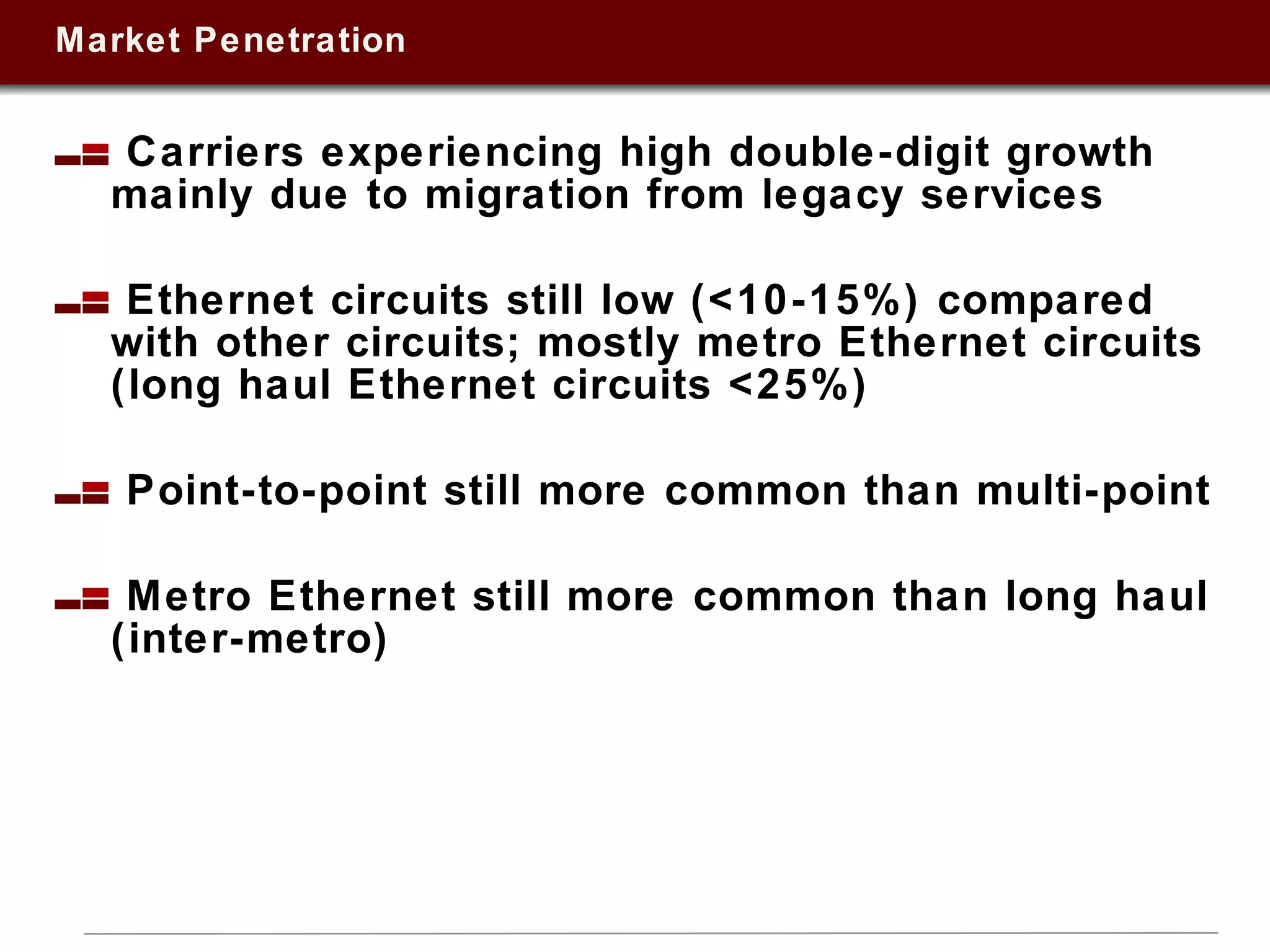
Market Penetration  Carriers experiencing high double-digit growth mainly due to migration from legacy services Ethernet circuits still low (<10-15%) compared with other circuits; mostly metro Ethernet circuits (long haul Ethernet circuits <25%) Point-to-point still more common than multi-point  Metro Ethernet still more common than long haul (inter-metro)
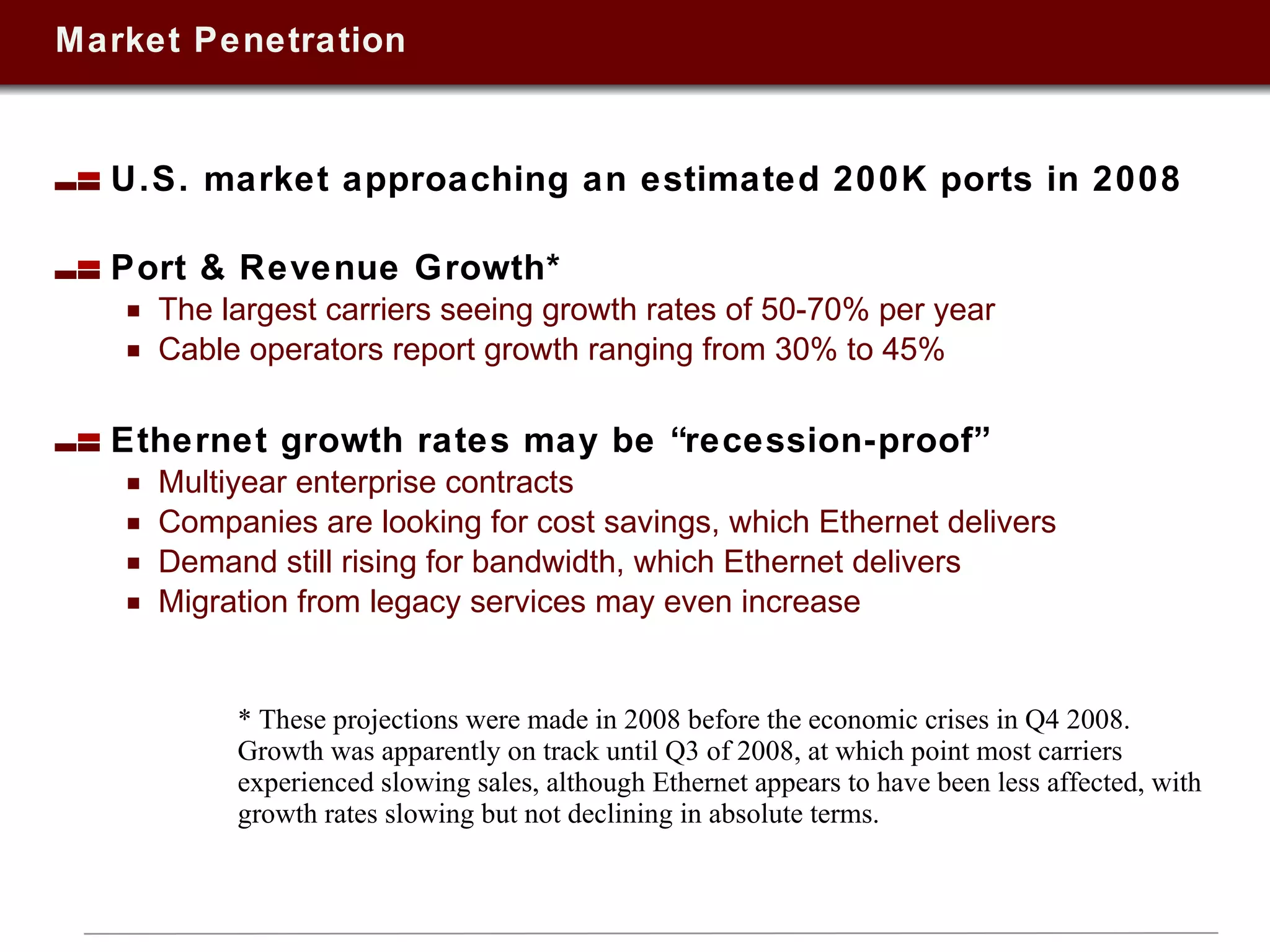
Market Penetration  U.S. market approaching an estimated 200K ports in 2008 Port & Revenue Growth* The largest carriers seeing growth rates of 50-70% per year Cable operators report growth ranging from 30% to 45% Ethernet growth rates may be “recession-proof”  Multiyear enterprise contracts  Companies are looking for cost savings, which Ethernet delivers Demand still rising for bandwidth, which Ethernet delivers Migration from legacy services may even increase * These projections were made in 2008 before the economic crises in Q4 2008. Growth was apparently on track until Q3 of 2008, at which point most carriers experienced slowing sales, although Ethernet appears to have been less affected, with growth rates slowing but not declining in absolute terms.
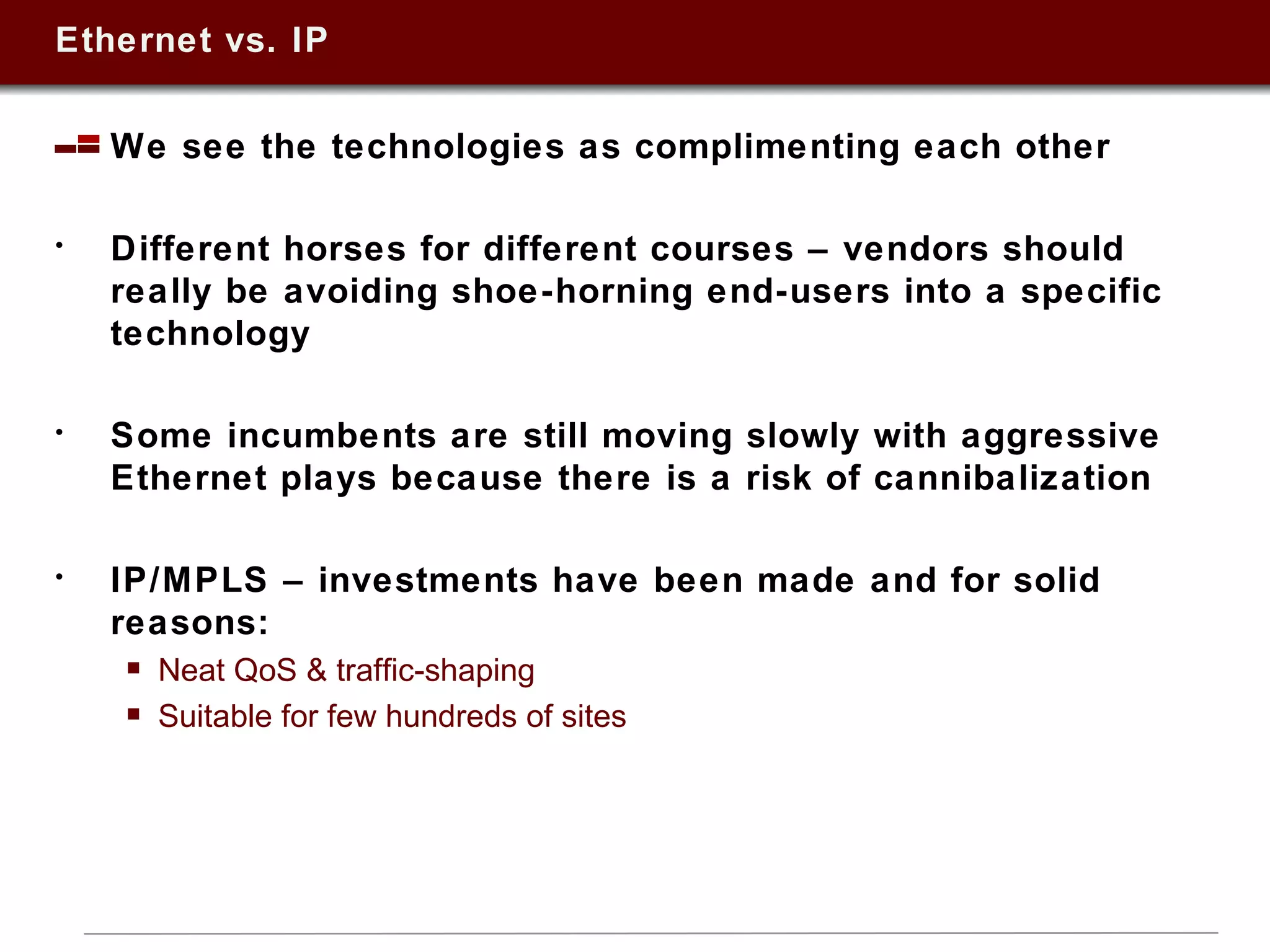
Ethernet vs. IP We see the technologies as complimenting each other Different horses for different courses – vendors should really be avoiding shoe-horning end-users into a specific technology Some incumbents are still moving slowly with aggressive Ethernet plays because there is a risk of cannibalization IP/MPLS – investments have been made and for solid reasons:  Neat QoS & traffic-shaping Suitable for few hundreds of sites
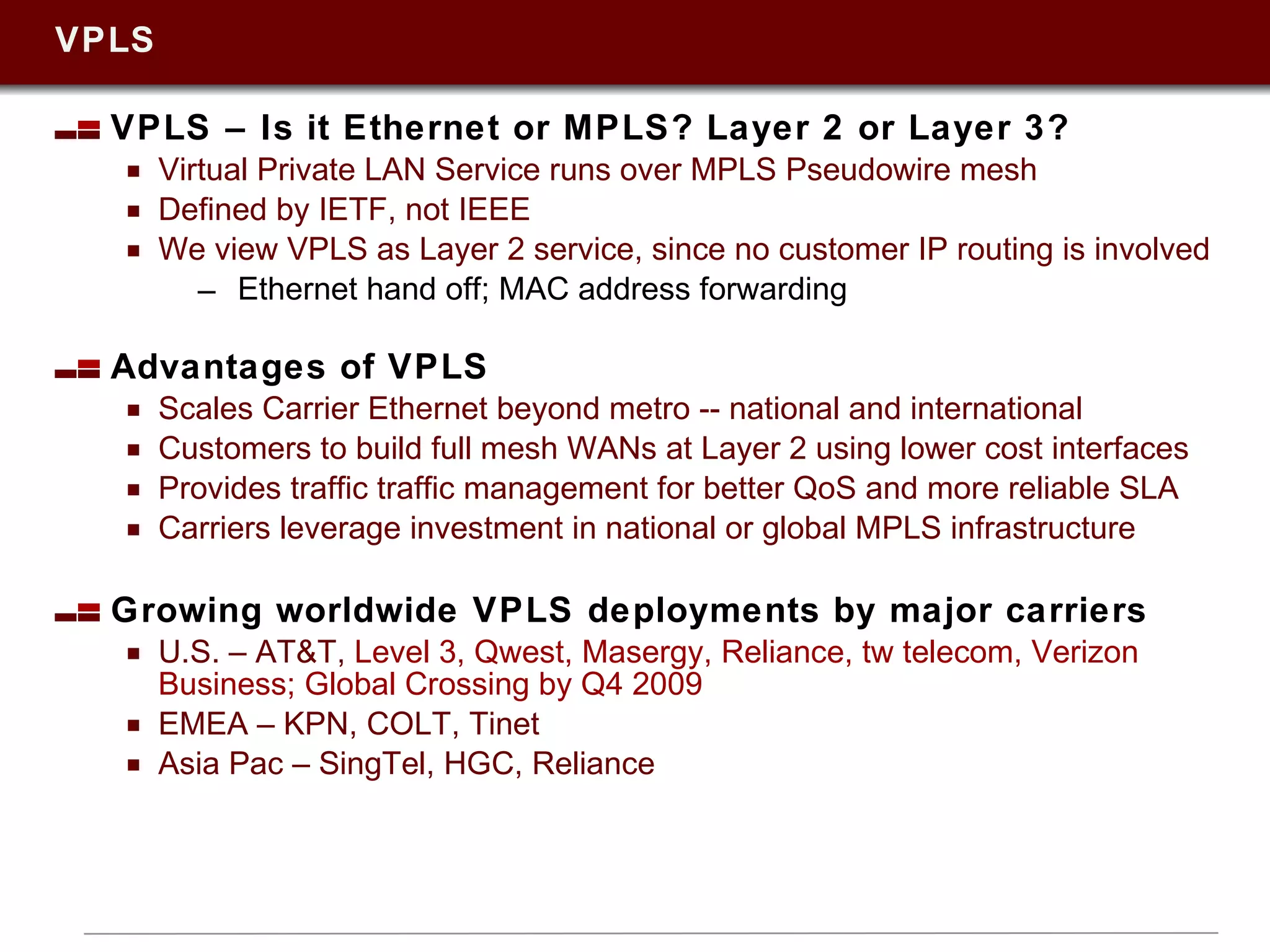
VPLS VPLS – Is it Ethernet or MPLS? Layer 2 or Layer 3? Virtual Private LAN Service runs over MPLS Pseudowire mesh Defined by IETF, not IEEE We view VPLS as Layer 2 service, since no customer IP routing is involved Ethernet hand off; MAC address forwarding Advantages of VPLS Scales Carrier Ethernet beyond metro -- national and international Customers to build full mesh WANs at Layer 2 using lower cost interfaces Provides traffic traffic management for better QoS and more reliable SLA Carriers leverage investment in national or global MPLS infrastructure Growing worldwide VPLS deployments by major carriers U.S. – AT&T,  Level 3, Qwest, Masergy, Reliance, tw telecom, Verizon Business; Global Crossing by Q4 2009 EMEA – KPN, COLT, Tinet  Asia Pac – SingTel, HGC, Reliance
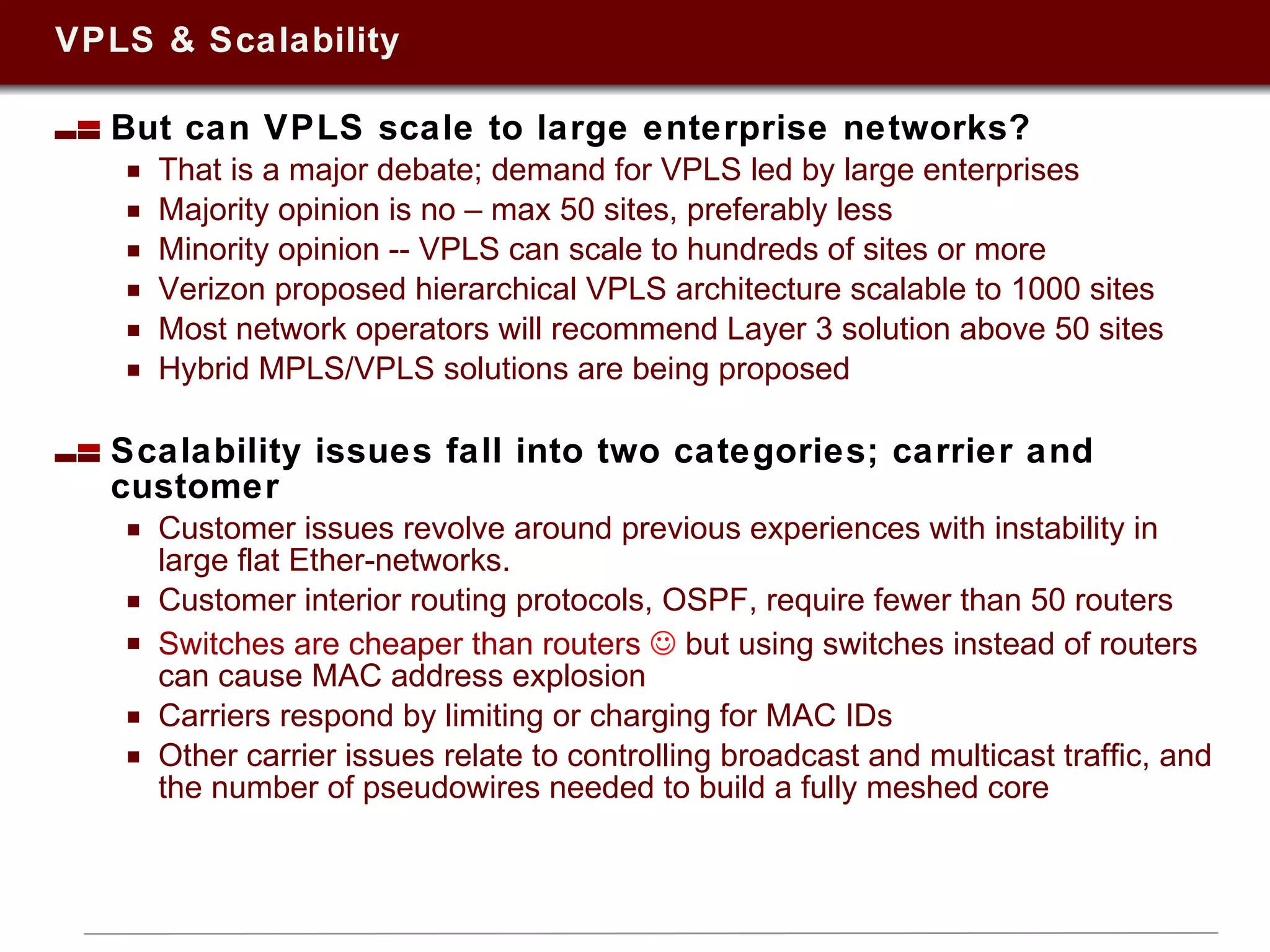
VPLS & Scalability But can VPLS scale to large enterprise networks? That is a major debate; demand for VPLS led by large enterprises Majority opinion is no – max 50 sites, preferably less Minority opinion -- VPLS can scale to hundreds of sites or more Verizon proposed hierarchical VPLS architecture scalable to 1000 sites Most network operators will recommend Layer 3 solution above 50 sites Hybrid MPLS/VPLS solutions are being proposed Scalability issues fall into two categories; carrier and customer Customer issues revolve around previous experiences with instability in large flat Ether-networks. Customer interior routing protocols, OSPF, require fewer than 50 routers Switches are cheaper than routers     but using switches instead of routers can cause MAC address explosion  Carriers respond by limiting or charging for MAC IDs Other carrier issues relate to controlling broadcast and multicast traffic, and the number of pseudowires needed to build a fully meshed core
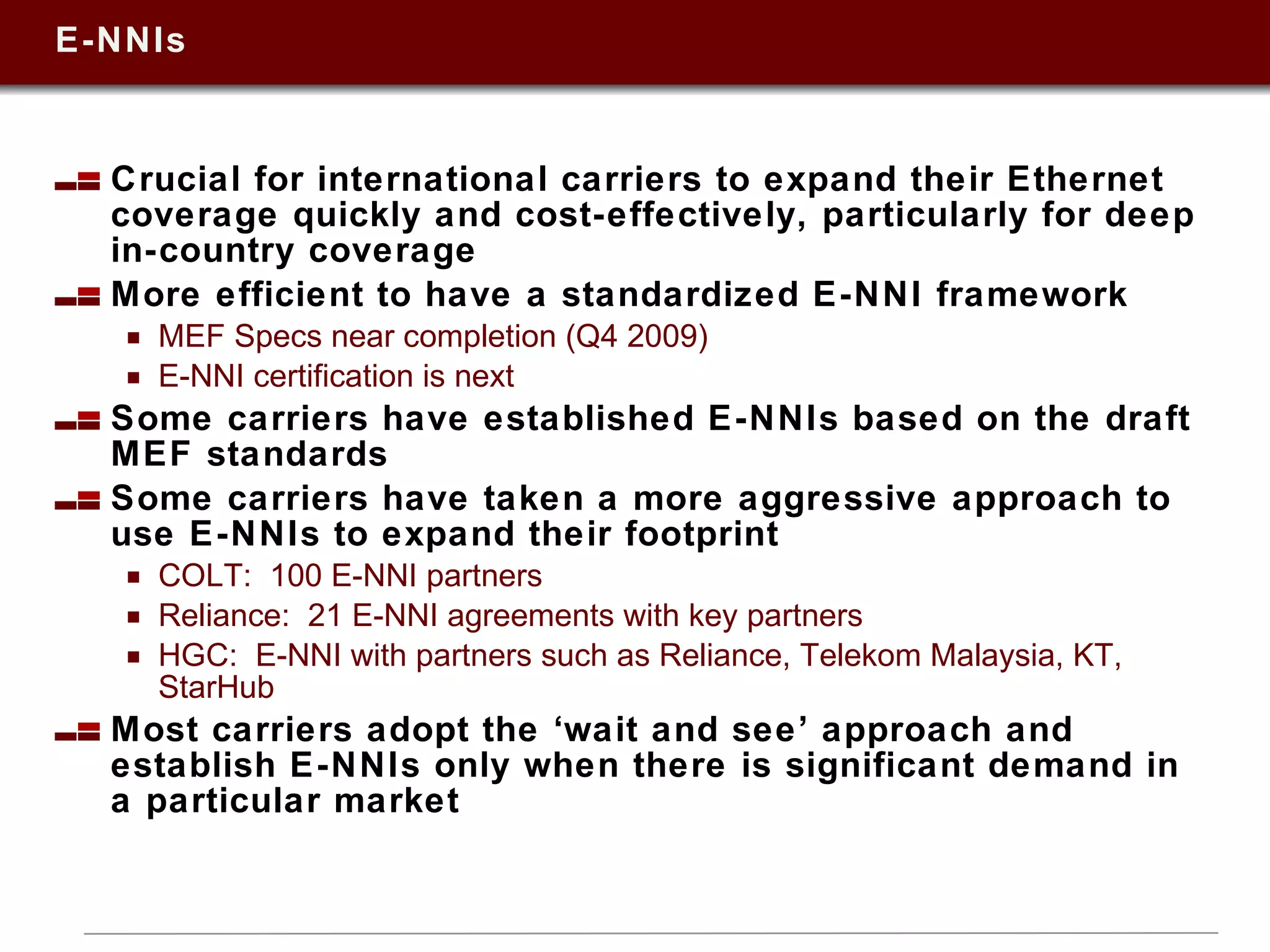
E-NNIs Crucial for international carriers to expand their Ethernet coverage quickly and cost-effectively, particularly for deep in-country coverage More efficient to have a standardized E-NNI framework  MEF Specs near completion (Q4 2009) E-NNI certification is next  Some carriers have established E-NNIs based on the draft MEF standards  Some carriers have taken a more aggressive approach to use E-NNIs to expand their footprint COLT:  100 E-NNI partners Reliance:  21 E-NNI agreements with key partners HGC:  E-NNI with partners such as Reliance, Telekom Malaysia, KT, StarHub Most carriers adopt the ‘wait and see’ approach and establish E-NNIs only when there is significant demand in a particular market
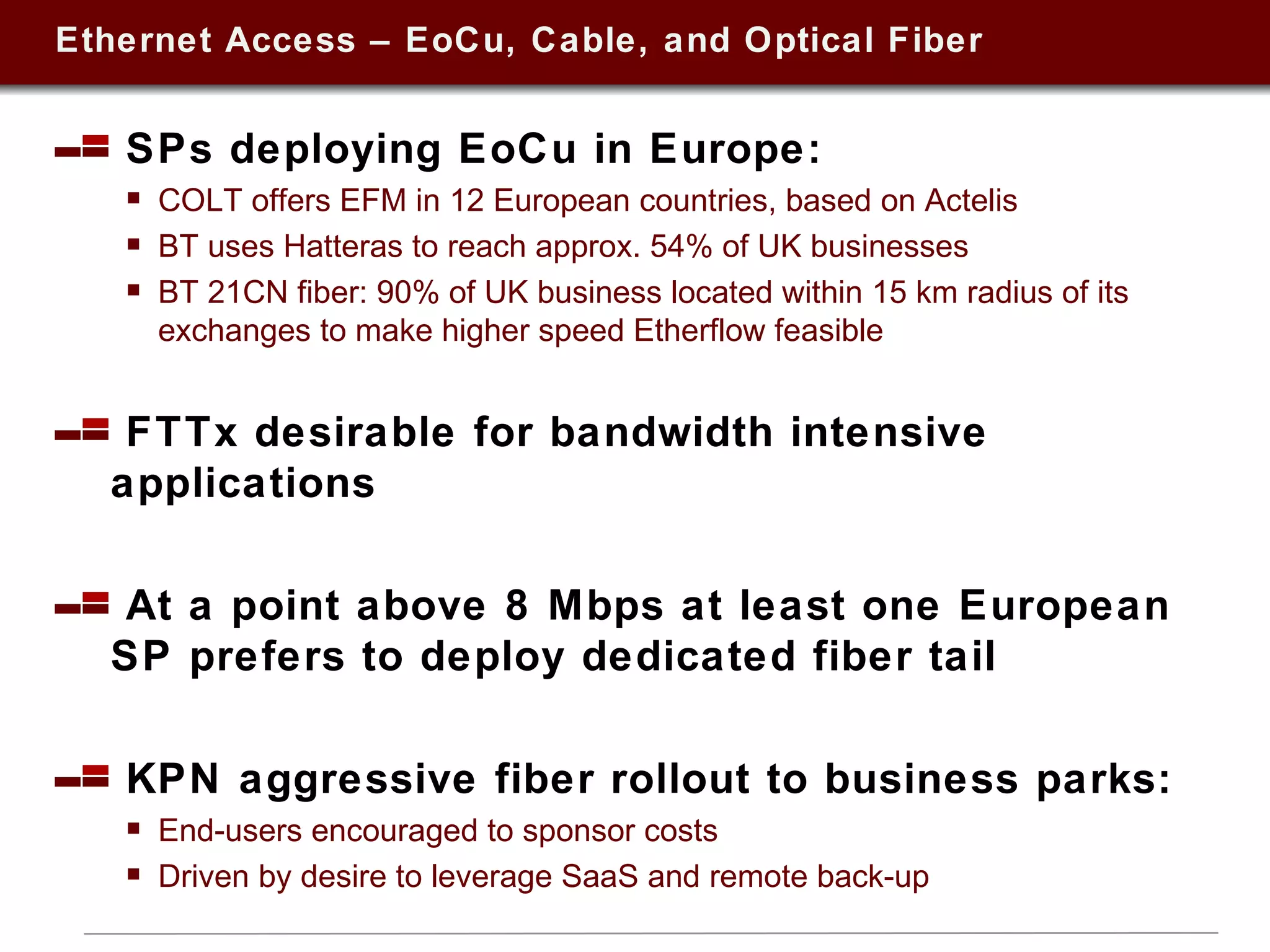
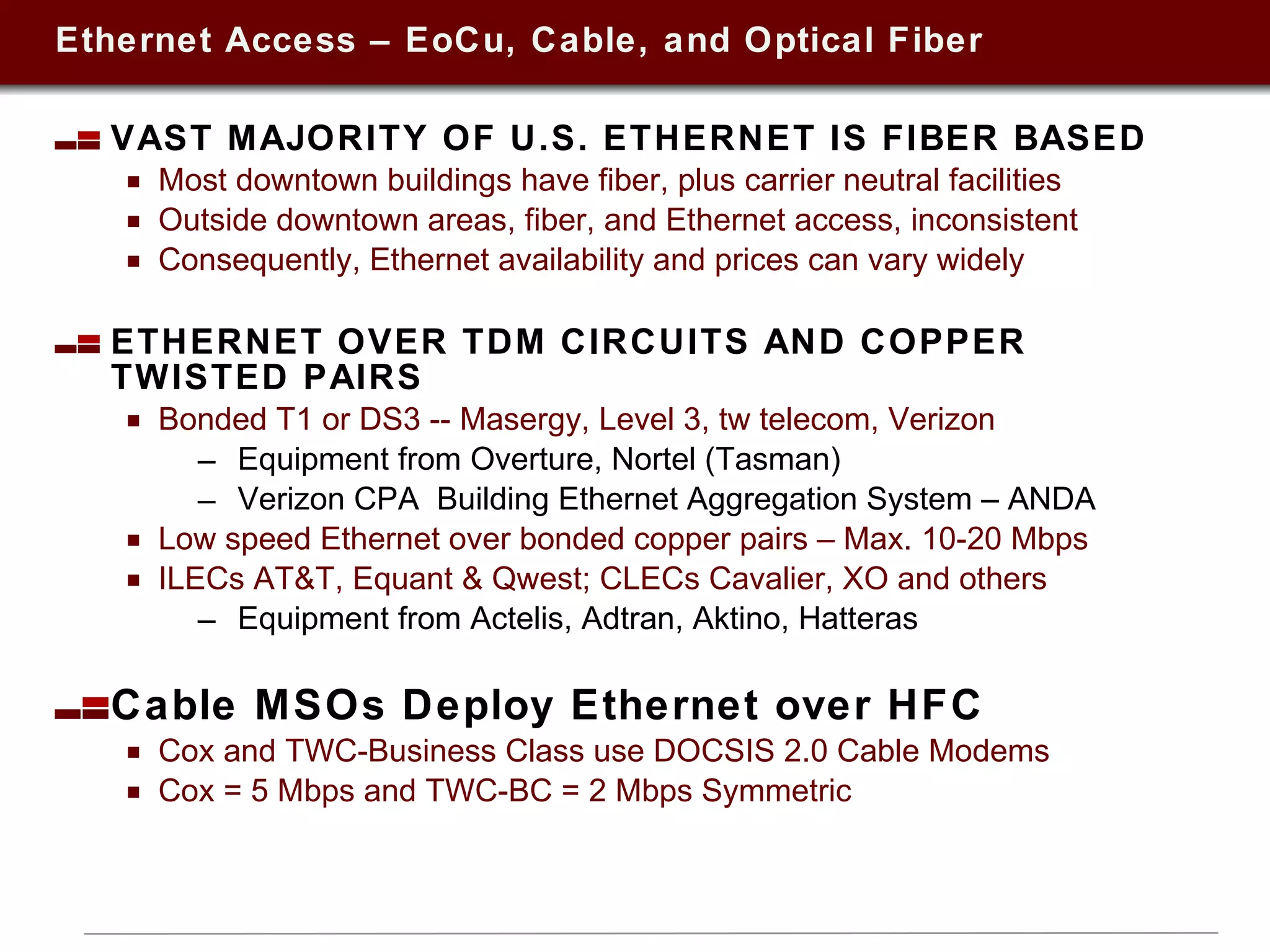
Ethernet Access – EoCu, Cable, and Optical Fiber SPs deploying EoCu in Europe:  COLT offers EFM in 12 European countries, based on Actelis BT uses Hatteras to reach approx. 54% of UK businesses  BT 21CN fiber: 90% of UK business located within 15 km radius of its exchanges to make higher speed Etherflow feasible FTTx desirable for bandwidth intensive applications At a point above 8 Mbps at least one European SP prefers to deploy dedicated fiber tail KPN aggressive fiber rollout to business parks:  End-users encouraged to sponsor costs Driven by desire to leverage SaaS and remote back-up
Ethernet Access – EoCu, Cable, and Optical Fiber VAST MAJORITY OF U.S. ETHERNET IS FIBER BASED Most downtown buildings have fiber, plus carrier neutral facilities  Outside downtown areas, fiber, and Ethernet access, inconsistent Consequently, Ethernet availability and prices can vary widely ETHERNET OVER TDM CIRCUITS AND COPPER TWISTED PAIRS Bonded T1 or DS3 -- Masergy, Level 3, tw telecom, Verizon  Equipment from Overture, Nortel (Tasman)  Verizon CPA  Building Ethernet Aggregation System – ANDA Low speed Ethernet over bonded copper pairs – Max. 10-20 Mbps ILECs AT&T, Equant & Qwest; CLECs Cavalier, XO and others Equipment from Actelis, Adtran, Aktino, Hatteras  Cable MSOs Deploy Ethernet over HFC Cox and TWC-Business Class use DOCSIS 2.0 Cable Modems Cox = 5 Mbps and TWC-BC = 2 Mbps Symmetric
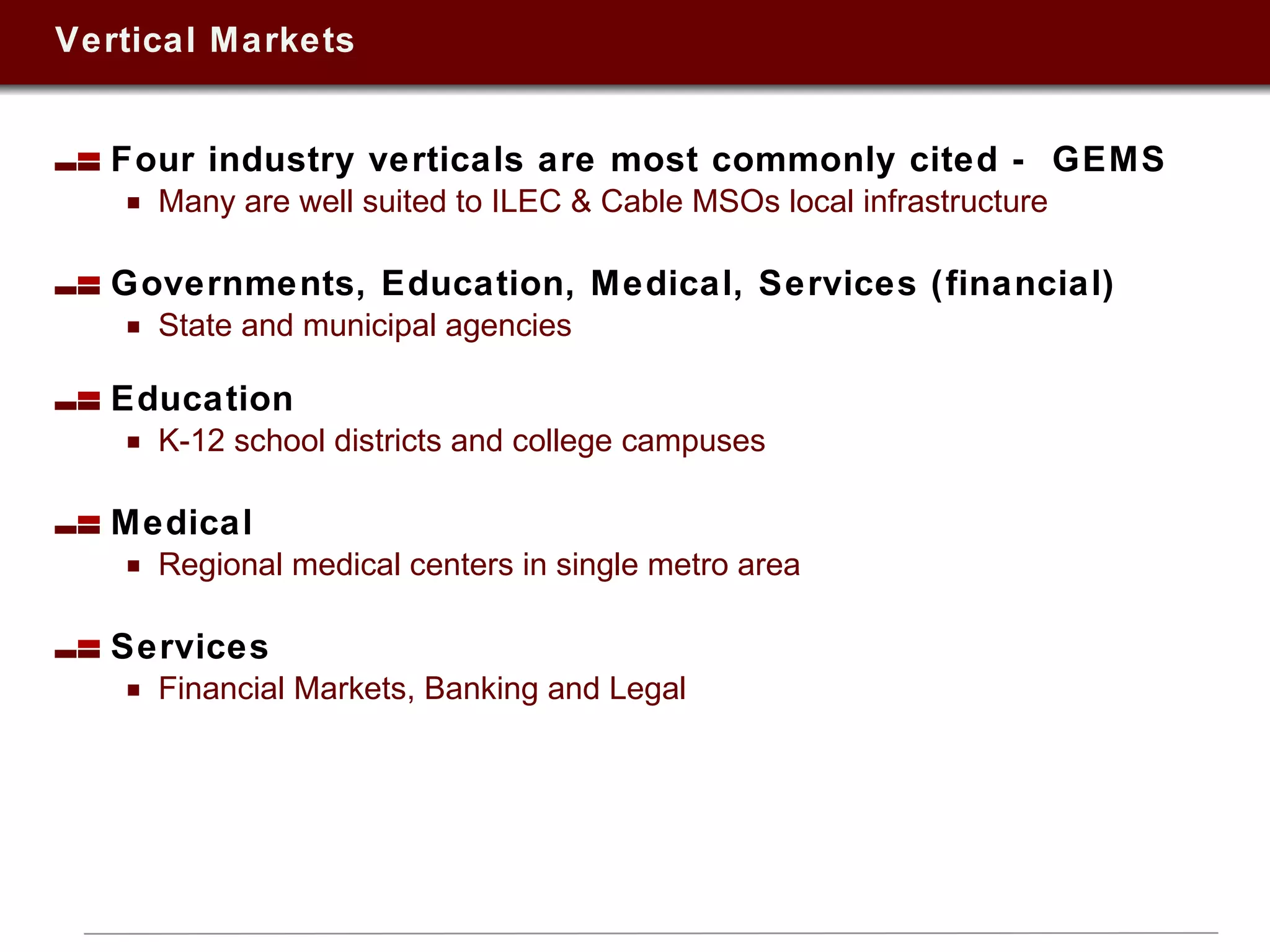
Vertical Markets Four industry verticals are most commonly cited -  GEMS Many are well suited to ILEC & Cable MSOs local infrastructure Governments, Education, Medical, Services (financial) State and municipal agencies Education K-12 school districts and college campuses Medical Regional medical centers in single metro area Services  Financial Markets, Banking and Legal
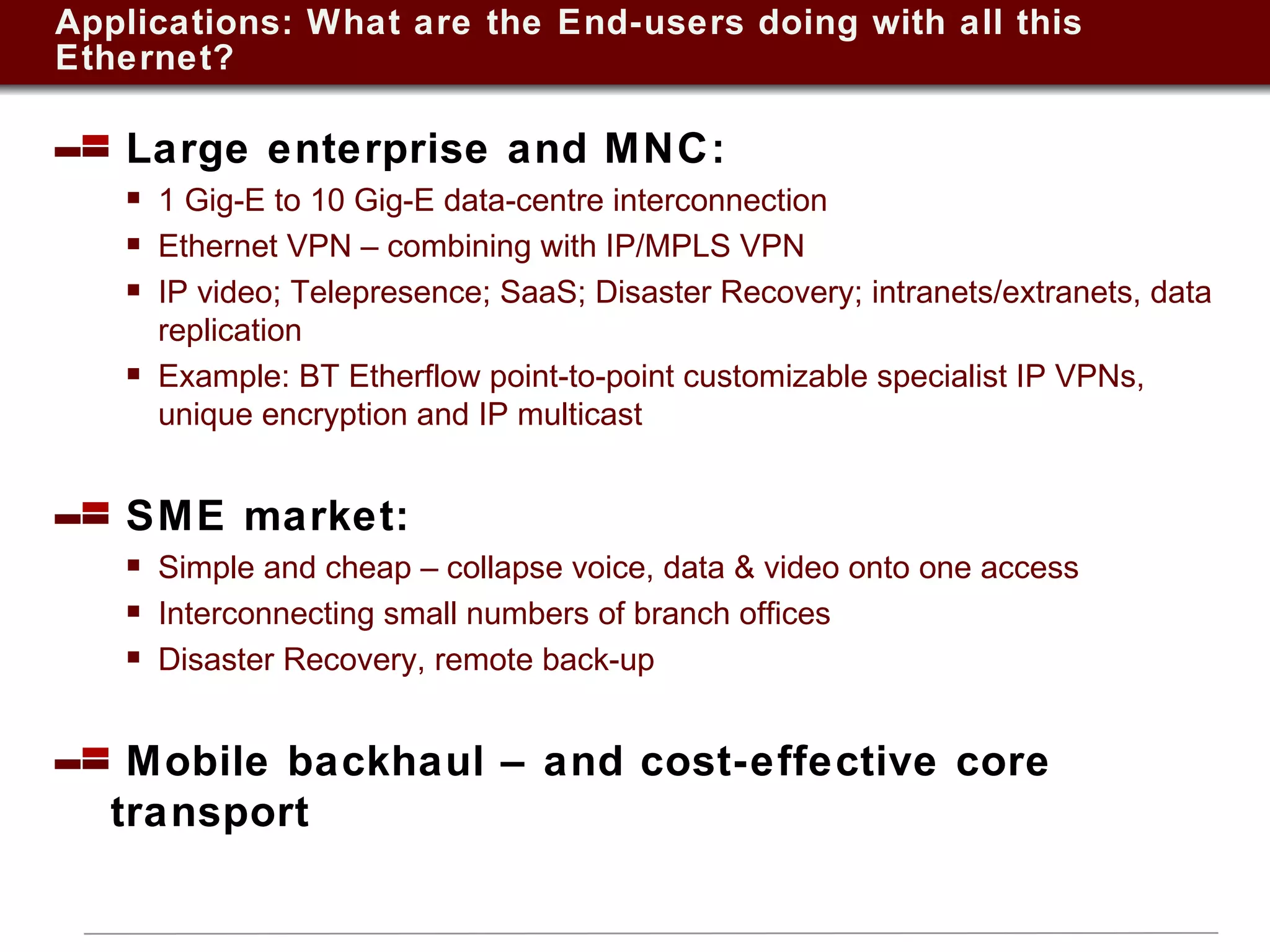
Applications: What are the End-users doing with all this Ethernet? Large enterprise and MNC:  1 Gig-E to 10 Gig-E data-centre interconnection Ethernet VPN – combining with IP/MPLS VPN IP video; Telepresence; SaaS; Disaster Recovery; intranets/extranets, data replication  Example: BT Etherflow point-to-point customizable specialist IP VPNs, unique encryption and IP multicast  SME market:  Simple and cheap – collapse voice, data & video onto one access Interconnecting small numbers of branch offices Disaster Recovery, remote back-up Mobile backhaul – and cost-effective core transport
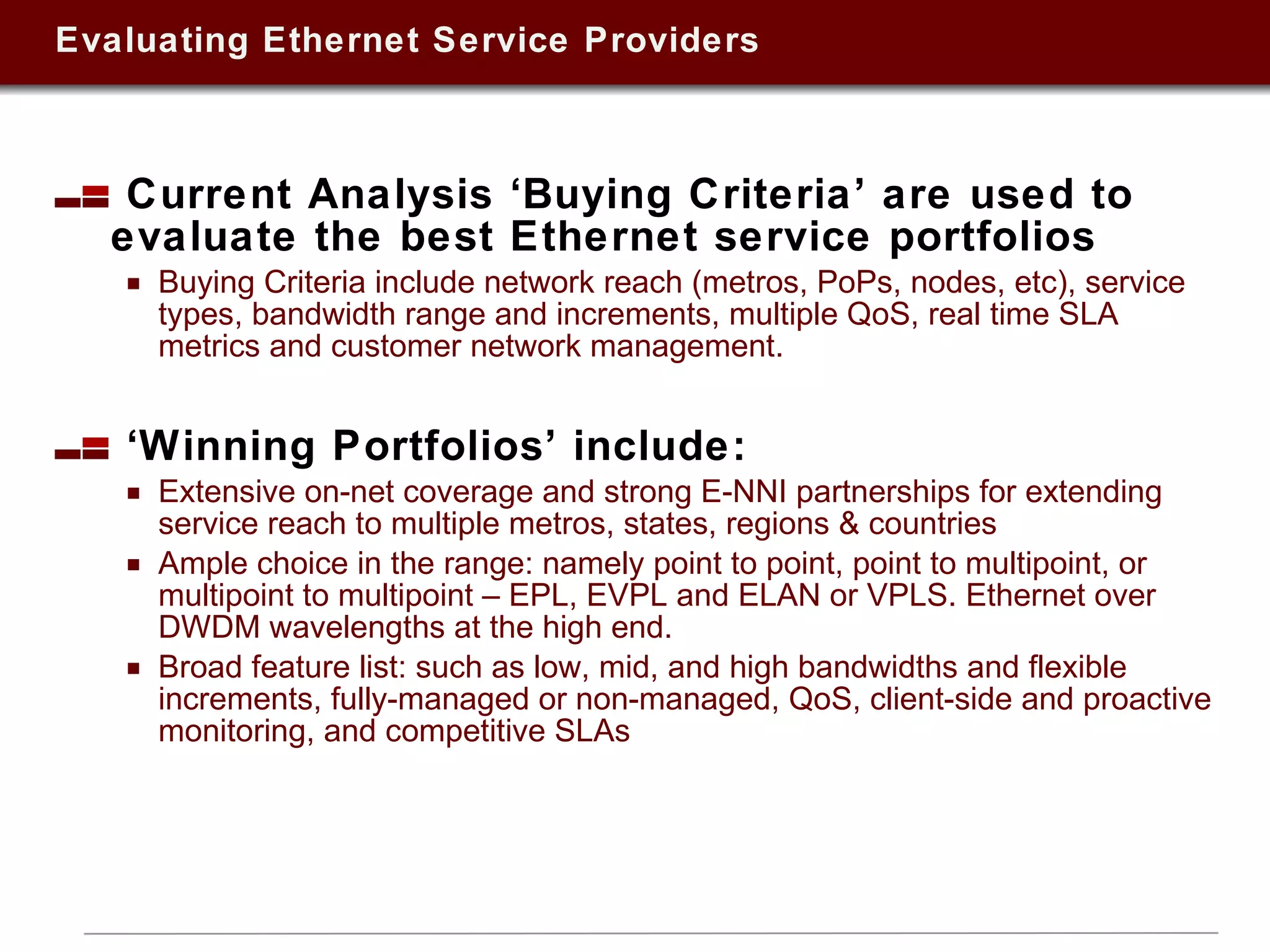
Evaluating Ethernet Service Providers Current Analysis ‘Buying Criteria’ are used to evaluate the best Ethernet service portfolios Buying Criteria include network reach (metros, PoPs, nodes, etc), service types, bandwidth range and increments, multiple QoS, real time SLA metrics and customer network management.  ‘ Winning Portfolios’ include: Extensive on-net coverage and strong E-NNI partnerships for extending service reach to multiple metros, states, regions & countries Ample choice in the range: namely point to point, point to multipoint, or multipoint to multipoint – EPL, EVPL and ELAN or VPLS. Ethernet over DWDM wavelengths at the high end. Broad feature list: such as low, mid, and high bandwidths and flexible increments, fully-managed or non-managed, QoS, client-side and proactive monitoring, and competitive SLAs
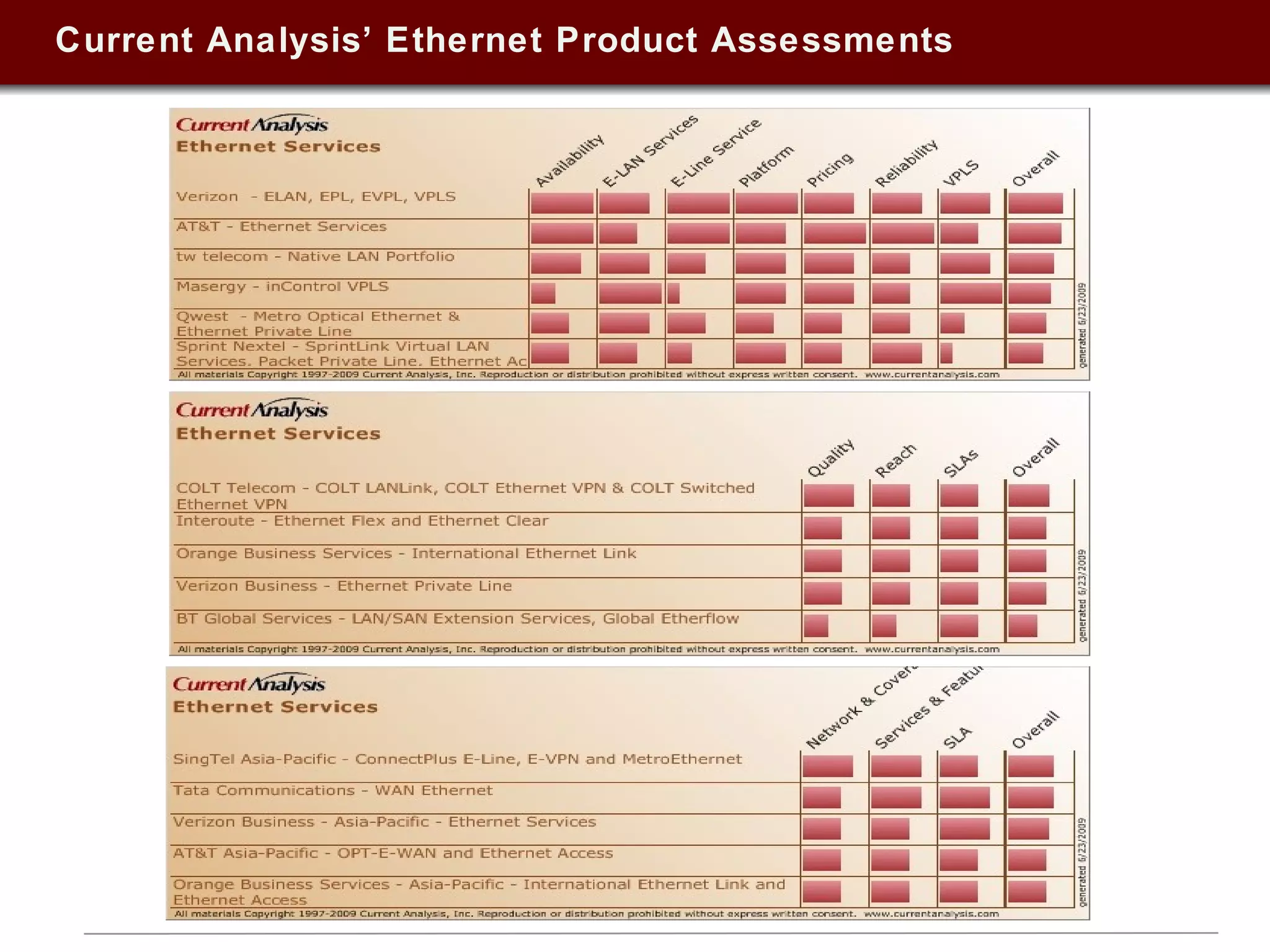
Current Analysis’ Ethernet Product Assessments
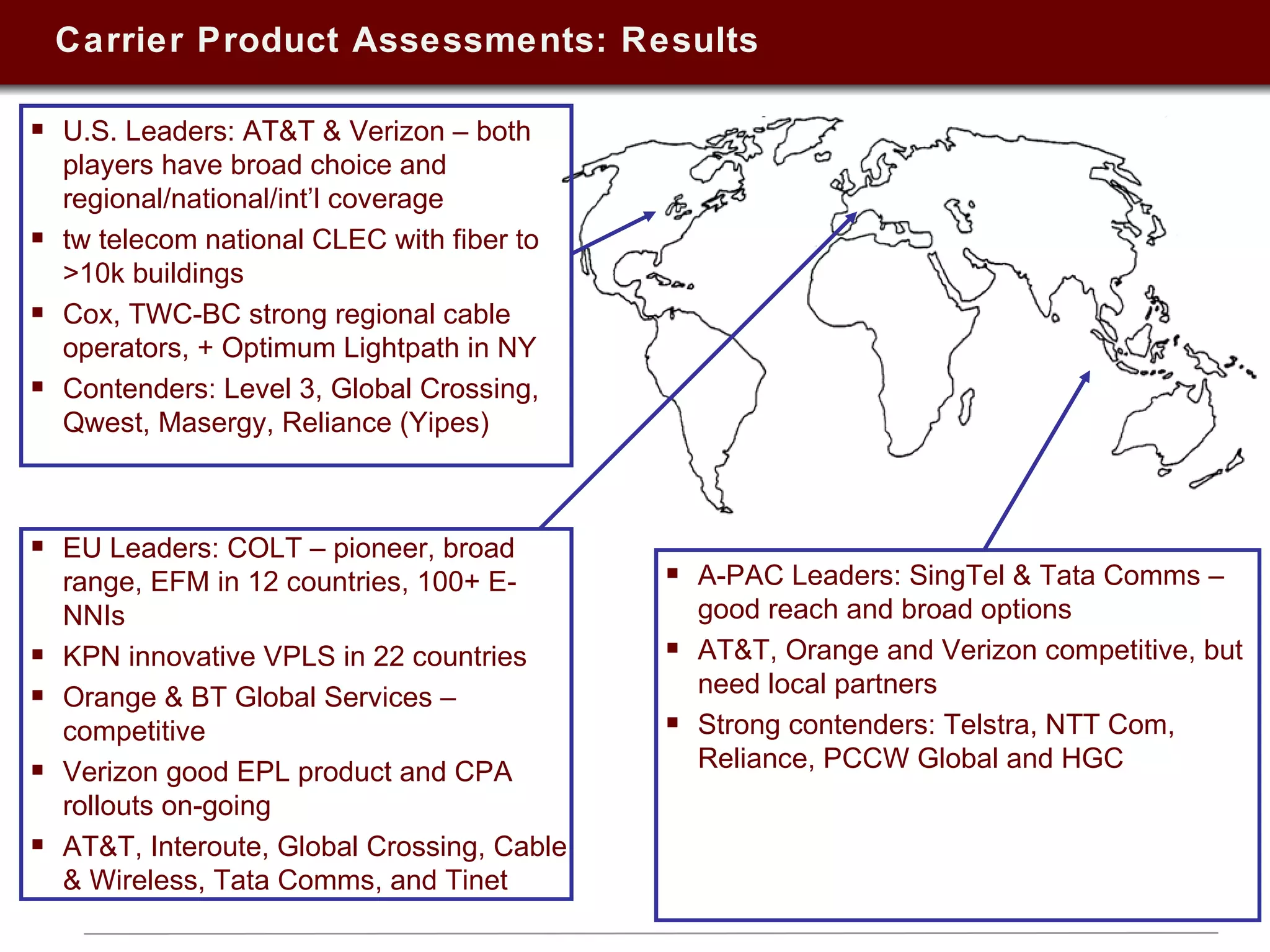
Carrier Product Assessments: Results U.S. Leaders: AT&T & Verizon – both players have broad choice and regional/national/int’l coverage tw telecom national CLEC with fiber to >10k buildings  Cox, TWC-BC strong regional cable operators, + Optimum Lightpath in NY Contenders: Level 3, Global Crossing, Qwest, Masergy, Reliance (Yipes) EU Leaders: COLT – pioneer, broad range, EFM in 12 countries, 100+ E-NNIs KPN innovative VPLS in 22 countries Orange & BT Global Services –competitive  Verizon good EPL product and CPA rollouts on-going  AT&T, Interoute, Global Crossing, Cable & Wireless, Tata Comms, and Tinet A-PAC Leaders: SingTel & Tata Comms – good reach and broad options AT&T, Orange and Verizon competitive, but need local partners Strong contenders: Telstra, NTT Com, Reliance, PCCW Global and HGC
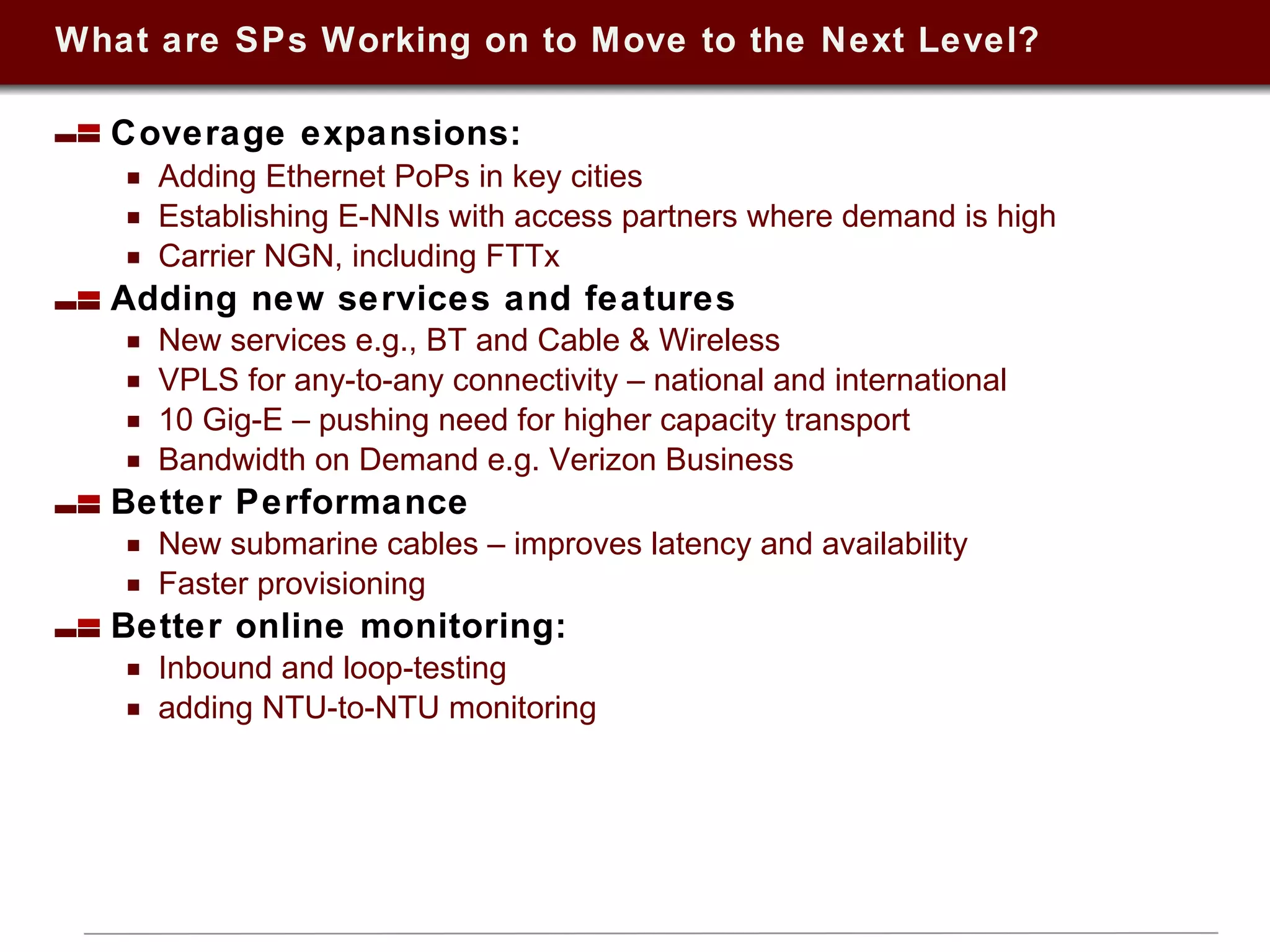
What are SPs Working on to Move to the Next Level? Coverage expansions:  Adding Ethernet PoPs in key cities  Establishing E-NNIs with access partners where demand is high Carrier NGN, including FTTx  Adding new services and features  New services e.g., BT and Cable & Wireless VPLS for any-to-any connectivity – national and international 10 Gig-E – pushing need for higher capacity transport Bandwidth on Demand e.g. Verizon Business Better Performance New submarine cables – improves latency and availability Faster provisioning Better online monitoring:  Inbound and loop-testing adding NTU-to-NTU monitoring
Competitive Intelligence   levels the playing field… Current Analysis  is the  only  competitive research firm that provides solutions to improve your company’s   Competitive Response Competitive Response enables you to Win. Ito To listen to a replay of this presentation, go to:  http://www.currentanlysis.com/t/2009/ethernet/ethernetserv0609.htm

Global Ethernet Telebriefing 06 23 09

  • 1.
    Ethernet Services: GlobalMarket Drivers & Winning Portfolios David Hold, Joel Stradling & Siow Meng Soh June 24 & 25, 2009 To listen to a replay of this presentation, go to: http://www.currentanlysis.com/t/2009/ethernet/ethernetserv0609.htm
  • 2.
    Introductions Siow MengSoh, Senior Analyst, Telecom Services Asia David Hold, Senior Analyst, Business Network Services, North America Joel Stradling, Senior Analyst, Business Telecom Services Europe
  • 3.
    Agenda 1. BroadTrends in Ethernet Services and Market Penetration 2. Current Controversies: Ethernet vs. IP VPLS, MPLS & Scalability 3. Reaching Customers: Topics in Ethernet access: Ethernet over Fiber, Bonded Copper & TDM circuits Off-net Access via E-NNIs 4. Market Verticals & Applications Who is buying Ethernet and why 5. Buying Criteria – What makes a Winning Portfolio? Regional Market Landscape and Leaders U.S, Europe & Asia Pacific 6. Future Directions – Taking Ethernet to the Next Level
  • 4.
    Broad Trends Ethernetis replacing legacy data networks Different country-by-country and cross-border landscapes around the world: Regulatory environment, network legacy/next-generation, competition, and so on Business applications are driving take-up: Software as a Service (SaaS), hosted UC & VoIP Additional ICT trends driving Ethernet take-up: Data centre consolidation, virtualization, ICT outsourcing
  • 5.
    Broad Trends byEthernet Services Types Positive Immature Mature EPL-Metro Metro Ethernet (All types) Cross-border VPLS Ethernet Access National VPLS Negative Momentum Maturity Neutral EVPL ETREE Transparent LAN Services (TLS) EPL-LH
  • 6.
    Market Penetration Carriers experiencing high double-digit growth mainly due to migration from legacy services Ethernet circuits still low (<10-15%) compared with other circuits; mostly metro Ethernet circuits (long haul Ethernet circuits <25%) Point-to-point still more common than multi-point Metro Ethernet still more common than long haul (inter-metro)
  • 7.
    Market Penetration U.S. market approaching an estimated 200K ports in 2008 Port & Revenue Growth* The largest carriers seeing growth rates of 50-70% per year Cable operators report growth ranging from 30% to 45% Ethernet growth rates may be “recession-proof” Multiyear enterprise contracts Companies are looking for cost savings, which Ethernet delivers Demand still rising for bandwidth, which Ethernet delivers Migration from legacy services may even increase * These projections were made in 2008 before the economic crises in Q4 2008. Growth was apparently on track until Q3 of 2008, at which point most carriers experienced slowing sales, although Ethernet appears to have been less affected, with growth rates slowing but not declining in absolute terms.
  • 8.
    Ethernet vs. IPWe see the technologies as complimenting each other Different horses for different courses – vendors should really be avoiding shoe-horning end-users into a specific technology Some incumbents are still moving slowly with aggressive Ethernet plays because there is a risk of cannibalization IP/MPLS – investments have been made and for solid reasons: Neat QoS & traffic-shaping Suitable for few hundreds of sites
  • 9.
    VPLS VPLS –Is it Ethernet or MPLS? Layer 2 or Layer 3? Virtual Private LAN Service runs over MPLS Pseudowire mesh Defined by IETF, not IEEE We view VPLS as Layer 2 service, since no customer IP routing is involved Ethernet hand off; MAC address forwarding Advantages of VPLS Scales Carrier Ethernet beyond metro -- national and international Customers to build full mesh WANs at Layer 2 using lower cost interfaces Provides traffic traffic management for better QoS and more reliable SLA Carriers leverage investment in national or global MPLS infrastructure Growing worldwide VPLS deployments by major carriers U.S. – AT&T, Level 3, Qwest, Masergy, Reliance, tw telecom, Verizon Business; Global Crossing by Q4 2009 EMEA – KPN, COLT, Tinet Asia Pac – SingTel, HGC, Reliance
  • 10.
    VPLS & ScalabilityBut can VPLS scale to large enterprise networks? That is a major debate; demand for VPLS led by large enterprises Majority opinion is no – max 50 sites, preferably less Minority opinion -- VPLS can scale to hundreds of sites or more Verizon proposed hierarchical VPLS architecture scalable to 1000 sites Most network operators will recommend Layer 3 solution above 50 sites Hybrid MPLS/VPLS solutions are being proposed Scalability issues fall into two categories; carrier and customer Customer issues revolve around previous experiences with instability in large flat Ether-networks. Customer interior routing protocols, OSPF, require fewer than 50 routers Switches are cheaper than routers  but using switches instead of routers can cause MAC address explosion Carriers respond by limiting or charging for MAC IDs Other carrier issues relate to controlling broadcast and multicast traffic, and the number of pseudowires needed to build a fully meshed core
  • 11.
    E-NNIs Crucial forinternational carriers to expand their Ethernet coverage quickly and cost-effectively, particularly for deep in-country coverage More efficient to have a standardized E-NNI framework MEF Specs near completion (Q4 2009) E-NNI certification is next Some carriers have established E-NNIs based on the draft MEF standards Some carriers have taken a more aggressive approach to use E-NNIs to expand their footprint COLT: 100 E-NNI partners Reliance: 21 E-NNI agreements with key partners HGC: E-NNI with partners such as Reliance, Telekom Malaysia, KT, StarHub Most carriers adopt the ‘wait and see’ approach and establish E-NNIs only when there is significant demand in a particular market
  • 12.
    Ethernet Access –EoCu, Cable, and Optical Fiber SPs deploying EoCu in Europe: COLT offers EFM in 12 European countries, based on Actelis BT uses Hatteras to reach approx. 54% of UK businesses BT 21CN fiber: 90% of UK business located within 15 km radius of its exchanges to make higher speed Etherflow feasible FTTx desirable for bandwidth intensive applications At a point above 8 Mbps at least one European SP prefers to deploy dedicated fiber tail KPN aggressive fiber rollout to business parks: End-users encouraged to sponsor costs Driven by desire to leverage SaaS and remote back-up
  • 13.
    Ethernet Access –EoCu, Cable, and Optical Fiber VAST MAJORITY OF U.S. ETHERNET IS FIBER BASED Most downtown buildings have fiber, plus carrier neutral facilities Outside downtown areas, fiber, and Ethernet access, inconsistent Consequently, Ethernet availability and prices can vary widely ETHERNET OVER TDM CIRCUITS AND COPPER TWISTED PAIRS Bonded T1 or DS3 -- Masergy, Level 3, tw telecom, Verizon Equipment from Overture, Nortel (Tasman) Verizon CPA Building Ethernet Aggregation System – ANDA Low speed Ethernet over bonded copper pairs – Max. 10-20 Mbps ILECs AT&T, Equant & Qwest; CLECs Cavalier, XO and others Equipment from Actelis, Adtran, Aktino, Hatteras Cable MSOs Deploy Ethernet over HFC Cox and TWC-Business Class use DOCSIS 2.0 Cable Modems Cox = 5 Mbps and TWC-BC = 2 Mbps Symmetric
  • 14.
    Vertical Markets Fourindustry verticals are most commonly cited - GEMS Many are well suited to ILEC & Cable MSOs local infrastructure Governments, Education, Medical, Services (financial) State and municipal agencies Education K-12 school districts and college campuses Medical Regional medical centers in single metro area Services Financial Markets, Banking and Legal
  • 15.
    Applications: What arethe End-users doing with all this Ethernet? Large enterprise and MNC: 1 Gig-E to 10 Gig-E data-centre interconnection Ethernet VPN – combining with IP/MPLS VPN IP video; Telepresence; SaaS; Disaster Recovery; intranets/extranets, data replication Example: BT Etherflow point-to-point customizable specialist IP VPNs, unique encryption and IP multicast SME market: Simple and cheap – collapse voice, data & video onto one access Interconnecting small numbers of branch offices Disaster Recovery, remote back-up Mobile backhaul – and cost-effective core transport
  • 16.
    Evaluating Ethernet ServiceProviders Current Analysis ‘Buying Criteria’ are used to evaluate the best Ethernet service portfolios Buying Criteria include network reach (metros, PoPs, nodes, etc), service types, bandwidth range and increments, multiple QoS, real time SLA metrics and customer network management. ‘ Winning Portfolios’ include: Extensive on-net coverage and strong E-NNI partnerships for extending service reach to multiple metros, states, regions & countries Ample choice in the range: namely point to point, point to multipoint, or multipoint to multipoint – EPL, EVPL and ELAN or VPLS. Ethernet over DWDM wavelengths at the high end. Broad feature list: such as low, mid, and high bandwidths and flexible increments, fully-managed or non-managed, QoS, client-side and proactive monitoring, and competitive SLAs
  • 17.
    Current Analysis’ EthernetProduct Assessments
  • 18.
    Carrier Product Assessments:Results U.S. Leaders: AT&T & Verizon – both players have broad choice and regional/national/int’l coverage tw telecom national CLEC with fiber to >10k buildings Cox, TWC-BC strong regional cable operators, + Optimum Lightpath in NY Contenders: Level 3, Global Crossing, Qwest, Masergy, Reliance (Yipes) EU Leaders: COLT – pioneer, broad range, EFM in 12 countries, 100+ E-NNIs KPN innovative VPLS in 22 countries Orange & BT Global Services –competitive Verizon good EPL product and CPA rollouts on-going AT&T, Interoute, Global Crossing, Cable & Wireless, Tata Comms, and Tinet A-PAC Leaders: SingTel & Tata Comms – good reach and broad options AT&T, Orange and Verizon competitive, but need local partners Strong contenders: Telstra, NTT Com, Reliance, PCCW Global and HGC
  • 19.
    What are SPsWorking on to Move to the Next Level? Coverage expansions: Adding Ethernet PoPs in key cities Establishing E-NNIs with access partners where demand is high Carrier NGN, including FTTx Adding new services and features New services e.g., BT and Cable & Wireless VPLS for any-to-any connectivity – national and international 10 Gig-E – pushing need for higher capacity transport Bandwidth on Demand e.g. Verizon Business Better Performance New submarine cables – improves latency and availability Faster provisioning Better online monitoring: Inbound and loop-testing adding NTU-to-NTU monitoring
  • 20.
    Competitive Intelligence levels the playing field… Current Analysis is the only competitive research firm that provides solutions to improve your company’s Competitive Response Competitive Response enables you to Win. Ito To listen to a replay of this presentation, go to: http://www.currentanlysis.com/t/2009/ethernet/ethernetserv0609.htm

Editor's Notes

  • #6 Metro Ethernet (including all types of Ethernet services) still reigns supreme over long haul (inter-city and international) services. Ethernet Access, which can include access to the Internet or to a cloud based VPN service such as Private IP or VPLS, ranks among the fastest growing of Carrier Ethernet services as customers migrate from TDM to Ethernet. There have been numerous rollouts of Ethernet VPLS by national carriers since about 2003, although the pace of deployment has really picked up in the past year. Cross-boarder E-VPLS services are the newest area of growth for Layer 2 VPN services Ethernet Virtual Private Line tends to be consistently popular for migrating legacy customers due to its topological similarity to Frame Relay and ATM. E-TREE is just beginning to emerge as an alternative to EVPL for point- to-multipoint and broadcast applications. Ethernet Private Line is seeing continued uptake in both Metro and Long Haul, but the long haul market tends to lag developments in the metro market by about 6-12 months. Traditional Switched Ethernet, also known as Transparent LAN Service (TLS), is the only area seeing decline as carriers migrate multipoint services to newer MPLS-based architectures such as VPLS. TLS was often deployed on ATM or enterprise-grade Ethernet switches since the 1990s that are approaching or past obsolescence.
  • #8 * These projections were made in 2008 before the economic crises in Q4 2008. Growth was apparently on track until Q3 of 2008, at which point most carriers experienced slowing sales, although Ethernet appears to have been less affected, with growth rates slowing but not declining in absolute terms.
  • #15 September 25, 2008 – Exponential-e launches ‘Power-X’ targeting financial clients requiring low-latency L2 WAN services and compliance with MiFID. The service is currently available between 4 new London stock exchanges, and the carrier intends to extend to 31 global exchanges moving forward. Power-X offers a 100 Mbps, or above, connection with each data feed presented to the client as a single secure VLAN plus QoS characteristics for traffic prioritization.
  • #16 September 25, 2008 – Exponential-e launches ‘Power-X’ targeting financial clients requiring low-latency L2 WAN services and compliance with MiFID. The service is currently available between 4 new London stock exchanges, and the carrier intends to extend to 31 global exchanges moving forward. Power-X offers a 100 Mbps, or above, connection with each data feed presented to the client as a single secure VLAN plus QoS characteristics for traffic prioritization.
  • #19 U.S. AT&amp;T &amp; Verizon have ILEC regional and IXC national/int’l services; Verizon offers full portfolio of metro, national EPL, EVPL, ELAN, VPLS; Verizon CPA provides consistent Ethernet access across markets; AT&amp;T offers EPL, ELAN and VPLS metro, regional and national; Verizon launched VPLS in 2006, VPWS in 2007; Int’l VPLS in 2009; AT&amp;T launched national and international VPLS in 2008; AT&amp;T launched Ethernet over bonded copper, Verizon supports EoPDH; Cox &amp; tw: Extensive regional fiber and HFC networks, but lack national networks; Rolling out Ethernet over HFC at 2 – 5 Mbps; tw: Nearly 10,000 buildings on tw fiber in 75 markets; Supports EoDS1/DS3; VPLS since 2003 EU COLT pioneer, 32 MAN/13 country footprint, unmatched EoCu capabilities, experienced E-NNI negotiator; KPN is aggressive early-mover with VPLS in 22 countries; Orange Business Services – IEL is a solid product backed by classical operational strength; Verizon Business aggressive CPA rollout and solid EPL in Europe; BT has the global element and proven applications-specific expertise (e.g., Radianz for financial trading) but needs to bring-to-market ‘Global Etherflow’; Other SPs: Interoute, Global Crossing, Cable &amp; Wireless, Tata Comms, and Tinet all have unique strengths in various sweet-spots A-PAC SingTel &amp; Tata leading with good regional coverage and broad range SingTel: E-Line (dedicated point-to-point), E-VPN (any-to-any VPLS) and metro Ethernet in Singapore Tata: different features on 3 platforms - Priority Ethernet (CoS) and Dedicated Ethernet (any-to-any, 10GigE) and Priority Stretch (usage-based billing) Global carriers strengthening APAC capabilities: Ethernet access in most countries within the region but mostly in major cities; work with local partners; AT&amp;T launched VPLS in 2008 starting with four cities; Orange Business Services offers its International Ethernet Link in six markets; Verizon Business offers EVPL in six markets; PoPs in major markets such as Japan, Australia, Singapore and Hong Kong Other relevant players: Telstra, NTT Com, Reliance, PCCW Global and HGC also have competitive Ethernet offerings – some have deployed VPLS