

 Introduction
 Types
 Layers of meninges
 Epidemology
 Mechanism
 Mode of transmission
 Signs and symptoms
 Diagnosis
 Treatment
 Prevention
3
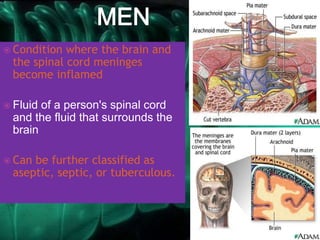
 Condition where the brain and
the spinal cord meninges
become inflamed
 Fluid of a person's spinal cord
and the fluid that surrounds the
brain
 Can be further classified as
aseptic, septic, or tuberculous.
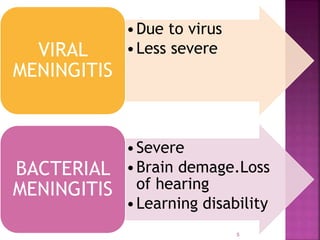
•Due to virus
•Less severeVIRAL
MENINGITIS
•Severe
•Brain demage.Loss
of hearing
•Learning disability
BACTERIAL
MENINGITIS
5
6
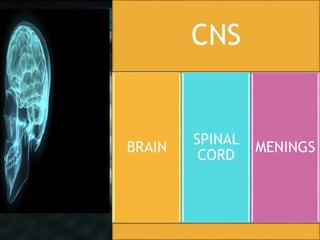
CNS
BRAIN
SPINAL
CORD
MENINGS
8
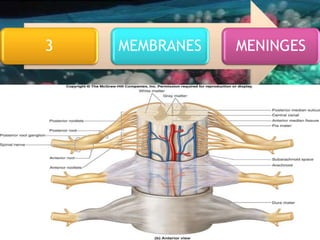
3 MEMBRANES MENINGES
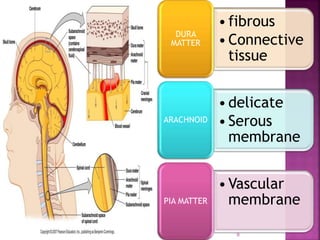
•fibrous
•Connective
tissue
DURA
MATTER
•delicate
•Serous
membrane
ARACHNOID
•Vascular
membranePIA MATTER
9
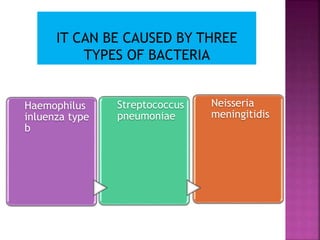
IT CAN BE CAUSED BY THREE
TYPES OF BACTERIA
Haemophilus
inluenza type
b
Streptococcus
pneumoniae
Neisseria
meningitidis
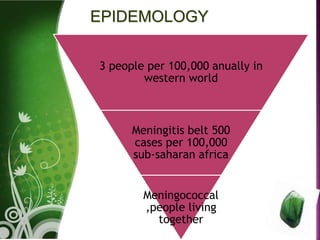
EPIDEMOLOGY
. 3 people per 100,000 anually in
western world
Meningitis belt 500
cases per 100,000
sub-saharan africa
Meningococcal
,people living
together
12
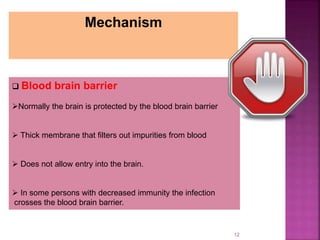
Mechanism
 Blood brain barrier
Normally the brain is protected by the blood brain barrier
 Thick membrane that filters out impurities from blood
 Does not allow entry into the brain.
 In some persons with decreased immunity the infection
crosses the blood brain barrier.
13
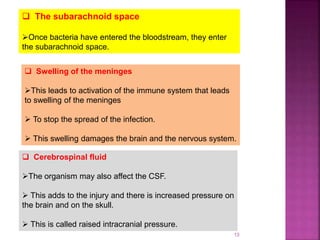
 The subarachnoid space
Once bacteria have entered the bloodstream, they enter
the subarachnoid space.
 Swelling of the meninges
This leads to activation of the immune system that leads
to swelling of the meninges
 To stop the spread of the infection.
 This swelling damages the brain and the nervous system.
 Cerebrospinal fluid
The organism may also affect the CSF.
 This adds to the injury and there is increased pressure on
the brain and on the skull.
 This is called raised intracranial pressure.
14
 The immune response
With the inflammation, the immune system identifies the
bacteria by its cell wall
 The immune cells of the brain (astrocytes and microglia),
respond by releasing large amounts of cytokines
are hormone-like mediators that recruit other immune cells. This
stimulates other tissues to participate in an immune response.
The blood-brain barrier becomes more permeable, leading to
"vasogenic" cerebral edema (swelling of the brain due to fluid
leakage from blood vessels)
 The blood vessels are also inflamed leading to
cerebral vasculitis which leads to a decreased blood flow another
type of edema, "cytotoxic" edema.
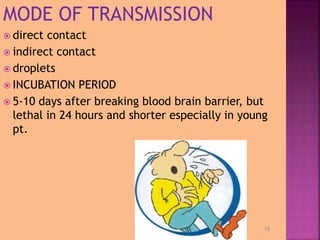
MODE OF TRANSMISSION
 direct contact
 indirect contact
 droplets
 INCUBATION PERIOD
 5-10 days after breaking blood brain barrier, but
lethal in 24 hours and shorter especially in young
pt.
15
15
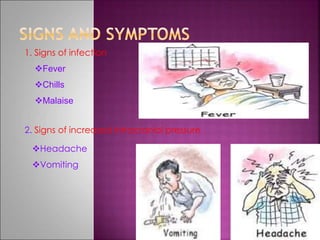
1. Signs of infection
Fever
Chills
Malaise
2. Signs of increased intracranial pressure
Headache
Vomiting
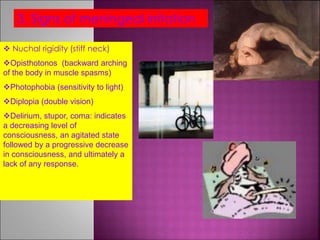
3. Signs of meningeal irritation
 Nuchal rigidity (stiff neck)
Opisthotonos (backward arching
of the body in muscle spasms)
Photophobia (sensitivity to light)
Diplopia (double vision)
Delirium, stupor, coma: indicates
a decreasing level of
consciousness, an agitated state
followed by a progressive decrease
in consciousness, and ultimately a
lack of any response.
Other symptoms may include:
- nausea
-discomfort looking into bright
lights
- Confusion
-sleepiness.
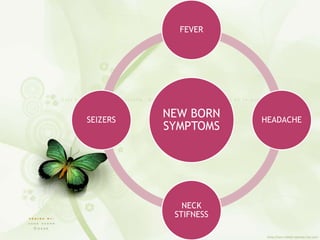
NEW BORN
SYMPTOMS
FEVER
HEADACHE
NECK
STIFNESS
SEIZERS
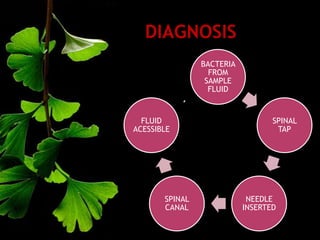
Assessment and stabilization
BACTERIA
FROM
SAMPLE
FLUID
SPINAL
TAP
NEEDLE
INSERTED
SPINAL
CANAL
FLUID
ACESSIBLE
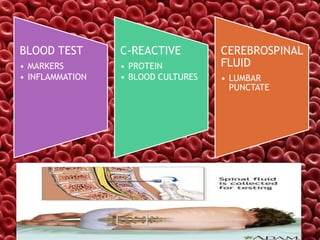
BLOOD TEST
• MARKERS
• INFLAMMATION
C-REACTIVE
• PROTEIN
• BLOOD CULTURES
CEREBROSPINAL
FLUID
• LUMBAR
PUNCTATE
A CBC will indicate acute infection. Bacterial antigen testing
may also be done.
A Gram’s stain will determine the presence of bacteria. A full
culture should be done with sensitivity.
 Radiography skull and spine x-rays used to identify sinus
infections, fracture, or osteomyellitis; chest x-rays may be used
to identify respiratory infections, abscesses, lesions, or
granulomas.
CT scan will usually be normal in uncomplicated cases of
meningitis, but can show diffuse enhancement in some types or
show hydrocephalus.
Electroencephalogram may be performed to show slow wave
activity.
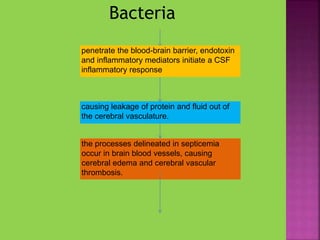
Bacteria
penetrate the blood-brain barrier, endotoxin
and inflammatory mediators initiate a CSF
inflammatory response
causing leakage of protein and fluid out of
the cerebral vasculature.
the processes delineated in septicemia
occur in brain blood vessels, causing
cerebral edema and cerebral vascular
thrombosis.
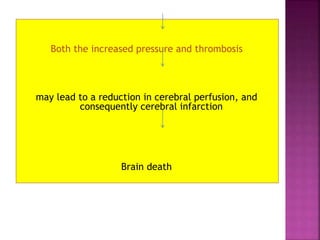
Both the increased pressure and thrombosis
may lead to a reduction in cerebral perfusion, and
consequently cerebral infarction
Brain death
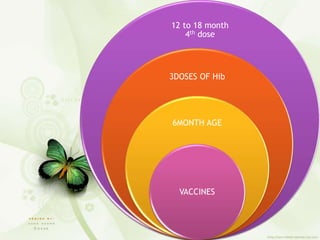
12 to 18 month
4th dose
3DOSES OF Hib
6MONTH AGE
VACCINES
Treatment:
 ceftriaxone, one of the third-generation
cefalosporin antibiotics recommended for the
initial treatment of bacterial meningitis.
 High-flow oxygen should be administered as soon
as possible, along with intravenous fluids if
hypotension or shock are present
 Mechanical ventilation may be needed if the level
of consciousness is very low, or if there is evidence
of respiratory failure
Prevention
 A quadrivalent vaccine -Meningococcus
vaccines exist against groups A, C, W135 and
Y
 Pneumococcal polysaccharide vaccine
 Prophylaxis
meningococcal meningitis, prophylactic
treatment of close contacts with antibiotics
(e.g. rifampicin, ciprofloxacin or ceftriaxone)
can reduce their risk of contracting the
condition, but does not protect against future
bacterial meningitis

bacterial meningitis

  • 3.
     Introduction  Types Layers of meninges  Epidemology  Mechanism  Mode of transmission  Signs and symptoms  Diagnosis  Treatment  Prevention 3
  • 4.
     Condition wherethe brain and the spinal cord meninges become inflamed  Fluid of a person's spinal cord and the fluid that surrounds the brain  Can be further classified as aseptic, septic, or tuberculous.
  • 5.
    •Due to virus •LesssevereVIRAL MENINGITIS •Severe •Brain demage.Loss of hearing •Learning disability BACTERIAL MENINGITIS 5
  • 6.
  • 8.
  • 9.
  • 10.
    IT CAN BECAUSED BY THREE TYPES OF BACTERIA Haemophilus inluenza type b Streptococcus pneumoniae Neisseria meningitidis
  • 11.
    EPIDEMOLOGY . 3 peopleper 100,000 anually in western world Meningitis belt 500 cases per 100,000 sub-saharan africa Meningococcal ,people living together
  • 12.
    12 Mechanism  Blood brainbarrier Normally the brain is protected by the blood brain barrier  Thick membrane that filters out impurities from blood  Does not allow entry into the brain.  In some persons with decreased immunity the infection crosses the blood brain barrier.
  • 13.
    13  The subarachnoidspace Once bacteria have entered the bloodstream, they enter the subarachnoid space.  Swelling of the meninges This leads to activation of the immune system that leads to swelling of the meninges  To stop the spread of the infection.  This swelling damages the brain and the nervous system.  Cerebrospinal fluid The organism may also affect the CSF.  This adds to the injury and there is increased pressure on the brain and on the skull.  This is called raised intracranial pressure.
  • 14.
    14  The immuneresponse With the inflammation, the immune system identifies the bacteria by its cell wall  The immune cells of the brain (astrocytes and microglia), respond by releasing large amounts of cytokines are hormone-like mediators that recruit other immune cells. This stimulates other tissues to participate in an immune response. The blood-brain barrier becomes more permeable, leading to "vasogenic" cerebral edema (swelling of the brain due to fluid leakage from blood vessels)  The blood vessels are also inflamed leading to cerebral vasculitis which leads to a decreased blood flow another type of edema, "cytotoxic" edema.
  • 15.
    MODE OF TRANSMISSION direct contact  indirect contact  droplets  INCUBATION PERIOD  5-10 days after breaking blood brain barrier, but lethal in 24 hours and shorter especially in young pt. 15 15
  • 16.
    1. Signs ofinfection Fever Chills Malaise 2. Signs of increased intracranial pressure Headache Vomiting
  • 17.
    3. Signs ofmeningeal irritation  Nuchal rigidity (stiff neck) Opisthotonos (backward arching of the body in muscle spasms) Photophobia (sensitivity to light) Diplopia (double vision) Delirium, stupor, coma: indicates a decreasing level of consciousness, an agitated state followed by a progressive decrease in consciousness, and ultimately a lack of any response.
  • 18.
    Other symptoms mayinclude: - nausea -discomfort looking into bright lights - Confusion -sleepiness.
  • 19.
  • 21.
  • 22.
    BLOOD TEST • MARKERS •INFLAMMATION C-REACTIVE • PROTEIN • BLOOD CULTURES CEREBROSPINAL FLUID • LUMBAR PUNCTATE
  • 23.
    A CBC willindicate acute infection. Bacterial antigen testing may also be done. A Gram’s stain will determine the presence of bacteria. A full culture should be done with sensitivity.  Radiography skull and spine x-rays used to identify sinus infections, fracture, or osteomyellitis; chest x-rays may be used to identify respiratory infections, abscesses, lesions, or granulomas. CT scan will usually be normal in uncomplicated cases of meningitis, but can show diffuse enhancement in some types or show hydrocephalus. Electroencephalogram may be performed to show slow wave activity.
  • 24.
    Bacteria penetrate the blood-brainbarrier, endotoxin and inflammatory mediators initiate a CSF inflammatory response causing leakage of protein and fluid out of the cerebral vasculature. the processes delineated in septicemia occur in brain blood vessels, causing cerebral edema and cerebral vascular thrombosis.
  • 25.
    Both the increasedpressure and thrombosis may lead to a reduction in cerebral perfusion, and consequently cerebral infarction Brain death
  • 26.
    12 to 18month 4th dose 3DOSES OF Hib 6MONTH AGE VACCINES
  • 27.
    Treatment:  ceftriaxone, oneof the third-generation cefalosporin antibiotics recommended for the initial treatment of bacterial meningitis.  High-flow oxygen should be administered as soon as possible, along with intravenous fluids if hypotension or shock are present  Mechanical ventilation may be needed if the level of consciousness is very low, or if there is evidence of respiratory failure
  • 28.
    Prevention  A quadrivalentvaccine -Meningococcus vaccines exist against groups A, C, W135 and Y  Pneumococcal polysaccharide vaccine  Prophylaxis meningococcal meningitis, prophylactic treatment of close contacts with antibiotics (e.g. rifampicin, ciprofloxacin or ceftriaxone) can reduce their risk of contracting the condition, but does not protect against future