Stefano Scarpetta
Director
Directorate for Employment, Labour and Social Affairs
Back to Work: Sweden
Improving the re-employment prospects of displaced
workers
Launch roundtable, Stockholm, 16 December 2015
Outline of the presentation
• Job displacement in Sweden – some facts
• Key strengths of the Swedish system
• Main challenges and possible ways forward
– Prevention and early intervention
– Re-employment assistance
– Income support
Job displacement in Sweden: Key facts
• During 2002-12, 2.1% of employees with at least one year
of tenure lost their job due to economic reasons
• Some groups are particularly vulnerable to displacement
– Low skilled workers
– Younger workers
• On average, during the period 2000-09, around 85% of
displaced workers were re-employed within one year…
• …but average annual earnings fall by approximately 4-
5% in the 4 years after displacement
Major Strengths of the Swedish system
• A sound ability to anticipate and manage restructuring
• Early intervention to provide employment support
before dismissal takes place
• Tailored employment support for different types of
displaced workers provided by Job Security Councils to
complement government assistance
 This results in prompt and efficient early action
facilitated by the social partners
(1) Employment protection hurts vulnerable
groups and job-loss prevention is rare
• Large disparities across workers in employment
protection legislation
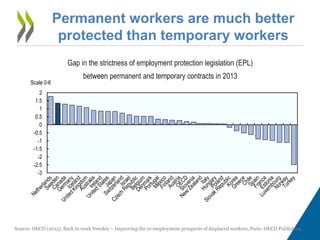
– Huge gap in employment protection between permanent and
temporary Swedish workers
– Widespread use of the ‘seniority rule’ despite considerable
flexibility in collective agreements
• Limited attention on job preservations policies
– Newly developed Short-time Work Scheme developed after GFC
and may restrict take-up in future
Permanent workers are much better
protected than temporary workers
Source: OECD (2015), Back to work Sweden – Improving the re-employment prospects of displaced workers, Paris: OECD Publishing.
Gap in the strictness of employment protection legislation (EPL)
between permanent and temporary contracts in 2013
-3
-2.5
-2
-1.5
-1
-0.5
0
0.5
1
1.5
2
Scale 0-6
Prevention policies: Ways forward
• Reduce the gap in employment protection
between permanent and temporary contracts
• Further ease the last-in-first-out rule which
penalises disadvantaged groups
• Evaluate the effectiveness of the recently
introduced short-time work scheme
(2) Re-employment services provided
by JSCs are effective but can be limited
• Some workers are excluded from tailored support of the
job security councils (JSCs)
– Fixed-term and temporary workers
– Youth and vulnerable groups
• Many who qualify for support receive only partial services
– TSL does not offer training services to blue collar workers
• PES fails to deliver timely and tailored training to workers
who cannot access JSC services
– The PES mostly caters for difficult-to-place unemployed people
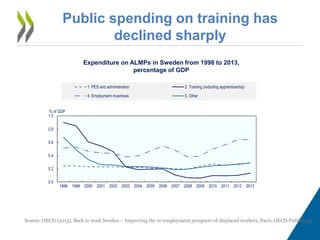
Public spending on training has
declined sharply
Source: OECD (2015), Back to work Sweden – Improving the re-employment prospects of displaced workers, Paris: OECD Publishing.
0.0
0.2
0.4
0.6
0.8
1.0
1998 1999 2000 2001 2002 2003 2004 2005 2006 2007 2008 2009 2010 2011 2012 2013
% of GDP
1. PES and administration 2. Training (including apprenticeship)
4. Employment incentives 5. Other
Expenditure on ALMPs in Sweden from 1998 to 2013,
percentage of GDP
Re-employment assistance:
Ways forward
• Extend support provided by JSCs during the notification
period to all types of displaced workers including youths
and workers with atypical employment contracts
• Improve timely re-employment counselling and support
by the PES to cater better and earlier for the displaced
workers who face the highest adjustment costs
• Invest in and improve access to training for low-skilled
and blue-collar displaced workers disadvantaged in
today’s dual-support system
(3) Disparities in the provision of
income support
• The generosity of unemployment insurance (UI) is quite
satisfactory for those eligible; but inequalities exist:
– Between older and younger workers
– Between blue-collar and white-collar workers
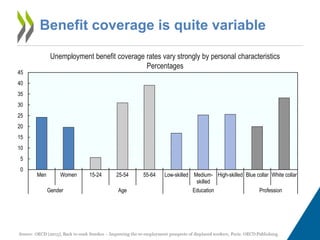
Benefit coverage is quite variable
0
5
10
15
20
25
30
35
40
45
Men Women 15-24 25-54 55-64 Low-skilled Medium-
skilled
High-skilled Blue collar White collar
Gender Age Education Profession
Unemployment benefit coverage rates vary strongly by personal characteristics
Percentages
• Broaden UI coverage to
– eliminate disparities in income support provision
– re-establish the legitimacy of the system
• Implement a monitoring system including
benefits that are not publicly provided to assess
whether there are gaps in benefit adequacy
Income support: Ways forward
Conclusions
• Sweden has been relatively successful in minimising
the adverse consequences for displaced workers,
mainly due to the active role of the social partners
• A number of steps can be taken to improve disparities
among displaced workers:
– Offering re-employment support to displaced workers who
need intensive help
– Providing adequate income support to all displaced workers
– Encouraging systematic evaluations on the effectiveness of
policy measures targeted at displaced workers
Thank you for your attention
Stefano.Scarpetta@oecd.org
For more information and OECD publications on the topic:
http://www.oecd.org/els/emp/displaced-workers.htm
To contact the authors of the report:
Shruti.Singh@oecd.org
Elena.Crivellaro@oecd.org

Back to work: Sweden

  • 1.
    Stefano Scarpetta Director Directorate forEmployment, Labour and Social Affairs Back to Work: Sweden Improving the re-employment prospects of displaced workers Launch roundtable, Stockholm, 16 December 2015
  • 2.
    Outline of thepresentation • Job displacement in Sweden – some facts • Key strengths of the Swedish system • Main challenges and possible ways forward – Prevention and early intervention – Re-employment assistance – Income support
  • 3.
    Job displacement inSweden: Key facts • During 2002-12, 2.1% of employees with at least one year of tenure lost their job due to economic reasons • Some groups are particularly vulnerable to displacement – Low skilled workers – Younger workers • On average, during the period 2000-09, around 85% of displaced workers were re-employed within one year… • …but average annual earnings fall by approximately 4- 5% in the 4 years after displacement
  • 4.
    Major Strengths ofthe Swedish system • A sound ability to anticipate and manage restructuring • Early intervention to provide employment support before dismissal takes place • Tailored employment support for different types of displaced workers provided by Job Security Councils to complement government assistance  This results in prompt and efficient early action facilitated by the social partners
  • 5.
    (1) Employment protectionhurts vulnerable groups and job-loss prevention is rare • Large disparities across workers in employment protection legislation – Huge gap in employment protection between permanent and temporary Swedish workers – Widespread use of the ‘seniority rule’ despite considerable flexibility in collective agreements • Limited attention on job preservations policies – Newly developed Short-time Work Scheme developed after GFC and may restrict take-up in future
  • 6.
    Permanent workers aremuch better protected than temporary workers Source: OECD (2015), Back to work Sweden – Improving the re-employment prospects of displaced workers, Paris: OECD Publishing. Gap in the strictness of employment protection legislation (EPL) between permanent and temporary contracts in 2013 -3 -2.5 -2 -1.5 -1 -0.5 0 0.5 1 1.5 2 Scale 0-6
  • 7.
    Prevention policies: Waysforward • Reduce the gap in employment protection between permanent and temporary contracts • Further ease the last-in-first-out rule which penalises disadvantaged groups • Evaluate the effectiveness of the recently introduced short-time work scheme
  • 8.
    (2) Re-employment servicesprovided by JSCs are effective but can be limited • Some workers are excluded from tailored support of the job security councils (JSCs) – Fixed-term and temporary workers – Youth and vulnerable groups • Many who qualify for support receive only partial services – TSL does not offer training services to blue collar workers • PES fails to deliver timely and tailored training to workers who cannot access JSC services – The PES mostly caters for difficult-to-place unemployed people
  • 9.
    Public spending ontraining has declined sharply Source: OECD (2015), Back to work Sweden – Improving the re-employment prospects of displaced workers, Paris: OECD Publishing. 0.0 0.2 0.4 0.6 0.8 1.0 1998 1999 2000 2001 2002 2003 2004 2005 2006 2007 2008 2009 2010 2011 2012 2013 % of GDP 1. PES and administration 2. Training (including apprenticeship) 4. Employment incentives 5. Other Expenditure on ALMPs in Sweden from 1998 to 2013, percentage of GDP
  • 10.
    Re-employment assistance: Ways forward •Extend support provided by JSCs during the notification period to all types of displaced workers including youths and workers with atypical employment contracts • Improve timely re-employment counselling and support by the PES to cater better and earlier for the displaced workers who face the highest adjustment costs • Invest in and improve access to training for low-skilled and blue-collar displaced workers disadvantaged in today’s dual-support system
  • 11.
    (3) Disparities inthe provision of income support • The generosity of unemployment insurance (UI) is quite satisfactory for those eligible; but inequalities exist: – Between older and younger workers – Between blue-collar and white-collar workers
  • 12.
    Benefit coverage isquite variable 0 5 10 15 20 25 30 35 40 45 Men Women 15-24 25-54 55-64 Low-skilled Medium- skilled High-skilled Blue collar White collar Gender Age Education Profession Unemployment benefit coverage rates vary strongly by personal characteristics Percentages
  • 13.
    • Broaden UIcoverage to – eliminate disparities in income support provision – re-establish the legitimacy of the system • Implement a monitoring system including benefits that are not publicly provided to assess whether there are gaps in benefit adequacy Income support: Ways forward
  • 14.
    Conclusions • Sweden hasbeen relatively successful in minimising the adverse consequences for displaced workers, mainly due to the active role of the social partners • A number of steps can be taken to improve disparities among displaced workers: – Offering re-employment support to displaced workers who need intensive help – Providing adequate income support to all displaced workers – Encouraging systematic evaluations on the effectiveness of policy measures targeted at displaced workers
  • 15.
    Thank you foryour attention Stefano.Scarpetta@oecd.org For more information and OECD publications on the topic: http://www.oecd.org/els/emp/displaced-workers.htm To contact the authors of the report: Shruti.Singh@oecd.org Elena.Crivellaro@oecd.org