OECD RECOMMENDATION ON HEALTH DATA
GOVERNANCE
17 January 2017
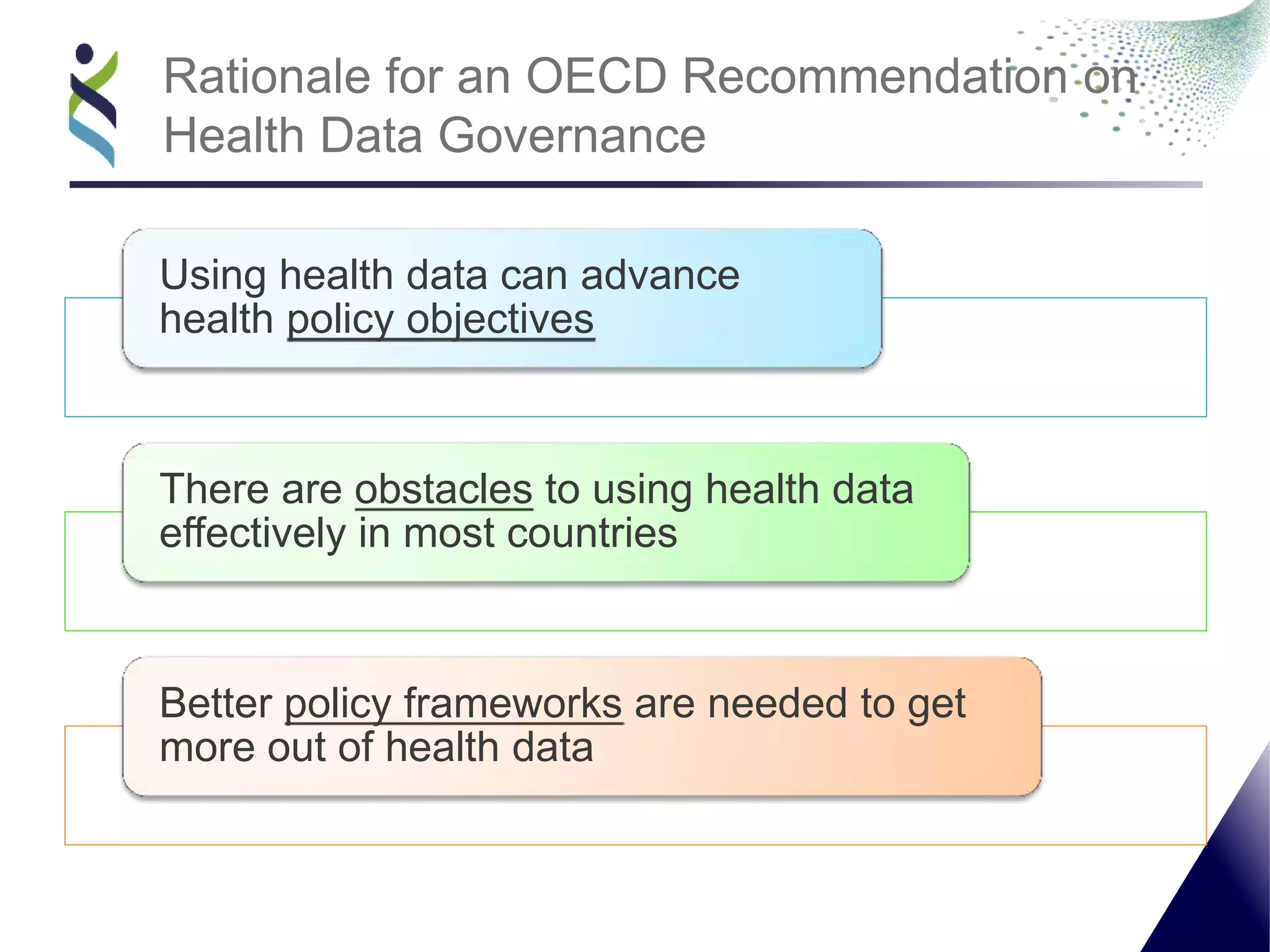
Using health data can advance
health policy objectives
There are obstacles to using health data
effectively in most countries
Better policy frameworks are needed to get
more out of health data
Rationale for an OECD Recommendation on
Health Data Governance
Culmination of 6 years’ work ….
OECD Guidelines Governing the Protection of
Privacy and Transborder Flows of Personal Data
[C(80)58/FINAL as amended by C(2013)79]
Drivers of Data Use
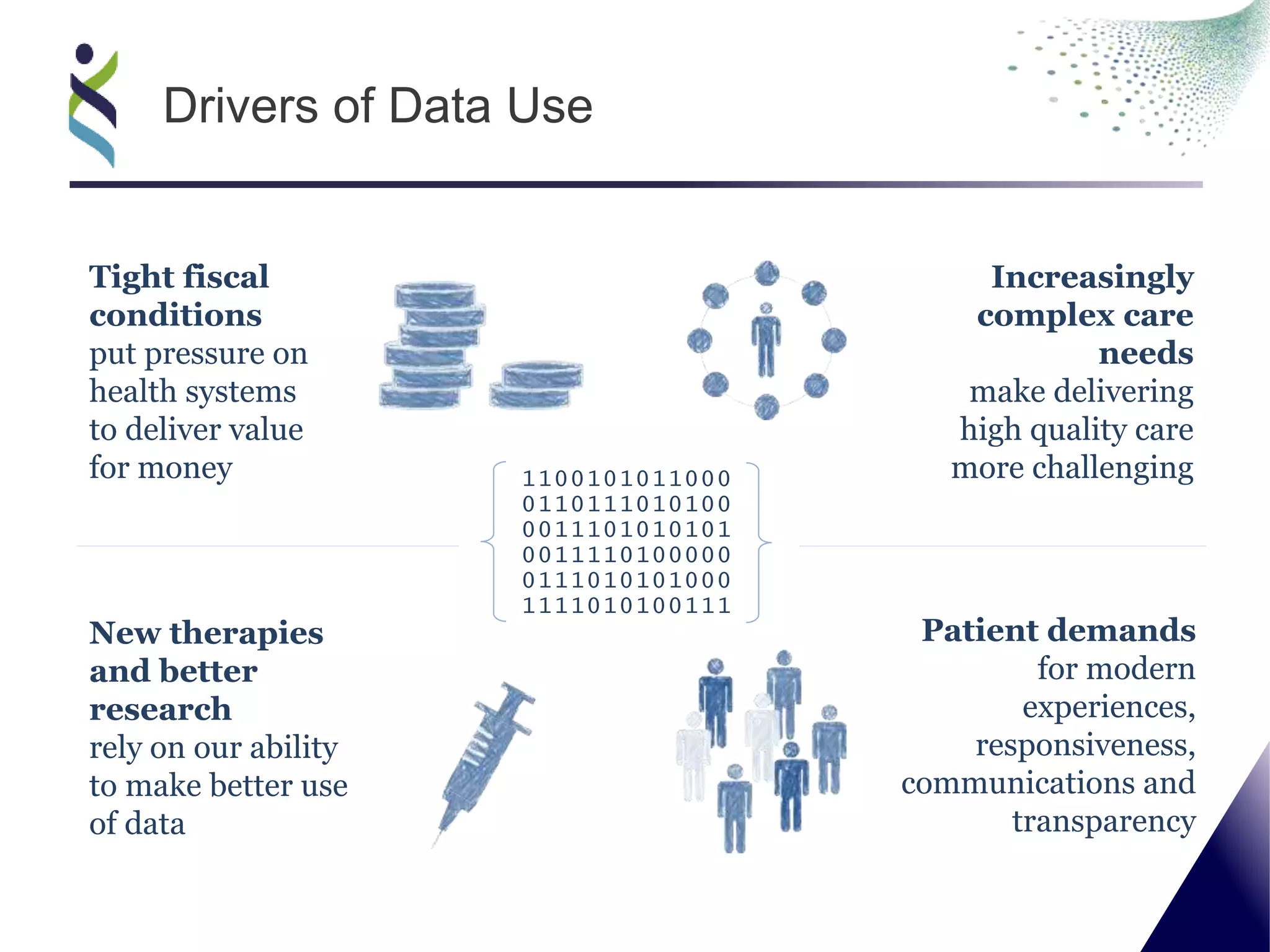
Tight fiscal
conditions
put pressure on
health systems
to deliver value
for money
Increasingly
complex care
needs
make delivering
high quality care
more challenging1 1 0 0 1 0 1 0 1 1 0 0 0
0 1 1 0 1 1 1 0 1 0 1 0 0
0 0 1 1 1 0 1 0 1 0 1 0 1
0 0 1 1 1 1 0 1 0 0 0 0 0
0 1 1 1 0 1 0 1 0 1 0 0 0
1 1 1 1 0 1 0 1 0 0 1 1 1
New therapies
and better
research
rely on our ability
to make better use
of data
Patient demands
for modern
experiences,
responsiveness,
communications and
transparency
Data needed to make progress
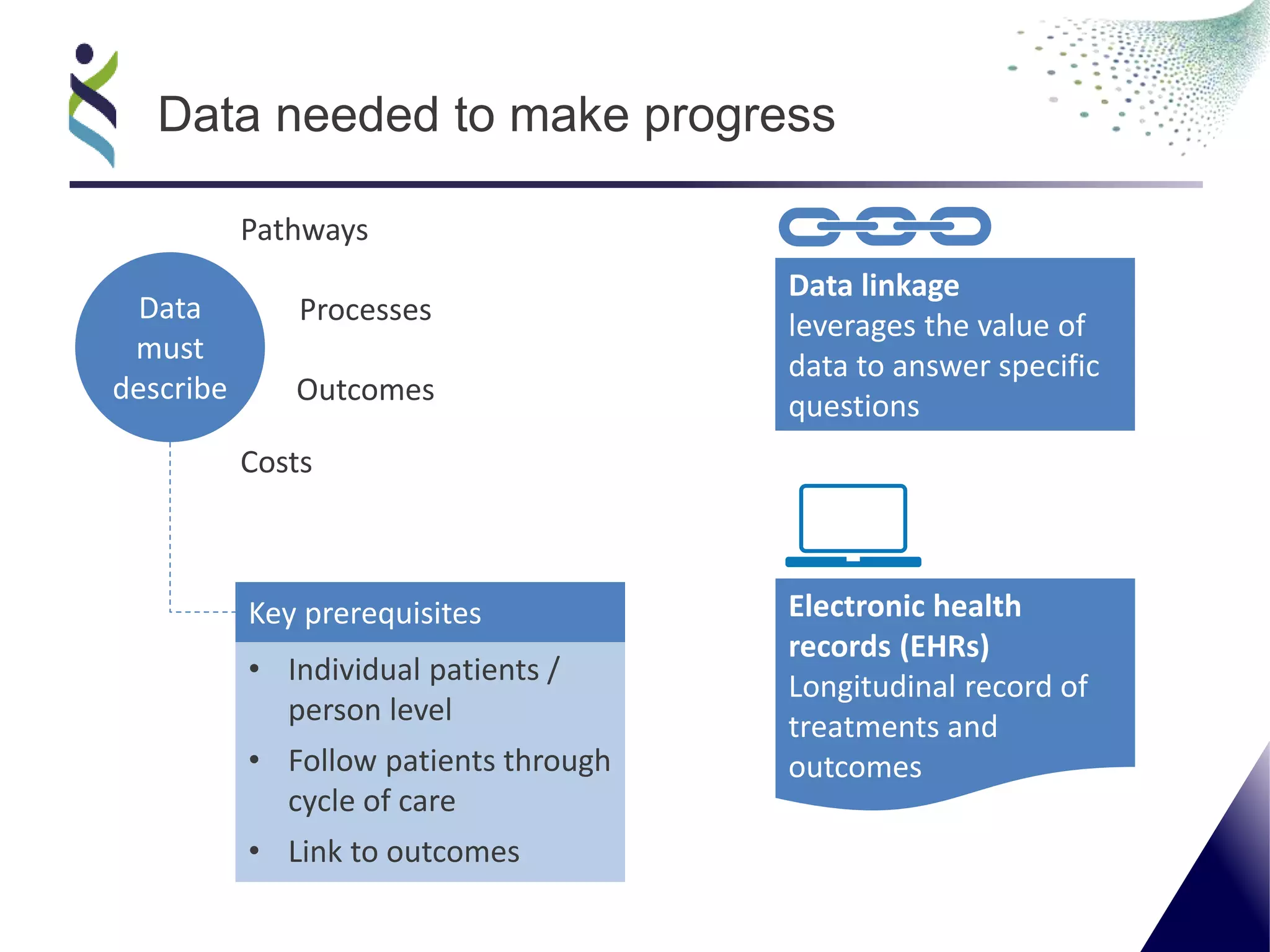
Data
must
describe
Pathways
Processes
Outcomes
Costs
Key prerequisites
• Individual patients /
person level
• Follow patients through
cycle of care
• Link to outcomes
Data linkage
leverages the value of
data to answer specific
questions
Electronic health
records (EHRs)
Longitudinal record of
treatments and
outcomes
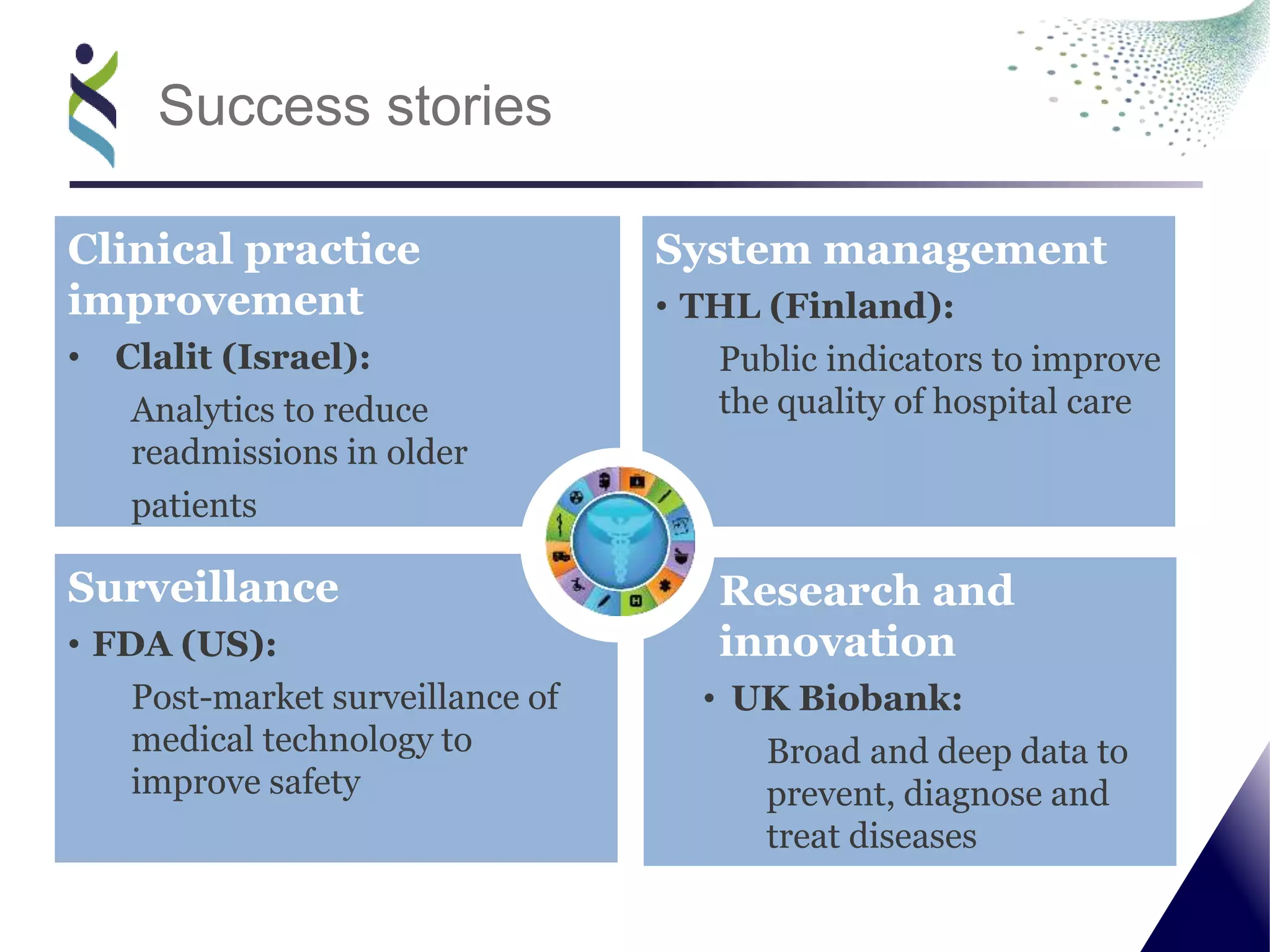
Research and
innovation
• UK Biobank:
Broad and deep data to
prevent, diagnose and
treat diseases
Surveillance
• FDA (US):
Post-market surveillance of
medical technology to
improve safety
System management
• THL (Finland):
Public indicators to improve
the quality of hospital care
Clinical practice
improvement
• Clalit (Israel):
Analytics to reduce
readmissions in older
patients
Success stories
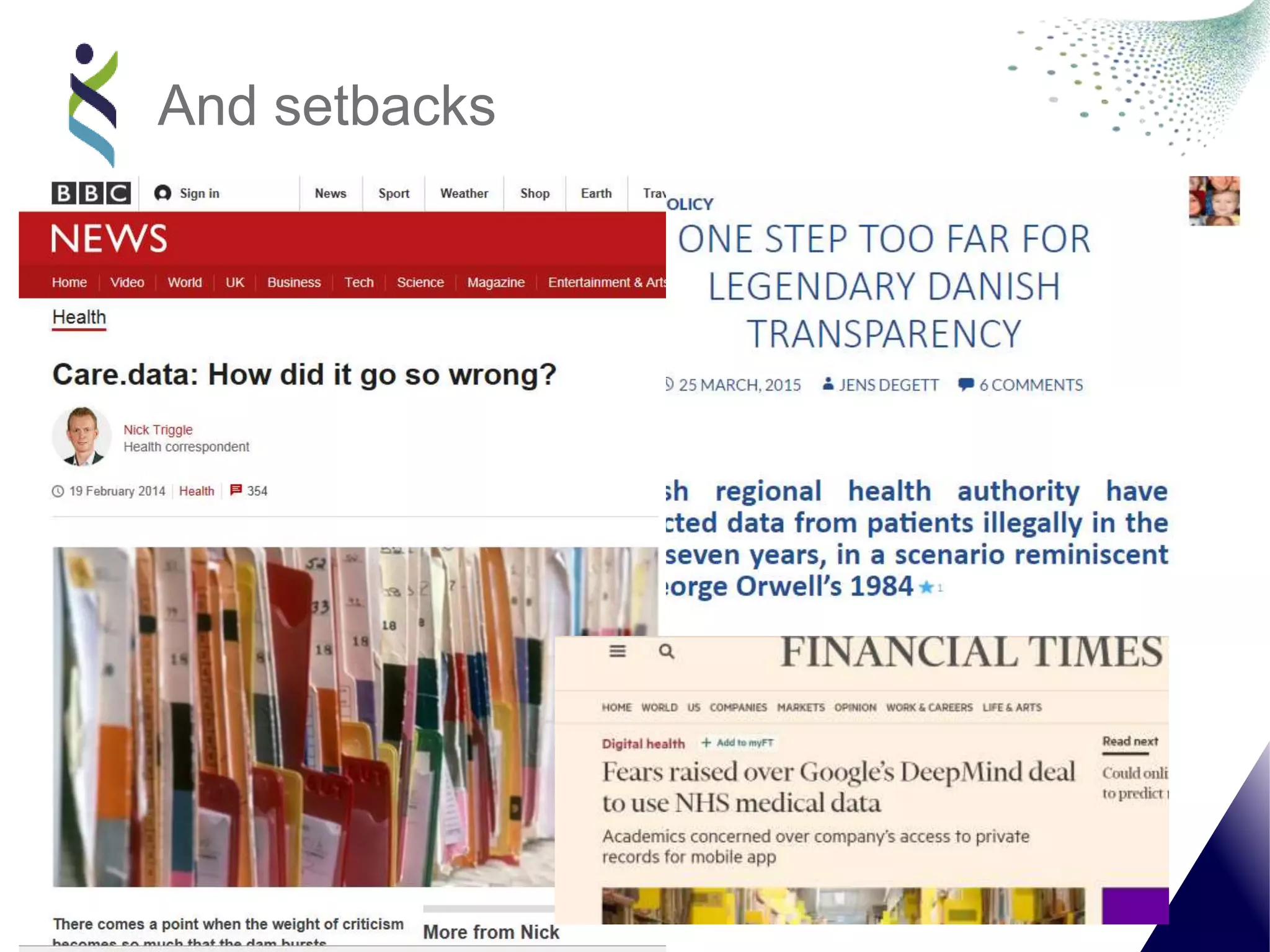
And setbacks
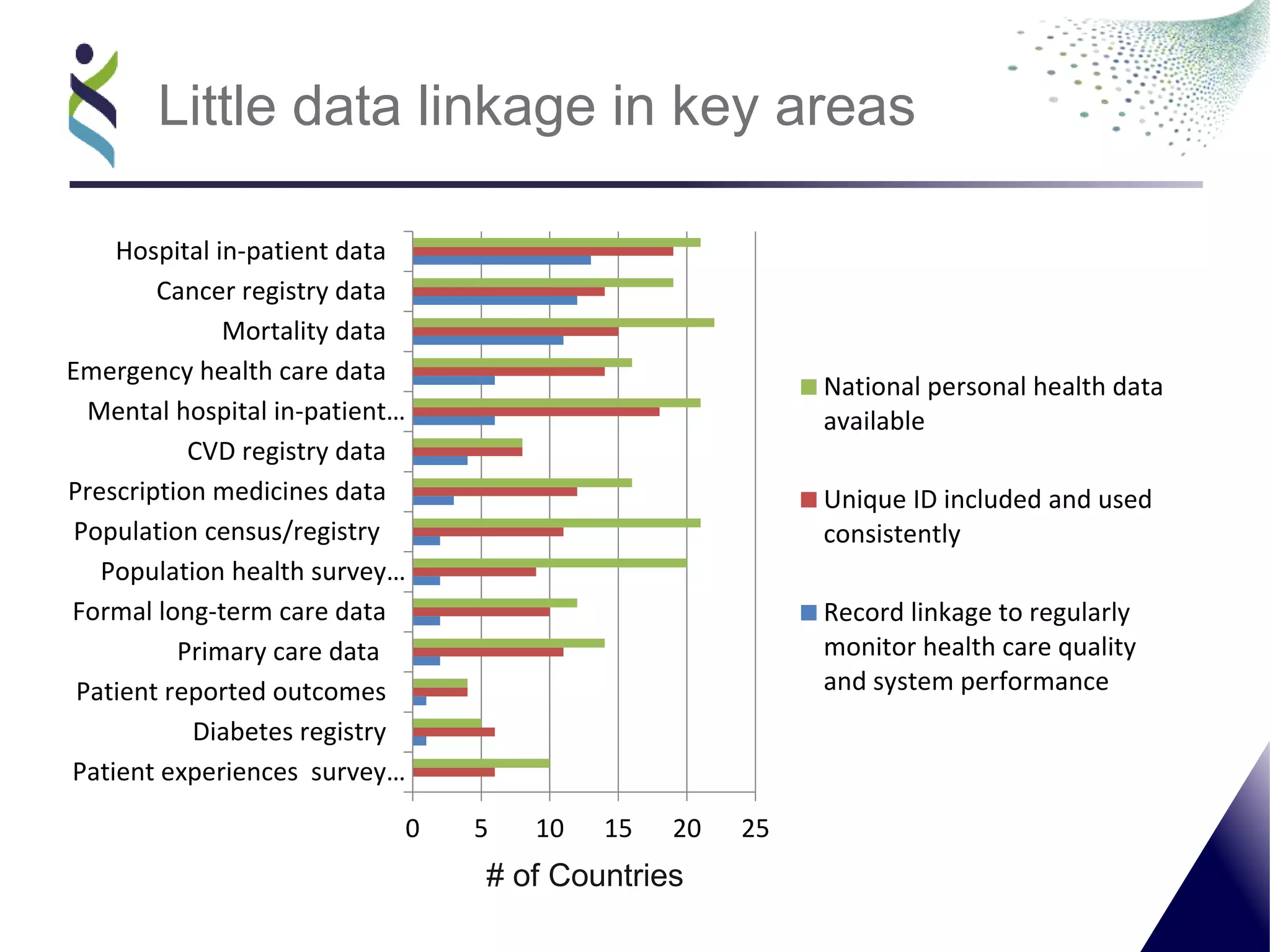
Little data linkage in key areas
0 5 10 15 20 25
Patient experiences survey…
Diabetes registry
Patient reported outcomes
Primary care data
Formal long-term care data
Population health survey…
Population census/registry
Prescription medicines data
CVD registry data
Mental hospital in-patient…
Emergency health care data
Mortality data
Cancer registry data
Hospital in-patient data
National personal health data
available
Unique ID included and used
consistently
Record linkage to regularly
monitor health care quality
and system performance
# of Countries
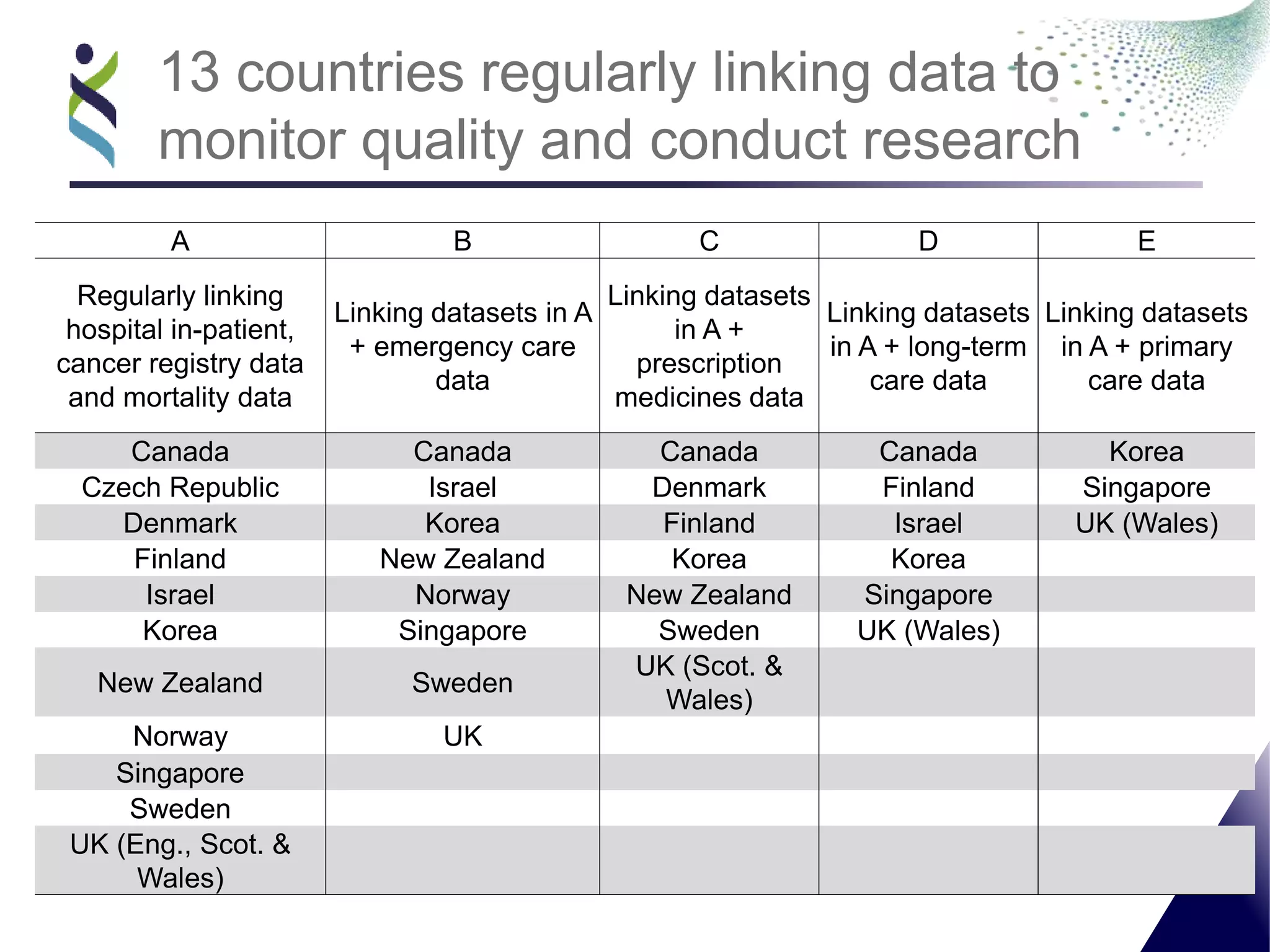
13 countries regularly linking data to
monitor quality and conduct research
A B C D E
Regularly linking
hospital in-patient,
cancer registry data
and mortality data
Linking datasets in A
+ emergency care
data
Linking datasets
in A +
prescription
medicines data
Linking datasets
in A + long-term
care data
Linking datasets
in A + primary
care data
Canada Canada Canada Canada Korea
Czech Republic Israel Denmark Finland Singapore
Denmark Korea Finland Israel UK (Wales)
Finland New Zealand Korea Korea
Israel Norway New Zealand Singapore
Korea Singapore Sweden UK (Wales)
New Zealand Sweden
UK (Scot. &
Wales)
Norway UK
Singapore
Sweden
UK (Eng., Scot. &
Wales)
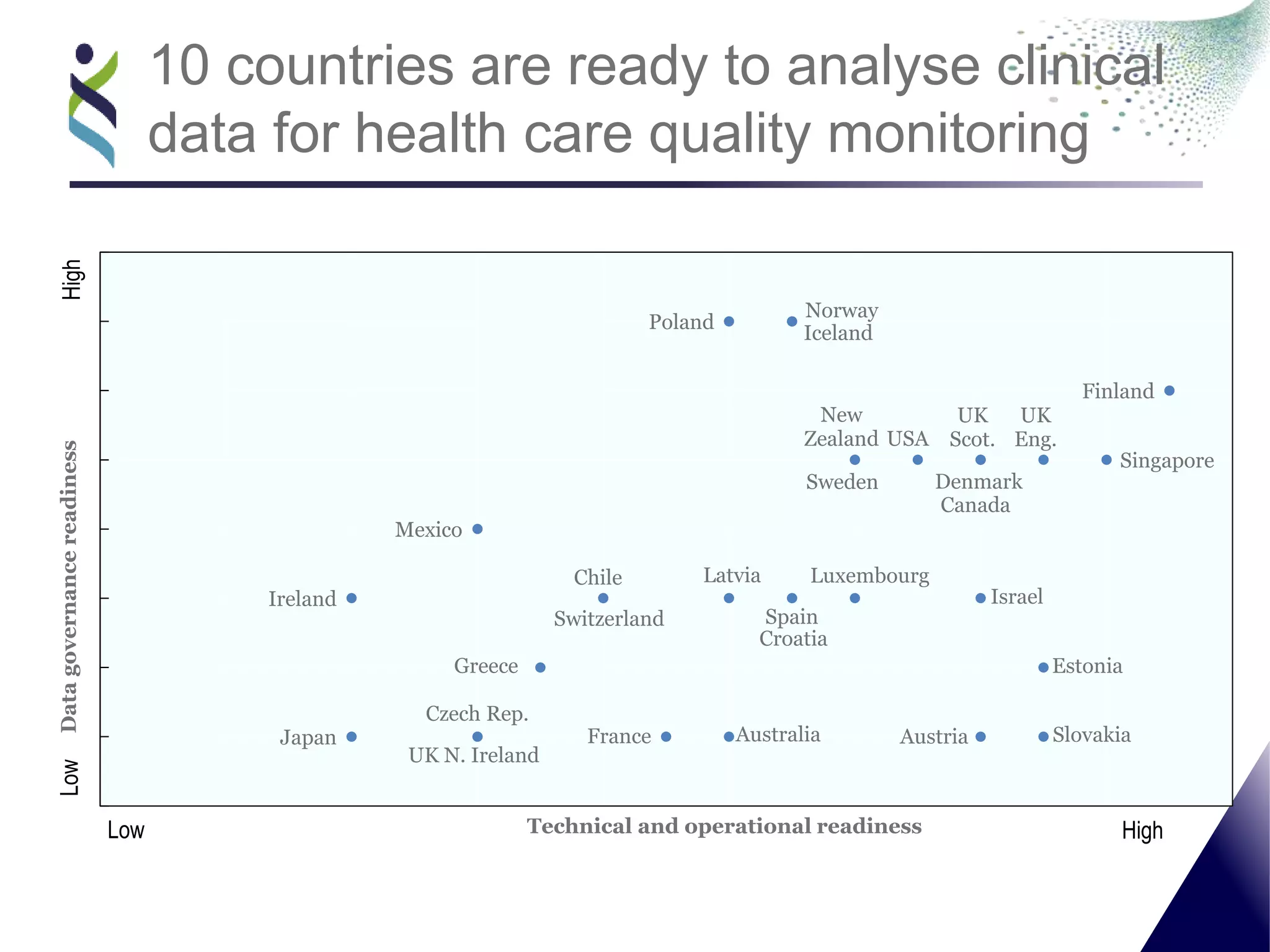
10 countries are ready to analyse clinical
data for health care quality monitoring
Australia Austria
Canada
Chile
Croatia
Czech Rep.
Denmark
Estonia
Finland
France
Greece
Iceland
Ireland Israel
Japan
Latvia Luxembourg
Mexico
New
Zealand
Norway
Poland
Singapore
Slovakia
Spain
Sweden
Switzerland
UK
Eng.
UK N. Ireland
UK
Scot.USA
Datagovernancereadiness
Technical and operational readinessLow High
LowHigh
International legal instruments and
guidelines protect information privacy
• Instruments include:
-OECD Privacy Guidelines
-EU General Data Protection Regulation (GDPR)
-APEC Cross-Border Privacy Rules
• None are specific to the protection of health
information privacy
• National interpretation for the governance of
the use of health data has varied widely
across countries
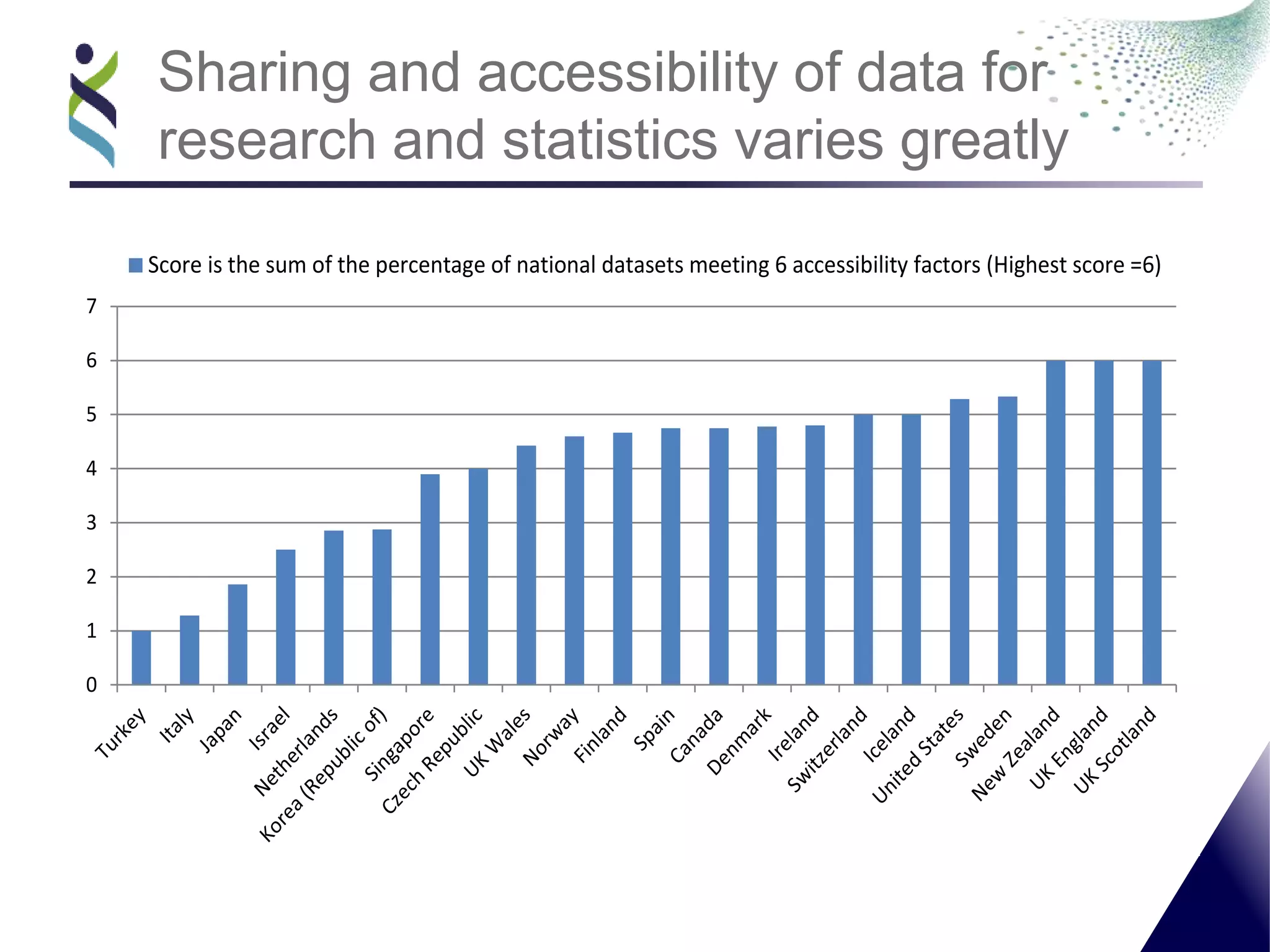
Sharing and accessibility of data for
research and statistics varies greatly
0
1
2
3
4
5
6
7
Score is the sum of the percentage of national datasets meeting 6 accessibility factors (Highest score =6)
• Collaboration of health ministries through the Health
Committee and data privacy authorities through the
Committee on Digital Economy Policy
• Expert input across domains of health, policy, law, ethics,
privacy, research, statistics, IT from government, industry and
civil society
• Developed over two years with extensive consultations with
governments, civil society, businesses and industry and
OECD Secretariat
• Approved by the OECD Council in December 2016 and
announced by OECD Health Ministers on 17 January 2017
• Represents a moral force and outcomes of Adherents will be
monitored
Process to develop the Recommendation
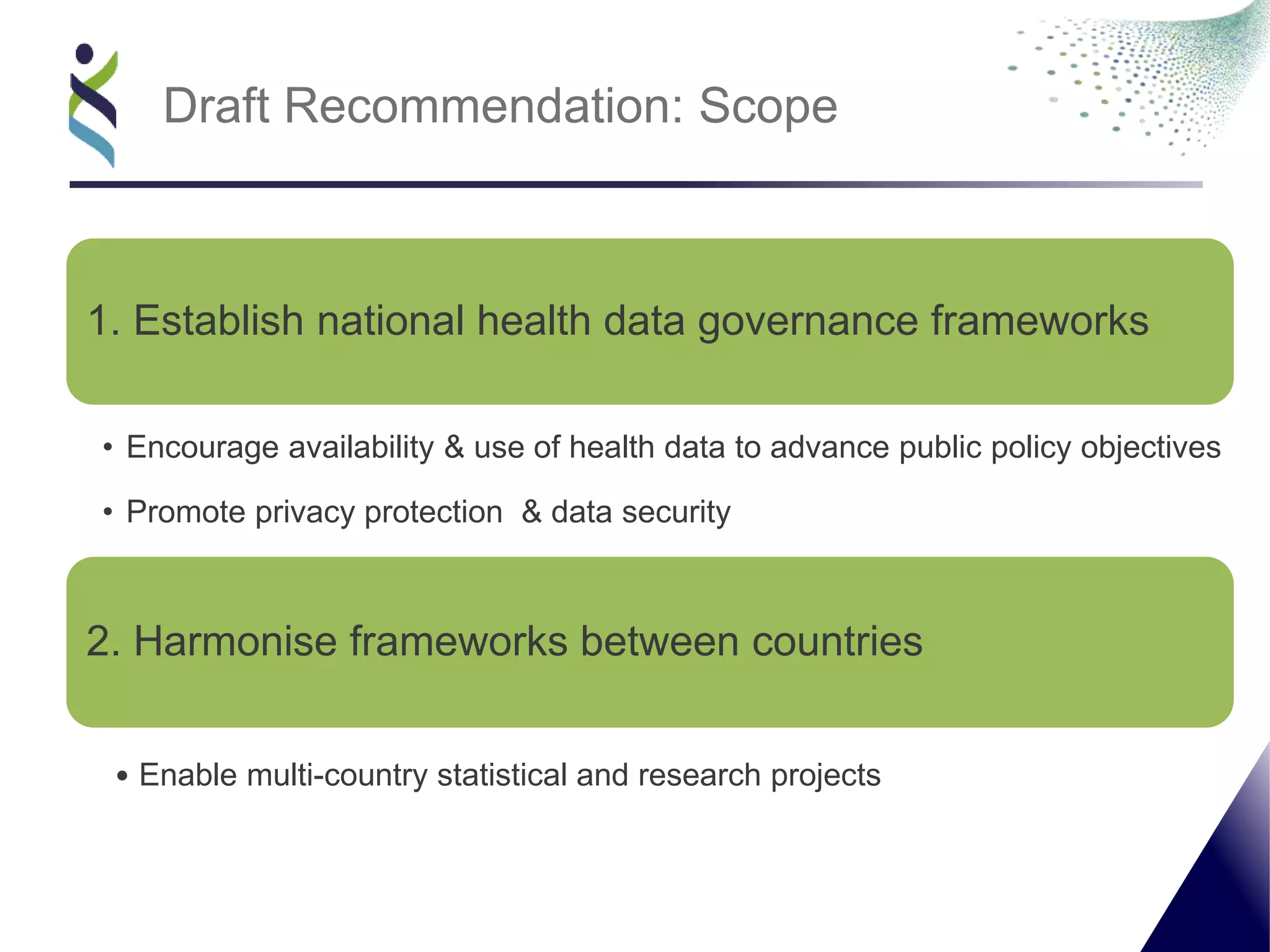
1. Establish national health data governance frameworks
• Encourage availability & use of health data to advance public policy objectives
• Promote privacy protection & data security
2. Harmonise frameworks between countries
• Enable multi-country statistical and research projects
Draft Recommendation: Scope
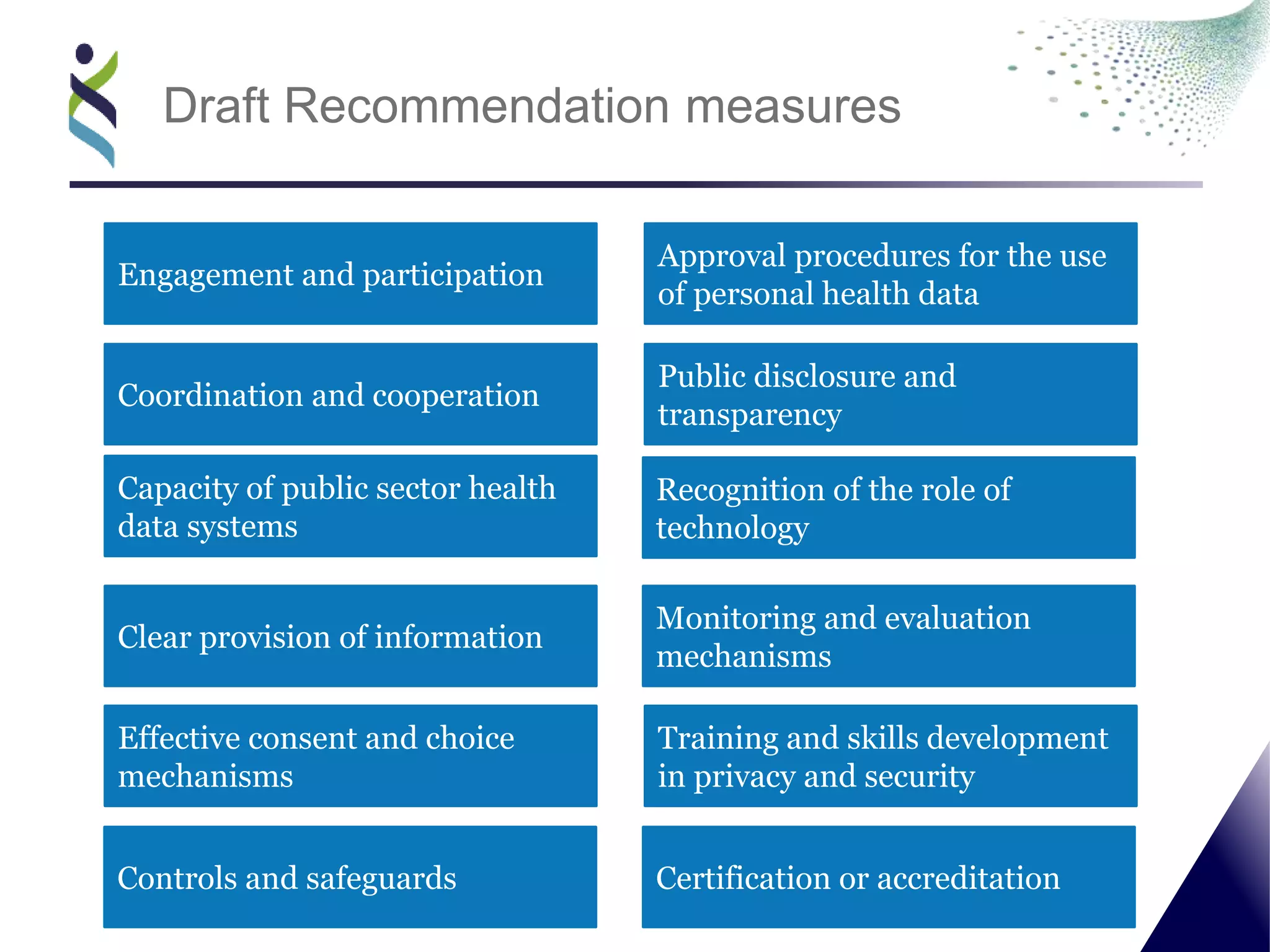
Draft Recommendation measures
Public disclosure and
transparency
Coordination and cooperation
Capacity of public sector health
data systems
Clear provision of information
Effective consent and choice
mechanisms
Engagement and participation
Approval procedures for the use
of personal health data
Recognition of the role of
technology
Monitoring and evaluation
mechanisms
Training and skills development
in privacy and security
Controls and safeguards Certification or accreditation
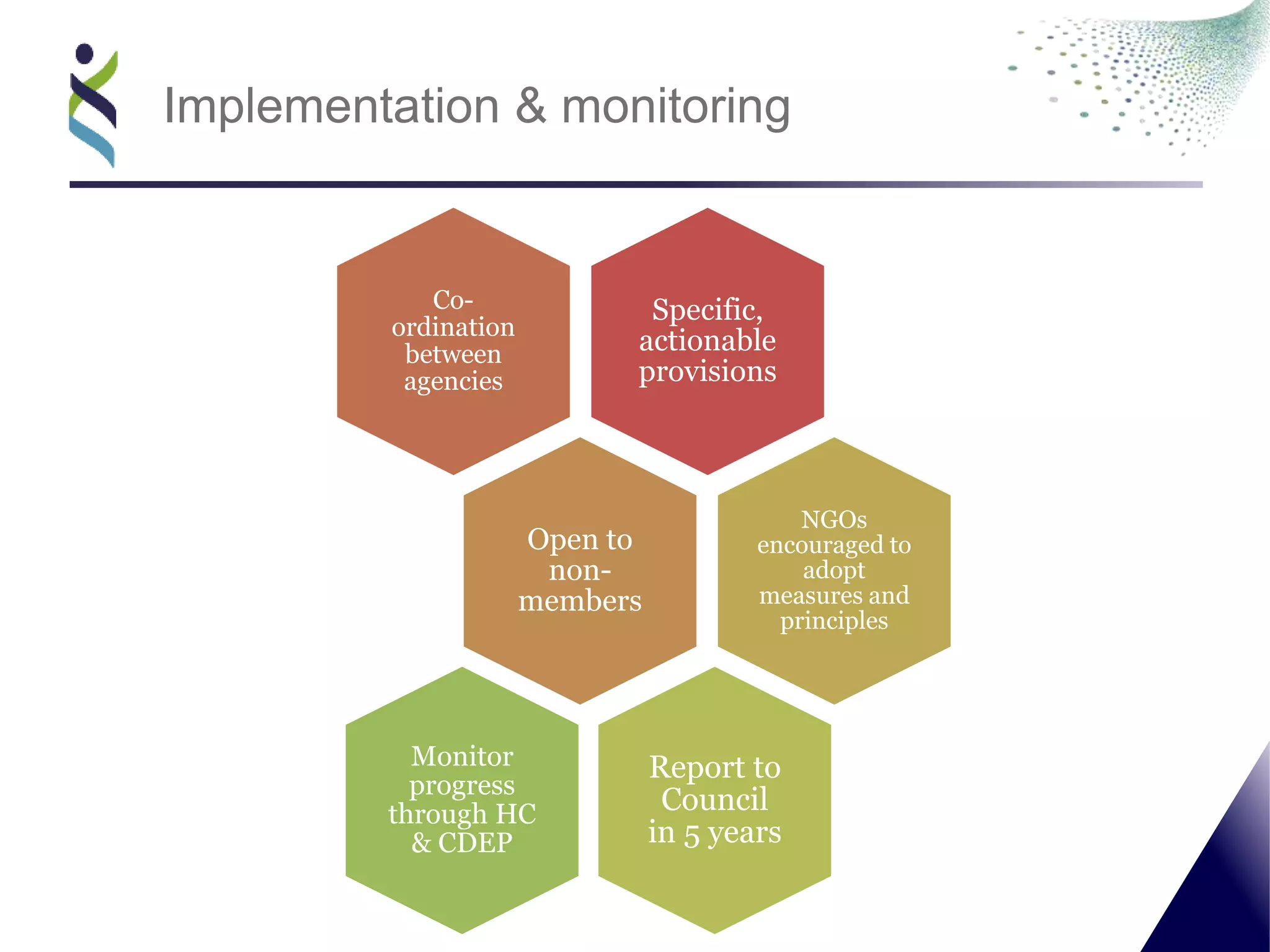
Specific,
actionable
provisions
Co-
ordination
between
agencies
Open to
non-
members
NGOs
encouraged to
adopt
measures and
principles
Report to
Council
in 5 years
Monitor
progress
through HC
& CDEP
Implementation & monitoring
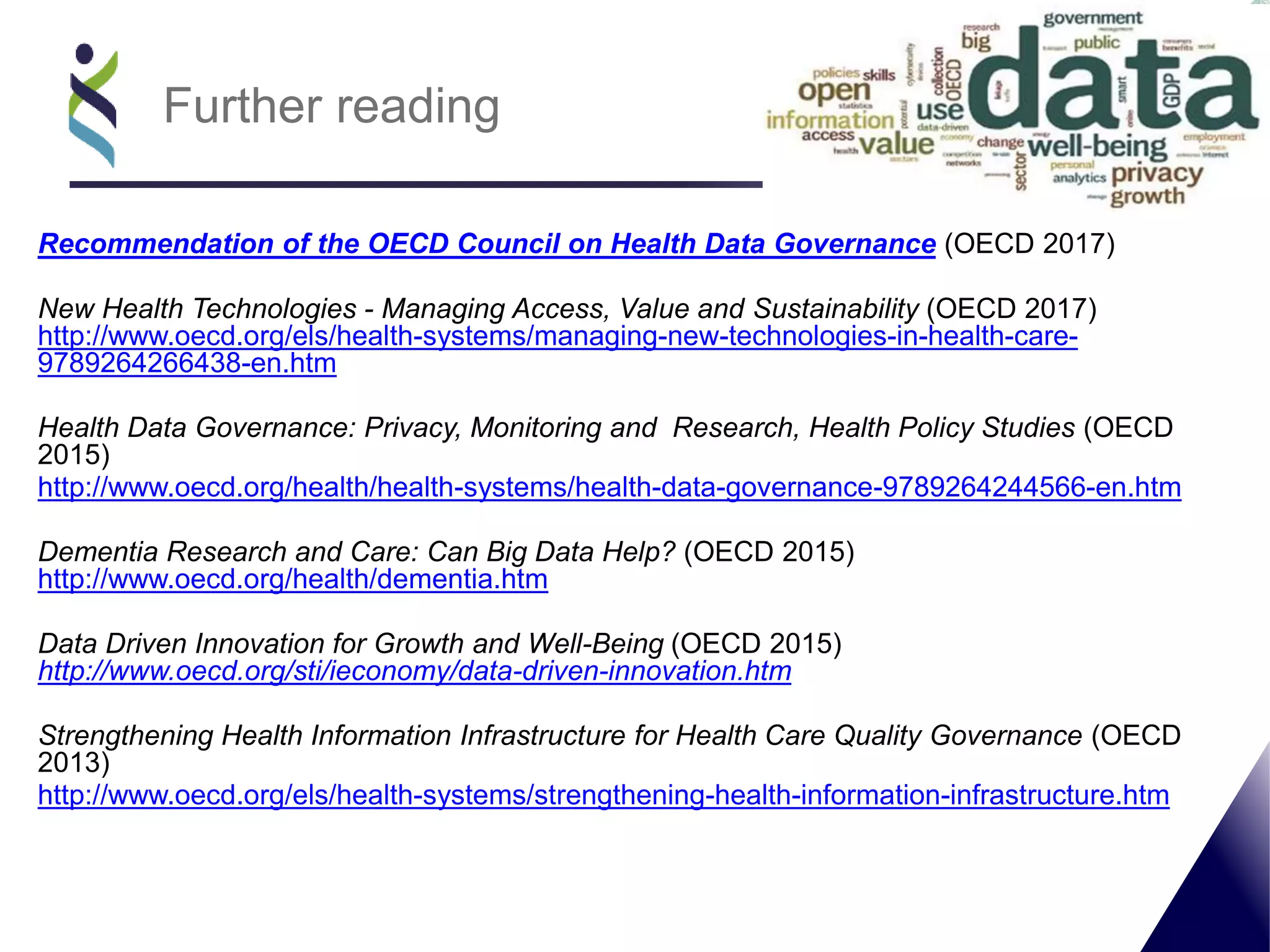
Recommendation of the OECD Council on Health Data Governance (OECD 2017)
New Health Technologies - Managing Access, Value and Sustainability (OECD 2017)
http://www.oecd.org/els/health-systems/managing-new-technologies-in-health-care-
9789264266438-en.htm
Health Data Governance: Privacy, Monitoring and Research, Health Policy Studies (OECD
2015)
http://www.oecd.org/health/health-systems/health-data-governance-9789264244566-en.htm
Dementia Research and Care: Can Big Data Help? (OECD 2015)
http://www.oecd.org/health/dementia.htm
Data Driven Innovation for Growth and Well-Being (OECD 2015)
http://www.oecd.org/sti/ieconomy/data-driven-innovation.htm
Strengthening Health Information Infrastructure for Health Care Quality Governance (OECD
2013)
http://www.oecd.org/els/health-systems/strengthening-health-information-infrastructure.htm
Further reading

Health Data Governance Recommendation: Presentation

  • 1.
    OECD RECOMMENDATION ONHEALTH DATA GOVERNANCE 17 January 2017
  • 2.
    Using health datacan advance health policy objectives There are obstacles to using health data effectively in most countries Better policy frameworks are needed to get more out of health data Rationale for an OECD Recommendation on Health Data Governance
  • 3.
    Culmination of 6years’ work …. OECD Guidelines Governing the Protection of Privacy and Transborder Flows of Personal Data [C(80)58/FINAL as amended by C(2013)79]
  • 4.
    Drivers of DataUse Tight fiscal conditions put pressure on health systems to deliver value for money Increasingly complex care needs make delivering high quality care more challenging1 1 0 0 1 0 1 0 1 1 0 0 0 0 1 1 0 1 1 1 0 1 0 1 0 0 0 0 1 1 1 0 1 0 1 0 1 0 1 0 0 1 1 1 1 0 1 0 0 0 0 0 0 1 1 1 0 1 0 1 0 1 0 0 0 1 1 1 1 0 1 0 1 0 0 1 1 1 New therapies and better research rely on our ability to make better use of data Patient demands for modern experiences, responsiveness, communications and transparency
  • 5.
    Data needed tomake progress Data must describe Pathways Processes Outcomes Costs Key prerequisites • Individual patients / person level • Follow patients through cycle of care • Link to outcomes Data linkage leverages the value of data to answer specific questions Electronic health records (EHRs) Longitudinal record of treatments and outcomes
  • 6.
    Research and innovation • UKBiobank: Broad and deep data to prevent, diagnose and treat diseases Surveillance • FDA (US): Post-market surveillance of medical technology to improve safety System management • THL (Finland): Public indicators to improve the quality of hospital care Clinical practice improvement • Clalit (Israel): Analytics to reduce readmissions in older patients Success stories
  • 7.
  • 8.
    Little data linkagein key areas 0 5 10 15 20 25 Patient experiences survey… Diabetes registry Patient reported outcomes Primary care data Formal long-term care data Population health survey… Population census/registry Prescription medicines data CVD registry data Mental hospital in-patient… Emergency health care data Mortality data Cancer registry data Hospital in-patient data National personal health data available Unique ID included and used consistently Record linkage to regularly monitor health care quality and system performance # of Countries
  • 9.
    13 countries regularlylinking data to monitor quality and conduct research A B C D E Regularly linking hospital in-patient, cancer registry data and mortality data Linking datasets in A + emergency care data Linking datasets in A + prescription medicines data Linking datasets in A + long-term care data Linking datasets in A + primary care data Canada Canada Canada Canada Korea Czech Republic Israel Denmark Finland Singapore Denmark Korea Finland Israel UK (Wales) Finland New Zealand Korea Korea Israel Norway New Zealand Singapore Korea Singapore Sweden UK (Wales) New Zealand Sweden UK (Scot. & Wales) Norway UK Singapore Sweden UK (Eng., Scot. & Wales)
  • 10.
    10 countries areready to analyse clinical data for health care quality monitoring Australia Austria Canada Chile Croatia Czech Rep. Denmark Estonia Finland France Greece Iceland Ireland Israel Japan Latvia Luxembourg Mexico New Zealand Norway Poland Singapore Slovakia Spain Sweden Switzerland UK Eng. UK N. Ireland UK Scot.USA Datagovernancereadiness Technical and operational readinessLow High LowHigh
  • 11.
    International legal instrumentsand guidelines protect information privacy • Instruments include: -OECD Privacy Guidelines -EU General Data Protection Regulation (GDPR) -APEC Cross-Border Privacy Rules • None are specific to the protection of health information privacy • National interpretation for the governance of the use of health data has varied widely across countries
  • 12.
    Sharing and accessibilityof data for research and statistics varies greatly 0 1 2 3 4 5 6 7 Score is the sum of the percentage of national datasets meeting 6 accessibility factors (Highest score =6)
  • 13.
    • Collaboration ofhealth ministries through the Health Committee and data privacy authorities through the Committee on Digital Economy Policy • Expert input across domains of health, policy, law, ethics, privacy, research, statistics, IT from government, industry and civil society • Developed over two years with extensive consultations with governments, civil society, businesses and industry and OECD Secretariat • Approved by the OECD Council in December 2016 and announced by OECD Health Ministers on 17 January 2017 • Represents a moral force and outcomes of Adherents will be monitored Process to develop the Recommendation
  • 14.
    1. Establish nationalhealth data governance frameworks • Encourage availability & use of health data to advance public policy objectives • Promote privacy protection & data security 2. Harmonise frameworks between countries • Enable multi-country statistical and research projects Draft Recommendation: Scope
  • 15.
    Draft Recommendation measures Publicdisclosure and transparency Coordination and cooperation Capacity of public sector health data systems Clear provision of information Effective consent and choice mechanisms Engagement and participation Approval procedures for the use of personal health data Recognition of the role of technology Monitoring and evaluation mechanisms Training and skills development in privacy and security Controls and safeguards Certification or accreditation
  • 16.
    Specific, actionable provisions Co- ordination between agencies Open to non- members NGOs encouraged to adopt measuresand principles Report to Council in 5 years Monitor progress through HC & CDEP Implementation & monitoring
  • 17.
    Recommendation of theOECD Council on Health Data Governance (OECD 2017) New Health Technologies - Managing Access, Value and Sustainability (OECD 2017) http://www.oecd.org/els/health-systems/managing-new-technologies-in-health-care- 9789264266438-en.htm Health Data Governance: Privacy, Monitoring and Research, Health Policy Studies (OECD 2015) http://www.oecd.org/health/health-systems/health-data-governance-9789264244566-en.htm Dementia Research and Care: Can Big Data Help? (OECD 2015) http://www.oecd.org/health/dementia.htm Data Driven Innovation for Growth and Well-Being (OECD 2015) http://www.oecd.org/sti/ieconomy/data-driven-innovation.htm Strengthening Health Information Infrastructure for Health Care Quality Governance (OECD 2013) http://www.oecd.org/els/health-systems/strengthening-health-information-infrastructure.htm Further reading