HEALTH IN THE 21ST
CENTURY
Putting data to work for stronger health systems
The health sector faces a changing landscape
and new challenges
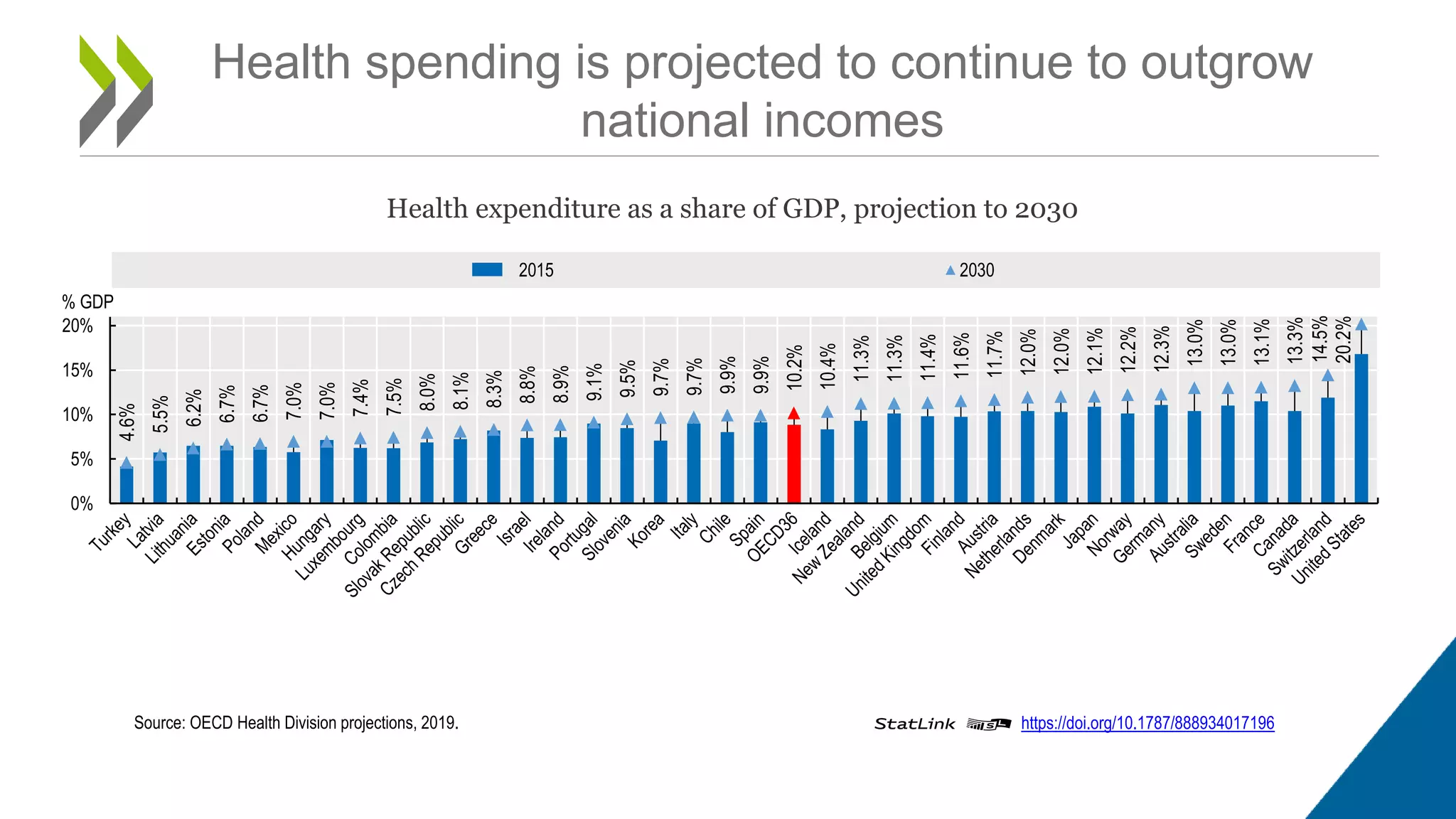
Health spending is projected to continue to outgrow
national incomes
Health expenditure as a share of GDP, projection to 2030
4.6%
5.5%
6.2%
6.7%
6.7%
7.0%
7.0%
7.4%
7.5%
8.0%
8.1%
8.3%
8.8%
8.9%
9.1%
9.5%
9.7%
9.7%
9.9%
9.9%
10.2%
10.4%
11.3%
11.3%
11.4%
11.6%
11.7%
12.0%
12.0%
12.1%
12.2%
12.3%
13.0%
13.0%
13.1%
13.3%
14.5%
20.2%
0%
5%
10%
15%
20%
2015 2030
% GDP
Source: OECD Health Division projections, 2019. StatLink 2 https://doi.org/10.1787/888934017196
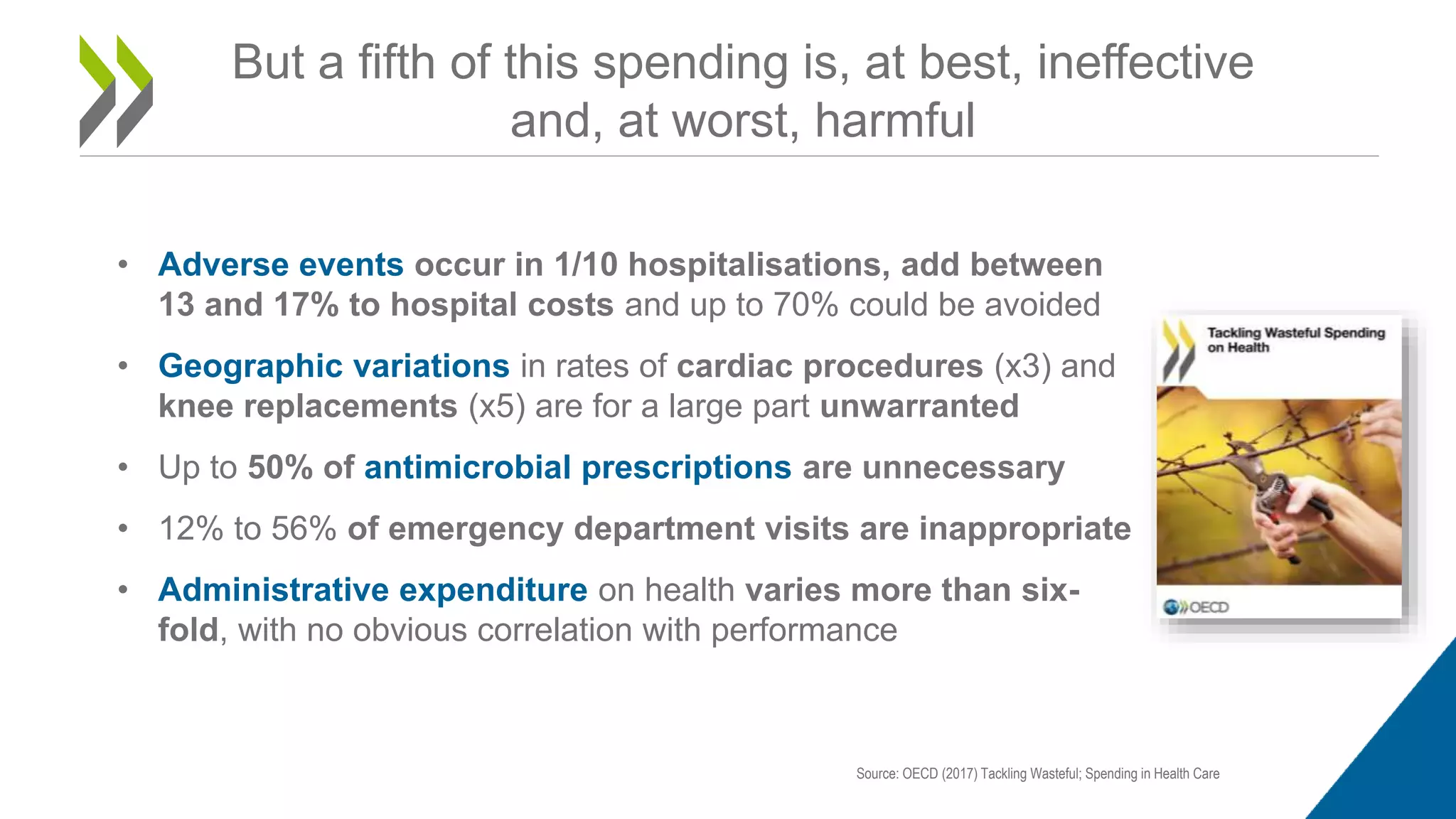
But a fifth of this spending is, at best, ineffective
and, at worst, harmful
Source: OECD (2017) Tackling Wasteful; Spending in Health Care
• Adverse events occur in 1/10 hospitalisations, add between
13 and 17% to hospital costs and up to 70% could be avoided
• Geographic variations in rates of cardiac procedures (x3) and
knee replacements (x5) are for a large part unwarranted
• Up to 50% of antimicrobial prescriptions are unnecessary
• 12% to 56% of emergency department visits are inappropriate
• Administrative expenditure on health varies more than six-
fold, with no obvious correlation with performance
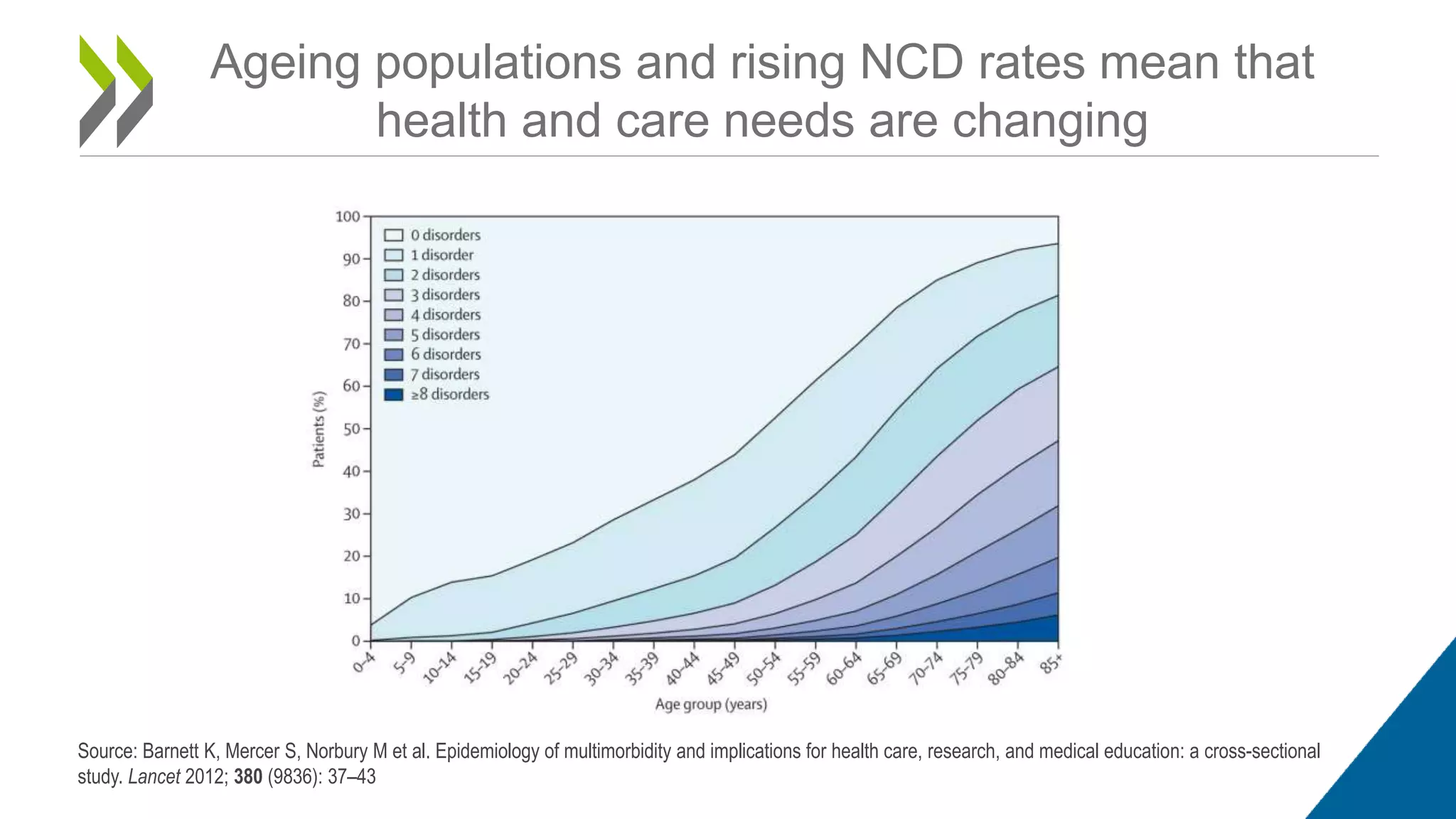
Ageing populations and rising NCD rates mean that
health and care needs are changing
Source: Barnett K, Mercer S, Norbury M et al. Epidemiology of multimorbidity and implications for health care, research, and medical education: a cross-sectional
study. Lancet 2012; 380 (9836): 37–43
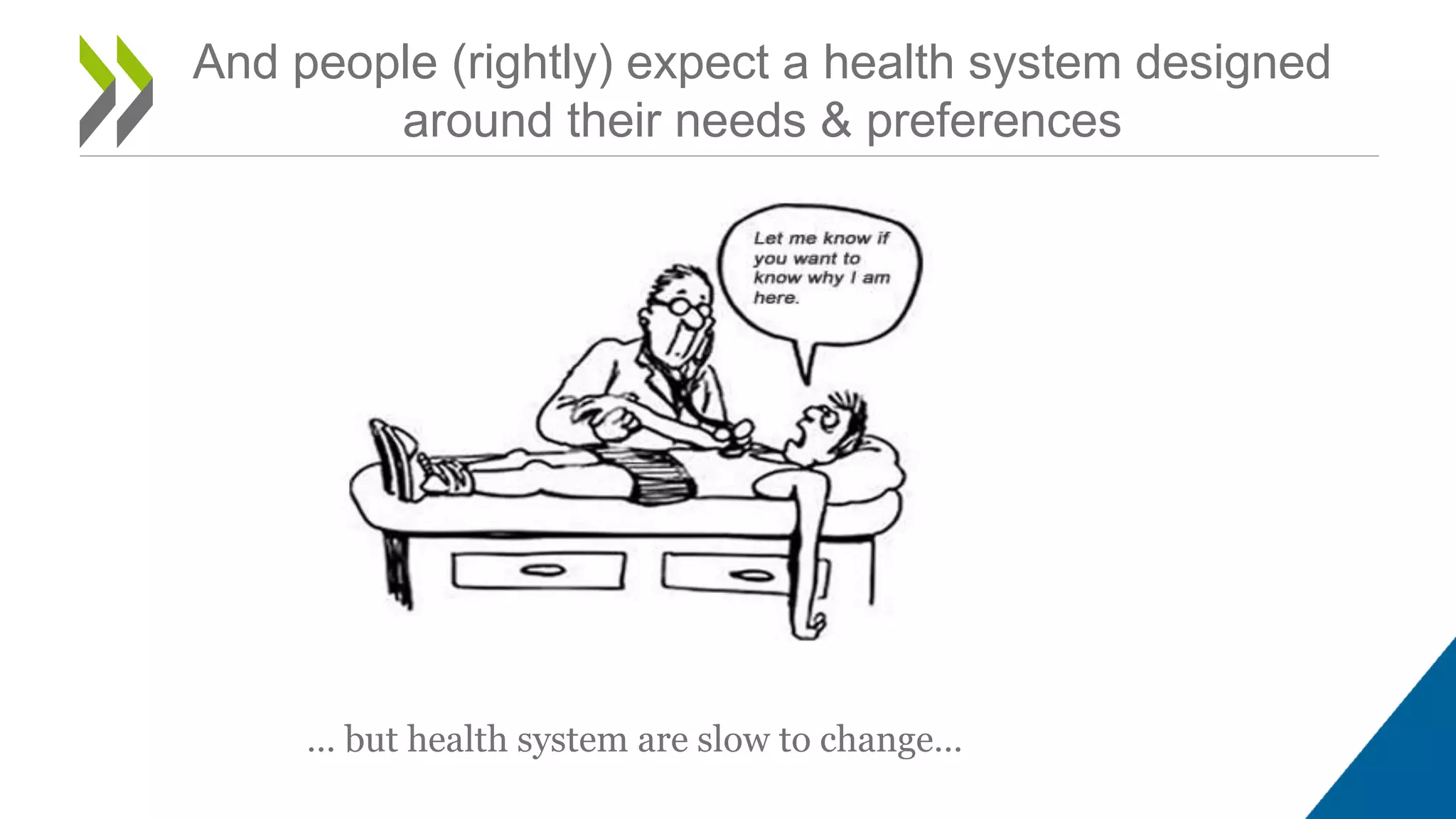
And people (rightly) expect a health system designed
around their needs & preferences
… but health system are slow to change…
7
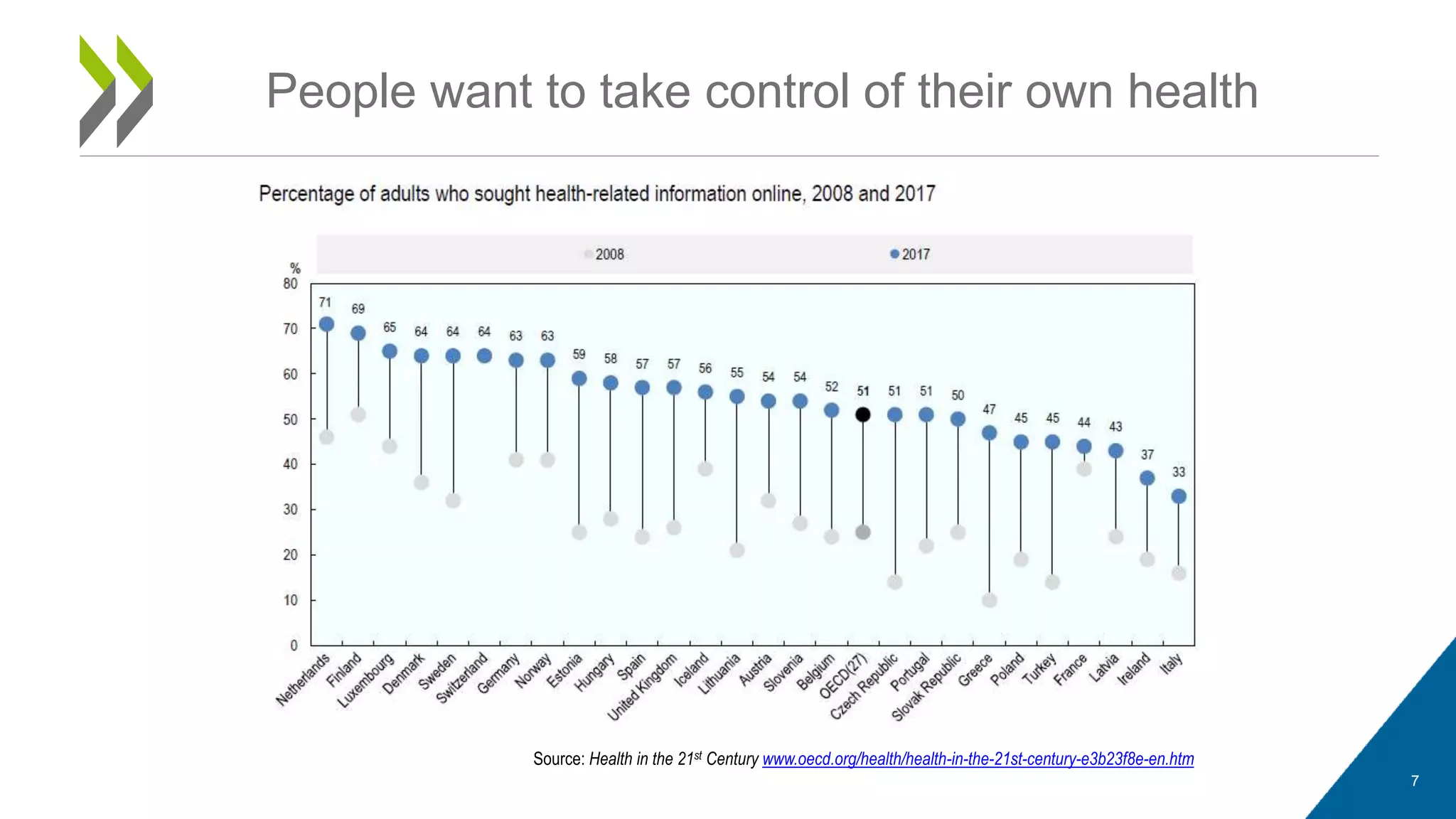
People want to take control of their own health
Source: Health in the 21st Century www.oecd.org/health/health-in-the-21st-century-e3b23f8e-en.htm
Intelligent use of data and digital technology
can help
8
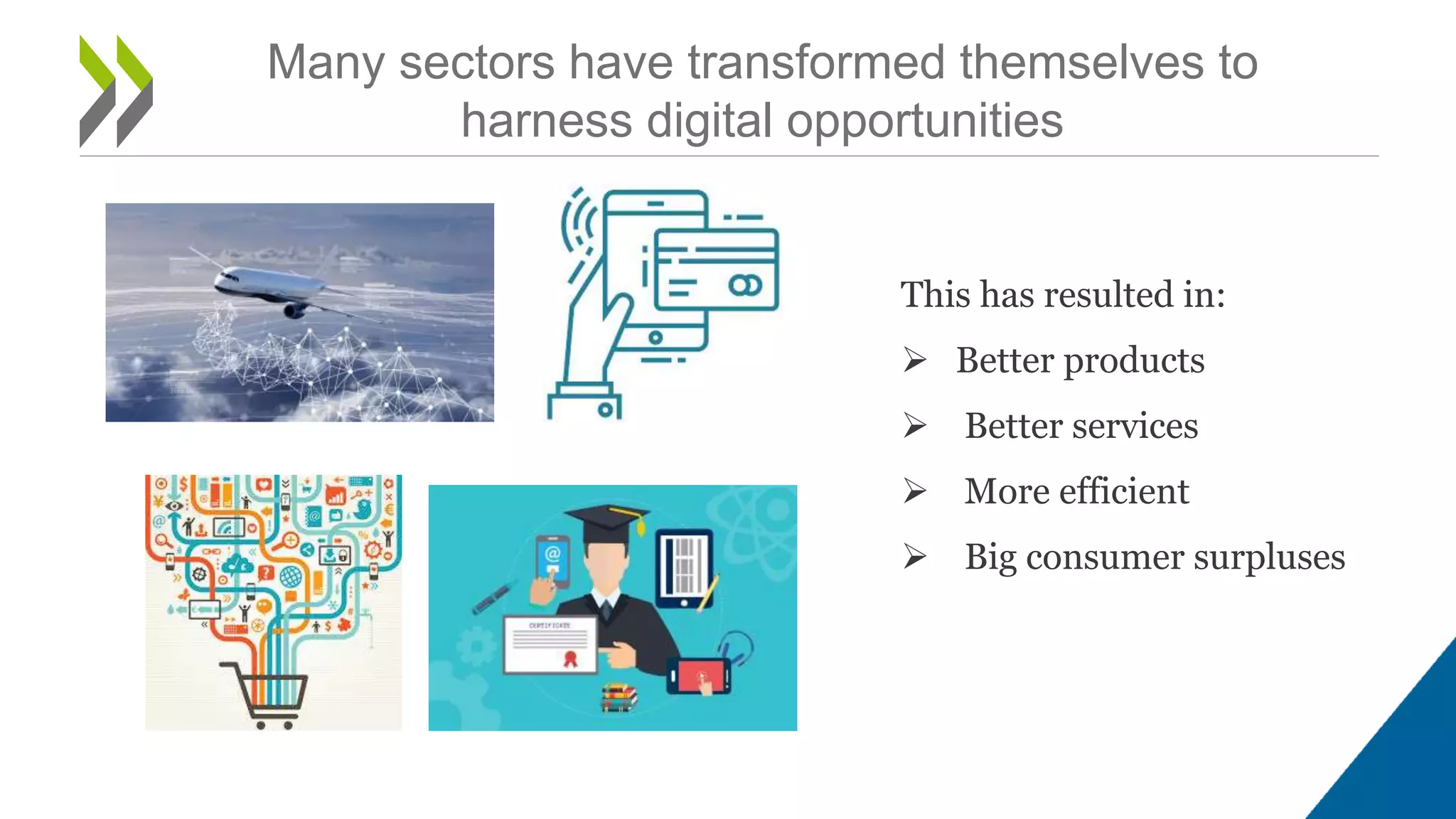
Many sectors have transformed themselves to
harness digital opportunities
This has resulted in:
 Better products
 Better services
 More efficient
 Big consumer surpluses
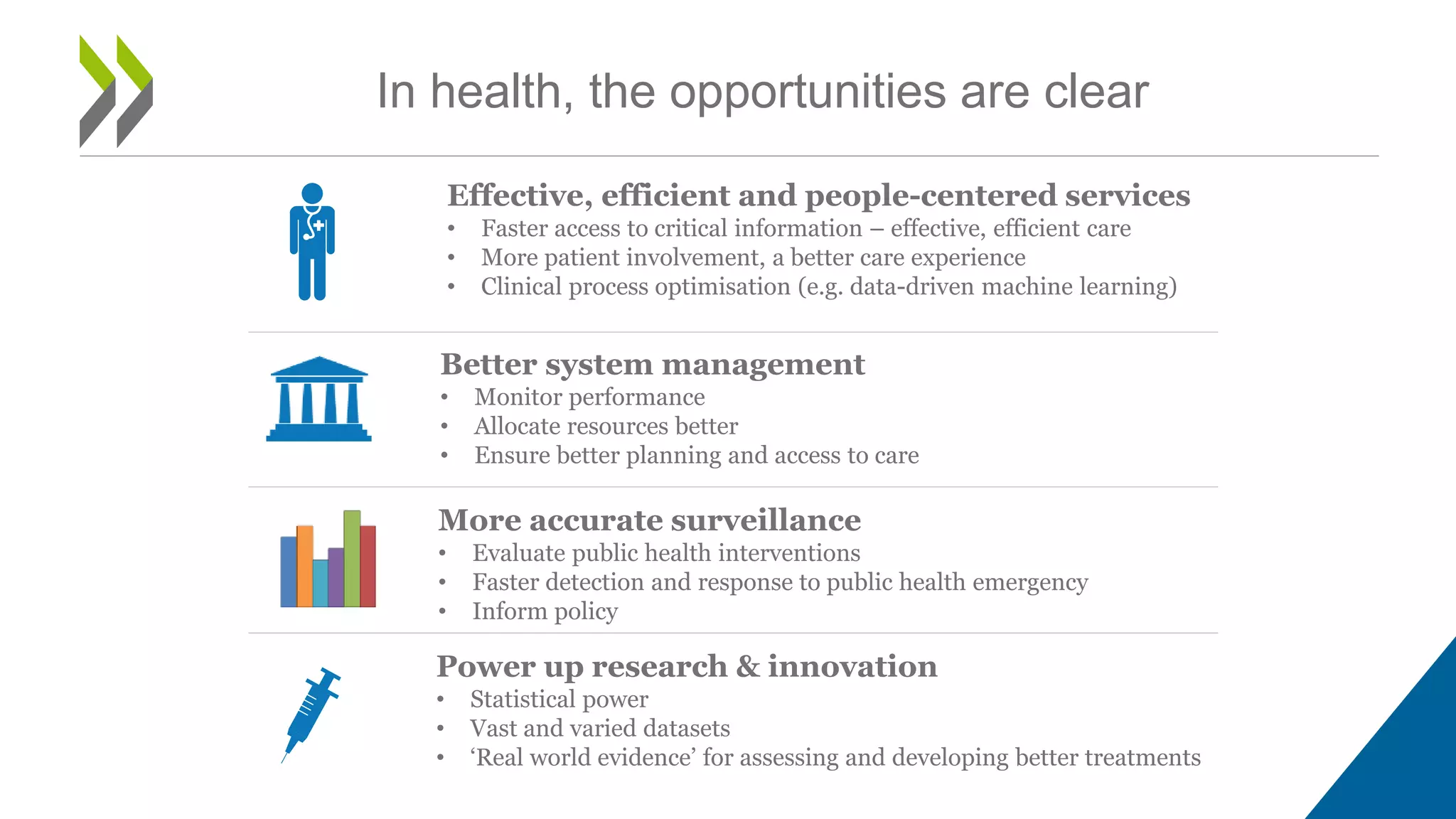
In health, the opportunities are clear
Effective, efficient and people-centered services
• Faster access to critical information – effective, efficient care
• More patient involvement, a better care experience
• Clinical process optimisation (e.g. data-driven machine learning)
Better system management
• Monitor performance
• Allocate resources better
• Ensure better planning and access to care
More accurate surveillance
• Evaluate public health interventions
• Faster detection and response to public health emergency
• Inform policy
Power up research & innovation
• Statistical power
• Vast and varied datasets
• ‘Real world evidence’ for assessing and developing better treatments
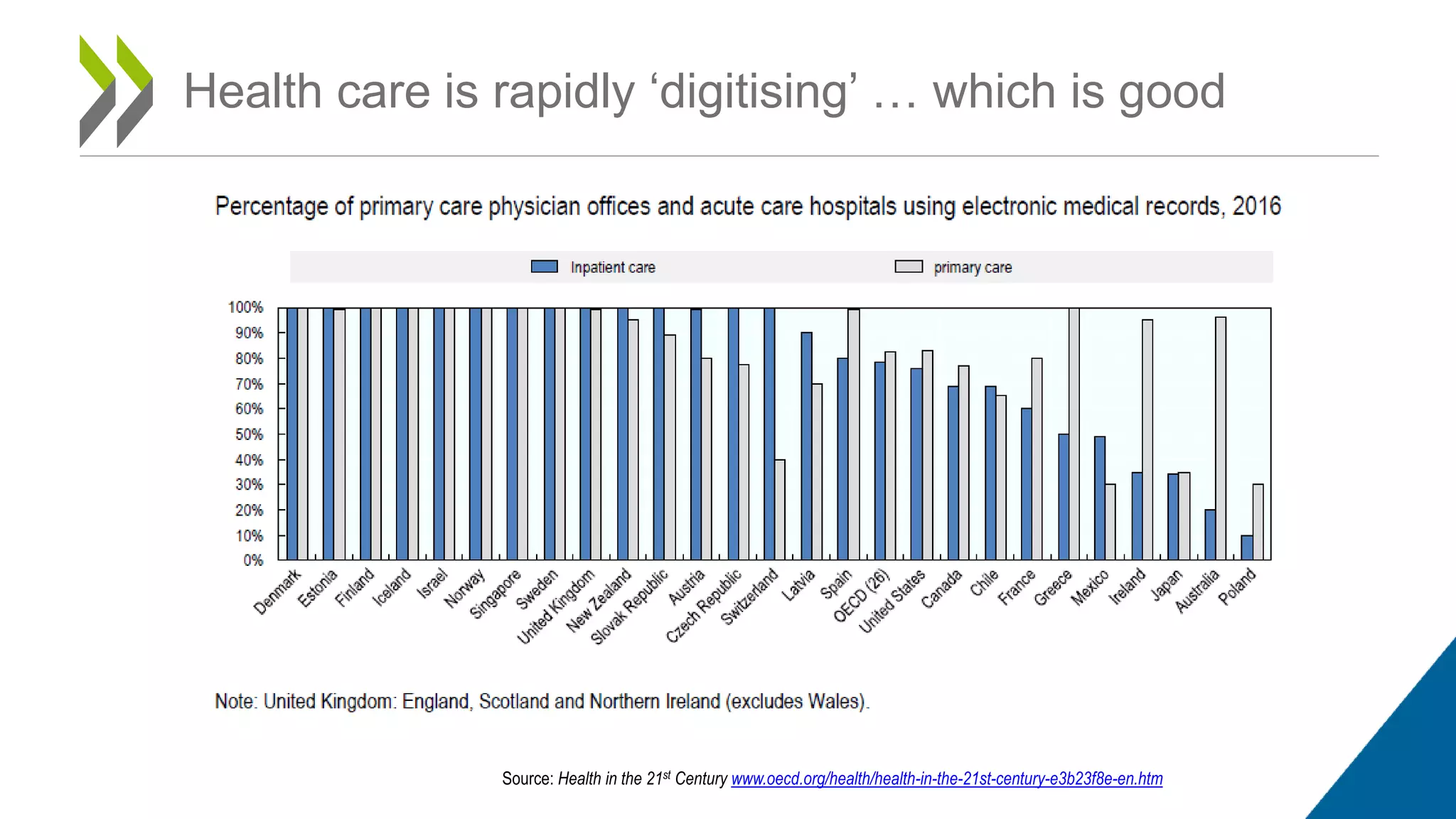
Health care is rapidly ‘digitising’ … which is good
Source: Health in the 21st Century www.oecd.org/health/health-in-the-21st-century-e3b23f8e-en.htm
But health systems remain “data rich -
information poor”
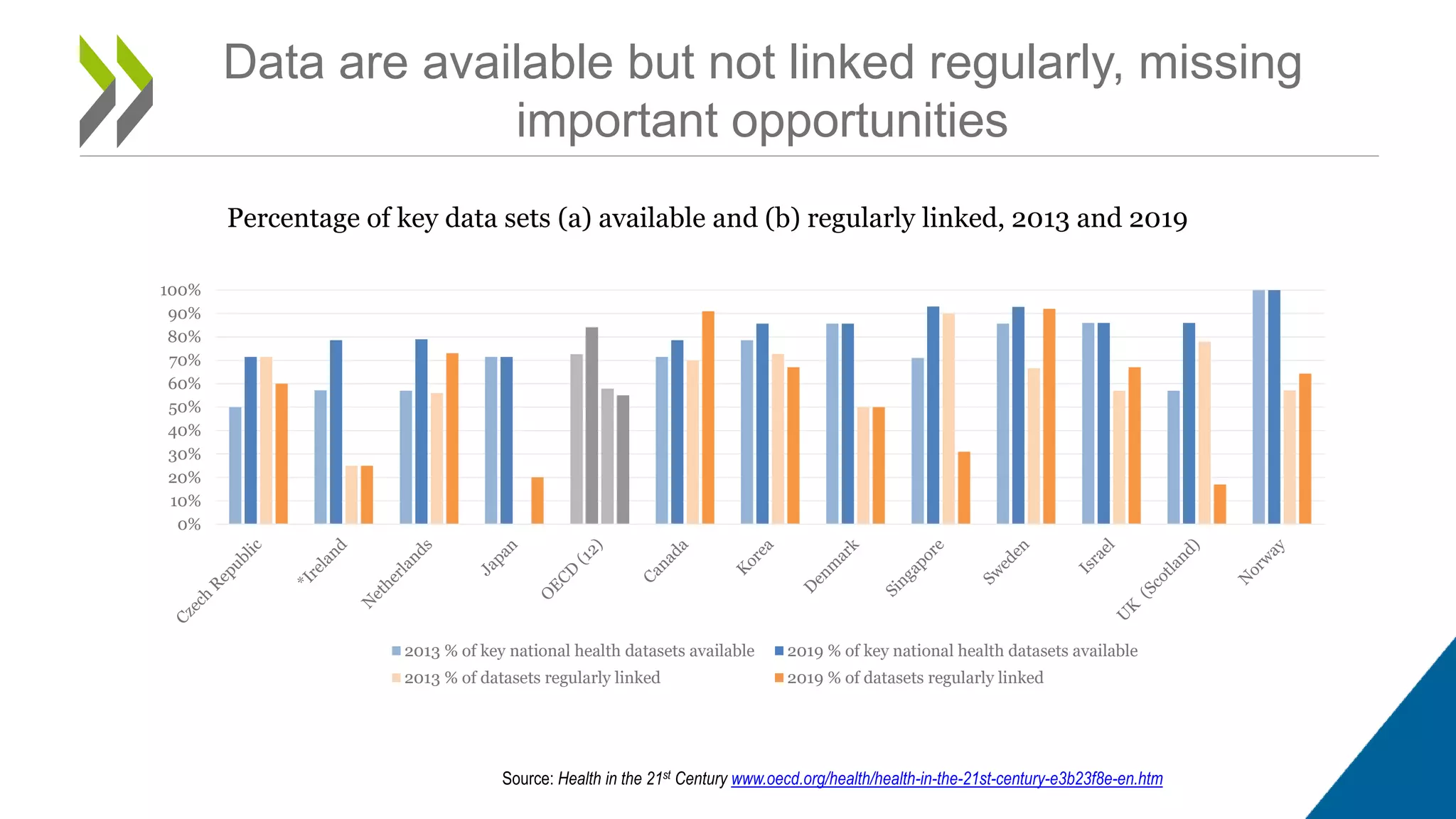
Data are available but not linked regularly, missing
important opportunities
Source: Health in the 21st Century www.oecd.org/health/health-in-the-21st-century-e3b23f8e-en.htm
0%
10%
20%
30%
40%
50%
60%
70%
80%
90%
100%
2013 % of key national health datasets available 2019 % of key national health datasets available
2013 % of datasets regularly linked 2019 % of datasets regularly linked
Percentage of key data sets (a) available and (b) regularly linked, 2013 and 2019
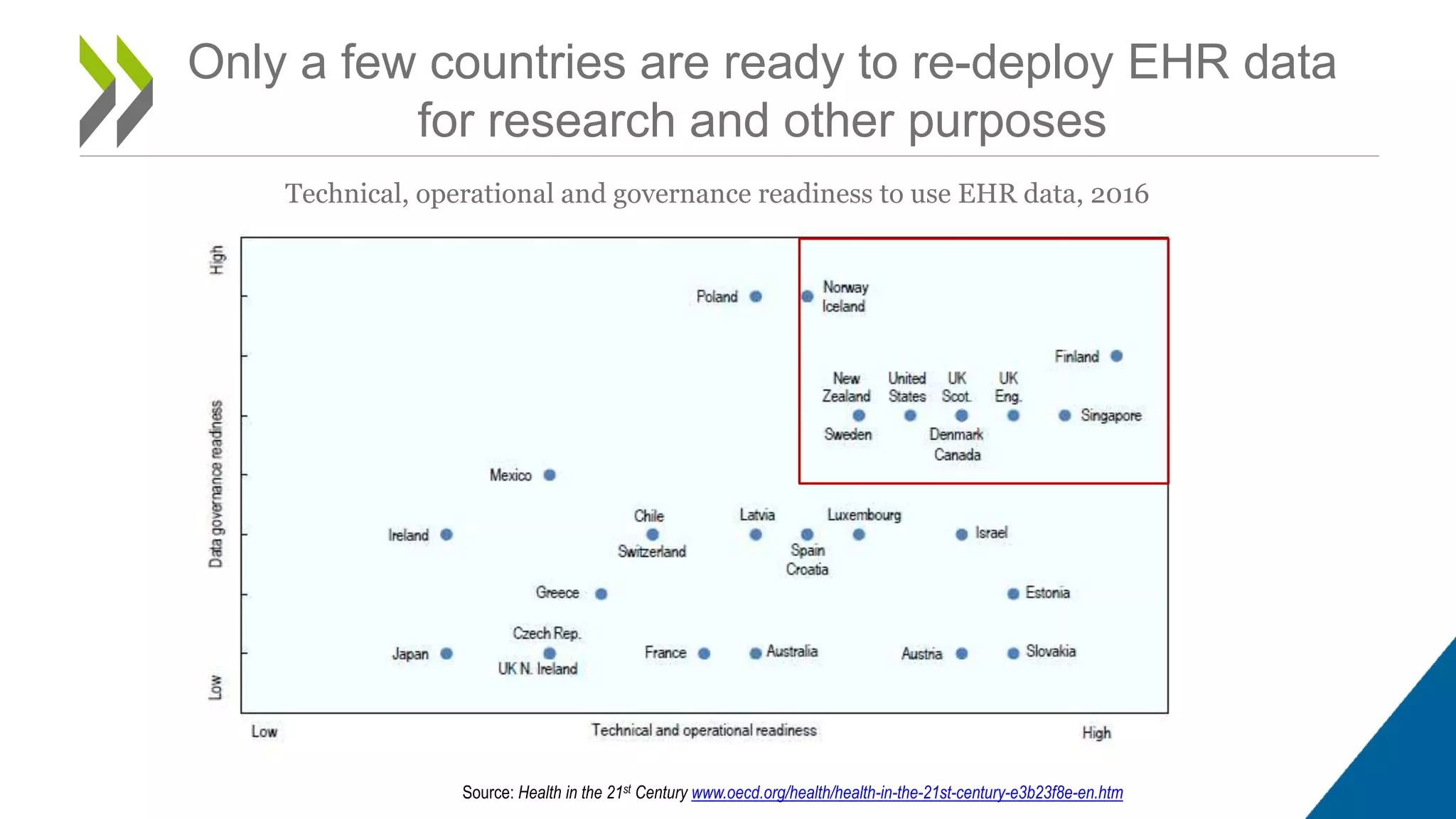
Only a few countries are ready to re-deploy EHR data
for research and other purposes
Source: Health in the 21st Century www.oecd.org/health/health-in-the-21st-century-e3b23f8e-en.htm
Technical, operational and governance readiness to use EHR data, 2016
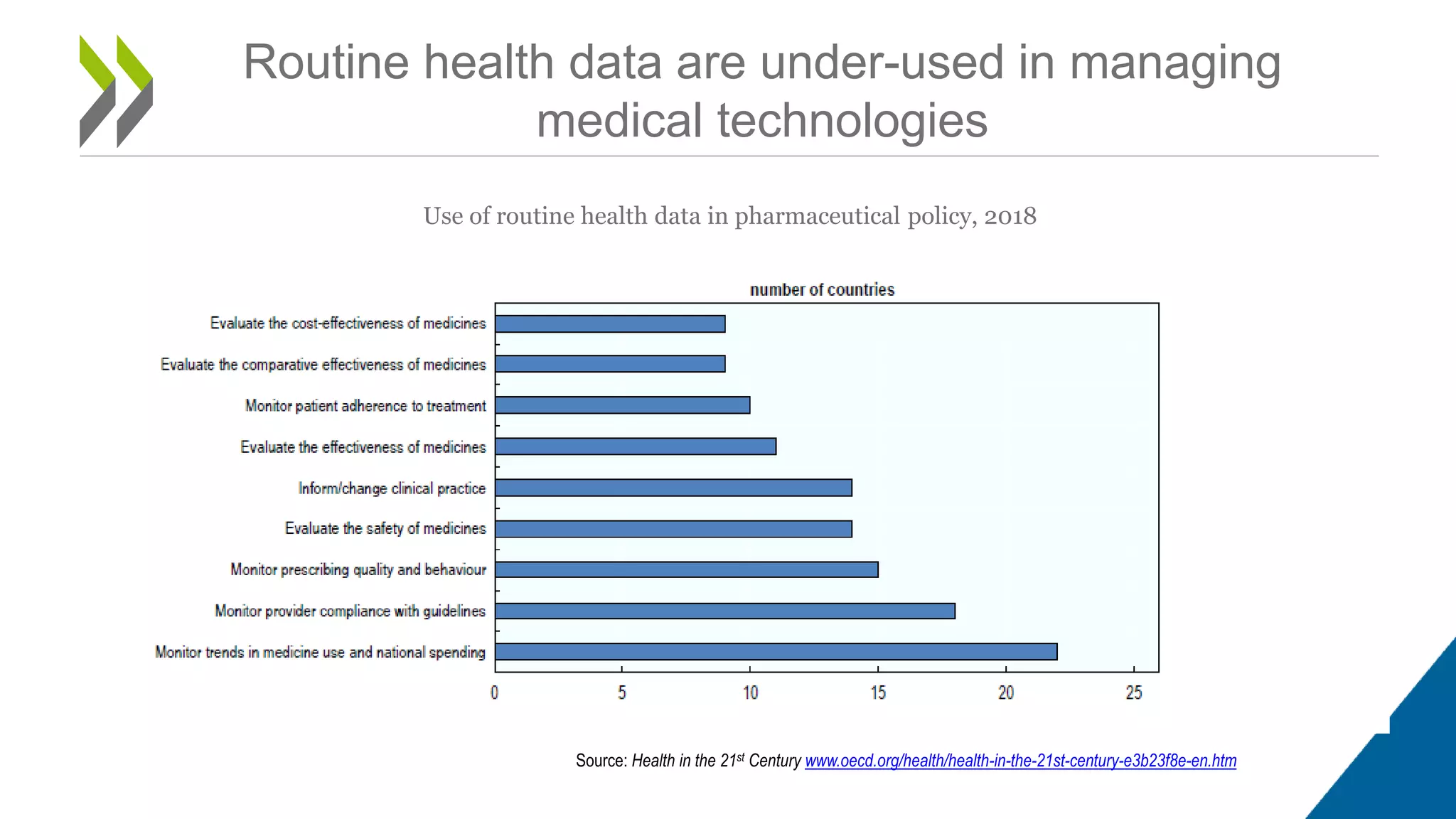
Routine health data are under-used in managing
medical technologies
Source: Health in the 21st Century www.oecd.org/health/health-in-the-21st-century-e3b23f8e-en.htm
Use of routine health data in pharmaceutical policy, 2018
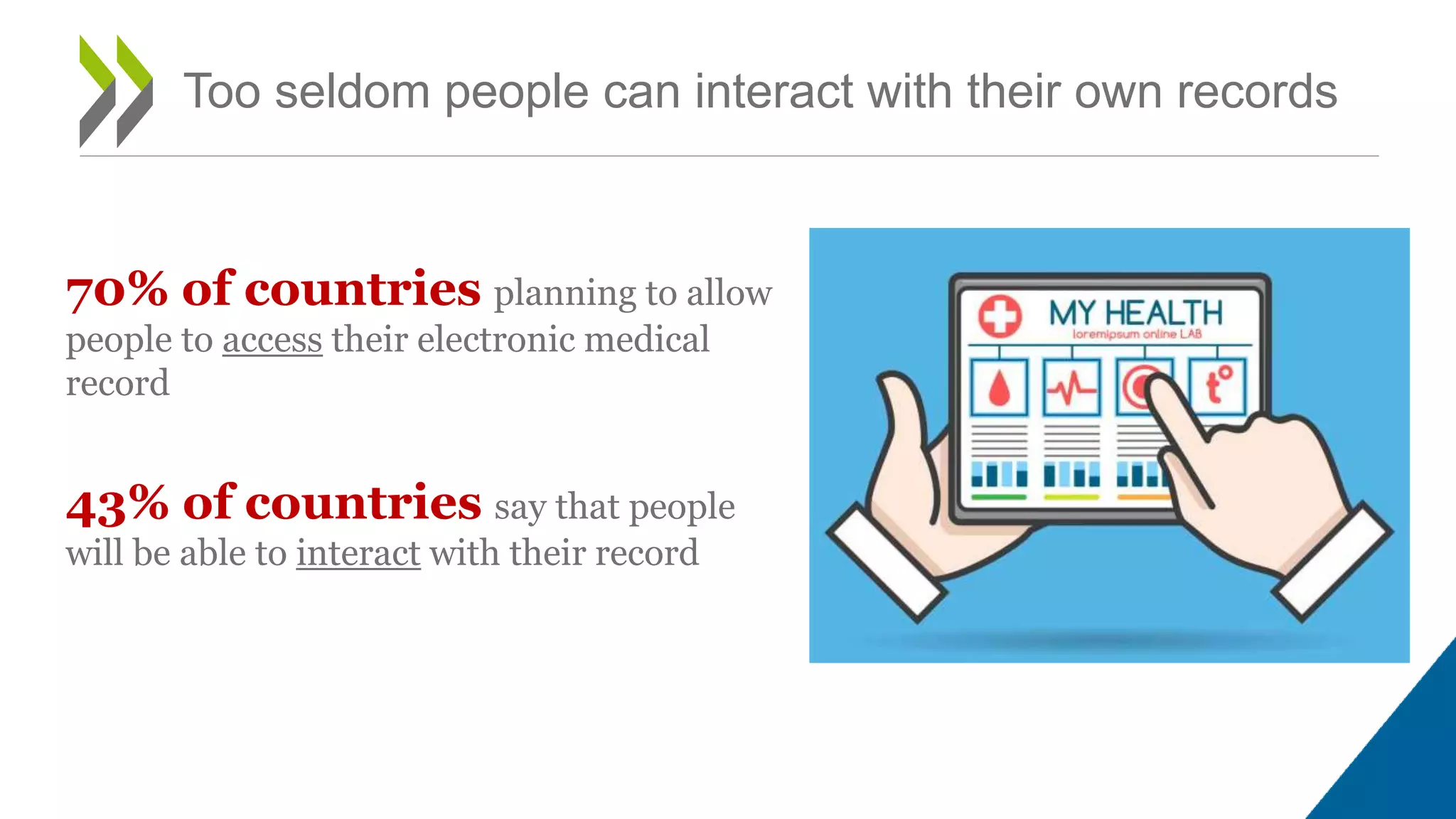
70% of countries planning to allow
people to access their electronic medical
record
43% of countries say that people
will be able to interact with their record
Too seldom people can interact with their own records
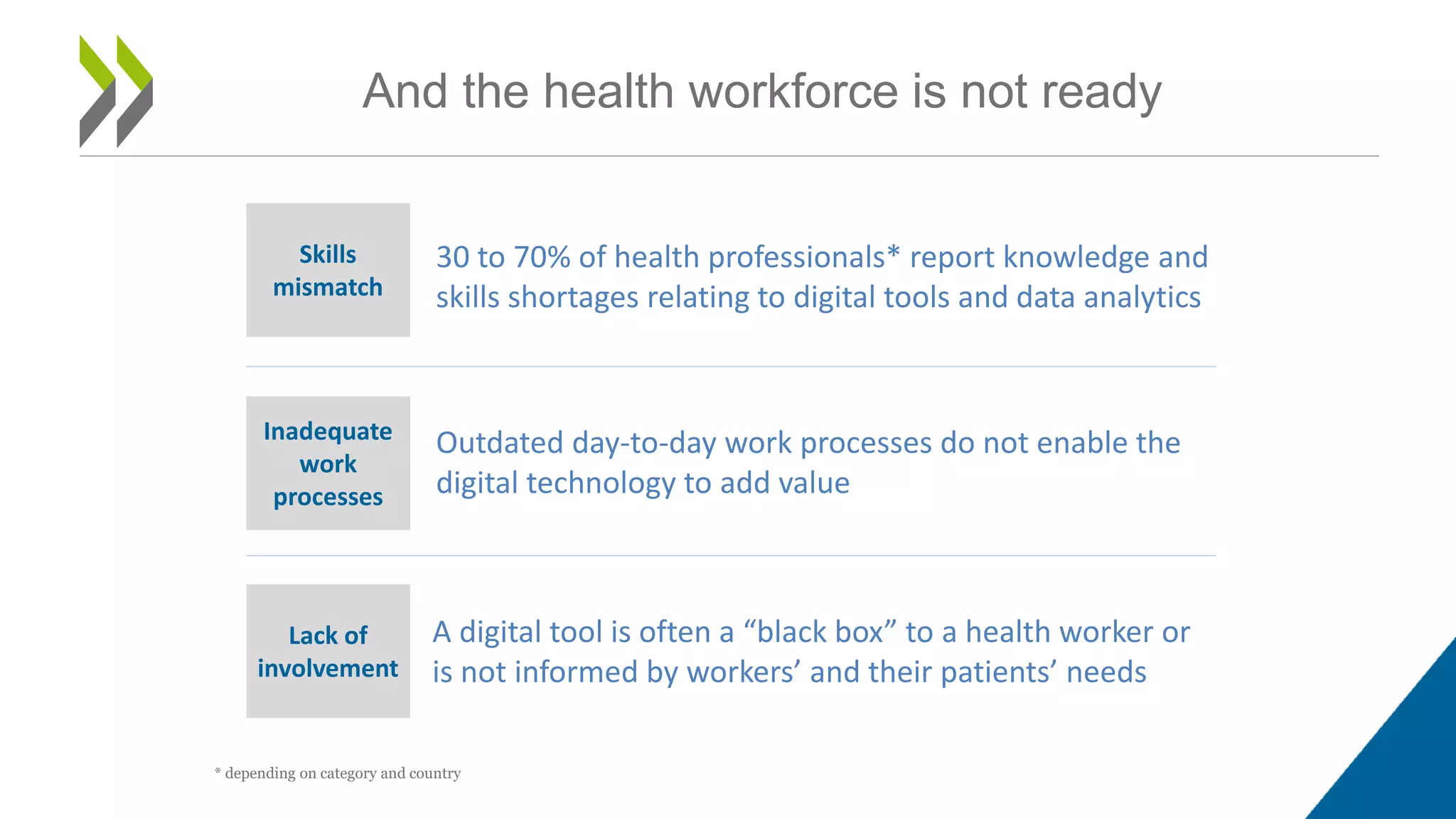
And the health workforce is not ready
30 to 70% of health professionals* report knowledge and
skills shortages relating to digital tools and data analytics
Outdated day-to-day work processes do not enable the
digital technology to add value
A digital tool is often a “black box” to a health worker or
is not informed by workers’ and their patients’ needs
Skills
mismatch
Inadequate
work
processes
Lack of
involvement
* depending on category and country
18
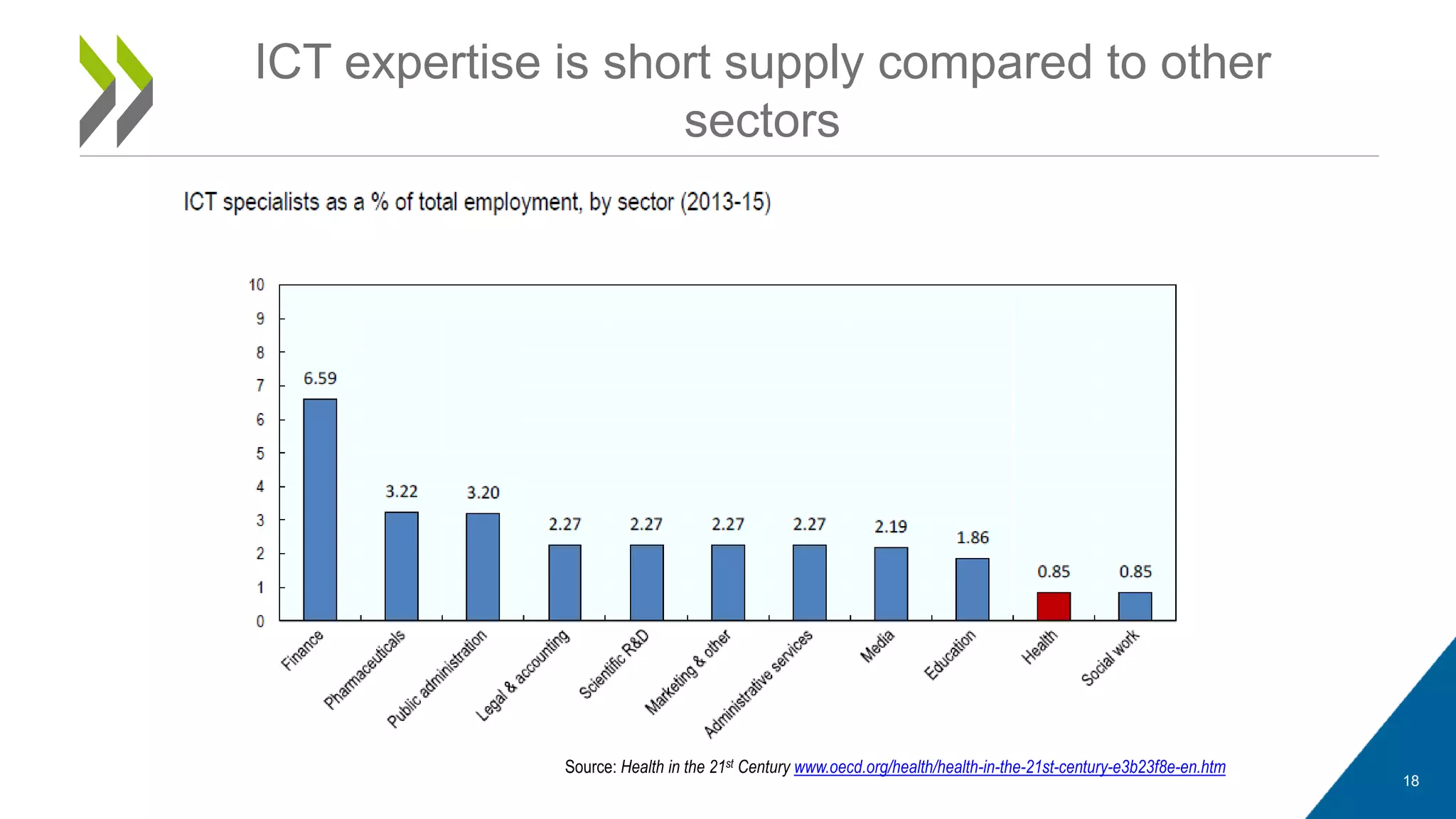
ICT expertise is short supply compared to other
sectors
Source: Health in the 21st Century www.oecd.org/health/health-in-the-21st-century-e3b23f8e-en.htm
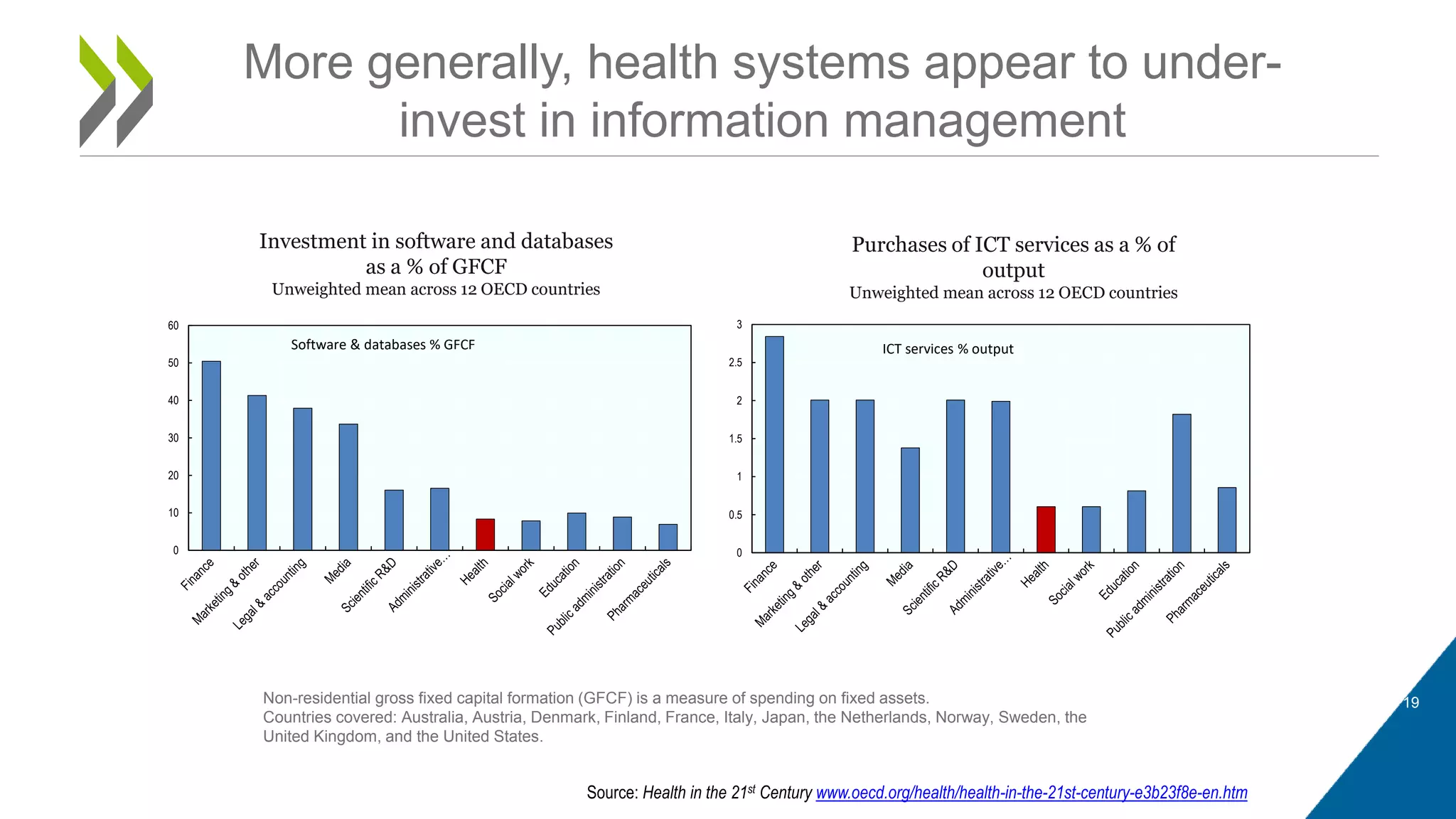
Investment in software and databases
as a % of GFCF
Unweighted mean across 12 OECD countries
More generally, health systems appear to under-
invest in information management
0
10
20
30
40
50
60
Software & databases % GFCF
0
0.5
1
1.5
2
2.5
3
ICT services % output
Non-residential gross fixed capital formation (GFCF) is a measure of spending on fixed assets.
Countries covered: Australia, Austria, Denmark, Finland, France, Italy, Japan, the Netherlands, Norway, Sweden, the
United Kingdom, and the United States.
Purchases of ICT services as a % of
output
Unweighted mean across 12 OECD countries
19
Source: Health in the 21st Century www.oecd.org/health/health-in-the-21st-century-e3b23f8e-en.htm
A DIGITAL TRANSFORMATION
RELIES ON A POLICY
TRANSFORMATION
20
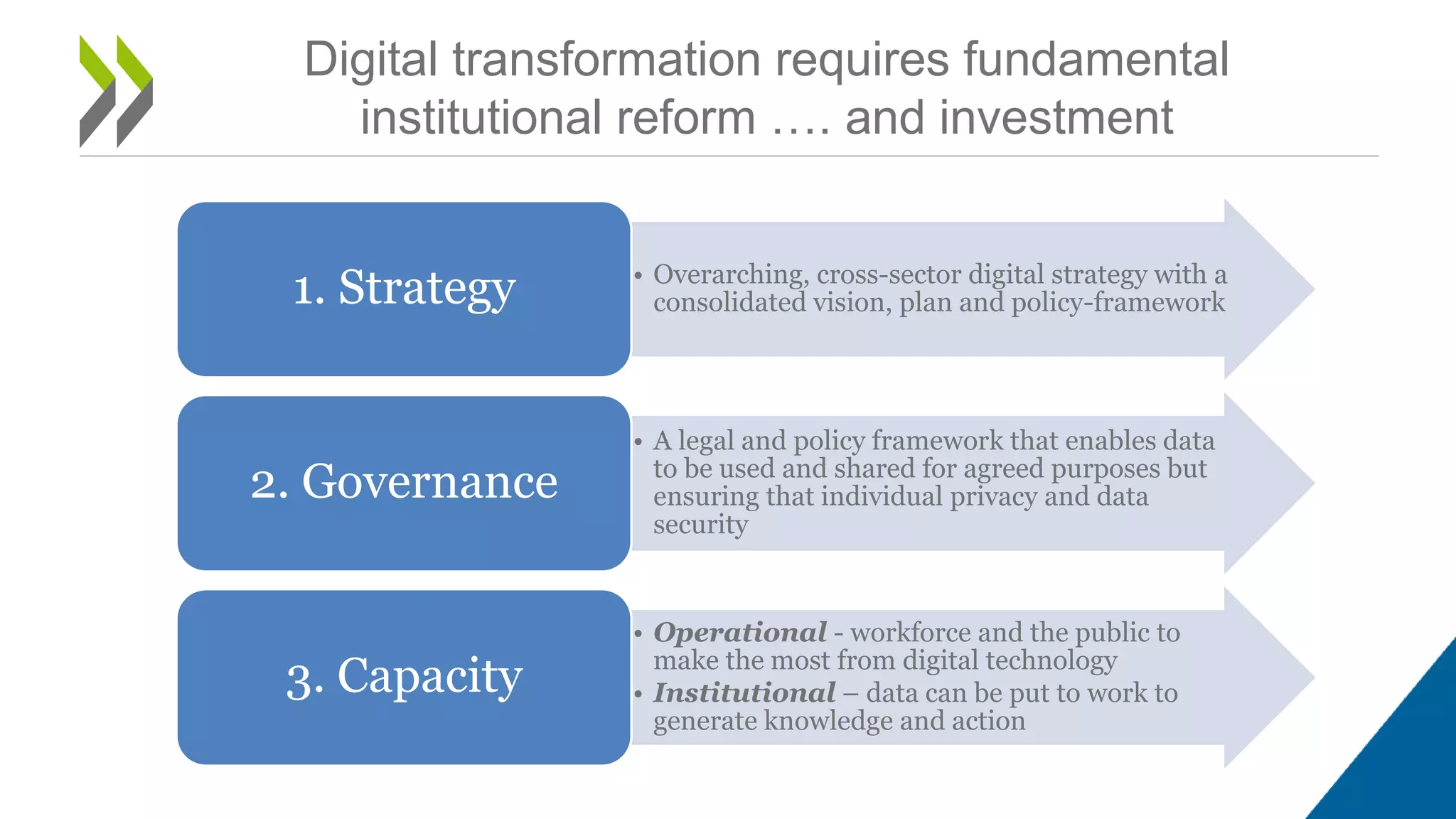
Digital transformation requires fundamental
institutional reform …. and investment
• Overarching, cross-sector digital strategy with a
consolidated vision, plan and policy-framework1. Strategy
• A legal and policy framework that enables data
to be used and shared for agreed purposes but
ensuring that individual privacy and data
security
2. Governance
• Operational - workforce and the public to
make the most from digital technology
• Institutional – data can be put to work to
generate knowledge and action
3. Capacity
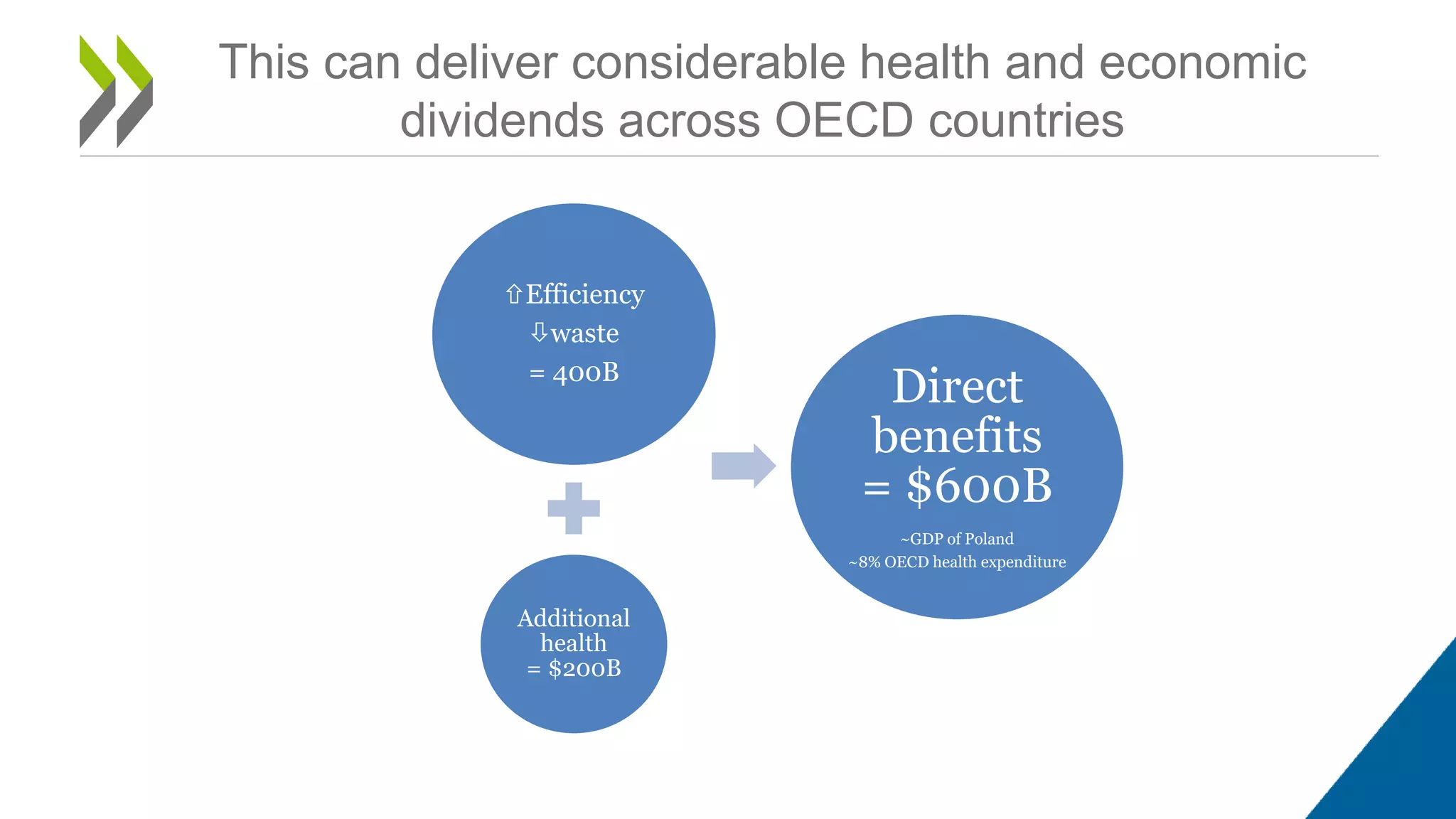
Efficiency
waste
= 400B
Additional
health
= $200B
Direct
benefits
= $600B
~GDP of Poland
~8% OECD health expenditure
This can deliver considerable health and economic
dividends across OECD countries
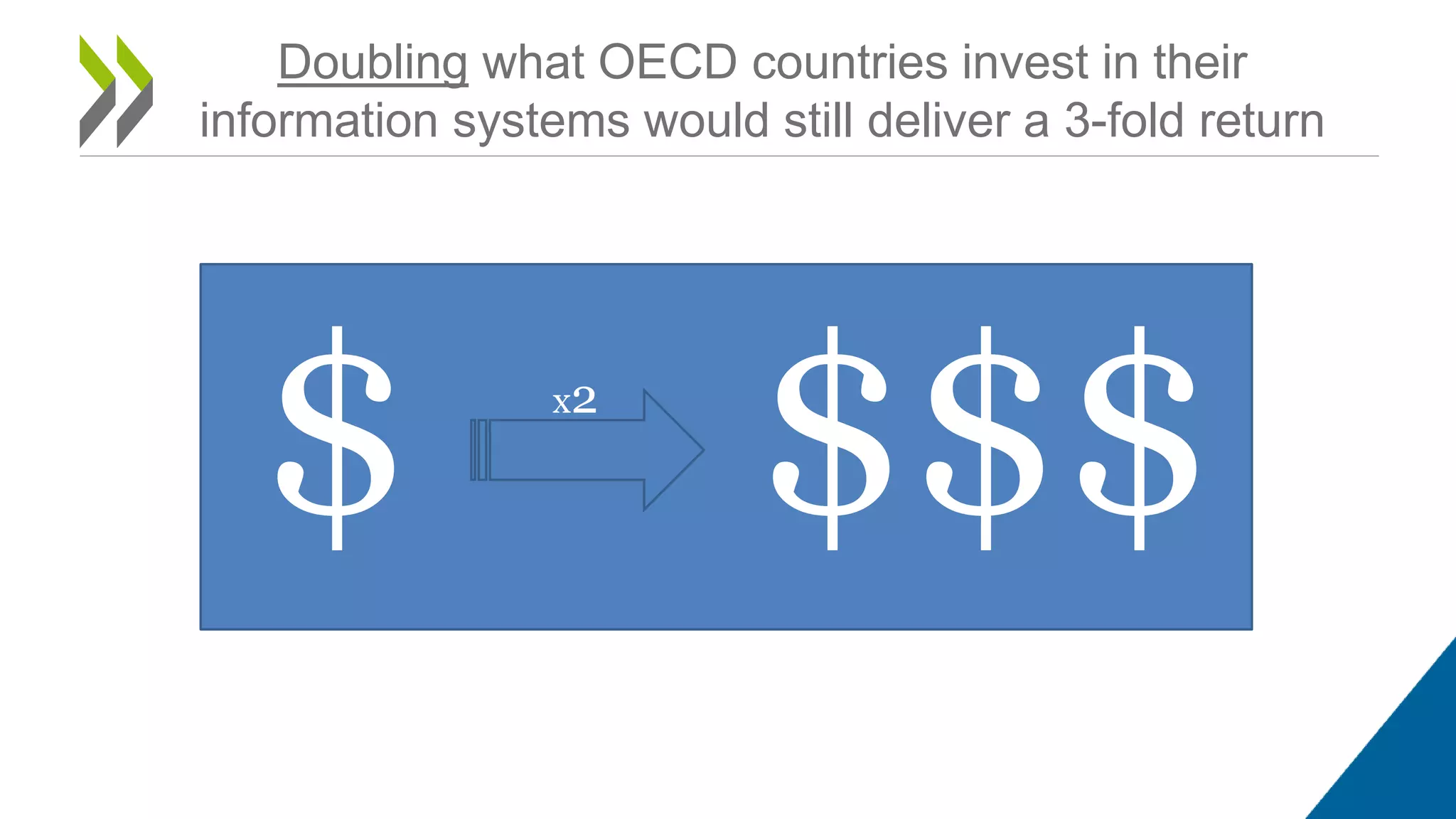
Doubling what OECD countries invest in their
information systems would still deliver a 3-fold return
$ $$$x2
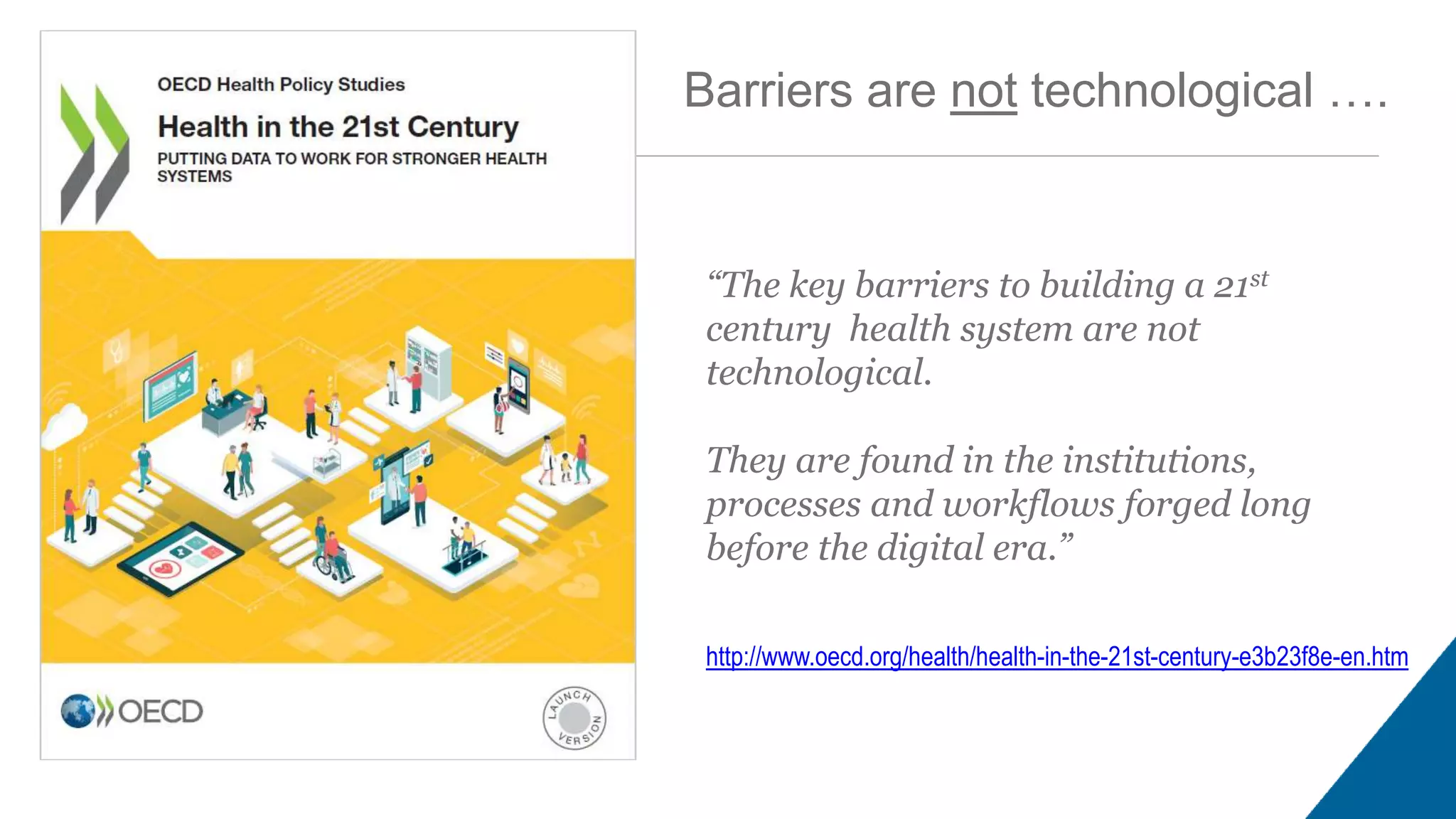
“The key barriers to building a 21st
century health system are not
technological.
They are found in the institutions,
processes and workflows forged long
before the digital era.”
http://www.oecd.org/health/health-in-the-21st-century-e3b23f8e-en.htm
Barriers are not technological ….
More on OECD work related to health
Contact us health.contact@oecd.org
@OECD_socialFollow us on Twitter
www.oecd.org/healthVisit our website

Health in the 21st Century - Launch presentation

  • 1.
    HEALTH IN THE21ST CENTURY Putting data to work for stronger health systems
  • 2.
    The health sectorfaces a changing landscape and new challenges
  • 3.
    Health spending isprojected to continue to outgrow national incomes Health expenditure as a share of GDP, projection to 2030 4.6% 5.5% 6.2% 6.7% 6.7% 7.0% 7.0% 7.4% 7.5% 8.0% 8.1% 8.3% 8.8% 8.9% 9.1% 9.5% 9.7% 9.7% 9.9% 9.9% 10.2% 10.4% 11.3% 11.3% 11.4% 11.6% 11.7% 12.0% 12.0% 12.1% 12.2% 12.3% 13.0% 13.0% 13.1% 13.3% 14.5% 20.2% 0% 5% 10% 15% 20% 2015 2030 % GDP Source: OECD Health Division projections, 2019. StatLink 2 https://doi.org/10.1787/888934017196
  • 4.
    But a fifthof this spending is, at best, ineffective and, at worst, harmful Source: OECD (2017) Tackling Wasteful; Spending in Health Care • Adverse events occur in 1/10 hospitalisations, add between 13 and 17% to hospital costs and up to 70% could be avoided • Geographic variations in rates of cardiac procedures (x3) and knee replacements (x5) are for a large part unwarranted • Up to 50% of antimicrobial prescriptions are unnecessary • 12% to 56% of emergency department visits are inappropriate • Administrative expenditure on health varies more than six- fold, with no obvious correlation with performance
  • 5.
    Ageing populations andrising NCD rates mean that health and care needs are changing Source: Barnett K, Mercer S, Norbury M et al. Epidemiology of multimorbidity and implications for health care, research, and medical education: a cross-sectional study. Lancet 2012; 380 (9836): 37–43
  • 6.
    And people (rightly)expect a health system designed around their needs & preferences … but health system are slow to change…
  • 7.
    7 People want totake control of their own health Source: Health in the 21st Century www.oecd.org/health/health-in-the-21st-century-e3b23f8e-en.htm
  • 8.
    Intelligent use ofdata and digital technology can help 8
  • 9.
    Many sectors havetransformed themselves to harness digital opportunities This has resulted in:  Better products  Better services  More efficient  Big consumer surpluses
  • 10.
    In health, theopportunities are clear Effective, efficient and people-centered services • Faster access to critical information – effective, efficient care • More patient involvement, a better care experience • Clinical process optimisation (e.g. data-driven machine learning) Better system management • Monitor performance • Allocate resources better • Ensure better planning and access to care More accurate surveillance • Evaluate public health interventions • Faster detection and response to public health emergency • Inform policy Power up research & innovation • Statistical power • Vast and varied datasets • ‘Real world evidence’ for assessing and developing better treatments
  • 11.
    Health care israpidly ‘digitising’ … which is good Source: Health in the 21st Century www.oecd.org/health/health-in-the-21st-century-e3b23f8e-en.htm
  • 12.
    But health systemsremain “data rich - information poor”
  • 13.
    Data are availablebut not linked regularly, missing important opportunities Source: Health in the 21st Century www.oecd.org/health/health-in-the-21st-century-e3b23f8e-en.htm 0% 10% 20% 30% 40% 50% 60% 70% 80% 90% 100% 2013 % of key national health datasets available 2019 % of key national health datasets available 2013 % of datasets regularly linked 2019 % of datasets regularly linked Percentage of key data sets (a) available and (b) regularly linked, 2013 and 2019
  • 14.
    Only a fewcountries are ready to re-deploy EHR data for research and other purposes Source: Health in the 21st Century www.oecd.org/health/health-in-the-21st-century-e3b23f8e-en.htm Technical, operational and governance readiness to use EHR data, 2016
  • 15.
    Routine health dataare under-used in managing medical technologies Source: Health in the 21st Century www.oecd.org/health/health-in-the-21st-century-e3b23f8e-en.htm Use of routine health data in pharmaceutical policy, 2018
  • 16.
    70% of countriesplanning to allow people to access their electronic medical record 43% of countries say that people will be able to interact with their record Too seldom people can interact with their own records
  • 17.
    And the healthworkforce is not ready 30 to 70% of health professionals* report knowledge and skills shortages relating to digital tools and data analytics Outdated day-to-day work processes do not enable the digital technology to add value A digital tool is often a “black box” to a health worker or is not informed by workers’ and their patients’ needs Skills mismatch Inadequate work processes Lack of involvement * depending on category and country
  • 18.
    18 ICT expertise isshort supply compared to other sectors Source: Health in the 21st Century www.oecd.org/health/health-in-the-21st-century-e3b23f8e-en.htm
  • 19.
    Investment in softwareand databases as a % of GFCF Unweighted mean across 12 OECD countries More generally, health systems appear to under- invest in information management 0 10 20 30 40 50 60 Software & databases % GFCF 0 0.5 1 1.5 2 2.5 3 ICT services % output Non-residential gross fixed capital formation (GFCF) is a measure of spending on fixed assets. Countries covered: Australia, Austria, Denmark, Finland, France, Italy, Japan, the Netherlands, Norway, Sweden, the United Kingdom, and the United States. Purchases of ICT services as a % of output Unweighted mean across 12 OECD countries 19 Source: Health in the 21st Century www.oecd.org/health/health-in-the-21st-century-e3b23f8e-en.htm
  • 20.
    A DIGITAL TRANSFORMATION RELIESON A POLICY TRANSFORMATION 20
  • 21.
    Digital transformation requiresfundamental institutional reform …. and investment • Overarching, cross-sector digital strategy with a consolidated vision, plan and policy-framework1. Strategy • A legal and policy framework that enables data to be used and shared for agreed purposes but ensuring that individual privacy and data security 2. Governance • Operational - workforce and the public to make the most from digital technology • Institutional – data can be put to work to generate knowledge and action 3. Capacity
  • 22.
    Efficiency waste = 400B Additional health = $200B Direct benefits =$600B ~GDP of Poland ~8% OECD health expenditure This can deliver considerable health and economic dividends across OECD countries
  • 23.
    Doubling what OECDcountries invest in their information systems would still deliver a 3-fold return $ $$$x2
  • 24.
    “The key barriersto building a 21st century health system are not technological. They are found in the institutions, processes and workflows forged long before the digital era.” http://www.oecd.org/health/health-in-the-21st-century-e3b23f8e-en.htm Barriers are not technological ….
  • 25.
    More on OECDwork related to health Contact us health.contact@oecd.org @OECD_socialFollow us on Twitter www.oecd.org/healthVisit our website