Introduction
• The developmental changes that occur
from birth to adulthood were largely
ignored throughout much of history.
Children were often viewed simply as small
versions of adults and little attention was
paid to the many advances in cognitive
abilities, language usage, and physical
growth. Interest in the field of child
development began early in the 20th-
century and tended to focus on abnormal
behavior.
Introduction
• The following are just a few of the
many theories of child development that
have been proposed by theorists and
researchers. More recent theories
outline the developmental stages of
children and identify the typical ages at
which these growth milestones occur.
Child Developmental Theories:
Psychoanalytic theories
– Emotional development: Erik Erikson
– Development of sexuality: Sigmund
Freud
Behavioral theories (Pavlov, and
Skinner)
Social Development Theories (John
Bowlby)
Cognitive theories (Jean Piaget)
Moral Development (Piaget and
Kohlberg)
Spiritual Development (JW Flower)
Child Developmental Theories:
Psychoanalytic theories
– Emotional development: Erik Erikson
– Development of sexuality: Sigmund Freud
Erik H Erikson
Emotional or personality development is a
continuous process. Erikson described it as
. In
each stage a central problem exists for
which a solution should be found. Solving
each at particular stage lays the basis for
progress to the next stage.
Child Developmental Theories:
Psychoanalytic theories
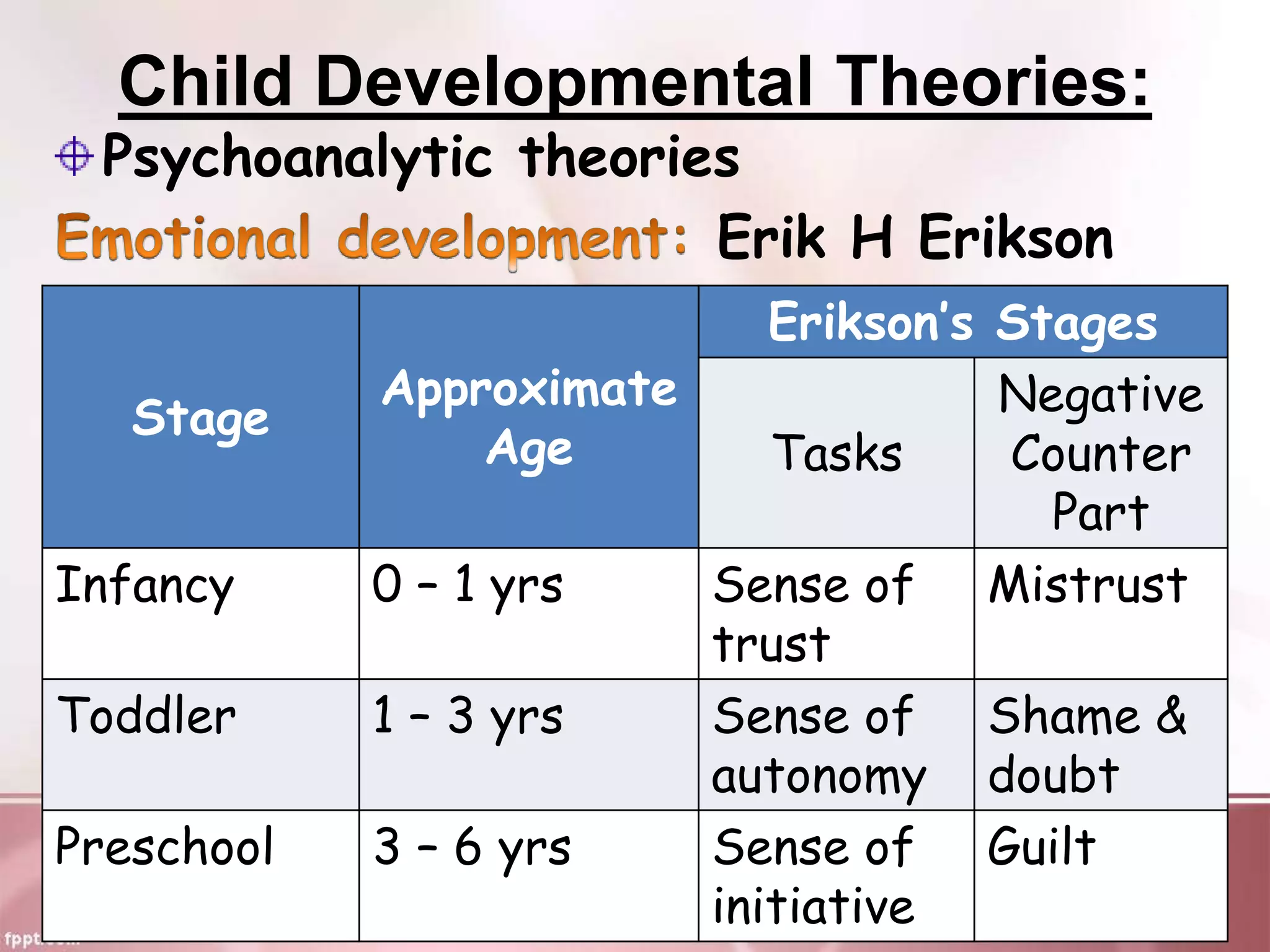
Erik H Erikson
Stage
Approximate
Age
Erikson’s Stages
Tasks
Negative
Counter
Part
Infancy 0 – 1 yrs Sense of
trust
Mistrust
Toddler 1 – 3 yrs Sense of
autonomy
Shame &
doubt
Preschool 3 – 6 yrs Sense of
initiative
Guilt
Child Developmental Theories:
Psychoanalytic theories
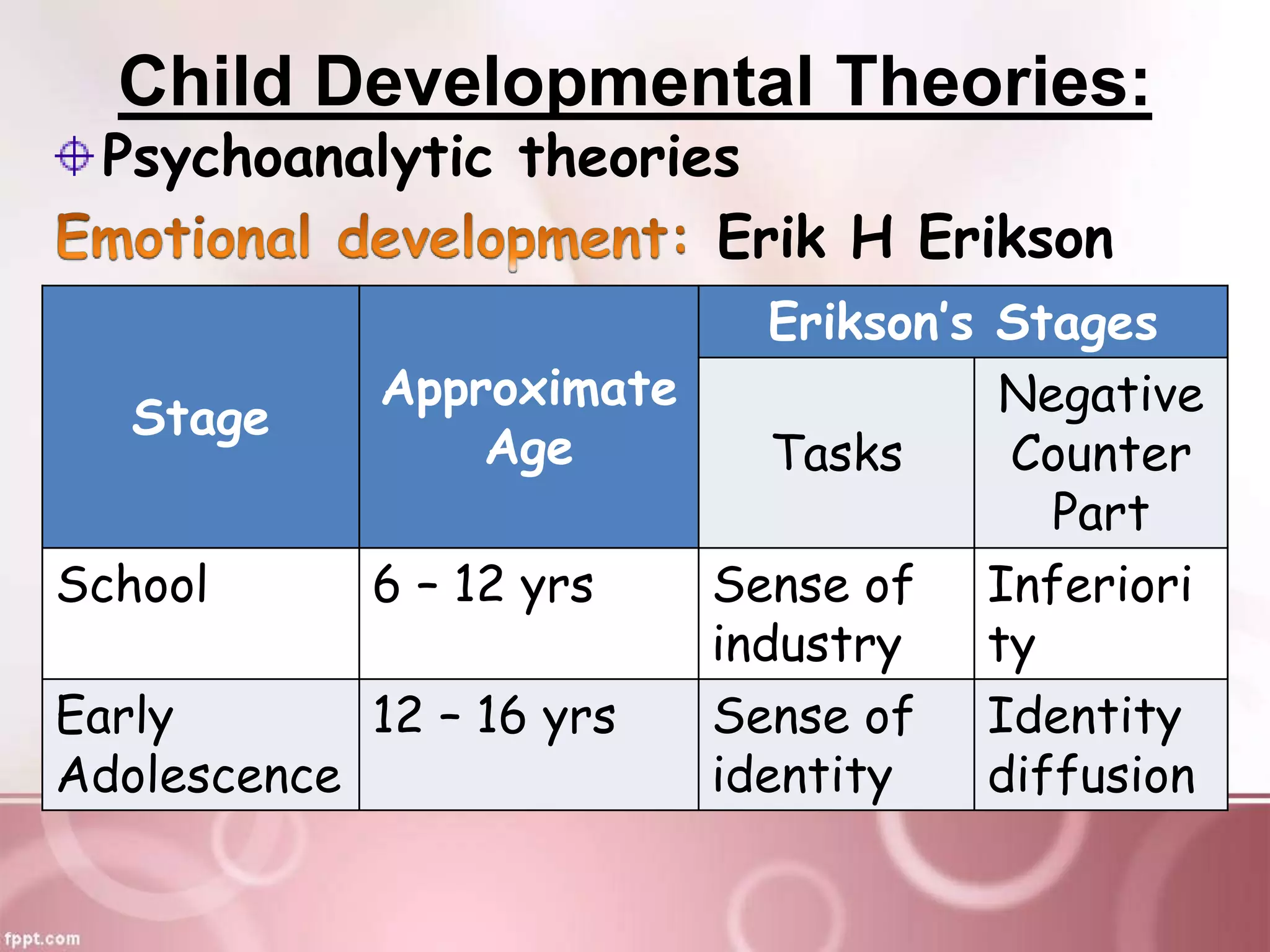
Erik H Erikson
Stage
Approximate
Age
Erikson’s Stages
Tasks
Negative
Counter
Part
School 6 – 12 yrs Sense of
industry
Inferiori
ty
Early
Adolescence
12 – 16 yrs Sense of
identity
Identity
diffusion
Child Developmental Theories:
Psychoanalytic theories
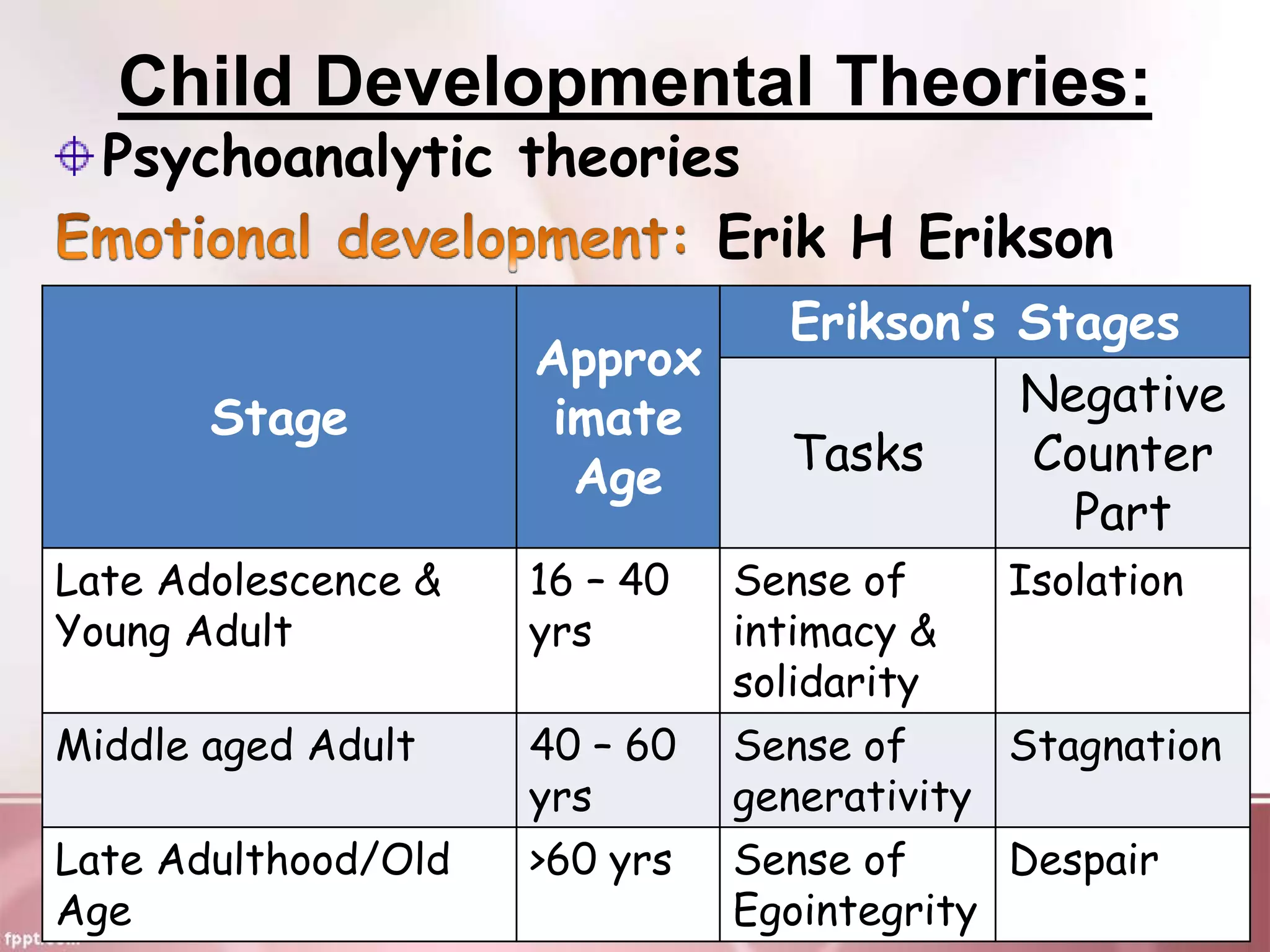
Erik H Erikson
Stage
Approx
imate
Age
Erikson’s Stages
Tasks
Negative
Counter
Part
Late Adolescence &
Young Adult
16 – 40
yrs
Sense of
intimacy &
solidarity
Isolation
Middle aged Adult 40 – 60
yrs
Sense of
generativity
Stagnation
Late Adulthood/Old
Age
>60 yrs Sense of
Egointegrity
Despair
Child Developmental Theories:
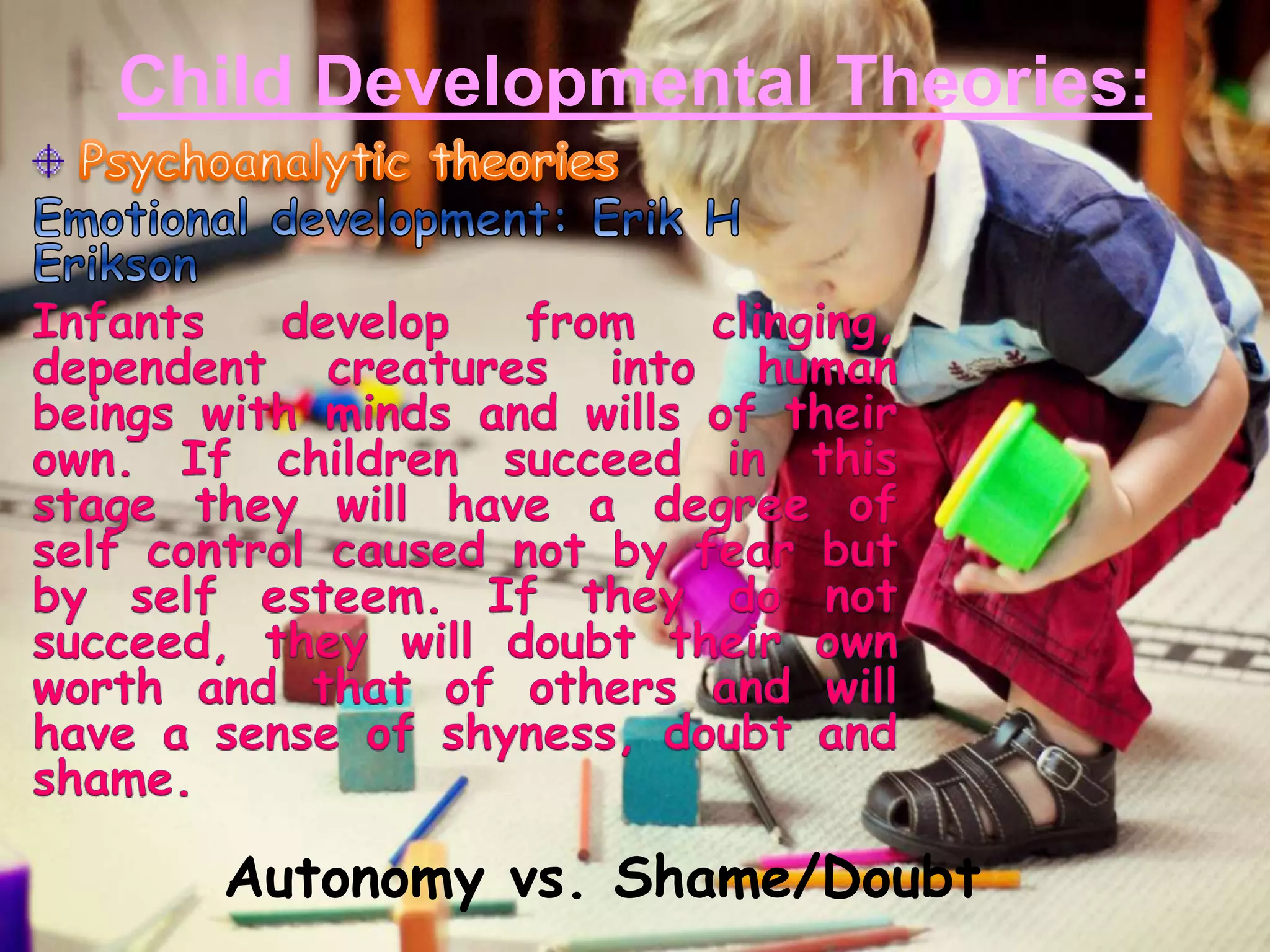
Autonomy vs. Shame/Doubt
Child Developmental Theories:
Erik H Erikson
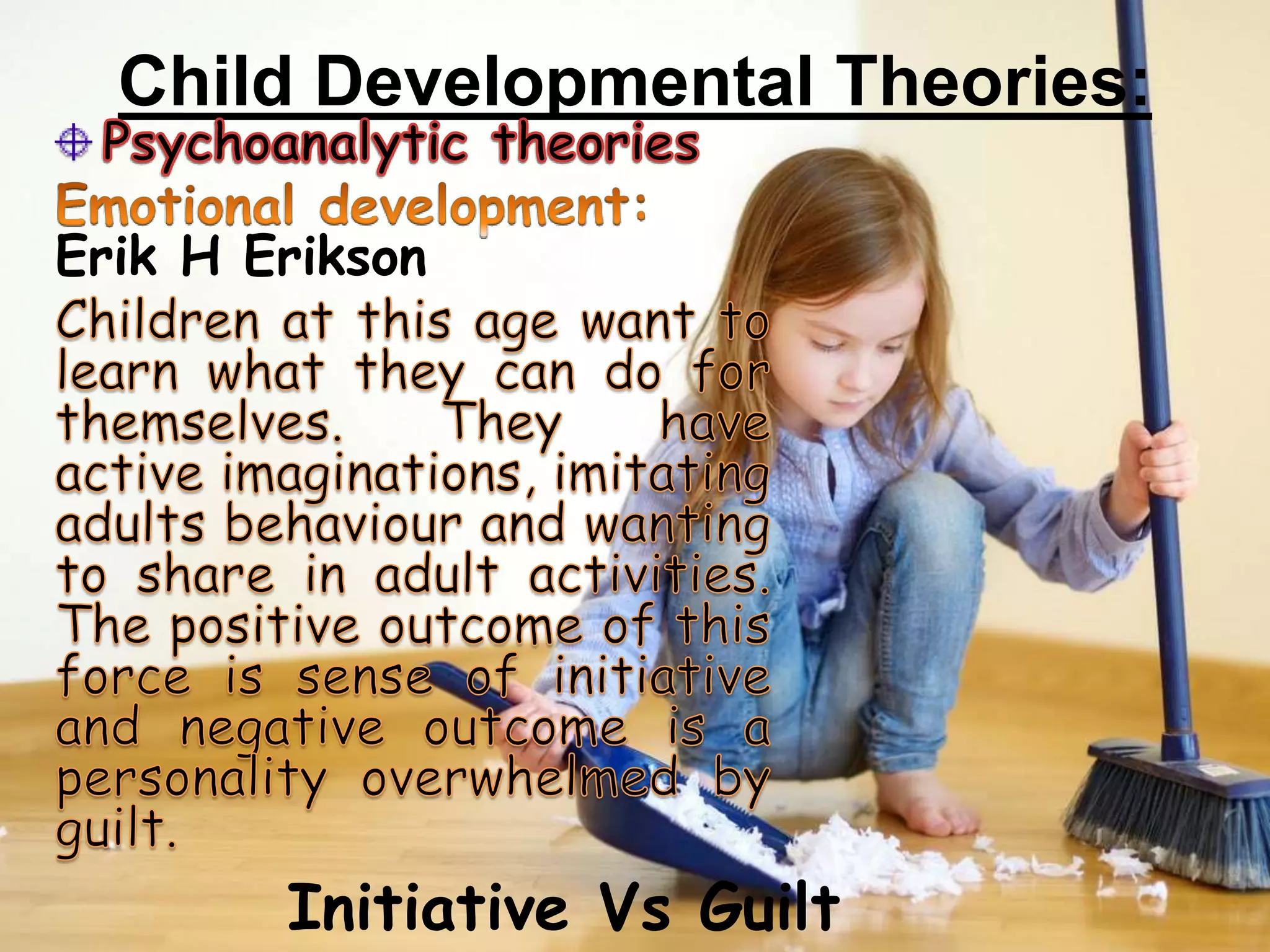
Initiative Vs Guilt
Child Developmental Theories:
Erik
H Erikson
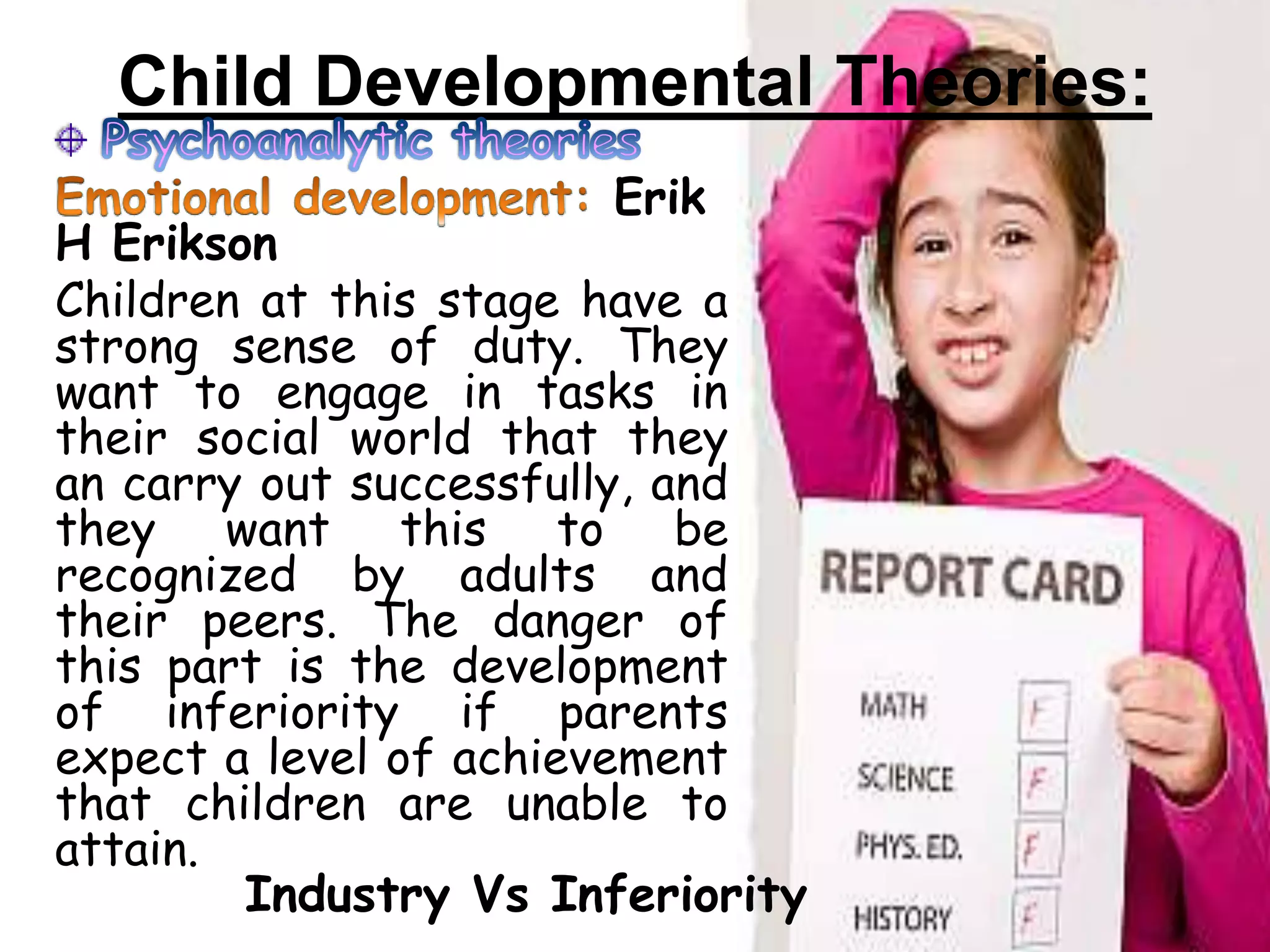
Children at this stage have a
strong sense of duty. They
want to engage in tasks in
their social world that they
an carry out successfully, and
they want this to be
recognized by adults and
their peers. The danger of
this part is the development
of inferiority if parents
expect a level of achievement
that children are unable to
attain.
Industry Vs Inferiority
Child Developmental Theories:
Psychoanalytic theories
Erik H
Erikson
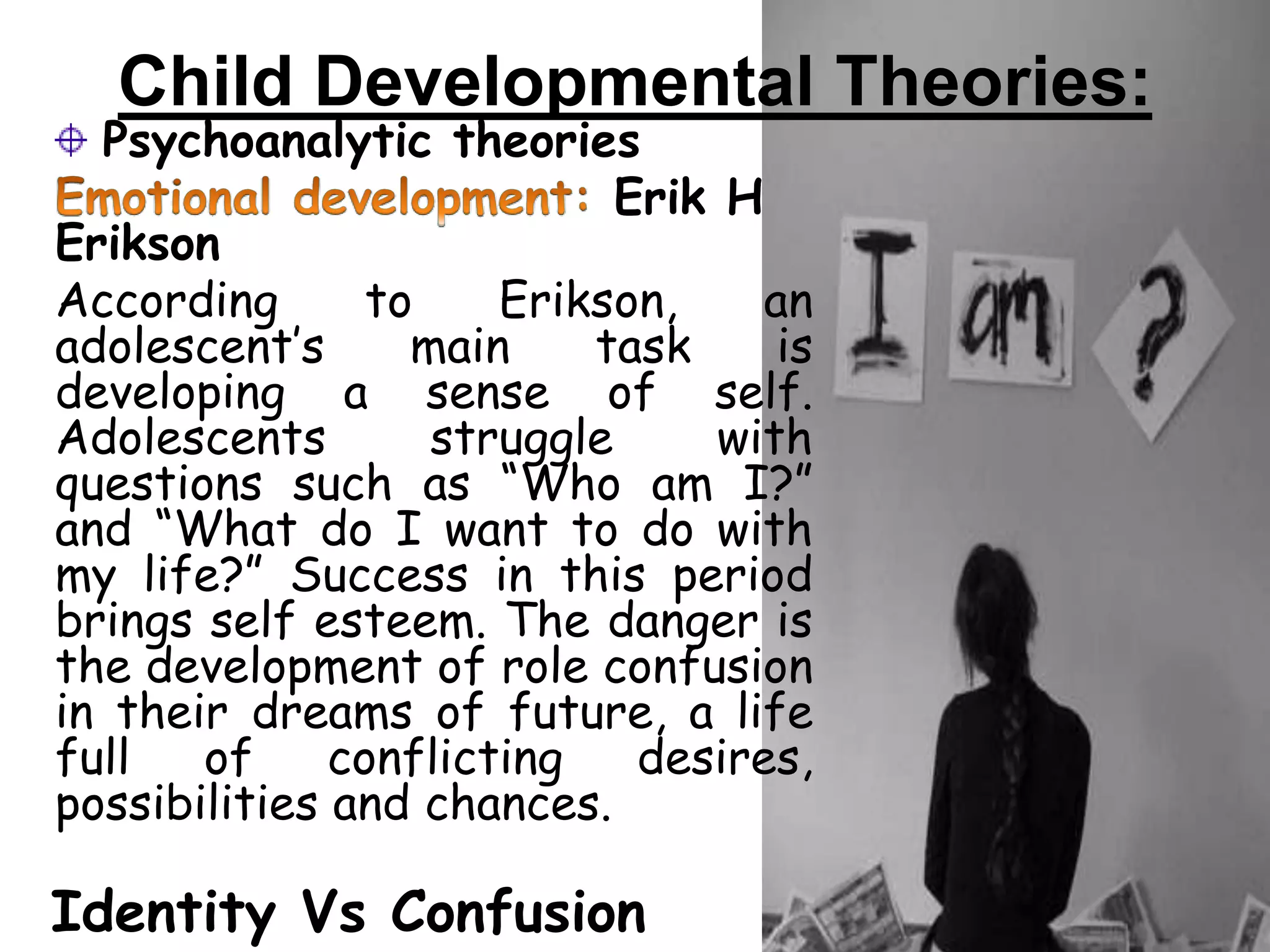
According to Erikson, an
adolescent’s main task is
developing a sense of self.
Adolescents struggle with
questions such as “Who am I?”
and “What do I want to do with
my life?” Success in this period
brings self esteem. The danger is
the development of role confusion
in their dreams of future, a life
full of conflicting desires,
possibilities and chances.
Identity Vs Confusion
Child Developmental Theories:
Psychoanalytic theories
Erik H Erikson
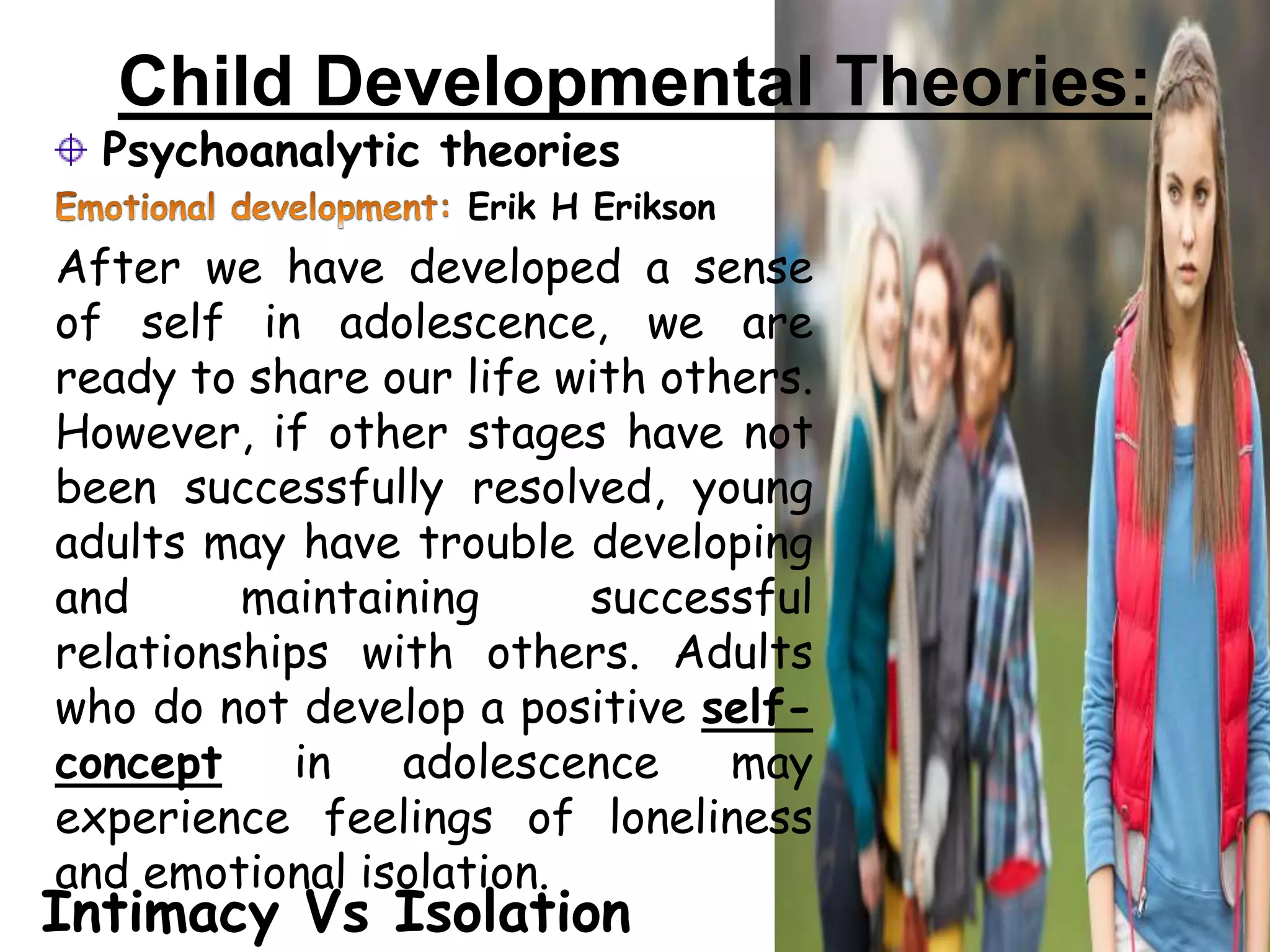
After we have developed a sense
of self in adolescence, we are
ready to share our life with others.
However, if other stages have not
been successfully resolved, young
adults may have trouble developing
and maintaining successful
relationships with others. Adults
who do not develop a positive self-
concept in adolescence may
experience feelings of loneliness
and emotional isolation.
Intimacy Vs Isolation
Child Developmental Theories:
Psychoanalytic theories
– Development of sexuality: Sigmund Freud
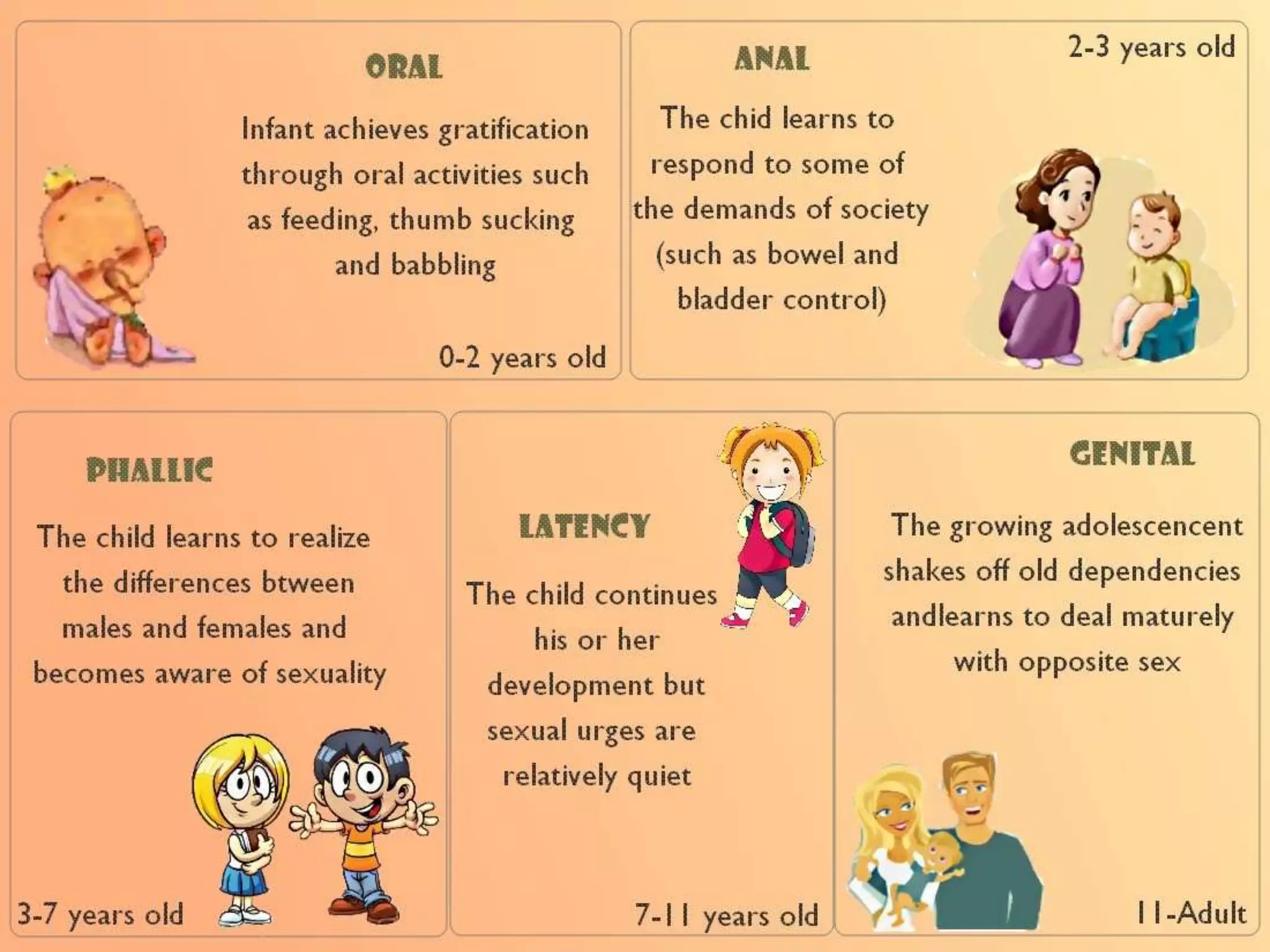
Freud (1905) proposed that psychological
development in childhood takes place in a
series of fixed psychosexual stages: oral,
anal, phallic, latency, and genital.
These are called psychosexual stages
because each stage represents the
fixation of libido (roughly translated as
sexual drives or instincts) on a different
area of the body.
Child Developmental Theories:
Behavioral theories (Pavlov, and
Skinner)
• Behavioral theories of development
focus on how environmental interaction
influences behavior and are based upon
the theories of theorists such as
Watson ,Pavlov, and Skinner.
• These theories deal only with
observable behaviors. Development is
considered a reaction to rewards,
punishments, stimuli, and reinforcement.
Child Developmental Theories:
Social Development Theories (John
Bowlby)
–Socialization, or social development, means
training a child in the culture of the group. A
newborn infant is not a social being.
–There is a great deal of research on the
social development of children.
–John Bowbly proposed one of the earliest
theories of social development. Bowlby
believed that early relationships with
caregivers play a major role in child
development and continue to influence social
relationships throughout life.
Child Developmental Theories:
Cognitive theories (Jean Piaget)
Piaget's (1936) theory of cognitive
development explains how a child
constructs a mental model of the world.
Theorist Jean Piaget suggested that
children think differently than adults and
proposed a stage theory of cognitive
development. He was the first to note
that children play an active role in gaining
knowledge of the world.
Child Developmental Theories:
Cognitive theories (Jean Piaget)
• Jean Piaget believed that children go
through a number of fixed stages on their
way to independent thinking.
• His theory on cognitive development,
though, is perhaps the most widely
accepted and most cited.
• Piaget believed that all children will go
through the following stages in order, the
age ranges are only a general guideline.
• Each child matures in his own time, and
even siblings don't do the same things at
exactly the same age.
Child Developmental Theories:
Cognitive theories (Jean Piaget)
Child Developmental Theories:
Cognitive theories (Jean Piaget)
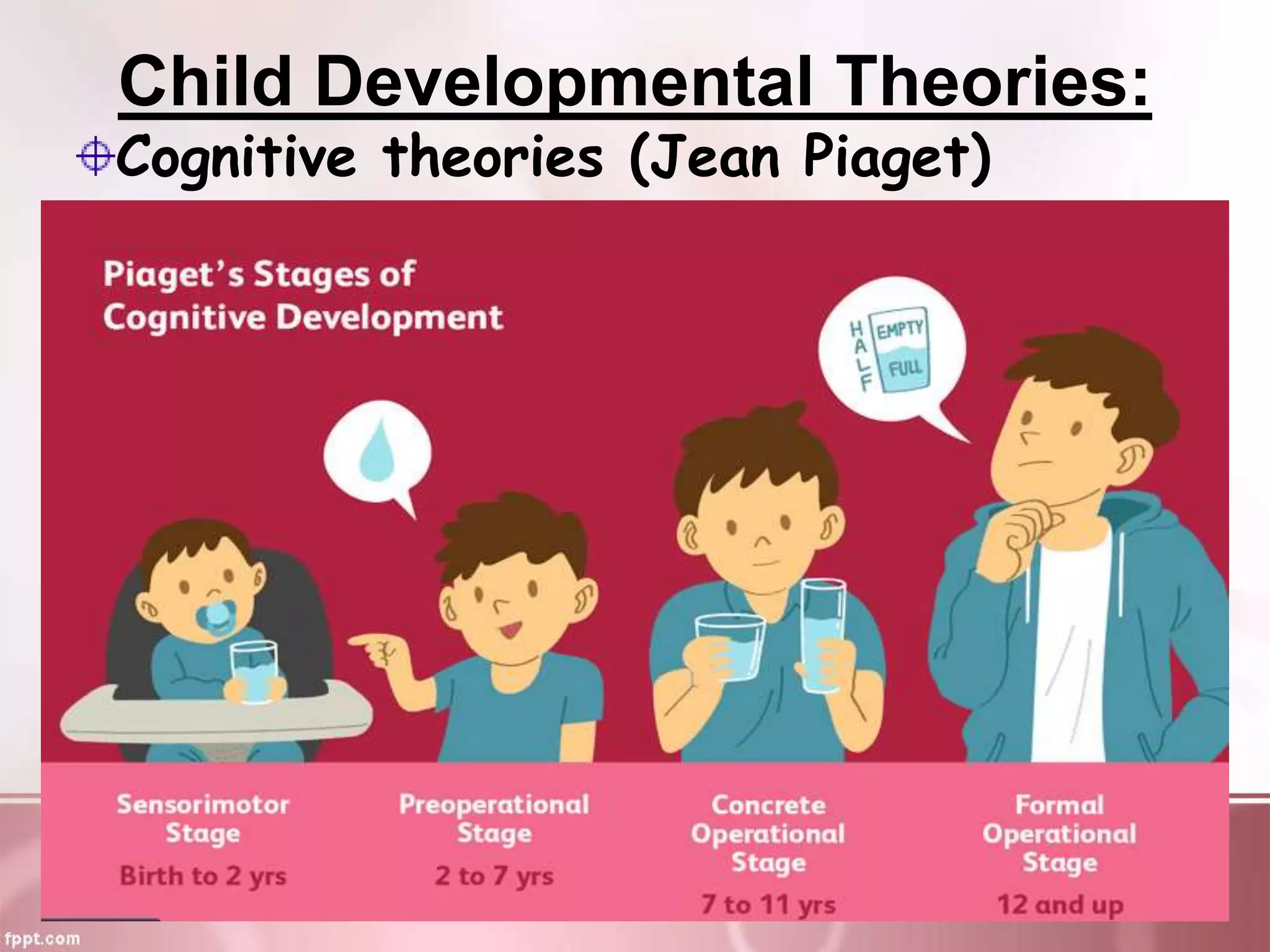
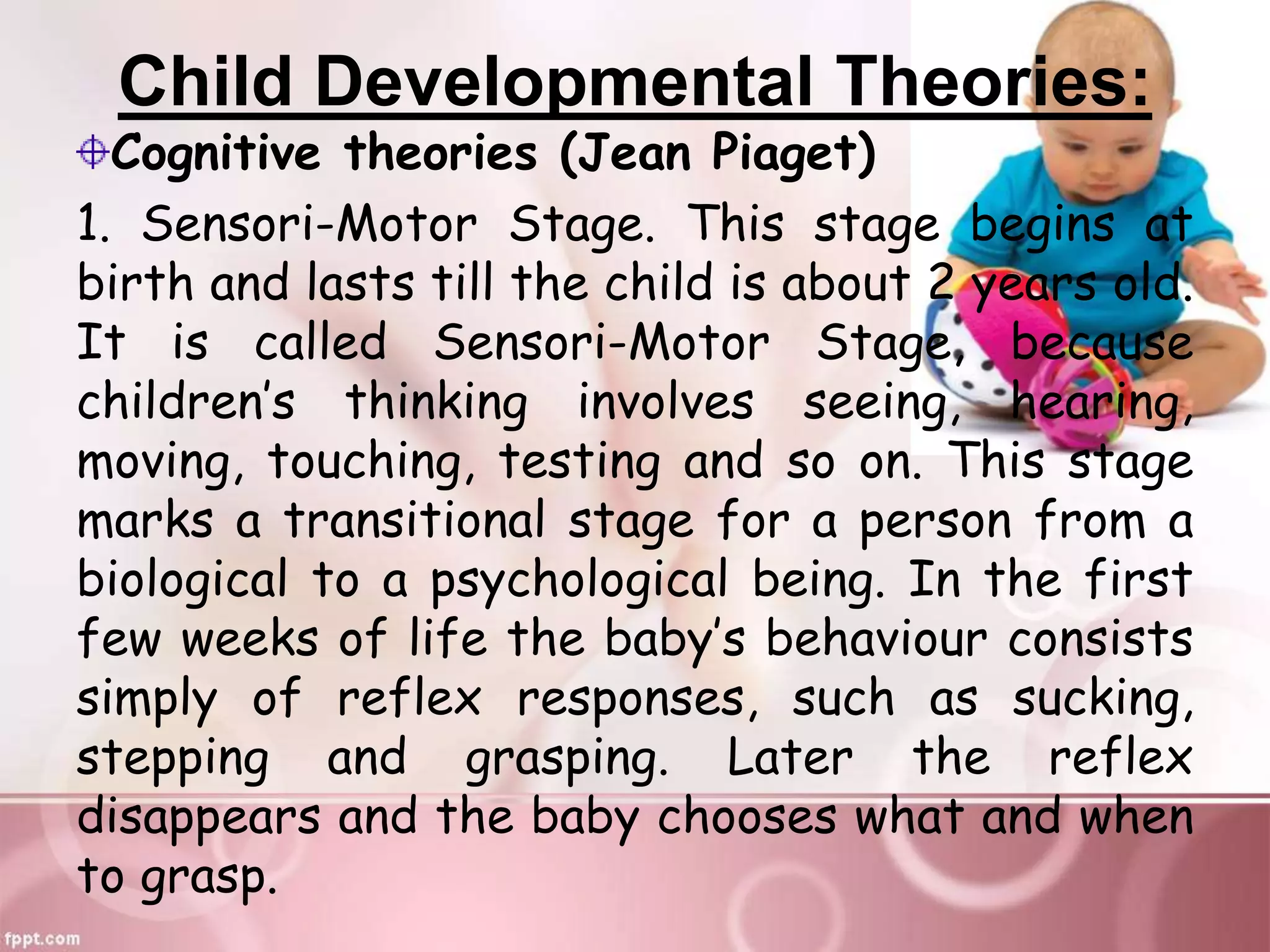
1. Sensori-Motor Stage. This stage begins at
birth and lasts till the child is about 2 years old.
It is called Sensori-Motor Stage, because
children’s thinking involves seeing, hearing,
moving, touching, testing and so on. This stage
marks a transitional stage for a person from a
biological to a psychological being. In the first
few weeks of life the baby’s behaviour consists
simply of reflex responses, such as sucking,
stepping and grasping. Later the reflex
disappears and the baby chooses what and when
to grasp.
Child Developmental Theories:
Cognitive theories (Jean Piaget)
1. Sensori-Motor Stage.
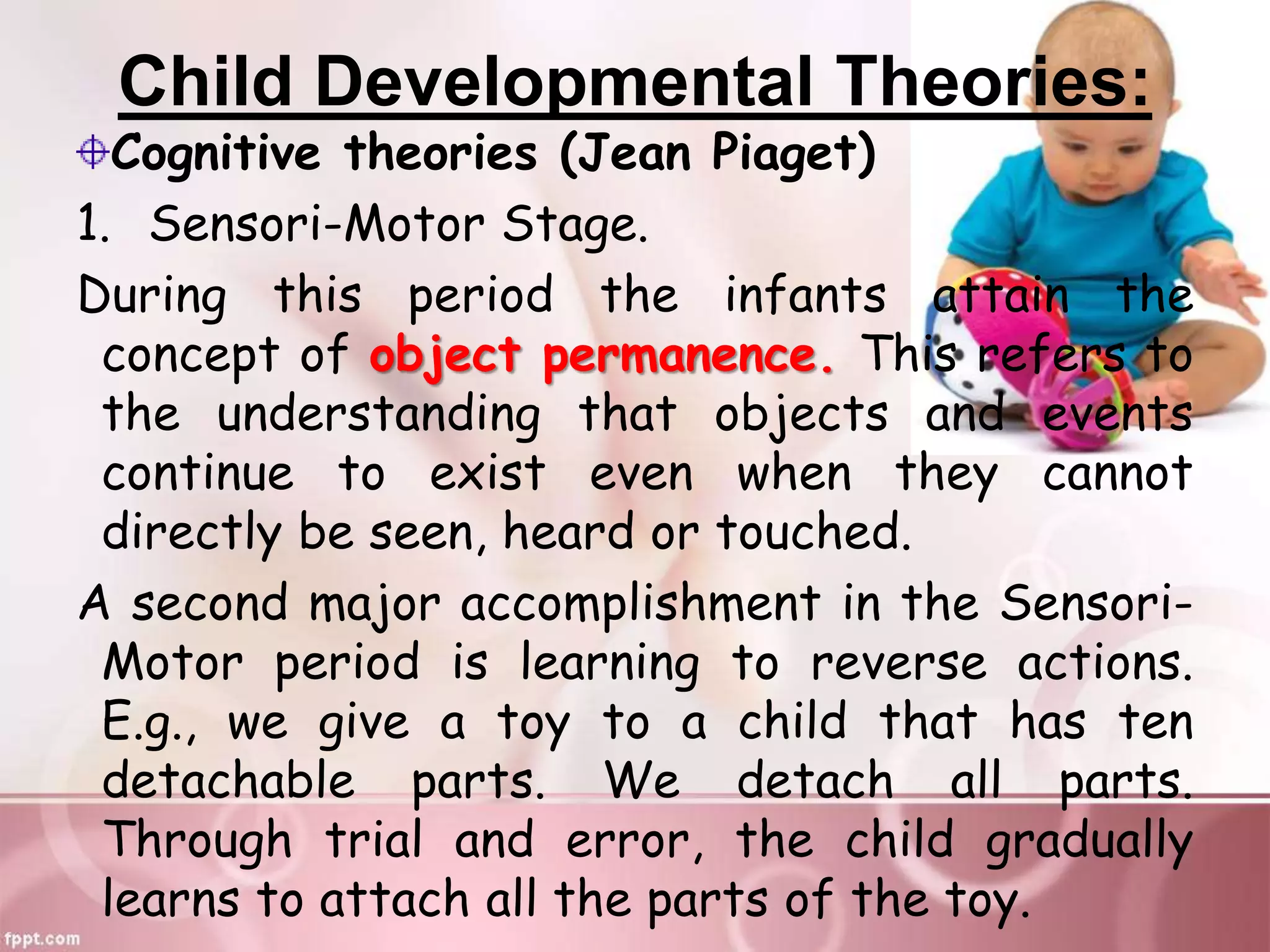
During this period the infants attain the
concept of object permanence. This refers to
the understanding that objects and events
continue to exist even when they cannot
directly be seen, heard or touched.
A second major accomplishment in the Sensori-
Motor period is learning to reverse actions.
E.g., we give a toy to a child that has ten
detachable parts. We detach all parts.
Through trial and error, the child gradually
learns to attach all the parts of the toy.
Child Developmental Theories:
Cognitive theories (Jean Piaget)
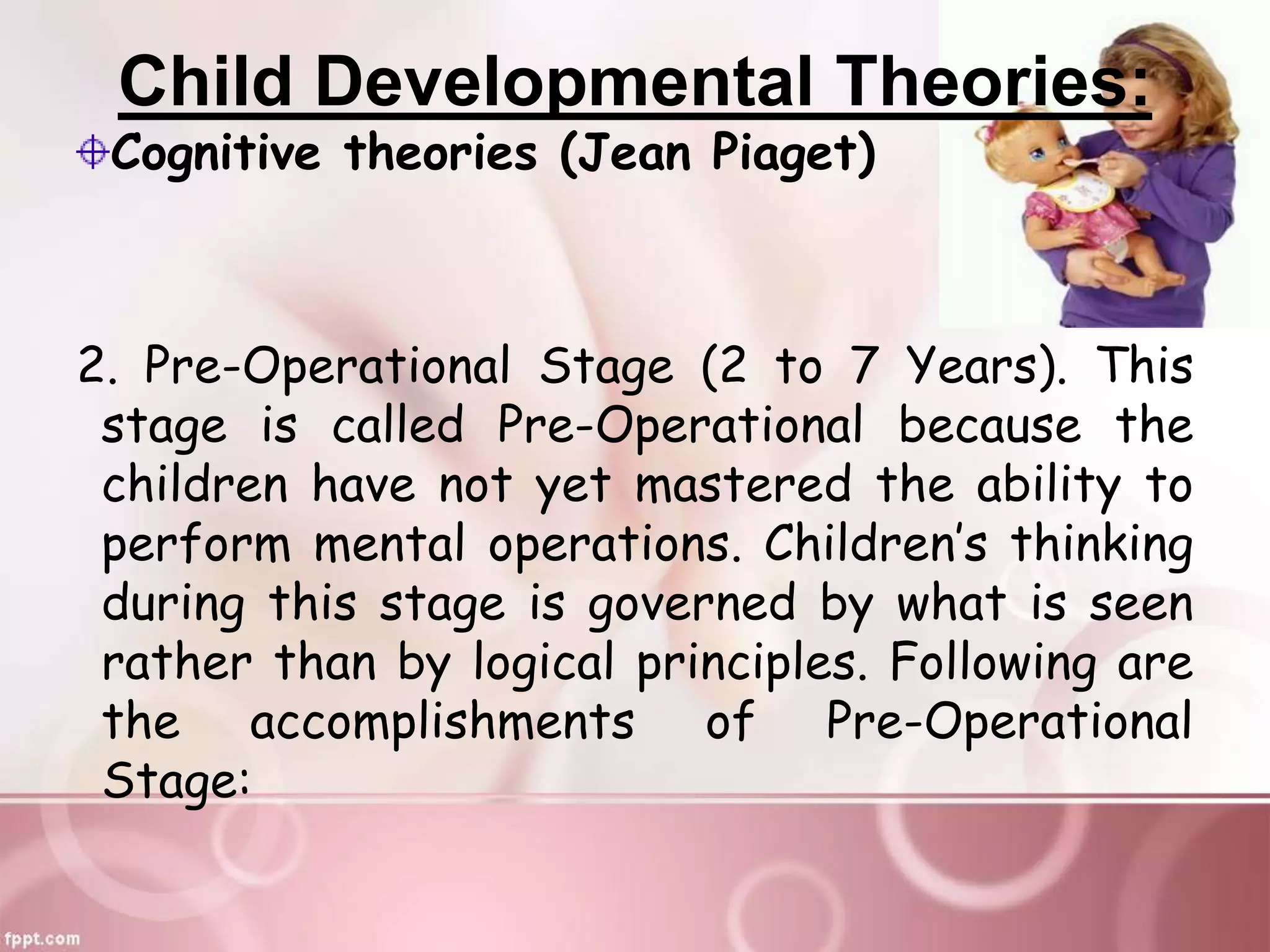
2. Pre-Operational Stage (2 to 7 Years). This
stage is called Pre-Operational because the
children have not yet mastered the ability to
perform mental operations. Children’s thinking
during this stage is governed by what is seen
rather than by logical principles. Following are
the accomplishments of Pre-Operational
Stage:
Child Developmental Theories:
Cognitive theories (Jean Piaget)
2. Pre-Operational Stage (2 to 7 Years).
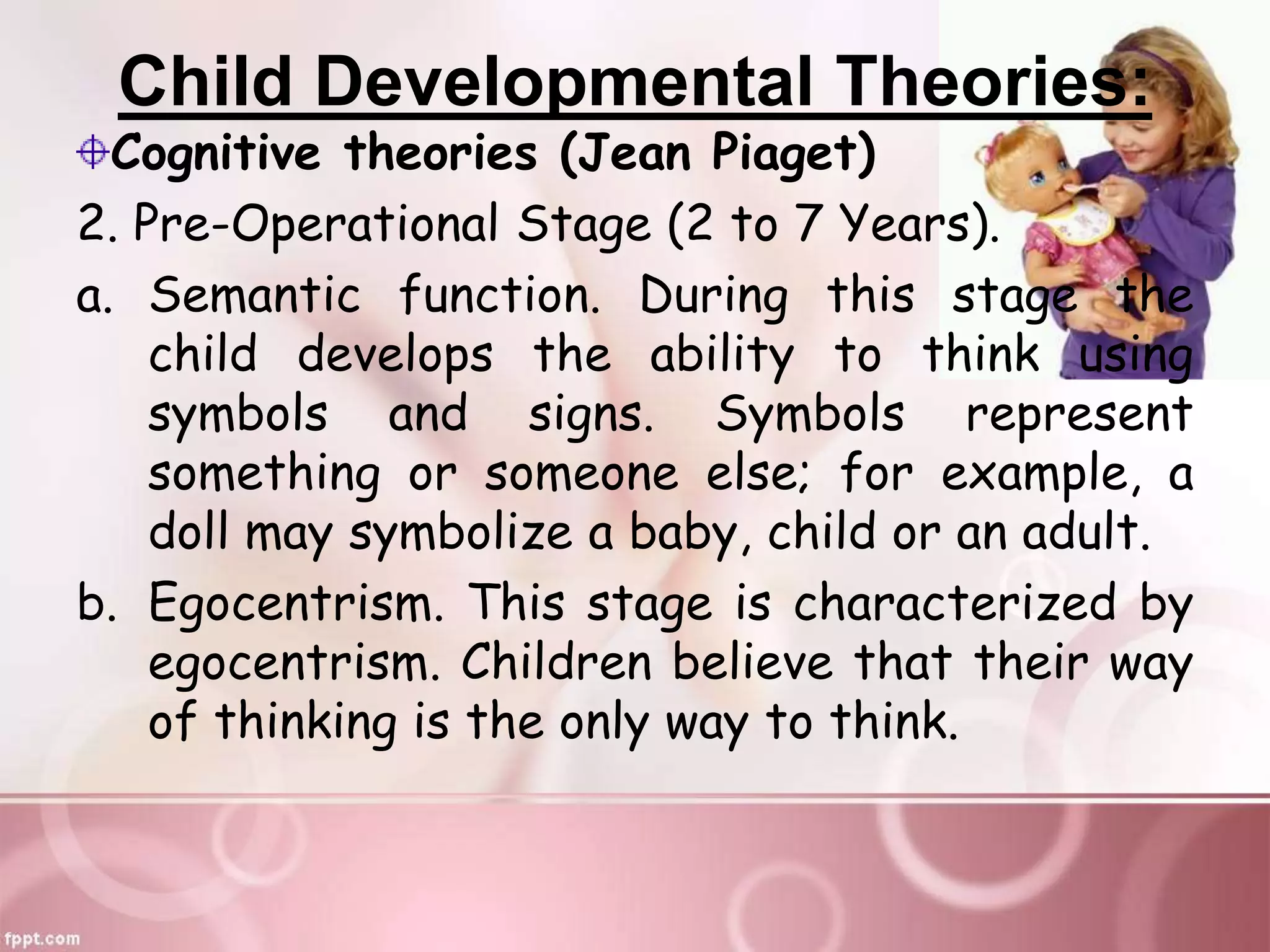
a. Semantic function. During this stage the
child develops the ability to think using
symbols and signs. Symbols represent
something or someone else; for example, a
doll may symbolize a baby, child or an adult.
b. Egocentrism. This stage is characterized by
egocentrism. Children believe that their way
of thinking is the only way to think.
Child Developmental Theories:
Cognitive theories (Jean Piaget)
2. Pre-Operational Stage (2 to 7 Years).
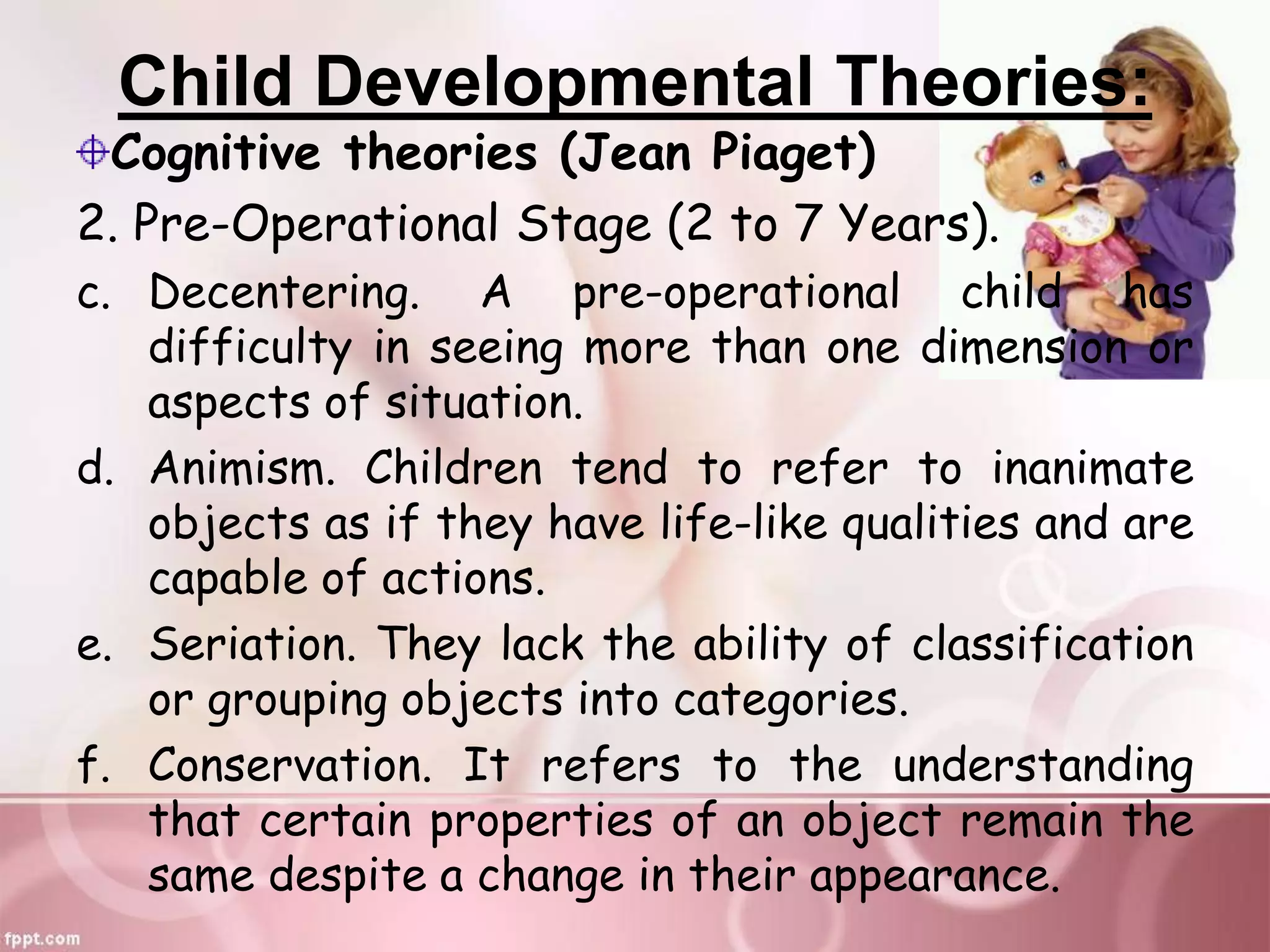
c. Decentering. A pre-operational child has
difficulty in seeing more than one dimension or
aspects of situation.
d. Animism. Children tend to refer to inanimate
objects as if they have life-like qualities and are
capable of actions.
e. Seriation. They lack the ability of classification
or grouping objects into categories.
f. Conservation. It refers to the understanding
that certain properties of an object remain the
same despite a change in their appearance.
Child Developmental Theories:
Cognitive theories (Jean Piaget)
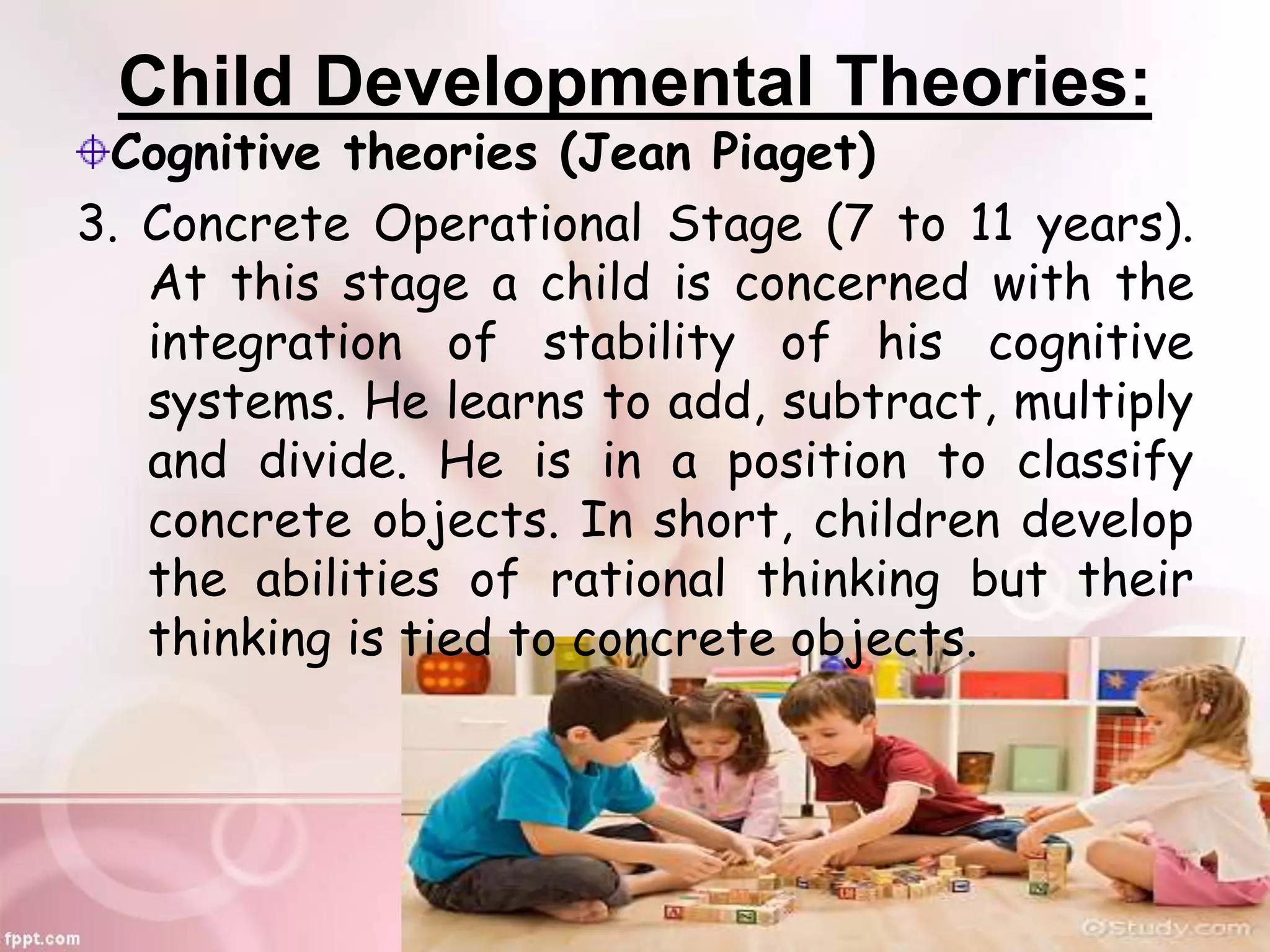
3. Concrete Operational Stage (7 to 11 years).
At this stage a child is concerned with the
integration of stability of his cognitive
systems. He learns to add, subtract, multiply
and divide. He is in a position to classify
concrete objects. In short, children develop
the abilities of rational thinking but their
thinking is tied to concrete objects.
Child Developmental Theories:
Cognitive theories (Jean Piaget)
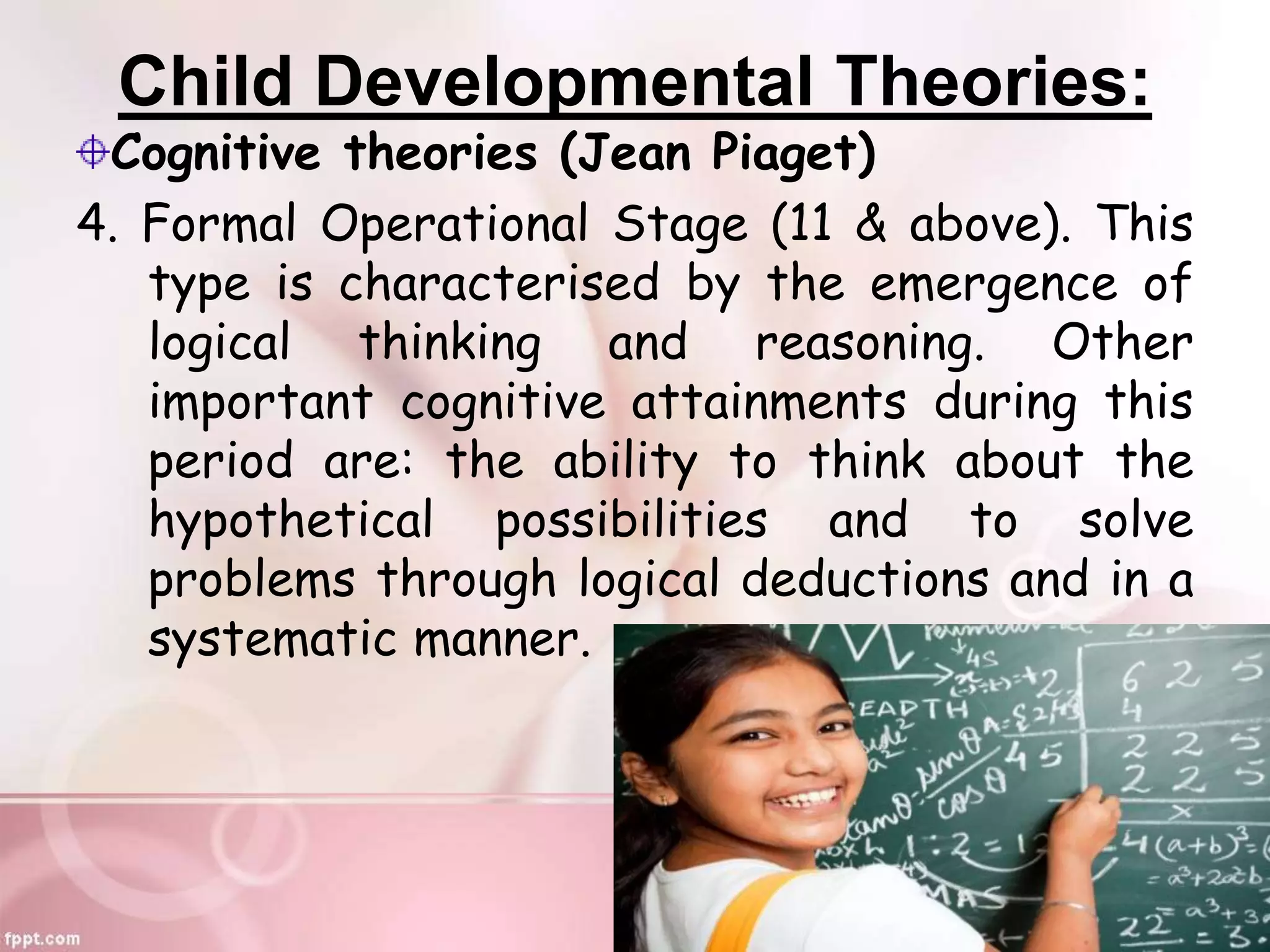
4. Formal Operational Stage (11 & above). This
type is characterised by the emergence of
logical thinking and reasoning. Other
important cognitive attainments during this
period are: the ability to think about the
hypothetical possibilities and to solve
problems through logical deductions and in a
systematic manner.
Child Developmental Theories:
Moral Development (Piaget and Kohlberg)
According to Piaget, moral development parallels
mental development and consists of two stages:
respect for rules and sense of justice. The first
stage, from about 3 – 11 years of age, Piaget
terms a ‘morality of restraint’. Rules are
considered sacred because they are laid down by
the parents or other adults in authority.
Punishment for infraction of the rules is
compensatory or vengeful.
The second stage, occurring from 12 years on, is
called the morality of reciprocity or cooperation.
Because the adolescent can think abstractly and
is becoming increasingly sensitive to other
persons, rules can be changed if this action is
advantageous to all.
Child Developmental Theories:
Moral Development (Piaget and
Kohlberg)
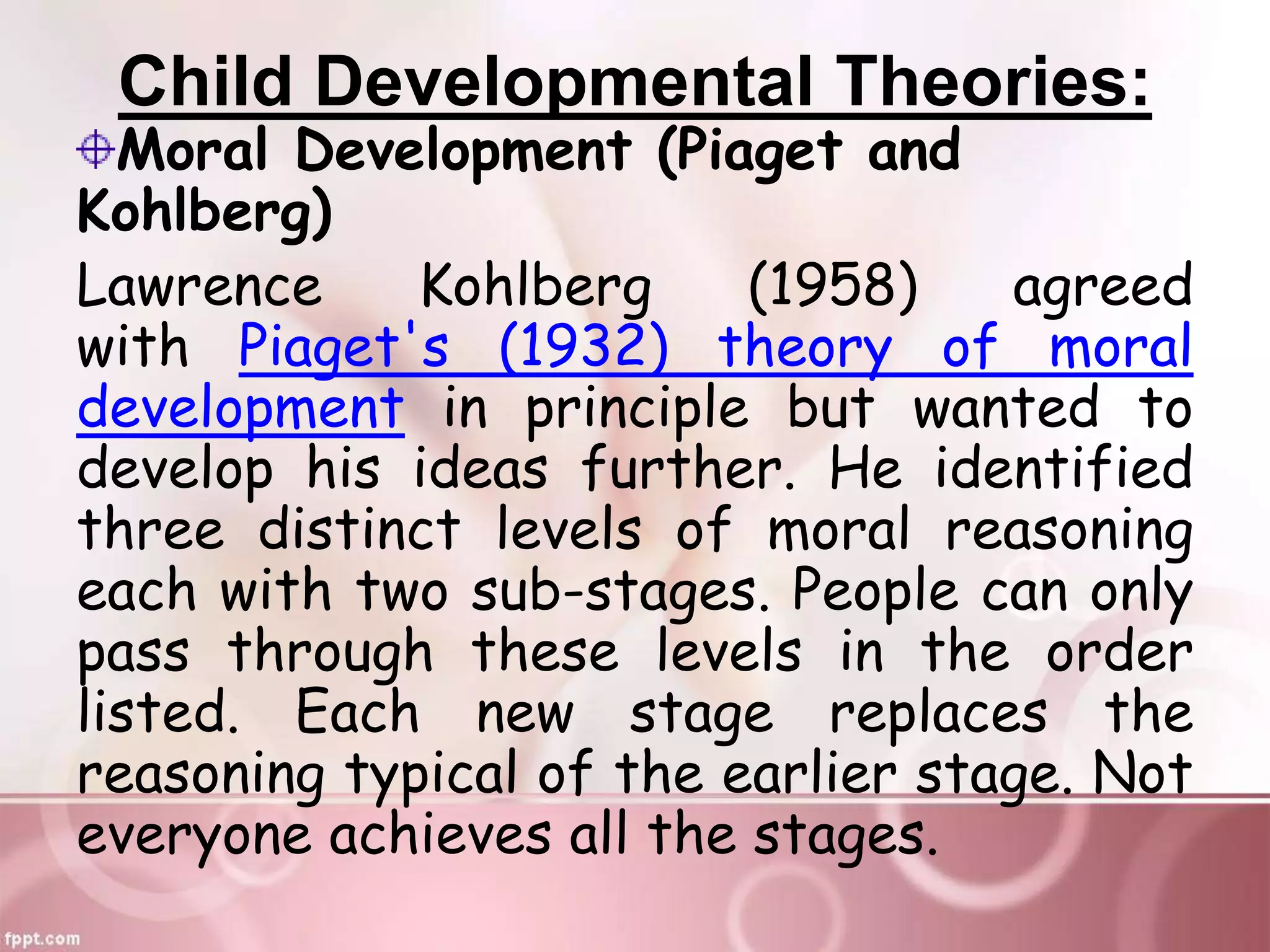
Lawrence Kohlberg (1958) agreed
with Piaget's (1932) theory of moral
development in principle but wanted to
develop his ideas further. He identified
three distinct levels of moral reasoning
each with two sub-stages. People can only
pass through these levels in the order
listed. Each new stage replaces the
reasoning typical of the earlier stage. Not
everyone achieves all the stages.
Child Developmental Theories:
Moral Development (Piaget and
Kohlberg)
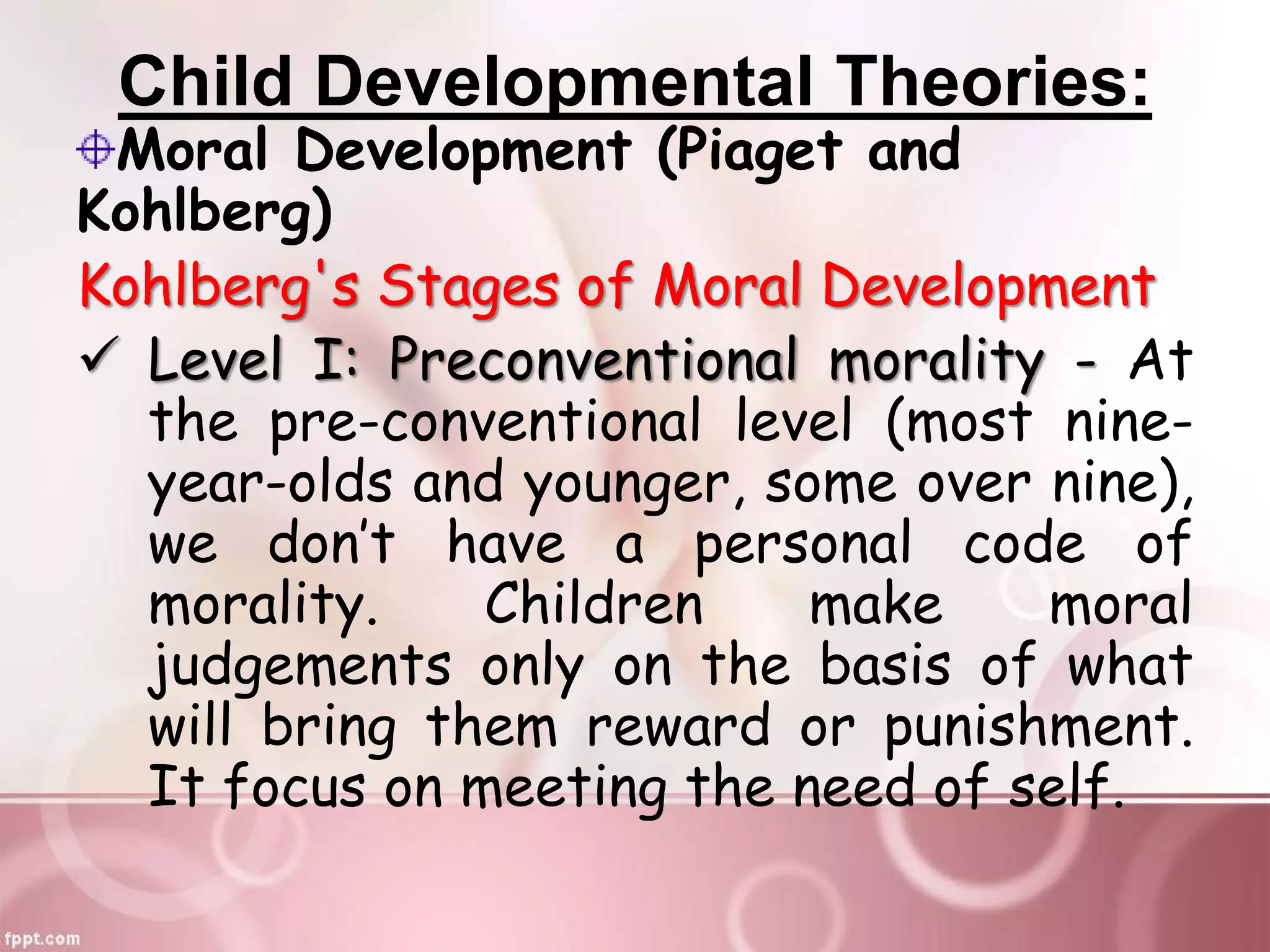
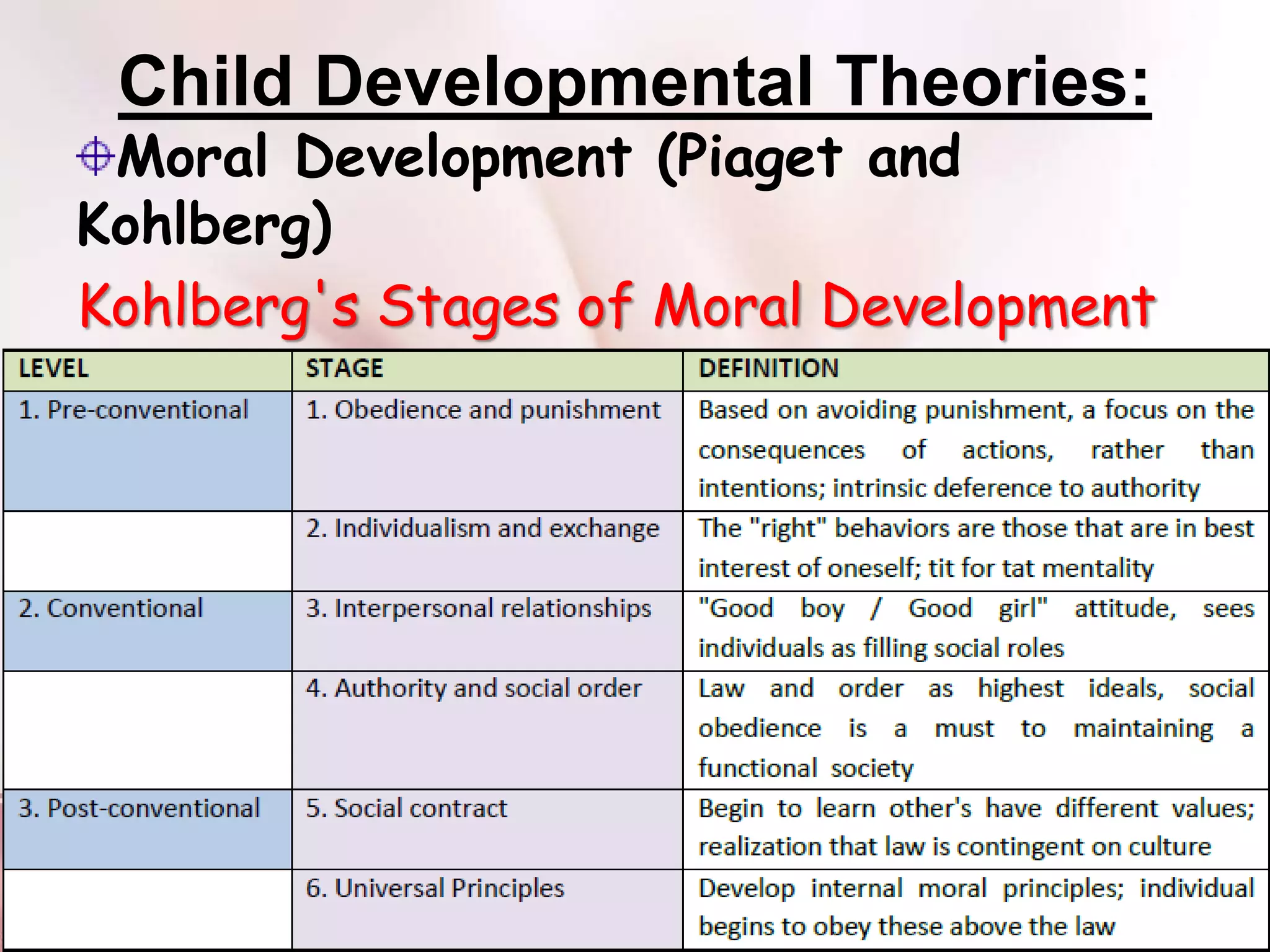
Kohlberg's Stages of Moral Development
 Level I: Preconventional morality - At
the pre-conventional level (most nine-
year-olds and younger, some over nine),
we don’t have a personal code of
morality. Children make moral
judgements only on the basis of what
will bring them reward or punishment.
It focus on meeting the need of self.
Child Developmental Theories:
Moral Development (Piaget and
Kohlberg)
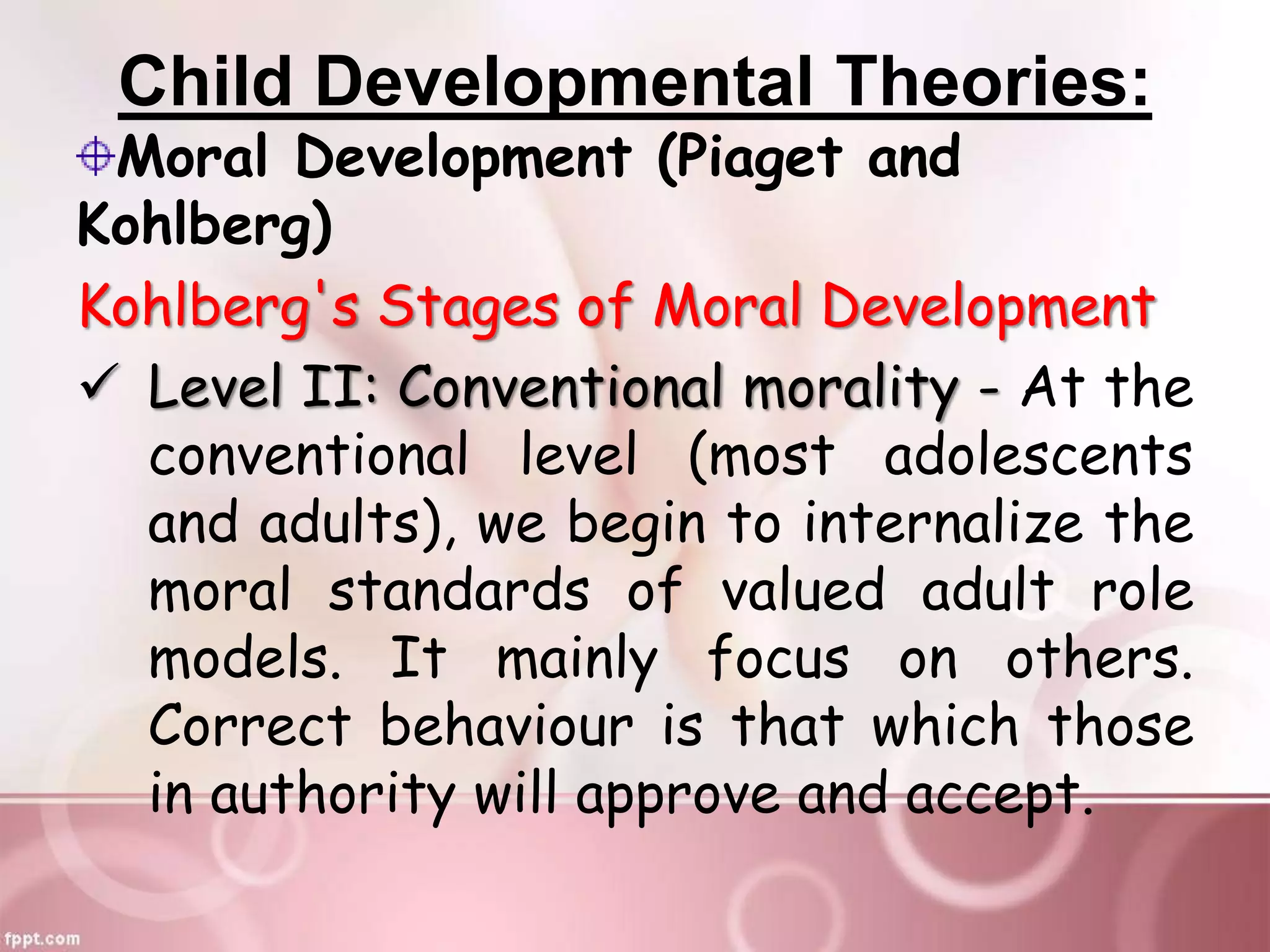
Kohlberg's Stages of Moral Development
 Level II: Conventional morality - At the
conventional level (most adolescents
and adults), we begin to internalize the
moral standards of valued adult role
models. It mainly focus on others.
Correct behaviour is that which those
in authority will approve and accept.
Child Developmental Theories:
Moral Development (Piaget and Kohlberg)
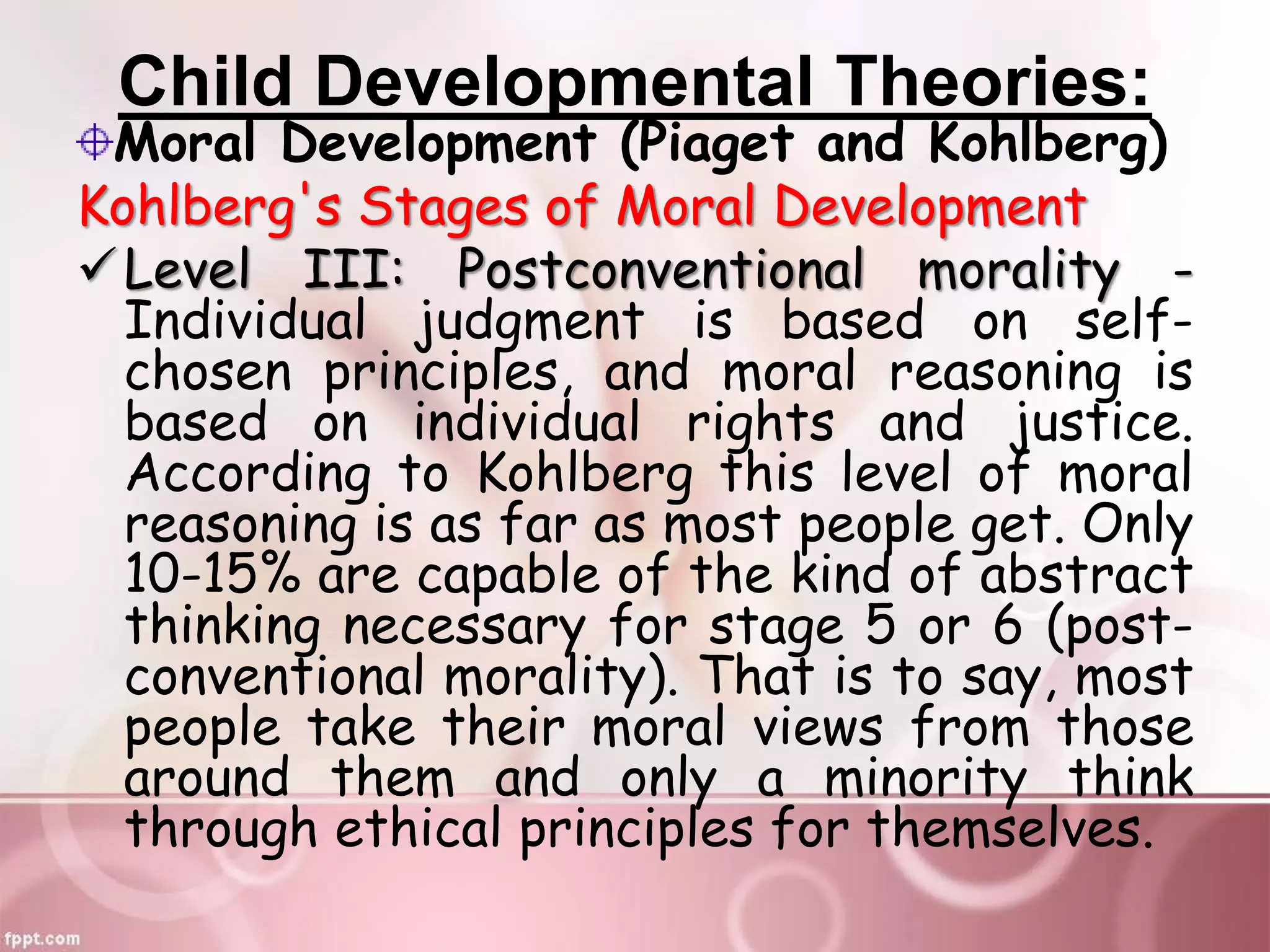
Kohlberg's Stages of Moral Development
Level III: Postconventional morality -
Individual judgment is based on self-
chosen principles, and moral reasoning is
based on individual rights and justice.
According to Kohlberg this level of moral
reasoning is as far as most people get. Only
10-15% are capable of the kind of abstract
thinking necessary for stage 5 or 6 (post-
conventional morality). That is to say, most
people take their moral views from those
around them and only a minority think
through ethical principles for themselves.
Child Developmental Theories:
Moral Development (Piaget and
Kohlberg)
Kohlberg's Stages of Moral Development
Child Developmental Theories:
Spiritual Development (JW Flower)
Stages of Faith
James W. Fowler developed a theory of
six stages that people go through as their
faith matures based on the work of Jean
Piaget and Lawrence Kohlberg. The basic
theory can be applied, not only to those in
traditional faiths, but to those who follow
alternative spiritualities or secular
worldviews as well.
Child Developmental Theories:
Spiritual Development (JW Flower)
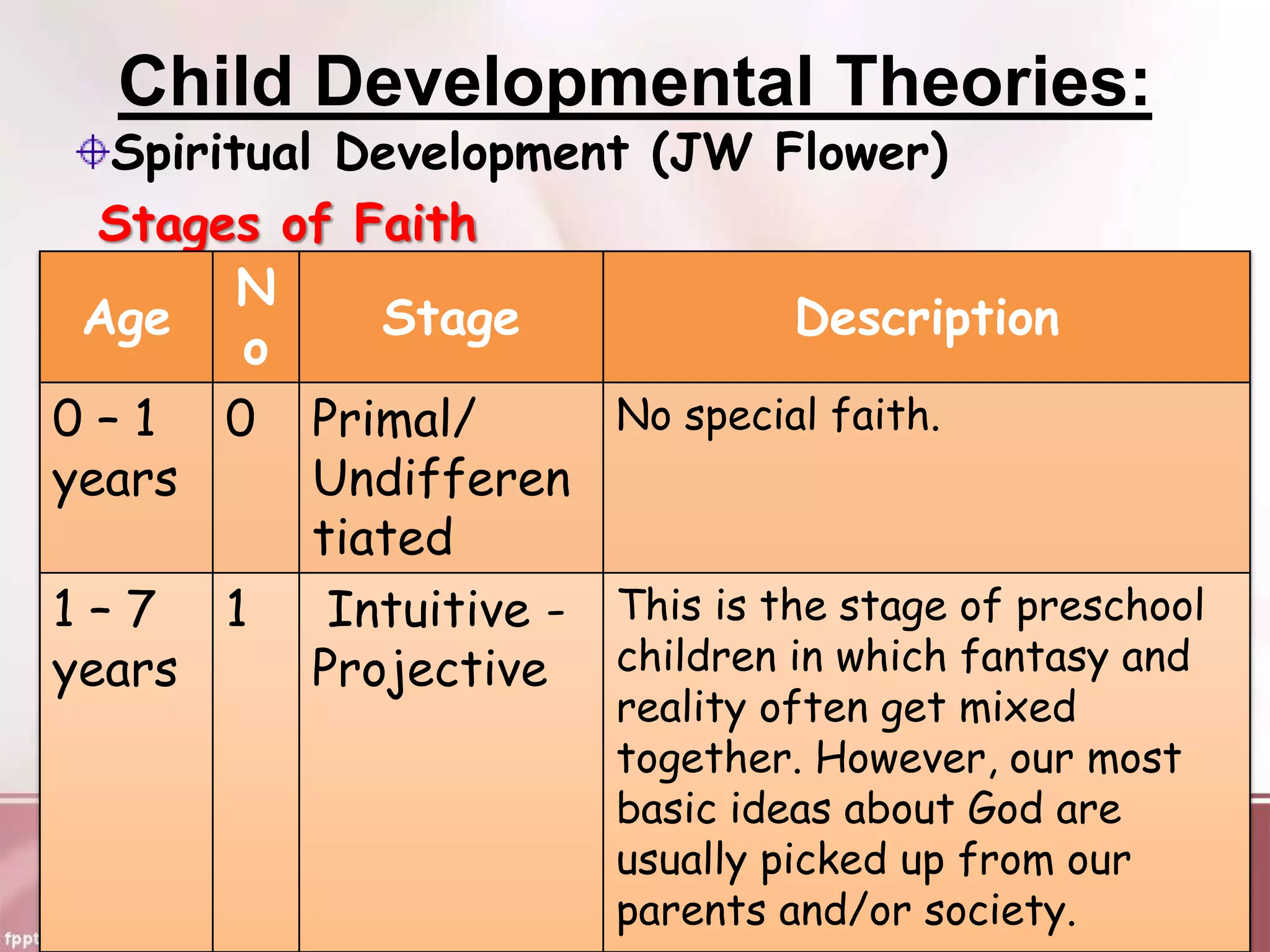
Stages of Faith
Age
N
o
Stage Description
0 – 1
years
0 Primal/
Undifferen
tiated
No special faith.
1 – 7
years
1 Intuitive -
Projective
This is the stage of preschool
children in which fantasy and
reality often get mixed
together. However, our most
basic ideas about God are
usually picked up from our
parents and/or society.
Child Developmental Theories:
Spiritual Development (JW Flower)
Stages of Faith
Age
N
o
Stage Description
7 – 12
years
2 Mythic -
Literal
When children become school-
age, they start understanding the
world in more logical ways. They
generally accept the stories told
to them by their faith community
but tend to understand them in
very literal ways. [A few people
remain in this stage through
adulthood.]
Child Developmental Theories:
Spiritual Development (JW Flower)
Stages of Faith
Age
N
o
Stage Description
12 – 18
years
(Puber
ty)
3
Synthet
ic -
Convent
ional
At this point, their life has grown
to include several different social
circles and there is a need to pull it
all together. When this happens, a
person usually adopts some sort of
all-encompassing belief system. At
this stage, authority is usually
placed in individuals or groups that
represent one's beliefs. [This is the
stage in which many people remain.]
Child Developmental Theories:
Spiritual Development (JW Flower)
Stages of Faith
Age
N
o
Stage Description
21 + ?
Late
Adoles
cence
&
Young
Adult
4
Individuat
ive -
Reflective
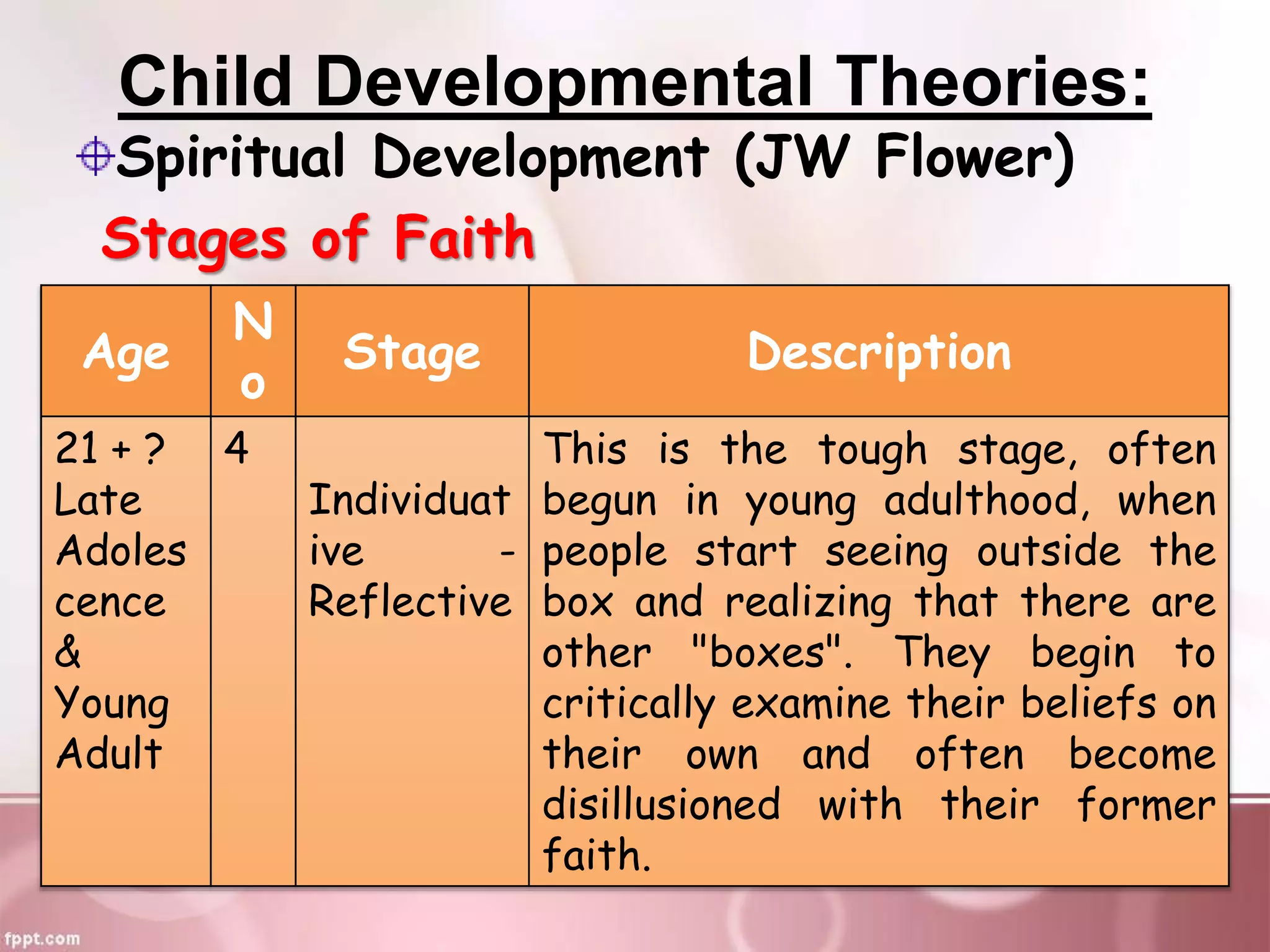
This is the tough stage, often
begun in young adulthood, when
people start seeing outside the
box and realizing that there are
other "boxes". They begin to
critically examine their beliefs on
their own and often become
disillusioned with their former
faith.
Child Developmental Theories:
Spiritual Development (JW Flower)
Stages of Faith
Age
N
o
Stage Description
35 + ?
(Adult
s )
5 Conjunctiv
e
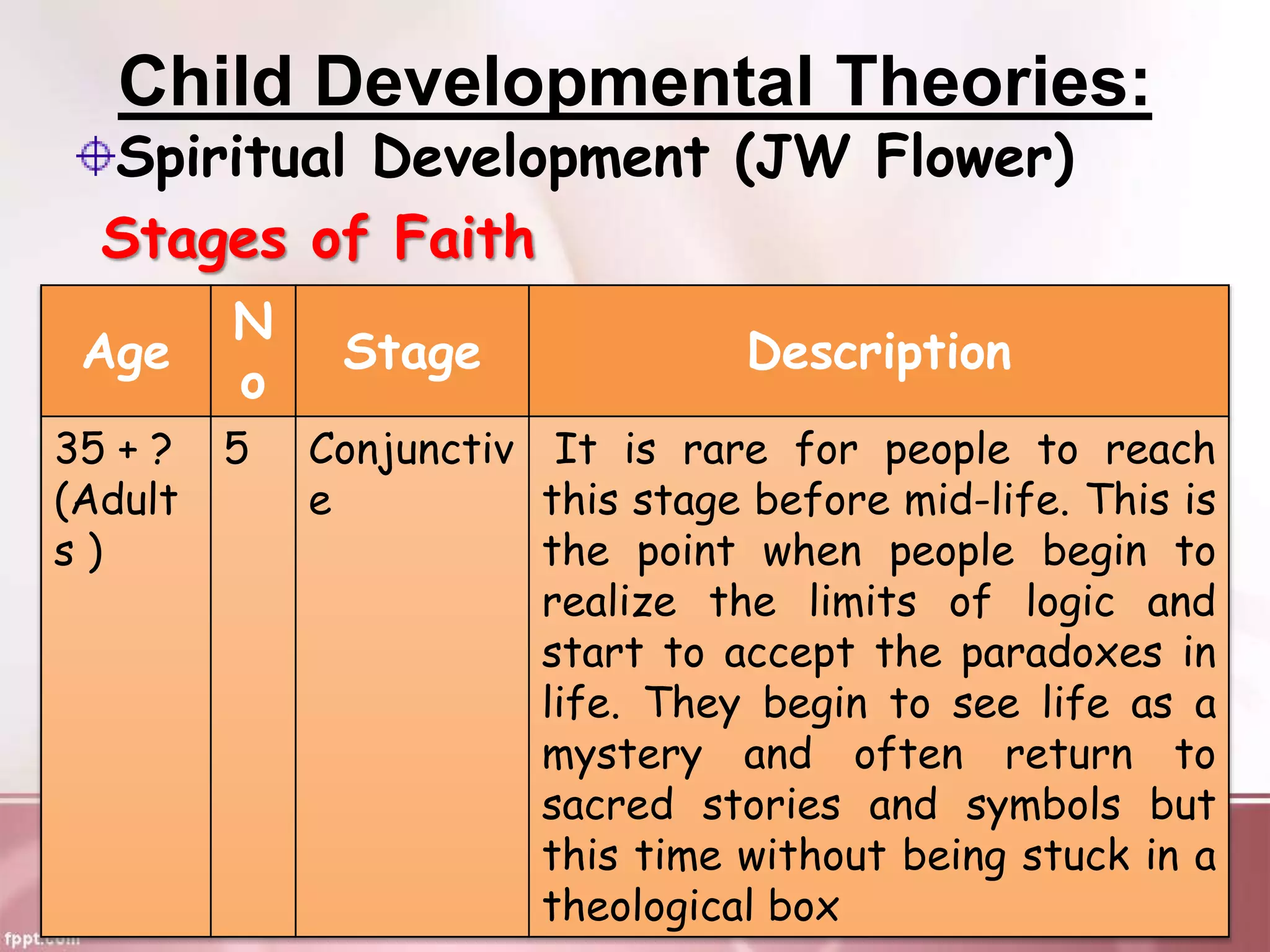
It is rare for people to reach
this stage before mid-life. This is
the point when people begin to
realize the limits of logic and
start to accept the paradoxes in
life. They begin to see life as a
mystery and often return to
sacred stories and symbols but
this time without being stuck in a
theological box
Child Developmental Theories:
Spiritual Development (JW Flower)
Stages of Faith
Age
N
o
Stage Description
45 + ? 6 Universa
lizing
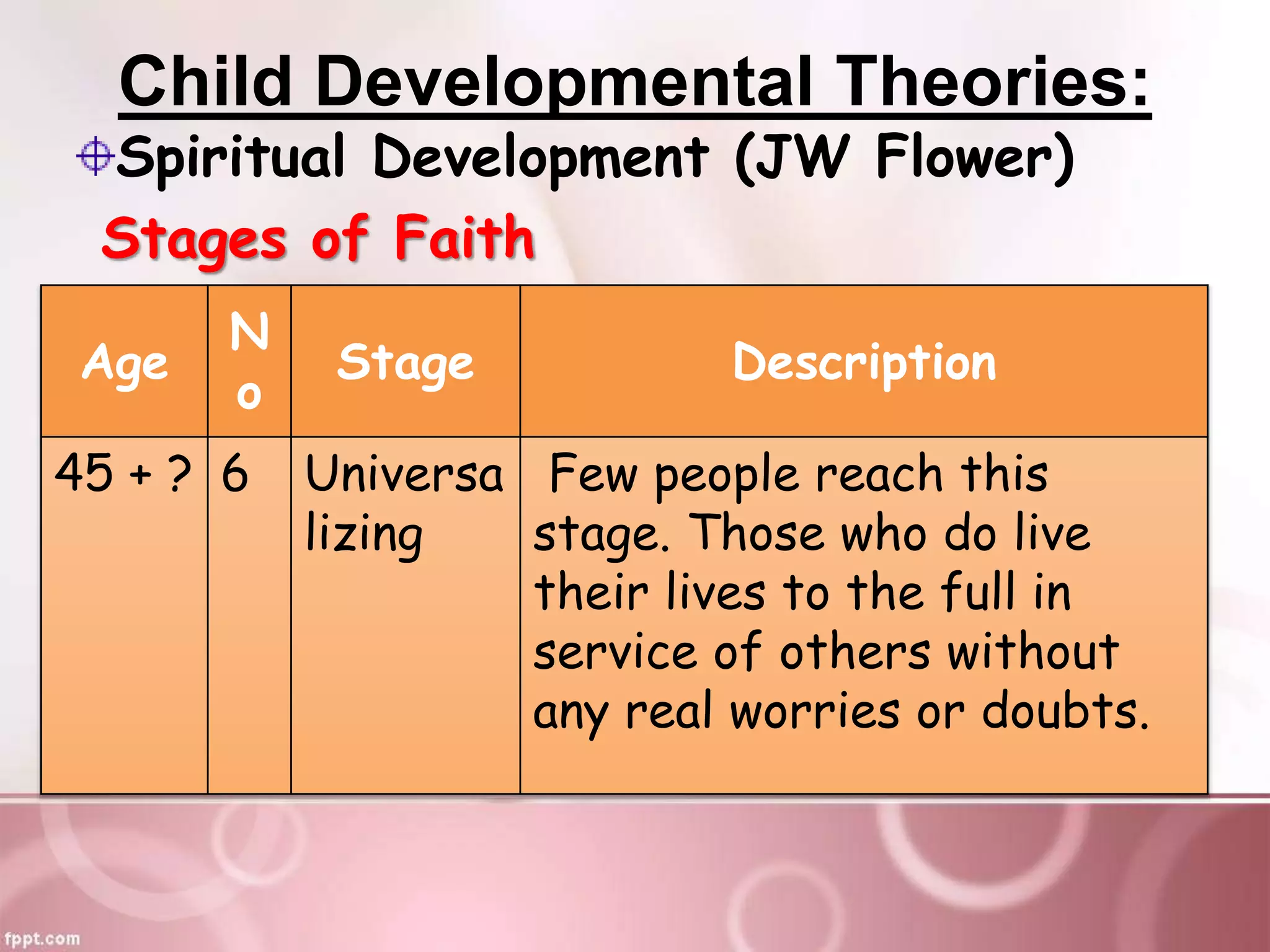
Few people reach this
stage. Those who do live
their lives to the full in
service of others without
any real worries or doubts.
Notes on theories of development

Notes on theories of development

  • 2.
    Introduction • The developmentalchanges that occur from birth to adulthood were largely ignored throughout much of history. Children were often viewed simply as small versions of adults and little attention was paid to the many advances in cognitive abilities, language usage, and physical growth. Interest in the field of child development began early in the 20th- century and tended to focus on abnormal behavior.
  • 3.
    Introduction • The followingare just a few of the many theories of child development that have been proposed by theorists and researchers. More recent theories outline the developmental stages of children and identify the typical ages at which these growth milestones occur.
  • 4.
    Child Developmental Theories: Psychoanalytictheories – Emotional development: Erik Erikson – Development of sexuality: Sigmund Freud Behavioral theories (Pavlov, and Skinner) Social Development Theories (John Bowlby) Cognitive theories (Jean Piaget) Moral Development (Piaget and Kohlberg) Spiritual Development (JW Flower)
  • 5.
    Child Developmental Theories: Psychoanalytictheories – Emotional development: Erik Erikson – Development of sexuality: Sigmund Freud Erik H Erikson Emotional or personality development is a continuous process. Erikson described it as . In each stage a central problem exists for which a solution should be found. Solving each at particular stage lays the basis for progress to the next stage.
  • 6.
    Child Developmental Theories: Psychoanalytictheories Erik H Erikson Stage Approximate Age Erikson’s Stages Tasks Negative Counter Part Infancy 0 – 1 yrs Sense of trust Mistrust Toddler 1 – 3 yrs Sense of autonomy Shame & doubt Preschool 3 – 6 yrs Sense of initiative Guilt
  • 7.
    Child Developmental Theories: Psychoanalytictheories Erik H Erikson Stage Approximate Age Erikson’s Stages Tasks Negative Counter Part School 6 – 12 yrs Sense of industry Inferiori ty Early Adolescence 12 – 16 yrs Sense of identity Identity diffusion
  • 8.
    Child Developmental Theories: Psychoanalytictheories Erik H Erikson Stage Approx imate Age Erikson’s Stages Tasks Negative Counter Part Late Adolescence & Young Adult 16 – 40 yrs Sense of intimacy & solidarity Isolation Middle aged Adult 40 – 60 yrs Sense of generativity Stagnation Late Adulthood/Old Age >60 yrs Sense of Egointegrity Despair
  • 9.
  • 10.
  • 11.
    Child Developmental Theories: ErikH Erikson Initiative Vs Guilt
  • 12.
    Child Developmental Theories: Erik HErikson Children at this stage have a strong sense of duty. They want to engage in tasks in their social world that they an carry out successfully, and they want this to be recognized by adults and their peers. The danger of this part is the development of inferiority if parents expect a level of achievement that children are unable to attain. Industry Vs Inferiority
  • 13.
    Child Developmental Theories: Psychoanalytictheories Erik H Erikson According to Erikson, an adolescent’s main task is developing a sense of self. Adolescents struggle with questions such as “Who am I?” and “What do I want to do with my life?” Success in this period brings self esteem. The danger is the development of role confusion in their dreams of future, a life full of conflicting desires, possibilities and chances. Identity Vs Confusion
  • 14.
    Child Developmental Theories: Psychoanalytictheories Erik H Erikson After we have developed a sense of self in adolescence, we are ready to share our life with others. However, if other stages have not been successfully resolved, young adults may have trouble developing and maintaining successful relationships with others. Adults who do not develop a positive self- concept in adolescence may experience feelings of loneliness and emotional isolation. Intimacy Vs Isolation
  • 15.
    Child Developmental Theories: Psychoanalytictheories – Development of sexuality: Sigmund Freud Freud (1905) proposed that psychological development in childhood takes place in a series of fixed psychosexual stages: oral, anal, phallic, latency, and genital. These are called psychosexual stages because each stage represents the fixation of libido (roughly translated as sexual drives or instincts) on a different area of the body.
  • 17.
    Child Developmental Theories: Behavioraltheories (Pavlov, and Skinner) • Behavioral theories of development focus on how environmental interaction influences behavior and are based upon the theories of theorists such as Watson ,Pavlov, and Skinner. • These theories deal only with observable behaviors. Development is considered a reaction to rewards, punishments, stimuli, and reinforcement.
  • 18.
    Child Developmental Theories: SocialDevelopment Theories (John Bowlby) –Socialization, or social development, means training a child in the culture of the group. A newborn infant is not a social being. –There is a great deal of research on the social development of children. –John Bowbly proposed one of the earliest theories of social development. Bowlby believed that early relationships with caregivers play a major role in child development and continue to influence social relationships throughout life.
  • 19.
    Child Developmental Theories: Cognitivetheories (Jean Piaget) Piaget's (1936) theory of cognitive development explains how a child constructs a mental model of the world. Theorist Jean Piaget suggested that children think differently than adults and proposed a stage theory of cognitive development. He was the first to note that children play an active role in gaining knowledge of the world.
  • 20.
    Child Developmental Theories: Cognitivetheories (Jean Piaget) • Jean Piaget believed that children go through a number of fixed stages on their way to independent thinking. • His theory on cognitive development, though, is perhaps the most widely accepted and most cited. • Piaget believed that all children will go through the following stages in order, the age ranges are only a general guideline. • Each child matures in his own time, and even siblings don't do the same things at exactly the same age.
  • 21.
  • 22.
    Child Developmental Theories: Cognitivetheories (Jean Piaget) 1. Sensori-Motor Stage. This stage begins at birth and lasts till the child is about 2 years old. It is called Sensori-Motor Stage, because children’s thinking involves seeing, hearing, moving, touching, testing and so on. This stage marks a transitional stage for a person from a biological to a psychological being. In the first few weeks of life the baby’s behaviour consists simply of reflex responses, such as sucking, stepping and grasping. Later the reflex disappears and the baby chooses what and when to grasp.
  • 23.
    Child Developmental Theories: Cognitivetheories (Jean Piaget) 1. Sensori-Motor Stage. During this period the infants attain the concept of object permanence. This refers to the understanding that objects and events continue to exist even when they cannot directly be seen, heard or touched. A second major accomplishment in the Sensori- Motor period is learning to reverse actions. E.g., we give a toy to a child that has ten detachable parts. We detach all parts. Through trial and error, the child gradually learns to attach all the parts of the toy.
  • 24.
    Child Developmental Theories: Cognitivetheories (Jean Piaget) 2. Pre-Operational Stage (2 to 7 Years). This stage is called Pre-Operational because the children have not yet mastered the ability to perform mental operations. Children’s thinking during this stage is governed by what is seen rather than by logical principles. Following are the accomplishments of Pre-Operational Stage:
  • 25.
    Child Developmental Theories: Cognitivetheories (Jean Piaget) 2. Pre-Operational Stage (2 to 7 Years). a. Semantic function. During this stage the child develops the ability to think using symbols and signs. Symbols represent something or someone else; for example, a doll may symbolize a baby, child or an adult. b. Egocentrism. This stage is characterized by egocentrism. Children believe that their way of thinking is the only way to think.
  • 26.
    Child Developmental Theories: Cognitivetheories (Jean Piaget) 2. Pre-Operational Stage (2 to 7 Years). c. Decentering. A pre-operational child has difficulty in seeing more than one dimension or aspects of situation. d. Animism. Children tend to refer to inanimate objects as if they have life-like qualities and are capable of actions. e. Seriation. They lack the ability of classification or grouping objects into categories. f. Conservation. It refers to the understanding that certain properties of an object remain the same despite a change in their appearance.
  • 27.
    Child Developmental Theories: Cognitivetheories (Jean Piaget) 3. Concrete Operational Stage (7 to 11 years). At this stage a child is concerned with the integration of stability of his cognitive systems. He learns to add, subtract, multiply and divide. He is in a position to classify concrete objects. In short, children develop the abilities of rational thinking but their thinking is tied to concrete objects.
  • 28.
    Child Developmental Theories: Cognitivetheories (Jean Piaget) 4. Formal Operational Stage (11 & above). This type is characterised by the emergence of logical thinking and reasoning. Other important cognitive attainments during this period are: the ability to think about the hypothetical possibilities and to solve problems through logical deductions and in a systematic manner.
  • 29.
    Child Developmental Theories: MoralDevelopment (Piaget and Kohlberg) According to Piaget, moral development parallels mental development and consists of two stages: respect for rules and sense of justice. The first stage, from about 3 – 11 years of age, Piaget terms a ‘morality of restraint’. Rules are considered sacred because they are laid down by the parents or other adults in authority. Punishment for infraction of the rules is compensatory or vengeful. The second stage, occurring from 12 years on, is called the morality of reciprocity or cooperation. Because the adolescent can think abstractly and is becoming increasingly sensitive to other persons, rules can be changed if this action is advantageous to all.
  • 30.
    Child Developmental Theories: MoralDevelopment (Piaget and Kohlberg) Lawrence Kohlberg (1958) agreed with Piaget's (1932) theory of moral development in principle but wanted to develop his ideas further. He identified three distinct levels of moral reasoning each with two sub-stages. People can only pass through these levels in the order listed. Each new stage replaces the reasoning typical of the earlier stage. Not everyone achieves all the stages.
  • 31.
    Child Developmental Theories: MoralDevelopment (Piaget and Kohlberg) Kohlberg's Stages of Moral Development  Level I: Preconventional morality - At the pre-conventional level (most nine- year-olds and younger, some over nine), we don’t have a personal code of morality. Children make moral judgements only on the basis of what will bring them reward or punishment. It focus on meeting the need of self.
  • 32.
    Child Developmental Theories: MoralDevelopment (Piaget and Kohlberg) Kohlberg's Stages of Moral Development  Level II: Conventional morality - At the conventional level (most adolescents and adults), we begin to internalize the moral standards of valued adult role models. It mainly focus on others. Correct behaviour is that which those in authority will approve and accept.
  • 33.
    Child Developmental Theories: MoralDevelopment (Piaget and Kohlberg) Kohlberg's Stages of Moral Development Level III: Postconventional morality - Individual judgment is based on self- chosen principles, and moral reasoning is based on individual rights and justice. According to Kohlberg this level of moral reasoning is as far as most people get. Only 10-15% are capable of the kind of abstract thinking necessary for stage 5 or 6 (post- conventional morality). That is to say, most people take their moral views from those around them and only a minority think through ethical principles for themselves.
  • 34.
    Child Developmental Theories: MoralDevelopment (Piaget and Kohlberg) Kohlberg's Stages of Moral Development
  • 35.
    Child Developmental Theories: SpiritualDevelopment (JW Flower) Stages of Faith James W. Fowler developed a theory of six stages that people go through as their faith matures based on the work of Jean Piaget and Lawrence Kohlberg. The basic theory can be applied, not only to those in traditional faiths, but to those who follow alternative spiritualities or secular worldviews as well.
  • 36.
    Child Developmental Theories: SpiritualDevelopment (JW Flower) Stages of Faith Age N o Stage Description 0 – 1 years 0 Primal/ Undifferen tiated No special faith. 1 – 7 years 1 Intuitive - Projective This is the stage of preschool children in which fantasy and reality often get mixed together. However, our most basic ideas about God are usually picked up from our parents and/or society.
  • 37.
    Child Developmental Theories: SpiritualDevelopment (JW Flower) Stages of Faith Age N o Stage Description 7 – 12 years 2 Mythic - Literal When children become school- age, they start understanding the world in more logical ways. They generally accept the stories told to them by their faith community but tend to understand them in very literal ways. [A few people remain in this stage through adulthood.]
  • 38.
    Child Developmental Theories: SpiritualDevelopment (JW Flower) Stages of Faith Age N o Stage Description 12 – 18 years (Puber ty) 3 Synthet ic - Convent ional At this point, their life has grown to include several different social circles and there is a need to pull it all together. When this happens, a person usually adopts some sort of all-encompassing belief system. At this stage, authority is usually placed in individuals or groups that represent one's beliefs. [This is the stage in which many people remain.]
  • 39.
    Child Developmental Theories: SpiritualDevelopment (JW Flower) Stages of Faith Age N o Stage Description 21 + ? Late Adoles cence & Young Adult 4 Individuat ive - Reflective This is the tough stage, often begun in young adulthood, when people start seeing outside the box and realizing that there are other "boxes". They begin to critically examine their beliefs on their own and often become disillusioned with their former faith.
  • 40.
    Child Developmental Theories: SpiritualDevelopment (JW Flower) Stages of Faith Age N o Stage Description 35 + ? (Adult s ) 5 Conjunctiv e It is rare for people to reach this stage before mid-life. This is the point when people begin to realize the limits of logic and start to accept the paradoxes in life. They begin to see life as a mystery and often return to sacred stories and symbols but this time without being stuck in a theological box
  • 41.
    Child Developmental Theories: SpiritualDevelopment (JW Flower) Stages of Faith Age N o Stage Description 45 + ? 6 Universa lizing Few people reach this stage. Those who do live their lives to the full in service of others without any real worries or doubts.

Editor's Notes

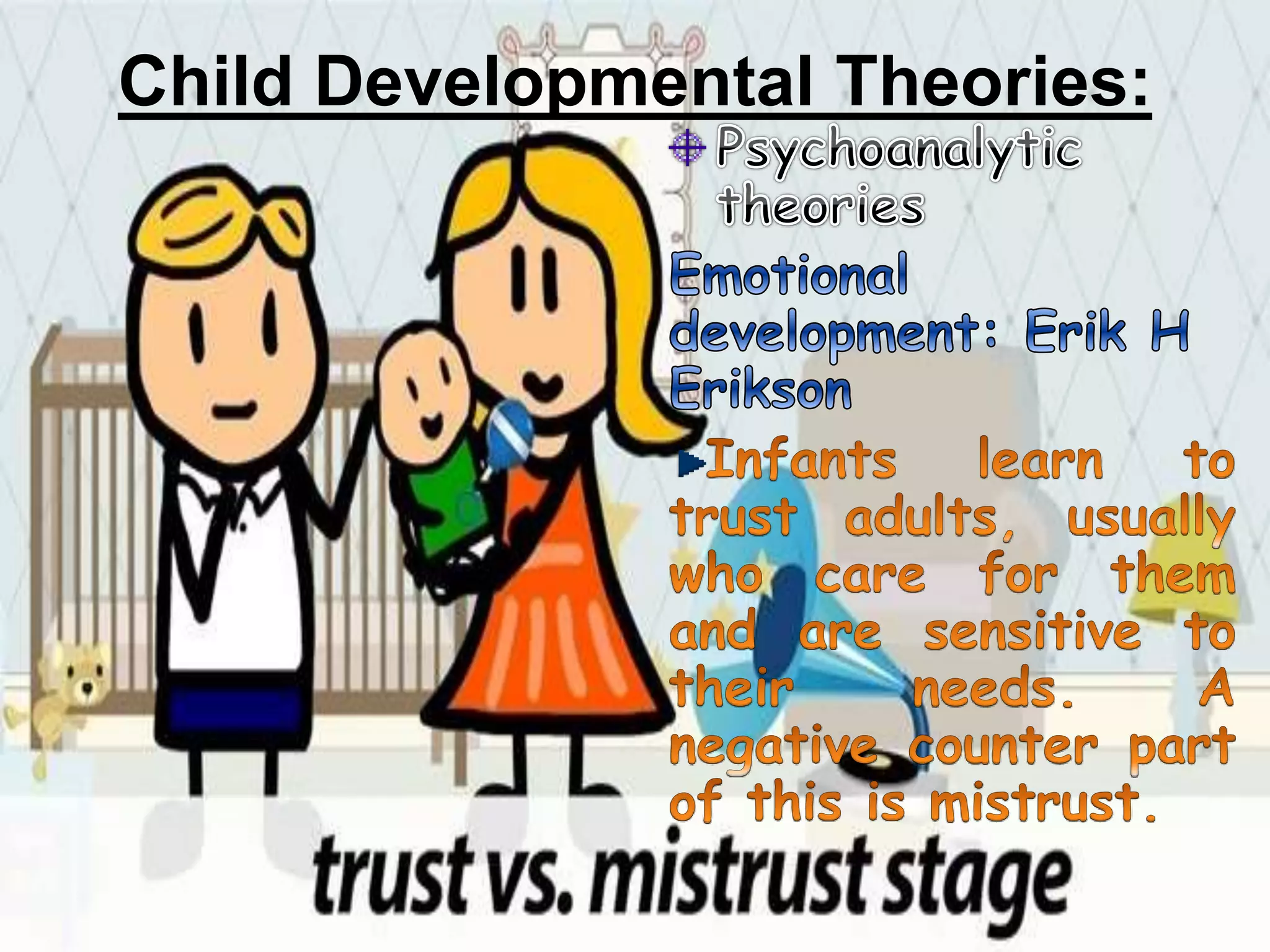
  • #10 Small babies may view this “new world” as threatening, as they must depend on others for their survival. Depending on how they are treated by their caregivers, this sense of threat can be replaced by trust. On the other hand, caregivers who are unresponsive to their baby’s needs can cause their baby to view this “new world” as unreliable and unpredictable. These babies may develop a sense of anxiety and mistrust, which will affect how they interact with others as they grow up.
  • #11 Parents’ patience and encouragement are crucial in shaping their child’s success at this phase of the Erikson stages.