Chapter Fifteen Valuing Work Force Diversity
Chapter Preview: Valuing Work Force Diversity Primary and secondary dimensions of diversity Formation of prejudiced attitudes  Discrimination in the workplace Organizational cultures that value diversity Individual and organizational enhancement of diversity Affirmative action programs
Work Force Diversity – A Definition The U.S. is a kaleidoscope of the world’s cultures American work force is becoming more racially and ethnically diverse, increasingly female and older Focus today is on valuing diversity
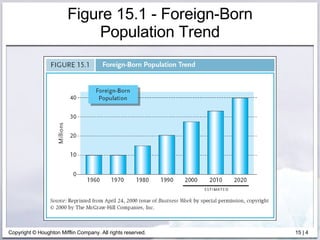
Figure 15.1 - Foreign-Born Population Trend
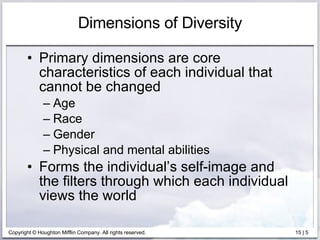
Dimensions of Diversity Primary dimensions are core characteristics of each individual that cannot be changed Age Race Gender Physical and mental abilities Forms the individual’s self-image and the filters through which each individual views the world
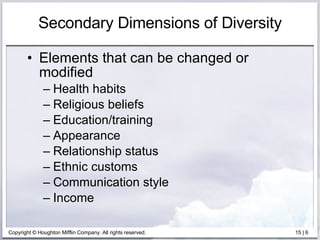
Secondary Dimensions of Diversity Elements that can be changed or modified Health habits Religious beliefs Education/training Appearance  Relationship status   Ethnic customs Communication style Income
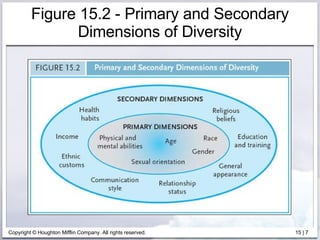
Figure 15.2 - Primary and Secondary Dimensions of Diversity
The Dimensions of Diversity They add depth to the individuals and shape values, priorities and perceptions Building effective human relationships is possible only when we value and accept these differences Without acceptance, both dimensions of diversity can become roadblocks to further cooperation and understanding
Prejudiced Attitudes Prejudice is a premature judgment or an opinion that is formed without examination of the facts Often based on primary or secondary dimensions Prejudiced people tend to think in terms of stereotypes Generalizations made about all members of a particular group
Total Person Insight No matter who you are, you’re going to have to work with people who are different from you. You’re going to have to sell to people who are different from you, and buy from people who are different from you, and manage people who are different from you. J.T. “Ted” Childs, Jr. Vice President, IBM Global Workforce Diversity
Prejudiced Attitudes Most common and powerful stereotypes focus on observable attributes Age Gender Ethnicity Stereotypes are likely to change when we learn more about specific members of a group
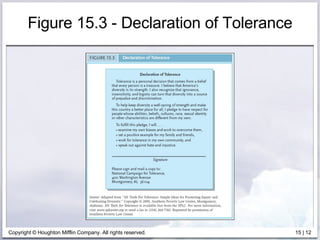
Figure 15.3 - Declaration of Tolerance
How Prejudiced Attitudes Are Formed and Maintained Major factors that contribute to formation of prejudice: Childhood experiences Ethnocentrism Economic factors
Childhood Experiences Children learn attitudes and beliefs from family, friends, and other authority figures They learn how to view and treat different racial, ethnic, religious, and other groups Prejudices can be unlearned later in life
Total Person Insight To bring Chinese music to an African American church, it means that when we leave Chinatown we are promoting our culture.  If we stay in Chinatown, we’re only preserving it.  If you’re going to promote cultural understanding, it has to be to all people of all walks of life. Sheryln Chew Creator, The Purple Bamboo Orchestra
Ethnocentrism Ethnocentrism is the tendency to regard our own culture or nation as better or more correct than others The standards or values of one culture are being used as a standard to measure the worth of other cultures Ethnicity refers to condition of being culturally rather than physically distinctive Iceberg analogy
Economic Factors Hard to eliminate Rooted in basic survival needs Reinforced by wide wealth and income gap between whites and nonwhites People’s prejudice against each other increases when the economy goes through a recession or depression and housing, jobs, and other necessities become scarce
The Many Forms of Discrimination Discrimination is behavior based on prejudiced attitudes Individuals or groups that are discriminated against are denied equal treatment and opportunities offered to people in the dominant group
Gender Focus of much attention Traditional roles for women in society have been changing Women in the work force New roles for men
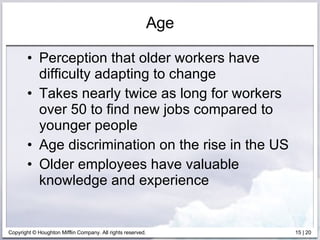
Age Perception that older workers have difficulty adapting to change Takes nearly twice as long for workers over 50 to find new jobs compared to younger people Age discrimination on the rise in the US Older employees have valuable knowledge and experience
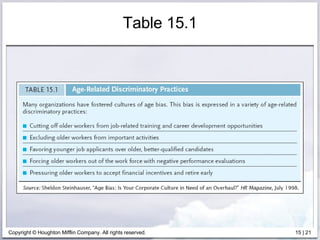
Table 15.1
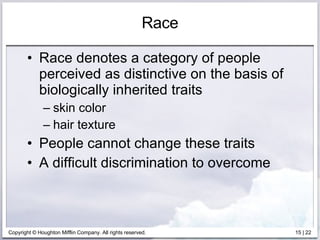
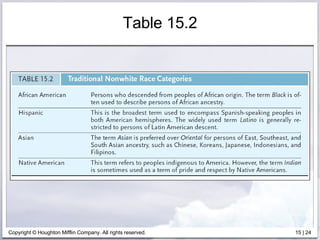
Race Race denotes a category of people perceived as distinctive on the basis of biologically inherited traits skin color hair texture People cannot change these traits A difficult discrimination to overcome
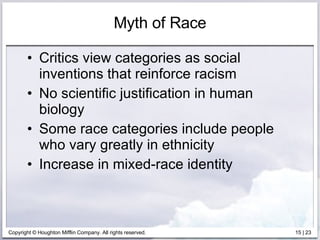
Myth of Race Critics view categories as social inventions that reinforce racism No scientific justification in human biology Some race categories include people who vary greatly in ethnicity Increase in mixed-race identity
Table 15.2
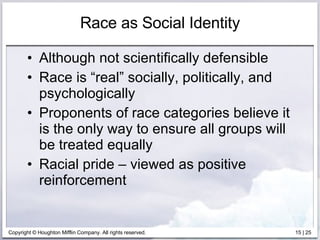
Race as Social Identity Although not scientifically defensible Race is “real” socially, politically, and psychologically Proponents of race categories believe it is the only way to ensure all groups will be treated equally Racial pride – viewed as positive reinforcement
Religion Religious discrimination has been an issue throughout history Intolerance for other religions  Intolerance for different denominations within a religion Intolerance for religious practices
Disability Mentally or physically challenged people find it difficult to enter the job market  Their rights to do so are protected by the Americans with Disabilities Act (ADA) of 1991 Some employers still unwilling or unable to make reasonable accommodations
Sexual Orientation Discrimination based on a person’s sexual orientation is motivated by homophobia Sexual orientation is not the big secret it once was When we are comfortable being ourselves, we are usually more productive and creative Progressive companies are taking steps to provide a more open atmosphere
Table 15.3
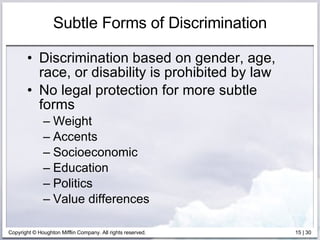
Subtle Forms of Discrimination Discrimination based on gender, age, race, or disability is prohibited by law No legal protection for more subtle forms Weight Accents   Socioeconomic Education Politics Value differences
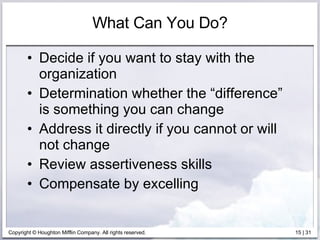
What Can You Do? Decide if you want to stay with the organization Determination whether the “difference” is something you can change  Address it directly if you cannot or will not change Review assertiveness skills Compensate by excelling
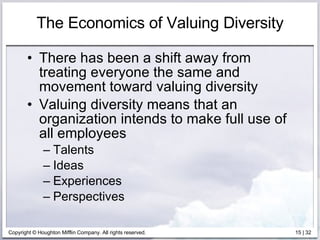
The Economics of Valuing Diversity There has been a shift away from treating everyone the same and  movement toward valuing diversity Valuing diversity means that an organization intends to make full use of all employees Talents Ideas Experiences Perspectives
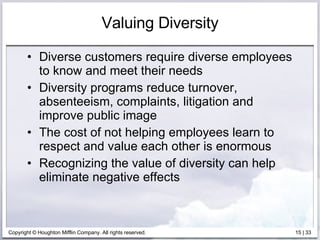
Valuing Diversity Diverse customers require diverse employees to know and meet their needs Diversity programs reduce turnover, absenteeism, complaints, litigation and improve public image The cost of not helping employees learn to respect and value each other is enormous Recognizing the value of diversity can help eliminate negative effects
Total Person Insight More and more, organizations can remain competitive only if they can recognize and obtain the best talent; value the diverse perspectives that come with talent born of different cultures, races, and genders; nurture and train that talent; and create an atmosphere that values its workforce. Lewis Brown Griggs and Lente-Louise Louw Authors,  Valuing Diversity: New Tools For A New Reality
Managing Diversity Process of creating an organizational culture where the primary and secondary dimensions of diversity are respected As workforce becomes more diverse, this becomes more challenging
What Individuals Can Do We cannot totally eliminate prejudices that have been deeply held and developed over time We can learn to change negative attitudes and behaviors
What Individuals Can Do Learn to look critically and honestly at the particular myths and preconceived ideas you have been conditioned to believe about others Develop a sensitivity to differences Develop your own diversity awareness program
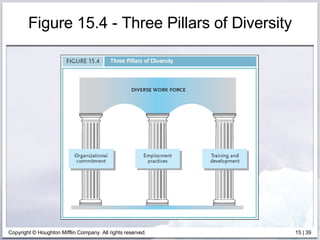
What Organizations Can Do A well-planned and well-executed diversity program can promote understanding and diffuse tension A comprehensive diversity program has three pillars: Organizational commitment Employment practices Training and development
Figure 15.4 - Three Pillars of Diversity
Organizational Commitment Diversity programs designed for competitive advantage usually have strong commitment Diversity programs seen as an event, or quick-fix can do more harm than good Key to success is long-term commitment
Employment Practices Actively recruit diversity Plug into alternative networks Foster a climate for retention Subtle biases create unnecessary stress An organization that makes every effort to make all employees comfortable will reduce stress
Training and Development Give managers and employees the tools they need to work more effectively with one another Uncover unconscious behavioral patterns Learn to value differences Diversity training programs can promote harmony, reduce conflict, and help give the organization a competitive advantage
Affirmative Action: Yesterday and Today Affirmative action can be defined as a program that encourages the hiring and promotion of members of groups that have been discriminated against in the past It is an effort to make up for past wrongs
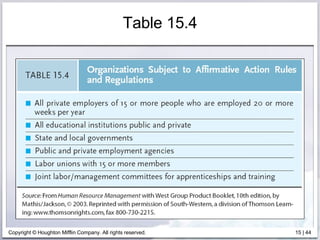
Table 15.4
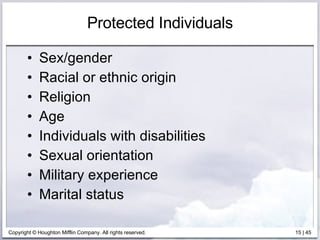
Protected Individuals Sex/gender  Racial or ethnic origin  Religion  Age  Individuals with disabilities  Sexual orientation Military experience Marital status
Affirmative Action Plans (AAP) Formal documents that employees compile annually for submission to various enforcement agencies Clarifies activities to seek out, employ, and develop talents of individuals from protected classes
Common Elements of AAPs Active recruitment of women and minorities Elimination of prejudicial questions on employment applications Establishment of specific goals and timetables for minority hiring Validation of employment testing procedures
The Affirmative Action Debate Some people believe it is time to rethink affirmative action Critics argue that no preferential treatment should be given to any groups Common arguments Preferences are discriminatory Preferences do not make sense, given changing demographics The debate will continue
Chapter Review Primary and secondary dimensions of diversity Primary dimensions include gender, age, race, physical and mental abilities, and sexual orientation Secondary dimensions include health habits, religious beliefs, ethnic customs, communication style, relationship status, income, general appearance, education, and training
Chapter Review Formation of prejudiced attitudes Prejudice is an attitude based on others’ difference and ignorance, fear, and cultural conditioning Prejudiced people tend to see others as stereotypes rather than individuals Prejudicial attitudes are formed through childhood experiences, ethnocentrism, and economic factors
Chapter Review Discrimination in the workplace Discrimination is behavior based on prejudicial attitudes Groups protected by law Gender, age, race, disabilities, religion, military and sexual orientation Subtle discrimination based on different appearances or educational backgrounds Subtle forms of discrimination not illegal, but they are disruptive to productive work
Chapter Review Organizational cultures that value diversity Valuing diversity is an economic issue  The work force will soon consist of a minority of white men and a majority of women, people of color, and immigrants
Chapter Review Organizational cultures that value diversity Competitive organizations must value diverse workers their ideas and talents Organizations need to understand their equally diverse customers’ needs Valuing diversity is a business imperative
Chapter Review Individual and organizational diversity Individuals can  Let go of their stereotypes Honestly evaluate their prejudiced attitudes Develop sensitivity to differences Develop their personal diversity programs Organizations must Value individual differences Implement practices that respect diversity Training should be a committed process  Seek out, employ, and develop diversity
Chapter Review Affirmative action programs Affirmative action guidelines have helped bring fairness in hiring and promotion Critics say affirmative action is discriminatory because it allows preferential treatment These preferences may no longer make sense given the changing demographics of today’s work force

BA 15 Chapter 15

  • 1.
    Chapter Fifteen ValuingWork Force Diversity
  • 2.
    Chapter Preview: ValuingWork Force Diversity Primary and secondary dimensions of diversity Formation of prejudiced attitudes Discrimination in the workplace Organizational cultures that value diversity Individual and organizational enhancement of diversity Affirmative action programs
  • 3.
    Work Force Diversity– A Definition The U.S. is a kaleidoscope of the world’s cultures American work force is becoming more racially and ethnically diverse, increasingly female and older Focus today is on valuing diversity
  • 4.
    Figure 15.1 -Foreign-Born Population Trend
  • 5.
    Dimensions of DiversityPrimary dimensions are core characteristics of each individual that cannot be changed Age Race Gender Physical and mental abilities Forms the individual’s self-image and the filters through which each individual views the world
  • 6.
    Secondary Dimensions ofDiversity Elements that can be changed or modified Health habits Religious beliefs Education/training Appearance Relationship status Ethnic customs Communication style Income
  • 7.
    Figure 15.2 -Primary and Secondary Dimensions of Diversity
  • 8.
    The Dimensions ofDiversity They add depth to the individuals and shape values, priorities and perceptions Building effective human relationships is possible only when we value and accept these differences Without acceptance, both dimensions of diversity can become roadblocks to further cooperation and understanding
  • 9.
    Prejudiced Attitudes Prejudiceis a premature judgment or an opinion that is formed without examination of the facts Often based on primary or secondary dimensions Prejudiced people tend to think in terms of stereotypes Generalizations made about all members of a particular group
  • 10.
    Total Person InsightNo matter who you are, you’re going to have to work with people who are different from you. You’re going to have to sell to people who are different from you, and buy from people who are different from you, and manage people who are different from you. J.T. “Ted” Childs, Jr. Vice President, IBM Global Workforce Diversity
  • 11.
    Prejudiced Attitudes Mostcommon and powerful stereotypes focus on observable attributes Age Gender Ethnicity Stereotypes are likely to change when we learn more about specific members of a group
  • 12.
    Figure 15.3 -Declaration of Tolerance
  • 13.
    How Prejudiced AttitudesAre Formed and Maintained Major factors that contribute to formation of prejudice: Childhood experiences Ethnocentrism Economic factors
  • 14.
    Childhood Experiences Childrenlearn attitudes and beliefs from family, friends, and other authority figures They learn how to view and treat different racial, ethnic, religious, and other groups Prejudices can be unlearned later in life
  • 15.
    Total Person InsightTo bring Chinese music to an African American church, it means that when we leave Chinatown we are promoting our culture. If we stay in Chinatown, we’re only preserving it. If you’re going to promote cultural understanding, it has to be to all people of all walks of life. Sheryln Chew Creator, The Purple Bamboo Orchestra
  • 16.
    Ethnocentrism Ethnocentrism isthe tendency to regard our own culture or nation as better or more correct than others The standards or values of one culture are being used as a standard to measure the worth of other cultures Ethnicity refers to condition of being culturally rather than physically distinctive Iceberg analogy
  • 17.
    Economic Factors Hardto eliminate Rooted in basic survival needs Reinforced by wide wealth and income gap between whites and nonwhites People’s prejudice against each other increases when the economy goes through a recession or depression and housing, jobs, and other necessities become scarce
  • 18.
    The Many Formsof Discrimination Discrimination is behavior based on prejudiced attitudes Individuals or groups that are discriminated against are denied equal treatment and opportunities offered to people in the dominant group
  • 19.
    Gender Focus ofmuch attention Traditional roles for women in society have been changing Women in the work force New roles for men
  • 20.
    Age Perception thatolder workers have difficulty adapting to change Takes nearly twice as long for workers over 50 to find new jobs compared to younger people Age discrimination on the rise in the US Older employees have valuable knowledge and experience
  • 21.
  • 22.
    Race Race denotesa category of people perceived as distinctive on the basis of biologically inherited traits skin color hair texture People cannot change these traits A difficult discrimination to overcome
  • 23.
    Myth of RaceCritics view categories as social inventions that reinforce racism No scientific justification in human biology Some race categories include people who vary greatly in ethnicity Increase in mixed-race identity
  • 24.
  • 25.
    Race as SocialIdentity Although not scientifically defensible Race is “real” socially, politically, and psychologically Proponents of race categories believe it is the only way to ensure all groups will be treated equally Racial pride – viewed as positive reinforcement
  • 26.
    Religion Religious discriminationhas been an issue throughout history Intolerance for other religions Intolerance for different denominations within a religion Intolerance for religious practices
  • 27.
    Disability Mentally orphysically challenged people find it difficult to enter the job market Their rights to do so are protected by the Americans with Disabilities Act (ADA) of 1991 Some employers still unwilling or unable to make reasonable accommodations
  • 28.
    Sexual Orientation Discriminationbased on a person’s sexual orientation is motivated by homophobia Sexual orientation is not the big secret it once was When we are comfortable being ourselves, we are usually more productive and creative Progressive companies are taking steps to provide a more open atmosphere
  • 29.
  • 30.
    Subtle Forms ofDiscrimination Discrimination based on gender, age, race, or disability is prohibited by law No legal protection for more subtle forms Weight Accents Socioeconomic Education Politics Value differences
  • 31.
    What Can YouDo? Decide if you want to stay with the organization Determination whether the “difference” is something you can change Address it directly if you cannot or will not change Review assertiveness skills Compensate by excelling
  • 32.
    The Economics ofValuing Diversity There has been a shift away from treating everyone the same and movement toward valuing diversity Valuing diversity means that an organization intends to make full use of all employees Talents Ideas Experiences Perspectives
  • 33.
    Valuing Diversity Diversecustomers require diverse employees to know and meet their needs Diversity programs reduce turnover, absenteeism, complaints, litigation and improve public image The cost of not helping employees learn to respect and value each other is enormous Recognizing the value of diversity can help eliminate negative effects
  • 34.
    Total Person InsightMore and more, organizations can remain competitive only if they can recognize and obtain the best talent; value the diverse perspectives that come with talent born of different cultures, races, and genders; nurture and train that talent; and create an atmosphere that values its workforce. Lewis Brown Griggs and Lente-Louise Louw Authors, Valuing Diversity: New Tools For A New Reality
  • 35.
    Managing Diversity Processof creating an organizational culture where the primary and secondary dimensions of diversity are respected As workforce becomes more diverse, this becomes more challenging
  • 36.
    What Individuals CanDo We cannot totally eliminate prejudices that have been deeply held and developed over time We can learn to change negative attitudes and behaviors
  • 37.
    What Individuals CanDo Learn to look critically and honestly at the particular myths and preconceived ideas you have been conditioned to believe about others Develop a sensitivity to differences Develop your own diversity awareness program
  • 38.
    What Organizations CanDo A well-planned and well-executed diversity program can promote understanding and diffuse tension A comprehensive diversity program has three pillars: Organizational commitment Employment practices Training and development
  • 39.
    Figure 15.4 -Three Pillars of Diversity
  • 40.
    Organizational Commitment Diversityprograms designed for competitive advantage usually have strong commitment Diversity programs seen as an event, or quick-fix can do more harm than good Key to success is long-term commitment
  • 41.
    Employment Practices Activelyrecruit diversity Plug into alternative networks Foster a climate for retention Subtle biases create unnecessary stress An organization that makes every effort to make all employees comfortable will reduce stress
  • 42.
    Training and DevelopmentGive managers and employees the tools they need to work more effectively with one another Uncover unconscious behavioral patterns Learn to value differences Diversity training programs can promote harmony, reduce conflict, and help give the organization a competitive advantage
  • 43.
    Affirmative Action: Yesterdayand Today Affirmative action can be defined as a program that encourages the hiring and promotion of members of groups that have been discriminated against in the past It is an effort to make up for past wrongs
  • 44.
  • 45.
    Protected Individuals Sex/gender Racial or ethnic origin Religion Age Individuals with disabilities Sexual orientation Military experience Marital status
  • 46.
    Affirmative Action Plans(AAP) Formal documents that employees compile annually for submission to various enforcement agencies Clarifies activities to seek out, employ, and develop talents of individuals from protected classes
  • 47.
    Common Elements ofAAPs Active recruitment of women and minorities Elimination of prejudicial questions on employment applications Establishment of specific goals and timetables for minority hiring Validation of employment testing procedures
  • 48.
    The Affirmative ActionDebate Some people believe it is time to rethink affirmative action Critics argue that no preferential treatment should be given to any groups Common arguments Preferences are discriminatory Preferences do not make sense, given changing demographics The debate will continue
  • 49.
    Chapter Review Primaryand secondary dimensions of diversity Primary dimensions include gender, age, race, physical and mental abilities, and sexual orientation Secondary dimensions include health habits, religious beliefs, ethnic customs, communication style, relationship status, income, general appearance, education, and training
  • 50.
    Chapter Review Formationof prejudiced attitudes Prejudice is an attitude based on others’ difference and ignorance, fear, and cultural conditioning Prejudiced people tend to see others as stereotypes rather than individuals Prejudicial attitudes are formed through childhood experiences, ethnocentrism, and economic factors
  • 51.
    Chapter Review Discriminationin the workplace Discrimination is behavior based on prejudicial attitudes Groups protected by law Gender, age, race, disabilities, religion, military and sexual orientation Subtle discrimination based on different appearances or educational backgrounds Subtle forms of discrimination not illegal, but they are disruptive to productive work
  • 52.
    Chapter Review Organizationalcultures that value diversity Valuing diversity is an economic issue The work force will soon consist of a minority of white men and a majority of women, people of color, and immigrants
  • 53.
    Chapter Review Organizationalcultures that value diversity Competitive organizations must value diverse workers their ideas and talents Organizations need to understand their equally diverse customers’ needs Valuing diversity is a business imperative
  • 54.
    Chapter Review Individualand organizational diversity Individuals can Let go of their stereotypes Honestly evaluate their prejudiced attitudes Develop sensitivity to differences Develop their personal diversity programs Organizations must Value individual differences Implement practices that respect diversity Training should be a committed process Seek out, employ, and develop diversity
  • 55.
    Chapter Review Affirmativeaction programs Affirmative action guidelines have helped bring fairness in hiring and promotion Critics say affirmative action is discriminatory because it allows preferential treatment These preferences may no longer make sense given the changing demographics of today’s work force